Peugeot 207 Dag (2010 year). Manual - part 8
 

  Index      Peugeot     Peugeot 207 Dag - service manual 2010 year in english


Search            


Content   ..  6  7  8  9   ..


Peugeot 207 Dag (2010 year). Manual - part 8


!

!

i

117

  Moving off 

      Apply the parking brake. 
     Select position  P  or  N . 
     Start the engine.  
 If this procedure is not followed, an au-
dible signal is heard, accompanied by a 
message on the multifunction screen. 
      With  the  engine  running,  press  the 

brake pedal. 

     Release the parking brake. 
     Select position  R ,  D  or  M , 
     Gradually release the brake pedal.  
 The vehicle moves off immediately. 

 If  position   N   is  engaged  inadver-
tently  while  driving,  allow  the  en-
gine  to  return  to  idle  then  engage 
position  D  to accelerate. 

 The  gearbox  then  operates  in  auto-
adaptive mode, without any intervention 
on the part of the driver. It continuously 
selects  the  most  suitable  gear  accord-

ing to the style of driving, the profi le of 

the road and the load in the vehicle. 
 For  maximum  acceleration  without 
touching  the  lever,  press  the  accelera-
tor  pedal  down  fully  (kick  down).  The 
gearbox  changes  down  automatically 
or maintains the gear selected until the 
maximum engine speed is reached. 
 On braking, the gearbox changes down 

automatically to provide effi cient engine 

braking. 
 If  you  release  the  accelerator  sharply, 
the gearbox will not change to a higher 
gear for safety reasons. 

  Automatic operation 

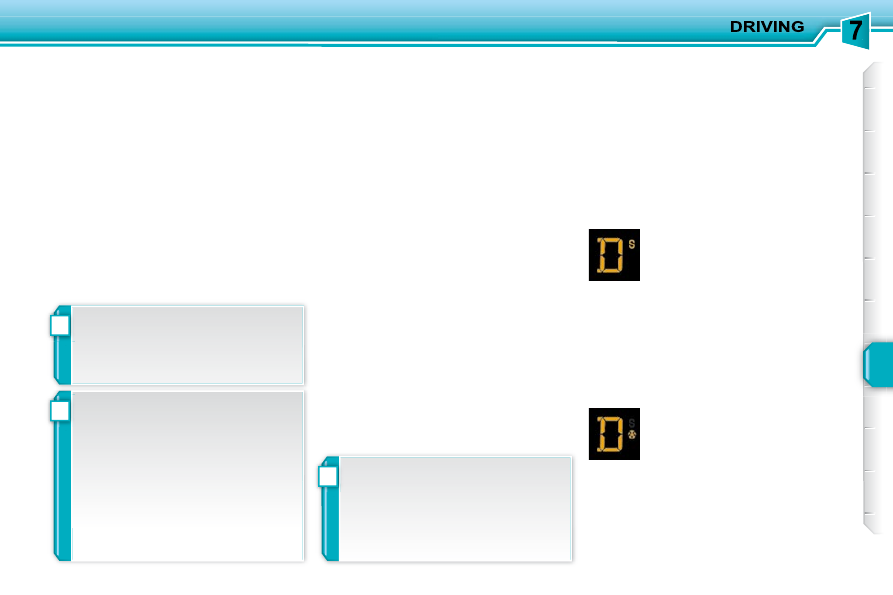
      Select  position   D   for   automatic  

changing of the four gears.  

     appears  on  the  instrument 

panel.   

  Snow programme "  " 
      Press  button  "  ",  after  starting  the 

engine.  

 The  gearbox  adapts  to  driving  on  slip-
pery roads. 
 This programme improves starting and 
drive when traction is poor. 

  S   appears  on  the  instrument 
panel.  

  Sport programme "S" 
      Press  button   "S" ,  after  starting  the 

engine.  

 The  gearbox  automatically  favours  a 
dynamic style of driving. 

 Never  select  position   N   while  the 
vehicle is moving. 
 Never  select  positions   P   or   R   un-
less  the  vehicle  is  completely  sta-
tionary.  

 When the engine is running at idle, 
with the brakes released, if position 
 R ,   D   or   M   is  selected,  the  vehicle 
moves  even  without  the  accelera-
tor being pressed. 
 When the engine is running, never 
leave  children  in  the  vehicle  with-
out supervision. 
 When carrying out maintenance with 
the  engine  running,  apply  the  par-
king brake and select position  P .  

  Sport and snow programmes 

 These two special programmes supple-
ment  the  automatic  operation  in  very 

specifi c conditions of use. 

  Return to automatic operation 

      At any time, press the button selec-

ted again to quit the programme en-
gaged  and  return  to  auto-adaptive 
mode.   

!

i

118

  Stopping the vehicle 

 Before  switching  off  the  engine,  you 
can engage position  P  or  N  to place the 
gearbox in neutral. 
 In  both  cases,  apply  the  parking  brake 
to immobilise the vehicle. 

  Operating fault 

 When  the  ignition  is  on,  the 
lighting  of  this  warning  lamp, 
accompanied by an audible sig-
nal and a message on the mul-

tifunction  screen,  indicates  a  gearbox 
malfunction. 
 In  this  case,  the  gearbox  switches  to 
back-up mode and is locked in 3rd gear. 
You may feel a substantial knock when 
changing from  P  to  R  and from  N  to  R . 
This  will  not  cause  any  damage  to  the 
gearbox. 
 Do not exceed 60 mph (100 km/h), local 
speed restrictions permitting. 
 Contact a PEUGEOT dealer as soon as 
possible. 

 There  is  a  risk  of  damage  to  the 
gearbox: 
   -  

if you press the accelerator and 
brake pedals at the same time, 

  -  

if  you  force  the  movement  of 
the gear lever from the  P  posi-
tion  to  another  position  when 

the battery is fl at.  

 To  reduce  fuel  consumption  when 
at  a  prolonged  standstill  with  the 

engine  running  (traffi c  jam...),  put 

the gear lever in the  N  position and 
apply the parking brake.  

  Manual operation 

      Select  position   M   for   sequential  

changing of the four gears. 

     Push the lever towards the  +  sign to 

change up a gear. 

     Pull  the  lever  towards  the   -   sign  to 

change down a gear.  

  D   disappears  and  the  gears 
engaged  appear  in  succes-
sion on the instrument panel. 
 In  the  event  of  the  engine  la-
bouring  or  over-revving,  the 

gear  selected  fl ashes  for  a  few  sec-

onds,  then  the  actual  gear  engaged  is 
displayed. 
 It is possible to change from position  D  
(automatic)  to  position   M   (manual)  at 
any time. 
 When  the  vehicle  is  stationary  or mov-
ing  very  slowly,  the  gearbox  selects 
gear  M1  automatically. 
 The sport and snow programmes do not 
operate in manual mode. 

 If  the  lever  is  not  in  position   P , 
when  the  driver's  door  is  opened 
or  approximately  45  seconds  after 
the ignition is switched off, a mes-
sage  appears  in  the  multifunction 
screen. 
      Return  the  lever  to  position   P ; 

the message disappears.   

 It  is  only  possible  to  change  from  one 
gear to another if the vehicle speed and 
engine  speed  permit;  otherwise,  the 
gearbox  will  operate  temporarily  in  au-
tomatic mode. 

  Invalid value during manual 
operation 

 This symbol is displayed if a gear 
is not engaged correctly (selec-
tor between two positions).   

i

119

SPEED LIMITER 

 System which prevents the vehicle from 
exceeding  the  speed  programmed  by 
the driver. 
 When  the  programmed  speed  limit  is 
reached, pressing the accelerator pedal 
no longer has any effect. 
 The speed limiter is  switched on  man-
ually:  it  requires  a  programmed  speed 
of at least 20 mph (30 km/h). 
 The  speed  limiter  is   switched  off   by 
manual operation of the control. 
 The  programmed  speed  can  be  ex-
ceeded temporarily by pressing the ac-

celerator fi rmly. 
 To  return  to  the  programmed  speed, 
simply slow down to a speed below the 
programmed speed. 
 The programmed speed remains in the 
memory when the ignition is switched off. 

 The controls of this system are grouped 
together on stalk  A . 
   1.   Speed limiter mode selection dial 
  2.   Value decrease button 
  3.   Value increase button 
  4.   Speed limiter on/off button   

 The  programmed  information  is  grouped 
together on the instrument panel screen. 
 5.  Speed limiter on/off indication 
 6.  Speed limiter mode selection indication 
 7.  Programmed speed value  

  Steering mounted controls 

  Displays on the instrument panel 

 The  speed  limiter  cannot,  in  any 
circumstances,  replace  the  need 
to  respect  speed  limits,  nor  can  it 
replace  the  need  for  vigilance  and 
responsibility  on  the  part  of  the 
driver. 

!

120

 On a steep descent, the speed lim-
iter  will  not  be  able  to  prevent  the 
vehicle  from  exceeding  the  pro-
grammed speed. 
 To avoid any risk of jamming of the 

pedals: 
   -  

ensure  that  the  mat  is  posi-
tioned correctly, 

  -   do not fi t one mat on top of an-

other.   

  Programming 

      Turn dial  1  to the  "LIMIT"  position: 

the speed limiter mode is selected 
but is not switched on (OFF).  

  Exceeding the programmed speed 

 Pressing  the  accelerator  pedal  to  exceed  the  programmed 
speed  will  not  have  any  effect  unless  you  press  the  pedal 
 

fi rmly  past the  point of resistance . 
 The  speed  limiter  is  deactivated  temporarily  and  the  pro-

grammed speed, which is still displayed, fl ashes. 
 Returning to the programmed speed, by means of intention-
al or unintentional deceleration of the vehicle, automatically 

cancels the fl ashing of the programmed speed.  

  Return to normal driving 

      Turn dial  1  to the  "0"  position: the speed limiter mode is 

deselected. The display returns to the distance recorder.   

  Operating fault 

 In  the  event  of  a  speed  limiter  mal-
function,  the  speed  is  cleared  result-

ing in fl ashing of the dashes. Contact a 

PEUGEOT  dealer  to  have  the  system 
checked. 


You  do  not  have  to  switch  the 
speed limiter on in order to set the 
speed. 

     Switch the speed limiter on by pressing button  4 . 
     Switch the speed limiter off by pressing button  4 : the dis-

play confi rms that it has been switched off (OFF). 

     Switch  the  speed  limiter  back  on  by  pressing  button   4  

again.   

     Set the speed value by pressing button  2  or  3  (e.g.: 70 mph 

(110 km/h).  


You can then change the programmed speed using but-
tons  2  and  3 : 

   -   by + or - 1 mph (km/h) = short press, 
  -   by + or - 5 mph (km/h) = long press, 
  -   in steps of + or - 5 mph (km/h) = maintained press.  

i

121

CRUISE CONTROL 

 System  which  automatically  maintains 
the  speed  of  the  vehicle  at  the  value 
programmed  by  the  driver,  without  any 
action on the accelerator pedal. 
 The  cruise  control  is   switched  on  
manually: it requires a minimum vehicle 
speed of 25 mph (40 km/h), as well as 
the engaging of: 
   -  

fourth gear on the manual gearbox, 

  -  

second  gear  with  the  2  Tronic  or 
automatic  gearbox,  in  sequential 
mode, 

  -  

position   A   on  the  2  Tronic  gearbox 
or  D  on the automatic gearbox.  

 The cruise control is  switched off  man-
ually or by pressing the brake or clutch 
pedal  or  on  triggering  of  the  ESP  sys-
tem for safety reasons. 
 It is possible to exceed the programmed 
speed  temporarily  by  pressing  the  ac-
celerator pedal. 
 To  return  to  the  programmed  speed, 
simply release the accelerator pedal. 
 Switching  off  the  ignition  cancels  any 
programmed speed value. 

 The controls of this system are grouped 
together on stalk  A . 
   1.   Cruise control mode selection dial 
  2.   Value decrease button 
  3.   Value increase button 
  4.   Cruise control off/resume button   

 The programmed information is grouped 
together on the instrument panel screen. 
  5.   Cruise control off/resume indication 
  6.   Cruise control mode selection 

indication 

  7.   Programmed speed value  

  Steering mounted controls 

  Displays on the instrument panel 

 The  cruise  control  cannot,  in  any 
circumstances,  replace  the  need 
to  respect  speed  limits,  nor  can  it 
replace the need for vigilance and 
responsibility  on  the  part  of  the 
driver. 
 You  are  advised  to  keep  your  feet 
near the pedals at all times. 

!

122

 When the cruise control is switched 
on,  be  careful  if  you  maintain  the 
pressure on one of the programmed 
speed  changing  buttons:  this  may 
result in a very rapid change in the 
speed of your vehicle. 
 Do  not  use  the  cruise  control  on 

slippery roads or in heavy traffi c. 
 On  a  steep  descent,  the  cruise 
control  will  not  be  able  to  prevent 
the vehicle from exceeding the pro-
grammed speed. 
 To avoid any risk of jamming of the 

pedals: 
   -  

ensure  that  the  mat  is  posi-
tioned correctly, 

  -   never fi t one mat on top of an-

other.   

  Programming 

      Turn  dial   1   to  the   "CRUISE"   po-

sition:  the  cruise  control  mode  is 
selected  but  is  not  switched  on 
(OFF). 

  Exceeding the programmed speed 

 Intentional  or  unintentional  exceeding  of  the  programmed 

speed results in fl ashing of this speed on the display. 
 Return to the programmed speed, by means of intentional or 
unintentional deceleration of the vehicle, automatically can-

cels the fl ashing of the speed.  

  Return to normal driving 

      Turn dial  1  to the  "0"  position: the cruise control mode is 

deselected. The display returns to the distance recorder.   

  Operating fault 

 In  the  event  of  a  cruise  control  mal-
function,  the  speed  is  cleared  result-

ing in fl ashing of the dashes. Contact a 

PEUGEOT  dealer  to  have  the  system 
checked. 

     Set the programmed speed by ac-

celerating  to  the  required  speed, 
then  press  button   2   or   3   (e.g.: 
70 mph (110 km/h)).  

      Switch  off  the  cruise  control  by  pressing  button   4 :  the 

display confi rms that it has been switched off (OFF). 

     Switch  the  cruise  control  back  on  by  pressing  button   4  

again.   

 You can then change the programmed speed using buttons 
 2  and  3 : 
   -  

by + or - 1 mph (km/h) = short press, 

  -  

by + or - 5 mph (km/h) = long press, 

  -  

in steps of + or - 5 mph (km/h) = maintained press.  

i

i

123

VISUAL AND AUDIBLE 
PARKING SENSORS 

 System consisting of four proximity sen-
sors, installed in the rear bumper. 

 It detects any obstacle (person, vehicle, 
tree, barrier...) located behind the vehi-
cle, however, it will not be able to detect 
obstacles  located  immediately  below 
the bumper. 

 The  parking  sensors  are   switched  on  
by engaging reverse gear. 
 This is accompanied by an audible signal. 

  *   According to version.  

 An object, such as a stake, a road-

works  cone  or  any  other  similar 

object may be detected at the start 

of the manoeuvre but may no lon-
ger  be  detected  when  the  vehicle 
moves nearer to it. 

 When the distance between the rear of 
the vehicle and the obstacle is less than 
approximately  thirty  centimetres,  the 
audible signal becomes continuous and 
the "Danger" symbol appears, depend-
ing on the multifunction screen version. 
 The  parking  sensors  are   switched  off  
by moving the gear lever to neutral. 

 The parking sensor system cannot, 
in  any  circumstances,  replace  the 
need for vigilance and responsibility 
on the part of the driver. 

 The proximity information is indicated by: 
   -  

an  audible  signal  which  becomes 
more rapid as the vehicle approaches 
the obstacle, 

  -  

a  diagram  on  the  multifunction 
screen * ,  with  blocks  which  move 
closer to the vehicle.  

i

i

i

124

   Deactivation/Activation of the rear 
parking sensors 

  Operating fault 

  In bad weather or in winter, ensure 
that  the  sensors  are  not  covered 
with  mud,  ice  or  snow.  When  re-
verse gear is engaged, an audible 
signal  (long  bleep)  indicates  that 
the sensors may be dirty. 
 When  the  vehicle  is  moving  at  a 
speed below 6 mph (10 km/h), cer-
tain  sound  sources  (motorcycle, 
lorry,  pneumatic  drill,  etc.)  may  trig-
ger the audible signals of the parking 
sensor system.   

 If  an  operating  fault  occurs, 
when  reverse  gear  is  engaged 
this  warning  lamp  is  displayed 
on  the  instrument  panel  and/or 

a message appears on the screen, ac-
companied  by  an  audible  signal  (short 
bleep). 
 Consult a PEUGEOT dealer. 

 The status of the function is stored 
when the ignition is switched off. 
 For further details about the access 
to the parking sensors menu, refer 

to the vehicle confi guration section 

corresponding to your multifunction 
screen.   

   The function will be deactivated au-
tomatically if a trailer is being towed 

or a bicycle carrier is fi tted (vehicle 

fi tted with a towbar or bicycle car-

rier recommended by PEUGEOT.   

 The function is deactivated 
or  activated  via  the  multi-

function  screen  confi gura-

tion menu. 

i

126

BONNET 

 Protects  the  components  of  the  engine 
and provides access for checking levels. 

     Push  the  exterior  safety  catch   B   to 

the left and raise the bonnet. 

     Unclip the stay  C  from its housing. 
     Fix the stay in one of the two notch-

es to hold the bonnet open.   

  Closing 

      Take  the  stay  out  of  the  support 

notch. 

     Clip the stay in its housing. 
     Lower  the  bonnet  and  release  it  at 

the end of its travel. 

     Pull on the bonnet to check that it is 

secured correctly.  

RUNNING OUT OF FUEL 
(DIESEL) 

 If your vehicle is fi tted with an HDI en-

gine, the fuel system must be primed if 
you  run  out  of  fuel  (refer  to  the  corre-
sponding image). 
 If  the  engine  does  not  start  fi rst  time, 

don't keep trying. 
 Operate  the  priming  pump  again,  then 
the starter motor. 

  Opening 

      Open the front left door. 
     Pull  the  interior  release  lever   A , 

located  at  the  bottom  of  the  door 
frame. 

 The  location  of  the  interior  control 
prevents  opening  of  the  bonnet 
while the front left door is closed. 
 When the engine is hot, handle the 
exterior  safety  catch  and  bonnet 
stay with care (risk of burns).  

  1.4 litre Turbo HDI engine 

   

   Fill the fuel tank with at least fi ve litres 

of diesel. 

     Open the bonnet. 
     Operate  the  priming  pump  until  it 

hardens (it may be hard on the fi rst 

press). 

     Operate  the  starter  until  the  engine 

starts. 

     Close the bonnet.   

  1.6 litre Turbo HDI 16V engine 

   

   Fill the fuel tank with at least fi ve litres 

of diesel. 

     Open the bonnet. 
     Operate  the  priming  pump  until  it 

hardens (it may be hard at the fi rst 

press). 

     Operate  the  starter  until  the  engine 

starts. 

     Close the bonnet.   

127

PETROL ENGINES 

 The caps and covers provide access for checking the levels of the various fl uids and to replace certain components. 

   1.   Coolant reservoir. 
  2.

   Passenger compartment fi lter. 

  3.   Screenwash  and  headlamp  wash 

reservoir. 

  4.

   Air fi lter. 

  5.

   Brake fl uid reservoir. 

  6.   Fusebox. 

  7.   Battery. 
  8.   Engine oil dipstick. 
  9.

   Engine oil fi ller cap.  

128

DIESEL ENGINES 

 The caps and covers provide access for checking the levels of the various fl uids, to replace certain components and to rep-

rime the fuel. 

   1.   Coolant reservoir. 
  2.

   Passenger compartment fi lter. 

  3.   Screenwash  and  headlamp  wash 

reservoir. 

  4.   Priming pump. 
  5.

   Brake fl uid reservoir. 

  6.   Fusebox. 

  7.   Battery. 
  8.   Engine oil dipstick. 
  9.

   Engine oil fi ller cap. 

  10.

  Air fi lter.  

129

CHECKING LEVELS 

 Check  all  of  these  levels  regularly  and 
top them up if necessary, unless other-
wise indicated. 
 If  a  level  drops  signifi cantly,  have  the 

corresponding  system  checked  by  a 
PEUGEOT dealer. 
 Take care when working under the bon-
net, as some parts of the engine can be 
extremely hot (risk of burns). 

  Brake fluid level 

 To  avoid  any  risk  of  scalding,  unscrew 
the cap by two turns to allow the pres-
sure  to  drop.  When  the  pressure  has 
dropped,  remove  the  cap  and  top  up 
the level. 

  Oil level 

 The reading will only be correct 
if the vehicle is on level ground 
and the engine has been off for 
more than 15 minutes. 

 The  check  is  carried  out  either  when 
the ignition is switched on using the oil 
level indicator on the instrument panel, 
or using the dipstick. 

 The brake fl uid level should be 

close to the "MAX" mark. If it is 
not, check the brake pad wear. 

  Changing the brake fl uid 
 Refer to the Warranty and Maintenance 
Record for details of the interval for this 
operation.  

  Coolant level 

 The coolant level should be close 
to  the  "MAX"  mark  but  should 
never exceed it. 
 When  the  engine  is  warm,  the 

temperature of the coolant is regulated by 
the fan. This can operate with the ignition 
off. 
  

On vehicles which are fi tted with a par-

ticle emission fi lter, the fan may oper-

ate after the vehicle has been switched 

off, even if the engine is cold.  
 In  addition,  as  the  cooling  system  is 
pressurised,  wait  at  least  one  hour  after 
switching  off  the  engine  before  carrying 
out any work. 

  Screenwash and headlamp 
wash *  fluid 

 The minimum level of this fl uid 

is  indicated  by  an  audible  sig-
nal and a message on the mul-
tifunction screen. 

 Top up the level when you stop the vehicle. 

  *   According to country.  

  Changing the engine oil 
 Refer to the Warranty and Maintenance 
Record for details of the interval for this 
operation. 
 In order to maintain the reliability of the 
engine  and  emission  control  system, 
the use of additives in the engine oil is 
prohibited.  

  Oil specifi cation 
 The oil must correspond to your engine 
and  conform  to  the  manufacturer's 
recommendations.   

  Fluid specifi cation 

 The  brake  fl uid  must  conform  to  the 

manufacturer's  recommendations  and 

fulfi l the DOT4 standards.   

  Changing the coolant 
 The  coolant  does  not  have  to  be 
changed.  

  Fluid specifi cation 
 The coolant must conform to the manu-
facturer's recommendations.   

  Fluid specifi cation 
 To  guarantee  optimum  cleaning  and 
avoid  freezing,  plain  water  should  not 

be used to top up or replace this fl uid.   

!

i

130

 Avoid  any  prolonged  contact  of 

used oil or fl uids with the skin. 

 Most of these fl uids are harmful to 

health or indeed very corrosive. 

 Do  not  discard  used  oil  or  fl uids 

into sewers or onto the ground. 
 Take  used  oil  to  an  authorised 
waste disposal site or a PEUGEOT 
dealer.  

  Diesel additive level (Diesel with 
particle emission filter) 

 The minimum level of this additive is in-
dicated by lighting of the service warning 
lamp,  accompanied  by  an  audible  sig-
nal and a message on the multifunction 
screen. 

  Used products 

 Unless 

otherwise 

indicated, 

check 

these  components  in  accordance  with 
the Warranty and Maintenance Record 
and in relation to your engine. 
 Otherwise,  have  them  checked  by  a 
PEUGEOT dealer. 

  Battery 

 The  battery  does  not  require 
any maintenance. 
  However,  check  that  the  ter-

minals  are  clean  and  correctly 
tightened, particularly in summer 
and winter. 

 When carrying out work on the battery, 
refer to the "Practical information" sec-
tion for details of the precautions to be 
taken  before  disconnecting  the  battery 
and following its reconnection.  

  Air filter and passenger 

compartment filter 

 Refer  to  the  Warranty  and 
Maintenance  Record  for  de-
tails  of  the  replacement  inter-
vals for these components. 
 Depending  on  the  environ-

ment (dusty atmosphere...) and the use 
of  the  vehicle  (city  driving...),   replace 
them twice as often if necessary
 . 
 A clogged passenger compartment fi lter 

may have an adverse effect on the per-
formance of the air conditioning system 
and generate undesirable odours.  

  Particle emission filter (Diesel) 

 It is imperative that the maintenance of 

the particle emission fi lter is carried out 

by a PEUGEOT dealer. 

  Oil filter 

 Replace the oil fi lter each time 

the engine oil is changed. 
 Refer  to  the  Warranty  and 
Maintenance  Record  for  de-
tails  of  the  replacement  inter-
val for this component.  

 Following  prolonged  operation  of 
the vehicle at very low speed or at 
idle, you may, exceptionally, notice 
the emission of water vapour at the 
exhaust on acceleration. This does 
not have any adverse effect on the 
performance  of  the  vehicle  or  on 
the environment.  

  Topping up 
 This  additive  must  be  topped  up  by  a 
PEUGEOT dealer without delay.   

!

i

130

 Avoid  any  prolonged  contact  of 

used oil or fl uids with the skin. 

 Most of these fl uids are harmful to 

health or indeed very corrosive. 

 Do  not  discard  used  oil  or  fl uids 

into sewers or onto the ground. 
 Take  used  oil  to  an  authorised 
waste disposal site or a PEUGEOT 
dealer.  

  Diesel additive level (Diesel with 
particle emission filter) 

 The minimum level of this additive is in-
dicated by lighting of the service warning 
lamp,  accompanied  by  an  audible  sig-
nal and a message on the multifunction 
screen. 

  Used products 

 Unless 

otherwise 

indicated, 

check 

these  components  in  accordance  with 
the Warranty and Maintenance Record 
and in relation to your engine. 
 Otherwise,  have  them  checked  by  a 
PEUGEOT dealer. 

  Battery 

 The  battery  does  not  require 
any maintenance. 
  However,  check  that  the  ter-

minals  are  clean  and  correctly 
tightened, particularly in summer 
and winter. 

 When carrying out work on the battery, 
refer to the "Practical information" sec-
tion for details of the precautions to be 
taken  before  disconnecting  the  battery 
and following its reconnection.  

  Air filter and passenger 

compartment filter 

 Refer  to  the  Warranty  and 
Maintenance  Record  for  de-
tails  of  the  replacement  inter-
vals for these components. 
 Depending  on  the  environ-

ment (dusty atmosphere...) and the use 
of  the  vehicle  (city  driving...),   replace 
them twice as often if necessary
 . 
 A clogged passenger compartment fi lter 

may have an adverse effect on the per-
formance of the air conditioning system 
and generate undesirable odours.  

  Particle emission filter (Diesel) 

 It is imperative that the maintenance of 

the particle emission fi lter is carried out 

by a PEUGEOT dealer. 

  Oil filter 

 Replace the oil fi lter each time 

the engine oil is changed. 
 Refer  to  the  Warranty  and 
Maintenance  Record  for  de-
tails  of  the  replacement  inter-
val for this component.  

 Following  prolonged  operation  of 
the vehicle at very low speed or at 
idle, you may, exceptionally, notice 
the emission of water vapour at the 
exhaust on acceleration. This does 
not have any adverse effect on the 
performance  of  the  vehicle  or  on 
the environment.  

  Topping up 
 This  additive  must  be  topped  up  by  a 
PEUGEOT dealer without delay.   

!

131

 Only use products recommended by 
PEUGEOT or products of equivalent 

quality and specifi cations. 
 In  order  to  optimise  the  operation 
of units as important as the braking 
system,  PEUGEOT  selects  and  of-

fers very specifi c products. 
 To  avoid  damaging  the  electrical 
units,  the  use  of  a  high  pressure 
washer in the engine compartment 
is strictly  prohibited .  

  2 Tronic gearbox 

 The  gearbox  does  not  re-
quire any maintenance (no oil 
change). 
  Refer  to  the  Warranty  and 
Maintenance  Record  for  de-
tails  of  the  level  checking  in-
tervals for this component.  

  Brake disc and drum wear 

 For  any  information  relating 
to  checking  of  the  brake  disc 
and/or  drum  wear,  contact  a 
PEUGEOT dealer.  

  Manual gearbox 

 The  gearbox  does  not  re-
quire any maintenance (no oil 
change). 
  Refer  to  the  Warranty  and 
Maintenance  Record  for  de-
tails  of  the  level  checking  in-
tervals for this component.  

  Brake pads 

 Brake  wear  depends  on  the 
style  of  driving,  particularly  in 
the  case  of  vehicles  used  in 
town,  over  short  distances.  It 
may be necessary to have the 

condition  of  the  brakes  checked,  even 
between vehicle services. 
 Unless  there  is  a  leak  on  the  circuit,  a 

drop  in  the  brake  fl uid  level  indicates 

that the brake pads are worn.  

  Parking brake 

 If  the  parking  brake  travel  is 
too long or if you notice a loss 
of  effectiveness  of  this  sys-
tem,  the  parking  brake  must 
be  adjusted,  even  between 
two services. 

 This  system  must  be  checked  by  a 
PEUGEOT dealer. 

  Automatic gearbox 

 The  gearbox  does  not  re-
quire any maintenance (no oil 
change). 
  Refer  to  the  Warranty  and 
Maintenance  Record  for  de-
tails  of  the  checking  intervals 
for this component.  

i

132

  This  repair  kit  is  available  from 
PEUGEOT dealers. 
 It is designed to repair most punc-
tures which could affect the tyre, lo-
cated on the tyre tread or shoulder. 
Avoid removing any foreign bodies 
which have penetrated the tyre.   

TEMPORARY PUNCTURE 
REPAIR KIT 

 Complete  system  consisting  of  a  com-
pressor  and  an  incorporated  sealant 
cartridge  which  permits   temporary  re-
pair
  of the tyre so that you can drive to 
the nearest garage. 

  Using the kit 

 This procedure, comprising several steps, 
must be carried out in full. 
      Switch off the ignition. 
     Turn the selector  A  to the "SEALANT" 

position. 

     Check  that  the  switch   B   is  in  posi-

tion  "0" . 

     Connect  the  white  pipe   C   to  the 

valve of the tyre to be repaired. 

     Connect  the  compressor's  electric 

plug to the vehicle's 12 V socket. 

  

   Affi x  the  speed  limitation  sticker  to 

the  vehicle's  steering  wheel  to  re-
mind  you  that  a  wheel  is  in  tempo-
rary use. 

     Start the vehicle and leave the engine 

running. 

  Access to the kit 


Content   ..  6  7  8  9   ..