Peugeot 207 Dag (2010 year). Manual - part 7
 

  Index      Peugeot     Peugeot 207 Dag - service manual 2010 year in english


Search            


Content   ..  5  6  7  8   ..


Peugeot 207 Dag (2010 year). Manual - part 7


!

!

i

i

SAFETY

101

TYRE UNDER-INFLATION 
DETECTION 

 System which automatically checks the 
pressure of the tyres while driving. 

 All repairs and changing of tyres on 

a wheel fi tted with this system must 

be  carried  out  by  a  PEUGEOT 
dealer. 
 If,  when  changing  a  tyre,  you  in-
stall a wheel which is not detected 

by  your  vehicle  (example:  fi tting 

of snow tyres), you must have the 
system reinitialised by a PEUGEOT 
dealer. 

 This  system  does  not  eliminate 
the  need  to  have  the  tyre  pres-
sure  checked  regularly  (refer  to 
the  "Technical  information  -  Identi-

fi cation markings" page) to ensure 

that  the  optimum  dynamic  perfor-
mance of the vehicle is maintained 
and prevent premature wear of the 
tyres,  particularly  in  arduous  driv-
ing  conditions  (heavy  load,  high 
speed). 
 The tyre pressures must be checked 
cold,  at  least  once  a  month.  Re-
member  to  check  the  pressure  of 
the spare wheel. 
 The  tyre  under-infl ation  detection 

system may experience temporary 
interference  due  to  electro-mag-
netic  signals  on  a  frequency  close 
to that used by the system.   

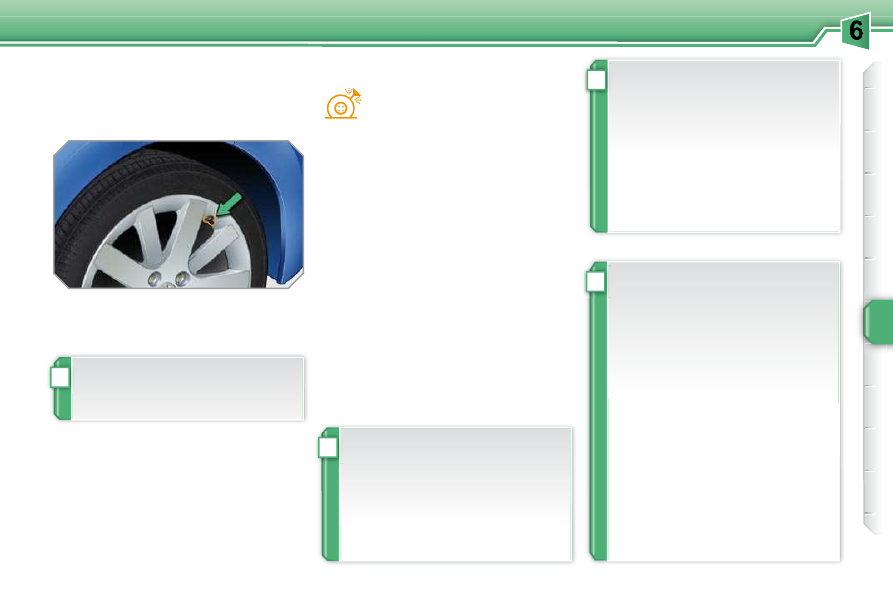
 Sensors  fi tted  in  each  valve  trigger  a 

warning  in  the  event  of  malfunction. 
The  speed  has  to  be  above  12  mph 
(20 km/h). 

  Flat tyre 
 A  message  appears  on  the  multifunc-
tion screen, accompanied by an audible 
signal, to locate the wheel concerned. 
      Check  the  tyre  pressures  as  soon 

as possible.  

 This  check  must  be  carried  out  when 
the tyres are cold.  

 This warning lamp and the  STOP  
warning lamp come on on the in-
strument panel, accompanied by 
an audible signal and a message 
on the multifunction screen locat-
ing the wheel concerned. 

      Stop immediately, avoiding any sud-

den movement of the steering wheel 
and the brakes. 

     Change the damaged wheel (punc-

tured  or  very  defl ated  tyre),  and 

have  the  tyre  pressure  checked  as 
soon as possible.   

  Puncture 

 The  tyre  under-infl ation  detection 

system is an aid to driving which does 
not replace the need for the driver to 
be vigilant or to drive responsibly.  

  Sensor(s) not detected or faulty 
 A  message  appears  on  the  multifunc-
tion screen, accompanied by an audible 
signal,  to  locate  the  wheel  or  wheels 
which are not detected or to indicate a 
fault in the system. 
 Contact a PEUGEOT dealer to replace 
the faulty sensor(s). 

 This  message  is  also  displayed 
when  one  of  the  wheels  is  away 
from the vehicle (being repaired) or 
when one or more wheels without a 

sensor are fi tted. 

 The  spare  wheel  is  not  fi tted  with 

a sensor. 

!

i

!

SAFETY

102

BRAKING ASSISTANCE 
SYSTEMS *  

 Group of supplementary systems which 
help  you  to  obtain  optimum  braking  in 
complete safety in emergency situations: 
   -  

anti-lock braking system (ABS), 

  -  

electronic  brake  force  distribution 
(EBFD), 

  -  

emergency braking assistance (EBA).  

  Anti-lock braking system 
and electronic brake force 
distribution 

 Linked systems which improve the sta-
bility  and  manoeuvrability  of  your  vehi-
cle  when  braking,  in  particular  on  poor 
or slippery surfaces. 

 When  braking  in  an  emergency, 

press very fi rmly without releasing 

the pressure.  

 When  replacing  wheels  (tyres  and 
rims),  ensure  that  they  conform  to 
the manufacturer's recommendations.   

  Operating fault 

 If this warning lamp comes on, 
accompanied by an audible sig-
nal and a message on the mul-
tifunction  screen,  it  indicates  a 

malfunction of the anti-lock braking sys-
tem which could result in loss of control 
of the vehicle when braking. 

 If this warning lamp comes on, 
together  with  the   STOP   and 
 ABS  warning lamps, accompa-
nied by an audible signal and a 

message on the multifunction screen, it 
indicates a malfunction of the electron-
ic  brake  force  distribution  which  could 
result  in  loss  of  control  of  the  vehicle 
when braking. 
  You    must    stop  as  soon  as  it  is  safe 
to do so.
  

          Emergency braking assistance 

 System  which,  in  an  emergency,  en-
ables you to obtain the optimum braking 
pressure  more  quickly,  thus  reducing 
the stopping distance. 

  Activation 
 The  anti-lock  braking  system  comes 
into operation automatically when there 
is a risk of wheel lock. 
 Normal operation of the ABS may make 
itself felt by slight vibration of the brake 
pedal. 

  Activation 
 It is triggered by the speed at which the 
brake pedal is pressed. 
 The  effect  of  this  is  a  reduction  in  the 
resistance of the pedal and an increase 

in braking effi ciency. 

  *   According to country.  

 In  either  case,  contact  a  PEUGEOT 
dealer. 

 When  braking  in  an  emergency, 

press  fi rmly  without  releasing  the 

pressure.   

!

SAFETY

103

  The  ESP/ASR  systems  offer  ex-
ceptional  safety  in  normal  driving, 
but  this  should  not  encourage  the 
driver to take extra risks or drive at 
high speed. 
 The  correct  functioning  of  these 
systems  depends  on  observation 
of  the  manufacturer's  recommen-
dations regarding the wheels (tyres 
and rims), the braking components, 
the electronic components and the 
PEUGEOT  assembly  and  opera-
tion procedures. 
 After  an  impact,  have  these  sys-
tems  checked  by  a  PEUGEOT 
dealer.   

   Deactivation 
 In  exceptional  conditions  (starting  a 
vehicle  which  is  bogged  down,  stuck 
in  snow,  on  soft  ground,  ...),  it  may  be 
advisable  to  disarm  the ASR  and  ESP 
systems,  so  that  the  wheels  can  move 
freely and regain grip. 

      Press the  "ESP OFF"  button, locat-

ed in the centre of the dashboard.  

  If this warning lamp comes on on 
the instrument panel and the indi-
cator  lamp  on  the  button  comes 
on, this indicates that the ASR and 
ESP systems are deactivated.  

  Reactivation 
 These systems are reactivated automat-
ically each time the ignition is switched 

back on or from 30 mph (50 km/h). 
      Press the  "ESP OFF"  button again 

to reactivate them manually.   

  Operating fault 

  If this warning lamp comes on, ac-
companied  by  an  audible  signal 
and a message on the multifunction 
screen, this indicates a malfunction 
of these systems. 

 Have them checked by a PEUGEOT dealer.   

TRAJECTORY CONTROL 
SYSTEMS 

  Activation 
 These systems are activated automati-
cally each time the vehicle is started. 

  Anti-skid regulation (ASR) and 
electronic stability programme 
(ESP) 

 They  come  into  operation  in 
the event of a grip or trajectory 
problem. 
 This is indicated by fl ashing of 

this warning lamp on the instru-
ment panel.   

  Steering/ESP coupling system 
(SSP) 

  The anti-skid regulation (also known as 
Traction  Control)  optimises  traction  to 
prevent skidding of the wheels, by act-
ing on the brakes of the driving wheels 
and on the engine. 
 The electronic stability programme acts 
on the brake of one or more wheels and 
on the engine to keep the vehicle on the 
trajectory  required  by  the  driver,  within 
the limits of the laws of physics.  

  This  system  optimises  the  stability  of 
the  vehicle  and  its  braking  capacity  by 
combining  the  actions  of  the  ESP  and 
electric power steering when braking on 
surfaces on which the grip of the right-
hand and left-hand wheel differs. 
 It  permits  increased  braking  of  the 
wheels  which  are  in  contact  with  the 
section of road offering the higher level 
of grip and, anticipating the instability of 
the  vehicle,  the  application  of  a  slight 
correction  to  the  turning  angle  of  the 
wheels  to assist the  driver in maintain-
ing his trajectory.    

SAFETY

SEAT BELTS 

  Height adjustment 

  Seat belt not fastened/unfastened 
warning lamp on the instrument 
panel 

  Fastening 

      Pull the strap, then insert the tongue 

in the buckle. 

     Check that the seat belt is fastened 

correctly by pulling the strap.   

      To lower the attachment point, squeeze 

control  A  and slide it downwards. 

     To  raise  the  attachment  point,  slide 

control  A  upwards.   

 When the ignition is switched on, 
this  warning  lamp  comes  on  on 
the  instrument  panel  if  the  driver 
has not fastened their seat belt. 

 Above  approximately  12  mph  (20  km/h) 
and  for  two  minutes,  this  warning  lamp 

fl ashes  accompanied  by  an  audible  signal 

of increasing volume. When the two minutes 
have elapsed, this warning lamp remains on 
until the driver fastens their seat belt. 
 This  warning  lamp  comes  on  on  the  in-
strument panel if one or more passengers 
unbuckle their seat belt.  

  Unfastening 
      Press the red button on the buckle.   

  Front seat belts 

 The front seat belts are fi tted with a pre-

tensioning and force limiting system. 
 This system improves safety in the front 
seats in the event of front impacts. De-
pending  on  the  severity  of  the  impact, 
the pretensioning system instantly tight-
ens  the  seat  belts  against  the  body  of 
the occupants. 
 The pretensioning seat belts are active 
when the ignition is on. 
 The  force  limiter  reduces  the  pressure 
of the seat belt on the chest of the oc-
cupant, increasing his protection. 
 On  the  5-door  versions,  a  slider,  fi tted 

on  the  seat  belt,  makes  it  possible  to 
support the buckle as close as possible 
to the upper mounting. 

SAFETY

105

   1.   Front left seat belt warning lamp. 
  2.   Front right seat belt warning lamp. 
  3.   Rear left seat belt warning lamp. 
  4.   Rear centre seat belt warning lamp . 
  5.   Rear right seat belt warning lamp.  
 On the central panel, the corresponding 
warning lamp  1  or  2  comes on in red if 
the seat belt is not fastened or is unfas-
tened. 
 When the engine is running, the corre-
sponding warning lamp  1  or   comes on 
in red, accompanied by an audible sig-
nal and a message on the multifunction 
screen,  if  a  front  occupant  has  unfas-
tened their seat belt.   

  Seat belt not fastened/unfastened 
warning lamp panel 

  Rear seat belts 

 The  rear  seats  are  fi tted  with  three, 

three point, inertia reel seat belts. 

  Seat belt unfastened warning lamp 
panel 

 When  the  ignition  is  switched  on,  the 
corresponding warning lamps  3, 4  and  5  

come on for approximately 30 seconds 

in red if the seat belt is not fastened. 
 When the engine is running, the corre-
sponding warning lamp  3, 4  or  5  comes 
on  in  red,  accompanied  by  an  audible 
signal and a message on the multifunc-
tion  screen,  if  a  rear  passenger  has 
unfastened their seat belt.   

  Fastening 
      Pull the strap, then insert the tongue 

in the buckle. 

     Check that the seat belt is fastened 

correctly by pulling the strap.   

  Unfastening 
      Press the red button on the buckle.   

i

SAFETY

106

      The  driver  must  ensure  that  the 
passengers  use  the  seat  belts  cor-
rectly  and  that  they  are  all  properly 
restrained before setting off. 
 Wherever  you  are  seated  in  the  ve-
hicle,  always  fasten  your  seat  belt, 
even for short journeys. 
 Do not invert the seat belt buckles as 

they will not fulfi l their role fully. 
 If  the  seats  have  armrests * ,  the  lap 
part of the seat belt must always pass 
under the armrest. 
 The seat belts are fi tted with an inertia 

reel  permitting  automatic  adjustment 
of the length of the strap to your size. 
The  seat  belt  is  stored  automatically 
when not in use. 
 Before and after use, ensure that the 
seat belt is reeled in correctly. 
 The  lower  part  of  the  strap  must  be 
positioned  as  low  as  possible  on  the 
pelvis. 
 The upper part must be positioned in 
the hollow of the shoulder. 
 The inertia reels are fi tted with an au-

tomatic  locking  device  which  comes 
into  operation  in  the  event  of  a  colli-
sion,  on  emergency  braking  or  if  the 
vehicle rolls over. You can release the 
device by pulling rapidly on the strap 
and releasing it. 

  *   According to model.  

 In order to be effective, a seat belt: 
   -  

must be tightened as close to the 
body as possible, 

  -  

must restrain one adult only, 

  -  

must not bear any trace of cuts or 
fraying, 

  -  

must be pulled in front of you with 
a  smooth  movement,  checking 
that it does not twist, 

  -   must not be transformed or modifi ed 

to avoid altering its performance.  

 In accordance with current safety reg-
ulations,  all  repairs  and  checks  must 
be carried out by a PEUGEOT dealer 
who guarantees that the work is car-
ried out correctly. 
 Have  your  seat  belts  checked  regu-
larly by a PEUGEOT dealer and par-
ticularly  if  the  straps  show  signs  of 
damage. 
 Clean the seat belt straps with soapy 
water  or  a  textile  cleaning  product, 
sold by PEUGEOT dealers. 
 After folding or moving a seat or rear 
bench seat, ensure that the seat belt 
is positioned and rolled up correctly.  

  Recommendations for children: 
   -  

use a suitable child seat if the pas-
senger is less than 12 years old or 

shorter than one metre fi fty, 

  -  

do not use the strap-guide *  when 
a child seat is installed. 

  -  

never  use  the  same  seat  belt  to 
secure more than one person, 

  -  

never  allow  a  child  to  travel  on 
your lap.  

  Depending  on  the  nature  and 
seriousness of the impacts
 , the pre-
tensioning  device  may  be  triggered 
before  and  independently  of  the  air 
bags. Triggering of the pre-tensioners 
is  accompanied  by  a  slight  emission 
of harmless  smoke  and  a noise,  due 
to  the  activation  of  the  pyrotechnic 
cartridge incorporated in the system. 
 In all cases, the airbag warning lamp 
comes on. 
 Following  an  impact,  have  the  seat 
belts  system  checked,  and  if  neces-
sary replaced, by a PEUGEOT dealer.   

!

i

SAFETY

107

  AIRBAGS 

  The airbags do not operate 
when the ignition is switched 
off. 
 This  equipment  will  only  operate 
once.  If  a  second  impact  occurs 
(during  the  same  or  a  subsequent 
accident), the airbag will not operate.  

          Front airbags 

 System  which  protects  the  head  and 
chest of the driver and front passenger 
in the event of a front impact. 
 The  driver's  airbag  is  incorporated  in 
the  centre  of  the  steering  wheel;  the 
front passenger's airbag is incorporated 
in the dashboard above the glove box. 

  Activation 
 The airbags are triggered simultaneous-
ly,  unless  the  passenger's  front  airbag 
is deactivated, in the event of a serious 
front impact applied to all or part of the 
front impact zone  A , in the longitudinal 
centreline of the vehicle on a horizontal 
plane and directed from the front to the 
rear of the vehicle. 
 The  front  airbag  infl ates  between  the 

front  occupant  of  the  vehicle  and  the 
dashboard  to  cushion  their  forward 
movement.  

  Impact detection zones 

   A.   Front impact zone. 
  B.   Side impact zone.  

 Triggering  of  the  airbag(s)  is  ac-
companied  by  a  slight  emission  of 
harmless smoke and a noise, due to 
the activation of the pyrotechnic car-
tridge incorporated in the system. 
 This smoke is not harmful, but sen-
sitive  individuals  may  experience 
slight irritation. 
 The  noise  of  the  detonation  may 
result in a slight loss of hearing for 
a short time.   

 System designed to maximise the safety 
of the occupants (with the exception of 
the rear centre passenger) in the event 
of violent collisions. It supplements the 
action of the force-limiting seat belts. 

 If  a  collision  occurs,  the  electronic  de-
tectors record and analyse the front and 
side  impacts  sustained  in  the  impact 
detection zones: 
   -  

in the case of a serious impact, the 
airbags  are  triggered  instantly  and 
protect the occupants of the vehicle 
(with the exception of the rear centre 
passenger);  immediately  after  the 

impact,  the  airbags  defl ate  rapidly 

so  that  they  do  not  hinder  visibility 
or the exit of the occupants, 

  -  

in the case of a minor or rear impact 
or in certain roll-over conditions, the 
airbags  will  not  be  triggered;  the 

seat  belt  alone  is  suffi cient  to  pro-

vide  optimum  protection  in  these 
situations.  

!

!

SAFETY

108

 If both airbag warning lamps come 
on  continuously,  do  not  install  a 
"rear facing" child seat on the front 
passenger seat. 
 Have  the  system  checked  by  a 
PEUGEOT dealer.   

  Operating fault 

 If this warning lamp comes on on 
the instrument panel, accompa-
nied by an audible warning and 
a message on the multifunction 

screen,  contact  a  PEUGEOT  dealer  to 
have the system checked. The airbags 
may no longer be triggered in the event 
of a serious impact. 

 To  assure  the  safety  of  your  child, 
it  is  imperative  that  the  passenger 
airbag is deactivated when you in-
stall  a  "rear  facing"  child  seat  on 
the front passenger seat. 
 Otherwise, the child would risk be-
ing seriously injured or killed if the 
airbag were triggered.  

 According to version, this warn-
ing  lamp  comes  on  either  on 
the  instrument  panel  or  on  the 
central  panel  when  the  ignition 
is on and until the airbag is re-
activated. 

  Reactivation 
 When  you  remove  the  child  seat,  turn 
switch  1  to the  "ON"  position to reacti-
vate the airbag and so asure the safety 
of  your  front  passenger  in  the  event  of 
an impact.  

  Deactivation 
 Only  the  front  passenger's  airbag  can 
be deactivated: 
       with the ignition off , insert the key 

in the passenger airbag deactivation 
switch  1 , 

     turn it to the  "OFF"  position, 
     then,  remove  the  key  keeping  the 

switch in the new position.  

!

SAFETY

109

          Lateral airbags *  

 System  which  protects  the  driver  and 
front  passenger  in  the  event  of  a  seri-
ous side impact in order to limit the risk 
of injury to the chest. 
 Each lateral airbag is fi tted in the front 

seat back frame, on the door side. 

  Operation 
 It  is  triggered  unilaterally  in  the  event 
of  a  serious  side  impact  applied  to  all 
or  part  of  the  side  impact  zone   B ,  per-
pendicular to the longitudinal centreline 
of the vehicle on a horizontal plane and 
directed  from  the  outside  towards  the 
inside of the vehicle. 
 The lateral airbag infl ates between the 

front  occupant  of  the  vehicle  and  the 
corresponding door trim panel.  

  Curtain airbags *  

 System  which  protects  the  driver  and 
passengers  (with  the  exception  of  the 
rear centre passenger) in the event of a 
serious side impact in order to limit the 
risk of head injuries. 
 Each  curtain  airbag  is  incorporated  in 
the pillars and the upper part of the pas-
senger compartment. 

 If  this  warning  lamp  comes  on 
in the instrument panel, accom-
panied by an audible signal and 
a message on the multifunction 

screen,  contact  a  PEUGEOT  dealer  to 
have the system checked. The airbags 
may no longer be triggered in the event 
of a serious impact.   

  *   According to country.  

  Operating fault 

  Operation 
 It  is  triggered  at  the  same  time  as  the 
corresponding lateral airbag in the event 
of a serious side impact applied to all or 
part of the side impact zone  B , perpen-
dicular  to  the  longitudinal  centreline  of 
the  vehicle  on  a  horizontal  plane  and 
directed  from  the  outside  towards  the 
inside of the vehicle. 
 The curtain airbag infl ates between the 

front or rear occupant of the vehicle and 
the windows. 

 In  the  event  of  a  minor  impact  or 
bump on the side of the vehicle or 
if  the  vehicle  rolls  over,  the  airbag 
may not be triggered. 
 The  airbag  is  not  triggered  in  the 
event of a rear or front collision.  

  Impact detection zones 

   A.   Front impact zone. 
  B.   Side impact zone.    

!

SAFETY

110

              For the airbags to be fully 
effective, observe the following 
safety rules: 
 Sit in a normal upright position. 
 Wear a correctly adjusted seat belt. 
 Do  not  leave  anything  between  the 
occupants  and  the  airbags  (a  child, 
pet,  object...).  This  could  hamper  the 
operation  of  the  airbags  or  injure  the 
occupants. 
 After an accident or if the vehicle has 
been  stolen  or  broken  into,  have  the 
airbag systems checked. 
 All work on the airbag system is strict-
ly forbidden unless it is carried out by 

qualifi ed personnel of the PEUGEOT 

dealer network. 
 Even  if  all  of  the  precautions  men-
tioned  above  are  observed,  a  risk  of 
injury  or  of  slight  burns  to  the  head, 
chest  or  arms  when  an  airbag  is  trig-
gered cannot be ruled out. In fact, the 

bag infl ates almost instantly (within a 

few milliseconds) then defl ates within 

the same time discharging hot gas via 
the  openings  provided  for  this  pur-
pose.  

  Front airbags 
 Do not drive holding the steering wheel by its spokes or resting your hands on 
the centre part of the wheel. 
 Passengers must not place their feet on the dashboard. 
 Smoke as little as possible as deployment of the airbags can cause burns or the 
risk of injury from a cigarette or pipe. 
 Never remove or pierce the steering wheel or hit it violently.  

  Lateral airbags *  
 Only put approved covers on the seats. These will not hinder the infl ation of the 

lateral airbags. Consult a PEUGEOT dealer. 
 Do not fi x or attach anything to the seat backs. This could cause injury to the 

chest or arms when the lateral airbag infl ates. 
 Do not sit with the upper part of the body any nearer to the door than necessary.  

  Curtain airbags *  
 Do not fi x or attach anything to the roof. This could cause injury to the head 

when the curtain airbag infl ates. 
 Do not remove the grab handles installed on the roof, they play a part in securing 
the curtain airbags.   

  *   According to country.  

!

!

i

111

 When  parking  on  a  slope,  direct 
your wheels against the pavement, 
apply  the  parking  brake  and  en-
gage a gear.   

PARKING BRAKE  

  Applying 
      Pull the parking brake lever fully up 

to immobilise your vehicle.   

 When the vehicle is being driven, 
if this warning lamp and the  STOP  
warning  lamp  come  on,  accom-
panied by an audible signal and a 

message on the multifunction screen, this 
indicates that the parking brake is still on or 
has not been properly released. 

  Releasing 
      Pull  the  parking  brake  lever  gently, 

press the release button then lower 
the lever fully.  

6-SPEED MANUAL GEARBOX 

  Engaging reverse gear 

      Raise  the  ring  under  the  knob  and 

push  the  gear  lever  to  the  left  then 
forwards.  

 Only  engage  reverse  gear  when 
the  vehicle  is  stationary  with  the 
engine at idle. 

 As a safety precaution and to facili-
tate starting of the engine: 
   -  

always select neutral, 

  -  

press the clutch pedal.   

i

112

  *   According to engine.  

GEAR SHIFT INDICATOR *  

 System  which  reduces  fuel  consump-
tion by advising the driver to change up 

a gear on vehicles fi tted with a manual 

gearbox. 

  Operation 

 The system acts solely in the context of 
economical driving. 
 Depending on the driving situation and 
your  vehicle's  equipment,  the  system 
may  advise  you  to  skip  one  or  more 
gears.  You  can  follow  this  instruc-
tion  without  engaging  the  intermediate 
gears. 
 The  gear  engagement  recommenda-
tions must not be considered compulso-

ry. In fact, the confi guration of the road, 

the amount of traffi c and safety remain 

determining factors when choosing the 
best gear. Therefore, the driver remains 
responsible for deciding whether or not 
to follow the advice given by the system. 
 This function cannot be deactivated.  

  Example: 
   -  

You are in third gear. 

  The information appears in the form of an 
arrow on the instrument panel display.  

  In the case of driving which makes 
particular  demands  on  the  perfor-

mance  of  the  engine  (fi rm  pres-

sure  on  the  accelerator  pedal,  for 
example,  when  overtaking...),  the 
system will not recommend a gear 
change. 
 The system never suggests: 
   -   engaging fi rst gear, 
  -  

engaging reverse gear, 

  -  

engaging a lower gear.    

  -  

You  press  the  accelerator  pedal 
moderately. 

  -  

The  system  may  suggest  that  you 
engage a higher gear, if appropriate.  

i

113

2 TRONIC GEARBOX (SALOON) 

 Five-speed 

electronically 

controlled 

gearbox which offers a choice between 
the  comfort  of  automatic  operation  or 
the pleasure of manual gear changing. 
 Three driving modes are offered: 
   -  

 automated  mode for automatic con-
trol of the gears by the gearbox, 

  -  

 sequential  mode for manual chang-
ing of the gears by the driver, 

  -  

 auto  sequential   mode  for  overtak-
ing,  for  example,  remaining  in  the 
automated  mode  while  using  the 
functions of the sequential mode.  

  R .  Reverse 
      With  your  foot  on  the  brake,  move 

the lever forwards to select this po-
sition.  

  N .  Neutral. 
      With  your  foot  on  the  brake,  select 

this position to start the engine.  

  A .  Automated mode. 
      Move the lever backwards to select 

this mode.  

  M. +/-  

 Sequential  mode  with  manual 
gear changing. 

      Move  the  lever  backwards,  then  to 

the left to select this mode, then:  

   -   push  forwards  to  change  up  a 

gear, 

  -   or  push  backwards  to  change 

down a gear.   

  Gear lever 

  +.   Change up paddle. 
      Press the back of the steering wheel 

 "+"  paddle to change up a gear.  


 Change down paddle. 

      Press the back of the steering wheel 

 "-"  paddle to change down a gear.  

  Steering mounted controls 

 The  steering  mounted  paddles  do 
not  permit  the  selection  of  neutral 
or the engaging and disengaging of 
reverse gear.  

i

i

i

114

  Instrument panel displays 

  Gear lever positions 
  N . Neutral 
  R . Reverse 
  1, 2, 3, 4, 5.  Gears in sequential mode 
  AUTO.   This  comes  on  when  the  au-

tomated  mode  is  selected.  It 
switches off on changing to se-
quential mode. 

     In  the  automated  mode,  if  the  gear-

box  detects  poor  grip,  this  warning 
lamp comes on. 

  Moving off 

  Sequential mode 

      After  starting  the  vehicle,  select 

position   M   to  change  to  sequential 
mode.  

  Automated mode 

      Following  use  of  the  sequential 

mode, select position  A  to return to 
the automated mode.  

 When  stopping  on  a  slope,  do  not 
use  the  accelerator  to  immobil-
ise  the  vehicle;  apply  the  parking 
brake. 
 When moving off on a slope, accel-
erate gradually while releasing the 
parking brake.  

     Place  your   foot  on  the 

brake   when  this  warning 

lamp  fl ashes  (e.g.:  starting 

the engine).  

      Select position  N . 
     Press the brake pedal. 
     Start the engine.  

  N  appears on the instrument panel. 

  N

  fl ashes on the instrument panel 

screen if the gear lever is not in po-
sition  N  on starting. 

   

   Select fi rst gear (position  M  or  A ) or 

reverse (position  R ) 

     Release the parking brake. 
     Take  your  foot  off  the  brake  pedal, 

then accelerate.  

  AUTO   and   1   or   R   appear  on 
the instrument panel. 

  AUTO   disappears  and  the 
gears engaged appear in suc-
cession  on  the  instrument 
panel. 

 The gear change requests are only car-
ried out if the engine speed permits. 
 When  driving  at  low  speed,  on  ap-

proaching a stop sign or traffi c lights for 

example, the gearbox changes down to 

fi rst gear automatically.  

  AUTO   and  the  gear  engaged 
appear on the instrument panel. 

 The  gearbox  then  operates  in  auto-
adaptive  mode,  without  any  action  on 
the part of the driver. It continuously se-
lects  the  most  suitable  gear  in  relation 
to the following parameters: 
   -  

driving style, 

  -  

road conditions, 

  -  

vehicle load.  

 There  is  an  audible  signal  on  en-
gagement of reverse.   

!

i

115

  "Auto sequential" mode 

 In the automated mode, you can resume 
control temporarily at any time using the 
steering mounted control paddles. 
 The use of these paddles permits man-
ual  selection  of  the  gears  in  situations 
which  require  a  more  rapid  change-
down  than  in the  automated  mode  (ar-
rival at a roundabout, leaving a car park 
with a steep gradient, overtaking...). 
 The gearbox engages the required gear if 
the engine speed permits.  AUTO  remains 
displayed on the instrument panel. 
 After  a  few  minutes,  the  gearbox  re-
sumes automatic control of the gears.  

  "Snow" automated mode 

 In  the  automated  mode,  if  the  vehi-
cle  detects  poor  grip,  the  gearbox  will 
change automatically to the "snow" au-
tomated mode. 

  Stopping the vehicle 

 Before switching off the engine, you can 
change to position  N  to be in neutral. 
 In this case, you must apply the parking 
brake to immobilise the vehicle.  

  Reinitialisation 

 Following  disconnection  of  the  battery, 
the gearbox must be reinitialised. 
      Switch on the ignition.  

  Operating fault 

 With the ignition on, if this warn-
ing  lamp  comes  on  and   AUTO  

fl ashes, accompanied by an au-

dible signal and a message on 

the  multifunction  screen,  this  indicates 
a gearbox malfunction.  
Have it checked by a PEUGEOT dealer. 

 You  must  press  the  brake  pedal 
while starting the engine. 
 Never  select  neutral   N   while  the 
vehicle is moving. 
 Only engage reverse gear  R  when 
the  vehicle  is  immobilised,  with 
your foot on the brake pedal. 
 In  all  cases,  you  must  apply  the 
parking  brake  to  immobilise  the 
vehicle.  

 If  you  press  the  accelerator  pedal 
beyond the point of resistance, the 
gearbox  selects  the  gear  below  to 
permit sharper acceleration.  

  AUTO   and      appear  on  the 
instrument panel.  

  AUTO ,    and  -  appear on the 
instrument panel. 

      Select position  N . 
     Press the brake pedal. 
     Wait approximately 30 seconds until 

 N   or  a  gear  appears  on  the  instru-
ment panel. 

     Release the brake pedal.  
 The gearbox is operational again.  

116

AUTOMATIC GEARBOX 

 Four-speed  automatic  gearbox  which 
offers  a  choice  between  the  comfort  of 
fully automatic operation, enhanced by 
sport and snow programmes, or manual 
gear changing. 
 Therefore,  four  driving  modes  are  of-
fered: 
   -  

 automatic   operation  for  electronic 
management  of  the  gears  by  the 
gearbox, 

  -  

 sport   programme  for  a  more  dy-
namic style of driving, 

  -  

 snow   programme  to  improve  driv-
ing when traction is poor, 

  -  

 manual   operation  for  sequential 
changing of the gears by the driver.  

  Gear lever 

  P.   Park. 
   -  

Immobilisation of the vehicle, parking 
brake on or off. 

  -  

Starting the engine.  

  R.   Reverse. 
   -  

Reversing manoeuvres, vehicle sta-
tionary, engine at idle.  

  N.   Neutral. 
   -  

Immobilisation of the vehicle, parking 
brake on. 

  -  

Starting the engine.  

  D.   Automatic operation. 
  M. +/-   Manual operation with sequential 

changing of the four gears. 

      Push forwards to change up through 

the gears.  


or 

     Pull  backwards  to  change  down 

through the gears.   

  Displays on the instrument panel 

 When  you  move  the  lever  in  the  gate 
to  select  a  position,  the  corresponding 
indicator is displayed on the instrument 
panel. 
  P.   Park 
  R.   Reverse 
  N.   Neutral 
  D.   Drive (Automatic driving) 
  S.    Sport  programme 
    .    Snow  programme 
  1, 2, 3, 4  .   Gear engaged during manual 

operation 

  -.   Invalid value during manual operation 

  Gear selection gate 

   1.   Gear lever. 
  2.   Button  "S"   (sport) . 
  3.   Button  "    "   (snow).    

  Foot on brake 

     Press 

the 

brake 

pedal 

when  this  indicator  lamp  is 
displayed on the instrument 
panel (e.g.: starting the en-
gine).    


Content   ..  5  6  7  8   ..