Lexus RZ (2023 year). Manual in english - page 14
 

  Index      Manuals     Lexus RZ (2023 year). Manual in english


Search            copyright infringement  


Content      ..     12      13      14      15     ..


Lexus RZ (2023 year). Manual in english - page 14


441

7

7-1. Emergency assistance

Wirel

ess

 co

mmunic

ation

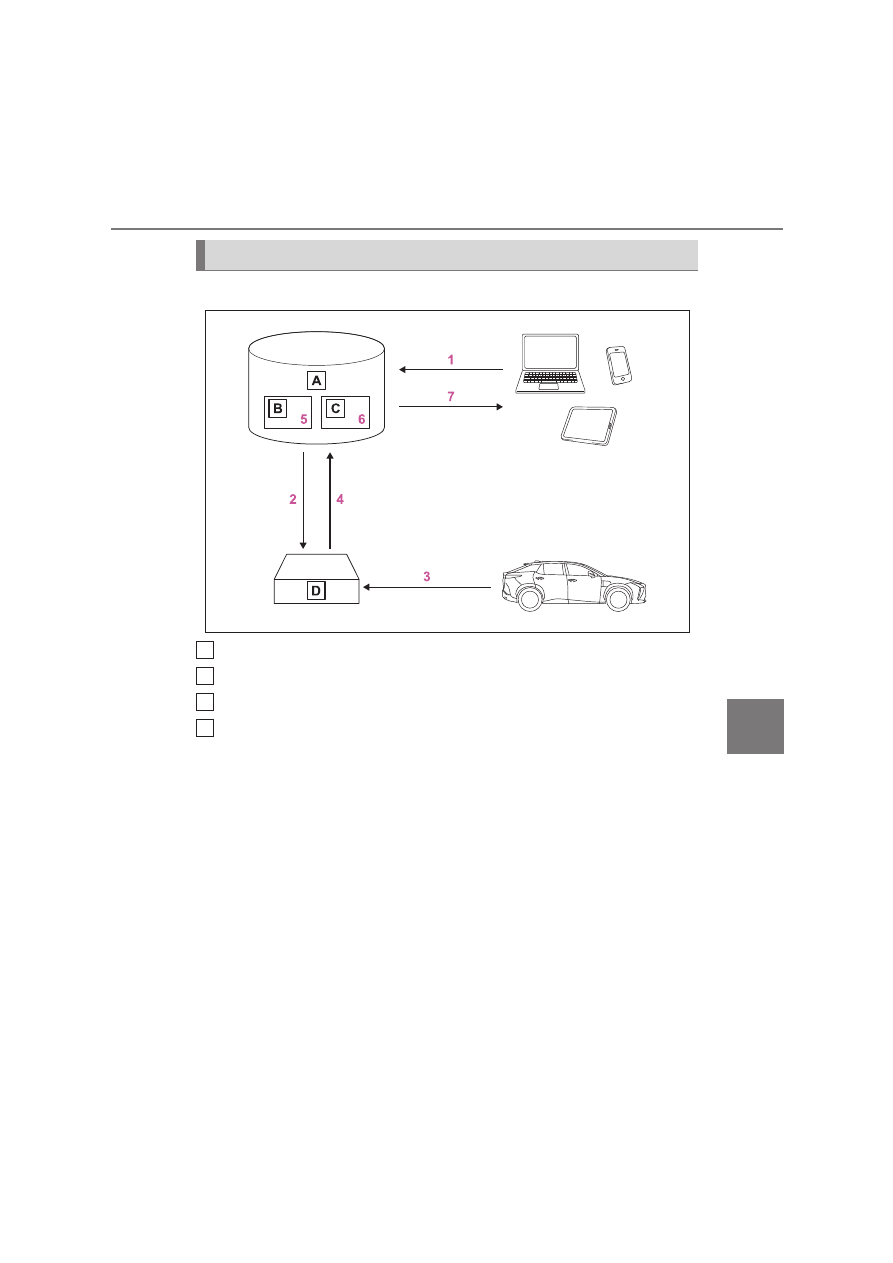
Data processing flow

Server
Storage
Processing
DCM

1

Customer activates service on Lexus Customer portal & accepts terms of ser-
vices according to GDPR.

2

Server activates the service in the DCM and defines which vehicle data to col-
lect.

3

Defined vehicle data is collected by the DCM.

4

Data is shared with the server.

5

Data is stored in the server.

6

Data is processed in the server for fulfilling the service.

7

Processed data is presented to the customer.

For a list of eligible service please visit the Lexus Customer portal.

System overview of added service

A
B
C
D

442

7-1. Emergency assistance

Implementing Regulation

Implementing Regulation Annex1 PART3 User Information

Conformity

1. DESCRIPTION OF THE ECALL IN-VEHICLE SYSTEM

1.1.

Overview of the 112-based eCall in-vehicle system, 
its operation and functionalities

O

1.2.

The 112-based eCall service is a public service of 
general interest and is accessible free of charge.

O

1.3.

The 112-based eCall in-vehicle system is activated by 
default. It is activated automatically by means of 
in-vehicle sensors in the event of a severe accident. It 
will also be triggered automatically when the vehicle 
is equipped with a TPS system which does not func-
tion in the event of a severe accident.

O

1.4.

The 112-based eCall in-vehicle system can also be 
triggered manually, if needed. Instructions for manual 
activation of the system

O

1.5.

In the event of a critical system failure that would dis-
able the 112-based eCall in-vehicle system, the fol-
lowing warning will be given to the occupants of the 
vehicle

O

2. INFORMATION ON DATA PROCESSING

443

7

7-1. Emergency assistance

Wirel

ess

 co

mmunic

ation

2.1.

Any processing of personal data through the 
112-based eCall in-vehicle system shall comply with 
the personal data protection rules provided for in 
Directives 95/46/EC and 2002/58/EC, and in 
particular, shall be based on the necessity to protect 
the vital interests of the individuals in accordance 
with Article 7(d) of Directive 95/46/EC.

O

2.2.

Processing of such data is strictly limited to the pur-
pose of handling the emergency eCall to the single 
European emergency number 112.

O

2.3. Types of data and its recipients

2.3.1.

The 112-based eCall in-vehicle system may collect 
and process only the following data: Vehicle Identifi-
cation Number, Vehicle type (passenger vehicle or 
light commercial vehicle), Vehicle propulsion storage 
type (gasoline/diesel/CNG/LPG/electric/hydro-
gen), Vehicle last three locations and direction of 
travel, Log file of the automatic activation of the sys-
tem and its timestamp.

O

2.3.2.

Recipients of data processed by the 112-based eCall 
in-vehicle system are the relevant public safety 
answering points designated by the respective public 
authorities of the country on which territory they are 
located, to first receive and handle eCalls to the sin-
gle European emergency number 112.

O

Implementing Regulation Annex1 PART3 User Information

Conformity

444

7-1. Emergency assistance

2.4. Arrangements for data processing

2.4.1.

The 112-based eCall in-vehicle system is designed in 
such a way as to ensure that the data contained in the 
system memory is not available outside the system 
before an eCall is triggered.

O

2.4.2.

The 112-based eCall in-vehicle system is designed in 
such a way as to ensure that it is not traceable and not 
subject to any constant tracking in its normal opera-
tion status.

O

2.4.3.

The 112-based eCall in-vehicle system is designed in 
such a way as to ensure that data in the system inter-
nal memory is automatically and continuously 
removed.

O

2.4.3.1.

The vehicle location data is constantly overwritten in 
the internal memory of the system so as always to 
keep maximum of the last three up-to-date locations 
of the vehicle necessary for the normal functioning of 
the system.

O

2.4.3.2.

The log of activity data in the 112-based eCall in-vehi-
cle system is kept for no longer than necessary for 
attaining the purpose of handling the emergency 
eCall and in any case not beyond 13 hours from the 
moment an emergency eCall was initiated.

O

Implementing Regulation Annex1 PART3 User Information

Conformity

445

7

7-1. Emergency assistance

Wirel

ess

 co

mmunic

ation

2.5. Modalities for exercising data subject’s rights

2.5.1.

The data subject (the vehicle’s owner) has a right of 
access to data and as appropriate to request the rec-
tification, erasure or blocking of data, concerning him 
or her, the processing of which does not comply with 
the provisions of Directive 95/46/EC. Any third par-
ties to whom the data have been disclosed have to be 
notified of such rectification, erasure or blocking car-
ried out in compliance with this Directive, unless it 
proves impossible or involves a disproportionate 
effort.

O

2.5.2.

The data subject has a right to complain to the com-
petent data protection authority if he or she consid-
ers that his or her rights have been infringed as a 
result of the processing of his or her personal data.

O

2.5.3.

Contact service responsible for handling access 
requests (if any):

P.446

O

3. INFORMATION ON THIRD PARTY SERVICES AND OTHER ADDED VALUE 
SERVICES (IF FITTED)

Implementing Regulation Annex1 PART3 User Information

Conformity

446

7-1. Emergency assistance

Service responsible for handling access requests

3.1.

Description of the operation and the functionalities of 
the TPS system/added value service

P.441

3.2.

Any processing of personal data through the TPS 
system/other added value service shall comply with 
the personal data protection rules provided for in 
Directives 95/46/EC and 2002/58/EC.

O

3.2.1.

Legal basis for the use of TPS system and/or added 
value services and for processing data through them

The Euro-

pean Union 

General Data 

Protection 

Regulation

3.3.

The TPS system and/or other added value services 
shall process personal data only on the base of the 
explicit consent of the data subject (the vehicle’s 
owner or owners).

O

3.4.

Modalities for data processing through TPS system 
and/or other added value services, including any 
necessary additional information regarding tracea-
bility, tracking and processing of personal data

P.441

3.5.

The owner of a vehicle equipped with a TPS eCall 
system and/or other added value service in addition 
to the 112-based eCall in-vehicle system has the right 
to choose to use the 112-based eCall in-vehicle sys-
tem rather than the TPS eCall system and the other 
added value service.

O

3.5.1.

Contact details for handling TPS eCall system deac-
tivation requests

N/A

Country

Contact information

Austria

datenschutz@toyota-frey.at

Belgium/Luxembourg

privacy@toyota.be

Croatia

dpcp@toyota.hr

Czech Republic/
Hungary/Slovakia

adatvedelem@toyota-ce.com

Implementing Regulation Annex1 PART3 User Information

Conformity

447

7

7-1. Emergency assistance

Wirel

ess

 co

mmunic

ation

Denmark

toyota@toyota.dk og

Estonia

privacy@toyota.ee

Finland

tietosuoja@toyota.fi

France

delegue.protectiondonnees@toyota-europe.com

Germany

Toyota.Datenschutz@toyota.de

Great Britain

privacy@tgb.toyota.co.uk

Greece

customer@toyota.gr

Iceland

personuvernd@toyota.is

Ireland

customerservice@toyota.ie

Italy

tmi.dpo@toyota-europe.com

Netherlands

www.toyota.nl/klantenservice

Norway

personvern@toyota.no

Poland

klient@toyota.pl

Portugal

gestaodadospessoais@toyotacaetano.pt

Romania

relatii.clienti@toyota.ro

Slovenia

dpcp@toyota.si

Spain

clientes@toyota.es / dpo@toyota.es.

Sweden

integritet@toyota.se

Switzerland

info@toyota.ch

Country

Contact information

448

7-1. Emergency assistance

8

449

8

Ma
inte
na

nc

e and care

Maintenance and care

.

8-1. Exterior maintenance and care

Washing the vehicle ................

450

8-2. Cleaning and protecting the 

vehicle interior

Cleaning the vehicle interior

........................................................

454

Cleaning the synthetic leather 

areas............................................

456

8-3. Maintenance

Maintenance requirements

........................................................

457

Scheduled maintenance outline

........................................................

457

Do-it-yourself maintenance

........................................................

458

8-4. Inspection of consumables

Do-it-yourself service precautions

........................................................

459

Opening the hood.....................

461

Motor compartment................

463

Adding washer fluid.................

468

Air conditioning filter mainte-

nance...........................................

468

8-5. Tire maintenance

Tire maintenance ......................

472

Tire inspection items................

472

Operation of the tire pressure 

warning system .......................

474

Checking tire inflation pressure

........................................................

482

Lifting the vehicle with a floor jack

........................................................

484

Rotating the tires.......................

485

Wheels ..........................................

485

Replacing the tire......................

487

450

8-1. Exterior maintenance and care

8-1.Exterior maintenance and care

Perform cleaning in a manner appro-
priate to each component and its 
material.

Working from top to bottom, liber-
ally apply water to the vehicle body, 
wheel wells and underside of the 
vehicle to remove any dirt and dust.

Wash the vehicle body using a 
sponge or soft cloth, such as a 
chamois.

For hard-to-remove marks, use car 
wash soap and rinse thoroughly with 
water.

Wipe away any water.

Self-restoring coat

The vehicle body has a self-restoring coat-

ing that is resistant to small surface 

scratches caused by a car wash, etc.

The coating lasts for 5 to 8 years from 

when the vehicle is delivered from the 

plant.

The restoration time differs depending on 

the depth of the scratch and outside tem-

perature.

The restoration time may become shorter 
when the coating is warmed by applying 
warm water.

Deep scratches caused by keys, coins, 

etc., cannot be restored.

Do not use waxes that contain abrasives.

Washing the vehicle

WARNING

Do not apply water to the inside of the 

motor compartment.

Doing so may cause the electrical com-

ponents, etc. to catch fire.

NOTICE

To prevent paint deterioration and 

corrosion of the body and compo-

nents (wheels, etc.)

Wash the vehicle immediately in the 

following cases:

• After driving near the sea coast

• After driving on salted roads

• If coal tar or tree sap is present on the 

paint surface

• If dead insects, insect droppings or 

bird droppings are present on the 

paint surface

• After driving in an area contaminated 

with soot, oily smoke, mine dust, iron 

powder or chemical substances

• If the vehicle becomes heavily soiled 

with dust or mud

• If liquids such as benzine or gasoline 

are spilled on the paint surface

If the paint is chipped or scratched, 

have it repaired immediately.

To prevent the wheels from corroding, 

remove any dirt and store in a place 

with low humidity when storing the 

wheels.

To prevent damage to the windshield 

wiper arms

When lifting the wiper arms away from 

the windshield, pull the driver side wiper 

arm upward first, and repeat for the pas-

senger side. When returning the wipers 

to their original position, do so from the 

passenger side first.

451

8

8-1. Exterior maintenance and care

Ma
inte
na

nc

e and care

When using a car wash

If the door handle becomes wet while the 

electronic key is within the effective range, 

the door may lock and unlock repeatedly. In 

that case, follow the following correction 

procedures to wash the vehicle:

Place the key in a position 2 m (6 ft.) or 

more separate from the vehicle while the 

vehicle is being washed.

Take care to ensure that the key is not sto-
len.

Set the electronic key to battery-saving 

mode to disable the smart entry & start 

system.

Brake pads and calipers

Rust may form if the vehicle is parked with 

wet brake pads or disc rotors, causing them 

to stick. Before parking the vehicle after it is 

washed, drive slowly and apply the brakes 

several times to dry the parts.

Perform the following before wash-
ing your vehicle:

• Fold the mirrors.
• Vehicles with power back door:
Turn off the power back door.
Start washing from the front of the vehicle.
Extend the mirrors before driving.

Brushes used in automatic car 
washes may scratch the vehicle sur-
face, parts (wheel, etc.) and harm 
your vehicle’s paint.

Depending on the automatic car 
wash, the rear spoiler may become 
caught, preventing it from being 
washed or causing damage to it.

When the shift position needs to be 
held in N, refer to P.158.

Using an automatic car wash

NOTICE

When using an automatic car wash, 

move the wiper lever to the off position.

If the wiper lever is in the AUTO position, 

the wipers may operate unintentionally 

and the wiper blades may be damaged.

Using a high pressure washer to 
wash the vehicle

NOTICE

When washing the vehicle, do not 

spray any of the cameras or their sur-

rounding area directly. The shock from 

high pressure water may cause a cam-

era to malfunction.

Do not bring the tip of the nozzle close 

to connectors or the boots (rubber or 

resin cover) of the following parts.

The parts may be damaged if sprayed by 
high-pressure water.
• Drivetrain related parts

• Steering  parts

• Suspension parts

• Brake  parts

Keep the tip of the nozzle at least 30 

cm (11.9 in.) away from the vehicle 

body. Otherwise resin parts, such as 

the moldings, bumpers, etc., may be 

deformed and damaged. Also, do not 

continuously spray water on the same 

place.

Do not spray the lower part of the 

windshield continuously. If water 

enters the air conditioning system 

intake located near the lower part of 

the windshield, the air conditioning 

system may not operate correctly.

452

8-1. Exterior maintenance and care

When using a high pressure washer, as 
water may enter the cabin, do not bring 
the tip of the nozzle near the gaps 
around the doors or perimeter of the 
windows, or spray these areas continu-
ously.

Perform the following:

Remove any dirt immediately using 
a neutral cleaning agent.

Wash detergent off with water 
immediately after use.

To protect the finish from damage, 
make sure to observe the following 
precautions.

• Do not use acidic, alkaline or abrasive 

cleaners

• Do not use hard brushes
• Do not use detergent on the wheels 

when they are hot, such as after driving 
or parking in hot weather

Painted brake calipers

When using detergent, use neutral deter-

gent. Do not use hard brushes or abra-

sive cleaners, as they will damage the 

paint.

Do not use detergent on the brake cali-

pers when they are hot.

Wash detergent off immediately after 

use.

Do not scrub with abrasive cleaners.

If dirt cannot be removed, clean the 
parts as follows:

Use a soft cloth dampened with an 
approximately 5 % solution of neu-
tral detergent and water to clean the 
dirt off.

Wipe the surface with a dry, soft 

NOTICE

Do not wash the underside of the vehi-

cle using a high pressure car washer. If 

water enters the traction battery, the 

EV system may malfunction.

Do not use the washer on the area 

around the charging port lid. Water 

could get into the charging inlet and 

could damage the vehicle.

Cleaning the wheels and wheel 
ornaments

Cleaning the bumpers

WARNING

If the paint of the front or rear bumper is 

chipped or scratched, the following sys-

tems may not function correctly. If this 

occurs, consult any authorized Lexus 

retailer or Lexus authorized repairer, or 

any reliable repairer.

Lexus Safety System +

BSM (Blind Spot Monitor)

Automatic Rear Flashing Hazard 

Lights

Safe Exit Assist

Lexus parking assist-sensor

RCTA (Rear crossing traffic alert)

PKSB (Parking Support Brake)

Secondary Collision Brake (Rear 

Impacts while Stopped)

Cleaning and protecting the 
plated portions

453

8

8-1. Exterior maintenance and care

Ma
inte
na

nc

e and care

cloth to remove any remaining 
moisture.

To remove oily deposits, use alcohol 
wet wipes or a similar product.

Front side windows water-repellent 

coating

The effectiveness of the water-repellent 

coating can be extended by paying atten-

tion to the following.

Remove any dirt, etc., from the front side 

windows regularly.

Do not allow dirt and dust to accumulate 

on the windows.

If dirty, clean the windows with a soft, damp 

cloth as soon as possible.

Do not use wax or glass cleaners that 

contain abrasives when cleaning the win-

dows.

Do not use any metallic objects to 

remove condensation build up.

Wax the vehicle when the waterproof 
coating has deteriorated.
If water does not bead on a clean sur-
face, apply wax when the vehicle body 
is cool.

Cleaning the exterior lights

NOTICE

Wash carefully. Do not use organic 

substances or scrub with a hard brush.

Doing so may damage the surface of the 
lights.

Do not apply wax to the lights.

Wax may damage the lenses.

Cleaning the windshield

WARNING

Move the wiper lever to the off position.

If the wiper lever is in the AUTO position, 

the wipers may operate unexpectedly in 

the following situations, possibly leading 

serious injury from a hand being caught, 

or damage to the wiper blades.

Off
AUTO

When the upper part of the windshield 

where the raindrop sensor is located is 

touched by hand

When a wet rag or similar is held close 

to the raindrop sensor

A
B

If something bumps against the wind-

shield

If you directly touch the raindrop sen-

sor body or if something bumps into 

the raindrop sensor

Waxing the vehicle

Cleaning aluminum parts

NOTICE

When cleaning the hood, do not push 

hard or put weight on it. The aluminum 

part may be dented.

454

8-2. Cleaning and protecting the vehicle interior

8-2.Cleaning and protecting the vehicle interior

Cleaning the vehicle interior

WARNING

Water in the vehicle

Do not splash or spill liquid in the vehi-

cle. Doing so may cause the electrical 

components, etc., to malfunction or 

catch fire.

Do not get any of the SRS components 

or wiring in the vehicle interior wet.

An electrical malfunction may cause the 

airbags to deploy or not function prop-

erly, resulting in death or serious injury.

Vehicles with wireless charger: Do not 

let the wireless charger (

P.231) get 

wet. Failure to do so may cause the 

charger to become hot and cause 

burns or could cause electric shock 

resulting in death or serious injury.

Cleaning the interior (especially 

instrument panel)

Do not use wax polish or a polishing 

cleaner on the instrument panel. The 

instrument panel may reflect off the 

windshield, obstructing the driver’s view 

and leading to an accident, resulting in 

death or serious injury.

To prevent burns

If the vehicle is left in direct sunlight for a 
long time, the underside of the glass roof

*


could become very hot and could cause 

burns.

*

: If equipped

NOTICE

Cleaning solvents

Do not use the following cleaning sol-

vents, as they may discolor the vehicle 

interior or cause streaks or damage to 

painted surfaces:

• Areas other than the seats: Organic 

substances such as benzine or gaso-

line, alkaline or acidic solutions, dye, 

and bleach

• Seats: thinner, benzine, alcohol, or 

alkaline or acidic solutions

Do not use wax polish or a polishing 

cleaner. The painted surfaces of the 

instrument panel or other interior 

parts may be damaged.

Water on the floor

Do not wash the vehicle floor with water.

If water contacts audio system or other 

electrical components under the floor 

carpet, it may cause the vehicle to mal-

function. Water may also cause the body 

to rust.

When cleaning the inside of the wind-

shield

Do not allow glass cleaner to contact the 

lens of the front camera. Also, do not 

touch the lens.

Cleaning the inside of the rear win-

dow

Do not use glass cleaners to clean the 

rear window, as this may cause dam-

age to the rear window defogger 

heater wires or antenna. Use a cloth 

dampened with lukewarm water to 

gently wipe the window clean. Wipe 

the window in strokes running parallel 

to the heater wires or antenna.

Be careful not to scratch or damage 

the heater wires or antenna.

455

8

8-2. Cleaning and protecting the vehicle interior

Ma
inte
na

nc

e and care

Remove dirt and dust using a vac-
uum cleaner. Wipe dirty surfaces 
with a cloth dampened with luke-
warm water.

If dirt cannot be removed, wipe it off 
with a soft cloth dampened with 
neutral detergent diluted to approx-
imately 1%.

Wring out any excess water from the cloth 
and thoroughly wipe off remaining traces 
of detergent and water.

Shampooing the carpets

Excellent results can be obtained by keep-

ing the carpet as dry as possible. When 

cleaning, use a commercially available 

foaming-type cleaner.
Use a sponge or brush to apply the foam 

and rub it in overlapping circles. Do not use 

water. Wipe the surface to remove the 

cleaner and dirt and let it dry.

Handling the seat belts

Clean with mild soap and lukewarm water 

using a cloth or sponge. Also check the 

belts periodically for excessive wear, fraying 

or cuts.

Handling precautions of the panoramic 
fixed moon roof glass (Low-E coating)

*

*

: If  equipped

Do not rub the glass with a metal tool, etc.

Note that applying film to the glass sur-

face may damage the function of the 

coating.

Note that attaching a sucker to the glass 

surface may cause suction marks to 

remain.

NOTICE

Cleaning the panoramic fixed moon 

roof glass (if equipped)

When cleaning the panoramic fixed 

moon roof glass, do not use a compound 

or abrasive articles, such as a glass 

cleaner, detergent, wax, etc. Doing so 

may damage the coating.

456

8-2. Cleaning and protecting the vehicle interior

Remove dirt and dust using a vac-
uum cleaner.

Wipe it off with a soft cloth damp-
ened with neutral detergent diluted 
to approximately 1%.

Wring out any excess water from 
the cloth and thoroughly wipe off 
remaining traces of detergent and 
water.

Cleaning the synthetic 
leather areas

457

8

8-3. Maintenance

Ma
inte
na

nc

e and care

8-3.Maintenance

Where to go for maintenance service?

In order to maintain your vehicle in the best 

possible condition, Lexus recommends that 

maintenance service operations as well as 

other inspections and repairs be carried out 

by authorized Lexus retailers or Lexus 

authorized repairers, or any reliable repair-

ers. For repairs and services covered by 

your warranty, please visit an authorized 

Lexus retailer or repairer, who will use gen-

uine Lexus parts in repairing any difficulties 

you may encounter. There can also be 

advantages in utilizing authorized Lexus 

retailer or repairers for non-warranty 

repairs and services, as members of the 

Lexus network will be able to expertly assist 

you with any difficulties you may encounter.
Your Lexus retailer or Lexus authorized 

repairer, or any reliable repairer will per-

form all of the scheduled maintenance on 

your vehicle reliably and economically due 

to their experience with Lexus vehicles.

Scheduled maintenance should be 
performed at specified intervals 
according to the maintenance sched-
ule.
For full details of your maintenance 
schedule, refer to the “Lexus Service 
Booklet” or “Lexus Warranty Booklet”.

Maintenance requirements

To ensure safe and economical driv-
ing, day-to-day care and regular 
maintenance are essential. Lexus 
recommends the following mainte-
nance:

WARNING

If your vehicle is not properly main-

tained

Improper maintenance could result in 

serious damage to the vehicle and possi-

ble death or serious injury.

Handling of the 12-volt battery

12-volt battery posts, terminals and 

related accessories contain lead and 

lead compounds which are known to 

cause brain damage. Wash your hands 

after handling.

Scheduled maintenance out-
line

458

8-3. Maintenance

What about do-it-yourself mainte-
nance?
Many maintenance items are easy to 
do yourself if you have a little mechani-
cal ability and a few basic automotive 
tools.
Note, however, that some maintenance 
tasks require special tools and skills. 
These are best performed by qualified 
technicians. Even if you’re an experi-
enced do-it-yourself mechanic, we 
recommend that repairs and mainte-
nance be conducted by any authorized 
Lexus retailer or Lexus authorized 
repairer, or any reliable repairer. Any 
authorized Lexus retailer or repairer 
will keep a record of maintenance, 
which could be useful should you ever 
require Warranty Service. Should you 
choose to select a qualified and 
equipped professional other than an 
authorized Lexus repairer to service or 
maintain your vehicle, we recommend 
that you request that a record of main-
tenance be kept.

Does your vehicle need repairs?

Be on the alert for changes in performance 

and sounds, and visual tip-offs that indicate 

service is needed. Some important clues 

are:

Appreciable loss of power

Strange noises

A fluid leak under the vehicle

However, water dripping from the air con-
ditioning system after use is normal.

Flat-looking tires, excessive tire squeal 

when cornering, uneven tire wear

Vehicle pulls to one side when driven 

straight on a level road

Strange noises related to suspension 

movement

Loss of brake effectiveness, spongy feel-

ing brake pedal, pedal almost touches the 

floor, vehicle pulls to one side when brak-

ing

If you notice any of these clues, take your 

vehicle to any authorized Lexus retailer or 

Lexus authorized repairer, or any reliable 

repairer as soon as possible. Your vehicle 

may need adjustment or repair.

Do-it-yourself maintenance

459

8

8-4. Inspection of consumables

Ma
inte
na

nc

e and care

8-4.Inspection of consumables

Items which require maintenance and 
the necessary parts and tools to per-
form maintenance on those items are 
as follows:

12-volt battery condition

Warm water

Baking soda

Grease

Conventional wrench (for terminal 

Do-it-yourself service pre-
cautions

If you perform maintenance by 
yourself, be sure to follow the cor-
rect procedure as given in the sec-
tion for each part.

WARNING

The motor compartment contains many 

mechanisms and fluids that may move 

suddenly, become hot, or become elec-

trically energized. To avoid death or seri-

ous injury, observe the following 

precautions.

When working on the motor com-

partment

Make sure that “POWER ON” on the 

multi-information display and the 

“READY” indicator are both off.

Keep hands, clothing and tools away 

from the moving fan.

Be careful not to touch the motor, 

power control unit, radiator, etc., right 

after driving as they may be hot. Cool-

ant and other fluids may also be hot.

Do not leave anything that may burn 

easily, such as paper and rags, in the 

motor compartment.

Do not smoke, cause sparks or expose 

an open flame to the 12-volt battery. 

12-volt battery fumes are flammable.

Never touch, disassemble, remove or 

replace the high voltage parts, cables 

and their connectors. It can cause 

severe burns or electric shock that 

may result in death or serious injury.

Take care because brake fluid can 

harm your hands or eyes and damage 

painted surfaces. If fluid gets on your 

hands or in your eyes, flush the 

affected area with clean water imme-

diately. If you still experience discom-

fort, consult a doctor.

When working near the electric cool-

ing fan or radiator grille

Be sure the power switch is OFF.

With the power switch in ON, the elec-

tric cooling fan may automatically start to 

run if the air conditioning is on and/or the 

coolant temperature is high.

Safety glasses

Wear safety glasses to prevent flying or 

falling material, fluid spray, etc., from get-

ting in your eyes.

NOTICE

If the fluid level is low or high

It is normal for the brake fluid level to go 

down slightly as the brake pads wear or 

when the fluid level in the accumulator is 

high.

If the reservoir needs frequent refilling, it 

may indicate a serious problem.

Maintenance

460

8-4. Inspection of consumables

clamp bolts)

Distilled water

Heater coolant level

“Toyota Super Long Life Coolant” or 
a similar high quality ethylene gly-
col-based non-silicate, non-amine, 
non-nitrite and non-borate coolant 
with long-life hybrid organic acid 
technology “Toyota Super Long Life 
Coolant” is premixed with 50% 
coolant and 50% deionized water.

Funnel (used only for adding cool-
ant)

Power control unit coolant level

In order to ensure maximum perfor-
mance of the traction battery cool-
ing system and limit risks of battery 
short-circuit and other damage to 
your vehicle, Toyota recommends 
using “Toyota Genuine Traction Bat-
tery Coolant” or similar high-quality 
ethylene glycol-based, low electric 
conductivity coolant, non-amine 
and non-borate coolant with azole 
additives.

Funnel (used only for adding cool-
ant)

Fuses

Fuse with same amperage rating as 
original

Radiator and condenser

-

Tire inflation pressure

Tire pressure gauge

Compressed air source

Washer fluid

Water or washer fluid containing 
antifreeze (for winter use)

Funnel (used only for adding water 
or washer fluid)

461

8

8-4. Inspection of consumables

Ma
inte
na

nc

e and care

1

Pull the hood lock release lever.

The hood will pop up slightly.

2

Pull up the auxiliary catch lever to 
the left and lift the hood.

3

Hold the hood open by inserting 
the supporting rod into the slot.

Opening the hood

WARNING

Pre-driving check

Check that the hood is fully closed and 

locked.

If the hood is not locked properly, the 

hood may suddenly open while driving.

After installing the support rod into 

the slot

Make sure the rod is properly inserted 

into the slot to prevent the hood from 

shutting on your head or body.

When closing the hood

When closing the hood, take extra care 

to prevent your fingers etc., from being 

caught.

462

8-4. Inspection of consumables

NOTICE

When closing the hood

Be sure to return the support rod to its 

clip before closing the hood. Closing the 

hood without returning the support rod 

properly may cause the hood to be dam-

aged.

463

8

8-4. Inspection of consumables

Ma
inte
na

nc

e and care

Heater coolant reservoir (

P.463)

Washer fluid tank (

P.468)

Power control unit coolant reservoir (

P.465)

12-volt battery (

P.465)

Fuse box (

P.589)

Radiator (

P.464)

Condenser (

P.464)

Electric cooling fan

The coolant level is satisfactory if it is 
between the “MAX” and “MIN” lines 
on the reservoir when the EV system is 
cold.

Reservoir cap
“MAX” line

Motor compartment

Motor compartment components

A
B
C
D

E
F

G

H

Checking the heater coolant

A
B

464

8-4. Inspection of consumables

“MIN” line

If the level is on or below the “MIN” line, 
add coolant up to the “MAX” line. (P.586)

Coolant selection

Only use “Toyota Super Long Life Coolant” 

or a similar high quality ethylene glycol 

based non-silicate, non-amine, non-nitrite, 

and non-borate coolant with long-life 

hybrid organic acid technology.
“Toyota Super Long Life Coolant” is a mix-

ture of 50% coolant and 50% deionized 

water. (Minimum temperature: -35°C 

[-31°F])
For more details about coolant, contact any 

authorized Lexus retailer or Lexus author-

ized repairer, or any reliable repairer.

If the coolant level drops within a short 

time of replenishing

Visually check the radiator, hoses, power 

control unit coolant reservoir caps, drain 

cock and water pump.
If you cannot find a leak, have any author-

ized Lexus retailer or Lexus authorized 

repairer, or any reliable repairer, test the 

cap and check for leaks in the cooling sys-

tem.

Check the radiator and condenser and 
clear away any foreign objects.
If either of the above parts is extremely 
dirty or you are not sure of their condi-
tion, have your vehicle inspected by 
any authorized Lexus retailer or Lexus 
authorized repairer, or any reliable 
repairer.

WARNING

When the heater system is hot

Do not remove the heater coolant reser-

voir caps.

The heater system may be under pres-

sure and may spray hot coolant if the cap 

is removed, causing serious injuries, such 

as burns.

C

NOTICE

When adding coolant

Coolant is neither plain water nor 

straight antifreeze. The correct mixture 

of water and antifreeze must be used to 

provide proper lubrication, corrosion 

protection and cooling. Be sure to read 

the antifreeze or coolant label.

If you spill coolant

Be sure to wash it off with water to pre-

vent it from damaging parts or paint.

Checking the radiator and con-
denser

WARNING

When the EV system is hot

Do not touch the radiator or condenser 

as they may be hot and cause serious 

injuries, such as burns.

When the electric cooling fan are 

operating

Do not touch the motor compartment.

With the power switch in ON, the elec-

tric cooling fan may automatically start to 

run if the air conditioning is on and/or the 

coolant temperature is high. Be sure the 

power switch is OFF when working near 

the electric cooling fan or radiator grille.

465

8

8-4. Inspection of consumables

Ma
inte
na

nc

e and care

The coolant level is satisfactory if it is 
between the “MAX” and “MIN” lines 
on the reservoir when the EV system is 
cold.

Reservoir cap
“MAX” line
“MIN” line

If the level is on or below the “MIN” line, 
add coolant up to the “MAX” line.

Coolant selection

In order to ensure maximum performance 

of the traction battery cooling system and 

limit risks of battery short-circuit and other 

damage to your vehicle, Lexus recom-

mends using “Toyota Genuine Traction Bat-

tery Coolant” or similar high-quality 

ethylene glycol-based, low electric conduc-

tivity coolant, non-amine and non-borate 

coolant with azole additives.
Lexus cannot guarantee that the use of a 

product other than “Toyota Genuine Trac-

tion Battery Coolant” will prevent risks of 

battery short-circuit or other damage.
Never use water as it will cause damage.
Do not reuse coolant that has been 

removed from the radiator.
For more details about coolant, contact any 

authorized Lexus retailer or Lexus author-

ized repairer, or any reliable repairer.

If the coolant level drops within a short 

time of replenishing

Visually check the hoses, heater coolant 

reservoir caps, drain cock and water pump.
If you cannot find a leak, have any author-

ized Lexus retailer or Lexus authorized 

repairer, or any reliable repairer, test the 

cap and check for leaks in the cooling sys-

tem.

Check the 12-volt battery as follows.

12-volt battery exterior

Make sure that the 12-volt battery ter-
minals are not corroded and that there 
are no loose connections, cracks, or 
loose clamps.

Checking the power control unit 
coolant

A
B
C

WARNING

When the EV system is hot

Do not remove the power control unit 

coolant reservoir caps.

The cooling system may be under pres-

sure and may spray hot coolant if the cap 

is removed, causing serious injuries, such 

as burns.

NOTICE

When adding coolant

Coolant is neither plain water nor 

straight antifreeze. The correct mixture 

of water and antifreeze must be used to 

provide proper lubrication, corrosion 

protection and cooling. Be sure to read 

the antifreeze or coolant label.

If you spill coolant

Be sure to wash it off with water to pre-

vent it from damaging parts or paint.

Checking the 12-volt battery

466

8-4. Inspection of consumables

Terminals
Hold-down clamp

Checking 12-volt battery fluid

Check that the level is between the 
“UPPER LEVEL” and “LOWER 
LEVEL” lines.

“UPPER LEVEL” line
“LOWER LEVEL” line

If the fluid level is at or below the “LOWER 
LEVEL” line, add distilled water.

Adding distilled water

1

Remove the vent plug.

2

Add distilled water.

If the “UPPER LEVEL” cannot be seen, 

check the fluid level by looking directly at 

the cell.

3

Put the vent plug back on and close 
it securely.

Before recharging

When recharging, the 12-volt battery pro-

duces hydrogen gas which is flammable 

and explosive. Therefore, observe the fol-

lowing precautions before recharging:

If recharging with the 12-volt battery 

installed on the vehicle, be sure to discon-

nect the ground cable.

Make sure the power switch on the 

charger is off when connecting and dis-

connecting the charger cables to the 

12-volt battery.

After recharging/reconnecting the 

12-volt battery

The EV system may not start. Follow the 

procedure below to initialize the system.

1

Shift the shift position to P.

2

Open and close any of the doors.

3

Restart the EV system.

Unlocking the doors using the smart 

entry & start system may not be possible 

immediately after reconnecting the 

12-volt battery. If this happens, use the 

wireless remote control or the mechani-

cal key to lock/unlock the doors.

Start the EV system with the power 

switch in ACC. The EV system may not 

start with the power switch turned off. 

However, the EV system will operate nor-

mally from the second attempt.

The power switch mode is recorded by 

the vehicle. If the 12-volt battery is dis-

A
B

A
B

467

8

8-4. Inspection of consumables

Ma
inte
na

nc

e and care

connected and reconnected, the vehicle 

will return the power switch mode to the 

status it was in before the 12-volt battery 

was disconnected. Make sure to turn off 

the power switch before disconnecting 

the 12-volt battery. Take extra care when 

connecting the 12-volt battery if the 

power switch mode prior to the 12-volt 

battery being disconnected is unknown.

If the EV system will not start even after 
multiple attempts at all the methods above, 
contact any authorized Lexus retailer or 
Lexus authorized repairer, or any reliable 
repairer.

WARNING

Chemicals in the 12-volt battery

Batteries contain poisonous and corro-

sive sulfuric acid and may produce 

hydrogen gas which is flammable and 

explosive. To reduce the risk of death or 

serious injury, take the following precau-

tions while working on or near the 12-volt 

battery:

Do not cause sparks by touching the 

12-volt battery terminals with tools.

Do not smoke or light a match near the 

12-volt battery.

Avoid contact with eyes, skin and 

clothes.

Never inhale or swallow electrolyte.

Wear protective safety glasses when 

working near the 12-volt battery.

Keep children away from the 12-volt 

battery.

Where to safely charge the 12-volt 

battery

Always charge the 12-volt battery in an 

open area. Do not charge the 12-volt bat-

tery in a garage or closed room where 

there is insufficient ventilation.

Emergency measures regarding 

electrolyte

If electrolyte gets in your eyes

Flush your eyes with clean water for at 

least 15 minutes and get immediate 

medical attention. If possible, continue 

to apply water with a sponge or cloth 

while traveling to the nearest medical 

facility.

If electrolyte gets on your skin

Wash the affected area thoroughly. If 

you feel pain or burning, get medical 

attention immediately.

If electrolyte gets on your clothes

It can soak through clothing on to your 

skin. Immediately take off the clothing 

and follow the procedure above if nec-

essary.

If you accidentally swallow electrolyte

Drink a large quantity of water or milk. 

Get emergency medical attention 

immediately.

When there is insufficient 12-volt bat-

tery fluid

Do not use if there is insufficient fluid in 

the 12-volt battery. There is a possible 

danger that the 12-volt battery may 

explode.

NOTICE

When recharging the 12-volt battery

Never recharge the 12-volt battery while 

the EV system is operating. Also, be sure 

all accessories are turned off.

When adding distilled water

Avoid overfilling. Water spilled during 

12-volt battery recharging may cause 

corrosion.

468

8-4. Inspection of consumables

If washer fluid does not spray from any 
of the washers or “Windshield Washer 
Fluid Low” is displayed on the 
multi-information display, the washer 
fluid bottle may be empty. Add washer 
fluid.

Adding washer fluid

WARNING

Do not add washer fluid when the EV 

system is hot or operating.

As washer fluid contains alcohol, it may 

catch fire if spilled on the motor, etc.

NOTICE

Do not use any fluid other than 

washer fluid

Do not use soapy water or engine anti-

freeze instead of washer fluid. Doing so 

may cause streaking on the vehicle’s 

painted surfaces, as well as damaging the 

pump leading to problems of the washer 

fluid not spraying.

Diluting washer fluid

Dilute washer fluid with water as neces-

sary. Refer to the freezing temperatures 

listed on the label of the washer fluid bot-

tle.

Air conditioning filter main-
tenance

The air conditioning filter must be 
changed regularly to maintain air 
conditioning efficiency.

WARNING

Observe the following precautions. Fail-

ure to do so may result in the air condi-

tioning system operating during the 

procedure, possibly resulting in injury.

Check that the charging connector is 

not connected

Vehicles with Remote Air Condition-

ing System: Do not use the Remote Air 

Conditioning System

NOTICE

When using the air conditioning sys-

tem

Make sure that a filter is always 

installed. Using the air conditioning 

system without a filter may cause dam-

age to the system.

The filter is replaceable. When clean-

ing the filter, do not clean with water or 

an air gun.

To prevent damage to the filter cover

When moving the filter cover in the 

direction of arrow to release the fitting, 

pay attention not to apply excessive force 

to the claws. Otherwise, the claws may 

be damaged.

469

8

8-4. Inspection of consumables

Ma
inte
na

nc

e and care

When installing the filter cover

Slide the recessed part 

 of the filter 

cover on the upper surface of the upper fil-
ter case 

 as shown in the figure, and 

attach it so that it is lifted toward the inser-

tion part of the cover attachment.

Left-hand drive vehicles

Right-hand drive vehicles

Checking interval

Inspect and replace the air conditioning fil-

ter according to the maintenance schedule. 

In dusty areas or areas with heavy traffic 

flow, early replacement may be required.

If air flow from the vents decreases dra-

matically, the air conditioning filter may 

be clogged. Check the filter and replace 

it if necessary.

(For scheduled maintenance information, 

please refer to the “Lexus Service Booklet” 
or “Lexus Warranty Booklet”.)

If air fresheners, etc. are used inside the 

vehicle, the service life of the deodorizing 

function of the air conditioning filter with 

deodorizing function may be reduced 

significantly. If odors from the air condi-

tioning system become a concern, 

replace the filter.

If air flow from the vents decreases dra-

matically

The filter may be clogged. Check the filter 

and replace if necessary.

1

Turn the power switch off.

Confirm that the charging connector is not 

connected. Also, do not use the Remote 

Air Conditioning System (if equipped) dur-

ing the procedure.

2

Open the front passenger’s door.

Vehicles with Remote Air Conditioning 

System: By keeping the door open, unex-

pected operation of the Remote Air Con-

ditioning System can be prevent.

3

Disengage the clips of the passen-
ger door side.

NOTICE

Replacing the air conditioning 
filter

470

8-4. Inspection of consumables

4

While pressing the claw, hold han-
dle   and remove the panel.

5

Unplug the connector.

6

Remove the panel.

7

Unlock the filter cover ( ), pull the 
filter cover out of the claws ( ), 
and remove the filter cover.

8

Hold the filter case   and remove 
the lower filter case.

471

8

8-4. Inspection of consumables

Ma
inte
na

nc

e and care

9

Hold the filter case   and pull 
down the upper filter case.

10

Hold the filter case   and remove 
the upper filter case.

11

Remove the air conditioning filter 
from the upper and lower filter case 
and replace it with a new one.

Install so that the arrow points to the rear of 

the vehicle.

12

When installing, reverse the steps 
listed.

472

8-5. Tire maintenance

8-5.Tire maintenance

Check if the treadwear indicators are 
showing on the tires. Also check the 
tires for uneven wear, such as excessive 
wear on one side of the tread.

Tire maintenance

Replace or rotate tires in accord-
ance with maintenance schedules 
and treadwear.

NOTICE

Take particular care when driving on 

uneven rough roads with cracks and pot-

holes.

These conditions may cause loss of tire 

inflation pressure, reducing the cushion-

ing ability of the tires. Driving on rough 

roads may also cause damage to the tires 

themselves, as well as the vehicle’s 

wheels and body.

Tire inspection items

WARNING

When inspecting or replacing the 

tires

Observe the following precautions.

Failure to do so may lead to damage to 

the drivetrain or unstable handling.

Do not mix tires of different makes, 

models or tread patterns. Also, do not 

mix tires of remarkably different 

treadwear.

Do not use tire sizes other than those 

recommended by Lexus.

Do not mix differently constructed 

tires (radial, bias-belted or bias-ply 

tires).

Do not mix summer, all season and 

snow tires.

Do not use tires that have been used 

on another vehicle.

Do not use tires if you do not know how 
they were used previously.

Do not tow anything if a tire that has 

been repaired using the emergency 

tire puncture repair kit is installed. The 

load on the tire may cause unexpected 

damage to the tire.

NOTICE

If tire inflation pressure becomes low 

while driving, do not continue driving. 

Otherwise the tire or wheel may be dam-

aged.


Content      ..     12      13      14      15     ..