Ford Orion. Manual - part 29
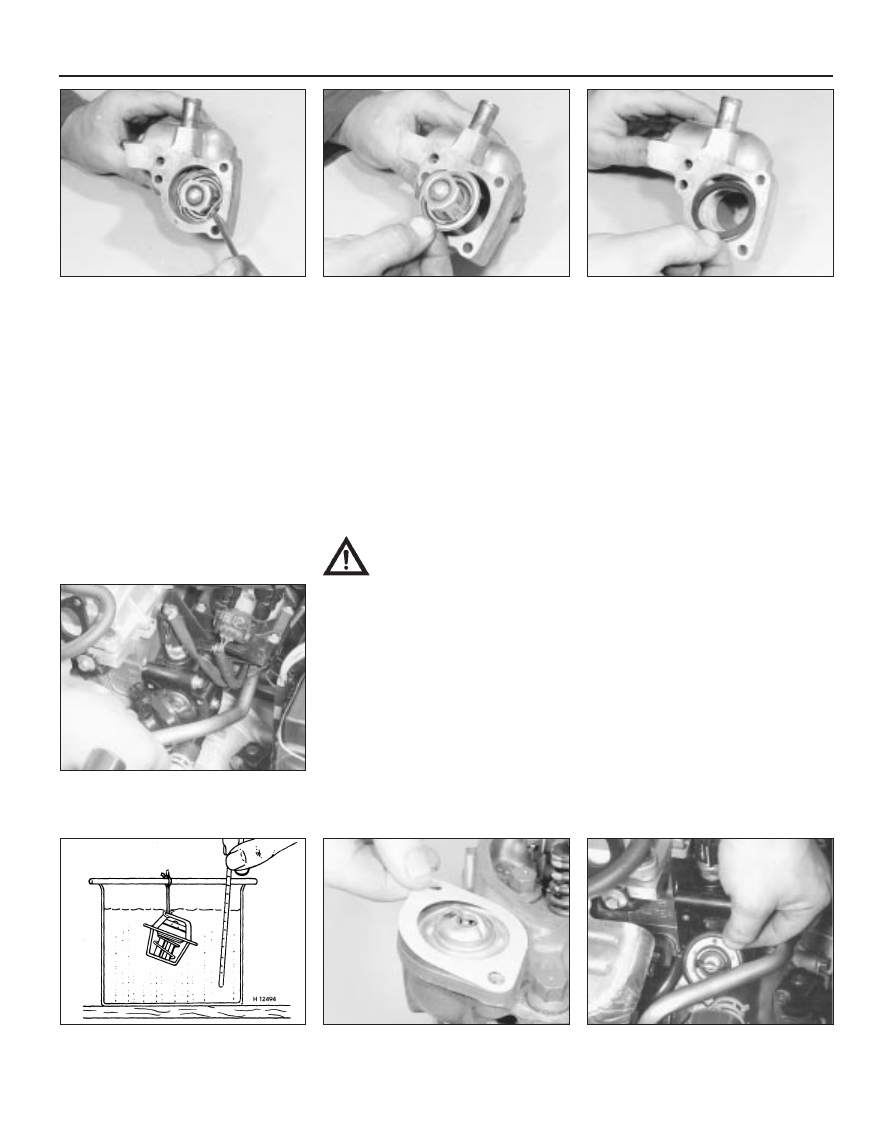
8 Unscrew the retaining bolts, and remove
the water outlet from the thermostat housing
(see illustration).
9 Withdraw the thermostat from the housing
noting the position of the air bleed valve, and
how the thermostat is installed (which end is
facing outwards).
Testing
General check
10 Before assuming the thermostat is to
blame for a cooling system problem, check
the coolant level, auxiliary drivebelt tension
and condition (see Chapter 1) and
temperature gauge operation. When checking
the coolant level, don’t rely on the fact that the
expansion bottle is full - where possible,
remove the radiator cap and check the level in
the radiator.
11 If the engine seems to be taking a long
time to warm up (based on heater output or
temperature gauge operation), the thermostat
is probably stuck open. Renew the
thermostat.
12 If the engine runs hot, use your hand to
check the temperature of the radiator top
hose. If the hose isn’t hot, but the engine is,
the thermostat is probably stuck closed,
preventing the coolant inside the engine from
escaping to the radiator - renew the
thermostat.
Caution: Don’t drive the vehicle
without a thermostat. The lack of
a thermostat will slow warm-up
time. The engine management
system’s ECU will then stay in warm-up
mode for longer than necessary, causing
emissions and fuel economy to suffer.
13 If the radiator top hose is hot, it means
that the coolant is flowing and the thermostat
is open. Consult the “Fault finding” section at
the end of this manual to assist in tracing
possible cooling system faults.
Thermostat test
14 If the thermostat remains in the open
position at room temperature, it is faulty, and
must be renewed as a matter of course.
15 To test it fully, suspend the (closed)
thermostat on a length of string in a container
of cold water, with a thermometer beside it;
ensure that neither touches the side of the
container (see illustration).
16 Heat the water, and check the
temperature at which the thermostat begins to
open; compare this value with that specified.
It’s not possible to check the fully-open
temperature, because this occurs above the
boiling point of water at normal atmospheric
pressure. If the temperature at which the
thermostat began to open was as specified,
then it is most likely that the thermostat’s OK.
Remove the thermostat, and allow it to cool
down; check that it closes fully.
17 If the thermostat does not open and close
as described, if it sticks in either position, or if
it does not open at the specified temperature,
it must be renewed.
Refitting
All models
18 Refitting is a reversal of removal. Clean
the mating surfaces carefully, and renew the
thermostat’s O-ring seal or housing gasket, as
applicable (see illustration).
19 On Zetec engines, ensure that the
thermostat is fitted with its air bleed valve
uppermost (see illustration).
20 Tighten the thermostat housing/water
outlet bolts to the specified torque wrench
setting.
21 Refill the cooling system (see Chapter 1).
22 Start the engine and allow it to reach
normal operating temperature, then check for
leaks and proper thermostat operation.
3•4 Cooling, heating and air conditioning systems
4.19 Ensure that the thermostat is fitted as
shown
4.18 Use a new gasket when refitting the
thermostat housing
4.15 Testing the thermostat
4.8 Unscrew the retaining bolts, and
remove the water outlet from the
thermostat housing
4.6C . . . and where applicable, remove the
O-ring seal
4.6B . . . extract the thermostat . . .
4.6A Release the retaining clip . . .