Citroen C4 (2023 year). Manual in english - page 16
8-2. Steps to take in an emergency
607
WARNING
■ When exchanging the battery
● When the vent plug and indicator are close to the hold down bracket, the
battery fluid (sulfuric acid) may leak.
●For information regarding battery replacement, contact any authorized
Toyota retailer or Toyota authorized repairer, or any reliable repairer.
■ To prevent damage to the vehicle (vehicles with manual transmission)
Do not pull- or push-start the vehicle as the three-way catalytic converter or
catalytic converter may overheat and become a fire hazard.
NOTICE
■ When handling jumper cables
When connecting the jumper cables, ensure that they do not become entan-
gled in the cooling fan or belt.
8
608
8-2. Steps to take in an emergency
If your vehicle overheats
The following may indicate that your vehicle is overheating.
● The needle of the engine coolant temperature gauge (P. 128)
enters the red zone or a loss of engine power is experienced.
(For example, the vehicle speed does not increase.)
● Vehicles with multi-information display: “Engine Coolant Temp
High Stop in a Safe Place See Owner’s Manual” is shown on the
multi-information display.
● Steam comes out from under the hood.
Correction procedures
1
Stop the vehicle in a safe place and turn off the air conditioning sys-
tem, and then stop the engine.
2
If you see steam:
Carefully lift the hood after the steam subsides.
If you do not see steam:
Carefully lift the hood.
3
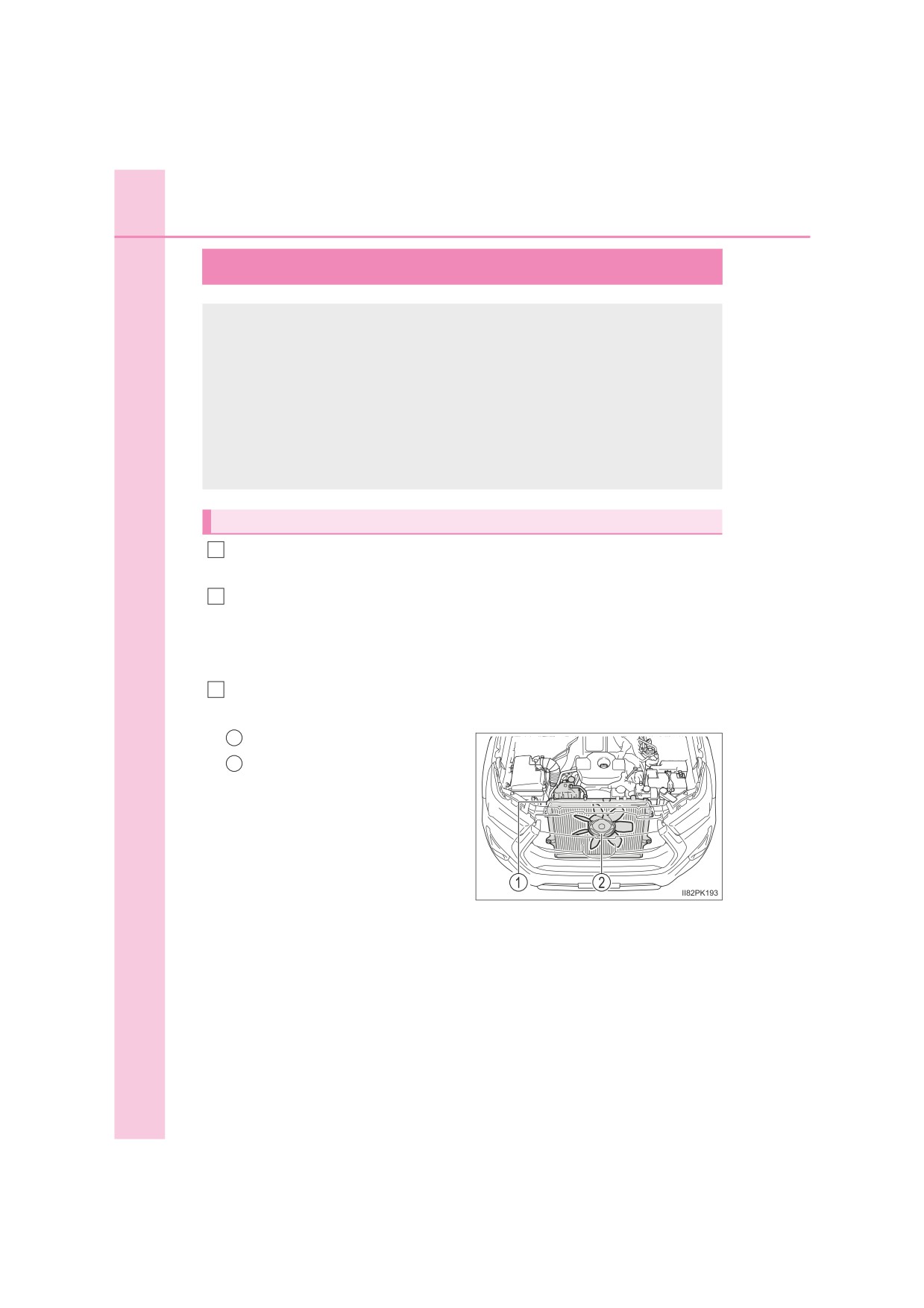
After the engine has cooled down sufficiently, inspect the hoses and
radiator core (radiator) for any leaks.
1
Radiator
2
Cooling fan
If a large amount of coolant
leaks, immediately contact any
authorized Toyota retailer or
Toyota authorized repairer, or
any reliable repairer.
8-2. Steps to take in an emergency
609
4
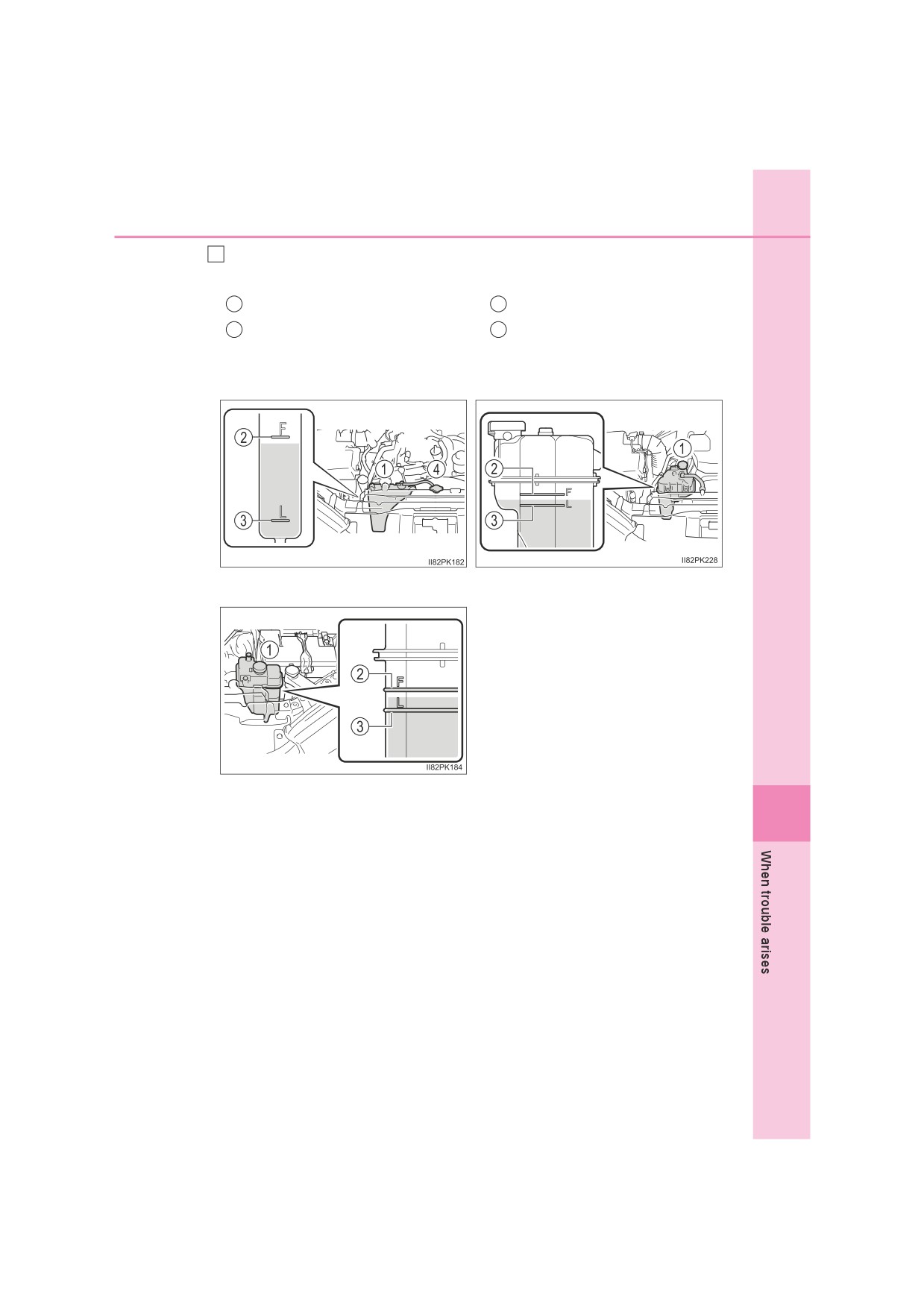
The coolant level is satisfactory if it is between the “F” and “L” lines
on the reservoir.
1
Reservoir
3
“L” line
2
“F” line
4
Radiator cap (if equipped)
Engine coolant
(gasoline
Engine coolant (diesel engine)
engine)
Intercooler coolant (if
equipped)
8
610
8-2. Steps to take in an emergency
5
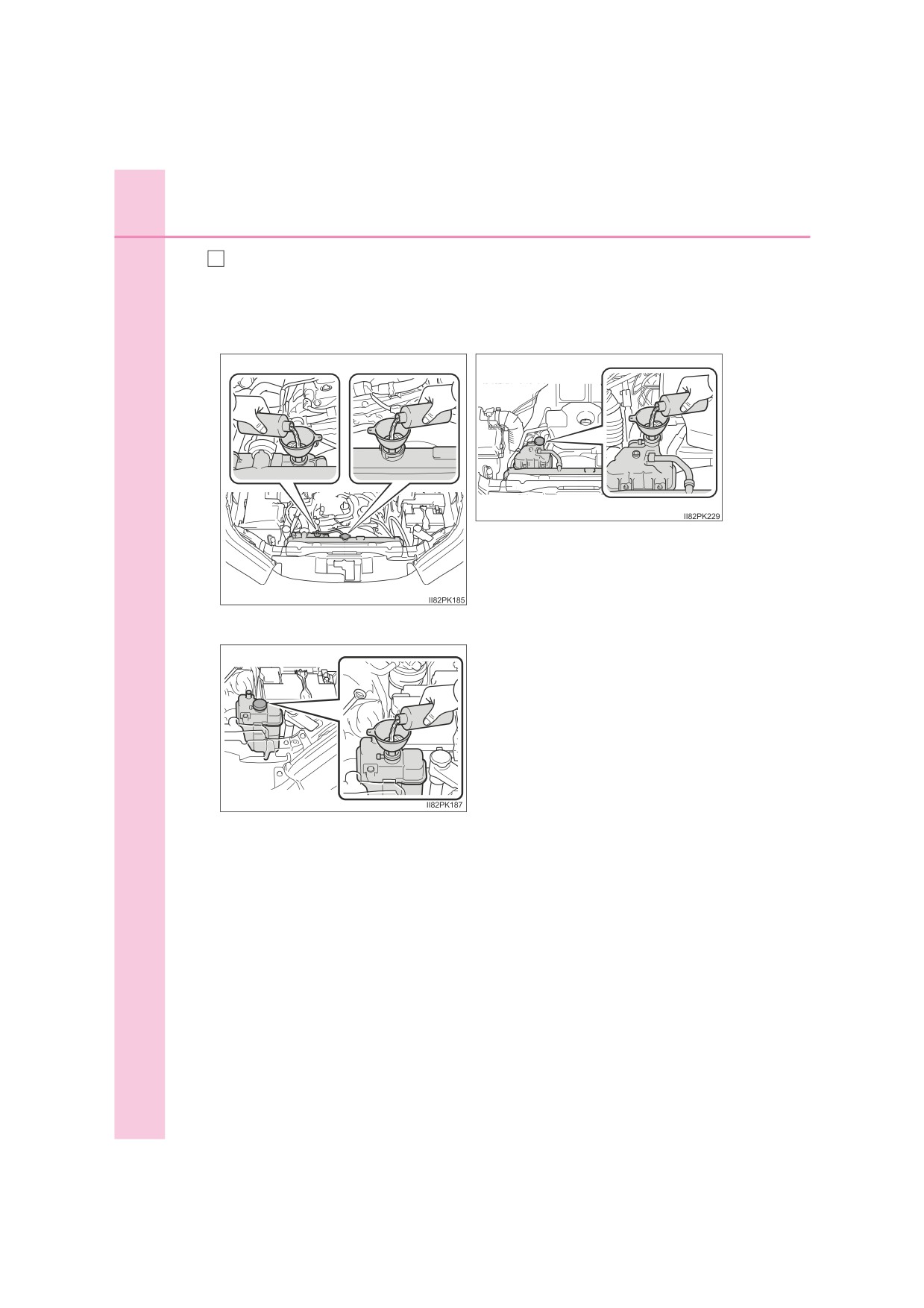
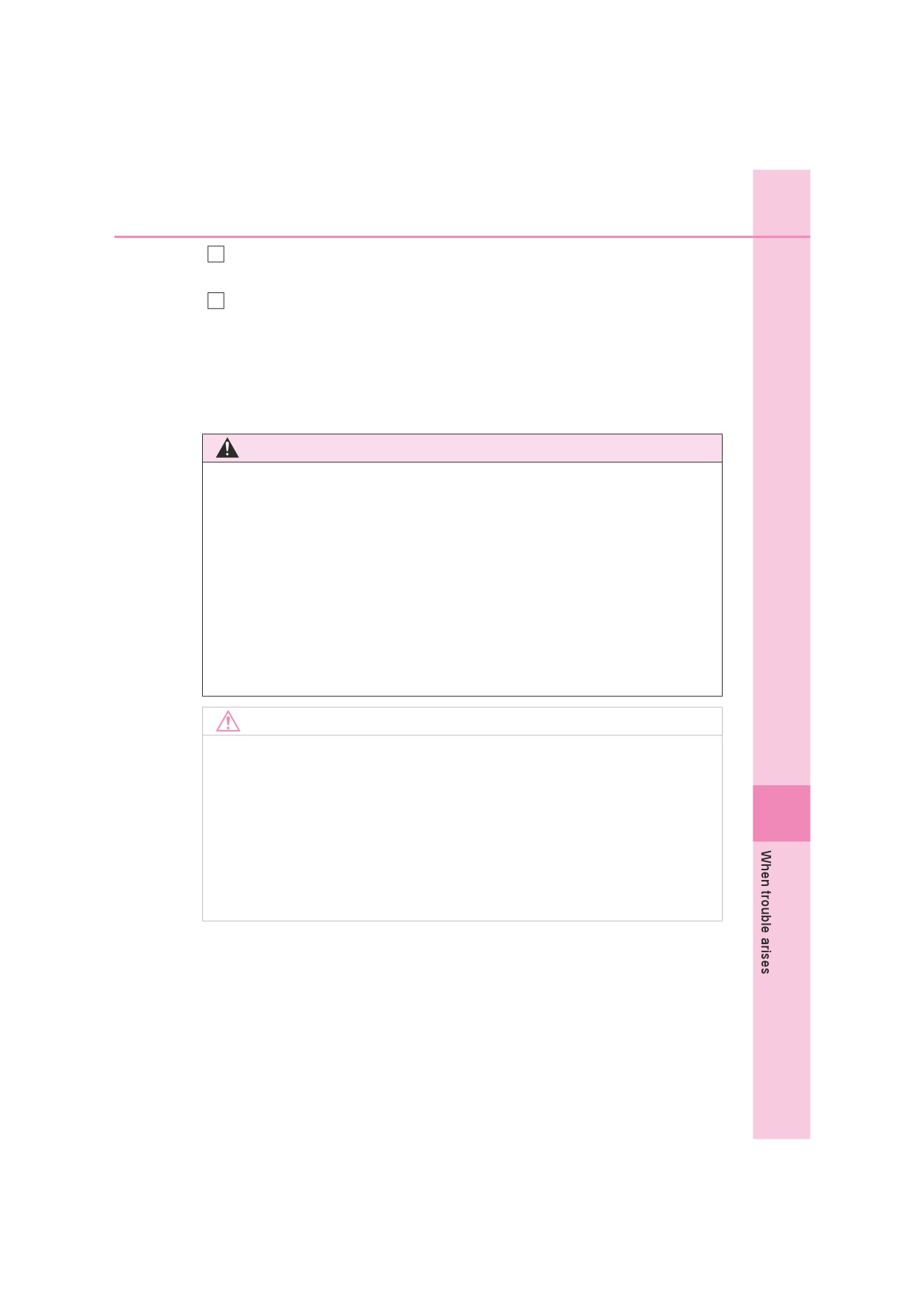
Add engine coolant if necessary. (P. 632)
Water can be used in an emergency if engine coolant is unavailable.
Engine coolant
(gasoline
Engine coolant (diesel engine)
engine)
Intercooler coolant (if equipped)
8-2. Steps to take in an emergency
611
6
Start the engine to check that the radiator cooling fan operates and
to check for coolant leaks from the radiator or hoses.
7
If the fan is not operating:
Stop the engine immediately and contact any authorized Toyota
retailer or Toyota authorized repairer, or any reliable repairer.
If the fan is operating:
Have the vehicle inspected at the nearest authorized Toyota retailer
or Toyota authorized repairer, or any reliable repairer.
WARNING
■ When inspecting under the hood of your vehicle
Observe the following precautions.
Failure to do so may result in serious injury such as burns.
●If steam is seen coming from under the hood, do not open the hood until
the steam has subsided. The engine compartment may be very hot.
● Keep hands and clothing (especially a tie, a scarf or a muffler) away from
the fans and belts. Failure to do so may cause the hands or clothing to be
caught, resulting in serious injury.
●Do not loosen the radiator cap (if equipped), the engine coolant reservoir
cap or intercooler coolant reservoir cap (if equipped) while the engine and
radiator are hot. High temperature steam or coolant could spray out.
NOTICE
■ When adding engine coolant
Add coolant slowly after the engine has cooled down sufficiently. Adding
cool coolant to a hot engine too quickly can cause damage to the engine.
8
■ To prevent damage to the cooling system
Observe the following precautions:
● Avoid contaminating the coolant with foreign matter (such as sand or dust
etc.).
●Do not use any coolant additive.
612
8-2. Steps to take in an emergency
If you run out of fuel and the engine stalls
(diesel engine only)
If you run out of fuel and the engine stalls:
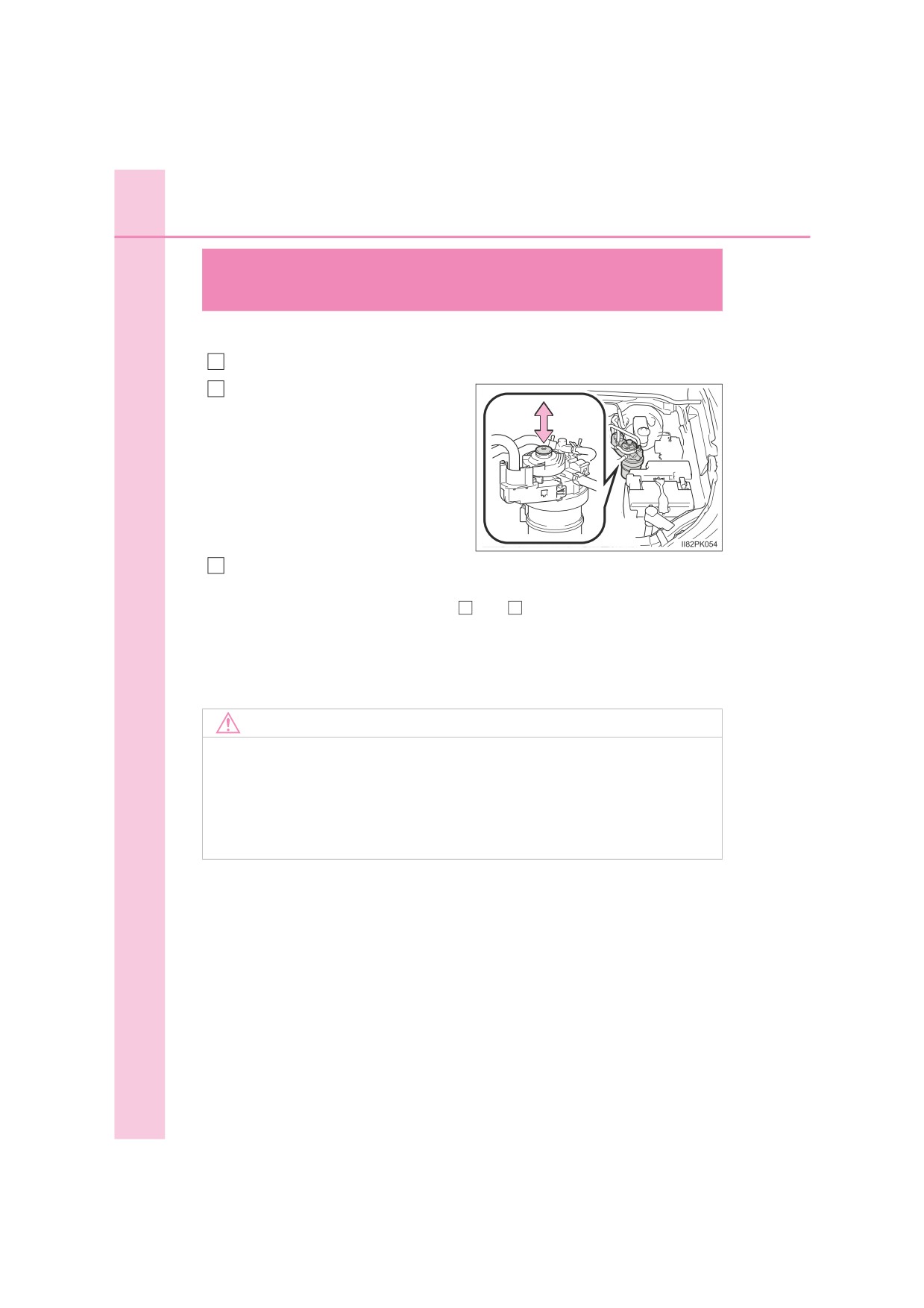
1
Refuel your vehicle.
2
To bleed the fuel system, oper-
ate the priming pump until you
feel more resistance.
3
Start the engine. (P. 218, 221)
If the engine does not start after the above
steps
have been performed,
wait for 10 seconds and try steps
2
and
3
again. If
the engine still does
not start, contact any authorized Toyota retailer or Toyota authorized
repairer, or any reliable repairer.
After starting the engine, depress the accelerator pedal lightly until the
engine runs smoothly.
NOTICE
■ When restarting the engine
●Do not crank the engine before refueling and operating the priming pump.
This may damage the engine and fuel system.
●Do not crank the engine for more than 30 seconds at a time. This may
overheat the starter and wiring system.
8-2. Steps to take in an emergency
613
If the vehicle becomes stuck
Carry out the following procedures if the tires spin or the vehicle
becomes stuck in mud, dirt or snow:
1
Stop the engine. Set the parking brake and shift the shift lever to P
(automatic transmission) or N (manual transmission).
2
Remove the mud, snow or sand from around the stuck tire.
3
Place wood, stones or some other material under the tires to help
provide traction.
4
Restart the engine.
5
Vehicles with rear differential lock system: Lock the rear differential.
(P. 339)
Shift the shift lever to the D or R position (automatic transmission)
6
or 1 or R position (manual transmission) and carefully apply the
accelerator to free the vehicle.
8
614
8-2. Steps to take in an emergency
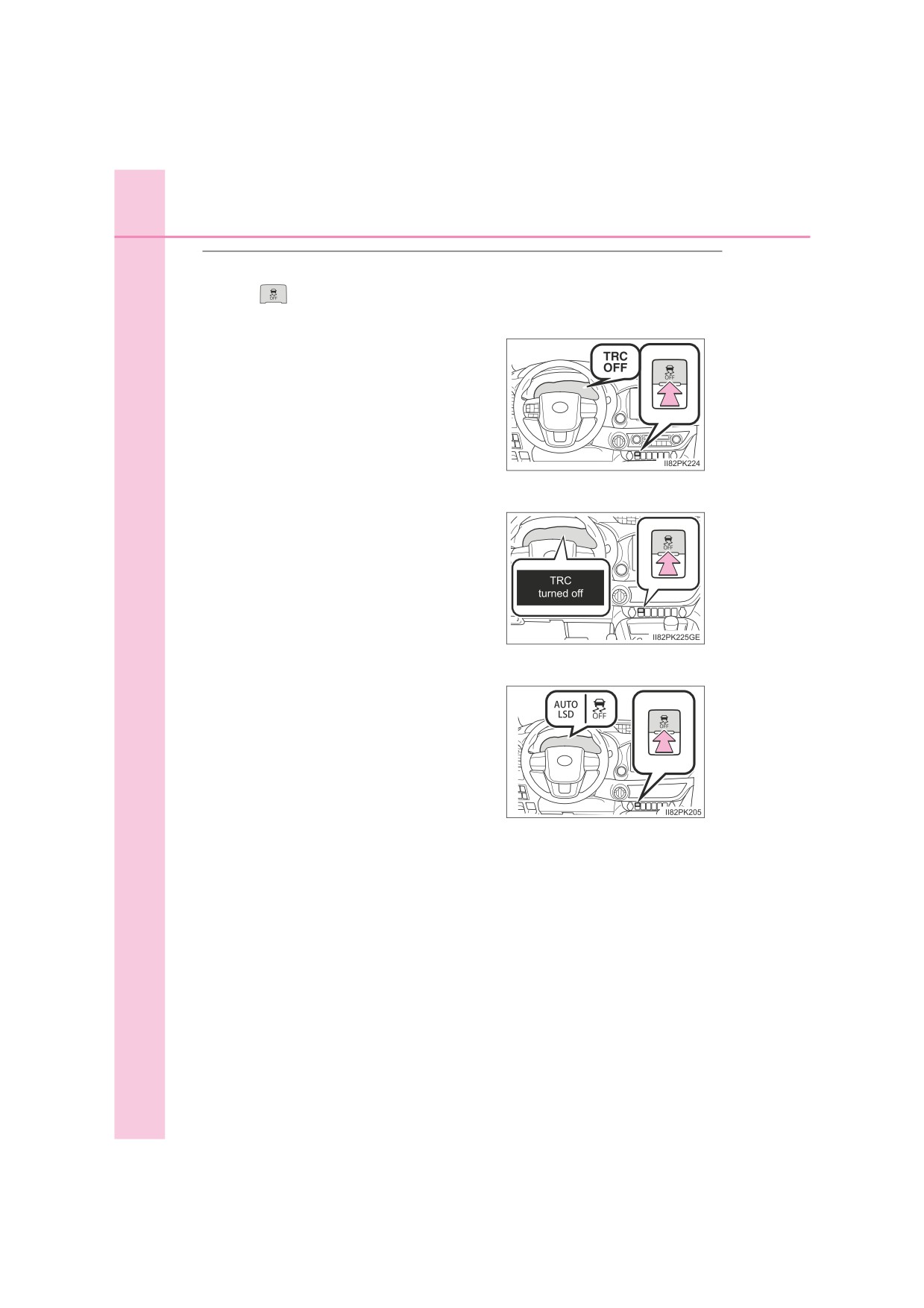
■ When it is difficult to free the vehicle (vehicles with TRC/A-TRC system)
Press
to turn off TRC/A-TRC.
Vehicles without AUTO LSD system (without multi-information display)
Vehicles without AUTO LSD system (with multi-information display)
Vehicles with AUTO LSD system
8-2. Steps to take in an emergency
615
WARNING
■ When attempting to free a stuck vehicle
If you choose to push the vehicle back and forth to free it, make sure the
surrounding area is clear to avoid striking other vehicles, objects or people.
The vehicle may also lunge forward or lunge back suddenly as it becomes
free. Use extreme caution.
■ When shifting the shift lever
For vehicles with automatic transmission, be careful not to shift the shift
lever with the accelerator pedal depressed.
This may lead to unexpected rapid acceleration of the vehicle that may
cause an accident resulting in death or serious injury.
NOTICE
■ To avoid damage to the transmission and other components
● Avoid spinning the wheels and depressing the accelerator pedal more
than necessary.
● If the vehicle remains stuck even after these procedures are performed,
the vehicle may require towing to be freed.
● Vehicles with automatic transmission: When a warning message for the
automatic transmission fluid temperature is displayed while attempting to
free a stuck vehicle, immediately remove your foot from the accelerator
pedal and wait until the warning message disappears. Otherwise, the
transmission may become damaged. (P. 236)
8
616
8-2. Steps to take in an emergency
617
Vehicle specifications
9
9-1. Specifications
Maintenance data
(fuel, oil level, etc.)
618
Fuel information
641
9-2. Customization
Customizable features
644
9-3. Initialization
Items to initialize
652
618
9-1. Specifications
Maintenance data (fuel, oil level, etc.)
Dimensions
5265 mm (207.3 in.)*2
Without rear bumper
Without
5285 mm (208.1 in.)*3
over fender
With rear bumper
5335 mm (210.0 in.)
Overall length
5255 mm (206.9 in.)*2
Without rear bumper
With
5275 mm (207.7 in.)*3
over fender
With rear bumper
5325 mm (209.6 in.)
1800 mm (70.9 in.)*4
Without over fender
1815 mm (71.5 in.)*5
Overall width
1855 mm (73.0 in.)*6
With over fender
1900 mm (74.8 in.)*7
1910 mm (75.2 in.)*8
1855 mm (73.0 in.)*10
Single-cab models
1795 mm (70.7 in.)*11
Overall
1860 mm (73.2 in.)*10
Smart-cab models
height*1
1810 mm (71.3 in.)*11
1865 mm (73.4 in.)*10
Double-cab models
1815 mm (71.5 in.)*11
Wheelbase
3090 mm (121.7 in.)
1505 mm (59.3 in.)*12
Front tread
1495 mm (58.9 in.)*13
1535 mm (60.4 in.)*14
1520 mm (59.8 in.)*12
Rear tread
1510 mm (59.4 in.)*13
1550 mm (61.0 in.)*14
1: Unladen vehicle
*2: With tailgate type A (P. 158)
*3: With tailgate type B (P. 158)
*4: Without side step
*5: With side step
*6: With exterior type A*9
*7: With exterior type B*9
*8: With exterior type C*9
9-1. Specifications
619
*9: See “How to identify exterior type” to check the type of your vehicle.
(P. 619)
*10: Without short pole antenna
*11: With short pole antenna
*12: With 205R16C tires
*13: With 225/70R17C tires
*14: With 265/65R17 or 265/60R18 tires
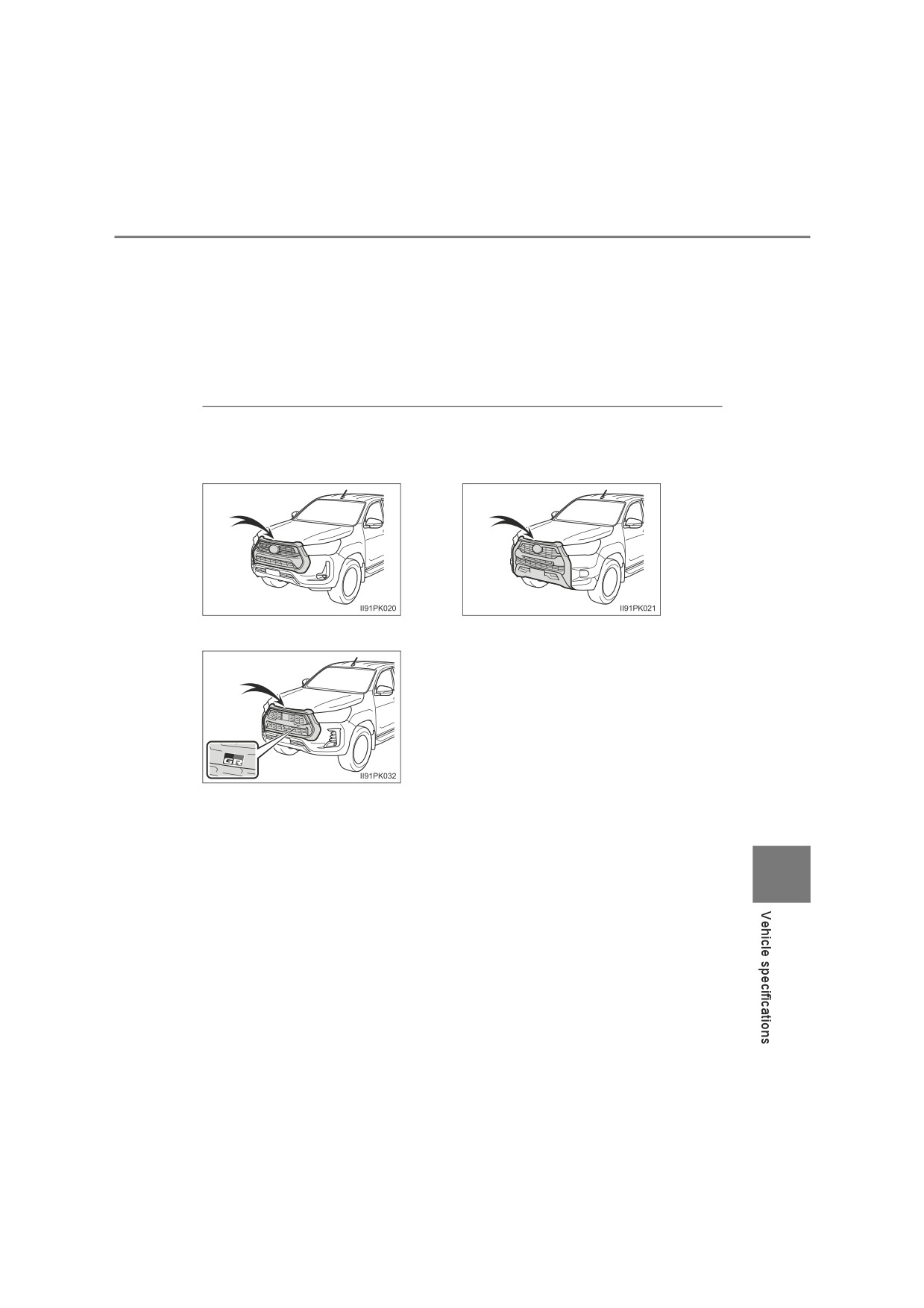
■ How to identify exterior type
Check the type of the exterior in the following illustrations.
Type A
Type B
Type C
9
620
9-1. Specifications
Weights (with towing hitch)
Models for model code destination W*1
4WD
3080 kg (6790 lb.)
Single-
models
cab
models
Pre
3000 kg (6614 lb.)
Runner
Smart-cab models
3150 kg (6945 lb.)
Models made in South Africa*1
Gross vehicle
3210 kg (7077 lb.)
mass
4WD
Models made in Thailand*1
models
2910 kg (6415 lb.)*2
Double-
3130 kg (6900 lb.)*3
cab
models
Models made in South Africa*1
Pre
3050 kg (6724 lb.)
Runner
Models made in Thailand*1
3030 kg (6680 lb.)
Front
1450 kg (3197 lb.)
Single-
cab
1850 kg (4079 lb.)
models
Smart-
cab
1920 kg (4233 lb.)
models
Maximum
permissible axle
Except for GUN125L-DTFSXW,
capacity
Rear
GUN126L-DTTSXW
and
GUN126L-DTTHXW models*5
Double-
1920 kg (4233 lb.)
cab
For
GUN125L-DTFSXW,
models
GUN126L-DTTSXW
and
GUN126L-DTTHXW models*5
1650 kg (3638 lb.)*6
1920 kg (4233 lb.)*7
4WD models
140 kg (309 lb.)
Drawbar load
Pre Runner
120 kg (265 lb.)
9-1. Specifications
621
Without brake
750 kg (1653 lb.)
4WD
3500 kg (7716 lb.)
Towing capacity
models
With
brake
Pre
3000 kg (6614 lb.)
Runner
*1: See “Checking your vehicle’s model” if you are not sure of which model
your vehicle is. (P. 12)
*2: Except for EURO VI models*4 for Israel and Turkey
*3: For EURO VI models*4 for Israel and Turkey
*4: EURO VI is an emission standard. If it is not clear that your vehicle meets
relevant standards, contact any authorized Toyota retailer or Toyota
authorized repairer, or any reliable repairer.
*5: The model code is indicated on the manufacturer’ plate or label.
(P. 622)
*6: Except for EURO VI models*4 for Israel, Turkey and Ukraine
*7: For EURO VI models*4 for Israel, Turkey and Ukraine
Models for model code destination Blank* (for Kazakhstan and
Russia)
Gross vehicle mass
2800 kg (6173 lb.)
Front
1400 kg (3086 lb.)
Maximum permissible
axle capacity
Rear
1650 kg (3638 lb.)
Drawbar load
100 kg (220 lb.)
Without brake
750 kg (1653 lb.)
Towing capacity
With brake
2500 kg (5512 lb.)
*: See “Checking your vehicle’s model” if you are not sure of which model
9
your vehicle is. (P. 12)
622
9-1. Specifications
Vehicle identification
■ Vehicle identification number
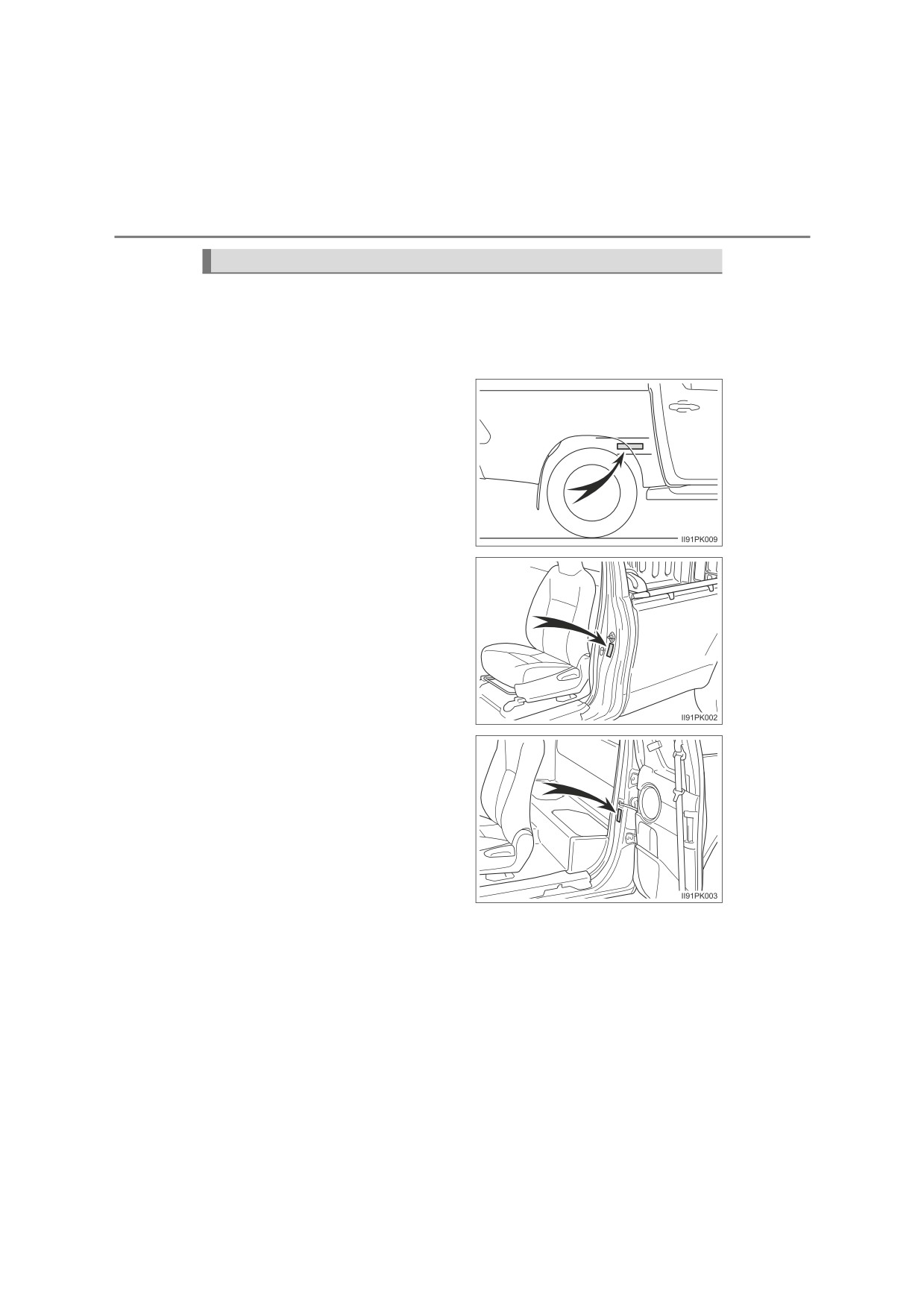
The vehicle identification number (VIN) is the legal identifier for
your vehicle. This is the primary identification number for your
Toyota. It is used in registering the ownership of your vehicle.
This number is stamped on the
rear right frame.
Single-cab models:
This number is also on the
manufacturer’s label.
Smart-cab models:
This number is also on the
manufacturer’s label.
9-1. Specifications
623
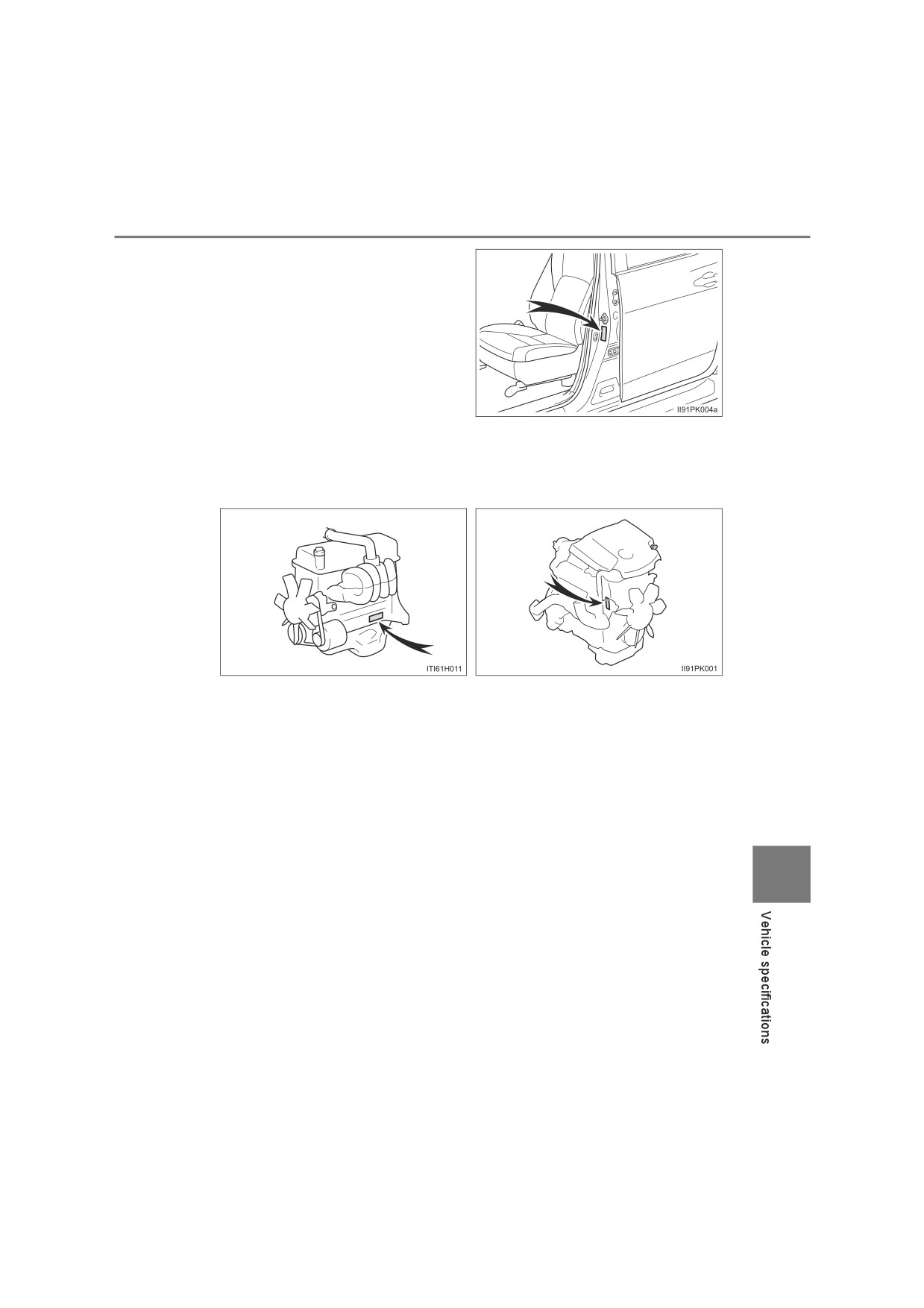
Double-cab models:
This number is also on the
manufacturer’s label.
■ Engine number
The engine number is stamped on the engine block as shown.
Gasoline engine
Diesel engine
9
624
9-1. Specifications
Engine
2TR-FE engine
Model
2TR-FE
Type
4 cylinder in line, 4 cycle, gasoline
Bore and stroke
95.0 95.0 mm (3.74 3.74 in.)
Displacement
2694 cm3 (164.4 cu.in.)
Valve clearance
Automatic adjustment
Drive belt tension
Automatic adjustment
1GD-FTV engine
Model
1GD-FTV
4 cylinder in line, 4 cycle, diesel
Type
(with turbocharger)
Bore and stroke
92.0 103.6 mm (3.62 4.08 in.)
Displacement
2755 cm3 (168.1 cu.in.)
Valve clearance
Automatic adjustment
Drive belt tension
Automatic adjustment
2GD-FTV engine
Model
2GD-FTV
4 cylinder in line, 4 cycle, diesel
Type
(with turbocharger)
Bore and stroke
92.0 90.0 mm (3.62 3.54 in.)
Displacement
2393 cm3 (146.0 cu.in.)
Valve clearance
Automatic adjustment
Drive belt tension
Automatic adjustment
9-1. Specifications
625
Fuel
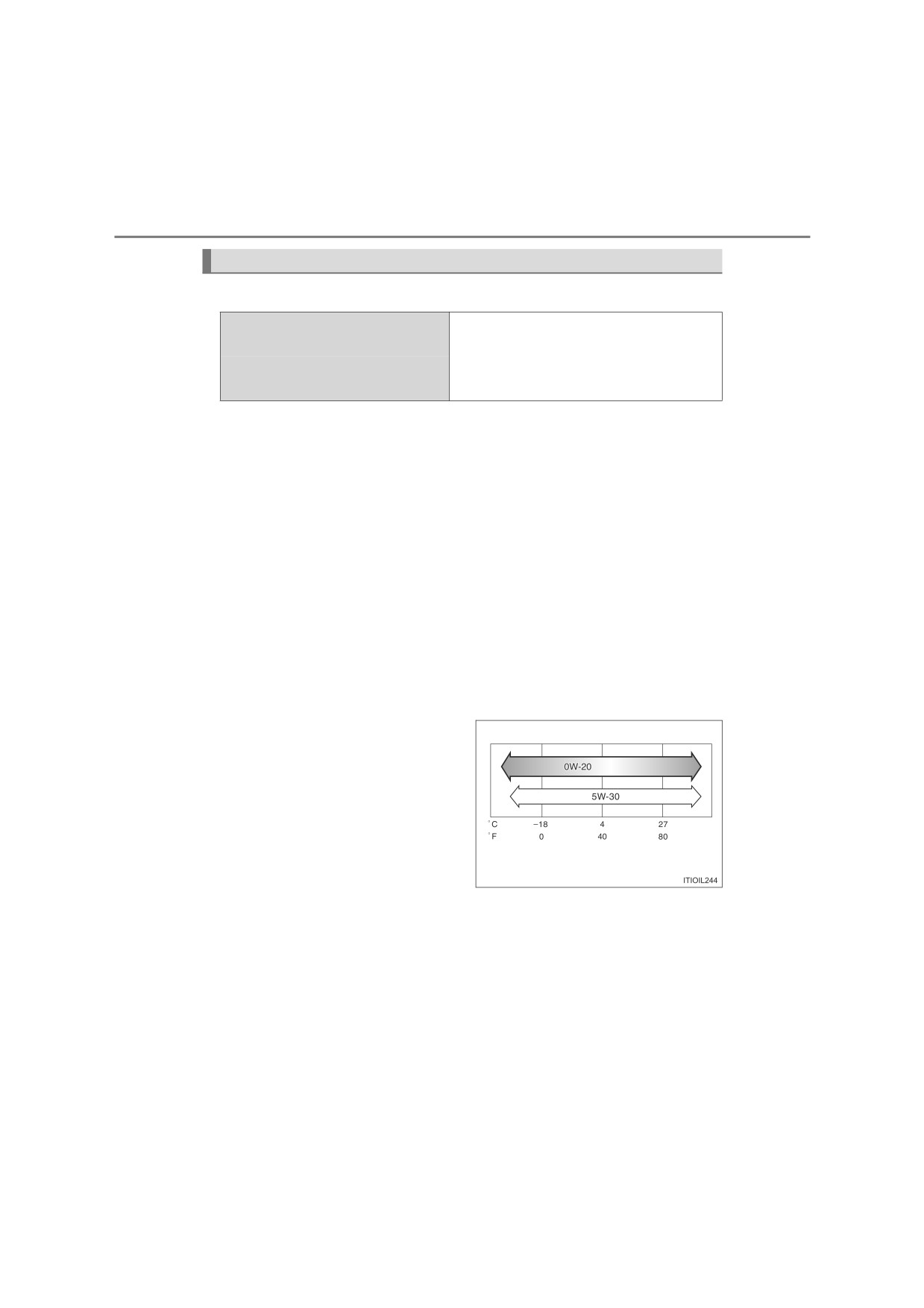
Gasoline engine
When you find these types of fuel label at the gas
station, use only the fuel with one of the following
labels.
Fuel type
Unleaded gasoline only
Research Octane
91 or higher
Number
Fuel tank capacity
80 L (21.1 gal., 17.6 Imp.gal.)
(Reference)
Diesel engine
When you find these types of fuel label at the gas
station, use only the fuel with one of the following
labels.
Fuel type
EU area:
Diesel fuel conforming to European standard
EN590, EN16734 or EN15940*
Except EU area (vehicles without DPF system):
Diesel fuel only
Except EU area (vehicles with DPF system):
Diesel fuel that contains 10 ppm or less of sulfur
9
Cetane number
48 or higher
Fuel tank capacity
80 L (21.1 gal., 17.6 Imp.gal.)
(Reference)
*: In case that a vehicle which has “XTL” label on the fuel lid, XTL (EN15940,
paraffin diesel) can be used.
626
9-1. Specifications
Lubrication system
Gasoline engine
Oil capacity
(Drain and refill reference*)
With filter
5.6 L (5.9 qt., 4.9 Imp.qt.)
Without filter
5.3 L (5.6 qt., 4.7 Imp.qt.)
*: The engine oil capacity is a reference quantity to be used when changing
the engine oil. Warm up and turn off the engine, wait more than 5 minutes,
and check the oil level on the dipstick.
■ Engine oil selection
“Toyota Genuine Motor Oil” is used in your Toyota vehicle. Toyota
recommends the use of approved “Toyota Genuine Motor Oil”.
Another motor oil of matching quality can also be used.
Oil grade:
0W-20 and 5W-30:
API grade SM “Energy-Conserving”, SN “Resource-Conserving”,
SN PLUS “Resource-Conserving” or SP “Resource-Conserving”; or
ILSAC GF-6A multigrade engine oil
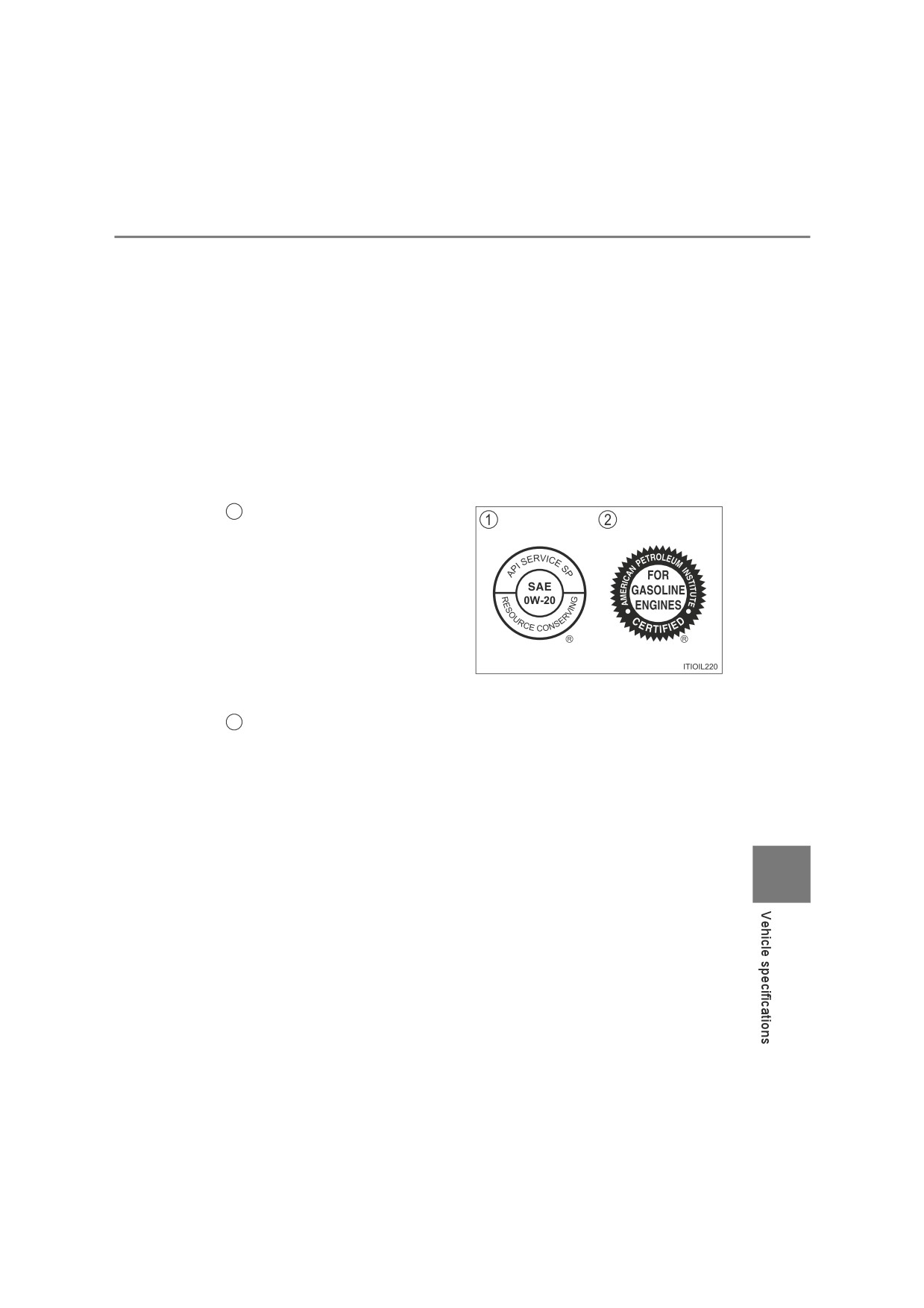
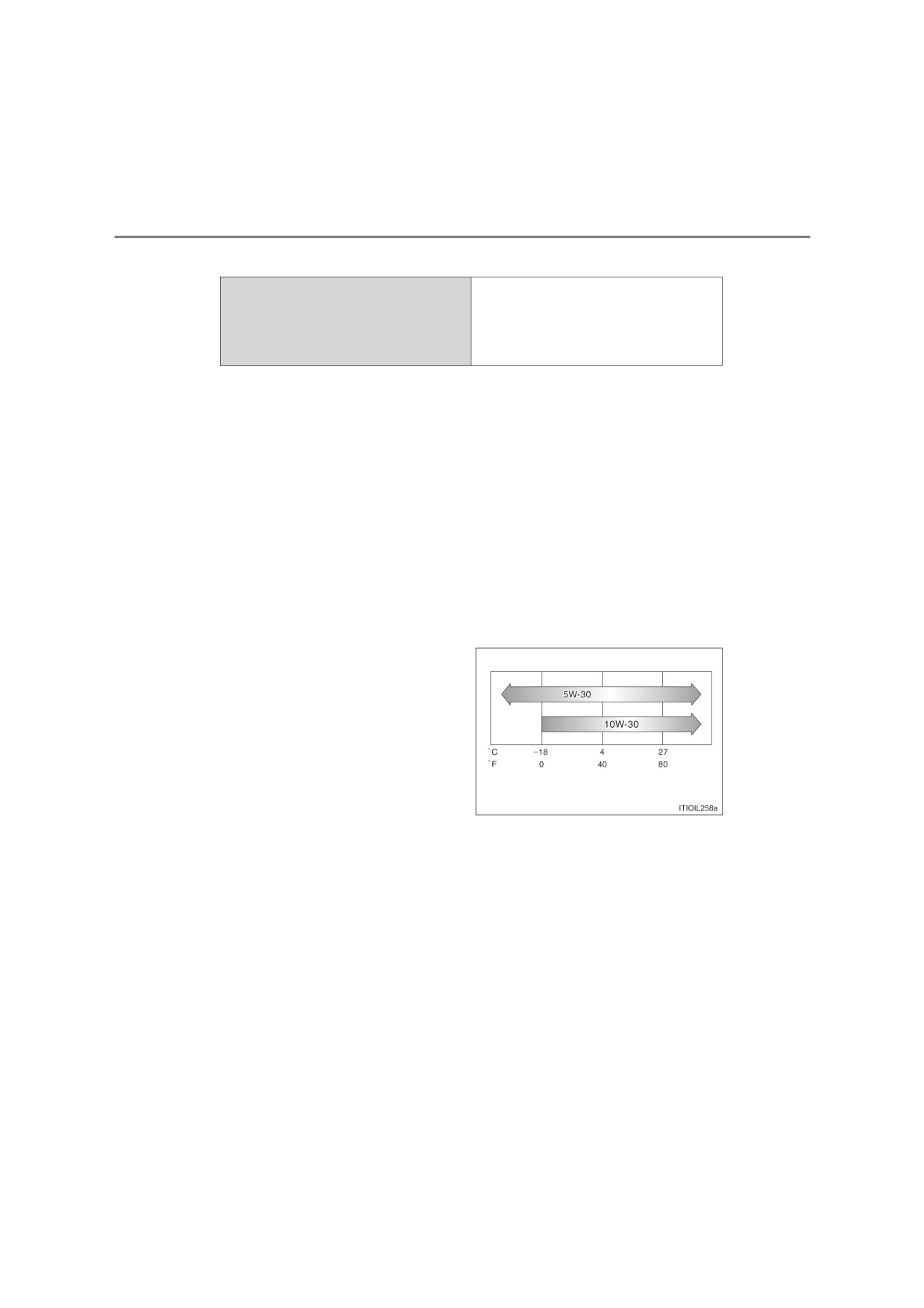
Recommended viscosity (SAE):
SAE 0W-20 is filled into your
Toyota vehicle at manufactur-
Preferred
ing, and the best choice for
good fuel economy and good
starting in cold weather.
If SAE 0W-20 oil is not avail-
able, SAE 5W-30 oil may be
Temperature range anticipated
used. However, it should be
before next oil change
replaced with SAE 0W-20 at the
next oil change.
9-1. Specifications
627
Oil viscosity (0W-20 is explained here as an example):
• The 0W in 0W-20 indicates the characteristic of the oil which
allows cold startability. Oils with a lower value before the W allow
for easier starting of the engine in cold weather.
• The 20 in 0W-20 indicates the viscosity characteristic of the oil
when the oil is at high temperature. An oil with a higher viscosity
(one with a higher value) may be better suited if the vehicle is
operated at high speeds, or under extreme load conditions.
How to read oil container labels:
Either or both API registered marks are added to some oil contain-
ers to help you select the oil you should use.
API Service Symbol
1
Top portion: “API SERVICE SP”
means the oil quality designa-
tion by American Petroleum Ins-
titute (API).
Center portion:
“SAE
0W-20”
means the SAE viscosity grade.
Lower portion: “Resource-Con-
serving” means that the oil has
fuel-saving and environmental
protection capabilities.
ILSAC Certification Mark
2
The International Lubricant Specification Advisory Committee (ILSAC)
Certification Mark is displayed on the front of the container.
9
628
9-1. Specifications
Diesel engine (except for EURO V and VI models*1)
Oil capacity
(Drain and refill — reference*2)
With filter
7.5 L (7.9 qt., 6.6 Imp.qt.)
Without filter
7.0 L (7.4 qt., 6.2 Imp.qt.)
*1: EURO V and VI are emission standards. If it is not clear that your vehicle
meets relevant standards, contact any authorized Toyota retailer or Toyota
authorized repairer, or any reliable repairer.
*2: The engine oil capacity is a reference quantity to be used when changing
the engine oil. Warm up and turn off the engine, wait more than 5 minutes,
and check the oil level on the dipstick.
■ Engine oil selection
“Toyota Genuine Motor Oil” is used in your Toyota vehicle. Use
Toyota approved “Toyota Genuine Motor Oil” or equivalent to sat-
isfy the following grade and viscosity.
Oil grade: API CF-4, CF or ACEA B3, B4, B5 or JASO DL-0
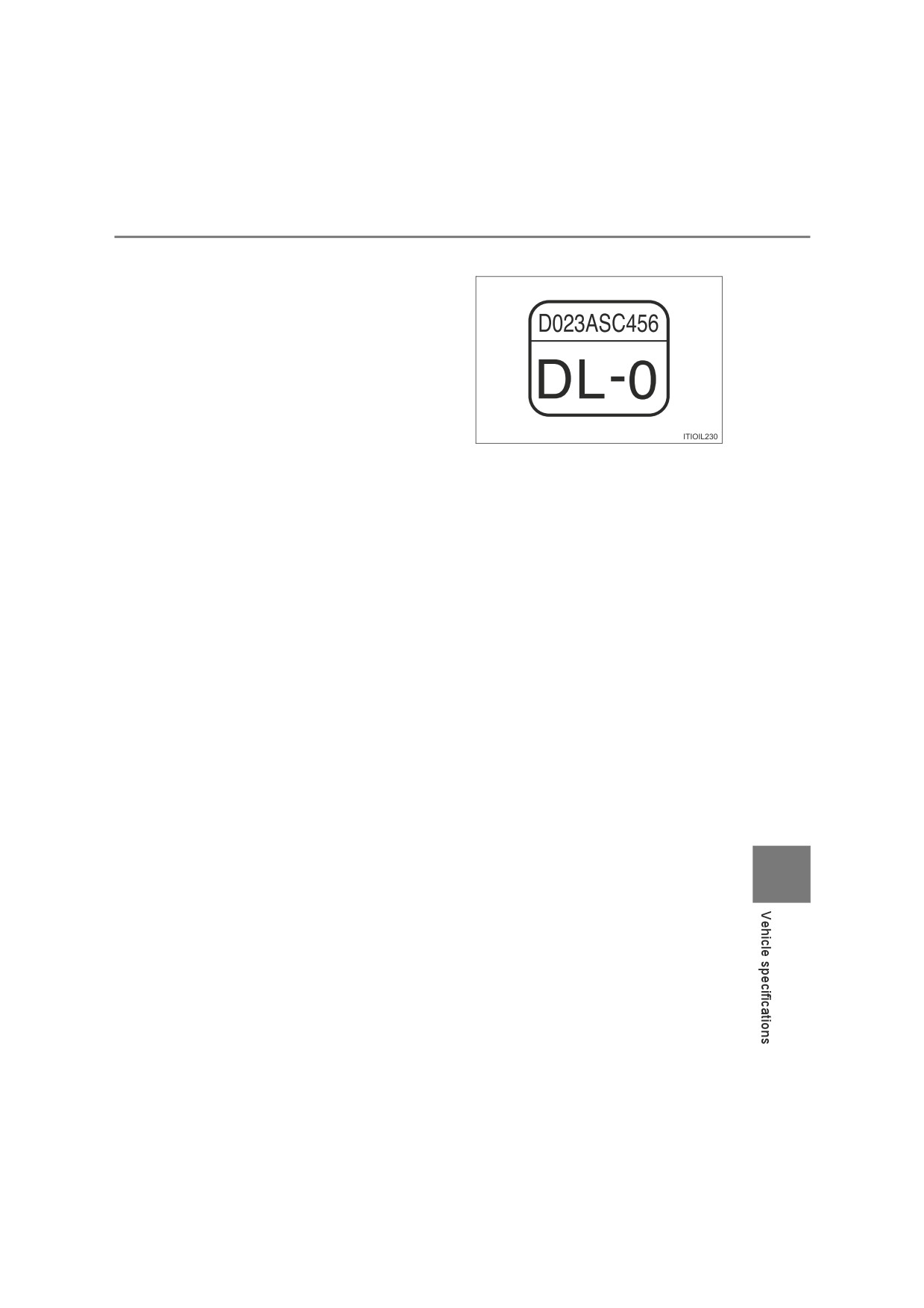
Recommended viscosity (SAE):
SAE 5W-30 is the best choice
for good fuel economy and
good starting in cold weather.
Preferred
If you use SAE 10W-30 or a
higher viscosity engine oil in
extremely low temperatures,
Temperature range anticipated
the engine may become difficult
before next oil change
to start, so SAE 5W-30 engine
oil is recommended.
9-1. Specifications
629
How to read oil container label:
The Japanese Automobile
Standard Organization (JASO)
DL-0 Mark is added to some oil
containers to help you select
the oil you should use.
Oil viscosity (5W-30 is explained here as an example):
• The 5W in 5W-30 indicates the characteristic of the oil which
allows cold startability. Oils with a lower value before the W allow
for easier starting of the engine in cold weather.
• The 30 in 5W-30 indicates the viscosity characteristic of the oil
when the oil is at high temperature. An oil with a higher viscosity
(one with a higher value) may be better suited if the vehicle is
operated at high speeds, or under extreme load conditions.
9
630
9-1. Specifications
Diesel engine (for EURO V and VI models*1)
Oil capacity
(Drain and refillreference*2)
With filter
7.5 L (7.9 qt., 6.6 Imp.qt.)
Without filter
7.0 L (7.4 qt., 6.2 Imp.qt.)
*1: EURO V and VI are emission standards. If it is not clear that your vehicle
meets relevant standards, contact any authorized Toyota retailer or Toyota
authorized repairer, or any reliable repairer.
*2: The engine oil capacity is a reference quantity to be used when changing
the engine oil. Warm up and turn off the engine, wait more than 5 minutes,
and check the oil level on the dipstick.
■ Engine oil selection
“Toyota Genuine Motor Oil” is used in your Toyota vehicle. Toyota
recommends the use of approved “Toyota Genuine Motor Oil”.
Another motor oil of matching quality can also be used.
Oil grade:
0W-20: ACEA C5
0W-30 and 5W-30: ACEA C2 or JASO DL-1
NOTICE
Using engine oil other than ACEA C5, C2 or JASO DL-1 may damage the cat-
alytic converter.
9-1. Specifications
631
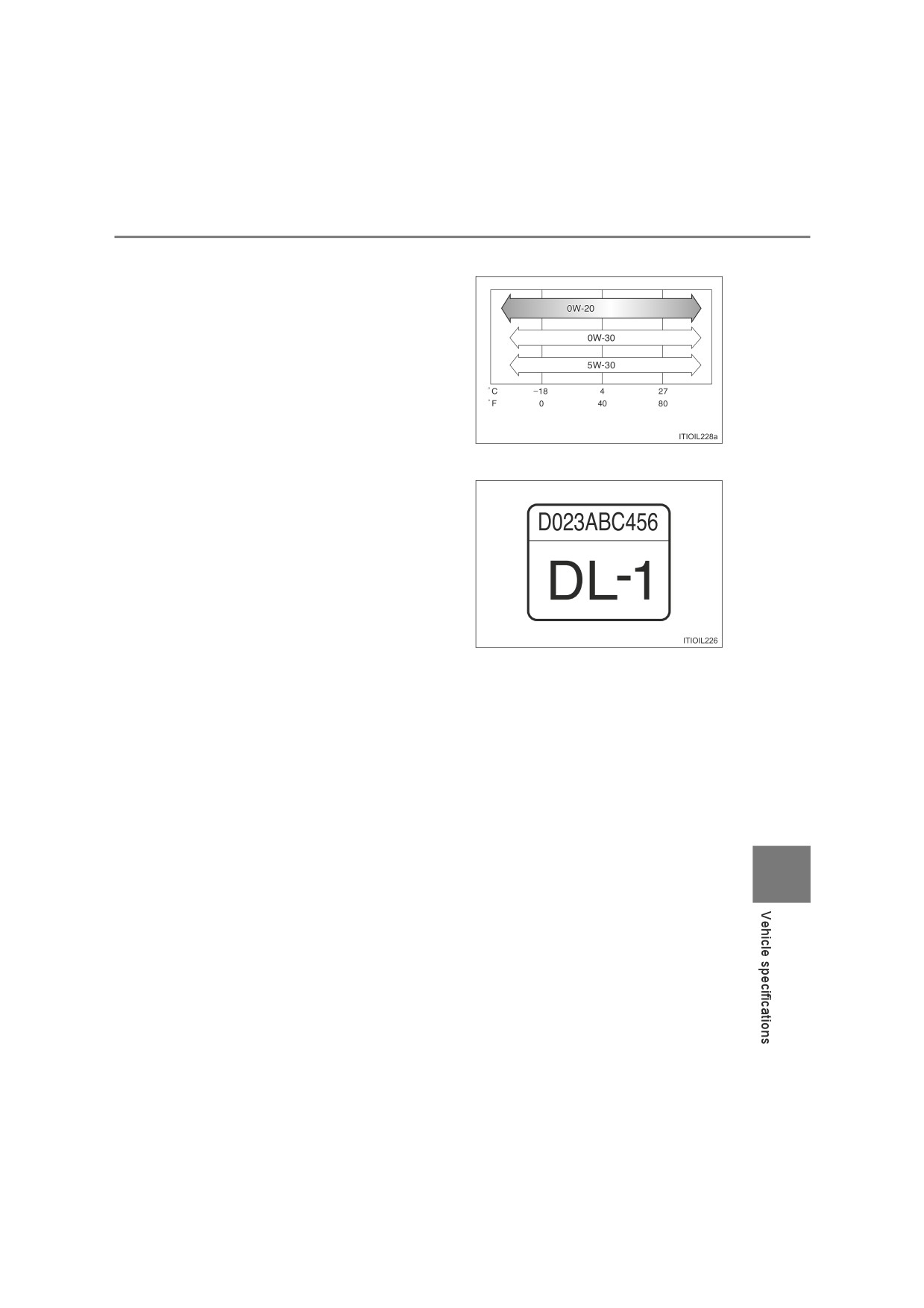
Recommended viscosity (SAE):
SAE 0W-20 is filled into your
Toyota vehicle at manufactur-
Preferred
ing, and the best choice for
good fuel economy and good
starting in cold weather.
Temperature range anticipated
before next oil change
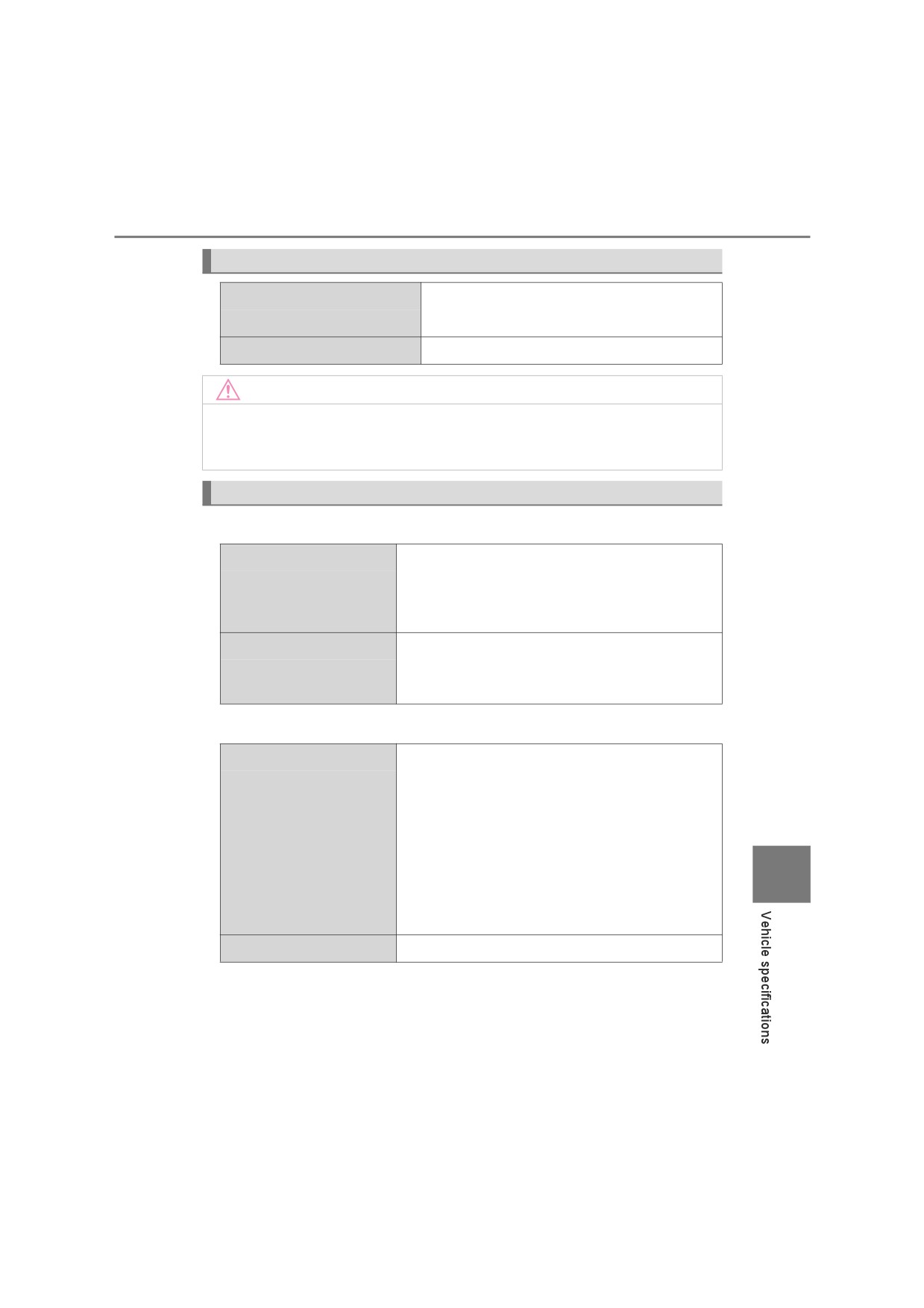
How to read oil container label:
The Japanese Automobile
Standard Organization (JASO)
DL-1 Mark is added to some oil
containers to help you select
the oil you should use.
Oil viscosity (0W-20 is explained here as an example):
• The 0W in 0W-20 indicates the characteristic of the oil which
allows cold startability. Oils with a lower value before the W allow
for easier starting of the engine in cold weather.
• The 20 in 0W-20 indicates the viscosity characteristic of the oil
when the oil is at high temperature. An oil with a higher viscosity
(one with a higher value) may be better suited if the vehicle is
operated at high speeds, or under extreme load conditions.
9

632
9-1. Specifications
Cooling system
With automatic transmission
8.1 L (8.6 qt., 7.1 Imp.qt.)
Gasoline engine
With manual transmission
7.8 L (8.2 qt., 6.9 Imp.qt.)
Except for
Engine
EURO IV,
8.2 L (8.7 qt., 7.2 Imp.qt.)*2
coolant
V and VI
8.6 L (9.1 qt., 7.6 Imp.qt.)*3
capacity
models*1
Diesel
With automatic transmission
engine
For
9.8 L (10.4 qt., 8.6 Imp.qt.)
EURO IV,
V and VI
With manual transmission
models*1
8.7 L (9.2 qt., 7.7 Imp.qt.)*2
9.3 L (9.8 qt., 8.2 Imp.qt.)*3
Intercooler coolant capacity
(if
2.95 L (3.12 qt., 2.60 Imp.qt.)
equipped)
Use either of the following:
•
“Toyota Super Long Life Coolant”
• Similar high-quality ethylene gly-
col-based non-silicate, non-amine,
Coolant type
non-nitrite, and non-borate coolant
with long-life hybrid organic acid
technology
Do not use plain water alone.
1: EURO IV, V and VI are emission standards. If it is not clear that your vehi-
cle meets relevant standards, contact any authorized Toyota retailer or
Toyota authorized repairer, or any reliable repairer.
*2: Without power heater
*3: With power heater
9-1. Specifications
633
Ignition system (gasoline engine)
Spark plug
Make
DENSO FK20HR-A8
Gap
0.8 mm (0.031 in.)
NOTICE
■ Iridium-tipped spark plugs
Use only iridium-tipped spark plugs. Do not adjust the spark plug gap.
Electrical system
Vehicles with maintenance type battery
Battery
Specific gravity reading
1.25 or higher
at 20C (68F):
If the specific gravity is lower than the standard
value, charge the battery.
Charging rates
Quick charge
15 A max.
Slow charge
5 A max.
Vehicles with maintenance-free type battery
Battery
12.3 V or higher
Open voltage at
20C
If the voltage is lower than the standard value,
(68F):
charge the battery.
(After charging the battery, turn on the high
beam headlights for 30 seconds with the engine
switch in the “LOCK” position [vehicles without
9
smart entry & start system] or off [vehicles with
smart entry & start system], and turn the head-
lights off.)
Charging rates
5 A max.
634
9-1. Specifications
Automatic transmission
Gasoline engine
8.5 L (9.0 qt., 7.5 Imp.qt.)
Fluid
capacity*
Diesel engine
9.5 L (10.0 qt., 8.4 Imp.qt.)
Fluid type
Toyota Genuine ATF WS
*: The fluid capacity is the quantity of reference.
If replacement is necessary, contact any authorized Toyota retailer or
Toyota authorized repairer, or any reliable repairer.
NOTICE
■ Automatic transmission fluid type
Using transmission fluid other than the above type may cause abnormal
noise or vibration, or damage the transmission of your vehicle.
Manual transmission
5-speed models
2.2 L (2.3 qt., 1.9 Imp.qt.)
4WD
2.5 L (2.6 qt., 2.2 Imp.qt.)
Oil capacity
models
6-speed
models
Pre
2.7 L (2.9 qt., 2.4 Imp.qt.)
Runner
TOYOTA Genuine Manual
Oil type
Transmission Gear Oil API
GL-3 (GL-4) or equivalent
Recommended oil viscosity
SAE 75W-90
NOTICE
■ Manual transmission gear oil
Please be aware that depending on the particular characteristics of the gear
oil used or the operating conditions, idle sound, shift feeling and/or fuel effi-
ciency may be different or affected. Toyota recommends to use “TOYOTA
Genuine Manual Transmission Gear Oil” to achieve optimal performance.
9-1. Specifications
635
Transfer (4WD models)
Oil capacity
1.0 L (1.1 qt., 0.9 Imp.qt.)
Toyota Genuine Transfer Gear oil LF or
Oil type*
equivalent
Recommended oil viscosity
SAE 75W
*: Your Toyota vehicle is filled with “Toyota Genuine Transfer Gear oil LF” at
the factory. Use Toyota approved “Toyota Genuine Transfer Gear oil LF” or
an equivalent oil of matching quality that satisfies the above specifications.
Please contact any authorized Toyota retailer or Toyota authorized
repairer, or any reliable repairer for further details.
Differential
Front
Without A.D.D.
1.45 L (1.53 qt., 1.28 Imp.qt.)
(4WD
models)
With A.D.D.
1.60 L (1.69 qt., 1.41 Imp.qt.)
Oil
Without rear differ-
3.65 L (3.86 qt., 3.21 Imp.qt.)*2
capacity
ential lock system
3.75 L (3.96 qt., 3.30 Imp.qt.)*3
Rear
With rear differential
3.60 L (3.80 qt., 3.17 Imp.qt.)
lock system
Toyota Genuine Differential
Oil type*1 and oil viscosity
gear oil LT
75W-85 GL-5 or
equivalent
1: Your Toyota vehicle is filled with “Toyota Genuine Differential Gear Oil” at
the factory. Use Toyota approved “Toyota Genuine Differential Gear Oil” or
an equivalent oil of matching quality that satisfies the above specifications.
Please contact any authorized Toyota retailer or Toyota authorized
repairer, or any reliable repairer for further details.
*2: Models made in Thailand*4
9
*3: Models made in South Africa*4
*4: See “Checking your vehicle’s model” if you are not sure of which model
your vehicle is. (P. 12)
Clutch (vehicles with manual transmission)
Pedal free play
5 15 mm (0.2 0.6 in.)
SAE J1703 or FMVSS No.116 DOT 3 or
Fluid type
SAE J1704 or FMVSS No.116 DOT 4
636
9-1. Specifications
Brakes
82 mm (3.2 in.)*3
Without VSC
92 mm (3.6 in.)*4
Pedal clearance*1
With VSC
82 mm (3.2 in.)
1.0 6.0 mm
Pedal free play
(0.04 0.24 in.)
Parking brake lever travel*2
7 9 clicks
SAE J1703 or FMVSS No.116
Fluid type
DOT 3 or SAE J1704 or
FMVSS No.116 DOT 4
*1: Minimum pedal clearance when depressed with a force of 490 N (50 kgf,
110 lbf) while the engine is running.
*2: Parking brake lever travel when pulled up with a force of 200 N (20 kgf,
45 lbf)
*3: Without 205R16C tires
*4: With 205R16C tires
Chassis lubrication
Lithium base chassis grease,
Spider
NLGI No.2
Front
(4WD
Molybdenum-disulfide
lithium
models)
Propeller
Slide
base chassis grease, NLGI No.2
shafts
yoke*1
or lithium base chassis grease,
NLGI No.2
Lithium base chassis grease,
Rear
Spider*2
NLGI No.2
*1: Models made in Thailand*3
*2: With grease fitting only
*3: See “Checking your vehicle’s model” if you are not sure of which model
your vehicle is. (P. 12)
9-1. Specifications
637
Steering
Free play
Less than 30 mm (1.2 in.)
Power steering fluid type
Automatic transmission fluid DEXRON® II or III
Tires and wheels
16 inch tires
Tire size
205R16C 8PR 110/108S
Rear wheel
Rear wheel
Tire inflation
Front wheel
(unladen)
(full load)
pressure
kPa (kgf/cm2 or
kPa (kgf/cm2 or
kPa (kgf/cm2 or
(Recommended
bar, psi)
bar, psi)
bar, psi)
cold tire inflation
pressure)
270 (2.7, 39)
270 (2.7, 39)
340 (3.4, 49)
Wheel size
16 6J
Wheel nut torque
105 N•m (10.7 kgf•m, 77 ft•lbf)
17 inch tires (type A)
Tire size
225/70R17C 108/106S
Rear wheel
Rear wheel
Tire inflation
Front wheel
(unladen)
(full load)
pressure
kPa (kgf/cm2 or
kPa (kgf/cm2 or
kPa (kgf/cm2 or
(Recommended
bar, psi)
bar, psi)
bar, psi)
cold tire inflation
pressure)
240 (2.4, 35)
240 (2.4, 35)
300 (3.0, 44)
Wheel size
17 6J
Wheel nut torque
105 N•m (10.7 kgf•m, 77 ft•lbf)
9

638
9-1. Specifications
17 inch tires (type B)
Tire size
265/65R17 112S
Tire inflation
Front wheel
Front wheel
Rear wheel
Rear wheel
pressure
(unladen)
(full load)
(unladen)
(full load)
(Recommended
kPa
kPa
kPa
kPa
cold tire inflation
(kgf/cm2 or
(kgf/cm2 or
(kgf/cm2 or
(kgf/cm2 or
pressure)
bar, psi)
bar, psi)
bar, psi)
bar, psi)
Models
for
model code
destination
Blank* (except
200
230
200
250
for
Kazakh-
(2.0, 29)
(2.3, 33)
(2.0, 29)
(2.5, 36)
stan, Kyrgyz-
stan, Russia,
Turkmenistan
and Tajikistan)
Models
for
model code
destination
Blank
(for
Kazakhstan,
230
230
230
250
Kyrgyzstan,
(2.3, 33)
(2.3, 33)
(2.3, 33)
(2.5, 36)
Russia, Turk-
menistan and
Tajikistan) and
W*
Wheel size
17 7 1/2J
Wheel nut torque
105 N•m (10.7 kgf•m, 77 ft•lbf)
*: See “Checking your vehicle’s model” if you are not sure of which model
your vehicle is. (P. 12)
9-1. Specifications
639
18 inch tires
Tire size
265/60R18 110H
Tire inflation
Front wheel
Front wheel
Rear wheel
Rear wheel
pressure
(unladen)
(full load)
(unladen)
(full load)
(Recommended
kPa
kPa
kPa
kPa
cold tire inflation
(kgf/cm2 or
(kgf/cm2 or
(kgf/cm2 or
(kgf/cm2 or
pressure)
bar, psi)
bar, psi)
bar, psi)
bar, psi)
Models
for
model code
destination
Blank* (except
200
230
200
250
for
Kazakh-
(2.0, 29)
(2.3, 33)
(2.0, 29)
(2.5, 36)
stan, Kyrgyz-
stan, Russia,
Turkmenistan
and Tajikistan)
Models
for
model code
destination
Blank
(for
Kazakhstan,
230
230
230
250
Kyrgyzstan,
(2.3, 33)
(2.3, 33)
(2.3, 33)
(2.5, 36)
Russia, Turk-
menistan and
Tajikistan) and
W*
Wheel size
18 7 1/2J
Wheel nut torque
105 N•m (10.7 kgf•m, 77 ft•lbf)
*: See “Checking your vehicle’s model” if you are not sure of which model
your vehicle is. (P. 12)
■When towing a trailer (with towing hitch)
9
Add 20.0 kPa (0.2 kgf/cm2 or bar, 3 psi) to the recommended tire inflation
pressure and drive at speeds below 100 km/h (62 mph).

640
9-1. Specifications
Light bulbs
Light bulbs
W
Type
Headlights
High/low beams
(halogen headlights
type A)
60/55
A
Low beams (halogen headlights type B)
55
B
High beams (halogen headlights type B)
60
C
Halogen front fog lights*
19
D
Front position lights (halogen headlights)
Without daytime running lights
5
E
With daytime running lights
21/5
E
Front turn signal lights (halogen headlights
21
F
Exterior
type A)
Front turn signal lights (halogen headlights
21
G
type B)
Rear turn signal lights
21
F
Back-up lights (without LED stop lights)
21
H
Rear fog light (without LED stop lights)*
21
H
Stop/tail lights (without LED stop lights)
21/5
H
License plate light
5
E
Outer foot lights*
5
E
Interior light*
8
I
Interior
Personal/interior lights
5
E
A: H4 halogen bulbs
F: Single end bulbs (amber)
B: H11 halogen bulbs
G: Wedge base bulbs (amber)
C: HB3 halogen bulbs
H: Single end bulbs (clear)
D: H16 halogen bulbs
I: Double end bulbs
E: Wedge base bulbs (clear)
*: If equipped
9-1. Specifications
641
Fuel information
◆ Gasoline engine
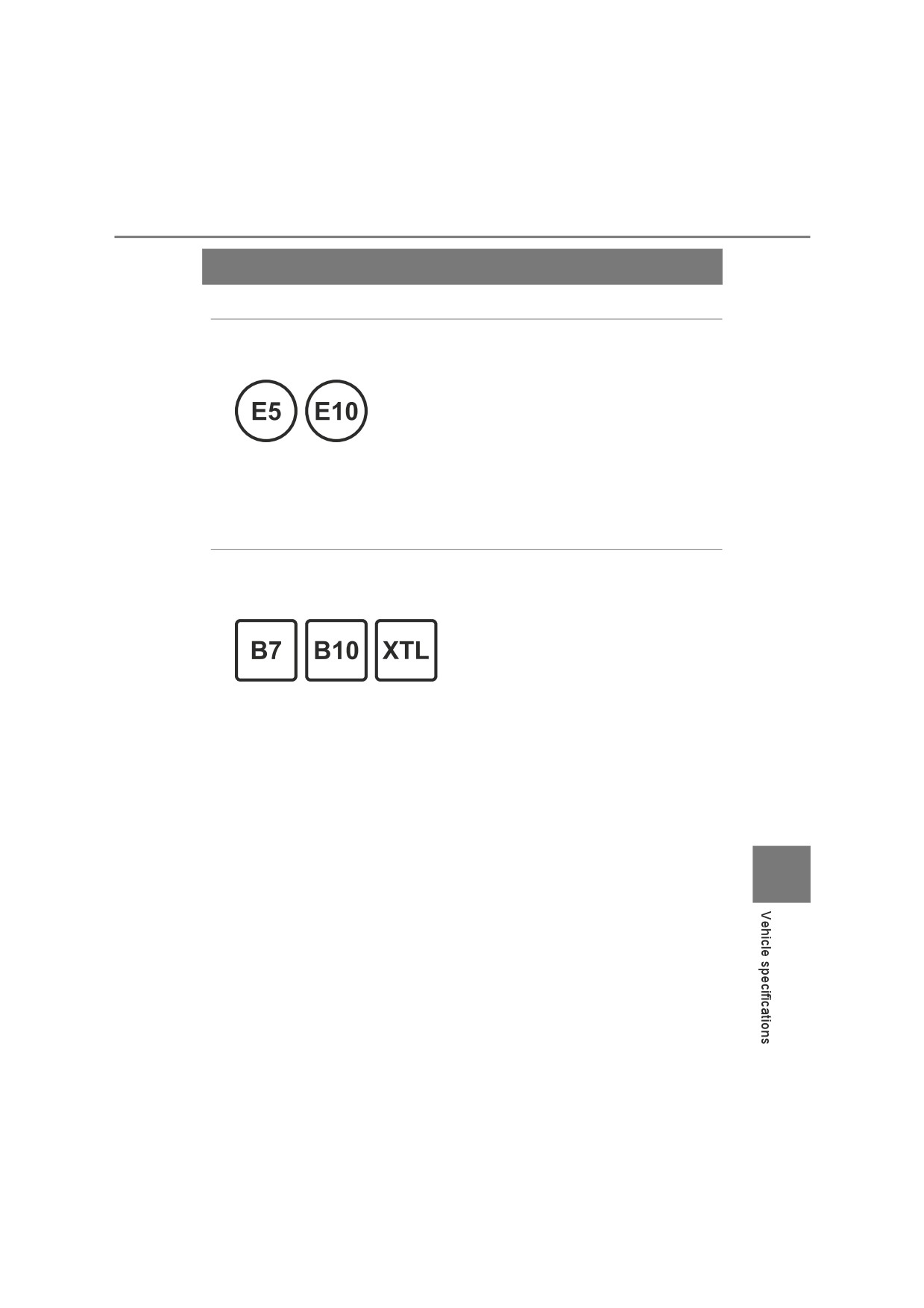
When you find these types of fuel label at the gas station, use only
the fuel with one of the following labels.
You must only use unleaded gasoline.
Select unleaded gasoline with a Research Octane Number of 91 or
higher for optimum engine performance.
◆ Diesel engine
When you find these types of fuel label at the gas station, use only
the fuel with one of the following labels.
EU area:
You must use diesel fuel conforming to European standard EN590,
EN16734 or EN15940*.
Except EU area (vehicles without DPF system):
You must use only diesel fuel with a cetane number of 48 or higher.
Except EU area (vehicles with DPF system):
You must use only diesel fuel that contains 10 ppm or less of sulfur
with a cetane number of 48 or higher.
9
*: In case that a vehicle which has “XTL” label on the fuel lid, XTL (EN15940,
paraffin diesel) can be used.
642
9-1. Specifications
■ Use of ethanol blended gasoline in a gasoline engine
Toyota allows the use of ethanol blended gasoline where the ethanol content
is up to 10%. Make sure that the ethanol blended gasoline to be used has a
Research Octane Number that follows the above.
■ If you plan to drive in foreign countries (vehicles with DPF system)
Low sulfur diesel fuel may not be available, so please check the availability
with your distributor.
■ If your engine knocks
●Consult any authorized Toyota retailer or Toyota authorized repairer, or any
reliable repairer.
● You may occasionally notice light knocking for a short time while accelerat-
ing or driving uphill. This is normal and there is no need for concern.
NOTICE
■ Notice on gasoline fuel quality
●Do not use improper fuels. If improper fuels are used, the engine will be
damaged.
●Do not use gasoline with metallic additives, for example manganese, iron
or lead, otherwise it may cause damage on your engine or emission con-
trol system.
●Do not add aftermarket fuel additives which contain metallic additives.
●Do not use the methanol blended gasoline such as M15, M85, M100. The
use of gasoline containing methanol may cause engine damage or failure.
●Bioethanol fuel sold under names such as “E50” or “E85” and fuel contain-
ing a large amount of ethanol should not be used. Your vehicle can use
gasoline mixed with 10% max ethanol. The use of fuel with more than 10%
ethanol content (E10) will damage the vehicle’s fuel system. You must
ensure that refueling is carried out only from a source where fuel specifica-
tion and quality can be guaranteed. In case of any doubt, ask any autho-
rized Toyota retailer or Toyota authorized repairer, or any reliable repairer.
9-1. Specifications
643
NOTICE
■ Notice on diesel fuel quality
●Do not use improper fuels. If improper fuels are used, the engine will be
damaged.
● Vehicles with DPF system: Do not use a fuel that contains more than 10
ppm of sulfur. Use of such a high sulfur fuel may damage the engine.
● EU area: FAME (Fatty Acid Methyl Ester) fuel sold under names such as
“B30” or “B100” and fuel containing a large amount of FAME should not be
used. The use of these fuels will damage the vehicle’s fuel system. In case
of any doubt, ask any authorized Toyota retailer or Toyota authorized
repairer, or any reliable repairer.
● Except EU area: FAME (Fatty Acid Methyl Ester) fuel sold under names
such as “B30” or “B100” and fuel containing a large amount of FAME
should not be used. Your vehicle can use diesel mixed with 5% max
biodiesel FAME (B5) or diesel equivalent to EN590/EN16734/EN15940*.
The use of fuel with more than 5% FAME content (B5) or diesel not equiv-
alent to EN590/EN16734/EN15940* will damage the vehicle’s fuel sys-
tem. You must ensure that refueling is carried out only from a source
where fuel specification and quality can be guaranteed.
In case of any doubt, ask any authorized Toyota retailer or Toyota autho-
rized repairer, or any reliable repairer.
*: In case that a vehicle which has
“XTL” label on the fuel lid, XTL
(EN15940, paraffin diesel) can be used.
9
644
9-2. Customization
Customizable features
Your vehicle includes a variety of electronic features that can be
personalized to your preferences. The settings of these features
can be changed using the multi-information display, navigation
system, multimedia system type A* or at any authorized Toyota
retailer or Toyota authorized repairer, or any reliable repairer.
Some function settings are changed simultaneously with other func-
tions being customized. Contact any authorized Toyota retailer or
Toyota authorized repairer, or any reliable repairer for further details.
*: See “How to identify multimedia system type” to check the type of your
multimedia system. (P. 650)
Customizing vehicle features
■ Changing using the multi-information display
1
Use the meter control switches to select
while the vehicle is
stopped, and then press
to display the customize mode
screen.
2
Select the desired item, and then press
3
Select the desired setting, and then press
To go back to the previous screen or exit the customize mode,
press
■ Changing using the navigation system or multimedia system
type A
1
Press the “SETUP” button while the vehicle is stopped.
2
Select “Vehicle”.
3
Select “TOYOTA park assist”.
9-2. Customization
645
Customizable features
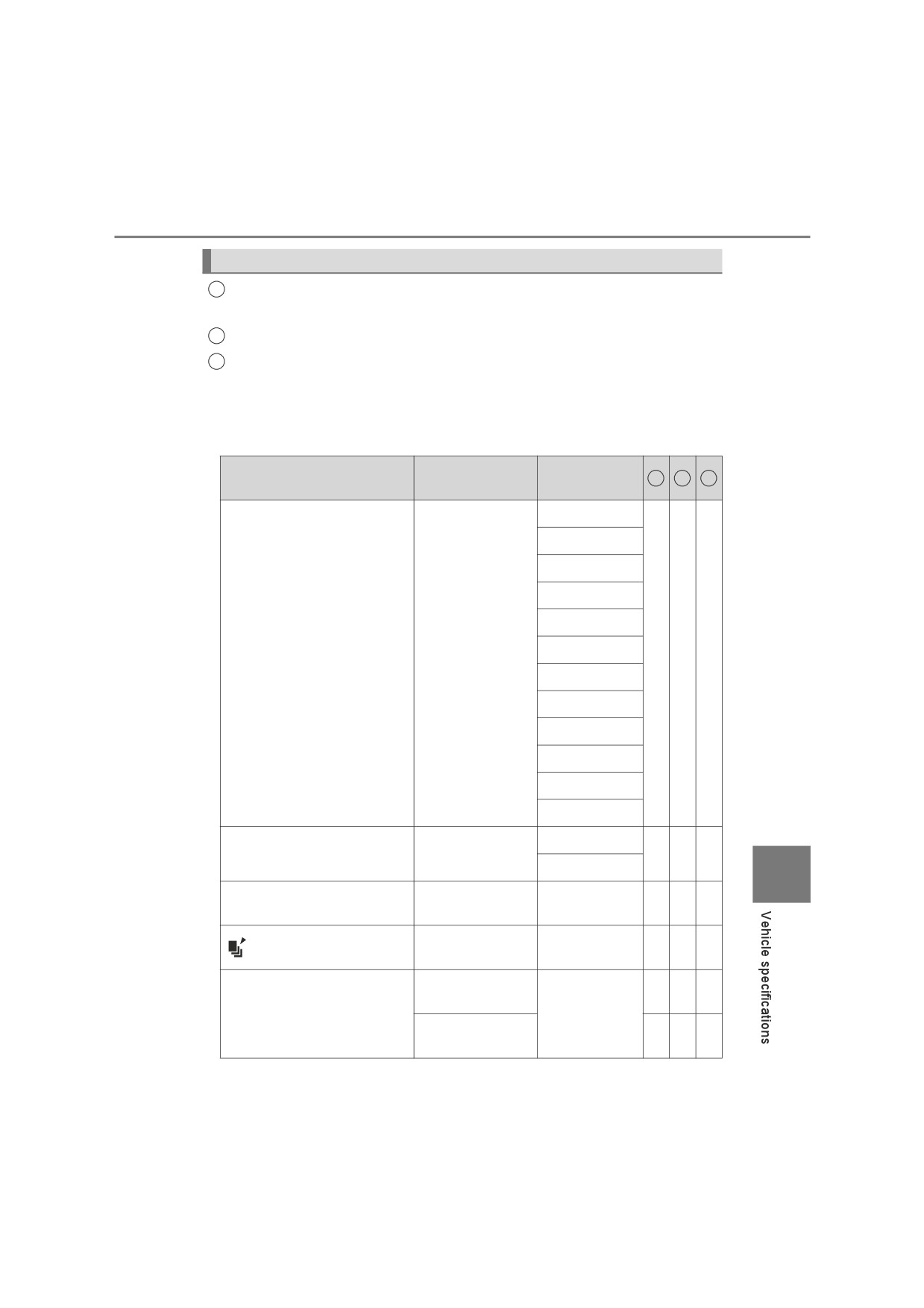
1
Settings that can be changed using navigation system or multime-
dia system type A
Settings that can be changed using the multi-information display
2
Settings that can be changed by any authorized Toyota retailer or
3
Toyota authorized repairer, or any reliable repairer
Definition of symbols: O = Available, - = Not available
■ Gauges, meters and multi-information display*1 (P. 133)
Customized
Function*2
Default setting
1
2
3
setting
German
French
Spanish
Italian
Russian
Turkish
Language*3
English
-
O
-
Ukrainian
Thai
Portuguese
Indonesian
Arabic
Taiwanese
km (km/L)
Units*3
km (L/100 km)
-
O
-
miles (MPG)
9
On
Eco Driving Indicator Light
Off
-
O
-
(Self-lighting)
Drive
Desired status
switch settings
-
O
-
information 1
screen*4
Current fuel
-
O
-
economy
*5
Drive information 1
Average fuel
-
O
-
economy
646
9-2. Customization
Customized
Function*2
Default setting
1
2
3
setting
Distance to
-
O
-
empty
*5
Drive information 2
Average speed
-
O
-
Pop-up display*1
On
Off
-
O
-
Color 1 to
Accent color*1, 3
Color 1
-
O
-
color 4
Fuel
*6
consumption
10.0
-
O
-
comparison
*6
Fuel price
150
-
O
-
Eco
(Baht)
Saving
Currency*3
(Rupiah)
-
O
-
(No currency unit)
(Euro)
*1: If equipped
*2: For details about each function: P. 133
*3: The default setting and the customized setting items that can be displayed
vary according to country.
*4: Some status screens cannot be registered (indicated on multi-information
display).
*5: Customized items are the following items except for default setting items:
current fuel economy (bar type), current fuel economy (value type), aver-
age fuel economy (after reset), average fuel economy (after start), average
fuel economy (after refuel), average speed (after reset), average speed
(after start), elapsed time (after reset), elapsed time (after start), distance
(range), distance (after start), blank.
*6: The values can be changed using the meter control switches.