Alfa Romeo Stelvio MCA (2023 year). Manual in english - page 8
 

  Index      Manuals     Alfa Romeo Stelvio MCA (2023 year). Manual in english


Search            copyright infringement  


Content      ..     6      7      8      9     ..


Alfa Romeo Stelvio MCA (2023 year). Manual in english - page 8


 MAINTENANCE AND CARE

236

specialised personnel if they have been

fitted for longer than 6 years;

in the case of replacement, always fit

new tyres, avoiding those of unknown

origin.

RIMS AND TYRES

For the type of wheel rims and tyres

fitted on the vehicle see the "Rims and

Tyres" paragraph in the "Technical data"

chapter.

SNOW CHAINS

94)

Rear Wheel Drive and All-wheel drive

versions

It is possible to fit 0.5 in (13 mm) chains

on all the tyres except for R20.

Quadrifoglio version

It is possible to put chains on the rear

285/40 R20 tyre (winter tyre size).

Avoid using traditional chains as

they can damage the braking system

if not installed correctly, thereby

compromising the car’s safety.
We strongly advise using zero-clearance

chains and to use equipment proposed

by the Dedicated Alfa Romeo Dealership.

Warnings

The use of snow chains should be in

compliance with local regulations of

each country. In certain countries, tyres

marked with code M+S (Mud and Snow)

are considered as winter equipment;

therefore their use is equivalent to that

of the snow chains.
The snow chains may be applied only to

the rear wheel tyres.
Check the tension of the snow chains

after the first few metres have been

driven.
WARNING Using snow chains with

tyres with non-original dimensions may

damage the vehicle.
WARNING Using different size or

type (M+S, snow, etc.) tyres between

front and rear axle may adversely

affect car driveability, with the risk of

losing control of the car and resulting

accidents.

SUGGESTIONS ABOUT THE ROTATION

OF THE TYRES

The front and rear tyres are subject

to different loads and stress due to

steering, manoeuvres and braking. For

this reason they are subject to uneven

wear.
To resolve this problem, tyres should

be rotated at the appropriate time

(6,200/9,300 miles / 10000 / 15000 km).

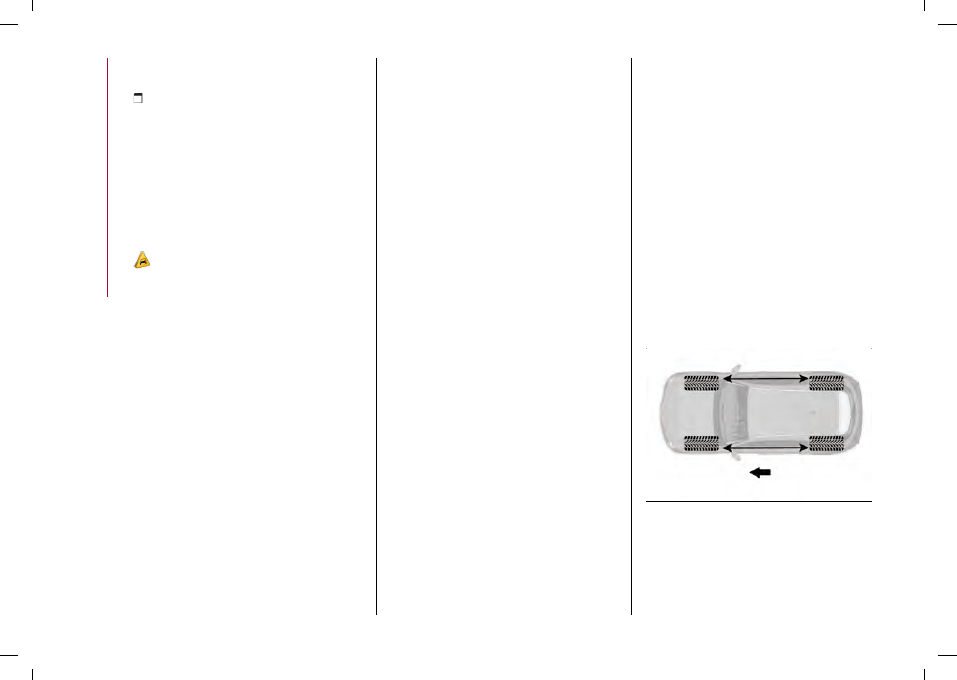
Inverting the tyres means moving them

to different positions on the same side of

the car (front to back and vice versa).
WARNING Crossing the tyres is not

advised, so placing a tyre on a different

axle on the other side of the car is

impossible.

WARNING On cars equipped with

differentiated tyres (tyre size different

between front and rear axles, ex. QV

version) rotation of any of the tyres is

not advised.
Tyre rotation contributes to the

preservation of the grip and traction

performance on wet, muddy or snowy

roads, guaranteeing optimal driveability

of the vehicle.
In the case of irregular wear of the tyres

identify the cause and correct it as soon

as possible, by contacting an Alfa Romeo

Dealership.
The suggested method for inverting
the tyres is shown in fig. 272 (the arrow

indicates the travel direction of the car).

272

09066V0002EM

All-Wheel Drive (AWD) versions

It is recommended to avoid situations

with a large difference in wear between

the front and rear tyres and to strictly

CarManuals2.com

237

use winter tyres of the sizes given in the

“Rims and tyres provided” table.

WARNING

211)

The road holding qualities of the

car also depend on the correct inflation

pressure of the tyres.

212)

If tyre pressure is too low, it may

overheat and be severely damaged as a

result.

213)

Do not repaint alloy wheel rims at

temperatures higher than 150°C. The

mechanical features of the wheels could be

compromised.

IMPORTANT

94)

Keep your speed down when snow

chains are fitted; do not exceed 50 km/h (or

the equivalent in miles). Avoid potholes, do

not drive over steps or pavements and do

not drive long distances over roads without

snow, to avoid damaging both your vehicle

and the road surface.

PROLONGED CAR INACTIVITY

If the vehicle is left inactive for longer

than a month, the following precautions

should be observed:

park the car in covered, dry and if

possible well-ventilated premises and

slightly open the windows;

check that the electric parking brake is

not activated;

disconnect the negative battery

terminal and check the battery charge.

Repeat this check once every three

months during storage;

if the battery is not disconnected from

the electrical system, check its state of

charge every thirty days;

clean and protect the painted parts

using protective wax;

clean and protect the shiny metal

parts using special compounds available

commercially;

sprinkle talcum powder on the

windscreen wiper rubber blades and lift

them off the glass;

cover the vehicle with a fabric or

perforated plastic sheet, paying

particular care not to damage the

painted surface by dragging any dust

that may have accumulated on it.
Do not use compact plastic sheets which

do not allow humidity to evaporate from

the surface of the vehicle;

inflate tyres to +7.2 psi (+0.5 bar) above

the standard prescribed pressure and

check it periodically;

do not drain the engine cooling system;
any time the car is left inactive for

two weeks or more, operate the air

conditioning system with engine idling

for at least 5 minutes, setting external

air and with fan set to maximum speed.

This operation will ensure appropriate

lubrication for the system, thus

minimising the possibility of damage to

the compressor when the system is

operated again.
WARNING After setting the ignition

device to STOP and having closed

the driver side door, wait at least

one minute before disconnecting the

electrical supply from the battery. When

reconnecting the electrical supply to the

battery, make sure that the ignition

device is in the STOP position and the

driver side door is closed.

CarManuals2.com

 MAINTENANCE AND CARE

238

BODYWORK

BODY AND UNDERBODY WARRANTY

Your car is covered by warranty against

perforation due to rust of any original

element of the structure or bodywork.

For the general terms of this warranty,

refer to the Warranty Booklet.

PRESERVING THE BODYWORK

Paintwork

95) 96)

7)

Touch up abrasions and scratches

immediately to prevent the formation of

rust.
Maintenance of paintwork consists of

washing the car: the frequency depends

on the conditions and environment

where the car is used. For example, it is

advisable to wash the car more often in

areas with high levels of atmospheric

pollution or salted roads.

97)

To correctly wash the car, follow these

instructions:

if high pressure jets or cleaners are

used to wash the car, keep a distance

of at least 40 cm from the bodywork to

avoid damage or alteration. Build up of

water could cause damage to the car in

the long term;

in order to make it easier to remove

any debris in the area where the brushes

are normally placed, it is advised to put

vertically the windscreen wiper (Service

Position). For more information refer to

the “Maintenance procedures” chapter in

this section;

wash the bodywork using a low

pressure jet of water if possible;

wipe a sponge with a slightly soapy

solution over the bodywork, frequently

rinsing the sponge;

rinse well with water and dry with a jet

of air or a chamois leather.
Dry the less visible parts (e.g. door

frames, bonnet, headlight frames, etc.)

with special care, as water may stagnate

more easily in these areas. Do not wash

the car after it has been left in the sun or

with the bonnet hot: this may alter the

shine of the paintwork.
Exterior plastic parts must be cleaned in

the same way as the rest of the car.
If you want to wash a car with automatic

transmission in a car wash that moves it,

you must do the following:

make sure that the car is on a flat

surface and that automatic engagement

of the parking brake when the engine

is switched off is disabled (for how to

disable it, refer to the "Electric parking

brake" chapter in the "Starting and

driving" section);

with the car stationary, the gear in N

(Neutral) and the brake pedal up: press

the start button. The car will remain in

N (Neutral) for 15 minutes, after which P

(Park) mode will be activated.
Avoid parking under trees; the resin

dropped by trees makes the paintwork

go opaque and increases the possibility

of corrosion.

Windows

Use specific detergents and clean cloths

to prevent scratching or altering the

transparency.
WARNING Wipe the rear window inside

gently with a cloth following the direction

of the filaments to avoid damaging the

heating device.

Headlights

Use a soft cloth soaked in water and

detergent for washing cars.
WARNING Never use aromatic

substances (e.g. petrol) or ketones (e.g.

acetone) for cleaning the plastic lenses

of the headlights.
WARNING When cleaning the car with

a pressure washer, keep the water jet

at least 8 in (20 cm) away from the

headlights.

ENGINE COMPARTMENT WASHING

98)

If the engine compartment is washed (at

low pressure, e.g. in very dusty areas),

this must be done with the engine cold

and with ignition device turned to STOP.

Take care not to direct the water

CarManuals2.com

239

jet straight at the electronic control

modules or the wiper motors. Have this

operation performed by a specialised

workshop. After washing, check that the

various protective components (e.g.

rubber guards and caps) have not been

removed or damaged.

IMPORTANT

95)

In order to preserve the appearance of

the paint abrasive products and/or polishes

should not be used for cleaning the car.

96)

Abrasive products and/or polishes

should not be used for cleaning the car. Bird

droppings must be washed off immediately

and thoroughly as the acid they contain is

particularly aggressive. Avoid parking the

vehicle under trees (unless it is absolutely

necessary). Remove any resinous plant

matter immediately because, once it has

dried, it may require the use of abrasive

and/or polishing products to be removed,

which are strongly discouraged as they

could potentially alter the characteristics of

the paintwork. Do not use pure windscreen

washer fluid for cleaning the front

windscreen and rear window; dilute it min.

50% with water. Only use pure screen

washer fluid when strictly necessary due to

outside temperature conditions. Do not use

chemicals/acids to defrost windows/vehicle

glass as they can damage the paint.

97)

Avoid washing with rollers and/or

brushes or a pressure washer with a

high-pressure jet in washing stations.

Wash the car only by hand using neutral

pH detergents; dry it with a wet chamois

leather. Abrasive products and/or polishes

should not be used for cleaning the car. Bird

droppings must be washed off immediately

and thoroughly as the acid they contain is

particularly aggressive. Avoid (if at all

possible) parking the car under trees;

remove vegetable resins immediately

as, when dried, it may only be possible to

remove them with abrasive products and/or

polishes, which is highly inadvisable as they

could alter the typical opacity of the paint.

Do not use pure windscreen washer fluid

for cleaning the front windscreen and rear

window; dilute it min. 50% with water. Only

use pure screen washer fluid when strictly

necessary due to external temperature

conditions. Do not use chemicals/acids to

defrost windows/vehicle glass as they can

damage the paint.

98)

A high pressure jet cleaner should

not be used for cleaning the engine

compartment. The appropriate precautions

have been taken to protect all parts and

connections, but the pressures generated by

these devices are so high that complete

protection against water seepages cannot

be guaranteed.

IMPORTANT

7)

Detergents pollute the water. The vehicle

should be washed in areas equipped for

collecting and purifying the liquid used in the

washing process.

INTERIOR

214) 215) 216) 217)

Periodically check the cleanliness of the

interior, beneath the mats, which could

cause oxidation of the sheet metal.

SEATS AND FABRIC PARTS

Use a specific product to clean carpets

and fabric upholstery.
Remove dust with a soft brush or a

vacuum cleaner.
It is advisable to use a moist brush on

velvet upholstery. Rub the seats using a

soft microfibre cloth moistened with a

solution of water and neutral detergent.

Cleaning heat press images on seats

(where provided)
Due to the colour, opacity and wear-

resistant protection with which the heat

press images on some seat versions are

made, they may be subject to temporary

scratching if they are touched by finger

nails, keys, or other hard objects.
In such cases, the visible signs do not

impair the profiled images, and can easily

be removed by wiping the affected area

with a microfibre cloth moistened with

water (not dry) to restore the seat to its

original condition.
WARNING The microfibre cloth must not

have been previously soaked in other

substances or detergents.

CarManuals2.com

 MAINTENANCE AND CARE

240

LEATHER SEATS

(where provided)
Remove the dry dirt with a chamois or

slightly damp cloth, without exerting too

much pressure.
Remove any liquid or grease stains using

an absorbent dry cloth, without rubbing.

Then clean with a soft cloth or chamois

leather dampened with water and mild

soap. If the stain persists, use specific

products and observe the instructions

carefully.
WARNING Never use alcohol. Make sure

that the cleaning products used contain

no alcohol or alcohol derivatives, even in

small quantities.

PLASTIC AND COATED PARTS

99)

Clean interior plastic parts with a damp

cloth (if possible made from microfibre),

and a solution of water and neutral, non-

abrasive detergent.
To clean oily or persistent stains,

use specific products free from

solvents and designed to maintain the

original appearance and colour of the

components.
Remove any dust using a microfibre

cloth, if necessary moistened with

water. The use of paper tissues is not

recommended as these may leave

residues.

ALCANTARA PARTS

(where provided)

100)

Alcantara parts maintenance procedure:

treat the surface with a microfibre

cloth moistened with mild marseille soap

and water, taking care to cover the entire

covered area and applying a uniform light

pressure (do not rub vigorously);

rinse and wring out the microfibre

cloth, and pass it again over the covered

area treated according to the previous

point;

let it dry then brush gently with a soft

brush.

LEATHER AND SOFT TOUCH PARTS

(where provided)
To clean these components, use a soft

microfibre cloth moistened with a

solution of water and neutral detergent.
Before using a specific product for

cleaning interiors, make sure that it does

not contain alcohol and/or alcohol-based

substances or solvents.

CARBON FIBRE PARTS

To eliminate small scratches and

marks on the carbon, contact an Alfa

Romeo Dealership Authorized Point. An

improperly performed operation may

irreparably damage the carbon.

WARNING

214)

ever use flammable products, such as

petrol ether or rectified petrol to clean the

inside of the car. The electrostatic charges

which are generated by rubbing during the

cleaning operation may cause a fire.

215)

Do not keep aerosol cans in the car:

they might explode. Aerosol cans must not

be exposed to temperatures above 50°C.

Temperatures may greatly exceed this

value inside a car exposed to direct sunlight.

216)

There must be no obstacles on the floor

under the pedals. Make sure that mat are

always flat and do not interfere with the

pedals.

217)

Do not use aggressive organic

substance such as: petrol, kerosene, oil,

acetone or solvents.

IMPORTANT

99)

Never use alcohol, petrols and

derivatives to clean the dashboard and

instrument panel lens.

100)

Do not use "hard" synthetic brushes as

they could damage the fabric irreparably.

Do not perform partial, localized

interventions that could cause "aesthetic"

differences between the treated and

untreated areas. Do not use alcohol or

acetone-based solvents.

CarManuals2.com

TECHNICAL SPECIFICATIONS

IDENTIFICATION DATA . . . . . . . . . . . . . . . . . . . . . . . . . . . . . . . . . . . . . . . . . . . . . . . . .242
ENGINE . . . . . . . . . . . . . . . . . . . . . . . . . . . . . . . . . . . . . . . . . . . . . . . . . . . . . . . . . . . . . . . . . . . .243
TRANSMISSION . . . . . . . . . . . . . . . . . . . . . . . . . . . . . . . . . . . . . . . . . . . . . . . . . . . . . . . . .245
RIMS AND WHEELS . . . . . . . . . . . . . . . . . . . . . . . . . . . . . . . . . . . . . . . . . . . . . . . . . . . . 246
DIMENSIONS . . . . . . . . . . . . . . . . . . . . . . . . . . . . . . . . . . . . . . . . . . . . . . . . . . . . . . . . . . . . . 251
WEIGHTS AND LOADS . . . . . . . . . . . . . . . . . . . . . . . . . . . . . . . . . . . . . . . . . . . . . . . . . .253
REFILLING . . . . . . . . . . . . . . . . . . . . . . . . . . . . . . . . . . . . . . . . . . . . . . . . . . . . . . . . . . . . . . . .255
FLUIDS AND LUBRICANTS . . . . . . . . . . . . . . . . . . . . . . . . . . . . . . . . . . . . . . . . . . . . .259
PERFORMANCE . . . . . . . . . . . . . . . . . . . . . . . . . . . . . . . . . . . . . . . . . . . . . . . . . . . . . . . . . .263
FUEL CONSUMPTION AND CO2 EMISSIONS . . . . . . . . . . . . . . . . . . . . . . . 264
PRESCRIPTIONS FOR HANDLING THE CAR AT THE END OF

ITS LIFE . . . . . . . . . . . . . . . . . . . . . . . . . . . . . . . . . . . . . . . . . . . . . . . . . . . . . . . . . . . . . . . . . . .265

Everything you may find useful for understanding how your

vehicle is made and works is contained in this section and

illustrated with data, tables and graphics.

For the enthusiasts and the technician, but also just for those

who want to know every detail of their car.

CarManuals2.com

 TECHNICAL SPECIFICATIONS

242

IDENTIFICATION DATA

VEHICLE IDENTIFICATION NUMBER

The Vehicle Identification Number (VIN)

is stamped on a plate on the front left
corner of the dashboard cover fig. 273,

which can be seen from outside the

vehicle, through the windscreen.

273

10016V0001EM

This number is also printed on the

chassis at the front right shock absorber

and can be seen by opening the bonnet
fig. 274.

274

10016V0002EM

VEHICLE IDENTIFICATION NUMBER

(VIN) PLATE

The plate is located on the left side front
door pillar fig. 275 and shows the data

about:

1: correct value of smoke coefficient

(for Diesel engines);

2: name of the manufacturer,

vehicle type-approval number, vehicle

identification number, max. permitted

weights;

3: engine identification, type variant

version, spare part number, colour code,

additional information.

275

10016V0003EM

CarManuals2.com

243

ENGINE

2.9 V6 510 HP

2.9 V6 520 HP

2.0 T4 MAir

Cycle

Otto

Otto

Otto

Number and position of cylinders

6 a V

6 a V

4 in line

Piston bore and stroke (mm)

86.5 x 82

86.5 x 82

84 x 90

Total displacement (cm³)

2891

2891

1995

Compression ratio

9.3: 1

9.3: 1

10 ± 0.35

Maximum power (ECE) (kW)

375

382

206

Maximum power (ECE) (HP)

510

520

280

Corresponding engine speed (rpm)

6500

6500

5250

Maximum torque (ECE) (Nm)

600

600

400

Maximum torque (ECE) (kgm)

61

61

40.8

Corresponding engine speed (rpm)

2500

2500

2250

Spark plugs

NGK LKAR8APTJDS

NGK LKAR8APTJDS

NGK ILZKR7G

Fuel

Unleaded petrol with

at least 95 R.O.N.

(EN228 specifications)

(*)

Unleaded petrol with

at least 95 R.O.N.

(EN228 specifications)

(*)

Unleaded petrol with at

least 95 R.O.N.

(EN228 specifications)

(*) In order to comply with all emission limits while simultaneously guaranteeing minimal consumption and maximum performance, use premium

unleaded petrol with octane rating (R.O.N.) 98 or more.

CarManuals2.com

 TECHNICAL SPECIFICATIONS

244

2.2 JTD

160 HP

210 HP

Cycle

Diesel

Diesel

Number and position of cylinders

4 in line

4 in line

Piston bore and stroke (mm)

83 / 99

83 / 99

Total displacement (cm³)

2143

2143

Compression ratio

15.5 ± 0.4

15.5 ± 0.4

Maximum power (ECE) (kW)

118

154

Maximum power (ECE) (HP)

160

210

Corresponding engine speed (rpm)

3750

3500

Maximum torque (ECE) (Nm)

450

470

Maximum torque (ECE) (kgm)

45.9

47.9

Corresponding engine speed (rpm)

1750

1750

Fuel

Diesel for motor vehicles (EN590 Specification)

CarManuals2.com

245

TRANSMISSION

Version

Transmission

Traction

2.9 V6

Eight forward gears plus reverse with

synchronisers for forward gears and reverse

All-wheel drive

2.0 T4 MAir

Eight forward gears plus reverse with

synchronisers for forward gears and reverse

Rear

or

All-wheel drive

2.2 JTD

Eight forward gears plus reverse with

synchronisers for forward gears and reverse

Rear

or

All-wheel drive

CarManuals2.com

 TECHNICAL SPECIFICATIONS

246

RIMS AND WHEELS

Alloy rims. Tubeless radial carcass tires.
All approved tires are listed in the

Registration Certificate.
WARNING If there are any discrepancies

between the Owner Handbook and

the Registration Document, take the

information from the latter. For safe

driving, the car must be fitted with tyres

of the same make and type on all wheels.
WARNING Do not use air chambers with

tubeless tyres.
WARNING Using tyres of a different

size, type, brand or design at the front

and rear may adversely affect car

driveability. We recommend using tyres

approved by the manufacturer. The

manufacturer cannot determine if

unapproved tyres are suitable for use

and therefore cannot guarantee vehicle

safety in those conditions.

CORRECT READING OF THE TYRE

Example

fig. 276: 215/65 R16 98H

276

10096S0001EM

215

Nominal width (S, distance in mm

between sides)

65

Height/width ratio (H/S), expressed

as a percentage

R

Radial tyre

16

Rim diameter in inches (Ø)

98

Load rating (capacity)

H

Maximum speed rating

Maximum speed index

Q

up to 160 km/h

R

up to 170 km/h

S

up to 180 km/h

T

up to 190 km/h

U

up to 200 km/h

H

up to 210 km/h

V

up to 240 km/h

W

up to 270 km/h

Y

up to 300 km/h

Maximum speed index for snow tyres

QM+S

up to 160 km/h

TM+S

up to 190 km/h

HM+S

up to 210 km/h

Load rating (capacity)

60

= 250 kg

80

= 450 kg

61

= 257 kg

81

= 462 kg

62

= 265 kg

82

= 475 kg

63

= 272 kg

83

= 487 kg

64

= 280 kg

84

= 500 kg

65

= 290 kg

85

= 515 kg

66

= 300 kg

86

= 530 kg

67

= 307 kg

87

= 545 kg

68

= 315 kg

88

= 560 kg

69

= 325 kg

89

= 580 kg

70

= 335 kg

90

= 600 kg

71

= 345 kg

91

= 615 kg

72

= 355 kg

92

= 630 kg

73

= 365 kg

93

= 650 kg

74

= 375 kg

94

= 670 kg

CarManuals2.com

247

Load rating (capacity)

75

= 387 kg

95

= 690 kg

76

= 400 kg

96

= 710 kg

77

= 412 kg

97

= 730 kg

78

= 425 kg

98

= 750 kg

79

= 437 kg

CORRECT READING OF THE RIM CODE

Example

fig. 276: 7J x 17 H2 ET 40

7

width of the rim in inches (1).

J

rim drop centre outline (side projection

where the tyre bead rests) (2).

17

fitting diameter, expressed in inches

(corresponds to the diameter of the tyre

that should be fitted) (3 = Ø).

H2

shape and number of humps

(circumference measurement which

keeps the bead of tubeless tyres in

position on the rim).

ET 40

: wheel compensation (distance

between the disc/rim supporting plane

and the wheel rim centre line).

SNOW CHAINS

101)

Rear-Wheel Drive and All-wheel drive

versions

It is possible to fit 13 mm chains on all the

tyres except for R20.

QV version

It is possible to put chains on the rear

285/40 R20 tyre (winter tyre size).

Avoid using traditional chains as

they can damage the braking system

if not installed correctly, thereby

compromising the car’s safety.
We strongly advise using zero-clearance

chains and to use equipment proposed

by the Dedicated Alfa Romeo Dealership.

Warnings

The use of snow chains should be in

compliance with local regulations of

each country. In certain countries, tyres

marked with code M+S (Mud and Snow)

are considered as winter equipment;

therefore their use is equivalent to that

of the snow chains.
The snow chains may be applied only to

the rear wheel tyres.
Check the tension of the snow chains

after the first few feet/meters have

been driven.
WARNING Using snow chains with

tyres with non-original dimensions may

damage the car.
WARNING Using different size or

type (M+S, snow, etc.) tyres between

front and rear axle may adversely

affect car driveability, with the risk of

losing control of the car and resulting

accidents.

IMPORTANT

101)

Keep your speed down when snow

chains are fitted; do not exceed 50 km/h.

Avoid potholes, do not drive over steps or

pavements and do not drive long distances

over roads without snow, to avoid damaging

both your car and the road surface.

CarManuals2.com

 TECHNICAL SPECIFICATIONS

248

RIMS AND TYRES PROVIDED

218)

Version

Rims

Tyres

2.9 V6

20 x 9J ET29 (FRONT)

21 x 9J ET29 (FRONT)

255/45 R20 101Y (FRONT)

255/40 R21 102Y XL (FRONT)

20 x 10J ET34 (REAR)

21 x 10J ET34 (REAR)

285/40 R20 104Y (REAR)

285/35 R21 105Y XL (REAR)

2.0 T4 MAir
2.2 JTD

18 x 8J

235/60 R18 107W XL

19 x 8J

235/55 R19 101Y

20 x 8.5J

255/45 R20 105W XL

21 x 8.5J

255/40 R21 102W XL

Space-saver wheel

(where provided)

195/75 18 106P

NOTE In partnership with Pirelli, Alfa Romeo has developed a range of tyres specially for the Alfa Romeo Stelvio. They can be

identified by the “AR” mark. The "AR" tyres ensure the best vehicle performance and safety. Alfa Romeo cannot guarantee that

non-approved tyres are suitable, and they may cause vehicle malfunctions.

2.9 V6 engine

: winter tyres are available in the following sizes: 255/45 R20 101W (M+S) and 285/40 R20 104W (M+S).

2.0 T4 MAir and 2.2 JTD engines

: winter tyres are available in the following sizes: 235/60 R18 103V, 235/55 R19 101V and 255/45 R20

101W.
Always check the registration certificate for the tyres that can be installed (size, load index, speed symbol).

CarManuals2.com

249

The pressures given below apply to all tyre types: summer and winter.

2.9 V6 Engine

Tyres

Unladen/medium load [psi / bar]

Full load [psi / bar]

Front

Rear

Front

Rear

225/45 R20 101Y

33.3 / 2.3

39.2 / 2.7

255/40 R21 102Y XL

39.2 / 2.7

39.2 / 2.7

285/40 R20 104Y

36.3 / 2.5

42.2 / 2.9

285/35 R21 105Y XL

42.2 / 2.9

42.2 / 2.9

2.0 T4 MAir and 2.2 JTD engines

Tyres

Unladen/medium load [psi / bar]

Full load [psi / bar]

Front

Rear

Front

Rear

235/60 R18

30.5 / 2.1

33.3 / 2.3

33.3 / 2.3

37.7 / 2.6

235/55 R19

30.5 / 2.1

33.3 / 2.3

33.3 / 2.3

37.7 / 2.6

255/45 R20

33.3 / 2.3

36.3 / 2.5

34.8 / 2.4

39.2 / 2.7

255/40 R21

33.3 / 2.3

36.3 / 2.5

34.8 / 2.4

39.2 / 2.7

195/75 18
(Space-saver spare wheel)

43.5 / 3.0

If winter tyres are fitted, always use the same inflation pressures as for the tyres originally installed (table above).

COLD TYRE INFLATION PRESSURE

When the tyres are warm, the inflation pressure should be + 4.35 psi (+0.3 bar) in relation to the recommended figure. However,

recheck the correct value when the tyre is cold. If it is necessary to raise the vehicle, refer to the "Raising the vehicle" chapter in the "In

an emergency" section.

CarManuals2.com

 TECHNICAL SPECIFICATIONS

250

WARNING

218)

If winter tyres with a lower speed rating than that indicated in the Registration Document are used, do not exceed the maximum speed

corresponding to the speed rating of the tyres used.

CarManuals2.com

251

DIMENSIONS

Dimensions are expressed in inches/mm and refer to the car equipped with its original tyres. Height is measured with car unladen.

277

9490102

A

B

C

D

E

F

G

H

I

33.9 / 861

110.94 / 2818

39.68 / 1008

184.5 / 4687

64.2 / 1632

66.6 / 1693

63.5 / 1613

63.8 / 1621 (*)

(**)

65.2 / 1657

64.7 / 1644 (*)

65.1 / 1654 (**)

85.1 / 2163

75 / 1903

(*) Versions with 20” tyres / (**) Versions with 21” tyres

Small variations with respect to the reported values are possible depending on the dimensions of the rims.

CarManuals2.com

 TECHNICAL SPECIFICATIONS

252

QV VERSION

Dimensions are expressed in inches/mm and refer to the car equipped with its original tyres. Height is measured with car unladen.

278

9490103

A

B

C

D

E

F

G

H

I

34 / 866

110.9 / 2818

40.1 / 1.018

185.2 / 4701

66.2 / 1680 -

66.5 / 1689

63.8 / 1623

66.2 / 1681 (*)

65.2 / 1658

(**)

85.1 / 2163

76.9 / 1955

(*) Versions with 20” tyres / (**) Versions with 21” tyres

LUGGAGE COMPARTMENT VOLUME
Capacity (V.D.A. standards)

Non-folding rear seats (unladen car):

525 litres

CarManuals2.com

253

WEIGHTS AND LOADS

To identify the weights and loads for

your car, refer to the plate shown in
fig. 279 and described in the “Vehicle

identification number (VIN) plate"

chapter or refer to the car registration

certificate showing the type-approved

weights (for markets, where provided).

D

: Maximum authorised weight of car

fully laden (GVW).

E

: Maximum authorised weight of fully

laden car (GVW) plus trailer. If there is no

value in the field or if there is a dash, it

means that the car cannot tow.

F

: Maximum permitted weight on first

front axle.

G

: Maximum permitted weight on second

rear axle.

279

10106S0090EM

To calculate the towable weight with

a braked trailer, take the difference

between values (E) e (D) shown on the

plate.

E.g.: E= 8750 lb (3950 kg) - D= 5170 lb

(2350 kg)
Braked trailer = 3527 lb (1600 kg)
WARNING

Do not exceed the indicated

trailer and towable weights

.

WARNING

Respect the vehicle towing

capacities

.

WARNING

Never exceed the maximum

permitted load indicated on the plate

(

E

).

CarManuals2.com

 TECHNICAL SPECIFICATIONS

254

TOWABLE WEIGHTS (lb / kg)

2.9 V6

2.0 T4 MAir

2.2 JTD

RWD versions

AWD versions

GVW

5421 / 2460

5170 / 2350

5126 / 2330

5302 / 2410

Towable loads

A

3527 (1600) / 5070 (2300)

(*)

3527 / 1600

5070 / 2300

B

1653 / 750

1653 / 750

1653 / 750

C

141 (64) / 209 (95) (*)

141 / 64

209 / 95

D

165 / 75

165 / 75

165 / 75

165 / 75

A

= TOWABLE WEIGHT

B

= UNBRAKED TRAILER

C

= LOAD ON TOW HOOK

D

= LOAD ON ROOF

(*) With the “tow hook” optional original equipment. For the maximum towable load, always refer to the Registration Document.

CarManuals2.com

255

REFILLING

2.9 V6

2.0 T4 MAir

Prescribed fuels and original

lubricants

Fuel tank (UK gal / litres)

14 / 64

14 / 64

Unleaded petrol
(EN228 specifications)

including a reserve of (UK gal /

litres)

2.1 / 9.6

2.1 / 9.6

Main cooling system (UK gal /

litres)

2.46 / 11.2

1.93 (8.8) (*) / 2.02 (9.25) (***)

50% mixture of distilled water and

PARAFLU UP (**)

Secondary cooling system (UK gal /

litres)

1.25 / 5.75

0.95 (4.3) (*) / 1.15 (5.25) (***)

Engine oil filter (UK gal / litres)

0.08 / 0.4

SELENIA QUADRIFOGLIO (2.9 V6

engine) / SELENIA DIGITEK P.E. (2.0

T4 MAir engine)

Engine oil sump (UK gal / litres)

1.01 / 4.6

Engine sump and filter (UK gal /

litres)

1.42 / 6.5

Hydraulic brake circuit (UK gal /

litres)

0.2 / 0.9

0.2 / 0.9

TUTELA BRAKE FLUID TOP EVO

Windscreen washer tank (UK gal /

litres)

0.92 / 4.2

0.9 / 4.1

PETRONAS DURANCE SC 35

Automatic transmission AWD (UK

gal / litres)

2.01 / 9.11

2.05 / 9.3

TUTELA TRANSMISSION AS 8

Automatic transmission RWD (UK

gal / litres)

2.07 / 9.4

RDU 230-LSD differential (UK gal /

litres)

0.25 / 1.1

0.2 / 0.9

TUTELA TRANSMISSION LS AXLE

FLUID

CarManuals2.com

 TECHNICAL SPECIFICATIONS

256

2.9 V6

2.0 T4 MAir

Prescribed fuels and original

lubricants

RDU 210-eLSD differential (where

provided) (UK gal / litres)

0.24 / 1.1

TUTELA TRANSMISSION LS AXLE

FLUID

AWD System FAD transfer case

(UK gal / litres)

0.09 / 0.45

0.11 / 0.5

TUTELA TRANSMISSION

HYPOIDE GEAR OIL

AWD System TRANSFER CASE (UK

gal / litres)

0.15 / 0.7

0.15 / 0.7

TUTELA TRANSMISSION

TRANSFER CASE

(*) Without “tow hook” optional original equipment
(**) When the vehicle is used in particularly harsh weather conditions, we recommend using a 60% mixture of PARAFLU UP and 40% demineralised

water.
(***) With the “tow hook” optional original equipment.

CarManuals2.com

257

102) 103)

2.2 JTD

Prescribed fuels and original lubricants

Fuel tank (UK gal / litres)

58 / 64 (*)

Diesel for motor vehicles (EN590 Specification)

including a reserve of (UK gal / litres)

1.98 (9.0) / 2.2 (10) (**)

AdBlue® tank (where provided) capacity

approximately (UK gal / litres)

3.5 / 16.1

AdBlue® (DIN 70 070 and ISO 22241-1

specifications)

Main cooling system (UK gal / litres)

1.71 (7.8) / 1.75 (8.0) (***)

50% mixture of distilled water and

PARAFLU UP (*)

Secondary cooling system (UK gal / litres)

1.03 / 4.7 (***)

Engine oil filter (UK gal / litres)

0.11 / 0.5

SELENIA W.R. FORWARD 0W-20

Engine oil sump (UK gal / litres)

0.85 / 3.9

Hydraulic brake circuit (UK gal / litres)

0.02 / 0.9

TUTELA BRAKE FLUID TOP EVO

Windscreen washer tank (UK gal / litres)

0.92 / 4.2

PETRONAS DURANCE SC 35

Automatic transmission (UK gal / litres)

2.0 / 9.1

TUTELA TRANSMISSION AS8

RDU 230-LSD differential (UK gal / litres)

0.02 / 0.9

TUTELA TRANSMISSION LS AXLE FLUID

RDU 210/215-LSD differential (UK gal / litres)

0.24 / 1.1

AWD System FAD transfer case (UK gal / litres)

0.11 / 0.5

TUTELA TRANSMISSION HYPOIDE GEAR OIL

CarManuals2.com

 TECHNICAL SPECIFICATIONS

258

2.2 JTD

Prescribed fuels and original lubricants

AWD System TRANSFER CASE (UK gal / litres)

0.15 / 0.7

TUTELA TRANSMISSION TRANSFER CASE

(*) For markets where provided.
(**) Versions with 14 UK gal / 64 litre fuel tank.
(***) 210 HP AWD version
(****) When the vehicle is used in particularly harsh weather conditions, we recommend using a 60% mixture of PARAFLU UP and 40% demineralised

water.

IMPORTANT

102)

Only use AdBlue® (UREA) compliant with DIN 70 070 and ISO 22241-1. Other fluids may cause damage to the system: also exhaust emissions

would no longer comply with the law.

103)

The distribution companies are responsible for the compliance of their product. Observe the precautions of storage and servicing, in order to

preserve the initial qualities. The manufacturer will not recognise any guarantee in case of malfunctions and damage caused to the car due to the
use of AdBlue® (UREA) not in accordance with regulations.

CarManuals2.com

259

FLUIDS AND LUBRICANTS

Your car is equipped with an engine oil that has been thoroughly developed and tested in order to meet the requirements of the

Service Schedule. Constant use of the prescribed lubricants guarantees the fuel consumption and emission specifications. Lubricant

quality is crucial for engine operation and duration.

104)

PRODUCT SPECIFICATIONS

ENGINE LUBRICATION

Use

Features

Specification

Original liquids and

lubricants

Replacement frequency

2.9 V6

SAE 5W-40

ACEA C3

9.55535-GH2

SELENIA QUADRIFOGLIO

Contractual Technical

Reference N°F022.B18

According to Service

Schedule

2.0 T4 MAir

SAE 0W-30

ACEA C2

9.55535-GS1

SELENIA DIGITEK P.E.

Contractual Technical

Reference N°F020.B12

According to Service

Schedule

2.2 JTD

SAE 0W-20

ACEA C5

9.55535-DSX

SELENIAW.R.FORWARD

0W-20

Contractual Technical
Reference N°F013.K15

According to Service

Schedule

If lubricants conforming to the specific request are not available, products that meet the indicated specifications can be used to top

up; in this case optimal performance of the engine is not guaranteed.

CarManuals2.com

 TECHNICAL SPECIFICATIONS

260

Use

Features

Specification

Original liquids and

lubricants

Applications

Lubricants and greases for

drive transmission

ATF Synthetic lubricant

9.55550-AV5

TUTELA TRANSMISSION

AS 8

Contractual Technical

Reference N°F139.I11

Automatic transmission

SAE 75W-85 synthetic

lubricant

9.55550-DA9

TUTELA TRANSMISSION

LS AXLE FLUID

Contractual Technical

Reference N°F059.N15

Differential RDU 230-LSD

and RDU 210/215-LSD

SAE 75W-80 APL GL-5

synthetic lubricant

9.55550-DA10

TUTELA TRANSMISSION

HYPOIDE GEAR OIL

Contractual Technical

Reference n° F060.N15

AWD System FAD Transfer

case

SAE 75W synthetic

lubricant

9.55550-DA11

TUTELA TRANSMISSION

TRANSFER CASE

Contractual Technical

Reference N°F061.N15

AWD System TRANSFER

CASE

NLGI 0-1 grease for

constant velocity joints

with low friction

coefficient

9.55580-GRAS II

TUTELA STAR 700

Contractual Technical

Reference N°F701.C07

Differential side constant

velocity joints

NLGI 1-2 molybdenum

disulphide grease for high

temperatures

9.55580-GRAS II

TUTELA ALL STAR

Contractual Technical

Reference N°F702.G07

Wheel side constant

velocity joints

CarManuals2.com

261

Use

Features

Specification

Original liquids and

lubricants

Applications

Brake fluid

Synthetic fluid for brake

and clutch systems.

Exceeds specifications:

FMVSS n° 116 DOT 4, ISO

4925 Class 6, SAE J1704.

9.55597 or MS.90039

TUTELA BRAKE FLUID

TOP EVO

Contractual Technical

Reference N°F002.L18

Hydraulic brakes and clutch

controls

Protective agent for

radiators

Protective with antifreeze,

ethylene glycol based

organic formula, free from

amine and 2–EH (2–ethyl

hexanoic acid), containing

corrosion inhibitors and

anti-foam additives. CUNA

NC 956-16, ASTM D 3306

9.55523 or MS.90032

PARAFLU UP

Contractual Technical

Reference N°F101.M01

Use rate 50% Not mixable

with different formulation

products (*)

Windscreen washer fluid

CUNA NC 956–11

9.55522

PETRONAS DURANCE SC

35

Contractual Technical

Reference N° F001.D16

To be used diluted or

undiluted in windscreen

washer/wiper systems

AdBlue® additive for diesel

emissions

Water-AdBlue® solution

DIN 70 070 and ISO 22241-1

AdBlue®

To be used for filling the

AdBlue® tank on versions

equipped with Selective

Catalytic Reduction (SCR)

system (2.2 JTD engine)

Diesel fuel additive

Antifreeze additive for

diesel fuel, with protective

action for diesel engines

PETRONAS DURANCE

DIESEL ART

Contractual Technical

Reference N°F601.C06

To be mixed with diesel (25

cc per 10 litres)

CarManuals2.com

 TECHNICAL SPECIFICATIONS

262

Use

Features

Specification

Original liquids and

lubricants

Applications

Automatic climate control

system (HVAC)

R1234yf or R134a

(depending on market)

(*) When the vehicle is used in particularly harsh weather conditions, we recommend using a 60% mixture of PARAFLU UP and 40% demineralised

water.
AdBlue® is a registered trademark of Verband der Automobilindustrie e.V. (VDA)

IMPORTANT

104)

The use of products with specifications other than those indicated above could cause damage to the engine not covered by the warranty.

CarManuals2.com

263

PERFORMANCE

Top performance after the initial period of vehicle usage.

Versions

Maximum speed (mph / km/h)

Acceleration from 0-100 km/h (sec)

2.9 V6 510 HP

175 / 283

3.8

2.9 V6 520 HP

177 / 285

3.8

2.0 T4 MAir AWD

143 / 230

5.7

2.2 JTD 160 HP RWD

124 / 200

8.8

2.2 JTD 210 HP AWD

134 / 215

6.6

CarManuals2.com

 TECHNICAL SPECIFICATIONS

264

FUEL CONSUMPTION AND CO2 EMISSIONS

The fuel consumption and CO2 emission figures declared by the manufacturer are determined on the basis of the type-approval tests

laid down by the applicable standards in the country where the vehicle is registered.
The type of route, traffic conditions, weather conditions, driving style, general condition of the car, trim level/equipment/accessories,

use of the climate control system, car load, presence of roof racks and other situations that adversely affect the aerodynamics or

wind resistance lead to different fuel consumption values than those measured.
The fuel consumption will only become more regular after driving the first 3000 km.
To find the specific fuel consumption and CO2 emission figures for this car, please refer to the data in the Certificate of Conformity,

and the related documentation that accompanies the vehicle.

CarManuals2.com

265

PRESCRIPTIONS FOR HANDLING THE CAR AT THE END OF ITS LIFE

(where provided)
For years, Alfa Romeo S.p.A. has pursued a global commitment to protect and respect the environment by continually improving its

production processes and developing increasingly "eco-compatible" products. To grant customers the best possible service in terms

of respecting environmental laws and in response to European Directive 2000/53/EC governing vehicles at the end of their life, Alfa

Romeo S.p.A. is offering its customers the chance to hand over their car at the end of its life without incurring any additional costs.

The European Directive sets out that when the vehicle is handed over the last keeper or owner should not incur any expenses as a

result of it having a zero or negative market value.
To hand your car over at the end of its life without extra cost, contact one of our dealerships if you are purchasing another car or an

Alfa Romeo S.p.A.-authorised collection and scrapping centre. These centres have been carefully chosen to offer high quality service

for the collection, treatment and recycling of vehicles at their end of life, respecting the surrounding environment.
You can find further information on these collection and scrapping centres either from an Alfa Romeo S.p.A. dealership or by calling

the number in the Warranty Booklet or by consulting the Alfa Romeo S.p.A. website.

CarManuals2.com

MULTIMEDIA

TIPS INFORMATION AND GENERAL INFORMATION . . . . . . . . . . . . . . 268
CONTROLS . . . . . . . . . . . . . . . . . . . . . . . . . . . . . . . . . . . . . . . . . . . . . . . . . . . . . . . . . . . . . . .270
CONTROLS ON THE STEERING WHEEL . . . . . . . . . . . . . . . . . . . . . . . . . . . . . . 273
"TOUCHSCREEN" FUNCTION . . . . . . . . . . . . . . . . . . . . . . . . . . . . . . . . . . . . . . . . . .274
WIDGETS . . . . . . . . . . . . . . . . . . . . . . . . . . . . . . . . . . . . . . . . . . . . . . . . . . . . . . . . . . . . . . . . . 275
RADIO (TUNER) MODE . . . . . . . . . . . . . . . . . . . . . . . . . . . . . . . . . . . . . . . . . . . . . . . . . .278
MEDIA MODE . . . . . . . . . . . . . . . . . . . . . . . . . . . . . . . . . . . . . . . . . . . . . . . . . . . . . . . . . . . . .278
Bluetooth® SOURCE . . . . . . . . . . . . . . . . . . . . . . . . . . . . . . . . . . . . . . . . . . . . . . . . . . . .279
USB/iPod/AUX SUPPORT . . . . . . . . . . . . . . . . . . . . . . . . . . . . . . . . . . . . . . . . . . . . . .279
CLIMATE CONTROL SYSTEM . . . . . . . . . . . . . . . . . . . . . . . . . . . . . . . . . . . . . . . . . 280
PHONE MODE . . . . . . . . . . . . . . . . . . . . . . . . . . . . . . . . . . . . . . . . . . . . . . . . . . . . . . . . . . . . 281
NAVIGATION MODE . . . . . . . . . . . . . . . . . . . . . . . . . . . . . . . . . . . . . . . . . . . . . . . . . . . .282
Tom Tom® ONLINE SERVICES . . . . . . . . . . . . . . . . . . . . . . . . . . . . . . . . . . . . . . . . 284
SETTINGS . . . . . . . . . . . . . . . . . . . . . . . . . . . . . . . . . . . . . . . . . . . . . . . . . . . . . . . . . . . . . . . . 286
PERFORMANCE . . . . . . . . . . . . . . . . . . . . . . . . . . . . . . . . . . . . . . . . . . . . . . . . . . . . . . . . . 288
CAR INFORMATION . . . . . . . . . . . . . . . . . . . . . . . . . . . . . . . . . . . . . . . . . . . . . . . . . . . . 288
DRIVER ASSISTANCE . . . . . . . . . . . . . . . . . . . . . . . . . . . . . . . . . . . . . . . . . . . . . . . . . . 288
Apple CarPlay and Android Auto . . . . . . . . . . . . . . . . . . . . . . . . . . . . . . . . . . . . . . 290
VOICE COMMANDS . . . . . . . . . . . . . . . . . . . . . . . . . . . . . . . . . . . . . . . . . . . . . . . . . . . . .292
CONNECTED SERVICES - ALFA CONNECT SERVICES . . . . . . . . . . . . .293
WIRELESS CHARGING SYSTEM– WCPM (Wireless Charge Pad

Module) . . . . . . . . . . . . . . . . . . . . . . . . . . . . . . . . . . . . . . . . . . . . . . . . . . . . . . . . . . . . . . . . . . . 298
OFFICIAL TYPE APPROVALS . . . . . . . . . . . . . . . . . . . . . . . . . . . . . . . . . . . . . . . . . 299

This section describes the main features of the Connect

system that can be fitted on the car.

CarManuals2.com

 MULTIMEDIA

268

TIPS INFORMATION AND

GENERAL INFORMATION

ROAD SAFETY

219) 220)

Learn how to use the varied system

functions before starting to drive.
Read the instructions for the system

carefully before starting to drive.
WARNING Look at the screen only and

when it is necessary and safe. If you need

to look at the screen for a long time,

pull over to a safe place so as not to be

distracted while driving. Immediately

stop using the system in the event of

a fault. Otherwise the system might

be damaged. Contact an Alfa Romeo

Dealership as soon as possible to have

the system repaired.

RECEPTION CONDITIONS

(where provided)
Reception conditions change constantly

while driving. Reception may be

interfered with by the presence of

mountains, buildings or bridges,

especially when you are far away from

the broadcaster.
WARNING The volume may be adjusted

when receiving traffic information and

news.
NOTE The DAB frequency can be used

in countries where digital transmission

technology is available. The device will

tuned to any frequency if the DAB button

is pressed in a country where the service

is not provided.

CARE AND MAINTENANCE

105) 106)

Observe the following precautions to

ensure the system is fully operational:

avoid hitting the display lens with

pointed or hard objects that could

damage its surface.

clean with a damp cloth (microfibre

if possible). If necessary, you can use a

delicate mild soap and water solution,

then dry with a soft, dry cloth. Do not

apply pressure to the display lens while

cleaning;

do not use alcohol, petrol and derived

products them to clean the display lens

and make sure that the Connect system

is switched off during cleaning;

prevent any liquid from entering the

system: this could damage it beyond

repair.

CONNECT SYSTEM USE

To interact with the Connect system

you can use the controls on the central

tunnel, on the steering wheel, using

the touchscreen function or the voice

controls.

ANTI-THEFT PROTECTION

The system is equipped with an

anti-theft protection system based on

the exchange of information with the

electronic control unit (Body Computer)

on the vehicle.
This guarantees maximum security

and prevents the system from being

used on other cars in the event of theft.

If necessary contact an Alfa Romeo

Dealership.

IMPORTANT NOTES

Look at the screen only and when it is

necessary and safe. If you need to look

at the screen for a long time, pull over to

a safe place so as not to be distracted

while driving.
Immediately stop using the system in the

event of a fault.
Otherwise the system might be

damaged. Contact an Alfa Romeo

Dealership as soon as possible to have

the system repaired.

WARNING

219)

Follow the safety rules below:

otherwise serious injuries may occur to the

occupants or the system may be damaged.

220)

If the volume is too loud this can be

dangerous. Adjust the volume so that you

can still hear background noises (e.g. horns,

ambulances, police vehicles, etc.).

CarManuals2.com


Content      ..     6      7      8      9     ..