Alfa Romeo Stelvio MCA (2023 year). Manual in english - page 7
 

  Index      Manuals     Alfa Romeo Stelvio MCA (2023 year). Manual in english


Search            copyright infringement  


Content      ..     5      6      7      8     ..


Alfa Romeo Stelvio MCA (2023 year). Manual in english - page 7


 IN AN EMERGENCY

204

the battery, on the other hand, is placed

in the boot.
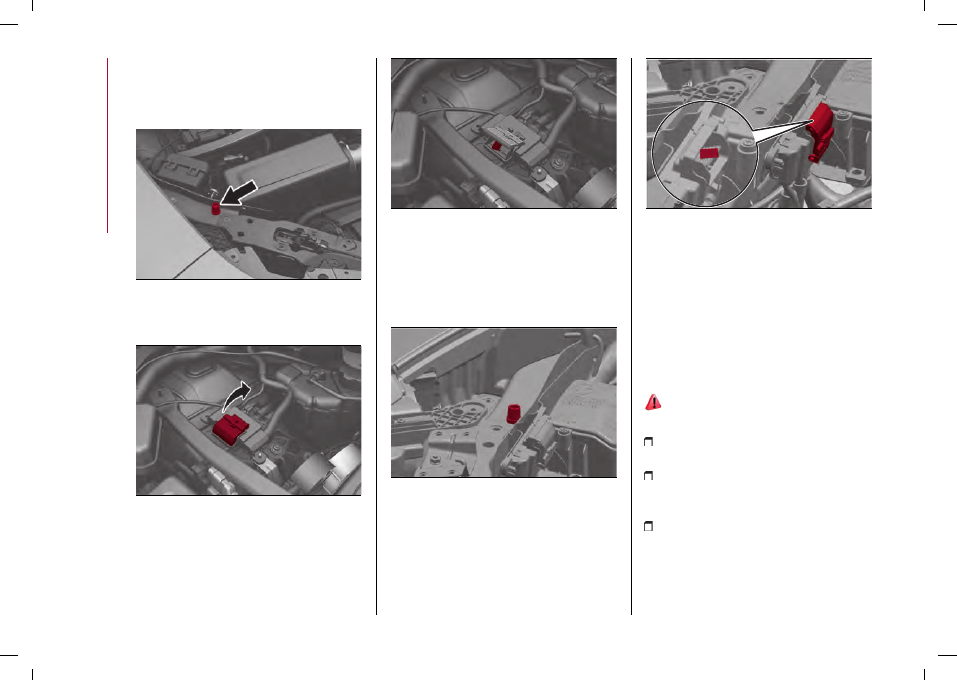
The negative terminal (-) fig. 250 is

located next to the right bonnet catch.

250

08076V0006EM

You can access the positive terminal (+)
by lifting the protective flap fig. 251.

251

08076V0002EM

The pole is shown in fig. 252.

252

08076V0001EM

QV version

The negative terminal (-) fig. 253 is

located next to the right bonnet catch.
You can access the positive terminal (+)
by lifting the protective flap fig. 254.

253

08076V0003EM

254

08076V0007EM

To carry out the operation, you need to

have the correct cables to connect the

auxiliary battery to the remote poles of

the flat battery.
Usually, these cables have terminals at

the ends and are identified by different

sheath colours (red = positive, black =

negative).

STARTING WITH AUXILIARY BATTERY

190) 191) 192)

Proceed as follows:

switch off all electrical devices in the

car;

engage the parking brake, activate P

(Park) mode and put the ignition device in

the STOP position;

should you be using the battery of

another car, park the other car within

the range of the cables used for the

connection, operate the parking brake

and ensure that its ignition is off.

CarManuals2.com

205

WARNING If the auxiliary battery is

installed on another car, check that there

is no accidental contact of metal parts

between the two cars, since an earth

connection may result, with the risk of

serious injury to any people who may be

nearby.
WARNING If the procedure below is

carried out incorrectly, it can cause

severe injury to people or damage the

recharging system of one or both cars.

Carefully follow the instructions given

below.

Cable connection

77)

Proceed as follows to carry out a jump

starting:

connect a terminal on the end of the

positive cable from the remote positive

pole (+) of the car with flat battery;

connect the terminal on the opposite

end of the positive (+) cable to the

positive (+) pole of the auxiliary battery;

connect a negative cable end terminal

to the negative (-) pole of the auxiliary

battery;

connect the terminal on the opposite

end of the negative (-) cable to the earth

point (-) on the car with the battery flat;

start the engine of the car with an

auxiliary battery, let it run for some

minutes at idle and then start the engine

of the car with flat battery.

In case a portable battery is used, before

starting the car, wait a few seconds after

completing the connection.

Cable disconnection

Once the engine is started, remove the

connection cables in reverse sequence,

as shown below:

disconnect the negative cable end

terminal (-) from the earth point (-) of the

car with flat battery;

disconnect the terminal on the

opposite end of the negative cable from

the negative (-) pole of the auxiliary

battery;

disconnect the terminal on the

opposite end of the positive (+) cable

from the positive (+) pole of the auxiliary

battery;

disconnect the terminal on the end

of the positive cable from the remote

positive pole (+) of the car with flat

battery.

WARNING

190)

Do not get too close to the radiator

cooling fan: the electric fan may start;

danger of injury. Scarves, ties and other

loose clothing might be pulled by moving

parts.

191)

Remove any metal objects (e.g. rings,

watches, bracelets), that might cause an

accidental electrical contact and cause

serious injury.

192)

The batteries contain acid that can

burn skin or eyes. Batteries produce

hydrogen, which is easily flammable and

explosive. Thus keep away flames or

devices which may cause sparks.

IMPORTANT

76)

Never use a fast battery charger to

start the engine as this could damage the

electronic systems, particularly the engine

ignition and fuel supply control units.

77)

Do not connect the cable to the negative

terminal (–) of the flat battery. The following

spark could lead to battery explosion and

cause serious harm. Only use the specific

earth point; do not use any other exposed

metallic part.

CarManuals2.com

 IN AN EMERGENCY

206

FUEL CUT-OFF SYSTEM

DESCRIPTION

Depending on the type and violence

of the impact, the control unit of the

ORC occupant protection systems

determines whether to activate

the airbags and the front seat belt

pretensioners and whether to

immediately interrupt the current from

the batteries to the supply pumps and to

the devices that operate the engine. The

power from the battery is interrupted by

"skipping" the pyrotechnic fuse placed on

the fusebox next to the positive pole of

the battery.
When the fuse is "skipped", only some

services, necessary for the safety of the

vehicle (e.g.: door locks, anti-theft device,

etc.), remain powered.
WARNING After the impact, carefully

check the vehicle for fuel leaks, for

instance in the engine compartment,

under the vehicle or near the tank area.
WARNING Contact an Alfa Romeo

Dealership to have the system checked.

ENGINE OVERHEATING

WARNING An overheated cooling

system can damage the car. In the case

of overheating, pull over and stop the

car. Keep the engine at idling with air

conditioning off until the temperature

decreases. If temperature does not

decrease, contact an Alfa Romeo

Dealership as soon as possible.
WARNING Coolant (antifreeze) exiting

from the engine or vapour exiting from

the radiator can cause serious burns. If

vapour is seen or heard coming from the

engine compartment, do not open the

bonnet until the radiator has had enough

time to cool down. Never try to remove

the cap when the radiator is hot.

AUTOMATIC TRANSMISSION

GEAR LEVER RELEASE

(where provided)
To release the automatic transmission

lever, contact an Alfa Romeo Dealership.

TOWING A BROKEN-DOWN CAR

This chapter describes the conditions

and methods to transport and tow a

broken-down car with a breakdown truck.
The assistance car operators must be

informed about the minimum ground

clearance of the car in order to avoid

contact between the ends of the bumper

with the tow truck equipment.
The front and rear attachment corners

of the car, to be taken into consideration

when loading the car on the roadside
assistance vehicle are shown in fig. 255.

255

9490113

AWD versions

A

: 21.7°

B

: 18.3°

CarManuals2.com

207

RWD versions

A

: 20.6°

B:

18.8°

QV versions

A

: 20.8°

B

: 20°

REAR-WHEEL DRIVE (RWD) VERSIONS

It is recommended to tow the car with all

four wheels lifted from the ground on the

platform of a roadside assistance car.
If a tow truck with platform is not

available, the car must be towed with

the rear wheels LIFTED from the ground

(using a trailer or special equipment

allowing lifting of the rear wheels).

ALL-WHEEL DRIVE (AWD) VERSIONS

It is recommended to tow the car with all

four wheels lifted from the ground on the

platform of a roadside assistance car.
WARNING Avoid lifting the front (or

rear) wheels only, using a trailer or car

that allows lifting the wheels of one axle

only. Lifting the front (or rear) wheels

only while towing might damage the

transmission or the transfer unit.

WARNINGS

If a car is towed without complying

with the above requirements, the

transmission and/or the transfer unit

might be seriously damaged (on AWD

versions). Damage due to incorrect

towing is not covered by warranty.
The car should be transported with all

four wheels lifted from the ground on the

platform of a roadside assistance car.

Avoid towing with only the front (or rear)

wheels lifted. When towing with only the

front (or rear) wheels lifted, in addition to

damaging the body, it could damage the

gearbox.
To carry out the operation, the

assistance car must be equipped with

an appropriate movement/lifting

equipment to avoid damaging the car.

For loading on the towing car, attach the

tow equipment to the main structural

components of the car and not to the

bumpers or other related brackets.
Comply with the regulations regarding

assistance and car towing in force in each

country.
When securing the car to a row truck, do

not attach to front or rear suspension

components. Damage to your car may

result from improper towing.

TOWING THE CAR

193) 194) 195)

In order to be able to tow the car, which

has been in an accident or has broken

down, on the road surface and only for

short distances, a tow ring is provided in

the tools container inside the boot.
Proceed as follows to use the tow ring:

release the cap fig. 256 on the front or

rear bumper (where provided) fig. 257,

pressing on the upper part;

take the tow hook from its housing in

the boot and carefully clean the threaded

housing on the car before using it;

tighten the car's tow ring in its place

for about 11 turns.

256

9490114

CarManuals2.com

 IN AN EMERGENCY

208

257

9490115

WARNING The largest work angle of

the cable to fix on the tow ring must not
exceed 15°, as shown in fig. 258.

258

9490116

WARNING

193)

Move the ignition device to ON and

then to STOP, without opening the door.

194)

The brake servo and the

electromechanical power steering will not

work while the vehicle is being towed. You

will therefore need to apply more force on

the brake pedal and steering wheel. Do not

use flexible ropes when towing, and avoid

jerky movements. While towing, make sure

that the trailer hitch does not damage any

components it is touching. When towing the

car, you must comply with all specific traffic

regulations and adopt an appropriate

driving behaviour. Do not start the engine

while towing the car. Before tightening the

ring, clean the threaded housing thoroughly.

Make sure that the ring is fully screwed into

the housing before towing the car.

195)

The front and rear tow hooks should

be used only for emergencies on the road.

You are allowed to tow the vehicle for short

distances using an appropriate device in

accordance with the highway code (a rigid

bar), to move the vehicle on the road in

readiness for towing or transport via a

breakdown vehicle. Tow hooks MUST NOT

be used to tow vehicles off the road or

where there are obstacles and/or for towing

operations using cables or other non-rigid

devices. In compliance with the above

conditions, towing must take place with the

two vehicles (one towing, the other towed)

aligned as much as possible along the same

centre line.

CarManuals2.com

MAINTENANCE AND CARE

SCHEDULED SERVICING . . . . . . . . . . . . . . . . . . . . . . . . . . . . . . . . . . . . . . . . . . . . . . . 210
ENGINE COMPARTMENT . . . . . . . . . . . . . . . . . . . . . . . . . . . . . . . . . . . . . . . . . . . . . . .220
RECHARGING THE BATTERY . . . . . . . . . . . . . . . . . . . . . . . . . . . . . . . . . . . . . . . . . . 227
SERVICING PROCEDURES . . . . . . . . . . . . . . . . . . . . . . . . . . . . . . . . . . . . . . . . . . . . .229
LIFTING THE VEHICLE . . . . . . . . . . . . . . . . . . . . . . . . . . . . . . . . . . . . . . . . . . . . . . . . . .235
WHEELS AND TYRES . . . . . . . . . . . . . . . . . . . . . . . . . . . . . . . . . . . . . . . . . . . . . . . . . . .235
PROLONGED CAR INACTIVITY . . . . . . . . . . . . . . . . . . . . . . . . . . . . . . . . . . . . . . . . 237
BODYWORK . . . . . . . . . . . . . . . . . . . . . . . . . . . . . . . . . . . . . . . . . . . . . . . . . . . . . . . . . . . . . .238
INTERIOR . . . . . . . . . . . . . . . . . . . . . . . . . . . . . . . . . . . . . . . . . . . . . . . . . . . . . . . . . . . . . . . . .239

Proper maintenance allows car performance to be maintained

over time, operating costs to be contained, and safety system

performance to be safeguarded. This section explains how.

CarManuals2.com

 MAINTENANCE AND CARE

210

SCHEDULED SERVICING

Correct servicing is crucial for

guaranteeing a long life for the car under

the best conditions.
For this reason, Alfa Romeo has planned

a series of checks and maintenance

operations at fixed distance intervals

and, for versions/markets, where

provided, at fixed time intervals, as

described in the Service Schedule.
Before each scheduled service deadline,

it is always necessary to carefully follow

the instructions in the Service Schedule

(e.g. periodically check level of fluids,

tyre pressure, etc.).
Scheduled Servicing is offered by an Alfa

Romeo Dealership according to a set

time schedule. If, during each operation,

in addition to the ones scheduled, the

need arises for further replacements or

repairs, these may be carried out with

the owner's explicit consent only.
WARNING The scheduled service

deadlines are set out by the

Manufacturer. Failure to have them

carried out may invalidate the New

Vehicle Limited Warranty.
It is advisable to inform the Alfa Romeo

Dealership of any small operating

irregularities without waiting for the next

scheduled service deadline.

PERIODIC CHECKS

Every year or

620

miles (

1000

km) or

before long journeys, check and top up, if

necessary:

engine coolant level;
brake fluid level (if insufficient, see

an Alfa Romeo dealership as soon as

possible);

AdBlue® (UREA) diesel emissions

additive (2.2 JTD versions only);

windscreen washer fluid level;
tyre inflation pressure and condition;
operation of lighting system

(headlights, direction indicators, hazard

warning lights, etc.);

operation of windscreen washer/wiper

system and positioning/wear of wiper

blades.
Oil consumption of the engine depends

on conditions and driving style. For this

reason, the engine oil level must be

checked every

1860

miles (

3000

km),

and topped up, if necessary (see the

"Engine compartment - Checking the

levels" chapter for information on the

quantity to be topped up).

DEMANDING USE OF THE CAR

If the car is used in one of the following

conditions:

dusty roads;

short, repeated journeys (less than 4-

5 miles or 7-8 km) at sub-zero outside

temperatures;

engine often idling or driving long

distances at low speeds or long periods

of inactivity;

in the event of a long period of

inactivity;
the following checks must be carried out

more often than indicated in the Service

Schedule:

check front and rear disc brake pad

condition and wear;

check cleanliness of bonnet and boot

locks, cleanliness and lubrication of

linkage;

visually inspect conditions of:

engine, gearbox, transmission,

pipes and hoses (exhaust/fuel

system/brakes) and rubber elements

(gaiters/sleeves/bushes, etc.);

check battery charge and battery fluid

level (electrolyte);

visually inspect conditions of the

accessory drive belts;

check and, if necessary, change engine

oil and replace oil filter;

check and, if necessary, replace the

pollen filter;

CarManuals2.com

211

check and, if necessary, replace the

Bad Fuel filter (where provided).

check and, if necessary, replace air

cleaner;

CarManuals2.com

 MAINTENANCE AND CARE

212

SCHEDULED SERVICING PROGRAMME (2.9 V6 engine)

WARNING Once you have carried out the last intervention in the table, continue with the scheduled servicing, maintaining the

frequency indicated in the plan by marking each operation with a dot or dedicated note. Warning: simply restarting the maintenance

from the start of the plan may cause the allowed interval to be exceeded for some operations!

Thousands of miles

9

18

27

36

45

54

63

72

81

90

Thousands of kilometres

15

30

45

60

75

90

105

120

135

150

Years

1

2

3

4

5

6

7

8

9

10

Check battery state of charge with the proper instrument

Check tyre conditions/wear and adjust pressure, if necessary. Check

Tire Repair Kit condition/expiry

Check operation of lighting system (headlights, direction indicators,

hazard warning lights, boot, passenger compartment, glove

compartment, instrument panel warning lights, etc.)

Check and, if necessary, top up fluid levels in engine compartment

(engine oil, windscreen washer, etc.) (1)

Check the supply/engine management systems operation using the

diagnosis equipment

Visually inspect condition of: exterior bodywork, underbody

protection, pipes and hoses (exhaust, fuel system, brakes), rubber

elements (gaiters, sleeves, bushes, etc.)

Check windscreen and rear window wiper blade position/wear

Check operation of the windscreen wiper/washer system and adjust

nozzles, if necessary

CarManuals2.com

213

Thousands of miles

9

18

27

36

45

54

63

72

81

90

Thousands of kilometres

15

30

45

60

75

90

105

120

135

150

Years

1

2

3

4

5

6

7

8

9

10

Check cleanliness of bonnet and luggage compartment locks,

cleanliness and lubrication of linkage

Visually inspect conditions and wear of front/rear disc brake pads and

operation of pad wear indicators

Visually inspect the surface and edge of the carbon-ceramic brake

discs (where provided)

Visually inspect the condition and tensioning of the accessory drive

belt(s)

Replace brake pads/carbon-ceramic brake discs (where provided)

(5)

Change engine oil and replace oil filter

Replace Transfer Case oil (for AWD versions)

Spark plug replacement

Replace accessory drive belt/s

(2)

Replace air cleaner cartridge (3)

Change the brake fluid

(4)

Replace passenger compartment filter (3)

CarManuals2.com

 MAINTENANCE AND CARE

214

Thousands of miles

9

18

27

36

45

54

63

72

81

90

Thousands of kilometres

15

30

45

60

75

90

105

120

135

150

Years

1

2

3

4

5

6

7

8

9

10

Alfa Connect Box system battery replacement (where provided)

(6)

(1) Only ever use the fluids shown in the handbook for topping up, and only after checking that the system is intact.
(2) Areas that are not dusty: the maximum mileage is 60,000 km. The belt must be replaced every 4 years, regardless of distance travelled. If the

car is used in heavy conditions (dusty areas, particularly harsh weather conditions, very low or very high temperatures for extended periods, urban

driving, long periods of idling), the maximum mileage is 30,000 km. The belt must be replaced every 2 years regardless of the mileage.
(3) If the car is used in dusty areas, this cleaner should be replaced every 15,000 km.
(4) The brake fluid must be changed every 2 years, regardless of the mileage.
(5) The actual interval for changing the brake pads and the carbon ceramic brake discs depends on the car usage conditions and is signalled by the

warning light or message on the instrument panel. Use the diagnosis equipment to reset the warning light every time the discs are replaced.
(6) The battery in the Alfa Connect Box system must be replaced every 5 years, regardless of mileage.
(o) Recommended operations
(●) Mandatory operations

CarManuals2.com

215


SERVICE SCHEDULE (2.0 T4 MAir engine)

WARNING Once you have carried out the last intervention in the table, continue with the scheduled servicing, maintaining the

frequency indicated in the plan by marking each operation with a dot or dedicated note. Attention: simply restarting the maintenance

from the start of the plan may cause the allowed interval to be exceeded for some operations!

Thousands of miles

9

18

27

36

45

54

63

72

81

90

Thousands of kilometres

15

30

45

60

75

90

105

120

135

150

Years

1

2

3

4

5

6

7

8

9

10

Check battery state of charge with the proper instrument

Check tyre conditions/wear and adjust pressure, if necessary. Check

Tire Repair Kit condition/expiry

Check operation of lighting system (headlights, direction indicators,

hazard warning lights, boot, passenger compartment, glove

compartment, instrument panel warning lights, etc.)

Check and, if necessary, top up fluid levels in engine compartment

(engine oil, windscreen washer, etc.) (1)

Check the supply/engine management systems operation using the

diagnosis equipment

Visually inspect condition of: exterior bodywork, underbody

protection, pipes and hoses (exhaust, fuel system, brakes), rubber

elements (gaiters, sleeves, bushes, etc.)

Check windscreen and rear window wiper blade position/wear

Check operation of the windscreen wiper/washer system and adjust

nozzles, if necessary

Check cleanliness of bonnet and luggage compartment locks,

cleanliness and lubrication of linkage

CarManuals2.com

 MAINTENANCE AND CARE

216

Thousands of miles

9

18

27

36

45

54

63

72

81

90

Thousands of kilometres

15

30

45

60

75

90

105

120

135

150

Years

1

2

3

4

5

6

7

8

9

10

Visually inspect conditions and wear of front/rear disc brake pads and

operation of pad wear indicators

Visually inspect the condition and tensioning of the accessory drive

belt(s)

Change engine oil and replace oil filter

(2)

Replace Transfer Case oil (for AWD versions)

Spark plug replacement

Replace accessory drive belt/s

(3)

Replace air cleaner cartridge (4)

Change the brake fluid

(5)

Replace passenger compartment filter (4)

Alfa Connect Box system battery replacement (where provided)

(6)

(1) Only ever use the fluids shown in the handbook for topping up, and only after checking that the system is intact.
(2) The engine oil and filter change frequency depends on the driving conditions and is signalled by a warning light or message on the instrument

panel. In any cases, never exceed 1 year.
(3) Areas that are not dusty: the maximum mileage is 60,000 km. The belt must be replaced every 4 years, regardless of distance travelled. If the

car is used in heavy conditions (dusty areas, particularly harsh weather conditions, very low or very high temperatures for extended periods, urban

driving, long periods of idling), the maximum mileage is 30,000 km. The belt must be replaced every 2 years regardless of the mileage.
(4) If the car is used in dusty areas, this cleaner should be replaced every 15,000 km.
(5) The brake fluid must be changed every 2 years, regardless of the mileage.
(6) The battery in the Alfa Connect Box system must be replaced every 5 years, regardless of mileage.
(o) Recommended operations
(●) Mandatory operations

CarManuals2.com

217

SERVICE SCHEDULE (2.2 JTD engine)

WARNING Once you have carried out the last intervention in the table, continue with the scheduled servicing, maintaining the

frequency indicated in the plan by marking each operation with a dot or dedicated note. Attention: simply restarting the maintenance

from the start of the plan may cause the allowed interval to be exceeded for some operations!

Thousands of miles

12

24

36

48

60

72

84

96

108

120

Thousands of kilometres

20

40

60

80

100

120

140

160

180

200

Years

1

2

3

4

5

6

7

8

9

10

Check battery state of charge with the proper instrument

Check tyre conditions/wear and adjust pressure, if necessary. Check

Tire Repair Kit condition/expiry

Check operation of lighting system (headlights, direction indicators,

hazard warning lights, boot, passenger compartment, glove

compartment, instrument panel warning lights, etc.)

Check and, if necessary, top up the fluid levels in engine compartment

(engine coolant, hydraulic clutch/brakes, windscreen washer, battery)

(1)

Check the supply/engine control systems operation using the

diagnostic socket

Visually inspect condition of: exterior bodywork, underbody

protection, pipes and hoses (exhaust, fuel system, brakes), rubber

elements (gaiters, sleeves, bushes, etc.)

Check windscreen and rear window wiper blade position/wear

Check operation of the windscreen wiper/washer system and adjust

nozzles, if necessary

CarManuals2.com

 MAINTENANCE AND CARE

218

Thousands of miles

12

24

36

48

60

72

84

96

108

120

Thousands of kilometres

20

40

60

80

100

120

140

160

180

200

Years

1

2

3

4

5

6

7

8

9

10

Check cleanliness of bonnet and luggage compartment locks,

cleanliness and lubrication of linkage

Visually inspect conditions and wear of front/rear disc brake pads and

operation of pad wear indicators

Visually inspect the condition and tensioning of the accessory drive

belt(s)

Visually inspect the toothed timing drive belt

Check engine air cleaner

Change engine oil and replace oil filter

(2)

Replace Transfer Case oil (for AWD versions)

Replace accessory drive belt/s

(3)

Replace toothed timing drive belt

(3)

Replace air cleaner cartridge (4)

Replace fuel filter cartridge (6)

Change the brake fluid

(5)

Replace passenger compartment filter (4)

CarManuals2.com

219

Thousands of miles

12

24

36

48

60

72

84

96

108

120

Thousands of kilometres

20

40

60

80

100

120

140

160

180

200

Years

1

2

3

4

5

6

7

8

9

10

Alfa Connect Box system battery replacement (where provided)

(7)

(1) Only ever use the fluids shown in the handbook for topping up, and only after checking that the system is intact.
(2) The actual interval for changing engine oil and replacing the engine oil filter depends on the car usage conditions and is signalled by the warning

light or message on the instrument panel. In any case, it must never exceed 2 years. If the car is used mainly on urban routes or it runs on diesel fuel

that does not meet the EN590 Specification, the engine oil and engine oil filter must be changed every year.
(3) Areas that are not dusty: the maximum mileage is 120,000 km. The belt must be replaced every 5 years, regardless of distance travelled. If the

car is used in heavy conditions (dusty areas, particularly harsh weather conditions, very low or very high temperatures for extended periods, urban

driving, long periods of idling), the maximum mileage is 60,000 km. The belt must be replaced every 4 years regardless of the mileage.
(4) If the car is used in dusty areas, this cleaner should be replaced every 20,000 km.
(5) The brake fluid replacement has to be done every two years, irrespective of the mileage.
(6) If the car runs on fuel with quality below the relevant European specification, this filter must be replaced every 20,000 km.
(7) The battery in the Alfa Connect Box system must be replaced every 5 years, regardless of mileage.
(o) Recommended operations
(●) Mandatory operations

CarManuals2.com

 MAINTENANCE AND CARE

220

ENGINE COMPARTMENT

CHECKING LEVELS

196) 197)

78)

Quadrifoglio Version - 2.9 V6 engine

fig. 259

259

09016V0001EM

1. Engine oil level dipstick 2. Engine oil filler 3. Engine coolant reservoir cap 4. Windscreen washer fluid reservoir cap 5. Brake fluid

reservoir plug access cover 6. Intercooler fluid reservoir cap

CarManuals2.com

221

WARNING

196)

Never smoke while working in the engine compartment: gas and inflammable vapours may be present, with the risk of fire.

197)

Be very careful when working in the engine compartment when the engine is hot: you may get burned. Do not get too close to the radiator

cooling fan: the electric fan may start; danger of injury. Scarves, ties and other loose clothing might be pulled by moving parts.

IMPORTANT

78)

Be careful not to confuse the various types of fluids while topping up: they are not compatible with one another! Topping up with an unsuitable

fluid could severely damage your vehicle.

CarManuals2.com

 MAINTENANCE AND CARE

222

2.0 T4 MAir engine

fig. 260

260

09026V0002EM

1. Engine oil filler 2. Primary engine cooling reservoir plug 3. Brake fluid reservoir plug access cover 4. Windscreen washer fluid

reservoir cap 5. Secondary engine cooling reservoir plug

CarManuals2.com

223

2.2 JTD Engine

fig. 261

261

09026V0020EM

1. Engine oil filler 2. Engine coolant reservoir cap 3. Brake fluid reservoir plug access cover 4. Windscreen washer fluid reservoir cap 5.

Secondary engine cooling reservoir plug

CarManuals2.com

 MAINTENANCE AND CARE

224

ENGINE OIL

198)

79)

WARNING It is advisable to check the

engine oil level indication before long

journeys.
The engine oil level can be seen on the

instrument panel display every time the

engine is started, or on the Connect

system display using the "Vehicle

Information" widget (see the Connect

supplement for more information).
Use the 6 segments on the display to

check that the oil level is between MIN

and MAX level: 1 segment = MIN level,

6 segments = MAX level. If the oil level

indication reaches the first red mark,

add oil through the filler 1, considering

that each notch shown on the display

corresponds to approximately:

2.9 V6 Engine

0.055 UK gal (250 ml)

2.0 T4 MAir engine

0.055 UK gal (250 ml)

2.2 JTD Engine

0.053 UK gal (200 ml)

If the

symbol and the corresponding

message "Insufficient engine oil level"

light up on the display of the instrument

panel, top up 1 litre of engine oil as soon

as possible.

In case of oil change or top-up, check the

amount introduced using the dipstick.

The level must NEVER be over the MAX

line.
The oil level must be checked with

the dipstick with the engine warm

(temperature of about 194°F/ 90°C) after

waiting 5 minutes.

80)

WARNING Make sure not to add too

much engine oil when topping up. Engine

oil in excess may damage the engine.

Have the car checked. Never exceed the

MAX level when topping up engine oil.

It is advisable to check the oil level in

intermediate steps on the instrument

panel display. Use the oil dipstick on the

QV version to check the level.

2.9 V6 engine

: If the level is over the MAX

line on the dipstick, go to a dedicated

Alfa Romeo Dealership.
WARNING The oil level is not refreshed

immediately on the display of the

instrument panel after topping up.

Consequently, wait for the oil level to

be refreshed on the display following to

procedure shown below.

Oil level manual checking procedure

2.9 V6 Engine

With the car level, check that the oil level

is between the MIN and MAX marks on

the dipstick (6). Take out the engine oil

dipstick (6), clean it with a lint-free cloth

and reinsert it. Extract the dipstick again

and check that the level is between the

MIN and MAX marks on it.

80)

WARNING Make sure not to add too

much engine oil when topping up. Engine

oil in excess may damage the engine.

Have the car checked. Never exceed

the MAX level when topping up engine

oil. It is advisable to check the oil level

in intermediate steps using the oil that

dipstick.
WARNING The oil level is not refreshed

immediately on the display of the

instrument panel after topping up.

Consequently, wait for the oil level to

be refreshed on the display following to

procedure shown below.
WARNING The manual engine oil level

checking procedure must be carried out,

when necessary, on a cold engine only.

Never attempt to carry out the manual

engine oil checking procedure (using the

dipstick) with the engine hot. Contact

with the surrounding hot engine parts

could cause burns.

2.0 T4 MAir and 2.2 JTD engines

Have this operation performed at an Alfa

Romeo Dealership.
WARNING The oil dipstick in the engine

compartment, on versions with 2.2 JTD

engine, must be used ONLY if the oil level

sensor is faulty. The latter condition is

CarManuals2.com

225

indicated by the

symbol which will

appear on the instrument panel.

Oil level indication update on display

If a top-up is needed, proceed as follows

to ensure correct indication of the oil

level on the display.

2.9 V6 Engine

Proceed as follows:

with the car level, run the engine for

approximately 5 minutes (temperature

of approximately 198°F/ 90°C) and then

stop the engine;

wait for at least 5 minutes, turn the

ignition switch in ON position without

starting the engine and wait for a few

seconds.
If the level indication is not updated after

the previously described procedure,

repeat the engine adjustment, stop the

engine and wait a further 5 minutes

before starting it again. If the indication

is not updated after the second start,

contact the dedicated Alfa Romeo

Dealership.
WARNING In normal working conditions,

the oil level indication is shown on the

instrument panel display. In case of oil

level sensor failure (condition indicated
by the lighting of the

symbol on the

instrument panel display), use the oil

dipstick in the engine compartment

EXCLUSIVELY for the time needed to

restore correct operation of the oil level

sensor. The latter operation must be

performed at a dedicated Alfa Romeo

Dealership.

2.2 JTD Engine

Proceed as follows:

with the car level, run the engine until

the third oil temperature notch lights on

the display on the instrument panel, then

stop the engine;

wait for at least 3 minutes, turn the

ignition switch to ON without starting the

engine and wait for 20 seconds.

Procedure for reading the engine oil level

with the engine running and idling

Proceed as follows:

with the car stopped, parked on level

ground, run the engine until the second

oil temperature notch lights on the

display on the instrument panel;

idle the engine and wait at least 1

minute for the correct reading.

2.0 T4 MAir engine

Proceed as follows:

with the car level, run the engine for

approximately 5 minutes (temperature

higher than 176°F (80°C)) and then stop

the engine;

start the engine again and idle it for

about 2 minutes.
WARNING If the indication is not correct

after the procedure, contact an Alfa

Romeo Dealership.

Engine oil consumption

81)

4)

The maximum engine oil consumption

is usually 0.88 lb (400 grams every

620 miles (1000 km). When the car is new,

the engine needs to be run in, therefore

the engine oil consumption can only be

considered stabilised after the first 3100

- 3700 miles (5000 - 6000 km).

ENGINE COOLANT

199)

82)

If the level is too low, unscrew reservoir

cap and add the fluid described in the

"Technical Specifications" section.

WINDSCREEN WASHER FLUID

200) 201)

The windscreen fluid reservoir is

equipped with a telescopic filler.
If the level is too low, lift the reservoir

cap (4) fig. 262 upwards and then lift

the filler, as shown in the figure, and

add the fluid described in the "Technical

Specifications" section.
After having topped up the fluid, arrange

the filler correctly and then press on the

cap until you hear it click.

CarManuals2.com

 MAINTENANCE AND CARE

226

262

09086S0666EM

BRAKE FLUID

Check that the fluid is at the max. level.
If the liquid level in the tank is

insufficient, contact an Alfa Romeo

Dealership to have the system checked.
WARNING Contact an Alfa Romeo

Dealership for any filling/replacement

operation.

AUTOMATIC TRANSMISSION

ACTIVATION SYSTEM OIL

5)

The transmission control oil level should

only be checked at an Alfa Romeo

Dealership.

BATTERY

202) 203) 204) 205)

83)

6)

The battery does not require the

electrolyte to be topped up with distilled

water. A periodic check carried out at

an Alfa Romeo Dealership is, however,

necessary to check efficiency.

Useful advice for extending the life of

your battery

To avoid draining your battery and make

it last longer, observe the following

instructions:

when you park the car, ensure that

the doors, boot and bonnet are closed

properly, to prevent any lights from

remaining on inside the passenger

compartment;

switch off all ceiling lights inside the

car: the car is however equipped with a

system which switches all ceiling lights

off automatically;

do not keep accessories (e.g. Connect

system, hazard warning lights, etc.)

switched on for a long time when the

engine is not running;

before performing any operation on

the electrical system, disconnect the

negative battery cable.
If, after purchasing the car, you wish

to install electrical accessories

which require permanent electrical

supply (e.g. alarm, etc.) or accessories

which influence the electrical supply

requirements, contact an Alfa Romeo

Dealership, whose qualified staff

will evaluate the overall electrical

consumption.
WARNING If the battery was

disconnected, do not start the engine

immediately after reconnecting the

terminals, but press the start button,

without operating the pedals, to turn on

the instrument panel and then start the

engine.
WARNING If the charge level remains

under 50% for a long time, the battery

is damaged by sulphation, reducing its

capacity and efficiency at start-up. The

battery is also more prone to the risk of

freezing (already at 14 °F / -10°C).

Replacing the battery

If necessary, replace the battery with

another original battery with the same

specifications. Follow the battery

Manufacturer’s instructions for

maintenance.

CarManuals2.com

227

WARNING It will not be possible to open

the boot with a key or by pressing the

button in the passenger compartment

when the battery is disconnected.

So, always extract the manual boot

opening strap before disconnecting the

battery. The procedure is described in

the "Prolonged car inactivity” chapter

this section.

WARNING

198)

If the engine oil is being topped up, wait

for the engine to cool down before loosening

the filler cap, particularly for vehicles with

aluminium cap (where provided). WARNING:

risk of burns!

199)

The cooling system is pressurised.

If necessary, only replace the plug with

another original or the operation of the

system may be adversely affected. Do not

remove the reservoir plug when the engine is

hot: you risk scalding yourself.

200)

Do not travel with the windscreen

washer fluid reservoir empty: the

windscreen washer is essential for

improving visibility.

201)

Some commercial additives for

windscreen washer fluid are flammable.

The engine compartment contains hot

components which may start a fire.

202)

Battery fluid is poisonous and

corrosive. Avoid contact with the skin and

eyes. Keep open flames away from the

battery and do not use objects that might

create sparks: risk of explosion and fire.

203)

Using the battery with low fluid will

irreparably damage the battery and may

cause an explosion.

204)

If the car must remain unused for a

long time at a very low temperature, remove

the conventional battery and take it to a

warm place, to avoid freezing.

205)

Always wear appropriate goggles to

protect your eyes when working on or near

the conventional battery.

IMPORTANT

79)

The oil level must never exceed the MAX

mark.

80)

If the MAX mark is exceeded (last notch

on the right turns red) after the top-up, go

to an Alfa Romeo Dealership as soon as

possible to have the oil in excess removed.

81)

Always top up using engine oil of the

same specifications as that already in the

engine.

82)

Use a fluid of the same type as that

already present in the reservoir for any

topping up of the engine cooling system.

The fluid cannot be mixed with other types

of antifreeze fluids. In the event of topping

up with an unsuitable product, under no

circumstances start the engine and contact

an Alfa Romeo Dealership.

83)

When you need to disconnect or remove

the battery, do not close the boot. In order

to avoid possible accidental closure, it is

recommended to place an obstacle (e.g.

a cloth) on the lock that would physically

avoid closure.

IMPORTANT

4)

Used engine oil and oil filters contain

substances which are harmful to the

environment. To change the oil and filters,

we advise you to contact an Alfa Romeo

Dealership.

5)

Used transmission oil contains

substances that may be dangerous for the

environment. You are advised to contact an

Alfa Romeo Dealership for oil changes.

6)

Batteries contain substances which

are very harmful for the environment.

For battery replacement, contact an Alfa

Romeo Dealership.

RECHARGING THE BATTERY

WARNINGS

206) 207)

WARNING Before using the charging

device, always make sure that it is

appropriate for the installed battery,

with constant voltage (below 14.8 V) and

low amperage (maximum 15 A).
WARNING Recharge the battery in a well

ventilated environment.
WARNING Never charge or recharge a

frozen battery: it may explode because

of the nitrogen trapped inside the ice

crystals.
WARNING At all times while charging

or recharging the battery, make sure

CarManuals2.com

 MAINTENANCE AND CARE

228

that any sparks or open flames are kept

sufficiently far away from the battery.
WARNING Before using any devices to

charge or to maintain the charge of the

battery, carefully follow the instructions

provided with the device in order to

properly and safely connect it to the car

battery.
You can recharge the battery without

disconnecting the wires of the vehicle's

electrical system.

To reach the battery, remove the

load platform inside the luggage
compartment fig. 263;

263

04206V0004EM

remove the access cover fig. 264;

264

09036V0005EM

remove the protective cover (1) fig. 265

and connect the positive cable terminal

of the charger (usually red) to the

positive terminal (+) of the battery;

connect the terminal of the negative

cable of the charger (usually black) to nut

(2) next to the negative terminal (-) of the
battery, as shown in fig. 265;

265

09036V0002EM

The vehicle is equipped with an IBS

(Intelligent Battery Sensor), which is able

to measure the charge and discharge

voltage and calculate the charge level

and the general condition of the battery.

The sensor is placed next to the negative

terminal (-) of the battery.
For a correct charge/discharge

procedure, the charge voltage must go

through the IBS sensor.

Turn the charger on and follow the

instructions on the user's manual to

completely recharge the battery;

when the battery is charged, turn the

charger off before disconnecting it from

the battery;

first disconnect the black cable

terminal of the battery charger and then

the red cable terminal;

refit the protective cover of the

positive terminal of the battery

and the access cover to the battery

compartment.
WARNING If a "quick-type" battery

charger is used with the battery fitted

on the vehicle, before connecting it

disconnect both cables of the battery

itself. Do not use a "quick-type" battery

charger to provide the starting voltage.

84)

WARNING

206)

The process of charging or recharging

the battery produces hydrogen, a

CarManuals2.com

229

flammable gas that can explode and cause

serious injury.

207)

When charging or recharging the

battery, always follow the precautions

listed.

IMPORTANT

84)

When you need to disconnect or remove

the battery, do not close the boot. In order

to avoid possible accidental closure, it is

recommended to place an obstacle (e.g.

a cloth) on the lock that would physically

avoid closure.

SERVICING PROCEDURES

208) 209) 210)

85) 86) 87) 88) 89) 90) 84)

The following pages contain the rules on

the

required

maintenance envisaged by

the technical personnel who designed

the car.
In addition to these specific maintenance

instructions specified for routine

scheduled servicing, there are other

components which may require

intervention or replacements over the

car’s life cycle.

ENGINE OIL

Engine oil level check

87)

To ensure correct engine lubrication, the

oil must always be kept at the prescribed

level (see the "Engine Compartment"

chapter in this section).
Check the oil level at regular intervals,

for example every 1860 miles (3000 km).
It must be checked about 5 minutes after

stopping the engine, once full operating

temperature is reached. The car must

also be parked on as level a surface as

possible.
Ensure that the oil level is always

between the minimum and maximum

limits.

Quadrifoglio versions

: Ensure that

the oil level is within the interval on the

dipstick between the minimum and

maximum limits.
The engine oil level can be checked using

the Connect system.
To access the function, activate the main

menu (MENU button) and select the

following options in sequence: “Apps”;

“Car Status”; “Oil Level”.

Changing the engine oil

See the "Service Schedule" for the

correct servicing intervals.

Choice of engine oil type

To ensure optimal performance and

maximum protection in all operating

conditions, it is advisable to use

solely ACEA-certified engine oils (see

description in "Fluid and lubricants"

chapter in the "Technical specifications"

section).

Additives for engine oil

It is strongly recommended not to use

additives (other than leak detection

dyes) with the engine oil.
The engine oil is a product designed

specially for the car and its performance

may be deteriorated through the use of

further additives.

Disposal of used engine oil and filters

For the disposal of the engine oil and

filters, contact the appropriate body to

determine local regulations.
WARNING Used engine oil disposed

of incorrectly may seriously harm the

environment.

ENGINE OIL FILTER

Replacing the engine oil filter

The engine oil filter must be replaced

each time the engine oil is changed. It

is advisable to replace it with a genuine

spare part, specifically designed for this

car.

AIR CLEANER

208)

Replacing the air cleaner

See the "Service Schedule" for the

correct servicing intervals. It is advisable

to replace it with a genuine spare part,

specifically designed for this car.

CarManuals2.com

 MAINTENANCE AND CARE

230

AIR CONDITIONING SYSTEM

MAINTENANCE

92) 93)

To ensure the best possible

performance, the air conditioning

system must be checked and undergo

maintenance at an Alfa Romeo

Dealership at the beginning of the

summer.
WARNING Do not use chemicals to clean

the air conditioning system, since the

internal components may be damaged.

This kind of damage is not covered by

warranty.

Replace the pollen filter

See the "Service Schedule" for the

correct servicing intervals. For cleaner

replacement, contact an Alfa Romeo

Dealership.

LUBRICATING MOVING PARTS OF THE

BODYWORK

Ensure that the locks and bodywork

junction points, including components

such as the seat guides, door hinges (and

rollers), boot and bonnet are periodically

lubricated with lithium-based grease to

ensure correct, silent operation and to

protect them from rust and wear.
Thoroughly clean the components,

eliminating every trace of dirt and dust.
After lubricating, eliminate excess oil

and grease. Also pay particular attention

to the bonnet closing devices, to ensure

correct operation. During operations on

the bonnet, to be carried out with the

engine cold, also remember to check,

clean and lubricate the locking, release

and safety devices.
Lubricate the external lock barrels twice

a year. Apply a small amount of high-

quality lubricant directly into the lock

barrel.
If necessary, contact an Alfa Romeo

Dealership as soon as possible.

WINDSCREEN WIPER

Periodically clean the windscreen and

rear window and rubber profile of the

windscreen wiper blades, using a sponge

or a soft cloth and a non-abrasive

detergent. This eliminates the salt or

impurities accumulated when driving.
Prolonged operation of the windscreen

window wipers with dry glass may

cause the deterioration of the blades, in

addition to abrasion of the surface of the

glass. To eliminate the impurities on the

dry glass, always operate the windscreen

washers.
In the event of very low outdoor

temperatures, below zero degrees,

ensure that the movement of the rubber

part in contact with the glass is not

obstructed.
Use a suitable deicing product to release

it if required.

Avoid using the windscreen wipers to

remove frost or ice.
Also avoid contact of the rubber profile

of the blades with petroleum derivatives

such as engine oil, petrol, etc.
WARNING The envisaged life of the

windscreen wiper blades varies

according to the usage frequency. In any

case, it is advisable to replace the blades

approximately once a year. When the

blades are worn, noise, marks on the

glass or streaks of water may be noticed.

In the presence of these conditions,

clean the windscreen wiper blades or, if

necessary, replace them.
WARNING Driving with worn windscreen

wiper blades is a serious hazard, because

visibility is reduced in bad weather

conditions.

Raising the windscreen wiper blades

("Service position" function)

The "Service position" function allows

the driver to replace the windscreen

wiper blades more easily. It is also

recommended to activate this function

when it is snowing and to make it easier

to remove any dirt deposits in the

area where the blades are normally

positioned, when washing.

Activation of the function

To activate this function, deactivate

the windscreen wiper (ring fig. 266 in

CarManuals2.com

231

position

O

) before setting the ignition

device to STOP.
This function can only be activated within

2 minutes of setting the ignition device

to STOP.
To activate this function, move the lever

upwards (unstable position) for at least

three seconds.

266

9490600

Function deactivation

The function is deactivated if:

wait for longer than 2 minutes before

turning the ignition device to the STOP

position, after having raised the lever,

and starting the Service procedure in this

way;

the ignition device is taken to position

ON and the windscreen wiper control.
If, after using the function, the ignition

device is set back to ON with the blades

in a position other than rest position (at

the base of the windscreen), they will

only return to rest position following a

command given using the stalk (stalk

upwards, into unstable position) or when

a speed of 3 mph (5 km/h) is exceeded.

Replacing the windscreen/rear window

wiper blades

Proceed as follows:

raise the wiper arm, press tab fig. 267

of the attachment spring and remove the

blade from the arm;

267

09046V0002EM

fit the new blade, inserting the tab in

the dedicated housing in the arm and

checking that it is locked;

lower the wiper arm onto the

windscreen.
WARNING Do not operate the

windscreen wiper with the blades lifted

from the windscreen.

Windscreen / rear window washer

The screen washer jets fig. 268 are

located on the windscreen wiper arms.

The rear screen washer jet is fixed
fig. 269.
If there is no jet of fluid, firstly check

that there is fluid in the reservoir (see

paragraph “Engine compartment” in this

chapter).

268

09046V0003EM

269

09046V0004EM

Then check that the nozzle holes are not

clogged; use a needle to unblock them if

necessary.

CarManuals2.com

 MAINTENANCE AND CARE

232

EXHAUST SYSTEM

209) 210)

88)

Adequate maintenance of the engine

exhaust system represents the

best protection against leaks of

carbon monoxide into the passenger

compartment.
If an unusual noise from the exhaust or

the presence of smoke in the passenger

compartment is identified, or if the

underbody or rear part of the car have

been damaged, have the entire exhaust

system and adjoining bodywork areas

checked at an Alfa Romeo Dealership

to identify any components which are

broken, damaged, worn or have moved

from their correct fitting position.
Open welding or loose connections

may permit exhaust gas to enter the

passenger compartment.
Have the exhaust system checked every

time the car is raised.
Replace the components where

necessary (for these operations, contact

an Alfa Romeo Dealership).
In normal operating conditions, the

catalytic converter does not require

maintenance. To ensure that it operates

correctly, however, and prevent it

from getting damaged, it is extremely

important that the engine operates

perfectly.

To minimise the risk of damaging the

catalytic converter, proceed as follows:

do not stop the engine or deactivate

the ignition device with gear engaged and

car in motion;

do not attempt to start the engine by

bump starting;

do not persist in using the car if

idling is very irregular or the operating

conditions are very notably irregular.

COOLING SYSTEM

Coolant (antifreeze) exiting from

the engine or vapour exiting from the

radiator can cause serious burns.
If vapour is seen coming from the engine

compartment, or its hissing is heard, do

not open the bonnet until the radiator

has cooled.
WARNING Never attempt to remove the

cap with radiator or expansion tank hot:

DANGER OF SCALDING!

Engine coolant check

Check the engine coolant level every 620

miles (1000 km) or before long journeys.
If there are impurities in the engine

coolant, the system must be drained,

flushed and refilled: contact an Alfa

Romeo Dealership.
Check the front part of the condenser to

check for any build-up of insects, leaves

or other debris.

Should it be dirty, clean it by spraying

delicately with water.
Check the hoses of the engine cooling

system to ensure that the rubber has

not deteriorated and that there are no

cracks, tears, cuts or obstructions in

the expansion tank side and radiator

side connectors. Should there be any

doubt regarding leaks from the system

(e.g. if frequent top ups are required),

have the seal checked at an Alfa Romeo

Dealership.
With the engine off and at normal

operating temperature, check that the

cooling system radiator cap is closed

properly.
WARNING DO NOT remove the cap if the

fluid is boiling: DANGER OF SCALDING.
WARNING Before removing the engine

coolant reservoir cap, wait for the

system to cool down.

Topping up / draining / flushing the

engine coolant

If the engine coolant (antifreeze) is dirty,

have cleaning and flushing carried out at

an Alfa Romeo Dealership.
See the "Service Schedule" for the

correct servicing intervals.

Warnings

For topping up, use a fluid with the

same characteristics as those indicated

CarManuals2.com

233

in the "Fluids and lubricants" table (see

"Technical specifications" chapter).

Do not use pure water, alcohol-based

coolants, corrosions inhibitors or

additional anti-rust products because

they may be incompatible with the

engine coolant and cause the clogging of

the radiator. The use of propylene glycol-

based coolant is also not recommended.

Engine cooling system cap

To prevent loss of engine coolant, make

sure that the expansion tank cap is

closed. If it is open, screw it completely

until you reach/hear the click.
Periodically check the cap and clean it

from any foreign bodies that may have

deposited on the external surface.

Warnings

Never add coolant with the engine hot

or overheated.

Do not attempt to cool an overheated

engine by loosening or removing the cap.

The heat causes a considerable increase

in pressure in the cooling system.

To prevent damage to the engine,

only use the engine cooling circuit caps

provided.

Disposal of used engine coolant

Disposal of engine coolant is subject

to legal requirements: contact the

appropriate body to determine local

regulations.

Warnings

To prevent the fluid from being

ingested by children or animals, do not

keep it in open containers or pour it on

the ground. If ingested, contact a doctor

immediately. Eliminate any traces of

fluid from the ground immediately.

When the car stops after a short

journey, vapour may be seen coming

out from front of the bonnet. This is a

normal phenomenon which is due to

the presence of rain, snow or a lot of

moisture on the surface of the radiator.

With engine and system cold, do not

top up with coolant beyond the maximum

level indicated on the reservoir in the

engine compartment.

BRAKING SYSTEM

The guarantee the efficiency of the

braking system, periodically check its

components: for this operation, contact

an Alfa Romeo Dealership.
See the "Service Schedule" for the

correct servicing intervals.
WARNING Driving with the pedal resting

on the brake pedal may compromise

its efficiency, increasing the risk of

accidents. While driving, never keep your

foot on the brake pedal and do not put

unnecessary strain on it to prevent the

brakes from overheating: excess pad

wear may cause damage to the braking

system.

Warnings

When a low oil level is detected,

contact an Alfa Romeo Dealership as

soon as possible to have the system

checked.

Always keep the cap of the brake fluid

reservoir (in the engine compartment)

completely closed.

AUTOMATIC TRANSMISSION

89)

Use only transmission oil with the same

specifications as those indicated in

the "Fluids and lubricants" table (see

"Technical specifications" chapter).

Special additives

Do not use any type of additive with

the automatic transmission oil. The

automatic transmission oil is a product

designed specially for this car and its

performance may be compromised

through the use of further additives.
Avoid the use of transmission sealers,

since they may compromise the

efficiency of the automatic transmission

seals.
WARNING Do not use chemicals to flush

the transmission, since this may damage

its components.

Frequency of oil changes

In normal car operating conditions,

it is not necessary to change the

transmission fluid.

CarManuals2.com

 MAINTENANCE AND CARE

234

If fluid leaks are noticed or irregular

operation of the transmission is

detected, have it checked immediately at

an Alfa Romeo Dealership.
WARNING Driving the car with an

insufficient oil level may cause serious

damage to the transmission.

REPLACING THE BATTERY

If necessary, replace the battery

with another battery with the same

specifications. It is advisable to

contact an Alfa Romeo Dealership for

replacement.
Follow the battery manufacturer's

instructions for maintenance.
WARNING It will not be possible to open

the boot with a key or by pressing the

button in the passenger compartment

when the battery is disconnected.

So, always extract the manual boot

opening strap before disconnecting the

battery. The procedure is described in

the "Prolonged car inactivity" paragraph

in this chapter.

91)

WARNING

208)

The air intake system (air cleaner,

rubber hoses, etc.) can be a protection in

the case of blowbacks from the engine. DO

NOT REMOVE this system unless you need

to carry out repair or maintenance. Before

starting the engine, ensure that the system

has not been removed: failure to observe

this precaution may result in serious injury.

209)

Exhaust emissions are very

dangerous, and may be lethal. They contain

carbon monoxide, a colourless, odourless

gas which can cause fainting and poisoning

if inhaled.

210)

The exhaust system may reach high

temperatures and may cause a fire if the

car is parked on flammable material. Dry

grass or leaves can also catch fire if they

come into contact with the exhaust system.

Do not park or use the car in a place in which

the exhaust system might come into contact

with flammable material.

IMPORTANT

85)

Incorrect servicing of the car or failure

to carry out operations or repairs (when

necessary) may lead to more expensive

repairs, damage to other components

or have a negative impact on the car

performance. Have any malfunction

inspected immediately by an Alfa Romeo

Dealership.

86)

The car is filled with fluids which are

optimised or protecting its performance

and life and extending service intervals.

Do not use chemicals for washing these

components since they may damage the

engine, the transmission or the climate

control system. This damage is not covered

by the car’s warranty. If any component

needs to be washed due to malfunctioning,

use only the specific liquid for that

procedure.

87)

An excessive or insufficient amount of

oil inside the base is extremely damaging

to the engine. Make sure it is always at an

adequate level.

88)

Vehicles equipped with catalytic

converter must be fuelled only with

unleaded petrol. Leaded petrol would

permanently damage the catalytic

converter and eliminate its ability to reduce

polluting emissions, seriously compromising

the engine performance, which would be

irreparably damaged. If the engine does

not work correctly, especially if it starts

irregularly or if there is a reduction of

its performance, immediately go to an

Alfa Romeo Dealership. Prolonged and

faulty operation of the engine may cause

overheating of the converter and, as a

consequence, possible damage to the

converter and the car.

89)

Using transmission fluid different from

that approved may compromise the quality

of gear changes and/or cause vibration of

the transmission.

90)

It is recommended to have the car

serviced by an Alfa Romeo Dealership.

When carrying out normal periodic

operations and small servicing interventions

personally on the car, it is recommended

to use suitable equipment, genuine spare

parts and the necessary fluids. Do not carry

out any interventions if you do not have the

necessary experience.

91)

When you need to disconnect or remove

the battery, do not close the boot. In order

to avoid possible accidental closure, it is

recommended to place an obstacle (e.g.

CarManuals2.com

235

a cloth) on the lock that would physically

avoid closure.

92)

Always require the use of only

compressor coolants and lubricants

approved and suitable for the specific air

conditioning system fitted on the car. Some

non-approved coolants are flammable and

may explode, with the risk of injuries. The

use of non-approved coolants or lubricants

may adversely affect system efficiency,

leading to expensive repairs.

93)

The air conditioner system contains

coolant under high pressure: to avoid

injuries to people or damage to the system,

any coolant addition or repair that requires

to disconnect the cables must be carried out

by an Alfa Romeo Dealership.

LIFTING THE VEHICLE

If the car needs to be jacked up, go to

an Alfa Romeo Dealership which is

equipped with shop jacks and jack arms.
The vehicle lifting points are marked on
the side skirts with the symbols

(see

illustration in fig. 270).

270

09056V0001EM

WHEELS AND TYRES

SAFETY INFORMATION

Before embarking on a long trip, and

every two weeks, check the tyre inflation

pressure. Check the tyres when cold.
It is normal for the pressure to

increase when the vehicle is used due

to tyre heating; for the correct tyre

inflation pressure, see the "Rims and

Tyres" paragraph in the "Technical

specifications" chapter.
Incorrect pressure causes abnormal tyre
wear fig. 271:

271

09066S0001EM

1 -

normal pressure

: tread evenly worn;

2 -

low pressure

: tread particularly worn

at the edges;
3 -

high pressure

: tread particularly worn

in the centre.
The tyres must be replaced when the

tread reaches the minimum thickness

reference on the tyres themselves.

GENERAL INFORMATION

211) 212) 213)

Take the following precautions to

prevent damage to the tyres:

avoid braking suddenly, racing starts

and violent impact against the curb,

potholes or other obstacles and driving

for extended periods on uneven road

surfaces;

periodically check that the tyres

have no cuts in the side wall, abnormal

swelling or irregular tread wear;

avoid travelling with the vehicle

overloaded. If a tyre is punctured, stop

immediately and change it;

every 6200/9300 miles (10000/15000

km) switch the tyres, keeping them on

the same side of the vehicle in order not

to change the rotation direction (if the

tyres are the "one-way" type). Tyres with

unidirectional tread can be recognised

by arrows on the side of the tyre which

indicate the direction of rotation. It is

compulsory to comply with this direction.

Only in this way can the tyres maintain

their characteristics in terms of grip,

noise, resistance to wear and drainage on

wet surfaces;

tyres age even if they are not used

much. Cracks in the tread and on the

sidewalls are a sign of ageing. In any

event, have the tyres checked by

CarManuals2.com


Content      ..     5      6      7      8     ..