FIRST AID. Field Manual (2002) - page 5
NOTE
When providing first aid for immersion foot and trench foot—
DO NOT massage the injured part. DO NOT moisten the skin.
DO NOT apply heat or ice.
(3)
Frostbite. Frostbite is the injury of tissue caused from
exposure to cold, usually below 32°F depending on the windchill factor,
duration of exposure, and adequacy of protection. Individuals with a history
of cold injury are likely to suffer an additional cold injury. The body parts
most easily frostbitten are the cheeks, nose, ears, chin, forehead, wrists,
hands, and feet. Frostbite may involve only the skin (superficial), or it may
extend to a depth below the skin (deep). Deep frostbite is very serious and
requires prompt first aid to avoid or to minimize the loss of parts or all of the
fingers, toes, hands, or feet.
•
Signs and symptoms.
•
Loss of sensation (numb feeling) in any part
of the body.
•
Sudden blanching (whitening) of the skin of
the affected part, followed by a momentary tingling sensation.
•
Redness of skin in light-skinned service
members; grayish coloring in dark-skinned service members.
•
Blisters.
•
Swelling or tender areas.
•
Loss of previous sensation of pain in affected
area.
•
Pale, yellowish, waxy-looking skin.
•
Frozen tissue that feels solid (or wooden) to
the touch.
CAUTION
Deep frostbite is a very serious injury and requires
immediate first aid and subsequent medical treatment to
avoid or minimize loss of body parts.
5-11
•
First aid measures.
•
Face, ears, and nose. Cover the casualty’s
affected area with his and/or your bare hands until sensation and color return.
•
Hands. Open the casualty’s field jacket and
shirt.
(In a chemical environment, do not loosen or remove the clothing and
protective overgarments.) Place the affected hands under the casualty’s
armpits. Close the field jacket and shirt to prevent additional exposure.
•
Feet. Remove the casualty’s boots and socks
if he does not need to walk any further to receive additional treatment.
(Thawing the casualty’s feet and forcing him to walk on them will cause
additional pain and injury.) Place the affected feet under clothing and against
the body of another service member.
WARNING
DO NOT attempt to thaw the casualty’s feet or other
frozen areas if he will be required to walk or travel to an
MTF for additional medical treatment. The possibility
of additional injury from walking is less when the feet
are frozen than when they are thawed.
(However, if
possible avoid walking.) Thawing in the field increases
the possibilities of infection, gangrene, or other injury.
NOTE
Thawing may occur spontaneously during transportation to the
MTF; this cannot be avoided since the body in general must be
kept warm.
In all of the above areas, ensure that the casualty is kept warm and that he is
covered (to avoid further injury). Seek medical treatment as soon as possible.
Reassure the casualty, protect the affected area from further injury by covering
it lightly with a blanket or any dry clothing, and seek shelter out of the wind.
Remove or loosen constricting clothing (except in a contaminated environment)
and increase insulation. Ensure the casualty exercises as much as possible,
avoiding trauma to the injured part, and is prepared for pain when thawing
occurs. Protect the frostbitten part from additional injury. DO NOT—
•
Rub the injured part with snow or apply cold water
soaks.
5-12
•
Warm the part by massage or exposure to open
fire because the frozen part may be burned due to the lack of feeling.
•
Use ointments or other salves.
•
Manipulate the part in any way to increase
circulation.
•
Use alcohol or tobacco because this reduces the
body’s resistance to cold.
NOTE
Remember, when freezing extends to a depth below the skin, it
is a much more serious injury. Extra care is required to reduce
or avoid the chances of losing all or part of the toes or feet.
This also applies to the fingers and hands.
(4)
Snow blindness. Snow blindness is the effect that glare
from an ice field or snowfield has on the eyes. It is more likely to occur in
hazy, cloudy weather than when the sun is shining. Glare from the sun will
cause an individual to instinctively protect his eyes. However, in cloudy
weather, he may be overconfident and expose his eyes longer than when the
threat is more obvious. He may also neglect precautions such as the use of
protective eyewear. Waiting until discomfort (pain) is felt before using
protective eyewear is dangerous because a deep burn of the eyes may already
have occurred.
•
Signs and symptoms. Symptoms of snow blindness
are a sensation of grit in the eyes with pain in and over the eyes, made worse
by moving the eyeball. Other signs and symptoms are watering, redness,
headache, and increased pain on exposure to light.
•
First aid measures. First aid measures consist of
blindfolding or covering the eyes with a dark cloth which stops painful eye
movement. Complete rest is desirable. If further exposure to light is not
preventable, the eyes should be protected with dark bandages or the darkest
glasses available. Once unprotected exposure to sunlight stops, the condition
usually heals in a few days without permanent damage. The casualty should
be evacuated to the nearest MTF.
(5)
Dehydration. Dehydration occurs when the body loses
too much fluid. A certain amount of body fluid is lost through normal body
processes. A normal daily intake of liquids replaces these losses. When
individuals are engaged in any strenuous exercises or activities, fluid is lost
5-13
through sweating and this loss creates an imbalance of fluids in the body, and
if not matched by rehydration it can contribute to dehydration. The danger
of dehydration is as prevalent in cold regions as it is in hot regions. In hot
weather, the individual is aware of his body losing fluids through sweat. In
cold weather, however, it is extremely difficult to realize that this condition
exists since sweating is not as apparent as in a hot environment. The danger
of dehydration in cold weather operations is a serious problem. In cold
climates, sweat evaporates so rapidly or is absorbed so thoroughly by layers
of heavy clothing that it is rarely visible on the skin. Dehydration also occurs
during cold weather operations because drinking is inconvenient.
Dehydration will weaken or incapacitate a casualty for a few hours, or
sometimes, several days. Because rest is an important part of the recovery
process, casualties must take care that limited movement during their
recuperative period does not enhance the risk of becoming a cold injury
casualty.
•
Signs and symptoms. The symptoms of cold
weather dehydration are similar to those encountered in heat exhaustion. The
mouth, tongue, and throat become parched and dry, and swallowing becomes
difficult. The casualty may have nausea (with or without vomiting) along
with extreme dizziness and fainting. The casualty may also feel generally
tired and weak and may experience muscle cramps. Focusing the eyes may
also become difficult.
•
First aid measures. The casualty should be kept
warm and his clothes should be loosened (if not in a chemical environment)
to allow proper circulation. Shelter from wind and cold must be provided.
Fluid replacement should begin immediately and the service member
transported to an MTF as soon as possible.
(6)
Hypothermia
(general cooling). When exposed to
prolonged cold weather a service member may become both mentally and
physically numb, thus neglecting essential tasks or requiring more time and
effort to achieve them. Under some conditions (particularly cold water
immersion), even a service member in excellent physical condition may die
in a matter of minutes. The destructive influence of cold on the body is
called hypothermia. This means bodies lose heat faster than they can produce
it. Hypothermia can occur from exposure to temperatures either above or
below freezing, especially from immersion in cold water, wet-cold conditions,
or from the effect of wind. Physical exhaustion and insufficient food intake
may also increase the risk of hypothermia. General cooling of the entire
body to a temperature below 95°F is caused by continued exposure to low or
rapidly dropping temperatures, cold moisture, snow, or ice. Fatigue, poor
physical condition, dehydration, faulty blood circulation, alcohol or other
drug use, trauma, and immersion can cause hypothermia. Remember, cold
5-14
may affect the body systems slowly and almost without notice. Service
members exposed to low temperatures for extended periods may suffer ill
effects even if they are well protected by clothing.
•
Signs and symptoms. As the body cools, there are
several stages of progressive discomfort and impairment. A sign that is
noticed immediately is shivering. Shivering is an attempt by the body to
generate heat. The pulse is faint or very difficult to detect. People with
temperatures around 90°F may be drowsy and mentally slow. Their ability
to move may be hampered, stiff, and uncoordinated, but they may be able to
function minimally. Their speech may be slurred. As the body temperature
drops further, shock becomes evident as the person’s eyes assume a glassy
state, breathing becomes slow and shallow, and the pulse becomes weaker or
absent. The person becomes very stiff and uncoordinated. Unconsciousness
may follow quickly. As the body temperature drops even lower, the
extremities freeze, and a deep (or core) body temperature (below 85°F)
increases the risk of irregular heart action. This irregular heart action or
heart standstill can result in sudden death.
•
First aid measures. Except in cases of the most
severe hypothermia (marked by coma or unconsciousness and a weak pulse),
first aid measures for hypothermia are directed towards protecting the casualty
from further loss of body heat. For the casualty who is conscious, first aid
measures are directed at rewarming the body evenly and without delay.
Provide heat by using a hot water bottle or field expedient or another service
member’s body heat.
CAUTION
DO NOT expose the casualty to an open fire, as he may
become burned.
NOTE
When using a hot water bottle or field expedient (canteen filled
with warm water), the bottle or canteen must be wrapped in
cloth prior to placing it next to the casualty. This will reduce
the chance of burning the casualty’s skin.
Always call or send for help as soon as possible and protect the casualty
immediately with dry clothing or a sleeping bag. Then, move him to a warm
place. Evaluate other injuries and provide first aid as required. First aid
measures can be performed while the casualty is waiting transportation or
5-15
while he is en route. In the case of an accidental breakthrough into ice water,
or other hypothermic accident, strip the casualty of wet clothing immediately
and bundle him into a sleeping bag. Rescue breathing should be started at
once if the casualty’s breathing has stopped or is irregular or shallow. Warm
liquids (NOT HOT) may be given gradually if the casualty is conscious. DO
NOT force liquids on an unconscious or semiconscious casualty because he
may choke. The casualty should be transported on a litter because the
exertion of walking may aggravate circulation problems. Medical personnel
should immediately treat any hypothermia casualty. Hypothermia is life
threatening until normal body temperature has been restored. The first aid
measures for a casualty with severe hypothermia are based upon the following
principles: attempt to avoid further heat loss, handle the casualty gently, and
transport the casualty as soon as possible to the nearest MTF. If at all
possible, the casualty should be evacuated by medical personnel.
WARNING
Rewarming a severely hypothermic casualty is
extremely dangerous in the field due to the possibility
of such complications as rewarming, shock and
disturbances in the rhythm of the heartbeat. These
conditions require treatment by medical personnel.
NOTE
Resuscitation of casualties with hypothermic complications is
difficult if not impossible to do outside of an MTF setting.
CAUTION
The casualty is unable to generate his own body heat.
Therefore, merely placing him in a blanket or sleeping bag
is not sufficient.
e.
Table. See Table 5-2 for further information.
5-16

Table 5-2. Injuries Caused by Cold and Wet Conditions
INJURIES
SIGNS/SYMPTOMS
FIRST AID
CHILBLAIN
RED SWOLLEN, HOT, TENDER,
1. AREA USUALLY
ITCHING SKIN. CONTINUED
RESPONDS TO LOCALLY
EXPOSURE MAY LEAD TO
APPLIED REWARMING
INFECTED (ULCERATED OR
(BODY HEAT).
BLEEDING) SKIN LESIONS.
2. DO NOT RUB OR
MASSAGE AREA.
3. SEEK MEDICAL AID.
IMMERSION
AFFECTED PARTS ARE COLD,
1. GRADUAL REWARMING
SYNDROME
NUMB, AND PAINLESS. PARTS
BY EXPOSURE TO WARM
(IMMERSION
MAY THEN BE HOT, WITH
AIR.
FOOT/TRENCH
BURNING AND SHOOTING PAINS.
FOOT)
ADVANCED STAGE: SKIN PALE
2. DO NOT MASSAGE
WITH BLUISH CAST; PULSE
OR MOISTEN SKIN.
DECREASES; BLISTERING,
SWELLING, HEAT,
3. PROTECT AFFECTED
HEMORRHAGING, AND GANGRENE
PARTS FROM TRAUMA.
MAY FOLLOW.
4. DRY FEET
THOROUGHLY, AVOID
WALKING.
5. SEEK MEDICAL AID.
FROSTBITE
LOSS OF SENSATION (NUMB
1. WARM THE AREA
FEELING) IN ANY PART OF THE
AT THE FIRST SIGN OF
BODY. SUDDEN BLANCHING
FROSTBITE, USING FIRM,
(WHITENING) OF THE SKIN OF THE
STEADY PRESSURE OF
AFFECTED PART, FOLLOWED BY A
THE HAND, UNDERARM,
MOMENTARY TINGLING SENSATION.
OR ABDOMEN.
REDNESS OF SKIN IN LIGHT-
SKINNED SERVICE MEMBERS;
2. FACE, EARS, NOSE:
GRAYISH COLORING IN DARK-
COVER AREA WITH HANDS
SKINNED SERVICE MEMBERS.
(CASUALTY’S OWN OR
BLISTERS. SWELLING OR TENDER
BUDDY’S).
AREAS. LOSS OF PREVIOUS
SENSATION OF PAIN IN THE
3. HANDS: OPEN FIELD
AFFECTED AREA. PALE
JACKET AND PLACE
YELLOWISH, WAXY-LOOKING
CASUALTY’S HANDS
SKIN. FROZEN TISSUE THAT
AGAINST HIS BODY,
FEELS SOLID (WOODEN) TO
THEN CLOSE THE JACKET
THE TOUCH.
TO PREVENT HEAT LOSS.
4. FEET: REMOVE THE
CASUALTY’S BOOTS AND
SOCKS AND PLACE HIS
FEET AGAINST THE BODY
OF ANOTHER SERVICE
MEMBER.
5-17

Table 5-2. Injuries Caused by Cold and Wet Conditions (Continued)
INJURIES
SIGNS/SYMPTOMS
FIRST AID
5. WARNING: DO NOT
ATTEMPT TO THAW THE
CASUALTY’S FEET OR
OTHER FROZEN AREAS IF
HE WILL BE REQUIRED TO
WALK OR TRAVEL TO AN
MTF FOR ADDITIONAL
TREATMENT. THE
POSSIBILITY OF INJURY
FROM WALKING IS LESS
WHEN THE FEET ARE
FROZEN THAN WHEN
THEY HAVE BEEN
THAWED. (HOWEVER, IF
POSSIBLE AVOID
WALKING.) THAWING IN
THE FIELD INCREASES
THE POSSIBILITY OF
INFECTION, GANGRENE,
OR INJURY.
6. LOOSEN OR REMOVE
CONSTRICTING CLOTHING
AND REMOVE ANY
JEWELRY.
7. INCREASE INSULATION
(COVER WITH BLANKET
OR OTHER DRY
MATERIAL). ENSURE
CASUALTY EXERCISES AS
MUCH AS POSSIBLE,
AVOIDING TRAUMA TO
INJURED PART.
SNOW
EYES MAY FEEL SCRATCHY.
1. COVER THE EYES
BLINDNESS
WATERING, REDNESS, HEADACHE,
WITH A DARK CLOTH.
AND INCREASED PAIN WITH
EXPOSURE TO LIGHT CAN OCCUR.
2. SEEK MEDICAL AID.
DEHYDRATION
SIMILAR TO HEAT EXHAUSTION
1. KEEP WARM.
(REFER TO TABLE 5-1).
2. CASUALTY NEEDS
FLUID REPLACEMENT,
REST, AND PROMPT
MEDICAL AID.
HYPOTHERMIA
CASUALTY IS COLD. SHIVERING.
MILD HYPOTHERMIA
CORE TEMPERATURE IS LOW.
CONSCIOUSNESS MAY BE
1. REWARM BODY
5-18

Table 5-2. Injuries Caused by Cold and Wet Conditions (Continued)
INJURIES
SIGNS/SYMPTOMS
FIRST AID
ALTERED. UNCOORDINATED
EVENLY AND WITHOUT
MOVEMENTS MAY OCCUR. SHOCK
DELAY. (NEED TO
AND COMA MAY RESULT AS BODY
PROVIDE HEAT SOURCE;
TEMPERATURE DROPS.
CASUALTY’S BODY
UNABLE TO GENERATE
HEAT.)
2. KEEP DRY, PROTECT
FROM THE ELEMENTS.
3. WARM (NOT HOT)
LIQUIDS MAY BE GIVEN
GRADUALLY (TO
CONSCIOUS CASUALTIES
ONLY).
4. BE PREPARED TO
START BASIC LIFE
SUPPORT MEASURES
FOR THE CASUALTY.
5. SEEK MEDICAL
TREATMENT
IMMEDIATELY.
SEVERE HYPOTHERMIA
1. STABILIZE THE
TEMPERATURE.
2. ATTEMPT TO AVOID
FURTHER HEAT LOSS.
3. HANDLE THE
CASUALTY GENTLY.
4. EVACUATE TO THE
NEAREST MTF AS SOON
AS POSSIBLE.
5. WARNING:
HYPOTHERMIA IS A
MEDICAL EMERGENCY.
PROMPT MEDICAL
ATTENTION IS
NECESSARY.
5-19
CHAPTER 6
FIRST AID FOR BITES AND STINGS
6-1.
General
Snakebites, insect bites, or stings can cause intense pain and/or swelling. If
not treated promptly and correctly, they can cause serious illness or death.
The severity of a snakebite depends upon: whether the snake is poisonous or
nonpoisonous, the type of snake, the location of the bite, and the amount of
venom injected. Bites from humans and other animals, such as dogs, cats,
bats, raccoons, and rats, can cause severe bruises and infection and tears or
lacerations of tissue. Awareness of the potential sources of injuries can
reduce or prevent them from occurring. Knowledge and prompt application
of first-aid measures can lessen the severity of injuries from bites and stings
and keep the service member from becoming a serious casualty.
6-2.
Types of Snakes
a.
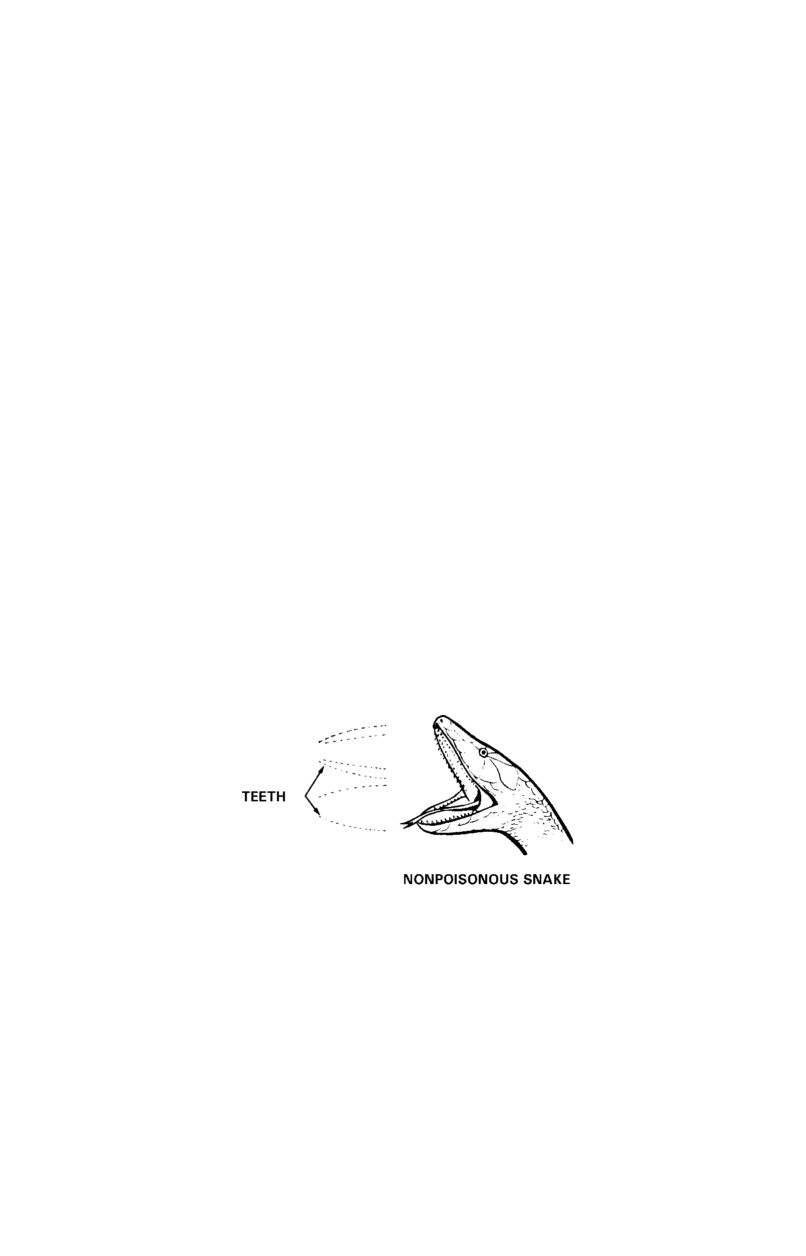
Nonpoisonous Snakes. There are approximately 130 different
varieties of nonpoisonous snakes in the United States. They have oval-
shaped heads and round eyes. Unlike poisonous snakes, discussed below,
nonpoisonous snakes do not have fangs with which to inject venom. Figure
6-1 depicts the characteristics of a nonpoisonous snake.
Figure 6-1. Characteristics of nonpoisonous snake.
b.
Poisonous Snakes. Poisonous snakes are found throughout the
world, primarily in tropical to moderate climates. Within the United States,
there are four kinds:
rattlesnakes, copperheads, water moccasins
(cottonmouth), and coral snakes. Poisonous snakes in other parts of the
world include sea snakes, the fer-de-lance, the bushmaster, and the tropical
rattlesnake in tropical Central America; the Malayan pit viper in the tropical
Far East; the cobra in Africa and Asia; the mamba (or black mamba) in
central and southern Africa; and the krait in India and Southeast Asia. Refer
to Figure 6-2 for characteristics of a poisonous pit viper.
6-1
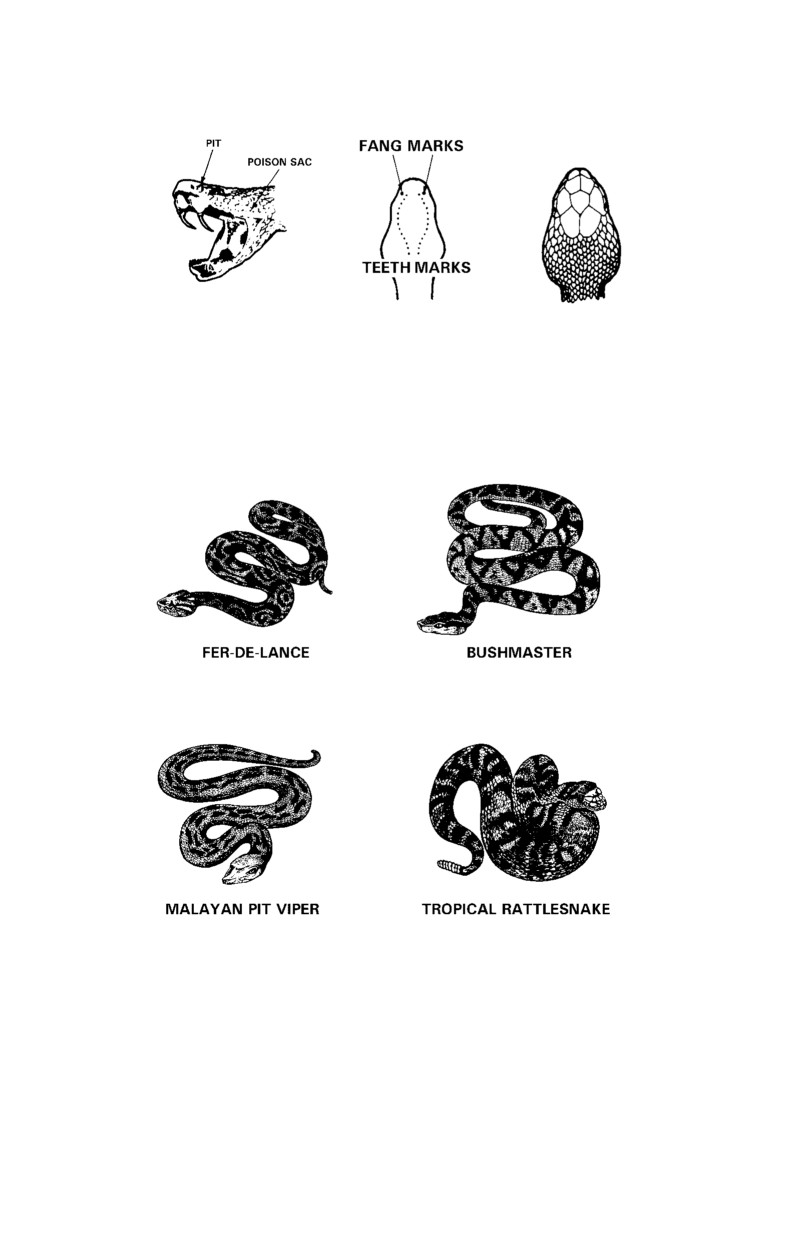
Figure 6-2. Characteristics of poisonous pit viper.
c.
Pit Vipers
(Poisonous). Figure
6-3 depicts a variety of
poisonous snakes.
Figure 6-3. Poisonous snakes.
(1)
Rattlesnakes, bushmasters, copperheads, fer-de-lance,
Malayan pit vipers, and water moccasins (cottonmouth) are called pit vipers
because of the small, deep pits between the nostrils and eyes on each side of
the head (Figure 6-2). In addition to their long, hollow fangs, these snakes
have other identifying features: thick bodies, slit-like pupils of the eyes, and
flat, almost triangular-shaped heads. Color markings and other identifying
characteristics, such as rattles or a noticeable white interior of the mouth
(cottonmouth), also help distinguish these poisonous snakes. Further
6-2
identification is provided by examining the bite pattern of the wound for
signs of fang entry. Occasionally there will be only one fang mark, as in the
case of a bite on a finger or toe where there is no room for both fangs, or
when the snake has broken off a fang.
(2)
The casualty’s condition provides the best information
about the seriousness of the situation, or how much time has passed since the
bite occurred. Pit viper bites are characterized by severe burning pain.
Discoloration and swelling around the fang marks usually begins within 5 to
10 minutes after the bite. If only minimal swelling occurs within 30 minutes,
the bite will almost certainly have been from a nonpoisonous snake or possibly
from a poisonous snake which did not inject venom. The venom destroys
blood cells, causing a general discoloration of the skin. Blisters and numbness
in the affected area follow this reaction. Other signs, which can occur, are
weakness, rapid pulse, nausea, shortness of breath, vomiting, and shock.
d.
Corals, Cobras, Kraits, and Mambas. Corals (Figure 6-4),
cobras (Figure 6-5), kraits, and mambas all belong to the same group even
though they are found in different parts of the world. All four inject their
venom through short, grooved fangs, leaving a characteristic bite pattern.
Figure 6-4. Coral snake.
(1)
The small coral snake, found in the Southeastern US, is
brightly colored with bands of red, yellow (or almost white), and black
completely encircling the body. Other nonpoisonous snakes have the same
coloring, but on the coral snake found in the US, the red ring always touches
the yellow ring. To know the difference between a harmless snake and the
coral snake found in the United States, remember the following:
“Red on yellow will kill a fellow,
Red on black, venom will lack.”
6-3
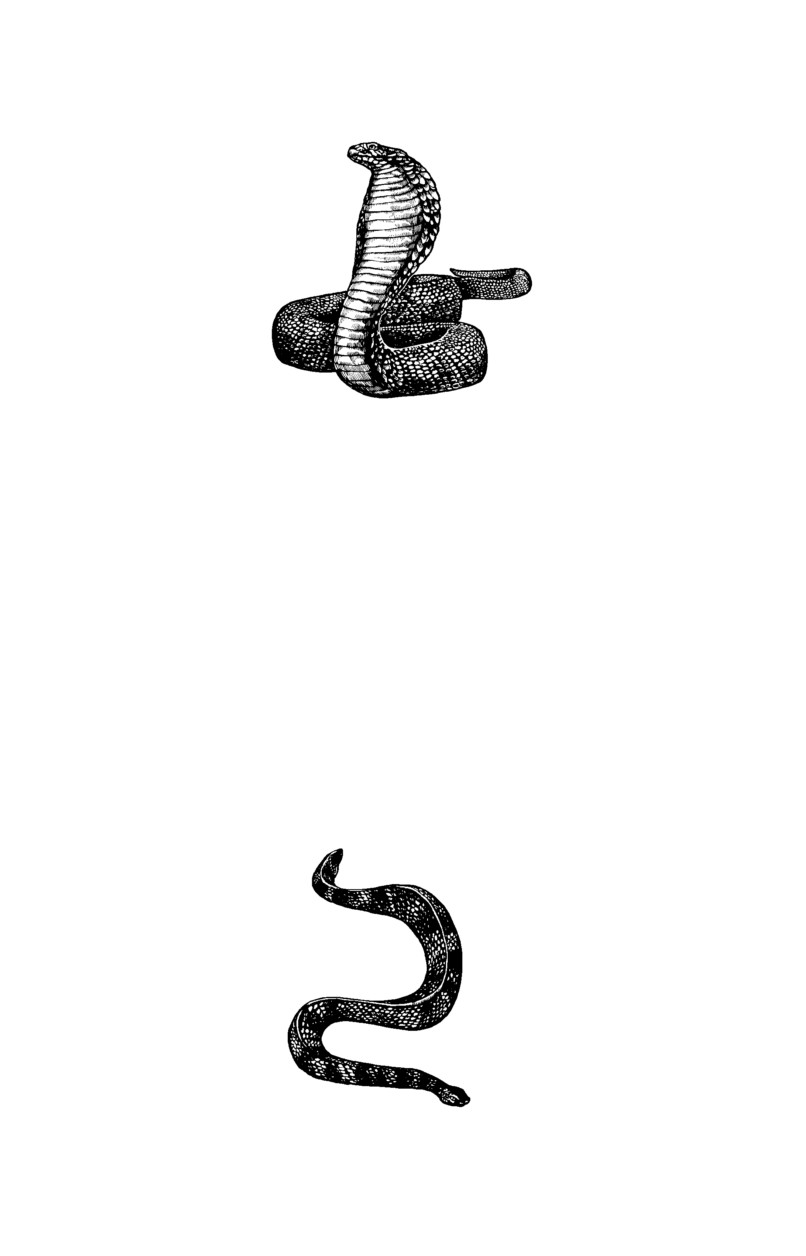
Figure 6-5. Cobra snake.
(2)
The venom of corals, cobras, kraits, and mambas
produces symptoms different from those of pit vipers. Because there is only
minimal pain and swelling, many people believe that the bite is not serious.
Delayed reactions in the nervous system normally occur between 1 to 7 hours
after the bite. Symptoms include blurred vision, drooping eyelids, slurred
speech, drowsiness, and increased salivation and sweating. Nausea, vomiting,
shock, respiratory difficulty, paralysis, convulsions, and coma will usually
develop if the bite is not treated promptly.
e.
Sea Snakes. Sea snakes (Figure 6-6) are found in the warm
water areas of the Pacific and Indian oceans, along the coasts, and at the
mouths of some larger rivers. Their venom is VERY poisonous, but their
fangs are only 1/4 inch long. The first aid outlined for land snakes also
applies to sea snakes.
Figure 6-6. Sea snake.
6-4
6-3.
Snakebites
a.
Poisonous snakes DO NOT always inject venom when they
bite or strike a person. However, all snakes may carry tetanus (lockjaw);
anyone bitten by a snake, whether poisonous or nonpoisonous, should
immediately seek medical attention.
•
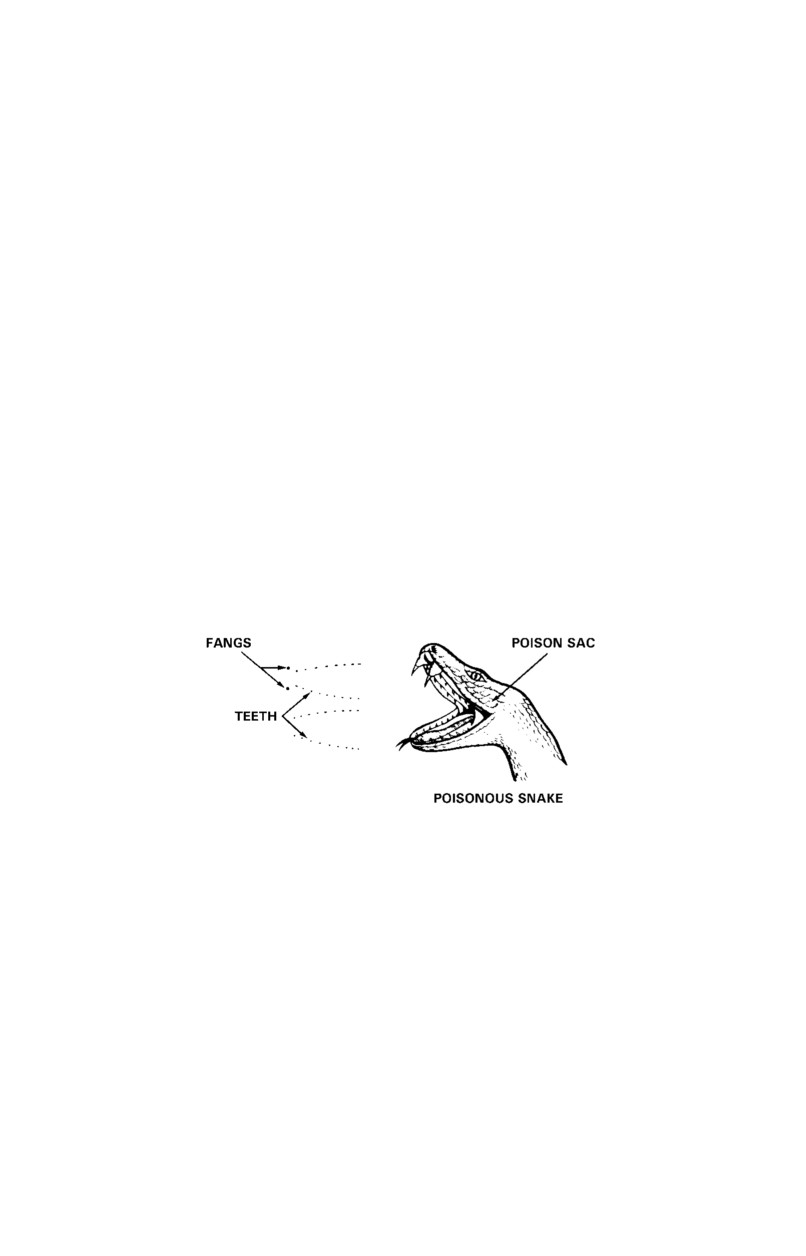
Poison is injected from the venom sacs through grooved
or hollow fangs. Depending on the species, these fangs are either long or
short. Pit vipers have long hollow fangs. These fangs are folded against the
roof of the mouth and extend when the snake strikes. This allows them to
strike quickly and then withdraw. Cobras, coral snakes, kraits, mambas, and
sea snakes have short, grooved fangs. These snakes are less effective in their
attempts to bite, since they must chew after striking to inject enough venom
(poison) to be effective. Figure 6-7 depicts the characteristics of a poisonous
snakebite.
•
In the event you are bitten, attempt to identify and/or kill
the snake. Take it to medical personnel for inspection/identification. This
provides valuable information to medical personnel who deal with snakebites.
TREAT ALL SNAKEBITES AS POISONOUS.
Figure 6-7. Characteristics of poisonous snakebite.
b.
The venoms of different snakes cause different effects. Pit
viper venom (hemotoxin [blood toxin]) destroys tissue and blood cells.
Cobras, adders, and coral snakes inject powerful venom (neurotoxin [nerve
toxin]) which affect the central nervous system, causing respiratory paralysis.
Water moccasins and sea snakes have venom that is both hemotoxic and
neurotoxic.
c.
The identification of poisonous snakes is very important since
medical treatment will be different for each type of venom. Unless it can be
positively identified, the snake should be killed and saved. When this is not
possible or when doing so is a serious threat to others, identification may
6-5
sometimes be difficult since many venomous snakes resemble harmless
varieties. When dealing with snakebite problems in foreign countries, seek
advice, professional or otherwise, which may help identify species in the
particular area of operations.
d.
Get the casualty to an MTF as soon as possible and with
minimum movement. Until evacuation or treatment is possible, have the
casualty lie quietly and not move any more than necessary. If the casualty
has been bitten on an extremity, DO NOT elevate the limb; keep the extremity
level with the body. Keep the casualty comfortable and reassure him. If the
casualty is alone when bitten, he should go to the medical facility himself
rather than wait for someone to find him. Unless the snake has been positively
identified, attempt to kill it and send it with the casualty. Be sure that
retrieving the snake does not endanger anyone or delay transporting the
casualty.
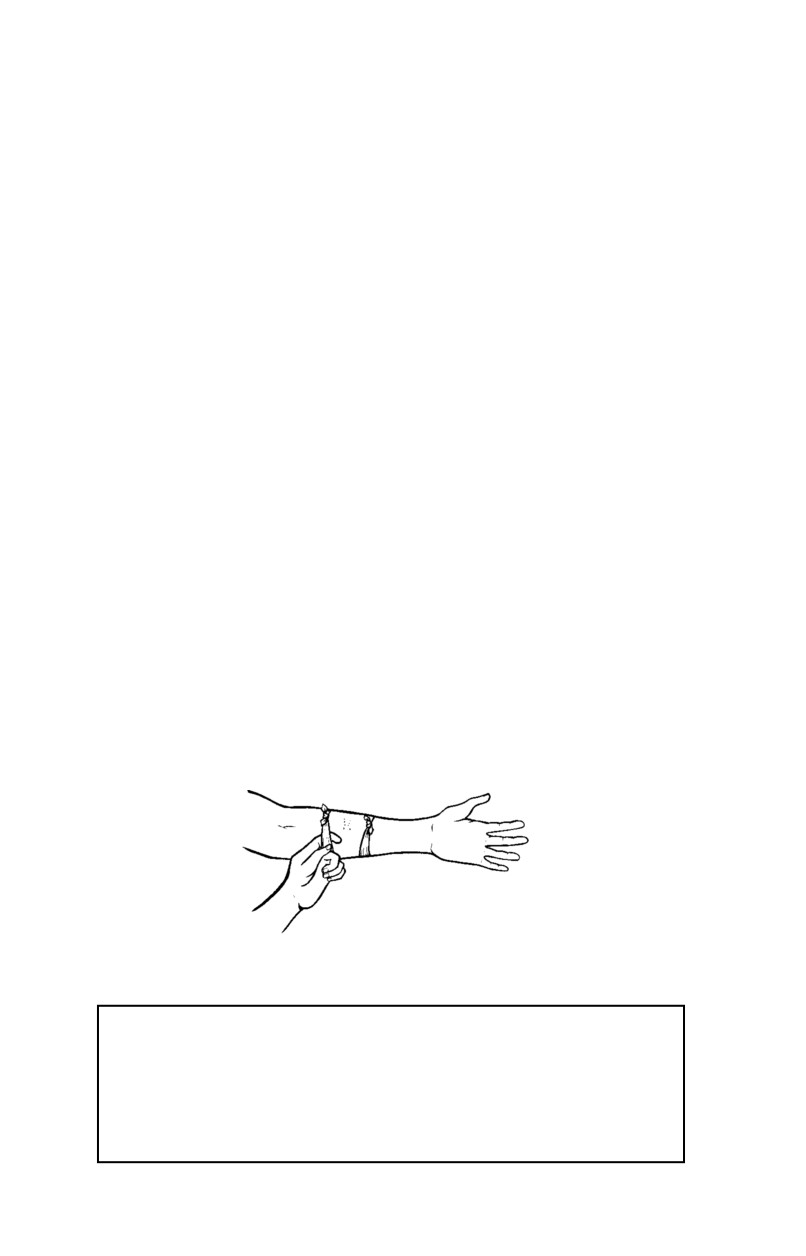
(1)
If the bite is on an arm or leg, place a constricting band
(narrow cravat [swathe], or narrow gauze bandage) one to two fingerbreadths
above and below the bite (Figure 6-8). If the bite is on the hand or foot,
place a single band above the wrist or ankle. The band should be tight
enough to stop the flow of blood near the skin, but not tight enough to
interfere with circulation. In other words, it should not have a tourniquet-
like affect. If no swelling is seen, place the bands about 1 inch from either
side of the bite. If swelling is present, put the bands on the unswollen part at
the edge of the swelling. If the swelling extends beyond the band, move the
band to the new edge of the swelling.
(If possible, leave the old band on,
place a new one at the new edge of the swelling, and then remove and save
the old one in case the process has to be repeated.)
Figure 6-8. Constricting band.
CAUTION
DO NOT attempt to cut open the bite nor suck out the
venom. If the venom should seep through any damaged or
lacerated tissues in your mouth, you could immediately lose
consciousness or even die.
6-6
(2)
If the bite is located on an arm or leg, immobilize it at a
level below the heart. DO NOT elevate an arm or leg even with or above the
level of the heart.
CAUTION
When a splint is used to immobilize the arm or leg, take
EXTREME care to ensure the splinting is done properly and
does not bind. Watch it closely and adjust it if any changes
in swelling occur.
(3)
When possible, clean the area of the bite with soap and
water. DO NOT use ointments of any kind.
(4)
NEVER give the casualty food, alcohol, stimulants
(coffee or tea), drugs, or tobacco.
(5)
Remove rings, watches, or other jewelry from the
affected limb.
6-4.
Human or Animal Bites
Human or other land animal bites may cause lacerations or bruises. In
addition to damaging tissue, bites always present the possibility of infection.
a.
Human Bites. Human bites that break the skin may become
seriously infected since the mouth is heavily contaminated with bacteria.
Medical personnel MUST treat all human bites.
b.
Animal Bites. Land animal bites can result in both infection
and disease. Tetanus, rabies, and various types of fevers can follow an
untreated animal bite. Because of these possible complications, the animal
causing the bite should, if possible, be captured or killed (without damaging
its head) so that it can be tested for disease.
c.
First Aid.
(1)
Cleanse the wound thoroughly with soap.
(2)
Flush it well with water.
(3)
Cover it with a sterile dressing.
6-7
(4)
Immobilize the injured arm or leg, if appropriate.
(5)
Transport the casualty immediately to an MTF.
NOTE
If unable to capture or kill the animal, provide medical personnel
with any information that will help identify it.
6-5.
Marine (Sea) Animals
With the exception of sharks and barracuda, most marine animals will not
deliberately attack. The most frequent injuries from marine animals are
wounds by biting, stinging, or puncturing. Wounds inflicted by marine
animals can be very painful, but are rarely fatal.
a.
Sharks, Barracuda, and Alligators. Wounds from these marine
animals can involve major trauma as a result of bites and lacerations. Bites
from large marine animals are potentially the most life threatening of all
injuries from marine animals. Major wounds from these animals can be
treated by controlling the bleeding, preventing shock, giving basic life
support, splinting the injury, and by securing prompt medical aid.
b.
Turtles, Moray Eels, and Corals. These animals normally
inflict minor wounds. Treat by cleansing the wound(s) thoroughly and by
splinting if necessary.
c.
Jellyfish, Portuguese Man-of-War, Anemones, and Others.
This group of marine animals inflict injury by means of stinging cells in their
tentacles. Contact with the tentacles produces burning pain with a rash and
small hemorrhages on the skin. Shock, muscular cramping, nausea,
vomiting, and respiratory distress may also occur. Gently remove the clinging
tentacles with a towel and wash or treat the area. Use diluted ammonia or
alcohol, meat tenderizer, and talcum powder. If symptoms become severe or
persist, seek medical assistance.
d.
Spiny Fish, Urchins, Stingrays, and Cone Shells. These
animals inject their venom by puncturing the skin with their spines. General
signs and symptoms include swelling, nausea, vomiting, generalized cramps,
diarrhea, muscular paralysis, and shock. Deaths are rare. Treatment consists
of soaking the wounds in hot water (when available) for 30 to 60 minutes.
This inactivates the heat sensitive toxin. In addition, further first aid measures
(controlling bleeding, applying a dressing, and so forth) should be carried out
as necessary.
6-8
CAUTION
Be careful not to scald the casualty with water that is too hot
because the pain of the wound will mask the normal reaction
to heat.
6-6.
Insect (Arthropod) Bites and Stings
An insect bite or sting can cause great pain, allergic reaction, inflammation,
and infection. If not treated correctly, some bites/stings may cause serious
illness or even death. When an allergic reaction is not involved, first aid is a
simple process. In any case, medical personnel should examine the casualty
at the earliest possible time. It is important to properly identify the spider,
bee, or creature that caused the bite/sting, especially in cases of allergic
reaction.
a.
Types of Insects. The insects found throughout the world that
can produce a bite or sting are too numerous to mention in detail. Commonly
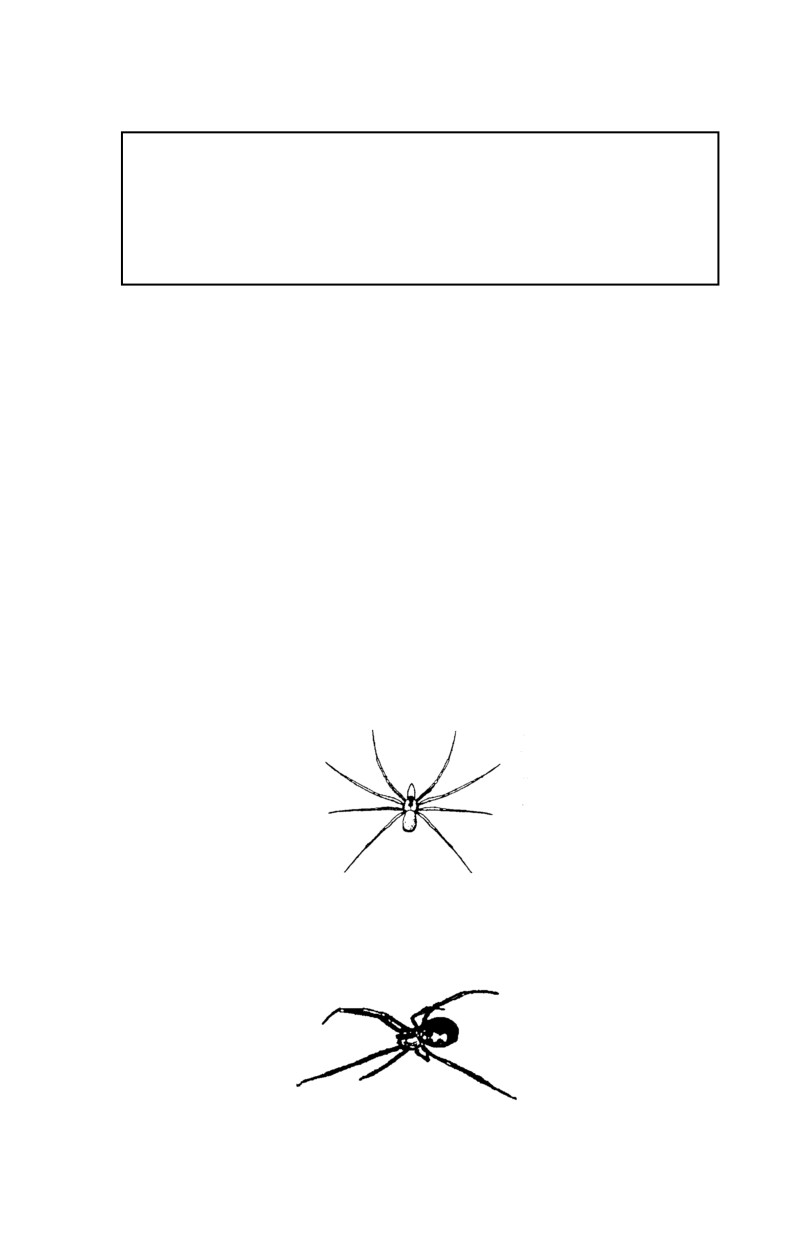
encountered stinging or biting insects include brown recluse spiders (Figure
6-9), black widow spiders (Figure 6-10), tarantulas (Figure 6-11), scorpions
(Figure 6-12), urticating caterpillars, bees, wasps, centipedes, conenose
beetles
(kissing bugs), ants, and wheel bugs. Upon being reassigned,
especially to overseas areas, take the time to become acquainted with the
types of insects to avoid.
Figure 6-9. Brown recluse spider.
Figure 6-10. Black widow spider.
6-9
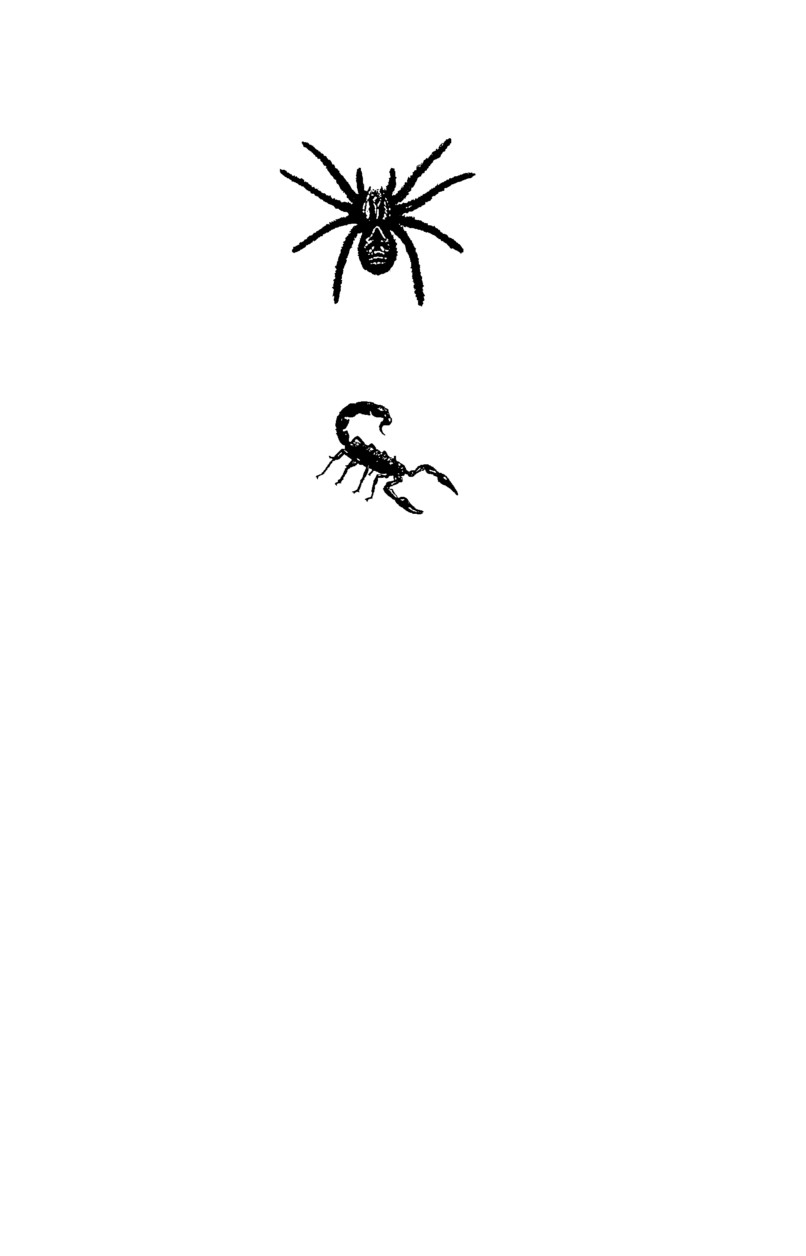
Figure 6-11. Tarantula.
Figure 6-12. Scorpion.
b.
Signs and Symptoms. Discussed in paragraphs (1) and (2)
below are the most common effects of insect bites/stings. They can occur
alone or in combination with the others.
(1)
Less serious. Commonly seen signs/symptoms are pain,
irritation, swelling, heat, redness, and itching. Hives or wheals (raised areas
of the skin that itch) may occur. These are the least severe of the allergic
reactions that commonly occur from insect bites/stings. They are usually
dangerous only if they affect the air passages (mouth, throat, nose, and so
forth), which could interfere with breathing. The bites/stings of bees, wasps,
ants, mosquitoes, fleas, and ticks are usually not serious and normally produce
mild and localized symptoms. A tarantula’s bite is usually no worse than that
of a bee sting. Scorpions are rare and their stings (except for a specific
species found only in the Southwest desert) are painful but usually not
dangerous.
(2)
Serious. Emergency allergic or hypersensitive reactions
sometimes result from the stings of bees, wasps, and ants. Many people are
allergic to the venom of these particular insects. Bites or stings from these
insects may produce more serious reactions, to include generalized itching
and hives, weakness, anxiety, headache, breathing difficulties, nausea,
vomiting, and diarrhea. Very serious allergic reactions (called anaphylactic
shock) can lead to complete collapse, shock, and even death. Spider bites
(particularly from the black widow and brown recluse spiders) can also be
6-10
serious. Venom from the black widow spider affects the nervous system.
This venom can cause muscle cramps, a rigid, nontender abdomen, breathing
difficulties, sweating, nausea, and vomiting. The brown recluse spider
generally produces local rather than system-wide problems; however, local
tissue damage around the bite can be severe and can lead to an ulcer and even
gangrene.
c.
First Aid. There are certain principles that apply regardless of
what caused the bite/sting. Some of these are—
•
If there is a stinger present (for example, from a bee),
remove the stinger by scraping the skin’s surface with a fingernail or knife.
DO NOT squeeze the sac attached to the stinger because it may inject more
venom.
•
Wash the area of the bite/sting with soap and water
(alcohol or an antiseptic may also be used) to help reduce the chances of an
infection and remove traces of venom.
•
Remove jewelry from bitten extremities because swelling
may occur.
•
In most cases of insect bites the reaction will be mild and
localized; use ice or cold compresses (if available) on the site of the bite/
sting. This will help reduce swelling, ease the pain, and slow the
absorption of venom. Meat tenderizer
(to neutralize the venom) or
calamine lotion (to reduce itching) may be applied locally. If necessary,
seek medical assistance.
•
In more serious reactions (severe and rapid swelling,
allergic symptoms, and so forth) treat the bite/sting like you would treat a
snakebite; that is, apply constricting bands above and below the site.
•
Be prepared to perform basic life-support measures, such
as rescue breathing.
•
Reassure the casualty and keep him calm.
•
In serious reactions, attempt to capture the insect for
positive identification; however, be careful not to become a casualty yourself.
•
If the reaction to the bite/sting appears serious, seek
medical assistance.
6-11

WARNING
Insect bites/stings may cause anaphylactic shock (a
shock caused by a severe allergic reaction). This is a
life-threatening event and a TRUE MEDICAL EMER-
GENCY. Be prepared to perform the basic life-support
measures and to immediately transport the casualty to
an MTF.
NOTE
Be aware that some allergic or hypersensitive individuals may
carry identification or emergency insect bite treatment kits. If
the casualty is having an allergic reaction and has such a kit,
administer the medication in the kit according to the instructions
which accompany the kit.
d.
Supplemental Information.
For additional information
concerning biting insects, see FM 21-10.
6-7.
First Aid for Bites and Stings
See the table below for information on bites and stings.
Table 6-1. First Aid Measures for Bites and Stings
TYPES
FIRST AID MEASURES
SNAKEBITE
1. MOVE CASUALTY AWAY FROM THE SNAKE.
2. REMOVE JEWELRY FROM THE AFFECTED AREA, IF
APPLICABLE.
3. REASSURE CASUALTY AND KEEP HIM QUIET.
4. APPLY CONSTRICTING BAND, 1-2 FINGERBREADTHS
FROM THE BITE. YOU SHOULD BE ABLE TO INSERT A
FINGER BETWEEN THE BAND AND THE SKIN.
a. ARM OR LEG BITE. PLACE ONE BAND ABOVE AND
ONE BAND BELOW THE BITE SITE.
b. HAND OR FOOT BITE. PLACE ONE BAND ABOVE
THE WRIST OR ANKLE.
6-12

Table 6-1. First Aid Measures for Bites and Stings
TYPES
FIRST AID MEASURES
5.
IMMOBILIZE THE AFFECTED PART IN A POSITION
BELOW THE LEVEL OF THE HEART.
6.
KILL THE SNAKE (IF POSSIBLE, WITHOUT DAMAGING
ITS HEAD OR ENDANGERING YOURSELF) AND SEND IT
WITH THE CASUALTY.
7.
SEEK MEDICAL ASSISTANCE IMMEDIATELY.
BROWN RECLUSE
1.
KEEP CASUALTY QUIET.
SPIDER
OR
2.
REMOVE ALL JEWELRY FROM AFFECTED PART, IF
BLACK WIDOW
APPLICABLE.
SPIDER BITE
3.
WASH THE AREA.
4.
APPLY ICE OR FREEZE PACK, IF AVAILABLE.
5.
SEEK MEDICAL ASSISTANCE.
TARANTULA BITE
1.
WASH THE AREA.
OR
SCORPION STING
2.
REMOVE ALL JEWELRY FROM AFFECTED PART, IF
OR
APPLICABLE.
ANT BITE
3.
APPLY ICE OR FREEZE PACK, IF AVAILABLE.
4.
APPLY BAKING SODA, CALAMINE LOTION, OR MEAT
TENDERIZER (IF AVAILABLE) TO BITE SITE TO RELIEVE
PAIN AND ITCHING.
5.
IF THE SITE OF THE BITE IS ON THE FACE, NECK
(POSSIBLE AIRWAY PROBLEMS), OR GENITAL AREA,
OR IF LOCAL REACTION SEEMS SEVERE, OR IF THE
STING IS BY THE DANGEROUS TYPE OF SCORPION
FOUND IN THE SOUTHWEST UNITED STATES DESERT,
KEEP THE CASUALTY AS QUIET AS POSSIBLE. SEEK
MEDICAL ASSISTANCE.
BEE STING
1.
IF THE STINGER IS PRESENT, REMOVE BY SCRAPING
WITH A KNIFE OR FINGERNAIL. DO NOT SQUEEZE
VENOM SAC ON STINGER; MORE VENOM MAY BE
INJECTED.
2.
REMOVE ALL JEWELRY FROM AFFECTED PART, IF
APPLICABLE.
6-13

Table 6-1. First Aid Measures for Bites and Stings
TYPES
FIRST AID MEASURES
3. WASH THE AREA.
4. APPLY ICE OR FREEZE PACK, IF AVAILABLE.
5. IF ALLERGIC SIGNS OR SYMPTOMS APPEAR, BE
PREPARED TO PERFORM BASIC LIFE SUPPORT
MEASURES. SEEK IMMEDIATE MEDICAL ASSISTANCE.
6-14
CHAPTER 7
FIRST AID IN A NUCLEAR, BIOLOGICAL,
AND CHEMICAL ENVIRONMENT
7-1.
General
American forces have not been exposed to NBC weapons/agents on the
battlefield since World War I. In future conflicts and wars we can expect the
use of such agents. Nuclear, biological, and chemical weapons will rapidly
degrade unit effectiveness by forcing troops to wear protective clothing and by
creating confusion and fear. Through training in protective procedures and
first aid, units can maintain their effectiveness on the integrated battlefield.
7-2.
First Aid Materials
You may be issued the following materials to protect, decontaminate, and use
as first aid for NBC exposure. You must know how to use the items; some
items are described in a through d below. It is equally important that you
know when to use them.
a.
Nerve Agent Pyridostigmine Pretreatment (NAPP). You may
be issued a blister pack of pretreatment tablets when your commander directs.
The NAPP is a pretreatment; it is not an antidote. It improves the
effectiveness of the nerve agent antidote. When ordered to take the
pretreatment you must take one tablet every 8 hours, mission permitting.
This must be taken prior to exposure to nerve agents, since it may take
several hours to develop adequate blood levels.
NOTE
Commanders must follow investigational new drug protocols
for use of the NAPP.
b.
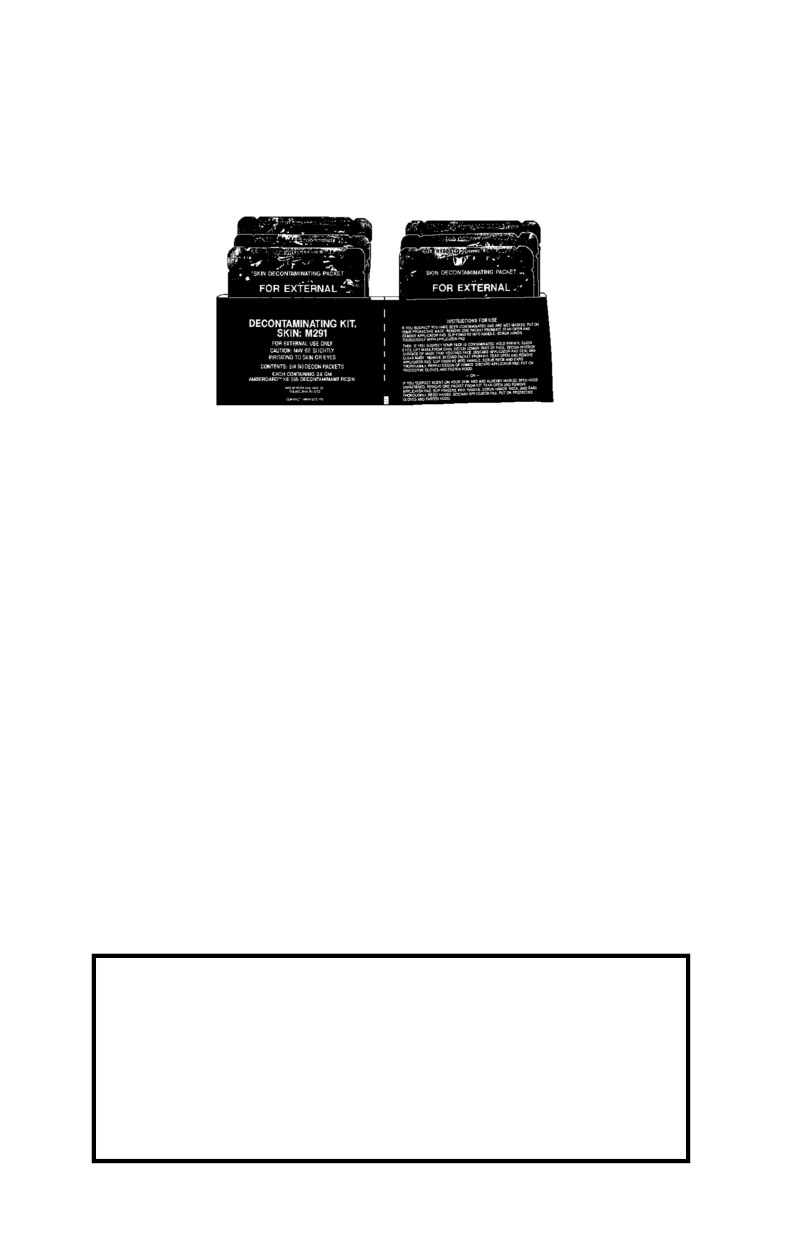
M291 Skin Decontaminating Kit. The M291 Skin Decontam-
inating Kit (Figure 7-1) contains six packets of XE-555 decontaminant resin.
WARNING
For external use only. May be slightly irritating to the
eyes. Keep decontaminating powder out of eyes. Use
water to wash toxic agent out of eyes.
7-1
c.
Nerve Agent Antidote Kit, MARK I. Each service member is
issued three MARK Is for use in first aid for nerve agent poisoning (Figure
7-2 and paragraph 7-6).
Figure 7-1. M291 Skin Decontamination Kit.
d.
Antidote Treatment, Nerve Agent, Autoinjector. A new nerve
agent antidote injection device, Antidote Treatment, Nerve Agent, Autoinjector
(ATNAA) is currently under development that will replace the MARK I.
The ATNAA is a multichambered device with the atropine and pralidoxime
chloride in separate chambers. Both antidotes will be administered through a
single needle.
7-3.
Classification of Chemical and Biological Agents
a.
Chemical agents are classified according to the primary
physiological effects they produce, such as blistering, choking, vomiting,
and incapacitating agents.
b.
Biological warfare agents are classified according to the effect
they have on man. The effects include their ability to incapacitate and cause
death. Most biological warfare agents are delivered as aerosols that effect
the respiratory tract; some can be delivered by releasing infected insects, by
contaminating food and water, and by injection
(injecting material in
individuals by terrorist, not mass exposure). These agents are found in living
organisms such as fungi, bacteria, and viruses.
WARNING
Swallowing water or food contaminated with nerve,
blister, and other chemical agents and with some
biological agents can be fatal. NEVER consume water
or food that is suspected of being contaminated until it
has been tested and found safe for consumption by
medical personnel.
7-2
7-4.
Conditions for Masking Without Order or Alarm
a.
Once an attack with a chemical or biological agent is detected
or suspected, or information is available that such an agent is about to be
used, you must STOP BREATHING and mask immediately. DO NOT
WAIT to receive an order or alarm under the following circumstances:
•
Your position is hit by artillery missiles, rockets that
produce vapors, smoke, and mists, and aerial sprays.
•
Smoke or vapor cloud from an unknown source is
present or approaching.
•
A suspicious odor, liquid, or solid is present.
•
A chemical or biological warfare agent attack is
occurring.
•
You are entering an area known or suspected of being
contaminated.
•
When casualties are being received from an area where
chemical or biological agents have reportedly been used.
•
You have one or more of the following symptoms:
•
An unexplained runny nose.
•
A sudden unexplained headache.
•
A feeling of choking or tightness in the chest or
throat.
•
Dimness of vision.
•
Irritation of the eyes.
•
Difficulty in or increased rate of breathing without
obvious reasons.
•
Sudden feeling of depression.
•
Dread, anxiety, or restlessness.
•
Dizziness or light-headedness.
7-3
•
Slurred speech.
•
Unexplained laughter or unusual behavior is noted in others.
•
Numerous unexplained ill personnel.
•
Service members suddenly collapsing without evident cause.
•
Animals or birds exhibiting unusual behavior or suddenly
dying.
b.
For further information on protection and masking procedures,
refer to FM 3-4, FM 4-02.7, FM 8-284, and FM 8-285.
7-5.
First Aid for a Chemical Attack
Your field protective mask gives protection against biological and chemical
warfare agents as well as radiological fallout. With practice you can mask in
9 seconds or less, or put on your mask with hood within 15 seconds.
a.
Stop breathing. Don your mask, seal it properly, and clear
and check it; then resume breathing. Give the alarm, and continue the
mission. Keep your mask on until the “all clear” signal has been given.
NOTE
Keep your mask on until the area is no longer hazardous and
you are told to unmask.
b.
If symptoms of nerve agent poisoning (paragraph 7-7) appear,
immediately give yourself one MARK I or ATNAA.
CAUTION
Do not inject a nerve agent antidote until you are sure you
need it.
c.
If your eyes and face become contaminated, you must
immediately try to get under cover. You need shelter to prevent further
contamination while performing decontamination procedures on your face.
If no overhead cover is available, put your poncho over your head before
beginning the decontamination process. Then you put on the remaining
7-4
protective clothing. If vomiting occurs, the mask should be lifted
momentarily and drained—with your eyes closed and while holding your
breath—then replaced, cleared, and sealed.
d.
If nerve agents are used, mission permitting, watch for persons
needing nerve agent antidotes and immediately follow procedures outlined in
paragraph 7-8b or c.
e.
Decontaminate your skin immediately and clothing and
equipment as soon as the mission permits.
7-6.
Background Information on Nerve Agents
a.
Nerve agents are among the deadliest of chemical agents.
Nerve agents enter the body by inhalation, by ingestion, and through the
skin. Depending on the route of entry and the amount, nerve agents can
produce injury or death within minutes. Nerve agents can achieve their
effects with small amounts. Nerve agents are absorbed rapidly, and the
effects are felt immediately upon entry into the body. You will be issued
three MARK Is or three ATNAAs and one Convulsant Antidote for Nerve
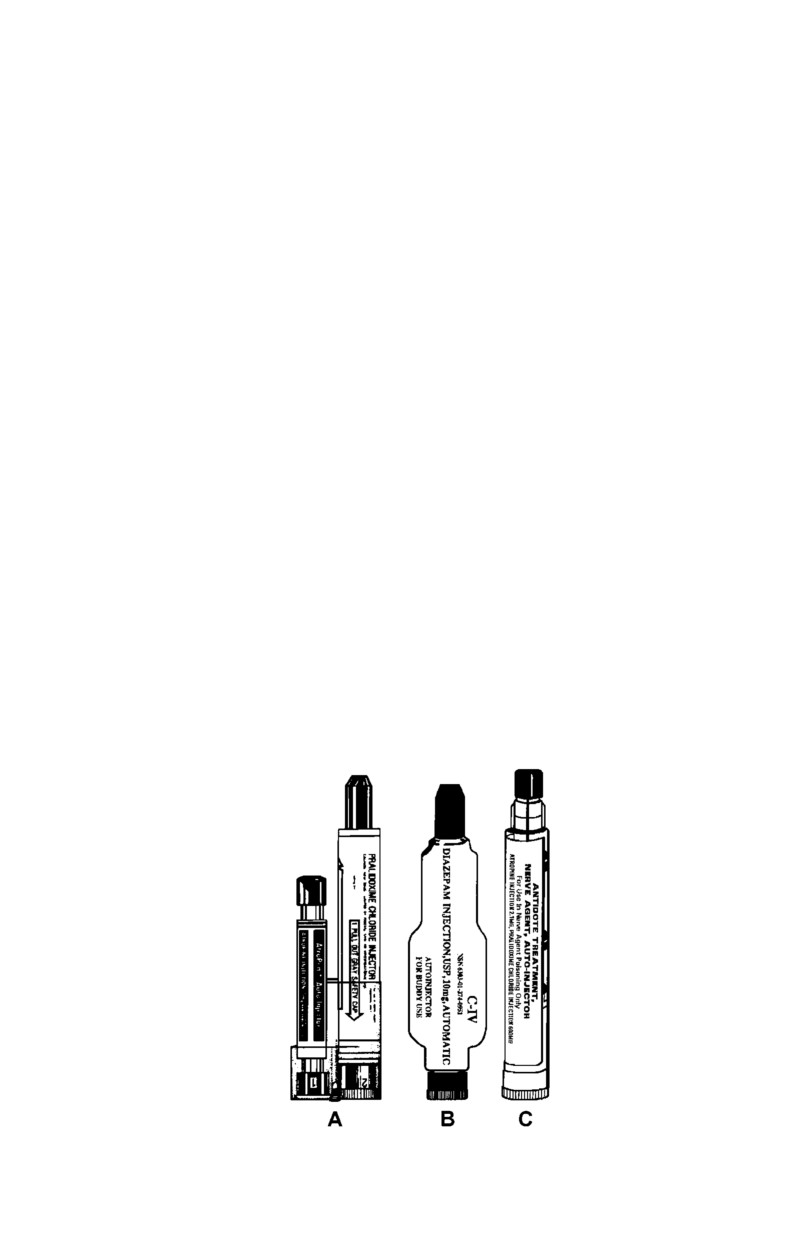
Agent (CANA). Each MARK I consists of one atropine autoinjector and one
pralidoxime chloride (2 PAM Cl) autoinjector (Figure 7-2A). Each ATNAA
consist of a multichambered autoinjector with the atropine and pralidoxime
chloride in separate chambers
(Figure
7-2C). The CANA is a single
autoinjector with flanges (Figure 7-2B). Procedures for use of both the
MARK I and ATNAA are described below. You will use either the MARK I
or the ATNAA in self-aid and buddy aid as issued.
Figure 7-2. Nerve Agent Antidote Kit, MARK I, CANA, and ATNAA.
7-5
b.
When you have the signs and symptoms of nerve agent
poisoning, you should immediately put on the protective mask and then inject
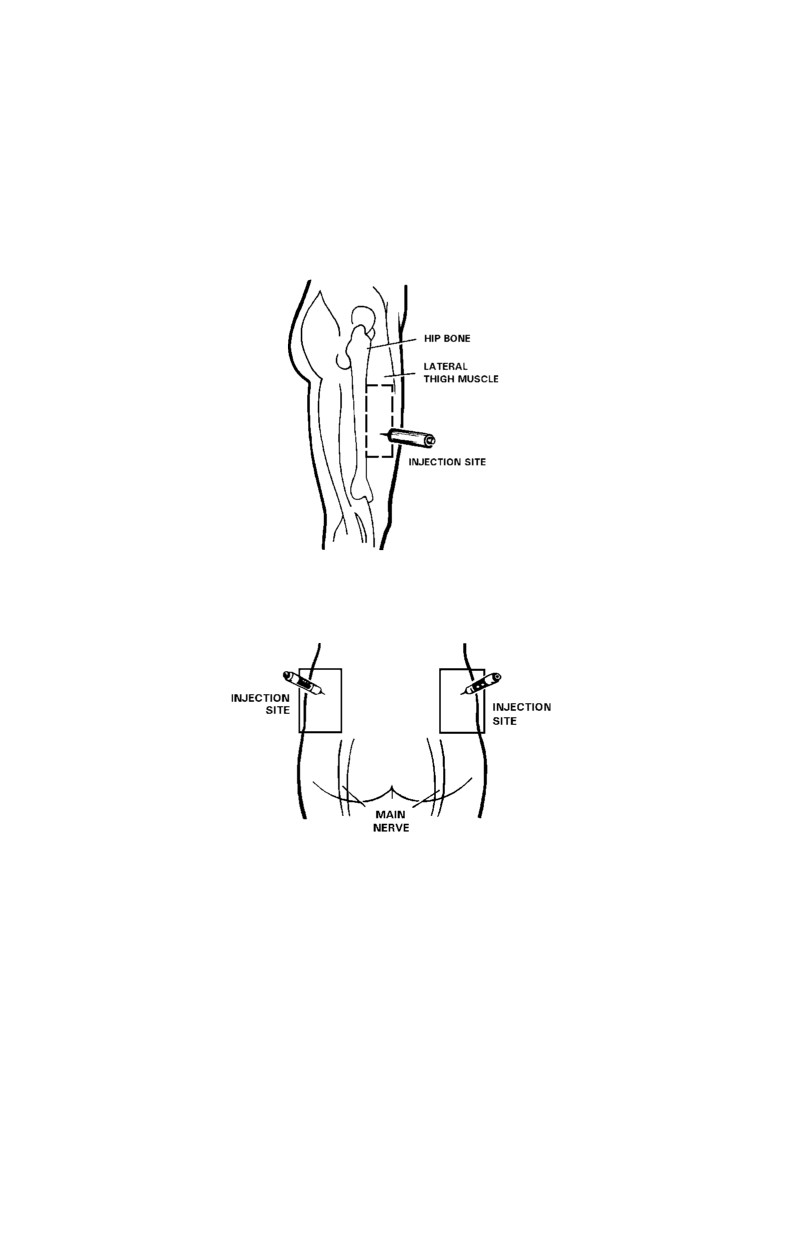
yourself with one set of the MARK I or ATNAA. Do not administer the CANA.
You should inject yourself in the outer (lateral) thigh muscle (Figure 7-3) or if
you are thin, in the upper outer (lateral) part of the buttocks (Figure 7-4).
Figure 7-3. Thigh injection site.
Figure 7-4. Buttocks injection site.
c.
Also, you may come upon an unconscious chemical agent
casualty who will be unable to care for himself and who will require first aid.
You should be able to successfully—
(1)
Mask him if he is unmasked.
(2)
Inject him, if necessary, with all of HIS autoinjectors.
(3)
Decontaminate his skin.
(4)
Seek medical assistance.
7-6
7-7.
Signs and Symptoms of Nerve Agent Poisoning
The symptoms of nerve agent poisoning are grouped as MILD—those that
you recognize and for which you can perform self-aid, and SEVERE—those
which require buddy aid.
a.
MILD Signs and Symptoms.
•
Unexplained runny nose.
•
Unexplained sudden headache.
•
Sudden drooling.
•
Difficulty seeing (dimness of vision and miosis).
•
Tightness in the chest or difficulty in breathing.
•
Localized sweating and muscular twitching in the area of
contaminated skin.
•
Stomach cramps.
•
Nausea.
•
Tachycardia followed by bradycardia.
(Tachycardia is
an abnormally rapid heartbeat with a heart rate of over 100 beats per minute.
Bradycardia is a slow heart rate of less than 60 beats per minute.)
b.
SEVERE Signs and Symptoms.
•
Strange or confused behavior.
•
Wheezing, dyspnea
(difficulty in breathing), and
coughing.
•
Severely pinpointed pupils.
•
Red eyes with tearing.
•
Vomiting.
•
Severe muscular twitching and general weakness.
•
Involuntary urination and defecation.
7-7