Technical Manual for Drilling Works for Technical Support Plan for the Drillers in DDCA (2013) - page 5
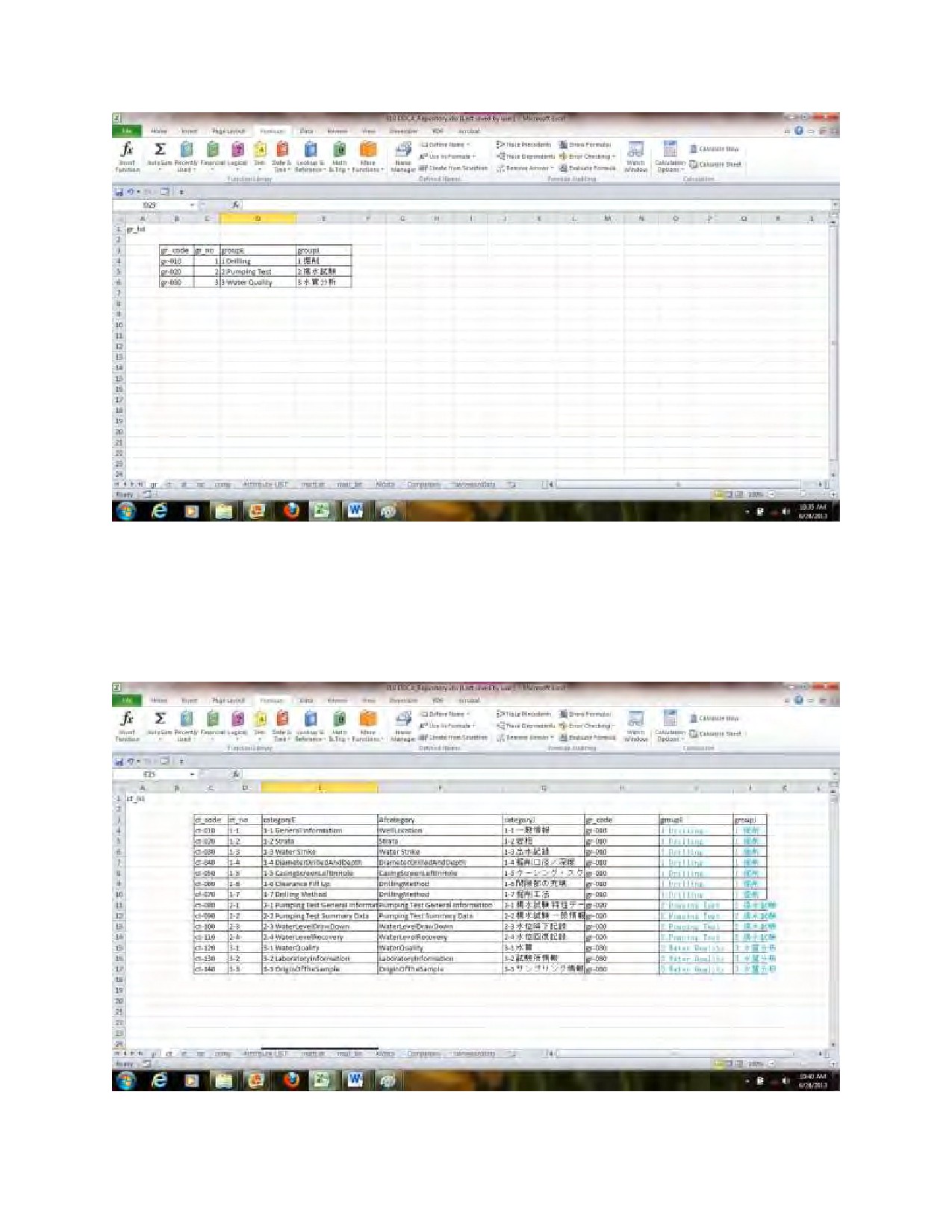
Figure 9 group list(GR list)
CT list sheet
CT list sheet shoe the categories under the group .Each categories has coded the CT no.and
refer to the group in the gr -list sheet with using the LOOKUP functions(the cells with blue
color).there are 14 categories as the following windows shows.
Figure 7 Category List(CT list)
17
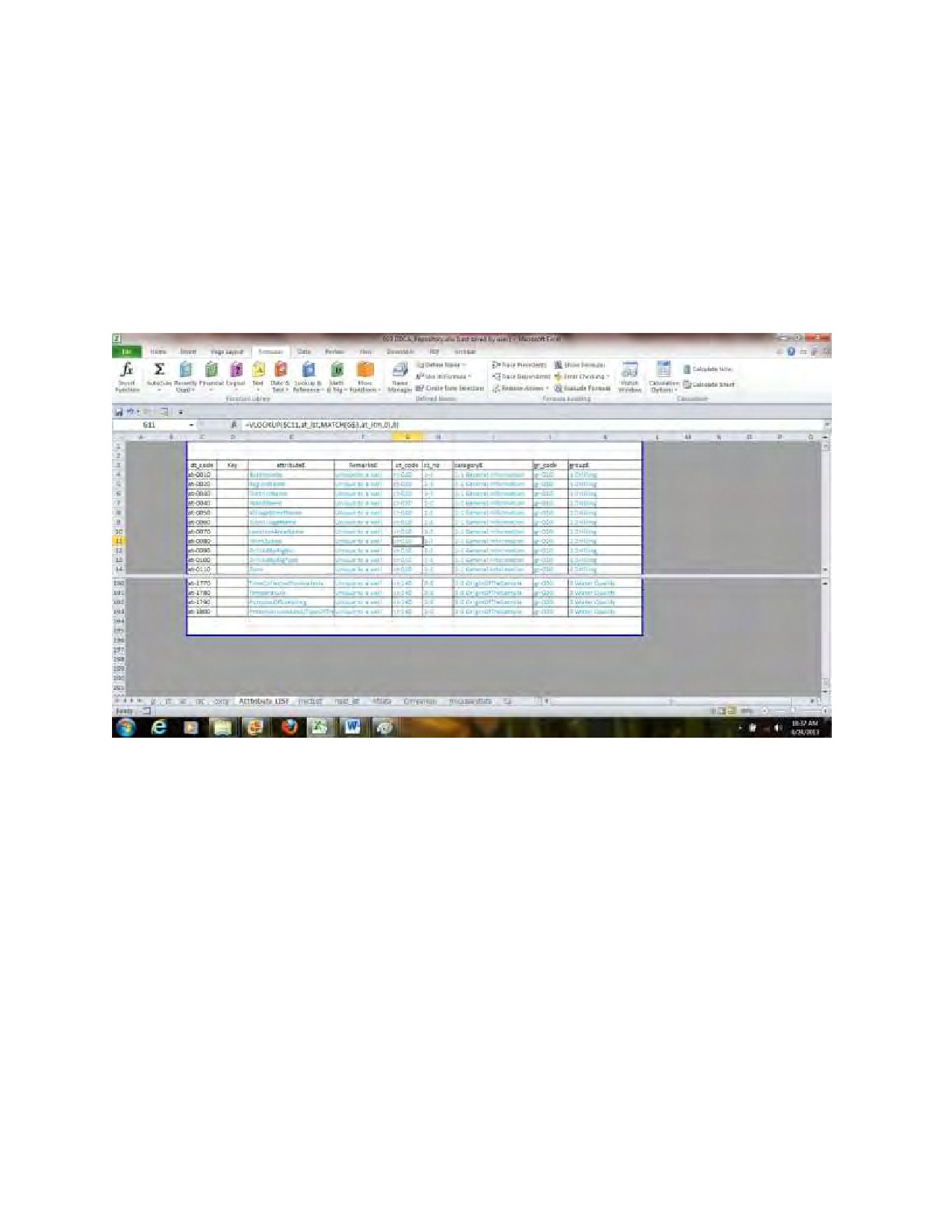
AT list sheet
AT list show the attributes which is under each category and group. Each categories has coded
the AT No.and refer to the group in the CT list sheet with using the LOOKUP functions(the cell
with blue color).In case the new categories is added, make sure to expand the range of list(re-
range and rename) there are 190 attributes as the following window shows
Figure 8 Attribute List(AT list)
RAT list sheet
RAT list sheet show the all attributes unfolding the repeating items. Each data has been coded
the RAT No.The group, category and attribute before unfolding the repeating items re-range and
rename the first after addition of the new attribute. RAT No. Is stored into the top row in the data
entry sheet so as to store the attributes into the data entry sheet so as to store the attributes into
the data entry sheet from RAT list sheet in the repository by referring to the RAT No.
18
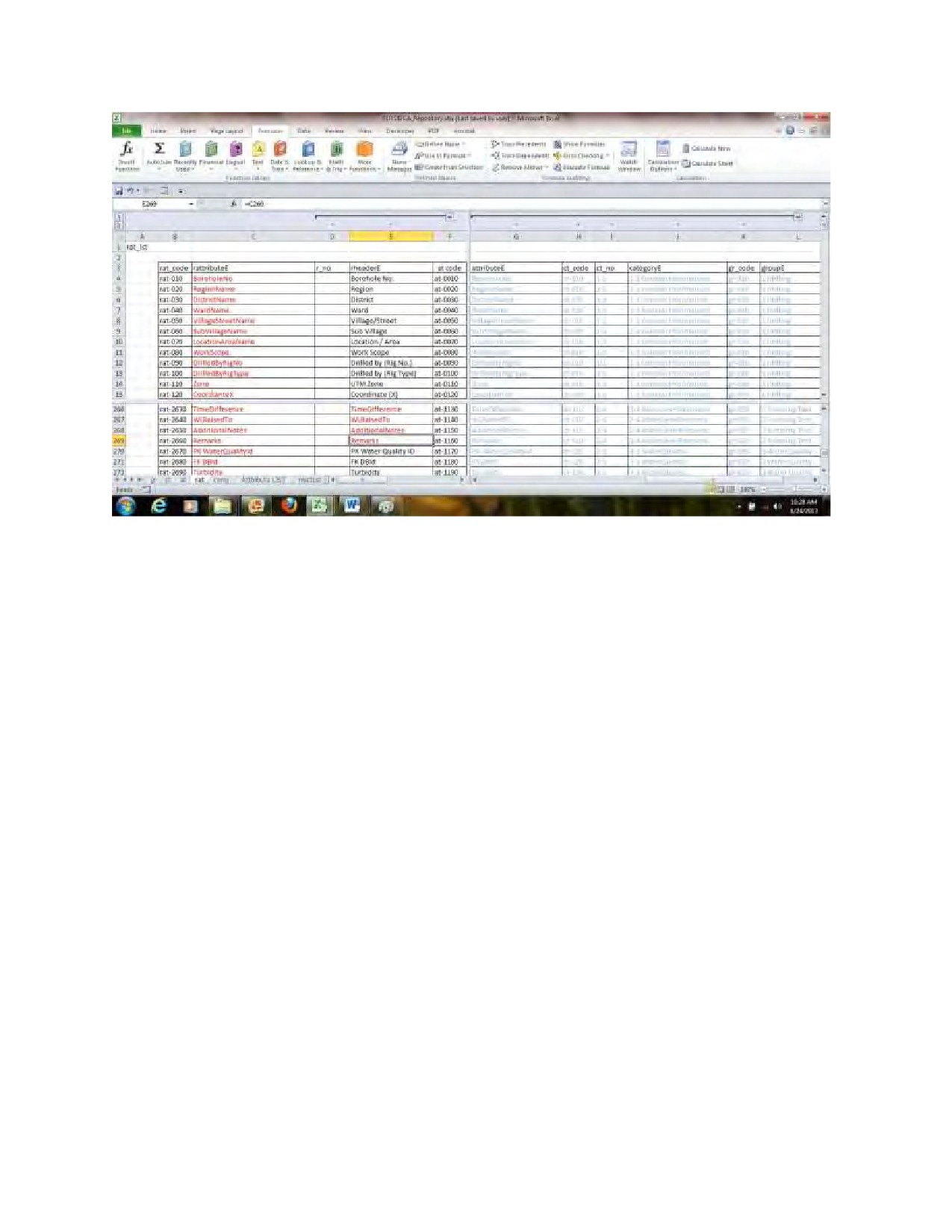
Figure 8: Attribute List(RAT list)
Steps For Additional Attributes To Repository And Data Entry Sheet
1. In AT list sheet, insert the row where the new attribute will be stored
2. Code new AT No and enter the new attribute.
3. The vlookup formula is set into the category column
4. Shift to the RAT list sheet and insert the row where the new attributes will be stored
5. Enter the new RAT No.
6. The VLOOKUP formulas of group and category for new RAT items are set
7. The formula for the RAT items is set as set in the cells up and down cells
8. In case the new attribute is repeating items, the formula is set like that of green colour.In
case of not repeating items, the formula is set as that of red color
9. Shift to the data entry sheet and insert the column in which the new attribute is stored
10. Set the formula of VLOOKUP so as to quote the attribute from the repository into the
data entry sheet.
19
LOCAIDES GENERAL SUPPLY LIMITED
P.O. Box 33333, Dar es Salaam. Survey, Kinondoni
Tel:2700096 Fax: 2700096
email: locaides@gmail.com,bertharicky@yahoo.com
GROUNDWATER DEVELOPMENT AND MANAGEMENT
CAPACITY DEVELOPMENT PROJECT
DDCAP
OUTPUT (13)
WORK REPORT FOR PHASE-2
APRIL 2013
LOCAIDES GENERAL SUPPLY LIMITED
Output (6) System Design Completed
Contents
1. EVALULATION OF OPERATION CONDITION
2
2. SYSTEM ANALYSIS AND DESIGN FOR IMPROVEMENT
2
3. SYSTEM MODIFICATION FOR IMPROVEMENT AND INTEGRAL TEST
2
4. REVISION OF MANUAL
7
5. TRAINING
7
Figure
Figure 1: Interface for borehole data entry
3
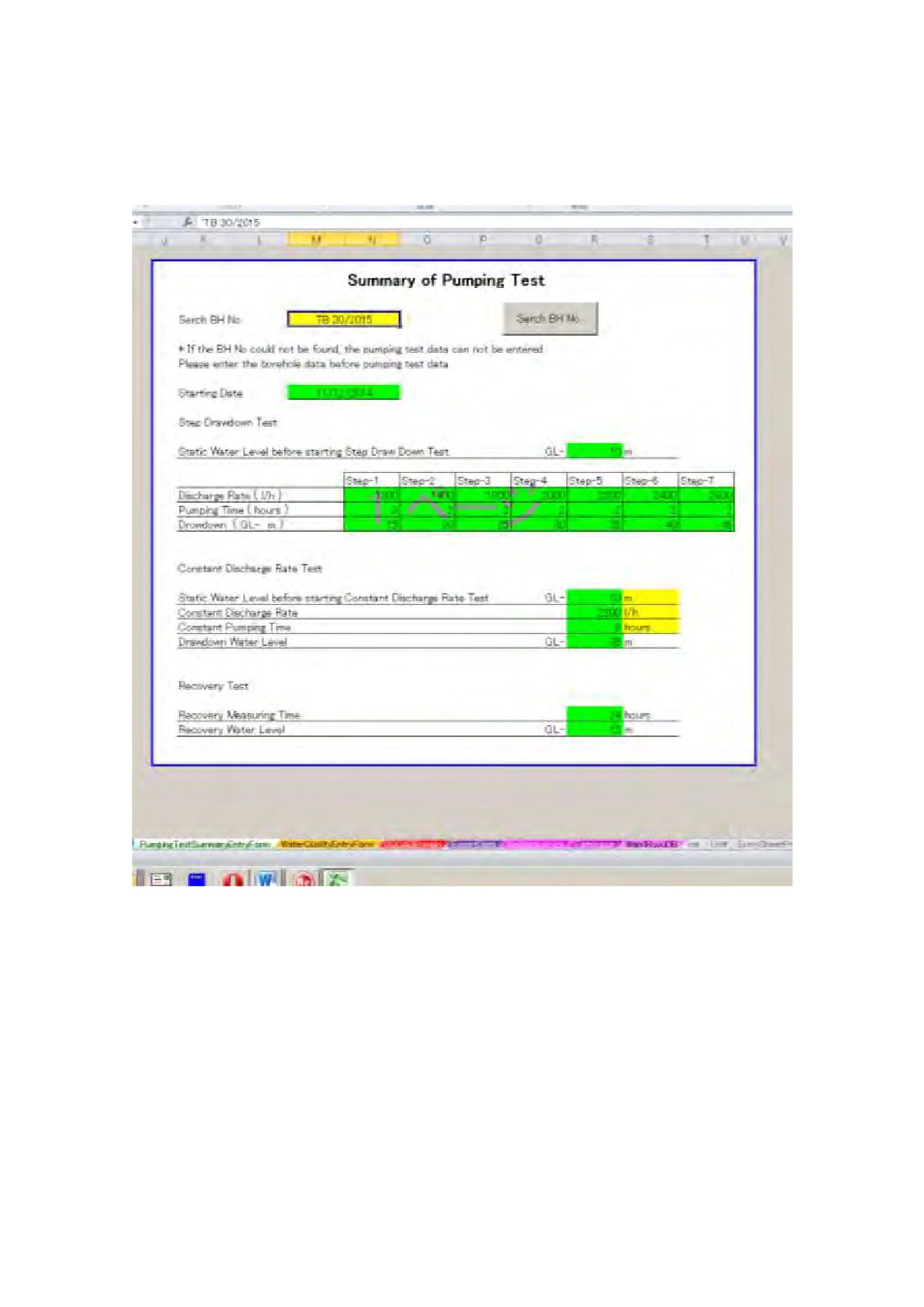
Figure 2: Interface pumping test summary data entry
4
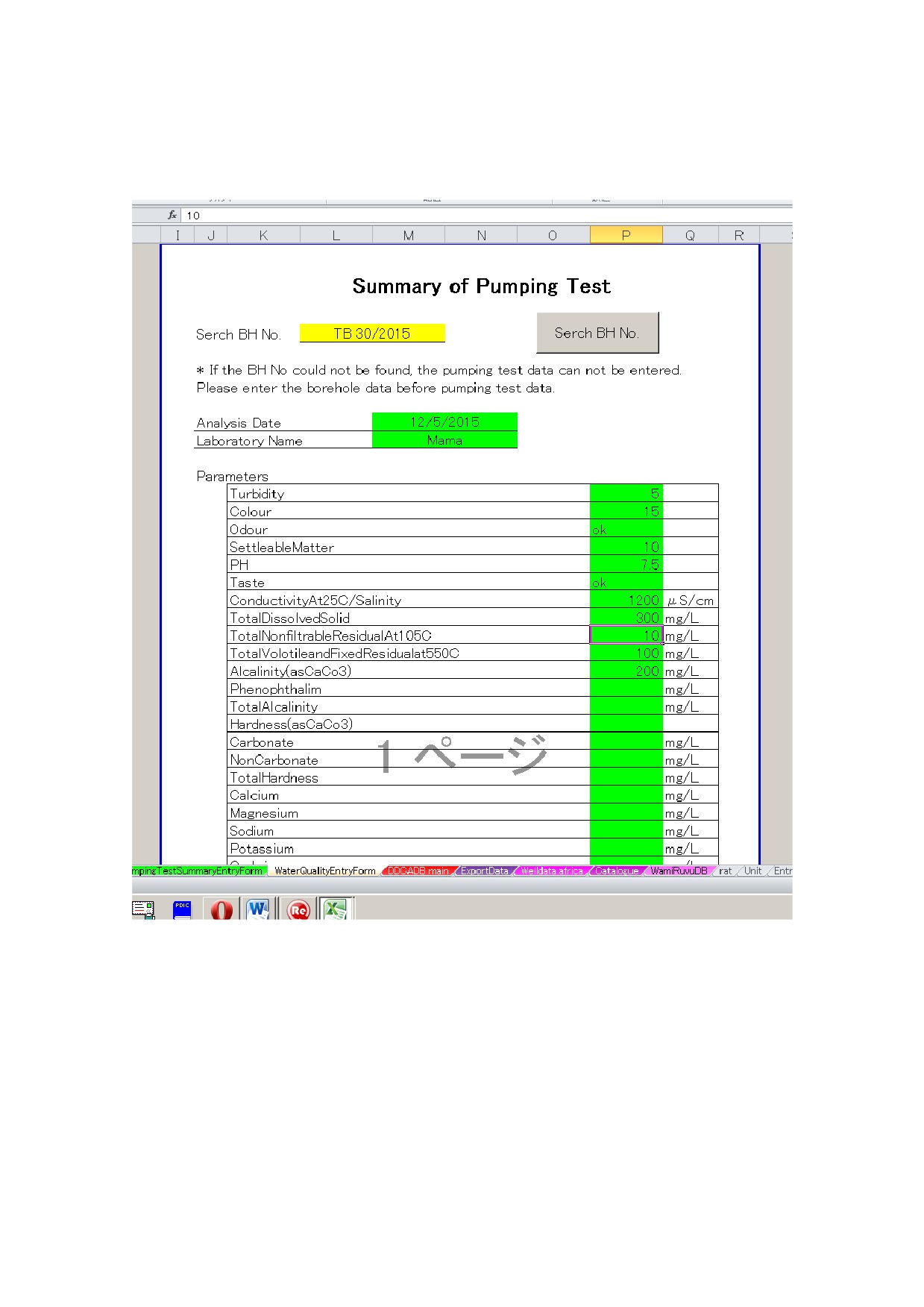
Figure 3: Interface for water quality data entry
5
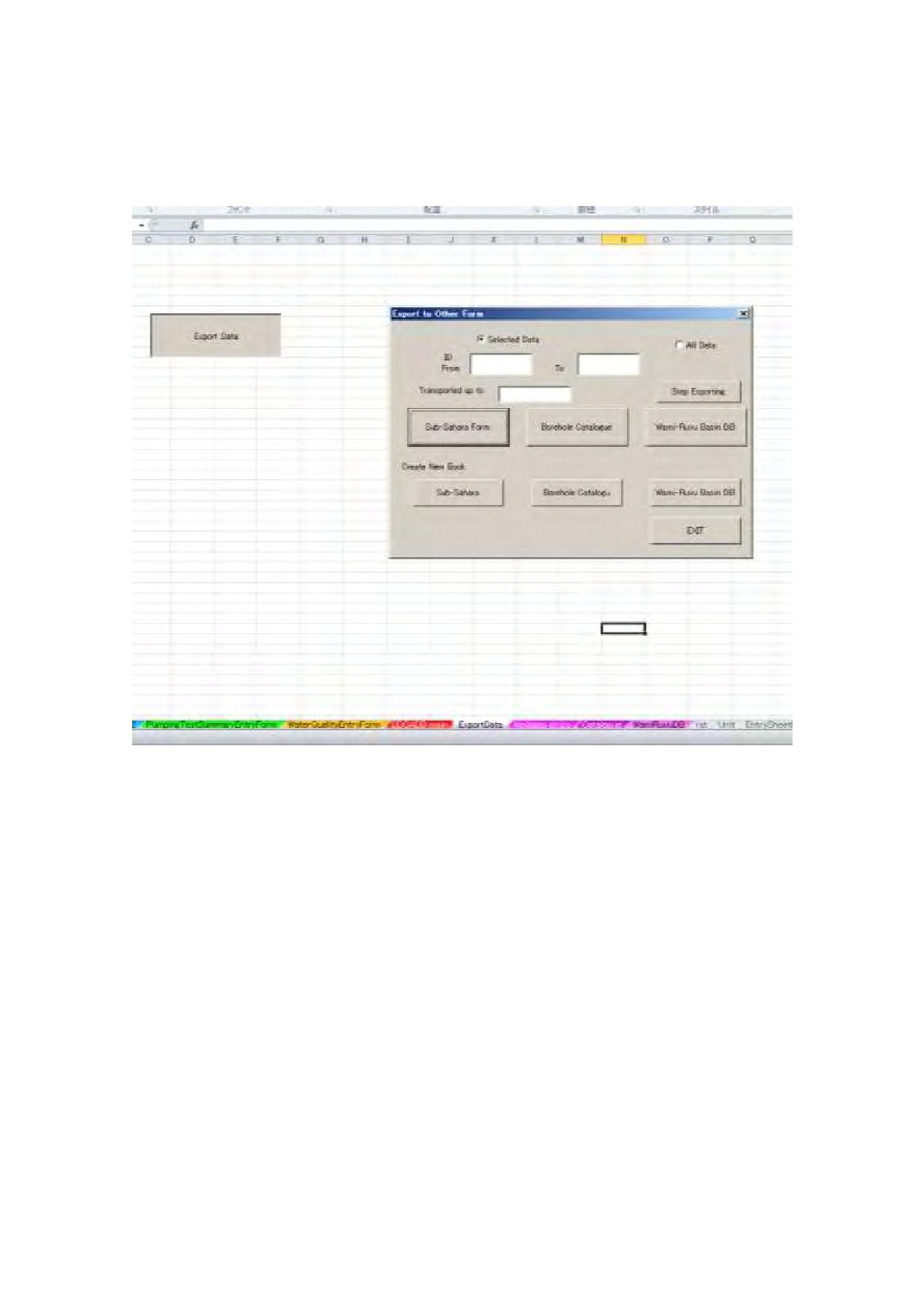
Figure 4: Control form for data export
6
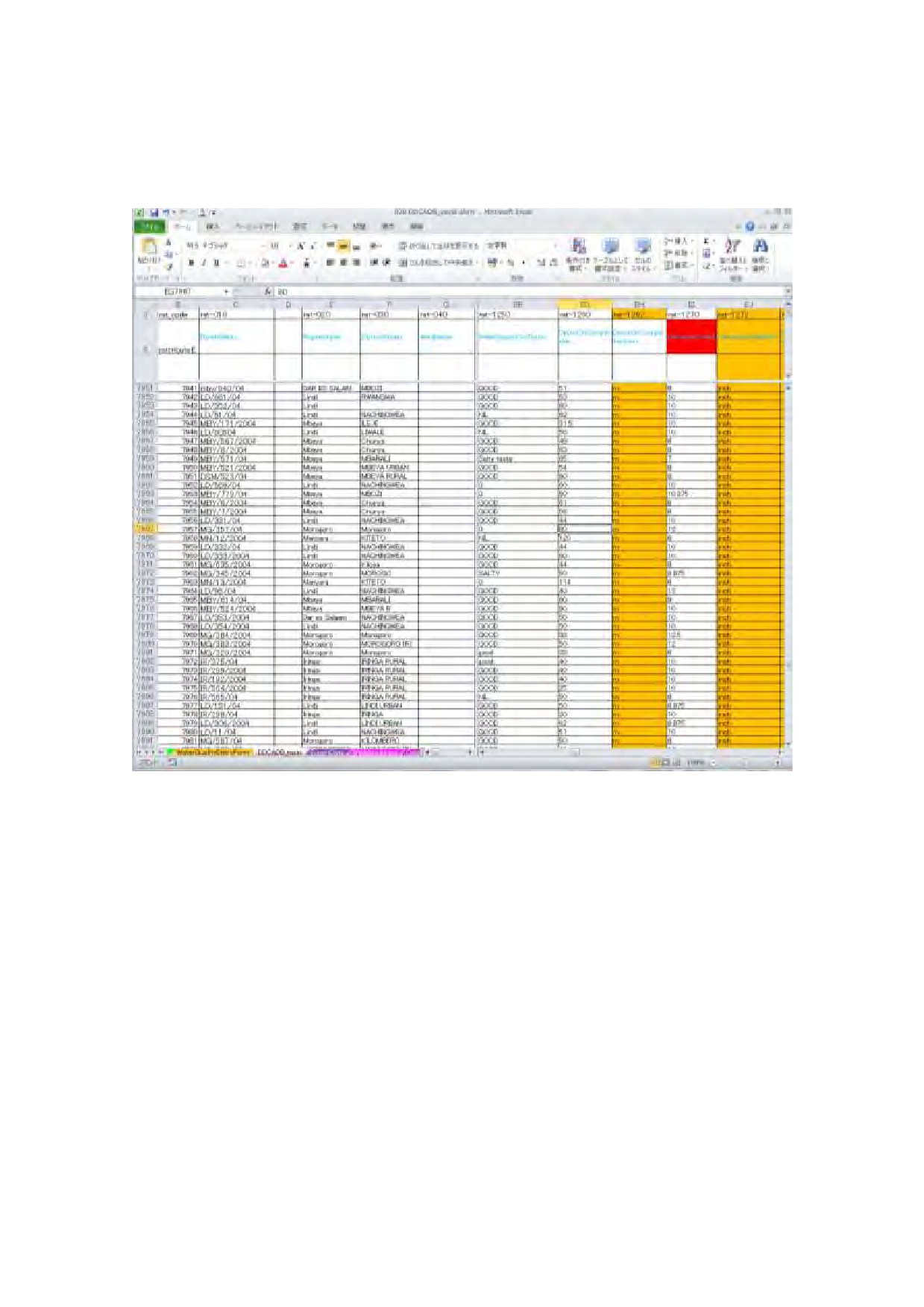
Figure 5: Exported data (Africa sub-sahara well database form)
7
1
Output (6) System Design Completed
1. EVALULATION OF OPERATION CONDITION
After the training at the end of Phse-1, LOCAIDES and the Client evaluated the test version of
the database. And two kinds of challenges were observed as follows.
- It is very tough work to enter borehole data into the excel datasheet.
- It is very likely to be changed by human error.
2. SYSTEM ANALYSIS AND DESIGN FOR IMPROVEMENT
In order to solve the challenges described above, further function was designed as follows.
- Making data entry interface for borehole data entry, pumping test summary data entry and
water quality analysis.
- Making sheet protection with password.
As mentioned in the requirement analysis report, a function to export data to other database
form is to be added.
These additional functions were designed centering on being simple operation.
3. SYSTEM MODIFICATION FOR IMPROVEMENT AND
INTEGRAL TEST
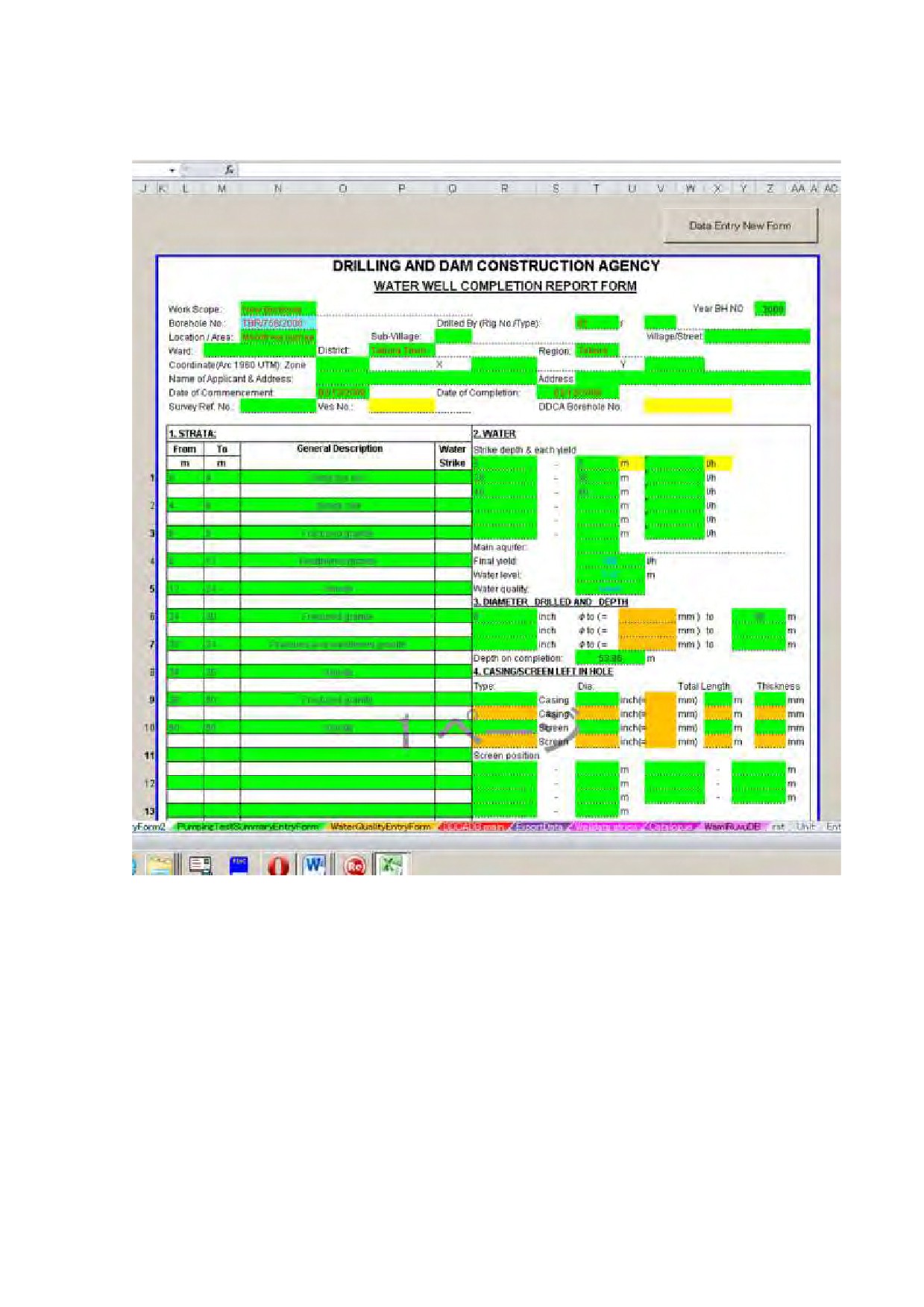
The excel database was modified with addition of function. The added interfaces are shown in
Figure 1 to Figure 3. The added data export function is shown in Figure 4 and Figure 5.
The modified database was tested by DDCA users and confirmed that the added functions work
well.
2
Output (6) System Design Completed
Figure 1: Interface for borehole data entry
3
Output (6) System Design Completed
Figure 2: Interface pumping test summary data entry
4
Output (6) System Design Completed
Figure 3: Interface for water quality data entry
5
Output (6) System Design Completed
Figure 4: Control form for data export
6
Output (6) System Design Completed
Figure 5: Exported data (Africa sub-sahara well database form)
4. REVISION OF MANUAL
The operation manual was revised by adding new functions described above. The revised
manual has already submitted to the Client.
5. TRAINING
Training was held by using modified database and modified manual from 8/July/2013 to
17/July/2013.
Furthermore LOCAIDES followed DDCA users from
17/July/2013 to
31/July/2013.
7
Ministry of Water (MoW)
Drilling and Dam Construction Agency (DDCA)
Japan International Cooperation Agency (JICA)
DDCAP
Guidelines on Hiring of Drilling
Eqiupment and Machinery
Version 1
March 2013
Groundwater Development and Management Capacity Development (DDCAP)
Project
Table of Contents
1. Introduction
1
1.1 Background
1
1.2 Purpose and Intended Users of the Guidelines
1
2. Environmental scan
2
2.1 Internal Environment
2
2.1.1 Strength
2
2.2.2 Weakness
2
2.2 External Environment
3
2.2.1 Opportunity
3
2.2.2 Threat
3
2.3 Cross SWOT Analysis
4
3. Segmentaiton of potential clients
4
3.1 Business Entities in Water Well Drilling Sector in Tanzania
4
3.2 Characteristics of Private Drilling Companies
6
3.2.1 Business Establishment
6
3.2.2 Clients for Water Well Drilling
9
3.2.3 Performance in the Past Three Years
9
3.2.4 Possession of Equipment
14
3.2.5 Human Resources
17
3.2.6 Interest in Business Opportunities
19
3.2.7 Investment for New Drilling Rigs
19
3.2.8 Demand for Technical Support Services of DDCA
20
3.3 Classification of the Private Drilling Companies
22
4. scope of services to be provided by ddca in the hiring business
25
4.1 Conditions Considered in Formulation of the Business Model
25
4.2 Items to be Hired
25
4.3 Placement of Drilling Rigs
27
4.4 Allocation of Drilling Staff
28
4.5 Maintenance of the Equipment
29
4.6 Hiring Conditions
29
5. qualificaitons to be required for clients and other conditions
31
5.1 Requirements to Applicants
31
5.2 Use of the Hiered Equipment
32
5.3 Use of the Equipment by DDCA for Its Own Drilling Activities
33
6. Laws and regulations to be followed
33
6.1 Liability of Insurance for the Hiring Equipment
33
6.2 Taxation
33
6.3 Regulations Related to the Groundwater Development
33
7. Establishment of the hiring business unit
35
7.1 Job Description
35
7.2 Personnel Arrangement Plan
36
8. performance management
36
8.1 Key Performance Indicators
36
8.2 Performance Monitoring Report
37
9. outline of the business flow
37
10. business promotion
40
11. finance
40
11.1 Budget Preparation
40
11.2 Pricing Policy
44
11.3 Break-Even Analysis
48
11.4 Accounting
49
11.5 Investment Plan
49
List of Tables
Table 1 Cross SWOT Analysis
4
Table 2 Number of Business Entities in Water Well Drilling Sector in Tanzania
5
Table 3 Number of Contracts Awarded in the Past 3 Years per Company
10
Table 4 Categorization of Well Specifications
11
Table 5 Average Days Required for Drilling Works
12
Table 6 Distribution of Companies by Type of Working Experience
13
Table 7 Contract Value and Number of Wells Drilled per Contract
13
Table 8 Hiring Cost of Drilling Equipment
15
Table 9 Classification of Private Drilling Companies
24
Table 10 List of Equipment to be Hired
25
Table 11 List of Rig Accessories, Casing Tools and Direct Mud Circulation Drilling Tools 26
Table 12 Roles of DDCA Staff to be Attached to the Hired Equipment
28
Table 13 Demarcaiton of Responsibilities in Logisticts of Hired Equipment
30
Table 14 Basis of Calculation of Standard Operation Days of Equipment
30
Table 15 Standard Operation Days of Equipment
31
Table 16 Classified Groups of Private Drilling Companies and Project Effect Potential
33
Table 17 Key Performance Indicators of the Equipment Hiring Service
36
Table 18 Expenditure Budget for Annual Operation of the Hiring Service (with Depreciation
Cost)
41
Table
19 Expenditure Budget for Annual Operation of the Hiring Service
(without
Depreciation Cost)
42
Table 20 Estimated Annual Sales
44
Table 21 Acquisition Cost of Equipment for Hiring
45
Table 22 Proportion of Hiring Service Cost
45
Table 23 Rental Fee of Drilling Equipment (with Depreciation Cost Considered)
46
Table
24 Structure of Rental Cost of Drilling Eqiupment
(with Depreciation Cost
Considered)
46
Table 25 Rental Fee of Drilling Equipment (without Depreciation Cost Considered)
47
Table
26 Structure of Rental Cost of Drilling Eqiupment
(without Depreciation Cost
Considered)
47
Table 27 Estimated Income and Profit
48
List of Figures
Figure 1 Potential Clinents of the Equipment Hiring Service
6
Figure 2 Geographical Distribution of Office and Project Location
7
Figure 3 Year of Establishment and Start of Business Operation in Drilling Works
8
Figure
4
Distributions of Companies Awarded Contracts for Drilling Works in
RWSSP/WSDP by Year of Experience of the Organization
8
Figure 5 Distribution of Companies by Status of Registration at CRB and MoW
8
Figure 6 Clients for Water Well Drilling (multiple answers)
9
Figure 7 Proportion of Drilling Works Awarded by the Government in Number of Contracts
and Contract Values
9
Figure
8 Total Number of Contracts Awarded to and Wells Drilled by the Surveyed
Companies in the Past 3 Years
10
Figure 9 Distribution of Companies by Number of Contracts Awarded for Drilling of Deep
Wells per Annum
11
Figure 10 Distribution of Companies by Number of Wells Drilled per Annum
11
Figure 11 Distribution of Wells Drilled per Annum by All the Surveyed Companies
12
Figure 12 Distribution of Companies by Number of Rigs Owned
14
Figure 13 Distribution of Owned Rigs by Drilling Capacity
14
Figure 14 Distribution of Companies by Number of Owned Rigs in Each Type
15
Figure 15 Possession of Supporting and Survey Equipment
16
Figure 16 Workshop Equipment and Tools Owned (multiple options)
16
Figure 17 Type and Level of Periodical Maintenance of Drilling Equipment the Company
can Perform (multiple options)
17
Figure 18 Distribution of Companies by Size of Staff
17
Figure 19 Areas of Capacity Development Needs of Technical Staff (multiple options)
18
Figure 20 Capacity Development Measures (multiple options)
19
Figure 21 Needs of Procurement of New Drilling Equipment (multiple options)
20
Figure 22 Demand for DDCA’s Hiring Service of Drilling Equipment
20
Figure 23 Demand for Hiring Supporting Equipment (multiple options)
21
Figure 24 Distribution of Companies by Demand for Different Types of Technical Support
Services by DDCA
21
Figure 25 Type of Technical Staff Required for Technical Instruction (multiple options)
22
Figure 26 Contents of Hydrogeological Information Required (multiple options)
22
Figure 27 Geographical Distribution of Private Drilling Companies and Rural Water Supply
Coverage by Regions
28
Figure 28 Status of Registration at CRB and MoW by Classification of the Surveyed
Companies
32
Figure 29 Organizational Structure of DDCA with the Hiring Business Unit
35
Figure 30 Business Cycle of the Hiring Service
38
Figure 31 Process of Equipment Hiring
39
Figure 32 Formula for Pricing of Rental Fee
45
Figure 33 Break-Even Point in Sales
49
Guideline on Hiring of Drilling Equipment
1. INTRODUCTION
1.1 BACKGROUND
Aiming at alleviating poverty through improvements in the governance of water resources
management and the sustaiblable delivery for water supply and sanitation services, the Government
of United Republic of Tanzania (hereinafter referred to as “the Government of Tanzania”) has been
implementing the Water Sector Development Program (WSDP) since 2007 to address shortfalls in
urban and rural water supply infrastructure, to improve water resources management, and to
strengthen the sector institutions and their capacities (MoW 2006 a). The target of the Program is
to achieve increase of proportions of the rural population with access to clean and safe water to
90% by 2025. It also calls for increased access to clean and safe water to the urban population to
100% by 2025.
WSDP estimates that approximately 79,000 water points need to be constructed in the Rural Water
Supply and Sanitation (RWSS) component in order to meet the target mentioned above.
91% of
these water facilities is expected to be sourced with the groundwater, which requires drilling of
1,200 wells annually. The Urban Water Supply and Sanitation (UWSS) component also has high
demand of borehole construction in specific regional and district centerrs where surface water
sources are scarce. Although private drilling companies are the main actor for groundwater
development in WSDP, their current capacity in drilling wells is approximately 600 per annum. In
other words, their capacities such as technical abilities and resources have a great gap compared
with the demand in the water sector.
Taking this situation into consideration, MoW procures new drilling equipment in WSDP in order
to support Drilling and Dam Construction Agency (DDCA) for strengthening of its capacity in
borehole construction and providing technical support services to private drilling companies with
utilizing the procured equipment. The Strategy for Strengthening Water Well Drilling Industry in
Tanzania formulated by MoW in 2006 in parallel with designing of WSDP states necessity to
establish the plant and equipment hiring unit within DDCA to manage the equipment procured for
the hiring service (MoW 2006 b). This is supported by the Executive Agencies (Drilling and Dam
Construction Agency) (Establishment) Order, 1999, which describes that hiring of the drilling
equipment to other organizations is a part of the secondary functions of DDCA.
Objectives to establish the equipment hiring service within DDCA are firstly to enable private
companies enhance knowledge and skills on water well drilling works through utilization of the
equipment hiring and technical instructions to be provided by the Agency as the technical support
services. Secondly, it is aimed to create a new revenue source for DDCA which is required to
operate the business autonomously.
1.2 PURPOSE AND INTENDED USERS OF THE GUIDELINES
The guidelines are intended to describe the business model and operational principles of the hiring
service of drilling equipment to be operated by DDCA. The Manual on Hiring of Drilling
Equipment supplements these guidelines and provides a source of reference on daily operation of
the hiring service in accordance with its business cycle.
These guidelines are the property of DDCA and to be used by authorized officers of the Agency
only. Amendments and additions on the guidelines will be issued from time to time by the
Business Support Manager after approval by the management of DDCA and Ministerial Advisory
Board (MAB). Hiring Business Unit is responsible to keep all editions of the guidelines
approved.
1
Guideline on Hiring of Drilling Equipment
2. ENVIRONMENTAL SCAN
The purpose of this chapter is to describe the internal and external environment of DDCA in
establishment of the equipment hiring service to accelarate participation of private drilling
companies in WSDP.
2.1 INTERNAL ENVIRONMENT
The internal environment of DDCA can be considered from viewpoints of strength and weakness.
2.1.1 STRENGTH
DDCA can utilize its human resources, facilities, organizational knowledge, and partnership with
other institutions and the private sector as its strength to establish and operate the hiring service of
drilling equipment. Firstly, DDCA has skilled drilling staff who can be transformed into technical
instructors to support capacity development of private drilling companies. As described in
Chapter 3, a certain percentage of the private drilling companies express their demand to receive
technical support from DDCA to enhance skills and knowledge of their drilling staff. Providing
Training of Trainers’ courses to them and certifying those who are qualified as the technical
instructors, DDCA can make good use of its senior drilling staff to conduct this function.
Secondly, DDCA has office and workshop facilities at the headquarters in Dar es Salaam and five
zonal offices. These facilities make it possible for DDCA to 1) promote the hiring business to
various entities which are involved in drilling works in every corner of the country, 2) collect needs
and perception of
(potential) owners/users of boreholes, and
3) provide quick actions for
maintenance and repair of equipme for hiring.
Thirdly, DDCA has accumulated knowledge and data on hydrogeological conditions and
specifications of boreholes in different areas of the country through implementation of drilling
works. These can be regarded as part of “assets” of the organization to add value to the technical
instructions to the private sector.
Lastly, the Agency can collaborate with WDMI in development of teaching guide and materials to
be used in technical instructions to the private sector in the manner that those contents will
supplement curriculum of WDMI, especially for the incumbent of the position of drilling staff.
DDCA has also established working relationship with the private drilling companies for years.
DDCA sometimes rented the drilling equipment with its drilling staff to private companies. In
other case, the Agency hired rigs from the private sector. Informal communication is also
maintained between DDCA and some of the drilling companies to exchange information on drilling
works. This kind of network with the private sector can be utilized in identification of potential
clients and business promotion.
2.2.2 WEAKNESS
While DDCA has advantages to start the hiring service as mentioned above, some weakness are
observed in terms of equipment owned by the organization, financial status, and practice of
capacity development of its staff members.
Although DDCA currently operates a total of 15 drilling rigs, 11 out of the existing equipment were
procured more than 15 years ago and the oldest one ages 52 years. It causes DDCA to spend
significant proportion of budget for maintenance and repair of these old rigs due to frequent
breakdown. As DDCA has to sequre reliable equipment for operation of its drilling activities, it is
difficult for the Agency to reallocate part of the existing rigs to the hiring service.
With regard to the financial status, DDCA relies on the government subventions for initial capital
investment for the equipment and part of the recurrent cost. The drilling rigs and supporting
equipment have never been replaced with own fund of the Agency as it does not employ the
concept of cost recovery of the initial investment from sales from the drilling activities. This
practice would affect sustainability of the hiring service since there will be no guarantee of
2
Guideline on Hiring of Drilling Equipment
financial resources for the future investment if the government stops provision of subventions to
the Agency.
The other weakness is that DDCA does not conduct capacity development of the staff members
systematically in accordance with analysis on capacity gaps of each position of the staff. In case
of the drilling staff, their capacity development is implemented mostly in the forms of training at
external academic institutions or on-the-job training at drilling sites by senior staff at ad hoc basis.
It would hinder the Agency from maintaining required number of the technical instructors who
possess standard teaching skills.
2.2 EXTERNAL ENVIRONMENT
The external environment of DDCA is analyzed from viewpoints of opportunity and threat.
2.2.1 OPPORTUNITY
Some favorable environment can be observed as opportunities for DDCA to operate the hiring
service. First of all, demand for water wells in the country is increasing with growth of
population both in rural and urban areas. WSDP projects 90% of water points to be constructed in
the Rural Water Supply and Sanitation (RWSS) component will be sourced from groundwater.
The urban water supply also relies on the groundwater sources in particular areas where there are
no perennial rivers or available amount of water is limited to meed demand.
Secondly, the water well drilling industry, especially the private drilling companies, has inadequate
capacity to respond to increasing demand for borehole construction. As described in detail in
Chapter 3, there is a limited number of private drilling companies which have conducted drilling
works in WSDP. This is partly due to the reason that the marjority of the private drilling
companies do not possess any large rotary drilling rigs which can perform DTH drilling, the
drilling method used in most part of inland areas of the country. Interest of the drilling companies
is very high in terms of participation in drilling works in WSDP as well as expansion of business
opportunities in the program. This situation can be regarded as an opportunity for DDCA to
provide the hiring service of drilling rigs in combination with technical instructions to the private
sector.
Thirdly, DDCA receives financial support and policy guidance from MoW. MoW supports
DDCA in procurement of new drilling equipment through WSDP. Part of these items are meant
for use for the hiring service. Reinforcement of regulation of the drilling companies by MoW will
also create an opportunity for DDCA to respond to needs of the private sector to fulfill allocation of
drilling equipment with appropriate specifications and practice of code of conducts in drilling
works.
The fourth point is the privilege of exemption from VAT on sales of the Agency. Hirers of the
equipment will also benefit from it as the cost they have to bear will be reduced.
2.2.2 THREAT
There are some competitors who hire drilling equipment to others in the country although the
number of such companies and available equipment are limited. These competitors operate
drilling works as their primary business and rent rigs to others when the equipment is not occupied
for their activities. These competitors might pose a threat to DDCA in pricing of rental fees when
they intend to maximize the number of hiring period by reducing the price without considering
costs to be incurred to manage and maintain the equipment.
Other factors which would become threat for DDCA are shortage of skilled and experienced
drillers in the private sector and insufficient understanding of drilling companies as well as
groundwater users on legislation related to water resources management. Operation of hired
drilling rigs by drillers with few experiences with large rotary rigs entails risks of accident during
works. Furthermore, unless drilling companies and groundwater uesrs have good understanding
on requirements by laws on procedures of the groundwater development which should be followed
3

Guideline on Hiring of Drilling Equipment
by the professionals and owners of wells, respectively, there will be less demand for
implementation of proper drilling works.
2.3 CROSS SWOT ANALYSIS
Analysis on internal and external environment of DDCA mentioned in the previous section can be
further used to strategize operation of the hiring service. Table 1 shows results of the cross
SWOT analysis which describe possible strategic directions in different situations which are
categorized into four scenarios mentioned below;
− Maximization of opportunities with utilizing strength of the organization [Strength and
Opportunity]
− Transformation of weakness to strength or reinforce weak points to loose opportunities
[Weakness and Opportunity]
− Differentiate from others with utilizing strength [Sthrength and Threat]
− Defend from the worst scenario [Weakness and Threat]
Table 1 Cross SWOT Analysis
Strength
Weakness
How to seize opportunities?
How to avoid missing opportunity because of
presence of weakness?
- Utilize senior drilling staff as the technical
- Allocate six drilling rigs under procurement in
instructors who will be attached to drilling rigs for
WSDP to be fully used for the hiring service.
hiring.
- Employ an internal transaction system in DDCA
- Reinforce workshop facilities and skills of
to be accounted as “sales from the hiring
mechanics at some of the zonal offices which are
service” for the case that the Agency uses these
strategically important to provide maintenance and
drilling rigs for its drilling activities.
repair of equipment for hiring.
- Apply pricing policy to recover initial
- Identify information and service options to which
investment for the equipment to secure funds for
the private drilling companies recognize value and
replacement of rigs and other machinery in the
come up with contents of the technical support
future
services including the equipment hiring to satisfy
- Conduct capacity assessment and training of the
different types of demand.
technical instructors and senior drilling staff
periodically to
- Institutionalize a systematic capacity
development support for the staff members of
the Agency.
How to change threat to opportunity with strength?
How to avoid the worst situation?
- Differentiate the service contents from the ones
- Prevent excessive reduction of rental fees to
provided by other companies through focusing on
compete with other companies in hiring
potential clients who are willing to pay for reliable
business.
quality of the equipment and technical instructions
- Apply a certain criteria to screen drilling
by skilled drilling staff at corresponding price.
companies who are qualified as hirers of the
- Enhance teaching skills of the technical instructors
equipment.
enough to provide adequate guidance to and
supervision of drilling staff from hirers on site.
- Provide guideance to the private drilling
companies on legal requirements on groundwater
development in cooperation with MoW and
WDMI.
3. SEGMENTAITON OF POTENTIAL CLIENTS
3.1 BUSINESS ENTITIES IN WATER WELL DRILLING SECTOR IN TANZANIA
Table 2 shows the total number of business entities involved in drilling works, which were
identified through the registrations at MoW and Contractors Registration Board (CRB), baseline
survey, and the Water Sector Management Information System (MIS). A total of 174 business
4

Guideline on Hiring of Drilling Equipment
entities were found from these sources of information. Further examination made it clear that
some of the business entities listed had already stopped operation of water well drilling or were
specialized in other activities such as soil testing and groundwater exploration. There were also a
certain number of organizations which could not be reached due to unavailability of updated
information on their contacts.
After excluding these organizations, 104 entities were confirmed to be currently involved in water
well drilling either by directly conducting drilling works or contracting out the whole works to
other specialized contractors. These 104 business entities are, therefore, regarded as the potential
clients of the technical support services of DDCA (Figure 1).
There are another 52 entities which status of business operation is currently unknown as some were
refused to be interviewed in the baseline survey and others could not be physically located.
DDCA will continue to try to establish contacts with these organizations to increase the number of
the potential clients for the hiring service.
Table 2 Number of Business Entities in Water Well Drilling Sector in Tanzania
Category
Total
Breakdown
: Listed in the original list of drilling permit
126
holders of MoW
27
: Added to the target list of baseline survey
: Registered as specialist contractors (drilling
Total No. of Business Entities
174
18
works) under CRB but not on the original list of
Identified
drilling permit holders of MoW
: Recorded on Water Sector MIS as contractor of
3
drilling works but not on the original list of
drillimg permit holders or CRB Directory
No. of Entities which are
currently involved in
104
drilling works
Interviewed in Baseline
94
Survey
1
: not found
1
: refused interview
Not interviewed
10
: not on the original list of the registered
8
companies obtained from MoW.
No. of Entities which are not
5
: perform survey works or soil testing only.
18
involved in drilling works
13
: stopped drilling works.
Could not confirm current status of the business as
No. of Entities which status is
52
some were refused to be interviewed and others could
unknown
not be located.
Note: The status in the table is as of December 2012.
5
Guideline on Hiring of Drilling Equipment
Figure 1 Potential Clinents of the Equipment Hiring Service
3.2 CHARACTERISTICS OF PRIVATE DRILLING COMPANIES
This section describes characteristics of private drilling companies1 currently involved in water
well drilling in the country. Data and information referred here are results of a baseline survey
which was conducted in 2012. Analyses were made on 94 companies which operate water well
drilling in order to assess capacities of the private drilling companies and their needs for technical
support from DDCA.
3.2.1 BUSINESS ESTABLISHMENT
(1) Geographical Distribution
The majority of the organization surveyed is established as private companies limited by shares
while six of them are formed as NGOs or religious organizations. Offices of these companies2
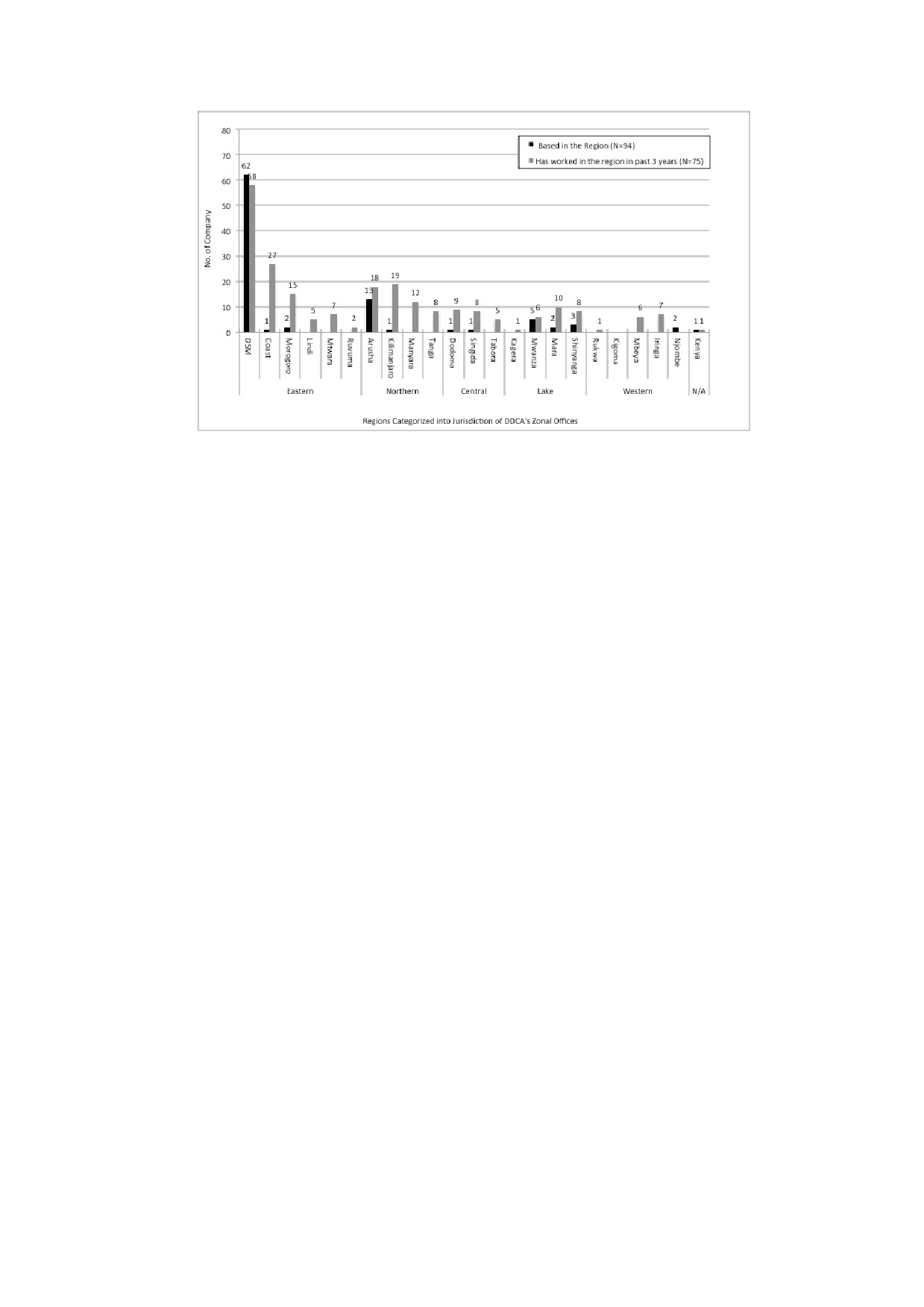
are concentrated in major cities in the country. Figure 2 shows distribution of the companies by
locations of their offices and project sites where they have worked in the past three years.
Regions are grouped into five zones where DDCA operates through its Zonal Offices.
62
companies (65.9%) are based in Dar es Salaam, which is followed by Arusha and Mwanza.
Projects the companies have worked in the past three years are located in most of the regions
although there are several areas such as Ruvuma, Kagera, Rukwa and Kigoma where few
companies have working experience in the same period. Half of the borehole drilling works
performed by the companies is located in districts with basement rock-dominant areas or
combination of basement rock and other types of geological formation.
1 The word “privte drilling companies” or “companies” refer to all the organizations interviewed in the baseline survey
although the rspondents included NGOs and religious organizations.
2 The word “private drilling companies” or “companies” refer to all the organizations interviewed in this baseline
although the respondents include NGOs and religious organizations.
6
Guideline on Hiring of Drilling Equipment
Note: The number of companies which have worked in the region indicates cumulative figures consolidated from 75
valid cases.
Figure 2 Geographical Distribution of Office and Project Location
It is observed that the companies in each zone have geographical advantage in performing works in
the area where they are based. Those which are operating from regions in Eastern Zone have
obtained more business opportunities in the same area than the companies in other zones. The
same tendency is seen in Northern and Lake Zones, too.
(2) Year of Establishment and Experience in Drilling Works
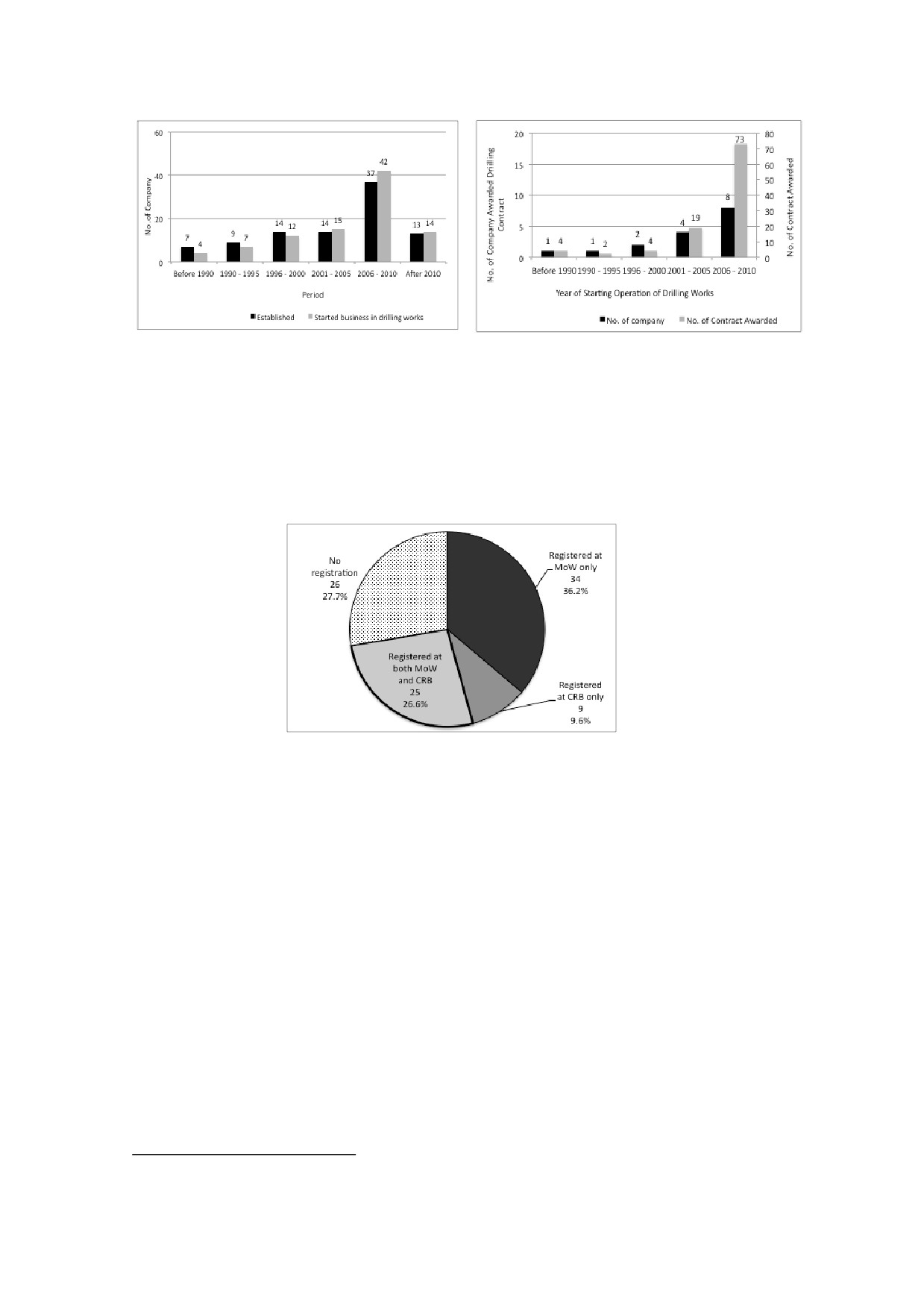
Half of the private drilling companies surveyed are relatively new as they were established after
2006, which coincides the launch of WSDP (Figure 3). The number of companies which start
business operation in drilling works doubled in 2009-2011 compared to the preceding period. In
these three years, 10-13 companies a year started drilling works as (a part of) their business while
there were maximum 7 entities per annum from 1985 to 2008. Nearly 60% (56 nos.) of the
companies have fewer than six-year experience in operation of the drilling works.
In comparison of years of experience of the company in drilling works with the number of
contracts awarded in WSDP, there is no clear correlation between these two factors. A total of 21
companies were involved in the drilling works as the contractors for 10-village subprojects in
RWSS Component of WSDP (Phase 1). Among these organizations, 16 companies are included
in the respondents of the baseline survey. As Figure 4 indicates, relatively new companies are
awarded contracts more than the ones that have longer experience in operation of drilling works.
It implicates that there is possibility for the companies with a few experience in the drilling
industry to have business opportunities in WSDP in case that other factors such as experience of
key personnel in similar works, arrangement of drilling equipment to be used in the works, and
financial status satisfy requirements in evaluation of bidding.
7
Guideline on Hiring of Drilling Equipment
Figure 3 Year of Establishment and
Figure 4 Distributions of Companies
Start of Business Operation in Drilling
Awarded Contracts for Drilling Works in
Works
RWSSP/WSDP by Year of Experience of the
Organization
(3) Registration to Regulatory Bodies
35 companies are registered at CRB while the number grows to 59 in case of those which are
regulated by MoW as the holder of valid water well drilling permit3. Of these entities, there are
25 companies (26.6%) which have registration at both CRB and MoW as shown in Figure 5.
Note: Each label in the figure shows category name, number of the case, and its proportion in the total number of the
valid cases.
Figure 5 Distribution of Companies by Status of Registration at CRB and MoW
The specialist contractors in drilling works
(28 nos.) occupy the majority in the surveyed
companies which are registered at CRB. Others, however, possess registration in the areas of civil
works, building or electricity only which are not included in the conditions of eligible bidders of
drilling works in WSDP.
Attention should be paid to a fact that about 15% of the permits are not renewed annually as per
requirement although three fourth of the surveyed companies have once obtained the water well
drilling permit from MoW, according to findings from the interviews. This also suggests that
MoW should update information on the water well drilling permit holders annually.
Also, one fourth of the companies are registered neither of the authorities, which would hinder
these organizations from participating in tendering of drilling works in WSDP. Even if they show
high interest in DDCA’s hiring business of drilling equipment, possibility of this group to utilize the
equipment in WSDP will remain low unless they register themselves at CRB and MoW to satisfy
the eligibility.
3 The validity of the drilling permit is one year. The companies which updated the permit in 2011 or 2012 were
counted as the holders of the valid permits in this analysis.
8
Guideline on Hiring of Drilling Equipment
3.2.2 CLIENTS FOR WATER WELL DRILLING
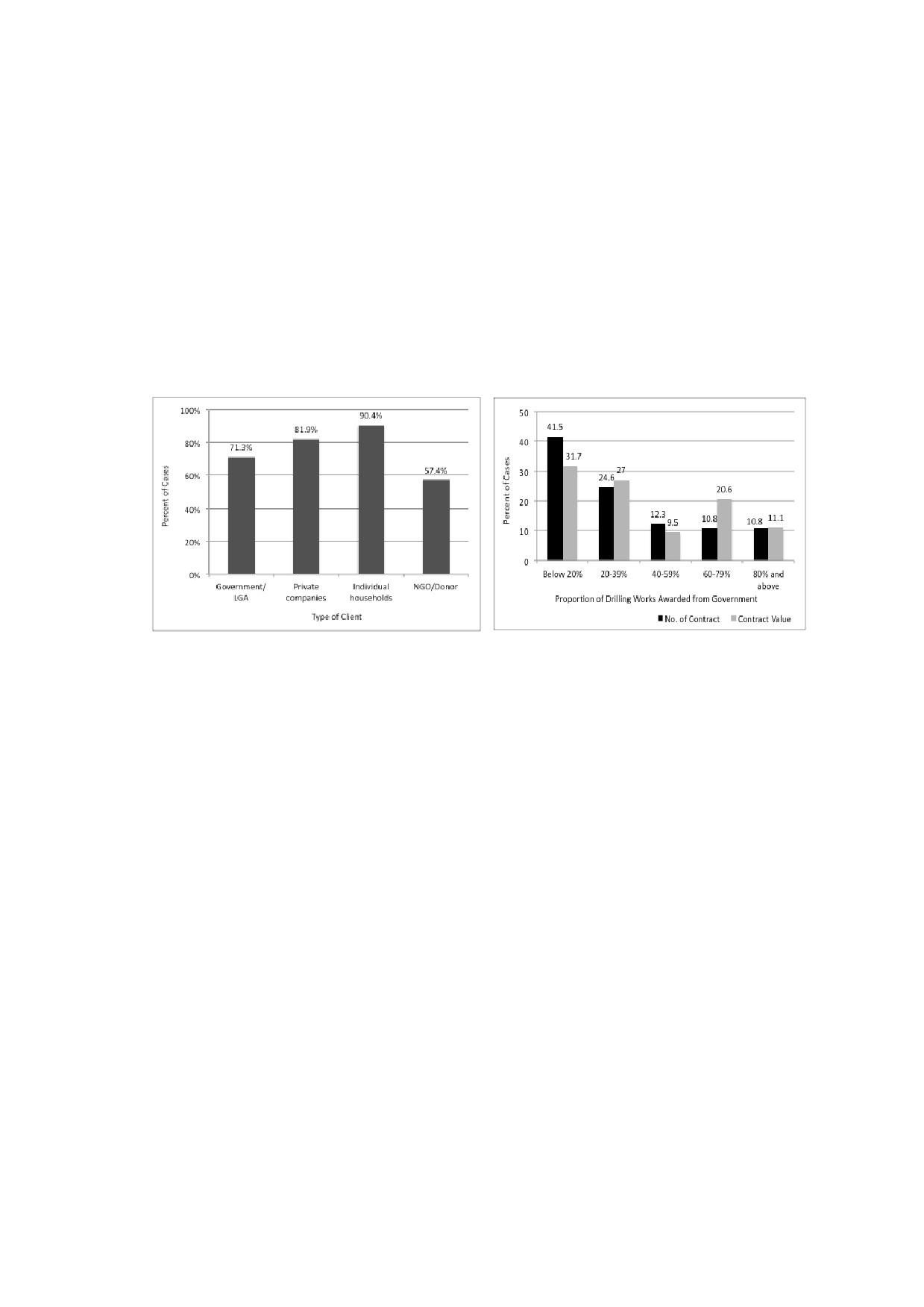
The major clients for water well drilling for the surveyed companies are individual households
(90.4%), followed by private companies (81.9%), government (71.3%), and donor/NGO(57.4%)
according to Figure 6.
27 companies have never worked for borehole drilling funded by the
government.
For approximately 60% of the companies, the drilling works procured by the government account
for less than 40% of the total number of contracts and amount of contract values the company has
been awarded (Figure 7). Meanwhile, the contractors which have been awarded the contracts in
WSDP concentrate in the groups that have more than 60% of sales from the contracts with the
government.
12 companies out of 21 contractors for drilling works in RWSSP/WSDP (Phase 1)
are categorized into these groups. This situation indicates that the companies which regularly
work with the government are in the minority while the rest usually deal with demand of the
private sector and individual households.
Note: No. of valid cases is 65 for the variable of “No.
Figure 6 Clients for Water Well Drilling
of Contract” and 63 for “Contract Value”.
(multiple answers)
Figure 7 Proportion of Drilling Works
Awarded by the Government in Number
of Contracts and Contract Values
3.2.3 PERFORMANCE IN THE PAST THREE YEARS
This subsection describes the performance of the companies in drilling works from viewpoints of
the number of contracts awarded, number of boreholes drilled, and amount of contract value in the
past three years from 2008/2009 to 2010/2011.
(1) Number of Contracts Awarded
In terms of the number of the contracts, the borehole drilling occupies the majority of works
awarded to the surveyed companies as a whole. Figure 8 shows an aggregate of number of
contracts awarded to the companies for each type of work annually. Information of the graph also
includes the grand total of boreholes drilled by the surveyed companies. It indicates that the
greater number of the contracts is for drilling of wells, followed by groundwater survey. Works
for borehole construction increased steeply in the period while contracts for other works reduce or
remained at the same level. As the number of contracts for deep well construction grew, the total
of wells drilled also rose accordingly. The increase of the contracts for borehole construction
coincides with growth of the numbers of business entities which started the operation of drilling
works as well as procurement of contractors for exploratory drilling in RWSSP/WSDP in the same
period.
9
Guideline on Hiring of Drilling Equipment
Note: Total number of wells drilled contains both successful and unsuccessful boreholes.
Figure 8 Total Number of Contracts Awarded to and Wells Drilled by the Surveyed
Companies in the Past 3 Years
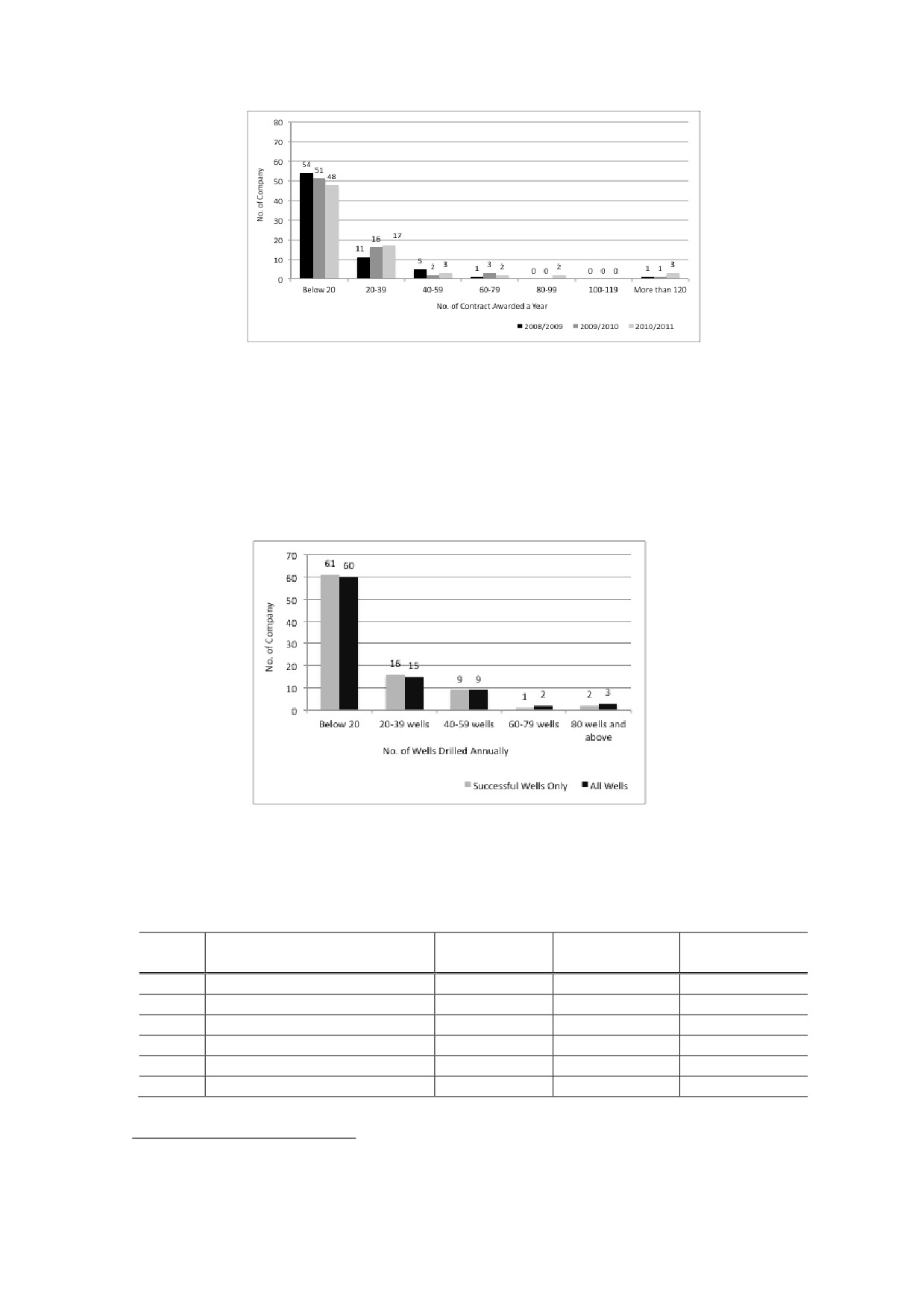
The median of the number of contracts awarded to a company is eight to nine a year in case of
drilling of deep wells (Table 3). Among 75 companies which provided valid answers on the
number of the contracts for drilling of deep wells, approximately 60% (48-54 companies) worked
for less than 20 contracts a year (Figure 9). Those which had more than 120 contracts a year are
contractors which have participated in the drilling works for RWSSP/WSDP (Phase 1).
Table 3 Number of Contracts Awarded in the Past 3 Years per Company
Number of Contracts by Fiscal Year
Valid
Type of Works
2008/09
2009/10
2010/11
N
Mean
Median
Mean
Median
Mean
Median
Construciton of shallow well
23
40.8
2
65.3
2
42.4
6
Construction of deep well
75
13.7
8
15.9
9
21.7
9
Rehabilitation of well
23
10.5
7
11.1
9
12.2
8
Piping works
27
5.8
2
5.4
3
5.9
3
Construction of water supply
14
9.3
3.5
8.5
5.5
12.6
7
facility
Groundwater survey
31
15.2
10
16.0
15
16.2
12
10
Guideline on Hiring of Drilling Equipment
Figure 9 Distribution of Companies by Number of Contracts Awarded for Drilling of
Deep Wells per Annum
(2) Number and Type of Wells Drilled
From the valid data obtained from 89 companies, it is estimated that one company drilled 10-13
wells4 including unsuccessful ones as the median per annum in the period of
2009-2011.
Approximately 68% (61 nos.) of the companies drill less than 20 successful wells a year (Figure
10). This proportion remains almost same even in case including unsuccessful ones.
Note: The number of valid cases is 89.
Figure 10 Distribution of Companies by Number of Wells Drilled per Annum
Distribution of these drilled wells was also obtained by type of wells categorized according to use
and depth of the well, size of casing pipe, and drilling method as listed in Table 4.
Table 4 Categorization of Well Specifications
Type
Use of Well
Well Depth
Size of Casing
Drilling
Pipe
Method
1D
Hand pump
30-100m
4” or 5”
DTH
1M
Hand pump
30-100m
4” or 5”
Mud rotary
2D
Medium-scale piped scheme
30-200m
6”
DTH
2M
Medium-scale piped scheme
30-200m
6”
Mud rotary
3D
Large-scale piped scheme
30-200m
8” to 10”
DTH
3M
Large-scale piped scheme
30-200m
8” to 10”
Mud rotary
4 This number includes the wells drilled with hired equipment. Information could not be obtained from the respondents
on the proportion of wells constructed with the drilling equipment owned by the company and those which were drilled
with the hired rigs.
11
Guideline on Hiring of Drilling Equipment
The biggest number of wells constructed in the period is Type 2D which is drilled with DTH
method and mainly meant for the medium-scale piped water schemes (Figure 11). The second
largest number is Type 1M constructed with mud rotary drilling method for hand pump water
facilities.
Note: The number of valid cases is 89.
Figure 11 Distribution of Wells Drilled per Annum by All the Surveyed Companies
These water sources constructed in each year vary in depth depending on type of wells. Type 1D
and 1M have approximately 90m depth while 2D and 2M are more or less with 100m depth on
average. The depth of wells in Type 3D and 3M is in almost same range with those of 2D and 2M.
There are no marked changes in the average depth of each type of wells in three years.
The average days required to drill a successful well is five to eight days depending on type of well.
Working days involved is relatively smaller in case of use of DTH method, as shown in Table 5.
Type 1D, 2D and 3D, in comparison with the period taken for mud drilling (Type 1M, 2M and 3M).
It takes another one or two days in case that pump installation is included in the works.
Table 5 Average Days Required for Drilling Works
Type of Work
No. of Working Days Required per
Each Type of Well
1D
1M
2D
2M
3D
3M
Drilling a successful well including drilling, development
and pumping test
5
6
5
7
7
8
Drilling an unsuccessful well excluding PVC installation,
development and pumping test
3
3
2
3
4
4
Pump Installation (hand pump or submersible pump)
2
1
1
1
2
2
Note: The number of valid cases is 93.
Based on information on the type of wells drilled, the proportion of the companies by drilling
methods they have experienced is 36.9% with mud rotary drilling only, 35.7% with DTH method
only, and 27.4% with both DTH and mud rotary drilling (Table 6). This means that approximately
63% of the companies have experience in using DTH drilling method.
With regard to type of water supply facilities, 45.2% of the companies worked for borehole
construction for piped schemes only in these three years and 34.5% was involved in drilling works
for hand pump water facilities only. The remaining 20.2% has experience of drilling works for
both hand pump and piped schemes. From the survey results mentioned above, it is observed that
12
Guideline on Hiring of Drilling Equipment
about two third of the companies possess working experience in drilling works with DTH method
to construct wells which can be served for the medium-scale piped schemes.
Table 6 Distribution of Companies by Type of Working Experience
Valid
Valid
Drilling Method
N
%
%
Type of Facility
N
%
%
Mud drilling only
31
34.8
36.9
42.
DTH only
30
33.7
35.7
Piped scheme only
38
7
45.2
Both DTH and mud
32.
drilling
23
25.8
27.4
HP only
29
6
34.5
Total
84
94.4
100
Both HP and piped
19.
scheme
17
1
20.2
NA
5
5.6
94.
Total
89
100
Total
84
4
100
Note: NA
(Not applicable: no drilling works were
conducted in the period.)
NA
5
5.6
Total
89
100
(3) Size of a Contract for Deep Well Construction
The drilling works accounts for approximately 80% of the sales of the surveyed companies.
Average size of a contract for deep well construction is analyzed in terms of the contract value and
number of wells drilled. Valid data was obtained from 59 companies on variables of the number
of contract, contract values and number of drilled wells per annum for three successive financial
years from 2008/2009 to 2010/2011. The median of a contract value is within a range of Tsh
7million - 8million in these three years, which covers construction of one well (Table 7). The
number of wells drilled per contract appears small as the major clients for drilling works for the
companies are individual households and private sector. In case of the works in WSDP, one
contract is made for construction of an average of nine wells.
The contract value awarded by those which have participated in drilling works in WSDP appears
relatively larger than the ones without experience in the same programme. The difference
becomes much more significant, especially in 2010/2011. With considering that the procurement
of contractors for drilling works in RWSSP/WSDP (Phase 1) reached a peak in 2010/2011, the
contract value of the companies with experience in WSDP seems to be pushed up by the contracts
awarded from the programme. This finding is also supported by the fact that the average value of
a contract for drilling works in RWSSP/WSDP (Phase 1) is approximately Tsh20million per well,
which was obtained from calculation of actual contract prices of the works conducted by all the 23
contractors involved in the programme, as explained in Section 3.1.3. The drilling works in
WSDP provide the contractors with opportunities to have larger size of the contract in terms of its
value and the number of boreholes required than those of clients in the private sector.
Table 7 Contract Value and Number of Wells Drilled per Contract
Contract Value (Tsh)
No. of Wells Drilled
Category of Company
2008/09
2009/10
2010/11
2008/09
2009/10
2010/11
Whole Cases
21,978,884.9
19,030,230.2
Mean
(N=59)
1
18,105,406.38
8
1.91
3.56
2.75
Median
7,000,000.00
8,000,000.00
7,729,312.50
1.00
1.00
1.00
Has experienceMean
42,495,047.87
50,896,878.47
56,275,838.09
3.72
4.19
3.50
in
WSDP
14,935,483.8
Median
(N=13)
8,650,000.00
11,834,734.85
7
1.00
1.00
1.00
No experienceMean
16,180,838.85
8,838,251.22
8,504,297.64
1.40
3.38
2.54
in
WSDP
Median
(N=46)
6,733,333.33
6,000,000.00
6,333,333.33
1.00
1.00
1.00
13
Guideline on Hiring of Drilling Equipment
3.2.4 POSSESSION OF EQUIPMENT
(1) Drilling Equipment
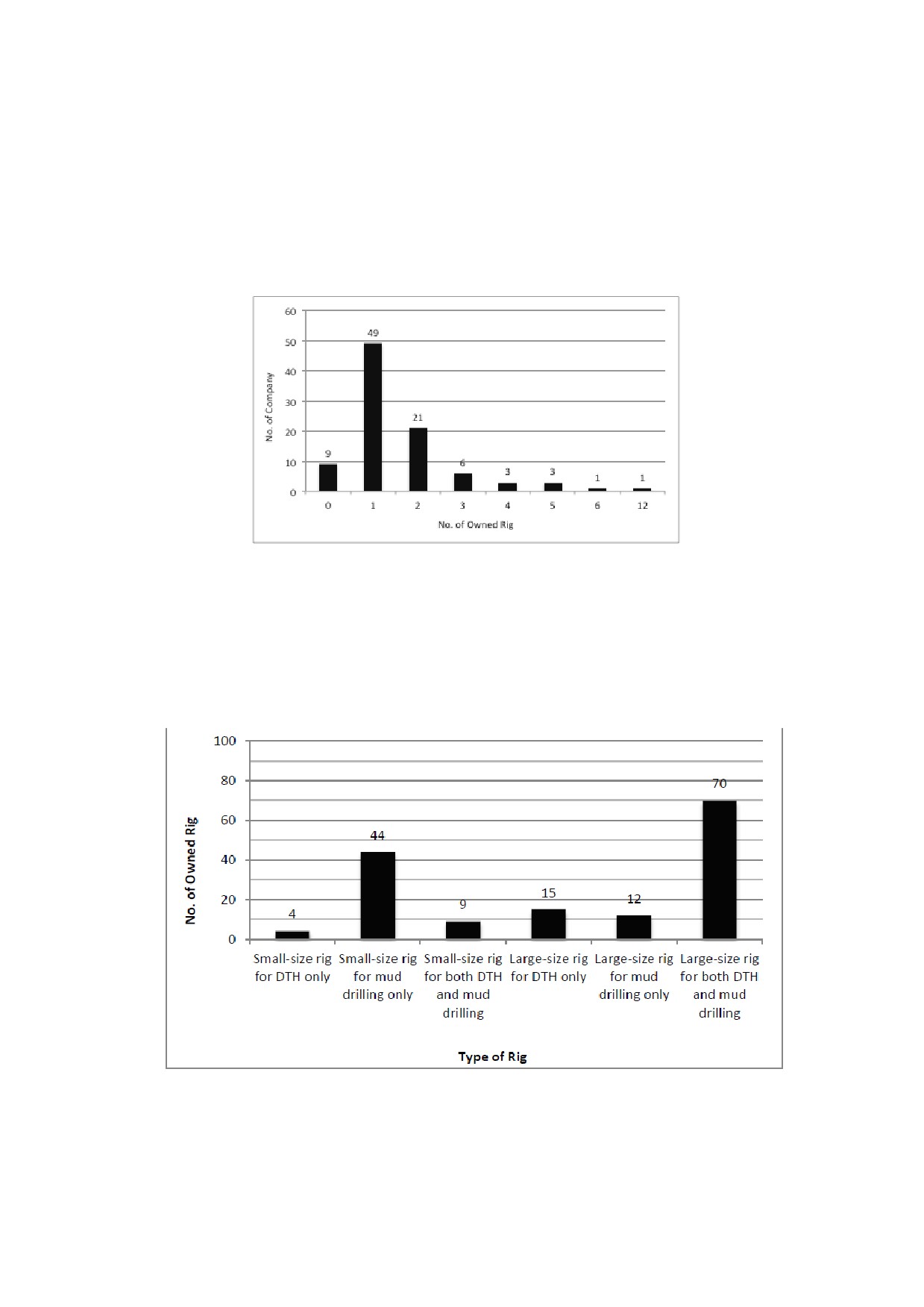
The number of drilling rig owned by a company is one on average. Figure 12 indicates that the
capacity of the private companies is relatively small in terms of possession of drilling rigs as 75%
of the companies have only one or two sets of the machinery. There is only one entity which
owns more than 10 rigs although it is far below the number of drilling equipment that DDCA
possesses. Meanwhile, nine organizations have no rigs at all. They hire drilling equipment from
others or contract out the whole scope of drilling works to specialized companies.
Note: The number of valid cases is 93.
Figure 12 Distribution of Companies by Number of Rigs Owned
The survey found a total of 156 drilling rigs owned by 84 companies among the surveyed. As a
result of categorization of these rigs by capacities, 45.5% (70 nos.) is classified into the large-size
rig which can perform both DTH and mud rotary drilling methods (Figure 13). The second
largest proportion is the small-size rig for mud drilling only with 28.6% (44 nos.). The definition
of large-size rig refers to the one that has capacities to drill up to maximum 150m depth and
12-inch diameter.
Note: The number of valid cases is 154. For the remaining 2 rigs, there is no information which can be used to
identify specifications and capacity of the equipment.
Figure 13 Distribution of Owned Rigs by Drilling Capacity
Further analysis in Figure 14 shows distribution of companies by the number of owned rig
according to the capacities. The proportion of companies which owns more than two units of
large-size rigs for both DTH and mud rotary drilling accounts for less than 20% (15 nos.) of the
surveyed companies.
Guideline on Hiring of Drilling Equipment
Figure 14 Distribution of Companies by Number of Owned Rigs in Each Type
In order to supplement shortage of the required number of rigs for particular works, 51% of the
companies have ever hired drilling rigs from other business entities. This includes 13 companies
which have used rigs owned by DDCA. There are more than 30 entities listed as the lender of the
rigs. Almost all of these lenders operate drilling works as their business and hire out the
equipment to others when it is available.
The cost for hired equipment is mainly charged either by meter or well. Table 8 shows the
median of the hiring costs which were actually charged to the respondents. The figures are
compared between the small-size drilling rigs which are mostly dominated with PAT model and
other types of equipment. The medina of the hiring cost is Tsh 80,000 per meter and Tsh 2million
per well for all types of the equipment. The hiring cost for PAT is cheaper than large-size
equipment.
Table 8 Hiring Cost of Drilling Equipment
Charging
Median of Hiring
Type of Rig
N
Method
Cost (Tsh)
Small-size (PAT)
6
50,000
Large-size
(Excluding
19
110,000
per meter
PAT)
All types
25
80,000
Small-size (PAT)
20
1,500,000
Large-size (Excluding
18
6,000,000
per well
PAT)
All types
38
2,000,000
(2) Supporting and Survey Equipment
More than 60% of the companies own each type of supporting equipment consisting of water
tanker, cargo truck, generator, compressor and vehicle (Figure 15). An average of one or two
units of each type of the equipment is available in an entity. Meanwhile, the companies which
have survey equipment are in small number except for the pumping test unit.
In case that the supporting equipment is not available at the company, the majority utilizes hiring
service of those items. In contrast, the proportion of sub-contract becomes larger than use of the
hired equipment in case of pumping test unit, well logging machine and geophysical prospecting
instrument.
15
Guideline on Hiring of Drilling Equipment
Note: Figures in the table above indicate number of companies while the graph shows its proportion.
Figure 15 Possession of Supporting and Survey Equipment
(3) Maintenance of Drilling Equipment
The majority of the companies attend the maintenance of the owned drilling equipment either at
their workshops or on site. Only eight companies do not have workshop facilities with them
while the rest installs equipment and tools as listed in Figure 16.
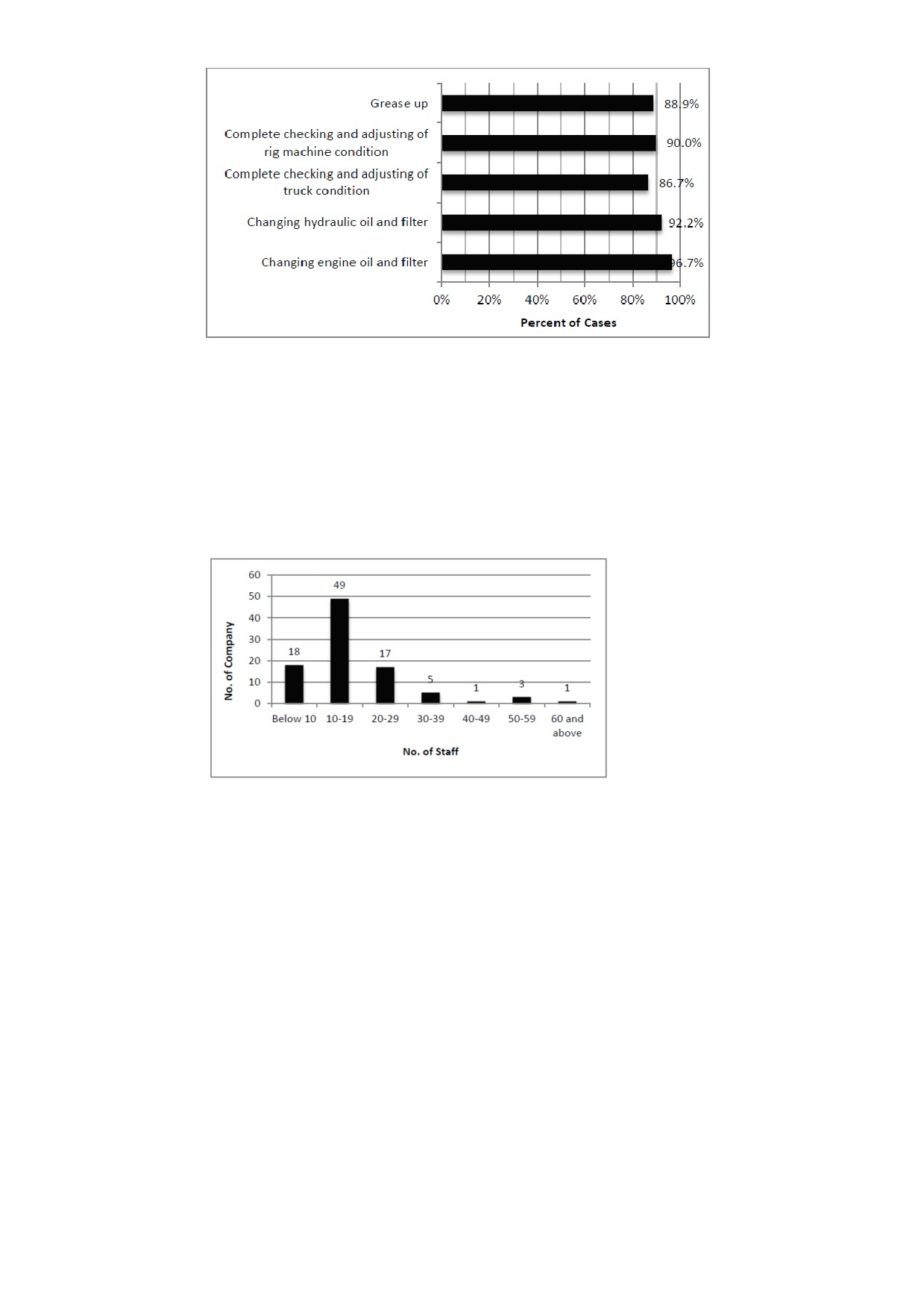
With regard to the type and level of routine maintenance of the owned rigs, more than 80% of the
companies assess that they can attend all necessary works such as greasing up, checking and
adjusting of condition of rigs and trucks, and changing hydraulic oil, engine oil and filters (Figure
17).
Note: The number of valid cases is 86.
Figure 16 Workshop Equipment and Tools Owned (multiple options)
16
Guideline on Hiring of Drilling Equipment
Note: The number of valid cases is 90.
Figure 17 Type and Level of Periodical Maintenance of Drilling Equipment the
Company can Perform (multiple options)
3.2.5 HUMAN RESOURCES
(1) Staffing
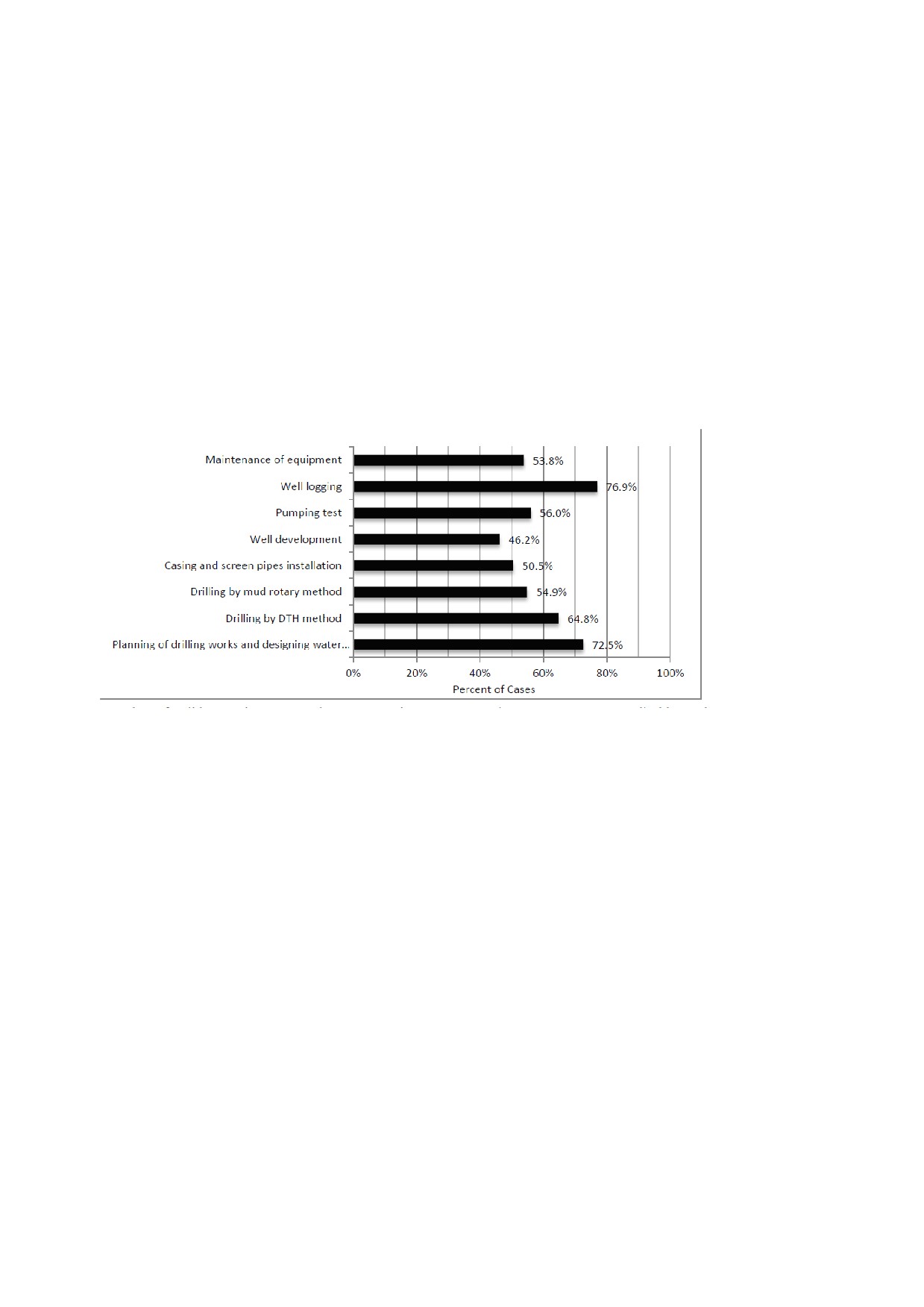
The median number of the staff in one company is 15 in total including non-regular workers. The
largest proportion of the companies has
10-19 employees followed by those with below 10
members (Figure 18). These groups account for 70% of the surveyed companies.
Figure 18 Distribution of Companies by Size of Staff
Drilling staff employed in an entity consists of one drilling supervisor, one driller (rig in charge),
one assistant driller, and two workers on average. More than 60% of the companies also have
staff in expertise as the engineer or hydrogeologist.
It is observed that the management staff serves as an engineer, hydrogeologist or drilling supervisor
in several organizations as they have limited number of human resources. Staff at other position
also makes similar arrangement to supplement shortage in staffing.
(2) Working Experience and Qualification of Technical Staff
As to working experience of these staff members, the management has the longest period of
experience in the drilling industry. The average period of their working experience is 14 years,
followed by the engineer, hydrogeologist, drilling supervisor, and driller with 10-12 year career on
average. Other employees such as assistant drillers, drilling workers
(helpers and assistant
technicians), mechanics, welders and plumber have been in the drilling industry for an average of
five to eight years.
The majority of the engineers possess bachelor degrees, whereas most of the hydrogeologists and
the drilling supervisors possess diplomas. The drillers (rig in charge) and assistant drillers are
holding Form IV certificates, whereas the drilling workers are STD VII leavers. STD VII
certificate holders are the majority of the workers in the surveyed drilling companies followed by
17
Guideline on Hiring of Drilling Equipment
the Form IV certificate holders. It is observed that the proprietors of the drilling companies call
some of their staff engineers or hydrogeologist while they only possess FTC, Form VI, Form IV or
Basic Certificates which are not qualified for those positions.
(3) Capacity Development of Technical Staff
Of all the companies surveyed, the respondents at 91 entities expressed capacity development
needs of their technical staff. The highest proportion of the companies see necessity of
strengthening of knowledge and skills of the staff on well logging (76.9%), followed by planning
of drilling works and designing of water wells (72.5%), drilling by DTH method (64.8%) as shown
in Figure 19. Approximately 30% (29 nos.) of the respondents chose all the areas listed in the
same graph as their needs for capacity development of the technical staff.
Only two organizations answered that they did not require capacity development of the technical
staff as they have enough skills necessary for drilling works. One of them is a private drilling
company which had the largest share in the contracts for drilling works in RWSSP/WSDP (Phase
1) and the other is a charitable organization providing support for water supply projects.
Note: The number of valid cases is 91. Another one case is no answer and two cases are not applicable as the
respondents do not see necessity of capacity development of their technical staff.
Figure 19 Areas of Capacity Development Needs of Technical Staff (multiple options)
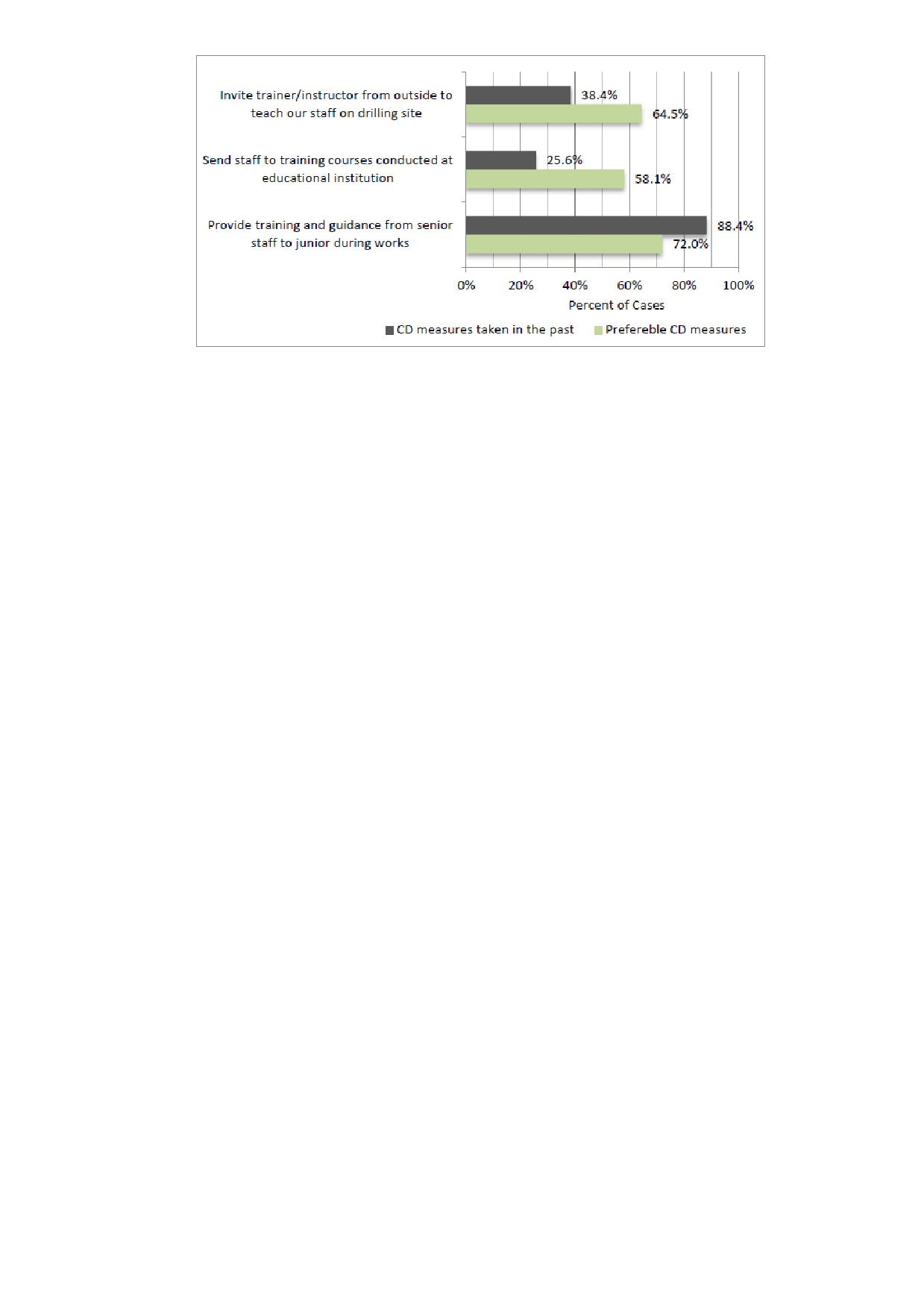
Aiming at the human resources development of their staff, 89 companies have conducted some
forms of the training or sent the selected staff to educational institutions. Figure 20 shows type of
capacity development activities the companies have ever employed as well as their preferable
measures for the same. Provision of On the Job Training (OJT) from senior staff was most widely
practiced among the companies (88.4%). Less than 40% of the companies have also organized
training on drilling site by trainers invited from outside and/or sent the staff to educational
institutions in contrast to relatively high preference to these measures.
In most cases, the company bore the costs for these capacity development measures. There are
only three cases that the staff member paid the cost. It is observed that the companies show
tendency to rely on utilizing the experienced personnel in their organizations for capacity
development of other staff rather than employing other measures which incur monetary burden.
18
Guideline on Hiring of Drilling Equipment
Note:
1. The number of valid cases for the variable “CD measures taken in the past” is 86. The remaining eight cases are
not applicable as the companies have never conducted capacity development for their technical staff.
2. The number of valid cases for the variable “Preferable CD measures” is 93. Another one case has no answer.
Figure 20 Capacity Development Measures (multiple options)
3.2.6 INTEREST IN BUSINESS OPPORTUNITIES
As mentioned earlier, 16 companies among the surveyed have worked as the contractors for drilling
works in
10-village subprojects in RWSSP/WSDP (Phase
1).
The interviewed companies
including the contractors which already had experience in the programme expressed high interest in
participating in drilling works in WSDP. Almost all the companies (93 nos.) showed their interest
in the programme. The remaining one is a charitable organization which does not operate the
drilling works at commercial basis.
78.7% (74 nos.) perceives that there are some obstacles to participate or expand business
opportunities in drilling works in WSDP while the rest does not see any such difficulties. Of
those obstacles raised by the respondents, the biggest proportion of opinions goes to concern on
high requirements in procurement rules for drilling works in WSDP (43.2%). Delay in payment
of the contract amount is also pointed out as one of the obstacles. Except for these difficulties
related to the implementation procedures of the programme, 36.5% expressed hardships to source
sufficient investment fund for the business operation as part of problems in the organizations. The
companies which have worked or are working in WSDP also pointed out difficulty in
hydrogeological conditions of project areas more frequently than the group without experience in
the programme.
3.2.7 INVESTMENT FOR NEW DRILLING RIGS
Nearly three third of the companies only rely on personal funds of proprietors when new
investment is required in their business. One third also borrows money from friends, relatives
and/or banks.
For those which consider new investment for the drilling equipment, demand for large-size rigs is
especially high.
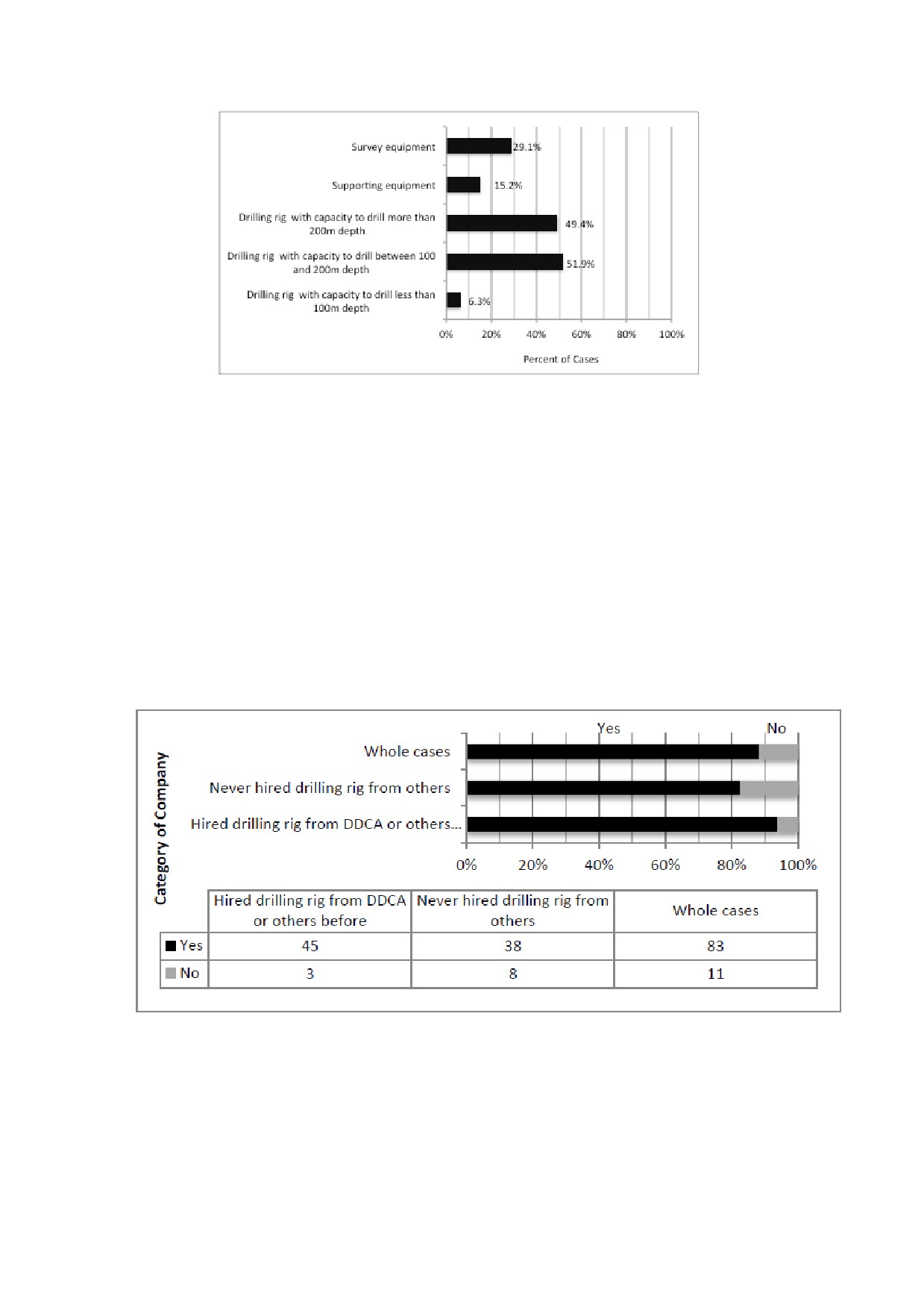
79 companies answered that they had investment plans to purchase new drilling
equipment. This number includes the entities which have experience in drilling works in WSDP.
The highest demand goes to a drilling rig with capacity to drill 100-200m depth, followed by a rig
with drilling capacity of more than 200m depth (Figure 21).
19
Guideline on Hiring of Drilling Equipment
Note: The number of valid cases is 79. Another 11 are not applicable as they do not have any investment plan for
new equipment and four have no answer.
Figure 21 Needs of Procurement of New Drilling Equipment (multiple options)
3.2.8 DEMAND FOR TECHNICAL SUPPORT SERVICES OF DDCA
(1) Hiring Service of Drilling Equipment
Of 94 companies interviewed, 88% (83 nos.) showed interest in using the hiring service of drilling
equipment from DDCA. These companies expect increase of contracts to be awarded in WSDP
(85.5%), acquisition of eligibility to participate in tendering in the same programme (62.7%), and
reduction of investment costs for the equipment (47.0%) as major benefits from using drilling rigs
hired by DDCA. High expectation to expand business opportunities in drilling works in WSDP is
observed on both the companies which already have experience in the programme and those which
are interest to participate newly. Regardless of possession of past experience in using hired
drilling equipment, needs for DDCA’s hiring service is high as shown in Figure 22.
Note: Figures in the table indicates the number of companies while the graph shows its percentage distribution.
Figure 22 Demand for DDCA’s Hiring Service of Drilling Equipment
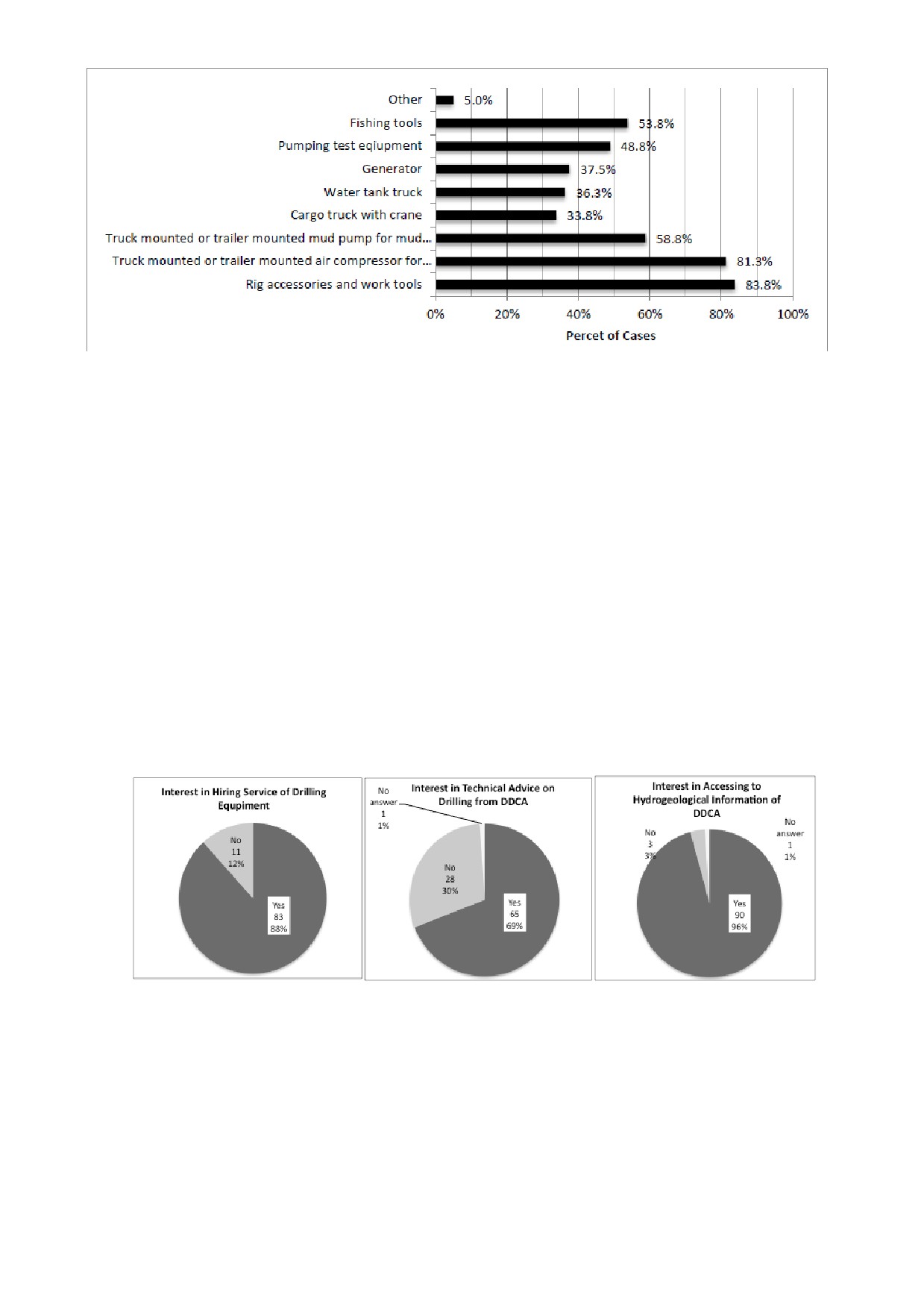
As to options of the hiring service, these companies much prefer to have hired rigs accompanied
with technical staff from DDCA (81.5%) rather than use the equipment only (25.9%). The survey
results also shows high demand of the companies to hire truck/ trailer mounted air compressor for
DTH drilling as well as rig accessories and work tools (Figure 23) together with the drilling
machine. Fishing tools, pumping test equipment and mud pump are also selected by half
proportion of the companies as items which they would like to hire from DDCA according to their
necessity. Meanwhile, generator, water tanker or cargo truck are not in acute needs compared
with other supporting equipment. It seems to be due to wide availability of these items for hiring
in the market.
Guideline on Hiring of Drilling Equipment
Note:
1. The number of valid cases is 80. Another three cases have no answer and 11 cases are not applicable as they are
not interested in the hiring service.
2. “Other” includes a flow meter, logging machine, and survey equipment.
Figure 23 Demand for Hiring Supporting Equipment (multiple options)
11 companies which did not show interest in hiring the equipment explained the reasons that they
have enough number of drilling rigs. The number of rigs owned by these companies varies from
one to six, which implicates that they do not intend to scale up their drilling works by hiring
equipment from others.
(2) Other Forms of Technical Support Services
The surveyed companies also showed high demand for other forms of the technical support
services of DDCA. Such services refer to technical advice for drilling works on site from the staff
of DDCA and provision of hydrogeological information on project areas where DDCA drilled wells
in the past. The percentage of the companies expressing their interest in these services is 95.7%
(90 nos.), bigger than demand for the hired equipment. Especially, all of these 90 companies
expect to access to hydrogeological information kept at DDCA while the number of companies
which are interested in receiving technical advice is counted 65 in total (Figure 24).
92.5% of the
companies are willing to pay for the technical support services to be provided by DDCA.
Figure 24 Distribution of Companies by Demand for Different Types of Technical
Support Services by DDCA
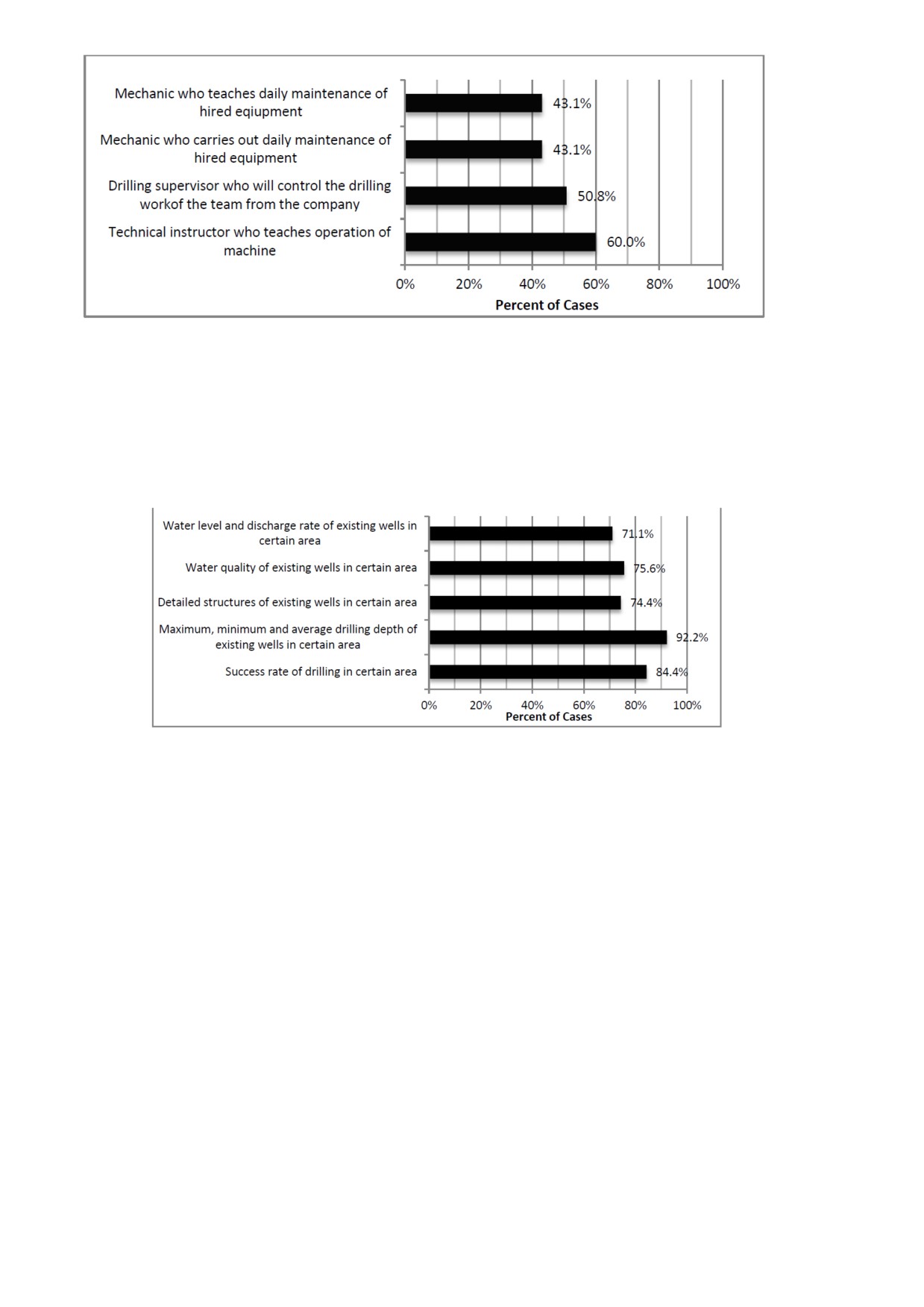
With regard to the technical advice, skilled and experienced instructors are mostly needed by the
companies, followed by drilling supervisor who will control drilling works to be conducted by the
team from the lessee (Figure 25). Some companies also raised necessity of mechanics who will
conduct daily maintenance of hired equipment and/or teach the lessee on required maintenance
procedures.
21
Guideline on Hiring of Drilling Equipment
Note: The number of valid cases is 65. Another one case has no answer and 28 cases are not applicable as they do not
require technical advice from DDCA’s staff.
Figure 25 Type of Technical Staff Required for Technical Instruction (multiple options)
As to access to the hydrogeological information kept by DDCA, the respondents are mostly
interested in drilling depth of existing wells and success rate of drilling in the areas where they are
going to work (Figure 26). Other types of information such as discharge rate, water quality and
detailed structure of wells are also with high demand.
Note: The number of valid cases is 90. Another one case has no answer and three cases are not applicable as they are
not interested in accessing to hydrogeological information at DDCA.
Figure 26 Contents of Hydrogeological Information Required (multiple options)
The survey revealed high demand of the private companies for hiring service of drilling equipment
as wells as other forms of technical support services of DDCA.
63.8% (60 nos.) of the surveyed
companies have also experience in use of such services provided by DDCA in the past although
DDCA had not developed procedures for service provision in formal manner. In most cases, these
companies requested DDCA for hydrogeological information and/or technical advice for drilling
works while 13 companies have hired drilling rigs from DDCA. Conclusion is drawn from these
facts that provision of technical support services by DDCA is not quite new in the drilling industry
in Tanzania. Rather, private companies have been keeping expectation that DDCA should play
such roles to support strengthening of capacities of the private sector.
3.3 CLASSIFICATION OF THE PRIVATE DRILLING COMPANIES
(1) Criteria for Classification
The technical support services to be provided by DDCA consists of i) hiring of drilling equipment,
ii) technical instructions on drilling works on site, and iii) hydrogeological information. Two
main criteria listed below are applied to classify the private drilling companies according to their
interest in the technical support services as well as current capacities in terms of experience of
DTH drilling and possession of equipment to respond to demand for drilling works in WSDP, so as
to estimate the number of potential clients with different needs.
22

Guideline on Hiring of Drilling Equipment
1) The company has experience of DTH drilling with a large rotary rig.
2) The company is interested in DDCA’s equipment hiring service.
The reasons of selection of above criteria are described below:
1) Experience of DTH Drilling with Large Rotary Rig
In order to obtain business opportunities for drilling works in WSDP, the private drilling
companies need to posssess drilling equipment and techniques which correspond to
specifications of boreholes required in the program. According to the results of drilling works
in the first phase of RWSS component of WSDP, the maximum drilling depth is 114m and the
minimum is 78m in minimum on average. Diameter of casing and screen pipes is not less than
150mm in 97% of drilled boreholes5. Furthermore, almost of all the project areas of WSDP are
with hard rock formation which requires employment of DTH method for drilling.
Contractors for drilling works in WSDP are, therefore, required experience in DTH drilling with
large rotary rigs6. The companies which fulfill this condition are regarded to be capable of
drilling works under WSDP in respects of both equipment and techniques.
2) Interest in DDCA’s Eqiupment Hiring Service
The second criterion is set set to identify companies which are interested to hire drilling
equipment from DDCA which is the major component of the technical support services by the
Agency. A sub-criterion is also considered if the companies are interest in other forms of the
technical support services such as technical advice on drilling works and hydrogeological
information in case that they do not consider to hire equipment from DDCA. Application of
these criteria enables DDCA to further segment the private companies according to their interest
in the hiring service and/or other forms of the technical support.
(2) Distribution and Characteristics of the Companies Classified
With applying the above criteria, 94 private drilling companies interviewed in the baseline survey
were classified into five groups as shown in Table 9. It is evaluated that 83 companies which
belong to Group A and B are the main target to promote the hiring service combined with the
tecnnical instructions on site. While Group C and D are currently not showing interest in the
hiring service, DDCA will keep the companies in these groups informed on available services for
the equipment hiring for their future demand. The characteristics of companies which belong to
each group are described below.
5 Calculated from Water Sector MIS and records of Rural Water Supply Division of MoW.
6 The definition of large rotary rig here refers to the one that has capacities to drill up to maximum 150m depth and
12-inch diameter with both DTH and mud drilling methods.
23

Guideline on Hiring of Drilling Equipment
Table 9 Classification of Private Drilling Companies
Interest in DDCA’s Service
Experience
of
Number
Technical Advice
DTH Drilling
Group
of
Equipment
and/or
with
Large
Company
Hiring Service
Hydrogeological
Rotary Rig
Information
A
23
23
17
22
B
60
0
60
58
C
3
3
0
3
D
7
0
0
7
E
1
1
0
0
Total
94
37
83
90
1) Group A
23 companies consisting Group A have experience of DTH drilling with large rotary rigs and are
interested in hiring drilling equipment from DDCA.
22 of them are also interest to receive
technical advice from and/or access to hydrogeological information at DDCA. Companies of
this group have drilling techniques to correspond to drilling works under WSDP. It is supported
by the fact that 11 companies in this group have participated in drilling works in WSDP.
As 17 companies of this group have a purchase plan of large drilling rigs, they seem to have an
intention to expand their business opportunities in drilling works. The hiring service would
provide an advantage to these companies to save investment costs to purchase new rigs.
2) Group B
Group B contains 60 companies, the largest group among five. While this group has no
experience of DTH drilling with a large rotary rig, they are interested in hiring drilling
equipment from DDCA. Although some of them possess large rotary rigs, they have only used
mud rotary drilling method. Others have experience to perform DTH drilling with rigs with
small capacity.
52 companies have a purchase plan of drilling rig capable to drill not less than 100m in depth.
58 companies also expressed their interest in technical support services. This proves that they
are highly motivated for the capacity development in drilling techniques to gain business
opportunities by acquiring skills and knowledge on operation of large rotary rigs to perform
DTH drilling which can respond to requirements in WSDP. Currently, only three companies
have provided drilling works in WSDP in this group.
3) Group C
The companies in Group C have experience of DTH drilling with large rotary rigs. They are
not interested in equipment hiring but willing to use other forms of technical support services of
DDCA such as provision of technical instructions on site and hydrogeological information.
One company of three in this group has experiences of drilling works under WSDP.
4) Group D
Seven companies consisting Group D have neither experience of DTH drilling with large rotary
rigs nor interest in hiring drilling machine from DDCA. However, they are interested in other
forms of the technical support services. DDCA can provide technical instructions and/or
hydrogeological information according to needs of each company of this group.
5) Group E
Group E is an exceptional case among 94 companies surveyed. It has experience in DTH
drilling with large rotary rigs and is not interested in neither hiring of equipment nor accessing to
other forms of the technical support of DDCA. Only one company is categorized into this
group. The company operates drilling works exclusively for boreholes with large diameter
24

Guideline on Hiring of Drilling Equipment
meant for urban water supply. As it is observed that their needs for equipment and drilling
techniques are currently satisfied, this group is excluded from the target of the technical support
services.
4. SCOPE OF SERVICES TO BE PROVIDED BY DDCA IN THE
HIRING BUSINESS
4.1 CONDITIONS CONSIDERED IN FORMULATION OF THE BUSINESS MODEL
MoW has a plan to procure a total of 20 drilling rigs for DDCA in WSDP. However, the ministry
has not yet concluded a procurement plan of the remaining number of the drilling equipment.
The business model is, therefore, formulated to operate the hiring service with six drilling rigs and
supporting equipment which are under procurement in the first phase of WSDP.
4.2 ITEMS TO BE HIRED
Table 10 shows items to be made available for hiring to the private companies. Hirers will choose
items necessary to execute contracts with their clients. In case that the hirer needs other
equipment which is not listed below, he will procure it in the market or borrow it from DDCA, if
available, at cost.
Table 10 List of Equipment to be Hired
Item
Specification
Qty
Remarks
1. Truck mounted drilling rig
Rotary cum DTH, max. depth 150m
6 units
2. Trailer mounted air
650CFM, 246 psi
5 units
Optional
compressor
3. Trailer mounted mud pump
20kg/cm2, 600 l/min.
5 units
Optional
4. Trailer monted pumping test
Generator, riser pipe, submersible
5 units
Optional
unit
pump
5. Rig accessories
6 sets
6. Casing tools
6 sets
7. Fishing tools
Tap, jack, etc.
6 sets
Optional
8. Direct mud circulation drilling
6 sets
tools & accessories
Rig accessories, casing tools, and direct mud circulation drilling tools and accessories contain i)
items which are permanently provided with the drilling rigs and ii) consumables which use is
optional for the hirer. Details of the items in each category are shown in Table 11. Maintenance
costs need to be considered for those which are equipped with drilling rigs permanently.
Meanwhile, the hirer will choose if he uses stocks of consumables kept by DDCA at cost or the
ones owned by the hirer.
25

Guideline on Hiring of Drilling Equipment
Table 11 List of Rig Accessories, Casing Tools and Direct Mud Circulation Drilling
Tools
Equiped
No.
Description
Consumable
with Rig
Rig Accessories
1
Drill pipes 41/2'' 0.D flush type with API 31 1/2''IF BOX and pin joints
x
furnished with wrech squares and steel made protectors,6m long/pc
2
Drilling collars 5''0.D,2''IF BOX and pin joints,furnished with wretch
x
squares and steel protectors,6m long/pc
3
Hoisting swivel API 1/2'' IF Pin joint
x
4
Hoisting plug API 1/2'' IF Pin joint
x
5
Drill pipes collar hanger
x
6
Cross over sub API 3 1/2 IF BOX and pin
x
7
DTH Hammer assembly for 6 1/4''(150mm) hole drilling API 3 1/2
x
Regular pin and 8'' to 10'' hole drillling
8
DTH Hammer assembly for 12''(300mm) hole drilling API 3 1/2
x
Regular pin
9
DTH Button Bit for 12''(300mm) hole drilling
x
10
Bit sub for drill pipes/collar to 6 1/4'' DTH Hammer API 3 1/2''
x
Regular box and API 3 1/2'' IF Box joint
11
Bit sub for drill pipes/collar to 6 1/4'' DTH Hammer API 3 1/2''
x
Regular box and API 3 1/2'' IF Box joint
12
DTH Button bit for 6 1/4''(159mm) hole drilling
x
13
DTH Button bit for 8 1/4''(216mm) hole drilling
x
14
DTH Button bit for 10''(254mm) hole drilling
x
16
Bit grindeer for button bit and body dressing,furnished with 15 m long
x
high pressure air hose
17
Tricone roller bits 6 1/2'' dia
x
18
Tricone roller bits 8 1/2'' dia
x
19
Tricone roller bits 10 1/2'' dia
x
20
Tricone roller bits 12 1/2'' dia
x
21
Roller bits 8 1/2'' dia
x
22
Roller bits 10 1/2'' dia
x
23
Roller bits 12 1/2'' dia
x
24
Roller bits 14 1/2'' dia
x
25
Drag bits three winged 8 1/2'' dia
x
26
Drag bits three winged 10 1/2'' dia
x
27
Drag bits three winged 12 1/2'' dia
x
28
Drag bits three winged 16 1/2'' dia
x
29
Roller bit 16'' dia for soft formation
x
30
Stabilizer for
6 1/4'' hole body dia,1.5m long API 3 1/2 IF BOX and
x
pin joints furnished with wretch squares and steel made thread
protectors on both ends
31
Stabilizer for
8 1/2'' hole 5'' body dia,1.5m long API 3 1/2 IF BOX
x
and pin joints furnished with wretch squares and steel made thread
protectors on both ends
32
Stabilizer for
10'' hole 5'' body dia,1.5 long API 3 1/2 IF BOX and pin
x
joints furnished with wretch squares and steel made thread protectors on
both ends
33
Stabilizer for
12'' hole 5'' body dia,1.5m long API 3 1/2 IF BOX and
x
pin joints furnished with wretch squares and steel made thread
protectors on both ends
Casing Tools
1
a) Casing lamp with bolts,nuts,wrench and sling wire for 4'' PVC
x
casing ,3 pairs/sets
2
b) Casing lamp with bolts,nuts,wrench and sling wire for 6'' PVC
x
casing ,3 pairs/sets
3
c) Casing lamp with bolts,nuts,wrench and sling wire for 8'' PVC
x
casing ,3 pairs/sets
4
d) Casing lamp with bolts,nuts,wrench and sling wire for 10'' PVC
x
casing ,3 pairs/sets
5
e) Casing lamp with bolts,nuts,wrench and sling wire for 12'' PVC
x
casing ,3 pairs/sets
26

Guideline on Hiring of Drilling Equipment
Equiped
No.
Description
Consumable
with Rig
6
f) Casing head for 8'' casing
x
7
g) Casing head for 10'' casing
x
8
h) Casing head for 12'' casing
x
9
i) Casing shoe for 8'' casing
x
10
j) Casing shoe for 10'' casing
x
11
k) Casing shoe for 12'' casing
x
12
l) Casing sub , API 3 1/2 IF BOX to 8 '' casing
x
13
m) Casing sub , API 3 1/2 IF BOX to 10 '' casing
x
14
n) Casing sub , API 3 1/2 IF BOX to 12 '' casing
x
15
o) Casing hoist plug with sling wire for 8'' casing
x
16
p) Casing hoist plug with sling wire for 10'' casing
x
17
q) Casing hoist plug with sling wire for 12'' casing
x
Direct Mud Circulation Drilling Tools & Accessories
1
Mud testing kit including mud balance ,marsh funnel,viscocity meter
with measuring cup sand content kit,stop watch and thermometer
2
Collapsible water tank with housing bag 3000 Litre capacity
x
3
Portable water level indicator,dry battery operated type,measuring
x
capacity of 200m
4.3 PLACEMENT OF DRILLING RIGS
Taking into account of convenience of hirers to access to the equipment, DDCA will decide
allocation of the drilling rigs and compressors to be newly procured among its headquarter and
zonal offices. The column chart in Figure 27 shows the number of private drilling companies
interviewed in the baseline survey according to their office locations and project areas where they
have worked in the past. The regions are grouped into five zones based on jurisdiction of DDCA’s
zonal offices. The private companies classified in Group A and B mostly concentrate in Dar es
Salaam while around 20 companies operate from Northern part of the country such as Arusha,
Mwanza and Shinyanga.
Figure 27 also indicates the rural water supply coverage as of 2011. From the viewpoint of
demand for improved water supply, regions which water supply coverage is below the national
average are Tabora, Singida, and Dodoma in the central part of the country, Shinyanga, Mara, and
Kagera in Lake zone, Rukwa in western zone, and Lindi and Mtwara in eastern zone.
Based on these points, rigs will be allocated depending on the demand for drilling works to the
specific time. It also needs to consider capacities of each zonal office in conducting maintenance
and repair works of the equipment.
27
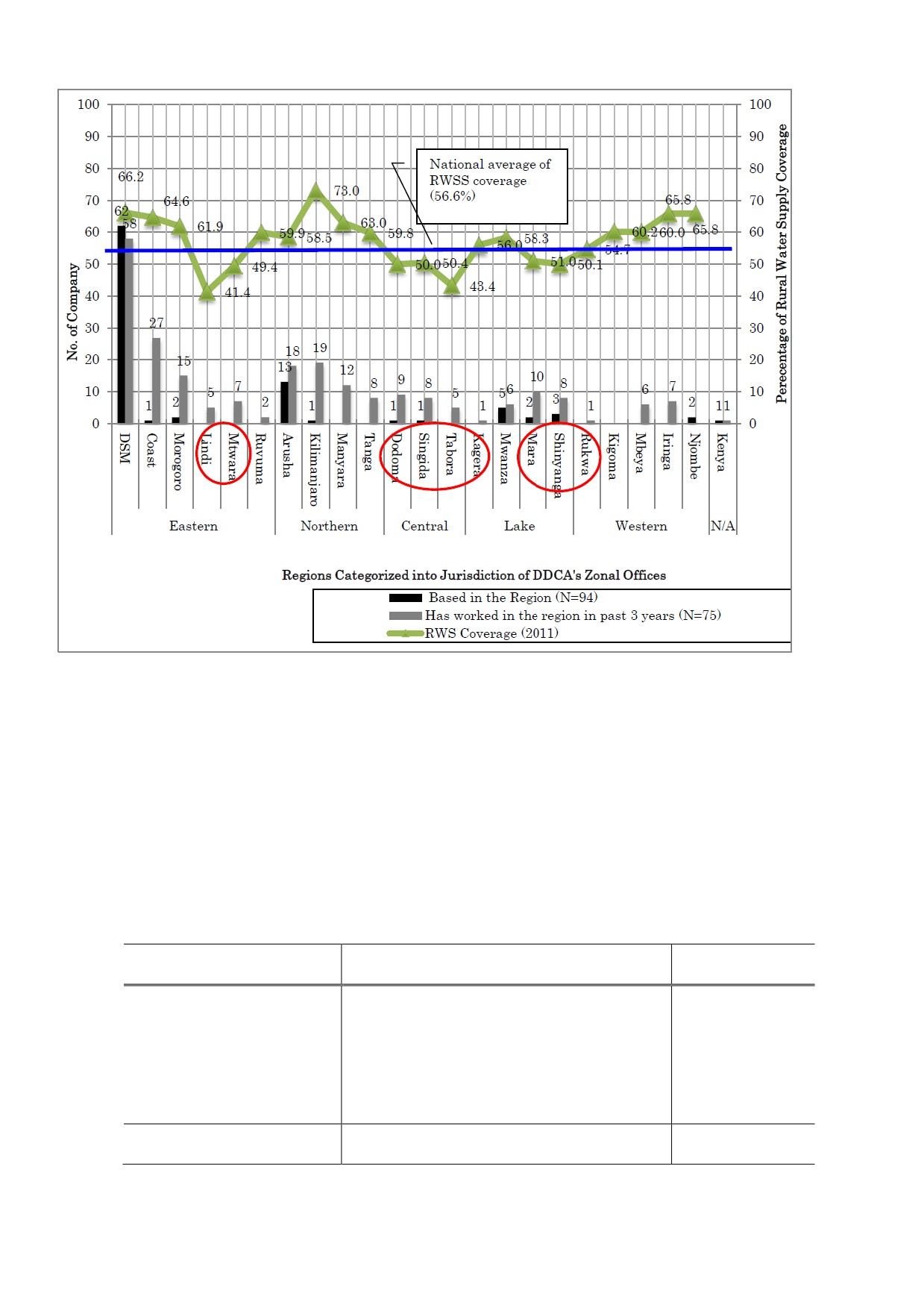
Guideline on Hiring of Drilling Equipment
Figure 27 Geographical Distribution of Private Drilling Companies and Rural Water
Supply Coverage by Regions
4.4 ALLOCATION OF DRILLING STAFF
DDCA will attach the following staff to the hired equipment (Table 12). At least one technical
instructor and driver are required for hiring of one set of the drilling rig. The purpose of
allocation of these personnel is firstly to ensure liability of operation of the government-owned
vehicles and machinery. The government prohibits driving of vehicles registered under the
government by personnel from the private sector. Secondly, it is meant for provision of technical
instructions to the drilling staff from the hirers on site. It is of cardinal importance that DDCA
operationalizes the technical instructions as an integral component in the hiring service in order to
support capacity development of the private sector.
Table 12 Roles of DDCA Staff to be Attached to the Hired Equipment
Responsibility in Operation of the Hired
Position
Required No.
Equipment
Techncial Instructor
- to teach how to operate the drilling rig.
1 person/ rig
- to provide technical advice on
management of the process of drilling
works on site.
- to supervise and control appropriate use
and routine maintenance of the hired
equipment.
Driver of carrier truck of
- to drive trucks owned by DDCA to and
1 person/ truck
drilling rig
from the drilling sites.
28
Guideline on Hiring of Drilling Equipment
DDCA will allocate necessary number of the technical instructors and drivers who operate the
drilling rigs to be hired. Furhtermore, the technical instructors need to refresh their skills
regularly to keep standardized quality of instruction techniques. When it is short of the technical
instructors compared to demands, DDCA will appoint additional ones from senior drilling staff in
accordance with the Technical Support Plan for the Drillers in DDCA.
4.5 MAINTENANCE OF THE EQUIPMENT
DDCA will be responsible for preventive maintenance and repair works of the equipment before
the equipment is hired and after the items are returned from the hirer. Maintenance Section
conducts necessary maintenance works in accordance with the guidelines, plan and manuals for
maintenance system of the equipment for hiring which are formulated separately.
On the other hand, the hirer will conduct routine maintenance of the hired equipment on site under
supervision of the technical instructor from DDCA. DDCA will provide the hirer with a manual
for maintenance of the hired equipment which describes procedures of daily maintenance check
and safety measures. The hirer wil bear the costs to be incurred for routine maintenance and
repairs required during operation of the equipment on site.
For any mechanical troubles which cannot be attended by the drilling staff from the hirer or
technical instructor, DDCA will send a mechanic to the site either from the headquarter or the
nearest zonal office. The contract will specify demarcation of responsibilities between two parties
on maintenance and repair of the equipment.
4.6 HIRING CONDITIONS
The basic hiring model of the drilling equipment is use of a truck mounted drilling rig to be made
available with one truck driver and one technical instructor. Hirers will choose other supporting
equipment as per their requirements.
(1) Responsibilities in Logistics Arrangement
Table 13 shows demarcation of responsibilities in logistics associated with use of the hired
equipment. The owner is responsible to arrange a carrier truck of drilling rig as it is mounted on a
truck. A driver for the carrier truck will be from DDCA as the vehicle is registered as the
government property. The owner is also responsible for fuel for carrier truck of the rig during
mobilization and demobilization. These costs will be recovered from the rental fee of the
equipment.
On the other hand, the hirer is responsible for fuel as used during the operation of the equipment on
site.
The hirer is also responsible to arrange carrier trucks and fuel to be required for
transportation of the compressor, mud pump, and pumping test unit.
29

Guideline on Hiring of Drilling Equipment
Table 13 Demarcaiton of Responsibilities in Logisticts of Hired Equipment
Responsibilities
Equipment
Fule for
Fuel for
Driver for
Carrier Truck
Transport
Operaiton on Site
Carrier Truck
Truck mounted drilling rig
Owner
Owner
Hirer
Owner
Trailer mounted aire compressor
Hirer
Hirer
Hirer
Hirer
Trailer mounted mud pump
Hirer
Hirer
Hirer
Hirer
Trailer mounted pumping test unit
Hirer
Hirer
Hirer
Hirer
(2) Standard Operation Days of Equipment
Standard operation days of each type of equipment for hiring is calculated in order to estimate
expenditure budget of the hiring service. Table 14 shows calculated annual operation ratio of one
drilling rig and other assumptions applied to estimation of the annual operation days of equipment.
Each drilling rig requires periods for transport of the equipment from DDCA yard to sites and
between sites. Also, there would be some waiting periods until a new hiring contract is signed.
Excluding these non-operation days, it is estimated that one drilling rig can serve for 197 days a
year. Approximately 33 boreholes can be drilled with one rig during the annual operation period
if it takes six days to construct one borehole as the results of the baseline survey of the private
drilling companies indicated.
Other assumptions considered are the number of hiring contract per rig, proportion of drilling
methods to be applied, and success rate of borehole drilling. With regard to the number of hiring
contract per rig, it is assumed that 10 boreholes will be drilled in a hiring contract based on track
records of drilling contracts in WSDP (Phase 1), which makes four contracts per rig per annum.
The proportion of drilling methods is estimated as DTH method will be used for the majority of the
boreholes to be drilled because of the geological formation of target areas of WSDP. The success
rate of the borehole drilling refers to performance of contractors in drilling works in WSDP (Phase
1).
These assumptions should be reviewed time to time based on historical operation records of the
equipment so as to improve accuracy of the analysis.
Table 14 Basis of Calculation of Standard Operation Days of Equipment
1.
Calculated Annual Operation Ratio per Rig
1) No. of days for maintenance
24 days/year
2) No. of days for transport between sites
60 days/year
3) Standby period
84 days/year
4) Total of non-operation days
168 days/year
=1)+2)+3)
5) Operation days
197 days/year
6) No. of days required to drill a well
6 days/well
(baseline survey)
7) No. of wells which can be drilled
33 wells/rig/year
2.
Assumption of Number of Hiring Contract per Rig
1) No. of wells to be drillied in one contract
10 wells
2) No. of contract per rig
4 / year
3.
Assumption of Proportion of Drilling Method to be Applied
1) Use of DTH method
70% of total number of wells to be drilled
2) Use of mud drilling method
30% of total number of wells to be drilled
3) Success rate of borehoel drilling
70%
The standard operation days of the equipment are set in Table 15 by applying the conditions
mentioned above.
30

Guideline on Hiring of Drilling Equipment
Table 15 Standard Operation Days of Equipment
No. of Operation
Item
Qty
Calculation*
Days per Annum
1)
Truck mounted drilling rig
6 units
197 days/unit
= 1.5)
2)
Trailer mounted air compressor
5 units
139 days/unit
= 1.6) x 3.1) x 1.7)
3)
Trailer mounted mud pump
5 units
59 days/unit
= 1.6) x 1.7) x 10%
4)
Trailer mounted pumping test unit
5 units
69 days/unit
= 1.7) x 3.3) x 3 days/ well
5)
Rig accessories
6 sets
197 days/set
= 1.5)
6)
Casing tools
6 sets
197 days/set
= 1.5)
= 40% of the operation day
7)
Fishing tools
6 sets
79 days/set
of drilling rig
Direct mud circulation drilling tools &
8)
accessories
6 sets
59 days/set
= 1.6) x 1.7) x 3.2)
* The numbers in the column refer to the ones in Table 14.
5. QUALIFICAITONS TO BE REQUIRED FOR CLIENTS AND
OTHER CONDITIONS
5.1 REQUIREMENTS TO APPLICANTS
DDCA will hire the equipment to qualified private drilling companies which will fulfill criteria
listed below;
To possess a valid water well drilling permit issued by MoW.
To be registered as the specialist contractor at CRB.
To have at least one permanent employee among the drilling staff to be on site
with the hired equipment and to receive the technical instructions from DDCA.
(1) Registration to CRB and MoW
Registrations at MoW and CRB are required by relevant laws, respectively, as the contractors to
execute a certain type of works governed by these organizations. For water well drilling permit,
the Groundwater (Exploration and Drilling) Licensing Regulation 2011 of the Water Resources
Management Act 2009 is in the proess of formulation by MoW and to be enacted soon.
For CRB registration, MoW is considering to stipulate possession of the CRB registration as one of
the conditions to issue a water well drilling permit in the said regulations. Registration as the
specialist contractor is also one of the conditions for contractors for drilling works in WSDP.
According to results of the baseline survey, most of the companies classified into Group A have
both valid drilling permit of MoW and registration at CRB (Figure 28). In contrast with this
situation, Group B is occupied by the companies which have the drilling permit only or no
registration at all. If these conditions are applied, around 23 companies in Group A and Group B
have higher advantage than others to access to the hiring service. DDCA will update information
on status of registration of the potential clients continuously.
31
Guideline on Hiring of Drilling Equipment
Figure 28 Status of Registration at CRB and MoW by Classification of the Surveyed
Companies
(2) Drilling Staff of the Hirer
The third condition is set based on intention that the hirer will utilize skills and knowledge acquired
from the technical instructors in other drilling works in the future by transferring such skills and
knowledge from the trained personnel to others.
5.2 USE OF THE HIERED EQUIPMENT
(1) Priority among Projects
The equipment to be hired should be primarily utilized in drilling works for WSDP in order to
contribute for attainment of the programme goal for improvement of water supply coverage in the
country. Meanwhile, it is predicted that the number of procurement for drilling works in WSDP
will much vary from time to time as the first phase of the programme experienced. The
equipment will also be hired for the use in drilling works to be procured by the private sector
including individual households in order to mitigate reduction of operation ratio of the equipment
during the period when procurement in WSDP is not concentrated. WSDP counts improvement of
water supply by the private sector into the water coverage.
(2) Priority among Applicants
Segmentation of the surveyed companies identified a total of 83 business entities which are
interested in the equipment hiring service. These were further divided into two groups. Group A
(23 nos.) already possesses experience in operation of DTH method with a large rotary drilling rig.
Group B (60 nos.) has no experience in DTH drilling with a large rotary rig.
It is expected that the project will create greater effect on Group B than Group A in terms of
increase of number of contractors which can perform drilling works in WSDP (Table 16). In case
that DDCA needs to choose hirers among applicants due to limited number of the available rigs, the
first priority in selection will, therefore, be given to the companies classified into Group B.
32

Guideline on Hiring of Drilling Equipment
Table 16 Classified Groups of Private Drilling Companies and Project Effect Potential
Interest in DDCA’s Service
Project
Experience
of
Technical
Experience
Number
Effect
DTH Drilling
Equipment
Advice and/or
of Drilling
Group
of
Potential
with
Large
Hiring
Hydrogeological
Works in
Company
(5: highest,
Rotary Rig
Service
Information
WSDP
1: lowest)
from DDCA
A
23
23
17
22
11
4
B
60
0
60
58
3
5
C
3
3
0
3
1
3
D
7
0
0
7
1
2
E
1
1
0
0
0
1
Total
94
37
83
90
16
5.3 USE OF THE EQUIPMENT BY DDCA FOR ITS OWN DRILLING ACTIVITIES
DDCA also plans to use the equipment for hiring in its own drilling works. In such cases, Drilling
Project Department will “hire” the equipment from Hiring Business Department and transfer the
fund equivalent to the rental fee to the account for the hiring service while the first priority in use
of the equipment will be given to applicants from the private sector.
6. LAWS AND REGULATIONS TO BE FOLLOWED
6.1 LIABILITY OF INSURANCE FOR THE HIRING EQUIPMENT
It was confirmed that there was no particular legal requirement for DDCA to start the hiring service.
Hiring of equipment to other organizations is included as the secondary function of DDCA in the
Executive Agencies (Drilling and Dam Construction Agency) (Establishment) Order, 1999, by
which DDCA is legally recognized to operationalize such function.
With regard to the administrative procedures, DDCA needs to decide arrangements of insurance for
machinery and vehicles to be hired out. All the equipment owned by DDCA belongs to the
Government of Tanzania and is insured by Ministry of Finance and Economic Affairs (MoFEA).
The Treasury of MoFEA is responsible for registration and management of all the
government-owned vehicles and machinery.
The arrangement of the insurance of the hired equipment varies depending on how the business is
going to be operated and what are to be charged as the rental fee to hirers. In case that the
equipment hiring is operated as part of the governmental services and to recover operation costs
only, MoFEA will insure the equipment in the same manner with other equipment that DDCA uses
for its own drilling works. On the other hand, if it pursuits profits at commercially viable basis,
the responsible party for the insurance needs to be agreed in a contract between DDCA and the
hirer.
6.2 TAXATION
As to taxation of the hiring service, the Value Added Tax (VAT) will not be charged to the service
as DDCA is exempted from taxation of VAT on its sales.
6.3 REGULATIONS RELATED TO THE GROUNDWATER DEVELOPMENT
MoW regulates development and use of groundwater in the framework of the Water Resources
Management Act of 2009. Regulations governing the groundwater development in the framework
of the Water Resources Management Act include the following;
33
Guideline on Hiring of Drilling Equipment
(1) Water Resources Management
(Water Abstraction, Use and Discharge)
Regulations, 2010
The regulation specifies procedures for administering permits for water use, groundwater
development, and wastewater discharge. The Act requires water users to apply for a water use
permit at Basin Water Board (BWB) when they intend to divert, dam, store, abstract or use surface
water or groundwater7. The water use permit allows a water user to exclusively use the water
resources within the terms and conditions specified in the permit. Meanwhile, the discharge
permit is issued to regulate those who discharge effluents from any commercial, industrial or
agricultural source or from any sewerage works or trade waste systems into surface water or
underground strata.
In case that owners or users of wells plan to construct, enlarge, or deepen wells, they are obliged to
apply for a groundwater permit prior to commencement of the works. The Act regards that
construction of a well by a person without a groundwater permit is an offence. Further, an
application for a water use permit is required for the owner or user of the well when the source is
successfully developed for water abstraction.
Although it is water users who are responsible to apply for these permits, drilling contractors
should also be aware of these regulations, especially in the context of the groundwater development,
as the water users would require information and report on drilling works from the contractors for
submission to BWB.
(2) Groundwater (Exploration and Drilling) Licensing Regulations, 2011
MoW is currently preparing the Groundwter (Exploration and Drilling) Licensing Regulations to
regulate professionals who undertake works relating to groundwater prospecting and construction
of wells. Taking over the existing water well drilling permitting system, the draft regulations
stipulate necessity of acquisition of a groundwater drilling license by any person who is involved in
groundwater drilling activities. Other licenses or permits newly created or reinforced by the
regulations are the groundwater exploration license, drillers license and drilling clearance permit.
DDCA will provide advice to hirers to consult with MoW for required procedures to acquire
licenses and permits necessary for operation of drilling works by hirers. The Water Resources
Management Act also mentions the following with regard to the groundwater development;
− The Minister responsible for Water has power to prescribe in regulations the minimum
distance for the sinking, enlargement or deepening of wells.
− Those who are engaged in drilling of wells or groundwater explorations are required to keep
and submit any relevant data on groundwater to BWB.
− BWB has power to determine the safe yield of any aquifer for the purpose of guiding
determinations concerning the abstraction and use of water from the aquifer.
DDCA will keep itself updated about new regulations formulated in the Water Resources
Management Act so that legal requirements in the groundwater development will be incorporated
into administration of the equipment hiring service where necessary.
7 Application for a water use permit is exempted for the following caeses, provided that its purpose of water abstraction
is for domestic use;
− Any person having lawful access to any water course uses the same for domestic purposes without construction
of any works.
− Any person being a legal occupier of land constructs a shallow hand dug well not exceeding a depth of 15m and
uses the water for domestic purposes.
− The owner or occupier of any land constructs any works for rainwater harvesting or for recycling of used water
other than in a river or stream and abstracts and uses the water conserved or recycled for domestic purposes.
The works should not exceed 20m capacity of water.
34