CG935G Wheel Loader. Manual - part 4
 

  Index      loaders     SICHUAN CHENGDU CHENGGONG CG935G Wheel Loader - service manual


Search            


Content   ..  1  2  3  4  5  ..


CG935G Wheel Loader. Manual - part 4


20

keep three-point contact (two feet and one hand or two hands and one foot) to ensure the 

stability of the body.   

● It is prohibited to hold any control lever when getting in or off the machine.   

● 

It is not allowed to climb into the operator’s cabin from the rear ladder of the machine or get 

off the machine by the tires beside the operator’s cabin.   

● 

Do not climb up or down the machine when carrying tools or other articles; the needed tools 

shall be hoisted onto the operation platform by rope.


3.3 Fire and Explosion Prevention 

The fuel used by the engine of the loader, most lubricant 

and some coolant are combustibles. It is very dangerous when 

flame is close by and special care shall be taken. 

 Do not leak the fuel on hot surface or electric components. 

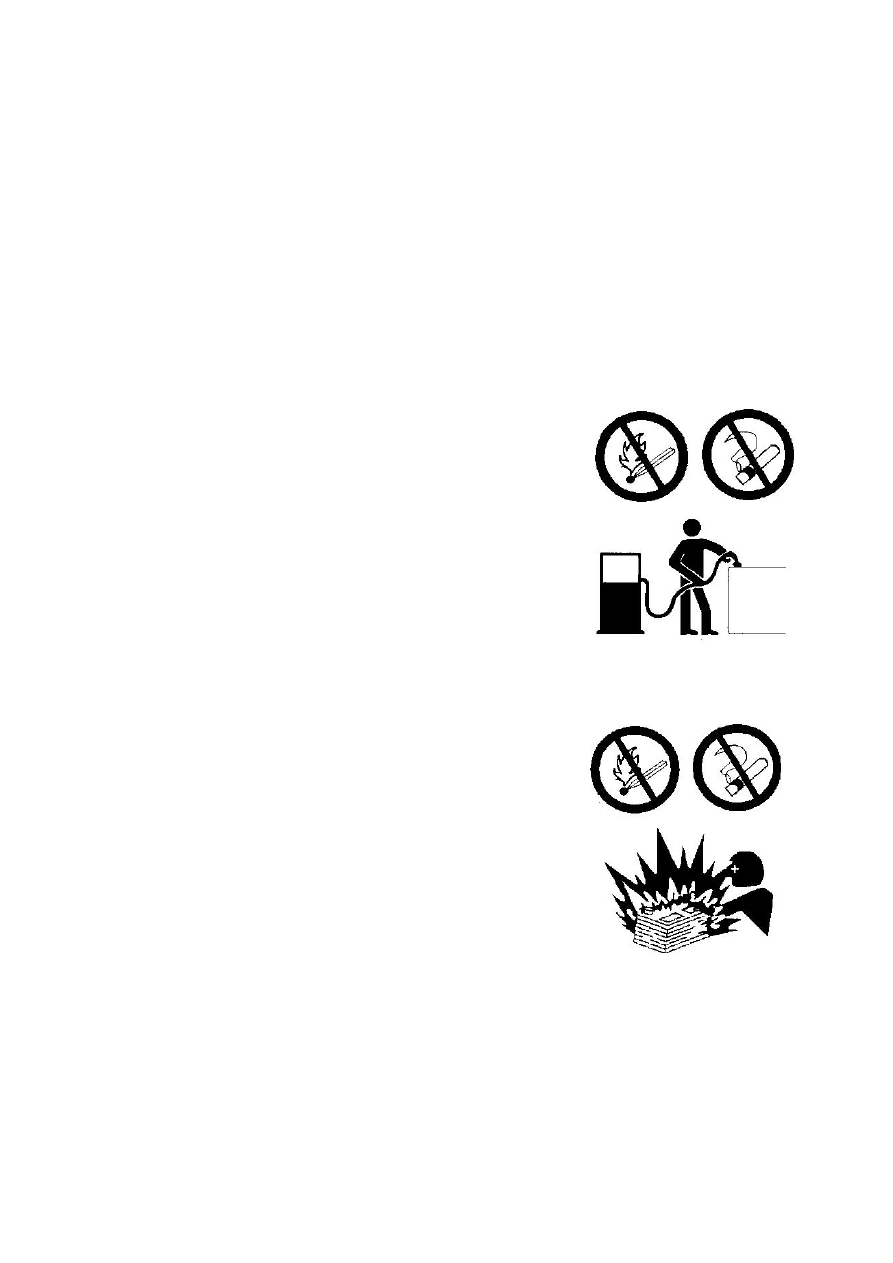
 When fill fuel, the engine must be stopped. Do not smoke 

when filling fuel or at the fuel-filling area. 

 Explosive gas will be generated around the storage battery; 

keep flames away. Maintain and use storage battery in 

strict compliance with the instructions in the product manual. 

  Fasten the lids of containers in which the above stated 

combustible liquid is stored. 

 Put the combustible liquid in protective containers and 

keep them at safe place. They shall be stored by categories 

and marked accordingly. Prevent them from being used by 

non-staff people. 

 Remove combustibles accumulated on the machine, such 

as fuel, lubricant and other fragments.   

 Do not conduct welding or flame cutting operation on tubes or boxes containing 

combustible liquid. Before welding or cutting, must clean with fire-resistant fluid when 

these operations have to be done. 

 During the operation of the machine, when the exhaust outlet of the engine muffler is close 

to dry grass, waste paper or other combustibles, special care shall be taken. 


21

 When parking the machine, take care to select parking place and avoid the high temperature 

parts like the engine muffler close to combustibles. 

 Clean and fasten all electrode terminals. Check for loose or worn wires everyday. Before 

starting the machine, fasten loose wires and repair or replace worn wires.   

 Check whether there is a leakage of fuel, engine oil or hydraulic oil. When there is, change 

the damaged hose; complete the repair and cleaning before operation.     

 Do not use flames when checking dark areas.   

 Shall prepare a fire extinguisher and know how to use it. Inspect and maintain it according 

to the instruction in the manual. 

3.4 Fire Extinguisher 

Take actions immediately should a fire arise:   

 Must prepare a fire extinguisher for use; get familiar with operation of the fire extinguisher.   

 Must prepare first-aid kit at the site. Check regularly and replenish medicines when 

necessary.   

 Sort out some emergency telephone numbers (such as first-aid center, hospital, fire alarm) 

for contact in emergency. Post these numbers at specified places to ensure everyone is 

informed.  

Location of the fire extinguisher: 

3.5 Ether (when coldstart device is equipped on the 

machine) 

 Ether is a toxic and combustible object.   

 Injury will be resulted from inhalation of ether vapor or 

frequent skin contact with ether.   

 The area shall be well-ventilated where ether is used.   

 Do not smoke when changing ether container.   

 Take care to prevent fire when using ether.   

 Do not put replaced ether container at living area or in the operator’s cabin.   

 Do not put ether at places under direct sunshine or where the temperature is over 39℃

120°F).  


22

 Put discarded ether container at safe place. Do not perforate it or heat it.   

 Keep ether container at place which is not accessible for non-staff. 

3.6 Precautions for Burnings and Other Injuries 

Coolant 

 When the machine is working or has just finished working, the engine coolant is hot and is 

pressured. Severe burnings will be inflicted by contacting with them.     

 When checking the coolant level, the engine shall be at the status of stopping and screw off 

slowly the filler cap of cooling system to check the fluid level (screw off slowly to vent the 

pressure).   

 When it is needed to discharge the coolant, allow the coolant cool down completely before 

the discharge.   


Oil  

 Please take care not to touch hot oil or parts to avoid skin burning.   

 When the machine is working, the hydraulic oil’s temperature is high and the oil is 

pressured.  

 When opening the filler cap of hydraulic oil tank, the engine shall be stopped and hydraulic 

oil should be cooled down to a degree that it is safe to open with bare hands. 

 Before opening the hydraulic oil tank cover, any tube or joint or dissembling parts, please 

vent their pressure firstly.   

 Please do not knock or bend high-pressure tubes.   

Accumulator 

 Must inspect accumulator before filling nitrogen. It is prohibited to fill gas in if the 

accumulator is not installed with plate, the contents on the plate is not complete or not able 

to be recognized, or defects on the body which may affect safe use of it.   

 The accumulator is only allowed to fill in nitrogen. It is prohibited to fill in oxygen, 

compressed air or other combustible gas to avoid explosion.   

 The accumulator is a high-pressure container and shall be maintained or changed by 

professional manufacturers. Before dissembling the accumulator, pressure must be vented 

and nitrogen inside the bladder be discharged with special tools. Then the parts can be 


23

dissembled. 

Storage battery 

 Storage battery will release combustible smoke that may cause explosion.   

 Do not smoke when checking the electrolyte of the storage battery.   

 Electrolyte is an acid material that will cause injury when in contact with skin or eyes.   

 Wear protective goggles when working on storage battery.   

Pipeline, tubes and hoses 

 Do not bend or hammer high-pressure pipelines; do not install damaged tubes or hoses on 

the machine.   

 When repairing any loose or damaged fuel or lubricant tube or hose, any leakage may cause 

a fire. Please take care to ensure safety.   

 Inspect the pipelines, tubes and hoses. Do not check for leakage with bare hand. Check for 

leakage with a piece of board or cardboard. Fasten all joints with specified torque. When 

any of the following troubles is discovered, shall make replacement.   

1. Damage or leakage of joints.   

2. Wear-out of or cut on out layer and bareness of reinforcing wire.     

3. Local bump of outer layer.   

4. Obvious twist or flatness of hoses.   

5. Wire in reinforcing layer is embedded into outer layer.     

6. Displacement of end joints.   

Ensure correct installation of all pipe clamps and guard plates to avoid vibration and consequent 

overheat by friction with other parts when the machine is working. 

Compressed air 

 Compressed air may cause injuries. When clean with compressed air, wear mask, protective 

clothing and shoes.   

 The maximum pressure of compressed air used 

for cleaning shall be lower than 0.205Mpa. 

Leakage of solution 

 Use board or cardboard to check for leakage. 

Even the leakage of pressured fluid as minor as a 


Content   ..  1  2  3  4  5  ..