Yanmar engines LV series (L48V, L70V, L100V). Manual - part 10
 

  Index      Engines     Yanmar industrial engines LV series (L48V, L70V, L100V) - service manual 2000 year


Search            


Content   ..  8  9  10  11   ..


Yanmar engines LV series (L48V, L70V, L100V). Manual - part 10


BEFORE YOU OPERATE

26

LV Operation Manual

A

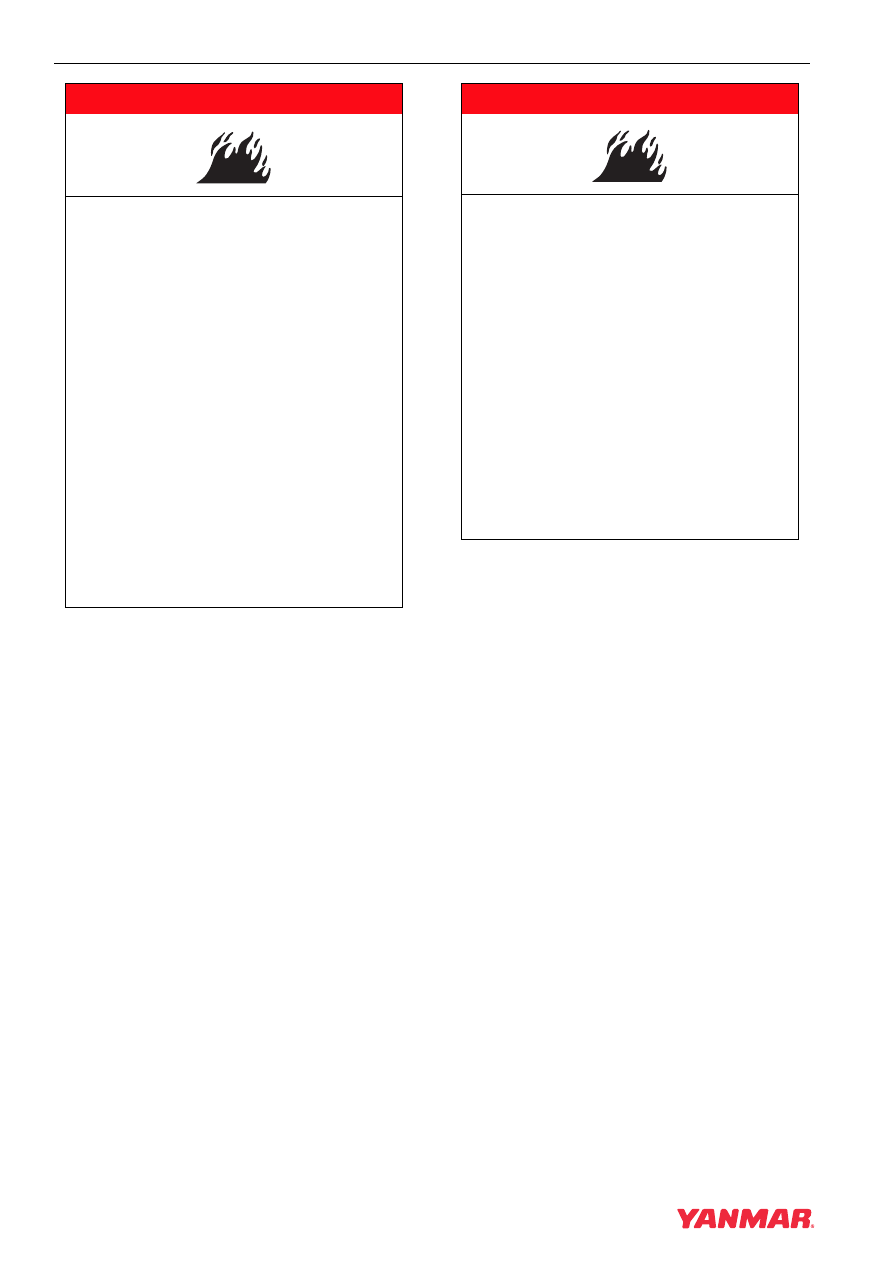
 DANGER

FIRE AND EXPLOSION HAZARD!

• Diesel fuel is extremely flammable and 

explosive under certain conditions.

• Be sure to place the diesel fuel 

container on the ground when 
transferring the diesel fuel from the 
pump to the container. Hold the hose 
nozzle firmly against the side of the 
container while filling it. This prevents 
static electricity build-up which could 
cause sparks and ignite fuel vapors.

• NEVER place diesel fuel or other 

flammable material such as oil, hay or 
dried grass close to the engine during 
engine operation or shortly after shut 
down.

• Failure to comply will result in death or 

serious injury.

0000014en

A

 DANGER

FIRE AND EXPLOSION HAZARD!

• Diesel fuel is extremely flammable and 

explosive under certain conditions.

• Before you operate the engine, check 

for fuel leaks. Replace rubberized fuel 
hoses every two years or every 2000 
hours of engine operation, whichever 
comes first, even if the engine has 
been out of service. Rubberized fuel 
lines tend to dry out and become 
brittle after two years or 2000 hours of 
engine operation, whichever comes 
first.

• Failure to comply will result in death or 

serious injury.

0000015en

BEFORE YOU OPERATE

LV Operation Manual

27

A

 WARNING

HIGH PRESSURE HAZARD!

• Avoid skin contact with the high 

pressure diesel fuel spray caused by a 
fuel system leak such as a broken fuel 
injection line. High pressure fuel can 
penetrate your skin and result in 
serious injury. If you are exposed to 
high pressure fuel spray, obtain 
prompt medical treatment.

• NEVER check for a fuel leak with your 

hands. ALWAYS use a piece of wood 
or cardboard. Have your authorized 
Yanmar industrial engine dealer or 
distributor repair the damage.

• Failure to comply could result in death 

or serious injury.

0000008en

A

 WARNING

BURN HAZARD!

• Keep your hands and other body parts 

away from hot engine surfaces such 
as the muffler, exhaust pipe, 
turbocharger (if equipped) and engine 
block during operation and shortly 
after you shut the engine down. These 
surfaces are extremely hot while the 
engine is operating and could 
seriously burn you. 

• Failure to comply could result in death 

or serious injury.

0000015en

A

 WARNING

BURN HAZARD!

• If you must drain the engine oil while it 

is still hot, stay clear of the hot engine 
oil to avoid being scalded. Make sure 
you wear eye protection. 

• Failure to comply could result in death 

or serious injury.

0000011en

CAUTION

• Only use diesel fuels recommended by 

Yanmar for the best engine 
performance, to prevent engine 
damage and to comply with EPA / ARB 
warranty requirements.

• Only use clean diesel fuel.

• NEVER remove inlet fuel screen from 

the filler port. If removed, dirt and 
debris could get into the fuel system 
causing it to clog.

0000004enLV

BEFORE YOU OPERATE

28

LV Operation Manual

CAUTION

• Only use the engine oil specified. 

Other engine oils may affect warranty 
coverage, cause internal engine 
components to seize, or shorten 
engine life.

• Prevent dirt and debris from 

contaminating the engine oil. Carefully 
clean the oil cap / dipstick and the 
surrounding area before you remove 
the cap.

• NEVER mix different types of engine 

oil. This may adversely affect the 
lubricating properties of the engine oil.

• NEVER overfill. Overfilling may result 

in white exhaust smoke, engine 
overspeed or internal damage.

0000005en

CAUTION

If any problem is noted during the visual 
check, the necessary corrective action 
should be taken before you operate the 
engine.

0000021en

BEFORE YOU OPERATE

LV Operation Manual

29

DIESEL FUEL

Diesel Fuel Specifications

Diesel fuel should comply with the following 
specifications. The table lists several worldwide 
specifications for diesel fuels.

Additional Technical Fuel Requirements

• The fuel cetane number should be equal to 45 

or higher.

• The sulfur content must not exceed 0.5% by 

volume. Less than 0.05% is preferred.

• Bio-Diesel fuels. See Bio-Diesel Fuels on 

page 29.

• NEVER mix kerosene, used engine oil, or 

residual fuels with the diesel fuel.

• Water and sediment in the fuel should not 

exceed 0.05% by volume.

• Keep the fuel tank and fuel-handling equipment 

clean at all times.

• Poor quality fuel can reduce engine 

performance and / or cause engine damage.

• Fuel additives are not recommended. Some 

fuel additives may cause poor engine 
performance. Consult your Yanmar 
representative for more information.

• Ash content not to exceed 0.01% by volume.

• Carbon residue content not to exceed 0.35% by 

volume. Less than 0.1% is preferred.

• Total aromatics content should not exceed 35% 

by volume. Less than 30% is preferred.

• PAH (polycyclic aromatic hydrocarbons) content 

should be below 10% by volume.

• Metal content of Na, Mg, Si, and Al should be 

equal to or lower than 1 mass ppm. (Test 
analysis method JPI-5S-44-95) 

• Lubricity: Wear mark of WS1.4 should be Max. 

0.018 in (460 

µ

m) at HFRR test.

Bio-Diesel Fuels

In Europe and in the United States, as well as 
some other countries, non-mineral oil based fuel 
resources such as RME (Rapeseed Methyl Ester) 
and SOME (Soybean Methyl Ester), collectively 
known as FAME (Fatty Acid Methyl Esters), are 
being used as extenders for mineral oil derived 
diesel fuels.

Yanmar approves the use of bio-diesel fuels that 
do not exceed a blend of 5% (by volume) of 
FAME with 95% (by volume) of approved mineral 
oil derived diesel fuel. Such bio-diesel fuels are 
known in the marketplace as B5 diesel fuels.

These B5 diesel fuels must meet certain 
requirements.

1. The bio-fuels must meet the minimum 

specifications for the country in which they 
are used.

• In Europe, bio-diesel fuels must comply with 

the European Standard EN14214.

• In the United States, bio-diesel fuels must 

comply with the American Standard ASTM 
D-6751.

2. Bio-fuels should be purchased only from 

recognized and authorized diesel fuel 
suppliers.

Precautions and concerns regarding the use 
of bio-fuels:

1. Free methanol in FAME may result in 

corrosion of aluminum and zinc FIE 
components.

2. Free water in FAME may result in plugging of 

fuel filters and increased bacterial growth.

Diesel Fuel Specification

Location

No. 2-D, No. 1-D, ASTM D975-94 

USA

EN590:96

European Union

ISO 8217 DMX

International

BS 2869-A1 or A2

United Kingdom

JIS K2204 Grade No.2

Japan

KSM-2610

Korea

GB252 China


Content   ..  8  9  10  11   ..