Yanmar engines LV series (L48V, L70V, L100V). Manual - part 8
 

  Index      Engines     Yanmar industrial engines LV series (L48V, L70V, L100V) - service manual 2000 year


Search            


Content   ..  6  7  8  9   ..


Yanmar engines LV series (L48V, L70V, L100V). Manual - part 8


PRODUCT OVERVIEW

LV Operation Manual

17

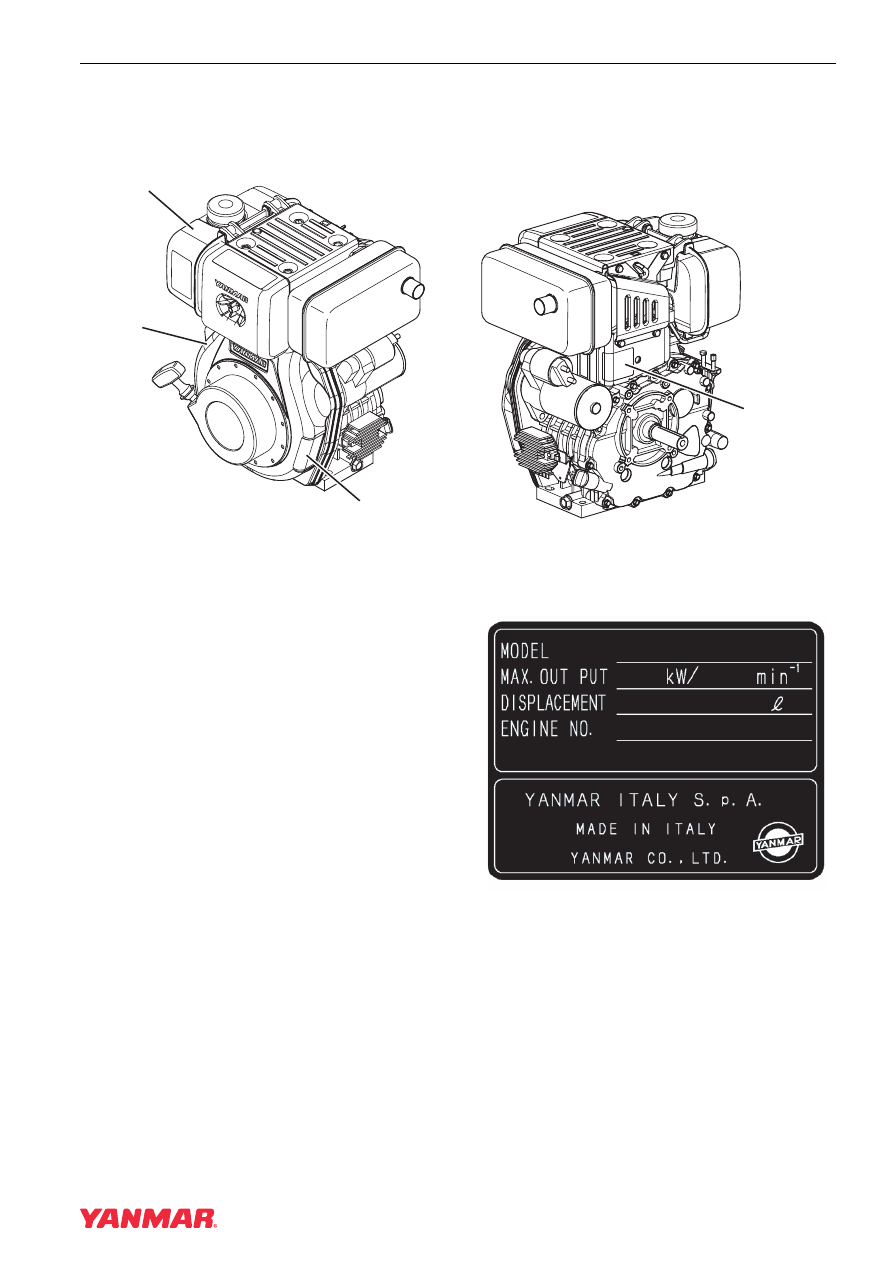
LOCATION OF LABELS

Figure 2 shows the location of regulatory and 
safety labels on Yanmar LV Series engines. 

Figure 2

The typical location of the emission control 
information label for LV Series engines is on the 
top of the fuel tank or on the flywheel cover 
(Figure 2, (1)).

• L48V, L70V and L100V (Figure 2, (1)) if engine 

is equiped with a Yanmar fuel Tank.

• L48V (Figure 2, (2)) if engine is not equiped 

with a Yanmar fuel Tank.

• L70V and L100V (Figure 2, (3)) if engine is not 

equiped with a Yanmar fuel Tank.

Typical location of the engine nameplate is shown 
(Figure 2, (4)).

Engine Nameplate (Typical)

0001126C

(2)

(3)

(4)

(1)

0001585

PRODUCT OVERVIEW

18

LV Operation Manual

EPA / ARB EMISSION 
CONTROL REGULATIONS - 
USA ONLY

Yanmar LV Series engines meet Environmental 
Protection Agency (EPA) (U. S. Federal) emission 
control standards as well as the California Air 
Resources Board (ARB, California) regulations. 
Only engines that conform to ARB regulations 
can be sold in the State of California.

Refer to the specific EPA / ARB installation 
(Page 64) and maintenance (Page 64) in the 
Periodic Maintenance section of this manual. 
Also refer to the Yanmar Co., Ltd. Limited 
Emission Control on page x
.

EMISSION CONTROL LABELS - 
USA ONLY

Since emission control regulations are being 
issued on a global basis, it is necessary to 
identify which regulations a particular engine 
complies with. We have listed several different 
types of labels you might find on your engine.

EPA / ARB Labels

For L100V (G2 mode engine)

For L70V & L100V (C1 mode engine)

For L48V (A.B.T. program)

PRODUCT OVERVIEW

LV Operation Manual

19

The 97/68/EC Directive Certified 
Engines

The engines described in this manual have been 
certified by the 97/68/EC Directive.

To identify the engines that meet this certification, 
the 97/68/EC emission control label is affixed on 
the engines.

ENGINE FAMILY

The EPA / ARB labels and the 97/68/EC label all 
have an Engine Family field. The following is an 
explanation of the Engine Family designation:

(97/68/EC)

97/68/EC DIRECTIVE

4 YDX L 0.22 D

1

N

Method of air aspiration

Number of cylinders

Combustion chamber design

Displacement (liter)

Non-road / Off-road engine

Yanmar Diesel

*2004 Model Year

4*: 2004

5: 2005

6: 2006

7: 2007

PRODUCT OVERVIEW

20

LV Operation Manual

FUNCTION OF MAJOR ENGINE COMPONENTS


Components

Functions

Air Cleaner

The air cleaner prevents airborne contaminants from entering the 
engine. Periodic replacement of the air cleaner filter element is 
necessary. See the Periodic Maintenance Schedule on page 65 for 
the replacement frequency.

Dynamo (Optional)

If the engine is equipped with the electric starting option, a dynamo 
is located between engine body and flywheel. The dynamo supplies 
electricity to the engine systems and charges the battery while the 
engine is running.

Electric Fuel Pump (Optional)

The electric fuel pump (if equipped) makes sure there is a constant 
supply of diesel fuel to the fuel injection pump. The electric fuel 
pump is electro-magnetic and runs on 12 VDC. 

Engine Oil Filter

The engine oil filter removes contaminants and sediments from the 
engine oil. Periodic cleaning of the oil filter is necessary. See the 
Periodic Maintenance Schedule on page 65 for the frequency of 
cleaning. 

Fuel Filters

Two fuel filters are provided to remove contaminants and 
sediments from the diesel fuel. The inlet fuel screen is located 
inside the fuel tank filler port. Since it uses a mesh construction, it 
can be cleaned. The outlet fuel filter is a replaceable cartridge that 
is located at the outlet of the fuel tank. Periodic cleaning / 
replacement is required. See Periodic Maintenance Schedule on 
page 65
.

Fuel Tank

The fuel tank is a reservoir that holds diesel fuel. When fuel leaves 
the fuel tank it goes to the fuel injection pump. Since fuel is used to 
keep fuel system components cool and lubricated, more fuel than is 
necessary for combustion enters the fuel system. Any fuel that is 
not used for combustion is returned to the fuel tank. The fuel tank is 
a required engine component. 

Oil Cap / Dipstick (Engine Oil)

The engine oil cap / dipstick combines the oil cap and dipstick in 
one assembly. The dipstick part of the assembly is used to 
determine the amount of engine oil in the crankcase.

Side Filler Ports
(Engine Oil)

You can fill the crankcase with engine oil from either side of the 
engine depending upon which one is most convenient.

Starter Motor (Optional)

If the engine is equipped with the electric starting option, the starter 
motor is powered by the battery. When you turn the key switch in 
the operator’s console to the START position, the starter motor 
engages with the ring gear installed on the flywheel and starts the 
flywheel in motion.


Content   ..  6  7  8  9   ..