Kawasaki Diesel MULE 4010 TRANS 4x4 (KAF950G9). Manual - part 16
 

  Index      Engines     Kawasaki Diesel MULE 4010 TRANS 4x4 (KAF950G9) - service manual


Search            


Content   ..  14  15  16  17   ..


Kawasaki Diesel MULE 4010 TRANS 4x4 (KAF950G9). Manual - part 16


2-42 PERIODIC MAINTENANCE

Periodic Maintenance Procedures

Steering

Steering Inspection

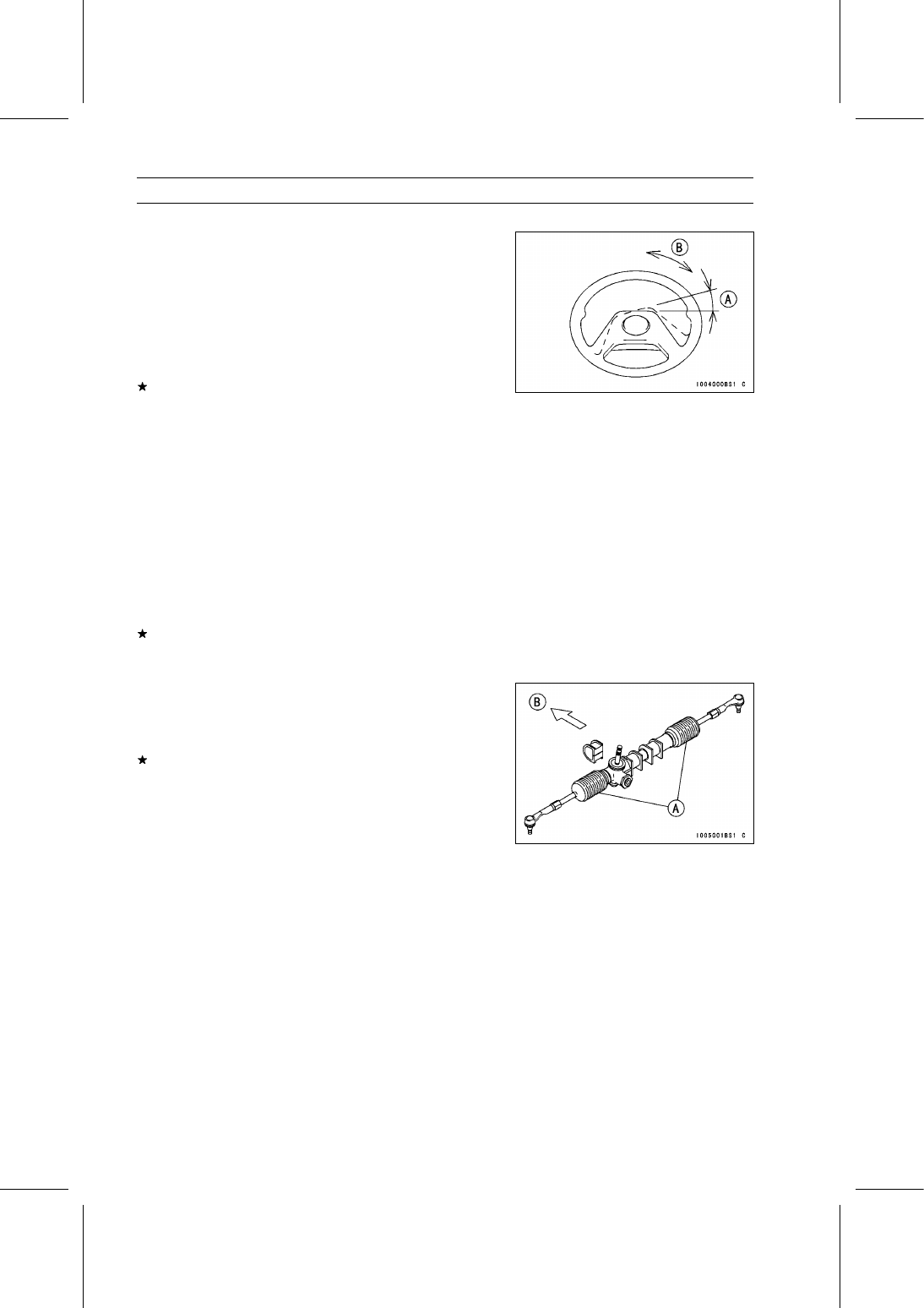
Check steering wheel free play [A].

Set the front wheels straight ahead. Gently turn [B] the
steering wheel left and right. The steering wheel free play
is the amount of travel in the steering wheel, before the
front wheels begin to turn.

Steering Wheel Free Play

Standard: 0

∼ 20 mm (0 ∼ 0.79 in.)

If steering wheel free play is not correct, inspect the fol-
lowing.

Steering Wheel Mounting Nut (see Steering Wheel Cen-
tering in the Steering chapter)
Universal Joint Clamp Bolts (see Exploded View in the
Steering chapter)
EPS Unit Mounting Bolts (see EPS Unit Installation in
the Steering chapter)
Steering Gear Assembly Bracket Bolts (see Steering
Gear Assembly Installation in the Steering chapter)
Steering Gear Assembly Mounting Rubber Dampers
Tie-Rod End Nuts (see Steering Gear Assembly Instal-
lation in the Steering chapter)
Steering Gear Preload Adjustment (see Steering Gear
Preload Adjustment in the Steering chapter)

If the inspections above are good but the free play is out
of the specified, the steering gear assembly is damaged
and should be replaced as a unit.

Steering Joint Dust Boot Inspection

Visually inspect the dust boots [A] at both the ends of the
steering gear assembly.

Front [B]

If there is any signs of deterioration, cracks, or damage,
replace the steering gear assembly together with these
boots.

PERIODIC MAINTENANCE 2-43

Periodic Maintenance Procedures

Frame

Seat Belt Inspection

Check the belts [A] for damage or tear.
If necessary, replace the belt with a new one.

Check the tightness torque of the seat belt mounting bolts
[B].

Torque - Seat Belt Mounting Bolts: 34 N·m (3.5 kgf·m, 25

ft·lb)

Seat Belt Buckle Mounting Bolts [C]: 34 N·m (3.5

kgf·m, 25 ft·lb)

Check the operation of the buckle [A].

Set the plate [B] in the buckle, and confirm the plate does
not come off when pulling it.

Set the plate in the buckle, and confirm the plate comes
off when the buckle button [C] is pushed.
If operation is not correct, visually inspect the plate.
If the plate is damaged, replace the plate assembly with
a new one.
If the plate is not damaged, replace the buckle assembly.

Electrical System

Electrolyte Level Inspection (Conventional Type

Battery)

WARNING

Electrolyte contains sulfuric acid which is harmful
to skin, eyes, and clothing.
Wear eye protection and rubber gloves.
If spillage occurs on body or clothing, rinse at once
with water for at least 15 minutes.

Remove the filler caps [A] on the battery.

Lift the side of the cap [B] opposite the terminals, and then
lift the side of the cap nearest the terminals.

2-44 PERIODIC MAINTENANCE

Periodic Maintenance Procedures

The electrolyte level should be between the upper and
lower levels.

Upper level is bottom [A] of the split ring [B].

Lower level is top of the plates [C].
If the level of electrolyte in any cell is below the lower level,
add only distilled water to the upper level of the cell.

NOTICE

Ordinary tap water is not a substitute for distilled
water and will shorten the life of the battery.
Do not fill into the split [D].
Do not overfill.

Electrolyte Specific Gravity Inspection

(Conventional Type Battery)

WARNING

Electrolyte contains sulfuric acid which is harmful
to skin, eyes, and clothing.
Wear eye protection and rubber gloves.
If spillage occurs on body or clothing, rinse at once
with water for at least 15 minutes.

Check battery condition by testing the specific gravity of
the electrolyte in each cell with a hydrometer.

Read the level [A] of the electrolyte on the floating scale
[B].

Specific Gravity

Standard: 1.265 at 20°C (68°F)

If the specific gravity is below 1.20 (charge 70%), the bat-
tery needs to be charged.

NOTE

The specific gravity of the electrolyte varies with
changes in temperature, so the specific gravity reading
must be corrected for the temperature of the electrolyte.

Celsius: Add 0.007 points to reading for each 10°C
(50°F) above 20°C (68°F) or subtract 0.007 points for
each 10°C (50°F) below 20°C (68°F)

Fahrenheit: Add 0.004 points to reading for each –12°C
(10°F) above 20°C (68°F) or subtract 0.004 points for
each –12°C (10°F) below 20°C (68°F)

If the specific gravity of any of the cells is more than 0.050
away from any other reading, the battery will probably not
accept a charge. It is generally best to replace a battery
in this condition.
If the specific gravity of all the cells is 1.265 or more, the
battery is fully charged.

PERIODIC MAINTENANCE 2-45

Periodic Maintenance Procedures

Charging Condition Inspection (Conventional

Type Battery)

Battery charging condition can be checked by measuring
battery terminal voltage.

Disconnect the battery terminal cables.

NOTICE

Be sure to disconnect the negative terminal cables
first.

Measure the battery terminal voltage.

NOTE

Measure with a digital voltmeter [A] which can be read
to 0.1 volt.

If the reading is below the specified, refreshing charge is
required.

Battery Terminal Voltage

Standard: 12.6 V or more

Terminal Voltage (V) [A]
Battery Charge Rate (%) [B]
Refresh charge is required [C]
Note [D]
Good [E]

Brake Light Switch Inspection

Check the operation of the brake light switch by depress-
ing the brake pedal. The brake light should go on after 10
mm (0.39 in.) of pedal travel [A].

If it does not, adjust the brake light switch [A] up or down.
To change the switch position, turn the adjusting nut [B].

Brake Light Switch Timing

Standard: ON after 10 mm (0.39 in.) of pedal travel

NOTICE

To avoid damaging the electrical connections in-
side the switch, be sure that the switch body does
not turn during adjustment.


Content   ..  14  15  16  17   ..