Yanmar marine engine 6LPA-STP2, 6LPA-STZP2. Manual - part 17
 

  Index      Engines     Yanmar marine engine 6LPA-STP2, 6LPA-STZP2 - service manual


Search            


Content   ..  15  16  17  18   ..


Yanmar marine engine 6LPA-STP2, 6LPA-STZP2. Manual - part 17


PERIODIC MAINTENANCE

6LPA Series Operation Manual

67

12/05

Perform the following maintenance every 
1000 hours or 4 years of operation, 
whichever comes first.

• Checking the Fuel Injection Timing

• Checking the Fuel Injector Pressure 

and Nozzle Spray Pattern

• Replacing the Seawater Pump Impeller 

• Adjusting Intake / Exhaust Valve 

Clearance


• Lapping the Intake and Exhaust Valves 

Checking the Fuel Injection Timing

See your authorized Yanmar Marine dealer 
or distributor.

Checking the Fuel Injector Pressure 
and Nozzle Spray Pattern

See your authorized Yanmar Marine dealer 
or distributor.

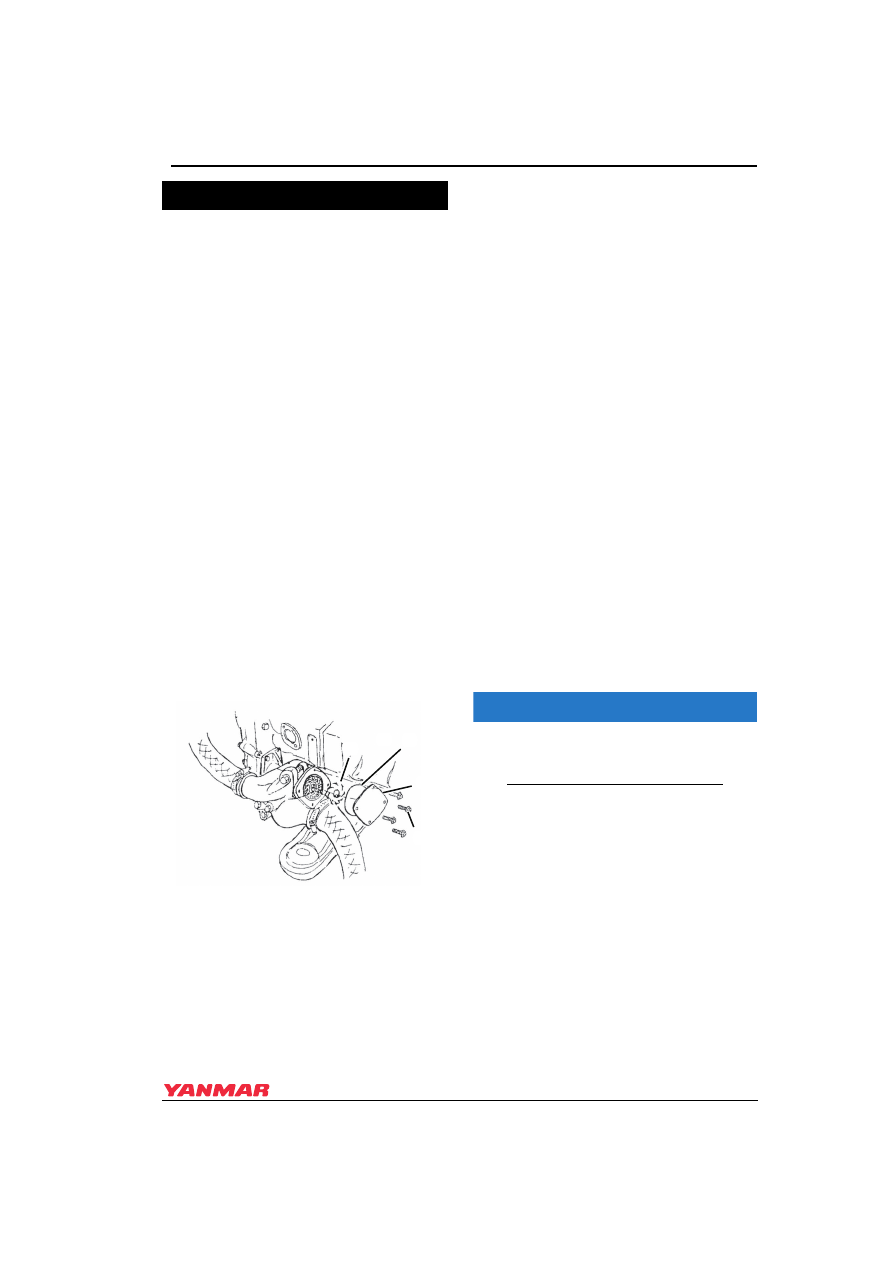
Checking or Replacing Seawater 
Pump Impeller

 Figure 17

Figure 17 

1 – Impeller
2 – O-Ring
3 – Cover
4 – Cover Bolts

1. Close the seacock.
2. Drain the seawater cooling system. See 

Drain Seawater Cooling System on 
page 74

.

3. Loosen the cover bolts and remove the 

cover and O-ring.

4. Inspect the inside of the seawater 

pump with a flashlight. If any of the 
following are found, disassembly and 
maintenance are required:
• Impeller blades are cracked or nicked. 

Edges or surfaces of the blades are 
marred or scratched.

• Wear plate is damaged.

5. If no damage is found when inspecting 

the inside of the pump, install the O-ring 
and cover.

6. If a large amount of water leaks 

continuously from the water drain line 
below the seawater pump during 
operation, replace the mechanical seal. 
See your authorized Yanmar Marine 
dealer or distributor.

7. When replacement is required, see 

your authorized Yanmar Marine dealer 
or distributor.

NOTICE

Replace the seawater pump impeller every 
1000 hours even if no damage is apparent.

Adjusting Intake / Exhaust 
Valve Clearance

See your authorized Yanmar Marine dealer 
or distributor.

Lapping the Intake and Exhaust 
Valve

See your authorized Yanmar Marine dealer 
or distributor.

Every 1000 Hours of Operation

(4)

(3)

(1)

(2)

0004914

PERIODIC MAINTENANCE

68

6LPA Series Operation Manual

Perform the following maintenance 
procedures every 1250 hours of operation 
or 5 years, whichever comes first.

• Cleaning the Cooling Water System
• Cleaning and Checking the Seawater 

Passage

• Cleaning and Checking the Fresh 

Water Cooling Water Passage

• Adjusting the Tension of the 

Alternator V-Belt

• Replacing the Timing Belt
• Washing Engine Oil Cooler
• Replacing the Front Rubber Damper

Cleaning the Cooling Water System

See your authorized Yanmar Marine dealer 
or distributor.

Cleaning and Checking the 
Seawater Passage

See your authorized Yanmar Marine dealer 
or distributor.

Cleaning and Checking the Fresh 
Water Cooling Water Passage

See your authorized Yanmar Marine dealer 
or distributor.

Adjusting the Tension of the 
Alternator V-Belt

See Checking and Adjusting the Alternator 
V-Belt Tension on page 66

.

Replacing the Timing Belt

See your authorized Yanmar Marine dealer 
or distributor.

Washing the Engine Cooler

See your authorized Yanmar Marine dealer 
or distributor.

Replacing the Front Rubber Damper

See your authorized Yanmar Marine dealer 
or distributor.

Every 1250 Hours of Operation

6LPA Series Operation Manual

69


TROUBLESHOOTING

SAFETY PRECAUTIONS

Before performing any troubleshooting 
procedures within this section, review the 
Safety

 section on page

3

.

If a problem occurs, stop the engine 
immediately. Refer to the Symptom column 
in the Troubleshooting Chart to identify the 
problem.

TROUBLESHOOTING 
AFTER STARTING

Just after the engine has started, check 
the following items at a low engine speed:

Is sufficient water being discharged 
from the seawater outlet pipe?

If the discharge is low, stop the engine 
immediately. Identify the cause and repair.

Is the smoke color normal?

The continuous emission of black exhaust 
smoke indicates engine overloading. This 
shortens the engines life and should be 
avoided.

Are there abnormal vibrations or noise?

Depending on the hull structure, engine 
and hull resonance may suddenly increase 
at certain engine speed ranges, causing 
heavy vibrations. Avoid operation in this 
speed range. If any abnormal sounds are 
heard, stop the engine and inspect for 
cause.

Alarm sounds during operation.

If the alarm sounds during operation, lower 
the engine speed immediately, check the 
alarm lamps and stop the engine for 
repairs.

TROUBLESHOOTING

70

6LPA Series Operation Manual

Is there water, oil or fuel leakage? Are 
there any loose bolts or connections?

Check the engine room daily for any leaks 
or loose connections.

Is there sufficient fuel in the fuel tank?

Refill fuel in advance to avoid running out 
of fuel. If the tank runs out of fuel, bleed 
the fuel systemSee Bleeding the Fuel 
System on page 29

.

When operating the engine at low speed 
for long periods of time, race the engine 
once every 2 hours. Racing the engine 
with the clutch in NEUTRAL, accelerate 
from the low-speed position to the 
high-speed position and repeat this 
process about five times. This is done to 
clean out carbon from the cylinders and 
the fuel injection valves.

NOTICE

Neglecting to race the engine will result in 
poor smoke color and reduce engine 
performance.

Periodically operate the engine near 
maximum speed while underway. This will 
generate higher exhaust temperatures, 
which will help clean out hard carbon 
deposits, maintain engine performance 
and prolong the life of the engine.

TROUBLESHOOTING 
INFORMATION

If the engine does not operate properly, 
refer to the Troubleshooting Chart on page 
71 

 or see your authorized Yanmar Marine 

dealer or distributor.

Supply the authorized Yanmar Marine 
dealer or distributor with the following 
information:

• Model name and serial number of your 

engine

• Boat model, hull material, size (tons)

• Use, type of boating, number of hours 

run

• Total number of operation hours (refer to 

hourmeter), age of boat

• The operating conditions when the 

problem occurs:

• Engine speed (min

-1

)

• Color of smoke
• Type of diesel fuel
• Type of engine oil
• Any abnormal noises or vibration
• Operating environment such as high 

altitude or extreme ambient 
temperatures, etc.

• Engine maintenance history and 

previous problems

• Other factors that contribute to the 

problem


Content   ..  15  16  17  18   ..