Technology of watch production - part 85
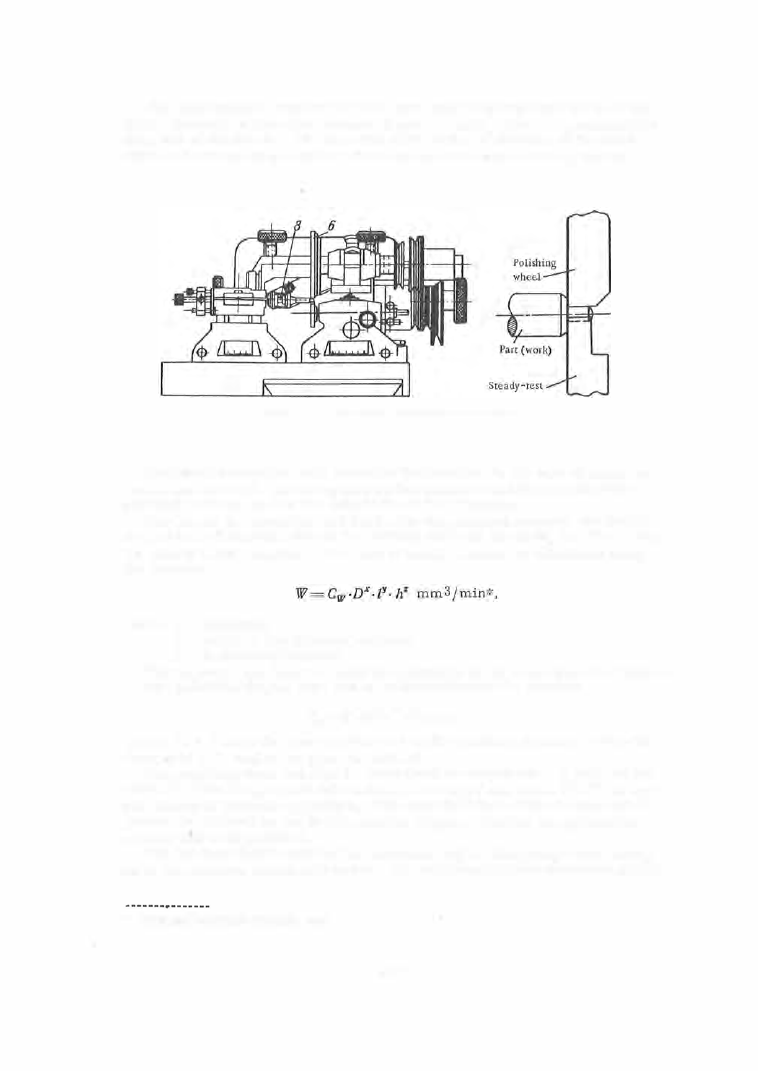
The work spindle revolves at 3 5 0 0 rpm , and the peripheral speed of the
pinion journals is therefore between 2 and 6 m
/
min, which is much smaller
than that or the wheel . The reversal of the s ense of rotation of the work
spindle therefore only slightly influences the resultant polishing speed.
FIGURE 11. Position of the work in the S-8a machine
The basic production- rate index for the machine is the rate of metal re
moval (pe r minute ), which depends on the diameter and the length of the
polished surface, and on the magnitude of the allowance .
The larger the diam eter and the longe r the polished surface , the large r
the surface of contact between the carbide ring and the work, and the higher
the rate of metal removal . The rate of metal removal is calculated using
the formula
where
D
=
diam eter;
l
=
length of the polished s urface;
h
=
diameter allowance;
The values of the factor
Cw
and the exponents
x,
y,
.
z
are given in Table 6 .
The polishing (basic ) time can b e calculated using the formula
TP
=
Cr · D0 · lb · he
min':' ,
where
D, l,
h
have the same meaning as in the previous fo rmula, while the
exponents a, b, and c are given in Table 6 .
The polishing time can also b e taken from the s tandards . A table o f the
polishing time for journals with 0 . 0 1 mm allowance and class \l\7\TV 1 2 sur
face finish is given in Appendix 8. The spherical face of the balance s taff
journal is polished on the S - 1 3 3 machine (Figure 1 2 ) after the cylindrical
surface has been polished.
The balance staff is held in the headstock and on the s teady - rest exactly
as in the machine considered above . The polishing is performed by a carbide
•
Otgmashpribor Institute standards, 1954 .
3 3 7