Technology of watch production - part 86
 

  Index      Books     Technology of watch production (Tarasov) 1964 year


Search            


Content   ..  84  85  86  87   ..


Technology of watch production - part 86


,/>. 

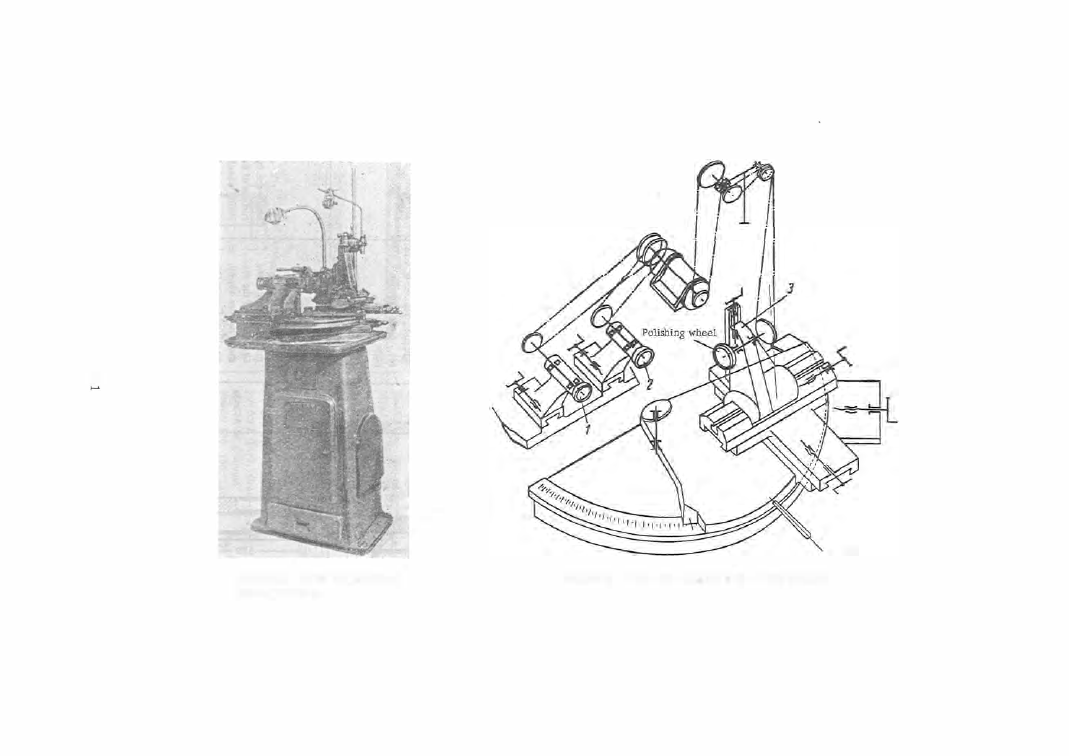
FIGURE 14 .  S-196 

carbide  wheel 

dressing machine 

FIGURE 15. 

Kinematic diagram 

of 

the 

S-196 

machine 

Draw ings 

TABLE  7 

Range  of use  of diamond wheels 

Index 

ASh-1 

ASh-1a 

ASh-3 

ASh-3a 

Description 

Body  and base-molding 

power  K-18-2 GOST 

5689-51.  Diamond grain 

size 180,  320 ,  M20, M14, 
M7.  Concentration 

5 0 "/o,  40"/o. 

Body- aluminum,  base 

material-compound . 

Grain  size  of the  dia­

mond powder 46,  60, 

90,  120.  Concentration 

100 "/o  and  50 "/o. 

Body  and  base-molding 

powder K-18-2 GOST 
5689-51.  Grain size  of 
the  diamond  powder  180, 
220, 280, 320 ,  M20, M14, 
M7.  Concentration 

5 0 "/o,  40"/o. 

Body- aluminum,  base 

material-compound. 

Grain size of the dia­
mond powder 46,  60, 
90,  120.  Concentra­
tion  50 "/o,  40 "/o. 

342 

Application 

Face cutting of  carbide 

polishing wheels,  finish 

grinding  of punches, 

gages,  etc. 

Cutting the cylindrical 

surface  of carbide pol­

ishing wheels.  Roughing 
of carbide  tools. 

Face cutting  of carbide 

polishing  wheels,  finish 

grinding  of pu.nches, 

gages,  etc. 

Cutting the cylindrical 

surface of carbide pol­
ishing wheels.  Rough­
ing of carbide  tools. 

Drawings 

Diamond layer 

Index 

ASh-4 

and 

ASh-4a 

Description 

Body-aluminum,  base 

material- molding pow­
der K -18-2  for  ASh-4, 

compound for ASh-4a. 
Grain size of the dia­

mond powder 280, 320, 
M20,  M14,  M7 for 
ASh-4,  46,  90, 120 

for ASh-4a.  Concen­

tration 1 0 0 "/o,  50"/o. 

Body - aluminum,  base 

material - molding­

powder K-18·2.  Grain 

size  of the  diamond pow­

der  280,  320 ,   M20 ,  

M14,  M7.  Concentra­
tion:  1 0 0 "/o. 

Body  and  base - molding 

powder K-18-2.  Grain 
size  of the  diamond 
powder 280,  320,  M20, 
M14 ,  M 7 .  Concentra­
tion 5 0 "/o,  40"/o. 

Body  and base - molding 

powder K-18-2.  Grain 
size of the  diamond 
powder  120,  180,  220, 
280, 320.  Concentra­

tion  1 00 "/o,  50 o/o. 

343 

TABLE  7  (cont'd) 

Application 

Preliminary  and final 

grinding of right-hand 

and left-hand tools 

with carbide bits, 

finish grinding of gages. 

Finish  grinding of con­

tour templates  and 
contour tools. 

Finish grinding of 

center punches  and 

and  measuring 
standards. 

Finish grinding of the 

holes  in  carbide  tools. 

dies,  bushings,  etc. 

The bakelite bond  is  suitable  for diamond  powder of any  grain  size, 

beginning with number 4 6  and ending with number  M - 3 . 5 .   The  cermet bond 
is  suitable for diamond powder of grain  size  numbe r   1 2 0  maximum;  it ra­

pidly loses  its  abrasive  properties  with  a  grain  size above  1 50,  due  to 

loading.  The metal  chips which cause the loading are  removed by  etching. 

This  phenomenon is not  observed  in bakelite -bonded wheels but their life 

is  s om ewhat  shorter than that of the  cermet wheels .  

Bakelite -bonded diamond wheels  are manufactured by  the  m ethod  of hot 

m olding.  A  mixture  of bakelite  and  diamond  grains  is  first poured into  the 

press  mold,  and pure  bakelite  powder is  then poured over it. 

Cermet-bond diamond wheels  are manufactured in the  following manner. 

Cermet powder is  poured into the  press  mold,  leveled and premolded.  A 

mixture  of  cermet powder and  diamond  grains  is  next poured and  the  whole 

is  now press ed .   To prevent burning-down of the  diamond,  a  layer  of  gra­

phite  is  poured  into  the  p ress  mold above  the  diamond layer.  The  pressed 

ring is  baked  in an oven at 800 to 8 2 0°  for 20 to  25 min. 

The  ring thus  obtained is fixed  on a  body,  and fastening of the ring by 

pins  and  drilling  (see Table  7  A Sh-1a and A Sh- 3a) is  performed in place. 

Low- grade  diamond,  called  "bort",  is used in diamond  wheels .  Bort 

is  extracted in the  form  of  chips  with  blunt  edge s ,   and  i s  crushed in por­

celain or metal  mortars  into  fine parts in order to obtain sharp -edged grains 

and to make  the  diamonds  abrasive .  The  grains are  subsequently  classified 

and s eparated into  grinding and polishing powders . 

TABLE 

Surface  quality  obtained 

as 

a  function of the  diamond  grain size 

Diamond grain size, 

Surface-finish 

according to GOS T 

Grain  size, 

f' 

class, 

GOST 

Application 

3647-47 

2789-51 

46 

42G-355 

Rough grinding. 

Cutting the cylindrical sur-

faces of carbide polishing wheels. 

90 

18G-150 

Grinding. 

Cutting the cylindrical surfaces 

of carbide polishing wheels  and  rough 

grinding  of carbide  tools. 

120 

1  5-105 

Grinding. 

Cutting the  face of carbide pol-

ishing wheels and preliminary  grinding of 

cutters. 

180 

85-63 

1 0  

Fine  grinding. 

Cutting the face of carbide 

220 

75-53 

1 0  

wheels  and finish-grinding screw  machine 

tools. 

280 

53-28 

11 

Lapping. 

Finish-grinding  of screw  machine 

320 

42-20 

12 

tools,  templates,  gages. 

F l o u r s  

M-28 

28-20 

12 

Polishing. 

Finish-grinding of contoured  tools, 

M-20 

2G-14 

templates,  gages. 

M-14 

14-10 

13 

Fine polishing. 

M-7 

7- 5 

M-3.5 

3 .5-1.5 

14 

Finish-lapping of measuring standards. 

344 


Content   ..  84  85  86  87   ..