Military reference books and manuals (2009-2023, Volume 5) - page 6
NATO-UNCLASSIFIED
MXP-1(D)(NAVY)(AIR)
D
Data Forms
6-5
Definitions
1-3
Depth Changes
Through Zones Assigned to Other Subs
4-7
Depth Limitation Chart
2-12
Depth Restrictions
Decoy
2-13
Depth Table
3-2
Distress Signals
Aircraft/Surface
5-3
Diving Message
5-4
Diving Procedures
2-45
E
Electronic Sound Underwater Signals
2-33
Emergencies
Aircraft
2-5
Aircraft Distress Signals
5-18, 5-20
During Exercise
2-5
Emergency Surfacing
2-6
Submarine
2-6
ESUS
2-33
ESUS MK 84
5-16
Exercise
Analysis
1-2
Command and Control
1-2
Confined Waters
2-54
Instruction Table
3-2
Instructions
3-2
Ordering
3-1
Records
6-1
Report Data Forms
6-5
Restrictions
2-41
Standard
3-1
Stovepipes
2-31
Explosive Charge Signals
5-1, 5-7
Explosive Charges
2-34
Explosive SUS Table
2-34
F
Fishing Vessel Avoidance
2-4
FORMEX
CASEX A
6-9
CASEX B
6-11
CASEX C
6-18
G
Gridlock
4-6
Index-2
ORIGINAL
NATO-UNCLASSIFIED
NATO-UNCLASSIFIED
MXP-1(D)(NAVY)(AIR)
H
Helicopter Sonar
Safety Precautions
2-16
HOOKER Procedure
2-4
I
Identification of Submarines
5-5
Impact Restrictions
2-43
L
Lookouts
2-14
M
MARK - SNAP Ranging
5-21
Marked Submarine
4-2
Marking Attacks
4-9
Method ALFA Surfacing
2-47
Method BRAVO Surfacing
2-50
Minimum Water Depth
4-5
Mutual Separation
2-2
N
Neutral Corridor
2-20
Night Exercises
2-45
O
Operating Restrictions
2-1
P
Participating Submarines
Minimum Requirements
4-1
Procedures
HOOKER
2-4
Surfacing
2-46
Unidentified Submarine
2-51
Pyrotechnic Signals
5-2
Pyrotechnics Table
5-6
R
Range
MARK - SNAP Method
5-21
Records
4-1
Records and Analysis
6-1
Relaxation Table
3-10
Index-3
ORIGINAL
NATO-UNCLASSIFIED
NATO-UNCLASSIFIED
MXP-1(D)(NAVY)(AIR)
Relaxations
3-2
Restrictions
1-4
Restrictions
Attack
2-34, 2-41
Decoy Depth
2-13
Safe Depth
2-8
Restrictions
1-4
Night ASW Exercises
2-45
Submarines as Impact Targets
2-43
S
Safety
2-1
Aircraft Safety
2-15
Changing Depth Signals
4-9
Helicopter Sonars
2-16
Lookouts
2-14
Responsibilities
2-2
Safety Bearing
4-2
Safety Circle
4-2, 4-4
Safety Line
4-3, 4-4
Towed Decoys
2-16
VDS/Towed Array Safety Precautions
2-17
Safety Precautions
2-15
Safety Rules
4-5
Safety Separation
2-7
Safety Zone
4-5
Security
1-1
Shallow Water Exerises
2-8
Ship Noise
2-14
Signal
Sonar Codes
5-13
Signals
2-15
Aircraft Distress
5-18, 5-19, 5-20
Aircraft Manoeuvre
5-17
Brevity Codes
6-6
Changing Depth Safety Signals
4-9
Diving/Surfacing/Check Reports
5-4
Electronic SUS
2-33
ESUS
5-16
Explosive Charge Signals
5-7, 5-8, 5-9
Pyrotechnic Signals
5-2
Safety and Control
5-2
Sonar Signal Codes
5-2
Special
5-3
SST/UWT Signals
5-10
Submarine Attack Signals
5-3
Submarine Pyrotechnics
5-10
Submarine Track Message
6-4
SUS
5-7, 5-8, 5-9
Target Data Message
6-5
Target Data Message Codes
6-7, 6-8
Index-4
ORIGINAL
NATO-UNCLASSIFIED
NATO-UNCLASSIFIED
MXP-1(D)(NAVY)(AIR)
Torpedo Attack
5-17
Underwater Telephone (UWT)
4-7
SITUATION Report
2-52
Sonar Signal Code Table
5-13
Sonar Signal Codes
5-2
Special Signals
5-3
Specifications
Towed Array
2-25
VDS
2-24
Standard Exercises
3-1
Stop Time
2-51
Submarine Track Message
6-4
Submarine(s)
Acoustic Equipment Requirements
2-11
Attack Claims
6-3
Collision Avoidance
4-4
Coordinated Operations
4-10
Course and Speed Diagrams
3-3
Depth Limitation Chart
2-12
Depth Tables
3-2
Diving Procedures
2-45
Emergencies
2-6
Fishing Vessel Avoidance
2-4
Identification
5-5
Pyrotechincs Table
5-6
Pyrotechnic Signals
5-2
Safety and Control Signals
5-2
Surfacing in an Emergency
2-6
Surfacing Procedures
2-46
Track Message
6-4
Uncle Joe Procedures
5-5
Unidentified Submarine During Exercises
2-51
Surfacing
Method ALFA
2-47
Method BRAVO
2-50
Procedures
2-46
Surfacing Messages
5-4
SUS
2-31
T
Tactical Analysis
6-2
Target Data Message
6-5
Target Data Message Codes
6-7, 6-8
Torpedo Attack Signals
5-17
Torpedo Firing
4-9
Towed Array Specifications
2-25
Towed Decoys
Safety Precautions
2-16
Training
1-1
Transit Lane
4-3, 4-5
Transit Position
4-3
Index-5
ORIGINAL
NATO-UNCLASSIFIED
NATO-UNCLASSIFIED
MXP-1(D)(NAVY)(AIR)
U
Underwater Signal Codes
ESUS
5-16
Explosive Charge Signals
5-1, 5-7
SONAR
5-2
SST/UWT Signals
5-13
SUS
5-1
Underwater Telephone (UWT)
2-14
Unknown Submarine
2-51
V
VDS Specifications
2-24
VDS/Towed Array
Authorization Table
2-23
Safety Precautions
2-17
Visibility Requirements
2-10
Index-6
ORIGINAL
NATO-UNCLASSIFIED
NATO-UNCLASSIFIED
MXP-1(D)(NAVY)(AIR)
List of Effective Pages
Page Number
Issue
Page Number
Issue
3-C4-1 to 3-C4-2
Change 4
I(RB)
Original
3-C5-1 to 3-C5-2
Original
III(RB)
Original
3-C6-1 to 3-C6-3(RB)
Change 4
V to VII(RB)
Original
3-C7-1 to 3-C7-2
Original
IX to X
Original
3-C8-1 to 3-C8-2
Original
XI to XVI
Change 5
3-C9-1 to 3-C9-3(RB)
Original
1-1 to 1-2
Original
3-C10-1(RB)
Original
1-3 to 1-4
Change 5
3-C11-1(RB)
Original
2-1 to 2-4
Change 4
3-C12-1 to 3-C12-3(RB)
Change 4
2-5 to 2-58
Change 5
3-D1-1 to 3-D1-2
Original
3-1 to 3-4
Change 4
3-D2-1 to 3-D2-3(RB)
Original
3-5 to 3-8
Original
3-D3-1 to 3-D3-2
Original
3-9 to 3-10
Change 3
3-D4-1 to 3-D4-4
Change 1
3-11 to 3-16
Change 4
3-D5-1 to 3-D5-4
Change 1
3-17 to 3-48
Original
3-E1-1 to 3-E1-2
Original
3-A1-1(RB)
Original
3-E1-A-1(RB)
Original
3-A2-1 to 3-A2-2
Original
3-E1-B-1(RB)
Original
3-A3-1 to 3-A3-2
Original
3-E2-1 to 3-E2-2
Original
3-A4-1 to 3-A4-2
Original
3-E3-1 to 3-E3-2
Change 5
3-A5-1 to 3-A5-2
Original
3-E4-1 to 3-E4-2
Original
3-A6-1 to 3-A6-2
Change 4
3-E5-1 to 3-E5-4
Original
3-A7-1 to 3-A7-2
Original
3-E6-1 to 3-E6-2
Original
3-A8-1 to 3-A8-2
Original
3-E7-1 to 3-E7-2
Original
3-A9-1 to 3-A9-2
Change 4
3-E8-1 to 3-E8-2
Change 4
3-A10-1 to 3-A10-3(RB)
Change 4
3-E9-1 to 3-E9-3(RB)
Original
3-A11-1 to 3-A11-2
Original
3-F1-1 to 3-F1-2
Original
3-A12-1 to 3-A12-2
Original
3-F2-1 to 3-F2-3(RB)
Original
3-A13-1 to 3-A13-2
Original
4-1 to 4-10
Original
3-A21-1(RB)
Original
4-S1-1 to 4-S1-2
Original
3-A22-1 to 3-A22-2
Original
4-S2-1 to 4-S2-3(RB)
Original
3-A23-1(RB)
Change 4
4-S3-1 to 4-S3-2
Original
3-A24-1(RB)
Original
4-S4-1 to 4-S4-2
Original
3-B1-1 (RB)
Original
4-S5-1 to 4-S5-2
Original
3-B2-1(RB)
Original
4-S6-1 to 4-S6-3(RB)
Original
3-B3-1(RB)
Change 4
4-S7-1 to 4-S7-4
Original
3-B4-1 to 3-B4-3(RB)
Original
4-S8-1 to 4-S8-2
Original
3-B5-1 to 3-B5-2
Original
4-S9-1 to 4-S9-3(RB)
Original
3-B6-1(RB)
Original
4-S10-1 to 4-S10-2
Original
3-B7-1 to 3-B7-2
Change 4
4-S10-A-1(RB)
Original
3-C1-1(RB)
Original
4-S11-1 to 4-S11-2
Change 3
3-C2-1 to 3-C2-2
Original
5-1 to 5-4
Original
3-C3-1 to 3-C3-2
Original
5-5 to 5-6
Change 2
LEP-1(RB)
CHANGE 5
NATO-UNCLASSIFIED
INTENTIONALLY BLANK
NATO-UNCLASSIFIED
MXP-1(D)(NAVY)(AIR)
Page Number
Issue
Page Number
Issue
5-7 to 5-8
Original
5-9 to 5-10
Change 3
5-11 to 5-12
Change 4
5-13 to 5-14
Original
5-15 to 5-16
Change 4
5-17 to 5-21 (RB)
Original
6-1 to 6-2
Change 3
6-3 to 6-21(RB)
Original
Glossary-1 to Glossary-4
Change 4
Glossary-5 to Glossary-7(RB)
Original
Index-1 to Index-6
Original
LEP-1(RB)
Change 5
LEP-3(RB)
Change 5
LEP-3 (RB)
CHANGE 5
NATO-UNCLASSIFIED
INTENTIONALLY BLANK
Afghanistan National Army
ANA 7-10.1
THE INFANTRY RIFLE
COMPANY
(Part 1)
15 October 2006

CHAPTER 1
COMPANY ORGANIZATION
1-1. A rifle company can be part of a light infantry, commando, or mechanized infantry kandak.
Each rifle company and commando company can be organized differently, but all are similar in
size, number of platoons, and capabilities.
a. A light infantry rifle company consists of a headquarters section, three rifle platoons, and a
mortar section (Figure 1-1).
OFF
EM
LT
5
135
Co HQ
MORTAR
RIFLE PLT
82mm
OFF EM
SEC EM
OFF EM
2
3
1
41
0
9
KEY WEAPONS
PLT HQ
RIFLE SQD
WEAPONS SQD
9- PKM
OFF EM
OFF EM
OFF EM
1
1
0
11
0
7
2- AGS-17
2- 82 mm
Figure 1-1. Light Infantry Company
b. Mechanized and Commando Infantry companies are organized around their respective
equipment, but fight IAW standard infantry tactics in this manual.
MISSION
1-2. The mission of any infantry rifle company is to close with the enemy by means of fire and
maneuver to destroy or capture him, or to repel his assault by fire, close combat, and counterattack.
1
EMPLOYMENT CONSIDERATIONS
1-3. The basic considerations for employing infantry companies result from the organization,
equipment, and capabilities of these units. Other capabilities result from a unit's training
program, leadership, morale, personnel strengths, and many other factors. These other
capabilities constantly change, depending on the current status and situation. The infantry
leader must be aware of them and plan accordingly. The capabilities and special
considerations for all infantry companies are as follows:
a. Capabilities.
(1) Conduct offensive and defensive operations in all types of environments, primarily
at night. Specific tasks include the following:
● Seize, secure, occupy, and retain terrain.
● Destroy, neutralize, suppress, interdict, disrupt, block, channel, and fix
enemy forces.
● Breach enemy obstacles.
● Deceive the enemy.
● Screen and guard friendly units.
● Reconnoiter, deny, bypass, clear, contain, and isolate. (These tasks may be
oriented on both terrain and enemy.)
(2) Conduct small-unit operations.
(3) Participate in air assault operations.
(4) Participate in airborne operations (commando companies).
(5) Operate in conjunction with heavy or special forces.
b. Special Considerations.
(1) Austere Combat Support (CS) and CSS assets.
(2) Limited vehicle mobility.
(3) Vulnerable to enemy armor, artillery, and air assets.
IMPERATIVES
1-4. ANA doctrine is based upon the Principles of War leaders at every level should know
and understand these principles. These imperatives were derived from the principles of war.
These imperatives prescribe key operating requirements and provide more specific guidance
than the principles of war. The 10 imperatives apply in all operations.
a. Ensure Unity of Effort. Leaders in the rifle company provide purpose, direction, and
motivation to their soldiers. The company's mission and how he supports it must be clearly
understood by every soldier in the unit. Plans are kept simple, and control measures are easy
to understand, apply, and communicate. Each subordinate's concept or plan fits within the
next higher leader's plan. A main effort is always clearly designated. All actions throughout
the unit must ensure the success of the main effort.
b. Anticipate Events on the Battlefield. To maintain or gain the initiative, a rifle
company commander must anticipate the enemy's action. Failure to do so results in the
commander reacting to the enemy's actions throughout the fight. The ability to effectively
2
anticipate enemy actions depends on the commander’s knowledge of the enemy's doctrine,
tactics, and weapons, and the commander's experience gained from fighting that enemy.
c. Concentrate Combat Power Against Enemy Weaknesses. The rifle company
commander must have enough knowledge of the enemy to determine his vulnerabilities and
weaknesses. The concentration of fires/effective maneuver can also create enemy weaknesses.
Once weaknesses are identified or created, the rifle company commander must have a plan to
quickly exploit them. At company level, enemy weaknesses may be of short duration and
easily corrected by the enemy commander.
d. Designate, Sustain, and Shift the Main Effort. The subordinate unit with the most
important task in the commander's concept is designated the main effort for the company. The
commander concentrates all of his resources to ensure the quick success of this unit. During
the fight, the actions of the main effort provide focus, orientation, and synchronization to all
other subordinate units. If the main effort does not succeed or a more lucrative enemy
weakness develops, the commander must quickly shift the orientation of the main effort or
shift the main effort to another subordinate unit.
e. Press the Fight. The commander's plan should be aggressive and offensively
oriented. Once the fight begins, the rifle company commander must be persistent in the
pursuit of accomplishing his mission. When the enemy is off balance, the company must
maintain or increase the pressure to prevent the enemy from recovering. The commander is in
a position to personally lead and motivate his men in the decisive action. A well-trained,
physically tough rifle company led by capable leaders can increase the tempo when the fight
hangs in the balance.
f. Move Fast, Strike Hard, and Finish Rapidly. Infantry companies must be capable
of fast, dispersed movements followed by a rapid concentration of combat power at a decisive
location. The violent attack on the enemy should be directed at enemy weaknesses and from
an unexpected direction. Once completed, the unit disperses again to avoid the enemy's
counterattack.
g. Use Terrain, Weather, Deception, and Operational Security (OPSEC). Terrain
and weather significantly impact on a rifle company's operations. The commander should be
expert at land navigation. He must understand the ability of the terrain to support maneuver,
provide protection, and support the employment of all organic weapon systems. The
commander who uses the terrain and weather better than his enemy to gain a combat
multiplier. The commander's personal reconnaissance helps him understand the effects the
environment can have on both forces. Deception operations are planned above company level,
but the rifle company commander often uses simple deception tasks or actions to confuse or
mislead the enemy. Operations security is continuous for an infantry rifle company. The
commander denies the enemy useful information on his unit.
h. Conserve Strength for Decisive Action. The company commander protects his
unit's combat potential. He ensures that in each fight he brings the maximum combat power to
bear on the enemy. He identifies risks and reduces them without unnecessarily taking
resources away from his main effort. He reduces his soldiers' loads and ensures his company
is organized and trained to conduct continuous operations.
i. Combine Arms to Complement and Reinforce. A rifle company commander must
be a proficient combined arms' warrior. He is the combined arms integrator who is closest to
the fight. Therefore, he must be expert in employing not only his organic assets but also the
resources and weapons that may support a rifle company. These may include SPG-9’s, tanks,
field artillery, and engineers.
j. Understand the Effects of Battle on Soldiers, Units, and Leaders. The infantry
company commander must ensure that his unit is trained to withstand the rigors of the modern
3
battlefield. He should know his men before entering the fight. Once in battle, he monitors the
condition of his men and sustains the unit's effectiveness. Well-trained, physically fit soldiers
in cohesive units retain the qualities of tenacity and aggressiveness.
BATTLEFIELD OPERATING SYSTEMS
1-5. The seven battlefield operating systems allow the commander to analyze the various
functions of his unit in battle. His plan integrates each of these systems to effectively
accomplish his mission.
a. INTELLIGENCE SYSTEM. The rifle company commander depends on
intelligence from higher headquarters to conduct operations. However, the company
commander can collect critical information required to complete his plan. This requires an
aggressive, continuous reconnaissance effort conducted by small units moving undetected
close to enemy forces. His company also assists in the kandak's intelligence collection effort.
He does this by assigning his platoons specific reconnaissance or security tasks. Organic
equipment, such as optical sights, enhance the companies ability to collect information on the
enemy. Additional assets, such as the kandak's scout platoon may support the company.
b. MANEUVER SYSTEM. The primary maneuver asset of a rifle company
commander is the rifle platoon. The three assigned platoons provide him the ability to
maneuver independently. The maneuver or positioning of these units allows him to bring
firepower to bear on the enemy. The commander must know the capabilities of his platoons;
he also maneuvers the mortar section to bring the effects of its fires on the enemy. The
commander must develop an understanding for the movement rates of his units across all
types of terrain. At times, the rifle company will receive additional maneuver assets such as
tanks or other infantry platoons. The direct-fire capabilities of these maneuver assets are
considered part of the maneuver system.
c. FIRE SUPPORT SYSTEM. The primary fire support system for the rifle company
is the mortar section. These assets provide the commander an organic, indirect-fire support
resource immediately responsive to the company's request for fires. The commander must
know the capabilities and limitations of these assets and integrate their fires in every
operation. Normally, the company will also have field artillery support available. The
company has a fire support team (FIST) habitually attached to his company. The company fire
support officer (FSO), in charge of the FIST, assists the commander with the indirect fire
support planning and execution. The forward observers (FOs) with each platoon also plan and
coordinate fire support, locate targets, and request and adjust fires to support the platoon
leader's concept.
d. MOBILITY, COUNTERMOBILITY, AND SURVIVABILITY SYSTEM. Even
without augmentation, the infantry company has significant engineering capabilities. Digging
fighting positions, constructing obstacles, preparing minefields, and breaching or reducing
enemy obstacles are all unit measures the rifle company may be responsible for. At times, the
infantry company is supported by engineer units and equipment. Although the commander
may rely on the engineer leaders recommendations, he must understand the capabilities of the
engineer units and equipment. He prioritizes the work and ensures the engineering effort
supports the friendly schemes of maneuver and fire plans.
e. AIR DEFENSE SYSTEM. The rifle company commander's primary means of air
defense are passive measures that prevent the enemy from detecting and engaging his
company. Moving during limited visibility and using all available cover and concealment and
effective camouflage are the primary passive measures infantry companies employ. The
company can also defend itself from air attack using organic direct-fire systems. The
company must be well trained in the techniques for employing small-arms fire against enemy
4
aircraft. The soldiers must also know under what conditions they have the freedom to engage
enemy aircraft.
f. COMBAT SERVICE SUPPORT SYSTEM. Infantry rifle companies have an
austere supporting Combat Service Support (CSS) structure -some organizations are more
austere than others. The sustainment of his company in combat is one of the greatest
challenges facing every rifle company commander. He must be innovative in his techniques
of resupply and casualty treatment and evacuation. The company executive officer, Company
Sergeant, and supply sergeant are key players in the company's CSS system. The
maintenance program within the company must be effective and continuous, and must have
leader involvement at every echelon. (A detailed discussion of CSS for the infantry company
is found in ANA 7-10.7.
g. COMMAND AND CONTROL SYSTEM. The command and control system
consists of the activities and procedures employed by the commander to plan, direct,
coordinate, and control the company. It includes the personnel and equipment that assist the
commander with command and control. The commander employs his unit following
guidance and orders received from kandak. He delegates authority to his subordinates and
clearly assigns their responsibilities. The company executive officer (XO) is the second in
command and is employed in that role to assist the company commander. The company
commander does not restrict his subordinate’s freedom of action with unnecessary control
measures. He uses mission-type orders and trains his subordinates to operate within the
framework of his concept. He clearly states his intent so every member of his unit can
effectively use their initiative. A commander must be proficient at analyzing a situation to
develop a plan that has the greatest chance of accomplishing his mission with the least cost in
lives and equipment.
5
CHAPTER 2
COMMAND AND CONTROL
Section I. COMMAND AND CONTROL SYSTEM
The company's command and control system must be reliable, responsive, and durable. It must
withstand crises, even the loss of the commander, and still continue to function. Although it is the
most complex system in the company, the result must be clear, concise instructions that focus the
entire unit toward the company's objective. This section describes the structure and key concepts of
the command and control system.
2-1. DEFINITIONS
Success in battle will require a combination of command and control. The proper mix of command
and control is determined by the situation, but commanders must emphasize command and reduce
control measures that restrict their subordinate's freedom of action.
a. Command. Command is the process that instills the commander's will among his
subordinates. It provides focus and direction to the company. The commander's leadership is an
integral part of command.
b. Control. Control, as the counterpart of command, follows up a decision and minimizes
deviation from the commander's concept. Control provides supervision to the operation while
synchronizing all systems and activities.
c. Synchronization. Commanders must avoid depending on close control of their units to
achieve synchronization. This slows execution and limits their subordinates' initiative.
Synchronization is maintained during execution by the proper decision of subordinates. A clear
understanding of the commander's intent and a simple effective concept are the keys to maintaining
synchronization.
2-2. COMMANDER'S LEADERSHIP
Leadership is the critical element of both combat power and the command and control system.
Through leadership the commander causes his unit to complete demanding tasks in difficult
situations. In addition, the following factors are key to the company commander's ability to lead his
company on the battlefield.
a. Will. Often the victor in battle is the unit that refuses to lose. Competent leaders and tough,
realistic training are the keys to developing this determination. The commanding officer or
company commander (CO) must develop a "will to win" in his soldiers and his company.
b. Trust. The CO must earn the trust of his men. They must have confidence in his abilities. He
must also trust his soldiers and develop a command climate that allows subordinates to make
decisions.
c. Delegation. After ensuring his subordinates are well trained, the CO must give the proper
authority and freedoms to his men. The CO focuses his time and energy on what is critical and
delegates the remainder to his subordinates.
d. Discipline. The CO instills discipline in his soldiers. Discipline ensures proper standards are
maintained in the absence of leader supervision. The decentralized operations, which the company
routinely conducts, require self-discipline of every soldier in the company.
2-3. MISSION-ORIENTED COMMAND AND CONTROL
Mission-oriented command and control is the Army's doctrinal approach to directing military
operations that encourages and expects subordinates to take action consistent with the intent and
concept of higher headquarters. The following principles provide the fundamentals for command
6
and control.
a. Expect Uncertainty. The commander must understand the environment of combat; the
situation is continuously changing. Communications will be degraded, and the chaos of battle will
often prevent the commander from knowing what is happening beyond his own senses. The
situation will always change before execution.
b. Reduce Leader Intervention. Plan and direct operations to require the absolute minimum
intervention during execution. When soldiers expect the commander to make the decision or initiate
the action, they are reluctant to take action. When precise control is required for synchronization,
such as an on-order task, the commander should also provide the subordinate the criteria for making
the decision. Leaders must realize that some loss of precision is better than inactivity.
c. Increase Subordinate Planning Time. The Commanding Officer (CO) ensures the effective
use of all available planning time. Although the majority of the planning takes place at company
level, the squads and platoons require extra time to conduct their rehearsals and inspections. SOPs
and warning orders are key tools for using time well.
d. Give Subordinates Maximum Freedom of Action. Given the expected battlefield
conditions, leaders at every level avoid unnecessary limits on their soldiers' freedom of action. The
leader at the point of decision must have the knowledge, the training, and the freedom to make the
correct decision that supports the commander's intent.
e. Command/Lead Well Forward. The commander locates where he can best lead his
company. This is determined by a number of factors. His leadership is most effective face-to-face
when he can see the situation and his soldiers can see him. Since he can not be everywhere, the CO
focuses on the decisive action that will accomplish his mission. He normally locates with his main
effort (the subordinate unit assigned the decisive action) to provide his leadership and to be in a
position to shift or re-task the main effort.
2-4. COMMANDER'S INTENT
Knowing the commander's intent enables subordinates to use their initiative during the execution of
an operation. Clear and concise terms are used to state the intent to ensure understanding throughout
the force. It must be clearly understood by all means of communication; written, face-to-face, or
spoken via radio or land line. The relationship between the kandak commander's intent for the
company, the company's role in his concept, the designation of the main effort, and the
development of the CO's concept is the focus of mission orders.
a. Intent. Intent is defined as the result the commander expects the unit to accomplish in a
specific operation. At the lowest tactical levels (company and below), intent is normally the purpose
from the mission statement. As such, it is assigned by the kandak commander when he determined
the company's mission statement. This mission statement consists of the mission essential task to be
accomplished and the purpose (result) it achieves.
b. Commander's Concept. When the kandak commander develops his concept, he determines
the mission for the company. He first determines the purpose the company must achieve and then
assigns the task(s) he feels will achieve that purpose. During the fight, if the assigned task will not
achieve the purpose, the CO is expected to re-task the company to achieve it. Soldiers should make
every effort to inform their commander of their actions, but they must not wait for an order to act.
Another example of how the assigned purpose/intent guides actions could be: During execution, the
CO sees the opportunity to achieve his assigned purpose faster or less costly by acting now. When
making this decision, he must consider what his company's role is within his commander's concept.
He must make every effort to operate within the framework of the kandak commander's concept
because it provides the synchronization and concentration of combat power for the operation. If he
determines that his actions will not jeopardize the unit or the mission, then in the absence of
communications he must act.
c. Concept Development. To accomplish the assigned mission, the CO assigns missions to his
platoons and sections. Just as the kandak commander assigned company missions and designated
his main effort, the CO does the same for the company. He also ensures that his concept fits within
7
the kandak commander's concept. This results in a unity of effort but supports decentralized
execution. At each level, the commander is given his mission by his superior, develops a concept to
accomplish the mission, organizes his unit to fight the concept, and assigns each subordinate his
responsibilities. The method for providing this information is the operations order (OPORD).
d. Main Effort. The platoon with the most important task in the CO's concept is designated the
main effort. This unit is the focus; all other units support the quick success of the main effort.
Success by the main effort should result in the accomplishment of the commander's mission. When
considering independent action, each leader makes his decision based on his relationship to the
main effort. The linkage between supporting and main efforts must be maintained except in
extraordinary cases.
2-5. MISSION ORDERS
Battle doctrine requires the use of mission-type orders. Mission orders focus on what tasks must be
accomplished without specifying how they will be done. Whenever possible, they are oral orders
issued face-to-face on the ground where the fight will take place. Mission orders require well-
trained subordinates who understand their commanders' intent and concepts (two levels higher).
a. Mission orders address only the required information. Avoid unnecessary detail and repeating
instructions; do not restate doctrine or SOPs. Develop unit SOPs that reduce the length of orders;
use clear and concise terms and graphics
b. The commander determines exactly what he wants his platoons to accomplish and clearly
communicates these requirements to them. If one of his leaders has not earned his trust or has not
displayed the tactical competence to operate with a mission order, then the order must be tailored,
based on the training, experience, and capability of the leader receiving the order.
(1) This may include nothing more than providing additional instructions, establishing more
restrictive control measures, or directing a specific use for one of his organic assets, such as
positioning one of the grenadiers to block enemy movement up a ravine to prevent the enemy from
flanking the platoon's battle position.
(2) Or in an unusual situation, the CO may detail exactly how the platoon leader will employ his
entire platoon, clearly state the limits for using his initiative, and locates himself or the XO with this
platoon.
2-6. DUTIES AND RESPONSIBILITIES OF KEY PERSONNEL
The company must accomplish many different tactical, administrative, and logistical tasks. To
accomplish these, the duties and responsibilities of key personnel must be defined, coordinated, and
understood.
a. Company Commander.
(1) The commander is responsible for everything the company does or fails to do. This
includes the tactical employment, training, administration, personnel management, and sustainment
of his company. He must know the capabilities of his men and supporting weapons and how to
tactically employ them. He must also know the capabilities of the enemy.
(2) The CO exercises command through his subordinate leaders.
(3) The CO employs his company to support the accomplishment of the kandak and brigade
missions. He requests additional support from kandak when required.
b. Executive Officer.
(1) The XO is second in command. His primary role is to help the commander fight the
company. He ensures the tactical reports from the platoons are forwarded to the kandak tactical
operations center.. The XO assumes command of the company as required.
(2) Before the battle, the XO (with the Company Sergeant) plans and supervises the company
CSS. They make sure precombat inspections are complete. He plans and coordinates logistical
support with agencies outside the company while the Company Sergeant does the same internally.
He prepares or assists in the preparation of paragraph 4 of the OPORD. He may also assist the CO
in planning the mission.
8
(3) The XO coordinates with higher, adjacent, and supporting units. He may aid in control of
a phase of the battle, such as passage of lines, bridging a gap, breaching an obstacle, or assumption
of control of a platoon attached on the move.
(4) The XO may be assigned tactical missions, such as the following:
(a) Landing zone/pickup zone control officer. This may include straggler control or
casualty evacuations and resupply operations as well as air/ground liaison.
(b) Quartering party/detachment officer in charge (OIC). The XO may be the OIC of an
element consisting of representatives of various company elements. Their purpose is to precede the
company and reconnoiter, secure, and mark an assembly area or battle position. Or they remain
behind the company to move or secure excess equipment and personnel while the company moves
to a new location or conducts combat operations.
(c) Element leader. The XO may be assigned a mission and a task-organized element
with which to accomplish it. He may, for instance, control all the company machine guns, the 60-
mm mortars, and one rifle platoon as the support element leader in a company raid or attack.
Common missions of this nature include.
•
Lead the reserve.
•
Control attachments to the company.
c. Company Sergeant.
(1) He is the senior non commissioned officer (NCO) and normally the most experienced
soldier in the company. He is the commander's primary tactical advisor and expert on individual
and NCO skills. He assists the commander in planning, coordinating, and supervising all activities
that support the unit mission. He operates where the commander directs or where his duties require
him.
(2) His specific duties include the following:
(a) Execute and supervise routine operations. This includes enforcing the tactical SOP;
planning and coordinating training; coordinating and reporting personnel and administrative
actions; and supervising supply, maintenance, communications, field hygiene, and medical
evacuation operations.
(b) Supervise, inspect, or observe matters designated by the commander. (For example-
observe and report on a portion of the company's sector or zone, inspect the mortar section, or
inspect all range cards.)
(c) Assist and coordinate with the XO. Be prepared to assume his duties.
(d) Lead task-organized elements or subunits on designated missions.
d. Fire Support Officer.
(1) The FSO helps plan, coordinate, and execute the company's fire support. During planning,
he develops a fire support plan based on the CO's concept and guidance. He coordinates the fire
support plan with the kandak fire support officer (FSO).
(2) During the planning, the FSO also:
• Advises the CO of the capabilities and current status of all available fire
support assets.
• Assists the CO in developing the OPORD to ensure full coordination of fires
into the commander's concept.
• Designates targets and fire control measures and determines method of
engagement and responsibility for firing the targets.
• Determines the specific tasks and instructions required to conduct and control the fire
plan.
• Briefs the fire support plan as part of the company OPORD and coordinates with platoon
forward observers (FOs) to ensure they understand their
responsibilities.
• Coordinates platoon targets into the company target overlay and target
worksheet. Passes these products to the kandak fire support element (FSE).
(3) During the battle, the FSO normally locates with the CO. This allows greater flexibility in
9
conducting or adjusting the fire support plan. At times, the FSO may locate away from the CO to
more effectively control supporting fires. The FSO informs the CO of key information received on
his radio net.
(4) The FSO must understand infantry tactics. This not only provides better fires integration,
but if the CO becomes a casualty, the FSO may need to assume control of the operation until the
XO is able to.
(5) The FSO may employ and control the company mortar section.
(6) The FSO ensures the indirect fire plan is part of each company rehearsal.
f. Supply Sergeant.
(1) The supply sergeant requests, receives, issues, stores, maintains, and turns in supplies and
equipment for the company. He coordinates requirements with the Company Sergeant and the
kandak S4 or logistics officer.
(2) He may also control the vehicle and driver when one is provided to the company.
(3) He monitors the tactical situation and anticipates logistical requirements. ANA 7-10.7 has
a more detailed discussion of the CSS requirements.
g. Mortar Section Leader
(1) He is responsible for employing the mortar section.
(2) He ensures effective mortar support for the company. He also assists the CO in planning
the employment of the mortar section, coordinates with the company FSO/FIST, and controls the
section during tactical operations.
2-7. SUCCESSION OF COMMAND
The chain of command provides for the succession of command should leaders become casualties.
The normal succession of command in the rifle company is commander, XO, platoon leaders by
seniority, other combat arms officers, Company Sergeant, and NCOs by seniority.
a. To reestablish the chain of command, the new commander establishes communications with
the kandak and all elements of the company. He informs them of the situation, receives status
reports from the company and any new orders from kandak, and continues operations. He issues
FRAGOs as required.
b. The company tactical SOP should cover reestablishment of the chain of command. The
allocation of radios and radio nets, and the location at which command is reestablished should be
planned for during both static and mobile situations.
2-8. ORDERS GROUP
A standardized orders group assists the rapid planning and dissemination of orders. It also ensures
all key personnel attend the OPORD. The orders group normally includes the XO, Company
Sergeant, company FSO, platoon leaders, mortar section leader, and leaders of supporting units. The
warning order includes when and where the orders group should assemble.
a. Based on guidance from the commander, members of the orders group prepare portions of the
OPORD and briefing aids (sand tables, sketches, overlays,). These activities are supervised by the
XO or Company Sergeant, freeing the commander to perform other duties (reconnaissance, a
detailed estimate, rest, and so forth).
b. The unit tactical SOP should address the composition and duties of the orders group. For
example, the Company Sergeant can prepare paragraph 4 of the operations order. The company
commander does not have time to do everything; therefore others assist in orders preparation. .
2-9. COMPANY COMMAND POST
The company CP does not have a set organization. It consists of the CO and other personnel and
equipment required to support the C2 process for a specific mission. It locates where the CO
determines it can best support his command and control process. Its purpose is to provide
communications with higher, lower, adjacent, and supporting units; to assist the CO in planning,
coordinating, and issuing the company OPORDs; and to support continuous operations by the
10
company. Often the CP must also provide its own security.
a. Normally, the CP consists of the CO, the fire support team headquarters (FIST HQs), and
drivers. The XO, Company Sergeant, reserve element leader, and the leaders of attached or
supporting units may also locate with the CP.
b. When positioning the CP, the CO considers his communication requirements, the security
needs for the CP, and above all, the location where he can best fight his company from.
(1) In static positions (assembly areas, battle positions, and so forth), a stationary CP location
may be designated by the CO. This allows wire communications to be established with kandak and
the units of the company and fighting positions to be dug. It also provides a designated spot to
which messengers can report. The CP should be off natural lines of travel like paths and key terrain
features. It must be well camouflaged from ground and air observation. Local security is provided,
either by its relation to the rifle platoons, by collocating with the company reserve element, or by its
own personnel. When the CO leaves the CP, the XO or the Company Sergeant normally assume
control.
(2) When moving, the CO designates where the CP will move. At times, he may locate away
from the CP. For example, to control the company's movement better, he may move with the lead
platoon; or in the attack, he may locate with the main effort. In these situations, he may designate a
part of the CP to move with him.
c. The CP personnel also assist the commander by preparing parts of the company OPORD.
They also:
• Provide recommendations or input during the planning.
• Receive and send required reports and situation reports (SITREPS).
• Lay land lines to subordinate units.
d. The CP must be capable of conducting continuous operations. Section IV of this chapter
provides additional guidance for conducting sustained and continuous operations. Because of the
impact that stress and fatigue will have on the command and control process, commanders should
consider the following:
• Organize and man the CP to allow continuous operations.
• Cross train personnel.
• Discuss critical decisions with the XO or Company Sergeant.
• Set up a CP sleep plan and ensure it works.
• Ensure key decision makers get sleep (do not wait until fatigue requires this- do it from the
start).
Section II. COMMAND AND CONTROL PROCESS
The leader uses the command and control process to figure out what is going on, decide what to do
about it, tell soldiers what to do and then keep track of how well his soldiers are doing. The troop-
leading procedures are the leader's tools to guide the command and control process. Two other tools
that are part of the command and control process are the estimate of the situation and METT-TC
(Mission, Enemy, Troops, Terrain & Weather - Time and Civilian considerations) analysis. The
relationship of these three tools is depicted in Figure 2-1.
11

ESTIMATE OF THE
TLP STEPS
SITUATION
1. RECEIVE MISSION
•MISSION ANALYSIS
METT-TC
2. ISSUE WARNING ORDER
•ANALYZE THE
3. MAKE A TENTATIVE PLAN
SITUATION/
MISSION
DEVELOP COURSES
ENEMY
4. INITIATE MOVEMENT
OF ACTION
TERRAIN-OCOKA
5. CONDUCT RECONNAISSANCE
•ANALYZE COURSES
TROOPS
OF ACTION
TIME
6. COMPLETE PLAN
•COMPARE COURSES
CIVIL CONSIDERATIONS
7. ISSUE OPERATIONS ORDER
OF ACTION
•DECISION
8. SUPERVISE
RECONNAISSANCE IS CONDUCTED BASED ON THE TENTATIVE PLAN.
INFORMATION DISCOVERED DURING RECONNAISSANCE IS “PLUGGED
BACK IN” TO BOTH METT-TC AND THE ESTIMATE OF THE SITUATION. IT
CAN CAUSE A CHANGE OF PLAN OR EVEN A CHANGE OF MISSION.
Figure 2-1
2-10. TROOP-LEADING PROCEDURES
The troop-leading procedures (TLPs) is a process by which a commander receives a mission, plans
it, and executes it. It should be an instinctive and familiar way of thinking for a company
commander. The sequence of the individual TLPs is not rigid. It is modified to meet the mission,
situation, and available time. Some steps are done at the same time while others may go on
continuously throughout the operation. The TLPs are time savers; as such, the leader conducts them
in the order that most effectively uses the available time.
a. Receive the Mission. A mission may be received in the form of a written or oral warning
order, operation order, or fragmentary order. At times, a leader may deduce a change in mission,
based on a change in the situation. When the kandak OPORD is issued, the company commander
should have his company FSO with him.
(1) Once an upcoming mission is identified, actions to begin preparing the unit are conducted.
The CO conducts an initial METT-TC analysis to determine the requirements for his warning
order.
(2) With the information available, the commander sets his time schedule by identifying the
actions that must be done (time-critical tasks) to prepare his unit for the operation. These
preparatory actions are identified by a consideration of the information on the mission, enemy,
terrain, and own troops. An initial reconnaissance (may be a map reconnaissance) is conducted to
allow the leader to more fully understand the time requirements for the mission. He then develops
his time schedule by starting at "mission time" and working backward to the time it is now (reverse
planning). The mission time is normally the most critical time in the operation.
(3) The commander must ensure that all subordinate units have enough time for their own
planning needs. A general rule of thumb for leaders at all levels is to use no more than one-third of
the available time for planning and issuance of the operation order (OPORD). This will leave the
rest of the available time for subordinate leaders to use for their planning and preparation. This is a
tentative time schedule, which may require adjustment as the TLP process continues.
• 0600, execute mission.
• 0530, finalize/adjust the plan, based on the leader's reconnaissance.
• 0400, establish ORP; begin leader's reconnaissance.
• 0200, begin movement.
• 2100, conduct platoon inspections.
• 1900, hold rehearsals.
• 1800, eat meals .
12
• 1745, hold briefbacks (Squad Leaders to Platoon Leaders).
• 1630, issue platoon OPORD.
• 1500, hold briefbacks (Platoon Leaders to CO).
• 1330, issue company OPORD.
• 1045, conduct reconnaissance.
• 1030, update company warning order, if required.
• 1000, receive kandak OPORD.
• 0900, receive kandak warning order; issue company warning order.
b. Issue a Warning Order. Do not wait for more information. Issue the best warning order
possible with the information at hand and update it as needed with additional warning orders. The
warning order lets units prepare for combat as soon as possible after being alerted of an upcoming
mission. This normally involves a number of standard actions that should be addressed by standing
operating procedure (SOP). The warning order should address those items not covered in the SOP
that must be done to prepare for the mission. The specific contents for each warning order will vary,
based upon the unique tactical situation. (ANA 7-10.2 provides an example warning order.)
c. Make a Tentative Plan. Tentative plans are the basis for the OPORD. The leader uses the
commander's estimate of the situation to analyze METT-TC information, develop and analyze a
course of action, compare courses of action, and make a decision that produces a tentative plan.
(See Section III for details on the estimate of the situation.)
d. Initiate Movement. This can be done by having a subordinate leader move the unit to an
assembly area or attack position. The instructions for this move can be given in the warning order.
The CO ensures that security is provided and fires are integrated for all company movements.
e. Conduct Reconnaissance. Reconnaissance is a continuous process during the troop leading
procedures (TLP). The tentative plan should include a reconnaissance and surveillance (R&S) plan.
Plan and conduct reconnaissance to confirm or adjust the tentative plan. A thorough tentative plan
helps the reconnaissance because specific R&S guidance can be given to subordinates. In every
tactical operation the CO requires additional information, and at the same time, he must deny the
enemy information about his company. These requirements provide the focus for the company R&S
plan.
(1) Prepare the plan. The CO determines—
•What are his information requirements?
•What are his security requirements? (The higher headquarters may also assign R&S
responsibilities to the company.)
•What are the priorities for these requirements?
•What assets are available to meet these requirements? (The CO may request support from
higher, adjacent, and supporting units.)
•How much time is available to collect the information or establish security?
•What is most critical (and thus the focus) for his personal reconnaissance?
•To whom will he assign tasks to meet the R&S needs?
(2) Issue the plan. The CO provides additional instructions to supplement the assigned tasks
to his subordinates. The amount of detail depends on the specific situation. A leader's
reconnaissance that has several subordinate units involved requires more specific instructions.
These may include the following:
• A specific tasking for selected soldiers from subordinate units, such as a messenger from
the lst Platoon.
• A specific time schedule for the reconnaissance (report, inspection, departure, and return
times).
• Specified routes and formations.
• Special equipment required.
• Likely contingency plans.
• Fire support coordination.
• Withdrawal plan from the reconnaissance site.
13
• Link up with the company.
(3) Select the technique. The leader's reconnaissance is crucial to every operation. An
effective leader reconnaissance provides the required information without being detected by the
enemy. The risk of detection and the effect that this loss of surprise will have on the mission must
be weighed against the benefit of collecting the information. Generally, the closer the
reconnaissance element is to the objective, the greater the risk of detection. The two primary
techniques for conducting the leader's reconnaissance are:
(a) Long-range observation/surveillance. Reconnaissance personnel generally stay
beyond small-arms range from the objective. This will usually be outside the enemy's security
positions also. Tentative observation post (OP) sites are selected from a map reconnaissance and
confirmed after the unit has occupied the objective rally point (ORP). This technique is generally
more effective during daylight hours. When possible, OPs should provide 360-degree coverage and
may require repositioning at night.
(b) Short-range observation/surveillance. This technique generally requires the
reconnaissance personnel to move inside the enemy's security positions and small-arms fire range.
It depends on stealth and effective use of available cover and concealment. Limited visibility may
support this technique. OPs are also designated for short-range observation.
(4) Conduct the reconnaissance. The leader's reconnaissance should be conducted as any
reconnaissance patrol; only essential personnel should take part. The smaller this element, the less
chance the enemy will detect them. This should include a leader from each of the key elements.
Additional tasks during the reconnaissance may include:
•Testing communications if authorized.
•Making final coordination on precise timings, signals, weapons/personnel locations, and
sub-unit responsibilities.
•Establishing security/surveillance on the objective area.
f. Complete the Plan. The CO must be prepared to adjust his tentative plan based on the results
of the reconnaissance. He may have to change courses of action (COAs) if the situation is not what
he expected. In this case, one of the previously analyzed and discarded COAs may be adjusted to
quickly finalize his new plan. Coordination continues with all supporting agencies, higher
headquarters, and adjacent units. This, along with his recon, gives the leader the information he
needs to expand the tentative plan into a five-paragraph OPORD. (See OPORD format, ANA 7-
10.2.)
g. Issue the Order. Preferably issue the order while viewing the avenues of approach/objective
area. Make maximum use of visual aids (sketches and terrain models) to enhance the presentation of
the order. When the CO issues the tentative plan before the leader's reconnaissance, he issues a
FRAGO to finalize the plan prior to execution.
h. Supervise. The best plan may fail if it is not managed right. Briefbacks, rehearsals,
inspections, and continuous coordination of plans must be used to supervise and refine troop-
leading procedures. Briefbacks and rehearsals are not the same; briefbacks focus on the planning
process, and rehearsals focus on execution.
(1) Inspect. During pre-combat inspections, check—
•Weapons and ammunition.
•Uniforms and equipment.
•Mission-essential equipment.
•Soldiers' knowledge and understanding of the mission and their specific
responsibilities.
•Communications.
•Rations and water.
•Camouflage.
(2) Rehearse. Rehearsals are always conducted. They are essential to ensure complete
coordination and subordinate understanding. The warning order should provide subordinate leaders
sufficient detail for them to schedule and conduct rehearsals of drills/SOPs before receiving the
14
company OPORD. Rehearsals conducted after the OPORD can then focus on mission specific
tasks. Rehearsals are conducted as any other training exercise except the training area should be as
much like the objective area as possible, including the same light and weather conditions. Models
look like the objective should be used for these practices. Rehearsals include holding soldier and
leader briefbacks of individual tasks and using sand tables or sketches to talk through the execution
of the plan. These are followed by walk-through exercises and then full-speed, blank-fire or live-
fire rehearsals. The CO should establish the priority for rehearsals based on the available time. The
priority of rehearsals, as COA development, flows from the decisive point of the operation. For
example, actions on the objective, battle drills for maneuver, actions on enemy contact, special
teams, movement techniques, and others as required. Security must be maintained during the
rehearsal.
(3) Briefback. Subordinates should briefback the commander right after the OPORD to ensure
they understand their instructions. Briefbacks of the subordinates' plans should also be conducted.
These briefbacks may be given at a meeting of the orders group. Such a technique allows exchange
of information, coordination among units, and rapid distribution of changes to the initial plan.
(4) Coordinate. The commander visits his subordinates and adjacent units to discuss their
plans. The CO ensures that all necessary preparations are being made. These may include
coordination of fire support and engineer activities, maintenance, resupply, movement, and other
required actions.
(a) Any departures from the plan, both before and during the operation, are coordinated
with the Kandak commander and staff.
(b) During execution, the CO issues FRAGOs to modify or refine the operation as the
situation develops. He personally supervises and or leads the critical actions.
2-11. COMMUNICATIONS
The CO communicates to control his platoons and weapons, to gather and pass information, and to
call for fires. He ensures required communications are available and functioning.
a. The CO analyzes each situation to determine the effect that the terrain, weather, and enemy
may have on his ability to communicate. He reduces these effects by proper positioning of units,
establishing visual signals for critical events, requesting a relay site be established by the kandak,
and other similar measures. The best way to limit these effects is to reduce the need for
communication throughout the operation by developing a simple plan, which requires the smallest
amount of command communications during the execution.
b. Several means of communications should be planned so the company does not depend on only
one. Considerations in selecting means of communications are:
•How long does it take to install?
•How long does it take to send a message?
•How vulnerable is it to enemy action?
•How critical is it to communicate? At what time?
•How reliable is it?
•What does it cost in resources?
c. There are several means available to the CO. He should use each of them, as appropriate, to
complement each other. They are radio, wire, visual signals, sound, and messenger.
(1) Radio. This is probably the most common means of communications. Radios are well
suited for use when the company is on the move or in an attack. When planning radio
communication, the CO considers several factors.
(a) Constant radio contact is not important for all operations. Often, due to the terrain,
radio limitations, and type of operation, radio contact will be lost. At other times, signal security
will require radio listening silence be imposed. The CO must determine when and where
communication will be critical during the operation and then ensure the required units can
communicate.
(b) He must think through the movement of the company to ensure that he knows when
15
the terrain may disrupt radio communications. The key lies in maintaining line-of- sight within the
planning ranges of his radios. When required, the CO may establish or request Kandak to set up a
relay site.
(c) He must ensure that all leaders know what to do in the event radio communications
are lost.
(2) Wire. Wire is more secure than radio. Wire usually provides better communications
because it is less subject to interference from weather, terrain, and man- made obstacles. It is not
subject to enemy electronic warfare actions, such as jamming and direction finding. It is, however,
subject to breakage by direct and indirect fire and ground traffic.
(a) Although wire is more secure, it can be tapped, so transmissions must be kept
secure. The time needed to install it depends on the terrain, the weather, the length of the lines, and
the way they are laid. As wire can be easily broken by weapons fire, it should be buried when
possible. In areas heavily traveled by vehicles, wire that cannot be buried should be put overhead.
Wire lines must be checked frequently and repaired as required.
(b) The decision to use wire depends on the company's mission, amount of wire and
time available, and the company's capability to install and maintain it. Most infantry companies
have limited amounts of wire.
(c) As with the company's radio net, different types of rifle companies have different
types of wire equipment. However, the company wire net normally includes the same leaders as
does the company command radio net (Figure 2-2).
(3) Visual signals. The company commander may use visual signals to send prearranged
messages quickly and to identify friendly units. They include arm-and-hand signals, flags, panels,
lights, weapon fires (both direct and indirect) and pyrotechnics. He may use visual signals to
identify friendly positions for aircraft. Visual signals, however, may be seen by the enemy or be
misunderstood by friendly units.
(a) Pyrotechnics are available in several types and colors. They include smoke grenades,
star clusters, and a variety of artillery and mortar rounds. The commander uses pyrotechnics for
signals, friendly unit identification, fire control, target marking, and ground-to-air communications.
Pyrotechnic signals may be prescribed by the signal operating instructions (SOI), SOP, or the
OPORD. Their advantage is the speed with which information can be transmitted.
(b) Combinations of colors fired at the same time or in a series increase the chance of
error, as it is easy to miss part of a series.
(c) Visual signals may be seen by the enemy as well as by friendly units. The enemy
may even imitate friendly signals. Therefore, visual signals should not be trusted fully unless the
signaler can be identified.
(4) Sound. The company commander may use whistles, sirens, gongs, shots, and explosive
devices for sound communications. These can attract attention, transmit prearranged messages, and
spread alarms. Sound signals are usually good for short distances only. Their range and reliability
may be further reduced by battle noise. Sound signals must be simple to avoid misunderstandings.
Meanings for sound signals should be stated in the unit SOP and SOI.
(5) Messenger. Aside from personal contact, messengers are the most secure and reliable
communications means. Messengers should always be available at the company CP. They are ideal
for transmitting lengthy written messages. Their speed depends on their mode of travel, the tactical
situation, and terrain. They are vulnerable to getting killed or captured or getting lost.. Hard copy
messages are preferred over oral messages. If oral messages are sent, have the messenger repeat the
message to ensure he understood. At times, the platoons may be tasked to provide a messenger to
the company CP.
16

Figure 2-2. Company wire system.
Section III. THE ESTIMATE OF THE SITUATION
The estimate of the situation is a decision-making process. It helps the leader determine his
mission, understand his situation, and select the best course of action to accomplish his assigned
responsibilities. Leaders use the estimate for EVERY tactical decision. Their experience, ability,
and the time available will determine the amount of detailed analysis in each estimate. The estimate
is a continuous process; the CO constantly receives information about the situation. Whenever he
receives the information (during planning, in route to the objective, or just before the assault
begins), he must decide if this information affects his mission. If it does, then he decides how to
adjust his plan to meet this new situation. It is only through the estimate process, however hasty,
that the leader can make the proper decision. The estimate has five steps.
Step 1: Conduct a detailed mission analysis.
Step 2: Analyze the situation and develop courses of action.
Step 3: Analyze courses of action (wargame).
Step 4: Compare courses of action.
17
Step 5: Make a decision.
2-13. CONDUCT A DETAILED MISSION ANALYSIS
Leaders conduct a detailed mission analysis whenever they receive instructions to begin a new
operation. These instructions may be received as warning orders, OPORDs, or FRAGOs. The leader
may also deduce a change to his mission based on a change in the situation. In any case, the CO
conducts the mission analysis to determine the following:
•Commander's concept and intent (Kandak and brigade).
•All tasks his unit must accomplish.
•All limitations on his unit's freedom of action.
•His unit's restated mission statement.
a. The Higher Commanders' Concept and Intent. The company commander must know what
both his Kandak and brigade commanders want accomplished as the result of the operation. He
must also understand his role and responsibilities within their concepts. This information is found in
the Kandak OPORD. Paragraph 1b states the brigade commander’s intent and paragraph 3 the
Kandak commander’s intent.
b. The Unit's Tasks. The CO determines all the tasks that his unit must accomplish; they may
be found throughout the order. Tasks that are clearly stated in the order, during the oral OPORD, or
on the operation overlay are called specified tasks. Examples of specified tasks are:
•Retain hill 545 to prevent envelopment of B Co.
•Provide one squad to the mortar platoon to carry ammo.
•Establish an OP vic GL124325 NLT 30 November 1500 hrs 2005.
(1) In addition to these specified tasks, other requirements may become required as the
OPORD is analyzed. These are called implied tasks; they are not routine or SOP-type requirements.
Routine or SOP tasks depend on the specific unit, but generally the following type tasks would be
considered routine:
•Provide security during movement.
•Conduct resupply operations.
•Coordinate with adjacent units.
(2) If the company was assigned a mission to seize an enemy position for some purpose, some
examples of inherent tasks might be as follows:
•Task-organize the unit to accomplish the mission.
•Conduct reconnaissance to locate enemy weak points.
•Isolate the area at the point of attack.
(3) In some cases or for some units, tasks that should be routine, inherent, or SOP may not be.
In this case, the CO (understanding the training and limitations of his unit) would identify that task
as an implied task.. What is important is to identify all the requirements (tasks) that the unit must
complete to accomplish its mission. Once the CO identifies these tasks, he then ensures that his plan
includes all of them.
c. The Unit's Limitations. The CO next determines all control measures or instructions in the
OPORD that restrict his freedom of action; these are called limitations. In every operation, there are
some limitations on the company. The operations overlay has graphic control measures that restrict
the unit's freedom to maneuver. The coordinating instructions often include limitations. Throughout
the order, there may be specific times that the unit must meet. The following is an example of
common limitations:
• Cross the line of departure (LD) at 1500 hours
d. Mission-Essential Task(s). After reviewing all the above factors, the CO identifies his
mission-essential task(s). Failure to accomplish a mission-essential task results in the company's
failure to accomplish its primary purpose for that operation. In a well-written OPORD, the CO will
find his mission-essential task in the maneuver paragraph.
e. The Restated Mission Statement. If the mission analysis began as the result of receiving a
18
kandak OPORD, the mission statement should have been clearly stated in the kandak concept of the
operation, (paragraph 3a). The mission essential tasks and purposes for each of the companies
should be stated in the kandak scheme of maneuver.
(1) If the mission analysis began as the result of a short FRAGO or a significant change to the
situation, the company's mission may not be clearly stated. In this case, the commander must
determine his mission essential task. He does this by reviewing the kandak commander's concept
and determining what his company’s role is for the decisive action. What must his unit achieve to
support the kandak's mission accomplishment? The relationship of his unit to the kandak's main
effort may also clarify his mission essential task. If his company is the main effort, there should be a
direct relationship between his purpose and the kandak's purpose. If the CO reviews each of his
assigned tasks by this process, it should be clear which task is essential to the success of the kandak
commander's concept.
(2) Time is continuously analyzed during the operation. Once the CO has conducted his mission
analysis, he has a better understanding of the time requirements for his unit. If a time schedule was
issued prior to conducting the detailed mission analysis, it may need to be updated now.
(3) The restated mission statement becomes the focus for the remainder of the estimate process.
This is a clear, concise statement of the essential task(s) to be accomplished by the company and the
purpose to be achieved. The mission statement will normally state WHO (the company), WHAT
(the task), WHEN (the critical time), WHERE (usually a grid coordinate), and WHY (the purpose
the company must achieve). It also becomes paragraph 2 of the company OPORD. The other
specified and implied tasks and limitations are included in the plan where required. Some examples
of restated missions follow:
•(WHO)"A Company attacks (WHEN) 090500Z Dec 92 (WHAT) to seize HILL 482
(WHERE) vicinity NB 457271 (OBJ BLUE) (WHY) to enable the kandak's main effort to
destroy enemy command bunker and reserve platoon."
•(WHO)"C Company defends (WHEN) NLT 281530Z Oct 97 (WHAT) to destroy enemy
forces (WHERE) from AB163456 to AB163486 to AB123456 to AB123486 to (WHY)
prevent enemy forces from enveloping 1-66 Infantry
(L) from the south."
2-14. ANALYZE THE SITUATION
With the restated mission statement from Step 1 to provide focus, the CO continues the estimate
process. Step 2 involves analyzing the situation, using the remaining factors of METT-TC (enemy,
terrain, troops, time, and civil considerations). The intelligence preparation of the battlefield (IPB)
integrates the enemy doctrine with the terrain and weather to evaluate enemy capabilities,
vulnerabilities, and possible COAs.
a. Once the CO has a full appreciation for the situation, he then develops several COAs that will
accomplish his mission. Throughout this section, the analysis process is presented in a very
deliberate, step-by-step manner. For example, this section describes the terrain analysis coming
before the enemy analysis. In a tactical situation, the commander will normally have a great deal of
knowledge about the enemy. In effect, this allows a more rapid estimate and decision. What must be
avoided is jumping to a hasty conclusion/decision without first doing an honest analysis of the
situation. Step 2 is normally the most time consuming step of the estimate.
b. During the analysis, the CO determines facts about the situation. He also determines questions
for which he has no facts. He then tries to answer these questions through additional analysis or
reconnaissance. When these questions impact on his ability to develop valid courses of action, he
must plan from assumptions.
(1) Assumptions are used in the absence of facts. They are based on the facts that he has
developed his knowledge of the enemy's doctrine, and also his experience from fighting this enemy.
An example of a valid assumption might be: The enemy has prepared antipersonnel minefields on
the dismounted avenues of approach into his position. Possible minefield locations can then be
deduced based on the enemy's doctrine and the CO's knowledge of his tactics. During this analysis,
assumptions are treated as facts to allow the CO to deduce the impact they may have on his unit.
19
The CO reduces the number of assumptions by conducting reconnaissance to gather the required
facts.
(2) The CO also analyzes the facts to determine how they impact on his mission, on his unit,
and on the enemy. For example: The CO's terrain analysis identifies a creek that is an obstacle to
mounted movement. The CO analyzes this fact to deduce the impact it may have on the operation.
If he is defending, he must determine how the creek will affect the enemy's movement. It may only
be an obstacle to wheeled vehicles and not to tracked ones. Are there choke points along the
obstacle which would allow him to concentrate combat power against the enemy? How will the
obstacle affect friendly units? Is vehicle resupply and casualty evacuation possible forward of the
creek or will he have to use soldiers to move supplies and casualties? How can this obstacle assist in
the accomplishment of his mission? The quality of these deductions will determine the effectiveness
of the courses of action developed later in Step 2. Figure 2-3 shows this analysis process for Step 2.
(3) Throughout Step 2, the CO identifies potentially decisive points where he can generate
superior combat power in relation to the enemy. These points may result from his terrain analysis
(locations on the ground which provide an advantage or put the enemy at a disadvantage), from the
enemy analysis (an identified enemy weakness that can be exploited), or possibly from the time
analysis (a time when the combat potential of the enemy force is degraded). Ideally, a decisive point
will be identified where an enemy weakness is positioned at a time and a location that allows the
company to generate overwhelming combat power. These points are potentially decisive because
the effects of the company's combat potential, when applied there, should lead to accomplishing the
mission.
20

Figure 2-3
2-15. ANALYZE THE TERRAIN
The factors of METT-TC guide the leader through the estimate process. Although the first factor is
mission analysis, the next factor analyzed should be the terrain, not the enemy. By understanding
the terrain prior to the enemy analysis, the leader will have a better appreciation for the enemy's
capabilities and limitations.
a. The leader considers the terrain from both his view-point and from the enemy's. The kandak
assigns the company its area of operations. If there is terrain or enemy units outside the assigned
area of operations (AO) that could impact on the mission, the leader must be concerned with them.
This terrain, including the area of operations, is called the area of interest. The leader conducts a
detailed terrain analysis of this area.
b. Obstacles, concealment, observation and fields of fire, key terrain, and avenues of approach
provide the significant military aspects of the terrain. These will assist the leader with his terrain
analysis. In order, analyze obstacles, avenues of approach, key terrain, observation and fields of
fires, and cover and concealment. Because of the effect that the weather has on the terrain, it is
21

analyzed at the same time.
(1) Obstacles. Identify the existing and reinforcing obstacles and hindering terrain that will
affect mobility. All terrain is evaluated and coded as either Severely Restricted, Restricted, or
Unrestricted. When time permits, a combined obstacle overlay is developed to graphically depict
the mobility capability of the terrain. Figure 2-4 shows an example of a combined obstacle overlay.
•Severely Restricted terrain is impractical for the type of force being considered to move
through it. Severely Restricted terrain does not always mean that units cannot pass
through that terrain, but only that the speed of movement will be substantially
reduced unless considerable effort is expended to enhance mobility. (Example: non
fordable stream and slopes of greater than 45 degrees for mounted movement.) With
mounted forces, this would require substantial engineer support.
•Restricted terrain hinders ground movement to a lesser degree than Severely Restricted
terrain. Little effort is needed to enhance mobility. (Example: sparsely vegetated
forests and fordable streams.)
•Unrestricted terrain is fairly open terrain that presents no problem to ground movement.
(a) Offensive considerations:
•How is the enemy using these obstacles?
•How will these obstacles affect my movement?
•Where are the weapons/units that are covering these obstacles?
•How can the company avoid these obstacles?
Figure 2-4 Combined Obstacle Overlay
(b) Defensive considerations:
•How will the existing obstacles affect the enemy?
•How do the existing obstacles support my mission?
(2) Avenues of approach. Avenues of approach are developed next and identified one level
22
down. These are areas through which a unit can maneuver. Normally, they are thought of in terms
of mounted movement, but they can be applied to dismounted movement as well. Both mounted
and dismounted avenues of approach must be identified. When selecting them, the commander uses
tactical judgment with respect to the type unit to be used. They traverse GO terrain, bypass NO-GO
terrain, and occasionally pass through or over SLOW-GO terrain. They are considered for both the
enemy and friendly units. As such, a doctrinal width guideline for a platoon is 250 meters, a
company is 500 meters, and a kandak is 1,500 meters. Aerial and subterranean avenues must also be
considered.
(a) Offensive considerations:
•How can these avenues support my movement?
•What are the advantages/disadvantages of each? (Consider enemy, speed,
cover, and concealment.)
•What are the likely enemy counterattack routes?
(b) Defensive considerations:
•How can the enemy use these approaches?
•Which avenue is most dangerous? Least? (Prioritize each approach.)
•Which avenues would support a counterattack?
(3) Key terrain. Key terrain is any location or area that the seizure, retention, or control of
affords a marked advantage to either combatant. Using the map and information already gathered,
look for key terrain that dominates avenues of approach or the objective area. Next, look for
decisive terrain that if held or controlled will have an important impact on the mission. The keeping
or taking of decisive terrain is necessary for accomplishment of the mission. During the analysis,
other terrain may be identified as potentially key or decisive, based on likely changes in the
situation. By this analysis, the commander should get a good feel for potential positions for friendly
and enemy units and weapon systems. These locations are important during the development of
COAs.
(a) Offensive considerations:
•Is the enemy controlling the key terrain? How?
•How does this terrain affect my mission?
•How can I gain control of this terrain?
(b) Defensive considerations:
•What advantage do I gain by controlling the key terrain?
•How can the enemy gain control of this terrain?
(4) Observation and fields of fire. Determine locations that provide the best observation and
fields of fire along the approaches, near the objective, or on key terrain. Determine the potential of
friendly or enemy forces to overwatch or support (with direct fire) the movement of their forces,
and to observe movement along the avenue of approach and place fire on it from various positions
on the terrain. The analysis of fields of fire is mainly concerned with the ability to cover the terrain
with direct fire. Positions with good observation for the FIST personnel are also identified. Look at
the capability of direct fire weapons from likely or known positions. Reconnaissance from the
enemy's viewpoint is most effective when conducting a defensive analysis. Determine where fires
may be concentrated.
(a) Offensive considerations:
•What are the fields of fires and observation for enemy weapons on or near the
objective? In route to the objective?
•Is there any dead space around the objective? On the approaches into it?
•What are the fields of fires and observation from likely support positions?
•Where can the enemy concentrate fires? Where is he less able to
concentrate his fires?
(b) Defensive considerations:
•What locations provide good fires and observation on the enemy
approaches?
23
•How obvious are these positions to the enemy?
•Determine possible locations for the key weapons (PKM machine guns, SPG-9’s,
RPG-7s,mortars).
(5) Cover and concealment. The analysis of cover and concealment is often inseparable from the
fields of fires and observation. Weapon positions must have both to be effective and to be
survivable. Infantry units are capable of improving poor cover and concealment by digging in and
camouflaging their positions. When moving, the terrain is used to provide cover and concealment.
(a) Offensive considerations:
•Determine the routes with good cover and concealment.
• Identify areas along the approaches to the objective with poor cover and
concealment.
• Consider the use of smoke missions/limited visibility to provide
concealment.
(b) Defensive considerations:
• Focus on the locations with good fields of fires.
• Think about how the enemy can use the available cover an concealment.
(c) Weather factors are considered at the same time as terrain. Primary emphasis is on
temperature/humidity, precipitation, wind, cloud cover and visibility. Light data is considered as
part of cloud cover and visibility. The commander focuses on how the weather affects the terrain,
equipment, and soldiers of both forces.
(1) Terrain. The terrain is most affected by rain, snow, or freezing temperatures.
Unrestricted terrain may become Severely Restricted terrain after a heavy rain because it will no
longer support vehicle movement. Freezing this same terrain may revert it to Unrestricted terrain if
it will now support vehicles. The frozen ground may prevent digging fighting positions, however.
(2) Equipment. The temperature and humidity can change the amount of maintenance
required to keep equipment operating. Batteries may not last as long. The soldiers' clothing and
boots wear out faster under some conditions.
(a) Vehicles. Aviation assets are grounded by a number of weather conditions.
Vehicles freeze to the ground or fail to start in extreme cold. Hot and dusty conditions increase the
maintenance needs.
(b) Weapons. The operation and maintenance of weapons are affected by extreme
temperatures. Even if the weapon is not affected, the capability to acquire targets may be severely
degraded. High winds affect the accuracy of all projectiles particularly indirect fires.
(3) Soldiers. The spirit and morale of the soldiers are affected by the conditions they
fight in. In winter zones, more energy and resources may be spent on just surviving the elements
than fighting the enemy. Non battle casualties may outnumber the battle casualties.
2-16. ANALYZE THE ENEMY
Often, a major portion of the enemy analysis has already been completed for the company
commander by the brigade and Kandak intelligence officer S2s, who had access to much more
information. The important enemy information is provided to the company commander in
paragraph 1a of the OPORD. The CO must accept this information as accurate because it is what
the Kandak commander based his concept on. If a company commander developed his concept
based on a different enemy COA, he could disrupt the entire Kandak plan. Therefore the company
commander begins his enemy analysis from the information provided by Kandak. However, it is
important to realize that the Kandak S2's analysis did not focus on the enemy expected in the
company's sector or the company's portion of the objective. He was looking at the situation from a
broader perspective and with different concerns. It is the company commander's responsibility to
refine this information to develop the detailed understanding required to complete his concept. The
focus of this analysis is to locate the enemy's strengths (to avoid them) and his weaknesses (to
exploit them). The end result of the enemy analysis should be a detailed statement of the enemy's
most probable COA. At this point, the commander analyzes the enemy's composition, disposition,
24
recent activities, reinforcement capabilities, possible courses of action, and weaknesses.
a. Composition. This is an analysis of the forces and weapons that the enemy can bring to bear.
Determine their strength, what weapons systems they have available, and what additional weapons
and units are supporting him. The CO must know the enemy's weapons as well as his own. It is this
detailed knowledge of the specific characteristics for each weapon that allows the leader to pinpoint
the enemy's weaknesses.
b. Disposition. The enemy's disposition is how he is arrayed on the terrain, such as in defensive
positions, in an assembly area, or moving in march formation. Use enemy doctrinal model to
develop situational overlays or model. Consider how long the enemy has to prepare his defense or
attack. When analyzing the situational templates, search for his weak points, which may be
exploited to destroy him or to control the decisive ground. Consider where he is accepting risk and
where the terrain limits his ability to defend, attack, or gain mutual support. Finally, determine what
his intentions are.
c. Recent Activities. Identify recent and significant enemy activities that may indicate future
intentions. These activities may point out a weakness that the company can exploit. They may also
provide a better understanding of what the enemy is likely to do in reaction to the company. This
will result in a more effective war-game process.
d. Reinforcement Capabilities. Determine positions for reserves and estimated time to
counterattack or reinforce. Although the enemy analysis must focus on the enemy force on the
company's objective or expected in the company's sector, the CO should consider all enemy forces
in his area of interest. To fully understand his enemy force, the CO must understand how the enemy
he is fighting fits into the larger enemy force.
e. Possible Courses of Actions. Determine the enemy's possible COAs. Analyzing these COAs
may ensure that the friendly unit is not surprised during execution. Determine the enemy's most
likely COA; use the other possible COAs to develop contingency plans or security taskings.
Develop a narrative description and sketch of the enemy COA from start to finish. Examples of
enemy COAs follow.
(1) "The enemy will continue to defend with one platoon in a deliberate defense vicinity of
HILL 482 oriented to the north and west. Two squads and two machine guns (MGs) are oriented
north overlooking a mounted avenue of approach. One squad and one MG is oriented west against a
dismounted approach. The platoon command post (CP) is on the topographical crest of Hill 482.
There are between 20 and 30 personnel in this position. A minefield is located NW of the position
at the bottom of the hill. A suspected minefield is west of the position. The confirmed OP is rotated
every 8 hours. Security patrols (5 to 7 men) operate north and west of the position at random
intervals. An observation post (OP) is positioned vicinity of HILL 524. Suspected OP locations are
at the trail intersection northwest (NW) of the platoon and on the trail southwest (SW) of the
platoon. We can expect the enemy platoon to retain its position to prevent its parent company from
being enveloped from the NW. If forced to withdraw, he will most likely move to the southeast
(SE) where there are supporting fires from the parent company. This company could reinforce the
platoon position with up to 20 men in 20 minutes. Figure 2-5 is a situational template of this enemy
position.
(2) "The enemy will attack no later than (NLT) 120800 Dec 87 to seize the high ground
vicinity HILL 464 with two motorized elements conducting the main attack along avenue of
approach C, and one motorized element in the second echelon. Enemy reconnaissance, possibly
with fire support, will arrive first and attempt to locate gaps in our defenses. At PL YANKEE, the
main body will assume attack formation and will attempt to seize their objective mounted. Specific
objectives for the lead elements will most likely be the intersection at GL123456 and HILL 464.
Indirect fire concentrations will be fired on Hill 464 as he crosses Phase Line (PL) YANKEE. After
seizing these objectives, the enemy will continue the attack to seize objectives along the Kandak
rear boundary. I expect econ vehicles in our sector within the next 24 hours."
25

Figure 2-5
NOTE: In addition to a narrative COA statement for the enemy, the commander develops a
situational overlay or model of how he expects the enemy COA to look. For example, in
the offense, a company commander develops a situational model that depicts enemy
squads and their fighting positions, individual vehicles, AT weapons, and crew-served
weapons. In the defense, the attacking enemy should be canalized down to platoon level.
His R&S activities, artillery targets, C2 assets, and obstacles should be canalized. Also
consider how he may employ smoke, chemical agents, CAS, and deception to support his
operation.
f. Weaknesses. Identify the enemy weaknesses. Others may result from the analysis process.
Determine how to exploit these weaknesses.
2-17. ANALYZE TROOPS AVAILABLE
The CO analyzes his troops available to ensure he knows the current status of his company. He also
considers the friendly situation to determine how adjacent and supporting units may affect his
mission. The purpose of this step is to identify all available resources and to identify any new
limitations resulting from recent fighting. The CO considers his current location, disposition, supply
status, and personnel strength. He is particularly concerned with losses to key leaders and weapons,
ammunition status, and the morale of his men. The CO considers his current task organization and if
any changes are planned. He considers the capability of any attached or supporting units and
determines the impact of the company's priority in the kandak's fire priorities. Other considerations
include:
•The location of the Kandak FOB and aid station.
•The locations for the Kandak main CP and command group.
26
2-18. ANALYZE THE TIME
The commander continuously updates his initial estimate of time and the time schedule. He
considers the times specified in the kandak order and any other key times that may have resulted
from his analysis of the situation. The deductions made here will assist in synchronizing
subordinate units. The CO evaluates time and space considerations (the consideration for how
specific units will move in a given situation, the time required, the formations used, and so forth)
throughout the estimate.
2-19. DEVELOP COURSES OF ACTION
A course of action is a possible plan that accomplishes the company's mission. It is as detailed as
necessary to clearly describe how the unit will accomplish the mission and to allow effective war-
gaming later in Step 3 of the estimate. It is generally a scheme of maneuver supported by a COA
sketch. It describes the employment of the rifle platoons and mortar sections, and possibly other
significant resources, such as attached units, weapons, or engineer support.
a. Normally two or three courses of action are developed; however, the amount of planning time
may limit the CO to only one. In this case the XO may assist by also developing a COA and
analyzing the two with the CO. Each COA must be:
•Feasible. It accomplishes the mission and supports the commander's
concept.
•Reasonable. The company remains an effective force after completing the
mission.
•Distinguishable. It is not just a minor variation of another COA.
b. During the analysis of the situation, the commander integrates the facts, makes deductions,
and analyzes further. Before developing the COAs, he determines the most critical facts and
deductions for this mission. These provide greater focus to the COA development process.
Examples of these might be:
•Potential decisive points determined from the integration of the terrain and
enemy analysis.
•Limited planning time requiring an immediate decision and quick execution.
•A critical ammunition shortage for the machine guns.
•An identified mistake in positioning of enemy weapons, resulting in a major
weakness in his defense.
•A complete lack of information on the enemy force.
c. These critical factors, the restated mission statement and the other facts and deductions
provide the focus for developing the COAs. Each COA should be developed starting at a potential
decisive point. If one has not already been identified, consider the focus of the company's mission
statement. If it focuses on:
•Gaining or retaining ground, then determine what terrain is most important. If
key or decisive terrain has been identified, the decisive point is probably on this ground.
•Enemy destruction, then determine what the enemy's weakness is. This may
result from his organization, his doctrine, or his disposition on the ground. There may be a
critical unit, weapon, or asset that is of great importance to the enemy. Its destruction will
have a decisive effect on the enemy's ability to generate combat power. A deception task
may cause the enemy to react in a way that exposes a weakness. If an obvious weakness is
not identified, locate his strengths and plan to avoid these while making an enemy weakness
through maneuver or the effect of the company's fires.
•Security of a friendly force, then determine the most vulnerable part of the
friendly force. Consider how the enemy may attack that unit. Look for the terrain that will
provide an advantage to the enemy. Consider the approaches he will use to get to this
terrain. From this analysis, the CO should be able to identify the area of greatest risk and a
potential decisive point.
27
d. Once the CO has identified his potential decisive point(s), he develops his COAs using the
following process.
(1) Determine decisive points and times to focus combat power.
(2) Determine the results that must be achieved at the decisive points to accomplish the
mission.
(3) Determine the purposes to be achieved by the main and supporting efforts. (The
supporting purposes must be clearly linked to the main effort's assigned purpose).
(4) Determine the essential tasks for subordinate units (main and supporting efforts) that
achieve these purposes.
(5) Task-organize squads to accomplish each mission that has been determined. (The loss of
cohesion when moving a squad to another platoon is critical. Normally, platoons do not cross-
attach squads.)
(6) Assign C2 headquarters. (The platoon headquarters, section leaders, XO, Company
Sergeant, and other company leaders are used as required.)
(7) Complete a generic task organization by assigning all organic or attached units.
(8) Establish control measures that clarify and support the accomplishment of the platoon's
assigned mission. (This may also include critical timings for key events.)
(9) Prepare a COA statement and sketch.
(10) Repeat this process for additional courses of action. (Other COAs may begin with a
different potential decisive point, or they may concentrate combat power at the same one using
different tasks, purposes, positions, and so forth.)
e. Consider the following while developing courses of action.
(1) Where can risk be taken to enable weighting the main effort? What is the likelihood of this
action being overwhelmingly decisive?
(2) What assets are needed for immediate subordinates to achieve their specific tasks and
purposes? Ensure the main effort is resourced first. If insufficient resources remain to ensure the
supporting efforts' missions are attainable, change the tasks or modify the purpose. Do not take
resources from the main effort to reduce risk in less important areas.
(3) Ensure mutual support is achieved. This may be done by the physical positioning of units
and weapons in relation to each other, or it may be achieved by the clear linkage of purposes in
subordinate's mission statements. Often, during decentralized operations, mutual support between
the main and supporting efforts is solely dependent on a clear linkage of purposes in the unit's
missions.
(4) What freedom of action do subordinates have? Use control measures (axis, assault
positions, objectives, battle positions (BPs), sectors, engagement areas...) to synchronize
subordinate actions without stifling initiative.
f. The essential part of the COA, dealing with the actions at the decisive point (normally on the
objective), has been completed. There may be additional details required to allow a thorough war
game of each COA from start to finish. These may include:
• Movement prior to the maneuver at the decisive point or following the decisive action.
• Positioning other assets, such as the CP, mortars, or the company trains,
and assigning them missions.
• Establishing additional fire control measures or signals.
• Significant soldiers' load decisions such as leaving the rucksacks, SPG-9’s , or company
mortars behind for an attack. If these details are not needed to clarify the COA or to allow a
complete war-game process, they should not be included at this time because they will
complicate the war-game process.
g. A sketch of the COA will enhance clarity. The sketch should graphically capture the
maneuver aspects of the COA. Proper graphic control measures should be used, but additional
graphics may also be used to clarify the COA. When using this sketch as a concept sketch (as part
of an OPORD), these nonstandard graphics must be explained in a legend. The following scenarios
and Figures 2-6 and 2-7 show examples of an offensive and a defensive COA statement and sketch.
28
For additional information on concept sketch development, see ANA 7-10.2.
(1) Offensive course of action.
•COMPANY MISSION STATEMENT: A Co/54 Kandak attacks at 190600 OCT 89, to
seize high ground vicinity NB 459270 (OBJ DOG) to prevent the enemy from disrupting 55
Kandak's (BDE Main Effort) attack.
•COA STATEMENT: The company crosses the LD at 0600 along direction of attack Blue
and occupies the ORP. After the leader's reconnaissance, one platoon (2 infantry squads,
and the mortars) occupy a support position vicinity hill 455 to suppress enemy positions to
support the company's seizure of OBJ DOG. The remaining two platoons (3 squads each)
occupy the assault position. The lead platoon seizes the western enemy squad position (OBJ
TOOL) to allow the trail platoon to pass through and seize the decisive terrain. The trail
platoon (company main effort) remains in the assault position. On-order, it moves through
the lead platoon, seizes the high ground vicinity NB459270 (OBJ BOX) to disrupt the
enemy's command and control and to dominate the remaining squad positions. Then it
destroys any enemy remaining in these positions to the south and east to prevent the enemy
from disrupting 55th Kandak's attack. The Company Sergeant with one infantry squad will
follow and support the main effort by re-supplying ammunition and evacuating casualties.
(2) Defensive course of action.
•MISSION STATEMENT: C Co/54 Kandak is prepared NLT 281700 AUG 93 to destroy
enemy forces from GL375651 to GL389650 to GL394660 to GL 373665 to prevent the
envelopment of A Co (BN Main Effort).
•COA STATEMENT: The company defends with two PLTs forward in sector and 1 PLT in
a depth BP. The PLT (2 squads) forward in the north destroys enemy forces to prevent
enemy bypass of the main effort PLT. The PLT (3 squads) in sector to the south destroys
enemy forces to prevent an organized company attack against the Co main effort. The main
effort PLT (3 squads) retains Hill 657 (vic. GL 378659) to prevent the envelopment of Co A
(BN Main Effort) from the south. The Co mortars locate vic GL 377664.
2-20. ANALYZE THE COURSES OF ACTION
Step 3 of the estimate is the analysis of courses of action. This analysis is conducted by war-gaming
the friendly courses of action against the enemy's most probable courses of action. This step of the
estimate ensures the COA is viable and that the CO understands how the fight will take place. It
clearly shows where the company is taking risks, when/where decisions may be required, and also
the advantages and disadvantages of each course of action. Do not begin to compare the friendly
COAs at this point in the estimate process. The comparison occurs during Step 4.
a. Techniques. Basic techniques for conducting the war game include the box, the belt, and the
avenue of approach methods.
(1) The box. This method is used to focus the war-game process on a specific area of the
battlefield. This may be the objective area, an engagement area, or some other critical area where
the decisive action will take place. The leader uses the same action-reaction- counteraction method
already discussed, but he limits himself to the actions within the box. The size of the box is
determined by the situation, but it should include the units and actions that impact on the decisive
action. When time is limited, this technique ensures that the war-game process considers the
decisive action, but the disadvantage is that other critical actions/events may not be considered.
(2) The belt. The leader using the belt technique divides the COA into sections in depth and
then war-games each of these belts in sequence. The offensive COA war- game example used the
belt technique initially. The COA was divided into the following phases:
• Movement from the assembly area (AA) into the ATTACK POSITION.
• Movement from the LD to the objective rally point (ORP).
• Actions in the ORP.
• Deployment prior to the assault.
• The assault.
29
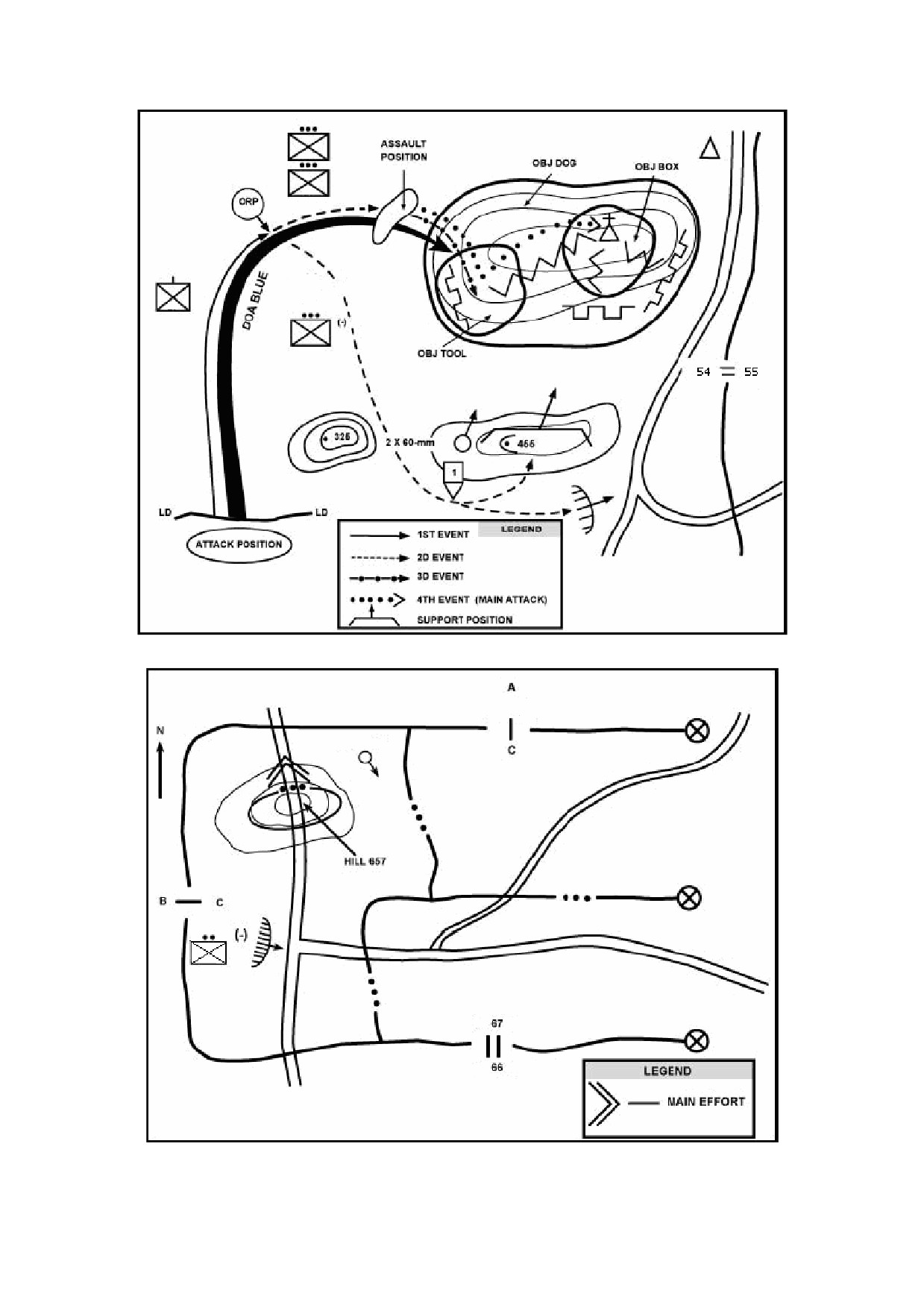
Figure 2-6
Figure 2-7
30
• Consolidation. Each of these phases was war-gamed in sequence. In the example, once the
war game reached the assault phase, the box technique was used to analyze the decisive
action in detail. This technique may also be used to analyze a defensive COA.
(3) The avenue of approach. It is most often used to war-game a defensive COA when there
are several avenues of approach that must be considered. The leader war- games the selected COA
against the enemy's most probable COA by focusing the process on one avenue of approach at a
time.
b. Analysis. To analyze the friendly COAs against the enemy most probable COA, the CO
mentally fights the battle as he expects it to occur. He divides the COAs into a series of actions or
events, analyzes each to determine the likely result or reaction, and then considers the likely
counteraction. This process of action, reaction, and counteraction continues until the mission is
accomplished or the COA fails. An example for war-gaming an offensive and defensive course of
action is provided.
(1) Offensive COA analysis. This is an analysis of the COA presented in paragraph 2-19g(1).
(a) First action: The company moves from the AA into the attack position.
• Enemy reaction: None. Risk of detection is slight.
(b) Second action: The company crosses the LD and moves along direction of advance
DOA BLUE.
• Enemy reaction: Moderate risk of detection at danger area (HWY 27). If detected,
the enemy may engage with indirect fires.
• Friendly counteraction: Suppress known enemy position (vic Hill 325) and
suspected enemy position (vic NB423243). Break contact and continue movement on
DOA BLUE to the ORP.
(c) Third action: Occupy the ORP.
• Enemy reaction: None.
(d) Fourth action: Conduct leader's reconnaissance.
• Enemy reaction: If detected, the enemy will increase the security on his perimeter
and possibly increase his patrolling.
• Friendly counteraction: Options include complete the reconnaissance,
immediately initiate the artillery preparation and execute the tentative plan, or move to
the alternate ORP and issue a FRAGO.
(e) Fifth action: Support and security elements move into position. The company minus
occupies the assault position.
• Enemy reaction: If he detects the company, his options include engaging with
direct and indirect fires, repositioning soldiers or vehicles within his perimeter, or
withdrawing to an alternate position.
• Friendly counteraction: Initiate the assault once the support element is in position.
(f) Sixth action: Support element initiates fires; the lead platoon breaches the wire.
• Enemy reaction: Returns direct fire on the support element. Requests indirect fires
2 minutes if we are on his planned targets, 5-7 minutes if we have avoided them.) Once
detected, the breach site will be the enemy leader's main concern. The two positions
with good observation will place effective small- arms fire on the breaching element.
The enemy will attempt to reposition the eastern squad to the trench vicinity of the
breach site.
• Friendly counteraction: The support element repositions as necessary to prevent enemy
movement toward the breach site. The close-in support element (with the breaching
platoon) suppresses the two enemy positions in vicinity of the breach. The lead PLT seizes a
foothold and begins clearing the trench towards the enemy CP. If the breach is unsuccessful
due to reinforcement by the enemy eastern squad, the breaching platoon will maintain
pressure here while the trail platoon moves to the alternate breach site (vicinity of the
31
enemy's vacated eastern squad position), to conduct a breach and clear toward the enemy
CP. On-order, the lead platoon will disengage and follow through the alternate breach site.
(g) Seventh action: The lead PLT seizes its objective and begins to pass through the trail
PLT (main effort).
• Enemy reaction: Options include repositioning soldiers, committing his reserve,
withdrawing from this position, or counterattacking with another unit.
• Friendly counteraction: Continue the attack. Once the lead platoon has seized its
objective, any enemy repositioning will have little effect. If the enemy has a reserve, it
should be too small to have much effect. If he attempts to withdraw, the support element
(with the FSO) will destroy him. A counterattack is unlikely and would be engaged by
the isolation forces, providing at least 15 minutes early warning.
(h) Eighth action: Main effort platoon seizes the dominant terrain and destroys the
enemy CP. Both platoons clear their objectives.
• Enemy reaction: Withdraw or wait for outside assistance. His remaining positions
are dominated by the high ground (OBJ BOX) seized by the main effort.
• Friendly counteraction: None.
(2) Defensive course of action analysis. This is an analysis for the COA presented in paragraph
2-19g (2).
(a) First action: Enemy divisional or regimental reconnaissance assets arrive in the
company sector.
• Friendly reaction: Security forces engage with direct and indirect fires.
• Enemy counteraction: If the reconnaissance unit was destroyed, the enemy may
send other assets to replace them. If not destroyed, they will withdraw and attempt to
bypass.
(b) Second action: Enemy combat reconnaissance patrol (CRP) enters the company
sector.
• Friendly reaction: Forward platoons report situation. Confirm enemy most
probable COA.
• Enemy counteraction: None unless the CRP detects the forward platoons or prior
reconnaissance has located the company's positions. If so, the enemy will use indirect
fires while the CRP determines the company's dispositions.
(c) Third action: Forward platoons engage enemy in sectors with direct and indirect
fires.
• Enemy reaction: CRP seeks cover and reports. Lead companies deploy, return
fire, and attempt to fight through forward platoons. Indirect fires called on any friendly
concentrations located.
• Friendly counteraction: Avoid decisive engagements. Maintain dispersed
formations.
(d) Fourth action: Main effort platoon engages enemy south of hill 657. Priority of fires
shifts to the main effort.
• Enemy reaction: He attempts to concentrate against the main effort by fixing
with direct and indirect fires. Then he conducts a flank attack with dismounted infantry
and repositions indirect assets (AGS 17s and BN mortars) to support this attack.
• Friendly counteraction: Forward platoons engage following forces to disrupt the
attack against the main effort. Destroy/disrupt command and control (C2) and combat
support (CS) assets as they move into sector.
(e) Fifth action: Enemy assault against the main effort platoon. The enemy second
echelon kandak may begin moving through forward platoon sectors.
• Friendly reaction: Depends on the combat potential the enemy has positioned to
support the assault. Possibly issue a FRAGO to the platoon (-) in the northern sector to
reorient against the enemy attacking the main effort. Arrival of a second echelon kandak
indicates the enemy main attack is in our sector. This is a change to the enemy most
32
probable COA requiring a FRAGO by kandak.
(f) Sixth action: The main effort successfully retains hill 657.
• Enemy reaction: Remnants of the attacking unit occupy defensive positions
vicinity hill 657 to reorganize and prepare to assault again or support another unit's
assault. If the lead kandak is unsuccessful, it is unlikely that the second echelon kandak
will be committed in this sector.
• Friendly counteraction: Issue a FRAGO to focus all available combat power to
destroy this enemy force before he can reorganize.
OR
Action: The main effort is unsuccessful in retaining hill 657.
• Enemy reaction: If the enemy attack is successful, he will reorganize and continue
the attack. Depending on his losses, he may pass through another company at this time.
• Friendly counteraction: The main effort platoon withdraws to a rally point in the
restricted terrain, reorganizes, and interdicts enemy moving north. Forward platoons
continue to destroy enemy in sector. The company reports the situation to kandak and
continues to operate to disrupt enemy forces moving through sector.
(g) Seventh action: Exploit success of the main effort. (Even if the main effort did not
retain hill 657, the enemy combat potential is degraded and his momentum disrupted.) Concentrate
combat power against enemy weaknesses exposed throughout the company sector, such as isolated
enemy positions, C2, and CS assets.
• Enemy reaction: He will attempt to reorganize to continue the attack.
• Friendly counteraction: Maintain pressure on the enemy throughout the depth of
his unit. Use artillery, mortars, and CAS against his strengths.
c. Information Learned. Upon completing the analysis of each COA, the leader should know
its advantages and disadvantages. He also has identified any critical events that will determine the
success or failure of each COA. These factors are used during Step 4 to compare the COAs. In
addition, the commander now has a much greater appreciation for the conduct of this mission. The
CO will use this information later as he expands the selected COA into the tentative plan for his
company.
2-21. COMPARE THE COURSES OF ACTION
At Step 4 in the estimate process, the CO compares the COAs and selects the one that is most likely
to accomplish the assigned mission. The CO considers the advantages and disadvantages for each
COA. He also considers how the critical events impact on each COA. Then he selects significant
factors based on this mission; the COAs are then compared using these factors. The CO may also
compare the COAs using only the advantages and disadvantages for each COA. This method is
more subjective than using the significant factors that are common to all COAs.
a. Advantages and Disadvantages. These are the specific strengths and weaknesses that were
noted during the analysis process. They may pertain to the mission, the terrain, the enemy, or any
other aspect of the operation. They may apply to just one COA or to all of them.
(1) Examples of advantages include:
• Uses the most covered and concealed routes.
• Allows extra time for the leader's reconnaissance.
• Supports the reduction of the soldier's loads.
• Provides an excellent chance of surprise.
• Limits the risk on the secondary approach.
(2) Examples of disadvantages include:
• High risk of detection by the enemy's observation post (OP).
• Mortar ammunition requirements increase the soldier's loads.
• Time constraint requires daylight movement.
• Does not attack the enemy's weakest point.
b. Critical Events. In every operation, there are certain events or activities that will have a major
33
impact on the success of the mission. These may have been identified during the mission analysis,
the analysis of the situation, or the war-game process. Normally at company level, these critical
events will apply to each COA. The significant factors for the comparison will often result from
these critical events. Examples of possible critical events include:
• A forward passage of lines.
• Crossing a major stream en route to the objective.
• Breaching the protective obstacles.
• Gaining a foothold on the objective.
• Evacuating the casualties.
• Defeating the enemy's reconnaissance.
•Controlling the unit's fires into an engagement area.
c. Significant Factors. These are common factors that provide the focus for comparing each
COA. They are selected for each tactical mission based on mission accomplishment. These factors
are significant because they impact directly on the success of the mission. A long list reduces the
importance of the most significant factors; therefore, the CO should limit the number of factors to a
manageable number. Normally three to seven factors will provide a good comparison. There are
two basic types of significant factors, mission-specific and general.
(1) Mission-specific factors. These are generated from the requirements for a specific mission.
They are often determined by the critical events identified during the war-game process. They may
also result from the advantages and disadvantages for each COA. Examples include:
• Casualty evacuation.
• Soldier's load or the weight of everything a soldier must carry on his back.
• Effectiveness in accomplishing the mission.
• Time usage.
(2) General factors. These are for the employment of infantry in all operations. They include
the Principles of War, the risk involved, the characteristics of the offense or defense, and other such
doctrinal guidelines. Although these apply in every tactical operation, certain ones are more
important to the mission at hand. The CO determines which these are and then lists them as
significant factors for this mission. Examples include:
• Security.
• Simplicity.
• Surprise.
• Exploitation of enemy weaknesses.
• Risk.
• Disruption of the enemy attack.
• Concentration at the decisive point.
• Use of limited visibility.
• Employment of key weapons.
d. Decision Matrix. or chart. Once the CO has selected the significant factors, he must decide
which COA supports each factor the best. The CO compares the COAs using each factor and then
makes his decision.
(1) A more detailed technique involves a simple COA decision chart. This may be required
when there are too many factors for the CO to compare. It is important that the CO uses significant
factors from his estimate of the situation to develop the matrix. Mission specific factors are used as
much as possible. Figure 2-8 provides an example of a COA decision matrix.
(2) There are several ways to use this chart. The simplest way is to give a + to the COA which
best supports each factor. All other COAs would receive a -. Another way is to rank order each
COA for each factor. The best COA for each factor receives a 1, next best a 2, and the COA that
supports the factor the least would receive a 3. The COA with the lowest sum supports the
significant factors best.
34

2-22. MAKE A DECISION
Step 5 of the estimate process involves making the decision. The CO selects the COA that he
believes has the best chance of accomplishing the mission. The results of the comparison in Step 4
assist him in making this decision, but they do not make it for him. The CO may not select the COA
that the decision chart indicates is the best. There may be factors that were not included in the
matrix but now have a significant impact on the mission. For example: As he analyzed the troops
available in Step 2 and selected his significant factors during Step 4, he was unaware of the current
status of his company's physical condition. Upon learning of the extent of his company's fatigue, the
CO may decide this is the most significant factor to consider in making this decision. Even if the
decision had already been made and orders issued before this new information was determined, the
CO should immediately update his estimate and decide what impact this may have on his mission. It
is this continuous estimate process that allows the CO to make rapid decisions during the fight.
Figure 2-8. Course of action decision matrix
2-23. COMPLETE THE TENTATIVE PLAN
The focus of this process is to generate overwhelming combat power at the decisive point. To do
this, the CO positions his units and weapons, assigns those tasks and purposes, allocates resources,
designates control measures, and synchronizes activities. He refers back to the deductions from his
estimate to complete his plan. To complete the tentative plan, the CO begins with the COA selected
at Step 5 of the estimate. He expands this COA into a complete five-paragraph OPORD. The
OPORD format is a guide for deciding what information is required to complete the plan.
a. Task Organization. The generic task organization from the COA is the basis for this; some
changes may have resulted from the war-game process. The CO refers to the task organization in
the kandak order and ensures all assets under his control are included in his plan. The CO takes the
generic task organization from the COA and develops a specific task organization that assigns
35
squads and weapons to each of his platoons. An example of a company task organization follows:
1st PLT(-)
2d PLT
3d PLT
Co Control
Mortar Section
1st Squad, 1st Plt
b. Enemy Situation. The enemy situation in the Kandak (BN) OPORD (paragraph 1a) is the
basis for this, but the CO refined this to provide the detail required by his subordinates. The CO
considers the results of his enemy analysis to determine the information he includes in his
paragraph 1a. This may include the enemy's composition, disposition, strength, recent activities, and
capabilities. He also includes the enemy's most probable COA, which was used in the war-game
process. A sketch or enemy overlay should be included.
c. Friendly Situation. This information is found in paragraphs 1b, 2, and 3 in the Kandak
OPORD. The Kandak mission and concept are stated in paragraphs 2 and 3a respectively. The units
adjacent to the company (left, right, front, and rear) are found on the operations overlay. Their
mission statements are found in both paragraph 1b (adjacent Kandaks) and 3a (adjacent companies).
Units supporting the company will be found in the Kandak task organization and in paragraphs 1b
(external to the Kandak) and paragraph 3 (Kandak assets).
d. Mission Statement. The company mission statement was determined at Step 1 of the
estimate. It is normally clearly stated in paragraph 3 of the Kandak OPORD.
e. Concept of the Operation. This paragraph describes how the CO intends to accomplish his
mission. At company level, a maneuver and fires subparagraph will always be included. When
needed to clarify the concept or to ensure synchronization, additional subparagraphs, such as
engineering and intelligence operations may be included. The operations overlay/concept sketch is
referenced here.
(1) Maneuver. The maneuver paragraph should be focused on the decisive action. It may,
however, describe the maneuver throughout the operation. At company level, a maneuver paragraph
that assigns the missions to each platoon/section and identifies the main effort normally requires no
additional clarification. When additional information is required to clarify the concept, the CO may
insert this information in the concept of the operation paragraph. Information such as movement
formations and techniques, or the order of movement, should only be included if it clarifies the
concept. Normally, the coordinating instructions paragraph is the appropriate location for this type
of information.
(2) Fires. This paragraph describes how the CO intends for the fires to support his maneuver.
The company FSO may prepare this paragraph based on the CO's guidance. This paragraph
normally states the purpose to be achieved by the fires, the priority of fires for the company, and the
allocation of any priority targets. A target list or overlay may be referenced here. Specific taskings
for the company mortars should only be stated here if they clarify the concept of the operation.
(3) Engineering. Often, especially in defensive operations, this paragraph is required to clarify
the CO's concept for preparing obstacles, mines and fortifications. When the company is supported
by engineer equipment or units, the CO would state his guidance for employing these assets here.
He may do this by stating the priority of effort (survivability, countermobility, and mobility) and the
priority of support for his subordinates (3d PLT, 1st PLT, 2d PLT, mortar section, and the CP).
f. Tasks to Maneuver Units. This paragraph lists the tasks/limitations for each of the platoons
and sections. Each of these subordinate units will have a separate paragraph. The information
included here comes from two sources-the tasks and limitations identified during the mission
analysis and from the war game process.
(1) The tasks from the mission analysis may require only one subordinate unit to complete
them. In this case, the CO decides which unit should do this task and assigns it. Examples of these
tasks are listed.
36
• Provide one squad to carry ammunition for the company mortar section.
• Establish an OP at NB233876 not later than (NLT) 231000. Others may require two or more
subordinate units or even the entire company to comply with them. In this case, the CO would list
these tasks or limitations in the coordinating instructions.
(2) Most of these requirements result from the war game of the COA. They include—
• How to synchronize the operation.
• How to secure the company throughout the operation.
• How to concentrate the combat potential at decisive points.
• How to manage the soldier's load.
• How to degrade the enemy's combat potential. To accomplish each of these requirements,
the CO assigns specific taskings to each of his units. He also assigns specific limitations to
certain subordinates. These may be listed here or noted on the company operations
overlay/concept sketch.
g. Tasks to Combat Support Units. The mortar section and other CS units (engineers, etc.) are
addressed here.
h. Coordinating Instructions. These are requirements that apply to two or more subordinate
units. These also may have been assigned by Kandak or required based on the COA developed by
the company CO. If they do not apply to all the subordinate units, then clearly state those units that
must comply. Examples might be:
• The company time schedule.
• 2d and 3d PLT will each carry 30 mortar rounds.
• The consolidation plan.
• The BN rehearsal is at 211500 DEC 91.
i. Service Support. This paragraph provides the critical logistical information required to sustain
the company during the operation. Most of this information is extracted from the kandak OPORD.
There are also certain requirements generated from the company commander's concept. These may
include:
• The location for the company supply point.
• The casualty evacuation plan.
• Instructions for caching rucksacks, supplies, or other equipment.
• The resupply plan.
j. Command and Signal. This paragraph states where the C2 facilities and key personnel will
be located during the operation. It includes the following information from the Kandak OPORD that
subordinates require.
(1) Locations for the Kandak main CP and the command group.
(2) Critical communication requirements, such as radio listening silence in effect forward of
the LD.
(3) Signals for specific events or actions. The company concept will have similar
requirements for the company commander. These may include:
• The locations for the CO or CP, and the XO.
• Adjustments to the unit SOP, such as a change to the succession of command or standard
markings.
• Emergency/visual signals for critical actions.
• Signal information.
NOTE: The tentative plan should stand alone and have essential information so that it
can be issued and executed if time does not permit physical reconnaissance to verify.
Section IV. CONTINUOUS OPERATIONS
Continuous operations are combat operations that continue around the clock at a high pace,
37
requiring soldiers to fight without letup for extended periods. Opportunities for sleep are scattered
throughout the day and night. Sustained operations are operations conducted 24 hours a day with
little or no opportunity for sleep.
2-24. SUSTAINED OPERATIONS
Sustained operations are when the same soldiers or small units engage in combat operations with no
opportunity for the unit to stand down and little time for soldiers to sleep. Infantry units must
routinely plan to conduct sustained operations.
2-25. DEGRADATION OF COMBAT CAPABILITY
As sustained operations continue, all soldiers begin to show effects of general fatigue and lack of
sleep. Unless counteracted, unit performance of combat tasks decline. Recent studies indicate
performance is degraded by 25 percent for each 24-hour period without sleep. After 96 hours,
performance can be expected to be near zero. Determination to endure must be supplemented by
countering the adverse effects to slow the rate of decline. It becomes more difficult to perform
assigned tasks to the required standard. Leaders need to recognize signs of serious sleep deprivation
in their subordinates.
a. Studies show that the performance in all duty positions does not degrade the same.
Performance in a duty position where there is a heavy load of mental tasks
(determining,
calculating, thinking, decision-making) degrades faster than the performance in a position whose
tasks are mainly physical (firing, running, lifting, digging).
2-26. TECHNIQUES TO SUSTAIN OPERATIONS
To maintain effectiveness, adverse conditions of sustained operations must be overcome. The
following are methods the commander can use to reduce degradation, develop the required abilities
in soldiers, and prepare his unit to fight sustained operations.
a. Build Individual Soldier Resources. Preventive measures are often more effective for
keeping groups healthy and active. They include improving or maintaining good physical condition,
balanced nutrition, and immunizations.
b. Provide Good Leadership. Leadership is the keystone for sustained unit performance.
c. Set High Standards. Achieving success during sustained operations demands the highest
standards of military professionalism.
d. Develop Individual Confidence. It is easier for units to withstand the adverse conditions of
sustained operations if they maintain an optimistic, confident outlook.
e. Establish Reliable Communication Channels. In combat, knowledge of the situation and the
status of both enemy and friendly units sustain soldiers.
f. Cross-train. This helps ensure that someone is always available to perform a critical task or to
help perform it. Criticality of tasks should determine the priority for cross-training.
g. Develop Coping Skills. Coping with stress is an important combat skill in sustained
operations. Severe problems may develop after several days if leaders and soldiers do not sleep at
least 4 hours every 24 hours. Ideally, the 4 hours should be continuous.
h. Develop Good Physical Fitness. Being physically fit strengthens the ability to recover from
exhaustion.
i. Build Stamina. Fit soldiers withstand the stresses of sustained operations better.
j. Foster a Spirit and Attitude of Winning. In sustained operations, a genuine and single-
minded dedication often gives the extra strength needed to win.
k. Foster Cohesion, Esprit, Morale, and Commitment. Cohesion holds units together; esprit
keeps them dedicated to the mission. Unit cohesion and esprit are key sources of strength for
enduring the stresses of sustained operations.
2-27. UNIT SLEEP PLAN
The commander must ensure his unit can conduct both sustained and continuous operations. The
only way a unit can conduct continuous operations is that all soldiers and leaders get enough rest.
38
a. The CO must devise and enforce a work-rest-sleep plan for the company. It must include
provisions for leaders as well as soldiers to sleep. Priority for sleep should go to those whose
judgment and decision-making are critical to mission accomplishment.
b. The plan should allow soldiers at least 4 to 5 hours of sleep each 24 hours; this will sustain
performance for several days. Six to 8 hours of sleep can sustain performance indefinitely.
39
ANA 7-10.2
Tactical Standard Operating Procedures
(TACSOP)
ANA 7-10.2 Infantry TACSOP
INFANTRY TACTICAL STANDING OPERATING PROCEDURE
This chapter provides the tactical standing operating procedures for
infantry platoons and squads. The procedures apply unless a leader
makes a decision to change from them based on the factors of
METT-TC. In such a case, the exception applies only to the particular
situation for which the leader made the decision.
Note: This chapter is published as a series of stand-alone “cards” to
enable the user to select only those parts needed for a particular
mission. By selecting the appropriate cards, the user can buid a
TACSOP suited to a units needs and leave out any part which does
not apply. Select the appropriate cards, punch holes the side and
make a TACSOP suited to your Unit.
CONTENTS
Card
100
Platoon Organization
Card 110
Command And Control
Card 120
Duties And Responsibilities
Card 200
Communication
Card 300
TLP
Card 310
Estimate of the Situation
Card 320
WARNOR
Card 330
OPORD
Card
340
Rehearsals
Card 350
REDCON
Card 400
Orders And Reports
Card 500
Tactical Standards
Card 510
PCI
Card
520
Movement
Card 600
Operations
Card 610
Assembly Area Procedures
Card 620
Fire Support
Card 630
Fire Control And Distribution
Card 700
Operational Security
Card 800
Combat Service Support
1
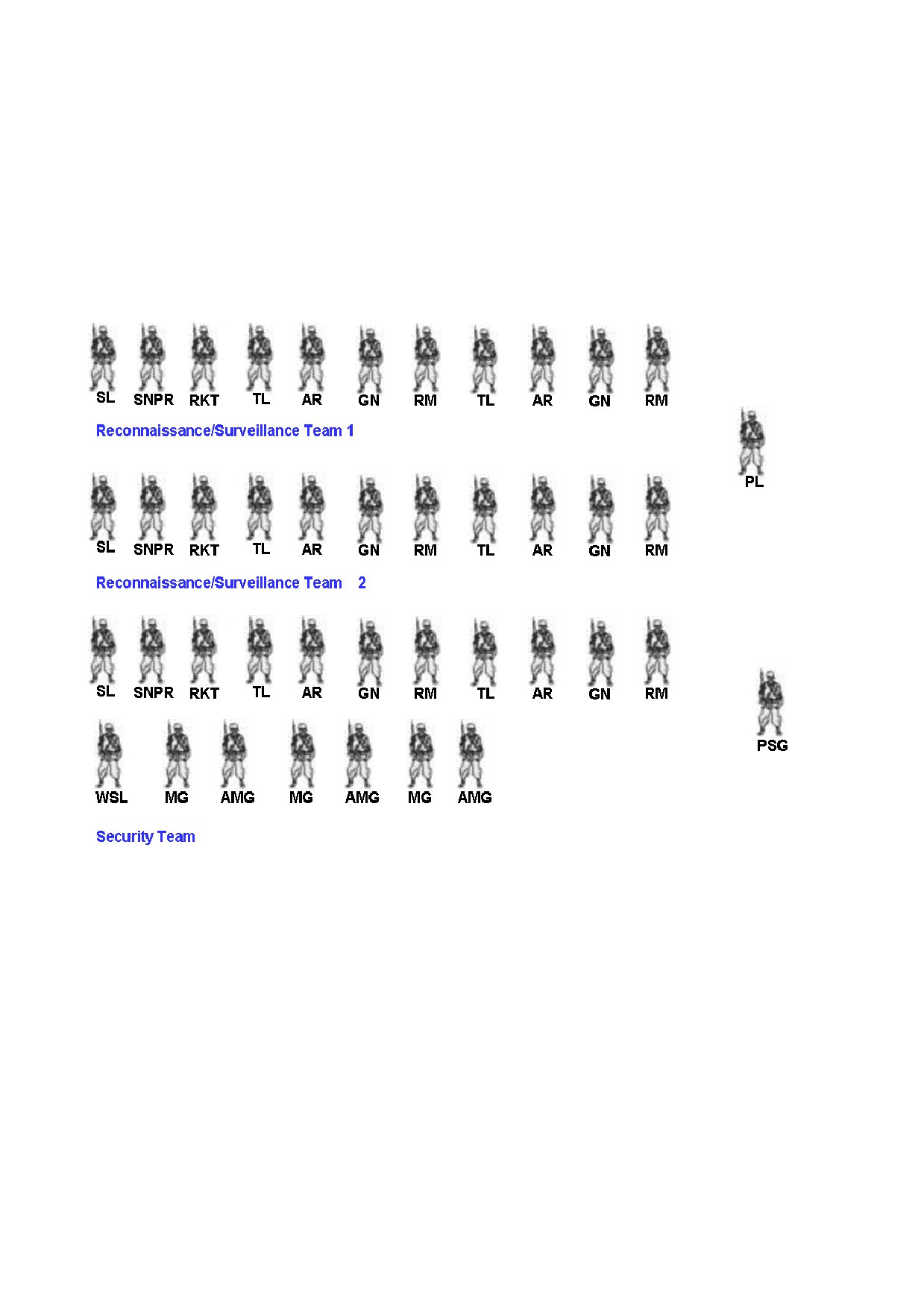
ANA 7-10.2 Infantry TACSOP
Card 100 - Platoon Organization
1. Platoon organizations will be different for each mission and the commander’s
estimate of METT-TC. The following platoon organizations are common to combat
and recon missions. See figure 1 and 2 for basic organizations
Figure 1. Platoon Basic Organization - Recon Mission
2

ANA 7-10.2 Infantry TACSOP
Figure 2. Platoon basic Task Organization - Combat Mission
2. ATTACHMENTS. Depending on the mission, the platoon can have several
attachments. These attachments include Engineer’s, Anti-Armor Support, Medic’s, and an
FSC. The attachments will have already been assigned a priority of work by the company
commander.. The platoon leader may be required to provide labor support and or security
to assist the attachment elements in there support role
3

ANA 7-10.2 Infantry TACSOP
Card 110 - COMMAND AND CONTROL
1. COMMAND. Platoon leaders are responsible for effectively using the platoon's
resources and for employing, organizing, and directing the platoon for all operations.
Effective command allows subordinate leaders to exercise their initiative, take risks, and
take advantage of opportunities during the mission.
a. Succession of Command. During combat, any member of the platoon may be
required to assume command. See figure 3 for the Platoon succession of
command
Figure 3. Platoon Succession of Command
b. Assumption of Command. When it is necessary for a new leader to assume
command of the platoon, the new leader will accomplish the following tasks:
(1)
Inform higher headquarters of the change.
(2)
Reestablish the platoon chain of command and ensure all subordinates
are made aware of changes.
(3)
Check the platoon’s security and the positioning of key weapons.
4
ANA 7-10.2 Infantry TACSOP
(4)
Check the platoon’s equipment and personnel status.
(5)
Pinpoint the platoon’s location.
(6)
Assess the platoon’s ability to continue the mission.
(7)
Inform higher command of assessment.
(8)
Perform your mission as directed by your Headquarters
2. COORDINATION. Adjacent unit coordination is accomplished from left to right and from
front to rear. Adjacent unit coordination is done face to face when possible. The following
information is exchanged for adjacent units coordination :
• Unit identification.
• Mission.
• Unit locations.
• Frequencies and call signs.
• Security plans.
• Fire support plans.
• Obstacle plans.
• CP and OP locations.
• Challenge and passwords.
• Sector sketches and or scheme of maneuver.
• Routes.
• Pyrotechnic signals.
• Fire control measures.
Card 120 - DUTIES AND RESPONSIBILITIES
5
ANA 7-10.2 Infantry TACSOP
1. General. Competent and confident leadership is the most essential element of combat
power. Leadership provides purpose, direction, and motivation in combat. The leader
maximizes maneuver, firepower, and protection; effectively balances these elements; and
decides how to bring them to bear against the enemy
PLATOON LEADER. The platoon leader is responsible for accomplishing the platoon’s
mission. He is responsible for all that the platoon does or fails to do. This includes the
tactical employment, training, administration, personnel management, and logistics of his
platoon. He must also know how to employ supporting weapons and attachments.
He does this by planning, making timely decisions, issuing orders, assigning tasks, and
supervising platoon activities. He must know his men and how to employ the platoon’s
weapons and maximize its capabilities. He is responsible for positioning and employing all
assigned or attached crew-served weapons. The platoon leader-
• Sets the Example and the Standards.
• Leads the platoon in support of company and battalion missions.
• Informs his commander of his actions at all times.
• Plans missions with the help of the platoon sergeant, squad leaders, and
other key personnel.
• Stays aware of the situation and goes where he is needed to supervise,
issue FRAGOs, and accomplish the mission.
• Requests support for the platoon from the company commander to perform
its mission.
• Directs the platoon sergeant in planning and coordinating the platoon’s CSS
effort.
• During planning, he receives on-hand status reports from the platoon
sergeant and squad leaders.
• Reviews platoon requirements based on the tactical plan.
• During execution, positions himself where he can influence the most critical
task for mission accomplishment.
• Commands through his squad leaders using the intent of the company and
higher echelon commanders
• Develops the casualty evacuation plan.
• During execution, he checks the work of the platoon sergeant and the squad
leaders.
• Ensures the soldier’s load is reasonable.
PLATOON SERGEANT. The platoon sergeant is the senior non-commissioned officer
(NCO) in the platoon and second in command. He helps and advises the platoon leader,
and leads the platoon in the platoon leader’s absence. He supervises the platoon’s
administration, logistics, and maintenance. He may prepare and issue paragraph four of
the platoon operations order. The platoon sergeant is responsible for individual training.
He must ensure that soldiers can perform their individual tasks. The Platoon Sergeant -
• Supervises the logistics, administration, and maintenance activities of the
platoon.
• Organizes and controls the platoon alternate command post (CP).
• He receives the squad leaders’ requests for rations, water, and ammunition.
He works with the company XO and first sergeant to request resupply. He
also directs the routing of supplies and mail.
• He maintains platoon strength information, consolidates and forwards the
platoon’s casualty reports. (ANA Forms 1155 and 1156) and receives
replacements.
6
ANA 7-10.2 Infantry TACSOP
• He monitors the morale, discipline, and health of platoon members.
• He commands task-organized elements in the platoon during tactical
operations. This can include, but is not limited to, quartering parties, security
forces in withdrawals, support elements in raids or attacks, and security
patrols.
• He coordinates and supervises company directed platoon resupply
operations.
• He ensures that ammunition and equipment are evenly distributed. (This is a
critical task during consolidation and reorganization.)
• He ensures that the casualty evacuation plan is complete and executed
properly by directing the platoon’s medic, and aid and stretcher teams.
2. SQUAD LEADER. The squad leader is responsible for the squad and the following
tasks:
• He controls the maneuver of his squad and its rate and distribution of fire.
• He exercises his command through the fire team leaders.
• He manages the logistical and administrative needs of his squad. He
requests and issues ammunition, water, rations, and special equipment.
• He maintains accountability of his soldiers and equipment.
• He completes casualty feeder reports and reviews the casualty reports
completed by squad members.
• He supervises the maintenance of the squad’s weapons and equipment.
• He conducts inspections of his soldiers, their weapons and their equipment.
• He keeps the platoon sergeant and platoon leader informed on his squad’s
supply status and equipment readiness.
• He ensures that supplies and equipment are internally cross-leveled.
3. WEAPONS SQUAD LEADER. The weapon squad leader is responsible for the
weapons squad and the following tasks:
• His duties are the same as the rifle squad leader.
• He controls the machine guns in support of the platoon’s mission.
• He advises the platoon leader on the employment of his squad during
movement, halts, and in patrol base.
• Supervise machine gun teams to ensure they follow priority of work.
• Inspects machine gun teams for correct fighting positions and understanding
of fire plan.
• He manages the logistical and administrative needs of his squad.
• He keeps the platoon leader and platoon sergeant informed of his squad’s
weapons, equipment, and supply status.
7
ANA 7-10.2 Infantry TACSOP
Card 200 - COMMUNICATION
1. GENERAL. The three primary means of communication available to the infantry platoon
are radio, wire, and messenger. Normally, the platoon uses one or all of these during an
operation. Additionally, the platoon leader plans an alternate means of communication in
case the primary means fails.
a. Radio. Radio is the least secure means of communication. Radio messages can
be intercepted and jammed. Proper radio procedures must be used to reduce the
enemy’s opportunity to disrupt radio communications.
(1)
Radio procedures:
(a)
Change frequencies and call signs in accordance with (IAW) unit signal
operating instructions (SOI).
(b)
Use varied transmission schedules
(c)
Keep transmissions short.
(d)
Use established formats to expedite transmissions such as SALUTE.
(e)
Encode messages or use secure voice.
(f)
Use brevity codes when possible.
(2)
Actions if jamming is suspected:
(a)
Continue to operate. (Do not let the enemy know that he is having any
affect on communications.)
(b)
Disconnect the antenna. If interference stops, communications are
probably being jammed.
(c)
Switch to highest power.
(d)
Relocate the radio. Terrain may mask the enemy’s jamming signal.
(e)
Use a directional antenna.
(f)
Turn the squelch off.
(3)
Radio nets: The platoon must monitor and operate on several radio nets.
These include-
(a)
Company command net. The platoon leader will continuously monitor the
company command net.
(b)
Platoon net. The platoon headquarters controls the platoon net. The
platoon net is be continuously monitored by all elements of the platoon.
(c)
Fire support net. The fire support net is controlled by the battalion fire
support officer (FSO) and is monitored by the platoon’s forward observer
(FO). The platoon FO is attached.
b. Wire. Wire is more secure than radio and is effected less by weather and terrain.
When possible, the platoon uses wire in lieu of radio. When the tactical situation
permits, the platoon establishes a wire net or “hot loop.” This is accomplished as
follows:
(1)
Each element is responsible for running wire to the platoon headquarters.
(2)
Each element of the platoon is responsible for running wire to the element
on its left.
(3)
Each element is responsible for running wire to their OP.
(4)
Once established, each element is responsible for the maintenance of the
wire it laid. Additionally, each element continuously monitors the wire net.
(5)
When breaking down the wire net, each element is responsible for
recovering its own wire.
(6)
The platoon headquarters maintains overall control of the wire net.
c. Messenger. Messenger is the most secure means of communications.
Messengers should vary their routes and schedules. Platoon leaders weigh the
8
ANA 7-10.2 Infantry TACSOP
risk associated with using messengers. Although secure, messengers are the
slowest form of communication.
2. CODE WORDS AND SIGNALS.
a. Code Words. Code words are used for a multitude of reasons. Code words are
established to speed up communications, add a degree of security, and help with
command and control. Code words are usually established during tactical
operations for (but not limited to) objectives, phase lines, check points, link ups,
and so forth.
b. Signals. Signals can be used in many forms on any operation. Signals are usually
either audio or visual. The key to the use of signals is ensuring everyone is aware
of the signal and its meaning.
CARD 300 - TROOP LEADING PROCEDURES
9
ANA 7-10.2 Infantry TACSOP
1. General. The troop leading procedures are the dynamic processes by which a platoon
leader receives a mission, plans it, and executes it. It is an instinctive and familiar way of
thinking for a platoon leader.
TROOP LEADING PROCEDURES
1. Receive the mission.
2. Issue a warning order.
3. Make a tentative plan
4. Initiate movement.
5. Conduct reconnaissance.
6. Complete the plan.
7. Issue the order.
8. Supervise.
STEP 1: Receive the mission.
a. Analyze the mission using METT-T.
b. Create a time schedule using backward planning.
c. Use 1/3 - 2/3 rule for planning/preparation.
STEP 2: Issue a warning order.
a. Issue the order to the platoon sergeant and squad leaders.
b. Update information with additional orders.
STEP 3: Make a tentative plan.
a. Mission analysis.
b. Enemy situation.
c. Friendly situation.
d. Friendly courses of action.
e. Terrain analysis using OCOKA.
STEP 4: Initiate movement. During steps 3 through 8, the platoon leader may be forward
completing his plan. If there is a distance between the platoon and where the
mission must be conducted, the platoon sergeant may bring the platoon
forward to save time. This step may be omitted, occur in a different sequence,
or be done concurrently with another step.
STEP 5: Conduct reconnaissance.
a. Issue specific tasking for selected soldiers.
b. Issue specific time schedule for the recon.
c. Plan routes and formations.
d. Select special equipment required.
STEP 6: Complete the plan.
a. Coordinate with supporting agencies, higher
headquarters, and adjacent units.
b. Use the five paragraph field order.
STEP 7: Issue the order.
a. Issue from a vantage point overlooking the avenues of approach/objective
area.
10
ANA 7-10.2 Infantry TACSOP
b. Use sketches and terrain models.
c. Use a map overlay.
STEP 8: Supervise.
a. Inspect.
(1) vehicles and generators
(2) weapons and ammunition
(3) uniforms and equipment
(4) soldiers’ knowledge
(5) specific responsibilities
(6) communications
(7) rations and water
b. Rehearse.
c. Briefback.
d. Coordinate.
11
ANA 7-10.2 Infantry TACSOP
Card 310 - ESTIMATE OF THE SITUATION
1. MISSION ANALYSIS.
a. Mission and intent of commander two levels up.
b. Mission and intent of immediate commander.
c. Assigned tasks (specified and implied).
d. Constraints and limitations.
e. Mission-essential tasks.
f. Restated mission.
g. Tentative time schedule.
2. ESTIMATE OF THE SITUATION AND DETERMINE COURSES OF ACTION.
a. Terrain and weather.
(1)
Terrain - OCOKA (Observation and fields of fire, Cover and concealment,
Obstacles, Key/decisive terrain, and Avenues of approach).
(2)
Weather - visibility, mobility, survivability.
b. Enemy situation and most probable courses of action.
(1)
Composition.
(2)
Disposition.
(3)
Recent activities.
(4)
Capabilities.
(5)
Weaknesses.
(6)
Most probable course of action (enemy use of METT-TC).
c. Friendly Situation.
(1)
Troops available.
(2)
Equipment status.
(3)
Time available.
d. Friendly Courses of Action. (Develop at a minimum two courses of action.)
3. ANALYSIS OF COURSES OF ACTION.
a. Significant factors.
b. Wargame.
4. COMPARISON OF COURSES OF ACTION.
5. DECISION.
CARD 320 - WARNO
12
ANA 7-10.2 Infantry TACSOP
1. General. Warning orders give subordinates advance notice of future operations. This
gives them time to prepare. Keep the order brief, but complete.
WARNING ORDER
1. Situation. Give a Brief description, for example, the enemy is defending and our
battalion is attacking to the north.
Attachments and detachments to the platoon.
2. Mission: Use the restated mission from the mission analysis.
3. General Instructions:
a. Chain of command (call out by name).
b. Special teams or task organization within the platoon.
c. Uniform and equipment common to all.
d. Special weapons, ammunition, or equipment.
e. Tentative time schedule (develop during mission analysis). It includes at least:
(1) Earliest time of move.
(2) Time and place of OPORD and who attends.
(3) Probable execution time.
(4) Inspection times and items inspected.
(5) Rehearsal times and actions rehearsed.
f. Additional general instructions as needed.
4. Special Instructions:
a. To subordinate leaders:
(1) Platoon sergeant.
(2) Squad Leaders
b. To persons helping in preparation of OPORD.
13
ANA 7-10.2 Infantry TACSOP
Card 330 - Operations Order
OPERATIONS ORDER. An Operations Order (OPORD) is a order issued by a leader to
his subordinates in order to effect the coordinated execution of a specific operation. A five-
paragraph format (shown below) is used to organize the briefing, to ensure completeness,
and to help subordinate leaders understand and follow the order. Use a terrain model or
sketch along with a map to explain the order. When possible, such as in the defense, give
the order while observing the objective. The platoon/squad leader briefs his OPROD orally
off notes that follow the five -paragraph format. OPORD format follows:
1. SITUATION
a. Enemy forces. The enemy situation in higher headquarters’ OPORD.
1. Include the enemy’s composition, disposition, strength
2. Recent activities
3. Known/suspected locations and capabilities
4. Describe the enemy's most likely and most dangerous course of action
b. Friendly forces. This information comes higher headquarters’ OPORD.
1. Include the mission, commander's intent, and concept of operations for
headquarters one and two levels up.
2. Locations of units to the left, right, front, and rear. State those units’ task and
purpose and how those units will influence your unit, particularly adjacent unit
patrols.
c. Attachments and detachments. Do not repeat information Organization, list units
that are attached or detached.
2. MISSION. State the mission derived during the planning process. There are no
subparagraphs in a mission statement. Include the 5 W's: Who, What (task), Where,
When, and Why (purpose).
3. EXECUTION
a. Concept of the Operations. The concept of operations may be a single
paragraph, or more. The concept statement should be concise and understandable
and describe, in general terms, how the unit will accomplish its mission from start to
finish.
1. Maneuver. The maneuver paragraph addresses, in detail, the mechanics of
the operations. Specifically address all subordinate units and attachments by
name, giving each its mission in the form of a task and purpose. The main
effort must be designated and all other subordinates’ missions must relate to
the main effort.
2. Fires. Clarify scheme of fires to support the overall concept. This paragraph
should state which maneuver unit is the main effort and has priority of fires, to
include stating purpose of, priorities for, allocation of, and restrictions for fire
support.
b. Tasks to maneuver units. Clearly state the missions or tasks for each maneuver
unit. Platoon leaders task their subordinate squads. Those squads may be tasked to
provide any of the following special teams: reconnaissance and security, assault,
support, aid and litter, EPW and search, clearing, and demolitions. Detailed
instructions may also be given to platoon sergeant, RTO’s, compass man, and pace
man.
c. Tasks to combat support units. Use these subparagraphs only as necessary.
d. Coordinating instructions. List only instructions applicable to two or more units
and not routinely covered in unit SOPs. Time Schedule (rehearsals, back briefs,
inspections and movement). Rules of engagement (ROE). Force Protection,
14
ANA 7-10.2 Infantry TACSOP
movement plan. Use terrain model and/or sketch. State azimuths, directions, and grid
coordinates. Some are listed, not all.
(1) Order of Movement, formation, and movement technique
(2) Actions at halts (long and short).
(3) Routes.
(4) Actions at danger areas
4. SERVICE SUPPORT Address service support in the areas shown below as needed to
clarify the service support concept.
a. General: Reference the SOP’s that govern the sustainment operations of the unit.
Provide current and proposed company trains locations, casualty, and damaged
equipment collection points and routes.
b. Materiel and Services.
(1) Supply
a. Class I - Rations Plan
b. Class III - Fuel, Oil, Lubricants
c. Class V - Ammunition
d. Class VII - Major end items (weapons)
e. Class VIII - Medical
f. Class IX - Repair parts
c. Distribution Methods
5. COMMAND AND SIGNAL This paragraph states where command and control facilities
and key leaders are located during the operation.
a. Command.
(1) Location of the higher unit commander and CP.
(2) Location of key personnel and CP during each phase of the operation.
(3) Succession of Command.
(4) Adjustments to the patrol SOP.
b. Signal.
(1) Special Operating Instructions (SOI, call sign, radio frequency, etc) index in
effect.
(2) Methods of communication in priority.
(3) Pyrotechnics and signals, to include arm and hand signals.
(4) Code words.
(5) Challenge and password (used when behind friendly lines).
(6) Number Combination (used when forward of friendly lines).
(7) Running Password.
(8) Recognition signals (near/far and day/night).
CARD 340 - Rehearsals
15
ANA 7-10.2 Infantry TACSOP
1.
A rehearsal for an impending combat operation ensures synchronization and agility
through practice of the plan. A rehearsal reinforces the scheme of maneuver and the
support of CS and CSS support units. It should identify problem areas and contingency
actions, determine movement reaction times, enhance coordination, and refine the
plan. A rehearsal should focus on actions critical to accomplishing the mission. This
ensures the unit can, in fact, accomplish the mission given its state of training, the
orders issued, and the terrain and weather conditions expected.
2.
Rehearsals are that part of the tactical operation in which the Patrol conducts one or
more exercises. They are executed according to a plan which approximates the
specific operation. Rehearsals test the—
• Familiarity of all elements with the plan.
• Timing of detailed operations.
• Combat readiness of participating forces.
3.
Responsibility for preparing rehearsal plans is the same as for preparing the actual
operations order. Rehearsal plans should be issued separately, but as close in time to
the operations plan as possible. In planning for rehearsals, consideration must be
given to the number, nature, and scope of rehearsals; the date and time for each; and
the area in which they will be conducted. Tactical forces must consider the difficulty of
repair or replacement of equipment damaged or lost during rehearsals conducted after
they leave the assembly area.
4.
The number, size, nature, and scope of the rehearsals will be influenced by—
The complexity of the tasks assigned to the elements
The time available for rehearsals.
The suitability of available rehearsal areas.
Special or unusual problems to be faced in the actual operation, the solution to
which must be accorded special attention in the rehearsal.
Intelligence and counterintelligence considerations.
Time to fix problems,
Suitability of the area for maneuver.
Similarity and location of the rehearsal area in relation to the actual AO.
Security.
Susceptibility to enemy interference.
Activity of civilians which might interfere with the rehearsal.
5.
There are several types of rehearsals that a unit can conduct. These are-
Full Rehearsal. This involves every member of the unit as each person
demonstrates there knowledge of the operation and the tasks This type of rehearsal
requires a lot of time and also includes making a very large to scale terrain model
and or sand table
Key leaders Rehearsal. Only key leaders conduct the rehearsal. This type of
rehearsal is used when time is critical and not enough space to conduct a full
rehearsal.
Sketch map or Map Rehearsal. This type of rehearsal is used when there is a
limited amount of time for rehearsal.
Terrain Model/ Sand table Rehearsal. This type of rehearsal requires time and
space. It is also resource intensive. This type of rehearsal involves a large scale
model of the actual area of operations. It includes marking routes, key terrain,
artillery targets, unit boundaries and objectives
16
ANA 7-10.2 Infantry TACSOP
Back Brief Rehearsal. This type of rehearsal requires each member of the team
to brief back to the Patrol Leader the patrol plan, and individual and team tasks
CARD 350 - READINESS CONDITIONS (REDCON)
1. The platoon uses the following readiness conditions to identify the speed with which it
must be ready for combat or movement.
17
ANA 7-10.2 Infantry TACSOP
2. Squads report their readiness to move by stating their REDCON. Additionally,
maintenance uses these codes to estimate readiness of vehicles and equipment for
combat. Note: The platoon maintains no less than 25% security unless specifically
authorized to do so by the platoon leader.
3. Movement readiness color codes dictate time standards for movements.
LEVEL
REACTION TIME
REMARKS
REDCON 1
IMMEDIATELY
READY TO MOVE NOW
- ENGINES RUNNING,
SOLDIERS MOUNTED
AND MANNING
WEAPONS
REDCON 2
15 MINUTES
50% SECURITY, REST
PLAN
REDCON 3
30 MINUTES
25% SECURITY
REDCON 4
1 HOUR
GREEN
2 HOURS
AMBER
4 HOURS
WHITE
8 HOURS
BLUE
12 HOURS
BLACK
24 HOURS
Card 400 - ORDERS AND REPORTS
1. ORDERS.
a. Orders Group.
18
ANA 7-10.2 Infantry TACSOP
(1)
Company orders. As a minimum, the platoon leader and attachments
leaders will attend company orders.
(2)
Platoon orders. As a minimum, the following individuals will attend
platoon orders:
• Platoon leader.
• Platoon sergeant.
• Squad leaders.
• Attachment leaders.
b. Orders Formats.
(1)
Warning order. A warning order has no specific format. One technique is
to use the five-paragraph operation order format. The leader issues the
warning order with all the information he has available at the time.
(2)
Operation order. The operation order is normally issued orally. The
leader uses notes that follow the five-paragraph format.
(3)
Fragmentary order. The format for a FRAGO is that portion of the current
OPORD that has changed. If significant changes have occurred since the
last OPORD, a new OPORD should be prepared.
c. Reports. The following reports are used.
(1)
SALUTE— Size, Activity, Location, Unit/uniform, Time, and Equipment.
(2)
SITREP— (situation report) IAW OPORD.
(3)
ACE— (ammunition, casualty, and equipment) normally, squad leaders
give ACE reports to the platoon sergeant after contact with the enemy.
(4)
Logistics— team leaders and squad leaders report twice daily up the chain
of command.
(5)
Sensitive item— status reported by team leaders and squad leaders up
the chain of command every day at 0600 and 1800
(6)
Personnel status— team leaders and squad leaders report daily at 0600
and 1800
CARD 500 - TACTICAL STANDARDS
1. In the field, soldiers:
a. Wear the “prescribed” uniform.
19
ANA 7-10.2 Infantry TACSOP
(1) Keep helmet on with chin strap snapped at all times except when sleeping or
under cover.
(2) Carry individual weapon.
(4) Maintain two sets of ANA Forms 1155 (Casualty Feeder Card) and DA
Forms 1156 (Casualty Witness Card) filled out. Keep one in ammo pouch and
one in the helmet.
b. Perform personal hygiene every day to include shaving before breakfast (or based
on sleep plan).
c. Pack TA-50 per standardized packing list.
d. Keep BDUs available at all times.
e. Lock all duffle bags when not in use.
f. Salute officers in the field.
g. Conduct PMCS and clean personal and crew served weapons daily (according to
TAA procedures/priorities of work).
h. Do not cover weapons during tactical operations.
I. Maintain accountability of all equipment.
2. When operating a vehicle, the senior occupant or
vehicle commander ensures:
a. All vehicles:
(1) Driver and TC wear goggles if windshield is missing. All personnel wear
helmets.
(2) Soldiers secure troop safety straps and all personnel wear seat belts.
(3) Soldiers secure canvas on vehicles.
b. Soldiers use ground guides in command posts and assembly areas.
3. Leaders enforce the above standards and complete the
following tasks:
A. Maintain unit integrity in all tasks.
b. Ensure crews camouflage vehicles when appropriate (static position for more than
8 hours of daylight).
c. Ensure soldiers pick up trash before leaving an area.
20