Military reference books and manuals (2009-2023, Volume 5) - page 7
ANA 7-10.2 Infantry TACSOP
d. Check serial numbers on sensitive items at least twice daily. Report status to the
platoon leader/platoon sergeant at 0600 and 1800 hours daily.
e. Ensure soldiers perform maintenance on all equipment
f. Mark dismount points for all command posts and assembly areas.
g. Ensure soldiers ground guide all vehicles within 500 meters of sleeping area.
h. Ensure sleep areas have at least one person awake as a guard at all times.
i. Maintain communications with higher at all times..
4. Leaders ensure that soldiers comply with the following rules of engagement:
a. First and foremost, ensure there is no doubt from anybody that you and your unit
are in charge at all times regardless of the current enemy situation.
b. Protect people, livestock, crops, trees and water from unnecessary harm.
c. Respect areas of worship, shrines, religious articles and clergy.
d. Respect local customs and traditions.
e. Treat all people with dignity and respect..
f. Adhere strictly to the Law of Land Warfare.
g Treat all captured and surrendered personnel as prisoners of war IAW Law of Land
Warfare.
h. Do not steal, take, seize, commandeer, appropriate or liberate private, public or
military property.
i. Do not vandalize or unnecessarily damage private or public property.
j. Do not harm or mistreat captured enemy soldiers, civilian detainees,
noncombatants, civilians, medical personnel, chaplains or noncombatant enemy
soldiers
CARD 510 - PRE-COMBAT INSPECTION
ITEM
GO
NO GO
INDIVIDUAL
PRESCRIBED UNIFORM
21
ANA 7-10.2 Infantry TACSOP
FIRST AID PACKET COMPLETE
CANTEEN FULL
INDIVIDUAL WEAPON W/ MAGAZINES
INDIVIDUAL WEAPON (CLEAN & OILED)
FLASHLIGHT W/ BATTERIES
HELMET WITH CAMOUFLAGE COVER AND BAND
BRIEFED ON CURRENT MISSION/SITUATION
LEADERS
LEADERS BOOK
TACSOP
MAP W/ CURRENT OVERLAY
CURRENT SOI
WATCH
BINOCULARS
NIGHT VISION DEVICE
COMPASS
MEDEVAC CARD (9 LINE MEDEVAC CALL)
VEHICLES
EQUIPMENT STORED IAW LOAD PLAN
TOPPED OFF W/ FUEL
WATER CANS FULL
OVM STORED ACCORDING TO LOAD PLAN
FIRST AID KIT COMPLETE
POL PACKAGE PRODUCTS
CAMOUFLAGE NETS AND SUPPORTS
CHEM LIGHTS
COMMUNICATIONS EQUIPMENT
RADIOS
OPERATIONAL
SECURELY MOUNTED
PROPER FREQUENCIES SET
ANTENNAS TIED DOWN
CONNECTORS CLEAN
TELEPHONE PRESENT W/ BATTERIES
WIRE AND REELING EQUIPMENT
CREW SERVED WEAPONS SYSTEM
CLEAN
SPARE BARRELS if issued
22
ANA 7-10.2 Infantry TACSOP
CARD 520 -MOVEMENT
1. MOVEMENT
a. Formation. Leaders choose the formation based on their analysis of METT-TC
and likelihood of enemy contact.
(1)
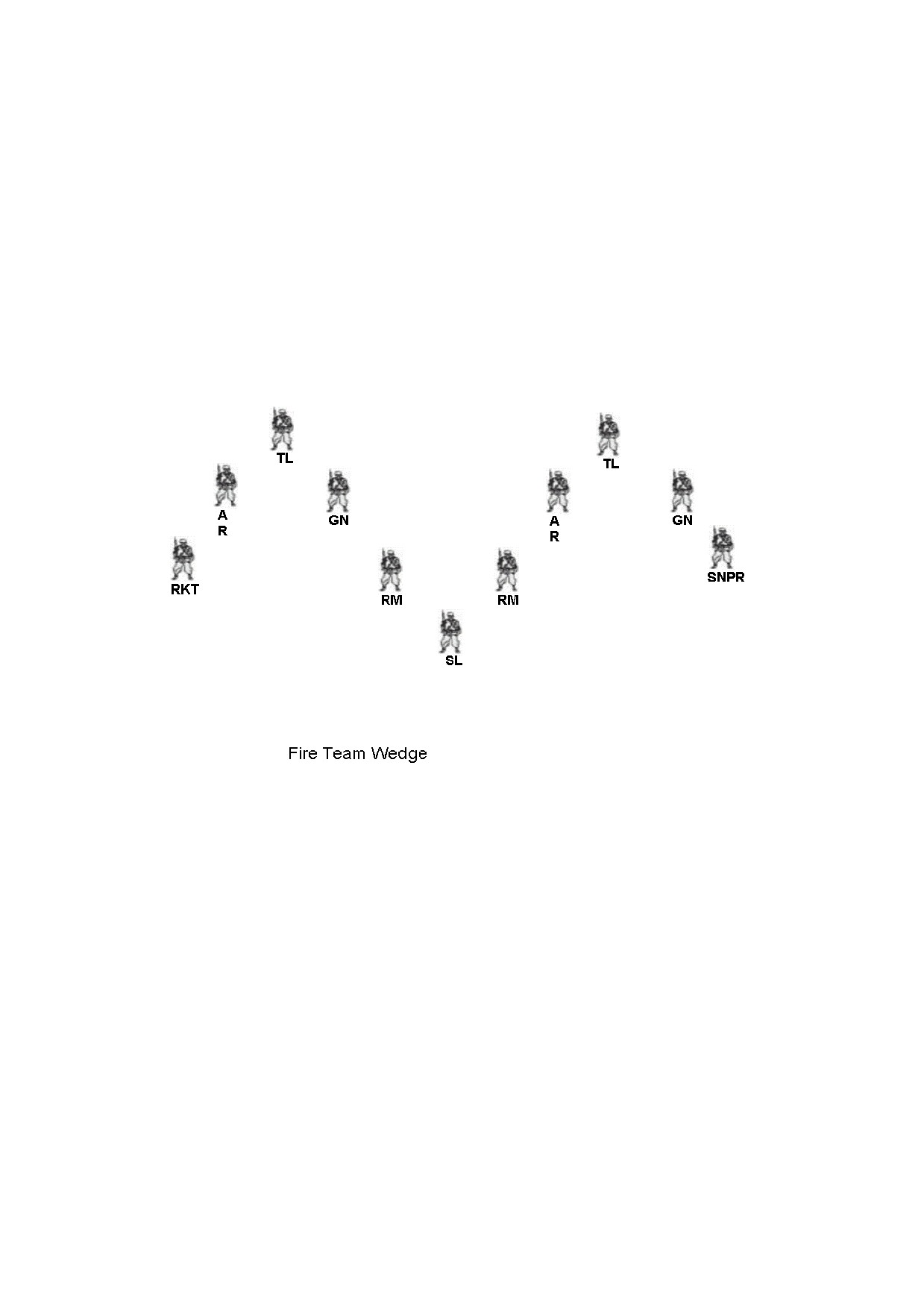
Fire team formations. All soldiers in the team must be able to see their
leader.
(a) Wedge. This is the basic fire team formation; it will be used unless
modified because of terrain, dense vegetation, terrain or mission.
(b) File. Used in close terrain, dense vegetation, limited visibility.
Figure 4. Fire Team Wedge
23

ANA 7-10.2 Infantry TACSOP
Figure 5. Fire Team File
24
ANA 7-10.2 Infantry TACSOP
(2)
Squad formations. Squad formations describe the relationships between
fire teams in the squad.
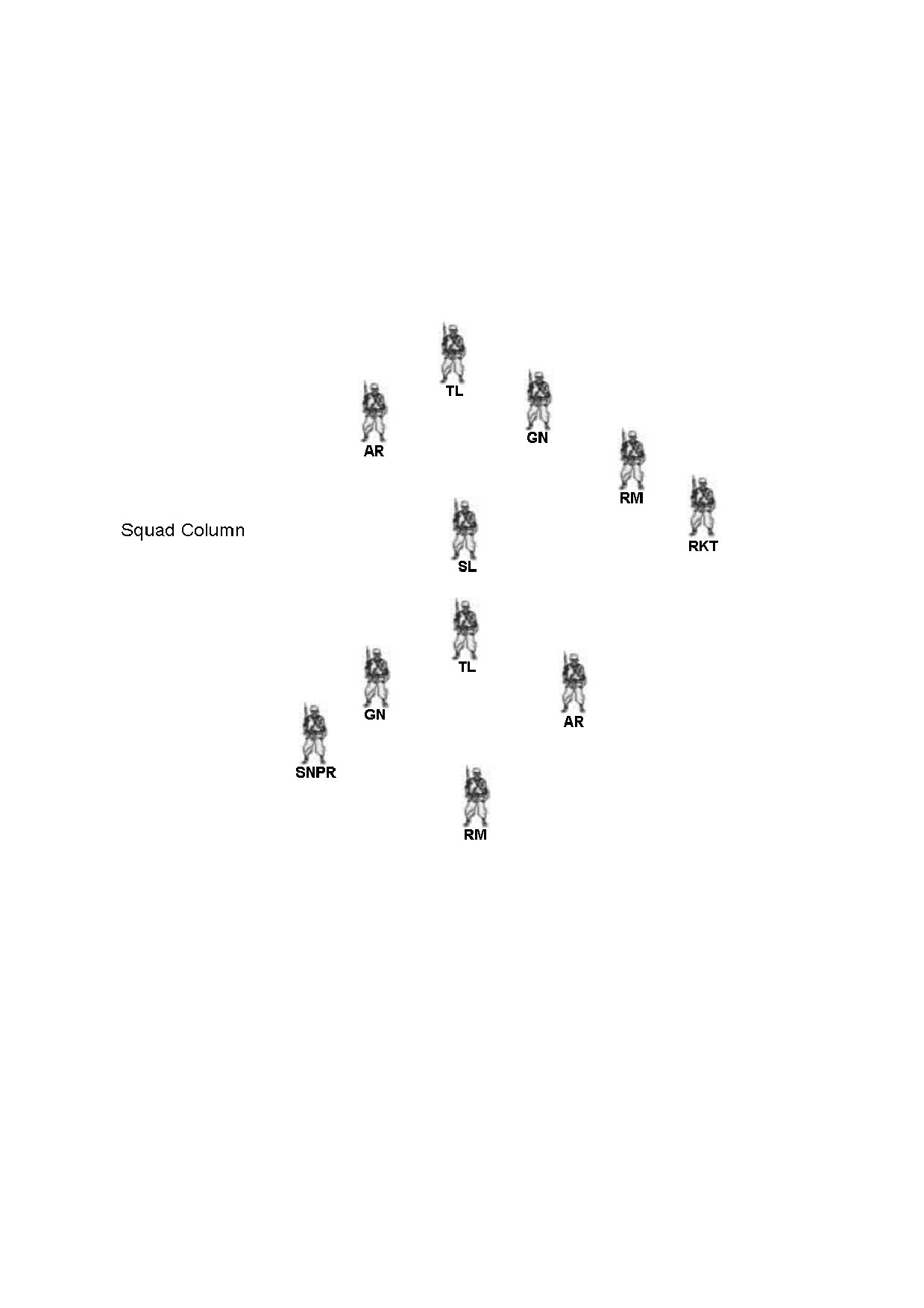
(a) Column. Primary squad formation and will be used unless METT-TC
dictates otherwise.
(b) Line. Used when maximum fire power is needed (to the front.
(c) File. Used in close terrain, dense vegetation, or limited visibility.
Figure 6. Squad Column
25

ANA 7-10.2 Infantry TACSOP
Figure 7. Squad Line
Figure 8. Squad File
26

ANA 7-10.2 Infantry TACSOP
(3)
Platoon formations. METT-TC will determine where crew-served
weapons move in the formation. They normally move with the platoon
leader so he can quickly establish a base of fire.
(a) Column. Primary platoon formation—used unless METT-TC dictates
otherwise.
(b) Platoon line, squads on line. Used when the platoon leader wants all
soldiers on line for maximum firepower forward. Used when the enemy
situation is known.
(c) Platoon line, squads in column. Used when the platoon leader does not
want everyone forward, but wants to be prepared for contact such as near
the objective.
(d) Platoon Vee. Used when enemy situation is vague, but contact is
expected to the front.
(e) Platoon wedge. Used when enemy situation is vague and contact is not
expected.
Figure 9. Platoon Column
27

ANA 7-10.2 Infantry TACSOP
Figure 10. Platoon Line, Squads in Line
Figure 11. Platoon Line, Squads in Column
28

ANA 7-10.2 Infantry TACSOP
Figure 12. Platoon Vee
Figure 13. Platoon Wedge
29

ANA 7-10.2 Infantry TACSOP
b. Movement Techniques. Leaders choose a movement technique based on their
mission analysis of METT-TC and likelihood of enemy contact.
(1)
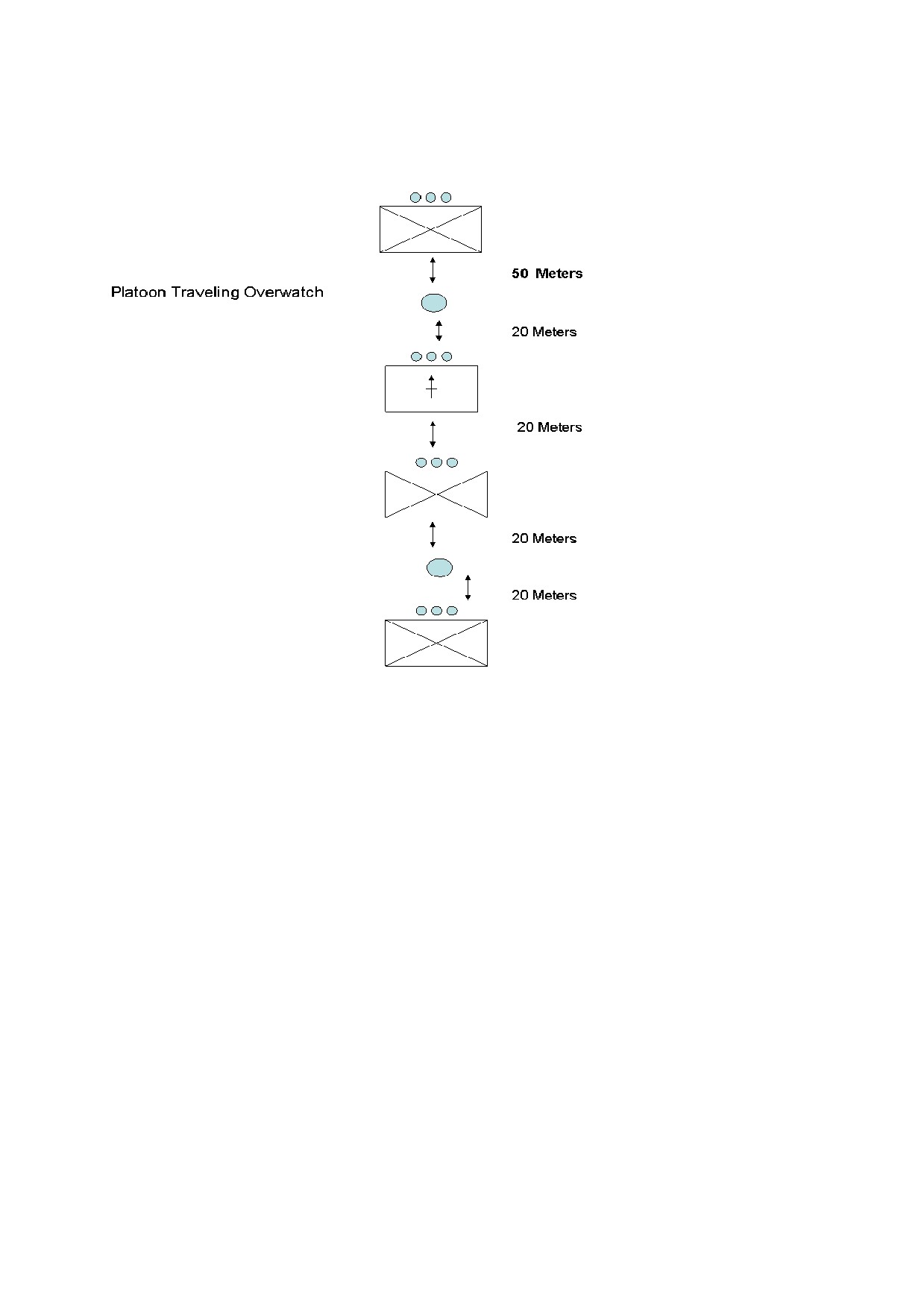
Traveling. Used when contact is not likely and speed is important.
(2)
Traveling overwatch. Used when contact is possible but speed is
important.
(3)
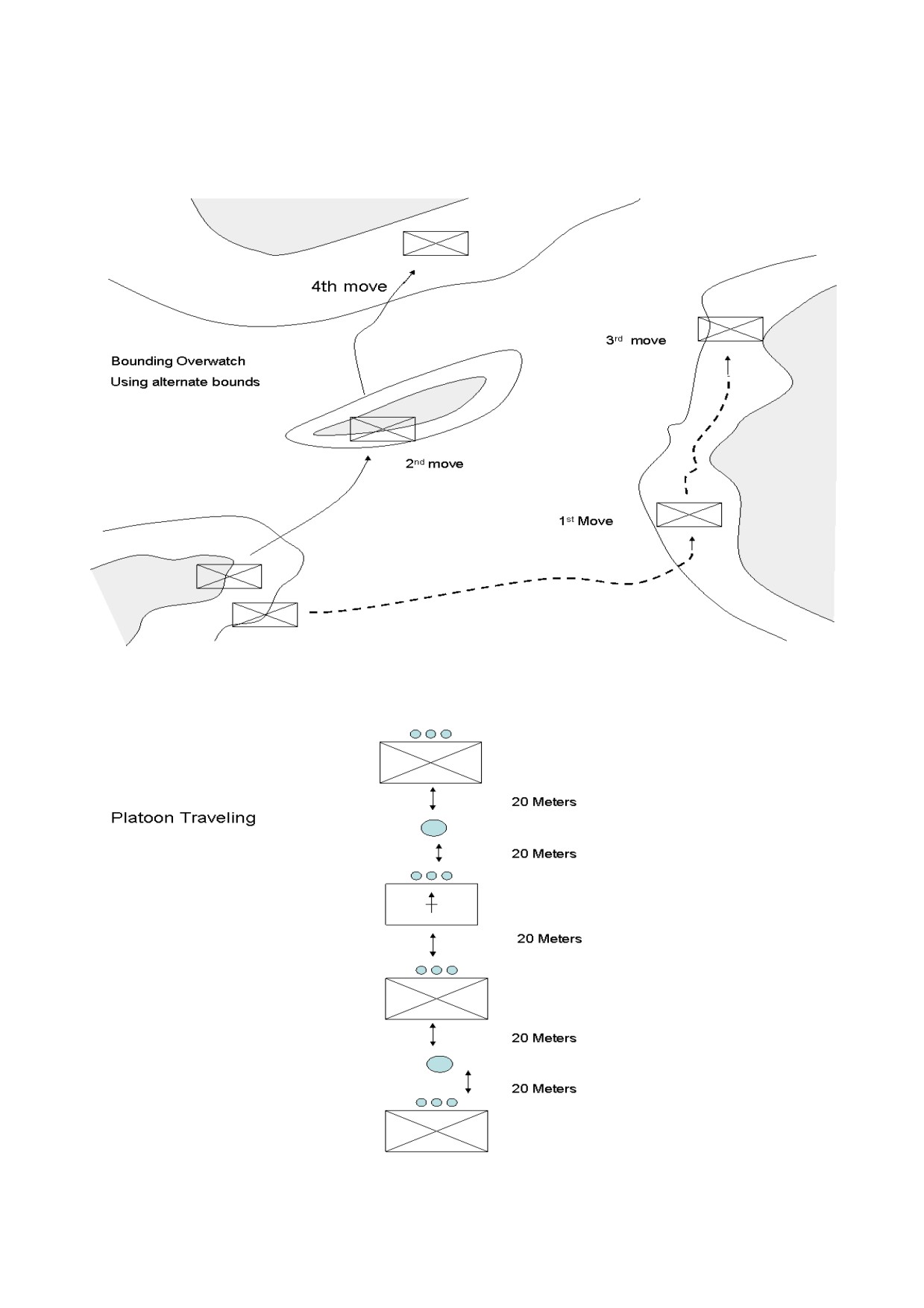
Bounding overwatch. Used when contact is likely or imminent and speed
is not important.
c. Foot Marches. When moving along a road in a relatively secure area, the platoon
will move with one file on each side of the road. Fire teams are not split up. There
will be 3 to 5 meters between soldiers and 25 to 50 meters between platoons.
(1)
The normal rate of march for an 8-hour march is 4 kmph. The interval and
rate of march depend on the length of the march, time allowed, likelihood
of enemy contact (ground, air, or artillery), terrain and weather, condition
of the soldiers, and the weight of the soldiers’ load.
(2)
A 15-minute rest will be conducted at the end of the first 45 minutes of a
road march. During this halt, the medic and squad leaders will check the soldiers’ feet and
report the physical condition of the soldiers to the platoon leader and platoon sergeant.
Thereafter, a 10-minute rest is conducted every 50 minutes.
Figure 14. Squad Traveling Formation
30

ANA 7-10.2 Infantry TACSOP
Figure 15. Squad Traveling Overwatch
2d
3rd
31
ANA 7-10.2 Infantry TACSOP
Figure 16. Bounding Overwatch, Successive Bounds*
*Note: Lead element stays in position and provides overwatching fires until the maneuver
element is in place and set. Once the maneuver element is in place and set they provide
overwatch to allow the lead element to maneuver.
Figure 17. Bounding Overwatch, Alternate Bounds
32
ANA 7-10.2 Infantry TACSOP
Figure 18. Platoon Traveling Formation
Figure 19. Platoon Traveling Overwatch
33

ANA 7-10.2 Infantry TACSOP
Figure 20. Platoon Bounding Overwatch
2. ACTIONS AT HALTS. During halts, security is posted and all approaches into the
platoon’s area are covered by key weapons. The platoon sergeant moves forward through
the platoon, checking security as he goes, and meets the platoon leader to determine the
reason for the halt.
34
ANA 7-10.2 Infantry TACSOP
a. During halts of 30 seconds or less, the soldiers drop to one knee and cover their
assigned sector.
b. During halts longer than 30 seconds, a cigar-shaped perimeter is formed, and the
soldiers assume the prone position.
3. ACTIONS ON CONTACT. On contact, the platoon executes the appropriate battle drill.
a. React to Contact.
b. Break Contact.
c. React to Ambush.
35
ANA 7-10.2 Infantry TACSOP
Card 600 - OPERATIONS
1. OFFENSE. The platoon leader receives the mission from the company commander.
a. Preparation.
(1)
The platoon leader conducts a mission analysis (see operations section).
(2)
The platoon leader issues a warning order.
(3)
The platoon members concurrently perform readiness, maintenance, and
functional checks under the supervision of their leaders. The chain of
command checks weapons, communications equipment, and any special
equipment.
(4)
Weapons will be test fired if the situation permits.
(5)
The platoon leader makes his tentative plan.
(6)
The platoon initiates movement as required—quartering party, selected
elements, or the entire platoon.
(7)
The platoon conducts required reconnaissance—determines location,
strength, disposition, and activity of the enemy, and accurate information
on the terrain (OCOKA).
(8)
Based on METT-TC considerations, intelligence from the reconnaissance,
and other sources, the platoon leader completes the plan. If time is
available, he always gives a brief back to the commander before issuing
the order.
(9)
The platoon leader issues his order to his subordinates providing them
with adequate time to develop their plans, brief the soldiers, and conduct
rehearsals.
(10)
The platoon sergeant (PSG) requests combat service support (CSS)
assets.
(11)
The platoon leader or responsible representative coordinates with higher,
supporting, and adjacent units:
• Fire plans.
• Scheme of maneuver.
• Current intelligence.
• Control measures.
• Communications and signals.
• Time schedules.
• Support requirements.
(12)
The platoon leader supervises mission preparation. Subordinate leaders
conduct brief backs of the plan to ensure his intent is understood. Key
platoon actions are rehearsed as time permits. Certain rehearsals should
take place before the OPORD (wise use of time). First priority for
rehearsals is actions on the objective.
(13)
The platoon leader plans for sustainment of combat operations.
(a)
Platoon leader, platoon sergeant, squad leaders determine
ammunition requirements and other supply needs.
(b)
Platoon leader issues guidance on soldier’s load and ensures loads
are distributed equally. The combat load includes the fighting load and
approach march load. The sustainment load includes the equipment
required for sustained operations and is stored by the battalion at the
brigade support area (BSA) and brought forward as needed.
(c)
Platoon leader and platoon sergeant determine the transportation
needed to support the operation and request it.
36
ANA 7-10.2 Infantry TACSOP
(d)
Platoon sergeant coordinates with the lSG, supply sergeant, and XO
for support. He distributes supplies according to the plan.
(e)
Platoon leader establishes and enforces a rest plan for all platoon
members, particularly for key personnel.
(14) Platoon continues to conduct reconnaissance during operation.
(15) The platoon leader monitors the actions of higher, adjacent, and
supporting units.
(16) The platoon leader issues orders or modifies original plan as needed.
(17) The platoon headquarters reports combat critical information to higher,
adjacent, and supporting units:
• SALUTE on enemy contact.
• Terrain information.
• Changes in platoon actions from the plan.
• Changes in the friendly situation (including attachments).
• Initiation of action by the platoon.
• CS or CSS requests required to execute tasks.
• Friendly information from other units that higher headquarters cannot
monitor.
b. Execution. The two types of attacks are hasty and deliberate.
(1)
Hasty attack. When the platoon or squad makes unexpected contact with
the enemy, the platoon or squad executes the battle drill.
• Deploy.
• Establish a base of fire.
• Find the enemy flank, gap, or weak point.
• Suppress the enemy.
• Attack through the flank, gap, or weak point.
• Report to the commander.
(2)
Deliberate attack. A planned attack against the enemy.
(a)
The platoon leader organizes the platoon for the attack—assault
element and support element.
(b)
The platoon positions for the assault.
• The platoon leader, PSG, or squad leader reconnoiter the
tentative support position, establish local security, ensure the
position provides observation of the objective and overwatch for the
assault element.
• The support element moves by a covered and concealed route
into the support position. The support element occupies the support
position. The platoon sergeant and squad leaders assign covered
and concealed positions, sectors of fire, and necessary fire control
measures. The enemy positions are located. All weapons are
oriented along sectors of fire toward the enemy positions.
• The support element overwatches the assault element’s
movement. The support element maintains continuous
communications with the assault element. If possible, the support
element maintains observation of the assault element and its route.
The support element ensures the assault element’s route does not
cross into the support positions’ sectors of fire. The support element
alerts the platoon leader of any movement on the objective or
change in the enemy situation.
• The support element suppresses the objective with direct or
indirect fires.
37
ANA 7-10.2 Infantry TACSOP
• The platoon leader leads the assault element into the last
covered and concealed position before the objective.
• The assault element uses smoke, if available, to cover its
movement. The assault element ensures it does not move into the
support element’s sector of fire.
• The platoon leader or FO calls for preparatory indirect fire on
the objective.
• The platoon leader ensures all elements are in position before
beginning the assault.
(c)
The platoon performs the assault.
• The platoon leader signals to lift or shift the suppressive fires of
the support element. (Primary signal is FM radio; alternate signal is
visual.)
• The support element lifts or shifts fires and continues to observe
the objective.
• The assault element begins to deliver suppressive fire on the
objective once the support element shifts fire. The assault element
assaults the objective from the flank, a gap, or a known weakness.
The assault element fights through the objective using available
cover and concealment, appropriate movement techniques, and
appropriate battle drills.
• On order, the support element moves onto the objective and
clears the objective of any remaining enemy.
(d)
The platoon consolidates, and then reorganizes. (Many events that
occur during consolidation and reorganization will be concurrent.)
c. Consolidation.
(1)
The platoon occupies a hasty fighting position and prepares for
counterattack.
(a) The platoon leader assigns the squad sectors of fire.
(b) The squad leaders assign positions and sectors of fire.
(c) The platoon leader positions key weapons systems.
(2)
The platoon leader positions OPs to provide security and early warning.
d. Reorganization.
(1)
The platoon leader reestablishes the chain of command and fills key
positions:
• PSG, squad leaders, and team leaders.
• Machine gunners.
• RPG gunners.
• Radio telephone operators (RTOs).
• GP-30 gunners.
(2)
The platoon leader establishes communications with the company
commander, adjacent units, and battalion FSO.
(3)
Leaders redistribute ammunition and equipment.
(a) The squad leaders give the ACE report to the platoon leader.
(b) The platoon leader reports the status to higher headquarters and
requests any required resupply.
(c) The PSG redistributes ammunition and equipment between the
squads as necessary.
(4)
The platoon evacuates casualties. The platoon handles all EPWs IAW the
five S’s. The platoon evacuates all KIA.
38
ANA 7-10.2 Infantry TACSOP
2. DEFENSE. The platoon leader receives the operations order from the company
commander.
a. Preparation of the Defense.
(1)
The platoon leader performs a mission analysis and issues a warning
order to the platoon.
(2)
Platoon members begin performing readiness, maintenance, and functions
checks on all assigned weapons and equipment.
(3)
The platoon leader makes an estimate of the situation and a tentative
plan.
(4)
The platoon leader and squad leaders conduct a leader’s reconnaissance.
They check for past or present enemy activity. They determine the
enemy’s most probable course of action. They confirm or adjust the
tentative plan.
• Squad positions.
• Key weapons positions.
• CP and OP locations.
(5)
The platoon sergeant does an initial inspection of all the platoon’s
weapons and assigned equipment.
(6)
The platoon leader completes the plan and issues the platoon operations
order.
(7)
The platoon sergeant ensures the platoon has a basic load of Class I, IV,
V, and VIII.
(8)
The platoon sergeant requests additional Class I, IV, V, and VIII to be
brought forward to the platoon battle position.
(9)
All platoon members camouflage themselves and their equipment.
(10)
The platoon leader conducts adjacent unit coordination.
(11)
The platoon test fires all assigned weapons.
(12)
The platoon leader conducts the final inspection.
(13)
The platoon conducts rehearsals. The most critical tasks are rehearsed
first. Movement to alternate and subsequent positions is rehearsed. When
possible, a full-force rehearsal is conducted. If the platoon is designated
as a reserve, it rehearses those actions as stated in the OPORD. As a
minimum, brief back rehearsals are conducted with key leaders.
(14)
The platoon begins movement to the platoon battle position.
b. Execution.
(1)
The platoon stops at the last covered and concealed position before the
platoon battle position.
(2)
The platoon leader and squad leaders move forward to the battle position.
They ensure there has been no change to the enemy situation. They clear
the area and establish local security.
(3)
The platoon leader assigns squad battle positions and sectors of fire and
positioning of key weapons systems.
(4)
The platoon leader returns to the platoon and leads them to the platoon
battle position. The squad leaders guide their squads into their squad
battle positions. The squad leaders assign temporary positions and
sectors of fire.
(5)
The platoon leader coordinates for indirect fire.
(6)
The platoon begins executing priorities of work.
(a) Establish security. As a minimum, each squad has one OP forward of
its position during preparation of the defense.
(b) Position key weapons. The platoon leader positions the platoon’s key
weapons and assigns them sectors of fire.
39
ANA 7-10.2 Infantry TACSOP
(c)
Position squads. The platoon leader verities each squad’s position
and assigns the squad a sector of fire. The squad leader assigns
individual fighting positions and sectors of fire.
(d)
Establish communications. As minimum, the platoon establishes a
“hot loop” wire net.
(e)
Coordinate with adjacent units. Each squad coordinates with the
squad on its left ensuring all sectors of fire are interlocking and all
dead space is covered by indirect fire.
(f)
Clear fields of fire. Each position clears its sectors of fire.
(g)
Prepare squad sector sketches. The squad leaders prepare an
original and one copy of the sector sketch. The original remains in
the squad CP, and the copy is turned in to the platoon leader. As a
minimum, the squad sector sketch includes-
• Key terrain within the squad sector.
• Each individual fighting position and its primary and
secondary sectors of fire.
• Key weapons positions and their primary sector of
fire, secondary sector of fire, and any fire control measures.
• All CP and OP locations.
• All dead space within the squad sector.
• Any obstacles within the squad sector.
(h)
Prepare platoon sector sketch. The platoon leader prepares an
original and one copy of the sector sketch. The original remains in
the platoon CP, and the copy is turned in to the company
commander. As a minimum, the platoon sector sketch includes-
• Squad positions and sectors of fire.
• Key weapons positions and their sectors of fire and fire control
measures.
• CPs, OPs, and patrol routes.
• Platoon maximum engagement lines.
• All dead space within the platoon sector.
• All obstacles within the platoon sector.
• Any TRPs or FPFs within the platoon sector.
(i)
Prepare fighting positions.
(j)
Emplace obstacles. Prepare IAW the company or battalion obstacle
plan.
(k)
Establish fire control measures. Establish and mark all required fire
control measures.
(l)
Assign alternate and supplementary battle positions. The platoon
leader assigns each squad and key weapons system an alternate
and a supplementary battle position.
(m) Improve fighting positions.
(n)
Prepare alternate and supplementary positions.
(o)
Establish a rest plan.
(7)
The platoon conducts a rehearsal.
(a)
Movement from primary positions to alternate and supplementary position.
(b)
Initial engagements at trigger lines and TRPs.
(c)
Casualty evacuation.
(d)
Any planned counterattacks.
(8)
The platoon sergeant stockpiles additional Class I, V, and VIII.
(9)
If time allows, communications trenches are dug between positions and
CPs.
40
ANA 7-10.2 Infantry TACSOP
(10) As time allows, the platoon’s positions are continually improved.
c. React to Indirect Fire.
(1)
When in defensive positions, soldiers seek the protection of their fighting
positions. (Fighting positions require a minimum of 18 inches of overhead
cover to provide protection from artillery rounds impacting nearby.)
(2)
While moving or halted in unprotected positions, soldiers immediately
assume prone positions. After the initial incoming rounds impact, the
platoon leader determines the extent of the impact area (its length and
width) and the nearest edge out of it (still heading roughly in the direction
of travel, if possible). Then, he gives the direction and distance to move
out of the impact area (for example, “Two o’clock, two hundred meters,
follow me”).
(3)
Leaders report and continue the mission.
d. Consolidation.
(1)
The platoon leader adjusts squad positions, if required, and reassigns
sectors of fire. The squad leaders and team leaders adjust positions to
cover assigned sectors of fire. The platoon leader adjusts crew-served
weapons to cover most dangerous avenues of approach.
(2)
The platoon leader positions OPs to provide security and early warning.
e. Reorganization.
(1)
The platoon reestablishes the chain of command and fills key positions:
(a) Platoon leader, platoon sergeant, squad leaders, and team leaders.
(b) Key weapons: machine guns, GP-30s, antiarmor.
(2)
The platoon establishes communications with the company commander,
the adjacent units, the battalion FSO, and the squads.
(3)
Leaders redistribute ammunition and equipment. The platoon leader
receives ACE report from squad leaders. The platoon leader reports the
status to the company commander and requests any supplies that are
required. The platoon sergeant redistributes ammunition and equipment
among the squads.
(4)
The platoon evacuates casualties, handles all enemy prisoners of war
(EPWs) in accordance with (IAW) the five S’s, and evacuates KIA.
(5)
The platoon repairs fighting positions as required.
41
ANA 7-10.2 Infantry TACSOP
Card 610 - ASSEMBLY AREA PROCEDURES
When directed to occupy an assembly area, the platoon leader designates a quartering
party. Each squad will provide two men for the quartering party. The platoon sergeant or
selected NCO will be in charge of the quartering party.
1. The quartering party reconnoiters the assembly area to ensure no enemy are present
and to establish initial security.
2. The quartering party determines initial positions for all platoon elements.
3. The quartering party provides security by forcing enemy reconnaissance personnel to
withdraw and providing early warning of an enemy attack.
4. As the platoon clears the release point, quartering party members, waiting in covered
and concealed positions, move out and guide the platoon to its initial position without
halting.
5. The platoon establishes and maintains local security. The platoon leader assigns each
squad a sector of the perimeter to ensure mutual support and to cover all gaps by
observation and fire. The platoon leader designates OPs and squad leaders select OP
personnel. OPs have communications with the platoon CP. OPs warn the platoon of
enemy approach before the platoon is attacked.
6. The platoon leader establishes a priority of work, to include-
a. Positioning of crew-served weapons and designating PDF, FPL, and FPFs.
b. Constructing individual and crew-served fighting positions.
c. Setting up wire communications between the squads and the platoon CP. (Radio
silence is observed by the platoon.)
d. Camouflaging positions.
e. Clearing fields of fire.
f. Distributing ammunition, rations, water, supplies, and equipment.
g. Conducting preventative maintenance checks and services on weapons and
equipment.
h. Inspection platoon members and equipment.
i. Rehearsing critical aspects of the upcoming mission.
j. Test firing small-arms weapons (if the tactical situation permits).
k. Conducting personal hygiene and field sanitation.
l. Instituting a rest plan.
m. Completing the work priorities as time permits.
7. The platoon leader conducts adjacent unit coordination. The platoon leader assigns
security patrols, if applicable. The platoon leader establishes responsibility for overlapping
enemy avenues of approach between adjacent squads and platoons. The leaders ensure
there are no gaps between elements. The platoon leader exchanges information on OP
locations and signals. The platoon leader coordinates local counterattacks.
8. The platoon leader forwards a copy of the sector sketch to the company.
42
ANA 7-10.2 Infantry TACSOP
Card 620 - FIRE SUPPORT
1. TARGETING. During mission planning, the platoon leader makes adjustments to the
company’s indirect fire support plan. Possible targets include-
a. Known or suspected enemy locations not targeted by higher.
b. Dead space not covered by organic weapons.
c. Gaps between adjacent units not targeted by higher.
d. Likely mounted and dismounted avenues of approach and withdrawal.
e. Key terrain or obstacles not targeted by higher.
2. FORWARD OBSERVER.
a. Duties and Responsibilities.
(1)
The FO is the platoon’s link to the battalion fire support system.
(2)
He assists the platoon leader in developing a platoon fire support plan that
supports the platoon scheme of maneuver.
(3)
He advises the platoon leader on the capabilities, limitations, and effects
of the various types of available munitions.
(4)
He continually updates the battalion FSO on his position and situation.
ensuring the platoon is able to receive responsive fire support.
(5)
He submits targets into the battalion fire support system and updates them
as necessary throughout the mission.
b. Positioning. The position of the FO always depends on METT-TC. Generally, he
moves as a member of the platoon headquarters. On rare occasions, the FO might
be separated from the platoon leader. The FO must be readily available to the
platoon leader, maintain communication with the battalion FSO, and be able to
observe the battlefield.
3. FIRE SUPPORT IN THE OFFENSE.
a. Targets are planned in front of and on the objective to support the platoon’s
approach, deployment, and assault during the attack.
b. Targets are planned beyond the objective to support the platoons consolidation
and reorganization after the attack.
c. Targets are planned on all known or suspected enemy positions.
d. Targets are planned on likely enemy withdrawal and counterattack routes.
e. Targets are planned on key terrain features throughout the platoon area of
operations.
f. Smoke is planned to obscure the platoon’s movement through or across danger
areas.
4. FIRE SUPPORT IN THE DEFENSE.
a. Targets are planned on all known or suspected enemy positions.
b. Targets are planned along likely enemy avenues of approach.
c. Targets are planned in front of, on top of, and behind the platoon battle position.
d. An FPF is planned along the enemy’s most dangerous avenue of approach.
e. Smoke is planned to screen the platoon’s withdrawal to alternate or supplementary
positions.
f. Illumination is planned BEHIND THE ENEMY. This exposes the enemy without
exposing the platoon.
5. INDIRECT FIRE CONTROL.
43
ANA 7-10.2 Infantry TACSOP
a. Before the start of any operation, the platoon leader ensures the FO knows the
following:
(1)
Target locations and descriptions.
(2)
The effects required or purpose of the target.
(3)
The priority of targets.
(4)
Target engagement criteria.
(5)
The method of engagement and control for the target.
(6)
The location of all TRPs, trigger lines, and any other fire control measure
used by the platoon leader.
6. CALL FOR FIRE. A call for fire is a message prepared by an observer. It has all the
information needed to deliver indirect fires on the target. Any soldier in the platoon can
request indirect fire support by use of the call for fire. Calls for fire must include-
a. Observer identification and warning order: adjust fire, fire for effect, suppress,
immediate suppression (target identification).
b. Target location methods: grid, polar, shift from a known point.
c. Target description. A brief description of the target using the acronym SNAP is
given: Size/shape, Nature/nomenclature, Activity, and Protective/posture.
44
ANA 7-10.2 Infantry TACSOP
Card 630 - FIRE CONTROL AND DISTRIBUTION
1. FIRE CONTROL.
a. Fire control measures.
(1)
Graphic measures.
(a)
Boundaries or sectors. Divide areas of tactical responsibility between
units.
(b)
Battle positions. Defensive position oriented along likely enemy
avenues of approach.
(c)
Engagement areas. The area in which the leader intends to destroy
the enemy.
(d)
TRPs. TRPs are used to reference enemy locations. They can be
man made or natural. TRPs must be easily identifiable.
(e)
Maximum engagement lines. Imaginary line which identifies the point
where a particular weapon system is engaging at its maximum
effective range.
(f)
Trigger lines. An imaginary line where once the enemy crosses,
friendly units can engage. Trigger Lines can be oriented to terrain,
obstacles, TRPs, or maximum engagement lines.
(g)
Phase lines. Imaginary line placed along identifiable terrain which is
used to control movement or coordinate fires.
(h)
Final protective fire. A preplanned barrier of both direct and indirect
fire designed to prevent or disrupt the enemy assault.
(2)
Rules of engagement. Rules of engagement are directives issued by
military or political authorities that specify circumstances under which the
platoon will initiate or continue combat operations. Rules of engagement
will generally be issued with the company operations order. Ensure
everyone understands ROE.
(3)
Engagement priorities. Targets appear in random order at different times
and locations throughout the battlefield. Engagement priorities allow the
leader to designate which target he wants destroyed first. Engagement
priorities are usually done by weapons systems.
(a)
Antiarmor weapons systems. The platoon antiarmor weapons
engage targets in the following priority:
• Most threatening armor.
• Armor in primary sector.
• Armor in secondary sector.
• Unarmored command and control vehicles.
(b)
Platoon machine guns. Machine gunners should always attempt to
engage at their maximum effective range and should strive for
grazing fire. Machine guns have the following target priority:
• The FPF, if directed.
• The most dangerous or threatening target.
• Groups of dismounted infantry in primary sector.
• Enemy crew-served weapons.
• Groups of dismounted infantry in secondary sector.
• Unarmored command and control vehicles.
(c)
GP-30s. The grenadiers are used to cover the platoon’s dead space.
The target priority for GP-30s is-
• The most dangerous or threatening target.
45
ANA 7-10.2 Infantry TACSOP
• Light-armored vehicles.
• Groups of three or more in primary sector.
• Groups of three or more in secondary sector.
b. Fire Commands. Leaders use fire commands to direct the fires of the unit. A
subsequent fire command adjusts or changes information given in the initial fire
command. Only the elements that change are given. Fire is terminated by the
command or signal for CEASE FIRE, END OF MISSION. A fire command has the
following six parts.
(1)
Alert. The leader can alert the soldiers by name or unit designation, by
some type of visual or sound signal, by personal contact, or by any other
practical way.
(2)
Direction. The leader tells the soldiers the general direction or pinpoint
location of the target.
(3)
Description. The leader describes the target briefly but accurately. The
formation of enemy soldiers is always given.
(4)
Range. The leader tells the soldiers the range to the target in meters.
(5)
Method of fire. The leader tells the soldiers which weapons to fire. He can
also tell the type and amount of ammunition to fire, and the rate of fire.
(6)
Command to fire. The leader tells soldiers when to fire. He can use an
oral command, a sound or a visual signal. When he wants to control the
exact moment of fire, he says AT MY COMMAND (then pauses until ready
to commence firing). When he wants to start firing upon completion of the
fire command, he just says FIRE.
c. Fire Control During Limited Visibility. During limited visibility, leaders ensure
that the platoon’s fires are controlled. To do this, they can use aiming stakes,
T&Es for all machine guns, illumination, TRPs.
2. FIRE DISTRIBUTION. The two methods of fire distribution are point fire and area fire.
a. Point Fire. The platoon’s fires are directed at one target. The platoon leader
accomplishes this by marking the desired target with tracer fire or by GP-30 fire.
b. Area Fire. The platoon’s fires cover an area from left to right and in depth. The
platoon leader accomplishes this four ways.
(1)
Frontal fire. Frontal fire is used when the enemy is moving perpendicular
to the platoon’s direction of fire. Each squad engages the targets to their
immediate front. As targets are destroyed, fires are shifted toward the
center of the enemy.
(2)
Cross fire. Cross fire is used when the enemy is moving perpendicular to
the platoon's direction of fire and terrain does not allow frontal fire. It is
also used when the enemy is moving oblique to the platoon’s direction of
fire. When using cross fire, squads engage targets from left to right or from
right to left depending on their location.
(3)
Depth fire. Depth fire is used when the enemy is moving parallel to the
platoon's direction of fire. Squads engage targets from front to rear or from
rear to front. As targets are destroyed, fires are shifted toward the center
of the enemy.
(4)
Combination. Depending on the METT-TC, the platoon may use any
combination of the above techniques.
46
ANA 7-10.2 Infantry TACSOP
CARD 700 - OPERATIONAL SECURITY
1. COVER AND CONCEALMENT.
a. Camouflage. All soldiers use camouflage paint to cover exposed skin. The outline
of an individual is broken using vegetation, burlap, or any other available means.
Fighting positions are camouflaged using all exposed dirt to breakup the outline of
a position. The position is checked from the enemy’s view. Equipment is
camouflaged using vegetation to break up the outline of the equipment and to
cover all reflective surfaces.
b. Protection. Fighting positions have 18 inches of overhead. Helmets are worn
during tactical operations.
c. Concealment. In order to avoid detection, soldiers operate using terrain and
vegetation.
2. OBSERVATION POSTS.
a. Positioning. OPs always contain a minimum of two soldiers and have
communication with the platoon headquarters (land line, FM, or signaling device).
OPs are positioned IAW METT-TC. Routes to and from the OP are recorded and
rehearsed. Each member of the OP is thoroughly briefed on the rules of
engagement before departing for their post. Signals for the return of OPs (running
password, challenge/password, light signals) will be established and briefed to all
platoon personnel.
b. Relief of OPs. When an OP is relieved, the relieving personnel meet with the
current OPs and receive a briefing that contains, as a minimum:
• Call signs and frequencies.
• Routes to and from perimeter.
• All signals and passwords.
• Area of responsibility for observation.
3. STAND-TO. The platoon will conduct stand-to 30 minutes before dawn and 30 minutes
after sunset.
a. Team leaders and squad leaders check every individual soldier to ensure he is
awake and alert, to ensure his equipment is packed in his rucksack, and to ensure
he is observing his sector in his assigned fighting position.
b. Team leaders and squad leaders gather sensitive items report and weapons
operational status, and pass the report to the platoon sergeant.
c. The platoon sergeant gathers the reports, spot checks squad position, and passes
the reports to platoon leader.
d. The platoon leader reports to higher headquarters, spot checks squad and crew-
served weapon positions.
4. NOISE, LIGHT, AND LITTER DISCIPLINE.
a. During preparation for combat, each platoon conducts final inspections.
Shortcomings in noise discipline are identified. Clanking, rattling, and so forth, is
reduced by the use of tape or cloth as required.
b. When lights are necessary for planning or map reading, a poncho is used to
conceal them.
c. Cigarettes and cooking fires are not lit during daylight or darkness without
permission of the company commander, or the leader of an independent element.
d. Nonverbal means of communication are used to the maximum extent possible.
47
ANA 7-10.2 Infantry TACSOP
e. During stationary operations, trash is collected and backhauled during logistics
runs. If this is not practical (and in all other operations), soldiers carry trash until it
can be disposed of securely (it is not buried or hidden unless specifically
authorized).
48
ANA 7-10.2 Infantry TACSOP
Card 800 - COMBAT SERVICE SUPPORT
1. SOLDIER’S LOAD. Determining the soldier’s load is a critical leader task. The soldier’s
load is always METT-TC dependent and must be closely monitored. Soldiers cannot afford
to carry unnecessary equipment into the battle. Every contingency cannot be covered. The
primary consideration is not how much a soldier can carry, but how much he can carry
without impaired combat effectiveness.
a. Combat Load. The mission-essential equipment, as determined by the
commander responsible for carrying out the mission, required for soldiers to fight
and survive immediate combat operations. When possible, a soldier’s combat load
should not exceed 60 pounds. There are two components:
(1)
Fighting load (the essential items needed to fight) includes bayonet,
weapons, clothing, helmet, and LBE and ammunition. Items will be added
or deleted based on METT-TC and other factors.
Load
Weight (Kilograms)
Helmet, ballistic
1.20
Pistol belt, suspenders, and first-aid pouch
.72
Canteen, 1-quart, and cover with water (2 each)
2.50
Case, small-arms (2each)
.80
Rifle, AK-47 with 30 rounds 7.62 Ball
3.90
Magazines (6) with 180 rounds of 7.62-mm
4.80
Grenade, fragmentation (4)
1.80
Total
15.72
(2)
Approach march load includes those items that are needed for extended
operations. These are dropped in an assault position, ORP, or other points
before or on enemy contact. Items may be added or deleted from this list
based on METT-TC and other factors.
Load
Weight (Kilograms)
ALICE, medium with frame
2.85
Rations, Halal (2each)
1.20
Canteen, 1-quart, and cover with water (2 each)
2.50
Toilet articles
.90
Towel
.09
Bag, waterproof
.36
E-tool with carrier
1.10
Poncho, nylon
.58
Liner, poncho
.73
Total
10.31
NOTE: This list keeps the “droppable” rucksack load under 16 kilograms and
the overall combat load under 27.2 kilograms (60lbs).
b. Sustainment Load. The remaining equipment and materials needed for sustained
combat operations must be carried by company and battalion assets.
c. Load Management Techniques. The leader decides, based on METT-TC what
will be carried in rucksack and what will be carried within immediate reach of
soldier.
(1)
Soldiers distribute loads evenly over body and LBE.
49
ANA 7-10.2 Infantry TACSOP
(2)
Nothing is carried on the front side of the LBE that prevents the soldiers
from taking well-aimed shots.
(3)
Distribute loads throughout the platoon.
(4)
Rotate heavy loads among several soldiers.
(5)
Always consider transportation assets to carry loads.
(6)
Drop rucksacks on enemy contact, or leave them in an ORP, an assault
position, or the assembly area.
(7)
Share or consolidate items.
(8)
Consider carrying fewer rations for short operations.
(9)
While carrying rucksacks, use water and rations carried in it first. After
rucksacks have been dropped, soldiers will still have a full supply on their
LBE.
NOTE: Items common to everyone’s load are located in the same place.
2. SUPPLY. Policies and procedures are applied for supply requests and resupply
operations. CSS operations are driven by the tactical setting for the infantry platoon.
Resupply operations are planned in advance so as to not interfere with combat operations.
The team leader and squad leader implement CSS by inspecting their soldiers for
shortages and shortcomings in equipment and supplies. Once the squads have compiled
their lists, they report their status to the platoon sergeant who in turn reports his status to
the company XO. To standardize resupply operations, requests are submitted to the
company XO for resupply.
a. Requests for Resupply. During the reorganization phase of combat operations,
the squad leader, within 10 minutes, must assess his squad’s status of
ammunition, equipment, food and water, and submit his report to the platoon
sergeant. Any time a weapon is fired by a soldier, the resupply system begins to
work to prevent soldiers from being without ammunition and equipment. The
system will not wait for minimum allocations, but it will be aggressive to anticipate
future demands.
b. Priority of Resupply. Class V, ammunition; Class VII, weapons systems; Class
IX, repair parts; Class VIII, medical supplies; and Class I, food and water.
3. MAINTENANCE. All weapons systems and equipment are cleaned by the user and
inspected by squad leaders.
a. Priority for Cleaning and Maintenance. The priority is mission and situational
dependent but will normally be antiarmor, crew-served weapons, and individual
weapons.
b. Stand-Down for Maintenance. Stand-down occurs by having no more than 50
percent of the antiarmor and crew-served weapons at any time out of actions for
maintenance. The rest of the squads’ small-arms weapons will stand-down at no
more than 33 percent at one time.
c. Preventive Maintenance Checks and Services (PMCS) Requirements. All
weapons systems and equipment receive an operator’s cleaning inspection.
d. Evacuation Responsibilities and Procedures. Once the soldier completes the
inspection of his weapons system, the squad leader verifies the work, and if a
problem occurs, the squad leader fixes it or informs the platoon sergeant of the
problem. The platoon sergeant then consolidates all of the maintenance requests,
and informs the company XO during scheduled resupply. The XO evacuates the
weapons and equipment to the battalion support area. The XO makes
arrangement for a float from higher support.
50
ANA 7-10.2 Infantry TACSOP
4. PERSONNEL.
a. Strength Reports. The platoon’s strength is reported at least twice daily on a
secure net or land line from the platoon battle roster.
b. Replacements. Care should be taken when integrating new soldiers into the
platoon. They are briefed by their entire chain of command. Their equipment is
inspected by their squad leader, and any problems that have surfaced during in-
processing are immediately fixed. Squad leaders explain the current situation and
inform new soldiers of their duties and SOPs.
c. EPWs and Civilian Internees and Detainees. All EPWs and civilians are handled
IAW with international law. The platoon sergeant monitors all activities dealing with
EPWs and civilian internees and detainees. He ensures that they are searched,
segregated, silenced, safeguarded and sped to the rear. He is in charge of
providing their medical treatment and their physical security. In addition, he
assigns a team or squad to help with this mission, and to help maintain control
throughout this process.
5. HEALTH SERVICES.
a. Medical Evacuation. Each platoon should have at least one MOS qualified
attached medic. Every effort is made to train as many personnel as possible as
combat lifesavers. However, their primary skills area is infantrymen not medics.
Each squad appoints one man as an assistant medic to help the platoon medic
with treatment of the casualties. The platoon sergeant coordinates with the platoon
medic and squad leaders for the location of the casualty collection point. The
squad’s chain of command is responsible for evacuating their troops to the
location. Once the mode of evacuation has been established, the platoon sergeant
secures the casualties’ weapons, equipment, and ammunition and cross levels
them, if need be. Requests for medical evacuation are handled by the platoon
sergeant and routine sick is handled by the platoon medic. Priority categories for
medical evacuation are urgent, urgent surgical, priority, routine, and convenience.
b. Field Sanitation. Field latrines are dug at least 100 meters from platoon positions,
if the tactical situation permits. If not, the trench is constructed within the platoon
perimeter. The trench is constructed under the supervision of the platoon medic.
The only water to be consumed by soldiers should be potable or treated water. If
located near a stream, the latrine is constructed downstream from the platoon’s
positions.
51
ANA 7-10.5
Other Tactical Operations
For The
Infantry Company
Commander
CHAPTER 1
OTHER TACTICAL OPERATIONS
Section I. PASSAGE OF LINES
A passage of lines is an operation in which one unit passes through the lines of a
stationary unit. When a unit moving toward the enemy passes through a stationary unit, it
is called a forward passage of lines. When a unit moving away from the enemy passes
through a stationary unit, it is called a rearward passage of lines.
1-1. PURPOSE
This operation is conducted when the company's mission requires a movement through
terrain occupied by another unit. A company may conduct a passage of lines—
· To initiate or continue the attack.
· To begin an infiltration.
· To conduct reconnaissance operations.
· To conduct a counterattack.
· To conduct retrograde operations.
1-2. GENERAL CONSIDERATIONS
In planning for a passage of lines, the CO (commanding officer of the company also
called the company commander) should consider the following to reduce the disruption
of both the passing unit's movement and the stationary unit's defense.
· Conduct the passage as quickly as possible.
· Avoid masking the fires of the stationary unit.
· Coordinate early in the planning process and maintain the coordination/liaison
during execution.
· Maximize the support from the stationary unit.
· Plan for likely contingencies.
· When possible, bypass the stationary unit.
· When possible, avoid passing through a unit that is in contact with the enemy.
1-3. SPECIFIC CONSIDERATIONS
Each tactical situation presents certain considerations for both the passing and the
stationary company commanders. These considerations result from the commanders'
estimate of the situation. A passage of lines to begin an attack will vary from a passage of
lines to begin an infiltration. The passage of lines is planned to support the company's
mission.
a. Command and Control. Different units will conduct passage of lines at different
times. Because of this, C2 (command and control) considerations for a passage of lines
are special. Coordination must begin early in the planning process. The positioning of
key leaders and the proper use of control measures will also make effective C2 possible.
(1) Coordination between the passing and stationary companies may include the
following:
· Exchange of intelligence.
· Exchange of tactical plans.
· The reconnaissance plan.
· Selection of passage points and use of guides.
· Time or event when responsibility for the control of the area of operations is
transferred to the designated unit.
· Fire and other combat support to be provided by the company that is in contact
with the enemy.
· Exchange of information of known or suspected minefields, obstacles or
important information that may be of help to the units involved.
· Exchange of liaison personnel.
· Exchange of frequencies, call signs, challenge and passwords, and far and near
recognition signals.
(2) The location of the key leaders for both the passing and the stationary company is
critical for command and control and safety. . The commanders and their FSOs (fire
support officers) should collocate where they can best observe and control the passage.
The other key leaders XO, company sergeant (executive officer, first sergeant) should be
positioned where they can best assist the commander, possibly at the passage point or
along the passage lanes.
(3) The passage of lines should be supported by the detailed military graphics to
provide both the required control and flexibility during execution. These may be
designated by the higher commander or either of the company commanders. The
following control measures are often used to support a passage of lines:
(a) Assembly areas. These are used more often in a rearward passage to allow the
passing company to reorganize before continuing movement. These may be designated or
proposed unit locations but occupied only when required.
(b) Attack position should be identified and known by both the stationary and the
moving unit.
(c) Battle handover line. A phase line (normally along easily identifiable terrain
features) used in a rearward passage to designate the point on the ground where the
stationary unit assumes responsibility and control for the battle is the BHO (battle
handover line) line. The stationary unit must be able to engage with direct and indirect
fires out to the battle hand off line and assist the passing unit's disengagement, if
required.
(d) Contact point. A contact point should be designated for each passage point or
lane by the stationary company Commanding officer. (The contact point is a designated
point of the ground where coordination can be made between the different units to make
the passage easier and safer for all units involved). The commanding officer may plan
both a primary and an alternate contact point.
(e) Passage lanes. These should pass through unoccupied terrain between positions
and completely through all obstacles. There may be multiple lanes or primary and
alternate ones.
(f) Passage points. These may be used instead of a passage lane when the
stationary units positioning and obstacles do not require a lane. They may also be
designated along a passage lane to increase control, flexibility and ease of movement.
(g) Routes.
(h) Release points.
(i) Start points.
(j) Signals. Use of hand and arm signals, near and far recognition signals to
facilitate the linkup at the contact point must be determined (as well as the exact time of
passage). Considerations for identifying enemy from friendly (particularly for a rearward
passage) include marking of personnel/vehicles, chemical lights, turret orientation (turrets
should be pointed toward the enemy), and the use of challenges and passwords, or code
words.
b. Reconnaissance. The passing commander ensures that a physical reconnaissance is
conducted early in the planning process. If the commanding officer is unavailable, then
the executive officer/second in command or another leader conducts the reconnaissance
and the initial coordination with the stationary company. When possible, subordinate
leaders also conduct a reconnaissance of their areas of concern. Specific requirements
may include reconnoitering the following locations:
· Passage points/lanes.
· Enemy positions.
· Obstacles (friendly and enemy).
· Friendly positions.
· Contact points, start points, release points, routes, and assembly areas.
· Locations for CS and CSS elements, (trains, aid stations, mortars).
c. Security. Preparatory actions must not reveal an increase in activity in the vicinity of
the passage area. To maintain operational security, limit the size of the reconnaissance
party. Contact points, passage points and lanes, assembly areas, and routes should use all
available cover and concealment. When possible, conduct the passage and the
preparatory activities during limited visibility. The stationary unit should continue to
operate as normal. Although normally planned above company level, it may be possible
to use a simple deception operation to focus the enemy's attention away from the passage
site.
d. Fire Support. The commanding officers and fire support officers must coordinate their
fire support plans. The stationary company plans to support the passing company with
direct and indirect fires; the fire support officers exchange target lists. If a transfer of
responsibility for the area forward of the stationary company is not required, such as
during an infiltration, then additional fire control measures may be required to prevent
fratricide. Both direct and indirect fires must be addressed, and these control measures
must be disseminated to all units involved.
e. Combat Service Support (CSS). The stationary company should provide CSS to the
passing company. This normally includes evacuating casualties, handling enemy
prisoners of war recovering and evacuating vehicles, and re-supplying fuel and
ammunition.
f. Guides. The stationary company must provide guides to link up with the passing
company at the contact points. These guides remain with the passing company
throughout the stationary company's area of operations. The passing commanding officer
provides the guide with the number of personnel and vehicles of each separate unit
passing through each passage point. The guide counts them as they pass to ensure they all
pass through and that no enemy has infiltrated their formations.
1-4. CONDUCT OF THE FORWARD PASSAGE
At the scheduled time, the passing company approaches the contact point(s) and
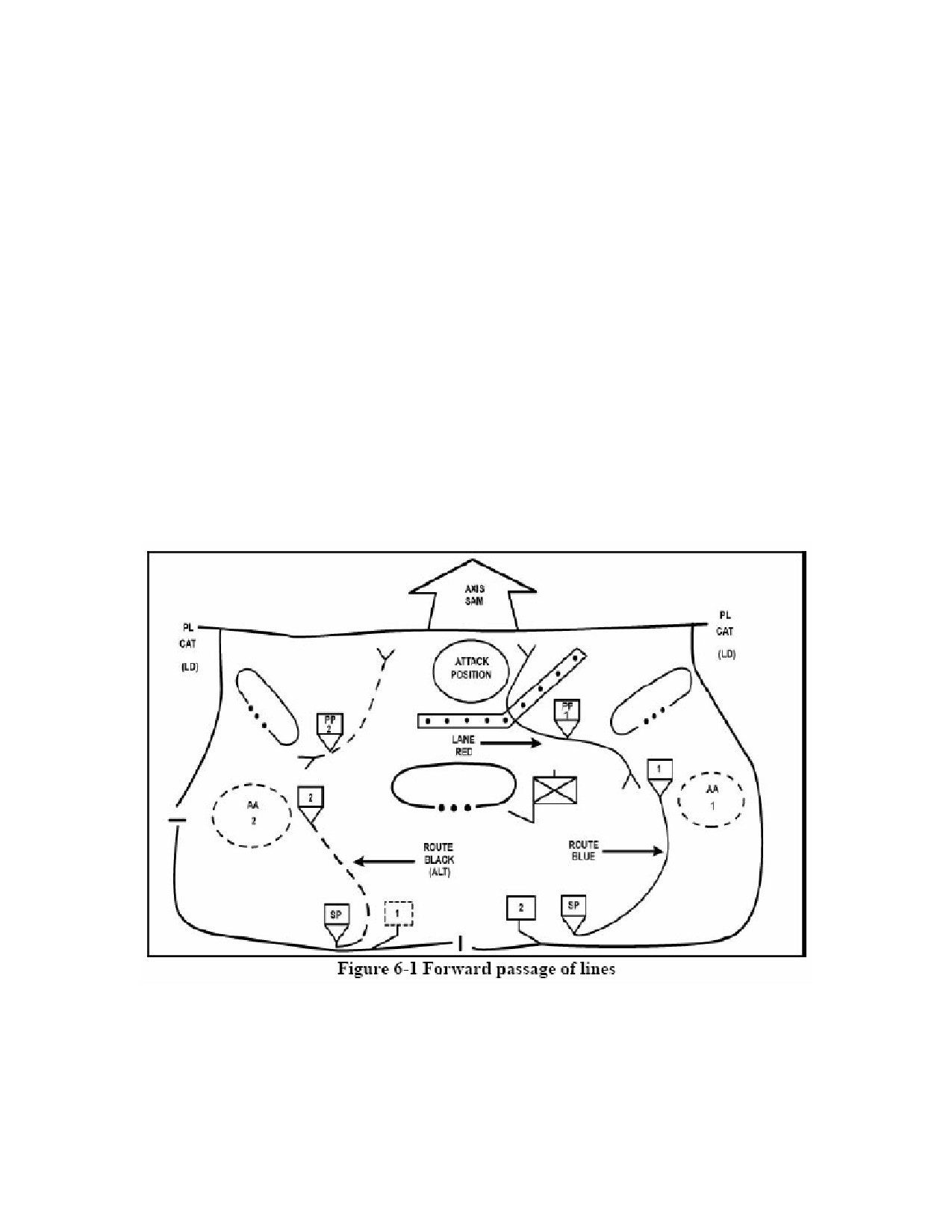
exchanges the recognition signals with the guide (s). Figure 6-1 depicts a forward passage
of lines. The guide then leads the passing unit through the stationary company's positions
along the coordinated routes or passage lanes. At the passage point or at the beginning of
the passage lane, a representative of the stationary company counts the passing unit
through. The passing unit moves through quickly without stopping. The COs and their
FSOs collocate where they can observe critical areas, make timely decisions, and issue
instructions. The guides release the passing units at the release point of a route or the end
of the passage lane.
1-5. CONDUCT OF A REARWARD PASSAGE
The tactics and techniques of a rearward passage are the same as the forward passage. A
rearward passage may include a battle handover. To conduct battle handover, the
stationary unit positions weapons and units where they can engage enemy forces out to

the Battle handover line. As the passing unit soldiers approach the Battle handover line,
they attempt to disengage from the enemy and move along their assigned passage routes
or lanes. The stationary unit assists their disengagement with direct and indirect fires. A
rearward passage under these conditions may get very confusing. Friendly and enemy
units may be intermixed, or the enemy may actually arrive first. To reduce this confusion,
the company COs should collocate. Figure 6-2 depicts a rearward passage of lines.
Section II. RELIEF IN PLACE
A relief in place is an operation in which one unit replaces another unit and assumes the
relieved unit's responsibilities.
1-6. PURPOSE
The primary purpose for a relief in place operation is to maintain the combat
effectiveness of committed units. A relief in place may also be conducted—
· To reorganize, re-establish the chain of command or re-equip a unit that has
sustained heavy losses.
· To rest units that has conducted sustained operations.
· To establish the security force or the DLIC (detachment left in contact) during a
withdrawal operation. (In this case, there are additional requirements addressed in
Section III, Retrograde Operations.)
· To allow the relieved unit to conduct another operation.
1-7. PLANNING CONSIDERATIONS
If the time and location of the coordination meeting was not directed, the relieving unit
commanding officer must contact the relieved unit commanding officer to coordinate
these specifics. The commanding officers, executive officers, platoon leaders, and fire
support officers should attend the meeting.
a. Mission Specific. Each tactical situation presents different or special considerations for
both the relieving and the relieved commanders. The missions for each company, the
enemy situation, and the amount of time available are a few of the specifics that will
impact on the plan.
b. Command and Control. The Command and Control (C2) requirements during a
relief are unique because of the mixing of units. To ensure effective C2, detailed
coordination must occur early in the planning process. The positioning of key leaders and
use of effective control measures will also ensure effective C2.
(1) Coordination between the relieving and the relieved units may include—
· Exchange of intelligence.
· Arrangements for reconnaissance.
· Exchange of tactical plans and sector sketches.
· Sequence and timing for each subunit's relief.
· Time or circumstance when the responsibility for the relieved unit's area of
operations is transferred.
· The use of guides and liaison personnel.
· Security and safety measures.
· Fire support.
· Transfer and exchange of equipment, supplies, ammunition, and information on
location of minefield or obstacles.
· Control measures.
· Exchange of frequencies, call signs, challenge and passwords, and recognition
signals.
(2) The locations of the primary leaders for both units are most important. The COs
and their FSOs normally collocate at a location where they can best observe and control
the relief. Other subordinate leaders should be positioned where they can assist the
commander in accomplishing the task. These may include areas along routes, assembly
areas, points of possible congestion, or locations of greatest enemy threat.
(3) The relief in place should be supported by control measures to provide control and
flexibility during execution. The specific method of relief will determine the number and
type of control measures required. The following control measures are routine:
(a) Assembly areas. (AA) The relieved unit may designate platoon and company
assembly areas to the rear of their positions. The relieving unit may also designate
AAs, but they should move directly into position. To avoid confusion, separate AAs
must be identified for each unit.
(b) Contact points. Contact points are normally designated by the relieved company
commander to facilitate the initial linkup between the companies. Multiple contact
points may be required to support certain relief operations.
(c) Release points. The relieved CO normally designates the platoon release point
for the relieving company. When required, squad release points may be designated by
the relieved company commander or platoon leader.
(d) Routes. All units should move along designated routes to avoid confusion and
fratricide. When possible, separate routes for both the relieving and the relieved units
should be designated. It is the responsibility of the relieved CO to ensure that all
movements are controlled.
c. Reconnaissance. The relieving CO conducts a physical reconnaissance as soon as
possible. The commanders and leaders of both companies should reconnoiter together to
ensure coordination of movement plans. It is critical that leaders down to squad level
reconnoiter to ensure full understanding of movements, control measures, and
responsibilities. Specific reconnaissance requirements may include—
(1) The relieved unit's disposition (to include locations of all OPs, minefields, land
lines, any early warning systems in place, and crew-served weapons).
(2) Enemy dispositions when the relieved unit is in contact.
(3) Locations for assembly areas, release points, contact points, and routes.
(4) Locations of the CP (command post), trains (supply point), mortars, anti armor
systems (SPG 9) and tanks (if available).
d. Method of Relief. The method of relief is determined by the specific situation;
however, regardless of the method of relief, the following actions normally occur. The
relieving company occupies an AA to the rear of the relieved company or is guided along
a route directly to the platoon release point. Guides are provided by the relieved unit for
each relieving subordinate unit. The company command posts collocate prior to
commencing the relief. The relief begins with the depth positions of the relieved
company. The relieving company's trains (supply point) and mortars will normally be
positioned before any relief begins. The relieved company's trains (supply point) and
mortars will normally remain in position until responsibility for the area has passed to the
relieving company. The methods for conducting the relief are as follows:
(1) Relieving one unit at a time. This method takes longer; however, it may be
required when covered and concealed routes are limited and all platoons must use the
same route. The relieving company occupies an AA to the rear of the relieved company
and relieves by platoon according to the coordinated sequence of relief (Figure 6-3). Each
platoon moves forward (with guides provided by the relieved unit) to the squad release
point. The squads are led to a covered and concealed location to the rear of the relieved
squad's position, the necessary equipment is exchanged, and members of the relieving
squads relieve the soldiers from the relieved squad. The relieved squad moves directly to
the platoon AA, links up with the remainder of their platoon, and continues to the
company AA. Once the entire relieving platoon assumes responsibility from the relieved
platoon, the next platoon begins their relief using the same method. This method is
slower than relieving units simultaneously at the same time.
(2) Relieving units simultaneously at the same time. Although this method is the
fastest, enemy detection is more likely since all units move at once creating more noise
and possible chance for confusion and friendly fire accidents. . This method may be
correct when-the mission requires a rapid relief, enemy detection is not likely, and the
terrain provides multiple covered and concealed routes. All relieving platoons move
forward at the same time along their designated routes to the squad release points. The
squad's actions are the same as in the preceding paragraph.
(3) Relieving by occupying in-depth or adjacent positions. This method requires the
relieving unit to occupy positions to the flank or rear of the relieved unit. The relieving
unit should be able to cover the relieved unit's direct-fire control measures Target
Reference Points and Engagement Areas (TRPs and EAs ). The relieving unit may
occupy its positions one at a time or all at the same time, depending on the situation.
Once the relieving unit is in position, the relieved unit withdraws along designated routes.
e. Sequence of Relief. To determine the most effective sequence of relief, consider the
following:
(1) The combat effectiveness of the units. If one subordinate unit has suffered heavy
losses in men or equipment, it may need to be the first relieved.
(2) The terrain. The subordinate unit most likely to be detected during the relief
should be relieved last. This allows the relieving units to be in position before the enemy
is aware of the relief operation.
(3) The enemy. The subordinate unit that is positioned on the most likely or most
dangerous avenue of approach should be considered for early relief.
(4) Control. When two adjacent units must use the same route to conduct the relief,
select a method and sequence of relief that reduces congestion and confusion. Avoid
massing units in a small area.
(5) Subsequent mission. The subordinate unit with the most critical task may need to
be relieved first. For example, a relieving subordinate unit may need to establish an OP
(observation post) forward of their position to provide security for the rest of the relief
operation. Or when the company being relieved is moving to a LZ (landing zone for
helicopters) for an air assault operation, the platoon tasked to secure the landing zone LZ
should be relieved first.

f. Transfer of Responsibility. The time for the transfer of responsibility must be agreed
to by both commanders. Normally, this occurs once two-thirds of the relieving company
are in position and have established communications and control.
g. Transfer/Exchange of Equipment and Supplies. To simplify the relief and maintain
the OPSEC, certain equipment and supplies may need to be transferred between the two
units. These include machine guns, mortar base plates and aiming stakes, camouflage
nets. Supplies that may need to be transferred include barrier materials; excess or
stockpiled supplies and ammunition; and bulky or heavy supplies, which would slow the
relief if the relieved unit attempted to carry them out. The prepared range cards, sector
sketches, and minefield records must also be transferred to the relieving unit.
h. Operations Security and Deception. Every effort must be made to keep the enemy
from knowing the relief is taking place. The relief should be conducted during limited
visibility.
(1) The dispositions, activities, and radio traffic of the relieved unit must be
maintained throughout the relief.
(2) Both companies should be on the relieved company's net. The relieved company
maintains routine traffic while the relieving company monitors. Once the relief is
complete and on a prearranged signal, the relieving company changes to their assigned
frequency.
(3) Security activities (observation posts and patrols) must maintain the established
schedule. This may require some personnel from the relieving unit being placed under
operational control (OPCON) of the relieved unit before the relief.
(4) Additional planning and coordinating is required when a relief is conducted
between a mechanized unit and an infantry company, and relief by the depth or adjacent
position method is not possible. If the relieving company is a mechanized unit, the
company should dismount, conduct the relief with the dismounts, and position the
vehicles once the relieved company has withdrawn. If the relieved company is a
mechanized unit, the relieving company should relieve the dismounts, and then the
vehicles move to the rear. The dismounts from the relieved unit may mount their vehicles
or move to the rear on foot and occupy AAs until they linkup with their vehicles. If
possible, the relieved company uses routine vehicle movements to reposition some
vehicles to the rear before the relief. This may be possible when the unit has been using
the out-of-position resupply technique. All vehicles would move to the resupply point,
but only half return to their positions.
i. Contingency Plan. The COs should collocate where they can best observe and control
the relief. The conduct of the relief is under the control of the relieved company
commander until the conditions for the transfer of responsibility are met. If the enemy
attacks before the transfer of responsibility, the subordinate units of the relieving
company, which are in the area, become OPCON to the relieved company commander. If
the enemy attacks after the transfer, the relieving commander assumes operational control
of all units of the relieved company still in the area. Plans should be developed to cover
these contingencies. A clear understanding of when units would become OPCON must be
agreed upon. These contingency plans should address how the uncommitted OPCON
units will be employed. A technique that provides flexibility to the relief plan is to
designate the last relieving unit as the reserve.
1-8. CONDUCT OF THE RELIEF
At the time set for the start of the relief, the relieving company moves to the contact point
and makes contact with the company guide from the relieved company (Figure 6-4). The
guide leads the company to the RP (release points) where it links up with the platoon and
section guides. The platoon guides lead the platoons to their respective RPs where the
squad guides link up with their squads.
a. In the sequence specified in the order, each platoon conducts its relief. The platoon

leader releases control of his squads, and the squad guides lead the squads to a location
just to the rear of their defensive positions. The squad leaders then begin relieving a few
men at a time until the relief is complete. Before each relieved soldier or leader leaves his
position, he orients the relieving soldier or leader on the position and the area around it.
b. As each soldier or leader is relieved, he moves to his squad's AA. When each squad is
assembled, it moves to its platoon's AA. When each platoon is assembled and its leader is
relieved of his responsibility for the defense, it moves to the company AA. After the
company is assembled and the transfer of responsibility is complete, the relieved
company commander moves his company as directed by the Kandak commander.
Section III. RETROGRADE OPERATIONS
A retrograde operation is an organized movement away from the enemy. It may be forced
or voluntary; but, in either case, the higher commander approves the rearward movement.
These operations (delays, withdrawals) are conducted to harass, exhaust, disrupt, delay,
or damage the enemy. Such operations gain time, avoid combat under unfavorable
conditions, or draw the enemy into an unfavorable position. They are also used to
reposition forces, to shorten lines of communications, or to permit the use of a force
elsewhere. All retrograde operations are difficult; delays and withdrawals are also
inherently risky. To succeed, they must be well organized and well executed.
1-9. DELAYS
The intent of a delay is to slow the enemy, cause enemy casualties, and stop him (where
possible) without becoming decisively engaged. This is done by defending, disengaging,
moving, and defending again. The company may also delay to draw the enemy into a
vulnerable position where they can neutralize or destroy the enemy. Delaying units are
expected to aggressively fight according to the Kandak order and in support of the higher
commander's concept. This often means conducting counterattacks/spoiling1 attacks
whenever possible. Companies do not conduct delays independently; they fight as part of
their Kandak. The company may delay in sector or from battle positions.
a. A delay against a mounted force is a difficult operation. The company may easily
become decisively engaged, and it runs the risk of being destroyed or surrounded. The
company must reduce the enemy's mobility advantage with obstacles, fires, and the
effective use of the terrain. The Kandak commander should give the CO clear instructions
on the criteria for disengagement and when decisive engagement may be required.
b. The Kandak commander normally assigns the company a sector when there is no
dominating terrain on the enemy avenues of approach, where there are multiple enemy
avenues of approach, or when the Kandak sector is extremely wide. He may also assign
one or more phase lines, which the company must prevent, the enemy from crossing until
a certain time.
c. The company commander may assign sectors or initial and subsequent delay positions
for his platoons (Figure 6-5). He defends and withdraws by platoons, bounding them to
the rear.
d. Delay positions must have the same characteristics as good defensive battle positions.
They should have effective fields of fire to the front and covered withdrawal routes to the
rear. If good routes are not available, plan for smoke to screen the withdrawal.
e. The Kandak commander normally assigns the company a series of battle positions
when one of the following two situations occurs. The Kandak is delaying in restrictive
terrain where the enemy can be canalized into selected areas. There is terrain that
dominates the avenues of approach, or the Kandak sector is narrow.
f. When the Kandak commander assigns the company a series of battle positions from
which to delay (Figure 6-6), the company moves from one battle position to another as
directed by him. If it coincides with the Kandak plan, the CO may pick platoon battle
positions and fight a delay action between assigned company battle positions. The CO
must decide which positions require preparation and allocate time and resources to them.
g. If a delay is conducted over a long distance, both methods may be used. No matter
which one is used, the CO picks the platoon positions and the routes to them. If there is

terrain that is defendable forward of a phase line (set by the Kandak commander), the CO
may decide to defend there for the required time stated for that line.
h. In both type delays, the CO supplements the company's fire by supporting fire, smoke,
minefields, and obstacles.
i. In both a delay in sector and a delay from battle positions, the CO sends a quartering
party to reconnoiter routes and positions. The party may mark the routes and battle
positions, and select positions for machine guns and mortars. It may also guide the
arriving units into their positions and pre-position supplies, water, and ammunition at
each position. They may also coordinate with any units to the rear of the company when a
passage of lines is required. If the company has thoroughly reconnoitered and rehearsed
the delay, the quartering party may not be required.
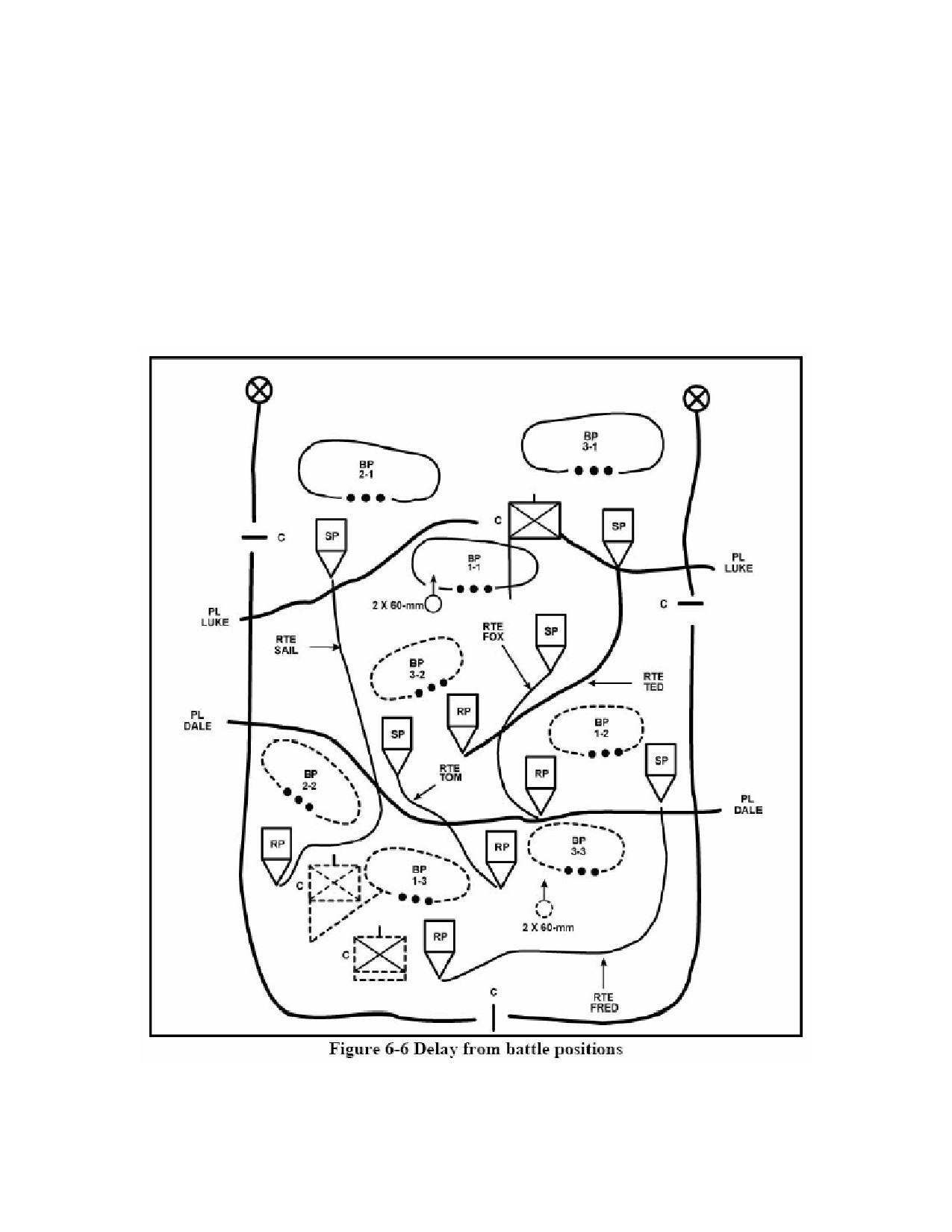
j. The Kandak commander has greater control of the delay when delaying from battle
positions. The CO has more control of the delay when delaying in sector. However, the
Kandak commander can impose more control on the company's rearward movement by
assigning phase lines and times for these lines.
k. If all means of communicating with the Kandak are lost, the CO may withdraw on his
own if he has delayed for the required time or if his withdrawal will not endanger the
mission. He must inform the Kandak commander of the action he has taken. If a platoon
leader loses communications with the company, he does the same. At times, decisive
engagement may be required to meet the time requirement.
(1) The CO and the platoon leaders should reconnoiter positions and routes before the
delay begins. Plans and rehearsals are as detailed as time permits.
m. The Kandak commander normally gives the company commanders a complete 5
paragraph operations order that includes:
(1) The Kandak task organization, mission, and concept.
(2) The company mission. In a decentralized Kandak concept, this may be a delay
task that allows the company commander maximum flexibility in conducting the mission.
In other cases, the company should receive more specific tasks such as:
· Block enemy movement south for 1 hour.
· Destroy enemy in EA (engagement area) FIRE .
· Disrupt enemy forces on avenue of approach 2A.
(3) Their initial delay positions.
(4) His plan for controlling the engagements, disengagements, and movements.
(5) Either a sector or battle positions.
(6) The locations of the company AAs (if used).
(7) General routes to follow from position to position (when delaying from battle
positions).
(8) Instructions about the quartering party (if used).
(9) Any special instructions concerning the control of the mortars, and the movement
of the company vehicles.
(10) Priorities for efforts of the supporting engineers.
n. The company commander normally gives the platoon leaders a complete 5 paragraph
operations order that includes:
(1) The platoon missions. Normally, not a delay task. The CO should develop a
concept that clearly states the platoon missions.
(2) Their initial battle positions to defend.
(3) His plan for controlling the engagements, the sequence and criteria for
disengagement, and the movement instructions.
(4) Subsequent positions to the rear.
(5) General routes to follow from position to position.
(6) Instructions about the company quartering party (if used).
(7) Any special instructions concerning the control of the mortars.
(8) Instructions on the movement of supplies, equipment, and vehicles.
(9) Priorities for efforts of the supporting engineers.
1-10. WITHDRAWALS
In a withdrawal, the company disengages from the enemy and repositions for some other
mission. That mission may be to delay the enemy, to defend another position, or to attack
some place else. There are two types of withdrawals: not under pressure and under
pressure. In a withdrawal not under pressure, the company disengages and moves to its
rear while the enemy is not attacking. The company must be ready to fight its way to the
rear or to resume the defense should the enemy attack. In a withdrawal under pressure,
the company disengages and moves to its rear while in contact with the enemy. The
enemy contact may be anything from a major attack to small patrol actions.
a. Withdrawal Not Under Pressure. A withdrawal not under pressure is conducted with
secrecy and deception. It is best done at night or during other limited visibility (fog,
snow, rain, or smoke). Usually, all platoons move to the rear at the same time. However,

the company leaves a force called the detachment left in contact, which is part of the
Kandak detachment left in contact with the enemy (DLIC), to cover the withdrawal by
deception and maneuver, when required (Figure 6-7).
(1) The size, composition, and mission of the Kandak DLIC are directed by the
Kandak commander. He also designates the Kandak DLIC commander, who is normally
the Kandak executive officer, the Headquarters company commander, or one of the rifle
company commanders.
(2) The Kandak commander may decide to leave one company as the Kandak DLIC or
have each company leave a platoon DLIC. The three company DLICs make up the
Kandak DLIC.
(3) The size, composition, and mission of the company DLIC are directed by the
company commander. He also designates the DLIC commander, who is normally the
company XO or a platoon leader.
(4) If the company is selected as the Kandak DLIC, the CO must reposition platoons
and weapons to cover the Kandaks withdrawal (Figure 6-8). This normally includes
repositioning a platoon in each of the other company positions (relief in place) to cover
the most dangerous avenues of approach into those positions, and repositioning weapons
to cover the most dangerous avenues of approach into the Kandaks sector. As a rule, the
DLIC Company is reinforced by about half of the Kandaks anti armor weapons, mortars,
and tanks (if available).

(5) If the company is directed to have a company DLIC, it normally consists of one-
third of the company's rifle strength (one platoon) and half of the company's crew-served
weapons. The CO may, however, have each platoon leave a platoon DLIC. The three
platoon DLICs make up the company DLIC.
(6) If a platoon is selected as the company DLIC, the platoon leader repositions squads
and weapons to cover the company's withdrawal. This normally includes repositioning a
squad in each of the other platoon positions to cover the most dangerous avenue of
approach into that position, and repositioning weapons to cover the most dangerous
avenues of approach into the company's position.
(7) If each platoon is to have a DLIC (part of the company DLIC), each platoon leader
leaves one-third of his rifle strength (one squad) and half of his key weapons. The platoon
DLIC leader is normally the squad leader of the squad left in position. When the
withdrawal starts, each platoon DLIC comes under the control of the company DLIC
commander. The withdrawing units use the same techniques and control measures as the
relieved units in a relief in place.
(8) The DLIC, whether the Kandak's or the company's, strives to conceal the
withdrawal and deceive the enemy by continuing the normal operating patterns of the
unit. If the enemy attacks during the withdrawal, the DLIC covers the main body's
withdrawal by fire. Once the main body is at its next position or a designated distance or
time from the old position, the DLIC commander orders the withdrawal of the DLIC.
These orders should be given by telephone or radio. The DLIC withdraws using the same
basic plan as the main body used. If under attack, the DLIC may have to delay to the rear
until it can disengage, and then withdraw to the rear. The company mortars may be part
of the DLIC. Part of their ammunition may be carried by the main body.
(9) The Kandak commander may send a quartering party to the next position before
the withdrawal starts. This party is normally made up of the Kandak headquarters’
personnel and representatives from each company (company quartering parties).
Company representatives (under the control of the company XO) are usually the
company sergeant, company headquarters personnel, platoon sergeants, and a guide from
each squad.
(10) When the company's quartering party reaches the next position, its members
reconnoiter and, as appropriate, pick positions, sectors, routes, and OPs for the company.
When the company arrives, the squad guides meet and guide their squads into position.
The platoon sergeants meet and brief the platoon leaders on the positions and any other
important information. The Company Sergeant (1SG) meets and briefs the CO.
(11) The Kandak commander normally tells the company commanders—
· When the withdrawal will start.
· Where the Kandak AA is (if used), and what each company is to do on arrival
in it.
· Where each company AA is.
· What routes to take from the company AAs to the Kandak AA or the next
position.
· The size, composition, mission, and the commander of the Kandak DLIC.
· Upcoming Kandak and company missions.
· When to move company vehicles to the rear.
· Any special instructions on the control of mortars and the use of radio nets for
deception.
(12) Based on the information received from the Kandak commander, the CO plans
for and tells the platoon leaders, the XO, and the company sergeant (1SG)—
· When and where the withdrawal will start.
· Where the company AA is, and what each platoon is to do upon arrival in it.
· Where each platoon AA is.
· What routes to take from the platoon AAs to the company AA.
· The size, composition, mission, and commander of the company DLIC.
· The withdrawal and linkup plan for the DLIC.
· Upcoming company and platoon missions.
· When to move company vehicles to the rear.
· Any special instructions.
(13) If the company DLIC is to occupy the OPs and the positions of other companies,
the COs concerned coordinate the time and the sequence of the relief. The relief must
occur at the designated time and before the companies withdraw.
(14) The DLIC FSO (one of the company FSOs) obtains the consolidated Kandak fire
plan and coordinates all indirect fire for the DLIC. In some cases, however, the Kandak
FSO may remain with the DLIC.
(15) Before the withdrawal starts, all company vehicles and or equipment not needed
for the withdrawal are moved to the rear. They may be moved to the next position or to
an AA where they will link up with the company. The mortars are also moved where they
can support the withdrawal. Several positions may be assigned to the mortars along the
withdrawal route to allow continuous coverage.
(16) At the time specified in the Kandak order, the withdrawal begins. Soldiers move
from their fighting positions to their squad’s AA, and the squads then move to their
platoon’s AA. The platoons then move to the company AA. When all personnel and
equipment are accounted for, the company moves as directed by the Kandak commander.
The complete move is characterized by stealth and secrecy.
(17) When the Kandaks main body is at a designated location, after a designated
length of time, or on command from the Kandak commander, the DLIC withdraws. It
follows the same basic plan that the main body used.
b. Withdrawal Under Pressure. A withdrawal under pressure is conducted when a
company under enemy pressure is directed to withdraw from its sector or is forced from
its defensive positions by the enemy (Figure 6-9). The company may move to another
position to continue the defense or to disengage and move elsewhere for another mission.
Each company tries to disengage from the enemy by maneuver to the rear. Once a
company has disengaged and moved to the rear of its original position, the Kandak
commander may direct what it is to do next. This may include covering the rearward
movement of other companies, occupying a new defensive position, or moving to
perform another mission.
(1) There is usually no time to make detailed plans or to rehearse a withdrawal under
pressure. The commander plans quickly and gives FRAGOs.
(2) The CO controls the sequence in which the platoons withdraw. His decision is
usually based on where the enemy attacks and how heavily each platoon is engaged.
Once the Kandak commander directs the company to withdraw, the CO normally
withdraws his least heavily engaged platoon first. He usually directs that platoon to
disengage and move into a position where it can overwatch the disengagement of the
more heavily engaged platoons. The platoons then change roles and bound to the rear,
using maneuver.
(3) At some point in this action, the company stops maneuvering and begins bounding
overwatch (to the rear). This occurs when the company is no longer under enemy direct
fire, or when another company is covering its move. Once the company has disengaged,
it moves as directed by the Kandak commander.
(4) If the withdrawing company is to make a passage of lines through a friendly unit to
its rear, the CO sends a quartering party to coordinate with that unit. The quartering party
should arrange recognition signals, communications, the battle handover, contact points,
passage points, passage lanes, AAs, guides, traffic control, fire support, and CSS prior to
the rearward passage.

1-11. RETIREMENTS
A retirement is a retrograde operation in which a force that is not engaged with the enemy
moves to the rear in an organized manner. Companies perform retirements as part of
larger units. They use tactical movement techniques, foot marches, and vehicular road
marches. Retirements may follow withdrawals or they may begin before contact with the
enemy.
Section IV. LINKUPS
Linkups normally occur in enemy controlled areas. They depend on control, detailed
planning, coordination, and stealth.
1-12. PLANNING
The plans for a linkup must be detailed; they must cover the following items:
a. Site Selection. Identify both a primary and an alternate site. They should be easy to
find at night, have cover and concealment, and be off the natural lines of drift. They must
also be easy to defend for a short time and offer access and escape routes.
b. Recognition Signals. Far and near signals are needed to keep friendly units from firing
on each other. Although the units conducting the linkup exchange radio frequencies and
call signs, the radio should be avoided as a means of recognition due to the threat of
compromise. Visual and voice recognition signals are to be planned.
(1) One is a sign and countersign exchanged between units. This can be a challenge
and password or a number combination for a near signal. It could also be an exchange of
signals using flashlights and chemical lights for far recognition signals.
(2) There also are signals that are placed on the linkup site. Examples are stones
placed in a prearranged pattern, markings on trees, and arrangements of wood or tree
limbs. These mark the exact location of the linkup. The first unit to the linkup site places
the sign and positions the contact team to watch it. The next unit to the site then stops at
the signal and initiates the far recognition signal.
c. Fires. Indirect fires are always planned. They support the movement by masking noise,
deceiving the enemy of friendly intent, and distracting the enemy. Plan indirect fires
along the infiltration lanes and at the linkup sites to support if chance contact is made.
Restrictive fire lines (RFL) or areas control fires around the linkup site. Phase lines may
serve as RFLs; they are adjusted as two forces approach each other.
d. Contingency Plans. The unit SOP or the linkup annex to the OPORD must cover the
following contingencies:
· Enemy contact before linkup.
· Enemy contact during linkup.
· Enemy contact after linkup.
· How long to wait at the linkup site.
· What to do if some elements do not make it to the linkup.
· Alternate linkup points and rally points.
1-13. CONDUCT OF THE LINKUP
In a linkup, the procedure begins as the unit moves to the linkup point. If the radio is
used, the unit reports its location using phase lines, checkpoints, or other control
measures. Each unit picks a small contact team to go to the linkup point; the remainder of
the unit stays in the linkup rally point. The leader fixes individual duties of the contact
team and coordinates procedures for integrating the linkup units into a single linkup rally
point. Full rehearsals are conducted if time permits. Figure 6-10 depicts a company
linkup between the 3d Platoon, which infiltrated early, conducted the reconnaissance of
the objective, and established the ORP, and the rest of the company, which infiltrated
later.
a. The unit stops and sets up a linkup rally point about 300 meters away from the linkup
point. A contact team is sent to the linkup point; it pinpoints the point and observes the
area. If the unit is the first at the site, it clears the immediate area and marks the linkup
point, using the agreed-upon recognition signal. It then takes up a covered and concealed
position to watch the linkup point.
b. The next unit approaching the site repeats the steps above. When its contact team
arrives at the site and spots the recognition signal, they then initiate the far recognition
signal, which is answered by the first team, and they exchange near recognition signals.

c. The contact teams coordinate the actions required to link up the units, such as to move
one unit to the other unit's rally point, or to continue the mission.
Section V. PATROLLING
A patrol is a detachment sent out by a larger unit to conduct a combat or reconnaissance
operation. A patrol may be a fire team, squad, platoon, or company.
1-16. INVOLVEMENT
The CO may be involved in patrolling in one of three ways. He may lead a company-size
patrol, provide small patrols from his company (as directed by Kandak), or send out
patrols to support his company's operation. The company routinely conducts patrols as
part of the company/Kandak R&S (reconnaissance and surveillance) plans.
ANA 7-8.2 discusses squad and platoon patrols.
a. When preparing for a company-size patrol, the CO is given a mission by the Kandak
commander. He obtains enemy information from the S2, conducts troop-leading
procedures, coordinates and develops a plan.
b. When providing a patrol for a Kandak mission, the CO ensures the unit is prepared and
properly organized and equipped for the mission. He assists the leader with preparations,
coordination, and final inspections before they depart.
c. When the CO plans to use a patrol to support a company operation, he decides on its
mission, organization, time(s) and places(s) for departure and return, and (possibly)
routes. Or he may just assign a mission and allow the platoon leader to plan the patrol. He
also assists in planning fire support, logistic support, and communications.
d. The planned action at the objective determines the type of the patrol.
(1) A reconnaissance (area or zone) patrol collects information or confirms or
disproves the accuracy of information previously gained.
(2) A combat (ambush, raid, or security) patrol provides security and harasses,
destroys, or captures enemy troops, equipment, and installations. A combat patrol also
collects and reports information, whether related to its mission or not.
(3) Regardless of the type of the patrol, there are several key principles to successful
patrolling. These are detailed planning, thorough reconnaissance, positive control, and
all-round security.
1-17. ORGANIZATION
The CO decides what elements and teams are needed for his mission, selects men or units
for these elements and teams, and decides what weapons and equipment are needed. He
should, however, use his unit's normal organization (squads and platoons) and chain of
command (squad and platoon leaders) as much as possible to meet these needs. For
example, a combat patrol may be organized as such: the company headquarters is the
patrol headquarters; the lst platoon is the assault element; the 2d platoon is the security
element; and the 3d platoon and weapons platoon make up the support element. When
task-organizing a company patrol, only the required number of personnel should
participate. For example, if the security element only requires three security teams, the
CO should task the platoon for a security element HQ and three fire teams
a. A patrol generally consists of a patrol headquarters and the elements needed for the
mission.
(1) Headquarters. The headquarters of a company-size patrol may consist of the same
number of men as a regular company headquarters. However, regardless of a patrol's size,
the CO tailors the headquarters to meet mission needs. The patrol headquarters has the
same responsibilities as any other command element.
(2) Elements. In an area reconnaissance (Figure 6-11), a patrol has a reconnaissance
element and a security element. In a zone reconnaissance, a patrol has several
reconnaissance elements (Figure 6-12). Each one provides its own security. A combat
patrol normally has an assault element, a security element, and a support element (Figure
6-13). At times, the support element may be omitted by combining it with the assault
element or a reserve element may be required.
b. Each element of a patrol may be further organized into the teams needed to perform
various tasks (Figure 6-14).
(1) Reconnaissance patrol elements are organized into several reconnaissance teams in
an area reconnaissance, or into R&S teams in a zone reconnaissance. R&S teams provide
their own security while reconnoitering. Security elements are organized into the number
of security teams needed to secure the objective area.


Figure 6-12, Zone Reconnaissance Patrol
(2) Combat patrol elements are also organized into the teams needed for various tasks
(assault, security, support, and special purpose).
(a) Two or more assault teams are organized when all of the assault element
cannot be directly controlled by the assault element leader. This may be the case when
the objective is to be assaulted from more than one location.
(b) Security teams are organized as needed to secure and or isolate the objective
area.
(c) Two or more support teams are organized when all of the weapons of the
support element cannot be directly controlled by the support element leader. This may
be the case when there are many supporting weapons, or they are too far apart for
direct control by the element leader.
(d) Special purpose teams may also be organized for missions involving the use
of demolitions, litters for wounded, and EPW handling.

1-18. RAID
A raid is a surprise attack against a position or installation for a specific purpose other
than seizing the terrain. It is conducted to destroy a position or installation, to destroy or
capture enemy soldiers or equipment, or to free friendly prisoners.
a. Key Characteristics. Surprise, firepower, and violence are the key characteristics for a
successful raid. Surprise is best achieved by attacking when the enemy least expects an
attack, when visibility is poor, and from an unexpected direction. Firepower is
concentrated at critical points to suppress and kill the enemy. Violence is best achieved
by gaining surprise, by using massed fire, and by attacking aggressively.
b. Planning Considerations. Although the planning process discussed earlier for the
attack applies for a raid, there are some differences. Because a raid is normally conducted
in enemy controlled territory and often conducted against an enemy of equal or greater
strength, the plan must ensure the unit is not detected prior to initiating the assault. An
extraction or withdrawal plan must also be developed and coordinated to ensure the unit's
survival after successfully accomplishing the actions on the objective. There may also be
greater complexity involved with the fire support plan, depending on the depth of the
raid. This may include a greater reliance on artillery, air support providing air to ground
fires, and attack helicopters more than usual. Finally, a raid often requires more detailed
intelligence of the objective area. This may be provided by higher units, or the company
may be required to develop this information through reconnaissance.
c. Actions on the Objective. The objective of the raid is normally a valuable asset that
the enemy is prepared to defend. Often, the enemy will have additional forces in position
to react against any threat to this asset. It is essential that the assault element conduct a
rapid and precise assault into and through the objective. It must spend the least amount of
time possible on the objective. The task organization of this element should consist of
only those personnel and teams that are essential to complete the assigned mission. This
is particularly important during limited visibility to reduce confusion and friendly
casualties. The assault must be thoroughly rehearsed to ensure precise execution.
d. Preparations. To achieve the surprise, violence, and speed of execution required, the
unit's preparation is crucial to the success of the operation. The following requirements
are key to the success of a raid mission.
(1) Maximum use of intelligence information. The gathering and disseminating of
information must be continuous, and it must be provided to the raid force even while en
route to the target area. To ensure mission accomplishment, the unit must be kept
informed of the latest enemy developments in the objective area to prevent being
surprised.
(2) Plan development. The reverse planning sequence and the planning process
discussed in Chapter 2 will assist in conducting the detailed planning required for a raid.
The plan must address the following phases:
· PHASE l. The unit is inserted or it infiltrates into the objective area.
· PHASE 2. The objective area is then sealed off from outside support or
reinforcement, to include the enemy air threat.
· PHASE 3. Any enemy force at or near the objective is overcome by surprise and
violent attack, using all available firepower for shock effect.
· PHASE 4. The mission is accomplished quickly before any
surviving enemy can recover or be reinforced.
· PHASE 5. The unit quickly withdraws from the objective area and is extracted, or
it infiltrates to link up with friendly units or to conduct a new mission.
(3) Coordination. Coordination is normally conducted through the Kandak
headquarters. At times, the company may coordinate directly with adjacent, supporting,
or coalition/allied forces.
(4) Rehearsals. Rehearsals validate all aspects of planning for the raid and ensure
precision in execution. They allow changes to be made in the plan before it is carried out.
Full-scale rehearsals should be conducted under the most realistic conditions possible.
e. Favorable Conditions. A successful raid is ensured by—
(1) Launching the raid at an unexpected time or place by taking advantage of darkness
and limited visibility and moving over terrain that the enemy may consider
impassable.
(2) Avoiding detection through proper movement techniques and skillful camouflage
and concealment to include taking advantage of natural cover of the terrain.
(3) Timing the operation as close as possible.
(4) Using all available support, both organic and non-organic.
(5) Performing quick, violent, precise, and audacious actions that focus full combat
power at the decisive time and place.
(6) Disengaging quickly upon mission completion.
(7) Withdrawing swiftly using planned routes and including a deception plan.
f. Functions. Four functions are normally performed by the unit when conducting a raid.
Each part of the unit is organized and equipped to do a specific part of the overall
mission. Depending upon the specific mission, nature of the target, enemy situation, and
terrain, the functions are as follows:
(1) The command group controls movement to and actions at the objective. This unit
normally consists of the company commander, other subordinate leaders, and
communications to support these leaders.
(2) The security element, whose organization is determined by the mission of the raid
force, size and type of the enemy force and its mobility and state of alert, terrain and
avenues of approach into the area, and the time needed to seal off the objective area. The
security element may—
· Secure the ORP.
· Give early warning of enemy approach.
· Block avenues of approach into the objective areas.
· Prevent enemy escape from the objective.
· Provide overwatch for the units at the objective and suppressive fires for their
withdrawal.
(3) The support element provides the heavy volume of fire needed to neutralize the
objective. Because fires from this unit are violent and devastating, they must be closely
controlled to ensure the precision needed. On order or as planned, fires are lifted or
shifted to cover the maneuver of the assault element by suppressing enemy fire from the
objective or aerial fires. The support element may also be given specific locations to
cover by fire in support of the security element if an enemy quick-reaction force moves
toward the objective area. These may include routes into and out of the objective site, key
terrain features, or installations adjacent to the main objective. Once the assault has been
completed, or on order from the raid force commander, the support element displaces to
the next planned position. Organization of the support element is determined by the
following:
(a) Size of the objective, the geography of surrounding area, and the enemy threat
(to include air) in the area. This element should be able to neutralize the objective
(when supported by air or naval gunfire) and to lift or shift fires either when the
assault is launched or when ordered to by the raid force commander.
(b) Mission of the assault unit.
(c) Suitable firing positions.
(d) Size and nature of the enemy force in the objective area and those enemy forces
capable of reinforcement at the objective.
(e) Fire support from other units (air strikes, and artillery fire).
(f) The assault element seizes and secures the objective and protects demolition
teams, search teams, prisoner-of-war teams, and other teams.
(4) The organization of the assault element is always tailored to the mission. Each
objective must be examined carefully. The element's mission is to overcome resistance
and secure the objective and to destroy the installation or equipment. Other specialized
teams may also be needed. For example, sniper teams could be needed to remove key
sentries. To capture prisoners, liberate personnel, and seize or destroy equipment, the
assault element could be organized into assault teams, prisoner teams, search teams,
medical teams, demolition teams, or breach teams.
g. Site Selection. The site chosen for the raid LZ or DZ (drop zone: A specific area upon
which airborne troops, equipment, or supplies are landed) must support the planned
actions at the objective. There are two options when choosing sites.
(1) The unit can land on or near the objective and seize it before the enemy can react.
This avoids forced marches over land carrying heavy combat loads. If there is no suitable
landing area near the objective, or the enemy has a strong reaction force nearby, this
option is not favored.
(2) The unit can land unseen far from the objective. It then assembles, reorganizes, and
moves into an ORP (objective rally point) near the objective. The objective is seized after
security and support elements are in place. This option makes coordinated action easier
by setting up control of small units before engaging the enemy.
h. Conduct of a Raid. The unit moves to the ORP. The ORP is secured, the leaders'
reconnaissance is conducted, and the plan is confirmed. Elements and teams then move to
their positions.
(1) The teams of the security element move to positions (Figure 6-15) where they can
secure the ORP, warn of enemy approach, and block avenues of approach into the
objective area. They also situate themselves where they can prevent enemy escape from
the objective area and perform any combination of these tasks within their capability.
(2) As the assault element and support element move into position, the security
element keeps the leader informed of all enemy action. It fires only if detected, or on the
leader's order.
(3) Once the assault starts, the security element prevents enemy entry into, or escape
from, the objective area.
(4) When the assault is over, the security element covers the withdrawal of the unit to
the ORP. It withdraws on order or on a planned signal.
(5) The support element moves into position before the assault element (Figure 6-16).
From its position, it suppresses the objective and shifts its fire when the assault starts. It

normally covers the withdrawal of the assault element from the immediate area of the
objective. It withdraws on order or on signal.
(6) The assault element deploys close enough to the objective to permit immediate assault
if detected by the enemy. As supporting fire is lifted or shifted, the assault element
attacks and secures the objective. It protects demolition teams, search teams, and other
special teams while they work. On order, the assault element withdraws to the ORP. The
assault element should be as small as possible and conduct thorough rehearsals to avoid
confusion on the objective.
(7) At the ORP, the patrol unit assembles and moves a safe distance away to reorganize
and disseminate information. They then return to friendly lines or continue the mission.
1-19. AMBUSH
An ambush is a surprise attack from a concealed position on a moving or temporarily
halted target. It may include an assault to close with and destroy the target, or the attack
may be by fire only. It does not require that ground be seized and held. The company
plans, prepares, and conducts ambush patrols the same as a platoon (ANA 7-8.2). An
ambush is a useful tactic because—
· Small, well-trained, disciplined forces with limited weapons and
equipment can destroy much larger enemy forces.

· It reduces the enemy's overall combat effectiveness by destroying
and harassing his forces.
· Enemy morale and effectiveness suffer heavily at little cost to the
force executing the ambush.
a. Execution. A successful ambush must be executed with precision, violence, speed, and
audacity. For success, ambush operations must emphasize the following:
(1) Surprise. Surprise, more than any other single aspect, enhances the value of an
ambush. Surprise increases the potential for inflicting damage on the enemy with less risk
to the unit.
(2) Coordinated firepower and shock effect. Coordinated firepower is used for
maximum shock effect.
(a) Massive volumes of accurate fire, explosives, and mines, coupled with an
aggressive attack, break the enemy's spirit to fight back. Surprise increases shock
effect and the chances for success. Shock effect can cover unexpected defects in an
ambush-for example, ambushing a much larger force than expected.
(b) All weapons must be sited with interlocking fires in the kill zone and along
likely avenues of entrance or exit. Mortars should be used if the terrain permits.
Tripods and traversing and elevating mechanisms are normally used with machine
guns to lock in fires. All riflemen use firing stakes to mark left and right limits, and
elevation stakes. There is a tendency to shoot high in an ambush-especially at night.
The grenade launchers are sited to cover the dead space and routes of escape.
(3) Control. Control is essential; leaders must have contact with all members of their
unit to alert them to the oncoming enemy.
(a) Leaders should not move around the ambush site during this crucial period. A
method used to alert members can be to tie strings or vines to soldiers' legs or arms.
By a series of light tugs, all members of the ambush can be alerted to enemy presence.
(b) The leader must initiate the ambush with a casualty-producing device. Using
command detonated mines is an excellent device to spring an ambush. Other good
techniques are to use a recoilless rifle firing antipersonnel rounds or a machine gun.
Whistles or pyrotechnics must not be used. They will give the enemy time to react.
· As soon as the enemy is hit, he reacts. The ambush force has only a few
seconds to destroy the enemy before he recovers from the initial shock and
leaves the kill zone-either with a direct counterattack or withdrawal. Subsequent
fires must be planned.
· The leader initiates the ambush except when a member of the ambush knows
he has been discovered. He then has the authority to execute-with killing fire,
not by yelling.
· The cease-fire must be controlled by the leader. A whistle or other device may
be used to get attention and then cease-fire is signaled.
(4) Security. The flanks and rear of an ambush site are open to counterattack. Flank
and rear security may be enhanced by—
· Echeloning in depth.
· Designating sectors of observation.
· Enforcing noise and light discipline.
· Having a good withdrawal plan.
· Securing routes of withdrawal.
· Executing with speed and violence.
· Positioning a security force to seal off the ambush area.
· Having good camouflage.
(5) Simplicity. A simple, direct plan improves the chance of success. The ambush plan
must be clear yet concise to offer the greatest likelihood of success. For example:
(a) Mission statements for security, support, and assault elements must be clear,
concise, and direct.
(b) Tasks to be performed by the ambush elements should be easy to understand.
(c) Contingency plans should be simple.
(d) Routes into positions and withdrawal routes should not cross. They should be
the shortest, most secure routes.
(6) Training and self-discipline. All advantages must be exploited. Discipline must be
strict. There must be no sleeping, talking, eating, or smoking in the ambush site. If an
ambush is to be set up for long periods, then the elements of the ambush must be pulled
back to the ORP at set times for rest. Extended ambushes of 24, 36, or 48 hours require
six- or eight-hour shifts. It may take a company to man an extended platoon ambush
position. Tired troops cannot man an ambush well; they cannot perform vigorous
operations all day and be alert on an ambush all night.
b. Organization. A unit conducting an ambush must be task-organized to perform the
following functions: assault, security, and support. The ambush forces should be task-
organized according to the TOE (your unit organization)-by platoons, squads, and fire
teams. These sub elements should not be changed to create smaller elements for an
ambush. The TOE formations may be reinforced with machine gun or recoilless rifle
teams, or a mortar squad.
(1) Assault. The elements assigned the assault mission either move directly into their
positions or move through a release point. The mission may include any combination of
the following actions:
· Conduct the main assault.
· Halt an enemy's motorized column or any moving target.
· Kill or capture personnel.
· Recover supplies and equipment.
· Destroy vehicles and supplies. Search teams are not always used; the leader must
decide how and when to use them. When soldiers leave the security of their well-
chosen, concealed ambush position, they are subject to the fires of the enemy who
may also be hidden and ready. If it is at night, does not use trip flares or
illumination to light the search area as this will also expose the search team to the
enemy. Always assume there is hidden enemy-the ambush will not kill them all.
Red-filtered flashlight taped to rifles (AK 47) should be used to make a quick
search. However, a white light flashlight is faster if loss of night vision is not
critical. If the return fire from the enemy is great or if the ambush missed the main
body, then the leader may choose to break contact and leave without searching the
kill zone.
(2) Security. The elements assigned the mission of security may move to their
positions directly or by way of a release point. Their missions may include any or all of
the following actions:
· Secure flanks, rear, or ORP.
· Provide early warning.
· Isolate/seal off the kill zone to prevent the enemy from escaping or reinforcing.
· Assist in executing the ambush.
· Cover withdrawal of main ambush force.
(3) Support. The units assigned a support mission provide fires that may include
employment of—
· Heavy automatic weapon fires.
· Antitank fires.
· Mortar fires.
· Mines.
· Flame munitions.
c. Ambush Site. When choosing an ambush site, all sources of information must be used
to enhance surprise, exploit the enemy's weak points, and take advantage of the terrain.
Emphasis is on—
• Natural cover and concealment for the ambush force.
• Routes of entry and withdrawal (at least two) that should be direct and easy to
reach.
• Good observation and fields of fire.
• Harmless-looking terrain.
• Few enemy escape routes.
• Limited enemy reinforcement ability.
• Nearby assembly or rendezvous area.
• Terrain that will canalize enemy into kill zones, and natural obstacles to keep
him there.
NOTE: Try to select a site covered by friendly supporting indirect fires.
(1) Take advantage of the terrain. Emphasis must be on exploiting all natural cover
and concealment afforded by the terrain. Site the ambush and individual positions based
on the terrain rather than trying to adapt the terrain to a fixed geometric design.
(2) Restrict enemy movement. Restricting enemy movement by natural or man-made
obstacles should also be planned.
d. Types of Ambushes. Ambushes have two basic types or kinds-area ambush and point
ambush.
(1) Area ambushes may be set up by platoons, companies, or Kandaks. They are used
to interdict enemy movement in a given area or inflict casualties on his forces. Area
ambushes consist of a series of point ambushes. The size and location of the ambushes
are dictated by the METT-TC analysis (Mission, Enemy, Terrain, Time, Troops
available, and effects on Civilians).
(a) Companies may conduct area ambushes independently or as part of a Kandak
area ambush. The company may receive very specific guidance or only an area of
operations and a mission statement. The CO may develop a very detailed concept with
a central ambush supported by smaller ambushes for security/isolation. Or, the CO
may assign platoon areas of operation and allow decentralized execution.
(b) Considerations in selecting point ambush sites as part of a company area
ambush include:
· Ensuring fires from one ambush force do not endanger other ambush units
· The enemy's likely course of action both before and after initiating the ambush.
· The withdrawal/ linkup plan after completing the ambush mission.
(c) The CO must establish clear criteria to each ambush site leader on when to
initiate fires.
(2) Point ambushes are set at the most ideal location to inflict damage on the enemy.
Such ambushes must be able to accept the enemy force from more than one direction.
The ambush site should enable the unit to execute an ambush in two or three main
directions. The other directions must be covered by security that gives early warning of
enemy attack.
(a) Most of the different types of point ambushes are found in ANA 7-8.2.
(b) However, another type is the mechanical (improvised munitions or command
detonated munitions/mines) ambush. It consists of mines/explosives/mortar or artillery
rounds set in series. It is command detonated or detonated by a triggering device
activated by the enemy. Mechanical ambushes are normally manned. Soldiers prepare
to engage the enemy with direct fire if the mechanical ambush does not detonate or if
it does not destroy the enemy. Mechanical ambushes are an effective way to interdict a
large area using a small force. If the mechanical ambush is effective and our soldiers
do not reveal their presence, the enemy is confused. This has a devastating effect on
his morale and effectiveness.
e. Execution of the Ambush. Stealth and security are important factors; the following
are various ways to accomplish these factors:
· Position security teams and early warning detection devices first.
· Use the best route to main ambush position consistent with security.
· Quickly occupy the ambush position and set up communications and signaling
devices.
· Position key weapons (automatic and antiarmor).
· Position mines, trip flares, and booby traps.
· Ensure that all weapons are correctly positioned. Assign sectors of fire to provide
mutual support and cover dead space.
(1) Camouflage. During mission preparation, each man camouflages himself and his
equipment, and secures his equipment to prevent noise. At the ambush site, prepare
positions with minimum change in the natural appearance of the site. Conceal all
resulting debris to prevent any evidence of occupation.
(2) Movement. Keep movement to a minimum. Closely control the number of men
moving at a time. Keep every man as quiet as possible, especially at night. Enforce light
discipline rigidly at night and forbid smoking.
(3) Signals. Change audible and visual signals, such as whistles or pyrotechnics, often
to avoid setting patterns and alerting the enemy. Three or four simple signals are needed
to execute the ambush. Signals are used—
(a) To provide early warning of an enemy approach. A signal by the security force
to alert the patrol leader to the correct direction of enemy approach may be given. This
includes arm-and-hand signals, radio, or field telephone.
(b) To initiate the ambush. This may be the detonation of mines or explosives. Fire
is then delivered at once in the heaviest, most accurate volume possible. Properly
timed and delivered fires add to the achievement of surprise, as well as to the
destruction of the target.
(c) To lift or shift fires if the kill zone is to be assaulted. Voice commands, whistles,
or pyrotechnics may be used. When the kill zone is assaulted, the lifting or shifting of
fires must be as precise as when starting the ambush. Otherwise, the assault is delayed
and the enemy has a chance to recover and react.
(d) To withdraw. The signal for withdrawal can be voice commands, whistles, or
pyrotechnics.
(4) Objective rally point. Locate the ORP far enough from the ambush site so that it
will not be overrun if the enemy manages to attack the ambushers. Leave ammunition
and equipment not needed for the mission in the ORP and scout the withdrawal routes to
the ORP (when possible by each man). Withdrawal routes should provide cover and
concealment for the unit and hinder enemy pursuit; they are a main consideration in the
selection of the ambush site. They may be the key to survival after executing the ambush.
On signal, the ambush force quickly (but quietly) withdraws to the ORP. If pursued, the
withdrawal may be by bounds with mines or hasty ambushes used to delay pursuing
forces.
(5) Ambush variety. Use more than one ambush method. If one method is used
predominantly, the enemy will develop an effective defense against it and will be affected
less by the shock of the ambush since he knows what to expect. No single method will fit
all combinations of terrain, equipment, weather, and enemy capabilities. Use a variety of
signals as well, both audible and visual. Use weapons fire, mines, and when possible and
vary signals to avoid compromise.
(6) Swift action. Speed in the execution of the ambush and the withdrawal should
prevent enemy reaction forces from engaging the ambush force. Speed is often your best
option against casualties and failure. If there is contact with reaction forces, speed may
enhance quick disengagement.
f. Successful Ambush. Emphasize the following to succeed:
(1) Intelligence. This ensures the enemy is ambushed at a time and place when he least
expects or is least prepared to fight.
(2) Detailed planning, thorough training, and rehearsing of all elements in all phases of
the ambush. This ensures maximum shock effect through swift, precise execution.
(3) All available firepower with emphasis on area and automatic weapons.
(4) Speed. This helps to achieve surprise and enhance security of the force.
(5) Cover, concealment, and overall protection afforded by the terrain when moving or
when occupying ambush positions.
1-20. PATROL BASE
A patrol base is a position set up when the patrol unit halts for an extended period. When
the unit must halt for a long time in a place not protected by friendly troops, it takes
active and passive security measures. The time the patrol base may be occupied depends
on the need for secrecy. It should be occupied only as long as necessary, but not for more
than 24 hours-except in an emergency. The unit should not use the same patrol base more
than once. The company selects and occupies a patrol base for the same reasons and in
the same manner as the platoon (ANA 7-8.2). The considerations for a perimeter defense
also apply for establishing a company patrol base.
Section VII.
STAY-BEHIND OPERATIONS
Stay-behind operations can be used as a part of defense or delay missions. In the defense,
the enemy can bypass a friendly force. This offers the opportunity to attack the enemy's
weakest point, thus delaying him.
1-21. PURPOSE
The unit that stays behind can inflict casualties on the enemy throughout the depth of his
formations. They can disrupt the enemy's offensive cohesion by attacking key command,
control, communications, CS, or CSS elements; and by blocking communications and
supply lines. Their presence can detract the enemy's main effort by forcing him to
allocate combat forces for rear area operations. Members of the stay-behind forces can
furnish human intelligence on enemy forces in its area and call for and adjust indirect
fires.
1-22. TYPES There are two types of stay-behind operations.
a. Unplanned. An unplanned stay-behind operation is one in which a unit finds itself cut
off from other friendly elements for an indefinite time without specific planning or
targets.
b. Deliberate. A deliberate stay-behind operation is one in which a unit plans to operate
in an enemy-controlled area as a separate for a certain time or until a specified event
occurs. This requires extensive planning for the establishment, operation, and linkup
phases.
(1) Establishment phase. In this phase, combat, CS, and CSS units and their required
logistics are positioned in the desired area of operations. Unnecessary vehicles and
equipment are evacuated. This phase can be either overt or covert.
(a)If overt, the unit continues to fight from its present defensive positions while the
enemy advances and other friendly forces withdraw. This technique is viable only if
the stay-behind unit has massive firepower and the ability to control or retain key or
decisive terrain from its defensive position.
NOTE: This technique is least desirable since the enemy will use his knowledge of
friendly positions to suppress, isolate, and overrun them.
(b) If covert, the unit moves its elements into position using clandestine techniques
to avoid detection. The unit allows the enemy to bypass it without making contact with
him until the unit is ready to start attacking vulnerable targets.
(2) Operation phase. This phase begins once the stay-behind units are positioned and
other friendly forces have withdrawn. During this phase, units conduct combat operations
to support their mission and the commander's intent. The combat operations often include
reconnaissance, raids, and ambushes against targets of opportunity. If commanders wish
to exercise greater control, they can set a priority of targets by type or assign tasks
according to avenues of approach.
(3) Linkup phase. This phase includes any plans to link up with friendly forces and
end the stay-behind operation. It does not include linkups between stay-behind units to
conduct missions during the operation phase. The linkup can be done after
reconsolidation, but involves small units infiltrating into friendly units.
NOTE: The stay-behind unit can either wait in place until friendly forces counterattack
to their location, or it can move through the enemy to friendly positions.
1-23. PLANNING
The troop-leading procedures apply to stay-behind operations. Planners must pay strict
attention to the following:
a. Task Organization. The stay-behind unit includes only the soldiers and equipment
needed for the mission. It can provide its own security, can hide easily, and can
move through restrictive terrain.
NOTE: Depending on METT-TC, small units can be augmented as needed with CS or
CSS. Who makes this decision depends on the level of operation; the goal is for each
element to be as self-sufficient as possible.
b. Reconnaissance. This is always important-in a stay-behind operation, it is even more
important. Reporting tasks/information requirements can include good sites for patrol
bases, OPs, locations to store supplies (caches) for later use, water sources, dismounted
and mounted avenues of approach, kill zones, engagement areas, and covered and
concealed approach routes.
c. Combat Service Support. Because the stay-behind unit will not be in physical contact
with its supporting unit, rations, ammunition, radio batteries, water, and medical supplies