Military reference books and manuals (2009-2023, Volume 3) - page 18
Operational-Level Considerations for Counter-Insurgency
7.
As security improves, police forces should assume a greater role and profile amongst
the populace. This will enhance the sense of civil normalcy and free up military forces for other
duties. It will also increase the sense of campaign success and legitimacy.
8.
It is possible that the police forces of a state are not organized or controlled in a manner
common to responsible governance. There have been many instances when police forces have
been poorly organized and trained, ill equipped and corrupt. Indeed, the behaviour of police
and other security forces in a nation may have been an aggravation of the crisis leading to the
insurgency. One must also understand the potential ramification of using former combatants as
police. Account must be taken of these factors when planning the overall campaign, and
measures taken to improve these circumstances must be foremost in the minds of planners.
Plans must be made to rectify the professionalism, competency and role of the local
constabulary forces. It is unlikely that a nation will be considered stable without a competent
police force.
542. INDIGENOUS MILITARY FORCES
1.
Indigenous military forces will vary from situation to situation in terms of quantity, quality
and effectiveness. In terms of a standing army, they may be non-existent. However, regardless
of their state of existence at the start of a COIN campaign, they will be indispensable in terms of
creating enduring solutions to the crisis.
2.
Indigenous military forces, if existing and supportive of the campaign, will be a key
source of intelligence and situational awareness for campaigning forces, particularly those of a
coalition not familiar with the local terrain, people, power structures and culture.
3.
Even if still under development, indigenous forces should be seen, to the greatest extent
possible, to be leading missions against the insurgents. This will indicate an attempt at a local
solution to the insurgency and add legitimacy to the overall campaign. Furthermore, it will help
to further develop the indigenous forces in terms of their professional skills, both individual and
collective.
4.
The lead role of indigenous forces must be respected even if they remain a developing
force with limitations. Although coalition forces may produce a more effective outcome if
leading, the issue of establishing and maintaining campaign legitimacy and popular support is
so crucial that indigenous lead should be emphasized even at the risk of losing some short-term
tactical success. Notwithstanding this, coalition forces will continue to train and mentor
indigenous forces, even in the midst of operations.
5.
The training and development of indigenous forces will be a key part of security sector
reform. This requires a comprehensive approach with the military and other agencies working
in a synchronized and complementary manner to develop not only police and military forces but
other aspects of security and governance, such as border police, prison services and judiciary
services. Security sector reform must be part of the campaign plan from the outset, and the
campaign plan and resulting initial operational order should clearly annunciate the security
sector reform responsibilities of each agency.
543. INDIGENOUS IRREGULAR AUXILIARY FORCES
1.
In almost all COIN campaigns, governments have attempted to mobilize the local
population to protect themselves by forming auxiliary forces. When soundly based, sensibly
organized and properly coordinated with other units, these forces have proved indispensable
and indeed, on occasion, the key to a successful campaign.
B-GL-323-004/FP-003
5-37
Counter-Insurgency Operations
2.
It is not unusual for regular soldiers to be scathing about the appearance, operational
efficiency, fighting potential and loyalty of auxiliary forces. This attitude, usually stemming from
an ignorance of the characteristics of auxiliary forces and a misunderstanding of their motivation
together with a lack of appreciation of the wider issues at stake in a COIN campaign, may have
unfortunate consequences. It can hinder the proper development of auxiliary forces and their
integration into the overall operational plan. Although the nature of these forces may differ
between campaigns, commanders and staff need to understand the characteristics of these
forces and the requirements and problems associated with their raising, training and
employment.
3.
Auxiliary forces contribute significantly to the campaign. Apart from providing the
needed manpower to replace regular and coalition forces, they have access to local intelligence
and detailed situational awareness that can help support further operations. They also have the
advantage of having a committed interest in seeing the campaign and its stability and
development succeed. The commitment of the local population through the raising of auxiliary
forces also adds further legitimacy to the campaign.
4.
The government campaign to defeat an insurgency will succeed only if it wins the loyalty
and support of the population. The real test of loyalty is whether the people will actively support
the COIN campaign since this will inevitably involve risk.
5.
COIN is expensive in terms of personnel. Successful campaigns may require a security
force-to-insurgent ratio of up to 20:1. Auxiliary forces help meet the personnel requirement.
They are particularly useful for defensive and stability operations, releasing the more mobile,
better-trained regular troops and police for offensive operations.
6.
The intimate and thorough knowledge that auxiliary forces can provide of their local area
and its people considerably ease the intelligence problem. They are more likely to pick up
information from the network of informal contacts throughout the populace, and that may even
extend to the insurgent forces. Furthermore, they will be able to advise on local power
structures and provide guidance to regular commanders regarding issues of cultural or social
significance, which in turn will help avoid offence to the local populace.
7.
Finally, some auxiliary forces may have specialized skills developed as part of their
social culture that complement those of the regular forces. While they have neither the training
nor equipment to operate like regular soldiers, they may excel in certain skills such as tracking,
patrolling, observation, the use of ground and communicating with the local population.
8.
Auxiliary forces may be employed as independent units to secure areas cleared of
insurgent control. Given their value and skills, particularly in language and local knowledge,
auxiliary forces will prove highly valuable if they are used to augment regular and coalition
forces.
9.
Other security forces in an indigenous population may also help secure the gains of the
campaign. Customs, immigration, border police and coastguards are all designed to control
movement across frontiers and coastlines and to prevent smuggling. While they tend to
concentrate their efforts at officially designated crossing points, they may also incorporate a
mobile element for patrolling unwatched sectors. These services are usually well acquainted
with the identities, habits and routes used by the smugglers and illegal border crossers that an
insurgent organization will use to move troops, arms and equipment.
10.
The use of auxiliary forces will create challenges in operational and information security.
Whilst care and caution must be exercised, some risk may have to be taken, at least in the early
stages, until auxiliary forces become a better known element. It must be recognized that, in
many cases, members of auxiliary forces accept considerable risk to themselves and their
5-38
B-GL-323-004/FP-003
Operational-Level Considerations for Counter-Insurgency
families in volunteering to combat insurgents. Therefore, a certain level of trustworthiness
should be assumed.
11.
By the time coalition forces arrive for the campaign, local auxiliary forces may be under
considerable pressure and discouraged by insurgent successes. They will need support and
encouragement as well as the opportunity to play a positive and constructive role in operations.
As areas are successively brought back under government control, they will be handed over to
the local administration together with its police and armed forces. Those auxiliary forces
recruited and deployed on a territorial basis near their homes will be key to securing those areas
and allowing long-term development and stability.
B-GL-323-004/FP-003
5-39
PAGE INTENTIONALLY LEFT BLANK
Counter-Insurgency Operations
CHAPTER 6
LAND COMPONENT OPERATIONS IN COUNTER-INSURGENCY
The fight against the guerrilla must be organized methodically and conducted
with unremitting patience and resolution. Except for the rare exception, it will
never achieve spectacular results.59
SECTION 1
INTRODUCTION
1.
Amongst all the various military assets deployed to a counter-insurgency (COIN)
campaign, the land force plays the central role. Its tactical units conduct all operational
functions (command, sense, act, shield and sustain) through execution of tactical operations:
offensive, defensive, stability and enabling. Indeed, given the nature of COIN operations, the
emphasis in terms of time and resources will be allocated to stability activities.
2.
In the conduct of full-spectrum operations, units will carry out tactical tasks that will be, in
terms of their effects, shaping, decisive or sustaining in support of the overall objectives and
campaign. Through the operational functions, they will find, fix and strike. Within a single unit’s
area of operations (AO), one sub-unit may be defending industrial vital points, another may be
attacking a recently discovered insurgent headquarters (HQ), another assisting police in
conducting snap vehicle checkpoints (VCPs) and another providing security for civilian
contractors and assisting in a reconstruction project.
3.
Tactics, techniques and procedures (TTP) must remain flexible and should be altered to
meet the threat and situation in theatre and to exploit any immediate lessons learned during
operations. The campaign plan must ensure that all tactical activities are directly linked to, and
work towards, operational objectives. Although tactical operations may be planned and
coordinated at the highest levels, they must be controlled and executed at the lowest levels.
Units become enablers for their sub-units, which in turn prosecute the tactical tasks in a
decentralized but coordinated fashion. The battle, which will involve a combination of fires and
influence activities creating physical and psychological effects, is fought and won at the section
and platoon level.
4.
Tactical activities, such as an attack, will be conducted in accordance with the principles
for offensive operations.60 However, their conduct and adherence to their own principles should
not violate the overarching philosophy and principles of a COIN campaign. To do so will
undermine the legitimacy and effectiveness of the overall campaign.
SECTION 2
ESTABLISHING THE FOOTHOLD—PHYSICAL AND MORAL
1.
As with any military operation, the first phase of a COIN campaign will likely involve
establishing a viable and secure base of operations. A unit/sub-unit will normally be assigned
an AO in which it will be responsible for the conduct of full-spectrum operations. This can be
considered the first “spot” in the tache d’huile or ink spot technique.
59 Roger Trinquier, Modern Warfare: a French View of Counterinsurgency (Westport, CT: Praeger, 1964, 2006),
p. 54.
60 See B-GL-300-001/FP-001 Land Operations regarding the principles for tactical operations and activities.
B-GL-323-004/FP-003
6-1
Counter-Insurgency Operations
2.
This physical foothold should follow the principles and characteristics of the defence but
adjusted for COIN.61 This foothold will become (at least initially) the base of operations for the
unit/sub-unit. It should be located on key terrain that will allow the forces to respond rapidly to
any threat or incident in the AO, to seize sudden opportunities and to provide a constant
presence in the AO. Although it must be defensible, the location cannot be viewed as a fortress
on a hill, remote and distant from the local populace. It is critical that the soldiers integrate with
the population. By establishing physical and emotional connections with the population, close
relationships will be developed that will increase popular affinity for the government, trust in the
security forces and provide intelligence that can be exploited in operations. These
psychological or moral connections and affinity will enhance the overall legitimacy and
popularity of the campaign. In short, the forces will establish a moral foothold as well as a
physical foothold.
3.
Whilst the commander will seek out and identify the key public figures in the area—
police chief constable, local mayor, industry managers, etc.—human intelligence (HUMINT),
counter-intelligence and possibly Special Forces (SF) intelligence specialists will seek to identify
and contact the actual power brokers within the social structure, who may be different from the
public figures.
4.
Patrols create links with the population and are the most obvious representation of a
nation’s commitment and resolve. Platoon and section patrols will seek to establish contact with
the average citizens in the streets and villages. The tone and demeanour set by the patrols is
critical and demands exemplary standards of conduct.
5.
A certain amount of risk management must be taken to allow patrols to set this needed
profile and to send the appropriate message to the populace. This of course does not mean
that the troops conduct themselves in a relaxed manner. Although the patrol leader may be
talking with local school children or shopkeepers, other members of the patrol maintain a secure
stance that implies the patrol remains a hard target for insurgents. This blend of openness and
a stern professional exterior impresses the civilians, gives them confidence and unnerves the
insurgents, who will always be watching.
6.
This foothold not only begins to reassure the populace and dislocate the insurgent, but it
begins the tactical-level intelligence collection, against which measures of effectiveness will be
devised and used as the campaign progresses.
7.
As the situation develops, other satellite camps or patrol bases may be established,
permanently or temporarily, even at the platoon level. This spreads the influence of the security
forces, supports intelligence collection and dislocates the insurgents. This represents part of
the “spreading” component of the ink spot or tache d’huile technique.
61 For example, the area will have observation posts (OPs), stand-to positions and interlocking arcs of fire—
defensible, force protection measures—but will unlikely clear fields of fire in the urban area. Liaison and close
surveillance will occur with locals in the immediate area in order to identify the local patterns of everyday life.
6-2
B-GL-323-004/FP-003
Land Component Operations in Counter-Insurgency
Establishing Physical and Moral Footholds
Upon arrival in Haiti in March 2004, I Coy, 2 Royal Canadian Regiment (2RCR) established
their company location in the centre of their AO, on the main supply route (MSR), across
from a public park. Within hours of arriving, an observation post (OP) reported a civilian man
beating a woman in the park. Whilst many may have simply dismissed the matter as a non-
military affair, or as just an aspect of Haitian culture, the company recognized the incident as
firstly a violation of the rule of law and secondly as simply unacceptable behaviour in their
AO. The quick reaction force (QRF) was dispatched, and the man was apprehended and
detained. The action and the reasons for it were explained to the individual and those in the
immediate area. After a quick medical inspection, the detainee was transported to the
nearest civilian police station and passed to their authority. Although it was highly unlikely
that any civilian charges resulted, a clear message had been sent to the populace. The
security forces had established their physical and moral foothold in the area. In addition, the
action began to dislocate the influence of the criminal and insurgent elements in the region.
The next day, normal levels of civilian activity returned to the immediate area of the camp
location.
Source: Op HALO, After Action Reports.
SECTION 3
ATTACKING THE INSURGENTS’ WILL
601. ROLE OF THE TACTICAL COMMANDER
1.
Even at the tactical level, a manoeuvrist approach to a COIN operation will seek to
disrupt and dislocate the adversary’s moral and physical cohesion rather than pursue his
wholesale destruction. If afforded confidence and freedom of action and supported by good
intelligence, commanders at the tactical level will be able, through ingenuity and a pro-active
stance, to undermine the power, authority and eventually the will of the insurgent.
2.
Commanders must be able to quickly identify and exploit those opportunities to pre-
empt, dislocate and disrupt the insurgency and its operations. Opportunities will be fleeting.
Therefore, recognizing and exploiting these opportunities in a timely and effective manner
requires a high level of tactical awareness and ingenuity. In this way, the power that the
insurgents hold over the local populace, which is often founded on intimidation, can be severed.
3.
In order to be successful in attacking the insurgent on the physical and moral planes, the
tactical commander requires more assets, independence and authority than he would normally
possess in conventional operations. Some examples are as follows:
a.
Independence and flexibility to establish and (if possible) chair, operational and
intelligence committees appropriate to his level of command with non-
governmental organizations (NGOs), coalition partners and local police and civic
authorities.
b.
Resources (namely monetary) and authority to conduct low-level civil-military
cooperation (CIMIC) and reconstruction projects in order to create an immediate
impact, which will, in turn, reinforce the positive aspects of the security force’s
presence.
c.
Authority to respond immediately to calls for assistance from local police and
security forces, without reference to higher authority as long as the requirements
B-GL-323-004/FP-003
6-3
Counter-Insurgency Operations
fall within the rules of engagement (ROE), tactical tasks assigned to the unit and
the campaign objectives.
d.
Authority to conduct information operations (Info Ops) that follow approved broad
Info Ops themes and messages. It is of the utmost importance that commanders
be able to pre-empt and counter the propaganda messages of the insurgents.
602. PRE-EMPTION
1.
Pre-emption is the taking of action so as to prevent an anticipated event from occurring.
In military operations, particularly COIN, pre-emption will require the seizing of opportunities
before an enemy can act in order to preclude insurgent operations and to deny them
advantages. The insurgents may be constantly destabilized by the initiative of security force
actions with both fires and influence activities (psychological operations [PSYOPS], deception,
profile, posture and presence, CIMIC and public affairs).
2.
Pre-emption is facilitated by a sensor-to-shooter link that is instituted through doctrine,
technology, training and organization. Pre-emptive operations will depend on a pro-active and
responsive intelligence system linked with a rapid decision-making process in such a way that
the detection of an opportunity can be translated into a successful outcome.
3.
Key to pre-emption is a covert surveillance capability at the unit and sub-unit level. This
may consist of dismounted reconnaissance assets, sniper detachments or rifle platoon elements
rehearsed and equipped for the task. Cunning use of surveillance will act as triggers for other
forces to deploy to exploit the fleeting opportunity.
4.
Even overt presence patrolling can pre-empt insurgents.62 For example, threats by
insurgents to keep the local schools closed and attempts to intimidate families to keep children
home can be pre-empted by the placement of standing patrols at the schools until such time
that confidence returns to the population and the insurgents have been displaced from the
neighbourhood.
5.
In COIN it is frequently the case that one success leads to opportunities for another: an
arrest may lead to the discovery of an arms cache and so on. Special forces (SF) and reserves
such as quick reaction forces (QRFs) must be available, properly positioned and able to exploit
unplanned opportunities to strike at the insurgency. Locating the QRFs with surveillance assets
(for example, covertly, inside a dilapidated building) will ensure an immediate response. Police
and other government agencies must move in quickly behind the military forces to re-establish
and retain control and influence.
6.
Pre-emption should also be a goal of influence activities (Info Ops). A flyer handed out
by patrols that explains the purpose of the security forces and their future operations may pre-
empt insurgent propaganda that paints the security forces as oppressors. Likewise, the timely
implementation of reconstruction projects at local schools will rob insurgents of a possible
grievance that the current regime fails to provide for the country’s citizenry and future.
62 Presence patrolling is considered part of a broader concept of framework operations, which are those generally
overt military operations conducted to establish a safe and secure environment, which in turn contributes to the
defeat of the insurgent in an area (British Land Force Field Manual, Vol 1, Part 10, Counter-Insurgency Operations).
Framework operations generally consist of those security and control tasks and activities that are part of stability
operations. They provide the secure environment in which normal civil society can function and other agencies
may conduct their activities in support of the campaign.
6-4
B-GL-323-004/FP-003
Land Component Operations in Counter-Insurgency
603. DISLOCATION
1.
One of the main aims of presence patrols, checkpoints and other security and control
activities is to dislocate the insurgents and their influence over the populace. Dislocation denies
the insurgents the ability to bring their strength to bear and goes beyond merely frustrating the
enemy’s plans by making their strength irrelevant by refusing to fight on their terms. It will
consist of deterrence and security measures such as protection of vulnerable targets, search
operations, overt surveillance of potential mounting areas or meeting places or places of
intimidation and a proactive Info Ops message that reinforces the legitimacy of the government
and security forces. The results of a determined effort to dislocate the insurgent may not be
spectacular and may not even be apparent to troops on the ground, but over time will rob the
insurgent of the initiative.
604. DISRUPTION
1.
Disruption seeks to attack the insurgent selectively, targeting his most important assets
and so throwing him into confusion. Well-executed, overt military operations will help to disrupt
the insurgent by threatening deployment and escape routes, locating arms caches and
restricting movements. Even the threat of aggressive covert and overt operations can be
effective in creating disruptive physical and psychological effects. Insurgents who know that
they are being actively hunted will be tempted to flee the AO.
2.
Disruption will also occur as security forces in the process of conducting security and
control tasks encounter insurgents attempting to infiltrate or operate in the area. Forces should
be prepared to not only disrupt and prevent the insurgents,but ideally will be able to fix them so
that they may be struck by reserve forces or other forces operating in the local area.
3.
Disruption calls for tactical awareness, cunning and a robust use of forces so long as
collateral damages and civilian casualties can be avoided. Commanders should also appreciate
that rare opportunities may be better exploited by other agencies (a minor arms find for example
could, if left undisturbed, become a fruitful ambush site). Speed and alertness will be essential.
4.
In order to create disruption, tactical commanders must be afforded freedom of action.
Commanders cannot await authority from higher echelons, as the opportunity to strike
effectively will likely be lost.
605. APPRECIATING SECONDARY AND TERTIARY EFFECTS
1.
Commanders and staff must understand that every action will have second- and third-
order effects. On one hand, pro-active security and control activities, robust deliberate
operations and thoughtful Info Ops measures to influence target audiences will dislocate and
disrupt the insurgents’ presence and influence amongst the populace and in turn corrode and
undermine their confidence and will. On the other hand, these operations—particularly if they
create undesired results such as collateral damages, do not meet their immediate aims or
produce physical signs of improvement—may cause embarrassment to the security forces,
unwanted disruption to the population and in turn undermine the public’s confidence and
empathy and the overall legitimacy of the campaign. Long-term success in COIN will be
affected by these second- and third-order effects of activities.
2.
This issue may best be illustrated by the following example. A cordon and search
operation of a suspected weapons cache in the heart of an insurgent controlled neighbourhood,
conducted in conjunction with local police forces may find few if any weapons. However, the
B-GL-323-004/FP-003
6-5
Counter-Insurgency Operations
second- and third-order effects may be significant and will be either positive or negative in
nature:
a.
The positive secondary and tertiary effects may include the following:
(1)
New intelligence sources are identified within the establishment and from
within the spectators who gathered during the conduct of the operation.
(2)
Insurgent leaders are identified either through arrest/detentions or from
evidence found at the scene.
(3)
The use of local police forces may have several effects:
(a)
increase the legitimacy of the military forces in that they are seen
to be working with local authorities;
(b)
increase the profile and esteem of the local police forces (who
may not be well-regarded by the local population); and/or
(c)
improve the professional conduct of the local police force by way
of example and through the training value of the operation.
(4)
Insurgents, knowing that they and their resources are being sought
actively, are forced further underground and may even flee the area.
(5)
The local populace begins to feel more secure and less afraid of the
insurgents and their power.
(6)
Weapons are forced further underground and are less readily available to
insurgent forces.
b.
The negative effects in this example may include the following:
(1)
embarrassment in that no weapons were found;
(2)
insurgent propaganda highlights this lack of success and attempts to
demonstrate that the security forces are incompetent, over-reacting,
heavy-handed and not to be trusted;
(3)
intelligence sources could be compromised;
(4)
interference to the local population’s daily routine incites anger;
(5)
local police assisting with the action loose confidence and trust in the
security forces; and/or
(6)
damage occurring to shops and homes during operations angers the
populace.63
3.
Information operations (influence activities) should be planned to exploit the positive
follow-on effects and attempt to mitigate the impact of the negative effects. Commanders must
ensure that this is considered from the outset of planning.
63 Commanders must insist that, during such operations, collateral damages are limited to the greatest extent
possible. Although troops must be prepared for breaches, locked doors can usually be removed from their hinges,
cut locks can be replaced and damages repaired by engineers in the days immediately following the operation.
6-6
B-GL-323-004/FP-003
Land Component Operations in Counter-Insurgency
SECTION 4
SECURING AND CONSOLIDATING A CONTROLLED AREA THROUGH
FULL-SPECTRUM OPERATIONS64
1.
Once the presence of a security force has been established, operations to clear, secure
and consolidate the next area to be brought under government control are launched from
established operating bases. While offensive and defensive activities will establish and
consolidate gains made in dislocating insurgents and securing a geographical area, the
presence and influence of COIN forces are maintained mainly through stability activities.
2.
The immediate aim of security and control tasks is to expand the area controlled by the
government. This can be viewed as another component of the spreading ink spot or tache
d’huile concept. The goal is to separate the insurgents from their sources of moral, fiscal and
logistical support as well as disrupt their intelligence networks. These continuous stability
activities such a presence patrols, mobile checkpoints and searches aim to wrest territory, and
more importantly the hearts and minds of people who live in it, from insurgent control and
influence. To this end, the profile and posture of troops and the manner in which they deal with
the populace will be crucial. Every action must seek to gain support for the campaign. Other
activities such as PSYOPS, CIMIC and public affairs must work to keep the profile of COIN
forces high, gain credit for the campaign and ultimately gain popular support. Stability activities
and the information they gain from the populace should also lead to opportunities to conduct
offensive operations such as attack or raid against the insurgents.
3.
The security and control activities of stability operations will include surgical cordons and
searches, raids, presence patrolling and mobile checkpoints. These tactics force the insurgents
to react or surrender the initiative.
4.
Specific offensive activities will stem from specifically gained intelligence. Well planned
and organized ambushes destroy the adversary. When the opportunity arises, infiltrations and
attacks may be used to destroy known and vulnerable insurgent camps and base positions.
Success, however, rests on very good intelligence, and commanders must make every attempt
to verify the accuracy and veracity of reports. Insurgents or others may plant false information
to cause embarrassment to security forces and to undermine the campaign. Furthermore, the
conduct of offensive activities, such as an attack on an insurgent stronghold, must not
undermine or counter the principles inherent in a COIN campaign. They must not risk effects,
such as civilian casualties or collateral damages, that will ultimately undermine public support
and cause segments of the populace to support the insurgents.
5.
Defensive tasks will likely include operating base security and defence of civilian vital
points such as key infrastructure.
6.
As areas of the hostile territory are cleared of insurgents, the civil administration must be
re-established. This will be part of the overall stability operations. It is possible that many of the
area’s former civil servants, magistrates and police may have escaped the initial insurgent take
over and would be able to put their local knowledge to good use on their return. However, they
and the civil police will undoubtedly need the backing of suitable military forces for some time
and certainly until the neighbouring regions have been brought back under government control.
Consideration must be given to the possibility that corruption in the civil administration may be a
legitimate grievance. If this is in fact the case, the commander must work closely with other
agencies participating in the campaign to devise a solution that redresses this problem.
64 See B-GL-300-001/FP-001 Land Operations for further details of full-spectrum operations.
B-GL-323-004/FP-003
6-7
Counter-Insurgency Operations
7.
In the absence of civil administration or in the presence of a corrupt or developing
administration whose shortcomings may have led in part to the insurgency, campaigning forces
must be prepared to assume governance and administrative duties. This should be identified in
the campaign planning stages and other agencies used to implement it. In such a
circumstance, measures even at the lowest level must be taken to develop indigenous
governance capabilities and to have indigenous leaders at the forefront of governance
development. Agencies other than the military will be key to such development, and their work
in this endeavour will be their equivalent of tactical-level activities supporting operational
objectives. Such development in terms of governance and infrastructure will be the true
consolidation of the military operations that removed the insurgents.
8.
Part of this development will include the stability activities inherent in security sector
reform (SSR). The military and appropriate other agencies will, in a coordinated and
complementary manner, undertake reform and development of various security services and
related governance and administration. Beyond military and police reform, SSR may include
prison services, the judiciary, border security, customs authorities, civil defence and auxiliary
forces.
9.
Inter-agency cooperation at the tactical level within a comprehensive approach may take
the form of a civil-military transition team. A civil-military transition team is defined as: “An
organization designed to integrate and coordinate interagency and multidisciplinary efforts
within a given geographic region. Note: Its purpose is to develop capacity in local agencies and
institutions in order to promote long-term stability. It may be referred to as a provincial
reconstruction team (PRT) in some theatres.”65
10.
This construct will see a number of agencies working in a cooperative and formal
manner to develop the infrastructure and governance of the nation. It may work on a single line
of operation or on a number of lines of operation. Generally, they focus on reconstruction,
development and governance development and mentoring. It could include SSR
responsibilities. In sort, the transition team will focus on stability activities that create long-term
solutions to the crisis. The military will likely have a supporting role and will provide security and
possible command and control assistance. The military may also support some reconstruction
and quick impact projects.
SECTION 5
DEFENSIVE OPERATIONS AND ACTIVITIES IN COIN
606. TYPES OF DEFENSIVE OPERATIONS
1.
Defensive operations include the activities of defence and delay. Unless insurgent
forces reach the point at which they develop manoeuvre forces, it is unlikely that a delay battle
will be required.
2.
The defence will play a major role in securing the local populace, their infrastructure and
territory gained through offensive operations. The defence will be realized through a wide array
of tactical tasks such as standing observations posts, standing patrols, vital point protection and
defensive positions, particularly around operating base locations (see Chapter 1, Figure 1-3).
3.
Defensive operations by the security forces will assist in the stabilization of the area and
allow the government and other agencies to effect their tasks. Defensive activities will seek to
65 Submitted to Army Terminology Panel, September 2007.
6-8
B-GL-323-004/FP-003
Land Component Operations in Counter-Insurgency
create a form of protection and sense of confidence for the security forces, the populace and
their institutions.
607. DEFENSIVE ACTIVITIES AND PROTECTIVE MEASURES—THREAT
1.
In most COIN campaigns, areas of operation will be non-linear and perhaps non-
contiguous. The threat will be irregular, and no area can be assumed to be safe, although
significant improvements in security will lower the threat level. Even in a cleared and
consolidated area, the insurgents may still likely have a capability that can launch bomb attacks
or carry out assassinations. They may attempt to reintroduce insurgent cells to launch terrorist
attacks both for their propaganda value and in an attempt to force a redeployment of police and
troops to remove the pressure from their forces elsewhere. Hence, defensive measures and
protection may be necessary for a wide range of people, areas and facilities.
608. RESPONSIBILITY
1.
The issue as to what security forces conduct these defensive measures will depend
greatly on the situation and may vary from area to area within the same theatre. If indigenous
security forces, particularly with a police lead, are capable of fixing and striking the insurgents,
then military forces may assume manpower-intensive defensive tasks. If indigenous,
particularly constabulary, forces lack the capability or resources and are continuing to develop,
campaigning security forces may have to assume the fixing and striking of insurgents whilst
local forces assume defensive roles. Ideally, as time progresses and the security situation
improves, auxiliary forces and police may be able to assume many of the static defensive
duties.
2.
In some campaigns, it may be desirable and practical to use private security companies,
particularly in terms of supporting NGOs or private organizations that are working in the theatre.
These private security companies must be employed carefully if they are part of the campaign
plan. They must be given a limited and specific mandate, clearly defined tasks and clear rules
of engagement.
609. ENDURANCE
1.
Defensive activities and protective measures will still be required in the most secure
base areas, although the tasks may eventually be handed over progressively to the police or
auxiliaries. A priority will be force protection of the security forces’ base areas. If the security
forces cannot protect their own infrastructure, the populace will have little confidence the
security forces can protect them. Government, infrastructure and economic vital points and
lines of communications will require protection, for they provide high value targets for the
insurgents. At all times and at all levels, vigilance must be stressed and enforced.
610. BALANCE
1.
Defensive activities and protective measures in high risk areas are manpower intensive.
Many of the tasks are routine and boring, and soldiers tend to lose their vigilance after long
periods without an incident. If possible, troops on such duties should be rotated with those on
more active operations, and every effort must be made to maintain a continual training
programme in theatre.
B-GL-323-004/FP-003
6-9
Counter-Insurgency Operations
611. OBJECTIVES OF DEFENSIVE ACTIVITIES AND PROTECTIVE MEASURES
1.
Defensive activities and protective measures will have to be taken with respect to
security forces themselves, other agencies in the campaign and the local populace and their
infrastructure. The general aims of defensive activities and protective measures include the
following:
a.
ensure security of all base areas, including forward operating bases and
temporary bases;
b.
secure controlled areas;
c.
secure lines of communication;
d.
disrupt supply and reinforcement of insurgent units;
e.
secure key infrastructure;
f.
protect vulnerable groups or individuals; and
g.
prevent disruption of the economic life of the nation.
612. TACTICAL TASKS FOR DEFENSIVE ACTIVITIES
1.
Defensive activities and protective measures will include a wide variety of tasks. In the
conduct of defensive activities, tactical-level units will be expected to conduct the following:
a.
VIP Protection. Protection may be required for key members of the
government, certain security force commanders and visiting dignitaries. It may
include the training of local forces in this role. Close protection will likely be
conducted by military police and SF troops, while temporary outer cordons may
be conducted by line troops.
b.
Security of Troops and Base Areas. Security force troops, their resources and
their locations will all require a certain level of defence. Administrative moves of
troops often expose concentrations of troops as soft targets. Forces will likely
have to be allocated for their protection.
c.
Convoy Security. The security forces will be expected to secure government
and NGO convoys as well as their own. This may be done through escorts or
through defence of the convoy route.
d.
Protection of Other Agencies. Other agencies within the environment and
campaign may, at least initially in the campaign, require levels of protection that
can only be provided by military forces. This will include protection of their base
camps and of their movements. This requirement will increase when
battlespaces are non-contiguous.
e.
Securing Routes and Lines of Communication. Main supply routes (MSR)
and lines of communication will always be vulnerable to attack. Likely or
previously used ambush areas may require picketing. Technology can be
exploited and pickets located on dominating terrain will be able to act as triggers
for the dispatch of reserves to either increase protection or disrupt an insurgent
operation.
f.
Static Defensive Positions. Security forces will not only have to secure their
own locations but may be tasked to guard civilian installations and vital
infrastructure along with government institutions. These will be augmented by
6-10
B-GL-323-004/FP-003
Land Component Operations in Counter-Insurgency
standing patrols and clearing patrols around vulnerable sites, which will continue
the disruption of insurgent activities and surveillance. They should also seek to
disrupt the placement of mines and improved explosive devices (IEDs).
613. COUNTER-SURVEILLANCE MEASURES
1.
Insurgent groups will rely on committed members, sympathisers and coerced neutrals
for surveillance and information on indigenous and coalition security forces’ actions, capabilities
and weaknesses. Much of the purposeful surveillance will occur in a fairly open, low-technology
fashion, with watchers blending in with the general public, shadowing patrols or watching base
camps. Intelligence gathered by sympathisers and coerced neutrals will be collected through
simple surveillance of security force practices. Counter-measures must be employed at all
levels. Vigilance must be stressed and practised constantly. Soldiers should be assured that,
in most cases, their departures and movements are reported. Some methods of countering
such surveillance include challenging suspicious persons or those shadowing patrols, and
avoiding patrolling patterns, and the use of clearing patrols around fixed locations.
614. STANDING PATROLS
1.
Apart from static defensive posts, the establishment of a network of overt and covert
standing patrols occupying key positions provides an important means of furnishing a defensive
posture and acquiring information. This in turn will assist in dominating an area and dislocating
and disrupting possible insurgent offensive activities.
2.
Standing patrols will generally have an assigned area that includes one or more
dominating positions from which they can maintain observation. The tasks allocated to standing
patrols may include:
a.
over-watch of locations, both permanent (such as base camps) or temporary
(such as VCPs);
b.
clearing insurgent watchers from points of observation;
c.
obtaining information on insurgent activity and noting patterns;
d.
observing the movement and activity of curfew breakers and crowds;
e.
identifying ring-leaders and law-breakers;
f.
directing patrols, police, reserve units or helicopters to incidents;
g.
providing covering fire to vehicle and foot patrols should they come under a level
of attack which necessitates the use of firearms; and/or
h.
assisting in the dispersal of unlawful assemblies and crowd confrontations by
passing information to elements of the security forces involved in crowd control.
B-GL-323-004/FP-003
6-11
Counter-Insurgency Operations
Counter-Surveillance Measures
Surveillance by insurgent gangs began as soon as Canadian troops arrived in Haiti in early
2004. Observant soldiers in observation posts (OPs) and clearing patrols quickly identified
and eliminated watchers. Patrol commanders detained individuals who were shadowing
patrols, removed (temporarily) their cell phones and recorded the names and numbers in the
calling memory and directory. This information was passed to United States Marine Corps
(USMC) regimental and Canadian intelligence staffs who used it to identify the insurgent
organization and command.
Source: Op HALO After Action Reports.
SECTION 6
OFFENSIVE OPERATIONS AND ACTIVITIES IN COIN—GAINING THE INITIATIVE
615. INTRODUCTION
1.
Offensive operations support the military’s key role in neutralizing the insurgent. They
effectively take the battle to the insurgent in order pre-empt, dislocate and disrupt him. They will
be key to gaining the initiative over the insurgent.
2.
Offensive operations include a wide range of activities, each of which are realized
through a wider range of tactical tasks (see Chapter 1, Figure 1-3). During a COIN campaign,
the most likely offensive activities that will be employed are:
a.
attacks, hasty or deliberate, against insurgent positions and locations, including
command and control centres and systems;
b.
fighting patrols for the conduct of a raid66 or an ambush;
c.
reconnaissance in force; and
d.
pursuit and exploitation.
3.
The conduct of offensive activities will follow their own principles and TTP. However, the
conduct of offensive activities should not violate the overarching philosophy and principles
inherent in the conduct of a COIN campaign. At times, the tactical success offered by a
potential offensive activity may have to be delayed in order to support the operational objectives
of the campaign. For example, the pursuit of a fleeing adversary may have to be ceased or
postponed in order to secure an urban area or provide emergency humanitarian assistance to a
local populace that has been under adversary control. Whilst the pursuit may destroy some
insurgents, the emergency assistance to the population will engender popular support and gain
legitimacy for the campaign.
616. ATTACKS—HASTY ATTACKS
1.
Occasionally, COIN forces will be able to wrest the initiative from the insurgent and
conduct hasty attacks. Any such opportunity should be fully exploited in order to gain the
66 Raid is defined as: “An operation, usually small scale, involving a swift penetration of hostile territory to secure
information, confuse the enemy, or destroy his installations. It ends with a planned withdrawal upon completion
of the assigned mission” (AAP 6). Note that a raid differs from a cordon and search.
6-12
B-GL-323-004/FP-003
Land Component Operations in Counter-Insurgency
initiative and undermine insurgent will and sense of impunity. These opportunities will be
fleeting, and commanders must have standing authority to assume offensive operations as the
opportunities arise. Depending upon the nature of the campaign, many of these opportunities
may occur at the section and platoon level during the conduct of presence patrols. Here,
commanders will have to make a rapid transition from stability activities to offensive activities.
2.
Any hasty attack should be conducted with a view to avoiding undesired effects such as
collateral damage and civilian casualties. A successful attack may kill a small number of
insurgents, but if completed with collateral damages and civilian casualties, it will do irreparable
harm to the campaign in the eyes of many. Indeed, it may even drive neutral members of the
populace to support the insurgency.
3.
In the conduct of hasty attacks, commanders must be cautious of insurgents seeking
shelter amongst local populations and institutions.
617. DELIBERATE ATTACKS
1.
As in any campaign, deliberate attacks will require detailed planning and
reconnaissance. In a COIN campaign, they will likely occur against insurgent bases and
concentrations of forces. Given the nature of insurgency, the opportunities for deliberate
attacks will not routinely occur.
2.
In the conduct of the battle procedure, operational security (OPSEC) will be paramount
and, given the nature of insurgent information collection practices, difficult to maintain. Special
consideration must be made to ensure the OPSEC is maintained.
3.
Apart from the conduct of the attack itself, plans should focus on the exploitation of
success. This will include the pursuit of fleeing insurgents (ideally by specially designated
forces), emergency aid to any non-combatants in the area and consolidation of the position.
Considerations must be given to the need for and possibility of permanent occupation of the
cleared location. The success of the deliberate attack will be limited and impermanent if
security forces withdraw and insurgents are permitted to re-establish their presence and
continue to influence any local populace.
618. LARGE-SCALE OFFENSIVE OPERATIONS
1.
In cases where an insurgency controls large areas of the theatre, the insurgents may
raise and deploy a sizeable force. Such a situation is most likely to occur where they have
access to a friendly neighbouring country which they use as a haven to assemble, train and
equip.
2.
Large-scale offensive operations are attractive for many commanders, as they imply
initiative and provide the opportunity to be pro-active and gain a major success against the
insurgent. They will include a variety of offensive activities such as deliberate and hasty
attacks, fighting patrols, pursuits and large scale “sweeps.”
3.
Past campaigns, however, do not provide many examples in which large-scale offensive
operations gained significant advantages and led to success. Difficulties with OPSEC and the
scale and inherent tactics of such operations allow insurgents adaptable to dispersal to ex-
filtrate and avoid decisive engagement.
B-GL-323-004/FP-003
6-13
Counter-Insurgency Operations
4.
Ideally, insurgent forces should be engaged and destroyed in battle while they are
relatively small and before they pose a major threat. This may not be feasible for a number of
reasons:
a.
the threat is likely to develop in a remote area while the host government focuses
on securing vital areas close to the capital, the main towns and their surrounding
well-populated and economically important rural areas;
b.
the host nation may have neither the troops available nor the means of projecting
force over a considerable distance into a remote and possibly mountainous
jungle region; and/or
c.
there may also be a risk that operations on the border of a stronger, hostile
neighbour may provoke an unwanted intervention on the pretext that the
neighbouring country’s borders have been violated or its security threatened.
5.
There are a number of prerequisites for the success of a large-scale offensive operation:
a.
Good Intelligence. The locations of units, headquarters and key leaders are as
important as the knowledge of the enemy’s positions and security screen.
Equally important is good intelligence on the insurgent’s supporting political and
logistic organization.
b.
Isolation. The area chosen for the operation must be isolated as much as
possible to prevent insurgent reinforcement or exfiltration. If the escape of small
parties cannot be stopped, the enemy should not be able to evacuate formed
units. Enemy escape routes should, as far as possible, be blocked.
c.
Surprise and Deception. Obtaining surprise presents the greatest problem.
Preparations and preliminary moves that cannot be hidden must be disguised.
Patrolling to obtain information should be carried out in as many areas as
possible, with no obvious emphasis on the selected area. Rumours of possible
operations planned to take place elsewhere may be fed into the insurgent
intelligence organization through channels which the insurgents are known to
trust. Demonstrations and feints may be launched in such a manner as not to
arouse suspicions as to the location of the main effort, its aims and its objectives.
6.
The execution of such an operation requires rapid deployment to encircle the main
enemy forces. Insurgent forces should not just be surrounded by a cordon, which is likely to
prove porous in the best circumstances, but located and pinned down. Once surrounded,
disorganized and broken up, the insurgents must be pursued.
7.
Success must be followed by rooting out the insurgents’ political and logistic support
organization and replacing it with the host government’s administration. The people in the area
must be protected from future covert insurgent infiltration by insurgent political cells and/or
forces.
619. OFFENSIVE ACTIVITIES AGAINST INSURGENT COMMAND
AND CONTROL SYSTEMS
1.
Offensive operations should include when possible action against insurgent command
and control (C2) systems. Such actions may be a particularly effective and often the most
economical means of reducing the combat effectiveness of insurgents, applicable at all levels of
command. The primary objectives of offensive operations directed against insurgent command
and control capabilities include the following:
6-14
B-GL-323-004/FP-003
Land Component Operations in Counter-Insurgency
a.
slow his tempo in relation to that of the security forces;
b.
disrupt his activities;
c.
degrade the insurgent commander’s ability to command and control;
d.
interdict electronic signals used to detonate improvised explosive devices; and
e.
disrupt his ability to generate and sustain offensive activities.
2.
Technological advances will greatly enhance the ability of security forces to affect the
insurgents’ command and control systems. Care must be taken, however, to minimize negative
consequences for the non-combatants. Also, one must be aware of the effect upon potential
intelligence collection. For example, shutting down a cellular telephone grid in order to deny its
use by insurgents has a strong negative impact on the civil society in addition to precluding
electronic warfare exploitation of intercepted communications.
620. FIGHTING PATROLS—RAID AND AMBUSHES
1.
Fighting patrols are distinct from other patrols, particularly presence patrols for the
purposes of security and control (stability operations), in that they are conducted for the
purposes of conducting an ambush or raid. The purpose of fighting patrols is to pre-empt or
disrupt the insurgent and his aims. A series of fighting patrols followed by the establishment of
a permanent security force presence will dislocate the insurgents. Fighting patrols bring troops
into contact with the insurgents on favourable terms.
2.
Fighting patrols are particularly effective in COIN campaigns in terms of gaining tactical
success over the insurgents, pre-empting and disrupting their activities and undermining their
will and cohesion. The inherent tactics of patrolling match those of the insurgents: planning is
detailed and they are conducted by small, mobile elements exercising initiative.
3.
Fighting patrols must be based upon good, accurate and specific information and
intelligence regarding the planned objective. Such information may be obtained from a variety
of sources, including police and military collection, technical sensors including imagery,
HUMINT sources, reconnaissance, routine presence patrols, tracking and, sometimes, a lucky
contact.
4.
Fighting patrols will be planned in detail, but they must retain the ability to develop and
adapt flexible TTP that can counter the mutable tactics of the insurgent. Lessons learned during
patrols should be disseminated quickly so that they may be incorporated into follow-on activities.
5.
Fighting patrols, particularly those conducted for ambushes, need not have a specific
target in mind but may simply be executed on the basis that the opportunity to ambush the
adversary may be encountered and exploited. It must be remembered that despite the
offensive nature of fighting patrols, normal rules of engagement (ROE) will apply and must be
followed.
6.
In close terrain, where it is seldom possible to set in a stealthy manner a cordon
successfully, a fighting patrol has a better chance of scoring a success. The patrol may be able
to set a hasty ambush or raid an insurgent base. Used judiciously, fighting patrols are an
excellent way of keeping small groups of enemy on the move, inducing a sense of insecurity
and dislocating insurgent plans.
7.
Ambushes are usually deliberate, but drills must be developed to enable a section or
patrol to move rapidly and quietly into an ambush position when its lead elements spot insurgent
forces moving. Ambushes may be conducted in areas under government control or in areas still
under the control of insurgents. Because they are followed by a withdrawal, raids will be
B-GL-323-004/FP-003
6-15
Counter-Insurgency Operations
conducted against insurgent camps or strong points in areas not yet under the control of
government forces.
8.
Ambushes and raids may be conducted with any combination of the following aims:
a.
the destruction of an insurgent force;
b.
the capture or killing of a wanted insurgent;
c.
the capture or destruction of weapons and equipment;
d.
gaining of intelligence;
e.
deterring the insurgent from using an area; and/or
f.
preventing the insurgents from approaching friendly positions.
621. RECONNAISSANCE IN FORCE
1.
Campaigning forces may conduct reconnaissance-in-force tasks in order to gain
required information regarding insurgents, their location, disposition, strength, intentions and
influence in a region and amongst its population. Such activities will likely be conducted in a
more overt fashion than fighting patrols, which rely upon stealth to reach their objective and
withdraw. Reconnaissance in force may be mounted or dismounted.
2.
Although information collection will be the primary aim of a reconnaissance-in-force
activity, forces must be prepared to exploit opportunities such as the ability to ambush insurgent
groups. Well-practised drills, good communications and high levels of training will ensure the
required flexibility to exploit fleeting opportunities.
SECTION 7
STABILITY OPERATIONS67 AND ACTIVITIES IN COIN
622. INTRODUCTION
1.
Stability operations are defined as “tactical activities conducted by military forces in
conjunction with other agencies to maintain, restore or establish a climate of order within which
responsible government can function effectively and progress can be achieved.”68 Stability
activities seek to gain support and legitimacy for a campaign by addressing the root causes of a
crisis. They include tasks that seek to protect an area and populace in order to allow other
agencies and the civilian populace to function, and they include reconstruction, training and
development. Compared with offensive and defensive activities, they are generally the
predominant type of operation in COIN and peace support campaigns.
2.
Stability operations consist of the following activities:
a.
security and control tasks;
b.
support to demobilization, disarmament and reintegration (DDR);
c.
support to SSR;
67 For a more detailed discussion of stability operations, see B-GL-300-001/FP-001 Land Operations.
68 Army Terminology Panel. NATO defines stability activities as: “Tactical activities that seek to stabilise the situation
and reduce the level of violence. They impose security and control over an area while employing military capabilities
to restore services and support civilian agencies” (NATO AJP 3.2).
6-16
B-GL-323-004/FP-003
Land Component Operations in Counter-Insurgency
d.
support to civilian infrastructure and governance; and
e.
assistance to other agencies.
3.
These stability activities are realized through a wide array of tactical tasks, such as:
cordon and search, vehicle checkpoints (VCPs), curfew implementation, presence patrols,
humanitarian aid delivery, training of indigenous security forces and crowd confrontation to
name a few.
4.
Initially in a campaign, the military may be the only agency in theatre or the local area
that is able to conduct stability activities and tasks. The military will initiate some aspects of the
work and establish the security and control needed for other agencies and civilian society to be
able to operate. Many stability activities require other agencies. SSR, for example, will require
not just the military but other agencies to conduct reform of other facets of a security apparatus,
such as prisons, police, border control and the related civilian and political administration and
oversight.
5.
Stability activities set the conditions for an enduring stable and secure situation and thus
future sustainable development. They often address many of the conditions and circumstances
that led to the instability and insurrection in the first place.
623. SECURITY AND CONTROL TASKS
1.
Security and control tasks seek to create a security framework that will allow the conduct
of normal civil society and will permit other agencies to conduct their operations. In other words,
the creation of a security framework will permit other agencies to operate and manoeuvre.
Security and control may be imposed through a wide variety of tactical tasks that support this
aim but will normally be conducted through presence patrols, observation posts, cordon and
searches, checkpoints, curfews, movement control and the use of reserves to react to
emergencies or threats.
2.
Security and control tasks often support the collection of information, namely from the
local populace and troops on the ground, which leads to the conduct of other stability activities
or even offensive activities.
624. PATROLLING AND OBSERVATION POSTS
1.
Most patrolling and observation posts conducted for the purposes of security and control
will be overt. However, in certain circumstances, they may be covert and seek to lure out
insurgents or other irregular threats, such as criminals, that threaten security. Such activities
are often termed framework operations or framework patrols, for they help create that security
framework that permits other agencies to operate.
2.
Patrols are a mainstay of COIN operations and must be conducted with a robust spirit,
taking into consideration, however, that they will be occurring often amongst civilian populations.
Most types of patrols should be assigned standing and specific information requirements (IRs)
to support the overall campaign and specifically planned operations. Given the overt nature of
most COIN patrolling, patrols are more vulnerable to ambush than those conducted in
conventional operations. Every effort should be made to avoid creating predictable habits,
including standardized routes and timing. Failing to do so will invite effective enemy attacks.
3.
Presence patrols provide a force presence that helps to create the secure environment.
They dislocate insurgents’ presence and influences and disrupt any insurgent activities. They
provide protection and should actively seek information through their contact with the public and
through observation.
B-GL-323-004/FP-003
6-17
Counter-Insurgency Operations
4.
Presence patrols may operate as a complete platoon or in a dispersed manner at the
half-section or section level, albeit controlled at the platoon level. They may operate on a half-
platoon or multiple system.69 The tactics and procedures will vary in accordance with the
environment, the threat, insurgent tactics, their task and the involvement of other security force
elements.
5.
The patrols may work from firm bases or from temporarily established patrol bases.
They may be mounted or move on foot. Patrolling should avoid creating a pattern of predictable
habits. In broad terms, their tasks are to:
a.
Provide local protection for security force bases by complimenting other
protective measures such as standing patrols, observation posts (OPs) and
sensors.
b.
Inhibit insurgents’ freedom of movement by random deployment at different times
in different areas. This supports the dislocation of the insurgent.
c.
Through their presence and positive influence on the public, dislocate the
influence of insurgents and their psychological hold over the populace.
d.
Increase the chances of intercepting gunmen, bombers or weapon runners.
e.
Conduct snap VCPs or “cordon and knock” operations.70
f.
Be in position to react to a threat or developing situation in a particular area or to
reinforce other patrols.
g.
Deter an insurgent attack or sniping operation by saturating an area and
threatening the escape route of a bomber or sniper.
h.
Gather information and intelligence through the issue of standing and unique IRs.
69 In a multiple patrol system, the basic tactical element is the four-man brick. Hence, a rifle section will consist of two
bricks. A multiple will normally consist of three bricks, and thus a platoon can form two multiples, one commanded by
the platoon commander, the other by the platoon second-in-command. Bricks patrol in support of one another,
normally within visual, or at least radio, contact, and are thus able to support one another while remaining flexible
enough to out-manoeuvre any insurgents encountered.
70 Roving snap VCPs are often more effective than static VCPs, which will quickly become known to the insurgents.
Patrols will often encounter suspicious activity, notice an irregular action or notice something out of its ordinary place
or simply receive a tip from a local. The patrol commander must be prepared to stop and search suspicious vehicles.
Additionally, he must be prepared to conduct a low-level cordon and search. With the combat power available, or
with additional reinforcements, he may simply set an immediate cordon and “knock” on the premises, explaining the
situation to any occupants and then conducting a search.
6-18
B-GL-323-004/FP-003
Land Component Operations in Counter-Insurgency
During the deployment to Haiti in 2004, intelligence sources at the United States Marine
Corps (USMC) regimental level indicated that a hardware store in the west end of Port au
Prince was a possible weapons cache, as the store was owned by a known gang leader.
This was added to a company target list, and framework patrols assigned to this area were
tasked to search for and identify this store. Eventually, after about 20 days later, a patrol
located the store. The patrol commander conducted his combat estimate and after receiving
authority to do so from the company command post, the patrol conducted a cordon and
knock operation. Nothing was found, and two locks had to be cut during the operation. It
was explained to the store manager that if the owner wished, he could report to the company
location and his locks would be replaced. Three days later, the owner and other man arrived
at the camp seeking new locks. The two men were, and had been, posing as Haitian
National Police (HNP) officers and were listed on the HNP most wanted list, a copy of which
was held in the company command post. They were detained and turned over to HNP
authorities.
625. MOVEMENT CONTROL
1.
Control of movement is a vital aspect of COIN operations. Although manpower
intensive, it is necessary to dislocate and disrupt insurgent activities and reassure the public.
Movement control measures can also be highly inconvenient to the general public and a point of
contention. Therefore, the need for them must be clear and well advertised (in terms of
purpose, vice location and time) through the Info Ops communication plan. Ideally, movement
control measures are conducted in conjunction with the local police, with the latter seen as
being in the lead.
2.
Principal Methods. Before movement controls are imposed, aims and plans and must
be discussed between the civil authorities, the police and the military to make sure the
enforcement is a practical proposition and that the necessary police and soldiers are available
to put them into effect. The principle methods of movement control are:
a.
road blocks;
b.
checkpoints, both snap and deliberate;
c.
traffic control points; and
d.
curfews.
3.
Controlling movement may have any of the following aims:
a.
permit security forces to enforce the law, thus increasing public confidence in the
government’s ability to protect them;
b.
disrupt insurgent groups and plans by making movement difficult and precluding
coordination between insurgent cells and groups;
c.
dominate an area to prevent crowds from gathering and to deter hostile action;
d.
control the movement of crowds that do form and prevent their reinforcement;
e.
intercept and discourage the illegal movement of arms, explosives, medical
supplies and food;
f.
seal off an area to prevent the introduction of weapons, explosives and
subversive propaganda material;
B-GL-323-004/FP-003
6-19
Counter-Insurgency Operations
g.
arrest wanted persons;
h.
record movement to detect patterns and obtain information; and/or
i.
facilitate the movement and operations of the security forces (for example, part of
an outer cordon of a deliberate operation may include a temporary road-block).
4.
Vehicle checkpoints (VCPs) will be a regular means of controlling movement and
disrupting insurgent activity. In the conduct of VCPs in a COIN operation, the following points
should be considered:
a.
Planning must be detailed and appropriate resources applied. These should
include enough resources and mobility to provide effective cut-off and pursuit
elements.
b.
Reserves or QRFs should be aware of the operation and prepared to support if
necessary.
c.
Modern communication devices, particularly cellular telephones, will alert
insurgents seeking to avoid the VCP to its presence within minutes of its
establishment. Thus the use of snap VCPs at the section level put in location for
very short periods and the simple stopping of suspicious vehicles and individuals
will do more to pre-empt and disrupt insurgents than long-term VCPs.
d.
Vehicle checkpoints provide members of the public the opportunity to pass
information to the security forces without raising the suspicion of insurgents.
Troops conducting VCPs must be prepared to receive such information or to
provide the informant with a contact.
5.
Large-scale or continuous movement control measures will require much consideration,
planning and coordination. Likely public reaction must be taken into account during the
planning stage. Agitators will be quick to exploit any adverse reaction, and the need for any
unavoidable irksome restrictions should be anticipated and explained to weaken hostile
propaganda. Ill-conceived measures that lead to the collapse of public services must be
avoided. The committee system exists to discuss these plans and their likely consequences. A
sound plan must be based on good intelligence, which involves close liaison and joint conduct
with the police. The concept must be supported by a specific Info Ops plan explaining the
purpose and goals of the control measures.
626. CROWD CONTROL MEASURES
1.
Crowds and violent demonstrations are often a feature of insurgencies and are easily
exploited by insurgents for their own ends. Insurgents will stage events to draw crowds and
often attempt to provoke security forces to over-react to a demonstration. These events will be
filmed by insurgents and the images quickly disseminated internationally in a carefully
coordinated propaganda effort. Crowds and resulting riots undermine the overall security
situation, weaken the government’s control and destroy civil infrastructure.
2.
In spite of measures to prevent it, crowds may rally around a particular issue and
assemble, usually in urban areas, in front of government offices, security force camps or in
public spaces. The civil police may be unable to cope with the situation, and military assistance
may be required. The size of a crowd is no indication of its attitude. A large crowd containing
many curious onlookers may be docile, until agitators begin to influence it. A small crowd may
be peaceful, or it may be a concentration of those with extreme views. The military commander
on the spot must use his own judgement as to how to deal with any particular situation.
6-20
B-GL-323-004/FP-003
Land Component Operations in Counter-Insurgency
3.
Crowd control operations (CCO) require special training in specific TTP and equipment.
These should not be acquired on the job and must be included in all pre-deployment training. In
theatre, regular training schedules should include a CCO refresher. Likewise, CCO-specific
equipment must be positioned forward with tactical sub-units, for violent crowds can gather with
little notice. Furthermore, when there is a threat of crowd confrontation, the mere appearance of
properly prepared troops can help dissuade the crowd from turning violent.
627. SEARCH TASKS
1.
As security forces impose control over urban and rural areas, search tasks become a
mainstay of the security environment. Searches must be guided by accurate intelligence in
order to minimize disruption of the population and embarrassment for the security forces.
2.
The purpose of search tasks is to isolate a selected area by deploying a cordon, either
by stealth or at such speed that the intended quarry has no chance to escape, and then
searching it thoroughly. The target area may be a single house or an entire city block.
Obviously, the more precise the target area can is the better.
3.
Search tasks are conducted whenever possible with police authorities. They may be
conducted in order to:
a.
capture wanted persons, weapons, communication devices, propaganda
materials and means, explosives or documents;
b.
disrupt insurgent activities;
c.
eliminate insurgent activity in a specific locality, particularly with a view to
expanding a controlled area;
d.
gain evidence to support prosecutions or to prove links with expatriate
communities and fraudulent fund raising schemes; and
e.
gain information to support future operations.
4.
In conducting such tasks with the local police and other forces, OPSEC is essential. It is
not uncommon for local security forces to be infiltrated by insurgents or to contain informants
who pass the insurgents information. If this is a concern for military commanders, methods
should be used to conceal the nature and area of the task until the last minute.
5.
The establishment of the cordon and the search are two separate activities but are
mounted as one task. Because the search part of the task is usually a lengthy affair that
disrupts the life of a locality, cordons and searches should only be mounted on reliable
information. A series of fruitless operations merely alienates the population from the
government and unnecessarily provides the insurgent with propaganda.
6.
Cordon and search tasks are not easy to execute, due in good part to the difficulty of
closing the cordon so quickly that the insurgents have no chance to escape. It is easier to
position a cordon in open country with a good road network, long fields of observation and with
the help of helicopters. In close terrain (jungle, urban) it is virtually impossible to position and
link up a cordon because movement is restricted, buildings are connected, watchers may see
the forces coming and alert the target area, and observation may be restricted to a few metres.
Ingenuity will be required by commanders to work around these challenges.
7.
During COIN, cordon and search tasks will often be conducted based on HUMINT
sources. Information from informants must be treated with caution. It is always possible that an
informant may simply wish to “set up” a local rival or may wish to lead the security forces into an
B-GL-323-004/FP-003
6-21
Counter-Insurgency Operations
ambush. Caution must be exercised at all times and information gained, when possible, should
be confirmed by other sources.
628. SUPPORT TO DDR AND SSR71
1.
The design of required demobilization, disarmament and reintegration (DDR) and
security sector reform (SSR) programmes should begin as part of the overall campaign planning
process. Specifically designated forces will normally be required, particularly for the SSR
programme.
2.
The military will play a supporting role in the overall DDR process, which sees various
armed elements undergo a dissolution process. DDR by its very nature will require the
involvement of any number of other agencies in order to properly demobilize and reintegrate
former combatants. These former combatants may be regular army members, conscripts,
private militia members, former insurgents and other irregular actors.
3.
It must be remembered that the DDR process cannot simply disarm former combatants
and return them to their homes without support or employment. Such actions will breed
instability, criminality and possibly insurrection. Therefore, other agencies are required to work
to avoid such problems. Work schemes and re-training will be necessary to occupy former
soldiers and to support wider development. Special programmes may be required to deal with
situations involving child soldiers.
4.
To this end, the DDR process will require a wide range of agencies, with the military
forces playing a supporting role. The likely tasks that the COIN military forces will undertake in
a DDR process include:
a.
disarmament of security forces, militias and/or illegally armed groups;
b.
weapons collection and accounting;
c.
weapon destruction;
d.
protection, escort and transportation of demobilized personnel, particularly where
they may be threatened by elements yet to be demobilized; and
e.
assistance in selection for a new security service.
5.
Not all former combatants may be demobilized. Many, either as collective groups or
individuals, may undergo a reform process in the creation of new security forces.
6.
Likewise, the SSR process will require a comprehensive approach involving a wide
range of agencies. Reform may be required for a variety of elements within a security
apparatus, including the military, police, judiciary, border and customs control, prison services
and national defence control, administration and governance. The level of reform required will
depend upon the situation and state of the indigenous security forces and administration.
7.
Many possibilities exist for the development or reform of security forces. The design of
the SSR programme should be undertaken within the campaign planning process, and
specifically assigned forces should be allocated. The design for the reformed security sector
should reflect the nation and environment (including social structures and culture) within which it
71 See B-GL-300-000/FP-001 Land Operations for details regarding demobilization, disarmament and reintegration
(DDR) and security sector reform (SSR) processes.
6-22
B-GL-323-004/FP-003
Land Component Operations in Counter-Insurgency
will occur. Structures or power arrangements that may have lead or contributed to the
insurgency or crisis in the past should be avoided to the greatest extent possible.
8.
Tribal lines and loyalties will have to be overcome in some cases. This may occur
between unit and sub-unit lines, in which units (battalion level) are integrated, but at the sub-unit
level, they are affiliated along regional or tribal lines. Indigenous traditions and opinions will
have to feed whatever construct is designed.
9.
The military’s role in the SSR programme will likely include the following tasks:
a.
selection and recruitment of future security force personnel;
b.
allocation and control of equipment and infrastructure; and
c.
training, mentoring and transfer of responsibility to indigenous military and, in the
short term, other security forces such as police and border guards.
629. SUPPORT TO RECONSTRUCTION AND GOVERNANCE—CIVIL-MILITARY
TRANSITION TEAMS
1.
Although the military forces may assume initially some provision of essential services,
reconstruction and governance, long-term development and governance maturity will require the
application of other agencies, working in conjunction with the military.
2.
Reconstruction and governance should initially seek to provide emergency and essential
services to a population. This will not only address issues and stresses within the environment
but will gain local support for the campaign and increase campaign legitimacy.
3.
Reconstruction and governance will require a comprehensive approach with the military
in a supporting role to other agencies better suited for these inherent development tasks. This
may be realized through the creation of civil-military transition teams (CIMITTs). These are
defined as: “An organization designed to integrate and coordinate interagency and
multidisciplinary efforts within a given geographic region. Note: Its purpose is to develop
capacity in local agencies and institutions in order to promote long-term stability. It may be
referred to as a provincial reconstruction team (PRT) in some theatres.”72
4.
Civil-military transition teams will incorporate a number of agencies under a single
construct and ideally command in order to conduct capability building within the developing
nation, its government and administration. It will attempt to address the root causes of instability
and the insurgency itself if possible. It will gain support and legitimacy for the campaign and
create the solutions for enduring stability. It may assume a wide variety of tasks, such as
training of police and prison officials, government leadership training, infrastructure repair and
development and other civil capacity development and expansion. These organizations should
be considered units or formations that undertake tasks and create effects that support
operational objectives. They must operate in cooperation and synchronization with other units
and activities in the theatre.
5.
The military’s role will be a supporting one. The military may assume some of the
capacity building, particularly in the early stages of the campaign when not all of the other
agencies have deployed. The military will be responsible for local security, defence and force
protection of other agencies. The military may also assist with C2 structures and support,
intelligence and threat analysis support and liaison support, to name a few possibilities.
72 Submitted to the Army Terminology Panel, September 2007.
B-GL-323-004/FP-003
6-23
Counter-Insurgency Operations
6.
Likely military tasks within infrastructure reconstruction and development include the
following:
a.
provision of mobility on roads, railways and waterways;
b.
restoration of airfields, harbours and ports;
c.
provision of essential water, fuel and power;
d.
restoration of essential health and public buildings and services, including
sewerage and waste;
e.
limited medical assistance/advice;
f.
enabling of humanitarian aid; and
g.
securing key national infrastructure.
7.
As the security situation improves, many of these tasks should be assumed by other
agencies, including indigenous elements.
8.
The military may assume some initial governance tasks, but ideally these will be
undertaken by other agencies better suited for their conduct and development. Requirements
for interim governance by military forces and other agencies may include the following:
a.
commercial support and economic institutions (e.g., establishment of local
markets, banks and village business cooperatives);
b.
public transportation nodes such as ports and airports;
c.
management of essential services and industries;
d.
education institutions and infrastructure;
e.
public civil service institutions, including refuse, health, customs, media, etc.;
f.
political institutions, particularly at the local, municipal level, such as a mayor’s
office and support staff;
g.
humanitarian assistance and aid distribution;
h.
enabling political negotiation at local level;
i.
providing pan-agency C2 framework;
j.
rule of law implementation, specifically policing duties against criminal activity
and border control; and
k.
support to elections.
9.
The provision of infrastructure and governance support will be developed and
implemented through the campaign plan and its lines of operation. Detailed plans will have to
be refined once the command and control relationship has been established across any
coalition and with the indigenous authorities.
630. ASSISTANCE TO OTHER AGENCIES
1.
Within the comprehensive approach to the campaign, there will be agencies operating
that may require military assistance. This assistance may include provision of transport and
security to select NGOs or other such assistance to their operations. Such assistance must be
clearly linked to the Info Ops being concurrently conducted to ensure a unified message and
effect are created. Such assistance must also be in line with operational objectives and, where
6-24
B-GL-323-004/FP-003
Land Component Operations in Counter-Insurgency
possible, provide additional opportunity for information collection and the development of
situational awareness.
SECTION 8
ENABLING OPERATIONS AND ACTIVITIES IN COIN
1.
Enabling operations consist of those activities and tasks that enable forces to conduct
other tactical operations. Enabling operations include activities such as the withdrawal, relief in
place, passage of lines and advance to contact to name a few.73
2.
Enabling operations within a COIN environment will be conducted using extant principles
and TTP. However, special consideration will have to be made with respect to the threat and
overall COIN campaign and environment.
3.
Echelon forces will require additional security and protection given the ubiquitous nature
of insurgent threats. It may be unlikely that the conduct of an advance to contact will be
required, but all forces moving from one point to another must conduct such movement as a
tactical movement prepared for engagement.
4.
Relief in place will occur repeatedly throughout a COIN campaign at all levels of
command. The details required for passage to the incoming force must not only include the
immediate tactical situation and threat but must include a holistic hand-over of the environment,
its actors and influences, local culture and power structures.
5.
Reconnaissance patrols will continue to be conducted within a COIN campaign and will
likely include both mounted and dismounted patrols. As in conventional operations, they may
be conducted as point, area or route reconnaissance. The information requirements will vary
with the specific task; however, they will likely focus on both physical terrain and elements of the
local populace. Within a COIN environment, the conduct of reconnaissance patrols will require
some specific considerations:
a.
Small reconnaissance patrols (which are relatively weak) will be vulnerable,
particularly if conducted overtly. They can be easily attacked in any terrain or
swarmed by crowds in urban areas.
b.
Covert patrols have a reduced threat profile, avoid early warning to insurgents of
their presence and do not reveal the information being sought.
c.
Reconnaissance patrols with technical requirements (e.g., route reconnaissance)
should include specialists such as engineers, where applicable. Depending upon
the intended mission, it may include members of other agencies, such as NGOs
(although these will more likely be classified as liaison visits).
d.
The insertion of covert patrols and OPs is very difficult in dense urban areas.
Ingenuity must be used to disguise their insertion, which can be concealed
amongst an overt operation.
e.
A QRF must be prepared to extract or reinforce the patrol.
f.
The patrol may assume additional responsibilities, as opportunities present
themselves, such as the conduct of snap VCPs.
73 See B-GL-300-001/FP-001 Land Operations for more details regarding enabling operations.
B-GL-323-004/FP-003
6-25
Counter-Insurgency Operations
SECTION 9
RESERVES AND QUICK REACTION FORCES
1.
Quick reaction forces (QRFs) are formed at the tactical levels in order to react to the
unexpected, exploit opportunities and success and support/reinforce threatened areas and
friendly forces. They are simply a form of reserve forces.
2.
In addition to supporting military forces, there will be a requirement to provide rapid
support through a QRF to local security forces and institutions. Even in dense urban areas,
civilian police stations and other offices of local authorities can feel isolated and threatened. In
rural areas, police outposts and border stations are vulnerable to attack due to their isolation. It
is important that such local forces be made aware the military forces are willing and capable of
rapidly and effectively coming to their aid. Without this confidence, they will be unwilling to
undertake operations and may flee from their posts, thereby allowing insurgents to destabilize
an area and undermine the government control.
3.
Likewise, coalition military forces operating from small platoon-sized bases or patrolling
at the section and multiple levels will at certain times require reinforcement or extraction. QRFs
must be ready to respond to such calls for support. QRFs may also be used to exploit brief
opportunities to strike at insurgents or to secure intelligence finds.
4.
Thus, QRFs must be identified and held in readiness to go to the aid of threatened
detachments or to exploit possible successes. The planning of QRFs in a COIN operation
should consider the following:
a.
The establishment of fixed communications means between the force and those
local security elements (such as police posts) that are within the unit’s AO and for
which the units are responsible.
b.
The allocation and practice of alternative routes in order to reduce the risk of
ambush from insurgents who have deliberately planned to attack the relieving
force.
c.
The allocation of armoured vehicles to the QRF to increase mobility and force
protection. There is a possibility that they may be blocked on an approach route
or ambushed with anti-armour weapons.
d.
The use of helicopters for rapid movement. This is often the best option for rapid
insertion but is vulnerable to all types of fire and may not be able to land in dense
urban environments.
e.
The design of a QRF as an all-arms grouping is based on manoeuvre forces with
embedded supporting forces such as field engineers, fire support and medical
support.
SECTION 10
MEASURES OF EFFECTIVENESS
1.
Within the continuum of operations, overall success is generally measured by progress
along the spectrum of conflict towards the end of less violence. Whilst this holds true for COIN,
there can be much finer indications of success as operations are conducted over a period of
time. Even though the measurement of overall success is of interest to all levels, strategic to
tactical, many of the indications will be measured at the tactical level.
6-26
B-GL-323-004/FP-003
Land Component Operations in Counter-Insurgency
2.
In order to determine progress in a campaign, a commander will assess the conduct of
the campaign through measures of performance (MoP) and measures of effectiveness (MoE).74
Whilst MoP ask the question, “Are we doing the task right?” MoE ask the question, “Are we
doing the right tasks to create the desired effects?”
3.
MoE are defined as: “a criterion used to evaluate how a task has affected system
behaviour or capabilities over time.”75 MoE refer to the desired effects and whether or not the
activities conducted have created those effects, that is, achieved results. They apply to both
fires and influence activities.
4.
With respect to fires and their effects on the physical plane, MoE remain relatively
obvious. An attack may have been conducted well, but if it failed to seize the assigned objective
or failed to achieve its purpose, then the MoE were not met and the activity failed.
5.
With influence activities and effects on the psychological plane, MoE are applied to
activities and the resulting changes in understanding, perception and the will of the target
audience. Given all of the individual and environmental variables in the human decision-making
process, developing MoE for influence activities and effects on the psychological plane may be
one of the most daunting intellectual tasks facing a commander. Influence activities seek to
work through external and internal filters in order to affect understanding and will. These filters
are often culturally and socially based. Hence, the planning and conduct of these activities is an
art requiring the commander’s subjective feel for their effect. The results of these influence
activities require as defined a set of indicators as possible in order to detect changes in
perceptions, understanding, attitudes and behaviours. These indicators need to account for the
effect of cultural and environmental influences.
6.
Developing appropriate MoE to assess effects on the psychological plane is a very
difficult task. Willpower, perceptions and beliefs are all less-than-completely-tangible variables
that defy simple measurement. Observing and measuring trends is one of the surest ways of
gauging a target audience’s attitude. Trends, however, require a definable baseline, and this
will be difficult to identify.
7.
At the start of an operation, the start-state of the security situation should be noted and,
ideally, recorded statistically. Indicators to be examined in a specific area may include the
following:
a.
number of murders or killings;
b.
number of insurgent attacks on government buildings, persons and security
forces;
c.
number of violent incidents and general levels of crime;
d.
number and intensity of public demonstrations;
e.
state and provisions of civil services such as sanitary collection services, schools
open and government offices open;
f.
police station manning and equipping and the profile of police presence in public;
g.
commercial activities, particularly small shops and open markets; and
74 For a more complete discussion on measures of performance and measures of effectiveness, see
B-GL-300-001/FP-001 Land Operations.
75 Army Terminology Panel, May 2006.
B-GL-323-004/FP-003
6-27
Counter-Insurgency Operations
h.
public activities in urban areas, particularly at night.
8.
As the mission progresses, improvements in the above indicators will indicate the
measure of effectiveness. The development and application of measures of effectiveness is key
to understanding and fostering success in a campaign.
9.
Success, that is, improvements in the civil situation, will not occur evenly over a region.
Improvements may occur in one area, while an area in which the insurgents have more
influence and power will be slower to improve. Likewise, improvements may come more rapidly
in the daytime, but the situation will be worse at night. Such indicators will allow the security
forces to focus their resources more effectively.
SECTION 11
CONDITIONING THE TACTICAL LEVEL FOR COUNTER-INSURGENCY OPERATIONS
1.
Commanders and soldiers alike must be made to appreciate the differences between
COIN and conventional campaigns. Their actions and activities must be guided by the
philosophy and principles of COIN. This must begin in the training for deployment and continue
throughout the operation. It is very much an intellectual challenge that must accompany the
training in TTP specific to COIN. Points that must be considered in educating commanders and
soldiers in COIN will include the following:
a.
Cultural training that will inform attitudes towards the civilian population. A lack
of cultural awareness and understanding can generate considerable animosity
between civilians and soldiers. Cultural training must include not only macro-
level factors (religion, language, geography, etc.) but also micro-level factors
(traditional, local political constructs, tribal identities and relations, local
mannerisms and the like). Soldiers must be made to appreciate the fear, stress
and frustration that the civilian populace will feel in times of an insurgency.
Furthermore, they must appreciate the effect that their tactical operations will
have on the local populations. Simply trying to imagine how one would feel if an
insurgency and COIN operations were taking place in one’s own neighbourhood
will go a long way towards developing an understanding attitude and empathy
towards civilians during operations.
b.
Junior leaders and soldiers must be made to realize the key importance that they
have in the information gathering and intelligence process. Every soldier must
realize they are a sensor or information collector. Patrol commanders must
conduct detailed patrol debriefs with their troops and provide detailed patrol
reports to the intelligence and operations staff. Additionally, soldiers require
regular feedback regarding the value and usefulness of the information they
provide.
c.
Commanders and soldiers must have measured expectations regarding the
quality and calibre of the local security forces. In many failed or failing states, the
local police and military will not be of a standard common to many soldiers. They
must realize that these assets, despite some shortcomings, have great
knowledge of the local issues, threats and insurgents’ methods. Furthermore,
soldiers and junior leaders must be made to realize that part of their mission is to
educate and improve local forces where necessary.
d.
Junior leaders and soldiers must be made to realize that COIN is a complicated,
long process and that success only comes after a long period of security and
development. Furthermore, success cannot be measured by offensive action
6-28
B-GL-323-004/FP-003
Land Component Operations in Counter-Insurgency
and the number of insurgents killed because for every insurgent killed there will
be at least one more recruit ready to take the deceased person’s place. In fact,
the soldier must understand that COIN is a battle of wills and that attrition may be
the insurgent’s friend. They must understand that success comes through the
gaining and maintaining of the public will over the long term.
e.
All ranks must realize the operational and strategic implications that individual
actions at the tactical level can have across the entire operation. An overreaction
to a threat or failure to react to a small civilian emergency can critically
undermine the operation and the esteem of the security forces in the minds of the
public, nationally and internationally.
SECTION 12
CULTURAL AWARENESS
1.
General. Historically, an understanding of the host nation’s (HN’s) culture is critical to
success in COIN. Cultural awareness (CA) can reduce battlefield friction and the fog of war
during COIN and thus improve the ability to accomplish the mission. CA gives insight into the
intent of insurgents and other groups in the battlespace, while reducing cultural friction with the
HN peoples. Additionally, CA assists in building rapport while preventing misunderstandings
that undermine support for the security forces.
2.
Cultural Considerations. Culture is a broad and encompassing term. The following
descriptions define the key aspects of culture:76
a.
Cultural Terrain. Culture is simply another element of the terrain, environment
and a particular battlespace. Cultural terrain parallels geographic terrain for
military consideration as both influence decisions. Cultural terrain presents
battlespace obstacles and opportunities.
b.
Cultural Factors. Cultural factors are dynamic aspects of society that have the
capacity to affect military operations. They include religion, ethnicity, language,
customs, values, practices and perceptions. All these factors affect the thinking
and motivation of the individual or group and make up the cultural terrain of the
battlespace. Not all factors are applicable to all operations, and additional factors
may be considered as necessary.
c.
Cultural Awareness. Cultural awareness is the knowledge of cultural factors
and an understanding of their impact on the planning, conduct and outcome of
military operations. Cultural awareness results from both standardized and
specific training.
3.
Power Structures. Within an environment and its culture(s), commanders must come
to understand the power structures, both formal and informal, that exist and will influence the
outcome of the campaign. Within a single group or situation, there may be a number of power
structures. Those who appear to be in charge, may, in actual fact, have very limited powers.
Not all elements within a social group may acknowledge uniformly the actual power and
influence of a certain leader. Furthermore, leaders in one field, such as religion, may have
influence and power in other social fields, such as politics. In many communities, the only
authority figure that locals acknowledge may be a local or tribal elder, despite the existence of a
76 Excerpt from American, British, Canadian, Australian (ABCA) Cultural Awareness Project Team Final Report,
March 2005.
B-GL-323-004/FP-003
6-29
Counter-Insurgency Operations
central government. Commanders must come to understand these power structures and work
with them to further the campaign objectives.
4.
Operations. Cultural considerations must be fully incorporated into the conduct of
operations. Commanders must understand the impact of culture on the execution of their
operations and plans and the implications inherent in the fluid nature of the complex
environment. All personnel must consider culture during the reassessment of the battlespace,
the amendment of existing plans and transition of authority/battle handover.
5.
Cultural Awareness During Relief in Place. A key piece of the successful relief in
place between tactical units and formations is the exchange of cultural information.
6.
Training. Any pre-deployment training for a specific mission area must include briefings
concerning the culture issues relevant to the operational area. If a specific AO is known prior to
deployment, then cultural awareness training should include any aspects that are unique to that
particular region. Aspects of the culture should be folded into pre-deployment training
exercises.
SECTION 13
THE TACTICAL-LEVEL COMMITTEE SYSTEM
631. ESTABLISHING THE COMMITTEES
1.
General. The comprehensive approach and its multi-agency execution of the COIN
campaign demands close cross-agency planning and coordination down to the lowest levels.
The committee system of coordination provides for such cooperation in the multi-faceted
approach to defeating the insurgency in both the short and long terms. It is especially important
when a formal single chain of command has not been established or other agencies and
organizations not within the formal chain of command participate in the campaign.
2.
Roles. The committee system will mirror that which is built at the operational level but
will be implemented and influenced at an appropriate level of civilian and police authority. The
various committees established should reflect the lines of operation established in the
campaign plan. In many cases, the committees will be based on geographical and civilian lines
of organization, such as municipalities and counties. At the tactical level, the role of the
committee system remains the same as that of operational level or national committees:
a.
establishment of priorities;
b.
coordination of intelligence and security;
c.
coordination between security and civil activities;
d.
joint consultation and, as far as security will permit, joint planning;
e.
joint direction of operations;
f.
arrangements for public safety and protection of public institutions; and
g.
direction of the Info Ops / influence activities.
3.
The committee system will harmonize the fires and influence—the comprehensive
operations—of the campaign at the tactical level.
4.
Regional, Provincial and District Committees. Fully integrated coordinating
committees are necessary at various subordinate, tactical levels. These will comprise the
regional representatives of the agencies cooperating in the conduct of the COIN. The
6-30
B-GL-323-004/FP-003
Land Component Operations in Counter-Insurgency
committees will often be based on boundaries that reflect civil administration and local
government boundaries in regions, provinces, counties and/or districts.
5.
Committee Features and Membership. Depending upon the level concerned, a
number of committees may be formed, or at the lowest social levels, a single committee may be
formed to deal with all issues. In the establishment and conduct of the tactical-level committee
system, the following should be noted:
a.
These lower-level committees and any subordinate coordinating bodies may be
referred to as operations or action committees. The taxonomy may have to be
flexible to reflect the desires of indigenous leaders or those of international
organizations participating.
b.
The chairman is usually the senior officer/administrator of the local indigenous
civilian administration, in whose support the security forces are working.
Depending on the size of the area, he could be a minister appointed for the
purpose, a provincial governor, the chairman of a county council, a civil chief
executive officer or a mayor of a large city. Depending upon the local culture and
society, he may be a religious leader with influences in other fields.
Commanders and agency leaders must avoid assuming that the same social or
political delineations that exist in their own societies will work in the society and
culture in question.
c.
The local police and military commanders and the intelligence and security
organization representatives will form the membership of appropriate security
and supporting intelligence committees. Local civilian experts may either be full
members or “in attendance,” as the occasion demands. Coalition formation
commanders of the appropriate level would normally attend the appropriate host
country’s committees.
d.
Senior administrators from various NGOs and international organizations
operating in the region may sit on the committee(s) or be in attendance.
e.
Depending upon the culture concerned, local religious and/or tribal leaders may
also attend the committees.
6.
Town, Ward and Village Level. Smaller, less formal committees are needed to
coordinate civil, police, military and intelligence operations at the lower levels without
jeopardizing security or creating a cumbersome bureaucracy. This is the level at which the
campaign plan is implemented as tactical-level action. It must be seen to succeed to retain the
loyalty and support of the people. It is important that local interests are represented and that the
people can relate to government policy. Locally acknowledged leadership figures must be
included if the system and campaign are to have legitimacy and thus support at the local level.
Failure at this level will mean defeat. The chairman is normally the head of the civil
administration, possibly the local mayor, the chief administrative officer, the rural council
chairman or even tribal elder. The membership reflects the police, military and other interests at
this level. The military representative may be a battalion or company commander, depending
on the scale and geographical area concerned.
B-GL-323-004/FP-003
6-31
Counter-Insurgency Operations
COMMITTEE
MILITARY LEVEL
CIVILIAN POLICE
CIVIL
OTHERS
LEVEL
OF COMMAND
ADMINISTRATION
National
Coalition
Chief constable of
Senior government
UN special envoy or
commander and
national police and
official or minister of
other international
political advisor
paramilitary police
defence or internal
parties. National
(POLAD).
commanders.
affairs.
religious leaders.
Provincial or large
Formation
Chief of city police or
Senior provincial
Administrators for
regional
commander.
provincial-level
minister or federal
major NGOs. Local
police force.
representative.
religious leaders.
Mayor or large city.
Regional, county
Unit commander.
Local police chief,
Mayor or senior
Local NGO officers.
or city.
Division commander
administrative officer
Local religious
or paramilitary
for city/town or
authorities.
police.
county administrator.
Town, district.
Sub-unit
Station police
Mayor or district
Local NGO. Local
commander77
chief(s).
representative.
religious authority.
(possibly platoon
Tribal leader.
level in remote
Religious leader.
areas78).
Figure 6-1: Example Delineation of a Committee System
632. CHALLENGES IN THE IMPLEMENTATION OF THE CAMPAIGN PLAN AND COIN
PRINCIPLES
1.
It will be important that all members of the committees, at whatever level, fully
understand the role and capabilities of the military element. They must also understand their
limitations in terms of resources, skills and ROE. Furthermore, they must understand the
national strategy and campaign plan, including their individual roles and that of the committee
itself. Many members of the committee will not be familiar or even comfortable with these
issues, and military personalities must be prepared to take a leadership role in what may be,
initially at least, a collective education process. Likewise, military members of the committees
will have to become familiar with the abilities and limitations of their counterpart agencies.
2.
The committees, even at the local level, may incorporate more than military, police and
local government; they may include leaders from other government departments,
representatives from international organizations and even NGOs if appropriate. Sub-
committees focusing on specific issues such as security or regional development may also be
created as required.
3.
Military commanders must remember that principles are easier to affirm than to apply,
particularly in a COIN campaign with its inherent variables, tensions and multiple agencies. The
committee system will help coordinate actions and harmonize means across the various
agencies. In many failed or failing states where insurgencies will occur, there will be a lack of
professionally trained administrators, and other professionals will lack depth and extensive
77 At this level, formal committees may not exist, but the military commander will conduct individual liaison and
coordination and call together ad hoc meetings as an issue may warrant.
78 The same manner of ad hoc coordination may be required at the platoon level should a platoon be operating
away from the sub-unit with its own AO.
6-32
B-GL-323-004/FP-003
Land Component Operations in Counter-Insurgency
training. Hence, progress and implementation of the principles and plan will be slow and require
patience on the part of the military.
4.
For their part, military commanders must remember that enduring campaign success will
only be realized through the benefits and development for which other agencies are required.
Other agencies enhance and truly enable the concept of comprehensive operations. Only in
this manner will the support of the populace be obtained.
5.
There will be a need for tact, understanding and compromise as individuals and
organizations are persuaded to give up some of their power and influence in the interests of
greater efficiency and closer cooperation.
633. FACILITATION OF THE COMMITTEE SYSTEM
1.
Boundaries. Civil administration, police and military unit boundaries should be the
same in the interests of liaison and planning and coordination and to avoid operational and
intelligence conflicts and confusion. Police boundaries usually coincide with those of the civil
administration. In cases of disagreement, military boundaries should conform to the civil/police
ones because the latter are usually well established and will remain when the land force
withdraws. Occasionally, it may be expedient to adjust boundaries in order to bring a known
insurgent organization within the area of responsibility of one commander.
2.
Location of Headquarters and Joint Operations Centre. A joint operations centre at
each level of command in support of the committee system provides the focal point for the
conduct and coordination of operations and for the collection and processing of information. It
also provides a secure meeting place for the civil authorities, police and military commanders
and has the staff machinery for disseminating decisions for implementation by all the various
forces and organizations within the local boundary. Other points to note in the establishment of
the HQ and joint operations centre are:
a.
it should be located, if possible, at the police HQ where police files and
intelligence are readily accessible;
b.
if the military HQ is not co-located, communications must be established between
the two locations; and
c.
OPSEC will remain an important consideration when working with local
government and police forces.
634. EXECUTION OF THE COMMITTEE SYSTEM—COMMAND AND CONTROL
1.
Committee Directives and Operational Orders. The committee framework will vary
with each situation but should run along the following lines:
a.
The committee chairman or director of operations will issue a policy directive for
the implementation of the national and campaign plan at that regional level.
Military assistance in drafting this document may be required. The directive
should reflect the lines of operation and objectives in the campaign plan and tie
together the activities for all agencies involved at that level and in that region. It
is issued initially as a guiding document and reviewed periodically.
b.
Formation and unit commanders issue operational orders that reflect and
implement the committee policy directive and highlight the military’s support to
each of the lines of operation. It translates the general policy direction into
tactical activities. It will need regular review and adjustment based on the MoE.
B-GL-323-004/FP-003
6-33
Counter-Insurgency Operations
c.
Regular, and at some levels daily, operational meetings will provide feedback
between agencies and allow for coordination and updated direction as required.
d.
At the unit level, the operational order should guide the day-to-day activities of
the sub-units, however, it will require regular updating particularly the priority
intelligence requirements (PIRs) and IRs. Specific orders are then issued for
individual deliberate operations.
2.
Command and Control. Much emphasis has been placed on the need for centralized
direction and decision-making. However, the function of the committee system is essentially to
provide a forum for planning and coordination. The command function remains the prerogative
and responsibility of each military and police commander or civil department head. These
officers and officials will be expected to consult one another before taking any initiatives or
making any changes to previously agreed policy or plans.
3.
Rapid Decisions. There will be occasions when a quick decision is needed, perhaps to
exploit a fleeting opportunity or to foil an unexpected insurgent initiative. If there is no time for a
military commander to consult his superior or his committee members, he will have to make a
timely decision and act upon it. Provided that a good understanding exists amongst the
members of the local committee and within the chain of command, and that some thought has
been given on how to react to foreseeable contingencies, the commander’s decision should be
a sensible one. A commander who tells his superior, the police officer and, if necessary, the
chairman of his committee what he has done and why he has done it should expect rapid
support and cooperation. In making such decisions and taking independent action,
commanders must consider the effects that will occur with regard to these other agencies.
Decisions and actions should reflect the principles of COIN and support the long-term
operational objectives of the campaign.
SECTION 14
EMPLOYMENT OF COMBAT ARMS AND SUPPORT ARMS
1.
General. The land force will play the key role in the conduct of a COIN. As with any
type of military campaign, the combat arms and support arms will all have separate, but
mutually supporting, roles to play. Military forces generally face a lower threat from insurgents
than they do when facing a conventional enemy. However, the nature of COIN operations
creates a high demand for patrolling and interaction amongst the civil population and a unique
level of exposure to an enemy indistinguishable from the local populace. A premium will be
placed on infantry for these tasks. Hence, non-infantry arms may be required to re-role in order
to undertake these manpower-intensive operations. Regardless of the situation, such units
must be prepared to conduct their normal combat functions should the threat warrant it.
2.
Infantry. Given the nature of COIN—with its requirement for pervasive, wide-spread
operations—infantry units will be in high demand. Both mechanized and light infantry complete
their missions dismounted (in all operations, not simply COIN). Mechanized infantry have the
advantage of protection, mobility and firepower, while light infantry adapt more readily to close
terrain such as urban areas, jungle and mountainous terrain. Given the need for rapid reaction,
the size of AOs and the “ink spot” doctrine of continually extending the influence of the security
forces and their campaign, even light infantry will require integral means of transport for the
conduct of operations. Regardless of the means of transport, all junior leaders and soldiers
must understand that success in COIN will only be realized by dismounting and spending time
amongst the local populace and gaining information from them.
3.
Armour. Armour, and all heavy firepower, must be used most judiciously in COIN so as
to avoid the “David versus Goliath” PSYOPS advantage this could give to the enemy, as well as
6-34
B-GL-323-004/FP-003
Land Component Operations in Counter-Insurgency
to limit unnecessary collateral destruction. Nonetheless, particularly in high intensity COIN
operations, armour plays a valuable role with its characteristics of firepower and protection. In
rural areas, armour provides both breaching capabilities and the power to strike at insurgents
outside the effective range of many of the typical insurgent small arms. In urban areas, armour
can provide invaluable protection, neutralize strong points and assist in breaching structures.
When not employed in this capacity, the troops may be employed in presence patrolling and
movement control.
4.
Armoured Reconnaissance. The mobility, protection, firepower and surveillance
capabilities that are offered by armoured reconnaissance forces make them useful for a variety
of tasks. Apart from surveillance and mounted reconnaissance patrols, they can perform area
security, lines of communication security, route picketing, convoy escort and form part of a QRF,
amongst other tasks. Nonetheless, armoured reconnaissance personnel must be prepared to
dismount and interact with the local population in order to maximize their usefulness as
information collectors and confidence builders.
5.
Dismounted Reconnaissance and Snipers. Given the requirement for intelligence
gathering and the need to conduct covert operations in close terrain, reconnaissance and sniper
detachments will prove very useful. Apart from gathering information, they can establish and
man covert OPs that will trigger the deployment of other forces to kill or capture insurgents and
disrupt their actions. They can also provide over-watch and protection for deliberate operations
such as cordons and searches.
6.
Aviation. Aviation assets deployed in a COIN will prove most useful in the same
manner as conventional operations. Apart from troop movement, sensor tasks and fire support,
aviation assets provide valuable over-watch during deliberate operations. Timings become
crucial as their appearance before the start of a deliberate operation will give early warning to
insurgents.
Prior to any ambush, we would select and prepare our ambush positions, but we would not
occupy them since helicopters would always overfly the route ahead of the convoy looking
for ambushes and roadblocks…The helicopter over flight was our usual tip off that the
convoy was coming and a signal to us to put out the roadblock and occupy our positions.
—Haji Sayed Mohammad Hanif, a mujahideen from the Soviet-Afghan war
Col. A. Jalali and Lester Grau, The Other Side of the Mountain: Mujahideen Tactics in the Soviet-Afghan War,
Vol.1, Stirling VA: The Military Press, 2000, p. 11.
7.
Artillery. Precision capabilities will allow the employment of artillery against pinpoint
targets. When not providing observation and fire support, their forward observation teams can
act as liaison cells for rifle companies and assist in manning command posts. The batteries
may be employed in presence patrolling, including assistance providing force protection for firm
bases.
8.
Engineers. During COIN, engineers will continue to provide their mobility, counter-
mobility and general engineer support to all forces in theatre. This will include a focus on the
detection and clearing of IEDs. Their capabilities will be a mainstay of military-led development
and reconstruction tasks, and their impact can be substantial. Commanders must give careful
consideration to the balance of resource and time allocated between CIMIC and support to the
force itself. A heavy weighting of resources to support for the force, vice CIMIC projects, may
send the wrong message to the local population.
B-GL-323-004/FP-003
6-35
Counter-Insurgency Operations
9.
Signals. In addition to providing communications to the force itself, the military will be
required to establish communications with other agencies, such as police. This may entail the
provision of signals detachments to those locations, particularly if communications are to be
secure.
10.
Military Police. Military police may be tasked to provide direct liaison to civilian police
services and in doing so will be able to provide an accurate assessment of the capabilities and
attitudes of those police forces.
6-36
B-GL-323-004/FP-003
Counter-Insurgency Operations
ANNEX A
CULTURAL INFORMATION
RELIEF IN PLACE TEMPLATE79
1.
General. This template provides commanders and staff with a guide/checklist that
identifies key questions pertaining to cultural information that must be addressed during a TOA.
This template may also be useful as a reference document during the conduct of a counter-
insurgency (COIN). It should be used in conjunction with Chapter 2.
2.
Transfer of Cultural Information. Cultural information included in this template should
be made available to units, down to the lowest level, preparing to enter the battlespace. As a
minimum, the following should be addressed during the TOA.
6A01.
LEADERSHIP AND POWER STRUCTURES
1.
Who are the leaders in your battlespace?
a.
What groups or interests do they represent?
b.
What are their personality types?
c.
What is your unit history with each leader?
d.
What is your personal assessment of each leader?
e.
What level of control does each leader exert on his/her group?
f.
What level of influence does each leader have within the battlespace?
g.
What strategies have you used to interact with each leader?
h.
Do some leaders have more or less power than it appears?
i.
How often do you meet with each leader and why?
j.
What meeting format do you use? What works best?
k.
What negotiating strategies do you find most effective with each leader?
l.
Is there a succession plan?
m.
If so, what is the plan to manage this change?
n.
What specific incidents with your units during your tour have impacted your
relationship with each leader, and what have you done to alter perceptions based
on that impact?
o.
What are the relationships between leaders, and how have those relationships
impacted your mission?
p.
How have you attempted / how do you plan to influence relationships between
leaders to alter the battlespace environment?
q.
What outstanding issues do you have with each leader that may impact the
mission/battlespace? What current contracts are in force with each leader?
r.
Hand over all meeting reports from meetings with leaders as available.
s.
Hand over all biographical reports on each leader as available.
79 Excerpt from ABCA Cultural Awareness Project Team Final Report, March 2005.
B-GL-323-004/FP-003
6A-1
Counter-Insurgency Operations
t.
Hand over all intelligence assessments on each leader as available.
2.
What are the influential groups in your battlespace?
a.
How influential is each group?
b.
How does each group influence the battlespace?
c.
Has each group had a helpful, neutral or hostile relationship with your unit, and
how has that impacted your mission?
d.
What strategy have you employed to influence the behaviour of each group?
e.
What specific incidents with your units during your tour have impacted your
relationship with each group, and what have you done to alter perceptions based
on that impact?
f.
How does each group interact with other groups, and what impact have those
interactions had on your mission and/or the battlespace?
g.
What is the source of power for each group, and how can you influence that
source of power to accomplish your mission?
h.
What outstanding issues do you have with each group that may impact the
mission? What current contracts are in force with each group, and how do those
contracts influence the group to support the mission?
i.
How does each group fit into the campaign plan?
j.
What non-traditional shadow groups influence the battlespace but may not be
readily apparent to an outsider?
k.
Hand over all meeting reports and intelligence reports on each group.
6A02.
GOVERNMENT
1.
What is the current government structure in the battlespace, and how does this structure
differ from historical data?
2.
Which elements of government are functioning well, and which are functioning poorly?
Why?
3.
What actions have you taken to alter, improve or change the government in your
battlespace?
4.
What government services do you consider vital to mission success, and what actions
have you taken to ensure they continue?
5.
How much influence does each government leader have, and from where is their power
derived? (Appointed? Elected? Took power through force?)
6.
What financial, support or construction contracts are currently in force or signed with the
government, and how do those contracts influence your relationship with the government,
people and groups within the battlespace?
7.
In what key ways does the battlespace differ from your pre-deployment impressions and
studies, and how can we avoid these misperceptions?
6A-2
B-GL-323-004/FP-003
Annex A to Chapter 6
6A03. BATTLESPACE AND ENVIRONMENT
1.
What are the atmospherics (sense of the community) of each village, town, city,
province, region or other key areas within your battlespace, and how do those atmospherics
impact your mission?
2.
Where have your units encountered the most cultural friction? (Cultural friction may
include reactions like open hostility, hostile gestures, sullen looks, etc.) How have you
attempted to deal with this friction?
3.
What are the perceptions of your soldiers/personnel of the people, groups and leaders in
each area and why?
4.
What are the perceptions of people, groups and leaders of your soldiers/personnel in
each area and why?
5.
What are general perceptions or misperceptions of your unit that have hindered or
helped your ability to accomplish the mission? How have you attempted to discourage or
encourage these perceptions?
6.
What are the cultural hot spots within your battlespace? (Include any site where cultural
friction could lead to a negative incident that would detract from mission accomplishment.) How
can these hot spots be dealt with to reduce friction?
7.
What patterns are common on the streets, and how do changes in those patterns
indicate shifts in hostility or supportiveness?
8.
What other cultural factors may impact your mission? What are the normal working
hours and working days? What days are children in school and from what age? How does this
information differ from pre-deployment assessments?
9.
What external cultural forces, such as religious influence, impact behaviour in your
battlespace, and how have you reacted to that influence? What is the cultural significance of
outside groups and/or leaders on the groups and leaders in the battlespace?
6A04. RELIGION, LANGUAGE AND CUSTOMS
1.
What are the key religions in your battlespace, and how do you perceive religious
influence? How do your current perceptions differ from pre-deployment assessments, and how
do you account for these differences?
2.
Where are the key religious sites within your battlespace? How does each religious site
influence your mission (e.g., "no-go" areas to reduce friction)?
3.
What influence does religion have on each group and/or leader within the battlespace?
How are religious groups and leaders linked with secular groups and leaders, and how does
that relationship impact the battlespace?
4.
What political influence does each religious group have within the battlespace, and how
do they exercise that influence?
5.
How does religion influence the everyday behaviour, action and reaction of people within
the battlespace?
6.
How do religious perceptions and beliefs affect the relationship between your
soldiers/personnel and the people? How have you attempted to influence those perceptions
and beliefs?
B-GL-323-004/FP-003
6A-3
Counter-Insurgency Operations
7.
What religious minorities live within your battlespace, how are they treated, how do they
interact with majority religious groups, and what has your relationship been with these groups?
8.
Have you been forced to interject yourself into any religious issues (e.g., minority rights),
and how did that action affect the perception of your unit with each group?
9.
What are the dominant languages within your battlespace, and how does language
impact the relationship between various groups?
10.
What major stumbling blocks has language caused between your unit and the people/
groups/leaders?
11.
What is the availability of local translators, and have you found them to be trustworthy,
effective, biased/unbiased? What tactics can you recommend for recruiting, employing and
monitoring local translators?
12.
How effective was your pre-deployment language training? What did you do to improve
the language capability of your personnel during operations? What phrases or translation tools
did you find the most useful to reduce cultural friction caused by language barriers?
13.
What local customs have caused the most friction between your personnel and the
people? How have you adjusted operations to reduce this friction?
14.
Recommend strategies to follow local customs without compromising mission
requirements.
15.
Which local customs do you recommend must be followed without exception, and which
can be ignored without causing undue friction?
16.
What customs have your personnel followed that have given you the most dividends in
improved perception/atmospherics?
6A05. ONGOING CULTURAL INITIATIVES
1.
What cultural initiatives have you undertaken to improve perceptions, reduce friction and
gain compliance or neutrality? What initiatives would you recommend for the future, and what
would you recommend against?
2.
What cultural exchanges have you attempted with groups, people and/or leaders? Have
these exchanges been effective?
3.
How effective have civil affairs projects been in influencing the battlespace? What
strategies and tactics would you recommend to improve or make best use of civil affairs projects
and missions?
4.
Where do you recommend applying civil affairs projects in the near term to achieve the
greatest effect?
6A06. SECURITY AND ARMED GROUPS
1.
What cultural influence have you used, or is available, to coerce hostile forces within
your battlespace?
2.
What cultural tactics (e.g., religious hatred) have hostile forces within your battlespace
used against you? How effective were these tactics? How did you try to counter them?
6A-4
B-GL-323-004/FP-003
Annex A to Chapter 6
3.
What are the cultural vulnerabilities of hostile, non-hostile and supportive groups within
the battlespace? Are there inherent cultural frictions that can be leveraged to reduce their
effectiveness? How have you exploited these vulnerabilities to ensure mission success?
4.
If you are training or working with local security forces, what cultural issues have
helped/hindered your relationships? What training strategies work best within this culture?
5.
What cultural frictions exist within the security forces that undermine their ability to
accomplish their missions? How can we reduce that friction?
6.
How do locals view the security services? How do those perceptions impact their
effectiveness, and how can we reduce frictions / improve effectiveness?
7.
When and on what day do hostile forces conduct attacks and why? Is there any
religious or cultural significance to these patterns that can be exploited or used in assessments?
8.
What are the crime levels, what types of crime are committed, and what are the reasons
behind crime trends? Are there cultural factors that we can influence to reduce crime or identify
criminals or criminal groups? How do people accept or reject criminal activity, and how have
you used that perception to impact crime?
6A07. OTHER ISSUES
1.
What are the cultural differences between rural and urban populations, and is there any
resulting cultural friction? How does this affect your mission?
2.
Are there any outstanding debts owed to any group, leader or individual in the
battlespace? What do we owe and why? Are there any outstanding debts such as
compensation or contract fees?
3.
What have we promised (money, contracts, support, medical aid, etc.) to groups, leaders
or individuals within our battlespace? What benefit will we receive from following through on
these promises, and what are the consequences of not following through?
4.
Which relationships (with leaders, groups, individuals) should we maintain, which ones
should we end, and which ones should we alter and why?
5.
What cultural opportunities do you see in this transition? Where can a fresh start help,
and where would it hurt?
6.
Which groups, leaders and/or individuals will try to take advantage of our relative
ignorance of the battlespace environment? What actions are they likely to take and why? How
can we counter these actions or use them to our advantage?
7.
What are the greatest cultural challenges and dangers to our mission? How should we
overcome these challenges?
8.
What has been your most successful cultural tactic (e.g. frequent meetings, meals, aid
delivery)? What would you like to have tried but didn't because of a lack of resources?
B-GL-323-004/FP-003
6A-5
PAGE INTENTIONALLY LEFT BLANK
Counter-Insurgency Operations
CHAPTER 7
INTELLIGENCE IN COUNTER-INSURGENCY
They have already learned to regret the emergence of new intelligence targets
that lack any concrete form: aggressive belief systems not subject to central
authority, shifting alliances of dangerous malcontents, stateless migrants disloyal
to any country of settlement. It is from those backg1rounds that the agents of anti-
Western terrorism are recruited.80
SECTION 1
INTRODUCTION
701. INTELLIGENCE SUPPORT TO COUNTER-INSURGENCY OPERATIONS
1.
Good intelligence is vital in any campaign and throughout the conduct of all of its lines of
operation. It is especially inextricable to successful counter-insurgency (COIN), where it will be
in constant and continuous demand. Sound intelligence supports continuing success that over
time will wear down the insurgent movement, restricting its capability and reducing its morale.
Accurate intelligence will permit commanders to conduct operations with precision, reducing the
detrimental effect on the host nation (HN) population and minimizing casualties among friendly
forces. The combined effect will be to secure and maintain the morale among the security
forces and raise their standing with the civilian population.
2.
Effective and precise use of means on both the psychological and physical planes will
earn legitimacy and respect, which are vital in the campaign for popular support. Ill-directed and
indiscriminate use of force will merely serve to alienate any HN population. It must be
appreciated, therefore, that sound intelligence is a precursor to all COIN operations. It must be
built up quickly and sustained efficiently from the start of a campaign.
3.
Thorough knowledge of the extent of the insurgency, the political and military aims,
command structures and logistic network of the insurgents should allow the HN government and
coalition forces to develop a long-term overall strategy and sensible military policies to defeat
the insurgency on the physical and psychological planes. At all levels, intelligence will permit
commanders to put the strategy and policies into practice, allowing for the defeat of the
insurgents by killing, capturing or arresting individuals and depriving them of targets,
intelligence, the means of command and communication, weapons, ammunition, food and other
supplies. Attrition of all these elements will reduce the insurgents’ ability to maintain the
campaign.
4.
In order to be truly successful in a COIN campaign, the concept of intelligence and its
analysis must be extremely broad. Intelligence staff will be key to establishing a broad
knowledge base regarding all systems within the environment: political, military, economic,
social (including religious and cultural characteristics), informational and infrastructure. They
must come to understand and describe for the commander power structures and the
relationships between these systems and their overall influence on the successful outcome of
the campaign. If the objectives of a COIN campaign are in general to gain support of the
population and address the underlying causes of the insurgency, these can only be achieved if
this broad knowledge base is created. For example, accurate intelligence regarding the exact
locations of insurgent forces will be important but will not lead to enduring success if the
80 John Keegan, Intelligence in War: Knowledge of the Enemy from Napoleon to Al-Qaeda (London: Key Porter
Books, 2003), pg. 364.
B-GL-323-004/FP-003
7-1
Counter-Insurgency Operations
intelligence picture does not assess the root causes of the insurgency, such as a lack of
economic development and political representation of a particular ethnic minority.
5.
Furthermore, intelligence analysis must include the establishment of measures of
effectiveness, so that progress on each of the campaign’s lines of operation may be measured.
This will include a base line or start-state along with specific means to measure progress.
6.
There is nothing radical in the application of the fundamentals of intelligence to a COIN
campaign. There are, however, three aspects that will carry greater emphasis than might be the
case in conventional campaigns:
a.
the predominance of human intelligence (HUMINT);
b.
the influence of the civilian authority on COIN operations and the consequent
constraints and complications on intelligence gathering; and
c.
the appearance that, at times, operations are in support of intelligence rather
than the reverse.
702. THE IMPORTANCE OF HUMAN INTELLIGENCE
1.
In any campaign, the purpose of intelligence is to determine the threat (by accurate and
timely assessment of both capability and intentions) and the influencing environmental factors
so that the commander may develop a plan to bring about a successful mission and ultimately
conclusion to the campaign. In COIN operations, the insurgency—not just the insurgent but the
insurgency’s idea and appeal—must be defeated, and this can be done only if commanders are
given sufficient knowledge of the enemy and other environmental factors.
2.
In situations where the insurgent lives among the population without uniform or a
recognizable military structure, his capabilities and intentions will be largely determined from
information provided by the population and individuals moving in close proximity to him.
Sophisticated intelligence sensors, crucial in general war, normally cannot match the HUMINT
agent, the informer, surveillance from observation posts or the reports from routine police or
army patrols. Time-consuming collation of detail and painstaking analysis may then prove the
key to unravelling important aspects of the insurgent’s activity and his ability to influence
populations. Processing HUMINT is enhanced with the use of recent software applications such
as link analysis and spreadsheets.
703. CIVILIAN CONTROL AND POLITICAL, LEGAL CONSTRAINTS
1.
Intelligence gathering in a COIN campaign will, in all probability, lack the freedom that
may be enjoyed in conventional operations. The primacy of civilian political control, the balance
between efforts to defeat the insurgency and those expended on crime prevention and
resolution, the need to share with other agencies, legal limitations and the need for admissible
evidence for prosecution will all constrain the gathering of intelligence. Military intelligence
staffs may find themselves in unfamiliar circumstances, subordinated to civilian control and
methods of operating (particularly when supporting police).
704. ACTIVITIES IN SUPPORT OF INTELLIGENCE
1.
In operations where the reliance on HUMINT is paramount, many operations and
activities will be conducted for the express, or at least parallel, task of gaining information. This
is particularly the case for dismounted presence patrols. The dismounted soldier becomes the
eyes and ears of an intelligence organization. The value of extensive patrolling and subsequent
7-2
B-GL-323-004/FP-003
Intelligence in Counter-Insurgency
debriefing may not be readily apparent to the soldier. For example, the true aim might be to
develop a picture of patterns of insurgent behaviour over a protracted period rather than short-
term reconnaissance for immediate offensive action. The need to win the minds and hearts of
the population so to weaken sympathy for insurgents and thus increase the potential flow of
information may also try the soldier’s patience and morale as he is obliged to adopt a less
aggressive stance than he might otherwise have chosen.
2.
The importance of information collection must be stressed to the soldiers, and they also
benefit from and are motivated by an information feedback that demonstrates how the
information they collected has benefited the mission.
705. PRINCIPLES OF INTELLIGENCE
1.
The four stages of the Intelligence Cycle (direction, collection, processing and
dissemination) and the application of the eight principles of intelligence remain extant in COIN
and provide the structure within which the intelligence organization operates. The eight
principles of intelligence are:
a.
centralized control;
b.
timeliness;
c.
systematic exploitation;
d.
objectivity;
e.
accessibility;
f.
responsiveness;
g.
source protection; and
h.
continuous review.
SECTION 2
ESTABLISHING A KNOWLEDGE BASE IN SUPPORT OF
A COUNTER-INSURGENCY CAMPAIGN
706. ASSESSMENT OF THE ENVIRONMENT
1.
The conduct of a successful campaign may require a broad range of elements or
systems within an environment to be considered for their role and influence in the campaign.
Such is the case in a COIN campaign, in which the population and its various leaders and
institutions will play a key role in campaign success, for their support is vital for success. Thus,
the systems within the environment must be considered and will cover the range of political,
military, economic, social (including culture and religion), information and infrastructure
(PMESII). Their relationship to the population and support for the campaign must be assessed.
It is this necessity that makes the campaigning environment complex and demands that
intelligence staff focus on and evaluate all these systems vice simply the insurgent and his
military capabilities (Figure 7-1 illustrates the complexity of an environment).
B-GL-323-004/FP-003
7-3
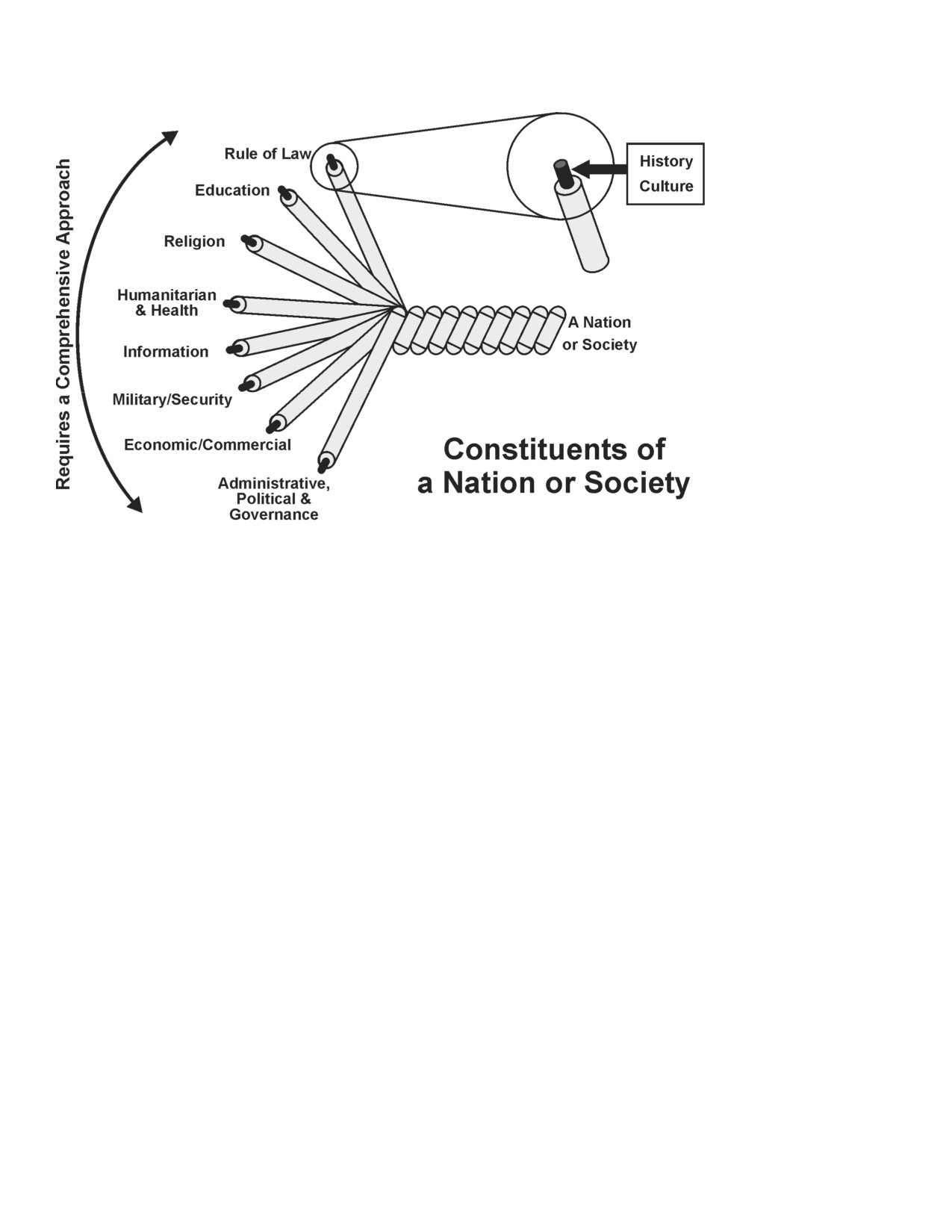
Counter-Insurgency Operations
Figure 7-1: Interrelated Elements of an Environment and Society
2.
Therefore, the intelligence staff must work to formulate a broad knowledge base that will
allow all relevant systems to be understood and engaged as required to create enduring
solutions to the insurgency. The knowledge base must include the influences that history and
culture play in each system.
3.
The knowledge base must also analyze each element of the society, along with the key
members of each element, and understand the role they play in the environment, their aims in
relation to the campaign and overall success, and the influence they have on other systems
within the environment. Apart from creating a detailed situational awareness, the knowledge
base should identify root causes and grievances that led to the insurgency and crisis in the
first place. This will help inform the development of operational objectives and supporting
effects. Only in this way will the commander know what, who and how to engage within the
campaign to move towards the desired objectives and end-state.
4.
Given that enduring solutions to underlying grievances and problems in many of the
PMESII systems are beyond the capabilities of military forces, the COIN campaign demands a
comprehensive approach that will use various elements of power—multiple agencies—to
conduct the campaign and create enduring solutions.
5.
Regardless of what agencies are used to undertake activities, much of the assessment
in support of operations will come from military intelligence staff. However, just as with the rest
of the military, intelligence staff will be limited in their capabilities to conduct a full assessment of
all these systems and their major players.
6.
Thus, intelligence staff will seek out expertise in each of these areas as required. These
may include cultural, economic and political experts, to name a few. Many of these experts will
reside in other agencies, and their support of military analysis will be facilitated by the use of
intelligence committees.
7.
The creation of such a broad knowledge base and its accompanying analysis will allow
the commander to decide what effects need to be created in each of these systems in order to
7-4
B-GL-323-004/FP-003
Intelligence in Counter-Insurgency
realize operational objectives and thus what activities need to be conducted. The development
of the knowledge base will take time and must be guided by an intelligence preparation of the
battlespace (IPB) process designed for the complexity of the operating environment.
707. A SPECTRUM OF RELATIVE INTEREST
1.
The systems in an environment do not exist without the people or actors who populate
them. It is these individuals and groups, along with their attitudes regarding the outcome of the
campaign, that must be considered and assessed. Hence, this requires a classification of all
the actors, which range from the adversary through hostile and neutral to friendly forces and
allies within the battlespace, as they relate to the interests and objectives of the friendly force.
This may be labelled the spectrum of relative interest, and where these actors fit along the
spectrum in relation to the desired end-state will weigh heavily on the commander’s
consideration of what effects he will apply to modify their positions and align them with his
interests, that is, have them support the campaign (see Figure 7-2). Some of these effects will
be physical, but many others, specifically those seeking to engender support from the target, will
be psychological effects, the result of influence activities. The individuals and groups are all
targets or target audiences for engagement, either on the physical plane, the psychological
plane or both.81
2.
This approach requires a cultural understanding and stems in part from the need to
engender support from local populations and to engage other elements of an environment. In
order to support this approach, the knowledge base must gain insight into the psychological
plane and the intent, motivations, and relationships of elements in the battlespace in order to
move them, through an effect of influence, to a position of acceptance, cooperation, or even
support. The assessment and analysis that leads to this spectrum of relative interest
categorization supports the targeting process, for each of the audiences on the spectrum of
relative interest is assessed with respect to how they may be influenced and moved to a
position of support or acceptance.
81 With respect to the term “targets,” a broader understanding the term must be used. Targets will include adversary
elements, friendly and allied elements and neutral audiences. Nothing nefarious is meant by the term, but it should
be viewed in the sense of a business advertisement “targeting” a particular audience. Thus, all target engagements
are considered together in a complementary and comprehensive fashion.
B-GL-323-004/FP-003
7-5

Counter-Insurgency Operations
Figure 7-2: The Spectrum of Relative Interest
3.
Each of the groups within an environment may be plotted along the spectrum of relative
interest, and an assessment may be made as to what activities are required to either maintain
their support or to move them to a position of support—to produce effects on their perceptions,
understanding and will, in support of the end-states of the campaign.
4.
This approach must also recognize the paradigm shift in information acquisition. In
major combat operations, a significant part of the information required to establish
understanding by the commander might flow from national or higher echelon sources.
However, in a COIN campaign, this shifts towards an information flow model that is more
bottom-up, with soldiers in direct contact as the key source of information. In many such
circumstances, actionable intelligence regarding adversary targets and the motivations for their
support will come from contact with the local populace. Furthermore, such contact will provide
useful input for measures of effectiveness, particularly in terms of gauging the reaction of the
local populace to the campaign’s activities and conduct.
SECTION 3
DIRECTION
708. GENERAL
1.
The intelligence cycle will begin with direction that stems from the requirements
determined in the campaign planning process and subsequent planning processes for
supporting operational plans.
2.
Direction will be implemented through national chains of command and through HN and
coalition chains of command. Once the campaign begins, plans and direction will likely be
formulated, at least in the coalition and with the HN authorities, through a committee system.
Whilst there will be certain frustrations in working through a committee system, it will ensure
7-6
B-GL-323-004/FP-003
Intelligence in Counter-Insurgency
close coordination and integration amongst different agencies and capabilities, which will allow
for effective and complementary direction to be issued.
709. INTELLIGENCE ARCHITECTURE AND THE ORGANIZATION OF INTELLIGENCE
IN COUNTER-INSURGENCY—DESIGN OF INTELLIGENCE ARCHITECTURE
1.
Early in a COIN campaign, it will be necessary to establish a chain of operational
command that reflects the political and military requirements of the HN and assisting coalition.
When this has been established, there will be a need for a supporting structure of intelligence
staffs placed at appropriate levels in order to provide timely, responsive intelligence for
commanders. It is inevitable that the intelligence structure will develop with the campaign. The
architecture must anticipate this and deploy progressive stages of capability that can be readily
linked together. In parallel with these staffs, a communications network that permits the rapid,
efficient passage of intelligence data of different types upwards, downwards and sideways must
be established. In a coalition operation, it will need to cross national, military, civilian and
service boundaries so that it can link staffs and agencies at every level.
2.
Unlike the military chain of command, which is purely hierarchical, this network should
be constructed on the principle of providing intelligence from where it is available to wherever it
is required. This may result in it bypassing some levels of command in order that it reach the
appropriate user. This “skip-echelon” system, like collaborative parallel planning, will ensure
information is available on the “pull” rather than the “push” principle at whatever level of
command may need it. The intelligence architecture is not simply a communications network,
for it includes the allocation of areas of intelligence responsibility (AIR) to each level of
command. It specifies precisely the authority to task individual collection assets and allocates
the reporting authority—who is responsible for the provision of fused intelligence reports—
based on information from collectors. The intelligence architecture should form an annex to the
operational directive under the title of the intelligence plan.
3.
In support of operations, it may be necessary to form an all-source intelligence centre
(ASIC), within which there may be a variety of enabling groups such as HUMINT support group
(HSG), a cryptological support group (CSG) or an image intelligence (IMINT) support group
(ISG). These may be an element within the contingent of a single nation, or they may be part of
a committee system. Specialist intelligence should always be kept under close review when
operating with allies, as it can encourage exclusivity and reduce the mutual trust so necessary
for effective cooperation.
710. CONSTRAINTS
1.
There will be constraints on this free flow of data caused by the necessity to apply the
“need to know” principle. This is vital for HUMINT source protection. Some intelligence,
perhaps that which is provided from strategic sources, may not be made available to all
intelligence staffs at every level. For example, material with national caveats may be made
available from a domestic agency for national commanders only. There will be a need for
special handling procedures for this and other such material. In such circumstances, as a
minimum, a national intelligence cell (NIC) may be established.
711. STRAINING COMMUNICATIONS NETWORKS
1.
Inevitably, extensive intelligence data networks will place a large burden on the
communications available. This should be borne in mind when designing the intelligence
architecture with as much use being made of existing systems as possible. In a COIN
B-GL-323-004/FP-003
7-7
Counter-Insurgency Operations
campaign, the usage by intelligence organizations of available bandwidth will outstrip that of all
other users due to the need for access to national databases, imagery products and the output
of national agencies. This is particularly the case when satellite communications are
established in the theatre.
2.
Operational planning must take into consideration this demand on communications
infrastructure.
712. CENTRALIZED CONTROL
1.
The Need for Centralized Control. Intelligence assets are normally centralized at the
highest appropriate level of command in order to be available across the widest possible area of
operations and group of users. In COIN operations, there are further imperatives for centralized
control. Where several intelligence organizations are working against a common target, there is
the danger of overlap. While some duplication is necessary to improve the evaluation of
information (by its being confirmed from more than a single source), the danger exists in the
possibility of a single source being exploited by more than one agency, each in ignorance of one
another. This can lead to false confirmation and, in turn, gives the source greater credibility
than may be its worth. There is also the potential for undesirable wastage of effort and
resources.
2.
The Director of Intelligence. In designing the intelligence organization, a decision
must be made to centrally coordinate all intelligence staffs—military, civilian, HN and coalition.
Ideally, a single director of intelligence should be established at the national level, with similar
posts at each lower level of command. This may be the civilian administrative authority or
military command depending upon the circumstances.
713. INTEGRATION AND THE COMMITTEE SYSTEM—ESTABLISHING AN
INTELLIGENCE COMMITTEE
1.
Intelligence committees should be established at each level of command in order to
coordinate the collection, processing and dissemination of information and intelligence. Each
committee would owe allegiance to the next higher level, which would be responsible for the
effectiveness and coordination of the intelligence efforts of those below it. Intelligence
committees may be sub-committees of military-police security force committees. Intelligence
committees should meet regularly if there is to be a useful exchange and discussion of
intelligence and a good working relationship between civil authorities, police and military
intelligence staffs established.
2.
Membership of the intelligence committee should be arranged mutually between the HN
intelligence services, both civilian and military, and those of coalition intelligence staffs. Security
classifications will restrict complete sharing of information, and there may be established inner
committees of nations with similar resources and interests. This, however, has the potential of
creating two classes of nations and accompanying animosity. Efforts must be made to avoid
such situations.
714. FUNCTIONS OF AN INTELLIGENCE COMMITTEE
1.
The functions of an intelligence committee are as follows:
a.
At the HN level, to keep the government, the civil and military commanders,
chiefs of staff, and operations staffs informed of all aspects of intelligence and
7-8
B-GL-323-004/FP-003
Intelligence in Counter-Insurgency
security operations and to facilitate the exchange and provision of the intelligence
necessary for the prosecution of a strategic campaign.
b.
At subordinate levels, to keep its related operations committees and the next
higher intelligence committee fully informed with relevant intelligence for
operational planning.
c.
To advise operational staffs on security and protective measures.
d.
To develop the collection plan, against which the collection agencies will be
tasked.
e.
To direct the collection agencies. The intelligence staffs, through the G3
operations staff, will allocate tasks and priorities along with limitations for when
the information must be obtained.
f.
Where possible, to establish common procedures for all HN and allied
intelligence and security organizations.
g.
To provide an appropriate dissemination service to commanders.
h.
To ensure coordination. The intelligence committee should ensure that
coordination in the following areas occurs:
(1)
Civil, police and army boundaries are the same and accord with the civil
authority and security force command system. This may not always be
possible.
(2)
Agreed plans and direction from the committee is allocated to respective
members in an appropriate fashion.
(3)
Information and intelligence flow downwards as well as upwards and
sideways to neighbouring committees where appropriate.
(4)
Representatives of government departments and HN experts are co-
opted for special advice and local or culture perspectives, with due regard
for security. They might come from wide variety of agencies, such as
customs services and coastguards, the transportation department, rail
services, inland water transport, civil engineering, telecommunications,
power and water suppliers and from a wider circle of the HN community,
which might include farmers, businessmen and other traders.
715.
CENTRAL INTELLIGENCE STAFFS
1.
Subordinate to the committees, there should be a centralized, integrated staff capable of
performing collection, coordination and intelligence requirements management (CCIRM),
database management and fusion functions on behalf of all the intelligence staffs of that
particular mission. For this reason, the concept of the ASIC was developed. As part of the
intelligence plan, clear orders should be given regarding which level has responsibility for
maintaining a master database. It is essential to prevent every level of intelligence staff running
databases in parallel. Although it will never be possible to avoid some duplication of record-
keeping, there should be a minimum of databases with a single level—probably the highest HN
or lead coalition nation—maintaining the master database, with subordinate and other levels
submitting changes to it in the form of data-change requests. Maintenance of a single database
is facilitated by the “pull” rather than the “push” method of information retrieval and by close
cooperation between all collectors, analytical staffs and committees.
B-GL-323-004/FP-003
7-9
Counter-Insurgency Operations
2.
While intelligence committees give general direction—laying down policy and allotting
general aims, collection tasks and priorities—they do not exercise command. Command and
control remains the prerogative of the commanders, civilian and military, over both their
respective intelligence staffs and their collection agencies.
716. FUNDAMENTALS OF INTELLIGENCE ORGANIZATION
1.
Whatever the design of the intelligence architecture, the organization and the sources
and agencies deployed, there are a number of fundamentals that should be considered in
intelligence architecture organization. These must be considered at the outset and plans made
for their inclusion in the structures.
a.
Continuity. Units should be kept in the same area of responsibility (AOR) for as
long as possible. This ensures that they become familiar with the HN
inhabitants, power structures, other security forces, the terrain and infrastructure.
Consequently, they are better able to measure their opponents and they acquire
the ability to develop information into intelligence. In short, they get a feel for
what is normal as a backg1round against which to observe the abnormal.
b.
Flexibility. An intelligence organization is designed to meet a specific situation,
but it must be receptive to the adjustments needed when the insurgent threat
develops in new directions, themes, strategies and tactics, or the situation
changes in some other way. Such changes in the situation may make fresh
demands upon specialist services such as imagery interpretation or interrogation.
Commanders and their intelligence staffs must be able to respond quickly to new
needs by redeploying resources and, where necessary, adjusting the functions
they fulfill. Furthermore, intelligence staff and the organizations must be capable
of collecting and assessing information regarding all systems within the
environment rather than simply collecting information on the enemy.
c.
Robust Information Handling Capability. The intelligence system, whatever
its shape, must be able to cope with an increasing amount of information as
units, with growing experience, become more productive and better focused. It is
hoped that with time the indigenous population becomes sufficiently confident to
pass more information to the security forces. As this happens, sufficient
intelligence-trained personnel must be made available to collate the additional
information, analyze and fuse it, interpret its meaning and disseminate the
resulting intelligence in time for it to be used operationally.
(1)
Specialists. The training of analysts, source handlers, surveillance
operators, imagery interpreters, linguists, interrogators and other
intelligence specialists must be developed as early as possible if the
inevitable shortage of such skilled personnel, which exists at the
beginning of any campaign, is to be overcome. The careful husbandry of
scarce skills, specific to the ongoing campaign, is necessary throughout a
campaign but particularly essential at the beginning until more trained
specialists become available.
(2)
Liaison. If the intelligence organization is to work effectively and
efficiently, good liaison between all intelligence organizations and
agencies—HN, allied, civilian and military—is paramount. The specialists
referred to above are vital elements in establishing effective liaison with
HN intelligence agencies. The sensitivities of such intelligence liaison
7-10
B-GL-323-004/FP-003
Intelligence in Counter-Insurgency
duties require the liaison officer to have wide experience of military
capabilities and knowledge of intelligence.
(3)
Security. The need for security, especially source protection, must be
fully understood within the intelligence organization and among those to
whom it is disseminated. The “need to know” principle has to be enforced
and clear guidelines given on dissemination, particularly to HN, civilian
authorities.
In the immediate era of Canadian Confederation, 1864-1870, the first Canadian Intelligence
Service was formed under one Gilbert McMicken, a stipendiary magistrate based in Windsor,
Ontario. This period saw numerous and confusing alarms brought on by the American Civil
War and the subsequent Fenian insurrectionary movement (an extreme Irish nationalist
movement) that raided Canada with the aim to influence British policy on Ireland. McMicken
“had organized an excellent detective force along the frontier, and had a wide acquaintance
of spies and informers. [Prime Minister Sir John Alexander] Macdonald usually knew more
about the plans of the Fenians than the Fenians did themselves.”
Extract and quote from Donald Creighton, John A. Macdonald: The Young Politician (Toronto: the Macmillan
Company of Canada, Ltd., 1956) pages 393, 421 and 438-439.
717. INTELLIGENCE STAFF ORGANIZATION
1.
There is no fixed establishment for an intelligence organization, nor is there any pre-
determined scale on which to base its composition. Its size will be determined by the extent and
nature of the threat, the commander’s requirements, the architecture necessary to support
operations and the intelligence collection agencies that can be made available.
2.
Within a COIN campaign, there will be an enormous demand for information regarding
the systems in the environment (PMESII) that may influence the support of the population and
the successful outcome of the campaign. The intelligence staff organization must grow to
include specialists in those non-military areas. They will be able to advise the commander and
staff planners regarding the role and influences of these systems, the cultural context within
which they operate and the means needed to create desired effects within them. In addition to
political advisors, intelligence staff may include economic, cultural and religious advisors as
necessary. They will also be helpful in the determination of measures of effectiveness.
3.
As no two campaigns are ever fought in quite the same circumstances, it follows that the
intelligence organization for each new commitment should be customized, although past
campaigns will provide guidance and lessons where there are useful parallels. In all cases, the
principles of intelligence and fundamentals for organization should be followed.
4.
The size of any national contribution to a COIN campaign will have to be designed in
consultation with the senior intelligence officer and the intelligence staff of the HN. Almost
certainly, the size of intelligence staffs will grow as the campaign develops.
718. FACTORS AFFECTING COMMITTEE INTEGRATION
1.
Although a single, centrally controlled, integrated intelligence organization answering to
a single director of intelligence is the ideal, the circumstances prevailing in a HN and coalition
campaign may not be conducive to such a system. Where it cannot be achieved, a compromise
B-GL-323-004/FP-003
7-11
Counter-Insurgency Operations
solution must be brokered between the interested parties. The establishment of a centralized
system may be affected by a variety of factors, including:
a.
The effectiveness, reliability and vulnerability of the HN's security forces and its
intelligence and security organization.
b.
Willingness by all parties to cooperate, to share information and details of,
perhaps sensitive, HN sources, other intelligence details and, particularly at the
higher levels, matters of political sensitivity.
c.
The different points of view and doctrine of the security forces, both HN and
allied. Because the HN’s security forces, in particular the police, must continue to
live and work among the population after the eventual departure of the allies,
they will be subject to greater internal pressures and constraints. It is important
that intelligence staffs overcome this problem as failure to integrate will seriously
impede the intelligence effort.
d.
The degree of authority delegated to officials at each level of the command
structure and committee level (national, provincial, regional and district).
719. ALL-SOURCE INTELLIGENCE CENTRE
1.
Whether or not an intelligence committee is established, the normal focus for intelligence
for campaign forces will be the all-source intelligence centre (ASIC) or, if a joint operation, the
joint ASIC (JASIC), which will be located alongside the joint operations cell (JOC), forming the
hub of any joint task force headquarters (JTFHQ).
2.
Within the ASIC will be the senior intelligence officer and his staff. This will include
CCIRM and the all-source cell (ASC), in which fusion and analysis will be conducted.
Representatives of the agencies (e.g., HSG, CSG and ISG) will be located in the ASC. In some
cases, it will be necessary for these elements to be afforded their own segregated area with
more stringent access controls.
720. TASKING—THE COMMANDER’S INTELLIGENCE REQUIREMENTS
1.
Direction will begin with a determination of the commander’s intelligence requirements or
as they are more commonly termed, priority intelligence requirements (PIR). These will be the
product of his mission analysis and should be discussed with the senior intelligence officer, who
will be able to ensure that they are accurately focused.
2.
It may not be possible in the early stages of a campaign to fully state the commander’s
intelligence requirements. When this is the case, the intelligence staffs have the responsibility
of giving guidance to commanders on the kind of intelligence that they will require. This may be
done by an intelligence estimate. An intelligence estimate takes the commander’s plan, no
matter how broadly defined, and compares it with existing intelligence on the insurgency.
3.
Concurrent with the intelligence estimate, the staff should apply intelligence preparation
of the battlefield (IPB). Together, the intelligence estimate and IPB will give the intelligence staff
a good idea of the gaps in their knowledge, which can form the basis of the initial collection
plan. It is likely, particularly in the initial stages, that there will be a shortfall in intelligence, with
more basic intelligence than current intelligence available. The preparation of an initial
collection plan will also give some indication of the necessary collection assets and intelligence
architecture that will be needed for the campaign.
7-12
B-GL-323-004/FP-003
Intelligence in Counter-Insurgency
4.
IBP within a COIN campaign must focus not only on matters of terrain, but on the
cultural factors and environmental systems (PMESII) that are at play in the insurgency.
721. DIRECTION TO THE COLLECTORS
1.
Even when an intelligence organization has been established, information does not flow
automatically into the hands of the intelligence staff and then to the commander. If direction is
poor, the intelligence organization may be in danger of collecting large quantities of irrelevant
information.
2.
A commander must give his intelligence staff clear direction and a firm indication of the
priorities to be allotted to his intelligence requirements. On receipt of the commander’s
intelligence requirements, the intelligence staff will, with the aid of the intelligence estimate and
IPB, identify gaps in the intelligence already held. These gaps should be filled by tasking
collection agencies (units and resources) to collect against them. The questions put to the
collectors are known as information requirements (IR), and their collection is carefully planned
by the senior intelligence officer in conjunction with his CCIRM staff, who will coordinate the
collection plan, IRs and the related intelligence requirements. The resultant collection plan
must, in turn, be approved by the commander before collectors receive their direction from the
operations and intelligence staffs. The collection plan will normally be maintained on a
collection worksheet that will show the allocation of tasks, in order of priority, to individual
collection agencies and the time and form in which information is to be reported.
SECTION 4
COLLECTION
722. GENERAL
1.
There are two aspects of collection: exploitation by intelligence staffs of their sources
and agencies, and the timely delivery of collected information to intelligence staffs for
subsequent processing into intelligence or, when appropriate, directly to weapon systems.
Collection will be based on the collection plan drawn up by the intelligence staffs under the
direction of commanders and the intelligence committees during the direction phase. The
CCIRM staff will manage collection.
723. HUMAN INTELLIGENCE—COLLECTION OF HUMAN INTELLIGENCE
1.
The most effective source of intelligence during a COIN campaign will be that derived
from the direct questioning of persons, whether formally or informally, in other words, from
HUMINT sources. HUMINT sources may include the following:
a.
Coalition Military Sources. This will include all ranks of the security forces,
especially those whose duties require them to move among the HN population,
on patrols, on collection of locally-produced supplies, on liaison with HN
authorities, dock workers, airport workers, aid workers and the like. It is vital that
all such personnel are thoroughly briefed on the gaps in intelligence that their
duties might enable them to fill. They should be made “intelligence aware” so
that they are always prepared to report information which may appear trivial but
which, when added to other pieces, may be important. Dismounted patrols are
critical to collection in COIN operations, and all soldiers are sensors who should
be debriefed upon return. Patrol report formats may have to be amended to
better suit the environment in which forces are operating.
B-GL-323-004/FP-003
7-13
Counter-Insurgency Operations
b.
HN Security Forces. HN security forces will include military, paramilitary,
auxiliaries, reserves and police forces. They will be an excellent source of
information along with the cultural reference, but they must be handled with great
sensitivity. The forces’ intimate knowledge of the local population, culture and
related grievances will provide more accurate information, of value both when on
duty and on leave. Like their coalition counterparts, they should be encouraged
to become intelligence aware. Attempts should be made systematically to brief
those going on leave locally and debrief them on return. Care must be taken not
to duplicate the information collection from police officers being undertaken by
their own intelligence staff. Police equivalents are very likely to be handling their
own sources among the population. It is probable that there will be a strong
reluctance to disclose these sources to intelligence staffs, but their tasking and
the information they provide should be coordinated and fused by the centralized
intelligence machinery.
c.
Military Surveillance. All the usual conventional campaign surveillance
sources—observation posts (OPs), mounted and dismounted patrols,
reconnaissance units, air reconnaissance and troops supplemented by specialist
surveillance equipment—are equally useful in COIN operations. They must be
tasked and briefed with great care because insurgents operate more covertly
than a conventional enemy. Units will frequently be tasked to mount operations
specifically to obtain information or to give cover to other intelligence-gathering
operations, for example, the insertion or retrieval of covert OPs.
d.
Covert Surveillance. Covert surveillance can obtain significant amounts of
information for later exploitation, criminal prosecution and for the triggering of
security forces to fix and strike targets. Line forces and Special Forces (SF) may
be used in this capacity. When SF are deployed, it will be normal for there to be
SF liaison officers in the HQ of the formation to which they are assigned.
e.
Irregular Forces. Irregular or auxiliary units may also be raised locally from the
police, the HN’s army and from friendly sections of the civilian population for the
purpose of defensive and stability operations in order to continue the dislocation
and disruption of insurgent activity and influence. Defensive operations include
the guarding of key points, storage areas and, most importantly, towns and
villages that have come to the HN government’s side. In Malaya, such irregulars
were used to infiltrate the insurgents’ command structure by completely replacing
a group in one particular area. They then operated to unravel the chain of
command from the inside. In Kenya, during the Mau Mau campaign of the early
1950s, “pseudo-gangs” were used to attack insurgents in their own territory.
These groups were comprised of soldiers, local security forces and former
insurgents convinced to support the government campaign. Such use of
irregular troops is, however, relatively sophisticated, and these operations can be
developed only over a protracted period in an environment that is very well
understood by the intelligence organization.82
f.
Interrogation and Tactical Questioning. Prisoners can be an important source
of information. Interrogation in a COIN campaign can, however, be a sensitive
82 Although the Mau Mau campaign is a useful study for counter-insurgency lessons, the campaign is considered to
have been especially brutal. Some of the techniques used at the time are unacceptable today and, in the long term,
would only serve to undermine the legitimacy of a COIN campaign.
7-14
B-GL-323-004/FP-003
Intelligence in Counter-Insurgency
matter. It must only occur when authorized and by specifically trained personnel.
It must be subject to rigorous oversight by the chain of command. Any abuses
must be dealt with in accordance with regulations and quickly, for they will only
cause campaigning forces to loose the moral superiority and damage campaign
legitimacy. It is important to be fully aware of the legal basis under which
interrogation takes place. Systematic interrogation of captured insurgents can
have excellent results, particularly in building a picture of command structures,
communications and other aspects of the insurgents’ infrastructure. In low-level
conflict, interrogation is less likely to produce intelligence of immediate tactical
value, simply because insurgent operational methods normally involve a very
restricted circle within which future plans are discussed. In general terms, but
not always so, interrogation should be capable of producing evidence that will be
acceptable in court. It is vital, therefore, that it is conducted strictly in accordance
with rules laid down by the HN’s judiciary and the law of armed conflict.
g.
Debriefing. Arrangements must be made to provide a debriefing team (DDT),
personnel skilled in debriefing willing subjects. These will normally include
domestic citizens or ex-patriots with recent knowledge of the HN situation and
environment. Such people might include travelers, airline crews, expatriate
workers and members of Canadian diplomatic missions. If the crisis has resulted
in an exodus of such people from the country, then debriefing will be established
in a domestic location. If such people have remained in the country, then a
debriefing team may deploy for debriefing operations in the HN.
h.
HUMINT Support. Both interrogation and debriefing require close steerage and
extensive intelligence support if they are to be effective. Liaison representatives
will be established at appropriate ASICs and will need extensive analytical and
research support.
i.
Captured Documents, Equipment and Stores. These are valuable sources of
information. Troops must be trained to realize their worth and encouraged to
make them available to intelligence staffs at the earliest opportunity. Documents
found on suspects may assist in the questioning of prisoners by providing
interrogators with information that they can exploit during interviews. In certain
instances, it may be necessary to employ specially trained personnel to
undertake sensitive site exploitation (SSE) when rules of evidence or human
rights investigations may be indicated. Documents and equipment captured may
also lead to evidence of third nation or party support of the insurgency, which can
be attacked using legal means in those other nations.
j.
HN Population. Undoubtedly, the HN population will, if systematically exploited,
be the best source of HUMINT. An informant is one who gives information—a
casual source. Great care must be taken in developing the HN population as
sources which must be done in close coordination with HN intelligence agencies.
HN informants should be given the opportunity to contact the security forces
confidentially. This can be done by making confidential telephone lines, text
message numbers or post office box numbers available and by keeping routine
military patrols in close proximity to the population. They may also be permitted
to pass information during vehicle checkpoints (VCPs), during cordon and search
operations or during other activities such as civilian medical clinics. Doing so will
permit a budding informant to pass information without unduly drawing attention
to himself and thus fearing reprisal by insurgents. Insurgents may use bogus
informants to plant false information or uncover the source-handling network,
B-GL-323-004/FP-003
7-15
Counter-Insurgency Operations
thus efforts must be made to verify sources and/or information. All military
patrols must be trained to talk to HN people as a matter of course and should be
given standing PIRs to address. The intelligence organization will be capable of
developing a system for making contact with, or being contacted by,
sympathizers.
k.
Informers and Agents. Much of the useful information that reaches the
intelligence staff will come from informers and agents. In HUMINT terms, an
agent is a person specifically recruited and trained, placed in a hostile
organization and who is tasked with information gathering on the organization of
which he is part, in other words, a controlled source. An informer is a person
who, perhaps uninvited, passes information to an opponent about his
organization, in other words, an uncontrolled source. A small number of well-
placed and reliable agents can provide information of value well beyond their
cost, particularly if aimed at the pivotal points in the insurgents’ command. If
agents are able to penetrate the top level of the insurgents’ command and control
organization, information may be provided on the development of their strategies,
the identification of important leaders, the system of liaison between the military
wing and the insurgent political leadership and the methods of acquiring
resources. At lower echelons, informers are useful in providing information on,
for example, personalities, tactical plans and weapon caches. At these levels, if
continuity is to be maintained, it is important that the agent network expands at a
similar rate to that of the insurgent movement, otherwise their relative value will
diminish. The problem with acting on information supplied by an individual is
source-protection. In an insurgent organization, the circle of knowledge is kept
small. If an informer reports the move of weapons to a new hide, for example,
perhaps only three insurgents have been made aware: the courier, the
commander and the quartermaster. A subsequent, immediate operation by the
security forces to recover the weapons might raise suspicions. This could
seriously jeopardize the security of the source. Therefore, care must be
exercised in such matters and the advice of the HSG sought when planning
operations.
l.
Non-governmental Organizations/International Organizations. Reports,
surveys and databases created by non-military organizations and other agencies
offer a potential wealth of information for the intelligence organization. Materials
created by these organizations may contain information not available to military
sources due to the close contact these organizations enjoy with the public. It
should be noted that in the interest of maintain impartiality, neutrality and a
favourable operating environment, some of these organizations may not be
interested in sharing their information with the military. These relationships must
be cultivated with care and will often depend upon the personalities involved.
7-16
B-GL-323-004/FP-003
Intelligence in Counter-Insurgency
In Czarist Russia, the Okhrana had succeeded in infiltrating the Bolshevik Party to such an
extent and with such zeal, it became difficult to tell whether the agents were acting as
Bolsheviks or agents. When the triumphant Bolsheviks seized the Okhrana record, Lenin
discovered that some of his most trusted companions and advice givers had been in the pay
of the Czar’s police. Although the use of the agents did not produce a wholly successful
COIN campaign for the Czar, infiltration to such a high degree can produce significant
tactical victories. One example of such victories was when Okhrana agents were able to
engineer a provocation that ended in the assassination of an influential Grand Duke.
David Galula, Counterinsurgency Warfare: Theory and Practice (U.S.A.: Praeger Security International, 1964),
pg. 46.
724. COORDINATION OF HUMAN INTELLIGENCE COLLECTION
1.
Whenever HUMINT sources are to be exploited, it is imperative that all HUMINT
collection agencies operating in the theatre effect liaison closely with each other. This liaison is
vital to ensure:
a.
De-confliction. No source should ever be run by more than a single agency. If
a single source works for more than one agency, it is possible that his reports
can, unwittingly, confirm themselves. This false confirmation, sometimes called
false corroboration, is a danger to the intelligence process and can cause the
source to gain greater credence than his worth. Furthermore, if the situation
becomes known to the insurgents, they can exploit the false collateral at the
expense of the security forces.
b.
Veracity. There is always the risk of a source, if not properly handled, producing
information which is unreliable or even acting as a double agent. Tasking must
be rigidly controlled to reduce the likelihood of this happening. Reliability of
sources must always be evaluated with great care and records maintained by the
HUMINT agency.
c.
Security. The smaller the circle of people knowing the identity of a source, the
safer he can operate. If sources are to be maintained, and confidence spread,
source-protection must be effective and be seen to be effective.
725. OPEN SOURCE INTELLIGENCE AND PUBLICATIONS—OPEN SOURCE
INTELLIGENCE
1.
Intelligence derived from open sources (OSINT) is playing an increasingly important role.
Nowhere, however, will the role of the media be more important than in COIN. The actions of
the security forces will be scrutinized closely and will play a major part in forming public opinion
and in building and maintaining the legitimacy of the campaign. Relations with the media are
not the direct responsibility of the intelligence staff. They should remember, however, that
reporters can get access where security forces often cannot. Furthermore, press teams are
often out and about for protracted periods. A warm relationship, built up between intelligence
staffs and individual members of the press corps, can reap dividends in the form of low-level
information.
2.
Many journalists will cover the campaign for an extended period, visiting the country for
a number of weeks at a time before returning home for one or two months. They may even be a
regional expert with a unique range of contacts. If an intelligence staff develops a sufficient
B-GL-323-004/FP-003
7-17
Counter-Insurgency Operations
relationship with individual members of a media team, information might be forthcoming in
return for, perhaps, a sanitized update or a security brief on their return to the theatre of
operations. Journalists may be useful in providing insight into the feelings and concerns of the
local populace or the opinions of local leaders.
3.
Media reports should always be regarded with caution. They are likely to include a bias
to some particular purpose rather than be a straight reporting of unabridged or unelaborated
facts. Commanders may have seen the morning news on television about the campaign
immediately before being briefed by the staff. This will inevitably lead to staffs having to
respond to press reports rather than leading on subjects of their choosing with unfortunate
results. Intelligence officers should take steps to avoid briefings developing in this way. HN
media, in particular, will have a vital role to play in building campaign legitimacy and in gaining
the support of the populace, and intelligence staff can expect to play a part in this with the public
affairs staff.
726. OPEN SOURCE PUBLICATIONS
1.
In addition to the current reporting of news teams in theatre, there is likely to be
considerable open-source material produced prior to the campaign which will go some way to
meeting intelligence staffs’ requirements for basic intelligence. This can include the Internet,
atlases, encyclopaedias, travel books, statistical summaries and a host of other references
produced by the specialist-interest press covering the armed forces and the political, economic
and geographical situations inside the country.
2.
Additionally, with a media savvy opponent, the intelligence staffs should attempt to
catalogue insurgent publications, for they can sometimes reveal aspects of the insurgents that
are otherwise unknown.
3.
It must be remembered that the insurgent movement will also attempt to make use of the
media to spread its own views and discredit those of the government and the security forces.
While they may use the media as a mechanism to air legitimate grievances, insurgents will also
manipulate the media to their advantage to disseminate manifestos, broadcast staged acts and
gain the public’s sympathy. The monitoring and assessment of such propaganda will allow staff
planners to develop plans to counter insurgent propaganda and to even pre-empt it at times.
727. IMAGERY INTELLIGENCE
1.
Intelligence derived from imagery (IMINT) will play an important operational supporting
role in any campaign, including COIN. Product coverage will include a wide range of imagery,
ranging from map-quality prints from airborne platforms, both satellite and aircraft, to thermal
imagery (TI), and infra-red (IR) pictures. TI is excellent at detecting bodies that are warmer than
their surroundings, such as people concealed in dense foliage or a warm vehicle engine. IR
imagery is capable of detecting disturbed soil, which is valuable for detecting buried arms
caches, command wires for booby traps and improvised explosive devices (IEDs).
2.
Collection platforms will include satellites, strategic aircraft, tactical air reconnaissance
(TAR), helicopters and unmanned aerial vehicles (UAV). OPs and other reconnaissance
capabilities can expect to be equipped with hand-held cameras, video recorders, TI equipment,
radar and image intensifiers (II). Coordination of IMINT is the task of an ISG.
3.
There will be a constant demand for photographic coverage of areas of operations. The
ISG will be able to provide intelligence derived from the analysis of all kinds of imagery. Much
analysis will be done through computer processed images rather than printed (hard) copies.
Although prints of images can be made available, care should be taken to ensure that they are
7-18
B-GL-323-004/FP-003
Intelligence in Counter-Insurgency
demanded only when necessary, for example, as briefing aids. Prints should not be demanded
as proof of intelligence reports as a matter of course. The time taken to interpret results of an
IMINT task is considerably lengthened when prints of the imagery are required.
728. SIGNALS INTELLIGENCE
1.
Insurgent groups have a need to communicate, and when they do via any electronic
medium, they are vulnerable to intercept, which provides a means for the gathering of signals
intelligence (SIGINT). Besides deriving intelligence from communications (COMINT), SIGINT
analysts will exploit emissions from radars and other electronic emitters. This electronic
intelligence (ELINT) can enable the detection of, for example, radio-control devices and missile
control, guidance and target-seeking radars. Where SIGINT collection is envisaged, a CSG will
be available to coordinate its collection and to interpret the results within the ASC.
2.
Electronic warfare (EW) detachments will provide useful information and intelligence by
exploiting insurgent weakness in modern civil and tactical communications. Given the nature of
COIN operations, it will not be unusual to see EW detachments employed at sub-unit level.
They will provide not only intelligence collection on behalf of higher headquarters but will
monitor communications during the conduct of tactical operations for the purposes of
intelligence collection and force protection. The monitoring of communications nets may give an
indication of impending attack or an attempt to flee an area during the conduct of a tactical
operation, thus allowing forces to take preventative or protective action.
3.
The detection of insurgent command and control (C2) networks may be considered a
target for possible engagement. However, the advantages to be gained from attacking their
means and locations must be weighed against the advantages to be gained from monitoring
their C2 means and exploiting them for purposes of intelligence gathering and force protection.
729. SPECIALIZED FUNCTIONS—BATTLE DAMAGE ASSESSMENT AND MEASURES
OF EFFECTIVENESS
1.
Battle damage assessment (BDA) is defined as “The assessment of effects resulting
from the application of military action, either lethal or non-lethal, against a military objective.”83
BDA examines the results of activities, and its collection may be the responsibility of a number
of entities including G2 staff.
2.
Measures of performance examine the accomplishment of a task and are defined as “a
criterion used to evaluate the accomplishment of a task.”84 They ask, “was the task done right?”
This is the purview of a commander to assess.
3.
Measures of effectiveness (MoE) relate directly to BDA and are defined as “a criterion
used to evaluate how a task has affected selected system behaviour or capabilities over time.”85
They ask the question, “was the right task done to create the desired results?” Intelligence staff
will be key to measures changes in terms of target capabilities and behaviour.
4.
MoE must be determined from the outset, based on the starting state of the planned
target and the desired objective. Whilst MoE for engaging insurgent capabilities with fires will
83 NATO AAP 6.
84 Army Terminology Panel, approved May 2006.
85 Army Terminology Panel, approved May 2006.
B-GL-323-004/FP-003
7-19
Counter-Insurgency Operations
be fairly straightforward, objective and immediate, MoE for targets that are to be changed
through influence activities and psychological effects will likely be subjective to a certain extent
and will require measurement over an extended period of time in order to note desired changes
in a system.
730. SELECTING MEASURES OF EFFECTIVENESS
1.
Intelligence staff will play a role in the determination and application of MoE. In order to
overcome the difficulties in their selection and application, some basic principles exist that can
aid in the development of useful MoEs:
a.
Causality.86 A definitive cause and effect relationship must be established
between the activity and the effect attempting to be measured. Given the cultural
and other variables present, there has to be a reasonable likelihood that the
planned activity will create the desired effect. Secondly, commanders and staff
must be able to assess any other extant factors that may be causing the effect
other than their own activities. Likewise, they must ascertain if the measured
effect is merely coincidental.
b.
Quantifiable.87 An MoE that can be counted helps to remove some of the
subjectivity that plagues MoEs on the cognitive plane. Quantification allows
accurate trend measurement.88
c.
Observable and Attributable. When drafting MoEs, consideration should be
given to the possibility that all of the variables influencing an activity and change
in behaviour cannot be observed. The MoEs must be able to recognize a trend
or change and confirm the connection or attribution to the activity. For example,
if the presence or absence of negative graffiti is being used as an informal
indicator of support for a campaign and military force in an urban area, observers
will ideally be able to ascertain its timing (i.e., when it was done); its attribution to
a particular group (e.g., political, criminal, military); the group’s motive and
whether it represents a minority or majority viewpoint; its attribution in terms of
cause, particularly if it appears as a reaction to a specific event or action; and, its
location in relation to the cultural makeup of the local environment.
d.
Correlated to Effects, Objectives and End-States. Just as activities are
planned to lead to specific effects and objectives within a line of operation, MoEs
should be selected to correlate to the achievement of each effect and be
reflective of the level of employment. The strategic and operational levels require
measures that occur throughout the length of a campaign, and many MoEs at the
86 For a detailed discussion of causality, see William S. Murray, “A Will to Measure,” Parameters Vol. 31, No. 3
(Autumn 2001), pp. 134-147.
87 The quantifiable, observable and timeliness principles are adapted from LtCol. David Grohoski, Steven Seybert,
and Marc Romanych, “Measures of Effectiveness in the Information Environment,” Military Intelligence Professional
Bulletin Vol. 29, No. 3 (July-September 2003), pp. 12-16.
88 Colonel Ralph Baker, “The Decisive Weapon: A Brigade Commander’s Perspective on Information Operations,”
Military Review (May-June 2006), pp. 13-32. For example, during a tour in Iraq, 2 BCT, 1st Armored Division
monitored and counted local and international media coverage of events in 2 BCT’s area of operations as an MoE.
This allowed positive and negative trends to be identified, which contributed to discerning the effectiveness of
ongoing activities.
7-20
B-GL-323-004/FP-003
Intelligence in Counter-Insurgency
operational and tactical levels will measure the incremental progress through
effects and objectives.
e.
Flexibility. Although MoEs should be drafted at the planning stage, they should
remain under regular review, and commanders must be prepared to adjust them
as required. They must evolve as a mission progresses, particularly as the
consequence of their activities leads to the attainment of operational effects.
Similarly, MoEs are likely not transferable from mission to mission. Even if a
mission takes place in the same area of operations (AO), the passage of time will
force reconsideration of MoEs previously employed.
f.
Collection. The commander must possess the capabilities to collect the
intelligence necessary to apply an MoE and provide the direction and guidance to
do so. Plans must be made to collect and assess MoEs through all units in the
AO as part of the G2 information collection plan. Collection may be assisted by
other agencies, however, without a formal command relationship, this may have
to be done informally. Nevertheless, other non-military agencies may prove to be
an effective gauge of progress in creating desired perceptions and will in a target
audience. For example, increased cooperation with non-governmental
organizations (NGOs) or other government departments (OGDs) may indicate a
greater acceptance of the campaign.
g.
Relativity. Improvements sought in a given environment must be relative to the
specific environment and to what is considered normal for that particular
environment and culture. Expectations for situational improvement must be
reasonable given the starting state and the normal state of that particular
environment. Improvements to a situation that will make it relatively normal for
that environment may come quickly; however, systemic improvements in
absolute terms may require cultural changes over a very long period of time.
Expectations for change and the related MoEs should be set as incremental
milestones so that improvement can be measured and demonstrated as tangible
progress over time. For example, a decrease in criminal activity must be initially
compared with the normal levels for the environment that existed before the
security situation demanded military intervention.
2.
Developing appropriate MoEs to assess effects on the psychological plane is a very
difficult task. Willpower, perceptions and beliefs are all less-than-completely-tangible variables
that defy simple measurement. Observing and measuring trends is one of the surest ways of
gauging a target audience’s attitude. Trends, however, require a definable baseline, and this
will be difficult to identify.
731. SENSITIVE SITE EXPLOITATION
1.
Intelligence staffs will be required to support the conduct of sensitive site exploitation
(SSE), in which specially trained personnel systematically search a specific location in the
search for evidence or other information or material. Intelligence staffs will help identify the
target location, immediate threats and evidence or items to be sought.
2.
SSE will often be used to collect information for additional operations or for evidence to
support subsequent legal prosecution of insurgent suspects. Much of it, therefore, will be
planned and done in conjunction with civilian counterparts.
B-GL-323-004/FP-003
7-21
Counter-Insurgency Operations
SECTION 5
PROCESSING
732. PROCESSING AS A DISCIPLINE
1.
The processing stage of the intelligence cycle incorporates the work of the intelligence
staff in collation, analysis, integration or synthesis and interpretation of information.
2.
The processing staff will normally be trained intelligence operators, often from all three
services, supported by specialists in the collection disciplines. Where appropriate, specialists
from other arms and services will join the analytical staff, for example, engineer intelligence
operators, with their specialist knowledge of terrain, explosives and route construction.
Alternately, ammunition technicians, with their training in explosives, firing devices and weapon
inspection, are able to develop weapons intelligence in conjunction with the police forensic
scientists. This discipline, based on such techniques as weapon matching, will be able to trace
weapons to their sources of supply, to rounds they have fired, explosives and detonators to their
origin and so on.
3.
Given the need in a COIN campaign to create a broad knowledge base incorporating the
PMESII systems of an environment, the processing stage will be complicated and require the
process to be applied to an enormous volume of information. It is in this staff discipline where
many of the non-military analysts will reside.
733. FUSION OF INTELLIGENCE
1.
The best results will be obtained from those intelligence organizations that are fully
integrated and work to a centrally-agreed collection plan, employing effective CCIRM personnel,
fusion and database managers, analysts and other intelligence specialists who approach their
task in a structured, objective and systematic way.
2.
One of the critical tasks performed in the ASIC is that of fusion. This is the collation of
reports and information from the separate, single-source agencies such as HUMINT, SIGINT
and IMINT into a single assessment. Each agency produces its own view of an event or activity
and reports it to the intelligence staff. This is known as “single-source picture compilation.” The
fused assessment—the assessment made by the comparison of more than one single-source
report—becomes the recognized tactical ground (or maritime or air) picture. The recognized
picture will be produced at the level with responsibility for reporting, which is usually the level
maintaining the database, as that is where the broadest view will exist. This fused assessment
becomes the authoritative view, which forms the basis for assessments by all subordinate
intelligence staffs. It will be disseminated upwards, downwards and to the flanks in the form of
intelligence summaries (INTSUMs).
734. DATABASES
1.
One of the fundamentals of effective processing is the maintenance of an efficient
database. In a COIN campaign there will be a plethora of small, apparently insignificant and
unconnected data. Only effective collation and cross-referencing will enable analysts to assess
the significance of individual pieces and make best use of them.
2.
Additionally, databases will be key to a successful relief in place, when units and
headquarters rotate between AOs or into a theatre. Consideration should be given to a trickle
relief in place of key analysts so that a relief in place maintains some form of continuity in
database familiarity.
7-22
B-GL-323-004/FP-003
Intelligence in Counter-Insurgency
SECTION 6
DISSEMINATION
735. RESPONSIBILITY
1.
Dissemination of intelligence to subordinate commanders is the responsibility of the
director of intelligence at the highest level and of the senior intelligence officers at subordinate
levels. Where intelligence committees are established, individual intelligence chiefs of the
represented services and agencies will accept responsibility for briefing their own commanders
and subordinate representatives.
2.
Depending upon the committee system used and the agencies involved, limited
distribution of some products may occur given security restrictions.
736. USE OF INTELLIGENCE ARCHITECTURE
1.
It should be emphasized that intelligence should flow not necessarily in a hierarchical
manner, as orders along an operational chain of command, but quickly and efficiently, from
whoever holds it to whomever needs it. This will mean that, on occasion, it will bypass some
levels of command. This flow is greatly aided by the use of information technology. INTSUMs
should be disseminated at regular intervals. These can be supplemented by detailed reports on
specific topics (e.g., insurgent ORBATs or incidents) as required.
2.
As with intelligence reporting in any campaign, care must be taken to avoid “circular
reporting,” in which parts of a summary from one intelligence staff are plagiarized in another and
returned to the originator as apparent confirmation of initial assessments. This problem is
particularly acute in combined operations, where the different national authorities include reports
from third parties in their own summaries. The best defence against this is clear orders for
reporting authority and a thorough knowledge, on the part of intelligence officers, of the sources
and agencies available to all the intelligence staffs providing reports for the theatre.
737. SECURITY
1.
While intelligence is of use only in the hands of operational decision-makers, its
dissemination should be closely controlled. Source-protection must always be a priority. If a
source is at risk, intelligence should be sanitized or disguised in such a way as to conceal its
source.
2.
Access to intelligence in such circumstances should be restricted to those with a real
need to know. Security of intelligence must always be balanced against the value to be gained
from its dissemination. Agencies generally have strict guidelines for dissemination of
intelligence in an emergency, perhaps when lives are at risk. Intelligence officers need to
acquaint themselves with these procedures so that emergency dissemination can take place
with a minimum of delay.
SECTION 7
INTELLIGENCE SUPPORT TO INFLUENCE ACTIVITIES
738. GENERAL
1.
Procedures and methods of intelligence support to fires are well established and
practised. Given the overarching philosophy and many of the supporting principles of a COIN
campaign which seek to gain campaign legitimacy and popular support for the campaign and its
B-GL-323-004/FP-003
7-23
Counter-Insurgency Operations
objectives, there is a significant emphasis on influence activities. These are activities with first-
order effects on the psychological plane that affect understanding, perceptions, will and
ultimately behaviour. Some influence activities, such as psychological operations (PSYOPS)
and deception, will support offensive operations. However, the aim of the majority of influence
activities in a COIN campaign will be to undermine support for the insurgency, separate the
insurgents morally and physically from the populace, address root causes and grievances and
ultimately win mass support for the campaign.
2.
To this end, influence activities consist of deception, PSYOPS, civil-military cooperation
(CIMIC), public affairs and presence, profile and posture of forces. The conduct of each of
these will have to be supported by intelligence staff in terms of addressing requirements,
targeting appropriate audiences and developing and collecting measures of effectiveness.
739. SUPPORT TO CIVIL-MILITARY COOPERATION
1.
Before CIMIC detachments assess the requirement for coordination and eventual
reconstruction and governance development, intelligence staffs will assess the overall state of
the civil institutions and infrastructure and their relation to the root of grievances and tensions
that sparked the insurgency. Such assessment will have to be done in relation to other PMESII
factors and systems, such as social or ethnic divides. For example, economic and social
disadvantages in one region or for one ethnic group may have helped cause the insurgency.
Therefore, intelligence assessment must identify these root causes and requirements for
enduring resolution.
2.
Once this is done, CIMIC staff may undertake a prioritization of needs and work in
cooperation with local and international agencies to build civil capacity and resolve civil
grievances. Intelligence staff, through their HUMINT network, should also be able to identify to
CIMIC staff and commanders local officials whose agenda may not support the campaign and
indeed who might seek to gain personal benefit from infrastructure and governance
development.
3.
For their part, CIMIC staff will be able to provide their own assessment to intelligence
staff regarding the situation amongst the populace and its leaders and their attitudes towards
the campaign.
740. SUPPORT TO PSYCHOLOGICAL OPERATIONS
1.
PSYOPS elements and commanders should work very closely with the all-source
intelligence cell to plan PSYOPS and to integrate these with other influence and fires activities.
Intelligence staff should assist PSYOPS staff in target audience assessment. This will be
particularly true for delineating between various ethnic or tribal groups and between various
leaders and power structures.
2.
Intelligence staff will be able to assist in historical analysis of the nation, its traditions and
past experiences, all of which will help formulate the PSYOPS message.
741. SUPPORT TO PUBLIC AFFAIRS
1.
The ability of intelligence staff to support public affairs will be limited. Public affairs will
have to seek assistance in terms of sanitized information that can be given to media and what
threats to media exist in the environment.
2.
Intelligence staff may be able to assist public affairs in assessing the legitimacy and
affiliations of indigenous media outlets and personalities.
7-24
B-GL-323-004/FP-003
Intelligence in Counter-Insurgency
742. SUPPORT TO DECISIONS ON PROFILE, POSTURE AND PRESENCE OF FORCES
1.
How soldiers and commanders present themselves can send strong messages to target
audiences and the public at large. Although commanders should be able to make intuitive
decisions in this field, to a great extent intelligence staff and, in particular, cultural advisors will
be able to recommend to commanders how force postures will be viewed by indigenous groups.
2.
Some groups may seek a robust show of force and capability in initial contacts as a
means to accepting a force’s legitimacy, whilst other groups will be alienated by what they
consider to be an offensive first impression. Commanders should seek advice from intelligence
staff regarding how the indigenous populations and constituent groups or tribes will view force
postures.
3.
Additionally, intelligence staff should be able to assist the commander in making risk
assessments regarding reductions in the profile, presence and posture of troops.
743. SUPPORT TO DECEPTION
1.
The only targets acceptable for deception are the insurgents themselves and normally in
direct support of an offensive or defensive action, such as the use of tanks in a demonstration to
divert attention away from the main effort of an attack.
2.
Intelligence supports deception planners by analyzing an insurgent’s reconnaissance
capabilities and identifying his perception of the battlespace and his perception of the COIN
forces. Staff also advise on insurgent deception doctrine, tactics/procedures, capabilities and
intentions. This requires an insight into an insurgent commander's way of thinking, including the
estimate process.
3.
During the execution of deception operations, all-source intelligence, particularly on
insurgent movement/deployments, is required to monitor the insurgents’ response and to
determine whether the deception operation is achieving its aim. In analyzing this intelligence,
attention must also be paid to possible insurgent deception plans to protect his own operations.
SECTION 8
TRAINING
744. PRE-DEPLOYMENT TRAINING
1.
All personnel involved in the direction, collection, processing and dissemination of
intelligence should deploy to the theatre having made thorough preparation, as a cohesive unit.
They must be clear on their role in the intelligence organization within a COIN campaign, having
had the opportunity to rehearse the issues with which they will be dealing and with those with
whom they will be working.
2.
Senior intelligence officers, in particular, should take the time to examine the forthcoming
operation against the principles of intelligence. It is necessary to order their thoughts on
architectures and intelligence support in such a way that they can clearly conceive the
infrastructure necessary to meet their aim of supporting the commander’s plan. Those
personnel with a role requiring them to conduct liaison with other authorities should have had
the opportunity to make contact with them, to discuss the issues and, particularly, agree on their
means of communication. Ideally, they should have the opportunity to exercise using similar
communications systems before departure.
B-GL-323-004/FP-003
7-25
Counter-Insurgency Operations
3.
Pre-deployment training must begin with the principles, practices and tools that have
served intelligence staff well in the past. This will ensure a suitable and confident start point
common to all personnel involved, based on proven methods and procedures. At the very least,
this will ensure well honed methods are used initially in theatre. Any changes required once in
theatre are then taken from the confidence of proven practices and procedures. Any changes to
practices and organization either in training or in operations should be assessed in terms of the
principles of intelligence to ensure that real improvement will be obtain from the change and that
the changes will not violate extant and proven principles.
745. BACKGROUND INTELLIGENCE
1.
Military staff should be as thoroughly briefed as possible on the situation in the theatre of
operations before deployment. Personnel recently returned from theatre or those there already
but returned to advise will be able to assist with individual and unit training on intelligence
matters, current affairs, lessons learned, practices tailored to the theatre and other aspects of
the insurgency.
746. SPECIALIST SKILLS
1.
Military staff with specialist skills should ensure that as much training as possible is done
prior to arrival in theatre. Problems are much easier to solve, particularly those involving
technical equipment, in a benign environment where extensive support facilities exist than in a
potentially hostile, austere environment after deployment.
SECTION 9
CHALLENGES FACING AN INTELLIGENCE ORGANIZATION
IN A COUNTER-INSURGENCY CAMPAIGN
747. CREATION OF THE BROAD KNOWLEDGE BASE
1.
The requirement for intelligence staff to not only produce intelligence regarding the
insurgent capabilities and military intentions but to assess all the systems within the
environment regarding their influences on the campaign will tax intelligence staff and their
organizational capabilities greatly. Staff and capabilities will have to expand greatly, as will their
conceptual understanding of their role within the campaign and environment.
2.
Additional staff, specialists and subordinate cells will have to be created. In doing so,
the principles of intelligence and the basic fundamentals of organization should be respected.
748. SECURITY OF THE EXPANDED ORGANIZATION
1.
Finding and vetting suitable personnel while preventing insurgent penetration of a rapidly
enlarging intelligence system will present difficulties and risks. The difficulties may be overcome
by effort and cooperation. The risks have to be accepted with open eyes and minimized by
good security.
749. CONFLICT BETWEEN CENTRALIZATION AND DECENTRALIZATION
1.
At the higher levels of command, the principle is to centralize intelligence. At the tactical
level of a COIN campaign, there will be a great expectation for sub-unit commanders to exercise
initiative. Furthermore, operations will be conducted in a dispersed nature, likely in a non-
7-26
B-GL-323-004/FP-003
Intelligence in Counter-Insurgency
contiguous battlespace. Together, these characteristics will demand a decentralization of
intelligence support.
2.
By applying the principle of mission command, the centralized direction of intelligence
policy and overarching plans need not stifle the initiative necessary to counter an insurgency
and will support this decentralized demand. Sub-unit level commanders may require an
intelligence processing capability within their headquarters element. Even without formal
intelligence support, they should seek to establish an intelligence cycle that links and drives an
operations cycle within their scope of command. This will be particularly the case if the
battlespace is organized such that each sub-unit has its own AO.
3.
Despite this decentralization of capability and process, a lack of at least centralized
direction and policy will erode the control of intelligence work and product. In order to avoid this,
the following must be kept in mind:
a.
Dissemination of Intelligence. Given the inter-agency framework necessary for
the conduct of a COIN campaign, there will likely be a need to share sensitive
information with a broader audience. Whilst there will remain demands to control
classified information, a delineation will be required between the information and
the source. Information may therefore be shared with a broader than normal
audience as necessary (maintaining reasonable precautions) but without
revealing the source.
b.
Collection Methods. Methods used to collect information can no longer be
controlled rigidly from central government. HUMINT must be handled at the
lowest level possible and practical. However, poor procedures and control of
sources may lead to a breakdown in reporting, double reporting and infiltration by
insurgents.
c.
Decisions on the Threat and Force Protection. Commanders at various levels
must discuss personally the threat assessment within their own areas of
responsibility. Whilst local commanders will undoubtedly know their own areas
and inhabitants the best and be able to interpret measures of effectiveness,
insurgents will not respect the boundaries imposed by the battlespace
organization. A threat in one area may easily migrate, even temporarily, to
another area. Thus, despite the acknowledgement of success at local levels, the
overall threat assessment must be made from a holistic, centralized view.
750. COUNTERING INSURGENT PROPAGANDA
1.
Insurgent propaganda will work to give the impression that the military forces, and in
particular their intelligence agencies, are rogue elements in the environment acting without
control, appropriate governance or legitimacy. This message must be effectively countered.
The relationship between the government, the judiciary, the security forces and intelligence
should be indivisible, and they should all be seen to be working to a central, common authority.
751. OPERATING RESTRICTIONS
1.
In combined operations, the charge may be made and exploited by the insurgents that
the government is under the control of foreigners. The resultant sensitivity may cause the
government to place greater restrictions on a coalition’s freedom of action. This might include
restrictions on intelligence-gathering, particularly sensitive collection in the HUMINT and SIGINT
fields. Again, friendly messages must work to dispel any such propaganda.
B-GL-323-004/FP-003
7-27
PAGE INTENTIONALLY LEFT BLANK
Counter-Insurgency Operations
CHAPTER 8
INFORMATION OPERATIONS—INFLUENCE ACTIVITIES
Insurgency is ultimately a war of ideas…Recognizing this fact, successful
counterinsurgents have devoted as much effort to defeating the enemy’s
propaganda as they have to defeating his fighters. Winning the war of ideas
has often been the decisive line of operations in successful counterinsurgency
campaigns.89
—Lt. Col. John A. Nagl, US Army
SECTION 1
INTRODUCTION
1.
One of the strategic centres of gravity of any counter-insurgency (COIN) campaign is the
local population. History has shown that insurgents require only the indifference of a population
to operate successfully. The insurgent operates amongst the population and depends on the
tacit acceptance or open support of the populace for a supportive operational environment.
Thus the primary target audience of information operations (Info Ops) in a COIN campaign is
that portion of the population that is mildly supportive, neutral or hostile to the insurgent
movement. The goal is to increase support for the host nation (HN) government or, at the very
least, decrease insurgent legitimacy by undermining the narrative of the adversary through a
combination of words and deeds. Ultimately this will lead to greater support for the government
and decreased support for the insurgency. Absent a neutral or friendly populace, insurgents
cannot operate or thrive. A second primary goal of Info Ops is the promotion of campaign
legitimacy and its objectives.
2.
Info Ops doctrine, as developed over recent years and in line with NATO,90 has included
three key activity areas: counter-command activities (CCA), information protection activities
(IPA), and influence activities. In a review of this construct, it must be realized that CCA and
IPA are simply offensive and defensive activities respectively and create first order effects on
the physical plane. Influence activities, however, seek to affect understanding, perceptions and
thus affect will and behaviour of the target audience as first order effects on the psychological
plane. For the purposes of both land force operations and this publication, Info Ops will be
considered as influence activities only.
3.
Influence activities are defined as “an activity designed to affect the character or
behaviour of a person or a group as a first order effect. (Note: It affects understanding,
perceptions and will, with the aim of affecting behaviour in a desired manner.)”91 Influence
activities are considered as any other operation, as a function of capabilities. Specific
capabilities that conduct influence activities are those that have first order effects on the
psychological plane and thus that affect understanding, perceptions and will as first order
effects: deception, PSYOPS, civil-military cooperation (CIMIC), presence, profile and posture (of
troops and commanders) and public affairs (PA). They affect the minds (understanding and
perception) and the hearts (will) of target audiences.
4.
They will comprise the bulk of activities in a COIN campaign, for they will create the
enduring solutions to a campaign, namely development and the redress of grievances, and thus
89 John Nagl, “A Better War in Iraq,” Armed Forces Journal, August 2006.
90 See NATO Allied Joint Publication (AJP) 3.10 Allied Joint Doctrine for Information Operations.
91 Army Terminology Panel, May 2007.
B-GL-323-004/FP-003
8-1
Counter-Insurgency Operations
gain and hold the population’s support. Influence activities seek to predispose, persuade,
convince, deter, disrupt, compel or coerce approved target audiences by promoting desired
themes and messages. These activities may use one or more capabilities dependent upon the
desired effect.
5.
In a COIN campaign, much of this will be done to gain support for the campaign and
undermine support for the insurgency. Thus, activities such as the presence of security forces
in the streets, the building of infrastructure, the resolve of economic and social hardship that led
to the insurgency and the advertisement of campaign objectives in the media should all be
aimed at gaining support for the campaign and undermining insurgent claims to legitimacy.
6.
Influence activities are combined with fires—physical activities (including electronic
warfare [EW] attacks and defence) that create first order physical effects—to be comprehensive
operations. Fires and influence activities are planned, targeted and conducted together in a
synchronized and complementary fashion through manoeuvre and battlespace management.92
7.
Due to the focus on the will of the population, COIN operations are less about the
application of physical force (fires) than the influence of perceptions and ultimately will and
behaviour. Given this focus, the influences of all activities, be they first order or second order
effects, must be carefully considered. Every action, even the most innocuous seeming, will
create effects that will influence someone. All activities and operations must be considered for
unintended effects and plans made to avoid undesired effects. For example, a successful
tactical engagement of the insurgents may cause such collateral damages that it ultimately
undermines the support of the population and is further exploited by insurgent propaganda.
8.
The government’s and campaign’s overall information/influence plan will concentrate on
the two broad aims of winning the population’s support and confidence, whilst simultaneously
lowering the morale and effectiveness of the insurgents and their supporters. Some degree of
success with the first aim may be a prerequisite for progress with the second. Leadership at all
command levels must be aware of the psychological implications of and the correlation between
the political, the military and the moral aspects of the campaign. In particular they should take
care that action in one sphere, despite promising a quick return, does not jeopardize the
success of the other two spheres and so of the campaign as a whole. For example, an
opportunity to ambush a particular insurgent leader may have serious negative repercussions if
the attack includes unacceptable collateral damage or the removal of a leader who may be
persuaded to ultimately support the campaign.
9.
The primary influence activity capabilities are PSYOPS, presence, posture and profile
(PPP), PA, CIMIC and deception. All activities must be supporting of the overall objectives, and
some activities such as PSYOPS and PA must maintain clear distinctions while maintaining
close coordination.
10.
The integration of influence activities will be complex and must be viewed as a
continuous set of operations. As such, the operations staff (J/G3 and J/G5) is responsible for
Info Ops planning and coordination. Influence activities (Info Ops) are not considered
separately from other activities, specifically fires. They are considered, planned, targeted and
conducted together with fires as comprehensive operations. Thus, in actual fact, there is no
separate Info Ops plan but simply a single plan that balances fires and influence activities.
11.
Moreover, because all successful COIN campaigns have possessed detailed thematic
direction from the strategic and political levels, influence activities must be integrated
92 For a more detailed discussion on comprehensive operations, see B-GL-300-001/FP-001 Land Operations.
8-2
B-GL-323-004/FP-003
Information Operations—Influence Activities
horizontally and vertically across and up and down the chain of command. For example, the
destruction of an insurgent safe house and seizure of a munitions cache may be combined with
a CIMIC-coordinated project that provides resources to a non-governmental organization
(NGO), publicized by PSYOPS in theatre and PA internationally, protected by a robust security
element displaying a strong deterrent posture to the enemy but a friendly and helpful profile to
the population and thus increase campaign and HN government legitimacy and establish a safe
environment for economic development. Obviously, such a series of operations requires
substantial inter-agency cooperation in both planning and execution to be successful.
Supporting Host Nation Legitimacy and Authority
An important component of the COIN campaign conducted by the Regional Assistance
Mission Solomon Islands (RAMSI) was a gun amnesty programme seeking to remove illegal
firearms from the general public. The International Committee of the Red Cross, which
helped to facilitate part of the gun amnesty, wanted to publicize their involvement by
displaying their symbol on all signs related to the programme. Although an understandable
request, RAMSI officials denied permission to display ICRC symbols in direct relation to the
amnesty programme. Not all agencies involved in a COIN campaign might realize the
importance of reinforcing the perception of host government legitimacy. In this case, it was
felt necessary to create the impression that the amnesty program was solely a government
initiative, the goal being to improve perceptions of government competence. Establishing
and improving government legitimacy is a central goal of all COIN Info Ops, and even the
most innocuous seeming actions should be judged against this maxim.
Source: Russell Glenn, Counterinsurgency in a Test Tube: Analyzing the Success of the Regional Assistance
Mission Solomon Islands (RAMSI), (Santa Monica, CA: Rand, 2007).
SECTION 2
PRINCIPLES OF APPLICATION OF INFLUENCE ACTIVITIES
801. GENERAL
1.
The principles that apply to Info Ops / influence activities must be carefully considered
and used as a guide to the conduct of influence activities within a COIN campaign. The concept
of affecting understanding, perceptions and the will of the populace and key individuals must be
well understood at all levels of command in order for the campaign to be successful.
2.
As with other activities, influence activities must be directly linked to the operational
objectives of the campaign plan. They will likely appear on all lines of operation in the campaign
plan to one degree or another.
802. COMMANDER’S DIRECTION AND PERSONAL INVOLVEMENT
1.
The commander’s personal involvement drives Info Ops, and he exercises control over
all Info Ops activity within a framework of timely decision-making and consultation up and down
the chain of command and with other agencies as appropriate. Following mission analysis, the
commander formulates a unifying theme, articulated in his stated intent. Tactical-level planning
is based on that intent, with its defined end-state and supporting effects, and harmonizes Info
Ops activities with other activities. Without the guidance of the commander’s unifying theme
B-GL-323-004/FP-003
8-3
Counter-Insurgency Operations
and intent, the Info Ops effort will lack focus and will not achieve the desired effects in harmony
and simultaneity with other activities. Messages risk becoming confused and contradictory.
2.
The importance of Info Ops must be understood and communicated by the commander
to his subordinates. Placing faith in influence activities may seem counter-intuitive to the
commander, however, it is essential that this cognitive leap is made. No successful COIN
campaign has been conducted without a sophisticated and integrated set of influence activities
(even though it may not have been described as such at the time). Moreover, the commander
must understand that influence activities may reside outside of some soldiers’ “comfort zone.”
The confidence to trust in and properly employ influence activities will only occur if the
commander demonstrates his own faith in non-physical activities. Furthermore, commanders
and staff must realize and accept that the measures of effectiveness (MoE) of influence
activities will require an extensive amount of time, years in some cases. Because of this, the
commander will need to be intimately involved in planning and ensure that influence activities
are given due focus and support.
803. CENTRALIZED PLANNING AND DECENTRALIZED EXECUTION
1.
The principles of centralized planning and decentralized execution apply to Info Ops at
all command levels. However, centralized execution may be required for certain types of
targeted information activities, when all involved force elements are required to adhere rigidly to
a plan or when strategic assets are used. The approval level and process for PSYOPS
messages must be as low and streamlined as possible in order ensure messages are timely
and relevant to the environment at hand.
804. EARLY INVOLVEMENT AND TIMELY PREPARATION
1.
Planning for influence activities must start early because both planning and execution
take time and results can be slow to develop. Hence, a commander’s intent and direction must
be viewed right from the start in relation to Info Ops capabilities and be maintained throughout
the planning process. Targeting staff and advisors such as PSYOPS detachment commanders
need to be fully involved in the planning process to integrate Info Ops within the overall plan.
2.
Conceptualizing and providing resources for influence activities is as complicated as the
planning work required for physical activities. COIN experiences demonstrate that Info Ops are
far more effective when Info Ops planners are amongst the first on the ground in theatre.
Whenever the security environment allows, key personnel involved in Info Ops planning should
be amongst the earliest elements deployed, as this enables an early and accurate assessment
of the general mood of the population. This requirement should be reflected in logistics
planning.
805. CLOSE COORDINATION AND SEQUENCING
1.
The very nature of Info Ops and the large, diverse target set means that there needs to
be very close integration, vertically and horizontally, within a command and with other agencies
to create complementary effects in support of common objectives. The principle of close
coordination and sequencing is arguably of greater import in a COIN campaign than in any other
type of mission because there is an adversary whose sole purpose is the de-legitimization of the
host government and friendly forces. Contradictory messages or inaccurate information will
undermine credibility and legitimacy and do great harm. All Info Ops activities must be
coordinated, de-conflicted and synchronized horizontally and vertically across the chain of
command and with other political and civil activities in order that one activity does not
8-4
B-GL-323-004/FP-003
Information Operations—Influence Activities
compromise, negate or diminish the desired effect of another. This is the responsibility of the
commander, assisted by targeting staff and subordinate commanders. The smooth integration
of influence and physical activities is critical to maintaining message and theme continuity
across all government and cooperating agencies.
806. TIMELY COUNTER-INFO OPS
1.
Even the most effective plan for influence operations will be frustrated in execution if
deliberate actions are not taken to counter the Info Ops actions of the adversary. A significant
portion of the planning should be dedicated to the preparation for reaction to enemy Info Ops.
There are numerous recent examples of a militarily weaker opponent effectively conducting an
Info Ops programme that has influenced foreign and indigenous populations, from Kosovo in
1999, to Hezbollah in the summer of 2006, to anti-coalition elements in Iraq and Afghanistan
today. Modern information technologies allow the targeting of domestic populations, seeking to
undermine the political will and popular support for the mission. It is for this reason that PA
must be fully integrated into the operational and tactical plans. Failure to adequately counter
the enemy’s story in a timely and credible fashion can undermine not only a public’s morale but
it can also bolster an enemy’s popularity and rally public opinion against the mission. Info Ops
planning must dedicate resources to monitoring enemy Info Ops and remain flexible enough to
counter erroneous information disseminated by an adversary. Timeliness is paramount
because the first story released is often the story that gets the greatest distribution and
attention. Measures must be taken to counter the propaganda of adversaries and to reveal their
falsehoods.
2.
A number of factors serve to leave the initiative of Info Ops in the hands of the insurgent.
First, the insurgent will have no moral or legal compunction to use only the truth in the conduct
of influence activities. Second, modern information technologies enable the rapid and broad
dissemination of text, audio, video and photographic material. This means that the news cycle
is now much shorter than in previous eras and therefore reaction to enemy propaganda cannot
wait even 24 hours. Third, because the insurgent will be operating on “home turf,” his sources
of intelligence will be superb.
3.
The insurgents require only a small amount of truth on which to base their propaganda.
Events will be staged to incite an overreaction by the security forces or simply to produce
images such as wounded and killed civilians that can be claimed to be a result of security force
actions. All told, friendly forces will be forced into a defensive, reactive stance, compelled to
monitor local and international media and other sources of information in order that false stories
can be rapidly countered with accurate information. This will likely be an unfamiliar stance for
friendly forces accustomed and trained to seize the initiative in operations. Despite this,
offensive Info Ops targeting the key lines of operations of the insurgent must take place
simultaneous with defensive Info Ops which seek to counter enemy propaganda. Only by
careful identification and analysis of the enemy’s centres of gravity (physical and moral) and
lines of operation can friendly forces conduct offensive Info Ops. Insurgent propaganda will
work hard to undermine public, domestic and international support for the campaign. This
propaganda must be actively countered and ideally precluded before it even occurs. Truthful
information provided to the public domain will aid in supporting campaign legitimacy and will
serve to undermine and even dislocate the insurgent propaganda. Such information provided in
a timely, proactive manner will be the most effective means of countering insurgent deceit and
propaganda.
B-GL-323-004/FP-003
8-5
Counter-Insurgency Operations
807. ACCURATE INTELLIGENCE AND INFORMATION
1.
Like all COIN activities, accurate and timely intelligence is critical to successfully
planning Info Ops. This intelligence must include information about potential adversaries, other
approved Info Ops targets and the operating environment. In particular, intelligence will need to
answer as many of the questions on cultural factors posed by commanders as possible. The
operations and plans staff focusing on influence capabilities should work closely with the
intelligence staff to define requirements necessary to plan, execute and assess the
effectiveness of Info Ops. Intelligence preparation of the battlespace (IPB) should include
analysis of human factors (including culture, religion, languages, etc.), information technology,
decision-making infrastructure and processes and network vulnerabilities. This portion of IPB
forms the basis of the Info Ops contribution to the command estimate.
2.
The enemy will be operating on familiar ground and will be able to gather accurate
intelligence with comparative ease as long as the population is not openly hostile to his
activities. It will require a significant amount of work for friendly forces to gain a similar amount
and quality of intelligence. Human intelligence (HUMINT) is critical. Throughout the world,
word-of-mouth and rumour is often accepted as a credible and legitimate source of information.
Rumours are spread between personal contacts, not formal mediums. The only way to
determine what stories, positive or negative, are being spread by these means is to develop and
maintain a large and dependable HUMINT network.
808. COMPREHENSIVE TARGETING
1.
At the operational level, targeting starts with a detailed understanding of the operational
environment, its constituent systems and entities and the commander’s objectives.
Commanders and targeting staff identify Info Ops effects required to achieve the desired
objectives and a range of activities that, when integrated into the overall operation plan, will
achieve those effects. It is important to realize that any element of targeting activity may
influence a range of target audiences and create unintended effects. The targeting staff,
therefore, must analyze the impact of such activity and propose appropriate measures to avoid
unintended effects. Info Ops targeting is not planned separately from the targeting of fires
process but in conjunction with it so that created effects are complementary.
2.
Influence activities will comprise the bulk of a COIN campaign. The use of fires will be
severely circumscribed because of the possibility of unintended effects. This is not to say that
physical destruction will not play a role in the campaign; rather, it is meant to reinforce the fact
that the primary strategic centre of gravity for both the insurgents and friendly forces is the
indigenous population. Thus the bulk of targeting in a COIN campaign will focus on the neutral
and indifferent portions of the populace.
3.
Although there are historic examples where the undermining of insurgent will has
brought about the collapse of an insurgency, the committed insurgent will be resistant to direct
influence. Particularly in groups motivated by fundamentalist religious ideology, the core
members of an insurgent movement are likely highly motivated, dedicated and unafraid of
mortal consequences of their actions. In fact, fundamentalist ideologues will likely view death
as part of a divinely mandated act that will please whatever deity they worship and therefore will
be incredibly resistant to any Info Ops message.93 This does not mean that all insurgents are
invulnerable to the effects of PSYOPS; in fact, the ephemeral actors (those not ideologically
93 Whalid Phares, The War of Ideas: Jihad against Democracy (New York: Palgrave MacMillan, 2007), pp. 43-44.
8-6
B-GL-323-004/FP-003