Military reference books and manuals (2009-2023, Volume 3) - page 17
Describing an Insurgency
3.
The value to removing or killing an insurgent leader must be carefully considered. The
costs involved and the undesired secondary effects (collateral damages, etc.) may outweigh the
tactical and operational advantages gained. Indeed, a powerful and charismatic leader open to
a negotiated settlement may be of more value alive, in terms of reaching an enduring end-state.
213. POPULAR SUPPORT
1.
The cause and the leader must appeal to as wide an audience as possible. Those who
are uncommitted or hostile to the cause must be persuaded or coerced to join the cause. Some
may have to be killed to persuade the others. Popular support is important from a political point
of view and essential to the provision of intelligence, logistics and to support a protective
security screen around the insurgents’ clandestine organization. The need to garner a decisive
level of popular support, or at least pervasive acquiescence, is necessary for eventual success.
214. ORGANIZATION AND ACTORS
1.
Insurgent groups often possess a cellular organization that both enhances force
protection and enables decentralized command and control. The cellular organization will limit
the numbers of personnel who know the actual names and locations of key actors of the
insurgency but still allows directives to be carried out. Thus if one or even multiple cells are
compromised, the threat to the overall organization is limited. The cell structure will extend to all
of the active supporters of an insurgency, including facilitators outside of the actual geographic
region where the insurgency is occurring. Although the cell structure is a very old method of
organization, modern information technologies increase its effectiveness by facilitating
networking and enhancing command and control in high risk environments.
2.
Within an insurgent organization, the primary classes of actors are the top leaders,
lieutenants, foot soldiers and recruiters.23 Ancillary classes of actors include external suppliers
and facilitators, financiers, heads of supportive states, supportive population segments and
sources of moral and religious support.24 The most important of these are the committed actors
and the sympathizers that may reside in either the primary or ancillary classes of actors.25
3.
Alongside the primary and ancillary actors are people who play a more ephemeral or
transient role. There is much evidence from recent conflicts, including Iraq and Afghanistan,
that insurgent and terrorist groups have paid, non-ideologically committed civilians to support
operations. In particular, this has included substantial remuneration for such things as sniping,
placing improvised explosive devices and other booby traps, launching rocket-propelled
grenades (RPGs) and conducting suicide attacks. Insurgent groups will exploit unemployed or
disaffected members of the populace by offering remuneration that may in fact represent the
only viable means of supporting families. As well, the old maxim of “the enemy of my enemy is
my friend” will likely hold true in any conflict where multiple, disparate actors are involved,
particularly in societies where tribal affiliations are stronger than any national identity. The
support of all of these actors is transitory because of the lack of ideological ties to the
23 Paul Davis and Brian Jenkins, Deterrence & Influence in Counterterrorism (Santa Monica, CA: RAND, 2002),
p. 13-15, figure 3.3.
24 Loc cit.
25 Fred Burton, “The Psychological Battlefield,” Stratfor Intelligence Report, 10 August 2005.
http://www.stratfor.com/products/premium/print.php?storyId=253467. Accessed 13 June 2006.
B-GL-323-004/FP-003
2-9
Counter-Insurgency Operations
insurgency. As such they represent an ideal target for influence activities to dissuade behaviour
at odds with host nation government and campaign objectives.
4.
Many, particularly the younger members, will join an insurgency out of peer pressure, a
willingness to gain a sense of belonging or a sense of adventure. Insurgents will actively recruit
based on these desires. The popularity of such choices is increased when unemployment rates
are high. Again, such non-ideologically committed individuals are key targets for influence
activities that seek to dissuade support for the insurgency.
215. NARRATIVE
1.
At the basis of an insurgency is a narrative that contains an idea and founding cause for
the insurgency. It motivates the primary and ancillary actors and allows the idea to be
formalized as an ideology. The narrative will be a plausible story that illustrates real or
perceived historical or extant injustices and grievances. The narrative will present a vision,
mission, strategy and goals that purport to resolve and redress those injustices. It is a highly
motivational tool that exploits grievances, culture and beliefs in order to further the insurgent
aims.
2.
In combination with actions, the narrative is used to attract devotees and supporters.26
The narrative will justify insurgent actions and may advocate for the use of violence to achieve
political goals and eventually justify actions, even atrocities. Furthermore, it will be used to paint
the existing authority and power structures as the logical result of the injustices that are
described through the narrative. Similar to propaganda, most narratives will possess, at the
very least, a kernel of truth but may also include substantial amounts of mythology and may
illustrate a utopian ideal as an ultimate goal. The narrative may be published as a manifesto,
religious edict or in some other form, or it may simply be passed verbally.
3.
Narratives underpin much of human thought. Narratives (or stories) influence the ability
to recall and understand history, motivate people to act, temper emotional reactions to events,
cue certain heuristics and biases, structure problem-solving capabilities and ultimately perhaps
even constitute individual identity.27 Narratives form not only the basis of insurgent
organizations but also of terrorist groups, national identities, culture, society and a host of other
things to which humans often cling in order to develop feelings of inclusiveness and identity.28
4.
Sub-narratives also form a substantial part of the overall narrative. This is true for all
individuals and groups. A further broad example is religion. All religions possess substantial
narratives and, indeed, the devotion of followers is predicated on faith in what is in essence a
story and, for branches and sects, the belief in sub-narratives that are offshoots of the primary
story. A narrative is not necessarily untrue, but neither can it be unquestioningly accepted as
completely factual.
26 Brigadier (ret’d) Maurice Tugwell, “Revolutionary Propaganda and Possible Counter-Measure,” PhD. Diss.
(London: King’s College, University of London, March 1979), p.307. Brigadier Tugwell, who continues to hold
complete copyright on his dissertation, graciously granted permission to quote from his work during a telephone
conversation on 13 February 2007.
27 William Casebeer and James Russell, “Storytelling and Terrorism: Towards a Comprehensive ‘Counter-Narrative
Strategy,’” Strategic Insights, Volume IV, No.3, March 2005 (Monterey CA: Center for Contemporary Conflict,
US Naval Postgraduate School). http://www.ccc.nps.navy.mil/si/2005/mar/casebeerMar05.pdf Accessed
November 2006.
28 Walid Phares, The War of Ideas (New York: Palgrave MacMillan, 2007), p. xiii.
2-10
B-GL-323-004/FP-003
Describing an Insurgency
Narratives exist in all situations and cultures. For example, Canadian narratives and
sub-narratives include, true or not, such notions as hockey as Canada’s national sport,
Canada as a nation of peacekeepers, and the dollar “loonie” coin embedded in the ice
at the Salt Lake City Olympics.
5.
The power of the narrative cannot be underestimated. Information operations (influence
activities) must work to counter the insurgent narrative and its supporting propaganda.
Countering the narrative will require the symbiotic use of words and deeds that seek to redress
the grievances exploited by the insurgent narrative while promoting the desired narrative of the
host-nation government and coalition.
216. CONTEXT OF AN INSURGENCY
1.
Beyond the five basic tenets listed above, it is essential for a COIN campaign to consider
and comprehend the insurgency’s context. Circumstances will often dictate what an insurgent
can and cannot do. For example, several uprisings that slavishly copied revolts in Russia or
Cuba were dismal failures. The Spartacist revolts in Germany (1919) and Che Guevarra’s
attempts in Bolivia (1967) failed given that ideologically based campaign plans did not fit the
socio-political context of either environment. Nonetheless, a population that is dissatisfied with
its conditions in general and holds the perception of a weak government can provide fertile soil
for a skilled insurrectionary leader with a popular cause and competent organizational support.
2.
A well led and organized insurrection may, if the government commands a wide
measure of support and can rely on its security forces, devolve into a protracted competition of
attrition. Such an attrition campaign may still succeed if the insurgency can gradually erode the
will of the government’s supporters at home and persuade public opinion amongst its foreign
allies that the government’s cause is hopeless or too expensive to support.
217. FACTORS AFFECTING THE CONDUCT OF AN INSURGENCY
1.
The factors affecting an insurgency can be as important as the tenets of the insurgency
itself and will contribute significantly to the end results if carefully applied. The factors are:
a.
Protracted War. Although a weak government may fall quite quickly to a well-
organized rebellion, or even overnight to a coup d’état, a strong government may
only be defeated by a war of attrition. Time is on the side of the insurgent. In a
rural-based insurgency, the territory supports a gradual occupation of a country,
as demonstrated by Mao Tse-tung in China. While the urban guerrilla’s
operating environment is not so permissive, its inability to occupy territory can be
partially overcome by establishing “no-go” areas within cities. Here the strategy
is based not on an outright overall military victory but upon creating war-
weariness, emphasizing economic privation and demonstrating the inability of the
government to provide security.
B-GL-323-004/FP-003
2-11
Counter-Insurgency Operations
b.
Choice of Terrain. Given the relative weakness, in relation to the government’s
standing army, an insurgent force is compelled to make best use of terrain.
Without the ability to seize and hold ground or to quickly achieve victory, space
and time became weapons rather than goals for the insurgent.29 As such,
insurgents utilize the terrain to their advantage. This terrain will include
populations in which to take cover. They will make best strategic use of space
and attack their enemy in their rear or echelon areas.
…the guerrilla’s greatest advantages are his perfect knowledge of an area (which he himself
has chosen) and its potential, and the support given him by the inhabitants.” To turn this
defeat into a victory, the counter-insurgent must recognize that “this total dependence upon
terrain and population is also the guerrilla’s weak point.
Source: Roger Trinquier, Modern Warfare: A French View of COIN (New York: Praeger, 1964), cited in Robert R.
Tomes, “Relearning COIN Warfare,” Parameters (Spring 2004), pp. 18-19.
c.
Intelligence. The insurgency threat picture is vastly more complicated than most
other forms of conflict given the wide range of elements, influences and factors
involved in an insurgency. Unlike conventional warfare, where mass fires and
manoeuvre may potentially substitute for comprehensive intelligence and
planning, neither the insurgency nor COIN can afford that luxury. For the
insurgent, the best source of intelligence is a sympathiser working for the
government, preferably in security-related employment. The media may also
contribute to the insurgent’s information-gathering process.
d.
Establishment of an Alternative Society. The aim of imposing an alternative
view of society is common to all insurgent organizations. These viewpoints may
be motivated by nationalist, religious or political beliefs. While nationalism
presents an emotive call of patriotism to replace a government portrayed as
ruling against the country’s interests, religious viewpoints promote a remoulding
of society along religious, dogmatic lines. Political motivations, regardless of the
supporting ideologies, are enhanced by a simple desire for power. Support for
these alternative perspectives will not be solely internal, as external support may
be received from sympathetic nations.
e.
External Support. Insurgencies are seldom successful at obtaining their goals
without external assistance. As such, outside support of both foreign populations
and governments is enlisted for the insurgency. Sympathetic governments may
assist the insurgent openly, through providing diplomatic support, or
clandestinely, by supplying weapons and training assistance. Even if a
government is unwilling to lend support to the insurgents, groups may appeal
directly to the foreign populace, notably ex-patriot communities, through the use
of propaganda aimed to appeal to popular sentiment. The resulting sympathetic
population may pressure their home government, engage in protests or sign
petitions, all increasing the insurgent support base. The insurgent can then use
these overseas actions as propaganda to increase local support. Sympathetic
external populations often also prove to be a good source of financial support.
29 John Shy and Thomas W Collier, “Revolutionary War,” Makers of Modern Strategy, Peter Paret, ed.
(Oxford: Clarendon Press, 1986), pg. 839.
2-12
B-GL-323-004/FP-003
Describing an Insurgency
f.
Concurrent Activity. The leadership will attempt to wage the insurgency on
political, economic, propaganda and military fronts simultaneously. This ability to
simultaneously conduct its range of activities enhances the effectiveness of the
insurgents’ overall operations, thus creating a synergy. This has the additional
effect of heightening the public’s perception of its cohesion and capability. As
such, the insurgency that looks and acts like a competent parallel state,
increases its ability to become the state.
218. WEAKNESSES AND ASPECTS OF INSURGENT VULNERABILITY
1.
There are usually many potential weak points within an insurgency. These are
particularly apparent in the early days of a campaign, when the insurgency is vulnerable to
some form of pre-emption, dislocation and disruption by COIN forces:
a.
Secrecy. Any group planning to use force and violence to prosecute its aims
must adopt a secretive, conspiratorial approach to its planning and actions.
While such discretion may add a degree of glamour and attractiveness to
potential recruits, this secrecy can quickly become counterproductive. Adverse
implications include affecting the necessary freedom of action, lowering
confidence in similar insurgent groups and readily lead to serious
misunderstanding within the organization. Consequently, a balance must be
struck between a too secretive and clandestine approach to insurgency actions
and the need to avoid undue attention from the authorities or rival groups. Some
insurgencies have attempted to minimize this difficulty by creating a more public,
political arm. For example, there is the Irish Republican Army’s (IRA’s)
associated political arm, Sinn Fein.
b.
Gaining Support. Gaining popular support for the cause can be a difficult and
sensitive stage in the evolution of an insurgency. If the publicly accepted reason
for rising against the government has appeal, it would seem that the insurgency
would therefore thrive. Unfortunately, various groupings and factions may hold
varying opinions, requiring different techniques, including possible compromises
and/or intimidation, to gain their support. Indifference, antipathy and likely fear of
government reprisal also have to be overcome. Publicity dramatically improves
the prospect of gaining popular support, as even bad publicity can advertise that
a group is resisting, consequently expanding recruitment.
c.
Secure Operating Base. Insurgents require a secure base from which to
operate. Selecting a location distant from activity centres may be potentially
more secure for the insurgents but may also put them out of touch with the
population and make them vulnerable to isolation. Alternatively, close proximity
likely eases the security force tasks of surveillance, infiltration and destruction.
Establishing an operating base in a border region can often provide temporary, or
perhaps permanent, headquarters beyond the reach and authority of the state.
d.
Funding. All insurgencies require some degree of funding in order to acquire the
staples of conflict: weapons, ammunition, food and medicines. Lack of sufficient
funds can limit the scope of an insurgency, inhibiting its prospects for success.
Accordingly, state authorities must utilize this weakness to their advantage,
aiming to dismantle the insurgents’ funding mechanisms. Lacking a friendly
nation or individuals to back the insurgency, funding can be found in criminal
activities such as narcotics trafficking, robberies and extortion. While the illegal
drug trade in particular has proven to be a more enduring source of income than
B-GL-323-004/FP-003
2-13
Counter-Insurgency Operations
bank robberies, it brings the movement into contact with unreliable, vulnerable
groups who can attract undue attention from the authorities. Insurgencies will
attempt to gain income from low-profile, high turn-over criminal sources such as
movie and music pirating. External support may also have a political price
affecting the overall aim of an insurgency.
e.
The Problem of Changing Aims. Changing aims is not a substantial problem at
an insurgency’s onset but has a potentially damaging effect once an insurgency
has been operational for some time. Indeed, changing aims is common when an
insurgency is still coalescing. Initial operations may change the outlook of a
number of insurgents, with some questioning the price of the overall aim
particularly if security force successes spread doubt about the cause or the
insurgency’s leadership. A seemingly generous compromise offered by the state
to the insurgents could prove divisive; forcing insurgent leaders to apply ruthless
measures to ensure that unity and secrecy are preserved. Changing aims can
be further problematic given the aforementioned secrecy, which may spark
misunderstanding and suspicion throughout the insurgency.
f.
Setting the Pace. Controlling the pace and timing of operations is vital to the
success of any campaign. Given that insurgents can control the start of
operations and have some measure of control over subsequent activity, it is
surprising to note that many insurgencies have failed to capitalize on
opportunities or have allowed the pace of events and scope of activities to be
dictated by the state authorities. Once momentum is lost, the strategic initiative
returns to the state, leaving the insurgency exposed.
g.
Informers. While informers have sometimes been infiltrated into insurgent cells,
it is far more common to achieve success by persuading the insurgent to become
an informer. This is someone already in the organization, or is a link between
clandestine cells and their public accomplices, such as the couriers or suppliers.
There is nothing more demoralizing to the insurgents than to fear that one of their
trusted comrades is giving information to the government. Insurgent leaders will
try to pre-empt the recruitment of informers by ruthless exemplary punishments.
h.
Lack of Moral Authority. Given its use of violence and the fact that an
insurgency will normally be related to and involved with criminal elements, its
leadership will be vulnerable to attacks on its moral authority and claimed
superiority. Its susceptibility to this will depend upon the culture in which the
insurgency occurs. This lack of moral authority must be pointed out to the
supporting and neutral populace. Furthermore, to exploit this weakness, COIN
forces must not only conduct their campaign from a standpoint of moral
superiority, in terms of conduct and application of the law of armed conflict, but
must advertize this fact through public affairs and psychological operations. This
will help to undermine the insurgency and its supporting narrative.
SECTION 3
INSURGENT METHODS AND END-STATES
219.
INSURGENT TACTICS
1.
The deliberate promotion of adverse publicity against government agencies and security
forces is essential and complementary. This aspect has proven more effective with the growing
trend towards political groups using civil liberties and human rights to lower the tolerance of the
2-14
B-GL-323-004/FP-003
Describing an Insurgency
public for harsher COIN measures. The insurgents’ claim to legitimacy is based on their
declared ability to improve the position of the oppressed. The essentially violent nature of
insurgencies moves in two concurrent complementary paths, one destructive and the other
constructive, as follows:
a.
Destructive actions are clearly aimed at overthrowing the established order and
creating a climate of collapse in the states’ authority. Destructive activities
include subversion, sabotage of the economic framework, terrorism and guerrilla
activity and large-scale combat operations.
b.
The constructive effort, meanwhile, aims at creating an organization to
subsequently replace the established order at a suitable moment.
2.
Subversion. Subversive activity attempts to undermine the political, economic and
military strength of a state without resorting to the use of force by the insurgent. Such activity
may provoke violent countermeasures, to be denounced as an overreaction by the authorities,
thus discrediting the government. As such, subversion probably poses the most difficult and
dangerous threat to a government engaged in a COIN campaign. Subversion takes many
forms, such as penetrating existing political parties and organizations and developing front
organizations that can have the appearance of challenging and defying the authority of
government. An insurgency will seek to win supporters within the government, especially the
security elements, in order to discern future plans and possibly any other economic and
financial information. These types of information are all useful for an insurgency to exploit as
required, particularly in the early days of an insurrection.
3.
Insurgent Information Operations. Propaganda is a key element of subversion. It
includes publishing information detrimental to the government or security forces and the
spreading of rumours, whether true or false, designed to undermine trust and confidence in the
government.
4.
Passive Resistance. Depending upon the society in which the insurgency is operating,
passive resistance may be a useful tactic. It is more effective in liberal societies, given an
authoritarian regime’s ability to crush such open dissent. Examples of passive resistance
include withdrawing labour from public services, obstructing the law or sit-ins in public places.
These measures to gain political change do not alone indicate an insurgency, which by
definition uses violence to acquire change. However, insurgent leaders will encourage passive
measures on behalf of the larger population in order to undermine the authority of the
government and disrupt civil society through agitation. They may also seek to provoke violence
during public demonstrations in hopes of causing an overreaction by the government forces and
creating another claim to injustice and a sense of alienation and frustration amongst the
populace.
5.
Sabotage. Sabotage is disruptive activity that furthers the insurgents’ interests. It may
be active or passive.
a.
Active sabotage sees insurgents set out to disrupt important services, functions
or industrial processes by violent means. Targets may be selected at random for
political or economic impact, or they may fit into a wider tactical plan with the aim
of increasing general confusion and tying down troops in the static defence of
installations. Suitable targets include bridges, roads, telephone lines or
dispersed military logistics sites. Targets whose destruction might cause mass
unemployment and thereby lose the goodwill of the people are in general
avoided.
B-GL-323-004/FP-003
2-15
Counter-Insurgency Operations
b.
Passive sabotage is generally aimed at causing disorder and disruption by
deliberate error, contrived accident, absenteeism or strikes. The target can be
industry, public services, supplies or troops, where action is usually planned on a
wide scale through political front organizations. Data sabotage is facilitated by
the universality of computers in government, business and industrial control
systems. These can be carried out through cyber attack or by having an
insurgent or sympathizer physically damage the system.
6.
The Tactic of Terrorism. Terrorism is a tactic. Despite the attention that it receives,
terrorism is a tactical level undertaking; however, one that is normally used to influence the
situation at the operational and strategic levels. It may be used by individuals, groups or states
as part of a larger operational objective and strategy to intimidate and coerce governments,
societies or elements of each. Terrorist actions call attention to the perpetrators and their
causes and may help them win support of potential sympathizers. Terrorism is used to strike at
civilian targets which normally have limited means of self-defence.30 The more spectacular or
outrageous the action, the louder it speaks. Terrorist attacks seek to undermine the legitimacy
of the indigenous government and security forces by demonstrating their inability to counter the
threat and prevent attacks. Thus, the key effect of terrorist attacks is psychological, in that they
seek to shape the perceptions of various audiences, locally, regionally and internationally. The
physical damages caused are simply the means of sending their message. Through the
resulting psychological impact, terrorist attacks seek to force policy changes or specific actions
by the effected governments. For example, at a tactical and operational level, they may seek to
cause an over-reaction by local security forces, thereby giving testimony to claims of
discrimination and bias against the perpetrating group. At the operational and strategic levels
they may seek to force a nation to withdraw its forces from a coalition campaign. Terror tactics
may include assassinations, bombings, hostage-takings, kidnappings, hijackings and sabotage.
The method chosen will try to exploit a perceived weakness within the adversary or to attack
what was thought to be a strength in order to heighten the psychological effect. Terror tactics
evolve with new technology and the availability of weapon systems, and seek to exploit
globalization, often through international criminal organizations. The speed of global
communications has supported and enhanced the messages that the perpetrators send through
their use of terror. These changes have served to strengthen the traditional network-based cell
structures favoured by organizations that use terror. This in turn reduces the efficacy of certain
traditional countermeasures, such as leadership targeting, and makes penetration more difficult.
In short, recent developments in the nature of global communications have made terror a
cheaper and more effective tool than in the past.31
30 Bard O’Neill, Insurgency and Terrorism: From Revolutionary to Apocalypse, 2nd ed., Revised.
Washington DC: Potomac, 2005. p. 33.
31 Allan Castle, Trans-national Organized Crime and International Security, University of British Columbia
Institute of International Relations Working Paper No. 19, November 1997.
2-16
B-GL-323-004/FP-003
Describing an Insurgency
Terrorism is a tactic that may be used by a number of irregular threats including
insurgents. The importance of terrorist acts is not in the act itself, but in the message
that it sends to various audiences. It is fundamental to the propaganda campaigns of
many insurgent groups. One expert on insurgent propaganda, retired British Brigadier
and academic Maurice Tugwell noted the following regarding the messages that
terrorist acts can transmit to various audiences:
“The nineteenth century anarchist Bakunin coined the phrase, ‘Propaganda of the
deed’ to describe an act, usually of terrorist violence, committed more for its indirect
effect upon public opinion than for any direct benefit arising from the act itself. Mr. Paul
Wilkinson has suggested that “the terrorist by his act of violence is telling the world,
‘We are here. Look what we can do. Heed us or there is worse to come.’ We may
comment that this message is the one intended for ‘enemies’ and that the same act is
telling ‘neutrals’ and ‘friends’ other things. To ‘neutrals’ it may say: ‘We are here. See
how the weak oppose the oppressors. Obviously our cause has justice on its side.
Support us.’ And to ‘friends’ it may impart this message: ‘We are here. Look how the
mighty forces of the oppression fade before our blows. There is no cause to fear them.
Victory will be ours. Join.’”
Every enemy action, even a seemingly irrational one such as a terrorist bombing of a
crowded market, is conveying a message, often at the strategic level, to various
audiences and is part of a larger propaganda campaign.
Source: Brigadier (ret’d) Maurice Arthur John Tugwell, “Revolutionary Propaganda and Possible Counter-
Measures,” Unpublished PhD. Dissertation, London: King’s College, University of London, March 1979,
p. 22.
Insurgents who employ terrorism will justify its use in a number of ways. Among other
ways, terrorist acts will be justified as legitimate by portraying them as altruistic
because the act is supposedly for a greater good and that it is the only weapon
available given the enemy’s superior military capabilities. Historically terrorists have
sought to distinguish themselves from common criminals because of adherence to and
support for what they believe to be a legitimate cause and that those who die
committing such acts are martyrs who’ll be remembered for their sacrifice. These
justifications have been used by groups throughout history, including Irish nationalists,
Jewish settlers desiring the creation of a Jewish state, Sri Lankan separatists, and
extremist Islamists of both the Sunni and Shia sects.
Source: Bruce Hoffman Inside Terrorism, rev. ed. NY: Columbia University Press, 2006; Roger
Trinquier, Modern Warfare: A French View of Counterinsurgency, Westport CT: Praeger
Security International, 1964, 2006; Bard O’Neill, Insurgency & Terrorism: From Revolution to
Apocalypse, 2nd ed, rev., Washington D.C.: Potomac, 2005.
7.
Fund Raising. The insurgents’ operating budget for weapons, medicines, political
bribes and other requirements will be substantial. An indicator of a developing insurgency
should therefore include fund-raising efforts. In the early stages, this will probably be covert and
criminal, such as bank robbery. Subsequently, the political organization within the insurgency
will take on the task of extracting aid from well-intentioned, charitable and philanthropic
organizations and from sympathizers abroad. More violent methods may include, the extorting
of ransom from individuals (kidnapping) or from governments (hijacking) and perhaps the
enforced levying of taxes on intimidated sections of the population. Finally, as has been
B-GL-323-004/FP-003
2-17
Counter-Insurgency Operations
demonstrated by the PLO and the Fuerzas Armadas Revolucionarias de Colombia (FARC), a
mature insurgency can develop a parallel socioeconomic order, which may attain a level of
political legitimacy greater than that enjoyed by the legal government in the eyes of the local
populace.
Some criminal organizations blur the line between lawbreaking and insurgency. For
example, the Cali drug cartel funds an insurgency in Colombia through narco-terrorism
that has spin-off economic benefits to the local growers of the coca plants. The sowing
of this general disorder helps allow freedom to operate for the drug cartel.
Source: Loretta Napoleoni, Terror Incorporated: Tracing the Dollars Behind the Terror Networks (New
York: Seven Stories Press, 2005). See especially Chapter 2 “The Macroeconomics of Terror,” pp. 13-29
and Chapter 3 “The Privatization of Terror,” pp. 31-48. Napoleoni examines and catalogues the methods
and effects of various insurgent movements’ linkages, if not outright involvement, with narcotics trade and
other forms of parallel socioeconomic structure and activity.
8.
Weapons and Equipment. Insurgents tend to use basic weapons whose essentials
have not changed very much since the 1940s. Beyond simple availability, selection criteria are
based upon compactness, lethality and simple operating procedures. The following should be
noted:
a.
Personal weapons are principally pistols, carbines, rifles and weapons with a
high rate of fire. In recent times, weapons and bombs have been miniaturized,
explosives harder to detect and more lethal, accompanied by a dramatic increase
in improvised explosive devices (IEDs).
b.
Insurgents generally have access to a complete range of combat support
weapons. Sniper rifles utilizing armour-piercing ammunition are being seen more
frequently. Improvised mortars are easy to make, although they are usually
inaccurate and unreliable. Most require some form of “flat bed” for
transportation. Acquisition of military mortars and ammunition significantly
increase the range and lethality of such weapons. Rocket-propelled grenade
(RPG)-type anti-armour weapons proliferate. Portable air defence missiles pose
a significant threat. The mere possession of air defence weapons, particularly
man-portable air defence systems (MANPADS), by an insurgent group will
disrupt the government use of helicopters.
c.
Explosives in various forms are the favoured weapons of insurgents. Military
mines, both anti-personnel and anti-tank, are frequently utilized by insurgents.
They have the dual purpose of hampering COIN forces’ efforts while terrifying the
local population. Insurgency forces are increasingly using IEDs. The
effectiveness of these weapons is well known, and expertise in their manufacture
and handling is often of a high order. Sophisticated initiating devices, anti-lifting
mechanisms and innovative tactical placement (including secondary IEDs) are
becoming common. Furthermore, any incident, bomb or hoax, can be used as a
bait to kill security forces and disposal specialists. Recently, the suicide bomber
has emerged as a particularly effective weapon. The suicide bomber is in effect
a precision weapon that also demonstrates the degree of the insurgent’s
commitment.
d.
Sophisticated chemical, biological, radiological and nuclear (CBRN) weapons will
likely remain beyond the capability of insurgent groups. Since the release of
Sarin gas in Tokyo subway in 1995, the potential for insurgents to use crude
2-18
B-GL-323-004/FP-003
Describing an Insurgency
CBRN devices must be considered. Such a capability is to be expected only in
an insurgent group already employing terrorist tactics.
220. INSURGENT TACTICS IN A RURAL ENVIRONMENT
1.
Rural insurgencies continue as the allocation of land, water or other scarce mineral
resources continues to provide a real or perceived grievance, particularly in areas where there
is a burgeoning population and a malevolent government. Insurgent bases will be established
in remote areas, often in difficult terrain (mountains, jungles, forest, etc.), from which attacks
may be launched over as wide an area as possible to disperse scarce security resources.
These actions may be mistaken for banditry. Under the pretext of protection against such
banditry, isolated villages will be prepared for defence, including the discreet clearance of fields
of fire. Other indications that a campaign is developing include hoarding supplies, training and
arming of village “self-defence” groups and increased evidence of local intimidation and
coercion.
2.
In its early stages, a rural insurgency relies upon small bands assembling for a limited
attack, probably against a remote and inadequately guarded target. As the movement grows to
the stage where it can command significant support from the local population, so its objectives
will become more ambitious and larger forces will be necessary. The relative strength of
insurgent bands will always place them at a disadvantage vis-à-vis the security forces, and they
will seek to avoid a pitched battle. Their tactics are therefore based on mobility and surprise,
generally using ambushes and explosives.
3.
Rural populations are vulnerable to terrorism and intimidation, and very quickly a feeling
of insecurity can spread throughout a whole region. Such intimidation is common within rural
insurgencies because of the population’s relative physical isolation from the protective security
forces and the government’s presence.
4.
Ambush is the most widely used insurgent tactic. It is particularly effective against road
movement, especially when the ground makes it difficult for the government forces to move off
the road and take cover. In addition to sniping and massed fires ambushes, there is a growing
trend in ambushes featuring IEDs and suicide bombing.
221. INSURGENT TACTICS IN AN URBAN ENVIRONMENT
1.
With the degree of urbanization increasing globally, encountering urban insurgencies will
likely expand. Urban populations are vulnerable, providing relatively small insurgent forces with
the opportunity to create an atmosphere of fear and insecurity sufficient to discredit the
government.
2.
In the urban environment, insurgents do not normally plan to occupy and control
territory, although they may seize small areas for a limited time to establish a presence from
which they can subsequently receive support. Lacking the ability to occupy territory on a
significant scale, insurgents will aim to make the government’s position untenable by
engendering a state of war-weariness, frustration and anger against government emergency
measures. Under such conditions, the people may rally to any organization or leader who offers
stability.
3.
Cities and towns provide great scope for insurgencies. The concentration of a large
population in a relatively small area provides cover for the insurgents, although they may find
support only in certain areas. Additionally, the needs of a great city, related to the complexity of
urban living, could find a city brought to its knees through the interruption of power supplies,
non-collection of rubbish or the cutting off of water.
B-GL-323-004/FP-003
2-19
Counter-Insurgency Operations
4.
For these reasons, the urban insurgent can operate more boldly than his rural
counterpart, and his tactics reflect this. Intimidating the local population, as seen in rural
insurgencies, also occurs in urban environments. In this setting, population density facilitates
the insurgents’ audacity, as they are able to readily disappear amongst the populace. However,
this too is a double-edged sword, for population density may also be used to advantage by the
COIN forces in the recruitment and placement of agents and in the stealthy infiltration of patrols.
5.
The ready availability of large numbers of people in urban areas enables insurgents to
engineer demonstrations and assemble crowds with relative ease. The emotions of the
demonstrators can then be readily manipulated, often in an effort to provoke an overreaction by
security forces. Women and children may be purposely included in a demonstration because
they lend a certain legitimacy to the event, are easier to gain sympathy from observers and may
help create an enormous propaganda victory if the insurgents succeed in provoking a
government overreaction that causes civilian casualties.
6.
Countering an insurgency in an urban area offers a number of challenges to the COIN
forces, particularly given the density and complexities of an urban environment. However, if a
city is an “urban jungle,” then it too consists of a number of villages or local areas. Each urban
area may be divided into almost self-contained sections. Few individuals live throughout an
entire city; instead they live, work, socialize and worship in the same local area, often within
walking distance. The terrain analysis and knowledge base established by intelligence
assessment should work to identify the urban delineations and their internal power structures.
222. INSURGENT COMMUNICATIONS
1.
Given the political aims and secretive nature of insurgency, communicating is critical.
Contact amongst the insurgents is accomplished through small, surreptitious groups or cells.
Insurgents make extensive use of secure methods, such as dead-letter drops or coded graffiti.
In addition to the methods below, they will also use political literature such as manifestos,
magazines, posters and circulars communicate. Today, modern mass communications facilitate
the task of the insurrectionary leader and supporting cadres. They can gain secure
communications within their organization and stage broad appeals to the mass audience
provided by the public. Therefore, a modern military seeking to defend its parent or foster
society must be prepared to exploit modern media and deny its use to an opponent. Currently,
insurgents are known to employ modern communications as follows:
a.
Cellular Telephone and Hand Held Radios. The mobile phone and similar
devices have become ubiquitous in the developing world. Insurgents use them
for communication and deception. Veiled speech and false information are used
to compensate for and even exploit the open nature of these types of systems.
b.
Radio. Radio is an increasingly used component of control as well as a means
of passing information or propaganda. Underground radio stations may
disseminate propaganda or order crowds out for demonstrations. They may also
use radio frequencies to detonate bombs.
c.
Television. Almost every insurgent group has used television directly to
promote their cause or indirectly, ensuring that incidents are newsworthy enough
to be reported on television. It is no coincidence that the steep rise in terrorist
and insurgent action has taken place at the same time as the growth in
television. The distribution of video tapes also enormously enhances an
insurgent cause, as seen by the linkage between certain media outlets and
terrorist organizations.
2-20
B-GL-323-004/FP-003

Describing an Insurgency
d.
Media. Coded messages may be included in newspaper advertisements,
articles in magazines or on posters or circulars to convey instructions to cells,
perhaps in conjunction with the dead letter box system. Such messages may be
used to pass information when time is not essential for the execution of an
operation or to inform an insurgent of the time and date a pre-planned attack or
incident is to be staged.
e.
Internet. The World Wide Web is being used increasingly within insurgencies.
Not only can it be used for propaganda purposes but also as a tool to pass along
terrorist and insurgent techniques and procedures. Insurgents are increasingly
publishing their versions of events in order to attract support and show their
strength, often through video clips of attacks on security forces or killings of
kidnapped government supporters. Such websites thus become a primary
source of intelligence, as analysts seek indicators of insurgent morale,
noms-de-guerre, various factions and their motivators or ideologies, which may
then be useful for negotiations or PSYOPS targeting.
SECTION 4
CONCLUSION—A MEDICAL METAPHOR FOR AN INSURGENCY AND COIN
1.
An insurgency may be compared to a communicable disease. The insurgent ideology
and its popular support are spread through a population by exposure to the equivalent of risk
factors: the exploitation of legitimate grievances, propaganda and the insurgent narrative.
Agents for the spread of the “disease” are memes—behavioural practices passed on by
imitation. Many individuals, especially young people, are not necessarily drawn to an
insurgency out of ideological commitment but rather through social and cultural associations
between family members and friends.
2.
A communicable disease is countered through a holistic and systematic approach
involving a wide range of means: changes to behaviour and the environment, such as the
reduction of risk factors; isolation and quarantine; inoculation; and, treatment of the clinically
infected.
Figure 2-4: An Insurgency Spread as a Communicable Disease32
3.
Just as a communicable disease may be treated in a number of ways, we can extend
the metaphor to illustrate how a COIN strategy may be applied to resolve an insurgency:
32 This construct was adopted from a briefing by LtGen P.K. Van Riper, USMC ret'd during the USMC JOINT URBAN
WARRIOR EXERCISE 2005 given to the COIN study group.
B-GL-323-004/FP-003
2-21
Counter-Insurgency Operations
a.
Changes to Behaviour and Environment. Just as the spread of a disease may
be curtailed through changes to behaviour and the environment and the removal
of risk factors, the same idea may be applied to stop the spread of an
insurgency. Grievances and circumstances that fuelled the insurgency’s start
and that continue to lend it credence and support must be resolved.
b.
Isolation and Quarantine. Just as those who are infected with a disease are
often quarantined, COIN forces and policies must seek to separate insurgents
from the populace. This will firstly cut off support from the populace, but more
importantly, will help preclude the “infection” of others and thus an increase to the
insurgency membership. The insurgents must be isolated both physically and
cognitively from the populace. In the latter sense, this will rely upon defensive
information operations and attacks against insurgent communication and
propaganda means.
c.
Inoculation. Those not infected with a disease are inoculated. Likewise, whilst
legitimate grievances are being resolved, information operations will be needed
to counter the ideological infection of the populace with the narrative and
justification for the insurgency.
d.
Treatment. Those who have been infected by a communicable disease undergo
treatment. In the case of those supporting an insurgency, a number of means
may be required. Ideally, influence activities (information operations) may be
used to persuade and dissuade insurgents and their supporters to pursue
peaceful and legitimate means to resolve their grievances. It may even be
possible to convert some insurgents to support the military forces of the COIN
forces. In other cases, committed insurgents unwilling to surrender may have to
be captured, killed or marginalized to the point that they are ineffective.
4.
In order to properly and effectively counter an insurgency, one must truly understand the
motivations, aims, strategies and context of the insurgency. Moreover, one must understand
the culture in which the insurgency is occurring. This is vital, for the overall goal of the COIN
campaign is to solve root causes and to convince the vast majority of the populace to support a
legitimate process and to reject the insurgency. This can only be done within the context of the
culture at hand.
5.
The solution to an insurgency is a political one, which will require a comprehensive
approach incorporating a wide variety of agencies with the military in a supporting role. This is
reflected in the philosophy and principles that frame the conduct of a COIN campaign.
2-22
B-GL-323-004/FP-003
Counter-Insurgency Operations
CHAPTER 3
COIN PRINCIPLES
The first thing that must be apparent when contemplating the sort of action which
a government facing insurgency should take, is that there can be no such thing
as a purely military solution because insurgency is not primarily a military activity.
At the same time there is no such thing as a wholly political solution either, short
of surrender, because the very fact that a state of insurgency exists implies that
violence is involved which will have to be countered to some extent at least by
the use of force.
—General Sir Frank Kitson, reflecting upon his experiences from
campaigns in Kenya, Malaya, Oman and Cyprus.
301. INTRODUCTION
1.
No insurgency has been defeated solely by military means. Successful conduct of
counter-insurgency (COIN) requires a harmonized approach using political, social, economic,
psychological, informational and military measures to restore or establish the authority of a
legitimate government and address the root causes of the insurgency. The root causes will be
political, social and economic in nature and therefore require agencies and elements of power
other than the military to resolve.
2.
Within this harmonized effort, military force will play a supporting role. The fundamental
maxim of all COIN is that a strategic centre of gravity is the populace of the threatened state or
region. Without the moral support of the people, no COIN campaign can succeed. Similarly, no
insurgency can succeed without at least the tacit acceptance of the populace. Insurgents will
also seek to attack the will of nations contributing coalition forces and other elements of power
and capabilities to combat the insurgency. These domestic populations and their will to support
a long-term commitment must be considered strategic centres of gravity in the campaign.
Operations at all levels must be conducted with these centres to gravity in mind.
SECTION 1
COUNTER-INSURGENCY PHILOSOPHY
1.
As in all campaigns, the application of military capabilities in a COIN campaign is guided
by doctrine, which consists of a philosophy, guiding principles and tested practices and
procedures. A COIN campaign is conducted using the same overarching philosophies that
guide the application of fighting power in other campaigns:
a.
a comprehensive approach that uses military capabilities in conjunction with
other elements of power to create enduring outcomes;
b.
adherence to the Principles of War;
c.
a war-fighting ethos;
d.
a manoeuvrist approach;
e.
mission command; and
f.
an ethical application of combat power.
2.
Specific to the conduct of a COIN campaign is a philosophy that reflects the centres of
gravity that are generally common to any COIN campaign. The overarching philosophy of a
COIN campaign is encompassed by the following:
B-GL-323-004/FP-004
3-1
Counter-Insurgency Operations
a.
An insurgency is a political problem that requires elements of power other than
the military to create an enduring solution and outcome. The military therefore
plays a supporting role.
b.
A successful COIN campaign requires the support of the populace. Thus all
military activities must be conducted with a view to gaining and maintaining the
support of the local populace and, to this end, creating and maintaining the
legitimacy of the campaign. This must be understood at all levels of command,
including the lowest tactical levels.33
SECTION 2
PRINCIPLES OF COUNTER-INSURGENCY
302. GENERAL
1.
From the overarching philosophy, certain principles may be developed in order to guide
the military and other agencies in the conduct of a COIN campaign. These principles are based
on history and theory and draw on the experiences of friend and foe alike. It must, however, be
remembered that principles are guidelines only and must be tempered by a realistic estimate of
the situation and an appraisal of the variables and potential responses. Like all principles, they
should be applied pragmatically and with common sense to suit the circumstances peculiar to
each campaign. The assessment of the situation will indicate where application of a principle
may not be possible (at least temporarily), where they may conflict or where there is overlap.
As with the principles of war, they must be balanced with one another, and all operations must
be examined against them. Part of the art of command will be to balance competing demands,
consider options and develop the best course of action possible, adhering as closely as possible
to the principles and the overarching philosophy. Plans and their implementation must be tailor-
made for the context in which they are to be implemented. Underpinning the principles are the
assumptions of minimum necessary force and legitimacy of all actions.
2.
Although the military plays a supporting role in a COIN campaign, the failure of
commanders to properly apply the principles could easily and directly lead to failure of the entire
campaign.
3.
In any campaign, tactics, techniques and procedures (TTP) will routinely be modified in
order to meet the situation at hand. Particularly in a COIN campaign, where the adversary will
be adaptive, cunning and resourceful, this will be a continual process.
4.
Principles offer the civil leadership and the heads of all agencies, including the military
commander, both a start point and useful guideposts. The COIN principles offered herein are
arranged in a logical sequence and provide a government and military commanders with a
general pattern on which to base and review strategy and operational plans.
5.
The principles for the conduct of a COIN campaign are:
a.
effect political primacy in the pursuit of a strategic aim;
b.
promote unity of purpose to coordinate the actions of participating agencies
(including government machinery);
33 The overarching nature of this concept and the need for it to be understood at all levels of command, like mission
command, raises the need to gain popular support to the level of a guiding philosophy rather than have it as a
constituent principle.
3-2
B-GL-323-004/FP-004
COIN Principles
c.
understand the complex dynamics of the insurgency, including the wider
environment;
d.
exploit intelligence and information;
e.
separate the insurgents from their physical and moral sources of strength,
including addressing their grievances, real and perceived;
f.
neutralize the insurgent;
g.
sustain commitment to expend political capital and resources over a long period;
and
h.
conduct longer-term, post-insurgency planning.
303. EFFECT POLITICAL PRIMACY IN THE PURSUIT OF A STRATEGIC AIM
1.
Insurgencies are a political problem that cannot be countered solely by military means.
Although an insurgency may be slow in becoming apparent, once it is identified, the host
government and its international supporters must decide upon a strategy to stop, neutralize and
reverse any effects of the insurgency. This must include an effective, pro-active response to
any violence and intimidation generated by the insurgents. Apart from immediate short-term
actions, many of which will be taken with the advice of the military force commander, the
government must formulate a long-term political plan—backed by political, economic and social
programmes—with the aim of addressing legitimate root grievances and legitimacy for the
insurgency. The military role will be to provide a security framework that creates conditions
conducive to implementing these programmes. That is, the military security and neutralization
of the insurgent violence will provide manoeuvre space for other agencies required for enduring
solutions. A COIN plan involving the police, military, locally raised militias and coalition security
forces will implement this security framework.34 Ideally, the security framework will be lead by
host nation police and military forces in order to provide additional legitimacy for the
government.
2.
Political primacy underpins COIN as it legitimizes strategic, operational and tactical
actions. All actions follow the political lead and support its strategic aim. Within a COIN
campaign, the specific strategy determines which instrument of power (diplomatic, military,
economic or social) is the focus of effort, and which agency may have the lead at operational
and tactical levels. This will change over time as the COIN operation and situation evolve.
34 Security forces include military, coalition military forces, national police, local police and locally recruited
support forces.
B-GL-323-004/FP-004
3-3
Counter-Insurgency Operations
Ensuring a Public Perspective in a COIN Campaign
Not only is it imperative that the military takes a supporting role to the other COIN players
during the execution of the campaign, it is also necessary that the fundamental of minimum
force be followed. Aggressive offensive actions should be viewed as a necessary, but
secondary, aspect to the campaign with only short-term value. The longer-term influence
aspects of the military’s engagement, particularly in conjunction with other agencies, that
lead to enduring solutions of the crisis must be highlighted to both indigenous and domestic
audiences. This serves two purposes. Firstly it demonstrates to the indigenous population
that COIN forces are not there to destroy their lives and property but rather to assist them in
securing the basics of life and enhancing their quality of life. This in turn garners their active
support for the campaign. Secondly, it illustrates to domestic populations of contributing
nations within a coalition that their sacrifice of treasure and lives are worthwhile in that
measures are being actively pursued to resolve underlying grievances and create enduring
stability. This is particularly important when the domestic populations hold an inaccurate
viewpoint focusing on the use of force only. In order for this perspective to be better
balanced, efforts must be made to advertise the use of strategic-level advisory teams and
other means used to build lasting capacity within a developing nation. Such was the case
with the former Canadian commander of the Afghanistan Strategic Advisory Team engaging
a wide variety of audiences upon his return from theatre. Such publicity, locally and
domestic, may help protect two strategic centres of gravity.
304. PROMOTE UNITY OF PURPOSE TO COORDINATE THE ACTIONS
OF PARTICIPATING AGENCIES—CONTROL AND COORDINATION
1.
The COIN effort requires a comprehensive approach involving a wide range of agencies
seeking to resolve the causes of the insurgency. This should be a number of agencies and
elements of power united by common objectives and end-state, thus a unity of purpose and
ideally a unity of effort will be achieved. This concept of a unity of effort may be implemented
through a variety of structures that promote various levels of common command, control and/or
coordination.
2.
Many of these agencies have different philosophies, modus operandi and methods.
Unity of command across this array of national, government and non-government organizations
and agencies will be impractical. Although unity of effort is most desirable, it too may not be
achievable. Unity of purpose, however, must be achieved, and all agencies must agree to work
towards a common purpose and end-state. This will require close coordination, often led or
facilitated by local military commanders.
3.
Within a national approach (i.e., that of the threatened nation or that of a coalition
contributing nation) and within a coalition, one person will ideally be granted responsibility for
the direction of the campaign and authority over all government agencies involved in the effort.
This will ideally allow differences of opinion between agencies to be resolved by an impartial
director and centralized coordination in order to exploit in a complementary and mutually
supporting fashion the strengths of each contributing agency. While this single individual could
be a military commander, control will likely be vested in a politician, diplomat or civil servant. In
any case, the individual will be working to strict government guidelines and overall control.
Ideally, the single commander will lead a joint command and control structure.
4.
Single Command System: Unity of purpose and effort is facilitated by organizing the
COIN campaign under a single commander, or committee director. While the person so
3-4
B-GL-323-004/FP-004
COIN Principles
designated may be civilian or military, it is critical that responsibility for overall direction is vested
in one headquarters. The commander will bring together both military and non-military elements
of power in a single command structure. Advisors will be made available from all of the relevant
participating elements, such as the civil service, international organizations, police and military.
The commander will oversee a staff system established to ensure that all plans and actions are
conducted towards a common goal.
5.
The Committee System: Operational-level committees are formed, again, mirroring the
strategic-level command. These committees will conduct joint planning in order to ensure that
the representative subordinate elements execute such plans in a manner keeping with the
overarching campaign plan. The actual committee structure and representation will vary
between insurgencies and indeed will likely change as the conflict evolves. As a minimum,
representatives will include the host nation political and civil authorities, host-nation military and
security authorities, political and civil troop-contributing representatives, troop-contributing
military commanders and select staff, intelligence, security-contributing representatives and
probably international organizations’ representatives.
6.
Trust is a key factor in making such an organization functional. This is often difficult to
establish across differing organizational cultures. For example, the military requirement for
security and expertise in applied violence is potentially the antithesis of humanitarian non-
governmental organizations’ (NGOs’) neutral transparency and abhorrence of things military.
The committee director and all members must continually strive to maintain mutual openness
and confidence. A key component of this will be clearly communicating the purpose and
reasoning behind military operations, within the bounds of operational security (OPSEC)
considerations.
7.
Role of Personalities: Given the inter-agency aspect of COIN operations and the need
for the military to work hand-in-hand with its civilian and police partners (many of whom will
have little understanding35 of military organization or command structures) the role of individual
personalities becomes magnified. Any system of control and coordination must be able to adapt
to the personalities of those involved. Military commanders must select their liaison officers and
committee members with care, exploiting those who can achieve progress through a balance of
charisma, persuasion and graceful force of personality. Commanders must be able to realize
that they themselves may not be the most suitable individuals to conduct daily face-to-face
operations and coordination with their civilian counterparts and therefore must select the most
suitable representative. This must be balanced with the message that the commander’s own
personal presence will send at any given time.
8.
Assistance to Allies and Foreign Powers: When a military provides assistance to a
foreign state, the forces assigned may necessarily be subordinate to that government in order to
preserve the host nation’s sovereignty and the government’s credibility in the eyes of its
populace. At the very least, the leadership role of the indigenous government must be
highlighted. In such cases, assisting forces will likely be obliged to adopt the coordination
system of the host nation.
9.
Government Planning and Military Support—Assessment and Estimate of the
Situation and Military Advisors. When the government is determining which of its objectives
can best be attained with the help of the armed forces, the military commanders and advisers
35 Experience has shown that some government political leaders, civil administrators and staff of NGOs will not only
have lack an understanding of how the military functions and operates but will have significant misconceptions and
even hold hostilities towards the military, and thus may be reluctant to cooperate.
B-GL-323-004/FP-004
3-5
Counter-Insurgency Operations
will be able to explain the forces’ capabilities and limitations in the context of the particular crisis.
An analysis of the situation should reveal the areas in which the supported government and the
insurgents are most vulnerable. These vulnerabilities are likely to be spread over the entire
political, economic, social and security spectrum. The aim will be to identify those government
vulnerabilities that are best suited to military defensive action and those vulnerabilities of the
insurgents that are most susceptible to offensive military action. The military will likely be able
to assist in certain areas of stability activities, such as reconstruction and governance, but the
capability limitations of the military and the perceptions of military involvement in these areas
must be fully assessed and clearly articulated to political leaders. Throughout the planning of a
COIN campaign, the supporting role of the military must be emphasized, and the concept that
insurgencies require enduring political solutions must be stressed.
10.
Allocation of Priorities. The coordinated national plan that emerges from the above
estimate should address the political, economic, social and security spectrum and seek
enduring solutions to the insurgency causes. Determining the type of insurgency faced will
highlight two priorities: identification of physical and moral centres of gravity for the insurgents,
and identification of the government actions that will achieve meaningful results. Some of these
results, or at least the actions leading to them, should be achieved quickly so as to demonstrate
resolution. Others, such as re-building of an economic infrastructure, will take a long time to
achieve, but it will often be these actions that lead to enduring success. The national priorities
need to be addressed at this stage of the planning process. Once the overarching priorities are
identified, other allocations of tasks and resources will be identified, to include:
a.
Roles and responsibilities between government departments and military offices
in order to avoid duplication of effort, gaps and potential conflict.
b.
Priority of action between the social, economic, military and civil administration
fields.
c.
Priorities within each field of activity (social, economic, military and civil
administration). Just as the military will apportion efforts across the operational
functions (command, sense, act, shield, sustain), so too must the civil, police and
other authorities set priorities across their own organizations and capabilities.
11.
Campaign Design and Operational Planning. Once the strategic priorities and
objectives have been identified, campaign design and operational planning may begin. The
military will work in conjunction with the host nation and the other elements of power and
agencies involved. Operational objectives will be identified and grouped along thematic lines of
operation leading to the operational end-state. It will be vital that the military conducts the
campaign design in cooperation with the other elements of power involved in order the truly
realize a unity of purpose and effort across all agencies.
305. UNDERSTAND THE COMPLEX DYNAMICS OF THE INSURGENCY, INCLUDING
THE WIDER ENVIRONMENT
1.
The various inter-related dynamics of an insurgency will present profound intellectual
challenges for commanders and staff. In order to understand the context of the insurgency, its
causes and motivations, a broad knowledge base must be created in order to understand it and
the environment in which it has grown. This will require an assessment of all the various
elements within the environment: political, military, economic, social (including culture and
religion), informational and infrastructure. It will also demand an understanding of the various,
often competing, power structures present in the society and insurgency itself.
3-6
B-GL-323-004/FP-004
COIN Principles
2.
Given the large number of variables at work, it may very well be impossible to predict the
secondary and tertiary effects of specific actions. Still, effort must be expended to understand
these variables and dynamics at hand and how best to tackle them.
3.
The dynamics of an insurgency may include:
a.
cause—what makes the insurgency attractive to the uncommitted;
b.
central idea (the narrative) of the insurgency—this may be an ideology or
religious ideal that also identifies a strategic end-state;
c.
aims of the insurgency—long term, short term, advertised and hidden;
d.
organization and capabilities—leaders, cadre, combatants, support base and
political wings;
e.
external support—moral, physical and conceptual;
f.
methodology—strategies and tactics; and
g.
the wider environment—political, economic, sociological and technical.
4.
For every dynamic within an insurgency, the lines of operation within the campaign plan
must anticipate and counter the evolving dynamics of the insurgency.
306. EXPLOIT INTELLIGENCE AND INFORMATION—THE OVERARCHING
IMPORTANCE OF INTELLIGENCE
1.
Intelligence is the key enabler that will allow the insurgency, its causes, its motivations,
its power structures and its weaknesses and vulnerabilities on both the physical and
psychological planes to be understood. It will thus support the creation of an effective and
legitimate campaign plan. Such intelligence will demand a multi-faceted assessment and
analysis capability that will examine the entire environment and its influences, well beyond the
mere military capabilities of the insurgents.
2.
Combating an insurgency requires a sophisticated human intelligence (HUMINT)
network that includes not only local sources of intelligence but also a detailed collection plan
that incorporates all sources, from the soldiers who patrol daily to the agents of influence within
a society. A sophisticated, well-guided network is essential to develop a complete picture of the
strengths and weaknesses of an insurgency.
3.
Information and intelligence must be exploited in a systematic and thorough manner. All
individuals concerned—civilians, commanders and soldiers of all ranks—must understand the
overriding importance of intelligence in actively defeating an insurgency and in gaining the
support of the populace. Intelligence will support direct military action against insurgents, guide
influence activities and psychological effects to attack the root causes of the insurgency, create
enduring solutions of standing grievances and allow for success to be measured. All-source
intelligence is the key enabler required to defeat an insurgency.
4.
Operational-Level Application—Local Knowledge. Knowledge of the country—its
ethnic composition, culture, religions and schisms, the political scene and party leaders, the
clandestine political organizations and their undercover armed groups, the influence of
neighbouring states and the economy—will provide the essential backdrop to understanding the
insurgency. However, such a knowledge base takes time to build. It is essential to do so
because the development of actionable intelligence relies on an ability to discern patterns of
change in behaviour. The host nation police and its intelligence service should be the prime
agencies for providing backg1round intelligence at the start of a mission so that a baseline of
B-GL-323-004/FP-004
3-7
Counter-Insurgency Operations
local conditions can be established. Creation of a baseline understanding and its growth into a
broad knowledge base allows developing trends and changes in specific areas to be identified
and encouraged, if positive, or halted if negative. In all cases, the best source of intelligence
comes from members of an insurgent group who have been detained or convinced to switch
loyalties.
All operations must be intelligence driven. This produces two benefits: first, it minimizes
disruption to the general population by focusing on specific targets, allows refined risk
assessment and avoids collateral damages; and second, it creates a snowball effect,
as each targeted operation inevitably produces more intelligence.
Since the summer of 2003 US forces in Iraq had been searching for and trying to
eliminate Abu Musab al-Zarqawi, the head of ‘al Qaeda in Mesopotamia.’ Al-Zarqawi
was personally responsible for innumerable suicide and roadside bombings, and
assassinations.
In February of 2006 US forces had gleaned intelligence from a captured insurgent
detailing a number of safehouses and residences in the Iraqi town of Yusufiya. This
intelligence was used to launch a number of raids in mid-April that captured more
insurgents and uncovered more intelligence. These operations had two effects: it
uncovered a videotape of al Zarqawi fumbling with a C9 (M249) light machine gun,
which was broadcast worldwide by the US in a counter-propaganda effort aimed at
demonstrating the incompetence of al Zarqawi and his immediate associates. The
second effect was more important. After weeks of interrogation by specially-trained
intelligence personnel, the captured insurgents revealed enough information to create
a detailed mapping of al-Zarqawi’s organization’s mid-level leadership. This
breakthrough allowed a number of targeted raids on 13, 14, and 17 May by SOF that
killed a number of insurgents and produced more physical intelligence.
Finally, at the beginning of June 2006 interrogators were able to produce intelligence
detailing the security precautions taken by Sheikh al-Rahman, a close advisor to al-
Zarqawi. Combined with electronic intelligence, this enabled US forces to identify the
location of a meeting between al-Rahman and al-Zarqawi. Using this intelligence, al-
Zarqawi was targeted and killed by aircraft-launched PGMs on 7 June 2006.
The deliberate, patient exploitation of intelligence guided and shaped an effective
series of operations that produced tangible results, resulting in a weakened and less
operationally effective adversary.
Source: Mark Bowden, “The Ploy,” The Atlantic Monthly, Volume 299, No.4, May 2007,
Washington DC: The Atlantic Monthly, pp.54-68.
5.
Tactical-Level Application. Without accurate intelligence, the security forces are
reduced to conducting blind and ineffective operations, which often provoke a negative reaction
amongst the population. The ensuing negative media reporting can undermine domestic and
international support for the mission and benefit the insurgency. Furthermore, troops
conducting routine framework patrolling tend to loose their focus and motivation, with the result
often being the conduct of patrolling for the sake of patrolling itself. Tactical intelligence
requirements should be pushed down to the lowest levels, and all sources, specialist and
routine framework patrols alike, should be given specific informational requirements to gather.
Furthermore, specialists wherever possible, should be pushed down to the lower (sub-unit)
tactical levels so that they may remain responsive to their intelligence requirements while
3-8
B-GL-323-004/FP-004
COIN Principles
fulfilling those of the units and formations. Every soldier is a source of information collection
and must come to understand the human and geographic terrain, including the operational
methodology of the enemy. Standing information requirements should be pushed down to the
lowest levels in order to focus routine operations such as security patrols and to allow the
requirements to be applied pervasively. In the end, each successful operation becomes an
intelligence windfall and parlays into a stronger intelligence picture.
6.
The tactical-level application of information and intelligence will allow large named areas
of interest (NAIs) to be reduced to point NAIs and eventually to target areas of interest (TAIs) for
subsequent precision strikes. For example, HUMINT reports may indicate a gang and their
suspected weapons cache are located in a neighbourhood containing 20,000 occupants.
Patrols and other sources, through specific tasks and stated information requirements, may
reduce this area NAI to a specific city block or house. This will eventually become a TAI that
can be passed to operations staff and commanders for subsequent action—in this case, a
cordon and search activity.
7.
The same can be said regarding information exploitation for psychological effects. For
example, HUMINT reports or interrogations may indicate that an insurgency is recruiting
members from a particular suburban region. Further examination and collection regarding this
area may reveal that it is an ethnic enclave with high unemployment. Hence, this area may
become a TAI for the application of civil-military cooperation (CIMIC) and other influence activity
capabilities in order to stimulate development of this enclave. Follow-up patrols can, in time,
gauge the public reaction to such measures. In short, intelligence drives and focuses tactical
operations, limits collateral damage and assists in measuring success.
8.
The Intelligence Organization. It should be expected that intelligence organizations in
COIN campaigns will have to grow considerably compared to those in conventional operations,
which focus merely on a conventional enemy. Ideally, the intelligence organization should start
expanding in lock step with the insurgents’ developing threat. Inevitably, however, there is an
interval before the expanded organization becomes effective. Such expansion should reflect
the need to understand the various elements of the environment that influence the campaign’s
outcome, such as cultural and economic aspects.
307. SEPARATE THE INSURGENTS FROM THEIR PHYSICAL AND MORAL SOURCES
OF STRENGTH
1.
Two Facets of Isolation. One of the primary operational objectives of the COIN
campaign is the physical and moral isolation of the insurgents from the sources of physical
resources and the population. Without the support, both physical and moral, of the population,
an insurgency will likely be unable to survive. Additionally, it is important to work to eliminate
the sources of funding and material support that sustain insurgent operations that come from
both internal and external sources. All agencies involved in the COIN operation must
understand this and work within their own fields to this end. Both elements must be addressed:
a.
Physical Separation. Insurgents must be separated from their physical support,
which includes recruits, finances and material resources that may be originating
from within the host nation or from external sources.
b.
Moral Separation. Insurgents must be undermined intellectually and morally
and any justification for their moral support by a population removed. A narrative
will form the foundation of insurgent propaganda and guide their actions. This
narrative will highlight real or perceived grievances and provide a vision and
strategic end-state as an alternative to the existing government or society. The
B-GL-323-004/FP-004
3-9
Counter-Insurgency Operations
narrative will also provide moral justification for the insurgency and attempt to
capture the moral high ground from the government. Thus, undermining the
insurgency’s narrative is critical to influencing the population to support the
government. To this end, a legal, viable alternative to the insurgency must be
offered by the COIN campaign. The insurgency must be deprived of any claim to
moral superiority.
308. PHYSICAL SEPARATION
1.
Establish a Firm Base. The first requirement may be to secure the base areas
essential to the survival and functioning of the government and state. These normally include
the capital, key points of entry, vital installations such as public infrastructure and reinforcing
those areas that are loyal to the government. The provision of security in these vital areas
encourages their inhabitants to rally behind the government.
2.
Expand Secure Areas. Once established, security forces expand outward from the
secure areas in a campaign akin to the spreading of an oil slick. As each area is consolidated,
loyal local forces could be raised to secure the area to release mobile regular troops to secure
the next area while the host state’s civil administration and police re-establish themselves in the
recently liberated territory and gain, through social development, the support of the populace.
This is a proven approach to combating an insurgency.
The tache d’huile, or “oil spot,” technique of counter-insurgency was first formalized by
French General Hubert Lyautey in the first decade of the 20th century. The premise of the
technique is the provision of a security umbrella or framework at the local level concomitant
to furnishing social services such as schools, health care and government administration.
Lyautey’s aim was to physically and psychologically separate the insurgent from the
population and to slowly expand government control by using “the army not as an instrument
of repression but as a positive social force.” Support for the government would come with
tangible improvements in the local populace’s well-being. Versions of this technique have
been applied by, among others, the French in Morocco and Algeria, the US Marines in
Vietnam and the US Army on southern Luzon during the 1899-1902 Philippine War (even
though the term tache d’huile had yet to be coined).
Source: Robert Asprey, War in the Shadows: The guerrilla in history (New York: Morrow, 1994), pp. 150-157.
3.
Integration of Security Forces. The most effective way of expanding a COIN
campaign’s affect and achieving physical separation of the insurgents is by having security
forces living amongst the population. History has proven that isolating security forces in fortified
strongholds is ineffective, allows insurgent infiltration and serves to separate the counter-
insurgents from the population, all of which is the reverse effect of that actually being sought.
For this “oil spot” or “ink spot” method to work as intended, the security forces must live and
interact intimately with the population and its established authority and government. Not only
does this create strong personal bonds between the people and the military, it enhances the
intelligence network and creates a hostile environment for the insurgents. This method is not
without risk. Indeed, risks may have to be taken in force protection in terms the relative
exposure of the soldiers is increased. This will also involve a political risk in terms of the
potential for higher casualties. Such risks must be carefully explained to soldiers and domestic
populations alike. In order to mitigate such risks, a certain level of security is necessary before
such a tactic can be employed. In the final analysis, it is imperative for a successful campaign
3-10
B-GL-323-004/FP-004
COIN Principles
that the security forces build confidence in the population, and it is unlikely that this can be
achieved from behind fortified walls.
4.
Eliminate the Insurgent Subversive and Support System. The security forces’
operations must focus on eliminating the insurgents’ subversive and support organizations.
This is an essential prerequisite to defeating any active insurgent group for the following
reasons:
a.
The subversive organization controls the population, denies the government
popular support, spreads propaganda unchecked and prevents witnesses from
providing information.
b.
Without such action, the insurgents continue to receive supplies, recruits and
information regarding the security forces and can continue to disrupt
development and stability even if the majority of their moral support has been
eliminated.
c.
Once the subversive organization is destroyed or dislocated, the insurgents are
forced to operate more openly and thus expose themselves to deliberate military
actions and arrest.
d.
Subversive elements arrested are the best sources of information on the
insurgent organization. These elements must be carefully handled, according to
legal constraints, by specialist staff skilled in extracting detailed intelligence.
5.
Methods of Physical Separation. A thoughtful combination of methods by all agencies
involved is needed to separate the insurgents from their subversive and supporting constructs:
a.
Intelligence should aim at the identification of support cells, quarter-master
functionaries, subversive cells and propagandists. This information should come
in good part from civilian police sources, but where police forces lack a physical
presence in a remote geographical area, the void may be filled with elements of
Special Forces assigned specific information requirements.
b.
The provision of security for the populace, the overt supporters and informers.
This is best done proactively through the use of anonymous tip telephone lines,
specialist handling of sources and low-level security measures (such as face
masks) to hide the identity of informers working with security forces.
c.
The gradual spread of government and security force control over areas.
d.
Curfews and searches of individuals thought to be supporting insurgents.
e.
Patrols, ambushes and vehicle checkpoints (the latter best done at low levels for
short intervals on likely routes).
f.
Interdiction operations against the entry of external supplies.
g.
Closing national borders or imposing control measures over them.
h.
International diplomacy to staunch the flow of external fiscal, human and material
support for the insurgency. This may require government legal action in a
number of nations, particularly those contributing troops to an insurgency.
Certainly, evidence collected in a theatre of operations indicating the sources of
external funding and resources should be advertised widely to support
government action that will staunch this support.
B-GL-323-004/FP-004
3-11
Counter-Insurgency Operations
309. INTELLECTUAL AND MORAL SEPARATION
1.
General. Undermining the narrative of the insurgents and removing grievances,
justification and causes of the insurgency is critical to enduring end-states. Indeed, such action
will be decisive in the campaign.
a.
Addressing this facet primarily involves dealing with the real and perceived
grievances that help to intellectually draw supporters and recruits to outwardly or
tacitly support the insurgents. Just as insurgent propaganda involves both words
and deeds, providing an alternative to the insurgent narrative requires both words
and actions. Therefore, not only does the campaign plan and its intent need to
be broadcast, it must be constantly reinforced, updated and supported by real
action that creates a sense of normalcy and improves the day-to-day lives of the
populace.
b.
A legal, viable alternative to the insurgency must be offered to members of the
insurgency, their supporters and the uncommitted in the population. Hand-in-
hand with this is the fact that the conditions that permit the spread of the
insurgency, and its justification in the eyes of many, must be addressed and
resolved with long-term solutions that are well publicized through information
operations.
c.
Broadly speaking, this will often involve the reform of government and
government institutions and policies, and alternatives to the idealized vision of
society that insurgent propaganda will advertise. The insurgency must be
deprived of any claim to moral superiority.
d.
In general, the concept of separating the insurgent in a moral or intellectual
sense has been termed “winning the hearts and minds.” More accurately, this
should be considered winning the minds and hearts of the population.
Specifically, planned influence activities must be conducted to affect the
understanding and perceptions (i.e., the mind) of the target audiences in order to
affect their will (heart) and ultimately their behaviour in a desired manner.
2.
Reforming the Host Nation Government and Institutions. In many cases, the
government under attack from an insurgency requires some type of reform in order to solidify its
legitimacy, win and maintain the support of its own populace and gain international support.
a.
This may include the reform of unjust policies such as inequitable distribution of
land. Government actions within a moral context—such as observance of the
law, discrete use of force, the provision of public services, and equitable
distribution of benefits realized through social and economic development—will
help to produce a favourable climate domestically and internationally. In other
words, the government must learn to envision and provide an equitable social
contract with its populace.
b.
Internationally, it is critical that the host nation government make real and
sustained efforts at any needed reforms for responsible and representative
government. The publics of supporting nations in a coalition will likely demand a
high standard of human rights, rule of law and good governance. Maintaining
this support is dependent partly on the efforts of the host nation to reform weak
institutions and develop internationally recognized legitimacy.
3-12
B-GL-323-004/FP-004
COIN Principles
3.
Domestic and International Diplomacy. Diplomacy must play a central role in the
intellectual and moral separation of the insurgents from the population. This involves both
diplomacy within the affected state and internationally.
a.
Domestically, it is important that the host nation government negotiate with
disaffected groups to develop a sense of inclusion and ownership of the political
process. Broadening the base of stakeholders in a political process is critical to
increasing participation in the legitimate process. With regards to insurgents,
undoubtedly there will be die-hards that refuse to support anything but absolute
achievement of the stated goals. For these, the only options are capture, death
or to be made so irrelevant that they wield no influence or threat. However, the
vast majority of most insurgent groups are normally composed of less highly
motivated people who simply want to achieve a better life. Domestic diplomacy
is critical in trying to bring this group to the government side and, although their
trust will be difficult to gain, it is imperative that efforts to do so are made. It is
highly unlikely that a permanent solution can be achieved otherwise.
b.
Internationally, diplomatic efforts aimed at cutting moral support from countries
that share ideological, cultural or religious links to an insurgency can play an
important part in countering the narrative underpinning insurgent propaganda.
This may simply involve greater support to a state that demonstrates the
compatibility of religion and democracy or a successful example of settling long-
standing grievances with government reforms. In other cases, this may involve
encouraging governments to enforce legal constraints on religious leaders
advocating violence or the support of extremist propaganda.
4.
Holding the Moral High Ground. Insurgent narrative and propaganda will provide a
moral justification for the existence of the insurgency and for any violent acts committed. The
struggle to intellectually and morally separate the insurgents from the populace hinges on the
government being seen as morally superior to the insurgents and the alternative society being
offered by the insurgency. This involves establishing and ascribing to the rule of law. Host
nation governments and institutions may require detailed assistance in achieving this concept in
both practice and in the eyes of their populace. To this end, commanders and even their
soldiers must understand the need to help ensure the supported government remains legitimate
and acts accordingly. Where possible, they must assist in the raising of standards of conduct,
from the local level upwards. Violations must be reported to the military and civil chains-of-
command and addressed accordingly. Coalition forces involved in the campaign must, as part
of the solution, set the example for the host nation government were necessary. In short, the
insurgency must be deprived of any claim to moral superiority.
5.
Apply Power Discriminately to Influence Human Will. Force must be applied
discriminately throughout a COIN campaign to avoid alienating the population through civilian
casualties or unnecessary damage to property. At times, short-term tactical success may have
to be forsaken in order to meet the long-term operational objectives of the campaign and
maintain the support of the populace.
a.
Minimum use of force should guide the actions of the security forces. This
maxim must be reinforced at all stages of the campaign and at all levels of
command.
b.
Furthermore, the exercise of power by any of the agencies involved in a
campaign must be conducted with legitimacy, within the rule of law and without
prejudice to any one group within the affected population.
B-GL-323-004/FP-004
3-13
Counter-Insurgency Operations
c.
Additionally, disruption to normal civic life must be limited to the greatest extent
possible. This principle must be applied at the operational and tactical levels.
For example, the imposition of curfews should be as limited in time and scope as
possible in order to avoid disruption to the lives of the majority of the populace,
who are always at risk of becoming fatigued by security measures. Likewise, the
conduct of a cordon and search in private homes may require forced entry into
locked rooms. If the owners cannot locate keys, even when breaching tools are
produced, then the door should, whenever possible, be removed from its hinges.
If nothing is found (as will often be the case), the door can then be replaced
without damage. This in turns limits embarrassment for the security forces, and
the extra effort taken to avoid damages to private property is, to a certain extent,
appreciated by the populace. It in turn helps gain and maintain their support and
counter the propaganda undoubtedly spread by the insurgents regarding the
security forces and their methods.
310. NEUTRALIZE THE INSURGENT
1.
The security forces of the government or coalition will have a significant role in the
selective destruction, disruption and dislodgment of insurgents. Confidence, trust and freedom
of action, without the need to refer routine and anticipated operations that will exploit often
fleeting opportunities back to a higher level(s) of command, must be afforded tactical
commanders (particularly down to sub-unit level) if they are to be successful in striking the
insurgent and dislocating him from his power base.
2.
It will be highly unlikely, if not impossible, to destroy the entire insurgent movement. Part
of the neutralization of the insurgent will be to neutralize his presence in affected areas. A
critical aspect of successful military COIN is command initiative and action at the lowest tactical
level that involves the junior commander (platoon and section level) leading small patrols36 into
the insurgents’ area of operations. The aim should be to defeat the insurgent on “home ground”
using adequate force, but no more than is absolutely necessary. Proportionality must be the
measure applied when employing force.
3.
All military tactical actions must be conducted in harmony with the other actions taken to
neutralize and defeat the insurgency: amelioration of the causes, reformation of the government
and development of local security forces (if necessary), information operations (to explain the
military actions) and social development. Without this multi-pronged approach, killing
insurgents simply becomes a form of attrition warfare and may encourage more converts to the
insurgency. Indeed, this point may be exacerbated by socio-cultural codes of conduct that
demand retribution for the death of a relative regardless of cause or justification.
311. SUSTAIN COMMITMENT TO EXPEND POLITICAL CAPITAL AND RESOURCES
OVER A LONG PERIOD
1.
Insurgency and counter-insurgency, like all forms of warfare, are protracted contests of
will. Insurgents understand that they do not have to win a decisive battle but have to make the
campaign too expensive and demanding (in terms of time, resources, financial and political
capital) for the government, the populace and/or the government’s external supporters, some of
whom may be supplying troops to stabilize and support the state. Not only must the
36 The required size of the patrol will depend upon a number of factors considered in the estimate and planning
process, including threat, insurgent tactics, distance to be covered and tasks of the patrol.
3-14
B-GL-323-004/FP-004
COIN Principles
commitment of the local populace be sustained, but the populations of any supporting nations
must be convinced to remain committed to the COIN. These are strategic centres of gravity
within the campaign.
2.
A sustained commitment to the COIN is underpinned by unity of purpose across a wide
range of disparate elements and organizations involved in the campaign, that is, through the
comprehensive approach to the campaign. Information operations will have to work towards
this aim. Furthermore, realistic measures of success will have to be decided and promulgated
so that complementary lines of operation and successive operational objectives may be fully
identified, broadened and exploited.
312. CONDUCT LONGER-TERM POST-INSURGENCY PLANNING
1.
The requirement for post-insurgency security and development probably holds the key to
effectively applying all of the other principles. Merely providing for the military defeat of
insurgents does not in any way end the government requirement to make suitable, longer-term
plans to address the perceived and real grievances that enabled the rise of an insurgency in the
first instance.
2.
The plans and requirements to address these grievances must be communicated to the
populace of the host nation, the international public and the populaces of nations contributing
resources and manpower to the campaign. This will allow the COIN campaign to develop the
long-term legitimacy required to sustain what will undoubtedly be a lengthy and complex effort.
3.
The announcement of bold government initiatives to be started after the insurgency has
been defeated, or at least significantly neutralized, can have a real and significant effect on
winning the moral support of the population. Such initiatives should be designed at the same
time as the comprehensive strategic plans are being prepared to defeat the insurgency. The
timing of any statement about longer term plans could be of crucial importance and should be
handled in a sensitive and controlled manner by the state authorities in concert with the overall
information operations plan. It is critical that the announcement of government reform initiatives
coincide with actual deeds. Failure to coordinate the words and actions of a strategy will
increase disenchantment with the government, both domestically and internationally.
In the British Dhofar campaign (1970-1975), the end of insurgent activity occurred in
December 1975, but the authorities had to work relentlessly for several more years to
achieve continued support from the population before the causes of the insurgency had been
fully rectified. As with subduing a fire, the flames have to be out and the embers cold before
it can be considered fully extinguished.
SECTION 3
FACTORS BEARING ON THE APPLICATION OF THE PRINCIPLES OF COIN
313. POPULAR SUPPORT
1.
Insurgent Aims. An insurgency aims to discredit the government, its legitimacy and its
policies. It will have spent much time preparing the ground for insurgency with propaganda,
using real and contrived discontents. When it considers that the government and/or its
supporting authorities (e.g., support from an external nation) have been sufficiently undermined
and that a significant part of the population has been alienated from authority, the insurgency
will use coercion and terror to reinforce its propaganda campaign.
B-GL-323-004/FP-004
3-15
Counter-Insurgency Operations
2.
A Competition for Loyalty: Minds and Hearts. A government must convince its
population that it can offer a better solution, better government and a better life than the
opposing insurgents in order to influence the minds and win the hearts of the population. This
will be a focal point for the information operations campaign. Just as an insurgency needs the
sympathy or the acquiescence of a sizeable percentage of the population to survive and to
overthrow the government, so the government needs the people’s support to appear legitimate
in its eyes and to obtain information leading to the arrest or capture of the terrorists. Violence,
or the threat of it, is aimed at the citizen’s fears for his family and freedom to earn a wage to
feed them. Whoever can guarantee citizens security can often command their allegiance. An
insurgency is a competition between government and insurgent for the individual’s loyalty.
Unless the government can offer reasonable protection, individuals are unlikely to risk their own
or their families’ lives by volunteering information, and the security forces will meet passive
resistance from the populace as a whole in addition to the active resistance of the insurgents.
3.
Government Protection. Protection of the civilian population will require restrictions
and measures (searches, checkpoints, curfews, etc.) that will disrupt normal lives and frustrate
the local populations. Their frustration will increase with time. Insurgents will seek to
misrepresent necessary inconveniences as harsh and oppressive. Consequently, the
government and its security forces must anticipate a possible hostile public reaction to such
security measures and prepare arguments to rebut insurgent propaganda in order to keep the
initiative in the battle for the hearts and minds of the people.
4.
Involving the Local Population in the Campaign. Even in situations in which the local
authorities and host nation police forces require significant reform, much effort should be made
to include them, within the dictates of force protection and OPSEC, in the campaign. Including
them will build their confidence, encourage higher standards and raise their profile in the eyes of
the local communities. Likewise, local populations should be made to feel that they have a vital
part to play in countering the insurgency and leading to its conclusion. Such confidence-
building measures may even extend to having remote communities raise their own local
defence forces. The trust the community initially places in its protectors is repaid by the trust
the government shows in them by allowing them to bear arms in a common cause.
5.
Countering Insurgent Propaganda. Insurgent propaganda must be monitored and
addressed by a deliberate and multi-faceted information operations campaign, that is, through
the use of influence activities. However, as much authority as possible must be pushed down to
the tactical levels in order that information operations at that level are able to be executed in a
timely and effective manner. Broad themes developed at the strategic and operational levels
must be tailored to the specifics of a local target audience at the tactical level in order to
address the specific issues at the local level. Canadian and coalition soldiers must be aware of
the key role that they play in countering insurgent propaganda, which, at the very least, will paint
them as foreign, oppressive occupiers. Their friendly (but professional) disposition, tone and
decorum while patrolling amongst the local population, their ability to relate to the populace, and
the discriminate use of force will quickly undermine that propaganda.
314. AVOIDANCE OF MORAL RELATIVISM
1.
Moral relativism is the doctrine that morality exists in relation to culture, society or
historical context and that there is no absolute right and wrong. Moral relativism assumes that
morals are not universal and therefore confuses culture and morality. When working in another
society, there is a natural tendency to practise moral relativism and thus accept immoral
practices by members of an indigenous population and attribute them to immutable local
customs and cultural values.
3-16
B-GL-323-004/FP-004
COIN Principles
2.
Such an assumption and the ensuing practice are wrong. Moral is defined as
“concerned with the principles of right and wrong behaviour.”37 Value, as in cultural value, is
defined as “the regard that something is held to deserve; the importance, worth, or usefulness of
something.”38 Because morals are concerned with principles, they can be considered
universal. Values are culturally specific, and the values and social constructs assumed by a
culture will vary to extreme degrees from those of other cultures. Values may change, but only
over very long periods of time. Both morals and cultural values are distinct from individual or
social practices, although all are related.
3.
The practice of moral relativism in COIN, as in all campaigns, should be avoided
because it creates a substantial risk of alienating the population and undermining support for the
campaign. This can occur in two ways:
a.
Firstly, moral relativism can sanction corrupt or otherwise illegal actions of people
in authority. This, in turn, will undermine their authority, legitimacy, credibility and
moral superiority along with that of the campaign in the eyes of indigenous and
international populations. Moral relativism must be avoided when dealing with
any individual or group, be they government officials and members of the host
nation security services or criminal elements, tribal authority figures, business
people, and members of the insurgency itself. The effects of moral relativism are
even greater when the sanctioned violations clearly undermine good governance
and the legitimacy, moral superiority and effectiveness of those authorities
fighting the insurgency. Thus moral relativism and its attribution of immoral
behaviour to simply extend local values and culture is counter productive as it
de-legitimizes the host nation government, the COIN campaign itself and the
forces conducting it.39
b.
Secondly, the illegal or immoral activities may have been one of the root causes
to instability in the society in the first place. By permitting, effectively sanctioning,
such behaviour as extortion by armed policemen at checkpoints, the
commanders will only forestall the long-term improvement of the society.
4.
In avoiding the practice of moral relativism and ensuring acceptable standards of
conduct from public officials and society itself, commanders must use a degree of common
sense and judgement. For example, armed police extorting money from civilians at a
checkpoint is different from a school teacher who charges parents a stipend per child in light of
poor or non-existent wages from a developing government.
5.
Although it may be considered a social or cultural norm, by virtue of its ubiquity,
corruption and criminal activity cannot simply be dismissed as a cultural or moral norm and
indeed may have aggravated the root causes of an insurgency. The insistence that government
officials and other authority figures follow moral standards may require individual and societal
changes but unlikely changes to cultural values. Societal change is acceptable and may indeed
be necessary for the successful conclusion of the COIN campaign. Additionally, if the
improvement of the host nation populace’s well-being is a primary goal of COIN, moral
relativism, with regards to permitting criminal activity and excusing a failure to fulfil the
government’s social contract, cannot be accepted as a legitimate or beneficial practice.
37 From The Oxford Dictionary of English, 10th ed. Revised, Oxford University Press, 1999, edited by Judy Pearsall,
p. 925.
38 Ibid., p. 1584.
39 At its worst, moral relativism in such cases may be considered racist for it assumes an indigenous population is not
capable of morally correct standards of behaviour. Again, this attitude will not garner support from the local populace.
B-GL-323-004/FP-004
3-17
Counter-Insurgency Operations
6.
In trying to improve a society facing an insurgency, it must be realized that a reduction in
corruption and criminal activity will not occur instantaneously but rather over a period of time.
Forces conducting a COIN campaign must expect and insist upon the moral conduct of host
nation authority figures and security forces. This may become part of the long-term security
sector reform and governance development.
Ensuring Police Professional Conduct: Haiti, 2004
In conducting low-level COIN operations against the criminal-based insurgency in Haiti in
early 2004, Canadian troops conducted a number of cordon and search operations against
gang headquarters and gathering places, most of which contained brothels. It quickly
became obvious that members of the Haitian national police routinely frequented such
establishments, thereby associating with gang members and exhibiting anti-social
behaviours. Some headquarters staff dismissed this issue as simply part of the Haitian
culture. Not only does this view disregard the lack of legitimacy of the local authorities, but it
assumes either that there is no moral yardstick that can be applied or that the local populace
is not capable of higher standards. Such conduct by local authorities certainly undermined
their legitimacy and trustworthiness in the eyes of the local populace. Throughout the
operation, the tactical-level commanders, from section commander upwards, continued to
insist on high standards from the local constabulary and reported violations to the upper
echelons of their chain-of-command.
Source: After-action reports from I Coy, 2 RCR, OPERATION HALO.
315. AVOIDANCE OF CULTURAL ABSOLUTISM
1.
It is possible to assume that one’s societal and cultural values and norms are universal
and equivalent to morals. Thus, one may attempt to impose social constructs unsuited to the
culture and society in which a campaign is being conducted. This is a form of cultural
absolutism.
2.
Such an assumption and situation risks creating or exacerbating the perception that
foreigners are trying to impose values and beliefs at odds with those of the indigenous
population. Confusing what is morally universal (e.g., the right to education or responsible
government) with what is specific to a culture and society (e.g., secular democracy) and
attempting to apply it in another culture can lead to the creation of the perception that one is
seeking to impose cultural rather than societal change and will thus undermine the authority of a
campaign and its acceptance by an indigenous population. While this perception may exist
within the host nation population regardless, the practice of cultural absolutism is more likely to
generate feelings of ill will or cultural imperialism than would otherwise be the case.
3.
For example, while responsible governance is considered a universal human right,40 it
must be recognized that there can be many forms of responsible government. Thus, secular
democracy as practised in Western nations may not be directly transferable to a culture that
does not necessarily ascribe to the notion of the separation of religion and politics. However,
this does not mean that forms of responsible, participatory government that incorporate religion
40 The 1948 UN Universal Declaration of Human Rights, articles 18 through 21, declare freedom of opinion,
expression, peaceful assembly and association and participatory government as universal rights. These are all
fundamental tenets of democracy but may be inherent in other forms of representative, responsible government
not considered purely democratic in the Western sense.
3-18
B-GL-323-004/FP-004
COIN Principles
into the political process should be dismissed as illegitimate if they do not violate the basic
principles of responsible government. Another example may be found in education
development. If the desires of a village council is for a CIMIC team to coordinate and provide
for the construction of a religious school rather than a secular school, this request should be
granted. It is not for the military commander to decide what type of education is offered.
Instead, the aim is to facilitate education in general, keeping in mind that development is
incremental and long-term. In this case, providing for a religious school at the local level may
allow parents and village leaders to moderate instruction at the school and avoid radicalized
teachings practised elsewhere.
4.
Insurgent propaganda, particularly from a point of moral superiority, will exploit the
practice of cultural absolutism by coalition forces, usually by claiming that grievances and
injustices are being perpetuated and that the fundamental, traditional culture is being attacked.
5.
In order to avoid such situations and perceptions, commanders and those planning a
campaign must understand the traditional tenets of the culture and society in which they will
operate. They must understand how their words and actions will be viewed and interpreted.
They must attempt to effect individual and societal change where necessary for a successful
outcome, whilst adhering to the cultural and traditional arrangements and avoiding assumptions
of cultural absolutism. A campaign may require changes to a society, but they must occur with
the culture arrangements of the environment.
6.
It should be noted that the domestic populations of nations contributing troops to a
campaign may not comprehend the importance of working within cultural constructs and expect
social developments to reflect their own society’s concept of development and progress. The
importance of working within a cultural construct reflective of the environment at hand may have
to be explained carefully to domestic audiences.
316. POLITICAL AWARENESS
1.
Commanders at all levels and individual soldiers must be aware of the consequences of
any action they may take. This is especially important should an unexpected opportunity
present itself to create a tactical success or in a sudden emergency when there is no time to
seek advice or direction from higher authority. Those with an understanding of the socio-
cultural and political nuances at the local level will be better able to assess the likely effect of
their actions on the local populace and to make correct decisions that will reinforce the larger
goals and objectives of the campaign. They must be ready to sacrifice short-term tactical
success in order to support the principles of a COIN campaign and the operational objectives
specific to the campaign.
2.
All ranks must be briefed on the aims of both the COIN campaign and those of the
insurgency and trained to recognize themes and messages in enemy propaganda along with
the need to avoid feeding those propaganda messages. An understanding of the issues at
stake ensures that soldiers know how to reinforce the COIN effort and objectives. Furthermore,
commanders and soldiers must be made to understand that success in COIN is not necessarily
synonymous with physical destruction of insurgents and that achieving tactical success must not
take precedence over the longer-term operational and strategic goals.
317. ACTING WITHIN THE LAW
1.
Even though terrorists and insurgents use lawless and violent methods, the government
and security force response must be constrained by adherence to the rule of law. Operating
outside the law will only fuel discontent and the insurgent propaganda machine. If the
B-GL-323-004/FP-004
3-19
Counter-Insurgency Operations
government and its security forces lose the moral high ground, and thus legitimacy and
credibility, the people have no incentive to support them. The host nation security forces must
act within domestic law, while coalition forces must operate within the bounds of both
international and national law as well as within the bounds of accepted international norms,
which may not be formally stated but nonetheless exist. In many nations, the police and local
military will require close supervision in order to ensure that they and their actions fall within
these parameters. Leaders at all levels must not be reluctant to voice their concerns with
respect to the conduct of local security forces, both on the spot and in their reports to their
chains-of-command.
318. MINIMUM NECESSARY FORCE
1.
No more force may be used than is necessary to achieve an aim. The amount used
must be reasonable and it must not be punitive. Once the aim is achieved, no more force
should be used.
2.
The need to use minimum force is not to be confused with deploying the minimum
number of troops. The appearance of a force large enough to contain a situation at the right
psychological moment may convince insurgents and other adversaries or dissidents that the
authorities are well prepared and determined to deal with lawlessness.
3.
As in all operations, commanders remain morally responsible to ensure that all ranks
can apply their rules of engagement robustly and with confidence. In doing so, commanders
and soldiers alike must recognize the need to limit collateral damages and to only engage
clearly identified threats. Insurgents will undoubtedly attack from the shelter and screen of
civilian populations, and soldiers must ensure that they clearly identify the threat before
engaging with deadly force. This must be a key aspect of training.
4.
Furthermore, insurgents will execute atrocities with the specific aim of causing an
overreaction from the security forces that will later be used in propaganda to undermine the
credibility of COIN forces and to enhance the insurgent’s narrative. This should be kept in mind
by commanders when planning.
SECTION 4
CONCLUSION
1.
The principles and considerations articulated above are only intended to provide
guidance and are not meant to be read as hard-and-fast rules. They are doctrinal principles
based on the overarching philosophy; they are not dogma and should be applied with flexibility
and common sense. All forms of warfare evolve, particularly during times of conflict, and
insurgency and counter-insurgency are not exceptions to this fact. However, the principles
listed and described represent the distillation of the facts of history and provide a reasonable
guide for the commander to comprehend a complex operational situation and develop plans that
will reinforce and complement the necessary political solution to the conflict.
3-20
B-GL-323-004/FP-004
Counter-Insurgency Operations
CHAPTER 4
STRATEGIC-LEVEL CONSIDERATIONS FOR COUNTER INSURGENCY
… the first requirement for the successful conduct of a COIN campaign is for the
government to set up a sound framework within which it can take place.
—General Sir Frank Kitson
SECTION 1
INTRODUCTION
1.
In its widest context, an insurrection will be politically motivated. Therefore, the
overarching strategy to defeat the insurrection must be political. While military activities will act
to form part of this strategy, they only encompass one arm of a multi-faceted campaign that
uses a comprehensive approach incorporating all elements of power in a unity of purpose. The
amount of emphasis placed the military’s role will be dictated by the strength of the insurgent
forces and their tactics, techniques and procedures. Strategic and operational considerations
are fundamentally different for counter-insurgency (COIN) campaigns than for conventional
campaigns. They require closer cooperation with ongoing diplomatic activities and more
consideration of the overarching political objectives at lower operational and tactical levels of
command. Usually this involves the selective use of force, as opposed to maximum firepower
and destruction, in conjunction with humanitarian and diplomatic activities. Therefore, closer
and more extensive coordination between the military and other governmental and non-
governmental agencies is required. Nonetheless, whether or not an insurgency develops to the
point at which there is major combat, as with the Chinese Peoples’ Liberation Army in 1947 or
the Afghan Northern Alliance in 2002, the outcome of a COIN campaign will be profound.
SECTION 2
THE GOVERNMENT CONCEPT
401. THE SETTING
1.
Alliances and global security arrangements enhance the security environment through
reducing the threat of attack against Canada while increasing the likelihood of support from
other nations. Also the willingness to contribute to allies, both regionally and on a global level
has been seen as effective in containing potentially unstable situations. As such, working with
other nations is an essential element of our foreign and defence policies. Here, the military has
a proven role in maintaining international policies and relationships.
2.
The government of the day decides on participation in international deployments on a
case-by-case basis. Considerations affecting the decision making process include Canadian
interests and costs, risks to military personnel, probability of success, specificity of objectives
and mission duration as well as existing commitments.
3.
It is possible that a national government, an international organization or other lead
nation faced with an insurgent threat will request assistance from Canada. In the event of the
Government of Canada agreeing to such a request, the Canadian military may deploy a force to
conduct COIN operations. Such a deployment may be a unilateral action or part of a
multinational coalition under the United Nations (UN) or other lead-nation or coalition
arrangements.
4.
In considering requesting Canadian military assistance, a national government or the UN
is likely to delay such a request in the hope that the existing situation will improve so that
B-GL-323-004/FP-004
4-1
Counter-Insurgency Operations
outside assistance will not be necessary. It should be expected, therefore, that any insurgency
will be well established by the time Canadian troops are committed.
5.
Even before a firm commitment is made by the Canadian government, and most
certainly immediately following any public announcement, military leaders must work to ensure
that the enablers and conditions needed to help ensure campaign success will be provided. As
stated earlier, a COIN campaign requires a comprehensive approach, with the military working
in support of other agencies in order to address the root causes of the insurgency. The
involvement of other government departments and other agencies in the campaign planning,
training and deployment to the campaign and their long-term commitment to the campaign will
be essential for success. Given the military’s unique understanding of COIN campaigns and the
principles by which they should be conducted, commanders must be prepared to take a lead in
encouraging the government to set these conditions for success in the campaign.
402. THE PRIMACY OF HOST NATION POLICIES
1.
A COIN campaign must be conducted in accordance with an agreed, pervasively applied
national policy of the host nation (HN) and indigenous government. They must take the lead in
the campaign. In the case of a failed, failing or re-established state, an interim government
mandate and its military campaign must be in accordance with any mandate issued by the
international organization sponsoring the overall campaign and coalition.
2.
In situations in which the indigenous government is nascent and only developing, it must
be mentored and brought to the fore in the public eye to the greatest extent possible. This will
give legitimacy to the campaign and to the indigenous government, and, ideally, a sense of
pride and ownership amongst the populace. Furthermore, even a nascent government will be
able to provide advice to coalition leadership regarding the perceptions and attitudes of its own
population and their view of coalition actions.
3.
All actions and restrictions arising from strategic policy affecting the nation, its population
and resources must be carefully explained to the populace. Similarly, the operations of the
security forces must be seen to stem from national policy.
403. THE PRIMACY OF LAW
1.
The legal framework within which COIN operations may be conducted will almost
certainly change from situation to situation, but the primacy of the law cannot be usurped by
military action. Where the national or mandated government maintains control of the country or
parts of the country, it should determine the policy and priorities for COIN operations and the
restoration of legitimate government.
2.
If martial law or emergency powers are enacted, these measures should be temporary in
nature and their purpose must be clearly explained to the people of the host nation. Such a
decision must be made carefully, for it will be readily exploited by insurgent propaganda as an
example of the unjust policies of the government.
3.
These facts dictate that the highest level of government develop and distribute a
strategic message which pervades down to the lowest tactical level. Furthermore, restoration of
legal normalcy is a decisive factor.
4-2
B-GL-323-004/FP-003
Strategic-Level Considerations for Counter-Insurgency
SECTION 3
STRATEGIC OBJECTIVES
1.
Since insurgency is principally a political struggle, the ultimate objective will be achieved
by a combination of complementary objectives under the overall direction of the highest civilian
authority. These objectives, which will address the root causes of the insurgency, will be
achieved through:
a.
political policy that will develop responsible governance, a competent civil service
and politically subordinate security forces;
b.
economic policy that will create enduring and pervasive wealth to meet basic
needs and expectations;
c.
social programmes that seek to develop current and future generations; and
d.
security operations that create a framework in which other elements of power
may operate and foster the development of indigenous forces to assume and
fulfil their own security requirements.
2.
In a COIN campaign, strategic centres of gravity will be segments of the population
(generally the majority) and their support for the campaign. There will be a competition over the
support, or at least the acquiescence, of the broad mass of indigenous people.41 The domestic
populations of troop contributing nations and their will to support a long-term campaign will also
be a strategic centre of gravity, which the insurgents will try to influence, mainly through
attacking their will by inflicting a heavy cost on the coalition forces. Other strategic centres of
gravity may be individuals or groups who are moral centres of gravity.
3.
The identification of centres of gravity becomes more complex at lower levels of
command, where subordinate commanders must deal with regional, sub regional and local
political, economic, social and military issues and influences. All activities, regardless of the
level at which they are conducted, must work to support the strategic and operational objectives
through the identified centres of gravity.
4.
Although centres of gravity remain vital considerations in campaign and operational
planning, they cannot be the sole focus. Campaigns must focus on the strategic and
operational objectives that must be reached or created in order to realize the desired end-state.
These objectives will be reached through, or at least in relation to, the identified centres of
gravity. Given the nature of counter-insurgencies, this will in many cases be conducted on the
psychological plane vice only the physical plane of physical attack and defence.
5.
In certain situations, the insurgency itself may have become complex enough to be
considered as a combination of groups of insurgencies, perhaps with shifting alliances and
varying degrees of competition within and amongst groups. The insurgency in Iraq during
2004-2005 is an example of this. Although planning will require perhaps greater complexity
and detail, plans should continue to apply the guiding principles for COIN campaigns.
6.
In a campaign in a foreign country, the objectives of the Canadian military will be
influenced by the policies of the host nation, the Government of Canada and the capabilities and
limitations of any coalition partners, be they military or other elements of power. The overall aim
is to create a situation in which the coalition military is no longer needed and the indigenous
security forces can provide a reasonable level of security, other agencies are capable of
41 COIN forces will need to gain and maintain the support of the broad mass of the indigenous populace. For
their part, insurgents only need to intimidate or exhaust the will of the local populace to resist the insurgency.
B-GL-323-004/FP-003
4-3
Counter-Insurgency Operations
operating securely and can eventually pass development and aid issues to international and/or
indigenous agencies, and Canadian involvement may be withdrawn in the confidence of an
enduring solution.
SECTION 4
THRESHOLD CIRCUMSTANCES AND CONSIDERATIONS
1.
It is vital the political and military leaders recognize the development of an insurgency
whilst it is still in its early stages. During this threshold period, key decisions will be made that
will either alleviate the crisis and pre-empt the insurgency or worsen and inflame the situation.
Ideally, the effects of decisions and actions will be carefully considered before they are
implemented.
2.
As a political and social situation deteriorates and an insurgency develops, the host
nation government may face a series of threshold circumstances. These will manifest in a
manner difficult to recognize, as a range of seemingly unrelated events such as politically
motivated strikes within key industries or demonstrations with potentially subversive political
undertones. Recognizing these actions as insurgent activity may be difficult because many of
these incidents occur with no subversive intent in normal times and no threat of violence.
Indeed, any related violence may be dismissed by some as simply criminal activity and an
attempt made to disassociate it from any political motivation.
3.
Although one must be careful not to assume an insurgency exists where it does not, the
dismissal of a nascent insurgency as mere criminal behaviour is the surest way of fuelling it.
Such dismissal adds to the insurgent’s narrative of subjugation and overall legitimacy and
provides political leaders with an excuse to ignore the root causes of the discontent
underpinning any growth in the insurgency.
4.
In dealing with a developing insurgency, all restrictive measures—curfews and
restrictions on movement, or in an extreme case, detention without trial—place a strain on
democracy, and any decision to introduce them must not be made lightly. Insurgent incidents
often bring a public demand for extreme measures as the populace seeks security.
Simultaneously, the insurgent, through his actions, intends for the government, military and
security forces to respond in a repressive manner. This must be avoided at all costs, as an ill-
considered response will heighten the effectiveness of the insurgent campaign.
5.
The government may conclude that a combination of selective legislation and small-
scale, precision security force operations would stand a good chance of nipping the insurgency
in the bud. In practice, however, crossing that threshold is seldom easy, as sensitivity to
potential domestic and international repercussions firmly inclines a government towards the
deferment of painful decisions.
6.
During this threshold period, the government will monitor the situation in the strategic
environment. If it deteriorates, relevant departments and ministries, such as National Defence
and Foreign Affairs in Canada, will begin contingency planning. This will include informing the
respective ministers of possible capabilities, options and restrictions within the context of the
insurgency’s perceived causes and objectives. From this initial planning, a strategic directive
should be prepared,42 setting out the government’s policy and objectives as the basis for
campaign design and a basis for the comprehensive approach to engage with political, military,
economic and social issues. The government should begin to bring together the military with
42 B-GG-005-004/AF-000 Canadian Forces Operations, dated 2000-12-18. See Chapter 3 “The Campaign Plan,”
especially Section 1 “Campaign Design,” article 301,“ The Strategic Environment,” pg. 3-1.
4-4
B-GL-323-004/FP-003
Strategic-Level Considerations for Counter-Insurgency
the other elements of power and national and international organizations needed to resolve the
crisis and conduct a successful campaign.
7.
Although such a scenario is likely to develop gradually as the seriousness of the threat
becomes obvious, there are a number of issues that would be particularly beneficial to military
planners, should the government give them early consideration. These include, but are not
limited to, formulating a long-term political aim, integrating and expanding the requisite
intelligence and security services and establishing a multi-agency framework for the planning
and conduct of security and other operations requiring civil, police and military cooperation.
Naturally, such efforts would be expanded should the situation continue to deteriorate.
SECTION 5
MILITARY COMMITMENT
1.
Guided by the national strategic directive, the Canadian military will develop a military
strategy and campaign plan, which is a subset of national strategy. The degree of preparation
enabled by this military strategy and campaign plan during this early stage will determine the
ease of deployment and subsequent operations for Canadian troops. The earlier that liaison is
established between the Canadian Forces, government agencies, coalition and local forces, and
the more integrated the planning that has taken place beforehand, the smoother the deployment
will be.
2.
In the simplest of terms, the aim of military intervention is to restore the situation to the
point at which the host nation police and security forces are able to maintain law and order. At
the same time, the military will provide the security framework within which other agencies may
be able to operate in order to restore essential services and help develop indigenous
government capacity. Initially, the security situation may be such that the military must assume
additional roles such as the re-establishment of essential services and emergency humanitarian
relief. As the security situation improves, these responsibilities should be assumed by other
organizations better suited to undertaking them. Concurrent with this must the hand-over of
security responsibilities to local authorities, ideally with a police lead. This will show progress,
lend legitimacy to the campaign and government and restore a sense of normalcy in the society.
A training and mentoring role may have to be adopted in order to develop the capability of the
local security forces to assume these responsibilities.
3.
There is always the risk that a deploying military force will replace rather than
supplement local security forces. This situation must be avoided in the interests of maintaining
the military in a supporting relationship with government, police and other agencies, both
indigenous and international. This will lend legitimacy and support to both the campaign and
the local forces themselves. It will be vital that a local face be given to any operation whenever
possible. Additionally, this will help preserve the security forces’ morale and their standing with
the population they will have to serve upon the return to normalcy.
4.
When acting within a coalition force, it will remain important to coordinate activities with
the local authorities. This will avoid the image of occupation and ensure that an understanding
of indigenous needs is gained and that planned operations and their effects are considered from
a suitable cultural perspective.
5.
When operating in support of a friendly government, the military must be seen to operate
clearly in support of the civil power and not in isolation from it. This can be accomplished more
readily if the local security forces are incorporated into military planning whenever possible, and
the civil government is seen to be implementing those aspects of policy, planning and control
which closely affect military operations.
B-GL-323-004/FP-003
4-5
Counter-Insurgency Operations
SECTION 6
THE WITHDRAWAL OF MILITARY FORCES
1.
The strategic end-state should describe the withdrawal of all government agencies from
the campaign, whilst the operational end-state will describe the conditions leading to the
withdrawal of military forces.
2.
The withdrawal phase of military disengagement may prove problematic. Whilst no
government or military aspires to a protracted conflict, history provides scant few examples of
short-lived counter-insurgencies. There is always the potential that public antipathy, manifest in
widespread opposition to a deployment and demands for withdrawal, could form a strategic
challenge to the government and the military to maintain the morale of the public and of military
elements deployed and in training to deploy. The key element in achieving these objectives is a
strategic public affairs programme.
3.
Potentially, a domestic or international settlement may allow for a swift troop withdrawal.
Nevertheless, the history of COIN indicates a greater probability for a prolonged struggle of the
attrition of national will.
4.
Because it is a political struggle on both the physical and psychological planes, a COIN
campaign takes years to succeed and to reach a point at which the military commitment may
hand-over to indigenous security forces and a normal force presence occur. Often the host
nation government will only regain control of its disaffected territory area by area over time.
This will necessitate a prolonged military withdrawal phase. This fact should be articulated at
the start of the strategic planning process, and the campaign plan must anticipate it and reflect
it.
4-6
B-GL-323-004/FP-003
Counter-Insurgency Operations
ANNEX A
LEGAL CONSIDERATIONS IN THE CONDUCT OF A COUNTER-INSURGENCY CAMPAIGN
4A01. INTRODUCTION
1.
Before any unit or component of the Canadian Forces (CF) may deploy on operations,
commanders at all levels need to understand the legal foundation for the particular mission or
operation to be undertaken. Generally, there are two legal regimes that govern the deployment
of the CF on missions or operations outside Canada, including, for the purpose of this manual,
counter-insurgency (COIN) operations. The first regime is the body of national, or domestic, law
that provides the foundation for embarking on COIN operations. The second regime includes
that large body of international law that governs the conduct of the CF during the execution of a
COIN operation in another sovereign state.
4A02. NATIONAL, OR DOMESTIC LEGAL FOUNDATION
1.
There are two sources of authority in national, or domestic, law that provide the legal
foundation for the CF to engage in operations. The first source can be found in the National
Defence Act (NDA). Sections 31 to 34 set out the authority of the government to place
members of the CF on active service, either for the defence of Canada or the consequence of
any action taken by Canada under the UN Charter, NATO treaty or other regional agreements.
Those sections of the NDA also provide that all members of the Regular Force are liable to
perform any lawful duty, and that members of the Reserve Force may be liable for lawful duty
when called out by regulations (i.e., Class B or C reserve service). In addition, Part III of the
NDA sets out the Code of Service Discipline. CF members on COIN operations are always
subject to the Canadian military justice system.
2.
The second source of authority within the national legal regime is the general authority of
the government to engage in military activity under the rubric of crown prerogative. Crown
prerogative is a residual royal power that is currently vested in the Governor-in-Council (i.e., the
governor general of Canada acting on behalf of the cabinet) and provides the authority for the
cabinet to order military deployments, engage in international expeditions, enter into
international treaties and declare war without the constitutional requirement to refer the matter
to Parliament.
4A03. INTERNATIONAL LEGAL FOUNDATION
1.
The second regime that provides a legal foundation for operations abroad is set out in
international law. Under international law, Canada may engage in overseas operations in any of
four possible sources of authority. The first source consists of the authority to conduct
operations on the territory of another state by the request or consent of the host state. For the
purpose of COIN campaigns, requesting states may ask Canada to provide military assistance
in the form of equipment or training (e.g., Congo in the 1960s, Sierra Leone, Sudan) or
humanitarian assistance to the host nation (e.g., Rwanda).
2.
The second source of authority is found in the UN Charter. Each of Chapters VI, VII and
VIII of the charter contain specific authority to conduct a spectrum of operations with UN
approval, and in the case of Chapter VIII, by regional arrangement. In the majority of cases,
Canada will only engage in operations that are approved by the UN or under internationally
recognized regional arrangements (e.g., International Security Assistance Force [ISAF]).
Historically, Canada has not unilaterally engaged in expeditionary operations in another
sovereign state.
B-GL-323-004/FP-003
4A-1
Counter-Insurgency Operations
3.
A third source of authority is founded on the inherent right to self-defence, either
collectively or in defence of Canadian sovereignty. Both of these legal authorities to engage in
military operations are unlikely in a COIN situation, mainly due to the level of threat and slow-to-
evolve nature of insurgencies. While unlikely, it is possible that a nation that is a member of a
regional arrangement will request the assistance of another member nation to combat an
insurgency (e.g., Australian assistance to the UK COIN operations in Malaya).
4.
A fourth and recently developing source of authority to engage in international missions
can be found in the principle of humanitarian intervention. While not universally accepted,
humanitarian intervention provides that a state may intervene in the internal affairs of another
state on the conditions that there is widespread humanitarian distress, the host nation is
unwilling or unable to deal effectively with the crisis, and the existing international organs have
failed to act. Humanitarian intervention must be limited in time and scope, and the intervening
force must withdraw once the situation is stabilized.
4A04. LAWFUL CONDUCT OF OPERATIONS IN A COIN CAMPAIGN
1.
Once the government has decided to engage in COIN operation under one or more of
the authorities explained above, the law of armed conflict governs the conduct of the CF during
the mission. It is well settled in COIN doctrine that maintaining the confidence of the legitimate
government and the citizens of the country suffering the insurgency is crucial to continued
military and governmental success. To that end, the conduct of the CF must be above reproach
when engaging in operations against the insurgents. Any real or perceived breach of the law of
armed conflict will undermine the legitimacy of the COIN campaign and those forces conducting
it. History has shown that once the citizens have lost the confidence of the military forces
engaged in COIN operations, their sympathies and support will be transferred to the insurgents.
2.
There is a robust international and domestic legal regime controlling the conduct of CF
units and members on operations. Apart from the protections offered by the domestic law of the
host nation, international law sets out the standard of conduct in non-international conflicts. The
CF will always conduct operations within the parameters of international law. For COIN
operations, Additional Protocol II (AP II) to the Geneva Conventions provides protection to
victims of non-international armed conflict by applying the humanitarian principles found in
Common Article 3 to the Geneva Conventions to non-international conflicts.
3.
Common Article 3 to the Geneva Conventions is the absolute minimum standard of
treatment, and it states that persons not taking part in hostilities must be treated humanely and
without discrimination. Specifically, they must not be subject to violence to life or person, being
taken as hostages, subjected to humiliating and degrading treatment. If charged with a crime,
they must be afforded the judicial protections commonly guaranteed by civilized nations.
Finally, if wounded or sick, they must be collected and cared for. The standard of treatment
afforded by this article also applies to those insurgents, irrespective of their status under
international law, who have been captured, surrendered or rendered hors de combat by wounds
or sickness.
4.
In addition, the Chief of the Defence Staff (CDS) has stressed direction to the CF to the
effect that all persons detained by units or individuals of the CF must be accorded the standard
of treatment provided by the 3rd Geneva Convention,43 i.e., the standard of treatment afforded
to a prisoner of war. Because CF personnel will treat all captured individuals as prisoner of war
irrespective of subsequent determination of their status, using labels such as “unlawful
43 B-GG-005-004/AF-005 Use of Force in CF Operations, dated 2001-06-01.
4A-2
B-GL-323-004/FP-003
Annex A to Chapter 4
combatants,” “detainees” or “personnel under custody” to identify captured insurgents are
irrelevant for the CF members involved with the capture, handling or treatment of detained
insurgents.
5.
The greatest leadership challenge in COIN operations is maintaining the moral high
ground and the rule of law by resisting the provocations of the insurgents. History has shown
that overreaction to insurgent provocation has led to breaches of the law of armed conflict,
which in turn have provided valuable propaganda material to the insurgents, the loss of citizen
support and ultimately mission failure. To avoid such a situation, commanders and units must
be well disciplined, well trained and comfortable and confident with the rules of engagement.
6.
While the legal foundation of the COIN operation may vary from situation to situation, the
primacy of the rule of law must never be displaced. CF personnel must conduct operations
within the accepted international norms of warfare and the Code of Service Discipline,
irrespective of the type of operation.
B-GL-323-004/FP-003
4A-3
PAGE INTENTIONALLY LEFT BLANK
Counter-Insurgency Operations
CHAPTER 5
OPERATIONAL-LEVEL CONSIDERATIONS FOR COUNTER-INSURGENCY
If the long-term political objective is not first in the mind of all participants, there
will be a tendency to adopt short-term, ad hoc measures in response to insurgent
or terrorist activity.
—Sir Robert Thompson
SECTION 1
JOINT AND COMBINED ASPECTS OF COUNTER-INSURGENCY
501. INTRODUCTION
1.
The planning and conduct of counter-insurgency (COIN) at the operational level requires
a realization by commanders and political leaders alike that the campaign requires a wide range
of actors and elements of power and cannot involve the military alone. Indeed, in most areas of
activity, or lines of operation, the military will have a supporting role to other elements of power
and international organizations.
2.
Despite this supporting role, military commanders will likely take the lead in campaign
planning, including the incorporation of other elements of power into the campaign plan. This
may occur within a formal command structure, within a cooperative, consensual arrangement or
within a combination of arrangements. Regardless, the approach to the campaign must be
comprehensive, addressing the root causes of insurgency.
502. COMPREHENSIVE APPROACH
1.
The demands of a COIN campaign call for the application of a comprehensive approach
that sees the military working in conjunction with other agencies and elements of power to
address the root, systemic causes of a crisis (including an insurgency) and to produce enduring
outcomes in the campaign. The comprehensive approach is defined as “The application of
commonly understood principles and collaborative processes that enhance the likelihood of
favourable and enduring outcomes within a particular environment. Note: The comprehensive
approach brings together all the elements of power and other agencies needed to create
enduring solutions to a campaign.”44
2.
Many of the root causes of an insurgency cannot be addressed by military forces and
require the application of international organizations (IOs) and other agencies and elements of
power. The military must neutralize the insurgents through pre-emption, disruption and
dislocation and create freedom of manoeuvre for these other agencies. Indeed, once the
security situation has improved and can be maintained by indigenous forces, the military may
even withdraw whilst these other agencies remain.
3.
The campaign plan must reflect this comprehensive approach. Each line of operation
will group together similar and related operational objectives and will likely involve a number of
agencies. In many lines of operation, the military will have a supporting role. At times, such as
in a line of operation dealing with security issues, the military may be the lead agency supported
by other elements of power.45
44 Army Terminology Panel, May 2007.
45 For more details regarding the comprehensive approach, see B-GL-300-001/FP-001 Land Operations.
B-GL-323-004/FP-003
5-1
Counter-Insurgency Operations
4.
Working with a comprehensive approach will require a unifying theme, manifested in a
common end-state, a unity of purpose and, ideally, a unity of effort across all agencies. Much of
this approach will be realized at the lower operational and tactical levels through military forces
working hand-in-hand with other agencies.
503. COMPREHENSIVE OPERATIONS
1.
Military units tend to be trained, organized and equipped for combating conventional
threats that are similar to themselves in terms of aims, structures and doctrine. A COIN
campaign necessitates a somewhat different emphasis. Many activities conducted by military
forces will seek to build confidence within a local populace and to convince them to support the
campaign vice the insurgents. Thus the military will conduct influence activities. These will be
activities that have first-order psychological effects in order to affect the understanding and
perceptions (i.e., the minds) of the populace and even the insurgents themselves and to
ultimately affect their will and behaviour (i.e., their hearts).
2.
These influence activities may be short-term psychological operations and public affairs
or longer-term civil-military cooperation (CIMIC) related undertakings. Many stability operations,
such as the construction of infrastructure or the training of indigenous forces, may be
considered part of influence activities.
3.
Influence activities are combined with fires—physical activities with first order physical
effects—to form the concept of comprehensive operations: the deliberate use and orchestration
of the full range of available capabilities and activities to realize desired effects. The campaign
theme, together with the situation at hand, will dictate the balance that is struck between fires
and influence. They are planned and conducted in a synchronized and complementary manner
and coordinated through manoeuvre and battlespace management (see Chapter 1 and
Figure 1-4).
4.
Together, fires and influence create effects on the physical and psychological planes
respectively and should be planned to support operational objectives. Many of these influences
will be conducted with or through other agencies that are best suited to meet humanitarian and
governance demands, thus realizing a comprehensive approach (see Figure 5-1).
5-2
B-GL-323-004/FP-003
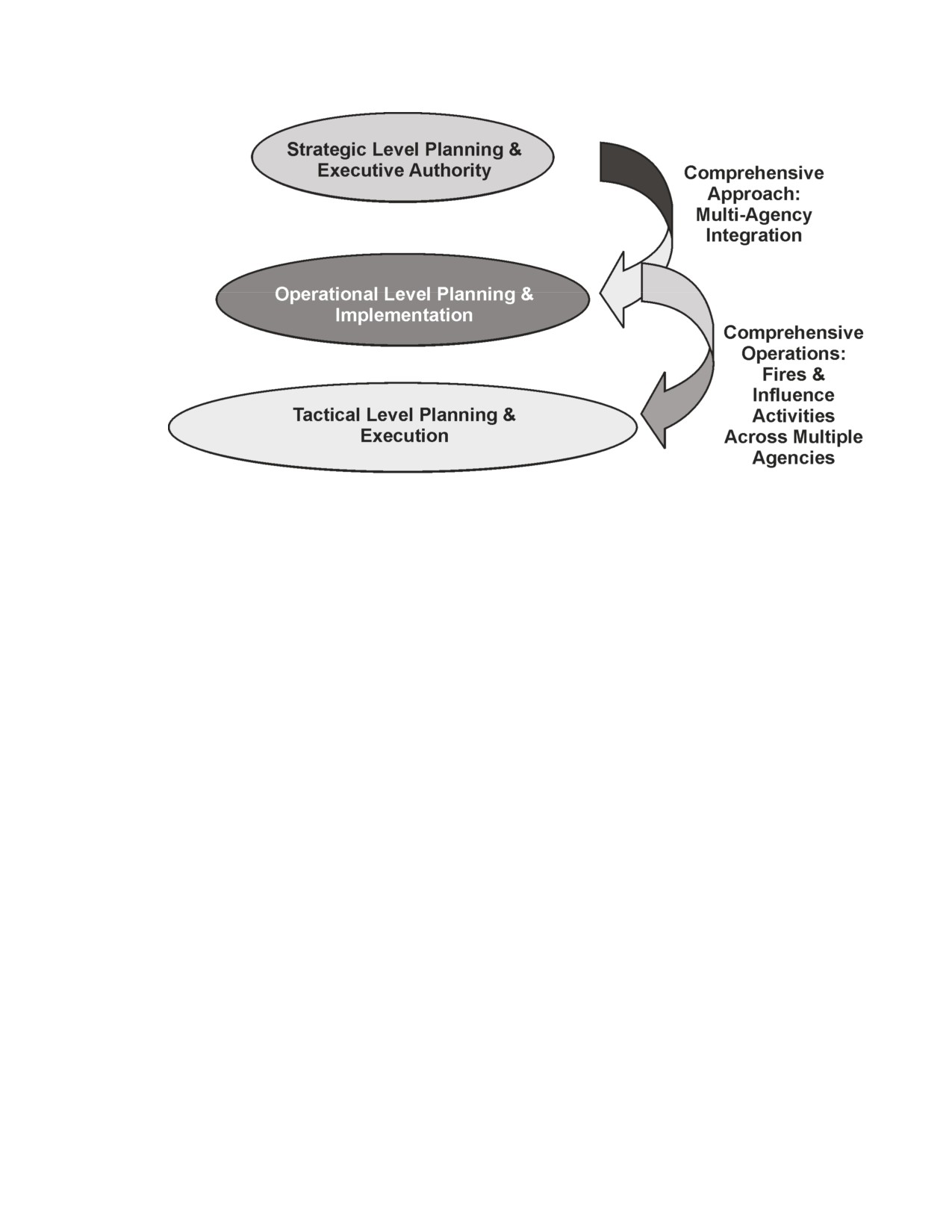
Operational-Level Considerations for Counter-Insurgency
Figure 5-1: The Comprehensive Approach and Comprehensive Operations
5.
The application of fires to neutralize the insurgents will ideally be done with indigenous
forces in order to develop their capabilities and to enhance the legitimacy of the campaign. In
conducting the engagement of the insurgents, commanders must come to appreciate and avoid
undesired effects. The creation of collateral damage and civilian casualties, for example, will do
much to undermine the operational objectives and overall legitimacy of the COIN campaign and
will greatly detract from influencing minds and hearts. Thus planning must be done with this in
mind.
6.
Planning of tactical-level activities must always be done in order to support the stated
operational objectives. The combination of fires and influence will support the neutralization of
the insurgent and the separation of him from his sources of strength. Fires and other physical
activities will separate the insurgent from his physical support, whilst influence activities, through
public affairs, psychological operations (PSYOPS) and other capabilities, will separate him from
his moral support and ideally neutralize his influence on indigenous and other populaces.
7.
COIN will be conducted through a joint and combined command intimately linked with
civilian political activities and other agencies. The shift in emphasis from the destruction of
enemy manoeuvre forces to a balance between fires and influence requires greater awareness
of intelligence, information and the socio-cultural milieu of the area of operation. In order to
gauge how influence messages will be perceived and understood and thus create the desired
effect, commanders must come to understand the overall environment, its systems and its
overall culture.
8.
Commanders must consistently emphasize the minimum use of force rather than
maximum firepower, with consideration of both primary and secondary effects, in order to
maintain legitimacy and avoid providing material for insurgent propaganda. All of these factors
will require a greater degree of cooperation and unity of effort across all agencies from all
participating countries, with a more diverse range of civilian and security force actors to deal
with than is customary to many within the military.
9.
Structurally, organizations at the operational level will mirror those civil and military
arrangements created at the strategic level, thus ensuring continued joint and combined
integrity throughout the various levels of command. Military leaders at the operational level will
B-GL-323-004/FP-003
5-3
Counter-Insurgency Operations
continue to ensure that military efforts remain subordinate to political-civil constraints and
requirements. This will hold true regardless of the shifting effort and emphasis as the
insurgency evolves.
10.
At the operational level and below, the comprehensive approach, with its integration of
multiple agencies to create enduring solutions to the insurgency, may be realized and
implemented through the creation of civil-military transition teams.46 These teams or groupings
combine military and other agencies to undertake a wide variety of tasks that focus on
reconstruction, governance and development. They may include a range of government
departments and international organizations supported by the military. Their overall tasks will
include essential services, sustainable development, infrastructure and governance
development. The military’s role may be wide ranging, particularly in the early stages, but as a
minimum will likely include security, escort, liaison duties as well as the provision of expertise in
fields such as engineering.
11.
These teams should be considered manoeuvre elements not in terms of combining
firepower and movement but in terms of psychologically out-manoeuvring the insurgents to
dislocate the insurgents and create lasting stability. They bring a customizable, multi-faceted
capability to the campaign, which will create effects in support of operational objectives. They
may work along a single line of operation or along a number of lines of operation.
504. COMMAND SYSTEMS AND STRUCTURES47
1.
The command and control structures adopted for a COIN campaign should include the
wide variety of agencies and elements of power needed to successfully prosecute the
campaign. These may be formal or informal arrangements. In either case, they must be based
on a unity of purpose and common end-state and include the various elements of power needed
to address the causes and aggravating factors of the insurgency.
505. SINGLE COMMANDER SYSTEM48
1.
In a single command construct, the chairman or director of the coordinated effort is in
overall command of the campaign. In this system, policy and executive authority are vested in a
single commander, usually a military officer, with senior civil service, police and subordinate
military commanders as advisers. The system requires a perceptive and charismatic (team
building) commander. Whether military or civilian, the commander will be acting on behalf of the
government and will have a variety of military and civilian advisers. The executive authority of
46 Civil-military transition team is defined as: “An organization designed to integrate and coordinate interagency and
multidisciplinary efforts within a given geographic region. Note: Its purpose is to develop capacity in local agencies
and institutions in order to promote long-term stability. It may be referred to as a provincial reconstruction team
(PRT) in some theatres” (submitted to the Army Terminology Panel, September 2007). The use of (PRTs) during
the campaign in Afghanistan is an example of civil-military transition teams.
47 “This section and the concept of single and committee command structures are based in part on the work of
General Sir Frank Kitson. See: Frank Kitson, Bunch of Five, London: Faber and Faber, 1977: passim.”
48 A recent example of a single command system can be found in the Australian command construct used in the
Regional Assistance Mission to Solomon Islands (RAMSI), initiated in 2003. In this case, a civil servant/diplomat led
the mission with the military and police elements subordinate to him in a single command structure even though the
military contributed the majority of the forces deployed. It is important to note, however, that the style of command
used was highly cooperative in nature. See: Russell Glenn, COIN in a Test Tube: Analyzing the Success of the
Regional Assistance Mission, Solomon Islands, (Santa Monica: RAND, 2007).
5-4
B-GL-323-004/FP-003

Operational-Level Considerations for Counter-Insurgency
the commander must be well understood by all subordinate commanders, be they civil or
military.
2.
A single command system will best suit a single nation’s contribution to a campaign
(even as part of a larger coalition) or that of a closely knit coalition.
3.
Although a single command system may exist, there will be important contributors to the
campaign that will not come under this command system. These may be international
agencies, private volunteer organizations, private business and non-governmental organizations
(NGOs). Ideally, they will share a unity of purpose and close coordination will be a common
practice.
4.
Within a nation’s campaign contribution, a single command system should allow the
application of a comprehensive approach at all levels of command, with an appropriate mix of
military and civil elements of power at various levels of command (see Figure 5-2, which is a
theoretical example only).
Figure 5-2: Example of a Possible Single Command System
506. COMMITTEE SYSTEM
1.
It may not be possible, particularly when dealing with a coalition, to form a single
command system across different civilian and military agencies. In such a case, committees
may be formed at the strategic, operational and tactical levels in order to coordinate all COIN
objectives and activities across all elements of power and lines of operation.
B-GL-323-004/FP-003
5-5
Counter-Insurgency Operations
2.
A committee lead, normally the civil administration, provides the chairman of the highest-
level committee, thus linking joint forces and other elements of power. Subordinate committees
may be formed to group together similar elements of power between international and
indigenous powers.
3.
The organization of committees may reflect thematic lines of operation in the
campaign plan. Committees are replicated at each level—national regional and local—as
appropriate.
4.
The police and the military provide members to the various security operations
committees at each level—national, regional and local—in the administrative and command
hierarchy. These must include elements of indigenous forces, particularly if they are mature
and reliable. The ability of indigenous forces, both police and military, to provide intelligence
and situational awareness cannot be underestimated.
5.
Other elements of power, such as judiciary reform institutions and infrastructure
development organizations, may form their own cooperative committees with indigenous input
or leadership at national, regional and local levels in order to coordinate and harmonize actions.
Military forces may also be represented at these non-military committees in order to coordinate
support (e.g., engineer expertise, security and transport) and provide situational awareness.
6.
Decisions are made jointly and implemented by the chairman and members through
their own civil service, police and military command. At various levels, the committees may also
include lead administrators from various NGOs and international bodies providing support to the
operation (such as the UN special envoy, United Nations High Commission for Refugees
[UNHCR] coordinator, etc.). The structure of the committees must be flexible and altered to suit
the circumstances at hand. A national police command and civilian intelligence agencies, both
indigenous and foreign, may be able to support.
7.
While the committees at various levels will guide and coordinate operations, military
commanders at all levels must be prepared to exploit fleeting opportunities in order to do
damage to the insurgency movement. In simple terms, time may not exist to refer potential
military actions back to a committee. Any military action taken, however, must be fully in
concert with the overall strategy of the COIN operation, use the minimal force necessary,
support the campaign objectives and avoid undesired effects that will undermine the legitimacy
of the campaign.
8.
Under a committee system, arrangements will become fairly ad hoc and change over
time. Nations contributing to a coalition will determine the level of commitment and the levels
and regions in which they will participate, be it a military commitment, a civilian commitment or a
combination thereof.
5-6
B-GL-323-004/FP-003

Operational-Level Considerations for Counter-Insurgency
Figure 5-3: Example of a Committee System for a COIN Campaign
SECTION 2
THE PLANNING OF THE COIN CAMPAIGN
507. OPERATIONAL CAMPAIGN PLANNING
1.
The COIN principles identified for the successful conduct of operations, as detailed in
Chapter 3, must be clearly understood. They form the backdrop to the campaign plan and
continue to be applied through all levels of command and integrated into daily operations.
Developing the military aspects of a COIN plan depends on many factors but typically involves
the securing of a firm base from which to operate. Once this base is established, military forces
should then seize the initiative in separating the insurgent from the supporting population in
order to support the government’s subsequent activities.
2.
The nature of a COIN campaign and the demand to use a comprehensive approach
calls for all elements of power needed in the campaign to be involved, to the greatest extent
possible, in the development of the campaign plan.
B-GL-323-004/FP-003
5-7

Counter-Insurgency Operations
508. EFFECTS-BASED APPROACH TO CAMPAIGN PLANNING
1.
An effects-based approach will be used in the development of the campaign plan.49 The
effects-based approach is defined as “a planning philosophy combined with specific processes
that enable firstly, the integration and effectiveness of the military contribution within a
comprehensive approach with other elements of power, and secondly, the realization of
operational objectives.”50 In simple terms, an effects-based approach ensures that the military
activities are integrated with those of other agencies and that military activities are directly linked
to operational objectives—the results or effects of the activities directly contribute to operational
objectives.
2.
The campaign plan for a COIN campaign must span a considerable length of time in
order to be realistic and address the systemic causes that led to the crisis. Once devised, the
campaign plan is implemented through a series of operational plans that are constantly
reviewed and issued on a continual basis. Assessment of the situation, the environment and
campaign progress is continuous and informs subsequent iterations of the operational plan.
Each successive operational plan adjusts operations to reflect the progress made in the
campaign. This is illustrated in figure 5-4.
Figure 5-4: Model of a Campaign Plan and Supporting Operational Plans
3.
In dealing with an effects-based approach and specifically with a COIN campaign, the
normal taxonomy used in campaign planning must be expanded.51 The campaign plan must
49 For more details on the effects-based approach, see B-GL-300-001/FP-001 Land Operations.
50 Army Terminology Panel, May 2007.
51 For the purposes of a military lexicon, effects are simply considered the results of activities. They may occur as
first order effects on the physical or psychological plane or on both planes when second order effects are considered.
For more details, see B-GL-300-001/FP-001 Land Operations.
5-8
B-GL-323-004/FP-003

Operational-Level Considerations for Counter-Insurgency
work towards a desired and well articulated operational end-state that supports the strategic
end-state and objectives. Such an operational end-state should envisage the termination of all,
or at least the majority of, military involvement in the campaign and a prevailing security
situation that allows other elements of power to operate freely and is maintained by indigenous
forces at a sustainable operating level. The campaign plan begins with an articulation of this
operational end-state.
4.
From this operational end-state, the commander and planning staff determine key
centres of gravity, operational objectives that will support the end-state, supporting effects that
will realize operational objectives and finally the activities (assigned through the operational
plans) that will create those supporting effects. This is illustrated in the figure below.
Figure 5-5: Model for the Development of an Effects-Based Campaign Plan
5.
The basic steps in completing such a campaign plan are as follows:
a.
Review the Situation. The operating environment will be complex, and a wide
range of factors—political, military, economic, social (including culture and
religion), informational and infrastructure—will need to be analyzed for their
power structures and influences upon the successful outcome of the campaign.
This will form the broad knowledge base that will inform the remainder of the
operational and tactical planning process.
b.
Identify and Analyze the Problem.
(1)
The commander and staff conduct a mission analysis to establish both
the mission and the operational end-state. Initial operational objectives
may also be identified.
B-GL-323-004/FP-003
5-9
Counter-Insurgency Operations
(2)
The staff conducts a detailed evaluation of the factors, building upon the
broad knowledge base. Based upon the operational end-state and
objectives, centres of gravity may be identified. Other operational
objectives and the supporting effects needed to create them may also be
identified at this point.
(3)
The commander and senior staff conduct analysis of the factors to
discern the major building blocks of the campaign plan. They will select
and analyze the centre(s) of gravity that dominate the situation along
with their critical requirements and vulnerabilities. Furthermore, they will
confirm the desired operational end-state. Based on the key centre(s) of
gravity, the commander will determine the operational objectives needed
to achieve the end-state. Analysis will occur throughout in order to
confirm the validity of decisions. At this point, the commander should
have identified coherent operational objectives focused on the operational
end-state and addressing the key centre(s) of gravity. The commander
will issue planning guidance to his staff.
c.
Frame the Campaign Plan and Initial Operational Plan (OPLAN). With the
building blocks decided, the campaign plan may be devised.
(1)
For the campaign plan, operational objectives may be grouped into
thematic lines of operation, which allow commanders and staff to
visualize the progress and direction of the campaign. The lines of
operation will indicate where the military has primacy and where it
supports other instruments of power. Note that all lines of operation,
regardless of the primary agency involved, move towards the operational
end-state. Once this framework is established, commanders and staff
may determine supporting effects or decisive points that create the
operational objectives. Measures of effectiveness52 are also determined.
Commanders and staff must realize that many of the desired effects in a
COIN campaign will take extensive periods of time to realize, for they
relate to changes in understanding, perceptions and will mainly in relation
to supporting a campaign.
(2)
Whilst the campaign plan depicts the long-term process, the near-term
requirements to commence the plan must be considered. Thus the
campaign plan is initiated through an operational plan (OPLAN), which is
updated and adjusted regularly to meet changes to the environment (see
Figure 5-4). The commander and staff select the decisive points that are
most relevant to the immediate situation and that must be achieved
before others can be achieved. Selection and prioritization of decisive
points will generate options, each of which will provide a potential
framework for an OPLAN. Based on his intuition, the commander will
select an option to decide which decisive points will be developed first. A
broad, outline scheme of manoeuvre may be developed.
d.
Develop and Validate Courses of Action (CoAs). The broad direction
and scheme of manoeuvre issued by the commander must now be
52 Measure of effectiveness (MoE) is defined as “A criterion used to evaluate how a task has affected selected
system behaviour or capabilities over time” (Army Terminology Panel, May 2006).
5-10
B-GL-323-004/FP-003
Operational-Level Considerations for Counter-Insurgency
developed into detailed courses of action. The decisive points / supporting
effects chosen for initial development will be analyzed to determine what
activities are needed to create them. This is done by staff in collaboration with
specialist advisors, such as cultural or political advisors, and subordinate
headquarters. The activities may be arranged in different courses of action that
will lead to the realization of the decisive points. Courses of action may be
developed and compared in terms of activity, resources, time and space.
e.
Course of Action (CoA) Evaluation. Each potential CoA is evaluated and
compared using a number of means in order to determine the most feasible and
likely of success. In doing so, the validity of selected decisive points may also be
examined to determine if they are deliverable and realistic within the constraints
of resources.
f.
Commander’s Decision and Plan Development. Once the CoAs for the
OPLAN have been compared and assessed, the commander may select or
develop the CoA most likely to be successful in terms of creating the required
decisive points / supporting effects.
6.
The extant taxonomy for campaign planning must be expanded beyond the concepts
dealing with conventional forces linked to geographical features and become broader concepts
in order to support the objectives and environmental issues relevant to a COIN campaign. The
expansion of campaign planning taxonomy should incorporate the need to create operational
objectives that involve more than simply military forces operating against other military forces:
a.
Lines of operation should be considered as thematic groupings of operational
objectives and their supporting effects. They connect and drive activities to meet
operational objectives and ultimately the operational end-state in relation to
identified centres of gravity.
b.
Centres of gravity remain vital in the development of a campaign plan and will
dictate the development of operational objectives.53
(1)
Centres of gravity should be considered capabilities, based on groups or
individuals, that can create effects. They may be physical, such as an
enemy armoured reserve, or they may be moral, such as a charismatic
religious leader. Centres of gravity will have characteristics and localities
of importance but must be considered as a capability to be affected or
influenced.
(2)
Centres of gravity at the strategic and operational levels must be
identified and considered in the development of the campaign plan.
(3)
Generally, within a COIN campaign, strategic centres of gravity are
populations and their support of the campaign. The population of the
region or nation in question is a centre of gravity over which the
insurgents and the COIN elements will fight for support. The domestic
populations of any troop contributing nations will also be centres of
gravity, which the insurgents will attempt to intimidate and convince not to
support the campaign.
53 Allied Administrative Publication (AAP) 6 defines a centre of gravity as “Characteristics, capabilities or localities
from which a nation, an alliance, a military force or other grouping derives its freedom of action, physical strength or
will to fight.”
B-GL-323-004/FP-003
5-11
Counter-Insurgency Operations
(4)
Operational objectives can be devised based on strategic and operational
centres of gravity. If a population mass and its support is a key centre of
gravity, then operational objectives will seek to create the conditions—a
responsible government, sustainable infrastructure, etc.—that will gain
and hold their support.
(5)
At an operational level, centres of gravity may be regional governments
and leaders whose competence and legitimacy in providing support and
security to their populations will be vital. Other centres of gravity may be
regional groups or tribes whose support withdrawn from an insurgency
may be key to long-term success.
(6)
In attacking or defending these centres of gravity, there will be a
requirement for comprehensive operations—the synchronized
combination of fires and influence activities. Influence activities through
public affairs, PSYOPS, CIMIC and presence, profile and posture are
particularly important in terms of convincing population-based centres of
gravity to reject the insurgency and support the COIN campaign.54
c.
Operational objectives will not necessarily be terrain-linked objectives but more
in the nature of decisive conditions that have both physical and psychological
dimensions. They may be military and security related, or they may be related to
governance, civil institutions and infrastructure. Thus many operational
objectives will be reached or created by other elements of power, with the military
in a supporting role or providing security and perhaps, given an early security
situation, initial work. Operational objectives are the key building blocks of the
campaign.
d.
Decisive points may be considered those supporting effects—results of
activities—that build to the operational objectives. For example, if, based on a
desired end-state, an operational objective is the creation of a competent,
politically subordinate military force, a decisive point or supporting effect required
for this objective may be the creation of a military training centre and professional
NCO corps. This supporting effect can then be created by the assignment of
tactical activities, in particular, those dealing with security sector reform (see
Figure 5-5). Several decisive points or supporting effects will likely be required to
achieve an objective.
e.
Activities are tactical activities and tasks assigned in order to create supporting
effects or decisive points that together will realize operational objectives. In this
manner, tactical activities are not conducted out of hand or from a preconceived
template but are directly related to operational objectives.
7.
Once operational objectives have been identified, they may be grouped together in
thematic lines of operation. The figures below indicate an example of lines of operation for a
campaign.
54 For more details with respect to influence activities, see B-GL-300-001/FP-001 Land Operations.
5-12
B-GL-323-004/FP-003

Operational-Level Considerations for Counter-Insurgency
NOTE
These are examples only and should not be considered a template for a COIN campaign.
8.
During the campaign planning process, it is vital that appropriate measures of
effectiveness be determined in order to measure progress in creating supporting effects /
decisive points and their related operational objectives.
Figure 5-6: Example of Lines of Operation for a Campaign Plan
B-GL-323-004/FP-003
5-13

Counter-Insurgency Operations
Figure 5-7: Example of Lines of Operations, Operational Objectives and Decisive Points /
Supporting Effects
509. CAMPAIGN ASPECTS UNIQUE TO A COIN CAMPAIGN
1.
Although the development and conduct of a COIN campaign at the operational level will
follow the same general process as that for any other campaign, there are several aspects that
warrant special consideration. These are reflective of the philosophy and principles unique to a
COIN.
2.
The importance of these unique aspects or factors cannot be overstated. Failure to
understand and consider them will ignore the principles for COIN and thus potentially lead to
campaign failure.
510. COLLABORATIVE PLANNING
1.
By its vary nature a COIN campaign will require a comprehensive approach so that
elements of power other than the military may address and solve the underlying causes of the
insurgency and morally separate the insurgency from its legitimacy and support base. Thus,
many lines of operation and operational objectives will not only involve other agencies, but
those agencies may well be the lead element.
2.
To this end, these other agencies—be they government departments, international
organizations or NGOs entering into the campaign in a spirit of cooperation—should be involved
in planning for the campaign. This will pose some challenges to agencies, including the military,
5-14
B-GL-323-004/FP-003
Operational-Level Considerations for Counter-Insurgency
which are accustomed to working in isolation or working without a formal plan at the operational
level. Military commanders may have to take the lead and carefully explain to other
organizations the reasoning and process behind collaborative campaign planning. This will be
necessary whether the campaign hierarchy is based on a single command system or a
committee system.
3.
In the early stages of the campaign, the security situation may be such that only the
military forces are able to operate. In such cases, some lines of operation that would normally
have a civilian agency lead may be assumed by the military in order to commence work, to
develop legitimacy for the campaign and to garner public support through the demonstration of
tangible progress. Restoration of essential services may be a case in point. In such cases, the
military activities should be supportive of likely future work by other agencies. Collaborative
planning before the deployment will help ensure this complementary aspect of activities.
511. OPERATIONAL CENTRE OF GRAVITY—INSURGENT SUPPORT
1.
Strategically, a small number of centres of gravity will exist. Within the nation itself,
these will likely be limited to the following possibilities:
a.
the bulk of the population, their support for the COIN campaign and their
rejection of the insurgency;
b.
the host government (members and structures) and their perceived legitimacy
amongst the populace, their capability and their physical and moral superiority to
the insurgents; and/or
c.
any individual national leader who has pervasive influence across the nation as a
moral centre of gravity.
2.
Gaining the support of the population will require effective political action, a safe and
secure environment and socioeconomic programmes that serve to substantively improve the
day-to-day lives of the people.
3.
Operational centres of gravity for insurgents will likely be various groups of individuals
who support the insurgency. This may be a particular tribe or clan in a region known to forego
recognition of a central government or one that has been marginalized by a central authority.
Another operational centre of gravity may be an external supporter supplying resources to the
insurgent forces.
4.
Each centre of gravity will have to be analyzed in order to determine its critical
requirements and critical vulnerabilities. These may be physical, moral or a combination. For
example, a specific tribe supporting an insurgency may have done so out of historic
marginalization by a central government. If assessed as an operational centre of gravity, it may
be neutralized through a number of means: its grievances regarding political marginalization
may be solved through political reform, its moderate leaders motivated and their images
enhanced through PSYOPS, the tribe’s tactical capabilities destroyed and hard line leadership
either destroyed or marginalized to the point that they are no longer influential. Thus, a
combination of fires and influence will be used to neutralize adversary centres of gravity.
5.
It is from operational centres of gravity that the insurgents draw their freedom of action,
physical strength and a portion of their will to fight. Although campaign planning must support
the overarching effort against the insurgents’ strategic centre of gravity, operational-level
leadership must determine the relevant operational centres of gravity, analyze them and
determine how best to neutralize them. Methods of neutralizing these centres of gravity may
include destruction or disruption of insurgents’ higher command and control structures, removal
B-GL-323-004/FP-003
5-15
Counter-Insurgency Operations
of fear of reprisals amongst the general population or influence activities seeking popular
support and legitimacy such as the provision of utilities and medical aid to society at large.
6.
Analysis of operational centres of gravity will involve the same general process as any
centre of gravity analysis; however, a greater emphasis must be placed upon centre of gravity
capabilities and vulnerabilities on the psychological/moral plane, for the operational focus must
be on influencing groups of people to reject the insurgency. Such an analysis will help inform
the development of operational-level objectives and subsequent decisive points (supporting
effects) and activities. This will require immense support from the intelligence community in
terms of identifying and analyzing the various factors and influences in the environment in order
to understand how best to engage, physically and psychologically, these centres of gravity and
alter their behaviour in a manner desired.
7.
Once this analysis is done, it will ultimately inform, shape and focus tactical-level
activities and their links to operational-level objectives. In all cases, the indigenous population is
the primary centre of gravity because no insurgency can survive amidst the hostile terrain of an
unreceptive public. Other centres of gravity may include, but are not limited to, sources of
financing, weapons and munitions, groups of supporters and their motivations and political
conditions that fuel public grievances. Higher headquarters and national sources can provide
valuable intelligence and information but will seldom be able to provide information of the
requisite quality to conduct tactical operations. The operational planning process will therefore
dedicate a significant amount of effort towards acquiring the information necessary to target the
insurgents’ centre of gravity.
512. DEVELOPMENT OF THE CAMPAIGN PLAN
1.
Once the centres of gravity and their critical vulnerabilities and requirements have been
identified and analyzed, operational objectives, lines of operation, decisive points (supporting
effects) and activities to meet those decisive points may be determined. In short, the campaign
plan may be developed.
2.
Part of this process should include an analysis of the insurgent’s own campaign plan.
This will be part of the intelligence assessment. It should determine the insurgent’s aims,
intents and strategic and operational schemes of manoeuvre and thus should allow
commanders to identify likely lines of operation and objectives for the insurgents. In turn, the
COIN campaign’s planned objectives, lines of operation, decisive points and activities should
seek to counter insurgent lines of operation and pre-empt, dislocate and disrupt the key
pillars of the insurgent campaign plan. Some of those key pillars will be to target friendly
centres of gravity. The commander must be aware of this fact and consider what actions may
be required to counter-act these insurgent efforts.
3.
Specifically, insurgents will try to capitalize on the role public opinion plays in
democracies and will deliberately stage events and coordinate operations to undermine the will
of domestic audiences of campaigning nations in order to cease their participation in the
campaign. The domestic audiences of these nations and their support for the campaign are
strategic centres of gravity that the insurgents will attack. Plans must be made and activities
conducted to defend these centres of gravity. Part of this battle will consist of a proactive public
affairs policy that seeks to highlight the legitimacy of the campaign to indigenous, domestic and
international audiences and, above all, ensures that the domestic audience of a campaigning
nation receives accurate and timely information regarding the campaign.
5-16
B-GL-323-004/FP-003
Operational-Level Considerations for Counter-Insurgency
The support of the domestic public is critical to sustaining any COIN campaign the CF is
tasked to undertake and is therefore a friendly centre of gravity. Technology now allows
insurgents to more easily coordinate actions and effects and directly target the will of the
public of coalition partners. Domestic public opinion can and will be targeted a number of
ways, including media releases and interviews with Western media outlets, attacks timed and
coordinated to coincide with specific events in coalition countries, and strategies aimed at
causing rates of attrition unacceptable to coalition members. There are many historical and
recent examples of insurgents targeting the will of an adversary’s domestic public. General
Vo Nguyen Giap specifically created a strategy that would target the will of the American
public during the Vietnam War. More recently, the Madrid train bombings on 11 March 2004
likely altered national election outcomes and led to the withdrawal of Spanish troops from
Iraq. At both the operational and strategic levels planners must anticipate and plan to counter
enemy lines of operation targeting friendly centres of gravity.
Sources: Michael Hennessy, Strategy in Vietnam: the Marines and Revolutionary Warfare in I Corps,
1965-1972. Westport CT: Praeger, 1997, pp.128-129.
4.
In short, the insurgents too will seek to influence key target audiences. Thus the
commander must anticipate this with a combination of defensive and offensive information
operations / influence activities. The former will seek to protect domestic populations,
supportive indigenous groups and friendly forces from the insurgent propaganda and explain the
nefarious motivations of his actions and atrocities. The latter—offensive influence activities—
will seek to convince neutral or unsupportive target audiences to reject the insurgency and its
aims.
5.
All operational objectives, decisive points and related activities of the campaign plan
should seek to undermine the physical and moral strength and legitimacy of the insurgents.
Given that the successful outcome of a COIN campaign is linked to the psychological
disposition of a population to support or reject an insurgency, destruction of the moral
superiority and legitimacy of the insurgent must underpin all operational objectives, supporting
effects and tactical activities. In doing so, the military will have a supporting role to other
agencies and elements of power that can address social grievances, build campaign legitimacy
and convince the populace to invest in and support the campaign.
6.
The various lines of operation for a COIN campaign will depend upon the thematic
groupings of the operational objectives. They may include such themes as security,
governance and social and economic development, to name only some possibilities. These will
be broad lines of operation containing a number of operational objectives and their related
decisive points. For example, a governance line of operation may include objectives and
decisive points in the area of economic and government development, the civil service, the
judiciary and the penal system. A line of operation dealing with security may include objectives
and decisive points regarding the military, paramilitary, constabulary, civil defence and border
security, to name just a few possibilities (see Figure 5-8 below). Many of these will of course
require elements of power other than the military to be successful. Thus, the campaign plan will
incorporate a comprehensive approach.
7.
Once the campaign plan has identified the operational objectives and required decisive
points or supporting effects, then successive operational plans will assign the tactical activities
needed to create the decisive points and subsequent objectives.
B-GL-323-004/FP-003
5-17

Counter-Insurgency Operations
NOTE
Some decisive points may not be necessary depending upon the progress of a
campaign.
THEMATIC LINES OF OPERATION
Governance
Security
Political Process
Reconstruction
OPERATIONAL OBJECTIVES
Interim
Self-
Secure
Self-
Electoral
Elected
Key
Sustained
Governance
Governance
Environment
Sustaining
Process
Government
Restoration
Infrastructure
Provided
Established
Maintained
Security
Reformed
Empowered
Established
DECISIVE POINTS/SUPPORTING EFFECTS
Transitional
Military
Provincial
Militia B
Electoral
Government
Essential
Equitable
government is
control
capitals
repatriated
process
structures
services re-
control
established
reformed
secured
designed
reformed
established in
achieved
all areas
Provincial
Police control
Border
Military
Ethnic
Political
Resource
Accountability
governments
reformed
crossings
training re-
leaders
oversight of
infrastructure
procedures in
re-established
secured
established
engaged
security
secured
place
institutions
Economic
Militia B
Police
Interim control
Enduring
reforms for
deterred
training re-
of resources
infrastructure
distribution
established
achieved
re-built
Militia B
Sustained
defeated if
growth
necessary
Figure 5-8: Example of a Campaign Plan Showing Lines of Operation, Operational Objectives and
Decisive Points / Supporting Effects
8.
Once the campaign plan is developed, it must be revisited continuously, as insurgent
activities and tertiary effects will cause decisive points and objectives to shift both in time and
space. This shifting of decisive points and objectives may be addressed through the process of
designing and issuing successive operational plans that seek to progress the campaign plan.
513. SUPPORTING AND TRANSITORY ROLE OF THE MILITARY
1.
Throughout the COIN campaign, the military will generally have a supporting role. It will
undertake actions to neutralize the insurgent—through pre-emption, disruption and dislocation—
in order to allow manoeuvre space and freedom of action other elements of power need to bring
a successful end to the campaign.
2.
Depending upon the security situation in the early stages of a campaign, the military
force may be the only element of power capable of working in the environment. Thus, it will be
the supported force and will initiate action along as many lines of operation as possible. Much
of this will be undertaken to neutralize the insurgent and seize the initiative but also to begin to
5-18
B-GL-323-004/FP-003

Operational-Level Considerations for Counter-Insurgency
gain the understanding and support of the indigenous population. Thus the military can expect
to undertake a combination of offensive, defensive and stability activities.
3.
Offensive activities will seek to seize the initiative from the insurgent and pre-empt and
disrupt his activities and influences. Defensive activities will seek to protect vital points,
vulnerable elements of the population and the force itself. Stability activities will seek to disrupt
the influence of the insurgent through area security and control, thereby establishing the
conditions for other agencies to begin work and undertake initial reconstruction, governance and
security sector reform (SSR) tasks in order to gain the support of the local populace.
4.
As the security situation improves, the ability and requirement to conduct stability
operations/activities will increase, and the military can expect to hand over some responsibilities
to other agencies, be they police or civilian. It should also allow other lines of operation beyond
the military’s capability to commence. Ideally, as the security situation continues to improve, a
greater proportion of the stability activities, including security and control, will be assumed by
other agencies, be they foreign, international or indigenous. In the later case, this will also
occur as indigenous capabilities are developed (see Figure 5-9).
Figure 5-9: Illustration of Transition of Stability Operations to Other Agencies
5.
Early involvement of those other agencies in the campaign plan will ensure that initial
military efforts in reconstruction, governance and security sector reform are done in accordance
with long-term objectives. Although commanders cannot assume this transition too early in the
campaign, the sooner it begins to occur, the greater will be the legitimacy of the campaign, for it
should indicate an improvement to the security situation and government action to address the
root social and/or economic causes of the crisis.
B-GL-323-004/FP-003
5-19
Counter-Insurgency Operations
514. THE SUBORDINATE ROLE OF FIRES AND THEIR PHYSICAL EFFECTS
1.
As discussed in earlier sections, the philosophy and principles of a COIN campaign
demand that the enduring solutions to an insurgency will require campaigning elements to
address the root and systemic causes of the insurgency and to not only physically neutralize the
insurgent but to morally separate him from his support base and the population in general.
Together, this will gain and hold the support of the mass of the populace and eventually cause
the insurgency to wither.
2.
To this end, offensive operations—fires and their physical effects—will only go so far.
Regardless of how many successful engagements occur, it is highly unlikely that the insurgency
will succumb in a permanent sense to attrition. Indeed, such attempts will likely drive more
individuals to the insurgency and provide additional support for the insurgent’s narrative and
propaganda. This will be magnified in certain cultures that practise an eye-for-an-eye sense of
retribution and justice.
3.
The successful outcome of the campaign will require a greater emphasis on activities
that influence a wide variety of target audiences, be they groups of individuals or key leaders
who may be moral centres of gravity. The influence activities should seek to gain the support of
the populace and will include in large measure stability activities that will solve the root
economic/social causes of the insurgency, address political and civil development and enhance
domestic services and security forces. Other influence activities, through PSYOPS and public
affairs, should seek to pre-empt and dislocate that of the insurgents and protect the indigenous
and domestic populations from insurgent propaganda. Properly conducted, these influence
activities may even convince certain portions of the insurgent group to either convert to support
the COIN campaign or at least enter a peaceful negotiation process.
4.
Such influence activities will take extensive periods of time, even years, to produce
tangible results. This will be a change for commanders accustomed to seeing the immediate
results or effects of fires, who may demand immediate feedback considering the possibility of a
relatively short period of time in theatre. However, acceptance of this subordination of fires and
the realization that measures of effectiveness for influence activities take considerable time are
essential for success in a COIN campaign.
5.
In light of this then, the operational plans through which the long-term campaign plan is
realized should not seek to resolve the campaign within a narrow time frame. Instead, they
should analyze the current situation and environment and seek to make incremental progress
towards the desired end-state that will set the conditions for the next operational plan to be
issued.
6.
The aim of military operations is to create a security framework that assists the host
nation government and other agencies in re-asserting control throughout the country and in
creating enduring solutions to the crisis. It is imperative that the civil administration be able to
provide public goods and services in order that the people are given proof of the government’s
legitimacy and capability to govern. A security framework that pre-empts, dislocates and
disrupts insurgent activity is a crucial enabler in achieving this imperative.
7.
The military commander’s task will not be as straightforward as is likely during
conventional warfare. The operational planning process must take account of a wide range of
political, economic, civil and security interests. This will ensure that the correct target audiences
are engaged through the appropriate influence activities that also take into account cultural
perspectives. These realities are reflected in the way in which operations are subject to the
approval of the civil administration through the joint committee system or single command
system. In most instances, the operational plan will aim to isolate and neutralize the insurgents
5-20
B-GL-323-004/FP-003
Operational-Level Considerations for Counter-Insurgency
both morally and physically through simultaneously conducted and parallel political, social and
military activities.
515. UNDERSTANDING EFFECTS OF ACTIVITIES AND THE COMPRESSION ACROSS
LEVELS OF COMMAND
1.
The nature of a COIN campaign sees the main effort focused on gaining and holding the
support of the majority of the populace in contrast to them supporting the insurgent’s will and
end-state. Tactical activities, even at the lowest levels, in a COIN campaign generally occur
amongst the populace for two reasons: they and their vital points must be secured against
insurgent attack, and insurgents tend to hide and operate amongst the populace. Thus the
effects of tactical activities are viewed and felt immediately by the very centre of gravity over
which insurgents and counter-insurgents are fighting.
2.
A result then is a compression across levels of command, in which tactical activities may
have operational and strategic level effects. Thus the conduct of soldiers at a checkpoint, for
example, may influence the perceptions of the whole populace with regard to the campaign and
its legitimacy.
3.
This compression across the levels of command must be understood at all rank levels.
The need to consider and avoid undesired effects, such as collateral damages and civilian
casualties, that will undermine campaign legitimacy and popular support must be considered in
planning and avoided. At times, risks must be taken or short-term tactical success must be
forsaken in order to avoid possible outcomes that will undermine support for the campaign.
516. WAR GAMING
1.
Operational plans and their tactical activities must be war gamed in the same fashion as
those for campaigns against conventional adversaries. However, the factors that must be
considered in such COIN war gaming are more extensive and complicated.
2.
Planning and subsequent war gaming must consider the political, military, economic,
social (including religious and cultural), information and infrastructure related systems55 in the
environment along with the influence that each system will have on the outcome of the
operation and campaign. Power structures and influential individual leaders must be identified
and considered in the war gaming. Additionally, other agencies and their reactions to
operational plans and activities must be considered.
3.
To this end, war gaming will be fairly complicated, with staff and, ideally, experts and
advisors considering the planned activities from the viewpoint of these various environmental
systems and gauging their respective reactions. Such reactions must be informed by the
cultural perspective of the environment or group under consideration. For this purpose, cultural
and political advisors may be included in the war gaming process.
4.
In this way, proposed courses of action at the operational and tactical levels may be
considered in detail and in perspective of the local environment in order to help ensure that
desired effects, both physical and psychological, are obtained and undesired effects are
avoided.
55 This range of environmental systems may be abbreviated as PMESII systems.
B-GL-323-004/FP-003
5-21
Counter-Insurgency Operations
SECTION 3
IMPLEMENTATION AND EXECUTION OF THE CAMPAIGN PLAN
517. EXPANDING THE CAMPAIGN PRESENCE: PHYSICALLY AND
PSYCHOLOGICALLY
1.
The operational plans that are issued to implement and execute the campaign may be
prosecuted in a number of ways. The concept of the campaigning COIN forces, and with them
their security and control and other agencies working to the same end, spreading like a tache
d’huile or ink spot over the contested environment is an effective, practical and methodical
manner of achieving success in the campaign. In simple terms, it sees the expansion of the
campaign and its influences, both physically and psychologically, throughout the environment,
gradually dislocating the insurgent from his physical and moral support bases. This is
particularly effective when parts of a territory or nation have been lost to insurgent control.
2.
The process of spreading the presence and control of the government and its
campaigning forces requires the comprehensive approach of all elements of power. This will
thus address the security and social issues inherent to the insurgency and in turn will build
legitimacy for the campaign and its forces and begin to influence the local populations to accept
and support the COIN campaign.
3.
In keeping with the philosophy and principles of COIN, political engagement will lead,
followed by simultaneous military and social/economic engagement. All should be advertised
and explained through information operations to the public audiences in order to influence the
understanding, perceptions and will of the indigenous populations and to win their support for
the campaign.
4.
At every stage of the campaign plan implementation, local forces and agencies must be
seen to be in the lead and at the forefront to the greatest extent possible. This will enhance
their legitimacy and undermine insurgent claims that the COIN campaign is an occupation.
Every advance of the “ink spot” should be done in consultation with national, regional and local
authorities as appropriate.
5.
As the deployment and manoeuvre of military forces cause insurgent activity and
presence to be pre-empted, dislocated and disrupted in a new area, other agencies (but
possibly the military initially) must undertake activities to relieve suffering, provide aid and
essential services, address grievances and generally gain support for the campaign. Thus
together, this will involve full-spectrum operations—simultaneous offensive, defensive and
stability operations.
6.
The manoeuvrist approach taken to pre-empt, dislocate and disrupt the insurgents will
involve both fires and influence activities (information operations) on the physical and
psychological planes as detailed below:
a.
Fires, or physical activities, will physically separate the insurgents from the
populace by pre-empting their plans, dislocating their forces and presence in a
population and disrupting their activities. Furthermore, military forces will directly
target the insurgents in order to destroy or deter them and their influences
whenever possible. Such activities must be done with a long-term view of
securing the population, allowing for the return of normal levels of civil activity
and deterring further insurgent actions.
b.
Influence activities will seek to shape the understanding, perceptions and the will
of a wide variety of targets—be they adversary, friendly or neutral—in order to
gain and maintain support for the campaign:
5-22
B-GL-323-004/FP-003
Operational-Level Considerations for Counter-Insurgency
(1)
PSYOPS, through such means of radio stations and public messages, will
inform the indigenous population as to the purpose of the mission and
seek to undermine the narrative of the insurgents.
(2)
Public affairs will support national and international media to ensure the
truth is presented in a public forum regarding the expansion of the
campaign and actions taken to support and protect the populace.
(3)
CIMIC related projects will address essential services, emergency aid and
other projects that will quickly impact upon the well-being of the populace,
alleviate suffering and gain their support for the campaign.
(4)
The profile, presence and posture of the forces, particularly those
providing a framework security presence amongst the public, must be
carefully considered. Forces should present hard targets to insurgents
but be accessible to the population at large. Apart from gaining support,
this may induce a flow of information on insurgent intentions and
activities.
7.
In such a manner, the insurgents will become not only physically, but psychologically,
separated from the local populace (see Figure 5-10).
518. SECURING A FIRM BASE AND INITIAL GOVERNMENT PLANNING
1.
It can be anticipated that the host nation government will have sufficient control of its
territory to provide a secure base where reinforcing coalition contingents can build up and
establish essential support elements. If this is not the case, an initial entry into the nation may
establish a firm base or one can be found amongst a supportive element of the populace.
2.
Consideration must be given to not overburdening the host nation with demands for
administrative support. This can be best achieved through increased self-sufficiency by the
deploying units. Incoming military formations and units should be deployed on the same
geographical basis as the host-nation security forces, corresponding with the boundaries of the
civil administration. It is possible, however, that the situation is deteriorated to such an extent
that no area is safe from insurgent activity. It may therefore be necessary to hold some logistic
assets afloat or in a third country while troops are committed to secure a base area. From this
secure area, troops are deployed into hostile territory to begin the process of re-establishing
control and security area by area.
3.
From this firm base, the COIN forces will conduct planning in cooperation with the
federal and/or regional political and civil authorities. This plan should layout the process for
spreading control and presence into the next area to be secured. Such a plan must take a
comprehensive approach and take into consideration all aspects of engaging in the new area,
using comprehensive operations to physically dislocate and pre-empt the insurgents and to
psychologically dislocate and disrupt them.
519. ENGAGEMENT OF THE LOWER LEVELS OF GOVERNMENT
1.
Once the plan has been agreed to by the national or higher regional government, the
expansion into the new district or area may begin. This expansion should have an indigenous
government lead to it. In beginning to make this expansion, the following should be undertaken
or considered:
a.
Key leaders in the area or district are engaged to develop a plan customized for
that region and the group or groups of people contained within it. This
B-GL-323-004/FP-003
5-23
Counter-Insurgency Operations
engagement must incorporate all leaders—be they elected, appointed or
traditional—that wield influence and power within the population. The leaders will
be able to identify the grievances and issues unique to that area, the
expectations of the populace and the intent and capabilities of the insurgents in
that area.
b.
A comprehensive approach must be incorporated from the outset, which sees the
military and other agencies planning the expansion hand-in-hand with local
leaders. Thus, engagement of the local leaders must be conducted with all
elements of power represented. Planning may follow the lines of operation
developed in the campaign plan. Any committee system established at the
higher national levels may be replicated at this local level in order to harmonize
information and plans between levels of government. A formal committee should
be established and regular meetings planned. This will support the coordination
of all campaign activities, be they offensive, defensive or stability.
c.
A specific assembly or committee may be developed with local stakeholders and
power structures in order to identify the needs of the local populace from their
perspective. This may include short-term projects and/or long-term
developmental undertakings.
d.
An information operations (influence activities) programme must be planned to
advertise immediately to the populace this cooperation between indigenous
government and COIN campaign forces.
e.
If not already present, indigenous police forces must be brought into the area.
Those already there should be enhanced if necessary. These local constabulary
forces must be integrated into the local government and into the campaign plan.
Wherever and whenever possible, they should have the lead in operations.
f.
Quick-impact CIMIC projects may be conducted in order to relieve serious
suffering, quickly gain the support of a local, perhaps wary, populace and to build
campaign legitimacy. Military forces may undertake some of these projects,
particularly if they are the only agency in the area. This will include simple but
effective measures such as emergency medical care, medical clinics in villages
or neighbourhoods, repairs to schools or orphanages and/or delivery of aid.
g.
In addition to quick-impact projects, long-term development planning must begin.
The root causes or grievances of the insurgency likely result from long standing
and complicated social, political and economic issues that may be difficult to
resolve. This may require extensive development in such areas as infrastructure,
economic development and political reform.
h.
Auxiliary security forces should be recruited and developed in these newly
secured areas. This will add legitimacy to the campaign, help provide enduring
security and help ensure a security vacuum is not created once campaigning
forces move to the next area. Such forces will require significant support but will
likely be able to provide excellent situational awareness and intelligence within
their areas. The raising and training of these forces should not be done as an ad
hoc measure once security forces arrive in the new area but should be part of the
plan from the beginning, and forces specifically designated for this training and
mentoring role should be allocated.
i.
Simultaneous to the political engagement will be the establishment of a security
force presence in the new area. Ideally, this will include an indigenous element.
5-24
B-GL-323-004/FP-003
Operational-Level Considerations for Counter-Insurgency
The forces will establish a form of a forward operating base (FOB) within the area
in order to support and realise the physical and psychological dislocation of the
insurgent from the populace. These security forces will support other agencies
and provide the security framework for their operations. Ideally, initial expansion
will occur in areas traditionally loyal to the central government, where the
population will readily rally back to its allegiance once it feels secure from
insurgent actions and retributions.
(1)
The selection of the area of the FOB must be one that can be
consolidated quickly and used as a base for further operations designed
to link up with the initial firm base and be able to spread government
control and influences to other areas.
(2)
Although an FOB is necessary, whenever possible military forces should
live and work amongst the population. Although the security situation
must be somewhat stabilized for this to occur, and that such a practice
may entail a higher level of risk to personnel, it is the only sure way of
developing solid relationships with the communities the security forces
are trying to protect. The constant and prolonged use of FOBs will create
in the minds of both the campaign forces and the indigenous populace a
fortress mentality and posture that physically and psychologically
separates the security forces from the population. This fact and
perception must be avoided.
520.
CLEAR AREA OF INSURGENT PRESENCE AND INFLUENCES
1.
Once security forces have moved into an area and are supported by a political plan and
scheme of manoeuvre in conjunction with indigenous forces, measures may be taken to clear
the area of insurgent presence and influence.
2.
Influence activities (information operations) must be exploited to morally separate the
insurgents from the populace. This requirement to gain the support of the indigenous
population must be understood down to the lowest rank levels, and all operations must be
conducted with the ultimate goal in mind.
3.
Daily contact with the local populace must also be used to gain valuable information
regarding the insurgents, their aims and methods as well as any reasons as to their support
amongst the populace. This will support the pursuit and engagement of the insurgents and
inform other activities that will seek to undermine the moral claims of the insurgents and
address root causes and grievances.
4.
A combination of offensive and defensive operations will be used to directly pursue and
engage the insurgents. Where deemed prudent, Special Forces may be used to conduct direct
action.56
5.
Wherever and whenever possible, indigenous forces should be seen to lead such
offensive and defensive operations. If still developing, they may have to be mentored and
continuously trained by specially designated observer and mentoring teams. Even if local
forces are in a developing stage, they should still be involved and certainly consulted in terms of
56 Direct action is defined as “A short-duration strike or other small-scale offensive action by special operations forces
or special operations capable units to seize, destroy, capture, recover or inflict damage to achieve specific, well-
defined and often time sensitive results” (AAP 6).
B-GL-323-004/FP-003
5-25
Counter-Insurgency Operations
situational awareness and intelligence information requirements. Particular caution may need to
be used when considering the operational security limits and challenges of indigenous forces.
6.
Local police must be developed and exploited as greatly as possible. They bring a
sense of normalcy to the indigenous population and are significant sources of intelligence
regarding local insurgent groups and their support bases. This is particularly true since
insurgents often stem from or work with local criminal organizations, about which police forces
should have detailed knowledge. As the security situation improves, the role and presence of
indigenous police forces should be raised in order to give a visible sign of improvement and to
free up military forces for other duties.
7.
Depending upon the situation and capabilities of the constabulary, local police forces
may be able to take the lead in pursuing and arresting insurgents whilst military forces assume
the manpower-intensive tasks of vital point security and routine patrols.
521. GOVERNMENT LEAD IN THE RETURN OF DISPLACED PERSONS
1.
Once a designated level of security and stability has returned to the local area, national
and regional governments may take the lead in the return of refugees and internally displaced
persons (IDPs).
2.
This must be handled carefully. Any underlying cultural or ethnic tensions between
competing groups must be managed and alleviated. As well, these groups cannot be returned
without a coherent and comprehensive plan that provides for their continued security as well as
for their welfare and sustainable employment. Displaced refugees will not stay, nor even begin
to return, if they cannot feel secure and have a means of supporting themselves.
3.
The return of refugees and IDPs will not only be a sign of returning normalcy and
security but will breed additional security through their presence and support of the campaign.
522. CIMIC ACTIVITIES BY THE MILITARY
1.
Even before non-military agencies arrive in the area to begin long-term development
projects, military forces may begin the process to alleviate suffering, spark development and
gain campaign support. Measures will involve quick-impact projects such as repairs to wells
and the conduct of local medical clinics, remuneration for collateral damages, low-level
employment schemes such as war damage repairs and checkpoint construction and delivery of
basic tools for work and agriculture.
2.
Much of these CIMIC activities should be planned in advance and started as soon as
possible after expanding into a new area. Many of the initial supplies may be delivered quickly
to theatre having been pre-planned as part of the campaign. Funds, resources and the
authority to use them should be pushed prior to the actual requirement to the unit and sub-unit
levels so that the quick-impact CIMIC projects may be designed to meet the needs of the
immediate local populace.
3.
Ideally, pre-planning with other agencies will allow these military lead projects to support
the further development of larger projects by other elements of power in due course.
523. ESTABLISH LOW-LEVEL (COMMUNITY-BASED) DEVELOPMENT COUNCILS
1.
The establishment of community-based development councils will allow local leaders the
opportunity to guide the development in their local areas in order to meet local grievances and
needs. These councils must bring together all agencies, including the military and political
5-26
B-GL-323-004/FP-003
Operational-Level Considerations for Counter-Insurgency
leadership. This should ensure that not only are local needs met but that best use of resources
is made and duplication and conflicts are avoided. The committee should be able to identify
and vocalize priorities and specific projects.
2.
Although the incorporation of local leadership is vital, care must be take to ensure that
the support won by such development is support and legitimacy for the campaign and is not
exploited by local leaders with their own agendas to gain support for themselves at the expense
of the larger campaign.
524. DEVELOP SECURITY PRESENCE AND SET CONDITIONS FOR SUSTAINABLE
SECURITY
1.
Development can only be supported by a permanent security presence and stable state.
The presence of security forces must be expanded in a logical and measured manner. As the
security situation improves, security forces should be increasingly integrated into the local
populace in order to avoid development of a fortress disposition and mentality and to further
separate and dislocate the insurgent.
2.
Local forces must play a key and ideally lead role. Their counsel will be vital in gaining
accurate and timely intelligence from the local populace and in identifying insurgents amongst
the local populace. Local security forces may require an ongoing training and mentoring
regime.
3.
Key to local forces will be the establishment or re-establishment of constabulary forces.
The presence of police forces brings a certain sense of civil normalcy to a population.
Furthermore, police are ideal for tackling the criminal elements and activities that routinely
become part and parcel of an insurgency. The expansion of a police presence will see the
creation of police posts and sub-stations throughout the area, which may be co-located with
military forces for a certain amount of time.
4.
Security forces should begin to raise auxiliary security forces, particularly such elements
as auxiliary police services. These will consist of locals who know their own areas and
populace the best and who have a vested interested in guarding stability and development.
This raising of auxiliary forces should be part of the overall security sector reform process.
Ideally, police training is conducted by civilian police forces as part of a comprehensive
approach.
525. SET THE CONDITIONS FOR SUSTAINABLE DEVELOPMENT
1.
Once security has been established, other agencies within the comprehensive approach
should begin to create sustainable development. Agencies will include other government
departments (both indigenous and those of supporting nations), international organizations,
private business and NGOs. The activities of these organizations must be carefully coordinated
with those of the security forces through either a single command system or a committee
system.
2.
Just as with the security forces, work towards sustainable development and improved
governance should be led by indigenous and local authorities. Only members of the indigenous
population will understand the needs and grievances of the local populace and be able to guide
development in a manner to address those needs and to meet local expectations. Without local
leadership, development may not meet the needs and expectations of the indigenous
population.
B-GL-323-004/FP-003
5-27
Counter-Insurgency Operations
3.
Remediation and payment for collateral damages must be foremost in any scheme, as
the related grievances will be readily identified with the campaign and its legitimacy. Likewise,
any expropriation of private property must be immediately repaid and ideally should start from a
premise of negotiation. Failure to quickly re-pay incurred debts by the campaigning forces will
undermine legitimacy, build distrust of the campaign, create grievances and feed insurgent
propaganda.
4.
The disarmament, demobilization and reintegration (DDR) process of any former
military, militia or insurgent forces must be carefully planned and managed in detail by both
military forces and other agencies. Former soldiers and fighters cannot simply be disarmed and
sent home without a reintegration plan that will include gainful employment.
5.
Expectation management of local populations must be carefully managed, as unrealistic
expectations that go unsatisfied will lead to discontent and a loss of legitimacy for the campaign.
Quick-impact projects and humanitarian aid should address short-term needs and gain quick
support for the campaign. Long-term development and its measured progress will have to be
well advertised to local populations. In order to avoid initial delays in development, the
campaign plan from the outset must include details for the sustainable development. Plans
should include project details, responsibilities and pre-approved funding envelopes. In this
manner, delays that will lead to indigenous frustration and disappointment will be avoided to the
greatest extent possible.
526. CONTINUED CAMPAIGN DEVELOPMENT AND TRANSITION
1.
As the security situation improves, successive operational orders will continue to pass
increased authority and responsibility to local security forces and agencies in each area. Viable
improvements in each area should encourage similar development in other areas as the “ink
spot” expands (see Figure 5-10 for a summary of the process).
2.
The expansion of the campaign into various contested areas will seldom follow a smooth
and orderly fashion, identical in each newly gained area. Regardless of how the COIN
campaign is conducted in detail, the following key elements must be maintained:
a.
a political lead and engagement of acknowledged leaders in each area;
b.
the incorporation of indigenous forces, ideally seen to be leading operations but
as a minimum done in cooperation with them and exploiting their local expertise;
c.
the simultaneous engagement through influence activities to gain the support of
the indigenous population and gain the moral/psychological advantage over the
insurgents; and
d.
sustainable development within carefully managed expectations based on a
comprehensive plan incorporated into the campaign plan from the outset.
5-28
B-GL-323-004/FP-003

Operational-Level Considerations for Counter-Insurgency
Figure 5-10: Example of the “Ink Spot” to Execute a COIN Campaign Plan
Application of Campaign Expansion
During the period December 2006 to February 2007, Canada's Joint Task Force Afghanistan
achieved remarkable success using classic "ink spot" doctrine to counter the existing
insurgency in Kandahar Province. Although known officially as the Afghan Development
Zone (ADZ) concept, it was in reality nothing more than expanding the Government of
Afghanistan' influence using ink spot doctrine. In essence security and quality of life had
been improved in the small town of Pajry Panjway (unofficially known as the "ink dot') to the
point where the inhabitants of the neighbouring districts of Panjway and Zhari assisted their
government and NATO forces in establishing security. As 1st Battalion, The Royal Canadian
Regiment Battle Group and partnered Afghan National Army units pushed forward to clear
the districts, the Taliban, knowing they had little support from the local population, withdrew.
In conducting these operations, a workable step-by-step process was developed.
Source: Colonel F.A. Lewis, Deputy Commander Canada's Joint Task Force Afghanistan, August 2006 to
February 2007
B-GL-323-004/FP-003
5-29
Counter-Insurgency Operations
SECTION 4
CONSIDERATIONS IN THE APPLICATION OF MILITARY DOCTRINE
IN A COIN CAMPAIGN
527. INTRODUCTION
1.
The conduct of any operational plan and subsequent tactical activities must be
conducted in keeping with the philosophy and principles inherent in a COIN campaign.
Furthermore, their conduct must all lead directly to the attainment of the operational objectives
delineated in the campaign plan.
528. BALANCE ACROSS FULL-SPECTRUM OPERATIONS
1.
The simultaneous conduct of offensive, defensive and stability operations, that is, the
realization of full-spectrum operations, will occur throughout a COIN campaign. Commanders
must carefully balance forces and activities across these three sets of activities in order to
further the campaign and reach operational objectives.
2.
Offensive operations are conducted in order to separate the insurgents from their
supporters, resources, suppliers and sources of information in the designated area. Such
operations must be based on actionable intelligence and sound planning. The secondary
effects of offensive operations must be carefully considered so that they do not cause undue
collateral damages or alienate the local populace. Indeed, there may be times when short-term
tactical success must be postponed in order to avoid undesired effects that will undermine the
campaign.
3.
The resulting dislocation of the insurgents from offensive operations will allow civil
administration to be re-established. Essential services, infrastructure development and
improvement to governance may commence through a comprehensive approach. The military
security forces may provide robust support to the police or be asked to help train local auxiliary
forces that will support the police when military forces withdraw. These newly controlled areas
then provide firm bases for further security operations, until gradually the entire theatre or nation
is restored to civil government control and enduring stability.
4.
Defensive operations will consist mainly of securing those areas from which the
insurgents have been displaced. They will secure base camps, government institutions, vital
points such as key infrastructure and the population at large. Military forces may assume many
of these manpower-intensive tasks in order to free up local constabulary forces so that they may
take the lead in pursing the insurgents and their related criminal activities and linkages.
5.
There will be occasions when private security companies assume defensive activities.
These may be hired by the indigenous government, brought into theatre by coalition forces or
hired by NGOs, international organizations or private businesses. If such private security
companies are considered part of the coalition, their rules of engagement, employment
responsibilities and limitations must be clearly defined. The local populace will not distinguish
between campaigning forces and these private security organizations, and indiscretions and
illegal use of force by either will undermine the campaign and its legitimacy.
6.
Stability operations consist of security and control activities, support to disarmament,
demobilization and reintegration activities, support to security sector reform activities, support to
civilian infrastructure and governance and assistance to other agencies. In due course, many of
these stability activities will be assumed by other agencies and indigenous government
services. Nevertheless, many stability activities, such as the training of new security elements
and the provision of military forces to augment the police in security patrols, will require direct
5-30
B-GL-323-004/FP-003
Operational-Level Considerations for Counter-Insurgency
military involvement or at least the military acting in a supporting role. Stability activities,
particularly the provision of security and control, will continue the dislocation of the insurgents
and will attempt to pre-empt or disrupt future insurgent activities. Other stability activities, such
as the training of indigenous forces and the development of local governance, will consolidate
the insurgent dislocation and morally dislocate the insurgents by addressing root causes and
grievances that support insurgent motivations and aims.
7.
Military forces and other security forces will always be in short supply. A careful balance
must be struck between the three types of tactical operations in order to meet the demands of
situation and the operational objectives. Too much of an emphasis on offensive operations will
allow insurgents to infiltrate amongst the populace and its vulnerable infrastructure. The
insurgents will thus be offered an opportunity to achieve easy successes against poorly
protected vulnerable points and thus embarrass the government and undermine its support.
With too little emphasis on offensive operations and a focus on defensive and stability
operations, the insurgent organization may continuously grow, and an ever-increasing
proportion of the campaign’s resources will become devoted to defensive countermeasures, so
that eventually the insurgents achieve their aim by making it appear that the price of further
resistance is too high.57
8.
The security and control activities and tasks within stability operations should be
emphasized whenever possible as a means to take a measured approached to continued
dislocation and disruption of the insurgents. Offensive activities should only be initiated on
sound intelligence. Activities for security and control will create a security framework within
which the military and civilian agencies may operate and the local populace may assume
routine civil duties. Patrols, checkpoints, observations posts and similar stability tasks will
protect the populace and disrupt or pre-empt insurgent activities and movement. They will gain
valuable intelligence which will support subsequent selective offensive operations.
529. COMPRESSION ACROSS THE LEVELS OF COMMAND
1.
The relationship between the operational and tactical levels of command during COIN
operations are somewhat compressed. Given the focus on winning popular support for a
campaign, actions at the tactical level can have far reaching operational and strategic
repercussions. Activities will be conducted in public view, and the manner in which routine
patrols, checkpoints and other tactical tasks are conducted will either support the attainment of
operational and strategic objectives or undermine them. The conduct of an individual soldier,
amplified by the media, can become an issue. A thoughtless move or overreaction at the
section or platoon level can easily have ramifications above the immediate tactical level that
undermine the legitimacy of a campaign and loose public support. Even if the majority of
tactical tasks are conducted with a view to gaining public support and winning campaign
legitimacy, the populace will remember and the insurgents will exploit those few poorly
conducted tasks that undermined legitimacy. Measures and precautions must be taken to limit
such occurrences. This must be understood by all levels of command, in all components,
including Special Forces.
530. MANOEUVRIST APPROACH
1.
The record of attritional success in COIN operations is generally a poor one. Effective
COIN operations place due emphasis on the intellectual and psychological aspects of
57 Frank Kitson, Bunch of Five, London: Faber and Faber, 1977: passim.
B-GL-323-004/FP-003
5-31
Counter-Insurgency Operations
operations not simply the material. They emphasize the focus on people and ideas not only on
ground.
2.
To this end, insurgent cohesion is identified and attacked by applying concentrated, yet
discrete, force against key vulnerabilities. Surprise, tempo and simultaneity are used to
overwhelm and unhinge the insurgent, attacking will and shattering cohesion and ultimately
helping to create the conditions for political defeat. Force is applied selectively, and destruction
is a means not an end.
3.
The successful application of the manoeuvrist approach still has limitations in a COIN
campaign. Even if COIN forces are highly successful in destroying insurgent critical
vulnerabilities, the insurgent’s will and cohesion are likely to remain intact or at least be less
affected than a conventional enemy, for insurgents are motivated by a political idea and
narrative. The insurgents may continue to fight, change tactics or simply go into abeyance and
re-appear at a later date.
4.
Thus, the manoeuvrist approach must be expanded to include psychological attacks
directly against the will, motivation and cohesion of the insurgency. Insurgents must be
defeated psychologically, as a first-order effect, and not solely through physical attacks.
Influence activities such as PSYOPS and CIMIC must seek to undermine insurgent legitimacy
and claims to a superior political option. The populace itself must be engaged with influence
activities that seek to gain their support and undermine or preclude support of the insurgency.
5.
In this way, the manoeuvrist approach within the campaign involves a blend of fires that
attack the insurgent’s capability to ultimately affect his will and cohesion and influence activities
that attack his understanding, perceptions, will, cohesion and legitimacy directly. Together
these fires and influence activities are synchronized through manoeuvre and battlespace
management.
6.
Furthermore, classic police work will undermine insurgent cohesion by evidence
gathering, arrest and legal action. Surprise can be achieved, for example, through developing
information by all sources then acting on the cue of intelligence gathering technology or human
intelligence (HUMINT). Rapid exploitation of this intelligence by either covert action or rapid
concentration of combat forces into a given area sows confusion and disruption throughout the
insurgent’s command structure. This occurs in large part because the level of trust within and
amongst insurgent cells is compromised and reduced.
531. MISSION COMMAND
1.
Success in COIN requires all participants to be actively aware of the long-term goals and
the plan to achieve them. Tactical-level commanders must be made to understand the
philosophy and principles by which a COIN campaign is conducted. The mission command
approach to leadership reaffirms this view, emphasizing informed initiative throughout the force.
This methodology is particularly applicable to COIN, given the key role played by low-level
tactical commanders. Militarily, COIN is quite often a platoon and section conflict.
532. DESCRIBING OPERATIONAL SUCCESS IN A COIN CAMPAIGN
1.
Success is defined by the state of affairs that needs to be achieved by the end of a
campaign—an end-state. Since insurgency is principally a political struggle, it may be that the
desired end-state of the government (and supporting nations) falls short of an identifiable victory
in a strictly military context.
5-32
B-GL-323-004/FP-003
Operational-Level Considerations for Counter-Insurgency
2.
Success in COIN may equate to reducing the threat to a point at which the situation may
be passed to the civil police or simply not losing control to the insurgents. If, for example, the
intention of committing troops is to buy time in which to address particular grievances, then
dramatic tactical military success may in fact be counter-productive. Troops must be aware of
the military role, which is normally a supporting one, and commanders should select accurate
measures against which to judge the effectiveness of military tactics. Ground captured has
much less significance in COIN than it does in conventional warfighting. Militarily speaking,
operational success may equate to the containment or reduction of violence and threats to a
level at which the police can deal with the situation and civil society functions normally.
533. DESTRUCTION OF INSURGENTS
1.
In COIN, physical destruction of the enemy may still have an important role to play.
Despite the best efforts of influence activities to persuade insurgents and their supporters to
pursue peaceful means to affect political change, there will be some insurgents who will remain
committed to the violent destruction of the in-place political and social structures. These
insurgents must be captured, killed or so physically and psychologically isolated that they are no
longer effective.
2.
Attrition will be necessary, but the number of insurgents killed should be no more than is
absolutely necessary to achieve success. Wherever possible, non-lethal methods of
neutralizing the enemy such as arrest, physical isolation or subversion are more likely to
advance the campaign’s cause. Given intense media scrutiny and domestic and international
legal oversight, sound judgement and close control of lethal force will need to be exercised.
534. ATTACKING INSURGENT LEGITIMACY
1.
The political and moral legitimacy of the insurgents must be attacked if a COIN
campaign is to be successful. Insurgencies gain legitimacy through a combination of words and
actions that emphasize flaws and injustices in the government or status quo while providing
evidence of the insurgent narrative and ideology as a viable alternative. Insurgent legitimacy
must be undermined through coordinated influence activities, including those aimed at
specifically countering the insurgent propaganda. These should aim to erode the narrative of
the enemy, exposing fallacies and fabrications. Other influence activities, such as CIMIC,
governance reform and public affairs, must reinforce the legitimacy of the campaign, the
government and its long-term objectives.
535. ATTACKING INSURGENT FUNDING
1.
Although many insurgencies will be fiscally supported from abroad, it is important that all
sources of funding within the host nation be identified and neutralized. Insurgents use funding
not only for the purchase of weapons, equipment and explosives but to pay informants,
supporters and members of the local population to be proxy fighters.
2.
Insurgent funding will likely be complex and involve sophisticated networks that include
international electronic banking and trading. It may also involve criminal activity such as
narcotics production and trafficking and the use of fraudulent charitable organizations or
legitimate charities that have been duped. Insurgent funding will also come from rather low-
profile and mundane sources such as pirated media sales. Attacking the sources of funds that
support the insurgency will be a complex effort that relies as much upon police and legal efforts
as military activity. However, it is absolutely vital that such an effort be made.
B-GL-323-004/FP-003
5-33
Counter-Insurgency Operations
536. SIMULTANEITY
1.
All effective insurgent strategies emphasize simultaneity by creating parallel political and
social challenges to the in-place authorities in addition to military challenges. If the use of
simultaneity is productive for the insurgent, then it is equally applicable for the COIN effort.
Tactically, it can be achieved through the restrained and carefully considered use of, and by
grouping for independent action, a mix of agencies, such as joint military-police patrols with
compatible communications reporting to a single headquarters. Operationally, it is achieved
through the development of a harmonized campaign plan using a comprehensive approach
along multiple lines of operation. This will attack the insurgents physically, undermine their
legitimacy and gain support of the local populace in a concerted and complementary fashion.
SECTION 5
THE ROLE OF MILITARY SERVICE COMPONENTS AND INDIGENOUS FORCES IN COIN
537. LAND COMPONENT
1.
The predominant service in counter insurgency is the land force, although air elements
often play a strong supporting role. Unless the insurgents are joined by an outside power with
significant naval and air forces, counterinsurgency will remain primarily a land force
responsibility with the other two services acting largely in support. This reflects the nature of
COIN and its focus on the indigenous population. Insurgents can only be countered
comprehensively through deploying troops on the ground, amongst the population.
2.
The land force can expect to be called upon, particularly at the tactical level, to employ
its traditional skills, ranging from providing observation and security to closing with and
destroying the enemy. The subtle political nuances underpinning COIN operations, the focus on
gaining popular support and the dispersed nature of the battlespace, however, require greater
initiative and flexibility at the sub-unit, platoon and section levels.
(See Chapter 6 for a further
discussion on the employment of land forces in a COIN campaign.)
538. AIR COMPONENT
1.
The use of the air component during various COIN and peace support campaigns has
clearly demonstrated the potential of advanced technology for surveillance, target acquisition,
reconnaissance and attack of targets. These capabilities have been expanded upon through
the use of unmanned aerial vehicles (UAVs) and have become a significant enabler of land
operations. The use of air support in a COIN campaign has been able to be expanded and
enhanced through precision weapons that have made improvements in reducing casualties and
collateral damage to infrastructure near the target area.
2.
For COIN operations, fixed-wing aircraft can provide the same types of support—troop
lift and resupply and photographic and visual reconnaissance—as they do for conventional
operations. Air component capabilities can be employed for ground attack missions, when
confirmed targets can be found along an insurgent’s lines of communication and when
insurgents are engaged by ground manoeuvre forces. Nonetheless, one must not
underestimate the insurgent’s ability to counter air power through deception, reduced signature
and even low-level air defence weapons such as man-portable air defence system (MANPADS).
3.
The use of air component assets to attack insurgents must be carefully considered and
targets confirmed in terms of their authenticity and value. Collateral damages and civilian
casualties will do much to undermine the campaign and its public support, both indigenously
5-34
B-GL-323-004/FP-003
Operational-Level Considerations for Counter-Insurgency
and abroad. Insurgents will exploit such incidents through propaganda and will be the first to
ensure international media coverage.
4.
Air-land integration and battlespace management will require careful planning. The
nature of COIN operations and the high volume of aircraft sorties available compared to
conventional operations will likely cause air-land integration coordination teams to be pushed to
lower levels of command.
5.
Aviation assets have obvious roles for troop carrying, surveillance, liaison and over-
watch of ground troops. Given the nature of COIN and the dispersed nature of insurgent
targets, it is unlikely that aviation will be used as a manoeuvre arm. Aviation can be used in
many roles comparable to those given to armoured reconnaissance regiments, such as
surveillance, point and area reconnaissance, imagery support to intelligence, economy of force
tasks and command and control (C2).
6.
Aviation assets may be employed in close fire support to ground manoeuvre forces.
Their target acquisition systems, responsiveness and ability to remain in the immediate area
make them valuable fire support assets.
539. MARITIME COMPONENT
1.
Much of the world’s population lives in littoral states and in large coastal cities.
Therefore, maritime considerations may be an important factor when campaigning in such
regions. Naval support may consist of providing deterrence and presence patrols, enforcing
international sanctions and blockades and providing some degree of support for troops ashore.
The presence of naval forces can also send a strong political statement and message to
insurgents and their supporters.
2.
Naval ships may be close enough to provide a timely, high profile appearance to
demonstrate support for a threatened ally. Conversely, naval forces have the ability to loiter
over the horizon for prolonged periods, providing a warning to hostile elements with minimum
provocation.
3.
They can be used in a sea basing concept for command and control and for resupply of
forces ashore. In addition, naval air support can potentially augment the air assets in theatre.
4.
Naval forces may also provide the initial firm base needed to support expansion into a
new territory. This may be the initial entry, or it may be an expansion further along the littoral
regions of a nation. Despite the advantages to the use of maritime resources, security must be
vigilant. Given the concentration of resources onboard ship, a single successful surface attack
by insurgents could cause significant loss of life and material.
540. SPECIAL FORCES
1.
The organization of Special Forces (SF) units, the high quality, versatility and
comprehensive training of these troops, and their capacity to work well in small groups make
them particularly suitable for a supporting role in COIN campaigns. Care should be taken,
however, that they be used to complement rather than replace conventional units.
2.
Tasks for Special Forces may be wide ranging and include special reconnaissance,
close protection, deep penetrations and covert observation in remote or difficult areas. They
B-GL-323-004/FP-003
5-35
Counter-Insurgency Operations
may undertake direct action58 tasks. However, care must be taken that Special Forces do not
become employed in tasks that are within the capability of line units, for this would be a waste of
valuable resources.
3.
Despite their capabilities and independent nature of operating, Special Forces must be
employed in line with the same principles of COIN as other forces. They too must understand
the need to win and maintain popular support and, to this end, avoid collateral damages and
civilian casualties. To the greatest extent possible, their operations must be coordinated with
the local tactical commanders in whose area they are operating, for these local tactical
commanders know their own areas and will be left to deal with the repercussions of the
operations.
4.
Special Forces may be used to train indigenous forces, however, this should be limited.
Training and mentoring forces should train forces that have identical or similar roles, mainly for
purposes of commonality, identity and mentoring. Thus Special Forces may be used to train
indigenous Special Forces and units responsible for typical special force operations.
541. INDIGENOUS SECURITY FORCES—POLICE FORCES
1.
Indigenous police forces may play a valuable role in the conduct of a COIN mission and
will be a key element in a comprehensive approach. Indeed, if competent and trustworthy,
they will likely have a detailed knowledge of insurgent leaders and their links to criminal
elements. The presence of police forces, particularly if seen to be leading operations, will have
a normalizing effect on the population.
2.
Military COIN forces must be closely coordinated with police forces, and military forces
will likely be employed in support of police forces in order to provide security and protection for
them in their routine duties. In some cases, police forces may play a supporting role, such as
the arrest of insurgents captured and detained by military forces.
3.
Police and military forces may be co-located in stations and sub-stations in order to
conduct joint operations and to afford the police additional protection, particularly in the early
stages of a campaign.
4.
The role of police in the host nation and the level of employment of those police are
often dependent on the competency of the police force and judiciary and their reputation
amongst the population. For example, if a police force or judiciary is regarded as corrupt, the
people will have little trust that the police will have the best interests of the people in mind or
that the force can provide real security.
5.
Military forces may be used, at least initially in a campaign, to train indigenous civilian
police. Ideally, this responsibility will be assumed by supporting police forces so that they
receive proper mentoring and training in all aspects of police duties. Nevertheless, the military
will continue to work closely with police forces and mentor them when necessary.
6.
Close and routine coordination with police forces will also provide valuable intelligence
sources. Joint intelligence and analysis centres may be established in order to exploit the
capabilities and resources of both military and police forces.
58 Direct Action is defined as “A short-duration strike or other small-scale offensive action by special operations forces
or special operations capable units to seize, destroy, capture, recover or inflict damage to achieve specific, well-
defined and often time sensitive results” (AAP 6).
5-36
B-GL-323-004/FP-003