Military reference books and manuals (2009-2023, Volume 3) - page 16
ANA 3-24
of one of the high contracting parties, each Party to the conflict shall be bound to apply,
as a minimum, the following provisions:
Persons taking no active part in the hostilities, including members of armed
forces who have laid down their arms and those placed hors de combat by
sickness, wounds, detention, or any other cause, shall in all circumstances be
treated humanely, without any adverse distinction founded on race, color,
religion or faith, sex, birth or wealth, or any other similar criteria.
To this end, the following acts are and shall remain prohibited at any time and in
any place whatsoever with respect to the above-mentioned persons:
Violence to life and person, in particular murder of all kinds,
mutilation, cruel treatment and torture.
Taking of hostages.
Outrages upon personal dignity, in particular, humiliating and
degrading treatment.
The passing of sentences and the carrying out of executions without
previous judgment pronounced by a regularly constituted court,
affording all the judicial guarantees which are recognized as
indispensable by civilized peoples.
An impartial humanitarian body, such as the International Committee of the Red
Cross, may offer its services to the Parties to the conflict.
The Parties to the conflict should further endeavor to bring into force, by means
of special agreements, all or part of the other provisions of the present
Convention.
The application of the preceding provisions shall not affect the legal status of the
Parties to the conflict.
The wounded and sick shall be collected and cared for.
APPLICATION OF CRIMINAL LAWS OF THE NATION
C-8. The final sentence of Common Article 3 makes clear that insurgents have no special
status under international law. They are not, when captured, prisoners of war and may
legally be prosecuted as criminals for bearing arms against the government and for other
offenses, so long as they are accorded the minimum protections described in Common
Article 3. ANA elements conducting COIN should remain mindful that the insurgents
they encounter are, as a legal matter, criminal suspects within the legal system of the
government. Weapons, witness statements, photographs, and other evidence collected at
the scene of their offenses must be carefully preserved so as to introduce them into the
criminal process and thus hold the insurgents accountable for their crimes while still
promoting the rule of law.
C-9. Status of Forces Agreements (SOFAs) establish the legal status of military personnel
in foreign countries. Criminal and civil jurisdiction, taxation, and claims for damages and
injuries are a few of the topics usually covered in a SOFA. In the absence of an
agreement or some other arrangement with a foreign government, Islamic Republic of
Afghanistan personnel in foreign countries may be subject to the laws of that
government.
222
ANA 3-24
DETENTION AND INTERROGATION
C-10. As Chapter 3, Chapter 5, and Chapter 7 (this manual) indicate, the need for human
intelligence in COIN operations can create great pressure to obtain time-sensitive
information from detained individuals. Law clearly prohibits ANA forces, including
officials from other government agencies, from certain methods in obtaining such
information.
Uniform Standards for the Interrogation of Persons Under the Detention of the
Ministry of Defense
C-11. In General—No person in the custody or under the effective control of the MOD or
under detention in a MOD facility shall be subject to any treatment or technique of
interrogation not authorized by and listed by the MOD.
C-12. Construction—Nothing in this section shall be construed to affect the rights under
the Constitution of the Islamic Republic of Afghanistan of any person in the custody or
under the physical jurisdiction of the Afghan Government.
Prohibition on Cruel, Inhuman, or Degrading Treatment or Punishment of Persons
Under Custody or Control of the Islamic Republic of Afghanistan
C-13. In General—No individual in the custody or under the physical control of the
Government of the Islamic Republic of Afghanistan, regardless of nationality or physical
location, shall be subject to cruel, inhuman, or degrading treatment or punishment.
C-14. Construction—Nothing in this section shall be construed to impose any
geographical limitation on the applicability of the prohibition against cruel, inhuman, or
degrading treatment or punishment under this section.
C-15. Cruel, inhuman, or degrading treatment or punishment defined—in this section, the
term “cruel, inhuman, or degrading treatment or punishment” means the cruel, unusual,
and inhumane treatment or punishment prohibited by Chapter 2 of the Constitution of the
Islamic Republic of Afghanistan and understandings to the United Nations Convention
Against Torture and Other Forms of Cruel, Inhuman, or Degrading Treatment or
Punishment established in New York, NY, December 10, 1984.
INTERROGATION
C-16. No interrogation techniques, other than those prescribed by approved manual are
authorized by Afghan military forces. Commanders must ensure that interrogators are
properly trained and supervised.
223
ANA 3-24
STANDARDS FOR DETENTION AND INTERNMENT
C-17. Regardless of the precise legal status of those persons captured, detained, or
otherwise held in custody by ANA forces, they must receive humane treatment until
properly released and are provided the minimum protections of the Geneva Conventions.
Prolonged detention should be accomplished by specially trained, organized, and
equipped military police units in adequately designed and resourced facilities according
to international standards. The military police personnel operating such facilities shall not
be used to assist in or “set the conditions for” interrogation.
TRANSFER OF DETAINEES TO ANOTHER NATION
C-18. ANA forces may not transfer custody of a detainee to the authorities of the host
country or of any other foreign government where there are substantial grounds for
believing that he or she would be in danger of being subjected to torture or inhumane
treatment.
ENFORCING DISCIPLINE OF FORCES
MILITARY PUNISHMENT LOG
C-19. Although the vast majority of well-led and well-trained Afghan military personnel
perform their duties honorably and lawfully, history records that some commit crimes
amidst the decentralized command and control, the strains of opposing a treacherous and
hidden enemy, and the often complex ROE that characterize the COIN environment.
Uniformed personnel remain subject at all times to the Military Punishment Log and
must be investigated and prosecuted, as appropriate, for violations of orders,
maltreatment of detainees, assaults, thefts, sexual offenses, destruction of property, and
other crimes, including homicides, that they may commit during COIN.
COMMAND RESPONSIBILITY
C-20. In some cases, a military commander may be deemed responsible for crimes
committed by subordinates or others subject to his control. This situation arises when the
criminal acts are committed pursuant to the commander’s order. The commander is also
responsible if he has actual knowledge, or should have knowledge, through reports
received or through other means, that troops or other persons subject to his control are
about to commit or have committed a crime, and he fails to take the necessary and
reasonable steps to ensure compliance with the law or to punish violators.
CIVILIAN PERSONNEL AND CONTRACTORS
C-21. Modern COIN operations feature large numbers of civilian employees, as well as
civilian personnel employed by government contractors. Although the means of
disciplining such persons for violations differ from the means of disciplining uniformed
personnel, these civilians may be made subject to prosecution or receive adverse
224
ANA 3-24
administrative action by the Government of the Islamic Republic of Afghanistan or
contract employers.
HUMANITARIAN RELIEF AND RECONSTRUCTION
C-22. In COIN, like all operations, commands require specific authority to expend funds.
These funds may be granted from the MOD in the form of Operation and Maintenance
funds, or Commander’s Emergency Response Program (CERP) funds. These funds are
used to offset needs required in specific Areas of Operation (AOs). Determination of the
distribution of funds of this type will be by the MOD.
COMMANDERS EMERGENCY RESPONSE PROGRAM (CERP)
C-23. CERP provided tactical commanders a ready source of cash for small-scale
projects to repair public buildings, clear debris from roadways, provide supplies to
hospitals and schools, and myriad other local needs. In any program like CERP, it is
imperative for commanders and staffs to make sound, well-coordinated decisions on the
expenditure of the funds to ensure that maximum goodwill is created, that harmful effects
are not caused in the local economy due to the infusion of cash, that projects can be
responsibly administered to achieve the desired objective, and that insurgents are not
being inadvertently financed.
DOMESTIC CLAIMS
C-24. Claims by civilians for property losses, injury, or death caused by Service members
or the civilian component of the ANA forces may be paid to promote and maintain
friendly relations with the populace. Claims that result from non-combat activities or
negligent or wrongful acts or omissions are also payable. Because payment of claims is
specifically governed by law and because many claims prove, upon investigation, to be
not payable, ANA forces must be careful not to raise expectations by promising payment.
ESTABLISHING THE RULE OF LAW
C-35. Establishment of the “rule of law” is a key goal/end-state in COIN. Defining that
end-state requires extensive coordination between the instruments of power and any
applicable coalition partners. Additionally, attaining that end-state is usually the province
of governmental authorities, international organizations, with support from the military.
Some key aspects of the rule of law, include:
A government that derives its powers from the governed and competently
manages, coordinates, and sustains collective security, as well as political, social,
and economic development. This includes local, regional, and national
government.
Sustainable security institutions. These include a civilian-controlled military, as
well as police, court and penal institutions (the latter should be perceived by the
local populace as being fair, just, and transparent).
225
ANA 3-24
Fundamental human rights. The UN Declaration on Human Rights and the
International Convention for Civil and Political Rights provide a guide for
applicable human rights; the latter provides for derogation from certain rights,
however, during a state of emergency. Respect for the full panoply of human
rights should be the goal of the government; derogation and violation of these
rights by security forces, in particular, often provides an excuse for insurgent
activities.
C-36. In periods of extreme unrest and insurgency, legal structures (for example, courts,
prosecutors, defense assistance, and prisons) may cease to exist or function at any level.
Under these conditions, COIN forces may need to undertake a significant role in the
reconstruction of the judicial system in order to establish legal procedures and systems
for dealing with captured insurgents and common criminals. During judicial
reconstruction, COIN forces can expect to be substantially involved in providing
sustainment and security support as well as legal support and advice to the judicial
entities. Even when judicial functions are restored, COIN forces, may still have to
provide logistical and security support to judicial activities for a prolonged period of time
if insurgents continue to demonstrate keen interest in disrupting all activities supporting
the legitimate “rule of law.”
226
ANA 3-24
Appendix D
Social Network Analysis
Social network analysis (SNA) is characterized by a distinct and unique methodology
for collecting data, performing statistical analysis, and making visual representations.
Such applications can be useful for devising more effective schemes for promoting ideas
or exerting influence in organizations. These are certainly important functions, but the
relevance of such analysis to counterinsurgency (COIN) primarily deals with explaining
how people behave and how that behavior is affected by their relationships.
NETWORKS AND INSURGENTS
D-1. Most governmental, business, and volunteer organizations today are operating
increasingly as networks. In a network organization, independent or semi-independent
people and groups act as independent nodes, link across boundaries, and work together
for a common purpose. The network organization has multiple leaders, lots of voluntary
links and many interacting levels.
D-2. The differences between a network organization and a traditional organization are
that a network:
Gains authority not from a hierarch but from an individual’s recognized
knowledge and skill.
Links people, groups, and teams across conventional boundaries.
Contains members and structures that adapt to changing circumstances.
Accomplishes activities because of a sense of mutual responsibility versus
following orders.
Explores ways to work effectively versus following predefined processes.
Re-adjusts or disbands teams as needed.
D-3. Whether or not a group is intentionally organized as a network, a group operating as
a network has specific enabling characteristics. These characteristics are counter-intuitive
to traditional military analysts and commanders who have trained within the efficiency of
a hierarchy with strict senior-subordinate relationships and established procedures.
D-4. Commanders facing an insurgency are probably dealing with an enemy organized as
a network. No longer can analysts just use an organizational chart to describe the enemy
configuration. It is increasingly unlikely that we can expect the enemy to exhibit a
coherent pattern of activity that would result from a single leader with a clearly
hierarchical subordinate structure. It is also much more difficult for a commander to
readily differentiate the enemy from members of the population.
D-5. This appendix provides a tool for understanding an insurgency and demonstrates
SNA-based metrics that assist a commander in gauging his performance. SNA supports
the commander’s understanding of the COIN battle-space.
227
ANA 3-24
PERFORMING SOCIAL NETWORK ANALYSIS
D-6. The social network graph is the building block of SNA. A social network graph
consists of individuals and connections between them. In a social network graph,
individuals are represented as nodes and relationships are represented by links between
the nodes.
D-7. Figure D-1 (below) shows a simple social network of key individuals and
relationships. The nodes in this data set are from a modified, sub-network of the link
diagram representing Saddam Hussein and his connections to various family members,
former regime members, friends, and associates. The original diagram contained
hundreds of names and took shape on a large 36-inch by 36-inch board. Each “box” in
the network contained personal information on the particular individual. This included
assigning roles and positions to certain people within the network - for example, chief of
staff, chief of operations, and personal secretary. These were not necessarily positions the
individuals occupied prior to the fall of Hussein, but instead were based on an
understanding of the role they were filling in support of the insurgency or Saddam’s
“underground” operations. These roles were assigned based on an assessment of various
personalities and recent intelligence and information reports. Such a process helped
coalition forces focus their efforts in determining those who were closest to Hussein and
their importance.
D-8. For an insurgency, a social network is not just a description of who is in the
insurgent organization, but a picture of the population, how they are put together, and
how they interact with one another. Often, social networks are large, complex, and
amorphous. They can be beyond the cognitive limitations of a human analyst. Figure D-2
(below) depicts a large, complex network.
D-9. SNA enables the commander to simultaneously understand individual and group-
level performance. SNA allows for the weighting of relationships to represent the
strength of the relationships, information capacity, rates or flow of traffic, distance
between nodes, and probabilities of information being passed. It is these values that allow
social network analysts to quantify the relationships, thus presenting a means for
mathematically testing the network.
228

ANA 3-24
Figure D-1. Simple Network
Figure D-2. Large Complex Network
SOCIAL NETWORK DATA COLLECTION
D-10. To draw an accurate picture of an insurgent network, we need to identify ties
between the members. Strong bonds formed over time either by family, friendship, or
organizational association characterize these ties. Units gather information on these ties
by pouring over historical documents and records, interviewing individuals in the
network (and those outside of it), and looking over photos and books. It is painstaking
229

ANA 3-24
work, but there is really no alternative when we our trying to piece together a network
that does not want to be identified.
D-11. The basic element of a social network graph is the pair or dyad. A dyad consists of
two nodes and a single line. In the simplest form of SNA, the two nodes represent people
and the line represents a relationship between the two people. A large number of
interconnected dyads make the organizational graph. (See Figure D-3, below.)
Figure D-3. Dyad Examples
D-12. Links in an insurgency are not easy to determine. Insurgents may be productive
members of the population one day and carrying out covert attacks the next day. Further,
insurgents hide their communications and do not publicize their relationships. Lastly,
membership is difficult to determine since there is little difference between the insurgent,
the population that supports the insurgents, the population that is neutral to the
insurgents, and the population supporting the counter-insurgency.
D-13. The typical connection between two nodes is discovered from facts learned by
soldiers on patrol or in interactions with the local police. Which nodes are brothers?
Which nodes are friends? What street does each node live on? A link can be based on one
or more criteria. Examples are kinship (brother of), role- based (boss of), affective (likes),
interactive (prays with, demonstrates with, communicates with), and affiliation (same
clan, club). A commander on the ground who best understands his region, the culture, the
economy, and the role of regional socio-political organizations is best qualified for
selecting the criteria for defining a link. SNA is best done from within the area of
operations under the commander’s control.
D-14. Relationships (links) in large data sets are established by similarities between the
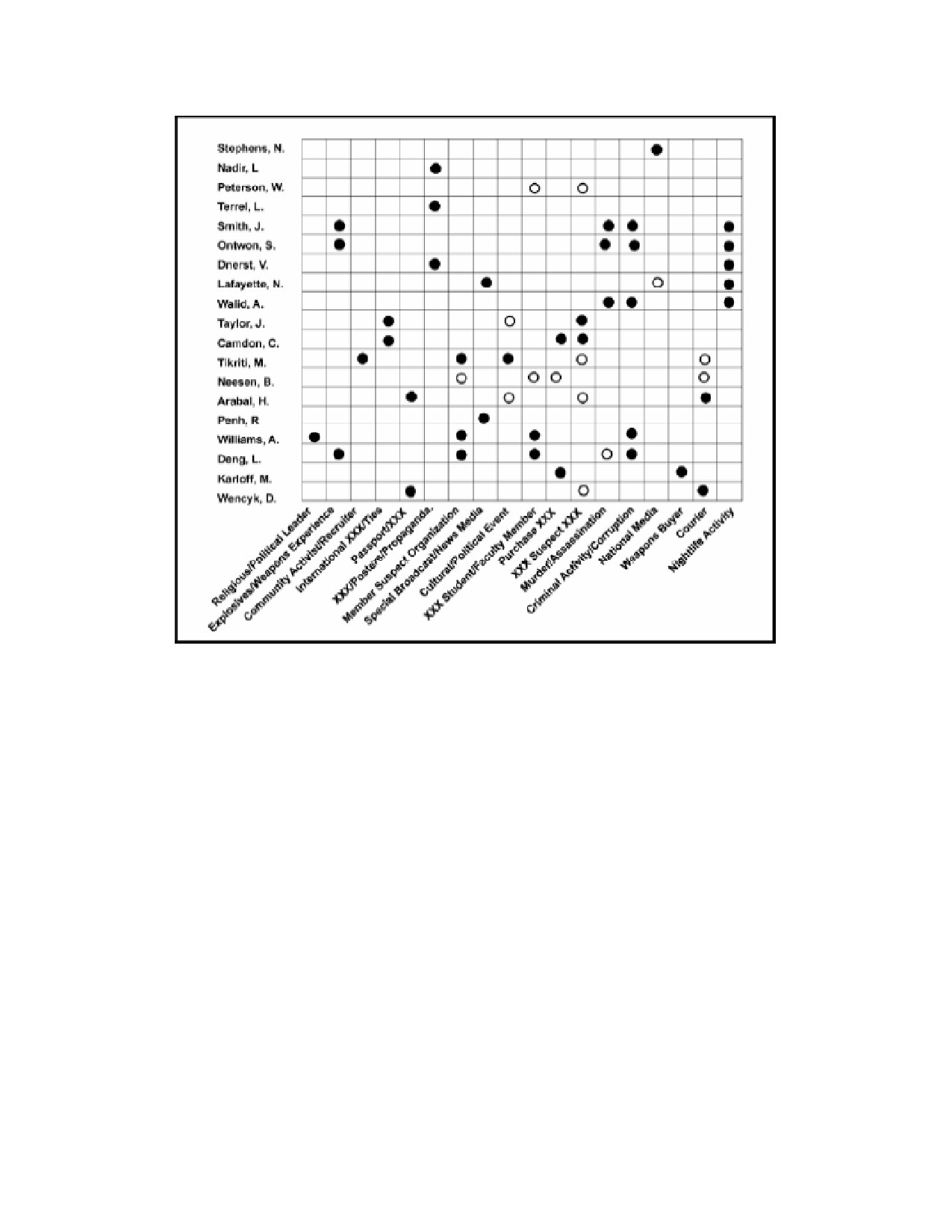
nodes (people). In the Figure D-4 (below), people are identified by their participation in
independent activities. When graphed, pairs who have engaged in the same activity
(columns with dots) are designated with a link.
230
ANA 3-24
Figure D-4. Activities Matrix
SOCIAL NETWORK GRAPHS AND INSURGENT ORGANIZATION
D-15. As you build your situational awareness of the environment you should create easy
to understand, adaptable, and accurate diagrams and information sheets. Charts and
diagrams contribute to understanding the insurgents’ means of operations. These same
diagrams are also useful for understanding tribal, family, nongovernmental organization,
and trans-national terrorist elements. Each diagram and chart may have linkages to
another or several others, but they are not created overnight. It takes time, patience,
detailed patrolling, and reporting and recording of efforts. These diagrams and charts
serve to shape your understanding of the enemy and aid you in planning and focusing
your efforts.
D-16. As the commander dispatches patrols to collect information on the nodes and links,
he can begin to build a graph of the population in his area of operations. As the graph
grows, he quickly finds that traditional, static organizational line charts may not produce
viable explanations of insurgent organizational behavior. As a network, the individual
insurgents are constantly adapting to the environment, their own capabilities, and our
own counter-insurgency tactics. The commander’s understanding of the insurgency is
only as good as the patrol’s last collection.
231
ANA 3-24
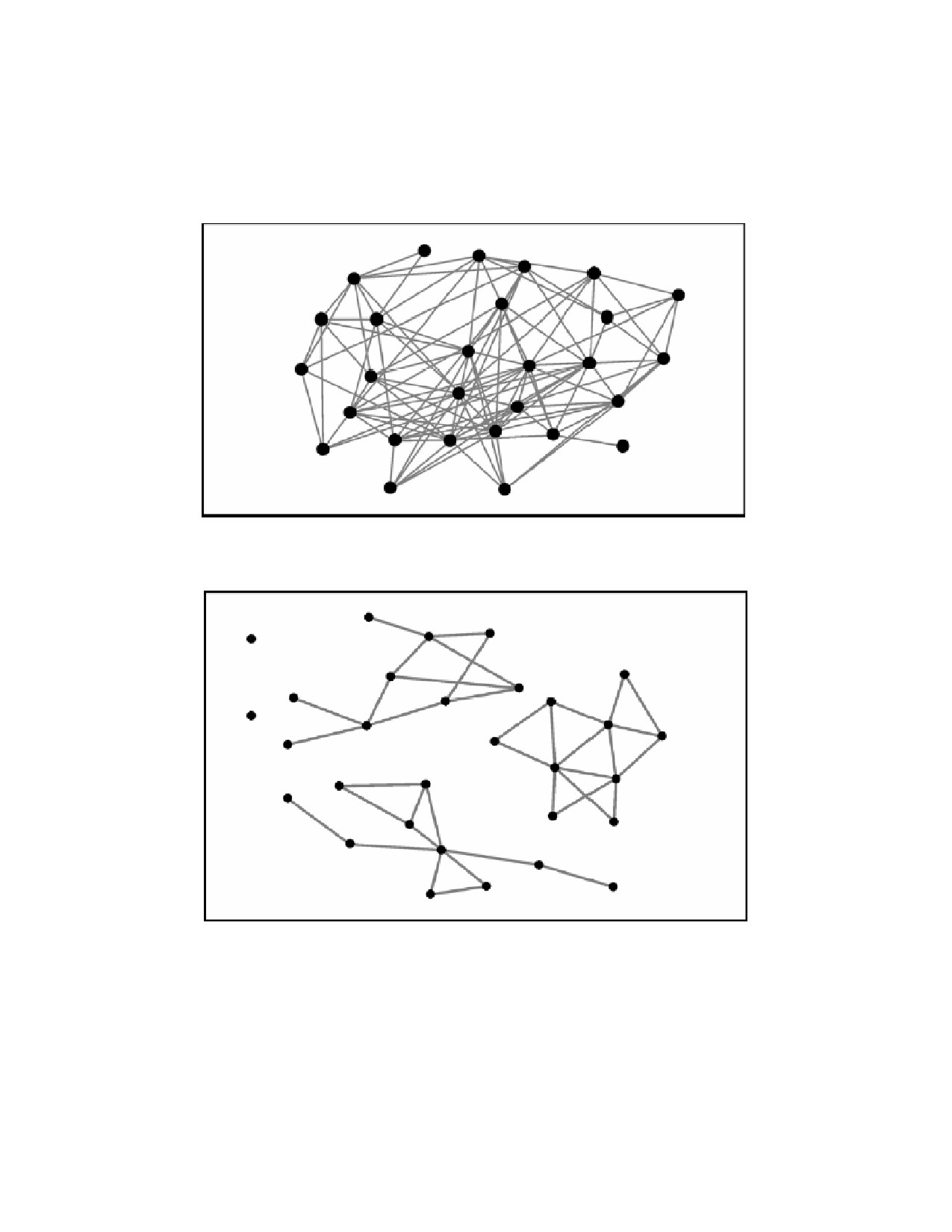
D-17. A regional insurgency can be fragmented within itself. A fully connected network
is an unlikely description of the enemy insurgent order of battle. (See Figure D-5, below.)
In fact a region may actually contain multiple sub-insurgencies that are either unaware of
or even competing with other sub-insurgent groups. (See Figure D-6, below.)
Figure D-5. Network Organization with High Connections
Figure D-6. Fragmented Network
D-18. Without some ability to monitor and assess the connectivity and fluidity of a
network, the behavior of the insurgent organization becomes unclear. Leaders may make
inappropriate assessments of enemy disposition and intent. COIN analysts can
misidentify insurgent leaders and make incorrect assessments of the degree of collusion
between regional sub-insurgencies. Figure D-7 (below) depicts two approaches to
understanding insurgent organizations. On the left side, the analyst imposes traditional
military structure to assess the organizational shape and key leader. The right side
232

ANA 3-24
represents a regional insurgency as actually substantiated by the relationship data collect
by patrols and interviews. This latter view represents a more accurate organization and
leadership assessment.
Figure D-7. Assessments
SOCIAL NETWORK MEASURES
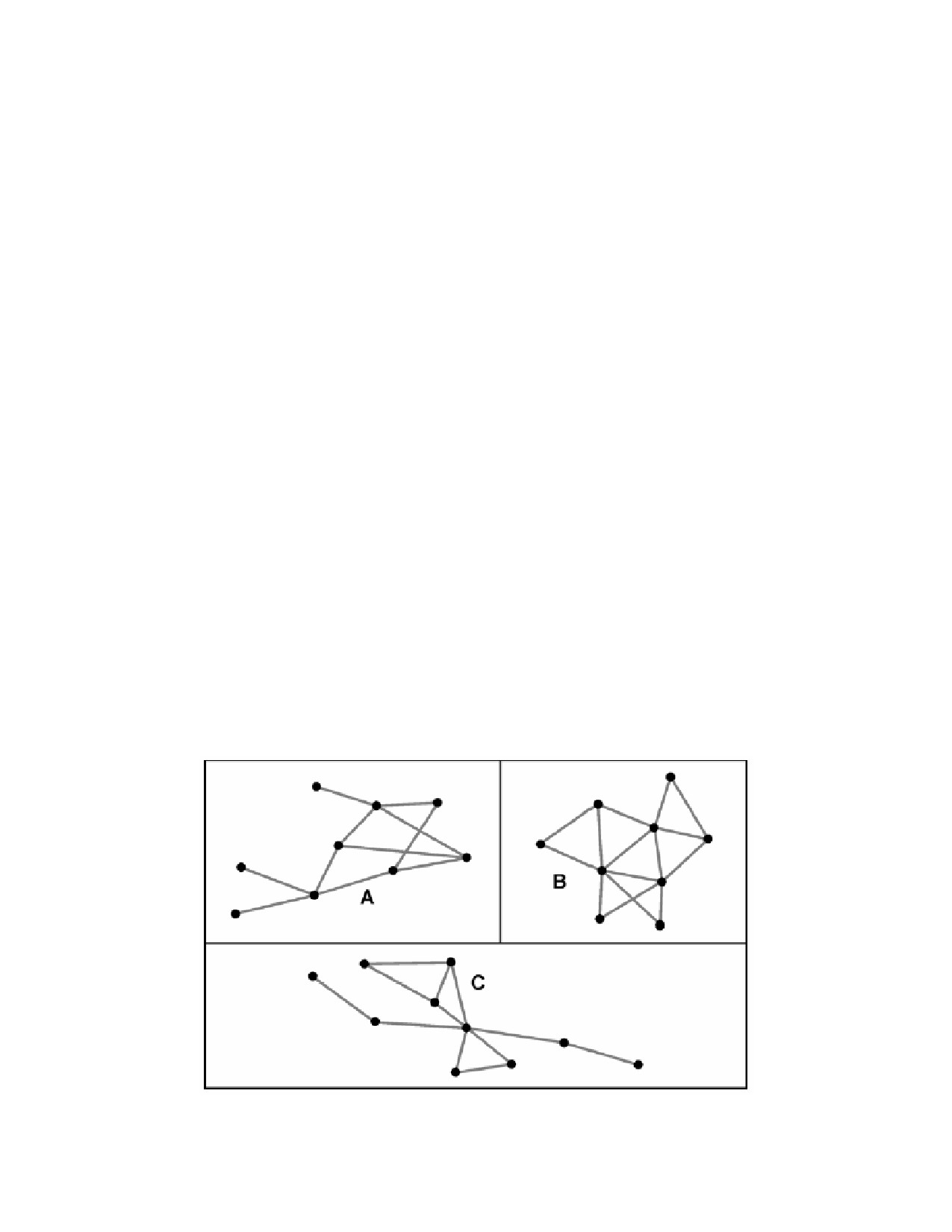
D-19. In Figure D-8 (below) each individually identified insurgent is identified as a node,
and intelligence gathered relationships are identified as a line. One can readily identify
three sub-groups (A, B, C) and two individuals without direct ties to the other groups
(ellipse). Thus, a social network is not just a description of who is in a group, but also
how they interact with one another.
Figure D-8. Hypothetical Regional Insurgency
D-20. SNA simultaneously supports a commander’s understanding of individual and
group behavior. In addition to producing the relationship graphs shown, SNA provides
data to assign values to these connections in order to represent the strength of the
233
ANA 3-24
relationships, information capacity, rates or flow of traffic, distance between nodes, and
probabilities of information being passed. It is these values that allow SNA to quantify
the relationships, thus presenting a means for mathematically testing the network.
ORGANIZATION LEVEL ANALYSIS
D-21. Organizational-level analysis provides insight about the organization’s form,
efficiency, and cohesion. A regional insurgency may consist of large numbers of
disconnected sub-insurgencies. As a result, each group should be analyzed based on its
capacities as compared to the other groups.
D-22. Organizational-level capacities can be described by the social network measures of
network density, cohesion, efficiency, and core-periphery. Each measure explains a
characteristic of the network organization’s structure. Different network structures can
support or hinder an organization’s capabilities. Therefore, each organizational measure
supports the analyst’s assessment of sub-group capacity.
D-23. Analysis is only as good as the data it is based upon. Unquestioningly using
someone else’s data to come to conclusions that determine military operations is
inadvisable. A commander should take ownership of the collection process, decide which
people are tracked as nodes in the data, and what constitutes a relationship between
nodes. Lastly, how a commander collects and organizes his changes which social network
measures are most relevant to the situation.
D-24. Network density is a general indicator of how connected people are in the network.
Network or global-level density is the proportion of ties in a network relative to the total
number possible. Comparing network densities between insurgent subgroups provides the
commander with an indication of which group is most capable of a coordinated attack
and which group is the most difficult to disrupt. (See Figure D-9, below.)
Figure D-9. Comparison of Subgroup Densities
234

ANA 3-24
D-25. Most network measures, to include network density, can be mapped out temporally
to evaluate performance over time. (See Figure D-10 below.) Based on changes in
network density over time, a commander can:
Monitor the capabilities of the enemy.
Monitor the effect of recent operations.
Develop strategies to further fragment the insurgency.
Figure D-10. Density Shift
D-26. An increase in network density indicates the likelihood that the insurgent group can
plan and execute coordinated attacks. A decrease in network density means the group is
reduced to fragmented or individual-level attacks. A well executed COIN eventually
faces only low network density sub-groups. This is because high network density sub-
groups only require the capture of one highly connected insurgent to lead to the rest of
the group. So, while a high network density group is the most dangerous, the high
network density group is also the easiest to defeat and disrupt.
D-27. Network density does not consider how distributed the connections are between the
nodes in a network. It is possible that a few nodes with a high number of connections
push up the group network density even though the majority of the people-nodes are
marginally linked to the group. In the case of a highly centralized network dominated by
one or a few very connected nodes, these nodes can be removed or damaged to fragment
the group further into sub-networks. Better metrics of group/organizational performance
would be network centrality, core-periphery, and diameter. These individual-level metrics
account for link distribution among the nodes and are available in most network analysis
software packages.
INDIVIDUAL-LEVEL ANALYSIS
D-28. Individual-level analysis characterizes every member of the organization and
identifies key members. SNA is best known for its ability to find key individual actors in
235
ANA 3-24
a large mass of data. SNA describes individuals based on their network position as
compared to the network position of every other individual in the network.
D-29. Individual network centralities provide insight into the individual's location in the
network. The relationship between the centralities of all nodes can reveal much about the
overall network structure.
D-30. One or a very few central nodes dominate a very centralized network. If these
nodes are removed or damaged, the network may quickly fragment into unconnected sub-
networks. Hubs are nodes with a very high degree of centrality. A network centralized
around a well connected hub can fail abruptly if that hub is disabled or removed.
D-31. A less centralized network has no single points of failure. It is resilient in the face
of many intentional attacks or random failures—many nodes or links can fail while
allowing the remaining nodes to still reach each other over other, redundant network
paths.
D-32. Degree centrality describes how active an individual is in the network. We measure
network activity for a node by using the concept of degrees—the number of direct
connections a node has. In the networks above, the nodes with the most direct
connections are the most active in their networks. Common wisdom in organizations is
“the more connections, the better.” This is not always so. What really matters is where
those connections lead to—and how they connect the otherwise unconnected. If a node
has many ties, it is often said to be either prominent or influential.
D-33. A node with high “betweenness” has great influence over what flows in the
network. Betweenness centrality indicates whether an individual lies between other
individuals in the network, serving as an intermediary, a liaison, or a bridge. Depending
on position, a person with high betweenness plays a “broker” role in the network. A
major opportunity exists for counterinsurgents if, as in Group C (Figure E-9), the high
betweenness centrality person is also a single point of failure, which if removed would
fragment the organization.
D-34. Most people would view the nodes on the periphery of a network as not being very
important. Nodes on the periphery receive very low centrality scores. However,
peripheral nodes are often connected to networks that are not currently mapped. The
outer nodes may be resource gatherers or actors that have their own network outside of
their insurgent group—making them very important resources for fresh information not
available inside their insurgent group.
THE NETWORK PERSPECTIVE
D-35. The network organization is a new concept in our military lexicon but an old
concept in application. Whether in insurgent groups or business organizations we can
expect the network organization to rapidly become the norm. Unfortunately, given the
flexibility, speed, and connectedness in a network organization, organizational behaviors
236
ANA 3-24
can rapidly become an invisible box with hidden connections and transactions. The
network organization has a different pulse than an organization tied to strict procedural
norms and expectations. Further, the network organization inherently deletes or bypasses
stovepipes that slow or inhibit decision making and coordination.
D-36. Insurgents are a network organization embedded in a sympathetic population.
Differentiating between the insurgent, the insurgent supporting population, the neutral
population, and the friendly population is difficult. With every success of the counter
insurgency, the insurgent organization is further fragmented, but it still can remain
dangerous.
D-37. SNA assists with formalizing the informality of an insurgent network; with
visualizing a structure that we may not readily observe. Network concepts allow us to
highlight the structure of a previously unobserved association by focusing on the pre-
existing relationships and ties that bind together such a group. By focusing on the roles
and organizational positions of those actors who are prominent and/or influential, we get
a sense of how the association is structured and thus how the group functions, how
members are influenced and power is exerted, and how resources are exchanged.
237
ANA 3-24
Appendix E
Airpower in Counterinsurgency
Airpower is an important asset for the government and any multinational forces fighting
an insurgency. This manual defines airpower as all the assets of the Army Air Corps and
multinational partners that fly or operate from space. These airpower assets could include
strike aircraft, reconnaissance aircraft, air transport and helicopters.
OVERVIEW
E-1. In counterinsurgency (COIN), airpower will serve predominantly in a supporting
role. At times aircraft can strike insurgents but, given the nature of COIN, the most
common roles of airpower will be providing reconnaissance and transporting troops,
equipment and supplies. Rough terrain and poor transportation nets can be serious
obstacles to COIN operations and serve as an aid to insurgents. Airpower helps overcome
these obstacles. Insurgencies cannot be defeated from the air—but airpower serves as a
tremendous force enhancer and enables COIN forces to operate more effectively.
E-2. Airpower provides a significant asymmetric advantage to the counterinsurgent. If the
insurgents field a force to engage Afghan or multinational forces, air assets can respond
quickly with precision firepower. In a sudden crisis, air mobility can shift troops
immediately to threatened points or to surround insurgent elements. The vital supporting
role played by airpower has been demonstrated in numerous COIN operations. In many
cases airpower has been a key element in COIN strategy and tactics. Airpower enables
Afghan and multinational forces to operate in rough and remote terrain, areas that
traditionally were havens for insurgents.
E-3. Airpower can be important in many ways that do not involve delivering ordnance.
Soldier’s morale improves noticeably when they know that, if wounded, MEDEVAC
helicopters would get them to a hospital within minutes. With this air support, the ANA
can become much more aggressive in tracking down and engaging terrorist forces.
E-4. Using air transport to airlift or drop food and medical supplies to civilians in isolated
regions is a very effective means of delivering humanitarian support quickly and in
winning the support of the population. As was highlighted in Chapter 8 air transport is
also important for logistics in COIN. In areas of high insurgent activity along the roads,
supplies can be airlifted rather than transported in highly vulnerable land convoys. Air
transport also enables the Afghan and multinational forces to maintain forces in remote,
but strategically important, locations.
E-5. This appendix does not aspire to provide a comprehensive doctrine for employing
airpower in COIN. It does, however, lay out some general principles for the most
effective employment of airpower in support of Afghan and multinational forces.
238
ANA 3-24
THE ADVANTAGES OF AIRPOWER
E-6. In COIN the direct attack role of airpower becomes more important as the conflict
becomes more conventional. If the insurgents mass forces and try to fight from
established positions, airpower can be employed with devastating and precise effects.
However, unless the insurgents assemble large units and try to engage government forces
in a conventional battle, employment of airpower in the strike role is likely to be
relatively rare.
E-7. Airpower provides the Afghan and multinational forces a flexibility and initiative
that is usually the advantage of the insurgent. The presence of airpower strike capability
alone provides a deterrent and denies the insurgent many options. If insurgents mass
forces for a major operation, they are vulnerable to close air support or gunships. If the
insurgents stand and fight, counterinsurgent forces can be quickly airlifted in to contain
the enemy and destroy them. Chapter 8 addresses the significant advantages air transport
can provide for COIN logistics.
AIRPOWER IN THE STRIKE ROLE
E-8. The employment of airpower in the strike role should be done with exceptional care.
Bombing, even with the most precise weapons, can cause unintended civilian casualties.
The benefits of every air strike should be weighed against the risks, the primary danger
being collateral damage that turns the population against the government and provides the
insurgents with a major propaganda victory. Even when justified under the law of war,
bombing a target that results in civilian casualties will bring media coverage that works to
the benefit of the insurgents. A standard insurgent and terrorist tactic for decades in
numerous countries has been to fire rockets or artillery from the vicinity of a school or
village in the hope that the military would carry out a retaliatory air strike that kills or
wounds civilians—who are then displayed to the world media as victims of aggression.
Insurgents and terrorists elsewhere have shown few qualms in provoking attacks that
ensure civilian casualties if such attacks fuel anti-government propaganda. Indeed,
insurgents today can be expected to use the civilian population as a cover for their
activities.
E-9. Even in a clear case of taking out an insurgent headquarters or command center, care
has to be taken to accomplish the mission while minimizing civilian casualties. New,
precise munitions with smaller blast effects have been developed and employed to limit
collateral damage. A miss, or even a direct hit, by a precision weapon though has the
possibility of injuring or killing innocents, as insurgents tend to conduct operations in
close proximity to the civilian population. The cost versus the benefit of the use of such
weapons has to be judged prior to their employment.
AIRPOWER IN INTELLIGENCE COLLECTION
E-10. COIN relies on good intelligence—and airpower has a major role in intelligence
collection. In a conflict where the insurgents operate in the countryside or remote areas,
239
ANA 3-24
aerial reconnaissance and surveillance can employ imagery and infrared systems to find
hidden base camps and insurgent defensive positions. Aerial surveillance can often
identify people, vehicles and buildings even when they are hidden under heavy growth.
UAVs and other aircraft can patrol roads to locate insurgent ambushes and improvised
explosive devices. Air-mounted, signal intelligence collection can detect insurgent
communications and locate the point of origin.
E-11. Air assets have proven important in convoy and route protection and in tactical
operations. Helicopters especially have shown great utility in providing overwatch, fire
support, alternate communications, and MEDEVAC. At the tactical level, air support
requires a decentralized command and control (C2) system in which the supported units
have immediate access to information gained by air reconnaissance and support assets,
and have combat air assets available to immediately engage insurgent forces.
E-12. However, intelligence obtained through air and space platforms is most useful if it
is tied in quickly and efficiently with a joint intelligence center where human intelligence
(HUMINT) and other forms of intelligence can be fused. Unlike conventional war where
air and space intelligence platforms are the primary one small piece to a larger puzzle. To
understand the whole puzzle, air and space intelligence has to be combined with
HUMINT. Aerial reconnaissance assets can tell you that the civilians in a village are
evacuating the area, but air and space intelligence cannot tell you why.
E-13. In COIN, HUMINT is an essential requirement for properly employing airpower in
the strike role. The Army Air Corps needs to be skilled in employing HUMINT in
operational planning.
THE ROLE OF HIGH-TECH ASSETS
F-14. “High-tech” air and space systems in use today have proven their worth in COIN.
UASs, such as the Predator, can give Afghan and multinational forces unprecedented
capabilities in surveillance and target acquisition. Aerial surveillance platforms with long
loiter times can place an entire region under constant surveillance. Predators have even
been equipped with precision munitions and employed in the strike role to successfully
target senior terrorist leaders. Air and space-based signals intelligence, if available, gives
the ANA and its multinational partners important intelligence collection capabilities and
enabled forces to monitor insurgent communications.
THE ROLE OF LOW-TECH ASSETS
E-15. The “low-tech” aspects of airpower have also proven effective in COIN. In many
cases light, slow, and inexpensive civilian aircraft have been successfully employed in
patrolling border areas. Different countries have employed stationary balloons equipped
with video camera and infrared sensors to watch for border incursions. The unmanned,
stationary balloons have proven to be a simple, inexpensive and effective means of
monitoring activity in remote areas.
240
ANA 3-24
E-16. Many nations have employed aerial gunships as very effective close air support
weapons in COIN. At its most basic, the aerial gunship is essentially a converted
transport plane modified to fire heavy machine guns or light artillery pieces from the
side. Gunships are inexpensive and relatively easy to operate. The major limitation to
their employment is the insurgent capability to employ anti-aircraft weapons and
missiles, as gunships require a relatively benign environment for operations.
THE AIRPOWER COMMAND STRUCTURE
E-17. The effective use of airpower in COIN requires an effective joint and multinational
command structure. It is not only an issue of jointness among Afghan forces, but also
coordinating the air assets of its multinational partners. One of the first steps in COIN
planning is the establishment of a joint and multinational airpower command and control
system, and agreed policies on the rules and conditions for employing airpower in the
theater. All air operations in the theater should be coordinated at one center for safety and
efficiency.
E-18. Expeditionary airfields are likely used during COIN operations. These bases should
be properly protected, and defense should be coordinated among all occupants.
BUILDING THE NATION’S AIRPOWER CAPABILITY
E-19. As the objective of ANA and multinational operations is to enable the government
to provide for its own internal and external defense, Afghan and multinational planners
need to set up a long-term program to develop a national aviation capability. The Army
Air Corps should be appropriate for the nation’s requirements. For conducting effective
COIN operations the Army Air Corps requires the following basic capabilities:
Aerial reconnaissance and surveillance.
Air transport.
Close air support for land troops.
Helicopter troop lift.
MEDEVAC.
E-20. The first step is to develop the right organizational model for the Army Air Corps.
The air assets should be centrally managed, under command of a single headquarters, and
tied into the joint intelligence center. Planning should identify gaps in the government’s
ability to command, control, and employ airpower in COIN operations.
E-21. The next step is to develop aviation infrastructure under a long term plan. This will
involve the development of an appropriate organization, force structure, and basing plans.
As aviation assets represent a large cost for the country, an effective airfield security
program is also necessary.
E-22. An important training asset are the NATO countries and the United States, which
have teams that are qualified to operate the most common equipment in use, and can
241
ANA 3-24
provide necessary training for COIN aviation operations. These teams also have the
language and cultural training to effectively support aircrew and personnel training.
E-23. Equipment should be selected with the economic and technological resources of the
nation in mind. In most cases, aircraft and supporting systems acquired by the nation
should be effectively operated and maintained over the long term by an Army Air Corps
with limited resources. Multinational support in training and equipping the Army Air
Corps can be very important.
E-24. Training and developing a capable Army Air Corps takes considerable time due to
the requirements to qualify aircrew, maintenance personnel and other specialists.
Training ANA personnel to work effectively in joint operations and to coordinate air-land
support also requires a high level of skill. Even when the ANA and police are trained to
an acceptable standard, it is likely that multinational personnel will be required to stay
with the Army Air Corps to conduct liaison for supporting multinational air assets and
advise the forces in the employment of their own airpower.
E-25. Because developing capable aviation forces usually takes longer than developing
land forces, multinational aviation units, advisors, and trainers are likely to be still
deployed after multinational land force trainers and advisors have completed their
mission. Thus, long-term multinational air support requirements need to be considered in
comprehensive COIN planning.
242
ANA 3-24
Appendix F
Learning Counterinsurgency
All insurgencies are different, but there are broad historical trends underlying the causes
that motivate insurgents, the successful and unsuccessful counterinsurgency (COIN)
practices adopted by the government attempting to defeat them, and the overall course of
most insurgencies.
F-1. One of the common features of almost all insurgencies is that the intervening
government invariably takes a while to understand that an insurgency is taking place,
while the insurgents take advantage of the time lag to gather strength. Thus the
intervening government always “comes from behind” when fighting an insurgency.
Another common feature is that armies conducting counterinsurgencies tend to begin
poorly. Western armies tend to neglect the study of insurgency, falsely believing that if
they are able to win large conventional wars, they can also win small unconventional
ones. The truth is exactly the opposite; in fact, the very things that make a conventional
army successful when fighting conventional adversaries—operational maneuver and the
ability to mass firepower—are often counterproductive in COIN warfare. Nonetheless,
they are almost invariably the first moves made by armies confronting an insurgency, and
they almost invariably fail.
F-2. Armies that successfully defeat an insurgency do so because they are able to
overcome their institutional proclivities to wage conventional war and learn how to
practice COIN despite themselves. The principles of COIN are well known and form the
skeleton of this manual. In essence, the counterinsurgent should:
Understand the environment in which the war is being fought.
Isolate the insurgents from their cause and their base.
Secure the population under the rule of law.
Generate intelligence from the population to drive actions against the insurgents.
Apply all elements of national power in unison to support the legitimacy of the
national government.
Be prepared for a long commitment, measured in years if not decades.
F-3. Applying these principles allows the counterinsurgent to gain the support of the local
people, who provide either a shield to the enemy or vital intelligence to the
counterinsurgent. Their choice of whom to support depends to a large extent on who
provides them with the security they need.
F-4. Traditionally, armies have had to unlearn much of their doctrine and (re)learn the
principles of COIN while waging COIN campaigns. The intent of this essay is to place
into the hands of planners, trainers and field commanders a tool to ensure that this
learning process begins faster, builds on a higher knowledge base, and costs fewer lives
and less national treasure than it has in the past. For this reason “Learn and Adapt” has
been identified as a modern COIN imperative.
243
ANA 3-24
F-5. Just as there are historical principles underlying success in COIN, there are
organizational traits shared by most successful learning organizations. Armies that learn
COIN effectively have generally:
Developed COIN doctrine locally.
Established local training centers during counterinsurgencies.
Regularly challenged their assumptions both formally and informally.
Requested outside assistance in understanding scenarios beyond their experience.
Promoted suggestions from the field.
Fostered truly open communication between senior officers and their
subordinates.
Established rapid avenues to ensure dissemination of lessons learned.
Coordinated closely with governmental and non-governmental partners at all
levels of command.
F-6. These are not easy traits for any organization to adopt, and are particularly
challenging objectives for an army during the course of a conflict. However, they are
essential when confronting an enemy that does not fight according to a prescribed
doctrine and that adapts while waging irregular warfare. The enemies today are
continuously and consciously evaluating the strengths and weaknesses of our military,
aiming to avoid our power and attack our vulnerabilities. The Afghan government should
therefore constantly evaluate its effectiveness in using all elements of national power to
learn and adapt more quickly than do its enemies. Learning organizations defeat
insurgencies; armies that are not learning organizations do not.
F-7. Effective learning organizations encourage individuals to pay attention to the rapidly
changing situations that characterize COIN campaigns—rapid enemy innovation, shifting
attitudes of local populations, local civilian leadership turmoil. When current
organizational behavior is no longer appropriate in such situations, learning organizations
engage in a directed search for more appropriate ways to defeat the enemy, rapidly
develop consensus on the new doctrine, publish the doctrine, and carefully observe the
impact of the doctrine on organizational behavior. In effective learning organizations, this
learning cycle repeats continuously—and faster than that of the insurgent enemy. He who
learns faster and adapts more rapidly wins.
F-8. When designing a learning institution, it is hard to improve upon U.S. Lieutenant
General Jack Cushman’s instruction to “Let insight evolve from an atmosphere of open,
shared thought…from a willing openness to a variety of stimuli, from intellectual
curiosity, from observation and reflection, from continuous evaluation and discussions,
from review of assumptions, from listening to the views of outsiders, from study of
history, and from the indispensable ingredient of humility.”
244
ANA 3-24
Glossary of Terms
Assessment The continuous monitoring and evaluation of the current situation and
progress of an operation.
Board A temporary grouping of selected staff representatives delegated decision
authority for a particular purpose or function.
Centers of Gravity Those characteristics, capabilities, or sources of power from which a
military force derives its freedom of action, physical strength, or will to fight.
Civil Considerations How the manmade infrastructure, civilian institutions, and attitudes
and activities of the civilian leaders, populations, and organizations within an area of
operations influence the conduct of military operations.
Clear A tactical mission task that requires the commander to remove all enemy forces
and eliminate organized resistance in an assigned area.
Commander’s Intent A clear, concise statement of what the force must do and the
conditions the force must meet to succeed with respect to the enemy, terrain, and desired
end state. A commander’s clear, concise articulation of the purpose(s) behind one or
more tasks assigned to a subordinate. It is one of two parts of every mission statement
which guides the exercise of initiative in the absence of instructions.
Commander’s Visualization The mental process of developing situational
understanding, determining a desired end state, and envisioning how to move the force
from its current state to that end state.
Command Post Cell A grouping of personnel and equipment by warfighting function or
purpose to facilitate command and control during operations.
Common operational picture A single identical display of relevant information shared
by more than one command. A common operational picture facilitates collaborative
planning and assists all echelons to achieve situational awareness. An operational picture
tailored to the user’s requirements, based on common data and information shared by
more than one command. Also called COP.
Counterinsurgency Those military, paramilitary, political, economic, psychological, and
civic actions taken by a government to defeat insurgency.
Counterstate A competing structure set up by an insurgent to replace the government in
power. It includes the administrative and bureaucratic trappings of political power, and
performs the normal functions of government.
Counterterrorism Operations that include the offensive measures taken to prevent,
deter, preempt, and respond to terrorism. Also called CT.
Decisive Point Geographic place, specific key event, critical system or function that
allows commanders to gain a marked advantage over an enemy and greatly influence the
outcome of an attack.
Direct Action Short-duration strikes and other small-scale offensive actions conducted as
a special operation in hostile, denied, or politically sensitive environments and which
employ specialized military capabilities to seize, destroy, capture, exploit, recover, or
damage designated targets. Direct action differs from conventional offensive actions in
the level of physical and political risk, operational techniques, and the degree of
discriminate and precise use of force to achieve specific objectives.
245
ANA 3-24
Execute To put a plan into action by applying combat power to accomplish the mission
and using situational understanding to assess progress and make execution and
adjustment decisions.
Foco/Focoism A popular theory that says that small cells of armed revolutionaries can
create the conditions for revolution through their actions. Demonstrated revolutionary
victories, the successes of the foci, are supposed to lead the masses to revolution. If
conditions are ripe, according to focoists, a single spark can start the revolutionary fire.
Focoist A practitioner of focoism as espoused by Che Guevara
Forward Operations Base In special operations, a base usually located in friendly
territory or afloat that is established to extend command and control or communications
or to provide support for training and tactical operations. Facilities may be established for
temporary or longer duration operations and may include an airfield or an unimproved
airstrip, an anchorage, or a pier. A forward operations base may be the location of special
operations component headquarters or a smaller unit that is controlled and/or supported
by a main operations base.
Full Spectrum Operations The conduct of simultaneous combinations of the four
components of Army operations (offense, defense, stability, and civil support) across the
spectrum of conflict (peace, crisis, and war).
Human Intelligence A category of intelligence derived from information collected and
provided by human sources.
Information Environment The aggregate of individuals, organizations or systems that
collect, process, or disseminate information; also included is the information itself.
Information Operations The employment of the core capabilities of electronic warfare,
computer network operations, psychological operations, military deception, and
operations security, in concert with specified supporting and related capabilities, to affect
and defend information and information systems and to influence decision making. Also
called IO.
Insurgency An organized movement aimed at the overthrow of a constituted government
through the use of subversion and armed conflict.
Intelligence Discipline A well-defined area of intelligence collection, processing,
exploitation, and reporting using a specific category of technical or human resources.
There are seven major disciplines: human intelligence, imagery intelligence,
measurement and signature intelligence, signals intelligence (communications
intelligence, electronic intelligence, and foreign instrumentation signals intelligence),
open-source intelligence, technical intelligence, and counterintelligence.
Intelligence Preparation of the Battlefield The systematic, continuous process of
analyzing the threat and environment in a specific geographic area. Intelligence
preparation of the battlefield (IPB) is designed to support the staff estimate and military
decision making process. Most intelligence requirements are generated as a result of the
IPB process and its interrelation with the decision making process. Also called IPB.
Intuitive Decision Making The act of reaching a conclusion that emphasizes pattern
recognition based on knowledge, judgment, experience, education, intelligence, boldness,
perception, and character. This approach focuses on assessment of the situation vice
comparison of multiple options.
246
ANA 3-24
Lines of Operations Lines that define the directional orientation of the force in time and
space in relation to the enemy. They connect the force with its base of operations and its
objectives.
Measure of Effectiveness A criterion used to assess changes in system behavior,
capability, or operational environment that is tied to measuring the attainment of an end
state, achievement of an objective, or creation of an effect.
Measure of Performance A criterion to assess friendly actions that is tied to measuring
task accomplishment.
Narrative An organizational scheme expressed in story form that is central to the
representation of a group’s identity.
Nongovernmental Organization A private, self-governing, not-for-profit organization
dedicated to alleviating human suffering; and/or promoting education, health care,
economic development, environmental protection, human rights and conflict resolution;
and/or encouraging the establishment of democratic institutions and civil society. Also
called NGO.
Operating Tempo The annual operating kilometers/hours for systems in a particular unit
required to execute the commander's training strategy. It is stated in terms of the
kilometers/hours for the major system in a unit; however, all equipment generating
significant operating and support cost has an established operating tempo.
Operational Environment The air, land and associated adversary, friendly, and neutral
systems (political, military, economic, social, informational, infrastructure, legal, and
others) that are relevant to a specific joint operation.
Operational Picture A single display of relevant information within a commander’s area
of interest.
Planning The process by which commanders (and staff if available) translate the
commander’s visualization into a specific course of action for preparation and execution,
focusing on the expected results.
Preparation Activities by the unit before execution to improve its ability to conduct the
operation including, but not limited to, the following: plan refinement, rehearsals,
reconnaissance, coordination, inspections, and movement.
Reachback The ability to exploit resources, capabilities, and expertise, not physically
located in the theater or a joint operations area, when established.
Rules of Engagement Directives issued by competent military authority that delineate
the circumstances and limitations under which forces will initiate and/or continue combat
engagement with other forces encountered. Also called ROE.
Stability Operation An operation to establish, preserve, and exploit security and control
over areas, populations, and resources.
Strike An attack which is intended to inflict damage on, seize, or destroy an objective.
Subordinates Initiative The assumption of responsibility for deciding and initiating
independent actions when the concept of operations or order no longer applies or when an
unanticipated opportunity leading to the accomplishment of the commander’s
intent presents itself.
Tempo The rate of military action. The relative speed and rhythm of military operations
over time with respect to the enemy.
Unified Action A broad generic term that describes the wide scope of actions (including
247
ANA 3-24
the synchronization of activities with governmental and nongovernmental agencies)
taking place within unified commands, subordinate unified commands, or joint task
forces under the overall direction of the commanders of those commands.
Warfighting Function A group of tasks and systems (people, organizations, information,
and processes) united by a common purpose that commanders use to accomplish missions
and training objectives.
Working Group A temporary grouping of predetermined staff representatives who meet
to coordinate and provide recommendations for a particular purpose or function.
248
ANA 3-24
THIS PAGE INTENTIONALLY LEFT BLANK
249
B-GL-323-004/FP-003
LAND FORCE
COUNTER-INSURGENCY OPERATIONS
(ENGLISH)
This publication becomes active on receipt
WARNING
ALTHOUGH NOT CLASSIFIED, THIS PUBLICATION, OR ANY PART OF IT, MAY BE EXEMPT FROM DISCLOSURE TO THE
PUBLIC UNDER THE ACCESS TO INFORMATION ACT. ALL ELEMENTS OF INFORMATION CONTAINED HEREIN MUST BE
CLOSELY SCRUTINIZED TO ASCERTAIN WHETHER OR NOT THE PUBLICATION OR ANY PART OF IT MAY BE
RELEASED.
Published on the authority of the Chief of the Land Staff
PAGE INTENTIONALLY LEFT BLANK
B-GL-323-004/FP-003
LAND FORCE
COUNTER-INSURGENCY OPERATIONS
(ENGLISH)
This publication becomes active on receipt
WARNING
ALTHOUGH NOT CLASSIFIED, THIS PUBLICATION, OR ANY PART OF IT, MAY BE EXEMPT FROM DISCLOSURE TO THE
PUBLIC UNDER THE ACCESS TO INFORMATION ACT. ALL ELEMENTS OF INFORMATION CONTAINED HEREIN MUST BE
CLOSELY SCRUTINIZED TO ASCERTAIN WHETHER OR NOT THE PUBLICATION OR ANY PART OF IT MAY BE
RELEASED.
Published on the authority of the Chief of the Land Staff
OPI: DAD
2008-12-13
PAGE INTENTIONALLY LEFT BLANK


PAGE INTENTIONALLY LEFT BLANK
Counter-Insurgency Operations
FOREWORD
1.
B-GL-323-004/FP-003 Counter-Insurgency Operations is issued on the authority of
the Chief of the Land Staff by the Army Publishing Office, Fort Frontenac, Kingston, Ontario.
2.
B-GL-323-004/FP-003 Counter-Insurgency Operations is effective upon receipt.
3.
The French version of this publication is B-GL-323-004/FP-004 Opérations de
contre-insurrection.
4.
The electronic version of this publication can be found in the Army Electronic Library,
accessible from the LFDTS Homepage, at http://lfdts.army.mil.ca.
5.
Suggested amendments should be forwarded through normal channels to the OPI of
the publication, the Directorate of Army Doctrine.
as represented by the Minister of National Defence, 2008
i
PAGE INTENTIONALLY LEFT BLANK
Counter-Insurgency Operations
PREFACE
AIM
1.
This publication, B-GL-323-004/FP-003 (FP-004 for French) Counter-Insurgency
Operations, establishes doctrine for military operations in a counter-insurgency (COIN)
environment and campaign.
SCOPE
2.
This publication provides a wide range of material in support of commanders and staff at
all levels of command. It reflects the concepts of Canadian doctrinal philosophies and
principles. This publication addresses the following:
a.
introduction to understanding insurgencies;
b.
a description of insurgencies and their objectives;
c.
the overarching philosophy and principles by which a COIN campaign and its
operations should be conducted;
d.
considerations for force employment at the strategic, operational and tactical
levels;
e.
considerations for intelligence staff in support of a COIN campaign;
f.
considerations for information operations, specifically focused on influence
activities;
g.
considerations for sustainment in a COIN campaign; and
h.
considerations for pre-deployment and in theatre training in support of a COIN
campaign.
PURPOSE
3.
This publication is intended to assist in the planning and conduct of a COIN campaign
and its constituent operations. It provides guidance to all levels of command.
ASSOCIATED PUBLICATIONS
4.
A suggested reading list is affixed to this publication. This publication should be read in
conjunction with other appropriate CF and specifically Land Force publications. Particular
attention should be paid B-GL-300-001/FP-001 Land Operations.
iii
PAGE INTENTIONALLY LEFT BLANK
Counter-Insurgency Operations
TABLE OF CONTENTS
FOREWORD
i
PREFACE
iii
CHAPTER 1 INTRODUCTION TO COUNTER-INSURGENCY OPERATIONS
101. Introduction
1-1
SECTION 1 DEFINITIONS
1-1
102. Insurgency
1-1
103. Counter-Insurgency
1-3
SECTION 2 COIN CAMPAIGN AS PART OF THE CONTINUUM OF OPERATIONS
1-3
104. General
1-3
105. The Continuum of Operations Framework
1-4
106. Predominant Campaign Themes
1-4
107. Full-Spectrum Operations
1-5
108. Comprehensive Operations
1-9
SECTION 3 AN OVERVIEW OF INSURGENCIES AND COUNTER-INSURGENCIES .1-11
109. Development of an Insurgency
1-11
110. Development and Conduct of A COIN Campaign
1-13
SECTION 4 CONTRASTS AND COMPETITION BETWEEN INSURGENCIES
AND COUNTER-INSURGENCY CAMPAIGNS
1-16
111. General
1-16
112. Initiative
1-16
113. Focus on Population
1-17
114. Role of Politics and Political Lead
1-17
115. Transition to Conflict and Campaign Duration
1-18
116. Relative Costs
1-18
117. Fluidity and Rigidity
1-19
118. Ideology
1-19
119. Enduring Irregular Nature of the Insurgency
1-20
CHAPTER 2 DESCRIBING AN INSURGENCY
SECTION 1 UNDERSTANDING AN INSURGENCY
2-1
201. Introduction
2-1
202. Causes of an Insurgency
2-1
203. The Aim of an Insurgency
2-1
204. Competitive Elements Over Populations—Strategic Centres of Gravity
2-2
v
205. Characteristics of an Insurgency—Unique and Local Aspects
of the Environment
2-4
206. Transitional Nature of Insurgencies
2-5
207. Assessing the Insurgency
2-6
208. Forms of an Insurgency
2-6
SECTION 2 SCOPE, CONTEXT AND LIMITATIONS OF AN INSURGENCY
2-7
209. Insurgent Strategies
2-7
210. Basic Tenets of an Insurgency
2-8
211. Motivating Central Cause
2-8
212. Leadership
2-8
213. Popular Support
2-9
214. Organization and Actors
2-9
215. Narrative
2-10
216. Context of an Insurgency
2-11
217. Factors Affecting the Conduct of an Insurgency
2-11
218. Weaknesses and Aspects of Insurgent Vulnerability
2-13
SECTION 3 INSURGENT METHODS AND END-STATES
2-14
219. Insurgent Tactics
2-14
220. Insurgent Tactics in a Rural Environment
2-19
221. Insurgent Tactics in an Urban Environment
2-19
222. Insurgent Communications
2-20
SECTION 4 CONCLUSION—A MEDICAL METAPHOR FOR AN INSURGENCY
AND COIN
2-21
CHAPTER 3 COIN PRINCIPLES
301. Introduction
3-1
SECTION 1 COUNTER-INSURGENCY PHILOSOPHY
3-1
SECTION 2 PRINCIPLES OF COUNTER-INSURGENCY
3-2
302. General
3-2
303. Effect Political Primacy in the Pursuit of a Strategic Aim
3-3
304. Promote Unity of Purpose to Coordinate the Actions of Participating
Agencies—Control and Coordination
3-4
305. Understand the Complex Dynamics of the Insurgency, Including
the Wider Environment
3-6
306. Exploit Intelligence and Information—The Overarching Importance
of Intelligence
3-7
307. Separate the Insurgents From Their Physical and Moral Sources of Strength
3-9
vi
Counter-Insurgency Operations
308. Physical Separation
3-10
309. Intellectual and Moral Separation
3-12
310. Neutralize the Insurgent
3-14
311. Sustain Commitment to Expend Political Capital and Resources
Over a Long Period
3-14
312. Conduct Longer Term Post-Insurgency Planning
3-15
SECTION 3 FACTORS BEARING ON THE APPLICATION OF THE PRINCIPLES
OF COIN
3-15
313. Popular Support
3-15
314. Avoidance of Moral Relativism
3-16
315. Avoidance of Cultural Absolutism
3-18
316. Political Awareness
3-19
317. Acting Within the Law
3-19
318. Minimum Necessary Force
3-20
SECTION 4 CONCLUSION
3-20
CHAPTER 4 STRATEGIC-LEVEL CONSIDERATIONS FOR COUNTER INSURGENCY
SECTION 1 INTRODUCTION
4-1
SECTION 2 THE GOVERNMENT CONCEPT
4-1
401. The Setting
4-1
402. The Primacy of Host Nation Policies
4-2
403. The Primacy of Law
4-2
SECTION 3 STRATEGIC OBJECTIVES
4-3
SECTION 4 THRESHOLD CIRCUMSTANCES AND CONSIDERATIONS
4-4
SECTION 5 MILITARY COMMITMENT
4-5
SECTION 6 THE WITHDRAWAL OF MILITARY FORCES
4-6
ANNEX A LEGAL CONSIDERATIONS IN THE CONDUCT OF A
COUNTER-INSURGENCY CAMPAIGN
4A01. Introduction
4A-1
4A02. National, or Domestic Legal Foundation
4A-1
4A03. International Legal Foundation
4A-1
4A04. Lawful Conduct of Operations in a COIN Campaign
4A-2
CHAPTER 5 OPERATIONAL-LEVEL CONSIDERATIONS FOR COUNTER-INSURGENCY
SECTION 1 JOINT AND COMBINED ASPECTS OF COUNTER-INSURGENCY
5-1
501. Introduction
5-1
502. Comprehensive Approach
5-1
503. Comprehensive Operations
5-2
vii
504. Command Systems and Structures
5-4
505. Single Commander System
5-4
506. Committee System
5-5
SECTION 2 THE PLANNING OF THE COIN CAMPAIGN
5-7
507. Operational Campaign Planning
5-7
508. Effects-Based Approach to Campaign Planning
5-8
509. Campaign Aspects Unique to a COIN Campaign
5-14
510. Collaborative Planning
5-14
511. Operational Centre of Gravity—Insurgent Support
5-15
512. Development of the Campaign Plan
5-16
513. Supporting and Transitory Role of the Military
5-18
514. The Subordinate Role of Fires and Their Physical Effects
5-20
515. Understanding Effects of Activities and the Compression Across Levels of
Command
5-21
516. War Gaming
5-21
SECTION 3 IMPLEMENTATION AND EXECUTION OF THE CAMPAIGN PLAN
5-22
517. Expanding the Campaign Presence: Physically And Psychologically
5-22
518. Securing a Firm Base and Initial Government Planning
5-23
519. Engagement of the Lower Levels of Government
5-23
520. Clear Area of Insurgent Presence and Influences
5-25
521. Government Lead in the Return of Displaced Persons
5-26
522. CIMIC Activities by the Military
5-26
523. Establish Low-Level (Community-Based) Development Councils
5-26
524. Develop Security Presence and Set Conditions for Sustainable Security
5-27
525. Set the Conditions for Sustainable Development
5-27
526. Continued Campaign Development and Transition
5-28
SECTION 4 CONSIDERATIONS IN THE APPLICATION OF MILITARY DOCTRINE
IN A COIN CAMPAIGN
5-30
527. Introduction
5-30
528. Balance across Full-Spectrum Operations
5-30
529. Compression Across the Levels of Command
5-31
530. Manoeuvrist Approach
5-31
531. Mission Command
5-32
532. Describing Operational Success in a COIN Campaign
5-32
533. Destruction of Insurgents
5-33
viii
Counter-Insurgency Operations
534. Attacking Insurgent Legitimacy
5-33
535. Attacking Insurgent Funding
5-33
536. Simultaneity
5-34
SECTION 5 THE ROLE OF MILITARY SERVICE COMPONENTS AND INDIGENOUS
FORCES IN COIN
5-34
537. Land Component
5-34
538. Air Component
5-34
539. Maritime Component
5-35
540. Special Forces
5-35
541. Indigenous Security Forces—Police Forces
5-36
542. Indigenous Military Forces
5-37
543. Indigenous Irregular Auxiliary Forces
5-37
CHAPTER 6 LAND COMPONENT OPERATIONS IN COUNTER-INSURGENCY
SECTION 1 INTRODUCTION
6-1
SECTION 2 ESTABLISHING THE FOOTHOLD—PHYSICAL AND MORAL
6-1
SECTION 3 ATTACKING THE INSURGENTS’ WILL
6-3
601. Role of the Tactical Commander
6-3
602. Pre-Emption
6-4
603. Dislocation
6-5
604. Disruption
6-5
605. Appreciating Secondary and Tertiary Effects
6-5
SECTION 4 SECURING AND CONSOLIDATING A CONTROLLED AREA THROUGH
FULL-SPECTRUM OPERATIONS
6-7
SECTION 5 DEFENSIVE OPERATIONS AND ACTIVITIES IN COIN
6-8
606. Types of Defensive Operations
6-8
607. Defensive Activities and Protective Measures—Threat
6-9
608. Responsibility
6-9
609. Endurance
6-9
610. Balance
6-9
611. Objectives of Defensive Activities and Protective Measures
6-10
612. Tactical Tasks for Defensive Activities
6-10
613. Counter-Surveillance Measures
6-11
614. Standing Patrols
6-11
SECTION 6 OFFENSIVE OPERATIONS AND ACTIVITIES IN COIN—GAINING THE
INITIATIVE
6-12
615. Introduction
6-12
ix
616. Attacks—Hasty Attacks
6-12
617. Deliberate Attacks
6-13
618. Large-Scale Offensive Operations
6-13
619. Offensive Activities Against Insurgent Command and Control Systems
6-14
620. Fighting Patrols—Raid and Ambushes
6-15
621. Reconnaissance In Force
6-16
SECTION 7 STABILITY OPERATIONS AND ACTIVITIES IN COIN
6-16
622. Introduction
6-16
623. Security and Control Tasks
6-17
624. Patrolling and Observation Posts
6-17
625. Movement Control
6-19
626. Crowd Control Measures
6-20
627. Search Tasks
6-21
628. Support to Ddr And Ssr
6-22
629. Support to Reconstruction and Governance—Civil-Military Transition Teams
6-23
630. Assistance to Other Agencies
6-24
SECTION 8 ENABLING OPERATIONS AND ACTIVITIES IN COIN
6-25
SECTION 9 RESERVES AND QUICK REACTION FORCES
6-26
SECTION 10 MEASURES OF EFFECTIVENESS
6-26
SECTION 11 CONDITIONING THE TACTICAL LEVEL FOR
COUNTER-INSURGENCY OPERATIONS
6-28
SECTION 12 CULTURAL AWARENESS
6-29
SECTION 13 THE TACTICAL-LEVEL COMMITTEE SYSTEM
6-30
631. Establishing the Committees
6-30
632. Challenges in the Implementation of the Campaign Plan and
COIN Principles
6-32
633. Facilitation of the Committee System
6-33
634. Execution of the Committee System—Command and Control
6-33
SECTION 14 EMPLOYMENT OF COMBAT ARMS AND SUPPORT ARMS
6-34
x
Counter-Insurgency Operations
ANNEX A
CULTURAL INFORMATION
SECTION 1 RELIEF IN PLACE TEMPLATE
6A-1
6A01. Leadership and Power Structures
6A-1
6A02. Government
6A-2
6A03. Battlespace and Environment
6A-3
6A04. Religion, Language and Customs
6A-3
6A05. Ongoing Cultural Initiatives
6A-4
6A06. Security and Armed Groups
6A-4
6A07. Other Issues
6A-5
CHAPTER 7 INTELLIGENCE IN COUNTER-INSURGENCY
SECTION 1 INTRODUCTION
7-1
701. Intelligence Support to Counter-Insurgency Operations
7-1
702. The Importance of Human Intelligence
7-2
703. Civilian Control and Political, Legal Constraints
7-2
704. Activities in Support of Intelligence
7-2
705. Principles of Intelligence
7-3
SECTION 2 ESTABLISHING A KNOWLEDGE BASE IN SUPPORT OF A
COUNTER-INSURGENCY CAMPAIGN
7-3
706. Assessment of the Environment
7-3
707. A Spectrum of Relative Interest
7-5
SECTION 3 DIRECTION
7-6
708. General
7-6
709. Intelligence Architecture and the Organization of Intelligence
in Counter-Insurgency—Design of Intelligence Architecture
7-7
710. Constraints
7-7
711. Straining Communications Networks
7-7
712. Centralized Control
7-8
713. Integration and the Committee System—Establishing an
Intelligence Committee
7-8
714. Functions of an Intelligence Committee
7-8
715. Central Intelligence Staffs
7-9
716. Fundamentals of Intelligence Organization
7-10
717. Intelligence Staff Organization
7-11
718. Factors Affecting Committee Integration
7-11
719. All-Source Intelligence Centre
7-12
xi
720. Tasking—The Commander’s Intelligence Requirements
7-12
721. Direction to the Collectors
7-13
SECTION 4 COLLECTION
7-13
722. General
7-13
723. Human Intelligence—Collection of Human Intelligence
7-13
724. Coordination of Human Intelligence Collection
7-17
725. Open Source Intelligence And Publications—Open Source Intelligence
7-17
726. Open Source Publications
7-18
727. Imagery Intelligence
7-18
728. Signals Intelligence
7-19
729. Specialized Functions—Battle Damage Assessment and Measures of
Effectiveness
7-19
730. Selecting Measures of Effectiveness
7-20
731. Sensitive Site Exploitation
7-21
SECTION 5 PROCESSING
7-22
732. Processing as a Discipline
7-22
733. Fusion of Intelligence
7-22
734. Databases
7-22
SECTION 6 DISSEMINATION
7-23
735. Responsibility
7-23
736. Use of Intelligence Architecture
7-23
737. Security
7-23
SECTION 7 INTELLIGENCE SUPPORT TO INFLUENCE ACTIVITIES
7-23
738. General
7-23
739. Support to Civil-Military Cooperation
7-24
740. Support to Psychological Operations
7-24
741. Support to Public Affairs
7-24
742. Support to Decisions on Profile, Posture and Presence of Forces
7-25
743. Support to Deception
7-25
SECTION 8 TRAINING
7-25
744. Pre-Deployment Training
7-25
745. Background Intelligence
7-26
746. Specialist Skills
7-26
SECTION 9 CHALLENGES FACING AN INTELLIGENCE ORGANIZATION IN A
COUNTER-INSURGENCY CAMPAIGN
7-26
xii
Counter-Insurgency Operations
747. Creation of the Broad Knowledge Base
7-26
748. Security of the Expanded Organization
7-26
749. Conflict Between Centralization and Decentralization
7-26
750. Countering Insurgent Propaganda
7-27
751. Operating Restrictions
7-27
CHAPTER 8 INFORMATION OPERATIONS—INFLUENCE ACTIVITIES
SECTION 1 INTRODUCTION
8-1
SECTION 2 PRINCIPLES OF APPLICATION OF INFLUENCE ACTIVITIES
8-3
801. General
8-3
802. Commander’s Direction and Personal Involvement
8-3
803. Centralized Planning and Decentralized Execution
8-4
804. Early Involvement and Timely Preparation
8-4
805. Close Coordination and Sequencing
8-4
806. Timely Counter-Info Ops
8-5
807. Accurate Intelligence and Information
8-6
808. Comprehensive Targeting
8-6
809. Establishing and Maintaining Credibility
8-7
810. Performance and Effects Monitoring and Assessment
8-7
811. Summary
8-10
SECTION 3 CHARACTERISTICS OF INSURGENT PROPAGANDA
8-11
812. General Characteristics
8-11
813. Themes of Insurgent Propaganda
8-12
814. Summary
8-14
SECTION 4 INFORMATION OPERATIONS ACTIVITIES IN
COUNTER-INSURGENCY
8-14
815. General
8-14
816. Psychological Operations
8-14
817. Public Affairs
8-16
818. Civil-Military Cooperation
8-17
819. Presence, Posture, Profile
8-19
820. Deception
8-20
SECTION 5 CONCLUSION
8-21
CHAPTER 9 SUSTAINMENT IN COUNTER-INSURGENCY
SECTION 1 SUSTAINMENT PRINCIPLES AND PLANNING
9-1
901. Introduction
9-1
xiii
902. Factors Affecting Sustainment
9-1
903. Combat Service Support Reconnaissance Plan
9-3
904. Reconnaissance Party
9-4
905. Strategic Reconnaissance
9-4
SECTION 2 SUSTAINMENT AND RESOURCES
9-7
906. Sustainment System
9-7
907. Situational Awareness And Communications
9-8
908. Replenishment Through Air, Aviation and Sea Basing
9-8
909. Use of Local Resources
9-9
910. Security
9-9
SECTION 3 PERSONNEL
9-9
911. Morale
9-9
912. Medical Support
9-10
CHAPTER 10 COUNTER-INSURGENCY TRAINING
SECTION 1 INTRODUCTION
10-1
SECTION 2 OPERATIONAL-LEVEL, JOINT AND COMBINED TRAINING AND
PREPARATIONS
10-1
1001. Lessons Identified During Campaigns
10-2
SECTION 3 TRAINING PRIOR TO UNDERTAKING COUNTER-INSURGENCY
OPERATIONS
10-2
SECTION 4 IN THEATRE TRAINING
10-3
SUGGESTED READINGS
xiv
Counter-Insurgency Operations
TABLE OF FIGURES
Figure 1-1: Predominant Campaign Themes
1-4
Figure 1-2: The Continuum of Operations and Full-Spectrum Operations
1-5
Figure 1-3: Tactical Activities and Tasks
1-6
Figure 1-4: Comprehensive Operations
1-10
Figure 2-1: Competition over the Populace as a Strategic Centre of Gravity
2-3
Figure 2-2: Competition over the Strategic Centres of Gravity—Populations
2-4
Figure 2-3: Forms of an Insurgency
2-6
Figure 2-4: An Insurgency Spread as a Communicable Disease
2-21
Figure 5-1: The Comprehensive Approach and Comprehensive Operations
5-3
Figure 5-2: Example of a Possible Single Command System
5-5
Figure 5-3: Example of a Committee System for a COIN Campaign
5-7
Figure 5-4: Model of a Campaign Plan and Supporting Operational Plans
5-8
Figure 5-5: Model for the Development of an Effects-Based Campaign Plan
5-9
Figure 5-6: Example of Lines of Operation for a Campaign Plan
5-13
Figure 5-7: Example of Lines of Operations, Operational Objectives and Decisive Points
Supporting Effects
5-14
Figure 5-8: Example of a Campaign Plan Showing Lines of Operation,
Operational Objectives and Decisive Points / Supporting Effects
5-18
Figure 5-9: Illustration of Transition of Stability Operations to Other Agencies
5-19
Figure 5-10: Example of the “Ink Spot” to Execute a COIN Campaign Plan
5-29
Figure 6-1: Example Delineation of a Committee System
6-32
Figure 7-1: Interrelated Elements of an Environment and Society
7-4
Figure 7-2: The Spectrum of Relative Interest
7-6
xv
PAGE INTENTIONALLY LEFT BLANK
Counter-Insurgency Operations
CHAPTER 1
INTRODUCTION TO COUNTER-INSURGENCY OPERATIONS
Insurgency is rooted in squalor, and fear and suffering are its flowers.
—General Sir Frank Kitson
101. INTRODUCTION
1.
The purpose of this chapter is, firstly, to define and introduce the concepts of insurgency
and counter-insurgency, and secondly, to provide a general overview for the conduct of a
counter-insurgency (COIN) campaign within the wider concepts of land operations and doctrine.
It will provide the reader a contextual understanding within which to view the details regarding
insurgency and COIN.
2.
A COIN campaign is conducted using the same means as any other campaign: through
the application of a military force’s fighting power.1 It is set within the continuum of operations
and is executed through a combination of tactical level activities and tasks. However, it is a
distinct campaign with its own philosophy and set of principles that provide guidance for the
application of fighting power and the conduct of activities.
3.
A number of concepts are discussed within this chapter that have been drawn from
B GL-300-001/FP-001 Land Operations. Fuller discussions of those concepts, as they apply
across the spectrum of conflict, will be found therein.
SECTION 1
DEFINITIONS
102. INSURGENCY
1.
Insurgency is part of a wider set of irregular activities and threats to a secure and stable
environment. Irregular activity may be defined as: “behaviour that attempts to effect or prevent
change through the illegal use, or threat, of violence, conducted by ideologically or criminally
motivated non-regular forces, groups or individuals, as a challenge to authority.”2
2.
This broader set of irregular activities that threaten authority and stability beyond the
capabilities of normal law enforcement includes criminality, disorder, insurgency, terrorism and
irregular military forces (e.g., private or sectarian militias). Insurgency is distinct from other
forms of threats in that it seeks a desired political effect, namely a desired change or re-ordering
of affairs.
3.
A number of definitions exist for the term insurgency, and although many have been
developed over the years, most have contained the same key elements: violence, or at least the
threat of violence, subversion, intimidation of the broad population mass, propaganda and a
political aim. Again, it is the last element, a political aim, that distinguishes an insurgency from
other forms of conflict or threats to security and stability.
1 Fighting power is comprised of three components: moral, intellectual and physical. Combat power refers to
the application of physical elements. See B-GL-300-001/FP-001 Land Operations.
2 Draft definition submitted to Army Terminology Panel (ATP) June 2007. For a more detailed discussion of
irregular activities, see B-GL-300-001/FP-001 Land Operations.
B-GL-323-004/FP-003
1-1
Counter-Insurgency Operations
4.
An insurgency has been defined as follows: “A competition involving at least one non-
state movement using means that include violence against an established authority to achieve
political change.”3 In this definition, the following can be noted:
a.
Insurgency is not a movement or people. It is a competition, struggle or conflict
involving different groups of people. As a manifestation of war, it is a competition
of wills.
b.
It must include at least one non-state movement to differentiate it from wars
between states.
c.
The established authority need not necessarily be the government of the nation
subject to an insurgency. It could be a local authority, a temporary military
authority or a government of a third party.
d.
Insurgencies seek political change like all wars. But the political nature of
insurgency is so important, it should be emphasized in the definition. The
change sought could be government collapse (typically an objective of 1950-60s
communist insurgencies) or a lesser objective such as self-determination,
regional autonomy or the release of political prisoners.
5.
Because of the focus on attaining political change, insurgencies are political problems
and are not solely military problems. They require political solutions, with the military playing a
largely supporting role.
6.
The key to any insurgency is gaining at the very least an indifferent attitude, if not the
outright support, of the population. Hence, many insurgencies have sought to persuade through
propaganda and subversion and to intimidate through violence large sectors of a population in
order to gain support for insurgent aims and undermine support for those countering the
insurgency. Insurgents live and operate amongst the population, thus those forces and
agencies countering the insurgency must separate, physically and morally, the insurgent from
the population base. A hostile populace will create hostile conditions for any side in an
insurgency. Therefore, gaining the support of the people is paramount to any COIN campaign.
7.
At the basis of an insurgency will be a narrative, a story. Central to this narrative is the
idea that motivates the insurgents and is formalized into an ideology. It empowers the
insurgents and lends them legitimacy and provides justification for their ends and means.
8.
Insurgencies have political aims stemming from a number of sources and a guiding
ideology. Regardless of their origins and ideology, all insurgencies will have to some extent,
legitimate grievances at their root. These grievances may be wide ranging and include
political, social or economic characteristics. They will be exploited by the insurgent forces in
order to gain additional support and undermine the authority and legitimacy of the official
government and supporting forces. Thus, in order to solve an insurgency and create enduring
solutions to conflict in the environment, COIN forces must address these grievances.
9.
A key to the eventual defeat of an insurgency is that the outbreak of an insurgency must
be properly identified as such. The classification or dismissal of a nascent insurgency as a
criminal or some other movement will only fuel the insurgency through inappropriate responses,
justify the insurgent narrative of systemic injustice and subjugation and provide political and
military leaders with the excuse to ignore the root, often legitimate, grievances of the insurgent
movement.
3 Definition as developed by a counter-insurgency study group during United States Marine Corps (USMC)
JOINT URBAN WARRIOR 2005.
1-2
B-GL-323-004/FP-003
Introduction to Counter-Insurgency Operations
103. COUNTER-INSURGENCY
1.
Counter-insurgency is defined as follows:
Those military, paramilitary, political, economic, psychological and civic actions taken to
defeat an insurgency.4
2.
Since an insurgency is a political problem, the military plays a largely supporting role to
other agencies and government departments in countering an insurgency. As indicated in the
definition, a wide range of agencies, elements of power and capabilities, in addition to the
military, must come together in a unity of purpose to defeat an insurgency.
3.
A COIN campaign is conducted through a specific philosophy and a set of specific
principles that guide the application of combat power. It is distinctly different from the conduct of
an insurgency itself, and the lines of operation within the COIN campaign must counter the lines
of operation of the insurgents. Within the guiding principles, each COIN campaign must be a
custom approach to the insurgency at hand. The constant is the fact that insurgency and
counter-insurgency are essentially about the battle to win and hold popular support both at
home and in the theatre of operations. If the strategic focal point is public opinion in the local,
domestic and international arenas, most initial military tactical efforts will be focused on breaking
the link between the insurgent and the people. This is not only a physical link, but the
psychological link of moral support. The former will entail physical activities, whilst the latter will
entail influence activities that undermine and attack the insurgent ideology, narrative and claims
to authority and legitimacy. This will include measures to address and resolve grievances that
lend support and credibility to the insurgency. If the insurgent can be isolated, it is then
theoretically a relatively simple matter to eliminate him and his cause.
4.
In order to reach this point, a COIN campaign will involve more than military
engagement. Defeating an insurgency requires not only the neutralization of insurgent military
capabilities but also the resolution of the root causes of the political and socioeconomic
grievances that enabled its occurrence in the first instance. Therefore, it requires a
comprehensive approach, with multiple agencies and other government departments, often
enabled through a coalition effort. The mere attrition of insurgents is highly unlikely to result in
the defeat of the insurgency. Indeed, any attempt to win an insurgency through attrition may
only help fuel that insurgency. Only a comprehensive approach that addresses the root causes
of an insurgency and attacks the legitimacy and authority of the insurgents will obtain an
enduring solution.
SECTION 2
COIN CAMPAIGN AS PART OF THE CONTINUUM OF OPERATIONS
104. GENERAL
1.
Campaigns and subordinate operations often require military forces to operate
effectively across the spectrum of conflict, conduct a wide range of military activities
simultaneously and transition quickly from one type of operation to another in rapidly changing
operational circumstances. Commanders must be able to visualize how a campaign or
operation will likely evolve over time in light of changing circumstances.
4 NATO Allied Administrative Publication (AAP) 6 NATO Glossary of Terms and Definitions.
B-GL-323-004/FP-003
1-3

Counter-Insurgency Operations
105. THE CONTINUUM OF OPERATIONS FRAMEWORK5
1.
The concept of a continuum of operations identifies a number of campaign themes and
provides a framework for commanders to understand the complexity of the operational
environment and the manner in which missions contribute to a lasting peace or, at least, to an
environment in which conflict is diminished. The continuum of operations consists of four
aspects:
a.
the spectrum of conflict;
b.
predominant (operational level) campaign themes, including counter-insurgency;
c.
types of tactical activities (offensive, defensive and stability); and
d.
the simultaneous conduct of different types of tactical activities, termed
full-spectrum operations.
106. PREDOMINANT CAMPAIGN THEMES
1.
Military operations may be described through a series of predominant campaign themes
plotted at appropriate and relative locations on the spectrum of conflict (see Figure 1-1).
Figure 1-1: Predominant Campaign Themes
2.
Campaign themes consist of the following: major combat, counter-insurgency, peace
support (which entails a range of peacekeeping and peacemaking campaigns) and peacetime
military engagement.6 The location of these themes along the spectrum of conflict is not fixed
5 See B-GL-300-001/FP-001 Land Operations for a fuller discussion of the continuum of operations.
6 Peacetime military engagement is defined as: “planned military activities that involve other nations and are intended
to shape the security environment in peacetime. Note: it includes programmes and exercises that nations conduct
with other nations to shape the international environment, improve mutual understanding with other countries and
improve interoperability with treaty partners or potential coalition partners” (submitted to Army Terminology Panel
June 2007).
1-4
B-GL-323-004/FP-003

Introduction to Counter-Insurgency Operations
but generally reflects the relative level of violence that can be expected within the campaign. A
limited intervention, such as a non-combatant evacuation or emergency humanitarian aid
mission, may occur at any point along the spectrum of conflict.7 As well, there may be elements
of different campaign themes within a campaign theatre. For example, one region of a nation
may require peace support, while another is enduring an insurgency.
107. FULL-SPECTRUM OPERATIONS
1.
All campaigns are conducted through the combined and simultaneous conduct of
tactical-level operations: offensive, defensive and stability operations.8 They are linked through
enabling operations.9 Each of these types of operations consists of a set of tactical activities
that are realized through tactical tasks (see Figure 1-2).
Figure 1-2: The Continuum of Operations and Full-Spectrum Operations
2.
Campaigns and operational plans are realized at the tactical level through the
simultaneous and sequential conduct of these tactical operations and their constituent activities.
The simultaneous conduct of tactical activities is termed full-spectrum operations.
3.
As campaigns progress, efforts and resources ebb and flow between these different
tactical activities, and their balance reflects the nature of the campaign, the principles by which
the campaign should be conducted and the situation at hand.
4.
Each of these tactical classifications consists of a number of tactical activities, which in
turn are realized through the conduct of tactical tasks. These tactical level activities and their
simultaneous conduct are termed full-spectrum operations (see Figure 1-3).
7 Limited intervention is defined as: “a military operation limited in objective, scope and timeframe. Note: not
considered a campaign, but may involve cooperation with other agencies and government departments” (approved
by Army Terminology Panel, May 2007).
8 Stability operations are defined as: “tactical activities conducted by military forces in conjunction with other agencies
to maintain, restore or establish a climate of order within which responsible government can function effectively and
progress can be achieved” (Army Terminology Panel).
9 Enabling operations include those tactical activities that enable others. They include withdrawal, relief in place
and advance to contact. For more details, see B-GL-300-001/FP-001 Land Operations.
B-GL-323-004/FP-003
1-5

Counter-Insurgency Operations
TACTICAL
OFFENSIVE
DEFENSIVE
STABILITY
OPERATIONS
OPERATIONS
OPERATIONS
OPERATIONS
Attack
Defence
Security and Control
Raid Ambush
Delay
Support to Demobilization,
Operations consist
Disarmament and
of tactical
Exploitation
Reintegration (DDR)
activities
Pursuit
Support to Security Sector
Reform (SSR)
Tactical Activities
Break-out
Support to Civilian
Feint and
Infrastructure and
Demonstration
Governance
Activities are
Reconnaissance in
Assistance to Other Agencies
realized through
Force
the assignment of
tasks and effects
Destroy
Block
Cordon and Search
Seize
Occupy
Observe/Monitor
Tactical Tasks
Secure
Counter-attack
Vehicle Checkpoint (VCP)
and Effects (Not
an all-inclusive
Support by Fire
Guard
Framework Patrols
list)
Fix
Humanitarian Aid Delivery
Retain
Train Indigenous Security
Forces
Crowd Confrontation
Notes:
1. Mission statements will be written with both the activity and the task or immediate effect, further described by the
purpose, or secondary effect. The activity is not always stated in the mission statement, such as “...(attack to) seize
(object) in order to…”
2. Mission statements relating to stability activities and tasks will use the transient verb “conduct” to assign the
activity, such as, “...will conduct security and control in order to…” This would then be allocated as tactical tasks
and effects to subordinates, such as VCPs, framework patrols, etc. At the lower tactical levels, only the tactical
tasks may appear in the mission statement, but again continue to use the verb “conduct,” such as, “…will conduct
framework patrols in order to…” or “…will conduct humanitarian aid delivery in order to…” In this manner, they are
similar to mission statements for enabling operations. See B-GL-331-002/FP-001 Staff Duties for Land Operations
for further details.
Figure 1-3: Tactical Activities and Tasks
1-6
B-GL-323-004/FP-003
Introduction to Counter-Insurgency Operations
5.
These types of tactical-level operations, together with tactical tasks, describe the total
tactical activity undertaken by a military force within a campaign. Each type is guided by a set
of principles.10 Note that each subordinate type constitutes individual tactical tasks. An attack
may consist of a support-by-fire task and clearing task, while humanitarian assistance may see
one sub-unit distributing food and another one conducting a medical clinic. Again, it is important
to note that in any type of campaign theme, these tactical tasks may be conducted
simultaneously. For example, one sub-unit may be conducting an attack, another may be
conducting security of an area through vehicle checkpoints, and another may be distributing
emergency water and rations to refugees.
Full-Spectrum Operations during the Iraq War—March 2003
Within a 48-hour period, between 22 and 24 March 2003, Z Coy, 1st Battalion, Royal
Regiment of Fusiliers (RRF) conducted full-spectrum operations at the sub-unit level.
Following a forward passage of lines with in-place US forces en route to Basra, Z
Company Combat Team conducted the following operations:
an attack on the near side of a bridge leading to the city of Basra;
an attack, on their flank, to clear a small Iraqi Army barracks;
an attack, following nightfall, to seize the far side of the bridge;
a hasty defensive position in their bridgehead;
at first light, 23 Mar 03, the combat team had to undertake crowd control operations
within their defensive position for civilians attempting to flee Basra but refused
passage at the bridge for fear of enemy ex-filtration;
the combat team defeated an enemy armoured counter-attack;
whilst maintaining the defensive position, part of the combat team (one platoon,
company HQ and a fire team of tanks) conducted a penetration into the city of
Basra, destroying five T-55s and a number of infantry detachments in the process,
withdrawing after the contact and returning to the defensive position;
maintained the defensive position the night of 23/24 Mar 03;
conducted a relief in place the morning of 24 Mar 03; and
moved to the battle group’s rear areas and conducted a series of stability activities,
including the delivery of aid, area security and route control, fire fighting and tasks
to stop looting and other criminal behaviour.
Whilst the combat team was conducting these activities, other sub-units of the 1 RRF
Battle Group were conducting other activities and tasks.
Source: Memoirs of OC Z Coy, 1 RRF, Major Duncan McSporan, RRF.
6.
The conduct of tactical-level activities should not violate the guiding principles by which
the overall campaign should be conducted. For example, the pursuit of fleeing insurgents that
will gain a tactical success should not be conducted if it will break the overarching philosophy
and principles of a COIN campaign.
10 See B-GL-300-001/FP-001 Land Operations.
B-GL-323-004/FP-003
1-7
Counter-Insurgency Operations
7.
The conduct of campaigns should always seek to reach operational objectives and
reduce the level of conflict. When operating at any point along the continuum of operations,
commanders and staffs should consider how to prevent the escalation of violence by the
adversary. During peace support, for example, operations must be conducted with a view to
preventing escalation to an insurgency or to major combat. Force must be used discriminately
because the undue application of force, lethal or otherwise, can undermine the overall campaign
and, in fact, cause an escalation of conflict if secondary effects are not fully considered.
8.
Recognizing changing circumstances or conditions, especially ones that require a
change to the major theme of a campaign, is both an intellectual as well as an intelligence
challenge. This is part of the art of war. The intelligence system must be attuned to, and look
for, indications of changes in the environment, and commanders and staffs must be able to
interpret the key indicators that demonstrate a shift is taking place. Commanders and staffs
must then react to the changing environment, either to prevent escalation of violence or facilitate
a shift to a lower level of violence, in such a way that the situation is manageable by the forces
at hand.
9.
In situations of political instability or disaffection, an insurgency may erupt. Insurgencies
are complex and may have several significant factors, including intra- or inter-state violence as
well as factional violence between different insurgent groups. Although some models of
insurgency, such as the Maoist model, forecast a progression to conventional operations,
insurgencies, as defined above, will fall short of large-scale, conventional operations inherent to
a major combat campaign.
10.
The military role in COIN is to create a security framework that precludes the ability of
insurgents to undertake offensive operations. The military will work in co-operation with other
agencies addressing the non-military aspects of the security environment in order to solve the
root causes and grievances that lead to conflict and insurgency. This will include many of the
tactical activities grouped under stability operations. Thus the military’s role is one of supporting
other agencies by creating manoeuvre space for them through the provision of security and
protection and the neutralization of the insurgent threat. It is these other agencies that will bring
the enduring political solutions to an insurgency.
1-8
B-GL-323-004/FP-003
Introduction to Counter-Insurgency Operations
Elements of different campaign themes may occur within the same theatre of
operations. In 1967, the US Marine Corps was simultaneously conducting conventional
and counter-insurgency specific operations in I Corps, the USMC area of operations.
While fighting a conventional war against elements of the North Vietnamese Army
(NVA) along the Laotian and North Vietnamese borders, the Marines were
concomitantly trying to support the Combined Action Program (CAP) that had been
slowly but successfully combating the influence of Viet Cong (VC) insurgents. The CAP
embedded Marine rifle sections with South Vietnamese militia to live and operate in
hamlets and villages throughout I Corps, which, in effect, implemented a form of
Lyautey’s tache d’huile method of COIN. Despite the small size of the CAP at the time
(approximately 1,200 Marines and 2,100 Vietnamese militia), the manpower demands
of attrition warfare in the border regions hindered an expansion of the CAP,
undermining the overall COIN campaign.
The coordination of NVA conventional warfare operations and VC insurgent activities
was not a coincidence. North Vietnam’s General Vo Nguyen Giap specifically created
and implemented a stratagem that sought to draw the bulk of US forces to the
peripheral areas of South Vietnam to be engaged in costly and demoralizing battles of
attrition in order to create physical and psychological manoeuvre space for insurgents in
population centres.
Commanders must be aware that a transition across campaign themes may occur over
time and space within a theatre, and a balance must be struck between competing
demands and principles. The main effort may shift between operational objectives,
dependent upon the situation and threat. At all times, commanders must focus on
achieving the operational objectives that will create conditions for enduring success.
Source: Michael Hennessy, Strategy in Vietnam: the Marines and Revolutionary Warfare in I Corps,
1965-1972 (Westport, CT: Praeger, 1997), pp.128-132.
108. COMPREHENSIVE OPERATIONS11
1.
In order to realize operational objectives, military forces create supporting effects
through the conduct of tactical activities, using a range of capabilities. This range of capabilities
and activities is classified as fires or influence activities. They are enabled in a simultaneous
and complementary manner through manoeuvre and battlespace management and are together
known as comprehensive operations (see Figure 1-4).
11 For a more detailed discussion on comprehensive operations and other related concepts, see
B-GL-300-001/FP-001 Land Operations.
B-GL-323-004/FP-003
1-9

Counter-Insurgency Operations
Figure 1-4: Comprehensive Operations
2.
The construct is defined as follows:
a.
Comprehensive Operations. The deliberate use and orchestration of the full
range of available capabilities and activities to realize desired effects.
b.
Fires. The physical means deliberately used to create or support the realization
of physical effects as first order effects.
NOTE
Fires include lethal and non-lethal systems. They also include electronic
counter-control measures of EW.
c.
Influence Activities. An activity designed to affect the character or behaviour of
a person or a group as a first order effect.
NOTE
Influence activities affect understanding, perceptions and will with the aim of
affecting behaviour in a desired manner.
3.
Although a wide array of activities will create influences, influence activities are primarily
realized through psychological operations (PSYOPS), public affairs (PA), civil-military
cooperation (CIMIC), deception and the posture, profile and presence of forces.
4.
Fires and influence activities are planned in a comprehensive and complementary
manner. For example, PSYOPS may be used to convince enemy conscripts to flee prior to an
attack, and CIMIC projects may repair damages caused by offensive operations in order to
maintain the support of affected populaces. In accordance with the manoeuvrist approach,
fires, although creating first order effects on the physical plane, should be conducted with a view
to the effects on the psychological plane—the resulting effects on will and cohesion. Likewise,
1-10
B-GL-323-004/FP-003
Introduction to Counter-Insurgency Operations
although influence activities may have first order effects on the psychological plane, they may
have subsequent effects on the physical plane. For example, PSYOPS that convince conscripts
to desert reduce the overall combat power of the enemy commander.
5.
Many of the influence activities will be activities under the category of stability
operations. They will seek to build lasting solutions to the root causes of conflict and crisis.
6.
The balance that a commander will strike between fires and influence activities will
depend upon the type of campaign, its guiding principles, the situation at hand and the desired
effects. In campaigns that require the support of a population and the redress of grievances
and civil strife, a large portion of capabilities will be dedicated to influence activities, likely in
conjunction with other agencies.
SECTION 3
AN OVERVIEW OF INSURGENCIES AND COUNTER-INSURGENCIES
109. DEVELOPMENT OF AN INSURGENCY
Insurgencies are not a new phenomenon. For example, the Greek historian Herodotus
chronicled an insurgency by the Scythians against the rule of the Persian warrior-king
Darius in 512 B.C. which ultimately succeeded in forcing a Persian withdrawal. The
forces of Alexander the Great (356-323 B.C.) and the Mongols also each suffered
significantly at the hands of insurgents. Similarly, terrorism has long been used as an
effective tactic. An early example of this is the use of terrorism as “propaganda of the
deed” by the Assassins in Persia in an effort to subvert the rule of the Seljuk Turks in the
11th and 12th centuries.
Sources: Robert Asprey, War in the Shadows: the Guerilla in History (New York, NY: Morrow, 1994); Brig’d
(ret’d) Maurice Tugwell, “Revolutionary Propaganda and Possible Counter-Measures,” PhD. Diss. (London:
King’s College, 1979) (with permission).
1.
At its most basic, an insurgency is an uprising or insurrection against an established
form of authority, normally a government, occupying authority or social structure. Various
situations may give rise to an insurgency, and a single insurgency may have several root and
contributing causes. In general, insurgencies spring from dissatisfaction with a social structure
or government policies. However, recent history has shown that criminal groups can foment a
form of insurgency by destabilizing a government to create conditions favourable to the pursuit
of criminal activity. This occurs in a number of ways, including the subversion of police and
security forces, the control of territory and the intimidation of the populace.
2.
Insurgencies develop in stages and often the government will only recognize the severity
of the threat after violence has begun to occur on a regular basis. Ideally, the government will
recognize a threat and act to preclude its development prior to the outbreak of widespread
violence.
B-GL-323-004/FP-003
1-11
Counter-Insurgency Operations
A recent example of early recognition of an insurgency was the Regional Assistance
Mission, Solomon Islands (RAMSI), which successfully halted a growing criminal
insurgency. The government of the Solomon Islands, hampered by corruption at many
levels, was no longer able to provide even basic services by the summer of 2003 and
requested international assistance. RAMSI, led by Australia, was able to successfully
dislocate, disrupt and disarm the major criminal groups, help reorganize the police
forces and assist in the resumption of the provision of basic public services, all prior to
the onset of major violence.
Source: Russell Glenn, COIN in a Test Tube: Analyzing the Success of the Regional Assistance Mission,
Solomon Islands (Santa Monica: RAND, 2007).
3.
Insurgencies are a method used by disaffected groups or those whose best interests are
served by destabilizing the existing government. By their very nature, insurgents quickly
become involved with other destabilizing elements within a society such as criminal entities.
Each exploits the other for their own benefits.
4.
Each insurgency will have its own set of causes, aims and desired end-state. Some
insurgencies will stem from a political, social and/or religious ideology that envisions an
improved (even utopian) state of affairs. Other insurgencies will stem from unresolved real or
perceived grievances, while others will be conducted by a particular group that simply wishes to
gain power but cannot do so through legitimate means or conventional use of military power.
Still others will stem from nationalist desires for independence or autonomy. In all cases,
insurgencies are supported by propaganda that justifies the use of subversion and violence.
5.
Insurgencies are more likely to occur in states where there are inherent racial, cultural,
religious or ideological divisions that lead to a lack of national cohesion and weak, inefficient,
unstable or unpopular governments. Additional factors, such as corruption and external
agitation, may facilitate an insurgency.
6.
In other words, many insurgencies will develop in failed or failing states where
governments have failed to address or satisfy the basic needs of their populace. These needs
will differ depending upon the region and culture involved, but in general will include the basic
essentials of a stable life, responsible government, religious freedom and economic viability. It
is from such fertile environments that insurgencies will often grow.
7.
The aim or desired end-state of the insurgency may be quite extreme, such as the
creation of a new state or social construct. Others may simply seek to seize power, expel a
foreign power or acquire specific but limited political advantages or control. Whatever the aim,
the insurgents themselves feel that their causes and aim justify the use of violence and
subversion and even, in some cases, the use of terrorism against the civilian populace.
1-12
B-GL-323-004/FP-003
Introduction to Counter-Insurgency Operations
History holds several examples of Canadian involvement in insurgencies conducted on
various scales with differing aims. Some examples are as follows:
United Empire Loyalists and the American Revolution (~1774-1783)
Fenian Raids (1866, 1870)
Northwest Rebellion (1885)
Siberia (1918-1919)
Haiti (2004)
Afghanistan campaign
8.
The tactics used by insurgents will vary with each campaign and situation. They will
certainly include violence or at the very least the threat of violence. Subversion and
propaganda have traditionally been used to great effect. Insurgent capabilities in this regard
have exponentially increased with the availability of sophisticated but inexpensive information
technologies that enable the exploitation of mass media to convey their message, propaganda,
threat and capabilities to a large audience. Insurgents seek support internally and externally,
and they often conceal fund raising campaigns behind facades of charitable or political
organizations. Dense urban terrain will be exploited in order to attack high value targets, inflict
mass casualties and hide their own presence. Unfortunately, many insurgencies resort to the
tactic of terrorism as a means to realize their operational and strategic end. Insurgents will also
exploit the inherent weaknesses of the society under attack, particularly liberal democracies and
states where religious or ideological tensions are high in order to support their operations. Their
words and deeds will continually paint themselves as the victims of an unjust social or power
structure, and their actions will often seek to provoke an overreaction from government forces
which will thereby support their themes and messages of persecution and victim hood.
9.
Insurgencies can cross international borders. Insurgents may establish bases in a
sympathetic country or in states with weak governments. They may also have pan-national
aims and therefore conduct their attacks in more than one geographic area in order to create
results there or in other areas. During the Cold War, communist expansion followed this model,
and some radical religious/cultural-based terrorist groups have recently undertaken similar
measures.
10.
Insurgencies seek to gain the support of a portion of the populace large enough to
achieve their goals. In some cases, this will require support by the majority; in others, this may
only require the support of a powerful portion of the populace (tribe, business class, ethnic
minority). In all cases, an insurgency requires only the indifference of a populace to operate, to
give it manoeuvre space that allows the development and expansion of an insurgency. As an
insurgency grows, those who do not rally to the cause are intimidated into silence, killed or
forced to flee. Insurgencies usually gain their greatest success amongst that segment of the
population that is disaffected or disadvantaged—those who have gained the least from the
current social organization. Even if the majority of the population fails to eventually rally to the
side of the insurgents, the insurgents simply have to make defending the status quo too
expensive or difficult for the security forces, the governments concerned and the general
populace. An insurgency is, therefore, like all conflict: a battle of wills.
110. DEVELOPMENT AND CONDUCT OF A COIN CAMPAIGN
1.
Operations conducted within a COIN campaign aim to defeat an insurgency through
military, paramilitary, political, economic, psychological and civil actions. An overarching
demand of counter-insurgency operations is that military forces play a key but supporting role in
B-GL-323-004/FP-003
1-13
Counter-Insurgency Operations
the campaign. The military role is to create the security framework to permit the legal and
political initiatives required for a long term solution to the root causes of grievances. Although
combat may occur, the primary strategic centre of gravity is the civilian populace. Only by
drawing the civilian population to the government side and therefore creating a hostile
environment for the insurgents can an insurgency be defeated. In other words, the military
plays but one part of a COIN campaign that will involve a wide variety of other government and
non-government agencies. It is these other elements of power that will bring about the enduring
solutions to the situation.
2.
The overall effect sought in a counter-insurgency is not the death or capture of
insurgents but, more importantly, the provision of security to the population and the reduction of
popular support for the insurgency through reform. Although the military’s role is limited, the
manner in which it conducts its responsibilities will influence the overall environment and
success in all facets of the campaign. For example, a heavy-handed response to insurgent
activities will be exploited by the insurgents’ propaganda and thereby undermine the trust of the
local populace in the security forces.
3.
A government facing an insurgency in its own territory is under direct threat and can
therefore be expected to bear a higher risk and accept higher casualties than a coalition partner
assisting it.
4.
Although not specifically designed for such commitments, military forces have often
been used to conduct COIN campaigns. This is generally due to the level of violence offered by
the insurgents and the resulting requirement for large numbers of well-armed troops to protect
high value targets, the populace and government and to engage and destroy the insurgents
when necessary.
5.
Although combat may be intense at the start of a COIN campaign, there is typically a
lower prevalence of combat than expected in conventional major combat campaigns.12 This
combat occurs primarily at the small-unit level—i.e., section, platoon, or company—although
larger organizations may sometimes be involved. The rate of resource consumption is also
lower than in major combat, although the campaign as a whole is likely to last much longer, with
several years being typical. Thus the overall resource requirement is usually higher. Certainly
the political and moral commitment of the government and people supporting the COIN
campaign in another nation must be prepared for a long-term commitment.
6.
Insurgencies have ambiguous start-dates, and COIN campaigns have ambiguous end-
dates. It is unlikely that the conflict will be suddenly ended with a major military victory against
the insurgents, who will rarely offer the opportunity for decisive military engagement and are
typically organized into small clandestine cells. Although there are examples of insurgencies
and counter-insurgencies that have resulted in decisive military successes—e.g., Castro’s
Cuban revolution in the former case, and the defeat of the North West Rebellion in the latter
case-the long-term solutions still require political and economic measures. In short, military
forces do not defeat insurgencies; instead, they create the security conditions necessary for the
political resolution of the conflict.
7.
Insurgencies can only be effectively fought with consideration of diverse factors such as
politics, economics, police capability, social structure, culture and psychology along with military
12 This is not a hard-and-fast rule. The Maoist model envisions a final phase of major conventional combat, and the
insurgencies in China, Vietnam and Cuba involved significant conventional combat. Similarly, the Front de Libération
Nationale (FLN) in Algeria attempted to build a conventional army with which to challenge French conventional
military superiority.
1-14
B-GL-323-004/FP-003
Introduction to Counter-Insurgency Operations
power. Hence, any counter-insurgency must consist of a multi-pronged, multi-agency approach
at the strategic, operational and tactical levels. The causes and symptoms, such as the
insurgents themselves and their popular support, must be addressed through comprehensive
operations—through a combination of fires and their physical effects as well as influence
activities and their psychological effects. It is the latter of these two, influence activities, that will
create enduring solutions to a COIN campaign by addressing root causes.
8.
The COIN campaign will be realized through a thematic lines of operation that group
similar operational objectives together that build to the desired end-state. Some lines of
operation may be lead by the military as a supported element. Other lines of operation will see
the military in a supporting role with most activities conducted by other agencies. Here the
supporting role will utilize unique military capabilities such as strategic lift, medical support,
security provision, military training capabilities and/or intelligence collection, collation and
analysis. Some lines of operation may be conducted by other agencies entirely within the
overall security provided by police and military forces.
9.
The multi-agency approach is termed the comprehensive approach.13 It sees the
military working in a unity of purpose and ideally in a unity of effort in order to create enduring
solutions to the root causes of the insurgency and reach the desired operational end-state. In
all cases, successful COIN requires this comprehensive approach facilitated through a unity of
purpose.
10.
The comprehensive approach may be illustrated by way of an example: while police and
military are cooperating in the search for insurgent bases and are providing security to
population centres and along lines of communication, international and non-governmental aid
organizations (along with military support) may be developing physical infrastructure in
disadvantaged urban areas. Concomitantly, the government, with international support, may be
reforming election laws and political structures.
11.
Conventional armies may not necessarily be routinely structured to conduct a COIN
campaign. However, such campaigns are not the purview of special or elite military or para-
military forces (although they may have roles to play as well). History has demonstrated that
the most successful COIN operations have been conducted by ingenious, resourceful, non-
doctrinaire conventional (even conscript) armies that have deployed with simply a guiding set of
principles, developing their tactics as the situation became understood. Paramount to the
success of the military portion of the campaign has been firm, clearly articulated political and
strategic goals and the ability of officers to exercise command with freedom, flexibility and
confidence down to the lowest levels, using ingenuity and resourcefulness to take the battle to
the insurgents on one hand, whilst attempting to resolve the root causes on the other. Indeed,
those attributes of a regimental system—confidence afforded the commander in remote
situations, familiarity among comrades and across ranks and reliance on small unit actions—
have proven most effective in COIN campaigns.14
12.
The commitment of western democracies and alliances to the stabilization of failed or
failing states and the desire to limit global effects of insurgencies in an era of weapons of mass
destruction means that governments will deploy both military forces and civilian agencies
together in order to address these threats to regional and global stability. Not only must
13 For more details regarding a comprehensive approach including guiding principles, see B-GL-300-001/FP-001
Land Operations.
14 Armies in Low-Intensity Conflict—A Comparative Analysis, edited by David Charters and Maurice Tugwell
(Toronto: Brassey’s Defence Publishers, 1989).
B-GL-323-004/FP-003
1-15
Counter-Insurgency Operations
commanders understand the military’s role in a COIN campaign, but they must be able to
understand the key role played by other agencies and how all agencies work together in a unity
of purpose to defeat insurgencies and their causes.
SECTION 4
CONTRASTS AND COMPETITION BETWEEN INSURGENCIES
AND COUNTER-INSURGENCY CAMPAIGNS15
111. GENERAL
1.
Conventional wars and battles pit two relatively similar forces against one another with
the winner being able to exercise political control over the other. The forces involved focus on
military actions in similar timeframes and use comparable capabilities and methods to attempt to
dominate the other. Although the constituent elements of each force’s fighting power may be in
different balance, there is a certain amount of symmetry within this competition.
2.
This symmetry does not exist between an insurgency and counter-insurgency elements.
The nature of the environment, aims of each force, relative demands and the elements of
fighting power of each force—the moral, physical and intellectual—demand that the conduct of a
COIN campaign be distinctly different from the conduct of the insurgency itself.
112. INITIATIVE
1.
Within an insurgency situation, the initiative at all levels lies with the insurgent. The
insurgent will pick the moment at which to begin his campaign and at which moment to initiate
the use of violence. At the tactical level, the insurgent will continuously be in a position to
accept or decline engagement, and most tactical engagements will be a time and place of his
choosing.
2.
The insurgent’s use of propaganda and other means to influence audiences—activities
to create first order effects on the psychological plane—will often take an offensive nature that
will seek to undermine the credibility of the government and COIN elements and increase his
own legitimacy. Despite the lack of formal doctrine for information operations, the insurgent will
have honed propaganda skills and will quickly master skills in the manipulation of international
media. Knowing what activities and engagements will occur, the insurgent will have his
propaganda and media messages ready for immediate implementation. Furthermore, the
eagerness of international media to be obtain inside, exclusive stories will allow insurgents to
control messages and present images and stories that support their narrative, their grievances
and representation of victim hood.
3.
Counter-insurgent forces will often be forced into a position of reaction. In realizing this,
leaders must understand that insurgent forces will conduct activities, mostly atrocities, in the
hope of provoking a heavy handed reaction from COIN forces that will ultimately undermine
their own credibility and legitimacy.
4.
Insightful political and military leaders will ideally foresee the development of an
insurgency before the insurgencies gain significant support and/or resort to open violence. In
such cases, they should, in addition to increasing intelligence collection and analysis, initiate
15 The basis for this section has been drawn from: David Galula, Counterinsurgency Warfare Theory and Practice
(Westport, CT: Praegar Security International, 2006), pp. 3-10.
1-16
B-GL-323-004/FP-003
Introduction to Counter-Insurgency Operations
actions that will address any legitimate grievances being exploited by the insurgent leadership
and undertake measures to counter the insurgent narrative and ideology.
5.
Attempts by government and COIN forces to seize the initiative must be carefully
considered. The use of physical attacks must be viewed from the perspective of long term
effects. Although physical attacks may result in short-term tactical success against an element
of the insurgent forces, they may cause secondary and tertiary effects, such as the death of
civilians or collateral damage, that hurt, perhaps irreparably, the long-term success of the
campaign.
6.
Initiative by COIN forces may seek to gain considerable success in terms of information
operations, specifically influence activities.16 The ability to undertake effective psychological
operations amongst the local populace, the ability to quickly explain actions through public
affairs means and the ability to use CIMIC and other resources to address grievances and other
potential causes of the insurgency will seize a sense of moral initiative for the COIN forces and
wrestle much of the initiative from the insurgent.
113. FOCUS ON POPULATION
1.
Because of the political aims of an insurgency and the lack of material resources in
comparison to the government forces, the insurgent will focus on gaining support of the
population. He will attempt, by whatever means deemed effective, to dissociate and isolate the
populace from the counterinsurgent and to gain its physical and moral support. As a minimum
the insurgent will seek to break the will of the population to resist. Ideally, the insurgent will
reach a point at which he can control the population through a combination of force and
intimidation or the populace willingly submits to the insurgent. Eventually, this will result in
success for the insurgent, for in the final equation, the exercise of political power depends upon
the tacit or explicit agreement of the population or, at least, on its submissiveness.
2.
The COIN forces and government agencies must actively work to counter the insurgent
attempts to coerce or persuade the population. A careful analysis must be made of the
population and its culture in order to comprehend its grievances, motivations and the ways in
which the insurgent will target it and influence it. At the very least, the population must be
protected from security threats. But this will not be enough for enduring success. The
population must be persuaded to reject the insurgent narrative and ideology, which lends the
insurgency credibility and justification.
3.
In addition to the populace in the theatre of operations, the insurgent will attempt to
undermine the support and will of the domestic populace of any nation contributing forces to the
campaign, such as those in a coalition. This will be a strategic centre of gravity and must be
considered in the planning by COIN forces and governments.
114. ROLE OF POLITICS AND POLITICAL LEAD
1.
In a conventional conflict, military activities are foremost, and their planning and
execution focuses on effects against the military forces of the other side. Politics takes a
supporting role.
16 See B-GL-300-001/FP-001 Land Operations. Within land operations, the concept of information operations
has been refined to consist of influence activities only, that is, those activities that seek first order effects on the
psychological plane.
B-GL-323-004/FP-003
1-17
Counter-Insurgency Operations
2.
The focus of insurgent and counterinsurgent actions on the populace and its support
brings politics to the fore in a COIN campaign. The military will take, for the most part, a
supporting role. Whilst the insurgent will be unencumbered by rules of engagement and the
laws of war and will seek through any means to intimidate the populace and to exhaust its will,
counterinsurgents must consider all their military actions in light of the secondary political and
social effects, which will have the enduring influence in a successful campaign.
3.
With the population and its support and will as a centre of gravity in the campaign, most
actions become political. Thus, political action becomes foremost in the campaign to the point
that politics or political action is an instrument of the campaign. It must be so, for only political
action will address the circumstances that lead to the insurgency. The military may only be
required to provide a security framework in which other agencies and government organizations
may manoeuvre and work.
115. TRANSITION TO CONFLICT AND CAMPAIGN DURATION
1.
During an insurgency, the transition from peace to open conflict will be gradual when
compared to the sudden eruption of high levels of violence in a conventional war. The insurgent
will generally have no desire for a quick transition to open levels of conflict. He will wish to build
up resources and to shape the environment through propaganda and other activities in order to
eventually justify the use of violence. He will wish to avoid an early reaction by government
counterinsurgent forces that could undermine preparations. Additionally, the insurgent will hope
to gain significant strength and influence before the population realizes the true danger posed.
2.
Once initiated, an insurgency will be a protracted affair. It will take time to build up
forces and resources, to gain support from the populace, to undermine the legitimacy and
credibility of the counterinsurgent forces and to defeat them, either militarily or through a lack of
support by the population. Additionally, the lack of a localized, obvious target against which to
apply combat power will preclude a rapid defeat of the insurgent’s forces.
3.
This works to the insurgent’s advantage, as a protracted conflict will serve to wear down
the will of the populace to resist and the will of the domestic populations of any forces
contributing to the COIN campaign. The insurgent must simply continue to sow disorder and
insecurity, whilst the COIN forces and government must fight to provide security and maintain
the commitment of the populace.
4.
The only means to quickly end an insurgency is to come to a political resolution that
resolves motivating grievances and eliminates the vast majority of public support for the
insurgent.
116. RELATIVE COSTS
1.
Simply put, an insurgency is cheap, a COIN campaign is expensive. It takes little for the
insurgent to sow disorder, undermine the credibility of the government and attack the will of the
population. Disorder will create insecurity and economic disruption and thus hardship for the
population.
2.
Government and COIN forces have the responsibility to counter this disorder. Failure to
do so will loose the support of the population. Security measures to prevent disorder are hugely
expensive in terms of resources, particularly manpower. Routes must be secured, vital points
protected and damaged infrastructure rebuilt. This responsibility to provide security to a
populace creates an incredibly high ratio of forces to insurgents, as many as 20 to one or
1-18
B-GL-323-004/FP-003
Introduction to Counter-Insurgency Operations
higher.17 However, failure to provide security will force the populace to seek it from elsewhere,
perhaps the insurgents themselves.
3.
Paradoxically, security measures themselves that seek to protect the populace also tend
to frustrate the populace and may inadvertently undermine their support. They cost the public
inconveniences and invasions of privacy. Thus, they must be applied carefully with the aim of
limiting disruption to the local populace. Additionally, the necessity of such security measures
must be carefully explained to the public, and they must be reduced at the earliest opportunity.
Ideally, they are conducted by a nation’s regular constabulary forces. Where this is not possible
and military forces must provide the security, they should be passed to constabulary forces as
the security situation improves and the latter’s capabilities increase.
4.
For counterinsurgent forces, particularly those from supporting third nations, the cost in
manpower from deaths may have an exponential effect. Although the relative cost in manpower
from deaths will be relatively low compared to losses typical of major combat, the political costs
will be high in terms of undermining national will.
5.
The relative costs in an insurgency situation allow and encourages the insurgent to
conduct a protracted campaign. This fact must be clearly articulated to all populations
supporting the COIN campaign.
117. FLUIDITY AND RIGIDITY
1.
An insurgent has few if any responsibilities. He may hide amongst the populace and
represent himself as part of it. His line of operations are therefore fluid, and his capabilities and
activities will ebb and flow over time. Insurgents have no rules of engagement and no
expectations of moral limits to the application of their combat power. They may use whatever
means, including overt propaganda, to influence and intimidate populations.
2.
COIN forces on the other have rigid limits to the conduct of operations. They have
onerous responsibilities to secure the populace and their infrastructure. They must abide by
rules of engagement and conduct activities with a view to maintaining their legitimacy and the
moral high ground. They must carefully coordinate the activities of a wide range of agencies.
Furthermore, COIN forces must refrain from using any forms of propaganda and must ensure
that their PSYOPS and public affairs activities portray only truthful messages in order to
maintain credibility and avoid being irrevocably discredited in the eyes of the populace.
118. IDEOLOGY
1.
At the basis of an insurgency is a narrative that contains an idea and founding cause for
the insurgency. This core idea becomes formalized as an ideology. It is a highly motivational
tool that exploits grievances, culture and beliefs in order to further the insurgent aims and justify
their actions.
2.
Although the ideology and narrative may be powerful motivators for the insurgent core
and for new recruits, they will unlikely attract and hold the vast majority of a populace who
simply seek the basic requirements of security and well-being. In the long run, it may be the
side that provides the best security and standard of living that wins the support of the populace.
17 There is generally an upper limit to this ratio. Once pervasive security is required beyond the ordinary capabilities
of a constabulary, subsequent increases in insurgent numbers do not require an equal increase in counterinsurgent
forces.
B-GL-323-004/FP-003
1-19
Counter-Insurgency Operations
3.
It is unlikely that the counterinsurgent forces will have a central ideology as a rallying
point. However, two key issues must be kept in mind. Regardless of the ideology touted by the
insurgents, COIN operations must be conducted in keeping with the cultural and societal norms
of the theatre population. Not to do so will undermine the credibility of, and support for, the
COIN forces.18 Secondly, the influence activities of COIN forces must seek to solve legitimate
grievances from which the narrative and ideology draw strength, advertise those solutions and
indicate and exploit inconsistencies in the ideology, particularly any false attempt by the
insurgents to claim a moral superiority.
119. ENDURING IRREGULAR NATURE OF THE INSURGENCY
Insurgencies can, in the end, only be quelled with a political solution. Lahcen Daoudi, the
leader of a moderate Islamist North African political party noted that, “if you let a cat into
the house, you can caress it. If you leave it in the mountains, it becomes savage.” In
essence, this articulates that if the host nation political leadership engages in some
political dialogue with potential or existing insurgent elements, there is a reasonable
chance that the legitimate grievances underlying the insurgent cause can be addressed in
a non-violent manner and progress made towards an enduring solution.
Moderate Islamist PJD Party poised to win parliamentary control, The Globe and Mail, 19 May
2007, p. A18.
1.
Throughout the life of an insurgency, the insurgent will likely remain unconventional.
Even if the insurgent comes to the point of mustering regular formations, he will continue to
exploit his flexibility of population support, guerrilla tactics and lack of rules of engagement. He
will not surrender this advantage.
2.
COIN forces for their part must avoid becoming frustrated by the irregular nature of
insurgent forces. Indeed, the insurgent will seek to exploit such frustration in order to cause the
COIN forces to over-react and create undesired effects amongst a populace.
3.
The only true means of turning an insurgent into a conventional force is to engage the
insurgent and bring him into the conventional political process.
18 Having said this, the idea of cultural respect or sensitivity cannot allow the practice of moral relativism. The
sanction of obvious morally wrong practices by local security forces and government leaders will only exacerbate the
security situation, undermine credibility and fuel support for the insurgents, particularly if they claim moral superiority.
1-20
B-GL-323-004/FP-003
Counter-Insurgency Operations
CHAPTER 2
DESCRIBING AN INSURGENCY
SECTION 1
UNDERSTANDING AN INSURGENCY
201. INTRODUCTION
1.
In order to successfully combat an insurgency, it is vital to understand the term, why they
occur and the various forms that they may take. Additionally, it is just as important to
understand the particular situation and culture in which an insurgency occurs. Without
comprehension of the causes and characteristics unique to each insurgency, there will be little
hope of successfully countering it.
2.
As discussed in Chapter 1, an insurgency may be described as follows: “a competition
involving at least one non-state movement using means that include violence against an
established authority to achieve political change.”19 In addition to the characteristic of violence,
or at least the threat of violence, insurgencies usually share a number of other characteristics,
including propaganda, subversion and links to criminal activities and organizations.
3.
Rarely will insurgents seek to, or believe that they can, defeat a government and its
conventional military forces through military pressure alone. Instead, they seek to outlast the
will of the other side and to influence and persuade the mass of the population to either support
their aims or to at least cease supporting the established government or recognized authority.
202. CAUSES OF AN INSURGENCY
1.
An insurgency may spring from many causes; however, the classic insurgency usually
begins with the perception of oppression due to political, societal and economic grievances.
When these perceptions become sufficiently emotive, leaders may emerge who are able to
organize violent protest or resistance and influence people to risk imprisonment and even death
in order to combat the established order.
2.
It must be remembered by those at all levels of command that at the root of most
insurgencies are legitimate grievances. Indeed, a certain amount of empathy may be justified in
dealing with insurgents. These grievances will often be of a political, social, historic and/or
economic nature, and therefore their enduring resolution will require more than the application
of military capabilities: they will demand the involvement of other agencies in a comprehensive
approach. The failure to resolve these grievances will likely lead to support for an insurgency.
Thus, commanders at all levels, particularly the strategic and operational, must understand that
a successful outcome to a counter-insurgency (COIN) campaign will demand upon achieving
enduring solutions to the grievances at the root of the insurgency.
203. THE AIM OF AN INSURGENCY
1.
An insurgency will aim to gain the advantage of power within a given political context in
order to realize socio-economic, cultural, religious and geographic goals or some combination of
these. It seeks to realize a change or re-order to the extant political structure and/or
relationships.
19 Definition as developed by a counter-insurgency study group during United States Marine Corps (USMC)
JOINT URBAN WARRIOR 2005.
B-GL-323-004/FP-003
2-1
Counter-Insurgency Operations
2.
In terms of overarching concepts, it is a competition between two political options. This
is, however, a simplification of insurgencies as they develop within a society. There will always
be root causes that drive individuals, groups and their leaders to take up arms to seek change.
Whilst a core leadership may share the same grievances, they will exploit a wide array of local
injustices or grievances in order to recruit a wide body of support.
3.
By their very nature of being illegal, secretive and disadvantaged, insurgencies will
become quickly tied to other groups and irregular activities within a society. Not only will
insurgencies undertake criminal activities to raise funds and disrupt society, they may well be
infiltrated and/or exploited by criminal groups who see the numbers and military power of an
insurgent force as a means of meeting criminal objectives. Additionally, social and religious
leaders will see the insurgency as a means of spreading their own ideologies, with which the
ordinary follower of the insurgency may have little knowledge or may not support.
4.
All of these complicating factors must not be allowed to mask the fact insurgencies and
their supporters have political and social grievances, perceived but often real, at their root.
They may be national, regional or local grievances or a combination thereof. Leaders at all
levels must understand this and the fact that an insurgency will only be solved through enduring
solutions to those grievances.
204. COMPETITIVE ELEMENTS OVER POPULATIONS—STRATEGIC CENTRES
OF GRAVITY
1.
Within a society, there exists an inter-related trilogy, consisting of the government, its
military and its population. Each element of the trilogy affects the other elements. During an
insurgency, a competition occurs over control of and support from the population. This can be
represented in the figure below. Both the established, legitimate, recognized government and
the insurgent leadership, offering an alternate form of government or political arrangement,
compete for the support of the populace or at least control over it.
2.
In influencing the populace, the insurgent elements have the advantage of being able to
directly influence the populace through its guerrilla or military forces. Due to the lack of
requirement to follow any law of armed conflict, the guerrilla forces can directly target and
intimidate the populace. The government’s military forces will ideally follow the law of armed
conflict and can only indirectly influence the populace in a positive manner. They can best
serve the populace by providing security and by being seen as a legitimate, lawful and moral
military force supporting the rule of law and good governance. The government must provide
the long-term solutions to any cause of the insurgency in order to gain and maintain the support
of the populace.
3.
In such a situation of insurgency, the populace is a strategic centre of gravity. Success
is impossible without the support of the populace or at least the willingness to combat the
insurgency.
2-2
B-GL-323-004/FP-003

Describing an Insurgency
Figure 2-1: Competition over the Populace as a Strategic Centre of Gravity20
4.
In accordance with the elements of campaign planning, lines of operation must be
developed that approach this centre of gravity. Those elements of the populace that support the
COIN campaign must be treated as a friendly centre of gravity and thus defended. Those
elements of the populace that are neutral or support the insurgency must be engaged and
convinced to support the COIN campaign.
5.
Should the government combating the insurgency receive support from another nation
(or coalition), then another populace—that of the contributing nation(s)—becomes a strategic
centre of gravity. There will be added competition to influence the will of the domestic
population of the supporting nation(s). Those fighting the insurgency will wish to maintain
support amongst the domestic populations for what will likely be a lengthy campaign. The
insurgents will seek to undermine the will of the domestic population of the supporting nation(s)
and in turn force a withdrawal of those nations from the campaign. The insurgents will do this
through directly targeting the forces of the contributing nation(s) or even the domestic
populace(s) themselves in order to undermine a significant proportion of national will. In order
to counter this threat to the domestic population’s will, the supporting government(s) must work
to explain the legitimacy of, and requirement for, the COIN campaign. This competition is
represented in figure 2-2.
20 This construct was adopted from a briefing by LtGen P.K. Van Riper, USMC ret'd during the USMC JOINT URBAN
WARRIOR EXERCISE 2005 given to the COIN study group.
B-GL-323-004/FP-003
2-3

Counter-Insurgency Operations
Figure 2-2: Competition over the Strategic Centres of Gravity—Populations
6.
Whilst this model has best application to traditional forms of state government combating
an insurgency, it must be applied with some flexibility to various situations. In many of the
remote regions of the world where insurgencies occur, elements of the populace will be unlikely
to recognize a central government authority beyond that of their own village or clan elder. Their
support for the insurgency may wax and wane depending upon the situation at any given time.
For example, they may take up arms against the government or coalition forces in order to
avenge recent collateral damages or the death of a village member. Once their need for
retribution is satisfied, they may no longer actively support the insurgency. Notwithstanding the
complex nature of such circumstances, the model still indicates that the support of the overall
populace will be a strategic centre of gravity vital for long term success of the campaign.
Additionally, the insurgents, or at least the hardcore leadership, will continue to attack the will of
any supporting nation’s populace in order to force that nation from the campaign.
7.
It is fundamental that military and political leaders understand that a key aim of the
insurgency will be to attack the will of any population(s) supporting the counter-insurgency, both
domestically and internationally.
205. CHARACTERISTICS OF AN INSURGENCY—UNIQUE AND LOCAL ASPECTS
OF THE ENVIRONMENT
1.
Each insurgency is unique and will therefore have its own set of characteristics.
Although insurgencies may share similar characteristics, each will have exceptional features.
For this reason, intelligence and planning templates suitable for major combat or conventional
campaigns have reduced utility during a COIN campaign.
2.
In conventional manoeuvre warfare, the known structure of military formations, evident
pattern of troop concentration in specific terrain and known doctrine often give very good
indication of intent. For example, the concentration of army-level bridging assets in a
mechanized division’s area of responsibility fronting on a river, with two armoured divisions
moving into assembly areas, are very good indications of a deliberate assault river crossing.
Contrasting to this, an insurgent movement may well organize and initiate activities using a
cellular structure within which the cells do not conform to a pattern amongst or within
themselves. Their combat indicators of forthcoming action will differ greatly throughout the
organization and will continually alter. Nonetheless, although much more complex, the intent of
2-4
B-GL-323-004/FP-003
Describing an Insurgency
insurgents based on structures and planned actions can be determined. For example,
sustained observation may reveal certain cells linked with specific activities such as information
operations, kidnapping or bank robbery. As a security measure, insurgents may alter or
transform cells for specific operations in a random manner.
3.
The one key attribute that distinguishes insurgency from most other forms of conflict is
the insurgent’s aim of forcing political change. Not all followers of an insurgency will necessarily
adhere to or even comprehend the political agenda of the insurgency. A good number of
participants may simply join through family, clan or other social links. Others may simply join to
seek retribution for other grievances on a personal level. Therefore, even the motivations and
ideology of insurgents will be difficult to view in a monolithic or holistic sense. The
characteristics of an insurgency will vary at the local level and must be viewed and assessed
from this context.
4.
Although there will be no escaping the need to address the root causes and legitimate
grievances of the overarching insurgency, much can be gained through operations and activities
at the local level. These must firstly avoid driving more individuals to resort to violence (e.g., the
avoidance of collateral damages in offensive activities) and secondly address local concerns
and grievances that will influence local leaderships and their groups to at least not support the
insurgency but ideally support the established authority.
5.
In order to understand the context of the insurgency, intelligence collection and
assessment must include all elements of the environment and the commander’s specific
battlespace rather than just a focus on the insurgent forces themselves. The establishment of a
broad knowledge base will include understanding of the political, military, economic, social
(including religion), informational and infrastructure (PMESII systems) aspects of the
environment. Historical and cultural aspects of environment must be understood, for they
influence all the aspects and local power structures. This knowledge base will allow the
commander to better understand the context, power structures, influences and motivations of
the insurgency as well as how best to pre-empt, dislocate and disrupt the insurgency and its
goals.
206. TRANSITIONAL NATURE OF INSURGENCIES
1.
Insurgencies are more likely to occur in states with inherent social boundaries, whose
racial, cultural, religious or ideological differences disrupt national cohesion. Insurgencies thrive
in states lacking efficient, stable or popular governments, conditions that are aggravated by
economic weakness, corruption or foreign agitation. Although various insurgency models exist,
few insurgencies fit neatly into any rigid classification such as rural or urban, Leninist or Maoist.
Instead, effective insurgents will take previous campaigns’ lessons and adapt them to their own
particular needs. For example, in the 1990s, Hamas profited by the Palestine Liberation
Organization’s (PLO’s) loss due to Arafat’s alignment with Saddam Hussein and his relatively
moderate policies toward Israel. The Saudis cut off money to the PLO, which caused them to
lose influence. While not lessening its anti-Israel stance, Hamas avoided supporting the Iraqi
dictator. Palestinians began looking to Hamas for leadership. By the end of the 1990s, Hamas
was carrying out most of the terror activity in Israel. Israeli sources claimed that in the 16
months before May 2002, Hamas received $135 million (US) from Saudi Arabia to meet
expenses.21
21 Loretta Napoleoni, Terror Incorporated Tracing the Dollars behind the Terror Networks (New York: Seven Stories
Press, 2005), pp. 72-73 passim.
B-GL-323-004/FP-003
2-5
Counter-Insurgency Operations
207. ASSESSING THE INSURGENCY
1.
Examining the complete range of characteristics will assist a commander and staff in
predicting the insurgents’ campaign plan. Previous experience and historical research may
provide valuable guidance, however, the key to an appropriate response remains an objective
military estimate. Essentially, to support operational planning, the estimate will identify the
insurgency’s causes, the extent of its internal and external support—including the basis of the
insurgents’ appeal to the target population—the motivation and depth of local commitment and
the likely weapons and tactics COIN forces may face.
208. FORMS OF AN INSURGENCY
1.
As established above, it is vital to military success for commanders and staffs to fully
understand the nature of the insurgency. To this end, six main forms of insurgency have been
defined, which are listed in Figure 2-3:
FORM
DESCRIPTION
COMMENT
Anarchist
Intent is to destroy the system. There are normally no
Being very secretive, such groups remain
plans to replace any form of government with
small and lacking public support. Given the
another system. The most potentially dangerous
rising threat of terrorism based on
form of insurrection is that of the anarchist group
weapons of mass destruction, their
which sets out to eliminate all political structures and
potential destructiveness to society cannot
the social fabric associated with them.
be overlooked.22
Egalitarian
Seeks to impose centrally controlled structures and
This has been seen recently in two
institutions by mobilizing the people (masses) to
variants: Communist (Malaya, Vietnam)
provide equality in the distribution of all state
and contained in Ba’athist ideology.
resources.
Traditionalist
Seeks to revert back to national/original values
This type of insurgency often incites similar
rooted in the previous, often mythologized, history of
movements elsewhere. Seen recently as
the region.
Islamic Jihad (Egypt) or Hezbollah
(Lebanon).
Separatist
Seeks to remove themselves, and the area in which
The form of political system adopted by
they live, from the control of the remainder of the
successful insurgents varies enormously.
state.
Amongst the examples are the Tamils
(LTTE) in Sri Lanka.
Reformist
This form of insurgency is similar to the separatist
Some insurgencies in Central and South
type but more moderate, in that insurgent groups
America that have sought reforms to
fight for political, economic or social reforms and
corrupt governments.
possibly some form of autonomy, without
dramatically altering the political status quo.
Figure 2-3: Forms of an Insurgency
22 For example, The US Senate Nuclear Proliferation Survey assesses a 70 percent chance of nuclear/radiological
terrorism within the decade. Online http://lugar.senate.gov/reports/NPSurvey.pdf. Accessed 16 July 2005.
2-6
B-GL-323-004/FP-003
Describing an Insurgency
SECTION 2
SCOPE, CONTEXT AND LIMITATIONS OF AN INSURGENCY
209. INSURGENT STRATEGIES
1.
Insurgent leaders are generally well informed, astute and will probably study the lessons
of previous campaigns of insurgency. Globally, because popular insurgent strategies continue
to provide inspiration and assistance to diverse groups, the professional development of
intelligence and operations staff should include study in this area. The study and analysis of an
insurgent's strategic approach has practical application, including the production of doctrinal
COIN guidance. Five broad strategic approaches are suggested below, the elements of which
may be combined by the insurgents:
a.
Conspiratorial Strategy. The oldest and least complicated of the strategies
features small cells attempting to release the energy of a disaffected society,
generating a “spontaneous” uprising by means of bold armed action. Designed
to operate in an urban environment where information may be quickly passed
and key installations exist, this was the strategy used by the Bolsheviks in 1917.
Typically, key points are seized before a decisive strike is made against the
governing regime. In its modern variant, insurgents seek to garner control over
and exploit media coverage.
b.
Protracted Popular War. This Maoist strategy sees three “phases”: strategic
defence (organization), strategic equilibrium (guerrilla warfare), and strategic
offensive (open battle) culminating in the seizure of political power. Its tactics
involve a mix of political activity, terrorism and guerrilla warfare, with the former
always predominating. Most applicable in rural, peasant-based environments
where government control is weak or non-existent, this strategy assumes that the
cause will attract ever-increasing numbers of supporters, allowing the insurgent
to expand outwardly from base areas. Favourable terrain in which to hide and
trade for time is essential for a protracted campaign, and therefore urbanization
may provide a suitable space to foster such insurrections.
c.
Urban Insurgency. In its pure form, this strategy involves the application of
organized crime and terrorism in a systematic and ruthless manner as a catalyst
for political change. The urban environment provides a dense populace for
exploitation and intimidation. This strategy, more than the others, aims to
provoke a repressive military response that will alienate a volatile mass of the
urban poor and move them to revolt. It relies primarily upon ruthless terror
tactics augmented by media manipulation to generate an air of panic, erode the
morale of the politicians, the administrators and the judiciary and the police and
the army with the aim of inducing a climate of collapse. The insurgency
anticipates that the government will then capitulate or be provoked into adopting
repressive measures and, above all, causing bloodshed. Against such
repression, the insurgent appears as the peoples’ protector.
d.
Military Focus. Also known as the foco theory, this strategy places political
action second to military victory, assuming the population will flock to the winning
side. Ascribed to the Cuban leadership (Fidel and Raul Castro and Che
Guevara), this strategy works only when the government is weak, discredited and
lacks reliable, effective, armed forces. Conventional military operations are not
the only option undertaken within this strategy. When a sharp asymmetric
balance of military force favours the establishment forces, immediate action may
B-GL-323-004/FP-003
2-7
Counter-Insurgency Operations
occur in the form of terrorism or guerrilla warfare. It should be noted that other
types of insurgent groups will initiate their campaign with a well-publicized
military success so as to gain popular support but then undertake a different,
more political, strategy.
e.
Liberation Strategy. Whilst many insurgencies may be focused on national
aims and the creation of a new state, some insurgencies may simply aim at the
expulsion of what is viewed as an occupying authority or nation(s). In peace
support or stabilizing operations conducted by a coalition, even with an
internationally sanctioned mandate, a disaffected element (often one that has lost
power) may resort to an insurgency strategy in order to disrupt the efforts to
stabilize or cement the new political order.
2.
It must be remembered that insurgencies will adopt a number of strategies in order to
achieve their aims. They will combine the concepts listed above in order to best meet the
demands of the situation and to progress their goals.
210. BASIC TENETS OF AN INSURGENCY
1.
All successful insurgents adhere to certain basic tenets. Naturally, such principles must
be applied rationally within the existing social and political circumstances when assessing an
insurgency. These tenets are:
a.
a suitable cause;
b.
leadership;
c.
popular support;
d.
organization and actors; and
e.
a narrative.
211. MOTIVATING CENTRAL CAUSE
1.
In most insurgencies there will be legitimate grievances that may result in a central,
motivating cause to the insurgency or may be exploited by the insurgent leaders so that a lack
of grievance resolution supports the cited cause. As mentioned previously, the definition of “the
cause” is crucial as a rallying point. The cause must appeal to all levels, from supporting the
philosophic ideals of the strategic leadership to the tactical motivation of the rank and file. The
cause is articulated in the motivating idea and resulting narrative (see below). The sooner that
legitimate grievances are addressed by the authorities, the better will be the ability to influence
the populace to not support the insurgency.
212. LEADERSHIP
1.
An insurrection often gives rise to a charismatic leader, who inspires followers, converts
the uncommitted and commands the respect or fear of those who normally support the
government. Often throughout history, such leaders have become cult figures whose very
name becomes a rallying point. Examples include Lenin, General Franco and Che Guevara.
They may even become moral centres of gravity.
2.
Insurgencies require leaders able to determine political/strategic aims as well as the
enabling tactics. While a strong leader is required in the early stages of an insurgency, when it
is necessary to enforce one’s leadership against contending rivals or if the cause seems weak
or divisive, when the cause is sound, the leader need not be so charismatic.
2-8
B-GL-323-004/FP-003