Kia Rio / Rio Hatchback (2022 year). Manual in english - page 16
Driving your vehicle
WARNING
• Rear Cross-Traffic Collision
Warning may not operate nor-
mally if interfered by strong
electromagnetic waves.
• Rear Cross-Traffic Collision
Warning may not operate for 3
seconds after the vehicle is
started, or the rear corner
radars are initialized.
This device complies with Part 15
of the FCC rules.
Operation is subject to the following
two conditions:
1. This device may not cause harm-
ful interference, and
2. This device must accept any inter-
ference received, including inter-
ference that may cause undesired
operation.
5
101
Driving your vehicle
ECONOMICAL OPERATION
Your vehicle's fuel economy depends
•
Don't "ride" the brake pedal. This
•
Keep your vehicle in good condi-
mainly on your style of driving, where
can increase fuel consumption and
tion. For better fuel economy and
you drive and when you drive.
also increase wear on these com-
reduced maintenance costs, main-
ponents. In addition, driving with
tain your vehicle in accordance
Each of these factors affects how
your foot resting on the brake pedal
with the maintenance schedule in
many miles (kilometers) you can get
may cause the brakes to overheat,
section 7. If you drive your vehicle
from a gallon (liter) of fuel. To operate
which reduces their effectiveness
in severe conditions, more frequent
your vehicle as economically as pos-
and may lead to more serious con-
maintenance is required (see sec-
sible, use the following driving sug-
sequences.
tion 7 for details).
gestions to help save money in both
fuel and repairs:
•
Take care of your tires. Keep them
•
Keep your vehicle clean. For maxi-
•
Drive smoothly. Accelerate at a
inflated to the recommended pres-
mum service, your vehicle should
sure. Incorrect inflation, either too
be kept clean and free of corrosive
moderate rate. Don't make "jack-
rabbit" starts or full-throttle shifts
much or too little, results in unnec-
materials. It is especially important
essary tire wear. Check the tire
that mud, dirt, ice, etc. not be
and maintain a steady cruising
speed. Don't race between stop-
pressures at least once a month.
allowed to accumulate on the
underside of the vehicle. This extra
lights. Try to adjust your speed to
•
Be sure that the wheels are
the traffic so you don't have to
aligned correctly. Improper align-
weight can result in increased fuel
consumption and also contribute to
change speeds unnecessarily.
ment can result from hitting curbs
Avoid heavy traffic whenever pos-
or driving too fast over irregular
corrosion.
sible. Always maintain a safe dis-
surfaces. Poor alignment causes
•
Travel lightly. Don't carry unneces-
tance from other vehicles so you
faster tire wear and may also result
sary weight in your vehicle. Weight
can avoid unnecessary braking.
in other problems as well as
reduces fuel economy.
This also reduces brake wear.
greater fuel consumption.
•
Don't let the engine idle longer
•
Drive at a moderate speed. The
than necessary. If you are waiting
faster you drive, the more fuel your
(and not in traffic), turn off your
vehicle uses. Driving at a moderate
engine and restart only when
speed, especially on the highway,
you're ready to go.
is one of the most effective ways to
reduce fuel consumption.
5
103
Driving your vehicle
•
Remember, your vehicle does not
• Use your air conditioning sparingly.
require extended warm-up. After
The air conditioning system is
WARNING - Engine off
the engine has started, allow the
operated by engine power so your
during
engine to run for 10 to 20 seconds
fuel economy is reduced when you
motion
prior to placing the vehicle in gear.
use it.
Never turn the engine off to
In very cold weather, however, give
• Open windows at high speeds can
coast down hills or anytime the
your engine a slightly longer warm-
reduce fuel economy.
vehicle is in motion. The power
up period.
• Fuel economy is reduced by cross-
steering and power brakes will
•
Don't “lug” or “over-rev” the engine.
winds and headwinds. To help off-
not function properly without
Lugging is driving too slowly in a
the engine running. In addition,
set some of this loss, slow down
very high gear resulting in engine
when driving in these conditions.
turning off the ignition while
bucking. If this happens, shift to a
driving could engage the steer-
lower gear. Over-revving is racing
ing wheel lock resulting in loss
the engine beyond its safe limit.
Keeping a vehicle in good operating
of vehicle steering. Keep the
This can be avoided by shifting at
condition is important both for econ-
engine on and downshift to an
the recommended speed.
omy and safety. Therefore, have an
appropriate gear for engine
authorized Kia dealer perform
braking effect.
scheduled inspections and mainte-
nance.
5
104
Driving your vehicle
SPECIAL DRIVING CONDITIONS
Hazardous driving conditions
Do not pump the brake pedal on a
Rocking the vehicle
vehicle equipped with ABS.
When hazardous driving conditions
If it is necessary to rock the vehicle
are encountered such as water,
• If stalled in snow, mud, or sand,
to free it from snow, sand, or mud,
snow, ice, mud, sand, or similar haz-
use second gear. Accelerate slow-
first turn the steering wheel right and
ards, follow these suggestions:
ly to avoid spinning the drive
left to clear the area around your
wheels.
front wheels. Then, shift back and
•
Drive cautiously and allow extra
• Use sand, rock salt, tire chains, or
forth between R (Reverse) and any
distance for braking.
other non-slip material under the
forward gear in vehicles equipped
•
Avoid sudden braking or steering.
drive wheels to provide traction
with
an Intelligent
Variable
•
When braking with non-ABS
when stalled in ice, snow, or mud.
Transmission. Do not race the
brakes, pump the brake pedal with
engine, and spin the wheels as little
a light up-and-down motion
until
as possible. If you are still stuck after
WARNING - Downshifting
the vehicle is stopped.
a few tries, have the vehicle pulled
Do not downshift with an intelli-
out by a tow vehicle to avoid engine
gent variable transmission
overheating and possible damage to
while driving on slippery sur-
the transmission.
faces. The sudden change in
The ESC system should be turned
tire speed could cause the tires
OFF prior to rocking the vehicle.
to skid and result in an acci-
dent.
CAUTION - Vehicle
rocking
Prolonged rocking may cause
engine overheating, transmis-
sion damage or failure, and tire
damage.
5
105
Driving your vehicle
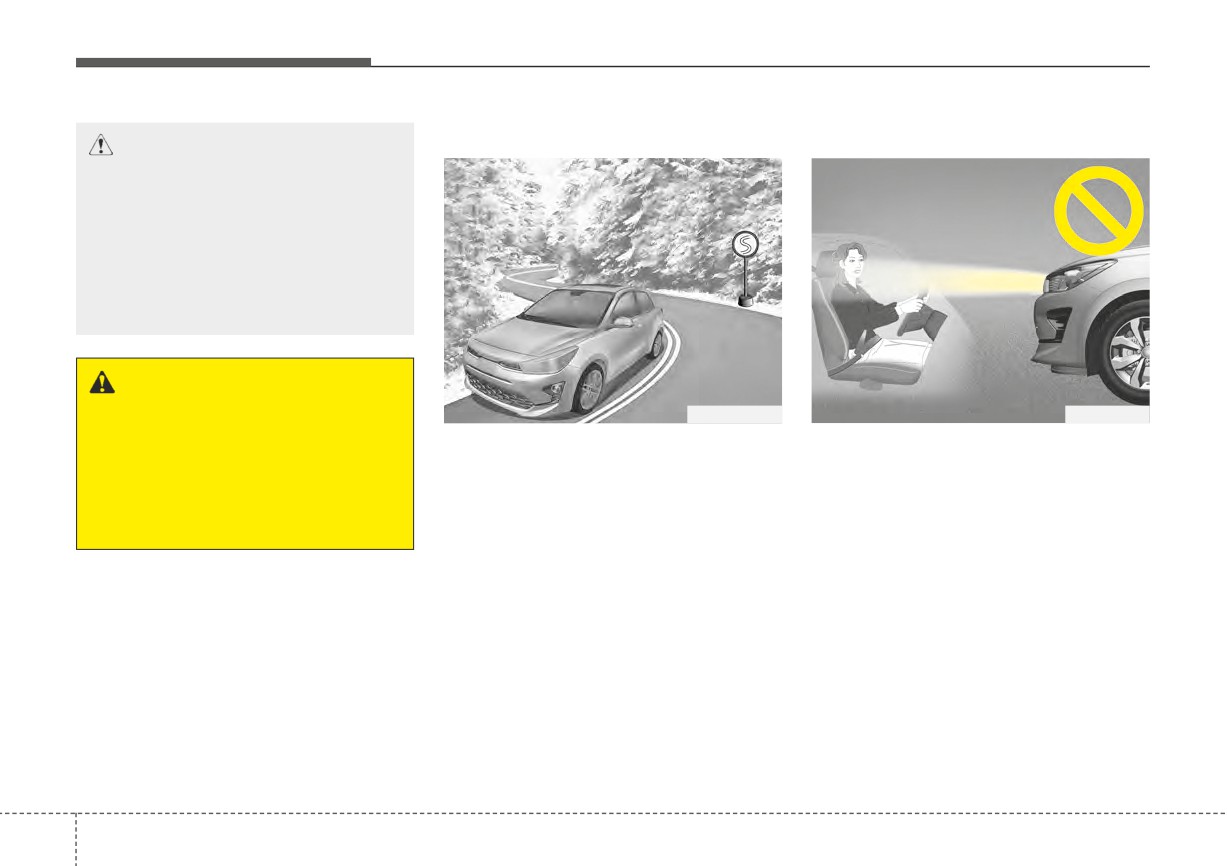
Smooth cornering
Driving at night
- Spinning tires
CAUTION
Do not spin the wheels, espe-
cially at speeds more than 35
mph (56 km/h). Spinning the
wheels at high speeds when the
vehicle is stationary could
cause a tire to overheat which
could result in tire damage.
WARNING - Sudden
vehicle movement
OSC051166N
OSC050105
Do not attempt to rock the vehi-
Avoid braking or gear changing in
Because night driving presents more
cle if people or objects are near-
corners, especially when roads are
hazards than driving in the daylight,
by. The vehicle may suddenly
wet. Ideally, corners should always
here are some important tips to
move forward or backwards as
be taken under gentle acceleration. If
remember:
it becomes unstuck.
you follow these suggestions, tire
• Slow down and keep more dis-
wear will be held to a minimum.
tance between you and other vehi-
cles, as it may be more difficult to
see at night, especially in areas
where there may not be any street
lights.
5
106
Driving your vehicle
•
Adjust your mirrors to reduce the
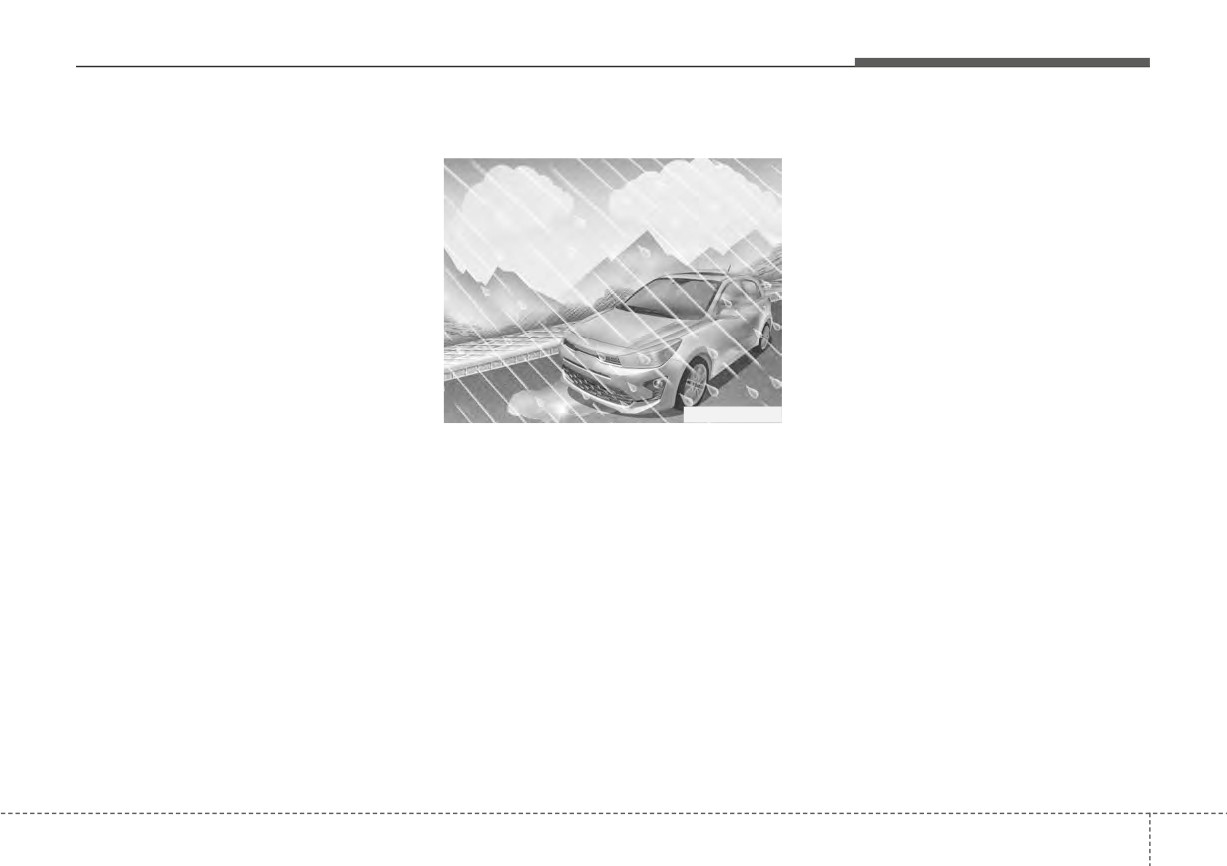
Driving in the rain
•
If your tires are not in good condi-
glare from other driver's head-
tion, making a quick stop on wet
lights.
pavement can cause a skid and
possibly lead to an accident. Be
•
Keep your headlights clean and
sure your tires are in good shape.
properly aimed on vehicles not
equipped with the automatic head-
•
Turn on your headlights to make it
light aiming feature. Dirty or
easier for others to see you.
improperly aimed headlights will
•
Driving too fast through large pud-
make it much more difficult to see
dles can affect your brakes. If you
at night.
must go through puddles, try to
•
Avoid staring directly at the head-
drive through them slowly.
lights of oncoming vehicles. You
•
If you believe you may have gotten
could be temporarily blinded, and it
OSC051168N
your brakes wet, apply them lightly
will take several seconds for your
while driving until normal braking
eyes to readjust to the darkness.
Rain and wet roads can make driving
operation returns.
dangerous, especially if you’re not
prepared for the slick pavement.
Here are a few things to consider
when driving in the rain:
• A heavy rainfall will make it harder
to see and will increase the dis-
tance needed to stop your vehicle,
so slow down.
• Keep your windshield wiping
equipment in good shape. Replace
your windshield wiper blades when
they show signs of streaking or
missing areas on the windshield.
5
107
Driving your vehicle
Driving in flooded areas
Highway driving
WARNING - Tire tread
Avoid driving through flooded areas
Tires
Always check the tire tread
unless you are sure the water is no
Adjust the tire inflation pressures to
higher than the bottom of the wheel
before driving your vehicle.
specification. Low tire inflation pres-
Worn-out tires can result in loss
hub. Drive through any water slowly.
sures will result in overheating and
Allow adequate stopping distance
of vehicle control. Worn-out
possible failure of the tires.
tires should be replaced as
because brake performance may be
Avoid using worn or damaged tires
soon as possible. For further
affected.
which may result in reduced traction
information and tread limits,
After driving through water, dry the
or tire failure.
refer to “Tires and wheels” in
brakes by gently applying them sev-
Never exceed the maximum tire
section 7.
eral times while the vehicle is moving
inflation pressure shown on the tires.
slowly.
WARNING - Under/Over
Driving off-road
Inflated Tires
Drive carefully off-road because your
Always check the tires for prop-
vehicle may be damaged by rocks or
er inflation before driving.
roots of trees. Become familiar with
Underinflated or overinflated
the off-road conditions where you
tires can cause poor handling,
are going to drive before you begin
loss of vehicle control, and sud-
driving.
den tire failure leading to acci-
dents, injuries, and even death.
5
108
Driving your vehicle
Fuel, engine coolant and engine
oil
High speed travel consumes more
fuel than urban motoring. Do not for-
get to check both the engine coolant
and engine oil.
Drive belt
A loose or damaged drive belt may
overheat the engine.
5
109
Driving your vehicle
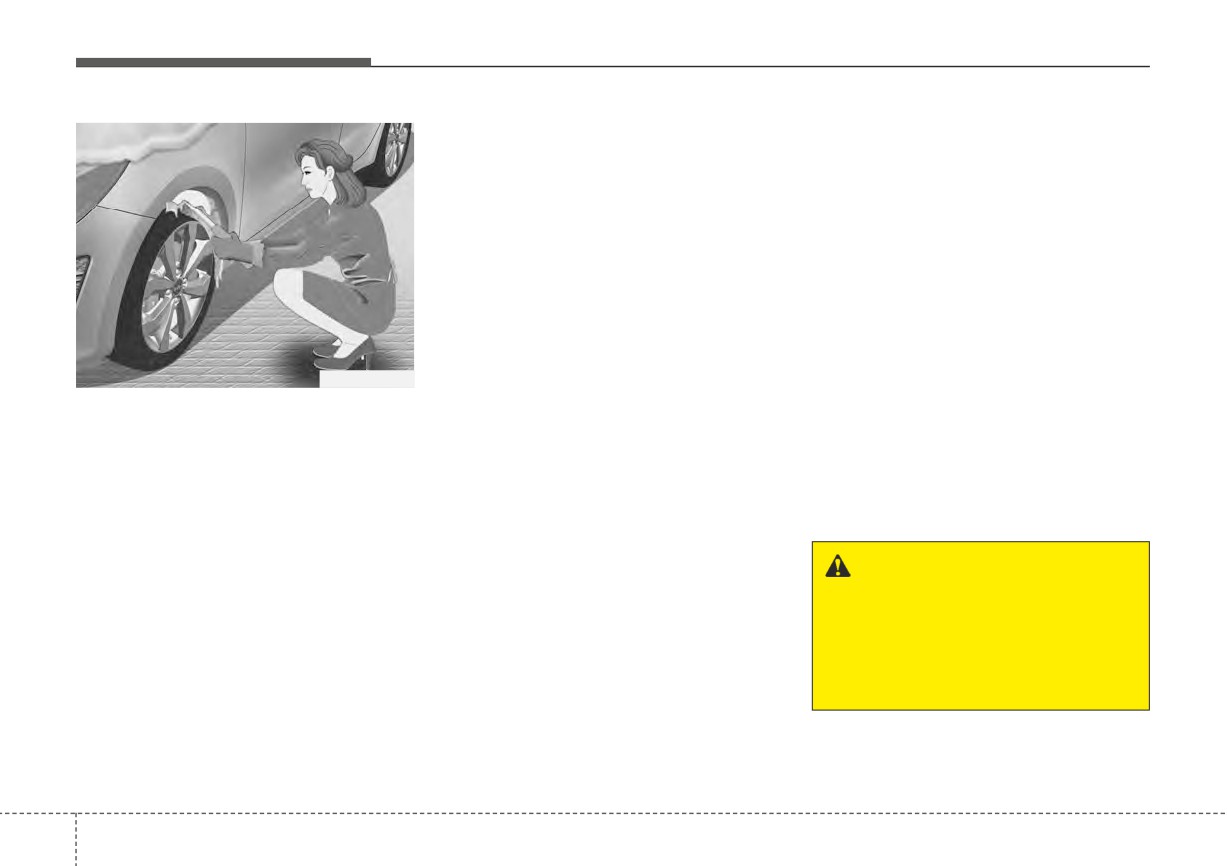
WINTER DRIVING
Snowy or Icy conditions
Snow tires
To drive your vehicle in deep snow, it
If you mount snow tires on your vehi-
may be necessary to use snow tires
cle, make sure they are radial tires of
or to install tire chains on your tires.
the same size and load range as the
If snow tires are needed, it is neces-
original tires. Mount snow tires on all
sary to select tires equivalent in size
four wheels to balance your vehicle’s
and type of the original equipment
handling in all weather conditions.
tires. Failure to do so may adversely
Keep in mind that the traction provid-
affect the safety and handling of your
ed by snow tires on dry roads may
car. Furthermore, speeding, rapid
not be as high as your vehicle's orig-
acceleration, sudden brake applica-
inal equipment tires. You should drive
OYB051170L
tions, and sharp turns are potentially
cautiously even when the roads are
Severe weather conditions in the
very hazardous practices.
clear. Check with the tire dealer for
maximum speed recommendations.
winter result in greater wear and
During deceleration, use engine
other problems. To minimize the
Do not install studded tires without
braking to the fullest extent. Sudden
problems of winter driving, you
brake applications on snowy or icy
first checking local, state and munic-
should follow these suggestions:
ipal regulations for possible restric-
roads may cause skids. You need to
keep sufficient distance between the
tions against their use.
vehicle in operation in front and your
vehicle. Also, apply the brake gently.
WARNING - Snow tire size
It should be noted that installing tire
Snow tires should be equivalent
chains on the tire will provide greater
in size and type to the vehicle's
driving force, but will not prevent side
standard tires. Otherwise, the
skids.
safety and handling of your vehi-
Tire chains are not legal in all states.
cle may be adversely affected.
Check state laws before installing tire
chains.
5
110
Driving your vehicle
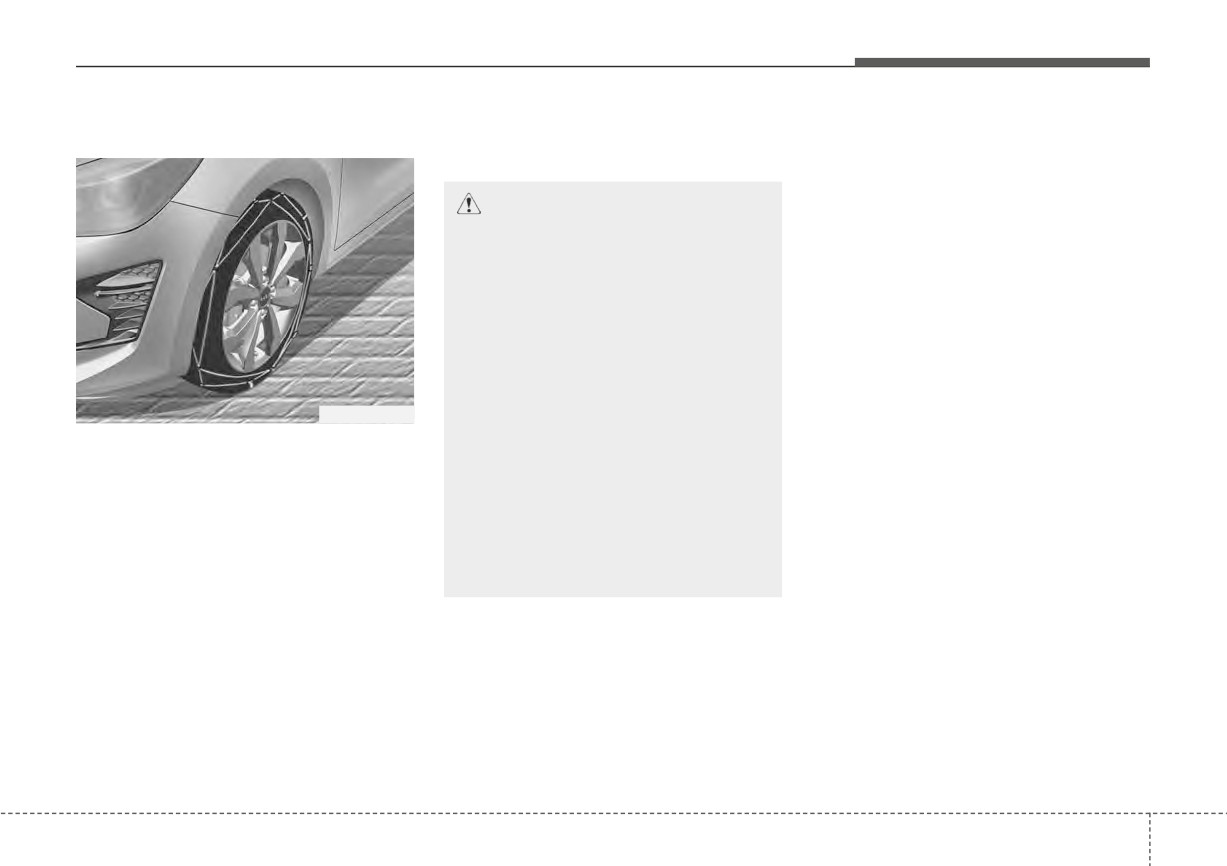
Tire chains
Install tire chains only on the front
The snow chain connecting hooks
tires.
may be damaged from contacting
vehicle components, causing the
snow chains to come loose from the
CAUTION - Snow chains
tire. Make sure the snow chains are
•
Make sure the snow chains are
SAE class “S” certified.
the correct size and type for
Always check chain installation for
your tires. Incorrect snow
proper mounting after driving
chains can cause damage to
approximately 0.3 to 0.6 miles (0.5 to
the vehicle body and suspen-
1 km) to ensure safe mounting.
sion and may not be covered
Retighten or remount
the chains if
by your vehicle manufacturer's
they are loose.
warranty.
OYB051171L
•
Even with the appropriate
chain installed, do not make a
Since the sidewalls of radial tires are
thinner, they can be damaged by
full turn(turn the steering
wheel fully to one side) when
mounting some types of snow chains
on them. Therefore, the use of snow
driving the vehicle. (If you are
making a full turn, drive with
tires is recommended instead of
snow chains. Do not mount tire
the speed below 6.2 mph (10
km/h)).
chains on vehicles equipped with
aluminum wheels; snow chains may
cause damage to the wheels. If snow
chains must be used, use wire-type
chains with a thickness of less than
0.59 in (15 mm). Damage to your
vehicle caused by improper snow
chain use is not covered by your
vehicle manufacturer's warranty.
5
111
Driving your vehicle
Chain installation
• The use of chains may adversely
Use high quality ethylene gly-
affect vehicle handling.
col coolant
When installing chains, follow the
manufacturer's instructions and
• Do not exceed 20 mph (30 km/h)
Your vehicle is delivered with high
mount them as tightly as you can.
or the chain manufacturer’s recom-
quality ethylene glycol coolant in the
Drive slowly with chains installed. If
mended speed limit, whichever is
cooling system. It is the only type of
you hear the chains contacting the
lower.
coolant that should be used because
body or chassis, stop and tighten
• Drive carefully and avoid bumps,
it helps prevent corrosion in the cool-
them. If they still make contact, slow
holes, sharp turns, and other road
ing system, lubricates the water
down until it stops. Remove the
hazards, which may cause the
pump and prevents freezing. Be sure
chains as soon as you begin driving
vehicle to bounce.
to replace or replenish your coolant
on cleared roads.
in accordance with the maintenance
• Avoid sharp turns or locked-wheel
When mounting snow chains, park
schedule in section 7. Before winter,
braking.
the vehicle on level ground away
have your coolant tested to assure
from traffic. Turn on the vehicle
that its freezing point is sufficient for
CAUTION - Snow chains
Hazard Warning flashers and place a
the temperatures anticipated during
triangular emergency warning device
• Chains that are the wrong size
the winter.
behind the vehicle if available.
or improperly installed can
Always place the vehicle in P (Park),
damage your vehicle's brake
Check battery and cables
lines, suspension, body and
apply the parking brake and turn off
the engine before installing snow
wheels.
Winter puts additional burdens on
the battery system. Visually inspect
chains.
• Stop driving and retighten the
the battery and cables as described
chains any time you hear them
in section 7. The level of charge in
hitting the vehicle.
your battery can be checked by an
authorized Kia dealer or a service
station.
5
112
Driving your vehicle
Change to "winter weight" oil
To keep locks from freezing
Don't let your parking brake
if necessary
freeze
To keep the locks from freezing,
In some climates, it is recommended
squirt an approved de-icer fluid or
Under some conditions, your parking
that a lower viscosity "winter weight"
glycerine into the key opening. If a
brake can freeze in the engaged
oil be used during cold weather. See
lock is covered with ice, squirt it with
position. This is most likely to hap-
section
8 for recommendations. If
an approved de-icing fluid to remove
pen when there is an accumulation
you aren't sure what weight oil you
the ice. If the lock is frozen internally,
of snow or ice around or near the
should use, consult an authorized
you may be able to thaw it out by
rear brakes or if the brakes are wet.
Kia dealer.
using a heated key. Handle the heat-
If there is a risk the parking brake
ed key with care to avoid injury.
may freeze, apply it only temporarily
while you put the shift lever in P
Check spark plugs and igni-
(Intelligent Variable Transmission)
tion system
Use approved window washer
and chock the rear wheels so the
anti-freeze in system
Inspect your spark plugs as
vehicle cannot roll. Then release the
described in section 7 and replace
To keep the water in the window
parking brake.
them if necessary. Also check all
washer system from freezing, add an
ignition wiring and components to be
approved window washer anti-freeze
Don't let ice and snow accu-
sure they are not cracked, worn or
solution in accordance with instruc-
mulate underneath
damaged in any way.
tions on the container. Window wash-
er anti-freeze is available from an
Under some conditions, snow and
authorized Kia dealer and most auto
ice can build up under the fenders
parts outlets. Do not use engine
and interfere with the steering. When
coolant or other types of anti-freeze
driving in severe winter conditions
as these may damage the paint finish.
where this may happen, you should
periodically check underneath the
car to be sure the movement of the
front wheels and the steering com-
ponents is not obstructed.
5
113
Driving your vehicle
Carry emergency equipment
Depending on the severity of the
weather you should carry appropri-
ate emergency equipment. Some of
the items you may want to carry
include tire chains, tow straps or
chains, flashlight, emergency flares,
sand, a shovel, jumper cables, a win-
dow scraper, gloves, ground cloth,
coveralls, a blanket, etc.
TRAILER TOWING
We do not recommend using this
vehicle for trailer towing.
5
114
Driving your vehicle
VEHICLE LOAD LIMIT
Tire and loading information label
Vehicle capacity weight:
849 lbs. (385 kg)
Vehicle capacity weight is the maxi-
mum combined weight of occupants
and cargo. If your vehicle is equipped
with a trailer, the combined weight
includes the tongue load.
OSC067003N
OSC067006N
The label located on the driver's door
sill gives the original tire size, cold
tire pressures recommended for your
vehicle, the number of people that
can be in your vehicle and vehicle
capacity weight.
OSC067004N
OSC067005N
5
115
Driving your vehicle
Seating capacity:
Towing capacity:
(4) The resulting figure equals the
Total : 5 persons
We do not recommend using this
available amount of cargo and
luggage load capacity. For exam-
(Front seat : 2 persons,
vehicle for trailer towing.
ple, if the "XXX" amount equals
Rear seat : 3 persons)
1400 lbs. and there will be five
Seating capacity is the maximum
Cargo capacity:
150 lb passengers in your vehi-
number of occupants, including a
The cargo capacity of your vehicle
cle, the amount of available cargo
driver, your vehicle may carry.
will increase or decrease depending
and luggage load capacity is 650
However, the seating capacity may
on the weight and the number of
lbs.
be reduced based upon the weight of
occupants.
(1400-750 (5 x 150) = 650 lbs.)
all of the occupants and the weight of
(5) Determine the combined weight
the cargo being carried or towed.
Steps for Determining Correct
of luggage and cargo being
Do not overload the vehicle as there
Load Limit -
loaded on the vehicle. That
is a limit to the total weight, or load
(1) Locate the statement "The com-
weight may not safely exceed the
limit including occupants and cargo,
bined weight of occupants and
available cargo and luggage load
the vehicle can carry.
cargo should never exceed XXX
capacity calculated in Step 4.
kg or XXX lbs.'' on your vehicle's
(6) If your vehicle will be towing a
placard.
trailer, load from your trailer will
(2) Determine the combined weight
be transferred to your vehicle.
of the driver and passengers that
Consult this manual to determine
will be riding in your vehicle.
how this reduces the available
cargo and luggage load capacity
(3) Subtract the combined weight of
of your vehicle.
the driver and passengers from
XXX kg or XXX lbs.
5
116
Driving your vehicle
Example 1
Example 2
Example 3
A
B
C
A
B
C
A
B
C
C190F01JM
C190F02JM
C190F03JM
Item
Description
Total
Item
Description
Total
Item
Description
Total
Vehicle Capacity
849 lbs
Vehicle Capacity
849 lbs
Vehicle Capacity
849 lbs
A
A
A
Weight
(385 kg)
Weight
(385 kg)
Weight
(385 kg)
Subtract Occupant
Subtract Occupant
Subtract Occupant
300 lbs
750 lbs
805 lbs
B
Weight
B
Weight
B
Weight
(136 kg)
(340 kg)
(365 kg)
150 lbs (68 kg) × 2
150 lbs (68 kg) × 5
161 lbs (73 kg) × 5
Available Cargo and
549 lbs
Available Cargo and
99 lbs
Available Cargo and
44 lbs
C
C
C
Luggage weight
(249 kg)
Luggage weight
(45 kg)
Luggage weight
(20 kg)
Refer to your vehicle’s tire and loading information label for specific information about your vehicle's capacity weight
and seating positions. The combined weight of the driver, passengers and cargo should never exceed your vehicle's
capacity weight.
5
117
Driving your vehicle
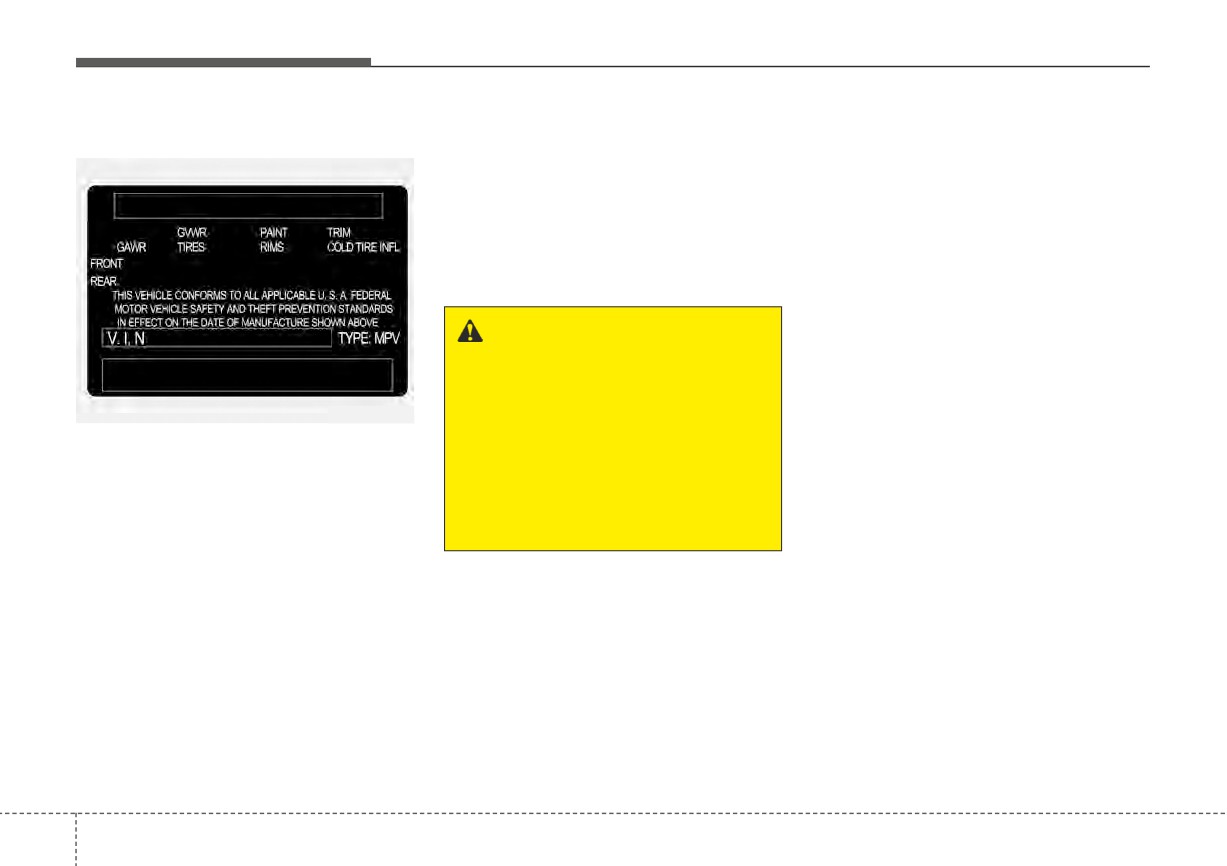
Certification label
To find out the actual loads on your
The label will help you decide how
front and rear axles, you need to go
much cargo and installed equipment
to a weigh station and weigh your
your vehicle can carry.
vehicle.Your dealer can help you with
this. Be sure to spread out your load
If you carry items inside your vehicle
equally on both sides of the center-
- like suitcases, tools, packages, or
line.
anything else - they are moving as
fast as the vehicle. If you have to stop
or turn quickly, or if there is a crash,
WARNING
- Over
the items will keep going and can
loading
cause an injury if they strike the driv-
Never exceed the GVWR for
er or a passenger.
your vehicle, the GAWR for
OEN056020
either the front or rear axle and
The certification label is located on
vehicle
capacity
weight.
the driver's door sill at the center pil-
Exceeding these ratings can
lar.
affect your vehicle’s handling
This label shows the maximum
and braking ability.
allowable weight of the fully loaded
vehicle. This is called the GVWR
(Gross Vehicle Weight Rating). The
GVWR includes the weight of the
vehicle, all occupants, fuel and
cargo.
This label also tells you the maxi-
mum weight that can be supported
by the front and rear axles, called
Gross Axle Weight Rating (GAWR).
5
118
Driving your vehicle
WARNING - Over
WARNING - Loose cargo
loading
Do not travel with unsecured
Do not overload your vehicle.
blunt objects in the passenger
Overloading your vehicle can
compartment of your vehicle
cause heat buildup in your vehi-
(e.g. suit cases or unsecured
cle's tires and possible tire fail-
child seats). These items may
ure, increased stopping dis-
strike occupants during a sud-
tances and poor vehicle han-
den stop or crash.
dling, all of which may result in
a crash.
✽ NOTICE
Overloading your vehicle may cause
damage. Repairs would not be cov-
ered by your warranty. Do not over-
load your vehicle.
5
119
Driving your vehicle
VEHICLE WEIGHT
This section will guide you in the
Cargo weight
GVWR
proper loading of your vehicle and/or
(Gross vehicle weight rating)
This figure includes all weight added
trailer, to keep your loaded vehicle
to the Base Curb Weight, including
This is the maximum allowable
weight within its design rating capa-
cargo and optional equipment.
weight of the fully loaded vehicle
bility, with or without a trailer.
(including all options, equipment,
Properly loading your vehicle will
passengers and cargo). The GVWR
provide maximum return of the vehi-
GAW (Gross axle weight)
is shown on the certification
label
cle design performance. Before load-
This is the total weight placed on
located on the driver’s door sill.
ing your vehicle, familiarize yourself
each axle (front and rear) - including
with the following terms for determin-
vehicle curb weight and all payload.
ing your vehicle's weight ratings, with
or without a trailer, from the vehicle's
specifications and the compliance
GAWR
label:
(Gross axle weight rating)
This is the maximum allowable
Base curb weight
weight that can be carried by a single
axle (front or rear). These numbers
This is the weight of the vehicle
are shown on the compliance label.
including a full tank of fuel and all
standard equipment. It does not
The total load on each axle must
never exceed its GAWR.
include passengers, cargo, or option-
al equipment.
GVW (Gross vehicle weight)
Vehicle curb weight
This is the Base Curb Weight plus
This is the weight of your new vehicle
actual Cargo Weight plus passen-
gers.
when you picked it up from your deal-
er plus any aftermarket equipment.
5 120
What to do in an emergency
Road warning
6-2
If you have a flat tire (with spare tire)
6-19
• Hazard warning flasher
6-2
• Jack and tools
6-19
In case of an emergency while driving
6-3
• Removing and storing the spare tire
6-20
• If the engine stalls at a crossroad or crossing
6-3
• Changing tires
6-21
• If you have a flat tire while driving
6-3
• Jack label
6-28
• If engine stalls while driving
6-3
Towing
6-29
If the engine will not start
6-4
• Towing service
6-29
• If the engine doesn't turn over or turns over slowly. . 6-4
• Removable towing hook (front)
6-30
• If engine turns over normally but does not start
6-4
• Emergency towing
6-31
Emergency starting
6-5
• Jump starting
6-5
• Push-starting
6-6
If the engine overheats
6-7
Tire Pressure Monitoring System
(TPMS - Type A)
6-8
• Low tire pressure telltale
6-9
6
• TPMS (Tire Pressure Monitoring System)
malfunction indicator
6-10
• Changing a tire with TPMS
6-11
Tire Pressure Monitoring System
(TPMS - Type B)
6-13
• Check tire pressure
6-13
• Low tire pressure telltale
6-15
• Low tire pressure position telltale
6-15
• Changing a tire with TPMS
6-17
What to do in an emergency
ROAD WARNING
Hazard warning flasher
It should be used whenever emer-
gency repairs are being made or
when the vehicle is stopped near the
edge of a roadway.
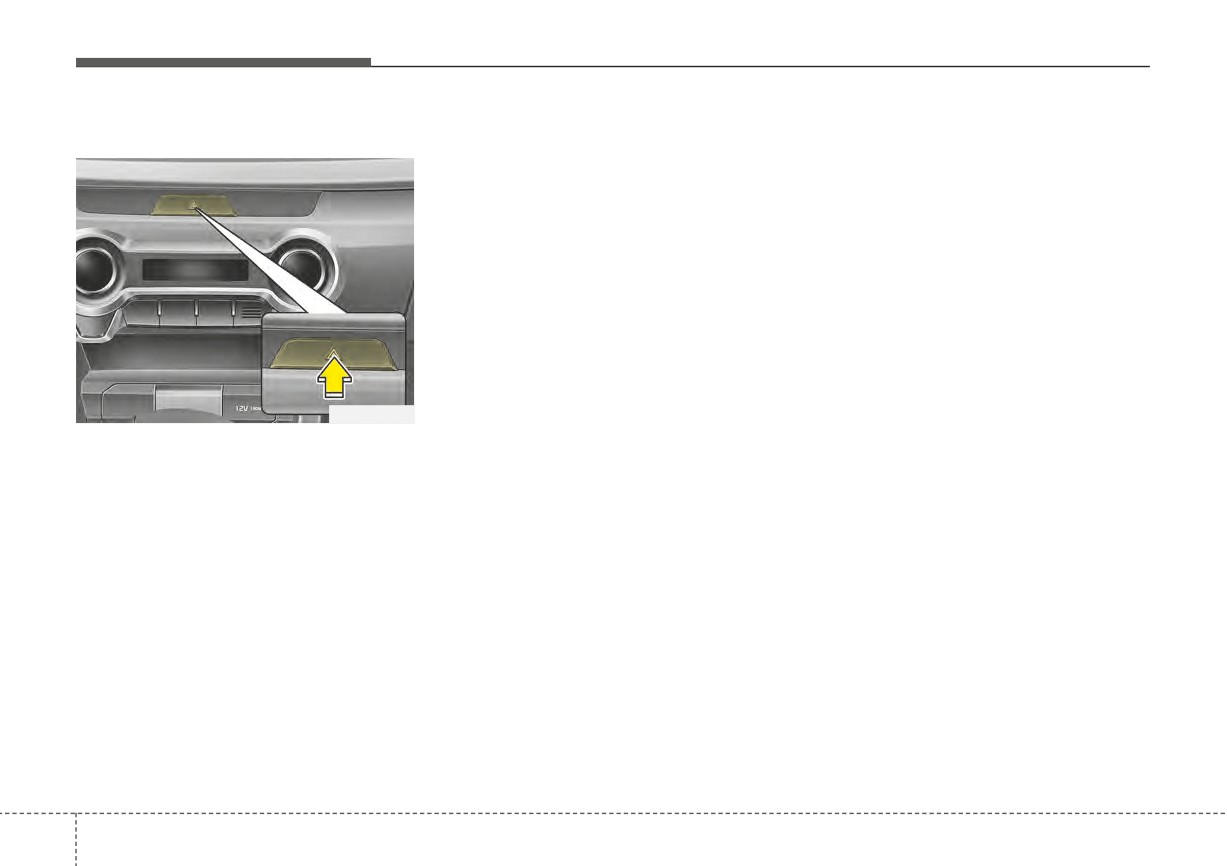
Depress the flasher switch with the
ignition switch in any position. The
flasher switch is located in the center
console switch panel. All turn signal
lights will flash simultaneously.
• The hazard warning flasher oper-
ates whether your vehicle is run-
OSC066002
ning or not.
• The turn signals do not work when
The hazard warning flasher serves
the hazard flasher is on.
as a warning to other drivers to exer-
cise
extreme caution when
• Care must be taken when using
approaching, overtaking, or passing
the hazard warning flasher while
your vehicle.
the vehicle is being towed.
6
2
What to do in an emergency
IN CASE OF AN EMERGENCY WHILE DRIVING
If the engine stalls at a cross-
If you have a flat tire while
3. Have all passengers get out of the
road or crossing
driving
vehicle. Be sure they all get out on
the side of the vehicle that is away
If the engine stalls at a crossroad or
If a tire goes flat while you are driv-
from traffic.
crossing, set the shift lever in the N
ing:
(Neutral) position and then push the
4. When changing a flat tire, follow
1. Take your foot off the accelerator
the instruction provided later in
vehicle to a safe place.
pedal and let the vehicle slow
this section.
down while driving straight ahead.
Do not apply the brakes immedi-
ately or attempt to pull off the road
If engine stalls while driving
as this may cause a loss of con-
1. Reduce your speed gradually,
trol. When the vehicle has slowed
keeping a straight line. Move cau-
down to such a speed that it is
tiously off the road to a safe place.
safe to do so, brake carefully and
pull off the road. Drive off the road
2. Turn on your emergency flashers.
as far as possible and park on a
3. Try to start the engine again. If
firm level ground. If you are on a
your vehicle will not start, contact
divided highway, do not park in the
an authorized Kia dealer or seek
median area between the two traf-
other qualified assistance.
fic lanes.
2. When the vehicle is stopped, turn
on your emergency hazard flash-
ers, set the parking brake and put
the transmission in P (Intelligent
Variable Transmission).
6
3