Kia Rio / Rio Hatchback (2022 year). Manual in english - page 13
Driving your vehicle
ESC OFF usage
Hill-start Assist Control (HAC)
WARNING - Maintaining
When driving
The Hill-start Assist Control (HAC) is
Brake Pressure on Incline
• It’s a good idea to keep the ESC
designed to prevent the vehicle from
turned on for daily driving whenev-
rolling back by applying the brakes
HAC does not replace the need
er possible.
automatically for about 2 seconds.
to apply brakes while stopped on
The brakes are released when the
an incline. While stopped, make
• To turn ESC off while driving, press
accelerator pedal is depressed or
sure you maintain brake pres-
the ESC OFF button while driving
after about 2 seconds.
sure sufficient to prevent your
on a flat road surface.
vehicle from rolling backward
The HAC is activated only for about 2
and causing an accident. Don’t
seconds, so when the vehicle is
release the brake pedal until you
WARNING - Operating
starting off always depress the accel-
are ready to accelerate forward.
ESC
erator pedal.
Never press the ESC OFF but-
ton while ESC is operating.
CAUTION
If the ESC is turned off while
• The HAC does not operate
ESC is operating, the vehicle
when the transmission shift
may go out of control.
lever is in the P (Park) or N
(Neutral) position.
• The HAC activates even
though the ESC is off but it
does not activate when the
ESC has malfunctioned.
5
35
Driving your vehicle
Vehicle Stability Management
The VSM does not operate when:
VSM operation off
(VSM)
•
Driving on a sloping road such as
If you press the ESC OFF button to
gradient or incline
turn off the ESC, the VSM will also
This system is designed to provide
cancel and the ESC OFF indicator
further enhancements to vehicle sta-
•
Driving in reverse
bility and steering responses when a
light (
) illuminates.
•
ESC OFF indicator light
(
)
vehicle is driving on a slippery road
remains on the instrument cluster
To turn on the VSM, press the button
or a vehicle detects changes in coef-
again. The ESC OFF indicator light
•
EPS indicator light remains on the
ficient of friction between the right
will turn off.
instrument cluster
wheels and left wheels when brak-
ing.
WARNING - Vehicle stabili-
ty management
VSM operation
Drive carefully even though your
When the VSM is in operation, the
vehicle has Vehicle stability man-
ESC indicator light (
) blinks.
agement. It can only assist you in
When the vehicle stability manage-
maintaining control under cer-
ment is operating properly, you can
tain circumstances.
feel a slight pulsation in the vehicle
and/or abnormal steering responses
EPS (Electronic Power Steering).
This is only the effect of brake and
EPS control and indicates nothing
unusual.
5
36
Driving your vehicle
Malfunction indicator
WARNING
WARNING
The VSM can be deactivated even if
you don’t cancel the VSM operation
The
Vehicle
Stability
For maximum protection, always
by pressing the ESC OFF button. It
Management system is not a
wear your seat belt. No system,
indicates that a malfunction has
substitute for safe driving prac-
no matter how advanced, can
been detected somewhere in the
tices but a supplementary func-
compensate for all driver error
Electric Power Steering system or
tion only. It is the responsibility
and/or driving conditions.
VSM system. If the ESC indicator
of the driver to always check the
Always drive responsibly.
light
(
) or EPS warning light
speed and the distance to the
remains on, take your vehicle to an
vehicle ahead. Always hold the
authorized Kia dealer and have the
steering wheel firmly while driv-
system checked.
ing.
• Your vehicle is designed to activate
according to the driver’s intention,
even with installed VSM. Always
WARNING - Tire/Wheel
follow all the normal precautions
size
for driving at safe speeds for the
When replacing tires and
conditions
- including driving in
wheels, make sure they are the
inclement weather and on a slip-
same size as the original tires
pery road.
and wheels installed. Driving
with varying tire or wheel sizes
may affect the vehicle's han-
dling.
5
37
Driving your vehicle
Good braking practices
•
Don't "ride" the brake pedal.
•
Be cautious when parking on a hill.
Resting your foot on the brake
Firmly engage the parking brake
•
Check to be sure the parking brake
pedal while driving can be danger-
and place the shift lever in P
is not engaged and that the park-
ous because the brakes might
(Intelligent Variable Transmission).
ing brake indicator light is out
overheat and lose their effective-
If your vehicle is facing downhill,
before driving away.
ness. It also increases the wear of
turn the front wheels into the curb
•
Driving through water may get the
the brake components.
to help keep the vehicle from
brakes wet. They can also get wet
rolling. If your vehicle is facing
•
If a tire goes flat while you are driv-
when the vehicle is washed. Wet
uphill, turn the front wheels away
ing, apply the brakes gently and
brakes can be dangerous! Your
from the curb to help keep the vehi-
keep the vehicle pointed straight
vehicle will not stop as quickly if the
cle from rolling. If there is no curb
ahead while you slow down. When
brakes are wet. Wet brakes may
or if it is required by other condi-
you are moving slowly enough for it
cause the vehicle to pull to one
tions to keep the vehicle
from
to be safe to do so, pull off the road
side.
rolling, chock the wheels.
and stop in a safe place.
To dry the brakes, apply the brakes
•
If your vehicle is equipped with an
lightly until the braking action
intelligent variable transmission,
returns to normal, taking care to
don't let your vehicle creep for-
keep the vehicle under control at
ward. To avoid creeping forward,
all times. If the braking action does
keep your foot firmly on the brake
not return to normal, stop as soon
pedal when the vehicle is stopped.
as it is safe to do so and call an
authorized Kia dealer for assis-
tance.
•
Don't coast down hills with the
vehicle out of gear. This is extreme-
ly hazardous. Keep the vehicle in
gear at all times, use the brakes to
slow down, then shift to a lower
gear so that engine braking will
help you maintain a safe speed.
5
38
Driving your vehicle
•
Under some conditions, your park-
ing brake can freeze in the
engaged position. This is most like-
ly to happen when there is an
accumulation of snow or ice
around or near the rear brakes or if
the brakes are wet. If there is a risk
that the parking brake may freeze,
apply it only temporarily while you
put the shift lever in P (Intelligent
Variable Transmission) and chock
the rear wheels so the vehicle can-
not roll. Then release the parking
brake.
•
Do not hold the vehicle on an
incline with the accelerator pedal.
This can cause the transmission to
overheat. Always use the brake
pedal or parking brake.
5
39
Driving your vehicle
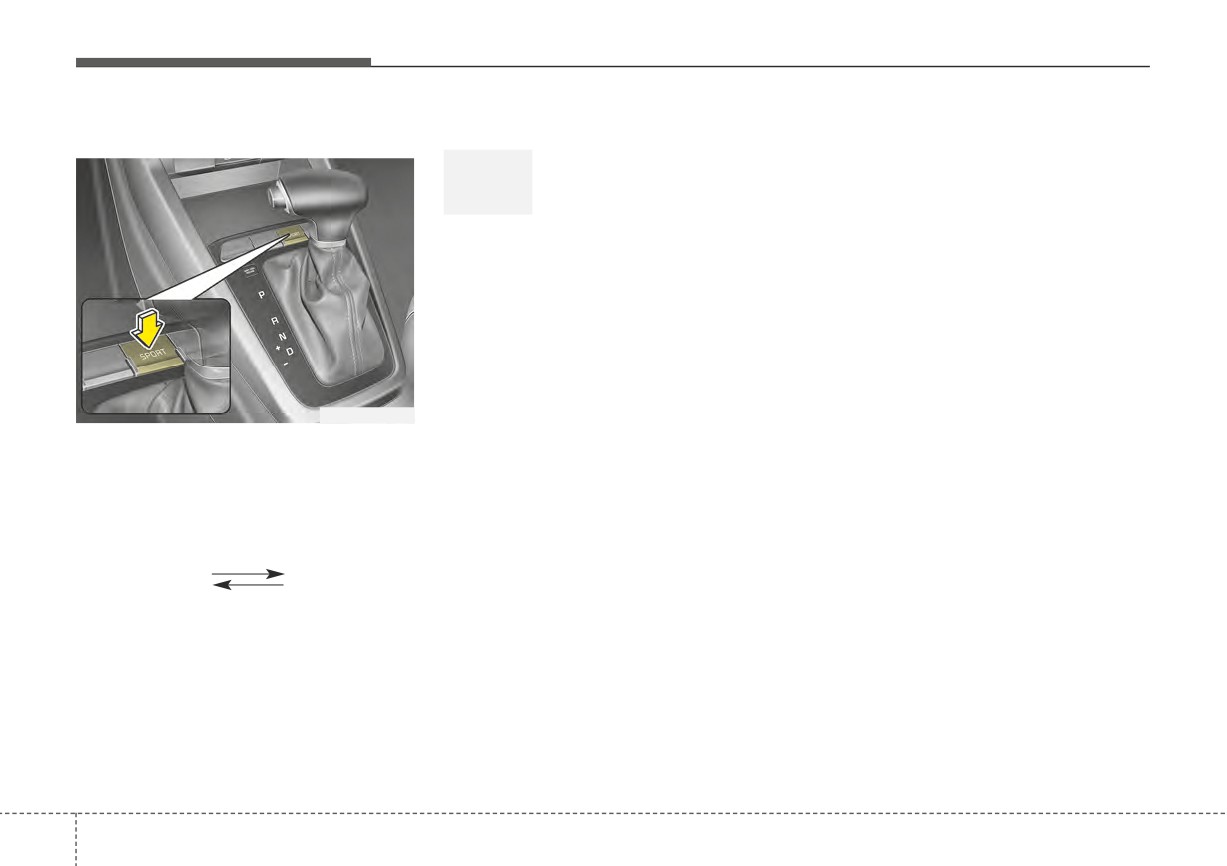
SPORT MODE INTEGRATED CONTROL SYSTEM
SPORT mode
SPORT mode
✽ NOTICE
SPORT mode focuses on
In Sport drive mode, the fuel effi-
SPORT dynamic driving by auto-
ciency may decrease.
matically adjusting the
steering effort, engine
and transmission system.
• When the SPORT MODE
button is pressed, the
SPORT indicator (yellow
or white) will illuminate.
• If the system is activat-
ed:
OSC057012N
- While holding vehicle
speed, it maintains the
The sport mode may be selected
gear and RPM for some
according to the driver’s preference
time even though the
or road condition.
accelerator pedal is not
The mode changes whenever the
depressed.
SPORT MODE button is pressed.
- Up-shifting is delayed.
NORMAL
SPORT
• When the SPORT mode
is activated, and the
❈ When normal mode is selected, it
ignition
switch
or
is not displayed on the cluster.
ENGINE START/STOP
button is turned off and
on, it will change to
NORMAL mode. To turn
on the SPORT mode,
press the SPORT
MODE button again.
5
40
Driving your vehicle
FORWARD COLLISION-AVOIDANCE ASSIST (FCA) (IF EQUIPPED)
Forward Collision-Avoidance Assist
Detecting sensor
is designed to detect and monitor a
WARNING - Forward
■ Front view camera
vehicle ahead or detect a pedestrian
Collision-Avoidance Assist
in the roadway through front view
Limitations
camera recognition to warn the driv-
Forward Collision-Avoidance
er that a collision is imminent, and if
Assist is a supplemental func-
necessary, apply emergency brak-
tion and is not a substitute for
ing.
safe driving practices. It is the
responsibility of the driver to
always check the speed and
distance to the vehicle ahead
and to be prepared to apply the
brakes.
OSC051301N
Refer to the picture
above for the
detailed location of
the detecting
sensor.
5
41
Driving your vehicle
Forward Collision-Avoidance
•
If you select "Active Assist",
WARNING
Assist settings
Forward
Collision-Avoidance
Take the following precautions
Assist activates. Forward Collision-
Setting features
Avoidance Assist produces warn-
when using Forward Collision-
Avoidance Assist :
ing messages and warning alarms
in accordance with the collision
•
This function is only a supple-
risk levels. Also, it controls the
mental function and it is not
brakes in accordance with the col-
intended to, or does it replace
lision risk levels.
the need for extreme care and
•
If you select "Warning Only",
attention of the driver. The
sensing range and objects
Forward
Collision-Avoidance
Assist activates and produces only
detectable by the sensors are
limited. Pay attention to the
warning alarms in accordance with
the collision risk levels. You should
road conditions at all times.
control the brake directly because
•
NEVER drive too fast in accor-
OJA050142L
Forward
Collision-Avoidance
dance with the road condi-
Assist do not control the brake.
tions or while cornering.
Forward Safety
•
If
you select "Off", Forward
•
Always drive cautiously to
The driver can
activate Forward
Collision-Avoidance Assist deacti-
prevent unexpected and sud-
Collision-Avoidance Assist by plac-
vates.
den situations from occur-
ing the ignition switch or ENGINE
ring.
Forward Collision-
START/STOP button to the ON posi-
Avoidance Assist does not
tion and by selecting on 'User
stop the vehicle completely
Settings
→ Driver Assistance
→
and does not avoid all colli-
Forward Safety'.
sions due to function limita-
tions.
5
42
Driving your vehicle
The warning light illumi-
Warning Timing
•
Late: When this condition is select-
nates on the LCD display,
ed, the initial Forward Collision
when you cancel Forward
Warning is activated later than nor-
Collision-Avoidance
mal. This setting reduces the
Assist. The driver can
amount of distance between the
monitor
Forward
vehicle or pedestrian ahead before
Collision-Avoidance
the initial warning occurs. Select
Assist ON/OFF status on
this condition only when traffic is
the LCD display. Also, the
light, and you are driving slowly.
warning light illuminates
when the ESC (Electronic
Stability Control) is turned
off
(Traction & Stability control dis-
abled.).
OJA050141L
When the warning light remains ON
The driver can select the initial warn-
with Forward Collision-Avoidance
ing activation time in the User
Assist activated, have your vehicle
Settings in the instrument cluster
inspected by an authorized Kia deal-
LCD display.
er.
The options for the initial Forward
Collision Warning include the follow-
ing:
• Normal: When this condition is
selected, the initial Forward
Collision Warning is activated nor-
mally.
5
43
Driving your vehicle
Prerequisite for activation
Forward Collision-Avoidance
WARNING
Assist warning message and
Forward Collision-Avoidance Assist
will activate when Forward Collision-
Forward Collision-Avoidance
function control
Avoidance Assist is selected on the
Assist may not recognize every
Forward Collision-Avoidance Assist
LCD display, and when the following
obstacle or provide warnings
produces warning messages, warn-
prerequisites are satisfied:
and braking in every situation, so
ing alarms, and emergency braking
do not rely on Forward Collision-
•
The ESC
(Electronic Stability
based on the level of risk of a frontal
Avoidance Assist to stop the
Control) is activated.
collision, such as when a vehicle
vehicle in instances where the
•
When
Forward
Collision-
ahead suddenly brakes, or when the
driver sees an obstacle and has
function detects that a collision with
Avoidance Assist recognizes a
the ability to apply the brakes.
vehicle or the pedestrian in front.
a pedestrian is imminent.
•
Forward Collision-Avoidance
The driver can select the initial warn-
Assist automatically activates
ing activation time in the User
upon placing the ignition
Settings in the LCD display. The
switch or ENGINE START/STOP
options for the initial Forward
button to the ON position. The
Collision Warning include Normal or
driver can deactivate Forward
Late initial warning time.
Collision-Avoidance Assist by
canceling the function setting
on the LCD display.
•
Forward Collision-Avoidance
Assist automatically deacti-
vates upon canceling the ESC.
When the ESC is canceled,
Forward Collision-Avoidance
Assist cannot be activated on
the LCD display. Forward
Collision-Avoidance Assist
warning light will illuminate.
5
44
Driving your vehicle
Collision Warning
•
For the pedestrian, the vehicle
Emergency Braking
speed is greater than or equal to 3
mph (5 km/h) and less than 50
mph (80 km/h). (Depending on the
condition of pedestrian and the
surrounding environment the pos-
sible maximum operating speed
may be reduced.)
- If you select "Warning Only",
Forward
Collision-Avoidance
Assist activates and produces
only warning alarms in accor-
dance with the collision risk lev-
OYB050152L
OYB050153L
els. You should control the brake
Additionally, some vehicle function
directly
because Forward
Additionally, some vehicle function
intervention occurs by the engine
Collision-Avoidance Assist do not
intervention occurs by the engine
management function to help decel-
control the brake.
management function to help decel-
erate the vehicle.
erate the vehicle.
The vehicle may slow down slightly.
The vehicle may slow down slightly.
• It will operate if the vehicle speed is
• It will operate if the vehicle speed is
greater than 3 mph (5 km/h) and
greater than 3 mph (5 km/h) and
less than or equal to 110 mph (180
less than or equal to 37 mph (60
km/h) on a forward vehicle.
km/h) on a forward vehicle.
(Depending on the condition of the
(Depending on the condition of the
vehicle ahead and the environment
vehicle ahead and the environment
surrounding it, the possible maxi-
surrounding it, the possible maxi-
mum operating speed may be
mum operating speed may be
reduced.)
reduced.)
5
45
Driving your vehicle
•
For the pedestrian, the vehicle
Brake operation
speed is greater than or equal to 3
WARNING
In an urgent situation, the braking
mph (5 km/h) and less than 37
Forward Collision-Avoidance
system enters into the ready status
mph (60 km/h). (Depending on the
for prompt reaction to assist the driv-
Assist cannot avoid all colli-
condition of pedestrian and the
sions nor completely stop the
er in depressing the brake pedal.
surrounding environment the pos-
vehicle before collision. The
• Forward
Collision-Avoidance
sible maximum operating speed
driver has the responsibility to
may be reduced.)
Assist provides additional braking
drive safely and control the
power for optimum braking per-
- If you select "Warning Only",
vehicle.
formance when the driver depress-
Forward
Collision-Avoidance
es the brake pedal during warning.
Assist activates and produces
• The braking control is automatical-
only warning alarms in accor-
WARNING
ly deactivated when the driver
dance with the collision risk lev-
Forward Collision-Avoidance
sharply depresses the accelerator
els. You should control the brake
Assist is a supplemental func-
pedal, or when the driver abruptly
directly
because Forward
tion and cannot completely
operates the steering wheel.
Collision-Avoidance Assist do not
stop the vehicle in all situations
control the brake.
• The braking control is automatical-
or avoid all collisions. It is the
ly canceled when risk factors dis-
responsibility of the driver to
appear.
safely drive and control the
The driver should always exercise
vehicle.
caution when operating the vehicle,
even though there is no warning
message or warning alarm.
5
46
Driving your vehicle
✽ NOTICE
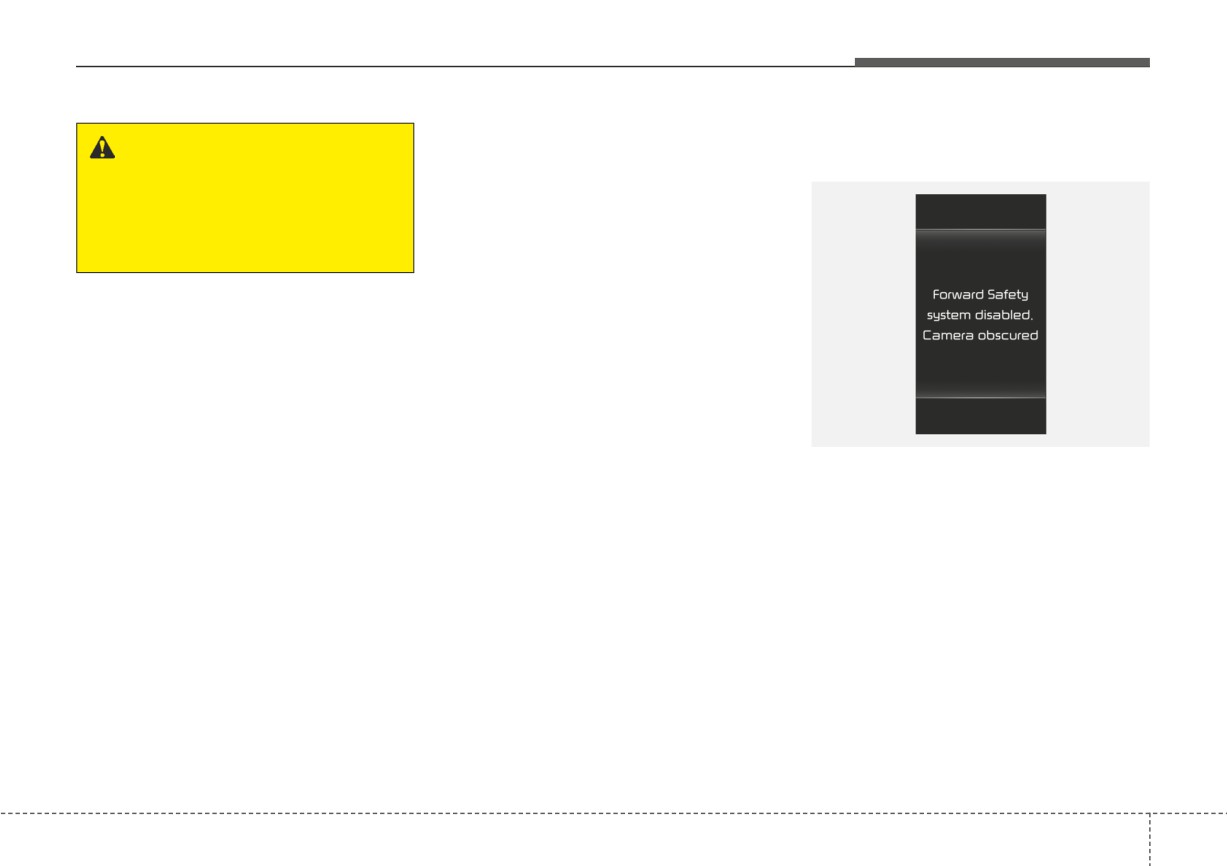
Warning message and warning
WARNING
light
•
Use only soft clothes to wash the
Never deliberately drive danger-
vehicle. Do not spray pressurized
ously to activate the function as
water directly on the sensor or
such conduct increases the risk
sensor cover.
of an accident.
•
Use only genuine parts to repair or
replace a damaged sensor or sen-
sor cover. Do not apply paint to
✽ NOTICE
the sensor cover.
•
Do not tint the window or install
Forward Collision-Avoidance Assist
stickers or accessories around the
assesses the risk of a collision by
inside mirror where the camera is
monitoring several variables such as
installed.
the distance to the vehicle/pedestri-
•
Make sure the front view camera
an ahead, the speed of the
ODL3A050278
installation point does not get wet.
vehicle/pedestrian ahead, and the
•
Do not impact or remove any front
driver's operation of the vehicle.
In this case, a warning message will
view camera components.
Certain conditions such as
appear to notify the driver. Remove
•
Do not place reflective objects
inclement weather and road condi-
the foreign substances to allow
(white paper or mirror etc.) on the
tions may affect the operation of
Forward Collision-Avoidance Assist
dashboard. The function may acti-
Forward Collision-Avoidance Assist.
to function normally.
vate unnecessarily due to reflec-
For the function operation, do not
tion of the sunlight.
Forward Collision-Avoidance Assist
attempt risky driving.
may not properly operate in an area
(e.g. open terrain), where any vehi-
cles or objects are not detected after
turning ON the vehicle.
5
47
Driving your vehicle
Forward Collision-Avoidance
Assist malfunction
WARNING
Forward Collision-Avoidance
When Forward Collision-Avoidance
Assist is only a supplemental
Assist is not working properly,
function. It is the driver's respon-
Forward Collision-Avoidance Assist
sibility to control the vehicle
warning light
(
) will illuminate
operation. Do not solely depend
and the warning message
will
on Forward Collision-Avoidance
appear for a few seconds.
Assist. Rather, maintain a safe
braking distance, and, if neces-
sary, depress the brake pedal to
ODL3A050328
reduce the driving speed or stop
the vehicle.
After the message disappears, the
master warning light (
) will illumi-
• In certain instances and under
nate. In this case, take your vehicle
certain driving conditions,
to an authorized Kia dealer and have
Forward Collision-Avoidance
Assist may activate uninten-
the function checked.
tionally. This initial warning
message appears on the LCD
display with a warning chime.
Also, due to sensing limita-
tions, in certain situations, the
front view camera recognition
function may not detect the
vehicle or pedestrian ahead.
(Continued)
5
48
Driving your vehicle
(Continued)
(Continued)
(Continued)
Forward Collision-Avoidance
•
Forward Collision-Avoidance
•
Forward Collision-Avoidance
Assist may not activate and the
Assist does not operate when
Assist may not activate
warning message will not be
the vehicle is in reverse.
depending on road or driving
displayed.
conditions.
•
Forward Collision-Avoidance
•
Forward Collision-Avoidance
Assist is not designed to
•
Forward Collision-Avoidance
Assist may unnecessarily pro-
detect other objects on the
Assist may not activate to all
duce the warning message
road such as animals.
types of vehicles.
and the warning alarms. Also,
•
Forward Collision-Avoidance
due to the sensing limitation,
Assist does not detect vehi-
Forward Collision-Avoidance
cles in the opposite lane.
Assist may not produce the
•
Forward Collision-Avoidance
warning message and the
Assist does not detect cross
warning alarm at all.
traffic vehicles that are
•
When there is a malfunction
approaching.
with Forward Collision-
•
Forward Collision-Avoidance
Avoidance
Assist,
the
Assist cannot detect the driv-
autonomous emergency brak-
er approaching the side view
ing does not operate upon
of a parked vehicle (for exam-
detecting a collision risk even
ple on a dead end street). In
with other braking systems
these cases, you must main-
normally operating.
tain a safe braking distance,
•
Forward Collision-Avoidance
and if necessary, depress the
Assist may not activate if the
brake pedal to reduce the
driver applies the brake pedal
driving speed in order to
before warning to avoid risk of
maintain a safe distance.
collision.
(Continued)
(Continued)
5
49
Driving your vehicle
Limitations of Forward
The sensor may be limited when:
•
The camera's field of view is not
Collision-Avoidance Assist
well illuminated (either too dark or
•
The function may not operate for
too much reflection or too much
Forward Collision-Avoidance Assist
15 seconds after the vehicle is
backlight that obscures the field of
started or the camera is initialized.
is designed to monitor the vehicle
view).
ahead in the roadway through front
•
Front view camera contaminated
•
The vehicle in front does not have
view camera recognition to warn the
or blocked.
their rear lights or their rear lights
driver that a collision is imminent,
•
The camera lens is contaminated
does not turned ON or their rear
and if necessary, apply emergency
due to tinted, filmed or coated
lights are located unusually.
braking.
windshield, damaged glass, or
•
The outside brightness changes
In certain situations, the front view
sticky foreign matter (sticker, bug,
suddenly, for example when enter-
camera may not be able to detect the
etc.) on the glass.
ing or exiting a tunnel.
vehicle ahead. In these cases,
•
Inclement weather such as heavy
Forward Collision-Avoidance Assist
•
Light coming from a street light or
rain or snow obscures the field of
may not operate normally. The driver
an oncoming traffic is reflected on
view of the camera.
must pay careful attention in the fol-
a wet road surface such as a pud-
•
There is interference by electro-
lowing situations where Forward
dle in the road.
magnetic waves.
Collision-Avoidance Assist operation
•
The field of view in front is
may be limited.
•
The camera sensor recognition is
obstructed by sun glare or head
limited
light of oncoming vehicle.
•
The vehicle in front is too small to
•
The windshield glass is fogged up;
be detected. (for example a motor-
a clear view of the road is obstruct-
cycle etc.)
ed.
•
The vehicle in front is an oversize
•
The vehicle in front is driving errat-
vehicle or trailer that is too big to
ically.
be detected by the camera recog-
•
The vehicle is on unpaved or
nition function. (for example a trac-
uneven rough. surfaces, or road
tor trailer, etc.)
with sudden gradient changes.
5
50
Driving your vehicle
•
The camera sensor recognition is
•
The windshield glass is fogged up;
•
The rear part of the vehicle in front
limited
a clear view of the road is obstruct-
is not normally visible. (The vehicle
ed.
turns in other direction or the vehi-
•
The vehicle in front is too small to
cle is overturned.)
be detected. (for example a motor-
•
The vehicle in front is driving errat-
cycle etc.)
ically.
•
The adverse road conditions cause
excessive vehicle vibrations while
•
The vehicle in front is an oversize
•
The vehicle is on unpaved or
driving.
vehicle or trailer that is too big to
uneven rough surfaces, or road
be detected by the camera recog-
with sudden gradient changes.
•
The sensor recognition changes
nition function. (for example a trac-
suddenly when passing over a
•
The vehicle is driven near areas
tor trailer, etc.)
speed bump.
containing metal substances as a
•
The camera's field of view is not
construction zone, railroad, etc.
•
The vehicle in front is moving verti-
well illuminated. (either too dark or
•
The vehicle drives inside a building,
cally to the driving direction.
too much reflection or too much
such as a basement parking lot.
•
The vehicle in front is stopped ver-
backlight that obscures the field of
tically.
•
The camera does not recognize
view)
the entire vehicle in front.
•
The vehicle in front is driving
•
The vehicle in front does not have
towards your vehicle or reversing.
•
The camera is damaged.
their rear lights or their rear lights
•
The brightness outside is too low
•
You are on a roundabout and the
does not turned ON or their rear
vehicle in front circles.
lights are located unusually.
such as when the headlamps are
not on at night or the vehicle is
•
The outside brightness changes
going through a tunnel.
suddenly, for example when enter-
ing or exiting a tunnel.
•
The shadow is on the road by a
median strip, trees, etc.
•
Light coming from a street light or
an oncoming vehicle is reflected on
•
The vehicle drives through a toll-
a wet road surface such as a pud-
gate.
dle in the road.
•
The windshield glass is fogged up;
a clear view of the road is obstruct-
•
The field of view in front is
obstructed by sun glare or head
ed.
light of oncoming vehicle.
5
51
Driving your vehicle
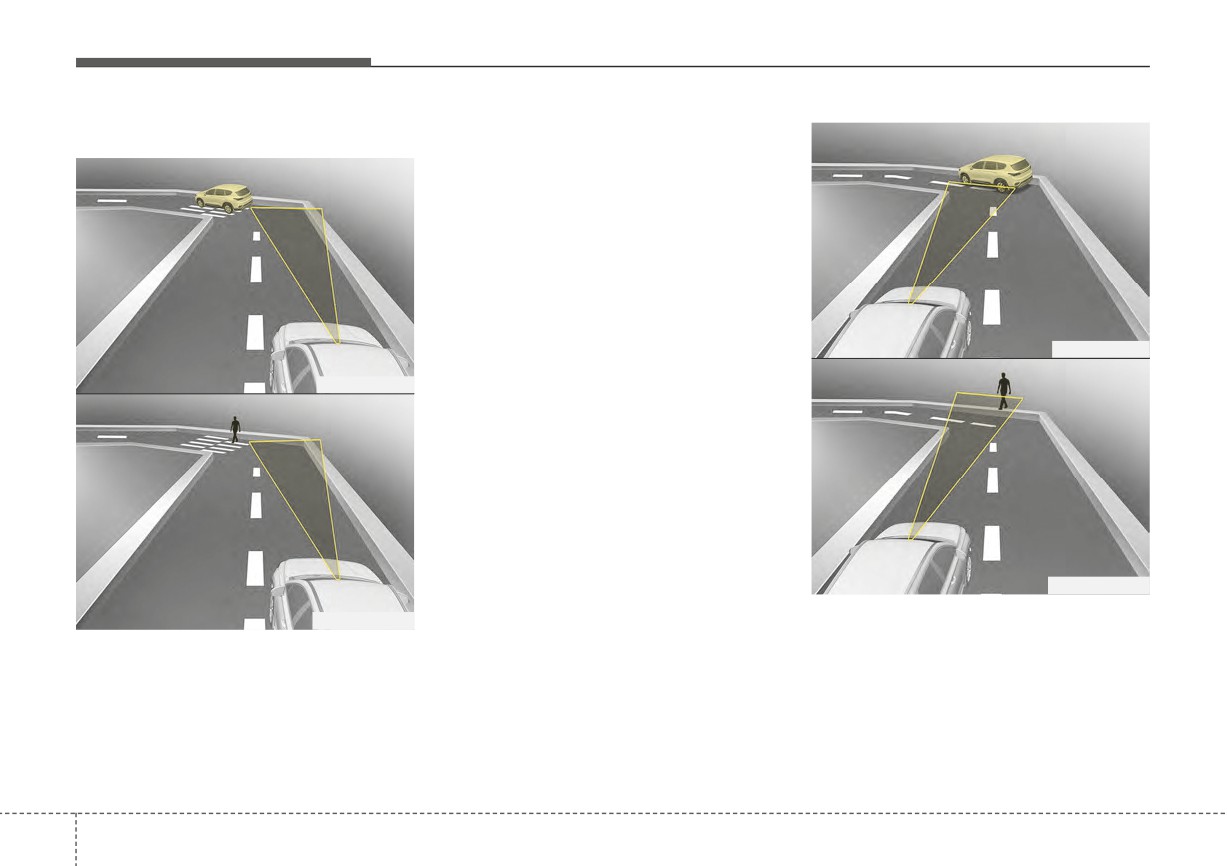
Driving on a curved road
The front view camera recognition
function may not detect the vehicle
or pedestrian traveling in front on a
curved road This may result in no
alarm or braking when necessary.
Always pay attention to road and
driving conditions, and if necessary,
depress the brake pedal to reduce
your driving speed in order to main-
tain a safe distance.
OHM059344L
OHM059342L
OHM059345L
Forward Collision-Avoidance Assist
OHM059343L
may recognize a vehicle or pedestri-
Forward Collision- Avoidance Assist
an in the next lane or outside the
may be limited when driving on a
lane when driving on a curved road.
curved road.
If this occurs, Forward Collision-
Avoidance Assist may unnecessarily
alarm the driver and apply the brake.
5 52
Driving your vehicle
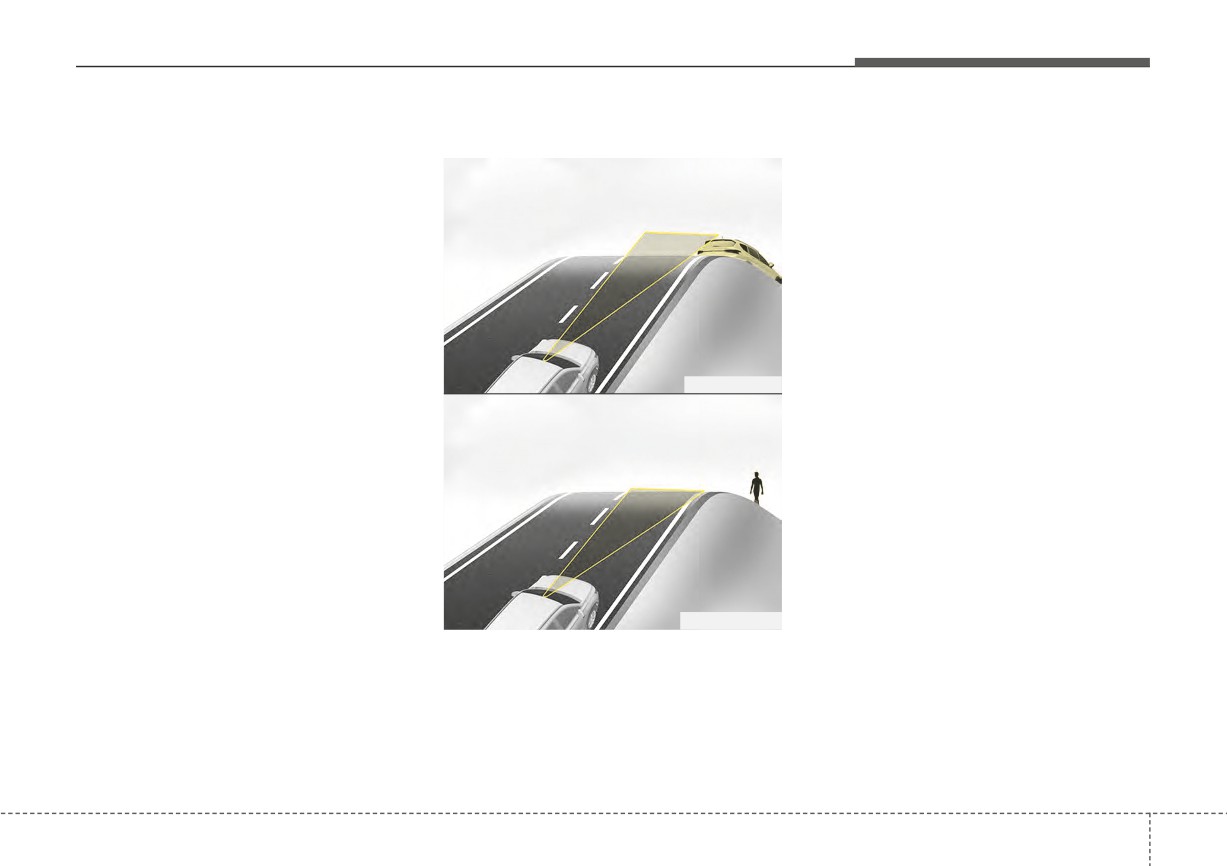
Always pay attention to road and Driving on an inclined road
The front view camera recognition
driving conditions, while driving.
may not detect the vehicle or pedes-
trian in front.
This may result in an unnecessary
alarm and braking or no alarm and
braking when necessary.
When the function suddenly recog-
nizes the vehicle or pedestrian in
front while passing over a slope, you
may experience sharp deceleration.
Always keep your eyes forward while
OHM059346L
driving upward or downward on a
slope, and, if necessary, depress the
brake pedal to reduce your driving
speed in order to maintain distance.
OHM059347L
The performance of Forward
Collision-Avoidance Assist may be
decreased while driving upward or
downward on a slope.
5
53
Driving your vehicle
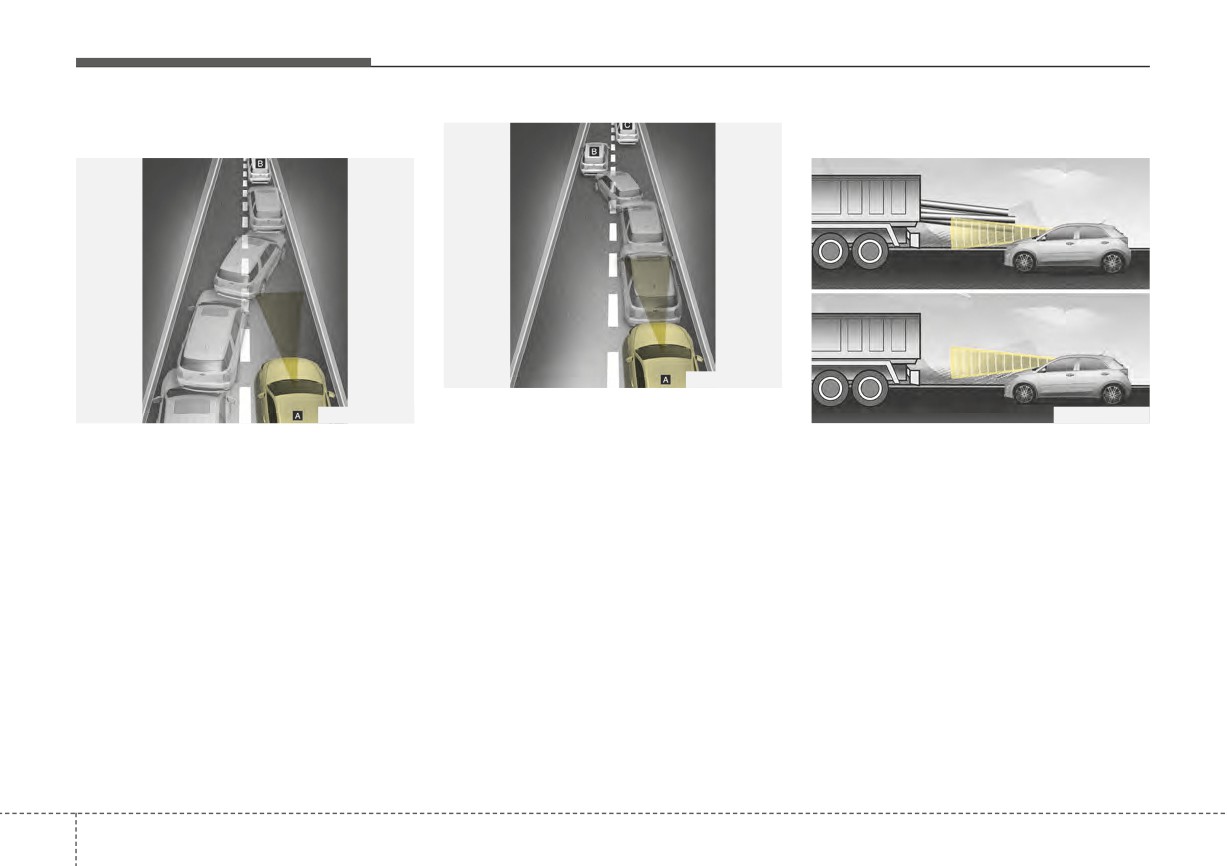
Changing lanes
Detecting vehicle
OSC050281N
[A]: Your vehicle, [B]: Lane changing
OSC050280N
OSC051154N
vehicle, [C]: Same lane vehicle
[A]: Your vehicle, [B]: Lane changing
When the vehicle in front has heavy
When driving in stop-and-go traffic,
vehicle
loading extended rearward, or when
and a stopped vehicle in front of you
When a vehicle changes lanes in
the vehicle in front has higher ground
merges out of the lane, Forward
clearance, it may induce a haz-
front of you, Forward Collision-
Collision-Avoidance Assist may not
Avoidance Assist may not immedi-
ardous situation. Always pay atten-
immediately detect the new vehicle
tion to road and driving conditions,
ately detect the vehicle, especially if
that is now in front of you. In this
the vehicle changes lanes abruptly.
while driving and, if necessary,
case, you must maintain a safe brak-
depress the brake pedal to reduce
In this case, you must maintain a
ing distance, and if necessary,
your driving speed in order to main-
safe braking distance, and if neces-
depress the brake pedal to reduce
tain distance.
sary, depress the brake pedal to
your driving speed in order to main-
reduce your driving speed in order to
tain a safe distance.
maintain a safe distance.
5
54
Driving your vehicle
Situation in which the function
•
There is an item similar to a per-
•
You are on a roundabout.
may not detect pedestrian
son's body structure
•
The pedestrian suddenly appears
properly
•
The pedestrian is small.
in front of the vehicle.
The sensor may be limited when:
•
The pedestrian has impaired
•
There is any other electromagnetic
mobility.
interference.
•
The pedestrian is not fully detected
by the camera recognition function,
•
The sensor recognition is limited.
for example, if the pedestrian is
•
The camera is blocked with a for-
leaning over or is not fully walking
eign object or debris.
upright.
•
Inclement weather such as heavy
•
The pedestrian is moving very
rain or snow obscures the field of
quickly or appears abruptly in the
view of the camera.
camera detection area.
•
When light coming from a street
•
The pedestrian is wearing clothing
light or an oncoming vehicle is
that easily blends into the back-
reflected on a wet road surface
ground, making it difficult to be
such as a puddle in the road.
detected by the camera recogni-
•
The field of view in front is
tion function.
obstructed by sun glare.
•
The outside lighting is too bright
•
The windshield glass is fogged up;
(e.g. when driving in bright sun-
a clear view of the road is obstruct-
light or in sun glare) or too dark.
ed.
(e.g. when driving on a dark rural
road at night)
•
The adverse road conditions cause
excessive vehicle vibrations while
•
It is difficult to detect and distin-
driving.
guish the pedestrian from other
•
The sensor recognition changes
objects in the surroundings, for
example, when there is a group of
suddenly when passing over a
speed bump.
pedestrians, or a large crowd.
5
55
Driving your vehicle
This device complies with Part 15
(Continued)
WARNING
of the FCC rules.
•
Forward Collision-Avoidance
•
Cancel Forward
Collision-
Operation is subject to the following
Assist is designed to detect
Avoidance Assist in the User
three conditions:
and monitor the vehicle ahead
Settings on the LCD display,
1. This device may not cause harm-
or detect a pedestrian in the
before towing another vehicle.
ful interference, and
roadway through front view
While towing, the brake appli-
camera recognition. It is not
2. This device must accept any inter-
cation may adversely affect
designed to detect bicycles,
ference received, including inter-
your vehicle safety.
motorcycles, or smaller
ference that may cause undesired
•
Exercise extreme caution to
wheeled objects such as lug-
operation.
the vehicle in front, when it
gage bags, shopping carts, or
3. Changes or modifications not
has heavy loading extended
strollers.
expressly approved by the party
rearward, or when it has high-
•
When replacing or reinstalling
responsible for compliance could
er ground clearance.
the windshield, front bumper
void the user’s authority to operate
•
Never try to test the operation
or front view camera recogni-
the device.
of
Forward
Collision-
tion after removal, take your
Avoidance Assist. Doing so
vehicle to an authorized Kia
may cause severe injury or
dealer and have the function
death.
checked.
(Continued)
✽ NOTICE
In some instances, Forward
Collision-Avoidance Assist may be
canceled when subjected to electro-
magnetic interference.
5
56