Amtrak. Service Standards Manual for Train Service and On-Board Service Employees (Version 6, 2011) - page 9
where they would interfere with the crew’s
ability to perform their duties effectively.
b) Business Class - In all cases where a split
Coach/Business (or split Business Class) is the
only designated Food Service Car in revenue
service, the Coach section will remain open for
the use of all passengers.
• Normally, on trains with more than one Food
Service Car, if the split Coach/Business is
properly positioned to avoid the necessity of
having Coach passengers pass through the
Business Class section, Coach passengers will
be given access to the Coach section.
c)
Report to CNOC
• Conductors must report standee conditions to
the CNOC using the toll-free telephone number
(800) 424-0217, and then follow prompts or
transmit the report via the Star Trak satellite
communications system using the perform
macro already in the system.
• Contact stations downline if possible so that the
station personnel can advise any passengers
waiting to board the train. (Refer to Chapter 8,
“Accounting”, Section 1 “Train Service
Accounting Procedures”)
15.
Unaccompanied Minor
For additional information on Unaccompanied Minors,
refer to Chapter 8 “Accounting”, Section 1 “Train
Service Accounting Procedures”)
a) Conditions for Travel
• Unaccompanied minor may only travel
between the hours of 6:00 a.m. and 9:00 p.m.
• Unaccompanied minor may only travel
between points where Amtrak station agents
are on duty.
• No transfers are permitted.
• Unaccompanied minor must pay full fare,
unless they are a pass rider.
• The responsible adult must complete and sign
the “Unaccompanied Minor Notification and
Release” (NRPC 770). This form must be
distributed to train crew and station agent.
• The unaccompanied minor must wear the
“Unaccompanied Minor Wristband” (NRPC
3150).
7-12
Policies & Procedures
• Minors must be between 8 and 14 years of age
and mature enough to make the trip.
• Unaccompanied minor must be interviewed by
the Station Agent or Person-in-Charge of the
station.
b) Unaccompanied Minor Using a Rail Travel
Privilege Card
• Minor must possess positive identification
whether traveling with the cardholder or alone.
• Employee or employee’s spouse may need to
sign tickets of children traveling unaccompanied
that are too young to have their own rail travel
privilege card.
• The conductor must:
• Note the minor’s location on the train.
• Make sure that the minor is located in sufficient
time to prepare for detraining.
• Make sure the minor departs at the correct
destination.
• Periodically check on the minor or, if necessary,
have a train attendant periodically check on
the child.
c)
If you encounter a situation where the minor is
between the ages of 8 and 14 and does not have a
release form, the following procedures apply:
•
Notify the next staffed station en route regarding
the minor’s destination.
•
If the destination is an unstaffed station, and a
party is not there to meet the minor, continue
to the next staffed station.
•
Upon arrival at the destination (ticketed or
otherwise), release the minor to a responsible
party or Station Agent.
•
File a report with the Station Supervisor or
agent that includes:
•
The name of the minor.
•
The fact that the minor under the acceptable
age was traveling unaccompanied without a
release form.
•
The minor’s destination.
•
To whom the minor was released upon arriving
at the destination (Station Agent, a relative or
friend, etc.).
•
Verification of the identity of minor’s relative
or friend by examination of a valid photo I.D.
Service Standards Manual No. 6
7-13
16.
Authority to Board and Ride Amtrak Locomotives
and Trains
a)
Authorization
•
Only authorized persons are permitted to ride
Amtrak locomotives and/or trains without
transportation.
•
Persons required to qualify on the physical
characteristics or perform services and/or
inspections must have in their possession at
least one type of authorization as listed in
letter b) Types of Authorization.
•
Each person authorized to board Amtrak
locomotives and/or trains to qualify on the
physical characteristics or perform services and/
or inspections must identify themselves to the
Engineer and Conductor and show proper
credentials and authorization prior to boarding.
•
Inspectors should also identify themselves to
any official present.
•
Whenever traveling for non-business purposes,
inspectors must purchase proper transportation.
•
Employees are prohibited from riding in
locomotives, power cars, and/or control car
cabs, whether operating or trailing, unless
specifically authorized to do so, in writing, in
the performance of their duties (e.g., qualifying
on physical characteristics; performing
Engineering or Mechanical Department
inspections, etc.).
b) Types of Authorization
• Amtrak Head-End and Train Authorization
Permit - Photo ID authorizes bearer to ride
head-end or body of train to learn physical
characteristics or perform services and/or
inspections.
• Amtrak Train Inspection Permit - Photo ID
authorizes bearer to ride body of train (NOT
HEAD-END) to perform services and/or
inspections.
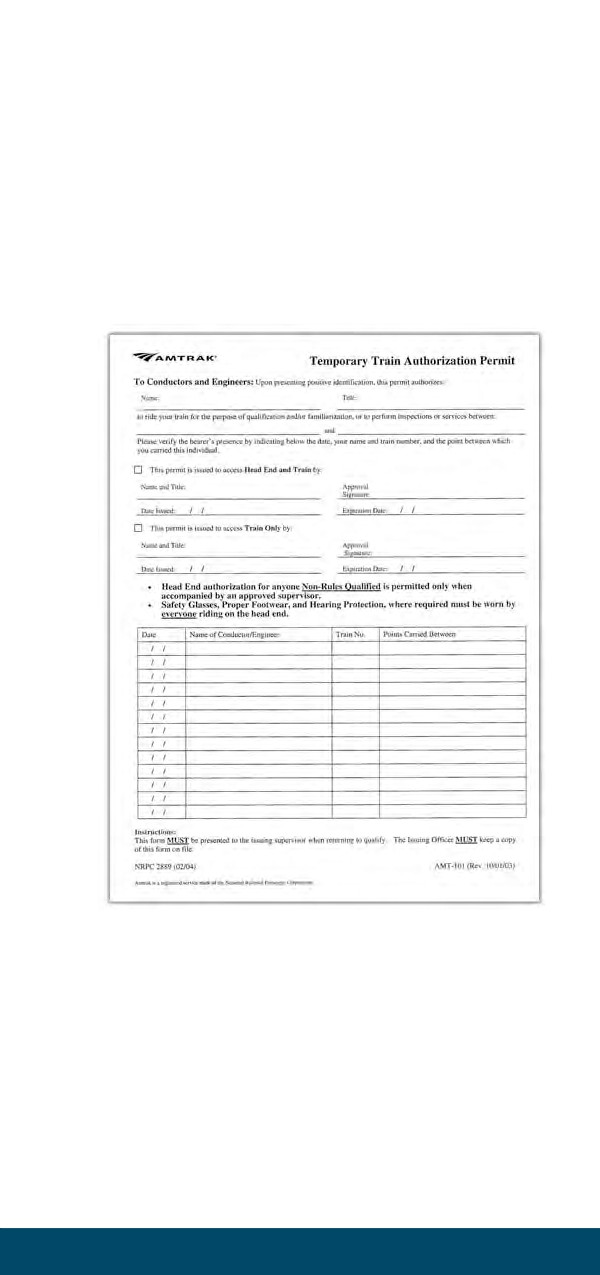
• Amtrak “Temporary Train Authorization
Permit” (NRPC 2889) - Authorizes bearer to
ride head-end or body of train to learn physical
characteristics, or perform services and/or
inspections. Permit must indicate whether
“Head-End and Train” or “Train Only”. (Refer
to Figure 7-2)
7-14
Policies & Procedures
•
Amtrak Police Identification -
• Systemwide - With a photograph, authorizes
Amtrak Police Officers to board and ride
head-end or body of all Amtrak trains.
• Amtrak Property - With a photograph,
authorizes Amtrak Police Officers to board
and ride head-end or body of all trains
operating on Amtrak property (Northeast
Corridor, Chicago Terminal, etc.).
•
Photo ID of individual working for a Municipal,
State or Federal Regulatory Agency -
• Authorizes inspectors and employees of
such agencies to ride head-end or body of
Amtrak trains to perform services and/or
inspections.
• New Jersey State Police, New Jersey Transit
Police and New York City Police
Department Officers while on duty and in
uniform may ride only in the body of the
train, unless otherwise authorized or
approved.
•
Valid Head-End Permit from other railroads/
transportation authority (On Amtrak property
between Washington, DC and Boston, MA) -
Authorizes bearer to ride head-end to perform
services and/or inspections on passenger trains
other than those in Amtrak service. When
doing so they must comply with all Amtrak
rules, procedures and instructions.
•
Valid Head-End Permit from other
railroads/transportation authority (On other
than Amtrak property between Washington,
DC and Boston, MA) - Authorizes bearer to
ride head-end to perform services and/or
inspections.
c)
Head-End Occupancy with Student Engineer
Present
Only persons in the following categories may
occupy the operating cab of a train while a
Student Engineer is operating the train:
• A member of the assigned Train and Engine
crew (Engineer, Second Engineer, Assistant
Conductor, Conductor). Train crew members may
occupy the Head-end only in the performance of
their duties. When a Student Engineer is on
the head-end, train crew members must not
Service Standards Manual No. 6
7-15
occupy the head-end for the purposes of
qualifying on the physical characteristics.
• An FRA/State Inspector performing an
inspection.
• A Designated Supervisor of Locomotive
Engineers evaluating a Student Engineer or
assigned Engineer. If an emergency occurs
that requires a person not in one of the above
categories to ride in the operating cab while a
Student Engineer is in training, the Student
Engineer must not be permitted to operate
the train.
d) Number of people in Cab
No more than four people, including the operating
crew, are permitted to ride in the operating cab
or compartment of any locomotive, control car or
multiple unit train.
e)
Employees in Cab
Employees are permitted to ride the head-end
only in the performance of their duties.
Employees must remain vigilant at all times
for signals and conditions ahead and must not
interfere with the Engineer’s vigilance. Any person
NOT qualified on ANY operating rules must not
occupy the head-end without being accompanied
by a qualified supervisor. Deadheading employees
are prohibited from riding in the operating cab
of trains. Employees qualifying on physical
characteristics are prohibited from riding the
head-end of Acela Express trains.
• Prior to boarding the locomotive, the authorized
rider must:
• identify themself to the Engineer. (The
Engineer will inform the Conductor of
his/her presence in the cab.)
• present the Head-end Authorization for
inspection.
• state the purpose of riding.
• state qualifications (i.e. operating rules,
physical characteristics).
• While in the operating cab, the authorized
rider must:
• not distract the Engineer from the
performance of their duties. (There must
be no unnecessary conversation).
• wear safety glasses and proper footwear.
7-16
Policies & Procedures
• if qualified on the operating rules, call
signals affecting the movement of the train.
• if qualified on physical characteristics, remind
the Engineer of temporary restrictions when
required by operating rules.
f) Conflict with Foreign Carrier
Where these instructions conflict with the policy
of a foreign carrier over which Amtrak trains
operate, the foreign carrier policy will govern.
Figure 7-2 - “Temporary Train Authorization Permit” (NRPC 2889)
Service Standards Manual No. 6
7-17
B.
Food & Beverage Policies/Procedures
1.
Alcohol Beverage
a)
Personal Supplies - Personal supplies of alcohol
can only be consumed by passengers in the privacy
of sleeping car accommodations and are not per-
mitted to be consumed in public view at any time.
b) Sale of Alcohol
•
The LSA must consult with the Conductor if
there is any question as to whether or not to
sell alcohol.
•
The sale of alcohol is determined by the state
or region through which the train is traveling.
•
Amtrak must be in compliance with the laws
of the state where the train is located or operating
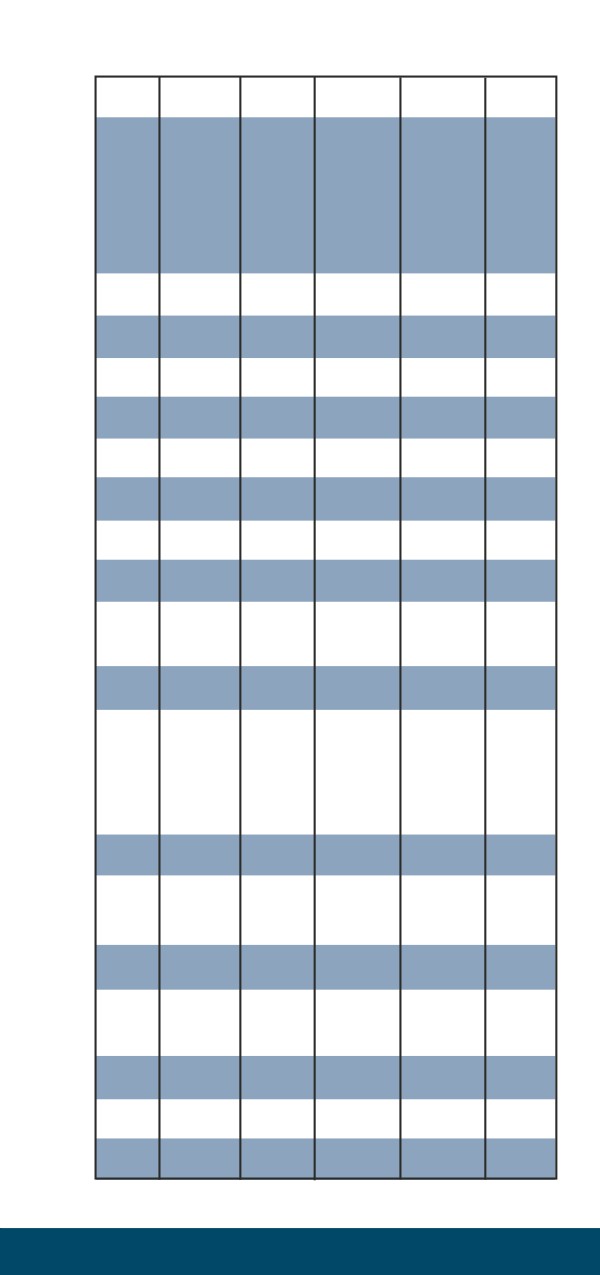
through. (Refer to Figure 7-7)
•
Employees must crack the seal of any alcoholic
beverage prior to giving it to the passenger.
•
Employees are prohibited from selling alcohol
to passengers under the legal drinking age,
passengers who appear intoxicated, or anyone
attempting to buy alcohol for these passengers
for an intoxicated individual or someone who
is under age.
•
In the state of Illinois, employees serving alcohol
are permitted to ask for identification to verify
the age of the person drinking alcoholic drinks.
If the individual has no identification, they are
not to be served.
7-18
Policies & Procedures
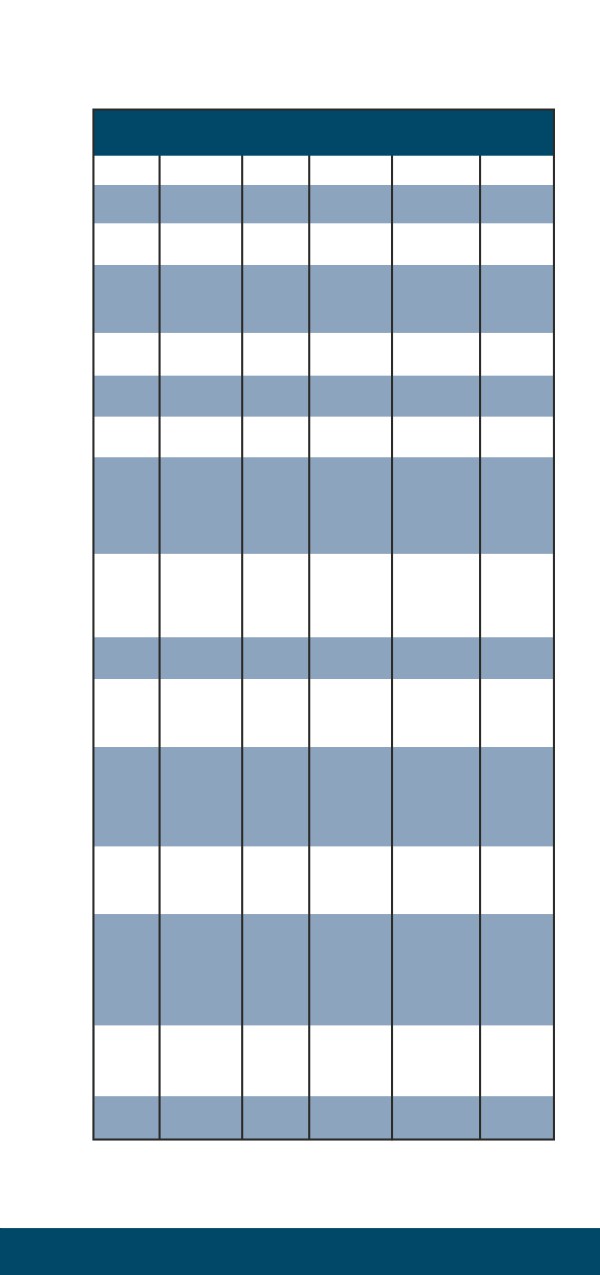
Alcohol Sales Restriction
Alcohol may NOT be sold during the following
designated times (May 2010)
State
Weekday
Saturday
Sunday
Holidays
Election Day
Alabama
No
No
Not b/w
No special
No special
restrictions
restrictions
2am-midnight
restrictions
restrictions
Arizona
Not b/w
Not b/w
Not b/w
No special
No special
2am-6am
2am-6am
2am-10am
restrictions
restrictions
Arkansas
Not b/w
Not b/w
No sales
No sales on
No special
midnight-7am
1am-7am
Xmas Day
restrictions
(M); not b/w
1am-7am (T-F)
California
Not b/w
Not b/w
Not b/w
No special
No special
2am-6am
2am-6am
2am-6am
restrictions
restrictions
Colorado
Not b/w
Not b/w
Not b/w
No special
No special
2am-7am
2am-7am
2am-7am
restrictions
restrictions
Connecticut
No
No
No
No special
No special
restrictions
restrictions
restrictions
restrictions
restrictions
Delaware
Not b/w
Not b/w
If Dec. 24 is
No special
1am-9am
1am-9am
on (Sun) or
restrictions
w/ special
Dec. 31 is on
license
(Sun), sales are
okay only b/w
1pm-6pm
District of
Not b/w
Not b/w
Not b/w
Okay until 3am
No special
Columbia
2am-8am
3am-8am
3am-10am
on all District &
restrictions
Fed. Holidays;
okay until 4am
on Jan 1
Florida
No
No
No
No
No special
restrictions
restrictions
restrictions
restrictions
restrictions
Georgia
No
No
No sales
Localities
No special
restrictions
restrictions
may restrict
restrictions
Xmas Day
sales
Idaho
Not b/w
Not b/w
Not b/w
Memorial Day,
No special
midnight-
1am-10am
1am-midnight
Thanksgiving,
restrictions
10am (M);
Xmas, not b/w
not b/w
1am-10am the
1am-10am
following day
(T-F)
Illinois
No
No
No sales
No special
No special
restrictions
restrictions
(unless county
restrictions
restrictions
or city council
permits)
Indiana
If no Sun.
Not b/w
If no Sun.
Never b/w 3am
No special
permit can’t
3am-7am
permit not b/w
Xmas Day -
restrictions
sell until 7am
3am-7am (M).
7am Dec 26
(M); If Sun.
If Sun. permit,
permit, can’t
okay to sell
sell b/w 3am-
b/w 7am-
7am (T-F)
3am (M)
Iowa
Not b/w
Not b/w
With Sun.
Always okay
No special
2am-6am
2am-6am
permit,okay
from 8am-2am
restrictions
to sell b/w
(M) when Dec
2am-8am (M)
31 is on Sun
Kansas
Not b/w
Not b/w
Not b/w
No special
No special
2am-9am
2am-9am
2am-9am
restrictions
restrictions
Figure 7-7 Liquor Law Chart (3 pages)
Service Standards Manual No. 6
7-19
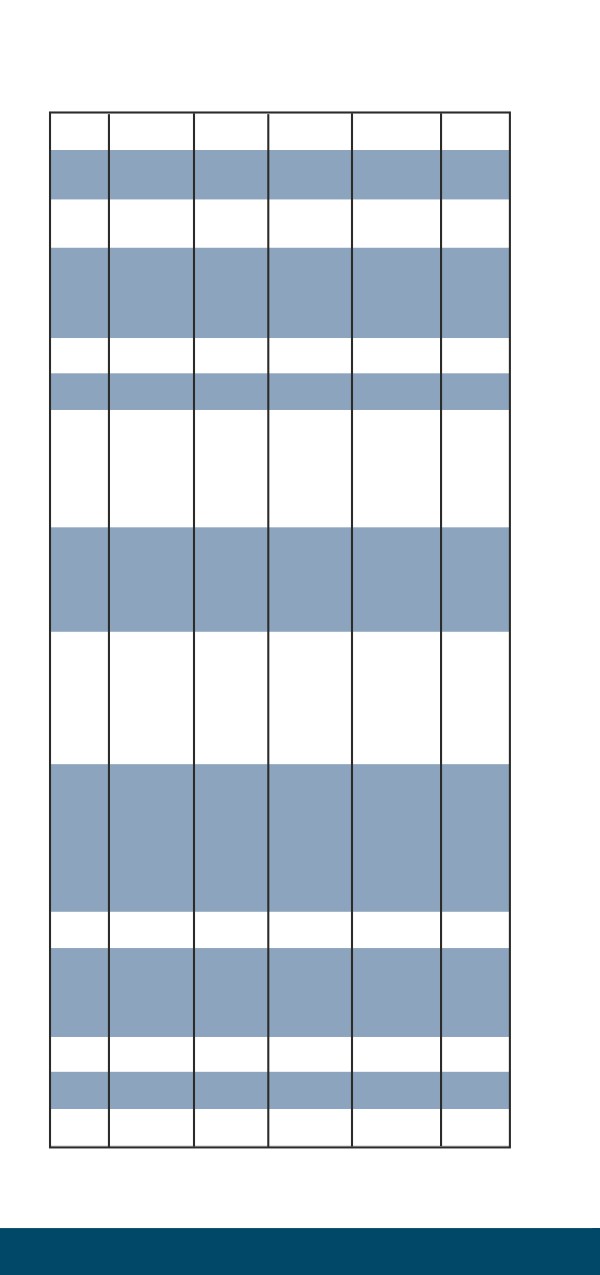
Alcohol Sales Restriction (continued)
State
Weekday
Saturday
Sunday
Holidays
Election
Day
Kentucky
Not b/w
Not b/w
No sales
No special
No sales
12am-6am
12am-6am
restrictions
until polls
close
Louisiana
Depends on
Depends on
Depends on
No special
No special
county
county
county
restrictions
restrictions
ordinance
ordinance
ordinance
Maine
Not b/w
Not b/w
Not b/w
Always okay b/w
No special
1am-6am
1am-6am
1am-9am
midnight - 2am
restrictions
Jan. 1; when
Dec. 31 on Sun,
okay b/w 9pm -
2am (M)
Maryland
No restrictions
No
No restrictions
No special
No special
restrictions
restrictions
restrictions
Massa-
No restrictions
No
No restrictions
No special
No special
chusetts
restrictions
restrictions
restrictions
Michigan
W/o Sun.
Not b/w
W/o Sun.
Not b/w 9pm,
No special
permit not b/w
2am-7am
permit, not b/w
Dec. 24 - 7am,
restrictions
midnight - 7am
2am-midnight;
Dec. 26; Okay
(M); If Sun.
If Sun. permit
b/w 7am - 4am
permit, not b/w
b/w noon -
on Jan.1
2am-7am (M);
2am (M)
Not b/w 2am-
7am (T-F)
Minnesota
W/o Sun.
Not b/w
W/o Sun.
No special
No special
permit not until
2am-8am
permit b/w 2am
restrictions
restrictions
10am (M); If Sun
10am (M); If
permit, not b/w
Sun permit b/w
2am-8am (M);
2am-10am (M)
Not b/w 2am-
8am (T-F)
Mississippi
No sales while
No sales while
No sales while
On Jan. 1, sales
No special
train stopped
train stopped
train stopped
okay until 1am;
restrictions
in dry country;
in dry county;
in dry county;
If Dec. 31 is on
no alcohol sales
no alcohol sales
no alcohol sales
Sun., alcohol,
b/w midnight -
b/w midnight-
on Sun.; beer &
beer, light wine
10am; no beer
10am; no beer
light wine
okay b/w
& light wine
& light wine
sales okay b/w
1pm-1am (M)
sales b/w
sales b/w
7am-midnight
midnight -7am
midnight -7am
Missouri
No liquor sales
Not b/w
Okay to sell
Always allowed to
No special
b/t midnight-
1:30am-6am
malt liquor b/w
sell b/w 1:30-6am
restrictions
6am (M); No
9am-midnight;
on Jan 1, March
sales of other
not okay to sell
17, July 4, Dec 31,
alcohol sales
other alcoholic
Sundays before
of other
beverages b/w
Memorial Day
alcoholic bev.
1:30am-
& Labor Day,
until 6am (M);
6am (M)
and on Super
Not b/w 1:30am-
Bowl Sunday
6am (T-F)
Montana
Not b/w
Not b/w
Not b/w
No special
No special
2am-8am
2am-8am
2am-8am
restrictions
restrictions
Nebraska
Not b/w
Not b/w
Not b/w
No special
No special
midnight-6am
1am-6am
6am-1am (M)
restrictions
restrictions
(M); not b/w
localities can
1am-6am
permit Sun
(T-F)
sales after
noon
Nevada
No restrictions
No
No restrictions
No special
No special
restrictions
restrictions
restrictions
New
Not b/w
Not b/w
Not b/w
No special
No special
Hampshire
1am-6am
1am-6am
1am-6am
restrictions
restrictions
New
No restrictions
No
No restrictions
No special
No special
Jersey
restrictions
restrictions
restrictions
7-20
Policies & Procedures
State
Weekday
Saturday
Sunday
Holidays
Election
Day
New
Not b/w
Not b/w
W/o a Sun
If Dec. 31 is on
No special
Mexico
midnight-7am
2am-7am
license; only b/w
Sun, okay to
restrictions
(M); not b/w
midnight-2am
sell from noon
2am-7am (T-F)
(no sales
to midnight.
allowed b/w
On Xmas, sales
7am - midnight);
okay from noon
with Sun license
to 10pm as long
okay to sell b/w
as Amtrak has
noon-midnight
food service
permit
New York
Not b/w
Not b/w
Not b/w
No special
No special
4am-8am
4am-8am
4am-noon
restrictions
restrictions
North
No
No
No
No special
No special
Carolina
restrictions
restrictions
restrictions
restrictions
restrictions
North
No
No
No
No special
No special
Dakota
restrictions
restrictions
restrictions
restrictions
restrictions
Ohio
Not b/w
Not b/w
Not b/w
No special
No special
1am-5:30am
1am-5:30am
2:30am-1pm
restrictions
restrictions
Oklahoma
No
No
No
No special
No special
restrictions
restrictions
restrictions
restrictions
restrictions
Oregon
Not b/w
Not b/w
Not b/w
No special
No special
2:30am-7am
2:30am-7am
2:30am-7am
restrictions
restrictions
Pennsyl-
Not b/w
Not b/w
Not b/w
No special
No special
vania
2am-7am
2am-7am
2am-7am
restrictions
restrictions
Rhode
No
No
No
No special
No special
Island
restrictions
restrictions
restrictions
restrictions
restrictions
South
No
No
No sales
No special
No sales on
Carolina
restrictions
restrictions
restrictions
days of
statewide
election
Tennessee
No restrictions
No
No restrictions
No special
No special
restrictions
restrictions
restrictions
Texas
No sales of
No sales of
No sales of
No sale of just
No special
beer, wine
beer, wine
beer, wine,
liquor on New
restrictions
and mixed
and mixed
and mixed
Year's Day,
beverages
beverages
beverages
Thanksgiving
b/w midnight-
b/w midnight-
b/w 1am-noon;
Day, or
7am; no sales
7am; no sales
no sales of
Xmas Day
of liquor b/w
of liquor b/w
just liquor
9pm-10am
9pm-10am
Utah
No restrictions
No
No restrictions
No special
No special
restrictions
restrictions
restrictions
Vermont
Not b/w
Not b/w
Not b/w
On New
No special
2am-8am
2am-8am
2am-8am
Year's Day,
restrictions
not b/w
3am-8am
Virginia
Not b/w
Not b/w
Not b/w
No special
No special
2am-6am
2am-6am
2am-6am
restrictions
restrictions
Washington
Not b/w
Not b/w
Not b/w
No special
No special
2am-6am
2am-6am
2am-6am
restrictions
restrictions
(w/o board
(w/o board
(w/o board
approval)
approval)
approval)
West
Not b/w
Not b/w
Not b/w
No special
No special
Virginia
2am-7am
2am-7am
2am-1pm
restrictions
restrictions
Wisconsin
No
No
No
No special
No special
restrictions
restrictions
restrictions
restrictions
restrictions
Wyoming
Not b/w
Not b/w
Not b/w
No special
No special
2am-6am
2am-6am
2am-6am
restrictions
restrictions
Service Standards Manual No. 6
7-21
2. Alcohol Beverage Serving Procedures
a) Acela Cocktail Service - First Class
• For table and at-seat service, prepare plastic
beverage glass, or appropriate glassware on
Acela Express, with ice, proper garnish and
cocktail stirrer.
• Place the glass, cocktail napkin, liquor miniature
and mixer on small serving tray.
• Take the tray to the passenger and present the
liquor for approval.
• Pour the liquor into the glass and add the mixer.
• Remove the empty miniature and remaining
mixer unless the customer requests otherwise.
• When serving several orders at once, place
cocktail napkins, setups with mixers, and items
to be served on a tray; then serve passengers
individually from the tray.
Cocktail
Garnish
Instructions
Tonic drinks
Lime Wedge (optional),
Add contents of miniature, then
Rum & Coke
Stirrer
add mixer. Pour over ice.
Martini (Gin or
Two Olives, Stirrer or
Add contents of miniature, then
Vodka)
Lemon Twist
add mixer. Pour over ice.
Screwdriver
No Garnish, Stirrer
Pour one Vodka miniature into
glass, then add orange juice.
Cognac
No Garnish, Stirrer
Serve straight or over ice as
(optional)
requested.
Bloody Mary
Lime or Lemon wedge
Pour Vodka into glass, and then
on rim of glass, Stirrer
add Bloody Mary mix to suit.
Highballs:
Lemon Wedge on rim
Add desired miniature to glass,
Bourbon & Scotch
is optional, Stirrer
and then add mix to suit.
& Soda, etc.
b) Cocktail Service - Counter
• Prepare plastic beverage glass with ice, proper
garnish and cocktail stirrer.
• Place the glass on a cocktail napkin on the
counter, or in a carryout box.
• Pour the liquor first, and then add the mixer.
c) Beer Service
• Keep an assortment of available beers chilled.
• Serve with beer appropriate plastic or glassware
(depending on service) and cocktail napkin.
• Open bottled beer using proper opener.
• Do not place glass directly on the top of bottle
or can.
d) Wine Service
• White wine is served chilled while red wine is
served at room temperature.
7-22
Policies & Procedures
• Open corked wine bottle using proper corkscrew.
• Serve wine in a plastic wine glass or appropriate
glassware on Acela Express with a cocktail napkin.
3.
Beverage - Non-Alcohol
a) Soda, Juice and Milk
• Soda is served with a plastic glass or appropriate
glassware on ice with a cocktail napkin.
• Juice is served chilled, if possible, in a plastic
glass or appropriate glassware with a cocktail
napkin. If juice is not chilled, serve with ice.
• Milk is always kept refrigerated and served in
a plastic glass with a cocktail napkin.
• Straws should be available for those passengers
who request them.
b) Hot Beverages
• Serve coffee, tea and hot chocolate in a cup
that is appropriate for hot beverages with a
cocktail napkin.
• Hot beverages, not served at a table, should
have a securely fitted lid.
• When placing hot beverages in a carryout box,
make sure the opening in the lid is to the
inside of the box.
4.
Beverage Refills
Refills are not permitted on purchased beverages but
are allowed on complimentary beverages.
a) Dining Cars - Beverages included with the purchase
of an item can be refilled at no additional cost to
the passenger.
b) Café/Lounge Cars
• There are no refills for beverages sold in these
cars with the exception of San Joaquin and
Capitol Corridor Routes.
• San Joaquin and Capitol Corridor Routes
passengers who purchase coffee, tea or hot
water that is dispensed into an Amtrak-provided
cup in the Café/Lounge Car are entitled to one
free refill.
• When dispensing the free refill for the San
Joaquin and Capitol Corridor Routes passenger,
the LSA shall mark the bottom of the Amtrak-
provided cup with the letter “R” indicating a
refill was provided.
c) Sleeping Cars
• Beverages that are offered as complimentary
in the Sleeping Car itself (coffee, juice or tea)
are refillable.
Service Standards Manual No. 6
7-23
• The Train Attendant should provide this service
unless there is a station stop or other operational
requirement necessitating their attention.
• If a Sleeping Car does not have their complimen-
tary beverages and/or has an inoperative coffee
maker, passengers in that car may obtain their
complimentary beverages by presenting their
ticket receipt to the LSA-Lounge.
d) Acela Express First Class - Those beverages that
are offered as complimentary to passengers in the
Acela Express First Class car can be refilled at no
additional cost to the passenger.
e) Northeast Regional and Pacific Business Class or
an upgraded service - Those beverages that are
offered as complimentary to passengers in these
services can be refilled at no additional expense
to the passengers.
f) Auto Train - Beverages that are offered as
complimentary aboard the train can have refills.
5.
At Seat Cart Service
a)
Loading Cart - Place heavy items in the bottom
of the cart to help stabilize the cart and to prevent
tipping over.
b) Cart Position
• Position the cart at the front of the train.
• When providing cart service to the entire
train, begin selling from the front of the train
proceeding to the rear of the train. This ensures
that the passengers see and understand what
“At Seat Cart Service” provides.
• When using a cart to delivery complimentary
service to passengers in Business Class Service,
then position the cart in the front of the
Business Class car.
c)
Announcements - Make announcements after
departure from major station stops to inform
passengers that Cart Service is available on this
train.
d) Keep Moving - Continuously walking through the
train with the cart allows multiple opportunities
for passengers to use the service.
e)
Greeting Passengers - Greet passengers with the
appropriate salutation.
f)
Public Health Requirements - Wash hands
frequently; comply with all Public Health
requirements, particularly related to the handling
of ice.
g)
Cart Brake - Apply cart brake when providing
service, conducting sales or in docking position.
7-24
Policies & Procedures
h) Back Ordering
• The LSA may purchase from the Café/Lounge
Car, if available.
• The LSA on NEC trains have the ability to
contact commissaries enroute to back order
supplies.
6.
Crew Members Eating in the Dining Car
a)
Meal Periods - The LSA-Diner is to designate one
table for use by On-Board Service crew members
using the “Reserved” tent card. (Refer to Chapter
10 “On-Board Announcements and Signage”)
b) Crew Table
• The designated crew table is to be set exactly
as every other table.
• Only one employee per slot is permitted to
occupy the table.
• Employees using the designated crew table are
responsible for cleaning and resetting the table
after completing their meal.
c)
Reservation System - The LSA-Diner is to use a
reservation system to coordinate the designated
meal times for employees who desire to eat in the
Dining Car.
d) Employee Responsibilities
• When a Food Service Car is open and serving,
employees must avoid occupying any seat or
table in the car.
• Employee grips and outerwear must be stored
out-of-sight, and must not be left on tables or
seats. This applies to all On-Train personnel.
e)
To Go Meals
Working or deadheading crew members who do
not eat in the Dining Car may order their meals
“to go”. Meals “to go” are to be consumed in one
of the following locations:
• Dorm Car - employee room.
• Superliner Dorm - lower-level table area.
• Sleeping Car - employee’s room.
• Coach - employee seat.
• Employees who come into the Dining Car to
pick up a meal “to go” are not to congregate or
sit at the designated crew table. This procedure
does not apply to Auto Train.
f)
Paperwork
• Employee paperwork is not to be performed at
tables in the Dining or Café/Lounge Cars during
service hours.
• If it becomes necessary to use a table, no more
than one table may be used.
Service Standards Manual No. 6
7-25
g) Extra Supplies - Any additional stock is to be
stored out of the site of passenger. Seats and
booths are not to be used to store stock.
h) Professional Demeanor - Employees must
maintain a professional demeanor and a clean,
organized work area at all times.
7.
Hours of Service - Dining Car
a)
Open and Ready - Dining Cars are to be open
and ready for service when passengers board at
initial terminals during a scheduled meal period.
No exceptions!
• The collection of tickets is not a reason to
delay the opening of any Food Service Car.
• Announcements that advise customers to wait
until all tickets have been collected before
visiting Food Service Cars are prohibited.
b) Hours of Service - Dining Car hours for meal
service are general timeframes that may be subject
to some variation by specific train or expanded
during seasonal or peak travel periods:
• Breakfast 6:30 am - 10:00 am
• Lunch
11:30 am - 3:00 pm
• Dinner
5:00 pm - 9:00 pm
c)
Breakfast for Train Nos. 49 and 29
• The breakfast timeframe for day two should
be reviewed with the passengers in the evening
of day one, prior to Sleeping Car passengers
retiring and before Coach lights are dimmed.
• Last call for breakfast on day two (the morning
the train arrives in Chicago) should be made
no earlier than the following times if the train
is operating on time:
• Train No. 49 - 8:00 a.m. central time
• Train No. 29 - 7:30 a.m. central time
• If the train is operating late, the LSA-Diner
must confer with the Conductor to determine
the estimated arrival time and adjust the last call
for breakfast to correspond with the projected
delay.
• As an alternative to having breakfast in the
Dining Car, advise all passengers that continental
breakfast items are available in the Café/Lounge
up to 30 minutes prior to arrival in Chicago.
8.
Hours of Service - Café/Lounge Cars
a) Open and Ready
• The collection of tickets is not a reason to
delay the opening of any Food Service Car.
7-26
Policies & Procedures
• Announcements that advise customers to
wait until all tickets have been collected before
visiting Food Service Cars are prohibited.
b) Hours of Service - Long Distance Trains
• Café/Lounge Cars operating on long distance
trains (500 miles or more) will have normal
hours of service from 6:00 am until midnight,
unless otherwise indicated on the train manifest.
• Café/Lounge Cars on long distance trains
should remain open until 30 minutes prior to
the arrival at the final terminal. If a passenger
wants to make a purchase after closing, all
efforts should be made to provide service.
c) Hours of Service - Short Distance Trains
Café/Lounge Cars operating on short distance
trains (500 miles or less) must be open continu-
ously from initial terminal to final destination or
“bumper to bumper” except for San Joaquin,
Capitol Corridor and Pacific Surfliner trains.
d) Hours of Service - San Joaquin and Capitol
Corridor Trains
Café Cars must be open continuously from initial
terminal to final destination or “bumper to
bumper” except for the following:
• Trains returning to Oakland on the last leg of the
trip will make a closing announcement upon
departure from the Martinez Station that the
Café Car will close departing the Richmond
Station.
• A second announcement must be made departing
the Richmond Station advising passengers the
Café Car is now closed.
• If a passenger wants to make a purchase after
closing, all efforts should be made to provide
service.
e) Hours of Service - Pacific Surfliner Trains
Café Cars must be open continuously from initial
terminal to final destination or “bumper to
bumper” except for the following:
• Trains returning to Los Angeles on the final leg
of the trip will make a closing announcement
upon departure from Fullerton on the south end
of the corridor and at departure from Glendale
on the north end of the corridor.
• A second announcement that the car is closed
will be made 10 minutes after departure from
Fullerton or Glendale depending on the train’s
orientation.
Service Standards Manual No. 6
7-27
• If a passenger wants to make a purchase after
closing, all efforts will be made to provide
service.
f) Break Periods - NEC Trains Operating Between
Boston and Washington
All LSAs working between Boston and Washington
may close their Café Car for a break period on all
Acela Express and Northeast Regional trains at
the following locations:
• Southbound train Café Cars will close at NRO
and reopen upon departure from NYP.
• Northbound train Café Cars will close upon
arrival at NWK and reopen upon departure
from NYP.
• An announcement should be made 5 minutes
prior to closing of the Café Car for break
periods. This “last Call” announcement will
allow passengers time to make their way to
the Café Car for purchases before closing.
9.
Ice
a) Amtrak will provide ice to passengers upon
request, as long as there is a sufficient supply
on-board. Passenger items can never come in
contact with Amtrak food, ice or related supplies.
It is particularly important that ice be provided to
any passenger who has medication which needs to
be kept cool
b) Ice can be dispensed to passengers as follows:
• In an ice bucket
• In an Amtrak plastic cup
• In a freezer bag (available from the kitchen)
10.
At Seat/In Room Meal Service
a) General Information
•
“At Seat” or “In Room Meal Service” is available
to all passengers.
• Those passengers who are disabled or find it
difficult to walk to the food service car are always
to be offered, and then provided this service.
• There is no charge for room service.
b) Sleeping Car
• Inform the LSA-Diner of any passengers who
would like meals in their rooms.
• The Sleeping Car Attendant is responsible for
taking the passenger’s order to the LSA-Diner
and delivering the meal.
• Meal will be delivered to the passenger on a
tray and served on a plate covered with a
plastic plate cover.
7-28
Policies & Procedures
• Silverware will be rolled in a linen napkin.
• When the passenger is finished, dispose of the
trash and return all food service equipment to
the Dining Car before the kitchen closes.
c)
Coach
•
Offer “at-seat” food and beverage service from
the Dining or Café/Lounge Car.
•
Obtain a copy of the current menu from the
LSA-Diner so questions relating to menu
selections can be accurately answered.
•
For “at-seat” orders, the Train Attendant is
responsible for taking the passenger’s order to
the LSA-Diner, handling payment and serving
the meal.
•
Meals will be delivered in a white paper
delivery bag.
•
Meals will be served in “carryout” hinged lid
containers.
•
The LSA-Diner will supply the Train
Attendant with the passenger’s receipt who, in
turn, is then responsible for ensuring that the
receipt is given to the passenger.
•
The following should be included with each meal.
•
Plastic ware.
•
Napkins.
•
Complimentary beverage when one is included
with meal.
•
Meal accompaniments such as ketchup, salad
and salad dressing, dinner rolls, etc.
11.
Non-Amtrak Food and Beverage (Non Alcohol)
a) May be consumed by passengers in the following
locations.
• Any Coach seat.
• Any Sleeping Car accommodation (both alcohol
and non-alcohol beverages permitted).
• Upper level of Superliner Lounge Cars.
• Acela Express equipment.
• Empire Service equipment.
• Northeast Regional Café Cars.
b) All other Food Service Cars are intended for the
consumption of only Amtrak provided meals,
snacks and beverages.
c) Amtrak is prohibited from providing any
refrigeration, thawing, heating, cooking or
storage of any food or beverage items brought
on-board by passengers or employees.
Service Standards Manual No. 6
7-29
12. Public Health
Crews working in any Food Service Car must strictly
adhere to FDA rules and inspection standards.
(Refer to Chapter 3 “FDA Rules and Inspections”)
13. Meal Restrictions for Employees Occupying
BT Space
Employees traveling on business, commuting or
personal business occupying BT space in Superliner
Transition Sleeping Cars must pay for their own
meals. If an employee traveling in BT space chooses
to eat in the Dining Car, the Coach box must be
marked on the meal check, not the Sleeper or
Employee box.
14. On-Board Guides/National Park Service
On-Board Guides may occupy, on occasion, a BT
accommodation. When ticketed for BT space, they
are to receive complimentary meals as outlined in
Chapter 8, “Universal Meal Check - Coach Guidelines.”
(Current authorized guides include the National Park
Service (through Trails and Rails), California State
Railroad Museum, Train Host Association and Native
American Guides.)
C.
Dining Car Procedures
1.
Dining Car Operation
a)
Dining Room Set-Up
Dining Room set-up includes, but is not limited
to the following.
• Fill salt and pepper shakers.
• Fill sugar bowls.
• Set all tables uniformly.
• Ensure curtains are uniform.
• Wipe down booths and windows.
b) Kitchen Procedures (Sanitation and Public Health)
• Use separate cutting boards for cooked and
raw food, sanitize after using.
• Hold potentially hazardous foods in the danger
zone (40º to 140º F) no more than two hours’
cumulative time.
• To reheat foods use the oven or microwave
and bring the food to a minimum temperature
of 165º F. Steam tables, warmers and similar
pieces of equipment are not to be used to
reheat foods.
• Thaw frozen food in the refrigerator, under
running water of 70º F or in a microwave (if the
food is to be thoroughly cooked immediately
after thawing).
7-30
Policies & Procedures
• Ensure that the steam table is maintained at a
minimum of 140º F when in use.
• Use plastic tasting spoons and discard when
used. Do not taste foods with fingers or with
kitchen utensils.
• Should refrigeration fail to maintain Amtrak
Public Health/FDA mandated temperatures;
the unit must not be used for food storage. It
should be tagged “Out of Order” using a “Food
Service Out Of Order Label” (NRPC 2926). The
LSA and Conductor should be notified as soon
as possible. (Refer to Chapter 3 “FDA Rules and
Inspections”)
c)
Preparation
• Steak is cooked to order.
• Griddle and microwave foods will take longer
to prepare than steam table foods that are hot
and ready to serve. DO NOT allow a hot order
to cool while waiting for other orders to be
processed.
d) Managing Food Inventory (Controlling Use and
Preventing Waste)
•
Organize on-board stock and use items that
have the shortest shelf life (First-In, First-Out).
•
Batch cook the appropriate amount of items
during each meal period as designated by the
“Service Guide”.
•
Heat specified items to order, as directed by
the “Service Guide”.
•
Only thaw out additional items that are
required for the designated meal period.
•
Items that were issued frozen and have
subsequently been thawed on-board will be
placed into a clear plastic ice bag with a label
attached indicating the date the item was
removed from the freezer, and the description.
•
The Chef should inform the Dining Car-LSA
of the remaining bulk food items that are
ready to be served (heated and opened)
approximately 20 minutes before the conclusion
of the meal period. The Dining Car-LSA can
promote these items to prevent the opening/
heating of additional bulk items that would
eventually become condemned.
•
Shelf life time limits are as follows:
•
All raw beef items - five (5) days.
•
All Sous Vide items - seven (7) days.
•
Cryo-vac half chicken - fourteen (14) days.
•
Inform LSA and OBS crew members when
items are depleted.
Service Standards Manual No. 6
7-31
• Ensure the correct meal check/order form is
paired with the correct meal sent out from the
kitchen.
• Make sure portion sizes are correct.
e)
Pantry Set-Up
Pantry set-up includes, but is not limited to the
following.
• Clean and sanitize the pantry, including
lockers, shelves, cold storage, floors, ice wells,
counters, etc.
• Slice lemons and limes.
• Prepare coffee, iced tea and juice.
• Begin preparation of items required for next
meal period.
• Store food, beverages and supplies in the
appropriate cabinet or refrigerator.
• Prepare Mise en Place.
• Prepare sanitizing solution.
• Set-up trash containers.
• Check elevators on Superliner equipment.
f)
Pantry and Dining Room Break Down
Pantry and Dining Room break down includes,
but is not limited to the following.
• Empty and clean coffee pots.
• Empty salt and pepper shakers; ensure they
are washed and dried prior to packing.
• Pack food items in proper containers ensuring
perishable items remain refrigerated.
• Clean and sanitize pantry, including lockers,
shelves, cold storage, floors, ice wells, etc.
• Pack supplies in appropriate containers.
• Empty end lockers.
• Bag and tag linen.
7-32
Policies & Procedures
2.
Simplified Dining Service
a)
Overview
Simplified Dining Service consists of the following
elements.
• Fully cooked center of the plate items, heated
to order.
• Disposable plates, glassware and tablecloths.
• Stainless flatware and linen napkins (pre-rolled).
• Reduced, standardized staffing levels based on
projected meal counts.
• Standardized reservation system based on the
staggered seating reservation system.
• Service requirements.
• Employees must work together in order to
be efficient and provide timely service that
passengers expect.
• Remember to smile, have good eye contact
and a pleasant tone of voice when greeting or
explaining menu selections to the passengers.
• Once passengers are seated, up-selling techniques
should be used to include beverages from the bar.
• Passengers should never receive any food items,
including salad and rolls, before beverages have
been served.
b) Staffing Levels
• Simplified Dining Service uses a standardized
staffing level of one LSA, one Service
Attendant (SA) and one Chef for a meal count
of up to 80 meals per meal period on the
California Zephyr and the Coast Starlight.
• On all other trains, the meal count is 96 meals
per meal period.
• Adjustments in staffing levels will be made
based upon projected meal counts.
c)
Simplified Dining Responsibilities for LSA
and SA(s)
The following table gives an overview of the LSA’s
and SA’s responsibilities when providing
Simplified Dining Service.
Service Standards Manual No. 6
7-33
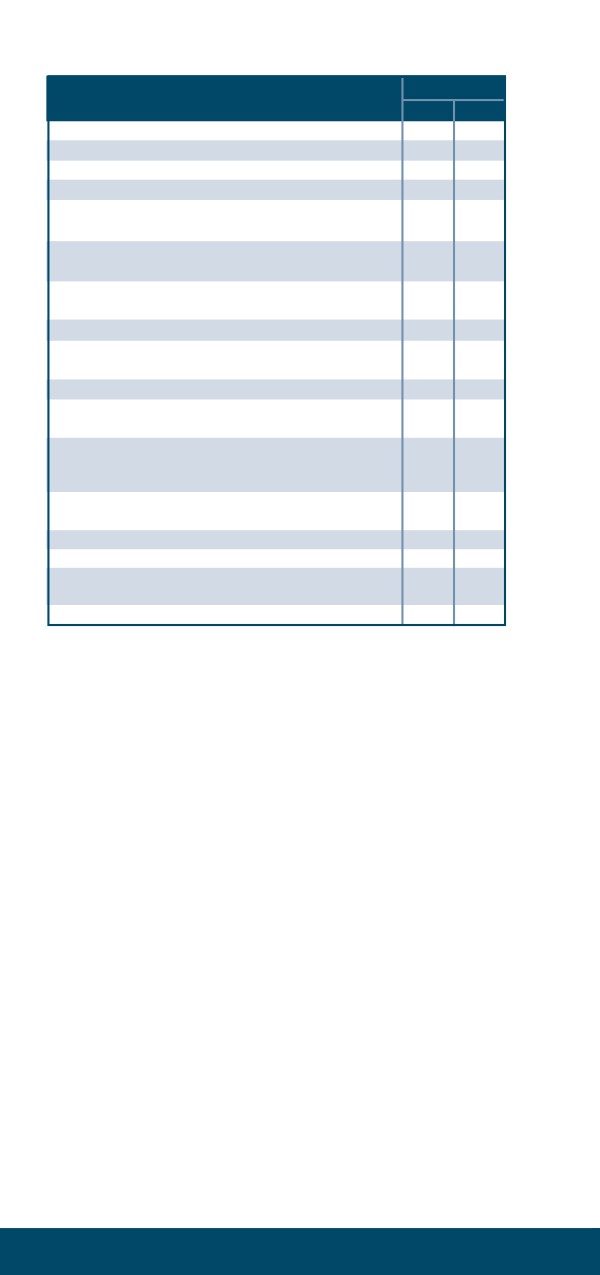
Simplified Dining Service
Responsibility
LSA
SA
Leads pre-service briefing.
X
Inspects dining car for preparation and proper mis en place.
X
Makes meal service announcement to customers.
X
Greets the customers.
X
X
Distributes the menus and removes unnecessary
place settings.
X
X
Returns to customers to take orders, customer preferences,
suggests (upsells) bar and picks up table menus.
X
X
Starts beverage service. (Remember customers appreciate
prompt beverage service)
X
X
Serves starter (water, juice, milk, etc.)
X
X
Clears starter and any unnecessary items, including
depleted condiments.
X
X
Brings any cutlery or condiments needed for the main course.
X
X
Serves main course. Checks the meal for accuracy
and completeness before serving.
X
X
Checks with each customer to be sure he or she is satisfied and
not in need of anything. The LSA does this just as the owner of
a restaurant would.
X
X
Checks with each customer to see if he or she would like more
coffee, beverage etc.
X
Presents meal check for payment.
X
Collects payments.
X
Prepares for next service or completes required mis en place for
next meal period.
X
Conducts post-service briefing.
X
3. Staggered Seating Reservation System
a) Use the “Simplified Dining Car Service
Reservations Listing” forms for lunch and dinner
meal periods. (Refer to Figures 7-8 and 7-9).
7-34
Policies & Procedures
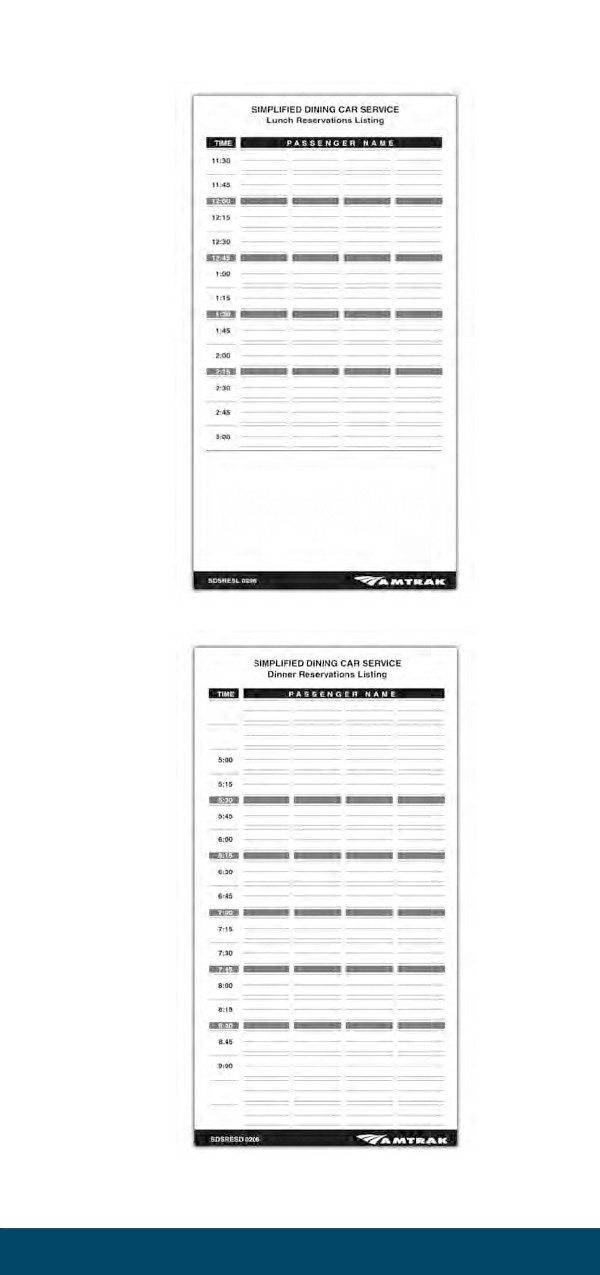
Figure 7-8 - “Simplified Dining Car Service - Lunch Reservations Listing”
Figure 7-9 - “Simplified Dining Car Service - Dinner Reservations Listing”
Service Standards Manual No. 6
7-35

• When making passenger announcements,
explain that reservations for lunch and dinner
seating are needed in the Dining Car.
• During breakfast, the staggered seating
procedure will be used to prevent overcrowding,
even though reservations are not taken.
• Utilize one table for the Mise En Place and
keep one table “in your pocket.”
• The LSA-Diner should present the meal
checks and menus to each table with assistance
from the SA.
• Walk the dining room floor to expedite cash-outs,
greet customers, handle customer concerns and
maintain decorum.
• Communicate with kitchen staff regarding the
remaining number of anticipated passengers
for the meal period.
• The Chef should continuously communicate
with LSA-Diner regarding the remaining
quantities of entrees remaining in stock.
b) Staggered Seating Reservation System
1 Lead Service Attendant and 1 Service Attendant
Time
Number of Customers
11:30
8
11:45
8
12:00
BREAK
12:15
8
12:30
8
12:45
BREAK
1:00
8
1:15
8
1:30
BREAK
1:45
8
2:00
8
2:15
BREAK
2:30
8
2:45
8
Each reservation time brings in 8 customers per 15-minute interval. This
accommodates 104 customers. (1 hour, 45 minute intervals for table turns,
1 mise en place and 2 pocket tables)
Figure 7-10 - Superliner Lunch
7-36
Policies & Procedures

1 Lead Service Attendant and 1 Service Attendants
Time
Number of Customers
11:30
12
12:00
12
12:30
12
1:00
12
1:30
12
2:00
12
2:30
12
Each reservation time brings in 12 customers per 30-minute interval. This
accommodates 84 customers. (1 hour, 30 minute intervals for table turns,
1 mise en place and 1 pocket tables)
Figure 7-11 - Superliner Lunch
1 Lead Service Attendant and 2 Service Attendants
Time
Number of Customers
11:30
12
11:45
12
12:00
12
12:15
12
12:30
BREAK
12:45
12
1:00
12
1:15
12
1:30
12
1:45
BREAK
2:00
12
2:15
12
2:30
12
2:45
12
3:00
BREAK
Each reservation time brings in 12 customers per 15-minute interval. This
accommodates 144 customers. (1 hour, 30 minute intervals for table turns,
1 mise en place and 2 pocket tables)
Figure 7-12 - Superliner Lunch
Service Standards Manual No. 6
7-37

1 Lead Service Attendant and 1 Service Attendant
Time
Number of Customers
5:00
8
5:15
8
5:30
BREAK
5:45
8
6:00
8
6:15
BREAK
6:30
8
6:45
8
7:00
BREAK
7:15
8
7:30
8
7:45
BREAK
8:00
8
8:15
8
8:30
BREAK
8:45
8
9:00
8
Each reservation time brings in 8 customers per 15-minute interval. This
accommodates 96 customers. (1 hour, 45 minute intervals for table turns,
1 mise en place and 1 pocket table)
Figure 7-13 - Superliner Dinner
1 Lead Service Attendant and 1 Service Attendants
Time
Number of Customers
5:00
12
5:30
12
6:00
12
6:30
12
7:00
12
7:30
12
8:00
12
8:30
12
Each reservation time brings in 12 customers per 30-minute interval. This
accommodates 96 customers. (1 hour, 30 minute intervals for table turns,
1 mise en place and 1 pocket tables)
Figure 7-14 - Superliner Dinner
7-38
Policies & Procedures

1 Lead Service Attendant and 2 Service Attendants
Time
Number of Customers
4:30
12
4:45
12
5:00
12
5:15
BREAK
5:30
12
5:45
12
(60)
6:00
BREAK
6:15
12
6:30
12
6:45
12
7:00
BREAK
7:15
12
7:30
12
(120)
7:45
BREAK
8:00
12
8:15
12
8:30
12
8:45
BREAK
9:00
12
9:15
12
(180)
LAST CALL
Each reservation time brings in 12 customers per 15-minute interval. This
accommodates 168 customers. (1 hour, 45 minute intervals for table turns,
1 mise en place and 2 pocket tables)
Figure 7-15 - Superliner Dinner
1 Lead Service Attendant and 1 Service Attendant
Time
Number of Customers
11:30
8
11:45
8
12:00
BREAK
12:15
8
12:30
8
12:45
BREAK
1:00
8
1:15
8
1:30
BREAK
1:45
8
2:00
8
2:15
BREAK
2:30
8
2:45
8
Each reservation time brings in 8 customers per 15-minute interval. This
accommodates 96 customers. (1 hour, 30 minute intervals for table turns, 1
mise en place and 1 pocket table)
Figure 7-16 - Single Level Lunch
Service Standards Manual No. 6
7-39

1 Lead Service Attendant and 2 Service Attendants
Time
Number of Customers
11:30
12
11:45
12
12:00
12
12:15
BREAK
12:30
BREAK
12:45
BREAK
1:00
12
1:15
12
1:30
12
1:45
BREAK
2:00
BREAK
2:15
8
2:30
12
2:45
12
3:00
BREAK
Each reservation time brings in 12 customers per 15-minute interval. This
accommodates 108 customers. (1 hour, 30 minute intervals for table turns,
1 mise en place and 1 pocket table)
Figure 7-17 - Single Level Lunch
1 Lead Service Attendant and 1 Service Attendant
Time
Number of Customers
5:00
8
5:15
8
5:30
BREAK
5:45
8
6:00
8
6:15
BREAK
6:30
8
6:45
8
7:00
BREAK
7:15
8
7:30
8
7:45
BREAK
8:00
8
8:15
8
8:30
BREAK
8:45
8
9:00
8
Each reservation time brings in 8 customers per 15-minute interval. This
accommodates 96 customers. (1 hour, 45 minute intervals for table turns,
1 mise en place and 1 pocket table)
Figure 7-18 - Single Level Dinner
7-40
Policies & Procedures

1 Lead Service Attendant and 2 Service Attendants
Time
Number of Customers
4:30
12
4:45
12
5:00
12
5:30
4
5:45
BREAK
6:00
BREAK
6:15
12
6:30
12
6:45
12
7:15
4
7:30
BREAK
7:45
BREAK
8:00
12
8:15
12
8:30
12
8:45
4
9:00
9:15
Each reservation time brings in 12 customers per 15-minute interval. This
accommodates 120 customers. (1 hour, 45 minute intervals for table turns
1 mise en place and 1 pocket table)
Figure 7-19 - Single Level Dinner
c)
Staggered Seating Examples
•
Example 1
One LSA and one SA choose to make
reservations for up to 12 passengers for each
30-minute seating. In this scenario, the LSA
will handle one table while the SA handles
two tables. This arrangement allows the entire
crew to provide quality service during this
30-minute period. The crew may use this
method without a break in service.
•
Example 2
One LSA and one SA choose to make
reservations for up to eight passengers for each
15-minute seating with a break in service at
every third seating. In this scenario, the LSA
will handle one table while the SA handles
the other table. This arrangement allows eight
passengers to be seated at 5:00pm, another
eight at 5:15pm and a break at 5:30pm to allow
the chef time to clean and prepare for future
meal orders. At 5:45pm the next eight passengers
would be seated followed by 6:00pm and a
break at 6:15pm.
Service Standards Manual No. 6
7-41
d) Recording Seat Location on Universal Meal
Checks
The following instructions for recording the table
and seat location on the Universal Meal Check
will enable all employees to identify who, at each
table, ordered what meal. All employees must
follow these instructions to provide consistent
delivery of food to the correct table.
• Using the right aisle seat as the starting point,
mark the table grid on the Universal Meal
Check in a clockwise fashion.
• Write the table number on the Universal Meal
Check.
D. Sleeping Car Procedures
1.
Room Set-up - Train Attendant Sleeping Car
(Refer to Chapter 6 “Crew Function & Responsibilities”,
Section M “Train Attendant- Sleeping Car”, Part 2.
“TASC - Pre-Departure Responsibilities” for more
information)
2.
Proper Bed Making Procedures
a)
General Instructions
• The style of bed making is designed to provide
the passenger a comfortable, sanitary berth.
The “chin space” of a sheet over the head of
the blanket is to prevent a passenger from
making contact with the blanket.
• When berths are turned down, bedding is
pulled back to expose a larger area of the
sheet. This is to reduce contact with the
blanket when the passenger sits on the bed.
• Pillows must be stacked in any berth that
may be turned down by a passenger without
assistance from the train attendant.
• Berths must be attractive. If an employee
discovers a sheet with stamps, stains, or small
rips, put such blemishes at the foot of the bed,
or use another sheet.
• Spread sheets and blankets so there are no
bumps or wrinkles. Tuck sheets tightly under
the mattress.
7-42
Policies & Procedures
• When making the upper berths the employee
is to use an Amtrak approved ladder or berth
stool for this purpose.
• The employee is NOT to use the bed or
sink when making the upper berth.
• If the ladder is missing, contact a supervisor
immediately.
• Berth stools are provided by the crew
base upon request.
b) Superliner and Viewliner Sleeping Cars -
Bedroom Upper Berths
•
The foot of berth is made toward the window.
•
The upper berth requires two (2) sheets; two
(2) blankets; two (2) pillows and two (2) pillow
slipcovers.
•
Begin by moving the mattress four (4) to six
(6) inches over the edge of the bed box.
•
Spread the first sheet and tuck in all sides.
•
Spread the second sheet over the first and fold
back six (6) inches of “chin space” at the head
end of the fold.
•
Allow approximately 16 inches of the front edge
of the sheet to hang over the mattress edge.
•
Tuck the back edge of the sheet under the
mattress from the center down to the foot.
•
Spread the first blanket.
•
Pull the head end even with the mattress edge
and allow the front edge of the blanket to hang
approximately one inch above the edge of the
sheet.
•
Tuck the back edge of the blanket under the
mattress from the center down to the foot.
•
Tuck the blanket and sheet under the mattress.
•
Fold the six-inch “chin space” in the second
sheet over the edge of the blanket across the
head end.
•
Then, make a second fold of the sheet and
blanket together, 24 inches down from the
head end.
•
Spread the second blanket and double it from
the foot so that the fold is 18 inches from the foot.
•
Tuck the back edge of the blanket under the
mattress.
•
Fold the front edge of this blanket up onto the
bed, and roll it neatly toward the back edge of
the mattress.
Service Standards Manual No. 6
7-43
• Push the mattress with bedding back into the
bed box to secure the sheets and blankets.
• Tuck the remaining front edge blanket and
sheet under the mattress, and tighten up.
• Stand pillows on their long edge at the head
end with pillow slipcover openings tucked in
and turned toward the wall.
• Attach ladder at foot of berth.
c)
Superliner and Viewliner Sleeping Cars -
Bedroom Lower Berths
• Follow “Superliner and Viewliner Sleeping Cars
- Bedroom Upper Berths” procedure, except
when both upper and lower berths are being used.
• Then, fold the second sheet and blanket (which
are draped toward the floor on the back edge)
up onto the bed.
• Lay it even with the edge of the mattress.
• Tuck in excess bedding along the front edge of
the mattress.
• Place pillows in an “L” shape, with the pillow
slip opening toward the corner.
• Place coat hangers on lower berth.
• Turn on reading lights above pillows.
d) Superliner Family Room - Upper/Lower Berths
• Follow the “Superliner and Viewliner Sleeping
Cars - Bedroom Upper Berths” procedures.
• Make foot of sofa bed and upper berth away
from the reading light.
e)
Superliner Roomette - Lower Berth
• One (1) pillow and one (1) blanket per berth
in roomettes.
• Make foot of bed toward the locomotive.
• Depress foot pedal release to pull two seats
together.
• Remove lower berth pad from upper berth and
spread out on lower seat cushion.
• Spread and center first sheet, tuck in firmly on
all sides.
• Spread second sheet with front edge no lower
than three inches from the floor, make six (6)
inches of “chin space” in second sheet over
edge of blanket at head end.
• Fold blanket and sheet together as far as the
door facing.
7-44
Policies & Procedures
• Fold the front edge of the blanket and sheet up
onto the bed.
f)
Superliner Roomette - Upper Berth
• The upper berth is made up in the same manner
as the lower berth.
• Put pillow slipcovers on pillows when vacant
room is made up.
• Stow pillow in upper berth.
g)
Superliner Accessible Room
• Superliner accessible room is made in same
manner as a roomette.
h) Securing Vacant Bedrooms
• Remake both beds.
• Fold the lower berth mattress pad into thirds
and stow in the upper berth.
• Place four clean pillow slipcovers under the
sheet in the upper berth, stow all pillows in the
upper berth.
• Place berth ladder on top of bedding with
hooks facing downward, and secure with safety
straps.
• Return lower berth sofa seat to daytime position.
i)
Securing Vacant Roomettes
• Remake lower berth mattress pad.
• Fold into an even “S” curve and stow in upper
berth.
3.
Sleeping Car Train Attendant Passenger’s “Welcome
Aboard” Introduction
a) Introduce yourself to the passenger(s).
b) Explain the following features.
• Attendant call system
• Restrooms and shower facilities
• Heating and air conditioning
• Lighting
• Complimentary beverage service
• Wake-up beverage service
• Meal service and options
• Dining and Lounge Car locations and hours of
service
• Reservation system for lunch and dinner
• Emergency evacuation card
• Movies, activities and promotions
Service Standards Manual No. 6
7-45
E.
Baggage Cars
1.
Baggage Cars
On trains with working Baggage Cars, the employee
assigned to handle baggage is responsible for the
following. (Refer to chapter 4 “Baggage Handling”
for addition information.)
a)
Assist the Station Agent with loading and unloading
of baggage, long gun cases and Railroad Business
mail (RRB).
b) Sort all checked baggage according to destination.
c)
Sort RRB by destination and place in a suitable
container (box, case, tub, etc.).
d) Prior to arrival at the station, prepare all baggage
to be unloaded by moving it to the appropriate door.
e)
Employees are prohibited from riding inside
Baggage Cars unless baggage or baggage crates
are secured during travel.
f)
When working in a moving Baggage Car maintain a
braced position and sufficient handhold.
g)
The employee assigned to handling baggage must
notify the Conductor of any skids, pallets, caskets
or other large items that would require the use of
a forklift or other equipment for removal from
the Baggage Car.
h) The Conductor must be notified before reaching
the last staffed station, prior to where the assistance
is required.
i)
After completing work, the employee assigned to
handling baggage should make sure all transfer
plates have been removed and the Baggage Car
doors are closed, secured and locked.
j)
Before the train moves, the Conductor must be
notified that the Baggage Car work has been
completed.
k) If long gun cases were loaded or unloaded, contact
the Conductor with the number of long gun cases
that were transferred so the Conductor can verify
that the gun case transfers were completed by
printing their initials in the required location on
the manifest.
F.
Conductors Reporting Arrival and
Departure Times via Cellular
Telephone (Central Division Only)
1.
Procedure
The following procedure governs the train delay
reporting requirements for Conductors working within
the Central Division. It is important that accurate
and timely train arrival and departure information
7-46
Policies & Procedures
be available to our customers, stations, call centers
and the Consolidated National Operations Center
(CNOC), in order to effectively communicate the
status of our service.
a)
Trains Departing an Un-Staffed Station - Upon
departure from an intermediate station, the
Conductor must telephone the Customer Support
Desk at (800) 205-0711.
b) The Conductor must provide:
• their name.
• the train number.
• the trains’ origin date.
• the exact time of arrival and departure for
that train.
• the station name.
c)
Arrival/Departure
• If the actual departure time differs from the
scheduled time, the reason for the delay must
be provided to the agent at the Train Status
Reporting Desk. Such delay information must
be in clear, concise terms that can easily be
understood.
• The agent at the Customer Support Desk will
note that time in Arrow as the arrival and
departure time for that train and provide the
reasons for any train delay as provided by the
Conductor. The agent working the Customer
Support Desk must enter into Arrow only the
time the Conductor provides.
• When arriving at an un-staffed destination, the
Conductor must call the Customer Support
Desk with the correct arrival time.
G. Communication
1.
Radios
a) Radios are to be used in accordance with applicable
FCC and operating rules of the railroad on which
the train is operating.
b) Adjust volume to an appropriate level that allows
the user to hear transmissions while minimizing
the impact on passengers.
c) If possible, communicate in an area away from
passengers.
d) Earpieces are required to be used between the
hours of 10:00 p.m. and 7:00 a.m., and at any
other time to keep transmissions quieter and
more secure.
Service Standards Manual No. 6
7-47
2.
Cell Phones/PDA
a) Company issued cell phones/PDAs/electronic
devices.
•
Proper care for the safety and security of cell
phones and/or electronic devices issued by the
corporation are the responsibility of the
employee to whom they were issued.
•
Company issued cell phones or electronic
devices, which are lost, must immediately be
reported to your direct supervisor and crew
base supervision.
•
Company issued cell phones or electronic
devices, which are stolen, must immediately be
reported to your direct supervisor, crew base
supervision and to the Amtrak or local Police.
•
It is the responsibility of the employee to provide
their supervisor with the telephone number so
that the service can be terminated on that phone.
•
It is the responsibility of the employee to
notify and secure a copy of the report from
Amtrak police if on Amtrak property or local
police if on non-Amtrak property.
•
It is the responsibility of the employee to
provide their direct supervisor with a copy of
the incident report as soon as possible after the
incident. (A police report does not exempt an
employee from any possible restitution and/or
disciplinary action).
•
Company issued cell phones and/or electronic
devices will be monitored by the appropriate
Division or Service Operations.
•
Any misuse (non-railroad business or unautho-
rized) of a company issued cell phone or elec-
tronic device could result in disciplinary action.
b) Cell phones/PDAs are not to be used in lieu of
radios to obtain or release track authorities or to
copy mandatory directives (e.g. Form D, TSRB,
Foul Time, etc.) unless authorized by Special
Instruction or a supervisor.
c)
If a cell phone/PDA is used, all crew members
must be informed of the intent to communicate
via cell phone/PDA by way of an additional
job briefing. Immediately following the cell
phone/PDA communication, an additional job
briefing must be held to properly disseminate
information from that call.
7-48
Policies & Procedures
• Employees using cell phones/PDAs to conduct
railroad business must not use the phone while
riding in the controlling cab of a moving train,
unless the business is associated with the
movement of the train.
• Passenger train Conductors may use a cell
phone/PDA to conduct railroad business while
the train is moving provided they are not in the
controlling cab, or controlling the movement
from the leading end.
d) Cell phone/PDA options:
• Ring - use vibrate or silent.
• Screen calls - use the caller ID function, return
calls later.
• Voice volume - use a normal tone; it is not
necessary to speak at a higher volume.
• Speaker phone - do not use this option at all.
• State and local laws - follow all applicable state
and local laws regarding cell phone/PDA usage.
• Movement - remain stationary (preferably
seated) when using a cell phone/PDA.
• Awareness - do not use in areas where
inattention could result in being struck by
tools or equipment.
e)
Use of cell phone/PDA in the presence of
customers.
• If a passenger approaches while a crew member
is conducting company business on a cell
phone/PDA, the first priority is the passenger
and their needs.
• End the call immediately by telling the person
on the phone you will call back as time permits.
• The only exception is if the call involves the
movement of the train or an emergency
involving illness, injury, or physical danger.
• If it is necessary to use a cell phone/PDA with
the customer present, always explain why you
will be using the device and for what purpose.
f)
When Conductors observe engineers using cell
phones/PDAs not in accordance with Amtrak
guidelines, they must refer the engineer to
System General Road Foreman Notices that
pertain to the correct use of cell phones and
electronic devices.
Service Standards Manual No. 6
7-49
g) If division or host railroad policies are more
restrictive than the policies outlined in this
section, the applicable more restrictive policies
will apply. Refer to Chapter 6, “Crew Functions
and Responsibilities” for a complete list of
prohibited devices.
3.
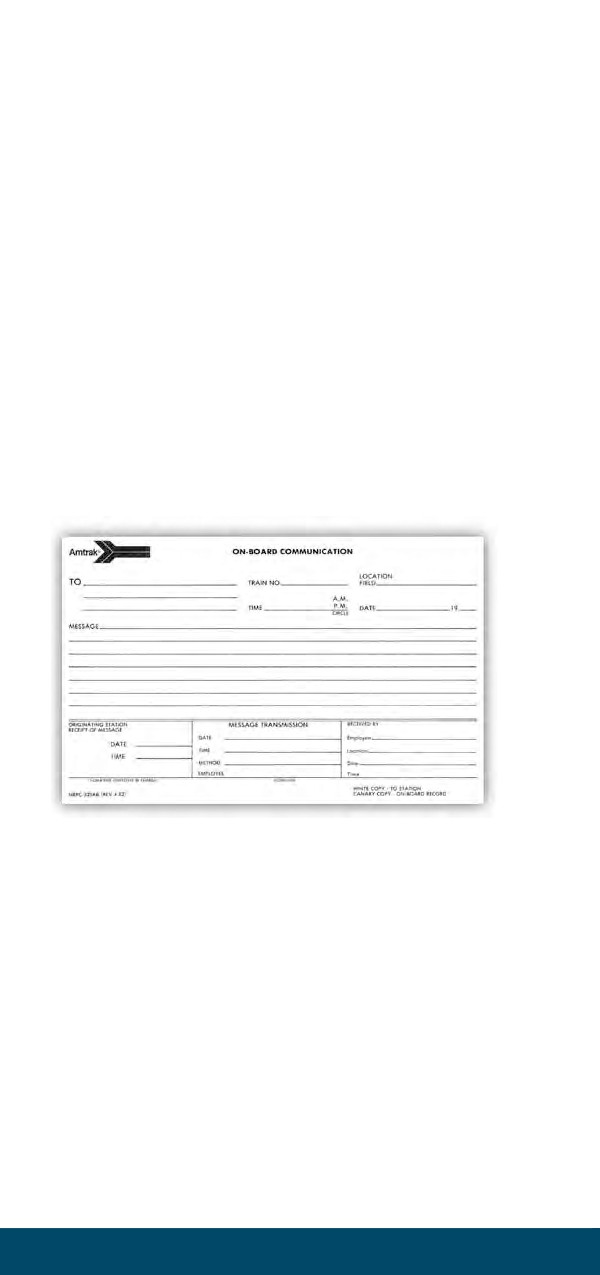
“On-Board Communication” (NRPC 333AB)
The “On-Board Communication” (NRPC 333AB)
is used whenever a crew member needs to set-off a
message at a staffed station. The “On-Board
Communication” (NRPC 333AB) must be completed
in its entirety, and must provide concise details of the
action required of the Station Agent. The top white
copy must be handed to the Station Agent, and the
yellow carbonless copy should be retained by the
crew member for future reference if needed. (Refer
to Figure 7-20)
Figure 7-20 - On-Board Communication (NRPC 333AB)
H. Reporting Mechanical Defects
1. Procedure
a) Report all mechanical defects or failures,
including Automated External Defibrillator
(AED) to CNOC at:
•
(800) 424-0217 ext. 2082/2083
•
(302) 683-2082/2083
• ATS 734-2082/2083
b) Record all mechanical defects and failures on
the “Record of Defect and Repair - MAP 21A”
(NRPC 2775).
7-50
Policies & Procedures
I.
Reporting and Recording Delays on
Host Railroads
These instructions apply to Conductors of all Amtrak
trains except on the following Northeast Corridor
districts: Boston-New Haven, Springfield-New Haven,
New York-Washington and Philadelphia-Harrisburg.
All other rail lines over which Amtrak operates,
including Amtrak-dispatched segments outside the
Northeast Corridor, are known as “Host Railroads”
for purposes of these instructions.
1.
Responsibility
Except on districts listed above, Conductors must
properly record and report all delays to their trains.
The Conductor must personally complete a Delay
Report showing arrival, departure, and/or passing
times at all stations and other designated locations; and
all delays, including the cause, location and railroad(s)
on which each delay occurred. Date(s), train number,
names of crew, engine number(s), car counts and other
information must also be shown as required on the
Delay Report.
All locomotive numbers in the consist must be
shown (including host-railroad locomotives, with
RR initials) and in correct order. If a locomotive
is added or removed en route, that fact and the
location must be shown in the “Eng. No. (s)” line
at the top of the Report.
If either the Conductor or Engineer is re-crewed
en route, or if a pilot is added, the name(s) of those
employees must be included at the top of the Report,
along with the location the new crew member went
on duty. For example, “Engr. J. Jones from MP 482.”
The Conductor will coordinate with the Engineer to
obtain all necessary information on over-the-road
(en route) delays so as to be able to properly
complete the Delay Report. If a new Delay Report
form is issued or revised, Conductors must obtain
sufficient copies, and must stop using and discard
the obsolete forms immediately.
When the departure time is reported at stations, it is
the time the train begins to move. If more than one
spot is made, it is the actual departure time after the
final spot.
Service Standards Manual No. 6
7-51