Amtrak. Service Standards Manual for Train Service and On-Board Service Employees (Version 6, 2011) - page 7
should inform the Conductor. A determination will
be made whether or not to relieve or withhold the
employee from service pending investigation.
There are two possible options for withholding an
employee from service en route. The Conductor
may decide to leave the employee on the train in
the dormitory or other non-service area.
Withholding from service does not necessarily mean
removal from the train. However, under serious
circumstances, the Conductor may remove the
employee from the train. This option should be
taken only if the incident leading to removal from
service involves violence or threatens the safety of
the employees or passengers. With either option, the
removed employee’s time is to be cut at the same
time they were taken out of service.
Circumstances calling for withholding from service
pending investigation include:
• Misappropriation of Amtrak funds or property.
• Threatening a passenger or crew member.
• Assaulting a passenger or crew member.
• Having unauthorized firearms in their possession.
• Being under the influence, possessing or using
alcoholic beverages or narcotics while on duty
or on company property.
• Using medication that alters the physical
condition of the employee to the extent that
they can not properly perform their duties.
• Being insubordinate, which includes deliberate
and willful refusal to execute a proper order.
If the Conductor decides, based on the above
criteria, that an employee should be withheld
from service and left on-board the train, the
following steps must be taken:
• The employee taken out of service must have
their time cut at the same time.
• The employee must be informed of the reason
for their removal. This should be done in the
presence of witnesses.
• The Conductor and other employees must
provide written and signed statements with all
pertinent facts. The Conductor will make a
detailed report in writing of the circumstances
Service Standards Manual No. 6
6-25
to the immediate management supervisor as
soon as possible.
• In offenses involving passengers, a signed
statement describing the alleged violation
should be obtained from the witnesses to the
employee's Crew Base manager. If the witness
refuses to provide a statement, the name, address
and space occupied should be documented.
• If overnight travel is involved, the removed
employee is entitled to sleeping accommodations.
• If a management supervisor is not present or
available, contact the Consolidated National
Operations Center (CNOC) by the quickest
means of communication.
Based on the above criteria, if the Conductor
decides that an employee should be removed
from service en route pending investigation and
also removed from the train, the following steps
should be taken in addition to the above items:
•
The employee should be removed from the train
at the next staffed station, where management
is present. (In extreme cases, when necessary
to detrain an employee immediately in order
to ensure safety, they may be taken off at
any point, as long as they are placed into the
custody of local law enforcement officers.)
•
Station personnel must be advised of the
circumstances regarding the removal of the
employee from the train.
•
The Conductor and other employees must
provide written and signed statements with all
pertinent facts. The Conductor will make a
detailed report in writing of the circumstances
to the immediate management supervisor as
soon as possible.
•
The employee’s Amtrak Photo ID/Flash Pass
will be confiscated and immediately forwarded
to the employee’s Crew Base manager. The
employee will be directed to return to their
assigned crew base via an alternate mode of
transportation, preferably a bus.
•
Station personnel will be advised to issue an
Emergency Exchange Voucher (EEV).The EEV
will only be issued to return the employee to
their assigned crew base.
•
If a management supervisor is not present or
available, contact CNOC by the quickest
means of communication.
6-26
Crew Functions & Responsibilities
In compliance with labor agreements, an employee
removed from service will be notified in writing of
charges and/or pending investigation.
k) Storing Items in Electric Lockers
Employees are not permitted to store personal
luggage or excess supplies in any electrical lockers.
Only authorized items (e.g., light sticks, Record of
Defect and Repair - 21A (NRPC 2775), and other
authorized items) may be stored in electrical
lockers. Storage of any unauthorized items may
cause personal injury, create an unsafe or dangerous
condition or cause a delay due to a damaged
component. Personal items must be stored in Crew
Dormitory Car (if available), the Conductors’
office or overhead luggage rack.
l)
Deadheading Employees
• Employees deadheading to and from work
may be placed in service when necessary, and
must maintain professional behavior at all
times. (Employees subject to Hours of Service
restrictions shall not be used if the time needed for
assistance will result in a violation of the Hours
of Service Act.)
• Deadheading employees must not loiter in
Food Service Cars and must maintain a neat,
professional appearance at all times in the
presence of passengers when in uniform.
m) On-Board Service Employees - Block Training
Notification
• A block training schedule will be posted
indicating those employees that are required
to attend class.
• The block training schedule will show the dates,
times and location of the classes and will replace
any previous practices concerning employees
receiving letters via US Mail and/or a phone call
confirming notification and will serve as your
official 7-day advance notification of your
scheduled classes as required by the ASWC
contract Rule 40 pertaining to training.
• Block training schedules will be posted in the
crew base by the 15th of every month for classes
proceeding in the following month. Example; a
notice will be posted by May 15, 2009 for classes
to be held in the month of June.
• Employees need to call Crew Management
Services (800) 522-7397 prior to the class date to
confirm their attendance for scheduled classes.
• It is the responsibility of the employee to make
class schedule changes with the Division
Service Standards Manual No. 6
6-27
Assistant Superintendent of Passenger Services
or their delegate. Any changes will be conveyed
from the Division to Crew Management and
potential replacements will be properly notified
by crew management via phone.
n) Employees Traveling Across the US/Canadian
Border
Employees crossing the US/Canadian border are
required to have a current WHIT (Western
Hemisphere Travel Initiative) document in their
possession. Employees must ensure that a copy of
their current WHIT document is on file at their
assigned crew base. Only one of the following
WHIT compliant documents is needed.
• U.S. Passport
• Passport Card
• Compliant Travel Documents:
• Trusted Traveler Cards (NEXUS, SENTRI,
or FAST)
• State Issued Enhanced Driver’s License
• Enhanced Tribal Cards (when available)
• Native American Tribal Photo Identification
Card
• Form I-872 American Indian Card
• Valid Passport from another Country along with
the Green Card or just the Green Card
C.
Conductor
The Conductor and Assistant Conductors are both
responsible for the following:
a) Adhering to all of the procedures in Section A
“General Information” of this chapter.
b) Possessing a working knowledge of Chapter 8,
Section 1 “Train Service Accounting Procedures”.
c) Understanding of the policies and procedures as
outlined in Chapter 3 “FDA Rules & Inspections”.
1.
Conductor - General Responsibilities
The Conductor is responsible for, but not limited to, all
of the following.
a) Job Briefing - Conduct a job briefing, ensuring that
all on-train employees participate.
b) Train Movement - Ensure that the movement of
the train is done promptly and safely.
c) Revenue - Completely and accurately collect and
remit all revenue.
d) Crew Performance - Observe and enforce all
rules and instructions resulting in the proper
performance of all crew members.
e) Train Walk Through - Walk through train at least
every 30 minutes.
6-28
Crew Functions & Responsibilities
f)
Securing Equipment at Stations - When cars not in
service are left at an intermediate station, they must
be secured with all doors locked.
g)
Earpieces - Use earpieces on radios between 10:00
p.m. and 7:00 a.m. while walking through cars.
h)
Monitoring - Continuously monitor the ventilation,
lighting, water supply, restrooms and temperature of
all cars.
i)
Seat Checks - Ensure seat checks are in place for
all passengers and that the “Special Assistance Seat
Check” (NRPC 3242) which is green with the words
“Keep in Sight” is used for any unaccompanied
minors and for any passenger who is unable to hear
announcements or needs special attention.
j)
Communication
• Keep passengers informed of all delays. (Refer to
Chapter 10 “On-Board Announcements and
Signage”)
• Provide information to passengers in easy-to-
understand language - avoid using Railroad
jargon.
• A Delay report must be maintained and
submitted at the end of the trip as required.
k)
Complimentary Service - Work with the LSA-
Diner and LSA-Café/Lounge in initiating
complimentary food and beverage service, as
outlined in Chapter 9 “Service Recovery”.
l)
Passenger Comments - Follow through on each
passenger complaint until resolved, or until the
passenger has been introduced to another employee
who will take responsibility of helping to resolve
the complaint.
2.
Conductor - Job Briefings
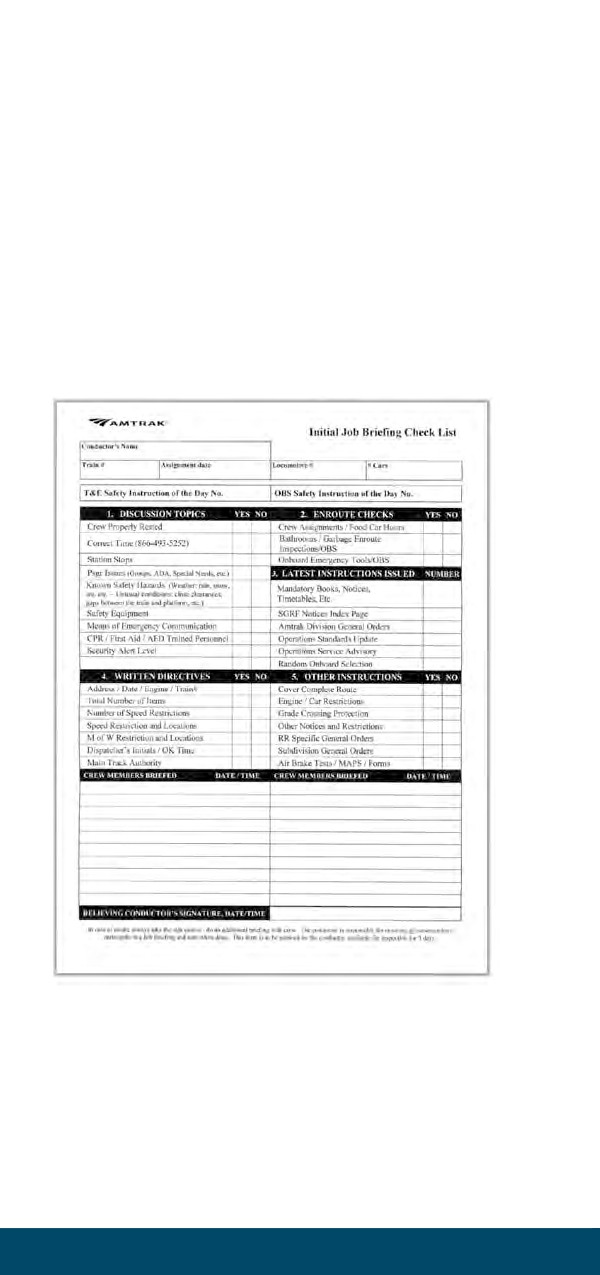
a) “Initial Job Briefing Check List” (NRPC 3243)
The Conductor will hold a crew job briefing using
the “Initial Job Briefing Check List” (NRPC 3243)
covering the following five sections. (Refer to
Figure 6-1)
Section 1 - Discussion Topics
Section 2 - En Route Checks
Section 3 - Latest Instructions Issued
Section 4 - Written Directives
Section 5 - Other Instructions
• Review the appropriate information specific to
the employees that are attending the briefing.
• Names of all participating crew members, along
with the time and date that they participated,
must be recorded in the appropriate section.
• On-Board Service employees working meal
Service Standards Manual No. 6
6-29
periods or taking rest periods during the job
briefing are not to be disturbed. An additional
job briefing can be held later to include those
who were unavailable.
• When relieved en route, the relieving Conductor
must sign, date and enter the time in the
appropriate box to document that all pertinent
briefing subjects have been discussed. The
relieving Conductor will hold a job briefing with
all on-train employees as-soon-as-possible.
• The “Initial Job Briefing Check List” (NRPC
3243) must be retained by the Conductor and
available for inspection for a period of five (5)
days before disposing.
Figure 6-1 - “Initial Job Briefing Check List” (NRPC 3243)
b) “Initial Job Briefing Check List for Yard Crews”
(NRPC 3272)
The Conductor will hold a crew job briefing for
yard crews using the “Initial Job Briefing Check
List for Yard Crews” (NRPC 3272) covering the
following three sections. (Refer to Figure 6-2)
6-30
Crew Functions & Responsibilities
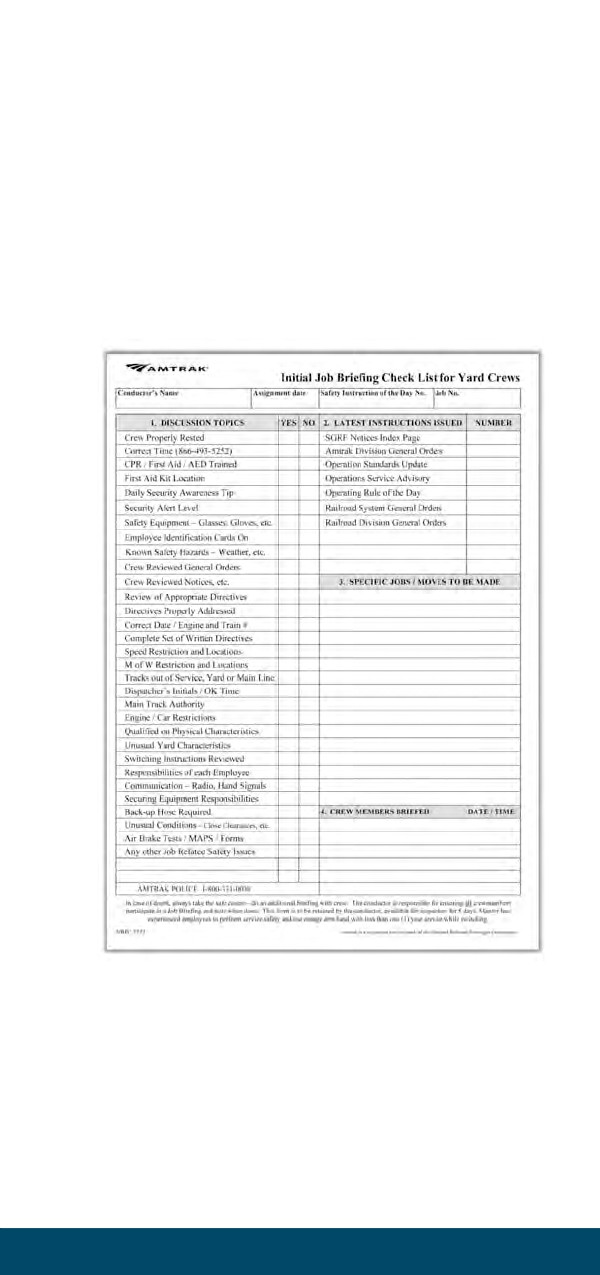
Section 1 - Discussion Topics
Section 2 - Latest Instructions Issued
Section 3 - Specific Jobs/Moves To Be Made
• Names of all participating crew members, along
with the time and date that they participated,
must be recorded in the appropriate section.
• The “Initial Job Briefing Check List for Yard
Crews” (NRPC 3272) must be retained by the
Conductor and available for inspection for a
period of five (5) days before disposing.
Figure 6-2 - “Initial Job Briefing Check List for Yard Crews” (NRPC 3272)
Service Standards Manual No. 6
6-31
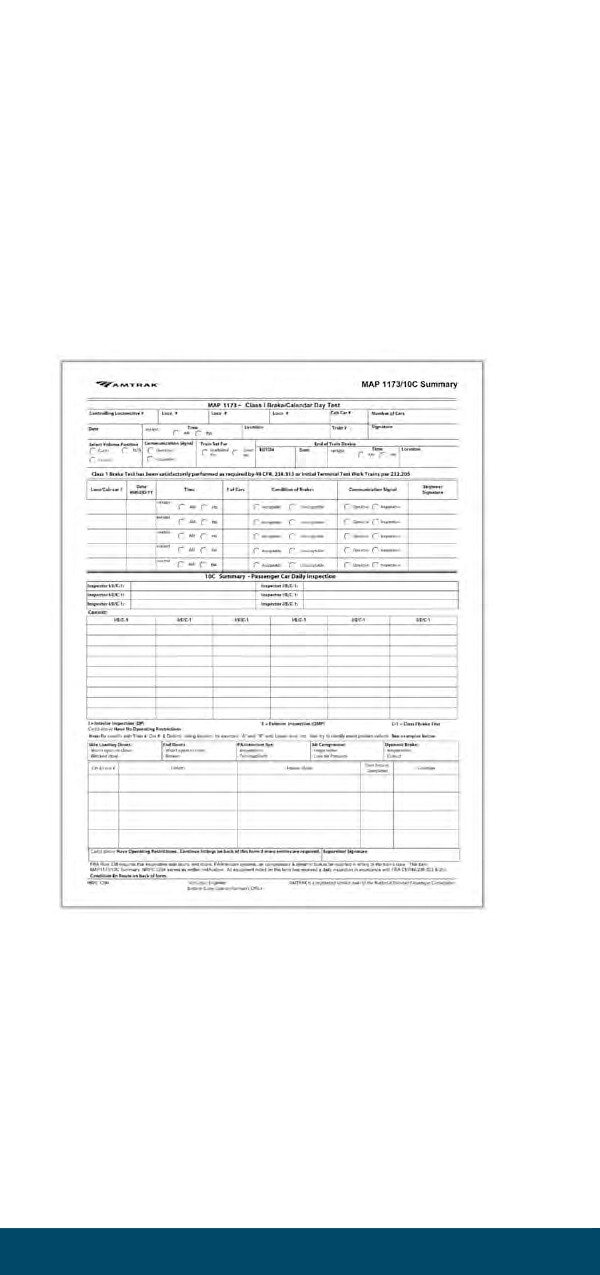
3. Conductor - Pre-Departure Responsibilities
a) Communicate with the Engineer - Prior to
departure from the initial terminal, the
Conductor will communicate with the Engineer
for any non-locomotive defects listed on the
“MAP 1173/10C Summary” (NRPC 3294). (Refer
to Figures 6-3 and 6-4)
If the “MAP 1173/10C Summary” (NRPC
3294) has missing or incorrect information, the
train is not to be delayed.
Figure 6-3 - “MAP 1173/10C Summary” (NRPC 3294) Front
6-32
Crew Functions & Responsibilities
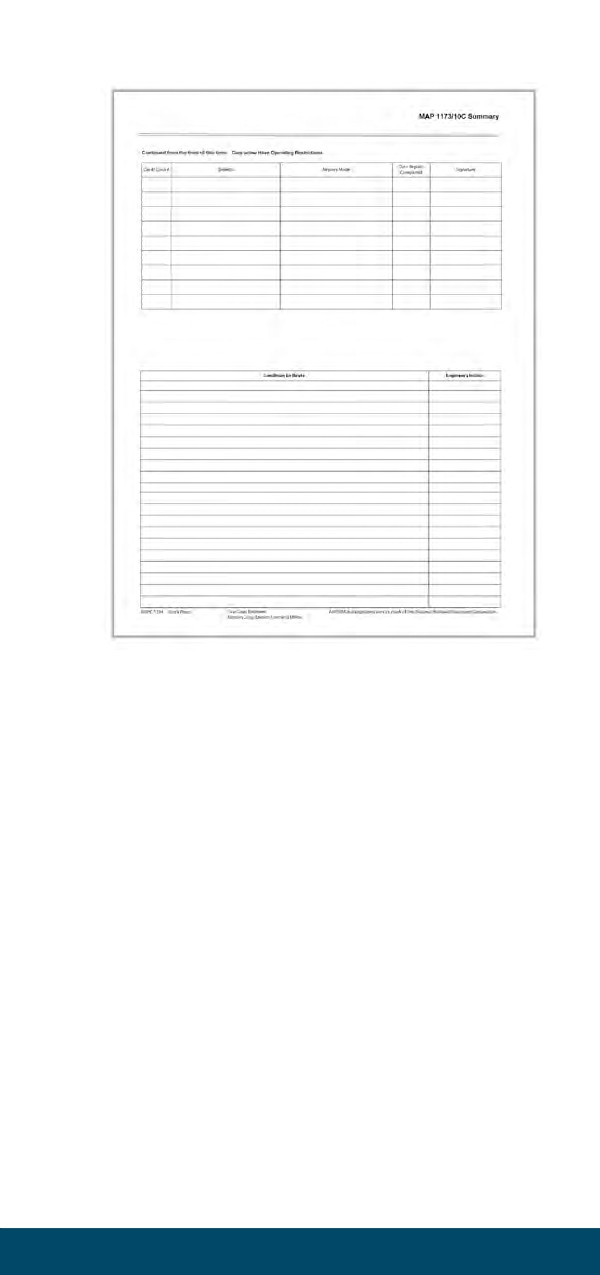
Figure 6-4 - “MAP 1173/10C Summary” (NRPC 3294) Back
b)
Manuals, Books and Notices - Each
Conductor/Assistant Conductor is required to have
the following in their possession.
• Operating and Safety Rule Books in effect for
the territory operated.
• AMT-3 - “Air Brake and Train Handling Rules
and Instructions”.
• AMT-2 - “Electrical Operating Instructions” (if
working Northeast Corridor).
• Employee timetable(s) and Special Instructions.
• Amtrak National System Timetable.
• Appropriate Commuter Timetable (if working
commuter service).
• Applicable Track Warrants, Division Notices,
Bulletin Orders, Form Ds, Temporary Speed
Restriction Bulletins, General Orders, On-Board
Passenger Count Forms and any other operations
document effecting the movement of trains.
• Maintain and have the current Service
Standards: Manual for Train Service and
On-Board Service Employees along with all
active OSUs in your possession while on duty.
Service Standards Manual No. 6
6-33
• Review and understand all current FOs, FSNs,
OSAs and TAs that are applicable to job
responsibilities.
• Train manifest.
c)
Forms, Tools and Supplies - The following items in
sufficient quantities are required.
•
“Baggage Identification Tag” (NRPC 347)
•
Ballpoint pens and pencils
•
“Canadian Customs Tag” (NRPC 3088) (Only
for Adirondack, Amtrak Cascades and Maple
Leaf trains)
•
Delay Report
•
“Employee Injury/Illness Report” (NRPC 260)
•
Flagging equipment (red flag, white light, six
fusees)
•
Flashlight (railroad-approved white light)
•
“Initial Job Briefing Checklist” (NRPC 3243)
•
“Non-Employee Injury/Illness Report”
(NRPC 3116)
•
“On-Board Communication” (NRPC 333AB)
•
“Operation Heartsaver-Employee Responder
Report” (NRPC 3245)
•
“Out of Service Label” (NRPC 3128)
•
“Pass Abuse Incident Report” (NRPC 1502)
•
“Passenger Incident Report” (NRPC 3200)
•
Punch key and coach key
•
Rubber bands and paper clips
•
Safety glasses (Refer to AMT-5 rule 5102)
•
Switch keys
•
Tempilstik(s) of appropriate degree
specification(s)
•
“Unusual Occurrence Report” (NRPC 2673)
d)
Walk the Train - At the origin point the Conductor
will walk the train and check the following:
• Train Consist - The train consist should match
the manifest.
• Access - Train crews must have access to all
occupied cars. With the exception of the first
and the last passenger-occupied cars, the end
doors of all cars must be unlocked while the train
is in motion.
• Unauthorized Access - Conductors and
Engineers are jointly responsible for ensuring that
locomotives, power cars, and/or control car cabs
of their trains, whether operating or trailing, are
secured at all times against unauthorized access.
• Food Service Cars - All cars are staffed, stocked
and ready for service.
6-34
Crew Functions & Responsibilities
• Safety Equipment - All safety equipment (first
aid kits sealed with shrink wrap, light sticks, fire
extinguisher, sledge hammer and a pry bar) is in
proper location and marked in accordance with
current safety standards. (Refer to Chapter 1
“Safety & Security”)
• Emergency Evacuation Cards - Safety instruction
cards are in all seat backs.
• Automated External Defibrillator (AED) - The
AED must be functioning and include a fully
charged oxygen bottle. The AED kit must be
stored in the proper location. (Refer to Chapter 2
“Injury, Illness and Reporting”)
• Communication - All public address and
attendant call button systems are to be working
in every car.
e)
Equipment Check - The Conductor will check the
following:
•
All equipment interiors and exteriors are clean.
•
Coach seats are secured and locked.
•
All water tanks are full.
•
Restrooms are clean and functioning properly.
•
HVAC and lighting systems are functioning
properly.
•
All doors are functioning properly (including
seals and weather stripping). (Refer to Chapter
12 “Equipment” for additional information)
•
Side-entry doors are properly train-lined, if
applicable. (Refer to Chapter 12 “Equipment”
for additional information)
•
All hardware (i.e. door latches, locks, hinges,
safety appliances) is functional.
•
All cars and related equipment conform to
applicable FDA and Amtrak public health
standards.
•
The correct interior and exterior signage is
displayed.
•
The brake test has been completed.
•
On-board hot journal detection systems are
functioning properly, if equipped.
•
Marker lights are functioning and displayed
properly.
•
Hand/parking brakes are fully released.
•
Locomotives and non-passenger carrying cars
are supplied.
Service Standards Manual No. 6
6-35
4.
Conductor - En Route Responsibilities
The Conductor must:
a)
Platform - Be on the platform at all station stops.
b)
Employee Positions - Ensure that there are
employees protecting vestibules and positioned to
assist boarding and detraining passengers.
c)
Announcements - Made upon arrival and departure
at all stations and at other times as outlined in
Chapter 10 “On-Board Announcements and
Signage”.
d)
Transportation Documents - Ensure that all tickets,
fares or other proper transportation documents
are collected from each passenger after leaving
all stations.
• The only exceptions are when the tickets have
been collected at the station or train side.
• When lifting tickets after 10:00 p.m., maintain
a quiet atmosphere and do not disturb other
passengers.
e)
Off-Duty Employee - If the Conductor requires
additional assistance with passengers from off-duty
employees, the Conductor will make the determi-
nation of the appropriate employees to provide
assistance indicating on the employees’ “Trip
Report” (NRPC 2039) or “OBS Unscheduled
Time/Train Authorization” (NRPC 3075) form
the specific time the employee was on duty and
the reason for any overtime pay. The Conductor
must print and sign the slip. In addition, the
“OBS Unscheduled Time/Train Authorization”
(NRPC 3075) form requires the Conductor place
a punch mark where indicated. If time slips are
not signed by the Conductor authorizing the
additional time, the employee’s crew base will
not pay for the extra time.(Refer to Figures 6-5,
6-6 or 6-7 as applicable)
6-36
Crew Functions & Responsibilities
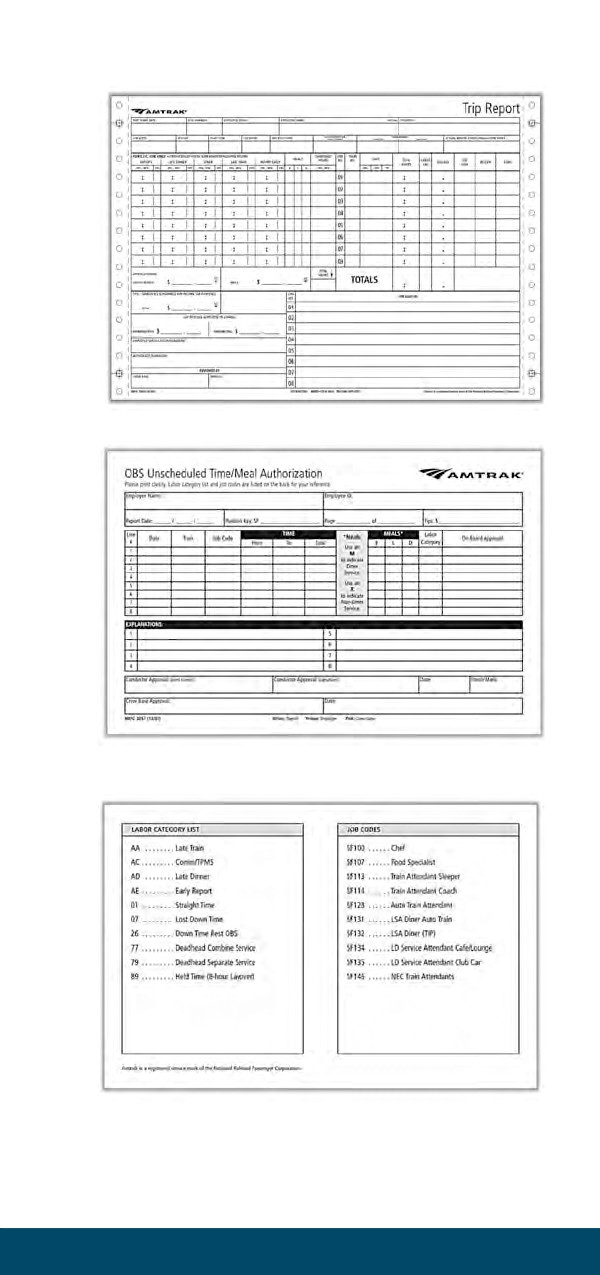
Figure 6-5 - “Trip Report” (NRPC 2039A)
Figure 6-6 - “OBS Unscheduled Time/Train Authorization” (NRPC 3057) (Front)
Figure 6-7 - “OBS Unscheduled Time/Train Authorization” (NRPC 3057) (Back)
Service Standards Manual No. 6
6-37
f)
Hours of Service Employees - Ensure that
employees governed by the Hours of Service Act
are not called upon if the time needed for the
assistance will result in a violation of the Hours
of Service Act.
g)
Equipment Defects - Record all equipment defects
on “Record of Defect and Repair MAP-21A”
(NRPC 2775) as well as any other required forms.
To report enroute defects, call the CNOC
Mechanical Desk at (800) 424-0217 ext. 2082/2083,
Bell (302) 683-2082/2083 or ATS 734-2082/2083 for
assistance 24 hours a day seven days a week.
h)
En Route Trainline Door Failure
• Make the “En Route Trainline Door Failure”
announcement from Chapter 10, “On-Board
Announcements and Signage” as required.
• Operate end doors locally, and refrain from
any trainlined door operation for the duration
of the trip. On Acela Express Trainsets, try the
“Side Door Reset Procedures” in Chapter 12
“Equipment”.
• If an end or side door failure occurs, at least one
operative and accessible door must be available
on each side of car. An “Out of Service Label”
(NRPC 3128) must be displayed directly on each
defective door. (Do not attach the label to door
windows.) (Refer to Figure 6-8)
• The Conductor must record the defect on the
“Record of Defect and Repair-MAP 21A”
(NRPC 2775), which is located in the electric
locker of each, car and contact the CNOC
Mechanical Desk at (800) 424-0217 ext.
2082/2083, (302) 683-2082/2083 or ATS
734-2082/2083.
i)
Public Address/Intercom System Defects -
Whenever a Public Address/Intercom system is
found defective or missing, an “Out of Service
Label” (NRPC 3128) must be displayed directly
on the defective Public Address/Intercom system.
(Refer to Figure 6-8) The Conductor must
record the defect on the “Record of Defect and
Repair-MAP 21A” (NRPC 2775), which is located
in the electric locker of each car, and contact
the CNOC Mechanical Desk at (800) 424-0217
ext. 2082/2083, (302) 683-2082/2083 or ATS
734-2082/2083.
6-38
Crew Functions & Responsibilities
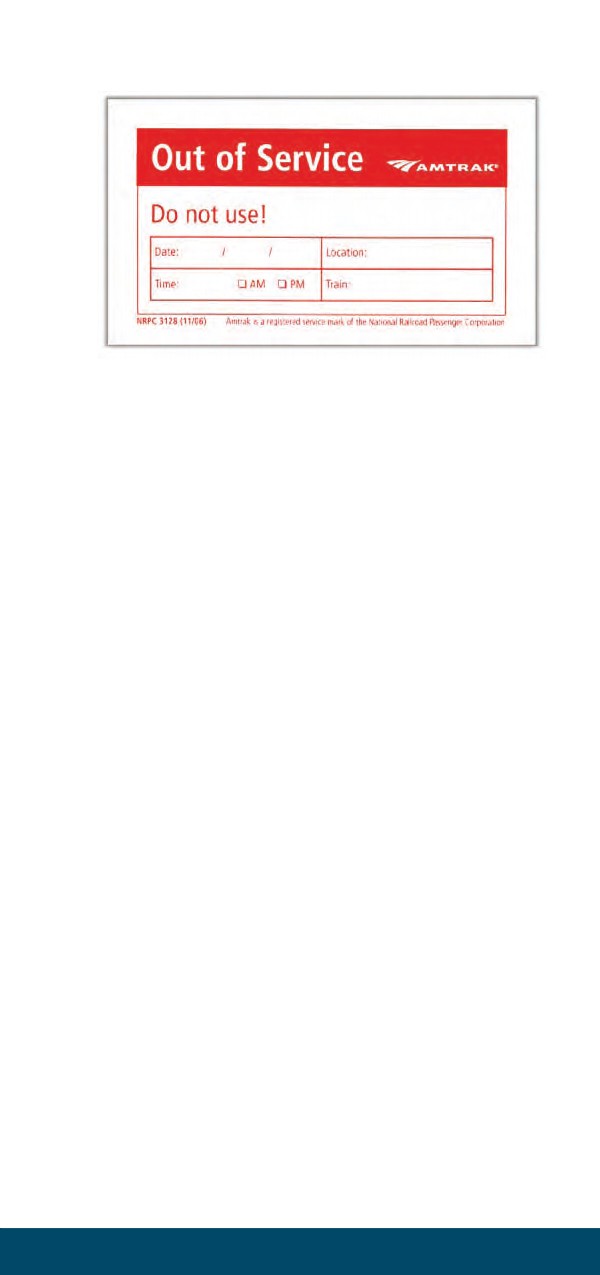
Figure 6-8 - “Out of Service Label” (NRPC 3128)
j)
Acela Express Wi-Fi Defect Reporting - If crew
members encounter Wi-Fi problems or failures,
notify the Conductor. The Conductor must
document the problem on the “Record of Defect
and Repair - MAP 21A” (NRPC 2775) and contact
the Wi-Fi Service Desk using the toll-free number
(888) 955-9434 to report the problem. Make sure
to include the train number and trainset number
along with a brief explanation of the problem. The
Conductor (or any on-train employee) should not
troubleshoot the problem or act as technical
advisors. The Wi-Fi Service Desk number is to be
used by crew members only, and is not to be given
to passengers.
k)
Conductor Availability - Conductors should be
available in the Dining Car with the lights on, after
closing and before reopening in the morning, to
provide assistance or answer questions. When
the Conductor or Assistant Conductor leaves the
Dining Car, the “Your Conductor will return shortly”
tent card must be placed on the table as outlined in
Chapter 10 “On-Board Announcements and
Signage”.
l)
Baggage Cars - Ensure that if the train has a
Baggage Car the employee assigned to handle
baggage understand that they are responsible for
maintaining checked baggage, Rail Road Business
(RRB) mail and monitoring/securing of all long gun
cases. (Refer to Chapter 7 “Policies and Procedures”)
m) Lost Articles & Baggage - Turn over any lost or
found items to the Baggage or Ticket Clerk at the
train’s final destination. (Refer to Chapter 7
“Policies and Procedures”)
n) Entering Restrooms - Knock on the door and enter
only when the room is empty.
Service Standards Manual No. 6
6-39
o)
Seats Position - Ensure that the seats remain
positioned as dispatched from the initial terminal.
On Acela Express, every seat must face either a
seat-back or a table.
p)
Quiet Car - Ensure that the integrity of the Quiet
Car is maintained at all times.
• If trains with Quiet Cars are crowded or sold
out, and seats are available in the Quiet Car,
passengers should be informed that seats are
available in this car; however, the rules of the
Quiet Car must be observed when occupying
those seats.
• If passengers must use their cell phone, they
should be directed to the Café/Lounge Car or
another safe area of the train.
q)
Conditions of Carriage - Be aware that Amtrak
may refuse to carry passengers:
• who have not paid the applicable fare.
• whose conduct is objectionable (such as, but not
limited to, being under the influence of alcohol
or narcotics).
• whose personal hygiene makes them offensive.
• who pose a health, safety or security hazard to
other passengers or employees.
• who refuse to comply with safety or security
rules or with instructions of Amtrak personnel.
• who would require Amtrak personnel to provide
personal care services or otherwise do not
meet the essential requirements for the receipt
of Amtrak service (Unable to take care of
themselves).
• who refuse to consent to Amtrak security
inspections of persons and/or baggage on board
Amtrak trains and/or at designated areas, such
as train platforms and passenger boarding or
waiting areas.
r)
En Route Crew Change -When being relieved en
route, the relieving Conductor must be informed
of any pertinent facts related to the movement of
the train or its passengers.
• With face-to-face relief, inbound Conductors
will personally inform relieving Conductors of
any known defect in their train.
• Without face-to-face relief, outbound Conductors
must check with outbound Engineer for any
defects noted on the “MAP 1173/10C Summary”
(NRPC 3294), and during the performance of
their duties must check each car of their train
for any “Out of Service Label” (NRPC 3128).
If a “Out of Service Label” (NRPC 3128) is
6-40
Crew Functions & Responsibilities
found, the Conductors must verify that the
“Record of Defect and Repair-MAP 21A”
(NRPC 2775) notes the defect. If the defect is
not documented on the “Record of Defect
and Repair-MAP 21A” (NRPC 2775), the
Conductor must record the defect on the
“Record of Defect and Repair-MAP 21A”
(NRPC 2775), which is located in the electric
locker of each car, and contact the CNOC
Mechanical Desk at (800) 424-0217 ext.
2082/2083, (302) 683-2082/2083 or ATS
734-2082/2083.
s)
Promoting Available On-Board Sleeping Car
Accommodations - Conductors and Assistant
Conductors should promote and sell Sleeping Car
accommodation upgrades when space is available
on the manifest. Make the “Availability of Sleeping
Car Accommodations Announcement” in Chapter
10 “On-Board Announcements & Signage.” Notify
the Train Attendants working in coaches that there
is Sleeping Car space available and solicit their help
in identifying passengers who might be interested in
upgrading their accommodations. This also applies
to passengers in a roomette who may want to
upgrade to a bedroom. Sleeping Car sales requests
should be made by contacting the Reservations
Support Desk at (800) 205-0711. Do not call any
other number or make reservations through any
other method. If space is available, handle the
upgrade as a standard on-board sale. Refer to
section P “Using COTS for Upgrades” in Chapter
8 “Train Service Accounting Procedures” or the
Conductor’s Memorandum Tariff - “Guidelines for
Selling Tickets On Board” for further guidance in
handling the ticketing process.
5.
Conductor - End-of-Trip Responsibilities -
Intermediate Locations
a) Detraining - Make sure passengers have safely
exited the train.
b) Red Cap Service - Make sure that the Station has
been informed that Red Cap service is required by
passengers (as available).
c) Job Briefing - Conduct job briefing with relieving
crew members and transfer all paperwork to the
relieving crew.
d) Train Status - Report standee conditions, on-board
passenger counts and unusual occurrences, as
required.
e) Remit - Remit revenue in accordance with Chapter
8, Section 1 “Train Service Accounting Procedures”.
Service Standards Manual No. 6
6-41
f) Delay Report - Complete and fax Delay Report, as
required.
6.
Conductor - End-of-Trip Responsibilities -
Final Destination
a) Trains Arriving - Conductors in charge of trains
arriving will remain with their train to supervise the
prompt and safe detraining of their passengers.
b)
Walk Through - Make a final walk-through of the
train to ensure that all passengers have detrained
with their belongings. Turn forgotten items in to
“Lost and Found.” If firearms were listed on the
manifest, check the secured on-board firearms
storage area to ensure no long gun cases have
been left behind. If any firearm(s) remain, notify
station personnel to have a secured float meet
the train for removal of the firearm(s).
c)
Red Cap Service - Make sure that the Station has
been informed that Red Cap service is required by
passengers (as available).
d)
Standing Equipment - For equipment left standing,
crews must ensure sufficient hand/parking brakes
are applied, windows and side doors are closed, and
that defects have been reported on the “Record of
Defect and Repair - MAP 21A” (NRPC 2775).
e)
Remit - Remit revenue in accordance with
Chapter 8 “Accounting Procedures”. Place
“Train Earnings Reports Envelope” (NRPC 158)
containing all tickets into the designated repository.
f)
Delay Report - Complete and fax Delay Report,
as required.
D. Engineer
The Engineer is responsible for operating the
locomotive or cab car safely and efficiently. The
Engineer is also responsible for the conduct of other
employees on the locomotive. A student Engineer or
other qualified employee may operate the locomotive
under the Engineer’s supervision. Any employee who
operates a locomotive must have a current certificate
in their possession.
E.
Assistant Conductor
The Assistant Conductor aids the Conductor with
providing the safe movement of the train, care of
passengers, properly handling luggage and revenue
collection. Refer to Section C “Conductor”, of this
chapter, for specific responsibilities.
6-42
Crew Functions & Responsibilities
F.
Lead Service Attendant-Diner
All references to Lead Service Attendant (LSA) also
refer to Employee-in-Charge (EIC) and Steward
positions.
The LSA-Diner is responsible for food and beverage
service in the Dining Car, for supervising Dining Car
personnel, has delegated responsibility for material
usage and accountability for providing quality customer
service and other duties as assigned.
All LSA positions, regardless of the car worked, are
responsible for but not limited to the following:
a) Adhering to all of the procedures in Section B
“General Information” of this chapter.
b) Possess a working knowledge of Chapter 8, Section 2
“On-Board Service Accounting Procedures”.
c) Be conversant with and adhere to the policies and
procedures as outlined in Chapter 3 “FDA Rules &
Inspections”.
1.
LSA-Diner - General Responsibilities
a)
Supervision
• The LSA-Diner supervises the On-Board Services
crew and the operation of the Dining Car.
• The LSA-Diner is a working member of the
Dining Car staff and will assist taking orders,
serving meals and bussing tables.
b)
Working Fund
• The LSA-Diner is required to have a working
fund. The Working fund is not to exceed $300.00.
• Only one working fund is to be active at any one
time. (Refer to Chapter 8, Section 2 “On-Board
Service Accounting Procedures”)
c)
Credit Card Device - The LSA is required to have
a credit card device with them one each trip.
• The device is supplied by the Crew Base along
with battery and other support items.
• All credit card transactions must be processed
through this device.
• If the credit card device malfunctions en route,
contact the Manager.
d)
Manifest
• The LSA is to receive a complete manifest.
• The LSA to review the manifest for groups,
special attention passengers, etc.
e)
Forms, Tools, and Supplies - Each LSA-Diner must
ensure that they have a sufficient quantity of the
following in their possession.
•
“Transfer Out Form” (896)
•
“Dining Car Report” (NRPC 131), if required
Service Standards Manual No. 6
6-43
•
“Change In On Train Inventory” (NRPC 125)
•
“Complimentary Service Accounting”
(NRPC 3157)
•
“Chef/LSA En Route Condemnation Report”
(NRPC 3143)
•
“Food Service Out Of Order Label”
(NRPC 2926)
•
“LSA Temperature Monitoring Report”
(NRPC 3220)
•
“Food And Beverage Service Remittance Receipt”
(NRPC 124)
•
Train Manifest
•
Maintain and have the current Service
Standards: Manual for Train Service and
On-Board Service Employees along with all
active OSUs in your possession while on duty.
•
Review and understand all current FOs, FSNs,
OSAs and TAs that are applicable to job
responsibilities.
•
Meal Checks
•
Dining Car reservation cards
•
Dining Car Service Guide
•
Current cycle menus, including Wine and
Cocktail menu and Children’s menu (supplied
by the Catering Vendor)
•
Corkscrew and bottle opener
•
Ice Scoop
•
Paring knife
•
Dial stem thermometer(s)
•
Chlorine test strips and solution
•
Calculator and extra batteries
•
Black pens, rubber bands, paper clips, etc.
•
Locks and keys
•
Any current promotional material
•
Amenities to support current service
•
All relevant Amtrak approved signage
•
Any additional items necessary to properly
perform duties or as deemed necessary by the
originating Crew Base
f)
Security and Loss Prevention
• Protect assets and monies.
• All Amtrak employees who handle revenue
funds or hold “Working Funds” are responsible
and accountable for the monies in their
possession.
• Amtrak monies is to be under an employee’s
personal supervision at all time and never left
unattended or left on board trains at terminal or
layover stops.
• Funds required for the continuation of the trip
must be either turned in for safekeeping to the
6-44
Crew Functions & Responsibilities
receiving clerk at crew bases, or deposited in the
safe deposit of the hotel where the employee is
staying.
•
Funds must not be kept or hidden in the hotel
rooms.
•
Funds must not be kept on the person overnight
without authorization from the appropriate
supervisor.
•
Personal and company funds should not be
combined for any reason.
•
Funds not required for the continuation of the
trip must be turned in to the receiving clerk at
the crew base, ticket receiver or ticket office at
layover point prior to going to the hotel or
layover accommodations.
•
Each employee handling Amtrak Revenue or
revenue-related items is required to comply with
the established revenue accounting procedures.
•
As soon as a trip is completed, Amtrak employees
must remit any funds or working funds received
from the sale of stock, supplies or related items.
•
Employees cannot leave the property with
company funds, unless they have received
authorization from their supervisor.
2.
LSA-Diner - Pre-Departure Responsibilities - Stock
Verification/Acceptance
a)
Inventory - Supervise and participate in the
inventory of stock.
b)
Commissary Discrepancies
• Check with the Chef, Food Specialist and/or
Service Attendant(s) for discrepancies.
• Immediately report any discrepancies to the
appropriate Supervisor.
c)
Stock Quality - Check that all stock is in useable
condition, including expiration dates.
d)
Temperatures - Verify temperature of “test”
item supplied by catering vendor and record
on the “LSA Temperature Monitoring Report”
(NRPC 3220).
e)
Manifest - Check manifest for any group or special
meal requests and arrange for additional stock, if
necessary.
f)
Transfer Out Form (896) - Comply with the
requirements as outlined in Chapter 8, Section 2
“On-Board Service Accounting Procedures” related
to discrepancies, backorders and start issue credits.
g)
Signatures - Ensure that all signatures required
from the Catering Vendor are secured before
accepting stock.
Service Standards Manual No. 6
6-45
h) Responsibility - Accept responsibility for stock.
i) Stock Delivery
• Ensure that stock is delivered to the train (as
applicable).
• Store refrigerated and frozen foods first.
• Check with the Chef and Food Specialist for
discrepancies.
• Immediately report any discrepancies to the
appropriate Supervisor.
• Stock must be stored out of the sight of
passenger. Seats and booths are not to be
used to store stock.
3.
LSA-Diner - Pre-Departure Responsibilities -
On Train
a)
Staff Report
• Ensure that all of the OBS crew has reported to
the train.
• Crew Management must be notified if a crew
member is not present 20 minutes prior to
departure.
• Make sure everyone is in compliance with
Chapter 5 “Uniform and Grooming” standards.
b)
Inspection of Equipment
• CNOC’s Mechanical Desk at (800) 424-0217
ext. 2082 or 2083, Bell (302) 683-2082 or
ATS 734-2082 or 2083 is available for reporting
defects 24 hours a day seven days a week.
• Examine the “Record of Defect and Repair -
MAP 21A” (NRPC 2775) in the Dining Car to
determine whether previously reported defects
have been corrected.
• Inspect every area of the car for cleanliness.
• Immediately report all inadequate cleaning and
equipment defects to the appropriate supervisor.
• Determine if the Public Address (PA) system is
operational.
c)
Public Health - Monitor refrigeration in accordance
with Chapter 3 “FDA Rules and Inspections”.
• If refrigeration or freezer equipment is not in
compliance with Amtrak Public Health/FDA
temperature specifications, the appropriate
supervisor should be notified immediately.
• Inspect Dining Car for any evidence of insects
and rodents. Notify CNOC’s Mechanical Desk
with findings and provided the appropriate
supervisor a written report.
6-46
Crew Functions & Responsibilities
d)
Stock Loading
• Supervise loading of supplies into refrigerators
and freezers.
• Ensure that all support items have been loaded
and placed in the appropriate storage areas.
• Follow loading diagrams if applicable to the
train/car.
e)
Safety Briefing
• Conduct safety briefing.
• Ensure that all safety equipment is complete and
in good working order.
f)
Service Preparation
• Ensure all crew members understand their job
responsibilities.
• Brief OBS crew (including Train Attendants) on
menus, specials, special service request, groups, etc.
• Review side work assignment with Service
Attendants.
• Inspect all tables to ensure they are set as
required by procedure for that specific train.
• All meals are to be served on plate-ware
appropriate to the train’s specific service.
• All beverages are to be served in glassware
appropriate to the train’s specific service.
• All flatware is to be rolled in a napkin.
• Ensure that beer and white wine are chilled. Red
wine is stored and served at room temperature.
g)
Mise en Place - Reserve one table for Mise en
Place (supply table) and ensure that it is properly
set up and visually appealing.
h)
Staggered Seating Reservation System
• Use the prescribed reservation system for dinner
service in the evening (Refer to Chapter 7
“Policies and Procedures”)
• Coordinate with the Conductor before making
the passenger announcement that you will
be walking through the train to make meal
reservations.
• Coordinate with both the Coach and Sleeping
Car Train Attendants when making meal
reservations.
4.
LSA-Diner - En Route Responsibilities
a) Hours of Service - The prescribed hours of operation
when opening and closing must be adhered to
Service Standards Manual No. 6
6-47
regardless if it is a Dining, Lounge or Café Car.
(Refer to Chapter 7 “Policies and Procedures”)
b)
Job Briefing
• Conduct job briefings prior to meal periods and
as deemed necessary.
• Make certain that each crew member is at his or
her assigned duty station.
c)
Opening Announcements - Make appropriate
announcements pertinent to the operation of the
Dining Car as outlined in Chapter 10 “On-Board
Announcements and Signage”.
• Advise passengers of the location of the Dining
Car, hours of service and the staggered seating
system used for lunch and dinner.
• With the assistance of the Train Attendants,
ensure that reservations are taken for dinner.
• Coordinate with the Conductor before making
announcement for meals.
d)
Chef Review - Review reservation numbers with
Chef to assist in determining the quantities of
entrees to prepare.
e)
Crew Briefing - Brief the Chef, Food Specialists and
Service Attendants on group dining arrangements,
method of payment, menu selections and special
orders.
f)
Dining Car Preparation - Ensure that the Dining
Car is properly set up and ready to receive
passengers at the designated meal periods. Ensure
that beer and white wine are chilled. Red wine is
stored and served at room temperature.
g)
Work Stations
• Make sure all Dining Car crew members are at
their assigned work station and that work is
properly distributed.
• The LSA-Diner is a working member of the
Dining Car staff and will assist taking orders,
serving meals and bussing tables.
h)
Meet and Greet
• Make sure all passengers are greeted and seated
by a member of the Dining Car staff.
• Whenever possible, introduce strangers seated
together and help them “break the ice.”
• If menus are not already at the place setting,
present a menu to each passenger when seated.
• Describe menu choices, beverage selections,
entrée specials and depleted items.
6-48
Crew Functions & Responsibilities
i)
Monitor Service
• Check the preparation, portion size, temperature,
presentation, garnish, etc. of meals being served.
• Coordinate kitchen and pantry work to avoid
service delays.
• Each order must be processed efficiently, so that
food does not cool while waiting to be served.
• Inquire about the passenger’s meal in a pleasant,
positive manner.
• Observe the level of service being provided by
the Dining Car staff.
• Make certain that any late-arriving passengers at
the end of a meal period are provided efficient
service.
j)
To Go Meals - Supervise all “to go” and room
service orders, making sure orders are complete
with all utensils, condiments and beverages.
k)
Up-Selling - Increase revenue opportunities by
up-selling with a focus on cocktails, desserts and
appetizers.
l)
Meal Checks
• Ensure that meal checks are properly completed
using only black ink.
• Make sure any additional items are recorded on
the meal check.
• When passengers have finished, total the meal
check, collect payment (if any amount is due)
and provide the passenger with a receipt.
• Abstract all entrees, beverages, desserts and
alcohol to assure accurate inventory control.
m) Table Rotation - Ensure that tables are cleared and
reset as soon as passengers leave.
n)
Crew Meal Schedules - (Refer to Chapter 7
“Policies and Procedures”)
o)
Crew Utilization - Re-assign on-board crew duties
during trip, if needed.
p)
Closing Announcement - When closing the Dining
Car for the evening, make an announcement as
to the next morning’s breakfast service. (Refer
to Chapter 10 “On-Board Announcements and
Signage”)
q)
En-route Supplies - Order additional supplies en
route, if needed. (Refer to Chapter 8, Section 2
“On-Board Service Accounting Procedures”)
r)
Public Health
• Monitor refrigeration as required. (Refer to
Service Standards Manual No. 6
6-49
Chapter 3 “FDA Rules and Inspections”)
• Ensure that stock is properly rotated - first in -
first out.
• Ensure that trash is off-loaded at designated
locations. (Refer to Chapter 3 “FDA Rules &
Inspections”).
• Arrange for the car to be watered en route if it
becomes necessary.
s) Crew Recognition
• Provide recognition and feedback to crew
members.
• Provide evaluation and feedback to the Crew
Base when someone is on a “new hire” or
“refresher” trip.
t) Car Security - Secure car when closed for service.
5.
LSA-Diner - End-of-Trip Responsibilities
a)
Inventory - Accurately inventory all items on hand
and reconcile against meal abstract. Section B items
of the “Transfer Out Form” (896) will be reviewed
with the Chef.
b)
Handheld Credit Card Device - Complete End of
Day Reports.
c)
Transfer Out Form - Complete the “Transfer Out
Form” (896). Do not complete the Return to Stock
column; this is the responsibility of the Catering
Vendor.
d)
End of Trip Cleaning
• Ensure that the car is properly cleaned and
sanitized, including Superliner food service
elevators.
• Ensure that all cabinets and lockers are clean
and all supplies removed.
• Ensure that all linen is bagged and tagged.
• Ensure that all trash bags are positioned as
required by the location - either to the platform
or left in the car.
e)
Return to Stock Items - Pack supplies and
remaining food items appropriately for off-loading
in accordance with local agreements.
g)
Equipment Issues - All mechanical defects have
been recorded on the “Record of Defect and
Repair - MAP 21A” (NRPC 2775).
h)
Crew Release - Release crew members and
secure car.
6-50
Crew Functions & Responsibilities
i) Remit - Remit revenue in accordance with Chapter
8, Section 2 “On-Board Service Accounting
Procedures”.
H.
Lead Service Attendant-Café/Lounge
The LSA-Café/Lounge is responsible for providing
food and beverage service in designed areas, providing
quality customer service and other duties as assigned.
All LSA positions, regardless of the car worked, are
responsible for but not limited to the following:
a) Adhering to all of the procedures in Section B
“General Information” of this chapter.
b) Possess a working knowledge of Chapter 8, Section 2
“On-Board Service Accounting Procedures”.
c) Be conversant with and adhere to the policies and
procedures as outlined in Chapter 3 “FDA Rules &
Inspections”.
1.
LSA-Café/Lounge - General Responsibilities
a)
Working Fund
• The LSA-Café/Lounge is required to have a
working fund.
• The Working fund is not to exceed $300.00.
• Only one working fund is to be active at any one
time. (Refer to Chapter 8, Section 2 “On-Board
Service Accounting Procedures”)
b)
Credit Card Device
• The LSA is required to have a credit card device
with them on each trip.
• The device is supplied by the Crew Base along
with battery and other support items.
• All credit card transactions must be processed
through this device.
c)
Manifest
• The LSA is to receive a manifest.
• If the train offers Business Class service,
the manifest will be used to validate the
complimentary service (if any) to passengers.
• If the credit card device malfunctions en route,
contact the Manager.
d)
Forms, Tools and Supplies - The LSA-Café/Lounge
must ensure that they have a sufficient quantity of
the following in their possession.
•
“Transfer Out Form” (896)
Service Standards Manual No. 6
6-51
•
“Café/Lounge, Food & Beverage Sales Reports”
(NRPC 695), if required
•
“First Class/Club Car, Food & Beverage Sales
Reports” (NRPC 3275), if required
•
“POS Trains, Food & Beverage Sales Reports”
(NRPC 3276), if required
•
“Change In On Train Inventory” (NRPC 125)
•
“Complimentary Service Accounting”
(NRPC 3157)
•
“Business Class Service Accounting”
(NRPC 3236)
•
“Chef/LSA En Route Condemnation Report”
(NRPC 3143)
•
“Food Service Out Of Order Label”
(NRPC 2926)
•
“LSA Temperature Monitoring Report”
(NRPC 3220)
•
“Passenger Receipt Book” (NRPC 3076)
•
“Canadian Customs Tag” (NRPC 3088) (Only
for Adirondack, Amtrak Cascades and Maple
Leaf trains)
•
“Baggage Identification Tag” (NRPC 347)
•
Maintain and have the current Service
Standards: Manual for Train Service and On-
Board Service Employees along with all active
OSUs in your possession while on duty.
•
Review and understand all current FOs, FSNs,
OSAs and TAs that are applicable to job
responsibilities.
•
Bulletins on preparation of menu items
•
Café Service Guide
•
Corkscrew and bottle opener
•
Ice Scoop
•
Paring knife
•
Dial stem thermometer(s)
•
Chlorine test strips and solution
•
Calculator and extra batteries
•
Current cycle wall menus (supplied by the
Catering Vendor)
•
Black pens, rubber bands, paper clips, etc.
•
Locks and keys
•
Any current promotional material
•
Amenities to support current service
•
All relevant Amtrak approved signage
•
“Sorry the Cafe is Temporary Closed” - tent
card number 028138, sign number 028139
•
“Line Forms this Way” - tent card number
028151, sign with right arrow number
6-52
Crew Functions & Responsibilities
028152R, sign with left arrow number
028152L
• Any additional items necessary to properly
perform duties or as deemed necessary by the
originating Crew Base
e)
Security and Loss Prevention
•
Protect assets and monies.
•
All Amtrak employees who handle revenue
funds or hold “Working Funds” are responsible
and accountable for the monies in their
possession.
•
Amtrak monies is to be under an employee’s
personal supervision at all time and never left
unattended or left on board trains at terminal or
layover stops.
•
Fund required for the continuation of the trip
must be either turned in for safekeeping to the
receiving clerk at crew bases, or deposited in the
safe deposit of the hotel where the employee is
staying.
•
Funds must not be kept or hidden in the hotel
rooms.
•
Funds must not be kept on the person overnight
without authorization from the appropriate
supervisor.
•
Personal and company funds should not be
combined for any reason.
•
Funds not required for the continuation of the
trip must be turned in to the receiving clerk at
the crew base, ticket receiver or ticket office
at layover point prior to going to the hotel or
layover accommodations. (If this is not possible,
follow the procedures outlined above.
•
Each employee handling Amtrak Revenue or
revenue-related items is required to comply with
the established revenue accounting procedures.
•
As soon as a trip is completed, Amtrak employees
must remit any funds or working funds received
from the sale of stock, supplies or related items.
•
Employees cannot leave the property with
company funds, unless they have received
authorization from their supervisor.
f)
Restrooms - Unless otherwise assigned, the LSA is
responsible for the maintenance of the restrooms in
the Café/Lounge Car.
Service Standards Manual No. 6
6-53
2.
LSA-Café/Lounge - Pre-Departure Responsibilities -
Stock Verification/Acceptance
a)
Inventory - Accurately inventory stock reporting
any shortages and submitting any backorders to
Catering Vendor.
b)
Commissary Discrepancies - Report any
discrepancies to the appropriate supervisor.
c)
Stock Quality - Check that all stock is in useable
condition, including expiration dates.
d)
Manifest
• Check for groups or special service requests and
arrange for additional stock if necessary.
• If the train has Business Class service, the
manifest is the document that validates
complimentary beverage service to the
passenger traveling in that class of service.
e)
Transfer Out Form (896) - Comply with the
requirements as outlined in Chapter 8, Section 2
“On-Board Service Accounting Procedures”, related
to discrepancies, backorders and start issue credits.
f)
Signature - Ensure that all signatures required from
certain personnel are secured before accepting stock.
g)
Responsibility - Accept responsibility for stock.
h)
Stock Delivery
• Ensure that the stock is delivered to the train
(as applicable).
• Store refrigerated and frozen foods first.
• Immediately report any discrepancies to the
appropriate supervisor.
• Stock must be stored out of the sight of passenger.
Seats and booths are not to be used to store stock.
3.
LSA-Café/Lounge - Pre-Departure Responsibilities -
On Train
a) Inspection
• Review the “Record of Defect and Repair
MAP-21A” (NRPC 2775) to verify that any
pre-existing conditions have been corrected.
If not, immediately notify the Mechanical
Department or a Supervisor.
• Check that all wall-menu frames contain the
appropriate menus for the current cycle. There
should be no empty menu frames.
• Northeast Regional Café Cars only - if any Café
posters are missing or damaged, notify one or
more of the following:
6-54
Crew Functions & Responsibilities
• Manager of On-Board Services
• BOS or WAS Crew Base
• NEC Service Operations NYP
• Food and Beverage NYP
• Inspect Café/Lounge Car for any defects and
immediately notify the Mechanical Department
or a Supervisor.
• Ensure that all refrigerators and freezers are in
the appropriate temperature range prior to
accepting delivery of stock from the Catering
Vendor.
• Inspect restrooms to make sure they are clean,
operational (check both sink and toilets for
water) and fully stocked.
b)
Cash Register/Point-of Sale (POS) - Check that
the cash register or POS (if one is installed) is
functioning properly. If not, call for a replacement
prior to departure. (Refer to Chapter 8, Section 2
“On-Board Service Accounting Procedures”)
c)
Public Health
• Verify that all provisions are delivered and
loaded on-board. Ensure that the Catering
Vendor loads refrigerated items first with the
frozen items next and the dry goods last.
• Verify temperature of “test” item supplied by
Catering Vendor and record on the “LSA
Temperature Monitoring Report” (NRPC 3220).
• Monitor refrigeration in accordance with
Chapter 3 “FDA Rules and Inspections”.
d)
Preparation for Service
• Set-up an attractive and serviceable back bar
display.
• Prepare and organize support items.
• Prepare necessary garnishes and condiment trays
(i.e. limes, lemons, etc.).
• Set up bar supplies and chill beer.
• Fill condiment trays.
• Make coffee.
• Menus in frames.
4.
LSA-Café/Lounge - En Route Responsibilities
a) Hours of Service - The prescribed hours of oper-
ation when opening and closing must be adhered to
regardless if it is a Dining, Lounge or Café Car.
(Refer to Chapter 7 “Policies and Procedures”)
Service Standards Manual No. 6
6-55
b)
Announcement Guidelines
• Ensure that the Café/Lounge Car is open for
service during the required hours.
• Make appropriate announcements regarding
location of Café/Lounge Car, hours of service,
LSA-Café/Lounge meal breaks, “Happy Hour”
specials, etc. (Refer to Chapter 10 “On-Board
Announcements and Signage”)
• Make announcements far in advance of closing
for meal breaks and at the end of the day/trip
to allow passengers the opportunity to make a
purchase.
c)
Cash Register/POS
• All sales transactions must be processed through
the cash register or POS. (Refer to Chapter 8,
Section 2 “On-Board Service Accounting
Procedures”).
• All passengers are provided with a receipt. In
the event of a register failure, receipts must be
provided manually using the “Passenger Receipt
Book” (NRPC 3076).
• All credit card transactions must be processed
using the Credit Card Device.
• If the credit card device malfunctions en route,
contact the Manager.
d)
Public Health
• Monitor refrigerators and freezers as required.
Refer to Chapter 3 “FDA Rules and Inspections”
if any unit fails.
• Off-load trash at designated locations. (Refer to
Chapter 3 “FDA Rules and Inspections”).
• Water cars at approved watering locations as
needed.
e)
Service
• Describe menu choices.
• Prepare items as outlined in the Service Guide.
• Present items to passenger in attractive way.
• Keep tables and seats clean and free from trash.
• Adhere to the procedures outlined in the
“National Café Service Guide” for proper food
and beverage service.
f)
Up-selling - Increase revenue opportunities by
up-selling - chips with soda, etc.
g)
Restrooms
• Monitor the condition of the restrooms every
45 minutes.
• Restock as necessary.
6-56
Crew Functions & Responsibilities
h) Crew Utilization
• If an LSA Assist or Service Attendant is
assigned to work the Café/Lounge Car, it is the
responsibility of the LSA-Café/Lounge to ensure
that they know their responsibilities and adhere
to all Amtrak policies and procedures.
• Provide evaluation and feedback to the crew
base when someone is on a “new hire” or
“refresher” trip.
i) Equipment Issues - Record all mechanical defects
on the “Record of Defect and Repair MAP-21A”
(NRPC 2775).
j) En route Ordering - Order additional supplies en
route, if needed. (Refer to Chapter 8, Section 2
“On-Board Service Accounting Procedures”)
k) Trash Removal: Ensure that trash bags are removed
when 75% full, and that trash is off loaded at the
designated trash stops.
5.
LSA-Café/Lounge - End-of-Trip Responsibilities
a)
Inventory - Accurately inventory all items on hand.
b)
Transfer Out Form - Complete the “Transfer Out
Form” (896). Do not complete the Return to Stock
column; this is the responsibility of the Catering
Vendor.
c)
Cash Register Close Out - Generate “Z” Report
from Cash Register.
d)
Handheld Credit Card Device - Complete End of
Day Reports.
e)
End of Trip Cleaning
• Ensure that the car is properly cleaned and
sanitized.
• All trash is bagged and positioned as required
by the location- either to the platform or left on
the car.
• All cabinets and lockers are to be left clean and
all supplies removed.
f)
Return to Stock Items - Pack supplies and
remaining food items appropriately for off-loading
in accordance with local agreements.
g)
Equipment Issues - All mechanical defects have
been recorded on the “Record of Defect and
Repair - MAP 21A” (NRPC 2775).
h)
Remit - Remit revenue in accordance with Chapter
8, Section 2 “On-Board Service Accounting
Procedures”.
Service Standards Manual No. 6
6-57
I.
LSA-Cart Service
The LSA-Cart is responsible for providing food and
beverage “At Seat Cart Service”, providing quality
customer service and other duties as assigned.
All LSA positions, regardless of the car worked, are
responsible for but not limited to the following:
a) Adhering to all of the procedures in Section B
“General Information” of this chapter.
b) Possess a working knowledge of Chapter 8, Section
2 “On-Board Service Accounting Procedures”.
c) Be conversant with and adhere to the policies and
procedures as outlined in Chapter 3 “FDA Rules &
Inspections”.
1.
LSA-Cart - General Responsibilities
a)
Working Fund
• The LSA-Cart Service is required to have a
working fund.
• The working find is not to exceed $300.00.
• Only one working fund is to be active at any on
time.
b)
Credit Card Device
• The LSA is required to have a credit card device
with them on each trip.
• The device is supplied by the Crew Base along
with battery and other support items.
• All credit card transactions must be processed
through the credit card device.
• If the credit card device malfunctions en route,
contact the Manager.
c)
Forms, Tools and Supplies - The LSA-Cart must
ensure that they have a sufficient quantity of the
following in their possession.
•
“Transfer Out Form” (896)
•
“Cart Service, Food & Beverage Sales Reports”
(NRPC 3256)
•
“Passenger Receipt Book” (NRPC 3076)
• Maintain and have the current Service Standards:
Manual for Train Service and On-Board Service
Employees along with all active OSUs in your
possession while on duty.
• Review and understand all current FOs, FSNs,
OSAs and TAs that are applicable to job
responsibilities.
• Ice buckets
• Ice scoop
• Tongs
6-58
Crew Functions & Responsibilities
• Sanitizing solution
• Cart menus
• Black pens, rubber bands, paper clips, etc.
• Locks and keys
• Credit card device
• Any additional items necessary to properly
perform their duties or as deemed necessary by
the originating Crew Base.
2.
LSA-Cart - Pre-Departure Responsibilities - Stock
Verification/Acceptance
a) Inventory - Accurately inventory stock, reporting
any shortages and submitting any backorders to
Catering Vendor.
b) Discrepancies - Report any discrepancies to the
appropriate supervisor.
c) Stock Quality - Check that all stock is in useable
condition, including expiration dates.
d) Temperatures - Check that all refrigerators and
freezers are in the appropriate temperature range
prior to accepting delivery of stock from the
Catering Vendor.
e) Accounting - comply with the requirements as
outlined in Chapter 8, Section 2 “On-Board Service
Accounting Procedures” related to discrepancies,
backorders and start issue credits.
3.
LSA-Cart - Pre-Departure Responsibilities - Cart
Preparation
a) Cleanliness - Ensure assigned cart is clean and safe
to operate.
b) Set-up Cart for Service - Place heaviest items on
the bottom.
c) Cart Safety Instructions - Refer to Saftey Rule 2123
in Chapter 1 “Safety and Security”.
4.
LSA-Cart - En Route Responsibilities
a) Crew Briefing - Attend crew briefing and review
cart operations plan and station stops procedures
with train crew.
b) Announcements - Make frequent “At Seat Cart
Service” announcements about the cart service
when departing from major station stops.
c) Service
• Provide cart service immediately upon departure.
• Provide additional services such as obtaining
items that are not available on the cart menu
Service Standards Manual No. 6
6-59
but are available in the Café/Lounge Car by
purchasing the item from the Café/Lounge Car
for the customer and serve it at their seat.
• Handle passenger questions, comments and
complaints.
• Assist passengers with disabilities or requested
assistance.
• Increase revenue opportunities by up-selling
products.
d)
Safety
• Ensure cart is out of the aisle during station stops.
• Always clean up spills on floors immediately.
e)
Equipment Issues
• Report all cart defects to Supervisor.
• Record all mechanical defects on the “Record of
Defect and Repair MAP-21A” (NRPC 2775).
f)
Public Health - Maintain proper food service
sanitation and Amtrak’s public health standards
(Refer to Chapter 3 “FDA Rules and Inspections”).
g)
Backorders/PAR Issues
• Order as necessary.
• In the NEC there are catering locations in BOS,
NYP and WAS which can provide backorders as
necessary.
• Report PAR issues or service issues to Catering
Vendor or Manager.
5.
LSA-Cart - End-of-Trip Responsibilities
a) Inventory - Accurately inventory all items on hand
and record on “Transfer Out Form” (896).
b) Handheld Credit Card Device - Complete End of
Day Reports.
c) Transfer Out Form - Complete the “Transfer Out
Form” (896). Do not complete the Return to Stock
column; this is the responsibility of the Catering
Vendor. Cart service is documented as Café 7 or
Café 8.
d) End of Trip Cleaning - Ensure that the cart is
properly cleaned and sanitized.
e) Return to Stock Items - Pack supplies and
remaining food items appropriately for off-loading
in accordance with local agreements.
f) Equipment Issues - Cart mechanical defects have
been recorded on the “Record of Defect and Repair
- MAP 21A” (NRPC 2775) and reported to proper
supervisor.
6-60
Crew Functions & Responsibilities
g) Remit - Remit revenue in accordance with
Chapter 8, Section 2 “On-Board Service
Accounting Procedures”
J.
Chef
The Chef is responsible for supervising the kitchen
staff, for managing and directing all aspects of Dining
Car cooking techniques in accordance with FDA and
Amtrak standards, providing quality customers service
and other duties as assigned.
Unlike other crafts, while the Chef reports in full
uniform, once on-board the train, Chef’s have the
option of working in a clean solid color tee shirt or
sweatshirt when loading or unloading the stock.
The Chef is responsible for but not limited to the
following.
a) Adhering to all of the procedures in Section B
“General Information” of this chapter.
b) Possess a working knowledge of Chapter 8,
Section 2 “On-Board Service Accounting
Procedures” that relates to the Chef position.
c) Be conversant with and adhere to the policies and
procedures as outlined in Chapter 3 “FDA Rules &
Inspections”.
1.
Chef - General Responsibilities
a) Forms, Tools and Supplies - The Chef must ensure
that they have a sufficient quantity of the following
in their possession.
•
“Transfer Out Form” (896) (Chef’s Reprint)
•
“Dining Car Report” (NRPC 131), if required
•
“Chef/LSA En Route Condemnation Report”
(NRPC 3143)
•
“Food Service Out Of Order Label” (NRPC 2926)
•
“Enroute Monitoring Report” (NRPC 2908)
• Dining Car Service Guide
• Maintain and have the current Service Standards:
Manual for Train Service and On-Board Service
Employees along with all active OSUs in your
possession while on duty.
• Review and understand all current FOs, FSNs,
OSAs and TAs that are applicable to job
responsibilities.
• Sanitizing solution
• Dial stem thermometer(s)
• Chlorine Test Strips
Service Standards Manual No. 6
6-61
• Thermal Labels
• Locks & Keys
• Wire Whip
• Tongs
• Spatulas
• Ladles (1, 2, 4 and 6 oz.)
• Perforated spoons
• Grill scraper
• Carving knife
• Chef knifes
• Serving spoons
• Oven mitts
2.
Chef - Pre-Departure - Stock Verification
a) Supervision
• Manages and directs all aspects and practices
of cooking techniques according to Amtrak
standards.
• Supervises the Food Specialists assigned to work
in the car.
b) Inventory
• Assist the LSA and Service Attendants in count-
ing stock, focus on center of the plate items, and
all support items (i.e., starches, vegetables, etc.).
• Verify condition of stock.
• Report any shortages to the LSA/Catering
Vendor.
• Based upon consultation with LSA determine if
any backorder items are required.
c) Stock Quality - Check that all stock is in useable
condition, including expiration dates.
3.
Chef - Pre-Departure Responsibilities - On Train
a) Kitchen
• Verify that all kitchen equipment is in proper
working order.
• Immediately inform the LSA and the
appropriate supervisor of any defects needing
correcting before the train departs.
• Ensure that all work surfaces and kitchen
equipment are properly cleaned and sanitized
before preparing food.
b) Temperatures
• Verify temperature of “test” item supplied by
catering vendor.
• Check temperature of refrigerators and freezers
prior to acceptance of stock. If out of temperature
6-62
Crew Functions & Responsibilities
range, immediately notify a Supervisor and/or
the Mechanical Department.
c) Public Health and Safety - Store any toxic chemicals
(cleaning compounds, etc.) away from food to avoid
cross-contamination.
4.
Chef - En Route Responsibilities
a)
Public Health
• Keep kitchen hand sink supplied with soap and
paper towels.
• Wrap or cover, label and date foods that are to
be stored in refrigerators and freezers.
• Monitor refrigeration in accordance with
Chapter 3 “FDA Rules and Inspections”.
• Assess all food to be condemned and record on
the “Chef/LSA En Route Condemnation Report”
(NRPC 3143) at the end of each meal period.
• Maintain a clean kitchen throughout the trip.
• Remove trash at designated locations. (Refer to
Chapter 3 “FDA Rules & Inspections”).
b)
LSA/Chef Review
• Review reservation numbers with the LSA-
Diner to help determine quantities to prepare.
• Inform the LSA-Diner if certain entrees are not
being ordered so that the Dining Car staff may
suggest items to passengers. In addition, give the
LSA-Diner an early warning when a menu item
is running low.
c)
Menu Preparation
• Prepare foods as close to service time as possible.
• Menus must never be modified or changed.
• Ensure portion sizes are correct and items are
properly presented.
• Ensure no food leaves the kitchen without a
completed meal check.
• Ensure the correct meal check accompanies each
meal sent out from the kitchen.
• Test final product with a thermometer for correct
temperature.
d)
Trash Removal - Ensure trash is bagged and
off-loaded at designated trash stops.
e)
Car Watering - Ensure that the car is watered at
designated watering stops incompliance with
Amtrak Public Health requirements.
f)
Security - Secure kitchen when closed for service.
Service Standards Manual No. 6
6-63
5.
Chef - End-of-Trip Responsibilities
a)
Inventory
• Inventory stock and abstract from the meal
checks for all Section B entree items at the
conclusion of each meal period.
• Reconcile “Transfer Out Form” (896) Section B
with LSA-Diner.
b)
Transfer Out Form (896) - Complete as required.
(Refer to Chapter 8, Section 2 “On-Board Service
Accounting Procedures”)
c)
End of Trip Cleaning
• Ensure that all kitchen equipment, surfaces,
storage areas, floors and mats are cleaned
and sanitized, including Superliner food service
elevators.
• Ensure that trash is bagged properly and off
loaded as required by local procedures.
d)
Equipment Issues - Ensure all mechanical defects
have been recorded on the “Record of Defect and
Repair MAP-21A” (NRPC 2775).
e)
Return to Stock
• At the turn-point or final destination of the trip,
follow local procedures regarding the removal of
stock from the Dining Car.
• If the car is to be stripped, assist in packing and
removing the items from the car.
f)
Security - Secure kitchen storage units, doors and
gates at the end of the trip.
K.
Food Specialist
The Food Specialist is responsible for following the
instructions from the chef, providing quality customer
service and other duties as assigned. The Food
Specialist reports in full uniform, once on-board the
train, Food Specialists have the option of working in a
clean solid color tee shirt or sweatshirt when loading or
unloading the stock.
All Food Specialists are responsible for but not limited
to the following:
a) Adhering to all of the procedures in Section B
“General Information” of this chapter.
b) Be conversant with and adhere to the policies and
procedures as outlined in Chapter 3 “FDA Rules &
Inspections”.
6-64
Crew Functions & Responsibilities