Amtrak. Service Standards Manual for Train Service and On-Board Service Employees (Version 6, 2011) - page 5
Preparedness, 60 Mass. Ave., NE, Washington,
DC 20002.
• ATTACH a copy of this form to the Trip
Report (if applicable).
• KEEP a copy for your file and/or your
supervisor’s file.
Service Standards Manual No. 6
2-37
Introduction
All Amtrak trains and facilities are subject to FDA rules
and inspections. The FDA is authorized to board Amtrak
trains and/or enter Amtrak facilities to perform
inspections, either announced or unannounced, to
check for compliance with federal interstate food
and sanitation regulations.
In accordance with Amtrak’s Comprehensive Sanitation
Plan, specific guidelines and standards of cleanliness
have been issued for our public facilities, the workplace
and rolling stock. Amtrak Conductors must follow all
applicable instructions, guidelines and standards issued
by the corporation as outlined in this chapter.
A. Food Service Cars
1.
General Instructions
a)
Employees with communicable diseases are not
permitted to work in any capacity that involves
handling food. Signs of communicable diseases
include, but are not limited to, open sores, infected
cuts or wounds, boils, rashes or other skin infections,
runny nose, coughing, sneezing or other respiratory
infections, jaundice (yellowing of skin or eyes),
diarrhea, fever and vomiting.
b) Employees’ fingernails should be clean, well
manicured and short (1/8 inch from the tip of
your finger). Chefs and Food Specialists may not
use nail polish.
c)
Chefs and Food Specialists must remove watches
or other jewelry from their hands and arms during
food preparation; one plain ring may be worn.
d) Food handling employees must wear proper
uniforms, including effective hair/beard restraints
(where required), at all times during food
preparation.
e)
Employees must maintain a sufficient number of
clean uniforms.
f)
Work tools, including thermometers and chlorine
test strips must be maintained and used as
required for food preparation and sanitation.
g)
To reduce the potential for food contamination,
people other than food service employees should
not enter food service areas (kitchens, pantries
and café/lounge counters) unless absolutely
necessary.
Service Standards Manual No. 6
3-1
h) The only food and beverage items to be sold or
given to Amtrak passengers are food and beverage
items authorized and paid for by Amtrak.
i) Food service workers must not use any form of
tobacco in food preparation areas.
j) A food service car may be dispatched as a
non-food service coach to be used for seating.
2.
Refrigerators/Freezers
a) All refrigerators must maintain an ambient
temperature between 33º and 40º F.
b) All freezers must maintain a temperature of 0º F
or below.
3.
Refrigerator/Freezer Failures
a)
When all refrigerators and freezers cannot
maintain proper temperatures, Food Service
Cars may not be dispatched unless only menu
items not requiring refrigerators or freezers are
stocked and served.
b) When partial refrigerators and/or freezers
cannot maintain proper temperatures, crew base
management will determine if the available
functioning refrigerator and/or freezer storage
capacity is adequate to store all required poten-
tially hazardous food items. If adequate storage
capacity is available with the remaining functioning
units, which can properly maintain temperature,
the car can be dispatched. Only menu food items
that can be properly refrigerated and/or frozen
should be stocked and served. (Example: If all
freezers on a car are not maintaining proper
temperature, frozen menu items should not be
stocked. Only the refrigerated menu items would
be stocked and served on the train.) Defective
refrigerators and/or freezers on a dispatched car
will be tagged and the endpoint notified.
4.
En Route Refrigerator/Freezer Failures
a) If a refrigerator or freezer malfunctions en route
(units are not maintaining approved temperatures),
it is the Conductor’s responsibility to assist the
LSA with determining whether or not food service
can continue using the following guidelines:
• If the freezer malfunctions but the capacity of
3-2
FDA Rules & Inspections
the refrigerator permits transfer of freezer
items with no change in quality, then food service
should continue.
• If the freezer malfunctions, the freezer cannot
be used as a refrigerator.
• In the case of total refrigeration failure, only
non-refrigerated and frozen foods can be
served (e.g. potato chips, candy bars, peanuts or
pre-plated frozen entrees).
b) If a refrigerator or freezer malfunctions en route
(units are not maintaining approved temperatures),
notify CNOC Mechanical Desk at (800) 424-0217
ext. 2082/2083, (302) 683-2082/2083 or ATS
734-2082/2083.
5.
Emergency Food Provisioning For Trains
(The following information is from the Amtrak Public
Health Bulletin 1-96 issued January 16, 1996.
a)
If possible, first use the food on-board the train,
or purchase food that can be prepared on the
train (e.g., pans of frozen lasagna, etc.).
b) When selecting a food vendor, a national chain is
preferred (e.g. Kentucky Fried Chicken, Burger
King, McDonalds, etc.).
c)
When contacting a food vendor, several questions
must be asked, and affirmative answers must be
received for all. Is the vendor:
• in an approved status with the local/state
health agencies?
• capable of producing the quantity needed in a
short time?
• capable of delivering it to the train in a short
time (45 minutes or less), or capable of holding
the food either at 41º F or below, or 140º F or
above, during transportation if it takes longer
than 45 minutes to deliver?
• capable of cooking and handling food consistent
with the FDA food code?
d) Amtrak must assure that the food is served or
discarded within four hours from the time that it is
removed from temperature control. No leftovers
may be saved. Whatever food is unused must be
discarded.
Service Standards Manual No. 6
3-3
6.
Dishwashing Machines
a) Dishwashing machines must pass a 160ºF
thermolabel heat test. If thermolabel is not
available, the final rinse thermometer must
register 180-195ºF.
b) If the sanitizing cycle is not hot enough to turn
the thermolabel black (less than 160ºF at plate
surface) follow these steps.
• The dishwashing machine can be used to wash
and rinse the plates, pans, glassware, etc.
• Washed and rinsed items must be removed
from the dishwasher and placed in a sanitizing
solution consisting of chlorine bleach (100ppm)
in warm water (80-100ºF) that is made in one
of the three compartment sinks. Use test strips
to check the chlorine bleach solution level.
• Sanitized items must be air dry before storing
or using.
c)
If a total failure of the dishwashing machine
(will not wash, rinse or sanitize) follow these steps.
• Set up the 3 compartment sink with hot soapy
wash water (110-120ºF) made with a manual
dish detergent in far left sink, warm and clean
rinse water (80-100ºF) in middle sink and a
sanitizing solution consisting of chlorine bleach
(100ppm) in warm water (80-100ºF) in the far
right sink.
• Scrape, presoak and sort items.
• Wash items in the left sink, transfer and
submerge to rinse in the middle sink and then
completely submerge items in sanitizing solution
for at least two minutes in the right sink.
• Sanitized items must be placed on dish racks
and air dry before storing or using.
d) During a dishwasher machine failure, use of “paper
and plastic” plates, bowls, utensils, etc. can be
utilized to minimize the amount of dishwashing
required at each meal service with the permission
of OBS supervision.
• Permission to use “paper and plastic” will only
be granted if there is a business demand that
cannot be met with the manual washing process.
• Three compartment sink process must be used
to wash, rinse and sanitize kitchen items such
as hotel pans, pots, etc.
3-4
FDA Rules & Inspections
e) Cleaning procedures for dishwashing machines.
• Drain the dishwashing machine according to
machine instructions. (On Heritage equipment,
remove the scrap basket, wash and rinse.)
• Remove large particulate matter.
• Scrub interior with brush and detergent solution.
• Rinse.
• Wipe dry.
• Clean dishwasher racks.
7.
Toilet Facilities and Hand Washing Equipment Failures
a) Superliner Equipment
Superliner equipment may not be dispatched
when more than one public and/or hand washing
facility is non-functional. The toilet and hand
washing facility provided within bedrooms are
not considered public facilities.
b) Amfleet, Heritage and Horizon Equipment
This equipment may not be dispatched unless all
public toilets and hand washing facilities are fully
functional. The toilet and hand washing facility
provided within the bedrooms and roomettes are
not considered public facilities.
c) En Route Toilet Facility Failure
If toilet facilities become non-functional en route,
the facility must be locked to prohibit passenger
usage. Post the authorized “This Restroom is
Out Of Service” sign on the door until repairs
can be made. (Refer to Chapter 10 “On-Board
Announcements and Signage”) Defective toilet
facilities must be recorded on the “Record of Defect
and Repair - MAP 21A” (NRPC 2775) form.
8.
Cardboard Trash Containers
Cardboard trash containers are delivered to the train
by the Catering Vendor as part of the train’s PAR
or by the Mechanical Department, depending upon
local procedure. Amtrak employees working in the
Dining Car, Lounge Car, Sleeping Car or Coaches
are responsible for assembling the containers and
lids. The employee is to insert a plastic liner in the
container. Once assembled, place the lid on the
container and position the required number of trash
containers in the areas summarized in the Cardboard
Trash Container Location Chart.
Service Standards Manual No. 6
3-5

Cardboard Trash Container Locations
Single Level Equipment
Superliner Equipment
Crew/Dorm Car
Crew/Dorm Car
Vestibule near the electrical locker (one)
Lower level in the vestibule (one)
Lower level in the crew area (one)
Lounge Car
Superliner Lounge
Accessible restroom (one)
Lower level service counter (one)
Garment bag area (one)
Lower level electrical locker area (two)
Upper level Lounge Car, in the center
and at each end (three)
Coach
Coach
Accessible restroom (one)
Upper level between the stairwell and
Garment bag area (one)
water fountain (one)
Lower level series cars 34000 in the seating
area across from the luggage rack (one)
Lower level in the vestibule (one)
Lower level in the women’s Lounge (one)
Dining Car
Dining Car
Chef’s work area (one)
Pantry area (one)
Sleeping Car
Sleeping Car
Vestibule area (one)
Vestibule area (one)
9. Trash Handling Locations
Trash bags are to be tied off at 75% of full capacity by
the OBS crew. Bags are to be set off, not thrown off,
at approved trash handling locations only. It is the
responsibility of the train crew to monitor the
amount of accumulated trash and notify the LSA
when trash bags need to be removed.
All trash liners are to be replaced once the container
is 75% filled, or if soiled or damage while en route (at
stations that can facilitate trash removal). Additionally,
employees are to discard all trash containers at the
end of the trip per facility instructions.
3-6
FDA Rules & Inspections

Approved Trash Handling Locations by Divisions
Central Division
Mid-Atlantic Division
Northeast Division
Carbondale, IL
Harrisburg, PA
Albany/Rensselaer, NY
Chicago, IL
Newport News, VA
Buffalo-Depew, NY
Denver, CO
Pittsburgh, PA
(Also emergency watering)
Galesburg, IL
Richmond, VA
Montreal, Canada
Grand Junction, CO
Washington, DC
Niagara Falls, NY
Grand Rapids, MI
Penn Station, NY
Kansas City, MO
Portland, ME
Memphis, TN
Rutland, VT
Milwaukee, WI
Springfield, MA
Minneapolis/St. Paul, MN
St. Albans, VT
Minot, ND
Toronto, Canada
Omaha, NE
Pontiac, MI
Port Huron, MI
Quincy, IL
St. Louis, MO
Toledo, OH
Pacific Division
Southern Division
Southwest Division
Havre, MT
Atlanta, GA
Albuquerque, NM
Klamath Falls, OR
Charlotte, NC
Flagstaff, AZ
Oakland, CA
Florence, SC
Ft Worth, TX
Portland. OR
Jacksonville, FL
Houston, TX
Reno, NV
Lorton, VA
LaJunta, CO
Sacramento, CA
Meridian, MS
Los Angeles, CA
Salt Lake City, UT
Miami, FL
Oklahoma City, TX
Seattle, WA
New Orleans, LA
San Antonio, TX
Sparks, NV
Raleigh, NC
San Diego, CA
Spokane, WA
Sanford, FL
San Luis Obisop, CA
Whitefish, MT
Savannah, GA
Tucson, AZ
10. Car Watering
Amtrak ensures that uncontaminated potable
(drinkable) water is dispensed from each watering
facility. Employees involved with watering cars must
receive the required training regarding proper car
watering procedures.
During the watering process:
• Never drag the hose nozzle on the ground.
• Only use hoses labeled “potable” from approved
Amtrak watering locations.
• Flush the hose for two (2) minutes.
• Flush out the car connection.
• When finished, empty out hoses and make sure
the end cap is over the nozzle.
• Be sure the nozzle is stored at least 18” above
ground and that it is pointing down.
Service Standards Manual No. 6
3-7
11.
Rodent And Insect Infestation
a)
Amtrak has a comprehensive sanitation plan in
place with independent exterminating contractors
providing pest control services. To control rodents
actively, three things must occur:
• Keep areas, especially floors, clean of debris.
• Extermination services must be used on a
routine basis.
• Rodent entry accesses must be prevented.
b) Signs of Rodent Infestation
Employees must know how to identify the signs
of infestation. Even with comprehensive control
efforts in place, rodents or evidence of rodent
activity may be noted occasionally while a train is
en route. (Additional information concerning en
route rodent sightings can be found in the
ARROW system under G/POL/PHB/P57-59.)
• Rodent Droppings - Mouse droppings (feces)
are about the size of a grain of rice (1/4” long)
and will take on the color of whatever has
been eaten. (Generally, mouse droppings are
brown but if a crayon (a favorite food) is eaten,
their droppings will turn the color of the crayon.)
• Gnawing - Chewed boxes, packaging and food.
• Nesting - Mice require a warm, soft area to
nest and can make a nest out of almost anything
(e.g., pillows, headrest covers and chewed up
newspapers).
• Reproduction - A mouse can reproduce as
often as every six weeks, with as many as 10
mice to a litter.
c)
Reporting Rodent And Insect Infestation
When rodent and/or insect sightings (cockroaches,
spiders, flies, ants, bed bugs and other common
insects) occur, the following steps must be taken:
• Contact CNOC Mechanical Desk at
(800) 424-0217 ext. 2082/2083,
(302) 683-2082/2083 or ATS 734-2082/2083.
(The CNOC Mechanical Desk will arrange for
the pest control treatment of car and will contact
CNOC Operations Customer Service Desk to help
with re-accommodating displaced passengers.)
• Provide name of person reporting the sighting
and a contact phone number.
• Details of sighting (mice/insect) and where
sighted if possible.
3-8
FDA Rules & Inspections
• Car number and date.
• Train number/facility name and location.
d) Removing Cars From Service
•
If evidence of bed bugs, rodents or rodent
activity is noted on a car prior to departure of
the initial terminal, the car should be removed
from service and treated by the contracted pest
control vendor.
•
If bed bug activity is discovered or suspected
en route, the infected car must be quarantined
with passengers being re-accommodated.
(Nothing should be removed from the car (e.g.
sheets, blankets, pillows, etc.), except the passengers
personal possessions.)
•
Cars on which evidence of rodent activity is
noted en route do not necessarily need to be
taken out of service. (However, such may be
justifiable in certain cases, (e.g., multiple
“sightings” or complaints by passengers) if
in the judgment of the train crew the rodent
activity is considered hazardous to the
passengers or crew.)
•
Food Service Cars should only be taken out of
service if rodent activity is noted in the food
preparation areas (e.g., behind the counter,
or if food is partly consumed by rodents or
contaminated with rodent droppings).
B.
FDA Inspections
When an FDA inspector conducts an inspection
on-board a train or at one of Amtrak’s facilities, the
FDA inspectors should be shown every courtesy during
the inspection and be provided safe unrestricted
access to Amtrak’s facilities and rolling stock.
1.
Inspection Notification
When an FDA inspector boards a train, it is the
Conductor’s responsibility to ensure that the
highest-ranking responsible Amtrak manager at the
nearest location be notified immediately. This can be
done by contacting CNOC at (800) 424-0217, which
in turn will notify the appropriate Division.
A responsible Amtrak representative, preferably the
highest level at that location, with familiarity of the
applicable FDA regulations, shall accompany the
Service Standards Manual No. 6
3-9
inspector at all times. In the case of on-board
inspections, this person should be the Conductor
or manager, if available.
All Amtrak personnel should be responsive and
provide honest and thoughtful answers to all inquiries.
Make it clear to the FDA inspector that if there are
any problems identified, Amtrak will do everything
reasonable to remedy the problems.
2.
Inspection Procedures
a)
The Conductor must accompany the inspector
(unless a responsible Amtrak Manager is available).
Ideally, management representatives will meet
the train when an FDA inspection occurs. A copy
of the inspection report will be given to the ranking
Amtrak employee at the completion of the
inspection. The individual who accompanies the
FDA inspector must immediately prepare a brief
written summary of the inspection indicating:
• Who was there (employees, inspectors).
• What areas were inspected (Cafe Car,
refrigeration, toilets, etc.).
• When and where the inspection occurred
(date, train number, time).
• This report, along with all original documents
received from the FDA, must be immediately
turned over to local management upon arrival.
b) Using good interpersonal skills is especially
important during an FDA inspection.
c)
Every effort must be made to be honest,
cooperative and courteous.
d) Other types of behaviors that will lead to
constructive outcomes are as follows:
• Use clear and specific language.
• Be responsive.
• Use active listening skills and pay attention to
words, tone of voice and body language.
• Clarify unclear communications before going
further (this will minimize the chance of
misunderstandings).
• Be cooperative and provide appropriate
assistance.
3.
Common Sanitation Principles
Amtrak is committed to serving safe, quality food to
our passengers in a clean and sanitary environment.
The following definitions explain common sanitation
3-10
FDA Rules & Inspections
principles that are fundamental to meeting Amtrak
and FDA regulations.
a)
Critical Violations, as defined by FDA regulations,
are more likely than other violations to result in
food contamination or food-borne illness.
b) Sanitation - Sanitation is the formulation and
application of measures designed to protect
public health. Amtrak is required to follow those
rules and regulations approved and monitored by
the FDA. Typically, on a day-to-day basis, sanitation
means maintaining cleanliness and controlling
undesirable variables (such as odors) and the
associated microorganisms.
c)
Bacteria - Bacteria can be useful to mankind, but
there are bacteria, which produce diseases in
humans, animals and plants. As these bacteria
grow, they produce harmful poisons and toxins,
which can cause serious illness even though their
initial presence is not easily detected.
d) Food-Borne Illness - Food-borne illness is the
result of eating food that has been contaminated
by harmful bacteria or chemicals. If someone gets
sick aboard our trains after eating or drinking a
food product, the illness most likely was caused
by the spread and growth of bacteria due to
cross-contamination and mishandling. However,
the illness could have been the result of any food
consumed up to 72 hours prior to the occurrence
of symptoms. In the case of suspected food-borne
illness, it is the Conductor’s responsibility to help
assess the situation and call for medical help if
necessary. Do not be judgmental about the incident;
develop the facts, (e.g., personal food was consumed
on-board, alcoholic beverages, medications, etc.). As
with any serious medical situation, notify CNOC
at (800) 424-0217 and complete the necessary
“Employee Injury/Illness Report” (NRPC 260)
or “Non-Employee Injury/Illness Report”
(NRPC 3116).
e)
Personal Hygiene - The most common cause of
contamination is the mishandling of food by people.
Therefore, the best way to eliminate contamination
is by ensuring everyone practices good personal
hygiene. This includes hand washing before
handling food, after smoking, using the toilet or
urinal, collecting tickets, doing paperwork, or
whenever hands become dirty or contaminated.
Never use the hand sink for food preparation,
Service Standards Manual No. 6
3-11
chilling food/beverages or for washing food
equipment or utensils. Only trained and qualified
employees are allowed in food preparation areas.
All other employees are prohibited.
f)
Clean Uniforms - Train crew duties often cause
uniforms to become soiled or dirty. Dirty uniforms
may contaminate surfaces or re-contaminate
skin or hands, even after washing. To reduce
contamination, employees should not enter food
service areas (kitchens, pantries and cafe/lounge
counters) unless absolutely necessary.
g)
Personal Food - The storage of personal food
items in refrigerators or freezers is prohibited
because personal food and/or containers may be
contaminated. Train crews must never request
that personal and/or passenger food items be
stored in any refrigerator or freezer. Passengers
requesting the storage of items, such as insulin
and baby formula, are also prohibited. Ice buckets, a
freezer bag of ice (available from the kitchen) or
a glass of ice can be provided to keep medications
chilled.
h) Smoking - Smoking is always prohibited in all
food service and preparation areas. Harmful
bacteria are easily transferred from your mouth
to your hands when smoking. Your responsibility
is to assure that you observe this restriction and
monitor crew members and passengers alike.
4.
Potentially Hazardous Foods
Potentially hazardous foods are foods that require
a specific controlled temperature to prevent the
growth of infectious micro-organisms. (e.g., meat,
seafood, dairy products, etc.).
The safe temperature thresholds of potentially
hazardous foods are summarized as follows:
a) Internal temperature of cold foods must be 41ºF
or below.
b) Internal temperature of hot foods must be held at
140ºF or above.
c) No cooking, warming or thawing of potentially
hazardous foods (e.g., meat, fish, dairy products)
in steam tables or holding drawers.
d) Cooking temperatures required:
• Rare Roast Beef = 130ºF
• Pork and Ground Beef = 155ºF
• Beef, Fish and Eggs = 145ºF
• Poultry = 165º
3-12
FDA Rules & Inspections
5.
Temperature Monitoring Reports
The following reports are to be used to record
refrigeration boxes and internal food temperatures
on all trains. It is mandatory that the Temperature
Monitoring Reports be submitted in the appropriate
Food and Beverage Sales Reports Envelope
immediately following the completion of each trip.
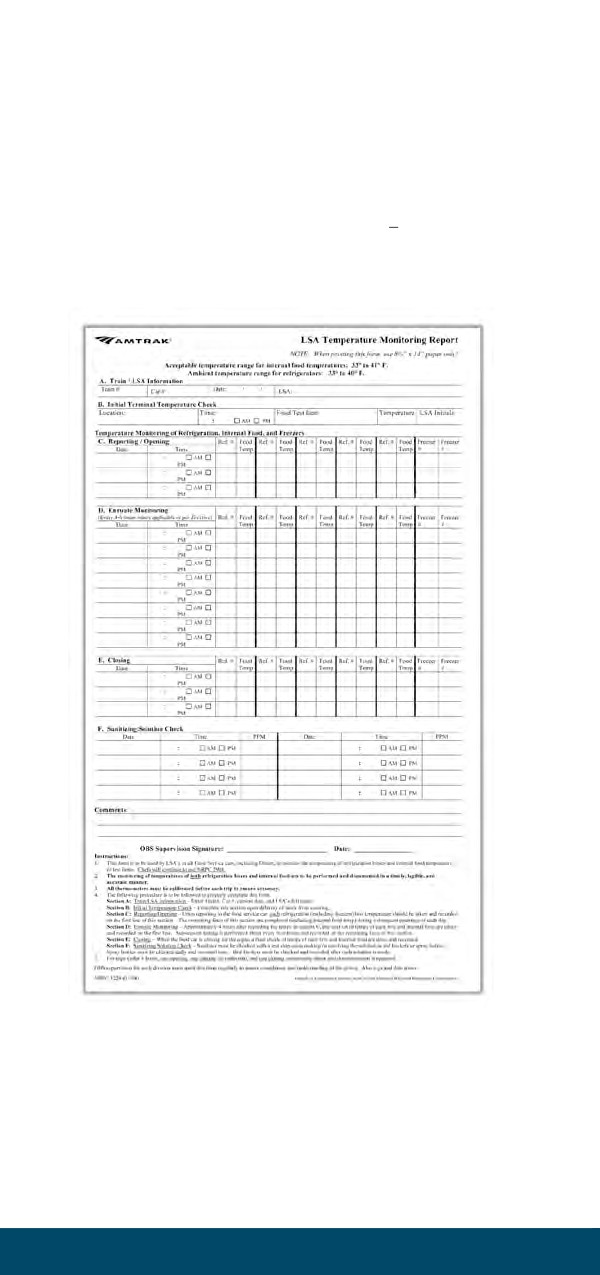
a) Instructions for the “LSA Temperature Monitoring
Report” (NRPC 3220) (Refer to Figure 3-1)
•
The “LSA Temperature Monitoring Report”
(NRPC 3220) is to be used by LSA’s in all Food
Service Cars, including Dining Cars, (except
Amtrak Cascades, Capitol Corridor, San Joaquin
and Pacific Surfliner trains which used approved
alternate systems) to monitor the temperature of
refrigeration boxes and internal food temperature
of test items.Chefs will continue to use NRPC 2908.
•
The monitoring of temperatures of both
refrigeration boxes and internal food (test yogurt)
are to be performed and documented in a timely,
legible and accurate manner.
•
All thermometers must be calibrated before each
trip to ensure accuracy.
•
The following procedure is to be followed to
properly complete this form.
Section A: Train/LSA Information - Enter
Train#, Car #, current date and LSA’s full name.
Section B: Initial Temperature Check -
Complete this section upon delivery of stock
from catering.
Section C: Reporting/Opening - Upon reporting
to the food service car, each refrigeration (including
freezers) box temperature should be taken and
recorded on the first line of this section. The
remaining lines of this section are completed
(including internal food temp) during subsequent
openings of each day.
Section D: Enroute Monitoring - Approximately
4 hours after recording the temps in section C, the
next set of temps of each box and internal food are
taken and recorded on the first line. Subsequent
testing is performed about every four hours and
recorded on the remaining lines of this section.
Section E: Closing - When the food car is closing
for the night or before arrival at the terminal, a
final check of temps of each box and internal
food are done and recorded.
Service Standards Manual No. 6
3-13
Section F: Sanitizing Solution Check - Sanitizer
must be checked with a test strip upon making
or receiving the solution in red buckets or spray
bottles. Spray bottles must be checked daily and
recorded here. Red buckets must be checked and
recorded after each solution is made.
• For trips under 4 hours, one opening, one enroute
(at midpoint), and one closing temperature check
of refrig boxes and internal food is made and
documentation of same is required.
Figure 3-1 - “LSA Temperature Monitoring Report” (NRPC 3220)
3-14
FDA Rules & Inspections
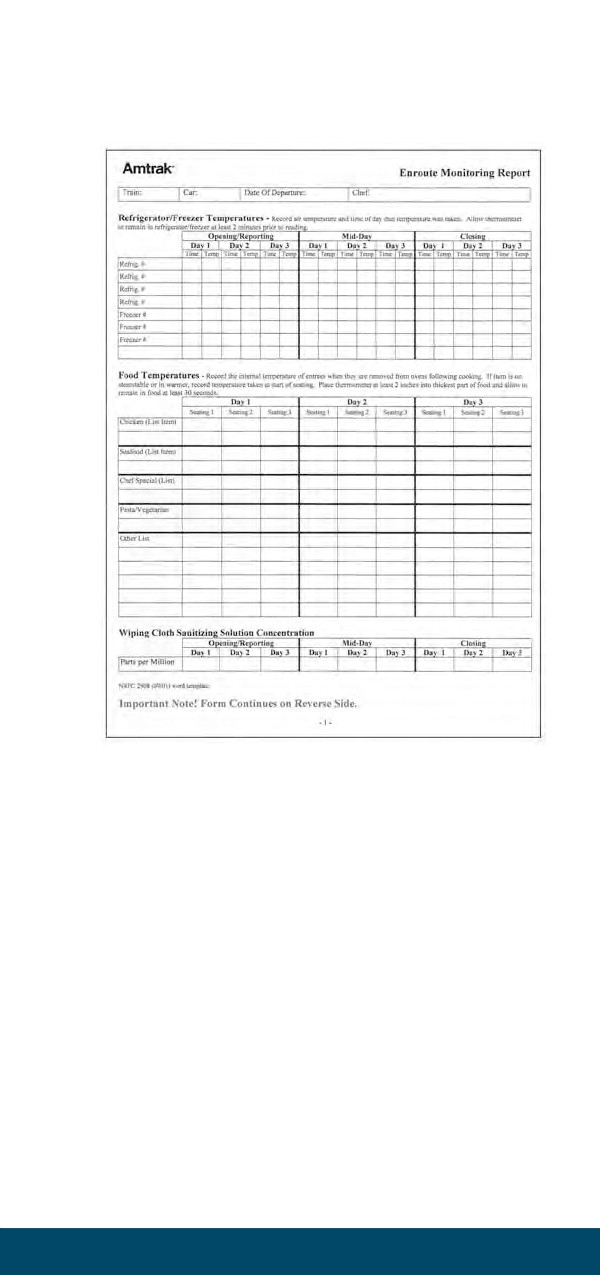
b) “Enroute Monitoring Report” (NRPC 2908) is
used by Chefs. (Refer to Figure 3-2)
Figure 3-2 - “Enroute Monitoring Report” (NRPC 2908)
6. Additional Information
Further information regarding Amtrak Public Health
Standards and Compliance can be found in the:
• Amtrak Public Health Standards (separate
stand-alone volume).
• individual Division Sanitation Plan.
• Amtrak Public Health Bulletins (available
through Crew Bases).
• current edition of the FDA Food Code.
Service Standards Manual No. 6
3-15
Introduction
This chapter covers the Carry-On Baggage Policy,
Checked Baggage Policy and the Parcel Check Policy at
Stations. Safety rules related to the lifting, storage and
movement of luggage are outline in Chapter 1 “Safety
& Security”, Section 1 “Safety”. Train Service employee
responsibilities related to baggage are outlined in
Chapter 6 “Crew Functions & Responsibilities”.
Amtrak does not assume liability for carry-on baggage,
only checked baggage. Passenger baggage must be handled
with care whenever it is moved, transported or transferred.
When assisting passengers with heavy luggage, employees
must stay focused on their personal safety, exercising care
and following proper safety procedures to avoid injury.
OBS and Train Service employees must check their
assigned cars frequently, looking for unsafe situations and
conditions resulting from the improper storage of carry-on
articles. Corrective action must be taken to avoid potential
injury or inconvenience on the part of the passenger.
OBS and Train Service employees will be relied upon to
assist passengers at un-staffed stations during train
arrivals and departures.
A. Carry-On Baggage
1.
Carry-On Baggage Policy Requirements
a) Carry-on luggage is limited to two (2) pieces per
passenger.
b) Carry-on luggage may not exceed 50 lb/23kg per
unit.
c) Carry-on luggage must not exceed 28"x 22"x 14",
the dimensions of a moderate-sized Pullman
suitcase per unit.
d) If a single carry-on bag is larger than the acceptable
per unit dimensions of 28"x 22"x 14", however
if in the employee’s judgment the total volume
of the bag does not exceed the space that would
be occupied by two Pullman suitcases of the
prescribed size, then the passenger may be
permitted to carry the bag on-board.
e) Items that do not apply to the two (2) piece
carry-on limit are as follows:
• Purses
• Briefcases
• Laptop cases
• Small daytime backpacks
Service Standards Manual No. 6
4-1
• Cosmetics cases
• Infant paraphernalia (such as car seats, diaper
bags, strollers)
• Equipment required for a customer’s medical
condition (e.g., oxygen breathing device, etc.)
• Folding bikes
f) Employees should direct passengers to stow smaller
items under seats, when practicable, leaving the
overhead and lower level luggage racks for the
larger items.
g) Pacific Surfliner overhead luggage racks can only
accommodate carry-on items that are 11 inches
or less in size.
2.
Carry-On Baggage Identification Tags Requirements
a)
All carry-on baggage must be visibly tagged with
the name and address of the person traveling
with the baggage.
b) Customers failing to comply with the baggage
identification standard must not be permitted to
board trains.
c)
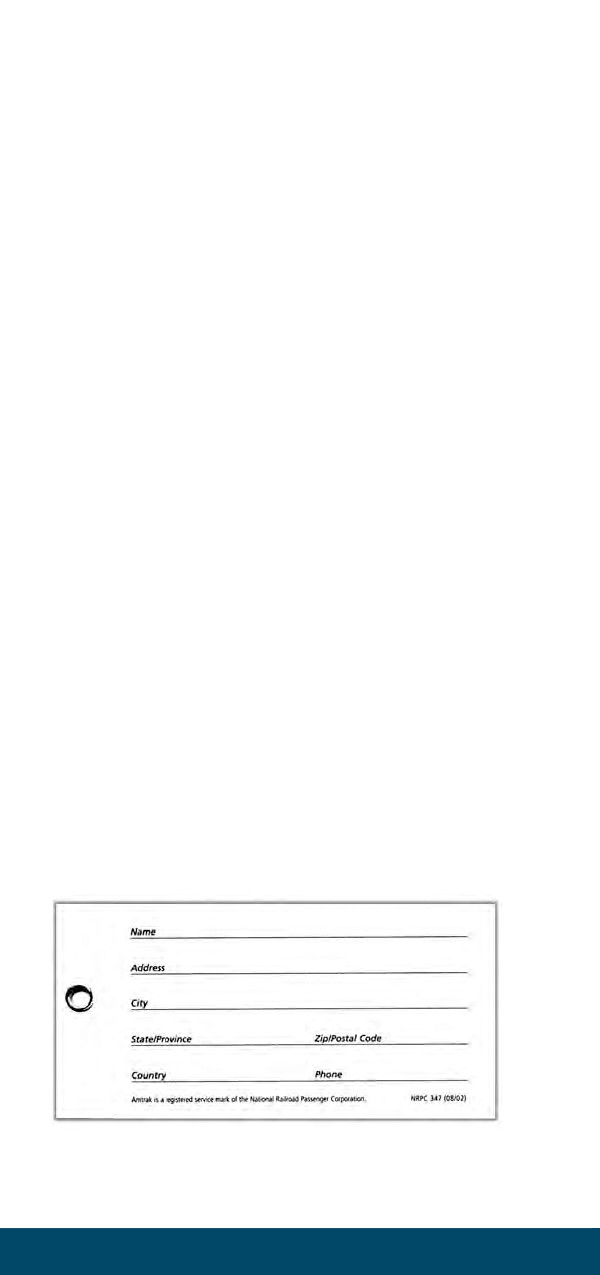
Passengers may use their own personal identifica-
tion tags, or obtain pre-printed Amtrak “Baggage
Identification Tags” (NRPC 347) available at station
ticket offices or on-board trains from a member of
the train crew. (Refer to Figure 4.1)
d) OBS and Train Service employees must maintain
a supply of the pre-printed Amtrak “Baggage
Identification Tags” (NRPC 347), which are
available at crew base locations. (Refer to Figure 4.1)
e)
OBS and Train Service employees must be vigilant
to ensure that all carry-on baggage is properly
tagged (such as briefcases etc).
f)
Items that do not apply to the two (2) piece
carry-on limit are not required to have
identification tags.
Figure 4-1 “Baggage Identification Tag” (NRPC 347)
4-2
Baggage Handling
3.
Carry-On Baggage “Canadian Customs Tag” (NRPC
3088) Requirements
a) The “Canadian Customs Tag” (NRPC 3088) is
to be used on Adirondack and Maple Leaf trains
entering Canada. (Refer to Figure 4-2.)
b) Conductors must make the Canadian Customs
Tag Announcement to inform passengers that all
carry-on items crossing the US/Canadian border
into Canada on the Adirondack and Maple Leaf
must be tagged with a completed “Canadian
Customs Tag” (NRPC 3088) which includes the
passenger’s name and citizenship. (Refer to Chapter
10 “On-Board Announcements & Signage”)
c) Carry-on items are defined as:
• Handbags
• Purses
• Briefcases
• Baby Bags
• Baby Strollers
• Baby Car Seats
• Backpacks
• Duffle Bags
• Suitcases
• Camera Bags
• Plastic or Paper Bags
• Boxes
• Other containers not identified in this list
d) The “Canadian Customs Tag” (NRPC 3088) may
be affixed to carry-on items using the attached
elastic string or as a sticker by pealing off the
entire top of the tag.
e) The small tag number sticker in the lower right-
hand corner of the tag must be removed and
affixed to the back of the passenger’s ticket receipt.
f) All on-train crewmembers must carry a sufficient
supply of “Canadian Customs Tag” (NRPC
3088) to meet demand.
g) Conductors and Assistant Conductors are the only
on-train crewmembers allowed to affix tags to
carry-on items.
h) The “Canadian Customs Tag” (NRPC 3088) is
not a substitute for baggage identification tags.
Luggage identifications tags (passenger or Amtrak
supplied) must be attached to luggage as defined
in Chapter 4 “Baggage Handling”, Section A2
“Carry-On Baggage Identification Tags
Requirements”.
Service Standards Manual No. 6
4-3
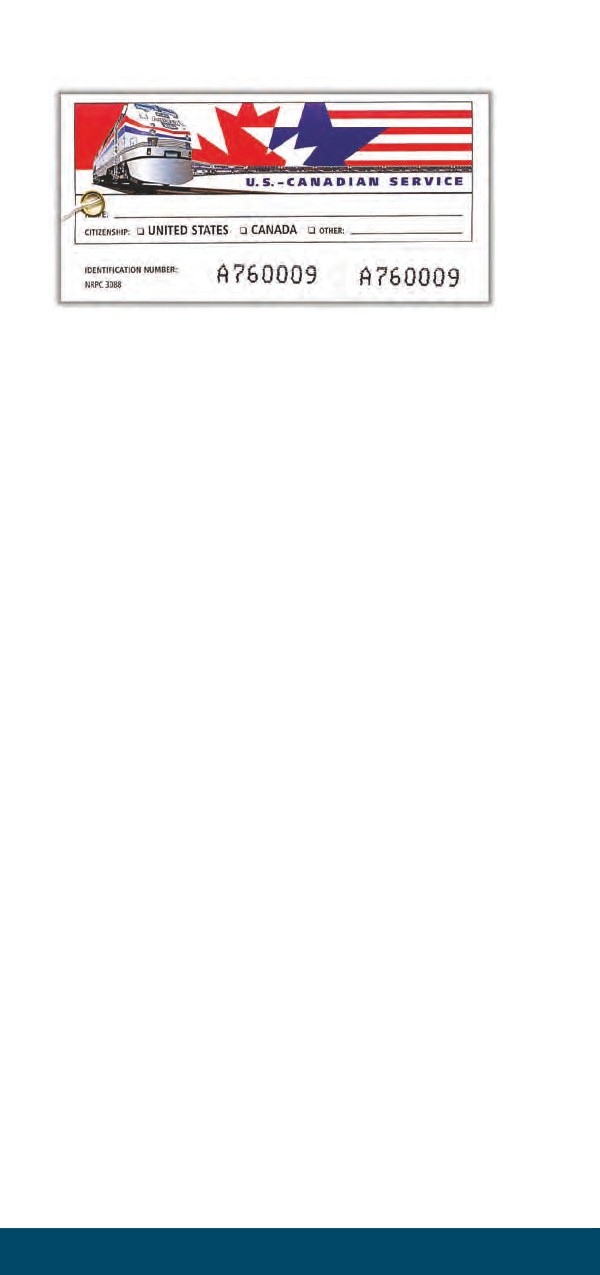
Figure 4-2 “Canadian Customs Tag” (NRPC 3088)
4.
Continental Airlines Passengers
Carry-on luggage limits will not apply to Continental
Airlines “involuntary rerouted” passengers.
5.
Military Passengers on Active Duty
Passengers traveling under Military travel orders
are exempt from baggage size, weight and quantity
limitations. Obtain assistance from another employee
or possibly the military person in order to load or
unload baggage with weight over 50 lb/23 kg.
6.
Excess Baggage
a) In cases where passengers arrive at trainside with
carry-on baggage that clearly exceeds the permitted
amount, OBS and Train Service employees must
not permit the passenger(s) to board the train
with the excess luggage.
b) Passengers exceeding the carry-on baggage limits,
traveling between points where checked baggage
service is available, should be instructed to check
their excess luggage.
• It is important that instances where passengers
are not permitted to board trains due to excess
luggage be handled with tact and professionalism.
• It should be explained to those passengers
that Amtrak security standards have been
implemented placing limits on the size, weight
and amount of luggage that can be brought
on-board the train.
• Alternative options should be offered at
staffed stations, where practicable.
7.
Firearms or Weapons Carried On-Board
Firearms, ammunition and/or other weapons,
whether or not packaged (assembled or disassembled),
4-4
Baggage Handling
are prohibited in carry-on baggage or on the person
at all times, even if the person has a permit to carry.
The only exception is if the person is a “qualified
active law enforcement officer” as defined in
Chapter 1 “Safety & Security”, Section 4 “Law
Enforcement Issues”.
8.
Folding Bicycles
Folding bicycles may be brought aboard passenger
cars as carry-on baggage. Only true folding bicycles
(bicycles specifically designed to fold up into a compact
assembly) are acceptable and must be able to fold
into a size no greater than 34" x 15" x 48".
Generally, folding bicycles have small wheels and
frame latches allowing the frame to be collapsed.
Regular bicycles of any size, with or without wheels,
are not considered folding bicycles, and may not be
stored aboard the train as a carry-on folding bicycles.
Folding bicycles must be folded before boarding the
train and will not count against the two-baggage
carry-on limit. Folding bicycles can only be stored in
luggage storage areas at the end of the car (or, in
Superliners, on the lower level). Folding bicycles
cannot be in stored in overhead luggage racks,
vestibules or in reserved (ticketed) bicycle racks.
9.
Full Size Bicycles and Surfboards
a) Pacific Surfliner Trains 550-599 and 750-799
Passengers are permitted to bring bicycles and
surfboards on-board. Trains 798-799 operating
with Horizon equipment are not equipped with
bicycle racks. When Pacific Surfliner equipment
is substituted with Horizon or Superliner
equipment, neither bicycles nor surfboards are
accepted on this equipment (advance notice is
often not provided).
Conditions of travel:
• Reservations not required (first come, first serve).
• No charge.
• Passenger must place bicycle in the self-service
racks.
• Six bicycle racks are available per train (two
cars with three racks each).
• No tandem bikes allowed.
• Surfboards must be in a carrying case and no
longer than 7 feet.
Service Standards Manual No. 6
4-5
b) Capitol Corridor Trains 520-549 and 720-749 and
San Joaquin Trains 701-717
Passengers are permitted to bring bicycles
on-board.
Conditions of travel:
• Reservations not required (first come, first
serve).
• No charge.
• Passenger must place bicycle in the self-service
rack on the lower level.
• Each car holds only three bicycles. If the racks
are filled, the passenger must go back to the
platform and board another car.
• Bicycles ARE NEVER to be stored in the
open area designated for wheelchairs.
c)
California Thruway Buses 3000 to 6999
Unboxed bicycles may be placed in the storage
bin under the buses connecting with Capitol
Corridor or San Joaquin trains.
• Passengers assume the risk - Amtrak has no
liability.
• No tandem bikes allowed.
d) Amtrak Cascades Trains 500-517
Passengers are permitted to bring bicycles on-board
if placed in special racks located in the Talgo
trainset Baggage Car. (If trains 510 and 517 are
operating with Superliner equipment, bicycle
racks will not be available.)
Conditions of travel:
• Reservations are required.
• Passenger must be ticketed for the same train.
• Passenger will load and off load bicycles at the
Baggage Car. They may use their own locking
device (if he or she chooses).
• If the Talgo equipment is not operating, bicycles
must ONLY be handled as checked baggage.
e) Downeaster Trains 680-697
Unboxed bicycles are permitted in the baggage
compartment of the Cab Car.
Conditions of travel:
• Reservations are required.
• There is a $5.00 charge for the bicycle.
• Bicycles will be placed in the baggage
compartment of the Cab Car.
4-6
Baggage Handling
f) Heartland Flyer Trains 821-822
This train operates with Superliner equipment.
Bicycles are not permitted on-board the train.
g) Illinois/Missouri Service Trains 300-series
Passengers are permitted to bring full sized
bicycles on-board the following trains:
• Chicago - Quincy
• Chicago - Carbondale (Does not include the
City of New Orleans)
• Chicago - St. Louis (Does not include the
Texas Eagle)
• St. Louis - Kansas City
Conditions of travel:
• Reservations are required.
• Passengers are required to remove the front
tire and use a bungee cord to secure the wheel
to the frame.
• Passengers are required to load and off load
the bicycle.
• Passengers are required to place the bicycle in
the overhead rack.
h) Piedmont Trains 73-74
Passengers are permitted to bring bicycles on-board.
Conditions of travel:
• Reservations are required.
• Bicycle reservations must be on the same train
the passenger is traveling.
• There is no charge for bicycles.
• Bicycles do not need to be boxed.
• Station agent is to place a checked baggage
tag on the bicycle, even if the destination is an
unstaffed station.
• Bicycles are placed in the Baggage Car by an
employee.
• There are six bicycle slots per train.
• At the passenger’s destination, bicycles are
given to the passenger when their claim check
is presented at the Baggage Car.
B.
Checked Baggage
1.
Checked Baggage Policy Requirements
a) Passengers are permitted to check up to three (3)
pieces (suitcase, truck, garment bag, etc) per
persons at no charge.
Service Standards Manual No. 6
4-7
b) Segways and Hoyer Lifts that are checked, are
exempt from additional charges.
c) In addition to the three (3) pieces of baggage at
no charge, passengers are permitted to check an
additional three (3) pieces of baggage for $10.00
each. Additional baggage must be sent by
Amtrak Express.
2.
Firearms in Checked Baggage
On December 15, 2010, Public Law 111-117
permitted passengers to check unloaded firearms
and ammunition on Amtrak trains within the United
States that offer checked baggage service. This
law does not apply to Amtrak trains to Canada or
Thruway Bus Services that provide checked baggage.
Under no circumstances is a non-law enforcement
passenger or employee permitted to carry firearms
or ammunition on-board Amtrak trains either on
their persons or in carry-on baggage. (Refer to
chapter 1, section 4 “Law Enforcement Issues”,
letter B. “Firearms and Weapons On-Board Trains”)
The Conductor/Assistant Conductor will be
responsible for overseeing checked baggage and
the loading/unloading of long gun cases (rifles and
shotguns) from the designated secure on-board
firearms storage area located within the train or
Baggage Car until relieved en route (crew transfer
point) or arrival at final destination.
a) Checked Baggage Containing Handguns/Starter
Pistols/Ammunition - All Trains Except Pacific
Surfliner and San Joaquin.
• Firearm case(s) or ammunition that are
contained inside checked baggage will follow
normal handling procedures for checked
baggage and must not be segregated from
other baggage for that train or transported
in a secured transport float.
• After the baggage leaves the origin city, there
should be no knowledge conveyed that
firearms/ammunition exists in this baggage.
b) Checked Baggage Containing Handguns/Starter
Pistols/Ammunition - Pacific Surfliner and San
Joaquin.
4-8
Baggage Handling
• Once Amtrak takes possession of checked
baggage containing handgun cases or
ammunition, it must be secured at all times.
• Checked baggage containing handgun cases or
ammunition must be transported to and from
the station in a secured firearms float.
• Load/unload the checked baggage containing
handgun case(s) and/or ammunition transferring
them to/from the secured firearms storage area
on the train.
• Baggage Agents may load/unload checked
baggage containing handgun cases or
ammunition but must not load/unload long
gun cases without notifying the train crew.
Stations have been provided with number 102
switch lock keys that can open the secured
on-board firearms storage area.
• The origin station must contact the destination
station via telephone to notify employees of
the incoming handgun cases or ammunition in
checked baggage.
c)
Long Gun Cases - All Trains
• Once Amtrak takes possession of a long gun
case (rifles and shotguns), it must be secured at
all times.
• Secured on-board firearms storage areas can
only accommodate a maximum of six (6) long
gun cases.
• Station baggage personnel will transport long
gun cases to/from trains in a secured baggage
float.
• Station baggage personnel will load/unload the
long gun case(s) from the secured baggage
float transferring case(s) to/from the
Conductor/Assistant Conductor.
• The Conductor/Assistant Conductor will be
responsible for loading/unloading long gun
case(s) to/from the secure on-board firearms
storage area provided on the train. The locks
on the secured storage cabinets can be unlocked
with a number 102 switch lock key.
d) Train Manifest
The train manifest will be used to track which
long gun case(s) have been loaded and unloaded
from the train.
Service Standards Manual No. 6
4-9
•
Long gun case(s) reservations are noted after
the special service request section in the train
manifest.
•
Conductors/Assistant Conductors are required
to legibly print their initials on the appropriate
line verifying the long gun case(s) that have
been loaded or unloaded at the station.
•
At the completion of the trip, or when a crew
is relieved in route (crew transfer point), the
manifest page containing the long gun case
tracking information must be removed from
the manifest and placed in the “Train Earnings
Reports Envelope” (NRPC 158).
•
The relieving crew is responsible for comparing
the original manifest page in the “Trains
Earnings Reports Envelope” (NRPC 158) with
the actual long gun case(s) on-board the train.
•
If long gun case(s) continue to be loaded and
unloaded, the relieving crew will document by
printing their initials on the original manifest
page contained in the “Trains Earnings
Reports Envelope” (NRPC 158).
•
If new long gun cases have been listed on the
relieving crew’s train manifest, printed initials
will be placed next to the newly listed guns
with this page of the manifest being included
with the original manifest gun case tracking
page in the “Trains Earnings Reports
Envelope” (NRPC 158).
e) Station employees have been provided with
number 102 switch lock keys, but will not open a
secure on-board firearms storage area unless they
have made multiple attempts to contact the crew.
f) Station employees can load/unload long gun
cases if the Conductor/Assistant Conductor is
unable to work the Baggage Car or designated
secure on-board firearms storage area.
• Station employees will load/unload long gun cases.
• Station employees must contact the Conductor/
Assistant Conductor with the number of long
gun cases that are loaded/unloaded.
• Conductor/Assistant Conductor must inventory
the firearms storage area updating the manifest
whenever long gun cases are loaded or
unloaded.
4-10
Baggage Handling
g) In cases where the station employee does not
meet the train at arrival, the Conductor/Assistant
Conductor is to remain at the Baggage Car until
the firearms are released to the station personnel.
h) When firearms discussions take place face-to-face
or over the radio between employees in the
presence of passengers, employees should refrain
from mentioning firearms. The discussion should
be communicated in this manner: “One item was
removed from the secured area in the Baggage
Car” or “Two items have been added to the
secured area on the train”.
i) Unaccompanied minors may check unloaded
firearms and/or ammunition in accordance with
normal firearms handling procedures.
j) Employee pass riders traveling on their personal
passes in a non-duty, non-travel status (vacation,
personal leave, rest days, etc.) may check firearms
under the same policies as for revenue passengers.
3.
Firearms in Checked Baggage - Unusual Circumstances
a) Recording of Delays Caused by Checked
Baggage Firearms:
Delays caused by or related to unloading firearms
or ammunition in checked baggage should be
coded "HLD". They will be considered a type of
Passenger-and-Baggage Delay. The explanation
for any such delays must begin with the word
"FIREARM" so the delay can be easily
distinguished from other types of "HLD" delays.
The word "FIREARM" may either be used
as the first word in the delay explanation, or
be a stand-alone word before the rest of the
explanation.
b) Passenger Removal
• If a passenger is removed from the train and
has checked baggage, the Conductor must
contact CNOC (302) 683-2299 with the
passenger’s travel reservation number and
the baggage tag numbers before releasing
the checked baggage to the passenger.
• CNOC will be able to identify if the passenger
has a firearm or ammunition in their checked
baggage.
• The baggage tag or manifest will identify if a
long gun is on-board.
Service Standards Manual No. 6
4-11
•
Under no circumstances will checked baggage
involving a firearm be released to the sole
custody of the passenger that is being
involuntarily removed from the train.
•
The Conductor must advise responding police
that the passenger is transporting firearms.
•
The Conductor and police will determine if:
• the police will take possession of the
firearms.
• the station where the passenger is removed
will take possession of the firearms, provided
that the station can handle checked firearms.
• the firearms will remain on-board the train
to the ticketed destination station.
•
If the firearms or ammunition in checked
baggage are not taken off the train with the
passenger, the checked firearms or ammunitions
should remain on the train to the station that
it was checked. The checked firearms or
ammunition will be handled as outlined in
section 3.e “Missing, Mishandled or Delayed
Firearms”, but the passenger will not be
eligible for reimbursement expenses.
•
The Conductor must notify CNOC
(302) 683-2299 of the status of the firearm(s).
•
CNOC will record the status of the firearm(s)
in the “Ticket” field of the “Remarks” section
of the PNR.
c)
Derailment
• During a derailment situation, the Conductor
will need to provide first responders with the
quantity and location of on-board firearms.
• The train manifest will list any long gun
cases onboard the train.
• Contact CNOC (302) 683-2299 to determine
checked baggage containing firearms.
• Emergency crews should be the only ones
permitted near the car containing the secured
on-board firearms storage area if the car is
on fire.
• If the passengers are taken to a shelter, the
checked firearms and ammunition should be
stored in a separate secured area. If a passenger
needs other items out of the suitcase that
contains firearms and ammunition, they should
be permitted to remove those items and then
4-12
Baggage Handling
return the baggage with the checked firearms
and ammunition to the secured area.
d) Service Disruptions - Bussing
• If train service is interrupted and the passen-
gers have to be bussed, all firearms must be
loaded in the storage bins under the bus.
• No firearms in checked baggage may be
loaded in the passenger areas of the bus.
• Long gun cases should be loaded together
in the same storage bin, but other baggage
can also be loaded in this bin.
• The storage bin containing long gun cases
should be locked if possible.
• Contact CNOC (302) 683-2299 to determine
checked baggage containing firearms.
• An Amtrak employee does not need to ride
with the bus.
• If an Amtrak employee does not accompany
the bus, the bus driver can become Amtrak’s
representative.
• When the bus arrives at its final destination, an
Amtrak agent must take charge of the luggage
- especially the long gun cases. The destination
station would have received a notice that long
gun cases were coming and should prepare for
the arrival of the bus with the secure firearms
float if possible.
• If the bus is being utilized to reconnect to rail
service at an intermediate point, the transfer
station must be notified by the Amtrak
employee in charge at the station the bus was
dispatched from, of any firearms that must be
handled. The intermediate station should use
the secure firearms float to transport long gun
cases from the bus to the train.
• Checked hand guns and ammunition may
continue to ride anonymously as long as
checked baggage is not placed in the passenger
area of the bus.
• If a bus company refuses to accept firearms,
allow the passengers to travel along with any
checked luggage that does not contain
firearms. Alternate transportation will need to
be arranged to carry the firearms.
• In situations where Amtrak will be providing
prolonged bus operations to replace rail service,
Service Standards Manual No. 6
4-13
firearms and ammunition in checked baggage
must continue to be accepted if checked
baggage service is being offered. If checked
baggage service is suspended, firearms and
ammunition in checked baggage service can
also be suspended.
e) Blanked or Shopped Car
•
If a car containing a secured on-board firearms
storage area is blanked or shopped in route,
firearms must be moved to a secured locked
bathroom or other lockable area within the car.
•
Firearms contain within checked baggage cannot
be stored in the same car that passengers occupy
unless the firearms are in a secured locked
bathroom or other lockable area within the car.
Contact CNOC (302) 683-2299 to determine
which checked baggage containing firearms.
•
If a Coach Car is provided to replace a
Baggage Car.
• The Coach Car should be locked when long
gun case(s) are being transported within the
car.
• If the Coach Car cannot be locked, all long
gun cases must be secured separately in a
locked bathroom or other lockable area
within the car.
• If there is no lockable space in the car, all
long gun cases must be transported in the
next available Baggage Car. The Conductor
can use the manifest to determine which
passengers are transporting long gun cases
and notify them that the next available
Baggage Car will be transporting their
firearms.
• Handgun cases and ammunition contained
inside checked baggage may be transported
in an unlocked Coach Car not occupied by
passengers.
•
Contact CNOC (302) 683-2299 to determine
checked baggage containing firearms.
f)
Missing, Mishandled or Delayed
Firearms/Ammunition
Station employees will use the follow steps
when handling missing, mishandled or delayed
firearms/ammunition.
4-14
Baggage Handling
•
Verify the passenger has a firearms checked
baggage receipt.
•
If the firearm is a long gun case, check with the
station agent to determine if an alert was sent
through the Arrow system notifying the destination
station that a long gun case is being stored inside
the secured storage cabinet of the incoming
train’s Baggage Car that should be offloaded.
•
If long gun case(s) do not arrive on the same
scheduled train that the passenger is riding, the
Baggage Agent must contact the origin station at
the first opportunity to confirm that the long gun
case(s) was loaded on the train.
•
Check with the Conductor if it’s a long gun case
to ensure the firearm was removed from the
storage locker.
•
Baggage that is mishandled or misconnected during
a passenger’s trip resulting in a delay of baggage
containing firearm case(s) and/or ammunition,
Amtrak will ship the firearm case(s)/ammunition
to the departure or destination station at the
passenger’s discretion.
•
At no time will Amtrak ship the firearm
case(s)/ammunition using other means of
transportation other than Amtrak’s checked
baggage service.
•
The passenger will be required to pickup their
firearm case(s)/ammunition at the designated
station and will be reimbursed for their
expenses.
•
Passengers will be reimbursed up to 200 miles
round trip at the current rate per mile
allowance.
•
The maximum for transportation costs other
than the passenger’s personal vehicle is $100.
•
Receipts are required from the passenger and
should be reimbursed through an EEV.
•
For mileage, the passenger should provide the
address of where they are staying.
•
Costs in excess of the above mentioned limits
must be approved by the District Manager.
•
Misrouted firearm case(s) are not to be
delivered by employees, taxis or any other
courier services.
Service Standards Manual No. 6
4-15
• If unsuccessful in locating the item, Amtrak
Police must be notified at (800) 331-0008 to
respond and initiate a lost or stolen property
report. Once the Amtrak Police have been
notified call CNOC’s 24-Hour Operations
Customer Services Desk (302) 683-2299.
4.
Checked Baggage To or From Canada
• Passengers crossing the border must be on the
same train as their checked baggage.
• Unaccompanied baggage will be turned back at
the border.
• Each piece of baggage must have an identification
tag and be unlocked to allow Boarder Patrol
inspections.
• Firearms and ammunition are not allowed in
checked baggage on trains going to Canada.
5.
Prohibited Checked Baggage Items
The following items must not be accepted as checked
baggage:
•
Animals
•
Books (applies to boxes or containers of books)
•
Phonograph records, tapes, etc.
•
Cameras and photographic accessories
•
Controlled or illegal substances
•
Electronic equipment (TVs, computers, video
games, etc.)
•
Dangerous or hazardous items (fireworks,
flammable items, radioactive materials, etc.)
•
Fishing poles not in containers
•
Fragile articles (antiques, art work, etc.)
•
Hand trucks
•
Household goods (appliances, china, clocks,
furniture, hooded hair dryers, sewing machines,
silverware, etc.)
•
Liquids (including toiletries such as perfumes)
•
Medications and prescriptions
•
Motorized vehicles and engines
•
Office equipment (calculators, typewriters, etc.)
•
Perishable items (food, plants, etc.)
•
Sailboards with masts
•
Tennis rackets
•
Tools and tool boxes
•
Tow-bars, trailer hitches, etc.
•
Valuable items (credit cards, coin or stamp
4-16
Baggage Handling
collections, gems and minerals, irreplaceable
papers and manuscripts, jewelry, stock certificates,
watches, etc.)
• Weapons other than handguns, firearms and
ammunition
• Any other oversized or overweight item, or an item
unsuitably packed or too fragile to withstand normal
handling
6.
Unsuitable Containers
Containers which are too fragile (paper or plastic
bags), unable to withstand cold (plastic containers),
have exposed hooks which can damage other baggage,
or woven items which can be easily pierced are not
to be accepted as checked baggage.
C.
Wheelchairs, Scooters and Segway
Personal Transporters
There are occasions when disabled passengers will
chose to check a mobility device, such as a battery
operated wheelchair or scooter. A passenger may
bring a lighter weight device on the train while
checking the heavier more cumbersome battery
operated unit.
1.
Wheelchairs and Scooters
a) The following wheelchairs and scooters are
allowed in checked baggage:
• Non-motorized wheelchairs are accepted at all
baggage stations.
• Four-wheel wheelchairs with only the two large
wheels powered.
• Three wheel powered scooters (i.e., Rascals)
which should be dismantled by the customer
to the extent possible and palletized for
protection enroute.
b) Wheelchairs and scooters with all four wheels
battery powered cannot be accepted in checked
baggage.
c) Battery powered wheelchairs and scooters can be
checked as baggage, if the following applies to
both origin and destination:
• The station has high level platforms or,
• The station has a low level platform and is
equipped with either a forklift or wheelchair lift
Service Standards Manual No. 6
4-17
(unit cannot weigh more than 600 lbs in total)
or,
• The station has a low level platform and is
served by Superliner Coach-Baggage Cars with
an on-board ramp.
2.
Segway Personal Transporters
The Segway Personal Transporter does not qualify as
a mobility assistance device.
Segway Personal Transporters can only be transported
as checked baggage and must be boxed for the unit’s
protection (customer to supply box).
Segway Personal Transporters cannot be brought
inside the passenger space of the train due to their
large size and heavy weight, which prevents safe
loading. The Segway’s design also prevents storing or
securing of the unit against undesired movement in
the event of an emergency.
3.
Hoyer Lifts
Hoyer lift can only be transported as checked baggage
and must be boxed for the unit’s protection (customer
to supply box). The Hoyer Lift cannot be brought
inside the passenger space of the train due to the
Hoyer Lifts’ size. In addition, the lift can not be
secured in the body of the car.
The Hoyer Lift is used to lift an individual from on
area to another. An example would be to lift someone
from a motorized chair to a non-motorized chair.
D. Regular Bicycles
Regular bicycles must be checked as baggage in a
box (with handlebars and pedals removed) or other
secure container on trains offering checked baggage.
Regular bicycles will not count against the two-baggage
carry-on limit and must never be transported in the
vestibule of any car. Trains having specially designed
equipment that can safely and securely accommodate
the storage of regular bicycles as checked baggage
without boxes are as follows:
• Amtrak Cascades - six reserved regular bicycle
spots per train
4-18
Baggage Handling
• Piedmont - six reserved regular bicycle spots
per train
• Downeasters - eight reserved regular bicycle
spots per train
• Most Pacific Surfliner Cars - three regular bicycle
spots per car, first come, first serve
•
1st Generation California Cars (Capitol Corridor
and San Joaquin) - three regular bicycle spots
per car, first come, first serve
• Heartland Flyer - up to four regular bicycle spots
per train (depending on consist)
E.
Snowboards, Surfboards, Golf Clubs
and Kayaks
a) Snowboards, surfboards and golf clubs may only
be handled as checked baggage on Amtrak trains
unless they can be safely stowed in the exterior
lockers on Superliner equipment or on-board
equipment that is specifically designed to safely and
securely accommodate the storage of those items
(e.g., surf boards on Capitol Corridor and Pacific
Surfliner trains). Snowboards, surfboards and golf
clubs will not count against the two-baggage
carry-on limit and must never be transported in
the vestibule of any car.
b) Kayaks are only permitted as checked baggage
if they are marked fragile and have an
identification tag.
F.
Ski Equipment
Ski equipment can be handled as checked baggage or as
unchecked baggage (if the ski equipment can be safely
stowed in the exterior lockers on Superliner equipment
or on-board equipment that is specifically designed to
safely and securely accommodate ski equipment) or as
carry-on baggage (as long as the skis and poles are con-
tained in a ski bag that can be secured to the overhead
luggage rack with tie wraps). Ski equipment will not
count against the two-baggage carry-on limit and must
never be transported in the vestibule of any car.
G. Scouting Organizations
Such luggage dimension limits will not apply to
scouting and other organizations that require
backpacks of a specific size. Luggage requirements
Service Standards Manual No. 6
4-19
should be established beforehand whenever practical,
so that appropriate accommodation may be made
for special groups.
H. Parcel Check
Parcel Check service is available at many staffed
stations in the Amtrak system for the temporary
storage of items. There is a charge of $3.00 per item
per 24 hours or fraction ($4.50 in NYP) thereof.
I. Pass Riders
Amtrak pass riders have the same restrictions and
coverage as fare paying passengers.
4-20
Baggage Handling
Introduction
While each of us is important to Amtrak’s success, those
providing direct service to our customers have a unique
role. As a front line employee of Amtrak, you create a
deep and lasting impression on our customers. An
employee’s behavior and appearance send clear messages
about how they feel about themselves, their responsibilities
and their company. In turn, our customers form impressions
about Amtrak from its employees - impressions of reliability,
consistency, proficiency and courtesy. An employee’s neat,
polished and professional appearance helps to create a
positive image of Amtrak for the traveling public and is
the first step for providing excellent service. In this chapter,
employees will find uniform and grooming standards
designed to help them present a professional and consistent
appearance.
A. Policy
Uniformed employees are required to abide by all
uniform and grooming standards outlined in this
chapter and/or any other official memo, bulletin,
advisory or other document issued by Amtrak. Any
questions regarding these standards should be directed
towards your immediate supervisor for clarification.
All employees on duty must wear the regulation
uniform as designated by Amtrak. Components for
the uniform can only be ordered through the Amtrak
Uniform Program. It is supervision’s responsibility to
assist employees in complying with the policy and to
enforce as necessary.
You must wear the required uniform components
for your particular job/craft only. Uniform
Coordinators can provide you with specific information.
All components must be issued by the Customer
Services Department and obtained from an approved
Amtrak vendor unless specifically authorized
otherwise (e.g., some special-size items). Each of
you has a responsibility to create a positive image of
yourself and Amtrak when in uniform. The uniform
and grooming standards are designed to enable you
to achieve this goal through a consistent, professional
appearance.
Service Standards Manual No. 6
5-1
Uniform guidelines and grooming standards can
be found in the uniform catalog titled “The
Uniformed Look”, and on Amtrak’s Intranet and
the Customer Services Department Website at:
B. Uniform Component Guidelines
Amtrak’s Uniform Program is a component system
that provides employees with a consistent look and
image. Each craft has a Prescribed Uniform using
specific components that are worn year-round.
During certain work situations, weather conditions
or months of the year, specified uniform components
can be added or removed to the prescribed uniform.
Uniform items not specifically mentioned are not
authorized. Uniforms and company accessories are
to be worn only while on duty. Employees, who
commute to and from work by Amtrak or commuter
rail service trains, may wear their uniforms but must
remove all Amtrak accessories.
1.
Train Service Employees
Conductor and Assistant Conductor
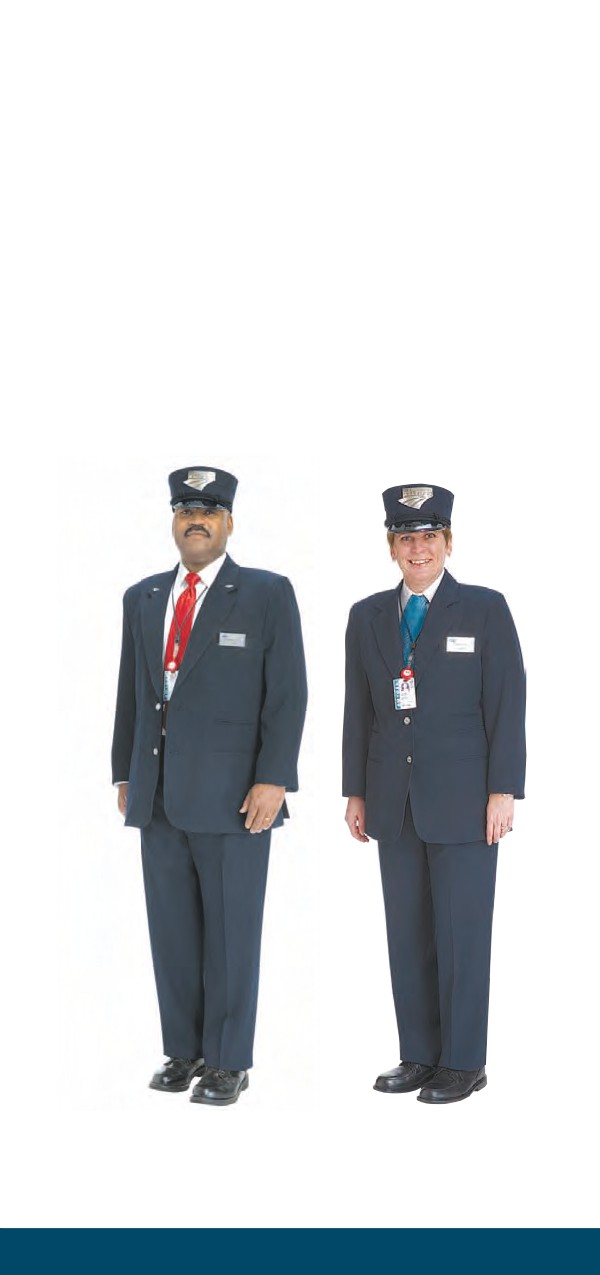
a) Prescribed Uniform
The prescribed uniform includes the navy jacket
with or without collar eyelets (collar eyelets
require collar pins), navy pants, plain white long
sleeve shirt/blouse, approved custom red or
blue neckwear and navy pillbox-style hat with
appropriate pewter hat badge. (Refer to Figure 5-1)
b) Uniform Options
The navy vest or sweater is optional, but may not
be worn without the jacket. The vest and sweater
cannot be worn simultaneously. The female long
style vest is not permitted. The white short sleeve
shirt/blouse without epaulets (no longer available
from Amtrak) and the white short sleeve
shirt/blouse with epaulets and slides may be worn
year-round only when covered with the prescribed
jacket. Previously issued navy pleated trousers/slacks
are authorized to be worn. Maternity clothing is
available upon request.
5-2
Uniform and Grooming
c) Seasonal Uniform Options
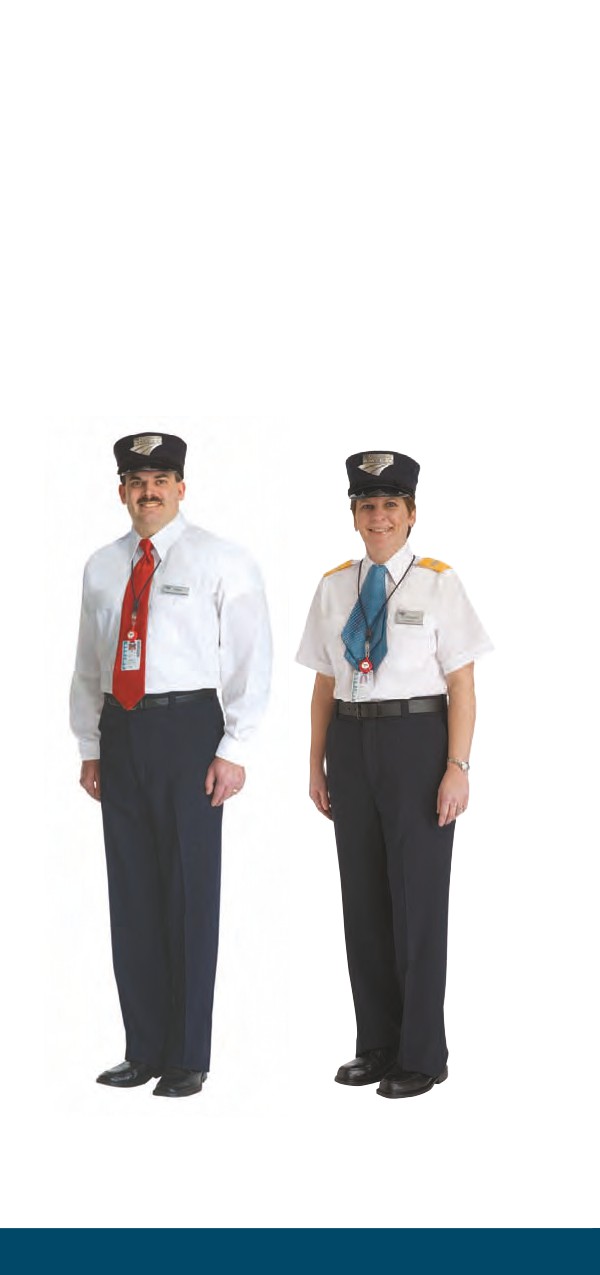
During the period from May 1 to October 31 or
when there are periods of sustained temperatures
exceeding 80-degrees during the year, Train Service
employees may remove their jacket as long as the
prescribed white long sleeve shirt/blouse or the
white short sleeve shirt/blouse with epaulets and
appropriate slides is worn. The short sleeve shirt/
blouse with epaulets is always worn with the
appropriate slides and is never worn without slides.
When the jacket is removed, the vest, sweater and
short sleeve shirt/blouse without epaulets cannot be
worn. (Refer to Figure 5-2)
Figure 5-1 - Prescribed Uniform for Conductor and Assistant Conductor
Service Standards Manual No. 6
5-3
d) General Uniform Information
All uniform components must be issued by Amtrak,
excluding white short sleeve shirts/ blouses without
epaulets. Blue on blue slides with four hash marks
must only be worn by the employee designated
“Conductor” per the job assignment. Blue on blue
slides without hash marks must only be worn by the
employees designated as “Assistant Conductor” per
the job assignment. Amtrak photo ID must be worn
at all times. Amtrak nametag must be worn on left
breast panel of uniform at all times while on duty.
Figure 5-2 - Correct Seasonal Uniform Option for Conductor and Assistant Conductor
5-4
Uniform and Grooming