Amtrak. Service Standards Manual for Train Service and On-Board Service Employees (Version 6, 2011) - page 6
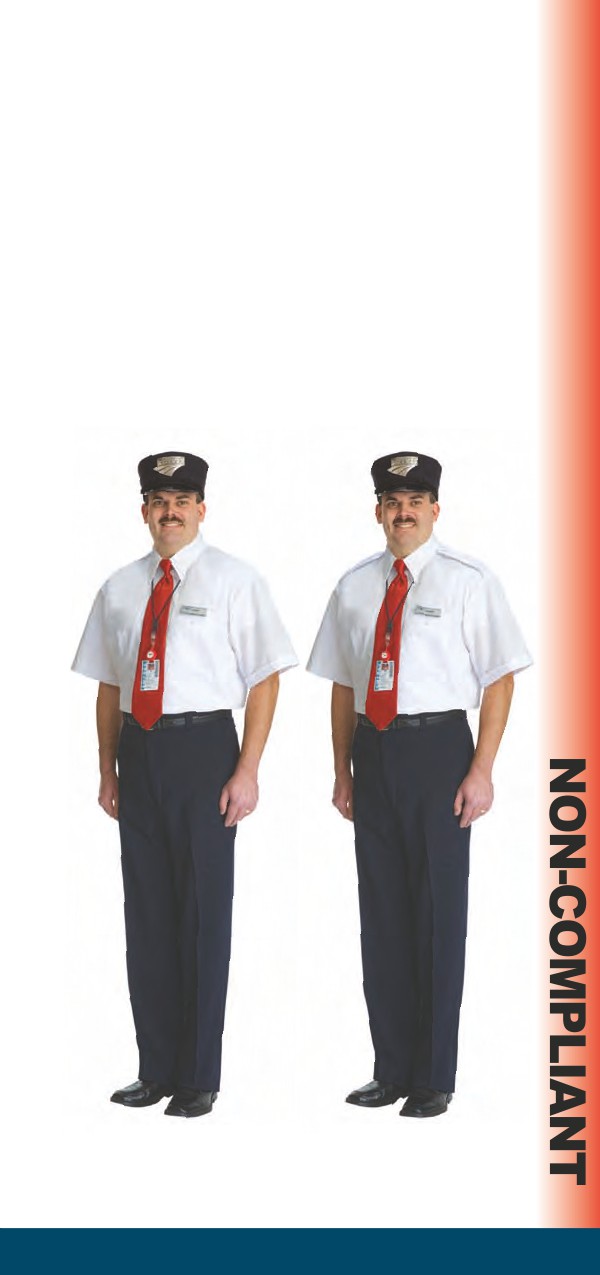
e) Non-Compliant Issues
• The Conductor in Figure 5-3 cannot wear this
short sleeve shirt without epaulets in this manner.
The white short sleeve shirt/blouse without
epaulets (no longer available from Amtrak)
must always be worn with the prescribed jacket.
• The Conductor in Figure 5-4 cannot wear this
short sleeve shirt with epaulets in this manner.
The white short sleeve shirt/blouse with epaulets
must always have the correct slides attached or
worn with the prescribed jacket.
• A vest is never to be the outermost garment. If
a vest is worn, the prescribed jacket must be the
outermost garment.
Figure 5-3 - Non-Compliant Usage
Figure 5-4 - Non-Compliant Usage of
of Short Sleeve Shirt without
Short Sleeve Shirt with Epaulets for
Epaulets for Train Service Employee
Train Service Employee
Service Standards Manual No. 6
5-5
2. On-Board Service Employees
Lead Service Attendant - Diner (LSA-Diner)
a) Prescribed Uniform
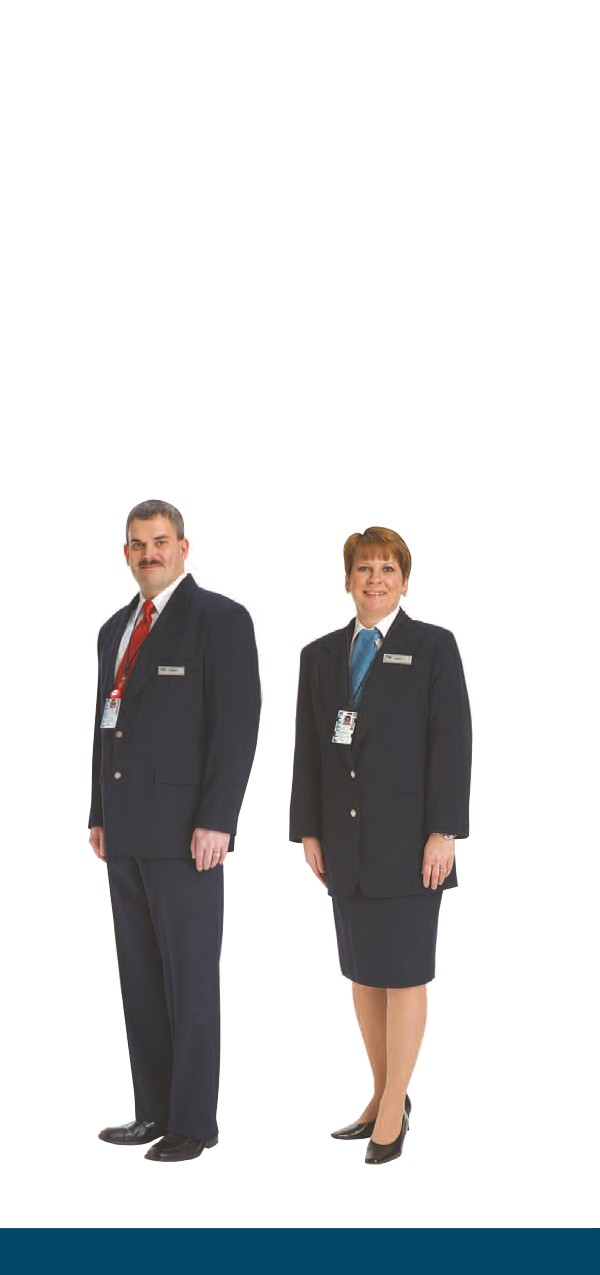
The prescribed uniform includes the navy blazer,
navy pants (navy dress or navy skirt), plain white
long sleeve shirt/blouse and approved custom red
or blue neckwear. (Refer to Figure 5-5)
b) Uniform Options
Previously issued navy pleated trousers/slacks are
authorized to be worn. Female skirts and slacks are
interchangeable. Maternity clothing is available
upon request.
c) General Uniform
Information All uniform components must be issued
by Amtrak. Amtrak photo ID must be worn at all
times. Amtrak nametag must be worn on left breast
panel of uniform at all times while on duty.
Figure 5-5 - Prescribed Uniform for (LSA-Diner)
5-6
Uniform and Grooming
3. On-Board Service Employees
Lead Service Attendant, Service Attendant, Train
Attendant and Sleeping Car Attendant
a) Prescribed Uniform
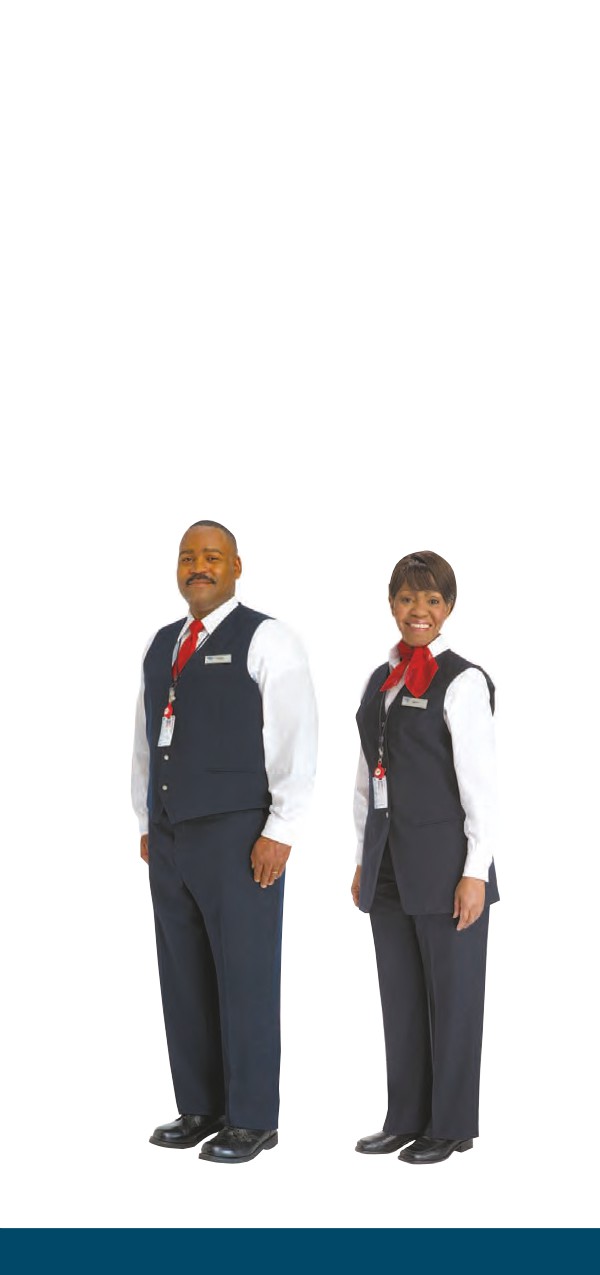
The prescribed uniform includes the navy vest,
navy pants (navy dress or navy skirt), plain white
long sleeve shirt/blouse and approved custom red
or blue neckwear. (Refer to Figure 5-6)
b) Uniform Options
A blazer may be worn individually or over the
vest and cardigan sweater. The vest and cardigan
sweater cannot be worn simultaneously. A white
short sleeve shirt/blouse without epaulets (no
longer available from Amtrak) may be worn
year-round when covered with the prescribed
blazer, vest or sweater.
Figure 5-6 - Prescribed Uniform for On-Board Service Employees
Service Standards Manual No. 6
5-7
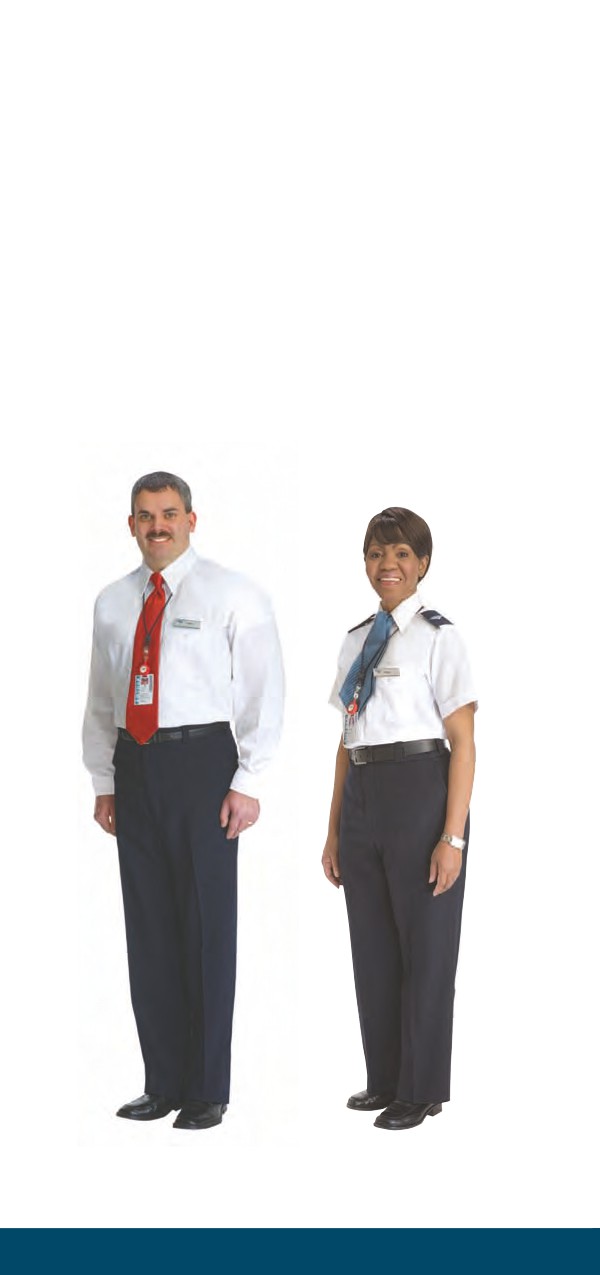
A white short sleeve shirt/blouse with epaulets
and appropriate slides may be worn year-round
when covered with the prescribed blazer or sweater
but not the vest. When an apron is worn (LSA/SA
only), it must be the outermost garment and can
only be worn over the prescribed white long sleeve
shirt/blouse or the prescribed white short sleeve
shirt/blouse with epaulets and appropriate slides.
Aprons cannot be worn over a blazer, vest, sweater
or a white short sleeve shirt/blouse without epaulets.
Previously issued navy pleated trousers/slacks are
authorized to be worn. Maternity clothing is
available upon request.
Figure 5-7 - Correct Seasonal Uniform Option for On-Board Service Employees
5-8
Uniform and Grooming
c)
Seasonal Uniform Options
During the period from May 1 to October 31 or
when there are periods of sustained temperatures
exceeding 80-degrees during the year, On-Board
Service Employees may remove their vest, as long
as the prescribed white long sleeve shirt/blouse or
the white short sleeve shirt/blouse with epaulets
and the appropriate slides are worn. The short
sleeve shirt/blouse with epaulets is always worn with
the appropriate slides and is never worn without
slides. (Refer to Figure 5-7)
d) General Uniform Information
All uniform components must be issued by
Amtrak, excluding white short sleeve shirts/
blouses without epaulets. On-Board Service
Employees must use the white on blue slides.
Amtrak photo ID must be worn at all times.
Amtrak nametag must be worn on left breast
panel of uniform at all times while on duty.
Service Standards Manual No. 6
5-9
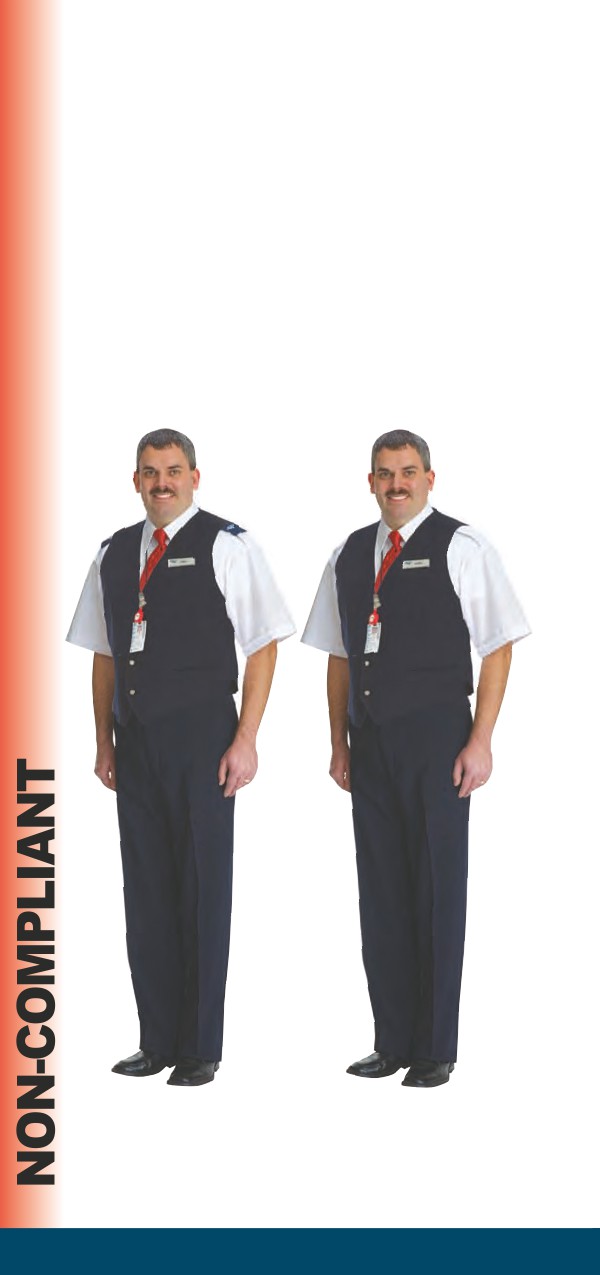
e) Non-Compliant Issues
• The On-Board Service employee in Figure 5-8
cannot wear a vest over this short sleeve shirt
with epaulets and slides in this manner. A white
short sleeve shirt/blouse with epaulets and the
appropriate slides is not permitted when a vest
is worn.
• The On-Board Service employee in Figure 5-9
cannot wear a vest over this short sleeve shirt
with epaulets in this manner. A white short
sleeve shirt/blouse with epaulets minus slides is
not permitted when vest is worn.
Figure 5-8 - Non-Compliant Usage of
Figure 5-9 - Non-Compliant
Vest over a Short Sleeve Shirt with
Usage of Vest over a Short Sleeve
Epaulets and Slides for On-Board
Shirt with Epaulets for On-Board
Service Employee
Service Employee
5-10
Uniform and Grooming
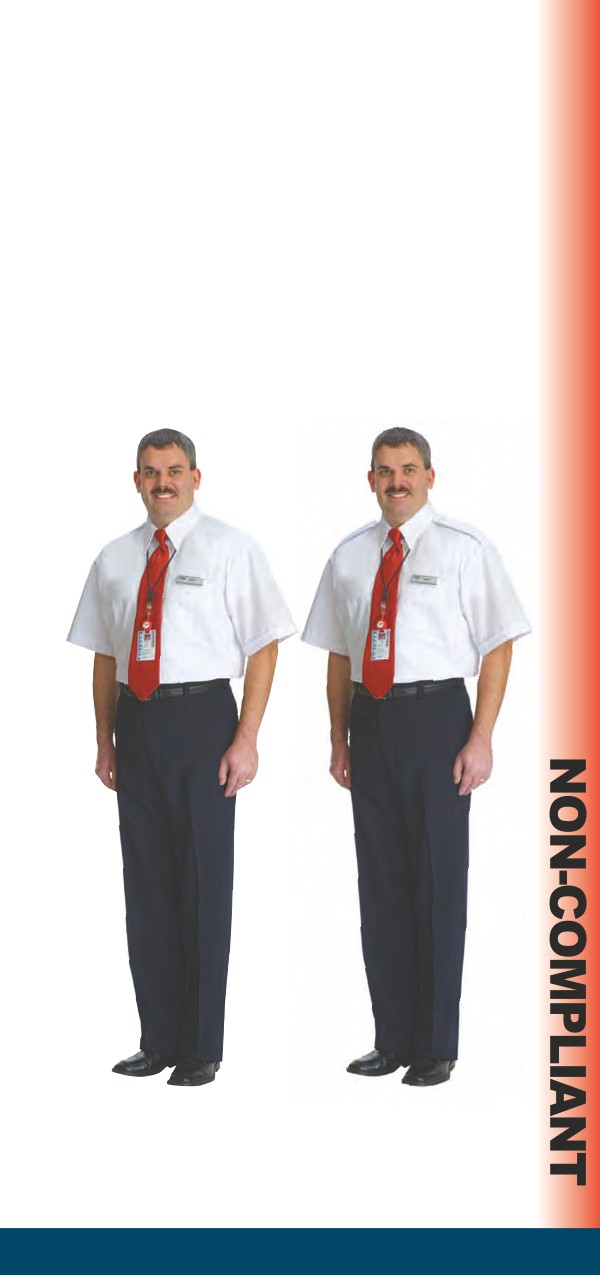
• The On-Board Service employee in Figure 5-10
cannot wear this short sleeve shirt without
epaulets in this manner. A white short sleeve
shirt/blouse without epaulets must always be
worn with the prescribed blazer, vest or sweater.
• The On-Board Service employee in Figure 5-11
cannot wear this short sleeve shirt with epaulets in
this manner. A white short sleeve shirt/blouse with
epaulets must always have the correct slides
attached or must be worn with the prescribed
blazer.
Figure 5-10 - Non-Compliant
Figure 5-11 - Non-Compliant
Usage of Short Sleeve Shirt
Usage of Short Sleeve Shirt with
without Epaulets for On-Board
Epaulets for On-Board Service
Service Employee
Employee
Service Standards Manual No. 6
5-11
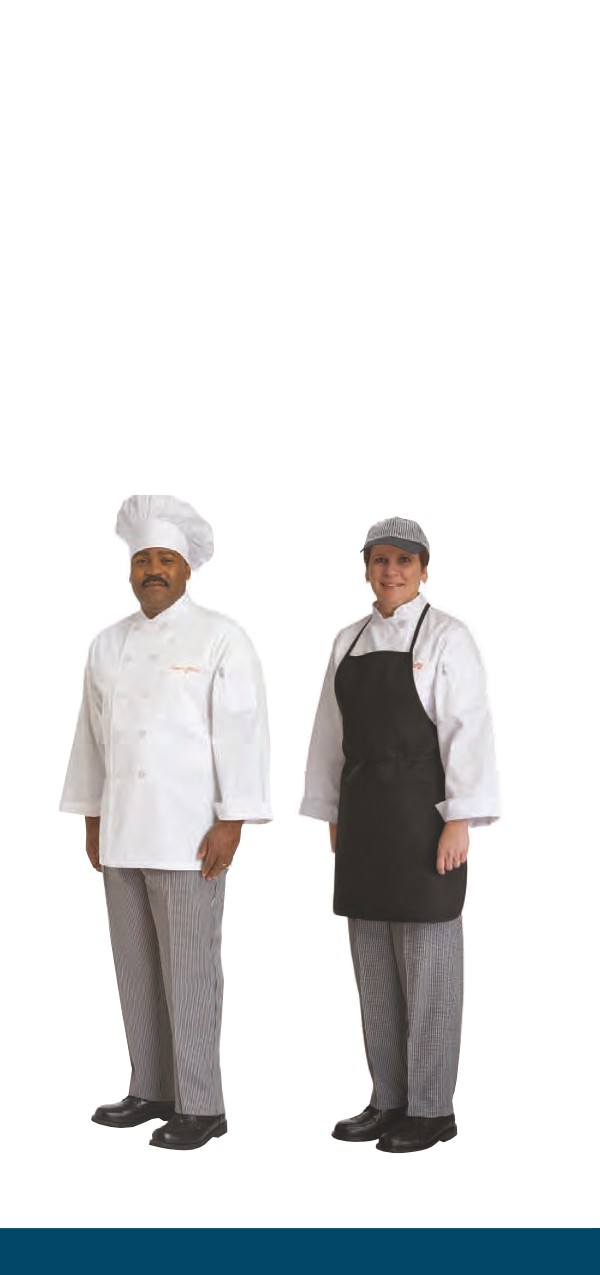
4. On-Board Service Employees
Chef
a) Prescribed Uniform
The prescribed uniform includes the apron, beard
net, chef coat, chef hat or baseball cap and chef
trousers. (Refer to Figure 5-12)
b) Uniform Options
The chef coat may be worn with or without the
apron. The chef hat is only to be worn by the Chef.
Maternity clothing is available upon request.
c) General Uniform Information
All uniform components must be issued by Amtrak.
Amtrak photo ID is not required during food
preparation, for safety reasons. Amtrak nametag
or embroidered nametag must be worn on left
breast panel of uniform at all times while on duty.
Figure 5-12 - Prescribed Uniform for Chef Employees
5-12
Uniform and Grooming
C.
Dress Wear
Proper cleaning and maintenance of all uniform articles
are required. The prescribed uniform must be worn
and in a presentable condition at all times.
•
Company photo identification must be worn and
be clearly visible above the waist at all times
while on company property, in accordance with
Amtrak’s Employee Security Handbook.
•
Maintain all uniform items in a clean, crisp, and
presentable condition at all times.
•
Uniform must fit well and not be excessively tight
or baggy.
•
Avoid overstuffing pockets that cause bulging or
distort the shape of the uniform item. (Shoulder
pouches and/or hip pouches are available to
accommodate COTS and other forms that are
required.)
•
Uniform items may not be changed in any way.
(For example, do not have pants/slacks altered so
that they are tapered, pegged, or cuffed.)
•
Suit jackets or blazers may be buttoned or unbut-
toned and worn over all uniform components.
•
Sweaters are not permitted to be worn over vests.
•
Vests, when worn, must always be buttoned.
•
Vests are not permitted to be worn over short
sleeve shirts that have epaulets.
•
Pants/slacks must be tailored to fall at the front
of the instep of the shoe without breaking and to
the seam of the heel of the shoe at the back.
•
Belts must be worn at all times, except with skirts.
•
Skirt lengths are not to be any shorter than two
(2) inches above the knee.
•
Plain white dress shirts must always be fully
buttoned and worn with a knotted tie.
•
Cuffs on the shirt/blouse must always be buttoned
and must never be rolled up or tucked under.
•
Shirts/blouses must be worn inside the pant or
skirt at all times.
•
Shirts/blouses must not be monogrammed.
•
Plain white blouse must be fully buttoned when
wearing the jabot.
•
Blouse may be worn with the top button open
when wearing the scarf.
•
Collars must lay flat and not be turned up around
neck. (If jackets are worn, make sure the collar
stays flat inside the jacket.)
Service Standards Manual No. 6
5-13
•
Train Service females are not allowed to wear the
scarf and must always wear their blouses fully
buttoned with the jabot.
•
Outerwear garments that are Amtrak-issued may
be worn with the uniform while on duty.
•
Outerwear garments not issued by the company
must be navy and similar to the style of the
Amtrak-issued.
•
Outerwear may not be worn on-board trains while
performing duties (e.g., ticket lifts, or serving food).
•
Hats that are required, must be worn when in
uniform. (When entering the Dining Car, hats
must be removed and carried under the arm as a
matter of common civility.)
•
Only Amtrak-issue skull caps may be worn while
on duty (in drafty outdoor areas such as platforms
while entraining and detraining passengers) by
OBS employees who do not have a hat as part of
their prescribed uniform.
•
Gloves must be black and only worn when outdoors.
•
Train service employees are only authorized to
wear the prescribe pillbox-style hat while on duty.
•
Suspenders, when worn, must be under the jacket
or vest.
D. Personal Appearance and Hygiene
Employees are the face of Amtrak. Everything you do
while in uniform reflects on the company. Customers
notice and appreciate a friendly tone of voice, open and
attentive body language and a caring, helpful attitude.
These are the things that keep passengers coming back.
Remember, a genuine smile is part of every Amtrak
uniform.
• Employee’s hygiene should be non-offensive,
even when deadheading or off-duty.
• Employee’s appearance should always be neat,
clean and professional at all times in the presence
of passengers, even when deadheading or off-duty.
• Use of a lightly scented perfume, cologne or
after-shave lotion is permitted.
• Tattoos may not be visible while in uniform.
1.
Hair
a) Both Males and Females
• Hair must not extend below the shirt collar.
5-14
Uniform and Grooming
• Hairstyles must not exceed 11/2 inches in fullest.
• Hair and scalp should be clean and contribute
to an overall neat appearance.
• Hairstyle should be professional and
business-like.
• Hair color must be natural looking.
b) Males
• Hair may not be worn in ponytails, spikes or
punk rock styles.
• Hairpieces may be used provided they are
natural looking.
c)
Females
• Shoulder length or longer hair should be
secured and pulled back.
• Hair may not be worn in spikes or punk rock
styles.
• Conservative hair accessories may only include
black colored barrettes, bows, hair combs, hair
bands and banana combs.
• Hairpieces including wigs, falls and extensions
may be used provided they are natural looking.
2.
Grooming
a) Males
• Sideburns must be even in length, well
trimmed, and may not be lower than the bottom
of their ear lobe.
• Moustaches should be clean, well shaped,
properly trimmed and may not be grown
below or outside the upper lip line.
• Beards and goatees must be clean and neat in
appearance.
b) Females
• Makeup should be tastefully applied.
• Use tasteful and professional blush, lipstick
and mascara.
• Foundation, if worn, should complement the
skin tone.
3.
Nails
a) Males
• Nails must be clean and well manicured.
• Length should be even with the top of the fingers.
• Only wear clear nail polish.
Service Standards Manual No. 6
5-15
b) Females
• Nails should be clean and well manicured.
• Maximum length, for both natural nails and
nail extensions is 1/2 inch from the tip of the
finger.
• Only wear nail polish that complements the
skin tone.
• Nail polish designs, decals and charms are not
allowed.
c) Food Service Employees
Food service employees should follow the grooming
standards that are outlined in Chapter 3 “FDA
Rules & Inspection Standards”, section A. “Food
Service Cars.”
E.
Footwear and Accessories
1.
Footwear
• Shoes must be black leather, plain, clean and
polished.
• Shoes must provide ample protection in the work
environment (e.g., cover the entire foot, including
toes and heels) and conform to all guidelines.
• Shoes must fasten to the foot and have a definite
heel.
• Shoes must cover entire foot including toes and
heel.
• Heels may not exceed 2 inches.
• Stacked and platform shoes may not be worn.
• Socks or hosiery are required.
• Hosiery must be skin tone or black sheer only.
• Boots or yard work type shoes are never to be
worn with dresses or skirts.
• Only stockings, pantyhose or tights are to be
worn with a skirt or dress.
• Socks must only be worn with slacks/trousers and
be plain, black and high enough so that the tops
do not show at any time.
2.
Glasses and Sunglasses
• Select a style of glasses that is business-like and
conservative in size and frame color and that
complement the facial structure.
• The eyeglass lenses may be tinted slightly.
• Glasses or sunglasses should not be worn on the
top of the head.
5-16
Uniform and Grooming
• Do not wear sunglasses inside trains, stations or
facilities. (Certain medical exceptions may apply.)
3.
Jewelry
Jewelry or ornamentation other than the types
described in this section must not be worn.
a)
Both Males and Females
• All employees must have a working watch that
is conservative and business-like.
• Medic Alert bracelets may be worn.
• If a necklace of any type is worn, make sure it
is not visible when you are in uniform.
• Only one (1) of the following lapel pins may
be worn in addition to the Amtrak name tag.
Employees may wear their union affiliation,
Amtrak brand, Years of Service, special promo-
tion or an earned Incentive Award Program pin.
• In addition to the Amtrak name tag and one
(1) lapel pin, a second military service honors
pin with respect to the traditions of the service
may be worn (i.e. ribbon pins, unit crests,
miniature insignia, blue/gold-star service flags,
rosettes, rank insignia, POW/MIA flag, U.S.
flag or yellow ribbon insignia).
• Body-piercing ornamentation that is visible to
customers is not permitted.
b) Males
• Wearing earrings of any type is not authorized.
• A single bracelet or narrow band with a polished
or brushed finish is acceptable as long as it is not
more than 1/2 inch wide in either gold or silver.
• Employees may wear up to two (2) rings of a
conservative size and style. (Only one ring may
be worn on any finger.)
c)
Females
• Employees may wear one set of matching
earrings (one in each ear lobe only).
• A single bracelet or narrow band with a
polished or brushed finish is acceptable as long
as it is not more than 1/2 inch wide in either
gold, silver, white pearl or diamond.
• Earrings must not be larger than 1 inch in
diameter (about the size of a quarter) and may
be oval, triangular, square,or round in shape.
• Employees may wear up to two (2) rings of a
conservative size and style. (Only one ring may
be worn on any finger. Wedding band sets are
considered one ring as long as you wear them
on the same finger.)
Service Standards Manual No. 6
5-17
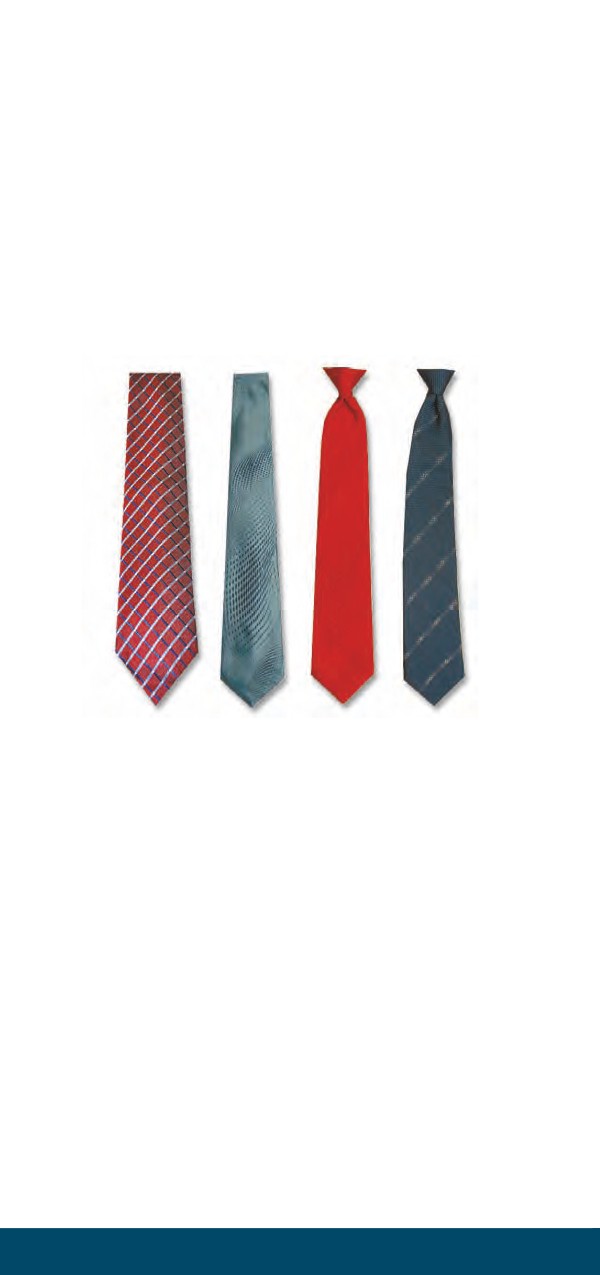
4. Neckwear
a) Males
• Ties, where required, must be knotted with a
Windsor or four-in-hand knot and must be
worn at all times.
• Ties must be secured firmly against the collar
and cover the top button.
• Do not tuck ties into shirt or under waistband
or belt.
• Ties must extend to the top of the belt buckle,
but not beyond. (Refer to Figure 5-13)
Figure 5-13 - Prescribed Neckwear for Males
b) Females
• Jabots must be secured firmly against the collar.
• Scarves must be worn at the neck. (Refer to
Figure 5-14)
5-18
Uniform and Grooming
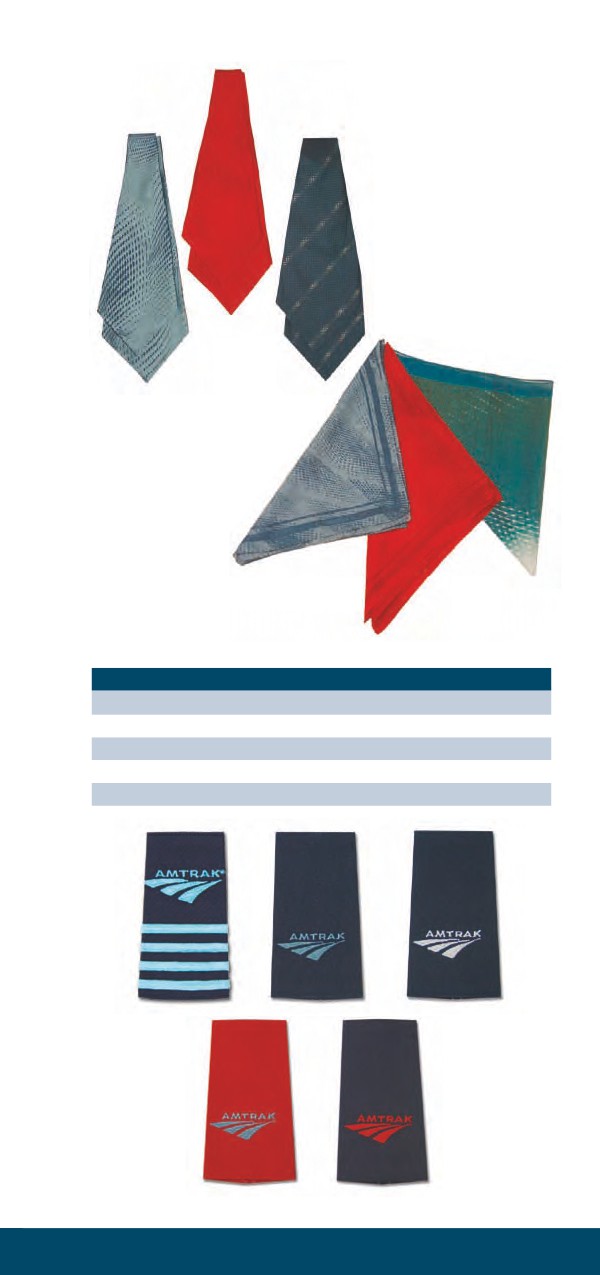
Jabots
Figure 5-14 - Prescribed Neckwear for Females
Scarves
5. Slides
(Refer to Figure 5-15)
EMPLOYEE CRAFT
SLIDE COLORS
Conductor
Blue on Blue with 4 Hash Marks
Assistant Conductor
Blue on Blue without 4 Hash Marks
On-Board Services
White on Blue
Baggage
Red on Blue
Red Cap
Blue on Red
Figure 5-15 -
Slide Examples
Service Standards Manual No. 6
5-19
6. Uniform Name Tags
a) Uniform name tags must be either:
• First initial, last name.
• First name (official first name or derivative
associated with SAP number - no nicknames).
b) The first name and/or initial must be your official
name associated with your SAP number.
Example:
If your official name is Michael Smith, Mike is
acceptable on your name tag since it is a derivative
of Michael. However, if your official name is
Michael, you cannot use Joe - even if Joe is your
middle name. If you do not want your name tag to
display Michael or Mike, you would use M. Smith.
c) Name tags must be kept current, clean, straight
and worn on your left breast panel of the uniform.
5-20
Uniform and Grooming
Introduction
This chapter contains general information, which pertains
to all train crew positions. Employee responsibilities are not
limited to the following descriptions, and may be augmented
or modified by Crew Base management when deemed
necessary. On-train crew members are responsible for
understanding and following all applicable chapters in
the “Service Standards: Manual for Train Service and
On-Board Service Employees” that pertain to the type of
service being provided.
A. Customer Service Tips for On-Train
Service Employees
The following Customer Service Tips provide useful
reminders of basic customer service activities
designed to enhance the level of our passenger’s
satisfaction - that is, the feeling that our service has
met or exceeded the passenger’s expectation.
Good customer service is the ability to provide the
type of service expected by our passengers before,
during and after their trip.
A satisfied passenger is a repeat passenger. If we
improve our retention rate by just 1% - that translates
into additional revenue totaling over one millions
dollars annually.
During the daily Job Briefing, employees must review,
discuss and understand the Customer Service Tip as
indicated by the Customer Service Tip Calendar.
Service Standards Manual No. 6
6-1
1.
Customer Service Tips Calendar
For On-Train Service Employees
Date
JAN
FEB
MAR APR
1
1
32
61
92
2
2
33
62
93
3
3
34
63
94
4
4
35
64
95
5
5
36
65
96
6
6
37
66
97
7
7
38
67
98
8
8
39
68
99
9
9
40
69
100
10
10
41
70
101
11
11
42
71
102
12
12
43
72
103
13
13
44
73
104
14
14
45
74
105
15
15
46
75
106
16
16
47
76
107
17
17
48
77
108
18
18
49
78
109
19
19
50
79
110
20
20
51
80
111
21
21
52
81
112
22
22
53
82
113
23
23
54
83
114
24
24
55
84
1
25
25
56
85
2
26
26
57
86
3
27
27
58
87
4
28
28
59
88
5
29
29
60
89
6
30
30
90
7
31
31
91
6-2
Crew Functions & Responsibilities
Customer Service Tips Calendar
For On-Train Service Employees
Date
MAY
JUN
JUL
AUG
1
8
39
69
100
2
9
40
70
101
3
10
41
71
102
4
11
42
72
103
5
12
43
73
104
6
13
44
74
105
7
14
45
75
106
8
15
46
76
107
9
16
47
77
108
10
17
48
78
109
11
18
49
79
110
12
19
50
80
111
13
20
51
81
112
14
21
52
82
113
15
22
53
83
114
16
23
54
84
1
17
24
55
85
2
18
25
56
86
3
19
26
57
87
4
20
27
58
88
5
21
28
59
89
6
22
29
60
90
7
23
30
61
91
8
24
31
62
92
9
25
32
63
93
10
26
33
64
94
11
27
34
65
95
12
28
35
66
96
13
29
36
67
97
14
30
37
68
98
15
31
38
99
16
Service Standards Manual No. 6
6-3
Customer Service Tips Calendar
For On-Train Service Employees
Date
SEP
OCT
NOV
DEC
1
17
47
78
108
2
18
48
79
109
3
19
49
80
110
4
20
50
81
111
5
21
51
82
112
6
22
52
83
113
7
23
53
84
114
8
24
54
85
1
9
25
55
86
2
10
26
56
87
3
11
27
57
88
4
12
28
58
89
5
13
29
59
90
6
14
30
60
91
7
15
31
61
92
8
16
32
62
93
9
17
33
63
94
10
18
34
64
95
11
19
35
65
96
12
20
36
66
97
13
21
37
67
98
14
22
38
68
99
15
23
39
69
100
16
24
40
70
101
17
25
41
71
102
18
26
42
72
103
19
27
43
73
104
20
28
44
74
105
21
29
45
75
106
22
30
46
76
107
23
31
77
24
6-4
Crew Functions & Responsibilities
2.
Customer Service Tips
For On-Train Service Employees
1.
Follow Through
If you say you will do something for the passenger,
follow through and make sure it gets done. If you
don’t know the answer, make every effort to find it.
2.
Expectations
Consistently exceed our passenger’s expectations.
They will appreciate your efforts.
3.
Experience
Amtrak is a unique experience. Help ensure that
passengers enjoy it.
4.
Greetings
Always greet passengers promptly and with a smile,
and ask if you can address your customer by name,
when appropriate.
5.
Praise in Public
Criticize in private. Praise in public.
6.
Listen
Listen to our passenger’s needs. Give them your
complete attention and determine how you can help.
7.
Apologize
On behalf of Amtrak, apologize to the customer.
Even if it is not your fault. He/she will appreciate
and value your apology.
8.
Repeat Riders
Your mission is to turn first-time riders into repeat
riders!
9.
Teamwork
Every employee has a stake in providing great
customer service. The company’s success depends on it.
10.
Communication
Let our passengers know what is going on, even if the
news isn’t pleasant. They will appreciate your honesty.
Effective communication keeps problems small.
Service Standards Manual No. 6
6-5
11.
Attention
Give your full attention and respect to the passenger
with whom you are interacting.
12.
Empathy
Listen to passengers. Determine what they need. If
you cannot provide it, at least try to understand the
passenger’s point of view and practice empathy.
13.
Complaints
Value and listen to our passengers’ concerns. They
are learning experiences.
14.
Anticipation
The more you get to know your passengers, the
better you can anticipate their needs.
15.
Sincerity
Be sincere. Unpleasant news told with sincerity is
appreciated.
16.
Team Members
Treat fellow crew members well and with respect.
Passengers are watching too.
17.
Thank You
A thank you goes a long way. Whenever you get the
chance, thank your passengers. Thank them often.
18.
Saying Yes
Yes is a powerful word. Use it often.
19.
Reassurance
When a passenger has a concern, reassure them
that you understand. Rephrase their concerns back
to them.
20.
Perception
The passenger’s perception of Amtrak depends upon
the service you provide and how you provide it.
21.
Clear Language
Avoid using Amtrak jargon when talking with
passengers. This makes us look unprofessional.
(i.e. deadhead, hotbox, LSA, etc.)
6-6
Crew Functions & Responsibilities
22.
Loyalty
Build passenger loyalty by going above and beyond
what passengers expect.
23.
Staying Positive
Speak positively about Amtrak and train travel when
you are around or talking to passengers.
24.
Smile
Sometimes all it takes is a smile.
25.
Over Deliver
Try to deliver more than you have promised.
26.
Speed
Resolve problems as quickly and safely as possible.
27.
Attitude
Project a can-do attitude. Others will notice it.
28.
Seniors
Be aware that senior passengers may hesitate to
request needed assistance. Always ask.
29.
ADA Passengers
Be sure to give special attention to passengers with
special needs. “How may I assist you?”
30.
First-Class
All passengers deserve first-class service. They have
paid for it.
31. Performance
Any one of us may be the customer’s only contact
with Amtrak. They will judge the whole company on
that one person’s performance.
32. Job
Treat passengers as if your job depends on it.
33. Great Service
Equipment may develop problems and the train may
be late, but the service you provide should reflect
friendly and helpful service.
Service Standards Manual No. 6
6-7
34.
Grooming
Be well groomed and neat in appearance.
35.
Availability
Always let passengers know where you are located.
36.
Patience
Some passengers need more help than others, and
some situations will be difficult to handle.
37.
Tips
Never solicit, but remember, good service can mean
good tips!
38.
First-Time Riders
Remember many of our passengers have never
traveled by train before and may need more assistance
or have questions.
39.
Disappointment
When a passenger is disappointed with the service
he/she received, make every effort to fix it
immediately, if you can.
40.
Arguments
You may be right, but never argue with a passenger!
Resolve the issue with dignity and respect.
41.
Blame
Take the heat even if the customer is wrong.
42.
Cleanliness
Litter and overflowing trash make a bad impression
on our passengers.
43.
Equipment Problems
You may not be able to control problems with the
equipment. However, you can control your reaction
to the problems.
44.
Customer Relations
Exhaust all options to solve a customer’s problem,
and as a last resort, direct customers to call
Customer Relations at 1-800-USA-RAIL.
6-8
Crew Functions & Responsibilities
45.
Nice Touches
At station stops, wipe the handrails so customers
don’t get their hands dirty.
46.
Luggage
When practical, safely help passengers with their
luggage.
47.
Announcements
Clear, concise PA announcements are appreciated by
our passengers.
48.
Question
If you were the passenger, what kind of service
would you want?
49.
Information
Information and knowledge are powerful. Share
them with our passengers.
50.
Complaints
Don’t complain to our passengers. They are here to
enjoy their trip.
51.
Cell Phones
Don’t use your cell phone for personal calls in view
of passengers.
52.
Co-workers
Help your coworkers. Work together. Support each
other. Teamwork speaks volumes.
53.
Golden Rule
Do unto others what you would want done unto you.
54.
Opportunities
Look for an opportunity today to make someone’s
day better.
55.
Travel Options
Remember, passengers chose to travel by train.
Make it a great experience for them.
56.
Expectations
Exceed the passenger’s expectations. They’ll love it.
Service Standards Manual No. 6
6-9
57.
Importance
Treat every passenger with importance. They are all
important!
58.
Ask
Ask your passenger what you can do to give them
better service.
59.
Thank you
Thank the passenger for riding Amtrak and ask
them to ride again!
60.
Empathy
Always show courtesy and respect, especially if a
passenger is upset.
61.
Can-Do
Choose a “can-do” attitude. It pleases our passengers
and gives them confidence in us.
62.
Perception
Perception is everything. Help passengers feel you
are right there, ready to help.
63.
Going the Extra Mile
Always go the extra mile to solve a passenger’s
problem.
64.
Frustrations
Don’t take passenger’s frustration personally. Stay
professional.
65.
Staying Calm
Do your best to stay calm. Don’t allow yourself to be
drawn into an argument. Focus on the issue and
solution rather than on the person.
66.
Distractions
Put distractions aside and give each passenger your
undivided attention.
67.
Welcome
Welcome passengers as if they were guests in your
home.
6-10
Crew Functions & Responsibilities
68.
Family
Treat each passenger the way you would want someone
to treat your grandparents, parents, or children.
69.
FAST
Customer Service Excellence is Friendly, Attentive,
Sincere and Timely. How FAST are you?
70.
Weather
Inclement weather in the forecast? Caution and
assist our passengers as they en-train and de-train.
71.
Trust
Build trust by giving the passenger the benefit of
the doubt.
72.
Quality
Customer service is as good as the people who provide
it. How good are we?
73.
Ambassador
Be an ambassador to our passengers from other
countries.
74.
Transportation Choice
The customer has many transportation options
available to them. Provide excellent service so they
will choose Amtrak.
75.
Children
Help children have positive, memorable train trips.
After all, they are our future customers.
76.
Pride
Take personal pride in the quality of each passenger's
Amtrak experience.
77.
Assistance
Step forward and offer assistance to passengers
before they ask for help.
78.
Alternatives
Offer a positive alternative rather than just telling a
passenger "no."
Service Standards Manual No. 6
6-11
79.
Repeating Information
Cheerfully repeat or explain information for a
passenger who could not hear or understand it.
80.
Assistance
Offer to bring food and drinks to the seat of passengers
who cannot easily move through the train.
81.
Families
Assist parents who are overwhelmed with children
and baggage.
82.
Employee Chatter
Complete conversations with other employees later,
not while interacting with a passenger.
83.
Passenger Requests
Understand that a passenger's request is what is
most important to him or her at that moment.
84.
Body Language
Use body language that invites passengers to
approach you with their questions and needs.
85.
Cleanliness
Take pride in the cleanliness and appearance of the
train and make it inviting to passengers.
86.
Fresh Look
Take a fresh look at the train from a passenger's
perspective. Look for what you can improve.
87.
Special Trip
Recognize that this may be a special trip for a
passenger. Help make it even better.
88.
Not My Job
Ask passengers how you can help them rather than
telling them that something is not your job.
89.
Delays
If there is a problem or a delay, give passengers factual
information as soon as possible.
6-12
Crew Functions & Responsibilities
90.
Priorities
Show each passenger that he or she is your highest
priority at that moment.
91.
Professionalism
Maintain a professional demeanor at all times. You
never know what passengers may see or hear.
92.
Try to Help
Don’t tell a passenger “I can’t do anything” or “it is
not my problem.” Supply solutions, options or
alternative. Tell the customer what is possible.
93.
Can-Do
Tell your passengers what you can do for them, not
what you can’t do.
94.
Tone of Voice
Always maintain a respectful tone of voice.
95.
Thanks
Never take your passengers for granted and thank
them for their business.
96.
Smile
The best thing about a smile is it makes you feel good.
It also makes your passengers feel good about you.
97.
Company
When you interact with passengers, you aren’t merely
working for the company; you are the company.
98.
Facial Expressions
Be mindful of your facial expressions. Unintentional
facial expressions can imply a completely different
meaning to the words you speak and your sincerity.
99.
Tone
Sometimes it’s not about what you say, but how you
say it. People may forget what you said but they’ll
never forget how you made them feel by the way
that you said it.
100.
Consistency
The enemy of excellent customer service is
inconsistency.
Service Standards Manual No. 6
6-13
101. Average
Don’t be content being average at customer service;
average is as close to the bottom as it is to the top.
102. Excellence
Customer service excellence is to do a common
thing in an uncommon way.
103. Understanding
When something goes wrong for a customer, they
want to feel like you understand their frustration
and that you are genuinely concerned that they are
being inconvenienced.
104. Determination
Some succeed with passengers because they are
destined to, but most do so because they are
determined to.
105. On the Spot
Employees have the power and obligation to solve
customer problems on their own and on the spot.
106. Service
Service is the lifeblood of any organization.
Everything flows from it and is nourished by it.
Customer service is not a department; it’s an attitude.
107. Every Day
Customer Service is not a single act. It is a habit
practiced every moment of every day.
108. Solutions
Anticipate the needs of the customer and provide
the solution before the customer requires it.
109. Hold on to Customers
Our goal is to retain each and every customer. It takes
months to find a customer and seconds to lose one.
110. Responsibility
The sea of change can pull customers in many
directions. It is our responsibility to lead the way
and take care of them, before the competition does.
6-14
Crew Functions & Responsibilities
111. Your Voice
Your voice is the best vehicle for making the customer
trust you. Your voice sells people on your level of
knowledge and professionalism.
112. Success
We must set success as our standard, a level where
good enough is not good enough. We must put our
customers at the center of everything we do,
because our future depends on it.
113. Self Portrait
Every job is the self-portrait of the person who does
it. Autograph yours with excellence.
114. Take Time
Say please when you ask a customer a question.
Thank them for their information and take time when
talking to them. Nothing makes a customer feel
more devalued than being treated like a number.
B.
General Information
All on-train employees are responsible for under-
standing and following all the information contained in
Section B. “General Information” of this chapter. The
Conductor supervises the operation and administration
of their assigned train. All employees must follow the
Conductor’s instructions. Whenever the Conductor is
unable to perform their duties, the Engineer will be
“in-charge” of the train.
1.
On-Train Authority Levels
a) Conductor
The Conductor is responsible for the safe movement
and operation of the train, the collection and
protection of Amtrak ticket revenue, the conduct
of the Operating and On-Board Service crews, the
boarding and detraining of passengers, as well as
the assignment of passenger accommodations.
Conductors and Assistant Conductors report to and
receive their instructions from the Superintendent
or other designated officers. Conductors and
Assistant Conductors must obey the instructions
of Trainmasters, Road Foremen, Transportation
Supervisors, and from officers of other departments
on matters pertaining to those departments.
Service Standards Manual No. 6
6-15
b)
Engineer
The Engineer is responsible for operating
locomotives and cab control cars safely and
efficiently. The Engineer also has the responsibility
for managing the conduct of any other individuals
in the locomotive. All employees who operate the
locomotive must have a current certificate in their
possession. A student Engineer or other qualified
employee may operate the locomotive under the
Engineer’s close supervision.
c)
Assistant Conductor
The Assistant Conductor assists the Conductor with
providing the safe movement of the train, care of
passengers, properly handling luggage and revenue
collection. The Assistant Conductor must be vigilant
in their duties and remain within the rules set
forth for Conductors in this chapter. Assistant
Conductors, just like Conductors, report to and
receive their instruction from the Superintendent
or other designated officer. They must obey the
instructions of Trainmasters, Road Foremen,
Transportation Supervisors, and from officers of
other departments on matters pertaining to those
departments.
d)
Lead Service Attendant (LSA)
The Lead Service Attendant is responsible for
providing a high level of customer service and
implementing Amtrak’s On-Board Service policies
and procedures as they affect passengers and
On-Board Service employees. All LSA’s be
proficient in the applicable accounting procedures.
Depending on the type of service, the LSA will be
responsible for directly supervising all On-Board
Service employees.
e)
On-Board Service Employee
Service Attendant, Train Attendant, Chefs, Food
Specialist and En Route Cleaner are responsible
for the proper performance of their duties and
ultimately report to the Conductor. Communication
between the Conductor and the On-Board Service
employees is essential to operate the train safely
and promote effective teamwork.
2.
All Crew Members - General Responsibilities
a) All Employees - Reporting for Duty
• Report to the designated location at the
prescribed time.
6-16
Crew Functions & Responsibilities
• Report in full uniform with Amtrak photo identi-
fication badge prominently displayed at all times.
(Refer to Chapter 5 “Uniform and Grooming”)
• Amtrak issued “Crew Luggage Identifications
Tags” must be attached to employee’s luggage.
• Sign-in as directed by Crew Base management.
• Review bulletin board(s) for any pertinent
information.
• Maintain and have the current Service Standards:
Manual for Train Service and On-Board
Service Employees along with all active
OSUs in your possession while on duty.
• Review and understand all current FOs, FSNs,
OSAs and TAs that are applicable to job
responsibilities.
• Attend all pre-departure safety and crew
briefings.
• Carry all tools necessary to properly perform job
duties, including all paperwork and operating
rule books/manuals.
• Obtain and review the most recent manifest.
• Adhere to Amtrak’s policies when on or off duty.
b)
All Employees - Pre-Departure Duties/
Responsibilities
• Ensure that all safety equipment is present and
in proper working order including a working
flashlight that is properly maintained and readily
available.
• Inspect and prepare areas of responsibility.
• Ensure that all doors function properly.
• Review the “Record of Defect and Repair -
MAP 21A” (NRPC 2775) to determine whether
previously reported defects have been corrected.
• Comply with Public Health and FDA rules and
inspection standards.
• Ensure all cars are in compliance with all Public
Health and FDA rules and inspection standards
as detailed in Chapter 3 “FDA Rules &
Inspection”.
• Immediately report cleaning and equipment
defects to the appropriate supervisor.
Service Standards Manual No. 6
6-17
c)
All Employees - En route Responsibilities
•
Maintain a professional demeanor, a professional
appearance and a clean, organized work area at
all times.
• Do not chewing gum and using toothpicks
while on duty.
• Do not eat or drink while boarding or
detraining passengers.
• Gambling, begging and/or soliciting of any
type while on-board the train or on any
Amtrak property is prohibited.
• Any distribution of unauthorized advertising
material or solicitations while on-board the
train or on any Amtrak property is prohibited.
• Stay in his/her assigned area of responsibility.
• Do not loiter or congregate in Coach,
Sleeping or Food Service Cars.
• Do not disturb the passengers’ traveling
experience with unprofessional conduct.
•
Assume responsibility for his/her personal safety,
as well as the safety of other employees and
passengers.
• Be alert and vigilant at all times.
• Do not lean against cars or structures, nor
appear to stroll aimlessly on platforms.
•
Maintain an appropriate voice level to be heard
and understood, but not boisterous or annoying
to passengers.
•
Make appropriate announcements from Chapter
10 “On-Board Announcements and Signage”.
•
Tactfully enforce the smoking policy. (Refer to
Chapter 1 “Safety & Security”)
•
Ensure that the Conductor is kept informed of
any passenger problems, issues or service
disruptions before taking any action, except in
life-threatening emergency situations such as a
derailment.
•
Be aware of whether or not other Amtrak
employees are traveling so they can be called
upon for assistance, if necessary.
•
Ask other crew members for assistance as
needed (i.e. baggage, passenger assistance, etc.).
•
Be respectful of co-workers.
•
Assist, encourage, train and motivate fellow crew
members.
6-18
Crew Functions & Responsibilities
•
Never relinquish your responsibilities to another
employee who is observed as not “fit for duty”.
•
Ensure trash is off-loaded at the designated
locations. (Refer to Chapter 3 “FDA Rules &
Inspections”).
•
Water cars only at designated watering points
when necessary.
•
Report mechanical defects and service failures to
appropriate employees and record on “Record of
Defect and Repair MAP-21A” (NRPC 2775) as
well as any other required forms. To report
enroute defects, call the CNOC Mechanical
Desk at (800) 424-0217 ext. 2082/2083, Bell
(302) 683-2082/2083 or ATS 734-2082/2083 for
assistance 24 hours a day seven days a week.
•
When performing paperwork or administrative
functions associated with job responsibilities
employees are required to:
• Use the crew office or Dormitory Car. If the
train is not equipped with a crew office or
Dormitory Car or if crew office or
Dormitory Car space is not available, then
employees are expected to use a vacant
Coach seat with drop down seat tray.
• Avoid using tables in Dining Cars.
Employee paperwork is not to be performed
at tables during service hours. If it becomes
necessary to use a table during non-service
hours, no more than one table may be used.
• Avoid using tables in Food Service Cars
operating in continuous service (bumper to
bumper). If it becomes necessary to use a
table, no more than one table may be used.
•
Employee grips and outerwear must be stored
out-of-sight, and must not be left on tables or
seats.
d)
All Employees - End-of-trip Responsibilities
• Complete all necessary paperwork as required
by craft.
• Remit Amtrak monies.
• Clean car as directed by Crew Base management.
• Check train for passengers, luggage, stock and
forgotten items.
• Secure train as required.
Service Standards Manual No. 6
6-19
e)
All Employees - Passenger Service Responsibilities
•
Assist passengers with boarding and detraining.
•
Provide directions to passengers in finding the
correct train or proper car location.
•
Meet and greet all passengers and offer assistance
as needed.
•
Provide useful information in an easy-to-
understand language, avoiding railroad jargon.
•
Respond to passenger questions in a courteous
and helpful manner.
•
Listen to passenger complaints, ideas and
suggestions.
•
Take the appropriate steps to resolve passenger
complaints.
•
Look for service recovery opportunities when
passengers have expressed dissatisfaction.
•
Look for opportunities to enhance passenger
comfort and satisfaction.
•
Assist disabled passengers with meal service,
movement to a feature cars (if requested),
restroom, etc.
•
Assist with wheelchair and wheelchair lift
operation as necessary.
•
Be knowledgeable about stations and connecting
services.
•
Offer suggestions regarding Amtrak products
that might increase passenger travel comfort and
satisfaction.
•
Thank passengers warmly for their patronage.
3.
All Employees - General Guidelines
a) Crew Luggage Identification Tags
• All Train Service and On-Board Service
employees are required to affix Crew Luggage
Identification Tags to their personal grips.
• Crew Luggage Identification Tags must be visible
when on both railroad property and the train.
• Crew Luggage Identification Tags are available
at each Crew Base.
• Employees are permitted two luggage
identification tags. (If more tags are needed, please
provide justification to the Crew Base Manager.)
• Each Crew Luggage Identification Tags serial
number associated with the employees name
will be recorded in the Transportation
Department Review System (TDRS) database.
6-20
Crew Functions & Responsibilities
• If a Crew Luggage Identification Tag is lost or
stolen, immediately report this information to
your Supervisor. (There is no charge for a
replacement.)
• All Crew Luggage Identification Tags must be
returned to the issuing Crew Base when you
no longer hold a position in Passenger Train
Service or as an OBS employee.
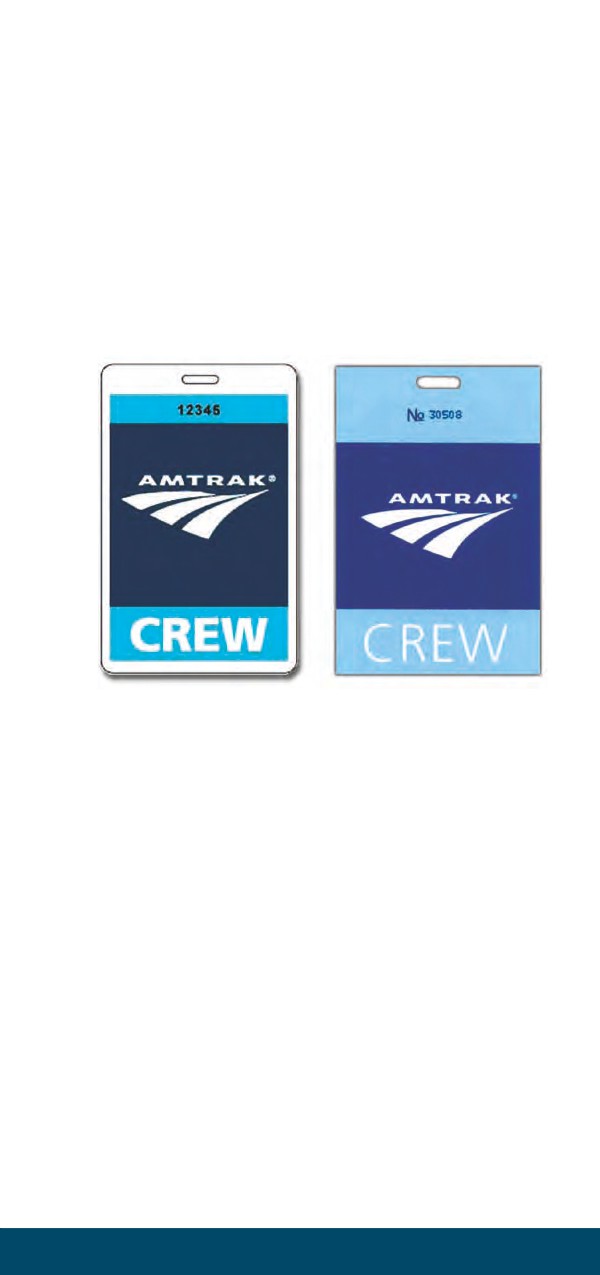
• Currently, two versions of Crew Luggage
Identification Tags are valid for use. (Refer to
Figure 6-1.)
Figure 6-1 - Examples of valid Crew Luggage Identification Tags
b) Amtrak Provided Accommodations
• Restrict any unauthorized visitor or relative from
employee accommodations on-board or at layover
locations.
• Use the Corporate Lodging card for check-in at
Amtrak provided accommodations.
• Employees must conduct themselves properly in
Amtrak provided accommodations at all times.
• Pay for all personal charges prior to checking-out
of accommodations.
c) Amtrak Police Credentials
• When presented with proper credentials by
Amtrak Police and Security, employees must
fully cooperate as directed.
• When presented with proper credentials by
Amtrak officers, employees must fully cooperate
with all reasonable requests for access to
documents, tickets lifted, equipment, meal
checks and food stock.
Service Standards Manual No. 6
6-21
d)
News Media
• Contact with the news media is prohibited.
• Any questions from the news media are to be
referred to Amtrak’s Government and Public
Affairs Department at (202) 906-3860.
• Amtrak field personnel should not initiate
contact with the press, unless directed.
e)
Electronic Devices
• Electronic devices used for personal business or
entertainment are prohibited while on duty. For
the purpose of this policy, electronic devices can
be any of the following:
• Phones (cellular, satellite, wireless, web)
• Pagers
• PDA (Personal Digital Assistant)
• Text Message/E-mail Devices
• DVD/CD Disc Players (audio or video)
• Portable audio or video players
• Radios (music or communication)
• Tape or Digital recording devices
• Cameras
• Electronic games
• Computers
• Personal Electronic Devices - Personal electronic
devices used during off-duty time are only
permitted when equipped with earphones or
headsets.
f)
Commissions
• Commissions from the sale of transportation or
transportation-related services must never be
accepted by employees
• Commission earnings or profits are considered
property of the National Railroad Passenger
Corporation (Amtrak)
• The commission policy covers, but is not limited
to, profits derived from the sale of tours, car
rental services, hotel arrangements and
arrangements for connecting bus services.
g) Reporting Tips
• Employees who receive at least $20 a month in
combined tips from all sources (e.g., cash, credit
cards and other employees) must report their
tips to their local time keeping facility on or
before the tenth of the month subsequent to
that in which the tips were received.
6-22
Crew Functions & Responsibilities
•
Employees must report their tips on their time
documents using labor category 46, “Tips,” along
with their other hours worked.
•
Employees may use IRS Form 4070A, “Daily
Record of Tips,” for their convenience in
recording tips and for their own records.
•
Tips will be taxed and reported as income on
employees’W-2 forms at the end of the calendar
year. Allocated Tip Requirement Employees
who work job code SF112, Service Attendants
(TIP); SF128, Auto Train Attendants; SF131,
Lead Service Attendants (LSA) Diner Auto
Train; or SF132, LSA Diner (TIP) positions in
Dining or Lounge/Café Cars with table service
are all subject to the allocated tip requirement,
as follows:
• Eight (8) percent of total gross receipts in
each covered service are divided among
tipped employees working that train.
• The difference between the amount reported
by the employees and 8% of the total gross
receipts in each covered service must be
allocated to the employees and reported
on the employees’ W-2 forms. Allocated tips
will appear in Box 8 of FormW-2.
• The amount allocated and reported in Box 8
of FormW-2 is not subject to federal income
tax withholding or Railroad Retirement Tier 1,
Tier 2 or Medicare taxes. However, employees
may be subject to payment of income taxes
on these amounts.
h) Absence from Work
• Employees must not be absent from work without
first obtaining permission from their supervisor.
• If for any reason, an employee cannot report
for duty they must immediately notify Crew
Management Services, appropriate crew
dispatcher or other persons in charge.
• Employees must provide the necessary
documentation substantiating their assignment
that was missed.
i) Completing Assignments
Although the Corporation is mindful that certain
circumstances may occur that could be considered
legitimate cause to excuse an employee from
completing his/her assignment, such circumstances
Service Standards Manual No. 6
6-23
should be limited to emergency situations. "Merely
a feeling ill" does not normally constitute an
emergency situation unless such illness necessitates
immediate medical attention.
The following procedures will apply when an
employee has proper cause to detrain prior to the
bulletined end point of his or her assignment.
• Assistant Conductors will request permission
from their Conductor to detrain at a pre-arranged
location, not to deviate from the regular train
schedule unless emergency conditions are
extreme. Conductors must obtain permission to
detrain directly from the Chief Train Dispatcher.
• Conductors will immediately report the
detraining of the crew member to the Chief
Train Dispatcher, providing the name, location
of departure, and reason why the detraining
was considered necessary. The Conductor will
also report the number of working cars on the
train, and the number of train crew members
still employed thereon.
• Employees receiving permission to detrain due
to illness will be required to present medical
documentation within 24 hours of the occurrence,
or prior to marking back up for work, whichever
is later.
When an employee is found to have detrained
prior to his or her final destination, and the Chief
Train Dispatcher has not received a timely report,
both the Employee and the Conductor will be
disciplined accordingly.
Abandonment of assignment is considered a serious
matter and will be treated accordingly. Employees
will subject themselves to charges of both insub-
ordination and extreme negligence for participation
in, or the attempted cover-up of an unauthorized
departure from their assignment.
j)
Guidelines for Withholding an Employee from
Service En Route
Under certain circumstances, it may become
necessary for the Conductor to withhold an
employee from performing service en route pending
investigation. If an employee observes or has reason
to believe a violation of the rules has occurred, they
6-24
Crew Functions & Responsibilities