Amtrak. Service Standards Manual for Train Service and On-Board Service Employees (Version 6, 2011) - page 8
1.
Food Specialist General Responsibilities
Responsibilities include, but are not limited to, the
following.
a)
Form, Tools and Supplies
•
“Food Service Out Of Order Label” (NRPC
2926)
•
Dining Car Service Guide
•
Food Preparation Guide
•
Maintain and have the current Service Standards:
Manual for Train Service and On-Board Service
Employees along with all active OSUs in your
possession while on duty.
•
Review and understand all current FOs, FSNs,
OSAs and TAs that are applicable to job
responsibilities.
•
Dial stem thermometer(s)
•
Chlorine Test Strips
•
Thermal Labels
•
Locks & Keys
•
Wire Whip
•
Tongs
•
Spatulas
•
Ladles (1, 2, 4 and 6 oz.)
•
Perforated spoons
•
Sanitizing solution
•
Grill scraper
•
Carving knife
•
Chef knifes
•
Serving spoons
•
Oven mitts
b)
Inventory/Kitchen Preparation - Assist Chef with
the following:
• Receiving, storing and rotation of provisions.
• Taking inventory of provisions.
• Cleaning and sanitizing of kitchen work surfaces.
• Preparing car for service.
• Preparing food.
• Washing dishes, glassware, flatware and cooking
utensils.
• Other duties as instructed by the Chef.
c)
Expeditor
• Assist Chef in advance preparation of food.
• Maintain prepared foods, salads, desserts, etc in
ready-to-serve condition, whenever practicable.
• Receive orders from the LSA-Diner and Service
Attendants.
• Check for accuracy of meal checks (if in doubt,
ask the waiter for clarification).
Service Standards Manual No. 6
6-65
• Call orders to the Chef.
• Consider timing when calling orders so that all
food is served equally hot.
• Send earlier orders up first to the dining area on
Superliner equipment.
• Griddle and microwave foods will take longer to
prepare than steam-table foods that are already
hot and ready to serve.
• Do not allow a hot order to cool while waiting
for others to be prepared.
• Prepare and plate food as directed by the Chef.
d)
Order Accuracy
• Ensure that no food leaves the kitchen without a
completed meal check.
• Make sure that the correct meal check
accompanies each order.
• Ensure portion sizes are correct and items are
properly presented.
• Do not send out incomplete orders.
e)
Cleaning and Housekeeping
• Wash and sanitize utensils, dishes, pots, pans.
• Wash flatware, glassware and dishes as required.
• All items are to be clean and stored properly at
the end of the trip.
f)
Equipment Issues - Ensure all mechanical defects
have been recorded on the “Record of Defect and
Repair MAP-21A” (NRPC 2775).
g)
Public Health
• Water car, if necessary, at approved watering
locations.
• Off-loading trash at designated locations. (Refer
to Chapter 3 “FDA Rules & Inspections”).
h)
End of Trip
• Assist chef with inventory, packing and
off-loading of supplies
• On Superliner equipment, ensure that the
dumbwaiter area has been completely emptied,
the shaft is clear of items, and the entire unit has
been sanitized.
• Perform other duties as assigned by the chef.
L.
Service Attendant
All Service Attendants (SA) are responsible for
performing all necessary duties related to serving food,
beverage and other specified item providing quality
customer service and other duties as assigned.
6-66
Crew Functions & Responsibilities
Service Attendants are responsible for but not limited
to the following:
a) Adhering to all of the procedures in Section B
“General Information” of this chapter.
b) Be conversant with and adhere to the policies and
procedures as outlined in Chapter 3 “FDA Rules &
Inspections”.
1.
SA - Pre-Departure Responsibilities
a)
Forms, Tools and Supplies
• Dining Car Service Guide.
• Current cycle menu.
• Maintain and have the current Service Standards:
Manual for Train Service and On-Board Service
Employees along with all active OSUs in your
possession while on duty.
• Review and understand all current FOs, FSNs,
OSAs and TAs that are applicable to job
responsibilities.
• Any additional items necessary to properly
perform their duties or as deemed necessary by
the originating Crew Base.
b)
Inventory
• Assist with verification of stock at the Catering
Vendor’s facility as assigned by the crew base.
• Ensure all required items for table set-up are
provided and are in clean usable condition.
c)
Discrepancies - Advise LSA-Diner of any shortages,
discrepancies or unacceptable food items.
d)
Stock Quality - Check stock to ensure it is in
useable condition, including expiration dates.
e)
Stock Delivery
• Assist LSA in checking delivered supplies to the
Dining Car.
• Assist in loading and storing supplies using the
first in, first-out method.
2.
SA - En Route Responsibilities
a) Work Areas/Tables
• Inspect and prepare areas of responsibility.
• Fill salt and pepper shakers, sugar bowls and
relish caddies.
• Flatware will be rolled in a linen napkin.
• The Catering Vendor will supply the initial par
of rolled flatware.
• Folded linen napkins are utilized on some trains.
Follow the procedure established for that trains.
• Assist in rolling flatware after initial supply
is used.
Service Standards Manual No. 6
6-67
• Set all tables in a uniform manner according to
established train-specific procedures.
• Assist in sidework, which may include positioning
of salads, dessert, juices, rolls, etc.
b)
Job Briefing
• Attend job briefing conducted by LSA.
• Required to know:
• Menu selection.
• Entrée preparation methods.
• Required to be knowledgeable of:
• Wine selections - and best compliments by
entrée.
• Selection of appetizers.
c)
Service
•
Welcome passengers and introduce yourself.
•
Acknowledge passengers waiting to be seated.
•
Politely acknowledge seated passengers if unable
to serve them immediately.
•
Keep track of where passengers are seated and
where they are in the delivery of service process.
•
Explain the menu choices, beverage selections,
entrée specials or any substitutions.
•
Offer a selection of cocktails, wine and appetizers.
•
Serve beverages first, followed by first-course
items, and then the entrée.
•
If there are depleted items, let the passenger
know by apologizing and then offering an
alternative selection.
•
Up-sell additional items with a focus on appetizers,
cocktails and desserts. Ensure add-on items are
added to the meal check.
•
Review the order for accuracy and completeness
prior to sending to kitchen.
•
Prior to serving meal, ensure order is correct and
complete before serving.
•
Make certain the passenger has the necessary
condiments.
•
Indicate passenger location at the table on
the meal check in order to eliminate “food
auctioning.”
•
Check back with passengers during their meal
to inquire if everything is satisfactory.
•
Offer Beverage refills on coffee and tea.
•
Always place meal check face down on the table.
•
When passengers have finished, thank them and
invite them to visit the Dining Car again.
6-68
Crew Functions & Responsibilities
• Inform the LSA-Diner when customers are
ready to pay. The Service Attendant may be
directed by the LSA-Diner to collect payment.
d)
On-Going Responsibilities
• Replace linen tablecloths when stained, soiled,
torn or otherwise unsuitable.
• Paper tablecloths (if used) should be placed over
the linen tablecloths prior to the start of the meal
period.
• Use only one layer of paper per table.
• Store unused paper in the original box for
easy access during the meal period.
• Do not place paper on unused tables.
• Monitor the meal progress and promptly clear
empty plates, used tableware, etc.
• Reset table(s) and inform LSA-Diner when
ready to accept new customers.
• Keep pantry stocked.
• Assist in making coffee during meals.
e)
Passenger Comments - Immediately notify the
LSA-Diner of any passenger comments or
complaints regarding the meal or service.
f)
Public Health - Ensure trash is off-loaded at
designated locations. Avoid emptying trash
receptacles while passengers are dining.
3.
SA - End of Trip Responsibilities
a) Break down pantry and dining room at the
completion of the meal period.
• Do not begin breaking down the Dining Car
while passengers are present.
• Return items to refrigeration or storage.
• Sweep after each meal period.
• Wipe seats after passengers leave the table.
• Mop uncarpeted areas as required.
b) Assist LSA-Diner with inventory.
c) Pack supplies and related service items for
off-loading in accordance with local agreements.
M. Train Attendant-Coach (TAC)
The train attendant coach is responsible for providing a
high level of passenger service according to Amtrak’s
specification for proper use and care of company
property in the designated area, providing quality
customer service and other duties as assigned.
All Train Attendants-Coach (TAC) are responsible for
but not limited to the following.
Service Standards Manual No. 6
6-69

a) Adhering to all of the procedures in Section B
“General Information” of this chapter.
b) Be conversant with and adhere to the policies and
procedures as outlined in Chapter 3 “FDA Rules &
Inspections”.
1.
TAC - Staffing Levels
The staffing levels for TACs on long-distance trains
are based on both the total number of coaches and the
passenger count (Refer to chart 6-9). The number of
passengers must exceed the maximum count for at
least four (4) hours of daylight travel to warrant an
additional Train Attendant-Coach being added to the
crew. Amtrak’s Crew Management Services at CNOC
(800) 522-7397 will be responsible for determining all
Train Attendant staffing requirements on a daily basis,
ensuring that extra personnel are assigned when
required.
Number of
Passenger Count
Number of Coach
Coaches
Minimum
Maximum
Train Attendants
1-3
0
150
1
151
225
2
4
0
150
1
151
300
2
5
0
300
2
301
375
3
6
0
300
2
301
375
3
376
450
4
Chart 6-9 - Staffing Levels for Train Attendants - Coach on Long-Distance Trains
2. TAC - General Responsibilities
a) Forms, Tools and Supplies - Report Location
Before boarding the equipment, the TAC must have
the following:
• Coach key.
• Punch-lock key.
• Flashlight.
• Cleaning Kit.
• Cleaning towels (rags)
• Germicidal spray car interior cleaner
• Glass cleaner “Solution Plus”
• Febreze air freshener
• Scrubbing Bubbles toilet cleaning kit
• Scrubbing Bubbles toilet refill pads
• Swiffer hard surface floor cleaner handle
• Swiffer wet refills
• Swiffer dry refills
• Carpet sweeper or Shark electric sweeper
6-70
Crew Functions & Responsibilities
• Lysol disinfectant wipes
• Gloves - green rubber
• Gloves - latex disposable
•
Snow broom.
•
De-icer.
•
Manifest.
•
Coach seating diagrams.
•
National and train-specific timetables.
•
Maintain and have the current Service Standards:
Manual for Train Service and On-Board Service
Employees along with all active OSUs in your
possession while on duty.
•
Review and understand all current FOs, FSNs,
OSAs and TAs that are applicable to job
responsibilities.
•
Amtrak approved signage including:
•
“Please Proceed This Way to the Lounge Car” -
number 028157.
•
“Please Proceed This Way to the Dining Car” -
number 028128.
•
“Reserved for Passengers with Disabilities” -
number 028111.
•
“Assisted Seating” - number 028129.
•
“This Restroom Out of Service” - number
028126.
•
“Automatic Door Inoperative - Please Slide by
Hand” - number 028128.
•
“Reserved for Group” - number 028117.
•
“Reserved for Parties of Three or More” -
number 028113.
•
“Reserved for Parties of Two” - number 028135.
•
“Reserved for Crew” - number 028114.
•
“Baggage Identification Tag” - (NRPC 347).
b)
Equipment - On Train
Once on board the equipment the Train Attendant
must make certain that the following items are on
board, in place and operational:
• Public Address System is operational.
• Prescribed emergency and safety equipment is in
place and ready to use.
• Step box.
• Rear gate or safety bar is secured in place.
• Trash boxes and liners.
• Coach pillows and pillowcases.
• Soap - dispenser.
• Paper towels.
• Toilet paper.
• Paper cups.
Service Standards Manual No. 6
6-71
c) Teamwork
• Assist the LSA-Diner with lunch and dinner
reservations.
• Assist in organizing and distributing any type of
service recovery complimentary food service that
may be offered.
• Prior to turning the car over to a relief TAC,
review the seating diagram(s) and refer any
discrepancies to the Conductor.
• If Cart Service is offered on the train, the TAC
will work with the LSA-Cart to ensure that all
passengers have an opportunity to use the service.
• On Superliner equipment the TAC will offer the
Cart Service to those passengers seating on the
lower level.
3.
TAC - Pre-Departure Responsibilities
a)
Loading Numbers - Correctly set the car’s “loading
number.”
b)
Vestibule Curtains - Pull and attach vestibule
curtains.
c)
Set Signs - Position signage to indicate the direction
of the food service cars.
d)
Seat Position - Inspect all seats for cleanliness and
place in an upright position.
e)
Manifest - Get a copy of the manifest.
f)
Check Functionality - Immediately report cleaning
and equipment defects - particularly toilets with
odor problems to the appropriate supervisor.
• Lights
• Seats and footrests
• Restrooms (water is operating in toilets and sinks)
• Water fountains (supplied with paper cups)
• Public Address system is working
• Heating/air conditioning
• Window curtains are uniformly positioned
• Doors and latches
• Trap doors (when equipped)
g)
Announcement Protocols
• At origin and all major intermediate stations the
Train Attendant is to make an announcement
which:
• Provides safety information.
• Orients the passenger to the consist of the train -
location of food service cars, restrooms, etc.
• Introduces the Train Attendant by name to the
passenger and provides the employee location in
the event of an emergency or other problem.
• Announce all station stops between the hours of
7 a.m. and 10 p.m.
6-72
Crew Functions & Responsibilities
• Notify passengers individually of their station
stops from 10 p.m. to 7 a.m. Use your flashlight
to locate passengers during the night.
• When an en route delay occurs, passengers are
to be immediately notified. If the Conductor
does not make an announcement or the
announcements are too infrequent, it is the
TAC responsibility to keep the passenger
informed.
h)
Overhead Racks - Clear overhead luggage racks of
any supplies, blankets or pillows.
i)
Pillows
• Pillows are to be cased before passengers board
the train.
• En route pillows are to be re-cased as needed.
• Every passenger is to receive a pillow delivered
to them from the Train Attendant.
• Within 15 minutes of departure from every
station stop, offer a pillow regardless of the
length of a passenger’s trip.
• Collect pillows 15 minutes prior to a passenger’s
destination, 30 minutes prior to the train’s
end-point.
• Do not use any blankets, linens or pillows from
the Sleeping Cars unless authorized by the
Conductor.
• If there are sufficient supplies of pillows, a
second pillow may be given to a passenger, if
requested.
j)
Trash Containers - Set up trash containers at
appropriate locations in the car - ensuring they do
not block doors or vestibules.
k)
Equipment
• Review the “Record of Defect and Repair
MAP-21A” (NRPC 2775) to verify that any
pre-existing conditions have been corrected.
If not, immediately notify the mechanical
department or a supervisor.
• Safety bar and gates are to be secured in the
closed position when cars are being switched or
standing in a station.
• The rear door of the train is closed and locked
with all other doors being closed during train
movement.
l)
Work Area
• Single Level Equipment - The TAC work area is
the two rear Coach seats.
• Superliner - The TAC work area is the two rear
upper level seats or the two seats across from
stairway.
• Place a “Reserved for Crew” sign above the seats.
Service Standards Manual No. 6
6-73
• The passengers are to be kept informed of the
Train Attendants seat location.
• If a standee condition develops, the TAC is
expected to relinquish the window seat to a
passenger. The passenger may occupy that seat
until another seat becomes available.
m) Emergency Equipment - Prescribed emergency
and safety equipment is in place and ready for use.
4.
TAC - Upon Departure and En Route Responsibilities
a)
Receiving Passengers
•
Wipe all hand railings and grab irons.
•
Place the step box securely on the platform
whenever the distance from the lower car step is
12 inches or more.
•
As passengers approach the car, call out the
destination of the train, and the destinations
assigned to the car.
•
Assist passengers with the boarding process.
•
Assist passengers with luggage.
•
Remain on the ground until the Conductor
signals the train is ready to depart.
•
Late boarding passengers will be allowed to
board at any opening and then escorted to
their car.
•
Ensure that the vestibule doors and outside
windows are properly closed and secured.
•
Continually update seating diagram for boarding
and detraining passengers.
•
Update the seating diagram as the Conductor
makes the ticket lift.
•
Verify this information periodically with the
Conductor.
•
Notify the Conductor of any ticketing problems.
•
Direct the passenger to their seat.
•
Make every effort to seat families and groups
together.
•
Coordinate group seating with the Conductor.
b)
Introduction
• Introduce yourself to passengers.
• Inform passengers of smoking policy
• Inform passengers on how to safely move
through the train.
• Orient passenger to the car.
• location of restrooms.
• location of Food Service Cars.
• location of drinking fountains.
• Refer passengers to the Emergency Evacuation
Information Cards and the location of the
emergency exits.
6-74
Crew Functions & Responsibilities
• Inform passenger of your location (the car and
seat you will occupy) so passenger can find you
for assistance or to answer questions.
• Let passenger know that you will be walking
through the cars distributing pillows and
personally saying “hello”.
c)
Ticket Lift/Coach Seating Diagram
•
As the Conductor or Assistant Conductor
make the ticket lift, complete the Coach seating
diagram.
• The Train Attendant is not to collect tickets
unless directed to by the Conductor or
Assistant Conductor.
•
Every passenger must have a seat check.
•
Passengers who indicate they require special
assistance (for example they are deaf), are to
have the “Special Assistance Seat Check”
(NRPC 3242) which is green with the words
“Keep in Sight”.
•
Unaccompanied Minors are to have the “Special
Assistance Seat Check” (NRPC 3242) which is
green with the words “Keep in Sight”.
•
It is the Train Attendants responsibility to update
the diagram throughout the trip.
• Compare coach diagram, passenger counts
and destinations with the Conductor’s
ticket counts.
• An up-to-date coach diagram ensures all crew
members know which passengers will be
boarding and detraining overnight.
•
Passengers boarding between 10pm and 7am
are to be directed to a specific seat number
to minimize disruption to passengers already
on-board and asleep.
•
Passengers detraining between the hours of
10pm and 7am are to be individually notified by
the Train Attendant. Use a flashlight to assist the
passenger in collecting their personal items.
d)
Cleanliness of Coaches
• Inspect cars every 30 minutes.
• Ensure drinking fountains are supplied with
paper cups.
• Deodorize cars with air freshener as needed.
• Keep the outside of end doors free of dust and
dirt so passenger will not soil their clothing when
going from one car to another.
• Keep vestibules and passageways free of snow
and ice. Apply de-icing chemical if it is necessary.
• Mop uncarpeted floors as needed. Do not allow
water to collect or stand on floors.
Service Standards Manual No. 6
6-75
• Sweep all carpeted floors and upholstered areas
as needed.
• Brush vacated seats en route
e) Restrooms - Routine Cleaning
Restrooms are to be checked every hour during the
course of the trip and checked every 30 minutes
during the morning peak time between 6:00 am and
10:00 am. Clean as required.
• Keep the public restrooms clean and dry.
• Wipe mirrors, sinks and counters.
• Wipe and disinfect toilet bowl, toilet seat,
under toilet lid.
• Replenish soap and paper products as necessary.
• Pick up trash.
• Dust floor with Swiffer Dry.
f)
Restrooms - Heavy Cleaning
Restrooms are to have a heavy cleaning as the last
duty of the evening, in order to have the restrooms
ready for peak usage between 6:00 am - 10:00 am
the next morning. Restrooms should also have a
heavy cleaning after the peak usage time of 10:00 am
and as needed or as directed by local supervision.
Follow these steps in the order listed:
•
Pick up trash.
•
Begin toilet cleaning process by using green
rubber gloves or disposable latex gloves to lift
toilet seat lid, then spray germicidal foaming
cleaner inside the bowel outside of the toilet
bowl including the seat, lid and platform the
toilet sits on (let soak).
•
Spray the glass cleaner (Solutions Plus) on the
mirror and under mirror back splash (clean
with paper towels).
•
Use the germicidal foaming cleaner inside of
the sink bowl, hot/cold faucet handles, spout,
sink counters, outside of sink cabinet, toilet
flush button, doors, doorknobs and locks
(clean with paper towels).
•
Finish wiping down the outside of the toilet
bowl including the seat, lid and platform the
toilet sits on.
•
Finish toilet cleaning process by using the
Scrubbing Bubbles toilet cleaning kit to scrub
inside of toilet.
•
Used scrubbing pads can be flushed down
the toilet or put into a small plastic bag and
disposed with the trash.
•
Wipe and disinfect changing table.
•
With a wet Swiffer, mop clean the floor
including the corners of the floor and around
the toilet base.
6-76
Crew Functions & Responsibilities
• Remove gloves. (If green rubber gloves were
used, clean first (before removing) by squirting
liquid hand soap into the palm of a glove and
rub the gloves vigorously together, rinse gloves
in hand sink under running water then dry with
paper towel.)
• Spray a light amount of Febreze into the
restroom.
• Wipe liquid soap container with disinfectant
and replace liquid soap container when
malfunctioning or nearly empty.
• Remove used bars of soap, and replace with
new bars (long distance coaches and first class
accommodations).
• Restock proper paper cups, facial tissue,
paper towels and toilet paper as necessary in
appropriate holders. (Do not leave extra stock
on counter tops or back of toilet.)
• Empty trash containers and install new liners.
• Return all cleaning supplies to the proper
storage area.
g)
Restrooms - Defects
• If a sink or toilet malfunctions, lock the
restrooms until authorized repairs can be made.
• Shut off water supply to prevent flooding, if
necessary.
• Place sign “This Restroom is out of Service” -
number 028126 on door.
• Record all defects on “Record of Defect and
Repair MAP-21A” (NRPC 2775).
• Lock the restrooms if a car runs out of water.
Arrange for the car to be watered en route.
h)
Lighting - Main ceiling and cove lights must be
turned off at 10 p.m. on overnight trains.
i)
Trash Containers
• Empty trash containers as they reach 75 percent
of capacity.
• Off-load trash at designated locations. (Refer to
Chapter 3 “FDA Rules & Inspections”).
j)
Temperature Control - Regulate lights, heat and air
conditioning en route.
k)
Luggage
• Ensure that all carry-on baggage has
identification tags attached.
• Do not store luggage in the vestibule areas.
• Ask passengers to keep baggage and paper clear
of floor heating strips.
l)
Detraining
• Review Seating Diagram in preparation for a
station stop.
• Notify the Conductor of all passengers who
Service Standards Manual No. 6
6-77
require a wheelchair or other special assistance
at their destination. This must be done as early as
possible so that the information can be sent well
in advance to the station.
•
Prepare passengers for detraining at least 20
minutes prior to arrival at their destination station.
•
Make sure that all passengers detrain at their
ticketed destination. Notify the Conductor
immediately if unable to locate a passenger.
•
Should a passenger fail to detrain at their stop
(a carry-by), immediately notify the Conductor.
•
Assist passenger with positioning of their luggage
in preparation for detraining
•
Get help when passengers are exiting from more
than one car.
• Open vestibule side doors and traps only after
the train has come to a complete stop.
• Wipe the handrails.
•
Remind passenger to check around their seats to
avoid forgetting anything.
•
As passengers detrain, remind them to be careful
and thank them for riding Amtrak.
•
If Red Cap Service has been ordered, but has not
yet arrived. The Train Attendant is to stay with
the passenger until the Red Cap Service arrives.
k)
Additional Responsibilities
•
Passenger Changes Accommodations
• When a passenger changes accommodations
during a trip, the Train Attendant in the car
from which the passenger is transferring is
responsible to assist in carrying baggage to
the new accommodation.
• If the transfer of a passenger can be better
accomplished at a station stop, the Train
Attendant will assist the passenger after
notifying the Conductor to ensure there are
not safety issues (door unprotected, etc.).
•
Unaccompanied Minors
• All unaccompanied minors should have a wrist
band on indicating their name, destination and
a contact number. (Refer to Chapter 7
“Policies and Procedures”)
• Unaccompanied minors are to be monitored
by employees to ensure their safety and
comfort.
•
At Seat Meal Service
• Any passenger may request “At Seat Meal
Service”. Any passenger who is disabled
6-78
Crew Functions & Responsibilities
MUST be offered “At Seat Meal Service”.
• Inform the LSA-Diner of any passenger who
would like meals at their seat.
• The Train Attendant is responsible for taking
passenger’s meal orders to the LSA-Diner,
handling the payment process and serve the
prepared meal to the passenger.
• Meals will be served in a “carryout” hinged lid
container.
• Meals will be carried and delivered to
passengers in a delivery sack and include
plastic ware and condiments.
l) Café/Lounge Car Cleaning - On Long Distance
trains, the TAC (when assigned by the bulletined
job description) is to maintain the cleanliness of the
Café/Lounge Car, including the removal of trash,
the restrooms and general removal of items left by
passengers.
5.
TAC - End-of-Trip Responsibilities
a)
Inspection
• Check all cars to make sure that no passengers
remain on-board.
• Ensure that all items have been removed from
the train. Any items left on-board must be turned
in to Lost and Found or the Ticket Office; a
receipt must be obtained.
• Notify the Conductor and Police if any suspicious
items are found.
• Pick up trash, newspapers and litter.
b)
Pillows
• Put fresh slips on pillows and store in pillow
locker.
• No pillows are to be left in seats or overhead
luggage racks.
c)
Trash
• Bag all trash.
• As required by location, leave the bags in the car
or place on the platform.
d)
Defect Report - Ensure that any defects are
recorded on the “Record of Defect and Repair
MAP-21A” (NRPC 2775).
e)
Dormitory Responsibilities
• If the Coach Car is adjacent to the Dormitory
Car, it is the TAC’s responsibility to supply clean
linen to the car and to bag used linen at the end
of the trip.
• Co-workers are to strip their rooms and separate
used linen for bagging.
Service Standards Manual No. 6
6-79
f) Storage of Equipment
• Stow all equipment and supplies.
• Place step box in vestibule.
N. Train Attendant-Sleeping Car
The Train Attendant in the Sleeping Car is responsible
for the orderly maintenance of Sleeping Car
accommodation, for providing all required services,
providing quality customer service and other duties
as assigned.
All Train Attendants-Sleeping Car (TASC) are
responsible for but not limited to the following.
a) Adhering to all of the procedures in Section B
“General Information” of this chapter.
b) Be conversant with and adhere to the policies and
procedures as outlined in Chapter 3 “FDA Rules &
Inspections”.
1.
TASC - General Responsibilities
a)
Forms, Tools and Supplies
•
Coach key.
•
Punch-lock key.
•
Flashlight.
•
Ice Scoop.
•
Sanitizing Test Strips.
•
Sanitizing Solution (50-200 parts per million).
•
Cleaning Kit.
• Cleaning towels (rags)
• Germicidal spray car interior cleaner
• Glass cleaner “Solution Plus”
• Febreze air freshener
• Scrubbing Bubbles toilet cleaning kit
• Scrubbing Bubbles toilet refill pads
• Swiffer hard surface floor cleaner handle
• Swiffer wet refills
• Swiffer dry refills
• Carpet sweeper or Shark electric sweeper
• Lysol disinfectant wipes
• Gloves - green rubber
• Gloves - latex disposable
•
Snow broom (winter).
•
De-icer (winter).
•
Step box.
•
Sleeping car diagram and manifest.
•
National and train-specific timetables.
•
Maintain and have the current Service Standards:
Manual for Train Service and On-Board Service
Employees along with all active OSUs in your
possession while on duty.
6-80
Crew Functions & Responsibilities
• Review and understand all current FOs, FSNs,
OSAs and TAs that are applicable to job
responsibilities.
• Amtrak “Baggage Identification Tag” (NRPC 347)
• Amtrak approved signage including:
•
“Only Sleeping Car Passengers Beyond this
Point” - number 028133
•
“Only Crew Members Beyond this Point” -
number 028102
•
“This Restroom is Out of Service” - number
028126
•
“Please Proceed this Way to the Dining Car” -
number 028127
•
“Please Proceed this Way to the Lounge Car” -
number 028157
b)
Equipment for Room Set-Up
• Coat hangers.
• Amtrak postcards.
• Train-specific Route Guides and Timetables.
• Trash boxes and liners.
• Paper cups, tissues, paper towels.
• Hand soap and dispensers of soap.
• Coffee pot and all supplies for service.
• Ice chest, ice and ice scoop.
• Welcome Aboard cards.
• Emergency Evacuation Card.
• Amtrak approved work ladder or berth stool.
• Amenities, including complimentary beverages.
• Linen:
• Pillows.
• Sheets, pillow cases, wash clothes, hand and
bath towels.
• Blankets.
• Linen bags.
• Hamper.
• Mattresses for all beds.
• Curtains on all windows and all doors.
c)
Equipment - On Train
• Public address system is operational.
• Switches, lights call bells and controls in each
accommodation are operational.
• Drinking fountains operational and stocked.
• In-room sinks, showers and toilets operational.
• Community restrooms operational (water is
operating in toilets and sinks).
• Beds and upper-berth safety restraints in place.
• Safety bar or gate is secured in place.
Service Standards Manual No. 6
6-81
• Trash boxes and liners in place.
• Step box.
d) Teamwork
• Assist LSA-Diner with lunch and dinner
reservations.
• If waiting lists become necessary for the Dining
Car, support the LSA-Diner by keeping the
passengers informed as to wait times, etc.
• Provide “At Seat Service” for any passenger who
would like this service.
• Assist in organizing and disturbing any type of
service recovery complimentary food service that
may be offered.
• Prior to turning the car over to a relief TASC,
review the manifest with the Conductor and the
relief TASC.
e) Amenity Station
• The Amenity Station must be kept clean and
sanitized at all times.
• The utility sink must be free of any items such
as water and ice.
• All tools must be stored in a clean plastic ice bag.
• Ice must be removed from the plastic bag and
stored directly in the sanitized ice well.
• The complete Amenity Station must be kept
sanitized including the sink, surface area, ice
scoop, ice rack and ice well using the sanitizing
solution.
2.
TASC - Pre-Departure Responsibilities
a) Loading Numbers - Correctly set the car’s “loading
numbers”.
b) Vestibule Curtains - Ensure vestibule curtains are
properly attached between cars.
c) Set Signs - Position signage to indicate the direction
of the Food Service Cars.
d) Linen and Amenities Delivery
• Verify that the Catering Vendor has supplied the
correct par for all items necessary to operate the
car. This includes linen, cleaning supplies and
amenities.
• If there is a shortage, immediately notify a
supervisor.
• Check linen and supplies to ensure a full
allotment has been provided.
6-82
Crew Functions & Responsibilities
• Check amenities and supplies to ensure all
selections and support items have been provided.
e)
Room Inspection and Equipment Functionality
•
Review the “Record of Defect and Repair MAP-
21A” (NRPC 2775) to verify that any pre-existing
conditions have been corrected. If not,
immediately notify the mechanical department
or a supervisor.
•
Turn on the lights in each accommodation.
•
Turn on heating or air conditioning in each room
as necessary.
•
Ensure all berths are properly made up before
boarding passengers.
•
Ensure Emergency Evacuation Card is in each
room.
•
Public Address System is operational.
•
Switches, lights, call bells and controls in each
accommodation are operational.
•
Drinking fountains are operational and stocked.
•
In-room sinks, showers and toilets are operational.
•
Community restrooms are operational (water is
operating in toilets and sinks).
•
Beds and upper-berth safety restraints are in
place.
•
Last car on train, rear safety bar or gate is
secured in place.
•
Last car on train, rear door is closed and locked
and all other doors are closed during train
movement.
f)
Room Set-Up
• Remove partition between bedrooms that have
been sold “en suite”.
• Verify that all beds are made up.
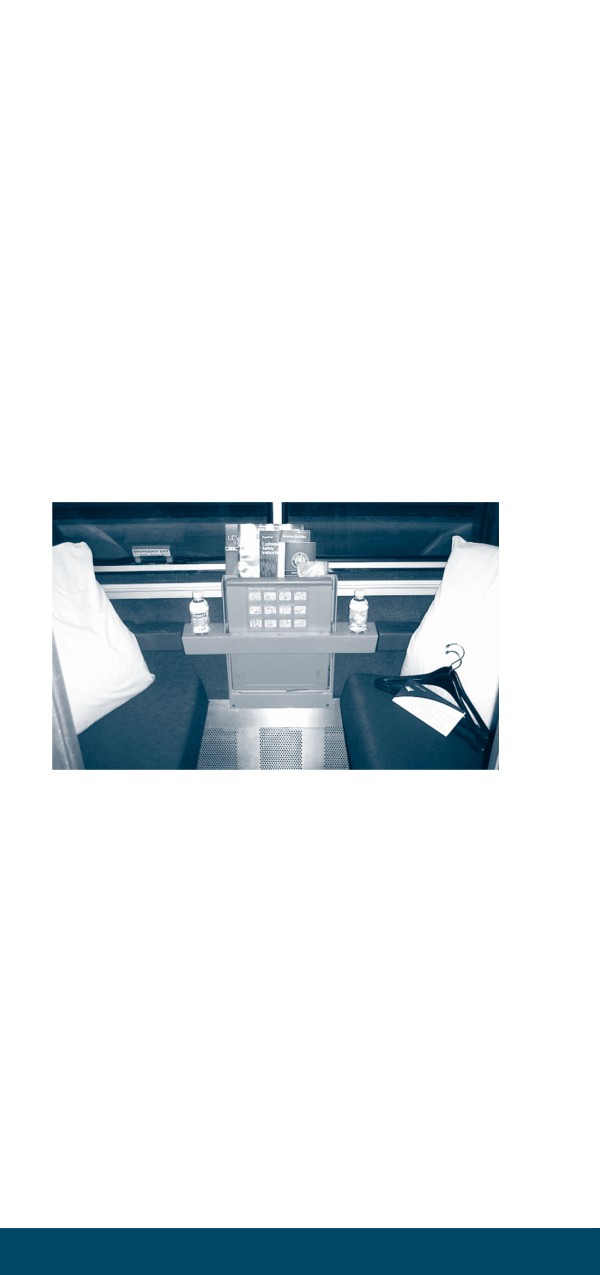
• Stock each accommodation with the following:
(Refer to Figure 6-10)
• Two pillows - place one in each seat.
• Day pillow service is to be provided on all
trains departing a station before 8:00pm.
• Two clothes hangers - arrange in front of one
of the pillow.
•
“Welcome Aboard” tent card - place facing
upwards in front of the hangers toward the
entrance to the accommodation.
• Summarizes amenities offered.
• Space for the passenger to indicate a time for
their “wake up” coffee.
Service Standards Manual No. 6
6-83
• Write your name in the space provided.
• One bottle of spring water and one plastic cup
for each passenger (additional water may be
provided upon request).
• Bottled water will be placed in the cup holder on
the side of the table.
• Magazines, the safety card, route guide, and post
card should be placed between the table and the
window (table remains upright (closed) when
passengers are boarding).
• One timetable for the appropriate route.
• One route guide (when available).
• One Amtrak postcard (when available).
• Two Hand Towels.
• Two Wash Cloths.
• Two Bath Towels.
• Bath towels in community shower rooms.
Figure 6-10 - Preparing Sleeping Car for Passenger’s Arrival
g) Amenities and Amenities Station Set-Up
• Coffee, hot tea, orange and apple juice constitute
the complimentary service available within the
Sleeping Car.
• Coffee service is to be made available throughout
the day.
• Bottled water, plastic cups and ice are available
upon request.
• The complimentary wake-up beverage may be
taken with the wake-up call or at any time
more convenient for the passenger during the
established hours of the complimentary service
between 6am and 9:30am. (Refer to Chapter 7
“Policies & Procedures”)
h) Announcement Protocols
• At origin and all major intermediate stations the
6-84
Crew Functions & Responsibilities
Train Attendant is to make an announcement
which:
• Provides safety information.
• Orients the passenger to the consist of the
train (i.e., location of Food Service Cars,
restrooms, etc.).
• Train Attendants should introduce themselves by
name to the passenger, and provides the employee
location in the event of an emergency or other
problem.
• Announce all station stops between the hours of
7 am and 10 pm.
• Notify passengers individually from 10p.m. to
7a.m. Use a flashlight to locate passengers during
the night.
• When an en route delay occurs, passengers are
to be notified immediately. If the Conductor
does not make an announcement or the
announcements are too infrequent, it is the
TASC responsibility to keep passengers informed.
3.
TASC - Upon Departure Responsibilities
a)
Receiving Passengers
•
Wipe all hand railings and grab irons.
•
Place the step box securely on the platform
whenever the distance from the lower car step is
12 inches or more.
•
As passengers approach the car, call out the car
number.
•
As passengers approach greet them, ask for their
name, confirm their name is on the manifest and
direct them to their accommodation.
• Assist passengers with luggage onto
the vestibule and direct them to their
accommodations.
• Inform passengers that their baggage will be
brought to them upon departure. Do not
leave the boarding door unattended.
• Ensure that all carry-on baggage has
identification tags attached.
•
Remain on the ground until the Conductor
signals the train is ready to depart.
•
Late boarding passengers will be allowed to board
at any opening and then escorted to their car.
•
Ensure that the vestibule doors and outside
windows are properly closed and secured.
•
Continually update diagram/manifest for
boarding and detraining passengers.
•
Update the diagram/manifest as the Conductor
makes the ticket lift.
Service Standards Manual No. 6
6-85
• Verify this information periodically with the
Conductor.
• Notify the Conductor of any ticketing problems.
• Direct the passenger to their accomodation.
b)
General PA Introduction Announcement
• The TASC is to make a PA announcement
welcoming everyone to the train and Amtrak.
• Include your name, and advise the passengers
that you will be personally contacting each
passenger.
• Include general information related to smoking
policies, moving safely throughout the train and
a recommendation to review the emergency
evacuation card.
c)
Personal Introduction
•
Introduce yourself to each passenger in each
accommodation.
•
Inform passengers of policies related to smoking
and on how to safely move throughout the train.
•
Describe the features of the accommodation
including the operation of the:
• Lights
• HVAC
• Ask passengers to keep baggage and
papers clear of floor heating strips in their
accommodations.
• Seats
• Tray table
• Call button
• Door
• Closet
• Towels and wash clothes
•
Familiarize the passengers with:
• Lounge Car location and hours of operation.
• Dining Car location, hours and reservation
system.
• Restroom and shower facilities location.
• Complimentary service (i.e., coffee, juice and
water).
• Wake up service and beverage.
• Newspaper in the morning.
• Drinking fountain.
• Other services (i.e., wine tasting, happy
hour, etc).
• Location of Train Attendant.
d)
Ticket Lift/Manifest
• Unless instructed otherwise, the Conductor is to
collect all tickets.
6-86
Crew Functions & Responsibilities
• Immediately notify the Conductor of any
duplicate sales of Sleeping Car space.
• If this circumstance occurs, accommodate the
passengers, if possible, in a vacant room in the
car. If no vacant rooms are available, relocate the
passenger to other accommodations in another
Sleeping Car, if available.
• Continually update accommodation diagram for
boarding and detraining passengers. Verify this
information periodically with the Conductor.
4.
TASC - En Route Responsibilities
a)
Call Bell
• Answer call bells promptly.
• Be aware if the system is not working and inform
the passenger.
b)
Wake-Up Service
• Maintain diagram/manifest showing the times
passengers want to be called in the morning.
• Offer complimentary wake-up service of coffee,
hot tea, or juice at the time requested by the
passenger.
• This service is available between the hours of
6am to 9:30am.
• This service is provided to all Sleeping Car
passengers.
c)
Morning Newspapers
• Newspapers are to be distributed promptly to
passengers after they wake up, preferably with
their complimentary wake-up beverage.
• One newspaper is provided to each
accommodation.
• If the number of newspapers received in a
Sleeping Car exceeds the number needed,
inquire if additional newspapers are needed in
other Sleeping Cars.
• Excess newspapers should be placed in the
Café/Lounge Car for use by all passengers.
d)
Morning Service - When passengers leave their
accommodations in the morning:
• Confirm they would like their beds made.
• Remove trash.
• Refresh the room.
• Replace pillow covers and leave pillows on seats.
• Replace used towels and washcloths.
• Wipe surfaces.
• Replenish toilet paper, soap and tissues, if
necessary.
• Brush crumbs off seats and sweep floor.
Service Standards Manual No. 6
6-87
• Ensure showers are wiped clean, frequently.
• Remove used bar soap.
• Spray shower floor with disinfectant gel and
rinse well to prevent slipping.
• Remove dirty linen bags from shower when
¾ full.
• Mop general area floor.
e)
Maintain a Quiet Atmosphere
• Contact the Conductor immediately if a
disturbance occurs that cannot be resolved.
• General informational PA announcements
should not be made between 10 pm and 10 am
• Emergency announcements should be made at
anytime regardless of the time of day.
• Follow announcement guidelines as out lined
in Chapter 10 “On-Board Announcements
and Signage”.
f)
In Room Meal Service
•
“In Room Meal Service” is available to every
passenger.
•
Any passenger who has a disability must be
offered “In Room Meal Service”. If the disabled
passenger requests to eat in the Food Service
Car, every attempt must be made to fulfill
this request.
•
The TASC must notify the LSA-Diner of any
passenger who would like meals in their room.
•
The TASC is responsible for taking the
passenger’s order to the LSA-Diner and serving
the prepared meal to the passenger.
• Meals must be served on a dinner plate,
covered with a plastic plate cover.
• Silverware will be rolled in a linen napkin.
• Beverages will be served in glassware or china.
• Meals will be carried and delivered to
passengers on a tray.
• When passengers have finished, dispose of
trash and return all food service equipment to
the Dining Car-LSA before the kitchen closes.
•
There is no charge for room service.
•
Sleeping Car passengers may drink their own
supply of liquor in the accommodations.
g)
Night Service
• Turning Down Beds
• Turn beds down when requested by the
passenger.
• Ensure berths are secured in the open
position and all safety straps are correctly
fastened.
• Beds should be made in advance, for
passengers boarding after 10pm.
6-88
Crew Functions & Responsibilities
• Bed making procedures are outlined in
Chapter 7 “Policies & Procedures”.
• Passenger Boarding En Route
• Rooms should be prepared for passengers
boarding after 10 pm
• If an accommodation is sold more than once
on a trip, ensure that the next occupant
receives all required items in the room set up.
• The room is to be swept, sinks and restrooms
h) Restrooms - Routine Cleaning
Restrooms are to be checked every hour during
the course of the trip and checked every 30 minutes
during the morning peak time between 6 am and
10 am. Clean as required.
• Keep the public restrooms clean and dry.
• Wipe mirrors, sinks and counters.
• Wipe and disinfect toilet bowl, toilet seat,
under toilet lid.
• Replenish soap and paper products as necessary.
• Pick up trash.
• Dust floor with Swiffer Dry.
i) Restrooms - Heavy Cleaning
Restrooms are to have a heavy cleaning as the last
duty of the evening, in order to have the restrooms
ready for peak usage between 6:00 am - 10:00 am
the next morning. Restrooms should also have
a heavy cleaning after the peak usage time of
10:00 am and as needed or directed by local
supervision. Follow these steps in the order listed.
• Pick up trash.
• Begin toilet cleaning process by using green
rubber gloves or disposable latex gloves to lift
toilet seat lid, then spray germicidal foaming
cleaner inside the bowel outside of the toilet
bowl including the seat, lid and platform the
toilet sits on (let soak).
• Spray the glass cleaner (Solutions Plus) on the
mirror and under mirror back splash (clean with
paper towels).
• Use the germicidal foaming cleaner inside of the
sink bowl, hot/cold faucet handles, spout, sink
counters, outside of sink cabinet, toilet flush
button, doors, doorknobs and locks (clean with
paper towels).
• Finish wiping down the outside of the toilet
bowl including the seat, lid and platform the
toilet sits on.
• Use Scrubbing Bubbles toilet cleaning kit to
scrub inside of toilet.
• Used scrubbing pads can be flushed down the
Service Standards Manual No. 6
6-89
toilet or put into a small plastic bag and disposed
with the trash.
•
Lower toilet seat lid and wipe top of seat lid and
back of toilet.
•
Wipe and disinfect changing table.
•
With a wet Swiffer, mop clean the floor
including the corners of the floor and around
the toilet base.
•
Remove gloves. (If green rubber gloves were
used, clean first (before removing) by squirting
liquid hand soap into the palm of a glove and rub
the gloves vigorously together, rinse gloves in
hand sink under running water then dry with
paper towel.)
•
Spray a light amount of Febreze into the
restroom.
•
Wipe liquid soap container with disinfectant
and replace liquid soap container when
malfunctioning or nearly empty.
•
Remove used bars of soap, and replace with new
bars (long distance coaches and first class
accommodations).
•
Restock proper paper cups, facial tissue,
paper towels and toilet paper as necessary in
appropriate holders. (Do not leave extra stock
on counter tops or back of toilet.)
•
Empty trash containers and install new liners.
•
Return all cleaning supplies to the proper
storage area.
j) Restrooms - Defects
If a sink or toilet malfunctions, lock the rest-
rooms until authorized repairs can be made.
• Shut off water supply to prevent flooding, if
necessary.
• Place sign “This Restroom is out of Service” -
number 028126 on door.
• Record all defects on “Record of Defect and
Repair MAP-21A” (NRPC 2775).
• Lock the restrooms if a car runs out of water.
• Arrange for the car to be watered en route.
k) Detraining
• Maintain diagram/manifest showing the times
passengers want to be called prior to their
destination.
• Plan sufficient lead-time to allow the passengers
to prepare for detraining or to complete their
meal in the Dining Car.
• It is recommended that passengers be
prepared at least 20 minutes prior to arrival at
their destination station.
6-90
Crew Functions & Responsibilities
• Make certain the passenger is detraining at
their ticketed destination.
• Notify the Conductor immediately if unable
to locate a passenger.
• If a call is for a definite time, call the passenger at
that time, even if the train is delayed.
• If a call is for a certain amount of time before
arrival, allow for train delays and call passenger
at the specified time before arrival.
• In all cases, continue to call passengers until they
respond.
• Assist passenger with any luggage from
accommodation, and make certain that all
other luggage carried on is located.
• Remind passenger to check accommodation to
avoid forgetting anything.
• As passengers detrain, remind them to be careful.
• Thank passengers for riding Amtrak.
l)
Car Security/Safety
•
Employees must check their assigned cars
frequently for safety issues and passenger
comfort.
•
Any person entering the car, especially late at
night, must be asked if they need assistance. If
the passenger’s reasons are not valid, politely
direct them to the appropriate car.
•
All doors and curtains in unoccupied rooms must
be left open.
•
Deadheading employees may not occupy
Sleeping Car accommodations unless authorized
by the Conductor.
m)
Superliner Transition Sleeping Car
•
All of the services and amenities provided to
Sleeping Car passengers also apply to
paying passengers who are assigned to the
Superliner Transition Sleeping Car.
•
Employees traveling in Business Travel
(BT) space are expected to make their own
bed, remove soiled linen and leave the
accommodation neat and clean.
•
Meals are not provided and must be purchased.
•
For employees not familiar with BT accom-
modations the TASC should familiarize the
employee with the workings of the car and
location of bedding and linens.
n) Public Health
• Empty trash containers as they reach 75% of
capacity.
• Off-load trash at designated locations. (Refer to
Chapter 3 “FDA Rules & Inspections”).
Service Standards Manual No. 6
6-91
• If a car runs out of water, lock community
restrooms and advise passengers with in-room
restrooms not to use the toilet.
• Place sign “This Restroom is out of Service”
number 028126 on door.
• Notify the Conductor if water is needed in
the car.
• Arrange for the car to be watered en route.
o) Defect Report - Ensure that all defects are record
on the “Record of Defects and Repair MAP-21A”
(NRPC 2775).
5.
TASC - End of Trip Responsibilities
a)
Inspection of Car
• Check the car to ensure that all passengers have
detrained.
• Ensure that all items have been removed from
the train. Any items left on-board must be
turned into lost and found or the ticket office.
Obtain a receipt.
• Ensure that all china, flatware and other Dining
Car equipment has been returned to the kitchen
before it closes.
b)
Accommodations
• All beds are to be correctly made and folded
before going off duty.
• All linen - soiled and unused are to be removed
and placed in the linen bags.
• Pick up trash, newspapers and litter.
• All pillows are to have the pillowcases removed
and new pillowcases installed, then place in one
of the berths.
• No pillow is to be left in the seat.
• Hangers should be placed in the closet or clothes
rack.
c)
Linen and Storage Lockers
• Bag and tag all soiled linen.
• Complete the linen requisition.
• Strip all supplies that are excessive.
• If local procedures require, strip all items from
the Sleeping Car.
• Lockers are to be left in a clean and orderly
manner.
• Stow equipment and supplies in the correct
locker.
d)
Trash
• Remove all trash bags.
• As required by location, leave the bags in the car
or place on the platform.
6-92
Crew Functions & Responsibilities
e) Defect Report - Ensure that all defects are recorded
on the “Record of Defect and repaid “MAP -21A”
(NRPC 2775).
O. NEC En Route Cleaner
The NEC En Route Cleaner is responsible for but not
limited to the following.
a) Adhering to all of the procedures in Section B
“General Information” of this chapter.
b) Be conversant with and adhere to the policies and
procedures as outlined in Chapter 3 “FDA Rules &
Inspections”.
1.
NEC En Route Cleaner - General Responsibilities
a) NEC En Route Cleaner
• Refresh restrooms, Lounges and Coaches when
riding trains between station stop.
• Follow all prescribed policies and Amtrak
standards.
b) Timecard - After reporting to the Conductor of
your assigned train, either at the crew base, en
route, or at train side, the Conductor is to sign the
En Route Cleaner’s timecard form “OBS
Unscheduled Time/Meal Authorization” (NRPC
3057) for payroll accounting purposes. (Refer to
Figure 6-4)
c) Announcement - NEC En Route Cleaners must
make an announcement introducing themselves
and advise passengers that they will be coming
through the car to collect any trash, cleaning the
restrooms, etc. (Refer to Chapter 10 “On-Board
Announcements and Signage”).
2.
NEC En Route Cleaner - Work Schedule
a) Work schedules may be adjusted in peak seasons
and during holidays, (vacancies are generally not
filled for vacations or other reasons).
b) In the event of service disruptions or late trains,
En Route Cleaners must adjust their
schedule to cover as many assigned trains as
possible. Adjusting schedules for delays may
require cleaners to board or detrain at alternate
locations not designated on the general
work schedule.
Service Standards Manual No. 6
6-93
Introduction
This chapter contains information on policies, procedures
and processes. Employee responsibilities are not limited to
the following descriptions, and may be adjusted, modified
or changed by management when deemed necessary.
A. Passenger Policies/Procedures
1.
Canadian Currency
Amtrak accepts only Canadian paper bills (no coins
or personal checks). (Refer to Chapter 8 “Accounting”,
Section 1 “Train Service Accounting Procedures”)
2.
Carry-Bys
a)
Passengers must not be carried beyond their ticketed
destination. If a passenger is inadvertently taken
beyond their destination, the operating crew may
issue authorization for return travel to the proper
destination.
b) Return Travel Arrangements
•
The Conductor or Assistant Conductor must
prepare a Conductor On-Board Ticket Stock
(COTS) by punching the “RET” box and writing
the train number and date in the endorsement
box. Indicate the points the passenger overrode
in such order that the return coupon “A” will
read in the right direction for the passenger to
return to their original destination. If known,
indicate the next returning train. Check the
passenger’s identification and put their name
on the form.
•
Make sure the passenger signs the form.
•
Inform the passenger that the Passage Coupon
(coupon A) is valid only if used on the first
returning train, as shown on the form.
•
The Conductor or Assistant Conductor will
detrain the passenger at the station that is
most convenient and safest for transfer.
•
The Conductor on the return train will place
Coupon A in the “Train Earnings Reports
Envelope” (NRPC 158). The issuing Conductor/
Assistant Conductor will attach Coupons C and
D to the Sales Report copy of the “Conductor
Sales Report Book” (NRPC 193).
Service Standards Manual No. 6
7-1
3.
Checks - Personal
a) OBS - Personal checks will not be accepted as a
form of payment in any Food Service Cars (Cafe,
Lounge or Dining Car) or food carts - except from
groups (booked and ticketed in a group PNR).
b) Train Service - (Refer to Chapter 8 “Accounting”,
Section 1 “Train Service Accounting Procedures”)
4.
Conditions of Carriage
a)
Any travel on Amtrak is subject to Amtrak’s
policies, conditions of carriage, and limitation
on liabilities (collectively “Policies”). Amtrak
polices, fares, schedules and rates are subject to
change without notice.
b) Conditions of Carriage
Amtrak may refuse to carry passengers:
• who have not paid the applicable fare.
• whose conduct is objectionable (such as, but
not limited to, being under the influence of
alcohol or narcotics).
• whose personal hygiene makes them offensive.
• who pose a health, safety or security hazard to
other passengers or employees.
• who refuse to comply with safety or security
rules or with instructions of Amtrak personnel.
• who would require Amtrak personnel to provide
personal care services or otherwise do not
meet the essential requirements for the receipt
of Amtrak service (unable to take care of
themselves).
• who refuse to consent to Amtrak security
inspections of persons and/or baggage on
board Amtrak trains and/or at designated
areas, such as train platforms and passenger
boarding or waiting areas.
c)
The following examples include, but are not limited
to, circumstances that are lawful grounds where a
passenger may be removed from a train.
• Improper conduct.
• Intoxication.
• Demonstrated inability to take care of oneself,
unless accompanied by someone who can take
care of them. (Ensure that ADA Guidelines do
not apply, refer to Chapter 11 “Assisting
Passengers with Disabilities”)
• Malicious damage to equipment.
7-2
Policies & Procedures
• Obscene language.
• Smoking in non-smoking areas.
• Refusal to pay the proper fare.
d) Conductors should not allow passengers who are
not able to take care of themselves to board the
train, unless accompanied by a caregiver. If the
individual chooses not to have a caregiver
accompany them, that individual must be able to
tend to his or her most basic needs, such as eating,
using the restroom and taking medication.
e)
When removing and/or restraining a passenger,
the conductor should remain as calm as possible,
with no display of temper.
• Whenever, there is a passenger removed from
the train, prevented from boarding or
restrained, and/or luggage carried beyond its
destination, the Conductor must complete a
“Passenger Incident Report” (NRPC 3200).
• Amtrak cannot “ban” a passenger from our
trains because of a previous situation, which
resulted in removal. A passenger may be
removed for any of the reasons listed above,
but a permanent prohibition of any passenger
is not legally possible without a court order.
f)
Removal of a Passenger from the Train
•
A passenger should be removed and/or
restrained only when other methods, including
a firm request to the passenger, have failed.
•
A passenger may be physically restrained, but
ONLY if personal injury or damage to equipment
is threatened or reasonably anticipated.
•
If it becomes necessary to use force, ONLY
reasonable force must be used.
•
Make sure you avoid any personal injury.
•
The removal of a passenger must be facilitated
by calling for the Amtrak Police or local law
enforcement authorities to meet the train
enroute to remove the passenger.
• It is essential that CNOC (302) 683-2299 be
notified of the situation and to determine if
the passenger being removed has any firearms
or ammunition contained within their checked
baggage. (Refer to “Firearms in Checked
Baggage - Unusual Circumstances” in
Chapter 4 “Baggage Handling” for additional
information.)
Service Standards Manual No. 6
7-3
• In those cases where law enforcement is
unable to meet the train enroute, and the
circumstances warrant, the passenger(s)
must only be removed from the train at any
open, staffed station, unless their safety might
be endangered.
• When necessary for the safety or other
passengers or employees, a passenger may be
removed at a point other than a staffed station.
In this case, employees should contact the
police if it appears to be necessary to protect
property or to assure the safety of passengers
(including the passenger to be removed from
the train) or employees.
g)
Involuntary Removal
• Involuntary removal of a passenger or passengers
from an Amtrak train is an extremely serious
action that should only be taken when the
passenger(s) refuses to refrain from conduct that
might endanger their own lives or jeopardize
the safety and comfort of others.
• If an involuntary removal of a passenger or
passengers from an Amtrak train is required, the
Amtrak Police Department should be contacted
as soon as possible so that arrangements can
be made to have police assistance meet the
train at the quickest point to investigate,
document and process the incident.
• In the NEC this will generally be Amtrak Police,
in other locations it will be the local police.
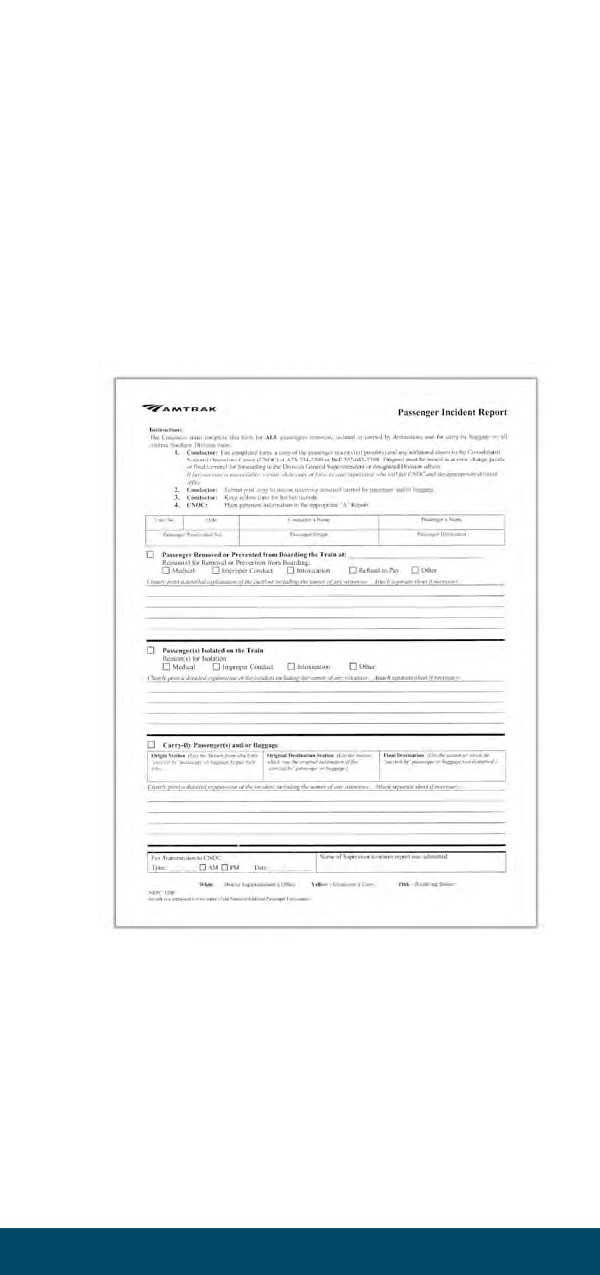
h) Completion of Form NRPC 3200
• The Conductor must complete the “Passenger
Incident Report” (NRPC 3200). (Refer to
Figure 7-1)
• In cases of involuntary removal or restraint,
the report must include the names and
addresses of passengers and employees who
witnessed the altercation, and a full statement
of the facts surrounding the incident, including
the details regarding the affected passenger’s
ticket.
• Pink copy of the form is submitted to the station
receiving the removed/carried by passenger or
baggage.
• Copy must be faxed to CNOC at ATS 734-2399
noting the time and date of the fax transmission
7-4
Policies & Procedures
to CNOC and to whom a copy of the report
will be given.
• A copy is to be given to the designated
Division officer as soon as possible but no later
than the end of his/her assignment.
• If no fax is available, submit the white copy to
his/her supervisor at the first opportunity, but in
no case later than the end of his/her assignment.
The supervisor is to transmit the form to CNOC.
• The conductor is to retain the yellow copy for
their records.
Figure 7-1 - “Passenger Incident Report” (NRPC 3200)
i) Traveling Under Pass Privileges - Misconduct
involving someone traveling under pass privileges
must also be reported on the “Pass Abuse
Incident Report” (NRPC 1502).
j) Ticket Handling
• If the passenger was removed from the train
en route involuntarily, their ticket is NOT to
be returned to them.
Service Standards Manual No. 6
7-5
•
Notify CNOC immediately.
•
Provide the passenger’s name, original
destination, and a brief description of the
situation including whether or not the local
police were involved.
•
Specify the names of any accompanying
companion(s), the original destination, and
the station or location where the passenger
left the train.
•
Note the delay (if any) on the delay report.
•
Follow up with a report to the Road
Trainmaster, Road Foreman, Manager of
crew base or On-Board Service Manager.
•
The passenger’s ticket is not to be returned
to them nor is a “Service Adjustment”
(NRPT 27) to be issued to the passenger.
•
Ticket or Station Agents must advise the
passenger(s) who have been removed from
the train that they must purchase a new
ticket to continue their journey.
•
Advise the passenger that any refund or
fare adjustment is determined on a case-by-
case basis based upon the fare plan and any
restrictions of that plan.
•
If the passenger voluntarily leaves the train
or indicates a desire to leave the train before
their ticketed destination, collect the ticket and
do not return.
• Notify CNOC to provide the passenger’s
name, details of the situation, the original
destination, and the station or location
where the passenger left the train.
• Complete a “Service Adjustment” (NRPT
27). Do not return the passenger’s ticket.
(Refer to Chapter 8 “Accounting”, Section 1
“Train Service Accounting Procedures“)
• Give the passenger the 4th copy of “Service
Adjustment” (NRPT 27) (Refund Copy).
Advise the passenger that any refund or
fare adjustment depends on the fare plan
and is determined on a case-by-case basis.
• If, at the time of the ticket lift, the passenger
indicates a desire to leave the train before
their ticketed destination; collect the ticket,
and place it in the “Train Earnings Reports
Envelopes” (NRPC 158). Then issue a
7-6
Policies & Procedures
“Service Adjustment” (NRPT 27), giving the
passenger the 4th copy (Refund Copy).
• Advise the passenger that any refund or
fare adjustment is determined on a case-by-
case basis based upon the fare plan and any
restrictions of that plan.
5.
Death En Route
a)
A death en route is an apparent death. Only a
licensed physician or coroner (or designee) is
legally able to pronounce someone dead.
b) In the case of apparent death en route, the
operating crew is responsible for notifying the
dispatcher who, in turn, will contact a qualified
medical officer or coroner immediately. State
laws and host railroad instructions will govern.
c)
The operating crew is responsible for safeguarding
the remains and personal effects.
d) It is imperative to use care and discretion when
dealing with the deceased and others in the
surrounding area.
e)
If possible and local authorities are agreeable,
have the person and their belongings removed by
rescue personnel so that the train can proceed.
f)
If there is a family member or a friend traveling
with the individual, and they choose to get off
the train voluntarily, the Conductor is to fill out
a “Service Adjustment” (NRPT 27) giving the
passenger the 4th copy. (Refer to Chapter 8
“Accounting”, Section 1 “Train Service
Accounting Procedures”)
6.
Displaced Sleeping Car Passenger Due to Equipment
Change or Duplicate Sale
a) It is Amtrak’s policy to protect the displaced
passengers in equal or superior accommodations
without additional fare collection regardless of
higher accommodation charges or greater minimum
ticket requirements. (Refer to Chapter 8
“Accounting”, Section 1 “Train Service
Accounting Procedures”)
b) Meal Amenity - If en route Sleeping Car passengers
are involuntarily downgraded to Coach due to
equipment failure or other cause, the passengers
will still receive the meal amenity portion of the
Sleeping Car accommodation. (Refer to Chapter 8
Service Standards Manual No. 6
7-7
“Accounting”, Section 1 “Train Service Accounting
Procedures”)
7.
Groups
a)
Manifest - Check manifest for any group travel.
Determine placement of the group(s) based upon
size, destination and special service requirements.
b) Group Seating - Amtrak will make every attempt
to seat members of a group together.
c)
Downline Boarding - If a group is boarding
downline, determine which car the group will
board and reserve sufficient seats so everyone
can sit together. (Use “Reserved for Group” sign
number 028117 shown in Chapter 10 “On-Board
Announcements and Signage”)
d) Exclusive Occupancy - the exclusive use of any car
by a group, subject to minimum fare requirements.
• Even with the exclusive occupancy, other
passengers and crew may require access to
and through the area occupied by the group.
• Normal courtesy is expected.
• Unless ticketed for exclusive occupancy, or the
number in the group fills the car, it must be made
clear to the group that at any point during the
trip other passengers may be seated in the car
and that the group must conduct themselves
appropriately.
e)
Meal Service - Coordinate meals with the LSA-
Diner, Chef, Train Attendant, Conductor and
Group Leader.
f)
Luggage Storage
• Coordinate luggage storage requirements, seating
and other group expectations with the On-Train
Crew and Station Agents.
• Advise the destination station as to the group’s
on-board location and amount of checked and
carry-on luggage.
g)
Boarding Plan - Communicate with the Group
Leader about the boarding plan.
h) Group Issues/Concerns - En route, if the Group
Leader raises any issues or concerns, it is essential
these issues be resolved or, at a minimum,
communicated to a staffed downline Station
for resolution. (Refer to Chapter 8, Section 1
“Accounting”, Section 1 “Train Service Accounting
Procedures”)
7-8
Policies & Procedures
8.
Identification
a) General Information (Refer to Chapter 8,
“Accounting”, Section 1 “Train Service Accounting
Procedures”)
b) Senior Citizens - Must present proof of age.
(Refer to Chapter 8, “Accounting”, Section 1
“Train Service Accounting Procedures”)
c) Persons with Disabilities - (Refer to Chapter 8,
“Accounting”, Section 1 “Train Service
Accounting Procedures”)
d) Military - ID card required. (Refer to Chapter 8,
“Accounting”, Section 1 “Train Service
Accounting Procedures”)
e) Thruway Buses for Unaccompanied Minor - The
adult purchasing the ticket must presents ID to the
bus driver. Showing ID to the bus driver fulfills the
requirement for identification including purchase of
a ticket at an Amtrak ticket office.
9.
Lost and Found Items
a) Found articles or baggage should be turned over
to the Baggage or Station Agent at the train’s
final destination.
b) On trains where the Conductor is relieved en
route, the found articles should be given to the
next Conductor.
c) Found articles or baggage should never be put off
a train at any intermediate point, unless the
owner has already been notified.
d) Any passenger who has lost or misplaced articles or
baggage should be advised to report it to the Station
Agent or customer service at (800) USA-RAIL.
10.
Lost, Stolen or Found Tickets
(Refer to Chapter 8, “Accounting”, Section 1 “Train
Service Accounting Procedures”)
a) Lost or stolen tickets.
• Tickets without a name or identifier on the
ticket are considered the same as lost cash and,
therefore, are the property of whoever possesses
the tickets.
• Tickets with a name or identifier on the ticket
are considered to be the property of the person
who purchased the ticket.
Service Standards Manual No. 6
7-9
b) Tickets found by an Amtrak employee:
• must be turned over to a ticket office or the
Ticket Receiver’s Office.
• must never be refunded for cash or for the
cash value.
11.
Ticket Refund Policy
(Refer to Chapter 8 “Accounting”, Section 1 “Train
Service Accounting Procedures”)
12.
Special Assistance Seat Check (NRPC 3242)
The “Special Assistance Seat Check” (NRPC 3242)
(green in color) is to be used for any passenger who
indicates he/she needs assistance. For example, this
would apply to unaccompanied minors, passenger
who are deaf or have other disabilities and need
assistance. (Refer to Chapter 8 “Accounting”, Section
1 “Train Service Accounting Procedures”)
13.
Smoking Policy
Amtrak supports a smoke free environment and
does not allow the use of electronic smoking devices
in areas that are designated smoke free on-board the
train, in stations and in offices.
a)
Auto train - Smoking is permitted in designated
areas only.
b) Enforcement - All On-Train personnel are
responsible for the enforcement of the smoking
policy.
c)
Station Dwell - Where station dwell times and
conditions permit, Conductor may use their
discretion in allowing passengers to smoke briefly
on station platforms.
• Conductors must exercise care to ensure that
their trains incur absolutely no delay as a result
of permitting passengers to smoke at stations.
• On-Train personnel must remind passengers
not to leave train-side, and be prepared to
board the train immediately once a member of
the train crew calls “All Aboard”.
• Conductors must not permit passengers to smoke
at stations when weather or other conditions may
compromise their safety or comfort.
d) Employees Using Tobacco Products
• The use of tobacco products are prohibited by
7-10
Policies & Procedures
employees on duty and in uniform, whether
on-board train or in the station.
• Employees are not permitted to smoke in the
Dormitory Car or other crew cars at any time
on any train.
14.
Standees
a)
Coach - If the number of Coach passengers exceeds
the Coach seating capacity, take the following steps.
•
Make sure no passenger occupies more than
one seat with baggage or personal effects on
adjacent seats.
•
If there are individuals riding on a 10 Ride
ticket, ask them to move to another location as
their ticket does not guarantee them a seat,
only transportation.
•
If available on the train, upper level seats in
Superliner Lounge Cars may be used to ease
overflow conditions. Seats in the Café/Lounge cars
should be used only in extreme circumstances.
•
If available, the overflow passengers may be
seated in the vacant Sleeping Car rooms until a
complete review of the train has occurred.
•
Make sure passengers understand that they
can only use the sitting area and that any use
of the beds or amenities will result in a full
charge for the accommodation.
•
If the Sleeping Car space has been sold
downline, the Coach passengers will be
required to move when the passengers who
have purchased the space board the train.
•
Seats in Dining Cars may be used in extreme
situations and only at night after the last meal
service. Passengers must understand that the
car is to be vacated before breakfast.
•
If the number of people wishing to board
unreserved trains exceeds the available spaces,
an announcement must be made that only a
certain number of persons can be boarded
and seated.
•
All others may board if they understand it is
Standing Room Only (SRO).
•
Those wishing to travel SRO should be
allowed to board.
•
Standees must not be boarded to a point
Service Standards Manual No. 6
7-11