Renault Megane (2023 year). Manual in english - page 5

ACTIVE EMERGENCY BRAKING (8/8)
Deactivating the function
You must disable the function if:
- the brake lights are not functioning;
- the area of the camera has been damaged (e.g. on the inside or outside of the windscreen);
- the front of the vehicle was damaged (impact, scratch on the radar, etc.);
- the vehicle is being towed (breakdowns);
- the windscreen is cracked or distorted (do not carry out windscreen repairs in this area; have it changed by an approved
dealer);
- you are not driving on a paved road.
In the event of the system behaving abnormally, deactivate it and consult an authorised dealer.
Halting the function
You can halt the active emergency braking function at any time by tapping the accelerator pedal or by turning the steering
wheel in an avoidance manoeuvre.
2.78
CarManuals2.co
FATIGUE DETECTION WARNING (1/2)
The fatigue detection warning is a func-
tion which is useful on monotonous
roads (motorways, high-speed roads
1
etc.).
It analyses driver behaviour and takes
account of events to inform you of any
risk of fatigue such as:
- steering wheel movement;
- driver actions on other devices (indi-
cators, windscreen washer etc.);
- time spent driving without stopping;
- ...
Activation/deactivation
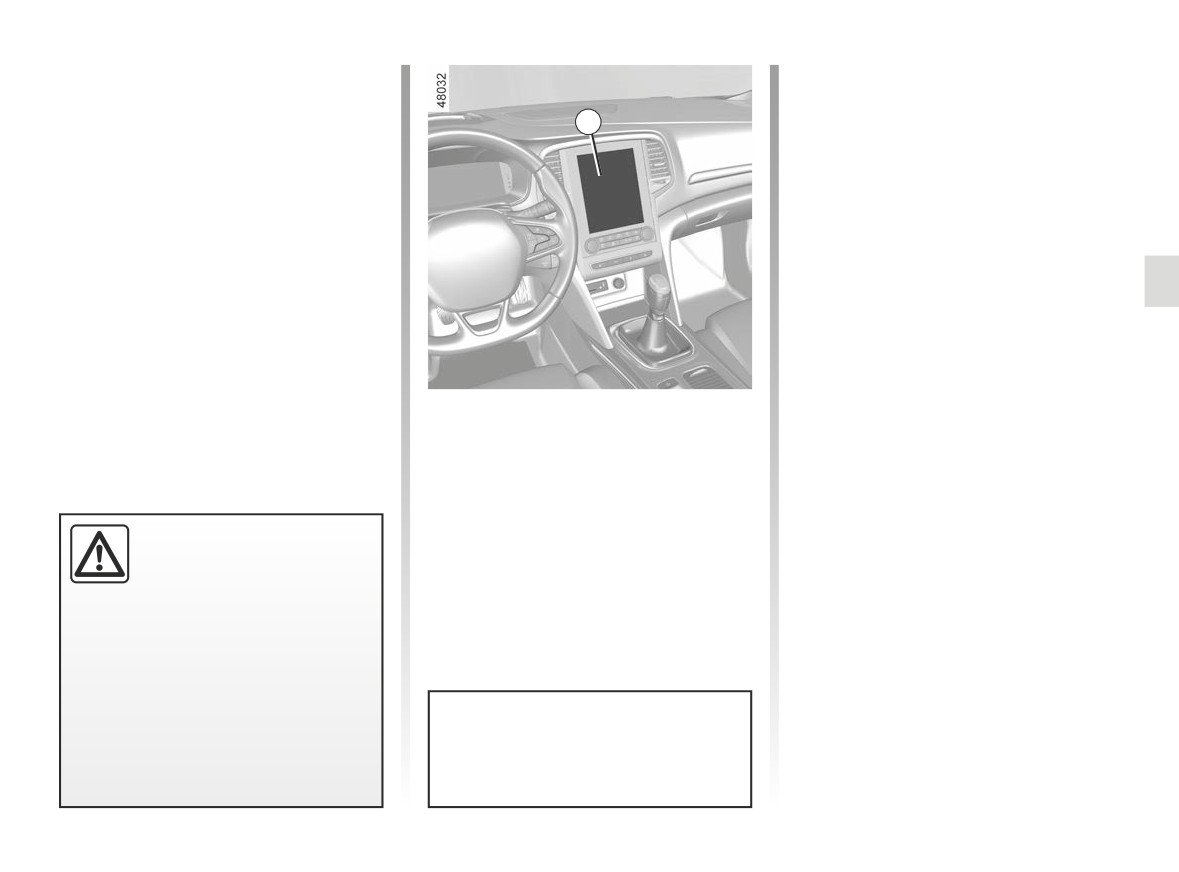
Vehicles fitted with a multimedia
screen 1
To activate or deactivate the function,
refer to the multimedia instructions.
This function is an addi-
Select ON or OFF.
tional driving aid in case of
risk of fatigue. This function
does not take the place of
the driver.
Under no circumstances should this
function replace the driver’s care or
responsibility whilst driving.
When the engine is started, the
system remembers its position
when the ignition was last switched
off.
2.79
CarManuals2.co
FATIGUE DETECTION WARNING (2/2)
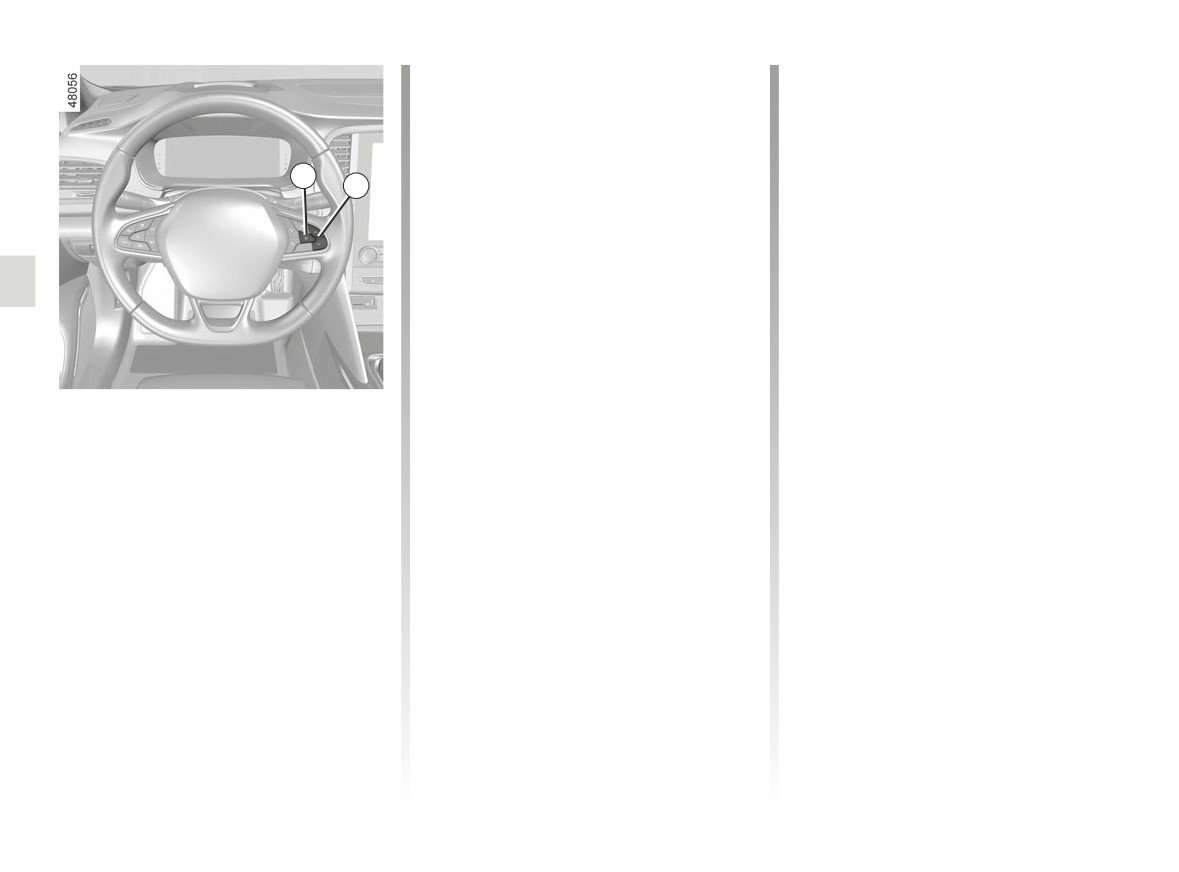
- repeatedly press the control 3 up or
Note:
down until you reach the “Fatigue
- if the warning is not deleted by press-
detection warning” menu, then press
ing switch 2 OK, the beep repeats;
the switch 2 OK.
- the function may interpret certain
- press the 2 OK switch again to acti-
2
driving styles as a sign of tiredness
3
vate or deactivate the function.
(sporty driving, incorrect driving etc.)
or driving along a road which is in
Operation
poor condition.
The function is set to notify the
driver if:
Operating faults
- the vehicle speed is greater than ap-
If the system detects a fault, the mes-
proximately 37.2 mph (60 km/h);
sage “Check fatigue warning” is dis-
and
played on the instrument panel. Call an
- Approximately
15 minutes have
approved Dealer.
passed since the deletion of the pre-
Vehicles not fitted with a multimedia
vious warning.
screen
The function triggers an alert if the
- With the vehicle at a standstill, press
system detects repeated signs of fa-
and hold the switch 2 OK to access
tigue in the driver at the steering wheel.
the settings menu;
When a risk of fatigue is detected,
- repeatedly press the control 3 up or
the message “Fatigue warning have a
down until you reach the “Driving as-
break” is displayed on the instrument
sistance” menu. Press the switch 2
panel accompanied by a beep.
OK;
Press switch 2 OK to delete the warn-
ing.
It is advisable to stop as soon as pos-
sible for a break.
2.80
CarManuals2.co
DETECTION OF ROAD SIGNS (1/4)
Note: make sure the windscreen is not
For vehicles equipped with a navigation
obscured (dirt, mud, snow, condensa-
system and if the vehicle is travelling in
1
tion etc.).
a country where the speed units differ
from those of the vehicle, the system
For vehicles which are equipped with it,
displays the speed limit sign in the unit
the system also uses information from
of the country, alongside the speed limit
the navigation system.
converted to the unit used by the vehi-
Once the speed limiter is activated, you
cle’s instrument panel.
can adjust the speed limiter indication
For countries where the speed limit is
displayed by the system.
reduced during rainy weather on some
If the limit speed is exceeded, the dis-
types of roads, on vehicles equipped
play panel is modified to warn the driver.
with a navigation system, the system
can modify the limited speed after a few
seconds of wiping the windscreen.
Special situations
The system detects speed limit signs
The system does not take into account
on the side of the road and displays the
exceptional speed limit measures, such
speed limit on the instrument panel.
as peak pollution days.
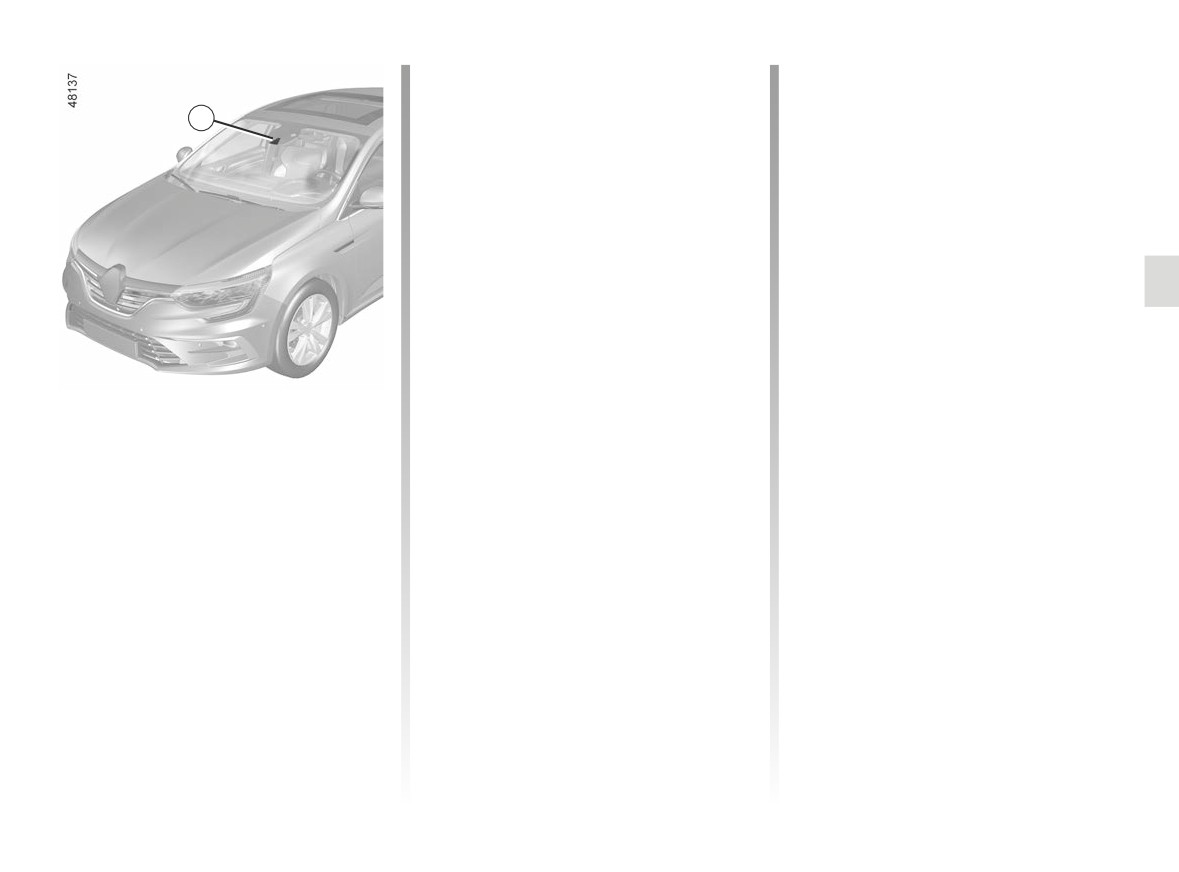
It mainly uses information taken from
the camera 1, attached to the wind-
screen behind the rear view mirror.
2.81
CarManuals2.co
DETECTION OF ROAD SIGNS (2/4)
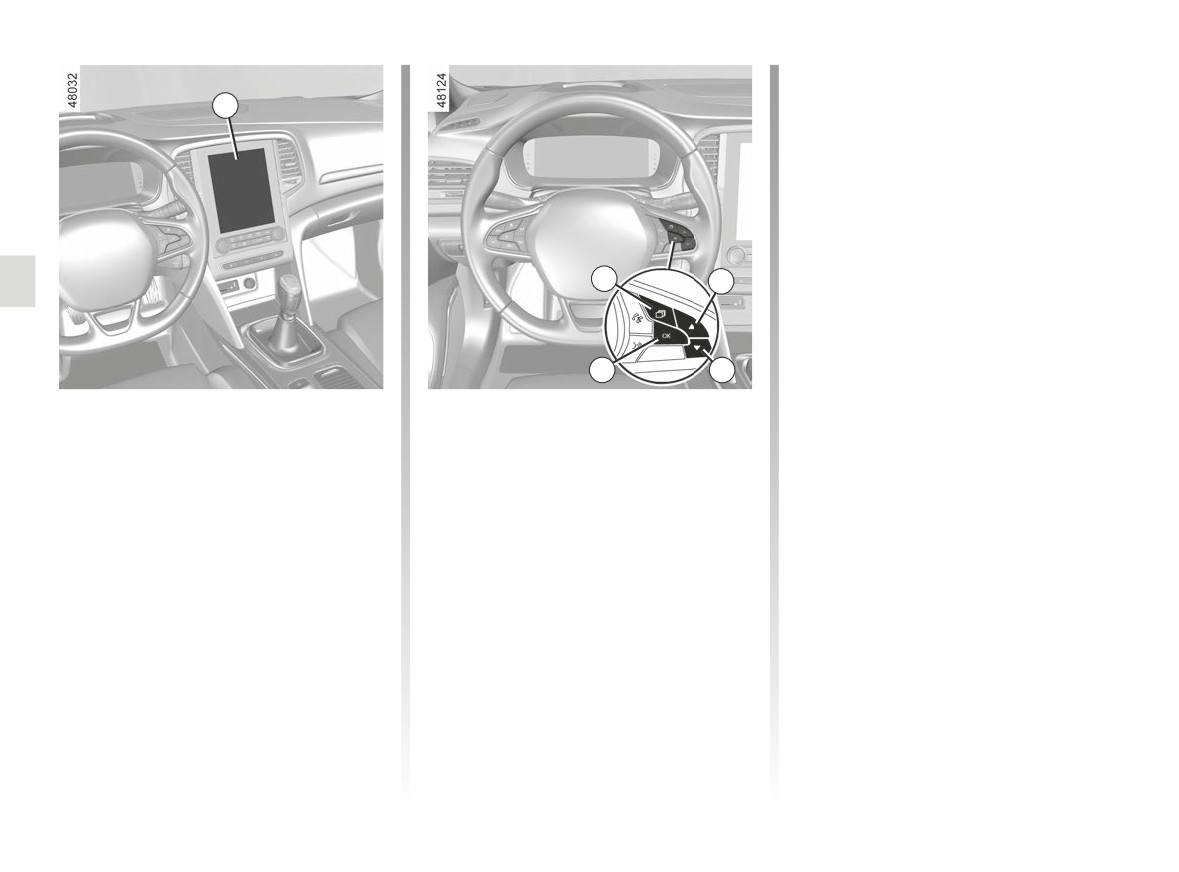
- press the 4 or 5 control repeatedly
to reach the “Settings” menu and
2
press 6 OK;
- press the 4 or 5 control repeatedly to
reach the “DRIVING ASSIST” menu
and press 6 OK;
- press the 4 or 5 control repeatedly
to reach the “Speed alert” menu and
press 6 OK;
- press the 6 OK switch to activate or
3
4
deactivate the function:
=
function activated
6
5
<
function deactivated
Activating/deactivating the
With the function activated, depend-
ing on local regulations, you can acti-
system
vate the “Risk area display” option. The
Vehicles fitted with a multimedia
system will notify you of the distance
screen 2
separating you from this zone, and
while you are travelling in the zone.
To activate or deactivate the function,
refer to the multimedia instructions.
Vehicles not fitted with a multimedia
Select “ON” or “OFF”.
screen
- With the vehicle stopped, press the
switch 3 as many times as required
to reach the “Vehicle” tab;
2.82
CarManuals2.co
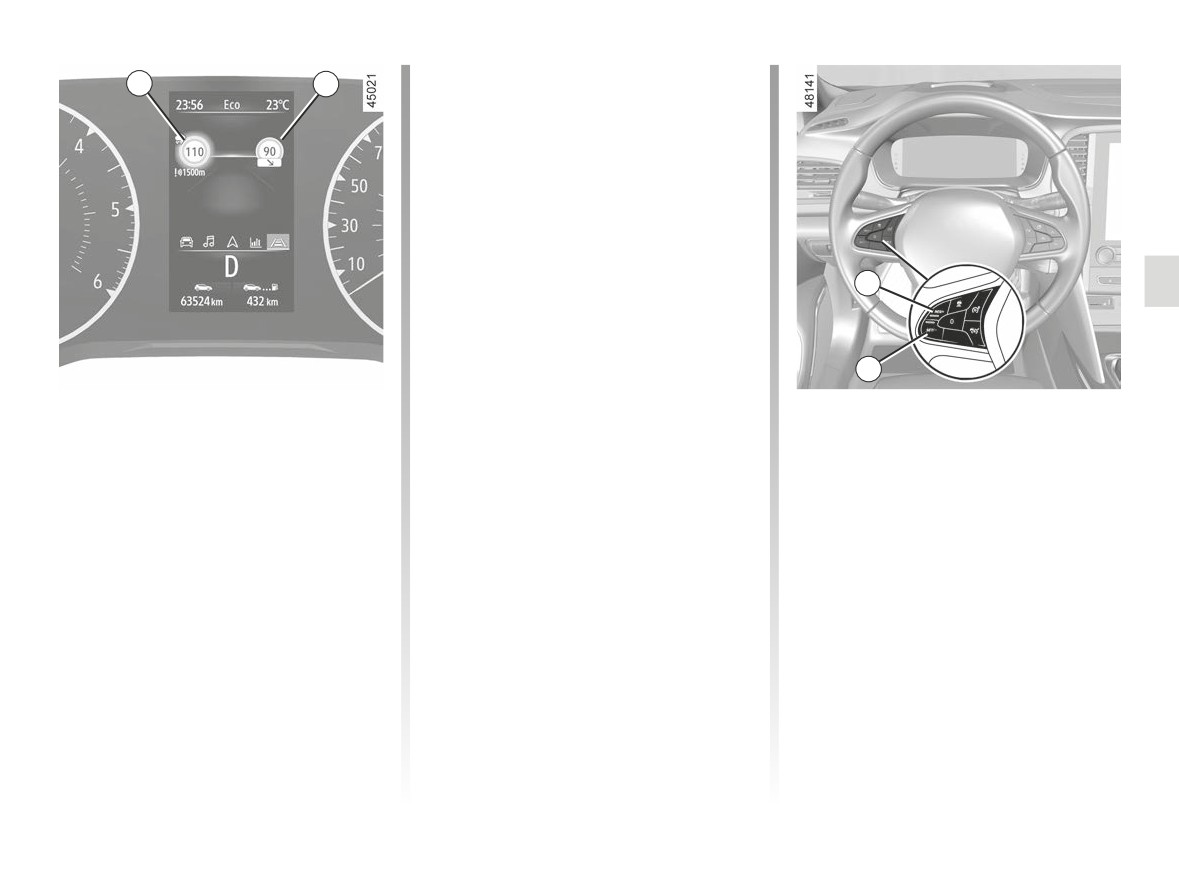
DETECTION OF ROAD SIGNS (3/4)
If the speed limit is exceeded, the circle
7
8
around the road sign symbol 7 flashes
along with a sound signal to warn the
driver (depending on the vehicle).
9
10
Operation
Varying the limit speed
If the speed limit notification differs from
Warning lights
the detected speed value, press and
The function displays the following
hold the following switches:
warning lights:
- 9 (RES/+) to increase the notification
- 7
Speed limit road signs.
speed to the detected speed;
– 8
Additional road signs (start or end
- 10 (SET/-) to reduce the notification
of “No overtaking” zone, slip road
speed to the detected speed.
speed limit, speed in case of a cara-
van, speed limit with length of appli-
cation, etc.).
2.83
CarManuals2.co

DETECTION OF ROAD SIGNS (4/4)
Operating faults
The system cannot detect the speed
limit if:
- the windscreen is not clean;
- the camera is blinded by the sun;
- there is insufficient visibility (night,
fog etc.);
- the signs are not legible (snow, etc.)
or are hidden (by another vehicle or
by trees);
- the information taken from the navi-
gation system is not up to date.
This function is an additional driving aid. This function is not under any
circumstances intended to replace the due care and attention of the
driver, who should at all times be in control of the vehicle.
The driver should always adapt their speed to the traffic conditions, re-
gardless of the system indications.
The system detects speed limit signs and does not detect other signs (e.g. entry/
exit to/from urban areas, etc.).
The system may not detect all speed limit signs or may interpret them incorrectly.
The driver should not ignore signs that are not detected by the system and should,
as a priority, comply with the traffic signage and the highway code.
In the event of poor visibility (fog, snow, frost, etc.), it is possible that the system
may not indicate the correct speed to the driver.
The driver should always adapt their speed to the traffic conditions, regardless of
the system indications.
2.84
CarManuals2.co
SPEED LIMITER (1/4)
6
5
1
4
3
2
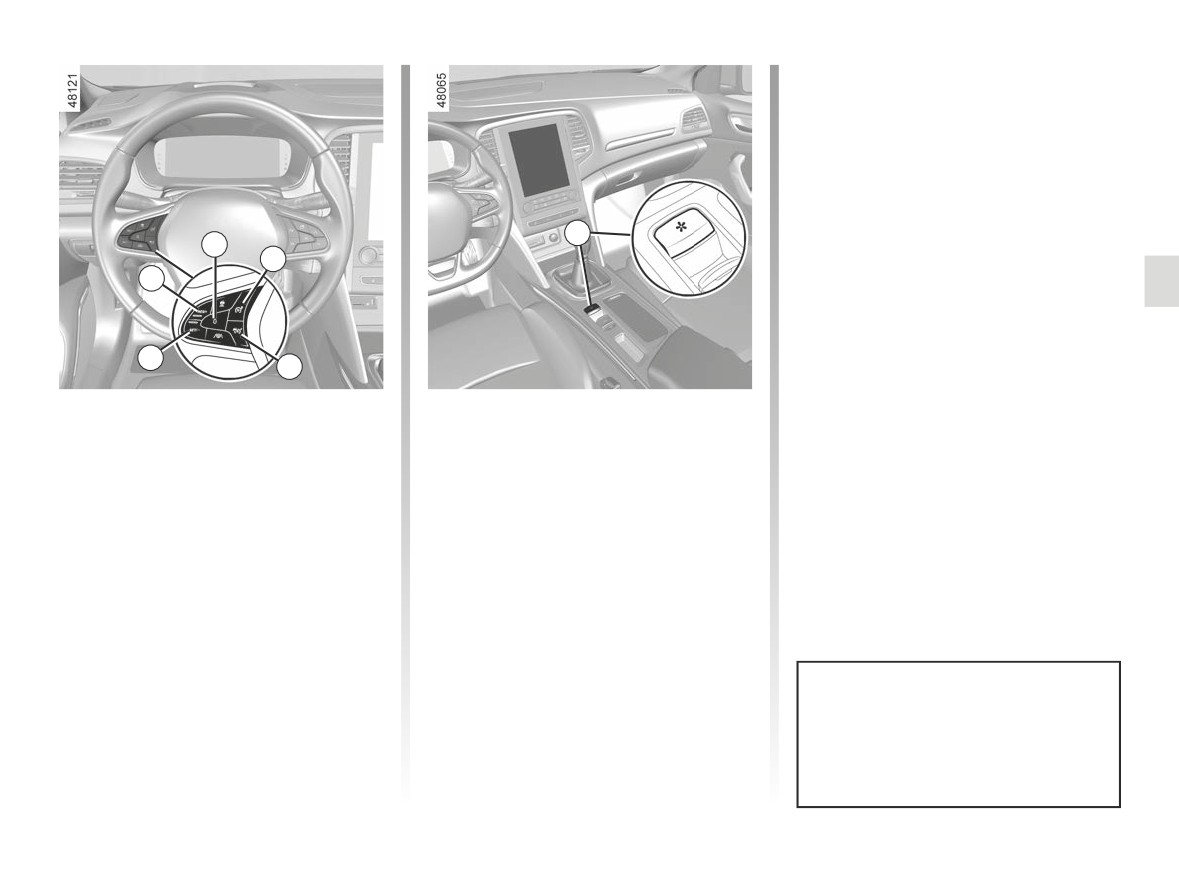
The speed limiter function helps you
Controls
stay within the driving speed limit that
1 Speed limiter On/Off switch.
you choose, known as the limit speed.
2 Cruise control On/Off switch.
Depending on the vehicle, the speed
limiter is linked with the “Hill Descent
3 Switch to activate and decrease the
Control” function which uses the brak-
limit speed (SET/-).
ing system to optimise downhill speed
4 Switch to activate and increase the
limitation.
limit speed or to set the stored limit
The presence of the
“Hill Descent
speed (RES/+).
Control” function can be identified by
5 Speed limiter function standby (with
the presence of the 6 button.
limited speed memory) (0).
You can link the speed limiter to
the “Road sign detection” function.
➥ 2.81.
2.85
CarManuals2.co
SPEED LIMITER (2/4)
7
7
1
4
3
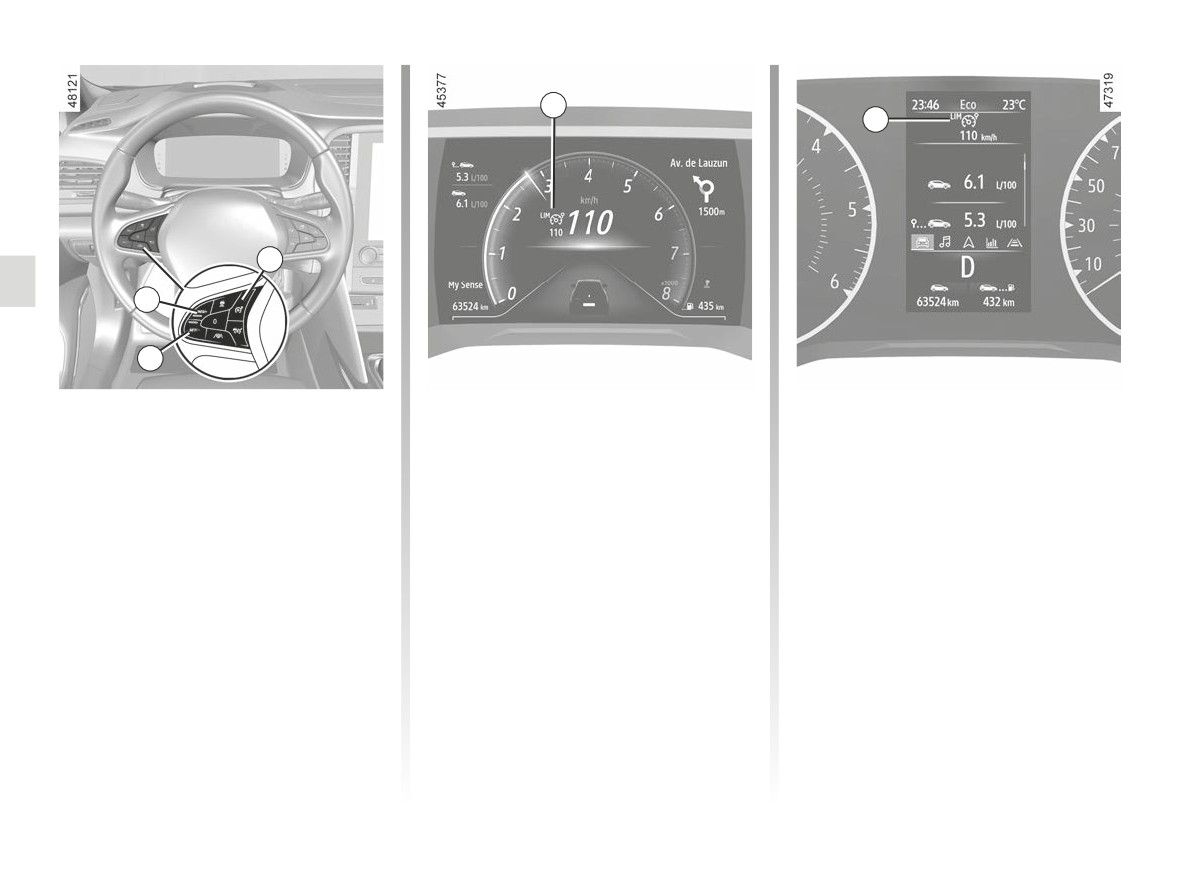
Driving
Switching on
To store the current speed, press the 4
switch (RES/+) or the 3 switch (SET/- ):
When a limit speed has been set but
Press switch 1. The 7 warning light ap-
the limit speed replaces the dashes
not yet reached, driving is similar to
pears in grey. The “Speed limiter ON”
and, depending on the vehicle, the 7
driving a vehicle without the speed lim-
message appears on the instrument
warning light appears in white.
iter function.
panel accompanied by dashes to indi-
The minimum stored speed is 20 mph
cate that the speed limiter function is in
Once you have reached the stored
(30 km/h).
operation, waiting to store a limit speed.
speed, no effort on the accelera-
tor pedal will allow you to exceed
the programmed speed except in an
emergency (refer to information on
“Exceeding the limit speed”).
2.86
CarManuals2.co
SPEED LIMITER (3/4)
Exceeding the limit speed
Limited speed cannot be maintained
It is possible to exceed the limit speed
When driving down a steep gradient,
at any time. To do this: press the accel-
the system may not maintain the limit
erator pedal firmly and fully (beyond
speed: the limit speed flashes in red
the resistance point).
on the instrument panel and an audi-
While the speed is being exceeded, the
ble signal sounds at regular intervals to
speed limiter flashes red on the instru-
inform you of this situation.
ment panel. Then, release the accelera-
tor pedal: the speed limiter function will
return as soon as you reach a speed
4
lower than the memorised speed.
3
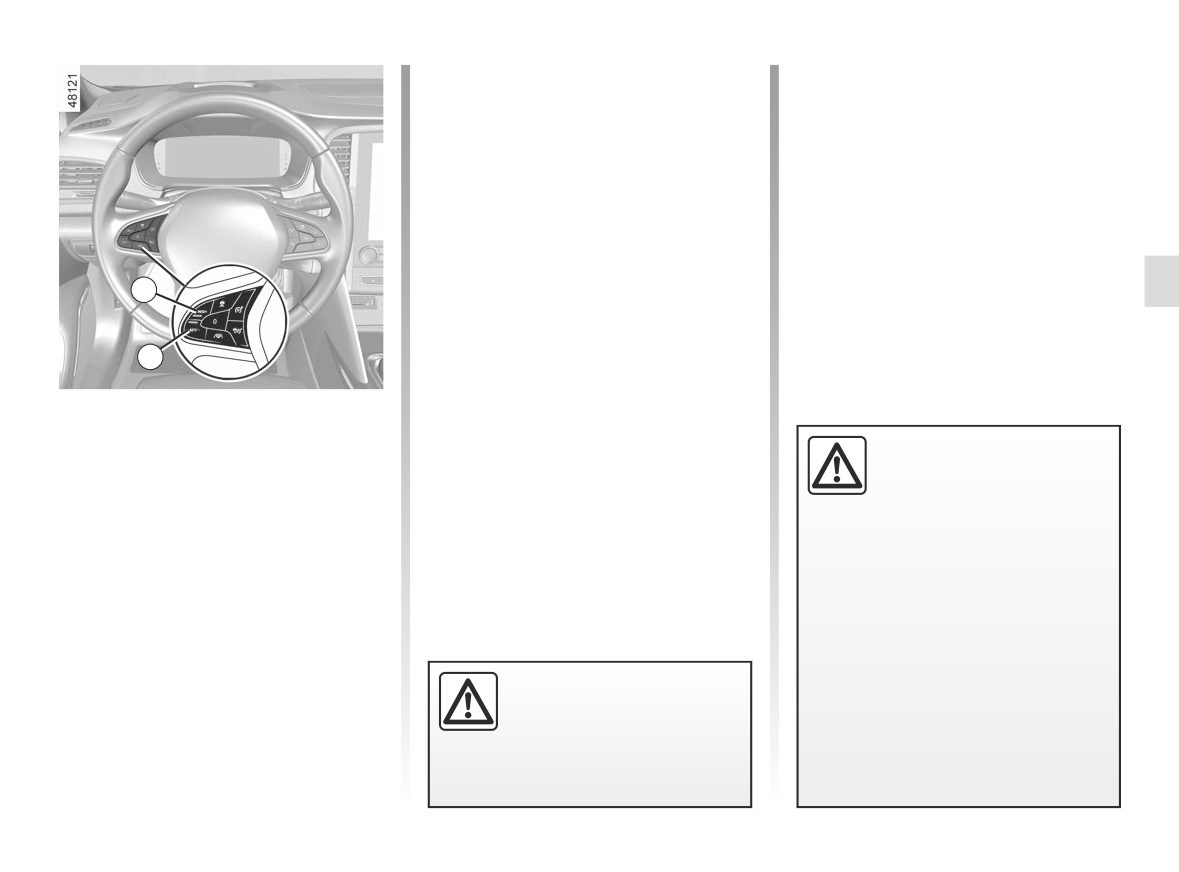
Varying the limit speed
The limit speed may be changed by
Cruise control/speed
pressing repeatedly or holding down:
limiter with Hill Descent
- switch 4 (RES/+) to increase speed;
Control:
the function may act on the
- switch 3 (SET/-) to reduce speed.
braking system.
Cruise control/speed limiter with-
out Hill Descent Control:
The function never interacts with the
braking system.
Please note that you must always
keep your feet close to the pedals
If the speed limiter is not
in order to react in an emergency.
available (after several at-
tempts to activate), contact
an approved dealer.
2.87
CarManuals2.co
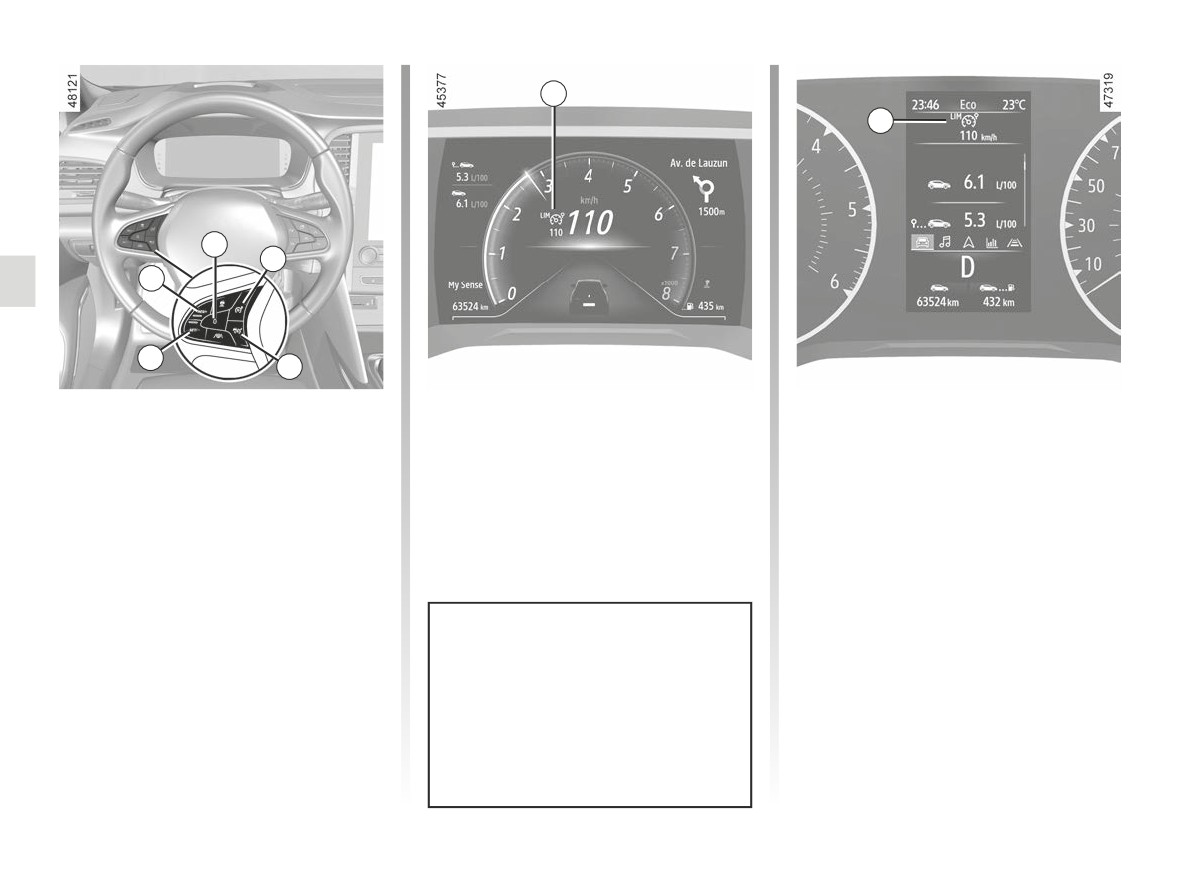
SPEED LIMITER (4/4)
7
7
5
1
4
3
2
Putting the function on
Switching off the function
standby
The speed limiter function is inter-
The speed limiter function is suspended
rupted:
when you press switch 5 (0). The limit
- when you press the 1 switch. In this
speed is stored and displayed in grey
case, the speed is no longer stored;
on the instrument panel.
- when you press the 2 switch. In this
case the cruise control is selected
Recalling the limit speed
and there is no stored speed.
If a speed has been stored, it can be re-
The warning light 7 disappears from
called by pressing the 4 switch.
the instrument panel to confirm that the
When the speed limiter is set to
function is no longer active.
standby, pressing the 3 switch re-
activates the function without taking
into account the memorised speed:
the speed at which the vehicle is
moving is taken into account.
2.88
CarManuals2.co
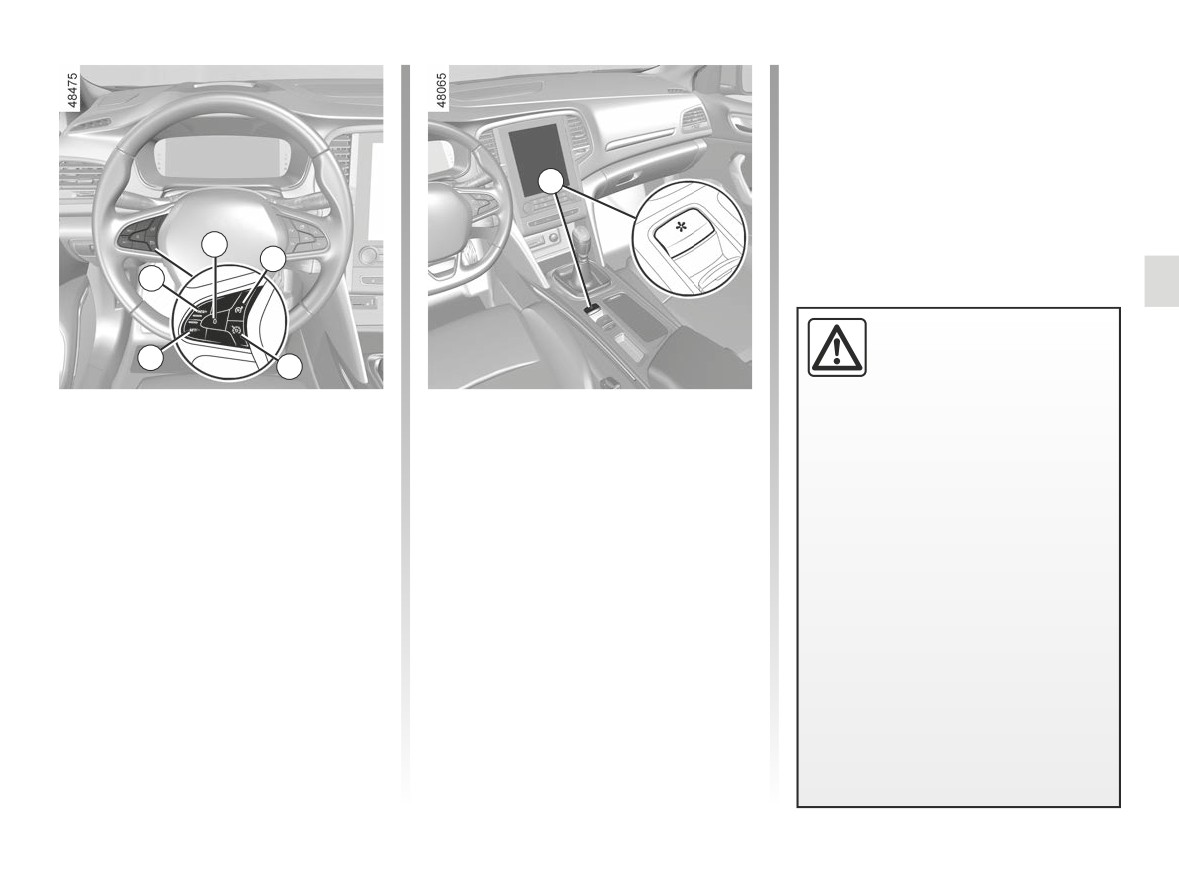
CRUISE CONTROL (1/5)
4 Switch the function to standby (with
cruising speed saved) (0).
5 Speed limiter On/Off switch.
6
4
5
3
This function is an addi-
tional driving aid.
2
1
It can under no circum-
stances replace the driver’s
The cruise control function helps you to
The presence of the
“Hill Descent
responsibility to respect speed limits
maintain your driving speed at a speed
Control” function can be identified by
or to be vigilant.
that you choose, called the cruising
the presence of the 6 button.
speed.
The driver must always be in control
of the vehicle.
This cruising speed may be set at any
Controls
speed above 19 mph (30 km/h).
Cruise control must not be used
1 Cruise control On/Off switch.
in heavy traffic, on winding or slip-
Depending on the vehicle, cruise con-
2 Switch to activate and decrease
pery roads (black ice, aquaplan-
trol is linked with “Hill Descent Control”
cruising speed (SET/-).
ing, gravel) and during bad weather
which uses the braking system to opti-
(fog, rain, side winds etc.).
mise downhill cruise control.
3 Switch to activate and increase
cruising speed or to recall the mem-
There is a risk of accidents.
orised cruising speed (RES/+).
2.89
CarManuals2.co
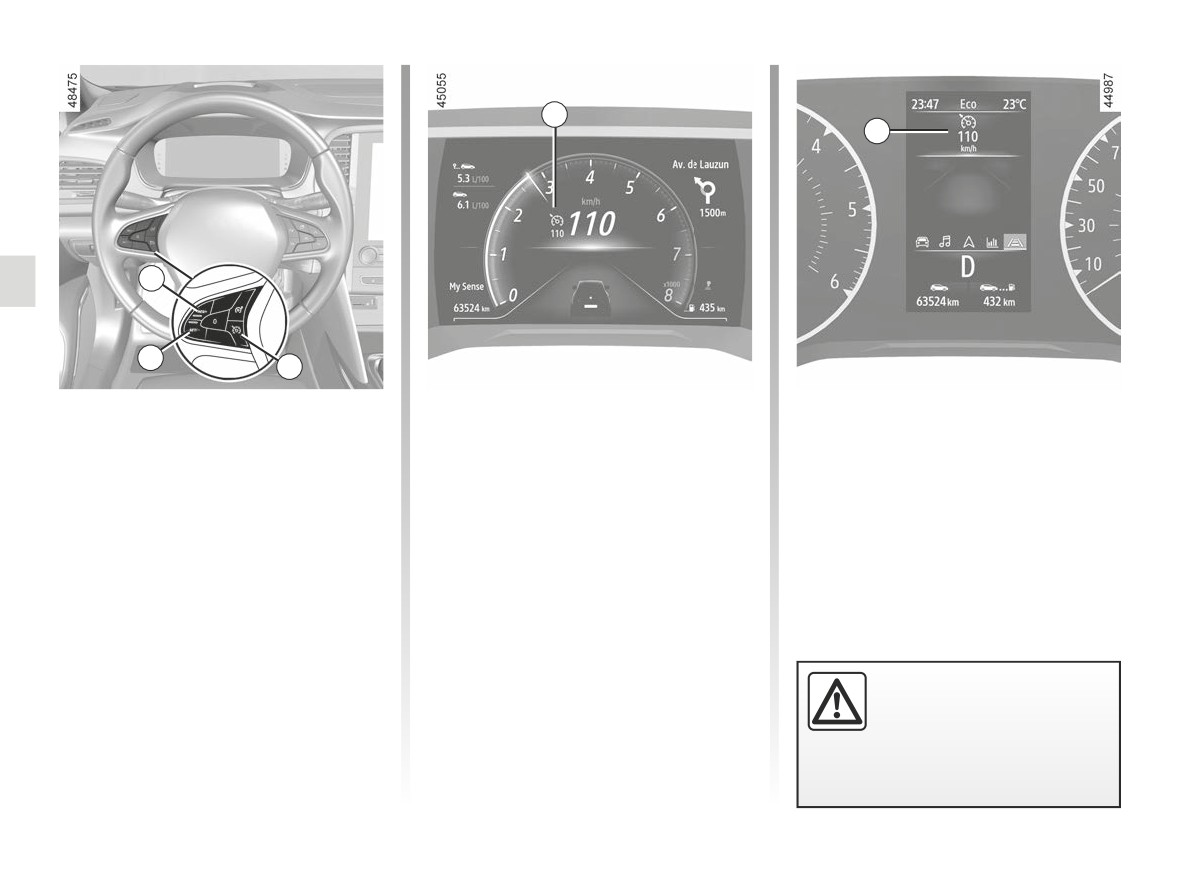
CRUISE CONTROL (2/5)
7
7
3
2
1
Switching on
Activating cruise control
Driving
Press switch 1.
While the vehicle is moving a steady
Once a cruising speed is registered
speed above approximately 19 mph
and the cruise control function is active,
The 7 warning light appears in grey.
(30 km/h), press the 2 (SET/-) switch
you may lift your foot off the accelera-
The “Cruise control ON” message ap-
or the 3 (RES/+) switch : the function
tor pedal.
pears on the instrument panel accom-
is activated and the current speed is
panied by dashes to indicate that the
taken into account.
cruise control function is in operation
The cruising speed replaces the
and waiting to memorise a cruising
dashes. Cruise control is confirmed
speed.
when the memorised speed and warn-
ing light appear in green 7.
If you try to activate the function below
19 mph (30 km/h), the message “Invalid
Please note that you must
Speed” will be displayed and the func-
keep your feet close to the
tion will remain inactive.
pedals in order to react in
an emergency.
2.90
CarManuals2.co
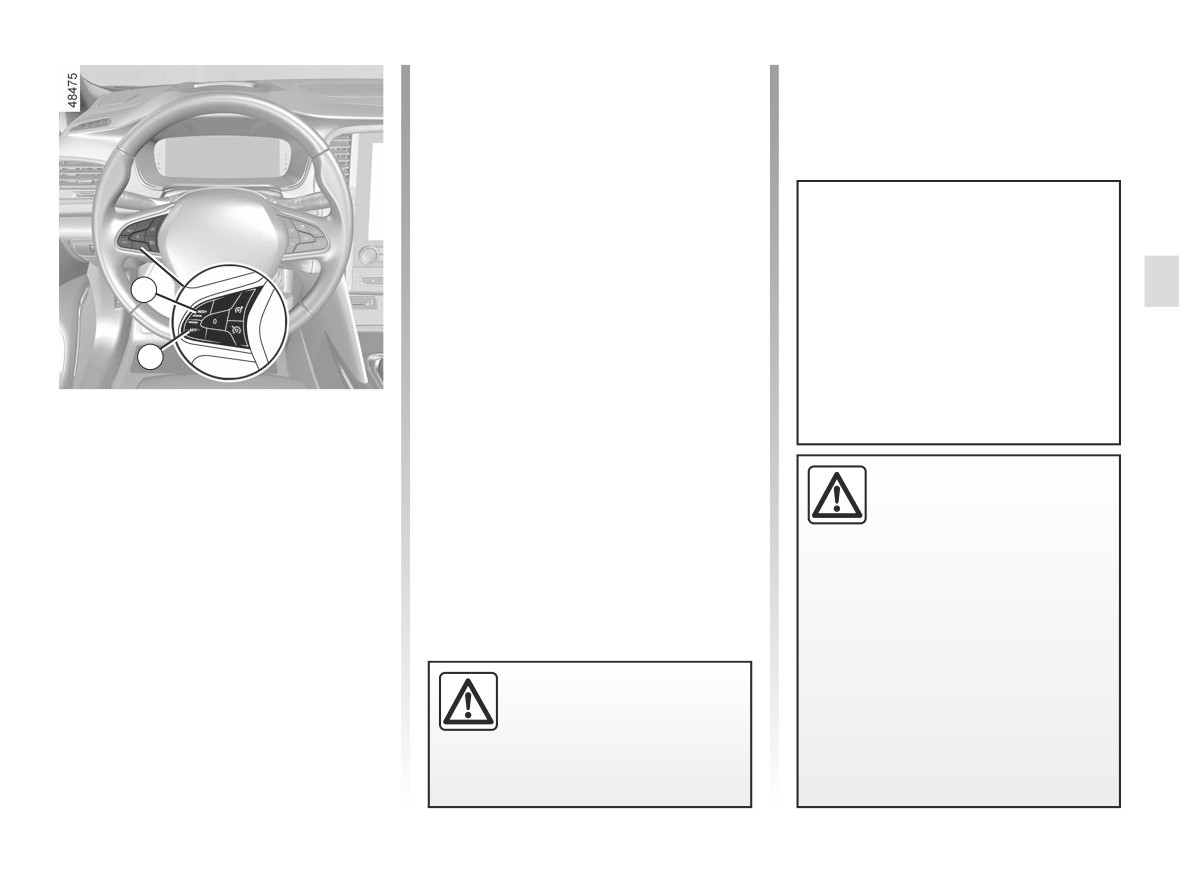
CRUISE CONTROL (3/5)
Exceeding the cruising speed
The cruising speed may be exceeded
at any time by depressing the acceler-
ator pedal.
While it is being exceeded, the cruising
speed flashes in red on the instrument
panel.
Then, release the accelerator pedal:
Cruise control with cruising
after a few seconds, the vehicle will
speed maintained during gear
3
automatically return to its set cruising
changing:
speed.
This function maintains the cruise
control speed before and after a
Cruising speed cannot be
2
gear change, without any action re-
maintained
quired from the driver.
When driving down a steep gradient,
Adjusting the cruising speed
the system may be unable to main-
The cruising speed may be changed by
tain the cruising speed: the memorised
pressing the following repeatedly:
speed will flash in red on the instrument
Cruise control/speed
panel and an audible signal sounds at
- the 2 switch (SET/-) to reduce the
limiter with Hill Descent
regular intervals to inform you of this
speed;
Control: the function may
situation.
- the 3 switch (RES/+) to increase the
take action on the braking
speed.
system.
Note: press and hold one of the
Cruise control/speed limiter with-
switches to modify speed by succes-
out Hill Descent Control: the
sive increments.
function does not affect the braking
system.
If the cruise control is no
Please note that you must always
longer available (after sev-
keep your feet close to the pedals
eral attempts to activate
in order to react in an emergency.
it), contact an Approved
Dealer.
2.91
CarManuals2.co
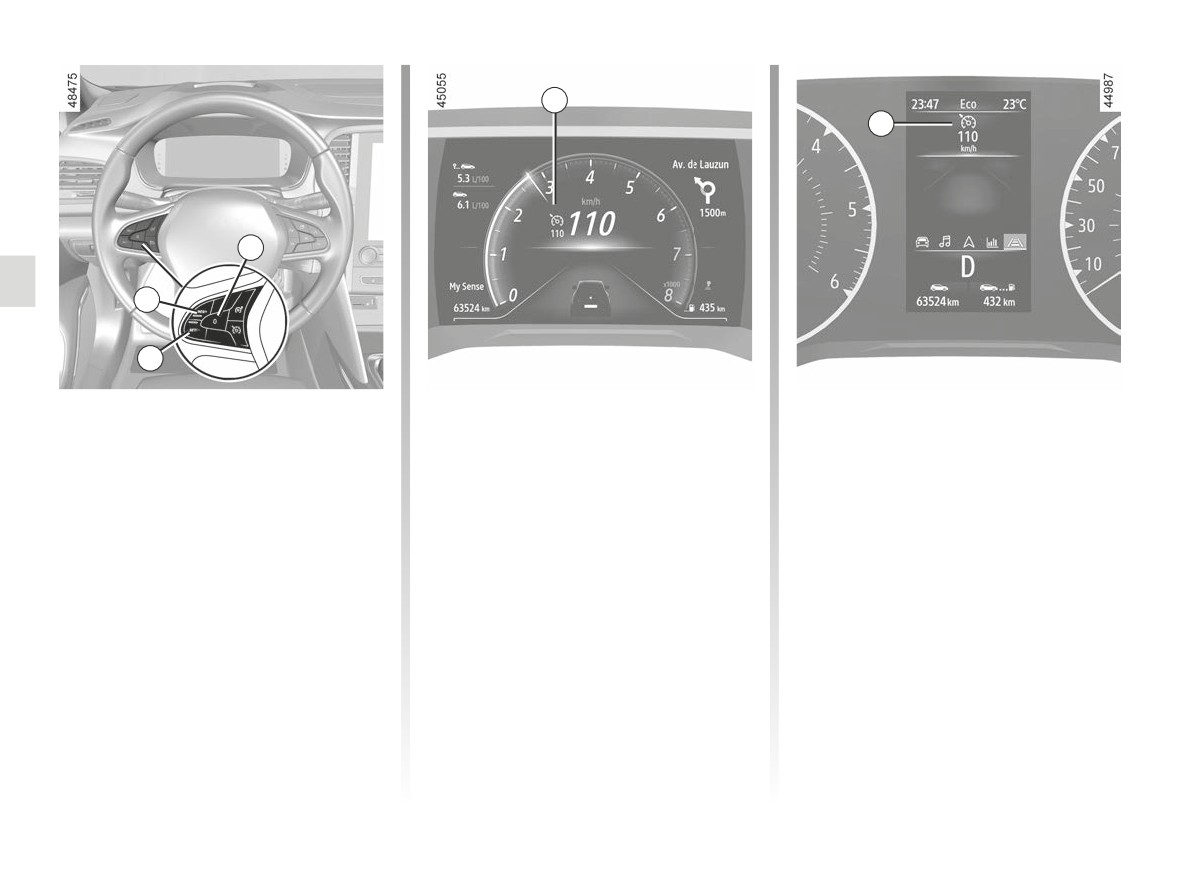
CRUISE CONTROL (4/5)
7
7
4
3
2
Putting the function on
Returning to the cruising speed
NB: if the speed previously stored is
much higher than the current speed,
standby
If a speed is stored, it can be recalled,
the vehicle will accelerate more rapidly
once you are sure that the road condi-
The function is set to standby if you:
to reach this threshold.
tions are suitable (traffic, road surface,
- 4 switch (0);
weather conditions, etc.).
When the cruise control is set to
- the brake pedal;
standby, pressing switch 2 (SET/-) re-
Press the switch 3 (RES/+) if the vehi-
activates the cruise control function
- the clutch pedal for a prolonged
cle speed is above 19 mph (30 km/h).
without taking into account the stored
period or upon prolonged neutral po-
When the speed is stored, cruise con-
speed: it is the speed at which the vehi-
sition on vehicles equipped with a
trol activation is confirmed by the dis-
cle is moving that is taken into account.
manual gearbox;
play in green of the cruising speed and,
- shifting to neutral position on ve-
depending on the vehicle, the 7 warn-
hicles equipped with an automatic
ing light is displayed.
gearbox.
The cruising speed is stored and dis-
played in grey on the instrument panel.
2.92
CarManuals2.co
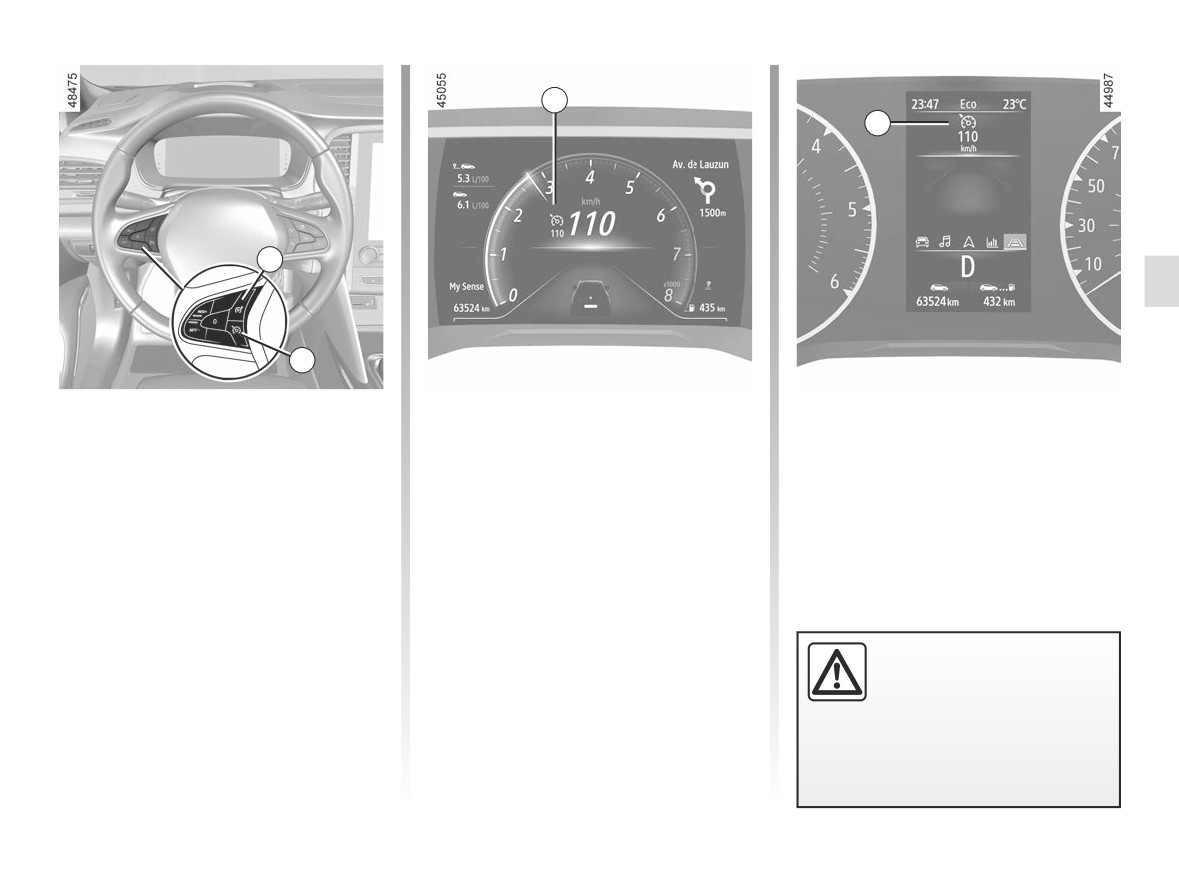
CRUISE CONTROL (5/5)
7
7
5
1
Switching off the function
The warning light 7 disappears from
the instrument panel to confirm that the
The cruise control function is inter-
function is no longer active.
rupted:
- when you press the 1 switch. In this
case, the speed is no longer stored;
- when you press the 5 switch. In this
case the speed limiter is selected
and there is no stored speed.
Putting the cruise control
on standby or switching it
off does not cause a rapid
reduction in speed: you
must brake by depressing the brake
pedal.
2.93
CarManuals2.co

ADAPTIVE CRUISE CONTROL (1/14)
Based on information from a radar
According to conditions on the road
or camera, the adaptive cruise con-
(traffic, weather etc.), the
“Adaptive
trol function
(or Stop and Go adap-
cruise control” function can be acti-
tive cruise control function on vehicles
vated:
equipped with an automatic gearbox)
This function is an addi-
- 0 mph (0 km/h) to 105 mph (170 km)
enables you to maintain the speed se-
tional driving aid.
on vehicles fitted with an automatic
lected (known as cruising speed) while
It can under no circum-
gearbox;
keeping a following distance with the
stances replace the driver’s
- 19 mph (30 km/h) to
105 mph
vehicle in front in the same lane.
responsibility to respect speed limits
(170 km) on vehicles fitted with a
On vehicles fitted with an automatic
manual gearbox.
and safe distances or to be vigilant.
gearbox, if the vehicle in front stops,
The driver must always be in control
the Stop and Go adaptive cruise control
The function is indicated by the
of the vehicle.
function may apply the vehicle brakes
symbol.
The driver must always adapt their
to a full-stop before allowing the vehicle
Note:
speed according to the surround-
to move-on.
ings and traffic conditions.
- the driver must observe the maxi-
The system controls acceleration and
mum speed limit and safe distances
The adaptive cruise control must
deceleration of your vehicle using the
in the country where they are driving;
only be used on a motorway (or mul-
engine and braking system.
- the adaptive cruise control can brake
ti-lane road with a central barrier).
The system’s maximum range is ap-
the vehicle up to a third of the brak-
The cruise control must not be used
proximately 150 metres.
ing capacity. Depending on the situ-
in heavy traffic, on winding or slip-
ation, the driver may need to brake
This may vary according to the road
pery roads (black ice, aquaplaning,
harder.
conditions (ground relief, weather con-
gravel) or during bad weather (fog,
ditions, etc.)
rain, side winds etc.).
There is a risk of accidents.
The adaptive cruise control does
not trigger an emergency stop and
its braking capability is limited.
2.94
CarManuals2.co
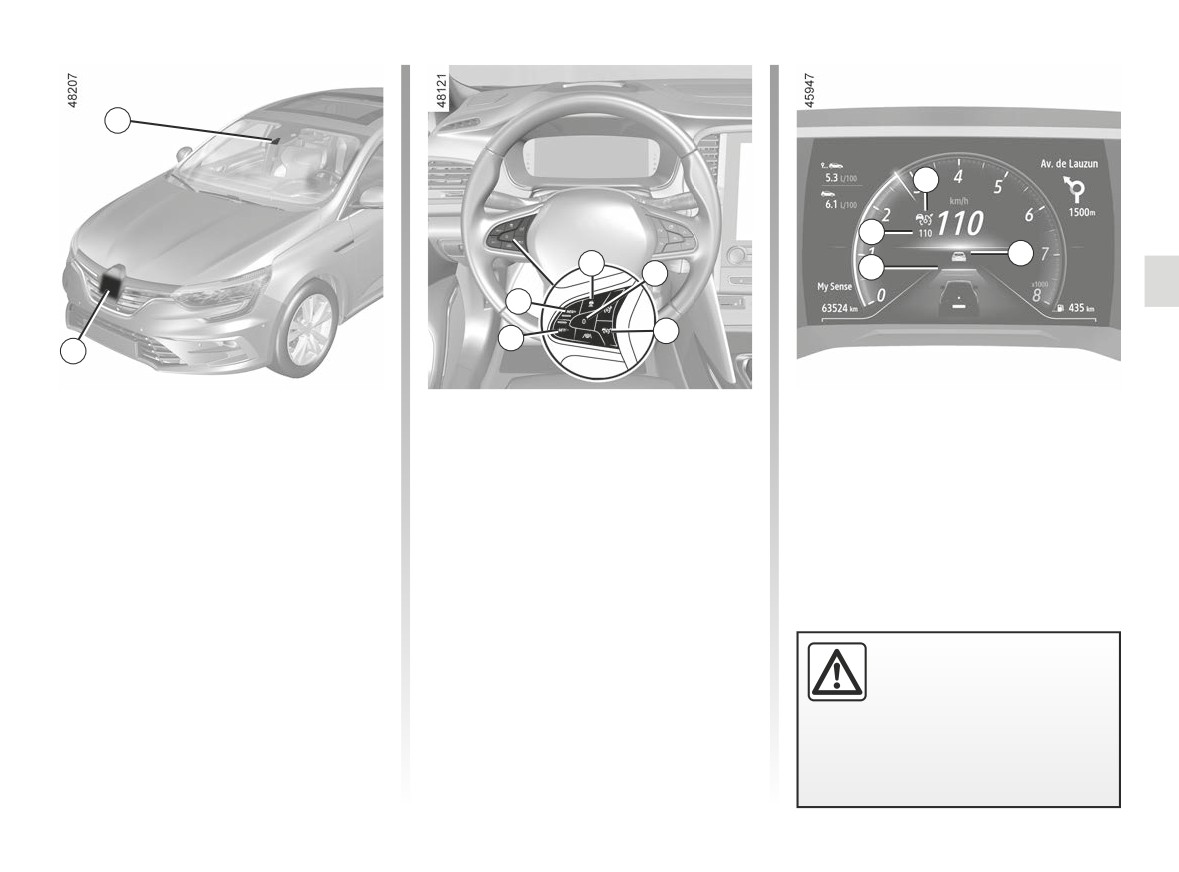
ADAPTIVE CRUISE CONTROL (2/14)
1
8
11
9
3
10
4
7
5
6
2
Location of the camera 1
Controls
Make sure the windscreen is not ob-
3 Safe distance settings
scured (by dirt, mud, snow, condensa-
4 Switch the function to standby (with
tion etc.).
cruising speed saved) (0).
5 Adaptive cruise control main stop/
Location of the radar 2
start switch
Ensure that the radar area is not ob-
structed (dirt, mud, snow, a badly fitted
6 Cruising speed activation, storage
front number plate), impacted, modified
and decrease switch (SET/-).
(including painting) or hidden by any
7 Switch to activate and increase cruis-
accessory fitted on the front of the vehi-
ing speed or to recall the memorised
The radar and camera
cle (on the grille or logo etc.).
cruising speed (RES/+).
zones must be kept clean
and free of any tampering in
order to ensure the proper
operation of the system.
2.95
CarManuals2.co
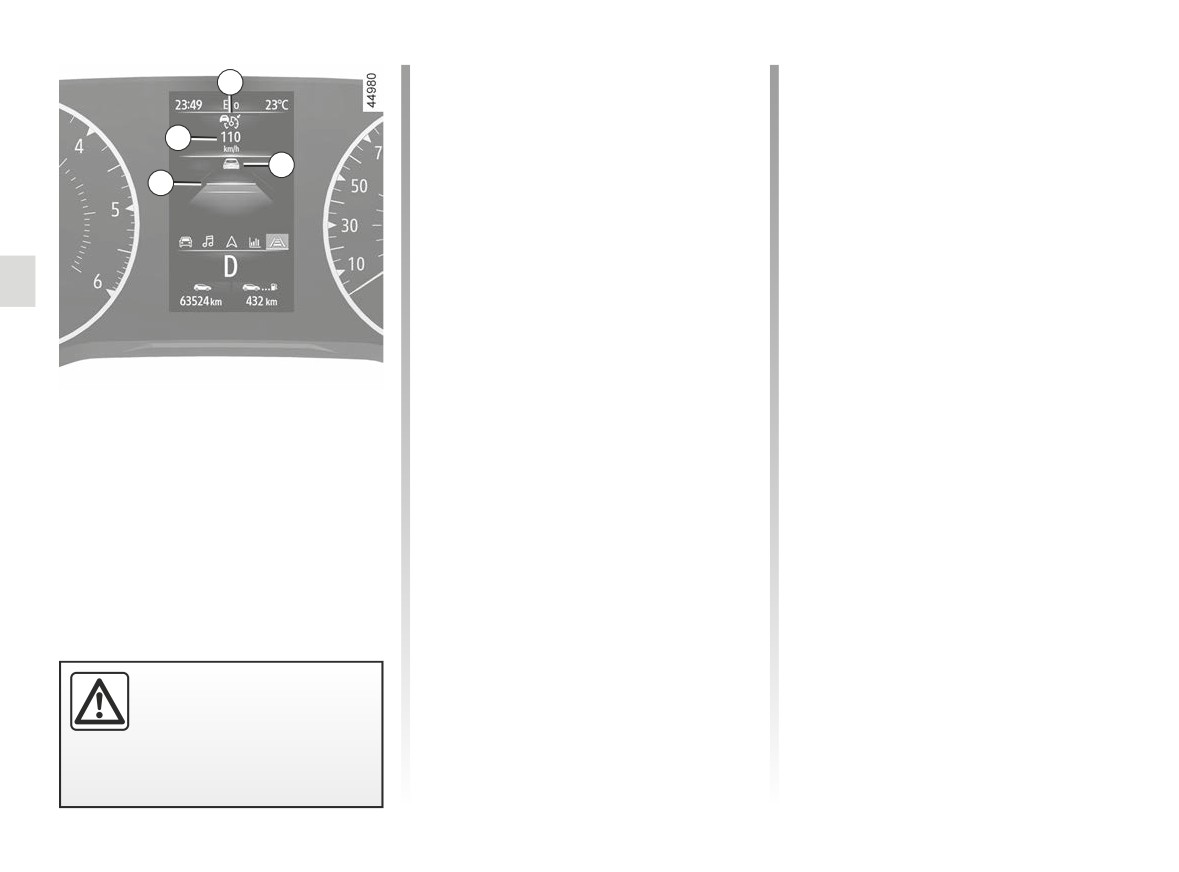
ADAPTIVE CRUISE CONTROL (3/14)
Switching on
The minimum cruising speed is 19 mph
8
(30 km/h).
Press switch 5.
The cruising speed 11 replaces the
11
dashes and cruise control is confirmed
Warning light
appears in grey,
9
and the message “Adaptive Cruise Ctl
by the appearance of the cruising speed
10
ON” appears on the instrument panel,
in green and warning light
accompanied by dashes to indicate that
the cruise control function is activated
If you try to activate the function when
and waiting to store a cruising speed.
the vehicle speed is over 105 mph
(170 km/h) or below 19 mph (30 km/h) for
This function cannot be activated when:
vehicles fitted with a manual gearbox,
- the parking brake is applied;
the message “Invalid Speed” is dis-
played and the function is not activated.
- the Park Assist function is already
activated ➥ 2.137.
Once a cruising speed is memorised
and the cruise control function is active,
The message “Adaptive Cruise Ctl una-
Displays
vailable” is displayed on the instrument
you may lift your foot off the accelera-
tor pedal.
panel.
8
Adaptive cruise control warning
light.
Special feature on vehicles with
an automatic gearbox: if the vehicle
9
Vehicle in front.
Activating cruise control
speed is below approximately 19 mph
10
Stored safe distance
When the vehicle is stationary (vehicles
(30 km/h), the cruising speed will auto-
equipped with an automatic gearbox) or
matically be set to 19 mph (30 km/h).
11
Stored cruising speed.
when the vehicle is moving at a steady
The vehicle will accelerate until it
speed (all vehicles), press the 6 (SET/-)
reaches the stored cruising speed.
or 7 (RES/+): switch to activate the func-
tion and store the current speed.
Important: you should keep
your feet near the pedals at
all times to prepare for any
event.
2.96
CarManuals2.co
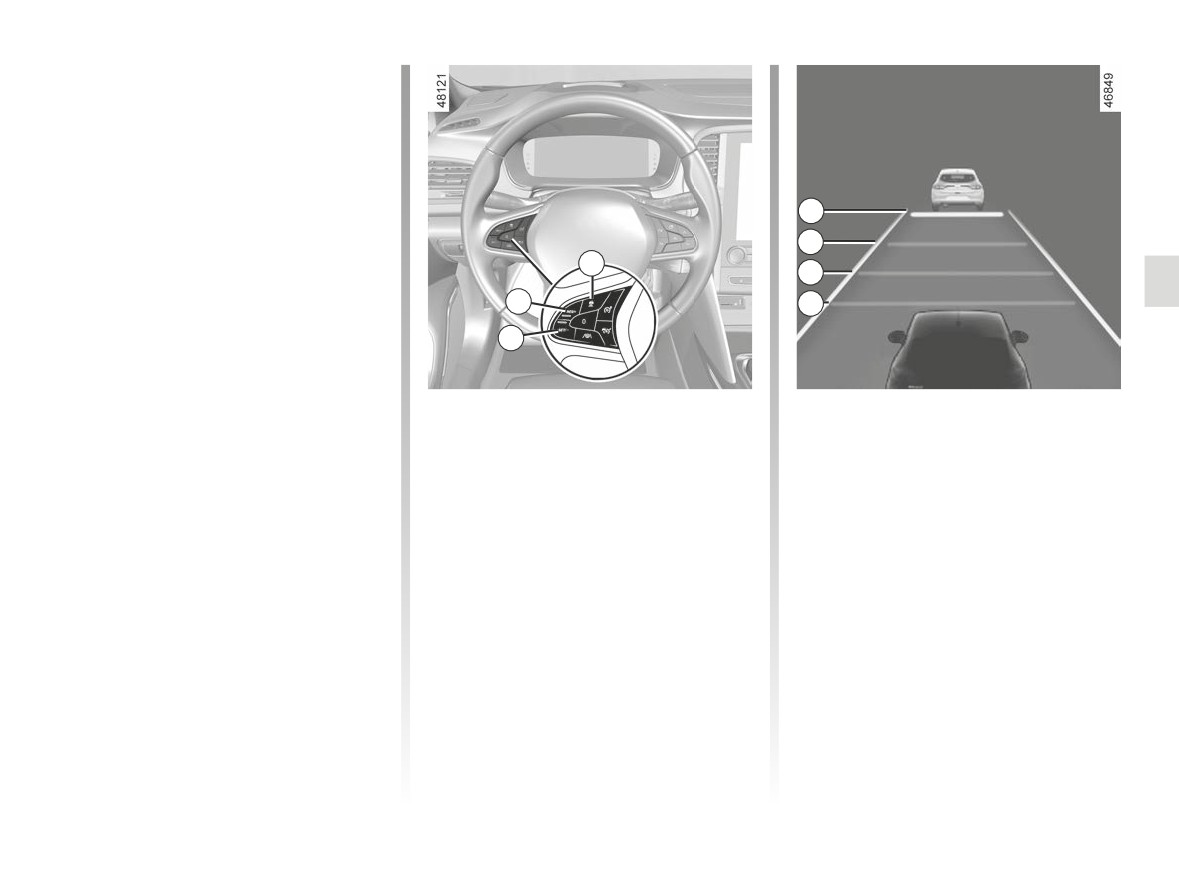
ADAPTIVE CRUISE CONTROL (4/14)
Safe distance control
activation
As soon as cruise control is activated,
the default safe distance 10 is displayed
in green on the instrument panel.
The default safe distance corresponds
A
to approximately two seconds (see fol-
lowing pages).
B
3
If the system detects a vehicle in your
C
lane, an outline of a vehicle 9 appears
7
D
above the distance gauge 10 on the in-
strument panel.
6
Your vehicle adapts its speed to that
of the vehicle in front and applies the
brakes if necessary (the brake lights
Setting the cruising speed
Adjusting the following
come on) in order to maintain the dis-
You can vary the speed by repeatedly
distance
tance displayed on the instrument
pressing (for a small variation) or press-
You can vary the safe distance from the
panel.
ing and holding (for a larger variation)
vehicle in front at any time by pressing
Note: the size of the 9 outline varies ac-
switch 6 or 7:
switch 3 repeatedly.
cording to the distance separating you
– use the (SET/-) switch 6 to reduce
The horizontal distance gauge on the
from the vehicle in front. The larger the
the speed;
instrument panel indicates the various
outline, the closer the vehicle in front.
- use the (RES/+) switch 7 to increase
available safe distances:
the speed.
- distance gauge A: long distance
(corresponding to approximately
2.4 seconds);
2.97
CarManuals2.co
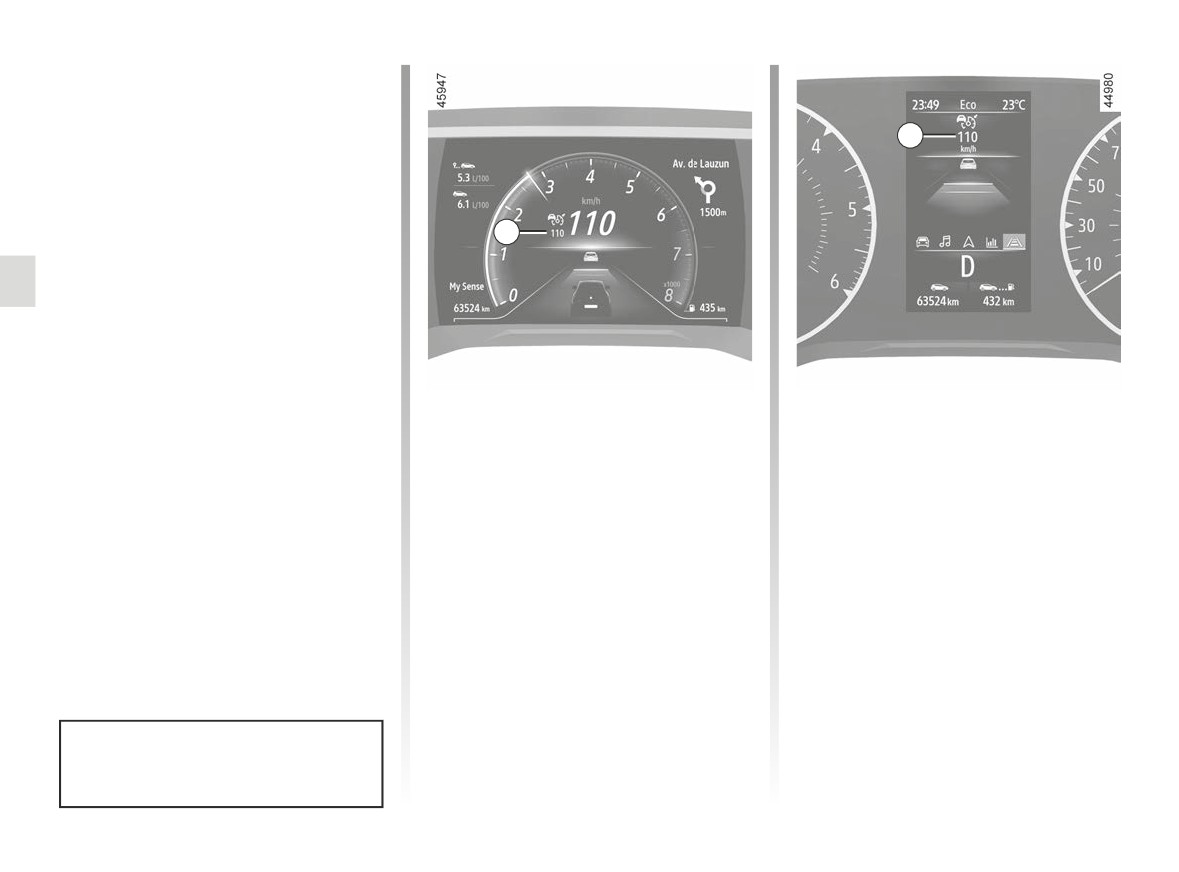
ADAPTIVE CRUISE CONTROL (5/14)
Adjusting the safe distance
(cont.)
- distance gauge B: intermediate dis-
11
tance 2 (corresponding to approxi-
mately 2 seconds);
- distance gauge C: intermediate dis-
tance 1 (corresponding to approxi-
11
mately 1.6 seconds);
- distance gauge D: short distance
(corresponding to approximately
1.2 seconds).
The selected distance gauge appears
in green on the instrument panel.
The other gauges remain in grey.
Exceeding the cruising speed
Then, release the accelerator pedal:
Note: the distance must be set accord-
the cruise control and safe distance
ing to the traffic level, local regulation
The cruising speed may be exceeded
control will automatically resume the
and weather conditions.
at any time by applying the accelerator
speed and distance instructions that
pedal.
you had previously selected.
If it is exceeded, the cruising speed 11
appears in red.
Overtaking manoeuvre
The distance gauge flashes if the dis-
If you wish to overtake the vehicle in
tance between your vehicle and the
front, activating the indicator will tem-
vehicle in front is less than the safe
porarily cancel the safe distance con-
distance selected: the Safe Distance
trol and enable an acceleration speed
Control function is no longer active.
sufficient to complete overtaking.
The safe distance is adjusted by de-
fault on the distance gauge B.
2.98
CarManuals2.co
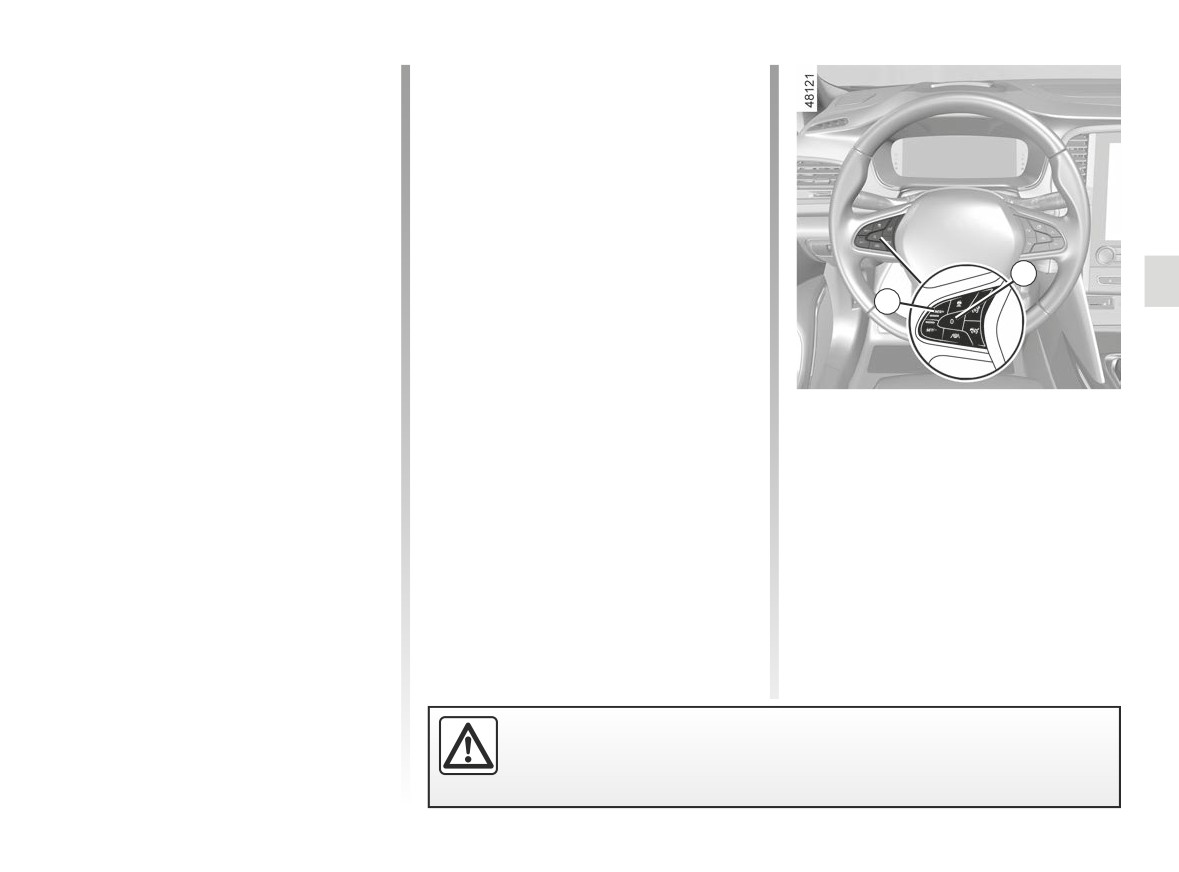
ADAPTIVE CRUISE CONTROL (6/14)
Stop and start
Putting the function on
On vehicles fitted with an automatic
standby
gearbox, if the vehicle in front slows
You can set the function to standby
down, the system adapts its speed to
when:
a complete stop if necessary (in the
- you press switch 4 (0);
event of a traffic jam). The vehicle stops
- you apply the brake pedal while the
a few metres from the vehicle in front.
vehicle is moving.
The Stop and Start function can put the
The function is deactivated by the
engine on standby ➥ 2.8.
system if:
When the vehicle in front sets off again:
- you set the automatic gearbox to P
4
- if the stop does not exceed about
or N;
three seconds, the vehicle sets off
7
- you engage the reverse gear;
automatically without any action by
- you unbuckle the driver’s seatbelt;
the driver;
- you open one of the opening ele-
- if the stop exceeds about three sec-
ments;
onds, you must apply the accelera-
- you press the engine start/stop
tor pedal or press button 7 (RES/+) in
- when you press the clutch pedal for a
button;
order for the vehicle to set off again.
prolonged period or upon prolonged
- the slope is too steep;
The message “Press RES/+ or ac-
neutral position on vehicles equipped
- the vehicle speed is above 112 mph
celerate” appears on the instrument
with a manual gearbox.
(180 km/h);
panel to confirm.
In all circumstances, the standby is con-
- certain driving aids and correction
If the stop exceeds about three min-
firmed when the warning lights appear
devices are triggered (active emer-
utes, the electronic parking brake is au-
in grey and the message “Adaptive
gency braking, ABS, ESC etc.) ;
tomatically applied and the Stop and
Cruise Ctl Disconnected” appears on
Go adaptive cruise control is deacti-
the instrument panel.
vated. The
warning light dis-
appears to confirm that the function is
deactivated.
Putting the adaptive cruise control in standby or switching it off does not
cause a rapid reduction in speed: you must brake by applying the brake
pedal if necessary.
2.99
CarManuals2.co
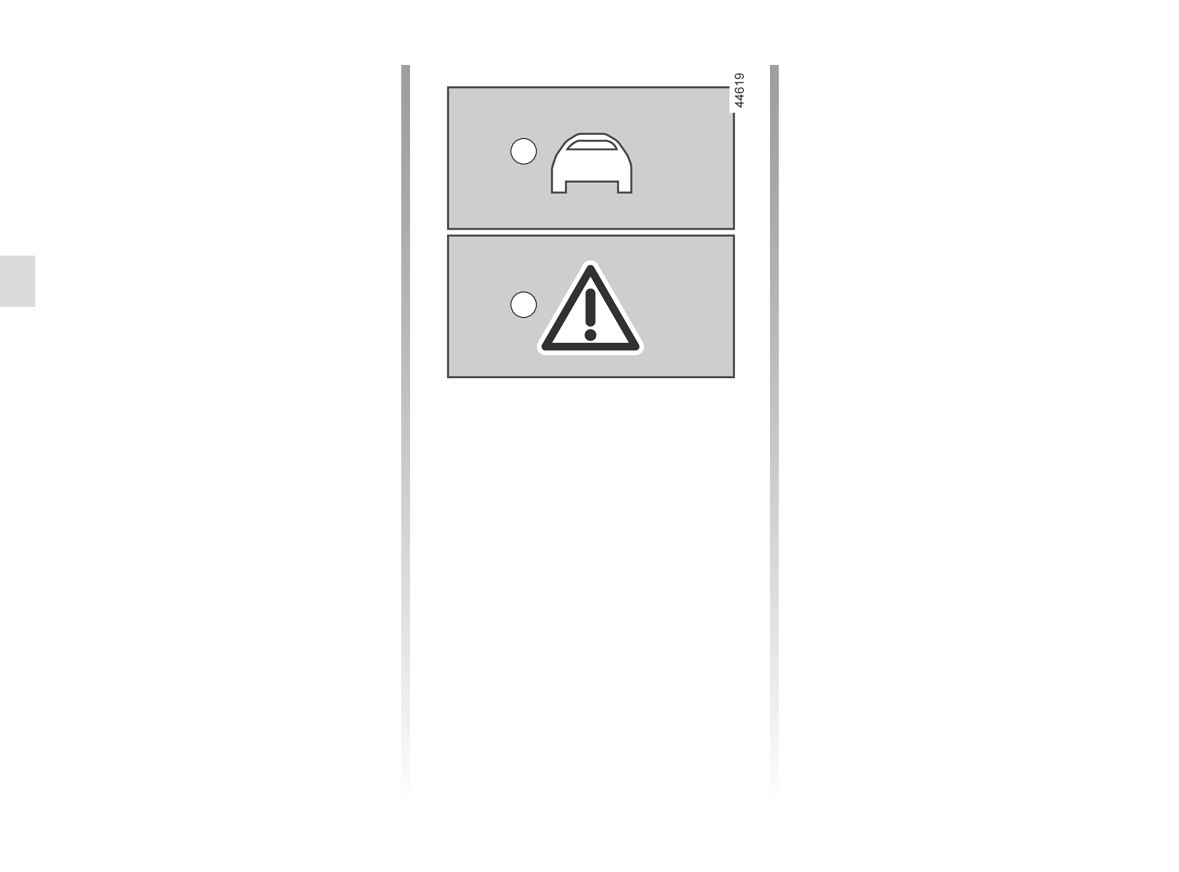
ADAPTIVE CRUISE CONTROL (7/14)
Exit from standby
Depending on the situation, the system
sounds a beep associated with:
Based on the stored cruising speed
- the orange alert E if the situation re-
If a speed is stored, it can be recalled,
quires the driver’s attention;
E
once you are sure that the road condi-
or
tions are suitable (traffic, road surface,
weather conditions, etc.).
- the red alert F accompanied by the
message “Brake”, if the situation re-
Press switch 7 (RES/+) in the range of
quires the driver’s immediate atten-
confirmed speeds.
tion.
When the stored speed is recalled, acti-
In all situations, react accordingly
vation of the cruise control is confirmed
F
and perform the appropriate ma-
by the illumination of the cruising speed
noeuvres.
in green.
Note: if the stored speed is higher than
the current speed, the vehicle will ac-
“Take control of the vehicle”
celerate to reach that speed.
warnings
Based on the current speed
In some situations (e.g. coming upon
When the cruise control is set to
a much slower vehicle, vehicle in
standby, pressing switch 6 (SET/-) re-
front changing lanes quickly etc.), the
activates the cruise control function
system may not have time to react.
without taking into account the stored
speed: it is the speed at which the vehi-
cle is moving that is taken into account.
2.100
CarManuals2.co
ADAPTIVE CRUISE CONTROL (8/14)
Operating faults
If the radar detection area is obstructed
or the radar signal is disrupted, the
If an “Adaptive cruise control” function
message “Front radar no visibility” is
operating fault is detected, the mes-
displayed on the instrument panel and
sage “Check Adaptive Cruise control”
the “Adaptive cruise control” function
appears on the instrument panel and
is interrupted. The green warning light
the “Adaptive cruise control” function is
disappears to confirm that the
deactivated.
function has been automatically deac-
If an operating fault is detected on one
tivated.
or more components of the system, the
Ensure that the radar area is not ob-
“Adaptive cruise control” function is in-
structed (dirt, mud, snow, a badly fitted
terrupted.
7
front number plate), impacted, modified
5
The
warning light appears on
6
(including painting) or hidden by any
the instrument panel along with, de-
accessory fitted on the front of the vehi-
pending on the malfunction, one of the
cle (on the grille or logo etc.).
following messages:
Conditions in certain geographical
Switching off the function
areas may hinder the function, for ex-
- “Front camera to check”;
The “Adaptive cruise control” func-
ample:
- “Front radar to check”;
tion is deactivated when you press the
- arid zones, tunnels, long bridges or
switch 6.
lightly used roads without road lines,
- “Camera/Radar to check”;
without signs or trees nearby;
- “Check vehicle”.
The warning light
disappears
- a military or airport zone.
from the instrument panel to confirm
You must leave such areas in order for
Consult an approved dealer.
that the function is no longer active.
the function to work.
In all cases, if the message is not
erased after the engine is restarted,
Temporary unavailability
please contact an authorised dealer.
The radar is able to detect vehicles
in front of your vehicle. The system
cannot operate correctly if the radar de-
tection area is obscured or if its signal
is disrupted.
2.101
CarManuals2.co
ADAPTIVE CRUISE CONTROL (9/14)
G
H
J
Limitations of system
The system cannot detect:
Detection during cornering
operation
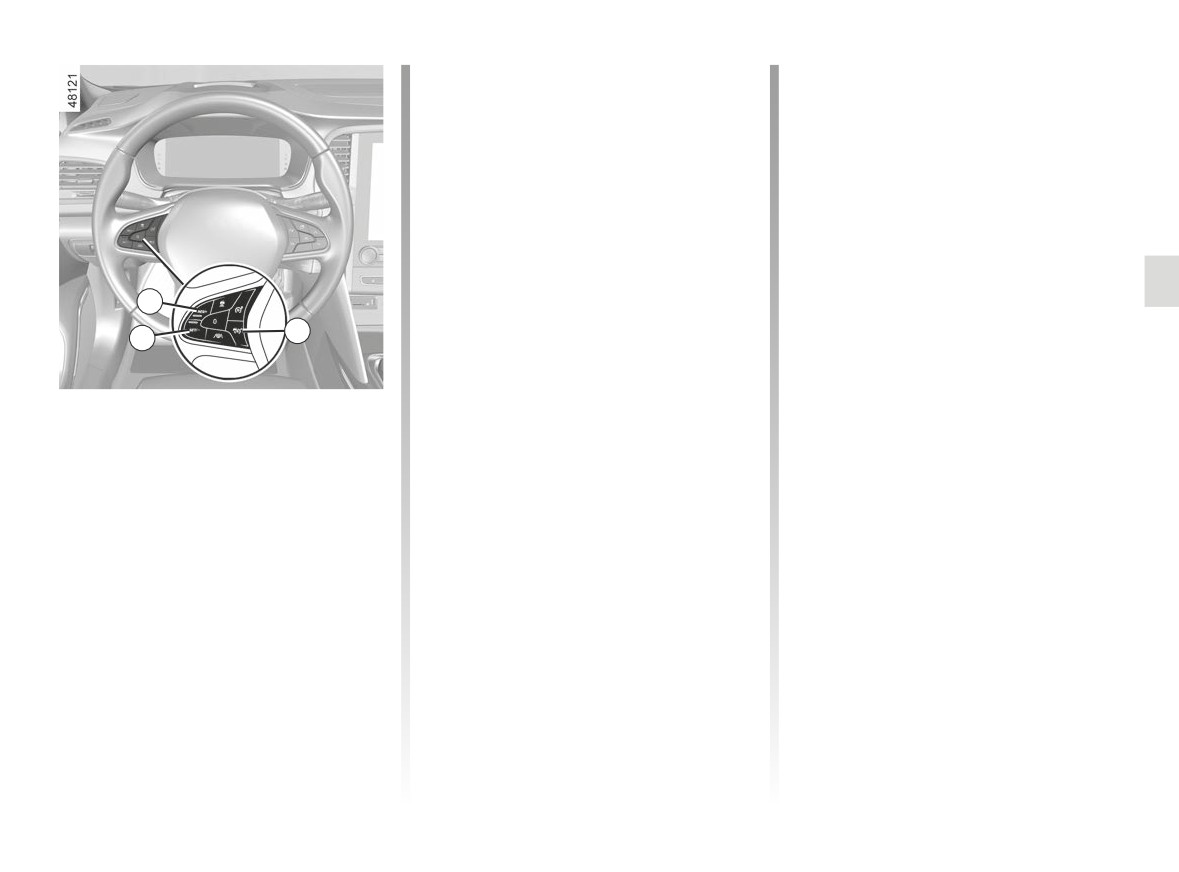
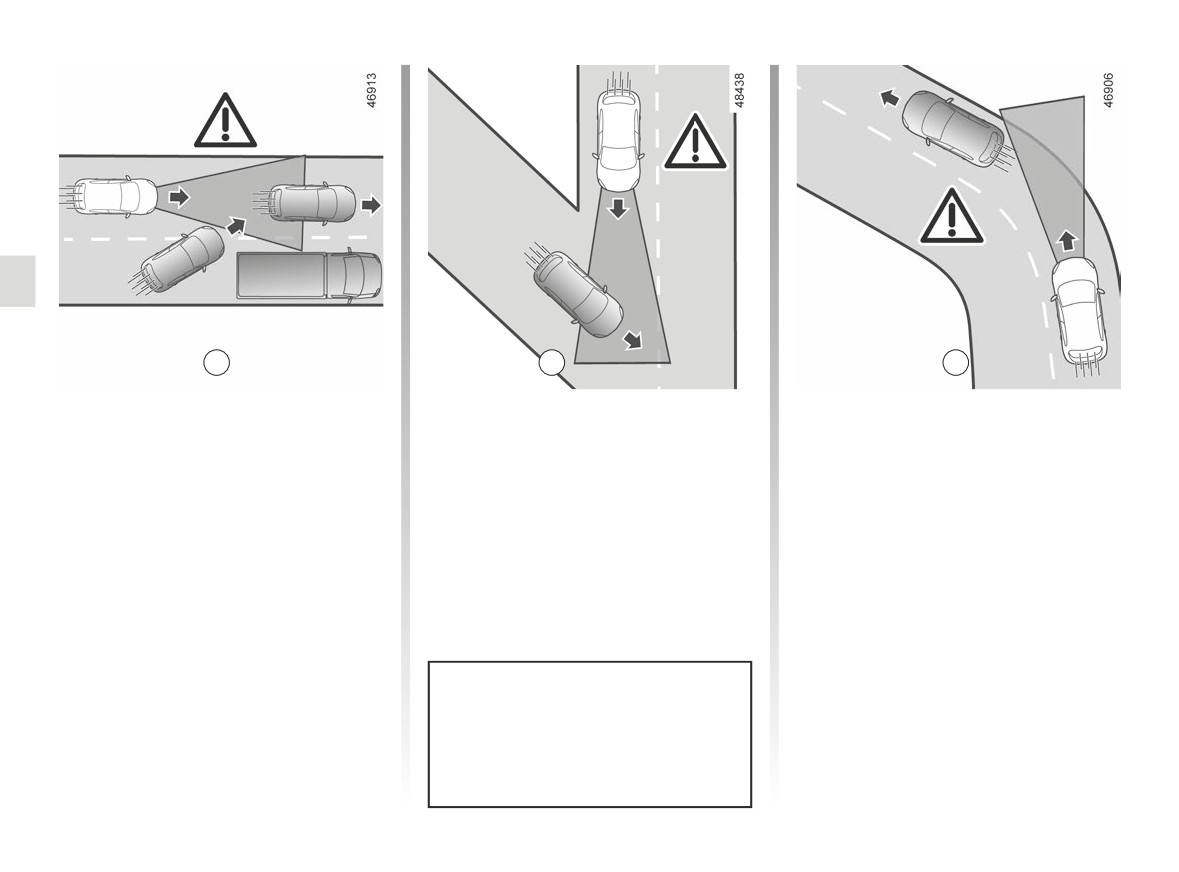
- vehicles arriving at intersections: slip
When entering a corner or bend, the
road (e.g. H) etc;
radar and/or camera may temporarily
Vehicle detection
not be able to detect the vehicle in front
- vehicles driving on the wrong side of
The system detects only vehicles (cars,
(e.g. J).
the road or reversing towards you.
trucks, motorbikes) that are moving in
The system may trigger an accelera-
the same direction as your vehicle.
tion.
A vehicle turning into the same lane
When exiting a bend, the system’s de-
(e.g. G) will be taken into account by
tection of the vehicle in front may be
the system only once it enters the
disrupted or delayed.
camera and radar detection areas.
The system may trigger abrupt or
The system may trigger abrupt or
delayed braking.
delayed braking.
The adaptive cruise control must
only be used on a motorway (or
multi-lane road separated by a bar-
rier).
2.102
CarManuals2.co
ADAPTIVE CRUISE CONTROL (10/14)
K
L
M
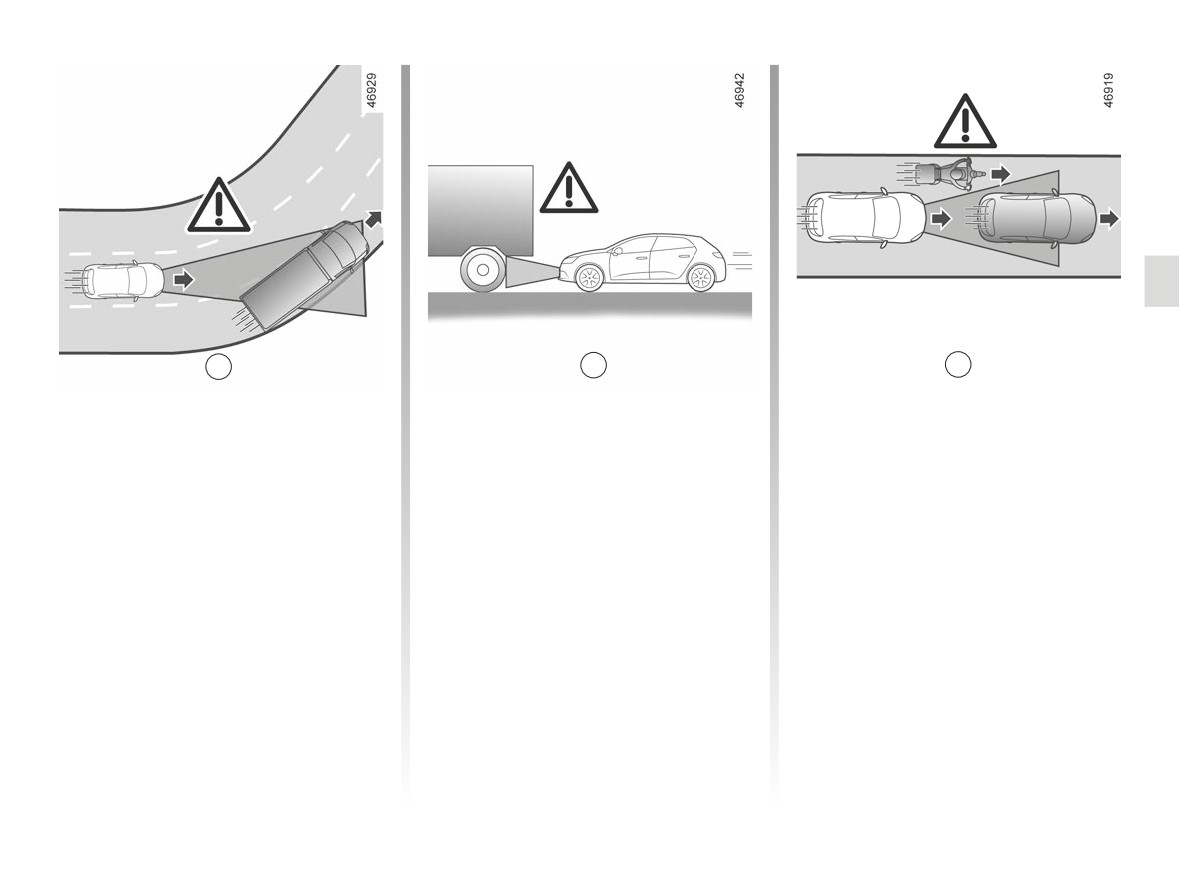
Detection of vehicles in adjacent
Vehicles hidden due to variations in
- vehicles transporting long objects
lanes
ground relief
which exceed the line;
The system may detect vehicles driving
The system will not detect vehicles
- the actual length of tall vehicles
on an adjacent lane when:
hidden due to variations in ground relief
(e.g. L) outside the radar detection
or those located outside of the camera
area (construction machine, agricul-
- you drive into a bend (e.g. K);
and radar detection areas when driving
tural equipment towing vehicle, etc.)
- you are driving on a road with narrow
uphill or downhill.
;
lanes;
- vehicles insufficiently centred in the
Vehicles outside the camera and
- the speed of the vehicle on the ad-
lane;
radar detection areas.
jacent lane is slower and if one of
- narrow vehicles which are very close
these vehicles is located too close to
The system will react late or not at all
(e.g. M).
the lane of the other.
if the detected vehicles are outside the
camera and radar detection areas, par-
The system may incorrectly trigger
ticularly in the following cases:
vehicle slowing or braking.
2.103
CarManuals2.co
ADAPTIVE CRUISE CONTROL (11/14)
12
13
14
N
P
Q
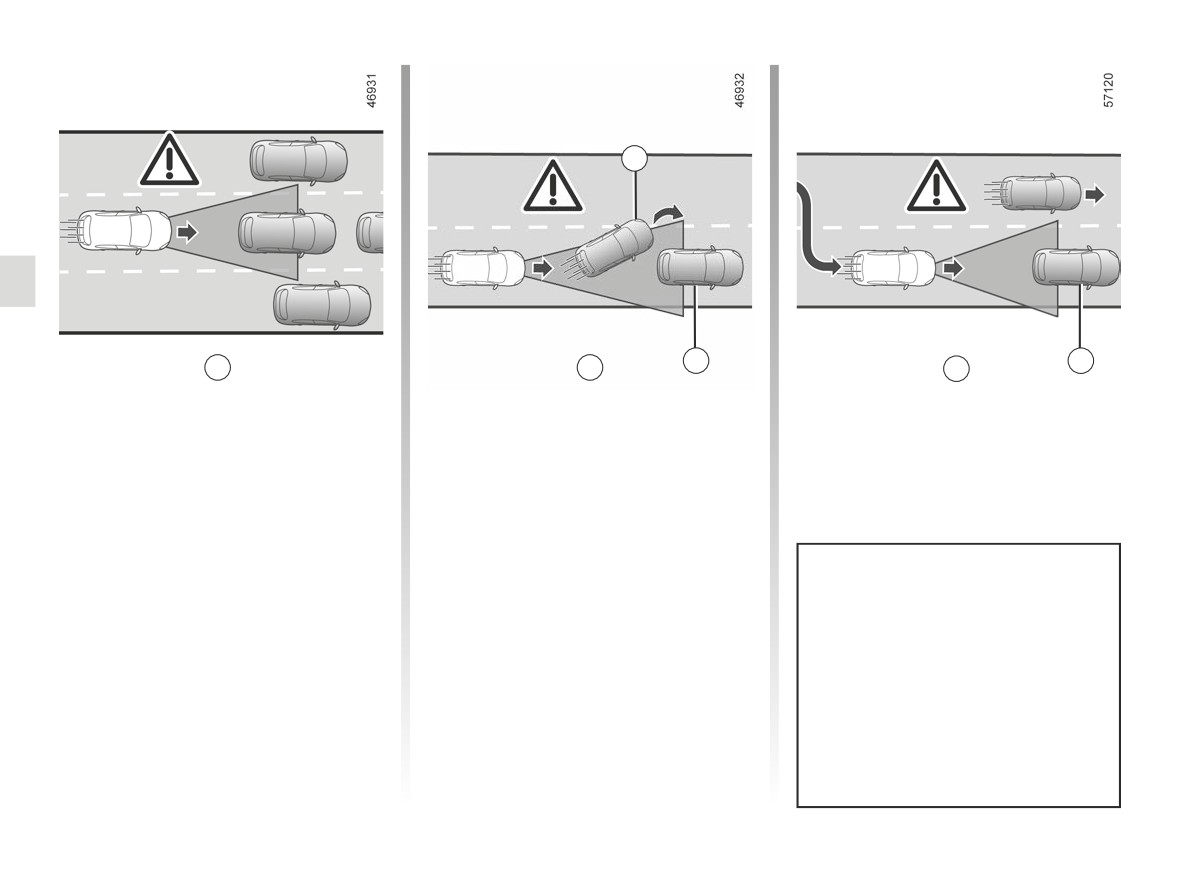
Stationary and slow moving
- vehicles in front 12 that change lane,
vehicles
discovering a stationary vehicle 13
(e.g. P);
When your speed is over approximately
31 mph (50 km/h), the system does
- when the vehicle is stationary 14,
not detect:
when you change lane (e.g. Q).
- stationary vehicles (e.g N);
- very slow moving vehicles.
When your speed is less than approxi-
mately 31 mph (50 km/h), the system
Always be ready to take control
may not react or may react very late
of your vehicle when you come
to:
upon stationary or very slow
- stationary vehicles (e.g N);
moving vehicles (e.g. N).
– very slow moving vehicles;
The adaptive cruise control does
not trigger an emergency stop and
its braking capability is limited.
2.104
CarManuals2.co
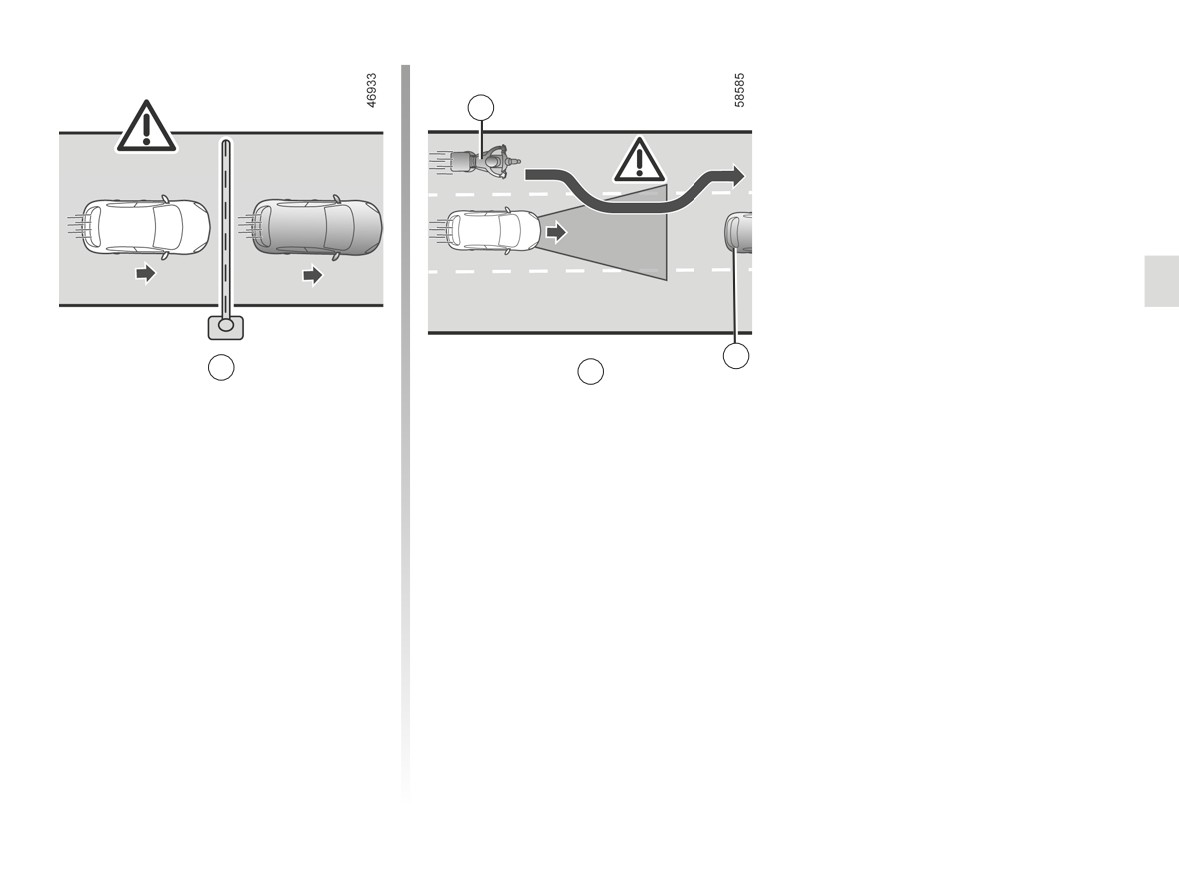
ADAPTIVE CRUISE CONTROL (12/14)
15
16
R
S
Non-detection of fixed obstacles
Detection of vehicles moving into
and objects of a small size
lane at high speed
The system cannot detect:
If your vehicle is overtaken by another
vehicle driving at high speed 15 (motor-
- pedestrians, bikes, scooters, etc. ;
cycle, car, etc.) and the vehicle is tem-
- animals;
porarily between you and the vehicle
- fixed obstacles (toll barriers, walls,
in front 16, the system may trigger
etc.) (e.g. R).
undue acceleration, slowing or brak-
ing.
These are not taken into account by the
system. They do not trigger any alert or
reaction by the system.
2.105
CarManuals2.co

ADAPTIVE CRUISE CONTROL (13/14)
This function is an additional driving aid. It can under no circumstances replace the driver’s responsibility to respect
speed limits and safe distances and to be vigilant.
The driver must always be in control of the vehicle.
The driver must always adapt their speed to the surroundings and driving conditions, regardless of system indications.
Except for lines delimiting lanes, traffic indicators (traffic lights, signs, pedestrian crossings etc.) are not recognised by the
system. These do not trigger any alert or reaction by the system.
The system should under no circumstances be taken to be an obstacle detector or an anti-collision system.
The adaptive cruise control must only be used on a motorway (or multi-lane road separated by a barrier).
System servicing/repairs
- In the event of an impact, the radar and/or camera alignment may be changed and its operation may consequently be af-
fected. Deactivate the system and consult an authorised dealer.
- Any work in the proximity of the radar and/or camera (replacements, repairs, windscreen modifications, paintwork etc.) must
be carried out by a qualified professional.
Only an authorised dealer is qualified to service the system.
Deactivating the function
You must disable the function if:
- the vehicle is travelling on a windy road;
- the vehicle is being towed (breakdowns);
- the vehicle is towing a trailer or a caravan;
- the vehicle is being driven in a tunnel or close to a metallic structure;
- the vehicle arrives at a toll point, a roadwork area or on a narrow lane;
- the vehicle is being driven up or down a very steep slope;
- the visibility is poor (glaring sun, fog etc.);
- the vehicle is being driven on a slippery road surface (rain, snow, gravel, etc.);
- the weather conditions are poor (rain, snow, side winds, etc.);
- the radar area has been damaged (impacts etc.) ;
- the camera area has been damaged (e.g. on the inside or outside of the windscreen);
- the windscreen is cracked or distorted.
In the event of the system behaving abnormally, deactivate it and consult an authorised dealer.
2.106
CarManuals2.co

ADAPTIVE CRUISE CONTROL (14/14)
In the event of system disturbance
Some conditions can disturb or damage the operation of the system, such as:
- the windscreen or bumper is obscured in the area of the radar (by dirt, ice, snow, condensation, number plate etc.);
- a complex environment (tunnel etc.);
- poor weather conditions (snow, heavy rain, hail, black ice, etc.);
- poor visibility (night, fog etc.);
- poor contrast between the vehicle preceding it and the surrounding area (e.g. white vehicle in a snowy area etc.);
- being dazzled (glaring sun, lights of vehicles travelling in the opposite direction etc.);
- narrow, winding or undulating road (tight bends etc.);
- a slower vehicle with a significant difference in speed;
- use of mats not adapted to the vehicle. On the driver’s side, only use mats suitable for the vehicle, attached with the pre-
fitted components, and check the fitting regularly. Do not lay one mat on top of another. There is a risk of wedging the
pedals.
In these cases, the system may wrongly intervene.
Risk of unwanted braking or acceleration.
Many unforeseen situations may affect the system operation. Certain objects or vehicles that can appear in the camera or
radar detection zone may be interpreted by the system incorrectly, possibly leading to inappropriate acceleration or braking.
You should always be attentive to sudden events that might occur while you are driving. Always keep your vehicle
under control by keeping your feet near the pedals, so that you are ready to act in any event.
2.107
CarManuals2.co

MOTORWAY AND TRAFFIC ASSISTANT (1/16)
The Motorway and Traffic Assistant is a
The “Stop and Go adaptive
Note:
driving aid system designed for use on
cruise control” function
- the driver must observe the maxi-
long motorway journeys, where traffic is
mum speed limit and safe distances
Based on information from a radar or
flowing or in jams.
in the country where they are driving;
camera, the Stop and Go adaptive
Depending on the vehicle, this system
cruise control function gives you the
- the Stop and Go adaptive cruise con-
comprises the “Stop and Go Adaptive
option of maintaining a selected speed,
trol can brake the vehicle up to a third
cruise control function” ➥ 2.94 and
known as the cruising speed, while
of the braking capacity. Depending
the “Lane Centring” function.
keeping a safe distance from the vehi-
on the situation, the driver may need
When these two functions are activated
cle in front in the same lane.
to brake harder.
simultaneously, the system allows the
If the vehicle in front stops, the Stop
driver to:
and Go adaptive cruise control may
- maintain vehicle speed based on a
brake your vehicle to a complete stop
previously saved speed;
before setting off again.
- adjust the distance between this ve-
The system controls acceleration and
hicle and the vehicle in front;
deceleration of your vehicle using the
engine and braking system.
- direct the vehicle to the centre of the
lane.
The “Stop and Go adaptive cruise con-
trol” function can be activated from 0 to
105 mph (0 to 170 km/h) according to
conditions on the road (traffic, weather,
etc.).
It is represented by the following symbol
➥ 2.94.
Important: you should keep
your feet near the pedals
and your hands on the
The Stop and Go adaptive cruise
steering wheel at all times
control does not trigger an emer-
to prepare for any event.
gency stop and its braking capabil-
ity is limited.
2.108
CarManuals2.co

MOTORWAY AND TRAFFIC ASSISTANT (2/16)
The “Lane centring” function
Additional information
Using information from a camera, the
Depending on the vehicle, the
“Lane Centring” function manipulates
“Motorway and Traffic Assistant” func-
the steering system to direct the vehi-
tion may be used with other driving aid
cle to the middle of the lane. This func-
functions.
tion is only available while the Stop and
Please note that:
Go adaptive cruise control is activated
➥ 2.94.
- activating the speed limiter causes
deactivation of the system;
If the conditions allow it, the function is
available between:
- the system cannot be activated when
the “Park Assist” function is active;
- 0 mph and 99 mph (0 and 160 km/h)
approximately with a vehicle in front;
- activation of the
“Lane Centring”
function leads to suspension of the
or
“Lane Departure Warning” or “Lane
- 37 mph
(60 km/h) et
99 mph
Keep Assist” functions if these have
(160 km/h) approximately without a
been activated. They will be reac-
vehicle in front.
tivated when the driver decides to
stop the “Lane Centring” function.
The “Lane Centring” function is a com-
fort feature. It is represented by the
symbol
Note: in the event of a sharp bend,
the function’s lateral retention capaci-
ties are limited and require the driver to
take immediate action on the steering
wheel.
2.109
CarManuals2.co
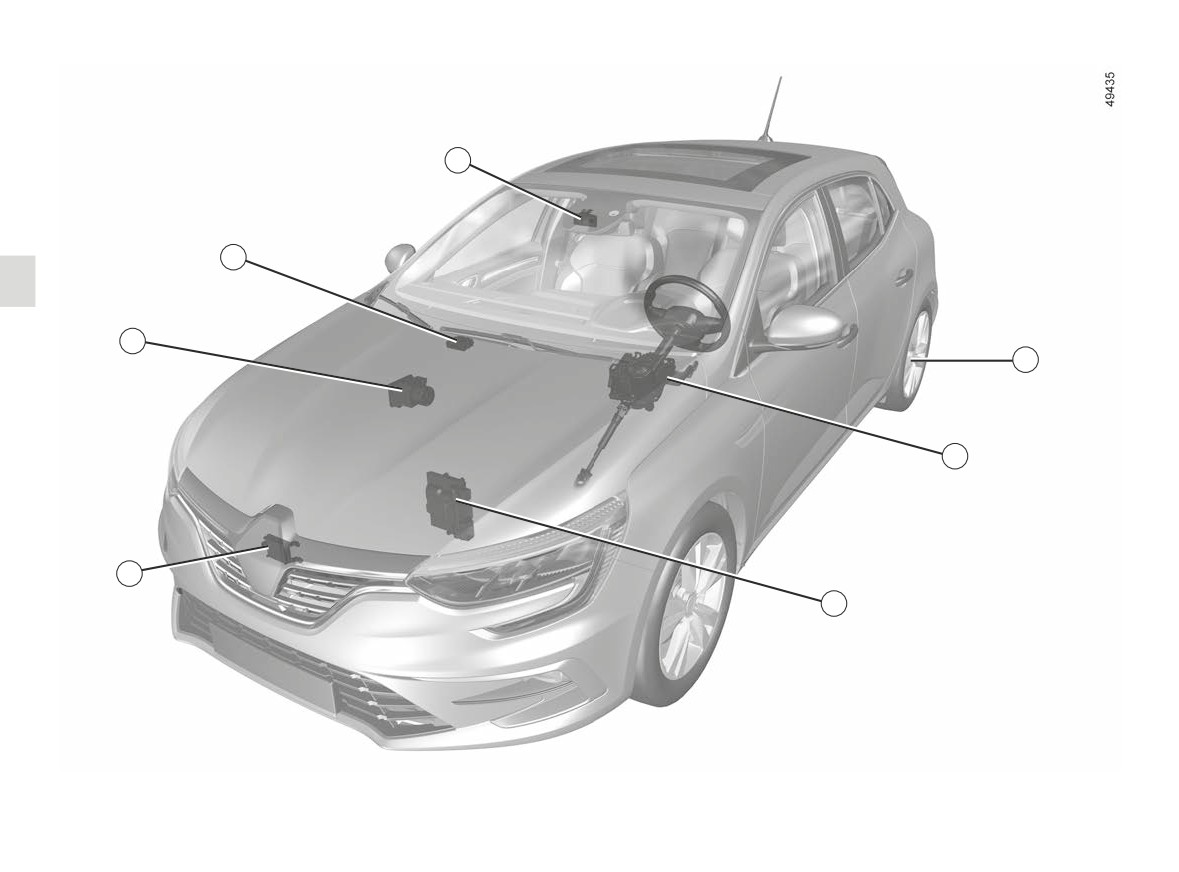
MOTORWAY AND TRAFFIC ASSISTANT (3/16)
2
1
7
3
4
6
5
2.110
CarManuals2.co

MOTORWAY AND TRAFFIC ASSISTANT (4/16)
Computer 1
Power-assisted steering 4
Active vehicle control 7
Receives information from the radar
Operates the front wheels to assist the
This system provides information on
and camera to determine the vehi-
trajectory of your vehicle according to
vehicle dynamics to the computer 1
cle trajectory and speed (acceleration
details transmitted by the 1 computer.
(speed, lateral acceleration etc.) and
or braking). Amongst other things, it
It also enables detection of the driver’s
acts on the braking system to control
controls activation/deactivation of the
hands on the steering wheel.
deceleration and to keep the vehicle
system (door opening, etc.).
stationary.
Engine computer 5
Camera 2
It controls and directs the engine to
Detects markings on the ground and
carry out the required acceleration.
the position of vehicles on the various
traffic lanes. It complements the infor-
Radar 6
mation transmitted by the 6 radar.
Calculates the distance between your
Make sure the windscreen is not ob-
vehicle and the vehicle in front.
scured (by dirt, mud, snow, etc.).
The system’s maximum range is ap-
proximately
150 metres. This may
Electronic parking brake 3
vary according to the road conditions
Keeps the vehicle stationary under cer-
(ground relief, weather conditions, etc.)
tain conditions.
Ensure that the radar area is not ob-
structed (dirt, mud, snow, a badly fitted
front number plate), impacted, modified
(including painting) or hidden by any
accessory fitted on the front of the vehi-
cle (on the grille or logo etc.).
The
radar
and
camera
zones must be kept clean
and free of any tampering in
order to ensure the proper
operation of the system.
2.111
CarManuals2.co
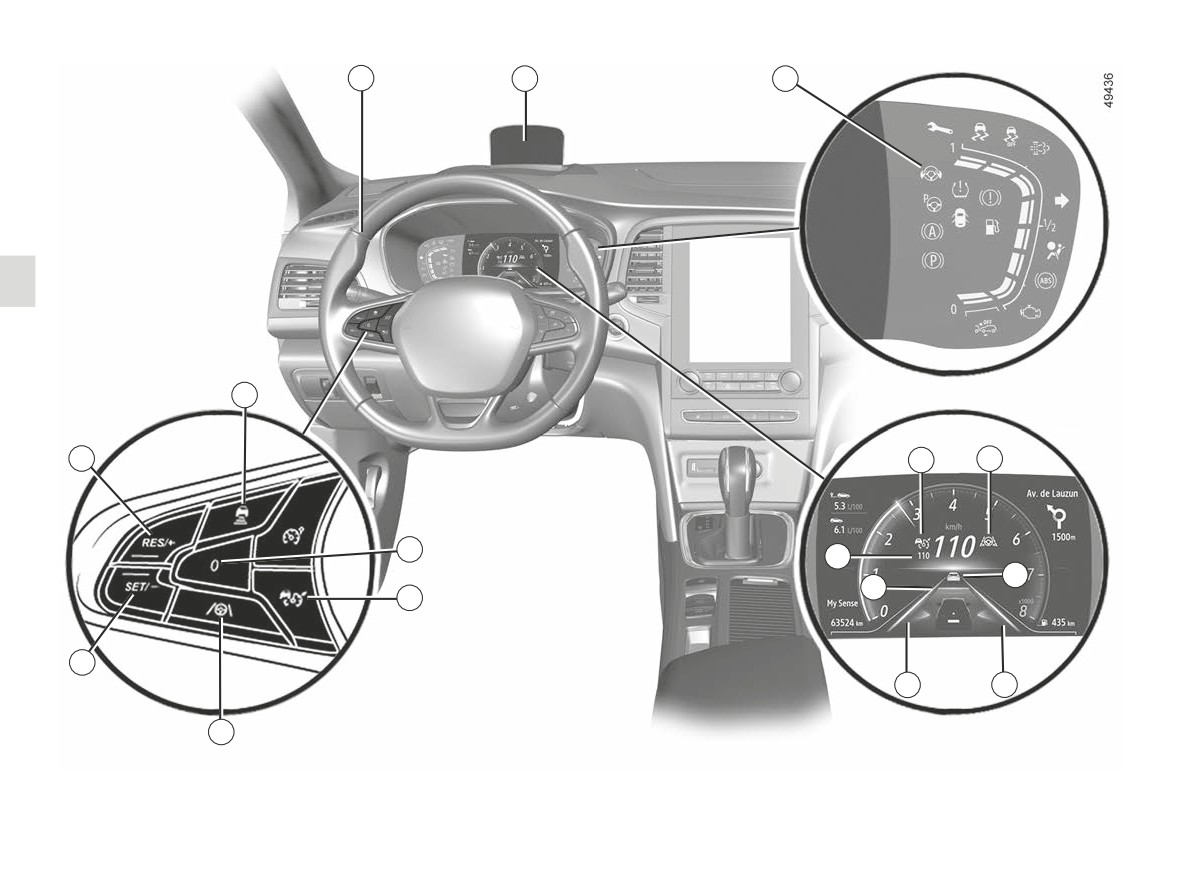
MOTORWAY AND TRAFFIC ASSISTANT (5/16)
21
22
20
8
13
14
15
9
19
16
18
10
12
17
17
11
2.112
CarManuals2.co

MOTORWAY AND TRAFFIC ASSISTANT (6/16)
Controls
Displays on the instrument
Steering wheel 21
8
Safe distance settings
panel
The driver must always keep their
14
“Stop and Go adaptive cruise con-
hands on the steering wheel. If too
9
Set active functions to standby
much force is applied when turning the
(with cruising speed saved) (0).
trol” function warning light
steering wheel, the “Lane Centring”
10
Adaptive cruise control main stop/
function is put on standby so the driver
15
“Lane Centring” function warning
can regain control of the vehicle.
start switch
light
Under certain conditions (sharp bends,
11
“Lane Centring” function activa-
16
Vehicle in front.
etc.) a vibration may be triggered on the
tion/deactivation switch
steering wheel to warn the driver that
17
Left-hand and right-hand line indi-
they must regain control of the vehicle.
12
Cruising speed activation, stor-
cators.
age and decrease switch (SET/-).
If the driver does not handle the steer-
18
Stored safe distance.
ing wheel (no hands are detected) the
13
Switch to activate and increase
19
Stored cruising speed.
“Lane centring” function is deactivated
cruising speed or to recall the
20
Hands off steering wheel detec-
after several alerts.
memorised cruising speed
(RES/+).
tion warning light
Head-up display 22
On equipped vehicles, some informa-
tion is provided on the head-up display.
2.113
CarManuals2.co
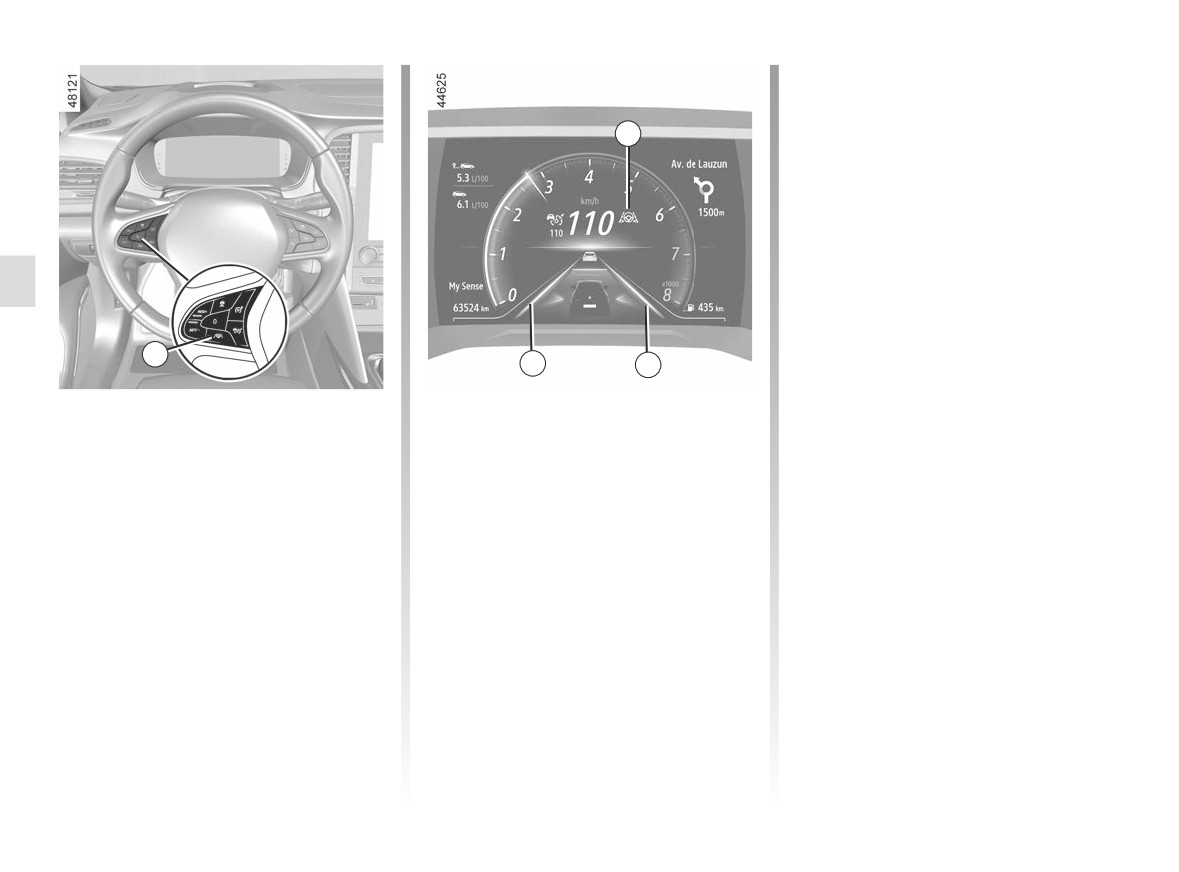
MOTORWAY AND TRAFFIC ASSISTANT (7/16)
Note: if you press button 11 when the
Stop and Go adaptive cruise control is
not activated, the message: “First acti-
15
vate Adapt. cruise ct” appears on the
instrument panel.
11
17
17
Activating the “Lane
Note: you must keep your hands on
the driving wheel when using the “Lane
Centring” function
Once the Stop and Go adaptive
Centring” function. The
symbol
cruise control is activated
➥ 2.94,
is displayed to confirm that the function
press button 11 to activate the “Lane
is activated.
Centring” function.
The warning light 15
is displayed
The “Lane centering activated” mes-
in green and the left-hand and right-
sage appears on the instrument panel
hand line indicators 17 are displayed on
accompanied by the 15
warning
the instrument panel to confirm that the
function is activated and directing your
light and the
symbol to confirm
vehicle to the centre of the lane.
that the function is activated.
2.114
CarManuals2.co
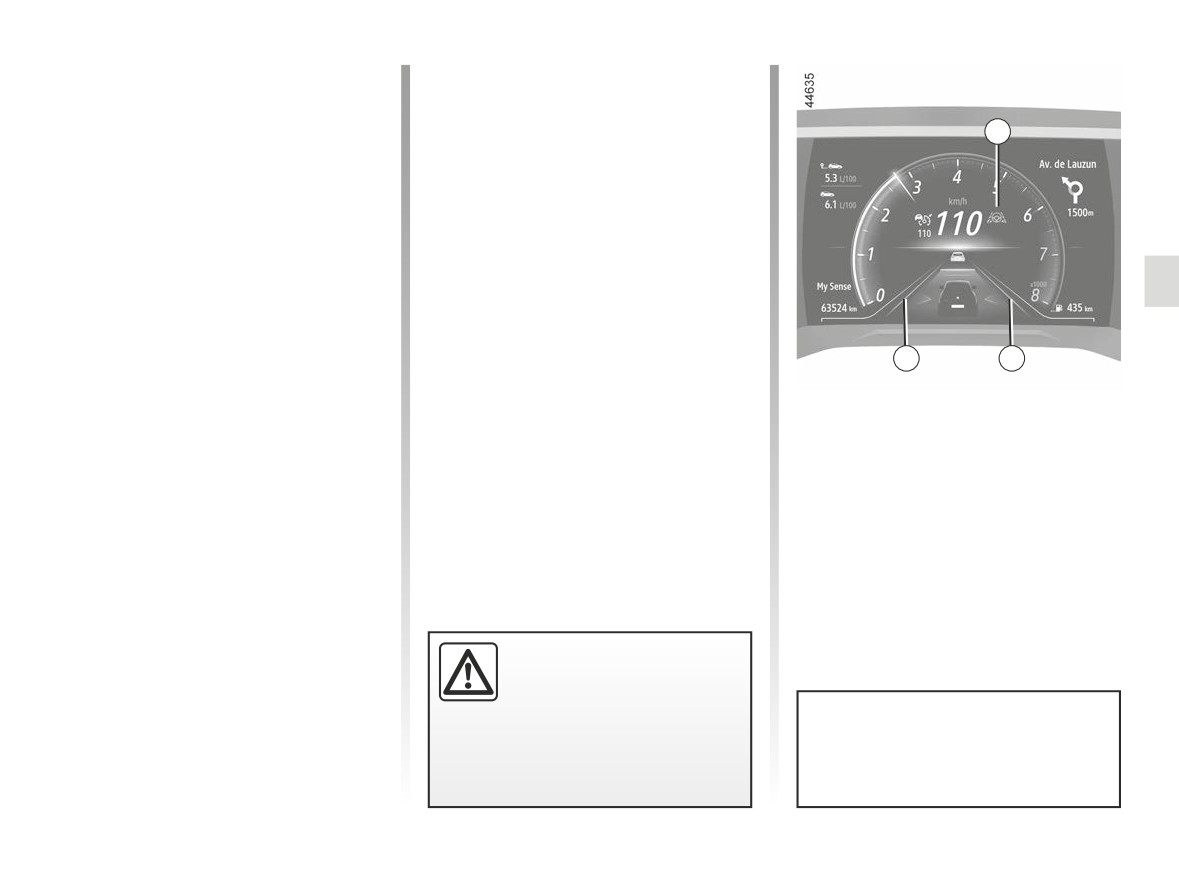
MOTORWAY AND TRAFFIC ASSISTANT (8/16)
“Lane Centring” function on
Certain actions carried out by the driver
also suspend the “Lane Centring” func-
standby
tion:
The “Lane Centring” function is put on
15
- activating the indicators;
standby automatically when:
- too much force is used when han-
- the Stop and Go adaptive cruise con-
dling the steering wheel.
trol is put on standby ➥ 2.94;
Standby of the function is confirmed by
- the system no longer detects the
lines or only one line is detected in
the 15
warning light and the left-
your lane;
hand and right-hand line indicators 17
- the lane is too narrow or too wide;
appearing in grey on the instrument
panel.
- the system does not detect any
hands on the steering wheel;
17
17
- the bend is too sharp;
- the vehicle speed is over approxi-
Once the conditions are met, the func-
mately 99 mph (160 km/h);
tion again directs the vehicle to the
- the vehicle speed is below approx-
centre of the lane. The 15
warn-
imately 37 mph (60 km/h), without
ing light and left-hand and right-hand
any vehicle in front;
line indicators 17 are displayed in green
- the vehicle touches or breaches a
on the instrument panel.
line;
- the system is temporarily disrupted
(for example: camera obscured by
dirt, mud, snow,condensation, etc.).
Important: you should keep
your feet near the pedals
and your hands on the
steering wheel at all times
You can affect the vehicle trajec-
to prepare for any event.
tory at any point by turning the
steering wheel.
2.115
CarManuals2.co
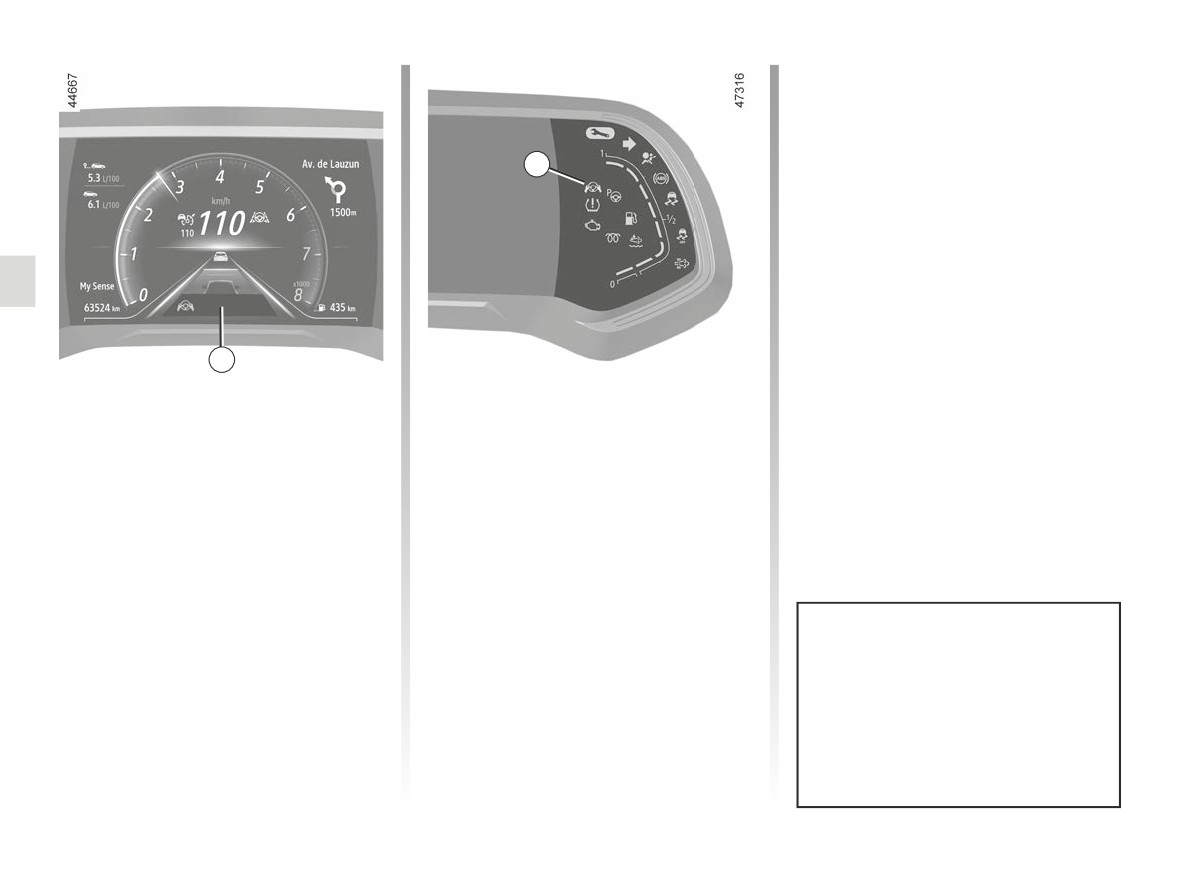
MOTORWAY AND TRAFFIC ASSISTANT (9/16)
Note: in some situations, the “Lane
Centring” function may no longer detect
your hands on the steering wheel and
may sound a signal:
20
- the vehicle is moving along a long
straight lane and the driver’s hands
are immobile on the steering wheel;
- the driver is holding the steering
wheel very lightly;
- ...
If the “Lane Centring” function is de-
activated due to the driver’s hands not
23
being detected on the steering wheel,
the Stop and Go adaptive cruise control
function continues to function.
“Hands on steering wheel”
- after approximately 30 seconds,
the message: “Keep hands on steer-
alert
ing wheel” appears on the instrument
When the “Lane Centring” function no
panel 23 and the warning light 20
longer detects your hands on the steer-
ing wheel, several warning levels will
appears in red, accompanied
be triggered:
by an audible signal of gradually in-
creasing volume;
- after
15 seconds, the message:
“Keep hands on steering wheel” is
- after approximately 45 seconds,
shown in yellow on the instrument
the audio sources go on standby,
panel 23;
the audible signal sounds contin-
ually, the warning light 20
is
In the first two alert levels, when the
switched off and the message “Lane
system again detects the presence
centering deactivated” appears in
of the driver’s hands on the steering
red on the instrument panel 23: the
wheel, the system stops the alerts.
“Lane Centring” function is deac-
The function continues to direct the
tivated.
vehicle to the centre of the lane.
2.116
CarManuals2.co
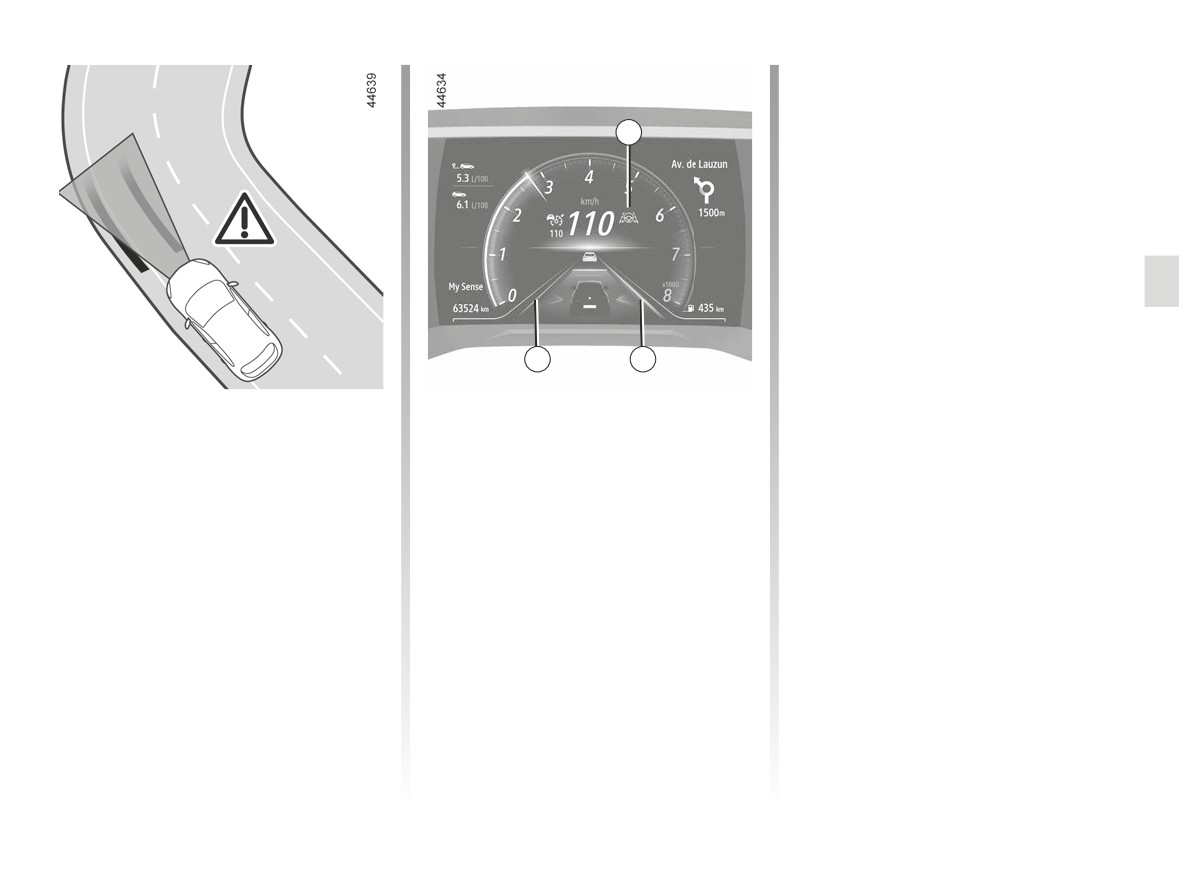
MOTORWAY AND TRAFFIC ASSISTANT (10/16)
If the vehicle crosses a line com-
pletely and moves out of lane, the
“Lane Centring” function is put on
15
standby. Standby of the function is
confirmed by the 15
warning
light and the left-hand and right-hand
line indicators 17 appearing in grey on
the instrument panel.
17
17
In the case of a sharp bend
If the driver does not intervene, the
function triggers the vibration of the
In the case of a sharp band, and de-
steering wheel to signal that the vehi-
pending on the vehicle speed, the func-
cle is about to breach a line and that
tion’s side retaining capacities will be
the driver needs to carry out immediate
limited and require the driver to carry
action.
out immediate action on the steering
wheel so that the function can continue
The 15
warning light and the
to maintain the vehicle in the centre of
left-hand or right-hand line indicator 17
the lane.
appear in red on the instrument panel.
2.117
CarManuals2.co
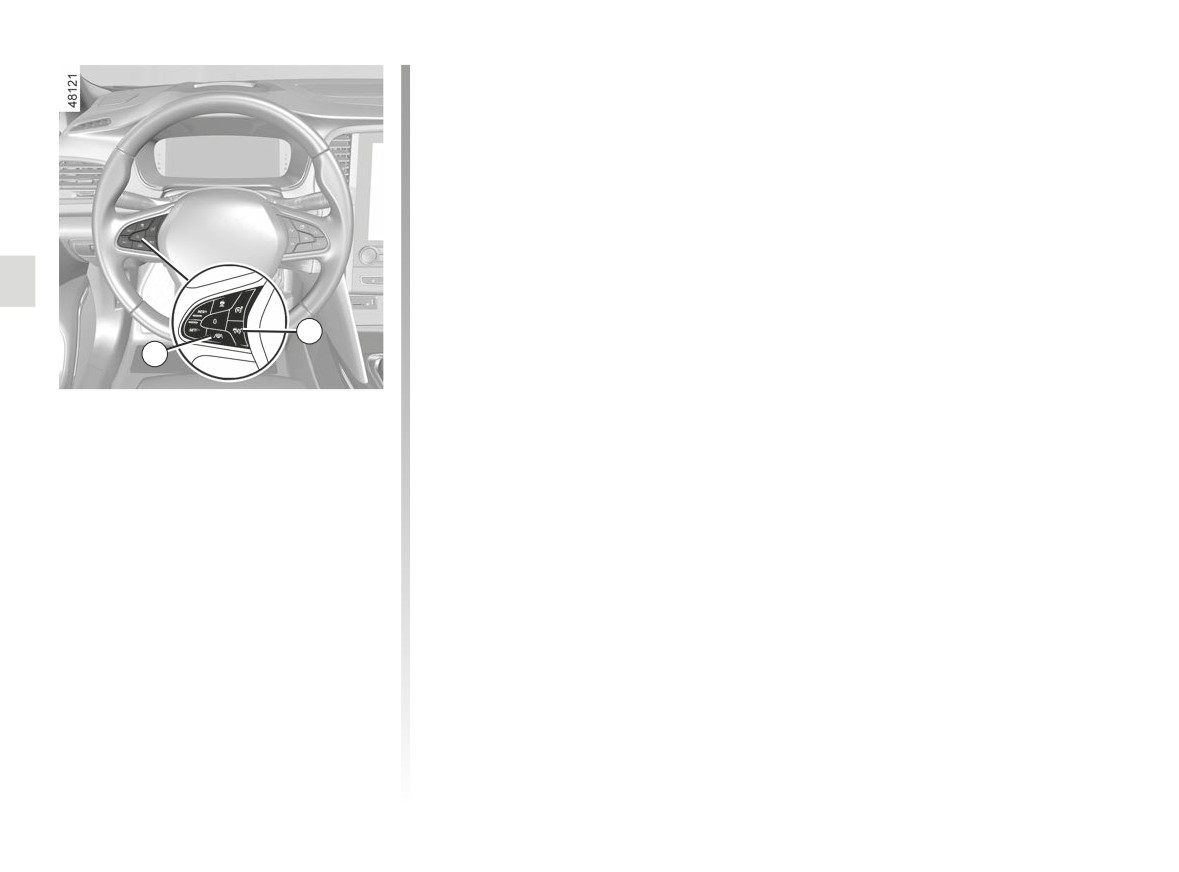
MOTORWAY AND TRAFFIC ASSISTANT (11/16)
- the Stop and Go adaptive cruise
control is deactivated ➥ 2.94;
button
Note: pressing the 10
once deactivates both the “Stop and
Go adaptive cruise control” function
and the “Lane Centring” function.
- the system will no longer detect the
driver’s hands on the steering wheel
for a period over 45 seconds approx-
imately.
10
The 15
warning light and the left-
11
hand and right-hand line indicators 17
disappear from the instrument panel.
Deactivating the “Lane
Centring” function
The “Lane Centring” function is deacti-
vated when:
- you press the 11 switch. The func-
tion’s deactivation is confirmed by
the appearance of the “Lane center-
ing deactivated” message on the in-
strument panel;
Note: pressing the 11 switch once
deactivates the
“Lane centring”
function but does not affect operation
of the Stop and Go adaptive cruise
control function.
2.118
CarManuals2.co

MOTORWAY AND TRAFFIC ASSISTANT (12/16)
Temporary unavailability
Conditions in certain geographical
If a “Stop and Go adaptive cruise con-
areas may hinder the function, for ex-
trol” function operating fault is detected,
The radar is able to detect vehicles
ample:
the “Check Adaptive Cruise control”
in front of your vehicle. The system
message appears on the instrument
cannot operate correctly if the radar de-
- arid zones, tunnels, long bridges or
panel and both the “Stop and Go adap-
tection area is obscured or if its signal
lightly used roads without road lines,
tive cruise control” function and the
is disrupted.
without signs or trees nearby;
“Lane Centring” function are inter-
If the radar detection area is obstructed
- a military or airport zone.
rupted.
or the radar signal is disrupted, the
You must leave such areas in order for
Consult an approved dealer.
message “Front radar no visibility” is
the function to work.
displayed on the instrument panel and
If an operating fault is detected on one
the “Stop and Go adaptive cruise con-
In all cases, if the message is not
or more components of the “Motorway
trol” function is interrupted.
erased after the engine is restarted,
and Traffic Assistant” system, the
please contact an authorised dealer.
warning light appears on the in-
The green warning light
disap-
strument panel, alongside, depending
pears to confirm that the function has
on the nature of the fault, the message:
Operating faults
been automatically deactivated.
- “Front camera to check”;
If a Lane Centring function operating
Ensure that the radar area is not ob-
fault is detected, the message “Check
- “Front radar to check”;
structed (dirt, mud, snow, a badly fitted
lane centering” is displayed on the in-
- “Camera/Radar to check”;
front number plate), impacted, modified
strument panel and the function is dis-
(including painting) or hidden by any
abled.
- “Check vehicle”.
accessory fitted on the front of the vehi-
The Stop and Go adaptive cruise con-
The two “Stop and Go adaptive cruise
cle (on the grille or logo etc.).
trol function remains in operation.
control” and “Lane Centring” functions
are interrupted.
Consult an approved dealer.
Consult an approved dealer.
2.119
CarManuals2.co

MOTORWAY AND TRAFFIC ASSISTANT (13/16)
The “Motorway and Traffic Assistant” function is an additional driving aid. This system does not take the place of the
driver.
Therefore, it can under no circumstances replace the driver’s responsibility to respect speed limits and safe distances
and to be vigilant (the driver must always be ready to brake).
The driver must always be in control of the vehicle. The driver must always adapt their trajectory and speed according to the
surroundings and traffic conditions.
The “Motorway and Traffic Assistant” uses the “Stop and Go adaptive cruise control” function and the “Lane Centring” function.
It must only be used on a motorway or multi-lane road (separated by a barrier).
It must not be used in heavy traffic, on winding or slippery roads (black ice, aquaplaning, gravel) or during bad weather (fog,
rain, side winds etc.).
There is a risk of accidents.
2.120
CarManuals2.co

MOTORWAY AND TRAFFIC ASSISTANT (14/16)
The “Motorway and Traffic Assistant” function is an additional driving aid. it can under no circumstances replace the
driver's responsibility to respect speed limits and safe distances and to be vigilant.
The driver must always be in control of the vehicle.
The driver must always adapt their trajectory and speed according to the surroundings and driving conditions, regard-
less of system indications.
Except for lines delimiting lanes, traffic indicators (traffic lights, signs, pedestrian crossings, etc.) are not recognised by the
system. These do not trigger any alert or reaction by the system.
The “Motorway and Traffic Assistant” uses the Stop and Go adaptive cruise control function and the Lane Centring function.
The system should under no circumstances be taken to be an obstacle detector or an anti-collision system.
The Motorway and Traffic Assistant function must only be used on a motorway or multi-lane road separated by a barrier.
System servicing/repairs
- In the event of an impact, the radar and/or camera alignment may be changed and its operation may consequently be af-
fected. Deactivate the system and consult an authorised dealer.
- Any work in the proximity of the radar and/or camera (replacements, repairs, windscreen modifications, paintwork etc.) must
be carried out by a qualified professional.
Only an authorised dealer is qualified to service the system.
2.121
CarManuals2.co

MOTORWAY AND TRAFFIC ASSISTANT (15/16)
Deactivating the system
You must deactivate the system if:
- the vehicle is travelling on a windy road;
- the vehicle is being towed (breakdowns);
- the vehicle is being driven with an emergency spare wheel;
- the vehicle is towing a trailer or a caravan;
- the vehicle is being driven in a tunnel or close to a metallic structure;
- the vehicle arrives at a toll point, a roadwork area or on a narrow lane;
- the vehicle is being driven up or down a very steep slope;
- the visibility is poor (glaring sun, fog etc.);
- the weather conditions are poor (rain, snow, side winds, etc.);
- the vehicle is being driven on a slippery road surface (rain, snow, gravel, etc.);
- the area of the camera has been damaged (e.g. on the inside or outside of the windscreen);
- the windscreen is cracked or distorted;
- the radar area has been damaged (impacts, etc.) ;
In the event of the system behaving abnormally, deactivate it and consult an authorised dealer.
2.122
CarManuals2.co

MOTORWAY AND TRAFFIC ASSISTANT (16/16)
Some conditions can disrupt or damage the operation of the system, for example:
- obstruction of the windscreen or the radar area (by dirt, ice, snow, condensation etc.) Frequently check the cleanli-
ness and condition of the windscreen, front wiper blades and front bumper;
- a complex environment (tunnel etc.);
- poor weather conditions (snow, heavy rain, hail, black ice, etc.);
- poor visibility (night, fog etc.);
- poor contrast between the vehicle preceding it and the surrounding area (e.g. white vehicle in a snowy area etc.) ;
- being dazzled (glaring sun, lights of vehicles travelling in the opposite direction etc.);
- narrow, winding or undulating road (tight bends etc.);
- the tar lines detected as a line by the system;
- narrowing/widening lanes;
- road markings which are worn, lacking in contrast or very widely spaced from one another (lines partially erased etc);
- multiple markings on the road (roadworks area, slip roads connecting to adjacent motorways, hard shoulder etc.);
- a slower vehicle with a significant difference in speed;
- use of mats not adapted to the vehicle. On the driver’s side, only use mats suitable for the vehicle, attached with the pre-
fitted components, and check the fitting regularly. Do not lay one mat on top of another. There is a risk of wedging the
pedals.
In these cases, the system may wrongly intervene.
- Risk of unwanted braking or acceleration.
- Risk of unwanted, incorrect correction or no correction of trajectory.
Many unforeseen situations may affect the system operation. Certain objects or vehicles that can appear in the camera or
radar detection zone may be interpreted by the system incorrectly, possibly leading to inappropriate acceleration or braking.
You should always be attentive to sudden events that might occur while you are driving. Always maintain your vehi-
cle under control by keeping your feet near the pedals and your hands on the steering wheel, so that you are ready
to act in any event.
2.123
CarManuals2.co
PARKING DISTANCE CONTROL (1/6)
Operating principle
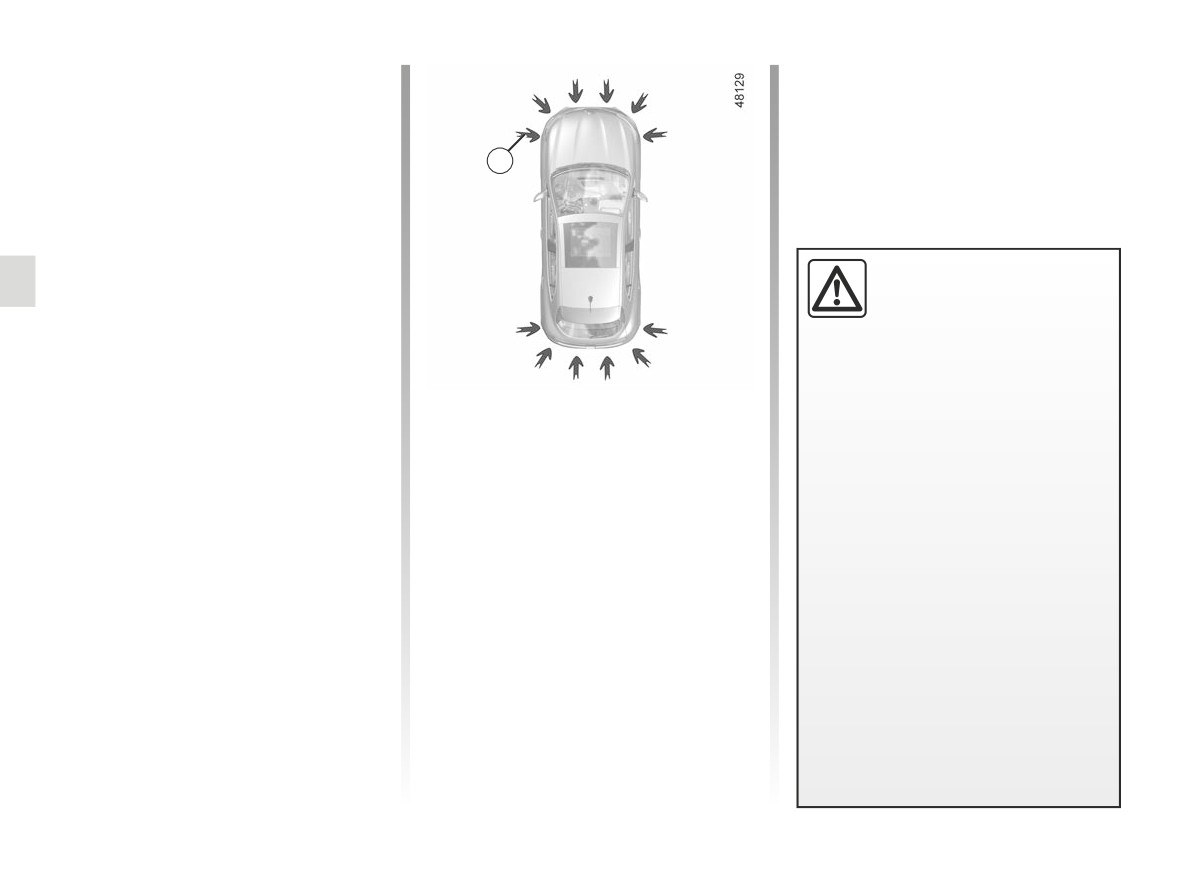
Ultrasonic sensors in the rear bumper
measure the distance between the ve-
hicle and an obstacle.
1
This measurement is indicated by
beeps which become more frequent the
closer you come to the obstacle, until
they become a continuous beep when
the vehicle is approximately
20 to
This function is an addi-
30 centimetres from the obstacle.
tional aid that indicates the
The system detects obstacles to the
distance between the vehi-
front, the rear and the sides of the ve-
cle and an obstacle whilst
hicle.
reversing, using sound signals.
The parking distance control system
Under no circumstances should it
is only activated when the vehicle is
replace the driver’s care or respon-
Location of the ultrasonic
driven at a speed below approximately
sibility whilst reversing.
sensors 1
6 mph (10 km/h).
The driver should always be ready
Ensure that the ultrasonic sensors indi-
The function does not take into account
for sudden incidents while driv-
cated by the arrows 1 are not obscured
towing or carrying systems that are not
ing: always ensure that there are
(by dirt, mud, snow, a badly fitted/at-
recognised by the system.
no small, narrow moving obstacles
tached number plate, etc.), impacted,
(such as a child, animal, pushchair,
modified (including paintwork) or ob-
bicycle, stone, post etc.) in the blind
structed by any accessory fitted to the
spot when manoeuvring.
rear and/or, depending on the vehicle,
to the front or sides of your vehicle.
2.124
CarManuals2.co
PARKING DISTANCE CONTROL (2/6)
Note: in the event of a change in tra-
2
jectory during a manoeuvre, the risk of
C
collision with an obstacles may be sig-
nalled late.
A
B
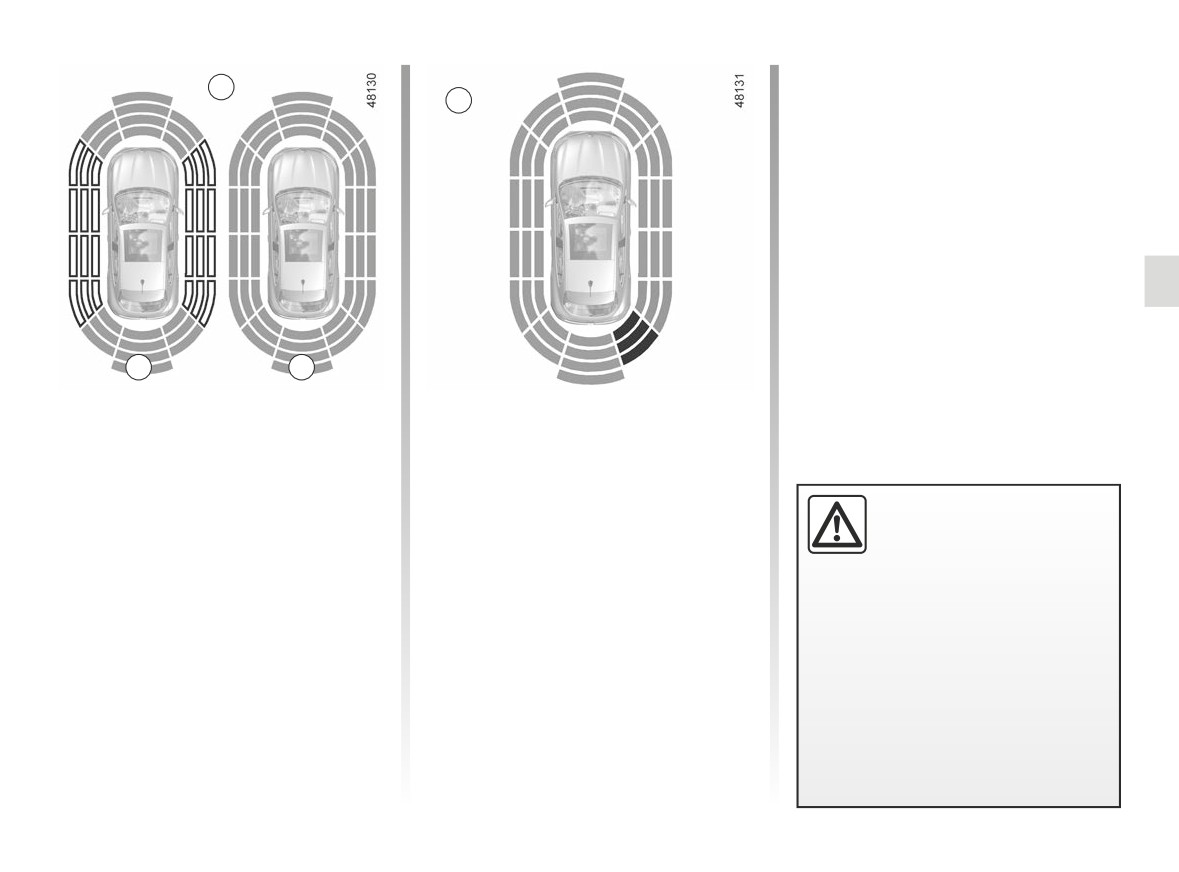
Note: the display 2 shows the vehicle
Operation
surroundings and emits beeps.
Most objects located less near the
It is necessary to travel a few metres
front, rear and sides of the vehicle are
before the side detection is activated.
detected.
If all areas have a grey background, the
Depending on the distance of the ob-
An impact to the under-
whole area around the vehicle is being
stacle, the frequency of the beep will
side of the vehicle while
monitored:
increase when approaching it, and will
manoeuvring
(e.g.: strik-
become a solid beep at approximately
ing a post, raised kerb or
- A: analysis of the vehicle surround-
20 cm from obstacles to the sides and
other street furniture) may result in
ings in progress;
30 cm from obstacles to the front or
damage to the vehicle (e.g.: defor-
- B: analysis of the vehicle surround-
mation of an axle).
rear. Green, orange and red zones will
ings carried out.
be displayed on the display C.
To avoid any risk of accident, have
your vehicle checked by an ap-
proved Dealer.
2.125
CarManuals2.co
PARKING DISTANCE CONTROL (3/6)
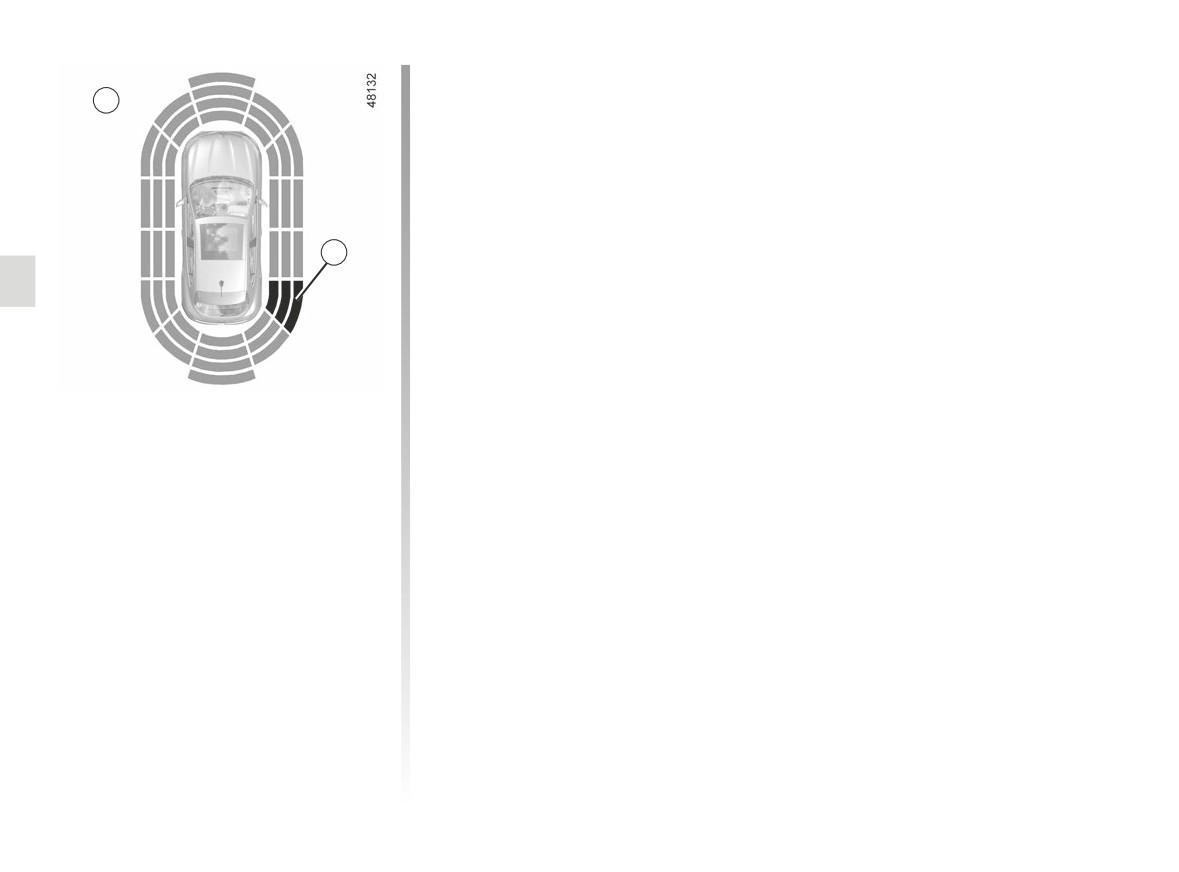
If a side obstacle is detected:
D
- the beeps become faster and then
sound continuously as the obstacle
gets nearer. Green, orange and red
zones will be displayed on the dis-
play D;
- if there is no risk of collision, no beep
will sound when approaching the ob-
3
stacle. Green, orange and red zones
will be displayed interspersed on the
display D.
Detection of obstacles to the side
Depending on the direction of the
wheels, the system determines the tra-
jectory of the vehicle and notifies the
driver of any risk or otherwise of a col-
lision with an obstacle 3 to the side of
the vehicle.
2.126
CarManuals2.co
PARKING DISTANCE CONTROL (4/6)
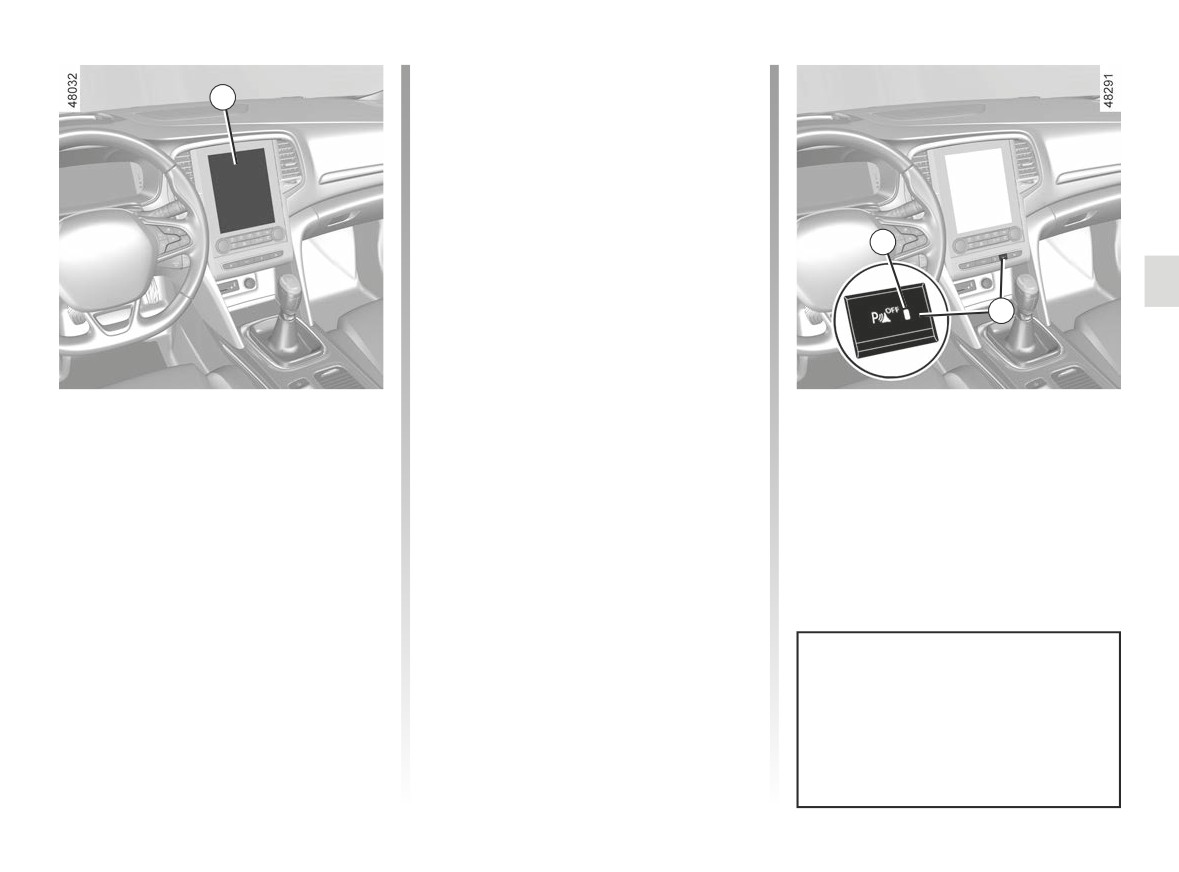
Vehicles not fitted with a multimedia
4
screen
With the vehicle stopped, press the 6
switch to deactivate parking distance
control. Warning light 5 in the switch
lights up. Press again on the 6 switch to
activate the function. The indicator light
built into the 5 switch goes out.
5
Adjustment
6
Vehicles fitted with a multimedia
screen 4
Depending on the vehicle, with the
engine running, some settings can be
Activation/deactivation
Deactivating the system sound
adjusted from the multimedia screen 4.
Activate or deactivate the parking dis-
Please refer to the multimedia instruc-
Vehicles fitted with a multimedia
tance control sound.
tions for further information.
screen 4
Note: if you deactivate the sound, you
To activate or deactivate the various
Parking distance control audio
will no longer be notified with beeps
zones covered by the ultrasonic detec-
volume
when approaching an obstacle.
tors, please refer to the multimedia in-
Adjust the volume of Park Assist by
structions.
pressing “+” or “-”.
Select “ON” or “OFF”.
System sound
Enables the system sound to be
chosen.
When the vehicle is being driven at
a speed below approximately 6 mph
(10 km/h), certain noises (motorcy-
cle, lorry, pneumatic drill, etc.) may
trigger the beeping sound of the
parking distance control.
2.127
CarManuals2.co