Renault Express (2023 year). Manual in english - page 6
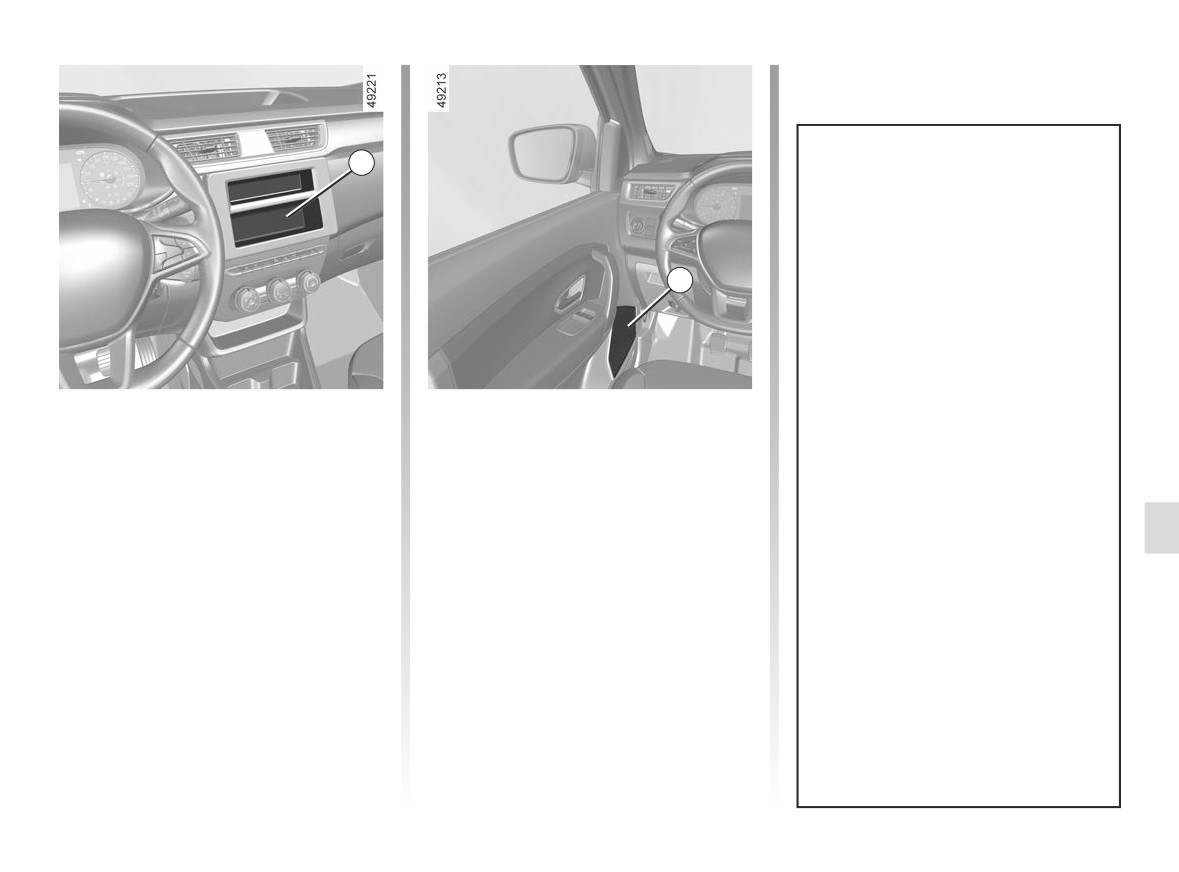
FITTED AUDIO EQUIPMENT
1
2
-
In all cases, it is very important to
follow the manufacturer’s instruc-
tions carefully.
-
The specifications of the brack-
ets and wires (available from our
network) vary depending on the
If your vehicle is not fitted with an audio
Radio location 1
equipment level of your vehicle
system, it is pre-equipped with:
Unclip and remove storage compart-
and the type of radio.
- a location for the radio 1;
ment 1.
Consult an approved Dealer to
find out the correct part number.
– door loudspeakers 2.
To install any equipment, please con-
sult an authorised dealer.
-
No work may be carried out on
the vehicle’s electrical or radio
circuits, except by approved
Dealers since an incorrectly
connected system may result in
damage to the electrical equip-
ment and/or the components
connected to it.
5.39
CarManuals2.co
ACCESSORIES
Electrical and electronic accessories
Before installing this type of accessory (particularly for transmitters/receivers: frequency bandwidth, power level, po-
sition of the aerial, etc.), make sure it is compatible with your vehicle. You can get advice from an authorised dealer.
Before connecting an accessory to a socket, please ensure that you do not exceed the maximum power authorised for
the socket ➥ 3.34, ➥ 3.20. Fire hazard.
No work may be carried out on the vehicle’s electrical or radio circuits, except by authorised dealers: an incorrectly connected
system may result in damage being caused to the electrical equipment and/or the components connected to it.
If the vehicle is fitted with any aftermarket electrical equipment, make sure that the installation is correctly protected by a fuse.
Establish the rating and position of this fuse.
Using the diagnostic socket
The use of electronic accessories on the diagnostic socket may cause serious disturbance to the vehicle’s electronic systems.
For your safety we recommend that you use only electronic accessories approved by the manufacturer, consult an Approved
Dealer. Serious accident risk.
Fitting aftermarket accessories
If you wish to install accessories on the vehicle: please contact an authorised dealer. Also, to ensure the correct operation of
your vehicle, and to avoid any risk to your safety, we recommend that you use only accessories specifically designed for your
vehicle, which are the only accessories for which the manufacturer will provide a warranty.
If you are using an anti-theft device, only attach it to the brake pedal.
Obstructions to the driver
On the driver’s side, only use mats suitable for the vehicle, attached with the pre-fitted components, and check the fitting reg-
ularly. Do not lay one mat on top of another. There is a risk of wedging the pedals.
5.40
CarManuals2.co
OPERATING FAULTS (1/8)
The following advice will enable you to carry out quick, temporary repairs. For safety reasons you should always contact
an approved dealer as soon as possible.
Using the remote control
POSSIBLE CAUSES
ACTION REQUIRED
The remote control does not lock or The remote control battery is flat.
Use the emergency key.
unlock the doors.
Use of appliances operating on the same
Stop using the devices or use the key.
frequency as the remote control (mobile
phone, etc.).
Vehicle located in a high electromagnetic
Replace the battery. You will still be able to
radiation zone.
lock, unlock, and start your vehicle ➥ 1.6
Discharged battery.
and ➥ 2.3.
The vehicle is started.
With the engine running, the key’s locking/
unlocking device is blocked. Turn off the
ignition.
Desynchronisation of the remote control.
Unlock the driver’s door using the key in
the door lock, then start the engine to syn-
chronise the remote control.
5.41
CarManuals2.co
OPERATING FAULTS (2/8)
The following advice will enable you to carry out quick, temporary repairs. For safety reasons you should always contact
an approved dealer as soon as possible.
The starter is activated
POSSIBLE CAUSES
WHAT TO DO
The instrument panel indicator lights
Battery terminals disconnected,
Retighten them, reconnect them or clean
are weak or fail to light up and the
oxidised or incorrectly secured.
them if they are oxidised.
starter does not turn.
Battery discharged or worn.
Connect another battery to the faulty bat-
tery. ➥ 5.33 or replace the battery if neces-
sary.
Do not push the vehicle if the steering
column is locked.
The engine will not start.
Starting conditions are not fulfilled.
➥ 2.3
With the vehicle stationary, engine
Petrol version, this is not necessar-
The engine’s idle speed should decrease
cold, the engine’s idle speed is high.
ily a fault.
after about one minute. Otherwise, this
This may be caused by the in-
may be caused by another fault. Call an ap-
crease in the engine temperature.
proved Dealer.
The steering column remains locked.
Steering wheel locked.
To unlock: turn the key and the steering
wheel slightly ➥ 2.2.
Faulty electrical circuit.
Consult an approved dealer.
5.42
CarManuals2.co
OPERATING FAULTS (3/8)
On the road
POSSIBLE CAUSES
WHAT TO DO
Vibrations.
Tyres not inflated to correct pres-
Check the tyre pressures; if this is not the cause, have
sures, incorrectly balanced or dam-
their condition checked by an approved dealer.
aged.
Coolant boiling in the coolant
Mechanical fault: damaged cylin-
Stop the engine.
reservoir.
der head gasket.
Contact an approved dealer.
Smoke under the bonnet.
Short circuit or cooling system
Stop, switch off the ignition, move away from the vehi-
leak.
cle and contact an approved dealer.
The oil pressure warning light
comes on:
while cornering or braking;
The level is too low.
Top up the engine oil ➥ 4.6.
is slow to go out or re-
Loss of oil pressure.
Stop the vehicle and contact an approved dealer.
mains lit up under accel-
eration.
5.43
CarManuals2.co
OPERATING FAULTS (4/8)
On the road
POSSIBLE CAUSES
WHAT TO DO
Abnormal white smoke from the ex-
In the diesel version, this is not
➥ 2.10.
haust.
necessarily a fault. Smoke may be
caused by particle filter regeneration.
In the case of the petrol version, this
Reduce the engine speed and avoid
is not necessarily a fault. Depending
sudden acceleration to gradually make the
on the climate conditions (cold,
smoke disappear.
moisture etc.), the smoke may occur
Otherwise, this may be caused by another
during strong vehicle acceleration.
fault. Consult an approved dealer.
Smoke under the bonnet.
Short-circuit or cooling system leak.
Stop, switch off the ignition, stand away from
the vehicle and contact an approved dealer.
Vibrations.
Tyres not inflated to the correct pres-
Check the tyre pressures; if this is not the
sure, incorrectly balanced or dam-
cause, have their condition checked by an
aged.
approved dealer.
Steering becomes heavy.
Assistance overheating.
Drive carefully at reduced speed, be aware
of the level of force in the steering wheel
No power-assisted steering oil.
needed to turn the wheels. Consult an ap-
Fault in the assistance system.
proved dealer.
5.44
CarManuals2.co
OPERATING FAULTS (5/8)
On the road
POSSIBLE CAUSES
WHAT TO DO
Whistling.
Roof aerial poorly positioned.
Position the aerial.
The engine is overheating. The cool-
Engine cooling fan not working.
Stop the vehicle, switch off the engine and
contact an approved dealer.
ant temperature indicator light Ô
comes on in red.
Coolant leaks.
Stop the vehicle, switch off the engine and
check the coolant reservoir: it should con-
tain fluid. If there is no coolant, consult an
approved dealer as soon as possible.
The oil change warning light remains
Warning not reset after oil change.
Reset the alert after an oil change ➥ 1.67.
lit after an oil change.
Coolant boiling in the coolant reser-
Mechanical fault: cylinder head
Stop the engine.
voir.
gasket
Call an approved Dealer.
damaged.
Radiator: if there is a significant lack of coolant, remember that it must never be topped up using cold coolant when the
engine is very hot. After any procedure on the vehicle which has involved even partial draining of the cooling system,
it must be refilled with a new mixture prepared in the correct proportions. Reminder: only products approved by our
Technical Department may be used for this purpose.
5.45
CarManuals2.co
OPERATING FAULTS (6/8)
Stopped
POSSIBLE CAUSES
WHAT TO DO
The engine cooling fan starts to run
This is not necessarily a fault. The
after the ignition is switched off.
engine cooling fan group may start
to run in order to regulate the engine
temperature. This operation may last
several minutes after the engine is
switched off.
The engine cooling fan runs for more
Consult an approved dealer.
than 10 minutes after the engine is
switched off.
5.46
CarManuals2.co
OPERATING FAULTS (7/8)
Electrical equipment
POSSIBLE CAUSES
WHAT TO DO
Direction indicators flashing more
Bulb blown.
Replace the bulb ➥ 5.19.
quickly.
The direction indicators do not work.
Faulty electrical circuit.
Consult an approved dealer.
Fuse damaged.
Replace or have replaced ➥ 5.27.
The headlights do not switch on or off.
Faulty electrical circuit or control.
Consult an approved dealer
Fuse damaged.
Replace the fuse or have it replaced
➥ 5.27.
Traces of condensation in the head-
This is not a fault. Traces of condensa-
lights or rear lights.
tion are a natural phenomenon caused
by variations in temperature and humid-
ity.
In this case, the traces will disappear
slowly once the lights are switched on.
5.47
CarManuals2.co
OPERATING FAULTS (8/8)
Electrical equipment
POSSIBLE CAUSES
WHAT TO DO
The wipers do not work.
Wiper blades stuck.
Free the blades before using the wipers.
Faulty electrical circuit.
Consult an approved dealer.
Fuse damaged.
Replace the fuse or have it replaced
➥ 5.27.
The wiper does not stop.
Faulty electrical controls.
Consult an approved dealer.
The front seat belt reminder warning
An object is stuck between the floor and
Remove all objects from underneath the
light comes on when the seat belts
the seat and is disrupting the operation
front seats.
are fastened.
of the sensor.
5.48
CarManuals2.co
Section 6: Technical specifications
Vehicle identification plates
6.2
Technical Information for the emergency services
6.3
Engine identification
6.4
Dimensions
6.5
Engine specifications
6.7
Weights (in Kg)
6.9
Replacement parts and repairs
6.11
Service sheets
6.12
Anticorrosion check
6.18
6.1
CarManuals2.co
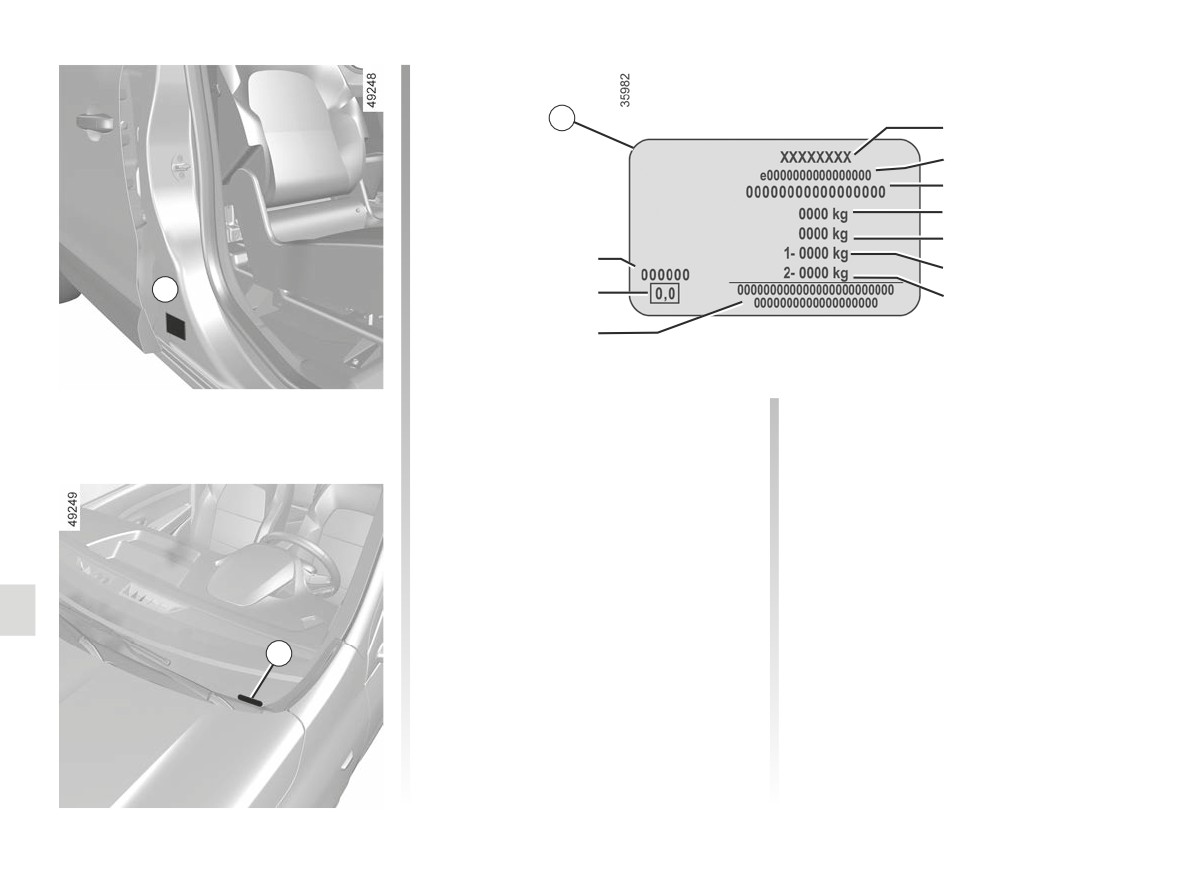
VEHICLE IDENTIFICATION PLATES
A
1
2
3
4
5
10
6
A
9
7
8
Quote the details given on identifica-
5
MTR (Gross train weight: vehicle
tion plate A on all letters or orders.
fully loaded, with trailer).
The presence and location of the in-
6
MMTA (Maximum Permissible
formation depends on the vehicle.
Weight) front axle.
7
MMTA rear axle.
Vehicle identification plate A
8
Reserved for related or additional
1
Manufacturer name.
entries.
2
EC design number or approval
9
Diesel exhaust emissions.
number.
Depending on the vehicle, this
3
Identification number.
information is not indicated on
This information is repeated on
the manufacturer’s plate but on
the marking B.
the engine smoke opacity label
4
MMAC (Maximum permissible
B
➥ 2.10.
all-up weight).
10
Paint reference (colour code).
6.2
CarManuals2.co
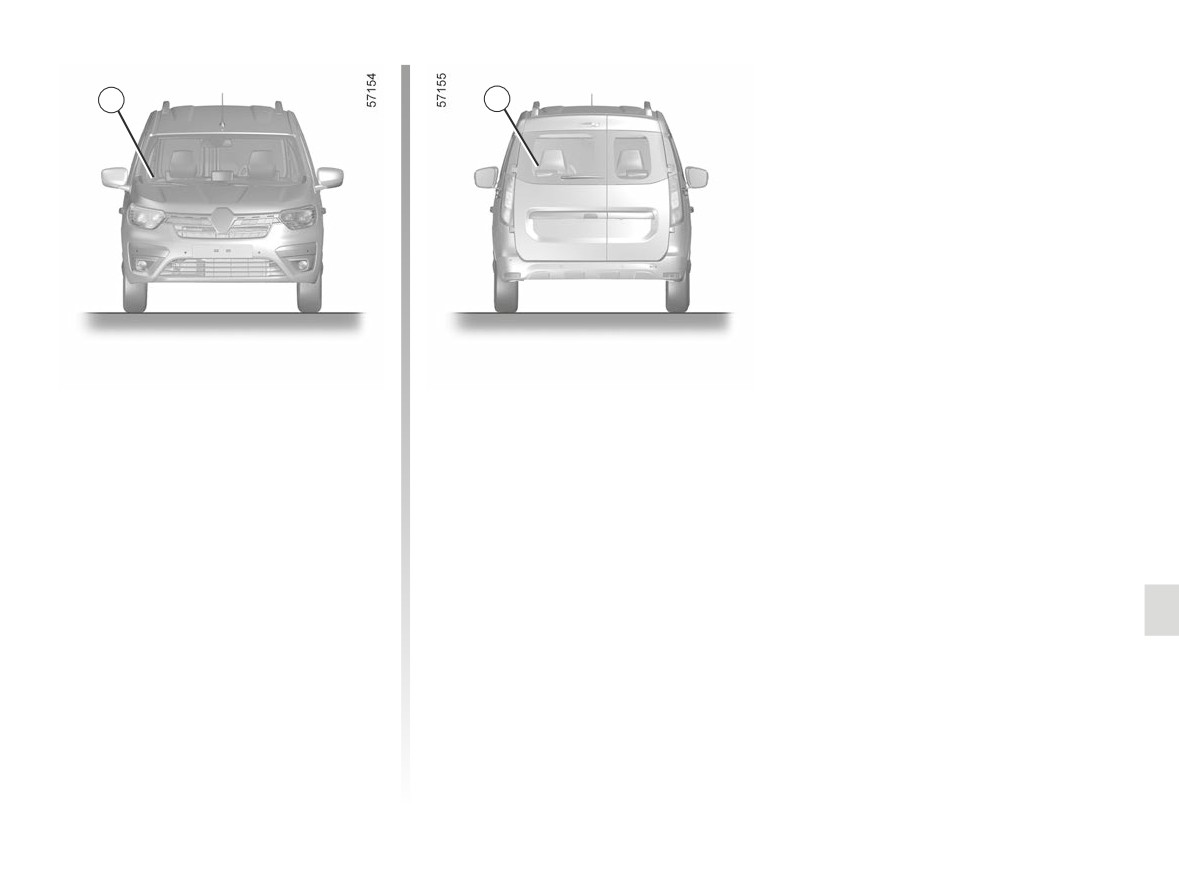
TECHNICAL INFORMATION FOR THE EMERGENCY SERVICES
A
A
The QR Code on the A label allows
Note: vehicles without rear windows
emergency workers using a tablet or
have only the front label affixed.
smartphone to immediately access the
technical information useful for working
on the vehicle in the event of an acci-
dent.
Ensure that the A label is always visible
and present on the windscreen as well
as the rear screen.
Any modification or damage would
prevent access to the information.
6.3
CarManuals2.co
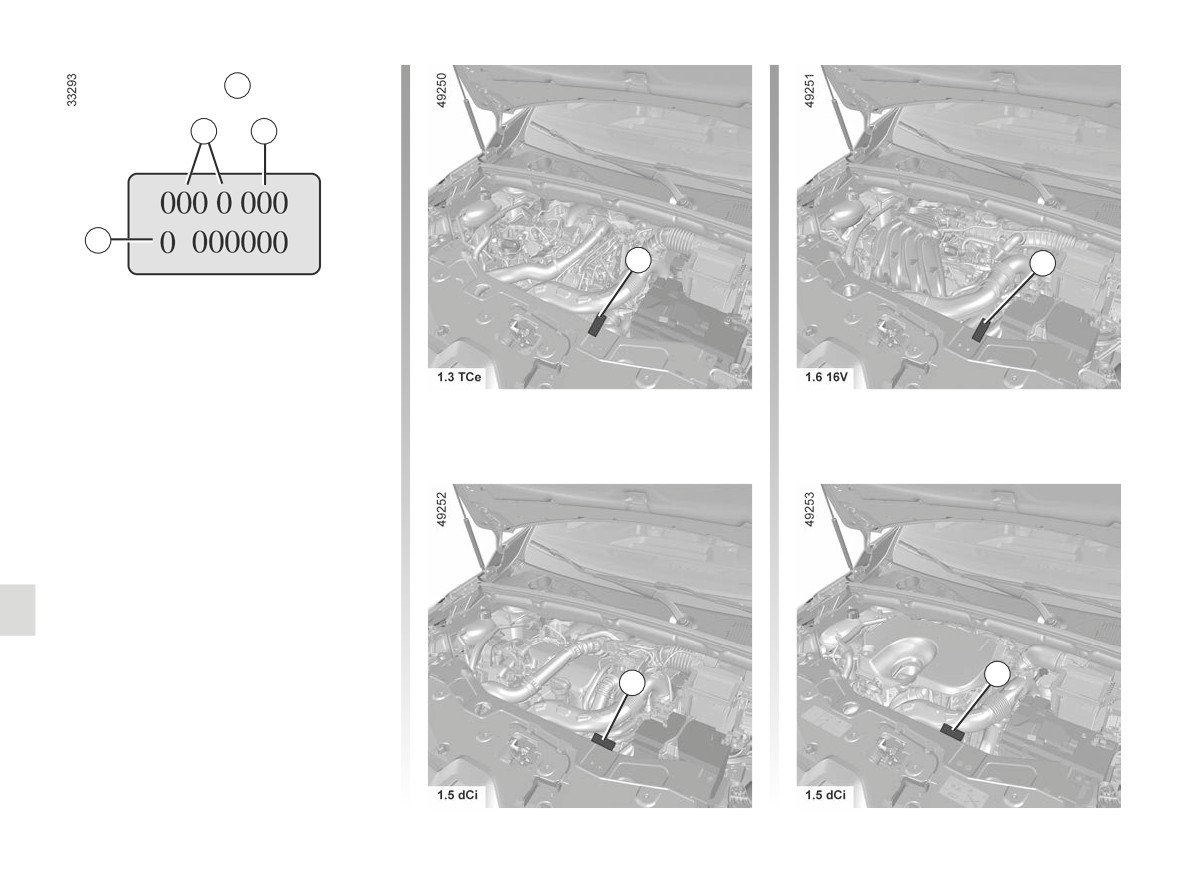
ENGINE IDENTIFICATION
A
1
2
3
A
A
Please quote the engine identifica-
tion information in area A in all cor-
respondence or orders.
(Location varies depending on engine)
1
Engine type.
2
Engine suffix.
3
Engine serial number.
A
A
6.4
CarManuals2.co
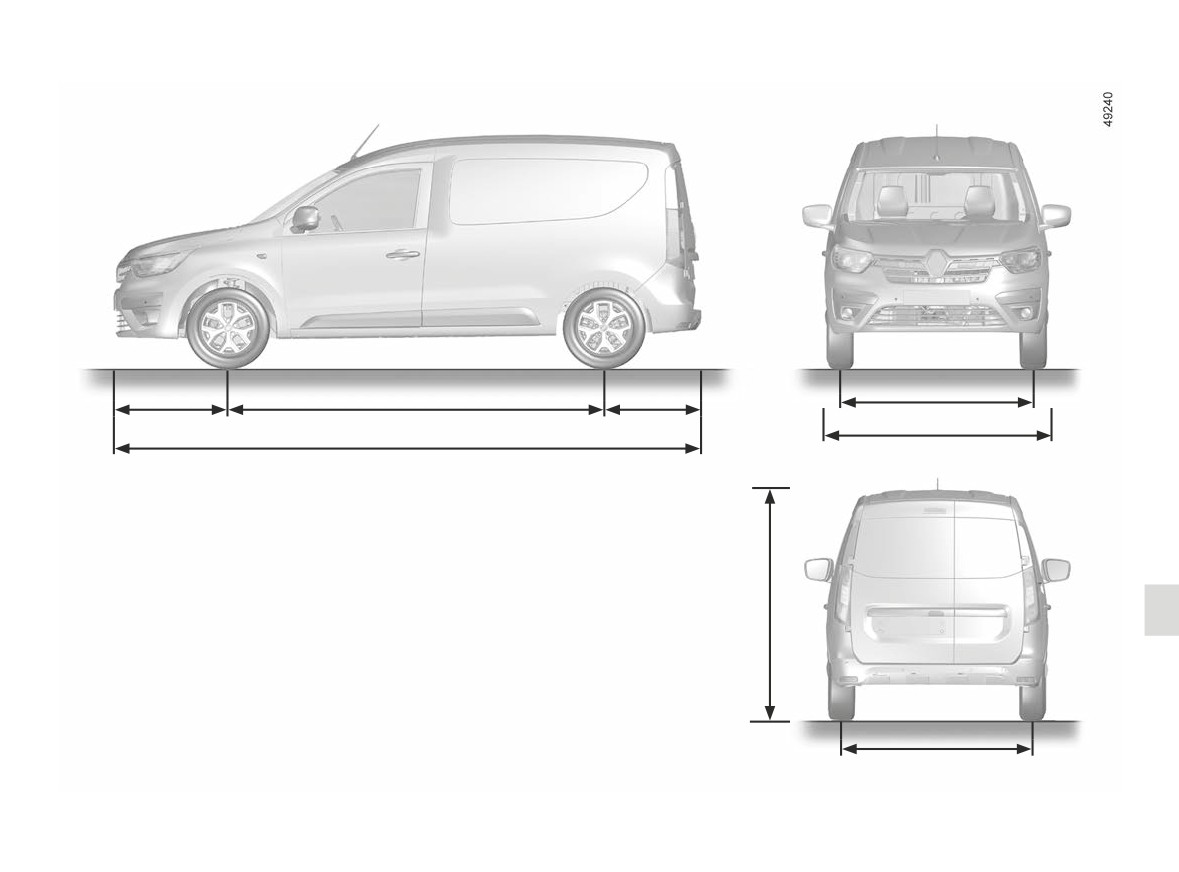
DIMENSIONS (in metres) (1/2)
Van version
0,851
2,812
0,730
1,488
1,883 ** - 2,079 ***
4,393
1,811 - 1,850 *
1,491
* unladen, with or without roof bars
** with rear view mirrors folded away
*** with rear view mirrors open
6.5
CarManuals2.co
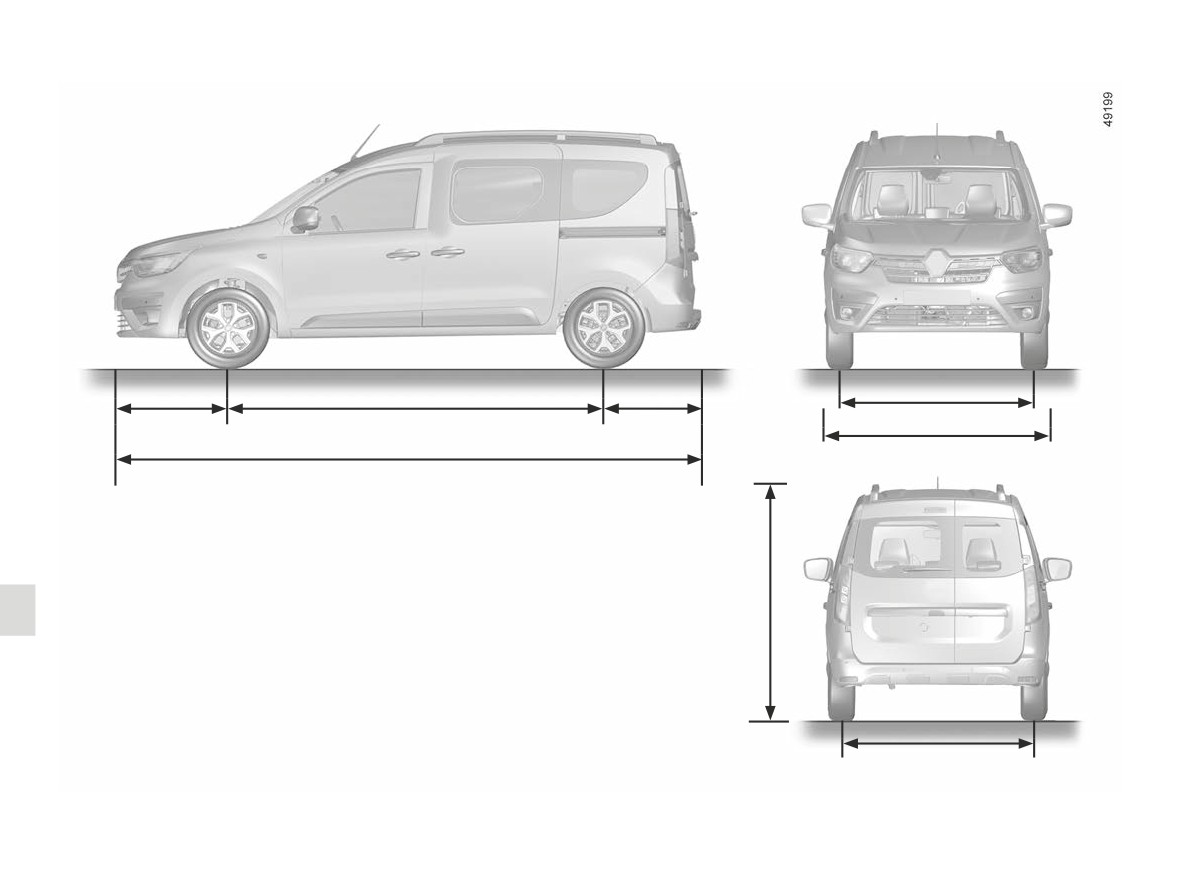
DIMENSIONS (in metres) (2/2)
Estate version
0,851
2,812
0,730
1,488
1,883 ** - 2,079 ***
4,393
1,804 - 1,842 *
1,491
* unladen, with or without roof bars
** with rear view mirrors folded away
*** with rear view mirrors open
6.6
CarManuals2.co
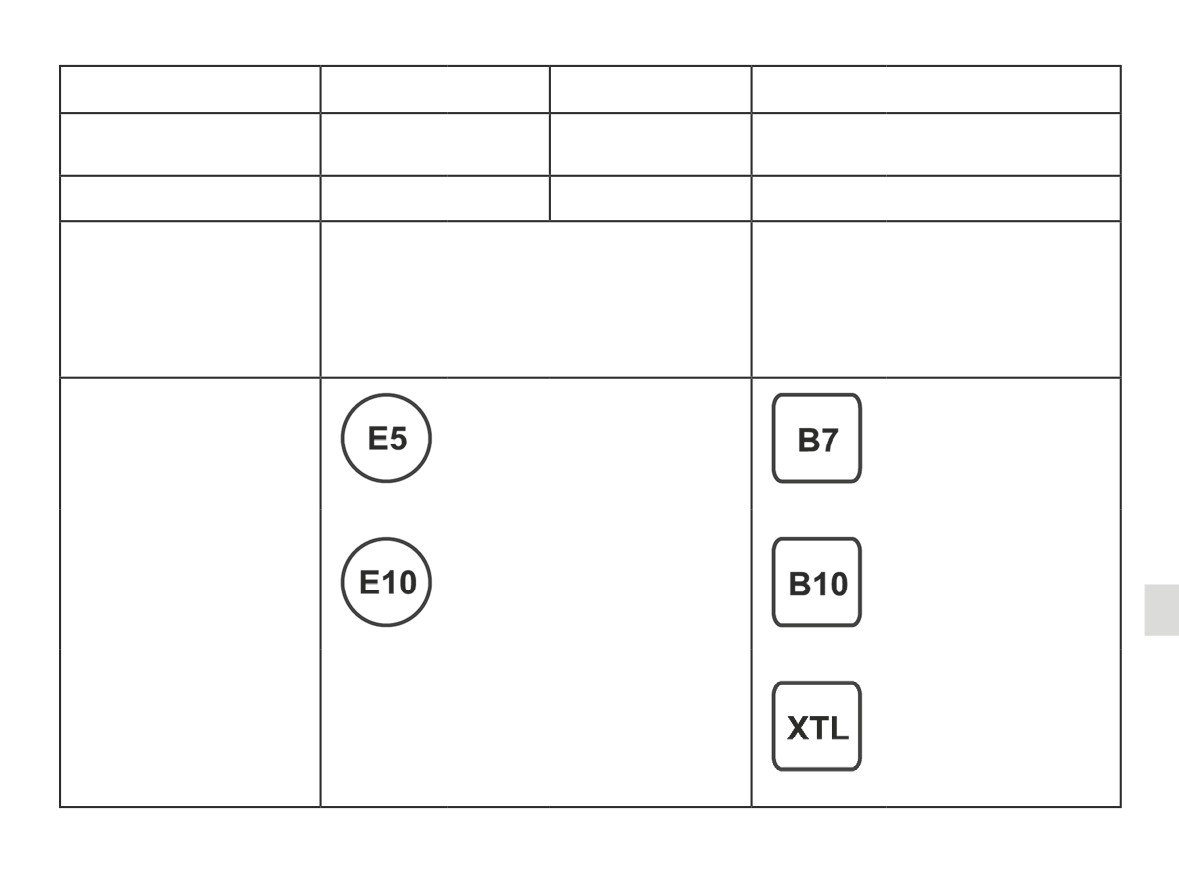
ENGINE SPECIFICATIONS (1/2)
Versions
1.3 TCe
1,6 16V
1.5 dCi
Engine type
H5Ht
H4M
K9Kt
(see engine plate)
Cubic capacity (cc)
1 332
1 598
1.461
Petrol
Diesel
You must use unleaded petrol with the octane
The label located in the fuel filler flap indi-
Type of fuel
rating stated on the label inside the fuel filler flap.
cates authorised fuels.
Octane rating
➥ 1.95.
Diesel fuel compliant with
Unleaded petrol compliant with
standard EN 590 contains
standard EN 228 contains up to 5%
up to 7% fatty acid methyl
ethanol in volume.
ester in volume.
Fuel types that meet
Diesel fuel compliant with
European standards and
Unleaded petrol compliant with
standard EN 16734 con-
are compatible with the en-
standard EN 228 contains up to
tains up to 10% fatty acid
gines of vehicles sold in
10% ethanol in volume.
methyl ester in volume.
Europe (in any other case,
contact an Approved Dealer).
Diesel fuel compliant with
standard EN 15940 con-
tains up to 7% acid methyl
ester in volume.
6.7
CarManuals2.co
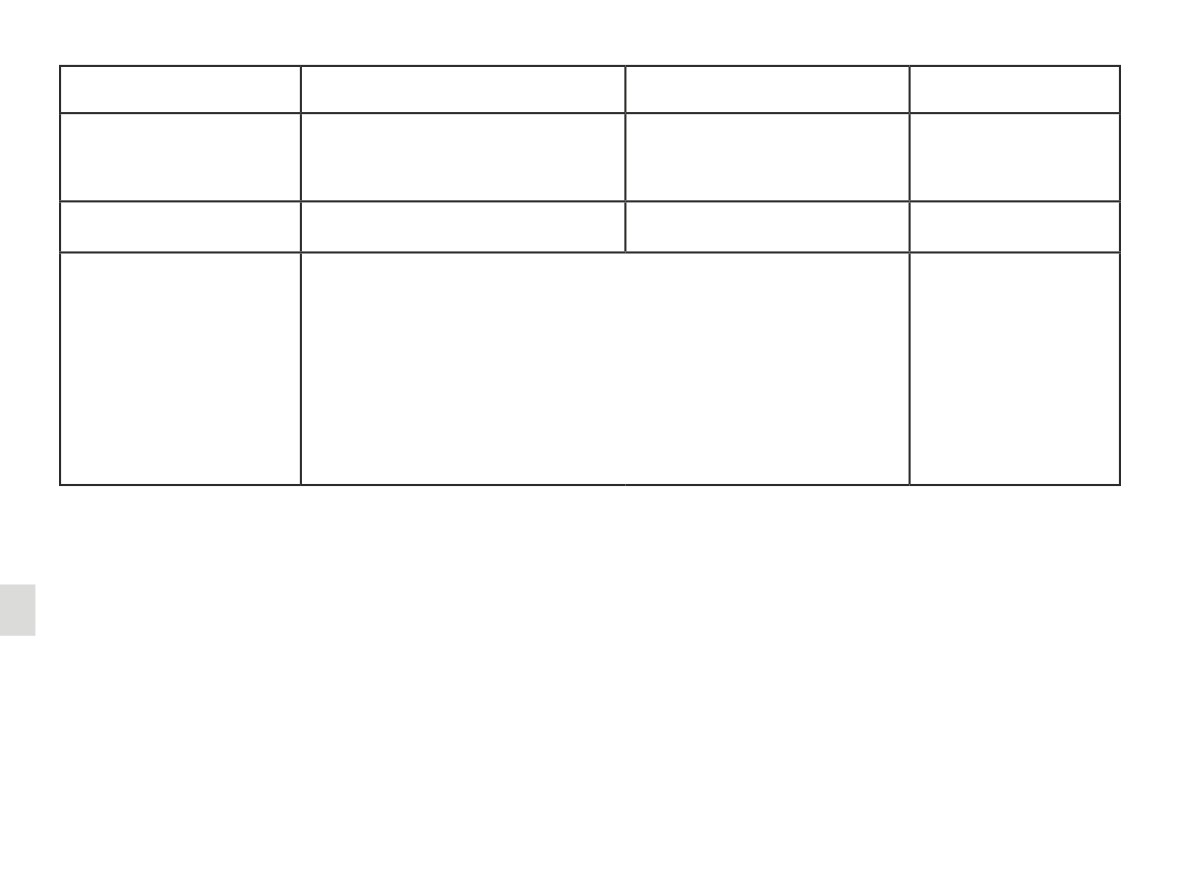
ENGINE SPECIFICATIONS (2/2)
Versions
1.3 TCe
1.6 16V
1.5 dCi
Engine type
H5Ht
H4M
K9Kt
(see engine plate)
Cubic capacity (cc)
1 332
1 598
1.461
Only use spark plugs specified for your vehicle’s engine.
The type should be marked on a label affixed inside the engine compart-
Spark plugs
_
ment. If it is not then contact an approved Dealer.
Fitting spark plugs other than those specified may damage the engine.
6.8
CarManuals2.co
WEIGHTS (in kg) (1/2)
The weights indicated are for a basic vehicle without options: they vary depending on your vehicle’s equipment. Consult
an approved dealer.
Van version
Maximum Authorised Mass (MMAC)
Maximum permissible weight (MMTA)
Weights indicated on the vehicle identification plate ➥ 6.2.
Gross Train Weight (MTR)
Braked Trailer Weight*
found by calculating: MTR- MMAC
Unbraked trailer weight*
620
Permissible nose weight*
75
Maximum permissible load on roof with a
80 (including carrying equipment)
carrying device
* Towing weight (Towing a caravan, boat etc.)
Towing is prohibited when the MTR - MMAC calculation is equal to zero, or when the MTR is equal to zero (or is not listed) on the
identification plate.
- It is important to respect local towing regulations in force, specifically those set out in the Highway Code. Contact an approved
Dealer for any modifications to towing equipment.
- When towing, under no circumstances may the total train weight (vehicle + trailer) be exceeded. However the following is
permitted:
- rear axle MMTA exceeded by no more than 15%,
- maximum MMAC exceeded by no more than 10% or 100 kg (whichever is reached first).
In either case, the maximum speed of the towing assembly must not exceed 48 mph (80 km/h) and the tyre pressure must be
increased by 0.2 bar (3 PSI).
- The engine output and climbing capability are reduced with altitude. We recommend that the maximum load be reduced by 10%
at an altitude of 1,000 metres and by an additional 10% for each 1,000 metres thereafter.
6.9
CarManuals2.co
WEIGHTS (in kg) (2/2)
The weights indicated are for a basic vehicle without options: they vary depending on your vehicle’s equipment. Consult
an approved dealer.
Estate version
Maximum Authorised Mass (MMAC)
Maximum permissible weight (MMTA)
Weights indicated on the vehicle identification plate ➥ 6.2.
Gross Train Weight (MTR)
Braked Trailer Weight*
found by calculating: MTR - MMAC
Unbraked trailer weight*
645
Permissible nose weight*
75
Maximum permissible load on roof with a
80 (including carrying equipment)
carrying device
* Towing weight (Towing a caravan, boat etc.)
Towing is prohibited when the MTR - MMAC calculation is equal to zero, or when the MTR is equal to zero (or is not listed) on the
identification plate.
- It is important to respect local towing regulations in force, specifically those set out in the Highway Code. Contact an approved
Dealer for any modifications to towing equipment.
- When towing, under no circumstances may the total train weight (vehicle + trailer) be exceeded. However the following is
permitted:
- rear axle MMTA exceeded by no more than 15%,
- maximum MMAC exceeded by no more than 10% or 100 kg (whichever is reached first).
In either case, the maximum speed of the vehicle and trailer must not exceed 62 mph (100 km/h) and the tyre pressures must
be increased by 0.2 bar (3 psi).
- The engine output and climbing capability are reduced with altitude. We recommend that the maximum load be reduced by 10%
at an altitude of 1,000 metres and by an additional 10% for each 1,000 metres thereafter.
6.10
CarManuals2.co
REPLACEMENT PARTS AND REPAIRS
Original parts are based on strict specifications and are subject to highly-specialised tests. Therefore, they are of at least the same
level of quality as the parts fitted originally.
If you always fit genuine replacement parts to your vehicle, you will ensure that it performs well. Furthermore, repairs carried out
within the manufacturer’s Network using original parts are guaranteed according to the conditions set out on the reverse of the
repair order.
6.11
CarManuals2.co
SERVICE SHEETS (1/6)
VIN:
Date:
Miles (Km):
Invoice number:
Comments/miscellaneous
Type of operation:
Stamp
Service
□
□
Anti-corrosion check:
OK □ Not OK* □
*See specific page
Date:
Miles (Km):
Invoice number:
Comments/miscellaneous
Type of operation:
Stamp
Service
□
□
Anti-corrosion check:
OK □ Not OK* □
*See specific page
Date:
Miles (Km):
Invoice number:
Comments/miscellaneous
Type of operation:
Stamp
Service
□
□
Anti-corrosion check:
OK □ Not OK* □
*See specific page
6.12
CarManuals2.co
SERVICE SHEETS (2/6)
VIN:
Date:
Miles (Km):
Invoice number:
Comments/miscellaneous
Type of operation:
Stamp
Service
□
□
Anti-corrosion check:
OK □ Not OK* □
*See specific page
Date:
Miles (Km):
Invoice number:
Comments/miscellaneous
Type of operation:
Stamp
Service
□
□
Anti-corrosion check:
OK □ Not OK* □
*See specific page
Date:
Miles (Km):
Invoice number:
Comments/miscellaneous
Type of operation:
Stamp
Service
□
□
Anti-corrosion check:
OK □ Not OK* □
*See specific page
6.13
CarManuals2.co
SERVICE SHEETS (3/6)
VIN:
Date:
Miles (Km):
Invoice number:
Comments/miscellaneous
Type of operation:
Stamp
Service
□
□
Anti-corrosion check:
OK □ Not OK* □
*See specific page
Date:
Miles (Km):
Invoice number:
Comments/miscellaneous
Type of operation:
Stamp
Service
□
□
Anti-corrosion check:
OK □ Not OK* □
*See specific page
Date:
Miles (Km):
Invoice number:
Comments/miscellaneous
Type of operation:
Stamp
Service
□
□
Anti-corrosion check:
OK □ Not OK* □
*See specific page
6.14
CarManuals2.co
SERVICE SHEETS (4/6)
VIN:
Date:
Miles (Km):
Invoice number:
Comments/miscellaneous
Type of operation:
Stamp
Service
□
□
Anti-corrosion check:
OK □ Not OK* □
*See specific page
Date:
Miles (Km):
Invoice number:
Comments/miscellaneous
Type of operation:
Stamp
Service
□
□
Anti-corrosion check:
OK □ Not OK* □
*See specific page
Date:
Miles (Km):
Invoice number:
Comments/miscellaneous
Type of operation:
Stamp
Service
□
□
Anti-corrosion check:
OK □ Not OK* □
*See specific page
6.15
CarManuals2.co
SERVICE SHEETS (5/6)
VIN:
Date:
Miles (Km):
Invoice number:
Comments/miscellaneous
Type of operation:
Stamp
Service
□
□
Anti-corrosion check:
OK □ Not OK* □
*See specific page
Date:
Miles (Km):
Invoice number:
Comments/miscellaneous
Type of operation:
Stamp
Service
□
□
Anti-corrosion check:
OK □ Not OK* □
*See specific page
Date:
Miles (Km):
Invoice number:
Comments/miscellaneous
Type of operation:
Stamp
Service
□
□
Anti-corrosion check:
OK □ Not OK* □
*See specific page
6.16
CarManuals2.co
SERVICE SHEETS (6/6)
VIN:
Date:
Miles (Km):
Invoice number:
Comments/miscellaneous
Type of operation:
Stamp
Service
□
□
Anti-corrosion check:
OK □ Not OK* □
*See specific page
Date:
Miles (Km):
Invoice number:
Comments/miscellaneous
Type of operation:
Stamp
Service
□
□
Anti-corrosion check:
OK □ Not OK* □
*See specific page
Date:
Miles (Km):
Invoice number:
Comments/miscellaneous
Type of operation:
Stamp
Service
□
□
Anti-corrosion check:
OK □ Not OK* □
*See specific page
6.17
CarManuals2.co
ANTICORROSION CHECK (1/6)
If the continuation of the warranty is subject to repair, it is indicated below.
VIN:
Corrosion repair operation to be carried
Stamp
out:
Date of repair:
Repair to be carried out:
Stamp
Date of repair:
Repair to be carried out:
Stamp
Date of repair:
6.18
CarManuals2.co
ANTICORROSION CHECK (2/6)
If the continuation of the warranty is subject to repair, it is indicated below.
VIN:
Corrosion repair operation to be carried
Stamp
out:
Date of repair:
Repair to be carried out:
Stamp
Date of repair:
Repair to be carried out:
Stamp
Date of repair:
6.19
CarManuals2.co
ANTICORROSION CHECK (3/6)
If the continuation of the warranty is subject to repair, it is indicated below.
VIN:
Corrosion repair operation to be carried
Stamp
out:
Date of repair:
Repair to be carried out:
Stamp
Date of repair:
Repair to be carried out:
Stamp
Date of repair:
6.20
CarManuals2.co
ANTICORROSION CHECK (4/6)
If the continuation of the warranty is subject to repair, it is indicated below.
VIN:
Corrosion repair operation to be carried
Stamp
out:
Date of repair:
Repair to be carried out:
Stamp
Date of repair:
Repair to be carried out:
Stamp
Date of repair:
6.21
CarManuals2.co
ANTICORROSION CHECK (5/6)
If the continuation of the warranty is subject to repair, it is indicated below.
VIN:
Corrosion repair operation to be carried
Stamp
out:
Date of repair:
Repair to be carried out:
Stamp
Date of repair:
Repair to be carried out:
Stamp
Date of repair:
6.22
CarManuals2.co
ANTICORROSION CHECK (6/6)
If the continuation of the warranty is subject to repair, it is indicated below.
VIN:
Corrosion repair operation to be carried
Stamp
out:
Date of repair:
Repair to be carried out:
Stamp
Date of repair:
Repair to be carried out:
Stamp
Date of repair:
6.23
CarManuals2.co