Renault Arkana (2023 year). Manual in english - page 5
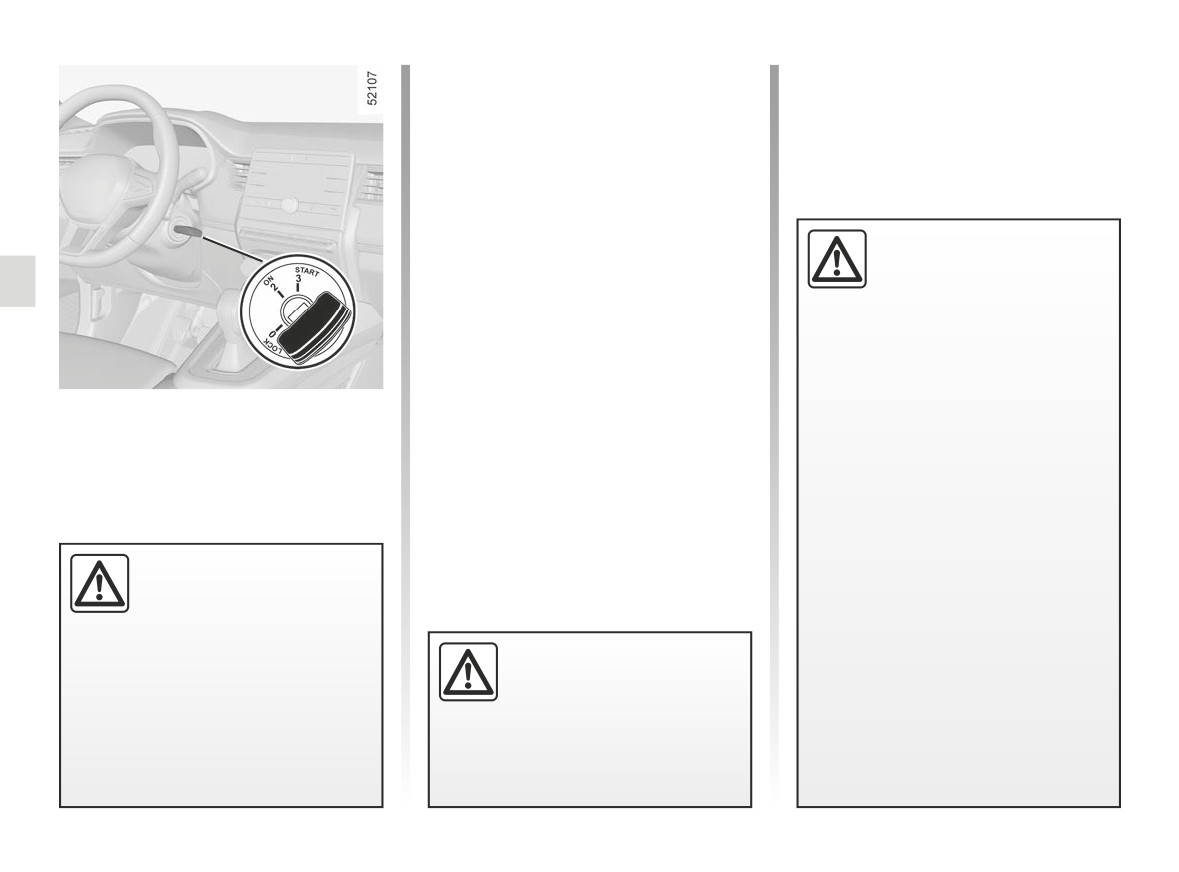
STARTING, STOPPING THE ENGINE: vehicle with key
Starting the engine
To start:
On vehicles equipped with automatic
gearboxes with a mechanical lever, set
the lever to position P.
- Activate the starter without acceler-
ating;
Driver’s responsibility
- release the key as soon as the
when parking or stopping
engine starts.
the vehicle
Never leave an animal,
child or adult who is not self-suffi-
Stopping the engine
cient alone in your vehicle, even for
With the engine idling, turn the key to
a short time.
the “LOCK” position 0.
They may pose a risk to themselves
or to others by starting the engine,
activating equipment such as the
electric windows or locking the
doors, for example.
Also, in hot and/or sunny weather,
please remember that the tempera-
ture inside the passenger compart-
Never switch off the igni-
ment increases very quickly.
tion before the vehicle has
stopped completely. Once
RISK OF DEATH OR SERIOUS
the engine has stopped, the
INJURY.
brake servo, power-assisted steer-
Never start your vehicle
ing etc., and the passive safety de-
while freewheeling on a gra-
vices such as the airbags and pre-
dient. Risk of non-activation
tensioners will no longer operate.
of power-assisted steering.
There is a risk of accidents.
2.4
CarManuals2.co
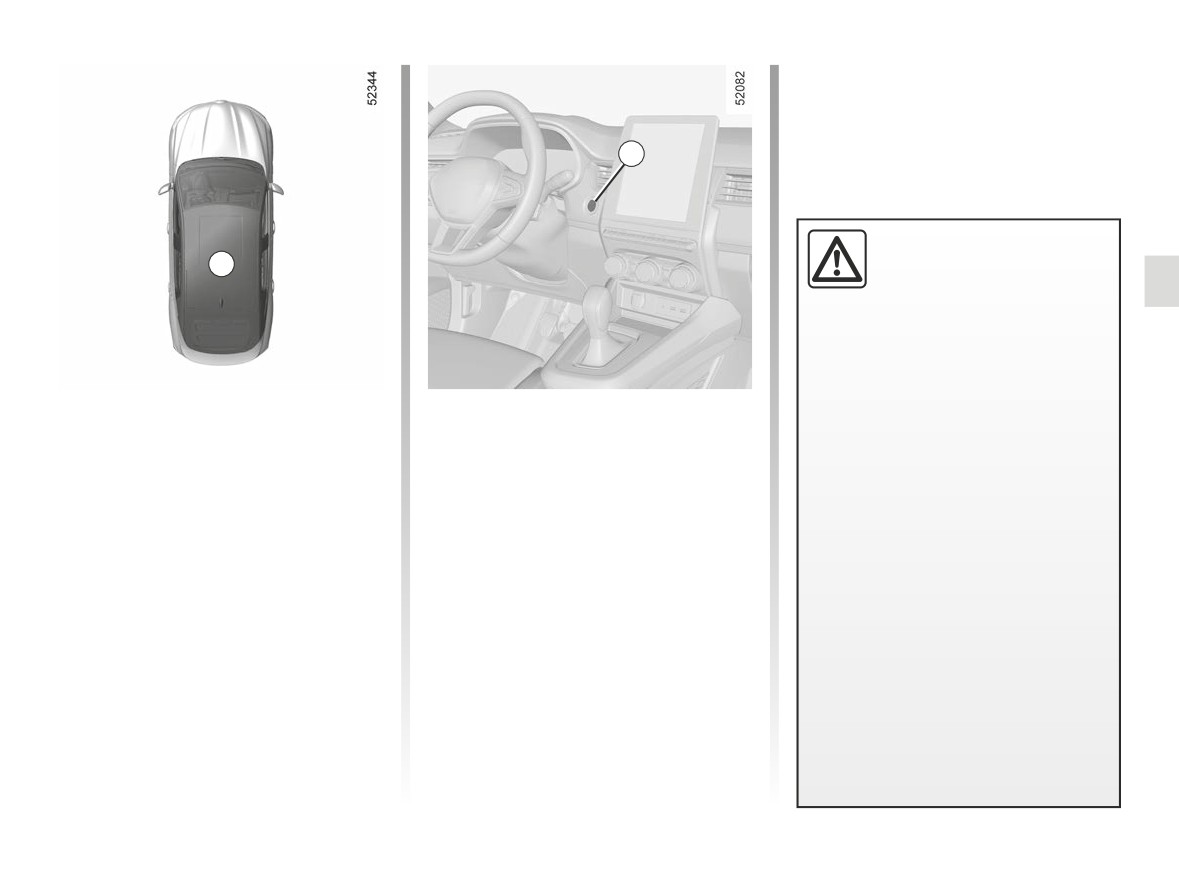
STARTING, STOPPING THE ENGINE: vehicle with card (1/3)
2
Driver’s responsibility
when parking or stopping
1
the vehicle
Never leave an animal,
child or adult who is not self-suffi-
cient alone in your vehicle, even for
a short time.
The card must be inserted in detection
Special features
They may pose a risk to themselves
zone 1.
or to others by starting the engine,
- If one of the conditions required for
activating equipment such as the
To start:
starting is not met, the message
electric windows or locking the
“Press Brake + START” will appear
- on vehicles with an automatic gear-
doors, for example.
on the instrument panel;
box, while in P position, press the
Also, in hot and/or sunny weather,
brake pedal and 2 button;
- in some cases, it will be necessary
please remember that the tempera-
to move the steering wheel whilst
- vehicles with a manual gearbox,
ture inside the passenger compart-
pressing the start button 2 to help
depress the brake or clutch pedal
ment increases very quickly.
unlock the steering column; the
and press the button 2. If a gear is
message “Turn Steering Wheel +
RISK OF DEATH OR SERIOUS
engaged, the vehicle may only be
START” will warn you of this;
INJURY.
started by depressing the clutch
pedal.
2.5
CarManuals2.co
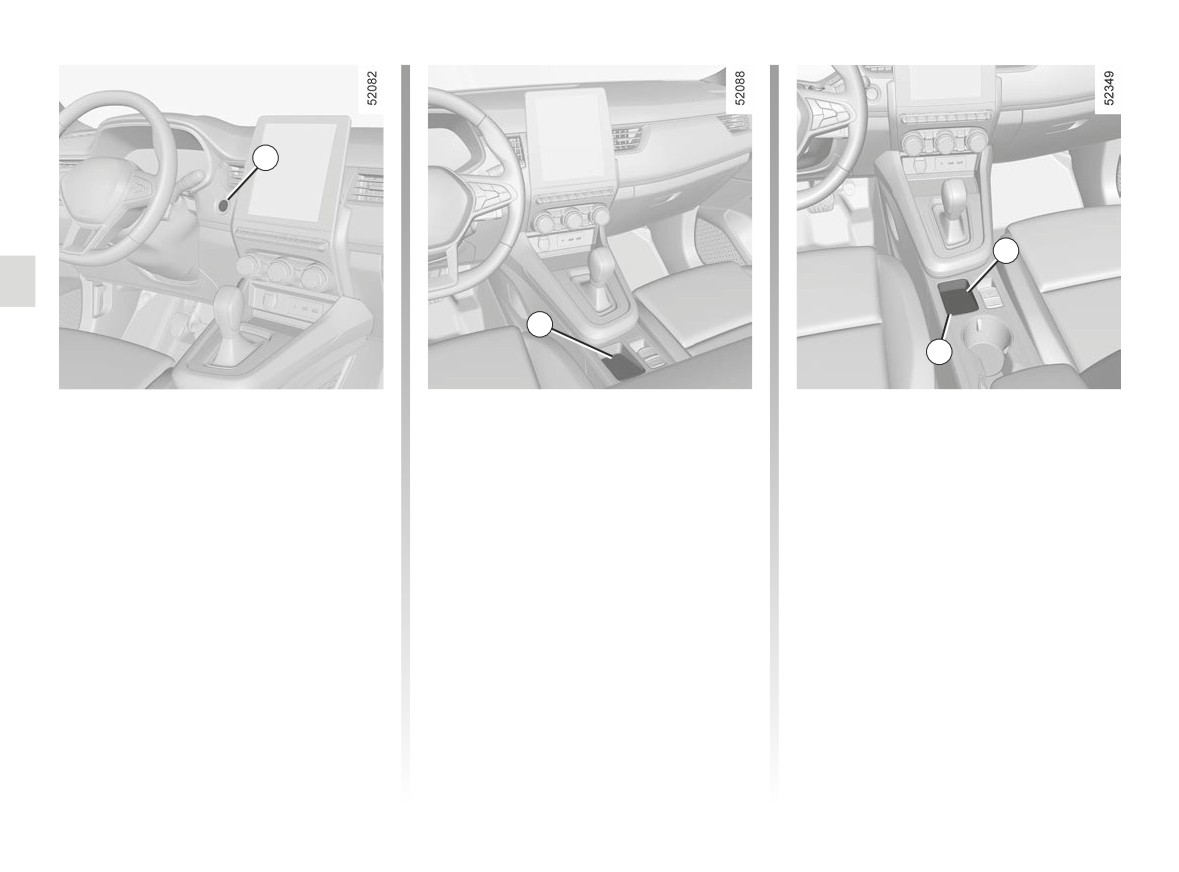
STARTING, STOPPING THE ENGINE: vehicle with card (2/3)
2
4
3
3
“Hands-free” starting with
Operating faults
The message “Place card on zone +
START” appears on the instrument
the tailgate open
In certain cases, the hands-free card
panel.
In this case, the card should not be lo-
may not work:
Press the brake or clutch pedal, then
cated in the luggage compartment, to
- when the card battery is dead;
place the card 4 (button side) on the
prevent the risk of loss.
- near to appliances operating on the
placement area 3. Press the 2 button
same frequency as the card (moni-
to start the vehicle. The message goes
Accessories function
tor, mobile phone, video game, etc.);
out.
(switching on the ignition)
- vehicle located in a high electromag-
Once you have gained access to your
netic radiation zone.
vehicle, you may use some of its func-
tions (radio, navigation, wipers, etc.).
To use the other functions, with the
card in the passenger compartment,
press the 2 button without pressing the
pedals.
2.6
CarManuals2.co
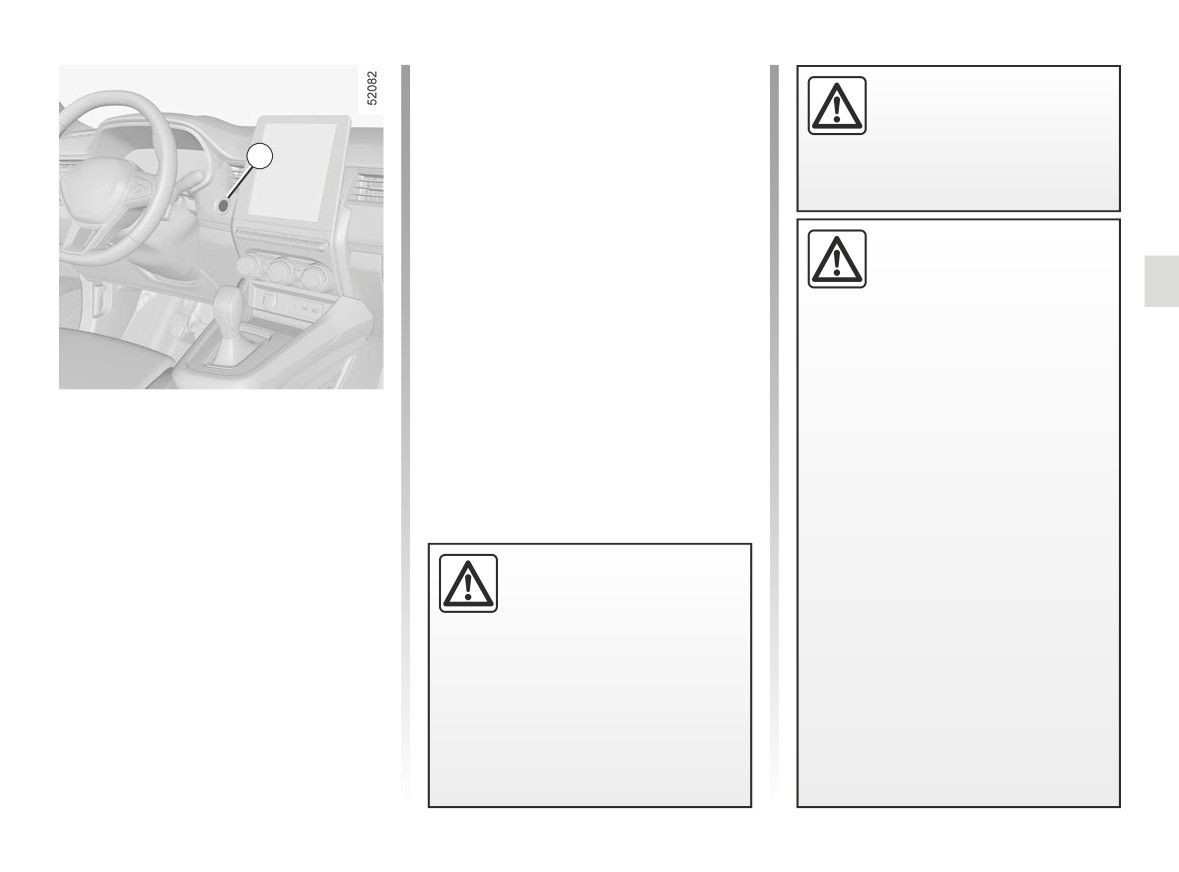
STARTING, STOPPING THE ENGINE: vehicle with card (3/3)
If the card is no longer in the passenger
When you leave your vehi-
compartment when you try to switch the
cle, especially if you have
engine off, the message “Card miss-
your card with you, check
ing: press and hold” appears on the
that the engine is com-
2
instrument panel: press the 2 button
pletely switched off.
for at least two seconds. If the card is
no longer in the passenger compart-
ment, make sure you can retrieve it
before pressing and holding the button.
Driver’s responsibility
Without the card, you will not be able
when parking or stopping
to start.
the vehicle
With the engine switched off, any ac-
Never leave an animal,
cessories being used (radio, etc.) will
child or adult who is not self-suffi-
continue to function for approximately
cient alone in your vehicle, even for
10 minutes.
a short time.
When the driver’s door is opened, the
They may pose a risk to themselves
Conditions for stopping the
accessories stop working.
or to others by starting the engine,
engine
activating equipment such as the
The vehicle must be stationary, in P
electric windows or locking the
position on vehicles with an automatic
doors, for example.
gearbox.
Also, in hot and/or sunny weather,
With the card in the vehicle, press
please remember that the tempera-
button 2: the engine stops. The steer-
ture inside the passenger compart-
Never switch off the igni-
ing column is locked when a door is
ment increases very quickly.
tion before the vehicle has
opened or the vehicle is locked.
stopped completely. Once
RISK OF DEATH OR SERIOUS
the engine has stopped, the
INJURY.
brake servo, power-assisted steer-
ing etc., and the passive safety de-
vices such as the airbags and pre-
tensioners will no longer operate.
2.7
CarManuals2.co
STOP AND START FUNCTION (1/4)
This system enables a reduced fuel
and
In this case it becomes operational
consumption and lower greenhouse
again when the engine is no longer on
- the accelerator pedal is not de-
gas emissions. The system is acti-
standby or the speed exceeds approxi-
pressed;
vated automatically when the vehicle
mately 1 mph (1 km/h) (downhill, slope
is started. During driving, the system
and
etc.).
stops the engine (standby) when the
- when the vehicle speed is zero
vehicle comes to a stop or is moving at
during approximately one second or,
a slow speed (traffic jam, traffic lights,
depending on the vehicle, as soon
etc), depending on the vehicle.
as the vehicle speed is below ap-
proximately 3 mph (5 km/h).
Conditions for engine
The engine remains on standby if posi-
standby
tion P is selected, or if position N is se-
If the engine is put in
lected with the handbrake engaged and
The vehicle has set off from where it
standby, the electronic
the brake pedal released.
was parked;
parking brake (depending
on the vehicle) is not ap-
- the gearbox is in position D, M or N;
Warning light
on the instru-
plied automatically.
ment panel is lit when the engine is on
and
standby.
- the brake pedal is depressed (suffi-
The vehicle equipment remain opera-
ciently hard);
Keep your vehicle station-
tional while the engine is stopped.
Depending on the vehicle, if the
ary when the engine is
When the engine switches to standby,
on standby (shown by the
warning light flashes and that
the steering assistance may no longer
the message “Press brake pedal”
be operational.
warning light
on the
appears on the instrument panel,
instrument panel).
this indicates that the brake pedal is
not sufficiently pressed;
The engine MUST be
stopped (not put in standby)
before leaving the vehicle
➥ 2.4 ➥ 2.5.
2.8
CarManuals2.co
STOP AND START FUNCTION (2/4)
Preventing the engine from
Conditions for coming out of
standing by
engine standby
In certain situations, such as negotiat-
-
when the driver’s door is opened;
ing a crossroads for instance, it is pos-
or
sible (with the system activated) to keep
the engine running so as to be ready to
-
when the driver’s seat belt is unfas-
move off quickly.
tened;
Keep the vehicle stationary without
-
the brake pedal is released, position
pressing too hard on the brake pedal.
D or M engaged;
or
-
brake pedal is released, position
N engaged and parking brake re-
leased;
or
-
parking brake is applied again, po-
sition P engaged, or position N en-
gaged with parking brake applied;
or
-
position R is engaged;
or
-
the accelerator pedal is depressed;
or
“AUTOHOLD” function
activated
-
in manual mode, the gear change
➥ 2.18, the brake pedal may be
paddles are activated.
released and the engine standby
To fill up with fuel, the engine must
maintained.
be stopped (and not put in standby):
you MUST stop the engine ➥ 2.4
To exit engine standby, with the
➥ 2.5.
brake pedal released, press the ac-
celerator pedal.
2.9
CarManuals2.co
STOP AND START FUNCTION (3/4)
Conditions preventing the
- the gradient is too steep for vehicles
fitted with an automatic gearbox;
standby of the engine
- the “Clear view” function is activated
Certain conditions prevent the system
➥ 3.9;
from using the engine standby function,
including when:
- the engine temperature is too low;
-
the driver’s door is not closed;
- the emission control system is being
regenerated;
–
the driver’s seatbelt is not fastened;
- ...
–
reverse gear is engaged;
Depending on the vehicle, warning light
–
the bonnet is not locked;
–
the outdoor temperature is too low or
is displayed on the instrument
too high;
panel. This notifies you that engine
standby is not available.
-
the battery is not sufficiently charged;
–
the difference between the vehicle
The
warning light may appear
interior temperature and the auto-
along with a message on the instru-
matic climate control instruction is
ment panel:
too high;
- “Optimising Battery Recharge” to pri-
-
parking distance control is in opera-
oritise battery charging;
tion;
- “Prioritising Thermal Comfort” to pri-
-
the altitude is too high;
oritise air conditioning;
- “Prioritising running engine” to priori-
tise engine operations.
Deactivate the Stop and
Start function for any opera-
tion performed in the engine
compartment.
2.10
CarManuals2.co
STOP AND START FUNCTION (4/4)
Special feature of the automatic
Deactivating, activating the
engine re-start
function
Under certain conditions, the engine
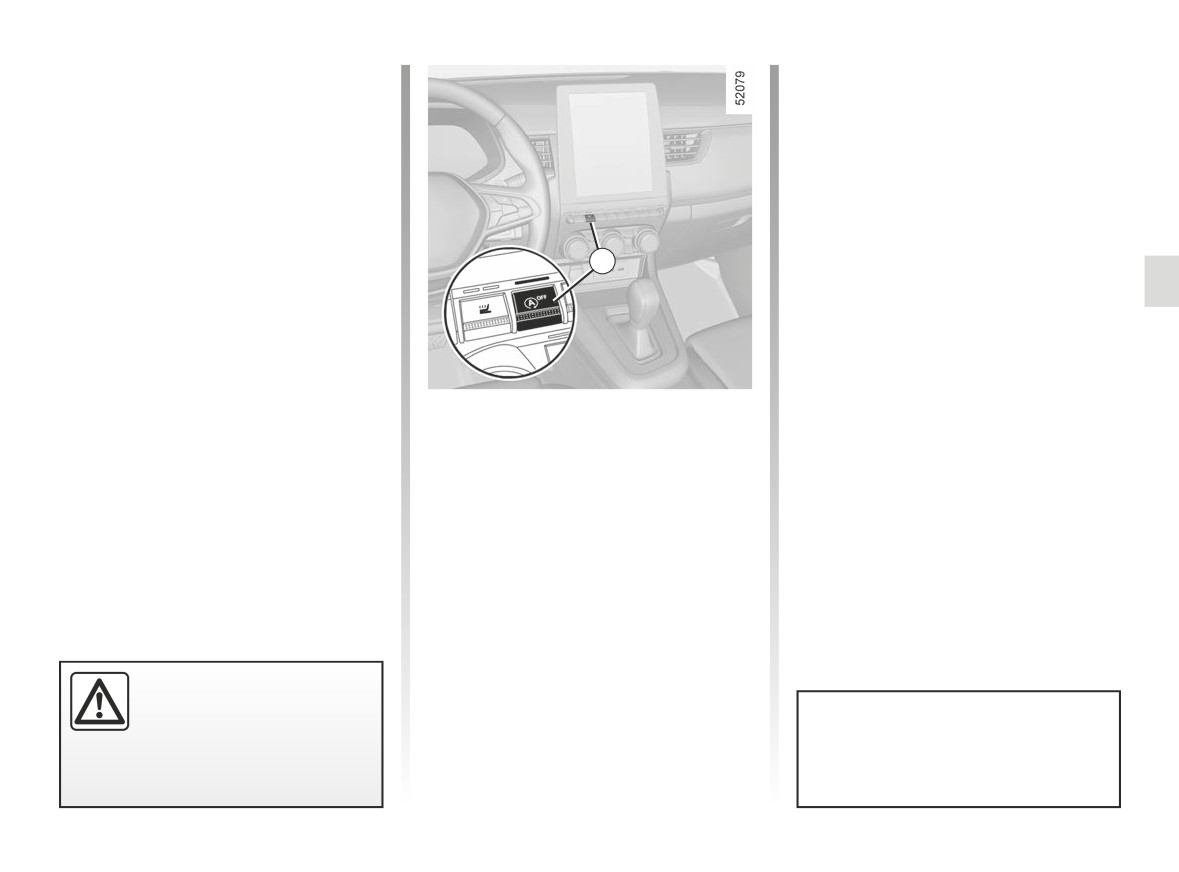
Press 1 to deactivate the function. The
can restart on its own in order to guar-
message “Stop & Start deactivated” ap-
antee your safety and comfort.
pears on the instrument panel and the
This can occur especially when:
ignition warning light 1 appears.
- the outdoor temperature is too low or
Pressing again will reactivate the
too high;
system. The message “Stop & Start
- the “Clear view” function is activated
1
Activated” appears on the instrument
➥ 3.9;
panel and the 1 switch disappears.
- the battery is not sufficiently charged;
- the vehicle speed is above 3 mph
The system is automatically reactivated
(5 km/h) (downhill slope, etc.);
each time the vehicle is started using
- repeated pressing on the brake
the start button ➥ 2.4 ➥ 2.5.
pedal or braking system require-
ment;
Operating faults
- ...
Depending on the vehicle, the
When the “Check Stop & Start” mes-
warning light may appear along with a
sage appears on the instrument panel
Depending on the vehicle, the
message on the instrument panel:
and the 1 switch is on, this indicates
warning light is displayed on the instru-
ment panel to notify you of automatic
- “Optimising Battery Recharge” to pri-
that the system is deactivated.
engine restarting.
oritise battery charging;
Please consult an authorised dealer.
- “Prioritising Thermal Comfort” to pri-
oritise air conditioning;
- “Prioritising running engine” to priori-
tise engine operations.
The engine MUST be
stopped (not put in standby)
before leaving the vehicle
Special note: engine on standby,
➥ 2.4 ➥ 2.5.
press switch 1 to automatically re-
start the engine.
2.11
CarManuals2.co
SPECIAL FEATURES OF PETROL VERSIONS (1/2)
The following operating conditions
If you notice any of the above operating
should be avoided:
faults, have the necessary repairs car-
ried out as soon as possible by an ap-
- driving for long periods when the low
proved dealer.
fuel level warning light is lit;
These faults may be avoided by regu-
- using leaded petrol;
larly taking your vehicle to an approved
- using lubricant or fuel additives
Dealer at the intervals specified in the
which are not approved.
Maintenance Document.
Or operating faults such as:
- faulty ignition, running out of fuel or
Starting problems
disconnected spark plugs resulting
To avoid damaging the catalytic con-
in the engine misfiring or cutting out
verter or the starter, and to prevent pre-
when driving;
mature wearing of the battery, do not
- loss of power.
keep trying to start the engine (using
the start button, or by pushing or towing
may cause the catalytic converter to
the vehicle) without having identified
overheat, reducing its efficiency which
and corrected the starting fault.
may irreparably damage it and cause
heat damage to the vehicle.
If the fault cannot be identified, do not
keep trying to start the engine, but con-
tact an approved Dealer.
Do not park the vehicle or
run the engine in locations
where combustible sub-
stances or materials such
as grass or leaves can come into
contact with the hot exhaust system.
2.12
CarManuals2.co
SPECIAL FEATURES OF PETROL VERSIONS (2/2)
Particle filter
Note: The indicator light may go out
If the filter becomes saturated, the
after 20 minutes when the driving con-
warning light and, depending
The particle filter is used in the treat-
ditions needed to clean the filter are not
ment of exhaust gases from petrol en-
completely met.
on the vehicle, the
warning light
gines.
will appear on the instrument panel, ac-
If the vehicle is stopped before the
Depending on the vehicle, the warning
companied by the message “Check in-
warning light disappears you will have
jection”. In this case, please consult an
to restart the process from the begin-
light
displayed on the instrument
Authorised Dealer.
ning.
panel indicates that the filter is becom-
If the
®
warning light and, de-
ing clogged and requires cleaning. To
pending on the vehicle, the
clean it, when the
warning light
warning light appears, accompanied by
appears, and as traffic conditions and
the “WARNING: Engine Failure Risk”
speed limits allow, drive at between
message, stop the vehicle, switch off
about 31 mph (50 km/h) and 68 mph
the engine and contact an Approved
(110 km/h) until the light goes out.
Dealer.
After between approximately 5 and
20 minutes, the warning light should go
out.
Warning light
®
re-
quires you to stop immedi-
ately, for your own safety,
as soon as traffic conditions
allow. Switch off the engine and do
not restart it. Contact an approved
Dealer.
2.13
CarManuals2.co
ELECTRONIC PARKING BRAKE (1/4)
In all other instances, for example the
engine has stalled or is in standby
due to the Stop and Start ➥ 2.8,
1
the assisted parking brake is not ap-
plied automatically. Manual mode must
be used. For certain country-specific
model versions, the assisted brake ap-
3
plication function is not activated. Refer
to the information on “Manual opera-
tion”.
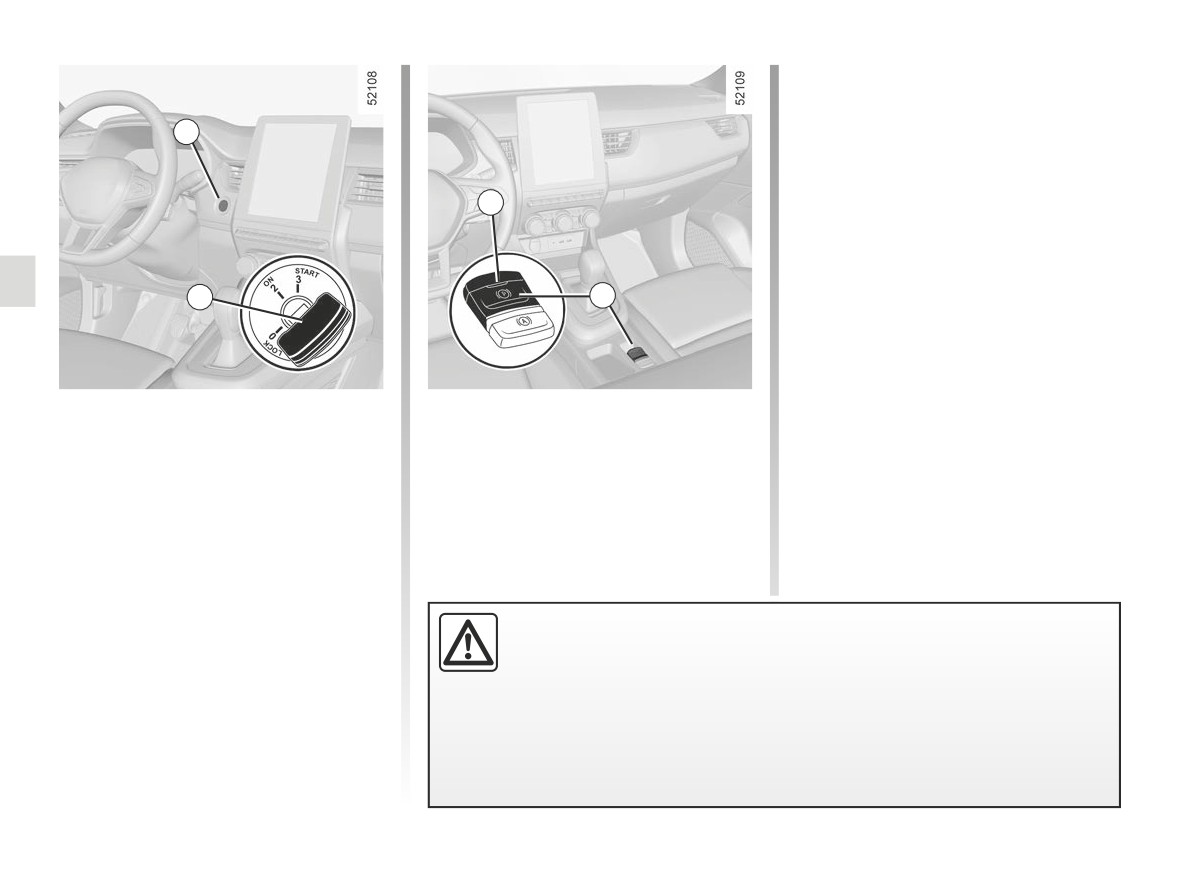
To confirm that the electronic parking
2
4
brake is applied, the message “Parking
Brake ON” is displayed, the
}
warning light appears on the instrument
panel and the 3 warning light appears
Assisted operation
or
on the 4 switch.
-
for vehicles fitted with an automatic
After the engine is switched off, indi-
Applying the electronic parking
gearbox, when position P is en-
cator light 3 goes out several minutes
brake
gaged.
after the assisted parking brake has
With the vehicle stationary, the elec-
tronic parking brake can be used to im-
been applied and indicator light }
mobilise the vehicle:
goes out when the vehicle is locked.
- by pressing the engine start/stop
button 1 or by turning the ignition
key to the 2 “ON” position (2);
The electronic parking brake can be used to immobilise the vehicle.
or
Before leaving the vehicle, check that the electronic parking brake is fully
- when the driver’s seat belt is un-
fastened;
applied. Warning light 3 on switch 4 and warning light }
on the in-
or
strument panel light up to show that the parking brake is applied but go out when
the doors are locked. Depending on the vehicle, a sticker is located on the upper
– when the driver’s door is opened;
section of the windscreen to remind you of this.
2.14
CarManuals2.co
ELECTRONIC PARKING BRAKE (2/4)
Assisted operation
(continued)
Note: in some situations (electronic
1
parking brake failure, manual release of
the parking brake, etc.), a beep sounds
and the message “WARNING: Apply
3
Parking Brake” appears on the instru-
ment panel to warn you that the elec-
tronic parking brake has been released.
- with the engine running: when the
driver’s door is opened;
4
2
- with the engine switched off (e.g.
when the engine stalls): when a front
door is opened.
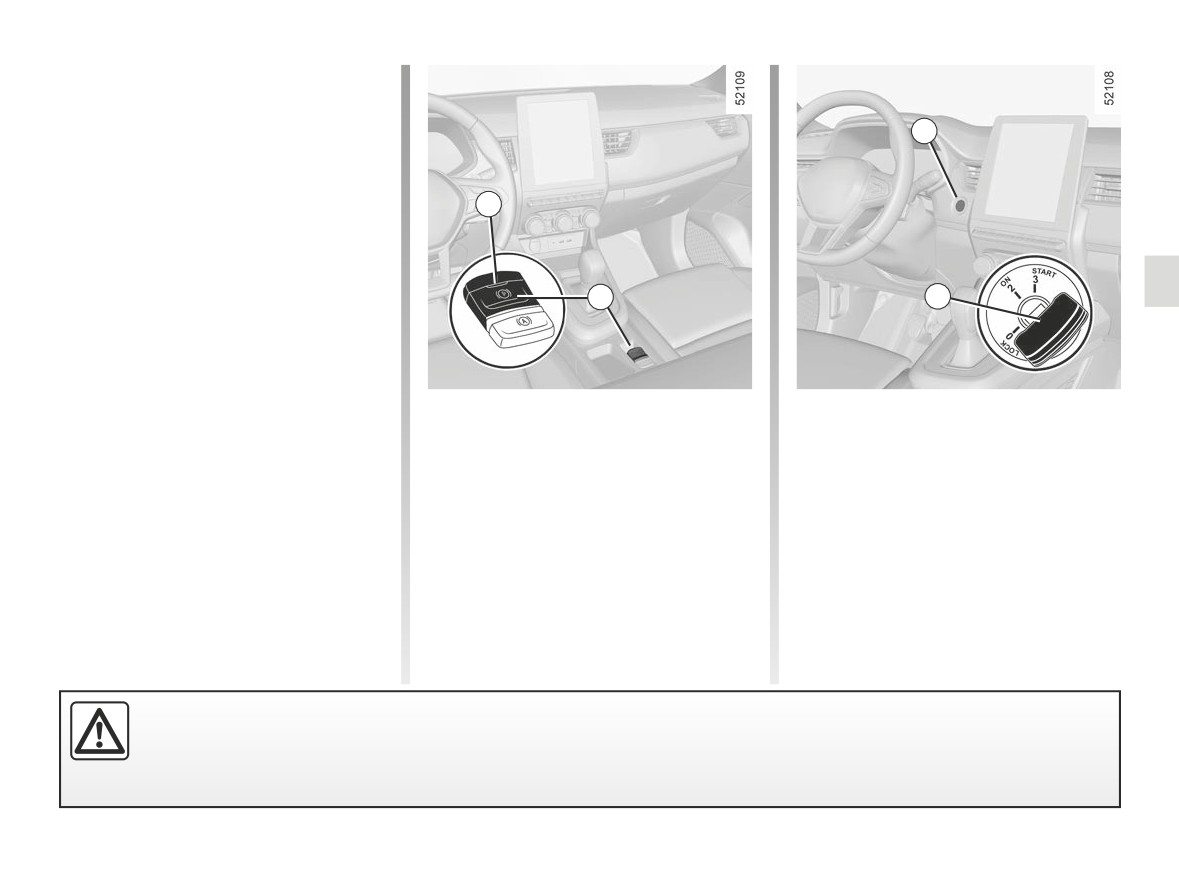
In this case, pull and release switch 4 to
apply the assisted parking brake.
Manual operation
Manually releasing the electronic
parking brake
You can apply the electronic parking
Assisted release of the parking
brake manually.
Press switch 1 without pressing the
brake
pedals or turning the key 2 to position
The brake will be released as soon as
Manually applying the electronic
“ON” 2 to switch on the ignition. Press
the vehicle starts and accelerates.
parking brake
the brake pedal then press switch 4: in-
dicator light 3 on the switch and indica-
Pull switch 4. Warning light 3 and warn-
tor light }
displayed on the instru-
ing light }
on the instrument panel
ment panel go out.
light up.
Before leaving the vehicle, check that the electronic parking brake is fully applied. Warning light 3 on switch 4 and
warning light }
on the instrument panel light up to show that the parking brake is applied but go out when the
doors are locked.
2.15
CarManuals2.co
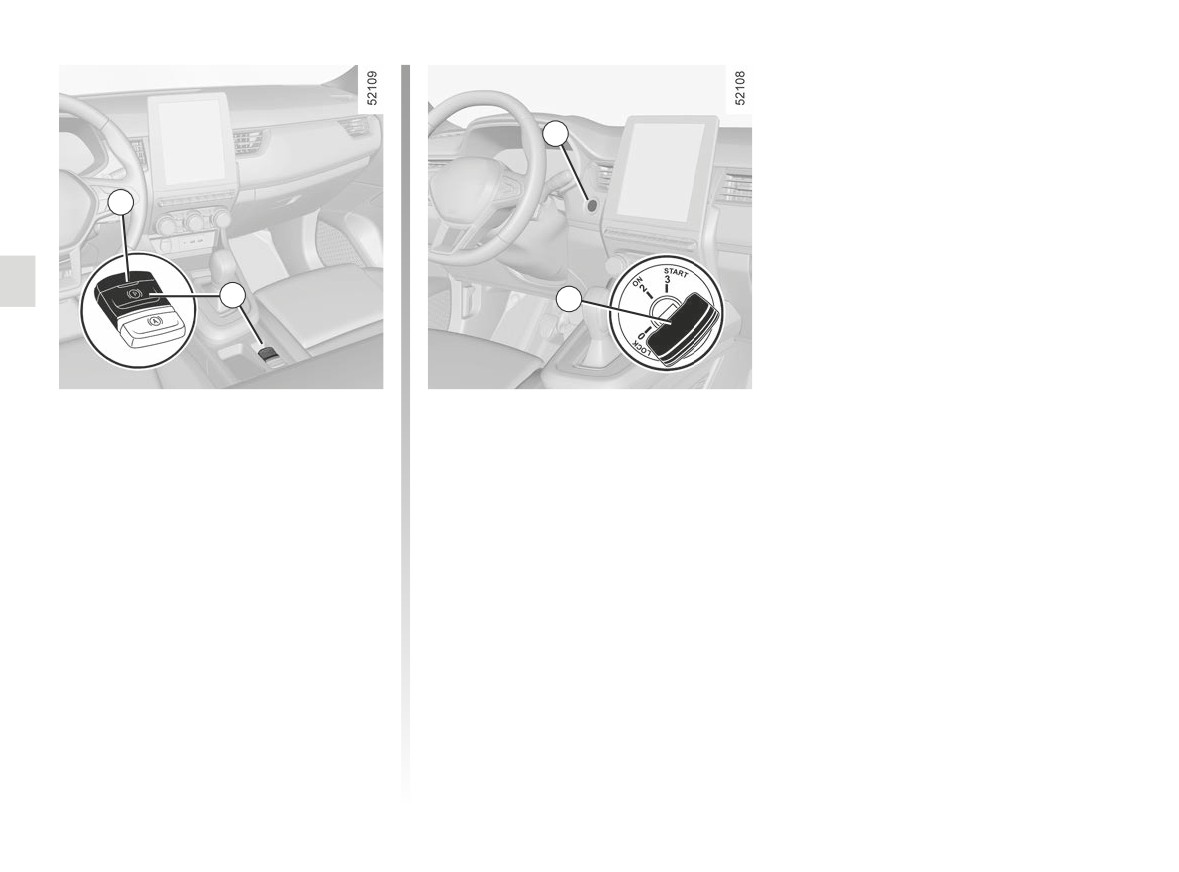
ELECTRONIC PARKING BRAKE (3/4)
1
3
4
2
Brief stop
To park the vehicle without applying the
electronic parking brake (if there is a
To apply the electronic parking brake
risk of freezing, for example):
manually (when stopping at a red light,
or stopping when the engine is running,
- switch off the engine by pressing the
etc.): pull and release the switch 4. The
engine start/stop button 1 or by turn-
brake is released as soon as the vehi-
ing the ignition key 2;
cle is started up again.
- manually release the electronic park-
ing brake;
Special cases
- with a gear or position P engaged,
release the brake pedal and the
To park on a slope or while towing a
switch 4.
trailer, for example, pull switch 4 for
a few seconds to gain the maximum
braking.
2.16
CarManuals2.co
ELECTRONIC PARKING BRAKE (4/4)
Versions with an automatic
Contact your approved Dealer straight
If no lights or sounds are ap-
away.
gearbox
parent, this indicates a fault
in the instrument panel. This
For safety reasons, automatic release
- If there is an assisted parking brake
indicates that it is essential
is deactivated when the driver’s door
fault, the warning light
®
to stop immediately (as soon as traf-
is open or not shut properly and the
comes on, along with the message
fic conditions allow). Ensure that the
engine is running (in order to prevent
“WARNING: Braking System”, a
vehicle is correctly immobilised and
the vehicle from moving without the
beep and, in some cases, the warn-
contact an approved Dealer.
driver). The “Release Parking Brake
ing light }
Manually” message appears on the
instrument panel when the driver de-
This means that you must stop as soon
presses the accelerator.
as traffic conditions allow.
Operating faults
If the message “WARNING:
-
Electric System” or “Check
light illuminates on the instrument
battery” or
“WARNING:
panel accompanied by the “Check
Braking System” is dis-
Parking Brake” message and, in
played, you must immobilise the
some cases, the }
warning
vehicle by selecting first gear (on a
light.
manual gearbox) or position P (on
an automatic gearbox) or by pull-
Never leave your vehicle
ing the switch 4 for approximately
without re-engaging P po-
10 seconds. If the conditions and the
sition and switching off the
slope require it, chock the wheels of
engine. This is because
the vehicle.
when the vehicle is stationary with
the engine running and a gear en-
Risk of loss of immobilisation of
gaged, the vehicle may begin to
the vehicle.
move if you accelerate.
Call an approved Dealer.
There is a risk of accidents.
2.17
CarManuals2.co
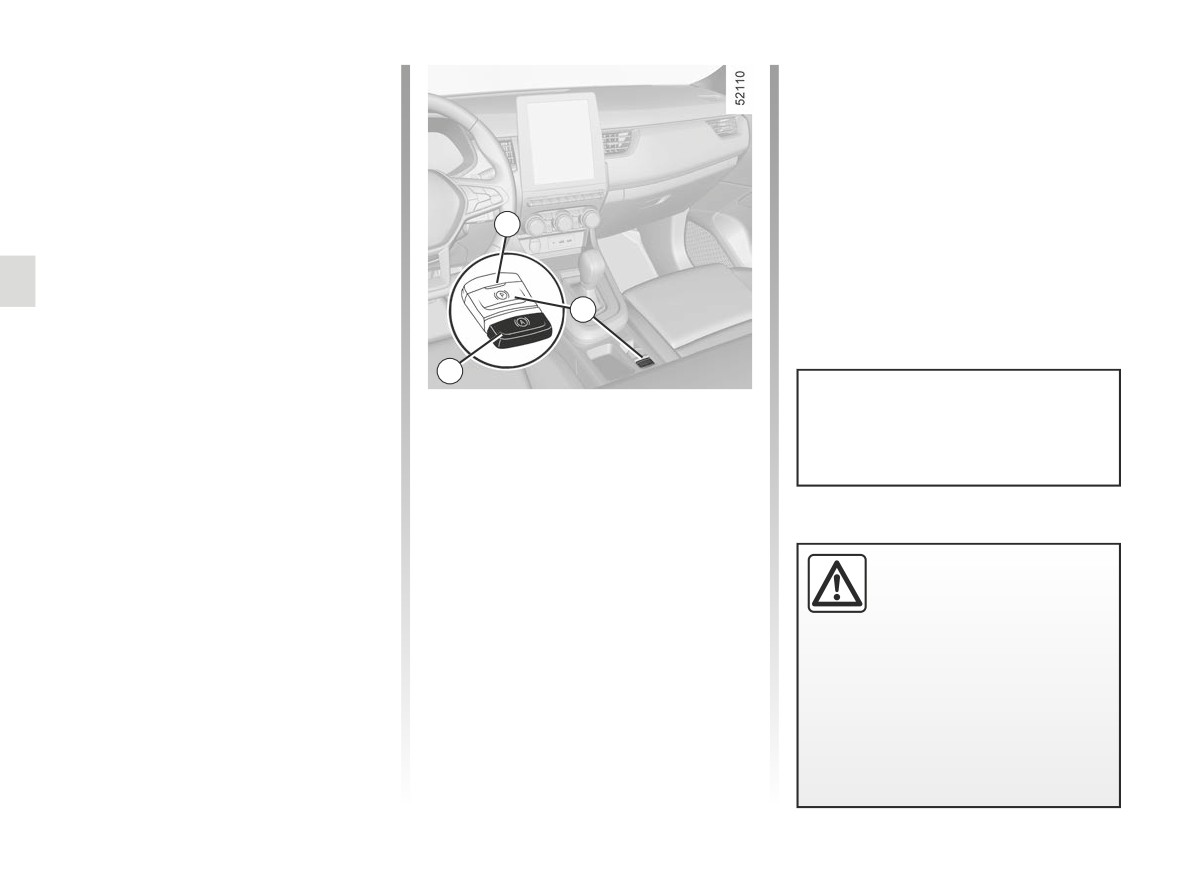
“AUTOHOLD” FUNCTION
Vehicle stopped (e.g. at a red light, an
Conditions for interrupting the
intersection, a traffic jam, etc.), the func-
braking force
tion ensures braking force even when
The following conditions must be met:
the driver releases the brake pedal.
- the driver accelerates sufficiently
The braking force is released as soon
with a gear engaged;
as the driver accelerates sufficiently
or
with a gear engaged.
- the driver disables the function.
1
Activation
Warning light
goes out on the in-
Press the switch 3.
strument panel.
The 3 warning light switch illuminates
to confirm that the function is activated.
2
Deactivation
3
Press the brake pedal and 3 switch si-
multaneously.
Conditions for maintaining the
Upon each start-up, the function
The 3 switch warning light disappears
braking force
continues the mode set at the time
to confirm that the function is deacti-
the engine was last switched off.
The following conditions must be met:
vated.
- the seat belt for the driver is fas-
If the braking force is maintained, the
tened;
parking brake is applied automatically
and
when:
- the electronic parking brake is re-
- the driver exits the vehicle;
leased;
Before leaving the vehicle,
or
and
check that the electronic
- the vehicle is immobilised for more
- the vehicle is not stationary on a very
parking brake is fully ap-
than approximately three minutes.
steep slope.
plied. Warning light
1 on
The maintained braking force is con-
switch 2 and warning light }
firmed by the
warning light on
on the instrument panel light up to
the instrument panel.
show that the parking brake is ap-
plied but go out when the doors are
locked.
2.18
CarManuals2.co
DRIVING ADVICE, ECO DRIVING (1/7)
Fuel consumption is accredited in ac-
Depending on the vehicle, you will have
cordance with a standard regulatory
various functions which enable you to
method. Identical for all manufactur-
lower your fuel consumption:
ers, this enables vehicles to be com-
- the rev counter;
pared with one another. Consumption
in real time depends on vehicle usage
- the driving style indicator;
conditions, the equipment fitted and the
- the journey record and eco-driving
user’s driving style. To optimise fuel
advice via the multimedia screen;
consumption, please refer to the follow-
- acceleration indicator Eco;
ing advice.
- ECO mode;
- the Stop and Start function. ➥ 2.8
If fitted on the vehicle, the navigation
system provides additional information.
2.19
CarManuals2.co
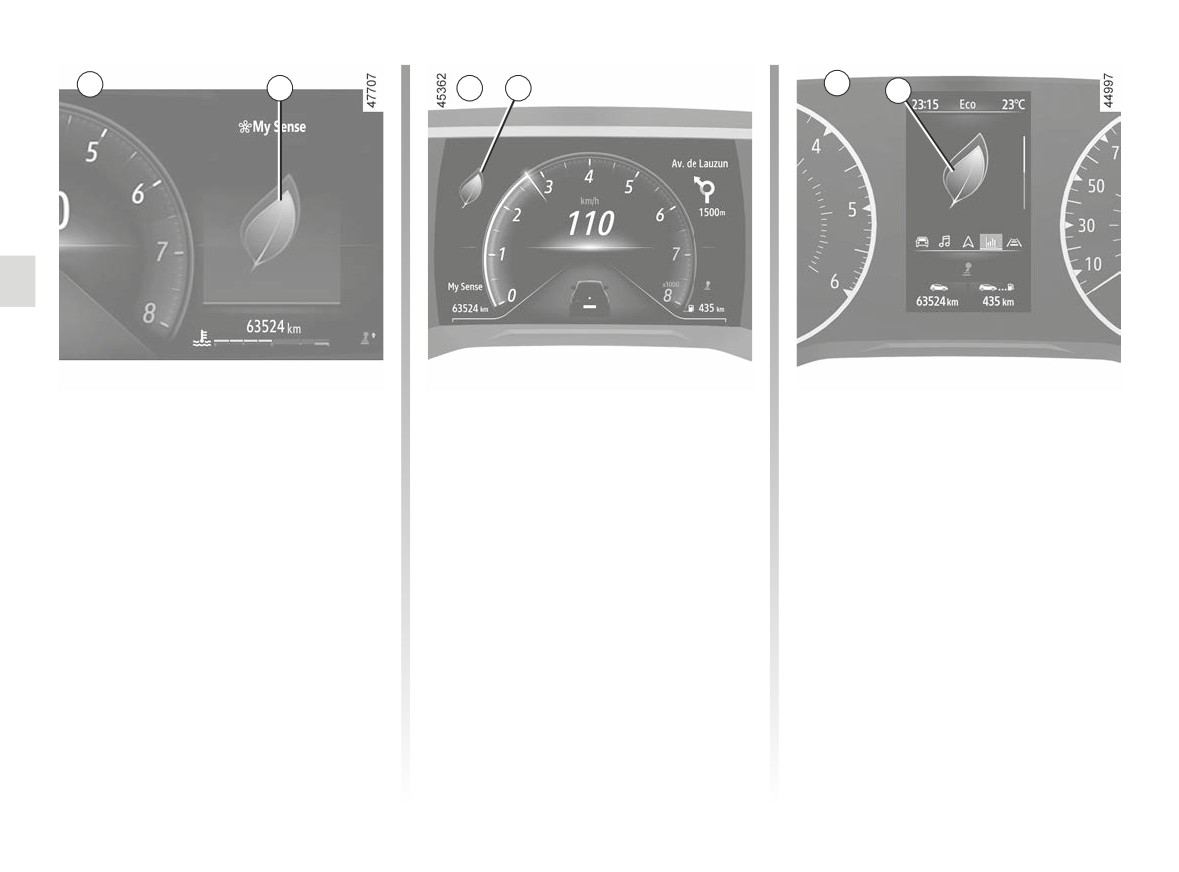
DRIVING ADVICE, ECO DRIVING (2/7)
A
1
B
1
C
1
On the instrument panel A, B
Driving style indicator 1
or C
Informs you about the driving style
adopted in real time. This is shown by
Depending on the vehicle, the informa-
indicator light 1.
tion display can be organised and cus-
tomised based on the instrument panel
The more petals displayed on 1, the
customisation style selected from the
more your driving is flexible and eco-
multimedia screen.
nomical.
If you regularly monitor this indicator,
you will reduce your vehicle’s fuel con-
sumption.
Please refer to the multimedia instruc-
tions for further information.
2.20
CarManuals2.co
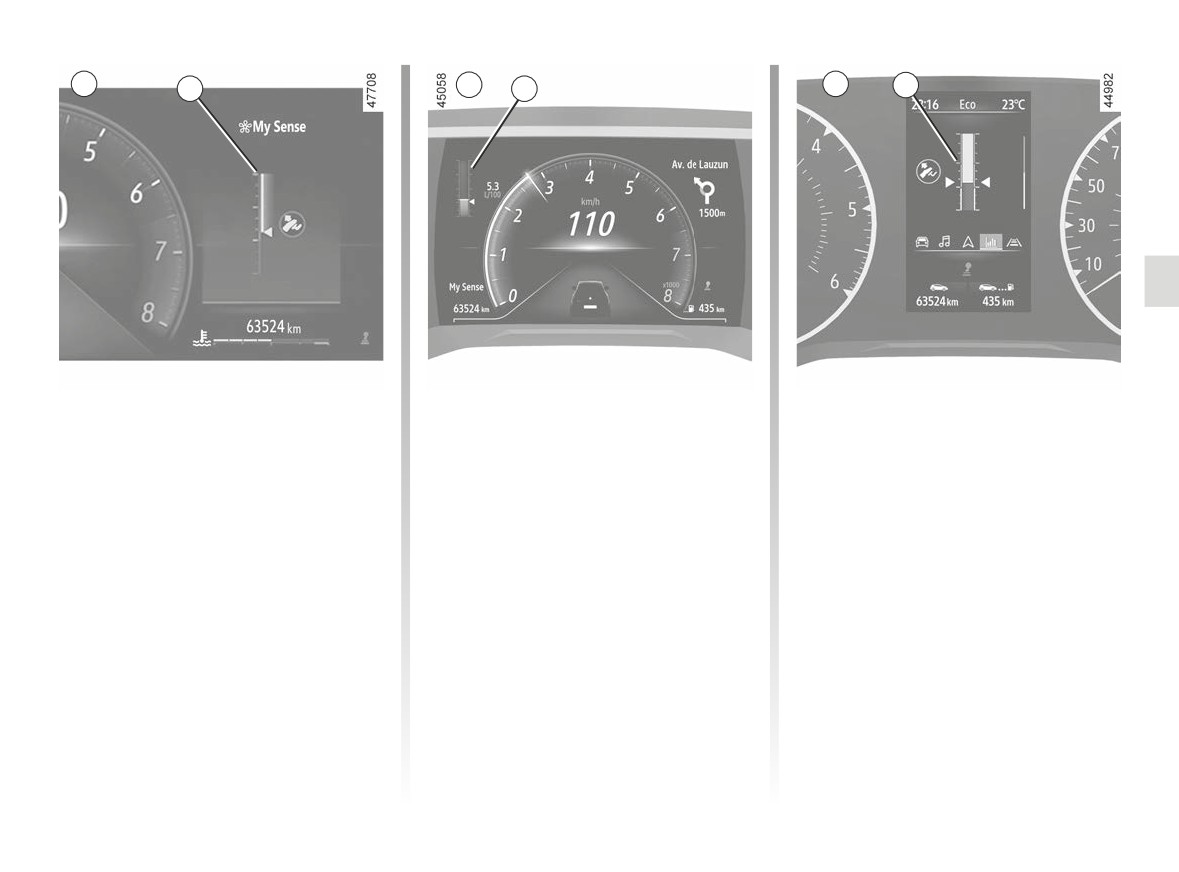
DRIVING ADVICE, ECO DRIVING (3/7)
A
2
B
2
C
2
Acceleration indicator Eco 2
This informs you in real time whether
you are accelerating moderately or
strongly.
This is shown by the 2 warning light:
- green: acceleration is moderate and
correct;
- white: acceleration is too high;
- grey: acceleration is high.
Note: it is not possible to simultane-
ously display the driving style indica-
tor 1 and the Eco acceleration indica-
tor 2.
2.21
CarManuals2.co
DRIVING ADVICE, ECO DRIVING (4/7)
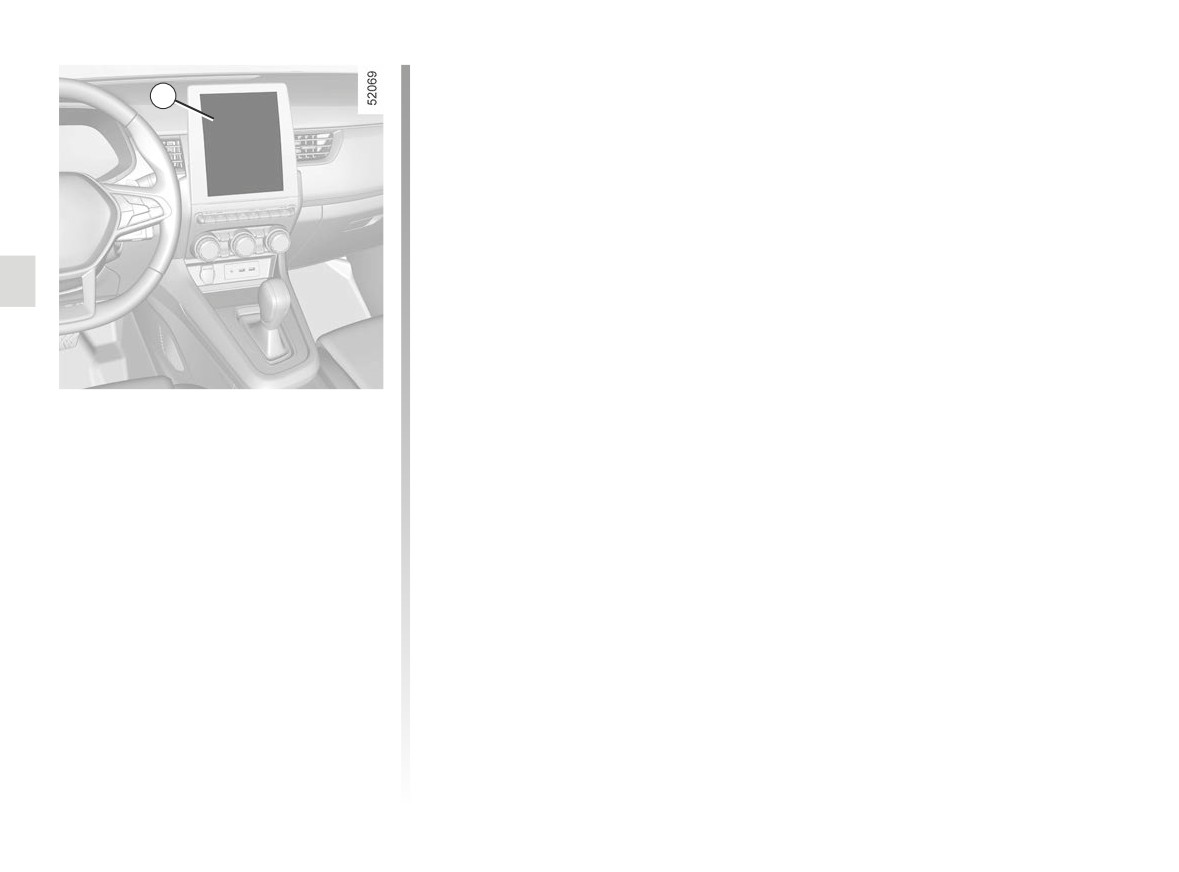
Please refer to the multimedia instruc-
3
tions for further information.
An overall rating from 0 to 100 is dis-
played to let you assess your eco driv-
ing performance. The higher the rating,
the lower the fuel consumption.
Eco advice is given to help improve
your performance.
With your favourite journeys saved,
you can compare your performance
between trips and the performance of
other vehicle users.
On the multimedia screen
Journey record
Once the engine is switched off, you
will see “Journey record” displayed on
the multimedia screen 3, enabling you
to view information on your last journey.
This indicates:
- the general score;
- score evolution;
- distance without fuel consumption.
2.22
CarManuals2.co
DRIVING ADVICE, ECO DRIVING (5/7)
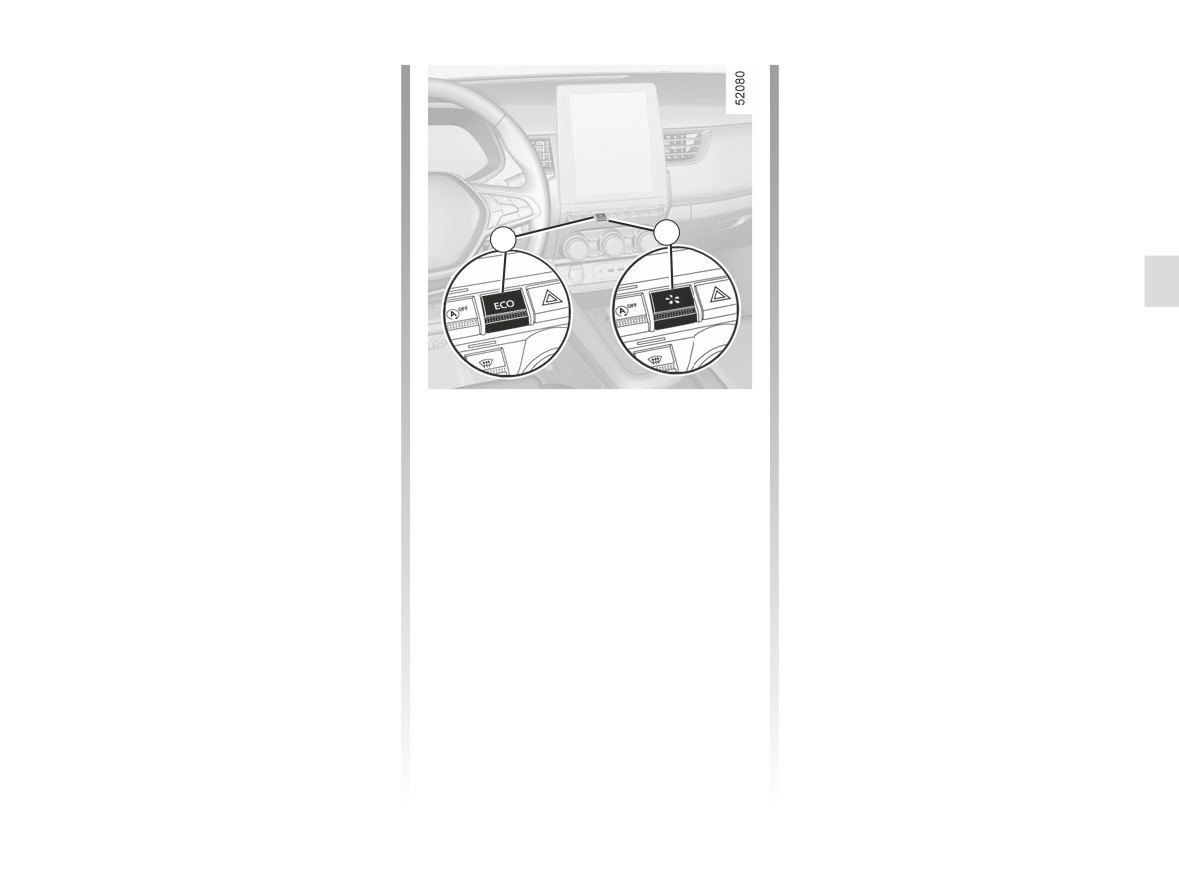
ECO mode
ECO mode is a function which opti-
The warning light
comes on on
mises fuel consumption. It acts upon
the instrument panel to confirm activa-
certain power consuming systems in
tion.
the vehicle (heating, air conditioning,
While driving, it is possible to leave the
power-assisted steering, etc.) and on
ECO mode temporarily in order to im-
certain driving actions (acceleration,
prove engine performance.
gear changing, cruise control, deceler-
5
4
To do this, press the accelerator pedal
ation, etc.).
firmly and fully.
Limiting acceleration enables low fuel
ECO mode is reactivated when you
consumption in urban and surrounding
take pressure off the accelerator pedal.
areas. Reduced usage of the air condi-
tioning reduces fuel consumption with-
Disabling the function
out affecting heating comfort.
Depending on the vehicle, the function
Free wheel in ECO mode (or My
can be deactivated either:
Activating the function
Sense mode depending on the
Depending on the vehicle, the function
- by pressing the 4 switch; ➥ 3.2
vehicle)
can be activated either:
- by pressing switch 5.
Depending on the vehicle, for vehicles
- by pressing the 4 switch; ➥ 3.2
fitted with an automatic gearbox, in the
The warning light
goes out on
deceleration phases (with the foot fully
- by pressing switch 5;
the instrument panel to confirm deac-
off the accelerator pedal), switching to
tivation.
- from the multimedia screen (refer to
freewheeling (automatic neutral) de-
the multimedia equipment instruc-
creases engine braking and allows you
tions).
to farther without accelerating in order
to save fuel.
To activate/deactivate
“Free wheel”
mode, refer to the multimedia instruc-
tions.
2.23
CarManuals2.co
DRIVING ADVICE, ECO DRIVING (6/7)
- High speeds significantly affect the
– Do not try to maintain the same
vehicle’s fuel consumption.
speed up a hill, accelerate no more
than you would on the level. Keep
Examples (at a steady speed):
your foot in the same position on the
- reducing the speed from 80 mph
accelerator pedal.
(130 km/h) to 68 mph (110 km/h)
- Double declutching and accelerating
approximately saves up to 20% of
before switching off are unnecessary
fuel approximately;
in modern vehicles.
- reducing the speed from 56 mph
- Bad weather, flooded roads:
(90 km/h) to 50 mph (80 km/h)
approximately saves up to 10% of
Do not drive through
fuel approximately.
floods if the water is
- Dynamic driving with a lot of frequent
above the lower edge of
acceleration and braking is expen-
the wheel rims.
sive on fuel in comparison to the time
saved.
Driving advice and ECO
- Do not over rev the engine in the in-
driving
termediate gears. You should always
Behaviour
use the highest gear possible.
- Drive carefully for the first few miles
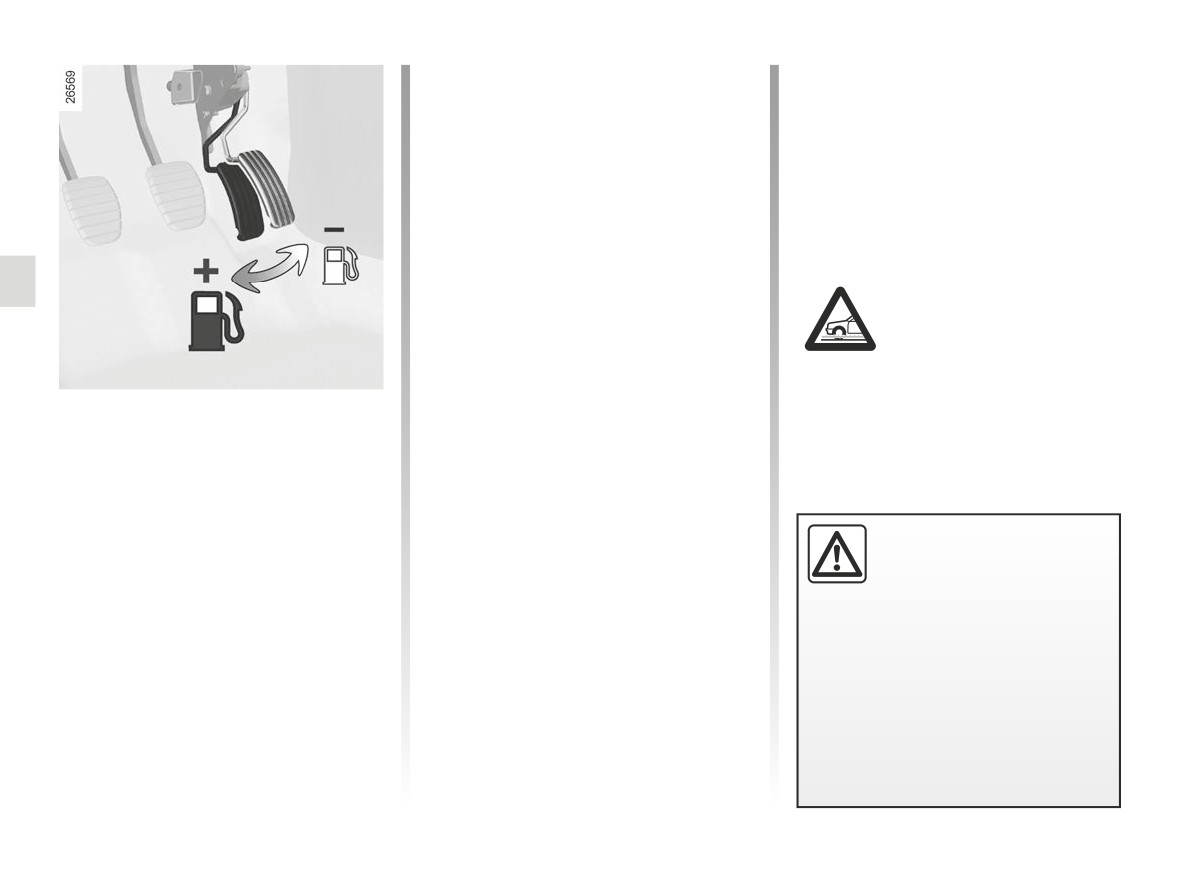
- Avoid sudden acceleration.
until the engine reaches its normal
- Brake as little as possible. If you an-
Obstructions to the driver
operating temperature, rather than
ticipate an obstacle or bend in ad-
let it warm up while the vehicle is sta-
On the driver’s side, only
vance, you may then simply release
tionary.
use mats suitable for the
the accelerator pedal.
vehicle, attached with the
pre-fitted components, and check
the fitting regularly. Do not lay one
mat on top of another.
There is a risk of wedging the
pedals
2.24
CarManuals2.co
DRIVING ADVICE, ECO DRIVING (7/7)
- In vehicles fitted with air condi-
tioning, it is normal to observe an
increase in fuel consumption (espe-
cially in urban conditions) when it is
used. For vehicles fitted with manual
air conditioning, switch off the system
when it is not required.
Advice for reducing consumption
and therefore helping to preserve
the environment:
If the vehicle has been parked in the
sun, open the doors for a few mo-
ments to let the hot air escape before
starting the engine.
- Do not leave an empty roof rack
Tyres
Advice on use
fitted to the vehicle.
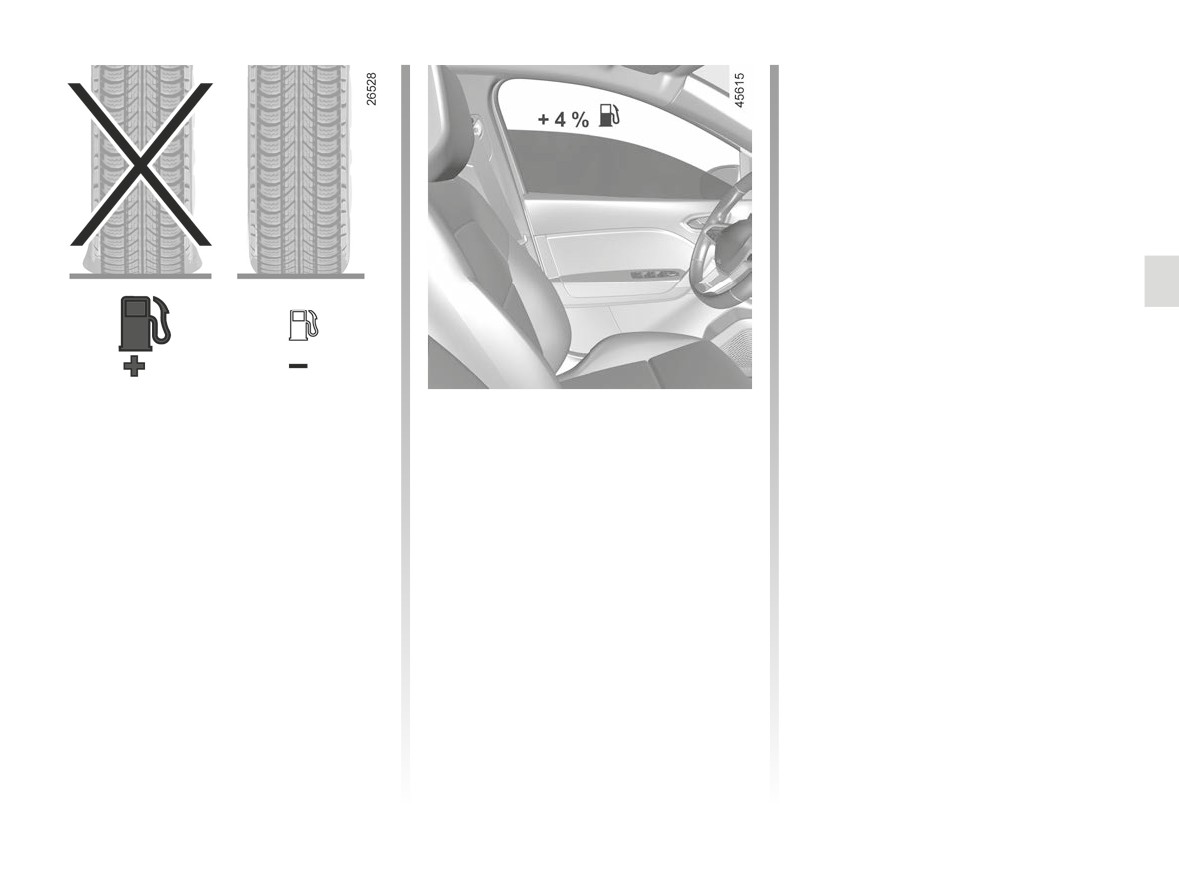
– An underinflated tyre increases fuel
- Favour the ECO mode.
- It is better to fit a trailer for bulky ob-
consumption.
jects.
- Electricity is fuel; switch off all the
- To optimise fuel consumption, set the
electrical components which are
- When towing a caravan, fit a wind
highest speed tyre pressure or the
not really needed. However (safety
deflector and adjust it carefully.
recommended pressure indicated on
first), keep your lights on when the
- Avoid using the car for door-to-door
the edge of the driver’s door. ➥ 4.10.
visibility is bad (“see and be seen”).
calls (short journeys with long waits
– The use of non-recommended tyres
- Use the air vents. Driving with the
in between) because the engine
can increase fuel consumption.
windows open at 60 mph (100 km/h)
never reaches its normal operating
will increase fuel consumption by
temperature.
4%.
- Never fill the fuel tank right to the
brim to avoid overflow.
2.25
CarManuals2.co
MAINTENANCE AND ANTIPOLLUTION ADVICE
Your vehicle complies with criteria for
In addition, replacing engine, fuel
- Air filter : a choked element will
recycling and recovering vehicles at the
supply system and exhaust compo-
reduce efficiency. It must be re-
end of their service life, which entered
nents with parts other than those origi-
placed.
into force in 2015.
nally recommended by the manufac-
turer may alter your vehicle so that it
Some parts of your vehicle have there-
Exhaust gas monitoring
no longer complies with anti-pollution
fore been designed to facilitate future
regulations.
system
recycling.
Have your vehicle adjusted and
The exhaust gas monitoring system will
These parts are easy to remove so
checked by an authorised dealer, in ac-
detect any operating faults in the vehi-
that they can be recovered and repro-
cordance with the instructions given in
cle’s antipollution system.
cessed by recycling companies.
your maintenance schedule: they will
If this system malfunctions, toxic sub-
By virtue of its design, moderate fuel
have all the equipment necessary for
stances may be released into the at-
consumption and initial settings, your
ensuring that your vehicle is maintained
mosphere or damage may occur.
vehicle also conforms to current an-
to its original standard.
This warning light on the in-
tipollution regulations. The manufac-
Ä
strument panel will indicate if
turer is actively striving to reduce pol-
there are any faults in the system:
lutant exhaust gas emissions and to
Engine adjustments
This lights up when the ignition is
save energy. But the fuel consumption
- Spark plugs: for optimum condi-
switched on and goes out when the
of your vehicle and the level of pollutant
tions of use, output and performance
engine is started.
exhaust gas emissions are also your
the specifications laid down by our
- If it lights up continuously, consult an
responsibility. Ensure that it is main-
Design Department must be strictly
approved Dealer as soon as possi-
tained and used correctly.
applied.
ble;
If the spark plugs have to be changed,
- if it flashes, reduce the engine speed
use the make, type and gap specified
until the light stops flashing. Contact
Maintenance
for your vehicle’s engine. Contact an
an authorised dealer as soon as pos-
It is important to remember that fail-
authorised dealer for this.
sible.
ure to respect antipollution regulations
- Ignition and idle speed: no adjust-
could lead to legal action being taken
ment is needed.
against the vehicle owner.
2.26
CarManuals2.co
ENVIRONMENT
Your vehicle has been designed with
Emissions
- At the end of the vehicle’s service
respect for the environment in mind for
life, it should be sent to approved
Your vehicle has been designed to emit
its entire service life: during production,
centres to ensure that it is recycled.
fewer greenhouse gases (CO2) while in
use and at the end of its life.
use, and therefore to consume less fuel
- In all cases, comply with local legis-
(eg. 140 g/km, equivalent to 5.3 l/100
lation.
Manufacture
km for a diesel vehicle).
Your vehicle has been manufactured at
Our vehicles are also equipped with a
Recycling
a factory which complies with a policy
particle filter system including a cata-
Your vehicle is 85% recyclable and
to reduce the environmental impact
lytic converter, an oxygen sensor and
95% recoverable.
on the surrounding areas (reduction of
an active carbon filter (the latter pre-
water and energy consumption, visual
vents vapour from the fuel tank being
To achieve these objectives, many of
and noise pollution, atmospheric emis-
released into the open air).
the vehicle components have been de-
sions and waste water; sorting and re-
signed to enable them to be recycled.
For certain diesel vehicles, this system
using waste).
The materials and structures have
also has a particle filter to reduce the
been carefully designed to allow these
volume of soot particles emitted.
components to be easily removed and
reprocessed by specialist companies.
Please make your own
In order to preserve raw material re-
contribution towards
sources, this vehicle incorporates nu-
protecting the environment
merous parts made from recycled plas-
tics or renewable materials (vegetable
too
or animal-derived materials such as
- Worn parts replaced in the course of
cotton or wool).
routine vehicle maintenance (vehi-
cle battery, oil filter, air filter, batter-
ies, etc.) and oil containers (empty or
filled with used oil) must be disposed
of through specialist organisations.
2.27
CarManuals2.co
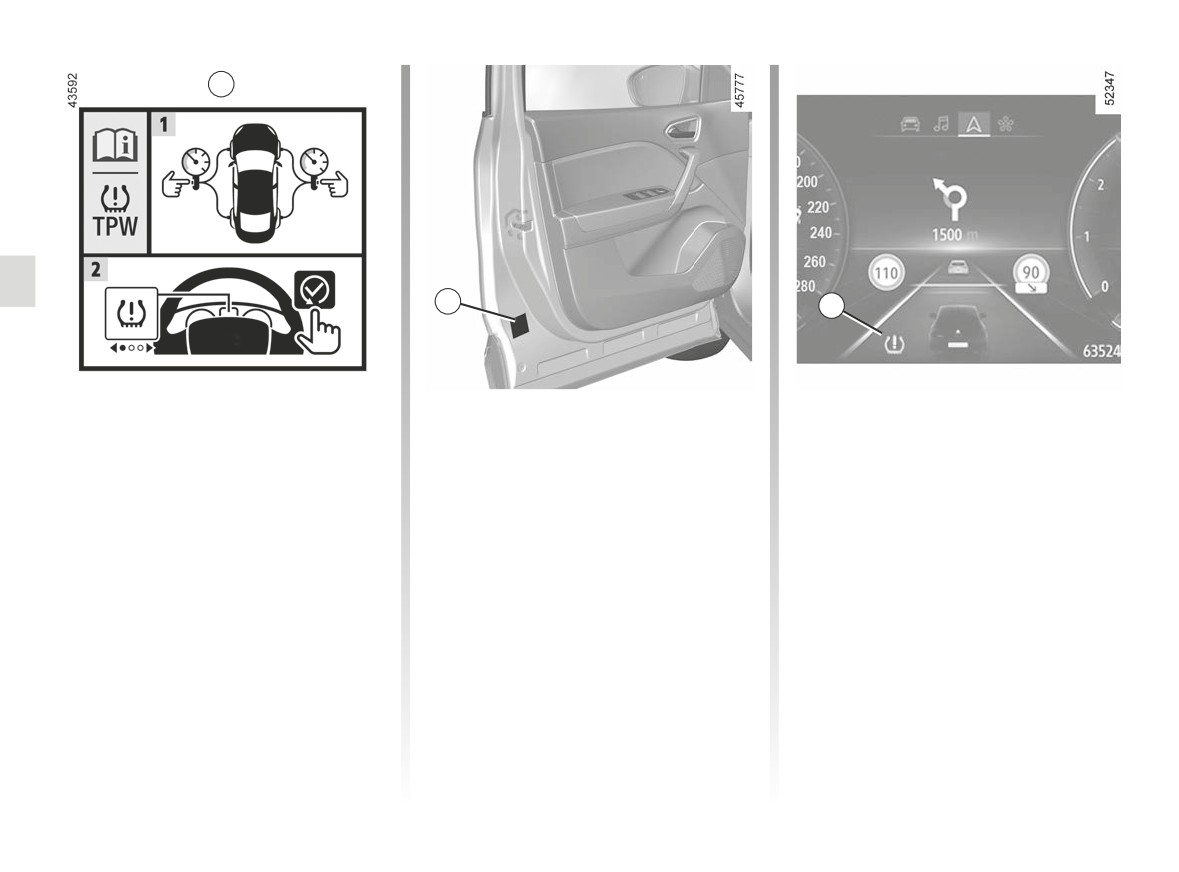
TYRE PRESSURE LOSS WARNING (1/4)
1
1
2
When fitted to the vehicle, this system
The system is fitted if there is a 1 label
Operating principle
notifies the driver if one or more tyres
in the vehicle.
This system detects a loss of pressure
lose pressure.
To verify its presence, open the driver’s
in one of the tyres by measuring the
door.
wheel speed while driving.
Warning light
2 comes on to
alert the driver in the event of insuffi-
cient pressure (deflated wheel, punc-
tured tyre, etc.).
2.28
CarManuals2.co
TYRE PRESSURE LOSS WARNING (2/4)
Operating conditions
-
fitting a single new tyre;
Resetting the standard level for the
tyre pressures
The system has to be reset with an
–
use of tyres not approved by the net-
inflation pressure equal to that writ-
work;
It must be carried out with the vehicle
ten on the tyre inflation pressure label.
stopped:
-
Otherwise it risks not giving a reliable
- after each reinflation or readjustment
warning in the event of a significant loss
of the pressure of one of the tyres;
of pressure. ➥ 4.10.
- when the standard tyre pressure
In the following situations, the system
needs to be changed to adapt to
risk coming into action late or not func-
usage conditions (empty, carrying a
tioning correctly:
load, motorway driving, etc.);
-
system not reset after reinflation or
- after changing a wheel;
any operation on the wheels;
- after using the tyre inflation kit;
-
system badly reset: different inflation
pressures from the recommended
- after swapping a wheel (however,
pressures;
this practice is not recommended).
-
significant change in load or distribu-
It should always be done after checking
tion of load on one side of the vehi-
the tyre pressure of all four tyres when
cle;
cold.
This function
is an addi-
-
sporty driving with strong accelera-
tional driving aid.
Tyre pressures must correspond to the
tion;
current usage of the vehicle (empty,
The function does not take
carrying a load, motorway driving, etc.).
-
driving on snowy or slippery surface;
the place of the driver. It
cannot, therefore, under any cir-
–
driving with snow chains;
cumstances replace the vigilance or
the responsibility of the driver.
Check the tyre pressures, including
the emergency spare wheel, once a
month.
2.29
CarManuals2.co
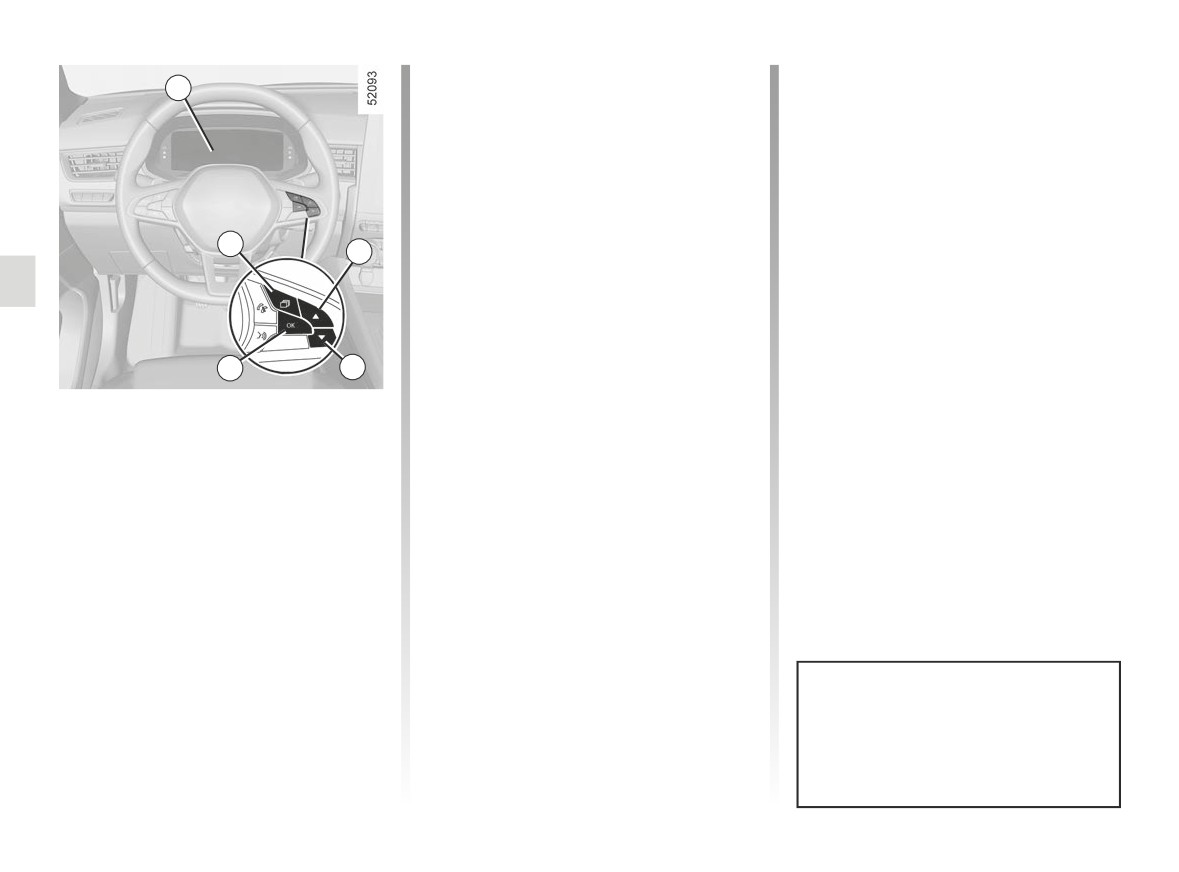
TYRE PRESSURE LOSS WARNING (3/4)
The display of the message “If pressure
“Check tyre press and init.”
3
OK [hold on]” for around five seconds
indicates that the reset request for the
Warning light
comes on, along
tyre pressure reference value has been
with the message “Check tyre press
taken into account.
and init.”. They indicate that at least
one tyre is flat or punctured.
Reinitialisation is carried out after a few
minutes’ driving. The “Operation com-
In the event of a flat tyre, inflate the rel-
pleted” message indicates that the tyre
evant tyre.
4
pressure reference value has been
5
In the event of a puncture, change the
reset.
tyre or consult an authorised dealer.
Display
Check and readjust the pressure of the
four tyres when cold, and launch the
The display 3 on the instrument panel
reset of the tyre pressure reference
informs you of any tyre pressure faults
7
6
value.
(flat tyre, punctured tyre, etc.).
Resetting procedure
Warning light
goes out after
Ignition on, vehicle stopped:
launching the reinitialisation of the tyre
pressure reference value.
- briefly press the 4 switch as many
times as required to reach the
“Vehicle” tab (or, depending on the
vehicle, the Information page);
- briefly press the 5 or 6 switch to
access the tyre pressures reset
page;
- press and hold the 7 OK switch to
launch the reset.
The sudden loss of pressure in a
tyre (burst tyre, etc.) cannot be de-
tected by the system.
2.30
CarManuals2.co
TYRE PRESSURE LOSS WARNING (4/4)
“TPW not available”
Readjustment of tyre pressures
After each change of wheel/tyre, read-
just the tyre pressure and launch the
The tyre pressures must be adjusted
The warning light
flashes for
reset of the tyre pressure reference
when cold (please refer to the label lo-
several seconds, then stays on, along
value.
cated on the edge of the driver’s door).
with the message “TPW not available”.
If tyre pressures cannot be checked
Emergency spare wheel
They indicate that the vehicle is
when the tyres are cold, the recom-
equipped with an emergency spare
If fitted on the vehicle, readjust the tyre
mended pressures should be increased
wheel which is smaller than the other
pressure and launch the reinitialisation
by 0.2 to 0.3 bar (3 PSI).
four and that it is fitted to the vehicle.
of the tyre pressure reference value.
Never deflate a hot tyre.
“Check TPW”
Tyre repair product and inflation kit
After each reinflation or readjustment of
The warning light
flashes for
the tyre pressure, launch the reinitiali-
Only use equipment approved by the
several seconds, then stays on, along
sation of the tyre pressure reference
network, otherwise the system risks
with the message “Check TPW”.
value.
late activation or incorrect operation.
➥ 5.4.
This message is accompanied by the
Replacing wheels/tyres
After using the tyre inflation kit, readjust
Only use equipment approved by the
the tyre pressure and launch the reini-
They indicate a system fault. Please
network, otherwise the system risks
tialisation of the tyre pressure reference
consult an authorised dealer.
late activation or incorrect operation.
value.
➥ 5.10.
2.31
CarManuals2.co
DRIVING CORRECTION DEVICES AND AIDS (1/5)
Depending on the vehicle, this is com-
Anti-lock braking system
posed of:
(ABS)
– anti-lock braking system (ABS);
Under heavy braking, the ABS prevents
- electronic stability program (ESC)
the wheels from locking, allowing the
with understeer control and trac-
stopping distance to be managed and
tion control;
keeping control of the vehicle.
In these circumstances, the vehicle can
- emergency brake assist;
be steered to avoid an obstacle whilst
- hill start assistance.
braking. In addition, this system can
increase stopping distances, particu-
Other driving assistance systems are
larly on roads with low surface grip (wet
detailed on the following pages.
ground etc.).
You will feel a pulsation through the
These functions are an ad-
brake pedal each time the system is
ditional aid in the event of
activated. The ABS does not in any
critical driving conditions,
way improve the vehicle's physical per-
enabling the vehicle behav-
formance in terms of the road surface
iour to be adapted to suit the driving
and road-holding. It is still essential to
conditions.
follow the rules of good driving practice
(such as driving at a safe distance from
These functions do not take the
the vehicle in front etc.).
place of the driver. They do not
increase the vehicle’s limits and
should not encourage you to
drive more quickly. Under no cir-
cumstances should they replace
the vigilance or responsibility of the
driver when manoeuvring the vehi-
cle (the driver must always be ready
In an emergency, apply firm and
for sudden incidents which may
continuous pressure to the brake
occur when driving).
pedal. There is no need to pump
it repeatedly. The ABS will modu-
late the force applied in the braking
system.
2.32
CarManuals2.co
DRIVING CORRECTION DEVICES AND AIDS (2/5)
Operating faults:
-
and x
lit up on the in-
strument panel accompanied
by the messages
“Check ABS”,
“WARNING: Check Braking System”
and “Check ESC”: the ABS, the ESC
and the emergency brake assist are
disabled. Braking is always ena-
bled;
- x
, D
,
and
®
lit on the instrument panel accom-
panied by the message “WARNING:
Braking System”: this indicates a
fault with the braking system.
In both cases, please consult an
Authorised Dealer.
Your braking system is par-
tially operational. However,
it is dangerous to brake
suddenly and it is essen-
tial to stop immediately, as soon as
traffic conditions allow. Call an ap-
proved Dealer.
2.33
CarManuals2.co