Peugeot 208 (2017 year). Manual - part 9
 

  Index      Peugeot     Peugeot 208 - service manual 2017 year in english


Search            


Content   ..  7  8  9  10   ..


Peugeot 208 (2017 year). Manual - part 9


127

6

Driving

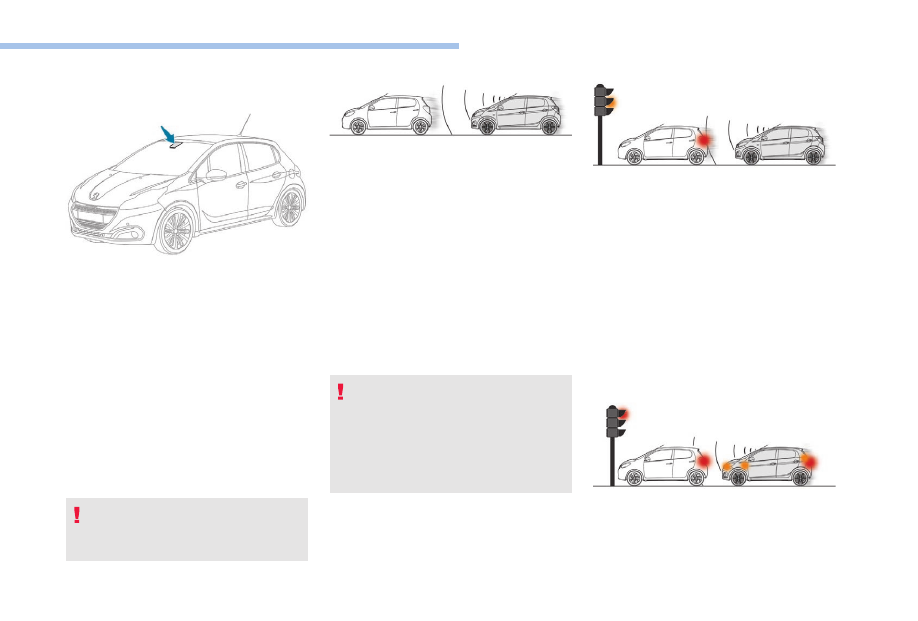
Active City Brake

A preventive driving assistance system 
that, using a sensor located at the top of the 
windscreen, automatically applies the vehicle's 
brakes if driving behind a vehicle that is slowing 
down rapidly, stopping or is stationary.
The objective is to avoid a collision or reduce 
the speed of impact.
This system has been designed to improve 
driving safety.
It remains the driver's responsibility to 
continuously monitor the state of the traffic and 
to assess the distances and relative speeds of 
other vehicles.

Active City Brake cannot in any 
circumstances replace the need for 
vigilance on the part of the driver.

When your vehicle is too close to or 
approaches the vehicle ahead too quickly, the 
system automatically applies the brakes to 
avoid a collision.

If operation is triggered:
-  Display of a message.
-  Illumination of the brake lamps.
The automatic braking is triggered as a last 
resort, if the driver fails to apply the brakes 
sufficiently firmly or at all, or to take avoiding 
action.

The laser beam is invisible. Never look at 
the laser sensor with an optical instrument 
(magnifying glass, microscope, etc.): risk 
of eye injury.

Conditions for operation:
-  Vehicles driving in the same lane.
-  Not in too sharp a bend.
-  Speed of your vehicle between 3 and 

18 mph (5 and 30 km/h).

-  Braking assistance systems (ABS, EBFD, 

EBA) in working order.

-  Trajectory control systems (ASR, DSC) in 

working order and not deactivated.

-  Operation of Active City Brake not triggered 

in the previous 10 seconds.

The automatic braking triggered:
-  can be even more effective if the driver 

presses the brake pedal more firmly,

128

Driving

The collision can be automatically avoided 
if the speed difference between your 
vehicle and the one ahead is not more 
than 9 mph (15 km/h).
Above this threshold, the system will do 
what is possible to avoid or reduce the 
seriousness of the accident by lowering 
the speed of impact.

Activation / Deactivation

It is possible to activate or 
deactivate the Active City Brake 
from the Driving / Vehicle menu.

The system state remains in memory when the 
ignition is switched off.
Each subsequent time the ignition is switched 
on, if the automatic emergency braking function 
is deactivated, a temporary message will 
be displayed indicating the speed threshold 
(6 mph (10 km/h)).

Please deactivate the Active City 
Brake:
-  Following impact damage to the 

windscreen close to sensor,

-  When towing a trailer,
-  When the vehicle is being towed,
-  When the vehicle is about to cross a 

toll barrier.

-  When the vehicle is passing through 

an automatic car wash,

Operating limits

Not detected are:
-  Pedestrians, animals, motorcyclists, 

cyclists.

-  Fixed and non-reflective materials and 

objects (cardboard box, wall, etc.).

-  Vehicles not travelling in the same direction.
This system will not trigger or intervene if the 
driver:
-  presses the accelerator pedal firmly,
-  turns the wheel sharply (avoiding 

manoeuvre).

-  may stop the vehicle, holding the brakes on 

for around 1.5 seconds when stationary to 
allow the driver time to take back control of 
the vehicle,

-  may cause the engine to stall,
-  may give rise to a pumping noise, due to the 

pressurisation of the braking system.

Operating faults

Clean or clear any dirt, mist or objects (stickers, 
leaves, etc.) from the top of the windscreen that 
could obstruct the laser's field of vision.

In the following cases, you should have the 
system checked by a PEUGEOT dealer or a 
qualified workshop:
-  The message "Automatic braking system

fault detected accompanied by an audible 
signal indicates that a fault has been 
detected.

-  Following an impact, the system is 

automatically put out of service, it no longer 
works. The system detects the deployment 
of airbags.

Do not attempt to remove, adjust or test 
the sensor.
Only a PEUGEOT dealer or a qualified 
workshop is able to work on the system.

Misting of the windscreen or accumulations 
of snow on the bonnet could interfere with the 
operation of the laser. A message appears if 
the laser is obstructed.
Use windscreen demisting and regularly clean 
the area of the windscreen in front of the 
sensor.
Be particularly vigilant when driving in poor 
weather (very heavy rain, hail, fog, snow, etc.). 
This is because braking distances increase 
while the laser's calculation parameters remain 
the same.

129

6

Driving

Parking sensors

The audible (front and rear) and visual (rear) 
parking sensor system consists of proximity 
sensors, installed in the rear bumper.
The sensors detect any obstacle which enters 
its field of operation (person, vehicle, tree, 
fence, etc.) behind the vehicle during the 
manoeuvre.
Certain objects detected at the beginning of the 
manoeuvre will no longer be detected at the 
end of the manoeuvre due to the blind spots 
between and below the sensors.
Examples: stake, roadworks cone or pavement 
post.

Engage reverse gear

An audible signal confirms the activation of the 
system on engaging reverse gear.
The proximity information is indicated by an 
audible signal which becomes more rapid as 
the vehicle approaches the obstacle.
When the distance between the rear of 
the vehicle and the obstacle is less than 
approximately 30 centimetres, the audible 
signal becomes continuous.

Display in the screen

The audible signal is supplemented by the 
display of bars in the screen which move 
progressively nearer to the vehicle. When the 
obstacle is very close, the "Danger" symbol is 
displayed in the screen.

Stopping the assistance

Change to neutral.

Switching off the assistance

Press; the indicator lamp comes on.
The state of the system is stored when the 
vehicle is switched off.

Resuming assistance

Press again; the indicator lamp goes off.

If this warning lamp comes on 
when reverse gear is engaged, 
accompanied by a message and/or 
an audible signal, a fault has been 
detected.

Contact a PEUGEOT dealer or a qualified 
workshop.

130

Driving

In bad or wintry weather, ensure that the 
sensors are not covered with mud, ice or 
snow.

The system will be deactivated 
automatically if a trailer is being towed or if 
a bicycle carrier is fitted (vehicle fitted with 
a towbar or bicycle carrier recommended 
by PEUGEOT).

The parking sensor system cannot in 
any circumstances replace the need for 
vigilance on the part of the driver.

Reversing camera

The reversing camera is activated automatically 
when reverse gear is engaged.
The image is displayed on the touch screen.
The reversing camera function may be 
supplemented with parking sensors.

They are represented by lines marked "on 
the ground" and do not allow the position of 
the vehicle to be determined relative to tall 
obstacles (for example: other vehicles, etc.).
Some deformation of the image is normal.

The blue lines represent the general direction 
of the vehicle (the gap represents the width of 
your vehicle except for the door mirrors).
The red lines represent a distance of about 
30 cm beyond the edge of your vehicle's rear 
bumper.
The green lines represent distances of about 1 
and 2 metres beyond the edge of your vehicle's 
rear bumper.

The superimposed representation of guide 
lines helps with the manoeuvre.

The reversing camera cannot, in any 
circumstances, replace the need for 
vigilance on the part of the driver.

High pressure jet wash
When washing your vehicle, do not direct 
the lance within 30 cm of the camera lens.

Opening the tailgate causes the display to 
disappear.

Clean the reversing camera regularly 
using a soft, dry cloth.

131

6

Driving

Park Assist

The system detects a parking space and then 
provides assistance with the parallel parking 
manoeuvres.
It controls the steering and provides visual and 
audible information to the driver.
The driver manages the accelerator, brakes, 
gears and the clutch in the case of a manual 
gearbox.
The driver can take control at any time by 
gripping the steering wheel.

The Park Assist system cannot in any 
circumstances replace the need for 
vigilance on the part of the driver.
The driver must remain in control of their 
vehicle ensuring that the space remains 
clear during the manoeuvre.
In some circumstances, the sensors may 
not detect small obstacles located in their 
blind spots.

During manoeuvring phases, the steering 
wheel performs rapid turns: do not hold 
the steering wheel, do not put your hands 
between the spokes of the steering wheel.
Watch out for any object that could block 
the manoeuvre (loose clothing, scarves, 
ties, etc.) – Risk of injury!

For entry into a parallel parking space the 
system does not detect spaces which are 
clearly much smaller or larger than the 
size of the vehicle.
The "Parking sensors" function activates 
automatically during the manoeuvres, it is 
possible that a warning lamp illuminates 
on the screen, accompanied by an audible 
signal, without affecting the parking.

Changing tyre sizes (out-size tyres, winter 
tyres, etc.) can interfere with the correct 
operation of the parking assistance 
system.

When the Park Assist is active, it prevents 
the Stop & Start going into STOP mode. 
In STOP mode, activating Park Assist 
restarts the engine.

Entering a parallel parking 
space

F  Once you have detected an available space, 

limit the speed of the vehicle to 12 mph 
(20 km/h).

F  Position your vehicle before this space.

The system provides assistance in entering and 
exiting a parking space when parallel parking.

132

Driving

To activate the Park Assist system:

F  Press this control.
The indicator lamp in the control remains off.

A message is displayed in the screen.

F  Select the enter parking space manoeuvre.
The indicator lamp in the control comes on.

F  Operate the direction indicator on the 

parking side.

F  Move forwards alongside the parking 

space at a speed below 12 mph (20 km/h) 
to measure it, keeping at a distance of 
between 0.5 and 1.5 metres from the row of 
parked vehicles.

Once measurement is complete, if the space is 
large enough a message indicates that parking 
is possible.

F  Move your vehicle forward until a new 

message is displayed.

F  Select reverse and release the steering 

wheel.

The assisted parking manoeuvre is in progress.
Without exceeding 5 mph (8 km/h), continue 
the manoeuvres following the information given 
by the "parking assistance" system, until the 
end of manoeuvre message is displayed.
The indicator lamp in the control goes off, 
accompanied by an audible signal.

133

6

Driving

The driver takes back control of the vehicle's 
steering.

Exit from a parallel parking 
space

F  When you want to exit from a parallel 

parking space, start the engine.

With the vehicle stationary, to activate the Park 
Assist system:

F  Press this control.
The indicator lamp in the control remains off.

A message is displayed in the screen.

F  Select the exit parking space manoeuvre. 

The indicator lamp in the control comes on.

F  Operate the direction indicator on the exit 

from parking side. 
The direction indicator flashes throughout 
the manoeuvre, whatever the position of the 
control stalk.

F  Select a forward or reverse gear then 

release the steering wheel.

The assisted exit from parking manoeuvre is in 
progress.
Without exceeding 3 mph (5 km/h), continue 
the manoeuvres following the information given 
by the "parking assistance" system, until the 
end of manoeuvre message is displayed.
The manoeuvre is complete once the front 
wheels of the vehicle are out of the parking 
space.
The indicator lamp in the control goes off, 
accompanied by an audible signal.

The driver takes back control of the vehicle's 
steering.

Deactivation

The system is deactivated automatically:
-  on switching off the ignition,
-  if the engine stalls,
-  if no manoeuvre is performed within 

5 minutes of selecting the type of 
manoeuvre,

-  after a prolonged stop of the vehicle during 

a manoeuvre,

-  if the road wheel anti-slip regulation (ASR) 

is triggered,

-  if the speed of the vehicle exceeds the 

stated limit,

-  when the driver interrupts movement of the 

steering wheel,

-  if the driver presses the Park Assist control,

134

Driving

If the system is deactivated during a 
manoeuvre, the driver should reactivate it 
manually to repeat the measurement.

-  if the vehicle cannot be properly positioned 

(too many manoeuvres to get the vehicle in 
or out),

-  if the driver's door is opened,
-  if one of the front wheels encounters an 

obstacle.

A message is displayed in the screen.

The driver then takes back control of the 
vehicle's steering.

Deactivation

The system is switched off automatically:
-  when towing a trailer,
-  if the driver's door is opened,
-  if the speed of the vehicle is above 42 mph 

(70 km/h).

To switch the system off for a prolonged period, 
contact a PEUGEOT dealer or a qualified 
workshop.

This warning lamp comes on in 
the instrument panel and/or a 
message appears on the screen, 
accompanied by an audible signal 
(short beep).

The indicator lamp flashes for a few seconds. If 
the problem occurs while using the system, the 
indicator lamp goes off.

These warning lamps indicate a fault 
with the power steering.

Contact a PEUGEOT dealer or a qualified 
workshop.

If the lateral distance between your vehicle 
and the space is too great, the system may 
not be able to measure the space.
Anything projecting beyond the dimensions 
of the vehicle is not taken into account by 
the Park Assist system during a manoeuvre.

In bad weather and in winter, ensure that 
the sensors are not covered by road dirt, 
ice or snow.
In the event of a fault, have the system 
checked by a PEUGEOT dealer or a 
qualified workshop.

135

6

Driving

Under-inflation detection

This system automatically monitors the tyre 
pressure while driving.

The system monitors the pressure in all four 
tyres, once the vehicle is moving.
It compares the information given by the 
wheel speed sensors with reference values, 
which must be reinitialised after every tyre 
pressure adjustment or wheel change
.
The system triggers an alert as soon as it 
detects a drop in the pressure of one or more 
tyres.

The tyre under-inflation detection system 
does not replace the need for vigilance on 
the part of the driver.
This system still requires you to check the 
tyre inflation pressure (including the spare 
wheel) every month as well as before a 
long journey.
Driving with under-inflated tyres impairs 
handling, extends braking distances and 
causes early tyre wear, particularly in 
adverse conditions (heavy loads, high 
speeds, long journeys).

Driving with under-inflated tyres 
increases fuel consumption.

The tyre pressure specifications for your 
vehicle can be found on the tyre pressure 
label.
For more information on Identification 
markings
, including in particular the tyre 
pressure label, refer to the corresponding 
section.
Tyre pressures should be checked when 
the tyres are "cold" (vehicle stopped for 
1 hour or after a journey of less than 
6 miles (10 km) at moderate speeds).
In the contrary case(hot), add 0.3 bar to 
the values indicated on the label.

Under-inflation alert

This is indicated by fixed illumination 
of this warning lamp, an audible 
signal and, depending on the 
equipment installed, a message 
displayed on the screen.

F  Reduce speed immediately, avoid excessive 

steering movements and sudden braking.

The loss of pressure detected does not 
always cause visible bulging of the tyre. 
Do not be satisfied with just a visual 
check.

F  In the event of a puncture, use the 

temporary puncture repair kit or the spare 
wheel (depending on equipment),

or
F  if you have a compressor, such as the one 

in the temporary puncture repair kit, check 
the pressures of the four tyres when cold, 

or
F  if it is not possible to make this check 

immediately, drive carefully at reduced 
speed. 

The alert is kept active until the system is 
reinitialised.

The under-inflation alert can only be relied 
on if the reinitialisation of the system has 
been done with the pressures in the four 
tyres correctly adjusted.

F  Stop the vehicle as soon as it is safe to do 

so.

136

Driving

Reinitialisation

The system must be reinitialised after any 
adjustment to the pressures of one or more 
tyres, and after changing one or more wheels.

Before reinitialising the system, ensure 
that the pressures of the four tyres are 
correct for the use of the vehicle and in 
line with the recommendations on the tyre 
pressure label.
The under-inflation alert can only be relied 
on if the reinitialisation of the system has 
been done with the pressures in the four 
tyres correctly adjusted.
The under-inflation detection system 
does not give a warning if a pressure is 
incorrect at the time of reinitialisation.

Without touch screen

F  With the ignition on and the vehicle 

stationary, press this button for about 
3 seconds then release it, an audible signal 
confirms the reinitialisation.

With touch screen

Snow chains
The system does not have to be 
reinitialised after fitting or removing snow 
chains.

Operating fault

The flashing and then fixed illumination of the 
under-inflation warning lamp accompanied 
by illumination of the Service warning lamp 
indicates a fault with the system.

In this case, under-inflation monitoring of the 
tyres is no longer assured.
Have the system checked by a PEUGEOT 
dealer or a qualified workshop.

After carrying out any work on the system, 
the pressures of the four tyres must be 
checked and the system reinitialised.

Initialisation of the system is done with the 
ignition on and the vehicle stationary.

The guide-me-home lighting can be 
configured in the menu Driving / 
Vehicle
.

The new pressure parameters saved are 
treated as reference values by the system.

PEUGEOT & TOTAL

The PEUGEOT TOTAL team knows how to push back 

the limits of performance to win victories in the most 

difficult conditions, as confirmed by the first three places 

achieved in 2017.

To obtain these exceptional results, the PEUGEOT Sport 

teams chose TOTAL QUARTZ for the PEUGEOT 3008 

DKR, a high-tech lubricant that protects the engine in the 

most severe conditions.

TOTAL QUARTZ protects your engine against the effects 
of time.

TOTAL QUARTZ Ineo First is an ultra-high performance 

lubricant, the result of collaboration between Peugeot 

and Total’s R&D teams. Specially formulated for Peugeot 

engines, its innovative technology significantly reduces 

CO

2

 emissions and keeps your engine clean.

A PARTNERSHIP FOR 
PERFORMANCE!

138

Practical information

Fuel tank

Capacity of the tank:
- approximately 

50 litres (petrol engines).

- approximately 

50 litres (Diesel engines).

- approximately 

45 litres (Diesel BlueHDi 

engines).

Low fuel level

When the low fuel level is reached 
this warning lamp comes on in the 
instrument panel. There remains 
approximately 5 litres of fuel in 
the tank. When the warning lamp 
flashes, there is very little fuel left.

Refuel as soon as possible to avoid running 
out.
For more information on Running out of fuel 
(Diesel)
, refer to the associated section.

With Stop & Start, never refuel with the 
system in STOP mode; you must switch 
off the ignition with the key.

Refuelling

A label on the inside of the fuel filler flap 
reminds you of the type of fuel to use, 
depending on your engine type.

To refuel in complete safety:

F  You must switch off the engine.

F  Open the fuel filler flap 1.
F  Insert the key in the cap 2, then turn it to the 

left,

F  Fill up the tank but do not continue after 

the 3

rd

 cut-off of the nozzle; this could 

cause malfunctions.

When you have finished filling the tank:
F  Refit the filler cap.
F  Turn the key to the right, then remove it from 

the cap.

F  Close the fuel filler flap.

The key cannot be removed from the lock 
until the cap is refitted.
Opening the filler cap may result in an 
inrush of air. This is entirely normal and 
results from the sealing of the fuel system.

If you have added the wrong fuel for 
your vehicle, the fuel tank must be 
drained and filled with the correct fuel 
before starting the engine.

Additions of fuel must be of at least 5 litres, in 
order to be registered by the fuel gauge.

F  Remove the cap and hook it onto the clip 

located on the inside of the flap 3.

7

139

Practical information

Misfuel prevention 
(Diesel)

(Depending on the country of sale.)
Mechanical device which prevents filling the 
tank of a Diesel vehicle with petrol. It helps 
avoid the risk of engine damage that can result 
from filling with the wrong fuel.

Operation

It is still possible to use a fuel can to fill 
the tank.
To ensure a good flow of fuel, do not place 
the nozzle of the fuel can in direct contact 
with the flap of the misfuel prevention 
device and pour slowly.

Travelling abroad
As Diesel fuel pump nozzles may be 
different in other countries, the presence 
of the misfuel prevention device may make 
refuelling impossible.
Not all Diesel vehicles are fitted with 
misfuel protection, so before travelling 
abroad, we recommend that you check 
with the PEUGEOT dealer network, 
whether your vehicle is suitable for the 
fuel pumps in the country in which you 
intend to travel.

Fuel cut-off

Your vehicle is equipped with a safety device 
which cuts off the fuel supply in the event of a 
collision.

When a petrol filler nozzle is introduced into 
the fuel filler neck of a Diesel vehicle, it comes 
into contact with the flap. The system remains 
closed and prevents filling.
Do not continue trying but introduce a 
Diesel filler nozzle instead.

140

Practical information

Compatibility of fuels

Fuel used for petrol engines

The petrol engines are compatible with biofuels 
that conform to current and future European 
standards and which can be obtained from 
filling stations:

Petrol that meets standard EN228 
mixed with a biofuel that meets 
standard EN15376.

The only petrol additives authorised for 
use are those that meet the B715001 
standard.

Fuel used for Diesel 
engines

The Diesel engines are compatible with 
biofuels that conform to current and future 
European standards and which can be 
obtained from filling stations.

For more information, contact a PEUGEOT 
dealer or a qualified workshop.

Diesel fuel that meets standard 
EN590 mixed with a biofuel that 
meets standard EN14214 (possibly 
containing up to 7% Fatty Acid 
Methyl Ester),

Diesel fuel that meets standard 
EN16734 mixed with a biofuel that 
meets standard EN14214 (possibly 
containing up to 10% Fatty Acid 
Methyl Ester),

Paraffinic Diesel fuel that meets 
standard EN15940 mixed with 
a biofuel that meets standard 
EN14214 (possibly containing up to 
7% Fatty Acid Methyl Ester).

The use of B20 or B30 fuel that 
meets the standard EN16709 is 
possible with your Diesel engine. 
However, this use, even occasional, 
requires strict application of the 
special servicing conditions referred 
to as "Arduous conditions".

The use of any other type of (bio)fuel 
(vegetable or animal oils, pure or diluted, 
domestic fuel, etc.) is strictly prohibited 
(risk of damage to the engine and fuel 
system).

The only Diesel additives authorised for 
use are those that meet the B715000 
standard.

Diesel at low temperature

At temperatures below 0°C (+32°F), the 
formation of paraffins in summer-type Diesel 
fuels could entail an abnormal operation 
of the fuel supply circuit. To avoid this, we 
recommend using winter-type Diesel fuel and 
keeping the fuel tank more than 50% full.
If, despite this, at temperatures below -15°C 
(+5°F) the engine has problems starting, 
just leave the vehicle in a garage or heated 
workshop for a little while.

7

141

Practical information

Snow chains

In wintry conditions, snow chains improve 
traction as well as the behaviour of the vehicle 
when braking.

The snow chains must be fitted only to the 
front wheels. They must never be fitted to 
"space-saver" type spare wheels.

Take account of the legislation in force 
in your country on the use of snow 
chains and the maximum running speed 
authorised.

Installation tips

F  If you have to fit the chains during a journey, 

stop the vehicle on a flat surface on the side 
of the road.

F  Apply the parking brake and if necessary 

put wheel chocks against the wheels to 
prevent your vehicle from sliding.

F  Fit the chains following the instructions 

provided by the manufacturer.

F  Move off gently and drive for a few seconds, 

without exceeding 30 mph (50 km/h).

F  Stop your vehicle and check that the snow 

chains are correctly tightened.

It is strongly recommended that before 
you leave, you practise fitting the snow 
chains on a level and dry surface.

Avoid driving with snow chains on roads 
that have been cleared of snow, to avoid 
damaging your vehicle's tyres and the 
road surface. If your vehicle is fitted with 
alloy wheels, check that no part of the 
chain or its fixings is in contact with the 
wheel rim.

Travelling abroad

Certain fuels could damage the engine 
of your vehicle.
In certain countries, the use of a 
particular fuel may be required 
(specific octane rating, specific trade 
name, etc.) to ensure correct operation 
of the engine.
For any additional information, contact a 
dealer.

142

Practical information

Only use the chains designed to be fitted to the 
type of wheels fitted to your vehicle:

Original tyre size

Maximum link size

185/65 R15

9 mm

195/55 R16

205/45 R17

7 mm

For more information on snow chains, contact a 
PEUGEOT dealer or a qualified workshop.

Towing a trailer

Your vehicle is primarily designed for 
transporting people and luggage, but it may 
also be used for towing a trailer.

We recommend the use of genuine 
PEUGEOT towbars and their harnesses 
that have been tested and approved from 
the design stage of your vehicle, and that 
the fitting of the towbar is entrusted to a 
PEUGEOT dealer or a qualified workshop.
If the towbar is not fitted by a PEUGEOT 
dealer, it must still be fitted in accordance 
with the vehicle manufacturer's 
instructions.

Driving with a trailer places greater 
demands on the towing vehicle and the 
driver must take particular care.
For more information on Driving advice
particularly when towing, refer to the 
corresponding section.

Please respect the maximum authorised 
towable weights, indicated on the 
registration certificate or in your vehicle’s 
technical data.

For more information on Weights (and the 
towed loads which apply to your vehicle) 
refer to the corresponding section.

Observe the legislation in force in the 
country in which you are driving.


Content   ..  7  8  9  10   ..