Lexus LC500C (2024 year). Manual in english - page 12
 

  Index      Manuals     Lexus LC500C (2024 year). Manual in english


Search            copyright infringement  


Content      ..     10      11      12      13     ..


Lexus LC500C (2024 year). Manual in english - page 12


379

7-2. Steps to take in an emergency

7

W

he

n t

ro

ub

le

 a

ris

es

7-2.Steps to take in an emergency

If your vehicle needs to be 
towed

If towing is necessary, we recom-
mend having your vehicle towed by 
your Lexus dealer or commercial 
towing service, using a wheel-lift 
type truck or flatbed truck.
Use a safety chain system for all 
towing, and abide by all state/pro-
vincial and local laws.

WARNING

Observe the following precautions. 

Failure to do so may result in death or 

serious injury.

When towing the vehicle

LC500: Be sure to transport the vehicle 

with all four wheels raised off the ground. 

If the vehicle is towed with the tires con-

tacting the ground, the drivetrain and 

related parts may be damaged or an 

accident may occur due to a change in 

direction of the vehicle.

LC500h: Be sure to transport the vehi-

cle with all four wheels raised off the 

ground. If the vehicle is towed with the 

tires contacting the ground, the drive-

train and related parts may be damaged, 

an accident may occur due to a change 

in direction of the vehicle or electricity 

generated by the operation of the motor 

may cause a fire to occur depending on 

the nature of the damage or malfunction.

While towing

When towing using cables or chains, 

avoid sudden starts, etc. which place 

excessive stress on the towing eyelets, 

cables or chains. The towing eyelets, 

cables or chains may become dam-

aged, broken debris may hit people, 

and cause serious damage.

Do not perform any of the following as 

doing so may cause the parking lock 

mechanism to engage, locking the 

rear wheels and possibly leading to an 

accident resulting in death or serious 

injury:

• Unfasten the driver’s seat belt and 

open the driver’s door.

• Turn the engine switch <power switch> 

off.

Installing towing eyelets to the vehi-

cle

Make sure that towing eyelets are 

installed securely. 

If not securely installed, towing eyelets 

may come loose during towing.

380

7-2. Steps to take in an emergency

In the following situations, it is not pos-
sible to be towed by another vehicle 
using cables or chains, as the rear 
wheels may be locked due to the park-
ing lock. Contact your Lexus dealer or 
commercial towing service.

There is a malfunction in the shift 
control system. (

P.183, 187, 397)

There is a malfunction in the engine 
immobilizer system <immobilizer 
system>. (

P.94)

There is a malfunction in the smart 
access system with push-button 
start. (

P.415)

The 12-volt battery is discharged. 
(

P.417)

The following may indicate a problem 
with your transmission. Contact your 
Lexus dealer or commercial towing 
service before towing.

LC500: The engine is running but 
the vehicle does not move.

LC500h: The hybrid system warn-
ing message is shown on the multi-
information display and the vehicle 
does not move.

The vehicle makes an abnormal 
sound.

From the front

Use a towing dolly under the rear 
wheels.

NOTICE

To prevent damage to the vehicle 

when towing using a wheel-lift type 

truck

When raising the vehicle, ensure ade-

quate ground clearance for towing at the 

opposite end of the raised vehicle. With-

out adequate clearance, the vehicle 

could be damaged while being towed.

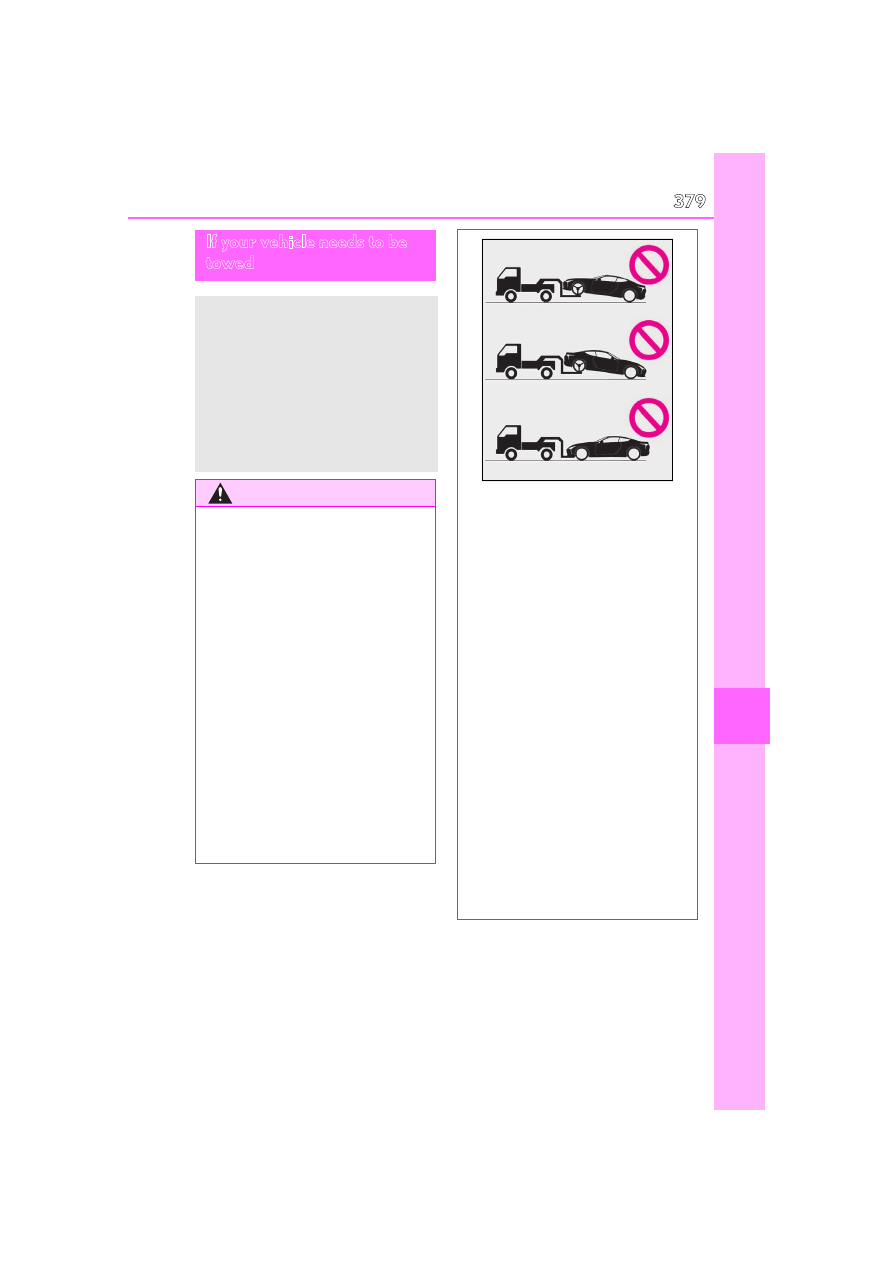
To prevent damage to the vehicle 

when towing with a sling-type truck

Do not tow with a sling-type truck, either 

from the front or rear.

To prevent damage to the vehicle 

during emergency towing

Do not secure cables or chains to the 

suspension components.

Situations when it is not possible 
to be towed by another vehicle

Situations when it is necessary to 
contact dealers before towing

Towing with a wheel-lift type 
truck

381

7-2. Steps to take in an emergency

7

W

he

n t

ro

ub

le

 a

ris

es

From the rear

Use a towing dolly under the front 
wheels.

When using a flat-bed truck to trans-
port the vehicle, use tire strapping 
belts. Refer to the owner’s manual of 
the flat-bed truck for the tire strapping 
method. In order to suppress vehicle 
movement during transportation, set 
the parking brake and turn the engine 
switch <power switch> off.

If a tow truck is not available in an 
emergency, your vehicle may be tem-
porarily towed using cables or chains 

secured to the emergency towing eye-
lets. This should only be attempted on 
hard surfaced roads for short distances 
at under 18 mph (30 km/h). 
A driver must be in the vehicle to steer 
and operate the brakes. The vehicle’s 
wheels, drive train, axles, steering and 
brakes must be in good condition.

To have your vehicle towed by another 
vehicle, the towing eyelet must be 
installed to your vehicle. Install the tow-
ing eyelet using the following proce-
dure.

1

Take out the screwdriver and tow-
ing eyelet. (

P.357)

2

Remove the eyelet cover using a 
flathead screwdriver.

To protect the bodywork, place a rag 

between the screwdriver and the vehicle 

body as shown in the illustration.

NOTICE

Towing with a sling-type truck

Do not tow with a sling-type truck to pre-

vent body damage.

Using a flatbed truck

Emergency towing

Emergency towing procedure

382

7-2. Steps to take in an emergency

3

Insert the towing eyelet into the 
hole and tighten partially by hand.

4

Tighten down the towing eyelet 
securely using a screwdriver or 
hard metal bar.

5

Securely attach cables or chains to 
the towing eyelet.

Take care not to damage the vehicle body.

6

Enter the vehicle being towed and 
start the engine <hybrid system>.

If the engine <hybrid system> does not 

start, turn the engine switch <power 

switch> to ON.

7

Shift the shift position to N and 
release the parking brake.

Turn automatic mode off. (

P.205)

While towing

If the engine is not running <hybrid system is 

off>, the power assist for the brakes and 

steering will not function, making steering 

and braking more difficult.

Wheel bolt wrench

Wheel bolt wrench can be purchased at 

your Lexus dealer.

383

7-2. Steps to take in an emergency

7

When trouble

 ari

ses

Fluid leaks under the vehicle. 
(Water dripping from the air condi-
tioning after use is normal.)

Flat-looking tires or uneven tire 
wear

Engine coolant temperature gauge 
continually points higher than nor-
mal.

Changes in exhaust sound

Excessive tire squeal when corner-
ing

Strange noises related to the sus-
pension system

Pinging or other noises related to 
the engine <hybrid system>

Engine missing, stumbling or run-
ning roughly

Appreciable loss of power

Vehicle pulls heavily to one side 
when braking

Vehicle pulls heavily to one side 
when driving on a level road

Loss of brake effectiveness, spongy 
feeling, pedal almost touches the 
floor

If you think something is 
wrong

If you notice any of the following 
symptoms, your vehicle probably 
needs adjustment or repair. Con-
tact your Lexus dealer as soon as 
possible.

Visible symptoms

Audible symptoms

Operational symptoms

384

7-2. Steps to take in an emergency

Follow the procedure below to restart 
the engine after the system is activated.

1

Turn the engine switch to ACC or 
turn it off.

2

Restart the engine.

Fuel pump shut off system 
(LC500)

To minimize the risk of fuel leakage 
when the engine stalls or when an 
airbag inflates upon collision, the 
fuel pump shut off system stops the 
supply of fuel to the engine.

Restarting the engine

NOTICE

Before starting the engine

Inspect the ground under the vehicle. 

If you find that fuel has leaked onto the 

ground, the fuel system has been dam-

aged and is in need of repair. Do not 

restart the engine.

385

7-2. Steps to take in an emergency

7

When trouble

 ari

ses

Brake system warning light (warning buzzer)

Charging system warning light

*

*

: This light illuminates on the multi-information display.

Low engine oil pressure warning light (warning buzzer)

*

*

: This light illuminates on the multi-information display.

If a warning light turns on or a warning buzzer sounds

Calmly perform the following actions if any of the warning lights comes on or 
flashes. If a light comes on or flashes, but then goes off, this does not necessar-
ily indicate a malfunction in the system. However, if this continues to occur, 
have the vehicle inspected by your Lexus dealer.

Actions to the warning lights or warning buzzers

Warning light

Details/Actions

(U.S.A.)

(red)

(Canada)

Indicates that:

The brake fluid level is low; or

The brake system is malfunctioning

This light also comes on when the parking brake is not released. If the 
light turns off after the parking brake is fully released the system is oper-
ating normally.

Immediately stop the vehicle in a safe place and contact your 
Lexus dealer. Continuing to drive the vehicle may be dangerous.

Indicates that the brake pads are worn out (only the right-side pads 
can be detected)

Have the vehicle inspected by your Lexus dealer.

Warning light

Details/Actions

Indicates a malfunction in the vehicle’s charging system

Immediately stop the vehicle in a safe place and contact your 
Lexus dealer.

Warning light

Details/Actions

Indicates that the engine oil pressure is too low

Immediately stop the vehicle in a safe place and contact your 
Lexus dealer. (

P.343

386

7-2. Steps to take in an emergency

Malfunction indicator lamp (warning buzzer)

SRS warning light

ABS warning light (warning buzzer)

Electric power steering system warning light (warning buzzer)

Warning light

Details/Actions

(U.S.A.)

(Canada)

Indicates a malfunction in:

The electronic engine control system;

The hybrid system (LC500h);

The electronic throttle control system;

The electronic automatic transmission control system (LC500); or

The electronic hybrid transmission control system (LC500h)

Have the vehicle inspected by your Lexus dealer immediately.

Warning light

Details/Actions

Indicates a malfunction in:

The SRS airbag system;

The front passenger occupant classification system; or

The seat belt pretensioner system

Have the vehicle inspected by your Lexus dealer immediately.

Warning light

Details/Actions

(U.S.A.)

(Canada)

Indicates a malfunction in:

The ABS; or

The brake assist system

Have the vehicle inspected by your Lexus dealer immediately.

Warning light

Details/Actions

(red)

or

(yellow)

Indicates a malfunction in the EPS (Electric Power Steering) system

Have the vehicle inspected by your Lexus dealer immediately.

387

7-2. Steps to take in an emergency

7

When trouble

 ari

ses

PCS warning light (warning buzzer)

LTA indicator (warning buzzer)

*

*

: This light illuminates on the multi-information display.

Slip indicator

*

: Only when controlled by the VDIM system.

Warning light

Details/Actions

(Flashes or illumi-

nates)

When a buzzer sounds simultaneously:
Indicates a malfunction has occurred in the PCS (Pre-Collision System)

Have the vehicle inspected by your Lexus dealer immediately.

When a buzzer does not sound:
The PCS (Pre-Collision System) has become temporarily unavailable, 
corrective action may be necessary.

Follow the instructions displayed on the multi-information display. 
(

P.224, 394)

If the PCS (Pre-Collision System) or VSC (Vehicle Stability Control) 
system is disabled, the PCS warning light will illuminate.

P.235

Warning light

Details/Actions

(orange)

Indicates a malfunction in the LTA (Lane Tracing Assist)

Follow the instructions displayed on the multi-information display. 
(

P.243)

Warning light

Details/Actions

Indicates a malfunction in:

The VSC (Vehicle Stability Control) system;

The TRAC (Traction Control) system; or

The hill-start assist control system

Have the vehicle inspected by your Lexus dealer immediately.

The light will flash when the VSC, TRAC, ABS, VGRS

*

 or DRS

*

 system 

is operating.

388

7-2. Steps to take in an emergency

Brake Override System warning light/Drive-Start Control warning light 
(warning buzzer)

*

*

: This light illuminates on the multi-information display.

Brake hold operated indicator

Parking brake indicator

Warning light

Details/Actions

When a buzzer sounds:
Indicates a malfunction in the Brake Override System or Drive-Start 
Control

Have the vehicle inspected by your Lexus dealer immediately.

Indicates that the shift position was changed while depressing the accel-
erator pedal and Drive-Start Control was operated

Momentarily release the accelerator pedal.

When a buzzer does not sound:
Indicates that the accelerator and brake pedals are being depressed 
simultaneously

Release the accelerator pedal and depress the brake pedal.

Warning light

Details/Actions

(flashes)

Indicates a malfunction in the brake hold system

Have the vehicle inspected by your Lexus dealer.

Warning light

Details/Actions

(flashes)

(U.S.A.) 

or

(flashes)

(Canada)

Indicates a malfunction in the parking brake system

Have the vehicle inspected by your Lexus dealer immediately.

389

7-2. Steps to take in an emergency

7

When trouble

 ari

ses

Brake system warning light

Low fuel level warning light

Driver’s and front passenger’s seat belt reminder light (warning buzzer)

*

*

: Driver’s seat belt warning buzzer:

The driver’s seat belt warning buzzer sounds to alert the driver that his or her seat belt is 
not fastened. Once the engine switch <power switch> is turned to ON, the buzzer sounds. 
If the seat belt is still unfastened, the buzzer sounds intermittently for a certain period of 
time after the vehicle reaches a certain speed.
Front passenger’s seat belt warning buzzer:
The front passenger’s seat belt warning buzzer sounds to alert the front passenger that his 
or her seat belt is not fastened. If the seat belt is unfastened, the buzzer sounds intermit-
tently for a certain period of time after the vehicle reaches a certain speed.

Rear passengers’ seat belt reminder lights (warning buzzer

*1

)

*2

*1

: Rear passengers’ seat belt warning buzzer:

The rear passengers’ seat belt warning buzzer sounds to alert the rear passenger that his 

Warning light

Details/Actions

(yellow)

Indicates a malfunction in:

The electronically controlled brake system

The regenerated braking system (LC500h)

The parking brake system

Have the vehicle inspected by your Lexus dealer immediately.

Warning light

Details/Actions

Indicates that remaining fuel is approximately 3.3 gal. [12.6 L, 2.8 
Imp.gal.] or less

Refuel the vehicle.

Warning light

Details/Actions

Warns the driver and/or front passenger to fasten their seat belts

Fasten the seat belt. 
If the front passenger’s seat is occupied, the front passenger’s seat 
belt also needs to be fastened to make the warning light (warning 
buzzer) turn off.

Warning light

Details/Actions

Warns the rear passengers to fasten their seat belts

Fasten the seat belt.

390

7-2. Steps to take in an emergency

or her seat belt is not fastened. If the seat belt is unfastened, the buzzer sounds intermit-
tently for a certain period of time, after the seat belt is fastened and unfastened and the 
vehicle reaches a certain speed.

*2

: This light illuminates on the center panel.

Master warning light (warning buzzer)

Tire pressure warning light

High coolant temperature warning light (warning buzzer)

*

*

: This light illuminates on the multi-information display.

Warning light

Details/Actions

A buzzer sounds and the warning light comes on and flashes to indicate 
that the master warning system has detected a malfunction.

P.394

Warning light

Details/Actions

When the light comes on:
Low tire inflation pressure such as

Natural causes (

P.392)

Flat tire (

P.410)

Adjust the tire inflation pressure to the specified level.
The light will turn off after a few minutes. In case the light does not 
turn off even if the tire inflation pressure is adjusted, have the sys-
tem checked by your Lexus dealer.

When the light comes on after blinking for 1 minute:
Malfunction in the tire pressure warning system

Have the system checked by your Lexus dealer.

Warning light

Details/Actions

Changes from a flashing to a solid light when the engine coolant tem-
perature increases

Immediately stop the vehicle in a safe place.
Handling method. (

P.431, 433)

391

7-2. Steps to take in an emergency

7

When trouble

 ari

ses

Hybrid system overheat warning light (warning buzzer)

*

 (LC500h)

*

: This light illuminates on the multi-information display.

SRS warning light

This warning light system monitors the airbag sensor assembly, front impact sensors, side 
impact sensors (door), side impact sensors (front), side impact sensors (rear)

*

, driver’s seat 

position sensor, driver’s seat belt buckle switch, front passenger occupant classification sys-

tem (ECU and sensors), “AIR BAG ON” indicator light, “AIR BAG OFF” indicator light, 

front passenger’s seat belt buckle switch, seat belt pretensioners, airbags, interconnecting 

wiring and power sources. (

P.37)

*

: Except Convertible

Front passenger detection sensor, seat belt reminder and warning buzzer

If luggage is placed on the front passenger seat, the front passenger detection sensor may 

cause the warning light to flash and the warning buzzer to sound even if a passenger is not 

sitting in the seat.

If the malfunction indicator lamp comes on while driving

First check the following:

Is the fuel tank empty?

If it is, fill the fuel tank immediately.

Is the fuel tank cap loose?

If it is, tighten it securely.

The light will go off after several driving trips.
If the light does not go off even after several trips, contact your Lexus dealer as soon as pos-

sible.

Electric power steering system warning light (warning buzzer)

When the 12-volt battery charge becomes insufficient or the voltage temporarily drops, the 

electric power steering system warning light may come on and the warning buzzer may 

sound.

Tire pressure warning light

When a malfunction occurs in the tire pressure warning system, the tire pressure warning 

light blinks to warn the driver. However, if the warning light blinks for 1 minute, and then 

remains illuminated, making it difficult to determine whether the warning light is blinking, 

turn the engine switch <power switch> from off to ON and check if the warning light blinks.

When the tire pressure warning light comes on

Check the tire inflation pressure and adjust to the appropriate level. Pushing the tire pres-

Warning light

Details/Actions

Indicates that the hybrid system has overheated
This light may be displayed when driving under severe operating condi-
tions. (For example, when driving up a long steep hill.)

Stop the vehicle in a safe place. 
Handling method. (

P.434)

392

7-2. Steps to take in an emergency

sure warning reset switch will not turn off the tire pressure warning light.

The tire pressure warning light may come on due to natural causes

The tire pressure warning light may come on due to natural causes such as natural air leaks 

and tire inflation pressure changes caused by temperature. In this case, adjusting the tire 

inflation pressure will turn off the warning light (after a few minutes).

Situations in which the tire pressure warning system may not function properly

P.352

If the tire pressure warning light frequently comes on after blinking for 1 minute

If the tire pressure warning light frequently comes on after blinking for 1 minute when the 

engine switch <power switch> is turned to ON, have it checked by your Lexus dealer.

Warning buzzer

In some cases, the buzzer may not be heard due to being in a noisy location or audio sound.

Customization

The vehicle speed linked seat belt reminder buzzer can be disabled. 

(Customizable features: 

P.459)

WARNING

If both the ABS and the brake system warning lights remain on

Stop your vehicle in a safe place immediately and contact your Lexus dealer. The vehicle 

will become extremely unstable during braking, and the ABS system may fail, which 

could cause an accident resulting in death or serious injury.

When the electric power steering system warning light comes on

When the light comes on in yellow, the assist to the power steering is restricted. When 

the light comes on red, the assist to the power steering is lost and handling operations of 

the steering wheel become extremely heavy. When steering wheel operations are 

heavier than usual, grip the steering wheel firmly and operate it using more force than 

usual.

If the tire pressure warning light comes on

Be sure to observe the following precautions. Failure to do so could cause a loss of vehi-

cle control and result in death or serious injury.

Decelerate to the lowest appropriate speed as soon as possible. Do not drive over 50 

mph (80 km/h).

Check and adjust the tire inflation pressure immediately.

If the tire pressure warning light comes on even after tire inflation pressure adjustment, 

it is probable that you have a flat tire. Have the flat tire replaced by the nearest Lexus 

dealer.

Avoid abrupt maneuvering and braking. If the vehicle tires deteriorate, you could lose 

control of the steering wheel or the brakes.

If a blowout or sudden air leakage should occur

The tire pressure warning system may not activate immediately.

393

7-2. Steps to take in an emergency

7

W

he

n t

ro

ub

le

 a

ris

es

WARNING

Maintenance of the tires

Each tire, including the spare (if provided), should be checked monthly when cold and 

inflated to the inflation pressure recommended by the vehicle manufacturer on the vehi-

cle placard or tire inflation pressure label (tire and load information label). (If your vehicle 

has tires of a different size than the size indicated on the vehicle placard or tire inflation 

pressure label [tire and load information label], you should determine the proper tire 

inflation pressure for those tires.)

As an added safety feature, your vehicle has been equipped with a tire pressure monitor-

ing system (TPMS-tire pressure warning system) that illuminates a low tire pressure tell-

tale (tire pressure warning light) when one or more of your tires is significantly under-

inflated. Accordingly, when the low tire pressure telltale (tire pressure warning light) illu-

minates, you should stop and check your tires as soon as possible, and inflate them to the 

proper pressure. Driving on a significantly under-inflated tire causes the tire to overheat 

and can lead to tire failure. Under-inflation also reduces fuel efficiency and tire tread life, 

and may affect the vehicle’s handling and stopping ability.

Please note that the TPMS (tire pressure warning system) is not a substitute for proper 

tire maintenance, and it is the driver’s responsibility to maintain correct tire pressure, 

even if under-inflation has not reached the level to trigger illumination of the TPMS low 

tire pressure telltale (tire pressure warning light).

Your vehicle has also been equipped with a TPMS (tire pressure warning system) mal-

function indicator to indicate when the system is not operating properly. The TPMS (tire 

pressure warning system) malfunction indicator is combined with the low tire pressure 

telltale (tire pressure warning light). When the system detects a malfunction, the telltale 

will flash for approximately one minute and then remain continuously illuminated. This 

sequence will continue upon subsequent vehicle start-ups as long as the malfunction 

exists. When the malfunction indicator is illuminated, the system may not be able to 

detect or signal low tire pressure as intended.

TPMS (tire pressure warning system) malfunctions may occur for a variety of reasons, 

including the installation of replacement or alternate tires or wheels on the vehicle that 

prevent the TPMS (tire pressure warning system) from functioning properly. Always 

check the TPMS (tire pressure warning system) malfunction telltale after replacing one 

or more tires or wheels on your vehicle to ensure that the replacement or alternate tires 

and wheels allow the TPMS (tire pressure warning system) to continue to function prop-

erly.

NOTICE

To ensure the tire pressure warning system operates properly

Do not install tires with different specifications or makers, as the tire pressure warning 

system may not operate properly.

394

7-2. Steps to take in an emergency

If a warning message is dis-
played

The multi-information display 
shows warnings of system malfunc-
tions, incorrectly performed opera-
tions, and messages that indicate a 
need for maintenance. When a 
message is shown, perform the cor-
rection procedure appropriate to 
the message.

When the main meter is in the center 
position:

Master warning light

The master warning light also comes on 
or flashes in order to indicate that a mes-
sage is currently being displayed on the 
multi-information display.

Multi-information display

Follow the instructions of the message 
on the multi-information display.
If any of the warning messages is shown 
again after the appropriate actions have 
been performed, contact your Lexus 
dealer.

A

B

When the main meter is in the side 
position:

Master warning light

The master warning light also comes on 
or flashes in order to indicate that a mes-
sage is currently being displayed on the 
multi-information display.

Multi-information display

Follow the instructions of the message 
on the multi-information display.
If any of the warning messages is shown 
again after the appropriate actions have 
been performed, contact your Lexus 
dealer.

A

B

395

7-2. Steps to take in an emergency

7

When trouble

 ari

ses

The warning lights and warning buzzers operate as follows depending on the con-
tent of the message. If a message indicates the need for inspection by a dealer, 
have the vehicle inspected by your Lexus dealer immediately.

*

: A buzzer sounds the first time a message is shown on the multi-information display.

Warning messages

The warning messages explained below may differ from the actual messages according to 

operation conditions and vehicle specifications.

System warning lights

The master warning light does not come on or flash in the following cases. Instead, a sepa-

rate system warning light will come on along with a message or image shown on the multi-

information display.

Malfunction in the ABS

The ABS warning light comes on. (

P.386)

Malfunction in the charging system

The charging system warning light comes on. (

P.385)

Malfunction in the brake system

The brake system warning light comes on. (

P.385)

Messages and warnings

System warn-

ing light

Warning 

buzzer

*

Warning

Comes on

Comes on

Sounds

Indicates an important situation, such as 
when a system related to driving is malfunc-
tioning or that danger may result if the cor-
rection procedure is not performed

Comes on

Sounds

Comes on or 

flashes

Sounds

Indicates an important situation, such as 
when the systems shown on the multi-infor-
mation display may be malfunctioning

Flashes

Sounds

Indicates a situation, such as when damage 
to the vehicle or danger may result

Comes on

Does not 

sound

Indicates a condition, such as malfunction of 
electrical components, their condition, or 
indicates the need for maintenance

Flashes

Does not 

sound

Indicates a situation, such as when an oper-
ation has been performed incorrectly, or 
indicates how to perform an operation cor-
rectly

396

7-2. Steps to take in an emergency

Malfunction in the EPS (Electric Power Steering) system

The electric power steering system warning light comes on. (

P.386)

Malfunction in the tire pressure warning system

The tire pressure warning light comes on. (

P.390)

Remaining fuel level is low

The low fuel level warning light comes on. (

P.389)

If “Hybrid System Overheated Output Power Reduced” is shown (LC500h)

This message may be displayed when driving under severe operating conditions. (For 

example, when driving up a long steep hill.) Stop and check. (

P.433)

If “Traction Battery Needs to be Protected Refrain from the Use of N Position” is 

shown (LC500h)

This message may be displayed when the shift position is in N.
As the hybrid battery (traction battery) cannot be charged when the shift position is in N, 

shift the shift position to P when the vehicle is stopped.

If “Traction Battery needs to be Protected Shift into P to Restart” is shown (LC500h)

This message is displayed when the hybrid battery (traction battery) charge has become 

extremely low because the vehicle has been left with the N shift position selected for a cer-

tain amount of time.
When operating the vehicle, shift to P and restart the hybrid system.

If “Shift to P Before Exiting Vehicle” is shown

The driver’s door is opened without turning the engine switch <power switch> to off with the 

shift lever in any position other than P. Shift the shift position to P.

If “Shift Is in N Release Accelerator Before Shifting” is shown

The accelerator pedal has been depressed when the shift position is in N. Release the accel-

erator pedal and shift the shift position to D or R.

If “Depress Brake when Vehicle Is Stopped Hybrid System May Overheat” is shown 

(LC500h)

The message may be displayed when the accelerator pedal is depressed to hold the vehicle 

while the vehicle is stopped on an uphill etc. The hybrid system may overheat. Release the 

accelerator pedal and depress the brake pedal.

If “Shift system malfunction Shifting unavailable Drive to a safe place and stop” or “Shift 

system malfunction Driving unavailable” is shown

There is a malfunction in the shift control system. Have the vehicle inspected by your Lexus 

dealer immediately.

If “Auto Power Off to Conserve Battery” is shown

LC500:

Power was turned off due to the automatic power off function. Next time when starting the 

engine, increase the engine speed slightly and maintain that level for approximately 5 min-

utes to recharge the battery.
LC500h:

Power was turned off due to the automatic power off function. Next time when starting the 

hybrid system, operate the hybrid system for approximately 5 minutes to recharge the 12-

volt battery.

397

7-2. Steps to take in an emergency

7

When trouble

 ari

ses

If a message that indicates the need for the shift lever operation is displayed

To prevent the shift lever from being operated incorrectly or the vehicle from moving unex-

pectedly, a message that requires shifting the shift position may be displayed on the multi-

information display. In that case, follow the instruction of the message and shift the shift posi-

tion.

If “Radar Cruise Control Temporarily Unavailable See Owner’s Manual” is shown

The dynamic radar cruise control with full-speed range system is suspended temporarily or 

until the problem shown in the message is resolved. (causes and coping methods: 

P.224)

If “Radar Cruise Control Unavailable” is shown

The dynamic radar cruise control with full-speed range system cannot be used temporarily. 

Use the system when it becomes available again.

If a message that indicates the malfunction of front camera is displayed

The following systems may be suspended until the problem shown in the message is 

resolved. (

P.224, 385)

PCS (Pre-Collision System)

LTA (Lane Tracing Assist)

AHB (Automatic High Beam)

RSA (Road Sign Assist) (if equipped)

Dynamic radar cruise control with full-speed range

If a message that indicates the malfunction of radar sensor is displayed

The following systems may be suspended until the problem shown in the message is 

resolved. (

P.385, 224)

PCS (Pre-Collision System)

LTA (Lane Tracing Assist)

Dynamic radar cruise control with full-speed range

If “Engine Stopped Steering Power Low” (LC500) or “Hybrid System Stopped Steer-

ing Power Low” (LC500h) is shown

The steering wheel may become extremely heavy. If the steering wheel becomes heavier 

than usual when operating, hold firmly and operate using more force than usual.

If “Warming Up Maximum Vehicle Speed: 65MPH” is shown (LC500h)

The transmission is being warmed up and the vehicle is unable to be driven over 65 mph 

(110 km/h). Wait until the transmission warms up.

If “Stop the vehicle in a safe place Shift to P position” is shown (LC500h)

There may be a malfunction in the hybrid system or the shift position may be shifted to N for 

a long time. Immediately stop the vehicle and contact your Lexus dealer.

If “Oil Maintenance Required Soon” is shown (LC500h)

The engine oil is scheduled to be changed. Check the engine oil, and change if necessary. 

After changing the engine oil, the message should be reset. (

P.330)

If “Maintenance Required Soon” is shown

Indicates that all maintenance according to the driven distance on the maintenance sched-
ule

*

 should be performed soon. The message is shown approximately 4500 miles (7200 

km) after the message has been reset. If necessary, perform maintenance.

398

7-2. Steps to take in an emergency

*

: Refer to the separate “Scheduled Maintenance” or “Owner’s Manual Supplement” for 

the maintenance interval applicable to your vehicle.

If “Engine Oil Level Low Add or Replace” is shown

The engine oil level is low. Check the level of engine oil, and add if necessary. (

P.343) 

This message may appear if the vehicle is stopped on a slope. Move the vehicle to a level 

surface and check to see if the message disappears.

If a message that indicates the need for referring to Owner’s Manual is shown

If any of the following messages is shown on the multi-information display, follow the 

instructions.

• “Engine Coolant Temp High” (

P.431, 433)

• “Aux  Battery  Low”  (

P.417)

• “Transmission Fluid Temp High” (

P.190, 196)

If any of the following messages is shown on the multi-information display, it may indicate 

a malfunction. Have the vehicle inspected by your Lexus dealer immediately.

• “Access System with Elec. Key Malfunction”

• “Shift system malfunction Apply parking brake securely when parking See owner’s man-

ual”

• “P switch malfunction Apply parking brake securely when parking See owner’s manual”

• “Shift system unavailable Apply parking brake securely when parking See owner’s man-

ual”

• “Shift system malfunction See owner’s manual”

• “Shift system malfunction Stop in a safe place See owner’s manual”

• “Battery  low  Shifting  unavailable See owner’s manual”

If any of the following messages is shown on the multi-information display, it may indicate 

a malfunction in a system or part. Immediately have the vehicle inspected by your Lexus 

dealer.

• “Hybrid System Malfunction” (LC500h)

• “Check  Engine”

• “Hybrid  Battery  System Malfunction” (LC500h)

• “Accelerator System Malfunction”

If any of the following messages is shown on the multi-information display, the vehicle may 

have run out of fuel. Stop the vehicle in a safe place and, if the fuel level is low, refuel the 

vehicle. (

P.89)

• “Hybrid system stopped” (LC500h)

• “Engine stopped”(LC500h)

If any of the following messages is shown on the multi-information display, it may indicate 

a malfunction. Immediately stop the vehicle and contact your Lexus dealer.

• “Braking Power Low”

• “Charging System Malfunction”

• “Oil Pressure Low”

If “Aux Battery Low” is shown, observe the following. (LC500h)

• If the message disappears in a few minutes

*

Keep the hybrid system operating for more than approximately 15 minutes to charge the 

12-volt battery.

• If the message does not disappear

Refer to “If the 12-volt battery is discharged” (

P.417) to start the hybrid system

*

: It is displayed for approximately 6 seconds.

If “Battery low” is shown, the 12-volt battery charge is insufficient. Recharge or replace the 

399

7-2. Steps to take in an emergency

7

W

he

n t

ro

ub

le

 a

ris

es

12-volt battery.

If “Maintenance Required for Traction battery Cooling Parts” is shown, the filters may be 

clogged, the air intake vents may be blocked, or there may be a gap in the duct. There-

fore, perform the following correction procedure. (LC500h)

• If the air intake vents and filters of the hybrid battery (traction battery) are dirty, perform 

the procedure on P.324 to clean them.

• If the warning message is shown when the air intake vents and filters of the hybrid battery 

(traction battery) are not dirty, have the vehicle inspected by your Lexus dealer.

If a message that indicates the need for visiting your Lexus dealer is shown

The system or part shown on the multi-information display is malfunctioning. Have the vehi-

cle inspected by your Lexus dealer immediately.

Warning buzzer

In some cases, the buzzer may not be heard due to being in a noisy location or audio sound.

NOTICE

While the engine oil level warning message is displayed

Continued engine operation with low engine oil will damage the engine.

If “High Power Consumption Partial Limit On AC/Heater Operation” is shown fre-

quently

Air conditioning, heater and other operations are temporarily limited due to high power 

consumption. Turn off unnecessary electronic equipment to reduce power consumption, 

and wait until the power supply returns to normal. If this message is frequently displayed, 

have the vehicle inspected at your Lexus dealer.

If “Aux Battery Low See Owner’s Manual” is shown frequently (LC500h)

The 12-volt battery may deteriorate. As it may cause the 12-volt battery discharge, have 

the 12-volt battery inspected by your Lexus dealer.

400

7-2. Steps to take in an emergency

Stop the vehicle in a safe place on a 
hard, flat surface.

Set the parking brake.

Shift the shift position to P.

Stop the engine <hybrid system>.

Turn on the emergency flashers. 
(

P.376)

Check the degree of the tire dam-
age.

A tire should only be repaired with the 
emergency tire puncture repair kit if the 
damage is caused by a nail or screw pass-
ing through the tire tread.
• Do not remove the nail or screw from 

the tire. Removing the object may widen 
the opening and make emergency 
repair with the repair kit impossible.

• To avoid sealant leakage, move the vehi-

cle until the area of the puncture, if 
known, is positioned at the top of the tire.

If you have a flat tire

Your vehicle is not equipped with a 
spare tire, but instead is equipped 
with an emergency tire puncture 
repair kit. 
A puncture caused by a nail or 
screw passing through the tire 
tread can be repaired temporarily 
with the emergency tire puncture 
repair kit. (The emergency tire 
puncture repair kit contains a bot-
tle of sealant. The sealant can be 
used only once to temporarily 
repair one tire without removing 
the nail or screw from the tire.) 
Depending on the damage condi-
tion of the flat tire, it may not be 
able to repaired with the emer-
gency tire puncture repair kit. 
(

P.401)

After temporarily repairing the tire 
with the kit, have the tire repaired 
or replaced by your Lexus dealer.

Repairs conducted using the emer-
gency tire puncture repair kit are 
only a temporary measure. Have 
the tire repaired and replaced as 
soon as possible.

WARNING

If you have a flat tire

Do not continue driving with a flat tire.
Driving even a short distance with a flat 

tire can damage the tire and the wheel 

beyond repair. Driving with a flat tire may 

cause a circumferential groove on the 

side wall. In such a case, the tire may 

explode when using the emergency tire 

puncture repair kit, resulting in death or 

serious injury.

Before repairing the vehicle

401

7-2. Steps to take in an emergency

7

When trouble

 ari

ses

A flat tire that cannot be repaired with 

the emergency tire puncture repair kit

In the following cases, the tire cannot be 

repaired with the emergency tire puncture 

repair kit. Contact your Lexus dealer.

When the tire is damaged due to driving 

without sufficient air pressure

When there are any cracks or damage at 

any location on the tire, such as on the 

side wall, except the tread

When the tire is visibly separated from 

the wheel

When the cut or damage to the tread is 

0.16 in. (4 mm) long or more

When the wheel is damaged

When two or more tires have been punc-

tured

When there is more than one hole or cut 

in the damaged tire

When the sealant has expired

Emergency tire puncture repair kit

Case

Bottle

Compressor

Tools

P.357

Location of the emergency tire 
puncture repair kit and tools

A
B
C

402

7-2. Steps to take in an emergency

Bottle

Sticker

Compressor

Air pressure gauge

Compressor switch

Power plug

Hose

Air release cap

Emergency tire puncture repair kit

The sealant stored in the emergency tire 

puncture repair kit can be used only once 

to temporarily repair a single tire. If the 

sealant in the bottle and other parts of the 

kit have been used and need to be 

replaced, contact your Lexus dealer. The 

compressor can be used repeatedly.

The sealant can be used when the outside 

temperature is from -40°F (-40°C) to 

140°F (60°C).

The kit is exclusively designed for size 

and type of tires originally installed on 

your vehicle. Do not use it for tires that a 

different size than the original ones, or for 

any other purposes.

If the sealant gets on your clothes, it may 

stain.

If the sealant adheres to a wheel or the 

surface of the vehicle body, the stain may 

not be removable if it is not cleaned at 

once. Immediately wipe away the sealant 

with a wet cloth.

During operation of the repair kit, a loud 

operation noise is produced. This does 

not indicate a malfunction.

Do not use to check or to adjust the tire 

pressure.

Note for checking the emergency tire 

puncture repair kit

Check the sealant expiry date occasion-

ally.

The expiry date is shown on the bottle.

Do not use sealant whose expiry date has 

already passed. Otherwise, repairs con-

ducted using the emergency tire punc-

ture repair kit may not be performed 

properly.

The sealant should be replaced before 

the expiry date. Contact your Lexus 

dealer.

Emergency tire puncture repair 
kit components

A

A
B
C
D

E

WARNING

Caution while driving

Store the repair kit in the trunk. Injuries 

may result in the event of an accident 

or sudden braking.

403

7-2. Steps to take in an emergency

7

W

he

n t

ro

ub

le

 a

ris

es

1

Open the trunk.

2

Take out the emergency tire punc-
ture repair kit.

1

Loosen the belt

2

Tighten the belt

3

Take out the repair kit from the 
case.

Attach the sticker enclosed with the bottle 

on the specified locations. (See step 

12

.)

4

Remove the hose and take out the 
power plug from the compressor.

5

Connect the bottle to the compres-
sor.

Insert and connect the bottle straight into 

the compressor as shown in the illustration, 

and check that the claws of the bottle are 

WARNING

The repair kit is exclusively only for 

your vehicle. Do not use repair kit on 

other vehicles, which could lead to an 

accident causing death or serious 

injury.

Do not use repair kit for tires that are 

different size than the original ones, or 

for any other purpose. If the tires have 

not been completely repaired, it could 

lead to an accident causing death or 

serious injury.

Precautions for use of the sealant

Ingesting the sealant is hazardous to 

your health. If you ingest sealant, con-

sume as much water as possible, then 

immediately consult a doctor.

If sealant gets in eyes or adheres to 

skin, immediately wash it off with 

water. If discomfort persists, consult a 

doctor.

Emergency repair procedure

404

7-2. Steps to take in an emergency

concealed in the holes.

6

Connect the hose to the bottle.

As shown in the illustration, make sure the 

hose is connected securely to the bottle.

7

Remove the valve cap from the 
valve of the punctured tire.

8

Extend the hose. Remove the air 
release cap from the hose.

You will use the air release cap again. 

Therefore keep it in a safe place.

9

Connect the hose to the valve.

Screw the end of the hose clockwise as far 

as possible.

405

7-2. Steps to take in an emergency

7

When trouble

 ari

ses

10

Make sure that the compressor 
switch is off.

11

Connect the power plug to the 
power outlet socket. (

P.309)

12

Attach the sticker provided with 
the tire puncture repair kit to a 
position easily seen from the 
driver’s seat.

13

Check the specified tire inflation 
pressure.

Tire inflation pressure is specified on the 

label as shown. (

P.363)

14

Start the engine <hybrid system>. 
(

P.180, 184)

15

To inject the sealant and inflate the 
tire, turn the compressor switch on.

406

7-2. Steps to take in an emergency

16

Inflate the tire until the recom-
mended pressure is reached.

The sealant will be injected and the 
pressure will spike to 44 psi (300 
kPa, 3.0 kgf/cm

2

 or bar) or 58 psi 

(400 kPa, 4.0 kgf/cm

2

 or bar), 

then gradually decrease.

The air pressure gauge will display 
the actual tire inflation pressure 
about 1 to 5 minutes after the 
switch is turned on.

Turn the compressor switch off and then 
check the tire inflation pressure. Being 
careful not to over inflate, check and 
repeat the inflation procedure until the 
specified tire inflation pressure is reached.
The tire can be inflated for about 5 to 20 
minutes (depending on the outside tem-
perature). If the tire inflation pressure is still 
lower than the specified point after inflation 
for 25 minutes, the tire is too damaged to 
be repaired. Turn the compressor switch 
off and contact your Lexus dealer.

If the tire inflation pressure exceeds the 
specified air pressure, let out some air to 
adjust the tire inflation pressure. (

P.407)

17

With the compressor switch off, 
disconnect the hose from the valve 
on the tire and then pull out the 
power plug from the power outlet 
socket.

Some sealant may leak when the hose is 

removed.

18

Install the valve cap onto the valve 
of the emergency repaired tire.

19

Attach the air release cap to the 
end of the hose.

If the air release cap is not attached, the 

sealant may leak and the vehicle may get 

dirty.

20

Temporarily store the bottle in the 
trunk while it is connected to the 
compressor.

21

To spread the liquid sealant evenly 
within the tire, immediately drive 
safely for about 3 miles (5 km) 
below 50 mph (80 km/h).

22

After driving, stop your vehicle in a 
safe place on a hard, flat surface 
and reconnect the repair kit.

Remove the air release cap from the hose 

A

B

407

7-2. Steps to take in an emergency

7

When trouble

 ari

ses

before reconnecting the hose.

23

Turn the compressor switch on and 
wait for several seconds, then turn 
it off. Check the tire inflation pres-
sure.

If the tire inflation pressure is under 
19 psi (130 kPa, 1.3 kgf/cm

2

 or 

bar): The puncture cannot be 
repaired. Contact your Lexus 
dealer.

If the tire inflation pressure is 19 psi 
(130 kPa, 1.3 kgf/cm

2

 or bar) or 

higher, but less than the specified 
air pressure: Proceed to step 

24

.

If the tire inflation pressure is the 
specified air pressure (

P.363): 

Proceed to step

25

.

24

Turn the compressor switch on to 
inflate the tire until the specified air 
pressure is reached. Drive for 

about 3 miles (5 km) and then per-
form step 

22

.

25

Attach the air release cap to the 
end of the hose.

If the air release cap is not attached, the 

sealant may leak and the vehicle may get 

dirty.

26

Store the bottle in the trunk while it 
is connected to the compressor.

27

Taking precautions to avoid sud-
den braking, sudden acceleration 
and sharp turns, drive carefully at 
under 50 mph (80 km/h) to the 
nearest Lexus dealer that is less 
than 62 miles (100 km) away for 
tire repair or replacement.

For repair and replacement of a tire or dis-

posal of the tire puncture repair kit, contact 

your Lexus dealer.
When having the tire repaired or replaced, 

make sure to tell your Lexus dealer that the 

sealant is injected.

After a tire is repaired with the emer-

gency tire puncture repair kit

The tire pressure warning valve and 

transmitter should be replaced.

Even if the tire inflation pressure is at the 

recommended level, the tire pressure 

warning light may come on/flash.

If the tire is inflated to more than the 

specified air pressure

1

Disconnect the hose from the valve.

A

B

C

408

7-2. Steps to take in an emergency

2

Install the air release cap to the end of 

the hose and push the protrusion on the 

air release cap into the valve to let some 

air out.

3

Disconnect the hose from the valve, 

remove the air release cap from the 

hose and then reconnect the hose.

4

Turn the compressor switch on and wait 

for several seconds, then turn it off. 

Check that the air pressure indicator 

shows the specified air pressure is 

reached. (

P.363)

If the air pressure is under the desig-

nated pressure, turn the compressor 

switch on again and repeat the inflation 

procedure until the specified air pres-

sure is reached.

When disposing of the liquid sealant

The liquid sealant contains materials which 

are harmful to the environment.
When disposing of liquid sealant or a liquid 

sealant bottle, contact any authorized 

Lexus retailer or Lexus authorized repairer, 

or any reliable repairer or contact your 

local government for information on the 

appropriate authorized waste disposal 

method.

WARNING

When fixing the flat tire

Stop your vehicle in a safe and flat 

area.

Do not touch the wheels or the area 

around the brakes immediately after 

the vehicle has been driven.

After the vehicle has been driven, the 

wheels and the area around the brakes 

may be extremely hot. Touching these 

areas with hands, feet or other body 

parts may result in burns.

Connect the valve and hose securely 

with the tire installed on the vehicle.

If the hose is not properly connected to 
the valve, air leakage may occur or seal-
ant may be sprayed out.

If the hose comes off the valve while 

inflating the tire, there is a risk that the 

hose will move abruptly due to air 

pressure.

After inflation of the tire has com-

pleted, the sealant may splatter when 

the hose is disconnected or some air is 

let out of the tire.

Follow the operation procedure to 

repair the tire. If the procedure is not 

followed, the sealant may spray out.

Keep back from the tire while it is 

being repaired, as there is a chance of 

it bursting while the repair operation is 

being performed. If you notice any 

cracks or deformation of the tire, turn 

off the compressor switch and stop the 

repair operation immediately.

The repair kit may overheat if oper-

ated for a long period of time. Do not 

operate the compressor continuously 

for more than 40 minutes.

Parts of the repair kit become hot 

during operation. Be careful handling 

the repair kit during and after opera-

tion. Do not touch the metal part con-

necting the bottle and the compressor. 

It will be extremely hot.

409

7-2. Steps to take in an emergency

7

W

he

n t

ro

ub

le

 a

ris

es

WARNING

Do not attach the vehicle speed warn-

ing sticker to an area other than the 

one indicated.

If the sticker is attached to an area 

where an SRS airbag is located, such 

as the pad of the steering wheel, it may 

prevent the SRS airbag from operating 

properly.

Driving to spread the liquid sealant 

evenly

Observe the following precautions to 

reduce the risk of accidents.
Failing to do so may result in a loss of 

vehicle control and cause death or seri-

ous injury.

Drive the vehicle carefully at a low 

speed. Be especially careful when 

turning and cornering.

If the vehicle does not drive straight or 

you feel a pull through the steering 

wheel, stop the vehicle and check the 

following:

• Tire condition. The tire may have sepa-

rated from the wheel.

• Tire inflation pressure. If the tire infla-

tion pressure is 19 psi (130 kPa, 1.3 
kgf/cm

2

 or bar) or less, the tire may be 

severely damaged.

NOTICE

When performing an emergency 

repair

Perform the emergency repair without 

removing the nail or screw that has 

punctured the tread of the tire. If the 

object that has punctured the tire is 

removed, repair by the emergency tire 

puncture repair kit may not be possi-

ble.

The repair kit is not waterproof. Make 

sure that the repair kit is not exposed 

to water, such as when it is being used 

in the rain.

Do not put the repair kit directly onto 

dusty ground such as sand at the side 

of the road. If the repair kit vacuums up 

dust etc., a malfunction may occur.

Make sure the sealant bottle of the 

repair kit is in a vertical position. The 

repair kit does not operate properly 

when it is laid.

Precautions for the emergency tire 

puncture repair kit

The repair kit power source should be 

12 V DC suitable for vehicle use. Do 

not connect the repair kit to any other 

source.

If gasoline splatters on the kit, the kit 

may deteriorate. Take care not to 

allow gasoline to contact it.

When the emergency tire puncture 

repair kit is not being used, be sure to 

leave it in the plastic bag and keep it in 

its proper storage position to prevent it 

from being exposed to dirt or water.

Store the repair kit in its assigned 

place out of reach of children.

Do not disassemble or modify the 

repair kit. Do not subject parts such as 

the air pressure indicator to impacts. 

This may cause a malfunction.

To avoid damage to the tire pressure 

warning valves and transmitters

When a tire is repaired with liquid seal-

ants, the tire pressure warning valve and 

transmitter may not operate properly. If a 

liquid sealant is used, contact your Lexus 

dealer or other qualified service shop as 

soon as possible. After use of liquid seal-

ant, make sure to replace the tire pres-

sure warning valve and transmitter when 

repairing or replacing the tire. 

(

P.352)

410

7-2. Steps to take in an emergency

One of the following may be the cause 
of the problem:

The electronic key may not be func-
tioning properly. (

P.416)

There may not be sufficient fuel in 
the vehicle’s tank.
Refuel the vehicle. (

P.218)

There may be a malfunction in the 
engine immobilizer system. 
(

P.94)

There may be a malfunction in the 
shift control system.

*

 (

P.183, 

396)

The engine may be malfunctioning 
due to an electrical problem such as 
electronic key battery depletion or a 
blown fuse. However, depending on 
the type of malfunction, an interim 
measure is available to start the 
engine. (

P.411)

*

: It may not be possible to shift the shift 

position from P.

One of the following may be the cause 
of the problem:

The 12-volt battery may be dis-
charged. (

P.417)

The 12-volt battery terminal con-
nections may be loose or corroded. 
(

P.349)

The engine starting system may be 
malfunctioning due to an electrical 
problem such as electronic key battery 
depletion or a blown fuse. However, an 
interim measure is available to start the 
engine.

One of the following may be the cause 
of the problem:

One or both of the 12-volt battery 
terminals may be disconnected. 
(

P.349)

The 12-volt battery may be dis-
charged. (

P.417)

Contact your Lexus dealer if the problem 
cannot be repaired, or if repair procedures 

If the engine will not start 
(LC500)

If the engine will not start even 
though correct starting procedures 
are being followed (

P.180), con-

sider each of the following points:

The engine will not start even 
though the correct starting pro-
cedure is being followed.

The starter motor turns over 
slowly, the interior lights and 
headlights are dim, or the horn 
does not sound or sounds at a low 
volume.

The starter motor does not turn 
over

The starter motor does not turn 
over, the interior lights and 
headlights do not turn on, or the 
horn does not sound.


Content      ..     10      11      12      13     ..