Lexus RZ450E (2023 year). Manual in english - page 13
 

  Index      Manuals     Lexus RZ450E (2023 year). Manual in english


Search            copyright infringement  


Content      ..     11      12      13      14     ..


Lexus RZ450E (2023 year). Manual in english - page 13


403

6-3. Reducing impact to the occupants in a collision

6

Driving 

suppo

rt 

sys
te

m

• SRS curtain shield airbags

When the pad section of the steering 

wheel, the dashboard near the front pas-

senger SRS airbag or the lower side of 

the instrument panel is scratched, 

cracked, or otherwise damaged.

When the surface of a seat with an SRS 

side airbag is scratched, cracked, or oth-

erwise damaged.

WARNING

SRS airbag precautions

Observe the following precautions. Fail-

ure to do so may result in death or seri-

ous injury.

The driver and all passengers must 

wear their seat belts correctly. 

The SRS airbags are supplemental 

devices to be used with the seat belts.

The SRS driver airbag deploys with 

considerable force, and can cause 

death or serious injury, especially if the 

driver is very close to the airbag. The 

National Highway Traffic Safety 

Administration (NHTSA) advises:

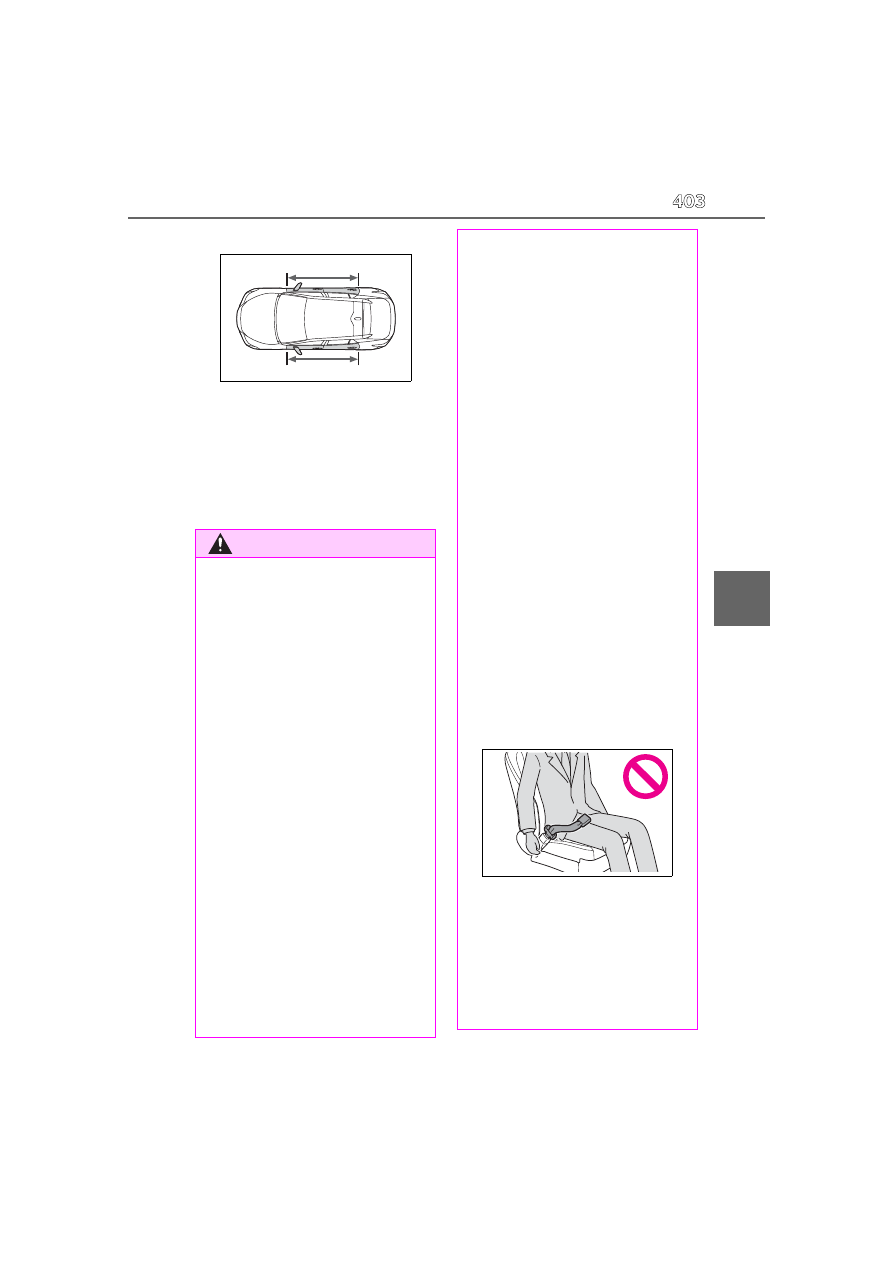
Since the risk zone for the driver’s airbag 

is the first 2 - 3 in. (50 - 75 mm) of infla-

tion, placing yourself 10 in. (250 mm) 

from your driver airbag provides you with 

a clear margin of safety. This distance is 

measured from the center of the steering 

wheel to your breastbone. If your current 

driving position places you less than 10 

in. (250 mm) away from the driver air-

bag, you can change your driving posi-

tion in several ways:
• Move your seat to the rear as far as 

possible while still being able to reach 

the pedals comfortably.

• Slightly recline the seatback. Although 

vehicle designs vary, many drivers can 

achieve the 10 in. (251 mm) distance, 

even with the driver seat all the way 

forward, simply by reclining the seat-

back somewhat. If reclining the seat-

back makes it hard to see the road, 

raise yourself by using a firm, non-slip-

pery cushion, or raise the seat if your 

vehicle has that feature.

• If your steering wheel is adjustable, tilt 

it downward. This points the airbag 

toward your chest instead of your head 

and neck. The seat should be adjusted 

as recommended by the NHTSA, 

while still being able to control the 

vehicle with the pedals and steering 

wheel, and maintaining your view of 

the instrument panel controls.

If a seat belt extender has been con-

nected to a front seat belt buckle but 

the latch plate of the seat belt has not 

been fastened to the seat belt 

extender, the SRS airbag system will 

judge that the occupant is wearing the 

seat belt even though the seat belt has 

not been fastened. In this case, the SRS 

front airbags may not deploy correctly 

in a collision, resulting in death or seri-

ous injury. Be sure to wear the seat belt 

correctly when using a seat belt 

extender.

The SRS front passenger airbag 

deploys with considerable force, and 

can cause death or serious injury, 

especially if the front passenger is very 

close to the airbag. The front passen-

ger seat should be positioned as far 

possible from the airbag with the seat-

back adjusted so that the passenger is 

sat upright.

404

6-3. Reducing impact to the occupants in a collision

WARNING

Improperly seated and/or restrained 

infants and children can be killed or 

seriously injured by a deploying airbag. 

An infant or child who is too small to 

use a seat belt should be properly 

secured using a child restraint system. 

Lexus strongly recommends that all 

infants and children be placed in the 

rear seats of the vehicle and properly 

restrained. The rear seats are safer for 

infants and children than the front pas-

senger seat. (

P.68)

Do not sit on the edge of the seat or 

lean against the dashboard.

Do not allow a child to stand in front of 

the SRS front passenger airbag or sit 

on the lap of a front passenger.

Front seat occupants should never 

hold items on their lap.

Do not lean against the door, roof side 

rail, or front, side, or rear pillar.

Do not allow anyone to kneel on a seat 

toward the door or put their head or 

hands outside the vehicle.

Do not attach anything to or lean any-

thing against areas such as the dash-

board, steering wheel pad and lower 

portion of the instrument panel.

Do not attach anything to areas such 

as the doors, windshield, side windows, 

front or rear pillars, roof side rails and 

assist grips. (With the exception of the 

speed limit label 

P.512)

Do not hang coat hangers or other 

hard objects on the coat hooks. These 

items could become projectiles if the 

SRS curtain shield airbags deploy, pos-

sibly leading to death or serious injury.

If a vinyl cover is attached to the area 

where the SRS knee airbag deploys, 

be sure to remove it.

405

6-3. Reducing impact to the occupants in a collision

6

Driving 

suppo

rt 

sys
te

m

WARNING

Do not use seat accessories which 

cover the parts from which the SRS 

airbags deploy, as they may interfere 

with inflation of the SRS airbags. Such 

accessories may prevent the SRS air-

bags from deploying correctly, may 

disable the system or cause the SRS 

airbags to inflate unintentionally, possi-

bly resulting in death or serious injury.

Do not strike or apply significant force 

to the SRS airbag system components, 

front doors or their surrounding area. 

Doing so may cause the SRS airbags 

to malfunction.

Do not touch any components of the 

SRS airbags immediately after the SRS 

airbags have deployed (inflated) as 

they may be hot.

If breathing becomes difficult after the 

SRS airbags have deployed, open a 

door or window to allow fresh air in, or 

leave the vehicle if it is safe to do so. 

Wash off any residue as soon as possi-

ble to prevent skin irritation.

If a part where an SRS airbag is stored 

is damaged or cracked, have it 

replaced by your Lexus dealer.

Do not place anything, such as a cush-

ion, on the front passenger's seat. 

Doing so will disperse the passenger’s 

weight, which prevents the sensor 

from detecting the passenger’s weight 

properly. As a result, the SRS front air-

bags for the front passenger’s seat may 

not deploy in the event of a collision.

Modification and disposal of SRS air-

bag system components

Do not dispose of your vehicle or per-

form any of the following modifications 

without consulting your Lexus dealer.

The SRS airbags may malfunction or 

deploy unintentionally, possibly leading 

to death or serious injury.

Removal, installation, disassembly or 

repair of the SRS airbags

Repair, removal or modification of the 

following parts or their surrounding

• Steering wheel

• Instrument panel

• Dashboard

• Seats

• Seat upholstery

• Front pillars

• Side pillars

• Rear pillars

• Roof side rails

• Front door panels

• Front door trim

• Front door speakers

Modifications to the front door panels 

(such as making holes in them)

Repair or modification of the following 

parts or their surrounding

• Front fender

• Front bumper

• Sides of the vehicle interior

Installation of the following parts or 

accessories

• Bull bars or kangaroo bars

• Snow plows

• Winches

• Roof luggage carriers

Modifications to the vehicle's suspen-

sion

Installation of electronic devices such 

as mobile two-way radios (RF-trans-

mitter) and CD players

406

6-3. Reducing impact to the occupants in a collision

WARNING

Modifications to your vehicle for a per-

sons with a physical disability

407

6-3. Reducing impact to the occupants in a collision

6

Driving 

suppo

rt 

sys
te

m

SRS warning light
Front passenger’s seat belt reminder light
“AIR BAG OFF” indicator light
“AIR BAG ON” indicator light

Front passenger occupant classification system

Your vehicle is equipped with a front passenger occupant classification system. 
This system detects the conditions of the front passenger seat and activates or 
deactivates the following SRS airbags.

SRS front passenger airbag

SRS front passenger knee airbag

System components

A
B
C
D

WARNING

Front passenger occupant classifica-

tion system precautions

Observe the following precautions 

regarding the front passenger occupant 

classification system. Failure to do so may 

cause death or serious injury.

Wear the seat belt properly.

Make sure the front passenger’s seat 

belt plate has not been left inserted 

into the buckle before someone sits in 

the front passenger seat.

408

6-3. Reducing impact to the occupants in a collision

WARNING

Make sure the “AIR BAG OFF” indica-

tor light is not illuminated when using 

the seat belt extender for the front pas-

senger seat. If the “AIR BAG OFF” 

indicator light is illuminated, discon-

nect the extender tongue from the seat 

belt buckle, and reconnect the seat 

belt. Reconnect the seat belt extender 

after making sure the “AIR BAG ON” 

indicator light is illuminated. If you use 

the seat belt extender while the “AIR 

BAG OFF” indicator light is illumi-

nated, the SRS airbags for the front 

passenger will not activate, which 

could cause death or serious injury in 

the event of a collision.

Do not apply a heavy load to the front 

passenger seat or equipment (e.g. 

seatback pocket or armrest).

Do not put weight on the front passen-

ger seat by putting your hands or feet 

on the front passenger seat seatback 

from the rear passenger seat.

Do not let a rear passenger lift the 

front passenger seat with their feet or 

press on the seatback with their legs.

Do not put objects under the front pas-

senger seat.

Do not recline the front passenger 

seatback so far that it touches a rear 

seat. This may cause the “AIR BAG 

OFF” indicator light to be illuminated, 

which indicates that the SRS airbags 

for the front passenger will not activate 

in the event of a severe accident. If the 

seatback touches the rear seat, return 

the seatback to a position where it 

does not touch the rear seat. Keep the 

front passenger seatback as upright as 

possible when the vehicle is moving. 

Reclining the seatback excessively 

may lessen the effectiveness of the 

seat belt system.

If an adult sits in the front passenger 

seat, the “AIR BAG ON” indicator light 

is illuminated. If the “AIR BAG OFF” 

indicator is illuminated, ask the passen-

ger to sit up straight, well back in the 

seat, feet on the floor, and with the seat 

belt worn correctly. If the “AIR BAG 

OFF” indicator still remains illumi-

nated, either ask the passenger to 

move to the rear seat, or if that is not 

possible, move the front passenger 

seat fully rearward.

When it is unavoidable to install a for-

ward-facing child restraint system on 

the front passenger seat, install the 

child restraint system on the front pas-

senger seat in the proper order. 

(

P.69)

Do not modify or remove the front 

seats.

Do not kick the front passenger seat or 

subject it to severe impact. Otherwise, 

the SRS warning light may come on to 

indicate a malfunction of the front pas-

senger occupant classification system. 

In this case, contact your Lexus dealer 

immediately.

Child restraint systems installed on the 

rear seat should not contact the front 

seatbacks.

Do not use a seat accessory, such as a 

cushion and seat cover, that covers the 

seat cushion surface.

Do not modify or replace the uphol-

stery of the front seat.

409

6-3. Reducing impact to the occupants in a collision

6

Driving suppo

rt 

sys
te

m

Adult

*1

Child

*4

Child restraint system with infant

*5

Front passenger occupant classification system conditions and opera-
tion

Indicator/warning light

“AIR BAG ON” and “AIR BAG OFF” indi-

cator lights

“AIR BAG ON”

SRS warning light

Off

Front passenger’s seat belt reminder light

Off

*2

 or flashing

*3

Devices

Front passenger airbag

Activated

Front passenger knee airbag

Indicator/warning light

“AIR BAG ON” and “AIR BAG OFF” indi-

cator lights

“AIR BAG OFF” or 

“AIR BAG ON”

*4

SRS warning light

Off

Front passenger’s seat belt reminder light

Off

*2

 or flashing

*3

Devices

Front passenger airbag

Deactivated or acti-

vated

*4

Front passenger knee airbag

Deactivated or acti-

vated

*2, 4

Indicator/warning light

“AIR BAG ON” and “AIR BAG OFF” indi-

cator lights

“AIR BAG OFF”

*6

SRS warning light

Off

Front passenger’s seat belt reminder light

Off

*2

 or flashing

*3

Devices

Front passenger airbag

Deactivated

Front passenger knee airbag

410

6-3. Reducing impact to the occupants in a collision

Unoccupied

System malfunction

*1

: The system judges a person of adult size as an adult. When a smaller adult sits in the 

front passenger seat, the system may not recognize them as an adult depending on their 
physique and posture.

*2

: In the event the front passenger is wearing a seat belt.

*3

: In the event the front passenger does not wear a seat belt.

*4

: For some children, child in seat, child in booster seat or child in convertible seat, the sys-

tem may not recognize them as a child. Factors which may affect this can be the phy-
sique or posture.

*5

: Never install a rear-facing child restraint system on the front passenger seat. A for-

ward-facing child restraint system should only be installed on the front passenger seat 
when it is unavoidable. (

P.69)

*6

: In case the indicator light is not illuminated, consult this manual on how to install the child 

restraint system properly. (

P.69)

Indicator/warning light

“AIR BAG ON” and “AIR BAG OFF” indi-

cator lights

“AIR BAG OFF”

SRS warning light

Off

Front passenger’s seat belt reminder light

Devices

Front passenger airbag

Deactivated

Front passenger knee airbag

Indicator/warning light

“AIR BAG ON” and “AIR BAG OFF” indi-

cator lights

“AIR BAG OFF”

SRS warning light

On

Front passenger’s seat belt reminder light

Off

Devices

Front passenger airbag

Deactivated

Front passenger knee airbag

411

7

7

Wirel

ess co
mmunica

tion

Wireless communication

.

7-1. Connected Services

Safety Connect ...........................

412

412

7-1. Connected Services

7-1.Connected Services

Microphone

LED light indicators
“SOS” button

Subscribers have the following Safety 
Connect services available:

Automatic Collision Notification

*

Helps drivers receive necessary response 
from emergency service providers. 
(

P.413)

*

: U.S. Patent No. 7,508,298 B2

Stolen Vehicle Location

Helps drivers in the event of vehicle theft. 
(

P.413)

Emergency Assistance Button 
(“SOS”)

Connects drivers to response-center sup-
port. (

P.413)

Enhanced Roadside Assistance

Provides drivers various on-road assis-
tance. (

P.413)

After you have signed the Telematics 
Subscription Service Agreement and 
are enrolled, you can begin receiving 
services.
A variety of subscription terms is avail-
able for purchase. Contact your Lexus 
dealer, call the following or push the 
“SOS” button in your vehicle for fur-
ther subscription details.

The United States

1-800-25-LEXUS (1-800-255-3987)

Canada

Safety Connect

Safety Connect is a subscrip-
tion-based telematics service that 
uses Global Positioning System 
(GPS) data and embedded cellular 
technology to provide safety and 
security features to subscribers. 
Safety Connect is supported by 
Lexus’ designated response center, 
which operates 24 hours per day, 7 
days per week.

Safety Connect service is available 
by subscription on select, telemat-
ics hardware-equipped vehicles.

By using the Safety Connect ser-
vice, you are agreeing to be bound 
by the Telematics Subscription Ser-
vice Agreement and its Terms and 
Conditions, as in effect and 
amended from time to time, a cur-
rent copy of which is available at 
Lexus.com. All use of the Safety 
Connect service is subject to such 
then-applicable Terms and Condi-
tions.

System components

A

Services

Subscription

B
C

413

7-1. Connected Services

7

Wirel

ess co
mmunica

tion

1-800-26-LEXUS (1-800-265-3987)

Puerto Rico

1-877-539-8777

Safety Connect Services Information

Phone calls using the vehicles Blue-
tooth

®

 technology will not be possible 

during Safety Connect.

Safety Connect is available beginning Fall 

2009 on select Lexus models (in the 

contiguous United States only). Contact 

with the Safety Connect response center 

is dependent upon the telematics device 

being in operative condition, cellular con-

nection availability, and GPS satellite sig-

nal reception, which can limit the ability to 

reach the response center or receive 

emergency service support. Enrollment 

and Telematics Subscription Service 

Agreement required. A variety of sub-

scription terms is available; charges vary 

by subscription term selected and loca-

tion.

Automatic Collision Notification, Emer-

gency Assistance and Stolen Vehicle 

Location will function in the United 

States, including Hawaii and Alaska, 

Puerto Rico and in Canada, and 

Enhanced Roadside Assistance will func-

tion in the United States, Puerto Rico and 

in Canada.

Automatic Collision Notification, Emer-

gency Assistance, Stolen Vehicle and 

Enhanced Road Assistance will not func-

tion in the United States Virgin Islands. 

For vehicles first sold in the USVI, no 

Safety Connect services will function in 

and outside the United States Virgin 

Islands.

Safety Connect services are not subject 

to section 255 of the Telecommunica-

tions Act and the device is not TTY com-

patible.

Languages

The Safety Connect response center will 

offer support in multiple languages. The 

Safety Connect system will offer voice 

prompts in English, Spanish, and French. 

Please indicate your language of choice 

when enrolling.

When contacting the response center

You may be unable to contact the response 

center if the network is busy.

Free/Open Source Software Informa-

tion

This product contains Free/Open Source 

Software (FOSS). The license information 

and/or the source code of such FOSS can 

be found at the following URL.
https://opensource.lge.com/osSch/

list?types=ALL&search=TL21BNU

When the power switch is turned to 
ON, the red indicator light comes on 
for 2 seconds then turns off. Afterward, 
the green indicator light comes on, 
indicating that the service is active.
The following indicator light patterns 
indicate specific system usage condi-
tions:

Green indicator light on = Active 
service

Green indicator light flashing = 
Safety Connect call in process

Red indicator light (except at vehi-
cle start-up) = System malfunction 
(contact your Lexus dealer)

No indicator light (off) = Safety 
Connect service not active

Automatic Collision Notification

In case of either airbag deployment or 
severe rear-end collision, the system is 
designed to automatically call the 

Safety Connect LED light Indi-
cators

Safety Connect services

414

7-1. Connected Services

response center. The responding agent 
receives the vehicle’s location and 
attempts to speak with the vehicle 
occupants to assess the level of emer-
gency. If the occupants are unable to 
communicate, the agent automatically 
treats the call as an emergency, con-
tacts the nearest emergency services 
provider to describe the situation, and 
requests that assistance be sent to the 
location.

Stolen Vehicle Location

If your vehicle is stolen, Safety Connect 
can work with local authorities to assist 
them in locating and recovering the 
vehicle. After filing a police report, call 
the Safety Connect response center at 
1-800-25-LEXUS 
(1-800-255-3987) in the United 
States, 1-877-539-8777 in Puerto 
Rico or 1-800-265-3987 in Canada, 
and follow the prompts for Safety Con-
nect to initiate this service.
In addition to assisting law enforce-
ment with recovery of a stolen vehicle, 
Safety-Connect-equipped vehicle 
location data may, under certain cir-
cumstances, be shared with third par-
ties to locate your vehicle. Further 
information is available at Lexus.com.

Emergency Assistance Button 
(“SOS”)

In the event of an emergency on the 
road, push the “SOS” button to reach 
the Safety Connect response center. 
The answering agent will determine 
your vehicle’s location, assess the 
emergency, and dispatch the neces-
sary assistance required.

If you accidentally press the “SOS” button, 
tell the response-center agent that you are 
not experiencing an emergency.

Enhanced Roadside Assistance

Enhanced Roadside Assistance adds 
GPS data to the already included war-
ranty-based Lexus roadside service.
Subscribers can press the “SOS” but-
ton to reach a Safety Connect 
response-center agent, who can help 
with a wide range of needs, such as: 
towing, flat tire, fuel delivery, etc. For a 
description of the Roadside Assistance 
services and their limitations, please 
see the Safety Connect Terms and 
Conditions, which are available at 
Lexus.com.

Important! Read this information about 
exposure to radio frequency signals 
before using Safety Connect;
The Safety Connect system installed in 
your vehicle is a low-power radio trans-
mitter and receiver. It receives and also 
sends out radio frequency (RF) signals.
In August 1996, the Federal Commu-
nications Commission (FCC) adopted 
RF exposure guidelines with safety lev-
els for mobile wireless phones. Those 
guidelines are consistent with the 
safety standards previously set by the 
following U.S. and international stan-
dards bodies.

ANSI (American National Stan-
dards Institute) C95.1 [1992]

Safety information for Safety 
Connect

415

7-1. Connected Services

7

Wirel

ess co
mmunica

tion

NCRP (National Council on Radia-
tion Protection and Measurement) 
Report 86 [1986]

ICNIRP (International Commission 
on Non-Ionizing Radiation Protec-
tion) [1996]

Those standards were based on com-
prehensive and periodic evaluations of 
the relevant scientific literature. Over 
120 scientists, engineers, and physi-
cians from universities, and govern-
ment health agencies and industries 
reviewed the available body of 
research to develop the ANSI Stan-
dard (C95.1).
The design of Safety Connect com-
plies with the FCC guidelines in addi-
tion to those standards.

416

7-1. Connected Services

417

8

8

Mai
nte

na

nc

e a

nd

 c

are

Maintenance and care

.

8-1. Exterior maintenance and care

Washing the vehicle..................

418

8-2. Cleaning and protecting the 

vehicle interior

Cleaning the vehicle interior

........................................................

422

Cleaning the synthetic leather 

areas ............................................

424

8-3. Maintenance

Maintenance requirements ..

425

Scheduled maintenance outline

........................................................

426

Do-it-yourself maintenance

........................................................

426

General maintenance.............

427

Motor compartment mainte-

nance items list........................

427

Vehicle interior maintenance 

items list......................................

428

Vehicle exterior maintenance 

items list......................................

429

Emission inspection and mainte-

nance (I/M) programs .........

429

8-4. Inspection of consumables

Do-it-yourself service precautions

.........................................................

431

Opening the hood ....................

433

Motor compartment................

435

Adding washer fluid.................

440

Air conditioning filter mainte-

nance............................................

441

8-5. Tire maintenance

Tire maintenance ......................

444

Tire inspection items................

444

Operation of the tire pressure 

warning system .......................

446

Checking tire inflation pressure

.......................................................

454

Lifting the vehicle with a floor jack

.......................................................

456

Rotating the tires.......................

457

Wheels ..........................................

458

Replacing the tire......................

459

Headlight aim .............................

466

418

8-1. Exterior maintenance and care

8-1.Exterior maintenance and care

Perform cleaning in a manner appro-
priate to each component and its 
material.

Working from top to bottom, liber-
ally apply water to the vehicle body, 
wheel wells and underside of the 
vehicle to remove any dirt and dust.

Wash the vehicle body using a 
sponge or soft cloth, such as a 
chamois.

For hard-to-remove marks, use car 
wash soap and rinse thoroughly with 
water.

Wipe away any water.

Self-restoring coat

The vehicle body has a self-restoring coat-

ing that is resistant to small surface 

scratches caused by a car wash, etc.

The coating lasts for 5 to 8 years from 

when the vehicle is delivered from the 

plant.

The restoration time differs depending on 

the depth of the scratch and outside tem-

perature.

The restoration time may become shorter 
when the coating is warmed by applying 
warm water.

Deep scratches caused by keys, coins, 

etc., cannot be restored.

Do not use waxes that contain abrasives.

When using a car wash

If the door handle becomes wet while the 

Washing the vehicle

WARNING

Do not apply water to the inside of the 

motor compartment.

Doing so may cause the electrical com-

ponents, etc. to catch fire.

NOTICE

To prevent paint deterioration and 

corrosion of the body and compo-

nents (wheels, etc.)

Wash the vehicle immediately in the 

following cases:

• After driving near the sea coast

• After driving on salted roads

• If coal tar or tree sap is present on the 

paint surface

• If dead insects, insect droppings or 

bird droppings are present on the 

paint surface

• After driving in an area contaminated 

with soot, oily smoke, mine dust, iron 

powder or chemical substances

• If the vehicle becomes heavily soiled 

with dust or mud

• If liquids such as benzine or gasoline 

are spilled on the paint surface

If the paint is chipped or scratched, 

have it repaired immediately.

To prevent the wheels from corroding, 

remove any dirt and store in a place 

with low humidity when storing the 

wheels.

To prevent damage to the windshield 

wiper arms

When lifting the wiper arms away from 

the windshield, pull the driver side wiper 

arm upward first, and repeat for the pas-

senger side. When returning the wipers 

to their original position, do so from the 

passenger side first.

419

8-1. Exterior maintenance and care

8

Mai
nte

na

nc

an

d c

are

electronic key is within the effective range, 

the door may lock and unlock repeatedly. In 

that case, follow the following correction 

procedures to wash the vehicle:

Place the key in a position 6 ft. (2 m) or 

more separate from the vehicle while the 

vehicle is being washed.

Take care to ensure that the key is not sto-
len.

Set the electronic key to battery-saving 

mode to disable the smart access system 

with push-button start.

Brake pads and calipers

Rust may form if the vehicle is parked with 

wet brake pads or disc rotors, causing them 

to stick. Before parking the vehicle after it is 

washed, drive slowly and apply the brakes 

several times to dry the parts.

Perform the following before wash-
ing your vehicle:

• Fold the mirrors.
• Vehicles with power back door:
Turn off the power back door.
Start washing from the front of the vehicle.
Extend the mirrors before driving.

Brushes used in automatic car 
washes may scratch the vehicle sur-
face, parts (wheel, etc.) and harm 
your vehicle’s paint.

Depending on the automatic car 
wash, the rear spoiler may become 
caught, preventing it from being 

washed or causing damage to it.

When the shift position needs to be 
held in N, refer to P.148.

Using an automatic car wash

NOTICE

When using an automatic car wash, 

move the wiper lever to the off position.

If the wiper lever is in the AUTO position, 

the wipers may operate unintentionally 

and the wiper blades may be damaged.

Using a high pressure washer to 
wash the vehicle

NOTICE

When washing the vehicle, do not 

spray any of the cameras or their sur-

rounding area directly. The shock from 

high pressure water may cause a cam-

era to malfunction.

Do not bring the tip of the nozzle close 

to connectors or the boots (rubber or 

resin cover) of the following parts.

The parts may be damaged if sprayed by 
high-pressure water.
• Drivetrain related parts

• Steering parts

• Suspension parts

• Brake parts

Keep the tip of the nozzle at least 11.9 

in. (30 cm) away from the vehicle 

body. Otherwise resin parts, such as 

the moldings, bumpers, etc., may be 

deformed and damaged. Also, do not 

continuously spray water on the same 

place.

Do not spray the lower part of the 

windshield continuously. If water 

enters the air conditioning system 

intake located near the lower part of 

the windshield, the air conditioning 

system may not operate correctly.

Do not wash the underside of the vehi-

cle using a high pressure car washer. If 

water enters the traction battery, the 

EV system may malfunction.

420

8-1. Exterior maintenance and care

When using a high pressure washer, as 
water may enter the cabin, do not bring 
the tip of the nozzle near the gaps 
around the doors or perimeter of the 
windows, or spray these areas continu-
ously.

Perform the following:

Remove any dirt immediately using 
a neutral cleaning agent.

Wash detergent off with water 
immediately after use.

To protect the finish from damage, 
make sure to observe the following 
precautions.

• Do not use acidic, alkaline or abrasive 

cleaners

• Do not use hard brushes
• Do not use detergent on the wheels 

when they are hot, such as after driving 
or parking in hot weather

Painted brake calipers

When using detergent, use neutral deter-

gent. Do not use hard brushes or abra-

sive cleaners, as they will damage the 

paint.

Do not use detergent on the brake cali-

pers when they are hot.

Wash detergent off immediately after 

use.

Do not scrub with abrasive cleaners.

If dirt cannot be removed, clean the 
parts as follows:

Use a soft cloth dampened with an 
approximately 5 % solution of neu-
tral detergent and water to clean the 
dirt off.

Wipe the surface with a dry, soft 
cloth to remove any remaining 
moisture.

To remove oily deposits, use alcohol 
wet wipes or a similar product.

NOTICE

Do not use the washer on the area 

around the charging port lid. Water 

could get into the charging inlet and 

could damage the vehicle.

Cleaning the wheels and wheel 
ornaments

Cleaning the bumpers

WARNING

If the paint of the front or rear bumper is 

chipped or scratched, the following sys-

tems may not function correctly. If this 

occurs, consult your Lexus dealer.

Lexus Safety System + 3

BSM (Blind Spot Monitor)

Safe Exit Assist

Intuitive parking assist (if equipped)

RCTA (Rear cross traffic alert)

PKSB (Parking Support Brake) (if 

equipped)

Cleaning and protecting the 
plated portions

421

8-1. Exterior maintenance and care

8

Mai
nte

na

nc

an

d c

are

Front side windows water-repellent 

coating

The effectiveness of the water-repellent 

coating can be extended by paying atten-

tion to the following.

Remove any dirt, etc., from the front side 

windows regularly.

Do not allow dirt and dust to accumulate 

on the windows.

If dirty, clean the windows with a soft, damp 

cloth as soon as possible.

Do not use wax or glass cleaners that 

contain abrasives when cleaning the win-

dows.

Do not use any metallic objects to 

remove condensation build up.

Wax the vehicle when the waterproof 
coating has deteriorated.
If water does not bead on a clean sur-
face, apply wax when the vehicle body 
is cool.

Cleaning the exterior lights

NOTICE

Wash carefully. Do not use organic 

substances or scrub with a hard brush.

Doing so may damage the surface of the 
lights.

Do not apply wax to the lights.

Wax may damage the lenses.

Cleaning the windshield

WARNING

Move the wiper lever to the off position.

If the wiper lever is in the AUTO position, 

the wipers may operate unexpectedly in 

the following situations, possibly leading 

serious injury from a hand being caught, 

or damage to the wiper blades.

Off
AUTO

When the upper part of the windshield 

where the raindrop sensor is located is 

touched by hand

When a wet rag or similar is held close 

to the raindrop sensor

If something bumps against the wind-

shield

If you directly touch the raindrop sen-

sor body or if something bumps into 

the raindrop sensor

A

B

Waxing the vehicle

Cleaning aluminum parts

NOTICE

When cleaning the hood, do not push 

hard or put weight on it. The aluminum 

part may be dented.

422

8-2. Cleaning and protecting the vehicle interior

8-2.Cleaning and protecting the vehicle interior

Cleaning the vehicle interior

WARNING

Water in the vehicle

Do not splash or spill liquid in the vehi-

cle. Doing so may cause the electrical 

components, etc., to malfunction or 

catch fire.

Do not get any of the SRS components 

or wiring in the vehicle interior wet.

An electrical malfunction may cause the 

airbags to deploy or not function prop-

erly, resulting in death or serious injury.

Do not let the wireless charger 

(

P.225) get wet. Failure to do so 

may cause the charger to become hot 

and cause burns or could cause elec-

tric shock resulting in death or serious 

injury.

Cleaning the interior (especially 

instrument panel)

Do not use wax polish or a polishing 

cleaner on the instrument panel. The 

instrument panel may reflect off the 

windshield, obstructing the driver’s view 

and leading to an accident, resulting in 

death or serious injury.

To prevent burns

If the vehicle is left in direct sunlight for a 
long time, the underside of the glass roof

*


could become very hot and could cause 

burns.

*

: If equipped

NOTICE

Cleaning solvents

Do not use the following cleaning sol-

vents, as they may discolor the vehicle 

interior or cause streaks or damage to 

painted surfaces:

• Areas other than the seats: Organic 

substances such as benzine or gaso-

line, alkaline or acidic solutions, dye, 

and bleach

• Seats: thinner, benzine, alcohol, or 

alkaline or acidic solutions

Do not use wax polish or a polishing 

cleaner. The painted surfaces of the 

instrument panel or other interior 

parts may be damaged.

Water on the floor

Do not wash the vehicle floor with water.

If water contacts audio system or other 

electrical components under the floor 

carpet, it may cause the vehicle to mal-

function. Water may also cause the body 

to rust.

When cleaning the inside of the wind-

shield

Do not allow glass cleaner to contact the 

lens of the front camera. Also, do not 

touch the lens.

Cleaning the inside of the rear win-

dow

Do not use glass cleaners to clean the 

rear window, as this may cause dam-

age to the rear window defogger 

heater wires or antenna. Use a cloth 

dampened with lukewarm water to 

gently wipe the window clean. Wipe 

the window in strokes running parallel 

to the heater wires or antenna.

Be careful not to scratch or damage 

the heater wires or antenna.

423

8-2. Cleaning and protecting the vehicle interior

8

Mai
nte

na

nc

an

d c

are

Remove dirt and dust using a vac-
uum cleaner. Wipe dirty surfaces 
with a cloth dampened with luke-
warm water.

If dirt cannot be removed, wipe it off 
with a soft cloth dampened with 
neutral detergent diluted to approx-
imately 1%.

Wring out any excess water from the cloth 
and thoroughly wipe off remaining traces 
of detergent and water.

Shampooing the carpets

Excellent results can be obtained by keep-

ing the carpet as dry as possible. When 

cleaning, use a commercially available 

foaming-type cleaner.
Use a sponge or brush to apply the foam 

and rub it in overlapping circles. Do not use 

water. Wipe the surface to remove the 

cleaner and dirt and let it dry.

Handling the seat belts

Clean with mild soap and lukewarm water 

using a cloth or sponge. Also check the 

belts periodically for excessive wear, fraying 

or cuts.

Handling precautions of the panoramic 
fixed moon roof glass (Low-E coating)

*

*

: If equipped

Do not rub the glass with a metal tool, etc.

Note that applying film to the glass sur-

face may damage the function of the 

coating.

Note that attaching a sucker to the glass 

surface may cause suction marks to 

remain.

NOTICE

Cleaning the panoramic fixed moon 

roof glass (if equipped)

When cleaning the panoramic fixed 

moon roof glass, do not use a compound 

or abrasive articles, such as a glass 

cleaner, detergent, wax, etc. Doing so 

may damage the coating.

424

8-2. Cleaning and protecting the vehicle interior

Remove dirt and dust using a vac-
uum cleaner.

Wipe it off with a soft cloth damp-
ened with neutral detergent diluted 
to approximately 1%.

Wring out any excess water from 
the cloth and thoroughly wipe off 
remaining traces of detergent and 
water.

Cleaning the synthetic 
leather areas

425

8-3. Maintenance

8

Mai
nte

na

nc

an

d c

are

8-3.Maintenance

Repair and replacement

It is recommended that genuine Lexus parts 

be used for repairs to ensure performance 

of each system. If non-Lexus parts are used 

in replacement or if a repair shop other than 

a Lexus dealer performs repairs, confirm 

the warranty coverage.

Allow inspection and repairs to be per-

formed by a Lexus dealer

Lexus technicians are well-trained spe-

cialists and are kept up to date with the 

latest service information. They are well 

informed about the operation of all sys-

tems on your vehicle.

Keep a copy of the repair order. It proves 

that the maintenance that has been per-

formed is under warranty coverage. If any 

problem should arise while your vehicle is 

under warranty, your Lexus dealer will 

promptly take care of it.

General maintenance

General maintenance should be performed 

on a daily basis. This can be done by your-

self or by a Lexus dealer.

Maintenance requirements

To ensure safe and economical driv-
ing, day-to-day care and regular 
maintenance are essential. It is the 
owner’s responsibility to perform 
regular checks. Lexus recommends 
the following maintenance:

WARNING

If your vehicle is not properly main-

tained

Improper maintenance could result in 

serious damage to the vehicle and possi-

ble death or serious injury.

Handling of the 12-volt battery

Oils and fluids contained in vehicles as 

well as waste produced by component 

wear contain or emit chemicals known 

to the State of California to cause can-

cer and birth defects or other repro-

ductive harm. Avoid exposure and 

wash any affected area immediately.

12-volt battery posts, terminals and 

related accessories contain lead and 

lead compounds which are known to 

cause brain damage. Wash your hands 

after handling.

426

8-3. Maintenance

Scheduled maintenance should be 
performed at specified intervals 
according to the maintenance sched-
ule.
For details about maintenance items 
and schedules, refer to the “Warranty 
and Service Guide”, “Owner’s Manual 
Supplement” or “Scheduled Mainte-
nance”.

You can perform some maintenance 
procedures by yourself. Please be 
aware that do-it-yourself maintenance 
may affect warranty coverage.
The use of Lexus repair manuals is rec-
ommended. For details about war-
ranty coverage, refer to the separate 
“Owner’s Guide”, “Warranty and Ser-
vice Guide”, “Owner’s Manual Supple-
ment” or “Warranty Booklet”.

Scheduled maintenance out-
line

Do-it-yourself maintenance

427

8-3. Maintenance

8

Mai
nte

na

nc

an

d c

are

General maintenance

General maintenance items should 
be performed at the intervals speci-
fied in the “Warranty and Service 
Guide” or “Owner’s Manual Sup-
plement”. This can be done by your-
self or by a Lexus dealer. It is 
recommended that any problem 
you notice should be brought to the 
attention of your Lexus dealer or 
qualified service shop for advice.

WARNING

If the EV system is on, turn the power 

switch off and ensure that there is ade-

quate ventilation before performing 

maintenance checks.

Motor compartment mainte-
nance items list

Items

Check points

Brake fluid

Is the brake fluid at 

the correct level? 

(

P.437)

Power control 

unit/heater coolant

Is the heater/power 

control unit coolant 

at the correct level? 

(

P.435, 436)

12-volt battery

Check the connec-

tions. (

P.438)

Radiator/condenser

The radiator and 

condenser should 

be free from foreign 

objects. (

P.436)

Washer fluid

Is there sufficient 

washer fluid? 

(

P.440)

428

8-3. Maintenance

Vehicle interior mainte-
nance items list

Items

Check points

Accelerator pedal

The accelerator 

pedal should move 

smoothly. There 

should be no uneven 

pedal effort or 

catching.

Transmission “Park” 

mechanism

When parked on a 

slope and the shift 

position is in P, is the 

vehicle securely 

stopped?

Brake pedal

Does the brake 
pedal move 
smoothly?

Does the brake 
pedal have appro-
priate clearance 
from the floor?

Does the brake 
pedal have the 
correct amount of 
free play?

Brakes

The vehicle 
should not pull to 
one side when the 
brakes are 
applied.

The brakes should 
work effectively.

The brake pedal 
should not feel 
spongy.

The brake pedal 
should not get too 
close to the floor 
when the brakes 
are applied.

Head restraints

Do the head 

restraints move 

smoothly and lock 

securely?

Indicators/buzzers

Do the indicators 

and buzzers func-

tion properly?

Lights

Do all the lights 
come on?

Are the headlights 
aimed correctly?

Parking brake

Does the parking 
brake switch 
operate normally?

When parked on 
a slope and the 
parking brake is 
on, is the vehicle 
securely stopped?

Seat belts

Do the seat belts 
operate 
smoothly?

The seat belts 
should not be 
damaged.

Seats

Do the seat controls 

operate properly?

Steering wheel

Does the steering 
wheel rotate 
smoothly?

Does the steering 
wheel have the 
correct amount of 
free play?

There should not 
be any strange 
sounds coming 
from the steering 
wheel.

Items

Check points

429

8-3. Maintenance

8

Mai
nte

na

nc

e a

nd

 c

are

The OBD system determines that a 
problem exists somewhere in the emis-
sion control system.
Your vehicle may not pass the I/M test 
and may need to be repaired. Contact 
your Lexus dealer to service the vehi-
cle.

When the 12-volt battery is discon-
nected or discharged

Readiness codes that are set during ordi-
nary driving are erased. Also, depending 
on your driving habits, the readiness codes 
may not be completely set.

The error code in the OBD system will 
not be cleared unless the vehicle is 
driven 40 or more times.

Vehicle exterior mainte-
nance items list

Items

Check points

Doors

Do the doors oper-

ate smoothly?

Hood

Does the motor 

hood lock system 

work properly?

Fluid leaks

There should not be 

any signs of fluid 

leakage after the 

vehicle has been 

parked.

Tires

Is the tire inflation 
pressure correct?

The tires should 
not be damaged 
or excessively 
worn.

Have the tires 
been rotated 
according to the 
maintenance 
schedule?

The wheel bolts 
should not be 
loose.

Windshield wipers

The wiper blades 
should not show 
any signs of 
cracking, split-
ting, wear, con-
tamination or 
deformation.

The wiper blades 
should clear the 
windshield with-
out streaking or 
skipping.

Emission inspection and 
maintenance (I/M) pro-
grams

Some states have vehicle emission 
inspection programs which include 
OBD (On Board Diagnostics) 
checks. The OBD system monitors 
the operation of the emission con-
trol system.

When the malfunction indicator 
lamp comes on

Situations your vehicle may not 
pass the I/M test

When the malfunction indicator 
lamp still remains on after sev-
eral driving trips

430

8-3. Maintenance

Contact your Lexus dealer to prepare 
the vehicle for re-testing.

When your vehicle does not pass 
the I/M test

431

8-4. Inspection of consumables

8

Mai
nte

na

nc

an

d c

are

8-4.Inspection of consumables

Items which require maintenance and 
the necessary parts and tools to per-
form maintenance on those items are 
as follows:

12-volt battery condition

Warm water

Baking soda

Grease

Conventional wrench (for terminal 
clamp bolts)

Distilled water

Brake fluid level

FMVSS No.116 DOT 3 or SAE 
J1703 brake fluid FMVSS No.116 
DOT 4 or SAE J1704 brake fluid

Rag or paper towel

Funnel (used only for adding brake 

Do-it-yourself service pre-
cautions

If you perform maintenance by 
yourself, be sure to follow the cor-
rect procedure as given in the sec-
tion for each part.

WARNING

The motor compartment contains many 

mechanisms and fluids that may move 

suddenly, become hot, or become elec-

trically energized. To avoid death or seri-

ous injury, observe the following 

precautions.

When working on the motor com-

partment

Make sure that “POWER ON” on the 

multi-information display and the 

“READY” indicator are both off.

Keep hands, clothing and tools away 

from the moving fan.

Be careful not to touch the motor, 

power control unit, radiator, etc., right 

after driving as they may be hot. Cool-

ant and other fluids may also be hot.

Do not leave anything that may burn 

easily, such as paper and rags, in the 

motor compartment.

Do not smoke, cause sparks or expose 

an open flame to the 12-volt battery. 

12-volt battery fumes are flammable.

Never touch, disassemble, remove or 

replace the high voltage parts, cables 

and their connectors. It can cause 

severe burns or electric shock that 

may result in death or serious injury.

When working near the electric cool-

ing fan or radiator grille

Be sure the power switch is OFF.

With the power switch in ON, the elec-

tric cooling fan may automatically start to 

run if the air conditioning is on and/or the 

coolant temperature is high.

Safety glasses

Wear safety glasses to prevent flying or 

falling material, fluid spray, etc., from get-

ting in your eyes.

NOTICE

If the fluid level is low or high

It is normal for the brake fluid level to go 

down slightly as the brake pads wear or 

when the fluid level in the accumulator is 

high.

If the reservoir needs frequent refilling, it 

may indicate a serious problem.

Maintenance

432

8-4. Inspection of consumables

fluid)

Heater coolant level

“Toyota Super Long Life Coolant” or 
a similar high quality ethylene gly-
col-based non-silicate, non-amine, 
non-nitrite and non-borate coolant 
with long-life hybrid organic acid 
technology “Toyota Super Long Life 
Coolant” is premixed with 50% 
coolant and 50% deionized water.

Funnel (used only for adding cool-
ant)

Power control unit coolant level

In order to ensure maximum perfor-
mance of the traction battery cool-
ing system and limit risks of battery 
short-circuit and other damage to 
your vehicle, Toyota recommends 
using “Toyota Genuine Traction Bat-
tery Coolant” or similar high-quality 
ethylene glycol-based, low electric 
conductivity coolant, non-amine 
and non-borate coolant with azole 
additives.

Funnel (used only for adding cool-
ant)

Fuses

Fuse with same amperage rating as 
original

Headlight aim

Phillips-head screwdriver

Radiator and condenser

-

Tire inflation pressure

Tire pressure gauge

Compressed air source

Washer fluid

Water or washer fluid containing 
antifreeze (for winter use)

Funnel (used only for adding water 
or washer fluid)

433

8-4. Inspection of consumables

8

Mai
nte

na

nc

an

d c

are

1

Pull the hood lock release lever.

The hood will pop up slightly.

2

Pull up the auxiliary catch lever to 
the left and lift the hood.

3

Hold the hood open by inserting 
the supporting rod into the slot.

Opening the hood

WARNING

Pre-driving check

Check that the hood is fully closed and 

locked.

If the hood is not locked properly, the 

hood may suddenly open while driving.

After installing the support rod into 

the slot

Make sure the rod is properly inserted 

into the slot to prevent the hood from 

shutting on your head or body.

When closing the hood

When closing the hood, take extra care 

to prevent your fingers etc., from being 

caught.

434

8-4. Inspection of consumables

NOTICE

When closing the hood

Be sure to return the support rod to its 

clip before closing the hood. Closing the 

hood without returning the support rod 

properly may cause the hood to be dam-

aged.


Content      ..     11      12      13      14     ..