Ford Orion. Manual - part 14
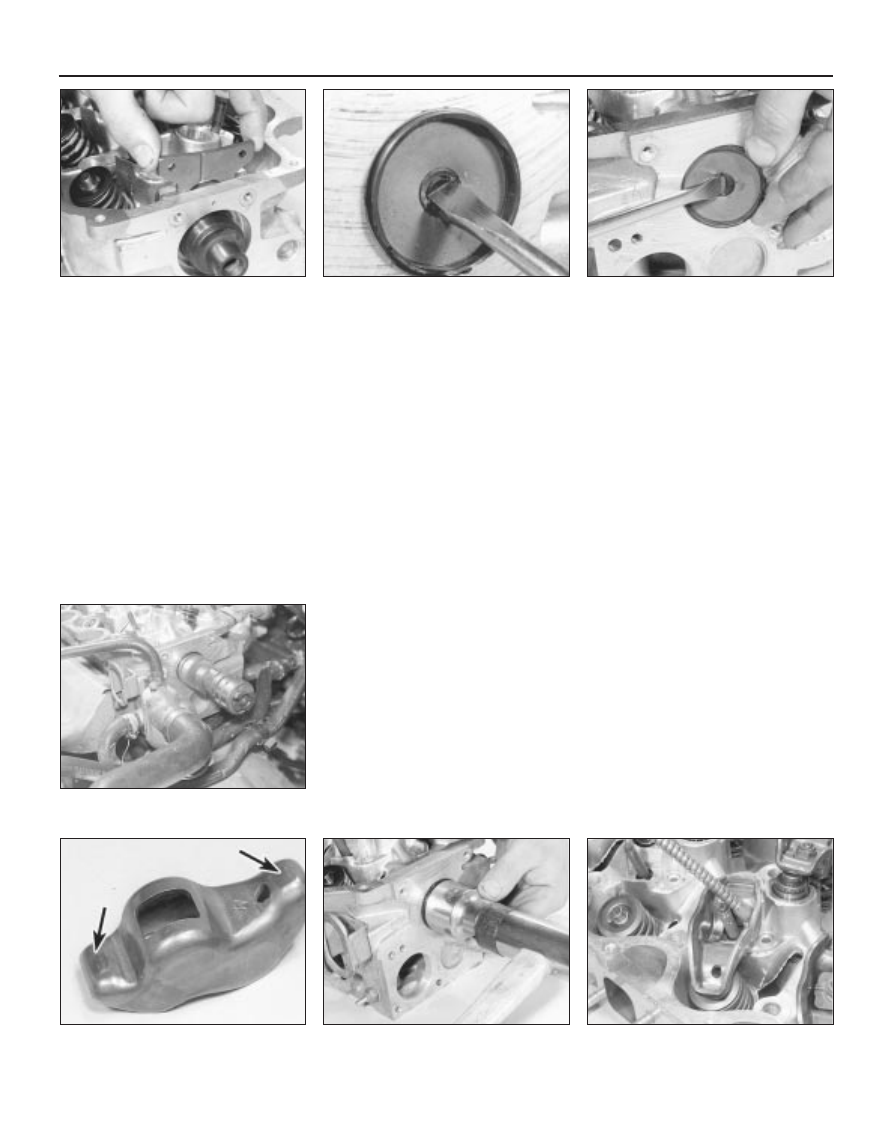
11 At the rear end of the cylinder head,
pierce the camshaft blanking plug with a
suitable tool, and then lever it out of its
aperture (see illustrations).
12 Withdraw the camshaft from the cylinder
head at the rear (ignition coil) end (see
illustration). Take care not to damage the
bearings in the cylinder head as the shaft is
withdrawn.
Inspection
13 Clean and inspect the various
components removed for signs of excessive
wear.
14 Examine the camshaft bearing journals
and lobes for damage or wear. If evident, a
new camshaft will be required.
15 Compare the previously-measured
camshaft endfloat with that specified. If the
endfloat is outside of the specified tolerance,
the thrust plate must be renewed.
16 The camshaft bearing bore diameters in
the cylinder head should be measured and
checked against the tolerances specified. A
suitable measuring gauge will be required for
this, but if this is not available, check for
excessive movement between the camshaft
journals and the bearings. If the bearings are
found to be unacceptably worn, a new
cylinder head is the only answer, as the
bearings are machined directly into the head.
17 It is seldom that the hydraulic tappets are
badly worn in the cylinder head bores but
again, if the bores are found to be worn
beyond an acceptable level, the cylinder head
must be renewed.
18 If the contact surfaces of the cam lobes
show signs of depression or grooving, they
cannot be renovated by grinding, as the
hardened surface will be removed and the
overall length of the tappet(s) will be reduced.
The self-adjustment point of the tappet will be
exceeded as a result, so that the valve
adjustment will be affected, resulting in noisy
operation. Therefore, renewal of the camshaft
is the only remedy in this case.
19 Inspect the rocker arm contact surfaces
for excessive wear, and renew if necessary
(see illustration).
Refitting
20 Refitting the camshaft and its associated
components is a reversal of the removal
procedure, but note the following special
points.
21 Lubricate the camshaft bearings, the
camshaft and the thrust plate with clean
engine oil prior to fitting them. As the
camshaft is inserted, take care not to damage
the bearings in the cylinder head. Refer to the
Specifications for the thrust plate
retaining bolt torque. When the thrust plate
bolts are tightened, make a final check to
ensure that the camshaft endfloat is as
specified.
22 A new front oil seal must be fitted after the
camshaft has been installed (see previous
Section for details). It will also be necessary to
insert a new blanking plug into the rear end of
the cylinder head. Drive it squarely into
position so that it is flush with the head (see
illustration).
23 Refer to the procedure in Section 11 when
refitting the camshaft sprocket.
24 Refit and tension the timing belt as
described in Section 10.
25 Lubricate the hydraulic tappets with
hypoid oil before refitting them into their
original locations in the cylinder head.
26 Lubricate and refit the rocker arms and
guides in their original sequence, use new
nuts and tighten them to the specified torque
setting (see illustration). It is essential before
each rocker arm is installed and its nut
tightened, that the respective cam follower is
positioned at its lowest point (in contact with
the cam base circle). Turn the cam (using the
2B•10 CVH engine – in-car engine repair procedures
13.26 Lubricate the rocker arm assemblies
as they are refitted
13.22 Driving a new blanking plug into
position
13.19 Inspect the rocker arm contact
points indicated for excessive wear
13.12 Withdraw the camshaft from the
cylinder head
13.11B . . . and lever it out of the cylinder
head
13.11A Pierce the centre of the blanking
plug . . .
13.10B . . . and lift out the camshaft thrust
plate