Ford Orion. Manual - part 4
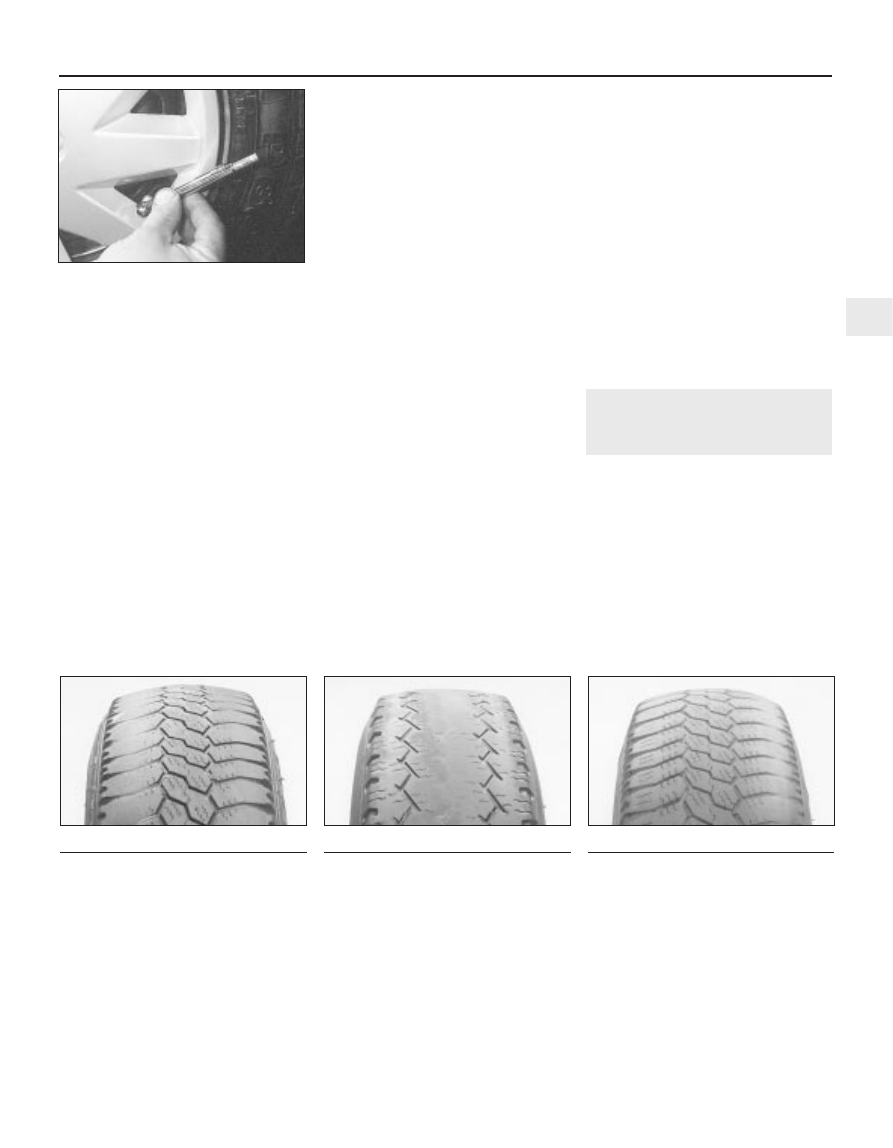
3 Ensure that tyre pressures are checked
regularly and maintained correctly (see the
Specifications at the beginning of this Chapter
for pressures). Checking should be carried out
with the tyres cold, and not immediately after
the vehicle has been in use. If the pressures
are checked with the tyres hot, an apparently-
high reading will be obtained, owing to heat
expansion. Under no circumstances should an
attempt be made to reduce the pressures to
the quoted cold reading in this instance, or
effective under-inflation will result. Most
garage forecourts have a pressure line which
combines a gauge to check and adjust the
tyre pressures, but they may vary in accuracy,
due to general misuse and abuse. It therefore
pays to carry a good-quality tyre pressure
gauge in the vehicle, to make the regular
checks required and ensure pressure
accuracy
(see illustration).
4 Note any abnormal tread wear (see
illustration). Tread pattern irregularities such
as feathering, flat spots, and more wear on
one side than the other, are indications of
front wheel alignment and/or balance
problems. If any of these conditions are
noted, they should be rectified as soon as
possible.
5 Under-inflation will cause overheating of the
tyre, owing to excessive flexing of the casing,
and the tread will not sit correctly on the road
surface. This will cause a consequent loss of
adhesion and excessive wear, not to mention
the danger of sudden tyre failure due to heat
build-up.
6 Over-inflation will cause rapid wear of the
centre part of the tyre tread, coupled with
reduced adhesion, harder ride, and the
danger of damage occurring in the tyre
casing.
7 Regularly check the tyres for damage in the
form of cuts or bulges, especially in the
sidewalls. Remove any nails or stones
embedded in the tread, before they penetrate
the tyre to cause deflation. If removal of a nail
reveals that the tyre has been punctured, refit
the nail, so that its point of penetration is
marked. Then immediately change the wheel,
and have the tyre repaired by a tyre dealer. Do
not drive on a tyre in such a condition. If in any
doubt as to the possible consequences of any
damage found, consult your local tyre dealer
for advice.
8 General tyre wear is influenced to a large
degree by driving style - harsh braking and
acceleration, or fast cornering, will all produce
more rapid tyre wear. Interchanging of tyres
may result in more even wear; however, it is
worth bearing in mind that if this is completely
effective, the likelihood is that all four tyres
would need replacing at once, which may
prove too expensive for many owners.
9 Front tyres may wear unevenly as a result of
wheel misalignment. The front wheels should
always be correctly aligned according to the
settings specified by the vehicle
manufacturer.
10 Don’t forget to check the spare tyre for
condition and pressure.
11 Legal restrictions apply to many aspects
of tyre fitting and usage, and in the UK this
information is contained in the Motor Vehicle
Construction and Use Regulations. It is
suggested that a copy of these regulations is
obtained from your local police, if in doubt as
to current legal requirements with regard to
tyre type and condition, minimum tread depth,
etc.
5
Power steering fluid level
check
1
1 The power steering fluid reservoir is located
on the right-hand side of the engine
compartment, next to the cooling system
expansion tank.
2 For the fluid level check, the power steering
system should be at its normal operating
temperature, so it is best to carry out the
check after a run.
3 Park the vehicle on level ground, with the
front wheels pointing straight ahead, and
switch off the engine.
Weekly Checks
1•13
4.3 Check the tyre pressures regularly
using an accurate gauge
Tyre tread wear patterns
Shoulder Wear
Underinflation (wear on both sides)
Under-inflation will cause overheating of the
tyre, because the tyre will flex too much, and
the tread will not sit correctly on the road
surface. This will cause a loss of grip and
excessive wear, not to mention the danger of
sudden tyre failure due to heat build-up.
Check and adjust pressures
Incorrect wheel camber (wear on one side)
Repair or renew suspension parts
Hard cornering
Reduce speed!
Centre Wear
Overinflation
Over-inflation will cause rapid wear of the
centre part of the tyre tread, coupled with
reduced grip, harsher ride, and the danger of
shock damage occurring in the tyre casing.
Check and adjust pressures
If you sometimes have to inflate your car’s
tyres to the higher pressures specified for
maximum load or sustained high speed, don’t
forget to reduce the pressures to normal
afterwards.
Uneven Wear
Front tyres may wear unevenly as a result of
wheel misalignment. Most tyre dealers and
garages can check and adjust the wheel
alignment (or "tracking") for a modest charge.
Incorrect camber or castor
Repair or renew suspension parts
Malfunctioning suspension
Repair or renew suspension parts
Unbalanced wheel
Balance tyres
Incorrect toe setting
Adjust front wheel alignment
Note: The feathered edge of the tread which
typifies toe wear is best checked by feel.
1