Vauxhall Crossland X (2023 year). Manual in english - page 9
 

  Index      Manuals     Vauxhall Crossland X (2023 year). Manual in english


Search            copyright infringement  


Content      ..     7      8      9     


Vauxhall Crossland X (2023 year). Manual in english - page 9


262

Vehicle care

Stowing a damaged full size

wheel in the load compartment

The spare wheel well is not designed

for other tyre sizes than the temporary

spare wheel. A damaged full size

wheel must be stowed in the load

compartment and secured with a

strap.
Vehicle tools 

3

 248.

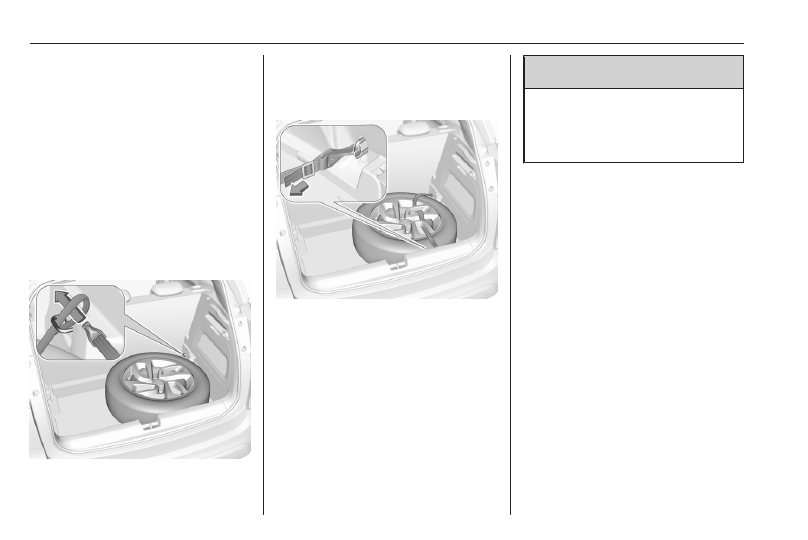
To secure the wheel:

1. Position the wheel outside up

close to one sidewall of the load

compartment.

2. Place the loop end of the strap

through the front lashing eye on

the appropriate side.

3. Place the hook end of the strap

through the loop and pull it until

the strap is fastened securely to

the lashing eye.

4. Insert the strap through the

spokes of the wheel as shown in

the illustration.

5. Mount the hook to the rear lashing

eye.

6. Tighten the strap and secure it

using the buckle.

If no strap is available, make sure to

store the wheel securely in the load

compartment.
Loading information 

3

 54

9

Danger

Always drive with folded up and

engaged rear seat backrests when

stowing a damaged full size wheel

in the load compartment.

Vehicle care

263

Jump starting

Do not start with quick charger.
A vehicle with a discharged vehicle

battery can be started using jump

leads and the vehicle battery of

another vehicle.

9

Warning

Be extremely careful when starting

with jump leads. Any deviation

from the following instructions can

lead to injuries or damage caused

by battery explosion or damage to

the electrical systems of both

vehicles.

9

Warning

Avoid contact of the battery with

eyes, skin, fabrics and painted

surfaces. The fluid contains

sulphuric acid which can cause

injuries and damage in the event

of direct contact.

● Never expose the vehicle battery

to naked flames or sparks.

● A discharged vehicle battery can

already freeze at a temperature

of 0 °C. Defrost the frozen battery

before connecting jump leads.

● Wear eye protection and

protective clothing when

handling a battery.

● Use a booster battery with the

same voltage (12 V). Its capacity

(Ah) must not be much less than

that of the discharged vehicle

battery.

● Use jump leads with insulated

terminals and a cross section of

at least 16 mm

2

 (25 mm

2

 for

diesel engines).

● Do not disconnect the discharged

vehicle battery from the vehicle.

● Switch off all unnecessary

electrical consumers.

● Do not lean over the vehicle

battery during jump starting.

● Do not allow the terminals of one

lead to touch those of the other

lead.

● The vehicles must not come into

contact with each other during

the jump starting process.

● Apply the parking brake,

transmission in neutral,

automatic transmission in P.

Open the positive terminal protection

caps of both vehicle batteries.
Lead connection order:

1. Connect the red lead to the

positive terminal of the booster

battery.

2. Connect the other end of the red

lead to the positive terminal of the

discharged battery.

264

Vehicle care

3. Connect the black lead to the

negative terminal of the booster

battery.

4. Connect the other end of the black

lead to a vehicle grounding point

of your vehicle in the engine

compartment.

Route the leads so that they cannot

catch on rotating parts in the engine

compartment.
To start the engine:

1. Start the engine of the vehicle

providing the jump.

2. After five minutes, start the other

engine. Start attempts should be

made for no longer than

15 seconds at an interval of one

minute.

3. Allow both engines to idle for

approx. three minutes with the

leads connected.

4. Switch on electrical consumers

(e.g. headlights, heated rear

window) of the vehicle receiving

the jump start.

5. Reverse above sequence exactly

when removing leads.

Towing

Towing the vehicle

Wrap a cloth around the tip of a flat

screwdriver to prevent paint damage.

Insert a screwdriver in the slot at the

bottom of the cap. Release the cap by

carefully moving the screwdriver

downwards.
The towing eye is stowed with the

vehicle tools 

3

 248.

Screw in the towing eye as far as it will

go until it stops in a horizontal

position.
Attach a tow rope – or better still a tow

rod – to the towing eye.
The towing eye must only be used for

towing and not for recovering the

vehicle.
Switch on ignition to release steering

wheel lock and to permit operation of

brake lights, horn and windscreen

wiper.

Vehicle care

265

Caution

Deactivate the driver assistance

systems like active emergency

braking 

3

 199, otherwise the

vehicle may automatically brake

during towing.

Switch the selector lever to neutral.
Release the parking brake.

Caution

Drive slowly. Do not drive jerkily.

Excessive tractive force can

damage the vehicle.

When the engine is not running,

considerably more force is needed to

brake and steer.
To prevent the entry of exhaust gases

from the towing vehicle, switch on the

air recirculation and close the

windows.
Vehicles with automatic transmission:

The vehicle must be towed facing

forwards, not faster than 50 mph nor

further than 60 miles. In all other

cases and when the transmission is

defective, the front axle must be

raised off the ground.
Seek the assistance of a workshop.
After towing, unscrew the towing eye.
Insert cap with the outer flange into

the recess and fix cap by pushing.

Towing another vehicle

Wrap a cloth around the tip of a flat

screwdriver to prevent paint damage.

Insert a screwdriver in the slot at the

bottom of the cap. Release the cap by

carefully moving the screwdriver

downwards.

The towing eye is stowed with the

vehicle tools 

3

 248.

Screw in the towing eye as far as it will

go until it stops in a horizontal

position.
The lashing eye at the rear

underneath the vehicle must never be

used as a towing eye.
Attach a tow rope – or better still a tow

rod – to the towing eye.
The towing eye must only be used for

towing and not for recovering a

vehicle.

266

Vehicle care

Caution

Drive slowly. Do not drive jerkily.

Excessive tractive force can

damage the vehicle.

After towing, unscrew the towing eye.
Insert cap with the upper flange into

the recess and fix cap by pushing.

Appearance care

Exterior care

Locks

The locks are lubricated at the factory

using a high quality lock cylinder

grease. Use a de-icing agent only

when absolutely necessary, as this

has a degreasing effect and impairs

lock function. After using a de-icing

agent, have the locks regreased by a

workshop.

Washing

The paintwork is exposed to

environmental influences.
Bird droppings, dead insects, resin,

pollen and the like should be cleaned

off immediately, as they contain

aggressive constituents which can

cause paint damage.
If using a vehicle wash, comply with

the vehicle wash manufacturer's

instructions. The windscreen wiper

and rear window wiper must be

switched off. Remove antenna and

external accessories such as roof

racks etc.
If the vehicle is washed by hand,

make sure that the insides of the

wheel housings are also thoroughly

rinsed out.
Wax painted parts of the vehicle

regularly.
Clean edges and folds on opened

doors and the bonnet as well as the

areas they cover.
Clean bright metal mouldings with a

cleaning solution approved for

aluminium to avoid damages.

Caution

Always use a cleaning agent with

a pH value of four to nine.
Do not use cleaning agents on hot

surfaces.

Do not clean the engine compartment

with a steam-jet or high-pressure jet

cleaner.

Vehicle care

267

Thoroughly rinse and leather-off the

vehicle. Rinse leather frequently. Use

separate leathers for painted and

glass surfaces: remnants of wax on

the windows will impair vision.
Have the door hinges of all doors

greased by a workshop.
Do not use hard objects to remove

spots of tar. Use tar removal spray on

painted surfaces.

Exterior lights

Headlight and other light covers are

made of plastic. Do not use any

abrasive or caustic agents, do not use

an ice scraper, and do not clean them

dry.

Polishing and waxing

Polishing is necessary only if the paint

has become dull or if solid deposits

have become attached to it.
Plastic body parts must not be treated

with wax or polishing agents.

Windows and windscreen wiper

blades

Switch off wipers before handling in

their areas.
Use a soft lint-free cloth or chamois

leather together with window cleaner

and insect remover.
When cleaning the rear window from

inside, always wipe in parallel to the

heating element to prevent damage.
For mechanical removal of ice, use a

sharp-edged ice scraper. Press the

scraper firmly against the glass so

that no dirt can get under it and

scratch the glass.
Clean smearing wiper blades with a

soft cloth and window cleaner. Also

make sure to remove any residues

such as wax, insect residues and

similar from the window.
Ice residues, pollution and continuous

wiping on dry windows will damage or

even destroy the wiper blades.

Glass panel

Use a soft lint-free cloth or chamois

leather together with window cleaner

to clean the glass panel.

Wheels and tyres

Do not use high-pressure jet

cleaners.
Clean rims with a pH-neutral wheel

cleaner.
Rims are painted and can be treated

with the same agents as the body.

Paintwork damage

Rectify minor paintwork damage with

a touch-up pen before rust forms.

Have more extensive damage or rust

areas repaired by a workshop.

Underbody

Some areas of the vehicle underbody

have a PVC undercoating while other

critical areas have a durable

protective wax coating.
After the underbody is washed, check

the underbody and have it waxed if

necessary.

268

Vehicle care

Bitumen / rubber materials could

damage the PVC coating. Have

underbody work carried out by a

workshop.
Before and after winter, wash the

underbody and have the protective

wax coating checked.

Towing equipment

Do not clean the coupling ball bar with

a steam-jet or high-pressure jet

cleaner.

Interior care

Interior and upholstery

Only clean the vehicle interior,

including the instrument panel fascia

and panelling, with a dry cloth or

interior cleaner.
Clean the leather upholstery with

clear water and a soft cloth. In case of

heavy soiling, use leather care.
The instrument cluster and the

displays should only be cleaned using

a soft damp cloth. If necessary use a

weak soap solution.

Clean fabric upholstery with a

vacuum cleaner and brush. Remove

stains with an upholstery cleaner.
Clothing fabrics may not be

colourfast. This could cause visible

discolourations, especially on light-

coloured upholstery. Removable

stains and discolourations should be

cleaned as soon as possible.
Clean seat belts with lukewarm water

or interior cleaner.

Caution

Close Velcro fasteners as open

Velcro fasteners on clothing could

damage seat upholstery.
The same applies to clothing with

sharp-edged objects, like zips or

belts or studded jeans.

Plastic and rubber parts

Plastic and rubber parts can be

cleaned with the same cleaner as

used to clean the body. Use interior

cleaner if necessary. Do not use any

other agent. Avoid solvents and petrol

in particular. Do not use high-

pressure jet cleaners.

Floor mats

9

Warning

If a floor mat has the wrong size or

is not properly installed, it can

interfere with pedals, what can

cause unintended acceleration or

increased stopping distance which

can cause a crash and injury.

Use the following guidelines for

proper floor mat usage.

● The original equipment floor mats

were designed for this vehicle. If

the floor mats need to be

replaced, it is recommended to

buy certified floor mats which fit

properly and are fixed by the

Vehicle care

269

retainers on the driver side.

Always check that the floor mats

do not interfere with the pedals.

● Use the floor mat with the correct

side up. Do not turn it over.

● Do not place anything on top of

the driver's side floor mat.

● Use only a single floor mat on the

driver's side.

Installing and removing the floor

mats

The driver's side floor mat and the

passenger's side floor mat are each

held in place by two retainers.
To install the floor mat:

1. Move the seat backwards as far

as possible.

2. Align slots in the mat with the

retainers, as shown.

3. Push the mat to the floor.

To remove the floor mat:

1. Move the seat backwards as far

as possible.

2. Pull the floor mat upwards to

remove.

270

Service and maintenance

Service and

maintenance

General information ................... 270

Service information .................. 270

Recommended fluids, lubricants

and parts .................................... 273

Recommended fluids and

lubricants ................................ 273

General information

Service information

In order to ensure economical and

safe vehicle operation and to

maintain the value of your vehicle, it

is of vital importance that all

maintenance work is carried out at the

proper intervals as specified.
The detailed, up-to-date service

schedule for your vehicle is available

at the workshop.
Severe operating conditions exist if

one or more of the following

circumstances occur frequently: Cold

starting, stop and go operation, e.g.

for taxis and police vehicles, trailer

operation, mountain driving, driving

on poor and sandy road surfaces,

increased air pollution, presence of

airborne sand and high dust content,

driving at high altitude and large

variations of temperature.
Under these severe operating

conditions, certain service work may

be required more frequently than the

regular service interval indicated in

the service display. Contact a

workshop for customised service

schedules.
Service display 

3

 67.

Service and maintenance

271

Service intervals

Engine code

EB2ADT
EB2ADTS

EB2FA

EP6FADTXD
(Hybrid version)

EB2DTS

EP6FDTMD
EP6FDTM

Country group 1 12,000 miles / 1 year

12,000 miles / 1 year

19,000 miles / 1 year

1)

1)

Unless otherwise indicated in the service display.

Engine code

DV5RC
DV5RD
DV5RCD
DV5RCE

DW10FC

DV6D

Country group 1

19,000 miles / 1 year 

1)

19,000 miles / 1 year 

1)

1)

Unless otherwise indicated in the service display.

Country Group 1:

Andorra, Austria, Belgium, Cyprus, Denmark, Finland, France, Germany, Greece, Iceland, Italy, Liechtenstein,

Luxembourg, Malta, Monaco, Netherlands, Norway, Portugal, Republic of Ireland, San Marino, Spain, Sweden,

Switzerland, United Kingdom.
Country Group 2:

Bosnia-Herzegovina, Bulgaria, Croatia, Czech Republic, Estonia, Hungary, Latvia, Lithuania, North Macedonia, Poland,

Romania, Slovakia, Slovenia.
Country Group 3:

Albania, Kosovo, Montenegro, New Zealand, Serbia.
Country Group 4:

Israel, Lesotho, South Africa, Swaziland, Turkey.

272

Service and maintenance

Country Group 5:

Russia.
Country Group 6:

All other countries which are not listed in the previous country groups.
Confirmations

Confirmation of service is recorded in the Service and warranty booklet. The date and mileage is completed with the stamp

and signature of the servicing workshop.
Make sure that the Service and warranty booklet is completed correctly as continuous proof of service is essential if any

warranty or goodwill claims are to be met, and is also a benefit when selling the vehicle.

Service and maintenance

273

Recommended fluids,

lubricants and parts

Recommended fluids and

lubricants

Only use products that meet the

recommended specifications.

9

Warning

Operating materials are

hazardous and could be

poisonous. Handle with care. Pay

attention to information given on

the containers.

Engine oil

Engine oil is identified by its quality

and its viscosity. Quality is more

important than viscosity when

selecting which engine oil to use. The

engine oil quality ensures e.g. engine

cleanliness, wear protection and

engine oil aging control, whereas

viscosity grade gives information on

the engine oil's thickness over a

temperature range.

Select the appropriate engine oil

based on its quality and on the

minimum ambient temperature

3

 277.

Topping up engine oil

Caution

In case of any spilled engine oil,

wipe it up and dispose of it

properly.

Engine oils of different manufacturers

and brands can be mixed as long as

they comply with the required engine

oil quality and viscosity.
Select the appropriate engine oil

based on its quality and on the

minimum ambient temperature

3

 277.

Additional engine oil additives

The use of additional engine oil

additives could cause damage and

invalidate the warranty.

Engine oil viscosity grades

The SAE viscosity grade gives

information of the thickness of the

engine oil.
Multigrade engine oil is indicated by

two figures, e.g. SAE 5W-30. The first

figure, followed by a W, indicates the

low temperature viscosity and the

second figure the high temperature

viscosity.
Select the appropriate viscosity grade

depending on the minimum ambient

temperature 

3

 277.

All of the recommended viscosity

grades are suitable for high ambient

temperatures.

Coolant and antifreeze

Use only antifreeze approved for the

vehicle. Consult a workshop.
The system is factory filled with

coolant designed for excellent

corrosion protection and frost

protection down to approx. -37 °C.

This concentration should be

maintained all year round. The use of

additional coolant additives that

274

Service and maintenance

intend to give additional corrosion

protection or seal against minor leaks

can cause function problems. Liability

for consequences resulting from the

use of additional coolant additives will

be rejected.

Washer fluid

Use only washer fluid approved for

the vehicle to prevent damage of

wiper blades, paintwork, plastic and

rubber parts. Consult a workshop.

Brake and clutch fluid

Over time, brake fluid absorbs

moisture which will reduce braking

effectiveness. The brake fluid should

therefore be replaced at the specified

interval.
Use only brake fluid approved for the

vehicle. Consult a workshop.

AdBlue

Only use AdBlue to reduce the

nitrogen oxides in the exhaust

emission 

3

 180.

Technical data

275

Technical data

Vehicle identification .................. 275

Vehicle identification number . . 275

Identification plate ................... 275

Engine identification ................ 276

Vehicle data ............................... 277

Recommended fluids and

lubricants ................................ 277

Engine data ............................. 278

Performance ............................ 279

Vehicle dimensions ................. 281

Capacities ................................ 282

Tyre pressures ........................ 283

Vehicle identification

Vehicle identification

number

The vehicle identification number is

stamped on the identification plate

and on the floor pan, under the floor

covering, visible under a cover.
The vehicle identification number

may be embossed on the instrument

panel, visible through the windscreen,

or in the engine compartment on the

right body panel.

Identification plate

The identification plate is located on

the front left or right door frame. The

layout and position differ for some

export countries.

276

Technical data

Information on identification label:
1 : manufacturer

2 : type approval number

3 : vehicle identification number

4 : permissible gross vehicle weight

rating in kg

5 : permissible gross train weight

in kg

6 : maximum permissible front axle

load in kg

7 : maximum permissible rear axle

load in kg

8 : vehicle-specific or country-

specific data

The combined total of front and rear

axle loads must not exceed the

permissible gross vehicle weight.

Vehicle's kerb weight depends on the

specification of the vehicle, e.g.

optional equipment and accessories.

Refer to the EEC Certificate of

Conformity provided with your vehicle

or other national registration

documents.
The technical data is determined in

accordance with European

Community standards. We reserve

the right to make modifications.

Specifications in the vehicle

documents always have priority over

those given in this manual.

Engine identification

The technical data tables use the

engine identifier code. The engine

data table additionally shows the

engineering code.
Engine data 

3

 278.

To identify the respective engine,

refer to the EEC Certificate of

Conformity provided with this vehicle

or other national registration

documents.

The Certificate of Conformity shows

the engine identifier code, other

national publications may show the

engineering code. Check piston

displacement and engine power to

identify the respective engine.

Technical data

277

Vehicle data

Recommended fluids and lubricants

Required engine oil quality

Country groups 

3

 270

Countries included in country groups 1 to 3 and 5

EB2FA
EB2ADT
EB2ADTS
DV5RC
DV5RCD
DV5RCE

EB2DT
EB2DTM

Vauxhall Original engine oil

B71 2010 / B71 2312

B71 2312

Engine oil viscosity grades

B71 2010

B71 2312

B71 2302

B71 2297

Engine oil viscosity grade

SAE 0W-20

SAE 0W-30

SAE 0W-30

SAE 5W-30

278

Technical data

Engine data

Sales designation

1.2

1.2 Turbo

1.2 Turbo

1.2 Turbo

Engineering code

EB2FA

EB2DT / EB2ADT

EB2DTM

EB2ADTS

Piston displacement [cm

3

]

1199

1199

1199

1199

Engine power [kW]

61

81

81

96

at rpm

5750

5500

5500

5500

Torque [Nm]

118

205

205

230

at rpm

2750

1750

1500

1750

Fuel type

Petrol

Petrol

Petrol

Petrol

Octane rating RON

1)2)

recommended

95

95

95

95

possible

98

98

98

98

possible

1)

A country-specific label at the fuel filler flap can supersede the engine-specific requirement.

2)

In certain countries, the use of a particular fuel, e.g. a specific octane rating, may be required to ensure proper engine operation.

Technical data

279

Sales designation

1.5

1.5

Engineering code

DV5RCD

DV5RCE

Piston displacement [cm

3

]

1499

1499

Engine power [kW]

88

81

at rpm

3750

3750

Torque [Nm]

300

250

at rpm

1750

1750

Fuel type

Diesel

Diesel

Performance

Engine

EB2FA

EB2DT / EB2ADT

EB2ADTS

EB2DTM

Maximum speed [mph]
Manual transmission

106

116

125

Automatic transmission

116

114

280

Technical data

Engine

DV5RCD

DV5RCE

Maximum speed [mph]
Manual transmission

111

Automatic transmission

117

Technical data

281

Vehicle dimensions

Length [mm]

4212

Width with two exterior mirrors [mm]

1976

Width with two exterior mirrors folded [mm]

1825

Height [mm]

1597

Length of load compartment floor [mm]

793

Length of load compartment with folded rear seats [mm]

1483

Load compartment width [mm]

947

Load compartment height with cover [mm]

584

Load compartment height without cover [mm]

894

Height of load compartment opening [mm]

712

Turning circle diameter [m]

11.2

282

Technical data

Capacities

Engine oil

Engine

EB2FA

EB2DT / EB2ADT
EB2ADTS

EB2DTM

DV5RCD
DV5RCE

including filter [l]

3.25

3.5

-

3)

3.95

between MIN and MAX [l]

1.0

1.0

-

3)

1.6

3)

Not available at time of printing

Fuel tank

Petrol / diesel, refilling quantity [l]

45

AdBlue tank

AdBlue, refilling quantity [l]

14.8

Technical data

283

Tyre pressures

Comfort with up to 3 people

ECO with up to 3 people

With full load

Tyres

front

rear

front

rear

front

rear

[kPa/bar] ([psi]) [kPa/bar] ([psi]) [kPa/bar] ([psi]) [kPa/bar] ([psi])

[kPa/bar]

([psi])

[kPa/bar]

([psi])

195/65 R15,
195/60 R16

230/2.3 (33)

230/2.3 (33)

250/2.5 (36)

250/2.5 (36)

240/2.4 (35) 290/2.9 (42)

205/60 R16,
215/50 R17

230/2.3 (33)

230/2.3 (33)

250/2.5 (36)

250/2.5 (36)

240/2.4 (35) 270/2.7 (39)

Temporary spare wheel
125/80 R16

420/4.2 (60)

420/4.2 (60)

420/4.2 (60) 420/4.2 (60)

284

Customer information

Customer

information

Customer information ................ 284

Declaration of conformity ......... 284

REACH .................................... 285

Software update ...................... 285

Registered trademarks ............ 287

Vehicle data recording and pri‐

vacy ........................................... 287

Emergency call data recording

and privacy ............................. 287

Event data recorders ............... 288

Radio Frequency Identification

(RFID) ..................................... 291

Customer information

Declaration of conformity

Transmission systems

This vehicle has systems that

transmit and / or receive radio waves

subject to Directive 2014/53/EU and

The Radio Equipment Regulations

2017 by the United Kingdom. The

manufacturers of the systems listed

below declare conformity with

Directive 2014/53/EU and

The Radio Equipment Regulations

2017. The full text of the EU

declaration of conformity for each

system is available at the following

internet address: www.opel.com/

conformity.
Importer is Vauxhall Motors Limited,

MP UK 1-101-135, Chalton House,

Luton Road, Chalton, Luton,

Bedfordshire, LU4 9TT, United

Kingdom.

Multimedia Navi Pro

Continental

LCIE Bureau Veritas-Site de

Fontenay aux Roses, 33 avenue du

général Leclerc, 92260 Fontenay aux

Roses, France
Operation

frequency (MHz)

Maximum output

(dBm)

2400.0 - 2483.5 2.2
2400.0 - 2483.5 15

Multimedia

LG Electronics
European Shared Service center B.V.
Krijgsman 1, 1186 DM Amstelveen,

The Netherlands
Operation frequency:

2400.0 - 2483.5 MHz
Maximum output: 4 dBm

BTA Module

Magneti Marelli S.p.A.
Viale A. Borletti 61/63, 20011

Corbetta, Italy

Customer information

285

Operation

frequency (MHz)

Maximum output

(dBm)

880 -915

33

1710 - 1785

24

1850 -1910

24

1920 - 1980

24

2500 - 2570

23

Antenna module

Laird
Daimlerring 31, 31135 Hildesheim,

Germany
Operation frequency: N/A
Maximum output: N/A

Radio remote control transmitter

Hülsbeck & Fürst GmbH & Co. KG
Steeger Str. 17, 42551 Velbert,

Germany
Operation frequency: 433.92 MHz
Maximum output: 10 dBm

Radio remote control receiver

Delphi European, Middle Eastern &

African Regional Offices Customer

Technology
Center Avenue de Luxembourg,

L-4940 Bascharage, G.D. of

Luxembourg
Operation frequency:

119.0 - 128.6 kHz
Maximum output: 16dBµA/m @ 10m

Electronic key transmitter

Valeo
43 Rue Bayen, 75017 Paris, France
Operation frequency:  433.92 MHz
Maximum output: 10 dBm

Immobiliser

KOSTAL of America, Inc.
350 Stephenson Hwy, Troy MI 48083,

USA 
Operation frequency: 125 kHz
Maximum output: 5 dBμA/m at 10m

ICASA type approval numbers

List of all Independent

Communications Authority of South

Africa (ICASA) type approval

numbers:
TA-2016/121, TA-2016/3261,

TA-2017/2387, TA-2017/2745,

TA-2013/430, TA-2017/1106,

TA-2016/929, TA-2017/3180

REACH

Registration, Evaluation,

Authorisation and Restriction of

Chemicals (REACH) is a European

Union regulation adopted to improve

the protection of human health and

the environment from the risks that

can be posed by chemicals. Visit

www.opel.com/reach for further

information and for access to the

Article 33 communication.

Software update

The Infotainment system can

download and install selected

software updates over a wireless

connection.

286

Customer information

Notice

The availability of these over-the-air

vehicle software updates varies by

vehicle and country. Find more

information on our home page.

Remote device management and

remote software and firmware

updates

As an integral part of the service

related to the performance of

subscribed connected service

contracts, necessary device

management and necessary

software and firmware updates

related to the software and firmware

for the named connected service will

be performed remotely, in particular

by using over-the-air technology.
For this, a secure radio network

connection between the vehicle and

the device management server will be

established when ignition is switched

on and a mobile network is available.

Depending on the equipment of the

vehicle, connection configuration

must be set to Connected vehicle to

allow the establishment of the radio

network connection.

Irrespective of a valid connected

service subscription, remote product

security or product safety related

device management and software

and firmware updates will be

performed when the processing is

necessary for the compliance with a

legal obligation to which the

manufacturer is subject (e.g.

applicable product liability law,

emergency call regulation) or when

the processing is necessary in order

to protect the vital interests of the

respective vehicle users and

passengers.
The establishment of a secure radio

network connection and the related

remote updates are not affected by

privacy settings and will be performed

in principal after an initiation by the

vehicle user following a respective

notification.
The system is able to notify receipt of

an update as soon as it is connected

to an exterior Wi-Fi network or a

mobile network. Large updates are

downloaded only via the Wi-Fi

network.

The availability of an update is

notified on the Info Display at the end

of a trip with an option of immediate

installation or postponement of

installation.
The installation time is variable and

can take several minutes with a

maximum of about 30 minutes. A

notification will give an estimate of the

duration and a description of the

update.
Updates can be checked manually

via the Info Display. Follow the on-

screen prompts in the respective

menu.
Info Display 

3

 79.

Notice

Steps for downloading and installing

updates may vary by vehicle.

For safety reasons and because it

requires sustained attention by the

driver, the installation must be carried

out with the ignition on without

starting the engine. The installation

cannot be carried out in the following

cases:

Customer information

287

● engine running
● emergency call in progress
● insufficient vehicle battery

charge

Notice

During the installation process, the

vehicle may not be operational.

If the update has failed, seek the

assistance of a workshop.

Registered trademarks

Apple Inc.

Apple CarPlay™ is a trademark of

Apple Inc.
App Store

®

 and iTunes Store

®

 are

registered trademarks of Apple Inc.
iPhone

®

, iPod

®

, iPod touch

®

, iPod

nano

®

, iPad

®

 and Siri

®

 are registered

trademarks of Apple Inc.
Bluetooth SIG, Inc.

Bluetooth

®

 is a registered trademark

of Bluetooth SIG, Inc.
DivX, LLC

DivX

®

 and DivX Certified

®

 are

registered trademarks of DivX, LLC.

EnGIS Technologies, Inc.

BringGo

®

 is a registered trademark of

EnGIS Technologies, Inc.
Google Inc.

Android™ and Google Play™ Store

are trademarks of Google Inc.
Stitcher Inc.

Stitcher™ is a trademark of Stitcher,

Inc.
Velcro Companies

Velcro

®

 is a registered trademark of

Velcro Companies.
Verband der Automobilindustrie e.V.

AdBlue

®

 is a registered trademark of

the VDA.

Vehicle data recording

and privacy

Emergency call data

recording and privacy

Data processing

All processing of personal information

by the emergency call function

complies with the framework for

protection of personal information

established by regulation 2016/679

(GDPR) and directive 2002/58/EC of

the European Parliament and the

Council, and in particular, seeks to

protect the vital interests of the data

subject, in accordance with article

6.1, paragraph d) of regulation

2016/679.
The processing of personal

information is strictly limited to the

requirements of the emergency call

function used with the European

emergency call number.
The emergency call function is only

able to collect and process the

following data relating to the vehicle:

chassis number, type (passenger

288

Customer information

vehicle or light commercial vehicle),

fuel type or power source, three most

recent locations and direction of

travel, number of passengers and a

timestamped log file recording

technical data related to the system's

operation.
The recipients of the processed data

are the emergency call handling

centres designated by the relevant

national authorities in the territory in

which they are located, enabling

priority routing and handling of calls to

the emergency number.

Data storage

Data contained in the system's

memory is not accessible from

outside the system until a call is

made. The system is not traceable

and is not continuously monitored in

its normal operation mode.
The data in the system's internal

memory is automatically and

continuously erased. Only the

vehicle's three most recent locations,

necessary for the normal functioning

of the system, are stored.

When an emergency call is triggered,

the data log is stored for no more than

13 hours.

Access to data

You have the right to access the data

and, if necessary, submit a request to

rectify, erase or restrict the

processing of any personal

information not processed in

accordance with the provisions of

Regulation 2016/679 (GDPR). Third

parties to which data has been

communicated shall be notified of any

rectification, erasure or restriction

carried out in accordance with the

aforementioned directive, unless

doing so would be impossible or

require a disproportionate effort.
You also have the right to lodge a

complaint with the relevant data

protection authority.
If you want to claim your above-

mentioned rights please contact us

per email at

privacyrights@mpsa.com.

For more information regarding our

contact details please take a look at

our Privacy & Cookies Policy on our

website.

Event data recorders

Electronic control units are installed in

your vehicle. Control units process

data which is received e.g. by vehicle

sensors, or which they generate

themselves or exchange amongst

themselves. Some control units are

necessary for the safe functioning of

your vehicle, others assist you while

you drive (driver assistance systems),

while others provide comfort or

infotainment functions.
The following contains general

information about data processing in

the vehicle. You will find additional

information as to which specific data

is uploaded, stored and passed on to

third parties and for what purpose in

your vehicle under the key word Data

Protection closely linked to the

references for the affected functional

characteristics in the relevant

Customer information

289

Owner's Manual or in the general

terms of sale. These are also

available online.

Operating data in the vehicle

Control units process data for

operation of the vehicle.
This data may include:

● vehicle status information (e.g.

speed, movement delay, lateral

acceleration, wheel rotation rate,

"seat belts fastened" display)

● ambient conditions (e.g.

temperature, rain sensor,

distance sensor)

As a rule such data is transient and is

not stored for longer than an

operational cycle, and only processed

on board the vehicle itself. Often

control units include data storage

(including the vehicle key). This is

used to allow information to be

documented temporarily or

permanently on vehicle condition,

component stress, maintenance

requirements and technical events

and errors.

Depending on technical equipment

levels, the data stored is as follows:

● system component operating

states (e.g. fill level, tyre

pressure, battery status)

● faults and defects in important

system components (e.g. lights,

brakes)

● system reactions in special

driving situations (e.g. triggering

of an airbag, actuation of the

stability control systems)

● information on events damaging

the vehicle

● for electric vehicles the amount of

charge in the high-voltage

battery, estimated range

In special cases (e.g. if the vehicle

has detected a malfunction), it may be

necessary to save data that would

otherwise just be volatile.
When you use services (e.g. repairs,

maintenance), the operating data

saved can be read together with the

vehicle identification number and

used where necessary. Staff working

for the service network (e.g. garages,

manufacturers) or third parties (e.g.

breakdown services) can read the

data from the vehicle. The same

applies to warranty work and quality

assurance measures.
Data is generally read via the OBD

(On-Board Diagnostics) port

prescribed by law in the vehicle. The

operating data read documents the

technical condition of the vehicle or

individual components and assists

with fault diagnosis, compliance with

warranty obligations and quality

improvement. This data, in particular

information on component stress,

technical events, operator errors and

other faults, is transmitted to the

manufacturer where appropriate,

together with the vehicle identification

number. The manufacturer is also

subject to product liability. The

manufacturer potentially also uses

operating data from vehicles for

product recalls. This data can also be

used to check customer warranty and

guarantee claims.
Fault memories in the vehicle can be

reset by a service company when

carrying out servicing or repairs or at

your request.

290

Customer information

Comfort and infotainment

functions

Comfort settings and custom settings

can be stored in the vehicle and

changed or reset at any time.
Depending on the equipment level in

question, these include

● seat and steering wheel position

settings

● chassis and air conditioning

settings

● custom settings such as interior

lighting

You can input your own data in the

infotainment functions for your

vehicle as part of the selected

features.
Depending on the equipment level in

question, these include

● multimedia data such as music,

videos or photos for playback in

an integrated multimedia system

● address book data for use with an

integrated hands-free system or

an integrated navigation system

● input destinations
● data on the use of online services

This data for comfort and

infotainment functions can be stored

locally in the vehicle or be kept on a

device that you have connected to the

vehicle (e.g. a smartphone, USB stick

or MP3 player). Data that you have

input yourself can be deleted at any

time.
This data can only be transmitted out

of the vehicle at your request,

particularly when using online

services in accordance with the

settings selected by you.

Smartphone integration, e.g.

Android Auto or Apple CarPlay

If your vehicle is equipped

accordingly, you can connect your

smartphone or another mobile device

to the vehicle so that you can control

it via the controls integrated in the

vehicle. The smartphone image and

sound can be output via the

multimedia system in this case. At the

same time, specific information is

transmitted to your smartphone.

Depending on the type of integration,

this includes data such as position

data, day / night mode and other

general vehicle information. For more

information, please see the operating

instructions for the vehicle /

infotainment system.
Integration allows selected

smartphone apps to be used, such as

navigation or music playback. No

further integration is possible

between smartphone and vehicle, in

particular active access to vehicle

data. The nature of further data

processing is determined by the

provider of the app used. Whether

you can define settings, and if so

which ones, is dependent on the app

in question and your smartphone's

operating system.

Customer information

291

Online services

If your vehicle has a radio network

connection, this allows data to be

exchanged between your vehicle and

other systems. The radio network

connection is made possible by

means of a transmitter device in your

vehicle or a mobile device provided

by you (e.g. a smartphone). Online

functions can be used via this radio

network connection. These include

online services and applications /

apps provided to you by the

manufacturer or other providers.

Proprietary services

In the case of the manufacturer's

online services, the relevant functions

are described by the manufacturer in

an appropriate location (e.g. Owner's

Manual, the manufacturer's website)

and the associated data protection

information is provided. Personal

data may be used to provide online

services. Data exchange for this

purpose takes place via a protected

connection, e.g. using the

manufacturer's IT systems provided

for the purpose. Collection,

processing and use of personal data

for the purposes of preparation of

services take place solely on the

basis of legal permission, e.g. in the

case of a legally prescribed

emergency communication system or

a contractual agreement, or by virtue

of consent.
You can activate or deactivate the

services and functions (which are

subject to charges to some extent)

and, in some cases, the vehicle's

entire radio network connection. This

does not include statutory functions

and services such as an emergency

communication system.

Third party services

If you make use of online services

from other providers (third parties),

these services are subject to the

liability and data protection and usage

conditions of the provider in question.

The manufacturer frequently has no

influence over the content exchanged

in this regard.

Therefore, please note the nature,

scope and purpose of the collection

and use of personal data within the

scope of third party services provided

by the service provider in question.

Radio Frequency

Identification (RFID)

RFID technology is used in some

vehicles for functions such as

immobiliser. It is also used in

connection with conveniences such

as radio remote controls for door

locking / unlocking and starting. RFID

technology in Vauxhall vehicles does

not use or record personal

information or link with any other

Vauxhall system containing personal

information.

292

Index

A

Accessories and vehicle

modifications .......................... 229

Active emergency braking.... 75, 199

AdBlue.......................... 74, 180, 282

Adjustable air vents ................... 169

Advanced parking assist............ 206

Airbag and belt tensioners ........... 70

Airbag deactivation ................ 40, 70

Airbag label................................... 35

Airbag system .............................. 35

Air conditioning regular

operation ................................ 170

Air conditioning system .............. 161

Air intake .................................... 170

Air vents...................................... 169

Antilock brake system ................ 187

Antilock brake system (ABS) ....... 72

Anti-theft alarm system ................ 17

Anti-theft locking system .............. 16

Appearance care........................ 266

Armrest............................. 30, 32, 48

Ashtrays ....................................... 64

Audio.................................. 109, 143

Automatic anti-dazzle .................. 21

Automatic crash notification.......... 84

Automatic light control ................. 88

Automatic locking ........................ 14

Automatic transmission ............. 183

Autostop............................... 75175

Auxiliary heater........................... 168

B

Battery discharge protection ........ 94

Belts.............................................. 32

BlueInjection............................... 180

Bluetooth audio streaming.. 112, 147

Bluetooth connection.......... 128, 153

Bonnet ....................................... 234

Brake and clutch system ............. 72

Brake assist ............................... 188

Brake fluid .......................... 236, 273

Brake light................................... 243

Brakes ............................... 187236

Breakdown.................................. 264

Bulb replacement ....................... 240

C

Capacities .................................. 282

Catalytic converter ..................... 180

CD player.................................... 112

Central locking system ................ 10

Centre console lighting ................ 94

Centre console storage ............... 47

Changing tyre and wheel size ... 252

Charging system .......................... 71

Child locks ................................... 14

Child restraint installation

locations ................................... 45

Child restraints.............................. 41

293

Child restraint systems ................ 41

Cigarette lighter ........................... 64

Climate control systems............. 160

Clock............................................. 62

Control indicators.......................... 68

Control of the vehicle ................. 171

Controls........................................ 58

Convex shape .............................. 19

Coolant and antifreeze............... 273

Cornering lights............................ 90

Cruise control ...................... 75, 192

Cupholders .................................. 47

Curtain airbag system .................. 40

D

DAB.................................... 109, 143

Danger, Warnings and Cautions ... 4

Daytime running lights ................. 90

Declaration of conformity............ 284

DEF............................................ 180

Deflation detection system........... 74

Descent control system ....... 73, 190

Diesel exhaust fluid.................... 180

Diesel fuel system bleeding ....... 239

Door open .................................... 76

Doors............................................ 15

Driver alert.................................. 220

Driver assistance systems.......... 192

Driver Information Centre............. 76

Driving characteristics and

towing tips .............................. 225

Driving hints................................ 171

E

Electric adjustment ...................... 19

Electrical system......................... 248

Electronic climate control system 164

Electronic key system..................... 8

Electronic Stability Control and

Traction Control system.... 73, 188

Electronic Stability Control and

Traction Control system off....... 73

Emergency call............................. 84

Emergency call data recording

and privacy.............................. 287

End-of-life vehicle recovery ....... 233

Engine coolant ........................... 235

Engine coolant temperature ........ 73

Engine coolant temperature

gauge ....................................... 66

Engine data ............................... 278

Engine exhaust .......................... 179

Engine identification................... 276

Engine oil ........... 234, 273, 277, 282

Engine oil level monitor................ 66

Engine oil pressure ...................... 74

Entry lighting ................................ 94

ERA GLONASS............................ 85

Event data recorders.................. 288

Exhaust filter......................... 73, 179

Exit lighting .................................. 94

Exterior care .............................. 266

Exterior light ................................. 75

Exterior lighting............................. 87

Exterior mirrors............................. 19

External devices................. 112, 147

F

First aid......................................... 52

First aid kit ................................... 52

Fixed air vents ........................... 169

Floor mats................................... 268

Folding mirrors ............................. 20

Forward collision alert................. 197

Front airbag system ..................... 38

Front fog lights ............... 75, 91, 243

Front pedestrian protection........ 202

Front seats.................................... 27

Fuel............................................. 221

Fuel for diesel engines .............. 222

Fuel for petrol engines ............... 221

Fuel gauge ................................... 66

Fuel tank..................................... 282

Fuses ......................................... 248

G

Gauges......................................... 64

Gear shifting................................. 72

General information ................... 224


Content      ..     7      8      9