F-14D. FLIGHT MANUAL (2004) - page 17
NAVAIR 01-F14AAP-1B
13. Affected L or R AICS (LF2 left,
LG2 right) cb .
Cycle
If WING SWEEP advisory light is illumi-
nated, cycling L AICS cb (LF2) may
cause unintentional wing sweep un-
less WING SWEEP DRIVE NO. 1 (LE1)
and WG SWP DR NO. 2/MANUV FLAP
(LE2) cb’s are pulled.
ENGINE OVERSPEED
(N2 107.7-PERCENT RPM)
1. Throttle (affected engine) .
IDLE
If overspeed continues:
2. ENG MODE SELECT switch .
SEC
Verify ENG SEC light illuminated.
If overspeed condition persists:
3. Throttle (affected engine) .
OFF
Note
Fuel flow automatically secured when
rpm reaches 110 percent. To regain fuel
flow, the throttle must be cycled OFF
then to IDLE.
CONTINUED
54
Change 3
NAVAIR 01-F14AAP-1B
Note
An overspeed condition in excess of
110 percent will result in momentary
loss of rpm indication until N2 rpm falls
below 110 ±.5 percent. EGT and FF
indicators will continue to function
normally.
4. Refer to Single-Engine Cruise Operations,
page 181.
5. Land as soon as practicable.
ENGINE TRANSFER TO SEC MODE
CAUTION
In SEC mode, idle lockup protection is
lost. Decelerate below 1.1 IMN before
retarding throttle to idle to avoid
supersonic inlet buzz and possible
compressor stall.
If engine transfers to secondary mode:
1. Throttle (affected engine): .
Less Than MIL
2. ENG MODE SELECT switch .
Cycle
If PRI mode restored:
3. Maintain constant subsonic airspeed in level
flight.
CONTINUED
55
NAVAIR 01-F14AAP-1B
If WING SWEEP advisory light is illumi-
nated, cycling L AICS cb (LF2) may
cause unintentional wing sweep un-
less WING SWEEP DRIVE NO. 1 (LE1)
and WG SWP DR NO. 2/MANUV FLAP
(LE2) cb’s are pulled.
4. Affected L or R AICS (LF2 left,
LG2 right) cb .
Cycle
If engine remains in SEC:12
3. ENG MODE SELECT switch .
SEC
4. Avoid abrupt throttle movements.
5. Land as soon as practicable.
CAUTION
Landing in SEC mode may increase
landing roll because of loss of nozzle
reset. If runway length or braking
conditions warrant, make an arrested
landing.
TRANSFER TO SECONDARY MODE RESULTS:1
1. SEC mode transfer from AB may result in pop
stalls
2. Nozzle full closed (higher taxi thrust)
CONTINUED
56
NAVAIR 01-F14AAP-1B
3. Stall warning is inoperative (engine overtemp
warning still available)
4. No nozzle position indication.
5. No AB capability.
6. Decrease stall margin at low rpm.
7. 65- to 116-percent basic engine thrust available.
8. Main engine ignition continuously energized.
9. No Idle lockup protection.
10. IGV fixed full open (higher windmill airspeed).
11. RATS inoperative.
UNCOMMANDED SEC MODE RPM DECAY
Engine will flame out if transfer is de-
layed below 59-percent rpm.
1. ENG MODE SELECT switch .
PRI
If PRI mode restored:
2. Maintain constant subsonic airspeed in level
flight.
CONTINUED
57
NAVAIR 01-F14AAP-1B
If WING SWEEP advisory light is illumi-
nated, cycling L AICS (LF2) cb may
cause unintentional wing sweep un-
less WING SWEEP DRIVE NO. 1 (LE1)
and WG SWP DR NO. 2/MANUV FLAP
(LE2) cb’s are pulled.
3. Affected L or R AICS (LF2 left,
LG2 right) cb .
Cycle
UNCOMMANDED ENGINE ACCELERATION —
ON DECK
*1. Paddle switch .
Depress/Hold
*2. Throttle(s) .
As Desired
*3. ENG MODE SELECT switch .
SEC
*4. THROTTLE MODE .
MAN
If engine(s) still uncommanded and aircraft is not in cata-
pult tension:
5. Throttle(s) .
OFF
6. FUEL SHUT OFF .
Pull
58
NAVAIR 01-F14AAP-1B
UNCOMMANDED ENGINE ACCELERATION —
AIRBORNE (NO THROTTLE MOVEMENT)
If the APC cutout switch is shorted,
attempting to disengage auto throttles
using a breakout force of greater than
11 pounds or via the APC cutout switch
(CAGE/SEAM button) may not be
effective.
1. ENG MODE SELECT switches .
SEC
If dual engine uncommanded acceleration associated
with CADC failure, normal primary mode may be re-
gained by selecting PRI mode with gear handle down.
If engine still uncommanded and engine shutdown
necessary:
2. Throttle (affected engine) .
OFF
3. Refer to Single-Engine Cruise Operations.
EXHAUST NOZZLE FAILED
NO NOZZLE RESPONSE TO THROTTLE
MOVEMENT
1. Monitor engine oil pressure/rpm.
2. Throttles .
Basic
(Use minimum power required). Engine Only
CONTINUED
Change 1
59
NAVAIR 01-F14AAP-1B
Note
D SEC mode transfer while in AB may
result in pop stalls. Nonemergency
manual selection of SEC mode air-
borne should be performed in basic
engine with the power set above 85
percent rpm.
D If the fan speed limiter circuit has
failed, engine rollback may occur
with the selection of SEC mode. In
event of engine rollback, PRI mode
must be reselected above 59-per-
cent rpm or flameout will occur and
an airstart will not be possible.
3. ENG MODE SELECT .
SEC
4. Obtain visual inspection.
If nozzle open in SEC mode or abnormal response:
5. ENG MODE SELECT .
PRI
6. Assume mechanical failure and land as soon as
practicable.
If nozzle closed or a visual inspection is not
possible:1234
5. ENG MODE SELECT .
Remain in SEC
6. Assume electrical failure and land as soon as
practicable.
60
NAVAIR 01-F14AAP-1B
STUCK OR JAMMED THROTTLES IN
AFTERBURNER
1. L ENG or R ENG MODE .
SEC
2. Apply maximum inboard force on throttles and
retard as required.
If throttles will not retard below MIN AB:
3. Match throttles.
4. Relax aft pressure on throttles.
5. While forcing throttles apart laterally:
a. Pull throttles straight aft to MIL detent.
b. Move inboard and aft.
6. Do not reselect afterburner.
If right throttle will not retard:
7. Right FUEL SHUTOFF .
Pull (if required)
8. Right throttle .
MAX AB (after shutdown)
9. Refer to single-engine procedures.
If left throttle will not retard:
10. Left FUEL SHUTOFF .
Pull (if required)
11. Refer to single-engine procedures.
61
NAVAIR 01-F14AAP-1B
AICS MALFUNCTION
RAMPS LIGHT/INLET LIGHT
*1. Avoid abrupt throttle movements.
*2. Decelerate to below 1.2 IMN.
*3. Affected INLET RAMPS switch .
STOW
Note
A RAMPS light should always be ac-
companied by an INLET light when the
LDG GEAR handle is UP.
If RAMPS light remains illuminated:
4. Throttle (bad engine) .
80 percent or less
5. If WING SWEEP advisory light is illuminated:
Wing sweep drive cb’s .
Pull
(LE1 and LE2)
If WING SWEEP advisory light is illumi-
nated, cycling L AICS (LF2) cb may
cause unintentional wing sweep un-
less WING SWEEP DRIVE NO. 1 (LE1)
and WG SWP DR NO. 2 / MANUV FLAP
(LE2) cb’s are pulled.
6. Affected L or R AICS cb .
Pull
(LF2, left or LG2, right)
CONTINUED
62
NAVAIR 01-F14AAP-1B
Note
Pulling the AICS cb while airborne may
illuminate the FCS CAUTION and ARI
DGR lights. Above about 600 KIAS, the
PITCH SAS and ROLL DGR lights will
also be illuminated. These should clear
with a MASTER RESET following a pro-
grammer reset.
7. Affected INLET RAMPS switch .
AUTO
8. Land as soon as practicable.
If INLET light only illuminated attempt AICS programmer
reset:123
4. Decelerate below 0.5 IMN.
5. If WING SWEEP advisory light is illuminated:
Wing sweep drive cb’s .
Pull
(LE1 and LE2)
If WING SWEEP advisory light is illumi-
nated, cycling L AICS (LF2) cb may
cause unintentional wing sweep un-
less WING SWEEP DRIVE NO. 1 (LE1)
and WG SWP DR NO. 2 / MANUV FLAP
(LE2) cb’s are pulled.
6. Affected L or R AICS cb .
Cycle
(LF2, left or LG2, right)
CONTINUED
63
NAVAIR 01-F14AAP-1B
Note
Pulling the AICS cb while airborne may
illuminate the FCS CAUTION and ARI
DGR lights. Above about 600 KIAS, the
PITCH SAS and ROLL DGR lights will
also be illuminated. These should clear
with a MASTER RESET following a pro-
grammer reset.
If INLET light goes off:
7. Affected INLET RAMPS switch .
AUTO
If INLET light remains illuminated:123456
7. Affected L or R AICS cb .
Pull
(LF2, left or LG2, right)
Note
Pulling the AICS cb while airborne may
illuminate the FCS CAUTION and ARI
DGR lights. Above about 600 KIAS, the
PITCH SAS and ROLL DGR lights will
also be illuminated. These should clear
with a MASTER RESET following a pro-
grammer reset.
8. Affected INLET RAMPS switch .
AUTO
9. Remain below 1.2 IMN.
When AICS programmer reset attempts are completed:
10. Wing sweep drive cb’s .
Reset
(LE1 and LE2)
64
NAVAIR 01-F14AAP-1B
INLET ICE LIGHT
1. ENG/PROBE ANTI-ICE switch .
ORIDE/ON
When clear of known icing conditions:
2. ENG/PROBE ANTI-ICE switch .
AUTO/OFF
Ice may form on inlet and ramp sur-
faces without any other visual indica-
tions which may cause compressor
stalls and/or FOD.
CAUTION
The formation of ice on pitot static sen-
sors may result in DFCS detected fail-
ures that may not clear with a MASTER
RESET.
65
NAVAIR 01-F14AAP-1B
L OR R OIL HOT LIGHT
CAUTION
Illumination of an OIL HOT caution
light may be an Indication of above-
normal gearbox scavenge oil tempera-
ture or high supply temperature.
Continuous engine operation will
result in reduced gearbox life and
lubrication degradation.
Note
On deck, light may be caused by under-
servicing or by excessive temperature
on deck. Normally, advancing throttles
out of IDLE will extinguish light.
1. Oil pressure .
Check
2. Throttle (affected engine) .
85-Percent Rpm
If, after 1 minute, light is still illuminated:
3. Throttle (affected engine) .
OFF
4. Refer to Single-Engine Cruise Operations
(page 181).
5. Relight engine for landing if necessary.
6. Land as soon as possible.
If light goes out, land as soon as practicable.
66
Change 3
NAVAIR 01-F14AAP-1B
OIL PRESS LIGHT AND/OR
ABNORMAL OIL PRESSURE
1. Throttle (affected engine) .
IDLE
If oil pressure is below 15 psi, above 65 psi, or engine
vibration:
If shutdown is feasible:
2. Throttle (affected engine) .
OFF
3. Refer to Single-Engine Cruise Operations.
If shutdown is not feasible: 1
2. Rpm .
Set minimum Rpm
FIRE
3. Avoid high-g or large throttle movements.
4. Land as soon as possible.
RATS OPERATION IN FLIGHT
1. Tailhook
DOWN
If conditions permit:
2. Anti-ice/hook control (7C2) cb .
Pull
Pulling the anti-ice/hook control (7C2)
cb disables RATS. Inform CV because
of increased wind-over-deck require-
ments and gross weight settings for a
non-RATS arrestment.
CONTINUED
67
NAVAIR 01-F14AAP-1B
With the cb in and RATS operating,
there is reduced thrust available for
approach and use of afterburner may
be required to arrest sink rate.
CAUTION
Circuit breaker 7C2 must be in prior to
hook transition. Avoid icing conditions
and rain with 7C2 pulled.
FIRE
Note
D If RATS secures when the hook is
raised with no other weight-on-
wheels indication, failure is internal
to the RATS circuitry.
D With ANTI−ICE CONTR/HOOK
CONT/WSHLD/AIR CB (7C2) pulled,
approach indexers will flash.
68
Change 3
NAVAIR 01-F14AAP-1B
FIRE
Index
ELECTRICAL FIRE .
73
ENGINE FIRE ON THE GROUND .
72
L OR R FIRE LIGHT AND/OR FIRE IN FLIGHT .
71
69/(70 blank)
NAVAIR 01-F14AAP-1B
L OR R FIRE LIGHT
AND/OR FIRE IN
FIRE
FLIGHT
*1. Throttle (affected engine) .
IDLE
*2. AIR SOURCE pushbutton .
OFF
If light goes OFF and no secondary indications:
Note
Fire detection test is not available on
the emergency generator.
*3. MASTER TEST .
FIRE DET TEST
If light remains on, FIRE DET TEST fails, or there are sec-
ondary indications:
*4. FUEL SHUT OFF handle
(affected engine) .
Pull
*5. Throttle (affected engine) .
OFF
*6. Climb and decelerate.
*7. Fire extinguisher pushbutton .
Depress
Note
Ensure BACKUP IGNITION switch is
OFF.
8. Refer to Single-Engine Cruise Operations.
9. Land as soon as possible.
10. If fire persists .
Eject
71
NAVAIR 01-F14AAP-1B
ENGINE FIRE ON THE GROUND
PILOT
*1. Both FUEL SHUT OFF handles .
Pull
*2. Both throttles .
OFF
3. If conditions permit .
Windmill Engine
4. BACKUP IGNITION switch .
Check OFF
CAUTION
Excessive windmilling of engine with
oil system failure may increase com-
bustion/smoking (blue/white) and re-
sult in greater difficulty extinguishing,
causing further damage to engine.
If FIRE light and/or other secondary indications:
5. Fire extinguisher pushbutton
(related engine) .
Depress
6. Egress.
RIO
1. Notify ground and/or tower.
2. Egress.
72
NAVAIR 01-F14AAP-1B
ELECTRICAL FIRE
*1. L and R generators
OFF
If uncommanded SAS or spoiler inputs are present:
*2. PITCH, ROLL, and YAW STAB
AUG switches
OFF
If associated with any other direct or indirect
indication of ECS malfunction, perform ECS leak/
Elimination of Smoke and Fumes procedure.
CAUTION
An electrical fire may affect the CADC
and AICS system, causing random
movements of the wings and ramps.
FLT
CONT
If conditions permit:
3. EMERG generator switch .
OFF
Note
Securing all electrical power while air-
borne causes the ECS to go full cold.
If cause of fire can be isolated:
4. Pull cb’s of affected equipment.
5. All generators
NORM
If cause of fire cannot be isolated:123
4. Secure all unnecessary equipment.
CONTINUED
73
NAVAIR 01-F14AAP-1B
5. EMERG generator switch .
NORM
6. Land as soon as possible.
CAUTION
Do not operate engines on the ground
without electrical power. Ground-
cooling fans are shut off, causing hot
bleed air to cook off oil and hydro-
carbons in the ECS ducting, resulting
in smoke in the cockpit and possible
damage to the ECS turbine
compressor.
FLT
CONT
74
NAVAIR 01-F14AAP-1B
FLIGHT CONTROLS
Index
ARI/SAS OUT LIGHT (WITH ROLL DGR,
YAW DGR OR ARI DGR LIGHT .
96
AUTOPILOT LIGHT .
99
ASYMMETRIC WING SWEEP .
108
ASYMMETRIC WING SWEEP ACCEPTABLE
FOR LANDING .
110
ASYMMETRIC WING SWEEP UNACCEPTABLE
FOR LANDING .
114
BINDING/JAMMED FLIGHT CONTROLS
ON THE GROUND .
84
CADC LIGHT .
119
CONTROLLABILITY CHECK .
77
DFCS POWER ON RESET (POR) .
80
FLAP AND SLAT ASYMMETRY .
90
FLAP LIGHT .
92
AFTER LANDING/TAKEOFF FLAP TRANSITION
OR REILLUMINATION AFTER
ABOVE PROCEDURES .
93
FLAP HANDLE DOWN AND FLAPS DOWN .
93
FLAP HANDLE DOWN AND FLAPS NOT
FULLY EXTENDED .
93
FLAP HANDLE UP AND FLAPS INDICATING
FULL UP .
93
FLAP HANDLE UP AND FLAPS NOT
FULLY RETRACTED .
93
NOT AFTER LANDING/TAKEOFF
FLAP TRANSITION .
92
FCS CAUTION LIGHT .
94
HZ TAIL AUTH LIGHT .
99
INVERTED DEPARTURE/SPIN .
106
OUTBOARD SPOILER MODULE MALFUNCTION .
89
PITCH SAS LIGHT .
95
ROLL DGR LIGHT, YAW DGR LIGHT
AND/OR ARI DGR LIGHT .
96
RUDDER AUTH LIGHT .
100
Change 2
75
NAVAIR 01-F14AAP-1B
Index (Cont.)
RUDDER HARDOVER .
100
RUNAWAY STABILIZER TRIM .
98
SPOILERS CAUTION LIGHT/SPOILER
MALFUNCTION/SPOILER STUCK UP .
85
STAB AUG TRANSIENTS .
98
UNCOMMANDED ROLL AND/OR YAW .
83
UNSCHEDULED WING SWEEP .
107
UPRIGHT DEPARTURE/FLAT SPIN .
104
WINGS SWEEP LIGHTS .
106a
ADVISORY AND WARNING LIGHTS .
106
ADVISORY LIGHT ONLY .
106
76
Change 2
NAVAIR 01-F14AAP-1B
CONTROLLABILITY
FLIGHT CONTROLS
CHECK
It is absolutely imperative that the aircrew thoroughly
and safely evaluate the degraded handling character-
istics of damaged or malfunctioning aircraft prior to
continued flight and landing. This check does not
take priority over existing emergency procedures.
D If aircraft stalls or departs in dirty
configuration, immediately unload
and place throttles at military. Do not
raise flaps until recovered. (If during
flap/slat transition, follow uncom-
manded roll/yaw procedures.)
D A controllability check requires the
total attention and awareness of the
aircrew. The aircrew must be
prepared to encounter unusual han-
dling characteristics, since aerody-
namic properties of the aircraft may
be significantly changed. Stall
speed as well as flight and ground
handling characteristics may be
drastically different from normal.1.
Note
If flight control malfunction is due to un-
commanded stab aug translents, spoiler
malfunction, flap/slat asymmetry, rudder
malfunction (hardcover), and/or wing-
sweep malfunctions; perform applicable
CONTINUED
77
NAVAIR 01-F14AAP-1B
emergency procedure(s) as necessary
before beginning a controllability check.
1. Climb to 10,000 feet AGL minimum.
2. Obtain visual check if possible.
3. Decelerate gradually to 200 KIAS if feasible.
4. Dirty aircraft, one configuration change at a
time, while flying straight and level.
Note
Landing gear should be lowered before
flaps. Do not lower arresting hook until
landing gear is confirmed down and
locked.
5. If flaps are lowered, do so incrementally and be
alert for flap/slat asymmetry.
6. If maneuver flaps are used for landing approach:
WG SWP DR NO. 1 and .
PULL
WG SWP DR NO. 2/
(LE1 and LE2).
MANUV FLAP cb’s
Note
D Failure to pull wing sweep drive circuit
breakers (LE1 and LE2) could result in
inadvertent maneuver device retrac-
tion or wingsweep during approach.
D WINGSWEEP WARNING, WING-
SWEEP ADVISORY and FLAP CAU-
TION lights will illuminate with both
wingsweep drive circuit breakers
pulled (LE1 and LE2).
7. Use differential thrust, if required, to achieve ac-
ceptable flight characteristics.
8. Slow-fly aircraft to determine approach handling
characteristics, including turns.
CONTINUED
78
NAVAIR 01-F14AAP-1B
9. Fly simulated approach to evaluate lineup correc-
tions, power changes, and waveoff/bolter perfor-
mance, and flight characteristics.
10. For landing, use minimum safe control speed,
but no slower than optimum AOA.
11. If performance and flight .
DIVERT
characteristics dictate that a CV landing is not
possible
12. If diverting with a flight control malfunction,
make arrested landing, if possible.
Note
If normal landing rollout is attempted,
flap handle should be checked DOWN
on deck with SPL BK selected to enable
full ground roll braking authority.
13. If directional control is in question:
a. A shorebased arrested landing should be
flown to touchdown at or just prior to the ar-
resting gear.
b. Use LSO if possible.
c. If arresting gear not engaged and perfor-
mance and flight characteristics permit, exe-
cute waveoff/touch-and-go, if possible.
d. Expect directional excursions during waveoff/
bolter, arrested landing, or landing rollout.
e. Nosewheel steering should not be engaged if
rudder pedal authority is restricted.
f.
Use rudder, lateral stick and/or differential
braking to oppose any directional excursions
during normal landing rollout.
g. Brief runway departure prior to landing and
identify any obstructions in close proximity
to the runway.
79
NAVAIR 01-F14AAP-1B
DFCS POWER ON RESET (POR)
If controllability is unsuitable for landing approach
due to complete loss of spoilers or other major flight
control malfunction, consideration may be given to
attempting a flight control computer reset in an at-
tempt to regain adequate controllability for landing.
Aircrew must be alert for erroneous uncommanded
SAS and/or spoiler control inputs following an air-
borne POR.
If a dual failure has been declared that
will not clear with a MASTER RESET,
performing a power on reset (POR) to
clear the failure can result in erroneous
uncommanded SAS and/or spoiler
control inputs.
Note
To minimize transient series servo
actuator inputs; POR should be per-
formed above 10,000 ft AGL, in the
cruise configuration, between 250 and
300 knots.
1. BOTH SPOILER CONTR cb’s .
Pull
(7G9, INBD and 8C5, OUTBD)
2. PITCH, ROLL, and YAW STAB AUG
switches .
OFF
3. ROLL A, YAW B, and YAW A cb’s
(7B4, 7B5, and 7B6) .
Cycle (RIO)
CONTINUED
80
Change 1
NAVAIR 01-F14AAP-1B
Observe PITCH SAS, ROLL DGR, YAW DGR, FCS
CAUTION, ARI DGR, ARI/SAS OUT, SPOILERS,
HZ TAIL AUTH, RUDDER AUTH, and AUTOPILOT
caution lights illuminated.
Note
Attempt to reset cb’s 7B4, 7B5, and 7B6
simultaneously to optimize DFCS
power-up sequence.
4. MASTER RESET pushbutton .
Depress
Observe all lights extinguished with the excep-
tion of ARI/SAS OUT light due to ROLL and YAW
STAB switches OFF.
D
If the system continues to display
any DFCS related caution lights
following MASTER RESET, this
could be indicative of a recurring
flight control malfunction.
D
If a SPOILERS caution light will not
extinguish following the execution
of a POR, selection of ROLL STAB
AUG switch ON can result in erro-
neous uncommanded SAS control
inputs.
D
When attempting to individually re-
set PITCH, ROLL, and YAW STAB
AUG switches, be prepared to iso-
late the affected STAB AUG switch
OFF if any uncommanded SAS
inputs are observed.
CONTINUED
81
NAVAIR 01-F14AAP-1B
Note
D Minimize control stick inputs during
or following MASTER RESET as this
can result in the SPOILERS caution
light with SPOILER CONTR cb’s
pulled.
D More than one MASTER RESET may
be required to extinguish all caution
lights.
5. Individually select PITCH, ROLL,
and YAW STAB AUG switches .
ON
If any uncommanded SAS control inputs:
6. Affected STAB AUG switch .
OFF
If uncommanded roll SAS inputs are
observed following a POR, reselection
of the SPOILER CONTR cb’s can result
in full spoiler deflection and an out of
control aircraft.
7. If uncommanded roll SAS control inputs, DO
NOT reset SPOILER CONTR cb’s.
8. Perform Controllability Check procedure.
If no uncommanded roll SAS control inputs:12345
6. Reset SPOILER CONTR cb’s.
7. Perform Controllability Check procedure.
82
NAVAIR 01-F14AAP-1B
UNCOMMANDED ROLL AND/OR YAW
*1. If flap transition:
FLAP handle .
Previous Position
*2. Rudder and stick .
Opposite Roll/Yaw
Note
For spoiler malfunctions, use lateral
stick as primary lateral control and rud-
der only as needed to maintain bal-
anced flight.
*3. AOA .
Below 12 Units
*4. Downwing engine .
MAX THRUST
(if required)
*5. Master Reset Button .
Depress
Note
DFCS synchronization can take up to 2
seconds following a power interrupt. If
the Master Reset button is depressed
during the synchronization time, an
additional depression of the Master
Rest pushbutton will be required to
restore spoiler functionality.
6. ROLL SAS .
ON
7. Roll trim .
Opposite Stick
(if required)
8. Out of control below 10,000 feet .
Eject
9. Control regained, climb and investigate for:
a. Flap and slat asymmetry
b. SAS malfunction
CONTINUED
83
NAVAIR 01-F14AAP-1B
Note
SAS failure may cause uncommanded
roll and/or yaw, even without illumina-
tion of the associated lights.
c. Spoiler malfunction
d. Hardover rudder
e. Structural damage.
10. Slow-fly aircraft to determine controllability at
10,000 feet AGL minimum.
BINDING/JAMMED FLIGHT CONTROLS ON
THE GROUND
1. Hold light pressure against binding/restriction
to facilitate maintenance troubleshooting
procedures.
CAUTION
Do not attempt to free controls by force
since further damage to flight control
system may result.
2. Abort mission.
84
NAVAIR 01-F14AAP-1B
SPOILERS CAUTION LIGHT/SPOILER
MALFUNCTION/SPOILER STUCK UP
CAUTION
If the current configuration is accept-
able for landing, careful consideration
should be given before depressing
Master Reset when a spoiler actuator
mechanical malfunction is suspected.
A deployed spoiler that resulted from
DFCS computers dropping off line is
not considered a mechanical failure.
Note
D Use lateral stick as primary control
and rudder only as needed to main-
tain balanced flight.
D Subsequent depression of the MAS-
TER RESET pushbutton will clear
failure until the spoiler is commanded
to move again.
1. MASTER RESET pushbutton .
Depress
Note
DFCS synchronization can take up to 2
seconds following a power interrupt. If
the Master Reset pushbutton is de-
pressed during the synchronization
time, an additional depression of the
Master Reset pushbutton will be re-
quired to restore spoiler functionality.
CONTINUED
85
NAVAIR 01-F14AAP-1B
If failure remains/reoccurs:
2. Avoid abrupt lateral control movements and
high roll rates.
CAUTION
With wings forward of 62_, excessive
horizontal tail differential may cause
severe structural damage.
If spoiler(s) fail down:
3. Perform controllability check procedure, page
77.
If spoiler(s) remain up or floating, or if control unsatisfac-
tory with flaps down:
Note
Any single, fully deflected, failed up
spoiler is controllable even with flaps
down and ROLL SAS off, if the remain-
ing spoilers are operating. With multi-
ple failures, aircraft configuration is
the critical factor. With flaps down, roll
control using lateral stick alone may be
impossible. However, with flaps up, ad-
equate roll control to regain wings level
flight is available with use of lateral
stick alone. Choice of flap position for
landing and CV recovery/divert deci-
sion should be made following a con-
trollability check.
CONTINUED
86
Change 2
NAVAIR 01-F14AAP-1B
4. Perform controllability check procedure, page
77, using maneuvering flap/slat (preferred) or
no-flap configuration only.
Note
If controllability is unsuitable for land-
ing approach due to complete loss of
spoilers, consideration may be given
to attempting a power on reset in an at-
tempt to regain at least one spoiler set.
See DFCS POR procedures, page 80.
If controllability satisfactory:
5. Perform maneuver flap/slat or no-flap straight-in
approach at or above minimum control airspeed.
If controllability still unsatisfactory:
With both INBD and OUTBD spoiler
control cb’s pulled, all opposing
spoiler control will be lost.
CAUTION
Marginal control or loss of control may
be experienced due to removal of a
spoiler set with multiple failures
present.
CONTINUED
87
NAVAIR 01-F14AAP-1B
Note
If multiple failed-up spoiler panels re-
sult in unsatisfactory handling quali-
ties regardless of flap position, an at-
tempt may be made to fail the panels
down by removing power via the corre-
sponding spoiler cb’s. This may take
as long as 60 sec, and result in a mar-
ginal control situation or loss of
control situation because power to the
other spoilers has been removed.
Therefore it should be considered only
as a last resort.1234
5. SPOILER CONTR cb for affected pair .
Pull
(7G9 for INBD, 8C5 for OUTBD)
If uncontrollable roll, or no improvement in controllability:
6. SPOILER CONTR cb (affected spoiler) . . Reset
7. MASTER RESET pushbutton .
Depress
Best control for landing will occur with flaps up.
See no-flaps and no-slats landing procedures.
8. If unsuitable for landing, perform controlled
ejection.
If controllability improves:
9. Perform straight-in approach in best configura-
tion with cb(s) out.
Note
Outboard spoiler position indicators
will indicate down with cb 8C5 pulled.
CONTINUED
88
NAVAIR 01-F14AAP-1B
Note
With cb’s 7G9 and 8C5 pulled, ground
roll braking is not available. Reset on
landing rollout if desired.
OUTBOARD SPOILER MODULE MALFUNCTION
An outboard spoiler module failure
with flaps extended, below 180 KIAS,
and with a combined hydraulic failure
rendering the inboard spoilers inop-
erative can result in asymmetric spoil-
er float such that the aircraft may not be
flyable at normal approach airspeeds.
CAUTION
If outboard spoilers fail with airspeed
greater than 225 KIAS and wing sweep
less than 62°, limit lateral stick to one-
half pilot authority.
1. OUTBD SPOILER PUMP (2B2) cb .
Check
a. If OUT .
Attempt Reset
b. If IN and outboard spoiler
module flag indicates OFF .
Pull OUTBD
Spoiler Pump (2B2) cb
CONTINUED
Change 1
89
NAVAIR 01-F14AAP-1B
The following important equipment is inoperative:
(1) Outboard spoilers
(2) Flap and slat backup
(3) ACL.
2. Evaluate flaps-down lateral control characteris-
tics at safe altitude.
If unacceptable:
3. Make flaps-up landing (No Flaps and No Slats
Landing).
FLAP AND SLAT ASYMMETRY
Note
Uncommanded roll/yaw procedures
take precedence if appropriate. Other-
wise, perform the procedures below.
1. FLAP/SLAT CONTR
SHUTOFF cb .
Check in
(RE2)
Lack of asymmetry protection (RE2 cb
out) may cause uncommanded roll
and/or yaw during flap or landing gear
handle movement.
2. Flaps .
Match Handle
With FLAPS Position
3. Obtain visual check if possible to ascertain posi-
tion of all flap and slat surfaces.
4. Slow-fly aircraft in approach configuration at or
above 10,000 feet AGL to determine approach
characteristics, conditions permitting.
90
Change 1
NAVAIR 01-F14AAP-1B
5. Land as soon as practicable if aircraft is control-
lable and minimum approach airspeed is within
shipboard arresting gear limits.
If asymmetry is so large as to make landing impossible or
minimum safe approach speed is above shipboard ar-
resting gear limits with no possible divert field available:
6. Climb above 10,000 feet AGL.
7. AUX FLAP/FLAP CONTR (7G3) cb .
Pull
D Failure to complete step 7 before the
subsequent steps can result in large
uncommanded pitch trim changes
because of auxiliary flap movement.
D Pulling circuit breaker RE2 removes
flap/slat asymmetry protection,
which could result in an uncontrol-
lable aircraft, and flap/slat overtravel
protection, which could result in
structural damage.
8. FLAP/SLAT CONTR
SHUT-OFF (RE2) cb .
Pull
9. Slowly move FLAP handle in direction to
minimize asymmetry and/or lateral control
requirements.
10. Stop flap and slat travel before reaching full up
or down.
11. FLAP/SLAT CONTR
SHUT-OFF (RE2) cb .
Reset
CONTINUED
Change 1
91
NAVAIR 01-F14AAP-1B
Asymmetric slats may not be apparent
until just before wing stall. Asymmetric
slats can cause rapid rolloff above 15
units AOA.
12. If asymmetry has been corrected, land using 15
units AOA.
13. If asymmetry has not been corrected, flaps and
slatsdid not respond to above procedure, or lat-
eral control problems exist, land using minimum
safe speed AOA if landing is elected.
FLAP LIGHT
NOT AFTER LANDING/TAKEOFF FLAP
TRANSITION
1. Airspeed .
Below 225 KIAS
2. FLAP handle .
Ensure Full UP
3. MASTER RESET .
Depress
While holding MASTER RESET pushbutton depressed:
4. Maneuver flap thumbwheel .
Full Forward
5. Check FLAP light out.
(Light can take up to 10 seconds to reilluminate.)
CONTINUED
92
NAVAIR 01-F14AAP-1B
AFTER LANDING/TAKEOFF FLAP TRANSITION
OR REILLUMINATION AFTER ABOVE
PROCEDURES
1. MASTER RESET .
Depress
2. If light is still illuminated, check FLAP handle and
indicator position, then proceed with appropri-
ate steps below.
FLAP HANDLE UP AND FLAPS NOT FULLY
RETRACTED
1. FLAP handle .
EMER UP
If FLAP handle or flaps will not respond or FLAP
light remains illuminated, refer to Flap and Slat
Asymmetry procedures.
FLAP HANDLE UP AND FLAPS INDICATING
FULL UP
1. Flaps .
Cycle
If FLAP handle or flaps will not respond or FLAP
light remains illuminated, refer to Flap and Slat
Asymmetry procedures.
FLAP HANDLE DOWN AND FLAPS NOT FULLY
EXTENDED
1. Wing sweep .
Ensure at 20_
FLAPs will not respond or FLAP light remains il-
luminated. Refer to Flap and Slat Asymmetry
procedures.
FLAP HANDLE DOWN AND FLAPS DOWN
1. Wing sweep .
Ensure at 20_
2. MASTER RESET .
Depress
(allow 10 seconds for auxiliary flaps to extend)
93
NAVAIR 01-F14AAP-1B
Note
If FLAP handle or flaps will not respond
or FLAP light remains illuminated, refer
to Flap and Slat Asymmetry
procedures.
FCS CAUTION LIGHT
Note
Verify maintenance file fault reporting
acronyms (RIO) to troubleshoot sys-
tem for maintenance debrief.
1. MASTER RESET pushbutton .
Depress
If light remains illuminated:
D The DFCS has lost redundancy but
has not lost any authority.
D The DFCS is potentially one failure
away from losing authority and may
degrade to ROLL SAS OFF or YAW
SAS OFF characteristics with a
subsequent failure.
2. Airspeed .
Remain
below 600 KIAS or 1.3 IMN and adhere to the fol-
lowing limitations:
a. Above 0.5 IMN, no cross control inputs per-
mitted above 10 units AOA.
b. With maneuvering devices retracted, coordi-
nate all lateral stick inputs above 0.6 IMN and
15 units AOA.
94
Change 1
NAVAIR 01-F14AAP-1B
PITCH SAS LIGHT
1. MASTER RESET pushbutton .
Depress
2. If light remains illuminated .
No limitations
CAUTION
D The spoilers may be inoperative
(ground roll braking) with a com-
plete failure of the pitch computer.
D If spoilers are inoperative the degra-
dation in the roll axis may be severe
and a careful slow flight should be
conducted to determine whether a
CV approach should be attempted.
Refer to spoiler failure procedure.
Note
D The PITCH SAS light will illuminate
with any degrade to authority. Addi-
tional failures or a complete loss of
SAS functions in the pitch axis may
not provide any further warning.
D The autopilot will not be operational
with a complete pitch SAS failure.
95
NAVAIR 01-F14AAP-1B
ROLL DGR LIGHT, YAW DGR LIGHT
AND/OR ARI DGR LIGHT
1. MASTER RESET pushbutton .
Depress
2. If light remains illuminated, aggressive maneu-
vering should be terminated.
3. Remain below 0.93 IMN.
Note
Rudder pedal shakers inop if YAW B
fail.
ARI/SAS OUT LIGHT (WITH ROLL DGR,
YAW DGR OR ARI DGR LIGHT)
1. Ensure ROLL and YAW STAB AUG
switches
ON
2. MASTER RESET pushbutton .
Depress
If lights remain illuminated:
3. Leave STAB AUG switches .
ON
(to take advantage of any remaining capability
that the DFCS may be able to provide). Termi-
nate aggressive maneuvering and remain below
0.93 IMN.
Maneuvering with YAW SAS OFF or in-
operative shall not be conducted
above 15 units AOA with landing gear
retracted.
CONTINUED
96
Change 2
NAVAIR 01-F14AAP-1B
4. Perform Controllability Check procedure.
CAUTION
D If spoilers are inoperative the degra-
dation in the roll axis may be severe
and a careful slow flight should be
conducted to determine whether a
CV approach should be attempted.
Refer to spoiler failure procedure.
D CV landings with total yaw SAS
failure require increased attention
to control of directional oscillations
especially in turbulence and/or dur-
ing lineup corrections.
D Rudder pedal shakers inop if YAW B
fail.
Note
ROLL DGR and ARI/SAS OUT lights
may automatically extinguish upon
selection of gear handle down. This is
indicative of a DFCS dual air data fail-
ure
(AOA or Mach sensor inputs).
These failures inhibit roll SAS and ARI
functions in cruise configuration, but
not in the landing configuration.
97
NAVAIR 01-F14AAP-1B
RUNAWAY STABILIZER TRIM
1. SPD BK/P-ROLL TRIM
ENABLE (RA2) cb
Pull
2. Decelerate to below 300 KIAS.
3. Use Autopilot, if available, in cruise configura-
tion to reduce pilot workload.
4. Minimum stick forces are achieved under fol-
lowing conditions:
a. Runaway nose down .
FLAPS UP
b. Runaway nose up .
FLAPS DOWN
5. Straight-in approach.
STAB AUG TRANSIENTS
1. MASTER RESET pushbutton .
Depress
2. Airspeed
Decelerate
below 400 KIAS or 0.93 IMN
3. STAB AUG switches .
All OFF
Note
With ROLL or YAW STAB AUG OFF, the
ARI/ SAS OUT light will be illuminated.
4. STAB AUG switches .
Reset
(reset individually to isolate failure)
5. Perform Controllability Check procedure.
98
Change 1
NAVAIR 01-F14AAP-1B
AUTOPILOT LIGHT
1. MASTER RESET pushbutton .
Depress
HZ TAIL AUTH LIGHT
1. MASTER RESET pushbutton .
Depress
(10 seconds)
If light remains illuminated above 400 KIAS/0.9 IMN:
2. ROLL STAB AUG switch .
OFF
Note
ARI/SAS OUT light will illuminate.
3. Restrict lateral control inputs above 400 KIAS/
0.9 IMN to one-quarter throw.
CAUTION
Above 400 KIAS/0.9 IMN there is a
danger of torsional overstress to the
fuselage with large lateral stick
deflections.
4. Reduce airspeed and remain below 400 KIAS/
0.90 IMN.
Below 400 KIAS/0.9 IMN:
5. ROLL STAB AUG switch .
ON
Note
At low airspeeds, lateral control effec-
tiveness may be reduced.
6. Do not select OV SW after landing.
Change 2
99
NAVAIR 01-F14AAP-1B
RUDDER AUTH LIGHT
1. MASTER RESET pushbutton .
Depress
(10 seconds)
2. If light remains illuminated . .Above 250 KIAS,
restrict rudder inputs to less than 10_
CAUTION
D With rudder authority stops failed
open, excess rudder authority is
available and could result in struc-
tural damage above 250 KIAS.
D After landing, nosewheel steering
authority may be restricted to 10_
(with neutral directional trim) and
differential braking is required com-
ing out of the arresting gear.
RUDDER HARDOVER
A rudder hardover will result in a single fully de-
flected (over 30 degrees, pegged on cockpit indica-
tor) inboard or outboard rudder with possible re-
stricted opposing “good” rudder authority and a
flight hydraulic failure. Rudder trim and rudder pedal
authority may also be restricted.
With zero flight hydraulic pressure, en-
sure hydraulic transfer pump switch is
secured as soon as possible. In the
event of hydraulic malfunction, refer to
appropriate hydraulic emergency pro-
cedure and execute appropriate steps
in parallel as required.
CONTINUED
100
Change 2
NAVAIR 01-F14AAP-1B
After completion of uncommanded roll/yaw procedures:
1. Confirm rudder hardover via cockpit indicator
and/or RIO/wingman visual inspection.
Note
Restriction of authority, if any, of op-
posing “good” rudder may be deter-
mined by reference to the cockpit
indicator.
2. If carrier based, divert to an airfield with short
field arresting gear.
3. Perform Controllability Check procedure.
Note
D Expect roll and yaw oscillations
during throttle and control move-
ments. Undesirable airspeed in-
crease may occur due to differential
thrust. Airspeed control may also be
influenced by flap position and pilot
workload. Specifically, evaluate the
effects of any required differential
thrust on lineup corrections, wave-
off/bolter performance, and flight
characteristics.
D Simulation has indicated that full
flap setting combined with severely
restricted opposing rudder results
in more pronounced roll and yaw
oscillations.
4. During cruise, use differential thrust, rudder, lat-
eral stick, and rudder trim to relieve pilot work-
load and control forces. Use lateral trim as
necessary.
CONTINUED
101
NAVAIR 01-F14AAP-1B
If jettison is required, consideration
should be given to keeping the wing
stations symmetric and avoiding aft
c.g. conditions.
Note
It is unknown what the fuel consump-
tion will be in this configuration. There-
fore, fuel quantity must be closely mo-
nitored. Recommend using gear up,
flaps down, single engine BINGO char-
ts. Fuel imbalance may occur during
prolonged flight with higher demands
on one engine. Use feed switch to mini-
mize fuel split.
5. If no suitable divert available and aircraft suffi-
ciently controllable for a CV approach, attempt
CV arrested landing.
Note
Recommend practice approach to CV,
fuel permitting.
6. If no suitable divert available and controlled CV
approach in question, perform a controlled
ejection.
CONTINUED
102
NAVAIR 01-F14AAP-1B
Prior to landing:
Controllability of a rudder hardover air-
borne is no indication of the ability to
maintain directional control on deck.
Upon touchdown, expect the aircraft to
experience uncontrollable directional
excursions potentially departing the
landing area/runway.
Note
D Ensure familiarity with landing con-
siderations of controllability check
procedures.
D Simulation indicated that bank
angle control was enhanced by
leading lateral stick inputs with dif-
ferential thrust.
7. Lateral trim
Neutralize
Note
The use of lateral trim to reduce stick
forces during actual approach and
landing should be avoided as this re-
duces the spoiler deflection available
for roll control.
8. Asym Thrust Limiter Sw .
Off (if reqd.)
CONTINUED
103
NAVAIR 01-F14AAP-1B
Asymmetric thrust limiter should only
be disabled if required to assist/main-
tain control.
9. Perform arrested landing.
Use only opposing throttle for waveoff/
bolter.
CAUTION
If rudder pedal authority is restricted,
nosewheel steering should not be en-
gaged upon landing rollout.
UPRIGHT DEPARTURE/FLAT SPIN
*1. Stick
Forward/Neutral
Lateral, Harness — LOCK
*2. Throttles
Both IDLE
*3. Rudder
Rudder−Opposite
Turn Needle/Yaw/Spin Arrow
If there is no recovery:
*4. Stick
Into Turn Needle
CONTINUED
104
Change 3
NAVAIR 01-F14AAP-1B
If yaw rate is steady/increasing or spin arrow flashing or
eyeball out g sensed:
*5. Roll SAS — ON, Stick — Full into turn needle and
aft.
If recovery is indicated:
*6. Controls
Neutralize
*7. Recover at 17 units AOA; thrust as required.
If flat spin is verified by flat attitude, increasing yaw rate,
increasing eyeball-out g, and lack of pitch and roll rates:
*8. Canopy
Jettison
*9. Eject (RIO command eject).
Ejection guidelines are not meant to
prohibit earlier canopy jettison and/or
ejection. If insufficient altitude exists
to recover from departed flight, the
flightcrew should not hesitate to eject.
Note
At high yaw rates where eyeball-out g
is sensed, aft stick and full lateral stick
into the turn needle may arrest the yaw
rate and increase the possibility of re-
covery. At these yaw rates, the addi-
tional differential tail provided by roll
SAS on will also increase the possibil-
ity of recovery. It may be necessary to
center the stick laterally momentarily
to engage roll SAS.
Change 2
105
NAVAIR 01-F14AAP-1B
INVERTED DEPARTURE/SPIN
*1. Stick
Full Aft/Neutral Lateral
Harness — LOCK
*2. Throttles
Both IDLE
*3. Rudder
Rudder--Opposite
Turn Needle/Yaw/Spin Arrow
If recovery is indicated:
*4. Controls
Neutralize
*5. Recover at 17 units AOA; thrust as required.
If spinning below 10,000 feet AGL:
*6. Eject (RIO command eject).
CAUTION
Dual compressor stalls/overtempera-
tures should be expected in an in-
verted spin.
Note
If pedal adjustment and/or pilot posi-
tioning (because of negative g forces)
is such that full rudder pedal travel
cannot be obtained, full lateral control
opposite the turn needle/yaw may pro-
vide an alternate recovery method. Aft
longitudinal stick should be relaxed
enough to allow full lateral stick ap-
plication.
106
Change 3
NAVAIR 01-F14AAP-1B
WINGS SWEEP LIGHTS
ADVISORY LIGHT ONLY
No loss of normal control:
1. MASTER RESET .
Depress
ADVISORY AND WARNING LIGHTS
No auto or manual control:
1. Airspeed .
Decelerate to 0.9 IMN or Less
2. Check spider detent engaged.
3. MASTER RESET .
Depress (wait 15
seconds to determine
system status)
If advisory and warning lights illuminate again:
4. WING SWEEP DRIVE NO. 1
and WG SWP DR NO. 2/
MANUV FLAP cb’s (LE1, LE2) .
Pull
5. Emergency WING SWEEP
handle .
Comply With Below Schedule:
a.
0.4 Mach — 20_
b.
0.7 Mach — 25_
c.
0.8 Mach — 50_
d.
0.9 Mach — 60_
e.
0.9 Mach — 68_
CAUTION
Avoid ACM and aerobatics.
Change 2
106a/(106b blank)
NAVAIR 01-F14AAP-1B
UNSCHEDULED WING SWEEP
1. Emergency WING SWEEP
handle
Raise and Hold
CAUTION
Unscheduled wing sweep at superson-
ic speed may cause structural damage.
2. Airspeed .
Decelerate to 0.6 IMN
or Less in 1g
Nonmaneuvering Flight
3. Emergency WING
SWEEP handle .
FULL FWD
If wings do not move full forward:
4. Emergency WING
SWEEP handle .
Match With Actual
Wing Position
5. WING SWEEP DRIVE NO. 1 and
WG SWP DR NO. 2/
MANUV FLAP cb’s (LE1, LE2) .
Pull
(refer to Aft Wing Sweep
Landing, page 163)
6. Land as soon as practicable.
Change 3
107
NAVAIR 01-F14AAP-1B
ASYMMETRIC WING SWEEP
With asymmetric wing-sweep emergency condition,
divert field landing is preferable to CV landing at-
tempt. See Asymmetric Wings Approach Airspeed
chart for 14 or 15 units AOA with asymmetric wing
configurations.
CAUTION
To preclude potential damage to air-
craft, avoid all wing-sweep commands
prior to performing steps 1 through 8.
Limit maneuvering envelope to 350
KIAS and 1.5g’s.
1. Leave wings and flaps as set.
2. Altitude
Climb/Remain
Above 10,000 feet AGL
3. Airspeed
250 Knots/
Do Not Exceed 12 Units AOA
4. Maneuver devices .
Thumbwheel
Manual Retract
5. WING SWEEP DRIVE NO. 1 and
WG SWP DR. NO. 2/MANUV
FLAP cb’s (LE1, LE2) .
Pull
6. All SAS’s
ON
Note
If roll SAS will not engage, accelerate
and attempt to reset at 20-knot inter-
vals. Stick may have to be released lat-
erally in order to engage roll SAS.
CONTINUED
108
Change 1
NAVAIR 01-F14AAP-1B
7. Confirm left and right wing position.
Note
Wing-sweep tape indicates actual right
wing position. All other cockpit wing
position indications may be unreliable,
including wing-sweep handle position.
Visually verify left wing position.
If left wing is aft of 62_ spoiler cutout and right wing
is at 20_, perform Asymmetric Wing Sweep Unac-
ceptable for Landing procedure.
8. Perform preliminary controllability check as fol-
lows:
a. Trim away from forward wing (opposite stick
force) to ensure that maximum spoiler
deflection is available.
b. Assess spoiler function by controlled left
and right stick inputs.
D Aircraft controllability in approach
configuration with spoilers inopera-
tive and a large wing-sweep asym-
metry will range from difficult to
impossible depending on the split.
D Upon lowering the landing gear an
uncommanded but controllable roll
transient may occur because of
spoiler gearing change from cruise
to PA.
CONTINUED
Change 2
109
NAVAIR 01-F14AAP-1B
c. Landing gear
Down
d. Leave flaps as set until further determina-
tions are completed.
e. Slowly increase AOA to no more than 15
units (attempt to maintain 0° sideslip)
f. Make small lateral stick inputs to simulate
lineup corrections.
If aircraft controllability is questionable for safe land-
ing, perform Asymmetric Wing Sweep Unacceptable
for Landing procedure.
If aircraft controllability is safe for landing, perform
Asymmetric Wing Sweep Acceptable for Landing
procedure.
ASYMMETRIC WING SWEEP ACCEPTABLE FOR
LANDING
Establish final landing configuration as follows:
1. AUX FLAP/FLAP CONTR cb (7G3) .
Pull
Note
Pulling the AUX FLAP/FLAP CONTR cb
(7G3) with the emergency WING
SWEEP handle at the 20_ position dis-
ables wingsweep commands.
If both wings are forward of 50º:
a. Airspeed .
Below 225 KIAS
CAUTION
Extending the main flaps with either
wing aft of 50_ could result in damage
to both the flaps and the aft fuselage.
CONTINUED
110
NAVAIR 01-F14AAP-1B
b. Flaps .
Lower incrementally
to 20° to 25°
CAUTION
When flaps are set to greater than 25°,
lateral pilot-induced oscillations are
likely and may result in wingtip damage
at touchdown and/or hard landings.
Note
The 25_ flap position can be estab-
lished first by noting when the spoiler
position indicators switch to the
dropped position during flap exten-
sion. An uncommanded but control-
lable roll transient because of the
spoiler gearing change will also occur.
Upon observing either event, retract
the flaps to just less than 25_, the roll
transient will occur in the opposite di-
rection as the flaps pass through 25_.
Main flap extension without auxiliary
flaps will require greater than normal
aft stick trim.
c. Approach airspeed .
15 Units AOA
Note
Indicated AOA is subject to a 1- to
2-unit sideslip-induced error. Verify
proper AOA at zero sideslip.
If either wing is aft of 50º:1
a. Flaps
UP
CONTINUED
Change 1
111
NAVAIR 01-F14AAP-1B
b. Approach airspeed .
14 Units AOA
CAUTION
Wing rock and wing stall may occur at
16 to 16-1/2 units AOA during flaps-up
approaches. Rapid lateral stick inputs
will result in pitch coupling. Excessive
descent rates may develop and/or
wingtip damage at touchdown may oc-
cur. Precise AOA control and smooth
lateral control inputs are required.
Note
Indicated AOA is subject to a 1- to
2-unit sideslip-induced error. Verify
proper AOA at zero sideslip.
2. Emergency WING
SWEEP handle .
Leave in Position
That Established
Satisfactory Controllability
3. Gross weight .
Reduce as Required
4. DLC
Stowed
5. Autothrottles (APC) .
Do Not Engage
6. Confirm flight characteristics by flying a simu-
lated landing approach at safe altitude to in-
clude lineup corrections, power changes, and
waveoff.
CONTINUED
112
NAVAIR 01-F14AAP-1B
CAUTION
Full spoiler authority will be required
for landing with large wing-sweep
asymmetry. Before attempting actual
approach, trim away from forward
wing (opposite stick forces) to ensure
that maximum spoiler deflection is
available.
7. Fly straight-in approach to arrested or normal
landing.
CAUTION
Avoid rapid lateral stick inputs, since
significant pitch-roll coupling may re-
sult in roll ratcheting, pitching motion,
and lateral PIO tendency; an excessive
descent rate may develop and/or wing-
tip damage at touchdown may occur.
Note
D Maximum airspeed for wheelbrake
application is
165 KIAS at gross
weight of 46,000 pounds and 145 at
51,000 pounds.
D A crosswind from the swept-wing
side is favorable while a cross-wind
from the forward-wing side is
unfavorable.
CONTINUED
Change 1
113
NAVAIR 01-F14AAP-1B
Note
D To reduce lateral stick force, the
landing approach can be flown with
rudder trim into the forward wing,
allowing aircraft to yaw into the
forward wing. Sideslip should be
reduced with rudder just prior to
touchdown.
D If desired, sideslip can be reduced
to zero with rudder at the beginning
of the approach and held to touch-
down. Lateral stick force increases
as sideslip is reduced. Method of
approach is pilot’s option.
D In the event of bolter or go-around,
as airspeed increases, the aircraft
will roll toward the swept wing and
yaw toward the forward wing.
ASYMMETRIC WING SWEEP UNACCEPTABLE
FOR LANDING
Efforts to improve controllability by at-
tempting to minimize or eliminate
wing-sweep mismatch could result in
an acceptable condition becoming
unacceptable.
CONTINUED
114
Change 2
NAVAIR 01-F14AAP-1B
Note
Once spoiler operation is assessed,
stick forces may be trimmed to reduce
pilot workload during transit to field or
CV. The use of lateral trim to reduce
stick forces during actual approach
and landing should be avoided as this
reduces the spoiler deflection avail-
able for roll control.
1. Flaps
UP
2. AUX FLAP/FLAP CONTR (7G3) cb .
In
Note
D At any point during the following
procedures, if wing-sweep symme-
try is regained at aft wing-sweep
position and runway length/
approach speed permit, aircrew
may elect to perform Aft Wing
Sweep Landing procedure.
D If left wing is jammed, wing-sweep
command can result in right wing
driving to either 19_ (forward com-
mand) or 69_ (aft command) actua-
tor overtravel stop. Subsequent
wing-sweep com-mands may not
move the right wing.
If spoilers are operational:
a. Emergency WING
SWEEP handle .
Input a Small
Forward Command
CONTINUED
115
NAVAIR 01-F14AAP-1B
If spoilers are not operational:1
a. Emergency WING
SWEEP handle .
Input a
2Small Aft Command
3. Note movement of left and right wings and
attempt to regain wing-sweep asymmetry by
using the following wing-sweep commands.
If both wings are movable and left wing is forward of right
wing:
a. Airspeed
300 KIAS
b. Emergency WING SWEEP handle .
68°
c. Emergency WING SWEEP handle .
20°
d. AUX FLAP/FLAP CONTR cb (7G3) .
Pull
e. Repeat preliminary landing controllability
check (step 9 on page 79)
If both wings are movable and right wing is forward of left
wing:1
a. Emergency WING SWEEP handle .
20°
b. AUX FLAP/FLAP CONTR cb (7G3) .
Pull
c. Repeat preliminary landing controllability
check (step 9 on page 79)
If right wing is jammed and left wing is movable:1
a. Airspeed
300 KIAS
CONTINUED
116
Change 1
NAVAIR 01-F14AAP-1B
Note
If right wing is jammed aft of spoiler
cutout angle, matching left wing will re-
sult in loss of spoiler control. If this re-
duced lateral control is undesirable,
left wing should be commanded just
forward of spoiler cutout to regain
spoiler control.
b. Emergency WING
SWEEP handle .
Match Left Wing
to Right Wing Position
c. AUX FLAP/FLAP CONTR cb (7G3) .
Pull
d. Repeat preliminary landing controllability
check (step 9 on page 79)
If left wing is jammed and spoilers are operational:1
a. Emergency WING SWEEP handle
20o
b. AUX FLAP/FLAP CONTR cb (7G3) .
Pull
c. Repeat preliminary landing controllability
check (step 9 on page 79)
If left wing is jammed aft of spoiler cutout, wing-sweep
angle and spoilers are inoperative:1
a. Airspeed
300 KIAS
b. Emergency WING SWEEP handle .
68_
c. AUX FLAP/FLAP CONTR cb (7G3) .
Pull
d. Repeat preliminary landing controllability
check (step 9 on page 79)
If final wing configuration is unsafe for landing:1
a. Prepare for and execute controlled ejection.
CONTINUED
Change 1
117
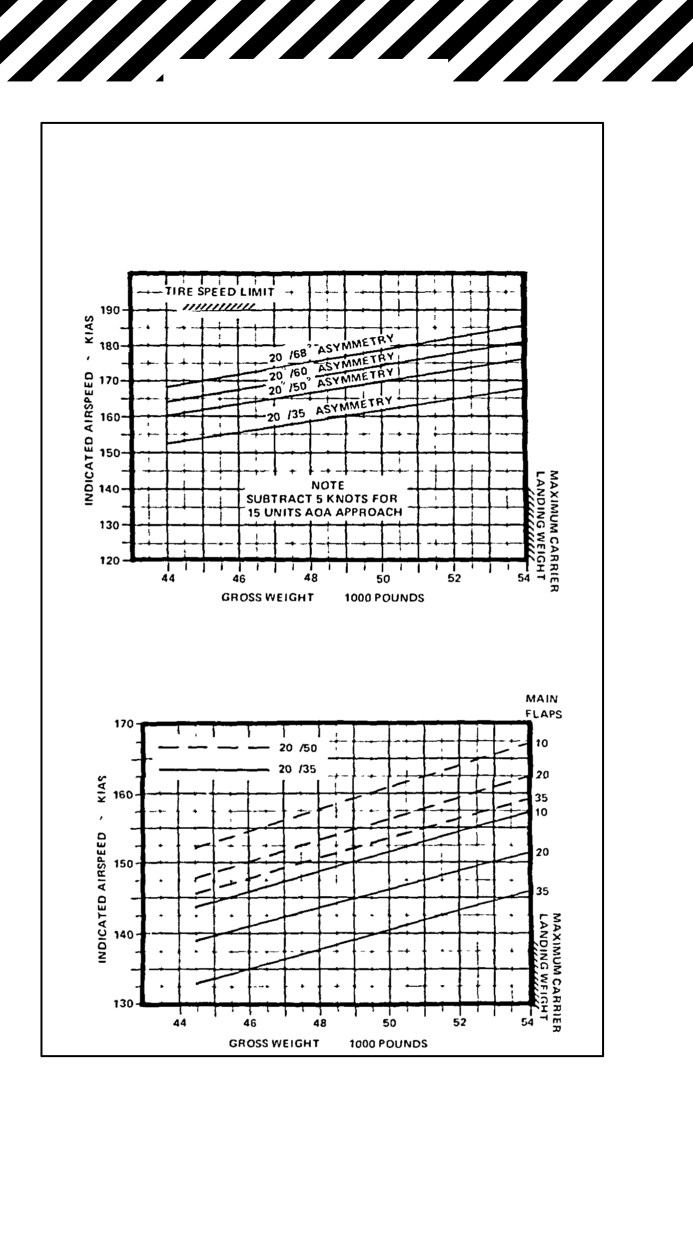
NAVAIR 01-F14AAP-1B
DATE: AUGUST 1986
DATA BASIS: FLIGHT TEST
FLAPS UP APPROACH AIRSPEED (14 UNITS AOA)
FLAPS/SLATS RETRACTED
LANDING APPROACH AIRSPEEDS (15 UNITS
AOA) MAIN FLAPS/SLATS EXTENDED:
AUXILIARY FLAPS RETRACTED
ASYMMETRIC WINGS APPROACH AIRSPEED
118
NAVAIR 01-F14AAP-1B
CADC LIGHT
1. MASTER RESET .
Depress
2. CADC cb’s (LA2, LB2, LC2, LH2) .
Cycle
3. MASTER RESET .
Depress
If light remains illuminated:
4. Remain below 1.5 IMN.
One or more of following systems may be af-
fected by CADC malfunction that illuminates
only the CADC light:
a. Maximum safe Mach
b. Autopilot
c. Idle lockup function of AFTC
d. Wing-sweep indicator
e. Cockpit cooling less than Mach 0.25
f. HUD display (takeoff and landing)
g. Servo altimeter.
FUEL
Note
D Erroneous Mach inputs to AFTC
may cause uncommanded accelera-
tion of both engines to near military
values in the primary engine mode.
D If illumination of the CADC light is
accompanied by other caution or
advisory light(s), refer to the ap-
propriate procedure that will dictate
the most restrictive limitation.
119
NAVAIR 01-F14AAP-1B
FUEL
120
NAVAIR 01-F14AAP-1B
FUEL
Index
FUEL IMBALANCE/FUEL QUANTITY BALANCING .
127
FUEL LEAK .
126a
FUEL TRANSFER FAILURES .
124b
WINGS ACCEPT FUEL WITH SWITCH
IN FUS EXTD POSITION .
126
WINGS DO NOT ACCEPT FUEL WITH
SWITCH IN ALL EXTD POSITION .
126
L AND/OR R FUEL PRESS LIGHT(S) ON .
123
L OR R FUEL LOW LIGHT .
124a
WING FUEL DOES NOT TRANSFER .
124b
UNCOMMANDED DUMP .
126
Change 3
121/(122 blank)