Network Intrusions Responder Program (NITRO). Instructor Guide - page 15
MFT (Master File Table)
NTFS utilizes the MFT (Master File Table) to track files and
associated locations on NTFS volume
MFT is similar to FAT in that it maps location of directories and
folders and is updated whenever a file is accessed, changed,
deleted or added
FAT can be thought of as a static fixed-sized chart that cannot
change in size
MFT is dynamic, a relational database that can grow in size if
necessary
U.S. Department of
Homeland Security
United States
Secret Service
MFT (Master File Table)
MFT created when drive (or volume) formatted with NTFS
Certain amount of contiguous space reserved for MFT
expansion, sometimes called “MFT Zone”
Initially, zone approximately 12 percent of total volume
capacity
Most NTFS volumes no larger than 2 terabytes in size, but
dynamic nature of MFT allows volume to reach 16 Exabyte’s,
equivalent to approximately 16,000,000 terabytes in capacity!
U.S. Department of
Homeland Security
United States
Secret Service
File Systems for Operating Systems
Operating
Type of Primary
Characteristics of File
System
File System
System
DOS
FAT16
• Limited to 2GB partitions
Windows for
FAT16 w/ limited
• 32-bit file access
Workgroups
VFAT
Windows 95a
VFAT
• 32-bit file access
• Supports long file names
U.S. Department of
Homeland Security
United States
Secret Service
File Systems for Operating Systems
Operating
Type of Primary
Characteristics of File
System
File System
System
Windows 95b
FAT32
• Supports larger disk
(OSR2),
capacity up to 2TB
Windows 98,
• Uses smaller cluster sizes
Windows ME
for more efficient storage
• Windows 2000 supports
FAT32 with disk volumes
up to 32GB
U.S. Department of
Homeland Security
United States
Secret Service
File Systems for Operating Systems
Operating
Type of Primary
Characteristics of File
System
File System
System
Windows NT
NTFS
• Improved reliability, and
fault tolerance
• Security and Access
Control
• Supports long file names
• Supports larger sized
partitions, up to 16
Exabytes
U.S. Department of
Homeland Security
United States
Secret Service
File Systems for Operating Systems
Operating
File
Characteristics of File
System
System
System
Windows
NTFS
• Improved Security
2000, XP
• Internal Data Encryption
• Disk Quotas
Linux (kernel
Ext2fs
• Security and Access Control
versions prior
• Supports partitions up to 4TB
to 2.4.16)
• Supports long file names
Linux
Ext3fs
• Faster than ext2fs
• Greater data control
U.S. Department of
Homeland Security
United States
Secret Service
Patching
Install Operating System patches and critical updates on
regular basis
Use Windows Update to choose Express or Custom settings
Express Settings installs all high priority updates
Custom settings will allow user to choose updates to install
Alternatively, use Windows Automatic Update, during middle of
night, every night
U.S. Department of
Homeland Security
United States
Secret Service
Danger of Automatic Patching
By default, Windows XP will automatically download and install
new patches on weekly basis
Drawback, if critical update is released, computer will
automatically install and reboot, closing all open applications
during process
Potential exists for loss of data if open files have not been
saved
U.S. Department of
Homeland Security
United States
Secret Service
Disable Auto Patching
To disable setting, select Start > Control Panel > System
Properties
Locate and select the tab for “Automatic Updates”
Recommended value for workstation is “Download updates for
me, but let me choose when to install them”
With option set, update icon will be in system tray and notify
when new updates have been downloaded
Apply updates when safe to do so
U.S. Department of
Homeland Security
United States
Secret Service
Operating System Updates
Use the Step/Action procedure in your student book to install
current System Updates
U.S. Department of
Homeland Security
United States
Secret Service
Module 5 - Introduction to Networks
U.S. Department of
Homeland Security
United States
Secret Service
You Will Learn . . .
Network Basics
Network Technologies
Network Topologies
Network Architecture
The OSI Model
U.S. Department of
Homeland Security
United States
Secret Service
Lesson 1 - Network Basics
Introduction to Networks
Network Types
Network Categories
U.S. Department of
Homeland Security
United States
Secret Service
Main purposes of a Network
Transfer data
Share hardware and system resources
Communicate via the Internet
U.S. Department of
Homeland Security
United States
Secret Service
IEEE 802 Standards
February 1980, members of Institute of Electrical and
Electronic Engineers (IEEE) develop data communications
standards
IEEE 802 standard governs Local Area Network (LAN) and
Wide Area Network (WAN) communications
Specifications for physical network devices, such as network
interface cards (NICs), cables, routers, bridges, and access
methods, ways data flows through physical network
U.S. Department of
Homeland Security
United States
Secret Service
IEEE 802 Standards
IEEE 802 Standard
Description
802.1
High Level Interface
802.2
Spanning Tree
802.3
Logical Link Control (LLC)
802.4
Token Bus Networks
802.5
Token Ring Networks
802.6
Metropolitan Area Networks (MAN)
U.S. Department of
Homeland Security
United States
Secret Service
IEEE 802 Standards
IEEE 802 Standard
Description
802.7
Broadband Technical Advisory Group
802.8
Fiber Optic Technical Advisory Group
802.9
Integrated Voice and Data Network
802.10
Network Security
802.11
Wireless LANs
U.S. Department of
Homeland Security
United States
Secret Service
IEEE 802.3 and 802.5 Standards
IEEE 802.3 sets standards for today’s Ethernet networks
IEEE 802.5 governs Token Ring standards
Ethernet most common architecture found in modern networks
Token Ring was standard for government networks for many
years
U.S. Department of
Homeland Security
United States
Secret Service
IEEE 802.11 Standards
The IEEE 802.11 (a/b/g/n) defines all aspects of radio
frequency wireless networking
Wireless networking uses technology in radio frequency
transmissions to send network packets across airwaves
U.S. Department of
Homeland Security
United States
Secret Service
IEEE 802.11e Standards
Enhancement to improve quality of service for 802.11a and
802.11g standards
Improves quality of multimedia performance through wireless
networks
Uses TDMA (time division multiple access) technology
U.S. Department of
Homeland Security
United States
Secret Service
TDMA
Divides radio frequencies into three time slots to increase
amount of available bandwidth that can carry data
Adds error-correcting mechanisms, reduces time delays often
experienced when streaming video
Offers more reliable medium for multimedia-based transfers
such as full-motion video, high fidelity audio, and VoIP
U.S. Department of
Homeland Security
United States
Secret Service
IEEE 802.16 Standards
Not shown in list on earlier slide
Emerging standard for high speed wireless broadband
Intended to be compatible with 802.11 standards
U.S. Department of
Homeland Security
United States
Secret Service
Networks
Can be simple as two PCs joined together with single cable or
complex as thousands of PCs joined through complicated
matrix of routers, switches, public and private infrastructures,
multiple cable types, and access methods
Regardless of simplicity or complexity, all networks provide
ability to share data or resources between at least two
networked devices
U.S. Department of
Homeland Security
United States
Secret Service
Local Area Networks (LANs)
Connect computers and peripherals to shared transmission
medium, such as coaxial cable or a multi-port hub
Generally span small area within building or several buildings
in close proximity
Each computer can access files and share devices, such as
printers and scanners, anywhere on LAN
U.S. Department of
Homeland Security
United States
Secret Service
Local Area Networks (LANs)
Size and distance limitations
Large networks not suited to single LAN design, performance
diminishes as more workstations attempt to access network
cable
Many ways to compensate for negative impact of adding
numerous workstations to large LANs
U.S. Department of
Homeland Security
United States
Secret Service
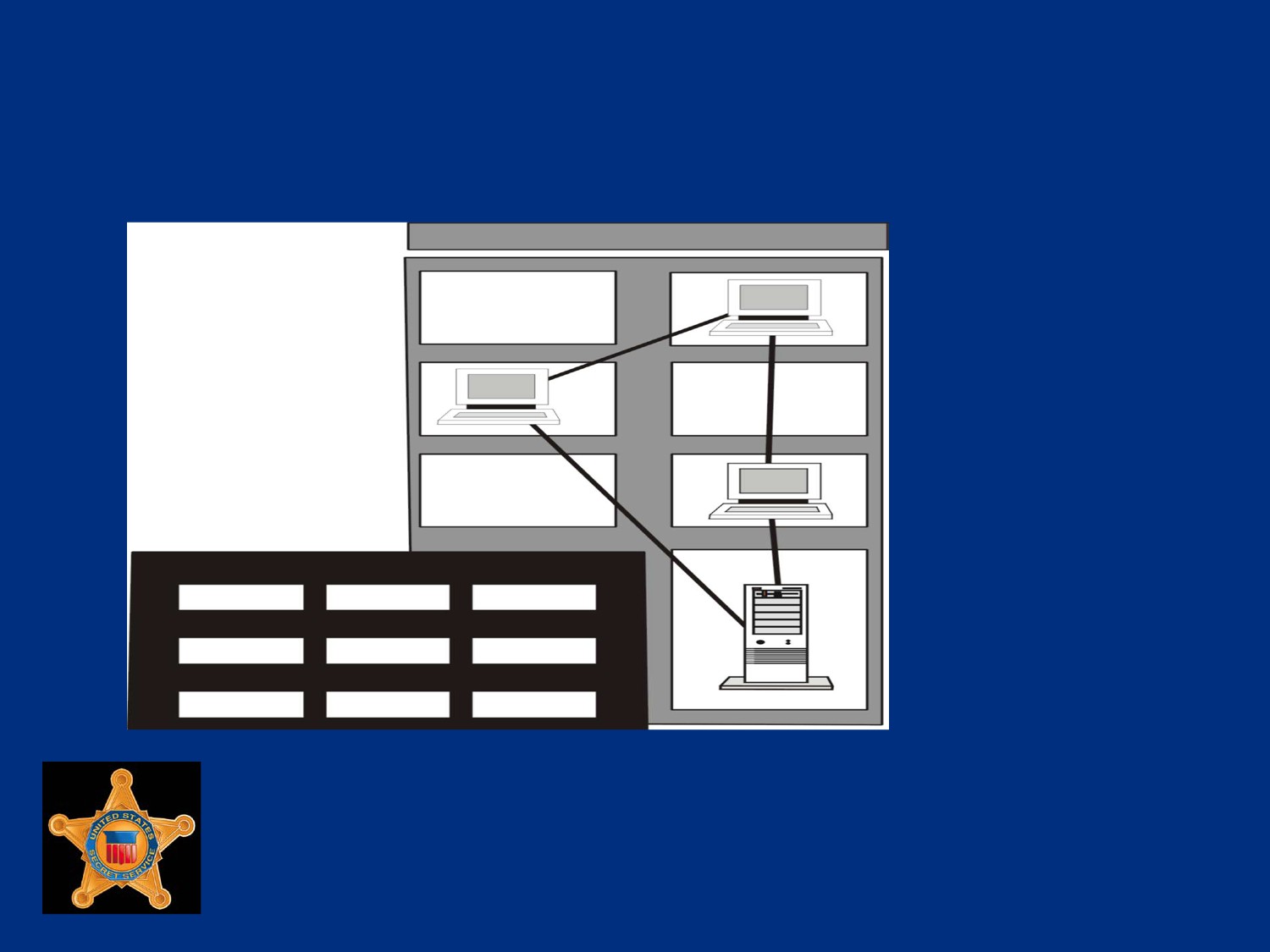
LAN Example Within a Building
U.S. Department of
Homeland Security
United States
Secret Service
Wide Area Networks (WANs)
Used to move information greater distances beyond LAN’s
capabilities
Provides long-distance, internal network that links LANs
located in different parts of a city, country, or globe
Links individual LANs using fiber optic, copper wire, or wireless
transmission medias
U.S. Department of
Homeland Security
United States
Secret Service
Types of WANs
Metropolitan Area Network (MAN) - Data network spans all
sites within metropolitan area
Enterprise Network - Connects all LANs of large, single
organization and can cross regional boundaries
Global Network - Data network that spans globe crossing
multiple national boundaries
May include networks of several organizations
U.S. Department of
Homeland Security
United States
Secret Service
WAN
Composed of interconnected LANs
In general, can have slower transmission rate than LAN
LAN can have transmission rate of 100 Mbps but medium
that connects to other LANs on WAN may only transmit at
64 Kbps per channel
U.S. Department of
Homeland Security
United States
Secret Service
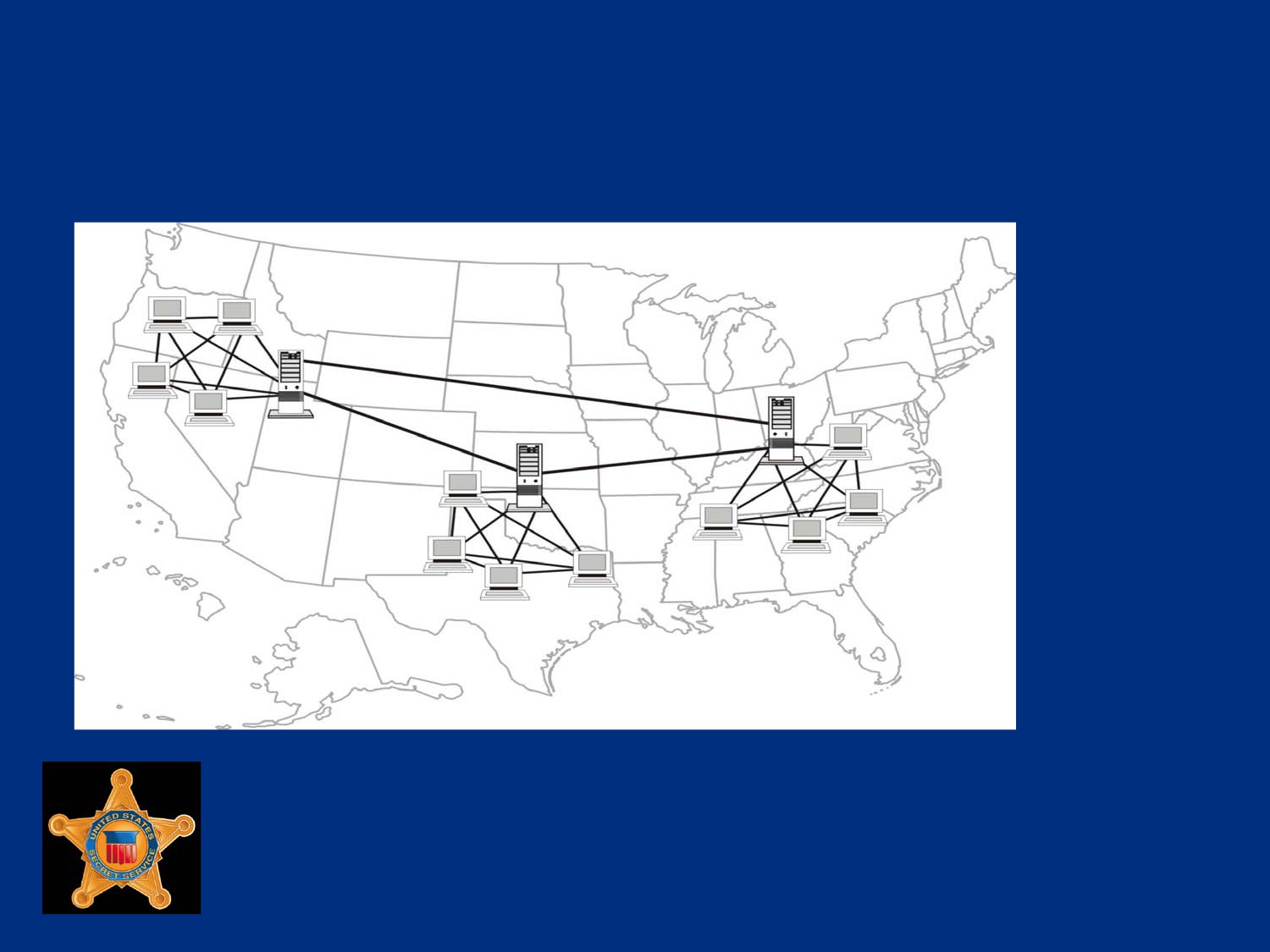
WAN Illustration
U.S. Department of
Homeland Security
United States
Secret Service
Internet
Massive web of interconnected networks spanning globe
Community of government agencies, private organizations,
and educational institutions
No one entity owns Internet
Nearly every organization uses it to communicate, share data,
conduct research, and share resources such as data
management and storage
Individuals rely on Internet for e-mail, news services, etc.
U.S. Department of
Homeland Security
United States
Secret Service
Internet
Represents largest repository of electronic information
Internet service providers (ISP) control connectivity of Internet
ISPs provide access for fee
Individuals pay fee to companies like America Online and
receive username, password, software, and access phone
number
ISPs provide large organizations means to connect their
networks to Internet
U.S. Department of
Homeland Security
United States
Secret Service
Intranet and Extranet
Many businesses and organizations maintain an intranet, or
internal Web site to communicate with employees or group
members
Intranet access limited to those granted permission to use site
Intranet provides Internet-like network inside organization to
include Web page hosting and use of Web page browsers to
access internal data
Extranets established when organization wants to extend
intranet to business partners or others outside company
U.S. Department of
Homeland Security
United States
Secret Service
Circuit-switched Networks
All components physically connected in circuit-switched
network using wire, cable, or other transmission media
Type of network can be compared to telephone system
whereby communication requires dedicated communication
channel and constant connection
Integrated Services Digital Network (ISDN),
telecommunications standard for providing digital service using
telephone networks, example of circuit-switched services
U.S. Department of
Homeland Security
United States
Secret Service
Circuit-switched Networks
Circuit-switched equipment uses digital signaling to establish
connection, transfer data on channel, and terminate
connection
All data traverses network on same pathway
Data divided into small sections called packets
Only initial packet needs address information as all
subsequent transmitted data follows same continuous path
U.S. Department of
Homeland Security
United States
Secret Service
Circuit-switched Networks
If connection broken, communication must start over as
remaining packets are not addressed and unable to reach
destination
Referred to as connection-oriented
U.S. Department of
Homeland Security
United States
Secret Service
Packet-switched Networks
Users share network and connections established with variety
of possible endpoints
Like circuit-switched networks, data divided into packets before
being transferred across network
Unlike circuit-switched networks, each packet carries
addressing information, packets can be delivered out of order
Receiving device arranges packets in correct order
U.S. Department of
Homeland Security
United States
Secret Service
Packet-switched Networks
Data can still be transferred in event of interruption or link
failure
Examples of network model include Asynchronous Transfer
Mode (ATM), frame relay, symmetric multiprocessing system
(SMP), and X.25
If connection broken, communication does not start over as
remaining packets each contain address information and are
able to reach destination via any functioning route
Referred to as connectionless
U.S. Department of
Homeland Security
United States
Secret Service
Lesson 2 - Network Technologies
Introducing Network Technologies
U.S. Department of
Homeland Security
United States
Secret Service
Network Technologies
Data transferred across a network using several network
technologies
Two most common are broadcast and point-to-point
U.S. Department of
Homeland Security
United States
Secret Service
Broadcast Networking
Most common type of modern network
Uses broadcast technology to communicate across shared
media; copper, optic fiber, or radio waves
Network devices compete for use of shared media by sensing
when available for transmission
Sensing opportunity to transmit, workstation transmits packets
intended for network device such as printer
As workstation transmits, packets are broadcasted to all
devices sharing media
U.S. Department of
Homeland Security
United States
Secret Service
Broadcast Networking
Broadcast packets received by network devices either
accepted or ignored, based upon destination address
embedded in packet
Common for multiple transmissions to occur at same time
Since transmissions are sent to all devices on shared media,
transmitted packets often collide, resulting in loss of packets
U.S. Department of
Homeland Security
United States
Secret Service
Broadcast Networking
When packets collide and not received by intended recipient,
they are retransmitted
Because collisions are common in broadcast network, term
collision domain frequently used to refer to broadcast network
Ethernet is example of broadcast network
U.S. Department of
Homeland Security
United States
Secret Service
CSMA/CD and CSMA/CA
Broadcast network access methods
Carrier Sense Multiple Access/Collision Detection (CSMA/CD)
Carrier Sense Multiple Access/Collision Avoidance (CSMA/CA)
U.S. Department of
Homeland Security
United States
Secret Service
CSMA/CD
Set of rules to determine how network devices connected to
broadcast network can access network to send data
Network cable can only transmit one communication at a time
Computers on network must compete for access to network
Designed to avoid repeated packet collisions
After collision, sending devices are assigned random time to
wait before resending packets
Rare for two sending devices to create two collisions in a row
U.S. Department of
Homeland Security
United States
Secret Service
Point-to-Point Networking
Type of network provides connections between two network
devices, sender and receiver
Data only travels between two connections, not broadcasted to
other devices
Token Ring is example of point-to-point network
U.S. Department of
Homeland Security
United States
Secret Service
Token Passing
Access method used by point-to-point networks
Computers arranged in a circle or closed loop
Token travels around network transmitting one packet of
information at a time
Computers connected to network wait for empty token and
attach message for transmission
Rather than competing for access, each network device in turn
has fair chance to “grab” empty token for use
U.S. Department of
Homeland Security
United States
Secret Service
Lesson 3 - Network Topologies
Topologies Defined
U.S. Department of
Homeland Security
United States
Secret Service
Physical Topology
Physical layout of workstations, servers, cabling, printers, and
other devices
Cables and connections in physical topology are called the
network transmission media
Implements one of network technologies mentioned earlier,
broadcast or point-to-point
U.S. Department of
Homeland Security
United States
Secret Service
Logical Topology
The way data flows through network
Dictated by technology implemented
U.S. Department of
Homeland Security
United States
Secret Service
Six main Topologies
Bus
Star
Tree
Ring
Star-Wired Ring
Mesh
U.S. Department of
Homeland Security
United States
Secret Service
Bus Topology
Least complex configuration of topologies and uses least
amount of cable
Workstations connected along single, straight line of coaxial
cable
Signal broadcast to all devices connected to cable using
CSMA/CD traveling down cable until accepted at intended
destination
When data sent, each device checks destination address of
data as it passes, ignoring data if intended for another device
U.S. Department of
Homeland Security
United States
Secret Service
Bus Topology
Bus network requires terminator connected to both ends of line
Terminators prevent signals from bouncing endlessly back and
forth along cable causing packet storm, which will render
network inoperable
Bus networks easily set up because they only require cable
adapters to join cable to network card and terminators at each
end
Major disadvantage is broken connection anywhere along
cable causes entire network to go down
U.S. Department of
Homeland Security
United States
Secret Service
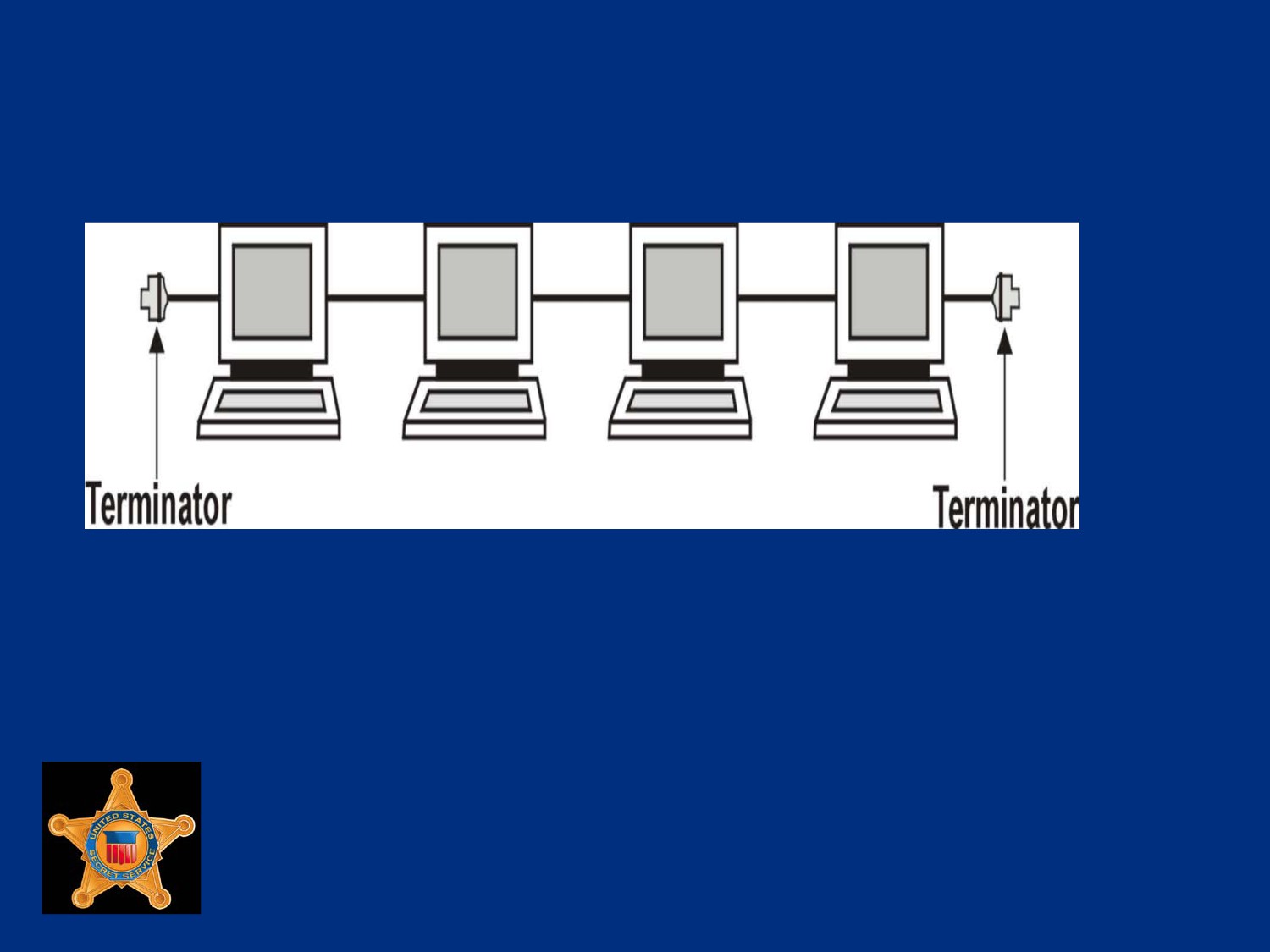
Bus Network Topology
U.S. Department of
Homeland Security
United States
Secret Service
Star Topology
All network devices attached to central hub
Topology resembles spokes that radiate from hub of a wheel
Communication among devices on network handled by cabling
between device and hub
All data passes first through hub
Hub broadcasts data to all devices connected to hub’s ports
U.S. Department of
Homeland Security
United States
Secret Service
Star Topology
Data flows on direct line between device and hub, making it
easy to troubleshoot problems
Break in single cable in network will not affect rest of network
Hub will simply ignore port from which PC is disconnected
U.S. Department of
Homeland Security
United States
Secret Service
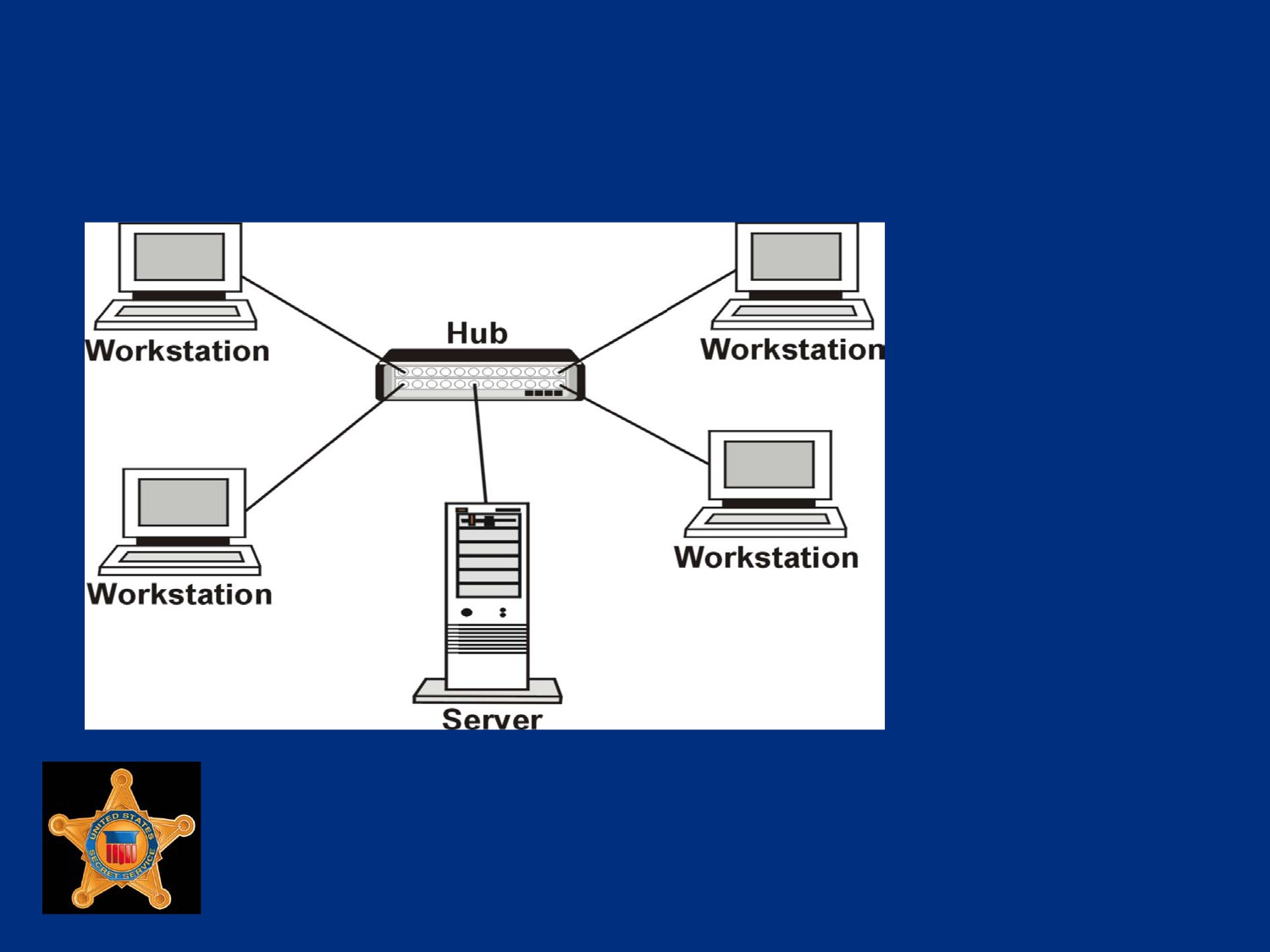
Star Topology
U.S. Department of
Homeland Security
United States
Secret Service
Star Topology
Star topology is physical star and logical bus
Devices are connected to central point resembling graphic on
previous slide
Underlying technology is broadcast
Devices still compete using CSMA/CD just like bus topology
U.S. Department of
Homeland Security
United States
Secret Service
Advantages of Star Topology
Support different types of cabling
Add/remove nodes easily
Can be moved easily
Can easily identify faulty node or connection
U.S. Department of
Homeland Security
United States
Secret Service
Disadvantages of Star Topology
Requires lot of cabling
Hub can be single point of failure causing entire network to go
down
U.S. Department of
Homeland Security
United States
Secret Service
Tree Topology
Tree network is hybrid of star and bus topologies
Network’s physical layout uses distributed bus or branching
topology to connect combination of bus and star segments
Logical topology of tree network transmits data in broadcast
form like bus network
Physical topology combines features of both bus and star
layouts
U.S. Department of
Homeland Security
United States
Secret Service
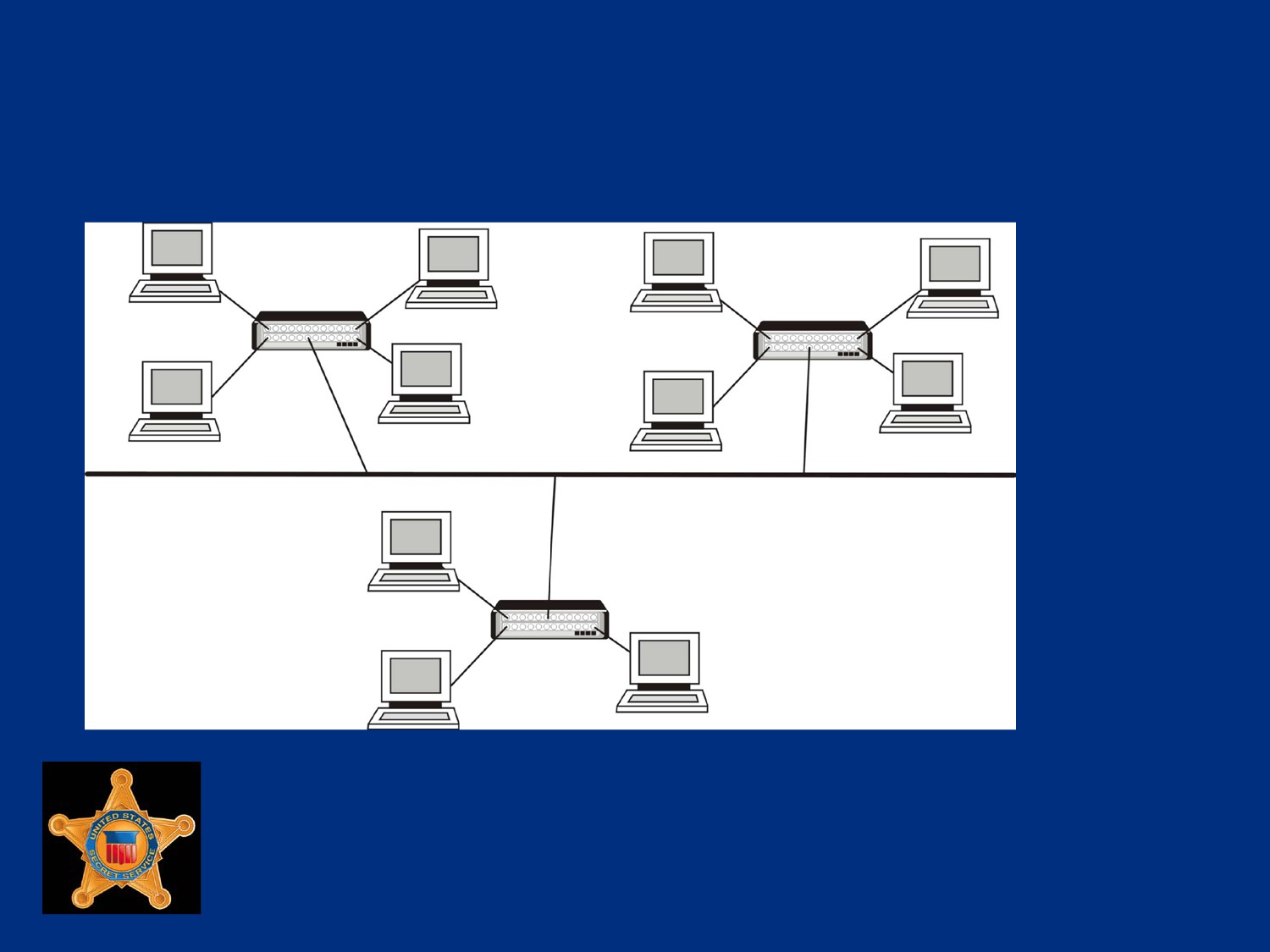
Tree Network Topology
U.S. Department of
Homeland Security
United States
Secret Service
Advantages of Tree Topology
Easy to relocate
Easy to add/remove nodes
U.S. Department of
Homeland Security
United States
Secret Service
Disadvantages of Tree Topology
Access and performance declines if tree network is too large
Entire network disabled from point of failure on down
U.S. Department of
Homeland Security
United States
Secret Service
Ring Topology
All devices linked together in closed loop or ring
Twisted-pair cabling generally used to connect computers
Uses token passing technology to transmit packets
Data broadcast only between sending and receiving devices
Break in cabling or malfunction of NIC can disrupt entire
network
Topology rarely used today
U.S. Department of
Homeland Security
United States
Secret Service
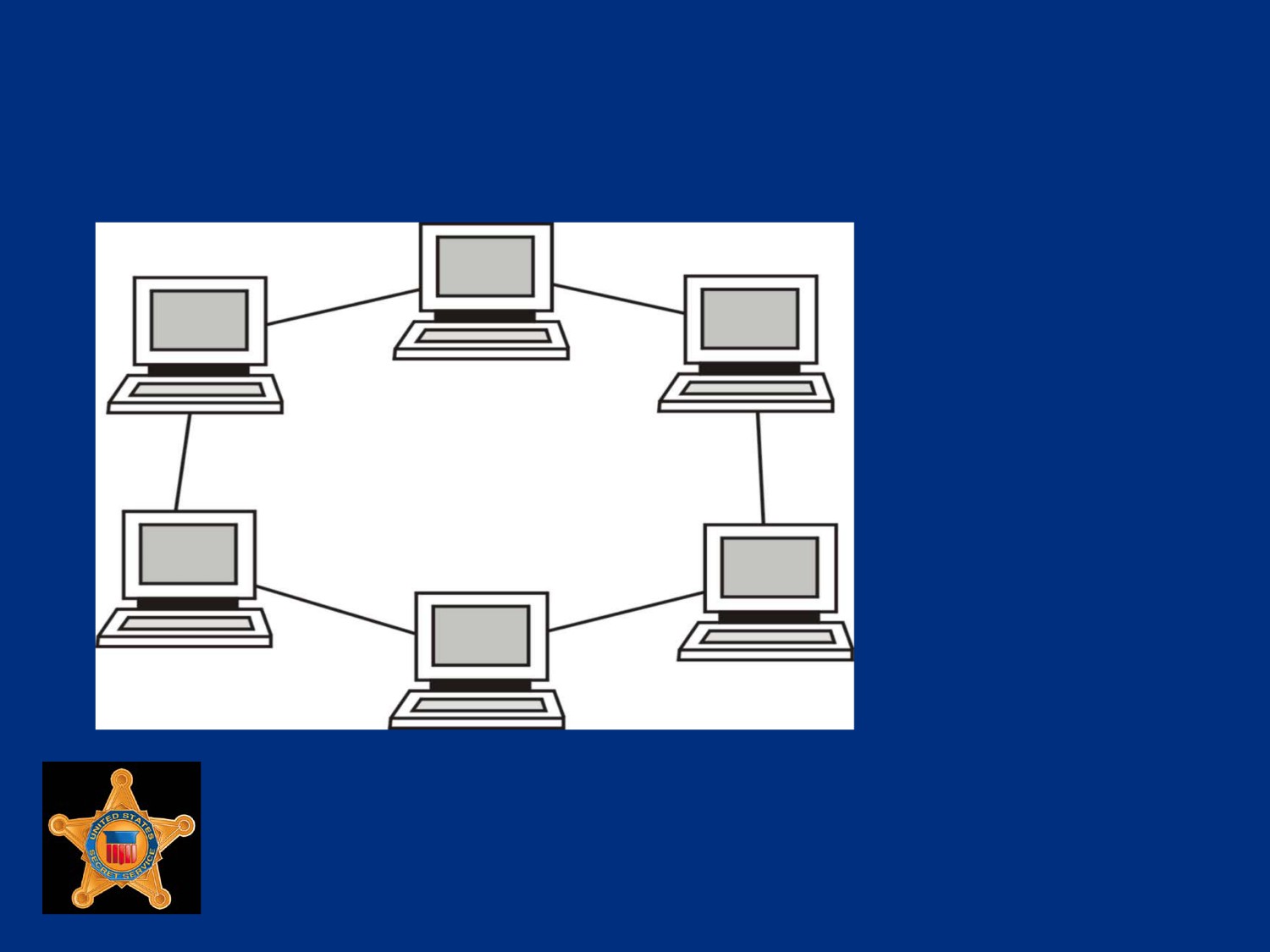
Ring Network Topology
U.S. Department of
Homeland Security
United States
Secret Service
Star-Wired Ring Network
Physical topology resembles star physical topology and uses
cabling that connects computers to multi-station access unit
(MAU)
Data signals flow in one direction through network using ring
logical topology (point-to-point / token passing)
Main advantage of star-wired ring network is ease of
troubleshooting
Disconnect between device and MAU, affects only that device,
rest of network continues to function
U.S. Department of
Homeland Security
United States
Secret Service
Mesh Network Topology
Direct, point-to-point connection made between each network
device
Mesh networks often used to connect LANs to create WAN
Mesh topology works well for WANs because connections
between various locations can be via Internet, satellite, or
other high-speed connection
U.S. Department of
Homeland Security
United States
Secret Service
Mesh Network Topology
Advantages of mesh topology include, multiple routes to each
host and no single point of failure
Main disadvantage is expense
Mesh describes physical topology
Mesh networks can contain logical point-to-point, broadcast, or
combination of both
U.S. Department of
Homeland Security
United States
Secret Service
Topology Summary
Topology defines both physical characteristics of network and
the way data flows through network
U.S. Department of
Homeland Security
United States
Secret Service
Lesson 4 - Network Architecture
Introduction to Network Architecture
Ethernet
Token Ring
Fiber Distributed Data Interface (FDDI)
Asynchronous Transfer Mode
Broadband
U.S. Department of
Homeland Security
United States
Secret Service
Network Architecture
Refers broadly to overall configuration of network
Includes type, topology, hardware, speed, and specific cabling
used in a given implementation
U.S. Department of
Homeland Security
United States
Secret Service
Key Network Architectures
Ethernet - Commonly used network architecture
Token Ring - Obsolete network architecture
FDDI - Often used to connect networks on different floors
within a building and where security and performance are a
concern
Asynchronous Transfer Mode (ATM) - Often used for large
networks in major corporations and government
U.S. Department of
Homeland Security
United States
Secret Service
Ethernet Networks
Introduced in early 1970s as first shared LAN technology
Design consists of computers connected to shared
transmission medium, such as coaxial cable or multi-port hub
In general, link computers located in same room or building
Each host checks cable for turn to transmit data
U.S. Department of
Homeland Security
United States
Secret Service
Ethernet Networks
Uses a bus, star, or tree topology
Broadcasts data to all devices in network
Uses CSMA/CD technology to correct data collision on shared
network
Provides good performance for low cost because it is
inexpensive to set up
Installs easily and supports all common protocols
Work well for small LANs, but problems arise as network
grows
U.S. Department of
Homeland Security
United States
Secret Service
Ethernet Cabling 10 Base X
10 base T - Cat 3 UTP
10 base 2 - Thinnet coaxial
10 base 5 - Thicknet coaxial
10 base FL - Fiber optic
U.S. Department of
Homeland Security
United States
Secret Service
Fast Ethernet 100 Base X
Fast Ethernet offers same shared network protocols as regular
Ethernet but with peak transfer rate of 100 Mbps
Three types of cable used are as follows:
100 base-T4 - Cat 3 UTP cable
100 base-TX - Cat 5 UTP cable
100 base-FX - Fiber optic cable
U.S. Department of
Homeland Security
United States
Secret Service
Gigabit Ethernet 1000 Base X
Gigabit Ethernet offers same shared network protocols as
regular Ethernet but with peak transfer rate of 1Gbps
Speed is achievable on Cat 5e or Cat 6 cable
All four-wire pairs used instead of just two pairs
Cable usage provides bi-directional transmissions and
receptions
U.S. Department of
Homeland Security
United States
Secret Service
Gigabit Ethernet 1000 Base X
1000 base-T - Cat 5e or Cat 6 UTP cable
1000 base-TX - Cat 6 UTP cable
1000 base-CX - Copper cable
1000 base-LH - Fiber optic cable
1000 base-LX - Fiber optic cable
1000 base-ZX - Fiber optic cable
U.S. Department of
Homeland Security
United States
Secret Service
Token Ring Network
All devices linked together in closed loop or ring
Data packages transmitted via token that travels in one
direction around ring
Token polls each host checking for transmission as it moves
around ring
Hosts must wait for empty token to transmit data
No other computer can transmit data while token is in use
U.S. Department of
Homeland Security
United States
Secret Service
Token Ring Network
Normally configured using device called Multistation Access
Unit (MAU) to connect computers
MAU contains logical ring that recognizes attached computers
and determines transmission route to them
Uses ring or star-wired ring topology
Provides point-to-point communication
Offers peak transfer rate of 16 Mbps
U.S. Department of
Homeland Security
United States
Secret Service
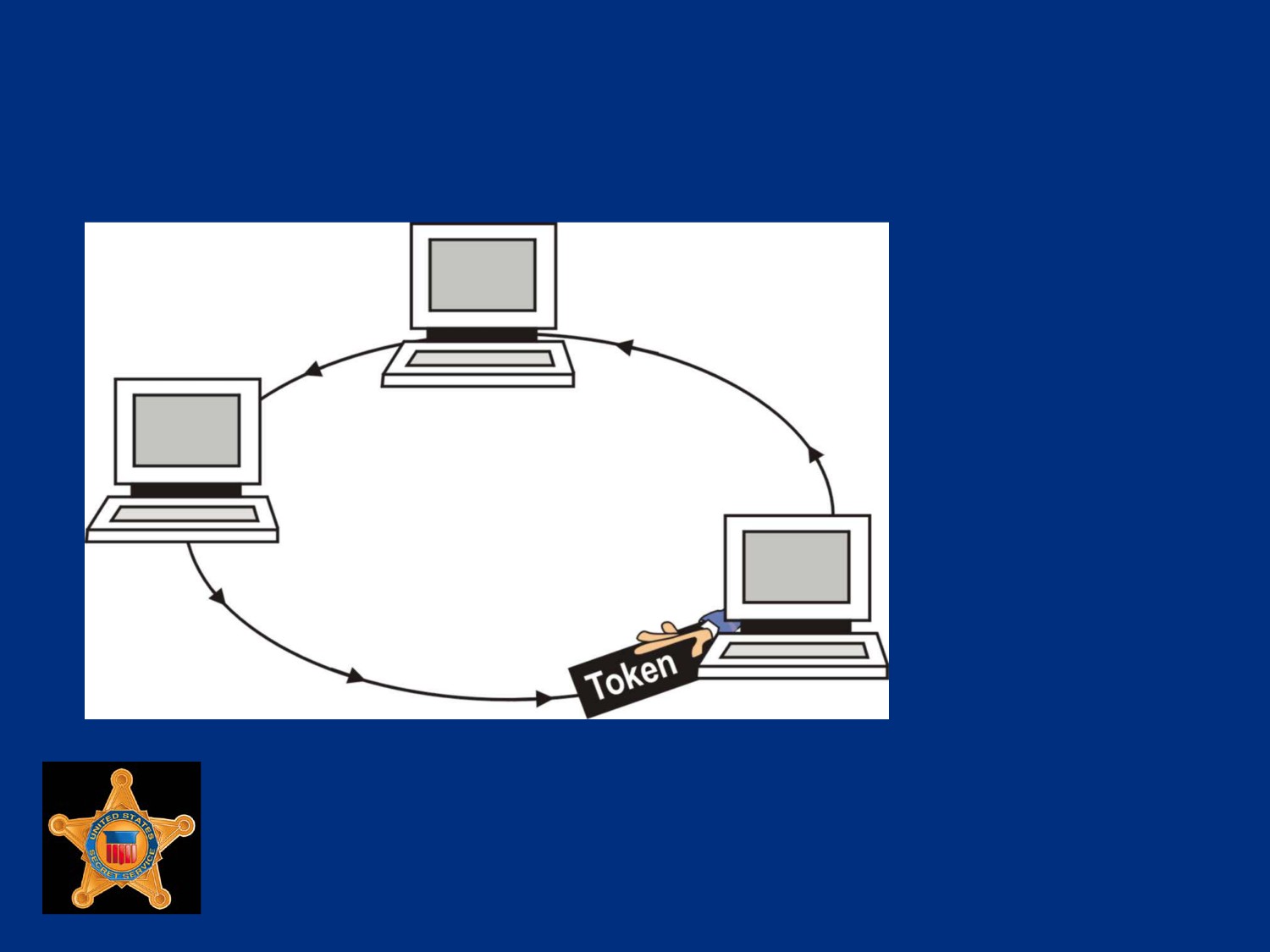
Token Ring Network
U.S. Department of
Homeland Security
United States
Secret Service
FDDI Network
Fiber Distributed Data Interface (FDDI) network uses fiber
optic cable to link computers in ring topology
Data passed using tokens
FDDI network provides two token rings:
Main ring used for all transmissions
Second ring only used for backup if main ring fails
Tokens travel simultaneously in opposite directions
U.S. Department of
Homeland Security
United States
Secret Service
FDDI Network
FDDI uses device called concentrator in lieu of MAU
Most concentrators can connect between 4 and 32 device
Fiber optic cable provides higher speeds
Peak data transfer rate of each ring is 100Mbs (200Mbs for
both rings)
High reliability of FDDI makes it ideal network backbone to
support high-end servers
U.S. Department of
Homeland Security
United States
Secret Service
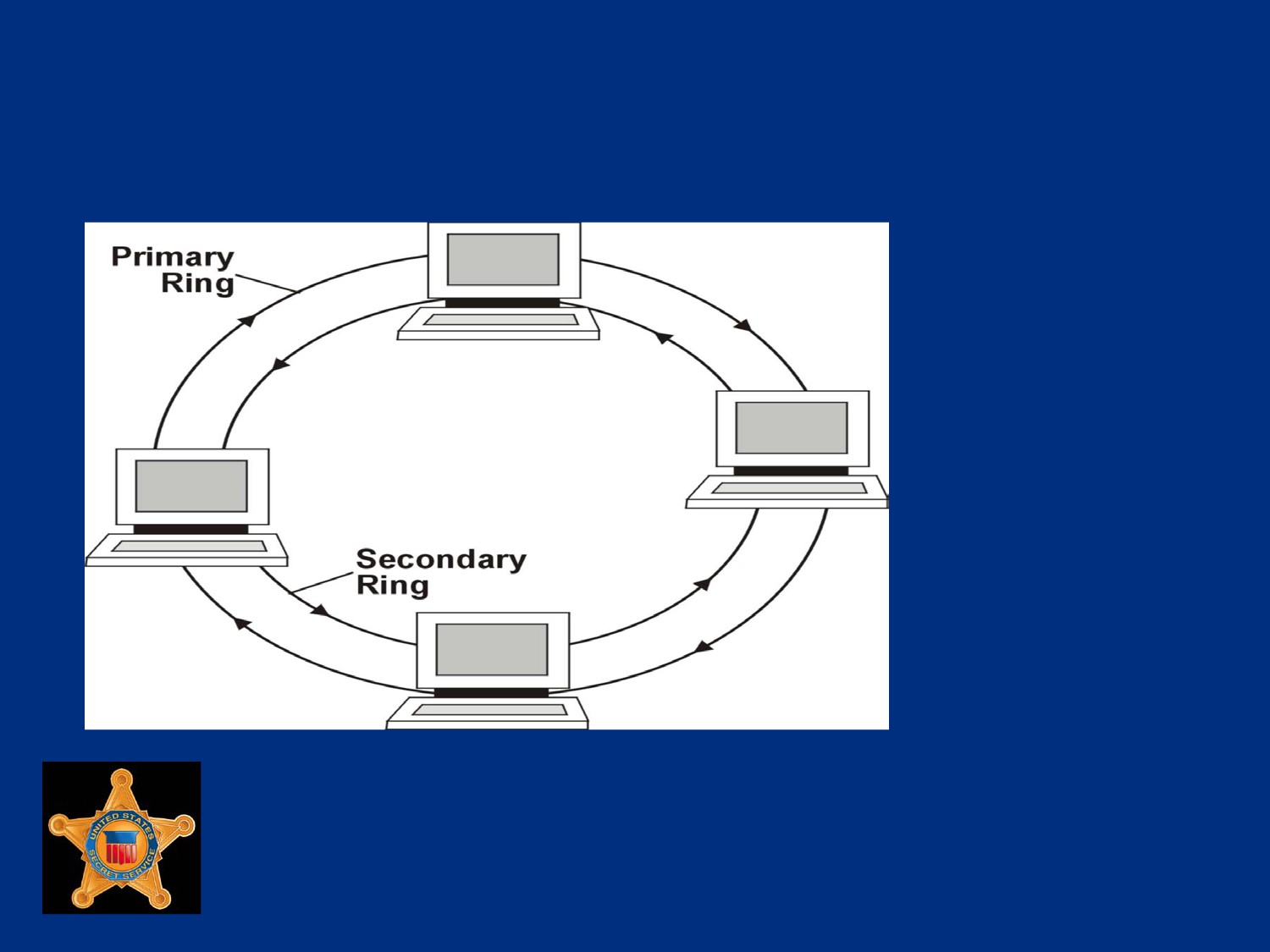
FDDI Network
U.S. Department of
Homeland Security
United States
Secret Service
ATM Network
The Asynchronous Transfer Mode (ATM) network performs at
high speeds with peak transfer rate of 622 Mbps
Designed for LANs, WANs, and Internet core networks
Provides connection-oriented technology that creates circuit
between data source and destination
Divides data into small fixed length cells prior to transmission
U.S. Department of
Homeland Security
United States
Secret Service
ATM Network
Fixed length cells provides high performance and reliability
Fixed length cells enable predictable traffic flow
Reliable delivery of time-sensitive data such as live voice and
video
Capable of transmitting different types of traffic simultaneously
(isochronous), including data, voice and audio
U.S. Department of
Homeland Security
United States
Secret Service
Baseband vs. Broadband
Data signals sent across transmission media in one of two
ways: baseband or broadband
With baseband, signals are sent down cable in state of “on,”
“off,” or “idle”
Simple transceivers receive signals and translate them into
digital 1s and 0s
U.S. Department of
Homeland Security
United States
Secret Service
Baseband vs. Broadband
Broadband more complex in that several streams or channels
are sent simultaneously
With broadband, three states are distinguished by complex
transceivers for multiple channels at same time
In general, baseband is technology used in Ethernet and
Token Ring networks
Broadband used for high speed Internet access
U.S. Department of
Homeland Security
United States
Secret Service
Cable Modems
Cable is broadband technology based on speed, ease of
installation, and low cost
Cable Internet data shared over cable television lines using
high frequencies to transmit data and low frequencies for audio
and video
Major drawback, consumers in single network segment share
bandwidth
Segment could be street, neighborhood, or entire community
More persons connected, lower overall speed for everyone
U.S. Department of
Homeland Security
United States
Secret Service
Cable Modems
Digital cable implements ATM architecture
Current speeds are between 1 through 6 Mbps
Future anticipated speed 160 Mbps
U.S. Department of
Homeland Security
United States
Secret Service
Digital Subscriber Line Modems
Digital Subscriber Line (DSL) popular choice for broadband
Internet
Transmits data over telephone lines using higher frequencies
than used by voice signals
Unlike cable Internet, DSL does not share connection speed
with others in area
Speeds usually stay constant throughout day
U.S. Department of
Homeland Security
United States
Secret Service
Digital Subscriber Line Modems
DSL implements ATM architecture
Current speeds between 256KB and 3 Mbps
Major drawback, requires consumers to be within 18,000 feet
of telephone company’s switching station
U.S. Department of
Homeland Security
United States
Secret Service
Fiber Optic Service (FIOS)
Provides fastest data transfer method by sending pulses of
light over fiber optic cable
Fiber cable expensive and service areas difficult to find
Verizon offers Fiber Optic Service (FIOS) that transmits light
signal over fiber optic cable to customer
When signal reaches customer, Optical Network Terminal
(ONT) converts signal from optical to Ethernet
Connection made to router which in turn connects to
customer’s computer
U.S. Department of
Homeland Security
United States
Secret Service
Fiber Optic Service (FIOS)
FIOS reaches speeds of 5, 15 or 30 Mbps for downloads
Speeds of 2 or 5 Mbps for uploads
U.S. Department of
Homeland Security
United States
Secret Service
Lesson 5 - The OSI Model
OSI Model Overview
OSI Model Layers
U.S. Department of
Homeland Security
United States
Secret Service
OSI Model
Before OSI model, networks developed and managed as
proprietary systems
Different networks could not communicate with each other
International Organization for Standardization (ISO) developed
OSI model as guideline for protocols to support open
networking and communication between multi-vendor systems
U.S. Department of
Homeland Security
United States
Secret Service
OSI Model
Communication sent across network is processed through
seven layers of OSI model
Simply put, OSI model helps data from application, such as a
spreadsheet, make its way through network cabling (or other
medium) to application on receiving workstation
OSI model layers represent sequence of procedures
U.S. Department of
Homeland Security
United States
Secret Service
Sequence of Procedures Addressed
Data from transmitting computer is encoded for transmission
Data is translated into signals and sent
Data reaches receiving computer
Data is decoded and displayed on computer
U.S. Department of
Homeland Security
United States
Secret Service
Layered Concept
OSI layers sequentially arranged, each one performs specific
tasks
Data passes from one layer to next after tasks are completed
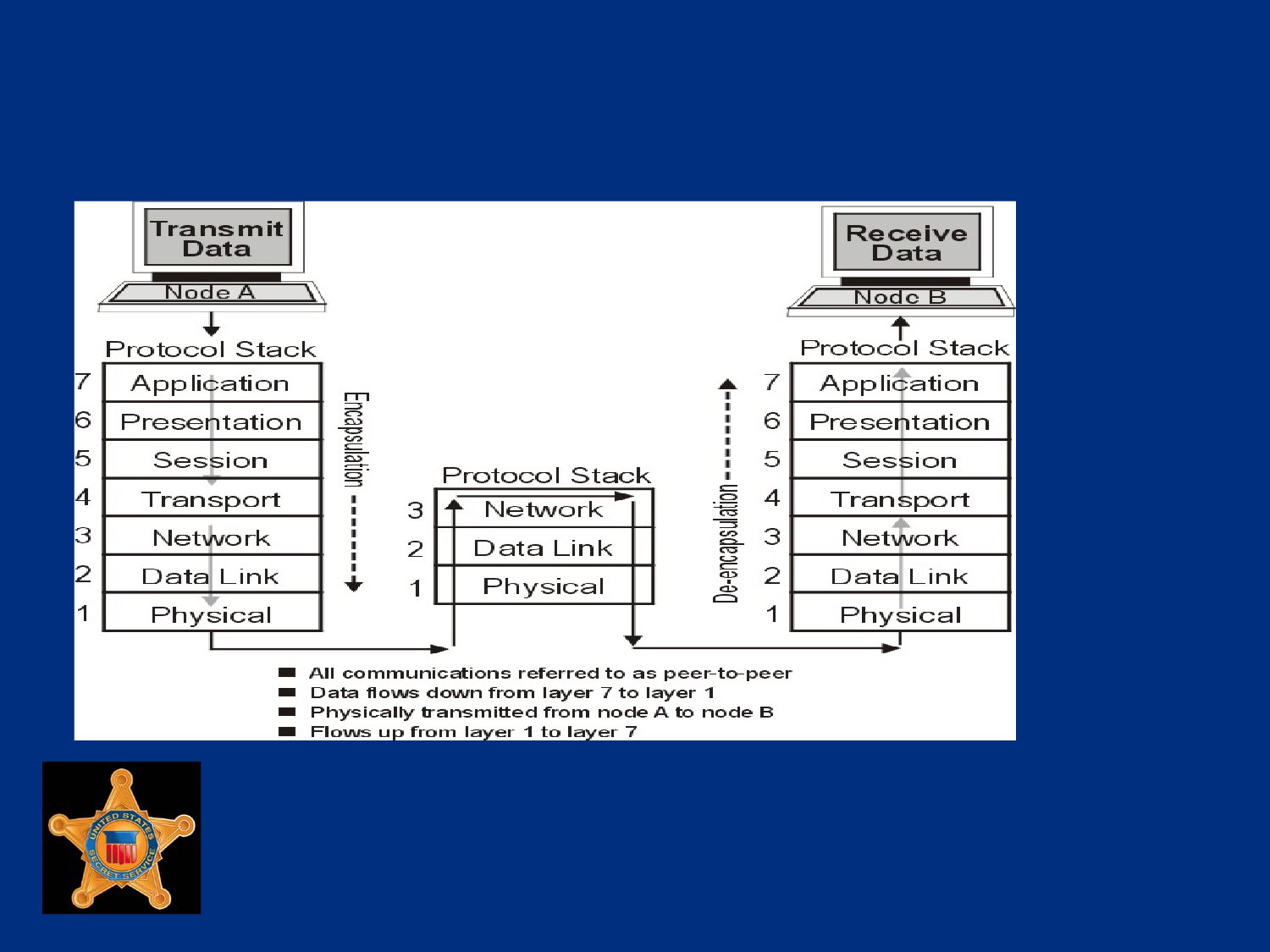
Communication from transmitting computer travels down stack
from layer seven to layer one before being physically
transmitted to receiving computer
U.S. Department of
Homeland Security
United States
Secret Service
How Data is Processed
Network traffic in simplest form is either request for information
or reply that answers request
All data transmitted over network is divided into packets
Packets can be of different sizes depending on type of request
or reply
Every request or reply consists of one or more packets
U.S. Department of
Homeland Security
United States
Secret Service
OSI Packet Processing Example
When transmitting computer makes request, request is divided
into one or more packets
Packet(s) begins journey through sequence of OSI layers
Network tracks request by adding data to each packet in form
of frames
Frames comprised of network control information to ensure
packets reach destination in proper form
Frames generated at various OSI layers
U.S. Department of
Homeland Security
United States
Secret Service
OSI Packet Processing Example
Packet travels down transmitting protocol stack from layer 7 to
layer 1
Physically transmitted to recipient protocol stack
Travels up protocol stack from layer 1 to layer 7
U.S. Department of
Homeland Security
United States
Secret Service
OSI Protocol Model
U.S. Department of
Homeland Security
United States
Secret Service
OSI Layers
To conduct computer forensics investigations you must
understand how data moves through network
The seven layers of OSI model describe how data is
transported
Layers divided into two groups: media layers and host layers
U.S. Department of
Homeland Security
United States
Secret Service
Media Layers
Manage physical delivery of data over network
Physical
Data link
Network
U.S. Department of
Homeland Security
United States
Secret Service
Host Layers
Ensure accurate data delivery between PCs
Transport
Session
Presentation
Application
U.S. Department of
Homeland Security
United States
Secret Service
Application Layer (Layer 7)
Defines interaction between application program and network
Layer closest to user, interface between application and
network
Example, user working with word processing application
requests file stored on network
Application layer first to process request
Determines if sufficient resources available to handle request,
synchronizes other applications, establishes procedures for
error recovery and data integrity
U.S. Department of
Homeland Security
United States
Secret Service
Presentation Layer (Layer 6)
Presentation layer ensures data sent by one application can be
interpreted by application on receiving computer
Sole function is translation of different types of system syntax
Interprets any formatting codes such as tabs or special
characters and formats data for display or printing
Also performs data encryption and decryption
U.S. Department of
Homeland Security
United States
Secret Service
Session Layer (Layer 5)
Session layer coordinates exchange of data by establishing
and managing dialog sessions between end systems
Sets up connection for data exchange
Terminates connection when transmission complete
U.S. Department of
Homeland Security
United States
Secret Service
Transport Layer (Layer 4)
Transport layer ensures reliable transmission of data between
end systems
Transfers data at specified level of quality, speed, and error
acceptance rates
Corrects, re-sequences, and reassembles data packets
U.S. Department of
Homeland Security
United States
Secret Service
Network Layer (Layer 3)
Network layer handles complex internetwork routing services
to transfer data between two distant networks
Determines connectivity by first identifying both source and
destination address
Detects errors and resends bad packets
Translates from hardware to network addresses
Supports multiple data link connections
Routes data to alleviate congestion
U.S. Department of
Homeland Security
United States
Secret Service
Data Link Layer (Layer 2)
Data link defines rules for transmitting information across
physical connection between two systems
Concerned with physical addressing as opposed to network or
logical addressing
Provides reliable transit of data
Creates, receives, and transmits packet frames
Handles physical device addressing
Checks for errors
U.S. Department of
Homeland Security
United States
Secret Service
MAC Addresses
Unique physical address that identifies computer for network
data transmissions
Stored on NIC, accessed at data link layer
When computer on Ethernet network wants to send data
packet, uses receiving computer’s MAC address to determine
pathway
Data packet carries MAC address of destination computer
U.S. Department of
Homeland Security
United States
Secret Service
Physical Layer (Layer 1)
Physical layer transforms data into binary code so it can be
transmitted as electrical or optical signals over cable network
Defines physical interface between transmission media and
network hardware
Manages all aspects of connection including mechanical
components and connectors, electrical aspects such as
voltage levels, functional aspects of establishing, maintaining,
and ending physical link
U.S. Department of
Homeland Security
United States
Secret Service
OSI Layers
See student book for detailed table defining layers and
associated services and devices that operate at each layer
U.S. Department of
Homeland Security
United States
Secret Service
U.S. Department of
Homeland Security
United States
Secret Service
Mod 6 - Network Connectivity and
Protocols
U.S. Department of
Homeland Security
United States
Secret Service
You Will Learn . . .
Network Connectivity
Network Configuration Models
Network Protocols
Wireless Networks
U.S. Department of
Homeland Security
United States
Secret Service
Lesson 1 - Network Connectivity
Network Connectivity
U.S. Department of
Homeland Security
United States
Secret Service
Network Connectivity
A network connects stand-alone computers, workstations,
printers, and other shared resources
Uses many different types of connection devices
U.S. Department of
Homeland Security
United States
Secret Service
Basic LAN components
Network interface cards (NIC) for each computer
Transmission media including cabling and connectors
U.S. Department of
Homeland Security
United States
Secret Service
Components for Internet Connection
Modem connected to an Internet Service Provider’s modem
NIC connected to a DSL or cable modem
USB cable modem
NIC connected to Optical Network Terminal (ONT)
Phone wire or UTP cabling as appropriate
U.S. Department of
Homeland Security
United States
Secret Service
Network Connection Devices
Routers to provide transmission pathways between networks
Hubs to establish central connection point for several network
devices on same network
Repeaters to ensure integrity of signals over long distances
Switches to direct traffic through network more efficiently
Multi access units/multi-station access units (MAUs/MSAUs) to
set up token ring in star-wired ring topology
Bridges to connect two separate segments of network
U.S. Department of
Homeland Security
United States
Secret Service
Network Transmission Media
Cable communication:
Electric currents or light pulses (for fiber optics) through
different types of cabling
Wireless connections:
Radio waves
Microwaves
light spectrum energy
U.S. Department of
Homeland Security
United States
Secret Service
Bandwidth
Capacity of transmission media, amount of data
communication channel can handle
Bandwidth denoted differently for analog transmissions
(phone, radio, and television communications) and digital
transmissions
Analog transmissions measured in cycles per second called
hertz (Hz)
Digital transmissions measured bits per second (bps) and
capacity called data transfer rate
U.S. Department of
Homeland Security
United States
Secret Service
Three Main Types of Cabling
Twisted-pair
Coaxial
Fiber optic
U.S. Department of
Homeland Security
United States
Secret Service
Attenuation
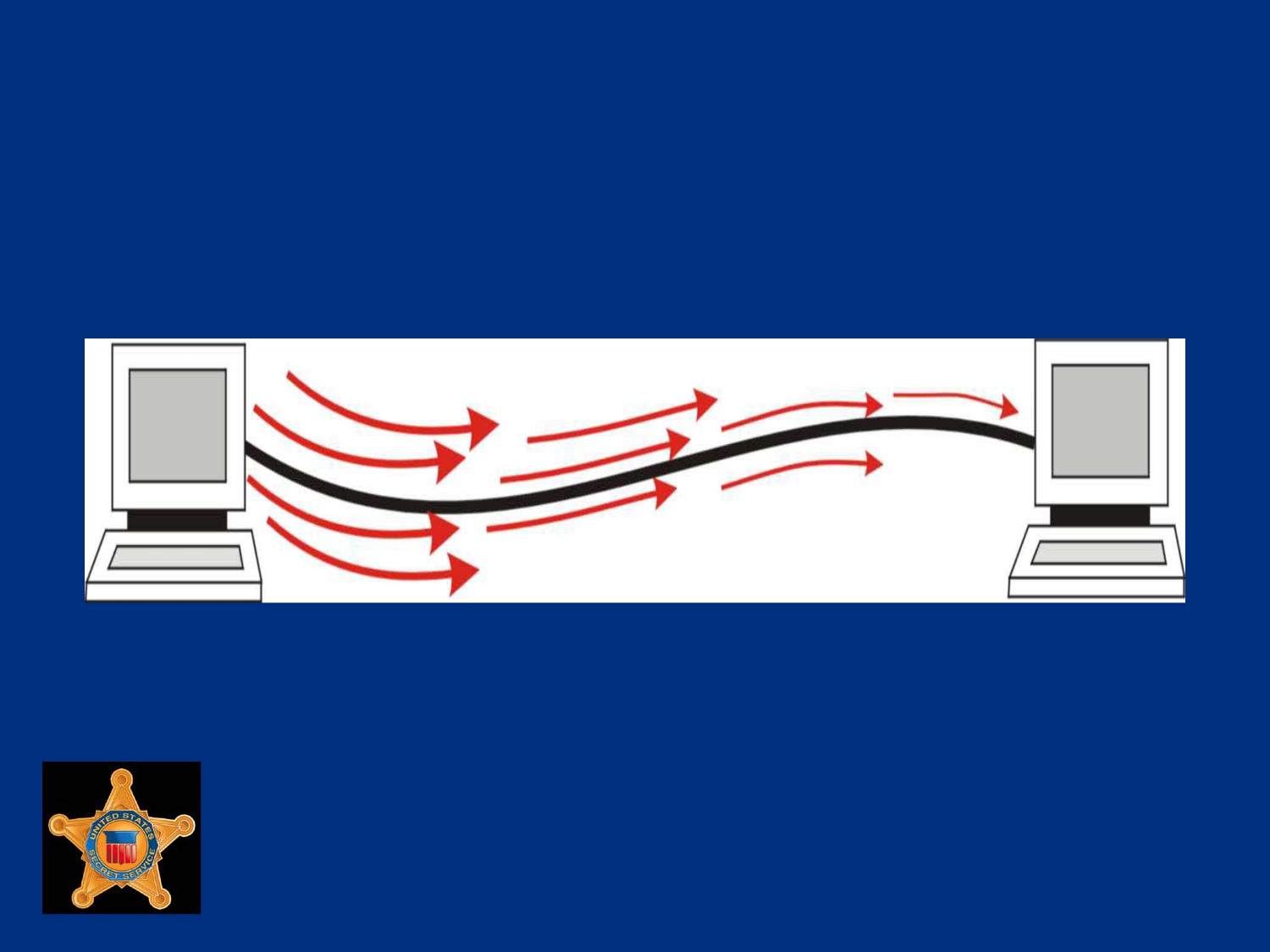
Signals carried over cabling susceptible to attenuation
Weakening of signals as they travel away from source
Specific distance limits for use of cables
Signals travel limited distance before becoming indecipherable
U.S. Department of
Homeland Security
United States
Secret Service
Attenuation
U.S. Department of
Homeland Security
United States
Secret Service
Twisted-pair Cabling
Inexpensive, used extensively with LANs and telephone
connections
Cable consists of individually insulated metal wires twisted
together and placed in plastic encasement
Wires are twisted to prevent crosstalk, noise interference from
other wires within same cable
Twists help prevent electromagnetic interference, or EMI, from
nearby electrical or magnetic fields
U.S. Department of
Homeland Security
United States
Secret Service
Two Types of Twisted-pair Cabling
Unshielded twisted-pair (UTP)
Shielded twisted-pair (STP)
Shielded cable has additional internal shield covering wires
that protects against electromagnetic interference (EMI)
Electromagnetic waves can be intercepted for eavesdropping
on signals
Neither STP nor UTP offer distance or more reliable
interference protection of coaxial or fiber optics
U.S. Department of
Homeland Security
United States
Secret Service
Categories of Twisted-pair Cable
Cat 3 twisted-pair cable supports speeds up to 10 Mbps,
commonly used in 10baseT Ethernet networks
Cat 5 twisted-pair cable supports speeds up to 100 Mbps
commonly used in 100baseX Fast Ethernet networks
Cat 5e twisted-pair cable supports speeds up to 1 Gbps,
commonly used in 1000baseX Gigabit Ethernet networks
Cat 6 twisted-pair cable supports speeds up to 1 Gbps,
commonly used in 1000baseX Gigabit Ethernet networks
U.S. Department of
Homeland Security
United States
Secret Service
RJ-45 Connectors
RJ-45 connector used on ends of twisted pair cabling to
connect components in Ethernet network
Has eight-wire modular plug similar in appearance to RJ-11
and RJ-12 (standard phone wire) connectors
U.S. Department of
Homeland Security
United States
Secret Service
Coaxial Cable
Offers greater protection against EMI than twist-pair cabling
Design has copper core surrounded by insulation and braided
metal shield
Plastic or rubber encasement comprises outside layer
Widely used for cable television and computer
U.S. Department of
Homeland Security
United States
Secret Service
Network Coaxial Cable
Thinnet coaxial cable
Used with 10base2 Ethernet
Thicknet coaxial cable
Used with 10base5 Ethernet
U.S. Department of
Homeland Security
United States
Secret Service
Other Coaxial Cable Characteristics
To build token ring network or bus Ethernet, thinnet used to
connect device using T-connector
Cable must be grounded and terminated
Peak transfer rate 16 Mbps
Effective range approximately 185 meters for thinnet and 500
meters for thicknet
Suffers from high attenuation
U.S. Department of
Homeland Security
United States
Secret Service
BNC Connectors
Acronym for British Naval Connector, Bayonet Neill
Canceilman, or Bayonet Nut Connector
Used to secure Thinnet coaxial cable, found in 10Base2
Ethernet systems
Has male-type plug found at each end of cable
Has center pin connected to center cable conductor and metal
sheath connected to exterior cable shield
Rotating ring used to secure connection
Come in T-connectors, barrel connectors, and terminators
U.S. Department of
Homeland Security
United States
Secret Service
Fiber Optic Cable
Uses glass or plastic fibers to transmit data modulated onto
light waves
Each cable contains two strands in separate jackets
Fibers can be single-mode allowing only one transmitted
signal, or multi-mode allowing multiple transmitted signals
simultaneously
Diameter of optic core of multi-mode fiber visibly larger than
single mode fiber
U.S. Department of
Homeland Security
United States
Secret Service
Fiber Optic Cable
Major difference between single-mode and multi-mode fiber is
distance they carry signal
Single-mode fiber, driven by laser light, can carry signal
approximately forty-three miles without regeneration
Multi-mode fiber limited to approximately one and a half miles
U.S. Department of
Homeland Security
United States
Secret Service
Fiber Optic Cable
Data not converted to analog before transmission
Sent in its original digital format
Fiber optic offer greater bandwidth
Can carry more data than metal cables
Less susceptible to signal interference
Popular choice for LANs or transoceanic cabling
U.S. Department of
Homeland Security
United States
Secret Service
Fiber Optic Cable
Much thinner and lighter than wire cables
More fragile to handle and more difficult to cut
Expensive to install
Phone companies replacing old lines with fiber optic cables
May be first choice for future communication cabling
U.S. Department of
Homeland Security
United States
Secret Service
Fiber Optic Connectors
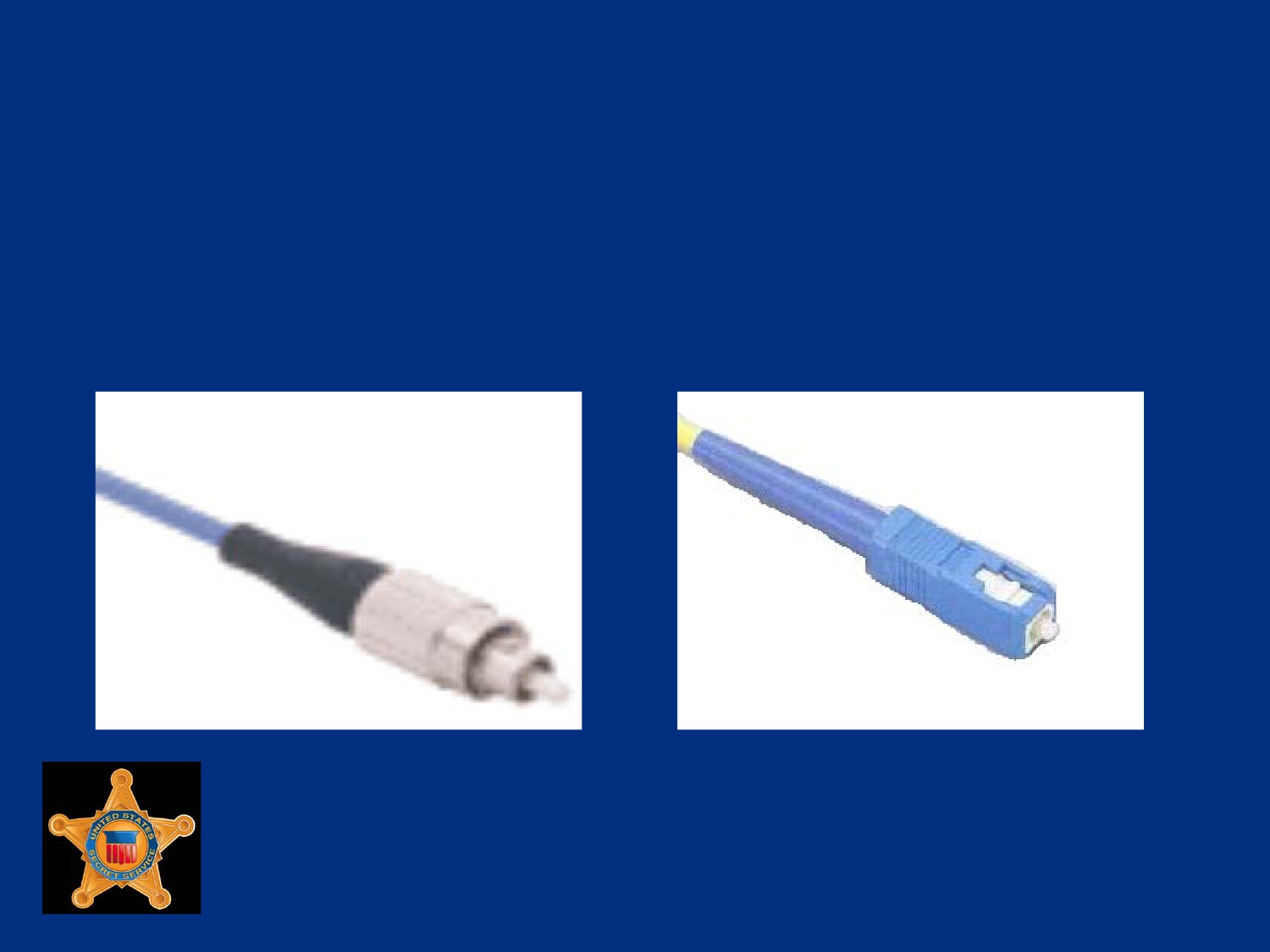
Several different types of connectors depending on application
End of fiber extends past the connector, damaged easily,
should be capped when not in use
U.S. Department of
Homeland Security
United States
Secret Service
Network Interface Card (NIC)
Adapter that enables computer to connect to network
Each made for network type it will support, such as Ethernet,
Token Ring, FDDI
Some formatted as separate plug-ins to MB while others are
integrated into MB
Most cards work with specific cable types
U.S. Department of
Homeland Security
United States
Secret Service
MAC Address
NICs manufactured with hardwired code unique to each card
Code called MAC address
First six hexadecimal characters of address represent
manufacturer of card
Last six characters represent serial number of individual card
Address is essentially computer’s physical address on network
Identifies destination for transmitting data packets on network
U.S. Department of
Homeland Security
United States
Secret Service
More About NICs
Laptop and notebook computers can have NIC built into MB or
use NIC in form of PC card
Slot on side of laptop holds PC card and provides high-speed
access to processor and memory
Several NICs for both Ethernet and Token Ring
NICs used for FDDI called Dual Access Stations (DAS) as they
connect computer to each of two separate token rings
U.S. Department of
Homeland Security
United States
Secret Service
How NICs Work
When computer makes request to communicate with network
OS sends request to NIC
NIC converts request into proper type of data packets
Monitors network traffic flow and sends packets at appropriate
time when there is opening
Checks MAC addresses of passing network transmissions
If addressed to computer, NIC copies packet for computer
NICs work at Data Link Layer 2 of OSI Model
U.S. Department of
Homeland Security
United States
Secret Service
Modems
Handle communications transmitted over telephone lines
between computer systems
Most have fax capabilities
Converts or modulates PC’s digital code to analog so it can be
sent over phone cables
Converts or demodulates analog signals to digital code before
transmitting data to PC
Modems work at Physical Layer 1 of OSI Model
U.S. Department of
Homeland Security
United States
Secret Service
Asynchronous Transmission Mode
Sends data intermittently one character at a time
A start bit and stop bit frame each character
U.S. Department of
Homeland Security
United States
Secret Service
Synchronous Transmission Mode
Relies on software to negotiate protocol used
Blocks of data much larger (128 up to 1024 bytes or more)
than with asynchronous mode communications
Receiving modem must respond with acknowledgement (ACK)
of receipt or negative acknowledgement (NAK)
U.S. Department of
Homeland Security
United States
Secret Service
Hubs
Contains ports to connect network computers and devices
Provides central point of connection for network nodes
Type connector needed by each node depends on network
architecture and cabling used (i.e., Ethernet, Fast Ethernet,
etc)
Most are small boxes with multiple ports
Some hubs are cards that can plug into a server
U.S. Department of
Homeland Security
United States
Secret Service
Types of Hubs
Passive Broadcast Hub:
Broadcasts data packets to every node on hub
Performs no signal regeneration
Active Broadcast Hub:
Broadcasts data packets to every node on hub
Enhances signal transmission by regenerating signals and
filtering noise
U.S. Department of
Homeland Security
United States
Secret Service
More About Hubs
Intelligent hub, essentially active hub that contains network
management functions used to gather information on network
traffic and error detection
Most intelligent hubs can monitor individual ports and close
port if problems arise
Hubs do not decide when or where to send data packets
Simply broadcast data to all ports
Hus work at Physical Layer 1 of OSI Model
U.S. Department of
Homeland Security
United States
Secret Service
Token Ring MAU/MSAU
Multi-Station Access Unit (MAU/MSAU), device used to link
nodes on token ring networks
Nodes connected to MAU and data packets routed in ring
Star-wired ring topology makes it easy to add or remove nodes
Devices decide where to send data packets and create point-
to-point connection based on sending and receiving node’s
MAC addresses
Work at Data Link Layer 2 of OSI Model
U.S. Department of
Homeland Security
United States
Secret Service
Repeater
Combat attenuation by boosting signal during transmission
Analog repeaters amplify, digital repeaters regenerate signal
Can relay signals between networks that use different types of
protocols or cabling
Repeaters do not decide when to send data
Receive data packets in one port, regenerate or amplify, and
send back out other port
Work at Physical Layer 1 of OSI Model
U.S. Department of
Homeland Security
United States
Secret Service
Bridge
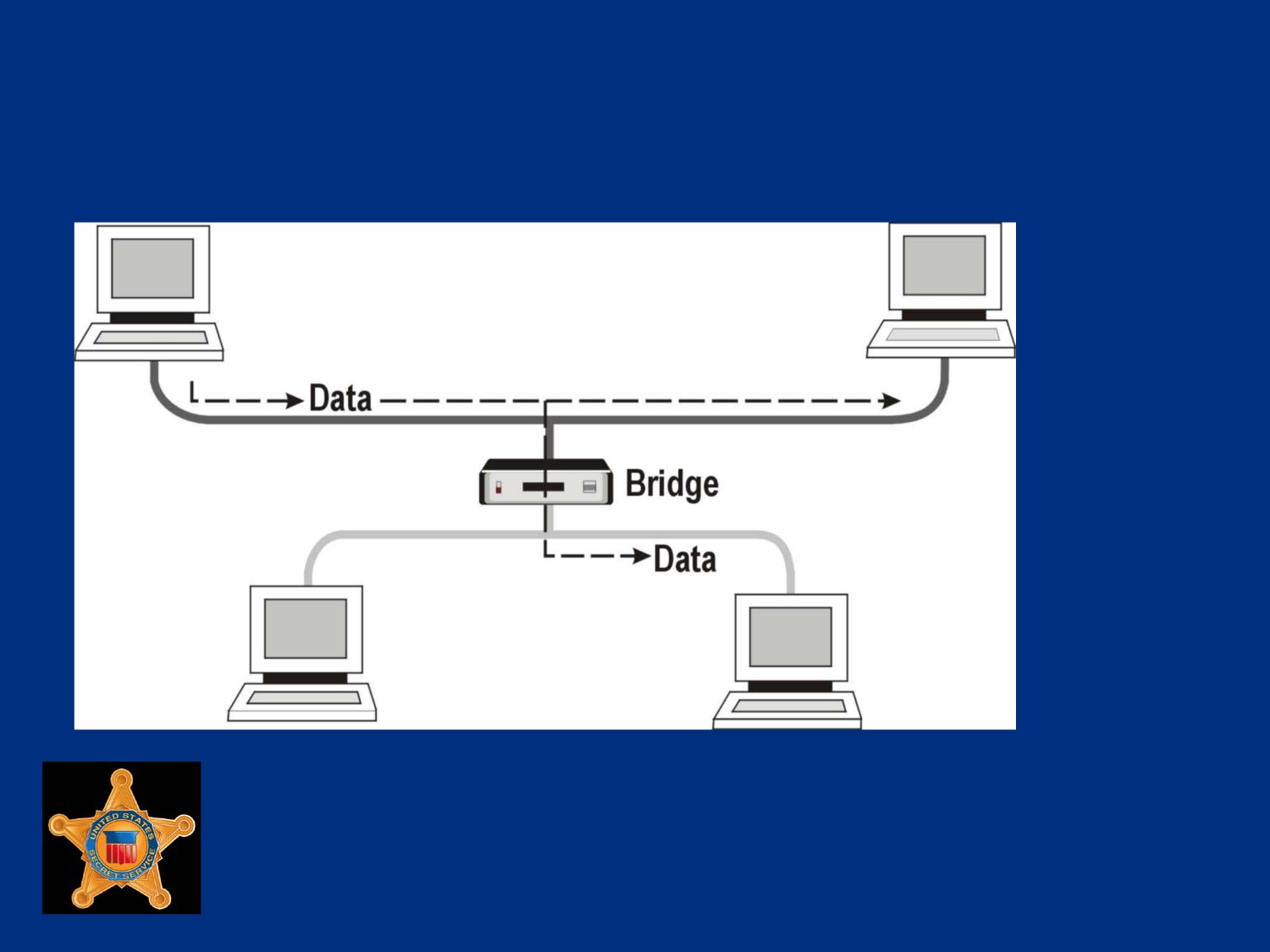
Joins two separate segments of same network
Can be used to divide overloaded network by creating
separate broadcast (collision) domains
Can connect two dissimilar networks, such as connecting
Ethernet with Token Ring network
U.S. Department of
Homeland Security
United States
Secret Service
Bridge Example
U.S. Department of
Homeland Security
United States
Secret Service
Bridge
Decides whether data packets should be sent from one
collision domain, across bridge, into second collision domain,
based on MAC address of sending and receiving nodes
If sending and receiving nodes on same segment, bridge
simply ignores, or drops packets
Works at Data Link Layer 2 of OSI Model
U.S. Department of
Homeland Security
United States
Secret Service
Switches
Visibly resemble hubs, help increase speed of network by
providing dedicated bandwidth to each port
Functions like cross between bridge and hub
Cut down on amount of broadcast traffic on network segment
Directs network packets from incoming port directly to port for
receiving computer
Lowers number of collisions on network segments, improving
overall performance
U.S. Department of
Homeland Security
United States
Secret Service
Switches
Can be managed, allowing individual port configuration and
monitoring from across network
Direct packets based on sender and receiver MAC addresses
Have ability to broadcast to all ports when necessary, differ
from hubs in that they limit traffic to sender and receiver ports
without broadcasting
Work at Data Link Layer 2 of OSI Model
Also Layer 3 switches, direct data based on network address
U.S. Department of
Homeland Security
United States
Secret Service
Routers
Link separate networks or LAN segments and establish
pathways for data packet transmissions
Use network addresses to transmit packets to correct
destination
Transmit data packets across different types of networks
Fragment data packets to fit different frame sizes of various
networks
Can be configured to segregate secure data and prevent it
from being sent to specified networks
U.S. Department of
Homeland Security
United States
Secret Service
Routers
Collect and assemble information from remote routers about
network routes, information used to identify reliable pathways
Do not broadcast data packets
Read each data packet looking for network address (IP
address) to send to
Determine best route to forward packets and replace sender’s
MAC address with its own
U.S. Department of
Homeland Security
United States
Secret Service
Routers
Each port on router is in essence a separate NIC with its own
unique MAC address
As packets move from one router to another, MAC address in
packets change from router to router
Original source and destination IP addresses remain same
regardless of how many routers packet encounters
U.S. Department of
Homeland Security
United States
Secret Service
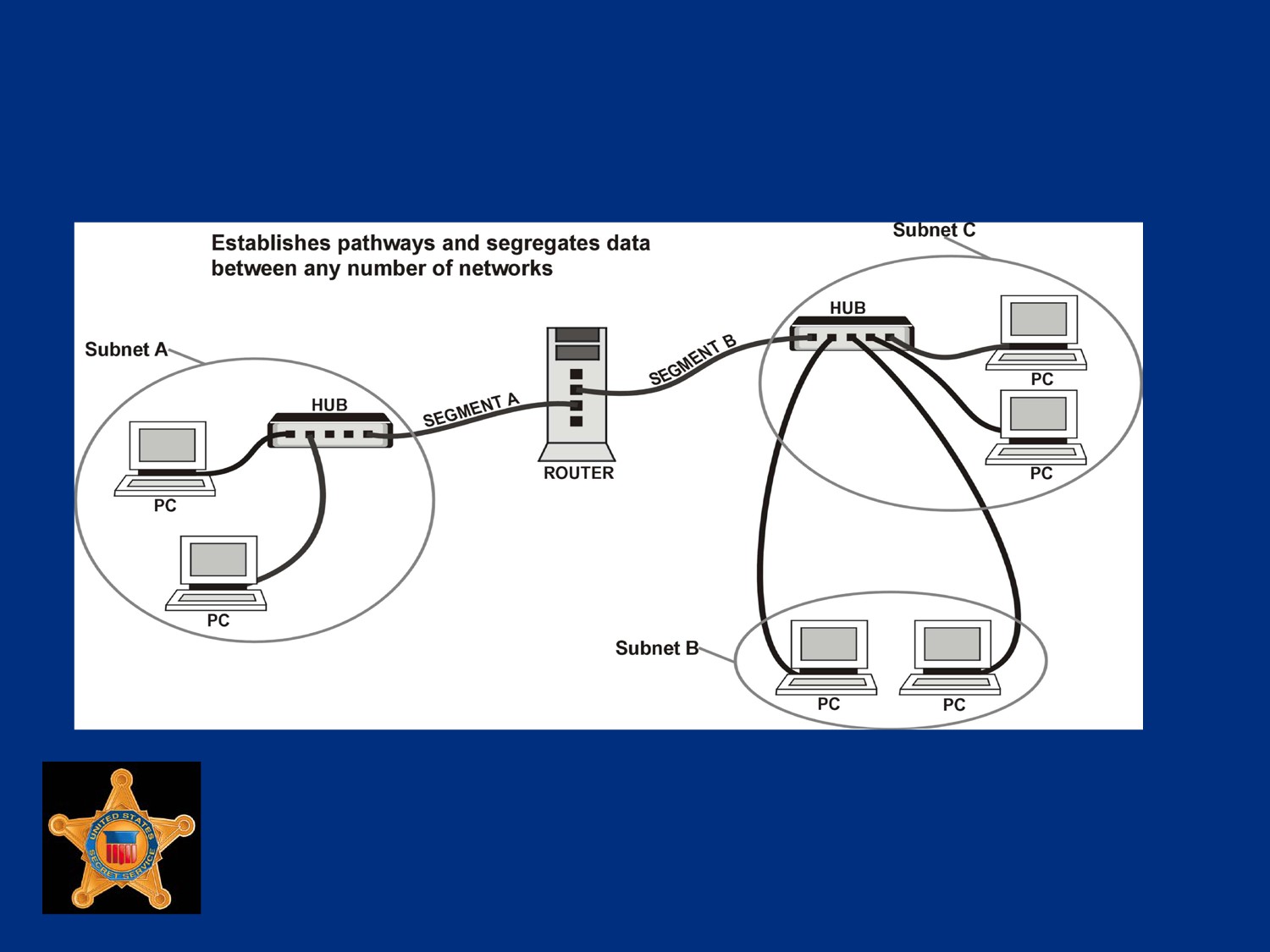
Router Model
U.S. Department of
Homeland Security
United States
Secret Service
Routing Activity
Routers on networks exchange information about paths
through process known as convergence
Convergence information stored in routing tables, which
contain network portion of host computer’s IP address
Routing assumes addresses convey at least partial information
about where host is located
Permits routers to forward packets without having to rely on
complete list of all possible destinations
U.S. Department of
Homeland Security
United States
Secret Service
Two Basic Routing Activities
Path determination
Enables routing protocol to determine best direction to route
packet
Determination will differ based on routing protocol used
Switching
Involves router forwarding packets independently through
network
Forwards packets based on IP address, function of Network
Layer 3 of OSI Model
U.S. Department of
Homeland Security
United States
Secret Service
Gateway
Server or software program that is entrance point to network
Can translate different protocols on network
Can serve as proxy servers and firewalls
Able to look at data inside packets and perform high-level
decisions about data beyond simply looking at MAC or network
address
Functions at Layers 4 - 7 of OSI Model
U.S. Department of
Homeland Security
United States
Secret Service
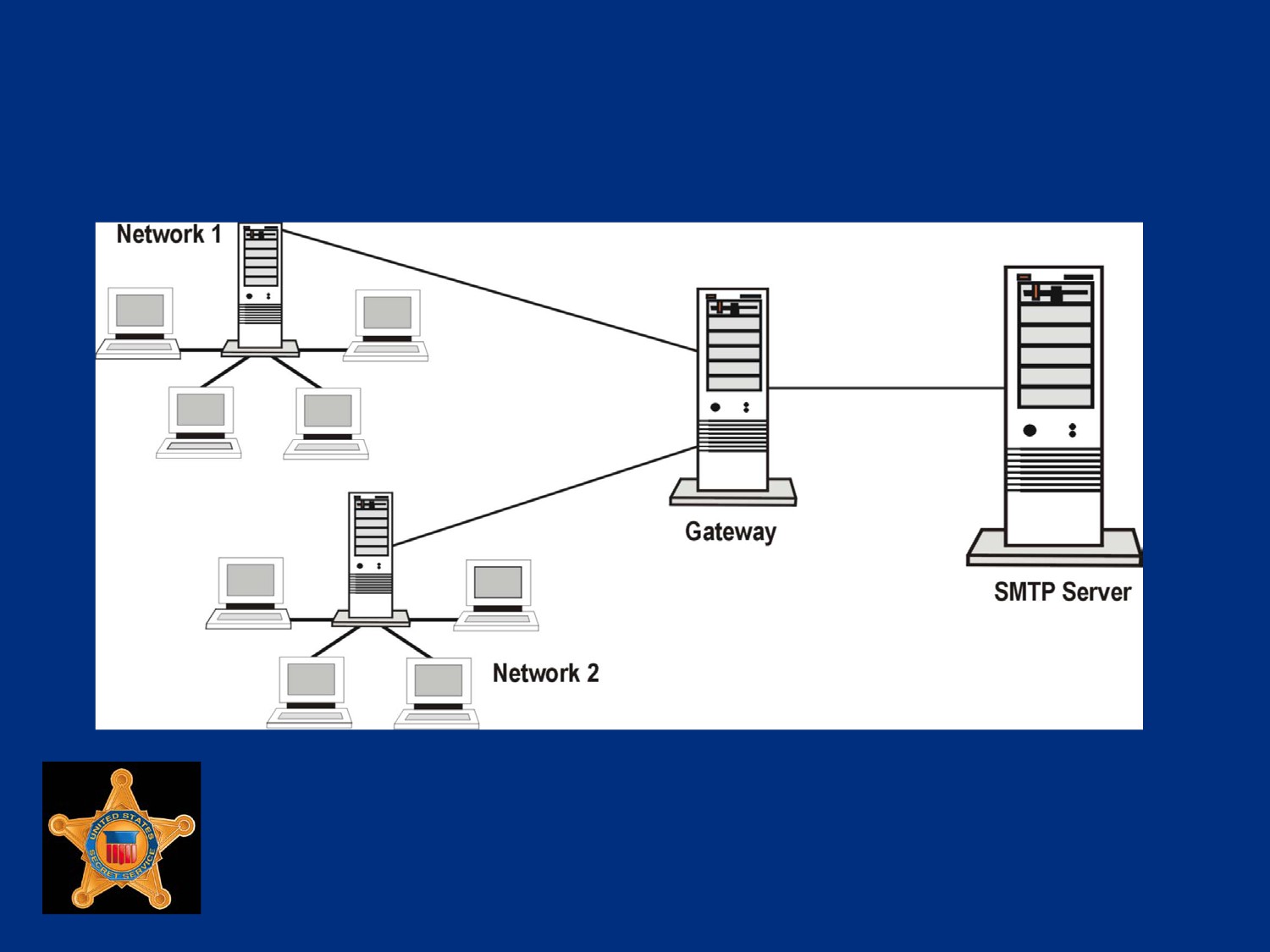
Gateway Example
U.S. Department of
Homeland Security
United States
Secret Service
Wireless Media
Offers data communications between computers without use of
traditional network wire or cabling
Data transmitted over frequencies in air rather than through
cable
IEEE 802.11 standard defines all aspects of radio frequency
wireless networking
U.S. Department of
Homeland Security
United States
Secret Service
Two Types of Wireless Systems
Fixed wireless
Describes computing devices or networks in fixed locations,
such as building, office, or home
Devices rely on electrical power
Mobile wireless
Portable computing devices, such as cell phones, PDAs,
and wireless notebooks that use battery power and can
transmit and receive from any location
U.S. Department of
Homeland Security
United States
Secret Service
How Wireless Communications
Works
Wireless Access Points (WAPs), base stations, are devices
clients use to connect to wireless networks
Devices transmit and receive signals without electrical or
optical conductors
Communication uses Earth’s atmosphere as physical data
path
U.S. Department of
Homeland Security
United States
Secret Service
How Wireless Communications
Works
Uses technology in radio frequency (RF) transmissions to send
network packets across airwaves
Typical indoor ranges are 150-300 feet and outdoor ranges up
to 1,000 feet
RF technology used in both LANs and WANs
U.S. Department of
Homeland Security
United States
Secret Service
How Wireless Communications
Works
Laptop computers have transceivers in PC-card slots that
connect to wireless access point (WAP) and wired network
Desktop PCs use either ISA/PCI wireless or USB transceiver
Data transfer speeds can be slower than wired connections
U.S. Department of
Homeland Security
United States
Secret Service
Wireless LAN
Wireless LAN, WLAN, transmits over air, do not require
arranging devices for line of sight transmission
WAPs are connected to Ethernet hub or server
Send radio frequency signals through walls over area up to
1,000 feet
Desktop PCs send and receive transmissions via ISA or PCI
card
Laptops use PC cards or wireless modems that connect to
Ethernet port
U.S. Department of
Homeland Security
United States
Secret Service
Wireless Signals
Wireless signals operate at frequency rate gauged by number
of oscillations per time unit signal makes
Faster the cycle rate, higher the frequency
High frequency has more oscillations per second than low
frequency
U.S. Department of
Homeland Security
United States
Secret Service
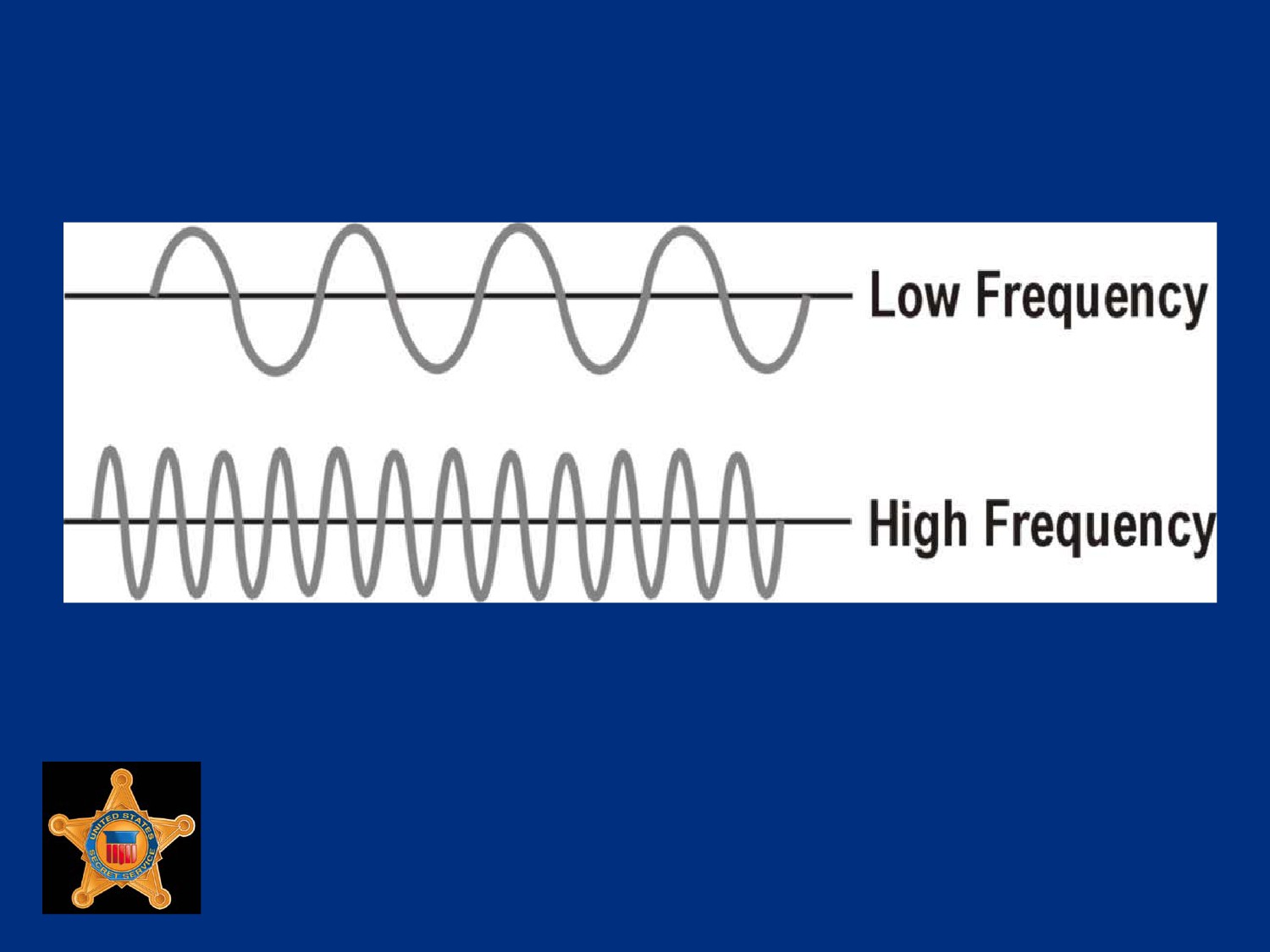
Frequency Illustration
U.S. Department of
Homeland Security
United States
Secret Service
Wireless Signals
Wireless signal frequencies measured in hertz (Hz)
Most current wireless communications involve megahertz
(MHz) and gigahertz (GHz)
Higher hertz rates mean greater bandwidth and more data
capacity
U.S. Department of
Homeland Security
United States
Secret Service
Types of Wireless Signals
Radio frequency (RF) signals
Microwaves
Infrared signals
U.S. Department of
Homeland Security
United States
Secret Service
Radio Frequency (RF)
Majority of wireless communication transmitted over RF
High Frequency (HF): 3 - 30 MHz
Very High Frequency (VHF): 30 - 300 MHz
Ultra High Frequency (UHF): 300 MHz - 3 GHz
Super High Frequency (SHF): 3 GHz - 30 GHz
Devices that use RFs between 10KHz and 1GHz include short
wave radio, VHF television, FM radio, and UHF radio television
U.S. Department of
Homeland Security
United States
Secret Service
Types of RFs
RF
Characteristics
Low Power,
Used to carry signals short distances. This
Single-
method is susceptible to massive attenuation and
Frequency
vulnerable to eavesdropping.
High-Power,
Used over long distances. They can resist
Single-
attenuation, but are vulnerable to eavesdropping.
Frequency
U.S. Department of
Homeland Security
United States
Secret Service
Types of RFs
RF
Characteristics
Spread
Uses multiple frequencies simultaneously and
Spectrum
continuously to change signal patterns. Two
types of spread spectrum RFs:
• Direct Sequence Modulation: Transmits
encoded data and white noise across subnet of
radio frequencies. Most common RF used.
• Frequency Hopping: Switches between pre-
established frequencies several times per
second.
U.S. Department of
Homeland Security
United States
Secret Service
Microwave Wireless Media
Microwaves are electromagnetic waves that use same
frequencies as RFs
Two basic forms of microwave communication, both
susceptible to weather conditions, jamming frequencies,
eavesdropping, and latency
Terrestrial: Sends data over land such as for line-of-sight
transmissions between buildings
Satellite: Sends data across great distances via satellites
U.S. Department of
Homeland Security
United States
Secret Service
Infrared Wireless Media
Infrared transmissions use optical transceivers to communicate
between transmitter and receiver
Operate using line-of-sight or reflection and require
unobstructed pathway between devices
U.S. Department of
Homeland Security
United States
Secret Service
Infrared Wireless Media
Point-to-Point Infrared:
Uses tightly focused beams directed at specific receiver (s)
such as one computer transmitting to another within same
area
Broadcast Infrared:
Signals diffused over wide area to number of receivers such
as data sent to several computers within a room
Data transfer is slow
U.S. Department of
Homeland Security
United States
Secret Service
Lesson 2 - Network Configuration
Models
Introduction to Network Models
U.S. Department of
Homeland Security
United States
Secret Service
Network Models
Peer-to-peer network
Client/server network
Server-centric network, which includes:
Enterprise network
Server/server network
Remote access service (RAS) network
U.S. Department of
Homeland Security
United States
Secret Service
Peer-to-Peer Network Model
Computers linked function as both workstations and servers to
share resources
PC’s can share drives, printers, and other common devices
while running applications
Easy to set up and often found in small offices
Limited user security can be configured to include password
access
Not ideal for large network where server-based network can
provide more security
U.S. Department of
Homeland Security
United States
Secret Service
Client/Server Network Model
Individual workstations send requests to central server and
server provides resources
Separation of duties makes for powerful system
Fast processing time for running applications
Increased disk space for sharing files
Network security including mandatory user login to access
network resources
U.S. Department of
Homeland Security
United States
Secret Service
Client/Server Network Model
Has advantages over peer-to-peer network
Provides more organized system, resources easier to locate
Better security features, all user login files stored in one
location
All users have profile that includes login name and password
User validation must occur before network access granted
U.S. Department of
Homeland Security
United States
Secret Service
Server-centric Network Model
Each server has defined roles and offers access to specific
shared resources
Each server requires user login authentication before
processing requests
U.S. Department of
Homeland Security
United States
Secret Service
Enterprise Network Model
Connects all departmental and individual networks into one
network allowing exchange and access of resources across
organization
Integrates all systems types to link in enterprise network
Interconnectivity achieved with TCP/IP and other Web
technologies
Designated server maintains system security
Users login once for access across network
U.S. Department of
Homeland Security
United States
Secret Service
Server/Server Network Model
One server provides services to other servers in network
Types of services provided include domain name service
(DNS) address resolution and dynamic host configuration
protocol (DHCP) IP address request and issue
U.S. Department of
Homeland Security
United States
Secret Service
Remote Access Service (RAS)
Enables users to access network from any outside location by
using modem or Internet connection
U.S. Department of
Homeland Security
United States
Secret Service
Lesson 3 - Network Protocols
Protocols
TCP/IP
Other Protocols
U.S. Department of
Homeland Security
United States
Secret Service
Protocols
Define rules for transmitting data between computers or other
devices
Determine size of data packets, type of information included in
each packet, what actions take place if communication does
not reach destination
U.S. Department of
Homeland Security
United States
Secret Service
Protocol Guidelines
Provide data compression, when necessary
Determine process to begin and end a communication
Govern message routes and data speeds
Provide error checking procedures to ensure error-free
message delivery
Offer translation services for different types of computers and
networks
U.S. Department of
Homeland Security
United States
Secret Service
Protocols Covered in This Lesson
TCP/IP
IPX/SPX
NetBEUI/NetBIOS
PPP/PPTP
U.S. Department of
Homeland Security
United States
Secret Service
TCP/IP
Transmission Control Protocol/Internet Protocol (TCP/IP)
considered standard protocol for the Internet
Can be used for internal networks without Internet access
Must be used for device to gain Internet access
U.S. Department of
Homeland Security
United States
Secret Service
TCP/IP
Suite of communications protocols governing how data travels
between devices and networks throughout Internet
Developed in 1969 to interconnect networks of research
agencies around country
Designed to work on all network topologies and communicate
over fiber optics, twisted-pair, or coaxial cable
U.S. Department of
Homeland Security
United States
Secret Service
TCP Functions
Divide data into manageable packet sizes
Reassembles data at destination
Verifies packet arrival at destination
Transport Layer 4 of OSI Model
U.S. Department of
Homeland Security
United States
Secret Service
IP Functions
Defines how much data can be carried by each packet
Packages and addresses data to be sent
Enables various types of networks to read and route data
packets
Network Layer 3 of OSI Model
U.S. Department of
Homeland Security
United States
Secret Service