SANY Excavator SY335 (Part Number: 11282013). Safety, Operation & Maintenance Manual - page 2
Safety - General
SY335 Excavator
•
Always drive carefully and at a controllable speed.
•
Never travel over objects that could tip the machine or cause you to lose control.
•
Avoid sudden stops or high speed turns which could cause loss of control or a possible rollover.
•
Watch clearances when traveling. Do not take a chance of running into overhead or side obstructions.
•
When moving in tight quarters, post a signal person to help guard against collisions.
•
Check the suitability of proposed route with regard to machine height, width, and length.
•
Before traveling across bridges, ensure they will carry a load greater than the loaded vehicle’s weight.
•
Check state and local restrictions and regulations.
•
Stay alert at the steering wheel.
•
Never back up without the aid of a signal person to verify that the area behind the vehicle is clear of
obstructions and/or personnel.
Maintenance Safety - General
WARNING
All maintenance to be performed on this equipment must be performed by trained and
authorized personnel only. When performing maintenance, it is important to follow all outlined
maintenance or repair procedures and safety information as outlined in this manual. Failure to
do so may result in possible injury or death.
The machine must be inspected prior to each work shift that it will be used. The owner, user, and operator must
ensure that required routine maintenance and lubrication tasks have been performed as stated in this manual by a
qualified person(s). Never operate a damaged or poorly maintained machine.
Perform function checks after repairs have been made to ensure proper operation.
Fill out the required maintenance record form. See maintenance section of this manual for information about this.
Direct any questions to your local authorized Sany distributor.
Preparing for Maintenance
Select an area where there is no danger of falling objects or interference with other equipment, personnel or
pedestrian traffic.
Before performing any maintenance on the equipment:
•
Stop the engine and disconnect the battery.
2-20
SY335 Excavator
Safety - General
•
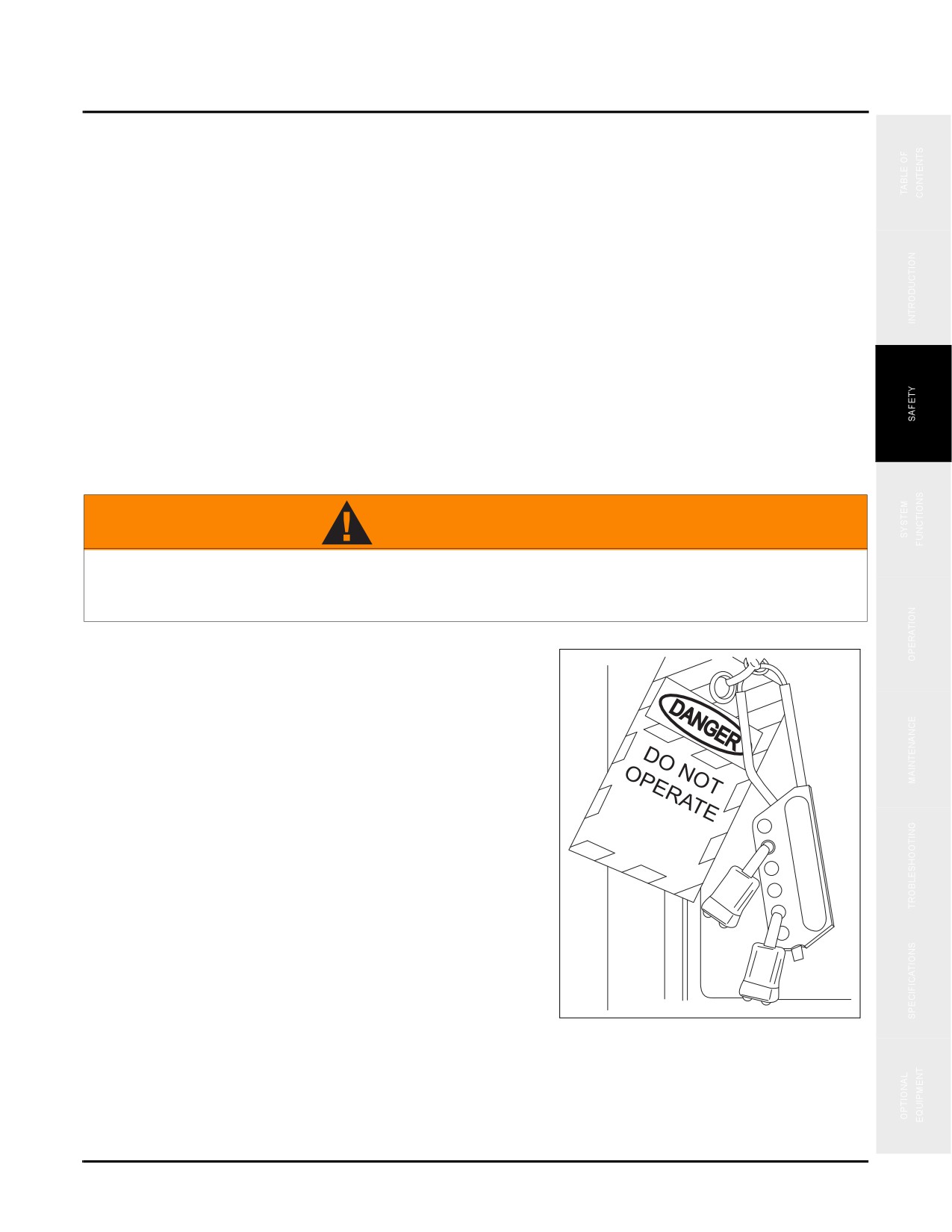
Controls, and power source, should be properly tagged. During all maintenance or repair, Lockout/Tagout
procedures must be used to ensure the safety of service personnel involved in the maintenance process of
the machine. All power sources must be disabled, locked and tagged with a warning label. See “Lockout/
Tagout Procedures” on page 2-21
•
Recognize and avoid pinch-points while performing maintenance.
After maintenance or repairs:
•
Fill out the required maintenance record form. See maintenance section of this manual for information
about this.
•
Replace all guards and covers that have been removed.
•
Remove all tags, connect the battery, and perform a function check of all operating controls.
Lockout/Tagout Procedures
WARNING
Never work on the machine without first ensuring that the lockout/tagout process has been
followed. Contact your supervisor or Sany with any questions. Failure to follow this warning
could result in serious injuries or death.
Only authorized employees performing repairs on the
machine shall perform Lockout/Tagout in accordance with
the procedure listed below.
If the employee performing repairs to the machine is issued
a lock and key, the employee shall not share the lock or key
with other employees until all repair procedures are
complete and the machine is ready to put back into service.
The following steps shall be performed in the sequence
listed when the equipment is to be locked-out and tagged-
out for service or repair.
Locking out of service
1. Notify all employees who may be potentially affected
by the repair or maintenance on the machine.
2. Secure the machine in a safe position. If so equipped,
Fig. 2-17
set the parking brake or hydraulic lock lever in the
parked (or locked) position.
3. Identify, remove or disconnect all power or energy
sources and be sure to install a Lockout/Tagout device
on them.
2-21
Safety - General
SY335 Excavator
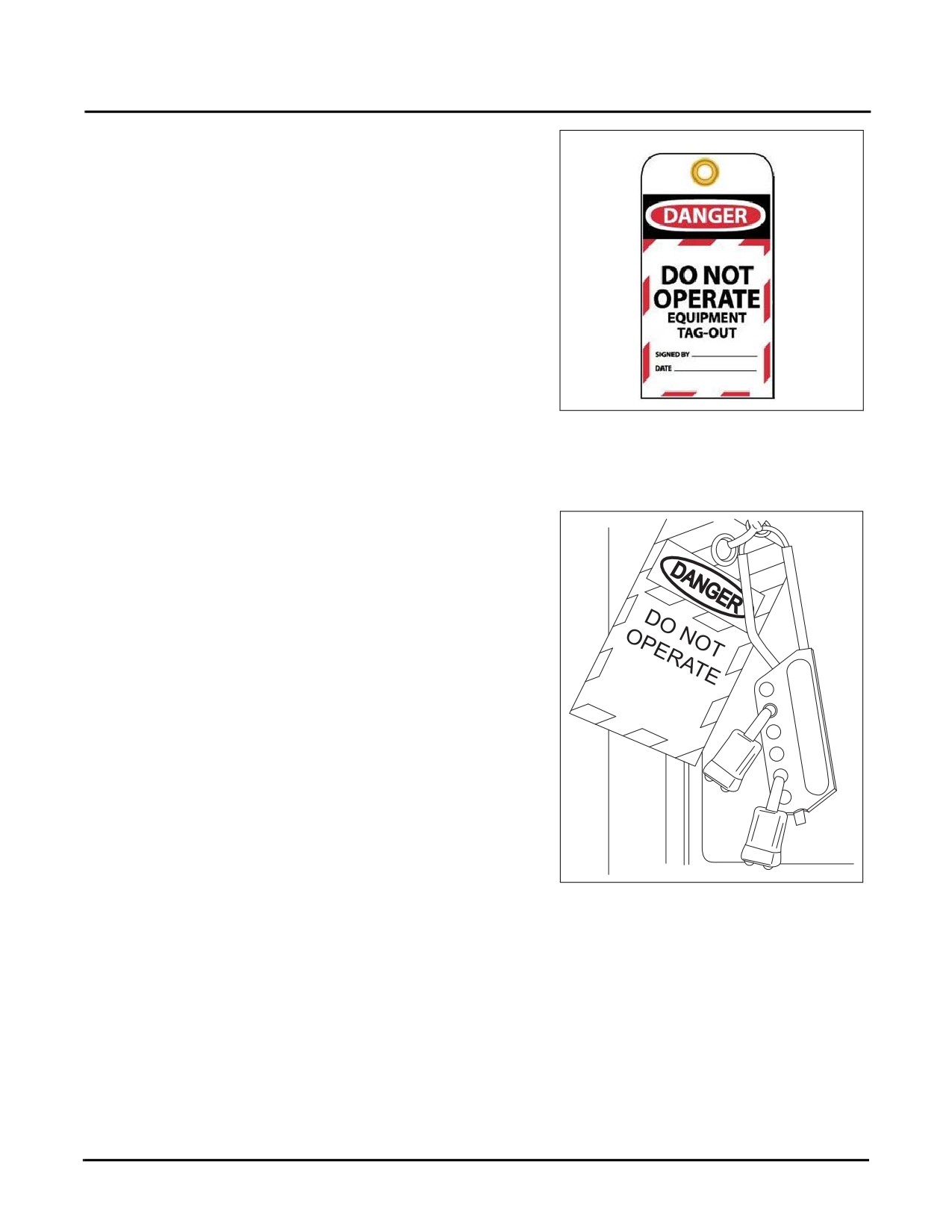
4. If the machine is equipped with a Maintenance Alert
Tag, attach it to the machine controls.
5. Be sure all employees involved in the repairs have
installed their own locks on the power source before
performing any repairs. Each employee who completes
a repair must remove his own lock and not access the
machine further.
Fig. 2-18
Returning to service
1. The authorized person who performed the Lockout/
Tagout procedure shall check the area around the
machine to ensure that no one is exposed to any hazard
before start-up.
2. The authorized person who performed the Lockout/
Tagout shall ensure that all guards have been properly
reinstalled to their respective locations, all tools,
equipment and locks have been removed.
3. The authorized person who performed the Lockout/
Tagout shall verify that all controls are in the neutral or
“off” position and that all personnel are aware of the
time the machine will be back in service.
4. Remove the Lockout/Tagout mechanisms and all tags
and re-energize the machine for return to service.
Fig. 2-19
2-22
SY335 Excavator
Safety - General
Cleaning the Machine
Always use hot water and mild, non-flammable grease-
cutting soaps or cleaning agents to clean the machine parts.
Never use flammable or caustic cleaning agents.
Never use high-pressure steam cleaners to clean the
equipment. Steam cleaners will damage the paint, hoses or
electrical system.
Never pressure-wash or flood the driver’s compartment.
This will damage sensitive electrical components.
KG25
Fig. 2-20
Always grease the equipment thoroughly after cleaning to
force out any water or soap residue.
Using the Correct Tools
Always do the following:
•
Always use the proper tools for the job. Using tools
that are incorrect, defective or damaged could cause
serious injury. CAUTION: Be careful when
working in tight areas to prevent injury to yourself.
•
Keep your tools clean, and when the job is
complete, take inventory of the tools you were
using to be sure no tools were left in the machine.
•
Always put shop tools back in there proper storage
location when finished.
A20004083C
Fig. 2-21
Jacking Up the Machine
Always do the following:
•
If you will be working under the machine, always
use approved jack stands that will support the
weight of the machine you are working on.
•
Never rely on the hydraulics of the machine or a
hydraulic jack to support the machine during
repairs.
•
Always lower any work equipment to the ground
and check the stability of the machine before going
Fig. 2-22
under the machine.
2-23
Safety - General
SY335 Excavator
Rotating Parts
Run the machine during maintenance procedures ONLY if
directed to do so in this manual. If the machine must be run
when making repairs, it is important to follow some basic
safety rules:
•
Always be aware of rotating components.
•
During maintenance operations while the engine is
running, one worker must remain in the operator
seat of the machine with clear contact between the
person performing the repairs on the machine at all
times.
A20004018C
•
If equipped, all lock levers must be in the LOCK
Fig. 2-23
position or the parking brake must be in the PARK
position.
•
Never touch any controls. If a control lever must be operated, always maintain a clear view to the person
doing the repair and signal them when you are about to move the control lever.
Track Recoil Springs
Track recoil springs are used to reduce the impact on the
idler. This spring is under extreme pressure at all times. If it
is disassembled by mistake, the spring will fly out and cause
serious injury. Never disassemble the recoil spring. Contact
your Sany distributor if this component requires servicing.
Removing Attachments
ACN0467
Fig. 2-24
If removing large, heavy attachments, always be sure to use
the correct lifting equipment rated for the capacity of the
load you will be lifting.
After the attachment or part has been removed, store it
where it cannot fall or move. Always be sure the attachment
is stable on a solid surface and clear of all walkways or fire
exits.
When installing and using optional attachments, read and
follow the instruction manual for the attachment.
A20004024C
Fig. 2-25
Do not use attachments that are not authorized by your Sany
2-24
SY335 Excavator
Safety - General
distributor. Use of unauthorized attachments could create a safety problem and adversely affect proper operation
and useful life of the machine. Any injuries, accidents, product failures resulting from the use of unauthorized
attachments will not be the responsibility of Sany.
Welding, Drilling, Cutting or Grinding on the Machine
NOTE: Please contact your Customer Service Department for proper guidance on any welding
being attempted.
Personnel welding on the machine must be fully qualified and certified to use the processes and equipment they
may operate in making these repairs. Customers are responsible for the structural integrity of any completed repair.
Sany strongly recommends against welding on connectors and fine grain hi-strength steels. Components should be
replaced if they are damaged.
Adding Fluids to the Machine
Before adding fluids, shut the equipment down and allow
the systems to cool to outdoor ambient temperature before
removing any caps. Failure to do so may result in serious
burns or a sudden loss of fluid.
If fluids must be added to the equipment during operation,
always be aware that these systems are under high pressure
and hot.
A20004022C
Fig. 2-26
Refueling
Before adding fluids, shut the equipment down and allow
the systems to cool to outdoor ambient temperature before
removing any caps. Failure to do so may result in serious
burns or a sudden loss of fluid. Read and understand the
following:
•
Refueling the machine could pose some hazards.
Grease, fuel, oil or coolant spills pose a hazard if
not cleaned up immediately.
•
When refueling or adding any fluids to the machine,
be sure you are in a well-ventilated area. Never
A20004073C
smoke or allow open flames near you while you are
Fig. 2-27
refueling the machine.
•
Never mix gasoline with diesel fuel. Gasoline is extremely flammable and could cause an explosion.
•
Always allow room for the fuel to expand when filling the fuel tank.
2-25
Safety - General
SY335 Excavator
High-Pressure Fluid Lines
During normal operations, it may be necessary to replace a
hydraulic hose if a leak is found or failure occurs. Always
remember that this system is highly pressurized.
Always do as follows:
•
Check for cracks in the piping or hoses and for
swelling in the hoses. If there is any leakage from a
line or hose, the surrounding area will be wet.
•
Never perform inspections or replace items while
the system is under pressure. Working on a system
still under pressure could lead to serious injury.
•
Never use any part of your body to check or feel for
leaks. Always wear safety glasses and leather
gloves when checking for leaks and use a piece of
wood or cardboard when checking leaks from small
holes.
•
If high-pressure fluids penetrate your skin or get
A20004025C
into your eyes, seek medical attention immediately.
Fig. 2-28
Accumulator
This machine is equipped with an accumulator charged with
high-pressure nitrogen gas. Before servicing the
accumulator, it is important to follow these basic
precautions.
•
Do not disassemble the accumulator.
•
Never expose the accumulator to high heat or open
flames.
•
Never weld on the accumulator.
ACN0030
Fig. 2-29
•
Never drill or cut on the accumulator.
•
Never strike the accumulator.
•
If the accumulator should need servicing, contact your Sany distributor.
2-26
SY335 Excavator
Safety - General
Electrical System
Always clean the electrical system using only approved
electrical cleaners.
Never use caustic soaps, high-pressure water or steam
cleaners to clean the electrical system, as these could
damage the system or cause intermittent system failures.
A20004002C
Fig. 2-30
Battery Safety
When working with batteries, always work in a well-
ventilated area. Working around batteries always poses a
hazard - especially if the battery has been in service for a
long period of time. Listed below are some basic
precautions to be aware of when servicing or working
around batteries:
•
Always wear personal protective equipment when
working around batteries.
A20004030C
•
Battery gases are extremely explosive. Smoking,
Fig. 2-31
sparks or open flames could cause an unexpected
explosion. When opening a battery compartment
always allow ample time for the gases to escape before servicing the battery.
•
If the battery is corroded, flush the area with a baking soda and warm water mix.
•
If battery acid gets on your skin or in your eyes,
flush the area immediately with fresh water and
seek medical attention.
Check battery condition only with proper test equipment.
Batteries shall not be charged except in an open, well-
ventilated area that is free of flame, smoking, sparks, and
fire.
A20004092C
Fig. 2-32
2-27
Safety - General
SY335 Excavator
Start-up Safety
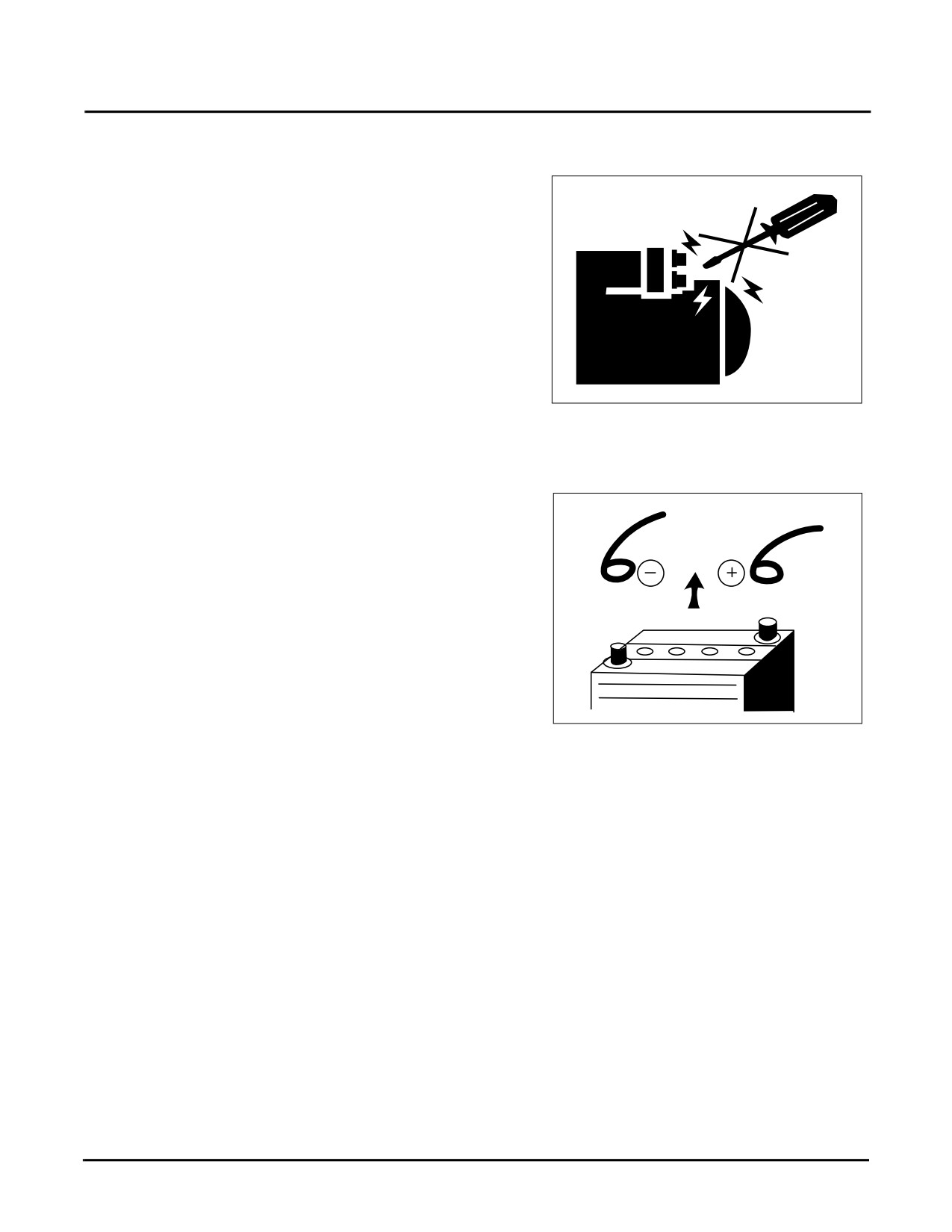
Never start the machine by tampering with or shorting the
starter terminals. Accidental movements of the machine
may result, leading to injury or possibly death. Always start
the machine from a seated position in the operator’s seat
using the ignition switch.
ACN0022
Fig. 2-33
Disconnecting the Battery
When disconnecting the battery, always disconnect the
negative (-) terminal first, then disconnect the positive (+)
cable.
ACN0257
Fig. 2-34
Jump-Start Safety
When using jumper cables to start the engine, hook the positive (+) jumper first, then connect the negative (-)
jumper to a remote location on the chassis away from the battery.
Never use a welder or equipment with a higher voltage system to jump-start the machine. Using a higher voltage to
jump-start the engine may damage the truck’s electrical system or cause an unexpected explosion or fire. Always
jump-start the engine with equal voltages.
2-28
SY335 Excavator
Safety - General
Environmental Precautions
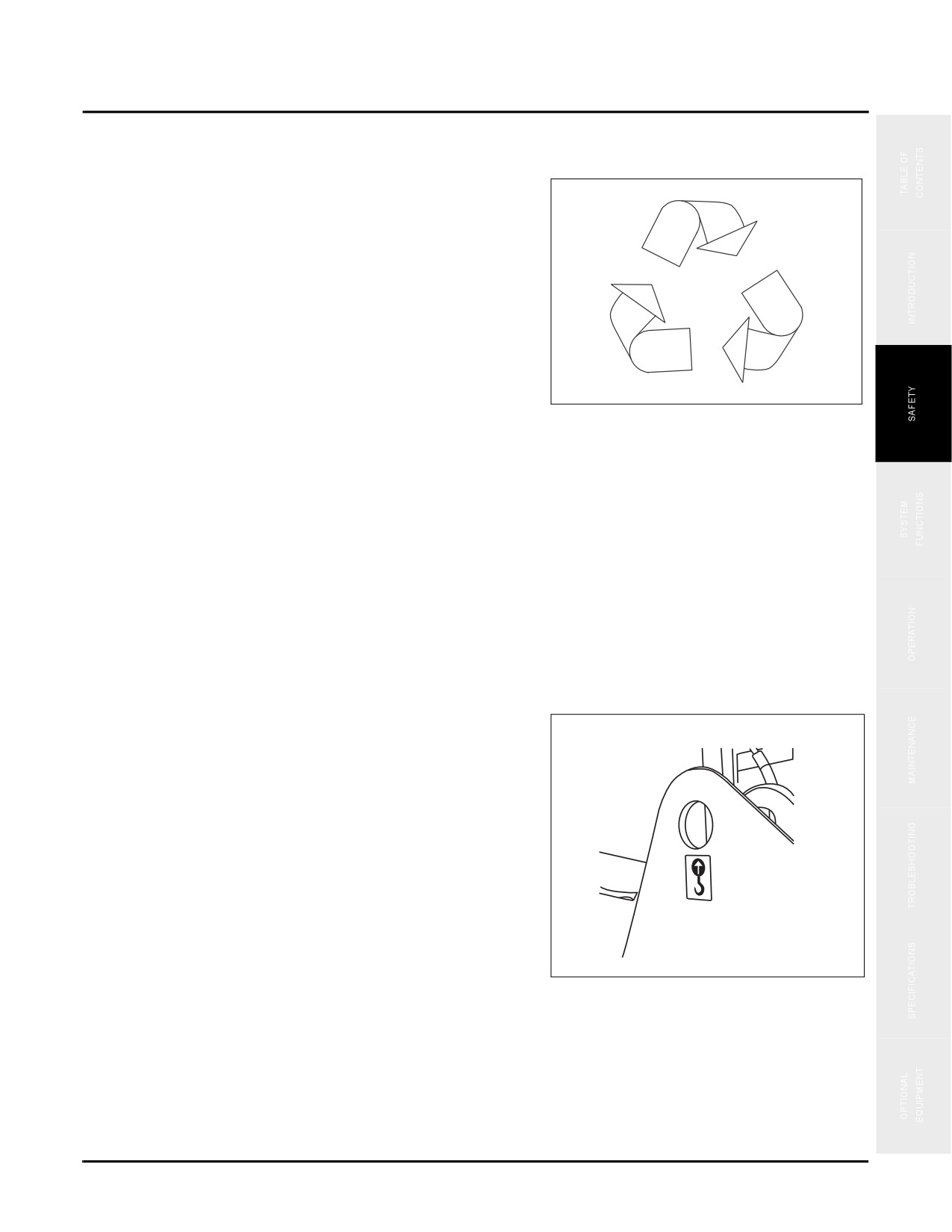
Recycling used oil, coolants or filters conserves a natural
resource and is good for the environment. Engine fluids
poured onto the ground, into storm drains or tossed into
trash cans (even in a sealed container) can contaminate and
pollute the soil, groundwater, streams, and rivers (and it's
illegal!). Recycling your used engine fluids reduces this
pollution threat.
Never dump waste fluids into a sewer system, on the
ground, in rivers, etc.
NOTE: Always drain fluids from your machine into an
A20004030C
appropriate container and dispose of properly.
Fig. 2-35
NOTE: Drain, crush and dispose of all filters properly. Once the oil is drained from the filters, recycle them.
Obey all appropriate laws and regulations when disposing of harmful objects such as oil, fuel, filters, batteries,
hydraulic oils or used parts.
Always recycle whenever possible. Failure to do so may result in fines or punishment.
Towing or Lifting the Machine
Serious injury or death could result if a disabled machine is towed or lifted incorrectly or if there is a mistake in the
selection of cable or towing locations. Adhere to the following:
•
Use only the designated lift points to lift the
machine and designated tow points to tow the
machine. Be sure the lift and tow points are
undamaged and in good working order.
•
Always tow or lift in the direction indicated by the
decal. If the decal is missing or damaged, contact
your Sany distributor for the proper procedures.
•
Always wear leather gloves when handling cable.
•
During the towing operation, never stand between
the towing machine and the machine being towed.
ACN0365
•
Never tow a machine on a slope.
Fig. 2-36
•
Never use towing equipment that is damaged,
stretched or overstressed.
2-29
Safety - General
SY335 Excavator
Optional Attachments
When installing and using optional attachments, read the instruction manual for the attachment and information
related to the attachment.
Do not use attachments that are not authorized by your Sany distributor. Use of unauthorized attachments could
create a safety problem and adversely affect proper operation and useful life of the machine. Any injuries,
accidents, product failures resulting from the use of unauthorized attachments will not be the responsibility of
Sany.
2-30
SY335 Excavator
Product Specific Safety
PRODUCT SPECIFIC SAFETY
Machine Decals
All safety, alert and warning decals must be in place, undamaged, covered or removed. The operator and all other
personnel involved with this machine must be aware of the decal content and locations on the equipment.
NOTE: Your Sany dealer can supply you with new replacement decals if needed. Never modify or change
existing decal information unless authorized by your Sany distributor.
When replacing decals, be sure they are placed in the proper locations.
NOTE: Additional safety or warning decals may be added to your machine if necessary.
Authorized Use of the Excavator
The excavator is designed to be used to dig and remove earth for construction purposes.
Unauthorized Use of the Excavator
•
Using equipment or attachments not authorized for the excavator.
•
Driving the excavator on a public road in a not-permissible driving condition.
•
Never use your equipment for tasks it was not designed for; damage to the machine or injury to the
operator and other personnel may result.
•
Do not use the swinging force to compact the ground or break objects.
•
Do not cut the bucket into the ground and use the traveling force to excavate.
•
Do not operate any cylinder at the very end of the stroke.
•
Do not use the bucket landing force for excavating, digging, breaking, or pile-driving.
•
Do not use the weight of the machine to excavate hard or rocky ground.
•
Do not move any control lever or pedal to abruptly change the direction of the machine.
•
Do not stop the machine suddenly by releasing the lever or pedal while traveling at high speed.
2-31
Product Specific Safety
SY335 Excavator
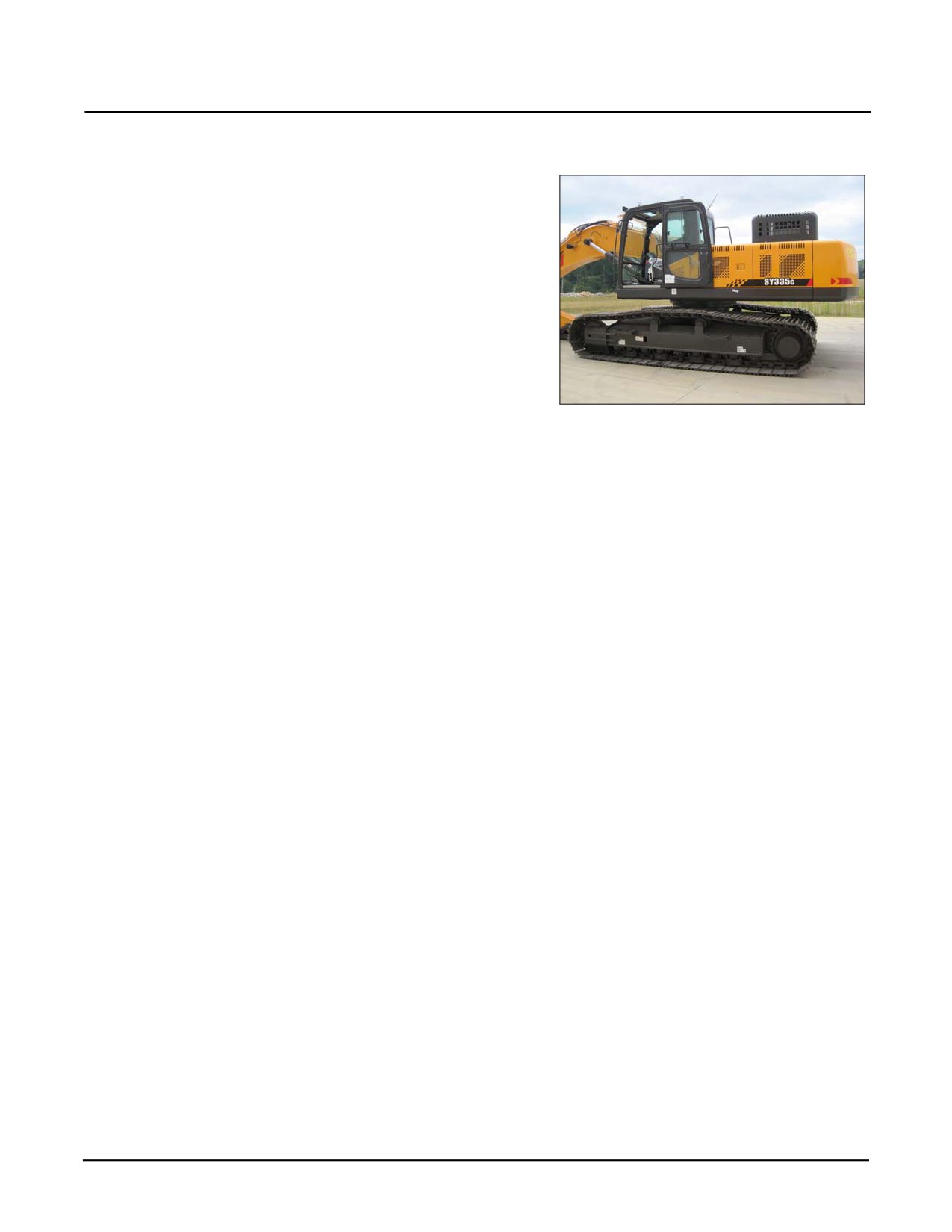
Accumulation of Flammable Material
During continuous operation of the machine over a long
period of time, flammable material can build up within the
machine’s operating systems. Dry leaves, wood debris and
trash could ignite when coming into contact with hot parts.
Listed below is some information to help prevent fires from
occurring during continuous operation in areas where the
machine is exposed to these types of environments. (See
also “Inside Operator Cab” on page 2-33)
•
Always inspect and remove any dry leaves, wood
chips, paper or any flammable material
accumulated or affixed around the engine, exhaust
Fig. 2-37
system, battery or under covers on the machine.
•
Operations such as logging, land clearing, mulching
or landfill work may cause trash and debris to
accumulate on the machine.
•
Always inspect and remove this debris
accumulation daily.
•
Clean the machine after servicing the hydraulic system, engine or fuel system.
•
Operating near burn piles or any type of open burning could cause airborne sparks or glowing embers to
land on the machine and ignite any accumulated debris or oil residue.
•
Never place any part of the machine in direct contact with open flames. Damage to the machine or a fire on
the machine may result.
2-32
SY335 Excavator
Product Specific Safety
Inside Operator Cab
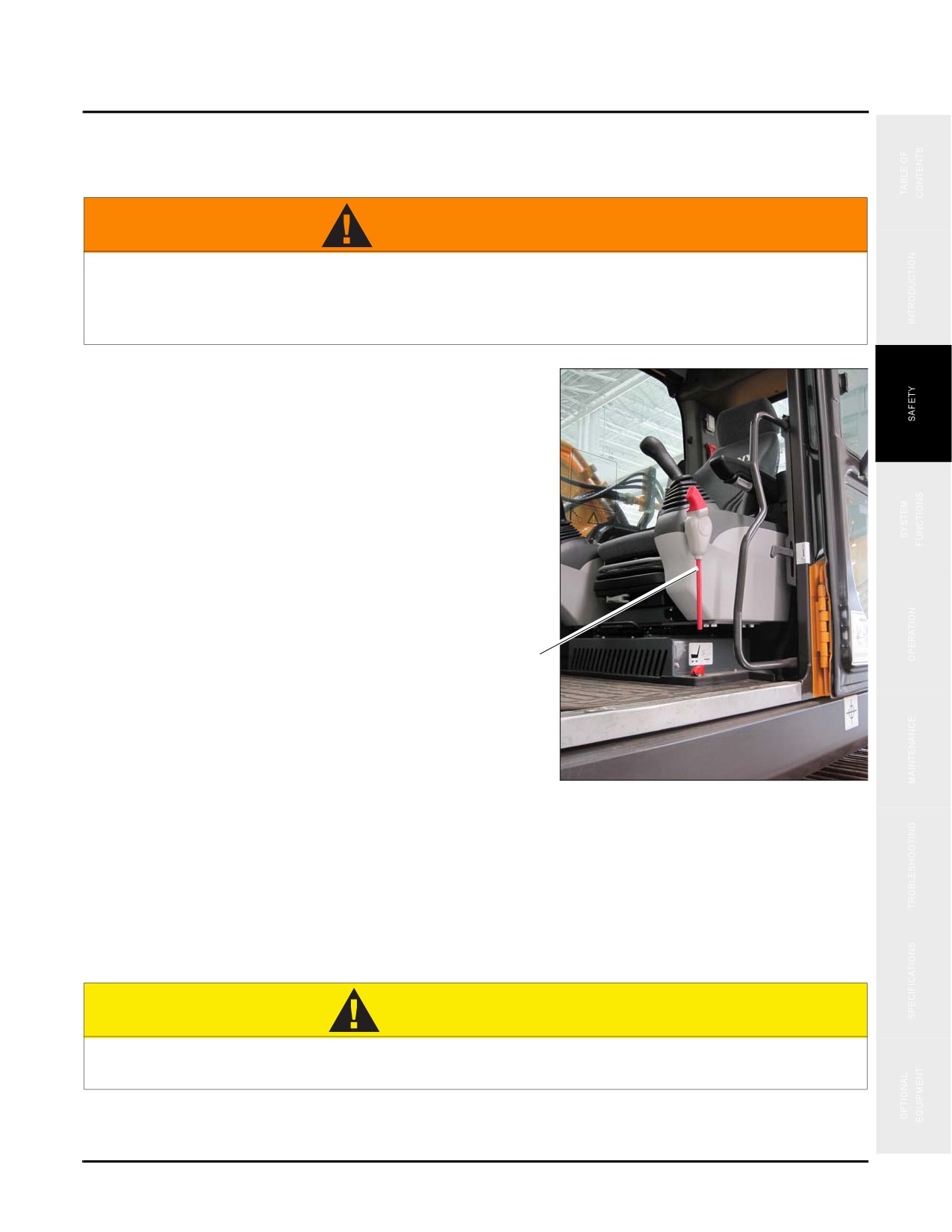
Lock Lever
WARNING
Never stand up from a seated position with the engine running and the work equipment
hydraulic lock lever in an UNLOCKED (free) position (a). Accidental activation of the work
equipment controls could result in unexpected movement of the work equipment, causing
possible damage, loss of control or injury or possibly death.
If you must stand up from the operator’s seat for any reason,
be sure the work equipment is fully lowered to the ground,
the engine is shut down and the work equipment hydraulic
lock lever is in the LOCK position (a).
Always remain seated with the seat belt fastened snuggly
around your waist when the engine is running and you are
operating the machine.
b
a
Fig. 2-38
Start-Up Safety
Never start the excavator by tampering with or shorting the starter terminals. Accidental movements of the
excavator may result and lead to injury or possibly death.
Always start the excavator from a seated position in the driver’s seat using the ignition switch.
CAUTION
Never use starting aids to start the engine. Starting aids are explosive and will damage the
engine or may result in minor or major injury.
2-33
Product Specific Safety
SY335 Excavator
Before starting operations:
•
Ask for inspection and maintenance records and verity that the appropriate operator manual is inside the
cab you are using.
•
Walk around the equipment and check for people or objects that might be in the way.
•
Do not start the equipment if warning tags have been attached to the control levers.
•
Sound your horn to warn others in the area before starting the engine, moving the machine or starting any
machine operation.
•
Operate the machine in the proper position only.
•
Never allow anyone in the driver’s compartment or on the machine during operation.
•
Check your view. Be sure you can see all work areas around your excavator clearly.
When using jumper cables to start the machine, connect the positive (+) jumper first, then the negative (-) jumper
to a remote location on the chassis away from the battery.
WARNING
Never use a welder or a machine with a higher voltage system to jump-start the machine.
Using a higher voltage to jump-start a machine may damage the machine’s electrical system
or cause an unexpected explosion or fire. Always jump-start a machine with equal voltages.
Failure to follow this alert may result in injury or possibly death.
Crush or Pinch-Point Precautions
Never place any part of your body out the windows or doors
during operation or travel. The movement of the work
equipment or falling objects could injure you.
Keep all safeguards on the equipment in place.
Never remove the side window of an excavator. If this
window should become damaged or broken, replace it
immediately.
Fig. 2-39
Death or serious injury could result from being crushed by
moving parts of this excavator.
Barricade the entire area where the excavator is working and keep all unnecessary personnel out of the work area.
Before initiating a arm swing or any other excavator function, sound the horn and verify that all personnel are clear
of rotating and moving parts.
2-34
SY335 Excavator
Product Specific Safety
Watch the path of the arm when in movement to avoid lowering or swinging the arm into personnel, equipment, or
other objects.
2-35
Product Specific Safety
SY335 Excavator
Leaving the Operator Cab
Before leaving the operator cab, it is important to keep in mind that you are responsible for the safety and security
of the machine. Listed below are several items you should be aware of as an operator of the machine.
•
Be sure the machine is in a stable secure area.
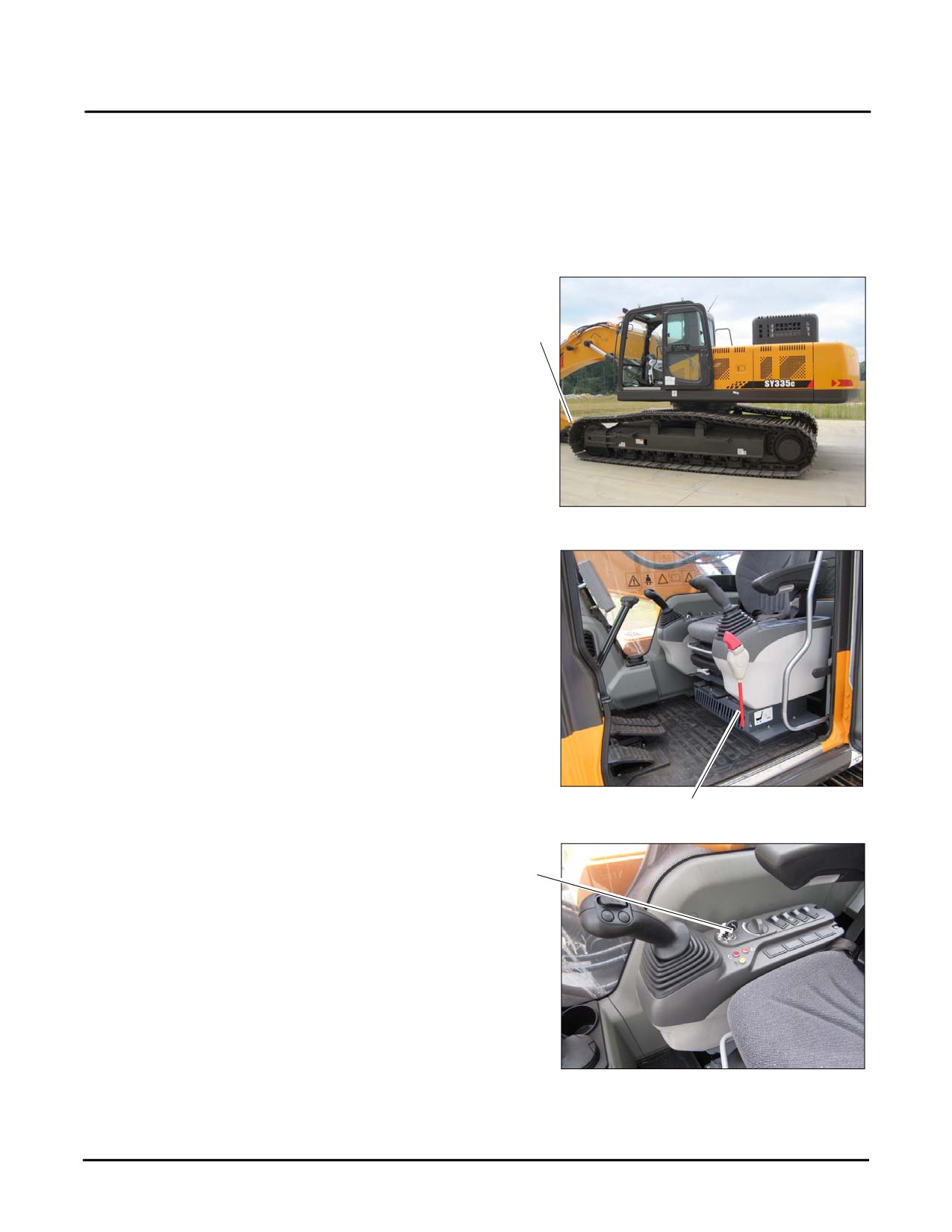
•
Lower all work equipment (a) to the ground and
shut the engine down.
a
Fig. 2-40
•
Neutralize all the controls by rotating the work
equipment control levers a full 360° several times,
then move the work equipment hydraulic lock lever
to the LOCK position (b).
Typical
Fig. 2-41
b
•
Remove the ignition key (c) and keep it with your
person to prevent unauthorized operation of the
c
machine.
Typical
Fig. 2-42
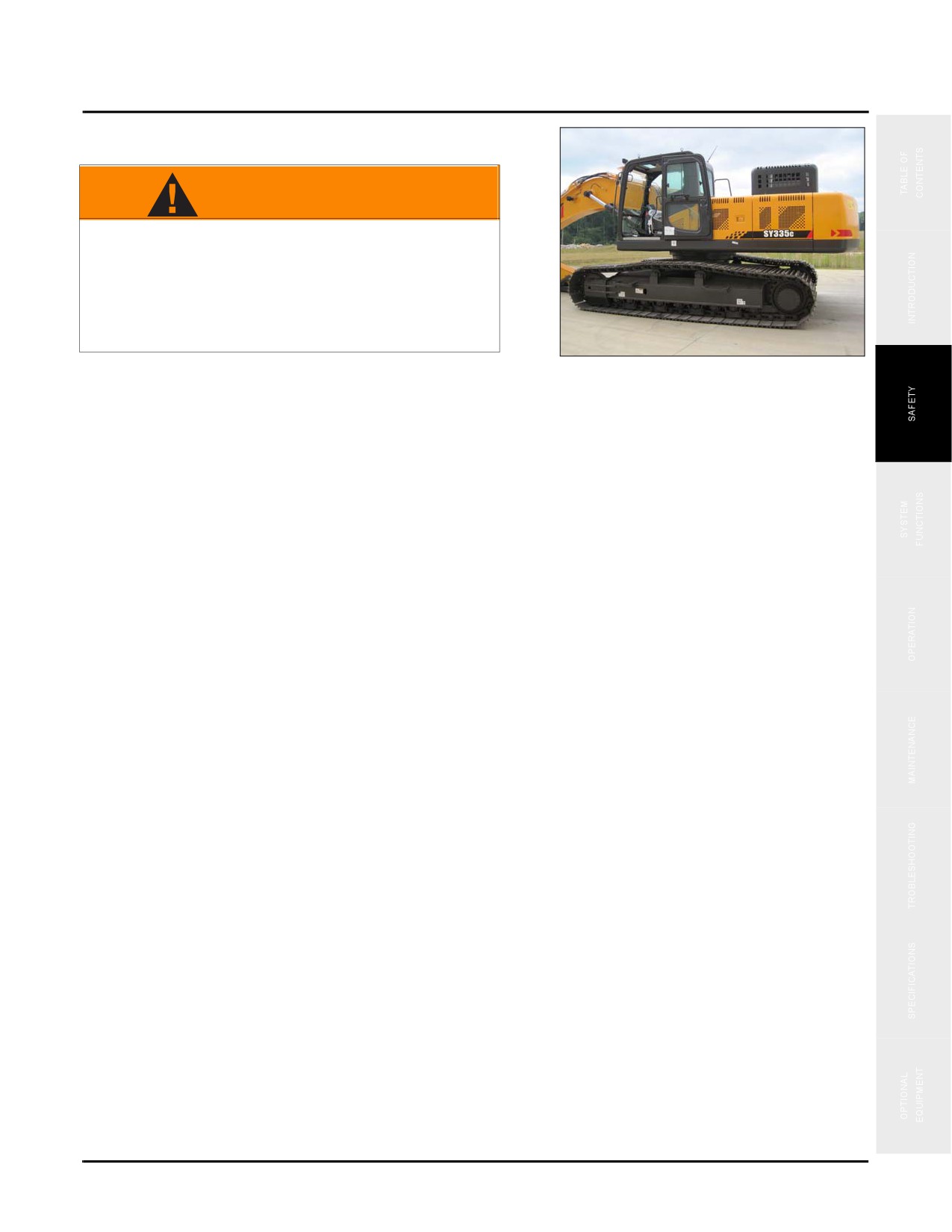
2-36
SY335 Excavator
Product Specific Safety
•
Lock and secure all lockable areas on the machine.
WARNING
Never leave your machine running and
unattended, even for a moment. Never leave a
load suspended in the air. Lower all loads to the
ground before leaving the machine. Shut the
engine down. Failure to observe and follow this
warning could result in injury or possibly death.
Fig. 2-43
2-37
Product Specific Safety
SY335 Excavator
Optional Attachment Use
If you will be using optional attachments with your machine, always contact your Sany distributor first. Any
injuries, accidents, or product failures resulting from the use of unauthorized attachments will not be the
responsibility of Sany. Do not use attachments that are not authorized by your Sany distributor. Use of
unauthorized attachments could create a safety problem and adversely effect the performance of the machine.
Large or Optional Attachments
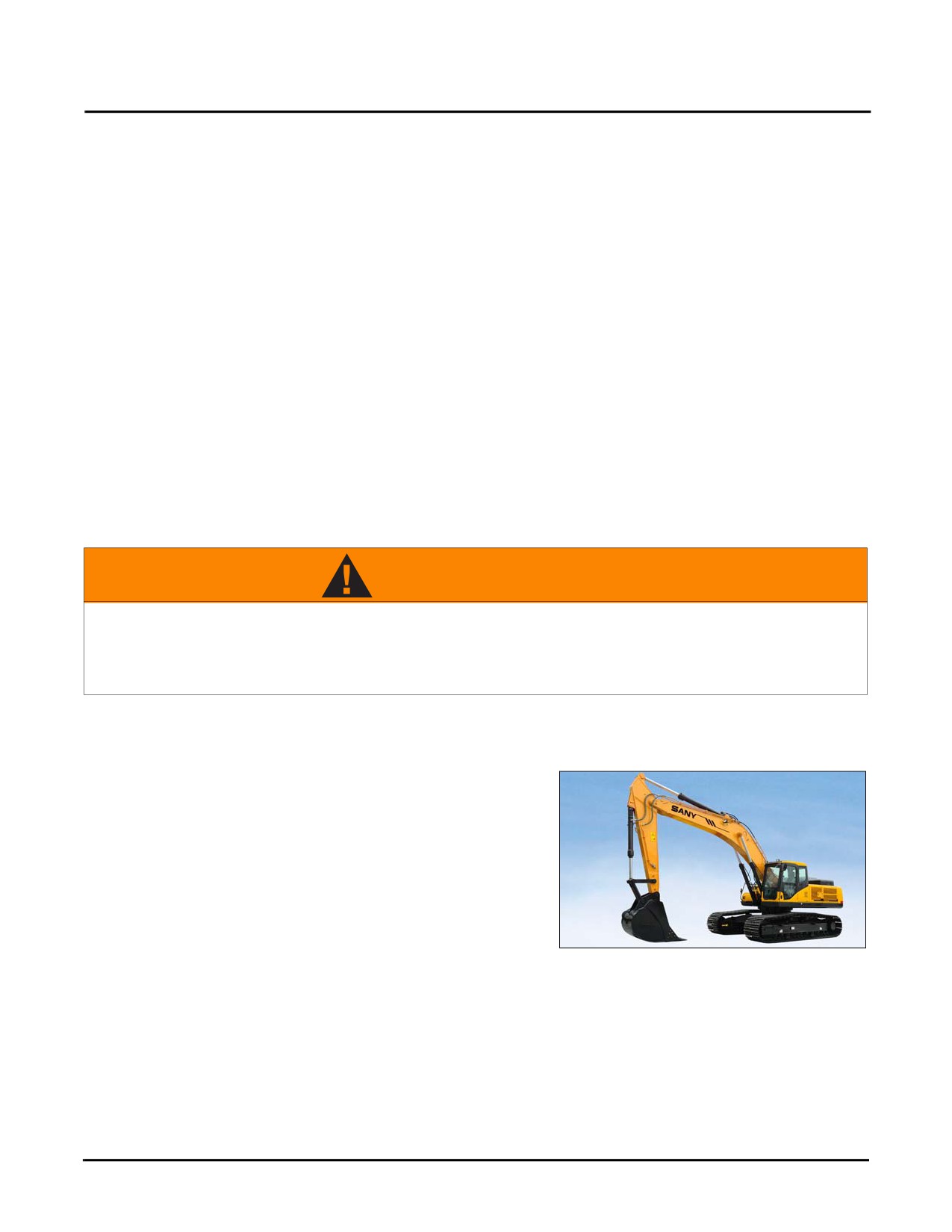
When using large attachments on your machine, always be
aware that the performance and handling of the machine
will be different from that of the standard digging bucket.
Before using a larger or optional attachment always be
aware of the following:
•
Be careful when folding the work equipment for
travel or when repositioning the machine. The
possibility of the attachment contacting the operator
Fig. 2-44
cab becomes greater depending on the size of the
attachment.
•
Before using unfamiliar work equipment, check if there is a danger of interference, then proceed with
operation in a cautious manner.
•
Never operate any attachments near the operator cab of the machine. Always be aware that the larger the
attachment on the machine, the more the center of gravity will change. Be careful when traveling on
slopes.
Operating Precautions
As an operator of the machine, you are responsible for the safe operation of your equipment at all times regardless
of the situation. Although Sany cannot cover or predict all operating conditions that pose a major hazard, listed
here are a few basic situations and information to be aware of when using the excavator during work or travel
operations. It is advised to study these items and always be aware of them before and during your work operations.
Failure to do so may result in damage to the machine, injury or possibly death.
Pre-Operational Checks
Before starting any work operations it is important to perform a pre-operational check on your machine to be sure
your equipment is in safe operating condition. If any problems are found during your pre-operational check, have
them repaired immediately. Never operate a machine that is unsafe, damaged or in need of repair. “Making do”
with broken or damaged equipment may result in damage to the machine or injury to the operator and other
personnel. Keep in mind, it is also important that a pre-operational check be performed at the beginning of your
work shift, even if you are taking the machine operations over from another operator. Always perform a pre-
operational check before you start your work.
Starting Operations
•
Before operating your equipment, walk around the machine and check for objects or personnel that might
be in the way.
2-38
SY335 Excavator
Product Specific Safety
•
Never start the machine if warning tags have been attached to the control levers.
•
Check your view. Be sure you can see all work areas around your machine clearly.
•
Be sure all personnel are clear from your work site before starting any operations.
•
Sound your horn to warn others in the area before starting the engine or moving the machine.
•
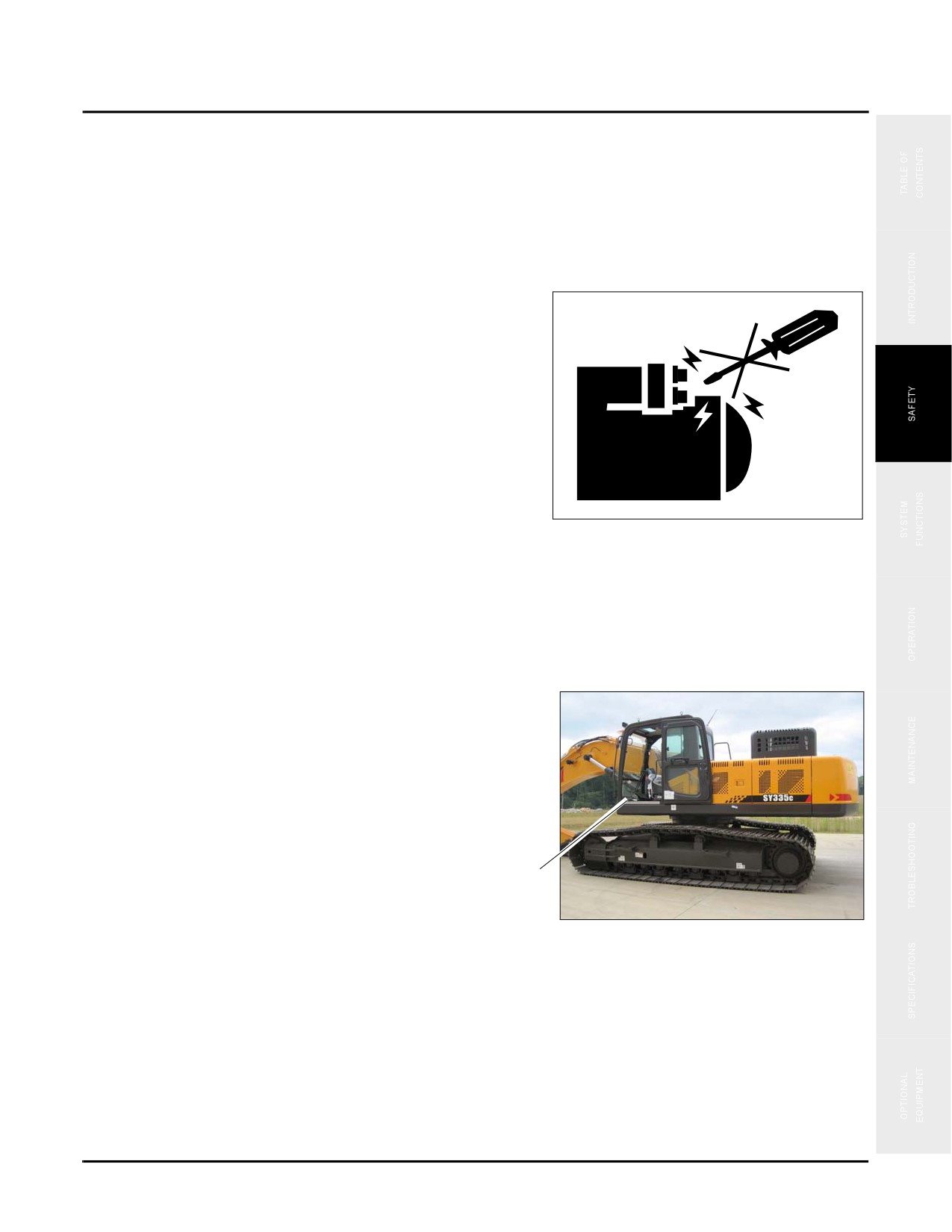
Never start the machine by tampering with or
shorting the starter terminals. Accidental
movements of the machine may result, leading to
injury or possibly death. Always start the machine
from a seated position in the operator’s seat using
the ignition switch.
•
Always operate the machine from a seated position
with the seat belt fastened snuggly around your
waist.
ACN0022
•
Do not allow anyone in the operator cab or on the
Fig. 2-45
machine during work operations whatsoever.
During Operation
•
It is important to follow all operating procedures as outlined in this operator's manual
before any
excavation operations are to begin. Failure to do so may result in damage to the machine or property and
even injury or death.
•
Keep the machine free from flammable materials
such as vegetation, trash, grease, oil or fuel.
•
Never use the excavator to lift, transport or provide
a work platform or device for personnel in any
manner.
•
Never allow personnel in the operator cab (a) of the
machine with you during operation or travel
a
procedures, regardless of the situation.
Fig. 2-46
2-39
Product Specific Safety
SY335 Excavator
•
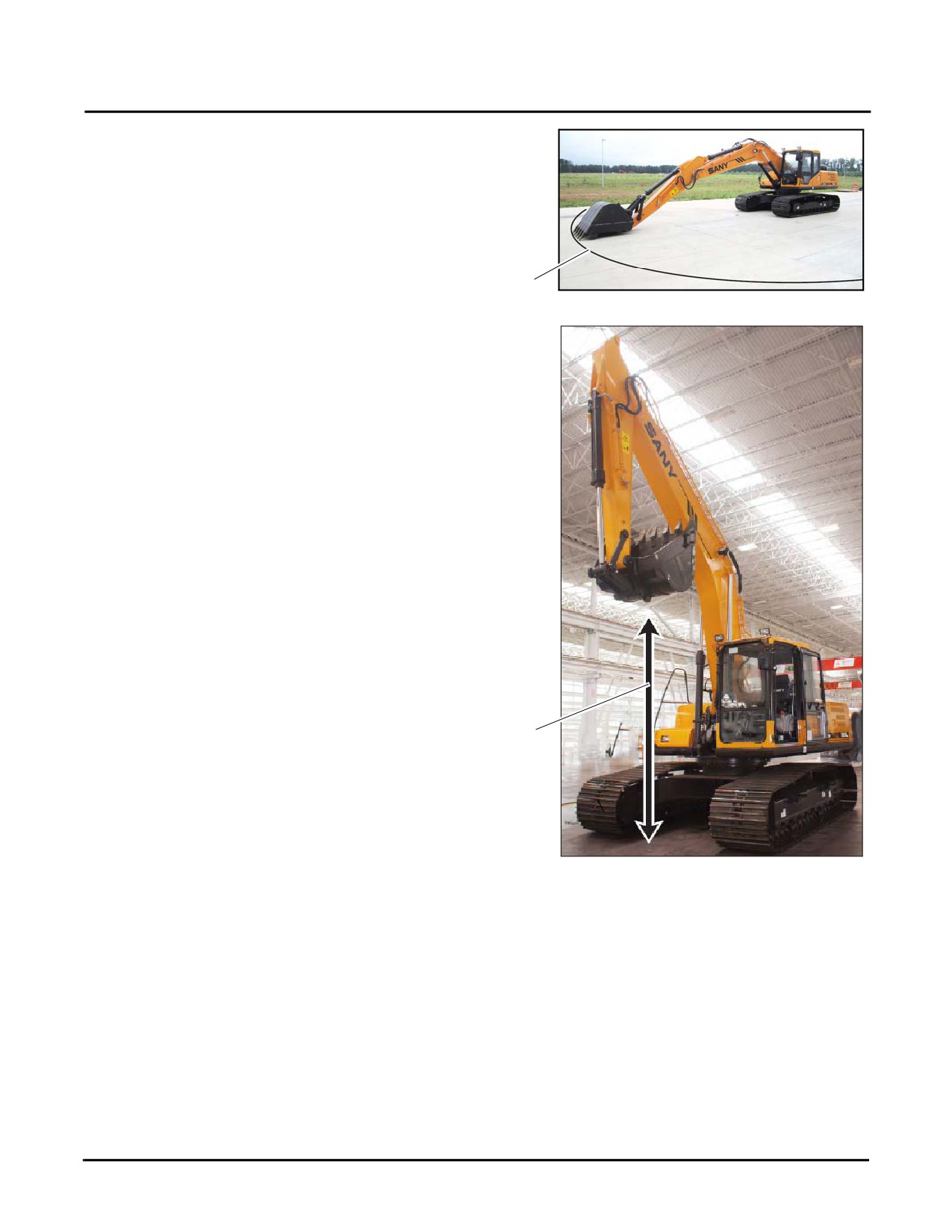
Always be aware of the swing circle area (b) of the
machine, especially in tight operating conditions.
•
Maintain a clear and visible swing circle area
during machine operations at all times.
Typical
b
Fig. 2-47
•
Never allow other personnel near your machine
while in operation. The possibility of getting hit by
falling objects, lowering work equipment
(c) or
pinning them between the machine and surrounding
objects becomes greater the closer they are.
•
Never use any part of the bucket or work equipment
to lift or maneuver objects if these implements are
not equipped with the proper lifting devices. Loss
of control or loss of a load may result.
•
If your digging bucket is equipped with a
designated lifting eye, use only the lifting eye to lift
objects. Never use the bucket teeth, “H” link or
mounting point to lift objects.
•
When lifting objects with the bucket lifting eye,
always maneuver the work equipment carefully and
slowly.
•
Never use your person or other personnel to handle
c
or maneuver loads being lifted by the machine in
any manner. The possibility of loss of control, being
trapped or pulled by the load can happen if
operations like this are performed.
•
When handling a load, always remain clear of the
Fig. 2-48
Typical
load at all times until the load is on the ground and
it is safe to approach.
•
Never drag or pull a load with the machine using the swing mechanism. Damage to the swing mechanism
or loss of control could result.
•
It is also not recommended to pull a load towards the machine. If the cable should snap or the load should
come free, the possibility of an object hitting the operator cab could cause damage to the machine or injury
to the operator.
•
Never dig the bucket into the ground and use the travel force to carry out excavation operations. Doing this
will damage the machine or work equipment or could cause loss of control.
2-40
SY335 Excavator
Product Specific Safety
•
Do not use the dropping force of the machine for digging or breaking up material. Using the bucket as a
pickax, breaker or pile driver will damage the machine. Keep in mind that operating the machine like a
pickax, breaker, pile driver or in similar manners will reduce the life of the machine or possibly cause
injury to the operator.
•
Do not use the swing force of the machine to strike, move or dismantle a structure or a large object.
Damage to the swing system will result.
•
Do not use the dropping force of the machine for digging or pulling materials from a high-level area.
Damage to the machine or injury to the operator may result.
•
If the work equipment is used with the cylinder rod operated to its end and the impact by some external
force is applied, the hydraulic cylinder will be damaged and may cause personnel injury. Avoid operations
with the hydraulic cylinder fully retracted or fully extended.
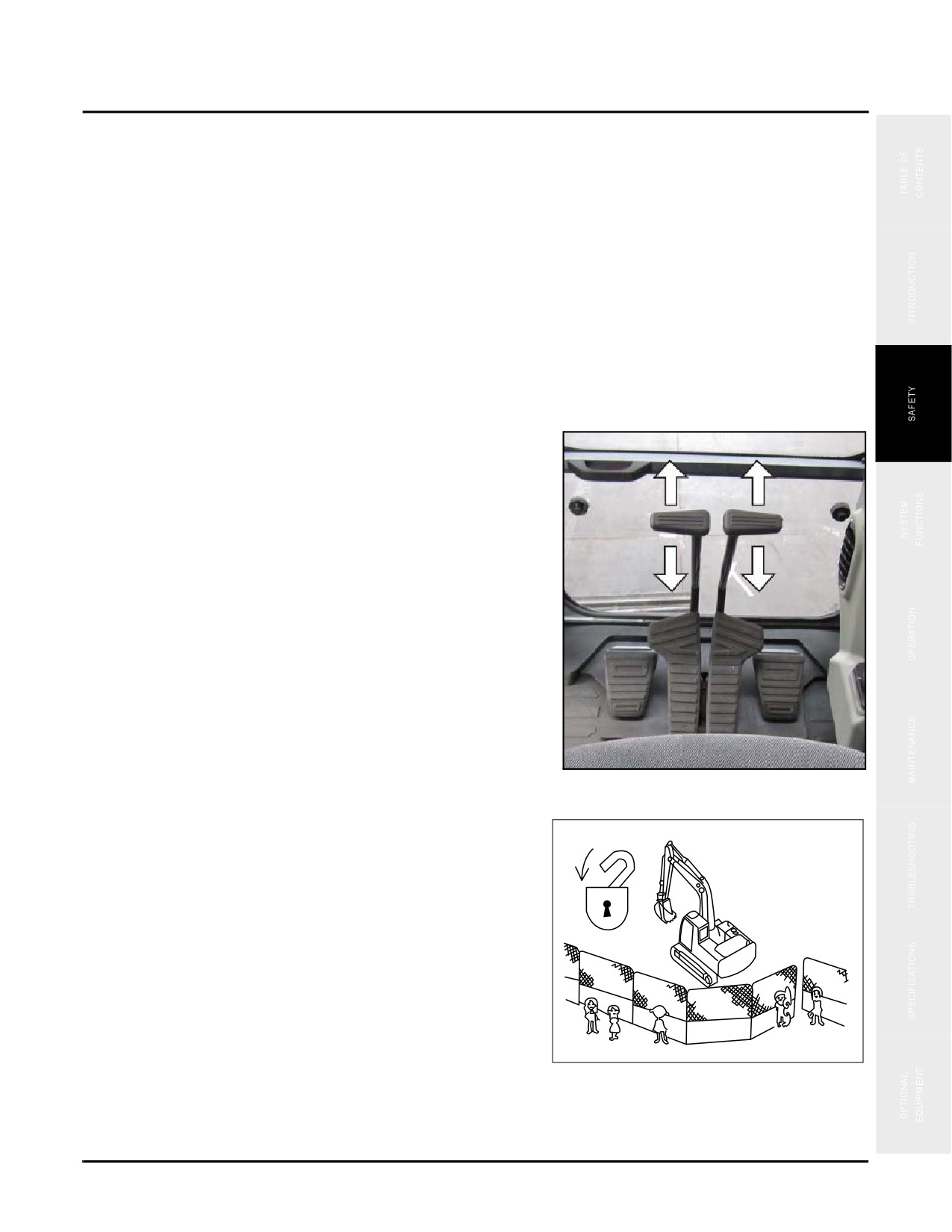
Avoid sudden travel lever shifting:
•
Always maintain a firm grip on the travel levers
when traveling, stopping or changing direction with
the machine.
•
Avoid any sudden release of the travel levers when
changing from forward movement to backward
movement. Doing so may cause the machine to tip,
rock or result in loss of control and damage to the
machine.
•
Avoid sudden lever release when traveling at top
speeds to stop the machine. Loss of control or
damage to the machine may result.
Typical
Fig. 2-49
Security of the machine at the end of a work day is very
important. Vandalism, access to the machine by children or
other unauthorized personnel can and will happen if the
machine is not properly locked and secured. Keep in mind
that you are responsible for the security of your machine at
all times.
•
If possible, park the machine in an area away from
people.
•
Lower all work equipment to the ground.
•
Shut the engine down and neutralize all controls to
Fig. 2-50
relieve any hydraulic pressure in the work
equipment hydraulic system.
•
Close and lock all windows and roof hatch covers.
2-41
Product Specific Safety
SY335 Excavator
•
Remove the ignition key and lock the door and all service access panels.
•
Before leaving the area, double check to be sure the machine is safely secured and all lockable areas are
locked.
•
Take the key to the machine with you off the job site.
Job Site Precautions
As an operator of this machine, you are responsible for the safe operation of the machine at all times, regardless of
the situation. Although Sany cannot cover all operating conditions that pose a hazard, here are a few basic
situations to avoid or be aware of when using excavator equipment during all types of work.
•
Thoroughly inspect the area for any unusual conditions that could be dangerous before starting any
operations.
•
Be careful when operating around or near open burning operations.
•
Before starting any work operations, travel or maintenance and repair procedures, be sure all personnel are
at a safe distance away from any point on the machine. Never allow anyone to stand near the machine
while it is in operation, under maintenance or being repaired.
•
If pedestrians are in the area, proceed slowly and sound your horn. Keep in mind that pedestrians have the
right of way and a loaded or smaller machine has the right of way over an unloaded machine. Remember
also that the larger the equipment, the more restricted your visibility will be.
•
When working with another person on a work site, ensure that all personnel involved understand all hand
signals that are to be used. The operator shall respond to operating signals from only the proper signal
person. However, the operator shall obey a stop signal from anybody at any time.
•
When leaving the job site, always lower all work equipment to a safe position, neutralize work equipment
controls and lock and secure your equipment properly to avoid tampering by unauthorized personnel.
•
Never drive up to anyone standing in your path of travel. Always be sure all personnel are standing to the
side when you approach them and they acknowledge your approach.
•
Never leave your equipment running and unattended. Always park the equipment in a stable, level area,
lower any work equipment to a safe position, lock the controls and turn the engine off before exiting the
operator’s cab.
2-42
SY335 Excavator
Product Specific Safety
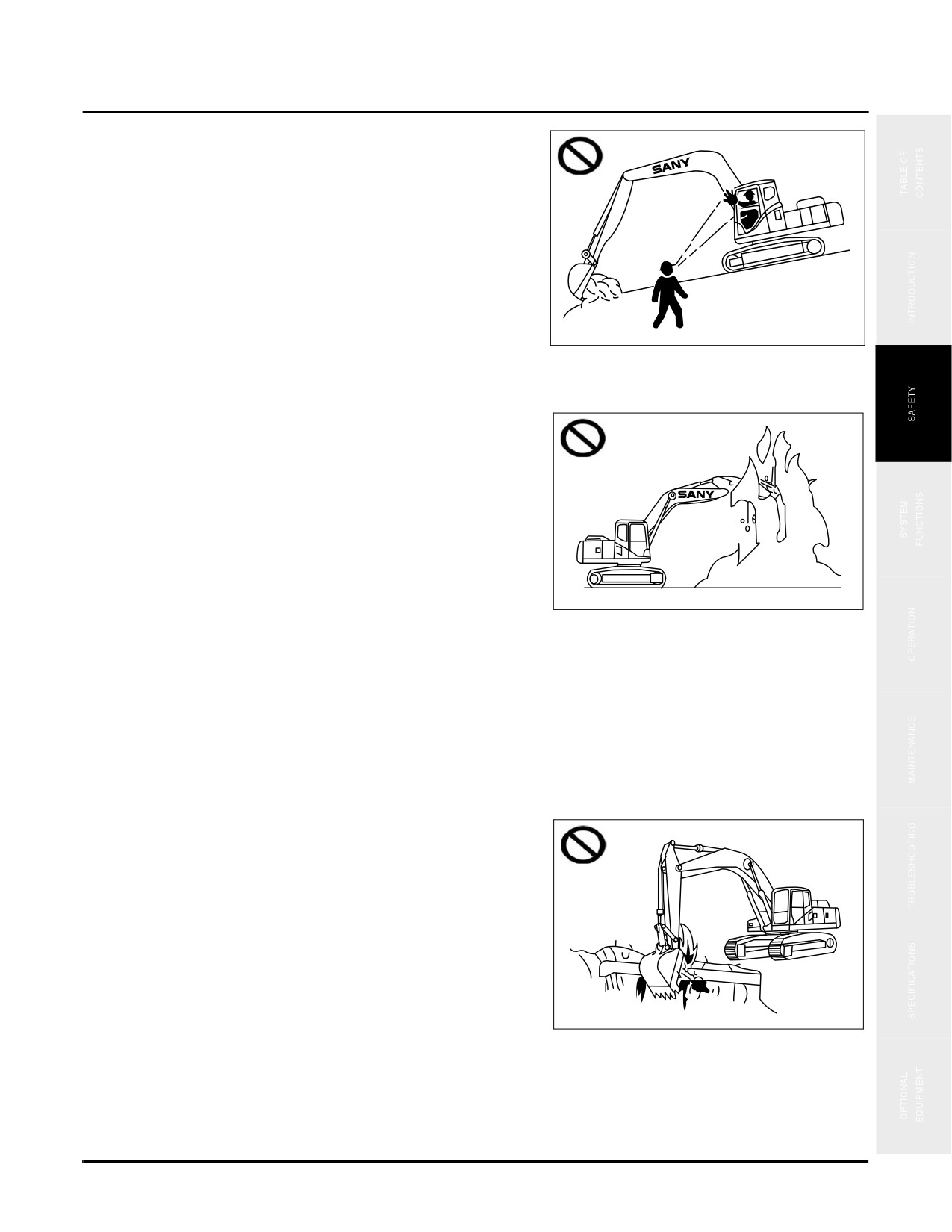
•
Never allow anyone to approach your work area
during operation or travel. If they should approach,
stop operation or travel immediately and signal
them to leave immediately. Do not resume
operation or travel until they have left your work
area and are at a safe distance.
•
If they must approach, signal them to stop where
they are, lower all work equipment to the ground,
set the work equipment hydraulic lock lever in the
LOCK position and shut the engine down. When it
ACN0939
is safe for them to approach, signal them to
Fig. 2-51
approach.
•
Never use any part of your machine or work
equipment to place or remove material from a
burning fire. The possibility of damaging or causing
a fire on the machine is heightened by the intensity
of the burning fire and the distance the machine is
from the fire.
•
Always keep all parts of the machine clear from a
burning fire at all times.
ACN0940
Fig. 2-52
Surface and Underground Hazards
It is important to study the area for hazards involved with the job operation before placing the machine on a job site
or starting any work operations. Below is a list of what to do to avoid some of these hazards. Below is a list of what
to do to avoid some of these hazards.
•
Before unloading the machine, be sure the ground
surface will support the machine. Note that when
operating on embankments, ditches near waterways
or soft areas, there is a possibility that the weight
and vibration of the machine will cause the soil to
collapse.
•
Before starting any excavation operations, contact
all utility departments in your area and have them
identify and mark any underground systems
ACN0941
locations, gas lines, water lines, electrical lines,
Fig. 2-53
sewer lines, etc.
•
Check the area for any unusual ground conditions.
2-43
Product Specific Safety
SY335 Excavator
•
Make sure your work area is stable and as level as
possible and that you will be able to maneuver your
work equipment or machine safely.
•
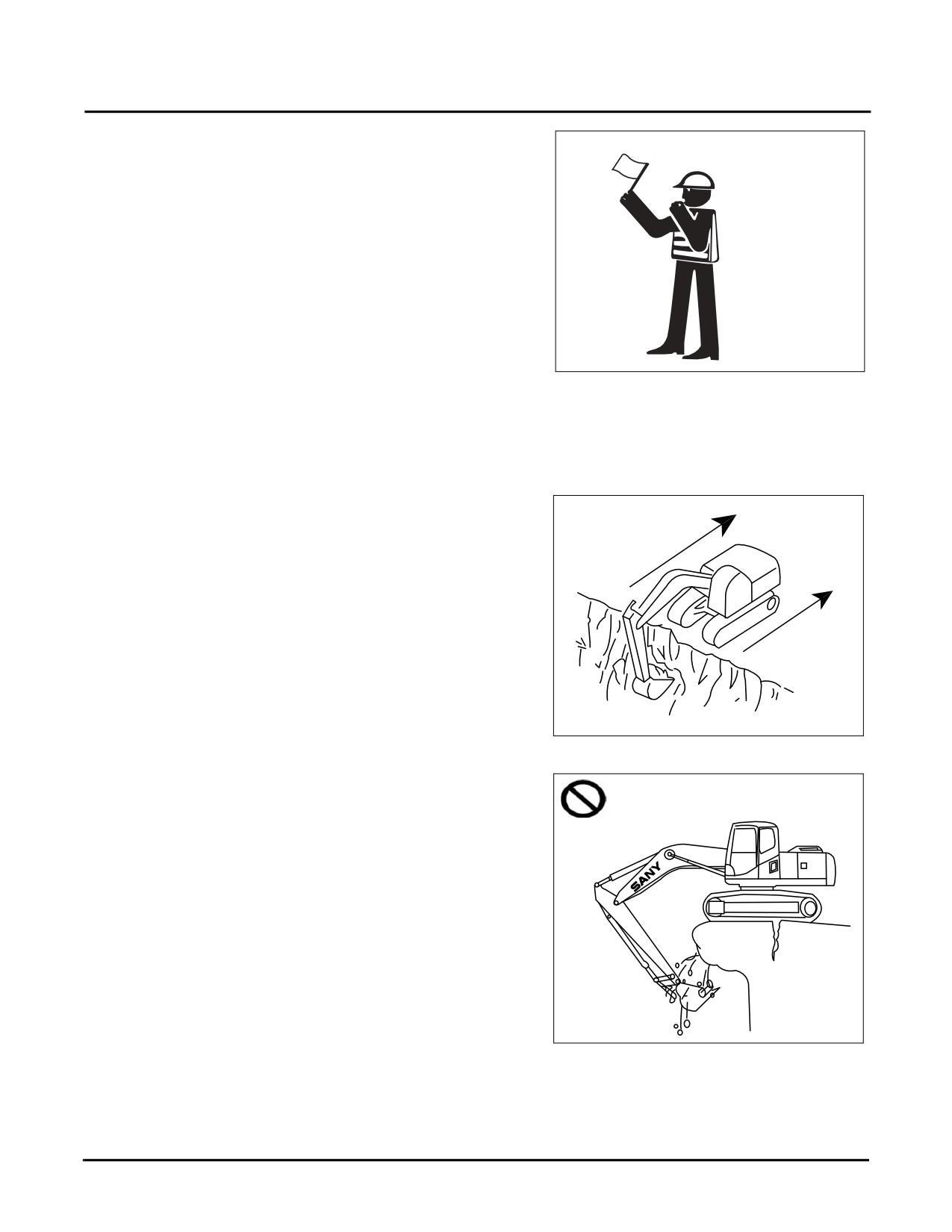
If you will be working in areas where high traffic or
pedestrians are a problem, have a dedicated worker
available to direct traffic or install safety fencing
around your work site.
•
Always be aware of all your work site dangers or
distractions.
ACN0013
•
Avoid operating or traveling too close to the edge of
Fig. 2-54
a cliff, overhang or deep ditches. The ground may
be weak in these areas. If the ground should
collapse under the weight or vibration of the machine, there is a possibility the machine may fall or tip
over.
•
When performing excavation operations on an
embankment, cliff or a large dig area, always
position the track carriage at right angles with the
machine as shown in the illustration. If the bank
should give way during operations, placing the
carriage in this position will allow you the
advantage of escaping the area easier.
ACN0942
Fig. 2-55
•
When excavating a trench, always be aware of the
ground condition and never attempt to dig too close
or under the machine. The possibility of the
machine falling into the excavated site becomes
greater the closer the excavation is to the machine.
ACN0943
Fig. 2-56
2-44
SY335 Excavator
Product Specific Safety
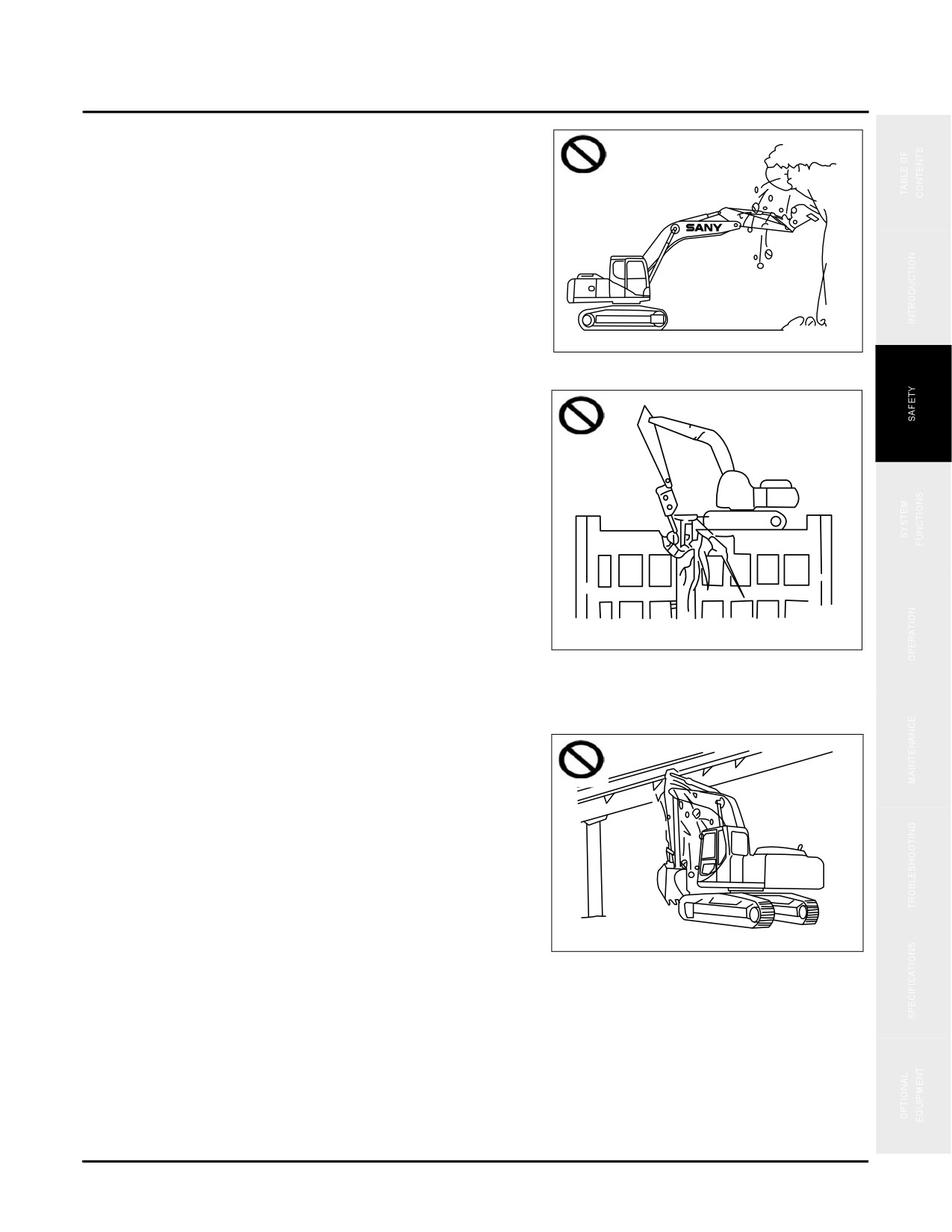
•
Never perform job operations under overhangs or
excavated bank areas. These could collapse and
damage the machine or injure the operator.
•
Keep in mind that the soil will be loose after a
heavy rain, blasting or earthquakes.
•
When traveling or operating in shallow water or
soft ground, check the shape and condition of the
bedrock, and the depth and speed of flow of the
water before starting any operations.
ACN0944
Fig. 2-57
•
Never perform demolition work under the machine.
This will cause a hazard as the machine could
become unstable or tip resulting in loss of control.
•
When working on tops of structures, check the
support strength before starting any operations.
Keep in mind, if these supports should collapse, you
could be seriously injured.
ACN0945
Fig. 2-58
Job Site Working Clearances
Listed are some basic safety precautions regarding
clearance to prevent risk:
•
After you have checked the condition of your
working surfaces, be aware of your working
clearances around, above and behind you. Be sure
you will have the space to swing the machine
without interference and that you can extend the
work equipment without striking any surrounding
objects/areas.
ACN0946
•
If you will be traveling, be sure you have the room
Fig. 2-59
to maneuver the machine and work equipment. As
mentioned above, be sure the ground surface will
support your machine.
•
Travel at a slow, cautious speed when working or traveling in an area where clearances are a problem.
•
Always maintain a clear and safe location for the machine at all times, regardless of the situation when
performing demolition operations.
2-45
Product Specific Safety
SY335 Excavator
•
Never change a demolition plan unless authorized and agreed upon by the demolition supervisor or
structural engineer and other co-workers.
•
Always study the demolition procedure before performing any operations.
•
Never place yourself or co-workers in harm’s way
when performing demolition operations and be sure
all personnel maintain a clear distance from the
demolition site at all times.
•
If you are not sure of your clearances, request the
aid of another person who can guide or warn you if
you get too close to objects.
•
Always be aware of your work equipment position
and location. Keep all parts of your work equipment
ACN0947
in full view all the time when working in areas
Fig. 2-60
where clearances are a problem.
Slopes or Inclined Surfaces
Always operate machine on a flat, stable, level surface
whenever possible. But if work must be done on a slope or
inclined surface, follow these rules:
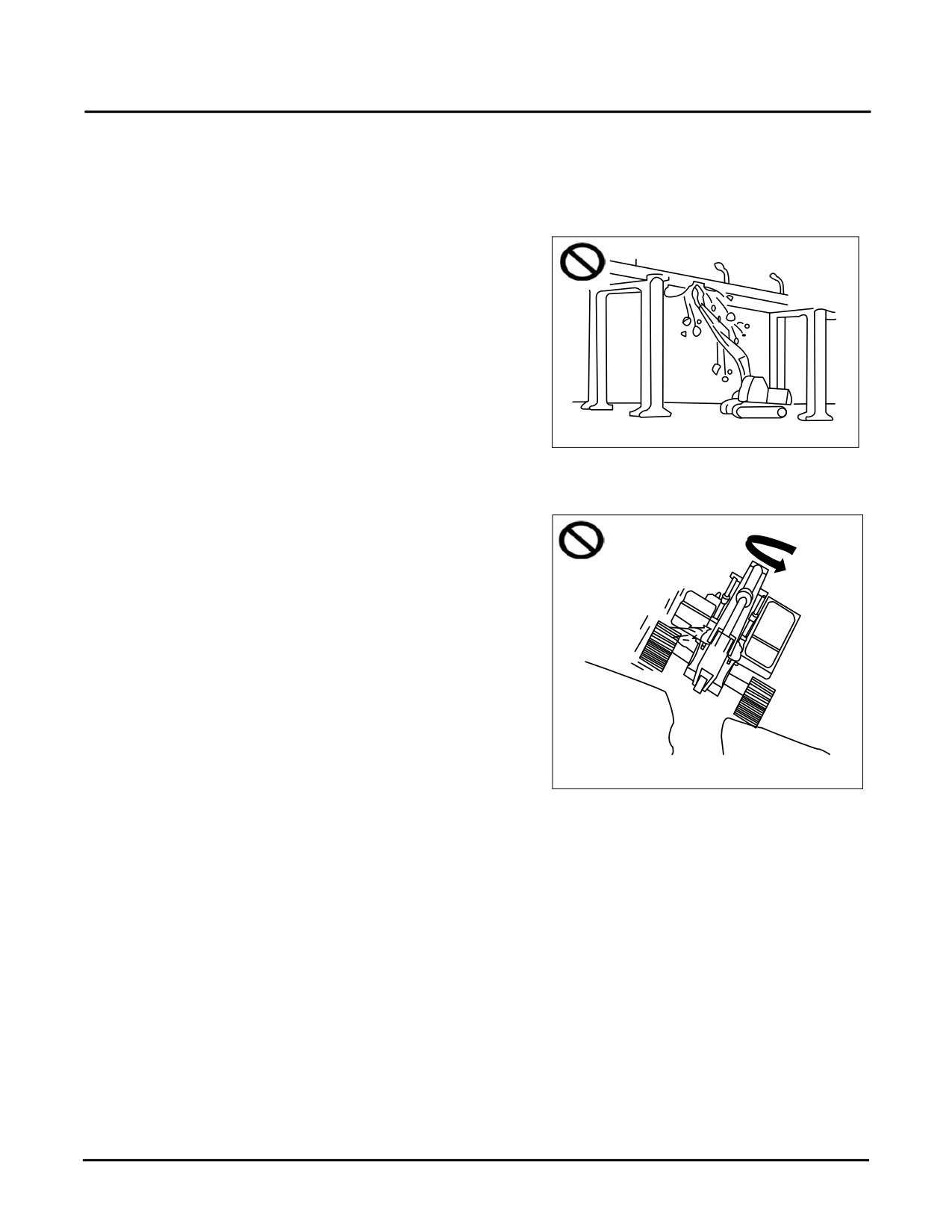
•
Always avoid operating the machine on slopes or
areas that could pose a rollover or loss of control
situation. Movement of the work equipment on an
unstable or sloped surface could cause the machine
to tip or roll over.
•
Remember that if you will be working on a slope or
inclined surface of any kind, there is always a
ACN0948
danger that the machine may roll over when the
Fig. 2-61
swing or work equipment is operated. Situations
like this may lead to serious injury or property
damage. Always provide a stable place when performing these types of operations, and work carefully.
•
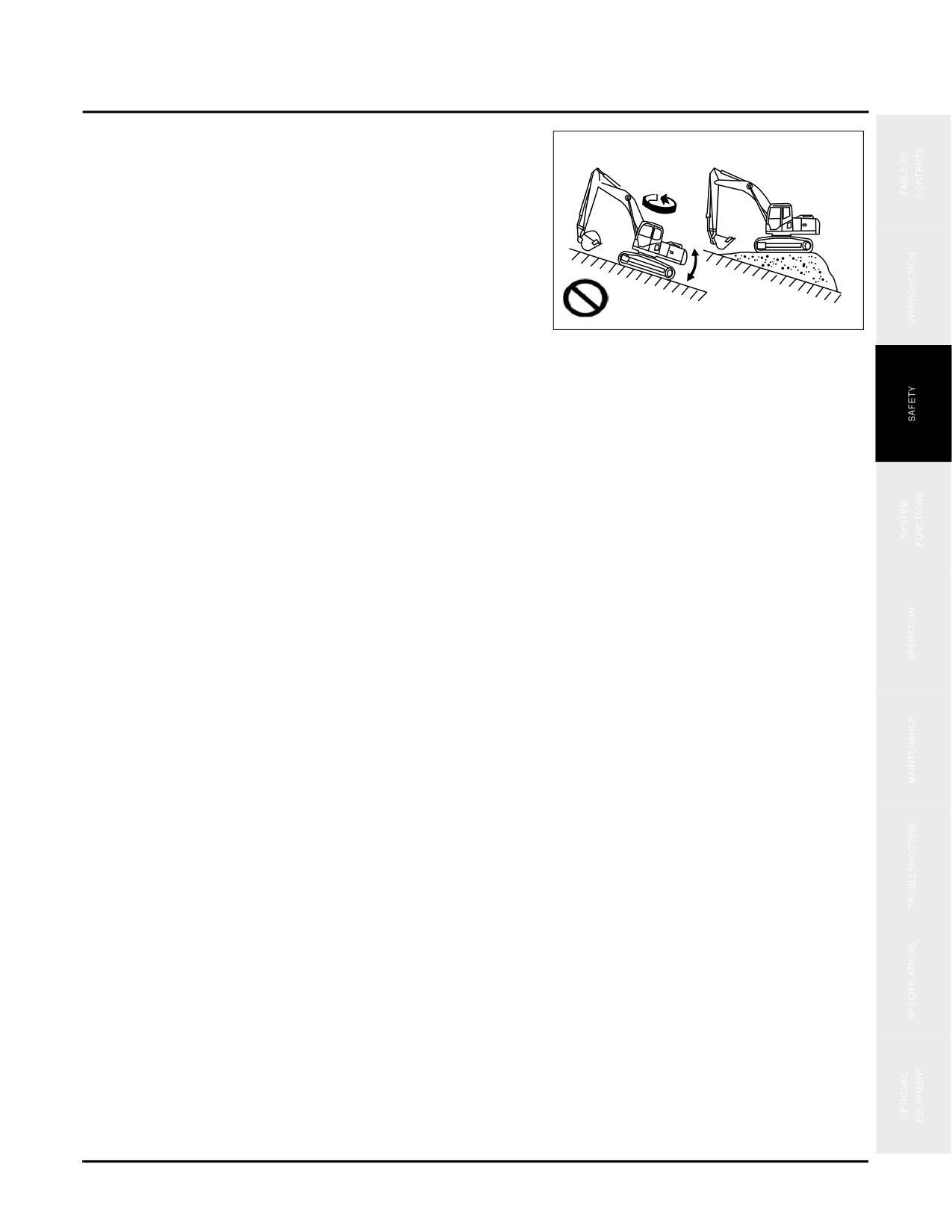
Do not swing the work equipment from the uphill side to the downhill side when the bucket is loaded. This
operation is dangerous and may cause the machine to tip over.
2-46
SY335 Excavator
Product Specific Safety
•
If the machine must be used on a slope, pile soil to
make a platform that will keep the machine as
horizontal as possible. Operate the machine
carefully and always be aware of your ground
conditions.
ACN0949
Fig. 2-62
2-47
Product Specific Safety
SY335 Excavator
Snow or Frozen Surfaces
It is extremely important to be extra careful when traveling or operating your machine on frozen or snowy surfaces.
Snow-covered or frozen surfaces are slippery. Your ability to maneuver the machine is seriously affected. The
machine may not respond as you expect when turning.
•
Always travel at a slow speed and gently operate the controls.
•
Avoid any rapid movement, acceleration or quick stopping. Always be aware of the increased stopping
distance required on these surfaces. Give yourself ample distance to stop the machine.
•
Avoid deep snow or frozen bodies of water. You could get easily trapped in these areas.
•
Keep in mind, even a slight slope may cause the machine to slip out of control. Be extra careful when
working on a sloped surface covered with snow or ice.
•
When traveling or moving the machine on a snow-covered slope, slow down gently. To reduce the speed,
use the engine to slow the machine down. If necessary, lower the work equipment to the ground.
High Voltage Areas
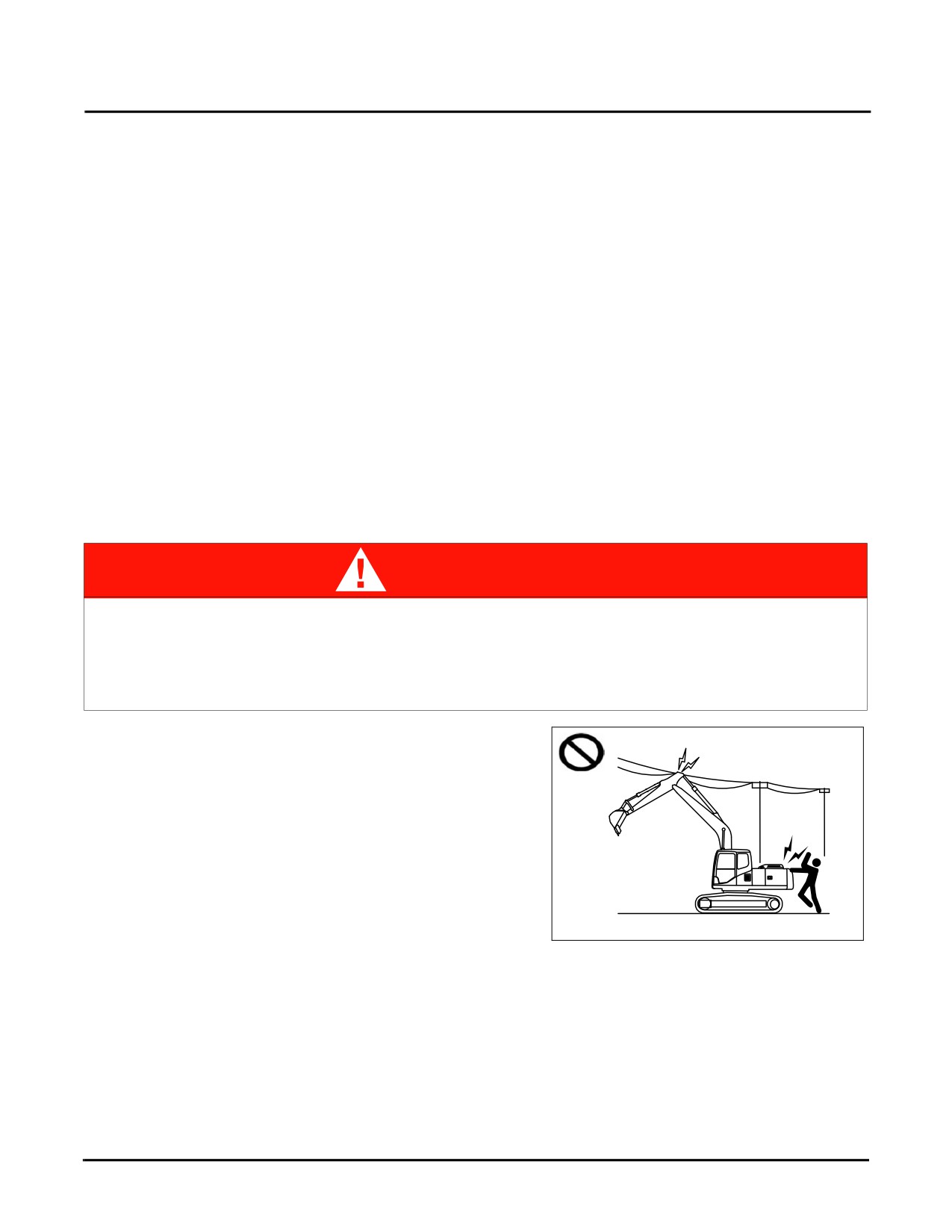
DANGER
If you will be working in an area where overhead power lines pose a hazard, it is important to
be aware of the dangers involved with these systems. High humidity may pose an even
greater hazard even if your machine clears the overhead power lines. Always use extra
caution when working near overhead power lines. Failure to follow the information listed
below could result in injury or possibly death.
•
Never assume or trust the word of a coworker or job
site personnel that power lines are de-energized.
Always contact a representative of the power
company in your area for proper authorization and
be sure power lines are de-energized.
•
If you are not sure of your clearances, request the
aid of another person who can guide or warn you if
you get too close to the power lines.
ACN0950
Fig. 2-63
2-48
SY335 Excavator
Product Specific Safety
•
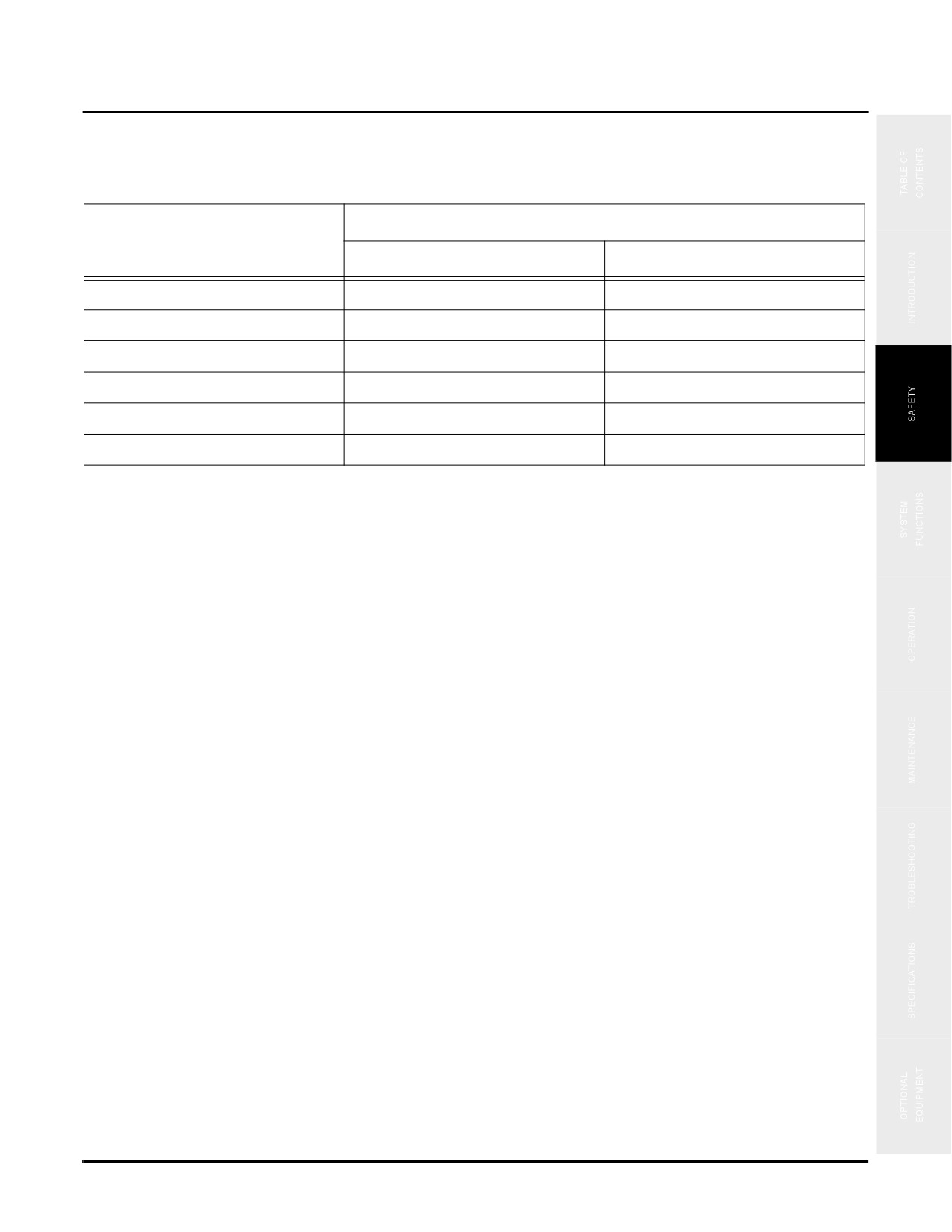
Always be aware of the dangers when working around overhead electrical lines. High humidity may pose
an electrical hazard even if your equipment seems to be safely clear of the overhead power lines. See the
table below for minimum machine-to-cable distances.
Minimum Distance Between Machine and Cables
Power Line Voltage
(ft)
(m)
0 - 50,000
Over 10
Over 3.0
50,000 - 200,000
Over 15
Over 4.5
200,000 - 350,000
Over 20
Over 6.0
350,000 - 500,000
Over 25
Over 7.5
500,000 - 750,000
Over 35
Over 10.0
750,000 - 1,000,000
Over 45
Over 13.5
Operating equipment near high frequency towers (for instance, cell phone towers) may pose an electrical hazard.
Ask the company to shut this system down until your work is finished.
Always be aware of the dangers when working around overhead electrical lines; high humidity may pose an
electrical hazard even if your equipment clears the overhead power lines.
If your machine should come in contact with overhead electrical lines, stop the machine and remain on the machine
until the power company clears the lines and it is safe to get off or move the equipment.
If you must exit the machine, keep both feet and legs together, your arms and hands at your side. Jump clear from
the equipment, maintain balance and land with both feet, legs, arms and hands still together. Your hands, arms or
any part of your body should not touch the equipment during the jump. Once on the ground continue to bunny hop
away from the affected area as far as possible.
If you are not sure of your clearances, request the aid of another person who can guide or warn you if you
maneuver the machine too close to objects.
Electrocution Hazard
Keep all parts of this machine, the rigging, and materials being lifted at least 20 ft away from all electrical power
lines with voltage less than 50,000 and electrical power source.
Before operating this excavator in the vicinity of electrical power lines or electrical power source, notify the power
utility company and assurance that the power has been turned off.
This machine is not insulated. All parts of the load and the excavator, including the cable, hoist cable, pendant
cables, and tag lines, can be conductors of electrical energy.
Treat all overhead power lines as being energized, and not insulated, unless you have reliable information to the
contrary from the utility company or owner.
The requirements stated in this manual must be followed at all times, even if the electrical power lines or electrical
power source have been turned off.
2-49
Product Specific Safety
SY335 Excavator
If any part of the excavator or load contacts or comes too close to an electrical power source, everyone in, on, and
around the excavator can be seriously injured or killed.
The excavator operator is responsible for alerting all personnel of dangers associated with electrical power lines
and electrical power source. Do not allow unnecessary personnel in the vicinity of the excavator while operating.
The excavator operator must permit no one to touch the excavator.
It is not always necessary to contact a power line or power source to become electrocuted. Electricity, depending on
magnitude, can arc or jump to any part of the load, load line, or excavator boom if it comes too close to an electrical
power source.
Read, understand, and abide by all applicable federal, state, and local regulations.
The use of electrocution hazard devices does not assure that electrical contact will not occur. Even if codes or
regulations require the use of such devices, failure to follow the rules listed in this manual may result in serious
injury or death. Electrocution hazard devices have limitations and you must follow the rules and precautions
outlined in this manual at all times even if the excavator is equipped with these devices.
Grounding of a excavator affords little or no protection from electrical hazards. The effectiveness of grounding is
limited by the size of the conductor (wire) used, the condition of the ground, the magnitude of the voltage and
current present, and numerous other factors.
Because of the voltages involved, overhead power lines present an extremely high risk of fatal electric shock. If
contact occurs, proper safety procedures should be followed. The danger posed by overhead power lines at the
construction site is often compounded by other factors, such as uneven ground that could cause the excavator to
weave or bob into power lines, and windy conditions that can make the power lines sway, reducing clearance.
To address these risks:
•
Identify overhead power lines and mark safe routes where excavator must repeatedly travel.
•
Operate the excavator at a slower-than-normal speed in the vicinity of power lines.
•
When working around overhead power lines, de-energize and ground them, or take other protective
measures such as guarding or insulating the lines.
•
If the power lines are not de-energized, operate excavator in the area ONLY if a safe minimum clearance is
maintained.
•
If maintaining safe clearance by visual means is difficult, designate a person to observe the clearance and
to give immediate warning when the excavator approaches the limits of safe clearance.
•
All persons should keep well away from the excavator whenever it is close to power lines.
•
Do not contact the excavator or its load until a signal person indicates that it is safe to do so.
•
Use cage-type boom guards, insulating links, or proximity warning devices, but do not substitute for de-
energizing and grounding lines, or maintaining safe clearance.
2-50
SY335 Excavator
Product Specific Safety
Electrical Contact
If the excavator should come in contact with an energized power source, you must:
1. Stay in the excavator cab. DON’T PANIC.
2. Immediately warn personnel in the vicinity to stay away.
3. Attempt to move the excavator away from the contacted power source using the excavator’s controls which are
likely to remain functional.
4. Stay in the excavator until the power company has been contacted and the power source has been de-energized.
NO ONE must attempt to come close to the excavator or load until the power has been turned off.
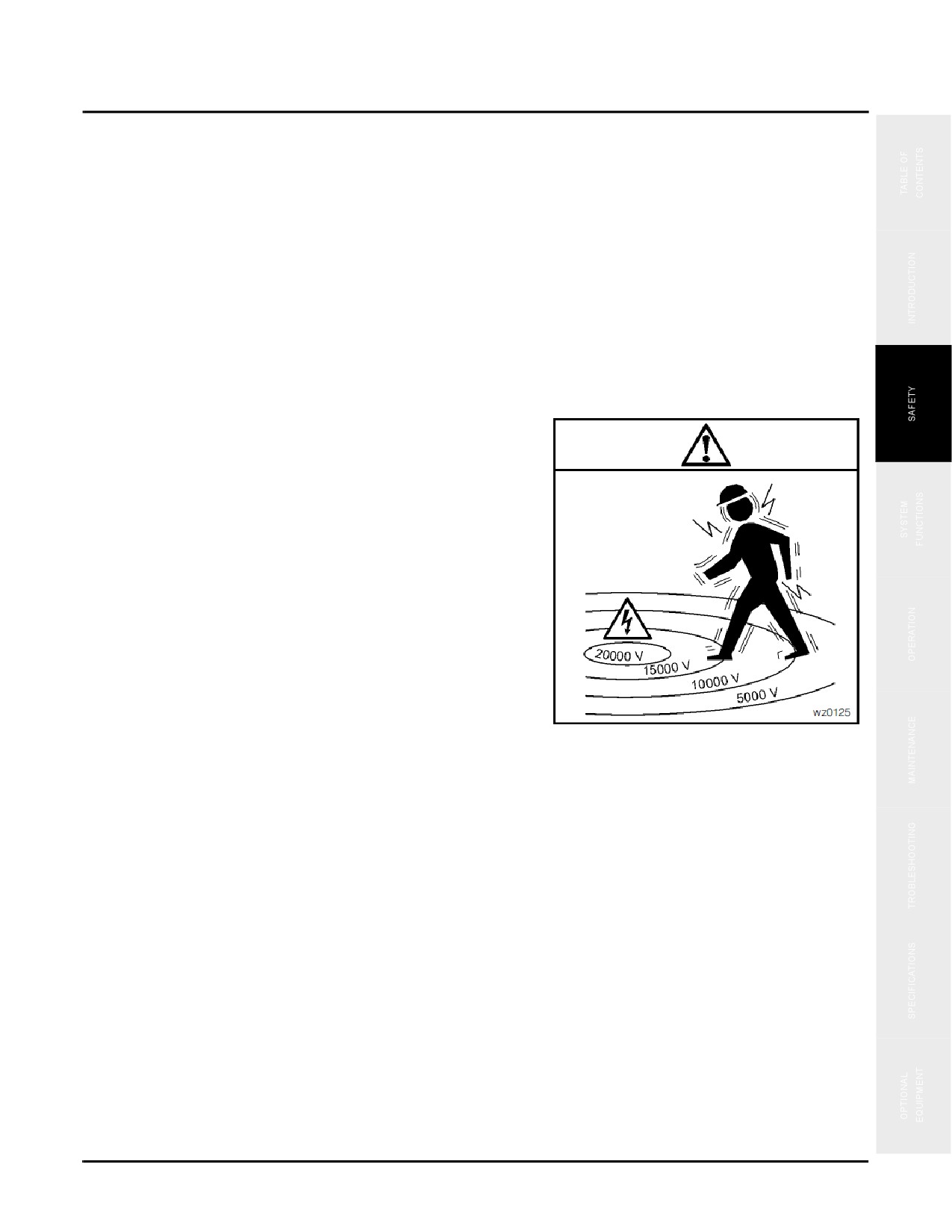
If it is absolutely necessary to leave the operator station,
Jump completely clear of the excavator. Do not step off the
excavator. Hop away with both feet together. DO NOT walk
or run as this will cause a electrical arc resulting in serious
injury or death.
Following any contact with an energized electrical source,
the local, authorized, Sany distributor must be immediately
advised of the incident and consulted on necessary
inspections and repairs. Should the distributor not be
immediately available, contact Sany America. The
excavator must not be returned to service until it is
thoroughly inspected for any damage and all damaged parts
are repaired or replaced as authorized by Sany or your local
Sany distributor.
Fig. 2-64
Travel Precautions
Traveling with an excavator may pose some hazards. If you will be traveling with your machine, always travel in a
safe, controllable manner and remain alert at all times. Be sure you can see all of your work equipment and areas
around you clearly. Remember a safety-conscious operator is the most important insurance when traveling with the
machine. Below are several procedures and information the operator of the machine should be aware of when
traveling with the machine.
2-51
Product Specific Safety
SY335 Excavator
Basic Travel Advice
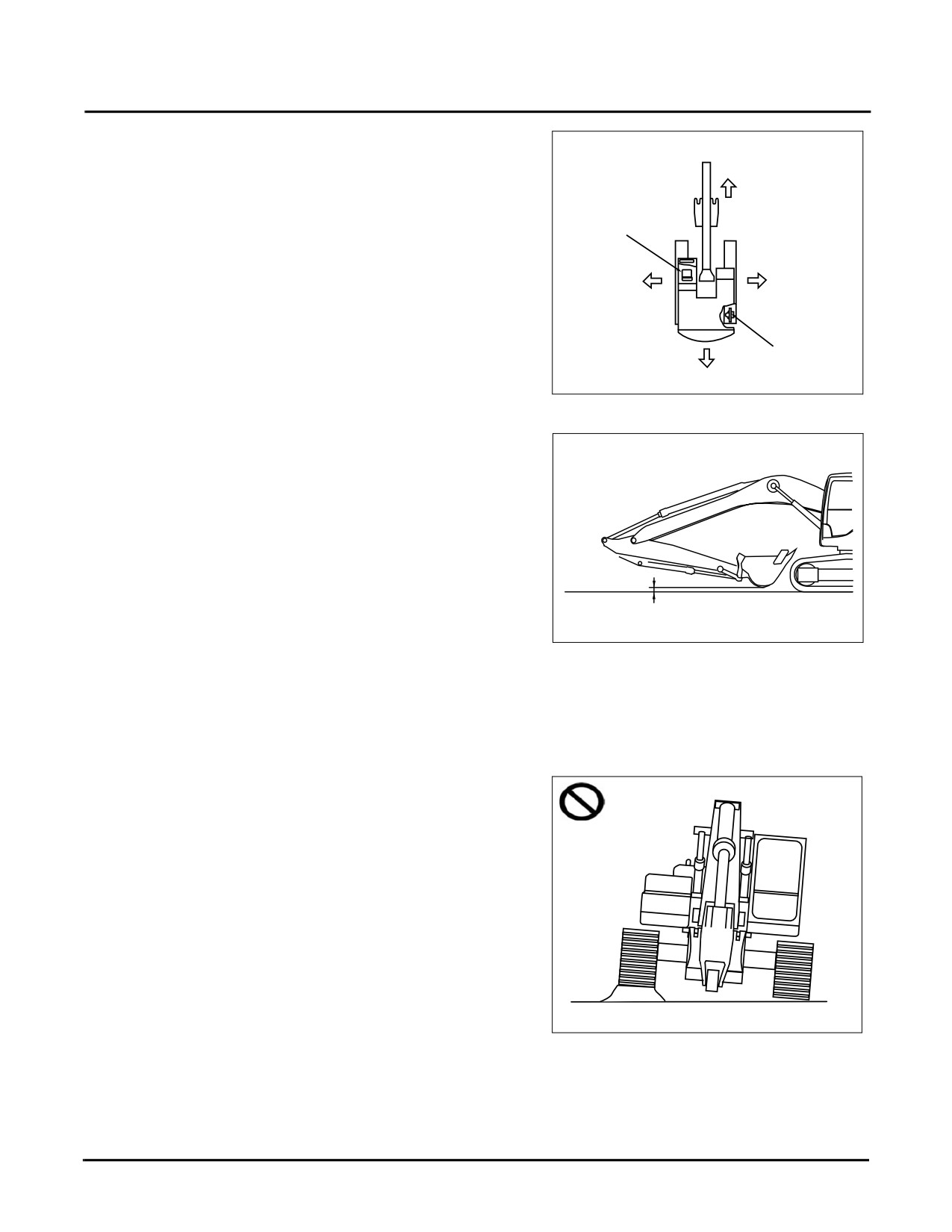
FRONT
•
Before traveling with the machine, be sure the track
carriage is positioned correctly with the travel
levers;
(Right lever, right track)
(Left lever, left
OPERATOR
track). If necessary, reposition the track carriage so
SEAT
travel levers are with the correct track.
LEFT
RIGHT
TRAVEL
MOTOR
REAR
ACN0951
Fig. 2-65
•
When traveling on level ground, position the work
equipment so you can see all parts of the work
equipment. Keep the height of the work equipment
40 to 50 cm (16 to 20 in.) from the ground surface.
•
If you will be traveling over rough ground, travel at
a low, controllable speed and do not operate the
steering suddenly since there is a danger loss of
control could result. Be sure the work equipment
40 - 50 cm
does not hit the ground surface and cause a loss of
(16 - 20 in.)
ACN0952
balance or equipment damage.
Fig. 2-66
•
(If equipped) be sure the auto-decel switch is in the
OFF position. If the auto-decel switch is set in the
ON position, the engine speed may accelerate and
the travel speed may suddenly increase.
•
Always avoid traveling over obstacles or raised
areas if possible. Traveling over obstacles or raised
areas could result in loss of control or damage to the
machine. If you must travel over raised areas,
always travel at a slow speed with the work
equipment as close the ground as possible. Avoid
any sharp turns or sudden stops.
•
During travel, always maintain a clear distance
from people or surrounding objects.
ACN0953
Fig. 2-67
2-52
SY335 Excavator
Product Specific Safety
•
Always check to be sure surface areas such as
bridges or road ways will support the weight of the
machine.
•
Before traveling on public roads or in publicly
owned areas, always check with the relevant
authorities and follow their instructions. Failure to
do may result in damage, loss of control, fines or
punishment.
•
Always be extra careful when traveling in tunnels,
under bridges, near utility lines or in places with
ACN0954
Fig. 2-68
limited weight, height or where clearance is a
problem. Operate slowly and be extremely careful
not to let the machine or work equipment come in
contact with anything.
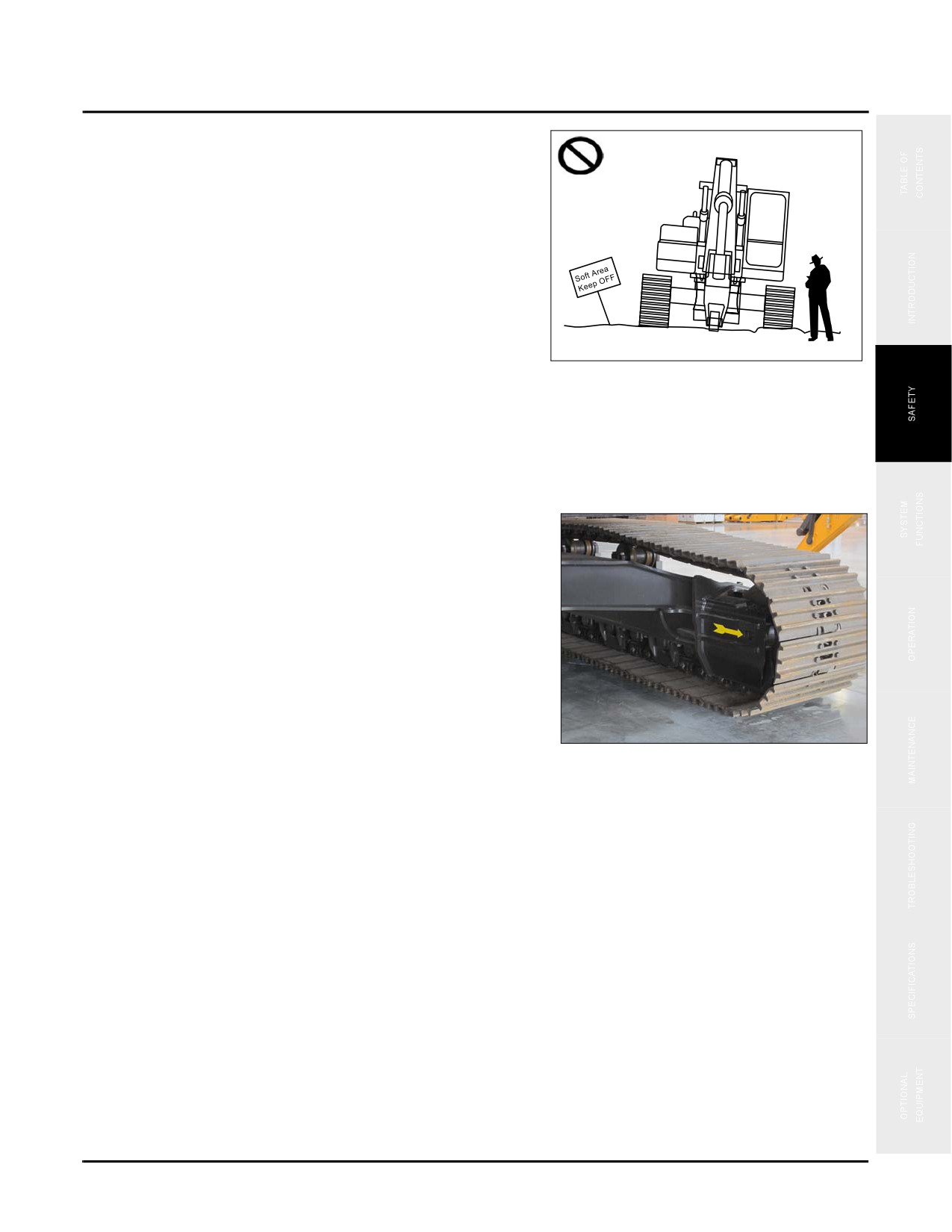
Traveling With a Reversed Carriage
Traveling with the carriage reversed could pose a hazard.
Travel direction for all Sany excavators is indicated on the
inside of the track motor with an arrow. Although Sany does
not recommend traveling with the carriage reversed, below
is a list of some basic rules to follow when traveling with a
reversed carriage:
•
Always keep in mind the travel lever controls will
be working in the opposite direction from normal
travel.
•
Before moving your machine, always check the
Fig. 2-69
position of the carriage as it relates to the travel
levers.
•
If you will be traveling in areas where the machine will be exposed to surrounding hazards, rough surfaces
or tight maneuvering, you may want to travel with the carriage in the normal position.
2-53
Product Specific Safety
SY335 Excavator
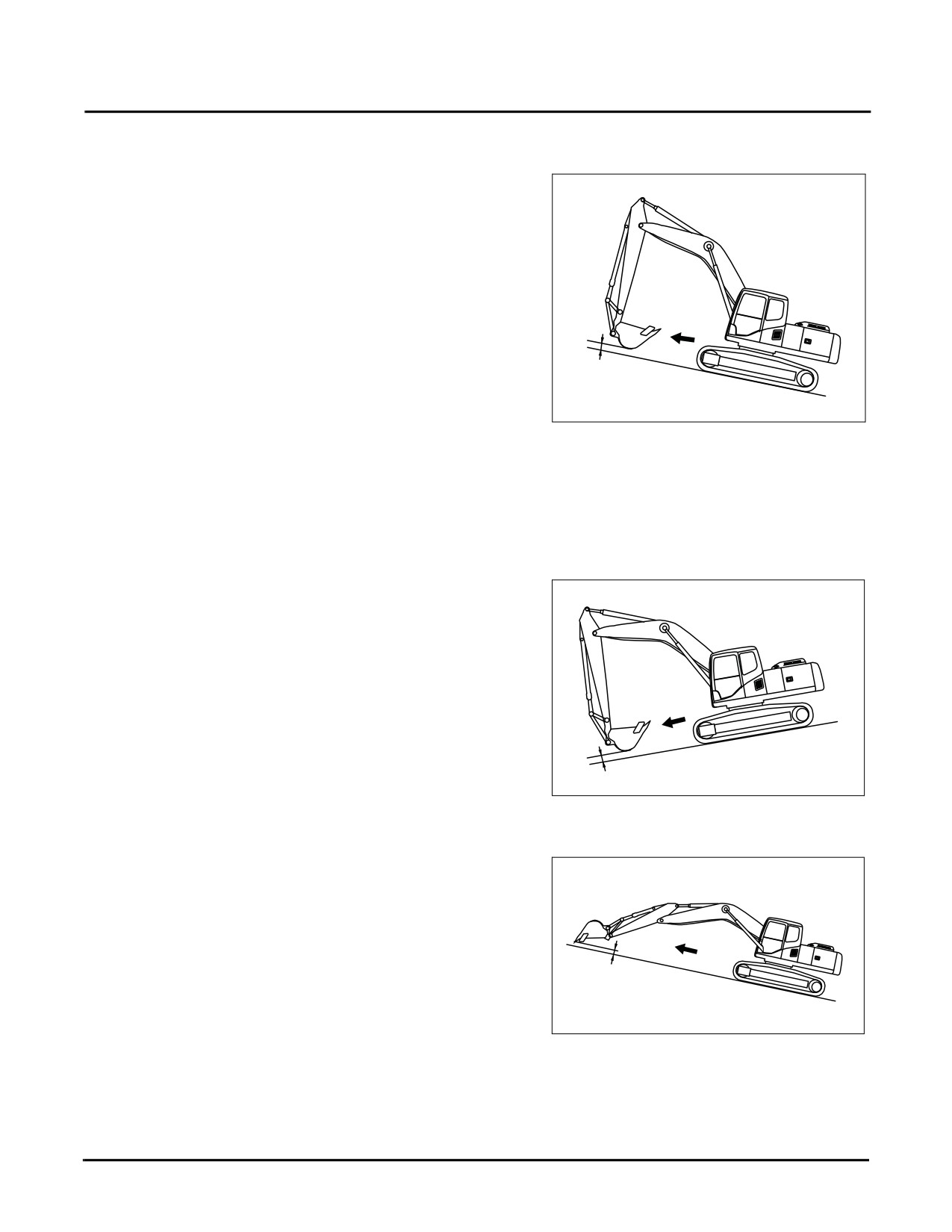
Traveling on Sloped Areas
Traveling on sloped areas with an excavator always poses a
hazard.Work equipment position, counterweight location
and carriage position all effect the stability of the machine
when traveling on sloped areas. Repositioning of the work
equipment, carriage or counterweight while traveling on
these surfaces will change the center of gravity location on
the machine. In order to prevent tipping, loss of control or a
rollover, it is important to follow some basic, simple rules
when traveling on sloped areas.
20 - 30 cm
•
Never turn the ignition switch off when traveling up
(8 - 12 in.)
or down a slope. If the engine should stop, lower the
ACN0955
work equipment to the ground immediately.
Fig. 2-70
•
Always keep the work equipment approximately 20
to 30 cm (8 to 12 in.) above the ground. Avoid moving the work equipment or shifting the position of the
carriage when traveling on a slope. Doing so will change the center of gravity on the machine.
•
Always face the front of the operator cab uphill when traveling up a slopes.
•
When traveling down slopes, set the operator cab
facing downhill.
•
Always check the firmness of the surface on the
slope before you attempt to travel on it.
20 - 30 cm
(8 - 12 in.)
ACN0956
Fig. 2-71
•
If you will be traveling up an extremely steep slope,
extend the work equipment to the front of the
machine to help balance the machine.
•
Keep the work equipment approximately 20 to 30
cm (8 to 12 in.) above the ground and travel at a
20 - 30 cm
slow speed. When traveling downhill, lower the
(8 - 12 in.)
engine speed, keep the travel at a low speed.
ACN0957
Fig. 2-72
2-54
SY335 Excavator
Product Specific Safety
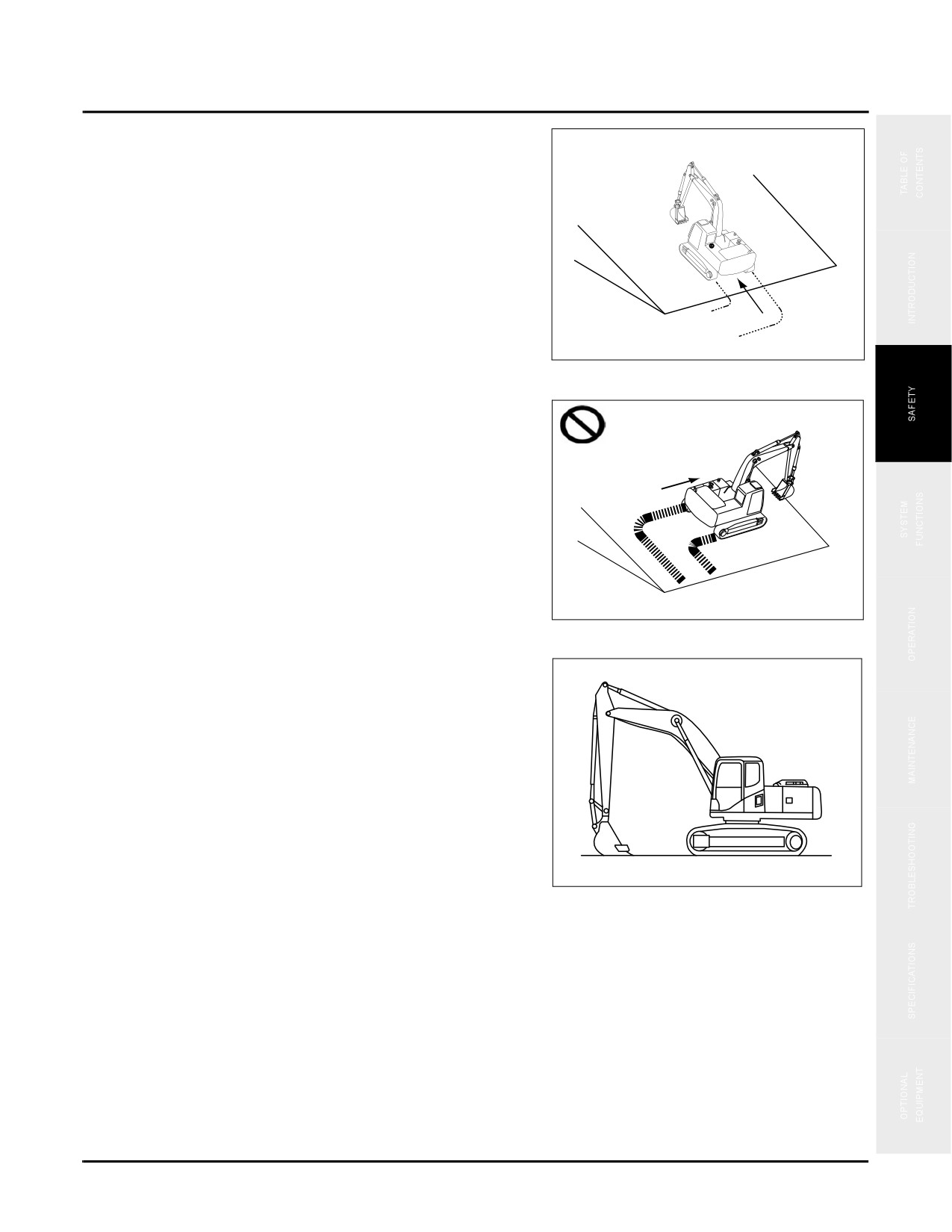
•
Always travel straight up or straight down a slope.
Travel at an angle on a slope may cause loss of
control or the machine to tip.
ACN0958
Fig. 2-73
•
Never turn on a slope or reposition the work
equipment or carriage on a slope.
•
Never swing the carriage while on a slope for any
reason.
ACN0959
Fig. 2-74
Parking and Securing the Machine
When parking the machine, it is important to follow several
basic safety rules. Always keep in mind that you are
responsible for the security of the machine when it is
parked. Listed below are some simple rules to follow when
parking your machine:
•
Always park the machine on a flat, level and stable
surface away from people, traffic or other
equipment.
ACN0960
Fig. 2-75
•
Lower all work equipment to the ground, turn the
ignition switch to the OFF position and neutralize
all controls.
2-55
Product Specific Safety
SY335 Excavator
•
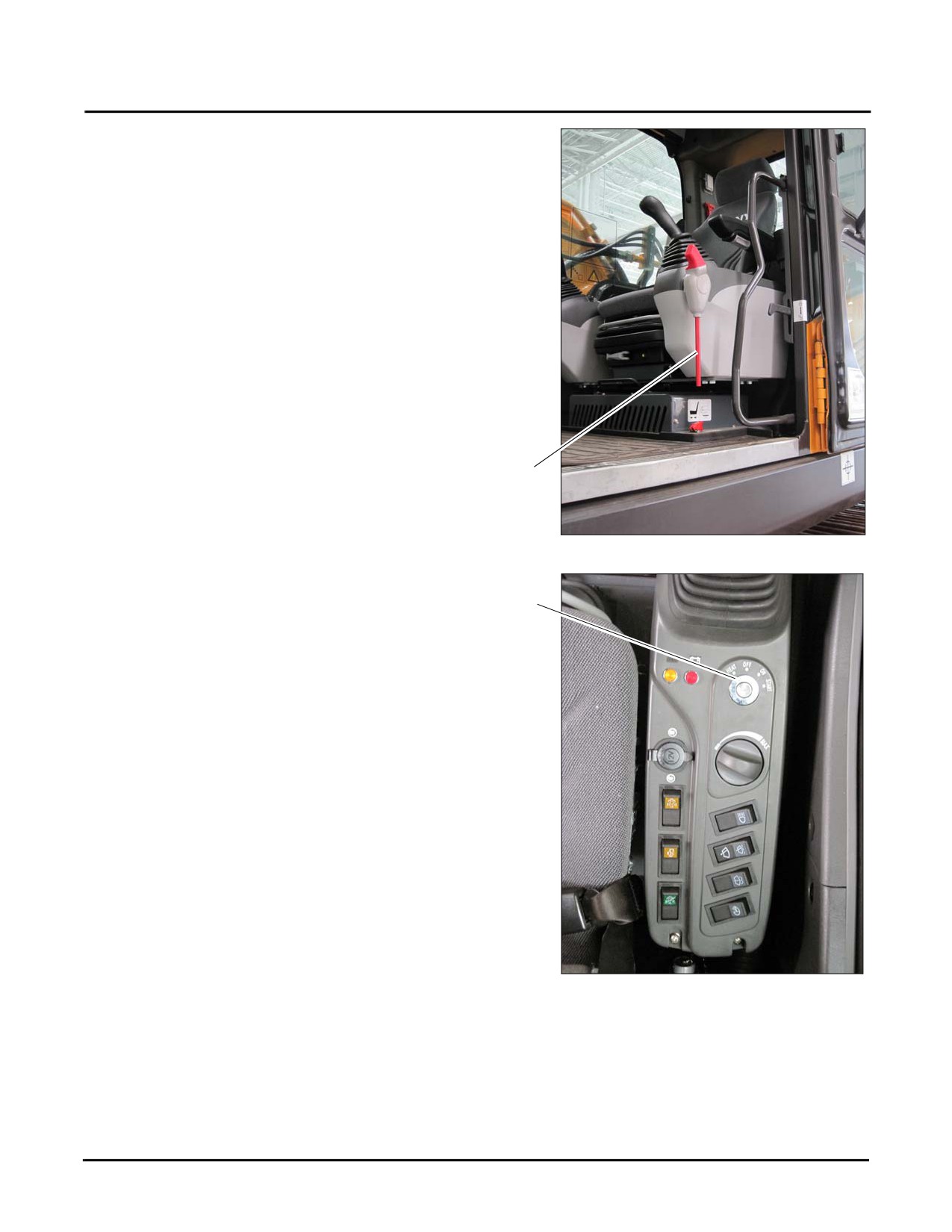
Set the hydraulic lock lever for the work equipment
in the LOCK position (a).
a
Fig. 2-76
•
Remove the ignition key (b) and keep it with you.
b
•
Close and lock all windows and doors on the
machine.
•
Be sure all access covers, tanks and areas equipped
with locks are locked and secured properly.
•
Before leaving the job site for the day, double-
check the machine to be sure it is fully secured.
Failure to do so may result in vandalism or
unauthorized access to the machine.
Fig. 2-77
2-56
SY335 Excavator
Product Specific Safety
Maintenance Safety
WARNING
All maintenance to be performed on this equipment must be performed by trained and
authorized personnel only. When performing maintenance, it is important to follow all outlined
maintenance or repair procedures and safety information as outlined in this manual. Failure to
do so may result in injury or possibly death.
Maintenance
The excavator must be inspected prior to each work shift that it will be used. The owner, user, and operator must
ensure that required routine maintenance and lubrication tasks have been performed as stated in this manual. Never
operate a damaged or poorly maintained excavator.
Perform a function checks after repairs have been made to ensure proper operation.
Routine maintenance of this excavator must be performed by a qualified person(s). Any questions regarding
procedures and specifications should be directed to the your local, authorized Sany Distributor.
Preparing for Maintenance
1. Park the machine on a dry, level surface, lower the work
equipment to the ground, then turn off the engine and
remove the ignition key.
Fig. 2-78
2-57
Product Specific Safety
SY335 Excavator
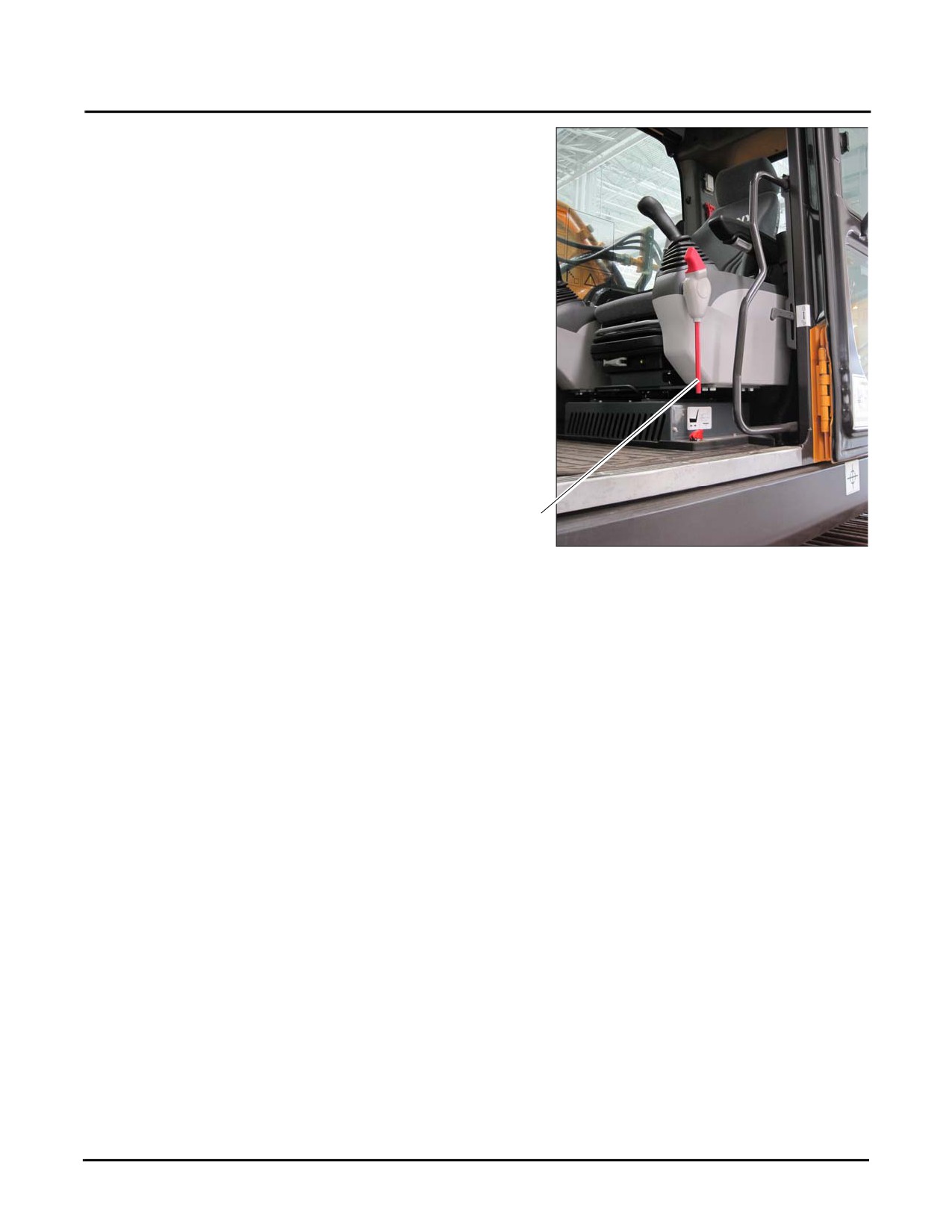
2. Neutralize the controls, then set the hydraulic lock lever
to the LOCK position (a).
3. Follow the Lock-out Tag-out procedure below before
proceeding.
a
Fig. 2-79
2-58
SY335 Excavator
Product Specific Safety
This Page Intentionally Left Blank
2-59