SANY Excavator SY335 (Part Number: 11282013). Safety, Operation & Maintenance Manual - page 1
Quality changes the world
Excavator
SY335
Safety, Operation & Maintenance Manual
Part Number: 11282013
SY335 Excavator
SY335 Excavator
SY335 Excavator
Safety, Operation & Maintenance Manual
This manual and its contents prepared by Technical Publications
while deemed to be accurate, is preliminary, based upon technical information
provided, and for a machine designed, manufactured and tested by:
SANY HEAVY INDUSTRY Co., LTD
NO.8 Beiqing Road,
Huilongguan, Changping District,
Beijing, China,102206
It is the responsibility of the owner, user, properly trained operator and lessor to be
knowledgeable of, and comply with, all industry standards, government
regulations, workplace rules and other directives that may govern and/or apply to
this machine as well as its environment/conditions of use.
WARNING
Read and understand all safety precautions and
instructions in this manual before reading any
other manuals provided with this equipment and
before operating or servicing it. Failure to do this
can cause property damage, personal injury or
death.
Safety, Operation & Maintenance Manual —November 28, 2013
SY335 Excavator
Table of Contents
Table of Contents
Introduction
About This Manual
1-3
Your Documentation Package
1-4
Operator Manual
1-4
Parts Book
1-4
Using and Storing the Documentation
1-4
Organization of this Manual
1-5
Table of Contents
1-5
Introduction
1-5
Safety
1-5
System Functions
1-5
Operation
1-5
Maintenance
1-5
Troubleshooting
1-5
Specifications
1-5
Optional Equipment
1-5
Serial Number Location
1-6
Record of Serial Number and Distributor Information
1-6
Contact Information
1-6
Correction Request Form
1-7
Safety
Safety - General
2-4
Diesel Engine Exhaust
2-4
Battery Posts, Terminals, and Related Accessories
2-5
Hazard Alerts in This Manual
2-5
Machine Decals
2-7
Operator Safety Information
2-7
Operator is Important
2-8
Operator Qualifications
2-8
General Machine Safety
2-9
Unauthorized Machine Modifications
2-9
General Job Safety
2-9
Job Site Safety
2-10
Pre-Operation Inspection
2-10
Personal Protective Equipment
2-11
General Fire Safety
2-11
Fuel and Oil Fires
2-12
Hydraulic Fires
2-12
Electrical Fires and Explosions
2-13
In Case of Fire
2-13
Extinguisher and First Aid Kit
2-14
Dust and Chemical Hazards
2-14
Safety, Operation & Maintenance Manual —November 28, 2013
i
Table of Contents
SY335 Excavator
Material Safety Data Sheets (MSDS)
2-15
Surface and Underground Hazards
2-15
High Voltage Areas
2-16
Electrocution Hazard
2-17
Safety During Transport (to Job Site)
2-19
Maintenance Safety - General
2-20
Preparing for Maintenance
2-20
Lockout/Tagout Procedures
2-21
Locking out of service
2-21
Returning to service
2-22
Cleaning the Machine
2-23
Using the Correct Tools
2-23
Jacking Up the Machine
2-23
Rotating Parts
2-24
Track Recoil Springs
2-24
Removing Attachments
2-24
Welding, Drilling, Cutting or Grinding on the Machine
2-25
Adding Fluids to the Machine
2-25
Refueling
2-25
High-Pressure Fluid Lines
2-26
Accumulator
2-26
Electrical System
2-27
Battery Safety
2-27
Start-up Safety
2-28
Disconnecting the Battery
2-28
Jump-Start Safety
2-28
Environmental Precautions
2-29
Towing or Lifting the Machine
2-29
Optional Attachments
2-30
Product Specific Safety
2-31
Machine Decals
2-31
Authorized Use of the Excavator
2-31
Unauthorized Use of the Excavator
2-31
Accumulation of Flammable Material
2-32
Inside Operator Cab
2-33
Lock Lever
2-33
Start-Up Safety
2-33
Crush or Pinch-Point Precautions
2-34
Leaving the Operator Cab
2-36
Optional Attachment Use
2-38
Large or Optional Attachments
2-38
Operating Precautions
2-38
Pre-Operational Checks
2-38
Starting Operations
2-38
During Operation
2-39
Job Site Precautions
2-42
Surface and Underground Hazards
2-43
Job Site Working Clearances
2-45
Slopes or Inclined Surfaces
2-46
Snow or Frozen Surfaces
2-48
High Voltage Areas
2-48
ii
Safety, Operation & Maintenance Manual —November
28, 2013
SY335 Excavator
Table of Contents
Electrocution Hazard
2-49
Electrical Contact
2-51
Travel Precautions
2-51
Basic Travel Advice
2-52
Traveling With a Reversed Carriage
2-53
Traveling on Sloped Areas
2-54
Parking and Securing the Machine
2-55
Maintenance Safety
2-57
Maintenance
2-57
Preparing for Maintenance
2-57
System Functions
Exterior Components
3-3
Cab Exterior
3-4
Cab Interior
3-5
Seat and Seat Belt
3-6
Left Control Console
3-8
Air Conditioning System - Control Panel
3-9
Radio Control Panel
3-11
Right Control Console
3-13
Indicator Lights
3-14
Ignition Switch
3-15
12V Power Supply
3-15
Throttle Control Dial
3-15
24V Power Outlet/Lighter
3-16
Work Lamp Switch
3-16
Manual Regeneration Switch
3-16
Memory Clear Switch
3-16
Regeneration Disable Switch
3-16
Head Lamp Switch
3-17
Windshield Washer Switch
3-17
Windshield Wiper Switch
3-17
Hydraulic Lockout Control
3-17
Emergency Stop Switch
3-18
Joystick Controls
3-19
SAE/BHL Selector Switch
3-19
SAE Mode
3-20
BHL Mode
3-21
Joystick Switches
3-22
Travel Controls
3-23
Automatic Deceleration Function
3-24
Fuses and Batteries
3-25
Batteries and Power Disconnect Process
3-26
Battery
3-26
Power disconnect process
3-26
Combined Instruments Display/Monitor
3-28
Combined Instrument Display screen
3-28
Function Icons
3-31
Function Keys
3-31
System Information
3-31
Safety, Operation & Maintenance Manual —November 28, 2013
iii
Table of Contents
SY335 Excavator
Main Menu Functions
3-33
Engine and Throttle Signals
3-34
Pilot (Hydraulic Control) Pressure Signals
3-34
Main Pump Signals
3-34
Machine Configuration
3-35
Fault Information
3-35
System Language Selection
3-36
Machine Configuration Setup
3-36
Time Setup
3-36
Service Hours Setup
3-37
Operation
Work Area
4-3
General Job Safety
4-3
Job Site Safety
4-5
Work Crew
4-6
Supervisor
4-6
Owner and Other Authorized Personnel
4-6
Machine Operator
4-7
New Machine Run-In
4-9
Mount and Dismount the Machine
4-10
Pre-Start Checks
4-12
Daily Maintenance Record
4-12
Fuel Level
4-13
Draining Primary Fuel Filter
4-14
Hydraulic Oil Level
4-15
Engine Oil Level
4-16
SAE/BHL Selector Switch
4-17
Engine Coolant Level
4-19
Cab
4-20
Safety, Operation and Maintenance Manual
4-20
Seat, Seat Belt, Mirrors and Backup Camera
4-20
Work Lights and Warning Devices
4-22
Operator Controls
4-23
Fire Extinguisher & Escape Tool
4-23
Combined Instruments Display/Monitor Settings
4-24
Set Language Display - First Time
4-24
Set Date/Time Setting - First Time
4-27
Engine Procedures
4-29
Cold Weather Operation
4-29
Engine Start Procedure
4-30
Idle the Engine
4-32
Engine Shutdown
4-32
Travel Operations
4-34
Preheat the Machine
4-34
Before Travel
4-35
Right Turn
4-38
Left Turn
4-38
Straight Travel
4-38
Counter Rotate
4-39
iv
Safety, Operation & Maintenance Manual —November
28, 2013
SY335 Excavator
Table of Contents
Slopes
4-39
Operations in Water
4-40
Release Excavator from Mud
4-40
Recommended Applications
4-42
Backhoe operation
4-42
Digging a trench
4-42
Bucket Replacement
4-43
End of Workday Checks
4-45
Control Work Equipment
4-46
Set SAE/BHL Selector Switch
4-46
SAE Control Pattern
4-48
Swing
4-48
Arm
4-48
Boom
4-48
Bucket
4-49
BHL Control Pattern
4-49
Swing
4-49
Arm
4-50
Boom
4-50
Bucket
4-50
Park And Store The machine
4-51
Overnight Storage
4-51
Long Term Storage
4-52
Preparation
4-53
During Storage
4-56
Return to Service
4-56
Transport
4-57
Load the machine
4-57
Unload the machine
4-61
Maintenance
Maintenance Information
5-4
Checks Before Maintenance
5-4
Checks After Maintenance or Repairs
5-5
Hour Meter Reading
5-5
Genuine Sany Replacement Parts
5-5
Sany-Approved Lubricants
5-5
Windshield Washer Fluid
5-5
Grease
5-5
Oil and Filter Inspection
5-6
Welding on the Machine
5-6
Inventory Your Tools and Parts
5-6
Cleaning Parts or the Machine
5-6
Adverse Work Site Conditions
5-6
Covers and Locks
5-7
Hydraulic Hoses, Lines or Components
5-7
Third-Party Inspection Requirements
5-7
Inspection and Maintenance in Severe Environments
5-7
Operation in Mud, Rain or Snow
5-7
Operation Near Ocean (Salt Air) Environments
5-7
Safety, Operation & Maintenance Manual —November 28, 2013
v
Table of Contents
SY335 Excavator
Dusty Environments
5-7
Rocky Ground Surface
5-8
Cold Environments
5-8
Other Weather Environments
5-8
Torque Values
5-9
Fluids & Lubricants
5-11
Fuel
5-11
Engine Oil
5-13
Lubricants
5-13
Daily Maintenance
5-14
Check
5-15
Safety, Operation & Maintenance Manual
5-15
Operating Functions
5-15
Fire Extinguisher and Escape Tool
5-18
Backup Camera
5-18
Engine Oil Level
5-19
Pump Mounting Bolts
5-20
Fuel Level
5-21
Engine Coolant Level
5-21
Engine Serpentine Belt
5-22
Slewing Gearbox
5-24
Hydraulic Oil Tank
5-25
Hydraulic Line Connections
5-26
Electrical System
5-28
Air Conditioner
5-30
Idler Wheel
5-33
Sheet Metal
5-34
Decals
5-34
Drain
5-35
Draining the Primary Fuel Filter
5-35
50 Hours of Maintenance
5-37
Change
5-38
Engine Oil and Filter - Initial
5-38
Check
5-42
Air Intake System
5-42
Muffler and Exhaust System
5-43
Hydraulic Hoses
5-44
Batteries
5-45
Crawler Shoe Connecting Pins
5-48
Crawler Support Roller Mounting Bolts
5-48
Crawler Gearbox Oil Level
5-49
Crawler Drive Sprocket Mounting Bolts
5-50
Track Tension - Initial
5-51
Lubricate
5-54
Slewing Turntable Bearing
5-54
Work Equipment
5-56
250 Hours of Service
5-61
Change:
5-62
Engine Oil and Filter
5-62
Hydraulic Tank Return Filter Elements — Initial
. .5-62
Hydraulic Pilot Line Filter Element — Initial
5-64
vi
Safety, Operation & Maintenance Manual —November
28, 2013
SY335 Excavator
Table of Contents
Hydraulic Oil - Breaker only at 400 Hours
5-65
Check
5-65
Air Conditioner Compressor
5-65
Air Filter
5-67
Crawler Assemblies
5-70
Track Tension
5-71
Fuses
5-71
Windshield Washer and Window Wipers
5-72
Handrails and Steps
5-73
Access Panels and Locks
5-73
500 Hours of Service
5-74
Change
5-75
Primary Fuel Filter
5-75
Coolant Filter
5-77
Slewing Gearbox Oil
5-78
Hydraulic System Breather Filter
5-79
Check
5-80
Radiator, Oil Cooler, and AC Condenser Fins
5-80
Air Conditioning Fresh Air and Recirculation Air Filters
5-82
Slewing Gearbox Bolts
5-84
Hydraulic Hoses
5-85
Hydraulic Pump
5-85
Upperworks and Lowerworks
5-86
Final Drive
5-87
Swing Pinion Gear Grease Level
5-88
Lubricate
5-89
Work Equipment
5-89
1,000 Hours of Service
5-90
Change
5-91
Hydraulic Tank Return Filter
5-91
Hydraulic Pilot Line Filter
5-91
Check
5-91
Engine Exhaust Pipe Clamps
5-91
Accumulator Nitrogen Pressure (Breaker only)
5-92
Fuel Tank Strainer
5-94
Fuel Lines
5-95
2,000 Hours of Service
5-96
Change
5-97
Hydraulic Oil
5-97
Engine Coolant
5-102
Final Drive Oil
5-105
Check
5-106
Hydraulic Hoses
5-106
Accumulator Gas Pressure
5-106
Machine Storage
5-107
Short-Term Storage (Less than 30 days)
5-107
Long-Term Storage (Longer than 30 days)
5-107
Troubleshooting
Before Troubleshooting
6-2
Safety, Operation & Maintenance Manual —November 28, 2013
vii
Table of Contents
SY335 Excavator
Troubleshooting Precautions
6-3
Precautions Troubleshooting Electrical Circuits
6-4
Precautions Handling Hydraulic Components
6-5
Towing the Machine
6-6
Towing Light Loads
6-7
Severe Operating Conditions
6-7
Jump-Starting the Engine
6-7
General Information
6-7
Battery Access
6-8
Connecting the Jumper Cables
6-8
Starting the Engine
6-9
Disconnecting the Jumper Cables
6-9
Fuses
6-10
Engine Failures
6-11
Failure Codes
6-20
Hydraulic System
6-22
Other Common Failures
6-25
Specifications
Machine Dimensions & Specifications
7-2
Operating Ranges
7-5
Optional Equipment
Optional Equipment Safety Equipment
8-2
Optional Equipment Selection
8-2
Read Equipment Instructions
8-2
Removal And Installation Precautions
8-2
Optional Equipment Operation Precautions
8-2
Optional Equipment System Functions
8-4
Component Location and Function
8-4
Stop Valve
8-4
Selector Valve
8-5
Hydraulic Circuit
8-6
Optional Tool Selection
8-7
Optional Equipment Operation
8-10
Attach Optional Equipment
8-10
Optional Equipment Control
8-13
Hydraulic Breaker Controls
8-14
Hydraulic Shears Controls
8-14
Disconnecting Optional Equipment
8-15
viii
Safety, Operation & Maintenance Manual —November 28, 2013
SY335 Excavator
Introduction
Introduction
About This Manual
1-3
Your Documentation Package
1-4
Operator Manual
1-4
Parts Book
1-4
Using and Storing the Documentation
1-4
Organization of this Manual
1-5
Table of Contents
1-5
Introduction
1-5
Safety
1-5
System Functions
1-5
Operation
1-5
Serial Number Location
1-6
Record of Serial Number and Distributor Information
1-6
Contact Information
1-6
Correction Request Form
1-7
Safety & Operation Manual — October 23, 2013
1-1
Introduction
SY335 Excavator
WARNING
To prevent death or serious injury:
•
Avoid unsafe operation and maintenance.
•
This equipment must be operated and maintained by trained and
experienced personnel. Sany is not responsible for qualifying these
personnel.
•
Do not operate or work on this crane without first reading and
understanding the Operator Manual and Rating Plate supplied with
the crane.
•
Store the Operator Manual in the operator cab seat pocket.
If the Operator Manual or Load Charts Manual are missing from the
operator cab, do not use the crane until replacements have been obtained
from your SANY distributor.
WARNING
Read and understand all safety precautions and
instructions in this manual before reading any
other manuals provided with this equipment and
before operating or servicing it. Failure to do this
can cause property damage, personal injury or
death.
1-2
Safety & Operation Manual — October 23, 2013
SY335 Excavator
About This Manual
ABOUT THIS MANUAL
•
Sany excavators offer high-quality performance and
top-notch, after-sales service.
•
Sany excavators are widely used throughout the
industry for various types of applications.
•
Sany is a leading manufacturer of construction
equipment worldwide.
This operator manual provides safety and operation,
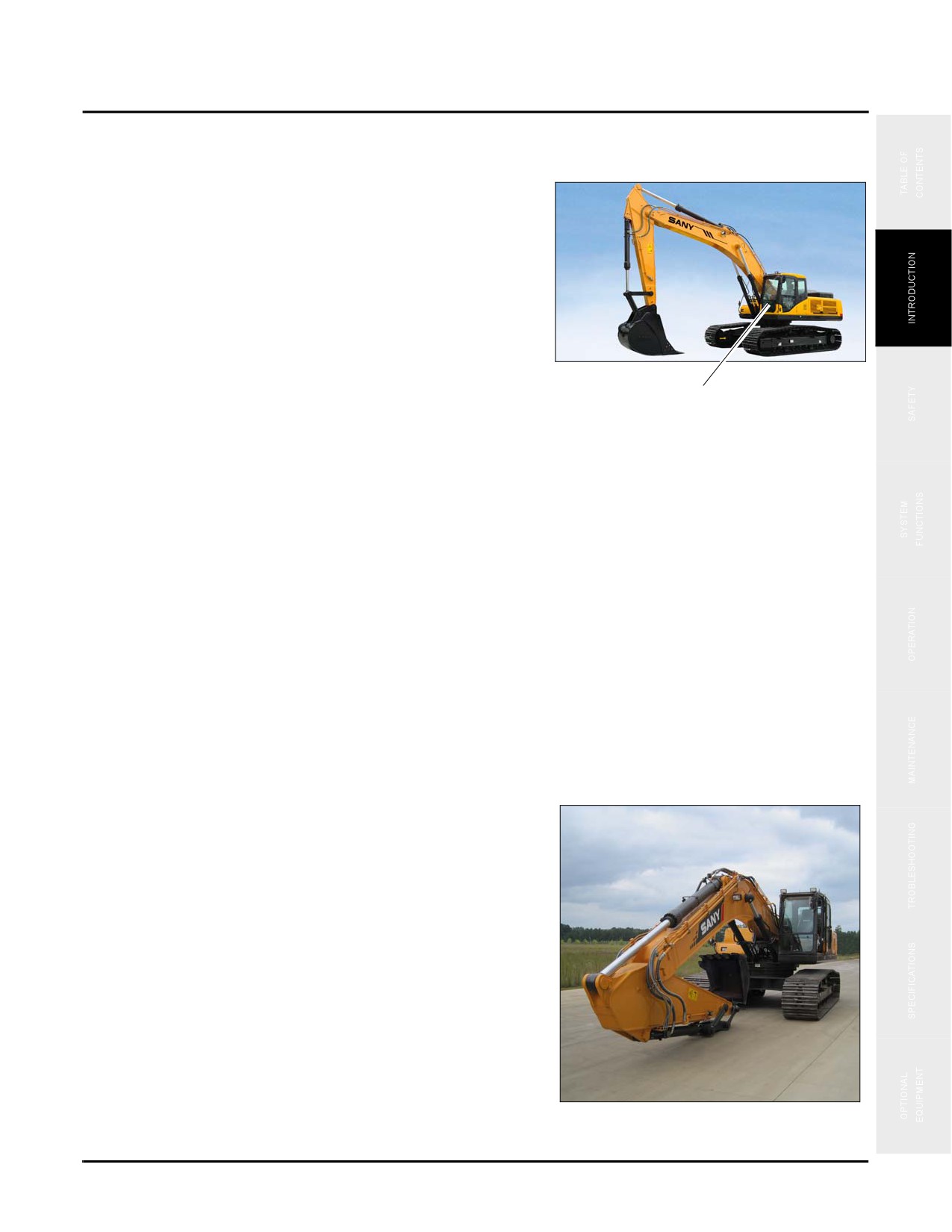
Fig. 1-1
information. A copy must be kept in the cab (a) or nearby at
a
all times. If a copy of the manual is not with the machine at
the time of use, do not use the equipment until you have
obtained a replacement copy from your Sany distributor.
In order to properly use your equipment, it is important to
read this manual carefully before beginning any operations. Also, have all personnel involved with any work
operations read this manual periodically so they remain knowledgeable about its contents.
Items addressed in this manual are designed to help you:
•
Understand the structure and performance of your equipment.
•
Reduce improper operation and point out possible hazardous situations when using equipment.
•
Increase equipment efficiency during operation.
•
Prolong the service life of your equipment.
•
Reduce maintenance costs.
If this manual is damaged and any part of it is unreadable,
you must immediately request a replacement copy from
your Sany distributor.
If you sell the equipment, this manual must be provided to
the new owner.
Continuing improvements in the design of this machine can
lead to changes in detail which may not be covered in this
manual. Always consult your Sany distributor for the latest
available information on your machine or if you have
questions regarding information in this manual.
Fig. 1-2
Safety & Operation Manual — October 23, 2013
1-3
Your Documentation Package
SY335 Excavator
YOUR DOCUMENTATION PACKAGE
The documentation for this machine includes the following
items:
Operator Manual
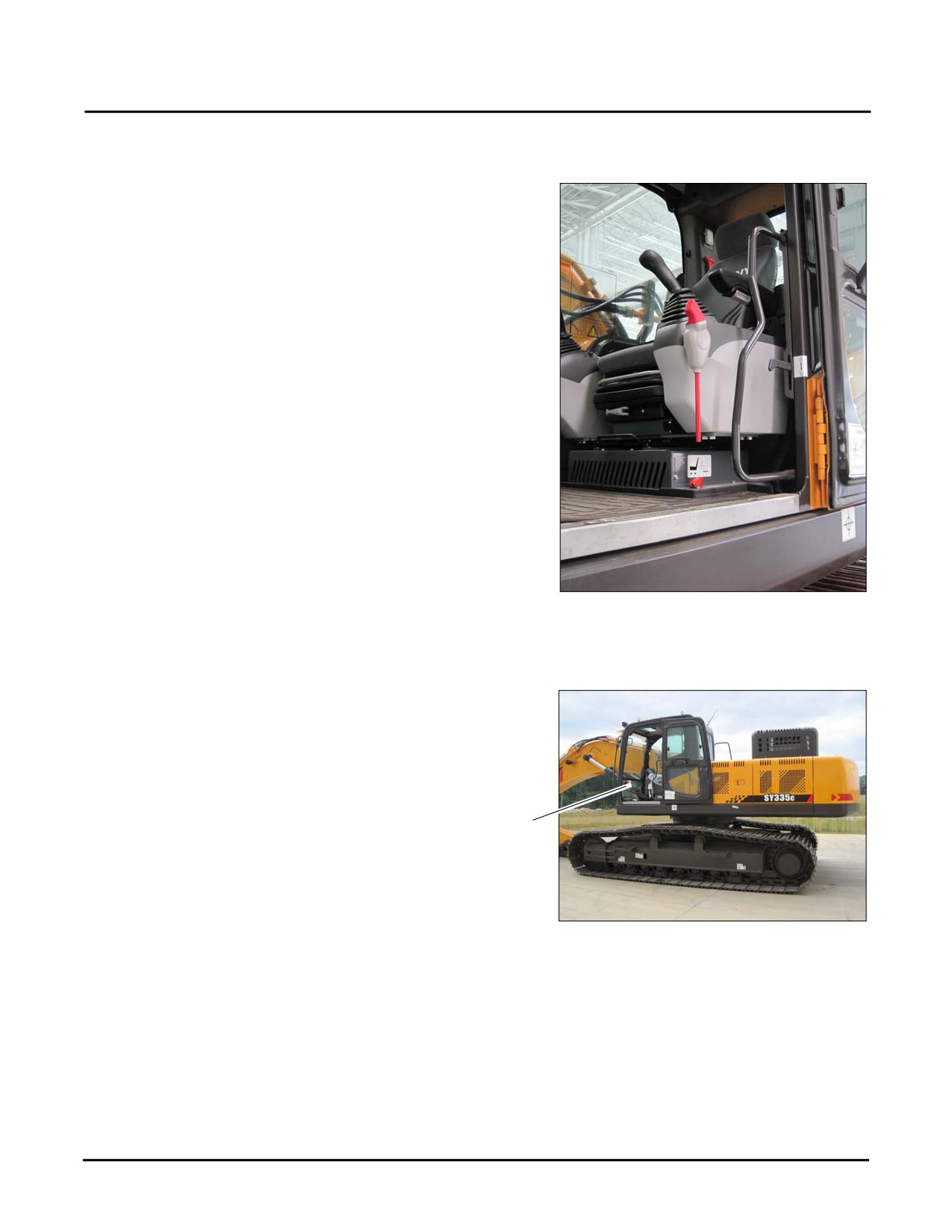
A copy of this manual must always remain in the operator
cab (a) when not being used. See “Organization of this
Manual” on page 1-5 for complete details.
Parts Book
The Parts book consists of parts lists and matching drawings
used for ordering spare parts as needed.
Fig. 1-3
Using and Storing the Documentation
This documentation applies only to this machine and should
not be used with any other machines.
Always keep this manual with the machine in the operator
cab (a) or nearby.
The Parts book are best left in the workshop area or office.
a
It should always be available to the maintenance and service
personnel as required. A copy of the Safety & Operator
Manual should also be kept in the workshop area or office
since it contains information required by the maintenance
personnel.
Fig. 1-4
1-4
Safety & Operation Manual — October 23, 2013
SY335 Excavator
Organization of this Manual
ORGANIZATION OF THIS MANUAL
Due to improvement and updating of products, some information in this manual may differ from your machine. If
you have any questions about the information in this manual, contact your Sany distributor before operating or
maintenancing the machine.
Table of Contents
This provides a listing of the general topics that are contained in this manual along with the page number each
starts on. There are also more detailed tables of contents at the start of each section in this manual.
Introduction
This section provides an overview of what is covered in the rest of this manual, including serial number
information and Sany contact information.
Safety
This section covers basic safety information relating to this equipment. It also describes what the hazard alerts
mean that are used throughout the manual.
System Functions
This section provides an overview of all the controls and operating systems.
Operation
This section provides detailed operating procedures.
Maintenance
This section covers basic maintenance information relating to this machine. It describes preventive and periodic
tasks that need to be performed to keep the machine running efficiently.
Troubleshooting
This section provides an overview of common maintenance problems and how to repair them.
Specifications
Provides height, length, width and weights (fully operational and transport) of the machine.
Optional Equipment
Describes basic information on the function and operation of the breaker and shear optional attachments.
Safety & Operation Manual — October 23, 2013
1-5
Serial Number Location
SY335 Excavator
SERIAL NUMBER LOCATION
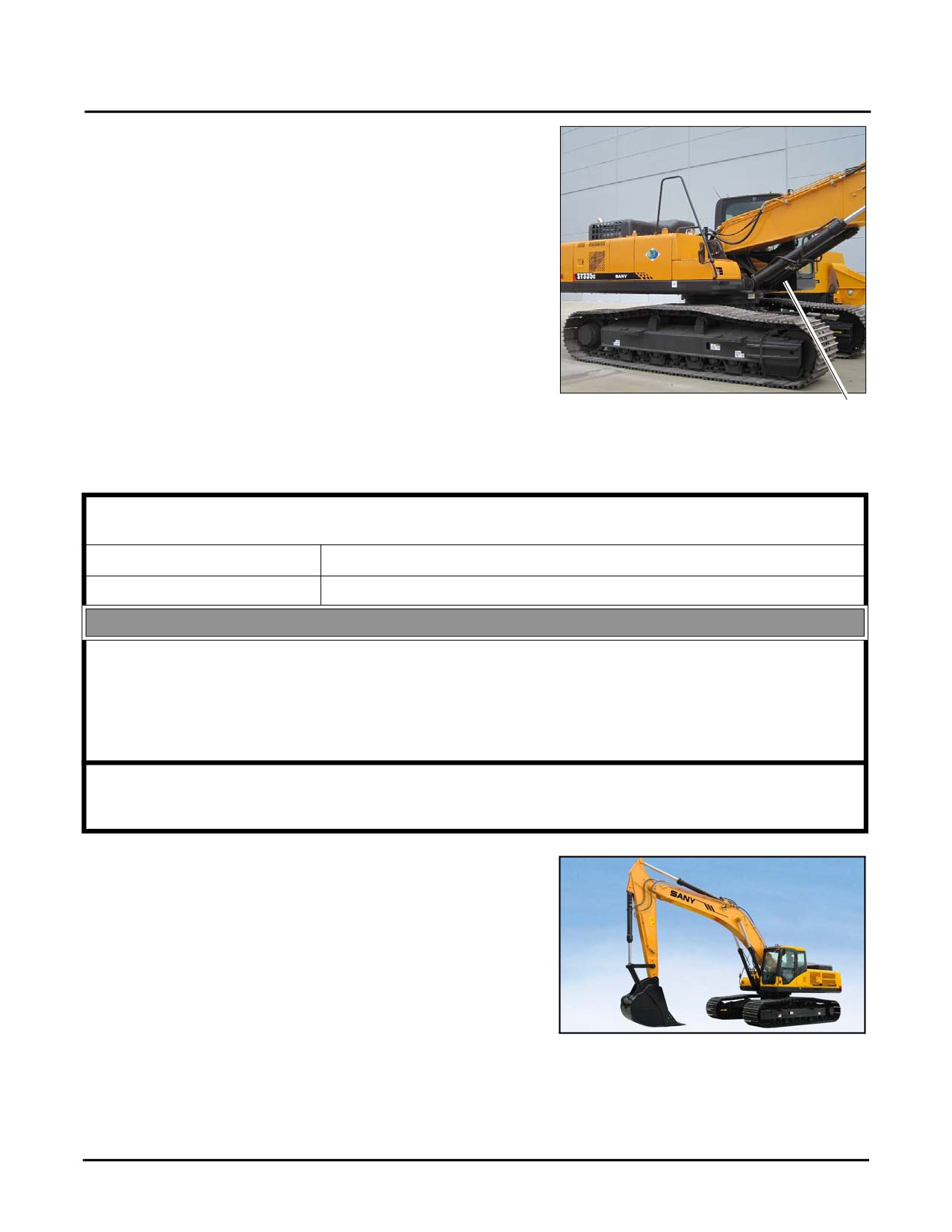
The serial number
(a) will be needed by your Sany
distributor when ordering replacement parts or providing
assistance for your equipment. Record this information in
this manual for future use.
Fig. 1-5
a
Record of Serial Number and Distributor Information
This location is for you to record information relating to your machine. It is required that you keep this manual
with your machine at all times for reference.
Machine Serial No.
Engine Serial No.
Distributor Name:
Address:
Phone Numbers:
CONTACT INFORMATION
Thank you for purchasing a Sany machine. If you need to
contact us for any reason, you can reach us as follows:
, Inc.
318 Cooper Circle
Peachtree City, Georgia 30269
Fig. 1-6
Phone: 678-251-2810
Fax: 770-631-7731
1-6
Safety & Operation Manual — October 23, 2013
SY335 Excavator
Correction Request Form
CORRECTION REQUEST FORM
If you find a problem with this manual, please make a copy of this page, fill out the information and send it to us,
attention Technical Publications. See “Contact Information” on page 1-6
Date of this request
Your Name
Company Name
Your Department
Street Address
City, State & ZIP
Phone
E-mail
Machine Model & Serial No.
Description of Problem (wrong information, unclear or erroneous procedure, etc.)
Corrective Action by You (if any)
Safety & Operation Manual — October 23, 2013
1-7
Correction Request Form
SY335 Excavator
1-8
Safety & Operation Manual — October 23, 2013
SY335 Excavator
Correction Request Form
This Page Intentionally Left Blank
Safety & Operation Manual — October 23, 2013
1-9
Correction Request Form
SY335 Excavator
1-10
Safety & Operation Manual — October 23, 2013
SY335 Excavator
Safety
Safety
Safety - General
2-4
Diesel Engine Exhaust
2-4
Battery Posts, Terminals, and Related Accessories
. . .2-5
Hazard Alerts in This Manual
2-5
Machine Decals
2-7
Operator Safety Information
2-7
Operator is Important
2-8
Operator Qualifications
2-8
General Machine Safety
2-9
Unauthorized Machine Modifications
2-9
General Job Safety
2-9
Job Site Safety
2-10
Pre-Operation Inspection
2-10
Personal Protective Equipment
2-11
General Fire Safety
2-11
Fuel and Oil Fires
2-12
Hydraulic Fires
2-12
Electrical Fires and Explosions
2-13
In Case of Fire
2-13
Extinguisher and First Aid Kit
2-14
Dust and Chemical Hazards
2-14
Material Safety Data Sheets (MSDS)
. .2-15
Surface and Underground Hazards
2-15
High Voltage Areas
2-16
Electrocution Hazard
2-17
Safety During Transport (to Job Site)
. .2-19
Maintenance Safety - General
2-20
Preparing for Maintenance
2-20
Lockout/Tagout Procedures
2-21
Locking out of service
2-21
Returning to service
2-22
Cleaning the Machine
2-23
Safety, Operation & Maintenance Manual — November 28,
2013
2-1
Safety
SY335 Excavator
Using the Correct Tools
2-23
Jacking Up the Machine
2-23
Rotating Parts
2-24
Track Recoil Springs
2-24
Removing Attachments
2-24
Welding, Drilling, Cutting or Grinding on the Machine
2-25
Adding Fluids to the Machine
2-25
Refueling
2-25
High-Pressure Fluid Lines
2-26
Accumulator
2-26
Electrical System
2-27
Battery Safety
2-27
Start-up Safety
2-28
Disconnecting the Battery
2-28
Jump-Start Safety
2-28
Environmental Precautions
2-29
Towing or Lifting the Machine
2-29
Optional Attachments
2-30
Product Specific Safety
2-31
Machine Decals
2-31
Authorized Use of the Excavator
2-31
Unauthorized Use of the Excavator
2-31
Accumulation of Flammable Material
2-32
Inside Operator Cab
2-33
Lock Lever
2-33
Start-Up Safety
2-33
Crush or Pinch-Point Precautions
2-34
Leaving the Operator Cab
2-36
Optional Attachment Use
2-38
Large or Optional Attachments
2-38
Operating Precautions
2-38
Pre-Operational Checks
2-38
Starting Operations
2-38
During Operation
2-39
Job Site Precautions
2-42
Surface and Underground Hazards
2-43
Job Site Working Clearances
2-45
Slopes or Inclined Surfaces
2-46
Snow or Frozen Surfaces
2-48
High Voltage Areas
2-48
Electrocution Hazard
2-49
Electrical Contact
2-51
Travel Precautions
2-51
Basic Travel Advice
2-52
Traveling With a Reversed Carriage
2-53
Traveling on Sloped Areas
2-54
Parking and Securing the Machine
2-55
Maintenance Safety
2-57
Maintenance
2-57
Preparing for Maintenance
2-57
2-2
Safety, Operation & Maintenance Manual — November
28,
2013
SY335 Excavator
Safety
WARNING
Read and understand all safety precautions and
instructions in this section of this manual before
reading the other sections of this manual or any other
manuals provided with this crawler hydraulic crane
and before operating or servicing the crawler hydraulic
crane. Failure to do this can cause property damage,
personal injury or death.
2-3
Safety - General
SY335 Excavator
SAFETY - GENERAL
WARNING
Make sure you fully understand the precautions described in this manual and the safety labels
on the machine before operating or maintaining this machine. Read and follow all safety
precautions. Failure to do so may result in equipment damage, serious injury or possibly
death.
This section of your manual provides detailed information on basic safety precautions and preventative measures,
during operation and maintenance of this machine.
Safe operation is very important. Prior to operation and maintenance, you must carefully read and understand all
contents in this section of this manual. Only after completely understanding the contents in this manual, can you
safely and expertly operate the machine. Following are some of the benefits of doing this:
•
Avoid personal injury or machine damage caused by improper operation.
•
Increase the reliability of the machine.
•
Prolong the service life of the machine.
•
Reduce repair cost and downtimes.
The safety information in this manual provides a basic guide line for safe operation for all authorized personnel.
Sany is unable to forecast all risks on work sites, so workers, operators and owners must consider if there are other
safety concerns that must be addressed for specific job situation.
Local governments or authorities may have more strict standards. If some stipulations in this manual disagree with
the local laws or regulations, the stricter prevails.
Diesel Engine Exhaust
WARNING
CALIFORNIA PROPOSITION 65 WARNING
Diesel engine exhaust and some of its constituents are known to the State of California to
cause cancer, birth defects, and other reproductive harm.
2-4
SY335 Excavator
Safety - General
Battery Posts, Terminals, and Related Accessories
WARNING
CALIFORNIA PROPOSITION 65 WARNING
The battery posts, terminals, and related accessories contains chemical lead and lead
compounds, chemicals known to the State of California to cause cancer, birth defects or other
reproductive harm. Wash hands after handling.
Hazard Alerts in This Manual
Most accidents are usually caused by the failure to follow fundamental safety rules for the operation and
maintenance of the machine. To avoid accidents it is important to read and understand all information outlined in
this manual before operating or performing maintenance on this machine.
Carelessness or neglect on the part of operators, job supervisors and planners, rigging personnel, service and
maintenance staff, and job site workers can result in their death or injury and costly damage to the machine2 and
property.
To alert operators, job supervisors and planners, rigging personnel, service and maintenance staff, and job site
workers to hazardous operating practices and maintenance procedures, safety messages are used throughout the
manual. Each safety message contains a safety alert symbol and a signal word to identify the hazard’s degree of
consequence if the message is ignored.
Read and understand all information outlined in this section of the manual before operating or performing
maintenance on this machine.
The following (ANSI/ISO) signal words are used to inform you that there is a potentially hazardous situation that
may lead to damage, personal injury or even death. In this manual and on the machine decals, different signal
words or illustrations are used to express the potential level of hazard.
DANGER
Identifies an immediate hazard which, if not avoided, will result in serious injury or death.
WARNING
Identifies potential hazards which, if not avoided, could result in serious injury or possible
death.
CAUTION
Identifies potential hazards which, if not avoided, could result in minor or major injury.
2-5
Safety - General
SY335 Excavator
NOTICE
Indicates a situation which can cause damage to the machine, personal property and/or the
environment, or cause the equipment to operate improperly.
This symbol is used in a graphic to alert the user not to do something.
Sany cannot predict every circumstance that might involve a potential hazard in operation or
maintenance. Some safety messages in this manual and on the machine may not include all possible safety
precautions.
If any procedures or actions not specified, recommended or allowed in this manual are used, you must be sure that
you and others can perform such procedures and actions safely and without damaging the machine, causing injury
to yourself or other personnel. If you are unsure about the safety of some procedures, contact your local Sany
distributor.
WARNING
•
All personnel involved with the operation, maintenance or service of this equipment
must read this manual thoroughly before operating or maintaining this equipment.
•
This manual must be kept on the machine for reference and periodically reviewed by
all personnel involved with operation, maintenance or service of this equipment.
•
Some actions involved in the operation or maintenance of this equipment could cause
a serious accident if they are not performed in the manner described in this manual.
•
All procedures and precautions outlined in this manual apply only to intended uses of
this equipment. If you use your equipment for any unintended uses that are not
specifically prohibited, you must be sure that it is safe for you and others to do so. In
no event should you or others engage in prohibited uses or actions as described in
this manual.
•
Sany delivers equipment that complies with all applicable regulations and standards
of the country to which the equipment has been shipped. If this equipment was
purchased in another country or purchased from someone in another country, it may
lack certain safety features and specifications that are necessary for use in your
country. If there is any question about whether your product complies with the
applicable standards and regulations of your country, contact your local Sany
distributor before operating this equipment.
•
Improper operation or maintenance of this equipment can be hazardous and could
result in serious injury or even death.
2-6
SY335 Excavator
Safety - General
Machine Decals
All safety, alert and warning decals must be in place, undamaged, and not covered. The operator and all other
personnel involved with this machine must be aware of the decal content and locations on the equipment.
NOTE: Your Sany dealer can supply you with new replacement decals if needed. Never modify or change
existing decal information unless authorized by your Sany distributor.
When replacing decals, be sure they are placed in the proper locations.
NOTE: Additional safety or warning decals may be added to your machine if necessary.
Operator Safety Information
It is impossible to compile a list of safety precautions covering every situation. However, there are basic principles
that must be followed during the daily routine of using this machine.
Only qualified persons who have been specially trained are permitted to operate and/or work on this machine.
Inspect the operator aids of this machine daily and make sure all each operator aid is in normal conditions. Any
faults found shall be reported to Sany and or you nearest Sany distributor. Stop all work immediately if any
operator aid is found to be not working properly.
There is a risk of lethal accidents if the machine is not operated correctly.
Incorrect operation of the machine can result in death or serious injury.
All accident prevention guidelines, operating instructions, etc. are based on authorized use of the machine.
You must read and understand this manual and any accompanying manuals before operating this machine.
This manual must be readily available to the operator at all times and must remain in the cab while the machine is
in use.
Ensure that all personnel in the working area around the machine are thoroughly familiar with safe operating
practices as stated in this manual.
You must be thoroughly familiar with the location and content of all decals on the machine. Walk around the
machine and review each of them. Decals provide important instructions and warnings and must be read prior to
any operational or maintenance function.
You must review the local, state, and federal regulations and standards regarding this equipment and its operation.
Work practice requirements may vary slightly between government regulations, industry standards, and employer
policies so a thorough knowledge of all such relevant work rules is required before operating this equipment or
doing maintenance on it.
Do not remove any decal from this machine.
Inspect the equipment before the start of each workday shift. Ensure that routine maintenance and lubrication are
being performed as stated in this manual. Don’t operate a damaged or poorly maintained equipment.
No one besides the operator is to be anywhere on the equipment while it is functioning or moving.
2-7
Safety - General
SY335 Excavator
Operator is Important
The information in this manual has been provided to assist you, the operator, in promoting a safe working area for
yourself and those around you. This manual is not meant to cover every possible circumstance which could arise. It
is intended to present basic safety precautions that should be followed in daily operation and to promote you, the
operator, to take charge of all matters that could relate to safety.
The operator’s responsibility is not lessened by the addition of operational aids or warning devices. The operator
must guard against acquiring a false sense of security when using them. Operational aids and/or warning devices
assist, but do not direct the operation. They are subject to failure or misuse and should not be relied upon in place
of good operating practices.
The operator’s first priority is to ensure his safety and the safety of those around them.
Remember, failure to follow even a single safety precaution could allow an accident to occur resulting in death or
serious injury to personnel or damage to equipment. You are responsible for the safety of yourself and those around
you.
Report all accidents, malfunctions, and equipment damages to your local Sany distributor at once. The local Sany
distributor must be immediately advised of the incident and consulted on necessary inspections and repairs
following an accident or damage to equipment.
If the distributor is not immediately available, contact directly. The equipment must not be returned
to service until it is thoroughly inspected following all accidents, malfunctions, and equipment damage. All
damaged parts must be repaired or replaced as authorized by your local Sany distributor and .
Operator Qualifications
Do not operate this equipment unless you comply with the following:
•
You have been trained on this specific machine. Controls and design may vary from between models,
therefore, it is important that you have specific training on the specific equipment you will be operating.
Training is essential for proper equipment operation and safety.
•
You have read and understand this Safety section, the operating recommendations in the remainder of this
Safety, Operation & Maintenance Manual, and any other manuals provided with this equipment, your
employer’s work rules, and applicable industry standards and government regulations.
•
You are sure the machine is operating properly and has been inspected and maintained in accordance with
this manual’s stated requirements.
•
You are sure that all safety signs, guards, and other operating features are in place and in proper condition.
•
You are mentally and physically fit to operate this equipment. Never attempt to operate this equipment
while under the influence of medication, narcotics, or alcohol. Any type of drug could impair physical,
visual and mental reactions, and capabilities.
2-8
SY335 Excavator
Safety - General
General Machine Safety
Do the following:
•
Be sure all guards and covers are in place, especially after servicing the machine.
•
If guards or covers are damaged, have them repaired or replaced immediately.
•
Use all safety equipment such as locks, belts and guards properly.
•
Never remove or modify safety features. Always keep them in good condition.
•
Always secure the machine in a safe position when job operations are done.
Unauthorized Machine Modifications
Unauthorized modifications may adversely effect the machine’s performance and strength. If this machine is
modified without authorization from Sany, there is a danger that performance and safety problems may occur
which could lead to equipment failure, personal injury or possibly death.
General Job Safety
Review each of these carefully:
•
Only trained and authorized personnel shall be allowed to operate and service the equipment.
•
Keep this manual with your machine at all times for ease of reference and study it to become familiar with
all controls and safety decals before operating this equipment.
•
It is the owner and or operator's responsibility to replace any safety, warning or caution decals if they are
defaced or removed from the equipment.
•
Never operate equipment that is unsafe or in poor operating condition.
•
Always perform a pre-operational check on your equipment before operating it. Never operate a machine
that is in need of repair, damaged or unsafe.
•
Never use your equipment for tasks it was not designed for; damage to the machine or injury to the
operator and other personnel may result.
•
Never leave your equipment running and unattended. Instead, always park the equipment in a stable level
area, lower any work equipment to a safe position, set the parking brake, lock the controls to secure the
machine prevent tampering by unauthorized personnel and turn the engine off before exiting the work site
even for a moment.
•
When leaving the job site, always lower all work equipment to a safe position and secure it properly to
avoid tampering by unauthorized personnel.
•
Before starting any work operations, travel or maintenance and repair procedures, be sure all personnel are
at a safe distance away from any point on the machine. Never allow anyone to stand near the machine
while in operation or under maintenance or repair. Remember, the larger the equipment, the more restricted
your visibility will be.
2-9
Safety - General
SY335 Excavator
•
If pedestrians are in the area, proceed slowly and sound your horn. Keep in mind, pedestrians have the
right of way; a loaded or smaller machine has the right away over a larger or unloaded machine.
•
Always study the job site carefully.
•
The operator of this equipment must be alert, physically fit and free from the influences of alcohol, drugs
or medications that might affect eyesight, hearing, reaction or judgment.
•
Follow all rules relating to safety as outlined in this manual and by your company. Never get involved in
horseplay.
•
Know your location to report an accident or fire. In case of an emergency, have a local emergency phone
number available.
•
Keep all safety equipment and job-related warning equipment in good working condition. Replace them if
they should become damaged.
•
Conduct periodic safety training and familiarize all personnel with emergency procedures.
•
Never drive up to anyone standing in your path of travel. Always be sure all personnel are standing to the
side when you approach them and they acknowledge your approach.
•
When working with another person on a work site, insure all personnel involved understand all hand
signals that are to be used.
•
The operator shall respond to operating signals from the proper signal person only but shall obey a stop
signal at any time from anybody.
•
Take action to prevent unauthorized personnel from entering or approaching the job site area.
•
As an operator, you must always be able to see the point of work location. If this is not possible then a
spotter must be used. If visibility should become blocked for any reason, stop operation immediately.
Job Site Safety
Within the job site (also called “construction site”) is the “work area” (where the actual job function is being
performed). Within the work area are “hazard areas”, that is, areas immediately surrounding the machine where
personnel may be at risk due to machine operation or movement.
With the machine operator being responsible for the safe and correct operation of the machine, he/she is
responsible for safety within the hazard zones while the machine is in use. Immediate work stoppage and machine
shutdown by the machine operator is required if unauthorized personnel enter any of the hazard areas.
All hazard areas must be clearly identified, marked and secured to prevent access by unauthorized personnel and
must be visible to the machine operator at all times and under all circumstances. If this is not possible, a signal
person must be assigned to supervise activities within hazard areas. Personnel within a hazard area must use
increased caution and wear suitable personal protective equipment as required.
Pre-Operation Inspection
CAUTION
Failure perform pre-operation checks may result in damage to the machine or possible injury
to the operator and other personnel.
2-10
SY335 Excavator
Safety - General
Before starting your work operations, it is important to perform a pre-operation check to be sure your equipment is
in safe operating condition. If any problems are found during your pre-operation check, have them repaired
immediately. Never operate a machine that is unsafe, damaged or in need of repair.
Personal Protective Equipment
Your safety is important so read and understand the
following:
•
If your machine is equipped with safety equipment,
OSHA requires this equipment to be used when
operating your machine.
•
Avoid any loose fitting clothing, jewelry and loose
long hair. These can get caught in moving parts or
on the controls and could cause serious injury.
•
If required, wear a hard hat, safety glasses, safety
shoes, face mask and gloves when operating or
maintaining the equipment.
Fig. 2-7
•
Before using personal protective equipment, be sure
it is in good condition and will be able to perform its task.
•
Wear hearing protection if you will be near loud noises.
General Fire Safety
WARNING
Fuel, oil, electrical and other flammable material can pose a serious hazard when using heavy
equipment on the job, especially when working in areas where flammable debris could build
up around hot engine systems. The following points can help reduce the chance of incidents
of fire or explosion on your machine. Failure to be aware if these alerts could result in an
unexpected fire or explosion causing possible injury or death.
Fuel, oil, electrical and various types of substances are flammable. Always observe the following:
•
Keep open flames, airborne sparks or burning embers away from the machine.
•
Stop the engine and do not smoke when refueling or servicing the machine.
•
Refueling or adding oil should be done in a well-ventilated area.
•
Clean up any spilled fluids immediately.
•
Check the machine daily for excess debris buildup.
2-11
Safety - General
SY335 Excavator
Fuel and Oil Fires
Fuel and oil are particularly flammable and can be
hazardous. Pay close attention to the following:
•
Do not smoke or bring open flames or sparks near
fuel or oil. Always stop the engine before refueling.
•
Never use fuel starting aids or other unapproved
cleaning solvents to clean the machine or parts.
•
Never leave the machine while in the process of
adding oils or fuel.
Fig. 2-8
•
Tighten all fuel and oil caps securely.
•
Always inspect the machine for fuel or oil leakage during a pre-operational check. If any leakage is found,
have it repaired immediately. Never operate a machine that is leaking fuel or oil.
•
Be careful not to spill fuel or oil, especially not on hot parts, machine surfaces or electrical components.
Clean up fuel or oil spills immediately.
•
Never overfill the oil or fuel tanks. During operation, hot fuel or oil could be spewed out onto hot
components, causing a fire or explosion.
•
When adding fuel or oil to the equipment, always perform these operations in a well-ventilated area.
Hydraulic Fires
Excess oil accumulation, leaks or spurting hydraulic
components can cause a fire on your machine. Always be
aware of these situations and have them repaired
immediately. Always observe and obey the following:
•
Never weld, cut, drill or modify hydraulic
components in any manner.
•
When performing pre-operational checks, always
inspect hoses and tubing clamps for leaks and that
they are properly secured. If they are loose, they
Fig. 2-9
may vibrate during operation and rub against other
parts. This may lead to damage to the hoses and
cause high-pressure oil to spurt out, leading to fire damage or serious injury.
•
Check the machine for oil leaks daily. Never operate a machine that is leaking oil in any manner. Doing so
could case an explosion or a fire
2-12
SY335 Excavator
Safety - General
Electrical Fires and Explosions
Short circuits in the electrical system, damage or
overcharging batteries can cause fires. Adhere to the
following:
•
Never use a welder or a machine of a higher voltage
to jump-start your machine.
•
Check the wiring on the machine for damage when
doing a pre-operational check. Repair or replace
any damaged wiring.
•
Never install aftermarket electrical equipment
Fig. 2-10
without approval from your Sany distributor.
In Case of Fire
If a fire occurs on your machine, escape from the machine
as follows:
•
Immediately turn the ignition switch to the OFF
position to stop the engine and shut the machine
down. Never attempt to move or continue operating
the machine.
•
Exit the area immediately and remain clear of the
machine until the fire department gives you
Fig. 2-11
permission to come near the machine.
•
Immediately call for help.
•
If you will be using a fire extinguisher, always aim the extinguisher nozzle at the base of the fire.
2-13
Safety - General
SY335 Excavator
Extinguisher and First Aid Kit
As a precaution for fire or injury to personnel, always keep a
fire extinguisher and first aid kit in your machine and on the
job. Also, do the following:
•
Be sure the fire extinguisher is in good condition
and all personnel know how to use it.
•
Be sure the fire extinguisher is a minimum of a 10
pound “A, B, C” fire-rated extinguisher (ASME
B30.5-2007).
•
Keep a first aid kit in the storage area and inspect it
periodically.
Fig. 2-12
•
Keep a list of emergency phone numbers handy in
case of an accident.
Dust and Chemical Hazards
WARNING
Performing equipment operations and/or encountering hazardous materials on the job site
often releases substances that could pose a hazard. Exposure to hazardous chemicals or
dusts pose a serious danger if they are released or mishandled. All workers involved should
use approved personal protective equipment and follow all environmental safety regulations.
Serious injury or death may result unless proper precautions are observed while working with
these materials.
Dust in the air from the job operation could cause lung
damage if inhaled. If there is danger of inhaling these dusts
when working on the job sites, always observe the
following:
•
Spray water to keep down the dust when cleaning.
Do not use compressed air for cleaning.
•
If there is danger that there may be asbestos dust or
similar dusts in the air, always operate the machine
from an upwind position. All workers should use
approved respirators.
•
Always observe the rules and regulations for work
site and environmental standards.
Fig. 2-13
•
Never allow unauthorized or improperly protected
personnel in the work area.
•
Sany machines do not contain asbestos, but there is a possibility that imitation or aftermarket parts may
contain asbestos. Always use genuine Sany replacement parts.
2-14
SY335 Excavator
Safety - General
Material Safety Data Sheets (MSDS)
The contractor on the job site must provide all personnel
with the proper Material Safety Data Sheet (MSDS)
information relating to the materials the workers could be
exposed to.
MSDS data sheets provide both workers and emergency
personnel with the proper procedures for handling or
working with a particular substance. Information includes
physical data, health effects, first aid, reactivity, storage,
disposal and protective equipment required.
Comply with the following:
•
Keep MSDS data sheets conveniently placed and
Fig. 2-14
available to all job site personnel and emergency
personnel.
•
Be sure all personnel involved with job site operations are familiar with all MSDS information as it relates
to hazardous materials they could be exposed to.
•
Consult the appropriate MSDS and verify its data before handling hazardous materials.
Surface and Underground Hazards
Do the following before starting any operations:
•
Determine the safest method of entrance and
operation.
•
Contact all utility departments in your area to have
them identify and mark any underground system
locations,
(gas lines, water lines, electrical lines,
sewer lines, etc.).
•
Check your work area for any unusual ground
conditions and be sure the ground surface is stable
enough to support the equipment.
Fig. 2-15
•
Be sure there are no obstructions in your working
area spaces.
•
Do not operate where there is a hazard of landslides
or falling objects.
•
If possible, never set up or operate near excavated sites. Always use extreme caution when near the edge of
a cut, ditch, water way or similar areas, as the edge may give way causing the machine to slide or roll over.
2-15
Safety - General
SY335 Excavator
•
Make sure your work area is a level as possible and you will be able to maneuver your work equipment or
machine easily.
•
If you will be working near a high-traffic area (pedestrians or cars), have a dedicated worker available to
direct traffic or install safety fencing around your work site.
•
Always be aware of all your work site dangers or distractions.
High Voltage Areas
WARNING
If you will be working in an area where overhead power lines pose a hazard, it is important to
be aware of the dangers involved with these systems. High humidity may pose an even
greater hazard even if your machine clears the overhead power lines. Always use extra
caution when working near overhead power lines. Failure to follow the information listed
below could result in serious injury or death.
Operating equipment near high frequency towers (for instance, cell phone towers) may pose an electrical hazard.
Ask the company to shut this system down until your work is finished.
Always be aware of the dangers when working around overhead electrical lines; high humidity may pose an
electrical hazard even if your equipment clears the overhead power lines.
If your machine should come in contact with overhead electrical lines, stop the machine and remain on the machine
until the power company clears the lines and it is safe to get off or move the equipment.
If you must exit the machine, keep both feet and legs together, your arms and hands at your side. Jump clear from
the equipment, maintain balance and land with both feet, legs, arms and hands still together. Your hands, arms or
any part of your body should not touch the equipment during the jump. Once on the ground continue to bunny hop
away from the affected area as far as possible.
If you are not sure of your clearances, request the aid of another person who can guide or warn you if you
maneuver the machine too close to objects.
2-16

SY335 Excavator
Safety - General
Electrocution Hazard
Keep all parts of this machine at least 20 ft away from all electrical power lines with voltage less than 50,000 and
electrical power source. See Table 2-1:
Table 2-1: Minimum Distances Between Machine and Power Lines
Minimum Required Clearance,
Cable Voltage, kV (kilovolts)
ft (m)
50 - 350
20 (6.10)
Over 350 - 500
25 (7.62)
Over 500 - 750
35 (10.67)
Over 750 - 1,000
45 (13.72)
Contact the power utility company for assurance that the power has been turned off before operating this machine
in the vicinity of electrical power lines or electrical power source.
This machine is not insulated.
Treat all overhead power lines as being energized, and not insulated, unless you have reliable information to the
contrary from the utility company or owner.
The requirements stated in this manual must be followed at all times, even if the electrical power lines or electrical
power source have been turned off.
If any part of the equipment contacts or comes too close to an electrical power source, everyone in, on, and around
the equipment can be seriously injured or killed.
The equipment operator is responsible for alerting all personnel of dangers associated with electrical power lines
and electrical power source. Do not allow unnecessary personnel in the vicinity during operation. The operator
must prevent everyone from touching the equipment.
It is not always necessary to contact a power line or power source to become electrocuted. Electricity, depending on
magnitude, can arc or jump to any part of the equipment if it comes too close to an electrical power source.
Read, understand, and abide by all applicable federal, state, and local regulations.
The use of electrocution hazard devices (insulated links, insulated boom cages/guards, proximity warning devices
or mechanical limit stops) do not assure that electrical contact will not occur. Even if codes or regulations require
the use of such devices, failure to follow the rules listed in this manual may result in serious injury or death.
Electrocution hazard devices have limitations and you must follow the rules and precautions outlined in this
manual at all times even if the unit is equipped with these devices.
Grounding of the equipment affords little or no protection from electrical hazards. The effectiveness of grounding
is limited by the size of the conductor (wire) used, the condition of the ground, the magnitude of the voltage and
current present, and numerous other factors.
Because of the voltages involved, overhead power lines present an extremely high risk of fatal electric shock. If
contact occurs, proper safety procedures should be followed. The danger posed by overhead power lines at the
construction site is often compounded by other factors, such as uneven ground that could cause the equipment to
2-17
Safety - General
SY335 Excavator
weave or bob into power lines, and windy conditions that can make the power lines sway, reducing clearance.
To address these risks:
•
Identify overhead power lines and mark safe routes where the equipment must repeatedly travel.
•
Operate the equipment at a slower-than-normal speed in the vicinity of power lines.
•
When working around overhead power lines, de-energize and ground them, or take other protective measures
such as guarding or insulating the lines.
•
If the power lines are not de-energized, operate the equipment in the area ONLY if a safe minimum clearance is
maintained.
•
If maintaining safe clearance by visual means is difficult, designate a person to observe the clearance and to
give immediate warning when the equipment approaches the limits of safe clearance.
•
All persons should keep well away from the equipment whenever it is close to power lines.
•
Do not touch the equipment until a signal person indicates that it is safe to do so.
•
The use of electrocution hazard devices is not a substitute for de-energizing lines, or maintaining safe
clearance.
While operating the equipment near transmitter towers, de-energize the transmitter, or (for equipment) use
equipment with an electrical ground connected directly to the upper structure of the boom, or (for materials) attach
materials to ground jumper cables.
If the equipment or any of its components does touch contact an energized power source, you must:
1. Remain calm and DO NOT PANIC.
2. Immediately warn personnel in the vicinity to stay away.
3. Attempt to move the equipment away from the contacted power source using the equipment’s controls which
are likely to remain functional.
4. If in the cab, stay there until the power company has been contacted and the power source has been de-
energized. NO ONE must attempt to come close to the equipment until the power has been turned off.
2-18
SY335 Excavator
Safety - General
If it is absolutely necessary to leave the equipment cab or
chassis, jump completely clear of the vehicle. Do not simply
step off the vehicle. Hop away with both feet together. DO
NOT walk or run as this will cause a electrical arc resulting
in serious injury or death.
Following any contact with an energized electrical source,
the local, authorized, Sany distributor must be immediately
advised of the incident and consulted on necessary
inspections and repairs. Should the distributor not be
immediately available, contact . The
equipment must not be returned to service until it is
thoroughly inspected for any damage and all damaged parts
are repaired or replaced as authorized by Sany or your local
Sany distributor.
Fig. 2-16
Safety During Transport (to Job Site)
Transporting your equipment may pose some hazards. Always travel in a safe manner and remain alert at all times.
A safety-conscious driver is the most important insurance when traveling with your machine. Below are several
situations and information the driver should be aware of.
Before traveling with the equipment, do the following:
•
If your machine must be transported to the job site on another vehicle, always verify that the transport
vehicle is capable of supporting the weight of the machine before loading the machine onto the transport
vehicle.
•
(Transported machines) Ensure the machine is adequately secured to the transport vehicle during travel.
•
(Transported vehicles) Always sound the horn of the transport vehicle to warn others in the area before
traveling to the job site.
•
Be sure there is no trash, debris or tools on the equipment that could fall off during travel.
•
Be sure there is nothing in the driver’s compartment that could distract the driver (empty soda cans, food,
loose tools, mud, etc).
•
Be sure all components are secured properly in place.
•
Be sure the windshield and mirrors are clean and free of dirt, frost or ice.
•
Verify that all lighting systems work and are not damaged or obstructed.
•
Check the tires and brake operation before starting.
•
Know your route; contact state and local districts to be sure you are able to legally travel in these locations.
•
Obey all regulations regarding the permissible width, height, length, weight and speed.
2-19
//////////////////////////////////////////