SANY Crawler Hydraulic Excavator SY365H-9, SY365BH-9. Shop Manual (2014) - page 4
 

  Index      Manuals     SANY Crawler Hydraulic Excavator SY365H-9, SY365BH-9. Shop Manual (2014)


Search            copyright infringement  


Content      ..     2      3      4      5     ..


SANY Crawler Hydraulic Excavator SY365H-9, SY365BH-9. Shop Manual (2014) - page 4


2-9

Shop Safety

SY365(B)H-9 Crawler Hydraulic Excavator

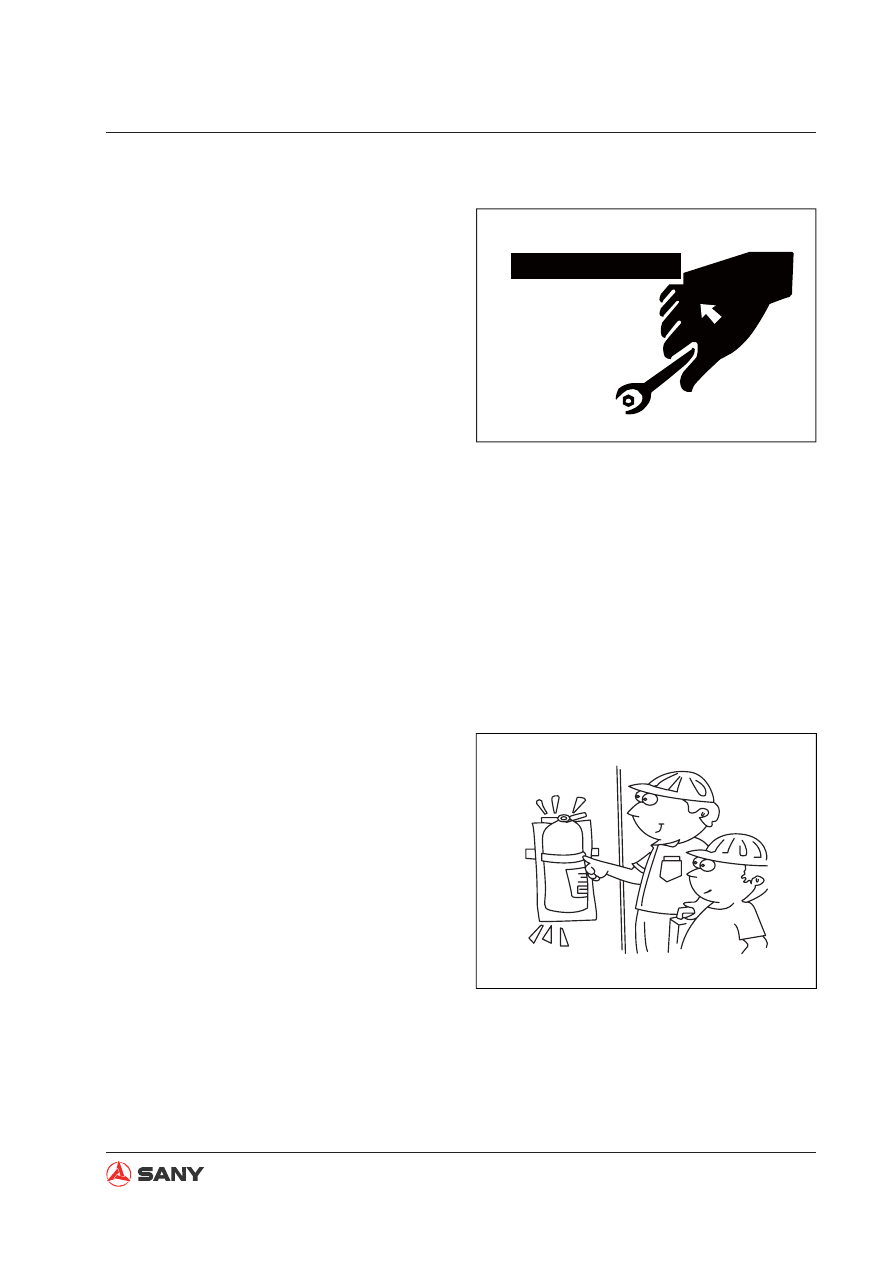
2.2.8  Using the Correct Tools

Always use the proper authorized tools for
the job. Using tools that are not authorized,
incorrect for the job, defective or damaged
could cause serious injury.

Keep all tools in good condition, learn the
correct way to use them.

Before starting the work, thoroughly check
the tools, machine, forklift, crane, service
car, etc.

Keep your tools clean, and when the job is
complete, take inventory of the tools you
were using to be sure no tools were left in
the machine.

Always put shop tools back in there proper
storage location when 

fi

 nished.

If welding repairs are needed, always have
a trained, experienced or certified welder
carry out the work.

2.2.9  Fire Extinguisher and Emergency 

Exits

It is important to know where all emergen-
cy exits and fire extinguishing equipment
are located if a fire should occur in the
shop.

Before preparing for work, take time and
walk around the shop to make a mental
note of where all exits and 

fi

 re  equipment

are located. If you are performing repairs
in the 

fi

 eld, always have a 

fi

 re extinguisher

handy and within reach.

If you do not know how to use a 

fi

 re extin-

guisher contact someone who can instruct
you in the proper use of this equipment.

ZX215-1000033

Fig. 2-8 

WX235R-1200006

Fig. 2-9 

2-10

Shop Safety

SY365(B)H-9 Crawler Hydraulic Excavator

2.2.11  Hoisting a Load

If you will be lifting parts or components that 
weigh more than 35 lbs (16 kg), it is important 
to follow some basic rules.


Always use the appropriate lifting equip-
ment such as hoist, crane, forklift etc. to 
handle a loads if possible.


Be sure the lifting equipment is in good 
condition and rated for the load you are 
about to lift.


If straps are to be used, ensure they are in 
good condition and rated for the load to be 
lifted with them.


If you must lift the load by hand, keep your 
back straight and parallel with the load, 
and lift the load using your leg muscles to 
avoid back injuries. Always ask for a lifting 
assistant.

2.2.10 Electrical Dangers


When testing electrical circuits, always be 
aware of what you will be checking in these 
systems. High voltage or high amp circuits 
could damage your equipment or cause a 
spark, explosion or possible 

fi

 re.


Before performing any repairs or testing on 
an electrical system be sure of the system 
voltage dangers. Always check the circuit 
to be sure it is off before performing any 
repairs.


When working around 

fl

 ammable liquids or 

explosive systems, use only approved anti-
explosion proof work lamps. Non-approved 
work lamps can cause an explosion or 

fi

 re.

Fig. 2-10 

Fig. 2-11 

2-11

Shop Safety

SY365(B)H-9 Crawler Hydraulic Excavator

2.3 Before Repair

2.3.1  Safe Work Preparations

Before starting any repairs, be sure the ma-
chine is sitting on a level stable surface.

Lower all the work equipment to a safe and 
stable position on the ground. Turn the engine 
OFF and neutralize the work equipment con-
trols by rotating them to the left and right (joy-
stick control) or moving them back and forth 
(lever control). This function will relieve system 
pressure.

Block the tracks (if equipped) or wheels (if 
equipped) with chocks to prevent the machine 
from moving.

If equipped, set the hydraulic lock lever in the 
LOCKED position. If equipped, set the parking 
brake in the PARK position.

Be sure all personnel and equipment is clear 
of your work area and you can be seen by all 
working personnel especially if performing re-
pairs in the 

fi

 eld.

Fig. 2-12 

2-12

Shop Safety

SY365(B)H-9 Crawler Hydraulic Excavator

2.3.2 Preparing yourself

Only approved personnel can maintain or 
repair the machine. An observer may be as-
signed if necessary. 

Wear protective clothing and shoes neces-
sary for the job.

Wear rubber apron and rubber gloves
when handling corrosive materials. Wear
heavy gloves when handling wooden ma-
terials, wire ropes or sharp-edged metals.

Wear a face shield when removing spring
or elastic parts, or adding acid to battery.
Wear safety hat and goggles when you
weld or cut with a torch.

Never carry out grinding, flame cutting or
welding without an aspirator and ventilation
equipment. If you have to weld on the ma-
chine, refer to related instructions and un-
derstand the correct operating procedure.

Fig. 2-13 

Fig. 2-14 

CZ335-1102069

CZ335-1102070

2-13

Shop Safety

SY365(B)H-9 Crawler Hydraulic Excavator

2.3.3 Lockout/Tagout

Due to the size and complexity of this ma-
chine, Lockout and Tagout procedures may 
be required by your company to ensure the 
safety of yourself and others involved in the 
repair process of the machine. While work 
is in progress, all power sources must be 
disabled, locked and tagged with a warning 
label. Lockout/Tagout procedure establishes 
the minimum requirements used to isolate all 
power sources from potentially hazardous en-
ergy, and to ensure that the machine is 

locked 

out and tagged out

 before anyone performs 

repairs on the machine.

Sequence of procedures

Only authorized employees performing repairs 
on the machine shall perform Lockout/Tagout 
in accordance with this procedure listed below.

If the employee performing repairs to the ma-
chine is issued a lock and key, the employee 
shall not share the lock or key with other em-
ployees until all repair procedures are com-
plete and the machine is ready to put back into 
service.

The following steps shall be performed in the 
sequence listed when the equipment is to be 
either locked-out or tagged-out for repair.

DO NOT

OPERA

TE

DANGER

Locking out of service

1. Notify all employees who may be poten-

tially affected by the repair process on the
machine.

2. Secure the machine in a safe position.

If equipped, set the parking brake or hy-
draulic lock lever in the PARK or LOCKED
position.

3. Identify, remove or disconnect all power

Fig. 2-15 

2-14

Shop Safety

SY365(B)H-9 Crawler Hydraulic Excavator

or energy sources and be sure to install 
a Lockout/Tagout device on them. If the 
machine is equipped with a Maintenance 
Alert Tag, attach this tag to the machine 
controls.

4.  Be sure all employees involved in the 

repairs have installed there lock on the 
power source before performing any 
repairs. Once an employee has completed 
there repair procedure, they must remove 
there lock and not access the machine in 
any manor.

Returning to service

1.  The authorized person who performed the 

Lock out/Tagout procedure shall check the 
area around the machine to ensure that no 
one is exposed to any hazard before start-
up.

2.  The authorized person who performed 

the Lock out/Tagout shall ensure that 
all guards have been reinstalled to their 
proper place, all tools and equipment have 
been removed and all locks are removed.

3.  The authorized person who performed the 

Lock out/Tagout shall verify that all controls 
are in the neutral or 

off

 position and 

all personnel are aware of the time the 
machine will be back in service.

4.  Remove the Lockout/Tagout equipment 

and any additional alert equipment and re-
energize the machine for return to service.

DANGER

DO NOT OPERATE

When this is not being used,
keep it in the storage compartment.

Fig. 2-16 

2-15

Shop Safety

SY365(B)H-9 Crawler Hydraulic Excavator

2.3.4  Two people when engine running

In order to prevent injury, do not perform the 
service while the engine is running. If the ser-
vice must be performed while the engine is 
running, operate only when two people are on 
the spot and follow the regulations below:

Always have one operator sit on the op-
eration seat and be ready to turn off the
engine at any time. All the operators must
keep in touch with each other.

Set the safety lock control lever to the lock
position.

Do not touch any control lever. If some
control lever must be operated, send signal
to other people and warn them to transfer
to safe place quickly.

Do not drop or insert the tools and other
objects into the fan or fan belt, or the parts
will be broken or thrown out.

2.3.5 Safety Partners

No one should be allowed to perform work 
operations in any shop alone. It should be a 
general shop safety rule for a minimum of two 
people in the shop area at all times when work 
procedures are performed. A person alone in 
the shop might not be able to get emergency 
help in the event of a shop accident.

When working together always maintain clear 
contact with each other at all times to avoid 
the occurrence of unexpected incidents.

When carrying out any operation with two or 
more workers, always agree on the operating 
procedures and signals before starting.

Fig. 2-17 

2-16

Shop Safety

SY365(B)H-9 Crawler Hydraulic Excavator

2.4 Repair Precautions

2.4.1  Running the Machine

Run the machine during repair procedures 
ONLY if directed to do so in this shop manual. 
If the machine must be run when making re-
pairs, it is important to follow some basic safe-
ty rules.


Always be aware of rotating components.


During repair operations while the engine 
is running, one worker must remain in the 
operator seat of the machine with clear 
contact between the person performing the 
repairs on the machine at all times.


If equipped, all lock levers must be in the 
LOCK position or the parking brake must 
be in the PARK position.


The person in the cab must never touch 
any controls. If a control lever must be op-
erated, always maintain a clear view to the 
person doing the repair and signal them 
when you are about to move the control le-
ver.


Be aware of hot surfaces. During running 
operations, most surfaces will be hot, and 
some surfaces will be extremely hot. If 
necessary, use personnel protective equip-
ment when working around high tempera-
ture surfaces.


Keep in mind that during running opera-
tions, hydraulic systems, cooling systems 
and fuel systems will be under extremely 
high pressure and at high temperatures.


Always use caution when working on or 
near these systems.

CZ335-1102077

CZ335-1102012

CC13031805

Fig. 2-18 

Fig. 2-19 

Fig. 2-20 

2-17

Shop Safety

SY365(B)H-9 Crawler Hydraulic Excavator

2.4.2  Mounting and Dismounting

It is important to follow these procedures when 
mounting or dismounting the equipment:


Use all hand-holds and step plates on your 
equipment.


Never jump off or onto the equipment.


Wipe off any oil, grease, or mud from your 
shoes, rails, steps or platforms before get-
ting on the equipment; always keep these 
areas clean and in good condition.


Never get on or off moving equipment. 
These actions may lead to serious injury. 
Always bring the equipment to a full stop 
and turn the engine OFF.


When getting on or off the equipment, 
always face the equipment and maintain 
a three-point contact (both feet and one 
hand or one foot and both hands) with the 
handrails, steps and platforms to ensure 
that you support yourself correctly.


Never climb on areas of the machine that 
are not designated walk areas.


Never climb on or off the machine with 
tools, parts or similar objects in your 
hands.


Never use machine controls or non-spec-
i

fi

 ed points on the equipment to get on or 

off the machine.


Use all hand-holds when on the machine.

Fig. 2-21 

Fig. 2-22 

2-18

Shop Safety

SY365(B)H-9 Crawler Hydraulic Excavator

2.4.3 Removing Attachments

If you will be removing large heavy attach-
ments from the machine, always be sure to
use the correct lifting equipment rated for
the capacity of the load you will be lifting.

After the attachment or part has been
removed, store it where it cannot fall or
move. Always be sure what you are stor-
ing is sitting stable on a stable surface and
clear of all walkways or 

fi

 re exits.

2.4.4  Jacking Up the Machine

If you will be working under the machine
always use approved jack stands that will
support the weight of the machine you are
working on.

Never rely on the hydraulics of the ma-
chine or a hydraulic jack to support the
machine during repairs.

Always lower the work equipment to the
ground and check the stability of the ma-
chine before going under the machine.

2.4.5  Adding Fluids to a System

If it should be necessary to add fluids to a 
system during running operations, always be 
aware that these systems may be hot and un-
der high pressure.

Before adding fluids, shut the machine down 
and allow the systems to cool down to outdoor 
ambient temperatures before removing any 
caps. Failure to do so may result in serious 
burns or a sudden loss of 

fl

 uid.

WX235R-1200009

Fig. 2-23 

CZ335-1102078

Fig. 2-24 

Fig. 2-25 

2-19

Shop Safety

SY365(B)H-9 Crawler Hydraulic Excavator

2.4.6  Aligning Parts or Components


Be careful when installing or aligning parts 
or components.


Avoid using your 

fi

 ngers or hands to posi-

tion holes or part mating surfaces, serious 
injury could result if your hand or fingers 
should get ought between the surfaces.


Always use tools to align a part or compo-
nent to avoid any 

fi

 nger or hand injuries.

2.4.7 Driving Pins

When using a hammer to drive pins, metal 
particles may 

fl

 y off. This may lead to serious 

eye injuries. Always do the following:


Always wear a face shield or goggles when 
striking a metal object with a metal ham-
mer.


Before performing any of these proce-
dures, be sure all personnel are clear of 
your work area.


If possible, avoid using a steel hammer to 
drive a component or pins in place. Dam-
age to the component may result. Always 
use a soft or non-ferrous hammer to drive 
a component or a pin.

2.4.8  When compressed air is used

When compressed air is used for cleaning, 

fl

 y-

ing particles may cause personal injury. In this 
case, wear goggles, dust-preventive mask, 
gloves and other protective gear.

WX235R-1200012

Fig. 2-26 

CZ335-1102069

Fig. 2-27 

2-20

Shop Safety

SY365(B)H-9 Crawler Hydraulic Excavator

2.4.9 Welding operation

There is possibility of 

fi

 re or electrocution dur-

ing welding. Therefore, welding must be per-
formed by qualified personnel with suitable 
equipment. Never allow other people to do the 
welding. 

2.4.10  Track Recoil Springs

If you are making repairs to a machine 
equipped with tracks, always be aware of the 
dangers involved with track recoil springs. This 
spring is under extreme pressure at all times. 
If it is disassembled by mistake, the spring 
may 

fl

 y out and cause serious injury.

Be careful when removing or installing tracks 
on track-type machines. When removing the 
master track link the track system may sepa-
rate suddenly and cause possible injury.

Always stand clear of the track travel path 
when separating the master link section of the 
track.

CZ335-1102070

Fig. 2-28 

Fig. 2-29 

2-21

Shop Safety

SY365(B)H-9 Crawler Hydraulic Excavator

2.4.11  High-Pressure Fluid Lines

Always keep in mind that these systems are 
under high pressure. When inspecting or re-
placing piping or hoses, always check to be 
sure the pressure in the system has been 
relieved before proceeding. Working on a sys-
tem still under pressure could lead to serious 
injury, always do as follows:

If you will be removing a line or component
with fluid in the system, always cap and
seal the opening to avoid leakage or sys-
tem contamination.

Never carry out inspections or replace
items while the system is under pressure.

Never use any part of your body to check
or feel for leaks. Always wear safety
glasses and leather gloves when checking
for leaks and use a piece of wood or card-
board when checking for leaks from small
holes.

If high pressure fluids should penetrate
your skin or get into your eyes, seek medi-
cal attention immediately.

CZ335-1102082

Fig. 2-30 

2-22

Shop Safety

SY365(B)H-9 Crawler Hydraulic Excavator

2.4.12  Air-conditioning system maintenance


Keep 

fi

 re source away when servicing air-

conditioning system.


In maintenance of air-conditioning system, 
observe the instruction on the refrigerant 
cylinder and use it correctly. The type of 
refrigerant is R134a. Use of other refriger-
ants may damage the air-conditioning sys-
tem.


Obey local material disposal regulations. 
Never discharge refrigerant directly into the 
air.

2.4.13  High voltage precautions

You must understand the elements before 
testing electric circuit. High voltage or current 
could lead to machine damage, spark, explo-
sion or 

fi

 re. 

You must know the voltage before repairing 
or testing electrical system. Always check the 
circuit and make sure it is disconnected before 
doing repair job. 

Only explosion-proof light can be used when 
you work near flammable fluids or explosive 
system. Unapproved illumination equipment 
could lead to explosion or 

fi

 re. 

CZ335-1102083

Fig. 2-31 

  WARNING


Refrigerant R134 a is a harmless gas 
under room temperature. It will change 
into highly toxic gas when burning.


Refrigerant getting into eyes may cause 
blindness. It may cause frostbite if 
splashed on your skin. 

CZ335-1102084

Fig. 2-32 

2-23

Shop Safety

SY365(B)H-9 Crawler Hydraulic Excavator

2.4.14  Disconnecting the System 

Power

Before starting any repair operations, remove 
the battery leads from the battery or set the 
main disconnect on the machine in the OFF 
position.

For the location of the machine main electri-
cal disconnect switch, refer to the machines 
Safety, Operation & Maintenance Manual for 
location and procedures.

If the battery must be disconnected, remove 
the negative (-) terminal clamp first then re-
move the positive (+) clamp last.

When reconnecting the battery, be sure every 
electrical system switch is in the OFF position, 
connect the positive clamp (+) first, then the 
negative clamp(-) last.

2.4.15 Accumulator

If the machine is equipped with an accumula-
tor charged with high-pressure nitrogen gas, it 
is important to follow these basic precautions.

Do not disassemble the accumulator.

Never expose the accumulator to high heat
or open 

fl

 ames.

Never weld on the accumulator.

Never drill or cut on the accumulator.

Never strike the accumulator.

Use only nitrogen gas to charge the ac-
cumulator. Unapproved gases could be
explosive.

Fig. 2-33 

CZ335-1102085

Fig. 2-34 

2-24

Shop Safety

SY365(B)H-9 Crawler Hydraulic Excavator

2.4.17 Battery Hazards

Working around batteries always poses a haz-
ard, especially if the battery has been in ser-
vice for a long period of time.

Listed below are some basic precautions to 
be aware of when servicing or working around 
batteries.

Always wear personal protective equip-
ment when working around batteries.

Battery gasses are extremely explosive.
When opening a battery compartment, al-
ways allow ample time for the gasses to
escape before servicing the battery.

When working with batteries, always work
in a well ventilated area.

If the battery is corroded, flush the area
with a baking soda and warm water mix.

If battery acid should get on your skin or in
your eyes, 

fl

 ush the area immediately with

fresh water and seek medical attention.

CZ335-1102061

Fig. 2-35 

CZ335-1102062

Fig. 2-36 

CZ335-1102083

Fig. 2-37 


Content      ..     2      3      4      5     ..