CG958G Wheel Loader. Manual - part 13
 

  Index      loaders     SICHUAN CHENGDU CHENGGONG CG958G Wheel Loader - service manual


Search            


Content   ..  11  12  13  14   ..


CG958G Wheel Loader. Manual - part 13


- 56 - 

IX. Safe Transportation


9.1 Loading and Unloading of Loader 

  Danger always exitsts in loading and unloading of 

loader, which should be conducted very carefully. 

When loading and unloading, loader engine 

should be running at a low rpm, and loader should 

be traveling at a low speed. 

  Loading and unloading must be conducted on firm and level ground with safe distance from roadsides 

being properly kept. 

  Tires of carrying vehicle must be fixed during loading and unloading of loader to ensure that carrying 

vehicle will not move. Cushion blocks should be placed under gangboards. 

  Gangboards used must have adequate strength with sufficient width and length to provide a safe slope 

for loading and unloading. The angle between gangboards and the ground should not exceed 15º, while 

spacing between gangboards should be adapted to wheel track of loader. 

  Make sure that gangboards are firmly positioned with the same height on both sides. 

  Make sure that gangboard surfaces are clean and free of lubricant, oil stain, ice and loose materials. 

Clean loader tires to remove dirt if any. 

  Never steer a loader on gangboards. If necessary, reverse the loader to get off gangboards, and then 

adjust direction before driving onto gangboards. 

  After the loader gets onboard, lock its steering mechanism and wedge the tires, then tie down the loader 

with ropes. 

9.2 Road Transportation 

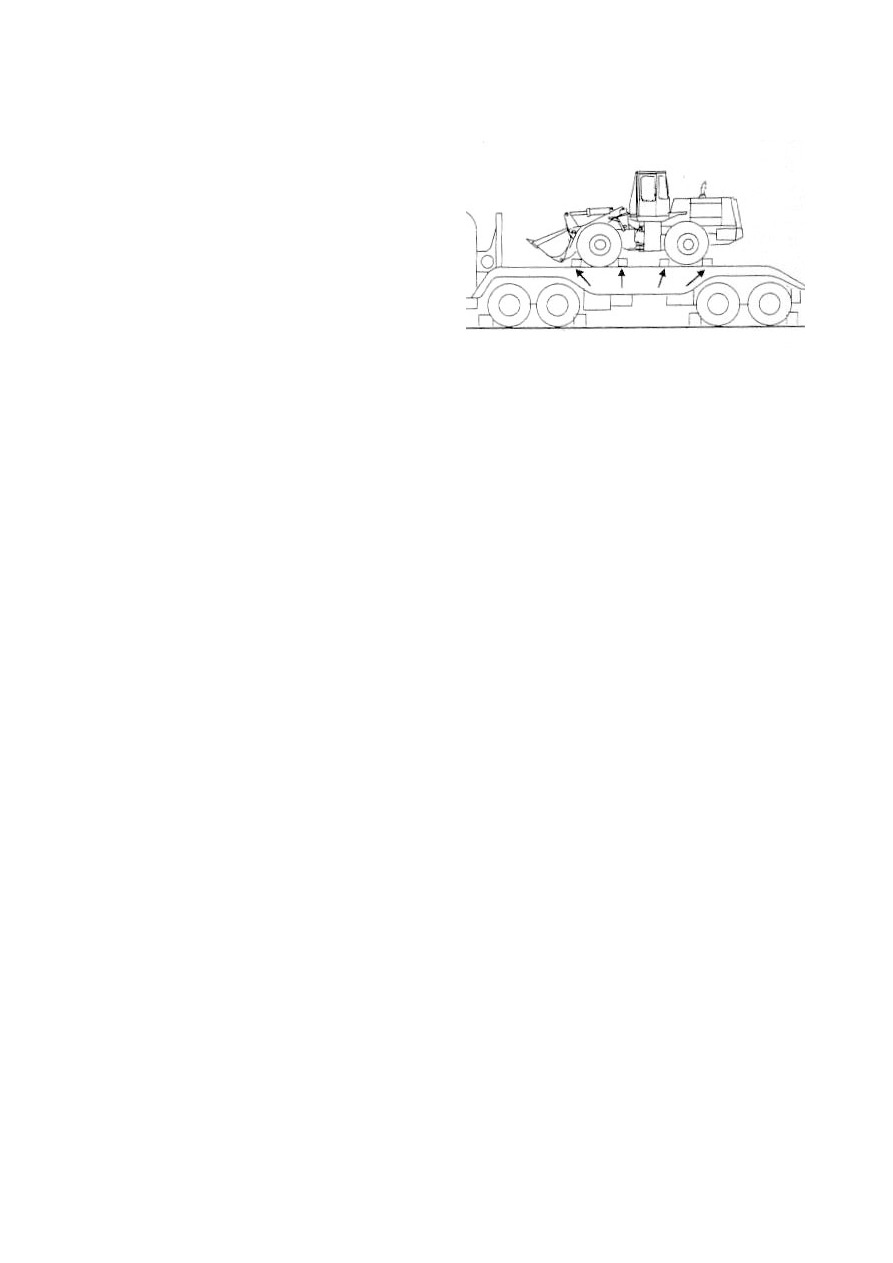
  In case the loader is towed by a trailer, provisions in national and local laws on weight, height, width and 

length must be observed. All related traffic regulations should be observed as well. 

  Weight, height, width and length of loader should be taken into consideration when deciding 

transportation route. 

  When passing bridges or constructions on a private premise, first check to see if whether such bridge or 

construction has an adequate strength to carry the weight of loader. When running on public roads, all 

related provisions must be understood and observed. Height of passages on transportation route should 

- 57 - 

be surveyed to see whether the height is sufficient for a cabbed loader to go through. 

  When other means of transportation are to be used, the loader may need to be disassembled. Please 

contact Chengdu Chenggong Construction Machinery Co., Ltd. Sichuan or authorized dealers for details. 

  Slippage of loader in transportation or transfer should be avoided. Ice or other slippery substances on 

dock or train wagon must be cleared. 

9.3 Running 

Consult tire supplier on pressure and speed limit of 

tires. 

Inflate tires to a proper pressure value. 

Use a self holding inflating nozzle and always stand 

aside when inflating a tire. Refer to instructions on 

“Tire Inflation”. 

Add engine coolant, engine oil and gearbox oil to a proper level. 

Running of loader is subject to inspection by competent officials for approval if necessary. 

The loader should be running at a medium speed, and attention should be paid to all speed limit 

signs when running. 

Always carry out in-process inspection and check liquid 

levels in all parts. 

9.4 Lifting 

Lifting instruction is only applicable to short-time lifting of loader 

in short distance during the shipment of loader. Do not lift the 

loader for a long time when maintaining or servicing the loader, otherwise accident may occur to cause 

personal injury and death. 

CAUTION 

Incorrect lifting may cause deviation of the loader and lead to personal injury or death 

and other losses. 

1 Weight and instructions given below only apply to 

CG958G wheel loader manufactured by Chenggong. 

Weight of CG958G is 17,200kg. 

- 58 - 

2 Crane beam should be long enough to avoid contact with the loader. 

3 Holes in front and rear frames (two holes each) designed for lifting should be used. 

Tie down the loader in different positions and wedge all tires. 

Refer to local regulations on lifting weight, width and length. 

For shipment of loader please contact Chenggong. 

Correct lifting: 

  Make sure that fixing rods on both front and rear frames are set to “Fixed” position to avoid relative 

turning of frames when lifting. 

  All control levers should be placed in neutral position. No person is allowed to stay in the cab. 

  Shut down engine and lock all equipment with keys before taking off keys. Close and lock right window 

and left door of the cab. 

  Make sure that there is no obstacles or persons in the range of lifting operation. 

  Make sure that wire ropes and hooks have adequate strength. A crane must be used for horizontal lifting 

of the loader. 

  Firmly connect wire ropes or hooks with ears marked for lifting on front and rear frames. 

  Personal entry into areas under the loader or within the range of lifting operation is strictly prohibited. 

  When lifting a loader onto a transportation vehicle or vessel, the loader must be properly fixed with wire 

ropes with all tires firmly wedged by wood blocks to avoid unexpected movement of loader during 

transportation. 


After the lifting is complete, always remember to retract fixing rods before steering the loader.


Holes for hooks 

- 59 - 

X. Trailer 

WARNING 

Incorrect towing of loader out of service may cause personal injury and death. 

Loader tires must be wedged before releasing brakes to avoid loader movement. In case 

tires are not properly wedged, consequential movement of the loader may case personal 

injury or death and other losses. 

Loader should be properly towed as per the following instructions. 

Note that these instructions are applied only in emergencies to tow a loader out of service when 

moving distance is within several meters and the speed is no higher than 2km/h to trail the 

machine to service area. For long-distance move a transporting van will be needed. 

The trailer should have a shield to protect operator in case towing line or towing lever breaks. 

Machine to be towed is not allowed to carry people unless an operator is necessary to control 

direction or brake. 

Make sure that the towing line or towing lever is in good order and has adequate strength to 

pull the machine before operation. The towing line or towing lever should be capable of towing 

a weight that is 1.5 times of machine gross weight to pull the machine out of mud or over a 

slope. 

The towing line angle should be minimized: the angle between towing line and dead-ahead 

direction should not exceed 30º. 

Too fast machine movement will break towing line or towing lever. Slow and smooth machine 

movement will facilitate the operation. 

Generally the trailer should be equipped with adequate brake capacity, weight and power to 

control the upward movement of both vehicles on slopes and the traveling distance thereof. 

The machine should be followed by a larger trailer or other equipment when going down a 

slope, so as to provide adequate control and braking capacity and prevent the machine from 

being out of control and rolling down. 

For example, a smaller trailer is sufficient in towing the loader on level and smooth road 

surfaces while a larger trailer is necessary for sloped roads with bad surface conditions. 

Specific instructions for various situations are not to be further described here. 

For more information on towing a loader out of service please contact Chenggong. 


Content   ..  11  12  13  14   ..