Kawasaki Diesel MULE 4010 TRANS 4x4 (KAF950G9). Manual - part 138
 

  Index      Engines     Kawasaki Diesel MULE 4010 TRANS 4x4 (KAF950G9) - service manual


Search            


Content   ..  136  137  138  139   ..


Kawasaki Diesel MULE 4010 TRANS 4x4 (KAF950G9). Manual - part 138


18-30 APPENDIX

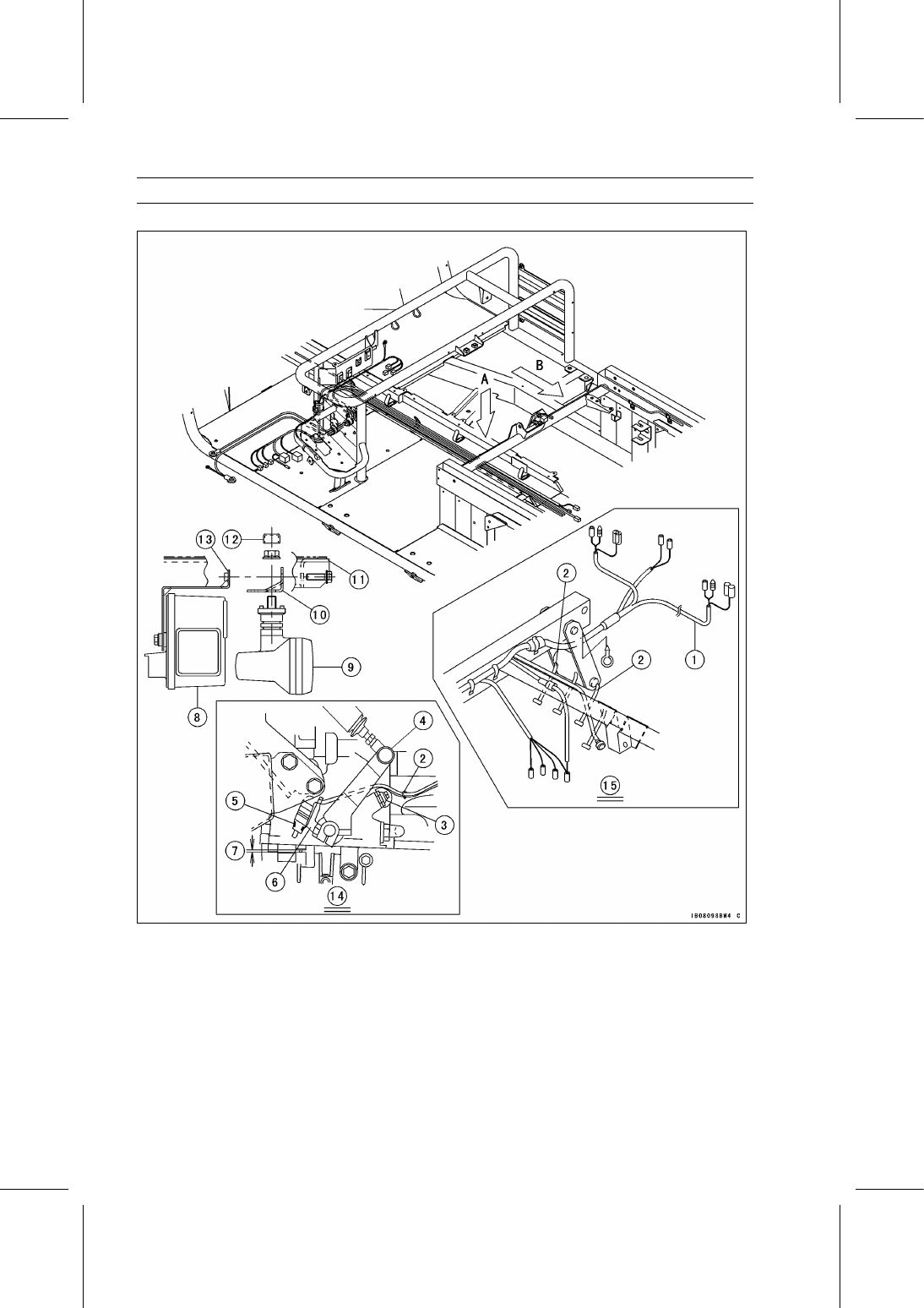
Cable, Wire, and Hose Routing

EUR Model

1. Tail/Brake Light Lead
2. Band
3. Neutral Switch
4. Shift Lever
5. Reverse Switch
6. Switch Holder
7. Clearance: 1

∼ 2 mm (0.04 ∼ 0.08 in.)

Adjust the switch location to this clear-
ance in shift lever working condition.

8. Tail/Brake Light
9. Reverse Light

10. Bracket

11. Cargo Bed

12. Cap
13. Bracket
14. View A
15. View B

APPENDIX 18-31

Troubleshooting Guide

NOTE

This is not an exhaustive list, giving every
possible cause for each problem listed. It
is meant simply as a rough guide to assist
the troubleshooting for some of the more
common difficulties.

Engine Doesn’t Start, Starting Difficulty:

Starter motor not rotating:

Neutral switch trouble
Starter motor trouble
Battery voltage low
Relays not contacting or operating
Wiring open or shorted
Main switch trouble
Fuse blown

Starter motor rotating but engine doesn’t
turn over:

Starter motor trouble
Pinion or ring gear worn

Engine won’t turn over:

Valve seizure
Rocker arm seizure
Cylinder, piston seizure
Crankshaft seizure
Connecting rod small end seizure
Connecting rod big end seizure
Camshaft seizure

No fuel flow:

No fuel in tank
Fuel tank air vent obstructed
Fuel injection pump trouble
Fuel filter clogged
Fuel line clogged

Compression low:

Fuel injection nozzle loose
Glow plug loose
Cylinder head not sufficiently tightened

down

No valve clearance
Cylinder, piston worn
Piston rings bad (worn, weak, broken, or

sticking)

Piston ring/groove clearance excessive
Cylinder head gasket damaged
Cylinder head warped
Valve spring broken or weak
Valve not seating properly (valve bent,

worn, or carbon accumulation on the
seating surface)

Poor Running at Low Speed:

Fuel/air mixture incorrect:

Air cleaner clogged, poorly sealed, or miss-

ing

Fuel tank air vent obstructed
Fuel injection pump trouble

Compression low:

Fuel injection nozzle loose
Glow plug loose
Cylinder head not sufficiently tightened

down

No valve clearance
Cylinder, piston worn
Piston ring bad (worn, weak, broken, or

sticking)

Piston ring/groove clearance excessive
Cylinder head gasket damaged
Cylinder head warped
Valve spring broken or weak
Valve not seating properly (valve bent,

worn, or carbon accumulation on the
seating surface)

Other:

Engine oil viscosity too high
Front final gear case oil viscosity too high
Drive train trouble
Brake dragging

Poor Running or No Power at High Speed:

Fuel/air mixture incorrect:

Air cleaner clogged, poorly sealed, or miss-

ing

Fuel tank air vent obstructed
Fuel line clogged
Fuel injection pump trouble

Compression low:

Fuel injection nozzle loose
Glow plug loose
Cylinder head not sufficiently tightened

down

No valve clearance
Cylinder, piston worn
Piston ring bad (worn, weak, broken, or

sticking)

Piston ring/groove clearance excessive
Cylinder head gasket damaged
Cylinder head warped
Valve spring broken or weak
Valve not seating properly (valve bent,

worn, or carbon accumulation on the
seating surface)

Knocking:

Carbon built up in combustion chamber
Fuel poor quality or incorrect

18-32 APPENDIX

Troubleshooting Guide

Miscellaneous:

Brake dragging
Overheating
Engine oil level too high
Engine oil viscosity too high
Front final gear case oil viscosity too high
Drive train trouble

Overheating:

Fuel/air mixture incorrect:

Air cleaner clogged, poorly sealed, or miss-

ing

Compression high:

Carbon built up in combustion chamber

Engine load faulty:

Engine oil level too high
Engine oil viscosity too high
Drive train trouble
Brake dragging

Converter and/or belt excessive heating:

Belt dirty or worn
Drive or driven pulley sheave dirty or worn
Driven pulley spring broken or weak
Drive pulley spring broken or weak
Idle speed too high
Converter fan damaged

Lubrication inadequate:

Engine oil level too low
Engine oil poor quality or incorrect

Front final gear case overheating:

Insufficient oil
Bevel gears maladjusted
LSD clutches maladjustment

Coolant incorrect:

Coolant level too low
Coolant deteriorated
Wrong coolant mixed ratio

Cooling system component incorrect:

Radiator clogged
Thermostat trouble
Radiator cap trouble
Radiator fan switch trouble
Fan motor broken
Fan blade damaged
Water pump not turning
Water pump impeller damaged

Over Cooling:

Radiator fan switch trouble
Thermostat trouble

Converter Operation Faulty:

Belt slipping:

Belt dirty, or worn
Drive or driven pulley sheave dirty or worn

Driven pulley spring broken or weak

Converter engagement speed too low:

Drive pulley spring broken or weak

Converter engagement speed too high:

Belt drive or worn
Drive or driven pulley sheave dirty or worn
Drive pulley weight doesn’t move smoothly
Drive pulley movable sheave doesn’t move

smoothly

Drive or driven pulley movable sheave bush

worn

Drive pulley weight or roller worn

Shifting too quickly:

Drive pulley spring weak
Driven pulley spring weak or incorrectly in-

stalled (too loose)

Shifting too slowly:

Belt dirty or worn
Drive or driven pulley sheave dirty or worn
Drive pulley weight doesn’t move smoothly
Drive pulley movable sheave doesn’t move

smoothly

Driven pulley spring incorrect installed (too

tight)

Driven pulley movable sheave doesn’t

move smoothly

Gear Shifting Faulty:

Doesn’t go into gear:

Shift arm bent or seized
Gear stuck on the shaft
Shift cable maladjusted
Shift cable lubrication inadequate
Shift cable damaged

Jumps out of gear:

Shifter groove worn
Gear dogs worn
Shift arm positioning bolt spring weak or

broken

Shift block worn
Transmission shaft, and/or gear splines

worn

Shift cable maladjusted

Overshifts:

Shift arm positioning bolt spring weak or

broken

Shift cable maladjusted

Abnormal Engine Noise:

Knocking:

Carbon built up in combustion chamber
Fuel poor quality or incorrect
Fuel injection nozzle incorrect
Overheating

APPENDIX 18-33

Troubleshooting Guide

Piston slap:

Cylinder/piston clearance excessive
Cylinder, piston worn
Connecting rod bent
Piston pin, piston pin hole worn

Valve noise:

Valve clearance incorrect
Valve spring broken or weak
Camshaft bearing worn
Rocker arm push rod runout excessive

Other noise:

Connecting rod small end clearance exces-

sive

Connecting rod big end clearance exces-

sive

Piston ring worn, broken, or stuck
Piston seizure or damaged
Cylinder head gasket leaking
Exhaust pipe leaking at cylinder head con-

nection

Crankshaft runout excessive
Engine mount loose
Crankshaft bearing worn
Cooling fan belt loose

Abnormal Drive Train Noise:

Converter noise:

Belt worn
Drive or driven pulley sheave worn
Drive or driven pulley movable sheave bush

worn

Drive or driven pulley mount loose
Driven pulley shoe worn
Drive pulley weight or roller side washer

worn

Drive pulley weight or roller worn

Transmission noise:

Bearings worn
Transmission gear worn or chipped
Metal chips jammed in gear teeth
Transmission oil insufficient

Final drive noise:

Bearing worn
Gears worn or chipped
Metal chips jammed in gear teeth
Insufficient lubricant
Bevel gears maladjusted
LSD clutch friction plate worn
LSD clutch spring worn
Universal joint damaged

Abnormal Frame Noise:

Shock absorber noise:

Shock absorber damaged

Brake noise:

Brake linings overworn or worn unevenly

Drum worn unevenly or scored
Brake spring(s) weak or broken
Foreign matter in hub
Brake not properly adjusted

Other noise:

Bracket, nut, bolt, etc.

not properly

mounted or tightened

Exhaust Smokes Excessively:

White smoke:

Piston oil ring worn
Cylinder worn
Valve oil seal damaged
Valve guide worn
Engine oil level too high

Black smoke:

Air cleaner clogged

Brown smoke:

Air cleaner poorly sealed or missing

Handling and/or Stability Unsatisfactory:

Steering wheel hard to turn:

Steering shaft bearing damaged
Steering shaft lubrication inadequate
Steering shaft bent
Steering gear assembly damaged
Tire air pressure too low
LSD clutch maladjusted
EPS unit trouble
EPS ECU trouble

Noise when turning:

Damaged side gear or pinion (front final

gear case)

Worn clutch friction plate (front final gear

case)

Worn clutch spring (front final gear case)
ESP unit mount loose

Steering wheel shakes or excessively
vibrates:

Tire(s) worn
Suspension arm bushing worn
Tie-rod joint worn
Wheel rim warped
Axle shaft bearing worn
Steering wheel mount loose
Steering bolt or nut loose

Steering wheel pulls to one side:

Frame bent
Wheel misalignment
Suspension arm bent or twisted
Steering shaft bent
Steering gear assembly damaged
Front or rear tire air pressure unbalanced
Shock absorber unbalanced


Content   ..  136  137  138  139   ..