BBM DIESEL 1500cc MODEL ZERO-TURN MOWER. Manual - part 5
 

  Index      Engines     BBM DIESEL 1500cc MODEL ZERO-TURN MOWER - service manual


Search            


Content   ..  3  4  5  6   ..


BBM DIESEL 1500cc MODEL ZERO-TURN MOWER. Manual - part 5


PAGE 


18

MOWING TIPS:

• Mow header strips at the ends of the lawn and around flower beds first. Make them wide enough that you can turn the mower

around in the already mown section. Then mow back and forth between these header strips overlapping each lap by about 1/8
the width of the mower’s deck.

• Don’t cut your grass too short, particular for cool season grasses. Higher heights usually provide for a deeper root system,

looks better, and is less likely to have weeds invading, particularly crabgrass.

• Don’t remove any more than one third of the grass leaf at any one cutting. If circumstances arise that a lawn gets too tall and

you just have to lop off a bunch to get caught up, bite the bullet and break it down into several mowings to get caught up with 3
or so days between cuttings.

NEVER SCALP YOUR LAWN. Scalping severely damages the root system to such a degree that it may die.

• Avoid mowing when the grass is wet or when it’s dark
• Avoid throwing grass clippings into the street and driveway where they can be washed into the sewer system. After mowing,

clean up driveway and walkways.

• When mowing remove only a third with each cutting (except for the first mowing of the season when it’s ok to remove more).

You can safely leave clippings that will quickly decompose and add nutrients back into the soil. Contrary to popular opinion,
grass clippings do not add to thatch buildup. Grass blades are made up of about 75% water.

• Mow your lawn in a different direction with each mowing, especially with lawns of shorter grass types. Altering the direction

ensures a more even cut since grass blades will grow more erect and less likely to develop into a set pattern.

• Keep your mower’s blade sharp, which means having it sharpened several times during the mowing season. Keep several

blades around so you’ll always have a sharp one on hand. Sharp blades cut the grass cleanly and help mulch clippings into
small pieces which break down quickly.

• Don’t forget to change your mower’s oil at least once during the mowing season. For brand new mowers, change the oil after

about 5 hours of operation during the initial break-in period.

• At the end of the mowing season use a fuel stabilizer in the remaining diesel.
• In the spring, don’t use that old gas unless you properly used a fuel stabilizer, it can cause a number of problems. Better to use

fresh gasoline to begin the new mowing season.

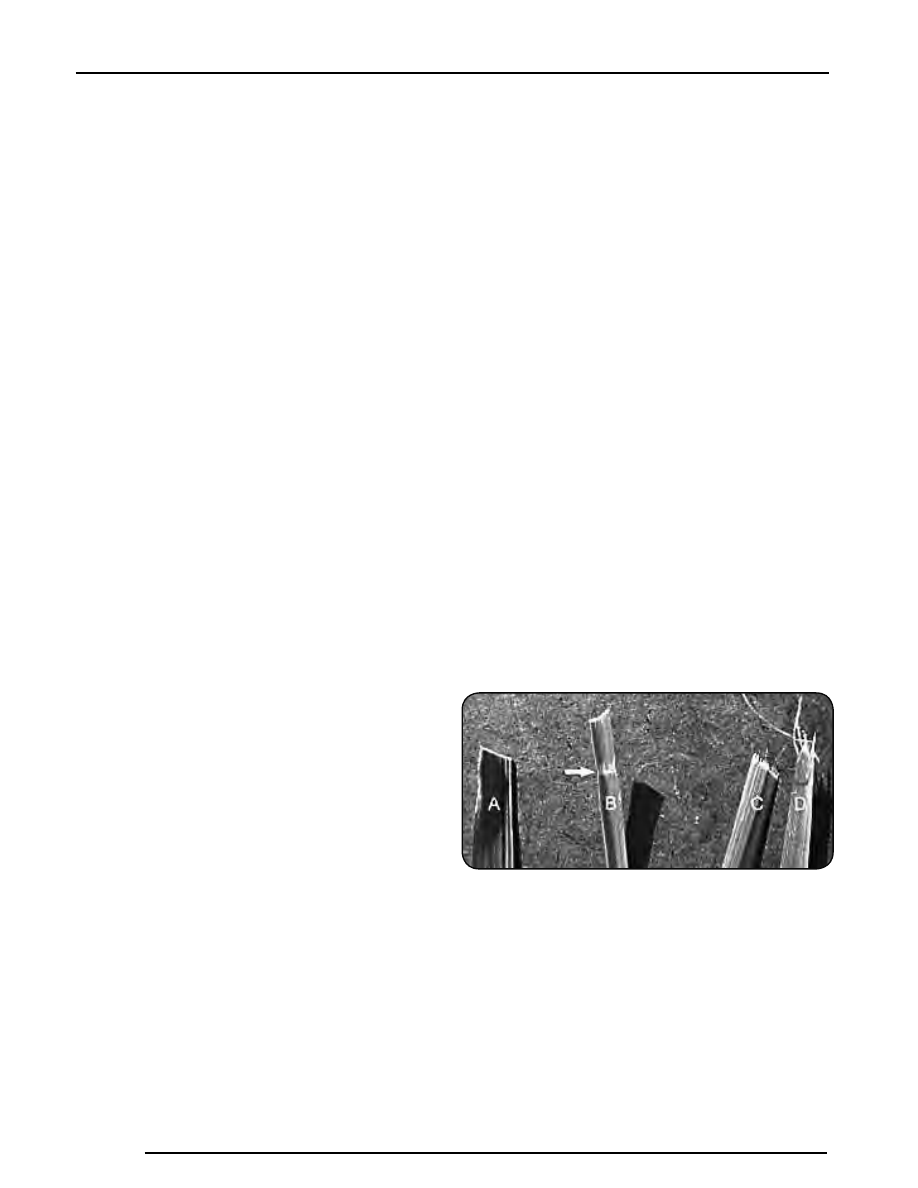
Leaf blade A demonstrates what a leaf blade should look like

after mowing with a sharp blade.

Leaf blade B demonstrates a leaf blade that was injured by a

dull mower blade.

Leaf blade C was cut by the mower but indicates that the

mower blade is not sharp enough. The shredded white tissue
protruding from the leaf blades C and D is the vascular tissue
of the plant.

Leaf blade D has been mown for quite some time with a dull mower blade.

To bag or mulch?

Grass clippings do not contribute to thatch buildup or increase the chances of disease. If you mow your lawn at the right height, 

without removing any more than 1/3 of it’s total height, clippings will quickly breakdown without a trace. These clippings 
contribute additional nitrogen and other nutrients to the soil and supply it with additional organic materials. Clippings from a 
1000 sq. ft. lawn can add as much as 1 - 2 pounds of nitrogen back into the soil.

If you have a compost pile, then you may want to bag your clippings occasionally to add much needed green-matter to the 

compost pile. Make sure it is mixed thoroughly with brown matter to avoid a strong ammonia odor. 

DO NOT COMPOST 

CLIPPINGS after applying any weed control or weed-feed type product. Before adding clippings to the compost pile wait at 
least 3 mowings after these products have been applied.

PAGE


19

SERVICE SECTION

SECTION 1: HYDROSTATIC SYSTEM

The hydraulic reservoir tank on the Diesel 1500cc model 

is located under the seat. There is a dipstick that 

indicates the current hydraulic oil level. Use only 20W-50 

motor oil in this tank.  Conventional or synthetic oil may 

be used. Bad Boy Hydrostatic Oil is recommend. Bad 

Boy recommends that the hydraulic oil and filters be 

changed within the first 50 hours of use; then at intervals 

of 250 usage hours. Use only Bad Boy replacement 

filters. Use of any other filters may result in damage to 

the hydraulic system and void the warranty. Each side 

requires approximately two quarts of oil to refill the 

system. 

THE FOLLOWING MAINTENACE IS TO BE PERFORMED 
ON A LEVEL SURFACE

.

Changing your hydraulic oil and filters: 

1)

Place an oil drain pan under the engine plate and 

place the hydraulic return lines that goes into the 

hydraulic reservoir tank into the oil pan. Remove 

the caps from the hydraulic reservoir tank.

2)

Start the engine in order to cycle out the old 

hydraulic oil.

3)

When you see air bubbles in the hydraulic lines 

immediately shut off the mower. Keep in mind 

that only 75-80% of the hydraulic oil can be 

changed at a time.

4)

Place rags under the hydraulic filters. Turn the 

hydraulic filters counter clockwise to remove.

5)

Fill the new hydraulic oil filters with 20W-50 

motor oil. Only use Bad Boy replacement filters.

6)

Place the hydraulic return lines back onto the 

hydraulic reservoir tank. Fill the hydraulic 

reservoir tank until the oil level reaches the 

bubble on the dipstick. Be careful not to overfill 

the hydraulic reservoir tank.

7)

Proceed to the purge procedure. 

PAGE 


20

Purging Procedure: 

Due to the effects air has on the efficiency in hydrostatic 
drive applications, it is critical that the air is purged from the 
system. These purge procedures should be implemented 
any time a hydrostatic system has been opened to facilitate 
maintenance or any additional oil has been added to the 
system. 

1) Lift the rear tires of the mower off of the ground and 

chock your front tires so they do no move.

2) With the bypass valve open and the engine running, 

slowly move the directional drive arms in the forward 
and reverse directions (5 to 6 times), as air is purged 
from the unit, the oil level will drop.

3) With the bypass valve closed and the engine 

running, slowly move the directional drive arms in the 
forward and reverse directions (5 to 6 times). Check 
the oil level, and add oil as required after stopping 
the engine.

4) It may be necessary to repeat steps 2 and 3 until all 

the air is completely purged from the system. When 
the transaxle moves forward and reverse at normal 
speed purging is complete. 

PAGE


21

SECTION 2: DRIVE BELT

Shown on the right is the tensioner for your pump belt. 
Adjusting this will either increase or decrease tension on 
the belt. Use a ¾” wrench to loosen the jam nuts and 
either tighten for more belt tension or loosen for less belt 
tension. 

The belt tension should be set to 70-75 lbs. 

Use a belt tension gauge to ensure the proper tension. 
Your dealer or service center will have a belt tension 
gauge or you can buy one (Part Number 041-9999-00).

SECTION 3: ENGINE

On the right is an overview of the 1500cc Diesel Engine. 
To access the engine remove the knob on top of the 
engine cover plate. The oil drain plug is located on the 
bottom of the engine. Bad Boy recommends that the oil 
and filter be changed after the initial first 8 hrs of use, 
and at intervals of 250 usage hours or yearly, whichever 
occurs first after that. The oil capacity is approximately 
5.91 quarts. Diesel Engine Oil 15W-40 is recommended 
for maximum protection.


Content   ..  3  4  5  6   ..