Yanmar marine engine 6LPA-STP2, 6LPA-STZP2. Manual - part 7
 

  Index      Engines     Yanmar marine engine 6LPA-STP2, 6LPA-STZP2 - service manual


Search            


Content   ..  5  6  7  8   ..


Yanmar marine engine 6LPA-STP2, 6LPA-STZP2. Manual - part 7


BEFORE YOU OPERATE

6LPA Series Operation Manual

27

12/05

• Even biodiesel fuels that comply with a 

suitable standard as delivered will 
require additional care and attention to 
maintain the quality of the fuel in the 
equipment or other fuel tanks. It is 
important to maintain a supply of clean, 
fresh fuel. Regular flushing of the fuel 
system, and / or fuel storage containers, 
may be necessary.

• The use of biodiesel fuels that do not 

comply with the standards as agreed to 
by the diesel engine manufacturers and 
the diesel fuel injection equipment 
manufacturers, or biodiesel fuels that 
have degraded as per the precautions 
and concerns above, may affect the 
warranty coverage of your engine.

Additional Technical Fuel 
Requirements

• The fuel cetane number should be 45 or 

higher.

• The sulfur content must not exceed 0.5% 

by volume. Less than 0.05% is preferred.

• NEVER mix kerosene, used engine oil or 

residual fuels with the diesel fuel.

• Water and sediment in the fuel should 

not exceed 0.05% by volume.

• Keep the fuel tank and fuel-handling 

equipment clean at all times.

• Ash content not to exceed 0.01% by 

volume.

• Carbon residue content not to exceed 

0.35% by volume. Less than 0.1% is 
preferred.

• Total aromatics content should not 

exceed 35% by volume. Less than 30% 
is preferred.

• PAH (poly cyclic aromatic hydrocarbons) 

content should be below 10% by volume.

• Do not use Beside.

• Do not use kerosene or residual fuels.

Handling of Diesel Fuel

WARNING

Fire and Explosion Hazard. 
Only fill the fuel tank with diesel fuel. 
Filling the fuel tank with gasoline may 
result in a fire and will damage the 
engine. NEVER refuel with the engine 
running. Wipe up all spills immediately. 
Keep sparks, open flames or any other 
form of ignition (match, cigarette, static 
electric source) well away when 
refueling.

Fire and Explosion Hazard. 
ALWAYS put the diesel fuel container 
on the ground when transferring the 
diesel fuel from the pump to the 
container. Hold the hose nozzle firmly 
against the side of the container while 
filling it. This prevents static electricity 
buildup which could cause sparks and 
ignite fuel vapors.

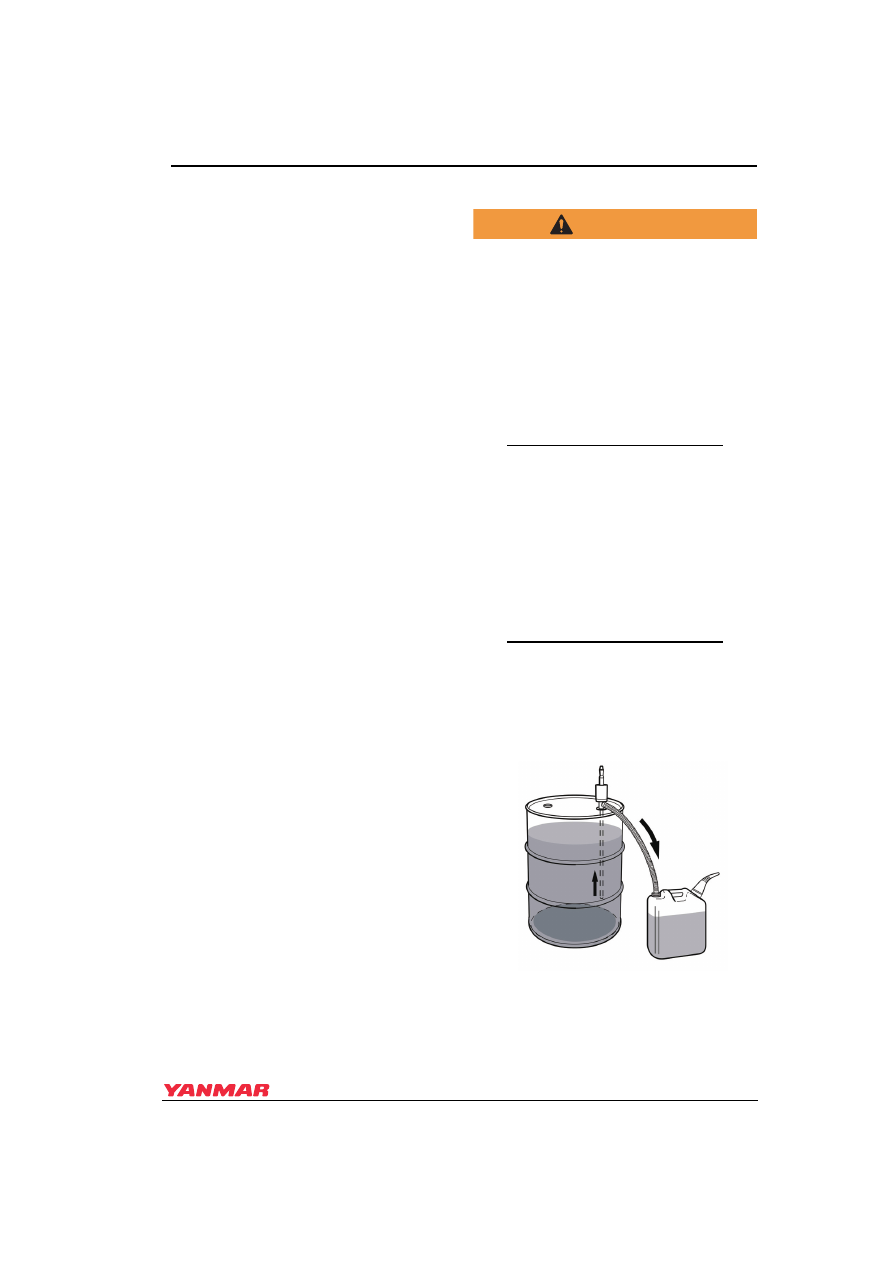
1. Water and dust in the fuel may cause 

engine failure. When fuel is stored, be 
sure that the inside of the storage 
container is clean and dry, and that the 
fuel is stored away from dirt or rain.

 Figure 1

Figure 1 

0004512

BEFORE YOU OPERATE

28

6LPA Series Operation Manual

2. Keep the fuel container stationary for 

several hours to allow any dirt or water 
to settle to the bottom of the container. 
Use a pump to extract the clear, filtered 
fuel from the top of the container.

Fuel Tank (Optional)

 Figure 2

Figure 2 

1 – Sediment  Bowl
2 – Drain Cock
3 – Fuel Line to Engine

Install a drain cock (Figure 2, (2)) at the 
bottom of the fuel tank to remove water 
and contaminants from the sediment bowl 
(Figure 2, (1)).

The fuel outlet should be positioned 20 to 
30 mm (0.75 to 1.125 in.) above the 
bottom of the tank so that only clean fuel is 
distributed to the engine.

Fuel System

Install the fuel line from the fuel tank to the 
fuel injection pump as shown in Figure 3

 Figure 3

Figure 3 

1 – Fuel Filter
2 – Fuel Feed Pump (Priming 

Lever)

3 – Fuel / Water Separator 

(Optional)

4 – Approximately 20 - 30 mm (0.75 

- 1.125 in.)

5 – Within 500 mm (20 in.)
6 – Drain Cock
7 – Fuel  Cock
8 – Fuel Return Line
9 – To Fuel Injection Pump

10 – Fuel  Tank

Filling the Fuel Tank

Before filling fuel tank for the first 
time:

WARNING

Fire and Explosion Hazard. 
NEVER refuel with the engine running.

Rinse fuel tank with kerosene or diesel 
fuel. Dispose of waste properly.

(1)

(2)

(3)

0004898

1

2

3

8

10

4

6

7

9

5

0004788

BEFORE YOU OPERATE

6LPA Series Operation Manual

29

12/05

Filling the fuel tank:

WARNING

Fire and Explosion Hazard. 
Operate bilge ventilation (blowers) for a 
minimum of 5 minutes to purge fumes 
from engine compartment after 
refueling. Never operate bilge blower 
while refueling. Doing so can pump 
explosive fumes into the engine 
compartment and result in an 
explosion.

1. Clean the area around the fuel cap.

2. Remove the fuel cap from the fuel tank.

3. Fill the tank with clean fuel free of oil 

and dirt. 

WARNING

Fire and Explosion Hazard. 
Hold the hose nozzle firmly against 
the filler port while filling. This 
prevents static electricity buildup 
which could cause sparks and ignite 
fuel vapors.

4. Stop fueling when the gauge shows the 

fuel tank is full.

WARNING

Fire and Explosion Hazard. 
NEVER overfill the fuel tank.

5. Replace the fuel cap and hand-tighten. 

Over-tightening the fuel cap will 
damage it.

Bleeding the Fuel System

Bleeding must be done if any fuel system 
maintenance has been performed 
(replacement of fuel filter, etc.) or if the 
engine does not start after several 
attempts.

 Figure 4

Figure 4 

1 – Priming  Pump
2 – Air Bleed Screw

1. Check the fuel level in the fuel tank.

Refill if necessary.

2. Open the fuel cock of the fuel tank.

WARNING

Exposure Hazard.

Always wear safety glasses when 
bleeding the fuel system.

(1)

(2)

0004908

BEFORE YOU OPERATE

30

6LPA Series Operation Manual

3. Loosen the air bleed screw 

(Figure 4, (2)) two to three turns.

4. Push up and down on the priming 

pum(Figure 4, (1))  to release air out 
of the air bleed screw.

5. Continue pumping until a solid stream 

of fuel with no air bubbles begins to 
flow.

6. Tighten the air bleed screw.

NOTICE

NEVER use an engine starting aid such 
as ether. Engine damage will result.

ENGINE OIL

Engine Oil Specifications 

Using engine oil that does not meet or 
exceed the following guidelines or 
specifications may cause seizure of parts, 
abnormal wear and shorten engine life.

Service Categories

Use an engine oil that meets or exceeds 
the following guidelines and classifications:

• API Service Categories: CD or higher

• SAE Viscosity: 

10W30, 15W40. Engine oil 10W30 and 
15W40 can be used throughout the year.

NOTICE

• Be sure the engine oil, engine oil storage 

containers and engine oil filling 
equipment are free of sediment or water.

• Change the engine oil after the first 50 

hours of operation and then at every 250 
hours thereafter. 

• Select the oil viscosity based on the 

ambient temperature where the engine 
is being operated. See the SAE Service 
Grade Viscosity Char(Figure 5).

• Yanmar does not recommend the use of 

engine oil “additives.”


Content   ..  5  6  7  8   ..