Technology of watch production - part 88
 

  Index      Books     Technology of watch production (Tarasov) 1964 year


Search            


Content   ..  86  87  88  89   ..


Technology of watch production - part 88


The  processing method  selected  and  the  sequence  of  operations  depend 

on  the  surface  condition  resulting from  the  preceding mechanical  operations 

on  the  metal,  and  on  the  type  of  finish to  be  applied. 

Tumbling 

Tumbling in  revolving barrels  is  used for  removing  from  the  metal 

surface burrs,  rust,  oxides  and contamination  in  general .  The  parts  are 

loaded into  the barrel  in batches  together with abrasives  such as  emery, 

broken  glass ,   hardwood  s awdust,  quartz  sand,  gravel,  etc.  If  a  more  tho­

rough  cleaning is required,  leather  s craps  and  soap  solution are added. 

Barrels are round or polyhedral,  and some des igns  permit them  to be  tilted 

to  allow a  more  intense  agitation .  Tumbling is  continued  for  s e veral  hours 
and  as  the  parts  rub against  each  other,  their  sharp  angles  are  blunted, 

burrs  are  removed,  and the surface s  are  cleaned.  The barrel revolves at 

speeds between  15  and  60  rpm .  

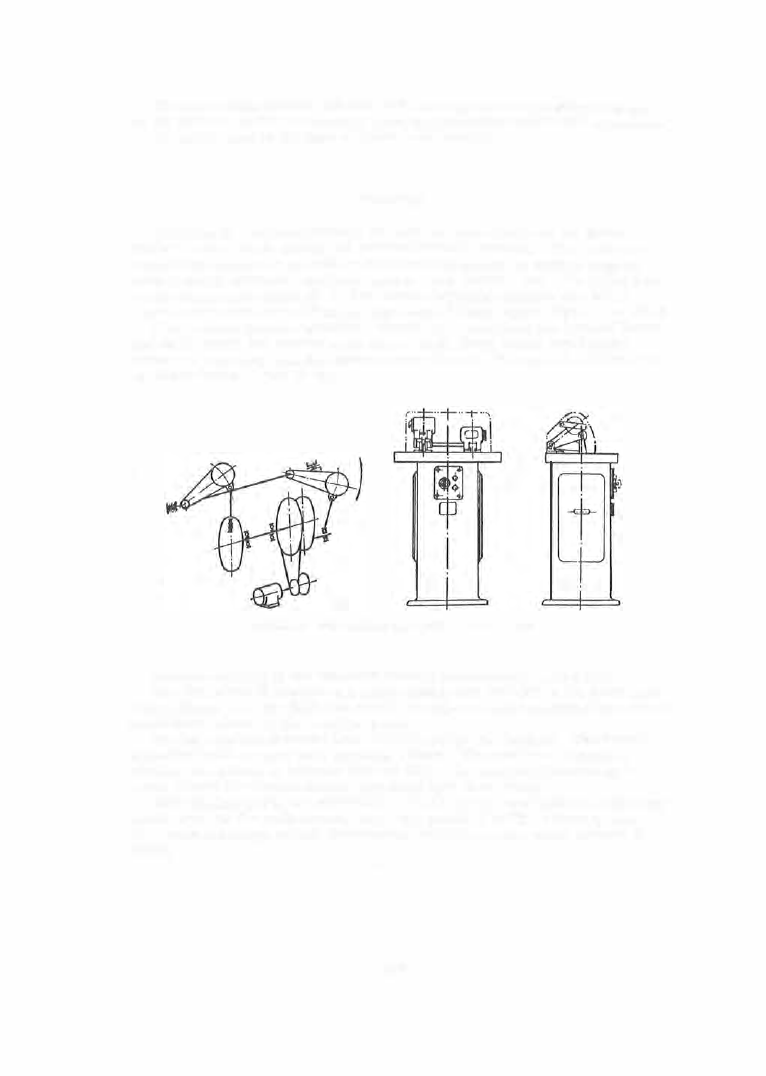
FIGURE  1 9 .   S-205  machine 

for 

tumbling small-size parts 

Barrels  are  loaded and  unloaded through  hermetically  sealed lids . 

The  fine  parts  of  pocket- and  wris twatches are tumbled  in  the  S - 2 0 5  ma­

chine  {Figure  1 9 ),  in  which two  double  barrels  are  set oscillating by a  crank 
mechanism  placed in the  machine  base . 

The  barrels  are  removed from  their housings for loading.  The  barrel 

diameter is  75 mm and  their  capacity  1  liter.  The  numbe r  of complete 
s trokes  per  minute  is between  3 5 5  and  5 0 0 .   The tumbling duration is b e ­

tween  1 0  and  3 0  minutes  and  is controlled b y  a  time  relay . 

Most blanked parts  are  subjected to  tumbling for burr

,....

removal

and many 

parts ,  such as  the  pocket-watch bow,  are polished by this  process,  since 

their complex s hape  makes  grinding and  polishing by any other method dif­

ficult. 

349 

Polishing Brass  and  Nickel - silver Parts 

Polishing as  a  preparatory operation  to  electroplating is applied mai

to  the  nonferrous parts  of watche s :   cases  and  dials .   The  parts are pol ­

ished on S-24 machines  by felt wheels ,  4 0- 5 0 mm  thick and  of  4 0 0 mm 

maximum  diameter (Figure  2 0 ) .   Abrasive  powder is  glued  to  the surface 

of  the  wheels . 

The  last mechanical  operation before  plating  is  polishing and  this  ope r ­

ation  gives  the parts  the  gloss  necessary  for protective - decorative  finishes . 

FIGURE 20.  S-42A  machine for rough- and 
finish-polishing nonferrous parts 

S-42A  machines  are  used with textile 

fabric  wheels  and the  abrasive  is chrom ­

ium -oxide  paste .  The  peripheral  wheel 

speed for preliminary  rough polishing 

averages  25  to  3 5 m

/

sec and  the  final­

polishing speeds are between  3 0  and 

40  m

/

s e c .  

Emery  of various  grain  sizes,  and 

chromium - oxide  pastes  are  used  for 

polishing  (see  Table  2 ). 

Abrasive  materials  are  classified 

into three  groups  according to  grain 

size  (GOST  3 2 3 8 - 4 6  and  3647 - 4 7 ),  grains , 

powders,  and  flours .   Dimensions  are 
given in  Table  1 0. 

Coarse  grains  are  glued to  wheels  by 

joiner ' s   glue .  Fine  grains  are bonded 

using stearin,  paraffin,  oleic acid, 

beeswax,  etc . 

After finishing  (coating) S-42A  ma­

chines are used with s teel,  brass,  bristle  or horse  hair and vegetable-fiber 

brushes  to  give the  coatings  a  uniform  hue  or metallic  gloss  and  to  remove 

any  remaining dirt  or  oxides .  This  operation is  called scratch-brushing. 

TABLE 

10 

Grains 

Powders 

Flours 

Grain size, 

Grain size, 

Grain size, 

Grain size, 

Grain size, 

Grain size, 

Grain size, 

Grain size, 

No. 

f.L 

No. 

f.L 

No. 

f.L 

No. 

Jl· 

1 0  

2300-2000 

36 

600-500 

100 

150-125 

M-28 

28-20 

12 

2000-1700 

46 

420- 355 

120 

125-105 

M-20 

2 0- 14 

14 

1700-1400 

54 

355-300 

150 

1 05-85 

M-14 

14- 10 

16 

1400-1200 

60 

300-250 

180 

85- 75 

M-10 

10- 7  

2 0  

1200- 1000 

7 0  

250-210 

220 

75-63 

M-7 

7-5 

24 

850- 700 

80 

210-180 

240 

63-53 

M-5 

5-3.5 

30 

700- 600 

90 

180-150 

280 

53-42 

M-3.5 

3 .5-1.5 

320 

42-28 

The brush wires  must be  elastic,  and  are  accordingly  given  a  corrugated 

s hape .  The  finer  the  wire,  the  better the  surface finish obtained .   The 

brush  wires  are  usually of 0 . 08  to  O . l O mm  diameter and  the  liquid used 

during  scratch-brushing can be  soapy  water,  F rench chalk,  chalk,  etc. 

3 5 0  

Dial  surfaces are  subjected to  scratch - brushing before  and  after  the 

silver-plating in order to  give  them  an even shade  (instead of  sand-blast 

proces sing). 

Chemical  Degreasing and Pickling 

Parts sent for electroplating are  usually  contaminated by fats  and  the  first 

operation is the refore  chemical  or electrochemical  degreasing.  Alkaline 

solutions,  alkaline  salts ,  and  special  organic  solvents  are  used in chemical 

de greasing. 

The  fats which contaminate  parts  are  classified as  saponifiable  and non­

saponifiable  fat s .   Vegetable  and  animal  fats,  such as lins eed oil,  colza  oil , 

stearin,  tallow,  olein,  etc . ,  belong to  the  first group.  These fats  break 

up  under the  action of alkaline  solutions  and produce  soaps  which are  soluble 

in water .   Mineral  fats ,  such as mineral  oils,  vas eline,  paraffin,  grease, 

etc . ,  are in the  second  category and they do not break up under the  action 

of alkaline solutions ,  but form  emulsions  (mixtures  of liquids  insoluble  in 

one  another). 

Upon  emulsification,  the  alkaline  solutions break the films  of fat  on the 

metal  surface and form  fine  fat  drop s .   The  drops  remain  in  the  liquid in 

a  suspended state  and  the  soap  and  emulsion  obtained  as a  result of the 

chemical  degreasing are  easily  removed from  the  surface  by  cold  or hot 

water .   The  rate  of degreasing is  increased by heating the  bath to  9 0°  and 

agitating it periodically .  Water  glass ,  soap  and  other emulsifiers  are  added 

to  the bath in  order to  speed up the process .   Both  saponifiable  and nonsa­

ponifiable fats are removed by sol vents  such as  kerosene,  gasoline,  toluene, 

carbon  tetrachloride,  dichlorethane,  and  trichlorethylene .  The  three  last­

mentioned sol vents differ  from the first three in that they are not inflammable 
allowing the  degreasing to  be  conducted in  conjunction  with heating.  Their 

shortcoming is  their  toxicity,  which  makes  good  ventilation mandatory  when 

working with them . 

Alkaline  solutions  of the  following  composition  are  used at a  temperature 

of  70  to  g ooc  for the  chemical  degreasing of  steel  and brass  parts  with un­

polished surface s :   2 0  to  3 0  g

/

1  caustic  soda,  2 5  to  3 0  g

/

1  sodium  phosphate 

or carbonate and  3  to  1 0  g

/

1  water  glass  or soap .  Degreasing takes  2 0  to 

30  min and is followed by  rinsing in very hot water  and  drying.  The  de­

greasing quality is determined by wetting the surface with water .   The wetted 

part is  pos itioned vertically,  and  its  water film  is  observed.  No  dis conti­

nuities will be observed in the film if the  degreasing is  satisfactory.  The 

water film  will break  down  in  those places were  fat  or  oil  spots  remain . 

The  next  operation,  after degreasing,  is  pickling which  consis ts  in  the 

removal  of  oxides  from  the  metal  surface by immers ing the  part in acid, 

alkaline  or acid- salt solutions .  Pickling can be chemical or electrochemical . 

F errous  metals  are  chemically pickled using sulfuric,  hydrochloric, 

phosphoric  or nitric  acid or mixtures  of  them .  The process  is more  rapid 

in hydrochloric  acid  than  in sulfuric  acids and  the  pickling can be  speeded 

up by heating the bath to  3 0 - 40°C .  Phosphoric - or nitric - acid pickling forms 

insoluble  iron phosphates  on the surface which aid in the satisfactory  ad­

herence  of paints etc .  Phosphoric - acid pickling is  slower than  sulfuric-

3 5 1  

or  hydrochloric - acid pickling.  Nitric  acid  is  used  relatively  rarely  for 

pickling ferrous  metal s ,   and  is  used in a  mixture  with  hydrochloric  acid. 

Chromium  steels  resis t  sulfuric  acid and  dissolve  in pure  hydrochloric 

acid  or  in hydrochloric  acid  mixed with other acids . 

A  mixture  of nitric ,  hydrochloric  and  sulfuric  acids  in  various  propor ­

tions  i s  used for  pickling brass  and  other nonferrous  metals  and  alloys . 
B efore  the  protective  finish is  applied,  the  parts  are  pickled  in  a  s olution 

of nitric  and  sulfuric  acids (in  equal  proportions  by  volum e )  with a  small 

amount of common salt ( 2 0  g  per  liter  of mixture).  This  operation imparts 
a  glossy surface  to  nonferrous  metals ,   and is  accordingly  sometimes  con­

sidered a  final  operation. 

Normally,  howeve r,  the  parts  are finally pickled for  several  s econds  in 

a  bath  of the  following  composition after the preliminary pickling: 

HN03 (specific weight 1 .38) 

.  . 

.  . 

•  . 

.  .  .  .  .  .  .  .  . 

1 liter 

H2so4 (specific weight 1 .84) .  .  .  .  .  .  .  .  .  .  .  .  .  .  .  .  .  . 

1  " 

HCl (specific weight 1 .17) 

.  .  .  .  .  .  .  .  .  .  .  .  .  • 

.  .  .  2 cm3 

Dutch soot  .  .  .  .  .  .  .  .  .  .  .  .  .  .  .  .  .  .  .  .  .  .  .  .  .  .  .  .  .  10  g 

Solution temperature 

.  .  .  .  •  . 

.  . 

• 

. .  .  .  .  .  .  .  .  .  50-6o•c 

The  pickled parts  are  rinsed in  hot and  cold  water,  or  in  cold water only . 

Electrochemical  Degreasing and  Pickling 

Degreasing with electric  current in  an alkaline  solution is  more  effective 

than o rdinary  chemical  degreasing.  The  electrolytes  used are  caustic soda, 

potass ium  carbonate ,  sodium  carbonate ,  or s odium  phosphate ,  etc .  Emul ­

sifiers  such  as  s oap  or  water  glass  are  sometimes  use d .   The  process  of 

electrochemical  degreasing cons ists  in  emulsifying the fats and oils with  the 

aid of the  hydrogen bubbles liberated at the  cathod e .   The  gas  bubbles  pene ­

trate  below  the  film  of  fat  and  b reak it up ,  and  fine  fat  droplets  are  formed 

as a  result . 

Degreasing proceeds  more  quickly  when  the  electrolyte  is  heated to  6 0° 

or  7 0°C  and  agitated .   Steel parts  such as  springs ,  plate s ,   etc .  are liable 

to be  saturated with hydrogen which,  liberated in great quantity at the cathode, 
penetrates the metal  and makes it b rittl e .   The adherence of electric platings 

to hydrogen- saturated metal  is poor.  Parts  made  of high - carbon  steel  are 

accordingly degreased by anodic  degreasing. 

Alkaline solutions and electrochemical degreasing conditions 

F o r   s t e e l   a n d   c a s t   i r o n   ( c a t h o d i c   a n d   a n o d i c   d e g r e a s i n g ) 

Caustic  soda  . . . . . . . . . . . . . . . . . . . . . . . . . . . . . . . . . . . . .  

Sodium phosphate or carbonate  . . . . . . . . . . . . . . . . . . . . . . . . .  

Water glass 

.

.

.

.

.

.

.

.

.

.

.

.

.

.

.

.

.

.

.

.

.

.

.

.

.

.

.

.


·  ·  ·  ·  ·  ·  ·  · 

Solution temperature,  •c 

.

.

.

.

.

.

.

.

.

.

.

.

.

.

.

.

.

.

.

.

.

.

.

.

.

.

.

.

.


Current density,  amp/dm2  . . . . . . . . . . . . . . . . . . . . . . . . . . . .  

Duration of de greasing,  min : 

cathodic 

.

.

.

.

.

.

.

.

.

.

.

.

.

.

.

.

.

.

.

.

.

.

.

.

.

.

.

.

.

.

.

.

.

.

.


anodic after cathodic  . . . . . . . . . . . . . . . . . . . . . . . . .  

3 5 2  

10--20 g/1 
25-50 g/1 

3-5 g/1 

70--80 

3-10 

2-3 
1-2 


Content   ..  86  87  88  89   ..