Technology of watch production - part 23
 

  Index      Books     Technology of watch production (Tarasov) 1964 year


Search            


Content   ..  21  22  23  24   ..


Technology of watch production - part 23


Swaging operations  are  performed  on powe rful  knuckle -joint,  friction, 

and  hydraulic  pres s e s .   Swaging of a  part  is  s ometim es  carried  out  before 
the  part  has  been blanked out  from  the  s trip  (see  Figure  48 ) .  

TABLE 

Prc"urcs required  for  embossing,  coining  and  swaging  operations 

Type  of operation 

Embossing of  a  convex-

concave  design 

.  '  . . . .  

Stamping of  figures  and 

symbols 

.  .  . 

. . . .

.

.

S1vaging 

. . . . .

.

. .  

.  .  . 

Ductility 

High 

Average 

.. 

High 

Pressure 

kg/mm2 

Surface-

quality 

brass 

steel 

class 

180  2 5 0  

2 5 0 - 3 0 0  

8 - 9  

1 0 0 - 1 10 

1 5 0 - 2 8 0  

1 2 0 - 1 6 0  

1 8 0 - 2 5 0  

8 - 9  

1 8 0 - 2 5 0  

2 5 0 - 3 0 0  

-

Dimensional 

accuracy, 

mm 

0 .02 - 0 .03 

-

0 . 0 3 - 0 .05 

-

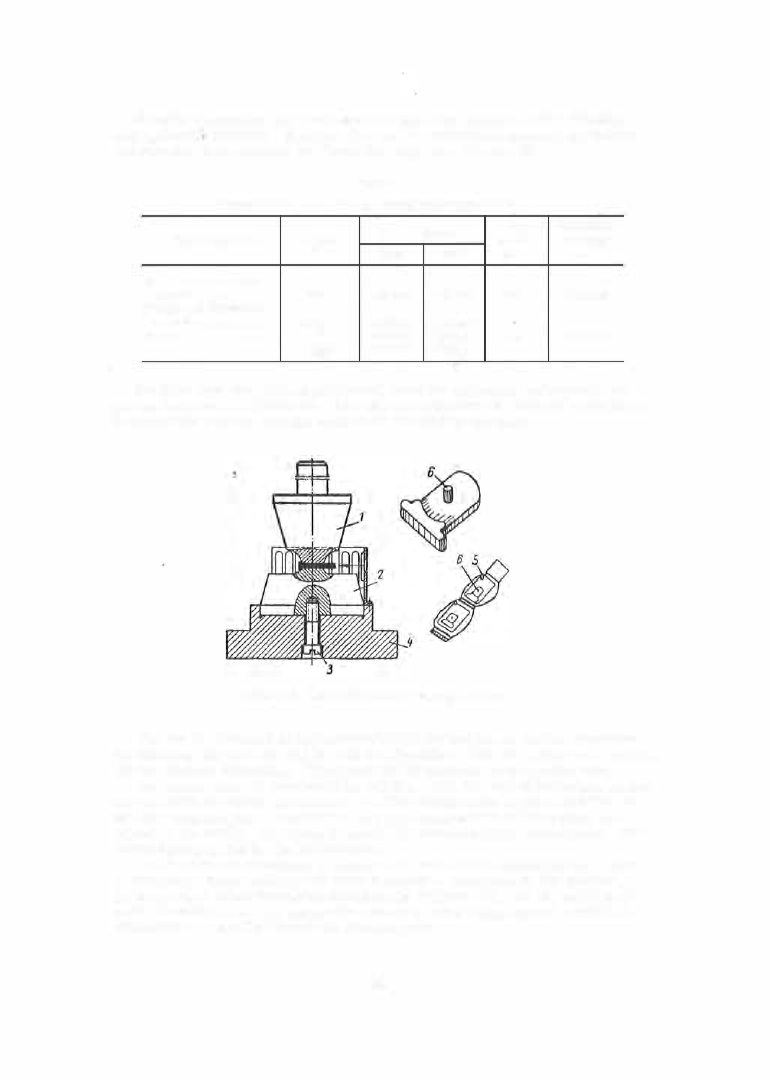
An  open- type  set without  guidepins ,  us ed for  making a  mainspring end 

piece,  is  shown  in  Figure  4 8 .   The pin and  shoulder are  formed in  the  strip 

in  one  press  s troke,  and  the  contour  is  blanked  in  the  next. 

FIGURE 

4 8 .  

Die  set  for  forming mainspring  end  piece 

The  die  (2 )  fastened to  the  lower s hoe  (4 )  by the  s crew  ( 3 )  has  reces s es 

for forming the  pins  ( 5 )  and  (6 )  and  the  shoulder.  The  die  edges  are  rounded 

off for greate r  durability.  The punch  ( 1 )  is  mounted on the press  ram . 

The  m etal  strip  is  pos itioned  on  the  die .   The  flat  end  of the  punch  makes 

contact with  the metal  and forces  it to flow between its  surface and that  of 

the die,  and into the die cavities .  A  relief impression of the  part  is  ob­

tained in  the  s trip .  The  s trip  is  manually advanced after  each s troke .  The 

formed s trip  is  fed to  the  blanking die . 

The  forming  of  chamfers  in  watch parts  can  als o  be  class ified  as  a  type 

of swaging.  Some  watch parts  have  decorative  chamfers  on the  contour, 

as  do  parts  of  other  precis ion  ins truments  (Figure 4 9 ) .  A s   the  milling of 

such  chamfe rs  is  a  very  expensive  proces s ,   even  using special  machines , 

chamfers  are  usually formed on s tamping dies . 

89 

A  die  s et  used  for  forming chamfers  on wristwatch bridges is  shown in 

Figure  5 0 .   The  die  ( 3 ) is  fastened  to  the  lower shoe  ( 1 )  and  has  a  recess 

in the shape  of the bridge .  The depth  of the recess  is  7 5 o/o  of the  bridge 

thickness  and  a  chamfer with  an  invers e  radius  has  been p roduced and  care­
fully polished  along the  contour  of the recess .  The punch  ( 5 )  is  mounted on 

the  press ram and is  larger than  the bridge contour.  When the ram des cends , 

the  punch presses  the  m etal  into  the  recess and  fills  it. 

The  excess  metal  resulting from the chamfe r,  moves  into 

the  punch  recess .  The  chamfered bridge is  ej ected from 

the  die by  the  knock-out  ( 2 )  through the pins  (4 ).  A fter 

chamfering,  the  punch- side s urface of the bride is  cleaned. 

The chamfering  allowance is taken  into  account in specify­

ing the  thickness  of the  s trip  used for blanking. 

FIGURE 

49.  Deco-

Combination  stamping. 

Combination stamping is  very 

rative  chamfer 

effective  in mas s  production.  A lthough  combination  dies 

are  more complex and  require clos e r  attention,  the addi­

tional  investment  is  justified .  

Various  operations  in  watch production,  which  were  forme rly performed 

in separate  die s ,   are now combined into  one  operation.  The blanking and 

shaving of  plates  and bridges,  cas e  rim s ,   mainspring  barrels ,  etc . ,  are 

examples . 

The  winding wheel  of  the  "Pobeda "  watch  (Figure  5 1 )  is  made  on  a  com ­

bination  die  which  combines  five  ope rations :  blanking,  punching  and  shaving 

the  s quare  hol e ,   stamping the  symbol  "Pobeda "  and the s tars ,  and straighten ­

ing. 

The combination  die for performing these operations  is  shown in Figure 

52 ,  a,  The punch  ( 1 )  (Figure  52,  c)  fo r piercing the  s quare hole is  s tepped. 

The  first  step  pierces  the  hole ,   and  the  s econd s haves  it.  The  uppe r  knock­

out ( 2 )  has the s tamping  symbols  on its face  (Figure  52,  b ) .  

1174 

Contour  chosen 

FIGURE 

50.  Die  set for  forming  chamfers  on  bridges 

90 

CD 

Section 

AB 

11.29-o.olf 

� 

c::; 

FIGURE 

5 1 .  

W inding wheel  of the " Pobeda" 

wristwatch 

View 

Section 

AA 

1.23-o.ooz 

� 

-..,. 

Section 

BB 

108_,.,� 

� 

FIGURE 

52. 

Combination die for blanking wheel blanks, 

punching and shaving the square hole,  stamping and 
straightening 

a-general view;  b-upper knock-out;  c-piercing punch 

for the square hole. 

When  the  upper shoe  of  the  die  s et  is  lowe red,  the  knock- out  ( 2 )  marks 

the  design,  after  which  the  die  (3 )  and punch 

(4 ) 

blank  the  part.  Simulta­

neously,  the  square  hole is  pierced and  shaved by the punch  (1 ).  The hole 
in  the punch  (4 )  serves  as  the  die for piercing the  hole.  When the upper 

shoe is  rais ed,  the  stripper  ( 5 )  removes  the  strip  from the  punch (4 ),  and 
the  knock- out  (2 )  presses  the blank back into  the  strip  simultaneously,  by 
straightening it. 

PRESSES 

A s  was  mentioned  earlier,  s tamping operations  are  carried  out on pres ­

s es  of  various  designs . 

Presses  are clas sifie d ,   according to  their working p rinciples ,  into: 

c rank  (single  action ),  vibration,  doubl e - action,  multi - station,  knuckle ,  

friction,  and hydraulic  pres s es . 

C rank 

(incl uding eccentric )  presses  are used for  blanking,  shaving, 

bending,  s tamping,  etc. ,  and  are  the bas ic  equipment of  stamping plants . 

Figure  5 3  s hows  a  S- 2 02  6 ton  high- speed clos ed- type  c rank press  with 

automatic  two- rolle r  feed . 

The  press  is  driven by  an  electric  motor  through a  V- belt transmission 

and a pair  of helical  gears .  The  starting clutch is  of  the  sleeve  type  with 

rotating wedge;  the  brake  is  of  the  periodi c - action band  type  and  adjus table .  

The  controls  are  hand- o r  pedal-operated.  Mechanical  controls  are avail ­

able  s o  that  the  press  cycle m ay  be  either continuous  or  singl e - stroke . 

Technical  specifications  of the  S-202  press 

Force  at  the  end of the  stroke,  tons 

.

.

.

.

.

.

.

W orking-stroke  length  ( adjustable),  mm 

.

.

.

.

.

.


Number  of double strokes per  minute 

.

.

.

.

.

.

.

.


Pitch of strip  feed ,  mm 

.

.

.

.

.

.

.

.

.

.

.

.

.

.


M aximum  distance  between  bed  and  ram,  mm 
Adjustment  of the  connecting-rod length,  mm 

.

.

.


From  4  to 4 0  

2 5 0  

From  0  t o  5 0  

2 6 0  

50 

Shaving operations  giving a  class  9  or  1 0  surface  quality are p erformed 

on D - 2 0 0  

vibration 

presses .  A  general  view  of  a  6  ton press  of  this  type  is 

s hown in Figure  54,  and  its  kinematic  scheme  is  given in  Figure  5 5 .  

Small parts  can b e  s haved o n  this  press both o n  their external  and internal 

contours .  To achieve  more  accurate  processing,  the  eccentric  B  superim ­

poses  a  recip rocating motion  of  90  vibrations  per ram s troke over the normal 

ram  motion,  controlled by  cam  A  through  the  rocker arm  C .  

The  press  is  equipped with a reliable device which prevents double  s trokes. 

A  characteristic feature  of the shaving process as  carried out on this 

press  is  that the  die  executes  up  to  90  cutting motions  for one  s troke  of  the 

rocker arm,  so  that the  p rocess  is similar to  s c raping.  The  vibrating  ram 
pushes the part  through the die  intermittently.  A shear  surface of class  9  o r  

1 0  quality is obtained.  The  deviation from the nominal  contour are of the order 

of 0 . 0 1 to 0 . 0 5 mm  and up  to 5000

.

parts can be shaved on this p ress per s hift. 

Double - actioA  press es 

are us ed mainly in  d rawing.  The  press  has  two 

rams :   an outer,  or  blank holder,  ram ,  and  an inner,  or plunger,  ram , 

9 2  


Content   ..  21  22  23  24   ..