содержание .. 10 11 12 13 14 15 16
ОБСУЖДЕНИЕ РЕЗУЛЬТАТОВ И ИТОГИ ИССЛЕДОВАНИЯ (АНЕСТЕЗИОЛОГИЯ)
1. Оптимизация гемодинамического мониторинга
Главный итог, вытекающий, на наш взгляд, из результатов настоящего исследования — мысль о необходимости и своевременности внедрения мониторинга сердечного выброса в практику общей анестезиологии.
Производительность сердца — наиболее надежный критерий гемодинамического благополучия. Именно падение МОК является центральным событием в патогенетическом механизме любого вида шока. Оценка этого показателя в сопоставлении с преднагрузкой и ОПСС позволяет дифференцировать кардинальные варианты острых циркуляторных расстройств — гиповолемический, вазопериферический и кардиогенный. Простейшая таблица признаков этих трех вариантов острой недостаточности кровообращения может быть легко преобразована в трехступенчатый диагностический алгоритм, порядок следования ступеней которого диктуется получением на каждом шаге максимума диагностической информации при минимуме дополнительных действий (рис. 42). Видно, что оценка МОК позволяет немедленно отдифференцировать норму от патологии, последующая оценка ОПСС (не требует ничего дополнительно, кроме цифры среднего АД!) отсеивает вазопериферический вариант ОНК, и лишь на третьем этапе анализа для дифференцирования гиповолемической и кардиогенной ОНК — если, конечно, они не дифференцируются по клинической ситуации! — возникает необходимость оценки преднагрузки. Отсюда со всей очевидностью вытекает первостепенная роль именно мониторинга МОК во время любой операции и анестезии. (Добавим здесь, что с точки зрения информационной теории расчет ОПСС по известным АД и МОК не привносит новой информации, а лишь делает имеющуюся легче воспринимаемой и трактуемой.) Доминирующее положение сердечного выброса как ключевого звена гемодинамического паттерна подчеркивается и его ролью маркера операционного риска, выявленной нашими исследованиями в клинике факультетской хирургии СПб ГПМА в 1992-1997 гг. Так, у 45 больных, подвергшихся резекции пищевода с одноэтапной внутригрудной эзофагогастропластикой, дисперсия величин УОК в покое продемонстрировала достоверную связь с выживаемостью пациентов (р < 0,05), развитием левосторонних (р < 0,05) и правосторонних (р < 0,01) легочно-плевральных осложнений и неосложненным течением послеоперационного периода (р < 0,01). Динамика величин УОК и их дисперсии после тестовой физической нагрузки также оказалась достоверно связанной с выживаемостью больных (р < 0,05) и развитием осложнений с левой, противоположной оперативному доступу, стороны (р < 0,05). При исследовании (совместно с Л.И. Давидовской) операционного риска у 177 пожилых больных острым холециститом (средний возраст 76,8 ± 4,6 года) оказалось, что с риском летального исхода достоверно связаны исходная величина СИ ниже 3,07 л•м-2•мин-1 (р<0,05) и падение дисперсии величин УОК после тестовой физической нагрузки (р<0,01). У 12 функционально сохранных больных старше 75 лет (средний возраст 79,3 ± 2,2 года) одними из наиболее характерных особенностей были гипердинамия кровообращения со средним СИ 4,0±0,9 л•м-2•мин-1 и реакция на тестовую физическую нагрузку, сопровождающаяся ростом дисперсии величин УОК и координированными сдвигами СИ и ИОПСС. Таким образом, у оперируемых больных производительность сердца и стереотипы ее реакций (нередко объединяемые понятием функционального резерва) могут служить критерием не только диагноза и тактики, на и прогноза непосредственного исхода операции.
|
Вариант ОНК |
Преднагрузка |
МОК |
Постнагрузка |
|
Гиповолемический |
↓ |
↓ |
↑ |
|
Вазопериферический |
↓ |
↓ |
↓ |
|
Кардиогенный |
↑ |
↓ |
↑ |
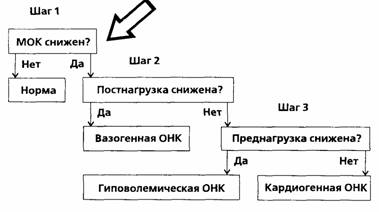
Рисунок 42.
Завершая обзор свидетельств центральной роли МОК среди всех доступных гемодинамических параметров, отметим интересный факт. Наш сотрудник А.Е. Карелов обратил внимание на то, что физическая размерность СИ в строгом смысле представлена линейной скоростью. В самом деле, переводя в Международную систему единиц, м3•м-2с-1=м•с-1. Это преобразование позволяет объяснить большее постоянство отношения МОК к площади поверхности тела (сердечный индекс) по сравнению с отношением МОК к массе тела [690] с позиций гипотезы В.М. Хаютина и Л.Л. Шика о том, что конечной целью регуляции кровообращения является поддержание постоянства линейной скорости кровотока в капиллярах [191, 192, 202].
Наиболее важными показаниями к мониторингу сердечного выброса в анестезиологии мы считаем следующие ситуации:
1) Выраженная соматическая отягощенность больного, в том числе по состоянию сердечно-сосудистой системы
2) Значительный объем или большая длительность операции.
3) Возможность большой кровопотери и/или массивной инфузии.
4) Возможность применения вазоактивных или инотропных препаратов.
5) Обусловленный любыми причинами повышенный риск циркуляторных расстройств кардио- или вазогенного происхождения (вмешательство в зоне средостения, поливалентная сенсибилизация, регионарные или комбинированные с регионарной методики анестезии и т.д.),
6) Неясность механизма гемодинамического расстройства, развившегося во время анестезии (гиповолемия, вазоплегия или первичный малый выброс) или невозможность отрегулировать гемодинамический режим, основываясь только на клинических ориентирах.
Оптимальным рутинным вариантом мониторинга производительности сердца представляется именно реографический: небезопасный метод термодилюции неприменим в случаях, когда его собственный риск превышает риск операции, а эхокардиографический мониторинг, помимо дороговизны аппаратуры и малой точности, требует высокой квалификации врача-оператора. Реографический мониторинг обладает следующими преимуществами:
1) Неинвазивность.
2) Моментальное выявление поврежденного звена гемодинамики.
3) Стоимость, в 8-10 раз уступающая инвазивным функциональным аналогам.
4) Техническая простота освоения и работы с системой.
5) Быстрота развертывания системы (7-10 мин против 50-60 мин, которые занимают подготовка и выполнение катетеризации легочной артерии катетером Swan-Ganz), позволяющая использовать метод в экстренной работе.
6) Неограниченная длительность использования метода у одного пациента.
7) В варианте интегральной реографии тела по М. И. Тищенко — удаленность электродов от зоны абдоминальных и торакальных вмешательств, создающая возможность интраопероционного контроля гемодинамики.
Уникальная особенность реомониторинга, которую следует отметить особо — измерение и накопление дискретных величин ударных объемов крови (УОК) за сколь угодно долгие промежутки времени, что открывает принципиально новые возможности анализа функции кровообращения. Простота, сравнительная дешевизна, изначальная компьютеризация и неинвазивный характер делают реографический мониторинг идеальным источником информации о гемодинамике в системах автоматизированного управления анестезией, внедрение которых сегодня является общемировой тенденцией.
В дополнение к метрологической характеристике реографического мониторинга, подробно изложенной выше, выскажем два теоретических соображения. Наш сотрудник К.Ю. Красносельский обратил внимание на то обстоятельство, что принцип разведения индикатора предполагает измерение его концентрации при постоянной объемной скорости потока: в противном случае соотношение между конвекцией и теплопроводностью меняется на протяжении времени регистрации дилюционной кривой, лишая смысла ее обработку. Поскольку реальный поток крови в ЛА пульсирует, это не может не создавать методической ошибки термодилюции, причем ошибки, неустранимой в принципе. Добавим к этому следующее соображение. Несмотря на резкое улучшение инерционных характеристик современных термисторов (fast-response thermistor], создать термистор с нулевой собственной теплоемкостью физически невозможно. А поскольку речь идет о термодинамических процессах, постоянная времени термистора всегда будет превышать постоянную времени электрической цепи реографа, работающей на частотах порядка десятков кГц. Отсюда с очевидностью вытекает преимущество импедансометрических методов в регистрации относительно высокочастотных составляющих механики кровообращения. Основными техническими проблемами реомониторинга сегодня представляются эффективность аппаратной и программной фильтрации сигнала, обоснование процедуры расчета в условиях сильно зашумленного сигнала и сопряжение реомонитора с другой контрольно-измерительной аппаратурой. Однако ошибки реомониторинга могут быть скомпенсированы трактовкой результатов как динамического ряда с ориентацией на исходные величины, а совершенствование средств фильтрации, распознавания и обработки реосигнала, вероятно, позволит в перспективе радикально решить острую на сегодня проблему артефактов. Специфическими показаниями к реографическому варианту мониторинга МОК нам представляются
a) малые вмешательства у пациентов IV-V классов ASA, когда риск мониторинга не должен превышать риска операции,
6) невозможность, неэффективность или опасность катетеризации ЛА (отказ пациента, дефекты перегородок или протезы клапанов правого сердца, техническая неудача, наличие ЭКС, блокада левой ножки пучка Гиса и т.д.) и
в) необходимость мониторинга МОК в экстренной ситуации.
С другой стороны, специфическими показаниями к катетеризации ЛА в общей анестезиологии можно считать случаи, когда постнагрузки левого и правого желудочков могут быть непропорциональны или даже меняться разнонапровленно из-за рассогласования их сократимости или (реже) постнагрузок. В этих ситуациях, поскольку ЦВД перестает адекватно отражать преднагрузку ЛЖ, для оценки преднагрузки (шаг 3 алгоритма на рис. 40) необходимо измерение и/или динамический контроль ДЗЛА или СДЛА. Спектр возможных причин представлен:
1) Документированной или подозреваемой сократительной слабостью ЛЖ (ФВ ЛЖ<60%, ОИМ, острая коронарная недостаточность, аневризма сердца, кардиомиопатии и т. д.).
2) Отеком легких любого генеза.
3) Терапией мощными инотропными и/или вазоактивными препаратами, способной несимметрично изменить условия функционирования желудочков. Проведенные нами сравнительные исследования термодилюционного и реографического методов измерения МОК показали не только достаточно хорошее совпадение данных, на и более высокую, по сравнению с термодилюцией, воспроизводимость результатов реографии. Однако, если можно так сказать, это — калибровка по эталонному методу измерения, тогда как в современном восприятии результат любого метода есть своего рода "виртуальный" МОК. Таким образом, калибровка данного типа является относительной. Следующая серия наших исследований носит кардинально иной характер. Впервые в мире метод измерения МОК в клинических условиях калибровали не по эталонному измерителю, а по эталонному генератор/потока (артериальной помпе АИК. Здесь можно говорить уже об абсолютной калибровке.
Пульсирующий характер так называемого "непульсирующего потока" (истинный непрерывный поток способен создать лишь центробежный нагнетатель новых моделей АИК [208]) заставляет искать ответ на вопрос о причинах различий между ним и собственно "пульсирующим потоком", выявленных многочисленными исследованиями разных лет [129, 1507, 1508 и др.]. Физически эти потоки различаются двумя параметрами: во-первых, это период и амплитуда пульсации, которые больше при "пульсирующем потоке", во-вторых, характерный для последнего неправильный характер пульсации, связанный с несинфазностью заданного ритма и рабочего цикла артериального насоса.
В естественных условиях, помимо пульсации потока, определенную роль для нормального функционирования сердечно-сосудистой системы также может играть непостоянство фазово-объемной структуры кардиоцикла, обусловленное физиологическими флюктуациями ритма сердца и венозного возврата. Аналогичная ситуация широко известна в респираторной терапии: строго "стереотипный" характер искусственных дыхательных актов в режиме постоянной принудительной вентиляции легких (CMV) приводит к прогрессирующей неравномерности регионарного распределения вентиляции. Зоны легких, в которых соотношение аэродинамического сопротивления (R, resistance, кПа•л-1•с и растяжимости (С, compliance, л•кПа-1 [1126] соответствует частотным характеристикам аппаратного дыхания, оказываются преимущественными потребителями аппаратного МОД, тогда как зоны с неоптимальной постоянной времени гиповентилируются. Ситуация, таким образом, в принципе сходна с механическим резонансом.
Эти соображения заставляют задуматься о способе управления аппаратом искусственного кровообращения, предусматривающем изменение тактовой производительности артериального насоса и временного паттерна его работы по случайному закону в установленных пределах с целью повышения равномерности перфузии отделов сосудистой системы с различными частотными характеристиками.
Выгодная специфика реомониторинга как технически очень простого и легкого в освоении метода навела нас на мысль создать оптимальные предпосылки для его использования в экстремальных и полевых условиях. Для этого предлагается конструктивно интегрировать в одежду или обмундирование комплект электродов для интегральной реографии тела, выполненных из токопроводящей углеволокнистой ткани и соединенных с внешним разъемом посредством микрокабелей, также интегрированных в одежду, например, проложенных в ее швах. Для подключения исследуемого к регистрирующему устройству в этом случае достаточно соединить кабель последнего с внешними разъемами в одежде и привести электроды в рабочее положение, если они в нем не находились (например, опустить закатанные рукава обмундирования). Основной сферой приложения этой разработки могли бы стать медицинские службы Вооруженных Сил и оперативных подразделений других ведомств. Данное предложение представляется тем более актуальным, что задача принятия на табельное снабжение Вооруженных Сил кардиореспираторного монитора выдвигается сегодня как одна из приоритетных [114]. Между тем сигналы ИГРТ и импедансной пневмограммы, как следует из нашего опыта, из-за своей более высокой энергоемкости характеризуются значительно большей помехоустойчивостью по сравнению с ЭКГ и любыми другими вариантами усиления естественных биопотенциалов организма. Использование реомониторинга в учебном процессе, широко практикуемое нами в рамках практических занятий и семинаров как со студентами IV-VI курсов Академии, так и с интернами, клиническими ординаторами и врачами-слушателями циклов ФПК и ПП, позволяет, на наш взгляд, решить ряд важных задач.
Несмотря на важность МОК как физиологической константы, этот показатель в значительной мере остается для студентов-медиков абстракцией. Техническая сложность его измерения приводит к тому, что не только студенты, на даже многие практикующие анестезиологи-реаниматологи не оперируют понятием сердечного выброса при анализе большинства гемодинамических ситуаций.
На практических занятиях со студентами IV и VI курсов академии мы показываем работу реографического монитора в операционной, кратко объясняя физические основы, возможности и преимущества метода. Если имеется свободный комплект аппаратуры, предлагаем провести исследование центральной гемодинамики у любого желающего студента, демонстрируя при этом соответствующие тесты. Обычно объектами исследования становятся те из группы, у кого ранее отмечались какие-либо кардиальные жалобы или нестабильность АД вплоть до пограничной артериальной гипертензии. Нередко при этом удается отметить повышенные показатели СИ или ОПСС либо аномальный характер реакций на тесты; такая наглядная демонстрация значительно облегчает дальнейшие объяснения основных понятий и подходов клинической физиологии кровообращения. В работе с врачами-слушателями циклов факультета повышения квалификации и профессиональной переподготовки оказывается необходимым более детальный разбор метода, включая его сравнительный анализ с иными методами гемодинамического мониторинга, в частности термодилюционным.
Особое значение мы придаем ознакомлению с реомонитором студентов-слушателей факультативных лекций, интернов и клинических ординаторов кафедры. Большинство из них в ходе обучения на практике осваивают работу с комплексом, параллельно изучая функции оператора и основы клинической интерпретации полученных данных. Опора на производительность сердца как главный критерий стабильности и адекватности гемодинамики — тот конечный результат, который мы стремимся внедрить в сознание молодых анестезиологов.
2. Клиническая оценка и коррекция режима гемодинамики
Анализ гемодинамических профилей анестезий, проводимых по различным методикам, позволяет сделать следующие главные обобщения. Для общей анестезии типично первичное влияние на производительность сердца, тогда как тонус сосудов лишь вторично "подстраивается" под динамику сердечного выброса. При этом от выбора конкретной схемы (т.е. от сочетания препаратов) анестезии зависит скорее не наличие этого эффекта — он удивительно постоянен!, — а лишь степень его выраженности. Может быть, лишь дроперидол, неизменно снижая ОПСС, проявляет четкий индивидуальный эффект в составе комбинаций.
За введением препаратов индукции закономерно следует падение сердечного выброса с компенсаторным подъемом ОПСС. В случае, если интубируют трахею, этому конечному результату может предшествовать в разной степени выраженный кратковременный подъем СИ (постинтубационная гипердинамия), на затем непременно следует его падение. Выраженность того и другого несколько ниже при использовании схем диазепам+фентанил или этомидат+фентанил. При этом добавление фентанила способствует снижению амплитуды постинтубационного подъема СИ, на делает более выраженным его последующее снижение.
По-видимому, причина такого постоянства заключается в неизменном комбинировании препаратов, приводящем к качественному изменению эффектов. Среди них начинает преобладать то общее, что в литературе называют "снижением эфферентного симпатического потока из ЦНС", а индивидуальные гемодинамические эффекты в значительной мере нивелируются. В итоге детально описанные гемодинамические паттерны, свойственные отдельным препаратам, мало соответствуют реальной картине. Можно сказать, что описания гемодинамических эффектов отдельных препаратов соотносятся с реальностью примерно так же, как схема стадий наркоза по A.J. Guedel (1920) — с клиникой современной многокомпонентной анестезии.
Таблица 69
ИНТЕРПРЕТАЦИЯ ДИНАМИЧЕСКИХ СДВИГОВ СИ и ИОПСС
|
Сердеч-ный выброс (СИ) |
Тонус сосудов сопротивления (ИОПСС) |
|
|
Снижен |
Повышен |
|
|
Снижен |
Обычно — "избыточная" анестезиологическая агрессия: либо регионарная анестезия в условиях неадекватной компенсации МОК, либо — несколько реже — вазоплегия со снижением венозного возврата за счет относительной передозировки общих анестетиков. Еще более редкой причиной являются осложнения, напрямую не связанные с анестезией — кровотечение в условиях вазоплегии или анафилаксия на фоне кардиодепрессии |
Наиболее типовой режим при стандартных схемах общей анестезии. Если СИ метаболически адекватен — это оптимум, если нет — необходима коррекция в виде снижения доз анестетиков или гипнотиков либо — при артериальной гипертензии — подключения нитропрепаратов. Может быть результатом осложнений — кардио-генной или гиповолемической ОНК |
|
Повышен |
"Штатная" ситуация при регионарной, вазоплегических видах общей анестезии (НЛА) или использовании вазоплегии для управления режимом кровообращения. Метаболически это малоцелесообразно, а иногда и опасно (в зависимости от динамики мощности ЛЖ) |
Обычная картина ноцицептивной реакции с артериальной гипертензией. В случае неэффективности форсирования аналгезии требуется "прямая" коррекция β-блокаторами или антагонистами Ca++ |
На этапе поддержания фракционное введение препаратов общей анестезии сопровождается незначительными гемодинамическими эффектами, и общая картина определяется скорее этапом вмешательства, нежели выбором и дозировками препаратов. Как и следовало ожидать, постоянная объемно-дозированная инфузия препаратов вообще приводит к полному исчезновению каких-либо статистически значимых гемодинамических эффектов: лишь изменение темпа инфузии аналгетика ведет (не всегда!) к изменению значений отдельных переменных, на никогда — к радикальной смене картины (направленность отклонений СИ и ОПСС по отношению к исходным величинам).
Все многообразие гемодинамических ситуаций, возникающих на этапах поддержания анестезии, может быть в первом приближении описано своего рода "четырехпольной таблицей" состояний двух главных переменных — производительности сердца и тонуса резистивных сосудов (табл. 69). Эта таблица может быть предложена как более современная альтернатива аналогично построенной таблице АД/ЧСС.
Этап выхода из анестезии практически всегда сопровождается гиперкинетической реакцией кровообращения; исключение составляют крайне тяжелые (ASA IV-V) пациенты с заведомой невозможностью полноценного восстановления сознания и самостоятельного дыхания. Можно даже сказать, что развитие гиперкинетической реакции является своего рода предиктором качества посленаркозного восстановления.
При регионарной анестезии начало действия блока всегда отмечается падением ОПСС. Эффект настолько постоянен, что может использоваться для контроля эффективности выполненной блокады. Сердечный выброс у разных больных ведет себя по-разному. Компенсированная ситуация характеризуется его увеличением, достаточным для поддержания системного АД на приемлемом уровне. Случаи же гипотензии объясняются именно неспособностью эффективно поднять выброс.
Повторные введения анестетика при эпидуральной анестезии вызывают несколько менее выраженную гемодинамическую реакцию. Зависимость гемодинамики от этапа операции выражена слабо (тем слабее, чем "грубее" протекает анестезия, т.е. чем глубже ее собственный гемодинамический эффект).
Говоря о качестве ноцицептивной защиты, создаваемой регионарной анестезией, в частности, центральными блоками, нельзя не обратить внимание на важный, на обычно не учитываемый факт. Блокируя чувствительную иннервацию, например, высоким эпидуральным блоком, мы в то же время оставляем интактными как центростремительные, так и центробежные волокна блуждающего нерва, доходящие, как известно, до органов брюшной полости. Таким образом, высокие центральные блоки, прерывая симпатический поток в зону хирургической агрессии и в то же время оставляя нетронутыми афференты и эфференты вагуса, сдвигают соотношение регуляторных влияний в пользу "демобилизующего", антиадаптивного влияния парасимпатикуса. Таким образом, высокий центральный блок нельзя рассматривать как "абсолютный ноцицептивный блок". (Данный тезис не следует, однако, рассматривать как призыв дополнять высокую эпидуральную или спинальную анестезию шейной вагосимпатической блокадой.) Седация на фоне регионарного блока или сочетание последнего с так называемой "облегченной" общей анестезией приводит к своего рода гибридизации гемодинамических эффектов. После начала действия спинальной или эпидуральной блокады происходят обычные для такой ситуации падение ОПСС с параллельным компенсаторным подъемом СИ. на после "комбинирования" ситуация кардинально меняется: не только полномасштабная индукция, на и простая седация (субгипнотические дозы) приводит к снижению СИ, сопровождающемуся небольшим подъемом ОПСС. Далее естественно следует форсирование инфузии, а в ряде случаев и использование вазопрессоров. Этап поддержания анестезии в большей степени сходен с чистой регионарной, нежели с общей анестезией, однако реакции на повторные введения препарата в виде падения ОПСС нередко выражены сильнее, чем в случае "чистого" эпидурального блока. Гемодинамическая реакция на прекращение общей анестезии проявляется существенно слабее, чем при наркозе как таковом.
Таким образом, влияние на гемодинамику собственно анестезии зависит скорее от выбора между общей или регионарной методикой, нежели от конкретного набора препаратов.
Обсуждая и сравнивая различные эффекты, нельзя не остановиться на блоке спорных вопросов, связанных с влиянием вазодилатации и компенсаторной гипердинамии на условия работы сердца, в особенности при наличии его сопутствующей патологии. Главный момент, порождающий неясности и разночтения, берет начало с классической работы S.J. Sarnoff и соавт. (1958, [1320]). Именно эти авторы, основываясь на экспериментальных данных, впервые постулировали слабую зависимость MVO2 от величины производительности сердца и, напротив, ее тесную корреляцию с ЧСС и уровнем артериального давления. Предложенный ими индекс "напряжение-время" (Tension-Time Index — TTI) стал эталонным критерием кислородного запроса миокарда левого желудочка, надолго превратив недопущение гипертензии и тахикардии в основную задачу анестезии у больного с сердечно-сосудистой патологией. Такое осознание приоритетов породило и систему предпочтений, в которой оптимальными являются препараты и методики анестезии, в наибольшей степени блокирующие симпато-адреналовые ноцицептивные реакции [2, 924]. В результате создалась ситуация, отражаемая лозунгом: "Анестезия ради гемодинамики!": гемодинамические показатели, и прежде всего АД как наиболее доступный из них, стали критерием не только принятия тактических решений, на и оценки адекватности анестезии в целом. В то же время на современном этапе высокоселективные препараты и методики создают возможность раздельного и взаимно-независимого управления уровнем основных компонентов анестезии и гемодинамическими параметрами. Выгоды такого подхода очевидны; по существу он вполне аналогичен происшедшему несколько десятилетий назад разделению каналов управления гипнозом, аналгезией и миорелаксацией, до того времени сосредоточенных в едином понятии "глубина наркоза" [1550]. Прежде всего, разделение каналов управления позволяет независимо соблюдать приоритеты и требования, предъявляемые клинической ситуацией к каждому из управляемых компонентов. При этом независимая регулировка доз, как это наглядно продемонстрировала концепция многокомпонентной анестезии, приводит еще и к ослаблению суммарной фармакологической агрессии. Такой анализ переводит вопрос о режиме кровообращения во время анестезии в несколько иную плоскость. В современной интенсивной терапии хорошо отработаны методы быстрого и избирательного управления всеми главными параметрами гемодинамики. Использование этих методов предоставляет возможность во время операции оптимизировать режим кровообращения в значительной мере независимо от используемых методик анестезии и текущего уровня ее отдельных компонентов. При этом постепенно формируется понимание того факта, что гемодинамически оптимальная анестезия — не та, которая выгодно влияет на кровообращение, а та, которая не влияет на него вовсе. В результате поддержание оптимальных уровней АД, ЧСС, производительности сердца и т.п. превращается из задачи выбора методики анестезии, обещающей удачное соотношение этих параметров, в задачу осознанного прямого управления ими.
По-видимому, при этих оговорках градация желательности кардиотропных эффектов препаратов, применяемых для анестезии, должна сегодня выглядеть следующим образом:
Нулевой > Кардиодепрессивный > Кардиостимулирующий
Под "депрессией" и "стимуляцией" выше понимаются прежде всего инотропные, а во вторую очередь — хронотропные эффекты. Дромо- и батмотропные влияния имеют к гемодинамике отношение, опосредованное главным образом гемодинамически значимыми расстройствами сердечного ритма, а люзитропный эффект, принципиально важный для осуществления насосной функции сердца, находится пока в стадии изучения. Прокомментируем приведенную выше градацию предпочтений. Наиболее очевидна ситуация с кардиостимулирующим эффектом — его реализация влечет за собой рост потребления кислорода миокардом и, соответственно, повышает риск ишемии. Выбор между нулевым (отсутствующим) и негативным инотропным эффектами объясняется упомянутой выше общей эволюционной тенденцией к повышению избирательности применяемых средств и методик. Преимущества же кардиодепрессивного эффекта перед кардиостимулирующим очевидны с позиций кардиологии: по существу, почти вся современная фармакотерапия ИБС построена на кардиодепрессивных эффектах.
Энергосберегающий подход может быть приложен и к управлению сердечным выбросом через величины пред- и постнагрузки. Поскольку уровень среднего АД диктуется "вилкой" требований перфузионной достаточности и энергорасхода миокарда, его оптимальное значение (с допуском± 10...15 мм рт.ст.) может быть выбрано заранее. Выдерживание этого оптимального уровня и означает, что управление гемодинамикой осуществляется по закону АД=const. Технически это сегодня не только не составляет проблемы, на и может быть осуществлено с помощью раздельной подстройки МОК и ОПСС. При таком условии дальнейшая оптимизация уже выходит за рамки подхода SJ. Sarnoff и соавт.
Для иллюстрации этого факта проанализируем динамику кровообращения в результате маневра его параметрами при условии АД=const. Если исходный режим характеризуется величинами МОК Qi ОПССi R и среднего АД Рi то Рi и мощность левого желудочка Ni могут быть выражены, пренебрегая величинами ЦВД и КДДПЖ, как

Пусть некое возмущение привело к снижению ОПСС до величины R такой, что R2=kRi, где k< 1. Тогда из условия выдерживания P2 =Pi =const следует, что

Поскольку к< 1, то из (32) следует, что необходимое для поддержания постоя нства АД Q больше Q, во столько же раз, во сколько снизилось ОПСС. Запишем теперь выражение для новой мощности ЛЖ с учетом (30) и (31):

Таким образом, при условии выдерживания заданной величины АД расход мощности левым желудочком нарастает обратно пропорционально падению ОПСС. Это можно наглядно представить на диаграмме (рис. 43) в виде вектора OВ, отражающего пример вышеописанного маневра. Обширная же зона OCD представляет геометрическое место точек, соответствующих таким переходным процессам, при которых расход мощности ЛЖ растет даже несмотря на снижение САД.

Рисунок 43.
Следовательно, оптимизация АД за счет снижения ОПСС представляется энергетически менее выгодной для миокарда, нежели уменьшение (в разумных пределах) сердечного выброса. Поскольку мощность ЛЖ пропорциональна квадрату МОК и первой степени ОПСС, "вазоплегические" методики анестезии с компенсацией АД сердечным выбросом также представляются энергетически невыгодным решением.
Однако вопрос о балансе интересов миокарда и организма в общем случае требует отдельного и более тщательного рассмотрения, не ограниченного условием постоянства АД. Одним из возможных подходов является проведенный в настоящей работе анализ соотношения механической работы левого желудочка и обеспечиваемого ею потребления кислорода тканями организма. Начальный опыт работы с показателем приведенной работы левого желудочка (ПРЛЖ) продемонстрировал его неплохую информативность и наглядность. Казалось бы, формула расхода работы левого желудочка на литр потребленного кислорода может быть легко преобразована:

На первый взгляд, итоговая формула полностью подтверждает концепцию о ведущей роли АД как детерминанты режима кровообращения. Однако, во-первых, приведенное преобразование некорректно в силу различия между потреблением кислорода в легких и расчетной величиной, полученной по принципу Фика. С другой стороны, неочевидна функциональная зависимость между объемной артериовенозной разницей по кислороду и средним АД — а она, несомненно, имеет место хотя бы в силу влияния сосудистого тонуса на объем тканевой перфузии.
Таким образом, правомерное, на первый взгляд, преобразование (34) при более детальном анализе оказывается лишенным смысла и необходимость получения первичной информации о минутном объеме и потреблении кислорода в легких для расчета ПРЛЖ сохраняется. При этом явным преимуществом данного показателя следует считать возможность его мониторирования неинвазивным путем.
К вопросу об адекватности гемодинамического режима тесно примыкает проблема адекватности анестезии — как известно, одна из наиболее активно обсуждаемых сегодня. Разнообразие мобилизованных для ее решения подходов и методов — от наглядно-эмпирических до теории информации и системного анализа — подчеркивает глубину сложившейся неопределенности.
Накопление огромного объема данных о патофизиологии стрессового ответа привело к появлению бесчетного количества критериев оценки качества стрессовой защиты [3, 48, 61]. Гемодинамические, биохимические, эндокринно-метаболические, нейрофизиологические, иммуно-гематологичес-кие и многие другие показатели предложены сегодня для клинического внедрения [52, 72, 148, 175, 196, 447, 848, 1185, 1198, 1231, 134]]. Анализ их обоснованности и информативности выходит далеко за рамки этой работы; обратим лишь внимание на некоторые общие методологические проблемы оценки операционного стресса. С одной стороны, прямая пропорция между уровнем разнообразных, в том числе гемодинамических, маркеров стресса и клиническим результатом воспринимается как аксиома, вытекающая из результатов фундаментальных [36, 48, 61, 117, 148, 164, 196]. Между тем, например, нередкое отсутствие достоверной связи высоких уровней кортизола, АКТГ, катехоламинов, ренина, АДГ и т.д. с осложнениями и неблагоприятными исходами [1231] может быть объяснено с позиций не только вероятностной, на и вполне детерминистской логики. С точки зрения физиологии неясно, соответствует ли более высокий уровень маркеров стресса в отдельно взятом случае большему стрессу или большим реактивным возможностям. Не всегда ясно также, что означает достижение плато на кривой гормонального или гемодинамического профиля — развитие устойчивой адаптации или истощение ресурсов. Создается впечатление, что современное понимание адекватности анестезии прежде всего предполагает ее адекватность нашим физиологическим представлениям о том, какой должна быть анестезия, а уже во вторую очередь — заданному клиническому результату. Ситуация заставляет вспомнить прогноз Альберта Эйнштейна относительно главной проблемы конца двадцатого века, сделанный в 40-е гг.: 'Perfection of means, confusion of goals...' (Совершенство средств, смешение целей; цит. по [1304]).
С другой стороны, до сих пор не обоснованы количественно те пределы стресс-реакции различных систем, при которых она — в зависимости от состояния самих этих систем и целостного организма — может и должна считаться целесообразной. Представление о "стресс-норме" выглядит сегодня скорее перспективной декларацией, нежели инструментом клинического анализа. Вообще, насколько те частные критерии, которым наши сегодняшние взгляды "делегируют" полномочия представлять весь комплекс реакций организма, соответствуют возложенной на них глобальной функции ?
В условиях постоянного сужения функциональных противопоказаний к операциям, роста разнообразия препаратов и методик, наконец, возможностей селективного управления всеми основными гемодинамическими переменными режим кровообращения из критерия адекватности анестезии превращается в самостоятельный объект управления — как вентиляция, КОС или водно-электролитный баланс. Условно говоря, на смену старой парадигме "гемодинамика как критерий адекватности анестезии" приходит (и это четко видно по публикациям, на — к сожалению — пока только из сферы кардиоанестезиологии!) иное представление: адекватное селективное управление гемодинамикой — необходимое условие адекватности анестезиологического пособия как целого.
Между прочим, из этой позиции вытекает и иной взгляд на проблему интраоперационных вегетативных рефлексов. Концепция "нейровегетативной блокады" или "нейровегетативного торможения" [64, 66], рождение которой связано с именами Henri Laborit и Piere Huguenard [899], впервые вополощенная в методике нейролептанестезии, постепенно пересматривается. Прежде всего, становится ясной нецелесообразность полного выключения вегетативной автоматики в условиях, когда современные возможности анестезиолога не обеспечивают ни тотального контроля, ни тотальной коррекции всех быстропротекающих процессов. Даже в хорошо изученной сфере гемодинамики очевидна опасность выключения вазомоторных механизмов перед лицом, например, возможной массивной кровопотери. Изменяются приоритеты и в выборе средств борьбы с вегетативным компонентом ноцицептивной реакции. Осознаются преимущества воздействия непосредственно на уровне периферических эффекторов (например, миокарда и сосудов) не только перед влиянием на высшие вегетативные центры, защищенные гема-тоэнцефалическим барьером [886], на и перед воздействием на вегетативные ганглии. Таким образом, не нейровегетативная блокада, а целенаправленная вегетативная коррекция становится сегодня методом выбора в борьбе с нежелательными вегетативно-рефлекторными последствиями ноцицептивного воздействия.
В контексте изучения этих наиболее общих проблем анестезиологии особую ценность представляет процедура опиоидной детоксикации под общей анестезией — уникальная модель своего рода системной (т.е. нелокализованной) ноцицептивной агрессии. Очень важно то, что ситуация в принципе исключает использование двух наиболее традиционных методик анестезиологической защиты — опиатной аналгезии и регионарных блоков. Остаются так называемые неопиатные анальгетики, инициатива использования одного из которых — аденозина — была выдвинута нами в рамках разработанной методики.
В заключение, основываясь на данных литературы и собственном опыте, попытаемся сформулировать некоторые принципы, позволяющие минимизировать возмущающее влияние анестезии на гемодинамику.
1. Главным условием является обеспечение тщательного мониторинга, иногда более важного, чем сам по себе выбор препаратов. Последний основывается на вероятных в данной ситуации эффектах, тогда как первый позволяет своевременно выявлять и парировать эффекты реальные, без страха пользуясь преимуществами каждого из возможных средств. Таким образом, можно сказать, что традиционная безопасная активность анестезиолога уступает место активной безопасности больного
Широко известной иллюстрацией такой динамики подходов является отказ от тотального использования атропина в премедикации, ставший возможным и даже желательным в условиях тотального мониторинга ЭКГ.
2. Использование минимального набора препаратов узконаправленного действия: "чистый" гипнотик + "чистый" аналгетик + (при необходимости) недеполяризующий миорелаксант без ганглио- и холинолитических эффектов. По нашему опыту, наиболее отвечают этим требованиям комбинации этомидат + фентонил + ардуан или диазепам + ардуан (+ фентанил?) на фоне действия аденозина.
3. Все препараты должны вводится медленно. Это "расплывчатое" требование можно, например, трактовать так: эффект препарата по данным мониторинга должен успевать проявляться до конца его введения. Оптимальным способом введения препаратов поддержания анестезии является непрерывная инфузия с помощью дозатора [597].
4. Любые управляющие воздействия, за исключением реанимационных мероприятий, должны выполняться с интервалами. Это в особенности относится к подключению компонентов анестезии вообще и, в частности, введению препаратов индукции. Оптимальным вариантом является выполнение следующего шага после того, как гемодинамика по данным мониторинга стабилизировалась после предыдущего. Применительно к этапу выхода из анестезии это означает возможно более позднее выключение подачи гипнотиков по отношению к завершению операции и продолжение введения аналгетиков на протяжении всего этапа восстановления сознания и самостоятельного дыхания. Выполнение последнего условия становится возможным при использовании аденозиновой аналгезии.
Четвертое требование, помимо более "мягкого" управления, является обязательным еще по одной важной причине. Далеко не для всех управляющих воздействий выполняется условие аддитивности (т.е. эффект комбинации равносилен сумме эффектов компонентов), а в условиях быстропротекающих процессов зависимость эффекта от возмущения нередко становится резко нелинейной. Наиболее известным примером недоучета этого обстоятельства является авария на Чернобыльской АЭС. На ее критическом этапе резкий скачок тепловой мощности реактора был вызван, в частности, тем, что операторы вводили новые управляющие воздействия до того, как энергоблок успевал полностью отреагировать на предшествующие [170].
Качество управления гемодинамикой напрямую зависит от плавности управляющих воздействий. В особенности это относится к скорости введения препаратов, обладающих теми или иными гемодинамическими эффектами. В последние годы выделилась группа сильнодействующих препаратов с коротким периодом полувыведения, использование которых вообще возможно только с использованием точно дозирующих устройств для непрерывной инфузии. Поэтому использование дозаторов, пусть даже простейших шприцевых, представляется сегодня непременным условием качественного гемодинамического управления.
3. Возможные направления дальнейших исследований
В рамках темы настоящего исследования изложенные выше результаты образуют логически завершенную систему. С клинической и технической точек зрения охарактеризованы инвазивный и неинвазивный методы мониторинга производительности сердца, проведена оценка совпадения и воспроизводимости их результатов, предложен метод верификации последних по эталону потока. В то же время из полученных данных вытекает ряд следствий и возможностей, которые мы хотели бы обсудить в данном разделе. Прежде всего, заслуживает внимания методика расчета ударного объема крови по данным реографии. Лежащие в основе формулы М.И. Тищенко допущения о равномерном притоке крови в сосуды в фазу систолы и равномерном оттоке ее на протяжении всего кардиоцикла выглядят с точки зрения биомеханики не вполне правдоподобными. С учетом кинетики сердечного сокращения и механического ответа сосудов на прирост объема крови значительно более вероятными представляются S-образная или экспоненциальная зависимости прироста объема от времени на протяжении систолы. Зависимость скорости оттока от колеблющегося венозного давления также ставит вопрос о совершенствовании расчетного алгоритма.
В то же время высокая информативность современной реографии заставляет задуматься о принципиально новых возможностях в анализе кардиоцикла. Уникальным свойством реографического исследования является способность не только определять дискретные величины ударных объемов крови (что недоступно при термодилюции!), на и — в силу непрерывного характера и неинвазивности метода — накапливать вариационные ряды этих величин. Показана также способность реографии достаточно точно идентифицировать разделительные моменты фаз кардиоцикла [1014]. Все это создает возможность неинвазивной оценки сократимости и растяжимости миокарда. Например, в простейшем варианте такая оценка может быть проведена по характеристикам зависимостей ударного объема от времени соответственно систолы и диастолы при фиксированных (за время накопления вариационного ряда УОК) величинах соответственно пост- и преднагрузки левого желудочка (см. соотношение (3)).
В частности, исследование зависимости УОК от длительности предшествующей диастолы Т на фоне задержки дыхания (т.е. фиксированного уровня преднагрузки), возможно, позволит количественно охарактеризовать диастолическую растяжимость миокарда. Для этой цели может быть испытан простейший показатель вида dVOKn/dTD(n-1) исключающий необходимость измерений преднагрузки и абсолютных величин конечно-диастолического объема. С другой стороны, почти аналогичный объемно-временной (или потоково-временной) анализ систолы может дать количественное представление о состоянии сократимости. Важно отметить, что "тестовый режим", создающий необходимые предпосылки для возникновения и анализа описанных зависимостей, создается естественными флюктуациями ритма сердца, а неинвазивный характер методик не ограничивает длительности и широты их применения у самых различных категорий пациентов.
С другой стороны, анализ кардиоцикла в реальном времени предоставляет новые возможности и в оценке биомеханики сосудистой системы, в частности, артериальной части русла большого круга. При расчете общепринятого сегодня показателя ОПСС, как известно, пульсирующие потоки и, соответственно, пульсирующие величины давления в артериях аппроксимируются постоянными ("демпфированными") значениями. Ясно, что такая процедура непременно приводит к утрате части важной информации о реальном состоянии сосудов. Учитывая, что поток крови в артериальной системе и величины давления в ней являются функциями времени, а гидравлическое сопротивление действительно равно отношению разности давлений на границах участка к величине потока, запишем обобщенную формулу вида:

Сегодня в клинике имеется техническая возможность исследовать в реальном времени как динамику АД, так и величины потока. В результате вместо условной цифры ОПСС оказывается принципиально возможным получать кривую зависимости мгновенных значений сосудистого сопротивления от времени со всеми вытекающими отсюда преимуществами. В частности, становится возможной оценка динамики гидравлического сопротивления сосудистых систем под влиянием изменений потока — например, по показателю dR/dt (количественная оценка феномена раскрытия, доказанного ранее лишь для сосудов малого круга). Учитывая несжимаемость крови, такая оценка предоставит клиницисту информацию о состоянии тонуса сосудов, менее зависимую от влияния реологических факторов, чем традиционные показатели сопротивления. С другой стороны, динамический анализ новых показателей на фоне терапии потенциально способен объективизировать оценку вазотропных эффектов.
В военном деле, кораблестроении, авиации, энергетике и других сферах высокого риска давно и плодотворно используется принцип натурного эксперимента — имитация рабочего режима в условиях, когда потеря управления не влечет за собой тяжких последствий. В доступной литературе мы встречали лишь разрозненные попытки спрогнозировать те или иные стороны гемодинамических ответов (примером может служить работа [1378]), на не систематичные программы дооперационной "обкатки" физиологических систем больного. В то же время наши результаты наглядно демонстрируют возможность с помощью дооперационного тестирования прогнозировать предстоящие особенности гемодинамики больного на операционном столе. В результате стереотип гемодинамических реакций оказывает, по нашему мнению, более значимое влияние на режим гемодинамики во время операции и анестезии, чем выбор препарата или даже метода. Возможности, создаваемые предложенной нами моделью эталонного потока для исследования методов измерения сердечного выброса, представляются не исчерпанными. Так, влияние степени топической равномерности распределения МОК относительно электродов (т.е соотношения регионарных сосудистых сопротивлений) на результаты реографии должно быть изучено в специальной серии измерений, когда на фоне постоянной объемной скорости перфузии сосудистый тонус будет значимо и целенаправленно меняться высокоселективными препаратами ультракороткого действия. Только такой клинический эксперимент позволит либо подойти к реографической формуле УОК, где одним из аргументов должно быть ОПСС, либо полностью исключить присутствие данной зависимости. Наконец, исследования реографического метода на модели эталонного потока наводят на мысль о возможности исключить другой потенциальный источник ошибок метода — отличие формы проводника (тела человека между электродами) от идеального цилиндра. В частности, такое исследование метода на эталонном биологическом проводнике позволило бы в более чистом эксперименте проверить основные постулаты реографии — идею о равномерном распределении кровенаполнения тканей, отмеченные выше сомнения относительно формы зависимостей притока и оттока от времени и т.д. В роли эталонного цилиндрического проводника при этом может быть использован участок тела крупной змеи, а в качестве референтного метода измерения МОК — допплерография потока крови в устье аорты, отходящей от единственного желудочка сердца (что существенно упрощает анатомическую ориентировку).
4. Заключение
Настоящее исследование посвящено центральной гемодинамике, понимаемой как один из объектов контроля и управления в рамках современной анестезии. Именно из такой трактовки исходят не только выводы, на и исходные позиции работы. Ключевым параметром, подлежащим контролю и управлению во время анестезии, является сердечный выброс. Эта ведущая роль обусловлена не только физиологической значимостью данного показателя, на и возможностями его измерения и влияния на него, создаваемыми современными технологиями.
Соблюдение достаточно простых технических условий делает реомониторинг центральной гемодинамики мощным и практичным инструментом клинико-физиологического исследования. В обозримом будущем метод, не имеющий ограничений по риску и длительности использования, может стать ключевым элементом стандарта мониторинга кровообращения в периоперационном периоде.
Одним из вариантов клинического использования реомониторинга является его применение во время и после операций с искусственным кровообращением, позволяющее калибровать неинвазивный метод по эталонному потоку АИК с тем, чтобы впоследствие корректировать его результаты у конкретного больного.
Метод катетеризации легочной артерии баллонным кататером Swan-Ganz, обладает своим специфическим спектром показаний, к которым относится прежде всего необходимость избирательной оценки преднагрузки левого желудочка. В то же время ввиду безопасности и хороших метрологических параметров реомониторинга измерение сердечного выброса нельзя отнести к числу показаний к катетеризации.
Гемодинамический профиль анестезии в большей степени определяется выбором между общей или регионарной ее методиками, нежели выбором конкретной схемы или препарата. В случае общей анестезии главным эффектом является снижение производительности сердца, отчасти компенсируемое увеличением системного сосудистого сопротивления. При регионарной анестезии, напротив, первичным результатом симпатического блока становится падение сопротивления сосудов, возможности компенсации которого зависят от способности сердечно-сосудистой системы увеличить сердечный выброс. Эволюция подходов к интраоперационной гемодинамике принципиально вполне соответствует смене исторических эпох в развитии анестезиологии. Первая эпоха, начавшаяся с момента внедрения наркоза (1846), характеризовалась господством моноанестезии — вначале только ингаляционной, а затем и неингаляционной. Основной памятник этой эпохи — детальная разработка стадий наркоза. В центре внимания исследований гемодинамики (которых, кстати, немного!) — проблема внезапной остановки кровообращения на операционном столе.
С 1942 года, когда благодаря H.R. Griffith и Е. Johnson миорелаксация впервые была фармакологически отделена и осознана как независимый компонент анестезии, начинается отсчет следующей эпохи — многокомпонентной анестезии. Ее основные вехи и памятники — различные схемы анестезии (НЛА, атар-, транкв-, альфалепт- и т.п.). Исследования интраоперационной гемодинамики в эту эпоху концентрируются на проблеме артериальной гипертензии как проявления неадекватной антиноцицептивной защиты. Соответственно такому пониманию главным путем коррекции видится такое видоизменение схемы анестезии, которое позволило бы исключить гипертензивные реакции. Центральной задачей гемодинамического контроля надолго становится оптимизация уровня АД. В сознании не только многих практических анестезиологов, на и исследователей эта эпоха продолжается и по сей день.
И все же на очереди третий этап развития, который пока можно условно назвать эпохой селективной анестезии. Осознается возможность раздельно контролировать все компоненты анестезиологического пособия — гипноз, аналгезию, релаксацию, управление легочным газообменом, кровообращением, водно-ионным балансом и т.д. Толчком опять послужило развитие фармакологии: общая тенденция сегодня — внедрение все более селективных препаратов (уже не появляются новые анестетики в полном смысле слова!) со все более коротким действием и — что еще важнее! — избирательных же антагонистов (налоксон, амантадин, флумазенил и т.п.). Кроме того, технологии контроля в реальном времени (мониторинга) основных физиологических процессов также способствовали осознанию селективности управления по принципу соответствия "отдельный параметр — отдельный прибор — отдельный рычаг". Из этого разделения вытекает и функциональная самостоятельность управления гемодинамикой. Оно рассматривается как одна из важных задач, целенаправленно решаемых комплексом средств, предназначенных специально для этой цели. Таким образом, анестезиолог из созерцателя побочных гемодинамических эффектов анестетиков, выбранных им в меру своих возможностей и эрудиции, превращается в оператора, располагающего отдельными органами для контроля и управления каждой функцией.
Анализ данных литературы и результатов наших исследований позволяет, таким образом, сформулировать следующие главные выводы.
• Минутный объем кровообращения — важнейший объект гемодинамического мониторинга во время анестезии, поскольку падение МОК лежит в основе всех вариантов острой циркуляторной недостаточности, определяя ее динамику и прогноз. Параметрами второго уровня следует считать величины пред- и постнагрузки сердца, раскрывающие механизм расстройства гемодинамики в конкретной ситуации.
• Результаты реографического мониторинга МОК демонстрируют хорошее совпадение, более высокую воспроизводимость и менее выраженную зависимость ошибки от уровня измеряемой величины в сопоставлении с результатами термодилюционного метода.
• Реографическое определение МОК характеризуется высокой точностью, что подтверждается хорошим совпадением его результатов с величинами заданной объемной скорости перфузии в условиях искусственного кровообращения на фоне кардиоплегии.
• В качестве калибровочной процедуры для повышения точности результатов реографического определения МОК в постперфузионном периоде может использоваться реография искусственного кровообращения.
• Реографический метод мониторинга МОК представляется оптимальным по соотношениям клинической эффективности с риском и финансовыми затратами. Показанием к катетеризации легочной артерии остается лишь необходимость измерения давления заклинивания легочной артерии в ситуациях, когда центральное венозное давление не отражает истинной величины преднагрузки левого желудочка.
• Для большинства типов современной общей анестезии характерно снижение сердечного выброса, компенсируемое ростом общего периферического сосудистого сопротивления, причем наибольшую стабильность сердечного выброса обеспечивает комбинация этомидата и опиоидов. В противоположность этому, регионарная и комбинированная регионарная анестезия первично снижают общее периферическое сопротивление, а стабильность гемодинамики обеспечивается компенсаторным увеличением сердечного выброса.
• Непременным условием выбора центрального регионарного блока или комбинированной регионарной анестезии является наличие у пациента функционального резерва увеличения сердечного выброса.
• Целенаправленная коррекция гипертензивных эпизодов во время анестезии возможна лишь на основании данных о величине МОК и постнагрузки левого желудочка, обосновывающих выбор между адренолитиками, нитратами и антагонистами кальция.
• Прогностическим критерием разграничения критического инцидента и гемодинамического осложнения анестезии может служить величина дефицита перфузии, определяемого интегрированием по времени дефицита сердечного индекса по отношению к его исходному уровню.
• Лабильность и хорошая управляемость показателей центральной гемодинамики в условиях современной анестезии позволяет считать их скорее самостоятельным объектом целенаправленного управления, чем независимым критерием качества анестезиологической защиты.
• В качестве цели управления функцией сердечно-сосудистой системы во время анестезии при непременном условии метаболической достаточности МОК может рассматриваться минимизация энергетической цены гемодинамики, которая, в свою очередь, может быть охарактеризована расходом механической работы левого желудочка на 1 л потребленного тканями кислорода.
Из результатов работы вытекают несколько практических рекомендаций, в сжатом виде изложенных ниже.
• В качестве рутинного метода мониторинга минутного объема кровообращения в практике общей анестезиологии следует использовать реографический, в частности, тетраполярную интегральную реографию тела по методике М.И. Тищенко с компьютерной обработкой сигнала в реальном времени. При этом следует обращать особое внимание на минимизацию возможных артефактов записи, тщательно соблюдая правила наложения электродов, обеспечивая надежное заземление всех элементов аппаратуры и операционного стола, а также задавая время осреднения мониторируемых показателей чуть меньшим по сравнению с минимальной периодичностью появления малых артефактов (обычно для условий операционной это 7-15 с).
• Показанием для катетеризации легочной артерии с помощью баллонного катетера Swan-Ganz является не потребность в мониторинге МОК, а лишь небходимость измерения давления заклинивания легочной артерии в тех ситуациях, когда ЦВД не отражает или может не отражать истинную величину преднагрузки левого желудочка. Использование у взрослых пациентов катетера калибра 5F снижает инвазивность вмешательства и позволяет непрерывно мониторировать кривые давления не только в легочной артерии, на и в правом желудочке, своевременно корректируя осевые смещения катетера.
• У больных, оперируемых в условиях полного искусственного кровообращения, заданные величины объемной скорости перфузии могут быть использованы как эталон МОК для калибровки прибора, который предполагается применять для мониторинга сердечного выброса в постперфузионном периоде. Для этого по двум или более парным значениям строится калибровочный график или аналитическим путем (например, методом наименьших квадратов) выводится уравнение регрессии, связывающее истинные и измеренные значения МОК, а затем измеренные значения корректируются по графику или уравнению.
• Стабильность центральной гемодинамики во время анестезии, определяемая прежде всего устойчивостью уровня МОК, может быть повышена за счет мониторирования этого показателя, снижающего время реакции врача на его отклонения, обеспечения более гладкого фармакокинетического профиля вводимых препаратов, что может быть достигнуто максимально широким использованием непрерывных дозированных инфузий и минимизацией лекарственных взаимодействий, достигаемой поочередным введением препаратов с выдерживанием между ними временных интервалов, соразмерных времени реакции основных показателей центральной гемодинамики. Среди изученных нами схем анестезии наибольшая стабильность МОК характерна для сочетания этомидата и фентанила.
• Непременным условием выбора регионарной или комбинированной регионарной анестезии является наличие у пациента функционального резерва увеличения МОК, что может быть оценено в дооперационном периоде, например, с помощью известных фармакологических проб с вазодилататорами.
• Эпизоды артериальной гипертензии во время анестезии, некупируемые усилением ее аналгетического или гипнотического компонентов, требуют дифференцированного подхода в зависимости от механизма их развития. В случае, если ведущей причиной гипертензии является гипердинамия, препаратами выбора являются бета-адреноблокаторы, в случае преобладания вазоконстрикторного механизма следует использовать нитраты, а относительно равная вовлеченность обоих механизмов является показанием к применению антагонистов Са++. Мониторирование МОК и ОПСС позволяет парировать эти отклонения по описанной схеме еще до развития выраженной артериальной гипертензии.
• Опасность развития в периоперационном периоде острой циркуляторной недостаточности, требующей катехоламиновой поддержки гемодинамики, может быть спрогнозирована по показателю дефицита перфузии, представляющего собой временной интеграл дефицита сердечного индекса по отношению к его исходному значению. Величины дефицита перфузии более 84,5 л•м-2 с высокой вероятностью говорят о переходе критического инцидента в осложнение анестезии, а его текущая величина может рассматриваться как показатель наличного резерва времени в процессе коррекции критического инцидента.
• Оценка энергетической эффективности режима кровообращения может быть осуществлена по величине отношения механической роботы левого желудочка к потреблению организмом кислорода за тот же временной интервал, названного нами приведенной работой левого желудочка (ПРЛЖ):
ПРЛЖ (Дж•л-1) =РЛЖ/VО2
В условиях стабильного течения анестезии значения ПРЛЖ колеблются в пределах 300 ± 70 Дж•л-1.
Автор надеется, что основная идея этой работы — необходимость и своевременность мониторинга сердечного выброса в повседневную практику общей анестезиологии — будет встречена с пониманием научной и врачебной общественностью нашей страны.
ПРИЛОЖЕНИЕ
ОСНОВНЫЕ ПОКАЗАТЕЛИ ГЕМОДИНАМИКИ И КИСЛОРОДНОГО ТРАНСПОРТА (ПО [208 И 838] С ДОПОЛНЕНИЯМИ)
|
Показатель |
Формула расчета |
Нормальные значения и единицы |
|
Ударный объем крови |
Термодилюция и метод Фика: УО=МОК/ЧСС Реография: первично измеряе-мый показатель |
55-90мл |
|
Ударный индекс |
УИ=УОК/ППТ |
30-60 мл/м2 |
|
Сердечный индекс |
СИ= МОК/ППТ |
2,8-3,6 л•м-2•мин-1 |
|
Общее периферическое сосудистое сопротивление |
ОПСС = 79,9• (САД-ЦВД)•МОК-1 |
770-2500 дин•с•см-5 |
|
Индекс общего периферического сосудистого сопротивления |
ИОПСС=79,9• (САД-ЦВД)/СИ |
800-1600 дин•с• см-5•м2 |
|
Общее легочное сосудистое сопротивление |
ОЛСС = 79,9 •(СДЛА-ДЗЛА) •МОК-1 |
50-240 дин•с•см-5 |
|
Индекс общего легочного сосудистого сопротивления |
ИОЛСС=79.9•(СДЛА-ДЗЛА)•СИ-1 |
80-250 дин•с•см-5 •м2 |
|
Индекс ударной работы левого желудочка |
ИУРЛЖ =0,0136•УИ -САД |
50-62 г•м-1 |
|
Индекс работы левого желудочка |
ИУРЛЖ =0,0136•СИ•САД |
3,6-4,4 кг•м-1 |
|
Индекс ударной работы правого желудочка |
ИУРЛЖ =0.0136•УИ•СДЛА |
5,1-6,9 г•м-1 |
|
Индекс работы правого желудочка |
ИУРЛЖ =0,0136•СИ•СДЛА |
0,44-0,56 кг•м~' |
|
Доставка кислорода |
DO2=CaO2•MOK |
520-720 мл•м-2• мин-1 |
|
Потребление кислорода |
Спирометрическое: VO2=FiO2•Vi-FeO2-VE По обратному принципу A. Fick: VO2=Q• (CaO2-CvO2) |
110-165 мд•м-1•мин |
|
Экстракция кислорода |
O2ER =VO2-DO2-1 .100% |
24-28% |
|
Фракция внутрилегочного шунтирования крови |
Qs/QT=(СрсО2-СаО2). •(СрсОд-СаО2)-1, где СрсО2 =РАО2(РA-РB) – РaСО2/0,8, где СрсО2- содержание O2 в легочных капиллярах, РA — атм.давление, PB - давление паров воды. |
3-7% |
ОСНОВНЫЕ ОБОЗНАЧЕНИЯ И СОКРАЩЕНИЯ
АДд - диастолическое артериальное давление.
АДс - систолическое артериальное давление.
АКШ - аорто-коронарное шунтирование.
БР - барорефлекс.
ДЗЛА - давление заклинивания легочной артерии.
ДЛАд - диастолическое давление в легочной артерии.
ДЛАс - систолическое давление в легочной артерии.
ДП - дефицит перфузии (с,131).
ИОЛСС - индекс общего легочного сосудистого сопротивления.
ИОПСС - индекс общего периферического сосудистого сопротивления.
ИРГТ - интегральная реография тела [180].
КДДЛЖ - конечно-диастолическое давление левого желудочка.
КДО - конечно-диастолический объем.
КСО - конечно-систолический объем.
ЛА - легочная артерия.
ЛЖ - левый желудочек.
ОЛСС - общее легочное сосудистое сопротивление.
ОПСС - общее периферическое сосудистое сопротивление.
ПЖ - правый желудочек.
ПРЛЖ - приведенная работа левого желудочка (с.132).
САД - среднее артериальное давление.
СДЛА - среднее давление в легочной артерии.
СИ - сердечный индекс.
УИ - ударный индекс.
ФВ - фракция выброса.
a-vDCtO2 - разница общего содержания O2 между артериальной и венозной кровью.
CtO2 - общее содержание кислорода (в крови).
DO2 -доставка кислорода (системная).
MVO2 - потребление кислорода миокардом,
MDC2 - доставка кислорода миокарду.
N - мощность.
Р -давление.
Q - расход, величина потока крови;
QS — величина артериовенозного шунтирования.
R - сосудистое сопротивление.
VO2 - потребление кислорода (системное).
Список ИСПОЛЬЗОВАННОЙ ЛИТЕРАТУРЫ
Ввиду объема списка назвоьия некоторых наиболее часто встречающихся периодических изданий и сборников даются в нижеприведенных сокращениях:
АиР - Анестезиология и реаниматология;
VI ВСАиР - Шестой Всероссийский съесзд анестезиологов и реаниматологов. Тезисы докладов и сообщений. — М., 1998,
А - Anesthesiology;
АА - Anesthesia & Analgesia;
AAS - Acta Anaesthesiologica Scandinavica;
AJP - American Journal of Physiology;
BJA - British Journal of Anaesthesia;
CJA - Canadian Journal of Anaesthesia;
EJA - European Journal of Anaeslhesia;
CCM - Critical Care Medicine;
JAMA- Journal of American Medical Association;
JCVA - Journal of Cardiothoracic and Vascular Anesthesia;
JPET - Journal of Pharmacology and Experimental Therapy;
JTCS - Journal of Thracic and Cardiovascular Surgery;
NEJM- The New England Journal of Medicine.
1. Агеенков В.П., Ежов Ю.С Неингаляционная анестезия при операциях, выполняемых на фоне острой невозмещенной кровопотери //АиР.- 1978. №3. С. 55-57.
2. Азаров В.И. Защита гипоталамо-гипофизарной системы и кровообращения во время операции и анестезии // Автореф. дисс. ... д.м н.-Л., 1989.-32 с.
3. Азаров В.И. Об одекватности анестезии //АиР. - 1984 - №5. - С. 8-11
4. Александров А.Л., Кирюхин А.Б., Тищенко М.И. Исследование достоверности косвенных методов определения ударного объема крови // Бюллетень экспериментальной биологии и медицины. — 1973. — № 11 — С. 119-122.
5. Александров В.А., Бобринская И.Т., Лаврентьев В.И. Общая анестезия кетамином при амбулаторных стоматологических вмешательствах // Стоматология. —1974. - № 6. — С. 45-48.
6. Александрова Т.Б., Удельнов М.Г, Самонина Г.Е. Анализ корковых влияний на сердечно-сосудистуо систему // Науч. докл. Высш. школы. Биохим. науки. — 1968 — № 11. — С. 29-33.
7. Амосов Н.М., Лищук В.А., Панкина С.А. и др Саморегуляция сердца // Киев. -1969. —157 с.
8. Ахмерово Ш.А., Евдокимов Е.А. Влияние гексенала и кетамина на центральную и периферическуо гемодинамику у больных с заболеваниями пищеварителоной системы // АиР. — 1979. — № 2 — С. 42-46.
9. Бобский Е.Б., Карпман В.Л., Абрикосова М.А. Взаимоотношение между минутным объемом сердца и периферическим сопротивлением у человека // Докл. АН СССР. - 1960. – Том 130. - С. 465-468.
10. Баевский P.M. Основы практической баллистокардиографии. М., 1962. - 256 с.
11. Баркалая Б.Б., Лейчук Н.Н., Сташадзе Л.Л. Отражение на элекрокардиограмме премедикации, вводного наркоза и интубации трахеи у детей // Экспер. xиp. и анест. — 1970. — № 3. — С. 66-69.
12. Батыров УЮ., Мизинов В.М. Анестезиологическое обеспечение лапароскопических вмешательств: проблема пневмоперитонеума // АиР. - 1995. - № 2. - С. 44-48.
13 Бспобородов Ю.П., Панько Г.И., Особенности гемодинамики и сокрагительной функции миокарда у стоматологических больных при наркозе сомбревином с премедикацией галоперидолом // АиР. — 1982. — № 4. — С. 54-61.
14. Белоярцев Ф.Ф. Компоненты общей анестезии. М., 1977. — 261 с.
15. Белоярцев ФФ Центральная анальгезия — один из методов защиты организма от операционной травмы // АиР - 1977 N 4. -С 41-47.
16. Беляков В.А. Тотальная многокомпонентная внутривенная общая анестезия (механизм действия, функциональные сдвиги, показания к применению) // Автореф. дисс. ... д. м. н. — М., 1990. — 32 с.
17. Беремжанова И.А., Беспалова ГА., Скипина Е.Г. Интероцептивные влияния с органов грудной и брюшной полости на тонус резистивных сосудов и магистральных артерий и вен конечностей // Материалы XI съезда Всесоюзного физиологического общества им. И.П. Павлова -Л., 1970.-С.214.
18. Берлинский В.В., Берлинский В.Ф. Кетамин-клофелиновый наркоз у детей // АиР. — 1995 —№5 —С 38-40
19. Борштейн С.А., Гуревич М.И., Соловьев А.И. Дефицит кислорода и сосудистый тонус. — Киев, 1984. – 261 с.
20. Бовианска Н. Сочетание пропофола с этомидатом для индукции анестезии // Хирургия (Болгария). — 1996. — № 4. — С. 37-39.
21. Борисюк М.В., Миканович С.Ф. Использование метода интегральной реографии для определения систолического объема крови у собак // Кровообращение (Арянгирджанарутюн, Ереван). — 1978 — № 1— С. 56-58.
22. Братусь В.В. Исследования основных параметров гемодинамики при рефлекторных реакциях сердечно-сосудистой системы. Ав-тореф. дисс... к.м.н. — Киев, 1968.
23. Булганин А.Д., Кузнецова О.Ю., Михайлович В.А. Использование центрального альфа-адреномиметика клофелина в составе общей анестезии и лечении болевого синдрома // Вестник хирургии. — 1991. — № 6 — С. 154-155.
24. Булганин А.Д., Кузнецова О.Ю., Михайлович В.А. Эпидуральная аналгезия клофелином как компонент общей анестезии // Вестник хирургии. - 1993. - № 3-4. - С. 70-72.
25. Бунятян А.А., Мещеряков А.В., Цибуляк В.Н. Атаралгезия. — Будапешт, 1968. — 171 с.
26. Бунятян А.А., Трекова Н.А., Флеров Е.В. и др. Применение нового ультракороткого β-адреноблокотора эсмолола в анестезиологической практике //АиР. — 1993. — № 3. — С. 11 -14.
27. Бунятян А.А., Флеров Е.В., Бабалян Г.В. Влияние нового внутривенного анестетика этомидата на кровообращение //АиР. — 1977 -№ 6.-С. 13-19.
28 Буров Н.Е., Иванов ГГ., Остапченко Д.А. и др. Гемодиномика и функция миокарда при ксеноновой анестезии // АиР. — 1993. — № 5. - С. 57-59.
29. Буров Н.Е., Касаткин Ю.Н„ Ибрагимова Г.В. и др. Сравнительная оценка состояния гормонального фона при однотипной методике анестезии N2О и ксеноном // АиР. — 1995. — № 4. — С. 57-60.
30. Бухало А.Е., Короман Н.В. Воздействие различных видов анестезии на гемодинамику и некоторые показатели метаболизма при ожирении // Вестник хирургии. — 1975. —N5 11.— С. 121-124.
31. Вальдман А.В Боль как эмоционально-стрессовая реакция и способы ее антиноцицептивной регуляции // Вестник АМН СССР. - 1986.-N 9.-С. 11-17
32. Вальдман В.А. Венозное давление и венозный тонус. — Л., 1947. — 220 с.
33. Вальдман В.А. Метод длительной флеботонометрии // Тер. архив. — 1948. — N 4. — С. 51 -56.
34. Ваневский В.Л. О гемодинамике при внутривенном небарбитуровом наркозе // В кн.- Новое в анестезии и реанимации. — Л., 1972.-С.8-10.
35. Ваневский В.Л., Доманская И.А. Влияние внутривенного небарбитурового наркоза на кровообращение при операциях по поводу митрального стеноза // АиР. - 1977. - № 2. - С 30-33.
36. Ваневский В.Л., Ершова Т.Г., Азаров В.И., Носырев С.П. Антиноцицептивный компонент анестезиологического пособия: смена концепций в анестезиологии // Тезисы докладов V Республиканского съезда анестезиологов-реаниматологов Украины. —Ворошиловград, 1988. - С. 42-43
37. Ваневский В.Л., Ершова Т.Г, Азаров В.И., Носырев С.П. Об адекватности анестезии // АиР. — 1984. — № 5. — С. 8-1 1.
38. Ветшева М.С. Адренопоэитивное средство клофелин как компонент общего и послеоперационного обезболивания // Автореф. дисс... к. м. н. - М„ 1991. - 27 с.
39. Виницкая Р.С., Коганова Ч.А. Особенности определения минутного объема кровотока методом возвратного дыхания // Бюллетень экспериментальной биологии и медицины. — 1977. — № 2. — С. 245-247.
40. Виноградов В.М., Дьяченко П.К., Тимофеев В.В., Фролов С.Ф. Основные аспекты использования ганглиолитиков в хирургии // Вестник хирургии. - 1964. - № 9. - С. 93-100.
41. Вишневская М.А., Гайзлер Ю.С., Гришина И.М. и др. Гемодиномические изменения в момент интубации трахеи обычной трубкой и трубкой Карленса // Сов. Мед. - 1965 - № 12. - С. 81 -84.
42. Вишневский А.А., Волынский Ю.Д, Кейлин Б.Б., Моциевский Д.Д Исследовоние динамики сердечного выброса у больных пороками сердца при помощи ультразвукового внутрисосудистого датчика // Экспер. хир. и анест. — 1968. — № 4. — С. 6-11.
43. Волынский Ю.Д., Бердикян С.Я., Кейлин Б.Б., Томощук Л.Я. Использование ультразвукового и термоплатинового метода для изучения нарушений центральной гемодинамики // Второй Советско-Американский симпозиум по врожденным порокам сердца. — М., 1972.-С. 253-262.
44. Гаевский В.В., Козлова Л.И., Никифорова А.С. О влиянии листенона на сердечно-сосудистую систему // Экспер. хир. и анест. — 1970. -№ 1.-С. 67-71.
45. Гисматуллин Р.И., Кушаковский М.С. Минутный объем сердца по данным низкочастотной непрямой баллистокардиографии, ацетиленового и сфигмографического методов. Сравнительные исследования // Тер. архив. — 1958. — №11. — С. 70-77.
46. Голиков А.Л., Эстрин В.А., Гурфинкель Ю.И., Валенчиц Ю.А. Значение интегральной реографии при лечении больных с гипертоническими кризами на догоспитольном этапе // Сов. Мед. — 1976. — № 1. — С. 97-101.
47. Гологорский В.А. Адекватность и концепция компонентности общей анестезии // В кн.: Руководство по анестезиологии. — М., 1994.-С. 76-83.
48. Гологорский В.А., Гриненко Т.Ф., Макарова Л.Д. О проблеме адекватности общей анестезии // АиР. — 1988. — № 2. — С. 3-6.
49. Гологорский В.А., Гриненко Т.Ф., Аскеров Н.М. Насосная и сократительная функция сердца при брюшнополостных операциях в условиях анестезии на основе инфузии кетамина // АиР. — 1985. — № 3. — С. 3-5.
50. Гологорский В.А., Гриненко Т.Ф., Богдотьев В.Б., Соколова Н.П. Сравнительная оценка влияния вводного наркоза кетамином, таламоналом и тиопенталом натрия на сердечно-сосудистую систему // АиР. — 1979. — № 1. — С. 34-38.
51. Гологорский В.А., Умонов И.М. Влияние листенона на деятельность сердца // Вестник хирургии. — 1965. — № 7. — С.102-107.
52. Гологорский В.А., Усватова И.Я., Ахундов А.А. Метаболические изменения как критерий адекватности некоторых видов комбинированной общей анестезии // АиР. — 1986. — № 2. — С. 13-17.
53. Гридин B.C. Опыт применения ганглиоблокаторов без гипотонии // Тез. докл. IV конф. Хирургов и анестезиологов Донбасса. — Луганск, 1966.-С. 140-141.
54. Губочев Ю.М., Дорничев В.М., Ковалев О.А. Психогенные расстройства кровообращения. — СПб., 1993. — 248 с.
55. Гуревич М.И., Повжитков М.М. Методы исследования сердечного выброса и некоторые аспекты его регуляции // В кн.: Гемодинамика и периферическое кровообращение. Киев, 1968. — С. 3-26.
56. Гуревич М.И., Фесенко Л.Д., Филиппов М.М. О надежности определения сердечного выброса методом тетраполярной грудной импедансной реогрофии // Физиологический журнал (укр.). — 1978. — № 6. — С. 884-886.
57. Гурьянов В.А. Клофелин как компонент общей анестезии у больных пожилого и старческого возраста с артериальной гипертензией //Автореф. дисс... к. м. н. — М., 1991. — 26 с.
58. Дамир Е.А., Бурое Н.Е., Макеев Г.Н. и др. Наркотические свойства ксенона и перспективы его применения в анестезиологии // АиР.- 1996. -№ 1.-С. 71-75.
59. Дамир Е.А., Шаронова B.C. Действие кетамина на гемодинамику // АиР. — 1974. — № 1. — С. 59-63.
60. Даниленко М.В., Голомазов М.Ф. Реакции сердечно-сосудистой системы при операциях на легких под интубационным наркозом // В кн.: Вопросы сердечно-сосудистой патологии. — Киев, 1963. — С. 108-119.
61. Дарбинян Т.М. Критерии адекватности общей анестезии // Тезисы докладов III Всесоюзного съезда анестезиологов и реаниматологов. - Рига, 1983. - С. 31-32.
62. Дарбинян Т.М. Общая анестезия кетамином: клиника, гемодинамика, дыхание // Экспер. хирургия. — 1973. — № 4. — С. 38-48.
63. Дарбинян Т.М., Ахундов А.А. Премедикоция в анестезиологии // Хирургия. — 1965. — № 8. — С. 18-25.
64. Дарбинян Т.М., Баранова Л.М., Григорянц Р.Г., Ярустовский М.Б. Нейровегетотивное торможение как компонент общей анестезии // АиР. - 1983. - № 2. - С. 3-9.
65. Дарбинян Т.М., Могицкая Л.Г. Изменение гемодинамики при толомонал-эпонтоловом, фентанил-эпонтоловом, кетаминовом и тиопенталовом наркозе // Вестник хирургии. — 1976. — № 7. — С. 100-105.
66. Дарбинян Т.М., Наливайко Е.С. Влияние нейролептаналгезии на центральную и периферическую гемодинамику // Кровообращение. - 1970. - № 1. - С. 62-68.
67. Демченко И.Т. Метаболические факторы регуляции // В кн.: Физиология кровообращения. Регуляция кровообращения. — Л., 1986.-С. 67-93.
68. Дергочев О.И. Влияние наркоза циклопропаном, фторотоном, виадрилом и гемитиамином на кровообращение // Автореф. дисс. ... к. м. н. - Л., 1973. - 16 с.
69. Дионесов С.М. Боль и ее влияние на организм человека и животного. — М., 1963. — 360 с.
70. Ершов Н.С. Применение клофелина для профилактики гипертонических эффектов кетаминового наркоза а ургентной хирургии // Автореф. дисс... к. м. н. — М., 1993. — 24 с.
71. Женило В.М. Влияние кетаминового наркоза на системную гемодинамику и катехоламиновый обмен у взрослых и детей // Автореф. дисс... к. м. н. — Харьков, 1988. — 22 с.
72. Женило В.М., Голубинцево И.Н. Оценка адекватности кетамин-феноридиновой анестезии при сочетанных окклюзирующих поражениях сосудов нижних конечностей // Тезисы докладов Всероссийской конференции хирургов, посвященной 70-летию Ростовского областного научного общества хирургов. — Ростов-на-Дону, 1991. — С. 75-76.
73. Жигелис В.А. Влияние барбитуратов на главные количественные характеристики кровообращения // АиР. — 1978. — № 4. — С.15-18.
74. Зайцев А.А. Особенности и механизмы болеутоляющего действия клофелина // Актуальные проблемы лекарственного обезболивания. - Л., 1988. - С. 62-74.
75. Зайцев А.А. Фармакологический анализ опиодных и адренергических механизмов регуляции гемодинамических ноцицептивных реакций // Нейрофармакологическоя регуляция болевой чувствительности. — Л., 1984. — С. 53-74.
76. Зайцев А А. Фармакология болеутоляющих средств в эксперименте и клинике. — Л., 1991. — С. 69-78.
77. Зайцев А.А., Игнатов Ю.Д. Нейрофармакология опиатов и опиоидов // В кн.: Болевой синдром. Под ред. В.А. Михайловича, Ю.Д. Игнатова. - Л., 1990. - С. 65-117.
78. Зайцев А.А., Игнатов Ю.Д. Нейрохимический анализ адренергических процессов регуляции боли // Нейропсихофармакология болеутоляющих средств. — Л., 1986. - С 30-43.
79. Зайцев А.А., Игнатов Ю.Д., Дмитриев А.В. К вопросу об аналгетичееком эффекте клофелина // Бюлл. экспер. биол. и мед. — 1981.-№ 12.-С.690-692.
80. Звонарев Г.П. Пределы нормальных колебаний основных гемодинамических показателей у молодых людей // Военно-медицинский журнал. - 1974. - № 6. - С. 60-62.
81. Звягин А.А. Общая анестезия кетамином: клиника, дыхание, гемодинамика // Автореф. дисс... к. м. н. — М., 1974. —18 с.
82. Зильбер А.П. Операционное положение и обезболивание. — Петрозаводск, 1961. — 231 с.
83. Зильбер А.П. Клиническая физиология в анестезиологии и реаниматологии. — М., 1984. — 479 с.
84. Игнатов Ю.Д., Зайцев А.А. Механизмы гемодинамических эффектов аналгетиков и нейротропных средств при ноцицептивном воздействии // Вестник АМН СССР. - 1984 - № 11. - С. 48-54.
85. Игнатов Ю.Д, Зайцев А.А. Роль различных опиатных рецепторов в регуляции ноцицептивных реакций артериального давления // Бюлл. экспер биол и мед. - 1987 - NP 4. -С. 420-422.
86. Игнатов Ю.Д., Зайцев А.А., Михайлович В.А., Страшнов В.И. Адренергическая аналгезия. — СПб. 1994. — 214 с.
87. Исследование кровообращения в хирургии и анестезиологии методами разведения индикаторов // Тезисы докладов Всесоюзного симпозиума. — Л., 1976. — 225 с.
88. Казанский Я.Ф., Кондратьев А.Н. Управляемая артериальная гипотония нитроглицерином в комплексе анестезиологического обеспечения больных с опухолью головного мозга // Информационное письмо. — Л., 1990. — 9 с.
89. Калина Г.И. Влияние различных вариантов вводного наркоза и интубации трахеи на центральную гемодинамику // Автореф. дисс... к. м. н. - М., 1981. - 18 с.
90. Калинин А.П., Неймарк М.И. Обезболивание в эндокринной хирургии. — М., 1986. — 148 с.
91. Карпман В.Л. Методы исследования систолического и минутного объема крови // В кн.: Современные методы исследования функций сердечно-сосудистой системы. — М., 1963. — С.125.
92. Карпман В.Л. Фазовый анализ сердечной деятельности. — М., 1965. — 275 с.
93. Карпман В.Л., Иоффе Л.А. О методике динамического исследования сердечного выброса в клинике // Кардиология. — 1966. — № 3. - С. 78-79.
94. Карпман В.Л., Меркулова Р.А., Любина Б.Г. Определение минутного объема кровотоко у спортсменов методом возвратного дыхания // Бюлл. экспер. биол. и мед. — 1974. — № 6. — С. 69-71.
95. Карпман В.Л., Порин В.В. Методы измерения сердечного выброса // В кн.: Физиология сердца. — Л., 1980. — С. 255-265.
96. Кедров А.А. О новом методе определения пульсовых колебаний кровенаполнения сосудов различных участков тела человека // Сов. мед.- 1941. - № 1.-С.71.
97. Кедров А.А. Попытка количественной оценки центрального и периферического кровообращения электрометрическим путем // Клин. мед. -1948. - № 5. - С. 32-51.
98. Козицкий Т.А. Интраоперационный мониторинг гемодинамики в комплексе анестезиологического обеспечения хирургических вмешательств // Автореф. дисс... к. м. н. — М., 1989. — 22 с.
99. Кондратьев А.Н. Сочетание воздействия на опиоидную и адренергическую антиноцицептивные системы в анестезиологическом обеспечении нейроонкологических операций // Автореф. дисс... д.м.н. — СПб., 1992. — 38 с.
100. Кондратьев А.Н., Тиглиев Г.С., Беретнев В.Г. Фентанил-клофелиновый наркоз в нейроонкологии // Сборник научных трудов РНХИ им. Поленова. - СПб., 1991. - С.22-36.
101. Коноплянкин А.А. Состояние гемодинамики и внешнего дыхания во время перидуральной анестезии // Вестник хирургии. — 1975. - Том 114, № 9. - С. 92-96.
102. Конради Г.П. Гомеометрическая ауторегуляция сокращения сердца // В кн.: Физиология сердца. — Л., 1980. — С. 341-346.
103. Конради Г.П. Рефлексы на сердце с аортально-каротидной зоны и рецепторов крупных артерий // В кн.: Физиология сердца. — Л., 1980.-С. 475-485.
104. Конради Г.П. Сопряженные рефлекторные влияния на сердце с различных афферентных волокон, механорецепторов полых органов и экстероцепторов // В кн.: Физиология сердца. — Л., 1980. — С. 495-501.
105. Коротков Н.С. К вопросу о методах определения кровяного давления // Бюллетень Императорской Военно-Медицинской Академии. - 1905. - Том 11. - С. 365-368.
106. Костюченко А.Л., Богомолов Б.Н., Ким И.А. Применение сомбревин-кетоминового наркоза при лечении больных с тяжелыми повреждениями // Воен. — мед. журнал. — 1988. — № 11. — С. 52-54.
107. Костюченко А.Л., Дьяченко П.К. Внутривенный наркоз и антинаркотики. — СПб. 1998. — 240 с.
108. Крепе Е.М. Оксигемометрия. -Л., 1959. - 222 с.
109. Кузин М.И., Ефимова Н.В., Осипова Н.А. Нейролептональгеэия в хирургии // М., 1976. — 31 2 с.
110. Ланцев Е.А., Моисеев В.Н. Влияние кетаминовой анестезии при кесаревом сечении на центральную гемодиномику рожениц // Акушерство и гинекология. — 1983. — № 8. —С. 51 -54.
111. Лауэр Н.В., Когановская М.М. О характере соотношений МОК и некоторых параметров кислородного режима организма // В сб.: Физиология сердечного выброса. — Киев, 1970. — С. 156-161.
112. Лебедева Р.Н. Осложнения в системе кровообращения после хирургических вмешательств. — М., 1979. — 176 с.
113. Левтов В.А., Регирер С.А., Шадрина Н.Х. Реология крови. — М., 1982. — 270 с.
114. Левшанков А.И. Материальное обеспечение // В кн.: Анестезиология и реаниматология. Под ред И, М. Чижа. — СПб. 1995. — С.485-487.
115. Лепахин В.К., Белоусов Ю.Б., Моисеев В.С Клиническая фармакология с международной номенклатурой лекарств. — М., 1988. - 445 с.
116. Лепилин М.Г, Васильев А.В., Лисицин В.Д. и др. Влияние вводного тиопенталового и фентанил-седуксенового наркоза на функцию левого желудочка и метаболизм миокарда у больных ишемической болезнью сердца // АиР. — 1987. — № 5. — С. 17-19.
117. Ливанов ГА , Буравцов В.И., Перелома В.И. и др Центральная гемодиномика как показатель адекватности анестезии при операциях на терминальном отделе толстой кишки // Тезисы V Республиканского съезда анестезиологов-реаниматологов УССР. — Ворошиловград, 1988. - С. 77-79.
118. Лиссово О.И. Система экспериментальных данных по саморегуляции сердечного выброса // В сб.: Физиология сердечного выброса. - Киев, 1970. - С. 67-71.
119. Лищук В.А. Математическая теория кровообращения // М., 1991. — 256 с.
120. Лукич В.Л. Гемодинамические сдвиги во время вводного наркоза и интубации трахеи // II-я Науч. конф., посвященная вопросам анестезиологии и реаниматологии. Материалы докладов. — М., 1966. — С.133-135.
121. Лурье Г.О. Влияние анестетиков на кровообращение (обзор литературы) // Экспер. хир. и анест. — 1969. — № 2. — С. 87-91.
122. Мажбич Б.И. Электроплетизмографический метод оценки сердечного выброса в легких // В кн.: Физиология сердечного выброса. - Киев, 1970. - С. 199-208.
123. Макаров О.В., Кононов Ю.В. Спинально-эпидурольная анестезия: гемодинамика и гемостаз // АиР. — 1995. — № 4. — С.61-63.
124. Малышев В.Д., Андрюхин И.М., Омаров Х.Т. и др. Проблемы безопасности анестезии у больных общехирургического профиля с сопутствующей гипертензией и ишемической болезнью сердца // АиР. — 1997. — № 4. — С. 4-6.
125. Малышев В.Д, Жданов А.М., Андрюхин И.М. и др. Изменения центральной гемодинамики и проводящей системы сердца при тотальной внутривенной анестезии с использованием дилривона во время обширных абдоминальных операций // АиР. — 1994. — № 6. - С. 7-9.
126. Маркин С.М., Козлов И.А. Новый общий анестетик ультракороткого действия - пропофол // АиР. — 1994. — № 6. — С. 49-53.
127. Матвейков Г.П., Пшоник С.С. Клиническая реография. — Минск, 1976. — 176 с.
128. Матюшин И.Ф., Мотусова А.П., Рамарцева Т.Ф. и др. Неинвазивная оценка гемодинамики и сократимости сердца методом импульсно-когерентной ультразвуковой локации // Грудная хирургия. — 1977. — № 5. — С. 35-40.
129. Меньшугин И.Н. Искусственное кровообращение у детей в условиях ганглионарной блокады и пульсирующего потока. — СПб., 1998.- 127 с.
130. Метелица В.И. Справочник по клинической фармакологии сердечно-сосудистых лекарственных средств. — М., 1996. — 778 С.
131. Методы исследования кровообращения // Под ред. Б.И. Ткаченко. — Л., 1976. — 275 с.
132. Михайлович В.А., Кузнецова О.Ю., Беркович А.Н. Клофелин как компонент анестезиологического пособия // Хирургия. — 1996.-№6.-С. 22-23.
133. Мойбенко А.А., Шабан В.М. Сосудистые рефлексы с соматических и висцеральных рецепторов // В кн.: Физиология кровообращения. Регуляция кровообращения. — Л., 1986. — С. 215-217.
134. Мухарлямов Н.М., Беликов Ю.Н., Атьков О.Ю. и др. Ультразвуковая диагностика в кардиологии // В кн.: Клиническая ультразвуковая диагностика. Под ред. Н. М. Мухарлямово. — М., 1987. — Том 1. — С. 7-184.
135. Мухарлямов Н.М., Дорофеева 3.3., Пушкарь Ю.Т. Возможности и пределы некоторых неинвазивных методов исследования в кардиологии // В сб.: Современные проблемы кардиологии. — М., 1977. — С. 162-170.
136. Мухарлямов Н.М., Крол В.А. Изучение сократительной функции миокарда с помощью эхокардиографии // Кардиология. — 1976. - № 4. - С. 93-97.
137. Назаров И.П. Длительная антистрессорная терапия ганглиолитиками в предоперационном периоде, во время и после операции //Автореф. дисс... д. м. н. — Л., 1983. — 40 с.
138. Наливайко Е.С. Изучение основных показателей гемодиномики методом разведения индикатора при нейролептаналгезии // Автореф. дисс... к.м.н. — М., 1970. — 20 с.
139. Неймарк М.И. Обезболивание в хирургии надпочечников // Материалы 1 Всероссийского симпозиума по эндокринной хирургии. - СПб. 1992.-С. 41-42.
140. Нервное напряжение и деятельность сердца / Под ред. П.В. Симонова. — М., 1969. — 239 с.
141. Ноздрачев А.Д. Физиология вегетативной нервной системы. — Л., 1983. — 295 с.
142. Орлин А.С. Процессы газообмена в двухтактных двигателях // В кн.: Двигатели внутреннего сгорания. Теория поршневых и комбинированных двигателей / Под ред. А.С. Орлино, М.Г. Круглова. — М., 1983. — С. 72-83.
143. Орлов В.В. Кортикальные влияния на кровообращение. Л., 1971. — 231 с.
144. Орлов Л.Л., Шилов А.М., Ройтберг Г.Е. Сократительная функция и ишемия миокарда. — М., 1987. — 247 С.
145. Осадчий Л.И. Работа сердца и тонус сосудов. — Л., 1975. — 186 с.
146. Осадчий Л.И. Положение тело и регуляция кровообращения. — Л., 1982. — 144 с.
147. Осипов В.П. Искусственная гипотония. — М., 1967. — 207 с
148. Осипова Н.А. Оценка эффекта наркотических, анальгетических и психотропных средств в клинической анестезиологии. — Л., 1983.-252 с.
149. Осипово Н.А., Игнатов Ю.Д., Ветшева М.С. и др. Клофелин как компонент общей анестезии и средство послеоперационного обезболивания в онкохирургии // АиР. — 1989. — № 6. — С. 14-18.
150. Осколкова М.К., Красина Г.А. Реография в педиатрии. — M., 1980. — 224 с.
151. Павлова А.И Изменение сердечной деятельности на этапах наркоза при применении интранаркона, эфира и закиси азота. Автореф. дисс... к. м. н. — Минск, 1966. — 18 с.
152. Панин А.А. Премедикация бензодиазепинами // Автореф. дисс... д. м. н. — М., 1988. —24 с.
153. Панов А.В., Бершодский Б.Г., Кузнецова О.Ю., Синицин М.А. Клинико-экспериментальное изучение болеутоляющего действия клофелина // В сб.: Нейропсихофармакология болеутоляющих средств. — Л., 1986. — С. 50-60.
154. Порин В.В. Баллистокардиография // В кн.: Современные методы исследования функций сердечно-сосудистой системы. — М., 1963.-С. 33-67
155. Парии В.В„ Карпман В.Л. Кардиодинамика // В кн.: Физиология сердца. — Л., 1980. — С. 215-240.
156. Парин В.В., Меерсон Ф.3 Очерки клинической физиологии кровообращения. М., 1965. — 500 с.
157. Перегудов Ф.И., Торасенко Ф.П. Введение в системный анализ. — М., 1989. — 367 с.
158. Поленов С.А. Гипоксия // В кн.: Физиология кровообращения. Регуляция кровообращения. — Л., 1986. — С. 384-396.
159. Полушин Ю.С., Гайдар Б.В., Щеголев А.В. и др. Центральная и мозговая гемодинамика во время общей анестезии при внутричерепных вмешательствах в положении сидя // АиР. — 1995. — № 4. — С. 41 -44.
160. Полохов С.М. Ганглионарноя блокада в анестезиологии // Вестник хирургии. — 1970, — Том 104, № 3. — С. 88-92.
161. Пушкарь Ю.Т. Прекордиальная реокардиография и ее клиническое значение // Терапевтический архив. — 1959. — № 9. — С.57-62.
162. Родионов Ю.Я. Об исследовании гемодинамики методом разведения красителей // Кардиология. — 1966. — № 2. — С. 85-90.
163. Рябов Г.А. Гипоксия критических состояний. — М., 1988. — 288 с.
164. Рябов Г.А., Гологорский В.А. Общая анестезия и кровообращение // АиР. — 1978. — № 6. — С. 6-10.
165. Савельев И.В. Курс общей физики. Том 2. - М., 1982. - 496 с.
166. Савицкий Н.Н. Биофизические основы кровообращения и клинические методы изучения гемодинамики. — Л., 1974. — 311 с.
167. Савицкий Н.Н. О физиологических нормах объема кровообращения у человека // В кн.: Достижения современной кардиологии. - М., 1970.-С. 233-240.
168. Савицкий Н.Н., Морозов К.А., Гисмотулин Р.И., Весельников Л.В. Методы исследования функций сердечно-сосудистой системы //В кн.: Физиологические методы в клинической практике. — Л., 1966. — С. 30-77.
169. Самойлов К.А„ Жучков С.П. Болеутоляющий эффект клофелина // В сб.: Актуальные проблемы лекарственного обезболивания. - Л., 1988.-С. 78-81.
170. Самойлов О.Б., Усынин Г.Б., Бахметьев А.М. Безопасность ядерных энергетических установок. — М., 1989. — 279 с.
171. Селезнев М.В., Юловский М.С., Бунятян А.А. Влияние некоторых неингаляционных анестетиков на центральную гемодинамику во время вводного наркоза // АиР. — 1977. — № 4. — С. 24-28.
172. Селезнев С.А., Вашетина С.М., Мазуркевич Г.С. Комплексная оценка кровообращения в экспериментальной патологии. — Л., 1976. - 207 с.
173. Словарь-справочник по физиологии и патофизиологии дыхания // Под ред. В.А. Березовского. — Киев, 1984. — 256 с.
174. Смирнов А.Д. Рентгенографические, эхографические и реогрофические методы определения систолического объема // В кн.: Физиология сердца. - М., 1980. - С. 266-269.
175. Татульян А.3. Мониторинг сократительной активности нижнего отдела пищевода как критерия адекватности анестезии при различных хирургических вмешательствах // Автореф. дисс... к. м. н. — М., 1992. — 29 с.
176. Теншибаева ДА., Колесник Т.Ф., Кузнецова Б.А. и др. Изменения центральной гемодинамики и реакция симпатико-адреналовой системы при применении оригинального отечественного ональгетика фенаридина в качестве аналгетического компонента общей анестезии во время операции аортокоронарного шунтировония у больных хронической ишемической болезнью сердца // АиР. — 1996, № 1. — С. 51 -55.
177. Технический словарь для работников тяжелой промышленности. Под ред. Л.К. Мартенса. — М., 1939. — 1915 с.
178. Тимофеев В.В. Предупреждение реакций на операционную травму с помощью ганглиолитиков // Труды ВМОЛА им. С М. Кирова. - 1962. - Том 143. - С.126-1 38.
179. Тищенко М.И. Измерение ударного объема крови по интегральной реограмме тела человека // Физиологический журнал СССР. - 1973. - № 8. - С.1216-1224.
180. Тищенко М.И., Смирнов А.Д., Данилов Л.Н., Александров А.Л. Характеристика и клиническое применение интегральной реографии — нового метода измерения ударного объема // Кардиология. — 1973. — № 11. — С. 54-62.
181. Ткаченко Б.И. Венозное кровообращение. — Л., 1979. — 222 с.
182. Ткоченко Б.И., Султанов Г.Ф. Изменения внешней температуры // В кн.: Физиология кровообращения. Регуляция кровообращения. - Л., 1986. - С. 409-457.
183. Тлеченова М.К. Нейрофармакологический анализ и клиническое течение анестезии кетамином при центральной альфа-стимуляции клофелином // АиР. - 1990. - № 3. - С. 23-26.
184. Трекова Н.А // В сб.: Материалы IV Всероссийского съезда анестезиологов и реаниматологов. — М., 1994. — С. 297.
185. Трекова Н.А., Бунятян А.А., Флеров Е.В. и др. Клинические, нейрофизиологические и гемодинамические эффекты нового недеполяризующего миорелаксанто мивокуриума у кардиохирургических больных // АиР. — 1997. — № 5. — С. 88-93.
186. Трубецкой Б.Г. Методы ганглиоплегии без гипотонии, применяемые в анестезиологии: их гемодиномическая характеристика // Автореф. дисс... к. м. н. — Харьков, 1972. — 19 с.
187. Трушина Т.А. Центральная гемодинамика при общей анестезии кетамином на фоне острой массивной кровопотери // АиР. — 1978. -№ 5. -С. 14-18.
188. Тумановский М.К, Сафонов Ю.Д., Лубэ В.М. Ультразвуковой метод исследования функций сердца, основанный на эффекте Допплера // Кардиология. — 1966. — Том 6, № 5. — С. 3-11.
189. Удельнов М.Г. Физиология сердца // М., 1975. — 303 с.
190. Флеров Е.В., Сандриков В.А., Левитская И.И. Влияние фентанила на центральную гемодинамику // Экспер. хир. и анест. — 1972. -№ 1.-С. 57-60.
191. Хаютин В.М. Основная цель управления кровообращением, принципы и механизмы ее осуществления // В кн.: Физиология сердечного выброса. — Киев, 1968. — С. 73-77.
192. Хаютин В.М., Едемский М.Е. Гипотеза об основной задаче нервной регуляции кровообращения — поддержании оптимальной линейной скорости течения крови в капиллярах // Бюллетень экспериментальной биологии и медицины. — 1967. — Том 64, № 11. — С. 43-46.
193. Хныкина В.И. Влияние интубации трахеи на кровообращение в условиях барбитурового наркоза // Советская медицина. — 1971.-№7.-С. 95-98.
194. Хныкина В.И. Гемодиномика при вводном борбитуровом наркозе, миорелаксации и интубации трахеи // Автореф. дисс... к. м.н. -Л., 1970.-23 с.
195. Хныкина В.И., Шанин Ю.Н. Гемодинамические сдвиги при вводном наркозе тиопентал-натрием // Экспер. хир. и онест. — 1970. - № 3. - С. 69-72.
196. Цыганий А.А., Коэяр В.В., Пеньков ГЛ., Ковалев Н.Л. Оценка адекватности общей анестезии морфином, промедолом, фентанилом, дипидолором и пентазоцином у больных с митральным пороком сердца по показателям сократимости и расслабления миокарда, системной, легочной и внутрисердечной гемодинамики // АиР. - 1986. — № 2. — С. 3-11.
197. Чепкий Л.П., Цыгоний А.А., Голубченко В.Г. Изменения гемодинамики и газообмена в зависимости от метода искусственной вентиляции легких // Экспер. хир. и анест. — 1967. — № 4. — С. 73-76.
198. Шалимов А.А., Гуляев Г.В., Шифрин Г.А. Реакции кровообращения на операционную травму. — Киев, 1977. — 383 с.
199. Шалимов А.А., Шифрин Г.А. Современные методы ганглиоплегии в хирургии и анестезиологии. — Киев, 1975. — 207 с.
200. Шалимов А.А., Шифрин Г.А., Трубецкой Б.Г. Центральная гемодинамика при современном эфирном наркозе // Вестник хирургии. - 1969. - № 4. - С. 94-97.
201 Шамсадинская Н.М., Жданов А.В. Влияние вводного кетамин-сомбревинового наркоза на гемодинамику у гинекологических больных // Кровообращение. — 1980. — Том 13, № 1. — С. 52-53.
202. Шик Л.Л. О регуляции величины сердечного выброса // Физиология сердечного выброса. Киев, 1968. — С. 79-80.
203. Шифрин Г.А. Влияние пропронолола на гемодинамику при операционной травме и экспериментальном шоке // Кардиология. — 1972.-№ 2.-С. 91-96.
204. Шифрин Г.А. Новый способ ганглионарной блокады без гипотонии // Клин. хирургия. — 1965. — № 8. — С. 50-54.
205. Шифрин Г.А. Основные механизмы изменений и возможности управления производительностью сердечно-сосудистой системы во время наркоза и операции // В кн.: Новое в анестезиологии и реаниматологии. — Л., 1972. — С. 64-67.
206. Шумакова Н.М. Состояние минутного объема сердца при комбинированном эфирном наркозе и искусственной вентиляции легких // Автореф. дисс. ... к. м. н — М., 1971. — 18 с.
207. Шустер Л.А., Бордюженко И.И. О роли компонентов формулы определения ударного объема крови методом интегральной реографии тела // Тер. архив. — 1978. — № 4. — С. 87-90.
208. A Procticol Approach to Cardiac Anesthesia // Ed. by F.A. Hensley, D.E. Martin. - Little, Brown & Co., 1995. - 713 p.
209. Abdulatif М. Sodium nitroprusside induced hypotension: haemodynamic response and dose requirements during propofol or halothane anaesthesia // Anaesth. Int. Care. - 1994. - Vol. 22. - P. 155-160.
210. Abе К. Vasodilators during cerebral aneurysm surgery // CJA. - 1993. - Vol. 40. - P. 775-790.
211. Abernathy W.S. Complete heart block caused by Swan-Ganz catheter // Chest. — 1974. — Vol. 65. — P. 195.
212. Abi-Jooude F., Brusset A., Ceddaha A. et al. Clonidine premedication for coronary artery bypass grafting under high-dose alfentanit anesthesia: intraoperative and postoperative hemodynamic study // JCVA. — 1993 — Vol. 7. — P. 35-40.
213. Abrams J.H., Weber R.E., Holmen K.D. Continuous cardiac oulput determination using transtracheal Doppler: initial results in humans// A.- l989.-Vol.71.-P. 11-15.
214. Abrams J.H., Weber R.E., Holmen K.D. Transtracheal Doppler: a new procedure (or continuous cardiac output measurement // A. — 1989. - Vol. 70. - P.134-138.
215. Adams A.P. Techniques of vascular control for deliberate Hypotension during anaesthesia // BJA. — 1975. — Vol. 47. — p. 777-792.
216. Adams H.A. S-(+)-Ketamin. Kreislaufinteroktionen bei totaler introvenoser Anasthesie und Analgosedierung // Anaesthesist. — 1997. — Bd.46.-S. 1081-1087.
217. Adams H.A., Beigl В., Schmitz C.S. et al. Totale intravenose Anesthesie (TIVA) in der Alterschirurgie. S-(+)-Ketamin versus Alfentonil // Anaesthesist. - 1995. - Bd. 44, Suppl. 3. - S. 540-548.
218. Aeschbacher B.C., Partner M„ Fluri М. et al. Midazolam premedication improves tolerance of transesophageal echocardiography // Am.J.Cardiol.- 1998.-Vol.81.-P. 1022-1026.
219. Aggarwol A., Farber N.E., Warltier D.C. Intraoperative bronchospasm caused by adenosine // A. - 1993. - Vol. 79. - Р.1132-1135.
220. Albert N.M., Spear B.T., Hommel J. Agreement and clinical utility of 2 techniques for measuring cardiac output in patients with low cardiac output // Am. J. Cril. Core. - 1999. - Vol. 8. - P. 464-474.
221. Albert S.N. Blood volume. - Springfield, 1963. - 156 р.
222. Alexander R., Binns J., Hetreed М. A controlled trial of the effects of esmolol on cardiac function // BJA. - 1994. - Vol. 72. -P. 594-595.
223. Al-Khudhairi D., Gordon G., Morgan М., Whitwom J.G. Acute cardiovascular changes following disoprofol. Effects in heavily sedaled patients with coronary artery disease // Anaesthesia. — 1982. — Vol. 37. — P. 1007.
224. Allan A.J., McQuillon P.J. Problems of thermodilution cardiac output measurements in small patients // Anaesthesia. — 1992. — Vol. 47. - P. 808-809.
225. Allaria В., Monzoni G., Zavanone G., Ferrero E. Effeti cardiovasculari diretti e mediati della ketomina IStudio sperimenloli sut cane) // Acta Anaesthesiologica Italiana. - 1976. - Vol. 26, N 6. - P. 837-852.
226. Allolio В., Dorr Н., Stuttmann R., Knorr D. et al. Effect of a single bolus dose of etomidate upon eight major corticosteroid hormones and plasma ACTH // Clinical Endocrinology. - 1985. - Vol. 22. - Р. 281.
227. Altmon P. L. Handbook of circulation // Philodelphia-London, 1959. - 339 р.
228. Ament R„ Popper E.M., Rovenstein E.A. Cardiac arrest during anesthesia // Ann. of Surgery. - 1951.-Vol. 134. - P. 220-235.
229. Andoh Т., Ohtsuko Т., Okazaki К. et al. Effects of odenosine triphosphate (ATP) on somatosensory evoked potentials in humans anesthetized with isoflurone and nitrous oxide // AAS. - 1993. - Vol. 37. - P. 590-593.
230. Andree R. A. Sudden death following naloxone administration.//AA. - 1980. - Vol. 59. - P. 782.
231. Andrews E. The relative dangers of anesthesia by chloroform and ether-statistica of 209.893 cases // Chicago Medical Examiner. — 1870. - № П. - Р. 257-269.
232. Aneman A., Ponten J., Fandriks L. et al. Hemodynamic, sympathetic and ongiotensin II responses to PEEP ventilation before and during administration of isoflurane // AAS. - 1997. - Vol. 41. - P. 41 -48.
233. Anjou-Lindskog E., Broman L„ Broman М. et al. Effects of intravenous anesthesia on VA/Q distribution: a study performed during ventilation with air and with 50% oxygen, supine and in the lateral position // A. — 1985. — Vol. 62. — P. 485-492.
234. Anjou-lindskog E., Bromon L., Holmgren A. Effects of nitroglycerin on central haemodynamics and V/Q distribution early after coronary bypass surgery // AAS. - 1982. - Vol. 26. - P. 489-497.
235. AnzaiY., Nishikowa T. Heart rate responses to body tilt during spinal anesthesia//AA. - 1991. -Vol. 73. - P. 385-390.
236. Appel P.L., Krom Н.В., Mockobee J. et al. Comporison of measurements of cardiac output by bioimpedance and thermodilution in severely ill surgical patients // CCM. - 1986. - Vol. 14. - P. 933-935.
237. Applefield J.J., Coruthers Т.E., Reno D.J. Assessment of the sterility of long-term cardiac catheterization using the thermodilution Swan-Ganz catheter // Chest. - 1978. - Vol. 74. - P. 377-383.
238.Arens J.F., Benbow В.P., Ochsner J.L., Theard R. Morphine anesthesia for aorto-coronary bypass procedures//AA. — 1972. —Vol. 51. -P. 901.
239. Assmann R., Heidelmeyer C.F., Trampisch Н.J. et al. Right ventricular function assessed by thermodilution technique during apnea and mechanical ventilation//CCM.- 1991.-Vol. 19. - P. 810-817.
240. Aslrand P.O, Cuddy Т., Saltin В., SteinbergJ. Cardiac output during submaximal and maximal work //J. Appl. Physiol. — 1964. — Vol. 19.-P. 268-274
241. Atollah M.M., Ismail O.M., Saied M.M. Hemodynamic and oxygenation variables during radical cystectomy. Does the anesthetic technique really matter? // Middle East J. of Anesth - 1995,-Vol 13.-P. 157-174.
242. Atlee J.L., Larovuso R.B. Muscle relaxants and high-dose fentanyl: hemodynamics during coronary bypass surgery // AA. — 1984. — Vol. 63. – P 181.
243. Atlee J. 1., Rusy В.F. Holothone depression of A-V conduction studied by electrograms of the bundle of His in dogs // A. — 1972. — Vol.36.-P. 112-118.
244. Atlee J., Saeed Dhamee M., OlundT., Young L. Esmolol, nicardipine or combination to prevent circulatory instability during electroconvulsive therapy // A. - 1998. - Vol. 89, Suppl. - A21 8.
245. Aun С., Major E. The Cardiorespiratory effects of ICI 35 868 in patients with valvular heart disease // Anaesthesia. — 1984. — Vol. 39. -P. 1096.
246. Ausems M. E., Hug С. C.Jr., delonge S. Variable rate infusion of alfentanilasa supplement to nitrous oxide anesthesia for general surgery // AA. - 1983. - Vol. 62. - P. 982.
247. Await G.Н., Frederickson E.L. The contractile and cell membrane effects of halothane // A. - 1964. - Vol. 25. - P. 90.
248. Azod S.S., Bartkowski R.R., Witkowski T.A. et al. A comparison of desflurane and isoflurane in prolonged surgery //J. Clin. Anesth. — 1993.-Vol. 5.-P. 122-128.
249. Azar L., Turndorf Н. Severe hypertension and multiple otrial premature contractions following noloxone administration // AA. — 1979. — Vol. 58. - P. 524.
250. Azevedo E.R., Newton G.E., Porker J.D. Cardiac and systemic sympathetic activity in response to clonidine in human heart failure // J. Am. Coil. Cardiol. - 1999. - Vol. 33. - Р.186-191.
251. BoekS. M., MokabaliG.G., Bryan-Brown С.W. et al. Plasma expansion in surgical patients with high central venous pressure (CVP); the relationship of blood volume to hematocrit, CVP, pulmonary wedge pressure, and cardiorespiratory changes // Surgery. — 1975. — Vol. 78. - P. 304-315.
252. Baele P.L., McMichon J.С., Marsh M.B. et al. Continuous monitoring of mixed venous oxygen saturation in critically ill patients // AA. - l982.-Vol.61.-P.513-517.
253. Bahlmon S.Н., Eger E.J., Smith N.T. et al. The cardiovascular effects of nitrous oxide-halothane anesthesia in man // A. — 1971. — Vol. 35. - P. 274-286.
254. Bailey D.R., Miller E.D., Kaplan J.A., Rogers P.W. The renin-angiotensin-aldosterone system during cardiac surgery with morphine-nitrous oxide anesthesia // A. - 1975. - Vol. 42. - P. 538.
255. Bailey J.M., Levy J. Н., Kopel M.A. et al. Relationship between clinical evaluation of peripheral perfusion and global hemodynamics in adults after cardiac surgery // CCM. - 1990 - Vol.18. - P.1353-1 356.
256. Bailey P.L., Stanley T.Н. Narcotic Intravenous Anesthetics // in: Anesthesia. Ed. by R. D. Miller, 3d edition, 1990. - P. 281-366.
257. Bailey P.L, Wilbrink J, Zwanikken P. et al. Anesthetic induction with fentanyl // AA. - 1985. - Vol. 64. - P. 48.
258. Boillard C., Cohen Y., Fosse J.P. et al. Haemodynamic measurements (continuous cardiac output and systemic vascular resistance) in critically ill patients: transoesophageol Doppler versus continuous thermodilution // Anaesth. Intensive Core. — 1999. — Vol. 27. — P. 33-37.
259. Bainbridge F.A The influence of venous filling upon the rate of the heart//J. Physiol. - 1915. -Vol.50. - P. 65-84.
260 Baker R.J., Chomprapaph В., Nyhus L. M. Severe ischemia of the hand following radial artery cannulotion // Surgery. — 1976. — Vol. 80. - P. 449-450.
261. Balasariswathi К., Glisson S. N., EI-Etr A. A. et al. Serum epinephrine and norepinephrine during valve replacement and aortocoronary bypass // CJA. - 1978. - Vol. 25. - P. 198.
262. Balestra В., Malacrida R., Leonardi L. et al. Esophageal electrodes allow precise assessment of cardiac output by bioimpedance // CCM. - 1992. - Vol. 20. - P. 62-67.
263. Baldyga A.P., Paganini E.P., Chaff C., Higgins T. L. Acute diolytic support of the octogenarian: is it worth it? // ASAIOJ. - 1993. -Vol. 39. - P. 805-808.
264. Balfors E., Haggmark S., Nyhman Н. et al. Droperidol inhibits the effects of intravenous ketomine on central hemodynomics and myocardial oxygen consumption in patients with generalized atherosclerotic disease // AA. — 1983. — Vol. 62. — P. 193-194.
265. Ballesteros M., BoldtJ., Zickmann B. et al. Opitmizacion de la funcion ventricular duronte la induccion anestesica mediante la administrocion de cristaloides у coloides en pacientes de cirugio cardiaca // Revista Espanola de Anestesiologia у Reonimacion. — 1995. — Vol. 42. — P. 9-14.
266. Barash P.G., Nardi D., Hommond G. Catheter-induced pulmonary artery perforation. Mechanisms, management, and modifications // JTCS. - 1981. - Vol. 82. - Р. 5-15.
267. Boron J.F., Bertrand M., Barre E. et al. Combined epidural and general anesthesia versus general anesthesia for abdominal aortic surgery //A.- 1991.-Vol. 75.-P. 61 1-618.
268. Baron J. F., CoriotP., MundlerO. et al. Left Ventricular global and regional function during lumbar epidurol anesthesia in patients with and without angina pectoris. Influence of volume loading // A. — 1987. — Vol. 66. — Р. 621 -627.
269. Barlelstone H.J. Role of the veins in venous return // Circul. Res. - 1960. - Vol. 8. - P. 1059-1076.
270. Bartkowski R.R., McDonnell T.E. Alfentanil as on anesthetic induction agent: a comparison with thiopental-lidocaine // AA. — 1984. — Vol. 63. - P. 330.
271. Bartle J., Stuart H., Sanbarco M.E. Measurement of left ventricular volume by biplane angiocordiography and indicator-washout techniques: A comparison in the canine heart // Circulat. Res. - 1966. - Vol. 19. - P. 295-306.
272. Bashein G., Johnson P.W., Dovis К.В., Ivey T. D. Elective coronary bypass surgery without pulmonary artery catheter monitoring // A. — 1985.-Vol. 63.-P. 451-455.
273. Basic Doppler Echocardiogrophy // Ed. By J.Kisslo, D.Adoms, D.Mork. - New York, 1986.
274. Bastard O.G., Carter J.G., Moyers J.R. et al. Circulatory effects of isoflurone in patients with ischemic heart disease: о comparison with halothane // M. - 1984. - Vol. 63. - P. 635-639.
275. Bolenhorst R.L, Clifton G.D., Booth D.C. et al. Evaluation of 516 cardiopulmonory resuscitation attempts // Am. J. Hasp. Pharm. - 1985. - Vol. 42. - P. 2478-2483.
276. Bazorol M.G., PetreJ., Novoa R. Errors in thermodilution cardiac output measurements caused by rapid pulmonary artery temperature decreases after cardiopulmonary bypass // A. — 1992. — Vol. 77. — Р. 31 -37.
277. Beani L, Beonchi С., Crema A. Vagol non-adrenergic inhibition of stomach //J. Physiol. - 197l.-Vol.217.-P. 254-279.
278. Beattie W.M., Buckley D.N., Forrest J. B. Epidural morphine reduces the risk of postoperative myocardial ischaemio in patients with cardiac risk factors // CJA. - 1993. - Vol. 40. - P. 532-541.
279. Beavis R.E., Crotty В., Osborne A. et al. Epidural fentanyl effect on cardiac output and hepatic blood flow // Anaesth. Intensive Care. — 1991.-Vol. 19.-P. 28-31.
280. BeckC.S, Robd A.J. Cardiac arrest during anesthesia and surgery // JAMA. - 1949. -Vol. 141. - P. 1230-1242.
281. Bedford R.F., Wollman H. Postoperative respiratory effects of morphine and halothone anesthesia: a study in patients undergoing cardiac surgery // A. - 1975. - Vol. 43. - Р. 1.
282. Beecher H., Todd D. A Study of the Deaths Associated With Anesthesia and Surgery // Ann. Surg. - 1954. - Vol. 140. - P. 2-45.
283. Beers R.A., Kane P.B., Nsouli I., Krouss D. Does a mid-lumbar block level provide adequate anaesthesia for transurethrol prostotectomy? // CJA. - 1994. - Vol. 41. - Р. 807-812.
284. Behnia R., Koushanpour E. Local versus central action of holothan on carotid sinus bororeceptor function // A. — 1984. — Vol. 61. — A161.
285. Beland A., Blaise G.A., Lenis S.G. et al. Effect of fentanyl on the coronary circulation in an isolated heart//Can. Anaesth, Soc.J. — 1987. - Vol. 34. - P. 72.
286. Belardinelli L, Linden J., Berne P.M. The cardiac effects of adenosine // Prog. Cardiovosc. Dis. - 1989. - Vol. 32. - P. 73-97.
287. Belardinelli L., Mottos E.C., Berne R.M. Evidence for adenosine mediation of otrioventricular block in the ischemic canine myocardium // J. Clin. Invest. - 1981.-Vol.68.-P. 195-199.
288. Belfrage M., Sollevi A., Segerdahl M. et al. Systemic adenosine infusion alleviates spontaneous and stimulus evoked pain in patients with peripheral neuropathic pain // AA. — 1995. — Vol. 81. — P. 71 3-717.
289. Bell H., Stubbs D., Pugh D. Reliability of central venous pressure as on indicator of left atrial pressure // Chest. — 1971. — Vol. 59. — P. 169-175.
290. Bell J., Sartoin J., Wilkinson G.A. Et al. Propofol and fentanyl anaesthesia for patients with low cardiac output state undergoing cardiac surgery: comparison with high-dose fentanyl anaesthesia // BJA. — 1994. — Vol. 73. — P. 162-166.
291. Bellows S.A. Comparison of two impedance cardiographic techniques for measuring cardiac output in critically ill patients // CCM. — 1990.-Vol. 18.-P. 1306-1307.
292. BemisC., Serurj., Borkenhagen D. et al. Influence of right ventricular filling pressure on left ventricular pressure and dimension //Circulat. Res. - 1974. - Vol. 34. - P. 498-504.
293. Benchimol A., Desser К.В., Gartlan J.L. Left ventricular blood flow velocity in man studied with Doppler ultrasonic flowmeter // Amer. HeanJ. - 1973. - Vol. 85. - P. 294-301.
294. BengtssonJ., Ederberg S., Stenqvist O. et al. Do changes in cardiac output affect the inspiratory to end-tidal oxygen difference? // AAS. _ 1995. - Vol. 39. - P. 1075-1079.
295. Bennett G.M., Ready P., Liu W.S. et al. Hemodynamic effects of anesthetic doses of alfa-prodine and sufentanil in dogs // A. — 1979. -Vol.51.-P. 102.
296. Bennett G.M., Stanley Т.Н. Cardiovascular effects of renlanyl during enflurane anesthesia in man // AA. — 1979. — Vol. 58. — P. 179.
297. Bennett G.M., Stanley Т.Н. Comparison of the cardiovascular effects of morphine –N2O and fentanyl- N2O balanced anesthesia before and after poncuronium in man // A. — 1979. — Vol.51. — Al38.
298. Bennett G.M., Stanley Т.Н. Human cardiovascular responses to endotracheol intubation during morphine- N2O and fentanyl- N2O anesthesia // A - 1980. - Vol. 52. - P. 520-526.
299 Bennett J.A., Mahadeviah A., StewartJ. et al. Desflurane controls the hemodynamic response to surgical stimulation more rapidly than isoflurane //J. Clin Anesth. - 1995. - Vol. 7. - P. 288-291.
300. Bennett L.L, Fisher C.W. The effects of ether on the myocardium // JPET. - 1948. - Vol. 93. - P. 482-496.
301. Benowitz N.L., Jacob P. Ill, Mayan H. et al. Sympothomimetic effects ofparaxonthine and caffeine in humans // Clin. Pharmocol. Ther. — 1995. - Vol. 58. - P. 684-691.
302. Benson K.T., Tomlinson D.L., Goto H., Arokawa K. Cardiovascular effects of lorazepam during sufentanil anesthesia // AA. — 1988. — Vol. 67. - P. 996-1000.
303. Benumof J.L., Saidman L.J., Arkin D.B. Where pulmonary artery catheters go: intrathoracic distribution // A. — 1977. — Vol. 46. — P. 336-350.
304. Berman H.J., Gamble W. Myocardial oxygen usage: its measurement, regulation and meaning // Microvasc. Reg. — 1975. - Vol. 9. — P. 127-135.
305. Bermon W. Jr., Fripp R.R., Rubier M. et al. Hemodynamic effects of ketomine in children undergoing cardiac catheterization // Pediatr. Cardiol. - 1990. - Vol. 11. - P. 72-76.
306. Bernard J.M., Bourreli В., Pinaud M. et al. Incidence of clonidine oral premedication and postoperative IV infusion on hemodynamic and adrenergic responses during recovery from anesthesia // A. — 1988. — Vol. 69. — A 147.
307. Bernard J.M., Pinaud M., Carteou S. et al. Hypotensive actions of diltiazem and nitroprusside compared during fentanyl anaesthesia for lolol hip arthroplasty // CJA. - 1986. - Vol. 33. - P. 308.
308. Bernstein D.P. A new stroke volume equation for thoracic electrical bioimpedonce: theory and rationale // CCM. — 1986. — Vol. 14. — Р. 904-909.
309. Bernstein D.P. Continuous noninvosive real-time monitoring of stroke volume and cardiac output by thoracic electrical bioimpedance // CCM. - 1986. - Vol. 14. - P. 898-905.
310. Bernstein J. S., Ebert T. J., Stowe D. F. et al. Partial attenuation of hemodynamic responses to rapid sequence induction and intubation with labetalol // J. Clin. Anesth. - 1989. - Vol. 1. - P. 444-451.
311. Berridge J.C. Influence of cardiac output on the correlation between mixed venous and central venous oxygen saturation // BJA. — 1992. - Vol. 69. - P. 409-410.
312. Bevegard B. S., Shepherd J. T. Regulation of the circulation during exercise in man//Physiol. Review.- 1967.-Vol.47.-P. 178-213.
313. Bezoldt A. Unlersuchungen Ober die Innervation des Herzens. 2te Abteilung. — Leipzig, 1863.
314. Bidwai A.V., Stanley H.T„ Graves C.L. et al. The effects of ketamine on cardiovascular dynamics during halothane and enflurane anesthesia // ДА. - 1975. - Vol. 54. - P. 588-592.
315. Bilfinger T.V., Lin C.Y., Anagnostopoulos C.E. In vitro determination of accuracy of cardiac output measurements by thermal dilution // J. Surg. Res. - 1982. - Vol. 33. - P. 409-414.
316. Birch B.D., Louie G.L., Vickery R.G. et al. L-phenylisopropylodenosine (l-PIA) diminishes halothone anesthetic requirements and decreases noradrenergic neurotransmission in rats // Life Sci. — 1988. — Vol. 42. — P.1355-1360.
317. Birman H., Haq A., Hew E. et al. Continuous monitoring of mixed venous oxygen saturation in hemodynomicolly unstable patients // Chest. - 1984. - Vol. 86. - P. 753-756.
318. Bishop V.S., Horvitz L. D. Quantitative assessment of cardiac pump performance // Journal of Physiology. — 1977. — Vol. 269. — P. 355-370.
319. Bishop V.S., Stone H. Quantitative description of ventricular output curves in conscious dog // Circula». Res. — 1967. — Vol. 20. — P. 581-586.
320. Bito H., Kato N., Maruyama K. et al. Effects of toborinone on systemic circulation in patients under general anesthesia // Masui-Japanese Journal of A. - 1997. - Vol. 46. - P. 900-909.
321. Bizouorn P., Soulard D., Blanloeil Y. et al. Oxygen consumption after cardiac surgery-o comparison between calculation by Pick's principle and measurement by indirect calorimetry // Intensive Care Med. — 1992. — Vol. 18. — Vol. 206-209.
322. Bjorkhem G. Echocardiographic assessment of left ventricular function // European Journal of Cardiology. — 1977. — Vol. 6. — P. 83-98.
323. Blades В. Cardiac arrest //JAMA. - 1954. - Vol. 155. - P. 709-716.
324. Blaise G.A., Sill J.C., Nugent M., Vanhoutte P.M. Fentanyl and responsiveness of canine coronary arterial smooth muscle // Can. Anaesth. Soc.J. - 1986. - Vol. 33. - P. 104.
325. Blaise G., Sill J. C., Nugent M. et al. Isoflurane causes endothelium-dependent inhibition of contractile responses of canine coronary arteries // A. - 1987. - Vol. 67. - Р. 513.
326. Blalock A. Cardiac output in the dog during ether anesthesia // Archives of Surgery. - 1927. -Vol. 14. - P. 732-736.
327. Blalock A. The effects of ether, chloroform and ethyl chloride anesthetics on the minute cardiac output and blood pressure // Surgery, Gynecology and Obstetrics. - 1928 - Vol. 46. - P. 72-80.
328. Blanck TJJ., Stevenson R.L. Thiopental does not alter Ca2+ uptake by cardiac sarcoplasmic reticulum // AA. — 1988. — Vol. 67. — P. 346.
329. Blonck T.J.J., Thompson M. Calcium transport by cardiac sorcoplosmic reticulum: modulation of halothone action by substrate concentration and pH // AA. - 1981. - Vol. 60. - Р. 390
330. Blonck TJJ., Thompson M. Enflurone and isoflurane stimulate calcium transport by cardiac sarcoplasmic reticulum // AA. — 1982. — Vol.61.-P. 142.
331. Blond J.H.L., Chir В., lowenstein E. Halothane-induced decrease in experimental myocordial Ischemia in the non-failing canine heart// A. - 1976. - Vol. 45. - P. 287.
332. Bland R.D., Shoemaker W.C. Common physiologic patterns in general surgical patients: hemodynamic and oxygen transport changes during and after operation in patients with and without associated medical problems // Surg. Clin. of North America. — 1985. — Vol. 65. — P. 793-809.
333. Bloch K.E., Jugoon S., de Socarraz H. et al. Thoracocardiography: noninvasive monitoring of left ventricular stroke volume // J. Cril. Care. - 1998. - Vol. 13. - P. 146-157.
334. Blomberg S„ Emanuelson H., Kvist H. Et al. Effects of thoracic epidural anaesthesia on coronary arteries and arterioles in patients with coronary artery disease // A. - 1990. - Vol. 73. - P. 840-847.
335. Blomberg S., Emanuelson H., Ricksten S.E. Thorocic epidurol anesthesia and central hemodynomics in patients with unstable angina pectoris // AA. - 1989. - Vol. 69. - P. 558-562.
336. Boarini D.J., Kassell N.F., Sprowell J.A. et al. Cerebrovascular effects of hypocapnia during adenosine-induced arterial hypotension // J.Neurosurg. - 1985. - Vol. 63. - P. 937-943
337. Boccalon H.J.L., Candelon B.J.L., Doll H.G., Puel P., Enjolberi A. Non-invasive electromagnetic measurement of the peripheral pulsatile blood flow // Cardiovasc. Res. - 1978. - Vol.12. - P. 66-68.
338. Bode R.H„ Lewis K.P., Zarich S.W. et al. Cardiac outcome after peripheral vascular surgery // A. - 1996. - Vol. 84. - P. 3-13.
339. Boer F., Bovill J.G., Ros P. et al. Effect of thiopentone, etomidate and propofol on systemic vascular resistance during cardiopulmonary bypass // BJA. - 1991. - Vol. 67. - Р. 69-72.
340. Bohm M., Gierschik P., Schwinger R.H. et al. Coupling of M-cholinoceptorsandAI odenosine receptors in human myocardium //AJP-1994. - vol. 266. - P. 1951 -1958.
341. Boiden M.P. Steroid response to ACTH and to ascorbinic acid during infusion of etomidote for general surgery // Acta Anaesthesiologico Belgica.- 1985.-Vol.36.-P. 15.
342. Boiden M.P., Erdman W.E„ Faithfull N.S. The role of ascorbic acid in etomidate toxicity // EJA. - 1986. - Vol. 3. - Р. 417.
343. BoldtJ., Menges Т., Wollbruck M. et al. Is continuous cardiac output measurement using thermodilution reliable in the critically ill patient? //CCM.- 1994.-Vol.22.-P. 1913-1918.
344. Bonico J. Cardiac arrest// Northwest Med. - 1953. - Vol. 52. - P. 719-727.
345. Boogaerts J., Lofont N. Anesthesie loco-regionole chez le patient cordiaque // Cahiers d'Anesthesiologie. — 1995. — Vol. 43. — P. 541-545.
346. Boomsmo F., Rupreht J., Man in't Veld A.J. et al. Hoemodynomic and neurohumoral effects of xenon anaesthesia. A comparison with nitrous oxide // Anaesthesia. - 1990. - Vol. 45. - P. 273-278.
347. Bornscheuer A., Lubbe N., Mahr K.H. et al. Endokrine Reaktionen, Kreislauf- und Aufwach-verhalten bei Ketamin/Midazolam-Norkosen. Eine Vergleichsstudie Ketamin-Rozemat vs. (S)-+-Ketamin bei Eingriffen am Knie // Anoeslhesist. - 1997. - Bd. 46. - S. 1043-1049.
348. Bos G. van, Elzinga G., Westerhof N., Noble I. Problems in the use of indices of myocardiol contractility // Cardiovasc. Res. — 1973. — Vol. 7. - P. 834-848.
349. Boscoe M.J., de Lange S. Damage to the tricuspid valve with a Swan-Ganz catheter // Br. Med. J. - 198 1. - Vol. 283. - Р. 346.
350. Bosnjoc ZJ., Aggarwal A., Turner L.A., Kampine J.P. Differential effects of holothane, enflurane and isoflurane on Ca2+ transients and popillar muscle tension in the guinea pig // A. — 1988. — Vol. 69. — A88.
351. Bosnjac ZJ., Rusch N.J. Calcium currents are decreased by halothane, enflurane and isoflurane in isolated canine ventricular and purkinje cells // A. - 1988. - Vol. 69. - A462.
352. Bottcher M., Behrens J.K., Moller E.A. et al. ACE inhibitor premedicotion attenuates sympathetic responses during surgery // BJA. — 1994.-Vol. 72.-P. 633-637.
353. Bottiger B.W., Rauch H., Bohrer H. et al. Continuous versus intermittent cardiac output measurement in cardiac surgical patients undergoing hypothermic cardiopulmonory bypass // JCVA. — 1995. — Vol. 9. — P. 405-411.
354. Bouchard R.J., Goult J.H., Ross J.Jr. Evaluation of pulmonary arterial end-diastolic pressure as on estimate of left ventricular end-diastolic pressure in patients with normal and abnormal left-ventricular performance // Circulation. — 1971. — Vol. 44. — Р. 1072-1079.
355. Bowling L.S., Sogeman W.S., O'Connor S.M. et al. Lack of agreement between measurement of ejection fraction by impedance Cardiography versus radionuclide ventriculography // CCM. - 1993.-Vol. 21.- P. 1523-1527.
356. Boyd O., Murdoch L.J., Mockay C.J. et al. The cardiovascular changes associated with equipotent anaesthesia with either propofol or isoflurone. Particular emphasis on right ventricular function // AAS. — 1994. — Vol. 38. — P. 357-362.
357. Boyd O., Lamb G., Mockay С.J. et al. A comparison of the efficacy of dopexamine and dobutamine for increasing oxygen delivery in high-risk surgical patients // Anaesth. Int. Care. - 1995. - Vol. 23. - P. 478-484.
358. Boyd O., Mackoy C.J., Newmon P. et al. Effects of insertion depth and use of the sideorm of the introducer sheath of pulmonary artery catheters in cardiac output measurement // CCM. - 1994. - Vol. 22. - Р.1I 32-1135.
359. Boyett J.D., Stone D.M., Becker L.H., Britz W.K. Rapid method for determination of cardiac output by indicator dilution techniques // J. Labor. Clin. Med. - 1964. - Vol. 64. - P. 160-167.
360. Brace D.E., Schert D., Spire L.J. The effect of cyclopropone on blood pressure, stroke volume, and heart size of the dog // A. — 1941. — Vol. 2.-Р. 261-267.
361. Brandi L.S., Bertolini R., Santini L. Calculated and measured oxygen consumption in mechanically ventilated surgical patients in the early post-operative period // EJA. - 1999. - Vol.16 - P.53-61.
362 Brandi L.S., Grona M., Mazzanti T. et al. Energy expenditure and gas exchange measurements in postoperative patients: thermodilution versus indirect calorimetry // CCM. - 1992. - Vol. 20. - P.1273- 1283.
363. Brandt L„ Mertzlufft F. Zur Aussagekraft "zentralvenoser" Blutproben. "Zentrolvenoser" versus gemischtvenoser O2-status // Anaesthesist. - 1991 - Bd.40.-S. 131-144.
364. Brecher G. A. Venous return. - N. Y., 1966. - 148 p.
365. Brewster W.R. Jr., Isaacs J.P., Waino-Andersen T. Depressant effect of ether on the myocardium of the dog and its modification by reflex release of epinephrine and norepinephrine // AJP. - 1943. -Vol. 175. - P. 399-411.
366. Brichard G, Zimmerman P.E Verapamil in cardiac dysrhythmias during anesthesia // BJA. - 1970.-Vol.42.- P. 1005-1012.
367. Briggs B.D, Sheldon D.B., Beecher H.K. Cardiac arrest // JAMA. - 1956. - Vol. 160. - Р. 1439-1451.
368. Brimacombe J., Archdeacon J., Newell S. et al Two cases ofnaloxone-induced pulmonary oedema-the possible use of phentolamine in management // Anaesth Int. Care. - 1991.-Vol. 19. - P. 578-580.
369. Brinkmonn A., Seeling W., Wolf C.F. et al. Einfluss der thorakolen Epiduralanasthesie auf die Pathophysiologie des Eventrationssyndroms // Anaesthesist. - 1994. - Bd. 43. - P 235-244.
370. Broemser Ph., Ronke O. Uber die Messung des Shiogvolumens des Herzens auf unblutigen Weg // Zeitschrift fur Biologie. — 1930. — Bd. 90. - S. 467-507.
371. Brown B.R.Jr, Crout J. R. The sympathomimetic effect of gallamine on the heart//JPET. - 1970.-Vol. 172. - P. 266.
372. Brown B.R., CroutJ.R. A comparative study of the effects of five general anesthetics on myocardial contractility // A. — 1976. — Vol. 45. -Р. 501-507.
373. Brown B.R., Crout J.R. A comparative study of the effects of five general anesthetics on myocardial contractility. I. Isometric condition // A. - 1971. - Vol. 34. - Р. 236-245.
374. Brussel Т., Theissen J.L., Vigfusson G. et al. Hemodynamic and Cardiodynamic effects of propofol and etomidate: negative inotropic properties of propofol // Anesth. Analg. Curr. Res. - 1993. - Vol. 77. - P. 27-3 1.
375. Bucsgmann H.-J., Thimme W. Die Bestimmung des Herzzeitvolumens // Z. Prokt. Anasth. - 1971. - Bd.6. - S. 137-142.
376. Burnord J., Granaug A., Gray R. Cardiac output in the newborn infant//Clin. Sci. - 1966. -Vol. 31. - P. 121-133.
377. Bumstock G. Overview. Purinergic mechanisms // Ann. N. Y. Acad. Sci. - 1990. - Vol. 603. - P. 1-17.
378. Bumstock G.S. Purinergic nerves // Pharmacol. Review. - 1972. - Vol. 24. - P 509-581.
379. Bush H.L. Jr., LoGerfo F.W., Weisel R.D. et al. Assessment of myocardial performance and optimal volume loading during elective abdominal aortic aneurysm resection//Arch. of Surg. - 1977.-Vol. 11 2.-P. 1301-1305.
380. Butt W., Shann F. Core-peripheral temperature gradient does not predict cardiac output or systemic vascular resistance in children // Anaesth. Intensive Care. - 1991. - Vol. 19. - Р. 84-87.
381. Butterworth J.F., Bean V.E., Royster R.L. Premedicotion profoundly influences hemodynamics during rapid sequence induction with sufentanil-succinylcholine for aortocoronary bypass grafting // A. — 1988. — Vol. 69. — A65.
382. Byrick R.J., Rose D.K. Pathophysiology and prevention of acute renal failure: the role of the anaesthetist // CJA. — 1990. — Vol. 37. — P. 457-467.
383. Caholan M.K. Modern anesthetic strategies for the patient with heart disease // AA. — 1998, Suppl. — P. 12-15.
384. Cahalon M.K., Lurz F.W., Eger E.I. et al. Narcotics decrease heart rate during inhalotional anesthesia//AA. — 1987.-Vol.66.-P. 166.
385. Cahalan M.K., Weiskopf R.B., Eger E.I. II et al. Hemodynamic effects of desflurane/nitrous oxide anesthesia in volunteers // AA. — 1991.-Vol.73.-P. 157-164.
386. Collar J. Histoirede la narco-ataralgesie // Ann. Anesth. Franc.- 1966. -Vol. 7. - P. 177-184.
387. Colverley R.K., Smith N.T., Prys-Roberts C. et al. Cardiovascular effects of enflurane anesthesia during controlled ventilation in man // AA. - 1978. - Vol. 57. - Р. 619.
388. Calverly R.K., Smith N.T., Jones C.W. et al. Ventilotory and cardiovascular effects of enflurane anesthesia during spontaneous ventilation in man // AA. - 1978. - Vol. 57. - Р. 610-618.
389. Cannon B.W., Meshiew W.T. Extremity amputation following radial artery cannulalion in о patient with hyperlipoproteinemia type V // A.- 1982.-Vol.56.-P.222.
390. Cannon W.B. Traumatic Shock. - New York, 1923. - 315 р.
391. Cannon W.В., Cattell McK. Experimental traumatic schock; critical level in a falling blood pressure // Arch. Surg. — 1922. — Vol. 4. — P. 300-309.
392. Cardenas V.J.Jr., ZwischenbergerJ. В., Too W. et al. Correction of blood pH attenuates changes in hemodynomics and organ blood flow during permissive hypercapnia // CCM. - 1996. - Vol. 24. - P. 827-834,
393. Cariou A., Monchi M., Dhainaut J. F. Continuous cardiac output and mixed venous oxygen saturation monitoring //J. Crit. Care. — 1998. -Vol. 13.-P. 198-213.
394. Corlsten A., Folkow В., Homber|er С. Cardiovascular effects of direct vagus stimulation in man // Ada Physiologica Scandinavica. — 1957.-Vol.41.-P. 18-76.
395. (Саго С.G., Pedley T. J., Schroter R. C., Seed U. A., 1978). Kapo К., Педли Т., Шротер Р., Сид У. Механика кровообращения // Пер. с англ., M., 1981. - 624 с.
396. Casati A., Zangrillo A., Fanelli G. et al. Comparison between hemodynamic changes after single-dose and incremental subarochnoid anesthesia // Regional Anesthesia. - 1996. - Vol. 21. - Р. 298-303.
397. Cassner S., Cohen M., Augen M. et al. The effect of ketomine on pulmonary artery pressure. An experimental and clinical study // Anaesthesia. - 1974. - Vol 29. - P. 141 -146.
398. Castor G., Klocke R. К., Stoll M. et al. Simultaneous measurement of cardiac output by thermodilution, thoracic electrical bioimpedance and Doppler ultrasound // BJA. - 1994. - Vol. 72. - P.133-1 38.
399. Castor G„ Molter G., Helms J. et al. Determination of cardiac output during positive end-expiratory pressure-noninvosive electrical bioimpedonce compared with standard thermodilution // CCM. — 1990. — Vol.18. — P. 544-546.
400. Castor G., Simon J. Thorocic electrical bioimpedance or thermodilution for measurement of cardiac index // BJA. — 1993. — Vol. 71.— P. 170-17).
401. Cote F. J., Kloster F.E., Dorp W.G. van. Meester G.Т., Roelondt J. Dimensions ond volumes of left atrium and ventricle determined by single beam echocardiography // Brit. Heart Journal. — 1974. — Vol. 36. — P. 737-746.
402. Cathelyn J., Glenn L.L. Effect of ambient temperature and cardiac stability on two methods of cardiac output measurement //J. Cardiovasc. Nurs.- 1999.-Vol. 13.-P. 93-101.
403. Ceccherelli F., Diani M. M., Altafini L. Postoperative pain treated by intravenous L-tryptophon: a double-blind study versus placebo in cholecystectomized patients // Pain. - 1991. - Vol. 47. - Р. 163-172.
404. Cetica P., Folchi S., Folsini S. et al. Anestesia con sevoflurano vs propofol nella chirurgio d'elezione extracavitaria // Minerva Anestesiologica. - 1997. - Vol. 63. - P. 47-56.
405. Chamberlain J.H., Seed R.G.F.L, Undre N. Myocardial depression by ketamine. Haemodynamic and metabolic observations in animals // Anaesthesia. - 1981. - Vol. 36. - P. 366-370.
406. Chon V.W., Chung F.F . Propofol infusion for induction ond maintenance of anesthesia in elderly patients: recovery and hemodynamic profiles // J. of Clin. Anesth. - 1996. - Vol. 8. - P. 317-323.
407. Chan V.W., Chung F., Gomez M. et al. Anesthetic and hemodynomic effects of single bolus versus incremental titration of hyperbaric spinal lidocoine through microcatheter // AA. - 1994. - Vol. 79. - P. 117-123.
408. Charlier A., Jonmin P., Poulcur H. Circulatory effects of deep inspiration, blocked expiration and positive pressure //Journal of Physiology. - 1974. - Vol. 241. - P. 589-605.
409. Chorlson M.E., MacKenzie С.R., Gold J.P. et al. Risk for postoperative congestive heart failure // Surg. Gynecol. Obstet. — 1991. — Vol. 172.-Р. 95-104.
410. Chatterjee К., Swan H.J., GonzW. et al. Use of о balloon-lipped flotation electrode catheter for cardiac mounting // Am.J. Cardiol. — 1975.-Vol. 36.-P. 56-61.
411. Chen С. H., Nakayama M., Talbot M. et al. Verapomil acutely reduces ventricular-voscular stiffening ond improves aerobic exercise performance in elderly individuals//J. Am. Coil. Cardiol. - 1999. -Vol. 33. - P. 1602-1609.
412. Chen L., TangJ., Wang B. G , White P. F. Effect of the anesthetic technique used for maintenance of hemodynamic stability on anesthetic drug costs during ambulatory surgery // A. — 1998. — Vol. 89, Suppl. — A42.
41 3. Chen Y. С., Chan К. H., Tsou M. Y. et al. The reversal effect of low dose ominophylline on thiopental-induced sedation // Chung-Hua1-Hsueh-Tso-Chih-Toipei, - 1993. - Vol. 52. - P. 145-148
414. CheungA.T., GuvakovD. V., Weiss S.J. et al. Acute effects of nicardipine bolus injection on left venlriculor function during cardiac surgery // A. - 1998. - Vol. 89, Suppl. - A306.
415. Cheung А.Т., Guvakov D.V., Weiss S.J. et al. Nicardipine bolus injection for blood pressure control during cardiac operation // A. — 1998. - Vol 89, Suppl - A222.
416. Cheung А.Т., Savino J.S., Weiss S.J. et al. Echocordiographic and hemodynamic indexes of left ventricular preload in patients with normal and abnormal ventriculor function // A. — 1994. — Vol. 81. — P. 376-387.
417. Chick T.W., Kochukoshy К.N., Matsumolo S. et al. The effect of nitroglycerin on gas exchange, hemodynomics, and oxygen transport in patients with chronic obstructive pulmonary disease // Am. J. Med. Sci. — 1978. — Vol. 276. — P. 105-111.
418. Chin A.W., Chong L.S., Birkett D.H. et al. The impact of pneumoperitoneum, pneumoretroperitoneum and gasless laporoscopy on the systemic ond renal hemodynamics // J. Am. Coil. Surg. - 1995. - Vol.181. - P. 395-406.
419. Chin К.W., Chin N.M., Chin M.K. Spread of spinal anaesthesia with 0.5% bupivacaine: influence of the vertebral interspace and speed of injection // Med. J. of Malaysia. - 1994. - Vol. 49. - P. 142-148.
420. Chodoff P. Evidence for central odrenergic action of ketamine // AA. - 1972. - Vol. 51. - Р. 247.
421. Chroemmer-Jorgensen В., Hoilund-Carlsen P. F., Marving J. et al. Left-ventricular performance, volumes, and catecholamine responses during anaesthesia induction-monitoring by combined radionuclide Cardiography and right heart cotheterization // EJA. — 1991. — Vol. 8. — P. 437-443.
422. Christensen E. Das Herzminutenvolumen // Ergebn. Physiol. - 1937. - Bd. 39. - S. 348-407.
423. Christopherson R., Beottie C., Frank S.M. et al. Perioperative morbidity in patients randomized to epidurol or general anaesthesia for lower extremity vascular surgery // A. - 1993. - Vol. 79. - P. 422-434.
424. Civetta J.M., Gobel J. C., Laver M. B. Disparate ventricular function in surgical patients // Surg. Forum. — 1971. — Vol. 22. — P. 131-139.
425. Civelto J.N., Gobel J.C. Flow-directed pulmonary artery catheterisation in surgical patients // Ann. of Surgery. — 1972. — Vol. 176. — Р. 753-759.
426. Claeys M.A., Gepts E., Camu F. Haemodynomic changes during anaesthesia induced ond maintained with propofol // BJA. — 1983. — Vol. 60. - P. 3.
427. Clancy R.I., Graham Т.Р. About the constancy of the stroke work ond volume during enhancement of the aortic pressure ond distention of the left ventricle // American Journal of Physiology. - 1968. - Vol. 214. - P. 11 86-1 194.
428. Clark S., Bennet W., Flautt J. Clinical report on controlled hypotension with arfonad //A. - 1955.-Vol. 16. - P. 434-440.
429. Clarke D.E., Raffin T.A. Thoracic electrical bioimpedance measurement of cardiac output-nol ready for prime time // CCM. — 1993. - Vol. 21. - Р. 1111-1112.
430. Clayton D. Asystole associated with vecuronium // BJA. - 1986. - Vol. 58. - P. 937.
431. Cleophas T.J., Kouw F.H. Pressor responses from noncardioselective beta-blockers // Angiology. — 1988. — Vol. 39. — P. 587-596.
432. Clinical and experimental blood flow measurement// Clin. and Exper. Pharm. ond Physiol. — 1974. — Suppl. 1. — P. 1-106.
433. Cootes D.P., Monk C.R., Prys-Roberts C. et al. Hemodynamic effects of infusions of the emulsion formulation of propofol during nitrous oxide anesthesia in humans // AA. - 1987. - Vol. 66. - P. 64-70.
434. Coates D.P., Prys-Roberts С., Spelina К.R. et al. Propofol (Diprivon) by intravenous infusion with nitrous oxide: dose requirements and hemodynamic effects // Postgraduate Medical Journal. — 1985. — Vol. 61. — P. 76.
435. Cockroft S., Withington P.S. The measurement of right ventricular ejection fraction by thermodilution. A comparison of values obtained using differing injectote ports//Anaesthesia. - 1993. -Vol.48. - P. 312-314.
436. Coda B. A., Hill H.F., Schaffer R.I. et al. Enhancement of morphine anolgesia by fenfluramine in subjects receiving tailored opioid infusions // Pain. - 1993. - Vol. 52. - P. 85-91.
437. Cohen A.J., Arnaudov D., Zabeeda D. et al. Non-invasive measurement of cardiac output during coronary artery bypass grafting // Eur. J. Cardiothorac. Surg. - 1998. - Vol. 14. - P. 64-69.
438. Cohen E., Eisenkroft J.В., Thys D. M. et al. Oxygenation and hemodynamic changes during one-lung ventilation: effects of CPAP10, PEEP 10, andCPAP10/PEEP10//J. Cardiothoroc. Anesth. - 1988. -Vol. 2. - P. 34-40.
439. Cohn A.E. The effect of morphine on the mechanism of the dog's heart after removal of one vagus nerve // Proc. Soc. Exp. Biol. Med. — 1913.-Vol. 10.-P. 93-97.
440. Collard E., Delire V., Mayne A. et al. Propofol-olfentonil versus fentanyl-midazolom in coronary artery surgery // JCVA. — 1996. — Vol. 10.-P. 869-876.
441. Colonna-Romano P., Harrow J.С. Dissociation of mixed venous oxygen saturation and cardiac index during opioid induction // J. Clin. Anesth. - 1994. - Vol. 6. - P. 95-98.
442. Colvin M.P., Savege T.M., Newland РЕ. et al. Cardiorespirotory changes following induction of anesthesia with ethomidate in patients with cardiac disease // BJA. - 1979. - Vol 51. - P. 551 -556.
443. ConohonT.J„ Ominsky AJ., Wollman H., Stroth R. A prospective random comparison of halothone and morphine for open-heart anesthesia: one year's experience // A. - 1973. - Vol 38 - P. 528.
444. Connolly J.E Carotid endorterectomy in the awoke patient // Amer. J. of Surg. — 1985. — Vol. 150. — Р. 159-165.
445. Connors A.F. Jr., Speroff Т., Dawson N.V. et al The effectiveness of right heart calheterizotion in the initial core of critically ill patients // jama - 1996 - Vol 276. - P. 889-897.
446. Conzen P.F., HabazettI H., Vollmar B. et al. Coronary microcirculotion during halothane, enflurane, isoflurane, and adenosine in dogs // A. - 1992. - Vol. 76. - Р. 261 -270.
447. Coopermon L.H. Plasma fatty acid levels during general anaesthesia and operation in man // BJA. — 1970. — Vol. 42. — P. 131-1 35.
448. Coote J. Physiological significance of somatic afferent pathways from skeletal muscle and joints with reflex effects on heart and circulation // Brain Res. - 1975. - Vol. 87. - P. 139-144.
449. Coote J., Hilton S., Perez-GonzalesJ. The reflex nature of the pressor response to muscular exercise //Journal of Physiology. — 1971. - Vol. 215. - P. 789-804.
450. Соре D.К., Impastato W.К., Cohen M.V. et al. Volatile anesthetics protect the ischemic rabbit myocardium from infarction // A. — 1997. - Vol. 86. - P. 699-709.
451. Coriot P. Circulatory effects of desflurane // Anaesthesia - 1995. - Vol. 50, Suppl. - P.18-21.
452. Coriat P., Daioz M., Bousseou D. et al. Prevention of intraoperative myocardial ischemia during noncardiac surgery with intravenous nitroglycerin // A. - 1984. - Vol. 61. - Р. 193.
453. Corno A. Perioperative use of carbon dioxide production in cardiac surgery // J. Thorac. Cardiovasc. Surg. — 1995. — Vol. 110.-P. 875.
454. CorsonJ. D., Chong В В., Shah D. M. et al. The influence of anesthetic choice on carotid endarterectomy outcome//Acrh. of Surgery. - 1987. - Vol. 122 - Р. 807-812.
455. Corssen G., Domino E. F. Dissociative anesthesia: further phormacologic studies and first clinical experience with the phencyclidine derivative Cl-581 // AA. - 1966. - Vol. 45. - P. 29-36.
456. Costello Т.G., Cormock J.R. Clonidine premedicolion decreases hemodynamic responses to pin head-holder application during craniotomy //AA.- 1998.-Vol.86.-P. 1001-1004
457. Cote D., Martin R., Tetrault J.P. Haemodynamic interactions of muscle relaxants and sufentonil in coronary artery surgery // CJA. — 1991. - Vol. 38. - P. 324-329.
458. Cote P., Gueret P., Courasso M.G. Systemic and coronary hemodynamic effects of diazepam in patients with normal and diseased coronary arteries // Circulation. - 1974. - Vol. 50. - P. 1210.
459. Cote P., Noble J., Bourossa M.G. Systemic vosodilatation following diozepam after combined sympathetic and parasympathetic blockade in patients with coronary heart disease // Cathel. Cardiovasc. Diagn. — 1976. — Vol. 2. — P. 369-380.
460. Cournond A.F., Riley R.L., Brodley S.E. et al. Studies of the circulation in clinical shock // Surgery. - 1943. - Vol.13. - P. 964-965.
461. Cournond A.F., Riley R.L., Breed E. S. et al. Measurements of cardiac output in man using the technique of cardiac cotheterization // Journal of Clinical Invest. - 1945. - Vol. 24. - P. 106-1 16.
462. Cowley G., Hager M. Deep in the Heart // Newsweek. - 1996. - September, 30. - P. 71.
463. Cozonitis D.A., Erkola O.A clinical study into the possible intrinsic bradycardic activity of vecuronium // Anaesthesia. — 1989. — Vol. 44. - P. 648.
464 Crawford M.W., Carmichael F.J., Orrego H. et al. Systemic hemodynamics and organ blood flow during odenosine-induced hypotension: effects of holothane and sevoflurane anaesthesia // CJA. - 1990. - Vol. 37. - P. 19.
465. Crawford M.W., Lerman J., Saldivio V. et al. The effect of adenosine-induced hypolension on systemic and splanchnic hemodynamics during halothane or sevoflurane anesthesia in the rat // A. — 1994. — Vol. 80. — P. 159-167.
466. Craythorne N.W.В., Darby T.D. The cardiovascular effects of nitrous oxide in the dog // BJA. - 1965. - Vol. 37. - P. 560-565.
467. Creon P., Koren G., Goresky G. et al. Fentanyl-oxygen versus fentanyl-N^O/oxygen anesthesia in children undergoing cardiac surgery // CJA. - 1986. - Vol. 33. - P. 36.
468. Criado A., MasedoJ., Navarro E. et al. Induction of anaesthesia with etomidote: haemodynamic study of 36 patients // BJA. — 1980. — Vol. 52. - P. 803-806.
469. Crile G., Dolley D. An experimental research into the resuscitation of dogs killed by anesthetics and asphyxia // J. Exper. Med. — 1906. -Vol. 8.-Р. 713-727.
470. Crilchley L.A. Impedance cardiography. The impact of new technology // Anaesthesia. — 1998. — Vol. 53. — P. 677-684.
471. Critchley L.A., leung D.H., Short T.G. Abdominal surgery alters the calibration of bioimpedance cardiac output measurement // Int. J. Clin. Monit. Comput. - 1996. - Vol. 13. - P.1-8.
472. Crosby E.Т., Bryson G.L., Elliott R.D. et al. Epidural sufentonil does not attenuate the central haemodynamic effects of caesarean section performed under epidural anaesthesia // CJA. - 1994. - Vol. 41. - Р. 192-197.
473. Croughwell N., Reves J.G., Howkins E. Cardiovascular changes after midozolam in patients with aortic stenosis: effects of nitrous oxide // AA. - 1988. - Vol 67. - S. 18.
474. Crazier T.A., Langenbeck M., Muller J. et al. Total intravenous anaesthesia with sufentanil-midozolam for major abdominal surgery // eja. - 1994. - Vol. 11. - P. 449-459.
475. Crozier T.A., Radke J., Weyland A. et al. Haemodynamic and endocrine effects of deliberate hypotension with magnesium sulphate for cerebral-oneurysm surgery// EJA. - 1991. - Vol. 8. - P. 115-121.
476. Crozier T.A., Sumpf E. Der Einfluss einerlotalen introvencisen Andsthesie mil S-f-'-l-Ketamin/Propofol auf hamodynamische, endokrine und metobolische Stressreaktionen im Vergleich zu Alfentanil/Propofol bei Laporotomien // Anaesthesisl. — 1996. — Bd. 45. — S.1015-1023.
477. Crystal G.J., Rooney M.W., Salem M.R. Myocordiol blood flow and oxygen consumption during isovolemic hemoditution alone and in combination with adenosine-induced controlled hypotension // AA. — 1988. — Vol. 67. — P. 539-547.
478. Crystal G.J., Salem M.R. Myocordial and systemic hemodynomics during isovolemic hemodilution alone and combined with nitroprusside-induced controlled hypotension // AA. - 1991. - Vol. 72. - P. 227-237.
479. Cullen P.M., Turtle M., Prys-Roberts C. et al. Effect of propofol anesthesia on baroreflex activity in humans // AA. — 1987. — Vol. 66. — Р.11-15.
480. Czer L.S.С., Shoemaker W.С. Optimal hemarocrit value in critically ill postoperative patients // Surg. Gynec. Obstet. — 1978. — Vol. 147.-P. 363-367.
481. Dognino J., Prys-Roberts C. Studies of anaesthesia in relation to hypertension. VI: Cardiovascular responses to extradural blockade of treated and untreated hypertensive patients // BJA. - 1984. - Vol. 56. - P. 1065-1073.
482. Dahlgren G., Settergren G., Ohqvist G. et al. A comparative study or five different techniques to reduce left ventricular dysfunction during endotracheol intubation // AAS. - 199). - Vol. 35. - P. 609-615.
483. Damask M.C., Weissman C., Barth A. et al. General versus epidural — which is the better anesthetic technique for femoral-popliteal bypass surgery? // AA. -1986 - Vol. 65. - P. 65-70.
484. Damen J. Ventricular arrhythmias during insertion and removal of pulmonary artery catheters //Chest.— 1985.—Vol. 88. — P. 190-196.
485. Domen J., Verhoef J., Bolton D.T. Microbiologic risk of invasive hemodynomic monitoring in patients undergoing open-heart operations // CCM.- 1985.-Vol. 13.-P. 548-557.
486. Danek SJ., Lynch J.P., Weg J., Dantzger D.R. The dependence of oxygen uptake on oxygen delivery in the adult respiratory distress syndrome // American Review Of Respiratory Diseases. - 1980. - Vol.122. - Р. 387-395.
487. Daniel Т., Francaux M., Michotte de Welle J. et al. Impedance cardiography applied to maximal arm cranking exercise: a matter of sampling and processing strategy // Med. Sci. Sports Exerc. — 1998. — Vol. 30. — P. 1321-1327.
488. Darmon P. L., Hillel Z., Mogtader A. et al. Cardiac output by transesophageol echocordiography using continuous-wave Doppler across the aortic valve // A. - 1994. - Vol. 80. - P. 796-805.
489. Dauri A., Colace F., Bellauca Т., Bertolini G. Possibilita di controllo degli effetti secondari cardiovoscolari dello ketomina. Studio sperimentali e clinico // Minerva Anaesth. - 1977. - Vol. 43. - P. 477-486.
490. Davis P.J., Lerman J., Suresh S. et al. A randomized multicenter study of remifentanil compared.with alfentonil, isoflurane, or propofol in anesthetized pediatric patients undergoing elective strobismus surgery // AA — 1997. — Vol. 84. — P. 982-989.
491. Davis R.F., de Boer L.W. ., Maroko P.R. Thoracic epidural anesthesia reduces myocardial infarct size after coronary artery occlusion in dogs//AA.- 1986.-Vol 65. - P 71 1-717.
492. Davis R.F., Tardiff В., Thompson J. et al. Human B-type natriurelic peptide decreases hypertension after aorto-coronary bypass surgery // A. — 1998. - Vol. 89, Suppl. - A220.
493. Dovison M.H.A. Pentamethonium iodide in anaesthesia // Lancet. - 1950. - № 1. - Р. 252-253.
494. De Bruijn N.D., Christian C., Fagraeus L. et al. The effects of alfentonil on global ventricular mechanics// A. — 1983. — Vol. 59. —A33.
495. De Geest H., Levy M. Negative inotropic effect of the vagus nerve upon the canine ventricle // Circulat. Res. — 1965. — Vol. 17. — P. 222-225.
496. De Lange S., Boscoe M., Stanley T. H. et al. Antidiuretic and growth hormone responses during coronary artery surgery with sufenlanil-oxygen and alfentonil-oxygen anesthesia in man // AA. — 1982 — Vol. 61. — P. 434.
497. De Lange S., Stanley T.H , Boscoe M. Comparison of anesthetic requirements and cardiovascular responses in Salt Lake City and Leiden, Holland // Seventh World Congress of Anaesthesiology. — Excerpta Medico, Amsterdam, 1980. — Р. 313.
498. De Lange S., Stanley T.H., Boscoe M.J. Alfentanil-oxygen anaesthesia for coronary artery surgery // BJA. — 1981. — Vol. 53. — P. 1291.
499. De Longe S., Stanley T.H., Boscoe M.J., Pace N.L. Comparison of sufentanil-O2 and fentanyl- O2 for coronary artery surgery // A. — 1982.-Vol.56.-P. 112.
500. De Leon-Casasola O.A., Lema M.J., Karabella D. et al. Postoperative myocardiol ischemia: epidural versus intravenous patient-controlled analgesia. A pilot project // Regional Anesthesia. - 1995. - Vol. 20. - P. 105-112.
501. De Silva R. A., Verrierm R. L., Lown B. Protective effect ofvagotonic action of morphine sulfate on ventricular vulnerability // Cardiovosc Res. - 1978. - Vol. 12. - P. 167.
502 DeCastroJ., Mundeleer P. Anesthesie sans barbituriques; la neuroleptonalgesie (R 1406, R 1625, hydergine, procain) // AA. — 1959. — Vol. 16.-P. 1022-1028.
503. Delaney T.J., Kistner J.R., Lake C.L., Miller E.D. Jr. Myocardial function during halothane and enflurone anesthesia in patients with coronary artery disease // AA. - 1980. - Vol. 59. - P. 240-244.
504. Delia Rocca G., Coccia C., Pischeddo M. et ai. Anestesia nel trapianto monopolmonare sperimentale: modificazioni emodinomiche ed ossiforetiche in corso di infusione di prostaglandino El e nitroglicerina // Minerva Anestesiologica. — 1995. — Vol.61.- P. 207-2 18.
505. Demonge J. Debit cardioque (par plethysmographie electrique) chez I'homme // Rev. med. Aeronaut. — 1970. — Vol. 33. — P. 11-19.
506. Denlinger J.К., Koplan J.A., Lecky J.H. et al. Cardiovascular responses to calcium administered intravenously to man during holothane anesthesia // A. - 1975. - Vol. 42. - P. 390-397.
507. Dentou M., Vourgh G. Troubles du rhythm Cardioque apres injection intraveineuse de succinylcholine //Anesth. Analg. Reonim. — 1967. - Vol. 24. - P. 529-534.
508. Dentz M.E., Lubarsky D.A., Smith L.R. et al. A comparison of amrinone with sodium nitroprusside for control of hemodynomics during infrarenol abdominal aortic surgery // JCVA. - 1995. - Vol. 9. - P. 486-490.
509. DeTraglio M.C., Komai H., Rusy В.F. Differential effects of inhalation anesthetics on myocordial potentiated-stole contractions in vitro // A.- 1988.-Vol.68.-P.534.
510. Deutsch S., Linde H.W., Dripps R.D., Price H.L. Circulatory and respiratory actions of halothane in normal man // A. — 1962. —Vol. 23. - P. 631-636.
511. Dhodphole P.R., Behrendt D.M., Jackson P.F. et al. The effect of diazepam on contractility in the intact human heart // In: Abstracts of Scientific Papers. ASA Annual Meeting. — New Orleans, 1977.
512. Diebel I.N., Lange M.P., Schneider F. et al. Cardiopulmonary complications after major surgery: a role for epidural analgesic ? // Surgery. - 1987. - Vol. 102. - P. 660-666.
513. Diverlie M.В., McMichon J.C. Continuous monitoring of mixed venous oxygen saturation // Chest. — 1984. — Vol. 85. — P. 423-427.
514. Doblar D.D., Hinkle J.C., Fay M.L. et al. Air embolism associated with pulmonary artery catheter introducer kit//A. — 1982. —Vol. 56. - P. 307.
515. Dobson P.M., Caldicott L.D., Gerrish S.P. et al. Changes in haemodynomic variables during transurethral resection of the prostate: comparison of general and spinal anaesthesia // BJA. — 1994. — Vol. 72. — P. 267-271.
516. DocherlyJ. R., McGroth J.C. Sympathomimetic effects of pancuronium bromide on the cardiovascular system of the pithed rat // British Journal of Pharmacology. - 1978. - Vol. 64. - P. 589.
517. (Dock W., Mondelbaum H., Mandelbaum R.) Док В., Мондельбаум Г., Мандельбаум Р. Баллистокордиография. Пер с нем. — М., 1956.-318 с.
518. Dodds Т.М., Burns А.К., DeRoo D.В. et al. Effects of anesthetic technique on nnyocordial wall motion abnormalities during abdominal aortic surgery // JCVA. - 1997. - Vol. 11. - Р. 129-136.
519. Dodge H., Sandier H., Bollew D., Lord J. The use of biplane ongiocordiography for the measurement of left ventriculor volume in man // Am. Heart J. - 1960. - Vol. 60. - P. 762-776.
520. Doering L, Lum E., Dracup K. et al. Predictors of between-method differences in cardiac output measurement using thorocic electrical bioimpedance and thermodilution // CCM. - 1995. - Vol. 23. - P. 1667-1673.
521. Doi M., Morita K., Ikeda K. Frequently repeated Fick cardiac output measurements during anesthesia //J. Clin. Monit. — 1990. — Vol. 6.-P. 107-112.
522 DomenechJ. S., Gorcia R. C., SosiainJ. M. R.etal. Poncuronlum bromide: An indirect sympothomimetic ogent// BJA. — 1976.-Vol.48. - P.1143.
523. Donovan K.D., Dobb G.J., Newman M.A. et al. Comparison of pulsed Doppler and thermodilution methods for measuring cardiac output in critically ill patients // CCM. - 1987. - Vol. 15. - P. 853-857.
524. Dorman B.H., ZuckerJ.R., Verrier E.D. et al. Clonidine improves perioperative myocardial ischemia, reduces anesthetic requirement, and alters hemodynamic parameters in patients undergoing coronary artery bypass surgery //JCVA. — 1993. — Vol. 7. — P. 386-395.
525. Dowdy E.G., Holland W.C., Yomaka I. Cardioactive properties of d-tubocurarine with and without preservatives // A. — 1971. — Vol. 34. - Р. 256.
526. Dowdy E.G., Kaya К. Studies of the mechanism of cardiovascular responses to Cl-581 // A. - 1968. - Vol. 29. - Р. 931.
527. Drew J.H., Dripps R.D., Comroe J.H. The effect of morphine upon the circulation of man and upon the circulatory and respiratory responses to tilting // A. - 1946. - Vol. 7. - P. 44-48.
528. Driessen J.J., Giart M. Comparison of isoflurane and midozolam as hypnotic supplementation to moderately high-dose fentanyl during coronary artery bypass grafting: effects on systemic hemodynomics and early postoperative recovery profile // JCVA. — 1997. — Vol. 11.— P. 740-745.
529. Droh R., Horst M.J. Der Einfluss von Succinylbischolin (Suxomethonium) auf die Herzinsuffizienz nach Borbituroten (Tiopental und Hexobarbital-nalriun)//Anaesthesist. - 1968.-Bd. 17. - S. 301-303.
530. Droh R., Schoeve E., Dick W., Horst J. Uberblick uber die Herz-Kreislauf-Reaktionen der gebrauchlisten Muskelrelaxanten // Anaesthesist. - 1970.-Bd. 19.-P 168-172.
531. Du X.Y., Schoemaker R.G., Bos E., Saxeno P.R. Effects of histamine on porcine isolated myocordium: differentiation from effects on human tissue //J. Cardiovasc. Pharmocol. - 1993. - Vol. 22. - P. 468-473.
532. Duka Т., Achenheil M., Noderer J. et al. Changes in noradrenaline plasma levels and behavioral responses induced by benzodiazeplne ogonists with the benzodiozepine antagonist Ro 15-1788 // Psychopharmocology (Berlin). — 1986. — Vol. 90. — Р. 351.
533. Duke P.C., Townes D., WadeJ. G // Halothone depresses baroreflex control of heart rate in man // A. - 1977. - Vol. 46. - P. 184.
534. Duke Т., Egger C.M., Ferguson J.G. et al. Cardiopulmonary effects of propofol infusion in llamas // Am. J. of Veterinary Res. — 1997. — Vol.58.-P. 153-156.
535. Dumesil J.G., Proulx G. A new nonsurgical technique for untying tight knots in flow-directed balloon catheters // Am.J. Cardiol. — 1984. - Vol. 53. - P. 395-397.
536. Dundee J.W. Comporative analysis of intravenous anesthetics//A. — 1971. —Vol.35. — P.I 37-148.
537. Dwyers C.S., Thomas В., Strout W.G. Cardiac arrest on intubation//AA. - 1953.-Vol. 32.- P. 123-129.
538. Dzeizkolns R., Stanley T.H. Placement of the pulmonary arterial catheter before anesthesia for cardiac surgery: a stressful, painful, unnecessary crutch // J. Clin. Monit. - 1985. - Vol. 1. - P. 197-200.
539. Ebert TJ., Bernstein J.S., Stowe D.F. et al. Attenuation of hemodynamic responses to rapid sequence induction and intubation in healthy patients with a single bolus of esmolol // J. Clin. Anesth. - 1990. - Vol. 2. - P. 243-252.
540. Ebert TJ., Kotrly KJ., Madsen K.E. et al. Fentanyl-diazepom anesthesia with or without N2O does not attenuate Cardiopulmonary baroreflex-mediated vosoconstrictor responses to controlled hypovolemio in humans // AA. — 1988. — Vol. 67. — P. 548-554.
541. Eckstein J.W., Hamilton W.K., McCammond J.M. The effect of thiopental on peripheral venous tone // A. — 1961. —Vol. 22.— P. 525.
542. Edde R.R. Hemodynomic changes prior to and after sternotomy in patients anesthetized with high-dose fentanyl // A. — 1981. — Vol. 55. - Р. 444.
543. Egan T.D., Lemmens HJ., Fiset P. et al. The phormocokinetics of the new short-acting opioid remifentanil (GI87084B) in healthy adult male volunteers // A. - 1993. - Vol. 79. - Р. 881 -892.
544. Eger E.J., Smith N.Т., Cullen D.J. Et al. A comparison of the cardiovascular effects of halothone, fluroxene, ether and cyclopropone in man//A.- 1971.-Vol. 34.-P. 25-41.
545. Eger EJ, Smith N.T., Sloelting R.K. et al. Cardiovascular effects in man // A. - 1970. - Vol. 32. - P. 395.
546. Ehrenhoft J.L, Eastwood D.W., Morris I.E. Analysis of 27 cases of acute cardiac arrest //J. Thoroc. Surg. — 1951. — Vol. 22. — P. 592-607.
547. Eisele J.H., Marta J.A„ Davis H.I. Quantitative aspects of the chronotropic and neuromuscular effects of gollomine in anesthetized man // A. — 1971.-Vol.35.-P.630.
548. Eisele J.H., Smith N.T. Cardiovascular effects of 40 percent nitrous oxide in man // AA. Curr. Res. - 1972. - Vol. 52. - P. 956-962.
549. Eisenberg M.J., London M.J., Leung J.M. et al. Monitoring for myocordial ischemia during noncordiac surgery. A technology assessment of Iransesophageal echocardiography and 12-lead electrocardiography // JAMA. — 1992. — Vol. 268. — Р. 210-216.
550. Ekblom A., Segerdohl M., Sollevi A. Adenosine increases the cutaneous heat pain threshold in healthy volunteers // AAS. — 1995. — Vol. 39.-Р. 717-722.
551. Ekman L.G., Milsom I., Arvidsson S. et al. Clinical evaluation of an ensemble-averaging impedance cardiograph for monitoring stroke volume during spontaneous breathing // AAS. - 1990. - Vol. 34. - P. 190-196.
552. Eldor J. Combined spinat-epidurol-general anesthesia // Medical Hypotheses. — 1995. — Vol. 45. — P. 86-90.
553. Elkayam U., Berkely R., Azen S. et al. Cardiac output determination by thermodilution technique. Effects of injeclote volume and temperature on accuracy and reproducibility in the critically ill patient//Chest. - 1983. -Vol. 84. - P. 418-422.
554. Emmelin N., Feldberg W. Systemic effects of adenosine triphosphate // Br.J. Pharmocol. - 1948. - Vol. 3. - P. 273-278.
555. Enderby G.E.H. Controlled circulation with hypotensive drugs and posture to reduce bleeding in surgery. Preliminary results with pentomethonium iodide // lancet. - 1950. - № 1. - Р.1145.
556. Epstein R.H., Mendel H.G., Guornieri K.M. et al. Sevoflurane versus halothane for general anesthesia in pediatric patients: a comparative study of vital signs, induction, and emergence//J. of Clin. Anesth. — 1995. — Vol. 7. — P. 237-244.
557. Estilo A.E., Cottrell J.E. Hemodynomic and catecholomine changes after administration of naloxone //AA. — 1982. — Vol. 61. — P. 349-353.
558 Estilo A.E., Cotlrell J.E. Naloxone, hypertension, and ruptured cerebral oneurysm // A. — 1981. — Vol. 54. — Р. 352.
559. Etsten В., Li Т.Н. Hemodynamic changes during anesthesia in human's cardiac output, stroke volume, total peripheral resistance and introthorocic blood volume // J. Clin invest. - 1955. - Vol. 34. - P. 500-513.
560. Etsten В., Reynolds R. N., Li T. H. The effects of controlled respiration on circulation during cyclopropan anesthesia // A, — 1955 — Vol. 16.-P. 365-372.
561. Euler U., Liljestrond G. Observation on the pulmonary arterial blood pressure in cot //Acta Physiol. Scand. — 1946.—Vol. 12.— P. 301-320.
562. Eyroud D., Mouren S., Teugels K. et al. Treating anesthesia-induced hypotension by angiotensin II in patients chronically treated with angiotensin-converling enzyme Inhibitors // AA. — 1998. — Vol. 86. — P. 259-263.
563. Fabian L.W. Anaesthesia and circulation. — Oxford, 1964. — 384 р.
564. Fahmy N.R., Sinder N., Soter N.A. Role of histomine in the hemodynamic and plasma catecholamine responses to morphine // Clin Pharmacol Ther. - 1983. - Vol. 33. - P. 615.
565. FairfieldJ.E., DritsasA., Beale R.J. Haemodynamic effects of propofol: induction with 2.5 mg-kg-1 // BJA. - 1991. - Vol. 67. -P. 618-620.
566. Faithfull N.S., Haider R. Kelamine for cardiac catheterization: an evaluation of its use in children // Anaesthesia. — 1971. — Vol. 26. - P. 318.
567. Falinski B.A., Sebel P.S., Hug С.С. Jr. et al. Pharmacodynamics of penlamorphone during coronary artery bypass grafting in humans // JCVA. - 1992. - Vol. 6. - P. 168-172.
568. Fang H.K., Krahmer R.L., Rypins E.B. et al. Iced temperature injectate for thermodilution cardiac output determination causes minimal effects on Cardiodynamics // CCM. - 1996. - Vol. 24. - P. 495-500.
569. Farsang С., Kopocsi J., Vajda L. et al. Reversal by naloxone of the ontihypertensive action of clonidine: involvement of the sympathetic nervous system // Circulation. - 1984. - Vol. 69. - Р. 461.
570. Favarel-GarriguesJ.F., Sztark F., Petitjean M.E. et al. Hemodynomic effects of spinal anesthesia in the elderly: single dose versus titratton through a catheter // AA. - 1996. - Vol. 82. - Р. 31 2-316.
571. Fegler G. Measurements of cardiac output in anesthetized animals by a thermo-dilution method // Quart. Journal of Experimental Physiology. - 1953. - Vol. 39 - P. 153-165.
572. Feigl E.O. Physics of the cardiovascular system // In: Physiology and biophysics. — Philadelphia, 1974. — P. 10-22.
573. Feng С.К., Chon K.H., Liu K.N. et al. A comparison of lidocaine, fentanyl, and esmolol for attenuation of cardiovascular response to laryngoscopy and tracheal intubation // Acto Anaesthesiol. Sin. — 1996. — Vol. 34. — P. 61-67.
574. Fenici R., Schiavello R., Marchel M. Le proprieto antiaritmiche dello ketamina. Osservazioni preliminari sugli effetti elettrofisiologici del farmaco nell'nomo mediante la registrazione del potenziole monofasico d'azione atriale destro e dell'elettrogramma hisiono // Minerva anesth. - 1977. - Vol. 43. - P. 487-493.
575. Fibuch E.E., Tuohy G.F. Intracordioc knotting of a flow-directed balloon-tipped catheter // M. - 1980. - Vol. 59. - Р. 217-21 8.
576. Fick A. Uber die Messung des Blutquantum in den Herzventrikein // Sitzgsber. Physik-med. Ges. Wurzburg. —1870. — Bd. 9. — S.16-20.
577. Fielding S., Spaulding Т. С., Lal H. Antinociceptive actions of clonidine // In: Psychophormocology of clonidine. — N. Y., 1981. — P. 225-242.
578. Fieldmon E. J., Ridley R. W., Wood E. H. Hemodynamic studies during thiopental sodium and NO anesthesia in humans // A. — 1955. -Vol. 16. - P. 473-486.
579. Finegan В.A., Chen H.J., Singh Y.N. et al. Comparison of hemodynomic changes induced by adenosine monophosphate and sodium nitroprusside alone and during dopamine infusion in the anesthetized dog // AA. — 1990. — Vol. 70. — P. 44-52.
580. Finlay W.E., Dykes W.S. Cardiac arrhythmia during hypothermia controlled by propranolol // Anaesthesia. — 1968. — Vol. 23. — P. 631-635.
581. Fisher M.L., DeFelice С.E., Porigi A.F. Assessing left ventricular pressure with flow-directed (Swan-Ganz) catheters: Detection of sudden changes in patients with left ventricular dysfunction // Chest. — 1975. — Vol. 68. — P. 542-548.
582. Flacke J.W., Bloor В.С., Flack W.E. et al. Reduced narcotic requirement by clonidine with improved hemodynamic and adrenergic stability in patients undergoing coronary bypass surgery // A. — 1987. — Vol. 67. — P. 11-19.
583 Flacke J. W., David L. J., Flacke W. E. et al. Effects of fentanyl and diozepam in dogs deprived of autonomic tone // AA. — 1985. — Vol.64.-P. 1053.
584. Flocke J.W., Flacke W.E„ Bloor B.C., Olewine S. Effects offenlanyl, naloxone, and clonidine on hemodynamics and plasma catecholomine levels in dogs // AA. - 1983. - Vol. 62. - P. 305.
585. Flacke J.W., Flacke W.E., Williams G.D. Acute pulmonary edema following naloxone reversal of high-dose morphine anesthesia // A. - 1977.-Vol.47.-P.376.
586. Flocke J.W., Van Etten A.P., Bloor B.C. et al. Histamine release by four narcotics: a double blind study in humans // M. — 1987. — Vol. 66. - P. 723.
587. Fletcher G., Pender J., Wood E. Hemodynamic effects of ether anesthesia and surgery in I1cases // Current Research in Anesthesia and Analgesic. - 1956. - Vol. 35. - P.18-24.
588. Fletcher J.A., Rosenberg H. In vitro interaction between halothane and succinylcholine in human sceletol muscle; implications for malignant hyperthermia and mosseter muscle rigidity // A. - 1985. - Vol. 63. - P. 190-194.
589. Foldes F.F. Pain control with intrathecally and peridurally administered opioids and other drugs // Anaesthesiol. Reanim. — 1991. — Vol. 16.-P. 287-298.
590. Folkov В., Corin L.E., Lindell S.E. et al. Cardiovascular reactions during abdominal surgery // Ann. Surg. — 1962. — Vol. 156. — P. 905-914.
591. (Folkow В., Neil E„ 1971) Фолков Б., Нил Э. Кровообращение // Пер. с англ., М., 1976. - 464 с.
592. Follend E., Parisi A., Moynihan P. et al. Assessment of left ventricular ejection fraction and volumes by real time, two-dimensional echocardiography. A comparison with angiogrophic and radionuclide techniques // Circulation. — 1979-Vol. 60. — P. 760-766.
593. Foote G.A., Schabel S.I., Hodges M. Pulmonary complications of the flow-directed balloon-tipped catheter // N. Engl. J. Med. — 1974. - Vol. 290. - P. 927-934.
594. Forrester J.S., Diamond G., McHugh T.J. et al. Filling pressures in right and left sides of the heart in acute myocardial infarction. A reappraisal of central venous pressure monitoring // N. Engl.J. Med. — 1971. - Vol. 285. — P. 190-198.
595. Forrester J.S., Ganz W. Thermodilution cardiac output determination with a single flow-directed catheler // Am Heart J. — 1972. — Vol. 83.-P. 306-315.
596. Foster E.D., Davis К.В., Carpenter J.A. et al. Riskofnoncordioc operation in patients with defined coronary disease: The Coronary Artery Surgery Study (CASS) registry experience // Annals of Thoracic Surgery. — 1986. — Vol. 41. — Р. 42-50.
597. Fragen R.J. lnfusions of intravenous anesthetics // In: Drug Infusions in A. Ed. by R.J. Fragen — New York, 1991. — P. 64-84.
598. Fragen R.J., Avrom M.J. Barbiturates // In: Anesthesia. Ed. by R.D. Miller, 3-d edition. 1990. - P. 225-242.
599. Fragen R.J., Shanks С. A., Molten A., Avram M.J. Effects of etomidate on hormonal responses to surgical stress// A. — 1984. — Vol. 61. -P. 652-657.
600. Frank L. P., Davis R. F. The effect of fentanyl on myocardial salvage in dogs after coronary artery occlusion // AA. — 1986. — Vol.65. - P. 50.
601. Frank O. Zur Dynamik des Herzmuskeis // Zeitschrift fur Biologie. -1895. - Bd. 32. - S. 370-392.
602. Frankle W.S. Pool-Wilson P.A. Effects of thiopental on tension development, action potential, and exchange of calcium and potassium in rabbit venlricular myocardium // J. of Cardiovasc. Pharmocol. — 1981— Vol. 3. — P. 554.
603. Franks J.J., HornJ. L., Janicki P. K. et al. Halothane, isoflurone, xenon, and nitrous oxide inhibit calcium ATPase pump activity in rat brain synaplic plasma membranes // A. — 1995. —Jan: 82:108-17
604. FranqueloC., Toledo A., ManubensJ. et al. Bupivacoine disposition and pharmacoiogic effects after intravenous and epidural administrations in dogs//Am. J. of Veterinary Res.- 1995.-Vol.56.-P 1087-1091.
605. Franz D.N., Hare B.D., McCloskey K.L. Spinal sympathetic neurons: possible sites of opiate withdrawal suppression by clonidine // Science. - 1982. - Vol. 15. - P 1643.
606 Freed M.D., Keone J.F. Cardiac output measured bythernnodilution in infants and children //J Pediatr. — 1978. —Vol. 92. — P. 39-52.
607. Freedman В., Christian С., Hamm D. et al. Isoflurane and myocardial protection // A. — 1983. — Vol. 59. — A25.
608. Freedman В., Hamm D., Pellom G. et al. Fentanyl-halothane anesthesia maintains myocardial contractility // A. — 1983. — Vol. 59. -A35.
609. Freund P.R. Transesophogeoi Doppler scanning versus thermodilution during general anesthesia. An initial comparison of cardiac output techniques // Am. j. Surg. - 1987. - Vol. 153. - Р. 490-494.
610. Freye E. Cardiovascular effects of high dosages of fentanyl, meperidine and naloxone in dogs // AA. — 1974. — Vol. 53. — P. 40.
611. Froese N., Friesen R. Measurement of cardiac outpul-tronslracheal Doppier versus thermodilution // CJA. —1991. — Vol. 38. — Р. 931-934.
612. Fromme G.A., White R. D. Support of the circulation during and after cardiac operation// In: Cardiovascular anaesthesia and postoperative care Ed. by S. Tarhon. - Chicago-london. 1982. - P. 357-375.
613. Fronek A., Yanz V. Measurement of flow in single blood vessels incending cardiac output by local thermodilulion // Circul. Res. — 1960 -Vol. 8. -P. 175.
614. Fukunaga A.F., Alexander G.E., Cheng R.L. et al. Use of adenosine to control acute hemodynamic responses during surgical anesthesia and postoperative pain in drug abuse patients // A. — 1998. — Vol. 89, Suppl. — A353.
615. Fukunaga A.F., Flacke W.E., Bloor B.C. Hypotensive effects of adenosine and odenosine triphosphate compared with sodium nitroprusside // AA. - 1982. - Vol. 61. - Р. 273-278.
616. Fullerton D.A., Jones S.D., Grover F.L. et al. Adenosine effectively controls pulmonary hypertension after cardiac operations // Ann. Thorac. Surg. - 1996.-Vol.6l.-P.11 18-1123.
617. Fullerlon D. A., Kirson L. E., Jones S. D. et al. Adenosine is о selective pulmonary vasodilalor in cardiac surgical patients // Chest. — 1996.-Vol. 109. - P. 41-46.
618. Gobelman С.G., Gann D.S., Ashworlh C.J., Carney W.I. One hundred consecutive carotid reconstructions: local versus general anesthesia // Amer.J. of Surgery. - 1983. - Vol. 145. - P. 477-482.
619. Galindo A.H.F, Davis T.B. Succinylcholine and cardiac excitability //A.- 1962.-Vol.23.- P. 32.
620. Gallagher J.D., Moore R.A., Jose A.B. et al. Prophylactic nitrogiycerin infusions during coronary artery bypass surgery //A. — 1986. — Vol. 64. - P. 785-789.
621. Gallant I.M., Mickelson J.R. Halothane-sensitivity gene and muscle contractile properties in malignant hyperthermia //AJP-1989. — Vol 257.-P. 781-786.
622. Gambonel,M., Fujiwora Y., Murray P.A. Endothelium-dependent pulmonary vasodilotion is selectively attenuated during isoflurane anesthesia // AJP - 1997 - Vol. 272. - P. 290-298.
623. Gomulin Z., ForsterA., Simonet F. et al. Absence of protective renal effects of epidural anesthesia in patients undergoing aortic abdominal surgery // A. - 1984. - Vol. 61. - Р.185.
624. Gantt W.H. Cardiovascular component of the conditional reflex to pain, food and other stimuli // Physiological Review. — 1960. — Vol. 40, suppl. 4. - P. 260-291.
625. Ganz W., Donoso R., Marcus H.S. et al. A new technique for measurement of cardiac output by thermodilution in man // Am. J. Cardiol. - 1971. - Vol. 27. - Р. 392-396.
626. Gardier R.W., Tsevdos E.J., Jackson D.B. Effects of gallomine and poncuronium on inhibitory transmission in cot sympathetic ganglion // Journal of Pharmacology and Experimental Ther? —1978. — Vol. 204. — P. 46.
627. Garnett R.L., Maclnlyre A, Lindsay P. et al. Perioperolive ischaemio in aortic surgery: combined epidurol/general anaesthesia and epidural analgesia versus general anaesthesia and intravenous analgesia // CJA. - 1996. — Vol. 43. — P. 769-777.
628. GatellJ. A., Borner H. В., Shevde К. Adenosine and myocardial protection //JCVA. - 1993. - Vol. 7. - P. 466-480.
629. Gottinoni L, Brozzi I., Pelosi P. et al. A trial of goal-oriented hemodynamic therapy in critically ill patients // N. Engl.J. Med. — 1995. — Vol.333.-P. 1025-1032.
630. Gaumann D.M., Yaksh T.L., Tyce G.M., Lucas D.L. Opioids preserve the adrenal medullary response evoked by severe hemorrhage: studies on adrenal catecholamines and met-enkephalin secretion in halolhane anesthetized cats // A. — 1988. — Vol. 68. — P. 743.
631. Gowlinski A. Can measurement of mixed venous oxygen saturation replace measurement of cardiac output in patients with advanced heart failure? // Am. J. Crit. Care. - 1998. - Vol. 7. - P. 374-380.
632. Gebara B.M., Gelmini M., Sarnoik A. Oxygen consumption, energy expenditure, and substrate utilization after cardiac surgery in children // CCM. - 1992. - Vol. 20. - P. 1550-1554.
633. Gebhardt W., Reondell H. Tonus und Kontraktilitat des Herzens // Dtsch. Med. Wschr. - 1964. - Bd. 89. - S. 736-742.
634. Geer R.T. Interpretation of pulmonary-artery wedge pressure when PEEP is used // A. - 1977. - Vol. 46. - P. 383-389.
635. Geigl R. Herz und Narkose // Munch. Med. Wochenshcr. - 1917. - S. 298.
636. Gelissen H.P., Epema A.H., Henning R.H. et al. Inotrepic effects of propofol, thiopental, midazolom, etomidote, and ketamine on isolated human otrial muscle // A. - 1996. - Vol. 84. - P. 397-403.
637. Geller E., Chernilos J., Halpern P. et al. Haemodynamics following reversal of benzodiazepine sedation with Ro 15-1788 in cardiac patients // A. - 1986. - Vol. 65. - A49.
638. Gelmon S., McDowell H., Vorner P.D. et al. The reason for cardiac output reduction after aortic cross-clamping // Am. J. Surg. — 1988. -Vol. 155.-P. 578-586.
639. Gerber Т. С., Behrenbeck Т., Allison Т. et al. Comparison of measurement of left ventricular ejection fraction by Tc-99m sestamibi first-pass angiography wilh electron beam computed tomography in potienis with anterior wall acute myocardiol inforction // Am. J. Cardiol. — 1999. -Vol.83.-P. 1022-1026.
640. Gerhardt M.A., Moretti E.W., Chaudhry U.A. et al. The safely of introoperative high dose magnesium administration in cardiac surgical patients // A. - 1998. - Vol. 89, Suppl. - A 302.
641. German D.C., Kredich N.M., Bjornsson T.D. Oral dipyridamole increases plasma odenosine levels in human beings // Clin. Pharmocol. Ther. - 1989. - Vol. 45. - P. 80-84.
642. Gerson J.L., Hickey R.F., Bainton C.R. Treatment of myocardiol ischaemio with halothane or nitroprusside-propronolol // AA. — 1982. -Vol.62.-P. 10-14.
643. Geske R., Treu T. Eine neue Methode zur nichtinvosiven Bestimmung des Herzminuten-volumens am beatmeten Patienlen // Anaesthesiol. undReanim.- 1991. - Bd. 16. - S. 323-328
644. Ghignone M., Quintin L., Duke P. C. et al. Effects of clonidine on narcotic requirements and hemodynamic response during induction of fentanyl anesthesia and endotracheol intubation // A. — 1986. — Vol. 64. — P. 36-42.
645. GieseJ. L., Stockham R.J., Stanley T. H.etal. Etomidate versus thiopental for induction of anesthesia //AA. — 1985. —Vol. 64. — P. 871.
646. Gilbert E.M., Hershberger R.E., Wiechmonn R.J. et al. Pharmacologic and hemodynamic effects of combined β-ogonist stimulation and phosphodiesterase inhibition in the failing human heart // Chest. - 1995. - Vol. 108. - Р. 1524-1532.
647. Gill J.В., Cairns J.A. Prospective study of pulmonary artery balloon catheter insertion // Intensive Core Medicine. — 1988. — Vol. 3. — P. 121-128.
648 Gillespie N.A. Deaths during anaesthesia // BJA. - 1944. - Vol. 19. - P.1-8.
649. Gillies J. Physiological trespass in anaesthesia // Proc.Roy.Soc.Med. - 1952. - Vol. 45. - P. 1-7.
650. Gilsonz F., Celemin R., Blanc G., Orts M.M. Sevoflurane // Revista Esponxlo de Aneslesiologio у Reonimacion. — 1996. — Vol. 43. — P. 243-248.
651. Gingles В. Complications of pulmonary artery catheter insertion // CCM. - 1990 - Vol.18. — P. 1187.
652. Giordano J., Rogers I. Putative mechanisms of buspirone-induced ontinociceplion in the rot // Pain. — 1992. — Vol. 50. — P. 365-72.
653. Girord D., Shulmon B.J., Thys D.M. et al. The safety and efficacy of esmolol during myocordiol revascularizotion // A. — 1986. — Vol.65.- P. 157-159.
654. Gloss P.S., Hardman D., Kamiyama Y. et al. Preliminary pharmacokinetics and phormacodynomics of on ullra-short-acting opioid: remifentonil (G187084B)//AA. - 1993.-Voi.77. - P. 1031-1040.
655. Gledhill N., Warburton D., Jamnik V Haemoglobin, blood volume, cardiac function, and aerobic power // Can. J. Appl. Physiol. — 1999 — vol. 24. - P. 54-65.
656. Glenn F. Cardiac arrest during surgery // Ann. of Surgery. - 1953 - Vol. 137. - Р. 930-939.
657. Goat V.A., Feldman S.A. The dual action of suxomethonium on the isolated rabbit heart // Anaesthesia. — 1972. — Vol. 27. — P. 149.
658. Godel G., Bertrand M., Corial P. et al. Comparison of isoflurane with sodium nitroprusside for controlling hypertension during thorocic aortic cross-clamping // J. Cardiothorac. Anesth - 1990. - Vol. 4. - P. 177-1 84.
659. Godin M.S., Bell W.H., Seedier M., Kerstein M. D. Costeffectiveness of regional anesthesia in carotid endorterectomy // Amer. J. of Surgery. - 1989. - Vol. 55. - P. 656-659.
660. Goldberg M. E., McNulty S. E., Azod S. S. et al. A comparison of lobetolol and nitroprusside for inducing hypotension during major surgery // AA. - 1990. - Vol. 70. - P. 537-542.
661. Gooding J.M., Corssen G. Effect of etomidate on the cardiovascular system // AA. — 1977. — Vol. 56. — Р. 717-719.
662. Gooding J. M., Dimick A. R., Tavakoli M. et al. A physiologic analysis of cardiopulmonary responses to ketomine anesthesia in noncardiac patients // AA. - 1977. - Vol. 56. - Р. 813.
663. Gooding J. M., Weng J. Т., Smith R. A. et al. Cardiovascular and pulmonary responses following etomidate induction of anesthesia in patients with demonstrated cardiac disease // AA. — 1979. — Vol. 58. — P. 40-44.
664. Gordh T. Epidural clonidine for ireatmen) of postoperative pain after thoracotomy // AAS. - 1988. - Vol. 32. - P. 702-709.
665. Gore J.H., Goldberg R.J., Spodnick D.H. et al. A community-wide assessment of the use of pulmonary artery catheters in patients with acute myocardial infarction // Chest. - 1987. - Vol. 92. - Р. 721 -727.
666. Gore J. M., Alpert J. S., Benotti J. R. et al. Handbook of Hemodynamic Monitoring. - Boston, 1985. — 158 р.
667. Gotshall R.W., Davrath L.R., Sadeh W.Z. et al. Validation of impedance cardiography during lower body negative pressure // Aviat. Space Environ. Med. - 1999. - Vol. 70. - P. 6-10.
668. Gotshall R.W., Sexson W.R. Comparison of band and spol electrodes for the measurement of stroke volume by the bioelectric impedance technique // CCM. - 1994. - Vol. 22. - P. 420-425.
669. Grant G.J., Ramonathan S., Turndorf H. The maternal hemodynamic effects of bupivocaine-epinephrine mixture used for obstetrical anesthesia // AAS. - 1990. - Vol. 34. - P. 543-547.
670. Gravel N.R., Searle N.R., Taillefer J. et al. Comparison of the hemodynamic effects of sevoflurane anesthesia induction and maintenance versus TIVA in CABG surgery // CJA. - 1999. - Vol. 46. - P. 240-246.
671. Grovlee G.P., Ramsey F.M., Roy R.C. et al. Pancuronium is hemodynamically superior to vecuronium for narcotic/reloxant induction // A. - 1986. - Vol. 65. - A46.
672. Gray Т.С. Disintegration of the nervous system // Annals of the Royal College of Surgeons. — 1954. — Vol. 15. — P. 402-419.
673. Gray T.C. Reassessment of the signs and levels of anaesthesia //Irish Journal of Medical Science. — 1961. — No. 419. — P. 499-508.
674. Gray T.C., Rees G.J. The role of opnoea in anaesthesia (or major surgery // British Medical Journal. — 1952. — Vol. 2. — P. 891.
675. Greeley W.J., Bushman G.A., Davis D.P., Reves J.G. Comparative effects of halothone and ketomine on systemic arterial oxygen saturation in children with cyanotic heart disease // A. - 1986. — Vol. 65. — P. 666.
676. Greene J.F., Fitzwoter J.E., Clemmer T.P. Septic endocarditis and indwelling pulmonary artery catheters //JAMA. — 1975. —Vol. 233. -P. 891.
677. Gregory G.A., Eger E.J., Smith N.T. et al. The cardiovascular effects of diethyl ether in man//A. - 1971. -Vol. 34.- P. 19-24.
678. Gribbe P., Hirvonen L, Lind J., Wegelius C. Cineangiocardiographic recordings of the cyclic changes in volume of the left ventricle // Cardiologia. - 1961. -Vol. 39. - P. 341-362.
679. Griffith H.W.C., Gillies J. Thoraco-lumbor splanchnicectomy and sympalhectomy, anaesthetic procedure // Anaesthesia. —1948. — Vol.3.-P. 134-140.
680. Griffiths H.R., Johnson E. The use of curare in general anesthesia // A. - 1942. - Vol. 3. - Р. 41 8-420.
681. Grobon L, Cheng E.Y., Mazzeo A. et al. Change in stroke volume by iced temperature injectate for thermodilution cardiac output determination//A. - 1993.-Vol.79.-P. 1444-1445.
682. Grollman A. The cardiac output in man in health and desease. — Illinois, 1932. — 325 p.
683. Grosenbough D.A„ Muir W.W. Cardiorespifatory effects of sevoflurane, isoflurone, and holothane anesthesia in horses // Am. J. of Veterinary Res. - 1998. - Vol. 59. - P. 101 -106.
684. Grossmon J., Weston R., Leiter L. Method for determining cardioc output by direct Fick principle without gas analysis // Journal of Clinical Invest.- 1953.-Vol.32.-P. 161-171.
685. Grossman W.(Ed.). Cardiac catheterization and ongiogrophy. — Philadelphia, 1985. — 686 р.
686. Grounds P.M., Twigley A.J., Corii F. et al. The hoemodynamic effects of intravenous induction. Comparison of the effects of thiopentone and propofol // Anaesthesia. - 1985. - Vol. 40. - P. 735-740.
687. Gruber С.M. The effects of anesthetic doses of sodium thiopentobarbilol, sodium thio-etomyl, and pentothal sodium upon the respiratory system, the heart and blood pressure in experimental animals //J. of Pharm. and Exper. Therapy. — 1937. — Vol. 60. — P. 142-154.
688. Grundmann U., Risen A., Kleinschmidt S. et al. Remifenlanil-Propofol-Andsthesie bei Bandscheibenoperationen: ein Vergleich mil einer Desfluran-N 0-lnhalationsanasthesie. Effekte ouf Hamodynamik und Aufwachverhalten // Anaesthesist. — 1998. — Bd. 47. — S. 102-110.
689. Guffin A., Girard D., KoplanJ. A. Shivering following cardiac surgery: hemodynomic changes and reversal //J. Cardiothorac. Aneslh. — 1987.-Vol. 1.-P. 24-28.
690. Gunnarsson L., Tokics L., Brismar B. et al. Influence of age on circulation and arterial blood gases in man // AAS. — 1996. — Vol. 40. — P. 237-243.
691. Gunnicker M., Brinkmonn M., DonovanT.J. et al. The efficacy of amrinone or adrenaline on low cardioc output following cardiopulmonary bypass in patients with coronary artery disease undergoing preoperotive beta-blockade // Thorac. Cardiovasc. Surg. — 1995. — Vol. 43. — P. 153-160.
692. Gunnicker M., Freund U., Hirche H. et al. Hamodynamik und myokardiale Energiebilanz koronorchirurgischer Patienten unter High Dose Fentanyl-Pancuronium- und unter modifizierter Neurolepl-Poncuronium-Anaesthesie // Anaesthesist. — 1990. — Bd. 39 — P. 406-411.
693. Guy J., Hindmon B.J., Baker K.Z. et al. Comparison of remifentanil and fenianyl in patients undergoing craniotomy for supralentorial space-occupying lesions // A. — 1997. — Vol. 86. — P. 514-524.
694. Guyton A.С. Regulation of cardiac output // A. - 1968. -Vol. 29. - P. 314-326.
695. Guyton AC., Jones СE., Coieman T.G. Circulatory physiology: cardiac output and its regulation. 2d ed. — Philadelphia, 1973. — 556 р.
696. Habazettl H., Vollmar В., Christ M. et al. Heterogeneous rnicrovascular coronary vosodilalion by adenosine and nitroglycerin in dogs // j. Appl. Physiol. - 1994. - Vol. 76. - P. 1951 -1960.
697. Haessler R., Modler C., Klasing S. et al Propofoi/fentanyl versus elomidafe/fentanyl for the induction of anesthesia in patients with aortic insufficiency and coronary artery disease//JCVA. - 1992. -Vol.6. - P. 173-180.
698. Haessler R., Wolff R. A., Chien G.L. et al. High spinal anesthesia does not alter experimental myocordial infarction size or ischemic preconditioning // JCVA. - 1997. - Vol.11. - P. 72-79.
699. Hainsworth R., Korim F. Inotropic responses of the left ventricle to changes in aortic arch pressure in anesthetized dogs // Journal of Physiology. - 1972. - Vol. 223. - Р. 213-228.
700. Hamilton W.F. Measurement of the cardiac output // In: Handbook of Physiology. Section 2: Circulation, vol. 1. — Washington, 1962. -Р. 551-584.
701. Hamilton W.F. Rote of the Starling concept in regulation of the normal circulation // Physiological Review. — 1955. — Vol. 1. — P. 161-168.
702. Hamilton W.F. The physiology of the cardiac output // Circulation. - 1953. - Vol.8. - P.527-543.
703. Hamilton W.F., Moore J.W., Kinsman J.M., Spurling R.G. Simultaneous determination of the pulmonary and systemic circulation times in man and of a figure related to the cardiac output // AJP. - 1928. - Vol. 84. - P. 338-344.
704. Hamilton W.F., Riley R., Attyoh A., Cournand A. et al. Comparison of the Fick and the dye dilution methods of measuring the cardiac output in man//Am. J. Phys. - 1948.-Vol. 153 -P. 309-321.
705. Hamm D., Freedman В., Pellom G. et al. The maintenance of myocardial contractility by fentanyl during enflurane administration // A. — 1983.-Vol.59.-A86.
706. Hanwell A., Linell J.L. Validation of the thermodilution technique for the estimation of cardiac output in the rot // Comp. of Biochemistry and Physiology. - 1972. - Vol. 41. - Р. 647-657.
707. Hording J., Kemper M., Weissman C. Midazolom attenuates the metabolic and cardiopulmonary responses to an acute increase in oxygen demand // Chest. - 1994. - Vol. 106. - Р. 194-200.
708. Hardy J. — F., Morissetle M., Toilleferj. Pathophysiology of rupture of the pulmonary artery by pulmonary artery balloon-tipped catheters // AA. - 1983. - Vol. 62. - P. 925-929.
709. Harkemo J.M., Choudry I.H. Mognesium-adenosine triphosphate in the treatment of shock, ischemia, and sepsis // CCM. — 1992. — Vol. 20. - P. 263-275.
710. Horkin C.P., Pagel P.S., Kersten J.R. et al. Direct negative inotropic and lusitropic effects of sevorlurane // A. — 1994. — Vol. 81. — P. 156-167.
711. Harrison G.A. The cardiovascular effects and some relaxont properties of four relaxonts in patients about to undergo cardioc surgery // BJA. - 1972.-Vol.44.-P.485.
71 2. Harrison L, Ralley F., Wynands J.E. et al. The role of an ultra short-acting adrenergic blacker (esmolol) in patients undergoing coronary artery bypass surgery // A. - 1987. - Vol. 66. - Р. 413-417.
713. Harlman J.C., Kampine J.P., Schmeling W.T. et al. Steal-prone coronary circulation in chronically instrumented dogs: isoflurane versus odenosine//A. - 1991.-Vol. 74. - P. 744-756.
714. Harukuni I., Yamaguchi H., Sato S. et al. The comparison of epidural fenianyl, epidurol lidocaine, and intravenous fentanyl in patients undergoing gostrectomy // AA. - 1995. - Vol. 81. - Р. 1169-1 174.
715. Hosbrouck J.D. Morphine anesthesia for open heart surgery //Annals of Thoracic Surgery. — 1970. — Vol. 10. — P. 364.
716. Hatano S., Keane D.M., Boggs R.E. et al. Diazepam-ketamine anaesthesia (or open heart surgery: a 'micro-mini" drip administration technique // CJA. - 1976. - Vol. 23. - P. 648.
717. Hausen В., Schafers H.J., Rohde R. et al. Clinical evaluation of tronstracheal Dopplerfor continuous cardiac output estimation //AA. — 1992. - Vol. 74. - P. 800-804.
718. HauswirthO., Schaer H. Effects of halolhane on the sinoatrial node//J. Phormac Exper. Therop. - 1967. -Vol. 158. - P. 36-39.
719. Hayashida M., Uchido K., Komotsu K. et al. Effects of cardiac output on blood and tissue pH during general anesthesia with constant ventilation // Masui. - 1998. - Vol. 47. - P. 1290-1295.
720. Hayes M. A., Timmins А. С., You E.H.S. et al. Elevation of systemic oxygen delivery in the treatment of critically ill patients // N. Engl. J. Med.- 1994.-Vol.330.-P. 1717-1722.
721. Hedvall G., Kjellmer I., Olsson T. An experimental evaluation of the thermodilution method for determination of cardiac output and of intracardioc right-to-left shunts// Scandinavian Journal of Clinical and laboratory Invest. — 1973. — Vol. 31. — P. 61-68.
722. Heerdt P.M., Pond C.G., Blessios G.A. et al. Comparison of cardiac output measured by intrapulmonory artery Doppler, thermodilution, and electromognetometry // Ann. Thorac. Surg. - 1992. - Vol. 54. - P. 959-966.
723. Hegglin R., Rutishauser W. Kaufmann J. et al. Kreislauf diagnostic mit der Farbstoffve diinnungs methode. Kreisiaufzeilen, Herzminutenvolumen. Biufvolumen Klappeninsuffizienz, Shunt. — Stuttgart 1962. — 236 S.
724. Heikkilo H., Jalonen J., Arola M. et al Low-dose enflurane as adjunct to high-dose fentanyl in patients undergoing coronary artery surgery: stable hemodynamics and maintained myocardiai oxygen balance // AA. — 1987. — Vol. 66. — P. 111.
725. Heikkilo H., Jalonen J. Arola M. et al. Midazolam as adjunct to high-dose fenionyl anaesthesia for coronary artery bypass grafting operation // AAS. - 1984. - Vol. 28. - P. 683-689.
726. Heikkilo H., Jalonen J., Arola M , Laaksonen V. Haemodynomics and myocardiai oxygenation during anesthesia for coronary artery surgery: comparison between enflurone and high-dose fentanyl anesthesia // AAS. — 1985. — Vol. 29. — P. 457
727. Heikkila H., Jalonen J., laoksonen V. et al. lorozepam and high-dose fentanyl anaesthesia: effects on haemodynamics and oxygen transportation in patients undergoing coronary revascularizotion // AAS. — 1984. — Vol. 28. — P. 357.
728. Heinonen J., Salmenpera M., Soumivuori M. Contribution of muscle relaxanttothe hemodynamic course of high-dose fenlanyl anaesthesia: A comparison of pancuronium, vecuronium and atracurium // Can. Anaesth. Soc. j. — 1986. — Vol. 33. — P. 597-603.
729. Helbo-Hossen S., Fletcher R., Lundberg D. et al. Clonidine and the sympatico-adrenol response to coronary artery bypass surgery // AAS. - 1986. - Vol. 30. - P. 235-242.
730 Hempelmann W., Hempelmann G., Piepenbrock S. A comparative study of blood gases and haemodynamics using the new hypnotic ethomidote, CT1341, melhohexitone, propanidid and thiopentone // In: Elhomidate — on intravenous hypnotic agent. Ed. by А. Б. Doenicke. - New York, 1977. - P. 119- 129.
731. Henderson Y. Acapnia and schock. II. A principle underlying the normal variations in the volume of the blood stream and the deviation from this principle in schock // AJP-1909 - Vol. 23. - P. 345-352.
732. Henderson Y., Barringer T.B.Jr. The conditions determining the volume of the arterial blood stream // AJP- 1913. — Vol. 31.— P. 288-296.
733. Henderson Y., Haggard H. Circulation and its measurement // American Journal of Physiology. — 1925. — Vol. 73. — P. 193-253.
734. Hering W.J., Ihmsen H., Longer H. et al., Phormocokinetic-pharmacodvnomic modeling of the new steroid hypnotic eitanolone in healthy volunteers // A. - 1996. - Vol. 85. - P.1290-1299.
735. Hemdon C.W., Sagowo К. Combined effects of aortic and right atrial pressures on aortic flow // AJP-1969. — Vol. 217. - P. 65-72.
736. Hertel V.G., Olthoff D., Vetter В. et al. Vergleich verschiedener Anasthesiemethoden mittels Plasma-Kotecholamin-Bestimmungen // Anaesthesiologie und Reonimation. - 1995. - Bd. 20. - S.116-125
737. Heymans G., Neil E.Reflexogenic Areas of the Cardiovascu^ System. — Boston, 1956. — 194 р
738. Heyward-Butt J. T. Atarolgesio: operations without anaesthesia // Lancet. - 1957. - Vol. 7003. - P. 972-974.
739. Hickey P.P., Hansen D.D. Fenionyl- and sufentanil-oxygen-pancuronium anesthesia for cardiac surgery in infants // AA. — 1984. — Vol.63.-P 117.
740. Hickey P.R., Hansen D.D. High-dose fentanyl reduces inlraoperative ventricular fibrillation in neonates with hypoplastic left heart syndrome //J.CIin.Anesth.- 1991.-Vol. 3. - P. 295-300.
741. Hickey P.R., Honsen D.D., Cromolini G.M. et al. Pulmonary and systemic hemodynamic responses to ketamine in infants with normal and elevated pulmonary vascular resistance // A. — 1985. — Vol. 62. — P. 287-293.
742. Hickey P.R., Hansen D.D., Wessel D.L et al. Pulmonary and systemic hemodynomic responses to fentanyl in infants // AA. — 1985. — Vol. 64. - P. 483-486.
743. Hicks H.C., Mowbroy A.G., Yhap EO. Cardiovascular effects of and catecholamine responses to high dose fentanyl-O2 for induction of anesthesia in patients with ischemic coronary artery disease // AA. — 1981. — Vol. 60. — Р. 563.
744. Hieronymi U., Kuckelt W., Douberschmidt R., Mrochen H., Meyer M. Die Genaugigkeit der Farbstoffdilutionsmethode zur Bestimmung des Herzzeitvolumens // Deutsch. Gesundheitswiss. - 1977. - Bd. 30. - S.1393-1397.
745. Hilgenberg J.C., McCommon R.L., Stoelting R.K Pulmonary and systemic vascular responses to nitrous oxide in patients with mitral stenosis and pulmonary hypertension // M. - 1980. - Vol. 59. - P. 323-326.
746. Hill A.E.G., Muller B.J. Optimum relaxant for sufentanil anesthesia //A. - 1984. - Vol. 61. - A393.
747 Hill AJ., Feneck R.O., Wolesby R.K.A comparison of fenoldopam and nitroprusside in the control of hypertension following coronary artery surgery //JCVA. - 1993. - Vol. 7. - P 279-284.
748. Hill D.C., Chelly J.E., DIewati A. et al. Cardiovascular effects of and interaction between calcium blocking drugs and anesthetics in chronically instrumented dogs. VI. Veropamil and fenianyl-pancuronium // A. — 1988. — Vol. 68. — P. 874.
749. Hill G. E., Wong K. C., Shaw C. I. et al. Interactions of ketomine with vasooctive amines at normothermia and hypothermia in the isolated rabbit heart // A. - 1978. - Vol. 48. - Р. 315.
750. Hill R., Jansen J., Fling J. Electrical impedance plethysmography. A critical analysis // Journal of Applied Physiology. — 1967. — Vol. 22. - P. 161-168.
751. Hillis LD., Fifth B.C., Winniford M.D. Analysis of factors affecting the variability of Fick versus indicator dilution measurements of cardiac output // Amer. J. of Cardiol. - 1985. - Vol. 56. - P. 764-768.
752. Hinder F., PoelaertJ. I., Schmidt C. et al. Assessment of cardiovascular volume status by transoesophogeal echocardiogrophy and dye dilution during cardiac surgery// EJA. - 1998. - Vol. 15. - P. 633-640.
753. Hinds C., Wotson D. Manipulating Hemodynamics and Oxygen Transport in Critically Ill Patients // NEJM. - 1995. - Vol. 333. -P. 1074-1075.
754. Hines R., Barash P. G. Intraoperalive right ventricular dysfunction detected with a right ventricular ejection fraction catheter // J. Clin. Monit. - 1986. - Vol. 2. - P. 206-209.
755. Hirose M., Chun T. Y., Tobita M. et al. The influence of aging on skin temperature and hemodynomic changes during spinal anesthesia // AAS. - 1995. - Vol. 39. - Р. 891-895.
756. Hirshmon C.A., Edelstein R.A., Ebertz J.M., Hanifin J.M. Thiobarbiturate-induced histomine release in human most cells // A. — 1985. — Vol. 63. - P. 353.
757. Hoar P.F., Nelson N.T., Mangono D.T. et al. Adrenergic response to morphine-diazepom anesthesia for myocordial revoscularization // AA. - 1981.-Vol.60.-P.406.
758. Hoch H.H., Fichtner D., Krischewski J. Homodynomische Veronderungen wohrend der Einleitungsphase von Holothon-Lachgas-Narkosen im Kindesalter // Anaesthesiol. Reanim. - 1990. - Bd. 15. - P. 37-42.
759. Hodgson D. S., Dunlop C. 1., Chapman P. L., GrandyJ. L. Cardiopulmonary effects of anesthesia induced and maintained with isoflurone in cots // Am. J. of Veterinary Res. - 1998. - Vol. 59. - P. 182-185.
760. Hoeh A., Korb H., Hellige G. et al. Zur Energetik und Okonomie der kordialen Pumpfunktion // Anaeslhesist. — 1991. — Bd. 40. — S.465-478
761. Hoffman W. E., Cunningham F., James M. K. et al. Effects of remifentanil, о new short-acting opioid, on cerebral blood flow, brain electrical activity, and introcranial pressure in dogs anesthetized with isoflurane and nitrous oxide // A. — 1993. — Vol. 79. — P. 107-113.
762. Hogue С.W.Jr., Rosenboom M., McCowley C., LaDpos D G Comparison of cardiac output measurement by continuous thermodilution with electromagnelon-.elry in odJt cardiac surg.cal panenrs // JCVA. —1904. — Vol. 8. — Р. 631-635.
763. Holman M. Junction potentials i" smooth muscle // In: Smooth muscle — London, 1970. — P. 244-288. 764 Holzer W. Polzer K., Mano A RKG - Rheokardiographie - Wien, 1946 - 57 S
765. Hoizman R. S.,. van der Velde M. E., Kaus S. J. e' al. Sevoflurane depresses myocardial conlraclility less than nalothane during inductio'i of anesthesia in children .// A - 1996. - Vol. 85. - P. 1260- 1267.
766. Hood D.D., Eisenach J. С , Tong C. et al. Cardioresoiratory and spirw cord blood flow effects of introtheca1 neostlgmine methylsulfate, clonldine and 'heir combination in sneep // A. - 1995. - Vol. 82. - P 428-435.
767. Hombein Т.P. Martin W.E., Bonico J.J. et al. Nitrous oxide effec's on the circulatory and ventiiatory responses to halolhone // A. — 1969.-Vol. 31. - P. 250.
768. Hornby L., Coates A. L., londs I.C. Effect of analyzer on determination of mixed venous PCO-. and cardiac output during exercise // J Appl. Physiol. - 1995 -Vol 79. - P. 1032-1038.
769. Horst КM., Obeid F.N., Vii D. et al. The risks of pulmonary artery catheterlzotion // Surg. Gynecoi. Obstet. - 1984 - Vol. 159 - Р. 229-240
770. Hosing M P., Lennon R. L., Crone1'! G. A. Combined H, ana H- receptor blockade attenuates the cardiovascular effects of high-dose atracurium for opid sequence endotrocheal intubation // AA. — 1988 — Vol. 67 — P. 1089.
771. Houltz E. Ricksten S. E. Milocco 1. et al. Effects of odenosire infusion on systolic and diastolic left venthcular function after coronary a^ery bypass surgery evaluation by computer-assisted quandtotive 2-D and Doppier echocardiography // AA — 1995. — Vol. 80. — P. 47-53.
772. Houltz E., RicKslen S £., Milocco I. et al. Effects otodenosine infusion on sysloiic and diastolic leftventncular function after coronary artery bypass surgery evaluation by computer-assisted quantitative 2-D and Doppier echocardiography // AA. — 1995 — Vol. 80. — P. 47-53.
773. Howell WH., Donaldson F. Experiments upon the hear: ot о dog with reference to the maximum volume of blood sent out by the left ventricle in a single beat and the influence of variations ip venous pressure, arterial pressure ana 'he pulse rate upon the work done by the heart // Phyl. Trans -1884. - Vol 175. - P.139-160.
774. Howie M. В Hiestond D. C., Jopling M. W. et al. Effect of oral clonidine premedication on anesthetic requirement, hormonal response, hernodynomics, and recovery in coronary artery bypass graft surgery patients //J. Clin Anesth — 1996 — Vol. 8 — P 263-272.
775. Howie MВ., McSweeney T.D , Lingam R.P. et al. A comparison of fentanyl-0., and sufentanil-0. for cardiac anesthesia // AA. —1985. - Vol. 64. - P. 877-887.
776. Hozumi T., Yoshida K., Mori I. et ai. Nomnvasive assessmerT of hemodynomic subsets in patients with acute myocardial infarciion using oigital color Doppier velocity profile integration and pulmonary venous flow analysis // Am. j. Cordial. — 1999. — Vol. 83. — P. 1027-1032.
777. Huang К.С., Stoddard M., Tsueda KA. et al. Stroke volume measurements by electrical bioimpedance and echocordiography in healthy ./olunteers // CCM. - 1990 - Vol.18. - P.1274-1278.
778. Huong Y.F., Upton R.N., Rutten A.J., et al. The hemodynamic effects of intravenous bolus doses of meperidine in conscious sheep // AA. - 1994 - Vol. 78 - P 442-449.
779. Hug С.С. Jr. Anesthesia for adult cardiac surgery//In: Anesthesia Ed. by R. D. Miller. - 1990.-Vol. 1. - P. 1605-1652.
780. Hughes R., Chappie D.J. Effects of non-depolarizing neuromuscular blocking agenis on aulonomic mechanisms in cats // BJA. — 1976. - Vol. 48 - P. 59-64.
781. Humphrey С.В., Oury J.H., Virgilo R.W. An analysis of direct and indirect measurement of left atrial filling pressures // JTCS. — 1976. - Vol. 41. - P. 643-650.
782. Hunn D., Gobel F. L., Pedersen W. et al. Thermodilution cardiac output values obtained by using о centrally placed introducer sheoth and right atrial port of a pulmonary artery catheter // CCM. - 1990. - Vol. 18. — P. 438-439.
783. Huntsman L.L., Stewort D. K., Barnes S.R. et al. Noninvasive Doppler determination of cardiac output in man. Clinical validation // Circulation. - 1983 - Vol. 67. - P 593-602
784. Husby P., Gramstad L., Rosiond J. H. et al. Haemodynamic effects of high-dose vecuromum compared with poncuronium in beta-blocked patients with coronary artery disease during tentanyl-diazepam-nitrous oxide anaesthesia // AAS. — 1996. — Vol. 40. — P. 26-31.
785. Iberti T.J., Benjamin E., Gruppi L. et al. Ventricular arrhythmias during pulmonary artery catheterization in the intensive core unit // American Journal of Medicine. - 1985. - Vol. 78. - Р. 451-454.
786. Ilias W., Lackner F., Zimpfer M. Zum intraoperafiven Einsatz van Folipamil (AQ-A39), einem neuen Kolziumontogonisten mil spezifisch bradytropen Eigenschaften // Anaesthesist. -1990. - Bd. 39. - S. 487-492.
787. Imperial E. S., Levy M. N., Zieske H. Outflow resistance as an independent determinant of cardiac performance // Circulatory Res. — 1961.-Vol.9.- P.1148-1 159.
788. Innes P.A., Frozer R.S., Booker P.D. et al. Comparison of the haemodynamic effects of dobutamine with enoximone after open heart surgery in small children // BJA. - 1994. - Vol. 72. - P. 77-81.
789. Inomala S., Nishikawo Т., Taguchi M. Continuous monitoring of mixed venous oxygen saturation for detecting alterations in cardiac output after discontinuation of Cardiopulmonary bypass // BJA. — 1994. — Vol. 72. — P. 11-16.
790. Inoue K., EI-Banayosy A., Stolarski L, Reichelt W. Vecuronium induced brodycardio following induction of anaesthesia with etomidate or thiopentone, with or without fentanyl // BJA. - 1988. - Vol. 60. - P. 10.
791. Inlrona R. P. S., PruetlJ. K., Crumrine R. C. et al. Use of transthoracic bioimpedance to determine cardiac output in pediotric palienis // CCM.- 1988. -Vol. 16.- P.1101-1108.
792. Ivankovich A.D., Miletich D.J., Albrecht R.F. Cardiovascular effects of intraperitoneal insuflotion with carbon dioxide and nitrous oxide in the dog // A. - 1975. - Vol. 42. - Р. 281 -287.
793. Ivonkovich A.D., Milevich D.J., Albrecht R.F. et al. The effect of pancuronium on myocardial contraction and catecholomine metabolism //J. Pharm. Pharmacol. - 1975. - Vol. 27. - P. 837.
794. Ivankovich A.D., Miletich D.J., Reimann C. et al. Cardiovascular effects of centrally administered kelamine in goats // AA. — 1974. — Vol. 53. - P. 924.
795. Iwatsuki M., Aobo Y., Sato K., Iwatsuki N. Clinical study of Cl-581, a phencyclidine derivative // Tohoku-Journol of Experimental Medicine. - 1967. - Vol. 93. - P. 39.
796. Jackson A.P.F., Dhodphole P.R., Calloghon M. L. et al. Haemodynamic studies during induction of anaesthesia for open-heart surgery using diazepam and ketamine // BJA. - 1978. - Vol. 50. - P. 375.
797. Jacob L., Boudaoud S., Poyen D. et al. Isoflurane, and not halothane, increases mesenteric blood flow supplying esophageal ileocoloplasty // A. - 1991. - Vol. 74. - P. 699-704.
798. Jacobsen J., Sorelt S., Brocks V. et al. Reduced left ventricular diameters at onset of brodycardia during epidural anaesthesia // AAS. — 1992.-Vol. 36.-P. 831-836.
799. Jaimovicn D.G., Shabino C.L., Nelson C. B. Continuous cardiac output measurement by tronstrocheal Doppier technique in a pediatric patient with septic shock // CCM. - 1992. - Vol. 20. - P. 707-710.
800. Join U., Body S.C., Bellows W. et al. Multicenter study of target-controlled infusion of propofol-sufentonil or sufentanil-midazolom for coronary artery bypass graft surgery. Multicenter Study of Perioperative Ischemia (McSPI) Research Group // A. — 1996. — Vol. 85. — P. 522-535.
801. Janssen P.A.J. Zur Froge des Abbaus und der Ausscheidung der bei Neuroieptanolgesie zur Anwendung kommenden Pharmaka // In: Henschel W.F. (Ed.): Die Neuroleplonolgesie. - Berlin, 1966. - S. 15.
802 Jonssen P.A.J., Niemegeers C.J.L, Schellekens K.H.L. et al. The pharmacology of dehydrobenzperidol (R4749), о new potent and short-acting neuroleptic agent chemically related to halopendoi // Arzneimittelforschung. — 1963. — Bd.13. — S. 205.
803. Jenkins В.S., Bradley R.D., Branthwoite M.A. Evaluation of pulmonary arterial end-diastolic as an indirect estimate of left atrial mean pressure // Circulation. - 1970. - Vol. 42. - P 75-80.
804. Jensen PJ., Andersen P.K., Thogersen C. The reproducibility of measurement of right ventricular ejection fraction and cardiac output by the thermodilution technique in patients on mechanical ventilation // AAS — 1994. — Vol. 38. — P. 486-489.
805. Jewkes C., Seorj. W., Verhoeff F. et al. Non-invasive measuremenT of cardiac output by thoracic electrical bioimpedance: a study of reproducibility and comparison with thermodilution // BJA. — 1991. - Vol 67 — Р. 788-794.
806. Jivegard L, Frid 1., Holjomae H. et oi. Cardiac output determinations in the pig-thoracic electrical bioimpedance versus thermodilJtion // CCM. - 1990. - Vol.18. - P. 995-998.
807. Johonsson В. Circulatory responses to stimulation of somatic afferents with special reference to depressor effects from muscle nerves // Acta Physiologico Scondinavica. - 1962. - Voi. 57. - P. 196-202.
808. Johnson H. D. Venous pressure, its physiology and pathology in haemorrhage, shock and transfusion // Br. J. Surg. — 1964, — Vol. 51. -P. 276-281
809. Johnson S.R. The effects of some anaesthetic agents on the circulation in man // Acto Chir. Scond. — 1951, Suppl. — P. 158-172.
810. Johnston P.W., Imam Z., Dempsey G. et al.Thetransthoracic impedance cardiogram is a potential haemodynomic sensor for on automated external defibrillator // Eur. Heart j. - 1998. - Vol. 19. - P. 1879-1888.
811. Johnslon W.E., Roysier R.L., Choplin R.H. Pulmonary artery catheter migration during cardiac surgery /'/ A. — 1986. — Vol. 64. — P 258-262.
812. Johnstone M. The cardiovascular effects of ketamine in man // Anaesthesia. -1976. - Vol. 3 1. - Р. 873-882.
813. Johnslone M. The human cardiovascular response to Fluothane anaesthesia // BJA. — 1956. — Vol. 28. — P. 392-394.
814. Jolin A., Helset E., Tollali T et al. Adenosine modulates vascular resistance and fluid filtration in isolated rat lungs // AAS. — 1992. — Vol. 36. - P. 400-405.
815. Jolin A., Myklebust R., Olsen R. et al. Adenosine protects uitrastructure of isolated rat lungs ogoinst fat emulsion injury //AAS. — 1994. — Vol.38.-P.75-81.
816. Jones R. E., Guldman N., Linde H. W. et al Cyclopropone anesthesia. III. Effects ofcyclopropane on respiration and circulation in normal man // A. - 1960. - Vol. 2 1. - Р. 380-386.
817. Jones R.E., Linde H.W., Deutsch S. et al. Hemodynamic actions of diethyl ether in normal man // A. —1962. - Vol. 23. — P. 299-305.
818. Jorfeldt L., Hofstrom В., Mollei J., Rosen A. Propranolol in ether anesthesia // AAS. - 1967. - Vol.11. - Р.159-169.
819. Jugan E., Albolade|o P., Jayais P. et al. Continuous monitoring of mixed venous oxygen saturation during orthotopic liver transplontatior JCVA.- 1992.-Vol. 6.-P. 283-288.
820. Kodota L.T. Theory and application of thermodilution cardiac output measurement: A review // Heart & Lung. — 1985. — Vol. 24. — P. 605-614.
821. Kainumo M., Shimado Y. Decreased partial pressure of oxygen in arterial blood secondary to inflation of a pulmonary orrery flow-directed catheter balloon // A. - 1987. - Vol. 66. - P. 214-216.
822. Kol J.E., Vergroesen 1., van Wezel H. B. The effect of nitroglycerin on pocing-induced changes in myocardial oxygen consumption and metabolic coronary vasodilotion in patients with coronary artery disease // AA. — 1999. — Vol. 88. — P. 271 -278.
823. Kampine J.P., Bosn|ak Z.J., Turner L.A. Effects of halothane on SA node: role of calcium // A- 1981- Vol. 55. - Р. 58-62.
824. Kondel G., Aberman A. Mixed venous oxygen saturation Its role in the assessment of the critically ill // Archives of Internal Medicine. — 1983. - Vol. 343 - P. 1400-1402.
825. Kanitz D. D., Eberr T. J., Kampine J. P. Introoperative use of bolus doses of esmolol to treat tachycardia // J. Clin. Anesth. — 1990. — Vol 2. - P. 238-242.
826. Kaplan J. A., Bush G L., LeckyJ. H. et ai. Sodium bicarbonate and systemic hemodynamics in volunteers anesthetized with halothane // A. - 1975. - Vol. 42. - P. 550-558.
827. Kaplan J. A., Wells P. H. Early diagnosis of myocordial ischemia using the pulmonary artery catheter // AA. — 1981.— Vol. 60. — P. 789-795.
828. Kapur P.A., Flacke W.E., Olewine S.K. Comparison of effects of isoflurane versus enflurone on cardiovascular and catecholamine responses to veropomil in dogs // AA. - 1982. - Vo!. 61. - Р. 193-194.
829. Kapur P.A., Flacke W.E., Olewine S.К., Van Etten P.A. Cardiovascular and catecholamine responses to verapamil during enflurane anesthesia // A. - 198 1. - Vol. 55. - Р. 14-18.
830. Kapur P.A., Norel E.J., Da|ee H., Flacke W. Haemodynamic effects of verapamil administration after large doses of fentanyl in man // CJA.- 1986.-Vol.33.-P. 138.
831. Karlsten R., Gordh T.Jr. An A1-selective odenosine ogonist abolishes allodynia elicited by vibration and touch after introthecal injection // AA. - 1995. - Vol. 80. - P. 844-847.
832. Karlsten R., Gordh T. Jr., Hartvig P. et al. Effects of intrathecol injection of the odenosine receptor agonists R-phenylisopropyl-odenosine and N-elhylcorboxamide-adenosine on nociception and motor function in the rat // AA. — 1990. — Vol. 71. — P. 60-64.
833. Kataja J. H., Koukinen S., Viinomoki 0. V. et al. Hemodynomic and hormonal chonge5 in patients pretreated with coptopril for surgery of the abdominal aorta //J. Cardiothorac. Anesth. - 1989. - Vol. 3. - P. 425-432.
834. Kotaja J. Thoracolumbar epidural anaesthesia and isoflurane to prevent hypertension and tachycardia in patients undergoing abdominal aortic surgery // EJA. - 1991. - Vol. 8. - Р. 427-436.
835. Kates R.A., Kaplon J.A., Hug C.C. et al. Hemodynamic interactions of verapamil and isoflurone in dogs // AA. — 1982. — Vol. 61.— P. 194-195.
836. Katz A. M., Birnbaum M., Moylan J. et al. Gangrene of the hand and forearm: a complication of radial artery cannulotion // CCM. — 1974.-Vol. 2.-P. 270-271.
837. Katz J. D., Cronau L. H. Pulmonary artery flow-guided catheters in the perioperative period: indications and complications // JAMA. — 1977. - Vol. 237. - P. 2832-2845.
838. Katz R. W., Pollack M., Weibley R. Pulmonary artery catheterization in pediatric intensive care // Adv Pediatr. - 1984. - Vol. 30. - P. 169-192.
916. Louwers M.H., Vonlersberghe С. Camu F. ComDorison of remifemonil and propofol infusions for sedation during regional anesthesia // Regional Anesthesia and Pair. Medicine. - 1998. - Voi. 23. - P. 64-70.
917. Lowience C.J., lestrade A. Chan E. et al Comparative study of isradipine and sodium nitroprusside in the control of hypertension in patienis following coronary artery-bypass surgery // AAS - 1993. — Vol. 99, Suppl. — P. 48-52.
918. le Bret F., Coriat P., Gosgnoch M. et al. Transesophageal echocordiographic assessment of left venrricular function in response to labetolol of control of postoperative hypertension // JCVA. — 1992 — Vol. 6. — P 433-437.
919. Lebowtz PW„ Cote M.E., Daniels A.L. Et al Cardiovascular effects of midazolam and thiopentone for induction of anesthesia in ill surgicoi patients, // CJA. - 1983. - Vol. 30. - P. 19
920. Lebowitz P.W., Cote M.E., Daniels A.L. et al. Comoorative cardiovascular effects of midazolam and thiopental in healthy patients // AA. - 1982 -<Vol. 61.-P. 771-775.
92 Liedingham I.М., Watt 1Influence of sedation of mortality in critically ill multiple trauma patients // Lancet. — 1983. — № 1. — P.1270.
922. Lefrant J.Y. Bruelle P. Ripart J et ai. Cardiac output measurement in critically ill patients' comparison of continuous and conventional thermodilution techniques // CJA. - 1995. - Vol. 42. - P. 972-976.
923. Lehmann K.G., Plan M.S. Improved accuracy and precision of thermodilution cardiac output measurement using a dual thermistor catheter system //J Am. Coil. Cardiol. - 1999. - Vol 33 - P. 883-891.
924. lehot J.J., Arvieux C.C., Viale J.P. et al. Ischemie myocordique et anesthesie // Annales Francoises d'Anesthesie el de Reanimation. — 1995 .- Vol 14. - P. 176-197.
925ю Lemmens H.J.M., Bovill J.G., Burm A.G.L, Hennis P.J. Alfentanll infusion in the elderly // Anaesthesia. - 1988. - Vol. 43. - P 850-854.
926. Lenz R.J., Thomas T.A., Wilkms D.G. Cardiovascular changes during laparoscopy. Studies of stroke volume and cardiac output using iьpedance cardiography // Anaesthesia. — 1976. — Vol. 31. — P. 4-12.
927. Leone D., Servillo G., De Robertis E. et al. Monitoroggio della gittaia Cardioco. Doppler esofageo versus termodiluizione // Minerva Anestesiol. - 1998. - Vol. 64. - P. 351-356.
928. Leslie J.B. Incidence and aetiology of perioperolive hypertension // AAS. — 1993. — Vol. 99. Suppl. — P. 5-9.
929. Leslie J.B., Kalayjian R.W., Sirgo M.A. et al. Intravenous labetalol for treatment of postoperative hypertension // A. — 1987. — Vol. 67. -P. 413-416
930. Leslie К., Mooney P., Sitbert B. Effect of intravenous clonidine on the dose of the thiopental required to induce anesthesia // AA. — 1992. . Vol. 75.- P 530-535
931. Lessire H., Pfisterer M., Schweppe-Hortenauer M. L. et al. Hamodynamische Auswirkungen der Kombinotion von Allgemein- und ^'rid^ralanaesthesie wahrend der Narkoseeinleitung bei geriatrischen Patienten //Anaesthesist. — 1991. — Bd. 40. — S. 375-379.
932. Leung J.M., O'Kelly B.F., Browner W.S. et al. Prognostic importance of post-bypass regional wall motion abnormalities in patients undergoing coronary orffcrv bypass surgery /,/ A. — 1989. —Vol. 71. — P. 16-25.
933. Leung J.M., O'Kelly B.F., Mongano D.T. et al. Relationship of regional wall motion abnormalities to hemodynomic indices of myocardial oxyger Supply and demand in patients undergoing CABG surgery // A. — 1990. — Vol. 73. — P. 802-814.
934. Levett J.M., Sepiogle K.L Thermodilution cardiac output: a critical analysis and review of the literature //J. Surg. Res. — 1979. — Vol. 27. - P. 392-404.
935. Levi R. Therapies for perioperotive hypertension: pharmacodynamic considerations // AAS. — 1993. — Vol. 99, Suppl. — P. 16-19.
936. Levine H. Compliance of the left ventricle // Circulation. - 1972. - Vol. 46. - P. 423-426.
937. Levy B.I., Poyen D.M., Tedgui A. et al. Non-invasive ultrasonic cardiac output measurement in intensive care unit // Ultrasound Med. Biol. - 1985.-Vol. 11.-P. 841-849.
938. Levy M.I., Arando M., Zeimon V. et al. Propylene glycol loxicity following continuous etomidate infusion for the control of refractory cerebral edemo // Neurosurg. - 1995. - Vol.37. - P.363-369.
939. Li Т., Etsten B. Etfeci of cyclooiopane anesthesia on cardiac output and related hemodynamics in man // A. — 1957. — Vol.18. — Р. 15-24.
940. Lichtenckert I., issekutz В., Bedo M. Uber den Zusammenhang zwichen Herzminutenvolumen und zentralen Venendruck // Acta Physiol. Hu-ig - 1953. - Bd. 4. - S. 49-53.
941. Licke- M., Farinelli C., Klopfenstein C. E. Cardiovascular reflexes during anesthesia induction and tracheal intubation in elderly patients: the influence of thoracic epidural anesthesia // J. Clin. Anesth. - 1995. - Vol. 7. - Р. 281-287
942. Lindeburg T., Spotoft H., Sorensen M. В., Skovsted P. Cardiovascular effects of etomidate used for induction and in combination with fentanyl-pancuronium for maintenance of anaesthesia in patients with valvular heart disease // AAS. — 1982. — Vol. 26. — P. 205.
943. Lindgren K.M., McShane K., Roberts W.C. Acute rupture of the pulmonic valve by a balloon-tipped catheter producing a musical diastolic murmur // Chest. - 1982. - Vol. 81. - Р. 251.
944. Lindop M.J. Complications and morbidity of controlled hypotension // BJA. - 1975. - Vol. 47. - P. 779-804.
945. Linton R.A., Bond D.M., Haire K.M. A new method of measuring cardiac output in man using lithium dilution // BJA. — 1993. — Vol. 71. - P. 262-266.
946. Linton R.A., Turtle M., Band D.M., elal. A new technique (or measuring cardiac output and shunt fraction during venovenous extrocorporeol membrane oxygenation // Perfusion. — 1999. — Vol. 14. — P. 43-47.
947. Lipfert P., Arndt J.O. Kreislaufeffekte ruckenmarknaher Leitungsonosthesien. Pathogenese, Prophyloxe und Therapie von Herz-Kreisloufkomplikalionen // Anaesthesist. - 1993. - Bd. 42. - P. 773-787.
948. Lipp H., O'Donoghue K., Resnekov L. Infra-cardiac knotting of a flow-directed balloon catheter // NEJM. - 1971. - Vol. 284. -P. 220-223.
949. Litak C., Ansley D., Wynands J.E. et al. Incidence of pre-byposs ischaemia during sufentanil/O2/pancuronium anesthesia in patients undergoing coronary artery surgery // CJA. — 1986. — Vol. 33. — A97.
950. (Little D. M.) Литл Д. Упровляемая гипотония в хирургии // Пер. с англ., M., 1961. — 118 с.
951. Liu S.S. Hemodynomic responses to on epinephrine test dose in adults during epidural or combined epidural-general anesthesia // AA. - 1996. - Vol. 83. - P 97-101.
952. Liu S., Angel J. M., Owens B. D. et al. Effects of epidural bupivacaine after thoracotomy // Regional Anesthesia. — 1995. — Vol. 20. — P. 303-310.
953. Liu S., Carpenter R. L., Neal J. M. Epidurol anesthesia and anolgesia. The role in postoperative outcome // A. — ???? — Vol. 82. — P. 1474-1506.
954. Liu W. S., Bidwai A. V., Lunn J. K. et al. Urine cotecholamine excretion after large dose fentanyl, diazepam and pancuronium // Can. Anaesth. Soc. J. - 1977. - Vol. 24. - Р. 371 -376.
955. Liu W. S., Bidwai A. V., Stanley T. H., Isern-Amoral S. Cardiovascular dynamics after large doses offentanyl and fentanyl plus N2O in the dog // AA. - 1976. - Vol. 55. - P. 168-172.
956. Lochner W. Jntersuchung uber die unvollstondige Mishung des BLtes im rechten Herzen mit HiKe von TemperaturmessLingen // Pflugers A.chiv - 1952 - Bd. 256 - S 296-303
957 Looser J.D Herpes zoster and postherpetic neuralgia // Po'n. — 1986. — Vol. 25. — P 149-164.
958 lo'ck H.M., Schrmdt C., Van Aken H. et ol High thorac'c epidural anesthesia, but not clonidine, altenLia'es the perioperative stress response via sympatholysis and reduces the release of trooomn T in oatients undergoing coronary artery bypass grafting // AA. — 1999 — Vol.88.-P 701-700.'
959. London M.J., Tubau J.F, Wong M.G et oi. The "natural history" of segmental wall motion abnormalities in patients undergoing non-card ac surgery // A. -1990. - Vol. 73. - P. 644-655
960. Longnecker D.E., Harris P.D. Micfocirculatory aclions of general anesthetics // Fed. Proc. Journal. — 1980. — Vol. 39. — P. 1580.
961. Longnecker D.E., Slurgill B. C. Influence of anes'he'ic agent on survival following hemorroge // A. - 1976. — Vol. 45. — P 516-522.
962. Lorzmon J., Powers S.R., Older T. Correlation of pulmonary wedge and ieft atrial pressure in man /'/ Arch. Surg. —1974. — Vol 109. — P 270-276.
963 Lowenstein E Morphine "anesthesia" — a perspective // A. — 1971. — Vol. 35. - P. 563.
964. Lowenstein E., Hallowell P., Levine F H. et al. Cardiovascular response to iorge doses of intravenous morphine in man // NEJM. — 1969. -Voi. 281 - P 1389
965. Lowensiein E. Phiibin D.M Narcotic "anesthesia" m the eighties // A. -198 1. - Vol. 55. - Р. 195-197
966. Lugo G., Anzpe D., Dominguez G et al. Relationsnip oetween oxygen consumption and oxygen delivery during anesthesia in high-risk surgical patients /У CCM. - 1993. - Vol. 21. - P 64-69.
967. Luk H.N., l'u C.i., Chcng C L. Lee A.R Differential inotropic effects of ^o.o'hane arid 'sofiurane on dog ver-ricular tissues // European Journal of Pharmacology. - 1987. - Vol. 136 - P. 409.
968. Lunn J.K., Dannem'ller FJ., Stanley Т.Н. Cardiovascuiar "esponses to clamping of the aorta during eoldural and general anesthesia // AA. - 1979. - Vol 58. - P. 372-376.
Закладка
969 Lunn J.K., Stanley Т.Н., Webster L.R. et al. High dose rentanyi anestnesia '01 coronary artery surgery: plasma rentanyi concentration and nfluerce of nitrous oxide on cardiovascu'ar responses // AA. — 1979. — Vol. 58. — P. 390.
970. Luttropp H.H., Rorrner В., Pernag L. el al Let1 ventncular performance and cerebral haemodynamics during xenon anaesthesia A t'ansoesophageo! echocardiography and 'ranscranioi Doppler sonograDhy study // Anaesthesia. — 1993. — Voi. 48 — P. 1045-1049. 97 I. Luttroop H. 4., Rydgren G Thomasson R et al. A minimal-flow system for xenon anesthesia // A. —1991. — Vol. 75. — P. 896-902.
972 LuttroDp H.H , Thomasson R Dahm S. et al Clinical experience wi'n minimal flow xenon anesthesia // AAS. — 1994. — Vol. 38. — P. 121-125
973 Lynch C. Differential depression of myocardia' contractility by halothane ana isoflurane in vitro'// A. —1986. — Vol. 64. — P. 620. 974. Lynch C Voge' S., β-atilo M G., Soerelak.'s N. Enflurone depression of slow action potentials //J. of Phormacoi. And Exper Ther .-: 982.-Vol. 222 - P 405
975 Lynch C. Vogei S., Sperelakis N. Halothane depression of myocard'al .'.low action potentials // A. — 1981. — Vol. 55. — P 360-368.
976. Mocieod В.A., Augreau P., Walker M.J.A. Effects ot ha^o'nane anesthesic compared wi'n fentanyl anesthesia and no anesthesia during coronary ligation ;n raTs //' A. - 1983. - Vol.58. - P. 44-48.
977. Madan А.К., UyBarreto V.V., Aliabaai-Wahle S. et oi Esopnageal Doppler ultrasound monitor versus pulmonary artery catheter in the hemodynomic management of critically ill surgical patients //J Trauma. — 1999. — Vol. 46, — P. 607-61 1
978 Madi-Jebraro S., Khater-Rossi D., Yazigi A. et al Comparative effects of nicordipme or isrodipine on arterial hypertension 'allowing CABG .// A - 1998 - Vol. 89, Suppi - A217
979 Mogiiiigan D.J Jr., Teasda.1 R., Eismminge' R. et al Mixed venous oxygen saturation as a predictor of cardiac output in the postooerative
cardiac surgical poUeni // Ann. Thorac. Surg. — '987. — Voi. 44 — P. 260-266.
980. Mahutte С.К . ;affe M.B., Chen PA. et ai. Oxygen Fick and modified carbon diox:de Fick caraioc outputs // CCM — 1994 — Vol. 22.
- P 86-95.
981Mahut'e С К. Jaffe M.B. Sassoon C. S. el ol Cardiac outpu' trom carbon dioxide production and arterial and venois oximetry //
CCM - 1991-Voi 19.-P 1270-1277.
982. Molon T.P. Jr., DiNardoJ.A., isner R.J. et al. Cardiovascular effects of sevoflurane compared with those of isoflurane in volunteers // A. — 1995. - Vol. 83.- P. 918-928.
983. Malinconico S.T., McCorl R.L. Effect of holoinane on cardiac sarcoplasmic reticulum Cc^'-ATPase ar low calcium concentraiions // Molecular Pharmacology. - 1982. - Vol. 22. - P. 8.
984. Mallow J.E., White R.D., Cucchioro R.F. et al. Hemodynamic effects of 'sofiurane and halothane in patients with coronary artery d'secse // AA. - 1976. - Vol. 55. - P.135-138.
985. Man in'l Veld A.J., Van den Meirocker A.H., Schalekamp M.A. Do b-b.'ockers really increase peripheral vascular resistance? Review of rhe literature and new observations under basal conditions // Am. J. Hypenens. — 1988. — Vol. 1. — P. 91 -96.
986. Mangano D.T. Preoperative assessment // In: Cardiac Anesthesia. Ed. oy J. A. Kaplan. — Orlondo, 1987. — P. 341 -348.
987. Mongono D.T., Browner W.S., Hollenburg M. et al. Association of perioperative myocardial ischoemia with cardiac morbidity and mortality in men undergoing noncordioc surgery // NEJM. — 1990. — Vol. 323. — P. 178-) 87.
988. Mannelll M., Moggi M., De Feo M.L. et al. Noloxone administration releases catecholamines // NEJM. — 1983. — Vol. 308. — P. 654-655.
989. MantzJ., Abi-Jooude F., Ceddaha A. et al. High-dose alfentanil for myocardial revosculorizalion: a hemodynamic and pnarmocokinetic study // JCVA. - 1991. - Vol. 5. - Р. 107-1 10.
990. Marcus M., Schuetle W., Whitehouse W., Bailey J., Glancy D. An automated method for the measurement of venlricular volume /,/ Circulation. - 1972. - Vol. 45. - P 65-76.
991. Morichal A., Hess W., Scheiber G. Hamodynamik koronarchirurgischer Potienten nach Magnesium-Asporrat-lnfusion // Anaesthesisl. — 1992.-Bd.41.-S. 752-759.
992. Morini J.J. Pulmonary artery occlusion pressure: Clinical physiology, measurement and interpretation // American Review of Respiratory Diseases. - 1983. - Vol.125. - P. 319-325.
993. Mark J.В., Greenberg C.M. Intraoperotive awareness and hypertensive crisis during high-dose fentanyl-diazepam-oxygen anesthesia // AA. - 1983. - Vol. 62. - P. 698-700.
994. Mark J.В., Steinbrook R.A., Gugino L.D. et al. Continuous noninvasive monitoring of cardiac output with esophogeol Doppler ultrasound during cardiac surgery//AA. - 1986. - Vol.65. - P. 101 3-1020.
995. Marshall I.G. The ganglion blocking and vagolylic action of three short-acting neuromuscular blocking agents in the cot // J. Pharm. Pharmacol. - 1973. - Vol. 25. - P. 530.
996. Marto J.A„ Davis H.S., Eisele J.H. Vogomimetic effects of morphine and Innovar in man // M. - 1973. - Vol. 52. - Р. 817.
1034. Menn R.G Autonomic nervous system phormacology // In: Anesthesia Ed by R. D. Miller. -1990. - Р. 471-504 1035. MeriosJ.R, Bosn|ol< Z.i. Pjrlock R.V. etal, Halothane and enfiurane effects on SA node cells//A. - 1980. -Vol. 53 - P 143-145. 1036 Messina A.G., Paraniccs M. Yao F.S. et al The effect of rnldazolam on left venincuiar pump performance and contractility in anesthetized patients with coronary artery disease: effect of preoperctive election fraction //' AA. - 1995. - Vol. 81 - P 793-799. 1037 Meyer F., hbgin W. Herz-Kreislaufreoktionen auf Succinocholln // Anaeslhesist. —1963. — Bd.12. — S. 65-66. 1038. (Meyer H., Gottlieb R.) Мейер Г., Готтлиб Р. Экспериментальная фармакология, как осчово лекарственного лечения // Пер. с нем., СПб. 1913 -557с.
1039 Mezzocappo E.S . Kelsey P.M., Katkin E.S. The effects of epineph'ine administration on impedance cardiographic measures o' cardiovascular function // Ini. j. Psychophysiol. - 1999. - Vol. 3 1. - Р.189-196.1040. Michoelis L.I-., Hickey P.R , Clork Т.A., Dixon VV.M. Veniriculor irritability associated with the use ofnoloxone hydrochioride //Annals of Thoracic Surgery. - 1974. - Vol.18. - P. 608-614.
1041. Michoeis 1. Borash P.G. Does nitrous oxide o' a reduced FiO^ alter nemodynam-c function during high-dose sufentonil anesthesia? // AA - 1983 - Vol.62.- P. 275
I 042 Michel L., Installe E., Joucken К Knotting of mtracordiac flow-directed balloon catheter. Simple surgical method for removal // Chesl. - 1983. -Vol. 83 -P. ! 47-I 49.
1043 Michel L McMirchan J.C Morsh H.M. Pulmonary artery catheter colonization and related sepsis // CCM. — 1979 — Vol. 7. — P. 131 - 137.
1044. M:ckellJ.J., lucking S.E , Chaten F.C. et al. Trending of impedance-monitored cardiac variables: method and statistical power analysis of 100 control studies in a pediatnc intensive care unit /./ CCM. - 1990. - Vol18. - P. 645-650. 1045. Mihm E.G., Gettinger A Honson C.W III et al. A multicenter evaluation of a new continuous cardiac output pulmonary or'ery catheter system ,// CCM. -1998. - Vol. 26. - P.1346- 1350.
1046 Mikowa К., Moekawo N., Kaetsu Ч. e' al. Effects of aaenosine 'riphosphate on the cardiovascular response to tracheal intubation // bja - 1991.-Vol.67.-P 410-415.
1047. Mies D. S., Gotsholl R. W., Quinones J. D. et al. impedance cardiography fails to measure accurately leh ventncular ejection fraction // CCM - 1990.-Vol 18-P 221-228.
1048. Miletich D. J., ivankovich A. D , Albrecht R. F. et al. The effect of ketomine on calecholamine metabolism in the Isolated perfused rot heart //•A.- 1973-Voi 39.-P 271.
1049. Miller D ?., Mortineou R. J . Ewing D. et al. Cardiovascular response of a continuous variable rate alfentanil infusion for abdominal aortic surgery /./ CJA. - 1990. - Vol. 37. - P. 844-85 1.
1050. Miller D.R , Wellwood M., Teasdale S.J. et al Effects of anesthe'ic induction or; myocordial function and metabolism: a comparison of fentonyi, sufenianil and alfentonil //' CJA. -] 988. - Vol. 35. - P. 219.
105 1. Miller <.W., Reo N.V., School Uiterkomp A.J. et al. Xenon NMR: chemical shifts of a general anesthetic in common solvents, proteins. and membranes // Proc. Not. Acad. Sci. USA. - 198 1. - Vo!. 78. - P. 4946-4949.
1052. Miller R.D., Eger E.I. II, Stevens W.C. Pancuronium induced tachycardia in relation to alveolar halolhane, dose of pancuronium, and prior atropine // A. - 1975. - Vol. 42. - P. 352.
1053. Miller R.D , Savarese J.^. Pharmacology of Muscle Reloxonts and Their Antagonisis // In: Anesthesia. Ed. by R. D. Miller, 3'^ edition, 1990.-P. 389-435.
1054. Miranda H.F., Bustamonte D. Kramer V. et al. Antinociceptive effects of Ca" channel blockers // Eur. J. Pharmacol — 1992. — Vol. 2 17.-P. 137-141.
1055. Moffitt E.A., Mclntyre AJ., Barker R.A. et al. Myocardia! metabolism and hemodynamic responses with fenlanyl-enflurane anesthesia for coronary arterial surgery // AA. — 1986. — Vol. 65. — P 46.
1056. Moffitt E.A., Mclntyre A.J., Glenn J.J. et al. Myocardial metabolism and haemodynamic responses with (entanyl-halothane anaesthesia for coronary patients // CJA. - 1985. - Vol. 32. - A86.
1057. Moffitt E.A., Scovill J.E., Barker R.A. et al Myocordial metabolism and hemodynomics of nitrous oxide in fentanyl or enflurone anesthesia in coronary patients // A. - 1983. - Vol. 59 - A31
1058. Moffitt E.A., Sethna D H., Bussell J.A. et al. Myocardial metabolism and hemodynomic responses to halothane or morphine anesthesia for coronary artery surgery // AA. - 1982. - Vol.61. - P. 979.
1059. Moldenhauer С.С., Griesemer R.W., Hug С.С., Holbrook G.W. Hemodynomic changes during rapid induction of anesthesia with alfentanil // AA. - 1983. - Vol. 62. - P. 276.
1060. Mailer G., Larsen R., Peters U. et al. Hoemodynomic changes produced by inhalation anaesthetics in the presence of phosphodiesterase inhibition // BJA. - 1993. - Vol. 70. - P. 428-433.
1061. Mond H.G., dark D.W., Nesbitt S.j. Technique for unknotting an intracordioc How-directed balloon catheter // Chesl. — 1975. — Vol. 67. - P. 731 -734.
1062. Monroe R.G., Gambie W., Lafarge C.G., Vainer S.F. Homeometric outoregulotion // In: Physiological basis or the Starling law of the heart. - Amsterdam, 1974. - P. 257-271.
1063. Monroe R.G., GombleW., Lafofge C.G. et al. The Anrep-effect reconsidered // J. Clin. Invest. - 1972. - Vol. 51. - Р. 2573-2583.
1064. Moodie D.S. Measurement of cardiac output by ihermodilution in pediatric patients // Pediatr. Clin. North. Am. — 1980. — Vol. 27. — Р. 513-523.
1065. Moodie D.S., Feldt R.K, Koye M.P. et al. Measurement of cardiac output by ihermodilution: Development of accurate measurement at flow applicable to the pediotric patient // J Surg Res. - 1978. - Vol. 25. - P. 305-314.
1066. Мого С.Т., Dudek С., Tor|man M.C. et al. The effects of anesthetic technique on the hemodynamic response and recovery profile in coronary revascularization patients // AA. - 1995. - Vol. 81. - Р. 900-910.
1067. (Morgan G.E. Jr., Mikhoil M.S.) Морган Дж., Михаил M.C. Клиническая анестезиология. Кн.1// Пер. с англ. — СПб, 1998. -430с.
1068. MorroyJ.P., Lynn A.M., Stamm S.J. et al. Hemodynamic effects of ketomine in children with congenital heart disease// AA — 1984. — Vol. 63. - P. 895.
1069. Morris D., Mulvihill D., Lew W.Y. Risk of developing complete heart block during bedside pulmonary artery cotheterization in patients with left bundle branch block // Arch Intern Med. - 1987. - Vol. 147. - P. 2005-2008.
1070. Morris R.B., Cahalan M.K., Miller R.D. et al. The cardiovascular effects of vecuronium (ORG NC45) and pancuronium in patients undergoing coronary artery bypass grafting // A. — 1983. — Vol. 58. — P. 438-440.
1071. Morrison D.A., Stovall R., Sensecqua J. Thermodilution measurement of the right ventriculor ejection fraction // Cothet. Cardiovosc.
Diagn. - 1987. - Vol.13. - P. 167-172.
1072. Morion M., DukeP.C., Ong В. Bororeflex control of heort rate in man awake and during enflurane and enflurane-nitrous oxide anesthesia
//A,- 1980.-Vol.52.-P.22l.
1073. Moser K.M., Spiogg R.G Use of the bolloon-lipped pulmonary artery catheter in pulmonary disease /,/ Ann. Intern. Med. —1983. — Vol 98 -Р 53-60
i 074 MossJ , Rosow C.E. Histomine release by narcotics and n-iLScie relaxonts in humans // A. —1983. — Vol. 59. — P 330. 1075 Moss J. Rosow C.E. Savarese J.j. et al. Role of histamine in the hypotensive action o' d-tubocurarine in humans /,/ A. — 1981—
•Vol. 55 - Р. 19.
I 076. Motomura S , Kissm i., Aultmon D., RevesJ.G. Effects of tentonyi and nitrous oxide on contractility of blood-perfused papillary muscle of the dog // AA. - 1984. - Vol. 63 - P 47.
Ю77. Mueller R.A., Soltzman L.S., !sley M.R. et al. Plasma adenosine changes during cardiac surgery//JCVA. — 1991. — Vol. 5. — P. 444-448.
•078. Muhludeen l.A, Kuecherer H.F., Lee E. et al. Intraoperoiive estimotion of cardiac output by tronsesophageai pulsed Doppler echocardiography /'/ A. -1991 - Vol 74. - Р. 9-14.
'079 M'jkaida Т., Andou A., Dote H. et al. Tnorocoscopic operation tor secondary pneumothorox under local and epidural anesthesia In high-risk patients // Ann Thorac. Surg. - 1998. - Vol. 65. - P 924-926.
I 080. Muiaoor. S.M . Hart J 1. Bowen K.A., Freos W Attenuation of endothelium-mediated vasodilation by hclothane //A—I 988. — Vol.68. - P. 31.
1081 Mulier J P, Wouters P.P. Van Aken H et ol Cardiodynamic effects of propofol 'n comparison with thiopental: assessment with a Iransesophogeal echocordiogroDhic approach // AA. —1991. — Vol 72. — P. 28-35
1082. Muiler B.J., Gollucci A. Pulmonary artery catheter induced pulmonary artery rupture in patients undergoing cardiac surgery // CJ. —
198.5 -Vol. 32.-P. 258-264.
i 083. Mulroy MF. Regional anesthetic techniques//Int Anesth. C!m. - 1994 - Vol 32. - P. 8 1-98.
1 084 Munger WL. Miller R.D. Stevens WC. The dependence or a-'ubocurarine induced hypolension on the alveolar concentration of halotnane close of d-tubocurarine and nitrous oxide //' A. —1974 — Vol. 40. — P. 442.
I 085 Mu'at J M , Levron J — С Berg A . Saint-Maurice С Effects of fentanyl on baroreceptor reflex control of hear? rate in newborn infants //A. - 1988. - Vol. 68. - P. 717
1086 Murray dj., Forbes R.B , Dull D.L. et al Hemodynamic responses to nitrous oxide during Inhalation anesthesia in pediainc patients /./ J Clin. Anesth - 1991.-Vol 3 - P. 14-19.
i 087 Murray IP. Complications of invasive monitoring .// Med. Instrum. - 1981.- Vol.15 — P. 85-98.
1088. Muskett A., McGreevy J., Miller M Detailed comparison of regional and general anesthesia for carotid endarterectomy // Amer.J. of Surgery - 1986. - Vo...152. - P. 691-694
1089. Mutch W.A., White I.W., Donen N et al Haemodynamic instability and myocordial .schaemia during carotid endarterec'omy: a comparison of propofol and isoflurone // CJA. - 1995. - Vol. 45. - P. 577-587.
1090 Muzl M , Gotf D.R Kampme J.P. et 01. Clonidine reduces sympathetic activity but maintains baroreflex responses in normotensive humans // A. - 1992. - Vol. 77. - P. 864-87)
1091 Muzi M Robinson B.J. Ebert T.J. et oi. Induction of anesthesia and tracheal intubation with sevoflurane In adults // A — 1996 — vol.85 - p. 536-543
1092 Myers M.I., Austin T W. Sibbald W.J. Pulmonary artery cothe'er infections A prospective study /'/ Ann Surg. — 1985. — Vo 201 - P 237-244.
1093. Nodeau S., Noble W.H. Limitations of cardiac output measuremen- by the'modilulion // CJA. — 1986. - Vol 33 - P. 780-784.
1094. Naguib M., Abdulatif M , Absood A. Comparative effects of pipecuronium and rubocuranne on plasma concentrations of histamine in humans// BJA. - 199;. - Vo! 67. - P 320-322.
1 095 Naguib M , Samarkand; A. H., Bokhamees H. S. et al. Histamine-release haemodynomic changes produced by rocuronium, vecuronium, mivocurium. atrocurium and tuoocuranne // BJA. — 1995. — Vol. 75 — P. 588-592.
I 096 Nokagawo 1., Omote К , Kitohata L M Serotonergic mediation of spinal analgesic and its interaction with noradrenergic sys'ems // A. _ 1990. - Vol. 73 - P. 474-478
1097. Natof H. E., Sodove M. S. Cardiovascular collapse in the operating room. — London, 1958. — 215 р.
1 098. Nouto J., Stanley T. H., de Lange S. et al. Anaesthetic induction with alfentanil: comparison with thiopental, midozolam and etomidote.//
CJA.- 1983.-Vol. 30.-P. 53-60.
1 099. Nechwatal W., Bier P., Eversman A., Konig E. Die unblutige Bes'immung des Herzvolumens mil der Impedanzkardiogrophie // Basic
Res. Cardiol. - 1976. - Bd. 71. - S. 542-552.
1 100. Nedergaord 0. A. Cocaine-like effect of ketamine on vascular adrenergic neurones // European Journal of Pharmacology — 1973. -Vol. 23. - P. 153.
1101. Neidhort P. P., Champion P., Vogel J. et al. A comparison of pipecuronium with poncuronium on hoemodynomic variables and plasma
cotecholamines in coronary artery bypass patients // CJA. — 1994. — Vol. 41. — P. 469-474.
1 102. Neiesen R. A., Show R., Ziegler M. G. et al. Impedance Cardiography-derived hemodynomic responses during bororeceptor testing
with amyi nitrite and pherylephrine: о validity and reliability study // Psychophysiology. —1999. — Vol. 36. — P. 105-108.
1 103 Nelson L. D., Anderson H. В. Patient selection for iced versus room temperature injectote for (hermodilurion cardiac output determinations
//CCM.- 1985.-Vol. 13.-P. 182-184.
1 104. Neviere R., Molhieu D., Riou Y. et al. Cordon dioxide rebreathing method of Cardioc output measurement during acute respiratory failure
in patients with chronic obstructive pulmonary disease // CCM. — 1994. — Vol. 22. — Р. 81 -85.
1 105. Newsome L.R., Roth J.V., Hug С.С., Nagle D. Esmolol attenuates hemodynomic responses during fentanyl-poncuronium anestnes'a for
aortocoronary bypass surgery // AA. — 1986. — Vol. 65. — P 451 -455.
1 106. Ng H.W., Walley T.J., Moslofa S.M. Comparison of thermodilution, thoracic electrical bioimpedance and Doppler ultrasound cardiac
OJtpu! measurement//BJA. - 1994.-Vol.73.-P.119-120.
1 107. Ngoi S.H., Berkowitz В.A., Yang J.C. et al. Pharmacokinetics of naloxone in rats and in man: basis for its potency and short duration of
action // A. - 1,976 - Vol. 44 - P. 398-401.
I 108. Nichols D.S., Thorn B.E. Stimulation-produced analgesia and its cross-tolerance between dorsal and ventral PAG loci // Pain. — 1990.
-Vol 41.-P. 347-352.
1109. Niclou R., Teague S.M., Lee R. Clinical evolualion of a diameter sensing Doppler cardiac output meter // CCM. —1990. —
Vol. 18. - Р. 428-432.
1110. Nicolson J.W., Wood E.H. Estimotion of cardiac output and blood volume by continuous recording of Evans blue time-concentration curves in man, employing an oximeter // AJP. — 1950. — Vol. 163. — 738-739.
1111. Niimi Y., Ichinose F., Soeguso H. et al. Echocardiographic evaluation of global left ventricular function during high thorocic epidurol anesthesia // J. Clin. Anesth. - 1997. - Vol. 9. - P.11 8-1 24.
1112. Nimmo G.R., Mackenzie S.J., Grant I.S. Haemodynamic and oxygen transport effects of proporol infusion in critically ill adults // Anaesthesia. -1994. - Vol. 49. - P. 485-489.
1 i13. Nish'kav<a T. Altera'icns in s'roke volume dunng '„cidiu!: outpu' determination by thermodilution // A. — 1994, — Vol. 81-•
F 780.
11 14. NJishlkawa T, Dohi S E^ors n the measurement of care oc output oy -he-modllution // C.|A. — ! 993. — Vol. 40 — P. 142-153.
1115 Nishikawa Т., Dor! S Hemoaynamic status susceptible to slo^ ng of hear' role du'mg thermodilution cardiac output determ1 notion in
anesthetized patients /'/' CCM -1990. - Vol. 18. - P. 84 1-844.
I 1!6. Nishikawa Т., Dc'hi S Slowing of heart rate dunng cardiac ou'put measurement by thermodilution // A. — 1982. — Vol. 57 —
P 538-539.
1117. N.shikcwa T , Namiki A. Mechanism for slowing of heart rate and associated changes in pulmonary circulation elicited by cold injectale during thermodilution card'ac output determino'ions in dogs // A — 1968 — Vol. 68. — P. 221-225.
1118. Nishnmu'a К , K.tamuro Y., Homai P. et a!. Phormacologico studies of ketomine hyd'ochionde in the cardiovascular system // Osaka City Medical Journal. - 1973.-Vol. 19.-P 17
1119. Nishimura R A., Calianan M.J., Schaft H.V er a! Noninvasive measurement of cardiac output by continuous-wave Doppie' ecnocordiography: initial experience and review of 'he literature // Mayo Clin. P"oc — 1984. — Vol. 59. — P 484-489.
1120. Nishina <. M.'<awo К., Maek-owa N. et al. The efficacy of guanfocine n reducing perioperative hemodynamic changes and volati'e
anesthetic requirement /'/ J Clin. Anesth. -1995. - Vol. 7. - ? 211 -218
1121. Nishlyama T Honooka К. Rapid induction of anesthesia with propo'ol-compar.son with thiopental // Masui-Japonese Journal of A. —
1996. - Vol. 45 -P 1469-1472.
i 122. Nitschmcnn P., Obe^ogler W, Hertsig M. et al. Compa'ison ot haemodynarric effects of roc'Jronium bromide with those o; vecuronium
in patients undergoing CABG surgery // eja. -1994. - Vol. 9. Supoi. - P 113-115.
1123. Nookes T D. Maxima! oxygen uptake, 'classical" versus "contemporary" viewpoints: a reouttal // Med. Sci. Sports Exerc. —1998 -
Voi. 30.- P 1381-1398.
i124. Norfleet £ A., Watson C. 3. Continuous mixed venous oxygen satJro'ion measurement: a significant advance in hemodynamic monitoring? /./' J. Ciln Monii - 1985 - Vol. i. - P. 245-258
1 125. Nosir Y.F S'oke' J., Kasprzak j D. et ai Paropione analysis from preco'diol three-oimensional echocardiographic data sets for rapid and accurate quantification of left ventricaar volume and function: a comparison with magnetic resonance imaging // Am. Heart. J —1999
- Vol. 137 - P. 134-143.
1126. Nunn j F. Applied respiratory physiology — London 1969. — 785 p.
1127 Nyboe- j. Elec'rical impedance ^leinysmog'aphy — Springfiela.1959. — 390 р.
1128 O'Connell A.j., TioballsJ . Coullhard M. Improving agreement betweer ihorocic bioimpedonce and dye dilution cardiac output es'imotior
in children, // Anaesth. intensive Care - 1991 - Vol. 19 - P 434-440.
1129. O'Connor J P Ramsay J.G., Wynands J.E e' cl. The incidence of myocardial ischemia during anesthesia for coronary artery bypass
surgery in patients receiving Dancuronlum or vecuronium // A. — 1989 — Vol. 70. — P 230-235
1130. 0 DwyerJ 0., King j.e. Wood СЕ. et al Continuous measurement of systemic vascu'ar resistance // Anaesthesia. -1994. — Vol 49
-- P. 587-590
1131. O'Qu'n R., Mar.'niJJ. Pu'mona'y artery occlusion pressure: clinical phys.ology measurement, and interpretation //Am. Rev. Respir D's - 1983.-Vol 128 -P. 319-325.
1132. 0 TooieJ D , Wurtzbacher J.j. Wearner N E. et al. Pulmonary-valve iniury and insufficiency during pulmonary-artery cothetenzation //
NEJM - 1979. -Vol. 301 - P. 1167
I 133 O'YoungJ., Mastiocostopoulos G Hilgenberg A. et al. Myocordial circulatory and metabolic effects of isoflurane and sufentanil during
coronory arte"/ surgery // A — 1987. — Vol. 66 — P. 653-658.
i 134. Obrisr PA. Lawler j.E . Goebele'n. C.., A psychobiologico! Respective on the cardiovascular system // In: Limbic and autonomic
system researcnes — New York — London.1974. — Р. 3 1I -334
1 ! 35. Ohnishi S T . Pressman G.S., Price H.L A possib'e mechanism of anesthetic-induced myocardial depression // Biochem. and Biophys
Res. Commur. - 1974. - Vol. 57. - P. 3 16
1136 Ohnishi Y Koyama Y., Hayashi Y. at ai. Anesthesia for pediotric open heart s^gery without transfusion // Mosui-jopanese Journal of
A. - 1997. - Vol. 46 - P 199-204.
1137. Oodyke D.E., Wiggers C.J. Stud'es of righl and left ventnculai activity during hemiorragic hypotension and shock // AJP. —1946. — Vo.i 147.- P 270-278.
1138. Orlando R. ill Continuous mixed venous oximetry in critically ill surgical patients, '-tigh-tech' cost-effec'iveness // Arch. Surg. — 1986. .-Vol 121.-P 470-471.
1 139. Ornstein E., Young W.L., Os'apkovich N. et al. Deliberate hypotension In patients with intracroniol arTeriovenous malformations: esrr.olol
compared with isoflurane and sodium nitroprusside // AA. — 1991. — Vol. 72. — Р. 639-644.
1 140. Orszulak-Micholak D. Influence of lidocaine on 'he hemodynamic parameters in rabbits during general anesthesia // Polish Journal of
Pho'macoiogy. - 1996. - Vol. 48. - P. 153-162.
1 141. Orszuiak-Micholok D. influence of selected ontiarrhythmic drugs on the hemodynomic parameters in rabbits during anesthesia. Part Hi.
Kelamine anesthesia // Polish Journal of Pharmacology. —1995. — Vol. 47. — P. 407-4 16.
! 142. Orszulak-Micnalak D. Influence of selecled antiarrhythmic drugs on the hemodynamic parameters in rabbits during anesthesia. Part I.
Propofol anesthesia ,// Polish Journal of Pharmacology. — 1995. — Vol. 47. — P. 143-152
I 143 Orszulak-Micholak D., TrzosKolska M. Influence or selected ontiarrhythmic drugs on the hemodynamic parameters in rabbi's during
anesthesia. Port II. Thiopental anesthesia // Polish Journal of Pharmacology. — 1995. — Vol. 47. — P.153- 162.
1144. Osterlund В., Gedeon A., Krill P. et al. A new method of using gos exchange measurements for the nomnvasive determination of cardiac
output: clinical experiences in adults following cardiac surgery // AAS. —1995. — Vol. 39. — P. 727-732.
1 145. Oudemans-von Straaten H. M., Scheffer G. J., Eysman L. et al. Oxygen consumption after Cardiopulmonary bypass-implications of
different measuring methods // Intensive Care Med. -1993. - Vol. 19. •- P 105-1 10.
1 146. Oulwater К. M., Treves S. Т., Long P. et oi. Renal and hemodynamic effects of dopamine in Infants following cardiac surgery // J. Clin.
Anesth. - 1990. - Vol. 2. - P. 253-257.
1 147. Owall A., Ehrenberg J., Brodin L. A. et ai. Effects of low-dose adenosine on myocordial performance after coronory artery bypass
surgery // AAS. - 1993. - Vol. 37. - P. 140- 148.
1 148. Owoll A., Jdmberg Р. О., Brodin L. A. et al. Effects of adenosine-lnduced hypotension on myocordial hemodynamics and metabolism in
fentanyl anesthetized patients with peripheral vascular disease // A. — 1988. — Vol. 68. — P. 416-421.
1 149. Owall A., Sollevi A. Myocordial effects of adenosine- and sodium nilroprusside-induced hypotension: a comparative study in patients
anaesthetized for abdominal aortic oneurysm surgery // AAS. —1991. — Vol. 35. — Р. 216-220.
1150. Pace N. L., Horton W. indwelling pulmonary ar'ery catheters: Their relationship to aseptic thrombotic endocardial vegetations //JAMA. - 1975. - Vol 233 - P. 893-896.
1151. ^ocker M., MellerJ Medino N ei ol rebound hemodynamic events a'ter the abrupt withdrawal of nitroprusside in patients with severe
crron.c hear'failure // NEjM - 1979. - Vol. 301. - P.1193-1 197
I 152 Pagel P.S Hettrick D.A , iowe D. et al. Desflurone and isofiurane exert modest beneficial actions on left ventriculor diostolic function
during myocardiol ischemia in dogs // A. - 1995. - Voi. 83. - P 102 1-1035
1153. Pa 1me' M, A Compa'ison of regional and genera! anesthesia for carotid endarterecomy // Amer.J. of Surgery. —1989. — Vol.157 —
P 329-330.
1154. Pandit S.K, Green C.R. Generoi anesthetic techniques // int. Anesthesia!. Clin. - 1994. - Vol. 32. - P. 55-79.
I 155 ^ape LA, Haffaiee C.I. MarklsJ.E. etai. Fatal pulmonary hemorrhage after use of the flow-directed balloon-tipped catheter //Ann Int.
Med. - ! 979. - Vol. 90. - P. 344-347.
1156 Poppogollo M , Gospardone A., Tomai :. et a!. Analgesic effect of bamiohylline on pain induced by intradefmol injection of odenos'ne
// Pain.- 1993. -Vol.53 - P. 199-204.
1157. Popper E.M., Bradiey S.E. Hemodynomic effects of intravenous morphine and pentotha1 sodium // JPET —1942 — Vol. 74. — P 3'9-325.
1158 Park G.R., Macnamara A.R., Mendel L., Bateman P.E. Ketamme infusion. Its use as a sedative, inolrope and bronchodilatot in a critically
il' patient //Anaesthesia. - ) 987. - Vol.42. - P.980-983.
1159 Partridge B.L., We'd C.F. ^'ulmono'y edemo following low-dose naloxone administration // A. —1986. — Vol. 65. — P. 709.
1160. Potel С., Loboy V., Venus 3. et al. Acute complications of pulmonary artery catheter insertion in critically ill patients // CCM. -1986.
-Vo:.14.- P. 195-197.
1161Palerson D.H., Cunning"am D.A Comparison of methods to coicuiole cardiac output using the CO, rebreothing method // European
Physiol Occup. Physiol. -1976. - Vol. 35. - P. 223-230.
1 162. PatonW.D., Thompson J. W. Procaine amide // B-. Med. J - 1953 - № 1. - P. 991-998.
1163. Patrick M.R , Blair I.J., Feneck R.0. Sebei PS. A comparison of the haemodynamic effects of propofol (Diprivan) and thiopentone in
patients with coronary artery disease // "oslgroduate Med J — 1985. — Vol. 61. — p 23-28.
1 164. Palschke D , Bruckner J.B., Gethmonn J W. et al. Comparison of the immediate effects of etomidote, propcnidid and thiopentone
on rioemodyncmics, coronary blood flow and myocardiol oxygen consumption //' Acta Anaesthesiologica Belgica. — 1975. — Vo.26.- P. 112-119.
1 65. Patschke D . Eberiein H.J., Tornowj. ZimmerTionn G Antagonism of morphine with naioxone in dogs: cardiovascular effects witii special reference to the coronary circulation // BJA. -1977 —Vol. 49 - P 525
' 166 Paulissian R., Mahdi M., Joseph N.j. et al. Herr.odynamic responses 'о poncuromum andvecuronium during high-dose fentanyl anesthesia for corona'y artery bypass grafting // JCVA. -1991 - Vol 5 - v120- 125.11 67 Poulson D M , Scott S M. Sethi G.K. Pulmonary hemorrhage associated wlh balloon flotation cathetef // JTCS. -1988 9 Vol. 50. -P 453-458.
1 ' 68. Pavlin E.G., Su j.Y Cardiopulmonofy Pharmacology // In: Anesthesia. Ed by R D. Miller. 3"' edition, 1990. - P 105-1 34. 1169 Peorl R.G. Adenosine produces oi^monary vasodilation in the oerfused raboit iung via an odenosine A. receptor // AA. — 1994. — Vol. 79. - P 46-51.
i17C. Pearl R.G., Rosenthal M.H . Nielscn L. et al. Effect cf :n|ec!ate volume and temperature on thermodilution cardiac output determination // A. - 1986 - Vol. 64. - P. 798-801 1171 Pearson K.S., Gomez M.N., Ca'ie' j G A cost/bene'il analysis of randomized invos've monitoring in cardiac surgery // AA. —1987.
- Vol.66.-Al 38.
1 172. Pensado A., Molins N. Alvarez j. Haemodynomic effects of oropofol dur ng coronary artery bypass surgery // BJA —1993. — Vol.7) - P. 586-588.
I ; 73 Ferrino А.С Jr. Fleming J., La Mantio K.R. Transesophageal Dopp:er ultrasonography: evidence for improved cardiac output monitoring //AA-1990 -Vol 71 -P 651-657
] ; 74 Реггшо А.С Jr , Fleming J. La Manliu K.R. Tronsesophageol Doppler caia'cc outpu- monitoring: performance during aortic reconst-uct.ve surgery //AA. - 1991 -Vol.73 -P. 705-71 0.
i t 75. Pernno A C.Jr, F-tarns S.N., Luther M.A. Intraooerotive oeterminatior. ofcdrdiac cutout using multiplane transesophageal echocardiography' з comparison to the^odilunon // A. — 1998. — Vol. 89 - P ЗэО-357.
1 176 Perrino А.С. Jr., Lippmon A., Ariyon С et al. iniraoperative cardiac output monitoi'^g: comparison of impedance cardiography and tnermocilution // JCVA. -1994. - Vol 8. - P. 24-29.
I177 Perrino A.C.Jr., 0 Connor Т., Luther M. Transtrocheal Dapple.' cardiac output monitorng: comparison to thermodilution during noncardiac surgery // AA. -1994. - Vol. 78. - P. 1060- 1066
''178 Pesola G. R., Corlon G. С. Thermodilution caraiac ou:pJl: proximo1 iumen versus right ventricular port // CCM. — 1991. — Vo'. 19 — Vol. 563-565.11 79. Peteison 1. F-1., Dnpps R. D., Rismon G. C. A method for recora'ng the a^ter.o^ pressure pulse and blood pressure in man // Am. Heart J.
- ) 949. - Vol. 37. - Р. 771 -780.
I 180. Peterson R.J., Kissoon N., Bayne E.J. et al. Transtracheol Doppler in infants and smail children following surgery for congenital heart d'seose: rational use of on imoroved technology // CCM. — 1994. — Vol. 22. — P.1294-1300.
1 18 1. Peterson R.J., Kissoon N., Murphy S.P. et al. Comparison oftrons'racheal and ext'avascuiar Doppier determinations of stroke volume and
cardicc output at various stales of volume loading in piglets // CCM., —1995. — Vol. 23 — P. 20)5-2022.
1 182. Philbin D.M., Lowensiein E. Hemodynamic consequences of the combination of isoflurane anesthesia jl MAC) and β-adrenergic
blockade in the dog // A -1975 - Vo! 42. - P. 567-573
I183. ^nto r.J., Siegel l.C., Chenzbraun A et ai. On-line estimation of cardiac output wi'h a new automated boraer detection system using
''orsesophogeal echocardiography: о preliminary comparison with thermodiluiion // jcva. — 1994. — Vol. 8. — P. 625-630.
1184. Pizov R., Segol E , Koplan L. et ai. The use of syslolic pressure variation in nemodynomic monitoring during aeliberate hypo'ension in
spine surgery // J. Clin. Anesth. -1990. - Vol 2. - P. 96- 100.
1185. PlugA.E., Halter J.S„ Tolas A.G. Plasma calecholamine levels during anesthesia and surgical stress.// Seg. Anesth. — 1982. — Vol.7. — P. 49-56.
1 186. Poelaertj., Schmidt С., Van Aken F-l. et al. A compa'ison of Iransoesophaged echocard'ographic Doppler across the aortic valve and the thermodilution technique for estimating cardiac output // Anaesthesia. — 1999. — Vol. 54. — P.128-136.
'i187. Poli E., Pozzoli C., Borboso G., Ber'accini G. Different effects of the histamine H- receptor blockers, fomotidine and zolantidme, on 'he
human olrium in viiro // Arch. Int. Pharmacodyn. Ther. -1994. - Vol. 328. - P.180-1 90.
1188. Pollack G.H. Isovolurrnc infaventricL'lo- pressure // А. - 1970. - Vo!. 32. - P. 381 -383.
1189. Pollack G.H Maximum velocity as an index of contractility in cardie muscle // Circul. Res. —1970. — Vol. 26. — P. 111-1 27.
1 190. Poon K.S., Chang W.K., Chen Y.C. el al Evaluation of stress response to surgery under genetoi anesthesia combined wi'h spinal
onolgesio // Acta Anaesth. Sin. - 1995. - Vol. 33. - P. 85-90.
1 191. Porfero С., Compton R., Wallers D. et al. Benefits of pulmonary artery catheter and transesophageal echocordiografic monitoring in loporoscopic cholecysteclomy patients with cardiac disease // Am. J. Surg. — 1995. — Vol. 169. — Р. 202-2061192. PorlJ.D., Stanley Т.Н., McJames S. Topical narcotic anesthesia //A. - 1983. -Vol. 59. - A325.11 93. Powelson j.a , Moini B.S., Bishop R.L., Sottiie F.D Continuous monitoring of mixed venous oxygen saturation during aortic operations // CCM. - 1992. - Vol. 20. - ° 332-339.
;194. Practice guidelines for pulmonary artery catheterizoliori: A report by the ASA Task Force on pulmonary ar'ery catheterizalion // A. — 1993. -Vol.78.- P. 380.
1 195. Prokash 0., Verdouw P.D., De Jong J.W. et al. Haemodynam.c and biochemical variables oner induction of anaesthesia in patients undergoing coronary artery bypass surgery /./ CJA. —1980. —Vol. 27. — P. 223.11 96. Prakash R., Thurer R , Vargos A. et al. Cardiovascular effects of diazepam induction ir patients for aorlocoronary saphenous vein bypass grafts // Abstracts of Scientific Papers, ASA Annual Meeting. — San Francisco. 1976.1197. Price H.L. Circulation During Anesthesia and Operation. — Springfield. 1967. — 326 р.1198. Price H.L The significance of catecholomine release during anaesthesia // BJA — 1966 — Vol. 38. — P. 705-7! 1.1199. Price H.L, Cohen PC. Effects of Anesthesia on the Circulation. - Springfield.1964. - 252 p.1200. Price -I.I, Ohnishi S.T. Effects of anesthetics on the heart // Fed. Proc. - 1980. - Vol 39. - P.1575-1 579 1201. Price HI., Price M.L. Has halothane о predominant circulatory action 3 /,/A. - 1966 -Vol. 27. - P. 764-769.1202. Pnce M.L., Millar B. Grounas M., CashmonJ. Changes in cardiac index and estimated systemic vascular resistance during induction of anaesthesia with thiopentone. methohexilone, propofol and etomidate // BJA. — ! 992. — Vol. 69. — P. 172-176.1203. Prime F.J., Gray Т С. The effect of certain anaesthetic and relaxant agents on circulatory dynamics // BJA. — 1952. — Vol. 24. — P 101-115
I 204. Prough D.S , Roy R., Bumgarner J et al. Acute pulmonary edema in healthy teenagers following conservative doses of intravenous noloxone // A. - 1984. - Vol 60. - P. 485-486.
1205. Prough D.S., Scuderi PE., Stuklen E., Dovis C.H Myocafdial inforction follow'ng regional anesthesia for carotid endartereciomy // Con. Anesth. Soc. J. - 1984. - Vol. 3 1. - P 192- 196
1 206. Prue't J.K., Mote P.S., Graver Т.Е., Augeri J.M. Enrlurane and halothone effects on cardiac Purkinje fibers // A. -198 1. -Vol 55 - Р. 65-75
1207. PruittJ.C. 1009 consecutive carotid endarterectomies using local anaesthesia, EEG and selective shunting with Pruitt-lniharo carotid shunt // Contemporary Surgery - 1983. - Vol. 23. - P. 49-56.1208. Prys-Roberts С. Anaesthesia and hypertension // BJA. - 1984. - Vol. 56. - P. 71 2-724.1209. Prys-Roberts С. Cardiovascular and ven»iiatory effects of intravenous anesthetics // Clin. Anaesth. — 1984. — Vol. 2. — P 203.
1210. Prys-Roberts С. Cardiovascular effects of anesthesia and surgery: review of hemodynomic measurements and their interpretation // Reg. Anesth. - 1982. - Vol.7. - P. 1-7.
1211. Prys-Roberts С. Hypertension and Anaesthesia-new developments // VI ВСАиР. — С. 40-41.
1212. Prys-Roberts С., Foex P., Biro G. P. et al. Studies of anaesthesia in relation to hypertension. V. Adrenergic beta-receptor blockade // BJA. -1973. - Vol. 45. - Р. 671 -68 1.
1213. Prys-Roberts C., Foex P., Greene L. Т. е' al. Studies of anaesthesia in relation to hypertension. IV. The effects of artificial ventilation on the circulation and pulmonary gas exchanges // BJA. — 1972. — Vol. 44. — P. 335-349.
1214. Prys-Roberts С , Gersh B.J., Baker А.В., Reuben S.R. The effects of halothane on the interactions Between myocardial contractility, aortic impedance and left ventricular performance. 1. Theoretical considerations and results // BJA. — 1972. — Vol. 44. — P. 634-639.
1215. Prys-Roberts С., Greene i-.T., Meloche R., Foex P. Studies of anaesthesia in relation to hypertension. II. Hoemodynamic consequences of induction and endotracheoi intubation // BJA. - 1971. - Vol. 43. - Р. 531-547.
1216. Prys-Roberts C., Kelman G.R. The influence of drugs used in neuroieptanatgesia on cardiovascular and ventilatory function // BJA. — 1967 - Vol. 39. - P. 134-145.
1217. Prys-Roberts C., Lloyd J.W., Fisher A. et al. Deliberate profound hypotension induced with halothane: studies of haemodynamics and pulmonary gas exchange // BJA. -1974. - Vol.46. - P. 105-116.
1218. Prys-Roberts C„ Meloche R., Foex P. Studies of anaesthesia in relation to hypertension. 1. Cardiovascular responses of treated and untreated patients // BJA. - 1971. - Vol. 43. - Р.122-1 37.
1219. Puerto B.A., Wong К.С., Puerto A.X. et al. Epinephrine-induced dysrhythmias: comparison during anaesthesia with narcotics and with
hologenoted agents in dogs // CJA. -1979, - Vol. 26. - P. 263.
1 220. Purdhom R.S. Reduced blood loss with hemodynamic stability during controlled hypotensive anesthesia for LeFort 1maxillary osteoromy
using high-dose fentanyl: a retrospective study // Crno. — 1996. — Voi. 7. — P. 33-46.
1221. Puri V.K., Corlson R.W. Complications of vascular catheterization in the critically ill: A prospective study // CCM. — 198 1. —
Vol. 9.-Р. 157-167.
I 222. PuiutC. M., Sell Т. L.Jones R.J. A new method to determine left ventricular pressure-volume loops in the clinical setting //J. Nucl. Med.
- 1988. - Vol. 29. - P. 1492-1 498.
1 223. Puttermon C. The Swan-Gonz catheter. A decade of hemodynamic monitoring // J. of Critical Care. —1989. — Vol. 4. —
P. 127-146.
1224. Ouintana A. Effect of pancuronium bromide on the adrenergic reactivity of the isolated rat vas deferens // European Journal of
Pharmacology. - 1977. - Vol. 46. - P. 275.
1 225. QvistT. F., Skovsted P., Bredgaard-Sorensen M. Moderate hypotensive anaesthesia for reduction of blood loss during total hip replacement
// AAS. - 1982. - Vol. 26. - Р. 351 -353.
1 226. Roder F. Verfahren den Herzminutenvolumenbestimmung durch Thermodilution mil einer difektausvertenden Melhodik // Acto Biologico
et Medico Germonica. - 1974. - Bd. 32. - S. 665-673.
1 227. Raby K.E., Goldmon L., Creager M.A. et al. Correlation between peri-operative and major cardiac events after peripheral vascular
surgery // NEJM. - 1989. - Vol. 32 1. - P.1296-1 300.
1 228. Rodstrom M., Benglsson J., Ederberg S. et al. Effects of ephedrine on oxygen consumption and cardiac output // AAS. —1995. —
Vol.39.-P. 1084-1087.
1 229. Rahimtooio S.H. Left ventricular end-diaslolic and filling pressures in assessment of ventricular function // Chest. — 1973. — Vol. 63. —
P. 858-862.
1 230. Ramanathan S., Grant G. J. Vasopressor therapy for hypotension due to epidural anesthesia for cesarean section // AAS. — 1988. —
Vol. 32.- P. 559-565.
1231. Romirez-Sonchez A., del Rio C.G., Garcia-Torres L. et al. Funcion renal en el postoperatorio inmediato de cirugio abdominal у oftalmica
// Revisto Esponxlo de Anestesiologia у Reanimacion. - 1995. - Vol. 42. - P. 407-41 1.
1 232. Ramsay J.G. Continuous cardiac output: myth or reality? // CJA. - 1993. - Vol. 40. - P. 98-102.
1233. Rcndich A., Maixr.er W. Interactions between cardiovascular and pa'n regulatory systems // Neurosci. Biobehav. Review. — 1984 — Vol. 8. - P. 343-367.
'; 234. Raner С., Biber S. Henriksson B. A. El ai. Are the cardiovascular actions of dopamine altered by 'soflurane? // AAS. — 1995. — Vol 39. - P. 678-684.
1 235. Roner С., Biber В., lundberg J. et al. Cardiovascular depression by isofiurane ana concomitant thorocic epidural anesthesia is reversed by dopamine//AAS. - 1994. -Vol. 38. - P. 136-143.
1 236. Roo S., Sherboniuk R.W., Prasod K. et al. Cord lopulmonary effects or diazepam // Clin Pharmocol. Ther. — 1973. — Vol. 14. — P. 182. 1237. RosmussenJ.P., Dauchot P.J., OePalma R.G. el ai. Cardiac function and hypercarbio // Arch. Surg. —1978. — Vol. 113.— p. 1196-2000.
1238 Rotho^ R., Jacobs H.K., Kramer N.E. Echocardiographic assessment ofventncular performance following induction with two anesthetics // a. - 1978. - Vol. 49. - P. 86-90.
1 239. Ravussin P. Propofol versus thiopentol-isoflurane (or neurosurgical anesthesia: comparison of hemodynamics CSF pressure, and recovery //J.ofNeurosurg.Anesth.- 1991 - Vol. 3 -P. 85-95
1 240. Roybould D., Bloor B.C., Mclntee D.F., Flacke W.E. Noloxone reverses the potenliotion of inhalotionol anesthesia and hemodynomic cnanges induced by the acute administration of clonidine // A. - t 987. — Voi 67. — A392.124 1. Ream A.K. Fogdall R P. Acute cardiovascular management. Anesthesia and Intensive Care —Philadelphia, ) 982. — P 48 1-549.1242 Recklinghausen von H. Neue Wege zur Blutdruckmessung. — Berlin,1931— 54 S. 1243. Reddy P., liu W.S., PortD. et al. Comparison of haemodynamic effects of anesthetic doses of alphaprodine and sufentanil in the dog .// CJA
- 1980 -Vol.27.-P.345
1244. ReesGJ., GrayT.C. Methyl-n-propyI ether//BjA. - 1950. - Vol. 32 - P. 83-91.
1 245. Reeves J.T , Grover R.F., Filley G.F. Cardiac output in normal resting man // J. Appl. Physiol. — 1961 — Vol 16. — P. 276-284.
1 246. Sehn E. Herzfunktion una Operotionstrauma // Dtsch. Zeitschr. Fur Chirurgie. - 1927. - Bd. 203/204. - S. 1-20.
1247 Reich D. L Has continuous perioperative cardiac outpu; monitoring finally arrived? //JCVA. - 1991. - Vol. 5. - P. 307-308.
1248. (Reinhardt К.) Рейнхорд К. Зависимость потребления от доставки кислорода — миф или реальность ? // В кн.: Актуальные
проблемы анестезиологии и оеаниматологии Освежающий курс лекций. Пер с нем. — Архангельск-Тромсё, 1997 — С 44-47.
1 249. ReilanJ.A., Stengert К.В., Wymore M.L., Martucci R.W. Central vagal control offen'onyl-induced brodycardia during holothane anesthesia
/,/AA.- 1978 -Vol. 57.-P. 31-33.
1 250. Ren K., Rondich A., Gebhart G.F. Spinal serotonergic and kappa opioid receptors mediate facilitation of the tail flick reflex produced by
vagal afferent stimulation // Pain.- 1991. -Vol.45. - P. 321-329.
1 251Rendig S.V., Amsterdam E.A,, Henderson G.L., Mason D.T. Comparative cardiac contractile actions of six narcotic analgesics: morphine
mependine, pentazocine, fentanyl, melhadoneand L-a-acetylmethadol (LAAM) //JPET- 1980. - Vol. 215. - P. 259.
1 252. Rennotte M.T., VanoverscheideJ.L, Robert A. etal Validation of cardiac echocardiogrophyfor measuring cardiac output to be applied
for the multiple inert gas elimination technique // Pothol. Bioi. (Paris). — 1998. — Vo!. 46. — P. 591 -596.
1253. RevesJ.G., Croughwell N.D., Howkins E. et al. Esmolol for treatment of introoperative tachycardia and/or hypertension In patients
having cardiac operations. Bolus loading technique // JTCS. —1990. — Vol. 100, — Р. 221 -227.
1 254. RevesJ.G., Croughwell N. Valium-fentanyl interaction // In: RevesJ. G., Hall K. D. (Eds.): Common Problems in Cardiac Anesthesia. —
Chicago, 1987.-P.356.
1 255. RevesJ.G., flezzani P., Kissin 1Pharmacology or intravenous anesthetic induction drugs// In: KoplanJ. A. (Ed.): Cardiac Anesthesia, 2г't) Ed.-Orlando, 1987.-P. 125.
1 256. RevesJ. G., Gelman S. Cardiovascular effects of intravenous anesthetic drugs // In: Covino B. G., Fozzard H. A., Rehder K., Stnchartz
G. (Eds.): Effects of Anesthesia. - Bethesdo. 1985. - P. 179-193.
1 257. RevesJ.G., Gloss P.S.A. Nonbarbiturate Intravenous Anesthetics // In: Anesthesia. Ed. by R. D. Miller 3'° edition, 1990. - P. 243-279.
1 258. RevesJ.G., Kissin I., Fournier S. E., Smith 1. R. Additive negative ino'ropic effect of a combination of diazepam and fentanyl // AA. — 1984.-Vol.63.-P.97.
1259. RevesJ.G., i-ell W.A., McCracken L.E.Jr. et al. Comparison of morphine and ketamine anesthetic techniques for coronary surgery: a
randomized study.//South. Med.J. - 1978. - Vol.71. - P.33.
1 260. RevesJ.G., Samuelson P.M., Linnan M. Effects of midazolam maleatein patients with elevated pulmonary artery occluded pressure // In:
Aldrete J. A., Stanley T. H. (Eds.): Trends in Intravenous Anesthesia. — Chicago, 1980. — P. 253.1261. Reynolds A. K., ChizJ. F., PasquetA. F. Halothone and methoxyflurane: a comparison of their effects on cardiac pacemaker fibers //A.
- 1970. - Vol. 33. - P. 602-610.
1 262. Reynolds A. K., ChizJ. F., PasquetA. F. Pacemoker migration and sinus node arrest with methoxyflurone and halothane // Con. Anesth.
Soc.J.- 1971.-Vol. 18.-P. 137-144.
1 263. Reynolds С., Veal J. R. Circulatory effects of penlothal sodium // Proc. Soc. Exper. Biol. and Med. - 1937. - Vol. 37. - P. 627-635.
1 264. Rice С. [., Hobelman С. F., John D. A. et al. Central venous pressure or pulmonary capillary wedge pressure as the determinant of fluid
replacement in aortic surgery // Surgery. — 1978. — Vol. 84. — P. 437-440.
1 265. Rieke H., Weylond A., Hoeft A. et al. Kontinuierliche HZV-Messung nach dem Fickschen Prinzip in der Kardioonaesthesie // Anaesthesist.
- 1990.-Bd.39.-S. 13-21.
1266. Rifal K., DroguetJ. Effet hemodynamique de I'enflurane chez I'homme // Annales de I'Anesthesiologie Fran^aise. — 1975. —
Vol. 16.- P. 593-600.
1 267. Piles T.S., Kopelman I., Imparalo A.M. Myocardial infarction following carotid endarlereclomy: a review of 686 operations // Surgery.
_ 1979. - Vol. 85. - P. 249-252.
1 268. Rivard J.C„ Lebowitz P.W. Brodycafdio after olfentonil-soccinylcholine // AA. - 1988. - Vol. 67. - P. 907.
1 269. Riva-Rocci S. Un nuovo srigmomanometro // Gaz. Med. Torino. -1896. - Vol. 47. - Р. 981 -983.
1270. Rabbins B.H., Baxter J.H.Jr. Cardiac output in dogs under cyclopropane anesthesia //JPET. - 1938. -Vol.62.- P. 179-185.
1271. RobbinsB.H., Fitzhugh O.G., Baxter J.H.Jr. The action of morphine in slowing the pulse//JPET. - 1939.-Vol.66. - P. 216-218.1272. Roberts J.G., Prys-Roberts C., Moore M.A., Frazer A. Cardiopulmonory function during ether and halothone anaesthesia // Anaesthesia. _ 1974.-Vol.29.-P 4-16.
1273. Roberlson E.N., Hull J.M.,Verbeek A.M. et al. A comparison of rocuronium and vecuronium: the pharmacodynamic, cardiovascular and intra-ocular effects // EJA. - 1994. - Vol. 9, Suppl. - P. 116-121.
1274. Roberlson J.D., Swon A.A., Whitteridge D. Effects of anaesthetics on systemic barorecepiors // J. Physiol. (London). — 1956. —
Vol. 131.-P. 463-471.
1 275. Robin E.D. Overuse and abuse of Swon-Ganz catheters// IntJ. Clin. Monit. Comput. — 1987. — Vol. 4. — P. 5-14.
1 276. Robin E.D. The cult of the Swan-Ganz catheter: Overuse and abuse of pulmonary flow catheters // Ann. Intern. Med. — 1985. —
Vol. 103.-P. 445-449.
1 277. Robson S.C., Samsoon G., Boys R.J et al. incremental spinal anaeslhesia for elective caesarean section: maternal and fetal haemodynomic effec's // BJA. - 1993. - Voi. 70 - P. 634-638
I 278. Rocke DA. Mankowitz E., Russell H.D., Murray W.B. Standards of practice in onoesthesia-intro-operative monitoring // S. Afr. Med. j. _ 1992 - Voi. 81.- P 403-406
1 279. Roder F Vertahren den Herzmmutenvolumenbestimmung durch Thermodilution mit einer direktausvertenden Methodik // Ada Biol. et Med Ger. -1974. - Bd. 32. - S. 665-673.
1 280 Roizen M.F., Hunt Т.К. Beaupre P.N. et al. The effect of Ot-adrenergic blockade on cardiac performance and tissue oxygen delivery durng excision of pheochromocytoma // Surgery. —1983. — Vol. 94 — P. 94) -945. 1281. Rose G.A., Blackburn H. Cardiovascular Survey Methods. — Geneva, 1968 — 430 p.1282. rossj.s., Nanna M., Rahimtoolo S.H. et al. Accuracy of determination of changes in cardiac output bytransculaneous continuous-wave Doppler computer//Am. J. Caidiol. - 1984. - Vol. 54 - P. 1099-1 101.
1 283. Rosenbaum L., Rosenbaum S.H., Ashkanazir T et al. Small amounts of hemophthisis as an early warning sign of pulmonary artery rupture by a pulmonary arterial catheter //CCM. - 198 1. - Vol. 9. - P. 3 19-321.
1 284. Rosen'hal A., Kawasuji M., Sawa S., Iwo T. Transesophogeal echocordiography monitoring during coronary artery bypass surgery // Japanese Circui. Journal. - 1991. - Vol 55. - P. 109-i 16.
1 285. Rosow C.E., Moss J., Philbin D.M., Savorese J.J. Histamine release during morphine and fentanyl anesthesia // A. — 1982. — Vol. 56. - P. 93.
1 286. Rosow C.E., Philbin D.M., <eegan C.R., MossJ. Hemodynomics and histamine release during induction with sufenranil or fentanyl //A. _ )984. -Vol. 60. - P. 489.
1 287. Rosow С. Remifenronil: a unique opioid analgesic // A. - 1993. - Vol. 79. - P. 875-876. 1288. Rosseel P., Marichal P., Lauwers L.F. et al A hemodynamic study of epidural versus intravenous anesthesia (or aortofemora' bypass surgery//Acta Anaesth. Belg. - 1985.-Vol.36 - P.345-363.
i 289. Roubyj.J., AndreevA., Leger P. et al. Peripheral vascular effects otthiopental and propofoi in humans with artificial hearts//A. — 1991. - Vol. 75. - P. 32-42.
I 290. Rouby J.J., Leger P., Andreev A et al. Peripheral vascular effects of haiorhone and Isoflurane in humans with on artificial heart //' A — 1990 - Vol. 72. - P. 462-469.
1291 Routsi С., Vincent J.L, BokkerJ. et al Relation between oxygen consumption and oxygen delivery in patients after cardiac surgery // AA. - 1993 - Vol 77 - P1104-11Ю.
I 292. Roy L., Romanothon S. ST-segment depression and myocardial contractility during cesorean section undei spinal anesthesia.// CJA. — 1999. - Vol.46.- P. 52-55.
1 293. Roy R. С General versus regional anesthesia for the elderly patient // In: Refresher Course in Anesthesiology. Ed. by P. J. Barrash — 1995.-Vol 23.-P. 233-243,
1 294. Roy W. L., Edelist G., Gilbert B. Myocardiol ischemia during non-cardiac surgicd procedures in patients with coronary-artery disease //A. _ 1979. _ Vol. 51. - P. 393-397
1 295. Royster R. L., Keeler D. К., i-laistyW. К. et al. Cardiac electrophysio-logic effects or fentanyl and combinations of fentanyl and neuromuscular relaxonis in pentobarbital anesthetized dogs // AA. - 1988. — Voi. 67. — P. 151296. Rucquoi M , Camu F Cardiovascular responses to large doses of alfenlanil and fentanyl // BJA. — 1983. — Vol. 55. — P. 223. 1297. Ruff R., Revesj G. Hemodynamic effects of a lorazepom-fentanyl anesthetic induction for coronary artery bypass surgery // JCVA. —1990. - Voi 4. - P. 3 14.
1 298. Ruokonen E., Takalo J., Uusaro A. Effect of ^asoactive treatment on the relationship between mixed venous and regional oxygen saturation //CCM. - 1991.-Vol. 19.- P. 1365-1369.1299 Rushmer R.F. Cardiovascular dynamics. — Philadelphia-London,196 1. — 517 р.1300. Rusy B.F., Moron JE., Fox S. The effects of halolhane and cyclopropane on the maximum acceleration of left ventricular ejection and the tension-time index in dogs // A. -197 1. - Vol 34. - P. 139- } 44.
1301. Ryan Т., Page R., Bouchier-Hayes D. et al. Iransoesophageoi puised wave Doppler measurement of cardiac output during major vascular surgery: comparison with'he thermodiiution technique/,/BJA — 1992 — Vol 69. — P 101-104. ! 302. Ryckwaert F., Coison P. Hemodynamic effects of anesthesia •n patients with iscnemic heart failure chronically treated with ongiotensin-convefting enzyme inhibitors // AA. - 1997 - Vol. 84. - P. 945-949
! 303 Rydvall A., Hagg mark S., Nyhman H., Reiz S. Effects of enflurone on coronary hemodynomics in patients with ischemic heart disease // AAS. - 1984. - Voi. 28. - P. 690-696.
1 304. (Sogasti F. R.) Ca.-ости Ф, P // В кн.: Искусство и гюука системной практики: Пер. с англ. - M., НИИВШ, 1989. - С. 80-1 10.1305. Sagsman W. S., Amundson D. E. 10. Thoracic eleclrical bio.mpedance measurement of cardiac output in postoortocoronary bypass patients//CCM.- 1993.-Vol. 2).- P.1139-1) 42.
1 306. Saitoh С., Momose К., Tanaka H. et al. Pharmacologicai profile of nicordipine hydrochloride in anesthetized dogs w'th acute heart failure. Part 1: Hemodynomic effects in normal dogs and dogs with acute heart failure // Arzneimittel-Forschung. — 1998. — Bd. 48. — S. 125-132.
1 307. Saitoh С., Momose К., Tanoka H. et al. Pharmocological profile of nicardipine hydrochloride in anesthetized dogs with acute heart failure. Port 2: Effect on myocardial metabolism // Arzneimittel-Forschung. - 1998. — Bd. 48. - S. 133-1 37.1308. Saitoh К., Hirabayashi Y., Shimizu R. et al. Amrinone is superior to epinephrme in reversing bupivocaine-induced cardiovascular depression in sevoflurane-aneslhetized dogs //' A. - 1995. - Vol. 83. - P.127-1 33.
1 309. Soiem M. R., Toyama Т., Wong A. Y. et al. Hoemodynamic responses to induced arterial hypotension in children // BJA. — 1978. — Vol. 50. - P. 489-494.
1310. Salevsky F. C., Wholley D. G., Kalont D. et al.; Epidural epinephrine and the systemic circulation during peripheral vascular surgery // CJA. - 1990. - Vol. 37. - P.160- 165.
!31 1. Salmenpera M., Peltola К., Rosenberg P. Does prophylactic lidocaine control cardiac arrhythmias associated with pulmonary artery catheterizotion ? // A. -1982. - Voi. 56. - Р. 210-21 2.
1312. Salmenpera M., Peltola К., Tokkunen 0., Heinonenj. Cardiovascular effects of pancuronium ondvecuronium during high-dose fentanyl anesthesia /./ AA. - 1983. - Vol. 62. - P. 1059-1064.
) 313. Salt P.J., Bornes Р. К., Beswick F.J, Inhibition ofneuronal and extroneuronal uptake ofnoradrenaline byketamine in the isolated perfused rat heart // BJA. -1979. - Vol. 5 I. - P. 835.
1314. Samii К., Conseiller С., Viors P. Central venous pressure and pulmonary wedge pressure // Arch. Surg. — 1976. — Vol.111— P. 1122-1127.
1315. Somuelson P.N., Leil W.A., Kouchoukos N.T. et al. 1-lemodynamics during diazepam induction of anesthesia for coronary artery bypass grafting // South Med. J. - 1980. - Vol. 73. - P. 332.
1316 Samuelson PN., RevesJ.G , Kouchoukos N.T. et al. Hemodynamic responses lo anesthetic induction with midazolam or diazepam in patients with ischemic bear' disease // AA. - ! 981 - Vol. 60. - P 802.
1317. Samuelsson S. Ehrenberg J., Sefergren G. Clinicol estimation or left and right ventriculor volume with open chest compared with Ironsesophageal echocardiography and fast-response thermodi'ulion //JCVA. — 1995 — Vol. 9. — P. 670-675. 1318 Sanders D. J., Jewkes С. Р., Sear J. W. et al. Thorocic electrical bioimpedance measurement of cardiac output and cardiovascular responses to the induction or anaesthesia and 'o laryngoscopy and intubation // Anaeslnesia. — 1992. — Vol. 47 — P. 736-740. 1319. Soniora T. Gonz W., Gold J. et a'. New method for monitoring pulmonary artery catheter location // CCM. —1991. — Vol. 19. — P.422-426.
1 320. Sarnoff S.J., Braunwold Ё., Welch G.H. Hemodynamic deierminar.ts of oxygen consumption of the heart with special reference to the tension-time index ,// AjP - 1958. - Vol 192. - P 148-156. 1321 Sasse S.A. Chen P.A., Berry R.B. et al. Variability of cardiac output over time in medical intensive care unit patients // CCM. — 1994.
- \/oi. 22 - P. 225-232.
I 322 Savorese J.J. The ou'onomic margins of safety of metocunne and d-tubocuranrie in the cat // A. — 1979. — Vol 50. — p 40.
! 323. Sova'ese J.J., Lowenstem E. The name of the gome: no anesthesia by cookbook // A. —1985. — Vol. 62. — P. 703.
' 324. Savege T M., Colvin M.P, Weaver EJ. et al. A comparison of some cardiorespiratory effects of olthesin and ketamine when used for
induction of anaesthesia in patients with cardiac disease // BJA -1976. - Vol 48. - P.1071 -108 1.
i 325. SovinoJ.S., Troianos С.A., Aukburg S е' ai. Measurement of pulmonary blood flow witn transesophageol two-dimensional and Doppler
echocordiography //A - 199) - Vol. 75. - P. 445-45 1.
I 326. Sawynok j , Reia A Desipramine potentiates spinal antinociception by 5-nyaroxy'rypiamine, morphine and adenosine // Pain. — 1992 -Vol 50 - P. 11.3-1 18
1 327 Schenk H. D , RadkeJ Ensink F. В et al. Wecnselwnkung zwischen renalei und ailgemeiner Hamodynamik unter Fentanyl, Droperidol.
Ketomin Thiopental sowie Jnter Pericuraiandsthesie-tierexperimentelle Untersuchungen //Anaesthesiologie und Reanimotion. — 1995 — Bd.20. - S. 60-70.
1328. Schertel E.R. Assessment of lefl-ventriculor function // JTCS - ! 998. - Vol. 46, Suppl. 2. - P. 248-254.
1 329. Scniovello R. Fenici R. Comaio '•. D et ol Indicazione e limiti ne'i'impiego della ketamina nelle indagin' emodinamiche // Minerva
anesth. -1977. - Vol. 43. - P 549-558.
I 330. Schlehe H., Matthys H. Hanch В., Nissen H., Konietzko N. Vergleichende Herzminutenvolumenbestimmungen in Rune und bei korperlicher
Belastung mittels Thermodilution und Ficklischerri Prinzip // Schweiz. Med. Wochenschnft. -1973. - Bd. 103. - S. 1773-1775.
133). Schmid E.R., Schmidlin D., Tornic M. e' al. Continuous thermodilution cardiac output: clinical validation against a reference technique of
known accuracy // Int. Care Med. - 1999. - Vol 25 - P. 166-1 72.
1 332 Schmid E.R , Spohn D R., Tornic M Reliability of о new generation transesophageal Doppler device for cardiac output monitoring //
AA. -1993. - Vol. 77. - ? 97 1-979.
1 333 Schmidlin D.Jenni R., Schmid E.R. Transesophageal echocardlographicarea and Doppler flow velocity measurements: comparison with
hemodynomic changes in coronary artery bypass surgery //JCVA. — 1999.—Voi.13. — P. 143-149.
1 334. Schmidt C.F., Uvingston A.E. The action of morphine on the mammalian circuiotion //JPET. — 1933. — Vol. 47. — P. 41 1-417.
1 335. Schmitt E.A., Brontigon С.О. Common artifacts of pulmonary artery wedge pressure: recognition and interpretation //J Clin Monit. —
1986. - Vol. 2. - P. 44-50.
1336 Schmucker P., van Ackern K., Fronke N. el ol Einwirkung von intravenos oppliziertem Lormetazepom ouf Homodynamik und arlerielle
B^tgase bei Patienten mil koronarer Herzerkrankung // Anaesthesist. —1982. — Bd. 3 1. — S. 557.
1 337. Schotienfield L. E. Cardiac ar'est during surgical procedures // Am. J. Surg. — 1952. — Vol. 84. — P. 141-149.
1 338. Schwartz A. J , Conohan T. J. ill. Pulmonary artery catheters: There are sril concerns with their ruotine use // J Cardiothorac Anesth. —
1987.-Vol. 1.- P. 7-9.
1 339. Schwartz К. V., Gariso F. G. Entanglement of Swan-Ganz catheter around an introcordiac structure // JAMA. —1987. —
Vol. 237. - P. 113-115.
1 340. Schwartz S., Frantz R., Shoemaker W.C. Sequential hemodynomic and oxygen transport responses in hypovolemio, anemia and hypoxia
// ajp. - 198 1. - Vol. 241. - Р. 864-877.
1 34 1. Schweizer 0., Hawland W.S., Vertes E. The effect of ether and halothcne on blood levels of glucose, pyruvate, lactate and metabolites
of the tricarbonic acid cycle in normotensive patients during operation // A. — 1962. — Vol. 28. — Р. 8 14-822.
1 342. Scott R. P. F., Sovaresej.J., Ali H. H. etai. Atracurium: Clinical strategies for preventing histamine release and attenuating the hemodynamic
response // BJA. - 1985. - Vol. 52. - P. 550.
1 343. Scuderi P. E., Prough D. S., Price J. D. Cessation of pulmonary artery catheter-induced endobronchial hemorrhage associated with the
use of PEEP // AA. -1983. - Vol. 62. - P. 236-337.
1 344. SeagardJ. L., Hopp F. A., Bosnjak Z. J. et al. Extent and mechanism of haiothan sensitization of the carotid sinus baroreceptors // A. —
1983.-Vol.58,- D?432.
1 345. SeagardJ. L., Hopp F. A., DoneganJ. H. et al. Halothane and the carotid sinus reflex: Evidence for multiple sites of action //A. — 1982.
-Vol.57.-P. 191.
1 346. Sear J.W., Jewkes С., Tellez J.C. et al. Does the choice of antihyperlensive therapy influence haemodynamic responses to induction,
laryngoscopy and intubation? // BJA. - 1994. - Vol. 73. - P. 303-308.
1 347. Sear J.W., Jewkes С., Wanigasekera V. Hemodynamic effects during induction, laryngoscopy, and intubation with eitanolone
(5-P-pregnanolone) or propofol. A study in ASA 1and II patients //J. of Clin, Anesth. — 1995. — Vol. 7. — P.126-1 31.
1 348. Sebel P.S., BovillJ.G. Cardiovascular effects ofsufentanil anesthesia: a study in patients undergoing cardiac surgery//AA. — 1982. —
Vol.61.-P.115.
1 349. Sebel P.S., Bovill J.G., Boekhorst R.A.A., Rog P. Cardiovascular effects of high dose fentanyl anesthesia // AAS. -1982. -
Vol. 26. - P. 308.
1 350. Secknus M.A., Asher C.R., Scalia G.M. et al. Introoperotive tronsesophageal echocardiography in minimolly invasive cardiac valve
surgery //J, Am. Soc. Echocardiogr. - 1999.-Vol.12. - P. 23 1-236.
1 351. Segal J., Goudiani V., Nishimuro T. Continuous determination of cardiac output using a flow-directed Doppler pulmonary artery catheter
//JCVA.- 1991.-Vol. 5.-P. 309-315.
1 352. Segal J., Nassi M., Ford A. J. Jr., Schuenemeyer T. D. Instantaneous and continuous cardiac output in humans obtained with a Doppler
pulmonary artery catheter // J. Am. Coil. Cardiol. - 1990. - Vol. 16. - P.1398-1405.
1 353. Segal J., Pearl R. G., Ford A.J.Jr. et al. Instantaneous and continuous cardiac output obtained with a Doppler pulmonary artery catheter
// J. Am. Coil. Cardiol. - 1989. - Vol.13. - P.1382-1 386.
1 354. Segerdahl M., Ekblom A., Sollevi A. The influence of odenosine, ketamine, and morphine on experimentally induced ischemic pain in
healthy volunteers // AA. - 1994. - Vol. 79. - P. 787-791.
1355 Seitz P. A., te; Riel M., Rush W. et al. Adenosine decreases the minimum alveo^ concentration of halothane in dogs // A. — 1990 — Vol. 73. - P. 990-994.
1 356 Selldun H , Kogner P., Sollevi A. Adenosine for per-operative blood pressure control in an infant with neurobiastoma // AAS. — 1995. _ Vol. 39. - P. 705-708
1 35/. Sellgren J., Ejnell H., Ponlen J. Anesthetic modulation of the cardiovascular response to microlaryngoscopy. A comparison of propofol and methohexitol with special reference to leg blood flow. catecholamines and recovery // AAS. — 1995. — Vol. 39. — Р. 381-389.1358. Sethna D. H., Starr N J., Estofanous F. G. Cardiovascular effects of nondepolarizing neuronnusculor dockers in patients with coronary artery disease // CJA. - 1986. - Vol. 33. - P. 280.
1 359. Sexson W. R., Golsholl R. W., Miles D. S. Cardiothoracic variables measured by bioelectrical impedance in prelerm and term neonates //CCM.- 1991.-Vol. 19.- P. 1054-10.59. 1360. Shah К. В , Rao T. L. K., Laughlin S. et oi. A review of pulmonary arlery catheterization in 6,245 patients // A —1984. —
Vol 61.- P 271-280
1 361. Shane S M , Asnman H A method of balanced anesthesia in general surgery, obstetrics and dentistry — Baltimore, 1955.
1362 Sharkey S. W. Beyond the wedge: Clinical physiology and the Swan-Ganz catheter // American Journal of Medicine. — 1987. — Vol.53.-P11 1-122.
I 363. Shorma A. D , Klein G.J., fee R. intravenous adenosinetriphosphare during wide ORS complex tachycardia: safety, therapeutic eff:cacy. arid diagnostic utility // Am. J. Med - 1990. - Vol 88. - P 337-343.
1364 Sharpey-Schafer E. P. Effect of respiratory acts on the circulation // n: Handbook of Physiology. Section 2: Circulation. Vol. 3. — Washington, 1965 - P 1875-1886.
I 365. Shorrock N. E Bading В., Mineo R. et al. Deliberate hypolensive epidural anesthesia for patients with normal and 'ow cardiac output // AA. - 1994. - Vol. 79. - P 899-904
I 366 Shorrock N. E , Mineo R., Go G. The effect of cardiac output on introoperative blood loss during total hip arthroplasty // Reg. Anesth _] 993 _ Vol. 18.- P. 24-29.
1 367. Shorrock N. E., Mineo R., Jrquhort B. Hemodynamic response to low-dose epmephrine infusion during hypotensive epidural anesthesic for totol hip replacemen' // Reg. Anesth. - 1990 - Vol.15 - P. 295-299.
1 368. Shenaq S. A., Casar G., Chelly J. E. et al. Continuous monitoring of mixed venous oxygen saturation during aortic surgery // Chest. —
1 987. - Vol. 92. - P. 796-799.
1 369 Shenoq S. A., Chelly J. E., Korlberg H. et al. Jse of nitroprusside during surgery for thorocoabdominal aortic aneurysm // Circulation
- 1984. -Vol.70.-P.7-10.
1370. Shepherd J. T. Role of the veins in the circulation // Circulation. - 1966. - Vol. 33. - P. 484-491.
1371. Sherman E.P., Lebowirz P.W., Street W.C. Bradycardia following sufentanil-succinylcholine // A. — ) 987 - Vol. 66. - P. 106.
1 372. Sherry К. M., Sarlain J., Bell J. H et al. Comparison of the use of a prcpofol infusion in cardiac surgical patients with normal and low
cardiac output slates // JCVA. - 1995. - Vol. 9 - P. 368-372.
1 373. Shevde К., Raob R., i.ee P. Decreasing the risk of pulmonary artery rupture with a pressure relief balloon // JCVA. —1994. —
Vol. 8. - P. 30-34.
I 374. Shibota К., Futogomi A., Toki Y. et al. Epidurol anesthesia modifies the cardiovascular response to marked hypercapnio in dogs // A. —
1 994. - Vol. 8 I. - P. 1454-1460.
1 375. Shibata К., Taki Y., Furagami A. et al Epidural anesthesia modifies cardiovascular responses to severe hypoxia in doqs // AAS. —
1995.-Vol.39-P. 748-753.
1 376. Shibata Т., Blanck T. j. J., Sagawa K., Hunter W. The effect of holothane, enflurane, and isoflurane on the dynamic sliffness of rabbit
popillor muscle // A. - 1989. - Vol. 70. - P. 496.
! 377. Shibutani К., Muraoka M., Shirasaki S. et al. Do changes in end-tidol PCO-, quantitotiveiy reflect changes in cardiac output? // AA. —
1994. - Vol. 79. - P. 829-833.
1 378. Shimoda 0., Ikuta Y., Sakamoto M. et al. Skin vasomotor reflex predicts circulatory responses to laryngoscopy and intubation // A. —
1998.-Vol.88.-P. 297-304.
1379. Shimosato S. Isovolumic introventricular pressure change: an index of myocardial contractility during anesthesia // A. — 1969. —
Vol. 31.-P. 327-333.
1 380. Shinozaki Т., Mazuzan J. E., Abojian J. Halothane and the heart // BJA. -1968. - Vol. 40. - P. 79-88.
1 38 1. Shoemaker W. С. Early invasive and noninvasive monitoring of high risk surgical patients improves outcome // VI BCAnP. — C. 44-45.
I 382. Shoemaker W. C., Appel P. L., Kram H. B. Hemodynamic and oxygen transport responses in survivors and nonsurvivors of high-risk
surgery // CCM. - 1993. - Vol. 2 1. - Р. 977-990.
1 383. Shoemaker W. C., Belzberg H., Wo С. С. et al. Multicenter study of noninvasive monitoring systems as alternatives to invasive monitoring
of acutely ill emergency patients // Chest. - 1998. - Vol. I14. - P. 1643- 1652.
1 384. Shoemaner W. C., Wo С. С., Bishop M. H. et al. Multicenter trial of a new thorocic electrical bioimpedonce device for cardiac output
estimation // CCM. - 1994. - Vol. 22. - P. 1907-19)2.
1 385. Short T. G., O'Regan A., JayosuriyoJ. P. et al. Improvements in anaesthetic care resulting from о critical incident reporting programme //
Anaesthesia. - 1996. - Vol. 51. - Р. 615-621.
1386.SibbaldW.j, Sprung C. L The pulmonary artery catheter. The debate continues (editorial) //Chest. - 1988.-Vol.94.- P. 899-901.
1387. Sidi A., Rush W. Adenosine for controlled hypotension: systemic compared with introcoronary infusion in dogs // AA. — 1992. —
Voi.75.-P. 319-328.
1 388. Sidi A., Rush W. Systemic compared with coronary infusion of odenosine during acute coronary hypoperfusion in dogs // CJA. —
1990.-Vol. 37.-P. 148.
1 389. Siegel I. C., Fitzgerald D. C„ Engstrom R. H. Simultaneous introoperative measurement of cardiac output by rhermodilution and transtracheal
Doppler // A. - 1991. - Vol. 74. - Р. 664-669.
1390. Siege! L. C., Pearl R. G. Noninvasive cardiac output measurement: troubled technologies and troubled studies // AA. — 1992. —
Vol. 74. - P. 790-792.
1 391. Sigmon D. H., Florentino-Pineda 1., Van Dyke R. A. et al. Halothane impairs the hemodynomic influence of endothelium-derived nitric
oxide // A. - 1995. - Vol. 82. - P. 135-143.
1 392. Sigurdsson G. H., Brouwer R. P., Thomson D. Repeated episodes of myocordial ischaemio during combined fhoracic epidural-isoflurane
anaesthesia // AAS. - 1994. - Vol. 38. - Р. 521 -524.
1 393. Simon P., Mohl W. Inlra-operotive echocardiographic assessment of global and regional myocardiol function // Echocardiography. —
1990.-Vol. 7.-P. 333-341.
I 394. Singer M., Clorke J., Bennett D. Continuous hemodynamic monitoring by esophogeal Doppler // CCM. —1989. — Vol.17.
-Р. 447.45 2.
1 395. Sivoraion M., Amory D. W., Everett G. B. et al. Blood pressure, nol Cardioc outpul, determines blood loss during induced hypotension //
AA. - 1980. - Vol. 59. - P. 203-206.
1 396. Skovsted P., Price M. L., Price H. L. The effects of short-acting barbiturates on arterial pressure, preganglionic sympathetic activity and
barostatic reflexes // A. - 1970. - Vol. 33. - Р. 10.
1 397. Skovsted P., Sapthavichaikul S. The effects of isoflurone on arterial pressure, pulse rote, autonomic nervous activity and borostatic
reflexes // Con. Anesth. Soc. Journal. - 1977. - Vol. 24. - P. 304-3 14.
1398. Sladen A. Complications of invasive hemodynamic monitoring in the intensive core unit // Current Problems of Surgery. — 1988. —
Vol. 25. - P.1-1 30.
1 399. Slinger P., Scott W. A. Arterial oxygenation during one-lung ventilation. A comparison of enflurone and isoflurane // A. — 1995. —
Vol. 82. - P. 940-946.
1 400. Slogoff S., Alien G. W. The role of baroreceptors in the cardiovascular response to ketomine // AA. —1974. — Vol. 53.
- P. 704.
1401. Slogoff S., Keats A. S. Randomized trial of primary anesthetic agents on outcome of coronary artery bypass operations // A. — 1989.
-Vol.70.-P. 179.
1402. Slutsky R., KarlinerJ., Ricci D. Response of left ventricular volume to exercise in man assessed by rodionuclide equilibrium angiography // Circulation. - 1979. - Vol. 60. - P. 565-569.
1403. Smith I., Avramov M. N., White P. F. A comparison of propofol and remifentanil during monitored anesthesia care// Journal of Clinical Anesthesia. - 1997. - Vol. 9. - P. 148-154.
1404. Smith J. S., Cohalan M. К., Benefiel D.J. elal. Intra-operotive detection ofmyocordial ischemia in high risk patients. Electrocordiography versus two-dimensional transesophageal echocardiogrophy// Circulation. - 1985. —Vol. 72. — P. 1015-1021.
1405. Smith N.T. Myocordial function and anesthesia // In: The Circulation in Anaesthesia. Ed. by C. Prys-Roberts. — Oxford, 1980. — P. 238-256.
1406. Smith N.T., Calverly R.K., Prys-Roberts C. et al. Impact nitrous oxide on the circulation during entiurone anesthesia in man // A. — 1978.
- Vol. 48. - P. 345-349.
1407. Smith N. Т., Corboscio A. N. The cardiovascular effect of nitrous oxide during halothane anesthesia in dog // A. — 1966. — Vol. 27, № 5. - P. 560-566.
1408. Smithies M.N., Royston В., Makita К. et al Comparison of oxygen consumption measurements: indirect calorimetry versus the reversed Fick method.//CCM. - 1991.-Vol.19 - P. 1401-1406.
1409. Snyder C.L., Soltzmon D., HappeJ. et al. Peripheral venous monitoring with acute blood volume alteration: cuff-occluded rote of rise of peripheral venous pressure // CCM. - 1990. - Vol.18. - P. 1142-1145.
1410. Snyder W. H., Snyder M. H. Jr., Chaffin L. Cardiac arrest in infants and children // AMA Arch. Of Surgery. - 1953. - Vol. 66. -P. 714-727.
1411. Sobolewski A. P., Deshmukh R. M., Brunson В. L. et al. Venous hemodynamic changes during laparoscopic cholecystectomy // J. of Loparoendoscopic Surg. - 1995. - Vol. 5. - P. 363-369.
1412. Sollevi A. Adenosine infusion during isoflurone-nitrous oxide anaesthesia: indications of perioperative analgesic effect // AAS. — 1992.
- Vol. 36. - P. 595-599.
1413. Sollevi A., Lagerkranser M., Irestedt 1. et al Controlled hypotension with odenosine in cerebral oneurysm surgery // A. — 1984. — Vol 61 -P. 400-405.
1414. Sommers M. S., Stevenson J. S., Hamlin R. L. et al. Mixed venous oxygen saturation and oxygen partial pressure as predictors of cardiac index after coronary artery bypass grafting // Heart Lung. - 1993. - Vol. 22. - P. 112-120.
1415. Sonnenblick E. H., Downing E. E. Afterlood as a primary determinant of ventriculor performance // AJP. — 1963. — Vol., 204. — P. 604-613.
1416. Sonntog H., lorsen R., Hilfiker 0. et al. Myocardial blood flow and oxygen consumption during high-dose fentanyl anesthesia in patients with coronary artery disease // A. - 1982. - Vol. 56. - Р. 417-ATI.
1417. Sorbara C., Pittarelio D., Rizzoli G. et al. Propofol-fentanyl versus isoflurane-fentanyl anesthesia for coronary artery bypass grafting:
effect on myocardial contractility and peripheral hemodynamics // JCVA. — 1995. — Vol. 9. — P.18-23.
1418. Sorensen M. В., Bille-Brahe N. E., Engel H. C. Cardiac output measurement by thermal dilution: Reproducibilily and comparison with dye-dilution technique // Ann Surg. - 1975. - Vol. 65. - P. 67-74.
1419. Sovo J. Cardiac rheometry: impedance plethysmography of the human trunk as a method for measurement of stroke volume and cardiac output // Ann. of New York Academy of Sciences. - 1970. - Vol. 170. - Р. 577-593.
1420. Sparr H.J., Leo C., Ladner E. et al. Influence of anaesthesia and muscle relaxation on intubating conditions and sympathoadrenal response to tracheal intubation // AAS. - 1997. - Vol. 41. - Р.1300-1307.
1421. Spiess B. D. Hemodynamic Monitoring. In: Rogers M. C., Tinker J. H., Covino B. G., Longnecker D. E. Principles and Practice of A. Mosby-Yeor Book, 1993. — CD-version.
1422. Spiess B. D., Sathoff R. H., EI-Ganzouri A. R. S., Ivankovich A. D. High-dose sufentanil: four cases of sudden hypotension on induction // AA.
- 1986.-Vol.65.-P.703.
1423. Spinole F.G., Reines H.D., Crowford F.A. Jr. Comparison of bioimpedonce and thermodilution methods for determining cardiac output:
experimental and clinical studies // Ann. Thoroc. Surg. - 1988. - Vol. 45. - P. 421 -425.
1424. Spinale F.G., Smith A.C., Crawford F.A. Relationship of bioimpedonce la thermodilution and echocardiographic measurements of cardiac function//CCM.- 1990.-Vol. 18.-P. 414-418.
1425. Spotoft H., Korshin J.D., Sorensen M.B. et al. The cardiovascular effects of ketomine used for Induction of anaesthesia in patients with valvular heart disease // CJA. - 1979. - Vol. 26. - P. 463.
1426. Sprogue D.H., YongJ.C., Nogoi S.H. Effects ofisoffurane and holothane on contractility and cyclic 3', 5'-adenosine monophosphate system in the rat aorta // A. - 1974. - Vol. 40. - P. 162.
1427. Sprung C.L. The pulmonary artery catheter: Methodology and clinical application. — Baltimore, 1983.
1428. Sprung C.L, Pozen R.G., Rozanski J.J. et al. Advanced venlricular arrhythmias during bedside pulmonary artery catheterizotion // Am. J. Med. - 1982. - Vol. 72. - P. 203-207.
1429. Sromek B. B. Thoracic electrical bioimpedonce measurement of cardiac output //CCM. — 1994. — Vol. 22. — P. 1337-1339.
1430. Stanley Т.Е. Ill, RevesJ.G. Cardiovascular Monitoring. In: Anesthesia. Ed. R. D. Miller, У Edition. - Churchill-Livingstone, 1990. -P. 1031-1100.
1431. Stanley Т.Н. Cardiovascular effects of droperidol during enflurane and enflurane-nitrous oxide anaesthesia in man // CJA. — 1978. — Vol. 25. - P. 26.
1432 . Stanley Т.Н., Berman L., Green 0. et al. Plasma catecholamine and cortisol responses to fentanyl-oxygen anesthesia for coronary— artery operations // A. - 1980. - Vol. 53. - P. 250.
1 433. Stanley T. H., Bidwai A. V., Lunn J. К., Hodges M. R. Cardiovascular effects of nitrous oxide during meperidine infusion in the dog // AA. _ 1977.-Vol.56-P.836.
1 434. Stanley T. H., de Lange S. The effect of patient habits on dosage requirements during high dose fentanyl anesthesia // CJA. —1985. — Vol. 31. - P. 368.
1435. Stanley T. H., de Lange S., Boscoe M. J., de Brui|n N. The influence of chronic preoperolive propranolol therapy on cardiovascular dynamics and narcotic requirements during operation in patients with coronary artery disease // CJA. —1982. — Vol. 29. - Р. 319.
1436. Stanley T. H., Isern-AmoralJ., Lathrop G. D. Urine norepinephrine excretion in patients undergoing mitral or aortic valve replacement with morphine anesthesia // AA. - 1975. - Vol. 54. - P. 509.
1437. Stanley Т.Н., Philbin D.M., CogginsC.H. Fentanyl-oxygen anesthesia for coronary artery surgery: cardiovascular and antidiuretic hormone responses // CJA. - 1979. - Vol. 26. - P. 168-172.
1438. Stanley Т.Н., Webster L.R. Anesthetic requirements and cardiovascular effects of fentanyl-oxygen and fentanyl-diazepam-oxygen anesthesia in man // M. - 1978. - Vol. 57. - P. 41 1.
1439. Stanley V„ HuntJ., Willis К. W„ Stephen C. R. Cardiovascular and respiratory function with Cl-581 // M. - 1968. - Vol. 47. -P. 760.
1440. Stanton-Hicks M., Berges P. U., Bonica J. J. Circulatory effects of peridurol block. IV. Comparison of the effects of epinephrine and phenylephrine // A. - 1973. - Vol. 39. - P. 308-3 14.
1441. Starck Т., Halt D., Freos W. et al. Peripheroi vascular depression with sufentanil in the dog // AA. — 1989. — Vol. 68. — A277.
1442. Starling E.H. The Law of the Heart Beat. - N. Y„ London. - 1918.
1443. Starling E.H. The Linacre lecture on the law of the heart. — London, 191 8.
1444. Starr 1. Clinical tests of simple method of estimating cardiac stroke volume from blood pressure and age // Circulation, — 1954. — Vol. 9. - P. 664-68 1.
1445. Starr N.J., Kraenzler E.J., Wong D. et al. Comparison of cardiovascular effects of pipecuronium versus vecuronium in patients receiving sufentanil anesthesia for myocardial revascularization // JCVA. — 1991. — Vol. 5. — P. 116-119.
1446. Storr N. J., Sethna D. H., Estafonous F. G. Bradycardio and asystole following the rapid administration of sufentanil and vecuronium // A,- 1986.-Vol.64.-P.521.
1447. SteibA., Gohord R., BellerJ.P. et al. Mixed venous oxygen saturation monitoring during liver transplantation // EJA. — 1993. — Vol. 10. - P. 267-272.
1448. Stein M. S., Barratt S. M., Purcell G. J. Intraoperative assessment of the Lawrence 3000 Doppler Cardiac Output Monitor // Anaesth. Intensive Care. - 1991 - Vo!. 19. - P. 251-255.
1449. SteingrubJ. S., Celoria G., Vickers-Lahti M. et al. Therapeutic impact of pulmonary artery catheterization in a medicol/surgicol ICU // Chest. - 1991. - Vol. 99. - Р. 1451-1455.
1450. Stenseth R., Myhre H. 0. Anaesthesia in surgery for aneurysm of the descending rhoracic or thorocoabdominal aorta // Acto Chir, Scond. - 1988. - Vol. 154. - Р. 147-1 50.
1451. (Slenqvist О.) Стенквист О. Периоперационный мониторинг оксигенации и метаболизма // В кн.: Актуальные проблемы анестезиологии и реаниматологии. Освежающий курс лекций. Пер. с англ. под ред. Э. В. Недошковского. — Архангельск-Тромсё, 1998. — С. 26-29.
1452. Stephon H., Sonntag H., Schenk H.D. et al. Effects of propofol on cardiovascular dynamics, myocardial blood flow and myocardial metabolism in patients with coronary artery disease // BJA. —1986. — Vol. 58. — P. 969.
1453. Stephen C.R., Martin R., Nowill W.K. Cardiovascular reactions of surital, pentothal, or evipol combined with muscle relaxonts for rapid anesthetic induction // Current Research in Anesthesia and Anolgesia. — 1953. — Vol. 32. — P. 361 -375.
1454. Stephen G.W., Davie J., Scott A.B. Circulatory effects of pentozocine and pelhidine during general anaesthesia with nitrous oxide, oxygen and holothane // BJA. - 1970. - Vol. 42. - P. 311 -3 16.
1455. Stetz C.W., Miller R.G., Kelly G.E. et al. Reliability of the thermodilution method in the determination of cardiac output in clinical practice.//Am.Rev. Resp. Dis. - 1982.-Vol.l26.-P 1001-1004.
1456. Stevens R.A., Beardsley D., White J.L. et al. Does the choice of local anesthetic offed the catecholamine response to stress during epidural anesthesia? .// A. - 1993. - Vol. 79. - P.1219-1 226.
1457. Stevens W.C., Cromwell Т.Н., Holsey M.J. et al. The cardiovascular effects of a new inhalation anesthetic, Forane, in human volunteers at constant arterial carbon dioxide pressure // A. — 1971. — Vol. 35 — P.8-1 6.
1458. Stevens W.C., Eger E.J. Comparative evaluation of new inhalation anesthetics // A. — 1971. — Vol. 35. — Р.125-1 36.
1459. Stevenson L.W., PerloffJ.K. The limited reliability of physical signs for estimating hemodynamics in chronic heart failure //JAMA. — 1989.-Vol. 261.-P. 884-888.
1460. Stock M.C., Ryan M.E. Oxygen consumption calculated from the Pick equation has limited utility // CCM. — 1996. — Vol. 24. — P. 86-90.
1461. Stoelting R.K. Blood-pressure responses to d-tubocurarine and its preservatives in anesthetized patients // A. — 1971. — Vol. 35.- P. 315.
1462. Stoelting R.K. The hemodynomic effects of poncuronium and d-tubocurarine in anesthetized patients // A. — 1972. — Vol. 36. — Р. 612-614.
1463. Stoelting R.K., Creosser C.W., Gibbs P.S., Peterson C. Circulatory effects of halothane added to morphine anesthesia in patients with coronary artery disease // M. - 1974. - Vol. 53. - P. 449-453.
1464. Stoelting R.K., Gibbs P.S. Hemodynamic effects of morphine and morphine-nitrous oxide in valvular heart disease and coronary artery disease // A. - 1973. - Vol. 38. - P. 45.
1465. Stoelting R.K., Gibbs P.S., Creasser C.W., Peterson C. Hemodynamic and ventilatory responses to fentanyl, fentanyl-droperidol, and nitrous oxide in patients with acquired valvular heart disease // A. — 1975. — Vol. 42. — Р. 319-324.
1466. Stoelting R.K., Longnecker D.E. Effects of promethozine on hypotension following d-tubocurarine use in anesthetized patients // AA. — l972.-Vol.51.-P.509.
1467. Stoelting R.K., Viegas 0., Campbell R.L. Sodium nitroprusside-produced hypotension during anesthesia and operation in the head-up position // AA. - 1977. - Vol. 56. - P. 391-394.
1468. Stone H.L. Cardiac function and exercise training in conscious dog // Journal of Applied Physiology. —1977. — Vol. 42. — P. 824-832.
1469. Stoops C.M., Curtis C.A., Kovoch D.A. et al. Hemodynamic effects of doxacurium chloride in patients receiving oxygen sufentanil anesthesia for coronary artery bypass grafting or valve replacement // A. — 1988. — Vol. 69. — P. 365-370.
1470. Stoops C.M., Curtis C.A., Kovoch D.A. et al. Hemodynomic effects of mivocurium chloride administered to patients during oxygen-sufentonil anesthesia for coronary artery bypass grafting or valve replacement // AA. — 1989. — Vol. 68. — P. 333-339.
1471. Stork Т.V., Muller R.M., PiskeGJ. et al. Nomnvosive determination of pulmonary orlery wedge pressure: comparative analysis of pulsed Doppler echocardiography and right heart cathelerization .// CCM. -1990. - Vol.18. - P. 1158- 1163. 1472 Straub H. DasArbeitsdiagrammdesSaugetierherzens// Pflug. Arch. - 1917.- Bd 163.- S. 564-594.
1473. Strouer B.E. Contractile responses to morphine, pirilramide, mependine and fentanyl: о comparative study of effects on the isolated ventriculor myocardium // A. - 1972. - Vol. 37. - P. 304.
1474. Strover В., Roggekomp M.C., de Vries P.M. et al. Systemic vascular resistance in intradialylic hypotension determined by means of impedance cardiography // Blood Purification. - 1998. - Vol. 16. - P. 281-289.
1475. StreisondJ.B., dark N.J., Pace N.L. Pulmonary arterial cotheterizalion before anesthesia in patients undergoing cardiac surgery. Placement of the pulmonary arterial catheter before anesthesia for cardiac surgery: safe, intelligent, and appropriate use of invasive hemodynamic monitoring // J. Clin. Monit. - 1985. - Vol. 1. - P. 193-197.
1476. Streisand R.L., GourinA., StuckeyJ.H. Respiratory and metabolic alkolosisand myocardiol contractility//JTCS. — 1971. —Vol. 62. —
P. 431-435.
1 477. Su J.Y., Bell J.G. Iniracellular mechanism of action of isofiurane and halothane on striated muscle of the rabbit // AA. —1986. —
Vol. 65. - P. 457
1478. Suj.Y., Kerrick W.G.L. Effects of enflurane on functionally skinned myocardial fibers from rabbits // A. - 1980. - Vol. 52. -
P. 385-389.
] 479. Su J. Y., Kerrick W. G. I. Effects of halolhane on Ca^'-activated tension development in mechanically disrupted rabbit myocardial fibers
// Pflugers Archiv. -1978. - Vol. 375. - Р.11 1.
1 480. Su J. Y., Kerrick W. G. L. Effects of haiothone on caffeine-induced tension transients in functionally skinned myocardial fibers // Pflugers
Archiv. - 1979. - Vol. 380. - P. 29.
148 1. Su J.Y., Kerrick W.G.L., Hil! S.A. Effects of diethyl ether and nitrous oxide on functionally skinned myocardial cells of rabbits // AA. —
1984.-Vol.68.- P. 451.
1482. Su J.Y., Zhong C.C IntracellLilor mechanisms of holothone's effect on isolated aortic strips of the rabbit // A. — 1989. — Vol.71. - P. 408.
1483. Sudmeyer W., Shilling K. Klinische Erfohrungen mit der intravenosen Applikation des Beta-Rezeptoren-Blockers Propronolol in der Aoasthesie und Intensivpflege /,/ Z. prakt. Andsth. - 1970. - Bd. 5. - P.104-1 10.
1484. Suleiman M.Y., Passannante A.N., Onder R.I. et al. Alteration of renal blood flow during epidural anesthesia in normal subjects // AA.
- 1997. -Vol. 84 - P. 1076-1080.
1 485 Sundeman H., Biber В., Mariner J. et al. Vasodilator effects otdesHurone and isoflurane in the feline small intestine // AAS. — 1995. —
Vol.39.-P 1105-1110.
1486. Sunzel M., Poalzow L., Berggren L., Eriksson I. Respiratory and cardiovascular effects in relation to plasma levels of midozolam and diazepam // Br. J. Clin. Pharm. - 1988. - Vol. 25. - Р. 561.
1487. Svensson K.L., Henriksson В.A., Sonander H.G. et al. Metabolic gas exchange during aortocoronary bypass surgery using a double pump system and mechanical ventilation. A comparison between indirect colonmelry and invasive blood gas measurements using Fick's principle //AAS.- 1991.-Vol.35.- P 185-189.
1 488. Swan H. J. Balloon flotation catheters: their use in hemodynamic monitoring in critical practice //JAMA. —1975. — Vol. 233. — P. 865-873.
1489. Swan H.J. Central venous pressure monitoring is on outmoded procedure of limited practical value // In: Controversies in Internal Medicine. Ed. by F.J. Ingelfinger, R.V. Eberi, M. Finland. - Philadelphia,1974. - P.185-1 87.
1490. Swan H.J., Ganz W., ForresterJ. Catheterizalion of the heart in man with use of a flow directed balloon-tipped catheter // NEJM. — ! 970. - Vol. 283. - P. 447-456.
1491. Swan H.J., Gonz W. Measurement of right atrial and pulmonary arterial pressures and cardiac output: Clinical application of hemodynomic monitoring //Adv Pediotr. - 1982. - Vol. 27. - P. 453-468.
1492. Swan H.J., GanzW., ForresteiJ. et al. Catheterization of the heart in man with use of a flow-directed balloon-tipped catheter// NEJM.
- 1970. - Vol. 283. - P. 447-451.
1493. Swedberg M.D. The mouse grid-shock analgesio test: pharmacologicol characterization of latency to vocalization threshold as an index of antinociception //JPET. - 1994. - Vol.269. - P. 1021 -1028.
1494. Tobata В.К., KirschJ.R., Rogers M.C. Diagnostic Tests and Technology for Pediatric Intensive Care // In: Textbook of Pediatric Intensive Care. Ed. M.C. Rogers. Vol. II. - Baltimore. 1987. - P. 1401 -1431.
1 495. Taff R.H. Pulmonary edema following noloxone administration in a patient without heart disease // A. —1983. — Vol. 59. — P. 576.
1496. Takemori A. Determination of pharmacological constants: use of narcotic antagonists to characterize analgesic receptors // Adv. Biochem. Psychophorm. - 1974. - Vol. 8. - P. 335.
1497. Tommisto Т., Tokki S., Toikka P. A comparison of the circulatory effects in man of the analgesics fentanyl, pentozocine and pethidine // BJA- 1970.-Vol.42.-P.3t7.
1498. Tammisto Т., Welling 1. The effect of alcuronium and tubocurarine on blood pressure and heart rate: A clinical comparison // BJA. — 1969.-Vol.41.-P.3l7.
1499. Tanoka G.Y. Hypertensive reaction to naloxone //JAMA. - 1974. - Vol. 228. - P. 25-26.
1500. Tanaka К., Harodo Т., Dan К. Low-dose thoracic epidural anesthesia induces discrete thorocic anesthesia without reduction in cardiac output//Reg. Anesth. - 1991.-Vol. 16. - P. 318-321.
1501. Tanoka S.,Tsuchida H., Nokabayoshi K. et al. The effects of sevoflurone, isoflurone, holothane, and enflurane on hemodynamic responses during an inhaled induction of anesthesia via a mask in humans // AA. — 1996. — Vol. 82. — Р. 821-826.
1502. Tannenboum G.A., Mathews D., Weissman С. Pulse contour cardiac output in surgical intensive core unit patients//J. Clin.Anesth. — 1993. _ Vol. 5.-P. 471-478.
1503. TarnowJ., Eberlein H.J., Oser B. et al. Influence of modern inholationol anesthelics on hoemodynamics, myocardial contractility, LV volumes and myocordioi oxygen supply // Anesthetist. —1977. — Vol. 26. — P. 220-230.
1504. TarnowJ., Markschies-Hornung A., Schulte-Sasse U. Isofiurane improves the tolerance to pacing-induced myocardial ischemia // A. — 1986.-Vol.64.-P. 147-156.
1 505. Tassani P., Jonicke U., Ott E. et al. Hemodynamic effects of anesthetic induction with eitanolone-fentanyl versus thiopental-fentanyl in coronary artery bypass patients //AA. - 1995. - Vol. 81. — P. 469-473.
1506. Tossani P., Martin К., Janicke U. et al. Induction of anesthesia by titration of eitanolone compared with thiopenlal and etomidate for coronary artery bypass grafting//J. of Clin. Anesth. - 1998.-Vol. 10. - P.114-1 19.
1507. Tatsumi E., Miyazaki К., Toda К. et al. Altered oxygen metabolic conditions associated with increased norepinephrine levels in a nonpulsatile systemic circulation // ASAIO Journal. - 1996. - Vol. 42. - P. 854-858.
1508. Tatsumi E., Miyozaki К., Todo К. et al. Influence of non-pulsatile systemic circulation on tissue blood flow and oxygen metabolism // ASAIO Journal. - 1996. - Vol. 42. - P. 757-762.
1509. TennantR., Wiggers C.J. The effect of coronary occlusion on myocardiol contraction //AJP-1935. -Vol.11 2. - P. 351-361.
1510. Terashimo M., Shinodo M., Wolanabe К. et al. The evaluation of cuff-occluded rate of rise of peripheral venous pressure (CORRP) for monitoring blood volume status // Mosul-Japanese Journal of A. — 1995. — Vol. 44. — P. 526-530.
1511. Theye R.A., Perry L.B., Brzica S.M. Jr. Influence of anesthetic agent on responce to hemorragic hypotension // A. — 1974. — Vol. 40. —
Р. 32-40.
15)2. Thiel M., Bordenheuer HJ. Medikamentose Therapie der Sepsis. Eine Indikation fur Pentoxifyllin? // Anaesthesist. — 1994. — Vol. 43.
- P. 249-256.
1513. Thomas A. N., Ryan J., Doran B. R. et al. Bioimpedance versus thermodilution cardiac output measurement: the Bomed NCCOM3 after coronary bypass surgery//Int. Care Med. - 1991.-Vol. 17. - P. 383-386.
1514. Thomson I. R., Bergstrom R. G., Rosenbloom M., Meotherall R. C. Premedication and high-dose fentanyl anesthesia for myocardial revoscularizalion' о comparison oflorazepam versus morphine-scopolamine // A. — 1988. — Vol. 68. — P. 194.
1515. Thomson I. R., Dalton B. C., lappos D. G. et al. Right bundle block and complete heart block caused by Swon-Ganz catheter // A. — ) 970. _ Vol. 51.-P. 359-364.
1516. Thomson I. R., Mutch A. C., Culligan J. D. Failure of intravenous nitroglycerin to prevent intraoperative myocardial ischemia during fentanyl-pancuronium anesthesia // A. — 1984. — Vol. 61. — P. 385.
1517. Thomson I. R., Putnins C. I. Adverse effects of pancuronium during high-dose fentanyl anesthesia for coronary artery bypass grafting // A - 1985.-Vol.62.-P.708.
i 5] 8. Thrush D. N. Spirometric versus Fick-derived oxygen consumption: which method is better? // CCM. —1996. — Vol. 24. — Р. 91 -95. 1519 Thrush D. N., Varlotto D. Thermodilution cardiac output: comparison between automated and manual injection of indicator //JCVA. — 1992 - Vol 6.-P. 17-19.
I 520. Thrush D., Downs J. В., Smith R. A. Continuous thermodilution cardiac output: agreement with Fick and bolus thermodilution methods // JCVA. - 1995. - Vol. 9. - P. 399-404.
1521. TibballsJ. The role of nitric oxide (formerly endothelium-derived relaxing factor-EDRF) in vasodilatation and vasodilotor therapy // Anaesth. Int. Care. - 1993. - Vol. 2 1. - P. 759-773.
1522. TibbollsJ., Hochmann M., Osborne A. et al. Accuracy of the BoMED NCCOM3 bioimpedance cardiac output monitor during induced
hypotension: an experimental study in dogs // Anaesth. Intensive Care. — 1992. — Vol. 20. — P. 326-331.
'523. Todd M.M., DrummondJ.C., U H.S. The hemodynamic consequences of high-dose thiopental anesthesia //AA. — 1985. —Vol. 64. —
P681-687.
1524 Tomichek R.C., Rosow C.E., Philbin D.M. et al. Diazepom-fentanyl interaction-hemodynamic and hormonal effects in coronary artery
surgery // AA - 1983. - Vol. 62. - Р. 881.
1525. Tomichek R.C., Rosow C.E., Schneider R.C. et al. Cardiovascular effects of diozepam-fentanyl anesthesia in patients with coronary artery disease //M. - 1982. - Vol. 61.- P. 217-222.
1526. Tomita Т., Watonabe H. A comparison of the effects of adenosinetriphosphate with noradrenalineond with the inhibitory potential of the
guinea-pig taenia coli // J Physiol. - 1973. - Vol. 231- P 167-1 77.
1 527. Tommosi Rosso M., Gorcia Aguado R., Vivo M. et al. Stabilila cardiocircolatoria ed estubazione precoce nei pazienti sottoposti о
chirurgio toracica utilizzondo propofol come ogente anestelico unico // Minerva Anestesiologico. — 1995. — Vol. 6). — P.183-1 89.
1 528 Tooker J., Huseby J., Butler J. The effect of Swan-Ganz catheter height on the wedge pressure-left atrial pressure relationship in edema
during positive-pressure ventilation // Am. Rev. Respir. Dis. - 1978. - Vol.117. - P. 721 -728.
1 529 Topol E.J., WeissJ.L, Guzmon P.A. et al. Immediate improvement of dysfunctional myocardial segment after coronary revascutarizotion:
Detection by infra-operative transesophageal echocardiography //J. ofAmer. Colledge of Cardiol. — 1984. — Vol. 4. — P. 11 23- 11 34.
1530. ToussaintG.P.M., Burgess J.S., Hampson L.G. Central venous pressure and pulmonary capillary wedge pressure in critical surgical illness //Arch. Surg. - 1974. -Vol. 109. - P. 265-279.
1531. Traber D.L, Pay Ph.D., Wilson R.D. Involvement of the sympathetic nervous system in the pressure response to ketomine // Anesth. Analg. Curr. Res. - 1969. - Vol. 48. - P. 248-252.
1532. Traber D. L, Wilson R. D„ Priano 1. I. Differentiation of the cardiovascular effects of Cl-581//Anesth., Analg. Curr. Res. - 1968. -Vol. 47 - P. 769-778.
1533. Trindode P.T., Brown P., Puryear J.V. et al. Automatic cardiac output measurement (АСОМ): clinical applications of a new noninvasive tool // Int. J. Card. Imaging. - 1998. - Vol. 14. - P.] 47-154.
1534. Tritapepe L., Voci P., Marino P. et al. Calcium chloride minimizes the hemodynamic effects of propofol in patients undergoing coronary artery bypass grafting //JCVA. - 1999. - Vol.13. - P. 150-153.
1535. Tsuji H., Asoh Т., Takeuchi Y., Shirosaka C. Attenuation ofadrenocortical response to upper abdominal surgery with epidurol blockade // Brit. J. of Surgery. - 1983. - Vol. 70. - P.122-1 24.
1536.TuchschmidtJ„ Oblitas D„ Fried J. C. Oxygen consumption in sepsis and septic shock//CCM. - 199). -Vol. 19.- P. 664-671.
1537. Tufano R., De Mortino G., Amantea B. Aspetti rovorevoli della anestesia con ketomina nello emodinamico del bombino // Minerva onesth.- 1977.-Vol 43.-P. 141-144.
1538. Tumon K.J., McCarthy R.J., Spiess B.D. et al. Does choice of anesthetic agent significantly affect outcome after coronary artery surgery? // A. - 1989. - Vol. 70. - P. 189-198.
1539. Tuman K.J., McCarthy R.J., Spiess B.D. et al. Effect of pulmonary artery catheterizolion on outcome in patients undergoing coronary artery surgery//A. - I989.-Vol.70.-P. 199-206.
1540. Turfrey D.J., Ray D.A.A., Sutcliffe N.P. et al. Thoracic epidural anesthesia following coronary artery bypass graft surgery // Anaesthesia.
-] W7 _ Vol. 52. - P. 1090-11)3.
1541. Tweed W.A., Minuck M., Mymin D. Circulatory responses to ketamine anesthesia //A, — 1972. — Vol. 37. — P. 61 3-6)9.
1542. Tweed W. A., Mymin D. Myocardial force-velocity relations during ketamine anesthesia at constant heart rote // A. — ) 974. — Vol.41.- P. 49.
1543. Tzeng С.С., Chong C.L, Yeh F.C. et al. The hemodynamic effects of continuous intravenous infusion of propofol at higher rates // Acta Anaesthesia!. Sin. - 1994. - Vol. 32. - P. 83-88.
1544. Ujhelyi M.R., Hulula G., Skou K.A. Role of exogenous adenosine as a modulator of theophylline toxicity // CCM. — 1994. — Vol. 22.
- P. 1639-1646.
1545. Ulmer 0.1., Berta G., Berkel H. Bestimmung des Herzzeitvolumens mit der Kohlensoureatmungsmethode // Archiv fur Kreisluafforschung.
- 1963. - Bd. 41. ? 3-4. - S. 292-298.
1546. Underwood S.M., Davies S.W., Feneck R.0. et al. Comparison of isradipine with nitroprusside for control o? blood pressure following myocordial revascularizotion: effects or\ hemodynomics, cardiac metabolism, and coronary blood flow //JCVA. — 1991. — Vol. 5. — Р. 348-356.
1547. Urban P., Scheidegger D., GabathulerJ. et al. Thermodilution determination of right venlricular volume and ejection fraction: a comparison with biplane angiography // CCM. - 1987. - Vol. 15. - P. 652-655.
1 548. Urtholer F., Walker A.A., James T.N. Comparison of the inotropic action of morphine and ketamine studied in canine cardiac muscle // JTCS- 1976.-Vol.72.-P. 142.
1 549 Lifting J.E. Pitfalls in anaesthetic practice // BJA. - 1987. - Vol. 59. - P. 877-890.1550. Lining J.E. The его of relaxant anaesthesia // BJA. - 1992. - Vol. 69. - P. 551. 1551. ValicentiJ.F, NewmonW.H., Bagwell E.E.etal. Myocardial contractility during induction and steady-state ketamine anesthesia//AA.
- 1973.-Vol.52.-P. 190.
1 552. Van Aken H., Meinshausen E., Prien T. et al. The influence of fentanyl and trachea) intubation on the hemodynamic effects of anesthesia
induction with propofol/N^O in humans // A. - 1988. - Vol. 68. - P. 157.
1 553. Van Aken H., Puchstein С., Anger С. et al. Changes in intracranial pressure and compliance during adenosine triphosphate-induced
hypotension in dogs // AA. - 1984. - Vol. 63. - Р. 381 -385.
1554. Van Aken H„ Puchstein C„ Fitch W. et al. Haemodynamic and cerebral effects of ATP-induced hypotension//BJA. - 1984.-Vol.56.
- P.1409- 1416.
1555. van Daele M.E., Trouwborst A., van Woerkens l.C. et al. Transesophageal echocardiographic monitoring of preoperative acute
hypervoiemic hemodilution // A. - 1994. - Vol. 81. - Р. 602-609.
I 556. Van der Meer N.J., Noordegraaf A.V., Kamp 0. et al. Noninvasive measurement of cardiac output: two methods compared in patients
with mitral regurgitation // Angiology. - 1999. - Vol. 50. - P. 95-101.
1557. Van Hemelri|ck J., Waets P., Van Aken H. et al. Blood pressure management during aortic surgery: urapidil compared to isosorbide
dinitraie//JCVA.- 1993. - Vol. 7. - P. 273-278.
1 558. van Iterson M., van der Waort F.J., Erdmann W. et al. Systemic haemodynomics and oxygenation during haemodilution in children //
lancet. - 1995 - Vol. 346. - P.11 27-1129
1 559. Van Winkle D.M., Chien G.L., Wolff R.A. et al. Cardioprotection provided by adenosine receptor activation is abolished by blockade of
the KATP channel // AJP-1994. - Vol. 266. - P. 829-839.
1560. Vandam L.D., Schweizer H.J., Kuboto 1. Circulatory responses to intraabdominal manipulation during ether anesthesia in man//Circulot. Res. - 1962. - Vol. 11.- P. 287-293.
1561. Vanhees I., Aubert A., Fagard R. et al. Influence of b,- versus b -adrenoceptor blockade on left ventricular function in humans // J. Cardiovasc. Pharmacol. - 1986. - Vol. 8. - P. 1086-1091.
1562. Vankydis P.C„ Cohen S.I. Catheter-induced arrhythmias //Am. Heart J. - 1974. - Vol. 88. - P. 588-593.
1563. VaskoJ.S., Henney R.P, Brawley R.K. et al. Effects of morphine on ventricular function and myocardiol contractile force//AJP-1966. —
Vol. 2 10.-P. 329-334.
1 564. Vainer S.P, Smith N.T. Effects of halothane on let» ventriculor function and distribution ol regional blood flow in dogs and primates //
Grculat. Res. - 1974. - Voi. 34. - P.155-167.
1565. Voughn S., Puri V.K. Cardiac output changes and continuous mixed venous oxygen saturation measurement in the critically ill // CCM.
- 1988. - Vol. 16. - P. 495-498.
1 566. Vender J.S. Clinical utilization of pulmonary artery catheter monitoring // Int. Anesthesiol. Clin. — 1993. — Vol. 3 1. — P. 57-85.
1 567. Vender J.S. Invasive cardiac monitoring // Cut. Care Clinics. - 1988. - Vol. 4. - P. 455-477.
1568. Verborgh С., Verbessem D., Camu F. Haemodynamic effects of isoflurane during propofol anaesthesia // BJA. — 1992. —
Vol. 69. - P. 36-39.
1 569. Vercruysse P., Bossuyt P., Hanegreefs G. et al. Gallamine and pancuronium inhibit pre- and post-junctional muscarinic receptors in canine
sophenous veins //J PET.- I979.-Vol.209.-P.225.
1570. Vercruysse P., Honegreefs G., Vanhoutte P. M. Influence of skeletal muscle reloxanis on the preiunctional effects of acetylcholine in
odrenergicolly-innervated blood vessels // Arch. Int. Pharmacodyn. Ther. — 1978. — Vol. 232. — P. 350.
1 571. Vermeyen К. M., Erpels F. A., Janssen L. A. et al. Propofol-fentanyl anaesthesia for coronary bypass surgery in patients with good left
ventricular function // BJA. - 1987. - Vol. 59. - P. 11 15
1 572. Vik-Mo H., Ottesen S., Renck H. Cardiac effects of thoracic epidurol anolgesia before and during acute coronary artery occlusion in
open-chested dogs // Scond. J. of Clin. Labor. Invest. - 1978. - Vol. 38. - P. 737-746.
1 573. Vincent J.L. How stable is о "stable" cardiac output? // CCM. - 1994. - Vol. 22. - P.188-1 89.
1574. Virtue R.W., AlanisJ.M., Mori M. et al. An anesthetic agent: 2-orthochlorophenyl, 2-methylamino cyclohexanone Cl-581 // A. —
1967.-Vol.28.-P.823.
1575. Visser C. A., Kamp 0. Peri-operative applications of Transesophageal Echcardiography// In: 1997' Yearbook of Intensive Care and Emergency Medicine. Ed. Vincent J. - L. - Berlin, 1997. - P. 366-379.
1576. Vohra A., Thomas A. N., Harper N. J. et al. Non-invasive measurement of cardiac output during induction of anaesthesia and tracheal intubation: thiopentone and propofol compared // BJA. — 1991. — Vol. 67. — Р. 64-68.
1577. von Spiegel Т., Wietasch G., Hoeft A. Basics of myocardial pump function // JTCS. — 1998. — Vol. 46, Suppl. 2. — P. 237-241.
1 578. VuykJ., Engbers F. H., Burm A. G. L et al. Pharmacodynomic interaction between propofol and alfentonil when given for induction of anesthesia // A. - 1996. - Vol. 84. - P. 288-299.
1579. Wade O.L, Bishop J.M. Cardiac output and regional blood flow. - Oxford, 1962. - 268 р.
1580. Wagner R.L, While P.P. Etomidate inhibits adrenocortical function in surgical patients//A. - 1984. -Vol.61. - P. 647-651.
1581. Waldmann C.S., Work K.J., Sebel P.S., Feneck R.0. Hemodynomic effects of otracurium, vecuronium and pancuronium during sufentanil
anesthesia for coronary artery bypass // AAS. - 1986. - Vol. 30. - Р. 351 -357.
1582 Waller J.L., Hug С.С., Nogle D.M., CraverJ.M. Hemodynomic changes during fentanyl-oxygen anesthesia for aortocoronory bypass
operation // A. - 1981. - Vol. 55. - Р. 21 2-217.
1 583. Waller J.L., Kaplan J.A„ Bauman D.I. et al. Clinical evaluation of a new fiberoptic catheter oximeter during cardiac surgery // AA. —
1982. - Vol. 61. - P. 676-680.
1584. Wallin C.J., Leksell L.G. Estimation of extravascular lung water in humans with use of 2H^O: effect of blood How and central blood volume //J. Appl. Physiol. - 1994. - Vol. 76. - P. 1868-1875.
1585. Walston A., Kendall M. E. Comparison of pulmonary wedge and left atrial pressure in man // Am. Heart J. — 1973. — Vol. 86. — P. 159-164.
1586. Wong J.Y., Russell G.N., Page R.D. et al. Comparison of the effects of sevoRurone and isoflurane on arterial oxygenation during one lung ventilation // BJA. - 1998. - Vol. 81. - P. 850-853.
1587. Wardener de H.D., Miles D.E., Lee G. et al. Circulatory effects of haemorrhage during prolonged light anaesthesia in man // Clin. Sci.
- 1953.-Vol. 12.-P. 175-184.
1588. Warner H.R., Gordner R.M., Toronto A.F. Computer-based monitoring of cardiovascular functions in postoperative patients//Circulation.
- 1968.-Vol. 37.-P. 68-75.
1589. Worner H.R., Toronto A.F. Regulation of cardiac output through stroke volume // Circulot. Res. -1960. - Vol. 8. - P. 549-552.
1590. Warner W.A. Beta-adrenergic blocking agents and anaesthesia // Can. Anaesth. Soc. J. — 1968. — Vol. 15. — P. 42-55.
1591. Watonabe К., Tase С., Sinodo M. et al. The effect or flumazenil in reversing midazolam, flunitrazepom or diazepam // Masui-Japonese Journal or A. -] 995. - Vol. 44. - P. 837-840.
1592. Watanabe S., Masuda Y., Mishima Y., Kano T. A comparison between the hemodynamic changes after intravenous adenosine and
edrophonium in man // A. - 1998. - Vol. 89, Suppl. - A250.
1 593. (WatkinsJ.) Уоткинс Дж. Иммунные реакции при анестезии // В кн.: Реакции немедленного типа при анестезии. Пер. с англ. —
M., 199).-С. 23-44.
1594. Wattwil LM„ Olsson J.G. Circulatory effects of isoflurane during acute hypercapnia // AA. - 1987. - Vol. 66. - P.1234-1239.
1 595. Woxmon К. Invasive cardiorespiratory monitoring // Emerg. Med. Clin. N. Am. — 1986. — Vol. 4. — P. 775-789.
1596. Waxman К., Shoemaker W.C., Lippmonn M. Cardiovascular effects of anesthetic induction with ketamine // AA. — 1980. — Vol. 59.-P. 355-358.
1597. Weaver P.C. Study of the cardiovascular effects of hoiothane // Ann. o( Royal Coil. of Surgeons of Engl. — 1971. — Vol. 49. — P. 114-136.
1598. Weidemann H.P., Matthoy M.A., Matthay R.A. Cardiovascular-pulmonary monitoring in the intensive care unit (Part 1) // Chest. — 1984.-Vol. 85.-P. 537-549.
1599. Weisel R.D., Berger R.L, Hechtn-.ari ^-l.B. Current concepts: measurement of cardiac output by thermodilution // NEJM. — 1975. — Vol. 292. - P. 682-684.
1600. Weiskopf R.B. Cardiovascular effects of desflurane in experimental animals and volunteers // Anaesthesia. — 1995. — Vol. 50, Suppi. - P. 14-17.
1601. Weiskopf R.B., Cohalan M.K„ Eger E.I. II et al. Cardiovascular actions of desflurane in normocarbic volunteers // AA. — 1991.— Vol.73.-P. 143-156.
1602. Weiss-Bloom L.J., Reich D.L. Haemodynamic responses to rracheal intubation following etomidate and fentanyl for anaesthetic induction // CJA. - 1992. - Vol. 39. - P. 780-785.
1603. Weiti R.S., Moldenhouer С.С. Hug С.С. Jr. et ai. High-dose hydromorphone (Dilaudid) for coronary artery bypass surgery // AA. —
1984.-Vol. 63.-P. 55-59
1604. Wendelboe Nielsen 0., Hansen S., Christensen P. et al. Repeaiability of the acetylene rebrealhing method in measuring cardiac output:
influence of acetylene concentration // AAS. - 1990. - Vol. 34. - P. 354-357. 1605 Wennberg E., ^id 1., Hal|omae H. et al Colloid (3% Dextran 70) with or without ephedrine infusion for cardiovascular stability during exirodural caesarean section // BJA. - 1992. - Vol. 69. - P. 13-18.
1606. Wennberg E. Frid I., Hal|amae H. et al. Comparison of Ringer's aceia'e with 3% dextron 70 for volume loading before extrodural caesarean section // BJA. - 1990. - Vol. 65 - P. 654-660.
1607. Wessels J.V., Alien G.W„ Slogoff S. Effect of Nitrous Oxide on kelomine anesthesia // A. - 1973. - Vol. 39. - P. 382-386.
1608 Weslj. M., Estrada S., Heerdt M. Sudden hypotension associated with midazolam and sufentonil //AA. — 1987. —Vol.66. — P. 693.
1609. Westmoreland C.L, Hoke J.F., Sebel P.S. et al. Pharmocokinetics of remifentonil (GI87084B) and its major metabolite (GI90291) in patients undergoing elective inpatient surgery // A. — 1993. — Vol 79. — P. 893-903.
1610. Wexler L. Pohost G. Hemodynamic monitoring: noninvasive techniques // A. — 1976. — Vol. 45. —P. 156-1 83.
1611. Weyland A., Buhre W., Hoeh A. et al. Application of a transpulmonary double indicator dilution method for postoperative assessment of cardiac index, pulmonary vascular resistance index, and extravascular lung water in children undergoing total covo-pulmonory anastomosis:
pieliminary results in six patients // JCVA. - 1994. - Vol. 8. - P. 636-641.
1612. Weylond A., Buhre W., Wietasch G. et al. Clinical value of aortic thermodilution monitoring of cardiac output in a small child after surgical correction of tetralogy of Fallot // JCVA. - 1995. - Vol. 9. - P. 435-437.
1613. Weyland A, Weylond W., Sydow M. et al. Inverses Ficksches Prinzip im Vergleich zu Messungen der Souerstoffoufnohme ous respiraiofischen Gasen. Sind systemotische Methodendifferenzen Ausdruck eines erhohten intrapulmonalen Sauerstoffverbrauchs? // Anaesthesisi. - 1994. - Bd. 43. - S. 658-666.
1614. Weylond A., Wietosch G., Hoeft A. et al. Einfluss eines intrakardiolen Links-Rechts-Shunts auf puimonal-arterielle Thermodilutionsmessungen des Herzzeitvolumens. Untersuchungen in einem extrakorporalen Kreislaufmodell // Anaesthesist. — 1995. — Bd. 44. — S. 13-23.
1615. Wezler К., Boger A. Uber einen Weg zur Bestimmung des absoluten Schlogvolumens des Herzens beim Menschen out grund der Windkesseltheorie und seine experimentelle Prufung // Archiv fur Experimentelle Pathologie und Pharmakologie. — 1937. — Bd. 184. — S. 482-505.
1616. Wheeler D.M., Rice R.T., Honsford R.G., Lakatta E.G. The effect of halothane on the free introcellular calcium concentration of isolated rot heart cells // A. - 1988. - Vol. 69. - P. 578.
1617. White P.F., Shafer A„ Boyle W.A., Doze V.A. Stress response following reversal of benzodiazepine-induced sedation // EJA. — 1988.
- Vol. 2. - P. 173.
1618. Wiggers C.J. Peripheral circulation // Ann. Rev. Physiol. - 1947. - Vol. 9. - P. 255-270.
1619. Wiggers C.J. The functional consequences of coronary occlusion // Ann. Int. Med. — 1945. — Vol. 23. — P. 158-163.
1620. Wiggers C.J. The Physiology of Shock. - New York, 1950. - 348 р.
162 1. Wilcken D.E. The measurement of the end-diaslolic and end-systolic or residual volumes of the left ventricle in man, using a dye-dilution
method // Clin. Science. - 1965. - Vol. 28. - P.131 -146.
1622. Wildsmith J. A., Sinclair С. J„ Thorn J. et al. Haemodynomic effects of induced hypotension with a nitroprusside-trimetaphan mixture // BJA.- 1983.-Vol. 55.-P. 381-389.
1623. Williams C.H., Deutsch S., Linde H.W. et al. Effect of intravenously administered succinyl dicholine on cardiac rate, rhythm, and arterial blood pressure in anesthetized man // A. - 1961. - Vol. 22. - P. 947-957.
1624. Willis С., Wight D., Zidulka A. Hypolension secondary to balloon inflation of a pulmonary artery catheter // CCM. — 1984. — Vol. 12 -P. 915-91 8.
1625. Wilson R.F., Beckman В., TyburskyJ.G. et al. Pulmonary artery diostolic and wedge pressure relationships in critically ill and injured patienis // Arch. Surg. - 1988. - Vol. 223. - P. 933-936.
1626. Windsor J.P.W., Sherry К., Feneck P.O., Sebel P.S. Sufentanil and nitrous oxide anaesthesia for cardiac surgery // BJA. — 1988. — Vol.61.-P.662.
1627. Winter P.M. Hornbein T.F., Smith G. Hyperbaric nitrous oxide anesthesia in man: Determination of anesthetic potency (MAC) and cardiorespiralory effects // Abstracts of Scientific Papers of 1972 ASA Meeting. - P. 103.
1628. Wittnich С., Trudel J., Zidulko A. et al. Misleading "pulmonary wedge pressure" after pneumonectomy: its importance in postoperative fluid therapy // Ann. Thoroc. Surg. - 1986. - Vol. 42. - P. 192-196.
1629. Wo С.С., Shoemaker W.C., Appel P.L. et al. Unreliability of blood pressure and heart rate Ю evaluate cardiac output in emergency resuscitation and critical illness // CCM. - 1993. - Vol.21. - P. 2 ) 8-223.
1630. WolfJ.S, Sloller M.L. Physiology of laparoscopy//J. Urol. - 1994.-Vol. 152. - P. 294-302.
1631. Wong D.H.W., Jenkins l.C. An experimental study of the mechanism of action of ketamine on the central nervous system // CJA. — 1974. _ Vol. 21. - Р. 57.
1632. Wong D.H., Mahutle С.К. Two-beam pulsed Doppler cardiac output measurement: reproducibility and agreement with thermodilution // CCM. - 1990. - Vol. 18. - P. 433-437.
1633. Wong D.H., Tremper К.К., Stemmer E.A. et al. Noninvasive cardiac output: simultaneous comparison of two different methods with thermodilution // A. - 1990. - Vol. 72. - P. 784-792.
1634. Wouters P.F., Van de Velde M.A., Marcus M.A. et al. Hemodynamic changes during induction of anesthesia with eitonolone and propofol in dogs // M. - 1995. - Vol. 8 1. - Р.125-1 3 11.
1635.WrightP.M., Fee J. P. Cardiovascular support during combined extrodural and genera 1anaesthesia//BJA. — 1992. —Vol 68. — P. 585-589.
1636. Wynands J.E., Townsend G.E., Wong P. et al. Blood pressure response and plasma fentanyl concentrations during high- and very high-dose fentanyl anesthesia for coronary artery surgery // AA. — 1983. — Vol. 62. — Р. 661.
1637. WynondsJ.E., Wong P., Townsend G.E. etal Narcotic requirements for intravenous anesthesia // AA. — 1984. — Vol. 63. — P. 101.
1638. WynandsJ.E., Wong P., Wholley D.G. et al. Oxygen-fentanyl anesthesia in patients with poor left ventriculor function, hemodynamics and plasma fentanyl concentrations // AA. — 1983. — Vol 62. —P. 476.
1639. Wyse S.D, PfitznerJ. Measurement of cardiac output by thermodilution in infants and children // Thorax. - 1975. - Vol. 30. - P. 262-276.
1640. Yagi Т., Yoshida К., Hozumi Т. et al. Effects of imaging parameters on automated cardiac flow measurement using color Doppler echocardiography//J. Cardiol. - 1999 - Vol 33. - P. 163-167.
1641. Yang S.C., Puri V.K. Role of preoperative hemodynamic monitoring in introoperative fluid management // American Surgeon. — 1986.
- Vol. 52. - P. 536-540.
1642. Yasuda I., HiranoT., Amaha К. et al. Chronotropic effects of succinylcholine and succinylmonocholineon sinootrial node //A. — 1982.
- Vol. 57. - P. 289.
1643. Yosudo N., Weiskopf R.B., Caholon M.K. elal. Does desflurane modify circulatory responses to stimulation in humans? //AA. — 1991.
-Vol.73.-P. 175-179.
1644. Ye Т., Gong Z., Jin Y. et al. A comparison of the effects of the propofol versus midozolam during total intravenous anesthesia for gynecologicol surgery procedures // Chinese Medical Sciences Journal. — 1995. — Vol. 10. — P. 181-184.
1645. Yeager M.P., Glass D.D., Neff R.K., Brink-Johnsen T. Epidural anesthesia and analgesia in high-risk surgical patients // A. — 1987. — Vol. 66. - P. 729-736.
1646. Yelderman M. Continuous measurement of cardiac output with the use of stochastic system identification techniques //J. Clin. Monil. — 1990.-Vol. 6.-P. 322-332.
1647. Yelderman M.I., Ramsay M.A., Quinn M.D. et al. Continuous thermodilution cardiac output measurement in intensive care unit patients // jcva. - 1992. - Vol. 6 - P. 270-274.
1648. YelonskyJ., Kolz R., Dietrich E. A study of some of the pharmacologic actions of droperidol //Toxicology and Applied Pharmacology.
- 1964. - Vol. 6. - P. 37.
1649. Yokoyama M., Ohta Y., Hirakawa M. et al. Hemodynamic changes during laparoscopic cholecystectomy under different anesthesia
methods// Masui-Joponese Journal of A. - 1996. - Vol. 45. - P. 160-166.
1 650. Yokoyamo M., Uedo W., Hirakawo M. et al. Hemodynomic effect of the prone position during anesthesia // AAS. — 1991. —
Vol. 35.-Р. 741-744.
1651. Yoshitoke S., Matsumoto S., Miyakawo H. et al. Intraoperative cardiac output monitoring by transtrocheol Doppler lube // CJA. —
1990.-Vol.37 -P. 110.
1652. Young J.D., McQuillon P. Comparison of thoracic electrical bioimpedance and thermodilution for the measurement of cardiac index in patients with severe sepsis //BJA. - 1993. - Vol.70. - P.58-62.
1653. Yu M., Takiguchi S., Tokonishi D et al. Evaluation of the clinical usefulness of thermodilution volumetric catheters // CCM. — 1995. — Vol.23 -Р. 681-686.
1654. Zaidon J.R., Guffin A.V., Perdue G. et al. Hemodynomics of intravenous nitroglycerin during aortic clamping // Arch. Surg. — 1982. — Vol.117.-P. 1285-1288.
1655. ZaII S., Eden E., Winso I. et al. Controlled hypotension with adenosine or sodium nitroprusside during cerebral aneurysm surgery: effects on renal hemodynamics, excretory (unction, and renin release // AA. — 1990. — Vol. 71. — P. 631-636.
1656. ZaII S., Kirno K., Milocco I. et al. Vasodilotion with adenosine or sodium nitroprusside after coronary artery bypass surgery: a comparative study on myocordial blood flow and metabolism // AA. - 1993. - Vol. 76. - P. 498-503.
1657. ZaII S., Milocco 1., Ricksten S.E. Effects of adenosine on myocardial blood flow and metabolism after coronary artery bypass surgery//AA. _] 991. _ Vol. 73. - P. 689-695.
1658. Zoll S., Milocco 1., Ricksten S.E. Effects of adenosine on renal function and central hemodynamics after coronary artery bypass surgery // AA. - 1993. - Vol. 76. - P. 493-497.
1659. Zolunardo M. P., ZollingerA., Posh Th. Preoperative intravenous clonidine blunts hemodynamic responses due to endotracheal intubation and emergence from anesthesia // A. - 1998. - Vol. 89, Suppl. - A219.
1660. Zarate E., S6 Rego M.M., Duffy L. et al. Use of adenosine as alternative to remifentanil for control of acute autonomic responses during surgery // A. - 1998. - Vol. 89, Suppl. - A224.
1661. Zierler К. Circulation times and the theory of indicator-dilution methods for determining blood flow and volume // In: Handbook of Physiology. Sect. 2: Circulation. Vol. 1. - Washington, 1962. - P. 585-615.
1662. Zimprer M., Fitzal S., Tonczar L. Verapamil as a hypotensive agent during neuroleptAnaesthesio // BJA. — 1981. — Vol. 53. — Р. 885-889. 1663 . ZimpferM., Kotal E., MoyerN.etal. Einflussvon MorphinaufdieKreisloufkontrollebei akuter progressiver Hamorrhogie // Anaesthesist.
- 1983.-Bd.32.-S. 259-264.
1664. Zion M.M., Balkin J., Rosenmonn D. et al. Use of pulmonary artery catheters in patients with acute myocardial infarction: analysis of experience in 5841 patients in the SPRINT registry // Chest. - 1990. - Vol.98. - P.1331 -1335.
1665. Zollner С., PolasekJ., Kilger E. et al. Evaluation of a new continuous thermodilution cardiac output monitor in cardiac surgical patients:
a prospective criterion standard study // CCM. - 1999. - Vol. 27. - P. 293-298.
1666. Zsigmond E.K., Kothary S.P., Matsuki A. et al. Diozepam for prevention of the rise in plasma catecholamines caused by ketamine // Clin. Pharmocoi. Ther. - 1974. - Vol 15. - P. 223.
1667. Zurick Am., Urzuo J., Yared J. — P., Estafonous F.G. Comparison of hemodynamic and hormonal effects of large single dose fentanyl anesthesia and halothane/N^O anesthesia for coronary artery surgery // AA. — 1982. — Vol. 61. — P. 521-526.
ЭЛЕКТРОННЫЕ БАЗЫ ДАННЫХ, ИСПОЛЬЗОВАННЫЕ В РАБОТЕ
1 The Electronic AnesthesiologyLibro-y (TEAL) on CD ROM (1 9871997). Aries Systems Corporation. 1997 2. Silver Planer Anestnesiology (1977-1997). Notional Library of Med cine. Elsevier Science Publishers B. V., Amsterdam. 1998.
3 Cni-rchill Livingslone's Electronic library of Anesthesia. С ul'chill Livingslone, 1998.
4 Mosby Anestnesio Lio'ary Mosby, 1998.
5. The Lcncer on CD-ROM. The essential archive (1994-1997). The Lancet,1998.
6. Silver Pla-ter Cardiology (1988-1997). National Library of Mecicine. Si ver Plotter Internal onal, N. V.1998.
7 Mart ndole The Extra Pharmacopoeia. The Royal Pharmaceutical Society of Great Britain. Micromedex. Inc., 1997
Издательство 000 "Человек" Санкт-Петербург, В.О., 21- я линия, 8-а Лицензия ЛР N 065938
выдана Государственным Комитетом РФ по печати 04 06.98 Установочный тираж 5 000 экз. Отпечатано в типографии ОАО "Светоч", СПб
ПРЕДИСЛОВИЕ..................................................................................................... 5
I. КЛИНИЧЕСКАЯ ФИЗИОЛОГИЯ И МОНИТОРИНГ КРОВООБРАЩЕНИЯ ВО ВРЕМЯ АНЕСТЕЗИИ........ 7
1. Основные гемодинамические параметры и их соотношения......................7
2. Методы мониторинга кровообращения ......................................................11
2.1. Анализ поглощения легкими газообразного индикатора .............13
2.2. Анализ разведения кровью жидкого индикатора...........................14
2.3. Методы визуализации объемов желудочков и эхолокации потоков .......20
2.4. Методы, основанные на измерении электропроводности тканей...22
2.5. Сопоставление методов измерения МОК.........................................24
3. Кровообращение и аэробный энергетический обмен.................................. 30
4. Материал и методы наших исследований .....................................................31
4.1. Клинический материал исследования............................................... 31
4.2. Методы и средства анестезии и интраоперационной интенсивной терапии...34
4.3. Методика искусственного кровообращения………………….. 34
4.4. Методы исследования.......................................................................34
4.4.1. Общеклинические методы исследования………………34
4.4.2. Специальные методы исследования.................................35
4.4.2.1. Технические средства и технологии………................. 35
4.4.2.2. Методы расчета производных показателей…………37
4.5. Архивация, обработка и представление результатов............39
5. Результаты наших исследований методов мониторинга гемодинамики.. 40
5.1. Импедансометрический мониторинг................................................ 40
5.1.1. Технологичность метода....................................................... 40
5.1.2. Клиническая характеристика метода .................................. 42
5.2. Катетеризация легочной артерии и метод термодилюции ............. 47
5.2.1. Клиническая характеристика метода……………………47
5.2.2. Методические приемы и рекомендации…………............49
5.3. Результаты сопоставления методов................................................52
5.4 Возможные подходы к повышению точности импедансометрического мониторинга .................................................. 54
5.4.1. Совершенствование алгоритма обработки реосигнала..... 54
5.4.2. Калибровка реографического мониторинга......................55
6. Заключение…………….........................………………………… 62
II. ГЕМОДИНАМИКА ВО ВРЕМЯ ОПЕРАЦИИ И АНЕСТЕЗИИ ……….. 65
1. Гемодинамические эффекты препаратов и методик анестезии ........ 65
1.1. Ингаляционные анестетики .............................................................. 65
1.2. Неингаляционные гипнотики..............................................................69
1.3. Неингаляционные анестетики и аналгетики........... . ............... ... 72
1.4. Некоторые комбинации препаратов........... ......... .... …………… 77
1.5. Миорелоксанты…………................................................................ 78
1.6. Регионарные и комбинированные методики анестезии................. 80
1.7. Гемодинамические критерии выбора препаратов и методик......... 82
2. Интерпретация и коррекция гемодинамики во время анестезии .................84
2.1. Развитие подходов и основные проблемы........................................ 84
2.2. Гемодинамический профиль операции и анестезии….....................88
2.3. Коррекция гемодинамики во время операции и анестезии…..........91
3. Результаты наших исследований гемодинамики во время анестезии........ 98
3.1. Вводные замечания………….......................................................... 98
3.2. Гемодинамический профиль анестезии и операции….................... 98
3.2.1. Начальный этап анестезии………………………........................... 98
3.2.1.1. Индукция общей анестезии ................................................98
3.2.1.1.1. Индукция внутривенной анестезии.................... 100
3.2.1.1.2. Индукция комбинированной анестезии с ИВЛ.102
3.2.1.2. Центральные регионарные блоки………........................113
3.2.1.2.1. Спинапьная анестезия ....................................................113
3.2.1.2.2. Эпидуральная анестезия.........................................................116
3.3. Гемодинамика на этапе поддержания анестезии..............………118
3.3 1. Поддержание анестезии фентанилом в сочетании с ингаляцией закиси азота и паров фторотана .............................. 118
3.3.2. Поддержание анестезии фентанилом и аденозинтрифосфатом натрия в сочетании с ингаляцией закиси азота и паров фторотана .............................................................119
3 3.3. Поддержание анестезии аденозинтрифосфатом натрия в сочетании с ингаляцией закиси азота и паров фторотана...........120
3.3.4 Течение спинальной анестезии маркаином в сочетании с седацией диазепамом ..................................................................121
3.4. Клинические особенности аденозиновой аналгезии .................. 122
3.5. Коррекция гемодинамики во время операции и анестезии ........ 124
3.6. Трактовка гемодинамических инцидентов ...................................130
3.7. Оценка энергетической эффективности кровообращения ...........131
3.8. Опиоидная детоксикация под общей анестезией .......................... 133
4. Заключение.....................................................................……………………..134
III. ОБСУЖДЕНИЕ РЕЗУЛЬТАТОВ И ИТОГИ ИССЛЕДОВАНИЯ........... 137
1. Оптимизация гемодинамического мониторинга.......................................137
2. Клиническая оценка и коррекция режима гемодинамики ....................... 141
3. Возможные направления дальнейших исследований ............................... 148
4. Заключение ........................................................................................................................... 150
ПРИЛОЖЕНИЕ................................................……………………………… 156
Основные обозначения и сокращения………............................................... 157
Список использованной литературы………………......................................158
Электронные базы данных, использованные в работе……………............ 200
содержание .. 10 11 12 13 14 15 16