Military reference books and manuals (2009-2023, Volume 8) - page 48

Team Name
MM/DD/YYYY
1.1 Assessment Team
1.2 Date of Assessment
Assessment Form V:
Text
Assigned by unit
1.3 Report Title
1.4 Report #
Mass Engagement
Directions: Complete Form A before completing this form.
White Blocks - Always Collect
Light Grey Blocks - Collect if time permits
Dark Grey - Collect if specifically requested
Block 3: General Information
Circle Applicable type
Other
3.1 What is the type of mass engagement?
Convention | Social Activity | Community Event | Religious | Political
Numeric
3.2 What was the approximate attendance?
Organization
Name
Organization
Name
3.3 What key leaders were
Text
Last Name, First Name
Text
Last Name, First Name
present?
3.4 What organizations were
Text
Last Name, First Name
Text
Last Name, First Name
represented?
Text
Last Name, First Name
Text
Last Name, First Name
Last Name, First Name
3.4.1 Who organized the event?
Text
3.5 What was the purpose of the event?
Block 4: Nuances of the Engagement
Circle one
4.1 Did you identify a level of cooperation?
If Yes, then complete Question 4.1.1
Yes | No
4.1.1 Explain:
Circle one
4.2 Did you identify levels of interest?
If Yes, then complete Question 4.2.1
Yes | No
4.2.1 What did they
mention the most?
Text (e.g., Drinking Tea, Small Talk, etc.)
4.3 What were the cultural nuances for the
gathering/meeting?
Text (e.g., Tea Dance, Prayer, Ceremonies, etc.)
4.4 What typical customary practices were conducted
during the event?
Block 5: Outcome from the Event
Text
5.1 What items were discussed?
Circle one
5.2 Did the organizer achieve the desired purpose?
Yes | No
Circle one
5.3 Did the engagement have a good outcome?
Yes | No
Circle one
5.4 Is there a potential for long-term influence?
Yes | No
Text
5.5 List the commitments made by the US:
Text
5.6 List the commitments made by attendees:
5.7 What are the recommendations for future engagement
at this event?
Text
5.8 Were there any intelligence considerations?
Comments or Additional Information
Name, Rank, Title
Signature
Date
Submitted by:
MASS ENGAGEMENT ASSESSMENT FORM V
CLASSIFICATION: ______________________
Page ____ of ____
57
58
B-32

Team Name
MM/DD/YYYY
1.1 Assessment Team
1.2 Date of Assessment
Assessment Form W:
Text
Assigned by unit
1.3 Report Title
1.4 Report #
Fishery/Hatchery
Directions: Complete Form A before completing this form.
White Blocks - Always Collect
Light Grey Blocks - Collect if time permits
Dark Grey - Collect if specifically requested
Block 3: Infrastructure
Circle Applicable type
Explain other
3.1 What type of facility?
Fishery | Hatchery | Both | Other
Numeric, Square Meters
3.2 What is the size of the fishery/hatchery?
Circle Applicable type
Explain other
3.3 Type of ownership?
Commercial | Private | Government | Other
Circle Applicable type
Explain other
3.4 What is the existing structure?
Maritime Area | Continental Waterway | Building | Other
Circle Applicable type
Explain other
3.5 Accessibility of waterways?
Easy Access | Difficult Access | Other
Circle one
3.6 Are there laws regulating fishery activity?
3.6.1 If Yes, then obtain a copy of the laws
Yes | No
Circle one
3.7 Are there any exclusive economic zones (EEZ)?
Yes | No
Circle one
3.8 Are boats present at the facility?
If Yes, then complete Question 3.8.1
Yes | No
3.8.1 Vessel List
Type of Vessel
Name of Vessel
Number
Owner
Operability
Text
Text
Numeric
Last Name, First Name
Complete a line for
Inoperable | Poor | Good | Excellent
each Vessel
Inoperable | Poor | Good | Excellent
Inoperable | Poor | Good | Excellent
Inoperable | Poor | Good | Excellent
Text (Last Name, First Name)
3.9 Who maintains all the necessary boat equipment?
3.10 Special equipment used:
3.10.1 Equipment List
Equipment
Quantity
Text
Numeric
Complete a line for
each type of Equipment
Block 4: Capabilities
Numeric
Circle One
4.1 Number of laborers?
4.1.1 What training have they received?
Official | Unofficial
Numeric, Years
Numeric, Local Currency
4.1.2 How long have they been working here?
4.1.3 What is their monthly salary?
Text
4.2 Types of cultivation?
Circle All That Apply
Explain other
4.3 How is product cultivated?
Nets | Long-Line | Pots | Other
Numeric, Kilos
4.4 Normal monthly production:
Text
4.5 How has the fishing been recently?
Numeric, Kilos
Numeric, Local Currency
4.6 Average daily harvest:
4.7 Cost of the product, per kilo:
Circle All That Apply
Explain other
4.8 How are the fish kept fresh?
Ice | Salt | Other
Circle Applicable Choice
4.9 Where do the fish get processed?
On-Site | Off-Site
Text
4.9.1 Off-site location:
Circle Applicable Choice
Explain other
4.10 Where does the processed product go?
Factory | Market | Other
Circle Applicable Choice
Explain other
4.11 How are the fish transported?
Truck | Bike | Hand-Carried | Other
FISHERY/HATCHERY ASSESSMENT FORM W
CLASSIFICATION: ___________________
Page ____ of ____
59
B-33

Fishery/Hatchery Assessment Form W
Block 4: Continued
Text
4.12 What is being done to deter piracy?
Circle one
4.13 Is there a piracy problem in the area?
If Yes, then complete Question 4.13.1
Yes | No
Text
4.13.1 Explain
Circle Applicable Choice
Explain other
4.14 Social situation:
No Strikes | Discriminatory | Disputes | Other
Text
4.15 Identify social conflicts if local fishery resources are
depleted:
Comments or Additional Information
Name, Rank, Title
Signature
Date
Submitted by:
FISHERY/HATCHERY ASSESSMENT FORM W
CLASSIFICATION: ___________________
Page ____ of ____
60
61
B-34

Team Name
MM/DD/YYYY
1.1 Assessment Team
1.2 Date of Assessment
Assessment Form X:
Text
Assigned by unit
1.3 Report Title
1.4 Report #
Ports and Harbors
Directions: Complete Form A before completing this form.
White Blocks - Always Collect
Light Grey Blocks - Collect if time permits
Dark Grey - Collect if specifically requested
Block 3: Port/Harbor Information
Circle Applicable type
Explain other
3.1 Is harbor a fixed installation?
Temporary | Permanent | Not Known | Other
Numeric
Numeric
3.2 Harbor approach channel depth
3.3. Harbor maximum vessel draught
Numeric
Numeric
3.4 Harbor maximum vessel length
3.5. Harbor maximum vessel width
Text
3.6 Harbor entrance restrictions
Circle one
Circle one
3.6.1 Ice a natural harbor restriction
3.6.2 Swell is a natural harbor restriction
Yes | No
Yes | No
Circle one
Circle one
3.6.3 Harbor has overhead restrictions
3.7 Is pilotage available?
Yes | No
Yes | No
Circle one
Circle one
3.8 Is pilotage required?
3.9 Are tugs available?
Yes | No
Yes | No
Circle one
Numeric
3.10 Harbor has turning area?
3.11 Harbor mean current tidal rate
Yes | No
Circle Applicable Choice
3.12 Prevailing harbor wind direction
All | E | E-NE | E-SE | N | NE | N-NE | N-NW | NW | S | SE | S-SE | S-SW | SW | W | W-NW | W-SW
Kilometers / Hour
Numeric
3.13 Harbor prevailing wind speed
3.14 Harbor prevailing wind rate
Numeric
Numeric
3.15 Mean neap tide (lowest high tide)
3.16 Mean spring tide
Text
3.17 Tide comments
Circle one
3.18 Estimated time of arrival message required
Yes | No
3.19 Description of Piers(s)
Complete Question 3.19.1
3.19.1 Pier List
Construction
Condition
Length
Width
Lighting
Circle one
Circle one
Circle one
Numeric, Meters
Numeric, Meters
Complete a line for
Masonry | Concrete | Lumber | Earthen | Other
Unusable | Poor | Fair | Good | Excellent
Yes | No
each Pier
Circle one
Circle one
Circle one
Numeric, Meters
Numeric, Meters
Masonry | Concrete | Lumber | Earthen | Other
Unusable | Poor | Fair | Good | Excellent
Yes | No
Circle one
Circle one
Circle one
Numeric, Meters
Numeric, Meters
Masonry | Concrete | Lumber | Earthen | Other
Unusable | Poor | Fair | Good | Excellent
Yes | No
Circle one
Circle one
Circle one
Numeric, Meters
Numeric, Meters
Masonry | Concrete | Lumber | Earthen | Other
Unusable | Poor | Fair | Good | Excellent
Yes | No
Circle one
Circle one
Circle one
Numeric, Meters
Numeric, Meters
Masonry | Concrete | Lumber | Earthen |Other
Unusable | Poor | Fair | Good | Excellent
Yes | No
Block 4: Port/Harbor Capabilities
Circle Applicable Type
Other
4.1 Patrolled by security forces
Navy | Coast Guard | Private | NOS | Not Known
Last Name, First Name, Title
4.1.1 POC information of police/security forces chief or leader
Text
4.1.2 Water, airborne, and land patrols:
Text
4.1.3 Equipment used to maintain security:
Circle one
4.2 Is harbor a port of entry for Customs and Immigration?
Yes | No
Circle one
4.2.1 Is there a Customs Agency representative present?
If yes, provide name
Yes | No
Last Name, First Name
Circle one
4.2.2 Customs Agency SOP being implemented?
Yes | No
Circle Applicable Type
Explain other
4.3 Harbor fire-fighting capability
AFLOAT | ASHORE | NOS | Other
Circle one
Circle one
4.3.1 Can supply fire-fighting capabilities?
4.3.2 Fresh water available?
Yes | No
Yes | No
PORTS AND HARBORS ASSESSMENT FORM X
CLASSIFICATION: ___________________
Page ____ of ____
62
B-35

Ports and Harbors Assessment Form X
Block 4: Continued
4.4 Emergency Services:
Complete Question 4.4.1
4.4.1 Emergency
Service
Response Time
Communications
Services List
HH:MM
Text
Fire
Complete a line for
HH:MM
Text
Police
each Service
HH:MM
Text
HAZMAT
Other
HH:MM
Text
Other
HH:MM
Text
Circle one
Circle one
4.4.3 Harbor supports LASH transport system
4.4.4 Lighters are available
Yes | No
Yes | No
Circle one
Numeric, Kilograms
4.4.5 Harbor has biologically secure facilities
4.4.6 Day limit (kg) of net explosive quantity
Yes | No
Kilograms
Circle one
4.4.7 Harbor night limit (kg) of net explosive quantity
4.5 Harbor has degaussing capability
Yes | No
Circle one
Circle one
4.6 Harbor can receive dirty ballast
4.7 Passenger handling facilities are available
Yes | No
Yes | No
Circle one
4.7.1 Transit accommodation available
Yes | No
Circle Applicable Type
Other
4.8 Harbor vehicle handling type
Not Known | NOS | Fixed Span | Floating Span | Movable-link Span
Circle Location Type
Location
4.9 Harbor refueling location
MGRS | Lat/Lon | DTG | GZ Designator
Circle Location Type
Explain other
4.9.1 Harbor refueling type
Bunkering-Barge | Fixed | Tanker-Road | Other
Circle Choice
Explain other
4.10 Harbor sheltering quality
Excellent | Good | Fair | Poor | Other
Circle one
Circle one
4.11 Harbor has convoy marshalling facilities
4.12 Tanker facilities available
Yes | No
Yes | No
Text
4.13 Launch and recovery services
Circle one
4.14 Repair and dry dock operations
If Yes, complete question 4.14.1
Yes | No
4.14.1 Operations
Equipment
Quantity
Condition
Equipment List
Text
Numeric
Circle One
Inoperable | Poor | Good | Excellent
Complete a line for
Text
Numeric
Circle One
each piece of
Inoperable | Poor | Good | Excellent
Equipment
Text
Numeric
Circle One
Inoperable | Poor | Good | Excellent
Text
Numeric
Circle One
Inoperable | Poor | Good | Excellent
Circle one
4.15 Cargo handling
If Yes, complete question 4.15.1
Yes | No
4.15.1 Cargo Handling
Equipment
Quantity
Condition
Equipment List
Text
Numeric
Circle One
Inoperable | Poor | Good | Excellent
Complete a line for
Text
Numeric
Circle One
each piece of
Inoperable | Poor | Good | Excellent
Equipment
Text
Numeric
Circle One
Inoperable | Poor | Good | Excellent
Text
Numeric
Circle One
Inoperable | Poor | Good | Excellent
4.16 Communication
Communication System
Quantity
Condition
Systems
Text (Type, Frequencies, etc.)
Numeric
Circle One
Cellular
Inoperable | Poor | Good | Excellent
Complete a line for
Numeric
Circle One
each System
Microwave
Inoperable | Poor | Good | Excellent
Numeric
Circle One
Bridge-to-Bridge Radio
Inoperable | Poor | Good | Excellent
Numeric
Circle One
Radio Aids to Navigation
Inoperable | Poor | Good | Excellent
Numeric
Circle One
Harbor Frequencies
Inoperable | Poor | Good | Excellent
Numeric
Circle One
Military/Rescue Frequencies
Inoperable | Poor | Good | Excellent
Numeric
Circle One
Other
Inoperable | Poor | Good | Excellent
PORTS AND HARBORS ASSESSMENT FORM X
CLASSIFICATION: ___________________
Page ____ of ____
B-36
Ports and Harbors Assessment Form X
Block 4: Continued
4.17 Transportation
Transportation System
Quantity
Condition
Systems in the Area
Text (Airfields, Road Access, Railways, with Access Points)
Numeric
Circle One
Inoperable | Poor | Good | Excellent
Complete a line for
Circle One
Text
Numeric
each System
Inoperable | Poor | Good | Excellent
Text
Numeric
Circle One
Inoperable | Poor | Good | Excellent
Text
Numeric
Circle One
Inoperable | Poor | Good | Excellent
4.18 Other Equipment
Equipment Type
Quantity
Condition
Text (SONAR, RADAR, Optics / Low-light Optics, Laser Rangefinder)
Numeric
Circle One
Complete a line for
Inoperable | Poor | Good | Excellent
each type of
Text
Numeric
Circle One
Equipment
Inoperable | Poor | Good | Excellent
Text
Numeric
Circle One
Inoperable | Poor | Good | Excellent
Text
Numeric
Circle One
Inoperable | Poor | Good | Excellent
Text
Numeric
Circle One
Inoperable | Poor | Good | Excellent
Text
4.19 Local policies, regulations, and restrictions:
Text
4.20 Legal tariffs, cost, and payments:
Circle one
Circle one
4.20.1 Does illegal taxing occur?
4.21 Harbor enclose marine sanctuary
Yes | No
Yes | No
Circle one
Circle one
4.21.1 National park
4.21.2 Ecological restoration
Yes | No
Yes | No
Circle one
Circle one
4.21.3 Wildlife habitat
4.21.4 Tourist attraction
Yes | No
Yes | No
Circle one
4.21.5 Is harbor schedule publically available?
Yes | No
Text
4.22 Trash, garbage, sewage issues:
Numeric
4.23 Dock of labor work force:
Comments or Additional Information
Name, Rank, Title
Signature
Date
Submitted by:
PORTS AND HARBORS ASSESSMENT FORM X
CLASSIFICATION: ___________________
Page ____ of ____
63
64
B-37

Team Name
MM/DD/YYYY
1.1 Assessment Team
1.2 Date of Assessment
Assessment Form Y:
Text
Assigned by unit
1.3 Report Title
1.4 Report #
Airfield / Airstrip
Directions: Complete Form A before completing this form.
White Blocks - Always Collect
Light Grey Blocks - Collect if time permits
Dark Grey - Collect if specifically requested
Block 3: General Information
Circle applicable type
Explain Other
3.1 Type of airfield / airstrip
Military | Commercial | Private | Other
Text
3.2 International civil aviation code
Length
Width
Narrowest
Composition
Restrictions
3.3 Runway information
Meters
Meters
Meters
Circle one
Months
Paved | Packed | NOS | Not known
Meters
Meters
Meters
Circle one
Months
Paved | Packed | NOS | Not known
Meters
Meters
Meters
Circle one
Months
Paved | Packed | NOS | Not known
HH:MM to HH:MM
Circle one
3.4 Hours of operation
3.5 Provides traffic control
Yes | No
Circle one
Circle one
3.6 Instrument landing system
3.7 Visual navigation aid available
Yes | No
Yes | No
Location
Space Available
Height
Condition
3.8 Hangar information
MGRS 8-digit Grid
Square Meters
Meters
Scale
Numeric
Type
Circle one
3.9 Aircraft parking capacity
3.10 Approach lights operational
Yes | No
Circle one
3.11 Lights on parking ramp
Yes | No
Type
Storage Capacity
On-Hand
Location
3.12 Fuel information
Text
Liters
Liters
MGRS 8-digit Grid
Circle one
MGRS 8-digit Grid
3.13 Radar operational
3.14 Radar location
Yes | No
Text
3.15 Aircraft maintenance capability
MGRS 8-digit Grid
MGRS 8-digit Grid
3.16 Location of passenger terminal
3.17 Location of weather facility
MGRS 8-digit Grid
MGRS 8-digit Grid
3.18 Location of customs office
3.19 Location of immigration office
Type
Quantity
Condition
3.20 Cargo handling equipment
Text
Numeric
Circle one
Inoperable | Poor | Good | Excellent
MGRS 8-digit Grid
Circle one
3.21 Location of cargo terminal
3.22 Loading ramp condition
Inoperable | Poor | Good | Excellent
Circle one
Circle one
Circle one
3.23 De-icing equipment
3.24 Emergency services
3.25 Fire fighting capabilities
Yes | No
Yes | No
Yes | No
Circle one
Circle one
Circle one
3.26 Fire extinguishers present
3.27 Crash crews available
3.28 MEDEVAC capabilities
Yes | No
Yes | No
Yes | No
Meters
Circle one
Circle one
3.29 Control tower height
3.29.1 Enclosed tower
3.29.2 Tower air conditioned
Yes | No
Yes | No
HH:MM
Text
3.29.3 Operational hours per day
3.30 Ground personnel communications
Type
Repair Required
Priority
3.31 Equipment needing repair
Text
Text
Numeric
Source
Type
Condition
Hours/Day
3.32 Airport power supply
Text
Text
Text
Circle one
Primary | Secondary
Operational |
Government | Commercial | On-site
Tertiary | Other
non-operational
Comments or Additional Information
Name, Rank, Title
Signature
Date
Submitted by:
AIRFIELD / AIRSTRIP ASSESSMENT FORM Y
CLASSIFICATION ______________________
Page ____ of ____
65
B-38

Team Name
MM/DD/YYYY
1.1 Assessment Team
1.2 Date of Assessment
Assessment Form Z:
Text
Assigned by unit
1.3 Report Title
1.4 Report #
Farm
Directions: Complete form A before completing this form.
White Blocks - Always Collect
Light Grey Blocks - Collect if time permits
Dark Grey - Collect if specifically requested
Block 3: General Information
Circle Applicable Type
Other
3.1 What is the principle product?
Dairy | Corn | Wheat | Rice | Vegetable | Fruit | Cattle | Hogs | Chicken
Circle Applicable Type
Other
3.2 Who owns the farm?
Government | Commercial | Private | Other
Numeric, Hectares
3.3 Farmable/pasture land area
3.4 Ground storage area usage
Complete Question 3.4.1
3.4.1 Storage List
Storage Type
Capacity
Location
Numeric, Cubic Meters
MGRS, 8-digit Grid
Complete a line for
Silo
each type of Storage
Numeric, Cubic Meters
MGRS, 8-digit Grid
Barn
Numeric, Cubic Meters
MGRS, 8-digit Grid
Warehouse
Numeric, Cubic Meters
MGRS, 8-digit Grid
Tank
Numeric, Cubic Meters
MGRS, 8-digit Grid
Stable
Other
Numeric, Cubic Meters
MGRS, 8-digit Grid
Circle one
3.5 Is the farm operational?
If No, then complete Question 3.5.1
Yes | No
Text
3.5.1 What is required to make it so?
Numeric
Circle one
3.6 How many people are employed?
3.7 Do the workers feel safe?
Yes | No
Text
3.7.1 If 3.7 is No, then Why?
Circle one
3.8 Is the farmer part of an association?
Yes | No
3.9 How does the farm obtain supplies?
Complete Question 3.9.1
3.9.1 Supply List
Supply
Source
Quantity
Month
Text
Text
Numeric
Text
Complete a line for
each type of Supply
Text
Text
Numeric
Text
Text
Text
Numeric
Text
Text
Text
Numeric
Text
Circle Applicable Type
Explain other
3.10 Primary means of transportation to market
Government | Commercial | Private | Other
Text
3.11 List primary water source
Text
3.11.1 List secondary water source
Text
3.11.2 List other water sources
3.12 List on-hand farm equipment
Complete Question 3.12.1
3.12.1 Equipment List
Equipment Type
Quantity
Condition
Text
Numeric
Circle One:
Complete a line for
Non-operational | Operational - Needs Minor Repair | Fully Operational
each type of
Text
Numeric
Circle One:
Equipment
Non-operational | Operational - Needs Minor Repair | Fully Operational
Text
Numeric
Circle One:
Non-operational | Operational - Needs Minor Repair | Fully Operational
Text
Numeric
Circle One:
Non-operational | Operational - Needs Minor Repair | Fully Operational
Text
Numeric
Circle One:
Non-operational | Operational - Needs Minor Repair | Fully Operational
3͘13 List farm’s outside assistance
Complete Question 3.13.1
FARM ASSESSMENT FORM Z
CLASSIFICATION: ___________________
Page __ of __
66
B-39

Farm Assessment Form Z
Block 3: Continued
3.13.1 Outside
What Assistance
Source of Assistance
Amount of Assistance
Assistance List
Circle applicable type
Circle applicable type:
Numeric
Financial, Labor , Agency/Organization
Government | NGO | Commercial | Private | Other
Complete a line for
Circle applicable type
Circle applicable type:
Numeric
each type of
Financial, Labor , Agency/Organization
Government | NGO | Commercial | Private | Other
Assistance
Circle applicable type
Circle applicable type:
Numeric
Financial, Labor , Agency/Organization
Government | NGO | Commercial | Private | Other
Block 4: Produce
4.1 Primary sources of fertilizer
Complete Question 4.1.1
4.1.1 Fertilizer List
Type of Fertilizer
Source of Fertilizer
Quantity On-Hand
Cost
Text
Text
Numeric, Kilos
Numeric, Dollars
Complete a line for
each type of Fertilizer
Text
Text
Numeric, Kilos
Numeric, Dollars
Text
Text
Numeric, Kilos
Numeric, Dollars
4.2 List chemical and pesticides used
Complete Question 4.2.1
4.2.1 Chemical &
Type of Chemical/Pesticide
Source of Chemical/Pesticide
Quantity On-Hand
Cost
Pesticide List
Numeric, Kilos/Liters
Text
Text
Numeric, Dollars
Complete a line for
Numeric, Kilos/Liters
Text
Text
Numeric, Dollars
each type of
Chemical/Pesticide
Text
Text
Numeric, Kilos/Liters
Numeric, Dollars
Text
4.3 HAZMAT control measures:
Text
4.4 Bio-security measures used:
Circle one
Circle one
Circle one
4.5 Is the farm seasonal?
4.6 Is crop rotation practiced?
4.7 Is soil conservation practiced?
Yes/No
Yes/No
Yes/No
Block 5: Livestock
Circle one
5.1 Any disease concerns?
If Yes, then complete Question 5.1.1
Yes/No
5.1.1 Disease
Disease Concern
Mitigation
Priority
Concerns List
Text
Text
Numeric
Complete a line for
Text
Text
Numeric
each Disease Concern
Text
Text
Numeric
Text
Text
Numeric
Circle one
5.2 Is there an animal health program?
If Yes, then complete Question 5.2.1
Yes/No
5.1.1 Animal Health
Program
Source
Funding
Programs List
Text
Text
Numeric, Dollars
Complete a line for
Text
Text
Numeric, Dollars
each Program
Text
Text
Numeric, Dollars
Circle one
Text
5.3 Is pasture rotation practiced?
5.4 What livestock products are produced?
Yes/No
Text
5.5 Describe disposal of animal waste:
Comments or Additional Information
Name, Rank, Title
Signature
Date
Submitted by:
FARM ASSESSMENT FORM Z
CLASSIFICATION: ___________________
Page __ of __
67
68
B-40
Team Name
MM/DD/YYYY
1.1 Assessment Team
1.2 Date of Assessment
Assessment Form AA:
Text
Assigned by unit
1.3 Report Title
1.4 Report #
Veterinary
Directions: Complete Form A before completing this form.
White Blocks - Always Collect
Light Grey Blocks - Collect if time permits
Dark Grey - Collect if specifically requested
Block 3: Veterinarian Capabilities
Text
3.1 Who provides the majority of animal care?
Text
3.1.1 Where is the veterinary care received?
Circle one
Text
3.1.2 Has an animal census been conducted for this country?
3.2 Who conducted census
Yes | No
MM/YYYY
Circle one
3.2.1 When was it done?
3.2.2 Is census data available?
Yes | No
Program
Sponsor
Status
Followed
3.3 List the current animal health programs
Text
Text
Text
Circle one
and initiatives.
Yes | No
Text
Text
Text
Circle one
Yes | No
Text
Text
Text
Circle one
Yes | No
Factor
Why Limiting
Mitigation
3.4 What are the limiting factors
Text
Text
Text
Text
Circle one
3.5 List national veterinary laboratory
3.6 Is wildlife conservation a national priority?
Yes | No
Circle one
Text
3.7 Is wildlife a major reason for tourism?
3.8 De-worm: Season / Month
Yes | No
Text
3.8.1 Name of vaccine / anti-parasitic
Text
Text
3.9 Ecto-parasitic: Season / Month
3.9.1 Name of vaccine / anti-parasitic
3.10 What is the animal and animal product market?
Text
Text
3.11 List the top five (5) animal products for
1)
this country.
Text
2)
Text
3)
Text
4)
Text
5)
Circle one
3.12 Are animals inspected at slaughter?
Yes | No
For What Diseases?
Program Coordinator
3.13 List national surveillance programs.
Text
Text
Text
Text
3.14 Are disease outbreaks readily reported to
Circle one
Circle one
3.15 Are there quarantine procedures for animals ENTERING the country
OIE?
Yes | No
Yes | No
3.16 Are there quarantine procedures for
Circle one
Circle one
3.17 Can the Ministry of Agriculture put a farm or area under quarantine?
animals LEAVING the country?
Yes | No
Yes | No
Block 4: Vet Support Income
Position
Last Name
First Name
4.1 MoA Director of Livestock / Veterinary Services:
4.2 USAID Agriculture / Economics POC:
4.3 USAID Veterinary / Livestock Specialist:
4.4 USDA - APHIS - IS Representative:
Text
4.5 List active veterinary programs
VETERINARY ASSESSMENT FORM AA
CLASSIFICATION _______________________
Page _____ of ______
69
B-41

Veterinary Assessment Form AA
Block 4: Continued
Last Name
First Name
4.5.1 Programs POC:
Text
4͘6 Describe “Other” that run active veterinary programs:
Text
4.7 Are there any NGOs working in the area providing veterinary support?
Last Name
First Name
4.7.1 NGO POC:
Circle one
4.8 Are there programs / projects being conducted by USAID or USDA
Yes | No
Text
Circle one
Explain Other
4.8.1 Program
Sponsor
USAID | USDA | Other
Block 5: Vet Support Income
Circle one
Numeric
5.1 Does the country have accreditation procedure?
5.2 How many are accredited by other countries?
Yes | No
School Name
Location
Accreditation
5.3 Veterinary Schools
Text
MGRS 8-digit Grid
Text
Text
MGRS 8-digit Grid
Text
5.4 Are veterinarians required to obtain a
Circle one
Circle one
5.5 Is continuing education mandatory for license renewal?
license to practice?
Yes | No
Yes | No
Circle one
Circle one
5.5.1 Is this enforced?
5.5.2 Is it readily available in country?
Yes | No
Yes | No
School Name
Location
Accreditation
5.6 Who provides continuing education?
Text
MGRS 8-digit Grid
Text
Text
MGRS 8-digit Grid
Text
Association
Function
POC
5.7 Agriculture, Veterinary, Farm Associations?
Text
Text
Last Name, First Name
Text
Text
Last Name, First Name
Text
5.8 Which three (3) countries educate the
1)
majority of the veterinarians?
Text
2)
Text
3)
5.9 Who pays for the education of veterinarians
Text
Numeric
5.10 Number of veterinarian schools
outside the country
Block 6: Domesticated Animals
Circle one
Circle one
6.1 Are corrals or pans available?
6.2 Are chutes available?
Yes | No
Yes | No
Circle one
6.3 Are chutes temporary or permanent?
Temporary | Permanent
6.4 List Domesticated Animals Present:
6.4.1
Land Animals
Number
Primary Use
Secondary Use
Birthing Season
Land
Text
Text
Text
Text
MM
Animals
6.4.2
Aquatic Animals
Number
Primary Use
Secondary Use
Birthing Season
Aquatic
Text
Text
Text
Text
MM
Animals
6.4.3
Winged Animals
Number
Primary Use
Secondary Use
Birthing Season
Winged
Text
Text
Text
Text
MM
Animals
Comments or Additional Information
Name, Rank, Title
Signature
Date
Submitted by:
Veterinarian Assessment Form AA
Classification _______________________
Page _____ of ______
70
B-42

Assessment Form BB:
Team Name
MM/DD/YYYY
1.1 Assessment Team
1.2 Date of Assessment
Dislocated Civilian /
Text
Assigned by unit
1.3 Report Title
1.4 Report #
Humanitarian Assistance
Directions: Complete Form A before completing this form.
White Blocks - Always Collect
Light Grey Blocks - Collect if time permits
Dark Grey - Collect if specifically requested
Block 3: General Camp Information
Circle one
Text (Option to complete NGO Assessment)
3.1 Is this an enduring or short-term camp?
3.2 List all NGO/GO coordination:
Yes | No
Numeric
Numeric
3.3 Total population impacted
3.4 Number of Males
Numeric
Numeric
3.6 Number of Females
3.7 Number of Children
Numeric
Text
3.8 Number of households within population
3.9 Group(s) targeted
Numeric, Sq Km
Numeric, Km
3.10 Area impacted
3.11 Distance between DC-camp and displaced area
Circle one
3.12 Are the IDPs organized with representatives?
If Yes, then complete Questions 3.12.1 and 3.12.2
Yes | No
1)
3.12.1 List top 3 priorities that
2)
have been expressed
3)
Circle Applicable Type
Explain other
3.12.2 List how representatives convey messages
Word of Mouth | Town Hall Meetings | Other
Text
3͘12͘3 Population’s receptiveness
Circle one
Circle one
3.13 Media interest
3.14 Does Admin maintain population records?
Yes | No
Yes | No
Circle one
Circle one
3.16 Does Admin maintain support received records?
3.17 Is there reliable system for safe food distribution
Yes | No
Yes | No
Circle one
3.18 Is there a medical facility at site?
* Option to complete Hospital/Clinic Assessment, Form L
Yes | No
Text
3.18.1 Describe medical capabilities
Circle one
Circle one
3.19 Is there a religious center?
3.20 Are there camp security forces?
Yes | No
Yes | No
Circle one
3.21 Is there a camp detention facility?
Yes | No
Text
3.22 What is the accessibility to major roads?
Text
3.23 Describe human waste management practices
Text
3.24 Describe personal hygiene practices
Text
3.25 List laundry cleaning capabilities
Block 4: Availability/Needs
4.1 List details about the following Supplies/Needs:
Supply/Need
Type
Qty Available
Qty Needed
Donated By
Text
Numeric
Numeric
Text
4.1.1 Food
Text
Numeric
Numeric
Text
Text
Numeric
Numeric
Text
Text
Numeric
Numeric
Text
Text
Numeric
Numeric
Text
Text
Numeric
Numeric
Text
4.1.2 Water
Text
Numeric
Numeric
Text
Text
Numeric
Numeric
Text
DC/HA ASSESSMENT FORM BB
CLASSIFICATION: ___________________
Page ____ of ____
71
B-43

DC/HA Assessment Form BB
Block 4: Continued
Supply/Need
Type
Qty Available
Qty Needed
Donated By
Text
Numeric
Numeric
Text
4.1.3 Clothing
Text
Numeric
Numeric
Text
Text
Numeric
Numeric
Text
Text
Numeric
Numeric
Text
Text
Numeric
Numeric
Text
4.1.4 Shelter
Text
Numeric
Numeric
Text
Text
Numeric
Numeric
Text
Text
Numeric
Numeric
Text
Text
Numeric
Numeric
Text
4.1.4.1 Cots
Text
Numeric
Numeric
Text
Text
Numeric
Numeric
Text
4.1.5 Medical
Text
Numeric
Numeric
Text
Text
Numeric
Numeric
Text
Text
Numeric
Numeric
Text
Text
Numeric
Numeric
Text
Text
Numeric
Numeric
Text
4.1.6 Financial Aid
Text
Numeric
Numeric
Text
Text
Numeric
Numeric
Text
Text
Numeric
Numeric
Text
Text
Numeric
Numeric
Text
4.1.7 Education
Text
Numeric
Numeric
Text
Text
Numeric
Numeric
Text
Text
Numeric
Numeric
Text
4.1.8 Other
Text
Numeric
Numeric
Text
Text
Numeric
Numeric
Text
Text
Numeric
Numeric
Text
Comments or Additional Information
Name, Rank, Title
Signature
Date
Submitted by:
DC/HA ASSESSMENT FORM BB
CLASSIFICATION: ___________________
Page ____ of ____
72
73
B-44

Team Name
MM/DD/YYYY
1.1 Assessment Team
1.2 Date of Assessment
Assessment Form CC:
Text
Assigned by unit
1.3 Report Title
1.4 Report #
Village
Directions: Complete Form A (General Information) before completing this form. For a Hamlet, complete Level 1 questions only. For a Village, complete Level 1-3
questions. For a Town, complete Level 1-3 questions. For a Urban Area, complete Level 1-4 questions. For a City, complete Level 1-5 questions and only if more
than 1 urban area is being assessed.
White Blocks - Always Collect
Light Grey Blocks - Collect if time permits
Dark Grey - Collect if specifically requested
Block 3: Mandatory Information
HAMLET
LEVEL 1 VILLAGE ASSESSMENT
Numeric
Numeric
3.1 Population
3.1.1 Area, in Sq Km
Text, Construction Material
3.1.2 Dwelling building material
Circle Applicable Choice
Other
3.1.3 Residents reaction to U.S.
Hostile | Friendly | Neutral | Unknown
Circle Applicable Choice
Other
3.1.4 Occupied
Yes | No | Unknown
VILLAGE
LEVEL 2 VILLAGE ASSESSMENT
Circle Applicable Type
3.2 What is the highest legal authority?
Religious | Law Enforcement | Tribal | Elected | Appointed Local | Appointed Non-Local
Last Name, First Name, Title, Contact Information
3.2.1 Village leader
Capabilities
3.2.2 Education: (Rate Capability as Full, Normal, Below, None, or Unknown)
Capability Rating
Capability Rating
3.2.2.1 Primary
3.2.2.2 Secondary
Capability Rating
Capability Rating
3.2.2.3 Trade
3.2.2.4 Higher
3.2.3 Distributed Power:
Select Type
Numeric
3.2.3.1 Primary
3.2.3.2 Hours per Day
Renewable | Gas | Coal | Other
3.2.4 Religion: (Rate Capability as Full, Normal, Below, None, or Unknown)
Capability Rating
Capability Rating
3.2.4.1 Places of worship
3.2.4.2 Education
Capability Rating
3.2.5 Library: (Rate Capability as Full, Normal, Below, None, or Unknown)
Capability Rating
3.2.6 Medical: (Rate Capability as Full, Normal, Below, None, or Unknown)
Capability Rating
3.2.7 Local Potable Water: (Rate Capability as Full, Normal, Below, None, or Unknown)
Capability Rating
3.2.8 Police: (Rate Capability as Full, Normal, Below, None, or Unknown)
Capability Rating
3.2.9 Fire Department: (Rate Capability as Full, Normal, Below, None, or Unknown)
3.2.10 Media: (Rate Capability as Yes, No, or Unknown)
Capability Rating
Capability Rating
3.2.10.1 Newspaper
3.2.10.2 Internet
Capability Rating
Capability Rating
3.2.10.3 TV
3.2.10.4 Radio
3.2.11 Telecommunications: (Rate Capability as Always, Usually, Sometimes, Rarely, Never, None, or Unknown)
Capability Rating
Capability Rating
3.2.11.1 Cell Phone Signal
3.2.11.2 Land Line Phone
Capability Rating
3.2.11.3 Cable Internet
3.2.12 Economics: (Rate Capability as Always, Usually, Sometimes, Rarely, Never, None, or Unknown)
Capability Rating
Capability Rating
3.2.12.1 Provide local goods
3.2.12.2 Provide delivered goods
TOWN
LEVEL 3 VILLAGE ASSESSMENT
Description of Town Area Covered
3.3 Areas covered
Bounding Coordinates (Note Here the Type of Coordinates Used):
Coordinates
Coordinates
3.3.1 Northwest (NW)
3.3.2 Northeast (NE)
VILLAGE ASSESSMENT FORM CC
CLASSIFICATION: ___________________
Page ____ of ____
74
B-45

Village Assessment Form CC
Block 3: Continued
Coordinates
Coordinates
3.3.3 Southwest (SW)
3.3.4 Southeast (SE)
Bounding Features
Text
Text
3.3.5 North
3.3.6 South
Text
Text
3.3.7 East
3.3.8 West
3.3.9 Associated Infrastructure: (Rate Capability as Yes, No, or Unknown; except for Question 3.3.9.k which requires text input)
Capability Rating
Capability Rating
3.3.9.a Shallow water docking
3.3.9.b Port / Harbor
Capability Rating
Capability Rating
3.3.9.c Railway
3.3.9.d Air cargo
Capability Rating
Capability Rating
3.3.9.e Air transit
3.3.9.f Trucking
Capability Rating
Capability Rating
3.3.9.g Military basing
3.3.9.h Monetary exchange
Capability Rating
Capability Rating
3.3.9.i Universities
3.3.9.j Highways / Interstates
Text
3.3.9.k NGOs
URBANIZED AREA
LEVEL 4 VILLAGE ASSESSMENT
Text (e.g., Downtown, Hoover Dam)
3.4 Name of suburb or dominant facility
Circle all Applicable Choices
3.4.1 Zoning or predominant structures
Residential | Industrial | Commercial | Retail | Commercial Business | Utility
Circle Applicable Choice
3.4.2 Specific purpose of area survey
PRC | SCA | NA | FHA | Other
Capabilities
3.4.3 Engineering:
Text
Circle One
3.4.3.1 Construction equipment
3.4.3.2 Foundation
Pile | Slab | Other
3.4.4 Transmission:
Range, Km
Mb/Sec
3.4.4.1 RF (Media Channels)
3.4.4.2 Bandwidth (Internet, Satellite)
Sq Km
3.4.5 Power
3.4.6 Maintenance: (Rate Capability as NA, Unit, Direct, General, Depot, or Above)
Capability Rating
Capability Rating
3.4.6.1 Wheeled
3.4.6.2 Water craft
Capability Rating
3.4.6.3 Communications
3.4.7 Storage:
Numeric, x 10m3 (e.g. 3 = 30 m3)
Numeric, x 10m3 (e.g. 3 = 30 m
3)
3.4.7.1 Warehouse space
3.4.7.2 Climate controlled warehouse space
3.4.8 Infrastructure:
Number of Axles
Number of Tons
3.4.8.1 Paved surfaces max load
3.4.8.2 Lowest load class bridges
CITY
LEVEL 5 VILLAGE ASSESSMENT
Last Name, First Name, Title
3.5 Local Government POC
Circle One
3.5.1 Dept of State action required, e.g., accompanied visit, official gathering
Yes | No
Text
3.5.2 Dept of State action type
Circle One
3.5.3 Has senior military leader engaged (Bde Cdr or higher meeting w/city leadership)
Yes | No | Never | Unknown
Circle One
3.5.1 Has senior civilian leader engaged Consulate or Diplomatic Attaché
Yes | No | Never | Unknown
Comments or Additional Information
Name, Rank, Title
Signature
Date
Submitted by:
VILLAGE ASSESSMENT FORM CC
CLASSIFICATION: ___________________
Page ____ of ____
75
76
B-46
1
ANNEX C JOINT CIVIL INFORMATION MANAGEMENT COORDINATOR MANUAL
2
C.0 Introduction
3
Joint civil information management (CIM), depicted in Figure
4
C-1, Joint CIM Cycle, supports situational awareness of the civil
5
environment. It is applicable to the full range of military
6
operations, particularly civil-military operations (CMO), and was
7
derived from the experiences of special operations and general
8
purpose forces. Injecting visible, accessible, and understandable1
9
civil information into command, control, communications,
10
computers and intelligence (C4I) systems to enable command
11
and control (C2) requires an information management
12
organization.2
The joint CIM coordinator is the primary
13
mechanism for establishing an information management
Figure C-1. Joint CIM Cycle
14
organization for civil information.
15
NOTE: The term “information” refers to data, knowledge, and understanding.
16
Joint CIM coordinators enable C2 by linking C4I physical networks the Joint Communications Directorate (J6)
17
manages to the logical networks of command and interpersonal relationships, procedures, and functional
18
organizations within the JTF and between stakeholders. They are action officers who ensure civil information is
19
visible, accessible, and understandable and are the reference librarians for the JTF “library” of civil information.
20
Joint CIM coordinators are SMEs for how to access information about the civil environment. Analysis of the civil
21
environment is accomplished by functional area specialists residing throughout the staff. Joint CIM coordinators
22
are typically organized under the Joint CMO Director (J9) or the CMO cell in the Joint Operations (J3) directorate.
23
This Manual defines roles, responsibilities, tactics, techniques and procedures (TTP) for joint CIM coordinators as
24
managers of information. Joint CIM coordinators manage civil information using the joint CIM and content
25
management processes. The joint CIM process is described in chapter one and explained in chapters three through
26
eight of the Joint CIM User’s Manual. Content management is comprised of two complementary processes:
27
Monitoring the civil information environment by evaluating the roles and responsibilities of people
28
managing civil information within the JTF, the process they execute, and the structure and interoperability
29
of physical networks [technology].
30
Coordinating civil information organization and access by evaluating metadata policies, evolutionary life-
31
cycle management, and the capabilities of data producers and data consumers to share civil information.
32
NOTE: Staff sections with topical responsibility for a subject, enablers with specialized knowledge, and subject
33
matter experts (SME) are referred to as functional area specialists.
34
NOTE: Chapter 2 of the Joint CIM User’s Manual describes the organization, functions, and required skills for
35
joint CIM coordinators.
36
Joint CIM coordinators are the only personnel in the JTF who know where civil data is stored, who the POCs are,
37
and how it is organized. The information management plan (IMP) and civil information architecture provide
38
coordinators structure in mapping people, process and technology; thereby allowing civil information to be passed
39
vertically and horizontally in an understandable form. Joint CIM coordinators also provide the J9 and stakeholders
C-A-C-1
40
with geospatial support.3
They have the capability of producing maps from consolidated or analyzed inputs and
41
specific guidance using the geospatial analysis techniques discussed in Chapter 6 of the Joint CIM User’s Manual.
42
C.0.1 Key Terms
43
Joint CIM coordinators are the SMEs for joint CIM, and are fluent with key terms from the User’s Manual. These
44
additional key terms are important for joint CIM coordinators:
45
Codification is an approach for capturing solutions in written documents, such as standard operating
46
procedures (SOP) or TTP.
47
Community of Interest is an informal working group (WG), team, or community formed out of a common
48
interest in a subject, event, action, or purpose. Also called COI.
49
Content management is how digital and non-digital content is managed throughout the joint CIM
50
process. It has two interdependent activities that must be synchronized: monitoring the civil information
51
environment and coordinating civil information organization and access. Effective content management
52
provides users with immediate and secure access to information.
53
Evolutionary life cycle describes the creation, posting, dissemination, and archiving of knowledge. A
54
typical life cycle includes: product development, placing knowledge so people can find it, disseminating it
55
to those who need it, archiving it for future reference, and destroying or removing obsolete products.
56
Knowledge is information analyzed to provide meaning and value. Knowledge is applied to support
57
decision making with information evaluated for operational implications. Joint CIM coordinators focus on
58
transferring tacit knowledge into explicit knowledge by employing codification and personalization:
59
o Explicit knowledge is documented rules, limits, and precise meanings that can be stored and
60
organized by digital (computer files) or non-digital (paper) media. It is easily collected, stored, and
61
disseminated using information systems. Examples of explicit knowledge are field manuals, SOP,
62
training materials, and operation orders.
63
o Tacit knowledge is gained through study, experience, and human interaction acquired from
64
experience, training, and networks of acquaintances. It resides in the mind. Examples are intuition or
65
being able to understand and focus on critical factors in a complex situation.
66
Knowledge transfer is communication of knowledge from one person or group to another. It includes
67
knowledge from internal and external sources exchanged in-person or through communications media.
68
Personalization is the approach of developing social networks (informal, teams, and communities) to link
69
people with knowledge, and sharing knowledge through interaction, such as team-peer assists, training,
70
mentoring and supervision.
71
Taxonomy is a defined hierarchy of categories in a tree-like structure of subject-specific terminology that
72
defines how categories relate to one another. Taxonomy provides a conceptual framework for discussion,
73
analysis, or information retrieval.
74
C.1 Context
75
Joint CIM is a subset of information management and staffs use it to populate C4I systems with civil information.
76
The process establishes procedures and standards for enhancing decisions with relevant, actionable civil
77
information. The J9 is normally the lead for managing civil information, and must identify and work with all
78
stakeholders that manage civil information. The J9 coordinates with the J3 and Intelligence (J2) directorates to
C-A-C-2
79
inject relevant civil information into the decision making process and common operating picture (COP). Joint CIM
80
coordinators work closely with the J9 and other staff including the information management officer (IMO) and the
81
J6 to manage the process IAW the IMP.4
The joint CIM process provides a framework for providing the right
82
information to planners and decision makers in a timely manner.
83
NOTE: For more information about the IMP, refer to JP 3-33 Joint Task Force (JTF) Headquarters (HQ).
84
C.2 Considerations
1.
There is never enough bandwidth.
85
Joint CIM coordinators ensure that the joint CIM process is
2.
There will never be a single database.
86
effectively executed so that sharing occurs among stakeholders.
3.
Stakeholders may each have their own
87
They provide oversight of civil reporting, coordinate information
database. Identifying points of integration is
88
sharing between stakeholders, and develop training, materiel, or
the key to success.
89
knowledge solutions. They use the maxims in Figure C-2, to
4.
Outside-the-wire warfighters are highly trained
90
address deficiencies in the process. Several considerations impact
and very well resourced: problems receiving
civil information from them result from unclear
91
execution of the process.
requirements being conveyed to them.
92
Relationship with the Supported Staff. An important aspect of
5.
Time is precious to Outside-the-wire
93
joint CIM is maintaining a close relationship with the J6 and IMO.
warfighters: don’t waste it trying to fix
94
The J6 maintains and controls C4I networks. The Chief of Staff
problems that originate higher at their level.
6.
Staff personnel (inside-the-wire) receive less
95
appoints the IMO, who manages the IMP. Joint CIM coordinators
training and have fewer resources to perform
96
work closely with the J6 to implement civil information
staff functions: problems receiving civil
97
repositories, stakeholder access and requirements, and to attain
information from staff are often caused by
98
effective information flow. They leverage the J6 and the IMP as a
poor training and discipline, poorly defined
99
coordinating mechanism to manage the logical and interpersonal
expectations and standards, and insufficient
100
networks that determine how physical C4I networks store and
command emphasis.
101
transmit civil data. Two aspects of coordination with the staff need
Figure C-1. Joint CIM Coordinator
102
close attention to implement and support joint CIM: network
Maxims
103
administration and staff relationships.
104
a. Network administration. C4I network environments must be tightly controlled. Every application suite and
105
hardware configuration must be thoroughly vetted prior to installation. Administrative privileges are only
106
assigned to qualified J6 personnel maintaining the unit C4I architecture. Joint CIM coordinators are never
107
assigned administrative privileges. Developing or installing civil information repositories or systems is
108
always coordinated through the J6.
109
b. Staff relationships. Equally important as the J6 and IMO are relationships with the command group and
110
staff of the supported unit. Positive, supportive relationships with this team are imperative for managing
111
civil information. CIM coordinators must interact with staff to ensure civil information is positioned
112
properly, mobile, accessible, aggregated, and interoperable, by analyzing the structure and flow of
113
information within the supported unit and among stakeholders.
114
Information Flow Strategy.5
Optimum information flow requires speed and clarity of transfer without creating
115
fragmented information. The IMP conveys responsibilities and provides instructions for managing information.
116
Joint CIM coordinators work within, and provide refinements to, the IMP so decision makers have accessible and
117
understandable information when they need it. Effective information flow requires information to be:
C-A-C-3
118
Positioned properly. Information requirements can be predictable. Positioning the required information
119
at anticipated points of need speeds the flow and reduces demands on C4I systems.
120
Mobile. Information flow must immediately adapt to support the vertical and horizontal movement of
121
information as conditions change.
122
Accessible. All levels of command must be able to pull the information they need to support mission
123
planning and execution. If possible, maintain information in such a manner that required users may pull
124
by automated means.
125
Aggregated. Aggregation is an output of the joint CIM process that provides echelon appropriate
126
information to successively higher command echelons by removing information not relevant to the
127
consolidating echelon. For example, a subordinate command may need to track engagements with
128
ministry level personnel. The higher task force may only need to track engagements with the minister of
129
the agency, but also needs to know the outcome, not the details, from subordinate engagements.
130
Interoperable. C4I systems within joint, subordinate, and supporting HQs must be interoperable.
131
Echelon Appropriate Information supports the different information needs at each echelon of command and
132
decision making. Echelon appropriate information mitigates information overload, by replacing distracters with
133
information analyzed to support decision making at the decision maker’s level. Attaining echelon appropriate civil
134
information has four key elements: connection, collaboration, content, and context:
135
a. Connection provides people with structure and networks—both technical and interpersonal—that
136
facilitate communication. Knowledge is social, people seek it from those they know and trust before
137
querying or accessing databases. Seeking knowledge from other people leads to collaboration.
138
Interpersonal network describes relationships between members of a community of interest (COI).
139
b. Collaboration is interaction among people who are developing knowledge. It can be in person or online
140
using collaborative environments. Collaboration facilitates knowledge transfer.
141
c. Content is the information or knowledge being transferred. Many media are available to store and
142
transfer content. Some content can be transferred directly from the media to a user. Other content, such
143
as tacit knowledge, requires interaction between people to be transferred effectively. Digital information
144
is content. Digital describes the media in which the content is recorded and by which it is transferred.
145
d. Context, for joint CIM purposes, is relevance of civil information to operational conditions and objectives
146
of the echelon using the information. During aggregation, context shifts from the subordinate
147
commander’s perspective to what is relevant to the higher commander.
148
C.2.1 Principles of Joint Civil Information Management
149
These principles represent the most important factors affecting the conduct of effective joint CIM:
150
Information is a Command Resource. Information is a resource “owned” by the JFC. It is created or derived by
151
individuals within the organization but ultimately, the JFC is accountable for his information. Thinking in terms of
152
“my report” or “my correspondence” sometimes leads to data being filed or stored where only “I” can find them. If
153
we think of information as “the JFC’s report or correspondence” we would ask ourselves “who should have access
154
to this?” and “how do I make sure that it is accessible?”
155
a. Make information visible. Configure repositories so that approved users have easy access.
156
(1) Create and maintain data catalogs that are searchable with user-friendly applications.6
C-A-C-4
157
(2) Conduct a data inventory to identify and prioritize data that supports the mission.
158
b. Make information accessible. Balance accessibility with security. Generally, civil information is unclassified
159
public and open source data which should be maintained on unclassified networks. Assign identification
160
(ID) and grouping meta-tags to all data. Refer to the Department of Defense (DoD) Discovery Metadata
161
Specification (DDMS) and User’s Manual, Chapter 5, Consolidation, for a description of meta-tagging.
162
c. Make information understandable. Use taxonomies for shared civil information that make sense.
163
d. Make information reliable. The repository should provide secure storage while allowing access by
164
authorized users with a user name and password.
165
Personal Responsibility. Everyone is responsible for effectively managing information they create or use. The JFC
166
“owns” the information and holds it under his authority, but responsibility for how this information is managed
167
and used on a day-to-day basis lies with individuals.
168
1. Compliance with Requirements. Information management complies with operational security (OPSEC),
169
information assurance (IA), data protection, Freedom of Information Act, computer network defense
170
(CND) and the commander’s dissemination policy (CDP).
171
2. Information accessibility. Make information accessible to others, except where there is a specific and
172
agreed reason not to. When deciding what to do with information-ask “is there a reason why I should
173
restrict this?” rather than “why should I let anyone see it?”
174
3. Retaining records. Retain details of all decisions made by or on behalf of the JFC. It is critical that records
175
of decisions and actions are complete and accurate as commanders and staff must be able to provide a
176
full history of them.
177
4. Ensuring Information is Accurate and Relevant. Staffs have the responsibility to create and maintain
178
information in a way that is appropriate for its intended purpose. Information must be reliable and
179
trusted so it provides users confidence that decisions are based on current, accurate information.
180
Joint CIM is a Social Activity. Joint CIM requires strong interpersonal networks and collaboration. Without them,
181
no technology can satisfy the requirement.
182
1. Connect People with Expertise. Knowledge creation depends on knowledge transfer from those with
183
expertise. Joint CIM focuses on transferring tacit knowledge through collaboration. It makes stored
184
explicit knowledge more visible and accessible.
185
2. Promote Trust and Mutual Understanding. Fundamentals of C2 include encouraging trust and mutual
186
understanding. Joint CIM builds interpersonal networks and facilitates mutual trust.
187
3. Be Responsive to Warfighters. Provide secure web-enabled access to users. Allow people to search,
188
discover, and retrieve data no matter where the repositories are. Develop processes to match user needs.
189
Categorizing objects helps do this.
190
a. Establish metrics to track user behavior, identify trends, and improve service quality. Develop means
191
to monitor how and to what extent knowledge is being transferred (for example, hits on a site,
192
feedback, and participation in discussions).
193
b. Provide feedback mechanisms that involve users in improving the IMP. Techniques include periodic
194
surveys, feedback forms, after action reviews, and engaging stakeholders directly.
C-A-C-5

195
Integrate Knowledge. Joint CIM affects the entire organization. Enabling civil information integration and
196
improving collaboration breaks down stovepipes and leads to situational understanding. It employs standard
197
processes and best practices that enhance effectiveness and decision making.
198
1. Exploit tacit knowledge. Information captured in digital form, on paper, and in pictures generally tells
199
“what” and “why,” but not “how.” Joint CIM facilitates transferring the “how” in the form of tacit
200
knowledge that resides in individuals. It includes experience, learned nuances, and subtleties. Mental
201
agility, effective responses to crises, and the ability to adapt to change are all forms of tacit knowledge.
202
This knowledge comes from people not technology.
203
2. Focus on Sharing Knowledge. Knowledge shared is power derived from improved organizational
204
effectiveness, operational processes, and informed decision making.
205
3. Support data interoperability. Standardize formats for knowledge products. This supports searches and
206
understanding by multiple users at different echelons. Reports on a particular topic should maintain
207
similar data structure as it is aggregated up the various levels.
208
C.3 Procedures
209
Joint CIM coordinators use the joint CIM and content management processes to manage civil information. Content
210
management nests under the joint CIM process, as illustrated in Figure C-3 Joint CIM Process and Content
211
Management Process, and supports monitoring and evaluating execution of CIM. Joint CIM coordinators execute
212
the joint CIM and content management processes focusing on the structure, flow, visibility, and accessibility of
213
information. Staff, functional area specialists, and users of civil information focus on understanding information.
214
215
Figure C-1. Joint CIM Process and Content Management Process
216
C.3.1 Monitor the civil information environment
217
Monitoring the civil information environment requires joint CIM coordinators to engage with civil data owners,
218
producers, consumers, and C4I system managers at all levels in the JTF. Joint CIM coordinators monitor it to
219
evaluate the roles and responsibilities of people managing civil information in the JTF, the process they execute,
220
and the structure and interoperability of JTF physical networks [technology]. They use it to define deficiencies in
C-A-C-6
221
CIM and implement training, materiel, and knowledge solutions that provide the skills, equipment, and guidance
222
necessary to effectively manage civil information. Monitoring the civil information environment is a four-step
223
process consisting of: assess, design, develop, and implement.
224
1.
Assess the unit’s civil information needs and identify unit capabilities, performance and requirements.
225
This requires analysis of reporting, technical systems, and civil information organization and access. The
226
objectives of assessing the unit’s civil information needs are to:
227
o Identify problems in data sharing, analysis, reporting, communication, storage, retrieval or any
228
other step or component of joint CIM.
229
o Determine if deficiencies require training, materiel or knowledge solutions.
230
a.
Civil reporting auditing. This examines how reports are created, organized, and transferred. It
231
identifies who uses report content and how to make that information available to them, consistent
232
with security requirements.
233
(1) Review incoming unit and subordinate civil reporting to determine if content is in required
234
formats, whether analysis has been correctly applied and annotated, and that the structure of
235
the reports conforms to the standards in place.
236
(2) Evaluate appropriateness of reporting period to determine its effectiveness for the echelon and
237
operational tempo. Look at costs versus benefits of reporting in terms of best use of time.
238
b.
Technical systems assessment. This provides operational and functional analysis of C4I systems
239
supporting joint CIM and must be coordinated with the J6.
240
(1) Analyze the reporting system to maximize data flow and availability.
241
(2) Evaluate joint CIM requirements for new information systems before they are given to the J6 for
242
validation and connection to C4I networks.
243
(3) Coordinate with the J6 to meet user and stakeholder requirements, while ensuring the
244
confidentiality, integrity and availability of technical networks are not jeopardized.
245
c.
Organization and Access Assessment. Organizing and accessing information are activities for
246
managing digital and nondigital content.
247
(1) Assess metadata, data evolutionary life-cycle, and archiving policies.
248
(2) Assess capabilities of data producers and data consumers.
249
(3) Determine most effective method and tools needed to successfully plan, collect, consolidate,
250
analyze, produce, and share civil information.
251
(4) Maintain information currency through version control and evolutionary life cycle management.
252
(5) Archive older files in designated and accessible locations.
253
2.
Design solutions to resolve deficiencies and enhance joint CIM within the JTF HQ.
254
a. Solutions to problems must:
255
(1) Be relevant to current or projected operations.
256
(2) Provide specific, measurable, achievable, realistic, and time-bound (SMART) goals.
257
(3) Implement action-centered, incremental, measurable, and scheduled (AIMS) tasks.
258
(4) Evaluate task performance by situation, task, action, and result (STAR).
259
(5) Specify where support can be obtained.
260
b. Leverage information systems to develop effective, efficient, and user-friendly solutions.
C-A-C-7
261
(1) Thorough coordination with the J6 is required to leverage information systems.
262
(2) Network-enabled relational databases are highly effective information systems for consolidating
263
civil information. These database systems are equipped with tools to facilitate analysis, but may
264
not be designed to support aggregation of tactical data to support operational or strategic levels.
265
3.
Develop solutions for stakeholders derived from the assessment and design steps. Coordinate with the
266
receiving unit, IMO, and J6 during this step.
267
a. Implement knowledge networks.
268
(1) Help users to rapidly share TTPs; observations, insights, lessons, and knowledge products.
269
(2) Utilize the C4I infrastructure established by the J6 to connect functional area specialists and
270
enable individual and organizational learning.
271
b. Enable COIs. COIs are groups of people sharing common concerns, problems, or professional
272
interests. Assist these communities in sharing information, insights and advice.
273
(1) Facilitate communities to create tools, standards, and publications.
274
(2) Support development and communication of knowledge.
275
(3) Manage and moderate communication capabilities for COIs.
276
(4) Support sharing between COIs.
277
(5) Link expertise rapidly to solve specific problems.
278
4.
Implement solutions and integrate them into the unit C2 system. Solutions include continuous
279
improvement by adjusting to new requirements, training, coaching, collaborative assistance and team-
280
peer assistance.
281
a.
Obtain feedback to monitor and assist implementation.
282
(1) Meet to help a leader or unit that requests assistance.
283
(2) Members share their knowledge with those who request help.
284
b.
Coordinate with staff as necessary to ensure compliance and minimal impact to existing operations.
285
(1) Recommend operational changes.
286
(2) Prepare an action list to track progress.
287
c.
Execute training or development plan.
288
(1) Target a specific technical or operational challenge.
289
(2) Identify possible approaches that have proven effective.
290
(3) Promote sharing of knowledge between the team and the assisted unit.
291
d.
Perform team-peer assistance. This involves passing knowledge and insight from people outside the
292
unit to unit members via virtual or in person meetings. Mobile training teams (MTT) are a form of
293
team-peer assistance.
294
(1) Develop strong networks within the assisted unit staff and between the assisted staff and
295
assisting team members.
296
(2) Clearly articulate to the assisting team the problem and the objective of the assistance visit. Be
297
prepared to reframe both during the visit. Give the assisting team context via briefing material.
298
(3) Assemble an assisting team tailored to the objectives of the assistance. Consider inviting people
299
who have diverse skills and experience, and offer options and new approaches. Invite people
300
from other disciplines and organizations.
C-A-C-8
301
(4) Improve the assistance process by asking participants to consider what they have learned and
302
will apply from the event.
303
C.3.2 Coordinate Civil Information Organization and Access
304
Coordinating civil information organization and access is the process of organizing information and knowledge
305
products for use, storage, and transfer. It is making content more readily accessible for collaborative knowledge
306
creation. Joint CIM coordinators execute it to evaluate metadata policies, data evolutionary life-cycle
307
management, and the capabilities of data producers and data consumers to share civil information by ensuring
308
collaboration and data interoperability. They use it to define data sharing requirements and agreements, metadata
309
policies, network privileges, and data management policies necessary for the movement of civil information within
310
the JTF and between stakeholders. Implementing organization and access involves the following four tasks:
311
identify, apply, organize, and transfer.
312
1.
Identify civil information, metadata policies, data evolutionary life-cycle management, and archiving
313
procedures, as well as the capabilities of data producers and data consumers. Proper organization and
314
access facilitates collaboration by broadening data visibility, making it easier to share.
315
a. Archiving procedures provide guidance for moving outdated and irrelevant data from active status to
316
an inactive status, based on rules and policies.
317
b. Metadata policies provide guidance for required and recommended meta-tags based on data
318
subject, type, use, and other information. The DDMS guides the process with enterprise standards.7
319
c. Evolutionary life-cycle management describes the changes, versions, and uses of a product from its
320
creation until its latest time of value (LTOV) when it is archived or destroyed.
321
(1) Version control is managing access to the versions of content to control information quality.
322
d. Collaboration is the basis for unity of effort and information sharing. Identifying data consumers and
323
data producers and their interrelated requirements and products is critical.
324
(1) Enable sharing between data producers and data consumers, through collaboration, data sharing
325
requirements and agreements, metadata and data management policies, and network privileges.
326
2.
Organize civil information. Create policies and procedures for archiving, meta-tagging, evolutionary life-
327
cycle management, and collaboration that satisfy requirement for civil data at the JTF HQ.
328
3.
Apply policies, procedures, and agreements. Coordinate implementing data organization methods with
329
receiving stakeholders to satisfy stakeholder and JTF requirements, and ensure they satisfy the
330
stakeholder objectives.
331
4.
Transfer information. Transferring information is pushing information to designated recipients in the IMP,
332
and answering IRs, requests for information (RFI), and monitoring and assisting stakeholder sharing.
333
C.3.3 Execution
334
Content management procedures can span multiple steps of the joint CIM process, or occur in a single step. Joint
335
CIM coordinators execute content management to initiate and enhance joint CIM in the following manner:
336
1. Collect to understand the civil information environment:
337
Assess reporting, C4I networks, civil information organization and accessibility, and the roles and
338
responsibilities of people in the JTF and stakeholder communities.
C-A-C-9
339
Identify civil information, metadata policies, data evolutionary life-cycle management, and archiving
340
procedures, as well as the capabilities of data producers and data consumers.
341
2. Consolidate and Analyze to define solutions for deficiencies that satisfy requirements:
342
Design solutions that satisfy JTF HQ requirements.
343
Organize metadata policies, data evolutionary life-cycle management, and the capabilities of data
344
producers and data consumers to satisfy JTF HQ requirements.
345
3. Analyze and Produce to coordinate solutions with receiving units to satisfy their requirements:
346
Develop the solutions with the receiving organization to ensure they are appropriate and achievable.
347
Apply the identified data organization methods with receiving stakeholders.
348
4. Share to monitor and assist execution of joint CIM:
349
Implement solutions with receiving stakeholders, and monitor and assist performance.
350
Transfer civil information to consumers IAW operational needs, the IMP, policies, and agreements.
351
The joint CIM and content management processes provide a framework for supporting units with civil information.
352
Staying focused on managing civil information and avoiding non-mission-related activities is essential. Executing
353
the joint CIM process in conjunction with content management requires that joint CIM coordinators focus on:
354
1.
Collecting information about the physical C4I networks civil information is shared over.
355
2.
Assessing logical networks connecting the C4I networks civil information is shared over.
356
3.
Analyzing execution of joint CIM in the JTF:
357
a. Identify root causes: Deficiencies usually fall into one of three types: training, materiel, or knowledge.
358
(1) Knowledge deficiencies occur in people who need training, guidance, or achievable standards.
359
(2) Training deficiencies occur in the process being executed.
360
(3) Materiel deficiencies occur in the technology being leveraged.
361
NOTE: Root cause analysis is described in Chapter 6 of the Joint CIM User’s Manual.
362
b. Design solutions to root causes: Effective methods for mitigating deficiencies identified are to provide
363
training, materiel, and knowledge solutions; enforce discipline; and leverage command emphasis.
364
4.
Identify if civil information is consolidated to support aggregation and echelon appropriate analysis.
365
5.
Determine the structure of reporting channels and the reports being transmitted over them.
366
6.
Develop SOPs, TTPs, Programs of Instruction (POIs), and other knowledge products for deficiencies.
367
7.
Train subordinate, adjacent, higher, and interagency stakeholders how to:
368
a. Interface with military civil information systems.
369
b. Submit effective reports into military civil information systems.
370
c. Pull relevant information from military civil information systems.
371
d. Establish connectivity between stakeholders and the supported command.
372
e. Aggregate civil information to better support their commander.
373
8.
Coordinate with IMO, J6 and J9 to ensure joint CIM is a priority and is resourced with effective
374
information technology (IT) systems and sufficient manpower.
375
9.
Implement effective reporting, analysis, and aggregation techniques that provide relevant, accurate, and
376
understandable civil information.
C-A-C-10

377
C.3.4 Joint CIM Coordinator Techniques
378
Joint CIM coordinators executing the content management process employ two techniques to enable joint CIM,
379
illustrated in Figure C-4, Range of Joint CIM Coordinator Techniques. These techniques form a continuum from
380
codification to personalization, and support civil information creation and transfer. Joint CIM coordinators give
381
priority to one over the other based on the situation.
382
383
Figure C-2. Range of Joint CIM Coordinator Techniques
384
Codification. Codification focuses on finding knowledge products like manuals, TTP, SOP, best practices, and
385
lessons learned, then add value by using technology to connect people with expertise to enhance organizing,
386
applying, and transferring civil information. Codification leverages people, process, and technology to make
387
content more mobile, accessible, and interoperable. Codification is more appropriate when:
388
Products, such as doctrinal publications, exist.
389
Requirements for civil information recur. SOPs, TTPs and similar products address these situations.
390
The explicit knowledge required for different projects falls into similar categories. Training packages and
391
products like operations orders address these situations.
392
Standardized products, such as infrastructure data, are required.
393
The explicit knowledge required is easily codified, such as with facility capabilities and requirements.
394
Personalization. Personalization focuses on developing COIs to connect people with knowledge. Personalization
395
shares tacit knowledge through interaction and is more appropriate when situations:
396
Require innovation, such as adapting to changes in the political environment.
397
Include unfamiliar problems that do not have a clear solution at the outset.
398
Require knowledge that applies across different types of problems, such as cultural awareness.
399
Require highly customized civil information to meet particular needs, such as coordinating activities
400
between rival tribes in an austere environment.
401
Require knowledge not easily codified, such as expertise and experience.
C-A-C-11
402
Coordinator techniques developed for specific situations use varying degrees of codification and personalization.
403
The receiving organization’s needs, operational conditions, and operational goals determine the mix of the
404
strategies to use. During protracted missions with high personnel turnover, joint CIM coordinators use codification
405
and personalization to convey tacit knowledge from experience to explicit knowledge in after action reports (AAR),
406
continuity books, and relief in place (RIP)/transition of authority (TOA) checklists.
407
C.4 Planning
408
Joint CIM coordinator planning consists of understanding the supported unit information environment. Obtaining
409
the supported command information architecture and IMP along with early coordination with the supported J9, J6,
410
IMO, and other key stakeholders is the starting point for establishing critical relationships. This should be
411
accomplished as a pre-deployment task to reduce the time to reach full operating capability.
412
The IMP is the equivalent of the operations order (OPORD) for joint CIM coordinators. They use it to understand
413
the information environment, both within and outside the JTF HQ, and to begin mission analysis to identify
414
requirements for managing civil information.8
The information necessary for conducting mission analysis is
415
provided under the following areas of the IMP9:
1. Introduction
2. JTF Information Management Organization
3. Commander’s dissemination policy (CDP)
4. IRs and General Procedures
5. Digital Rules of Protocol
6. Battle Rhythm
7. IA/CND
8. Information System Tools and Procedures
9. System Recovery Procedures
10. Non-DoD Information Management Integration
Guidelines or Checklists
416
Joint CIM coordinators also identify JTF civil information systems and functional area specialists. They obtain task
417
organization structures and policies, and compare them with the IMP and CDP. Joint CIM coordinators write a
418
concept of operations (CONOP) for CIM based on the IMP and other information they gather, and submit it as a
419
supporting plan to the CMO annex of the OPORD.
420
NOTE: When part of a CA CMOC, joint CIM coordinators have existing relationships with the CMOC staff, and
421
provide input to the CA unit IMP. The CMOC chief provides support, guidance, and advocacy for the coordinators.
422
C.5 Collection
423
Joint CIM coordinators primarily collect information about the civil information environment through engagements
424
with staff elements, including subordinate commands and stakeholder staffs. Information searches for information
425
about command information systems, especially network-enabled database systems, supplement these
426
engagements. When collecting information about the civil information environment the purpose is not to rate or
427
evaluate the performance of warfighters, staff, supporting elements, or subordinate commands. Records of
428
engagements and information searches are partitioned away from operational information to prevent collection
429
on friendly forces, IAW USG10
policy.
430
WARNING: Information about JTF personnel, coalition forces, or organizations and stakeholders is not
431
authorized for entry into defense information systems that could inject those personnel into targeting processes.
432
DO NOT COLLECT ON FRIENDLY FORCES! Generating point of contact (POC) lists and similar products for internal
433
use, such as continuity books, is permissible.
C-A-C-12
434
C.5.1 Assess and Identify
435
Coordinators assess the civil information environment against the requirements established in the IMP and their
436
determination of who requires what civil information. Joint CIM coordinators identify civil data repositories and
437
systems, and what types of information, as well as what file types and formats, are in use. At the same time, they
438
identify and establish contact with data owners, data producers, and data consumers to define requirements and
439
establish a civil information flow matrix to visualize where civil information originates, and where it is needed.
440
Understanding what civil information is being requested, received, and produced at each subordinate echelon is
441
vital to coordinate civil information organization and access.
442
Assess Joint CIM. Investigating how tactical units execute the joint CIM process is the most effective starting point
443
for looking at how joint CIM is being executed in the JTF. Civil information flow can be viewed as a ‘value chain’
444
beginning with ‘outside the wire’ tactical warfighters and ending with the JFC. Once the flow of civil information
445
from the tactical level has been assessed, joint CIM coordinators begin assessing echelons sequentially up the
446
value chain, identifying deficiencies and best practices in analysis, reporting, and management of civil information.
447
a. Gaps between the IMP CDP and execution of joint CIM. Joint CIM falls under the IMP as a sub-set of
448
information management. Joint CIM coordinators integrate with the IMO and J6 to support and refine the
449
IMP. They also provide a coordinating mechanism between warfighters managing civil information and
450
functional area specialists who require it. The following actions enable joint CIM coordinators to identify
451
where civil information is stored, but potentially not available to the JFC:
(1) Evaluate application of ID meta-tags
(2) Evaluate reporting chain and related IRs
(3) Identify stovepipes
(4) Identify information fratricide and flow barriers
452
b. Cross-staff/joint force enabler coordination. The J9 is usually task organized into sections to address civil
453
areas of key importance. In addition to J9 staff, functional area specialists collect, consolidate and analyze
454
civil data during the course of their duties. Joint CIM coordinators leverage functional area specialists to
455
provide appropriately consolidated and analyzed civil information.
456
One method to monitor the civil information environment is to identify those parties that manage civil
457
information and ensure they incorporate relevant civil information from other staff directorates and force
458
enablers into their consolidation and analysis processes. This function requires identifying the JTF
459
elements that manage civil information during the course of their duties, and knowing what civil
460
information they manage.
461
Assess Civil Information Reporting. Assessing reporting procedures and priorities requires a thorough
462
understanding of IRs from the JTF down to civil data collectors, and the processes reporters and tasking authorities
463
currently employ. Effective reporting requires civil data collectors to report in operationally relevant language. Civil
464
data collectors must know their supported commander’s CCIRs, MOEs, LOOs, and stated intent, and link their
465
reports directly and clearly to them. The following steps outline a procedure for civil report auditing:
466
(1) Query the civil information system. Units should report into the civil information system with unique,
467
identifiable names that fall into a logical structure, preferably IAW their task organization. Use the
468
procedures for information search in Chapter 4 of the Joint CIM User’s Manual to conduct the search.
469
(2) Evaluation metrics. The information search results should be evaluated against explicit metrics. Develop a
470
report audit spreadsheet template with fields similar to the following:
C-A-C-13
471
Report type. Identifies type of report submitted.
472
Overall evaluation. Rates how well reports achieve structural reporting requirements of the civil
473
information system, and the accessibility of report content to the intended audience(s).
474
Mission/event date. Provides the date the mission or event being reported about occurred.
475
Date submitted. Provides the date the report was submitted in the civil information system.
476
Bottom line up front. Evaluates whether an appropriate summary was provided, if appropriate.
477
Missions conducted. Evaluates whether mission(s) conducted are identified in the report.
478
Observations. Evaluates whether reporter observations are present and separate from
479
interpretations and recommendations.
480
Interpretations. Evaluates whether the report provides analysis of observations.
481
Recommendations. Describes whether the report includes recommended future operations.
482
Report content appropriate to report type. Evaluates whether the reporter used the right report type.
483
If the wrong type is used, identify which type should have been used and why.
484
Associated appropriate reports. Evaluates whether associations to other relevant reports are
485
established in the civil information system.
486
Related Reports. Identifies what reports should be associated.
487
Media attached. Evaluates whether appropriate supporting media is attached to the report.
488
Comments. Used for evaluator to explain how the report can be made better.
489
Report links. Contains a link to the report being evaluated.
490
(3)
Count reports. Mark the number of reports published by each unit in the appropriate category. The
491
spreadsheet template should be designed to automatically total report counts together for each unit and
492
add the totals for all units together for an overall total.
493
(4)
Organize the report audit spreadsheet. In the search results spreadsheet, copy all the reports and paste
494
them into the report audit spreadsheet in separate worksheets for each unit being audited. Copy and
495
paste new reports from the search results spreadsheet into the worksheet for the corresponding unit.
496
(a) To evaluate a unit’s reporting over an extended time period, grade one report per report type per
497
unit per day. Reports that do not include civil information should not be evaluated.
498
(b) For a weekly reporting audit product, each report type for each unit needs at least 3 evaluations for
499
meaningful analysis. It may be necessary to evaluate additional reports from previous days. Annotate
500
reporting consistency for each unit.
501
(5)
Evaluate reports. To evaluate a report, fill in the information in the given fields for that report under the
502
unit’s section in the scorecard. If a field does not
Table C-1. Sample Evaluation Criteria
5
Superior
Provides all possible info/access
503
apply to a specific report type, enter “n/a”.
Provides more than enough info/access to
504
sample evaluation metric are provided in Table C-1.
4
Good
be useable
505
(6)
Saving. Save report audit spreadsheet, and when
3
Fair
Provides enough info/access to be useable
506
final product is complete, save with the date range
Provides less than enough info/access to be
2
Poor
completely useful
507
of reports contained in the file name.
1
Bad
Is not useable or accessible
508
Assess C4I Systems. Net-centric warfare is highly complex
509
and easily disrupted. Joint CIM coordinators assess network configurations to properly support the J6 with relevant
510
feedback about C4I systems. The following potential problem areas can degrade effective execution of joint CIM:
C-A-C-14
Network configuration:
Connectivity
o Network trusts
o Satellite
o Network traffic routing
o Line of sight
o Enabled/disabled network ports
o Wired infrastructure
Collection systems/capabilities
Bandwidth
Example: During Operation Iraqi Freedom, when a brigade rotated into theater its Commander assessed his requirements and re-allocated
resources to support his updated concept of the operation. When changes to the brigade tactical network were implemented, not only
were network communications across Iraq Joint Operations Area impacted, but units under that brigade lost access to network resources
above the brigade, to include internet protocol telephone communication.
This breakdown in communications resulted in a unit being unable to access the theater-mandated reporting tool, and becoming unable to
identify unsafe areas of operation. Being unable to identify areas known to be hostile, that unit traveled to those areas, and was attacked.
That unit was able to establish contact with a JTF asset, who began sending PowerPoint slides to the affected unit so they could conduct
effective JIPOE and mission planning.
Other impacts were that JTF network resources fielded to the new brigade’s tactical network were inaccessible from the JTF strategic
network. These assets could not be updated with current information about the Iraq Joint Operational Area, and required personnel to
travel to the network assets and manually upgrade them.
The network communications breakdown was not caused from Command or warfighter failures. It was caused by no clear standards for
network interoperability in the JTF. The Joint CIM coordinators on ground during the breakdown participated in identifying the deficiency,
but not being J6 staff, they were not involved in remedying the issue.
511
512
1.
Network Configuration .Situations may occur where accessing content on network resources located
513
hundreds of miles away is faster than accessing the same content on resources located on the same base.
514
Tracing packet routes often indicates that data is travelling IAW unit task organizations, rather than taking
515
the most efficient route. Networks configured to follow task organization, instead of most efficient data
516
paths, create barriers to sharing information within the JTF. Often, network traffic between two
517
collocated units from different commands will have to travel up the sending unit’s chain of command,
518
through JTF servers, then down the receiving unit’s chain of command.
519
2.
IA/CND. Units implement network security differently, IAW DoD IA and CND policies. It is not uncommon
520
for units to deny network trusts to higher echelons. DoD has not established clear guidance for
521
interoperability between tactical networks, or tactical and strategic networks. Joint CIM coordinators
522
must be aware of this deficiency in their assessment of the civil information environment.
523
3.
Local civil information systems interoperability and data cross-population. Identify, locate, and assess all
524
local civil data repositories, institutionalized civil information systems, and equivalent efforts. Knowing
525
where civil data is located in the AO, and how to access it, is a critical responsibility of joint CIM
526
coordinators. No robust civil information architecture exists, like to the manning, procedures, and
527
equipment provided for intelligence architecture. Joint CIM coordinators fill this gap by identifying civil
528
information systems, coordinating access to them and ensuring they are interoperable and cross-populate
529
with other civil information systems.
530
4.
Stakeholder technical systems assessment. Two primary barriers exist between JTF civil information
531
systems and sharing data with stakeholders: policies and information system access. Methods for sharing
532
IAW policies are addressed in Chapter 8 and by implementing data sharing WGs. Information system
533
access should be addressed only after specific IRs have been clearly identified and approved for transfer.
C-A-C-15
534
Attempting to broker data transfer between the J6 and stakeholders without knowing what is to be
535
transferred and without authorization can alienate joint CIM coordinators from the J6 personnel they
536
must coordinate most extensively with. Assessing stakeholder technical systems is difficult because joint
537
CIM coordinators may not be provided necessary information about the relevant systems, and are not
538
authorized to configure non-DoD information systems to interface with DoD information systems. Joint
539
CIM coordinators should focus on assessing methods for transferring data between stakeholders.
540
Assess Organization and Access. Information managers implement policies and guidance to support their
541
commander or director. Joint CIM coordinators are the JFC’s civil information managers, who are tasked to ensure
542
subordinates support the JFC with relevant, actionable civil information. Understanding stakeholder content
543
management policies is necessary for supporting the JFC. Data fields and meta-tags must be matched between
544
information systems to enable compatible transfers. Archiving systems, application interfaces, web services
545
policies, data models, and meta-tagging taxonomies can all present barriers to sharing usable civil information.
546
Determining the information system requirements for stakeholders and the JTF to ingest information into their
547
respective information systems must also be accomplished. Joint CIM coordinators work closely with the J6 to
548
ensure IA and CND policies are met. Assessing stakeholder civil information organization and access mitigates the
549
risk of information overload by providing tools to convert files to compatible formats, associate related data fields
550
between databases, and coordinate policies for connecting web services.
551
Identify Network Architectures. Network architectures are comprised of two components:
552
Physical networks are IT assets, such as switches; routers; computers; scanners; and printers that are
553
used to store, organize, process, or transmit data. The J6 maintains and controls physical networks.
554
Logical networks are COI and information systems that connect independent physical networks. Logical
555
networks can include physical networks, but require people executing processes to pass information
556
between those physical networks. Joint CIM coordinators can influence the configuration of physical
557
networks, but can directly establish and optimize most logical networks.
558
(1) Civil information systems. Identifying civil information systems is a vital step in civil information
559
organization and access. Civil information can be stored anywhere, and anything could be relevant.
560
Identifying the physical and logical networks of civil information systems is a critical task for joint CIM
561
coordinators. These three areas require emphasis when identifying civil information systems:
(1) Archiving policies and practices
(2) Meta-tagging policies and practices
(3) Selection criteria and procedures
562
(2) Identify civil information visibility and accessibility. Civil information not being reported up the chain
563
of command or stored in civil information systems represent snapshots of the operating environment
564
at particular points in time, and can be used by analysts as reference material. These products
565
aggregate together numerous sources of information and their operational relevance to provide
566
valuable insight for planning, and can include:
Storyboards
Briefing slides
Talking points
White papers
Decision briefs
Other analytical products
C-A-C-16
567
Identify Civil Data Owners. Civil data owners are data producers, and data consumers, and can be staff
568
directorates, force enablers, functional area specialists, subordinate commands, stakeholders operating in the AO,
569
HN agencies, or IPIs. Not all data owners will be willing to share information.
570
1. Civil Data Consumers. Decision makers and analysts are civil data consumers. They require relevant,
571
actionable, and reliable information from credible sources. Consumers within the JTF should be identified
572
in the IMP, while external consumers should be identified and engaged by joint CIM coordinators.
573
CAUTION: Cross-check within the JTF prior to approaching stakeholders to prevent misunderstandings and
574
damaging an ongoing relationship between the JTF and a non-military stakeholder.
575
2. Data sharing WG. Data sharing WGs, are the most effective method for identifying the civil data owners
576
and the location and format of civil information.
577
NOTE: Data sharing WGs should be established after CIM WGs have been developed for data sharing and
578
problem resolution within the JTF and supporting USG elements.
579
3. Functional area specialists. Functional area specialists have tacit knowledge that is not easily codified and
580
transferred. Surgeons, Chaplains, Judge Advocate General, and other functional area specialists such as
581
economic development, rule of law, or infrastructure sections require specialized information that is
582
difficult to obtain. Often information vital for functional area specialists is technical and not recognized as
583
important by warfighters, so is not recorded or reported. The explicit knowledge of tactical warfighters
584
about the civil environment must be transferred to functional area specialists.
585
4. Existing and potential COI. Joint CIM coordinators enjoy the benefit of stand-off from the civil information
586
environment, so may be able to anticipate the need for functional area specialist assistance. Being
587
proactive in this area provides joint CIM coordinators the opportunity to enhance their own value added
588
and that of the functional area specialists by designing modular, ‘plug and play’ COI.
589
C.6 Consolidate and Analyze
590
Joint CIM coordinators consolidate information to support the JFC, J9 and other staff, data owners, and functional
591
area specialists. They monitor consolidation between echelons in the JTF in the form of aggregation. Staffs
592
synthesize information about the operating environment, including information their subordinate commands
593
report, to produce their commander’s COP. Synthesis of information between command echelons describes the
594
aggregation output of the joint CIM process, where echelon appropriate information is provided to support higher
595
commanders. .Joint CIM coordinators also consolidate civil data IAW the procedures in User’s Manual Chapter 5, in
596
response to RFIs and to assist analysts.
597
CAUTION: Joint CIM coordinators’ primary duty is to ensure civil information is moving up the chain of command
598
to the JFC. Joint CIM coordinators can consolidate civil information to support analysts, but it is not their primary
599
mission. Analyzing the civil components of the operating environment is beyond the capabilities of joint CIM
600
coordinators, because it requires additional effort, skills and dedicated manpower to accomplish.
601
C.6.1 Design and Organize
602
Joint CIM coordinators design solutions that satisfy requirements, mitigate deficiencies identified during
603
assessment, and bridge gaps between what information is flowing up the chain of command and what information
604
is needed. Effective solutions can be complex and require extensive coordination with multiple staff directorates,
605
subordinate task forces and/or component commands. Sometimes deficiencies can be corrected with a phone call
606
or email. Joint CIM coordinators focus on developing and implementing standardized procedures and policies to
C-A-C-17
607
support the JFC with civil information. Organizing civil information so that it is understandable and echelon
608
appropriate is a primary concern. The JFC’s guidance in the CDP is used to inform information management
609
practices and provides the legitimacy and authority necessary to provide guidance to subordinates.
610
Design Joint CIM Program. A joint CIM program defines requirements, roles, responsibilities, mechanisms, and
611
standards for civil information at every level, from the JFC down to squad/teams. The joint CIM program mirrors,
612
as closely as possible, how the JTF HQ and subordinate echelons manage civil information. It is an analytical tool
613
that links key positions to key tasks that satisfy the JFC’s IRs. Once the JTF HQ joint CIM program has been outlined,
614
it is expanded to include subordinate echelons and force enablers down to the squad/team level.
615
NOTE: A sample joint CIM program for CA forces attached to a JTF is provided in Appendix A of this Annex.
616
The IMP and CDP provide structure for the joint CIM program to link gaps between execution of joint CIM to the
617
IMP, while identifying refinements in the IMP for unanticipated civil IRs and consumers. The joint CIM program
618
provides joint CIM coordinators a technical architecture for the JTF civil information environment. Designing an
619
effective JTF joint CIM program has four critical considerations:
620
1.
The IMP and CDP:
621
a. The IMP provides the structure for the joint CIM program by identifying nodes in the JTF who are
622
directed to receive specific civil information.
623
b. The CDP specifies how information is to be directed, by identifying the relationships between nodes
624
directed to send and receive civil information.
625
2.
The JFC’s CCIRs:
626
a. Knowing the formats and types of information that satisfy the JFC’s CCIRs.
627
b. Squad-level tactical reports only provide insight and examples, never the high-level analytical
628
products that are the minimum requirement for a JFC to plan and execute operations.
629
3.
The activities and procedures of each echelon below the JFC:
630
a.
program that refines and “lifts and shifts” requirements, instead of adding new requirements, is
631
more effective.
632
b. Refining activities already being executed dramatically reduces resource requirements and time-to-
633
implement.
634
4.
Subordinate IRs and the formats and types of information that satisfy them.
635
a. Engage with JTF and subordinate staffs to understand the existing requirements and objectives for
636
civil information at each command.
637
b. Conduct information searches and additional engagements to determine the activities and
638
procedures used to manage civil information.
639
c. Assess the resources provided at each level for managing civil information.
640
This process identifies the ends, ways and means used to managing civil information at each level, from the JTF to
641
the squad/team level. Once the existing civil information environment has been assessed, strengths and
642
weaknesses at each level can be identified. Synchronizing the requirements of higher echelons with the existing
643
activities and capabilities of their direct subordinates is achieved by:
644
1. Defining the relationship between requirements and objectives for civil information at each echelon.
C-A-C-18
645
2. Identifying what direct subordinates are doing, and what they need to be doing, to support higher
646
commanders with civil information.
647
3. Designing SOPs, TTPs, POIs, and other products that synchronize subordinate echelon current activities
648
with higher civil IRs.
649
a. Products that refine and “lift and shift” requirements are developed when subordinate activities do
650
not provide echelon appropriate civil information
651
b. Reinforce communication, and emphasize the requirement for reporting echelon appropriate
652
information
653
Once joint CIM coordinators have designed a JTF joint CIM program, it is possible to:
654
1. Recommend appropriate changes to the IMP and CDP.
655
2. Establish theater training, information, and reporting requirements for civil information.
656
3. Provide training, materiel and knowledge solutions appropriate to the needs of their AO:
657
a. Codify strengths in best practices, lessons learned and AARs.
658
b. Develop and disseminate SOPs, TTPs and other knowledge products that enable warfighters to
659
accomplish their information management duties more effectively at their level.
660
c. Implement training POIs that address skills-based weaknesses in execution of CIM.
661
d. Coordinate development of operational needs statements for critical equipment requirements.
662
4. Implement and chair a joint CIM WG, IAW the procedures for establishing a data sharing WG in Chapter 8
663
of the Joint CIM User’s Manual, DODD 8320.02, and Section C.7.1 of this Annex, which brings together
664
representatives of the JTF staff, subordinate component commanders, and other military and USG
665
stakeholders to implement a unified joint CIM process; synchronize horizontal and vertical collaboration;
666
build a collaborative network of joint CIM coordinators; and vet civil information systems change
667
requirements.
668
Identify and develop data dissemination platforms and mechanisms to allow sharing of information
669
with friendly forces, HN, IPIs, PVOs, NGOs, and IGOs.
670
Design Solutions for Deficiencies. Gaps between JTF joint CIM execution and the IMP may be due to oversights or
671
errors in the IMP. Solutions to gaps streamline the civil information environment and leverage COI. Most
672
warfighters want to support the JFC, and highlighting gaps between information the JFC has specified as important
673
and what information is being provided to the JFC are generally simple to remedy.
674
1. Training. Most appropriate for skills or process driven deficiencies. Training solutions use codification and
675
personalization to transfer tacit knowledge to warfighters. There are four training methods:
(1) Centralized training
(2) Remote training with a MTT
(3) Computer-based training (CBT)
(4) Decentralized training: train the trainer
676
Whichever method is selected, facilities, training aids and a training plan must be incorporated into the
677
design to provide effective training. Training development requires:
678
a. Clearly identify causes of the deficiency and design a POI to mitigate them:
679
b. Define Task, Conditions, and Standards for the POI.
680
c. Define Terminal Learning Objectives and Enabling Learning Objectives for each Task defined.
C-A-C-19
681
d. Design practical exercises and/or hands-on modules. Design measures of performance (see Chapter 3
682
of the Joint CIM User’s Manual) for POI tasks by evaluating situation, task, action, result (STAR).
683
2.
Materiel. Most appropriate for IT and equipment deficiencies. Materiel solutions provide enhanced
684
technology support for execution of joint CIM.
685
a. Clearly identify shortfalls in equipment or supplies
686
b. Determine whether shortfalls are organizational or unmet operational needs:
687
(1) Identify supply chain relevant to need
688
(2) Coordinate with appropriate authorities to design solution
689
c. Identify whether deficiency is caused by network configuration, user interface, or connectivity
690
CAUTION: Be mindful of chain of command and “lanes”. Informal coordination and discussing shortfalls
691
in terms of managing civil information may mitigate damaging interpersonal relationships, but
692
coaching the unit with the shortfall and following up with the appropriate CMOC cell and/or JTF Joint
693
Staff Directorate is usually the safest, most efficient approach.
694
3.
Knowledge. Most appropriate when standards, doctrine, manuals, or other written guidance is
695
undeveloped or immature. Knowledge solutions provide policies and business practices that enhance
696
execution of joint CIM.
697
a. Clearly identify the knowledge shortfall:
(a) Is it skill driven?
(b) Is it procedure driven?
(c) Does it require special expertise?
698
b. Design knowledge product:
Example: During Operation Iraqi Freedom, tactical reporters and
699
(a) For skill driven deficiencies, develop
superior staff elements refused to use the theater mandated
reporting tool, resulting in a deficiency of all types of civil data
700
training
for the JFC. Joint CIM coordinators evaluated the reporting tool,
701
(b) For procedure driven deficiencies,
interviewed reporters and staff elements, and engaged the
702
design SOPs, TTPs, Best Practices
reporting tool vendor to identify causes of the deficiency. After
three months of research, interviews and coordination, the
703
(c) For functional area specialist expertise
causes of the deficiency were identified as: 1) low bandwidth; 2)
704
design COI
poor user interface; 3) lack of training; and 4) poor command
705
4.
When civil information is important to
emphasis.
706
operations, but not identified as a CCIR,
Joint CIM coordinators are unable to directly address bandwidth
constraints, but did establish the requirement with the reporting
707
coordinate with the J9, J2, and J3 to clearly
tool program manager for the system to use existing bandwidth
708
define and explain the requirement and have it
more effectively. Joint CIM coordinators identified that users
709
nominated for a CCIR. Synchronize the IMP with
were extremely dissatisfied with the interface of the reporting
tool, so recommended to the vendor that they conduct a human
710
civil IRs by facilitating coordination between the
factors evaluation of the system, and related how airliners had
711
J9, J3, J2, and J6.
crashed due to poor human factors design.
712
5.
Refer to lessons learned, best practices, AARs,
Also, users were not trained during mobilization, or in theater,
713
continuity books, appropriate doctrine,
for how to use the reporting tool. The joint CIM coordinators
developed comprehensive training and provided it to units
714
functional area specialists, user guides, and
arriving in theater, and disseminated training materials and
715
equipment manuals for resources when
SOPs/TTPs to units already in theater. The training
716
designing solutions to deficiencies in execution
demonstrated how effective civil reporting through the
reporting tool provided commanders with information they
717
of joint CIM. Designing solutions can require
otherwise would not receive, and demonstrated how to leverage
718
extensive codification of best practices,
the reporting tool to achieve command emphasis from the
719
feedback, functional area specialist interviews,
supported unit.
C-A-C-20
720
or research. Personalization provides solutions by fostering COIs between functional area specialists and
721
warfighters.
722
Organize Meta-Tagging Specification(s). Network enabled databases apply ID meta-tags during report submission.
723
However, attachments, external files and content managed through different civil information systems may not
724
have ID or grouping meta-tags. Joint CIM coordinators will establish taxonomy to identify necessary meta-tags and
725
standards for application IAW DDMS.
726
NOTE: Information about meta-tags is in the DDMS and Chapter 5 of the Joint CIM User’s Manual.
727
a. Meta-tag civil information repositories and data owner and functional area specialist POCs. Establish a
728
‘network map’ of JTF and stakeholder repositories, functional area specialists, data owners, and functional
729
area specialists as a structure to identify where civil information is stored, by who, and where consumers
730
are located. The ‘network map’ is a composite of the physical and logical networks used for managing civil
731
information. The civil data network map should include POCs, URLs and/or physical locations at a
732
minimum, but ideally will have robust meta-tags to facilitate visibility and accessibility.
733
Organize Aggregation. During CMO, standard military reporting procedures are inadequate, as discussed in
734
Chapter 8 of the User’s Manual. Sometimes warfighters “copy and paste” complete subordinate reports as their
735
report. This practice is a major contributor to information overload and obscures CCIR satisfied in the report, fails
736
to execute analysis to support the commander, and fails to present operational relevance of the reported content.
737
1. Train warfighters to support echelon appropriate analysis and reporting to mitigate information overload.
738
Operational level personnel who receive tactical data easily become overwhelmed with the volume of
739
data that has no relevance to their operational focus. The task of consolidating tactical level data for
740
analysis is impossible at the operational level. Leveraging civil information architecture to facilitate
741
aggregation enables user-definable, near-real-time COPs to commanders at all levels.
742
2. Leverage the observations, interpretations and recommendations framework provided in Chapter 8 of the
743
Joint CIM User’s Manual, to explain the strengths, opportunities, weaknesses, how it supports the
744
commander’s mission and intent, assumptions, and threats (SO WHAT). SO WHAT is a derivation of SWOT
745
analysis for identifying the relevance of a report. SO WHAT is not a report format. It is a memory aid for
746
emphasizing civil SWOT and potential operational impacts of a report. Decision makers need to know the
747
“So what?” of information presented to them. Proper civil reporting identifies decision points and the
748
operational impact of the activities reported.
749
C.7 Analyze and Produce
750
Joint CIM coordinators are responsible for producing training, materiel and knowledge solutions to deficiencies in
751
joint CIM, as well as policies and agreements that standardize organization of civil information and enable military
752
and non-military stakeholders to access civil information. The most effective method for producing relevant
753
training that standardizes and synchronizes execution of joint CIM is to first produce a joint CIM program that
754
captures the current status for how civil information is managed at all levels. This program enables joint CIM
755
coordinators to identify systemic deficiencies for which they can begin collecting the information, AARs, best
756
practices and lessons learned to implement training to mitigate deficiencies.
757
Producing relevant solutions that address the causes of deficiencies in execution of joint CIM requires comparing
758
the results of root cause analysis and report auditing against joint CIM program, IMP and the CDP. This comparison
C-A-C-21
759
highlights procedural and information flow differences, and provides joint CIM coordinators with SA of what is
760
going wrong to develop solutions.
761
C.7.1 Develop and Apply
762
Once the details of a problem and appropriate solution(s) have been identified, joint CIM coordinators develop
763
products to mitigate them. SOPs, TTPs, best practices, POIs, and lessons learned combined with functional area
764
specialist interviews provide the basis for solutions to deficiencies. Extensive research and coordination may also
765
be required. Solutions are tailored to the organization with the deficiency.
766
Civil information accessibility is enhanced by standardized organization and procedures from planning through
767
sharing. Joint CIM coordinators are the enabling capability tasked with achieving this requirement. Identifying and
768
organizing civil information provides the policies and procedures necessary for effectively managing civil
769
information. Joint CIM coordinators assist units apply those recommendations by offering insights into JFC CCIR
770
and information priority policies in the CDP, and by linking the importance of civil information to survivability and
771
mission success during population-centric warfare.
772
Develop Training, SOPs, and TTPs for Skills and Knowledge Driven Deficiencies. Training and knowledge solutions
773
address deficiencies in managing civil information that are caused by inadequate skills and guidance. Training
774
increases the skill level of warfighters managing civil information, and SOPs, TTPs, and other knowledge products
775
improve the process they execute.
776
a.
Effective training and knowledge solutions are concise and simple. Training should not exceed 30-45
777
minutes before hands-on activities are incorporated. SOPs should be clear and only as lengthy as
778
necessary to establish policy. TTPs should be short and use a ‘by-the-numbers’ approach. TTPs should be
779
no more than five to ten MS PowerPoint slides, or three to four pages in MS Word. Knowledge products
780
should be short and to the point.
781
(1) Understanding the audience and causes for deficiencies in joint CIM execution provides bounds for
782
developing solutions to mitigate civil information shortfalls. Ways and means for mitigating shortfalls
783
must be matched to the audience and underlying, root cause(s) of the deficiency. Training or
784
knowledge solutions for tactical skills deficiency will be dramatically different from SOPs/TTPs for
785
operational process deficiencies.
786
(2) Trainers must understand their audience because field grade officers and senior NCOs have
787
considerably more experience and education, as well as vastly different requirements, than company
788
grade officers and junior NCOs. When providing training or knowledge solutions to functional area
789
specialists, they must be tailored to the audience, as well as technically and conceptually accurate.
790
b.
Deficiencies in civil information flow, visibility and/or accessibility are caused by underlying factors.
791
Effectively mitigating the deficiency requires identifying the root cause and developing training or
792
knowledge solutions that addresses the cause, not the symptoms.
793
c.
Deficiencies in joint CIM and deviations from the IMP often result from training deficiencies, or lack of
794
awareness of the policies. These two causes for civil information not flowing up the chain of command to
795
support the JFC are simple to mitigate. A more difficult cause to mitigate is poor command emphasis.
796
Often civil information satisfying JFC CCIRs does not get reported because it is not recognized as
C-A-C-22
797
important, or commanders see little value added from civil information and don’t prioritize information
798
about the civil components of the operating environment.
799
Develop IT Solutions for Materiel Driven Deficiencies. IT solutions are the most time consuming deficiencies for
800
joint CIM coordinators to develop and implement. Extensive coordination between the J6 and the S6 of the
801
echelon with the deficiency is required, but all solutions must be thoroughly vetted, and receive approval before
802
being connected to any DoD C4I network.
803
a.
Joint CIM coordinators consider that remote bases with poor connectivity and data rates for their external
804
connection often have gigabit networks inside the base. Distributed network architectures and seamless
805
disconnected operation are requirements at the tactical level. Coordination between communications
806
SMEs, units, vendors and program managers will often be necessary to improve data rates for warfighters.
807
(1) Bandwidth is not an issue joint CIM coordinators are able to mitigate. Remote bases in austere
808
environments may have a satellite uplink providing connectivity. The data rate on this single, shared
809
connection can be slow when used by a single user, but because entire bases often share this single
810
connection, the data rate for each user is generally dramatically slower.
811
(2) Traditional ‘hub and spoke’ network architectures
Example: TiGR resides on a “distributed database
812
are ineffectual in austere tactical environments
application, using a network of laptop-based servers
813
with poor connectivity and data rates. Joint CIM
deployed throughout the area of operations”, instead of a
814
coordinators are unable to address the type of
traditional ‘hub and spoke’ architecture.
815
network architecture implemented. The usage of
“TiGR was not designed to perform a full-blown
synchronization across the network. Instead, TiGR servers
816
available bandwidth can be influenced by
perform a constant backg5round synchronization of
817
implementing data compression, local caching,
metadata — catalogs of where information can be found
818
local file servers, remote query and function
— along with text-based data and thumbnails of pictures,
pointing back to where the data sits. When someone
819
processing, and other methods that reduce
requests a large piece of data, such as a video,
820
network usage and improve data rates.
uncompressed picture, or PowerPoint presentation, from
821
b.
Obsolete or missing equipment. Most civil
a remote server, the information is pulled across the
network and stored at each server it crosses, caching it
822
information is UNCLASSIFIED. However, civil data
for access by other users later.”
823
collectors and analysts at the tactical level usually do
The distributed database design is effective for tactical
824
not have adequate NIPRNET and/or SIPRNET
users, where traditional ‘hub and spoke’ designs fail.
825
equipment and connectivity. Also, joint CIM
Soldier Notebook Serves as Intelligence Tool
Defense Systems
826
coordinators may find situations where units have
Knowledge Networks and Net-enabled Warfare
827
been tasked with CMO, but not appropriately
02 Apr 2009
828
resourced to accomplish the mission.
829
c.
To mitigate these deficiencies, identify the unit, section, cell or organization with the materiel deficiency,
830
and who is responsible for supporting them. Then initiate coordination between their higher HQ, the
831
element with the deficiency, and relevant supporting organization.
832
WARNING: Clearly elaborate the joint CIM coordinator role of supporting the JFC with civil information.
833
Never render directives or orders. Ask, inform, provide guidance and motivation. No one appreciates
834
someone from outside of their organization pointing out flaws in their operations.
835
Develop COIs. During CMO, there are numerous NGOs, IGOs, IPIs, PVOs and host nation agencies operating in the
836
AO. Joint CIM coordinators establish mutually supportive relationships with the major actors in the operating
C-A-C-23
837
environment. Often organizations, such as the United Nations (UN), World Health Organization (WHO), World
838
Food Program (WFP) and other large humanitarian and political organizations function as umbrella organizations
839
that provide funding and support to smaller agencies. Establishing relationships with larger, well-known
840
organizations potentially enables exchange of information with much larger consortiums of actors, while insulating
841
the JTF and stakeholder community from the appearance of complicity. Joint CIM coordinators:
842
a.
Develop CIM WG. CIM WGs are data sharing WGs for internal staff coordination, and can be used as the
843
core team for data sharing WGs coordinating with non-military and/or non-USG stakeholders. Organizing
844
and resourcing CIM WGs at subordinate and adjacent echelons enables:
845
o Cross-staff/joint force enabler coordination and consolidation of civil information
846
o Consolidating stakeholder data into JTF reporting, analysis, and decision cycles
847
Developing CIM WGs must be coordinated with the receiving unit. Organizational structures vary by unit
848
mission and operational requirements, so a standard participant list will rarely address the scope of
849
potential military civil information stakeholders. However, the following list provides a starting point to
850
inform developing a participant list and sending invitations to stakeholders:
a. J/S3; J/S2 staffs
b. J/S9 staffs
c. COIs in the AO
d. Functional area specialists
e. Subordinate CIM WGs
f.
Lower CIM coordinators
g. Engineers
h. Surgeon’s Office
i.
IMO and J/S6 staffs
j.
JAG
851
CAUTION: Do not invite HN, IPIs, or other local national personnel. Discussing how to collect, analyze
852
and disseminate information about people in their presence can be threatening and offensive.
853
NOTE: Contractors, USG agencies and other organizations authorized access to JTF information systems,
854
especially classified systems, should be included in CIM WGs.
855
(1) Implementing CIM WGs at the JTF HQ and subordinate units with CIM coordinators facilitates the
856
interpersonal relationships between staff sections and JTF organizations necessary for sharing civil
857
data with external organizations. Additionally, having a network of coordinating CIM WGs provides an
858
effective problem solving engine for obstacles to sharing that are not apparent at the JTF level, such
859
as FDO approval or technical systems deficiencies. CIM WGs form the core participants in data
860
sharing WGs at each echelon.
861
(2) CIM WGs interact with higher, adjacent and subordinate staffs, boards, cells, WGs, and committees in
862
their supported command. Leveraging online collaborative capabilities, such as video teleconference
863
(VTC), Adobe Connect or conference calls facilitates real-time collaboration and coordination.
864
(3) The process for establishing a CIM WG is the same as for establishing a data sharing WG identified
865
Chapter 8. Two notable differences are that no non-JTF organizations should be invited to CIM WGs,
866
and joint CIM coordinators must obtain authorization from the IMO to gather recommendations for
867
changes to the IMP based on issues identified by the CIM WG. Table C2.T3, Summary Descriptions of
868
COI Roles11
from DoD 8320.02, Guidance for Implementing Net-Centric Data sharing, establishes the
869
requirement for CIM WGs as COI established for the purpose of sharing data within the DoD, and
870
defines roles and responsibilities for COI members.
871
(4) Data sharing agreements and requirements. Joint CIM coordinators collaborate and network with
872
data owners and stakeholders to implement data sharing agreements that provide all parties with
C-A-C-24
873
information that satisfies their requirements. Data sharing and CIM WGs are powerful tools for
874
accomplishing this objective, but joint CIM coordinators must establish personal relationships and
875
rapport with stakeholders within, and external to, the JTF.
876
(1) Joint CIM is a social and interpersonal activity (Joint CIM coordinator Principle 3).
877
(2) Insurmountable obstacles or intractable people are often solved after meeting in-person.
878
(3) Cultivating positive and mutually supportive relationships with JTF and stakeholder personnel is
879
the most effective method for implementing sharing agreements and satisfying requirements.
880
(5)
Sharing timelines and goals. Joint CIM coordinators develop timelines and goals for sharing within the
881
JTF and between the JTF and stakeholders. The IMP provides a basis for developing goals, but should
882
not limit information that is shared between organizations. Optimal timelines for implementing
883
effective sharing policies, conducting required training, providing materiel and knowledge solution
884
support, and monitoring and evaluating must be sensitive to, but not defined by IRs.
885
(1) Goals should be developed using the SMART-AIMS-STAR framework identified in Chapter 3 of the
886
Joint CIM User’s Manual.
887
(2) Identifying goals and timelines establishes MOEs and MOPs for sharing civil information, and
888
links them to JTF objectives.
889
(6)
Data sharing WG. An effective method for enabling stakeholders and the JTF to pull civil data from
890
each other is to develop a data sharing WG. Joint CIM coordinators establish and leverage CIM WGs
891
prior to developing data sharing WGs. Systematically sharing civil data with stakeholders is impossible
892
if the JTF lacks consistent internal policies for sharing civil data. CIM WGs are the tool for coordinating
893
consistent internal sharing, as well as for developing a comprehensive understanding of JTF civil
894
information systems, data owners, and scope of civil information possessed.
895
Develop Civil Information Reporting Requirements. Joint CIM coordinators understand the C4I structure and
896
capabilities of civil data collectors, as well as civil data requirements at all levels of the JTF. Coordinating with civil
897
data collectors to develop reporting policies based in their current methods and that do not add additional
898
responsibilities is the foundation for effective civil information reporting. Collaboration with civil data collectors’
899
chain of command both manages expectations and enables effective execution of CIM.
900
a. Training higher expectations. Training the higher HQs of civil data collectors to expect reports in the
901
language of their supported unit and to focus on that unit’s operational objectives and IRs facilitates
902
freedom of movement and mutual trust. Additionally, this practice results in relevant, actionable civil
903
information being injected into the decision cycles of commanders.
904
b. Civil information is reported through J3-J9 channels. A common complaint of civil data collectors is that
905
they are directed not to report civil information through their operations staff reporting channel, and not
906
to report outside of their operations staff reporting channel. This situation chokes off civil information,
907
whether or not it satisfies higher CCIR, and is a gross violation of the duty to report. Joint CIM
908
coordinators must identify units with such policies and either coordinate with them to establish
909
appropriate civil information reporting chains, or coordinate with JTF staff to mitigate the situation.
910
c. Reporting feedback mechanisms. To complement civil report auditing, joint CIM coordinators should
911
implement feedback mechanisms. The mechanisms must be two-directional. Joint CIM coordinators
912
should develop procedures that enable subordinates to provide responses to report audit results.
C-A-C-25
913
Subordinates must be provided with audit results, not only so they know what they must do to improve,
914
but also so they can provide feedback. A situation where civil data reporting suffers is when civil data
915
collectors are ordered not to include civil data in their report to Operations staff, and to only provide
916
reports to their supported Operations staff. Receiving the results of their report audits and being provided
917
with the ability to respond can bring this situation to light, so it can be brought into compliance with the
918
IMP.
919
Apply Standards and Procedures for Civil Information System Interoperability. Often staffs will implement a local
920
repository for civil information to meet operational demands. While these efforts may meet immediate
921
requirements, they contribute to ‘stovepiping’ and degrade the flow of civil information to the JFC. The IMP
922
provides objectives and an operational framework for joint CIM coordinators, as well as a base-map for
923
interoperability requirements. The IMP is fluid, and can be updated to incorporate additional information or
924
requirements as they are identified. Therefore, developing standards for civil information system interoperability
925
may require first modifying the IMP to include local CIM solutions, unanticipated IRs or new stakeholders.
926
Developing procedures that facilitate civil information system interoperability should incorporate feedback from
927
executing personnel to improve acceptance and generate a sense of ownership.
928
a. Apply Archiving and Meta-Tagging Policies IAW Agreements. Archives for data that appears to be past its
929
LTOV provide an important capability for when historical information is required, or situations arise that
930
demonstrate that existing information is still of value. Effective archiving, meta-tagging and selecting
931
policies, which are standardized throughout the AO, synchronize the availability of such information.
932
Ensuring civil information system interoperability provides the redundancy necessary for effective
933
bandwidth usage and data protection.
934
b. Coordinate ingestion of stovepiped civil information into the JTF civil information system. Any time joint
935
CIM coordinators encounter a local civil information repository or system, they will arrange to have the
936
data ingested into the JTF civil information system. This makes data visible, accessible, and
937
understandable, while maintaining the original version. The desired end-state joint CIM is an integrated
938
civil information system with full access to echelon appropriate information at all levels.
939
c. Consolidate Stakeholder Data into JTF Reporting and Decision Cycles. Civil data collectors often interact
940
with stakeholders operating in the AO. Joint CIM coordinators ensure that policies and training are
941
provided so that information collected from non-military stakeholders is consolidated into JTF reporting
942
and analysis cycles. Not only does the JFC have a critical need to know what non-military stakeholders are
943
operating in the AO, but also to know their specific activities and avenues for establishing coordination
944
and synchronization to achieve unity of effort.
945
Apply Evolutionary Life-Cycle Policies. Version control is an important component of managing civil information.
946
Often several versions of files will be available, without DTG, author, or source information. Joint CIM coordinators
947
mitigate this by implementing version control policies.
948
C.8 Sharing
949
Sharing is the end joint CIM coordinators strive to achieve. Making raw and analyzed civil information available to
950
the widest audience of stakeholders is the mission for joint CIM coordinators. All joint CIM coordinator activities
951
emphasize sharing. As civil information sharing SMEs, joint CIM coordinators provide joint CIM training to JTF
C-A-C-26
952
personnel and stakeholders to enable them to
“The barriers to maximizing available intelligence are surprisingly few. The
953
manage civil information independently.
deficit of data needed by high-level analysts does not arise from a lack of
reporting in the field. There are literally terabytes of unclassified and classified
954
Building interpersonal and logical networks
information typed up at the grassroots level. Nor, remarkably, is the often-
955
that interconnect the various JTF and
assumed unwillingness to share information the core of the problem. On the
956
stakeholder physical networks complements
contrary, military officers and civilians working with ISAF allies, and even
many NGOs, are eager to exchange information. True, there are severe
957
joint CIM training by enabling stakeholders to
technological hurdles, such as the lack of a common database and digital
958
share information.
network available to all partners, but they are not insurmountable.
The most salient problems are attitudinal, cultural, and human.”
959
C.8.1 Implement and Transfer
MG Michael T. Flynn
960
Implementing solutions to deficiencies in joint
Deputy Chief of Staff, Intelligence (CJ2), for the International Security
961
CIM not only requires providing training,
Assistance Force in Afghanistan
962
materiel and knowledge solutions to elements
963
with the deficiency, and coordinating between their supporting organizations, command and the JTF, but also
964
requires providing ongoing support. Joint CIM coordinators assume a mentorship or helpdesk role with the
965
receiving unit. However, an important function they must also execute is performing oversight and providing
966
feedback to subordinate units.
967
During the sharing step of the joint CIM process, joint CIM coordinators focus on directing relevant, actionable,
968
echelon appropriate civil information to specified recipients. Coordinating with COI that provide additional
969
information and analytical capability enables the JFC to push and populate better information more quickly than
970
the adversary. Transferring content requires joint CIM coordinators to maintain familiarity with the supported unit
971
standing IRs, battle rhythm, CCIR, LOOs and commander’s guidance so they can effectively push information to
972
appropriate recipients. Comparing the IMP to standing civil IRs provides a basis for updating the IMP to
973
incorporate civil information.
974
Provide Training. Training can be provided by functional area specialists, ‘train the trainer’ procedures with the
975
element’s personnel, or joint CIM coordinators. Ideally, personnel providing training should be a SME, one of the
976
primary training developers, or a qualified instructor or trainer. When a MTT is conducting remote training they
977
must transport all required materials, or coordinate with the receiving element for them be provided. If centralized
978
training is being provided, accommodations, facilities, maps, and other necessary training materials must be
979
provided when participants arrive. When CBT training is utilized, connectivity between the elements receiving
980
training must be verified, and also must be consistent and fast enough for the training to be smooth and not
981
unduly time consuming or disjointed.
982
Share SOPs and TTPs. Sharing knowledge solutions is relatively simple. Identifying POCs for all organizations
983
requesting or requiring solutions and email them. SOPs and TTPs can also be provided for reference in training
984
packages. Always refer to SOPs and TTPs being disseminated as a baseline for the receiving element to adapt to
985
their operations as appropriate. Joint CIM
986
Provide Feedback to IT Solutions. Joint CIM coordinators will rarely develop or implement IT solutions alone.
987
However, they have a vital role as a feedback mechanism for IT solutions. Often, minor changes and hot fixes will
988
be required to finalize IT solutions, and joint CIM coordinators are the coordinating mechanism to provide
989
coherent feedback to the organization implementing them.
C-A-C-27
990
a. Enable User-Feedback to Facilitate Civil Information System Interoperability and Improvements. Joint CIM
991
coordinators function as the single point of contact between users and information system managers to
992
ensure continuity, clarity and accountability. Enabling feedback helps joint CIM coordinators maintain SA
993
of issues and problems, and can independently begin designing solutions to propose to information
994
system managers. Additionally, joint CIM coordinators may begin to function as a first-line helpdesk to
995
improve response time and increase acceptance and use of civil information systems.
996
b. Manage and assist COI. Stay in contact with functional area specialist-warfighter networks and COI. Be
997
available to provide immediate support for problems or concerns that arise. Ensure that relationships are
998
mutually beneficial.
999
Monitor and Assist CIM WGs. Ideally, joint CIM coordinators will chair the CIM WG at the JTF HQ, but this is not
1000
necessary. Joint CIM coordinators must be active in the CIM WG to act as a coordinating mechanism. When
1001
chairing the CIM WG, joint CIM coordinators can leverage the knowledge, experience and requirements of other
1002
members to assess problems, design and develop solutions and ensure the implemented solutions are
1003
interoperable.
1004
Coordinate Dual J3-J9 Section Reporting (Preferred) or Equivalent. Functional area specialists require consistent,
1005
reliable, and credible civil information for their expertise to benefit the JTF. Operations staffs are generally not
1006
concerned with civil data and atmospherics. Functional area specialists, such as CA and MISO, are non-mission
1007
capable without civil data and atmospherics. All staffs must ensure their commander is aware of civil conditions
1008
(SWOT) before reporting higher. Implementing a dual J3-J9 reporting chain ensures civil data is injected into a
1009
commander’s decision cycle, and sent to civil functional area specialists so they can analyze it.
1010
Transfer Civil Information to Stakeholders IAW JTF IMP, Data Sharing Agreements and Stakeholder
1011
Requirements. Joint CIM coordinators support the IMP. One responsibility inherent in that role is ensuring that
1012
stakeholders and JTF elements specified in the IMP for information dissemination or with standing IRs receive the
1013
information in a timely manner. Joint CIM coordinators fulfill this responsibility in two ways:
1014
a. Ensuring that IRs and the IMP are known to JTF staff and subordinate elements
1015
b. Actively pushing civil information to designated recipients IAW the push procedures in Chapter 8 of the
1016
Joint CIM User’s Manual
1017
C.9 Best Practices
1018
Joint CIM and its coordinators are an enabling capability to the JTF. Proper joint CIM enables C2 and conveys vital
1019
information about the AO not included in friendly or adversary layers of the COP. The following best practices
1020
enable joint CIM coordinators to function as force multipliers by enhancing joint CIM:
1021
Provide Value Added. The civil component of the operating environment is complicated, difficult to influence, and
1022
highly opaque for analysts and planners. Civil information is fragmented across time and location, making
1023
situational understanding difficult to attain. Joint CIM coordinators’ role as the single element in the AO focused
1024
on providing visible, accessible, and understandable information about the civil components of the operating
1025
environment to consumers is easily misunderstood. Gaining trust, and command emphasis on systematically
1026
reporting, analyzing and sharing civil information is a difficult and delicate process.
C-A-C-28
1027
a.
Providing excellent customer service is more effective for gaining trust than providing excellent support.
1028
Commanders and leaders understand that their subordinates do not always have all the answers, but they
1029
demand due diligence to get the answers. Becoming a ‘go to’ section requires developing COI and
1030
providing responsive support for all requests. The following practices will assist joint CIM coordinators to
1031
become the ‘go to’ section for support and information for the civil components of the operating
1032
environment:
1033
(1) Support requests whether or not they fall under the scope of your duties.
1034
(2) Consistently follow up with contacts, requestors and other customers.
1035
(3) Listen and pay attention to people.
1036
(4) Always fulfill your obligations.
1037
(5) Provide or offer support to functional area specialists and other members of COI.
1038
(6) Maintain a positive demeanor and proper bearing and respect - under all circumstances.
1039
(7) Be flexible by focusing on achieving desired results instead of on issues and obstacles.
1040
b.
Behind customer service, quality workmanship and a strong work ethic is the next most critical
1041
requirement for providing value added. No one is expected to succeed at every task. Everyone is expected
1042
to put forth the extra effort to achieve success at every task. Consistently demonstrating willingness to
1043
meet expectations and provide support generally earns high esteem.
1044
c.
Provide professional products that are responsive to customer requirements. Anticipate needs and
1045
actively push information to appropriate recipients. Joint CIM coordinators will never be capable of
1046
knowing everything about the civil components of the operating environment. They are capable of
1047
knowing how to get relevant information; who can provide analytical answers; and how to provide both
1048
to the JFC and stakeholders.
1049
Support COIs. COIs are the building blocks for effectively managing civil information between echelons and various
1050
stakeholders.
1051
Support virtual communities by sponsoring chat, email, and online forums.
1052
Enable COIs by connecting stakeholders and JTF sections with similar objectives.
1053
Joint CIM coordinators actively seek functional area specialists either within the AO or functioning as a
1054
reachback capability. Be prepared to offer them support and always follow through with all commitments
1055
made to functional area specialists.
1056
Develop COIs between JTF personnel and functional area specialists by forwarding questions from JTF
1057
personnel to a functional area specialist, and ask for their assistance. Never disseminate a functional area
1058
specialist’s contact information without explicit permission from them. The desired end state is for
1059
networks of functional area specialists and JTF personnel to be strong enough that joint CIM coordinators
1060
do not need to be consistently involved to coordinate assistance.
1061
Leverage the Chain of Command. Joint CIM coordinators are information managers for the J9, and are subordinate
1062
to the JTF IMO and J6 through the IMP and the CDP. They do not possess tasking authority and do not define or
1063
enforce reporting requirements in JTF, adjacent, or subordinate unit. Constant communication of requirements,
1064
deficiencies, solutions and challenges with the J9 and/or CMOC chief facilitates timely enhancements to joint CIM.
C-A-C-29
1065
Maintain Information Quality. The JTF requires a continuous flow of quality civil information. The goal of joint CIM
1066
is to ensure that this information gets to the right place on time and in a form that is quickly useable by its
1067
recipients. Quality information meets the criteria listed in Tables 4-1 and 4-2 in Chapter 4 of the User’s Manual.
1068
C.10 Conclusion
1069
Joint CIM coordinators execute a broad range of functions that enhance C2. They help ensure JTF C4I systems are
1070
responsive, dependable, interoperable, and enable information management. Coordinators oversee processes that
1071
provide SA, and support timely decision making. Coordination between staff, subordinate units, and non-military
1072
stakeholders requires interpersonal skills and the ability to creatively address challenges. Monitoring the civil
1073
information environment requires technical skills and operational experience. Coordinating civil information
1074
organization and access requires data management, networking, and interpersonal savvy. Managing civil
1075
information requires dedicated people to ensure that complete and accurate civil information is available.
1076
Information architectures about friendly and enemy forces are supported by staffs and the global command and
1077
control (GCCS) suite. No comparable infrastructure exists for civil information. Joint CIM coordinators ensure civil
1078
information is provided to support decision making. Coordinators evaluate technical networks and COI to mitigate
1079
information shortfalls, organize civil information ensuring it is discoverable and usable, and coordinate access to
1080
civil information systems. The joint CIM coordinator’s value added is providing analysts and functional area
1081
specialists with relevant information about the civil operating environment.
1 DoDD 8320.02, Data Sharing in a Net-Centric Department of Defense, page 2.
2 Joint Publication 3-33, Joint Task Force Headquarters, 16 February 2007, page IV-1.
3 Joint Publication 3-34, Joint Engineer Operations, 12 February 2007.
4 Joint Publication 3-33, Joint Task Force Headquarters, 16 February 2007, page IV-1.
5 Ibid, page D-1.
6 Department of Defense Discovery Metadata Specification, Version 3.0, 7 January 2010.
7 Ibid.
8 Joint Publication 5-0, Joint Operation Planning, 26 December 2006, page III-20.
9 Joint Publication 3-33, Joint Task Force Headquarters, 16 February 2007, page D-2.
10 DoDD 5200.27, Acquisition of Information Concerning Persons and Organizations not Affiliated with the DoD, 7
January 1980.
11 DoD 8320.02, Guidance for Implementing Net-Centric Data Sharing, page 12-14.
C-A-C-30
1
2
3
APPENDIX 1 TO ANNEX C SAMPLE JOINT CIVIL INFORMATION MANAGEMENT PROGRAM
4
C.1.0 Introduction
5
The joint civil information management (CIM) program reflects the information requirements (IR) and flow within a
6
command. It represents the practices, requirements, and products in use at the time it is developed, as well as
7
capturing the requirements of the Joint Force Commander (JFC). The purpose for developing the joint CIM
8
program is to understand the gaps between how information is being managed, and what information the JFC
9
requires for situational awareness and decision making. The joint CIM program links requirements to operations,
10
so that decision makers are supported with appropriate information with the least impact to unit operations.
11
Requirements and guidance for the joint CIM program are provided by the information management plan (IMP)
12
and commander’s dissemination policy (CDP). Development always begins at the JTF or higher level, and proceeds
13
down to tactical level forces. Identifying higher level requirements follows the principles of operational design by
14
defining the desired end state and objectives before apportioning resources or identifying tactical level
15
requirements. Observation and recording of the activities, reporting cycles, battle rhythms, and IR of each
16
commander from the JFC to the squad/team level is required.
17
The sample joint CIM program below was developed by a Civil Affairs (CA) Brigade CIM Cell Noncommissioned
18
Officer in Charge supporting a Corps during Operation Iraqi Freedom. It identifies the activities of different sections
19
of CA units from brigade down to the CA team level, and links those activities to the IRs of their supported
20
commanders. This joint CIM program was used as the benchmark document to:
21
1. Develop training provided to over 600 United States military and interagency personnel
22
2. Provide standard operating procedures (SOP) and tactics, techniques, and procedures (TTP) provided to
23
units throughout Iraq
24
3. Coordinate updates to the command, control, communications, computers, and intelligence (C4I)
25
architecture to improve reporting and analysis at all levels
26
4. Develop a user-definable, near-real-time common operational picture (COP) for forces from the
27
supported Corps to the squad/team level in Iraq.
28
The sample joint CIM program below is separated by level of war in Tables C-A-1 through C-A-3 for presentation
29
purposes. It should be read as a single display that links tactical level activities to operational level IRs and
30
objectives. It provides a framework for developing joint CIM programs for any theater or operation, regardless of
31
the level joint CIM coordinators where joint CIM coordinators are operating.
32
C-1-1

1
2
Table C-1-1. Tactical Level Joint Civil Information Management Program
Echelon
Report To
Report Type
Actions Conducted
Report Formats
Report Content
CA Company
Civil engagement
Civil significant actions (SIGACT)
Civil-Military
Compare civil SIG CTs to supported BN commander’s
Operations
Presence patrol
critical information requirements (CCIR)/lines of
Center
Record situation report (SITREP)
operation (LOO) - report overlaps
(CMOC);
Daily civil
Direct support
Evaluate mission success/results
Civil
Supported
affairs
Record CA team leader's feelings/observations about
Affairs
Quality assure/ quality check (QA/QC)
Battalion
summary
mission/target(s)
(CA) Team
(BN) Civil-
(CASUM)
CA team leader's recommended follow-on
Assessments
Specify Next 24/48
Military
missions/Courses of Action (COA)
Operations
Report tips; changes in people, distributions
Civil environment
(CMO)
(pricing, accessibility to services and goods),
Report any information gathered from civil environment
Atmospherics
Officer (S9)
etc
Civil-
Supported agency actions
Report of changes or new developments to
CA Company
Military
Projects
CA company for inclusion in maneuver
CMOC
All CMSE activity must be supportable & maintained on
Support
Daily CASUM
Engagement
command common operational picture (COP)
Supported
UNCLASSIFIED systems and networks
Element
Civil environment
Report any information that is received from
Agency
(CMSE)
Atmospherics
civil environment
Roll-up subordinate Teams' last 24 & next
Daily CASUM
Team daily CASUMs
24/48
Roll-up civil environment Information
Specify civil information trends
Notate civil SIGACTS
Develop geospatial and temporal civil SIGACT trends
CA BN
Compare civil SIGACTs to BCT CCIRs and civil
Report overlap and trends to supported BCT & CA BN
CMOC;
information trends
CA
Supported
MOPs are action-centered, incremental, measureable,
Evaluate Mission results against measures of
Company
Brigade
and scheduled (AIMS); MOEs are specific, measureable,
performance (MOP)/measures of
CMOC
Combat
achievable, relevant, and time-bound (SMART); they are
Weekly CASUM
Analysis of last 7 Daily CASUMs
effectiveness (MOE)
Team (BCT)
evaluated by situation, task, action, and result (STAR)
S9
Exchange civil information with CMSE
Specify civil information requirements (IR) to CA BN
Recommend team follow-on missions
Compare previous mission results to MOPs/MOEs
Evaluate how well missions are achieving BCT LOOs
Record status of area of operations (AO)
Recommend future operations (FUOPS) to support BCT
LOOs
Generalist expertise in public health, public works, &
Functional
Functional area assessments
CA Company
By demand;
public safety
Specialty
CMOC
weekly
Provide functional specialty analysis of civil
Cell (FSC)
Requested products
environment data
3
C-1-2

4
Table C-1-2. Tactical Level to Low Operational Level Joint Civil Information Management Progaram
Echelon
Report To
Report Type
Actions Conducted
Report Formats
Report Content
Roll-up subordinate companies' last/next
Weekly CASUM
week
Specify civil information trends
Notate civil SIGACTs
Develop geospatial and temporal civil SIGACT trends
Compare civil SIGACTS to DIV CCIRs and civil
Weekly CASUM
Report overlap and trends to supported BCT & CA BDE
CA Brigade
information trends
Weekly company CASUMs
(BDE)
Evaluate companies' MOEs/MOPs against BCT
CMOC;
LOOs
Supported
Recommend companies' areas of focus along
CA BN
Division
MOEs/MOPs
CMOC
(DIV)
Analyze geospatial/temporal civil SIGACT trends with DIV
Deputy
Assess civil environment
CCIRs and civil information trends
Chief of
Identify underlying civil movements impacting CMO
Staff for
Evaluate progress along BCT LOOs against DIV
CMO (G9)
Monthly CASUM
Analysis of last 4 weekly CASUMs
LOOs
Compare company evaluation to DIV LOOs
Evaluate how well company actions are achieving DIV
Record status of AOR
LOOs
Recommend FUOPS to support DIV LOOs
Functional area assessments
CA BN
By demand;
FSC
Provide functional specialty analysis of civil
CMOC
Weekly
Requested Products
environment data
Engagement
Notate civil SIGACTS
Compare civil SIGACTS to BCT CCIRs /LOOs - report
Presence patrol
overlaps
Record SITREP
Civil
Direct support
Evaluate mission success/results
Liaison
CA BN
Record CA team leader's feelings/observations about
Daily CASUM
QA/QC
Team
CMOC
mission/target(s)
(CLT)
Assessments
Specify next 24/48
CA team leader's recommended follow-on missions/COAs
Report tips; changes in people, distributions
Civil environment
(pricing, accessibility to services and goods),
Report any information gathered from civil environment
Atmospherics
etc
CA
CA tactical/operational planning &
Plan, coordinate, & enable tactical and
Reconstruction
Planning
CA BN
coordination
operational stabilization and reconstruction
Team
CMOC
CA operations (CAO), CMO, &
Synchronize CAO with CMO and stakeholder
Synchronization
(CAPT)
stakeholder plans
plans
5
C-1-3

6
Table C-1-3. Operational Level Joint Civil Information Management Program
Echelon
Report To
Report Type
Actions Conducted
Report Formats
Report Content
Notate civil SIGACTS
Develop geospatial and temporal civil SIGACT trends
Compare civil SIGACTS to DIV CCIRs and civil
Report overlap and trends to supported Corps
information trends
Weekly CASUM
Weekly BN CASUMs
Evaluate progress along DIV LOOs against
Corps LOOs
Specify civil information trends
Corps
Recommend CA BNs area of focus along LOOs
CA BDE
Combined
Analyze geospatial/temporal civil SIGACT trends with
CMOC
Director for
Assess civil environment
Corps CCIRs and civil information trends
CMO (C9)
Identify underlying Civil movements impacting CMO
Evaluate progress along Corps LOOs/LOEs
Monthly CASUM
Analysis of BN monthly CASUM
Compare CA BN evaluation to Corps LOOs/LOEs
Evaluate how well CA BN actions are achieving Corps
Record status of AOR
LOOs
Recommend FUOPS to support Corps LOOs
Functional area assessments
CA BDE
By Demand;
FSC
Provide Functional Specialty analysis of civil
CMOC
Weekly
Requested products
environment data
Engagement
Notate civil SIGACTs
Compare civil SIGACTS to Corps CCIRs/LOOs - report
Presence patrol
overlaps
Record SITREP
Direct support
Evaluate mission success/results
CA BDE
Record CA team leader's feelings/observations about
CLT
Daily CASUM
QA/QC
CMOC
mission/target(s)
Assessments
Specify next 24/48
CA team leader's recommended follow-on missions/COAs
Report tips; changes in people, distributions
Civil operating environment
(pricing, accessibility to services and goods),
Report any information gathered from civil environment
Atmospherics
etc
CA operational planning &
Plan, coordinate, & enable operational
Reconstruction
CA BDE
coordination
stabilization and reconstruction
CAPT
CMOC
Synchronize CAO with CMO, and stakeholder
Synchronization
CAO, CMO, and stakeholder plans
plans
7
C-1-4
1
ANNEX D SUMMARY OF THE DISTRICT STABILITY FRAMEWORK
2
D.0 Introduction
3
District Stability Framework (DSF) is a common interagency and effects based program management framework
4
that encourages unity of effort. DSF is a four step iterative process providing an assessment, planning, and
5
evaluation framework, developed through civil-military cooperation, for application in COIN, crisis, conflict, and
6
post-conflict environments. Designed at USAID it is a logical process which drives program design at whatever level
7
it is employed. It can be applied at the village, district and provincial levels.
8
Managing civil information is critical for successfully leveraging the capabilities of the DSF. Joint CIM enables
9
planning, executing, and assessing operations by providing relevant, actionable civil information to decision
10
makers. The DSF is a planning and execution framework focused on identifying and mitigating the causes of civil
11
instability. Joint CIM supports the DSF by providing practitioners with civil information necessary to gain situational
12
awareness, conduct analysis, design activities, and monitor and evaluate the outputs.
13
Joint CIM supporting the DSF is a use-case for joint CIM enabling operations. Regardless of the agency or
14
organization implementing the DSF, the role and execution of joint CIM is the same: to ensure civil information is
15
visible, accessible, and understandable for planners and key decision makers. Managing civil information to
16
support situational awareness of the civil components of the operating environment is a common task across civil-
17
military operations and the DSF.
18
D-1

19
D.1 District Stability Framework Overview
20
The District Stability Framework (DSF) is an analysis and program management process specifically designed to
21
help practitioners improve stability in a local area. The framework encourages unity of effort by providing field
22
implementers from various organizations with a common framework to:
23
Understand the environment from a stability-focused perspective
24
Maintain focus on the local population and their perceptions
25
Identify the root causes (sources) of instability in a specific local area
26
Design activities that specifically address the identified sources of instability
27
Monitor and evaluate activity outputs and impacts, as well as changes in overall stability
28
DSF has been successfully employed by US and Coalition military and civilian personnel in Iraq, Afghanistan, and
29
the Horn of Africa. The framework has four basic steps. Ideally, all relevant agencies and organizations in the area
30
are included in the entire process, organized into a comprehensive Stability Working Group (SWG):
31
1. Situational Awareness: DSF requires population-centric and stability-oriented situational awareness. The
32
SWG achieves this by examining the area of operations (AO) from four perspectives: the operational
33
environment; the cultural environment, the stability and instability dynamics, and local perceptions.
34
2. Analysis: The SWG applies the information gathered in the first step using a specifically-designed
35
analytical process to identify and prioritize the sources of instability (SOIs) in a given local area.
36
3. Design: Next, the SWG develops activities that diminish the SOIs identified during the analysis phase. The
37
process begins by brainstorming potential stabilization activities, then filtering and refining the proposed
38
activities against a series of stabilization fundamentals, design principles, and prioritization criteria.
39
4. Monitoring & Evaluation: Finally, DSF implementers measure their effort and achievements on three
40
levels: Output (which measures activity completion), Impact (which measures the effects achieved by
41
individual activities), and Overall Stability (which measures broad stability conditions and trends). The
42
lessons learned from this step feed adjustment and development of future stabilization activities.
43
44
Figure D-1. DSF Implementation Methodology
D-2
45
D.2 Situational Awareness
46
DSF uses four different “lenses” to examines the local environment and achieve a comprehensive understanding of
47
stability conditions and the factors that underlie them:
48
1.
Operational Environment: DSF uses two acronyms as checklists for identifying key information about the
49
operational environment: PMESII (Political/Governance, Military/Security, Economic, Social,
50
Infrastructure, and Information) identifies operational variables in the local area, while ASCOPE (Areas,
51
Structures, Capabilities, Organizations, People, and Events) focuses on civil considerations. Significantly,
52
DSF practitioners not only identify a list of facts about the operational environment, but more importantly
53
also the relevance of those facts to their stabilization mission. For example, they don’t just identify that
54
the local government is hampered by corruption, but also that they may have to work around and
55
marginalize corrupt officials in order to be effective.
56
2.
Cultural Environment: DSF looks at seven categories of cultural information - identifying the major
57
cultural groups, their interests, important cultural characteristics, traditional mechanisms of resolving
58
conflicts, traditional authorities, current conditions that may be undermining traditional mechanisms and
59
authorities, and how spoilers use these factors to their advantage.
60
3.
Stability/Instability Dynamics: DSF identifies potential sources of stability and instability, as seen from an
61
outsiders' perspective. Sources of stability include resiliencies in the society (institutions and mechanisms
62
that help the society function peacefully), events that present a window of opportunity to enhance
63
stability, and key actors (individuals) who are helping to enhance stability. Sources of instability are
64
composed of local grievances, events that present a window of vulnerability in which stability may be
65
undermined, and key actors (individuals) who are fomenting instability.
66
4.
Local Perceptions: Doctrine says that the population is the center of gravity in a Counter-Insurgency
67
(COIN) - a truth that is no less applicable to other types of Stability Operations. Because instability is a
68
matter of perspective, understanding the local population’s perceptions is a critical factor in any effort to
69
improve stability. DSF is particularly focused on identifying the population’s priority grievances - i.e. the
70
issues about which a significant percentage of the population is concerned or upset. DSF identifies local
71
perceptions using several possible tools, including population surveys, focus groups, key leader
72
engagements, polling conducted by external organizations, etc.
73
One methodology for collecting local perceptions is the Tactical Conflict Survey (TCS) - a simple, four-question
74
survey that can be easily utilized by military units while on patrol, civilian agency implementing partners, and host
75
nation (HN) government and security forces. Each question is followed up by asking “why” to ensure full
76
understanding of the interviewee’s perspective. The four questions are:
1. Has the number of people in the village changed
2. What are the most important problems facing
in the last year?
the village?
3. Who do you believe can solve your problems?
4. What should be done first to help the village?
77
In addition to the four survey questions, collectors also document some contextual information that will facilitate
78
further analysis. This includes the location and characteristics of the interviewee, including occupation,
79
ethnicity/tribe, age, and gender.
D-3
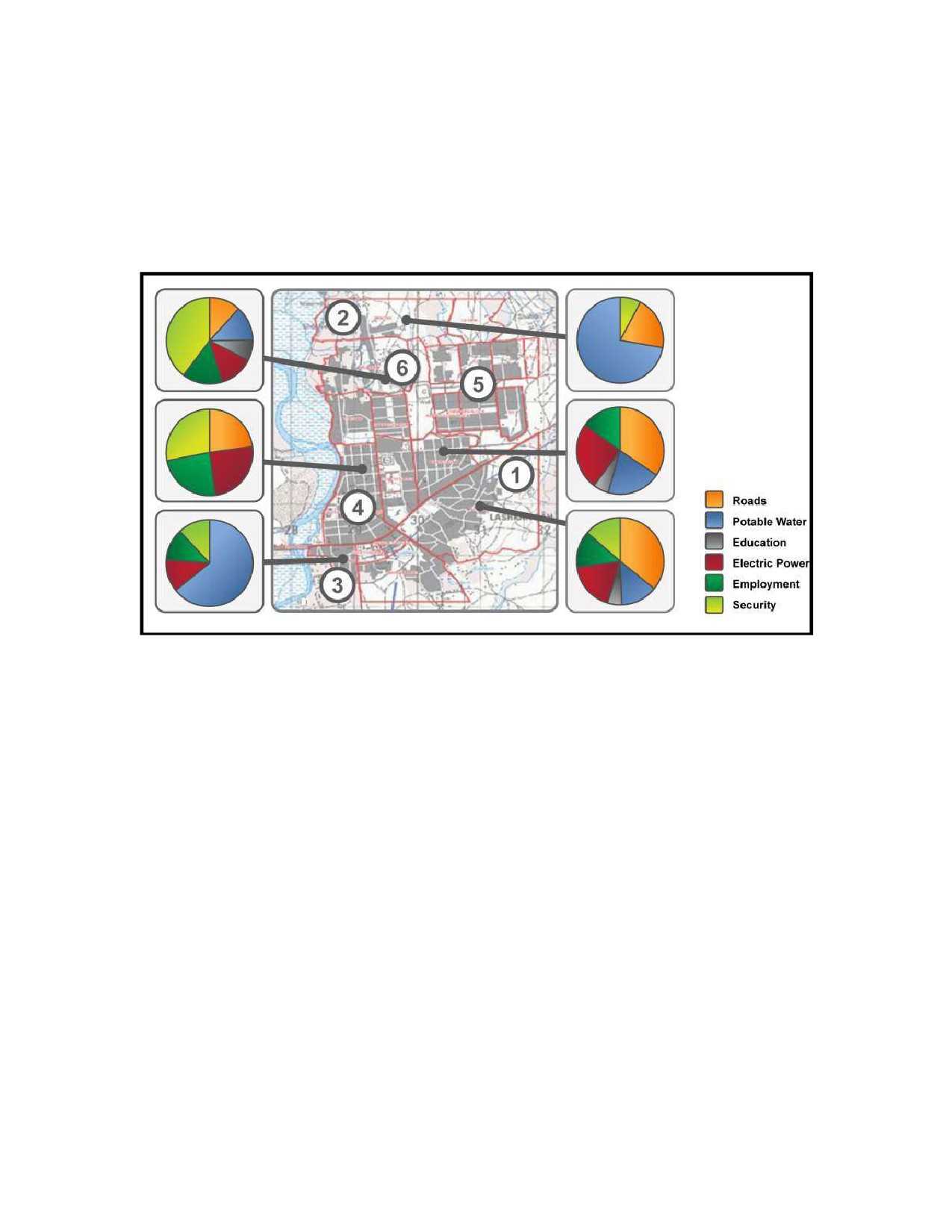
80
The answers to these questions are then entered into a simple database or spreadsheet using drop-down menus
81
to “bin” the survey answers into standardized categories. By turning this qualitative information into quantitative
82
data, the SWG can then create charts and graphs that make the local perceptions data quickly and easily
83
understandable. A pie chart, for example, represents a snapshot in time, while a line graph can be used to track
84
changes in public opinion over time. An example of these graphs, created for each neighborhood of a provincial
85
capital in Afghanistan, is shown in Figure D-2, DSF Local Perceptions Data by Neighborhood, below.
86
87
Figure D-2. DSF Local Perceptions Data by Neighborhood
88
D.3 Analysis
89
After collecting information to gain situational awareness, SWGs analyze this data to identify the sources of
90
instability and to define an objective and impact indicators that will measure progress in addressing each one. The
91
primary tool used to identify sources of instability is the SOI Analysis Matrix (see Figure D-6,, DSF Toolkit, located in
92
the next section). This matrix is at the heart of DSF’s “targeting” process. The first three Situational nalysis lenses
93
typically result in a long list of potential problems and grievances that could be driving instability in an area. As the
94
first column of the SOI nalysis Matrix indicates, all of these problems may be regarded as “needs.” In the three
95
subsequent steps, however, this matrix helps to whittle this list down to a limited number of core SOIs:
96
1. The first step is to use the fourth Situational Analysis lens, local perceptions, to identify which problems
97
local people really care about - i.e. their Priority Grievances. When using the Tactical Conflict Survey, this
98
can be as simple as selecting each grievance that polls as a priority for, 10% or more of the population.
99
2. The purpose of a Stability Operation is not simply to fulfill every wish of the local population, but
100
specifically to create a more stable environment. To further narrow its focus, therefore, the SWG next
101
applies the three SOI criteria - i.e. does the priority grievance:
102
a. decrease support for the government (based on what locals actually expect of their government)
103
b. increase support for anti-government elements (which usually occurs when spoilers are seen as
104
helping to solve the priority grievance), or
D-4
105
c. undermine the normal functioning of society (where the emphasis must be on local norms; for
106
example, if people have never had electricity, the continued lack of electricity can hardly be regarded
107
as undermining the normal functioning of society)
108
3. Just meeting one of the three SOI criteria is sufficient for a priority grievance to be regarded as a source of
109
instability. The more criteria an SOI meets, however, the higher priority it may be given.
110
4. Finally, the SOI Analysis Matrix distinguishes between SOIs that are Symptoms versus those that are
111
Causes. If an SOI is a Symptom, then addressing one or more of the other SOIs may be expected to fix the
112
symptom as well. If an SOI is a Cause, then addressing other SOIs will have little or no positive effect on it.
113
A Cause SOI must be addressed independently because it is a problem in its own right. SWGs should focus
114
on addressing the causes of instability, not symptoms.
115
After identifying a discrete number of Cause SOIs, stability working groups fill out a Tactical Stability Matrix (TSM)
116
for each one. The TSM is a key DSF tool that helps further analyze and (subsequently) design activities to address
117
each significant SOI. The TSM consists of nine columns. The first six columns are included in the Analysis process,
118
while the final three are regarded as part of the Design phase. An example of a TSM is included in Table 1. The
119
columns in the TSM are filled out by identifying:
120
1. The targeted Source of Instability
121
2. The local population’s perceptions of the SOI (Perceived Causes)
122
3. The Systemic Causes of the SOI (i.e. other “root causes” of which the general populace may be unaware)
123
4. An Objective (a succinct goal statement or end state that will address the SOI)
124
5. Impact indicators - a.k.a. measures of effectiveness or MOEs (changes in the environment that would
125
indicate progress toward achieving the objective
126
6. Impact indicator data sources (where information on the impact indicators can be obtained)
127
7. Stabilization Activities to be conducted
128
8. Output indicators - a.k.a. measures of performance or MOPs (metrics related to each activity that indicate
129
progress toward activity completion)
130
9. Output indicator data sources (where information on the output indicators can be obtained)
131
D.4 Design
132
Once the causes, objective and impact indicators for each SOI have been identified, the next step is to determine
133
what stabilization activities should actually be implemented. This process starts by brainstorming possible
134
activities, then putting those ideas through a series of filters to eliminate poor options and refine/improve others.
135
The first filter consists of three questions knows as the Stability Fundamentals:
136
Does each activity:
1. Decrease support for Anti-Government Elements?
2. Increase support for the government?
3. Increase institutional and societal capability and
capacity?
137
Any proposed activity that does not meet at least one of these criteria should be eliminated. Activities that meet
138
more than one of these criteria are preferred and may be prioritized.
D-5

139
Proposed activities that survive this first filter should then be refined using the seven Design Principles. To the
140
extent possible, practitioners should design or modify each activity such that it:
1. Ensures sustainability by the local government or
2. Considers the trade-offs between short-term and
institutions
long-term impacts
3. Strengthens governmental accountability and
4. Leverages/supports other government agencies,
transparency
intergovernmental organization, non-
governmental organizations, and HN programs
5. Fits the local political and cultural context
6. Facilitates local ownership
7. Provides flexibility
141
Table D-1. Example Tactical Stability Matrix
Analysis
Design
Output
Impact
Source of
Causes
Causes
Impact
Output
Indicator
Objective
Indicator
Activities
Instability
(Perception)
(Systemic)
Indicators
Indicators
Data
Data Sources
Sources
Tribal competition
Fewer people
prevents people
citing water as
Drip irrigation
# of drip
cooperating to dig
their primary
systems
Patrol reports
irrigation
wells or irrigation
concern
systems
Clean karezes
operational
Direct
Culture of dependency
Support for
observation
limits people’s
government
DSF surveys
Organize
# operational
willingness to dig wells
goes up
communities
karezes
or irrigation
Sub-governor
We need more
GIRoA helps
Patrol reports
to dig own
reports
wells
increase
More land
wells
# wells dug by
Water table could be
availability of
under
Interviews with
local
dropping (investigate)
drinking
irrigation
Ag Dept
Lack of
We need more
Build water
communities
water and
local
reports
Water
drinking water
cisterns
expand
households,
Karezes may be
amount of
Higher crop
farmers,
# water
clogged up
yields
shopkeepers
Interviews
We need water
land under
Build check
cisterns
(investigate)
with local
for our crops
irrigation
dams
constructed
communities
More local
Key leader
Involve MRRD
Public wells are too far
food for sale
engagements
to establish
# check dams
from some people’s
in bazaar
Contractor
built
homes
reports
Community
Households
Development
# CDCs
Flood irrigation is
spend less
MRRD reports
Councils
established
inefficient and adds
time fetching
(CDCs)
142
salt to the soil
water
143
After this, SWGs flesh out the details of their proposed stabilization activities; as they do so, new information may
144
come to light that requires them modify their proposed activities and potentially return to previous steps of the
145
design process. Next, SWGs screen each proposed activity against their available resources. Finally, activities for
146
which the necessary resources are available (or can be obtained) should be prioritized based on their anticipated
147
impact in addressing the targeted SOI. This completes Column 7 of the Tactical Stability Matrix.
148
Once the appropriate activities are identified, SWGs complete the TSM by identifying output indicators (measures
149
of performance) and output indicator data sources that will enable them to determine whether an activity is
150
proceeding as planned and, ultimately, when it has been completed.
D-6
151
Lastly in the design phase, SWGs use the Synchronization Matrix (Figure 9 in the next section) to synchronize and
152
prioritize identified activities by establishing logical a sequence for the activities, coordinate the activities along the
153
lines of operation, and assign activities and tasks to specific organizations.
154
D.5 Monitoring & Evaluation
155
The final step in DSF, Evaluation, takes place during and after the implementation of stabilization activities.
156
Evaluation is conducted on three levels. The first two have already been identified as part of the TSM.
157
1. Output Indicators (a.k.a. MOP) simply track implementation of an activity. They answer the question, “Is
158
the activity progressing?” and in the long run, “Is the activity complete?” Examples of output indicators
159
might be the number of miles of road paved, or number of police trained. Output Indicators are
160
monitored during the implementation of an activity, until it is completed.
161
2. Impact Indicators (a.k.a. MOE) measure the effect that an activity achieved. They answer the question,
162
“Did the activity have the intended effect?” Examples might be decreased travel time (for a road project),
163
or decreased criminal activity (for a police training activity). They are generally evaluated only after an
164
activity is completed.
165
3. Overall Stability, which takes into account the stabilization impact of ALL of the activities a unit has
166
conducted over a period of several weeks or months. It asks, “Is stability increasing or decreasing?”
167
Measuring the change in overall stability is a key component of the DSF process. By identifying and
168
measuring a common basket of stability-focused indicators, it is possible to track the change in stability
169
for a given district. When aggregated, they can provide a measurement of overall changes in stability over
170
time for a given district.
171
Suggested indicators for tracking Overall Stability include:
1. District Government Recognition (Government
2. Local-on-local violence
legitimacy in the eyes of the population)
3. Economic activity
4. Host nation security force presence
5. Population freedom of movement
6. Local perceptions of their government
7. Local perceptions of security conditions
172
As each of these three levels of monitoring and evaluation occurs, SWGs should identify lessons that can help them
173
improve future stabilization activities, or sustain successful ones. For example, implementers may learn that
174
certain external factors prevented their program from being success. Subsequent efforts may need to address
175
these external factors first, or take a completely different approach to addressing the SOIs.
176
D.6 Conclusion
177
DSF is specifically designed to help overcome many of the challenges to successful stability operations:
178
1. DSF keeps SWGs focused on the center of gravity for Counter-Insurgency and Stability Operations - the
179
population and its perceptions.
180
2. DSF provides a common operating picture for both military and civilian agencies. By making the
181
population’s perspective the focal point, these organizations can focus their varied resources and
182
expertise on a single, agreed set of priorities.
183
3. DSF helps prioritize our activities - based on their importance to the local populace and their relevance to
184
our over-arching mission of stabilizing the area.
D-7
185
4.
DSF enhances continuity between units. DSF data can be easily passed along from one unit to the next -
186
establishing a clear baseline for the problems identified, the steps taken to address those problems, and
187
the impact those activities achieved.
188
5.
DSF empowers implementers at the tactical level by giving them hard data that can be used as a basis for
189
decision-making at their level and for influencing decisions at higher levels.
190
6.
The DSF framework forces us to identify both Measures of Performance and Measures of Effect for our
191
activities - rather than the all-too-common pattern of tracking only the former.
192
7.
By tracking indicators of Overall Stability, DSF help us determine whether we are actually making progress
193
toward stabilizing the environment.
194
8.
By identifying the issues that matter most to the population, DSF helps identify information operations
195
themes that actually resonate with the population.
196
9.
For further information on DSF, DSF materials, or questions contact the USAID Office of Military affairs:
197
198
199
DSF POC: USAID Office of Military Affairs
200
Mick Crnkovich, mcrnkovich@usaid.gov
201
Eric Kotouc, ekotouc@usaid.gov
202
info: DSF@usaid.gov
203
D-8

1
APPENDIX 1 TO ANNEX D DISTRICT STABILITY FRAMEWORK TOOL KIT
2
D.1.0 Introduction
3
The District Stability Framework (DSF) tool kit on the following pages assists units in implementing the DSF
4
methodology. It consists of the:
1. ASCOPE/PMESII matrix
2. Cultural Matrix
3. Factors of Instability/Stability Matrix
4. Tactical Conflict Survey (TCS) Collection Planner
5. Sources of Instability (SOI) Matrix
6. Tactical Stability Matrix (TSM)
7. Activity Design Matrix
8. Synchronization Matrix
9. Monitoring & Evaluation (M&E) Matrix
10. Overall Stability Index
5
This tool kit is the basis for a successful assessment program. A successful program will only exist if units conduct
6
proper analysis and effective design, followed up by rapid implementation with comprehensive monitoring and
7
continuous evaluation. Units that only employ the TCS hoping it is a "silver bullet" will do more harm than good.
8
D.1.1 ASCOPE-PMESII Matrix
9
One model for describing the operational environment is areas, structures, capabilities, organizations, people, and
10
events (ASCOPE)-political, military, economic, social, infrastructure, information (PMESII), illustrated in Figure
11
D-1-1, ASCOPE-PMESII Matrix. Each letter stands for an aspect of the operational environment. The six ASCOPE
12
areas of civil considerations are used to inform the six PMESII operational variables.
13
14
Figure D-1-1. ASCOPE/PMESII Matrix
15
ASCOPE-PMESII is population-focused not enemy-focused, in contrast to a traditional area assessment
D-1-1
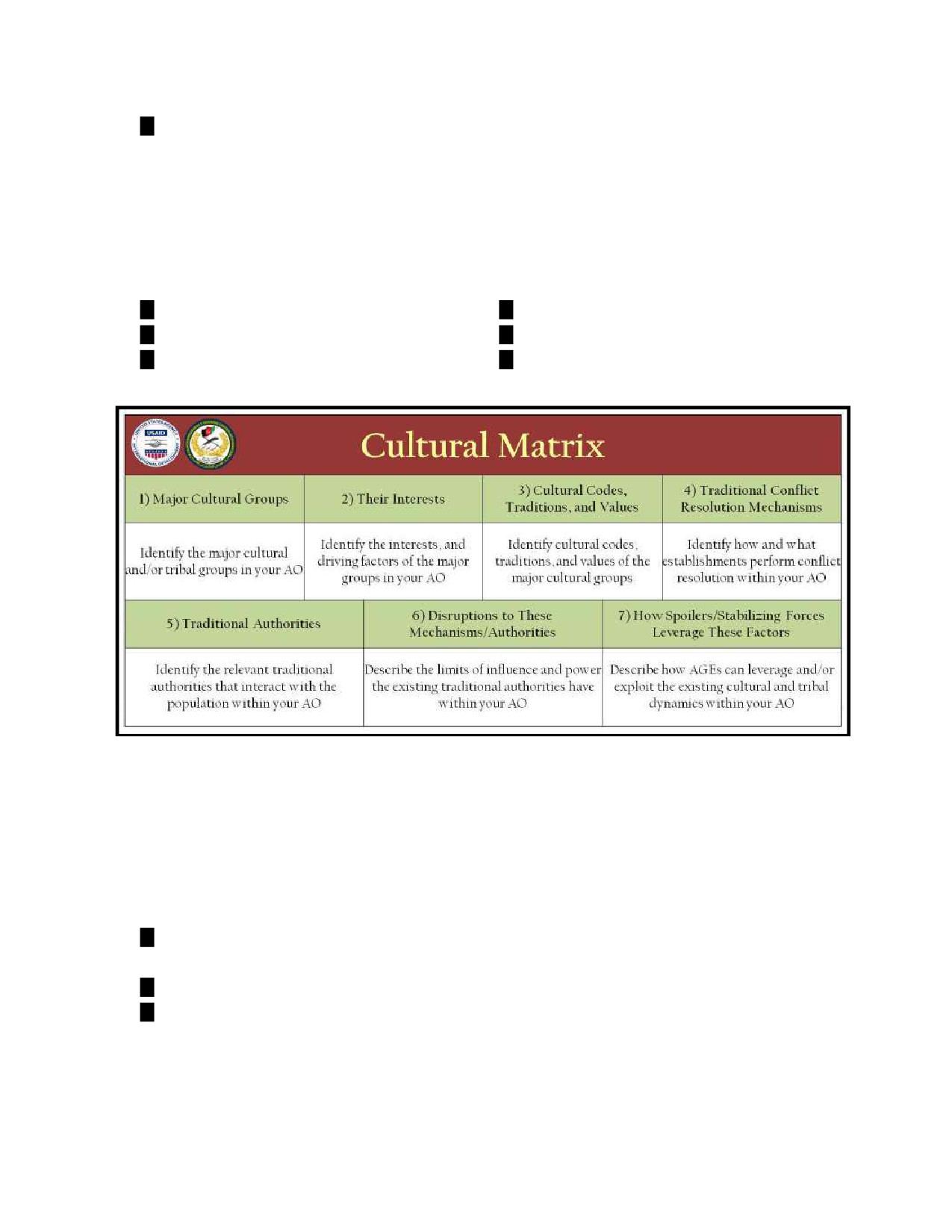
16
ASCOPE-PMESII organizes and examines strategic and operational factors for relevance to local stability
17
D.1.2 Cultural Matrix
18
The cultural environment is the second aspect of DSF situational awareness (SA). This awareness starts with a
19
thorough understanding of the organization, history and interests of local groups. In depth knowledge of cultural
20
factors is essential to the development of stability-focused SA. In particular, understanding how traditional conflict
21
resolution mechanisms function or how stabilizing or destabilizing actors can leverage these factors for negative
22
and positive effects is critical. Six key factors to analyze, illustrated in Figure D-1-2, include:
Major cultural groups and their interests
Cultural codes, traditions, and values
Traditional conflict resolution mechanisms
Traditional authorities
Disruptions to traditional authorities
Ways destabilizing elements take advantage of
these factors
23
24
Figure D-1-2. Cultural Matrix
25
D.1.3 Factors of Stability/Instability
26
The factors of stability/instability, depicted in Figure D-1-3, Factors of Instability/Stability Matrix, make up the third
27
lens for SA. It focuses specifically on the factors that typically work together to create or prevent instability.
28
Stability occurs when the stability factors “outweigh” the instability factors.
29
D.1.3.1 Instability Factors
30
There are three factors of instability to consider:
31
Community grievances. Grievances occur when people feel that their needs are not being met and/or
32
their interests are not being defended
33
Events with the potential to be destabilizing (windows of vulnerability)
34
Actors with the means and motivations to exploit grievances and windows of vulnerability
35
Although there can be many grievances, they do not all necessarily foster instability unless key actors with both
36
the motivation and the means to translate these grievances into widespread instability emerge. Windows of
D-1-2

37
vulnerability are often precipitated by a specific event that key actors can capitalize on - for example, the death of
38
a key leader, an economic crisis, or a natural disaster.
39
D.1.3.2 Stability Factors
40
Counter-balancing the factors of instability are the three stability factors:
41
Resiliencies, which are the processes, relationships, and institutions that enable the society to peacefully
42
solve its own problems and meet its own needs
43
Events with the potential to mitigate conflict and foster stability (windows of opportunity)
44
Actors with the means and motivations to foster stability
45
Most events are fundamentally neutral. That is, the same event may become an opportunity for the environment
46
to become more or less stable, depending on how it plays out. Elections are a good example. If an election plays
47
out peacefully and legitimately, it can help strengthen the political system and mitigate violence. If an election is
48
violent and corrupt, however, it can highlight government ineffectiveness and undermine the legitimacy of the
49
people/parties elected. Stability Working Groups identify upcoming events so that, to the extent possible, they can
50
shape the events to become windows of opportunity for stability to improve, rather than for instability to grow.
51
52
Figure D-1-3. Factors of Instability/Stability Matrix
53
D.1.4 Collection Planning
54
The Collection Planner is a tool utilized to help collectors understand the issues at hand and how those issues will
55
impact on the Collector to do his or her job. When completing the first two parts, units will identify the specific
56
issues that are of importance for each block to keep in consideration when planning for collection. More
57
importantly than the issues are the specific relevance each of those factors has on a unit’s ability to COLLECT - not
58
overall relevance, just relevance to the unit’s requirement to collect/gather local information. The planner has
59
three parts: operational; cultural; and survey considerations.
60
1. Operational. Operational Considerations, provided in Table D-1-1, TCS Collection Planner: Operational
61
Considerations, simply help the collector understand the area in which he or she is operating.
D-1-3